EP0143307A2 - Cyclic hexapeptide somatostatin analogs; process for their preparation and pharmaceutical compositions containing them - Google Patents
Cyclic hexapeptide somatostatin analogs; process for their preparation and pharmaceutical compositions containing them Download PDFInfo
- Publication number
- EP0143307A2 EP0143307A2 EP84112488A EP84112488A EP0143307A2 EP 0143307 A2 EP0143307 A2 EP 0143307A2 EP 84112488 A EP84112488 A EP 84112488A EP 84112488 A EP84112488 A EP 84112488A EP 0143307 A2 EP0143307 A2 EP 0143307A2
- Authority
- EP
- European Patent Office
- Prior art keywords
- loweralkyl
- indolylmethyl
- benzyl
- phe
- compound
- Prior art date
- Legal status (The legal status is an assumption and is not a legal conclusion. Google has not performed a legal analysis and makes no representation as to the accuracy of the status listed.)
- Granted
Links
- JGGDZRNBVUOXCU-UHFFFAOYSA-N CC(CC1)(CC2)C12N Chemical compound CC(CC1)(CC2)C12N JGGDZRNBVUOXCU-UHFFFAOYSA-N 0.000 description 1
Classifications
-
- C—CHEMISTRY; METALLURGY
- C07—ORGANIC CHEMISTRY
- C07K—PEPTIDES
- C07K14/00—Peptides having more than 20 amino acids; Gastrins; Somatostatins; Melanotropins; Derivatives thereof
- C07K14/435—Peptides having more than 20 amino acids; Gastrins; Somatostatins; Melanotropins; Derivatives thereof from animals; from humans
- C07K14/575—Hormones
- C07K14/655—Somatostatins
- C07K14/6555—Somatostatins at least 1 amino acid in D-form
-
- A—HUMAN NECESSITIES
- A61—MEDICAL OR VETERINARY SCIENCE; HYGIENE
- A61K—PREPARATIONS FOR MEDICAL, DENTAL OR TOILETRY PURPOSES
- A61K38/00—Medicinal preparations containing peptides
-
- Y—GENERAL TAGGING OF NEW TECHNOLOGICAL DEVELOPMENTS; GENERAL TAGGING OF CROSS-SECTIONAL TECHNOLOGIES SPANNING OVER SEVERAL SECTIONS OF THE IPC; TECHNICAL SUBJECTS COVERED BY FORMER USPC CROSS-REFERENCE ART COLLECTIONS [XRACs] AND DIGESTS
- Y10—TECHNICAL SUBJECTS COVERED BY FORMER USPC
- Y10S—TECHNICAL SUBJECTS COVERED BY FORMER USPC CROSS-REFERENCE ART COLLECTIONS [XRACs] AND DIGESTS
- Y10S930/00—Peptide or protein sequence
- Y10S930/01—Peptide or protein sequence
- Y10S930/16—Somatostatin; related peptides
-
- Y—GENERAL TAGGING OF NEW TECHNOLOGICAL DEVELOPMENTS; GENERAL TAGGING OF CROSS-SECTIONAL TECHNOLOGIES SPANNING OVER SEVERAL SECTIONS OF THE IPC; TECHNICAL SUBJECTS COVERED BY FORMER USPC CROSS-REFERENCE ART COLLECTIONS [XRACs] AND DIGESTS
- Y10—TECHNICAL SUBJECTS COVERED BY FORMER USPC
- Y10S—TECHNICAL SUBJECTS COVERED BY FORMER USPC CROSS-REFERENCE ART COLLECTIONS [XRACs] AND DIGESTS
- Y10S930/00—Peptide or protein sequence
- Y10S930/01—Peptide or protein sequence
- Y10S930/27—Cyclic peptide or cyclic protein
Definitions
- Somatostatin is a tetradecapeptide incorporating a cyclic dodecapeptide, having the structure: and has the properties of inhibiting the release of growth hormone, inhibiting the release of insulin and glucagon and reducing gastric secretions.
- Somatostatin itself has a short duration of action because it is inactivated, inter alia, by aminopeptidases and carboxypeptidases present in vivo. This problem of the short duration of action has been partially solved in the prior art by preparing derivatives of somatostatin which have low solubility, thus attaining a slow release on subcutaneous injection. Once dissolved, however, the derivatives are no more stable to inactivation by aminopeptidases and carboxypeptidases than somatostatin itself.
- the present invention provides for cyclic hexapeptides which are derivatives of somatostatin in which, inter alia, seven of the ring amino acids are replaced by a secondary amino acid, and both of the exocyclic amino acids are removed. Further substitution and reaction of the remaining amino acids is also described.
- the cyclic hexapeptides inhibit the release of glucagon, growth hormones and insulin, and inhibit the release of gastric acid secretions.
- the compounds may preferentially inhibit the release of growth hormones without effecting the level of gastric secretions or without effecting the level of gastric secretions, insulin and glucagon, or the compounds may inhibit the release of gastric acid secretions.
- the compounds have a more selective biological activity than somatostatin.
- the cyclic hexapeptide structure of the instant compounds also have a longer duration of activity than somatostatin.
- the instant cyclic hexapeptides are useful for the treatment of acromegaly, diabetes, diabetic retinopathy and peptic ulcers.
- the compounds are particularly effective when administered to Type I (insulin dependent) diabetics.
- the compounds have the property of preventing large increases in blood sugar which normally occurs in such patients following the ingestion of a meal.
- loweralkyl when used in the instant application is intended to represent those alkyl groups either straight or branched chain, which have from 1-5 carbon atoms. Examples of such alkyl groups are methyl, ethyl, propyl, iso-propyl. butyl, sec-butyl, pentyl and the like.
- loweralkoxy is intended to include those alkoxy groups of from 1-5 carbon atoms, in either a straight or branched chain. Examples of such alkoxy groups are methoxy, ethoxy, propoxy, isopropoxy, butoxy, tert-butoxy. pentoxy and the like.
- halogen or halo is intended to include fluorine, chlorine, bromine and iodine.
- 5- or 6-membered heterocyclic ring is intended to include those 5- and 6-membered heterocycles with 1- or 2-heteroatoms selected from oxygen, nitrogen and sulfur.
- exemplary of such heterocycles is imidazole. furan, thiazole, pyrazole, pyridine and the like.
- R 1 and R 2 are benzyl, R 3 is indolylmethyl, Y is methylene, and R 4 is 1-hydroxyethyl and the 7, 8, 9, 10 and 11 amino acids of somatostatin (-Phe-Trp-Lys-Thr-Phe-) are represented, and the secondary amino acid, represented by N-methyl alanine when R 5 is methyl, in structure I, and by proline when X is methylene in structure II, has taken the place of the remainder of the somatostatin amino acids.
- the substituent groups the following representative cyclic hexapeptide analog of somatostatin is formed in structure I;
- R 1 and R 2 groups are loweralkyl, benzyl or substituted benzyl where the substituent is loweralkyl, halogen, hydroxy, amino, nitro or alkoxy.
- R 1 and R 2 groups are loweralkyl, benzyl or substituted benzyl where the substituent is loweralkyl, halogen, hydroxy, amino, nitro or alkoxy.
- the novel cyclic hexapeptide somatostatin analogs are prepared by cyclizing corresponding linear peptides.
- the linear peptides are prepared by using the solid phase sequential synthesis technique.
- the process for preparing the cyclic hexapeptide somatostatin analogs of the present invention comprises a) preparing a corresponding blocked linear peptide attached to a solid phase resin; b) selectively deblocking the N-terminal amine group; c) removing the linear peptide from the resin; d) treating the linear peptide with a cyclizing agent to obtain the cyclic hexapeptide through the formation of an amide bond; e) removing any side chain blocking groups.
- linear peptide When the linear peptide is prepared on the resin, it is generally not critical which amino acid is selected to be at the C-terminal position provided only that the sequence of amino acids in the linear peptide corresponds to that in the desired somatostatin analog. Once a linear peptide has been cyclized one can no longer determine which amino acid was at the C-terminus of the linear peptide.
- the selection of the first amino acid to start the chain is not critical, since the linear peptide will be cyclized, there may be other factors which may prefer one starting amino acid over another.
- D-Trp can react with t-butyl carbonium ions which are formed when BOC groups are removed.
- selection of a reaction sequence which places D-Trp at the N-terminal end of the linear peptide will cause D-Trp to be added last, and thus it will have the least exposure to t-butyl carbonium ions.
- This type of selection may not always be possible, such as where there are two indole containing moieties in the peptide.
- reaction sensitivities should be considered when planning a peptide reaction sequence.
- the synthesis of the linear peptides by the solid phase technique is conducted in a stepwise manner on chloromethylated resin.
- the resin is composed of fine beads (20-70 microns in diameter) of a synthetic resin prepared by copolymerization of styrene with 1-2 percent divinylbenzene.
- the benzene rings in the resin are chloromethylated in a Friedel-Crafts reaction with chloromethyl methyl ether and stannic chloride. The Friedel-Crafts reaction is continued until the resin contains 0.5 to 5 mmoles of chlorine per gram of resin.
- the amino acid selected to be the C-terminal amino acid of the linear peptide is converted to its amino protected derivative.
- the carboxyl group of the selected C-terminal amino acid is bound covalently to the insoluble polymeric resin support, as for example, as the carboxylic ester of the resin-bonded benzyl chloride present in chloromethyl- substituted polystyrene-divinylbenzene resin.
- the amino protected derivative of the next amino acid in the sequence is added along with a coupling agent, such as dicyclohexylcarbodiimide.
- the amion acid reactant may be employed in the form of a carboxyl-activated amino acid such as the ONp ester, an amino acid azide, and the like. Deprotection and addition of successive amino acids is performed until the desired linear peptide is formed.
- protecting groups are, in part, dictated by particular coupling conditions, in part by the amino acid and peptide components involved in the reaction.
- Amino-protecting groups ordinarily employed include those which are well known in the art, for example, urethane protecting substituents such as benzyloxycarbonyl (carbobenzoxy), p-methoxycarbo- benzoxy, p-nitrocarbobenzoxy, t-butyloxycarbonyl, and the like. It is preferred to utilize t-butyloxycarbonyl (BOC) for protecting the a-amino group in the amino acids undergoing reaction at the carboxyl end of said amino acid.
- BOC t-butyloxycarbonyl
- the BOC protecting group is readily removed following such coupling reaction and prior to the subsequent step by the relatively mild action of acids (i.e., trifluoroacetic acid, or hydrogen chloride in ethyl acetate).
- the OH group of Thr and Ser can be protected by the Bzl group add the (-amino group of AChxAla and AmPhe can be protected by the INOC group, the benzyloxycarbonyl group (CBZ) or the 2-chlorobenzyloxycarbonyl (2-Cl-CBZ) group.
- the (-amino group with CBZ group it is preferred to protect the (-amino group with CBZ group as this group is removed simultaneously with the Bzl groups by treatment with HF after the linear peptide has been cyclized.
- the INOC group is not removed by HF and requires an additional treatment with Zn. Neither group is affected by TFA, used for removing BOC protecting groups.
- the protective groups such as CBZ and Bzl, are removed by treatment with HF.
- the linear peptide may be removed from the resin by a variety of methods which are well known in the art.
- the peptide may be cleaved from the resin with hydrazine and thus directly form the peptide hydrazide which may be subsequently cyclized via the azide to the desired cyclic peptide.
- the hydrazide is converted to the corresponding azide by reaction with a reagent which furnishes nitrous acid in situ.
- Suitable reagents for this purpose include a lower alkyl nitrite (e.g., b-butyl nitrite, isoamyl nitrite) or an alkali metal nitrite salt (e.g., sodium nitrite, potassium nitrite) in the presence of a strong acid such as hydrochloric, phosphoric, etc.
- a strong acid such as hydrochloric, phosphoric, etc.
- This reaction is carried out in the presence of either water and/or a non-aqueous solvent such as dimethylformamide, tetrahydrofuran, dioxane, chloroform, methylene chloride, etc., at a temperature between about -40°C and +20°C.
- the peptide may be removed from the resin by treatment with a lower alcohol such as methanol in the presence of an organic base such as triethylamine, thus resulting in the formation of the corresponding lower alcohol ester of the linear peptide.
- the resulting ester may be converted to the hydrazide which may then by cyclized, via the azide, to the desired cyclic peptide.
- the preferred method for cleaving the peptide from the resin in the present invention is the use of hydrazine.
- one preferred overall procedure for preparing the desired cyclic peptides of the present invention involves the stepwise synthesis of the linear peptide on a solid phase resin. More specifically, in the process for preparing: the carboxyl end of the N-blocked amino acid phenylalanine is bound covalently to an insoluble polymeric resin support as the carboxylic acid ester of the resin-bonded benzyl chloride. The amino group of Phe is protected by the BOC group. After the attachment of the Phe is completed on the resin, the protecting group BOC is removed by treatment with TFA in CH 2 C1 2 .
- the subsequent amino acids are attached, in the form of BOC-amino acid, using DCCI as the condensing agent or an active ester such as ONp.
- DCCI condensing agent
- an active ester such as ONp.
- the N-terminal amino group is selectively deblocked and the peptide is removed from the resin by treatment with hydrazine.
- the resulting linear peptide hydrazide with the N-terminal amino group deblocked having the amino acid sequence: is treated with isoamyl nitrite in acid pH to form the corresponding azide.
- the azide solution is diluted with solvent and neutralized with an organic base.
- the linear peptide cyclizes to form: During the cyclization the "pH" is checked and maintained at neutral by the addition of organic base.
- the "pH" in organic solvent is determined by the application of an aliquot of the solution to moistened narrow range pH paper.
- the protective groups, -CBZ and OBzl are removed by treatment with HF in the presence of anisole.
- the crude cyclic peptide obtained is purified chromatographically, preferably-with column chromatography on silica gel.
- the elution is generally an organic solvent or mixtures thereof which is selected by analyzing aliquots of the material using thin layer chromatography.
- Chloromethyl resin (2% cross-lined Merrifield resin), 862.0 g (2.37 moles), having 2.75 meq. chlorine/g, and 607.0 g (2.37 moles, 1 equivalent) of BOC-Phe were added to 4320 ml of peroxide-free tetrahydrofuran. The mixture was stirred in an oil bath at 80°C bath temperature for 45 minutes. Triethylamine, 310.0 ml, was added and the reaction mixture stirred at 80°C bath temperature for 70 hours, cooled to 25°C and transferred to a stirred solid phase reaction column with 2000 ml of tetrahydrofuran.
- BOC-Phe-O-CH 2 0-resin (2.13 g; 2.0 mmole) was carried through the procedures in Tables III and IV using 2 deblockings (2 minutes and 25 minutes) with 25% TFA in methylene chloride and 2.5 equivalents of BOC-amino acid in the required sequence until the desired BOC-hexapeptide-O-CH 2 0-resin was obtained.
- DCCI was used as the sole coupling agent in every step.
- the coupling reactions were carried out in methylene chloride, freshly degassed DMF or a mixture of these two solvents.
- the N-terminal amino group was blocked with a BOC group in each case; the hydroxy group of Thr was blocked with Bzl and the -amino group of t-4-AChxAla with CBZ.
- Example 2 The resin from Example 1 is combined with 30 ml of a 2:1 mixture of dimethylacetamide and hydrazine and stirred at room temperature for 1 hour. The insoluble resin is removed by filtration and the solution is evaporated to remove the dimethylacetamide. The residue is placed under high vacuum overnight to remove all volatile materials. A foam resulted from dissolving the residue in methanol, filtering and evaporating to dryness, weighing 2.19 g.
- Example 2 The foam from Example 2 is combined with 15 ml of degassed dimethylformamide under a blanket of nitrogen and cooled to -10°C, and 5 equivalents of 4.52M hydrogen chloride in tetrahydrofuran (2.2 ml) is added. The solution is cooled to -25°C and 5 ml of a 1:19 mixture of isoamyl nitrite in dimethylformamide is added in portions until a positive starch/KI test is obtained. The completion of the reaction is followed by thin layer chromatography and the disappearance of the hydrazide starting material.
- the azide compound of Example 3 is added to 600 ml of degassed dimethylformamide, precooled to -25°, the pH adjusted to 8, with triethylamine, and the reaction mixture placed in the freezer overnight. The pH is readjusted to 8 if necessary after about 14 hours and the mixture stored for 16 hours at -20°C and 16 hours at 5°C. Thin layer chromatography indicates that the reaction is completed. The mixture is concentrated to dryness, dissolved in 150 ml of a 3:1 dimethylformamide/water mixture and treated with a mixed bed anion-cation exchange resin for 1 hour. The mixture is filtered and concentrated to dryness in vacuo to an oil, and the residue is triturated with methanol, affording 1.91 g of a white solid.
- Example 2 The resin from Example 1 is combined with 30 ml of a 2:1 mixture of dimethylacetamide and hydrazine and stirred at room temperature for 1 hour. The insoluble resin is removed by filtration and the solution is evaporated to remove the dimethylacetamide. The residue is placed under high vacuum overnight to remove all volatile materials. A foam resulted from dissolving the residue in methanol, filtering and evaporating to dryness, weighing 1.84 g.
- Example 2 The foam from Example 2 is combined with 15 ml of degassed dimethylformamide under a blanket of nitrogen and cooled to -10°C, and 5 equivalents of 5.8 M hydrogen chloride in tetrahydrofuran (17 ml) is added. The solution is cooled to -25°C and 5 ml of a 1:19 mixture of isoamyl nitrite in dimethylformamide is added. The completion of the reaction is followed by thin layer chromatography and the disappearance of the hydrazide starting material.
- the azide compound of Example 3 is added to 600 ml of degassed dimethylformamide, precooled to -25°C, the pH adjusted to 8, and the reaction mixture placed in the freezer overnight. The pH is readjusted to 8 if necessary after about 14 hours and the mixture stored for 16 hours at -20°C and 16 hours at 5°C. Thin layer chromatography indicates that the reaction is completed.
- the mixture is concentrated to dryness, dissolved in 150 ml of 3:1 dimethylformamide/water mixture and treated with a mixed bed anion-cation exchange resin for 2 hours. The mixture is filtered and concentrated to dryness in vacuo, and the residue is dissolved in methanol, filtered and evaporated to dryness affording a foam.
- the cells were washed and incubated for 4 hours in Dulbecco-modified Eagle's medium in the presence or absence of graded doses of each analog or somatostatin. The medium was then collected for subsequent growth hormone determination by a double antibody radioimmunoassay for rat growth hormone.”
- Analogs of somatostatin were compared to somatostatin in their ability to decrease the levels of portal vein glucagon and insulin in anesthetized rates.
- Saline or peptides were administered via the external jugular vein. After 5 minutes, the portal vein was exposed, and blood was collected via syringe containing 3 mg of EDTA and placed in chilled tubes containing 100 ⁇ l of Trasylol (FBA Pharmaceuticals) for subsequent hormone analysis.
- Plasma levels of glucagon were determined by the method of Faloona and Unger, Methods of Hormone Radioimmunoassay, Jaffe and Behrman (Eds), Academic Press, New York, Vol. II, pp. 257-527 (1976), utilizing glucagon antisera 30K obtained from R. Unger (Dallas, TX). Plasma levels of insulin were determined by a modification of the procedure of Herbert et al., J. Clin. Endocrinol. Metab., 25, 1375-1384 (1965).
- test results for some of the compounds of this invention are recorded below with the results for somatostatin listed first and given the arbitrary value of 1.
- results for the instant compounds are given as multiples or fractions of the effect of somatostatin.
- the numbers in parentheses are the fiducial limits for the number preceding.
- the first of the instant compounds listed is the compound prepared in Examples 1-5. The compound is written slightly different, however, to conform to the order of the amino acids found in somatostatin.
Landscapes
- Health & Medical Sciences (AREA)
- Chemical & Material Sciences (AREA)
- Organic Chemistry (AREA)
- Life Sciences & Earth Sciences (AREA)
- Biophysics (AREA)
- Gastroenterology & Hepatology (AREA)
- Zoology (AREA)
- Biochemistry (AREA)
- Toxicology (AREA)
- General Health & Medical Sciences (AREA)
- Genetics & Genomics (AREA)
- Medicinal Chemistry (AREA)
- Molecular Biology (AREA)
- Proteomics, Peptides & Aminoacids (AREA)
- Endocrinology (AREA)
- Medicines That Contain Protein Lipid Enzymes And Other Medicines (AREA)
- Peptides Or Proteins (AREA)
Abstract
Description
- Somatostatin is a tetradecapeptide incorporating a cyclic dodecapeptide, having the structure:and has the properties of inhibiting the release of growth hormone, inhibiting the release of insulin and glucagon and reducing gastric secretions. Somatostatin itself has a short duration of action because it is inactivated, inter alia, by aminopeptidases and carboxypeptidases present in vivo. This problem of the short duration of action has been partially solved in the prior art by preparing derivatives of somatostatin which have low solubility, thus attaining a slow release on subcutaneous injection. Once dissolved, however, the derivatives are no more stable to inactivation by aminopeptidases and carboxypeptidases than somatostatin itself.

- The present invention provides for cyclic hexapeptides which are derivatives of somatostatin in which, inter alia, seven of the ring amino acids are replaced by a secondary amino acid, and both of the exocyclic amino acids are removed. Further substitution and reaction of the remaining amino acids is also described. The cyclic hexapeptides inhibit the release of glucagon, growth hormones and insulin, and inhibit the release of gastric acid secretions. Specifically the compounds may preferentially inhibit the release of growth hormones without effecting the level of gastric secretions or without effecting the level of gastric secretions, insulin and glucagon, or the compounds may inhibit the release of gastric acid secretions. Thus, the compounds have a more selective biological activity than somatostatin. The cyclic hexapeptide structure of the instant compounds also have a longer duration of activity than somatostatin. As such the instant cyclic hexapeptides are useful for the treatment of acromegaly, diabetes, diabetic retinopathy and peptic ulcers. The compounds are particularly effective when administered to Type I (insulin dependent) diabetics. The compounds have the property of preventing large increases in blood sugar which normally occurs in such patients following the ingestion of a meal.
- Thus, it is an object of the present invention to describe the cyclic hexapeptide somatostatin analogs. A further object is to describe procedures for the preparation of such cyclic hexapeptides. A still further object is to describe the use of such compound in the treatment of acromegaly, diabetic retinopathy and peptic ulcers. Further objects will become apparent from reading the following description.
- The compounds of the instant invention are best realized in the following structural formulae:


- R is

- m is 0 or 1;
- p is 0 when the ring is cyclohexyl and 1 when the ring is phenyl;
- X is (CH2)n wherein n is 0, 1 or 2, or sulfur;
- R1 and R2 are independently loweralkyl, benzyl, substituted benzyl where the substituent may be one or two of loweralkyl, halogen, hydroxy, amino, nitro or loweralkoxy; and loweralkyl substituted with hydroxy, 3-indolylmethyl, carboxy, amino, guanidino, or a 5- or 6-membered heterocyclic ring;
- R3 is 3-indolylmethyl, or substituted 3-indolylmethyl wherein the substituent may be loweralkyl, loweralkoxy, or halogen;
- R4 is loweralkyl, hydroxyloweralkyl, benzyl, carboxyloweralkyl, aminoloweralkyl, 3-indolylmethyl or substituted benzyl wherein the substituent may be loweralkyl, loweralkoxy, hydroxy, halogen, amino or nitro, or a 5- or 6-membered heterocyclic ring;
- R5 is loweralkyl, benzyl or substituted benzyl wherein the substituent is loweralkyl, loweralkoxy, hydroxy, halogen amino or nitro; and
- R6 and R7 are independently hydrogen or methyl.
- The term "loweralkyl" when used in the instant application is intended to represent those alkyl groups either straight or branched chain, which have from 1-5 carbon atoms. Examples of such alkyl groups are methyl, ethyl, propyl, iso-propyl. butyl, sec-butyl, pentyl and the like.
- The term "loweralkoxy" is intended to include those alkoxy groups of from 1-5 carbon atoms, in either a straight or branched chain. Examples of such alkoxy groups are methoxy, ethoxy, propoxy, isopropoxy, butoxy, tert-butoxy. pentoxy and the like.
- The term "halogen" or "halo" is intended to include fluorine, chlorine, bromine and iodine.
- The term "5- or 6-membered heterocyclic ring" is intended to include those 5- and 6-membered heterocycles with 1- or 2-heteroatoms selected from oxygen, nitrogen and sulfur. Exemplary of such heterocycles is imidazole. furan, thiazole, pyrazole, pyridine and the like.
- In the instant compounds there are several assymetric centers which will lead to the existence of optical isomers for such compounds. In the instant invention, for each of the assymetric centers of the various amino acids which make up the instant cyclic hexapeptides, both the D and L configurations are intended to be encompassed.
- It will be appreciated by those skilled in the art that when R1 and R2 are benzyl, R3 is indolylmethyl, Y is methylene, and R4 is 1-hydroxyethyl and the 7, 8, 9, 10 and 11 amino acids of somatostatin (-Phe-Trp-Lys-Thr-Phe-) are represented, and the secondary amino acid, represented by N-methyl alanine when R5 is methyl, in structure I, and by proline when X is methylene in structure II, has taken the place of the remainder of the somatostatin amino acids. Thus, using the above definitions of the substituent groups, the following representative cyclic hexapeptide analog of somatostatin is formed in structure I;

- The preferred embodiments of the cyclic hexapeptides of this invention are realized in the foregoing structural formula I wherein:
- R1 and R2 are as defined above;
- R3 is 3-indolylmethyl or substituted indolylmethyl wherein the substituent is methoxy or fluoro;
- R4 is methyl, ethyl, hydroxy methyl or hydroxy ethyl;
- R5 is methyl; and
- R6 and R7 are hydrogen.
- Further preferred embodiments are realized when:
- R1 and R2 are as defined above;
- R3 is 3-indolylmethyl;
- R4 is hydroxy ethyl; and
- R5 is methyl, ethyl, or benzyl.
- The preferred R1 and R2 groups are loweralkyl, benzyl or substituted benzyl where the substituent is loweralkyl, halogen, hydroxy, amino, nitro or alkoxy.
- Included within these preferred compounds are:


- Using the above definitions of the substituent groups, the following representative cyclic hexapeptide analog of somatostatin is formed in structure II:

- The preferred embodiments of the cyclic hexapeptides of this invention are realized in the foregoing structural formula II where:
- X is (CH2)n and n is 1 or 2;
- R1 and R2 are as defined above;
- R3 is 3-indolylmethyl or substituted indolylmethyl wherein the substituent is methoxy or fluoro; and
- R4 is methyl, ethyl, hydroxy methyl or hydroxy ethyl.
- Further preferred embodiments are realized when:
- X is S or S-methyl;
- R1 and R2 are as defined above;
- R3 is 3-indolylmethyl; and
- R4 is hydroxy ethyl.
- The preferred R1 and R2 groups are loweralkyl, benzyl or substituted benzyl where the substituent is loweralkyl, halogen, hydroxy, amino, nitro or alkoxy.
- Included within these preferred compounds are:

- In the instant application several abbreviated designations are used for the amino acid components, certain preferred protecting groups, reagents and solvents. The meanings of such abbreviated designations are given in Table I.


- In accordance with the present invention, the novel cyclic hexapeptide somatostatin analogs are prepared by cyclizing corresponding linear peptides. The linear peptides are prepared by using the solid phase sequential synthesis technique. Accordingly, the process for preparing the cyclic hexapeptide somatostatin analogs of the present invention comprises a) preparing a corresponding blocked linear peptide attached to a solid phase resin; b) selectively deblocking the N-terminal amine group; c) removing the linear peptide from the resin; d) treating the linear peptide with a cyclizing agent to obtain the cyclic hexapeptide through the formation of an amide bond; e) removing any side chain blocking groups.
- When the linear peptide is prepared on the resin, it is generally not critical which amino acid is selected to be at the C-terminal position provided only that the sequence of amino acids in the linear peptide corresponds to that in the desired somatostatin analog. Once a linear peptide has been cyclized one can no longer determine which amino acid was at the C-terminus of the linear peptide.
- While generally the selection of the first amino acid to start the chain is not critical, since the linear peptide will be cyclized, there may be other factors which may prefer one starting amino acid over another. For example, D-Trp can react with t-butyl carbonium ions which are formed when BOC groups are removed. Thus, selection of a reaction sequence which places D-Trp at the N-terminal end of the linear peptide will cause D-Trp to be added last, and thus it will have the least exposure to t-butyl carbonium ions. This type of selection may not always be possible, such as where there are two indole containing moieties in the peptide. However, such reaction sensitivities should be considered when planning a peptide reaction sequence.
- The synthesis of the linear peptides by the solid phase technique is conducted in a stepwise manner on chloromethylated resin. The resin is composed of fine beads (20-70 microns in diameter) of a synthetic resin prepared by copolymerization of styrene with 1-2 percent divinylbenzene. The benzene rings in the resin are chloromethylated in a Friedel-Crafts reaction with chloromethyl methyl ether and stannic chloride. The Friedel-Crafts reaction is continued until the resin contains 0.5 to 5 mmoles of chlorine per gram of resin.
- The amino acid selected to be the C-terminal amino acid of the linear peptide is converted to its amino protected derivative. The carboxyl group of the selected C-terminal amino acid is bound covalently to the insoluble polymeric resin support, as for example, as the carboxylic ester of the resin-bonded benzyl chloride present in chloromethyl- substituted polystyrene-divinylbenzene resin. After the amino protecting group is removed, the amino protected derivative of the next amino acid in the sequence is added along with a coupling agent, such as dicyclohexylcarbodiimide. The amion acid reactant may be employed in the form of a carboxyl-activated amino acid such as the ONp ester, an amino acid azide, and the like. Deprotection and addition of successive amino acids is performed until the desired linear peptide is formed.
- The selection of protecting groups is, in part, dictated by particular coupling conditions, in part by the amino acid and peptide components involved in the reaction.
- Amino-protecting groups ordinarily employed include those which are well known in the art, for example, urethane protecting substituents such as benzyloxycarbonyl (carbobenzoxy), p-methoxycarbo- benzoxy, p-nitrocarbobenzoxy, t-butyloxycarbonyl, and the like. It is preferred to utilize t-butyloxycarbonyl (BOC) for protecting the a-amino group in the amino acids undergoing reaction at the carboxyl end of said amino acid. The BOC protecting group is readily removed following such coupling reaction and prior to the subsequent step by the relatively mild action of acids (i.e., trifluoroacetic acid, or hydrogen chloride in ethyl acetate).
- The OH group of Thr and Ser can be protected by the Bzl group add the (-amino group of AChxAla and AmPhe can be protected by the INOC group, the benzyloxycarbonyl group (CBZ) or the 2-chlorobenzyloxycarbonyl (2-Cl-CBZ) group. In the case of AChxAla and AmPhe, it is preferred to protect the (-amino group with CBZ group as this group is removed simultaneously with the Bzl groups by treatment with HF after the linear peptide has been cyclized. The INOC group is not removed by HF and requires an additional treatment with Zn. Neither group is affected by TFA, used for removing BOC protecting groups. After the linear peptide is cyclized, the protective groups, such as CBZ and Bzl, are removed by treatment with HF.
- After the linear peptide has been formed on the solid phase resin, it may be removed from the resin by a variety of methods which are well known in the art. For example, the peptide may be cleaved from the resin with hydrazine and thus directly form the peptide hydrazide which may be subsequently cyclized via the azide to the desired cyclic peptide. The hydrazide is converted to the corresponding azide by reaction with a reagent which furnishes nitrous acid in situ. Suitable reagents for this purpose include a lower alkyl nitrite (e.g., b-butyl nitrite, isoamyl nitrite) or an alkali metal nitrite salt (e.g., sodium nitrite, potassium nitrite) in the presence of a strong acid such as hydrochloric, phosphoric, etc. This reaction is carried out in the presence of either water and/or a non-aqueous solvent such as dimethylformamide, tetrahydrofuran, dioxane, chloroform, methylene chloride, etc., at a temperature between about -40°C and +20°C. Alternatively, the peptide may be removed from the resin by treatment with a lower alcohol such as methanol in the presence of an organic base such as triethylamine, thus resulting in the formation of the corresponding lower alcohol ester of the linear peptide. The resulting ester may be converted to the hydrazide which may then by cyclized, via the azide, to the desired cyclic peptide. The preferred method for cleaving the peptide from the resin in the present invention is the use of hydrazine.
- As reference Table II will show, one preferred overall procedure for preparing the desired cyclic peptides of the present invention involves the stepwise synthesis of the linear peptide on a solid phase resin. More specifically, in the process for preparing:the carboxyl end of the N-blocked amino acid phenylalanine is bound covalently to an insoluble polymeric resin support as the carboxylic acid ester of the resin-bonded benzyl chloride. The amino group of Phe is protected by the BOC group. After the attachment of the Phe is completed on the resin, the protecting group BOC is removed by treatment with TFA in CH2C12. The subsequent amino acids are attached, in the form of BOC-amino acid, using DCCI as the condensing agent or an active ester such as ONp. After the desired linear peptide has been prepared, the N-terminal amino group is selectively deblocked and the peptide is removed from the resin by treatment with hydrazine. The resulting linear peptide hydrazide with the N-terminal amino group deblocked having the amino acid sequence:

 is treated with isoamyl nitrite in acid pH to form the corresponding azide. The azide solution is diluted with solvent and neutralized with an organic base. The linear peptide cyclizes to form:
 During the cyclization the "pH" is checked and maintained at neutral by the addition of organic base. The "pH" in organic solvent is determined by the application of an aliquot of the solution to moistened narrow range pH paper.
- After the linear peptide is cyclized, the protective groups, -CBZ and OBzl, are removed by treatment with HF in the presence of anisole. The crude cyclic peptide obtained is purified chromatographically, preferably-with column chromatography on silica gel. The elution is generally an organic solvent or mixtures thereof which is selected by analyzing aliquots of the material using thin layer chromatography.


- The following Examples are given to illustrate the methods used to carry out the present invention. It is to be understood that these Examples are given for purposes of illustration and not limitation.
- Chloromethyl resin (2% cross-lined Merrifield resin), 862.0 g (2.37 moles), having 2.75 meq. chlorine/g, and 607.0 g (2.37 moles, 1 equivalent) of BOC-Phe were added to 4320 ml of peroxide-free tetrahydrofuran. The mixture was stirred in an oil bath at 80°C bath temperature for 45 minutes. Triethylamine, 310.0 ml, was added and the reaction mixture stirred at 80°C bath temperature for 70 hours, cooled to 25°C and transferred to a stirred solid phase reaction column with 2000 ml of tetrahydrofuran. After removal of the solvent, the resin was washed using the stirred column with:

- BOC-Phe-O-CH20-resin (2.13 g; 2.0 mmole) was carried through the procedures in Tables III and IV using 2 deblockings (2 minutes and 25 minutes) with 25% TFA in methylene chloride and 2.5 equivalents of BOC-amino acid in the required sequence until the desired BOC-hexapeptide-O-CH20-resin was obtained.
- DCCI was used as the sole coupling agent in every step.
- The coupling of each amino acid proceeded smoothly. Best yields were obtained when the coupling was repeated in each step. When the coupling was repeated, the initial two chloroform washes, the deblocking step and the succeeding three chloroform washes were all omitted and replaced by a single chloroform wash.
- The coupling reactions were carried out in methylene chloride, freshly degassed DMF or a mixture of these two solvents. The N-terminal amino group was blocked with a BOC group in each case; the hydroxy group of Thr was blocked with Bzl and the -amino group of t-4-AChxAla with CBZ.
- When the desired BOC-hexapeptide-O-CH20- resin was obtained, the N-terminal BOC group was removed by the terminal deblocking procedure set forth in Table V.
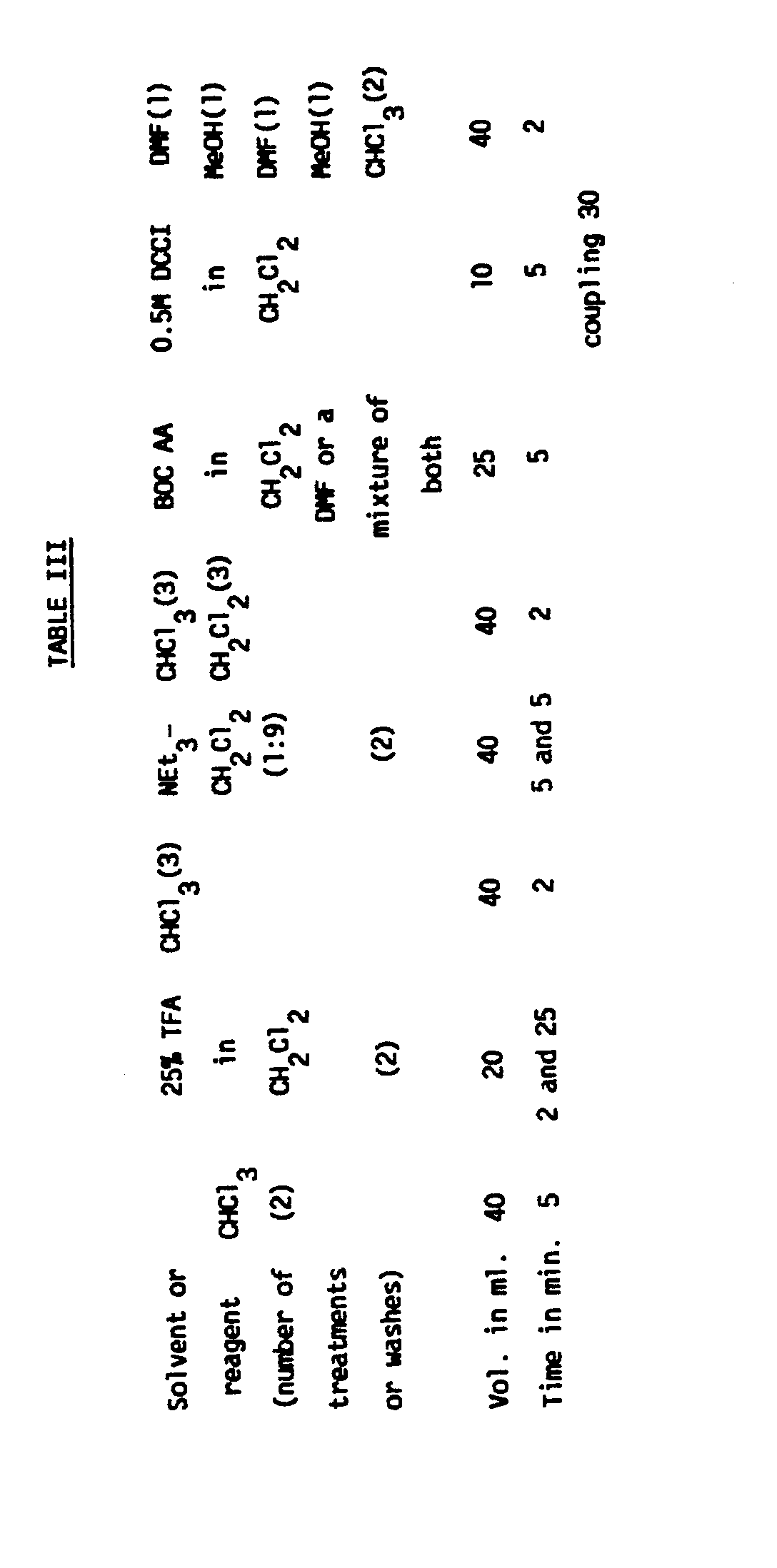

- After the procedures of Tables III, IV an V were completed, the blocked hexapeptide-OCH20- resin is dried overnight and weighs 3.7 g.
- The resin from Example 1 is combined with 30 ml of a 2:1 mixture of dimethylacetamide and hydrazine and stirred at room temperature for 1 hour. The insoluble resin is removed by filtration and the solution is evaporated to remove the dimethylacetamide. The residue is placed under high vacuum overnight to remove all volatile materials. A foam resulted from dissolving the residue in methanol, filtering and evaporating to dryness, weighing 2.19 g.
- The foam from Example 2 is combined with 15 ml of degassed dimethylformamide under a blanket of nitrogen and cooled to -10°C, and 5 equivalents of 4.52M hydrogen chloride in tetrahydrofuran (2.2 ml) is added. The solution is cooled to -25°C and 5 ml of a 1:19 mixture of isoamyl nitrite in dimethylformamide is added in portions until a positive starch/KI test is obtained. The completion of the reaction is followed by thin layer chromatography and the disappearance of the hydrazide starting material.
- The azide compound of Example 3 is added to 600 ml of degassed dimethylformamide, precooled to -25°, the pH adjusted to 8, with triethylamine, and the reaction mixture placed in the freezer overnight. The pH is readjusted to 8 if necessary after about 14 hours and the mixture stored for 16 hours at -20°C and 16 hours at 5°C. Thin layer chromatography indicates that the reaction is completed. The mixture is concentrated to dryness, dissolved in 150 ml of a 3:1 dimethylformamide/water mixture and treated with a mixed bed anion-cation exchange resin for 1 hour. The mixture is filtered and concentrated to dryness in vacuo to an oil, and the residue is triturated with methanol, affording 1.91 g of a white solid.
- 1.91 G (1.8 mmoles) of the protected cyclic hexapeptide of Example 4 is combined in a teflon lined chamber with 2 ml of anisole. The chamber is then evacuated and filled with liquid hydrogen fluoride at the temperature of the dry ice/acetone bath. The temperature is raised to 0°C and stirring continued for 1 hour. The hydrogen fluoride is allowed to evaporate and the residue placed in vacuo until a slurry is formed. The slurry is triturated with ethyl acetate and filtered affording 1.29 g of a fine powder. The powder is placed on 300 g of silica gel and eluted with a 10:5:1:3 mixture of EPAW, eluting with 9 ml fractions. Fractions 55-56 are combined and concentrated. The product is precipitated from a mixture of chloroform, ethylacetate and hexane affording 679 mg.
- The resin from Example 1 is combined with 30 ml of a 2:1 mixture of dimethylacetamide and hydrazine and stirred at room temperature for 1 hour. The insoluble resin is removed by filtration and the solution is evaporated to remove the dimethylacetamide. The residue is placed under high vacuum overnight to remove all volatile materials. A foam resulted from dissolving the residue in methanol, filtering and evaporating to dryness, weighing 1.84 g.
- The foam from Example 2 is combined with 15 ml of degassed dimethylformamide under a blanket of nitrogen and cooled to -10°C, and 5 equivalents of 5.8 M hydrogen chloride in tetrahydrofuran (17 ml) is added. The solution is cooled to -25°C and 5 ml of a 1:19 mixture of isoamyl nitrite in dimethylformamide is added. The completion of the reaction is followed by thin layer chromatography and the disappearance of the hydrazide starting material.
- The azide compound of Example 3 is added to 600 ml of degassed dimethylformamide, precooled to -25°C, the pH adjusted to 8, and the reaction mixture placed in the freezer overnight. The pH is readjusted to 8 if necessary after about 14 hours and the mixture stored for 16 hours at -20°C and 16 hours at 5°C. Thin layer chromatography indicates that the reaction is completed. The mixture is concentrated to dryness, dissolved in 150 ml of 3:1 dimethylformamide/water mixture and treated with a mixed bed anion-cation exchange resin for 2 hours. The mixture is filtered and concentrated to dryness in vacuo, and the residue is dissolved in methanol, filtered and evaporated to dryness affording a foam.
- 2.13 G (2 mmoles) of the protected cyclic hexapeptide of Example 4 is combined in a teflon lined chamber with 2 ml of anisole. The chamber is then evacuated and filled with liquid hydrogen fluoride at the temperature of the dry ice/acetone bath. The temperature is raised to 0°C and stirring continued for 1 hour. The hydrogen fluoride is allowed to evaporate and the residue placed in vacuo until a slurry is formed. The slurry is treated with ethyl acetate and filtered affording 1.19 g of a fine powder. 300 Mg of this powder is placed on a 1000 p silica gel preparative layer chromatography plate and eluted with a 70:30:5 mixture of chloroform, methanol and concentrated aqueous ammonia, affording 200 mg of product. The remaining crude product is placed on a silica gel column, and eluted with the same solvent. The presence of the product in the eluent is determined by thin layer chromatographic analysis and, after freeze drying, affords about 510 mg of product.
- Following the above procedure, and by modifying only the selection and order of amino acids in the process of Example 1, there are prepared other cyclic hexapeptides of this invention.
- The instant cyclic hexapeptide analogs of somatostatin are tested and compared with the effects of somatostatin in an in vitro test for the inhibition of growth hormone. The test is described as follows:
- "Rat pituitaries were isolated according to the procedures of Vale and Grant "In vitro Pituitary Hormone Secretion Assay for Hypophysiotropic Substances" in Methods in Enzymology, Vol. XXXVII, eds. O'Malley, B.W. and Hardman, J.G. (Academic Press, Inc., New York) pp. 5-93 (1975).
- After 4 days in culture, the cells were washed and incubated for 4 hours in Dulbecco-modified Eagle's medium in the presence or absence of graded doses of each analog or somatostatin. The medium was then collected for subsequent growth hormone determination by a double antibody radioimmunoassay for rat growth hormone."
- Analogs of somatostatin were compared to somatostatin in their ability to decrease the levels of portal vein glucagon and insulin in anesthetized rates. Male Sprague-Dawley rats (Charles River CD) weighing 160-200 g were anesthetized with urethane (150 mg/100 g of body weight; Aldrich). Saline or peptides were administered via the external jugular vein. After 5 minutes, the portal vein was exposed, and blood was collected via syringe containing 3 mg of EDTA and placed in chilled tubes containing 100 µl of Trasylol (FBA Pharmaceuticals) for subsequent hormone analysis. Plasma levels of glucagon were determined by the method of Faloona and Unger, Methods of Hormone Radioimmunoassay, Jaffe and Behrman (Eds), Academic Press, New York, Vol. II, pp. 257-527 (1976), utilizing glucagon antisera 30K obtained from R. Unger (Dallas, TX). Plasma levels of insulin were determined by a modification of the procedure of Herbert et al., J. Clin. Endocrinol. Metab., 25, 1375-1384 (1965).
- The test results for some of the compounds of this invention are recorded below with the results for somatostatin listed first and given the arbitrary value of 1. The results for the instant compounds are given as multiples or fractions of the effect of somatostatin. The numbers in parentheses are the fiducial limits for the number preceding. The first of the instant compounds listed is the compound prepared in Examples 1-5. The compound is written slightly different, however, to conform to the order of the amino acids found in somatostatin.

- The gastric effects of the instant cyclic- hexapeptide analogs of somatostatin are determined by the following procedure.
- Compounds were tested for their ability to inhibit pentagastrin evoked gastric secretion in the chronic fistula dog. Female beagle dogs with a chronic gastric fistula were given pentagastrin (2.5 pg./kg./hour, i.v. from -60 to 120 min.) and gastric outputs were collected via the fistula cannula. Samples were analyzed at 30 minute intervals for volume (Ml.) and titratable acid (mEq/L) (Titration to pH 7 with 0.01N NaOH); total acid output (mEq) was calculated as the production of output volume and acid concentration. Test compounds were infused at a constant rate from 0 to 60 minutes. Data have been expressed as percent change of total acid output relative to a placebo trial in the same animals.
- In the following data, the results for somatostatin are given first for comparison purposes.

Claims (10)


Applications Claiming Priority (2)
| Application Number | Priority Date | Filing Date | Title |
|---|---|---|---|
| US06/545,982 US4522813A (en) | 1983-10-27 | 1983-10-27 | Cyclic hexapeptide somatostatin analogs |
| US545982 | 2000-04-10 |
Publications (3)
| Publication Number | Publication Date |
|---|---|
| EP0143307A2 true EP0143307A2 (en) | 1985-06-05 |
| EP0143307A3 EP0143307A3 (en) | 1986-05-07 |
| EP0143307B1 EP0143307B1 (en) | 1989-01-04 |
Family
ID=24178342
Family Applications (1)
| Application Number | Title | Priority Date | Filing Date |
|---|---|---|---|
| EP84112488A Expired EP0143307B1 (en) | 1983-10-27 | 1984-10-17 | Cyclic hexapeptide somatostatin analogs; process for their preparation and pharmaceutical compositions containing them |
Country Status (4)
| Country | Link |
|---|---|
| US (1) | US4522813A (en) |
| EP (1) | EP0143307B1 (en) |
| JP (1) | JPS60109600A (en) |
| DE (1) | DE3475911D1 (en) |
Cited By (5)
| Publication number | Priority date | Publication date | Assignee | Title |
|---|---|---|---|---|
| EP0190946A3 (en) * | 1985-02-08 | 1988-09-14 | Merck & Co. Inc. | Novel cyclic hexapeptide lhrh antagonists |
| WO1997014715A1 (en) * | 1995-10-18 | 1997-04-24 | The Salk Institute For Biological Studies | Receptor-selective somatostatin analogs |
| US6066616A (en) * | 1987-07-10 | 2000-05-23 | Novartis Ag | Somatostatin analogue composition and use in treating breast cancer |
| US6214316B1 (en) | 1993-07-15 | 2001-04-10 | Diatide, Inc. | Somatostatin analogs |
| US6358491B1 (en) | 1999-08-27 | 2002-03-19 | Berlex Laboratories, Inc. | Somatostatin analogs |
Families Citing this family (21)
| Publication number | Priority date | Publication date | Assignee | Title |
|---|---|---|---|---|
| US4585755A (en) * | 1985-04-29 | 1986-04-29 | Merck & Co., Inc. | Cyclic and bridged cyclic somatostatin analogs useful as local anti-inflammatory agents |
| US4748153A (en) * | 1985-04-29 | 1988-05-31 | Merck & Co., Inc. | Compounds having somatostatin-like activity useful as local anti-inflammatory agents |
| US4871717A (en) * | 1987-01-07 | 1989-10-03 | Administrators Of The Tulane Educational Fund | Peptides |
| US4798821A (en) * | 1987-03-02 | 1989-01-17 | Merck & Co., Inc. | Antihypertensive therapy for diabetics |
| JPH07176U (en) * | 1991-06-06 | 1995-01-06 | 悦雄 谷原 | Foldable clothes rack |
| US5811512A (en) * | 1991-08-22 | 1998-09-22 | The Trustees Of The University Of Pennsylvania | Non-peptide peptidomimetics and related cyclic hexapeptides |
| US5504069A (en) * | 1993-02-11 | 1996-04-02 | Biomeasure, Inc. | Inhibition of trauma-induced tumor growth |
| US5597894A (en) * | 1995-06-05 | 1997-01-28 | The Louisiana State University Medical Center Foundation | Multi-tyrosinated somatostatin analogs |
| EP0981364B1 (en) * | 1997-05-13 | 2006-03-01 | Societe De Conseils De Recherches Et D'applications Scientifiques S.A.S. | Method and compositions for treating hyperlipidemia |
| CA2290592A1 (en) * | 1997-05-13 | 1998-11-19 | Michael Anthony Cawthorne | Somatostatin and somatostatin agonists for decreasing body weight |
| US6004928A (en) * | 1997-05-13 | 1999-12-21 | Biomeasure, Incorporated | Method of treating hyperlipidemia |
| CA2289499C (en) * | 1997-05-13 | 2010-02-23 | Michael Anthony Cawthorne | Somatostatin and somatostatin agonists for treating insulin insensitivity and syndrome x |
| US5968903A (en) * | 1998-05-07 | 1999-10-19 | Biomeasure, Incorporated | Inhibition of H. pylori proliferation |
| JP2002201168A (en) * | 2000-12-28 | 2002-07-16 | Kaken Pharmaceut Co Ltd | Cyclohexane derivative |
| NZ530007A (en) | 2001-06-08 | 2006-02-24 | Sod Conseils Rech Applic | Somatostatin-dopamine chimeric analogues that retain both somatostatin and dopamine activity in vivo and display enhanced biological activity |
| CA2523197C (en) | 2003-04-22 | 2016-05-24 | Societe De Conseils De Recherches Et D'applications Scientifiques S.A.S. | Peptide vectors |
| EP2310028B1 (en) | 2008-06-12 | 2016-11-16 | Ipsen Bioinnovation Limited | Fusion proteins for use in the treatment of acromegaly |
| WO2009150470A2 (en) | 2008-06-12 | 2009-12-17 | Syntaxin Limited | Suppression of cancers |
| GB0820970D0 (en) | 2008-11-17 | 2008-12-24 | Syntaxin Ltd | Suppression of cancer |
| EP3007704B1 (en) | 2013-06-13 | 2021-01-06 | Antisense Therapeutics Ltd | Combination therapy for acromegaly |
| CN113024639B (en) * | 2021-04-09 | 2022-10-14 | 中国科学院南海海洋研究所 | Cyclic peptide compounds and preparation method and application thereof |
Family Cites Families (4)
| Publication number | Priority date | Publication date | Assignee | Title |
|---|---|---|---|---|
| US4235886A (en) * | 1979-10-31 | 1980-11-25 | Merck & Co., Inc. | Cyclic hexapeptide somatostatin analogs |
| US4310518A (en) * | 1979-10-31 | 1982-01-12 | Merck & Co., Inc. | Cyclic hexapeptide somatostatin analogs |
| US4360516A (en) * | 1981-04-13 | 1982-11-23 | Merck & Co., Inc. | Modified D-retro cyclic hexapeptide somatostatin analogs |
| US4427661A (en) * | 1982-07-30 | 1984-01-24 | Merck & Co., Inc. | Fluorinated cyclic hexapeptide somatostatin analogs |
-
1983
- 1983-10-27 US US06/545,982 patent/US4522813A/en not_active Expired - Fee Related
-
1984
- 1984-10-17 EP EP84112488A patent/EP0143307B1/en not_active Expired
- 1984-10-17 DE DE8484112488T patent/DE3475911D1/en not_active Expired
- 1984-10-27 JP JP59225155A patent/JPS60109600A/en active Pending
Cited By (6)
| Publication number | Priority date | Publication date | Assignee | Title |
|---|---|---|---|---|
| EP0190946A3 (en) * | 1985-02-08 | 1988-09-14 | Merck & Co. Inc. | Novel cyclic hexapeptide lhrh antagonists |
| US6066616A (en) * | 1987-07-10 | 2000-05-23 | Novartis Ag | Somatostatin analogue composition and use in treating breast cancer |
| US6214316B1 (en) | 1993-07-15 | 2001-04-10 | Diatide, Inc. | Somatostatin analogs |
| SG93839A1 (en) * | 1993-07-15 | 2003-01-21 | Diatide Inc | Radiolabeled peptides |
| WO1997014715A1 (en) * | 1995-10-18 | 1997-04-24 | The Salk Institute For Biological Studies | Receptor-selective somatostatin analogs |
| US6358491B1 (en) | 1999-08-27 | 2002-03-19 | Berlex Laboratories, Inc. | Somatostatin analogs |
Also Published As
| Publication number | Publication date |
|---|---|
| US4522813A (en) | 1985-06-11 |
| JPS60109600A (en) | 1985-06-15 |
| DE3475911D1 (en) | 1989-02-09 |
| EP0143307A3 (en) | 1986-05-07 |
| EP0143307B1 (en) | 1989-01-04 |
Similar Documents
| Publication | Publication Date | Title |
|---|---|---|
| US4310518A (en) | Cyclic hexapeptide somatostatin analogs | |
| US4235886A (en) | Cyclic hexapeptide somatostatin analogs | |
| EP0143307B1 (en) | Cyclic hexapeptide somatostatin analogs; process for their preparation and pharmaceutical compositions containing them | |
| EP0063308B1 (en) | Modified d-retro cyclic hexapeptide somatostatin analogs, process for their preparation and pharmaceutical compositions containing them | |
| EP0000053B1 (en) | Somatostatin analogs, process for their preparation and pharmaceutical compositions containing them | |
| US4486415A (en) | Cyclic hexapeptide somatostatin analogs | |
| US4000259A (en) | Cyclic dodecapeptide analogs of somatostatin and intermediates | |
| EP0017746B1 (en) | Peptides having somatostatin activity, compositions comprising them and process for making the peptides | |
| EP0029310B1 (en) | Cyclic hexapeptide somatostatin analogs, process for their preparation and pharmaceutical compositions containing them | |
| US4612366A (en) | Cyclic hexapeptide somatostatin analogs | |
| US4140767A (en) | Somatostatin analogs | |
| US4011182A (en) | Cyclic undecapeptide analogs of somatostatin and intermediates | |
| US4611054A (en) | Cyclic hexapeptide somatostatin analogs | |
| EP0000919B1 (en) | Somatostatin analogs, process for their preparation and their use in pharmaceuticals. | |
| US4427661A (en) | Fluorinated cyclic hexapeptide somatostatin analogs | |
| EP0113029B1 (en) | Dicyclic hexapeptides, processes for their preparation and pharmaceutical compositions containing them | |
| US4054558A (en) | Cyclic dodecapeptide and intermediates therefor | |
| EP0002262B1 (en) | Somatostatin analogs and process for their preparation | |
| US4663435A (en) | Bridged cyclic hexapeptide somatostatin analogs | |
| US4159263A (en) | (D-Ala5)-somatostatin and analogues thereof | |
| US4209441A (en) | Anti-gastric secretion polypeptide | |
| US4182707A (en) | Somatostatin analogues | |
| IE46462B1 (en) | Somatostatin peptide analogues |
Legal Events
| Date | Code | Title | Description |
|---|---|---|---|
| PUAI | Public reference made under article 153(3) epc to a published international application that has entered the european phase |
Free format text: ORIGINAL CODE: 0009012 |
|
| AK | Designated contracting states |
Designated state(s): CH DE FR GB IT LI NL |
|
| ITCL | It: translation for ep claims filed |
Representative=s name: SOCIETA' ITALIANA BREVETTI S.P.A. |
|
| PUAL | Search report despatched |
Free format text: ORIGINAL CODE: 0009013 |
|
| AK | Designated contracting states |
Kind code of ref document: A3 Designated state(s): CH DE FR GB IT LI NL |
|
| 17P | Request for examination filed |
Effective date: 19860924 |
|
| 17Q | First examination report despatched |
Effective date: 19870615 |
|
| ITF | It: translation for a ep patent filed | ||
| GRAA | (expected) grant |
Free format text: ORIGINAL CODE: 0009210 |
|
| AK | Designated contracting states |
Kind code of ref document: B1 Designated state(s): CH DE FR GB IT LI NL |
|
| REF | Corresponds to: |
Ref document number: 3475911 Country of ref document: DE Date of ref document: 19890209 |
|
| ET | Fr: translation filed | ||
| PLBE | No opposition filed within time limit |
Free format text: ORIGINAL CODE: 0009261 |
|
| STAA | Information on the status of an ep patent application or granted ep patent |
Free format text: STATUS: NO OPPOSITION FILED WITHIN TIME LIMIT |
|
| 26N | No opposition filed | ||
| PGFP | Annual fee paid to national office [announced via postgrant information from national office to epo] |
Ref country code: CH Payment date: 19920917 Year of fee payment: 9 |
|
| PGFP | Annual fee paid to national office [announced via postgrant information from national office to epo] |
Ref country code: FR Payment date: 19920924 Year of fee payment: 9 |
|
| PGFP | Annual fee paid to national office [announced via postgrant information from national office to epo] |
Ref country code: GB Payment date: 19921001 Year of fee payment: 9 |
|
| ITTA | It: last paid annual fee | ||
| PGFP | Annual fee paid to national office [announced via postgrant information from national office to epo] |
Ref country code: NL Payment date: 19921031 Year of fee payment: 9 |
|
| PGFP | Annual fee paid to national office [announced via postgrant information from national office to epo] |
Ref country code: DE Payment date: 19921126 Year of fee payment: 9 |
|
| PG25 | Lapsed in a contracting state [announced via postgrant information from national office to epo] |
Ref country code: GB Effective date: 19931017 |
|
| PG25 | Lapsed in a contracting state [announced via postgrant information from national office to epo] |
Ref country code: LI Effective date: 19931031 Ref country code: CH Effective date: 19931031 |
|
| PG25 | Lapsed in a contracting state [announced via postgrant information from national office to epo] |
Ref country code: NL Effective date: 19940501 |
|
| GBPC | Gb: european patent ceased through non-payment of renewal fee |
Effective date: 19931017 |
|
| NLV4 | Nl: lapsed or anulled due to non-payment of the annual fee | ||
| PG25 | Lapsed in a contracting state [announced via postgrant information from national office to epo] |
Ref country code: FR Effective date: 19940630 |
|
| REG | Reference to a national code |
Ref country code: CH Ref legal event code: PL |
|
| PG25 | Lapsed in a contracting state [announced via postgrant information from national office to epo] |
Ref country code: DE Effective date: 19940701 |
|
| REG | Reference to a national code |
Ref country code: FR Ref legal event code: ST |