EP0143221B1 - Method of encapsulating volatile organic liquids - Google Patents
Method of encapsulating volatile organic liquids Download PDFInfo
- Publication number
- EP0143221B1 EP0143221B1 EP84110706A EP84110706A EP0143221B1 EP 0143221 B1 EP0143221 B1 EP 0143221B1 EP 84110706 A EP84110706 A EP 84110706A EP 84110706 A EP84110706 A EP 84110706A EP 0143221 B1 EP0143221 B1 EP 0143221B1
- Authority
- EP
- European Patent Office
- Prior art keywords
- silica
- liquid
- mixing
- volatile organic
- organic liquids
- Prior art date
- Legal status (The legal status is an assumption and is not a legal conclusion. Google has not performed a legal analysis and makes no representation as to the accuracy of the status listed.)
- Expired
Links
Images

Classifications
-
- A—HUMAN NECESSITIES
- A01—AGRICULTURE; FORESTRY; ANIMAL HUSBANDRY; HUNTING; TRAPPING; FISHING
- A01N—PRESERVATION OF BODIES OF HUMANS OR ANIMALS OR PLANTS OR PARTS THEREOF; BIOCIDES, e.g. AS DISINFECTANTS, AS PESTICIDES OR AS HERBICIDES; PEST REPELLANTS OR ATTRACTANTS; PLANT GROWTH REGULATORS
- A01N25/00—Biocides, pest repellants or attractants, or plant growth regulators, characterised by their forms, or by their non-active ingredients or by their methods of application, e.g. seed treatment or sequential application; Substances for reducing the noxious effect of the active ingredients to organisms other than pests
- A01N25/18—Vapour or smoke emitting compositions with delayed or sustained release
-
- A—HUMAN NECESSITIES
- A01—AGRICULTURE; FORESTRY; ANIMAL HUSBANDRY; HUNTING; TRAPPING; FISHING
- A01N—PRESERVATION OF BODIES OF HUMANS OR ANIMALS OR PLANTS OR PARTS THEREOF; BIOCIDES, e.g. AS DISINFECTANTS, AS PESTICIDES OR AS HERBICIDES; PEST REPELLANTS OR ATTRACTANTS; PLANT GROWTH REGULATORS
- A01N25/00—Biocides, pest repellants or attractants, or plant growth regulators, characterised by their forms, or by their non-active ingredients or by their methods of application, e.g. seed treatment or sequential application; Substances for reducing the noxious effect of the active ingredients to organisms other than pests
- A01N25/26—Biocides, pest repellants or attractants, or plant growth regulators, characterised by their forms, or by their non-active ingredients or by their methods of application, e.g. seed treatment or sequential application; Substances for reducing the noxious effect of the active ingredients to organisms other than pests in coated particulate form
-
- A—HUMAN NECESSITIES
- A01—AGRICULTURE; FORESTRY; ANIMAL HUSBANDRY; HUNTING; TRAPPING; FISHING
- A01N—PRESERVATION OF BODIES OF HUMANS OR ANIMALS OR PLANTS OR PARTS THEREOF; BIOCIDES, e.g. AS DISINFECTANTS, AS PESTICIDES OR AS HERBICIDES; PEST REPELLANTS OR ATTRACTANTS; PLANT GROWTH REGULATORS
- A01N25/00—Biocides, pest repellants or attractants, or plant growth regulators, characterised by their forms, or by their non-active ingredients or by their methods of application, e.g. seed treatment or sequential application; Substances for reducing the noxious effect of the active ingredients to organisms other than pests
- A01N25/26—Biocides, pest repellants or attractants, or plant growth regulators, characterised by their forms, or by their non-active ingredients or by their methods of application, e.g. seed treatment or sequential application; Substances for reducing the noxious effect of the active ingredients to organisms other than pests in coated particulate form
- A01N25/28—Microcapsules or nanocapsules
-
- B—PERFORMING OPERATIONS; TRANSPORTING
- B01—PHYSICAL OR CHEMICAL PROCESSES OR APPARATUS IN GENERAL
- B01J—CHEMICAL OR PHYSICAL PROCESSES, e.g. CATALYSIS OR COLLOID CHEMISTRY; THEIR RELEVANT APPARATUS
- B01J13/00—Colloid chemistry, e.g. the production of colloidal materials or their solutions, not otherwise provided for; Making microcapsules or microballoons
- B01J13/02—Making microcapsules or microballoons
- B01J13/04—Making microcapsules or microballoons by physical processes, e.g. drying, spraying
-
- Y—GENERAL TAGGING OF NEW TECHNOLOGICAL DEVELOPMENTS; GENERAL TAGGING OF CROSS-SECTIONAL TECHNOLOGIES SPANNING OVER SEVERAL SECTIONS OF THE IPC; TECHNICAL SUBJECTS COVERED BY FORMER USPC CROSS-REFERENCE ART COLLECTIONS [XRACs] AND DIGESTS
- Y10—TECHNICAL SUBJECTS COVERED BY FORMER USPC
- Y10T—TECHNICAL SUBJECTS COVERED BY FORMER US CLASSIFICATION
- Y10T428/00—Stock material or miscellaneous articles
- Y10T428/29—Coated or structually defined flake, particle, cell, strand, strand portion, rod, filament, macroscopic fiber or mass thereof
- Y10T428/2982—Particulate matter [e.g., sphere, flake, etc.]
- Y10T428/2984—Microcapsule with fluid core [includes liposome]
Definitions
- the invention relates to methods of preparing controlled release compositions such as encapsulated volatile organic liquids.
- the literature is replete with descriptions of prior art methods and techniques for the preparation of devices and compositions which allow for the controlled release of volatile organic liquids.
- One technique comprises impregnating absorbent particulate solids such as active charcoal, diatomaceous earth, clay, aluminium silicates, silica and like materials with the organic liquid. Over a period of time, the organic liquid vaporizes and is released from the absorbent carrier.
- the French Patent No. 2,420,994 describes a method of mixing a powder with a liquid, using high shear mixing.
- a high speed mixer is required.
- this method is disadvantageous for obtaining a free flowing or flowable powder when there is a high loading of liquid on the powder.
- the high shear mixing results in only a thixotropic lump, but no free flowing powder.
- particles of amorphous silica are employed to encapsulate volatile organic liquids.
- the resulting capsule compositions will allow the controlled, slow release of vapors over a period of time.
- the capsule materials are easy to handle and flow with the fluidity associated with granular or powdery solids.
- the invention comprises a method for encapsulating a liquid with a silica by adding the liquid to the silica and mixing, characterized in that as a liquid there is used a volatile organic liquid having a viscosity of 50 mPa.s or less at 25°C, the silica having an average particle size of less than 0.3 mm (300 microns) and a micropore distribution characterized by 50% of the integrated volume of said micropores being distributed to the micropores having a radius of up to 100 nm (1000 Angstroms), and the mixing is done under non-shearing conditions.
- the method of the invention is carried out by mixing under non-shear conditions, an amorphous silica with the volatile organic liquid to be encapsulated therein.
- the method may be employed to encapsulate any organic liquid having a viscosity of not more than 50 mPa.s (50 centipoise) at 25°C. If a more viscous liquid is used, the resulting composition tends to lose fluidity, even at low levels of loading. However, with the exception of viscosity, there is no limitation on the nature of the liquid to be encapsulated. A mixture of solid and liquid may also be encapsulated as long as the mixture has a viscosity not exceeding 50 mPa.s (50 centipoise) at 25°C.
- the method is advantageous to encapsulate volatile organic liquids or mixtures containing volatile organic liquids, i.e., liquids which are normally vaporized at ambient temperatures and under atmospheric, sub- or super pressures. These organic liquids will vaporize and be released slowly (controlled) from the capsule compositions of the invention.
- the silica employed to encapsulate the above-described organic liquids according to the method of the invention is an amorphous silica, and preferably a gel type produced either by the wet or dry production technique, further characterized by having an average particle size of less than 0.3 mm (300 microns) and a micropore distribution characterized by 50% of the integrated volume of said micropore being distributed to the micropores having a radius up to 100 nm (1000 Angstroms); most preferably up to 50 nm (500 Angstroms).
- the proportions of organic liquid and silica admixed together to encapsulate the liquids may be varied over a wide range, depending on the loading to be obtained. In general, an excess of silica is used, beyond the desired amount for a predetermined loading.
- either batch type or continuous type mixing equipment may be used.
- mixing vessels either vertical or horizontal type having ribbon like blades and vertical type mixing vessels having a screw type agitator can be used as long as the blades or an agitator rotate less than 100 r.p.m.
- the most suitable mixing equipment for carrying out this invention is a mixing vessel which has no agitating means but rotates itself.
- a V-shaped mixer, a double cone type mixer and inclined rotating cylinder types of mixer are best.
- the inclined rotating cylinder type of mixer is used for a continuous operation. All of the equipment described above does not mix under high shearing stress conditions.
- the product mixture becomes a wet mass having no fluidity.
- the liquid is divided into small droplets, covered by the silica and separated from each other as shown in Figure 2 of the accompanying drawings. There is no liquid between such capsules, only air. Therefore, the composition of Figure 2 can flowfreely.
- the silica is dispersed in the liquid and forms a wet mass which cannot flow as freely as the composition of this invention.
- the composition is prepared under conditions of strong shearing stress, it changes irreversibly to the wet mass.
- Another important factor for carrying out the method of the invention is the order of mixing the silica and the liquid.
- the silica should be charged into the mixing equipment first and then the liquid should be added onto the silica with mixing. If the silica is added onto the liquid, the purpose of this invention is not achieved.
- the technique of adding the liquid there is no special limitation. However, better results may be obtained by adding the liquid in a form of droplets or of a sprayed mist, especially when the viscosity of the liquid is relatively high.
- the method of the invention is carried out at temperatures or pressures below which substantial proportions of the organic liquid will not vaporize. At ordinary ambient temperatures and pressures the method of this invention can be carried out most economically. Mixing time depends on the type and size of equipment used, but normally less than one hour is required.
- the method of the invention presents a process for preparing a powdery composition containing a relatively large quantity of organic liquids, such as ethyl alcohol, which is used as a food preservative in a vapor form; liquid fragrances or flavors; pesticides; fungicides or sex pheromones, all of which are used in a vapor form, and still have good fluidity so as to be handled easily in industry.
- the method of the invention is particularly advantageous for encapsulating biologically active organic liquids such as pesticides and pheromones which are to be controlled in their release over periods of time.
- the angle of repose of a composition is determined by measurement of the angle made between the surface of the loose, granular or powdery composition and the horizontal after rotation for 2 minutes at 2 r.p.m. in the glass vessel of a Miwa's Rotary Cylinder Type Repose Angle Tester.
- 60 kg of gel type silica having an average particle size of 0.1 mm (100 microns) and a pore size distribution wherein 50% of the particles have an average pore diameter of up to 50 nm (500 Angstroms) (Tokusil PR, made by Tokuyama Soda Co., Ltd.), is charged to a 5000 liter, double cone type mixing vessel, which has a showering nozzle inside and is rotatable in a vertical direction.
- 110 kg of 98% ethyl alcohol is added onto the silica in the vessel while rotating the vessel at a rate of 20 r.p.m. for 30 minutes. After adding the alcohol, the vessel is rotated for another 10 minutes.
- a portion of the composition prepared in Example 1, supra. and having a repose angle of 43° is sub-divided into 1 g. portions and packed into small polyethylene bags having many small pinholes and heat sealed entirely automatically using an automatic packing machine. There is no trouble with packaging because of the good fluidity. About 100 grams of freshly baked cake and a 1.0 gram bag are packed together in a polyvinylidene chloride coated nylon bag and heat sealed. The baked cake is protected against mold for a month at 25°C, while another portion of the baked cake, packed alone in the same manner described above as a control, molded in a week.
- Example 3 is not an example of the invention but is made for comparative purposes.
- amorphous gel type silica having an average particle size of 80 pm and wherein 50% of the integrated micropore volume is distributed to micropores having a radius up to 1 mm (1000 microns) (Tokusil NR, Tokuyama Soda Co., Ltd.) is charged to a 2000 liter V-shaped mixer.
- the mixer is rotated at the rate of 10 r.p.m.
- 30 kg of bouquet type fragrance is then showered onto the silica during rotation for 30 minutes. After that, the mixer is rotated for an additional 5 minutes.
- About 50 kg of powdery composition is obtained (repose angle is 49°).
- the powder is subdivided into 6 g portions, packaged and heat sealed as in Example 1, supra. without difficulty.
- the packages are useful as scented bags.
- compositions are obtained with varying repose angles.
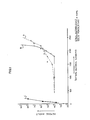
- proportion of ethyl alcohol employed (as percentage of loading) and the angles of repose found are given in the Figure 1 of the accompanying drawings, plotted with the square symbol on the broken line (A).
- Example 6 is not an example of the invention but is made for comparative purposes. Repeating the procedure of Example 5, supra. but replacing the silica with aluminum oxide (Sumitomo Chemical Co., Ltd.) and varying proportions of ethyl alcohol, compositions are obtained having unsatisfactory loadings and/or angles of repose as shown in Figure 1 of the accompanying drawings (plotted with the solid dot on the unbroken line).
- ethyl alcohol is used as the liquid and silica A (Tokusil NR, made by Tokuyama Soda Co., Ltd.), silica B (Tokusil PR, also made by Tokuyama Soda Co., Ltd.) and aluminium oxide C (made by Sumitomo Chemical Co., Ltd.) are used as the powdery solids.
- the repose angle should be smaller than about 50°.
- silica B (average particle size of 100 pm, 50% of integrated volume of micropore distributed to micropores having a radius up to 50 nm (500 Angstoms) may be loaded by 180% ethyl alcohol while maintaining a repose angle at 40° (which means very good fluidity).
- Silica A (average particle size is 0.08 mm (80 microns), 50% of integrated volume of micropore distributed to micropores having a radius up to 100 nm (1000 Angstroms) may be loaded with 190% ethyl alcohol while maintaining a repose angle at 55°, which means it has poorer fluidity than silica B loaded by ethyl alcohol, but still has a useful fluidity.
- aluminum oxide loaded by only 20% ethyl alcohol shows a very high repose angle (80°), which means it is very resistant to flow and consequently hard to handle.
Landscapes
- Life Sciences & Earth Sciences (AREA)
- Health & Medical Sciences (AREA)
- General Health & Medical Sciences (AREA)
- Toxicology (AREA)
- Dentistry (AREA)
- Environmental Sciences (AREA)
- Agronomy & Crop Science (AREA)
- Zoology (AREA)
- Pest Control & Pesticides (AREA)
- Plant Pathology (AREA)
- Chemical & Material Sciences (AREA)
- Engineering & Computer Science (AREA)
- Wood Science & Technology (AREA)
- Organic Chemistry (AREA)
- Chemical Kinetics & Catalysis (AREA)
- Dispersion Chemistry (AREA)
- Fats And Perfumes (AREA)
- Agricultural Chemicals And Associated Chemicals (AREA)
- Cosmetics (AREA)
- Manufacturing Of Micro-Capsules (AREA)
- Compositions Of Macromolecular Compounds (AREA)
- Processing And Handling Of Plastics And Other Materials For Molding In General (AREA)
Description
- The invention relates to methods of preparing controlled release compositions such as encapsulated volatile organic liquids.
- The literature is replete with descriptions of prior art methods and techniques for the preparation of devices and compositions which allow for the controlled release of volatile organic liquids. One technique comprises impregnating absorbent particulate solids such as active charcoal, diatomaceous earth, clay, aluminium silicates, silica and like materials with the organic liquid. Over a period of time, the organic liquid vaporizes and is released from the absorbent carrier.
- The prior art technique of employing absorbent solid particle carriers as described above has not been entirely satisfactory. Only limited quantities of the volatile organic liquids can be absorbed by the particulate solid carriers (on the order of 10 percent or less, by weight). Also, above the limited levels of absorbability, the particulate solids become wet and difficult to handle. They lose the fluidity or flowability associated with granular particles and powders.
- The French Patent No. 2,420,994 describes a method of mixing a powder with a liquid, using high shear mixing. A high speed mixer is required. However, this method is disadvantageous for obtaining a free flowing or flowable powder when there is a high loading of liquid on the powder. The high shear mixing results in only a thixotropic lump, but no free flowing powder.
- By the method of the present invention, particles of amorphous silica are employed to encapsulate volatile organic liquids. The resulting capsule compositions will allow the controlled, slow release of vapors over a period of time. The capsule materials are easy to handle and flow with the fluidity associated with granular or powdery solids.
- The invention comprises a method for encapsulating a liquid with a silica by adding the liquid to the silica and mixing, characterized in that as a liquid there is used a volatile organic liquid having a viscosity of 50 mPa.s or less at 25°C, the silica having an average particle size of less than 0.3 mm (300 microns) and a micropore distribution characterized by 50% of the integrated volume of said micropores being distributed to the micropores having a radius of up to 100 nm (1000 Angstroms), and the mixing is done under non-shearing conditions.
- Figure 1 is a graphical representation of the relationship between liquid loading and the repose angle obtained for compositions of the invention compared to other capsule compositions.
- Figure 2 is a magnified view (schematic) of a composition of the invention.
- The method of the invention is carried out by mixing under non-shear conditions, an amorphous silica with the volatile organic liquid to be encapsulated therein.
- The method may be employed to encapsulate any organic liquid having a viscosity of not more than 50 mPa.s (50 centipoise) at 25°C. If a more viscous liquid is used, the resulting composition tends to lose fluidity, even at low levels of loading. However, with the exception of viscosity, there is no limitation on the nature of the liquid to be encapsulated. A mixture of solid and liquid may also be encapsulated as long as the mixture has a viscosity not exceeding 50 mPa.s (50 centipoise) at 25°C.
- The method is advantageous to encapsulate volatile organic liquids or mixtures containing volatile organic liquids, i.e., liquids which are normally vaporized at ambient temperatures and under atmospheric, sub- or super pressures. These organic liquids will vaporize and be released slowly (controlled) from the capsule compositions of the invention.
- The silica employed to encapsulate the above-described organic liquids according to the method of the invention is an amorphous silica, and preferably a gel type produced either by the wet or dry production technique, further characterized by having an average particle size of less than 0.3 mm (300 microns) and a micropore distribution characterized by 50% of the integrated volume of said micropore being distributed to the micropores having a radius up to 100 nm (1000 Angstroms); most preferably up to 50 nm (500 Angstroms).
- The proportions of organic liquid and silica admixed together to encapsulate the liquids may be varied over a wide range, depending on the loading to be obtained. In general, an excess of silica is used, beyond the desired amount for a predetermined loading.
- In carrying out the method of the invention, either batch type or continuous type mixing equipment may be used. For example, mixing vessels, either vertical or horizontal type having ribbon like blades and vertical type mixing vessels having a screw type agitator can be used as long as the blades or an agitator rotate less than 100 r.p.m. The most suitable mixing equipment for carrying out this invention is a mixing vessel which has no agitating means but rotates itself. For example, a V-shaped mixer, a double cone type mixer and inclined rotating cylinder types of mixer are best. Advantageously, the inclined rotating cylinder type of mixer is used for a continuous operation. All of the equipment described above does not mix under high shearing stress conditions.
- If the silica and the liquid are mixed under conditions of a strong shearing stress, the product mixture becomes a wet mass having no fluidity. The reason is supposed as follows. In the case of a composition of this invention, the liquid is divided into small droplets, covered by the silica and separated from each other as shown in Figure 2 of the accompanying drawings. There is no liquid between such capsules, only air. Therefore, the composition of Figure 2 can flowfreely. In the case of a mixture prepared under mixing conditions of strong shearing stress, however, the silica is dispersed in the liquid and forms a wet mass which cannot flow as freely as the composition of this invention. When the composition is prepared under conditions of strong shearing stress, it changes irreversibly to the wet mass.
- Another important factor for carrying out the method of the invention is the order of mixing the silica and the liquid. The silica should be charged into the mixing equipment first and then the liquid should be added onto the silica with mixing. If the silica is added onto the liquid, the purpose of this invention is not achieved. In the technique of adding the liquid, there is no special limitation. However, better results may be obtained by adding the liquid in a form of droplets or of a sprayed mist, especially when the viscosity of the liquid is relatively high.
- In mixing temperature, pressure or time there is also no special limitation. Advantageously the method of the invention is carried out at temperatures or pressures below which substantial proportions of the organic liquid will not vaporize. At ordinary ambient temperatures and pressures the method of this invention can be carried out most economically. Mixing time depends on the type and size of equipment used, but normally less than one hour is required. Thus, the method of the invention presents a process for preparing a powdery composition containing a relatively large quantity of organic liquids, such as ethyl alcohol, which is used as a food preservative in a vapor form; liquid fragrances or flavors; pesticides; fungicides or sex pheromones, all of which are used in a vapor form, and still have good fluidity so as to be handled easily in industry. The method of the invention is particularly advantageous for encapsulating biologically active organic liquids such as pesticides and pheromones which are to be controlled in their release over periods of time.
- The following examples describe the manner and the process of making and using the invention and set forth the best mode contemplated by the inventor for carrying out the invention. Where reported, the angle of repose of a composition is determined by measurement of the angle made between the surface of the loose, granular or powdery composition and the horizontal after rotation for 2 minutes at 2 r.p.m. in the glass vessel of a Miwa's Rotary Cylinder Type Repose Angle Tester.
- 60 kg of gel type silica, having an average particle size of 0.1 mm (100 microns) and a pore size distribution wherein 50% of the particles have an average pore diameter of up to 50 nm (500 Angstroms) (Tokusil PR, made by Tokuyama Soda Co., Ltd.), is charged to a 5000 liter, double cone type mixing vessel, which has a showering nozzle inside and is rotatable in a vertical direction. 110 kg of 98% ethyl alcohol is added onto the silica in the vessel while rotating the vessel at a rate of 20 r.p.m. for 30 minutes. After adding the alcohol, the vessel is rotated for another 10 minutes. About 170 kg of a powdery composition containing about 180 parts alcohol per 100 parts of silica is obtained. The repose angle of the obtained composition is 43°. The composition flows freely. Repeating the above-described procedure a plurality of times, but varying the proportion of ethyl alcohol added, compositions are obtained with varying angles of repose. The proportions of ethyl alcohol employed (as percentage of loading) and the angles of repose found are given in the Figure 1 of the accompanying drawings, plotted with the circle symbol along the unbroken line (B).
- A portion of the composition prepared in Example 1, supra. and having a repose angle of 43° is sub-divided into 1 g. portions and packed into small polyethylene bags having many small pinholes and heat sealed entirely automatically using an automatic packing machine. There is no trouble with packaging because of the good fluidity. About 100 grams of freshly baked cake and a 1.0 gram bag are packed together in a polyvinylidene chloride coated nylon bag and heat sealed. The baked cake is protected against mold for a month at 25°C, while another portion of the baked cake, packed alone in the same manner described above as a control, molded in a week.
- Example 3 is not an example of the invention but is made for comparative purposes.
- 20 kg of the same silica used in Example 1, supra. is charged to a 1500 I, vertical upwardly expanded conical mixing vessel, having a screw agitator. The top end of the shaft thereof circulates while rotating. 36 kg of 98% ethyl alcohol is showered onto the silica in the vessel under circulation and rotation of the screw shaft for 20 minutes. After addition of the ethyl alcohol, the screw shaft continues to circulate and rotate for an additional 20 minutes. The rate of rotation of the screw shaft is 120 r.p.m. (shear conditions) and circulation is 3 times per minute. The contents become wet and constitute a sticky mass without fluidity.
- 20 kg of the same silica used in comparative Example 3, supra. and 36 kg of ethyl alcohol are treated using the same mixing equipment used in the comparative Example 3 with the exception that the rate of rotation is 60 r.p.m. (non-shear conditions) and circulation is 1.5 times per minute. After the mixing, about 56 kg of a powdery composition having a repose angle of 46° is obtained. Subdivided into 0.6 g lots, packed and heat sealed as in Example 1, it was used as a food preservative as in the Example 1, supra.
- 20 kg of amorphous gel type silica, having an average particle size of 80 pm and wherein 50% of the integrated micropore volume is distributed to micropores having a radius up to 1 mm (1000 microns) (Tokusil NR, Tokuyama Soda Co., Ltd.) is charged to a 2000 liter V-shaped mixer. The mixer is rotated at the rate of 10 r.p.m. 30 kg of bouquet type fragrance is then showered onto the silica during rotation for 30 minutes. After that, the mixer is rotated for an additional 5 minutes. About 50 kg of powdery composition is obtained (repose angle is 49°). The powder is subdivided into 6 g portions, packaged and heat sealed as in Example 1, supra. without difficulty. The packages are useful as scented bags.
- Repeating the above-described procedure a plurality of times, but varying the proportion of ethyl alcohol added, compositions are obtained with varying repose angles. The proportion of ethyl alcohol employed (as percentage of loading) and the angles of repose found are given in the Figure 1 of the accompanying drawings, plotted with the square symbol on the broken line (A).
- Example 6 is not an example of the invention but is made for comparative purposes. Repeating the procedure of Example 5, supra. but replacing the silica with aluminum oxide (Sumitomo Chemical Co., Ltd.) and varying proportions of ethyl alcohol, compositions are obtained having unsatisfactory loadings and/or angles of repose as shown in Figure 1 of the accompanying drawings (plotted with the solid dot on the unbroken line).
- Following the procedure of Example 5, supra., but replacing the bouquet type fragrance with Z-9-hexadecenyl acetate, a free flowing powdery composition composed of Z-9-hexadecenyl acetate encapsulated in silica is obtained, packaged in polyethylene bags. The bag releases vapor of Z-9-hexadecenyl acetate slowly and steadily at a constant rate for about 2 months. It is very useful to control Tea tortrix in a tea garden by the method of insect communication disruption, since the vapors of Z-9-hexadecenyl acetate are the sex pheromone of the Tea tortrix.
- Typical relationships between liquid loading and repose angle, which is widely recognized as a standard of fluidity of powdery materials, are shown in the Figure 1. In this Figure 1 ethyl alcohol is used as the liquid and silica A (Tokusil NR, made by Tokuyama Soda Co., Ltd.), silica B (Tokusil PR, also made by Tokuyama Soda Co., Ltd.) and aluminium oxide C (made by Sumitomo Chemical Co., Ltd.) are used as the powdery solids. For good fluidity, the repose angle should be smaller than about 50°. From the Figure 1 it can be seen that silica B (average particle size of 100 pm, 50% of integrated volume of micropore distributed to micropores having a radius up to 50 nm (500 Angstoms) may be loaded by 180% ethyl alcohol while maintaining a repose angle at 40° (which means very good fluidity). Silica A (average particle size is 0.08 mm (80 microns), 50% of integrated volume of micropore distributed to micropores having a radius up to 100 nm (1000 Angstroms) may be loaded with 190% ethyl alcohol while maintaining a repose angle at 55°, which means it has poorer fluidity than silica B loaded by ethyl alcohol, but still has a useful fluidity. To the contrary, aluminum oxide loaded by only 20% ethyl alcohol shows a very high repose angle (80°), which means it is very resistant to flow and consequently hard to handle.
- The relationships shown in Figure 1 were almost the same when ethyl alcohol was replaced by cis-3-hexenol, a component of fragrance or flavor compositions.
Claims (2)
Applications Claiming Priority (2)
| Application Number | Priority Date | Filing Date | Title |
|---|---|---|---|
| US06/537,682 US4579779A (en) | 1983-09-30 | 1983-09-30 | Method of encapsulating volatile organic liquids |
| US537682 | 1983-09-30 |
Publications (2)
| Publication Number | Publication Date |
|---|---|
| EP0143221A1 EP0143221A1 (en) | 1985-06-05 |
| EP0143221B1 true EP0143221B1 (en) | 1987-07-22 |
Family
ID=24143666
Family Applications (1)
| Application Number | Title | Priority Date | Filing Date |
|---|---|---|---|
| EP84110706A Expired EP0143221B1 (en) | 1983-09-30 | 1984-09-07 | Method of encapsulating volatile organic liquids |
Country Status (11)
| Country | Link |
|---|---|
| US (1) | US4579779A (en) |
| EP (1) | EP0143221B1 (en) |
| JP (1) | JPS6099337A (en) |
| AU (1) | AU559587B2 (en) |
| BE (1) | BE902572A (en) |
| CA (1) | CA1240884A (en) |
| CH (1) | CH665362A5 (en) |
| DE (1) | DE3464856D1 (en) |
| ES (1) | ES8603265A1 (en) |
| NL (1) | NL8501558A (en) |
| SE (1) | SE453263B (en) |
Families Citing this family (27)
| Publication number | Priority date | Publication date | Assignee | Title |
|---|---|---|---|---|
| JPS6327502A (en) * | 1986-07-22 | 1988-02-05 | Agency Of Ind Science & Technol | Cyclodextrin-silica composite material and production thereof |
| US4818522A (en) * | 1987-09-14 | 1989-04-04 | Reheis, Inc. | Encapsulation of adjuvants within antiperspirant actives |
| DE3824940C2 (en) * | 1988-07-22 | 2002-06-27 | Ipac Haushalt & Technik Gmbh E | Process for the manufacture of a material for dispensing aromas or essences |
| GB9021061D0 (en) * | 1990-09-27 | 1990-11-07 | Unilever Plc | Encapsulating method and products containing encapsulated material |
| FR2669222B1 (en) * | 1990-11-15 | 1995-03-03 | Oreal | COSMETIC COMPOSITIONS IN THE FORM OF CAST POWDERS COMPRISING HOLLOW MICROSPHERES, AND THEIR PREPARATION. |
| CA2080424A1 (en) * | 1991-10-25 | 1993-04-26 | Jerry Moy | Microcapsules containing inorganic colloids and method for making the same |
| ES2091591T3 (en) * | 1991-12-20 | 1996-11-01 | Procter & Gamble | A PROCEDURE FOR PREPARING A COMPOSITION OF PERFUME CAPSULES. |
| US5432292A (en) * | 1992-11-20 | 1995-07-11 | Colorado School Of Mines | Method for controlling clathrate hydrates in fluid systems |
| DE4416003C2 (en) * | 1994-05-06 | 1999-02-11 | Feinchemie Gmbh Sebnitz | Metal oxide powders and films with incorporated organic liquids and oils, their manufacture and use |
| US5730912A (en) * | 1996-05-30 | 1998-03-24 | M-Cap Technologies International | Method of the encapsulation of liquids |
| US5945159A (en) * | 1996-12-12 | 1999-08-31 | Dcv, Inc. | Method for encapsulating very finely divided particles |
| US6140475A (en) | 1997-04-11 | 2000-10-31 | Altus Biologics Inc. | Controlled dissolution crosslinked protein crystals |
| GB9818778D0 (en) | 1998-08-28 | 1998-10-21 | Crosfield Joseph & Sons | Particulate carrier for biocide formulations |
| NZ522111A (en) * | 2000-04-27 | 2004-03-26 | Sorex Ltd | Biocidal compositions comprising a stable aerated gel, or "dry water", containing hydrophobic silica |
| US6648639B2 (en) * | 2000-09-22 | 2003-11-18 | The Board Of Trustees Of The University Of Illinois | Device and method for treatment of malocclusion utilizing cyclical forces |
| US6576004B2 (en) | 2000-10-06 | 2003-06-10 | Weyerhauser Company | Wrap-ons aromatic thermal wraps |
| US20040028710A1 (en) * | 2001-01-18 | 2004-02-12 | Takashi Oka | Process for producing dry water |
| US20030031694A1 (en) * | 2001-04-20 | 2003-02-13 | 3M Innovative Properties Company | Controlled release particles |
| US7192620B1 (en) * | 2001-09-18 | 2007-03-20 | Polymerit | Mold-release coating systems |
| EP1906915B1 (en) | 2005-06-17 | 2017-09-27 | Australian Nuclear Science And Technology Organisation | Particles having hydrophobic material therein |
| US7422712B2 (en) * | 2005-12-15 | 2008-09-09 | Kimberly-Clark Worldwide, Inc. | Technique for incorporating a liquid additive into a nonwoven web |
| CN101952525A (en) | 2007-10-30 | 2011-01-19 | 世界矿物公司 | Modified mineral-based fillers |
| US20110223297A1 (en) * | 2010-03-12 | 2011-09-15 | Pepsico., Inc. | Anti-Caking Agent for Flavored Products |
| EP2689836A1 (en) | 2012-07-26 | 2014-01-29 | Basf Se | Composition of microcapsules with a silica shell and a method for preparing them |
| CN104719288B (en) * | 2013-12-19 | 2017-08-11 | 漳州市英格尔农业科技有限公司 | It is a kind of to be used to prevent and treat the composition that lichee eats into base of a fruit worm |
| EP3445990B1 (en) * | 2016-04-18 | 2020-04-29 | Volvo Truck Corporation | Structured brake disc |
| FR3117731A1 (en) * | 2020-12-21 | 2022-06-24 | Virbac | Wearable devices for pets with passive diffusion of semiochemical compositions |
Family Cites Families (7)
| Publication number | Priority date | Publication date | Assignee | Title |
|---|---|---|---|---|
| DE1070345B (en) * | 1959-12-03 | |||
| DE1467023A1 (en) * | 1964-02-28 | 1969-01-23 | Degussa | Process for the incorporation of water in finely divided silica |
| FR1497511A (en) * | 1965-05-28 | 1967-10-13 | Glaxo Lab Ltd | Process for the preparation of gelled aqueous colloids in a free-flowing form |
| US3710510A (en) * | 1971-05-10 | 1973-01-16 | Cabot Corp | Plant growth media and methods |
| DE2642032C2 (en) * | 1976-09-18 | 1987-04-30 | Rupprecht, Herbert, Prof. Dr., 8400 Regensburg | Process for incorporating active ingredients into silicon dioxide-containing carrier materials and a silicon dioxide-containing preparation |
| FR2420994A1 (en) * | 1978-03-30 | 1979-10-26 | Pentel Kk | MICROCAPSULES HAVING A MINERAL WALL AND PROCESS FOR THEIR PREPARATION |
| JPS6032496B2 (en) * | 1979-02-20 | 1985-07-29 | ぺんてる株式会社 | Method for producing inorganic walled microcapsules |
-
1983
- 1983-09-30 US US06/537,682 patent/US4579779A/en not_active Expired - Fee Related
-
1984
- 1984-09-07 DE DE8484110706T patent/DE3464856D1/en not_active Expired
- 1984-09-07 EP EP84110706A patent/EP0143221B1/en not_active Expired
- 1984-09-21 AU AU33402/84A patent/AU559587B2/en not_active Ceased
- 1984-09-27 JP JP59200684A patent/JPS6099337A/en active Granted
- 1984-09-28 CA CA000464298A patent/CA1240884A/en not_active Expired
- 1984-09-28 ES ES536346A patent/ES8603265A1/en not_active Expired
-
1985
- 1985-05-31 NL NL8501558A patent/NL8501558A/en not_active Application Discontinuation
- 1985-05-31 SE SE8502686A patent/SE453263B/en not_active IP Right Cessation
- 1985-06-03 BE BE0/215120A patent/BE902572A/en not_active IP Right Cessation
- 1985-06-04 CH CH2372/85A patent/CH665362A5/en not_active IP Right Cessation
Also Published As
| Publication number | Publication date |
|---|---|
| AU559587B2 (en) | 1987-03-12 |
| BE902572A (en) | 1985-09-30 |
| US4579779A (en) | 1986-04-01 |
| EP0143221A1 (en) | 1985-06-05 |
| JPS6099337A (en) | 1985-06-03 |
| CH665362A5 (en) | 1988-05-13 |
| ES536346A0 (en) | 1985-12-16 |
| NL8501558A (en) | 1986-12-16 |
| SE8502686D0 (en) | 1985-05-31 |
| SE8502686L (en) | 1986-12-01 |
| SE453263B (en) | 1988-01-25 |
| CA1240884A (en) | 1988-08-23 |
| AU3340284A (en) | 1985-04-04 |
| JPH0155898B2 (en) | 1989-11-28 |
| ES8603265A1 (en) | 1985-12-16 |
| DE3464856D1 (en) | 1987-08-27 |
Similar Documents
| Publication | Publication Date | Title |
|---|---|---|
| US4579779A (en) | Method of encapsulating volatile organic liquids | |
| Balassa et al. | Microencapsulation in the food industry | |
| US3619294A (en) | Method of combining crystalline sugar with impregnating agents and products produced thereby | |
| US3914439A (en) | Dry particulate flavor composition, method of making same and use thereof | |
| CN101558143A (en) | Perfumed beads and filter for cigarette | |
| US5447565A (en) | Apparatus and method for coating particles | |
| AU614831B2 (en) | Encapsulated silicone antifoam compositions | |
| JP2018500087A (en) | How to freshen the air | |
| SK22898A3 (en) | Pourable organic acid-based granulates, process for their preparation and their use | |
| US3397063A (en) | Beverage mix and process | |
| AU730077B2 (en) | Method for the encapsulation of liquids | |
| CN101018798B (en) | Crystalline maltitol powder less prone to consolidation and process for producing the same | |
| NO160964B (en) | ENCOURAGED VOLATILE ORGANIC LIQUIDS AND PROCEDURE FOR ENCOURAGING VOLUMENT ORGANIC LIQUIDS. | |
| US3480544A (en) | Lecithin compositions | |
| RU2852424C1 (en) | Method for physical structuring of fine amorphous substance of silicon dioxide for automated packaging | |
| US1678154A (en) | Special package of hydroscopic material | |
| JPS61224933A (en) | Granular cheese | |
| JP2007515275A (en) | Particulate matter | |
| CA1132834A (en) | Dry, free-flowing beverage mix and process therefor | |
| Onwulata | Milk fat powders encapsulated in sugars and starches | |
| US5945159A (en) | Method for encapsulating very finely divided particles | |
| JPH04253645A (en) | Packaging form for granular agent | |
| JPS592653A (en) | Granular cheese and its preparation | |
| JPS6317936A (en) | Production of desiccant | |
| Xing et al. | SO2-Release Performances of Sulphite Microparticles under Different Relative Humidity: SO2-Release Performance |
Legal Events
| Date | Code | Title | Description |
|---|---|---|---|
| PUAI | Public reference made under article 153(3) epc to a published international application that has entered the european phase |
Free format text: ORIGINAL CODE: 0009012 |
|
| AK | Designated contracting states |
Designated state(s): DE FR GB IT |
|
| 17P | Request for examination filed |
Effective date: 19851025 |
|
| 17Q | First examination report despatched |
Effective date: 19860526 |
|
| GRAA | (expected) grant |
Free format text: ORIGINAL CODE: 0009210 |
|
| ITF | It: translation for a ep patent filed | ||
| AK | Designated contracting states |
Kind code of ref document: B1 Designated state(s): DE FR GB IT |
|
| REF | Corresponds to: |
Ref document number: 3464856 Country of ref document: DE Date of ref document: 19870827 |
|
| ET | Fr: translation filed | ||
| PLBE | No opposition filed within time limit |
Free format text: ORIGINAL CODE: 0009261 |
|
| STAA | Information on the status of an ep patent application or granted ep patent |
Free format text: STATUS: NO OPPOSITION FILED WITHIN TIME LIMIT |
|
| 26N | No opposition filed | ||
| PGFP | Annual fee paid to national office [announced via postgrant information from national office to epo] |
Ref country code: GB Payment date: 19900907 Year of fee payment: 7 |
|
| PG25 | Lapsed in a contracting state [announced via postgrant information from national office to epo] |
Ref country code: GB Effective date: 19910907 |
|
| ITTA | It: last paid annual fee | ||
| GBPC | Gb: european patent ceased through non-payment of renewal fee | ||
| PGFP | Annual fee paid to national office [announced via postgrant information from national office to epo] |
Ref country code: FR Payment date: 19920828 Year of fee payment: 9 |
|
| PGFP | Annual fee paid to national office [announced via postgrant information from national office to epo] |
Ref country code: DE Payment date: 19921127 Year of fee payment: 9 |
|
| PG25 | Lapsed in a contracting state [announced via postgrant information from national office to epo] |
Ref country code: FR Free format text: LAPSE BECAUSE OF NON-PAYMENT OF DUE FEES Effective date: 19940531 |
|
| PG25 | Lapsed in a contracting state [announced via postgrant information from national office to epo] |
Ref country code: DE Effective date: 19940601 |
|
| REG | Reference to a national code |
Ref country code: FR Ref legal event code: ST |