EP0142485B1 - Emulsion flowable formulation containing a mixture of alachlor/atrazine as the active agent - Google Patents
Emulsion flowable formulation containing a mixture of alachlor/atrazine as the active agent Download PDFInfo
- Publication number
- EP0142485B1 EP0142485B1 EP84870135A EP84870135A EP0142485B1 EP 0142485 B1 EP0142485 B1 EP 0142485B1 EP 84870135 A EP84870135 A EP 84870135A EP 84870135 A EP84870135 A EP 84870135A EP 0142485 B1 EP0142485 B1 EP 0142485B1
- Authority
- EP
- European Patent Office
- Prior art keywords
- weight
- formulation
- chloro
- atrazine
- composition according
- Prior art date
- Legal status (The legal status is an assumption and is not a legal conclusion. Google has not performed a legal analysis and makes no representation as to the accuracy of the status listed.)
- Expired
Links
Classifications
-
- A—HUMAN NECESSITIES
- A01—AGRICULTURE; FORESTRY; ANIMAL HUSBANDRY; HUNTING; TRAPPING; FISHING
- A01N—PRESERVATION OF BODIES OF HUMANS OR ANIMALS OR PLANTS OR PARTS THEREOF; BIOCIDES, e.g. AS DISINFECTANTS, AS PESTICIDES OR AS HERBICIDES; PEST REPELLANTS OR ATTRACTANTS; PLANT GROWTH REGULATORS
- A01N25/00—Biocides, pest repellants or attractants, or plant growth regulators, characterised by their forms, or by their non-active ingredients or by their methods of application, e.g. seed treatment or sequential application; Substances for reducing the noxious effect of the active ingredients to organisms other than pests
- A01N25/02—Biocides, pest repellants or attractants, or plant growth regulators, characterised by their forms, or by their non-active ingredients or by their methods of application, e.g. seed treatment or sequential application; Substances for reducing the noxious effect of the active ingredients to organisms other than pests containing liquids as carriers, diluents or solvents
- A01N25/04—Dispersions, emulsions, suspoemulsions, suspension concentrates or gels
-
- A—HUMAN NECESSITIES
- A01—AGRICULTURE; FORESTRY; ANIMAL HUSBANDRY; HUNTING; TRAPPING; FISHING
- A01N—PRESERVATION OF BODIES OF HUMANS OR ANIMALS OR PLANTS OR PARTS THEREOF; BIOCIDES, e.g. AS DISINFECTANTS, AS PESTICIDES OR AS HERBICIDES; PEST REPELLANTS OR ATTRACTANTS; PLANT GROWTH REGULATORS
- A01N43/00—Biocides, pest repellants or attractants, or plant growth regulators containing heterocyclic compounds
- A01N43/64—Biocides, pest repellants or attractants, or plant growth regulators containing heterocyclic compounds having rings with three nitrogen atoms as the only ring hetero atoms
- A01N43/66—1,3,5-Triazines, not hydrogenated and not substituted at the ring nitrogen atoms
- A01N43/68—1,3,5-Triazines, not hydrogenated and not substituted at the ring nitrogen atoms with two or three nitrogen atoms directly attached to ring carbon atoms
- A01N43/70—Diamino—1,3,5—triazines with only one oxygen, sulfur or halogen atom or only one cyano, thiocyano (—SCN), cyanato (—OCN) or azido (—N3) group directly attached to a ring carbon atom
Definitions
- This invention relates to an emulsion flowable formulation containing a mixture of 2-chloro-2',6'-diethyl-N-(methoxymethyl)acetanilide (commonly known as alachlor) and 2-chloro-4-ethylamino-6-iso- propylamino-1,3,5-triazine (commonly known as atrazine) as the active herbicidal agent.
- An emulsion flowable formulation consists of three phases: an organic phase (discontinuous phase) dispersed in an aqueous phase, (the continuous phase) i.e., an oil-in-water emulsion, and a solid phase dispersed throughout the continuous phase.
- alachlor dissolved in organic solvent forms the organic or discontinuous phase which is dispersed throughout the aqueous or continuous phase.
- the solid phase, atrazine is also dispersed throughout the continuous phase.
- alachlor is sold by Monsanto Company as an emulsifiable concentrate formulation, and as a granular formulation.
- the active ingredient in the formulated state is sold under the name LASSO@ herbicide.
- Various formulations of atrazine are known in the art, e.g., as a water-base flowable, and also as a water dispersible granule. It is known in the art to tank-mix alachlor and atrazine and it is further known to combine alachlor and atrazine as a one-package mixture.
- Monsanto Company sells a one package mixture of alachlor/atrazine under the tradename LASSO@ AND ATRAZINE; this formulation is an emulsion flowable. Monsanto also sells a LASSO/ATRAZINE ready-mix formulation based on trichloroethane and perchloroethylene organic solvent.
- EP-A-0 088 049 discloses flowable herbicidal compositions containing an active component combination of at least one chlorotriazine and at least one chloroacetanilide, and a surfactant component which consists of an anionic surfactant which is a mono- or diphosphoric acid ester of a phenol polyglycol ether, and at least one non-ionic surfactant which is an alkoxy - , alkanoyloxy- or phenol-polyglycol ether.
- the formulation of the present invention allows complete freedom with respect to the quality of atrazine used in the formulation.
- One of the major differences between this formulation and the solvent based alachlor/atrazine formulation is that more than half of the organic solvent level in the prior art formulation is replaced by water. Since the amount of solvent in the formulation is reduced, there is reduced environmental/toxicological concerns due to the replacement of perchloroethylene and trichloroethane solvents by monochlorobenzene or by xylene with an overall solvent reduction of approximately 57%.
- the present invention offers the advantage that one is able to formulate an active agent which is readily soluble in organic solvents, i.e., alachlor, along with a solid active agent which is mostly insoluble in water or organic solvents, to produce a one-package mixture wherein the amount of organic solvent used in the formulation is greatly reduced when compared to the known emulsifiable concentrate formulations of alachlor herbicide.
- an active agent which is readily soluble in organic solvents, i.e., alachlor
- a solid active agent which is mostly insoluble in water or organic solvents
- the present invention is directed to an emulsion flowable formulation comprising the following ingredients:
- active herbicidal agent refers to a mixture of alachlor (2-chloro-2',6'-diethyl-N-(methoxymethyl) acetanilide and atrazine (2-chloro-4-ethylamino-6-isopropylamino-1,3,5-triazine).
- alachlor (2-chloro-2',6'-diethyl-N-(methoxymethyl) acetanilide
- atrazine (2-chloro-4-ethylamino-6-isopropylamino-1,3,5-triazine).
- Alachlor is present in the formulation at from 25.0% to 40.0% by weight of the composition, preferably from 27.5% to 35.0% by weight of the composition and most preferably at from 30.0% to 32.0% by weight of the composition.
- Atrazine is present in the formulation at from 5.0% to 25.0% by weight of the composition, preferably at from 10.0% to 20.0% by weight and most preferably from 13.0% to 18.0% by weight of the composition.
- the solvent used in the formulation is a hydrocarbon or an halogenated aromatic hydrocarbon. It can be a single organic solvent or may be a blend of two or more such materials.
- the solvent useful herein is one which is nonreactive to the herbicidal mixture and in which the herbicidal mixture, i.e., alachlor, readily dissolves and which is substantially immiscible with water.
- suitable solvents include aromatic hydrocarbons such as xylene, trimethyl benzene, C9 aromatics, polynuclear aromatic hydrocarbons such as naphthalene and alkyl naphthalenes, halogenated aromatic hydrocarbons such as monochlorobenzene and ortho-chlorotoluene.
- the preferred hydrocarbon solvent for use herein is monochlorobenzene (MCB) or xylene.
- the hydrocarbon solvent is present in the formulation at from 10.0% to 30.0% by weight of the composition, preferably at from 17.5% to 25.0% by weight and most preferably from 18.0% to 21.0% by weight of the composition.
- the emulsifying agents used herein can be mixtures of emulsifying agents, and may be blends of nonionic and anionic surfactants. Suitable emulsifiers which may be specifically named are described in detail below.
- Flo Mo 50H and 60H a calcium alkyl aryl sulfonate anionic emulsifier
- Flo Mo XHA
- Flo Mo ethylene oxide/propylene oxide block co-polymer, butanol, nonionic emulsifier
- Flo Mo 14D a dodecyl phenol ethoxylate, nonionic emulsifier
- Flo Mo 54C
- Table I various blends of these materials are useful in the formulations of the present invention. All of the "Flo Mo” emulsifiers are manufactured by Sellers Chemical Corporation, 1320 Sams Avenue, P.O. Box 23523, Harahan, Louisiana, 70183.
- emulsifiers which may be mentioned are "Atlox" 4880B, 4890B, and 4900B which are blends of anionic/nonionic emulsifiers typically calcium alkyl aryl sulfonate/nonionic blends; the HLB of these blends will range from about 11.3 to 12.8; these emulsifiers are manufactured by Atlas Chemical Industries N.V., Everslaan 45, B-3078 Everberg, Belgium, or in the U.S.A. by ICI Americas Inc., New Murphy Road and Concord Pike, Wilmington, Delaware, 19897.
- Berol 930, 938, and 947 which are combined anionic/ nonionic emulsifiers, typically, mixtures of calcium dodecylbenzene sulfonate with an ethoxylated/propoxylated nonyl phenol materials are specially intended for emulsifying pesticides and have also been found to be useful in the composition of the present invention.
- "Berol” 948 is an ethoxylated/propoxylated nonyl phenol (nonionic) which is also suitable for use herein. These emulsifiers are manufactured by Berol Kemi AB, 5-44401 Stenungsund 1, Sweden.
- the anionic/nonionic or mixtures of emulsifiers will be present in the formulation of the present invention at from 3.0% to 10.0% by weight of the composition, preferably from 4.0 to 8.0% by weight and most preferably from 6.0% to 7.0% by weight of the composition.
- Stabilizer refers to a material which is used at relatively low concentrations in the formulation of the invention and which acts to prevent loss of emulsifier activity during long term storage of the formulation.
- the materials which have been found to be useful herein are magnesium oxide (MgO), magnesium hydroxide, dolomite (MgC0 3 CaC0 3 ), calcium hydroxide, ammonium bicarbonate, sodium bicarbonate, and sodium metasilicate. Preferred for use herein is magnesium oxide.
- the stabilizer will be present in the formulations of the invention at from 0.10% to 2.0% by weight, preferably at from 0.50% to 1.0% by weight and most preferably at about 0.6% by weight.
- Lower alkyl glycols e.g., ethylene or propylene glycol
- Minor quantities i.e., from 0% to 5.0% by weight of the composition of one or more inert formulation adjuvants such as anti-foaming agents, biocides, dyes, anti-corrosion agents, may be incorporated into the emulsion flowable formulation of the present invention, especially if said formulations are to be stored for any extended period of time prior to use, particularly under adverse storage conditions.
- inert formulation adjuvants such as anti-foaming agents, biocides, dyes, anti-corrosion agents
- Silicone anti-foaming agents are "formulation adjuvants" which are frequently used in the compositions of this invention. Silicone anti-foaming agents are exemplified by the following commercially available anti-foam agents: "Antifoam F1", manufactured by Hodag Chemical Corporation, 7247 Central Park Avenue, Skokie, Illinois 60076; "Mazu DF 100S”, available from Mazer Chemicals, Incorporated, 3938 Porett Drive, Gurnee, Illinois 60031; "Rhodorsil 426R”, manufactured by Rhone-Poulenc, 33 Rue Jean Goujon, 75360 Paris, France; and "Sag 47", sold by Union Carbide Corporation, 270 Park Avenue, New York, New York 10017. From 0.01% to 0.20% by weight of the defoaming agent has been found to be useful in the present invention, preferably from 0.02% to 0.04% by weight of total composition is used herein.
- novel emulsion flowable formulations of this invention are prepared according to the following procedure:
- shearing means known to those in the art to be capable of producing sufficient shear to produce dispersion, emulsification, and/or homogenization is suitable for use herein.
- Illustrative of such shearing means is the "Polytron” homogenizer, sold by Brinkmann Instruments, Inc., Cantiague Road, Westbury, New York, 11590, USA, which utilizes mechanical shearing with sonic energy to effect homogenization, dispersion, or emulsification, the Tekmar, "Dispax Reactor DR 3-916", available from the Tekmar Company, P.O.
- Silverson homogenizer is available from Silverson Machines Ltd., Waterside, Chesham, Buckinghamshire, England HP5 1 PQ.
- An example of a "low shear” means is a paddle agitator having a paddle blade which is 120 mm in diameter, operated at a power setting of 0.75 Kw and a speed of ⁇ 1,000 rpm.
- the formulations of the present invention show excellent emulsification characteristics in all water hardnesses and from water temperatures of 7°C to 25°C.
- the formulations of the invention survive one month accelerated aging at 60°C without any significant deterioration in quality or degradation of active substances.
- the formulation of the invention will freeze at -10°C, but the extremely small trace quantities of alachlor crystals which develop after two weeks at this temperature are totally emulsified upon warming to room temperature (15°C to 20°C).
- the formulations of the invention have been satisfactorily processed using poor quality technical atrazine which would gel a solvent based emulsifiable concentrate type formulation upon long term storage.
- the emulsion flowable alachlor/atrazine compositions of this invention can be used as a preemergence herbicide to selectively control weeds in crops, particularly corn and grain sorghum.
- the compositions can be applied at rates of 0.44 ⁇ 0.66 g/m 2 (4 to 6 pounds per acre). The exact rate to be used will depend upon the crop, the soil type, the climate, and the weeds to be controlled. The treatment will control grasses and certain broadleaved weeds. The exact rate to be used can be readily selected by one skilled in the art from the available literature.
- the following example illustrates the herbicidal efficacy of several emulsion flowable formulations of the invention when compared with a commercially available LASSO ® /ATRAZINE solvent based formulation.
Landscapes
- Life Sciences & Earth Sciences (AREA)
- Health & Medical Sciences (AREA)
- General Health & Medical Sciences (AREA)
- Environmental Sciences (AREA)
- Plant Pathology (AREA)
- Engineering & Computer Science (AREA)
- Dentistry (AREA)
- Pest Control & Pesticides (AREA)
- Wood Science & Technology (AREA)
- Zoology (AREA)
- Agronomy & Crop Science (AREA)
- Dispersion Chemistry (AREA)
- Chemical & Material Sciences (AREA)
- Toxicology (AREA)
- Agricultural Chemicals And Associated Chemicals (AREA)
- Pharmaceuticals Containing Other Organic And Inorganic Compounds (AREA)
- Medicinal Preparation (AREA)
- Medicines Containing Material From Animals Or Micro-Organisms (AREA)
- Medicines Containing Plant Substances (AREA)
- Colloid Chemistry (AREA)
Abstract
Description
- This invention relates to an emulsion flowable formulation containing a mixture of 2-chloro-2',6'-diethyl-N-(methoxymethyl)acetanilide (commonly known as alachlor) and 2-chloro-4-ethylamino-6-iso- propylamino-1,3,5-triazine (commonly known as atrazine) as the active herbicidal agent. An emulsion flowable formulation consists of three phases: an organic phase (discontinuous phase) dispersed in an aqueous phase, (the continuous phase) i.e., an oil-in-water emulsion, and a solid phase dispersed throughout the continuous phase. In the formulation of this invention, alachlor dissolved in organic solvent forms the organic or discontinuous phase which is dispersed throughout the aqueous or continuous phase. The solid phase, atrazine, is also dispersed throughout the continuous phase.
- Various formulations of alachlor are known in the art. For example, alachlor is sold by Monsanto Company as an emulsifiable concentrate formulation, and as a granular formulation. The active ingredient in the formulated state is sold under the name LASSO@ herbicide. Various formulations of atrazine are known in the art, e.g., as a water-base flowable, and also as a water dispersible granule. It is known in the art to tank-mix alachlor and atrazine and it is further known to combine alachlor and atrazine as a one-package mixture. Monsanto Company sells a one package mixture of alachlor/atrazine under the tradename LASSO@ AND ATRAZINE; this formulation is an emulsion flowable. Monsanto also sells a LASSO/ATRAZINE ready-mix formulation based on trichloroethane and perchloroethylene organic solvent.
- EP-A-0 088 049 discloses flowable herbicidal compositions containing an active component combination of at least one chlorotriazine and at least one chloroacetanilide, and a surfactant component which consists of an anionic surfactant which is a mono- or diphosphoric acid ester of a phenol polyglycol ether, and at least one non-ionic surfactant which is an alkoxy-, alkanoyloxy- or phenol-polyglycol ether.
- One of the limitations of the alachlor/atrazine formulation based on trichloroethane and perchloroethylene solvents is the quality of the technical atrazine used in the formulation. Some atrazine sources cannot be used in this type of formulation due to the severe viscosity increase and partial gelling effect the quality of the atrazine has on the final formulation. This is particularly the case with high water content atrazine or atrazine processed by a water-based procedure as opposed to an organic solvent based method. Since the quality of the alachlor/atrazine solvent based formulation is dependent on the quality of the atrazine used in said formulation, the agricultural formulation is restricted in the choice of supplier of the atrazine.
- Surprisingly, it has been found that the formulation of the present invention allows complete freedom with respect to the quality of atrazine used in the formulation. One of the major differences between this formulation and the solvent based alachlor/atrazine formulation is that more than half of the organic solvent level in the prior art formulation is replaced by water. Since the amount of solvent in the formulation is reduced, there is reduced environmental/toxicological concerns due to the replacement of perchloroethylene and trichloroethane solvents by monochlorobenzene or by xylene with an overall solvent reduction of approximately 57%.
- The present invention offers the advantage that one is able to formulate an active agent which is readily soluble in organic solvents, i.e., alachlor, along with a solid active agent which is mostly insoluble in water or organic solvents, to produce a one-package mixture wherein the amount of organic solvent used in the formulation is greatly reduced when compared to the known emulsifiable concentrate formulations of alachlor herbicide.
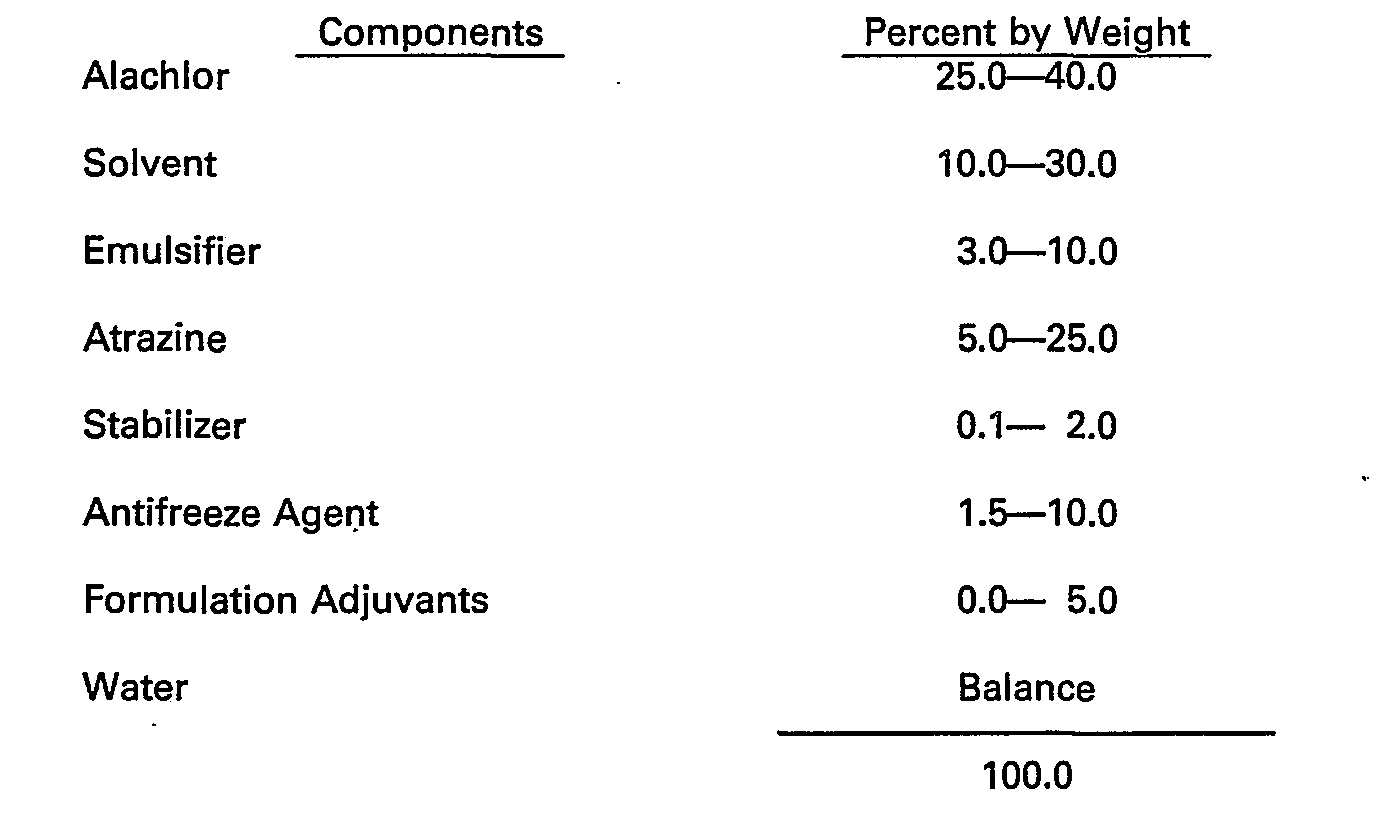
- The present invention is directed to an emulsion flowable formulation comprising the following ingredients:
- The term "active herbicidal agent" as used herein refers to a mixture of alachlor (2-chloro-2',6'-diethyl-N-(methoxymethyl) acetanilide and atrazine (2-chloro-4-ethylamino-6-isopropylamino-1,3,5-triazine). The preparation and herbicidal use of alachlor is described in U.S. Patent No. 3,442,945 and 3,547,620. The preparation and herbicidal use of atrazine is described in U.S. Patent No. 2,891,855.
- Alachlor is present in the formulation at from 25.0% to 40.0% by weight of the composition, preferably from 27.5% to 35.0% by weight of the composition and most preferably at from 30.0% to 32.0% by weight of the composition. Atrazine is present in the formulation at from 5.0% to 25.0% by weight of the composition, preferably at from 10.0% to 20.0% by weight and most preferably from 13.0% to 18.0% by weight of the composition.
- The solvent used in the formulation is a hydrocarbon or an halogenated aromatic hydrocarbon. It can be a single organic solvent or may be a blend of two or more such materials. The solvent useful herein is one which is nonreactive to the herbicidal mixture and in which the herbicidal mixture, i.e., alachlor, readily dissolves and which is substantially immiscible with water. Examples of suitable solvents include aromatic hydrocarbons such as xylene, trimethyl benzene, C9 aromatics, polynuclear aromatic hydrocarbons such as naphthalene and alkyl naphthalenes, halogenated aromatic hydrocarbons such as monochlorobenzene and ortho-chlorotoluene. The preferred hydrocarbon solvent for use herein is monochlorobenzene (MCB) or xylene.
- The hydrocarbon solvent is present in the formulation at from 10.0% to 30.0% by weight of the composition, preferably at from 17.5% to 25.0% by weight and most preferably from 18.0% to 21.0% by weight of the composition.
- The emulsifying agents used herein can be mixtures of emulsifying agents, and may be blends of nonionic and anionic surfactants. Suitable emulsifiers which may be specifically named are described in detail below.
- "Flo Mo" 50H and 60H, a calcium alkyl aryl sulfonate anionic emulsifier; "Flo Mo" XHA, an ethylene oxide/propylene oxide block co-polymer, butanol, nonionic emulsifier; "Flo Mo" 14D, a dodecyl phenol ethoxylate, nonionic emulsifier; and "Flo Mo" 54C, a polyethoxylated caster oil, nonionic emulsifier, have been found to be useful in the present invention. Also, as shown in Table I, various blends of these materials are useful in the formulations of the present invention. All of the "Flo Mo" emulsifiers are manufactured by Sellers Chemical Corporation, 1320 Sams Avenue, P.O. Box 23523, Harahan, Louisiana, 70183.

- Other emulsifiers which may be mentioned are "Atlox" 4880B, 4890B, and 4900B which are blends of anionic/nonionic emulsifiers typically calcium alkyl aryl sulfonate/nonionic blends; the HLB of these blends will range from about 11.3 to 12.8; these emulsifiers are manufactured by Atlas Chemical Industries N.V., Everslaan 45, B-3078 Everberg, Belgium, or in the U.S.A. by ICI Americas Inc., New Murphy Road and Concord Pike, Wilmington, Delaware, 19897. "Berol" 930, 938, and 947, which are combined anionic/ nonionic emulsifiers, typically, mixtures of calcium dodecylbenzene sulfonate with an ethoxylated/propoxylated nonyl phenol materials are specially intended for emulsifying pesticides and have also been found to be useful in the composition of the present invention. "Berol" 948 is an ethoxylated/propoxylated nonyl phenol (nonionic) which is also suitable for use herein. These emulsifiers are manufactured by Berol Kemi AB, 5-44401 Stenungsund 1, Sweden.
- The anionic/nonionic or mixtures of emulsifiers will be present in the formulation of the present invention at from 3.0% to 10.0% by weight of the composition, preferably from 4.0 to 8.0% by weight and most preferably from 6.0% to 7.0% by weight of the composition.
- The term "Stabilizer" as used herein refers to a material which is used at relatively low concentrations in the formulation of the invention and which acts to prevent loss of emulsifier activity during long term storage of the formulation. The materials which have been found to be useful herein are magnesium oxide (MgO), magnesium hydroxide, dolomite (MgC03CaC03), calcium hydroxide, ammonium bicarbonate, sodium bicarbonate, and sodium metasilicate. Preferred for use herein is magnesium oxide. The stabilizer will be present in the formulations of the invention at from 0.10% to 2.0% by weight, preferably at from 0.50% to 1.0% by weight and most preferably at about 0.6% by weight.
- Lower alkyl glycols, e.g., ethylene or propylene glycol, are used in the formulations of the invention as antifreeze agents. Amounts of these components ranging from 1.5% to 10.0% by weight of the composition, preferably from 1.0% to 5.0% by weight and most preferably at from 1.5% to 2.5% by weight of the total composition will adequately provide the composition with the desired antifreeze protection.
- Minor quantities, i.e., from 0% to 5.0% by weight of the composition of one or more inert formulation adjuvants such as anti-foaming agents, biocides, dyes, anti-corrosion agents, may be incorporated into the emulsion flowable formulation of the present invention, especially if said formulations are to be stored for any extended period of time prior to use, particularly under adverse storage conditions.
- Silicone anti-foaming agents are "formulation adjuvants" which are frequently used in the compositions of this invention. Silicone anti-foaming agents are exemplified by the following commercially available anti-foam agents: "Antifoam F1", manufactured by Hodag Chemical Corporation, 7247 Central Park Avenue, Skokie, Illinois 60076; "Mazu DF 100S", available from Mazer Chemicals, Incorporated, 3938 Porett Drive, Gurnee, Illinois 60031; "Rhodorsil 426R", manufactured by Rhone-Poulenc, 33 Rue Jean Goujon, 75360 Paris, France; and "Sag 47", sold by Union Carbide Corporation, 270 Park Avenue, New York, New York 10017. From 0.01% to 0.20% by weight of the defoaming agent has been found to be useful in the present invention, preferably from 0.02% to 0.04% by weight of total composition is used herein.
- The novel emulsion flowable formulations of this invention are prepared according to the following procedure:
- 1. The organic phase is prepared containing the emulsifier(s), molten technical alachlor and organic solvent; alachlor is melted at 50°C and added to the organic solvent followed by addition of the emulsifier mixture.
- 2. The organic phase, maintained at above 30°C, is added to the water, which is maintained at 15°C to 20°C, under either high or low shear conditions. Typically, temperatures of 18°C for the aqueous phase, and 30°C for the organic phase, have been used at the moment of addition. It is important that the temperatures of the aqueous/organic phases do not differ by more than 35°C as it is possible to generate a thermal shock in which microcrystals of alachlor may form in addition to oil-in-water emulsion droplets. The formation of microcrystals may act as nuclei for alachlor crystal growth and/or instability of the formulation.
- 3. To the formed emulsion the following ingredients are added in the order indicated: antifoam agent, antifreeze agent, and stabilizer. These components are added individually while maintaining either high or low shear agitation conditions.
- 4. When the oil-in-water emulsion is formed, technical atrazine is slowly added to the emulsion while maintaining agitation.
- Any shearing means known to those in the art to be capable of producing sufficient shear to produce dispersion, emulsification, and/or homogenization is suitable for use herein. Illustrative of such shearing means is the "Polytron" homogenizer, sold by Brinkmann Instruments, Inc., Cantiague Road, Westbury, New York, 11590, USA, which utilizes mechanical shearing with sonic energy to effect homogenization, dispersion, or emulsification, the Tekmar, "Dispax Reactor DR 3-916", available from the Tekmar Company, P.O. Box 372021, Cincinnati, Ohio 45222, USA; and the "EX" Silverson homogenizer fitted with high shear emulsion head; the Silverson homogenizer is available from Silverson Machines Ltd., Waterside, Chesham, Buckinghamshire, England HP5 1 PQ. An example of a "low shear" means is a paddle agitator having a paddle blade which is 120 mm in diameter, operated at a power setting of 0.75 Kw and a speed of ±1,000 rpm.
- Experience indicates that final milling of the finished formulation reduces the atrazine diameter particle size from about 6.0 to around 2.5 11m (microns) which improves the homogenity of the emulsion mixture, thereby reducing sedimentation/settling upon standing.
- The formulations of the present invention show excellent emulsification characteristics in all water hardnesses and from water temperatures of 7°C to 25°C. The formulations of the invention survive one month accelerated aging at 60°C without any significant deterioration in quality or degradation of active substances. The formulation of the invention will freeze at -10°C, but the extremely small trace quantities of alachlor crystals which develop after two weeks at this temperature are totally emulsified upon warming to room temperature (15°C to 20°C). The formulations of the invention have been satisfactorily processed using poor quality technical atrazine which would gel a solvent based emulsifiable concentrate type formulation upon long term storage.
- The following examples are illustrative of the concentrated emulsion flowable formulations contemplated by the present invention. Unless otherwise indicated, all examples were prepared according to the procedure described above.
-

-

-

-

-

-

- The emulsion flowable alachlor/atrazine compositions of this invention can be used as a preemergence herbicide to selectively control weeds in crops, particularly corn and grain sorghum. The compositions can be applied at rates of 0.44―0.66 g/m2 (4 to 6 pounds per acre). The exact rate to be used will depend upon the crop, the soil type, the climate, and the weeds to be controlled. The treatment will control grasses and certain broadleaved weeds. The exact rate to be used can be readily selected by one skilled in the art from the available literature.
- The following example illustrates the herbicidal efficacy of several emulsion flowable formulations of the invention when compared with a commercially available LASSO®/ATRAZINE solvent based formulation.
- The results reported below are actual field results. The pre-emergence activity of a commercial LASSO/ ATRAZINE solvent based formulation containing 480 g/L of active agent were compared to several emulsion flowable formulations of the present invention. The treatments were applied to fields of maize infested with Echinochloa crus-galli, Amaranthus retroflexus, Solanum nigrum, and Chenopodium album. The results are summarized in Table I.
-


Claims (9)
Priority Applications (1)
| Application Number | Priority Date | Filing Date | Title |
|---|---|---|---|
| AT84870135T ATE40932T1 (en) | 1983-09-19 | 1984-09-17 | LIQUID FORMULATION IN THE FORM OF AN EMULSION CONTAINING A MIXTURE OF ALACHLOR/ATRAZINE AS THE ACTIVE INGREDIENTS. |
Applications Claiming Priority (2)
| Application Number | Priority Date | Filing Date | Title |
|---|---|---|---|
| US53369683A | 1983-09-19 | 1983-09-19 | |
| US533696 | 1983-09-19 |
Publications (2)
| Publication Number | Publication Date |
|---|---|
| EP0142485A1 EP0142485A1 (en) | 1985-05-22 |
| EP0142485B1 true EP0142485B1 (en) | 1989-03-01 |
Family
ID=24127069
Family Applications (1)
| Application Number | Title | Priority Date | Filing Date |
|---|---|---|---|
| EP84870135A Expired EP0142485B1 (en) | 1983-09-19 | 1984-09-17 | Emulsion flowable formulation containing a mixture of alachlor/atrazine as the active agent |
Country Status (14)
| Country | Link |
|---|---|
| EP (1) | EP0142485B1 (en) |
| AT (1) | ATE40932T1 (en) |
| AU (1) | AU565901B2 (en) |
| BG (1) | BG43681A3 (en) |
| BR (1) | BR8404672A (en) |
| CA (1) | CA1235310A (en) |
| CS (1) | CS255861B2 (en) |
| DE (1) | DE3476845D1 (en) |
| HU (1) | HU195072B (en) |
| IL (1) | IL72982A (en) |
| NZ (1) | NZ209586A (en) |
| PL (1) | PL144619B1 (en) |
| RO (1) | RO88858A (en) |
| ZA (1) | ZA847346B (en) |
Families Citing this family (3)
| Publication number | Priority date | Publication date | Assignee | Title |
|---|---|---|---|---|
| DE3631558A1 (en) * | 1986-09-17 | 1988-03-31 | Hoechst Ag | NEW SUSPOEMULSIONS OF PLANT PROTECTION ACTIVE INGREDIENTS |
| CA1336863C (en) * | 1988-05-25 | 1995-09-05 | Gottfried Lichti | Controlled release composition |
| CN113519508B (en) * | 2020-04-20 | 2022-07-15 | 益诺思生物技术海门有限公司 | Atrazine suspension, preparation method thereof and high performance liquid chromatography detection method |
Family Cites Families (4)
| Publication number | Priority date | Publication date | Assignee | Title |
|---|---|---|---|---|
| EG13714A (en) * | 1978-11-03 | 1982-06-30 | Monsanto Co | Flow able herbicides |
| US4411692A (en) * | 1981-03-26 | 1983-10-25 | Monsanto Company | Flowable herbicides |
| US4440562A (en) * | 1981-07-20 | 1984-04-03 | Monsanto Company | Herbicidal emulsions |
| US4461641A (en) * | 1982-02-25 | 1984-07-24 | Ciba-Geigy Corporation | Herbicidal mixtures |
-
1984
- 1984-09-17 DE DE8484870135T patent/DE3476845D1/en not_active Expired
- 1984-09-17 AT AT84870135T patent/ATE40932T1/en not_active IP Right Cessation
- 1984-09-17 EP EP84870135A patent/EP0142485B1/en not_active Expired
- 1984-09-18 HU HU843501A patent/HU195072B/en unknown
- 1984-09-18 IL IL72982A patent/IL72982A/en unknown
- 1984-09-18 BR BR8404672A patent/BR8404672A/en unknown
- 1984-09-18 AU AU33211/84A patent/AU565901B2/en not_active Ceased
- 1984-09-18 CS CS846996A patent/CS255861B2/en unknown
- 1984-09-18 BG BG066911A patent/BG43681A3/en unknown
- 1984-09-18 ZA ZA847346A patent/ZA847346B/en unknown
- 1984-09-18 PL PL1984249633A patent/PL144619B1/en unknown
- 1984-09-18 NZ NZ209586A patent/NZ209586A/en unknown
- 1984-09-18 RO RO84115732A patent/RO88858A/en unknown
- 1984-09-18 CA CA000463469A patent/CA1235310A/en not_active Expired
Also Published As
| Publication number | Publication date |
|---|---|
| AU3321184A (en) | 1986-09-11 |
| IL72982A (en) | 1987-10-20 |
| CA1235310A (en) | 1988-04-19 |
| HUT35147A (en) | 1985-06-28 |
| HU195072B (en) | 1988-04-28 |
| AU565901B2 (en) | 1987-10-01 |
| PL249633A1 (en) | 1985-06-18 |
| RO88858A (en) | 1986-03-31 |
| ZA847346B (en) | 1985-07-31 |
| DE3476845D1 (en) | 1989-04-06 |
| CS255861B2 (en) | 1988-03-15 |
| BR8404672A (en) | 1985-08-06 |
| PL144619B1 (en) | 1988-06-30 |
| ATE40932T1 (en) | 1989-03-15 |
| CS699684A2 (en) | 1987-08-13 |
| BG43681A3 (en) | 1988-07-15 |
| EP0142485A1 (en) | 1985-05-22 |
| NZ209586A (en) | 1987-04-30 |
Similar Documents
| Publication | Publication Date | Title |
|---|---|---|
| US4594096A (en) | Plant protection agents in the form of mixed dispersions | |
| CA1163191A (en) | Flowable pesticides | |
| JP2574300B2 (en) | Aqueous suspension concentrate composition | |
| JPH08175902A (en) | Suspension of thixotropic aqueous plant protective agent | |
| CN103501596B (en) | Compositions and methods for improving the physical stability of agricultural oil-based suspension formulations | |
| MXPA02009035A (en) | Novel process to prepare aqueous formulations. | |
| RU2105475C1 (en) | Liquid herbicide agent as an emulsion | |
| US5707928A (en) | Emulsifiable suspension concentrate compositions of imidazolinyl benzoic acids, esters and salts thereof, and dinitroaniline herbicides | |
| EP0576484B1 (en) | Fungicidal formulations | |
| AU663004B2 (en) | Aqueous dispersible concentrate containing linuron as active ingredient | |
| EP0637202B1 (en) | Liquid pesticidal formulations | |
| EP0142485A1 (en) | Emulsion flowable formulation containing a mixture of alachlor/atrazine as the active agent | |
| US4810279A (en) | Herbicidal oil in water combination compositions of pendimethalin | |
| JP3083194B2 (en) | Stable solution and emulsion compositions of the herbicide propanil | |
| TW201325451A (en) | A novel aqueous suspoemulsion | |
| US4822405A (en) | Herbicidal oil in water combination compositions of imidazolinone herbicides | |
| US5180416A (en) | Herbicidal composition comprising a liquid thiocarbamate herbicide, a solid herbicide, surfactant, and dry process silicic acid | |
| DK163554B (en) | AQUEOUS PESTICID SOLUTION CONCENTRATES AND PROCEDURES FOR PREPARING THEREOF | |
| US4441919A (en) | Herbicidal compositions | |
| US4411694A (en) | Emulsifiable concentrates of 2-chloro-N-isopropyl-2',3'-dimethylacetanilide with improved resistance to crystallization and process for preparing the same | |
| US5045109A (en) | High concentration herbicide formulation | |
| EP0143099B1 (en) | Storage stable emulsion flowable formulation containing a mixture of alachlor/atrazine as the active agent | |
| EP0645083B1 (en) | Emulsifiable suspension concentrate compositions of imidazolinyl benzoic acids, esters and salts thereof, and dinitroaniline herbicides | |
| US5019150A (en) | Herbicidal oil in water combination compositions of imidazolinone herbicides | |
| CZ286229B6 (en) | Process for preparing stable aqueous suspension pesticidal concentrate |
Legal Events
| Date | Code | Title | Description |
|---|---|---|---|
| PUAI | Public reference made under article 153(3) epc to a published international application that has entered the european phase |
Free format text: ORIGINAL CODE: 0009012 |
|
| AK | Designated contracting states |
Designated state(s): AT BE CH DE FR GB IT LI LU NL |
|
| 17P | Request for examination filed |
Effective date: 19851003 |
|
| 17Q | First examination report despatched |
Effective date: 19870325 |
|
| GRAA | (expected) grant |
Free format text: ORIGINAL CODE: 0009210 |
|
| AK | Designated contracting states |
Kind code of ref document: B1 Designated state(s): AT BE CH DE FR GB IT LI LU NL |
|
| REF | Corresponds to: |
Ref document number: 40932 Country of ref document: AT Date of ref document: 19890315 Kind code of ref document: T |
|
| REF | Corresponds to: |
Ref document number: 3476845 Country of ref document: DE Date of ref document: 19890406 |
|
| ET | Fr: translation filed | ||
| ITF | It: translation for a ep patent filed | ||
| PG25 | Lapsed in a contracting state [announced via postgrant information from national office to epo] |
Ref country code: LU Free format text: LAPSE BECAUSE OF NON-PAYMENT OF DUE FEES Effective date: 19890930 |
|
| PLBE | No opposition filed within time limit |
Free format text: ORIGINAL CODE: 0009261 |
|
| STAA | Information on the status of an ep patent application or granted ep patent |
Free format text: STATUS: NO OPPOSITION FILED WITHIN TIME LIMIT |
|
| 26N | No opposition filed | ||
| PGFP | Annual fee paid to national office [announced via postgrant information from national office to epo] |
Ref country code: FR Payment date: 19900806 Year of fee payment: 7 |
|
| PGFP | Annual fee paid to national office [announced via postgrant information from national office to epo] |
Ref country code: AT Payment date: 19900808 Year of fee payment: 7 |
|
| PGFP | Annual fee paid to national office [announced via postgrant information from national office to epo] |
Ref country code: GB Payment date: 19900810 Year of fee payment: 7 |
|
| PGFP | Annual fee paid to national office [announced via postgrant information from national office to epo] |
Ref country code: BE Payment date: 19900814 Year of fee payment: 7 |
|
| PGFP | Annual fee paid to national office [announced via postgrant information from national office to epo] |
Ref country code: CH Payment date: 19900821 Year of fee payment: 7 |
|
| PGFP | Annual fee paid to national office [announced via postgrant information from national office to epo] |
Ref country code: LU Payment date: 19900828 Year of fee payment: 7 |
|
| PGFP | Annual fee paid to national office [announced via postgrant information from national office to epo] |
Ref country code: DE Payment date: 19900829 Year of fee payment: 7 |
|
| ITTA | It: last paid annual fee | ||
| PGFP | Annual fee paid to national office [announced via postgrant information from national office to epo] |
Ref country code: NL Payment date: 19900930 Year of fee payment: 7 |
|
| PG25 | Lapsed in a contracting state [announced via postgrant information from national office to epo] |
Ref country code: GB Effective date: 19910917 Ref country code: AT Effective date: 19910917 |
|
| PG25 | Lapsed in a contracting state [announced via postgrant information from national office to epo] |
Ref country code: LI Effective date: 19910930 Ref country code: CH Effective date: 19910930 Ref country code: BE Effective date: 19910930 |
|
| BERE | Be: lapsed |
Owner name: MONSANTO CY Effective date: 19910930 |
|
| PG25 | Lapsed in a contracting state [announced via postgrant information from national office to epo] |
Ref country code: NL Effective date: 19920401 |
|
| GBPC | Gb: european patent ceased through non-payment of renewal fee | ||
| NLV4 | Nl: lapsed or anulled due to non-payment of the annual fee | ||
| PG25 | Lapsed in a contracting state [announced via postgrant information from national office to epo] |
Ref country code: FR Effective date: 19920529 |
|
| REG | Reference to a national code |
Ref country code: CH Ref legal event code: PL |
|
| PG25 | Lapsed in a contracting state [announced via postgrant information from national office to epo] |
Ref country code: DE Effective date: 19920602 |
|
| REG | Reference to a national code |
Ref country code: FR Ref legal event code: ST |