EP0142113A2 - Active material for batteries - Google Patents
Active material for batteries Download PDFInfo
- Publication number
- EP0142113A2 EP0142113A2 EP84113334A EP84113334A EP0142113A2 EP 0142113 A2 EP0142113 A2 EP 0142113A2 EP 84113334 A EP84113334 A EP 84113334A EP 84113334 A EP84113334 A EP 84113334A EP 0142113 A2 EP0142113 A2 EP 0142113A2
- Authority
- EP
- European Patent Office
- Prior art keywords
- active material
- fluorine
- surface area
- batteries
- carbon
- Prior art date
- Legal status (The legal status is an assumption and is not a legal conclusion. Google has not performed a legal analysis and makes no representation as to the accuracy of the status listed.)
- Withdrawn
Links
Images

Classifications
-
- H—ELECTRICITY
- H01—ELECTRIC ELEMENTS
- H01M—PROCESSES OR MEANS, e.g. BATTERIES, FOR THE DIRECT CONVERSION OF CHEMICAL ENERGY INTO ELECTRICAL ENERGY
- H01M4/00—Electrodes
- H01M4/02—Electrodes composed of, or comprising, active material
- H01M4/36—Selection of substances as active materials, active masses, active liquids
- H01M4/58—Selection of substances as active materials, active masses, active liquids of inorganic compounds other than oxides or hydroxides, e.g. sulfides, selenides, tellurides, halogenides or LiCoFy; of polyanionic structures, e.g. phosphates, silicates or borates
- H01M4/583—Carbonaceous material, e.g. graphite-intercalation compounds or CFx
-
- C—CHEMISTRY; METALLURGY
- C01—INORGANIC CHEMISTRY
- C01B—NON-METALLIC ELEMENTS; COMPOUNDS THEREOF; METALLOIDS OR COMPOUNDS THEREOF NOT COVERED BY SUBCLASS C01C
- C01B32/00—Carbon; Compounds thereof
- C01B32/10—Carbon fluorides, e.g. [CF]nor [C2F]n
-
- C—CHEMISTRY; METALLURGY
- C09—DYES; PAINTS; POLISHES; NATURAL RESINS; ADHESIVES; COMPOSITIONS NOT OTHERWISE PROVIDED FOR; APPLICATIONS OF MATERIALS NOT OTHERWISE PROVIDED FOR
- C09C—TREATMENT OF INORGANIC MATERIALS, OTHER THAN FIBROUS FILLERS, TO ENHANCE THEIR PIGMENTING OR FILLING PROPERTIES ; PREPARATION OF CARBON BLACK ; PREPARATION OF INORGANIC MATERIALS WHICH ARE NO SINGLE CHEMICAL COMPOUNDS AND WHICH ARE MAINLY USED AS PIGMENTS OR FILLERS
- C09C1/00—Treatment of specific inorganic materials other than fibrous fillers; Preparation of carbon black
- C09C1/44—Carbon
- C09C1/48—Carbon black
- C09C1/56—Treatment of carbon black ; Purification
-
- H—ELECTRICITY
- H01—ELECTRIC ELEMENTS
- H01M—PROCESSES OR MEANS, e.g. BATTERIES, FOR THE DIRECT CONVERSION OF CHEMICAL ENERGY INTO ELECTRICAL ENERGY
- H01M4/00—Electrodes
- H01M4/02—Electrodes composed of, or comprising, active material
- H01M4/36—Selection of substances as active materials, active masses, active liquids
- H01M4/58—Selection of substances as active materials, active masses, active liquids of inorganic compounds other than oxides or hydroxides, e.g. sulfides, selenides, tellurides, halogenides or LiCoFy; of polyanionic structures, e.g. phosphates, silicates or borates
- H01M4/583—Carbonaceous material, e.g. graphite-intercalation compounds or CFx
- H01M4/5835—Comprising fluorine or fluoride salts
-
- C—CHEMISTRY; METALLURGY
- C01—INORGANIC CHEMISTRY
- C01P—INDEXING SCHEME RELATING TO STRUCTURAL AND PHYSICAL ASPECTS OF SOLID INORGANIC COMPOUNDS
- C01P2004/00—Particle morphology
- C01P2004/60—Particles characterised by their size
- C01P2004/61—Micrometer sized, i.e. from 1-100 micrometer
-
- C—CHEMISTRY; METALLURGY
- C01—INORGANIC CHEMISTRY
- C01P—INDEXING SCHEME RELATING TO STRUCTURAL AND PHYSICAL ASPECTS OF SOLID INORGANIC COMPOUNDS
- C01P2004/00—Particle morphology
- C01P2004/60—Particles characterised by their size
- C01P2004/62—Submicrometer sized, i.e. from 0.1-1 micrometer
-
- C—CHEMISTRY; METALLURGY
- C01—INORGANIC CHEMISTRY
- C01P—INDEXING SCHEME RELATING TO STRUCTURAL AND PHYSICAL ASPECTS OF SOLID INORGANIC COMPOUNDS
- C01P2006/00—Physical properties of inorganic compounds
- C01P2006/12—Surface area
-
- C—CHEMISTRY; METALLURGY
- C01—INORGANIC CHEMISTRY
- C01P—INDEXING SCHEME RELATING TO STRUCTURAL AND PHYSICAL ASPECTS OF SOLID INORGANIC COMPOUNDS
- C01P2006/00—Physical properties of inorganic compounds
- C01P2006/19—Oil-absorption capacity, e.g. DBP values
-
- Y—GENERAL TAGGING OF NEW TECHNOLOGICAL DEVELOPMENTS; GENERAL TAGGING OF CROSS-SECTIONAL TECHNOLOGIES SPANNING OVER SEVERAL SECTIONS OF THE IPC; TECHNICAL SUBJECTS COVERED BY FORMER USPC CROSS-REFERENCE ART COLLECTIONS [XRACs] AND DIGESTS
- Y02—TECHNOLOGIES OR APPLICATIONS FOR MITIGATION OR ADAPTATION AGAINST CLIMATE CHANGE
- Y02E—REDUCTION OF GREENHOUSE GAS [GHG] EMISSIONS, RELATED TO ENERGY GENERATION, TRANSMISSION OR DISTRIBUTION
- Y02E60/00—Enabling technologies; Technologies with a potential or indirect contribution to GHG emissions mitigation
- Y02E60/10—Energy storage using batteries
Definitions
- the present invention relates to an active material for batteries comprising a particular fluorinated carbon obtained by reacting a carbon black having a specific surface area of not less than 100 m 2 /g with fluorine and which has excellent discharge characteristics, in particular high discharge voltage.
- the present inventors further investigated a carbon material having a relatively large specific surface area as a starting material for the production of fluorinated carbon and found that, among such materials, a carbon black having a specific surface area of not less than 100 m 2 /g gives a fluorinated carbon capable of providing a much higher voltage as compared with the conventional fluorinated carbons.
- an active material for batteries comprising a fluorinated carbon obtained by reacting a carbon black having a specific surface area of not less than 100 m 2 /g with fluorine.
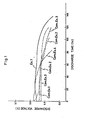
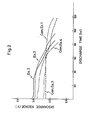
- Figs. 1 to 3 are graphs showing discharge characteristics, namely.changes in terminal voltage with the lapse of time, of batteries using active materials obtained in Examples according to the present invenion or active materials obtained in Comparative Examples.
- the starting material used in the present invention must be a particular carbon black having a specific surface area of not less than 100 m 2 /g, preferably not less than 500 m 2 /g.
- a carbon material other than a carbon black, even when it has a specific surface area of not less than 100 m 2 /g, for instance in case of an activated carbon can only give a fluorinated carbon inferior in flatness of discharge voltage level, in height of discharge voltage and in discharge time.
- the upper limit of the specific surface area of the carbon black is not particularly restricted, but is in general about 1300 m 2 /g.
- Typical examples of such carbon black are, for instance, a furnace black, and the like. Particularly, a furnace black having a specific surface area of not less than 500 m 2 /g is so called “condactive furnace black". However, a channel black is not preferred in general because it contains much impurities.
- the starting carbon black preferably has a dibutyl phtharate absorption value (hereinafter referred to as "DBP absorption value") of not less than 110 ml/100 g (determined according to the method of ASTM D 2414-65T), particularly not less than 150 ml/100 g.
- DBP absorption value dibutyl phtharate absorption value
- a fluorinated carbon obtained tends to decrease in initial discharge voltage and in height of discharge voltage.
- the upper limit of the DBP absorption value is not particularly restricted, but is in general about 500 ml/100 g.
- Typical examples of the carbon black having such DBP absorption value are, for instance, a conductive furnace black, and the like.
- the active material for batteries according to the present invention is prepared by reacting such a carbon black with fluorine gas.
- the fluorine gas may be a pure fluorine gas or a mixed gas of fluorine gas and a diluent gas.
- the fluorine concentration is adjusted to a level not lower than 0.1 % by volume, preferably 1 to 50 % by volume.
- the use of a mixed gas is preferable since the use of a mixed gas allows broad-range adjustment of reaction conditions, and moreover has advantages, from the viewpoint of apparatus maintenance, for exmaple, that the wear of the production apparatus can be decreased and that the production apparatus can be simplified.
- the diluent gas may be any of gases which do not react with fluorine and carbon, such as nitrogen gas, perfluorocarbon gas and rare gas.
- the reaction between a carbon black and a fluorine gas is carried out, for example, by introducing the fluorine gas into a reactor charged with the carbon black at room temperature, gradually raising the temperature to a given reaction temperature, namely a temperature within the range of 180 to 550°C, preferably 200 to 500°C, most preferably 250 to 450°C, and maintaining the reaction temperature. It is also possible to previously heat the starting carbon black to the reaction temperature, and then introduce the fluorine gas while maintaining the temperature.
- the active material for batteries obtained by the above reaction in accordance with the present invention has a fluorine content of 50 to 70 % by weight, preferably 52 to 68 % by weight.
- An electrode composition is obtained by admixing the active material for batteries of the invention with a binder and an electrically conductive material.
- the binder is used in an amount of 10 to 40 parts by weight
- the conductive material is used in an amount of 5 to 20 parts by weight, respectively based on 100 parts by weight of the active material.
- the composition can be easily molded into a desired form suitable as electrodes for batteries or cells.
- the binder includes, for instance, polytetrafluoroethylene (PTFE), and the conductive material includes, for instance, a highly conductive carbon black such as acetylene black or Ketchen black, and natural graphite.
- PTFE polytetrafluoroethylene
- the conductive material includes, for instance, a highly conductive carbon black such as acetylene black or Ketchen black, and natural graphite.
- Batteries or cells can be fabricated in known manners by using the active material of the invention. It is preferable to use the active material as a positive electrode and a metal such as lithium, mangesium, calcium or aluminum or an alloy based thereon as a negative electrode.
- the electrolyte is generally a non-aqueous electrolyte, though depending on the type of negative electrode.
- a reactor was charged with 10.0 g of a conductive furnace black (specific surface area 950 m2/g; DBP absorption value 350 ml/100 g; average particle size 0.03 ⁇ m) and degassed to remove moisture at 200°C for 30 minues, followed by cooling to room temperature.
- a conductive furnace black specific surface area 950 m2/g; DBP absorption value 350 ml/100 g; average particle size 0.03 ⁇ m
- the temperature in the reactor was raised to 200°C and maintained, and then fluorine gas was gradually introduced into the reactor at atmospheric pressure to adjust the fluorine concentration to 3 % by volume.
- a fluorine gas fluorine concentration 3 % by volume
- the reaction product was a pale gray powder.
- the fluorine content was 63.0 %.
- a reactor was charged with 10.0 g of a petroleum coke (specfic surface area 8.6 m2/g; average particle size 10 ⁇ m) and degassed to remove moisture at 400°C for 30 minutes. After introducing a fluorine gas, the reaction was carried out at 400°C for 4.5 hrs under a stream of a fluorine gas (fluorine concentration 10 % by volume) to give a white powder. The fluorine content was 62.0 %.
- a battery was fabricated in the same manner as in Example 1 and the terminal voltage was measure with the lapse of time. The result is shown in Figs. 1, 2 and 3.
- the fluorination was conducted in the same manner as in Comparative Example 1 except that an active carbon (specific surface area 807 m 2 /g; average particle size 149 um) was used as a starting carbon material and the reaction was carried out at 290°C for 18 hrs under a stream of a fluorine gas (fluorine concentration 4 % by volume) to give a pale gray powder.
- the fluorine content was 64.2 %.
- a battery was fabricated in the same manner as in Example 1 and the terminal voltage was measured with the lapse of time. The result is shown in Fig. 1.
- a reactor was charged with 10.0 g of a furnace black (specific surface area 84 m2/g; DBP absorption value 100 ml/100 g; average particle size 0.03 um) and degassed to remove moisture at 330°C for 30 minutes, followed by cooling to room temperature.
- a furnace black specific surface area 84 m2/g; DBP absorption value 100 ml/100 g; average particle size 0.03 um
- the fluorination was conducted for 8 hrs under a stream of a fluorine gas (fluorine concentration 1 % by volume), and subsequently for 21 hurs under a fluorine gas (fluorine concentration 4 % by volume) to give a pale gray powder.
- the fluorine content was 63.8 %.
- a battery was fabricated in the same manner as in Example 1 and the terminal voltage was measured with the lapse of time. The result is shown in Figs. 1, 2 and 3.
- a reactor was charged with 10.0 g of an artificial graphite (specific surface area 5.0 m 2 /g; average particle size 10 um) and degassed to remove moisture at 380°C for 30 minutes, followed by cooling to room temperature.
- an artificial graphite specific surface area 5.0 m 2 /g; average particle size 10 um
- a fluorine gas (fluorine content 90 %) at an atmospheric pressure was introduced into the reactor, and the temperature was raised to 380°C, and then the fluorination was conducted for 15.5 hrs to give a blackish brown powder.
- the fluorine content was 51.6 %.
- X-ray powder diffraction analysis of this powder revealed the occurrence of a peak at 10.50° (2 ) indicating diffraction on the (001) face. This result shows that the main component of the product was C 2 F.
- a battery was fabricated in the same manner as in Example 1 and the terminal voltage was measured with the lapse of time. The result is shown in Figs. 1 and 2.
- a reactor was charged with 5.0 g of a furnace black (specific surface area 325 m 2 /g; DBP absorption value 125 ml/100 g; average particle size 0.017 um) and degassed to remove moisture at 200°C for 30 minutes. Then, while maintaining the temperature at 200°C, a fluorine gas was gradually introduced into the reactor at atmospheric pressure to adjust the fluorine concentration to 2 % by volume. Subsequently, the fluorinaton was conducted for 1 hr under a stream of a fluorine gas (fluorine concentration 2 % by volume).
- the fluorine concentration in the gas stream was raised to 5 % by volume and the reaction was continued for 1 hr and, finally, the temperature was raised to 375 0 C and the reaction was conducted for further 1 hr to give a gray powder.
- the fluorine content was 53.5 %.
- a battery was fabricated in the same manner as in Example 1 and the terminal voltage was measured with the lapse of time. The result is shown in Fig. 2.
- a furnace black (specific surface area 110 m 2 /g; DB P absorption value 175 ml/100 g; average particle size 0.023 um) was fluorinated in the same manner as in Example 1 to give a pale gray powder.
- the fluorine content was 56.1 %.
- a battery was fabricated in the same manner as in Example 1 and the terminal voltage was measured with the lapse of time. The result is shown in Fig. 2.
- a reactor was charged with 5.0 g of a furnace black (specific surface area 950 m2/g; DBP absorption value 350 ml/100 g; average particle size 0.03 um) and degassed to remove moisture at 200°C for 30 minutes. Then, while maintaining the temperature at 200°C, a fluorine gas was gradually introduced into the reactor at atmospheric pressure to adjust the fluorine concentration to 2 % by volume. Subsequently, the fluorinaton was conducted for 1 hr under a stream of a fluorine gas (fluorine concentration 2 % by volume).
- the fluorine concentration in the gas stream was raised to 5 % by volume and the reaction was continued for 1 hr and, finally, the temperature was raised to 375°C and the reaction was conducted for further 1 hr to give a gray powder.
- the fluorine content was 59.5 %.
- a battery was fabricated in the same manner as in Example 1 and the terminal voltage was measured with the lapse of time. The result is shown in Fig. 3.
- a furnace black (specific surface area 1270 m 2 /g; DBP absorption value 480 ml/100 g; average particle size 0.03 um) was fluorinated in the same manner as in Example 4 except that a fluorine gas (fluorine concentration 10 % by volume) was introduced at the time when the temperature was raised to 375 0 C to give a white powder.
- the fluorine content was 67.8 %.
- a battery was fabricated in the same manner as in Example 1 and the terminal voltage was measured with the lapse of time. The result is shown in Fig. 3.
- a furnace black (specific surface area 250 m 2 /g; DBP absorption value 170 ml/100 g; average particle size 0.024 ⁇ m) was fluorinated in the same manner as in Example 4 to give a pale grayish powder.
- the fluorine content was 53.3 %.
- a battery was fabricated in the same manner as in Example 1 and the terminal voltage was measured with the lapse of time. The result is shown in Fig. 3.
- the active materials of the present invention are excellent in height of discharge voltage, in flatness of discharge voltage, in discharge level at initial stage and in discharge time.
Landscapes
- Chemical & Material Sciences (AREA)
- Organic Chemistry (AREA)
- Inorganic Chemistry (AREA)
- Chemical Kinetics & Catalysis (AREA)
- Electrochemistry (AREA)
- General Chemical & Material Sciences (AREA)
- Life Sciences & Earth Sciences (AREA)
- Environmental & Geological Engineering (AREA)
- General Life Sciences & Earth Sciences (AREA)
- Geology (AREA)
- Battery Electrode And Active Subsutance (AREA)
- Carbon And Carbon Compounds (AREA)
Abstract
Description
- The present invention relates to an active material for batteries comprising a particular fluorinated carbon obtained by reacting a carbon black having a specific surface area of not less than 100 m2/g with fluorine and which has excellent discharge characteristics, in particular high discharge voltage.
- Since the discovery that a fluorinated carbon has favorable discharge characteristics as an active material for batteries, a number of studies have been made in an attempt to attain higher discharge voltage and longer discharge time or longer life.
- In those studies, investigations from the viewpoint of starting carbon materials have also been made and the results obtained teach the fact that a fluorinated carbon obtained by reacting a carbon material having a small specific surface area with fluorine is favorable in flatness of discharge voltage but has defects that the discharge voltage drops at the initial stage of discharge and that the discharge voltage itself is not very high. There also teaches that a fluorinated carbon obtained by reacting a carbon material having a large specific surface area, such as active carbon, with fluorine does not cause the discharge voltage fall at the initial stage of discharge and has a high discharge voltage, but are short in discharge time and is inferior in flatness of discharge voltage (Japanese Unexamined Patent Publication (Tokkyo Kokai) No. 140972/1983).
- The present inventors further investigated a carbon material having a relatively large specific surface area as a starting material for the production of fluorinated carbon and found that, among such materials, a carbon black having a specific surface area of not less than 100 m2/g gives a fluorinated carbon capable of providing a much higher voltage as compared with the conventional fluorinated carbons.
- According to the present invention there is provided an active material for batteries comprising a fluorinated carbon obtained by reacting a carbon black having a specific surface area of not less than 100 m 2/g with fluorine.
- Figs. 1 to 3 are graphs showing discharge characteristics, namely.changes in terminal voltage with the lapse of time, of batteries using active materials obtained in Examples according to the present invenion or active materials obtained in Comparative Examples.
- The starting material used in the present invention must be a particular carbon black having a specific surface area of not less than 100 m2/g, preferably not less than 500 m2/g. A carbon material having a specific surface area of less than 100 m2/g, even when it is carbon black, can only give a fluorinated carbon incapable of providing high discharge voltage. Also a carbon material other than a carbon black, even when it has a specific surface area of not less than 100 m2/g, for instance in case of an activated carbon, can only give a fluorinated carbon inferior in flatness of discharge voltage level, in height of discharge voltage and in discharge time. The upper limit of the specific surface area of the carbon black is not particularly restricted, but is in general about 1300 m2/g.
- Typical examples of such carbon black are, for instance, a furnace black, and the like. Particularly, a furnace black having a specific surface area of not less than 500 m2/g is so called "condactive furnace black". However, a channel black is not preferred in general because it contains much impurities.
- Further, the starting carbon black preferably has a dibutyl phtharate absorption value (hereinafter referred to as "DBP absorption value") of not less than 110 ml/100 g (determined according to the method of ASTM D 2414-65T), particularly not less than 150 ml/100 g. When a carbon black having a DBP absorption value of less than 110 ml/100 g is used as a starting carbon material, a fluorinated carbon obtained tends to decrease in initial discharge voltage and in height of discharge voltage. The upper limit of the DBP absorption value is not particularly restricted, but is in general about 500 ml/100 g. Typical examples of the carbon black having such DBP absorption value are, for instance, a conductive furnace black, and the like.
- The active material for batteries according to the present invention is prepared by reacting such a carbon black with fluorine gas.
- The fluorine gas may be a pure fluorine gas or a mixed gas of fluorine gas and a diluent gas. In using such a mixed gas, the fluorine concentration is adjusted to a level not lower than 0.1 % by volume, preferably 1 to 50 % by volume. In the present invention, the use of a mixed gas is preferable since the use of a mixed gas allows broad-range adjustment of reaction conditions, and moreover has advantages, from the viewpoint of apparatus maintenance, for exmaple, that the wear of the production apparatus can be decreased and that the production apparatus can be simplified. The diluent gas may be any of gases which do not react with fluorine and carbon, such as nitrogen gas, perfluorocarbon gas and rare gas.
- The reaction between a carbon black and a fluorine gas (inclusive of a mixed gas, hereinafter the same) is carried out, for example, by introducing the fluorine gas into a reactor charged with the carbon black at room temperature, gradually raising the temperature to a given reaction temperature, namely a temperature within the range of 180 to 550°C, preferably 200 to 500°C, most preferably 250 to 450°C, and maintaining the reaction temperature. It is also possible to previously heat the starting carbon black to the reaction temperature, and then introduce the fluorine gas while maintaining the temperature.
- It is preferred to subject the starting carbon material to degassing at the reaction temperature to remove moisture prior to the reaction.
- The active material for batteries obtained by the above reaction in accordance with the present invention has a fluorine content of 50 to 70 % by weight, preferably 52 to 68 % by weight.
- An electrode composition is obtained by admixing the active material for batteries of the invention with a binder and an electrically conductive material. Usually, the binder is used in an amount of 10 to 40 parts by weight, and the conductive material is used in an amount of 5 to 20 parts by weight, respectively based on 100 parts by weight of the active material. The composition can be easily molded into a desired form suitable as electrodes for batteries or cells.
- The binder includes, for instance, polytetrafluoroethylene (PTFE), and the conductive material includes, for instance, a highly conductive carbon black such as acetylene black or Ketchen black, and natural graphite.
- Batteries or cells can be fabricated in known manners by using the active material of the invention. It is preferable to use the active material as a positive electrode and a metal such as lithium, mangesium, calcium or aluminum or an alloy based thereon as a negative electrode. The electrolyte is generally a non-aqueous electrolyte, though depending on the type of negative electrode.
- The present invention is more specifically described and explained by menas of the following Examples, in which all parts and % are by weight unless otherwise noted. It is to be understood that the present invention is not limited to the Examples, and various changes and modifications may be made in the invention without departing from the spirit and scope thereof.
- A reactor was charged with 10.0 g of a conductive furnace black (specific surface area 950 m2/g; DBP absorption value 350 ml/100 g; average particle size 0.03 µm) and degassed to remove moisture at 200°C for 30 minues, followed by cooling to room temperature.
- After filling the reactor with nitrogen gas, the temperature in the reactor was raised to 200°C and maintained, and then fluorine gas was gradually introduced into the reactor at atmospheric pressure to adjust the fluorine concentration to 3 % by volume. Subsequently, a fluorine gas (
fluorine concentration 3 % by volume) was introduced into the reactor, and the temperature was raised to 350°C at a rate of 20°C/hr while flowing the fluorine gas, and the reaction was conducted at that temperature for 12 hours. The reaction product was a pale gray powder. The fluorine content was 63.0 %. - Then, 10 parts of the above product was milled well with 3 parts of PTFE and 1 part of acetylene black, and the mixture was pessed on a nickel screen to form a positive electrode having an apparent surface area of 1.57 cm2. A plate having a surface area of 1 cm2 and a thickness of 1 mm cut out of a lithium block was supported on a nickel screen to form a negative electrode, and a 1 mole/liter solution of lithium borofluoride in γ-butyrolactone was used as an electrolyte. The discharge voltage of the obtained battery was measured at 250C using a fixed resistance of 10 kiloohms. The change in terminal voltage with the lapse of time is shown in Fig. 1.
- A reactor was charged with 10.0 g of a petroleum coke (specfic surface area 8.6 m2/g; average particle size 10 µm) and degassed to remove moisture at 400°C for 30 minutes. After introducing a fluorine gas, the reaction was carried out at 400°C for 4.5 hrs under a stream of a fluorine gas (fluorine concentration 10 % by volume) to give a white powder. The fluorine content was 62.0 %.
- Using the above fluorinated graphite, a battery was fabricated in the same manner as in Example 1 and the terminal voltage was measure with the lapse of time. The result is shown in Figs. 1, 2 and 3.
- The fluorination was conducted in the same manner as in Comparative Example 1 except that an active carbon (specific surface area 807 m2/g; average particle size 149 um) was used as a starting carbon material and the reaction was carried out at 290°C for 18 hrs under a stream of a fluorine gas (
fluorine concentration 4 % by volume) to give a pale gray powder. The fluorine content was 64.2 %. - Using the above product, a battery was fabricated in the same manner as in Example 1 and the terminal voltage was measured with the lapse of time. The result is shown in Fig. 1.
- A reactor was charged with 10.0 g of a furnace black (specific surface area 84 m2/g;
DBP absorption value 100 ml/100 g; average particle size 0.03 um) and degassed to remove moisture at 330°C for 30 minutes, followed by cooling to room temperature. - After the temperature was raised to 330°C, the fluorination was conducted for 8 hrs under a stream of a fluorine gas (
fluorine concentration 1 % by volume), and subsequently for 21 hurs under a fluorine gas (fluorine concentration 4 % by volume) to give a pale gray powder. - The fluorine content was 63.8 %.
- Using the above product, a battery was fabricated in the same manner as in Example 1 and the terminal voltage was measured with the lapse of time. The result is shown in Figs. 1, 2 and 3.
- A reactor was charged with 10.0 g of an artificial graphite (specific surface area 5.0 m2/g; average particle size 10 um) and degassed to remove moisture at 380°C for 30 minutes, followed by cooling to room temperature.
- A fluorine gas (fluorine content 90 %) at an atmospheric pressure was introduced into the reactor, and the temperature was raised to 380°C, and then the fluorination was conducted for 15.5 hrs to give a blackish brown powder. The fluorine content was 51.6 %. X-ray powder diffraction analysis of this powder revealed the occurrence of a peak at 10.50° (2 ) indicating diffraction on the (001) face. This result shows that the main component of the product was C2F.
- Using the above product, a battery was fabricated in the same manner as in Example 1 and the terminal voltage was measured with the lapse of time. The result is shown in Figs. 1 and 2.
- A reactor was charged with 5.0 g of a furnace black (specific surface area 325 m2/g; DBP absorption value 125 ml/100 g; average particle size 0.017 um) and degassed to remove moisture at 200°C for 30 minutes. Then, while maintaining the temperature at 200°C, a fluorine gas was gradually introduced into the reactor at atmospheric pressure to adjust the fluorine concentration to 2 % by volume. Subsequently, the fluorinaton was conducted for 1 hr under a stream of a fluorine gas (
fluorine concentration 2 % by volume). Then, the fluorine concentration in the gas stream was raised to 5 % by volume and the reaction was continued for 1 hr and, finally, the temperature was raised to 3750C and the reaction was conducted for further 1 hr to give a gray powder. The fluorine content was 53.5 %. - Using the product, a battery was fabricated in the same manner as in Example 1 and the terminal voltage was measured with the lapse of time. The result is shown in Fig. 2.
- A furnace black (specific surface area 110 m2/g; DBP absorption value 175 ml/100 g; average particle size 0.023 um) was fluorinated in the same manner as in Example 1 to give a pale gray powder. The fluorine content was 56.1 %.
- Using the product, a battery was fabricated in the same manner as in Example 1 and the terminal voltage was measured with the lapse of time. The result is shown in Fig. 2.
- A reactor was charged with 5.0 g of a furnace black (specific surface area 950 m2/g; DBP absorption value 350 ml/100 g; average particle size 0.03 um) and degassed to remove moisture at 200°C for 30 minutes. Then, while maintaining the temperature at 200°C, a fluorine gas was gradually introduced into the reactor at atmospheric pressure to adjust the fluorine concentration to 2 % by volume. Subsequently, the fluorinaton was conducted for 1 hr under a stream of a fluorine gas (
fluorine concentration 2 % by volume). Then, the fluorine concentration in the gas stream was raised to 5 % by volume and the reaction was continued for 1 hr and, finally, the temperature was raised to 375°C and the reaction was conducted for further 1 hr to give a gray powder. The fluorine content was 59.5 %. - Using the product, a battery was fabricated in the same manner as in Example 1 and the terminal voltage was measured with the lapse of time. The result is shown in Fig. 3.
- A furnace black (specific surface area 1270 m2/g; DBP absorption value 480 ml/100 g; average particle size 0.03 um) was fluorinated in the same manner as in Example 4 except that a fluorine gas (fluorine concentration 10 % by volume) was introduced at the time when the temperature was raised to 3750C to give a white powder. The fluorine content was 67.8 %.
- Using the above product, a battery was fabricated in the same manner as in Example 1 and the terminal voltage was measured with the lapse of time. The result is shown in Fig. 3.
- A furnace black (specific surface area 250 m 2 /g; DBP absorption value 170 ml/100 g; average particle size 0.024 µm) was fluorinated in the same manner as in Example 4 to give a pale grayish powder. The fluorine content was 53.3 %.
- Using the product, a battery was fabricated in the same manner as in Example 1 and the terminal voltage was measured with the lapse of time. The result is shown in Fig. 3.
- As is clear from Figs. 1 to 3, in case of the active material (Comparative Example 1) obtained from the petroleum coke, though the flatness of discharge voltage and the discharge time are good, the discharge voltage is low. In case of the active material (Comparative Example 2) obtained from the active carbon having a large specific surface area (807 m2/g), though the initial discharge voltage is high, the discharge voltage drastically decreases and the discharge time is short. Further, the active material (Comparative Example 3) obtained from the carbon black having a smaller specific surface area is inferior in height of discharge voltage, in discharge level at initial stage and in discharge time. Also, in case of the active material (Comparative Example 4) obtained from the artificial graphite, though the discharge voltage is relatively high, the discharge time is short.
- On the other hand, the active materials of the present invention are excellent in height of discharge voltage, in flatness of discharge voltage, in discharge level at initial stage and in discharge time.
Claims (6)
Applications Claiming Priority (6)
| Application Number | Priority Date | Filing Date | Title |
|---|---|---|---|
| JP209635/83 | 1983-11-07 | ||
| JP58209635A JPS60101869A (en) | 1983-11-07 | 1983-11-07 | Active material for battery |
| JP14841384A JPS6127064A (en) | 1984-07-16 | 1984-07-16 | battery active material |
| JP148414/84 | 1984-07-16 | ||
| JP14841484A JPS6127065A (en) | 1984-07-16 | 1984-07-16 | battery active material |
| JP148413/84 | 1984-07-16 |
Publications (2)
| Publication Number | Publication Date |
|---|---|
| EP0142113A2 true EP0142113A2 (en) | 1985-05-22 |
| EP0142113A3 EP0142113A3 (en) | 1985-10-02 |
Family
ID=27319554
Family Applications (1)
| Application Number | Title | Priority Date | Filing Date |
|---|---|---|---|
| EP84113334A Withdrawn EP0142113A3 (en) | 1983-11-07 | 1984-11-06 | Active material for batteries |
Country Status (1)
| Country | Link |
|---|---|
| EP (1) | EP0142113A3 (en) |
Cited By (4)
| Publication number | Priority date | Publication date | Assignee | Title |
|---|---|---|---|---|
| US4859444A (en) * | 1987-02-27 | 1989-08-22 | Central Glass Company, Limited | Method of producing ultrafine particles of graphite fluoride |
| US5712062A (en) * | 1992-11-06 | 1998-01-27 | Daikin Industries, Ltd. | Carbon fluoride particles, preparation process and uses of the same |
| CN109411752A (en) * | 2017-08-15 | 2019-03-01 | 天津大学 | A method of carbon fluoride nano-tube is prepared by Fluorine source of fluorine gas |
| CN109461923A (en) * | 2018-11-13 | 2019-03-12 | 山东重山光电材料股份有限公司 | A kind of lithium primary battery compound fluorocarbons positive electrode and its preparation method and application |
Family Cites Families (4)
| Publication number | Priority date | Publication date | Assignee | Title |
|---|---|---|---|---|
| JPS4825566B1 (en) * | 1968-04-17 | 1973-07-30 | ||
| US3956018A (en) * | 1974-12-30 | 1976-05-11 | Union Carbide Corporation | Primary electric current-producing dry cell using a (CFx)n cathode and an aqueous alkaline electrolyte |
| JPS549730A (en) * | 1977-06-24 | 1979-01-24 | Matsushita Electric Industrial Co Ltd | Active material on positive electrode of battery |
| EP0052446B1 (en) * | 1980-10-31 | 1986-03-12 | Eltech Systems Corporation | Partially-fluorinated carbon particles for use as electrodes |
-
1984
- 1984-11-06 EP EP84113334A patent/EP0142113A3/en not_active Withdrawn
Cited By (6)
| Publication number | Priority date | Publication date | Assignee | Title |
|---|---|---|---|---|
| US4859444A (en) * | 1987-02-27 | 1989-08-22 | Central Glass Company, Limited | Method of producing ultrafine particles of graphite fluoride |
| US5712062A (en) * | 1992-11-06 | 1998-01-27 | Daikin Industries, Ltd. | Carbon fluoride particles, preparation process and uses of the same |
| US6068921A (en) * | 1992-11-06 | 2000-05-30 | Daikin Industries, Ltd. | Carbon fluoride particles, preparation process and users of the same |
| CN109411752A (en) * | 2017-08-15 | 2019-03-01 | 天津大学 | A method of carbon fluoride nano-tube is prepared by Fluorine source of fluorine gas |
| CN109461923A (en) * | 2018-11-13 | 2019-03-12 | 山东重山光电材料股份有限公司 | A kind of lithium primary battery compound fluorocarbons positive electrode and its preparation method and application |
| CN109461923B (en) * | 2018-11-13 | 2021-11-30 | 山东重山光电材料股份有限公司 | Composite carbon fluoride positive electrode material for lithium primary battery and preparation method and application thereof |
Also Published As
| Publication number | Publication date |
|---|---|
| EP0142113A3 (en) | 1985-10-02 |
Similar Documents
| Publication | Publication Date | Title |
|---|---|---|
| Nishijima et al. | Synthesis and electrochemical studies of a new anode material, Li3− xCoxN | |
| EP0802575B1 (en) | A method for producing a lithium ion-conductive solid electrolyte | |
| SU867333A3 (en) | Primary chemical current source | |
| EP0637850B1 (en) | Nonaqueous electrolyte battery | |
| JPH10106626A (en) | Alkali metal electrochemical cell using ternary non-aqueous organic solvent | |
| US11618678B2 (en) | Method for producing sulfide solid electrolyte | |
| EP4307318A1 (en) | Solid electrolyte and method for producing same | |
| US4684591A (en) | Active materials for batteries | |
| JPH0251220B2 (en) | ||
| EP0054984B1 (en) | Fuel cell electrode and process for the production of a fuel cell electrode | |
| EP0142113A2 (en) | Active material for batteries | |
| US5885544A (en) | Lithium cobaltate based positive electrode-active material for lithium secondary cell and method of manufacturing same | |
| EP1280220B1 (en) | Non-aqueous electrolyte and lithium secondary battery | |
| CA2004744C (en) | Lithium primary cell, cathode active material therefor, and method for manufacturing manganese dioxide for cathode active material | |
| Novak et al. | CuO cathode in lithium cells: I. influence of the decomposition conditions of Cu (OH) 2 on the properties of CuO | |
| US4915809A (en) | Carbon electrodes including trasition metal dispersed therein | |
| US4686161A (en) | Method of inhibiting voltage suppression lithium/fluorinated carbon batteries | |
| EP0497186B1 (en) | Process for preparing non-amalgamated zinc alloy powder for alkali dry cells | |
| US4548881A (en) | High energy density battery with cathode composition | |
| US4765968A (en) | Fluorinated carbon composition for use in fabricating a Li/CFx battery cathode | |
| WO2021199550A1 (en) | Solid electrolyte material and battery using same | |
| EP4600328A1 (en) | Modified green coke material, preparation method therefor, and use thereof | |
| US11214496B2 (en) | Electrolytic manganese dioxide and method for its production, and its application | |
| EP0322806A1 (en) | Dry cell | |
| EP0350856A1 (en) | Purification method of carbon fluorides |
Legal Events
| Date | Code | Title | Description |
|---|---|---|---|
| PUAI | Public reference made under article 153(3) epc to a published international application that has entered the european phase |
Free format text: ORIGINAL CODE: 0009012 |
|
| AK | Designated contracting states |
Designated state(s): DE FR GB |
|
| PUAL | Search report despatched |
Free format text: ORIGINAL CODE: 0009013 |
|
| AK | Designated contracting states |
Designated state(s): DE FR GB |
|
| 17P | Request for examination filed |
Effective date: 19860322 |
|
| 17Q | First examination report despatched |
Effective date: 19861111 |
|
| STAA | Information on the status of an ep patent application or granted ep patent |
Free format text: STATUS: THE APPLICATION HAS BEEN WITHDRAWN |
|
| 18W | Application withdrawn |
Withdrawal date: 19870519 |
|
| RIN1 | Information on inventor provided before grant (corrected) |
Inventor name: MAEDA, TADAYUKI Inventor name: KOYAMA, SATOSHI Inventor name: OKAMURA, KAZUO |