EP0141878B1 - Improved malolactic fermentation method - Google Patents
Improved malolactic fermentation method Download PDFInfo
- Publication number
- EP0141878B1 EP0141878B1 EP83111786A EP83111786A EP0141878B1 EP 0141878 B1 EP0141878 B1 EP 0141878B1 EP 83111786 A EP83111786 A EP 83111786A EP 83111786 A EP83111786 A EP 83111786A EP 0141878 B1 EP0141878 B1 EP 0141878B1
- Authority
- EP
- European Patent Office
- Prior art keywords
- wine
- concentrate
- malic acid
- bacteria
- fruit juice
- Prior art date
- Legal status (The legal status is an assumption and is not a legal conclusion. Google has not performed a legal analysis and makes no representation as to the accuracy of the status listed.)
- Expired
Links
- 238000000034 method Methods 0.000 title claims abstract description 31
- 238000000855 fermentation Methods 0.000 title abstract description 8
- 230000004151 fermentation Effects 0.000 title abstract description 8
- 235000014101 wine Nutrition 0.000 claims abstract description 41
- 230000001580 bacterial effect Effects 0.000 claims abstract description 23
- 241000894006 Bacteria Species 0.000 claims description 28
- 239000012141 concentrate Substances 0.000 claims description 28
- BJEPYKJPYRNKOW-UHFFFAOYSA-N alpha-hydroxysuccinic acid Natural products OC(=O)C(O)CC(O)=O BJEPYKJPYRNKOW-UHFFFAOYSA-N 0.000 claims description 25
- BJEPYKJPYRNKOW-REOHCLBHSA-N (S)-malic acid Chemical compound OC(=O)[C@@H](O)CC(O)=O BJEPYKJPYRNKOW-REOHCLBHSA-N 0.000 claims description 24
- 235000011090 malic acid Nutrition 0.000 claims description 22
- 239000001630 malic acid Substances 0.000 claims description 21
- JVTAAEKCZFNVCJ-UHFFFAOYSA-N lactic acid Chemical compound CC(O)C(O)=O JVTAAEKCZFNVCJ-UHFFFAOYSA-N 0.000 claims description 20
- IJGRMHOSHXDMSA-UHFFFAOYSA-N Atomic nitrogen Chemical compound N#N IJGRMHOSHXDMSA-UHFFFAOYSA-N 0.000 claims description 18
- 241000192134 Oenococcus oeni Species 0.000 claims description 12
- 239000002609 medium Substances 0.000 claims description 12
- 239000000203 mixture Substances 0.000 claims description 12
- 241000219095 Vitis Species 0.000 claims description 11
- 235000015203 fruit juice Nutrition 0.000 claims description 11
- 235000009754 Vitis X bourquina Nutrition 0.000 claims description 10
- 235000012333 Vitis X labruscana Nutrition 0.000 claims description 10
- 235000014787 Vitis vinifera Nutrition 0.000 claims description 10
- 239000004310 lactic acid Substances 0.000 claims description 10
- 235000014655 lactic acid Nutrition 0.000 claims description 10
- PEDCQBHIVMGVHV-UHFFFAOYSA-N glycerol group Chemical group OCC(O)CO PEDCQBHIVMGVHV-UHFFFAOYSA-N 0.000 claims description 9
- 229910052757 nitrogen Inorganic materials 0.000 claims description 9
- 229940041514 candida albicans extract Drugs 0.000 claims description 6
- 239000012138 yeast extract Substances 0.000 claims description 6
- 230000003213 activating effect Effects 0.000 claims description 4
- 239000001963 growth medium Substances 0.000 claims description 4
- 150000001720 carbohydrates Chemical class 0.000 claims description 3
- 235000021321 essential mineral Nutrition 0.000 claims description 3
- 235000019674 grape juice Nutrition 0.000 claims description 3
- 239000003381 stabilizer Substances 0.000 claims description 3
- 230000003190 augmentative effect Effects 0.000 claims description 2
- 238000005119 centrifugation Methods 0.000 claims description 2
- 230000008014 freezing Effects 0.000 claims description 2
- 238000007710 freezing Methods 0.000 claims description 2
- 238000010257 thawing Methods 0.000 claims 1
- 229940099690 malic acid Drugs 0.000 description 12
- 238000006243 chemical reaction Methods 0.000 description 7
- 150000002085 enols Chemical class 0.000 description 7
- 241000192132 Leuconostoc Species 0.000 description 5
- 238000011081 inoculation Methods 0.000 description 5
- HEDRZPFGACZZDS-UHFFFAOYSA-N Chloroform Chemical compound ClC(Cl)Cl HEDRZPFGACZZDS-UHFFFAOYSA-N 0.000 description 4
- RAHZWNYVWXNFOC-UHFFFAOYSA-N Sulphur dioxide Chemical compound O=S=O RAHZWNYVWXNFOC-UHFFFAOYSA-N 0.000 description 4
- XLYOFNOQVPJJNP-UHFFFAOYSA-N water Substances O XLYOFNOQVPJJNP-UHFFFAOYSA-N 0.000 description 4
- LFQSCWFLJHTTHZ-UHFFFAOYSA-N Ethanol Chemical compound CCO LFQSCWFLJHTTHZ-UHFFFAOYSA-N 0.000 description 3
- OKKJLVBELUTLKV-UHFFFAOYSA-N Methanol Chemical compound OC OKKJLVBELUTLKV-UHFFFAOYSA-N 0.000 description 3
- NBIIXXVUZAFLBC-UHFFFAOYSA-N Phosphoric acid Chemical compound OP(O)(O)=O NBIIXXVUZAFLBC-UHFFFAOYSA-N 0.000 description 3
- 240000004808 Saccharomyces cerevisiae Species 0.000 description 3
- 235000014680 Saccharomyces cerevisiae Nutrition 0.000 description 3
- 230000004913 activation Effects 0.000 description 3
- 239000007789 gas Substances 0.000 description 3
- QGZKDVFQNNGYKY-UHFFFAOYSA-N Ammonia Chemical compound N QGZKDVFQNNGYKY-UHFFFAOYSA-N 0.000 description 2
- WQZGKKKJIJFFOK-GASJEMHNSA-N Glucose Natural products OC[C@H]1OC(O)[C@H](O)[C@@H](O)[C@@H]1O WQZGKKKJIJFFOK-GASJEMHNSA-N 0.000 description 2
- 241000186660 Lactobacillus Species 0.000 description 2
- 241000192001 Pediococcus Species 0.000 description 2
- BQCADISMDOOEFD-UHFFFAOYSA-N Silver Chemical compound [Ag] BQCADISMDOOEFD-UHFFFAOYSA-N 0.000 description 2
- 239000002253 acid Substances 0.000 description 2
- 235000019673 concord grape juice Nutrition 0.000 description 2
- OVBPIULPVIDEAO-LBPRGKRZSA-N folic acid Chemical compound C=1N=C2NC(N)=NC(=O)C2=NC=1CNC1=CC=C(C(=O)N[C@@H](CCC(O)=O)C(O)=O)C=C1 OVBPIULPVIDEAO-LBPRGKRZSA-N 0.000 description 2
- 235000013305 food Nutrition 0.000 description 2
- 235000011389 fruit/vegetable juice Nutrition 0.000 description 2
- 238000001030 gas--liquid chromatography Methods 0.000 description 2
- 239000000499 gel Substances 0.000 description 2
- 239000008103 glucose Substances 0.000 description 2
- 239000001307 helium Substances 0.000 description 2
- 229910052734 helium Inorganic materials 0.000 description 2
- SWQJXJOGLNCZEY-UHFFFAOYSA-N helium atom Chemical compound [He] SWQJXJOGLNCZEY-UHFFFAOYSA-N 0.000 description 2
- 238000002347 injection Methods 0.000 description 2
- 239000007924 injection Substances 0.000 description 2
- 150000007524 organic acids Chemical class 0.000 description 2
- 235000005985 organic acids Nutrition 0.000 description 2
- 239000000843 powder Substances 0.000 description 2
- 229910052709 silver Inorganic materials 0.000 description 2
- 239000004332 silver Substances 0.000 description 2
- FHVDTGUDJYJELY-UHFFFAOYSA-N 6-{[2-carboxy-4,5-dihydroxy-6-(phosphanyloxy)oxan-3-yl]oxy}-4,5-dihydroxy-3-phosphanyloxane-2-carboxylic acid Chemical compound O1C(C(O)=O)C(P)C(O)C(O)C1OC1C(C(O)=O)OC(OP)C(O)C1O FHVDTGUDJYJELY-UHFFFAOYSA-N 0.000 description 1
- 229920001817 Agar Polymers 0.000 description 1
- 108090000790 Enzymes Proteins 0.000 description 1
- 102000004190 Enzymes Human genes 0.000 description 1
- UFHFLCQGNIYNRP-UHFFFAOYSA-N Hydrogen Chemical compound [H][H] UFHFLCQGNIYNRP-UHFFFAOYSA-N 0.000 description 1
- JVTAAEKCZFNVCJ-REOHCLBHSA-N L-lactic acid Chemical compound C[C@H](O)C(O)=O JVTAAEKCZFNVCJ-REOHCLBHSA-N 0.000 description 1
- PWHULOQIROXLJO-UHFFFAOYSA-N Manganese Chemical compound [Mn] PWHULOQIROXLJO-UHFFFAOYSA-N 0.000 description 1
- OVBPIULPVIDEAO-UHFFFAOYSA-N N-Pteroyl-L-glutaminsaeure Natural products C=1N=C2NC(N)=NC(=O)C2=NC=1CNC1=CC=C(C(=O)NC(CCC(O)=O)C(O)=O)C=C1 OVBPIULPVIDEAO-UHFFFAOYSA-N 0.000 description 1
- 229910019142 PO4 Inorganic materials 0.000 description 1
- 241000364057 Peoria Species 0.000 description 1
- 239000001888 Peptone Substances 0.000 description 1
- 108010080698 Peptones Proteins 0.000 description 1
- 229930006000 Sucrose Natural products 0.000 description 1
- CZMRCDWAGMRECN-UGDNZRGBSA-N Sucrose Chemical compound O[C@H]1[C@H](O)[C@@H](CO)O[C@@]1(CO)O[C@@H]1[C@H](O)[C@@H](O)[C@H](O)[C@@H](CO)O1 CZMRCDWAGMRECN-UGDNZRGBSA-N 0.000 description 1
- QAOWNCQODCNURD-UHFFFAOYSA-N Sulfuric acid Chemical compound OS(O)(=O)=O QAOWNCQODCNURD-UHFFFAOYSA-N 0.000 description 1
- 239000008272 agar Substances 0.000 description 1
- 229940072056 alginate Drugs 0.000 description 1
- 235000010443 alginic acid Nutrition 0.000 description 1
- 229920000615 alginic acid Polymers 0.000 description 1
- 229910000147 aluminium phosphate Inorganic materials 0.000 description 1
- 150000001413 amino acids Chemical class 0.000 description 1
- 229910021529 ammonia Inorganic materials 0.000 description 1
- 235000015197 apple juice Nutrition 0.000 description 1
- 239000012911 assay medium Substances 0.000 description 1
- 125000003178 carboxy group Chemical group [H]OC(*)=O 0.000 description 1
- 239000001913 cellulose Substances 0.000 description 1
- 230000003247 decreasing effect Effects 0.000 description 1
- 238000010790 dilution Methods 0.000 description 1
- 239000012895 dilution Substances 0.000 description 1
- 229910000397 disodium phosphate Inorganic materials 0.000 description 1
- 238000011156 evaluation Methods 0.000 description 1
- 235000013861 fat-free Nutrition 0.000 description 1
- 229960000304 folic acid Drugs 0.000 description 1
- 235000019152 folic acid Nutrition 0.000 description 1
- 239000011724 folic acid Substances 0.000 description 1
- 239000011521 glass Substances 0.000 description 1
- 229940116298 l- malic acid Drugs 0.000 description 1
- 229940116871 l-lactate Drugs 0.000 description 1
- 229910052748 manganese Inorganic materials 0.000 description 1
- 239000011572 manganese Substances 0.000 description 1
- 229910000357 manganese(II) sulfate Inorganic materials 0.000 description 1
- 229910052751 metal Inorganic materials 0.000 description 1
- 239000002184 metal Substances 0.000 description 1
- 239000008267 milk Substances 0.000 description 1
- 210000004080 milk Anatomy 0.000 description 1
- 235000013336 milk Nutrition 0.000 description 1
- 235000013379 molasses Nutrition 0.000 description 1
- 238000006386 neutralization reaction Methods 0.000 description 1
- 238000007254 oxidation reaction Methods 0.000 description 1
- 239000013618 particulate matter Substances 0.000 description 1
- 235000019319 peptone Nutrition 0.000 description 1
- 239000010452 phosphate Substances 0.000 description 1
- NBIIXXVUZAFLBC-UHFFFAOYSA-K phosphate Chemical compound [O-]P([O-])([O-])=O NBIIXXVUZAFLBC-UHFFFAOYSA-K 0.000 description 1
- 229920001223 polyethylene glycol Polymers 0.000 description 1
- 235000019814 powdered cellulose Nutrition 0.000 description 1
- 229920003124 powdered cellulose Polymers 0.000 description 1
- 238000002360 preparation method Methods 0.000 description 1
- 108090000623 proteins and genes Proteins 0.000 description 1
- 102000004169 proteins and genes Human genes 0.000 description 1
- 238000001223 reverse osmosis Methods 0.000 description 1
- 238000005464 sample preparation method Methods 0.000 description 1
- 239000007858 starting material Substances 0.000 description 1
- 239000005720 sucrose Substances 0.000 description 1
- 150000003892 tartrate salts Chemical class 0.000 description 1
- 238000009369 viticulture Methods 0.000 description 1
Classifications
-
- C—CHEMISTRY; METALLURGY
- C12—BIOCHEMISTRY; BEER; SPIRITS; WINE; VINEGAR; MICROBIOLOGY; ENZYMOLOGY; MUTATION OR GENETIC ENGINEERING
- C12H—PASTEURISATION, STERILISATION, PRESERVATION, PURIFICATION, CLARIFICATION OR AGEING OF ALCOHOLIC BEVERAGES; METHODS FOR ALTERING THE ALCOHOL CONTENT OF FERMENTED SOLUTIONS OR ALCOHOLIC BEVERAGES
- C12H1/00—Pasteurisation, sterilisation, preservation, purification, clarification, or ageing of alcoholic beverages
- C12H1/003—Pasteurisation, sterilisation, preservation, purification, clarification, or ageing of alcoholic beverages by a biochemical process
- C12H1/006—Pasteurisation, sterilisation, preservation, purification, clarification, or ageing of alcoholic beverages by a biochemical process using bacterial cultures
-
- Y—GENERAL TAGGING OF NEW TECHNOLOGICAL DEVELOPMENTS; GENERAL TAGGING OF CROSS-SECTIONAL TECHNOLOGIES SPANNING OVER SEVERAL SECTIONS OF THE IPC; TECHNICAL SUBJECTS COVERED BY FORMER USPC CROSS-REFERENCE ART COLLECTIONS [XRACs] AND DIGESTS
- Y10—TECHNICAL SUBJECTS COVERED BY FORMER USPC
- Y10S—TECHNICAL SUBJECTS COVERED BY FORMER USPC CROSS-REFERENCE ART COLLECTIONS [XRACs] AND DIGESTS
- Y10S435/00—Chemistry: molecular biology and microbiology
- Y10S435/8215—Microorganisms
- Y10S435/822—Microorganisms using bacteria or actinomycetales
Definitions
- the present invention relates to an improved method for the conversion of malic acid to lactic acid (malolactic fermentation) in wine.
- the present invention relates to an improvement wherein the wine is inoculated directly with specially activated bacteria.
- the present invention relates to an improved method for the conversion of malic acid to lactic acid in wine by the introduction of high numbers of activated bacterial cells into the wine which comprises:
- the bacterial cells (Leuconostoc) do not significantly increase in number, but rather are activated for the introduction into the wine or must.
- the fruit juice medium of part (a) is not a "bulk starter", which functions to increase cell numbers. It is uncertain why the activating medium works.
- the invention is particularly concerned with using a Leuconostoc species for the conversion, preferably Leuconostoc oenos. Also Pediococcus and Lactobacillus species can be used.
- the growth of the bacteria in malic acid in preparing the concentrate conditions the bacteria so that they have the necessary enzyme systems for the conversion.
- the preferred bacteria are Leuconostoc oenos NRRL-B-15333 and NRRL-B-15334.
- the fermentation characteristics of these bacteria are shown in the Table I.
- the strains are quite similar. These strains are deposited with the Northern Regional Research Laboratories in Peoria, Illinois and are freely available upon request by name and number.
- the growth medium for the bacteria used to prepare the concentrate includes malic acid which is converted to lactic acid, assimilable carbohydrate which is also converted to lactic acid, essential minerals and a nitrogen source.
- the DL-malic acid concentration is present in an amount between about 0.01 and 1.0 percent by weight.
- the carbohydrate is generally glucose.
- the nitrogen source is preferably hydrolyzed protein and yeast extract, which contain amino acids.
- the essential minerals include manganese and phosphate for Leuconostoc species.
- the bacterial concentrates are generally prepared by centrifugation or other mechanical concentration of the bacterial cells from the growth medium. Reverse osmosis can also be used to provide concentrates of the bacterial cells.
- the concentrates usually contain at least about 10 8 cells to about 10 13 cells (CFU) per ml or per gram.
- CFU cells per ml or per gram.
- the bacteria are not constantly neutralized during growth of the cells in forming the concentrates in order to condition them to the acid in the wine.
- the bacterial concentrates are preferably provided in preserved form for storage and shipment.
- the bacterial concentrates can be frozen with a freezing stabilizing agent such as glycerol, non-fat dry milk powder, and malt extract and generally contain 10 8 to 10 11 CFU per ml.
- the bacteria can also be lyophilized or otherwise dried to a powder containing 10 8 to 10 13 CFU per gram. All of these variations are known to those skilled in the art.
- the bacterial culture concentrate is activated in a medium including a fruit juice (such as grape or apple juice) with added yeast extract or other nitrogen source.
- the bacteria are introduced into the activating medium at a level between about 1 x 10 7 CFU/ml and 1 x 10 10 CFU/ml.
- the bacteria are preferably activated by incubating at 18°C to 25°C for 48 to 72 hours. The bacteria do not significantly increase in number.
- the activated cells can then be added directly to the wine or grape must.
- the activated bacterial mixture is introduced into the wine or grape must.
- the bacteria are introduced to a level of at least about 10 5 CFU per ml or per gram and preferably between about 10 6 to 10 8 CFU per ml in the wine or grape must.
- Example 1 shows the preferred method of the present invention using Leuconostoc oenos.
- 1.0 ml of activated cells of NRRL-B-15533 and NRRL-B-15534 were inoculated into each of 100 ml of wine prepared as described above.
- 1.0 ml of a 1:100 dilution of each freshly thawed frozen concentrated culture of Leuconostoc oenos was added to each of 100 ml of wine. This was designated direct inoculation.
- the activated method of the present invention provides a rapid method for the malic to lactic acid conversion.
- Leuconostoc oenos NRRL-B-15534 is especially fast (8 days) and for preserved cultures, both cultures are much faster than the prior art such as Silver J., et al (1981) cited previously.
Landscapes
- Chemical & Material Sciences (AREA)
- Organic Chemistry (AREA)
- Engineering & Computer Science (AREA)
- Health & Medical Sciences (AREA)
- Genetics & Genomics (AREA)
- General Health & Medical Sciences (AREA)
- Life Sciences & Earth Sciences (AREA)
- Biochemistry (AREA)
- Bioinformatics & Cheminformatics (AREA)
- General Chemical & Material Sciences (AREA)
- General Engineering & Computer Science (AREA)
- Food Science & Technology (AREA)
- Physiology (AREA)
- Wood Science & Technology (AREA)
- Zoology (AREA)
- Micro-Organisms Or Cultivation Processes Thereof (AREA)
- Distillation Of Fermentation Liquor, Processing Of Alcohols, Vinegar And Beer (AREA)
- Preparation Of Compounds By Using Micro-Organisms (AREA)
- Agricultural Chemicals And Associated Chemicals (AREA)
Abstract
Description
- The present invention relates to an improved method for the conversion of malic acid to lactic acid (malolactic fermentation) in wine. In particular the present invention relates to an improvement wherein the wine is inoculated directly with specially activated bacteria.
- Various methods have been devised for removing malic acid from wine. The removal involves the conversion of dicarboxylic L-malate to the monocarboxylic L-lactate with the resulting loss of one carboxyl acid group, so that the acidity of the wine is decreased. In certain instances the use of Leuconostoc species, Pediococcus species or Lactobacillus species for the malolactic fermentation has been suggested; however, the initial high acidity of the wine prevents a significant reduction of the amount of malic acid by the bacteria. The prior art methods are described in U.S. Patent Nos. 4,380,552 to Gestrelius as well as in U.S. Patent Nos. 2,080,138, 4,350,708, 3,843,809, 2,415,431. In the Gestrelius et al method, Leuconostoc oenos are protected by an alginate gel and the wine is percolated through the gel in malolactic fermentation. This method is slow and is believed to be even less satisfactory in terms of malic acid reduction than a direct inoculation of the wine with the bacteria.
- Other prior art which describes the inoculation of wine with bacteria includes Beelman R. B., et al Symposium: Microbiology and Wines Chapter 9, 107 to 121 (1982); Beelman, R. B., et al Am. Journal of Enology and Viticulture 31 269-276 (1980); Gallander, J. F., Am. J. Enol. and Vitic. 30, 157-159 (1979); Kunkee, R. E., Am. J. Vitic 18,71-77 (1967); Beelman, R. B. et al., Am. J. Enol and Vitic27, 193-200 (1970); Kunkee, R. E., et al., Am. J. Enol. and Vitic. 15, 178-183 (1964); Pilone, G. J., Am. J. Enol. and Vitic. 30 326 (1979); Mayer, K. et al, Die Weinwirtschaft 9 223-226 (1979); King, S. W., Masters Thesis, Pennsylvania State University, (Shelved 1982); Beelman, R. B., et al., Am. J. Enol. Vitic. 28,159-165 (1977); Kole, M., et al., Biotechnology Letters 4, 695-700 (1982); Beelman, R. B., et al, University of California at Davis, Grape and Wine Centennial Symposium Proceedings 109-117 (1982); Hayman, D. C., Food Technology in Australia 34, 14-18 (1982); Lafon-Lafourcade, S., et al, Anton. Leeyvenhoek J. Microbiol. 49, 349-352 (1983); Silver, J., et al Am. J. Enol. Vitic. 32, 64-72 (1981). None of these methods are completely reliable.
- It is therefore an object of the present invention to provide an improved method for reduction of malic acid levels in wine by a method wherein high numbers of bacteria are added directly to the wine or must after being specially activated. It is further an object to provide a method which is economical and reliable. These and other objects will become increasingly apparent by reference to the following description.
- The present invention relates to an improved method for the conversion of malic acid to lactic acid in wine by the introduction of high numbers of activated bacterial cells into the wine which comprises:
- (a) activating a concentrate of a bacterial culture, which has been previously grown in the presence of malic acid, in a nitrogen source, preferably yeast extract, augmented fruit juice as a medium to form an activated mixture of the bacteria containing at least about 105 CFU per ml; and
- (b) introducing the activated mixture into wine or grape must and converting the malic acid to lactic acid.
- During the activation step the bacterial cells (Leuconostoc) do not significantly increase in number, but rather are activated for the introduction into the wine or must. Thus the fruit juice medium of part (a) is not a "bulk starter", which functions to increase cell numbers. It is uncertain why the activating medium works.
- The invention is particularly concerned with using a Leuconostoc species for the conversion, preferably Leuconostoc oenos. Also Pediococcus and Lactobacillus species can be used. The growth of the bacteria in malic acid in preparing the concentrate conditions the bacteria so that they have the necessary enzyme systems for the conversion.
- The preferred bacteria are Leuconostoc oenos NRRL-B-15333 and NRRL-B-15334. The fermentation characteristics of these bacteria are shown in the Table I.

- The growth medium for the bacteria used to prepare the concentrate includes malic acid which is converted to lactic acid, assimilable carbohydrate which is also converted to lactic acid, essential minerals and a nitrogen source. The DL-malic acid concentration is present in an amount between about 0.01 and 1.0 percent by weight. The carbohydrate is generally glucose. The nitrogen source is preferably hydrolyzed protein and yeast extract, which contain amino acids. The essential minerals include manganese and phosphate for Leuconostoc species.
- The bacterial concentrates are generally prepared by centrifugation or other mechanical concentration of the bacterial cells from the growth medium. Reverse osmosis can also be used to provide concentrates of the bacterial cells. The concentrates usually contain at least about 108 cells to about 1013 cells (CFU) per ml or per gram. The bacteria are not constantly neutralized during growth of the cells in forming the concentrates in order to condition them to the acid in the wine.
- The bacterial concentrates are preferably provided in preserved form for storage and shipment. The bacterial concentrates can be frozen with a freezing stabilizing agent such as glycerol, non-fat dry milk powder, and malt extract and generally contain 108 to 1011 CFU per ml. The bacteria can also be lyophilized or otherwise dried to a powder containing 108 to 1013 CFU per gram. All of these variations are known to those skilled in the art.
- The bacterial culture concentrate is activated in a medium including a fruit juice (such as grape or apple juice) with added yeast extract or other nitrogen source. The bacteria are introduced into the activating medium at a level between about 1 x 10⁷ CFU/ml and 1 x 10¹⁰ CFU/ml. The bacteria are preferably activated by incubating at 18°C to 25°C for 48 to 72 hours. The bacteria do not significantly increase in number. The activated cells can then be added directly to the wine or grape must.
- The activated bacterial mixture is introduced into the wine or grape must. The bacteria are introduced to a level of at least about 105 CFU per ml or per gram and preferably between about 106 to 108 CFU per ml in the wine or grape must.
- The following Example 1 shows the preferred method of the present invention using Leuconostoc oenos.
-
- 1. Leuconostoc oenos NRRL-B-15533 and NRRL-B-15534 were each grown in a medium of the following composition by weight:
- 2% glucose
- 1% molasses
- 0.5% yeast paste
- 0.5% peptone
- 0.4% DL-malic acid
- 0.05% MnS04
- 0.05% Na2HP04
- 2. The medium was sterilized at 121°C for 10 minutes and was cooled to 30°C. The pH was adjusted to 5.0 with ammonia.
- 3. The above medium was inoculated with Leuconostoc oenos NRRL-B-15534 or NRRL-B-15533 which had been incubated in the same medium as 1. above for 48 hours at 28°C.
- 4. The fermentor was held at 28°C for 72 hours without pH neutralization.
- 5. After 72 hours at 28°C the bacteria were harvested.
- 6. The bacteria were centrifuged aseptically and sterile glycerol was added to a final concentration of 10% by volume. the concentrate was packaged into 85 g cups. These packages were quick-frozen and stored at -30°C. Both culture concentrates werre stable when stored at -30°C as can be seen from the following table:
-
- 1. Leuconostoc oenos NRRL-B-15533 and NRRL-B-15534 were used. The 85 g cups of each strain were thawed by placing the containers in cold water.
- 2. 1.5 ml of each thawed concentrate was inoculated into each of 100 ml sterile Welch's" Concord Grape Juice diluted 1:1 with water and 0.5% yeast extract (Aye Light, Anheuser-Busch) added. These were incubated at 24°C for 48 hours. These bacteria were designated "activated" mixtures. During the activation period, the total Leuconostoc cell pupulation did not significantly increase.
- 3. Standardized wine for evaluation of these cultures was prepared as follows:
- (a) One liter of Welch's Concord Grape juice adjusted to 20° Brix with sucrose and pH 3.5 with 50% KOH in sterile 4 liter flask. Powdered cellulose (0.1% w/v) was added to simulate particulate matter in grape must.
- (b) Sulfur dioxide (S02) was added in the form of Na2S205 to a concentration of 100 mg/l.
- (c) Five (5) grams of active dry yeast (Saccharomyces cerevisiae Montrachet #522; Universal Foods) were added to the juice.
- (d) The juice was incubated at 24°C for 5 days. After 5 days, active fermentation was completed, °Brix was less than 1% and ethanol concentration was 12.6% as determined by gas-liquid chromatography using a Perkin-Elmer 3920B gas chromatograph with a flame ionization detector. A 1.8 meter x 0.4 cm glass column packed with 0.2% Carbowax 1500 on 80/100 Carbopack C (Supelco, Bellefonte, PA) was employed. The column temperature was 125°C, with injector and detector temperatures of 150°C each. Helium carrier flow was 20 cc/min. The electrometer attenuation was 32 on the 102 range. No sample preparations were necessary and sample size injected was one (1) pliter.
- (e) Resulting wine was decanted into a one (1) liter sterile centrifuge bottle and spun at 4200 rpm for 2 hours. This was decanted into a sterile 2 liter Erlenmeyer flask and stored overnight at 4°C to precipitate tartrates. This was decanted into a 1 liter sterile centrifuge bottle and spun at 4200 rpm for 2 hours.
- (f) The pH was adjusted to 3.2 with 85% phosphoric acid.
- (g) The total S02 content was determined to be 8 mg/l by the Aeration-Oxidation method of Beuschenstein and Ough, Am. J. enol. Vitic. 29: 161-165 (1978).
- (h) The malic acid content was 0.346% as determined by gas-liquid chromatography using a Perkin-Elmer 3920B gas chromatograph with a flame ionization detector. A 1.8 meter x 0.4 cm metal column packed with GP 10% SP―1000/1% H3PO4 on 100/120 Chromosorb® W AW (Supelco, Bellefonte, PA) was employed. The column temperature was 165°C with the injector and detector temperatures of 185°C each. Helium carrier flow was 60 cc/min. The electrometer attenuation was 8 on the 10 range. The organic acids in the wine were methylated before injection. One ml of wine was added to a 12 x 75 mm screwcap tube. Then 0.4 ml of 50% H2SO4 and 2 ml of methanol were added. The mixture was heated at 55°C in a water bath for 30 minutes. Then one ml water and 0.5 ml chloroform were added and the organic acids were extracted by inverting the tube 20 times. The tube was centrifuged at 2000 rpm for 2 minutes. One (1) pliter of the chloroform layer was used for injection into the gas chromatograph.
- After 48 hours, 1.0 ml of activated cells of NRRL-B-15533 and NRRL-B-15534 were inoculated into each of 100 ml of wine prepared as described above. At the same time, 1.0 ml of a 1:100 dilution of each freshly thawed frozen concentrated culture of Leuconostoc oenos was added to each of 100 ml of wine. This was designated direct inoculation.
- 4. All inoculated wine was incubated at 19°C. Uninoculated wine and grape juice controls also were included.
- 5. Viable counts were determined by the spread plate method. The medium was prepared as follows:
- 2% Microinoculum broth (DifcoTM Detroit, Michigan)
- 2% Folic acid assay medium (Difco)
- 0.5% Yeast extract
- The pH adjusted to 4.8 with L-malic acid, agar (Difco) was added to 2%; the medium was autoclaved for exactly 10 minutes, cooled to 50°C and then poured aseptically into petri plates.
- Results are shown in Table II.

- 6. Malic acid concentration was determined in each wine sample on days 0, 7, 8, 12, 14, 16, 19 and 34. Results are shown in Table III.
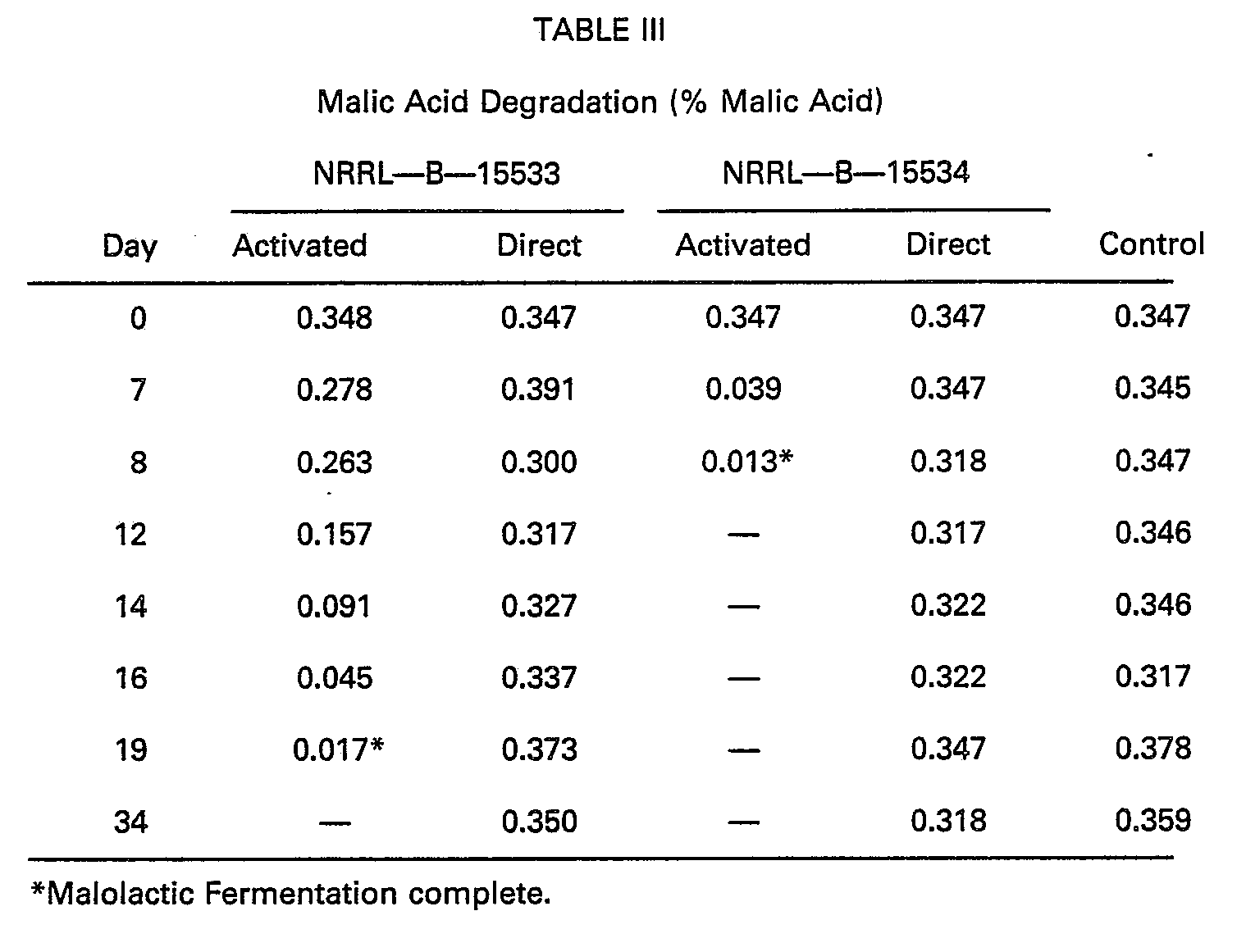
- As can be seen from the foregoing Example and Tables II and III, the activated method of the present invention provides a rapid method for the malic to lactic acid conversion. Leuconostoc oenos NRRL-B-15534 is especially fast (8 days) and for preserved cultures, both cultures are much faster than the prior art such as Silver J., et al (1981) cited previously.

Claims (14)
Priority Applications (1)
| Application Number | Priority Date | Filing Date | Title |
|---|---|---|---|
| AT83111786T ATE28214T1 (en) | 1983-10-19 | 1983-11-24 | MALOLACTIC FERMENTATION PROCESS. |
Applications Claiming Priority (2)
| Application Number | Priority Date | Filing Date | Title |
|---|---|---|---|
| US06/543,347 US4562077A (en) | 1983-10-19 | 1983-10-19 | Method for converting malic acid to lactic acid in wine |
| US543347 | 1983-10-19 |
Publications (2)
| Publication Number | Publication Date |
|---|---|
| EP0141878A1 EP0141878A1 (en) | 1985-05-22 |
| EP0141878B1 true EP0141878B1 (en) | 1987-07-08 |
Family
ID=24167623
Family Applications (1)
| Application Number | Title | Priority Date | Filing Date |
|---|---|---|---|
| EP83111786A Expired EP0141878B1 (en) | 1983-10-19 | 1983-11-24 | Improved malolactic fermentation method |
Country Status (7)
| Country | Link |
|---|---|
| US (1) | US4562077A (en) |
| EP (1) | EP0141878B1 (en) |
| AT (1) | ATE28214T1 (en) |
| AU (1) | AU561032B2 (en) |
| DE (1) | DE3372379D1 (en) |
| ES (1) | ES536846A0 (en) |
| NZ (1) | NZ206375A (en) |
Families Citing this family (12)
| Publication number | Priority date | Publication date | Assignee | Title |
|---|---|---|---|---|
| US4830968A (en) * | 1985-11-13 | 1989-05-16 | Thornton Roy J | Wine making inoculants and related means and methods |
| DE3605427A1 (en) * | 1986-02-20 | 1987-08-27 | Boehringer Ingelheim Kg | AGENTS AND METHODS FOR BIODIC ACID DEGRADING IN WINE OR MOST |
| EP0327380B1 (en) * | 1988-02-05 | 1994-08-10 | Unisearch Limited | Malolactic fermentation of wine |
| US5147666A (en) * | 1989-05-08 | 1992-09-15 | Kraft General Foods, Inc. | Removal of malic acid from coffee by fermentation |
| US5059431A (en) * | 1990-12-07 | 1991-10-22 | State Of Oregon Acting By And Through The State Board Of Higher Education On Behalf Of Oregon State University | Process for deacidifying wine |
| CH682155A5 (en) * | 1991-04-16 | 1993-07-30 | Nestle Sa | |
| US5607854A (en) * | 1992-04-01 | 1997-03-04 | Chr. Hansen A/S | Composition for inducing malolactic fermentation using Leuconostoc oenos strains accession numbers DSM 7008-DSM 7015 |
| US7112346B2 (en) | 1992-04-01 | 2006-09-26 | Chr. Hansen A/S | Method of inducing malolactic fermentation in wine or fruit juice by direct inoculation with a non-activated started culture |
| KR100316659B1 (en) * | 1998-12-28 | 2002-04-17 | 윤종용 | Photosensitive belt mounting device for printing press |
| EP2233559A1 (en) | 2003-06-26 | 2010-09-29 | Chr. Hansen A/S | Initiation of Fermentation |
| PT1664261E (en) | 2003-06-26 | 2010-11-18 | Chr Hansen As | Initiation of fermentation |
| US9382507B2 (en) * | 2008-07-16 | 2016-07-05 | Sandt Associates | Malolactic fermentation of wine |
Family Cites Families (9)
| Publication number | Priority date | Publication date | Assignee | Title |
|---|---|---|---|---|
| US2080138A (en) * | 1936-08-10 | 1937-05-11 | Ernst T Krebs | Method of aging wine |
| US2415431A (en) * | 1944-12-19 | 1947-02-11 | Ernst T Krebs | Method of processing wood for the rapid maturation and aging of table wines |
| FR1266086A (en) * | 1960-08-04 | 1961-07-07 | Method and device for the biological decomposition of malic acid in fermented and unfermented fruit and grape juices | |
| FR1407173A (en) * | 1964-06-16 | 1965-07-30 | Maison Amieux Freres | Preparation of lactic ferments of unlimited preservation, and products thus obtained |
| US3968256A (en) * | 1971-01-25 | 1976-07-06 | Sing Edmond L | Preparation of cottage cheese |
| US3843809A (en) * | 1972-08-23 | 1974-10-22 | E Luck | Manufacture of alcoholic beverages |
| US3975545A (en) * | 1975-06-16 | 1976-08-17 | Microlife Technics, Inc. | Stabilizing agents for frozen lactic acid producing bacteria compositions |
| ES480691A1 (en) * | 1979-05-18 | 1980-01-16 | Sinatinsa | Natural oak aroma for accelerating aging of alcoholic beverages |
| US4380552A (en) * | 1980-10-27 | 1983-04-19 | Novo Industri A/S | Method of deacidifying wine and composition therefor |
-
1983
- 1983-10-19 US US06/543,347 patent/US4562077A/en not_active Expired - Fee Related
- 1983-11-23 NZ NZ206375A patent/NZ206375A/en unknown
- 1983-11-24 AT AT83111786T patent/ATE28214T1/en not_active IP Right Cessation
- 1983-11-24 EP EP83111786A patent/EP0141878B1/en not_active Expired
- 1983-11-24 DE DE8383111786T patent/DE3372379D1/en not_active Expired
- 1983-11-29 AU AU21807/83A patent/AU561032B2/en not_active Ceased
-
1984
- 1984-10-18 ES ES536846A patent/ES536846A0/en active Granted
Non-Patent Citations (1)
| Title |
|---|
| CHEMICAL ABSTRACTS, vol. 72, No. 15, April 13, 1970, page 251, no. 77408h, COLUMBUS, OHIO, (US9. C.E. MALAN et al.: "Induction of malolactic fermentation in some wines of Piedmont". * |
Also Published As
| Publication number | Publication date |
|---|---|
| DE3372379D1 (en) | 1987-08-13 |
| ATE28214T1 (en) | 1987-07-15 |
| AU561032B2 (en) | 1987-04-30 |
| EP0141878A1 (en) | 1985-05-22 |
| ES8601298A1 (en) | 1985-10-16 |
| ES536846A0 (en) | 1985-10-16 |
| US4562077A (en) | 1985-12-31 |
| NZ206375A (en) | 1988-11-29 |
| AU2180783A (en) | 1985-04-26 |
Similar Documents
| Publication | Publication Date | Title |
|---|---|---|
| Lonvaud‐Funel et al. | Histamine production by wine lactic acid bacteria: isolation of a histamine‐producingstrain of Leuconostoc oenos | |
| Davis et al. | Practical implications of malolactic fermentation: a review | |
| King et al. | Metabolic interactions between Saccharomyces cerevisiae and Leuconostoc oenos in a model grape juice/wine system | |
| US4562077A (en) | Method for converting malic acid to lactic acid in wine | |
| AU620379B2 (en) | A method of inducing the decarboxylation of malic acid in must or fruit juice | |
| Kalmokoff et al. | Evaluation of ethanol tolerance in selected Saccharomyces strains | |
| US5059431A (en) | Process for deacidifying wine | |
| Jiménez et al. | Characterization of wine yeasts for ethanol production | |
| Izuagbe et al. | Characterization of Leuconostoc oenos isolated from Oregon wines | |
| Salih et al. | A survey of microbiological aspects of cider making | |
| Kitamoto et al. | Selection of killer yeasts (Kluyveromyces lactis) to prevent aerobic deterioration in silage making | |
| CN112760257A (en) | Lactobacillus plantarum strain YC21 and application thereof | |
| KR950006812B1 (en) | How to improve the quality of alcoholic beverages | |
| Edwards et al. | Lactobacillus spp. from Washington State wines: isolation and characterization | |
| US5607854A (en) | Composition for inducing malolactic fermentation using Leuconostoc oenos strains accession numbers DSM 7008-DSM 7015 | |
| Godtfredsen et al. | Occurrence of α-acetolactate decarboxylases among lactic acid bacteria and their utilization for maturation of beer | |
| US6284518B1 (en) | Synthetic media for the production of malolactic starter cultures | |
| Gao et al. | The degradation of malic acid by high density cell suspensions of Leuconostoc oenos | |
| US4021581A (en) | Culture of sour dough bacteria | |
| Van Oevelen et al. | Slime production by brewery strains of Pediococcus cerevisiae | |
| Nault et al. | Influence of pre-culture conditions on the ability of Leuconostoc oenos to conduct malolactic fermentation in wine | |
| US4547373A (en) | Wine preparation with new strains of Leuconostoc oenos | |
| CA1288364C (en) | Use of nisin to prevent spoilage of alcoholic beverages | |
| Dicks et al. | Identification of Leuconostoc oenos from South African fortified wines by numerical analysis of total soluble cell protein patterns and DNA‐DNA hybridizations | |
| Naouri et al. | Optimization of the conditions for preparing bacterial cultures for malolactic bioconversion |
Legal Events
| Date | Code | Title | Description |
|---|---|---|---|
| PUAI | Public reference made under article 153(3) epc to a published international application that has entered the european phase |
Free format text: ORIGINAL CODE: 0009012 |
|
| AK | Designated contracting states |
Designated state(s): AT BE CH DE FR GB IT LI LU NL SE |
|
| 17P | Request for examination filed |
Effective date: 19850730 |
|
| 17Q | First examination report despatched |
Effective date: 19860213 |
|
| GRAA | (expected) grant |
Free format text: ORIGINAL CODE: 0009210 |
|
| AK | Designated contracting states |
Kind code of ref document: B1 Designated state(s): AT BE CH DE FR GB IT LI LU NL SE |
|
| PG25 | Lapsed in a contracting state [announced via postgrant information from national office to epo] |
Ref country code: NL Effective date: 19870708 Ref country code: LI Effective date: 19870708 Ref country code: IT Free format text: LAPSE BECAUSE OF FAILURE TO SUBMIT A TRANSLATION OF THE DESCRIPTION OR TO PAY THE FEE WITHIN THE PRESCRIBED TIME-LIMIT;WARNING: LAPSES OF ITALIAN PATENTS WITH EFFECTIVE DATE BEFORE 2007 MAY HAVE OCCURRED AT ANY TIME BEFORE 2007. THE CORRECT EFFECTIVE DATE MAY BE DIFFERENT FROM THE ONE RECORDED. Effective date: 19870708 Ref country code: CH Effective date: 19870708 Ref country code: BE Effective date: 19870708 Ref country code: AT Effective date: 19870708 |
|
| REF | Corresponds to: |
Ref document number: 28214 Country of ref document: AT Date of ref document: 19870715 Kind code of ref document: T |
|
| PG25 | Lapsed in a contracting state [announced via postgrant information from national office to epo] |
Ref country code: SE Effective date: 19870731 |
|
| REF | Corresponds to: |
Ref document number: 3372379 Country of ref document: DE Date of ref document: 19870813 |
|
| ET | Fr: translation filed | ||
| REG | Reference to a national code |
Ref country code: CH Ref legal event code: PL |
|
| PG25 | Lapsed in a contracting state [announced via postgrant information from national office to epo] |
Ref country code: LU Free format text: LAPSE BECAUSE OF NON-PAYMENT OF DUE FEES Effective date: 19871130 |
|
| NLV1 | Nl: lapsed or annulled due to failure to fulfill the requirements of art. 29p and 29m of the patents act | ||
| PLBE | No opposition filed within time limit |
Free format text: ORIGINAL CODE: 0009261 |
|
| STAA | Information on the status of an ep patent application or granted ep patent |
Free format text: STATUS: NO OPPOSITION FILED WITHIN TIME LIMIT |
|
| 26N | No opposition filed | ||
| PGFP | Annual fee paid to national office [announced via postgrant information from national office to epo] |
Ref country code: FR Payment date: 19881116 Year of fee payment: 6 |
|
| PG25 | Lapsed in a contracting state [announced via postgrant information from national office to epo] |
Ref country code: GB Effective date: 19891124 |
|
| GBPC | Gb: european patent ceased through non-payment of renewal fee | ||
| PG25 | Lapsed in a contracting state [announced via postgrant information from national office to epo] |
Ref country code: FR Effective date: 19900731 |
|
| PG25 | Lapsed in a contracting state [announced via postgrant information from national office to epo] |
Ref country code: DE Effective date: 19900801 |
|
| REG | Reference to a national code |
Ref country code: FR Ref legal event code: ST |