EP0140116A1 - A 6-fluoro-1,4-dihydro-4-oxo-7-substituted piperazinyl-quinoline-3-carboxylic acid derivative and the method for preparing the same - Google Patents
A 6-fluoro-1,4-dihydro-4-oxo-7-substituted piperazinyl-quinoline-3-carboxylic acid derivative and the method for preparing the same Download PDFInfo
- Publication number
- EP0140116A1 EP0140116A1 EP84111035A EP84111035A EP0140116A1 EP 0140116 A1 EP0140116 A1 EP 0140116A1 EP 84111035 A EP84111035 A EP 84111035A EP 84111035 A EP84111035 A EP 84111035A EP 0140116 A1 EP0140116 A1 EP 0140116A1
- Authority
- EP
- European Patent Office
- Prior art keywords
- dihydro
- carboxylic acid
- lower alkyl
- alkyl group
- carbon atoms
- Prior art date
- Legal status (The legal status is an assumption and is not a legal conclusion. Google has not performed a legal analysis and makes no representation as to the accuracy of the status listed.)
- Granted
Links
- 0 C*NC=C(*)C(c(cc1C)*(C)c(C)c1N1CC(C)(*)*(C)C(C)C1)=O Chemical compound C*NC=C(*)C(c(cc1C)*(C)c(C)c1N1CC(C)(*)*(C)C(C)C1)=O 0.000 description 1
Classifications
-
- C—CHEMISTRY; METALLURGY
- C07—ORGANIC CHEMISTRY
- C07D—HETEROCYCLIC COMPOUNDS
- C07D401/00—Heterocyclic compounds containing two or more hetero rings, having nitrogen atoms as the only ring hetero atoms, at least one ring being a six-membered ring with only one nitrogen atom
- C07D401/02—Heterocyclic compounds containing two or more hetero rings, having nitrogen atoms as the only ring hetero atoms, at least one ring being a six-membered ring with only one nitrogen atom containing two hetero rings
-
- C—CHEMISTRY; METALLURGY
- C07—ORGANIC CHEMISTRY
- C07D—HETEROCYCLIC COMPOUNDS
- C07D215/00—Heterocyclic compounds containing quinoline or hydrogenated quinoline ring systems
- C07D215/02—Heterocyclic compounds containing quinoline or hydrogenated quinoline ring systems having no bond between the ring nitrogen atom and a non-ring member or having only hydrogen atoms or carbon atoms directly attached to the ring nitrogen atom
- C07D215/16—Heterocyclic compounds containing quinoline or hydrogenated quinoline ring systems having no bond between the ring nitrogen atom and a non-ring member or having only hydrogen atoms or carbon atoms directly attached to the ring nitrogen atom with hetero atoms or with carbon atoms having three bonds to hetero atoms with at the most one bond to halogen, e.g. ester or nitrile radicals, directly attached to ring carbon atoms
- C07D215/48—Carbon atoms having three bonds to hetero atoms with at the most one bond to halogen
- C07D215/54—Carbon atoms having three bonds to hetero atoms with at the most one bond to halogen attached in position 3
- C07D215/56—Carbon atoms having three bonds to hetero atoms with at the most one bond to halogen attached in position 3 with oxygen atoms in position 4
Definitions
- the present invention relates to novel 6-fluoro-1, 4-dihydro-4-oxo-7-substituted piperazinylquinoline-3-carboxylic acid derivatives which have an excellent antibacterial effect, and its pharmacologically acceptable salts and process for preparing the same.
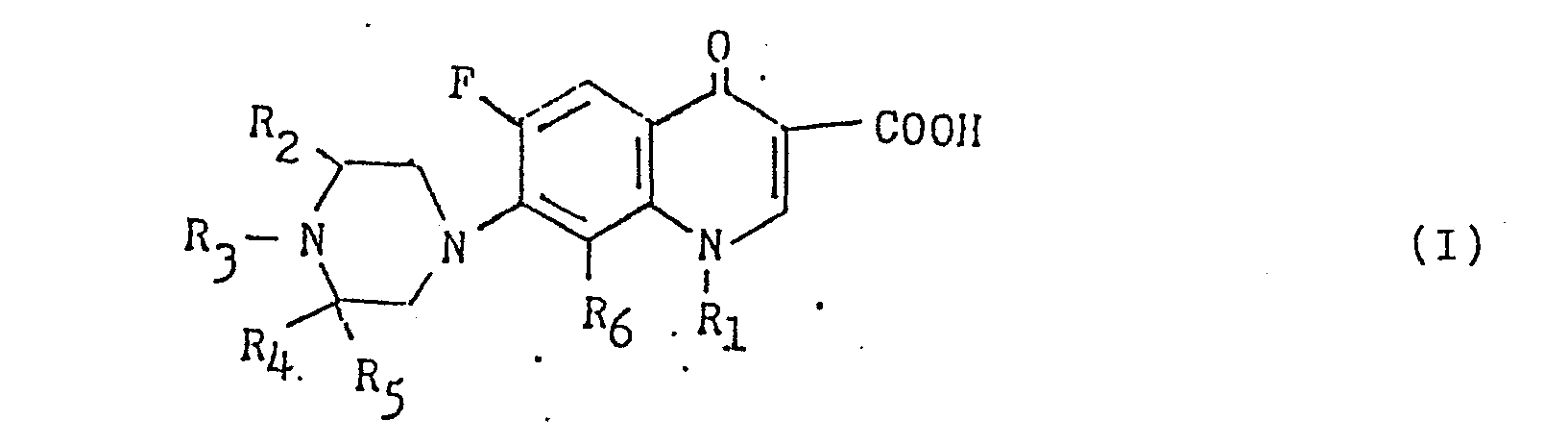
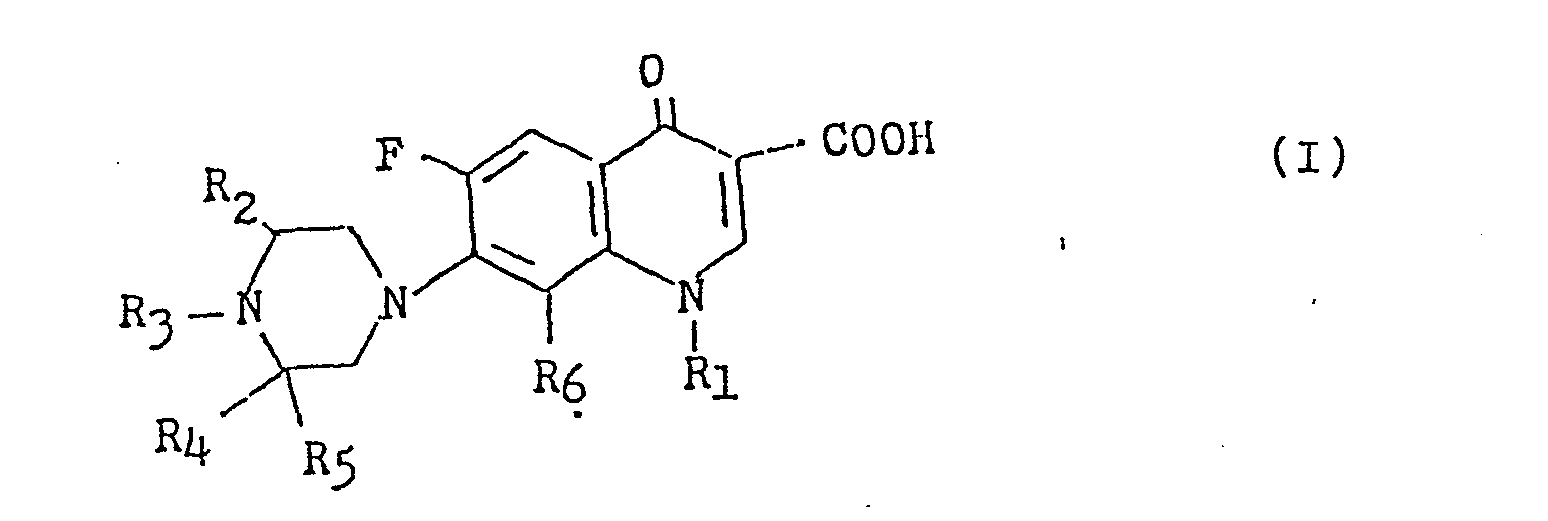
- the present invention relates to novel 6-fluoro-1, 4-dihydro-4-oxo-7-substituted pipera- zinylquinoline-3-carboxylic acid derivatives represented by the general formula (I), wherein R 1 is a lower alkyl group having 1 to 4 carbon atoms, a vinyl group, a 2-fluoroethyl group or a 2-hydroxyethyl group; R 2 , R 3 and R 4 each is a hydrogen atom or a lower alkyl group having each 1 to 4 carbon atoms; R 5 is a lower alkyl group having 1 to 4 carbon atoms and R 6 is a hydrogen atom or a fluorine atom, and its pharmacologically acceptable salt and process for preparing the same.
- R 1 is a lower alkyl group having 1 to 4 carbon atoms, a vinyl group, a 2-fluoroethyl group or a 2-hydroxyethyl group
- R 2 , R 3 and R 4 each is a
- norfloxacin The Merck Index, 10th Edition, 6541
- norfloxacin The Merck Index, 10th Edition, 6541
- It has the chemical fomula (III) as shown below and used for the clinical treatment of infections impetigo, phlegmon, subcutaneous abscess or tonsillitis.
- the present inventors studied therfore for finding out a more effective antibacterial and discovered that the compounds represented by the above-mentioned general formula (I) are more effective as an antibacterial medicine compared with pipemidic acid (II) and norfloxacin (III) and excellent in its rate of urinary excretion as well as in its low toxicity.
- the present invention is based on this finding.
- the lower alkyl group represented by R 1 - R 5 in the general formula (I) includes, for example, methyl, ethyl, propyl, isopropyl, butyl, isobutyl and tert-butyl groups, especialy methyl and ethyl groups.
- Pharmacologically acceptable salts of the compound having the said gerenal formula (I) are acid addition salts or alkali addition salts.
- the former includes mineral acid salts such as hydrocloride, sulfate, nitrate, hydrobromide, hydroiodide, phosphate, etc.; or organic acid salts such as acetate, maleate, fumarate, citrate, or tartarate, etc.
- the latter includes inorganic alkali salts such as sodium, potassium, calcium or ammonium salt, etc.; or organic base salts such as ethanolamine salt or N, N-dialkyl ethanolamine salt, etc.
- Non-limiting examples of the compounds of this invention include.
- novel compounds 6-fluoro-1, 4-dihydro-4-oxo-7-substituted piperazinylquino- line-3-carboxylic acids, represented by the gerenal formula (I) can be prepared by various methods.
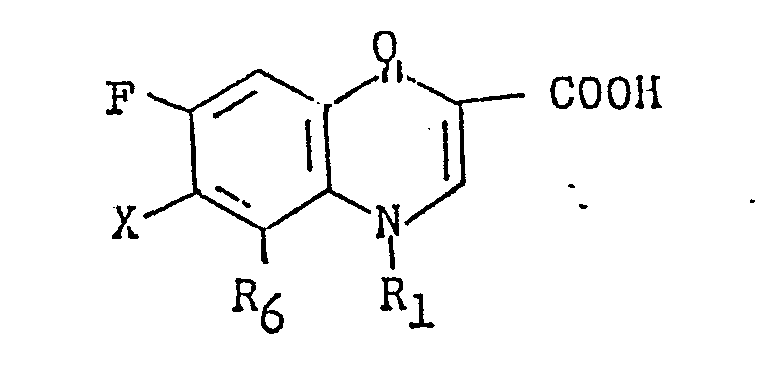
- the compound having the said formula (I) is obtained by reacting a 6-fluoro-7-halogeno-1, 4-dihy-dro-4-oxoquinoline-3-carboxylic acid having the following general formula (IV), wherein R 1 and R 6 each has the same meaning as that described above, while X is a chlorine atom or a fluorine atom, with a piperazine derivative represented by the following gerenal formula (V), wherein R 2 , R 3 , R 4 and R 5 each has the same meaning as that described above, in the presence or absence of a solvent.
- IV 6-fluoro-7-halogeno-1, 4-dihy-dro-4-oxoquinoline-3-carboxylic acid having the following general formula (IV), wherein R 1 and R 6 each has the same meaning as that described above, while X is a chlorine atom or a fluorine atom, with a piperazine derivative represented by the following gerenal formula (V), wherein R 2 , R 3
- the salvent used in the process of this invention is, for exmple, water, alcohols such as butanol, 3-methoxy butanol or isoamyl alcohol; ethers such as ethylene glycol dimethyl ether (monoglyme), diethylene glycol dimethyl ether (digly- me), triethylene glycol dimethyl ether (triglyme); aprotic polar solvents such as dimethyl formamide, dimethyl sulfoxide or hexamethyl phosphoric triamide; aromatic hydrocarbons such as benzene or toluene; or organic bases such as pyridine, picoline, lutidine, collidine or triethyl-amine.
- alcohols such as butanol, 3-methoxy butanol or isoamyl alcohol
- ethers such as ethylene glycol dimethyl ether (monoglyme), diethylene glycol dimethyl ether (digly- me), triethylene glycol dimethyl ether (triglyme)
- reaction is to be carried out within the temperature range from room temperature to 200 C, preferably from 100 to 180°C.
- a 6-fluoro-7-halo- geno-1, 4-dihydro-4-oxoquinoline-3-crboxylic acid having the general formula (IV) is, for instance, those already disclosed in Japanease Patent Publication (unexamined) No. 141286/1978, Japanese Patent Pubulication (unexamined) No. 47658/1980 and Japanese Patent Publication (unexamined) No. 30964/1981.
- the piperazine derivative having the general formula (V) are also a known substance and disclosed in, for example, U.S. Patent No. 2,780,625 and South Africa Patent No. 6,807,552.
- the inventive compound represented by the general formula (I) is prepared by hydrolyzing a 6-fluoro-1, 4-dihydro-4-oxo-7-substituted piperazinylquinoline-3-carboxylic acid ester derivative represented by the following general formula (VI), wherein R 1 , R 2 , R 3 , R 4 , R 5 and R 6 each has the same meaning as that described above and R 7 is s lower alkyl group having 1 through 4 carbon atoms.
- the hydrolysis is carried out according to the known method using an acid such as hydrochloric acid or sulfuric acid; or an alkali such as sodium hydroxide or potassium hydroxide.
- acids or alkalis can be used for the hydrolysis in the form of aqueous solutions, ethanol or methanol solutions or solutions of aqueous organic solvents.
- the reaction is to be carried out at a temperature within the range from the room temperature to the reflux temperature of the solvent used.
- a 6-fluoro-1, 4-dihydro-4-oxo-7-substituted piperazinylquinoline-3-carboxylic acid ester derivative is a novel substance and a method for its preparation is described in the following examples for reference.
- the compound represented by the general formula (I) is prepared by using a 6-fluoro-1, 4-dihydro-4-oxo-7-substituted piperazinyl-quinoline-3-carboxylic acid derivative having the following general formula (VII), wherein R1, R 2 , R 4 , R 5 and R 6 each has the same meaning as that descrived above.
- This formula is the same as the said formula (I) except that R 3 is replaced with a hydrogen atom.
- the above derivative is reacted with a carbonyl compound represented by the following gerenal formula (VIII), wherein R 8 is a hydrogen atom or a lower alkyl group having 1 through 3 carbon atoms, in the presence of formic acid.
- Examples of the carbonyl compound having the general formula (VIII) are formaldehyde, acetaldehyde and propionaldehyde.
- Formaldehyde is used preferably in the form of its aqueous solution (formalin).
- acetaldehyde or propionaldehyde it is desirable to use nitrobenzene as a solvent for the reaction.
- the reaction is carried out at a temperature within the range of 100 to 200"C, preferably at the reflux temperature of the reaction solvent used.
- the compound represented by the general formula (I) is prepared by reactng a 6-fluoro-l, 4-dihydro-4-oxo-7-substituted piperazinylquinoline-3-carboxylic acid deivative having the general formula (VII) with a alkyl halogenide represented by the general formula (IX).
- R 3 has the same meaning as that described above and A is a halogen atom, in a solvent in the presence or absence of a bace as a deoxydizing agent.
- the solvent used in this reaction can be any kind so far it does not inhibit the reaction.
- the examples are acetone, ethanol, ether, tetrahydrofuran, dimethylformamide, dioxane, benzene, toluene or chloroform.
- deoxydizing agent that can be used in the present invention is, for example, triethylamine, pyridine or potassium carbonate.
- the reaction is carried out at a temperature within the range from the room temperature to the reflux temperature of the solvent used, preferably at 50 to 100 C.
- novel compound a 6-fluoro-1, 4-dihydro-4-oxo-7- substituted piperazinylquinoline-3-carboxylic acid dirivatives represented by the general formula (I) and its pharmacologically acceptable salt, that are obtained according to the methods described so far, have an antibacterial effect against both gram-positive and gram- negative microorganisms and are very useful as medicines.
- MIC Minimum inhibitory concentrations
- mice of ddY strain Male mice of ddY strain, 4 weeks old, were used at 10 animals at a group.Test compounds suspended in 0.5% carboxymethyl cellulose were administered per os(p.o.) in mice.
- test compounds were solved in O.lN-HCl solution and neutralized with O.lN-NaOH solution.
- LD 50 was determined by the Probit method from dead animals with 10 days . The results are shown in Table 3.
- the compounds of the invention are very usefull as a medicine for clinical usage because of the superior pharmaceutical effects, as excellent absorption, and of the lower toxity.
- the present compound is much safer than traditionally marketed medicine and considered to be highly useful as a clinical medicine.
- 1000 mg is to be orally adiministered by dividing the amount into
Landscapes
- Chemical & Material Sciences (AREA)
- Organic Chemistry (AREA)
- Pharmaceuticals Containing Other Organic And Inorganic Compounds (AREA)
Abstract
Description
- The present invention relates to novel 6-fluoro-1, 4-dihydro-4-oxo-7-substituted piperazinylquinoline-3-carboxylic acid derivatives which have an excellent antibacterial effect, and its pharmacologically acceptable salts and process for preparing the same.
- More particularly, the present invention relates to novel 6-fluoro-1, 4-dihydro-4-oxo-7-substituted pipera- zinylquinoline-3-carboxylic acid derivatives represented by the general formula (I),

- So far, as antibacterial medicines, those of pyridone carboxylic acids have been widely used. For example, nalidi- xic acid, piromidic acid, pipemidic acid and cinoxacine have been marketed for the clinical treatment of urinary tract infection, intestinal infection and cholangia infection. The most effective and widely used antibacterial among these is pipemidic acid (The Merck Index, 10th Edition, 7332) represented by the following formula (II):
-

- Recently, norfloxacin (The Merck Index, 10th Edition, 6541) was synthesized to improve the antibacterial effect of pipe-midic acid and to expand its antibacterial spectrum. It has the chemical fomula (III) as shown below and used for the clinical treatment of infections impetigo, phlegmon, subcutaneous abscess or tonsillitis.

- However, such marketed antibacterials were unsatis- factory as they had to be applied in large quantities so that their continuous and long-term administration could cause adverse side-effects for example,gastrointestinal function disorder.
- The present inventors studied therfore for finding out a more effective antibacterial and discovered that the compounds represented by the above-mentioned general formula (I) are more effective as an antibacterial medicine compared with pipemidic acid (II) and norfloxacin (III) and excellent in its rate of urinary excretion as well as in its low toxicity.
- The present invention is based on this finding.
- In this invention the lower alkyl group represented by R1 - R5 in the general formula (I) includes, for example, methyl, ethyl, propyl, isopropyl, butyl, isobutyl and tert-butyl groups, especialy methyl and ethyl groups.
- Pharmacologically acceptable salts of the compound having the said gerenal formula (I) are acid addition salts or alkali addition salts. The former includes mineral acid salts such as hydrocloride, sulfate, nitrate, hydrobromide, hydroiodide, phosphate, etc.; or organic acid salts such as acetate, maleate, fumarate, citrate, or tartarate, etc. The latter includes inorganic alkali salts such as sodium, potassium, calcium or ammonium salt, etc.; or organic base salts such as ethanolamine salt or N, N-dialkyl ethanolamine salt, etc.
- Non-limiting examples of the compounds of this invention include.
- (1). l-Ethyl-6, 8-difluoro-1, 4-dihydro-7-(3-methyl-l-piperazinyl)-4-oxoquinoline-3-carboxylic acid.
- (2). l-Ethyl-6, 8-difluoro-1, 4-dihydro-7-(3-methyl-l-piperazinyl)-4-oxoquinoline-3-carboxylic acid hydrochloride.
- (3). l-Ethyl-6-fluoro-1, 4-dihydro-7-(3-methyl-l-piperazinyl)-4-oxoquinoline-3-carboxylic acid hydrochloride.
- (4). 6-Fluoro-1-(2-fluoroethyl)-1, 4-dihydro-7-(3-methyl-l-piperazinyl)-4-oxoquinoline-3-carboxylic acid.
- (5). 6, 8-Difluoro-l-(2-fluoroethyl)-l, 4-dihydro-7-(3-methyl-1-piperazinyl)-4-oxoquinoline-3-carboxylic acid.
- (6). 6, 8-Difluoro-1, 4-dihydro-7-(3-methyl-1-piperazinyl)-4-oxo-l-vinylquinoline-3-carboxylic acid.
- (7). 6, 8-Difluoro-1, 4-dihydro-l-methyl-7-(3-methyl-l-piperazinyl)-4-oxoquinoline-3-carboxylic acid.
- According to the present invention the novel compounds, 6-fluoro-1, 4-dihydro-4-oxo-7-substituted piperazinylquino- line-3-carboxylic acids, represented by the gerenal formula (I) can be prepared by various methods.
- In the first method, the compound having the said formula (I) is obtained by reacting a 6-fluoro-7-halogeno-1, 4-dihy-dro-4-oxoquinoline-3-carboxylic acid having the following general formula (IV),


- The salvent used in the process of this invention is, for exmple, water, alcohols such as butanol, 3-methoxy butanol or isoamyl alcohol; ethers such as ethylene glycol dimethyl ether (monoglyme), diethylene glycol dimethyl ether (digly- me), triethylene glycol dimethyl ether (triglyme); aprotic polar solvents such as dimethyl formamide, dimethyl sulfoxide or hexamethyl phosphoric triamide; aromatic hydrocarbons such as benzene or toluene; or organic bases such as pyridine, picoline, lutidine, collidine or triethyl-amine.
- The above mentioned reaction is to be carried out within the temperature range from room temperature to 200 C, preferably from 100 to 180°C.
- The starting material of this method, a 6-fluoro-7-halo- geno-1, 4-dihydro-4-oxoquinoline-3-crboxylic acid having the general formula (IV), is, for instance, those already disclosed in Japanease Patent Publication (unexamined) No. 141286/1978, Japanese Patent Pubulication (unexamined) No. 47658/1980 and Japanese Patent Publication (unexamined) No. 30964/1981.
- The piperazine derivative having the general formula (V) are also a known substance and disclosed in, for example, U.S. Patent No. 2,780,625 and South Africa Patent No. 6,807,552.
- According to the second method, the inventive compound represented by the general formula (I) is prepared by hydrolyzing a 6-fluoro-1, 4-dihydro-4-oxo-7-substituted piperazinylquinoline-3-carboxylic acid ester derivative represented by the following general formula (VI),

- The hydrolysis is carried out according to the known method using an acid such as hydrochloric acid or sulfuric acid; or an alkali such as sodium hydroxide or potassium hydroxide.
- These acids or alkalis can be used for the hydrolysis in the form of aqueous solutions, ethanol or methanol solutions or solutions of aqueous organic solvents.
- The reaction is to be carried out at a temperature within the range from the room temperature to the reflux temperature of the solvent used.
- The starting material of the said method, a 6-fluoro-1, 4-dihydro-4-oxo-7-substituted piperazinylquinoline-3-carboxylic acid ester derivative is a novel substance and a method for its preparation is described in the following examples for reference.
- In the third method of the present invention, the compound represented by the general formula (I) is prepared by using a 6-fluoro-1, 4-dihydro-4-oxo-7-substituted piperazinyl-quinoline-3-carboxylic acid derivative having the following general formula (VII),


- Examples of the carbonyl compound having the general formula (VIII) are formaldehyde, acetaldehyde and propionaldehyde. Formaldehyde is used preferably in the form of its aqueous solution (formalin). In case of acetaldehyde or propionaldehyde, it is desirable to use nitrobenzene as a solvent for the reaction.
- The reaction is carried out at a temperature within the range of 100 to 200"C, preferably at the reflux temperature of the reaction solvent used.
- According to the fourth method of the present invention, the compound represented by the general formula (I) is prepared by reactng a 6-fluoro-l, 4-dihydro-4-oxo-7-substituted piperazinylquinoline-3-carboxylic acid deivative having the general formula (VII) with a alkyl halogenide represented by the general formula (IX).

- The solvent used in this reaction can be any kind so far it does not inhibit the reaction. The examples are acetone, ethanol, ether, tetrahydrofuran, dimethylformamide, dioxane, benzene, toluene or chloroform.
- As a deoxydizing agent that can be used in the present invention is, for example, triethylamine, pyridine or potassium carbonate.
- The reaction is carried out at a temperature within the range from the room temperature to the reflux temperature of the solvent used, preferably at 50 to 100 C.
- The novel compound, a 6-fluoro-1, 4-dihydro-4-oxo-7- substituted piperazinylquinoline-3-carboxylic acid dirivatives represented by the general formula (I) and its pharmacologically acceptable salt, that are obtained according to the methods described so far, have an antibacterial effect against both gram-positive and gram- negative microorganisms and are very useful as medicines.
- The effect of antimicrobiological activity, antibacterial spectrum and urinary excretion are shown in Table 1 and 2 respectively as examples for representing the potentating pharmacological effect of the inventive compounds.
- The acute toxicity has been determined as shown in Table 3, whereby as a reference drug, norfloxacin, market product represented by formula (III), is used.
-
- Compound of Invention (Example 1)
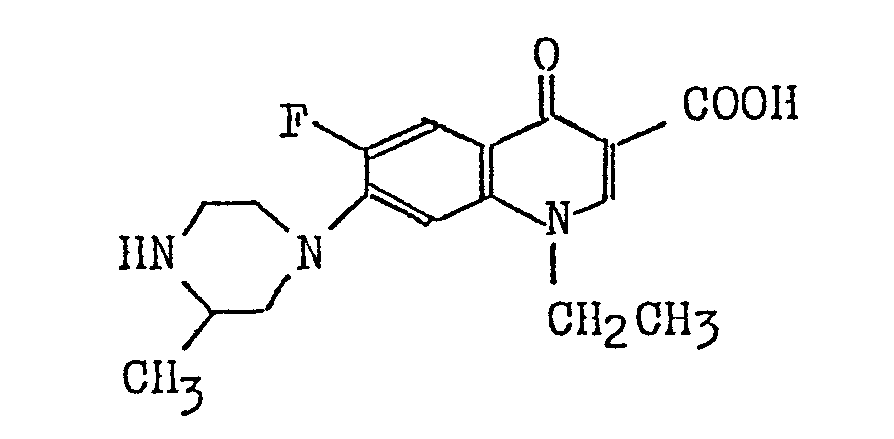
- Compound of Invention (Example 4)
-

- Compound of Invention (Example 16)
-

- Compound of Invention (Example 20)
-

-

- Minimum inhibitory concentrations (MIC) were determined by the twofold agar dilution method (Chemotherapy, 29(1), 76(1981)). Over night cultures in Mueller-Hinton broth were suspended by buffered saline gelatine. One loopful of the bacterial suspension(106 or 108 colony-forming units/ml) was inocubated onto the test compound containing plates. The plates were incubated for 18hrs. at 37°C. The MIC was the lowest concentration of the drug that inhibited visible growth. The results are shown in Table 1.


- Male rats of SD strain, weghing 180 -210g, were used at 8 animals at a group.Test compounds suspended in 0.5% carboxymethyl cellulose were administered per os to 24 hr- fasted rats at dose of 20mg/Kg.Urine was pooled from 0 to 6 hrs. and 6 to 24hrs, and urinary excretion was measured by bioassay using Escherichia coli NIHJ-JC-2. The results are shown Table 2.
- Bioassay:
- The assay method employed was the cup-plate method using Escherichia coli NIHJ-JC-2.Urine was appropriately diluted with 1/15M phosphate buffer pH7.0,before assay if necessary. Standard calibration lines were made in 1/15M phosphate buffer pH 7.0.

- Male mice of ddY strain, 4 weeks old, were used at 10 animals at a group.Test compounds suspended in 0.5% carboxymethyl cellulose were administered per os(p.o.) in mice. In the case of intraveneous(i.v.) administration, test compounds were solved in O.lN-HCl solution and neutralized with O.lN-NaOH solution. LD 50 was determined by the Probit method from dead animals with 10 days .The results are shown in Table 3.

- It is clearly seen from the results above that the compounds of this invention exibit potent effect of urinary excretion and excelent lower toxicity as compared to reference drug.
- Further, the antibacterial spectrum showns that the compounds of the invention exihibit approximately equall to reference drug.
- Therefore, it is clear that the compounds of the invention are very usefull as a medicine for clinical usage because of the superior pharmaceutical effects, as excellent absorption, and of the lower toxity.
- Thus, the present compound is much safer than traditionally marketed medicine and considered to be highly useful as a clinical medicine.
- Necessary amount Normally, a total of 150 -
- for treatment : 1000 mg is to be orally adiministered by dividing the amount into
- 2-4 times per day per adult. This preparation of the compound of the invention is further explained hereinbelow with the examples, which are given by way of illustration only and not to be considered as limitting.
- A mixture of 15.00g of 7-chloro-l-ethyl-6-fluoro-l, 4-dihydro-4-oxoquinoline-3-carboxylic acid, 16.70g of 2- metylpiperazine and 70 ml of pyridine was heated for 14 hours under reflux. The solvent of the reaction mixture was evaporated and the residue was acidified with 50% aqueous acetic acid. The solution was treated with activated carbon and neutralized with 20% aqueous sodium hydroxide. Then, the solution was treated with activated carbon again, and concentrated. The precipitate was filtered and dissolved in ethanol. The solution was acidified with ethanolic hydrogen chloride and concentrated. The precipitate was filtered and recrystallized from aqueous ethanol to give 8.19 g of hydrochloride of the title compound as pale yellow needles, M.p.) 300°C.
- Analysis for C17H20FN3O3 . HC1
-

- A mixture of 2.69 g of 1-ethyl-6-fluoro-1,4-dihydro-7-(3-methyl-l-piperazinyl)-4-oxoquinoline-3-carboxylic aid hydrochloride, 5.4 ml 90% formic acid, 3.5 ml of 37% formalin and 0.70 g of potassium carbonate was heated for 5 hours under reflux. The reaction mixture was neutralized with 20% aqueous sodium hydroxide. The precipitate was filtered and recrystallized from a mixture of chloroform and methanol to give 1.70g of the title compound as colorless needles, M.p.244-246°C.
- Analysis for C 18 H 22 FN 3 0 3
-

- A solution of 1.00 g of 1-ethyl-6-fluoro-1, 4-dihydro-7-(3-methyl-l-piperazinyl)-4-oxoquinoline-3-carboxylic acid hydrochloride, 1.29 g of ethyl iodide and 1.09 g of triethylamine in 20 ml of N, N-dimethylformamide was heated at 70 to 80°C for 1.5 hours. The solvent of the reaction mixture was evaporated and the residue was acidified with 50% aqueous acetic acid. The solution was neutralized with 20% aqueous sodium hydroxide and the precipitate was filtered. The precipitate was chromatographed on silica gel using chloroform-methanol (9:1) as eluent to give 0.47 g of the title compound as colorless crystalls, which was recrystal-lized from a mixture of chloroform and methanol as colorless needles, M.p. 203-205°C.
- Analysis for C19H24FN3O3
-

- A mixture of 1.00g of 1-ethyl-6,7,8-trifluoro-1,4-dihydro-4-oxoquinoine-3-carboxlic acid, 1.10 g of 2-methylpiperazine and 10 ml of pyridine was heated for 15 minutes under reflux. The reaction mixture was evaporated and methanol was added to the residue. The precipitate was filtered and recrystallized from ethanol to give 0.36 g of the title compound as colorless needles, M.p. 239-240.5 C.
- Analysis for C 17 H 19 F 2 N 3 0 3
-

- Analysis for C17H19F2N3O3.HCl

- A mixture of 1.40 g of 1-ethyl-6,8-difluoro-1,4-dihydro-7-(3-methyl-l-piperazinyl)-4-oxoquinoline-3-carboxylic acid, 2.8 ml of 90% formic acid and 2.2 ml of 37% formalin was heated for 4 hours under reflux. The reaction mixture was evaporated and the residue was dissolved in water. The solution was neutralized with aqueous sodium bicarbonate. The precipitate was filtered and recrystallized from ethanol to give 0.32 g of the title compound as colorless needles, M.p. 211.5-212°C.
- Analysis for C18H21F2N3O3
-

-
- a) To a solution of 0.55 g of ethyl l-ethyl-6, 8-difluoro-1, 4-dihydro-7-(3-methyl-l-piperazinyl)-4-oxoquinoline-3-carboxylate in 5.5 ml of ethanol 11 ml of 18% hydrochloric acid was added and the mixture was heated for 4 hours under reflux. The precipitate was filtered and washed with ethanol and ether. Recrystallization from water gave 0.43 g of hydrochloride of the title compound as colorless needles. This compound was identical with NMR and IR spectra of which prepard in example 4.
- b) Ethyl l-ethyl-6, 8-difluoro-1, 4-dihydro-7-(3-methyl-l-piperazinyl)-4-oxoquinoline-3-carboxylate used above was prepared as follow.
- A mixture of 1.50 g of ethyl l-ethyl-6, 7, 8-trifluoro-1, 4-dihydro-4-oxoquinoline-3-carboxylate, 1.50 g of 2-methylpiperazine and 5 ml of pyridine was heated for 3 hours under reflux. The solvent of the reaction mixture was evaporated and the residue was dissolved in chloroform. The solution was washed with water, dried and evaporated. The residue was recrystallized from a mixture of benzene and isopropyl ether to give 1.00 g of the title compound as colorless needles, M.p. 126.5-127.5°C.
- Analysis for C 19 H 23 F 2 N 3 0 3

- a) A mixture of 0.68 g of 6, 7, 8-trifluoro-l, 4-dihydro-l-isopropyl-4-oxoquinoline-3-crboxylic acid, 0.72 g of 2-methyl piperazine and 10 ml of pyridine was treated in the same manner as that described for example 4 to give 0.42 g of the title compound as colorless crystalls. M.p.217-218°C.
- Analysis for C18H21F2N3O3 . 1/2H 2 0

- b) 6, 7, 8-Trifluoro-l,4-dihydro-l-isopropyl-4-oxoquinoline-3-carboxylic acid used above was prepared as follows. 7.70 g of sodium borohydride was added to a mixture of 3.70 g of 2, 3, 4-trifluoroaniline, 10.30 g of sodium acetate, 20 ml of acetone, 19.6 ml of acetic acid and 39 ml of water under stirring and ice-cooling. After 2 hours, the reaction mixture was made alkaline with sodium carbonate andextracted with benzene. The extract was washed with NaCl saturated water, dried and the solvent was evaporated to give 3.17 g of 2, 3, 4-trifluoro-N-isopropyl aniline as colorless oil.

- A mixture of 2.50 g of 2, 3, 4-trifluoro-N-isopropylaniline and 2.80 g of diethyl 2-ethoxymethylenemalonate was heated for 1 hour at 160-170 C. Hexane was added to the reation mixture and then cooled.The crystalls were filtered to give 2.45 g of diethyl 2-(2, 3, 4-trifluoro-N-isopropylanilino) methyene malonate, which was recrystallized from hexane as colorlss needles, M.p. 92.5-93°C.
- Analysis for C17H20F3NO4

- A mixture of 9.00 g of diethyl 2-(2, 3, 4-trifluoro-N-isopropylanilino)methylenemalonate and 90.0 g of poly phosphoric acid was heated for 1 hour at 80-85°C under stirring. The reaction mixture was poured to ice-water and extracted with chloroform. The extract was washed with water, dried and the solvent was evaporated. A mixture of 90 ml of 18% hydrochloric acid and 45 ml of ethanol was added to the residue and refluxed for 1.5 hours.
- The precipitate was filtered and washed with ethanol to give 1.40 g of the title compound, which was recrystallized from a mixture of chloroform and ethanol as pale brown needles, M.p. 261-262.5 C.
- Analysis for C13H10F3NO3

- A mixture of 2.00 g of 1-ethyl-6,7,8-trifluoro-1,4-dihydro-4-oxoquinoline-3-carboxylic acid, 1.50 g of (R)-(-)-2-methylpiperazine([α]21° D -6.4° (c=1, ethanol)) and 15 ml of pyridine was heated for 15 minutes under reflux. After completion of the reaction, the solvent was evaporated and the residue was dissolved in 10% hydrochloric acid. The solution was neutralized with aqueous sodium bicarbonate. The precipitate was filtered, dried and dissolved in a mixture of chloroform and methanol. The solution was acidified with ethanolic hydrogen chloride. The precipitate was filtered and dissolved in water. The solution was neutralized with aqueous sodium bicarbonate and the precipi-tate was filtered to give 1.72 g of the title compound, which was recrystallized from a mixture of chloroform and ethanol as colorless needles, M.p. 244.5-245.5 C, [α]21° D +39.5 (c=l, chloroform).
- Analysis for C 17 H 19 F 2 N 3 0 3
-

- A mixture of 1.50 g of 7-chloro-6-fluoro-l-(2-fluoroethyl)-1,4-dihydro-4-oxoquinoline-3-carboxylic acid, 1.60 g of 2-methylpiperazine and 8ml of pyridine was heated for 11 hours under reflux. The solvent of the reaction mixture was evaporated and the residue was dissolved in hot water. After cooling of the solution, the precipitate was filtered and recrystallized from ethanol to give 0.62 g of the title compound as colorless needles, M.p. 226-227 C.
- Analysis for C17H19F2N3O3
-


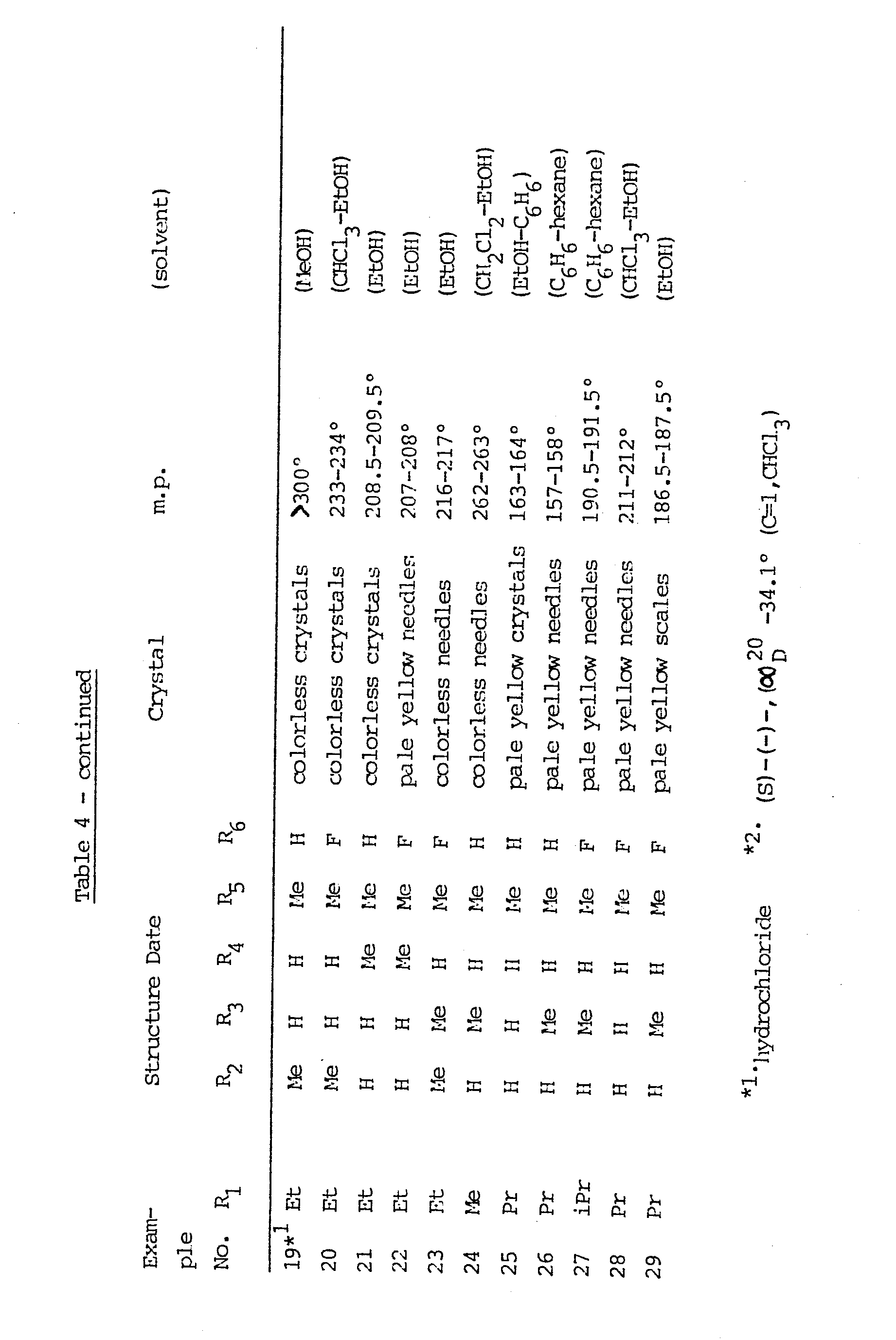

- A mixture of 700 mg of 6, 7, 8-trfluoro-1, 4-dihydro-l-methyl-4-oxoqinoline-3-carboxylic acid, 930 mg of 1, 2-dimethylpiperazine and 5 ml of pyridine was heated for 20 minutes under reflux. The reaction mixture was evaporated and the residue was dissolved in a mixture of chloroform and methanol. The solution was acidified with ethanolic hydrogen chloride. Then the precipitate was filtered and dissolved in water. The solution was neutralized with sodium bicarbonate and extracted with chloroform. The extract was washed with water, dried and evaporated. Methanol was added to the residue and the precipitate was filtered to gine 730 mg of the disired compound, which was recrystallized from a mixture of chloroform and ethanol as colorless needles, M.p. 231-232.5°C.
- Analysis for C 17 H 19 F 2 N 3 0 3
-

- yellow needles, M. p. 178-179°C(EtOH) Analysis for C 18 H 19 F 2 N 3 0 3
-

- pale yellow needles, M. p. 238.5-239.5°C(CHCl3-EtOH) Analysis for C 18 H 21 F 2 N 3 0 3
-

- colorless scales, M. p. 224.5-225°C(CHCl3-EtOH) Analysis for C18H20F3N3O3
-

Claims (13)
- (1). A 6-fluoro-1, 4-dihydro-4-oxo-7-substituted piperazinyl- quinoline-3-carboxylic acid derivative represented by the genenal formula (I)

- (2). l-Ethyl-6, 8-difluoro-1, 4-dihydro-7-(3-methyl-l-piperazinyl)-4-oxoquinoline-3-carboxylic acid.
- (3). l-Ethyl-6, 8-difluoro-1, 4-dihydro-7-(3-methyl-l-piperazinyl)-4-oxoquinoline-3-carboxylic acid hydrochloride.
- (4). l-Ethyl-6-fluoro-l, 4-dihydro-7-(3-methyl-l-piperazinyl)-4-oxoquinoline-3-carboxylic acid hydrochloride.
- (5). 6-Fluoro-1-(2-fluoroethyl)-1, 4-dihydro-7-(3-methyl-l-piperazinyl)-4-oxoquinoline-3-carboxylic acid.
- (6). 6, 8-Difluoro-1-(2-fluoroethyl)-1, 4-dihydro-7-(3-methyl-1-piperazinyl)-4-oxoquinoline-3-carboxylic acid.
- (7). 6, 8-Difluoro-1, 4-dihydro-7-(3-methyl-l-piperazinyl)-4-oxo-l-vinylquinoline-3-carboxylic acid.
- (8). 6, 8-Difluoro-1, 4-dihydro-l-methyl-7-(3-methyl-l-piperazinyl)-4-oxoquinoline-3-carboxylic acid.
- (9). A process for preparing a 6-fluoro-1, 4-dihydro-4-oxo-7-substituted piperazinylquinoline-3-carboxylic acid derivatie represented by the general formula (I)and a pharmacologically acceptable salt thereof,

- (10). A process for preparing a 6-fluoro-1, 4-dihydro-4-oxo-7-substituted piperazinylquinoline-3-carboxylic acid derivative represented by the general formula (I) and a pharmacologically acceptable salt thereof,

- (11) A process for preparing a 6-fluoro-1, 4-dihydro-4-oxo-7-substituted piperazinylquinoline-3-carboxylic acid derivative represented by the general formula (I) and a pharmacologically-acceptable salt thereof,


- (12). A process for preparation of Claim (11) wherein a carbonyl compound represented by the general formula,

- (13). A process for preparation of Claim (11) wherein a alkyl halogenide represented by the general formula,

Priority Applications (1)
| Application Number | Priority Date | Filing Date | Title |
|---|---|---|---|
| AT84111035T ATE34573T1 (en) | 1983-09-19 | 1984-09-15 | A 6-FLUORO-1,4-DIHYDRO-4-OXO-7 SUBSTITUTED PIPERAZINYLQUINOLINE-3-CARBONIC ACID DERIVATIVE AND PROCESS FOR ITS PREPARATION. |
Applications Claiming Priority (6)
| Application Number | Priority Date | Filing Date | Title |
|---|---|---|---|
| JP17127183A JPS6064979A (en) | 1983-09-19 | 1983-09-19 | 7-piperazine-substituted-6-fluoro-4-oxo-1,4- dihydroquinoline-3-carboxylic acid derivative |
| JP171271/83 | 1983-09-19 | ||
| JP45664/84 | 1984-03-12 | ||
| JP4566484A JPS60190777A (en) | 1984-03-12 | 1984-03-12 | Optical active 6,8-difluoro-1,4-dihydro-4-oxo-7-substituted piperazinylquinoline-3-carboxylic acid derivative |
| JP12378084A JPS615075A (en) | 1984-06-18 | 1984-06-18 | 6-fluoro-1,4-dihydro-4-oxo-7-substituted piperazinyl quinoline-3-carboxylic acid derivative |
| JP123780/84 | 1984-06-18 |
Publications (2)
| Publication Number | Publication Date |
|---|---|
| EP0140116A1 true EP0140116A1 (en) | 1985-05-08 |
| EP0140116B1 EP0140116B1 (en) | 1988-05-25 |
Family
ID=27292329
Family Applications (1)
| Application Number | Title | Priority Date | Filing Date |
|---|---|---|---|
| EP84111035A Expired EP0140116B1 (en) | 1983-09-19 | 1984-09-15 | A 6-fluoro-1,4-dihydro-4-oxo-7-substituted piperazinyl-quinoline-3-carboxylic acid derivative and the method for preparing the same |
Country Status (13)
| Country | Link |
|---|---|
| US (1) | US4528287A (en) |
| EP (1) | EP0140116B1 (en) |
| KR (1) | KR870001016B1 (en) |
| AU (1) | AU553415B2 (en) |
| CA (1) | CA1238638A (en) |
| DE (1) | DE3433924A1 (en) |
| DK (1) | DK157997C (en) |
| ES (2) | ES8604565A1 (en) |
| FI (1) | FI80033C (en) |
| FR (1) | FR2555584B1 (en) |
| HK (1) | HK62191A (en) |
| HU (1) | HU193226B (en) |
| YU (1) | YU45204B (en) |
Cited By (8)
| Publication number | Priority date | Publication date | Assignee | Title |
|---|---|---|---|---|
| FR2655545A1 (en) * | 1989-12-11 | 1991-06-14 | Rhone Poulenc Sante | NOVEL THERAPEUTIC APPLICATION OF FLUOROQUINOLONE DERIVATIVES. |
| EP0461501A1 (en) * | 1990-06-14 | 1991-12-18 | Bayer Ag | Process for the preparation of quinoline carboxylic acids |
| EP0614364A4 (en) * | 1991-11-27 | 1994-10-19 | Sepracor Inc | METHODS AND COMPOSITIONS FOR TREATING INFECTIONS USING OPTICALLY PURE (S) -LOMEFLOXACIN. |
| US5532239A (en) * | 1993-08-02 | 1996-07-02 | Assistance Publique - Hopitaux De Paris | Therapeutic application of fluoroquinolone derivatives |
| EP0661974B1 (en) * | 1991-11-27 | 2000-09-06 | Sepracor, Inc. | Methods and compositions for treating infection using optically pure (r)-lomefloxacin |
| WO2001036408A1 (en) * | 1999-11-15 | 2001-05-25 | New Pharma Research Sweden Ab | Compounds with antibacterial and antiparasitic properties |
| EP1927589A1 (en) | 2006-11-30 | 2008-06-04 | Cadila Healthcare Ltd. | Quinoline derivatives |
| US7973022B2 (en) | 2006-02-17 | 2011-07-05 | Idexx Laboratories, Inc. | Fluoroquinolone carboxylic acid salt compositions |
Families Citing this family (24)
| Publication number | Priority date | Publication date | Assignee | Title |
|---|---|---|---|---|
| JPS5630964A (en) * | 1979-08-22 | 1981-03-28 | Kyorin Pharmaceut Co Ltd | Novel substituted quinolinecarboxylic acid and its preparation |
| JPS6212760A (en) * | 1984-12-14 | 1987-01-21 | Dai Ichi Seiyaku Co Ltd | 1-(2-halogenocyclopropyl)quinolinecarboxylic acid derivative |
| US4755513A (en) * | 1985-01-30 | 1988-07-05 | Otsuka Pharmaceutical Company, Limited | Antimicrobial 1-substituted phenyl-4-oxoquinoline-3-carboxylic acid compounds |
| US4578473A (en) * | 1985-04-15 | 1986-03-25 | Warner-Lambert Company | Process for quinoline-3-carboxylic acid antibacterial agents |
| ATE72668T1 (en) * | 1985-09-24 | 1992-03-15 | Hoffmann La Roche | QUINOLINE DERIVATIVES. |
| HU196782B (en) * | 1985-12-09 | 1989-01-30 | Chinoin Gyogyszer Es Vegyeszet | Process for production of quinoline carbonic acid |
| CA1306750C (en) * | 1985-12-09 | 1992-08-25 | Istvan Hermecz | Process for the preparation of quinoline carboxylic acide |
| JPS62205060A (en) * | 1986-03-04 | 1987-09-09 | Kyorin Pharmaceut Co Ltd | 8-substituted quinolonecarboxylic acid derivative |
| DE3641312A1 (en) * | 1986-12-03 | 1988-06-09 | Bayer Ag | METHOD FOR PRODUCING CHINOLINE CARBONIC ACIDS |
| JPH0696533B2 (en) * | 1987-01-14 | 1994-11-30 | 北陸製薬株式会社 | Aqueous composition of quinolonecarboxylic acid |
| AU639409B2 (en) * | 1987-12-10 | 1993-07-29 | La Jolla Cancer Research Foundation | Conformationally stabilized cell adhesion peptides |
| JP2844079B2 (en) * | 1988-05-23 | 1999-01-06 | 塩野義製薬株式会社 | Pyridonecarboxylic acid antibacterial agent |
| NZ229605A (en) * | 1988-07-15 | 1990-07-26 | Abbott Lab | Preparation of 1,4-dihydro-6-fluoro-7-(piperazin-1-yl)-4-oxo-3-quinoline (or naphthyridine) carboxylic acid derivatives |
| US5476854A (en) * | 1991-11-27 | 1995-12-19 | Sepracor Inc. | Methods and compositions for treating bacterial infection using optically pure (R)-lomefloxacin |
| US6075024A (en) | 1991-11-27 | 2000-06-13 | Sepracor Inc. | Methods for treating infection using optically pure (S)-lomefloxacin |
| US5430152A (en) * | 1993-02-16 | 1995-07-04 | Hoechst Celanese Corporation | Method for preparing quinoline carboxylic acids and derivatives thereof |
| US5668134A (en) * | 1994-01-28 | 1997-09-16 | G. D. Searle & Co. | Method for preventing or reducing photosensitivity and/or phototoxicity reactions to medications |
| US6114531A (en) * | 1998-07-28 | 2000-09-05 | Pfizer Inc. | Process for preparing quinolone and naphthyridone carboxylic acids |
| DK1025846T3 (en) * | 1998-08-21 | 2006-11-06 | Kyorin Seiyaku Kk | Aqueous liquid preparations |
| FR2797874B1 (en) * | 1999-08-27 | 2002-03-29 | Adir | NOVEL PYRIDINE DERIVATIVES, THEIR PREPARATION PROCESS AND THE PHARMACEUTICAL COMPOSITIONS CONTAINING THEM |
| TW584632B (en) | 2000-01-12 | 2004-04-21 | Pharmaceutical Ind Tech & Dev | 6-fluoro-1,4-dihydro-7-[4-(2-hydroxyiminoethyl)-1-piperazinyl]-4-oxoquinoline-3-carboxylic acid derivatives, their preparation and pharmaceutical compositions |
| DE102005006827A1 (en) * | 2004-11-04 | 2006-05-24 | Huhtamaki Ronsberg, Zweigniederlassung Der Huhtamaki Deutschland Gmbh & Co. Kg | Process for producing a bottle-like or hose-like container, in particular a tubular bag, with a sealed bottom and a correspondingly produced tubular bag |
| US20070197548A1 (en) | 2006-02-17 | 2007-08-23 | Murthy Yerramilli V S | Fluoroquinolone compositions |
| FR2916446B1 (en) * | 2007-05-24 | 2009-08-21 | Biocodex Sa | NOVEL PROCESS FOR SYNTHESIZING FLUOROQUINOLONES |
Citations (2)
| Publication number | Priority date | Publication date | Assignee | Title |
|---|---|---|---|---|
| FR2463771A1 (en) * | 1979-08-22 | 1981-02-27 | Kyorin Seiyaku Kk | PROCESS FOR THE PREPARATION OF QUINOLINECARBOXYLIC ACID DERIVATIVES AND NOVEL PRODUCTS OBTAINED WITH ANTIBACTERIAL ACTIVITY |
| DE3205655A1 (en) * | 1981-03-06 | 1982-09-23 | Kyorin Pharmaceutical Co., Ltd., Tokyo | CHINOLINE CARBONIC ACID DERIVATIVE AND METHOD FOR THE PRODUCTION THEREOF |
Family Cites Families (9)
| Publication number | Priority date | Publication date | Assignee | Title |
|---|---|---|---|---|
| JPS53141286A (en) * | 1977-05-16 | 1978-12-08 | Kyorin Seiyaku Kk | Novel substituted quinolinecarboxylic acid |
| US4292317A (en) * | 1977-09-20 | 1981-09-29 | Laboratorie Roger Bellon | 1,4-Dihydro-quinoline-3-carboxylic acid derivatives, process for their preparation and compositions containing them |
| JPS5845426B2 (en) * | 1978-09-29 | 1983-10-08 | 杏林製薬株式会社 | Substituted quinoline carboxylic acid derivatives |
| DE3033157A1 (en) * | 1980-09-03 | 1982-04-01 | Bayer Ag, 5090 Leverkusen | 7-AMINO-1-CYCLOPROPYL-4-OXO-1,4-DIHYDRO-NAPHTHYRIDINE-3-CARBONIC ACIDS, METHOD FOR THE PRODUCTION THEREOF AND THE ANTIBACTERIAL AGENTS CONTAINING THEM |
| JPS5762259A (en) * | 1980-09-05 | 1982-04-15 | Kyorin Pharmaceut Co Ltd | Preparation of substituted quinolinecarboxylic acid derivative |
| SE440354B (en) * | 1981-02-19 | 1985-07-29 | Kyorin Seiyaku Kk | quinolinecarboxylic |
| JPS5910580A (en) * | 1982-07-09 | 1984-01-20 | Hokuriku Seiyaku Co Ltd | 7-phenyl-substituted piperazino-4-oxo-1,4- dihydroquinoline-3-carboxylic acid derivative |
| JPS5929685A (en) * | 1982-08-11 | 1984-02-16 | Hokuriku Seiyaku Co Ltd | 7-substituted phenylpiperazino-4-oxo-1,4-dihydroquinoline- 3-carboxylic acid derivative |
| IE55898B1 (en) * | 1982-09-09 | 1991-02-14 | Warner Lambert Co | Antibacterial agents |
-
1984
- 1984-09-12 AU AU32984/84A patent/AU553415B2/en not_active Expired
- 1984-09-15 DE DE19843433924 patent/DE3433924A1/en active Granted
- 1984-09-15 EP EP84111035A patent/EP0140116B1/en not_active Expired
- 1984-09-15 KR KR1019840005625A patent/KR870001016B1/en not_active Expired
- 1984-09-17 FI FI843620A patent/FI80033C/en not_active IP Right Cessation
- 1984-09-17 US US06/651,423 patent/US4528287A/en not_active Expired - Lifetime
- 1984-09-18 HU HU843498A patent/HU193226B/en unknown
- 1984-09-18 YU YU1603/84A patent/YU45204B/en unknown
- 1984-09-18 FR FR8414294A patent/FR2555584B1/en not_active Expired
- 1984-09-18 ES ES536004A patent/ES8604565A1/en not_active Expired
- 1984-09-18 DK DK445084A patent/DK157997C/en not_active IP Right Cessation
- 1984-09-19 CA CA000463652A patent/CA1238638A/en not_active Expired
-
1985
- 1985-07-31 ES ES545756A patent/ES8609303A1/en not_active Expired
-
1991
- 1991-08-08 HK HK621/91A patent/HK62191A/en not_active IP Right Cessation
Patent Citations (2)
| Publication number | Priority date | Publication date | Assignee | Title |
|---|---|---|---|---|
| FR2463771A1 (en) * | 1979-08-22 | 1981-02-27 | Kyorin Seiyaku Kk | PROCESS FOR THE PREPARATION OF QUINOLINECARBOXYLIC ACID DERIVATIVES AND NOVEL PRODUCTS OBTAINED WITH ANTIBACTERIAL ACTIVITY |
| DE3205655A1 (en) * | 1981-03-06 | 1982-09-23 | Kyorin Pharmaceutical Co., Ltd., Tokyo | CHINOLINE CARBONIC ACID DERIVATIVE AND METHOD FOR THE PRODUCTION THEREOF |
Non-Patent Citations (10)
| Title |
|---|
| CHEMICAL ABSTRACTS, Vol. 96, No. 11, March 15, 1982, Columbus, Ohio, USA Kyorin Pharmaceutical Co., Ltd. "Piperazinoquinolonecarboxylic Acid Derivatives" page 595, column 1, Abstract-no. 85 585z & Jpn. Kokai Tokkyo Koho JP 81, 128, 765 * |
| CHEMICAL ABSTRACTS, Vol. 96, No. 13, March 29, 1982, Columbus, Ohio, USA Irikura, Tsutomu; Suzuki, Hiroshi; Sugimoto, Tsutoma "Reproduction Studies of AM-715 in Mice. I. Fertility Study" page 38, column 1, Abstract-no. 97 222s & Chemotherapy (Tokyo) 1981, 29 (Suppl. 4), 886-94 * |
| CHEMICAL ABSTRACTS, Vol. 96, No. 13, March 29, 1982, Columbus, Ohio, USA Irikura, Tsutomu; Suzuki, Hiroshi; Sugimoto, Tsutomu "Reproduction Studies of AM-715 in Mice. II. Teratological Study" page 38, column 1, Abstract-no. 97 223t & Chemotherapy (Tokyo) 1981, 29 (Suppl. 4), 895-914 * |
| CHEMICAL ABSTRACTS, Vol. 96, No. 13, March 29, 1982, Columbus, Ohio, USA Nishino, Takeshi; Gotoh, Naomasa; Ishimura, Tokiko; Nagata, Masahiro; Matsuno, Kazuhiro; Tanino, Teruo "Bacteriological Evalution of a new Synthetic Antimicrobial Agent, AM-715" page 39, column 1, Abstract-no. 97 236z & Chemotherapy (Tokyo) 1981, 29 (Suppl. 4), 27-44 * |
| CHEMICAL ABSTRACTS, Vol. 96, No. 2, January 18, 1982, Columbus, Ohio. USA Thibault, M.; Koumare, B.; Soussy, C.J. DEVAL, J. "Structure-Activity Relations in the Quinolone Group: Antibacteria Activity of two new Compound" page 208, colmn 2, Abstract-no. 17 148j & Ann. Microbiol. (Paris) 1981, 132A(3), 267-81 * |
| CHEMICAL ABSTRACTS, Vol. 96, No. 21, May 24, 1982, Columbus, Ohio, USA King, Anna; Warren, Christine; Shannon, Kevin; Philips, Ian "In vitro Antibacterial Activity of Norfloxacin (Mk-0366)" page 410, column 1, Abstract-No, 177 842j & Antimicrob. Agents Chemother. 1982, 21(4), 604-7 * |
| CHEMICAL ABSTRACTS, Vol. 96, No. 21, May 24, 1982, Columbus, Ohio, USA Kyorin Pharmaceutical Co., Ltd. "Quinolinecarboxylic Acid Derivatives" page 717, column 1, Abstract-No. 181 311c & Belg. Be 890, 223 * |
| CHEMICAL ABSTRACTS, Vol. 96, No. 23, June 7, 1982, Columbus, Ohio, USA Nagatsu, Y.; Irikura, T. "Synthesis of Carbon-14-Labeled Antibacterial Agent. Synthesis of 1-Ethyl-(1-14C)-6-Fluoro-1, 4-Dihydro-4-Oxo-7-(1-Piperazinyl)-3-Quinolinecarboylic Acid (14c-AM-715)" page 669, column 1, Abstract-no, 199 632t & J. LABELLED Comp. Radiopharm. 1981, 18(12), 1765-71 * |
| CHEMICAL ABSTRACTS, Vol. 98, No. 15, April 11, 1983, Columbus, Ohio, USA Kyorin Pharmaceutical Co., Ltd. "Pyridonecarboxylic Acid Derivatives" page 623, column 1, Abstract-No. 125 905d & Jpn. Kokai Tokkyo Koho JP 57,176,961 * |
| CHEMICAL ABSTRACTS, Vol. 98, No. 17, April 25, 1983, Columbus, Ohio, USA MONTAY, G.; BLAIN, Y.; BOQUET, F.; LE HIR, A. "High-Performance Liquid Chromatography of Pefloxacin and Its Main Active Metalbolites in Biological Fluids" page 6, column 1, Abstract-No. 137 104e & J. Chromatogr. 1983, 272(2), 359-65 * |
Cited By (12)
| Publication number | Priority date | Publication date | Assignee | Title |
|---|---|---|---|---|
| FR2655545A1 (en) * | 1989-12-11 | 1991-06-14 | Rhone Poulenc Sante | NOVEL THERAPEUTIC APPLICATION OF FLUOROQUINOLONE DERIVATIVES. |
| EP0437128A2 (en) | 1989-12-11 | 1991-07-17 | Rhone-Poulenc Sante | Use of derivatives of fluoroquinolone in the treatment of pneumocystis carinii pneumonia |
| AU626743B2 (en) * | 1989-12-11 | 1992-08-06 | Rhone-Poulenc Sante | Therapeutic application of fluoroquinolone derivatives for pneumocystosis |
| EP0461501A1 (en) * | 1990-06-14 | 1991-12-18 | Bayer Ag | Process for the preparation of quinoline carboxylic acids |
| US5155223A (en) * | 1990-06-14 | 1992-10-13 | Bayer Aktiengesellschaft | Preparation of quinolinecarboxylic acids |
| EP0614364A4 (en) * | 1991-11-27 | 1994-10-19 | Sepracor Inc | METHODS AND COMPOSITIONS FOR TREATING INFECTIONS USING OPTICALLY PURE (S) -LOMEFLOXACIN. |
| EP0661974B1 (en) * | 1991-11-27 | 2000-09-06 | Sepracor, Inc. | Methods and compositions for treating infection using optically pure (r)-lomefloxacin |
| US5532239A (en) * | 1993-08-02 | 1996-07-02 | Assistance Publique - Hopitaux De Paris | Therapeutic application of fluoroquinolone derivatives |
| WO2001036408A1 (en) * | 1999-11-15 | 2001-05-25 | New Pharma Research Sweden Ab | Compounds with antibacterial and antiparasitic properties |
| US6967205B1 (en) | 1999-11-15 | 2005-11-22 | New Pharma Research Sweden Ab | Compounds with antibacterial and antiparasitic properties |
| US7973022B2 (en) | 2006-02-17 | 2011-07-05 | Idexx Laboratories, Inc. | Fluoroquinolone carboxylic acid salt compositions |
| EP1927589A1 (en) | 2006-11-30 | 2008-06-04 | Cadila Healthcare Ltd. | Quinoline derivatives |
Also Published As
| Publication number | Publication date |
|---|---|
| EP0140116B1 (en) | 1988-05-25 |
| DE3433924A1 (en) | 1985-04-04 |
| ES536004A0 (en) | 1986-02-01 |
| FI80033B (en) | 1989-12-29 |
| DK157997C (en) | 1990-08-06 |
| ES8609303A1 (en) | 1986-07-16 |
| DK157997B (en) | 1990-03-12 |
| HUT35666A (en) | 1985-07-29 |
| HK62191A (en) | 1991-08-16 |
| HU193226B (en) | 1987-08-28 |
| ES545756A0 (en) | 1986-07-16 |
| KR870001016B1 (en) | 1987-05-23 |
| YU45204B (en) | 1992-05-28 |
| CA1238638A (en) | 1988-06-28 |
| US4528287A (en) | 1985-07-09 |
| ES8604565A1 (en) | 1986-02-01 |
| KR850002481A (en) | 1985-05-13 |
| DK445084D0 (en) | 1984-09-18 |
| FI80033C (en) | 1990-04-10 |
| AU553415B2 (en) | 1986-07-17 |
| AU3298484A (en) | 1985-03-28 |
| FI843620A0 (en) | 1984-09-17 |
| FR2555584B1 (en) | 1987-10-23 |
| YU160384A (en) | 1987-02-28 |
| DK445084A (en) | 1985-03-20 |
| FR2555584A1 (en) | 1985-05-31 |
| DE3433924C2 (en) | 1988-07-28 |
| FI843620L (en) | 1985-03-20 |
Similar Documents
| Publication | Publication Date | Title |
|---|---|---|
| EP0140116B1 (en) | A 6-fluoro-1,4-dihydro-4-oxo-7-substituted piperazinyl-quinoline-3-carboxylic acid derivative and the method for preparing the same | |
| US4499091A (en) | 1-Amino (or substituted amino)-1,4-dihydro-4-oxo-6-fluoro-7-heterylquinoline-3-carboxylic acids and their use as antibacterial agents | |
| GB2057440A (en) | Quinoline carboxylic acid derivatives | |
| HU199821B (en) | Process for production of derivatives of in 8 position substituated quinoline carbonic acid and medical compositions containing them | |
| US4429127A (en) | Quinoline carboxylic acid derivative | |
| HU195954B (en) | Process for producing 1-cyclopropyl-6-fluor-1,4-dihydro-4-oxo-3-quinoline-carboxylic acid ester derivatives and pharmaceutics comprising the same | |
| EP0115049B1 (en) | 1-ethyl-6,8-difluoro-1,4-dihydro-7-(1-imidazolyl)-4-oxoquinoline-3-carboxylic acid derivatives, process for preparing the same and anti-microbial compositions | |
| EP0195316A1 (en) | Quinolonecarboxylic acid derivatives | |
| US5385906A (en) | Antibacterial quinolone compounds | |
| EP0090424B1 (en) | New quinolone compounds and preparation thereof | |
| EP0109285A1 (en) | 6,7-Dihydro-8-(imidazol-1-yl)-5-methyl-1-oxo-1H,5H-benzo(ij)quinolizine-2-carboxylic acids and derivatives | |
| EP0447484A1 (en) | Antibacterial quinolone compounds | |
| EP0178388A1 (en) | Quinolinecarboxylic acid derivatives | |
| GB1598915A (en) | 1,4-dihydro-quinoline-3-carboxylic acid derivatives process for their preparation and composition containing them | |
| NZ209193A (en) | Substituted tetrazolyl quinolone derivatives and pharmaceutical compositions | |
| CS270600B2 (en) | Method of new quinoline derivatives production | |
| US5011831A (en) | Derivatives of quinolinecarboxylic acid | |
| EP0339406A1 (en) | Quinoline-3-carboxylic acid derivatives, process for preparing the same, and composition exhibiting excellent antibacterial effect containing the same | |
| EP0221541A2 (en) | Quinolonecarboxylic acid derivatives and their preparation | |
| JPS63196580A (en) | Quinoline-3-carboxylic acid derivative | |
| JPS63132885A (en) | Quinoline-3-carboxylic acid derivative | |
| JPS6256151B2 (en) | ||
| FI89045B (en) | Process for the preparation of quinoline carboxylic acid derivatives | |
| JPH01258666A (en) | Novel substituted quinolinecarboxylic acid and production thereof | |
| JPH0413355B2 (en) |
Legal Events
| Date | Code | Title | Description |
|---|---|---|---|
| PUAI | Public reference made under article 153(3) epc to a published international application that has entered the european phase |
Free format text: ORIGINAL CODE: 0009012 |
|
| AK | Designated contracting states |
Designated state(s): AT BE CH GB IT LI NL SE |
|
| 17P | Request for examination filed |
Effective date: 19850504 |
|
| 17Q | First examination report despatched |
Effective date: 19860721 |
|
| D17Q | First examination report despatched (deleted) | ||
| GRAA | (expected) grant |
Free format text: ORIGINAL CODE: 0009210 |
|
| AK | Designated contracting states |
Kind code of ref document: B1 Designated state(s): AT BE CH GB IT LI NL SE |
|
| REF | Corresponds to: |
Ref document number: 34573 Country of ref document: AT Date of ref document: 19880615 Kind code of ref document: T |
|
| ITF | It: translation for a ep patent filed | ||
| REG | Reference to a national code |
Ref country code: AT Ref legal event code: UEP Ref document number: 84111035 Country of ref document: AT Kind code of ref document: T |
|
| PLBE | No opposition filed within time limit |
Free format text: ORIGINAL CODE: 0009261 |
|
| STAA | Information on the status of an ep patent application or granted ep patent |
Free format text: STATUS: NO OPPOSITION FILED WITHIN TIME LIMIT |
|
| 26N | No opposition filed | ||
| ITTA | It: last paid annual fee | ||
| MEDD | It: supplementary protection certificate for pharmaceutical products: granted |
Free format text: CCP 280, 19920513; HOKURIKU PHARMACEUTICAL CO.,LTD. |
|
| REG | Reference to a national code |
Ref country code: GB Ref legal event code: CTFF Free format text: GBCTFFSPC/GB93/020, 930319 |
|
| REG | Reference to a national code |
Ref country code: GB Ref legal event code: CTFA Free format text: GBCTFASPC/GB93/020, 930928, EXPIRES:20051212 |
|
| EAL | Se: european patent in force in sweden |
Ref document number: 84111035.6 |
|
| REG | Reference to a national code |
Ref country code: AT Ref legal event code: ESZA Ref document number: 84111035 Country of ref document: AT Kind code of ref document: T Free format text: PRODUCT NAME: LOMEFLOXACIN-HYDROCHLORID Spc suppl protection certif: SZ 134/1994 Filing date: 19941227 |
|
| REG | Reference to a national code |
Ref country code: CH Ref legal event code: SPCF Free format text: CHSPCFIKS 51460/920220, 960123 |
|
| REG | Reference to a national code |
Ref country code: CH Ref legal event code: SPCG Free format text: IKS 51460/920220, 960123, EXPIRES:20070220 |
|
| REG | Reference to a national code |
Ref country code: GB Ref legal event code: IF02 |
|
| REG | Reference to a national code |
Ref country code: AT Ref legal event code: EEZF Ref document number: 84111035 Country of ref document: AT Kind code of ref document: T Free format text: PRODUCT NAME: LOMEFLOXACIN-HYDROCHLORID Spc suppl protection certif: SZ 134/1994 Filing date: 19941227 Extension date: 20061104 Effective date: 20020923 |
|
| PGFP | Annual fee paid to national office [announced via postgrant information from national office to epo] |
Ref country code: SE Payment date: 20030904 Year of fee payment: 20 |
|
| PGFP | Annual fee paid to national office [announced via postgrant information from national office to epo] |
Ref country code: GB Payment date: 20030910 Year of fee payment: 20 |
|
| PGFP | Annual fee paid to national office [announced via postgrant information from national office to epo] |
Ref country code: AT Payment date: 20030911 Year of fee payment: 20 |
|
| PGFP | Annual fee paid to national office [announced via postgrant information from national office to epo] |
Ref country code: CH Payment date: 20030918 Year of fee payment: 20 |
|
| PGFP | Annual fee paid to national office [announced via postgrant information from national office to epo] |
Ref country code: NL Payment date: 20030922 Year of fee payment: 20 |
|
| PGFP | Annual fee paid to national office [announced via postgrant information from national office to epo] |
Ref country code: BE Payment date: 20031203 Year of fee payment: 20 |
|
| REG | Reference to a national code |
Ref country code: CH Ref legal event code: PFA Owner name: ABBOTT JAPAN CO., LTD. Free format text: HOKURIKU PHARMACEUTICAL CO., LTD#1-CHOME, 3-14 TATEKAWA-CHO#KATSUYAMA-SHI/FUKUI (JP) -TRANSFER TO- ABBOTT JAPAN CO., LTD.#9-9, ROPPONGI 1-CHOME#MINATO-KU, TOKYO (JP) |
|
| NLS | Nl: assignments of ep-patents |
Owner name: ABBOTT JAPAN CO., LTD. |
|
| PG25 | Lapsed in a contracting state [announced via postgrant information from national office to epo] |
Ref country code: LI Free format text: LAPSE BECAUSE OF EXPIRATION OF PROTECTION Effective date: 20040914 Ref country code: GB Free format text: LAPSE BECAUSE OF EXPIRATION OF PROTECTION Effective date: 20040914 Ref country code: CH Free format text: LAPSE BECAUSE OF EXPIRATION OF PROTECTION Effective date: 20040914 |
|
| PG25 | Lapsed in a contracting state [announced via postgrant information from national office to epo] |
Ref country code: AT Free format text: LAPSE BECAUSE OF EXPIRATION OF PROTECTION Effective date: 20040915 Ref country code: NL Free format text: LAPSE BECAUSE OF EXPIRATION OF PROTECTION Effective date: 20040915 |
|
| BE20 | Be: patent expired |
Owner name: *HOKURIKU PHARMACEUTICAL CO. LTD Effective date: 20040915 |
|
| REG | Reference to a national code |
Ref country code: GB Ref legal event code: PE20 |
|
| REG | Reference to a national code |
Ref country code: GB Ref legal event code: CTFE Free format text: SPC/GB93/020: 20040916, EXPIRES: 20051212 Spc suppl protection certif: SPC/GB93/020 Filing date: 20040916 Expiry date: 20051212 |
|
| REG | Reference to a national code |
Ref country code: CH Ref legal event code: PL |
|
| NLV7 | Nl: ceased due to reaching the maximum lifetime of a patent |
Effective date: 20040915 |
|
| EUG | Se: european patent has lapsed | ||
| REG | Reference to a national code |
Ref country code: SE Ref legal event code: EUG |
|
| REG | Reference to a national code |
Ref country code: AT Ref legal event code: EELA Ref document number: 34573 Country of ref document: AT Kind code of ref document: T |
|
| REG | Reference to a national code |
Ref country code: GB Ref legal event code: SPCE Free format text: SPC/GB93/020, EXPIRES: 20051212 Spc suppl protection certif: SPC/GB93/020 Expiry date: 20051212 |
|
| REG | Reference to a national code |
Ref country code: CH Ref legal event code: SPCL Spc suppl protection certif: C00140116/01 |