EP0138533B1 - 6h-dibenz(b,f)thiepin compounds - Google Patents
6h-dibenz(b,f)thiepin compounds Download PDFInfo
- Publication number
- EP0138533B1 EP0138533B1 EP84306816A EP84306816A EP0138533B1 EP 0138533 B1 EP0138533 B1 EP 0138533B1 EP 84306816 A EP84306816 A EP 84306816A EP 84306816 A EP84306816 A EP 84306816A EP 0138533 B1 EP0138533 B1 EP 0138533B1
- Authority
- EP
- European Patent Office
- Prior art keywords
- thiepin
- indeno
- benzo
- tetrahydro
- carboxylic acid
- Prior art date
- Legal status (The legal status is an assumption and is not a legal conclusion. Google has not performed a legal analysis and makes no representation as to the accuracy of the status listed.)
- Expired
Links
Classifications
-
- C—CHEMISTRY; METALLURGY
- C07—ORGANIC CHEMISTRY
- C07D—HETEROCYCLIC COMPOUNDS
- C07D409/00—Heterocyclic compounds containing two or more hetero rings, at least one ring having sulfur atoms as the only ring hetero atoms
- C07D409/02—Heterocyclic compounds containing two or more hetero rings, at least one ring having sulfur atoms as the only ring hetero atoms containing two hetero rings
- C07D409/04—Heterocyclic compounds containing two or more hetero rings, at least one ring having sulfur atoms as the only ring hetero atoms containing two hetero rings directly linked by a ring-member-to-ring-member bond
-
- A—HUMAN NECESSITIES
- A61—MEDICAL OR VETERINARY SCIENCE; HYGIENE
- A61P—SPECIFIC THERAPEUTIC ACTIVITY OF CHEMICAL COMPOUNDS OR MEDICINAL PREPARATIONS
- A61P11/00—Drugs for disorders of the respiratory system
-
- A—HUMAN NECESSITIES
- A61—MEDICAL OR VETERINARY SCIENCE; HYGIENE
- A61P—SPECIFIC THERAPEUTIC ACTIVITY OF CHEMICAL COMPOUNDS OR MEDICINAL PREPARATIONS
- A61P37/00—Drugs for immunological or allergic disorders
- A61P37/08—Antiallergic agents
-
- C—CHEMISTRY; METALLURGY
- C07—ORGANIC CHEMISTRY
- C07D—HETEROCYCLIC COMPOUNDS
- C07D337/00—Heterocyclic compounds containing rings of more than six members having one sulfur atom as the only ring hetero atom
- C07D337/02—Seven-membered rings
- C07D337/06—Seven-membered rings condensed with carbocyclic rings or ring systems
-
- C—CHEMISTRY; METALLURGY
- C07—ORGANIC CHEMISTRY
- C07D—HETEROCYCLIC COMPOUNDS
- C07D337/00—Heterocyclic compounds containing rings of more than six members having one sulfur atom as the only ring hetero atom
- C07D337/02—Seven-membered rings
- C07D337/06—Seven-membered rings condensed with carbocyclic rings or ring systems
- C07D337/10—Seven-membered rings condensed with carbocyclic rings or ring systems condensed with two six-membered rings
- C07D337/14—[b,f]-condensed
Definitions
- This invention relates to dibenzthiepins and their preparation and pharmaceutical uses.
- EP-A-0 052 912 discloses that 7-Fluoro-dibenzo[b,f]thiepin derivatives of formula: in which n is 0,1,2,3 or 4; Z is thio, sulfinyl, or sulfonyl; A is 5-tetrazolyl, 3-hydroxy-1,2,5-thiadiazol-4-yl,4-hydroxy-2,5-dioxo- ⁇ 3- pyrrolin-3-yl, or ⁇ CO ⁇ R 2 , where R 2 is hydroxy, lower alkyl, lower alkoxy, amino or 2-amino-3-methylthiazoline, or certain substituted amino or lower alkoxy radicals, and the dotted line indicates either an olefinic bond or saturation at the 10,11-position; and their pharmaceutically acceptable salts, are useful in the treatment and control of allergic conditions such as allergic asthma and are made into pharmaceutical compositions for this purpose.
- the present invention provides dibenzthiepins of the formula: where
- halogen means chlorine, bromine, iodine or fluorine.
- lower alkyl, lower acyl and lower alkoxy wherever used, mean straight and branched alkyl, acyl and alkoxy groups having from 1 to 5 carbon atoms in the alkyl, acyl or alkoxy residue, for example, methyl, ethyl, isopropyl, butyl, 2,2-dimethylpropyl, ethoxy, propoxy and isobutoxy.
- lower alkanoyl means straight and branched alkanoyl groups of 1 to 5 carbon atoms including, for example, formyl, acetyl, propanoyl, butyryl and 2,2-dimethylpropanoyl.
- preferred groups of compounds in accordance with the present invention are those in which Z is thio and R 1 is 5-tetrazolyl or especially when R 2 and R 3 are both hydrogen and R 1 is -CO-R 4 , particularly when R 4 is hydroxy, and when R 2 and R 3 are both hydrogen and R 1 is 5-tetrazolyl; those in which Z is sulfinyl, R 2 and R 3 are both hydrogen and R 1 is 5-tetrazolyl or -CO-R 4 , especially COOH; and those in which Z is sulfonyl, R 2 and R 3 are both hydrogen and R 1 is 5-tetrazolyl or -CO-R 4 , especially COOH.
- the present invention is based upon the discovery that the dibenz[b,f]thiepins of Formulae la, Ib and Ic markedly antagonize the actions of contractile prostaglandins such as PGF 2a , PGG 2 , PGH 2 and TXA 2 .
- the use of the dibenz[b,f]thiepins of this invention, which act as prostaglandin antagonists and biosynthesis inhibitors, offers a new approach to therapy in a variety of allergic conditions such as allergic asthma where excessive contractile activity of prostaglandins and prostaglandin biosynthetic intermediates occur.
- prostaglandins such as PGF 2 ⁇ , PGG 2 , TXA 2 and PGH 2 are potent contractants of bronchial muscle and that human asthmatics are especially sensitive to the bronchial constricting action of PGF 2 ⁇ .
- the antagonizing action of the dibenz[b,f]thiepins of this invention against the constricting actions of contractile prostaglandins has been confirmed in vitro and in vivo using standard pharmacological techniques. It is contemplated, therefore, that the dibenz[b,f]thiepins of this invention will be used in unit dosage form as the essential active ingredient in pharmaceutical formulations intended for the treatment and control of allergic conditions such as asthma in humans and warm-blooded animals.
- the dibenz[b,f]thiepin derivatives of this invention may be prepared in any available manner. One such method is presented in Scheme I.
- 5-Mercaptoindan is reacted with 4-carboxy-2-iodophenylacetic acid in the presence of a strong base such as potassium hydroxide affording an indanylthiophenylacetic acid compound.
- the indanylthiophenylacetic acid compound may be cyclized by treatment with (1) trifluoroacetic acid and (2) trifluoroacetic anhydride. Reduction of the 11-oxo compound to the 11-hydroxy compound is accomplished by conventional reducing agents, such as sodium borohydride.
- the 11-oxo compound may be converted to the compound 2,3,10,11-tetrahydro-1H-benzo[b]indeno-[5,6-f]thiepin-7-carboxylic acid by treatment with potassium hydroxide and hydrazine hydrate.
- Dehydration of the 11-hydroxy compound may be accomplished by treatment with a strong acid such as sulfuric acid, affording the compound 2,3-dihydro-1H-benzo[b]indeno[5,6-f]thiepin-7-carboxylic acid.
- a strong acid such as sulfuric acid
- Oxidation of the carboxylic acids using mild oxidation conditions affords the 5-oxide compound, while more vigorous conditions yield the 5,5-dioxide species.
- the carboxylic acids may be converted to a number of derivatives as discussed in greater detail below.
- 3-Cyano-10,11-dihydrodibenz[b,f]thiepin may be reacted with dichloromethyl methylether to yield the 6-formyl- and 8-formyl-3-cyano compounds.
- the formyl compounds may be reduced with sodium borohydride to produce the 6-hydroxymethyl. and 8-hydroxymethyl compounds.
- Bromination of the 6- or 8-hydroxymethyl compounds may be accomplished by treatment with phosphorus tribromide.
- Reduction of the 1-oxo group may be accomplished using a reducing agent such as sodium borohydride, affording the ( ⁇ ) hydroxy derivatives. These compounds may then further be derivatized and/or resolved into the separate enantiomorphs.
- a reducing agent such as sodium borohydride
- the carboxylic acid derivatives of this invention serve as valuable intermediates in the preparation of other variously substituted and therapeutically useful dibenz[b,f]thiepins of formula la, Ib or Ic.
- the carboxylic acid of formula la, Ib or Ic may be converted readily into the corresponding acid halide, preferably the acid chloride, by treating the carboxylic acid with a thionyl halide, preferably thionyl chloride.
- the resulting halocarbonyldibenz[b,f]-thiepin i.e., the chlorocarbonyl compounds of formula la, Ib or Ic
- various well-known reagents to form desired ester and amide derivatives.
- chlorocarbonyl compounds of formula la, Ib or Ic may be treated:
- the carboxylic acid derivatives of formulae la, Ib or Ic may be oxidized with hydrogen peroxide in the presence of an acidic solvent such as acetic acid or with organic peroxides such as peroxy acids, for example, m-chloroperbenzoic acid and the like, in a stepwise fashion to form the corresponding sulfinyl derivative, formuia la, Ib or lc, and sulfonyl derivative, formulae la, Ib or lc.
- the molar ratio of oxidant to reductant determines the oxidation level of the sulfur in the product.
- a 1:1 molar ratio results largely in the production of the sulfinyl derivative whereas a 2 to 3 molar excess of oxidant results in a yield predominantly comprising the sulfonyl derivative.
- pharmaceutically acceptable salts of the novel dibenz[b,f]thiepins also are included within the scope of this invention.
- pharmaceutically acceptable salts is intended to include salts derived from pharmaceutically acceptable non-toxic acids and bases such as, for example, ammonium salts, alkali metal salts such as sodium and potassium salts, alkaline earth metal salts such as magnesium and calcium salts, salts of organic bases such as amine salts derived from mono-, di and triloweralkyl or loweralkanoyl amines such as trimethylamine, dimethylamine and triethanolamine, salts derived from heterocyclic amines such as piperidine, 1-methylpiperazine, piperazine and morpholine, and salts derived from pharmaceutically acceptable acids such as hydrochloric acid, sulfuric acid, tartaric acid and propionic acid.
- dibenz[b,f]thiepins of formulae la, Ib and Ic are useful in the treatment and prophylaxis of human or warm-blooded animal disease conditions where excessive undesirable contractile activity of prostaglandins, such as PGF 2a , or prostaglandin biosynthetic intermediates contribute. In particular, they are of value in the treatment and control of allergic conditions such as asthma.
- a prophylactic or therapeutic dose of compound of formulae la, Ib and/or Ic will, of course, vary with the nature and the severity of the condition to be treated and with the particular compound of formulae la, Ib and Ic and its route of administration. In general, the dose range lies within the range of 0.2 mg to 100 mg per kg body weight per day.
- compositions of the present invention comprise a compound of formula la, Ib and/ or Ic as an active ingredient, and may also contain pharmaceutically acceptable carrier and optionally other therapeutic ingredients.
- the compositions include compositions suitable for oral, rectal, opthalmic, pulmonary, nasal, dermal, topical or parenteral (including subcutaneous, intramuscular and intravenous) administration, although the most suitable route in any given case will depend on the nature and severity of the condition being treated and on the nature of the active ingredient. They may be conveniently presented in unit dosage form and prepared by any of the methods well known in the art of pharmacy.
- a suitable dosage range is from 0.2 to 10 mg (preferably 1 to 8 mg) of a compound of formula la, Ib or Ic per kg of body weight per day.
- a suitable dosage range is about, e.g., 1 to 50 mg of a compound of formula la, Ib or Ic per kg of body weight per day, preferably from 10 to 40 mg/kg.
- compositions of the present invention suitable for oral administration and by inhalation in the case of asthma therapy may be presented as discrete units such as capsules, cachets or tablets each containing a predetermined amount of the active ingredient; as a powder or granules; or as a solution or a suspension in an aqueous liquid, a non-aqueous liquid, an oil-in-water emulsion or a water-in- oil liquid emulsion.
- Such compositions may be prepared by any of the methods of pharmacy but all methods include the step of bringing into association the active ingredient with the carrier which constitutes one or more necessary ingredients.
- compositions are prepared by uniformly and intimately admixing the active ingredient with liquid carriers or finely divided solid carriers or both, and then, if necessary, shaping the product into the desired presentation.
- a tablet may be prepared by compression or moulding, optionally with one or more accessory ingredients.
- Compressed tablets may be prepared by compressing in a suitable machine, the active ingredient in a free-flowing form such as powder or granules, optionally mixed with a binder, lubricant, inert diluent, lubricating, surface active or dispersing agent.
- Moulded tablets may be made by moulding in a suitable machine, a mixture of powdered compound moistened with an inert liquid diluent.
- each tablet contains from 50 mg to 500 mg of the active ingredient and each cachet or capsule contains from 50 mg to 500 mg of the active ingredient.
- the product was recrystallized from acetic acid and then had a melting point of 225-228°C.
- the compound was recrystallized from dimethylformamide/acetonitrile and then had a melting point of 275-277°C dec.
- the ammonium salt of the acid was crystallized from hot water and the title compound obtained by acidification of the salt had a melting point of 202-203°C dec.
- the title compound was purified by filtering a solution of the solid in a large volume of boiling acetic acid and evaporating the filtrate to a smaller volume, and the title compound had a melting point of 268-271°C dec.
- the ethyl ester of the title compound had a melting point of 103-104'C.
- Sulfone can be distinguished from sulfoxide and starting material on Quantum silica gel plates developed with 100:10:1 toluene/dioxane/acetic acid. Starting material was distinguished from sulfoxide and sulfone on Eastman silica gel sheet developed with the same solvent mixture. Sulfoxide and sulfone fluoresced differently.
- reaction mixture After heating for a further 1 hour the reaction mixture was allowed to cool, then it was diluted with water (150 ml) and acidified. An extraction with methylene chloride (250 ml) was performed. The methylene chloride solution was extracted with a mixture of water (100 ml) and 5N sodium hydroxide (10 ml) and after a further wash with water the combined aqueous extract on acidification yields 1.555 g of title compound.
- Analytically pure title compound was obtained in about 70% yield by recrystallization of the crude product from a mixture of dimethylformamide and acetonitrile, and then had a m.p. of 264° dec.
- Step A Preparation of methyl 2,3,10,11-tetrahydro-1H-benzo[b]indeno[5,6-f]-thiepin-7-carboxylate
- the aqueous layer was extracted with 200 ml of 1,2-dichloroethane and the combined organic layers were washed with water (2 x 250 ml), dried (MgS0 4 ) and evaporated.
- the crude product 26.65 g (74.5%) consisted of a mixture of the two title compounds in the ratio of about 5:4 (by nmr).
- Residue from the mother liquors were pooled and given a preliminary clean-up by chromatography on Merck silica gel using methylene chloride as solvent.
- the mixture of 6- and 8-formyl derivatives was separated by high pressure liquid chromatography on a Waters Prep Pak 500 instrument using methylene chloride.
- the 8-formyl derivative was the faster moving compound and complete separation was obtained with two recycles.
- the precipitate was filtered off and air-dried to afford quantitatively a mixture of the two title compounds which are separated by thin layer chromatography (toluene/ethyl acetate: 7/3).
- the less polar compound being the 3-cyano-6-hydroxymethyl-10,11-dihydrodibenzo[b,f]thiepin, m.p. 150°C and the more polar was the 3-cyano-8-hydroxymethyl-10,11-dihydrodibenzo[b,f]thiepin, m.p. 122°C.
- the title compound was obtained in 25% yield by the same route as the ethyl 3-(7-cyano-10,11-di- hydrodibenzo[b,f]thiepin-2-yl)-2-ethoxy carbonyl propanoate starting with 3-cyano-8-bromomethyl-10,11-dihydrodibenzo[b,f]thiepin.
- 6-(2-Carboxyethyl)-10,11-dihydrodibenzo[b,f]thiepin-3-carboxylic acid (328 mg; 1 mmole) was treated with thionyl chloride (6 ml) and after heating the mixture under reflux for 2 hours excess thionyl chloride was removed under vacuum. The residue was dissolved in 1,2-dichloroethane and the solvent was evaporated off to remove the last traces of thionyl chloride. The crude acid chloride dissolved in 1,2-dichloroethane (5 ml) was treated at 0 ⁇ 5°C with anhydrous alumimum chloride (100 mg; 0.75 mmole) in 1,2-dichloroethane (2 ml).
- the first keto ester to be eluted was methyl 1-oxo-2,3,11,12-tetrahydro-1H-benz[b]indeno[4,5-f]thiepin-8-carboxylate m.p. 162°C (33%) and the second was methyl 3-oxo-2,3,10,11-tetrahydro-lH-benz[b]indeno[5,6-f]thiepin-7-carboxylate m.p. 218-220°C (20%).
- Methyl 1-oxo-2,3,9,10-tetrahydro-1H-benz[b]indeno[5,4-f]thiepin-6-carboxylate 160 mg, 0.5 mmole was added to 4.1 ml of the potassium hydroxide soiution described above and the mixture was stirred at room temperature under argon for 8 hours. Water (2 ml) was added and then 10% hydrochloric acid (0.3 ml) was added to precipitate the title compound 126 mg (81%), m.p. 298-302° (dec.).
- Example 29 Repeating the procedure of Example 29 but using an equivalent amount of methyl 1-oxo-2,3,11,12-tetrahydro-1H-benz[b]indeno[4,5-f]thiepin-8-carboxylate in place of methyl 1-oxo-2,3,9,10-tetrahydro-1H-benz[b]indeno[5,4-f]thiepin-6-carboxylate provided the title compound in 79% yield, m.p. 267270° (dec.).
- Example 29 Repeating the procedure of Example 29 but using an equivalent amount of methyl 3-oxo-2,3,10,11-tetrahydro-1H-benz[b]indeno[5,6-f]thiepin-7-carboxylate in place of methyl 1-oxo-2,3,9,10-tetrahydro-1H-benz[b]indeno[5,4-f]thiepin-6-carboxylate provided the title compound.
- Step A Preparation of methyl 1-hydroxy-2,3,9,10-tetra-hydro-1H-benzo[b]indeno[5,4-f]thiepin-6-carboxylate
- Step B Preparation of methyl ( ⁇ )-1a-hydroxy-4a-oxido-2,3,9,10-tetrahydro-1H-benzo[b]indeno[5,4-f]-thiepin-6-carboxylate and methyl ( ⁇ )-1(3-hydroxy-4a-oxido-2,3,9,10-tetrahydro-1H-benzo[b]indeno[5,4-f]-thiepin-6-carboxylate
- Step A Preparation of methyl 4-oxido-1-oxo-2,3,9,10-tetrahydro-1H-benzo[b]indeno[5,4-f]thiepin-6-carboxylate.
- m-Chloroperbenzoic acid (85%) (10 mg; 0.05 mmole) was added to a solution of methyl 1-oxo-2,3,9,10-tetrahydro-1H-benzo[b]indeno[5,4-f]thiepin-6-carboxylate (16 mg; 0.05 mmole) in methylene chloride (5 ml) stirred in an ice-bath. The reaction mixture was allowed to warm to 10°C and monitored by thin layer chromatography. A very small additional quantity of peracid was added to complete the oxidation. Calcium hydroxide (25 mg) was added and after stirring the mixture for 15 mins. it was filtered and evaporated to afford the title compound as a solid, mp. 227-229°C dec.
- Step B Preparation of4-oxido-1-oxo-2,3,9,10-tetrahydro-1H-benzo[b]indeno[5,4-f]thiepin-5-carboxylic acid
- Step A Substituting an equivalent amount of methyl 1-oxo-2,3,10,11-tetrahydro-1H-benzo[b]indeno[4,5-f]-thiepin-8-carboxylate in Example 38, Step A, in place of methyl 1-oxo-2,3,9,10-tetrahydro-1H-benzo[b]-indeno[5,4-f]thiepin-6-carboxylate and taking the product through Step B of this example provided the title compound.
- Step A Substituting an equivalent amount of methyl 3-oxo-2,3,9,10-tetrahydro-1H-benzo[b]indeno[5,4-f]-thiepin-6-carboxylate in Example 38, Step A, in place of methyl 1-oxo-2,3,9,10-tetrahydro-1H-benzo[b]-indeno[5,4-f]thiepin-6-carboxylate and then taking the product through Step B of this example provided the title compound.
- the methyl ester of this product had a m.p. of 77°C.
- the foregoing specification is in terms of the use of the novel benzthiepins in the treatment and control of human and warm-blooded animal disease conditions characterized by excessive undesirable contractile activity of prostaglandins and prostaglandin biosynthetic intermediates, and particularly of asthma, it will be recognized that, in addition to the involvement of contractile prostaglandins in chronic obstructive lung disease (e.g. asthma), prostaglandins play a role in other allergic conditions as well as in inflammation, diarrhoea, hypertension, angina, platelet aggregation, cerebral spasm, premature abortion and dismennorrhoea.
- the benzthiepins of this invention are potent TXA 2 biosynthesis inhibitors, inhibiting platelet aggregation, and can be useful in diseases such as atherosclerosis, and myocardial infarction.
- the present invention includes both the racemic forms and the separate optically active isomers.
Landscapes
- Organic Chemistry (AREA)
- Chemical & Material Sciences (AREA)
- Health & Medical Sciences (AREA)
- Pulmonology (AREA)
- Engineering & Computer Science (AREA)
- Bioinformatics & Cheminformatics (AREA)
- Chemical Kinetics & Catalysis (AREA)
- General Chemical & Material Sciences (AREA)
- Nuclear Medicine, Radiotherapy & Molecular Imaging (AREA)
- Medicinal Chemistry (AREA)
- Life Sciences & Earth Sciences (AREA)
- Pharmacology & Pharmacy (AREA)
- Veterinary Medicine (AREA)
- Animal Behavior & Ethology (AREA)
- General Health & Medical Sciences (AREA)
- Public Health (AREA)
- Immunology (AREA)
- Pharmaceuticals Containing Other Organic And Inorganic Compounds (AREA)
- Heterocyclic Compounds Containing Sulfur Atoms (AREA)
- Plural Heterocyclic Compounds (AREA)
Description
- This invention relates to dibenzthiepins and their preparation and pharmaceutical uses.
- European Patent Specification EP-A-0 052 912 discloses that 7-Fluoro-dibenzo[b,f]thiepin derivatives of formula:

- Chemical Abstracts, Volume 91 (1979) page 648 140734w discloses that dibenzothiepins of formula

- The present invention provides dibenzthiepins of the formula:


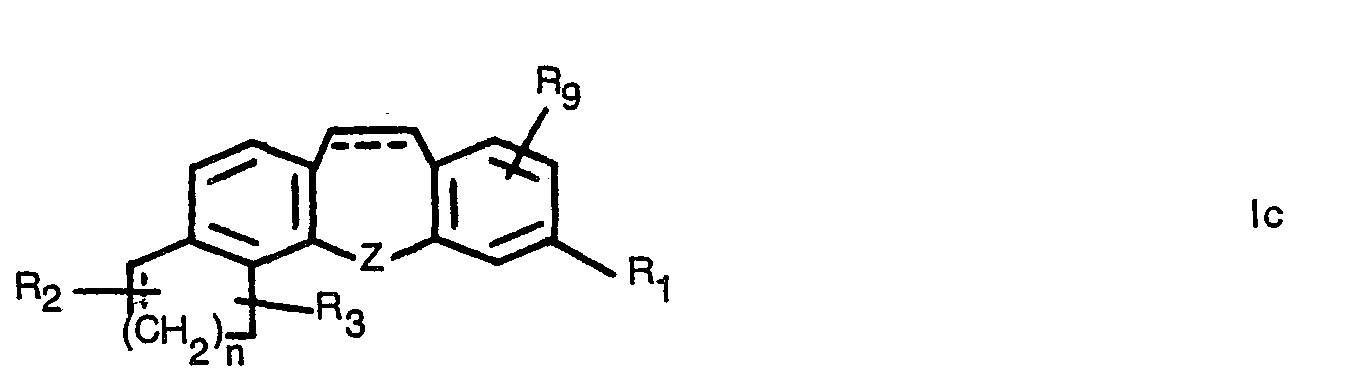
- n is 1 or 2;
- the broken lines represent optional double bonds;
- Z is thio, sulfinyl or sulfonyl;
- each of R2, R3 and R9, independently of the others, is a hydrogen or halogen atom or a nitro, lower alkyl, lower alkanoyl, hydroxy, lower alkoxy, lower alkylthio, trifluoromethylthio, lower alkylsulfinyl, lower alkylsulfonyl or trifluoromethyl radical, where "lower" means C1-s, or R2 and R3 together represent an oxo radical; and
- R1 is
- (a) 5-tetrazolyl or

- (b) -CHO or
- (c) ―(CH2)n―OH where n is 0, 1, 2, 3 or 4; and compounds that are pharmaceutically acceptable salts of such dibenzothiepins.
- As used herein, the term "halogen" means chlorine, bromine, iodine or fluorine. The terms, lower alkyl, lower acyl and lower alkoxy, wherever used, mean straight and branched alkyl, acyl and alkoxy groups having from 1 to 5 carbon atoms in the alkyl, acyl or alkoxy residue, for example, methyl, ethyl, isopropyl, butyl, 2,2-dimethylpropyl, ethoxy, propoxy and isobutoxy. The term "lower alkanoyl" means straight and branched alkanoyl groups of 1 to 5 carbon atoms including, for example, formyl, acetyl, propanoyl, butyryl and 2,2-dimethylpropanoyl.
- Among preferred groups of compounds in accordance with the present invention are those in which Z is thio and R1 is 5-tetrazolyl or

- Specific preferred compounds include
- Ethyl 2,3-Dihydro-1H-benzo[b]indeno[5,6-f]thiepin-7-carboxylate;
- 2,3-Dihydro-1 H-benzo[b]indeno[5,6-f]thiepin-7-carboxylic acid;
- 2,3-Dihydro-1 H-benzo[b]indeno[5,6-f]thiepin-7-carboxylic acid 5-oxide;
- 5-(2,3-Dihydro-1 H-benzo[b]indeno[5,6-f]thiepin-7-yl)tetrazole;
- 2,3-Dihydro-1 H-benzo[b]indeno[5,6-f]thiepin-7-carboxamide;
- 5-(2,3-Dihydro-1 H-benzo[b]indeno[5,6-f]thiepin-7-yl)tetrazole;
- 5-(2,3-Dihydro-5-oxido-1 H-benzo[b]indeno[5,6-f]thiepin-7-yl)-tetrazole;
- 5-(2,3-Dihydro-5,5-dioxido-1 H-benzo[b]indeno[5,6-f]thiepin-7-yl)-tetrazole;
- 2,3,10,11-Tetrahydro-1 H-benzo[b]indeno[5,6-f]thiepin-7-carboxylic acid;
- 2,3,10,11-Tetrahydro-1 H-benzo[b]indeno[5,6-f]thiepin-7-carboxylic acid 5-oxide;
- Methyl 2,3,10,11-tetrahydro-1 H-benzo[b]indeno[5,6-f]thiepin-7-carboxylate;
- Methyl 2,3,10,11-tetrahydro-1 H-benzo[b]indeno[5,6-f]thiepin-7-carboxylate-5-oxide;
- 2,3,10,11-Tetrahydro-1 H-benzo[b]indeno[5,6-f]thiepin-7-carboxylic acid 5,5-dioxide;
- Methyl 2,3,10,11-tetrahydro-1 H-benzo[b]indeno[5,6-f]thiepin-7-carboxylate 5,5-dioxide;
- Methyl 1-oxo-2,3,9,10-tetrahydro-1 H-benz[b]indeno[5,4-f]thiepin-6-carboxylate;
- Methyl1-oxo-2,3,11,12-tetrahydro-1H-benz[b]indeno[4,5-f]thiepin-8-carboxylate;
- Methyl 3-oxo-2,3,10,11-tetrahydro-1 H-benz[b]indeno[5,6-f]thiepin-7-carboxylate;
- . 1-Oxo-2,3,9,10-tetrahydro-1 H-benz[b]indeno[5,4-f]thiepin-6-carboxylic acid;
- 1-Oxo-2,3,11,12-tetrahydro-1 H-benz[b]indeno[4,5-f]thiepin-6-carboxylic acid;
- 3-Oxo-2,3,10,11-tetrahydro-1 H-benz[b]indeno[5,6-f]thiepin-7-carboxylic acid;
- (±)-1-Hydroxy-2,3,9,10-tetrahydro-1H-benzo[b]indeno[5,4-f]thiepin-6-carboxylicacid;
- (±)-1-Hydroxy-2,3,11,12-tetrahydro-1H-benzo[b]indeno[4,5-f]thiepin-8-carboxylicacid;
- (±)-1-Hydroxy-2,3,10,11-tetrahydro-1 H-benzo[b]indeno[5,6-f]thiepin-7-carboxylic acid;
- (±)-1a-Hydroxy 4a-oxido-2,3,9,10-tetrahydro-1 H-benzo[b]indeno[5,4-f]thiepin-6-carboxylic acid;
- (±)-1 β-Hydroxy-4a-oxido-2,3,9,10-tetrahydro-1 H-benzo[b]indeno[5,4-f]thiepin-6-carboxylic acid;
- Methyl1-hydroxy-2,3,9,10-tetrahydro-1H-benzo[b]indeno[5,4-f]thiepin-6-carboxylate;
- methyl (±)-1α-hydroxy-4α-oxido-2,3,9,10-tetrahydro-1H-benzo[b]indeno[5,4-f]thiepin-6-carboxylate;
- methyl (±)-1a-Hydroxy-4a-oxido-2,3,9,10-tetrahydro-1H-benzo[b]indeno[5,4-f]thiepin-6-carboxylate;
- (±)-1α-Hydroxy-4α-oxido-2,3,9,10-tetrahydro-1H-benzo[b]indeno[5,4-f]-thiepin-6-carboxylic acid;
- (±)-1β-hydroxy-4α-oxido-2,3,9,10-tetrahydro-1H-benzo[b]indeno[5,4-f]thiepin-6-carboxylic acid;
- (±)-1α-Hydroxy-6α-oxido-2,3,11,12-tetrahydro-1 H-benzo[b]indeno[4,5-f]thiepin-8-carboxylic acid;
- (±)-1β-Hydroxy-6α-oxido-2,3,11,12-tetrahydro-1H-benzo[b]-indeno[4,5-f]thiepin-8-carboxylicacid;
- (±)-3α-Hydroxy-5a-oxido-2,3,10,11-tetrahydro-1 H-benzo[b]indeno[5,6-f]thiepin-7-carboxylic acid;
- (±)-3(3-Hydroxy-5a-oxido-2,3,10,11-tetrahydro-1 H-benzo[b]indeno[5,6-f]thiepin-7-carboxylic acid;
- 4-Oxido-1-oxo-2,3,9,10-tetrahydro-1 H-benzo[b]indeno[5,4-f]thiepin-6-carboxylic acid;
- Methyl 4-oxido-1-oxo-2,3,9,10-tetrahydro-1H-benzo[b]indeno[5,4-f]thiepin-6-carboxylate;
- 6-Oxido-1-oxo-2,3,11,12-tetrahydro-1H-benzo[b]indeno[4,5-f]thiepin-8-carboxylicacid;
- 5-Oxido-3-oxo-2,3,10,11-tetrahydro-1 H-benzo[b]indeno[5,6-f]thiepin-7-carboxylic acid;
- Methyl 2,3,11,12-tetrahydro-1H-benzo[b]indeno[4,5-f]thiepin-8-carboxylate;
- 2,3,11,12-Tetrahydro-1 H-benzo[b]indeno[4,5-f]thiepin-8-carboxylic acid;
- Methyl 2,3,9,10-tetrahydro-1H-benzo[b]indeno[5,4-f]thiepin-6-carboxylate; and
- 2,3,9,10-Tetrahydro-1 H-benzo[b]indeno[5,4-f]thiepin-6-carboxylate
as well as the compound in which Z is thio, R2 and R3 are both hydrogen, and R1 is 4-hydroxy-Δ3-pyrrolin-3-yl-2,5-dione and the compounds 11-oxo-2,3,10,11-tetrahydro-1H-benzo[b]indeno[5,6-f]thiepin-7-carboxylic acid; 11-hydroxy-2,3,10,11-tetrahydro-1H-benzo[b]indeno[5,6-f]thiepin-7-carboxylicacid; and 2,3-dihydro-1 H-benzo[b]indeno[5,6-f]thiepin-7-carbonitrile. - The present invention is based upon the discovery that the dibenz[b,f]thiepins of Formulae la, Ib and Ic markedly antagonize the actions of contractile prostaglandins such as PGF2a, PGG2, PGH2 and TXA2. The use of the dibenz[b,f]thiepins of this invention, which act as prostaglandin antagonists and biosynthesis inhibitors, offers a new approach to therapy in a variety of allergic conditions such as allergic asthma where excessive contractile activity of prostaglandins and prostaglandin biosynthetic intermediates occur. It is well known, for example, that prostaglandins such as PGF2α, PGG2, TXA2 and PGH2 are potent contractants of bronchial muscle and that human asthmatics are especially sensitive to the bronchial constricting action of PGF2α. The antagonizing action of the dibenz[b,f]thiepins of this invention against the constricting actions of contractile prostaglandins has been confirmed in vitro and in vivo using standard pharmacological techniques. It is contemplated, therefore, that the dibenz[b,f]thiepins of this invention will be used in unit dosage form as the essential active ingredient in pharmaceutical formulations intended for the treatment and control of allergic conditions such as asthma in humans and warm-blooded animals.
- The dibenz[b,f]thiepin derivatives of this invention may be prepared in any available manner. One such method is presented in Scheme I.

- 5-Mercaptoindan is reacted with 4-carboxy-2-iodophenylacetic acid in the presence of a strong base such as potassium hydroxide affording an indanylthiophenylacetic acid compound.
- The indanylthiophenylacetic acid compound may be cyclized by treatment with (1) trifluoroacetic acid and (2) trifluoroacetic anhydride. Reduction of the 11-oxo compound to the 11-hydroxy compound is accomplished by conventional reducing agents, such as sodium borohydride.
- The 11-oxo compound may be converted to the compound 2,3,10,11-tetrahydro-1H-benzo[b]indeno-[5,6-f]thiepin-7-carboxylic acid by treatment with potassium hydroxide and hydrazine hydrate.
- Dehydration of the 11-hydroxy compound may be accomplished by treatment with a strong acid such as sulfuric acid, affording the compound 2,3-dihydro-1H-benzo[b]indeno[5,6-f]thiepin-7-carboxylic acid.
- Oxidation of the carboxylic acids using mild oxidation conditions affords the 5-oxide compound, while more vigorous conditions yield the 5,5-dioxide species.
- The carboxylic acids may be converted to a number of derivatives as discussed in greater detail below.
- In addition to the reactions outlined in Scheme I, the compounds of the present invention may be prepared as outlined in Scheme II.


- 3-Cyano-10,11-dihydrodibenz[b,f]thiepin (see compound XXVII, European Patent Appln. No. 11,067) may be reacted with dichloromethyl methylether to yield the 6-formyl- and 8-formyl-3-cyano compounds.
- The formyl compounds may be reduced with sodium borohydride to produce the 6-hydroxymethyl. and 8-hydroxymethyl compounds.
- Bromination of the 6- or 8-hydroxymethyl compounds may be accomplished by treatment with phosphorus tribromide.
- Reaction of the 6- or 8-bromo methyl compounds with diethyl malonate and sodium hydride, followed by (1) heating; (2) hydrolysis; and (3) cyclization, afforded the oxo-tetrahydro-1H-benz[b]indenothiepin compounds shown.
- Reduction of the 1-oxo group may be accomplished using a reducing agent such as sodium borohydride, affording the (±) hydroxy derivatives. These compounds may then further be derivatized and/or resolved into the separate enantiomorphs.
- In addition to their therapeutic properties as noted above, the carboxylic acid derivatives of this invention serve as valuable intermediates in the preparation of other variously substituted and therapeutically useful dibenz[b,f]thiepins of formula la, Ib or Ic. Thus, the carboxylic acid of formula la, Ib or Ic may be converted readily into the corresponding acid halide, preferably the acid chloride, by treating the carboxylic acid with a thionyl halide, preferably thionyl chloride. The resulting halocarbonyldibenz[b,f]-thiepin (i.e., the chlorocarbonyl compounds of formula la, Ib or Ic) then may be treated with various well-known reagents to form desired ester and amide derivatives.
- Thus, for example, the chlorocarbonyl compounds of formula la, Ib or Ic may be treated:
- (a) with a loweralkanol such as, for example, methanol, ethanol, 2-propanol, butanol and 2-butanol, to form the corresponding loweralkyl esters;
- (b) with ammonia to form the corresponding carboxamides;
- (c) with an N-loweralkylamine such as, for example, methylamine, ethylamine, propylamine, isopropylamine and butylamine, or an N,N-diloweralkylamine such as, for example, dimethylamine, diethylamine, dipropylamine and dibutylamine, to form the corresponding N-loweralkylcarboxamide or N,N-di- loweralkylcarboxamide;
- (d) with a loweralkylsulphonamide such as, for example, methanesulphonamide, ethanesulphon- amide, propanesulphonamide and butanesulphonamide, to form the corresponding N-loweralkylsulfonyl- carboxamide;
- (e) with 2-imino-3-methylthiazolidine to form the corresponding (3-methyl-2-thiazolidinylidene) carboxamide;
- (f) with a loweralkyldiol such as, for example ethylene glycol, trimethylene glycol and 1,4-butanediol, to form the corresponding hydroxyloweralkylester;
- (g) with an N,N-diloweralkylaminoloweralkanol such as, for example, N,N-dimethylethanolamine, N,N-diethylethanolamine, 3-N,N-dimethylaminopropan-1-01 and 4-N,N-diethytaminobutan-1-ot, to form the corresponding N,N-diloweralkylaminoloweralkyl ester;
- (h) with an amino acid such as, for example, glycine, alanine and valine, to form the corresponding N-carboxyloweralkylcarboxamide;
- (i) with an alkali metal salt of a hydroxyloweralkanoic acid such as, for example, hydroxyacetic acid, 3-hydroxybutyric acid and p-hydroxypropionic acid, to form the corresponding carboxyloweralkyl ester.
- Formation of the 5-oxide or the 5,5-dioxide groups (e.g., preparation of the sulfinyl or sulfonyl compounds of the instant invention) conveniently is achieved by controlled oxidation techniques. Thus, for example, the carboxylic acid derivatives of formulae la, Ib or Ic may be oxidized with hydrogen peroxide in the presence of an acidic solvent such as acetic acid or with organic peroxides such as peroxy acids, for example, m-chloroperbenzoic acid and the like, in a stepwise fashion to form the corresponding sulfinyl derivative, formuia la, Ib or lc, and sulfonyl derivative, formulae la, Ib or lc. The molar ratio of oxidant to reductant determines the oxidation level of the sulfur in the product. A 1:1 molar ratio, for example, results largely in the production of the sulfinyl derivative whereas a 2 to 3 molar excess of oxidant results in a yield predominantly comprising the sulfonyl derivative.
- As noted above, pharmaceutically acceptable salts of the novel dibenz[b,f]thiepins also are included within the scope of this invention. The term, pharmaceutically acceptable salts, is intended to include salts derived from pharmaceutically acceptable non-toxic acids and bases such as, for example, ammonium salts, alkali metal salts such as sodium and potassium salts, alkaline earth metal salts such as magnesium and calcium salts, salts of organic bases such as amine salts derived from mono-, di and triloweralkyl or loweralkanoyl amines such as trimethylamine, dimethylamine and triethanolamine, salts derived from heterocyclic amines such as piperidine, 1-methylpiperazine, piperazine and morpholine, and salts derived from pharmaceutically acceptable acids such as hydrochloric acid, sulfuric acid, tartaric acid and propionic acid.
- The dibenz[b,f]thiepins of formulae la, Ib and Ic are useful in the treatment and prophylaxis of human or warm-blooded animal disease conditions where excessive undesirable contractile activity of prostaglandins, such as PGF2a, or prostaglandin biosynthetic intermediates contribute. In particular, they are of value in the treatment and control of allergic conditions such as asthma.
- The magnitude of a prophylactic or therapeutic dose of compound of formulae la, Ib and/or Ic will, of course, vary with the nature and the severity of the condition to be treated and with the particular compound of formulae la, Ib and Ic and its route of administration. In general, the dose range lies within the range of 0.2 mg to 100 mg per kg body weight per day.
- The pharmaceutical compositions of the present invention comprise a compound of formula la, Ib and/ or Ic as an active ingredient, and may also contain pharmaceutically acceptable carrier and optionally other therapeutic ingredients. The compositions include compositions suitable for oral, rectal, opthalmic, pulmonary, nasal, dermal, topical or parenteral (including subcutaneous, intramuscular and intravenous) administration, although the most suitable route in any given case will depend on the nature and severity of the condition being treated and on the nature of the active ingredient. They may be conveniently presented in unit dosage form and prepared by any of the methods well known in the art of pharmacy.
- For intravenous administration, a suitable dosage range is from 0.2 to 10 mg (preferably 1 to 8 mg) of a compound of formula la, Ib or Ic per kg of body weight per day. In an oral composition a suitable dosage range is about, e.g., 1 to 50 mg of a compound of formula la, Ib or Ic per kg of body weight per day, preferably from 10 to 40 mg/kg.
- Pharmaceutical compositions of the present invention suitable for oral administration and by inhalation in the case of asthma therapy may be presented as discrete units such as capsules, cachets or tablets each containing a predetermined amount of the active ingredient; as a powder or granules; or as a solution or a suspension in an aqueous liquid, a non-aqueous liquid, an oil-in-water emulsion or a water-in- oil liquid emulsion. Such compositions may be prepared by any of the methods of pharmacy but all methods include the step of bringing into association the active ingredient with the carrier which constitutes one or more necessary ingredients. In general, the compositions are prepared by uniformly and intimately admixing the active ingredient with liquid carriers or finely divided solid carriers or both, and then, if necessary, shaping the product into the desired presentation. For example, a tablet may be prepared by compression or moulding, optionally with one or more accessory ingredients. Compressed tablets may be prepared by compressing in a suitable machine, the active ingredient in a free-flowing form such as powder or granules, optionally mixed with a binder, lubricant, inert diluent, lubricating, surface active or dispersing agent. Moulded tablets may be made by moulding in a suitable machine, a mixture of powdered compound moistened with an inert liquid diluent. Desirably, each tablet contains from 50 mg to 500 mg of the active ingredient and each cachet or capsule contains from 50 mg to 500 mg of the active ingredient.
- The invention is illustrated in the following non-limiting examples.
- To 50% aqueous potassium hydroxide solution (500 g) under argon was added 5-mercaptoindan (30.0 g, 0.2 mole) and copper powder (16.3 g). Then 4-carboxy-2-iodophenylacetic acid (38.25 g, 0.125 mole) was added with mechanical stirring and the reaction mixture was stirred under reflux (oil-bath 140-145°C) for 3 hours. The mixture was diluted with ice-water (800 ml), filtered, and the filtrate was treated with charcoal and refiltered. Acidification of the alkaline solution precipitated a solid which was collected, washed well with water and drained thoroughly on the filter. The solid was stirred with hexane (200 ml) to remove mercaptoindane and was refiltered to yield 33.55 g.
- The product was recrystallized from acetic acid and then had a melting point of 225-228°C.
- Analysis for C18H1604S:

- 4-Carboxy-2-(5-indanylthio)-phenylacetic acid (33.55 g, 0.102 mole) was added to trifluoroacetic acid (200 ml) and to the stirred suspension was added, slowly with stirring, trifluoroacetic anhydride (200 ml). After stirring the mixture for 48 hours at room temperature, the mixture was poured slowly onto ice (200 g), and the slurry was diluted to about 1 liter before collecting the crude product. The dried solid was stirred in suspension in acetonitrile for 45 minutes, refiltered and dried to yield 24.95 g.
- The compound was recrystallized from dimethylformamide/acetonitrile and then had a melting point of 275-277°C dec.
- Analysis for C18H14O3S:

- 11-Oxo-2,3,10,11-tetrahydro-1H-benzo[b]indeno[5,6-f]thiepin-7-carboxytic acid (24.75 g, 0.0798 mole) was suspended in water (495 ml) and 5N sodium hydroxide (17.6 ml) was added with stirring. The resulting suspension of sodium salt was treated with sodium borohydride (9.10 g, 0.24 mole) in 1 g portions and the mixture was stirred at room temperature overnight. Then the mixture was acidified carefully (frothing) with 6N hydrochloric acid. The suspension was stirred for 20 minutes after completion of the acidification and the solid was collected, washed well with water, and dried to yield 24.44 g.
- The ammonium salt of the acid was crystallized from hot water and the title compound obtained by acidification of the salt had a melting point of 202-203°C dec.
- Analysis of C18H16O3S:

- 11-Hydroxy-2,3,10,11-tetrahydro-1H-benzo[b]indeno[5,6-f]thiepin-7-carboxylic acid (11.3 g, 36.2 mmole) was suspended in acetic acid (225 ml) heated in an oil-bath at 115°C. Concentrated sulfuric acid (22.5 ml) was added in a thin stream. The suspension was heated in the oil-bath for 1 hour and allowed to cool. The crude product was filtered off and washed with methanol to yield 10.14 g.
- The title compound was purified by filtering a solution of the solid in a large volume of boiling acetic acid and evaporating the filtrate to a smaller volume, and the title compound had a melting point of 268-271°C dec.
- Analysis for C1sH1402S:

- The ethyl ester of the title compound had a melting point of 103-104'C.
- 2,3-Dihydro-1H-benzo[b]indeno[5,6-f]thiepin-7-carboxylic acid (2.97 g, 10.1 mmole) was suspended in trifluoroacetic acid (60 ml) and the stirred suspension was treated at 0-5°C with 50% hydrogen peroxide in small increments. The formation of the 5-oxide and then of the 5,5-oxide can be followed by thin layer chromatography.
- NOTE: Sulfone can be distinguished from sulfoxide and starting material on Quantum silica gel plates developed with 100:10:1 toluene/dioxane/acetic acid. Starting material was distinguished from sulfoxide and sulfone on Eastman silica gel sheet developed with the same solvent mixture. Sulfoxide and sulfone fluoresced differently.
- Conversion to the title compound requires about 1.8 ml of 50% hydrogen peroxide. The solution was evaporated to about 25 ml and poured into water (100 ml). The aqueous layer was decanted from the sticky precipitate which crystallized on stirring with hot acetic acid (10 ml) to afford 1.618 g of crude product. This was recrystallized from hot acetic acid to give the title compound 1.23 g with a melting point of 298-3010C dec.
- Analysis for C18H14O4S:

- Repeating the procedure of Example 5 but using a little less than half of the equivalent amount of 50% hydrogen peroxide provides the title compound.
- A mixture of 2,3-dihydro-1H-benzo[b]indeno[5,6-f]thiepin-7-carboxylic acid (6.00 g, 20.4 mmole) and thionyl chloride (24 ml) was heated slowly to reflux during 30 minutes and maintained at reflux for another 30 minutes. Excess thionyl chloride was distilled off and the residue was evaporated twice with benzene. The crude acid chloride was suspended in dry ether (150 ml) and a concentrated solution of ammonia in dry ether was added slowly with stirring. Ammonia was passed through the mixture for one hour and the solid was collected. The solid was stirred in suspension in a solution of ammonia in methanol (30 ml) and refiltered to afford 4.66 g (78%) of the title compound as an extremely insoluble solid.
- The crude amide from Step A (4.34 g, 14.8 mmole) in pyridine (43.5 ml) was treated slowly under cooling (ice-bath) with trifluoroacetic anhydride (8.7 ml). The mixture was stirred for 1 hour at ambient temperature and then poured into a mixture of ice (400 g) and concentrated hydrochloric acid (50 mI). The product was extracted into ether and the ethereal extract was washed with water, then with 10% sodium carbonate solution and finally with saturated sodium chloride solution. After drying (MgS04) the solution was evaporated to a tan colored solid (3.22 g). The product was purified by chromatography on Merck silica gel using toluene as solvent to give 2.45 g of the title compound. Melting point 142-143°C (from acetonitrile).
- Analysis for C18H13NS:

- A solution of 2,3-dihydro-1H-benzo[b]indeno[5,6-f]thiepin-7-carbonitri)e (2.10 g, 7.625 mmole) in dimethylformamide (31.5 ml) stirred under reflux (oil-bath at 170-1800C) in an atmosphere of argon was treated with a mixture of sodium azide (743 mg, 11.44 mmole) and ammonium chloride (612 mg, 11.44 mmole). An equal portion of sodium azide and ammonium chloride was added after 1 hour and then at 30 minute intervals seven portions of a mixture of sodium azide (247 mg, 3.81 mmole) and ammonium chloride (204 mg, 391 mmole) were added. After heating for a further 1 hour the reaction mixture was allowed to cool, then it was diluted with water (150 ml) and acidified. An extraction with methylene chloride (250 ml) was performed. The methylene chloride solution was extracted with a mixture of water (100 ml) and 5N sodium hydroxide (10 ml) and after a further wash with water the combined aqueous extract on acidification yields 1.555 g of title compound.
- Work up of the methylene chloride solution gave 832 mg of unreacted nitrile which on recycling through the reaction affords another 426 mg of product.
- Thus the combined yield of 5-(2,3-dihydro-1H-benzo[b]indeno[5,6-f]thiepin-2-yi)tetrazoie was 1.98 g (81 %). The tetrazole was purified by suspending the solid in hot 50% aqueous methanol, adding sufficient ammonium hydroxide to dissolve the solid, treating the solution with charcoal and filtering and then acidifying the filtrate with acetic acid. The compound thus purified had a melting point of 238-240°C dec.
- Analysis for C18H14N4S:

- A suspension of 5-(2,3-dihydro-1H-benzo[b]indeno[5,6-f]thiepin-7-yl)tetrazole (1.039 g, 3.27 mmole) in acetic acid (40 ml) at 70°C was treated slowly with stirring with a solution of 50% hydrogen peroxide in acetic acid (68 mg per ml). After the addition of 7.2 ml of oxidizing agent a barely detectable (by tic) amount of starting material remained. The mixture was cooled and the solid was collected. It was purified by stirring in suspension in hot methanol (22 ml) and filtering hot to obtain the title compound, 781 mg (71 %), m.p. 273° dec.
- Analysis for C18H14N4OS:

- Repeating the procedure of Example 8 but using a little more than twice the equivalent quantity of 50% hydrogen peroxide provides the title compound.
- A mixture of 11-oxo-2,3,10,11-tetrahydro-1H-benzo[b]indeno[5,6-f]thiepin-7-carboxylicacid (10.0 g 34 mmole), 85% potassium hydroxide (7.5 g), 100% hydrazine hydrate (5 ml) and diethylene glycol (200 ml) was heated under nitrogen, in an oil-bath at 225°C for 4 hours. The cool reaction mixture was diluted with water and acidified with 6N hydrochloric acid. The solid was collected by filtration, and after drying on the filter it was stirred in suspension in a mixture of ethyl acetate (50 ml) and methanol (10 ml). The crude product was collected and dried. 9.47 g.
- Analytically pure title compound was obtained in about 70% yield by recrystallization of the crude product from a mixture of dimethylformamide and acetonitrile, and then had a m.p. of 264° dec.
- Analysis for C18H16O2S:

- A suspension of crude 2,3,10,11-tetrahydro-1H-benzo[b]indeno[5,6-f]thiepin-7-carboxylicacid (8.276 g, 28 mmole) in methanol (200 ml) containing concentrated sulfuric acid was stirred under reflux for 20 hours. The suspension was evaporated, water was added and the product was extracted with chloroform. The crude ester was purified by chromatography (250 g Merck silica gel eluted with 1:1 hexane/methylene chloride). The title compound had m.p. 110-111°C (from acetonitrile).
- Analysis for C19H18O2S:

- To a solution of methyl 2,3,10,11-tetrahydro-lH-benzo[b]indeno[5,6-f]thiepin-7-carboxylate (3.05 g; 9.84 mmole) in methylene chloride (200 ml) stirred in a cooling bath at 0―5°C was added 85% m-chloroperbenzoic acid (2.00 g; 9.85 mmole) in small portions during 1 hour. After stirring the reaction mixture for 30 minutes at room temperature, more methylene chloride was added to get a clear solution and then calcium hydroxide (4 g) was added. The suspension was stirred for 25 minutes, filtered and evaporated. The crude product was purified by column chromatography (Merck silica gel eluted with 1:4 ethyl acetate/toluene) to yield 2.121 g (66%) of the title compound, m.p. 150-1540C (from MeCN).
- Analysis for C19H18O3S:

- Methyl 2,3,10,11-tetrahydro-1H-benzo[b]indeno[5,6-f]thiepin-7-carboxylate 5-oxide (2.00 g; 6.13 mmole) was added to a solution of 85% potassium hydroxide (808 mg; 12.26 mmole) in a mixture of water (8 ml) and ethanol (40 ml) at room temperature. After 1 hour, the solution was filtered, evaporated to 15 ml and acidified to pH 2 with hydrochloric acid. The product was collected, washed with water and dried (finally at 105°C/0.005 Torr) to yield 1.55 g (81 %) with a m.p. 290-294° dec.
- Analysis for C18H16O3S:

- Repeating the procedure of Example 11, Step B, but using slightly more than the two equivalents of m-chloroperbenzoic acid and a correspondingly greater amount of calcium hydroxide, provides the title compound.
- Repeating the procedure of Example 11, Step C, but using methyl 2,3,10,11-tetrahydro-1H-benzo[b]-indeno[5,6-flthiepin-7-carboxylate 5,5-dioxide in place of methyl 2,3,10,11-tetrahydro-1H-benzo[b]indeno-[5,6-f]thiepin-7-carboxylate 5-dioxide provides the title compound.
- Anhydrous aluminium chloride (37.8 g; 0.283 mole) was added to a stirred solution of 3-cyano-10,11-dihydrodibenzo[b,f]thiepin (32.0 g; 0.135 mole) in dry 1,2-dichloroethane (325 ml) with cooling (ice-bath) under argon. After 5 minutes a solution of dichloromethyl methyl ether (17.08 g; 0.1485 mole) in 1,2-dichloroethane (135 ml) was added slowly over 30 minutes and the reaction mixture was stirred for a further 30 minutes in the ice-bath before being poured into ice-water (500 ml). The mixture was shaken thoroughly and the organic layer was separated. The aqueous layer was extracted with 200 ml of 1,2-dichloroethane and the combined organic layers were washed with water (2 x 250 ml), dried (MgS04) and evaporated. The crude product 26.65 g (74.5%) consisted of a mixture of the two title compounds in the ratio of about 5:4 (by nmr).
- The solid was suspended in hot ethyl acetate (135 ml) and the suspension was allowed to stand for several hours before collecting the solid. Recrystallization of this solid from acetonitrile gave pure 3-cyano-6-formyl-10,11-dihydrodibenzo[b,f]thiepin, m.p. 168―9°C crystallized in the form of pale yellow prisms, nmr (CDCI3) 10.7 (s, CHO).
-

- Residue from the mother liquors were pooled and given a preliminary clean-up by chromatography on Merck silica gel using methylene chloride as solvent. The mixture of 6- and 8-formyl derivatives was separated by high pressure liquid chromatography on a Waters Prep Pak 500 instrument using methylene chloride. The 8-formyl derivative was the faster moving compound and complete separation was obtained with two recycles.
- Analysis for C16H11NOS:

- A mixture of 3-cyano-6-formyl-10,11-dihydrodibenzo[b,f]thiepin (3.71 g, 14 mmole), diethyl malonate (2.285 g; 14.3 mmole), acetic acid (84 mg; 1.4 mmole), piperidine (119 mg; 1.4 mmole) and benzene (140 ml) was heated under reflux under a Dean Starck Trap for 24 hours. A further 64 mg of diethyl malonate was added and reflux was continued for 10 hours. The benzene was evaporated off under vacuum and the residue was dissolved in methylene chloride (75 ml). The solution was washed with water, dried (MgS04) and evaporated to a gum which soon crystallized. 6.521 g (theory 5.7 g).
- Purification of a sample of the crude product by preparative thin layer chromatography (Whatman silica gel/methylene chloride) gave a recovery equivalent to a 96% yield, m.p. 96-98°C.
- Analysis for C23H21NO4S:

- Ethyl 3-(7-cyano-10,11-dihydrodibenzo(b,f]thiepin-2-yl)-2-ethoxycarbonyl propenoate Substituting 3-cyano-6-formyl-10,11-dihydrodibenzo[b,flthiepin in the foregoing example with 3-cyano-8-formyl-10,11-dihydro-dibenzo[b,f]thiepin provides the title compound in 77% yield after chromatography (Whatman silica gel/5% ethyl acetate in methylene chloride). The compound melted at 132-133° after recrystallization from ethyl acetate/isopropyl ether.
- Analysis for C23H21NO4S:
-

- A suspension of ethyl 3-(7-cyano-10,11-dihydrodibenzo[b,f]thiepin-2-yl)-2-ethoxycarbonylpropenoate (4.249 g; 10.44 mmole) in ethanol (130 ml) was treated with sodium borohydride (397 mg; 10.44 mole). The reaction mixture was stirred at room temperature until reduction is complete (ca 2 hours) and then it was acidified carefully with acetic acid. The solvent was evaporated and the residue was partitioned between water and methylene chloride. After washing the organic extract with saturated sodium chloride solution, it was evaporated to obtain an oil (4.125 g; 96%). The pure title compound was obtained by short path distillation of the crude product (oven temperature 230°C/0.05 Torr).
- Analvsis for C23H23NO4S:

- Substituting ethyl 3-(7-cyano-10,11-dihydrodibenzo[b,f]thiepin-2-yl)-2-ethoxy carbonyl propenoate in the foregoing example with crude ethyl 3-(7-cyano-10,11-dihydrodibenzo[b,f]thiepin-4-yl)-2-ethoxycarbonyl propenoate provides the title compound in 69% yield m.p. 81-83°C after chromatography on Merck silica gel (90 g) using 3% ethyl acetate in methylene chloride for elution.
- Analysis for C23H23NO4S:

- Sodium borohydride (42 mg; 1.1 mmole) was added portionwise to a mixture of 3-cyano-6-formyl-10,11-dihydrodibenzo[b,f]thiepin and 3-cyano-8-formyl-10,11-dihydrodibenzo[b,f]thiepin (from Example 13) (5:4 ratio) (236 mg; 0.89 mmole) in methanol (2.5 ml) and dimethylformamide (2.5 ml) under nitrogen. The reaction mixture was stirred one hour at room temperature, then poured slowly into ice. The precipitate was filtered off and air-dried to afford quantitatively a mixture of the two title compounds which are separated by thin layer chromatography (toluene/ethyl acetate: 7/3). The less polar compound being the 3-cyano-6-hydroxymethyl-10,11-dihydrodibenzo[b,f]thiepin, m.p. 150°C and the more polar was the 3-cyano-8-hydroxymethyl-10,11-dihydrodibenzo[b,f]thiepin, m.p. 122°C.
- Phosphorous tribromide (0.2 ml) was added to a suspension of 3-cyano-8-hydroxymethyl-10,11-di- hydrodibenzo[b,f]thiepin (500 mg; 1.87 mmole) in ether (7 ml). The reaction mixture was stirred at room temperature for one hour, then poured onto ice, extracted with ether (3 x 50 ml), dried over Na2S04 and evaporated to afford 581 mg (95%) of 3-cyano-8-bromomethyl-10,11-dihydrodibenzo[b,f]thiepin as an oil.
- As described previously for the 3-cyano-8-bromomethyl-10,11-dihydrodibenzo[b,f]thiepin, the title compound was prepared from 3-cyano-6-hydroxymethyi-10,11-dihydrodibenzo[b,f]thiepin in 95% yield.
- Diethylmalonate (0.69 ml; 4.5 mmoles) was added to a suspension of sodium hydride 50% in oil (220 mg; 4.58 mmoles) in dry dimethylformamide (3 ml) under nitrogen. The reaction mixture was stirred at room temperature for 30 minutes and added dropwise to a solution of 3-cyano-5-bromomethyl-10,11-di- hydrodibenzo[b,f]thiepin (0.377 g; 0.8 mmole) in dry dimethylformamide (3 ml). The reaction mixture was stirred overnight at room temperature then poured on ice and extracted with methylene chloride (3 x 50 ml). The organic layer was dried (Na2SO4) and evaporated to dryness. The crude product was purified by column chromatography (E. Merck silica gel eluting with methylene chloride) affording 12 mg (25%) of pure title compound.
- The title compound was obtained in 25% yield by the same route as the ethyl 3-(7-cyano-10,11-di- hydrodibenzo[b,f]thiepin-2-yl)-2-ethoxy carbonyl propanoate starting with 3-cyano-8-bromomethyl-10,11-dihydrodibenzo[b,f]thiepin.
- A mixture of ethyl 3-(7-cyano-10,11-dihydrodibenzo[b,f]thiepin-2-yl)-2-ethoxy-carbonylpropanoate (4.025 g; 4.84 mmole), water (354 mg; 19.7 mmole), sodium chloride (576 mg) and dimethylsulfoxide (100 ml) are heated together under argon in an oil bath at 200―205°C for 3 hours. The cool reaction mixture was diluted with methylene chloride and the solution was extracted with water (3 x 100 ml), then dried (MgS04) and evaporated to an oil (3.223 g; 97%). The pure title compound was obtained by short path distillation of the crude product (oven temperature 200°C/0.05 Torr).
- Analysis for C20H19NO2S:

- Substituting ethyl 3-(7-cyano-10,11-dihydrodibenzo[b,f]thiepin-2-yl)-2-ethoxycarbonylpropanoate in the foregoing example with an equivalent amount of ethyl 3-(7-cyano-10,11-dihydrodibenzo(b,f]thiepin-4-yl-2-ethoxycarbonylpropanoate provided the title compound in 97% yield. The compound was purified by short-path distillation at an oven temperature of 190°/0.05 Torr and then has m.p. 61-62°C.
- Analysis for C20H19NO2SO:

- A mixture of ethyl 3-(7-cyano-10,11-dihydrodibenzo[b,f]thiepin-2-yl)-propanoate (1.50 g, 4.45 mmole), ethanol (15 ml) and 40% potassium hydroxide solution (15 ml) was stirred under reflux under argon for 24 hours. The reaction mixture was diluted with water, acidified with hydrochloric acid and extracted with ethyl acetate (50 ml + 2 x 25 ml). The extract was washed with water, then with saturated sodium chloride solution, dried (MgS04) and evaporated. Recrystallization of the crude product from acetic acid provided the title compound, 1.27 g, (87%), m.p. 233-235°C.
- Analysis for C18H16O4S:

- Substituting ethyl 3-(7-cyano-10,11-dihydrodibenzo[b,f]thiepin-2-yl)-propanoate in the foregoing Example 25 with an equivalent amount of ethyl 3-(7-cyano-10,11-dihydrodibenzo[b,f]thiepin-4-yl)-propanoate provided the title compound in 88% yield m.p. 265-270°C dec after recrystallization from acetic acid.
- Analysis for C18H16O4S:

- 6-(2-Carboxyethyl)-10,11-dihydrodibenzo[b,f]thiepin-3-carboxylic acid (328 mg; 1 mmole) was treated with thionyl chloride (6 ml) and after heating the mixture under reflux for 2 hours excess thionyl chloride was removed under vacuum. The residue was dissolved in 1,2-dichloroethane and the solvent was evaporated off to remove the last traces of thionyl chloride. The crude acid chloride dissolved in 1,2-dichloroethane (5 ml) was treated at 0―5°C with anhydrous alumimum chloride (100 mg; 0.75 mmole) in 1,2-dichloroethane (2 ml). The mixture was stirred in the ice-bath for 2 hours and then it was treated with methanol (4 ml). The mixture was stirred in the ice-bath for 5 minutes, then at room temperature for 30 minutes and finally at 50°C for 30 minutes. Ethyl acetate (20 ml) was added and the solution was washed in succession with 2N hydrochloric acid (2 x 6 ml), water (6 ml), N sodium (2 x 6 ml) and finally with water (6 ml). Evaporation of the dried (MgS04) ethyl acetate solution gives 291 mg of crude product which on purification by column chromatography (10 g Merck silica gel eluted with 3% ethyl acetate in methylene chloride) gave 228 mg (70%) of solid m.p. 156-158°C.
- The pure title compound crystallized from acetonitrile in prisms m.p. 160―161°C.
- Repetition of the procedure of Example 27 using an equivalent amount of 8-(2-carboxyethy))-10,11-di- hydrodibenz[b,f]thiepin-3-carboxylic acid in place of 6-(2-carboxyethy))-10,11-dihydrodibenz[b,f]thiepin-3-carboxylic acid provides a mixture of the two title compounds which are separated by column chromatography (Merck silica gel eluted with 3% ethyl acetate in methylene chloride). The first keto ester to be eluted was methyl 1-oxo-2,3,11,12-tetrahydro-1H-benz[b]indeno[4,5-f]thiepin-8-carboxylate m.p. 162°C (33%) and the second was methyl 3-oxo-2,3,10,11-tetrahydro-lH-benz[b]indeno[5,6-f]thiepin-7-carboxylate m.p. 218-220°C (20%).
- A solution of 85% potassium hydroxide (6.59 g) in water (60 ml) was diluted with ethanol (325 ml) and dioxane (32.5 ml).
- Methyl 1-oxo-2,3,9,10-tetrahydro-1H-benz[b]indeno[5,4-f]thiepin-6-carboxylate (160 mg, 0.5 mmole) was added to 4.1 ml of the potassium hydroxide soiution described above and the mixture was stirred at room temperature under argon for 8 hours. Water (2 ml) was added and then 10% hydrochloric acid (0.3 ml) was added to precipitate the title compound 126 mg (81%), m.p. 298-302° (dec.).
- Repeating the procedure of Example 29 but using an equivalent amount of methyl 1-oxo-2,3,11,12-tetrahydro-1H-benz[b]indeno[4,5-f]thiepin-8-carboxylate in place of methyl 1-oxo-2,3,9,10-tetrahydro-1H-benz[b]indeno[5,4-f]thiepin-6-carboxylate provided the title compound in 79% yield, m.p. 267270° (dec.).
- Repeating the procedure of Example 29 but using an equivalent amount of methyl 3-oxo-2,3,10,11-tetrahydro-1H-benz[b]indeno[5,6-f]thiepin-7-carboxylate in place of methyl 1-oxo-2,3,9,10-tetrahydro-1H-benz[b]indeno[5,4-f]thiepin-6-carboxylate provided the title compound.
- A suspension of 1-oxo-2,3,9,10-tetrahydro-1H-benzo[b]indeno[5,4-f]thiepin-6-carboxylic acid (3.10 g, 10 mmole) in water (60 ml) was stirred during the addition of 1N sodium hydroxide solution (10 ml). After stirring for 15 minutes the mixture was treated with sodium borohydride (0.95 g, 25 mmole) in portions and the reaction mixture was stirred at room temperature overnight. Careful acidification of the mixture with 10% hydrochloric acid precipitated the racemic title compound which was collected by filtration and washed well with water.
- (±)-7-Hydroxy-2,3,11,12-tetrahydro-1H-benzo[b]indeno[4,5-f]thiepin-8-carboxylic acid Substituting an equivalent amount of 1-oxo-2,3,11,12-tetrahydro-1H-benzo[b]indeno[4,5-f]thiepin-8-carboxylic acid in Example 32 for 1-oxo-2,3,9,10-tetrahydro-1H-benzo[b]indeno[5,4-f]thiepin-6-carboxylic acid provided the title compound.
- (±)-3-Hydroxy-2,3,10,11-tetrahydro-1H-benzo[b]indeno[5,6-f]thiepin-7-carboxylic acid Substituting an equivalent amount of 3-oxo-2,3,10,11-tetrahydro-1H-benzo[b]indeno[5,6-f]thiepin-7-carboxylic acid in Example 32 for 1-oxo-2,3,9,10-tetrahdyro-1 H-benzo[b]indeno[5,6-f]thiepin tetrahydro-1 H-benzo[b]indeno[5,4-f]thiepin-6-carboxyiic acid provided the title compound.
- A suspension of (±)-1-hydroxy-2,3,9,10-tetrahydro-1H-benzo[b]indeno(5,4-f]thiepin-6-carboxylic acid (3.10 g; 10 mmole) in methanol (30 ml) at room temperature was treated with excess ethereal diazomethane solution in small portions with stirring. The completion of the reaction was indicated by the cessation of the evolution of nitrogen after adding more diazomethane and was confirmed by thin layer chromatography. Evaporation of the solvent provided the title compound. [Note: An alternative method of preparation was by reduction of methyl 1-oxo-2,3,9,10-tetrahydro-1H-benzo[b]indeno[5,4-f]thiepin-6-carboxylate.] Step B: Preparation of methyl (±)-1a-hydroxy-4a-oxido-2,3,9,10-tetrahydro-1H-benzo[b]indeno[5,4-f]-thiepin-6-carboxylate and methyl (±)-1(3-hydroxy-4a-oxido-2,3,9,10-tetrahydro-1H-benzo[b]indeno[5,4-f]-thiepin-6-carboxylate
- A solution of methyl (±)-1-hydroxy-2,3,9,10-tetrahydro-1H-benzo[b]indeno(5,4-f]thiepin-6-carboxylate (1.40 g, 4 mmole) in methylene chloride (70 ml) was treated at 0-5°C with 85% m-chloroperbenzoic acid (2.13 g, 4.2 mmole) in small portions. After stirring the mixture for 2 hours calcium hydroxide (4.25 g) was added and after another 20 mins. the solution was filtered. Evaporation of the solvent afforded a mixture of the diasteroisomeric methyl esters which are separated by column chromatography to provide the individual title compounds.
Step Ci: Preparation of (±)-1a-hydroxy-4a-oxido-2,3,9,10-tetrahydro-1 H-benzo[b]indeno[5,6-f]thiepin-6-carboxylic acid - Substituting an equivalent amount of methyl (±)-1a-hydroxy-4a-oxido-2,3,9,10-tetrahydro-1H-benzo- . [b]indeno[5,4-f]thiepin-6-carboxytate in Example 29 for methyl 1-oxo-2,3,9,10-tetrahydro-1H-benzo[b]-indeno[5,4-flthiepin-6-carboxylate provided the title compound.
Step Cii: Preparation of (±)-1 β-hydroxy-4a-oxido-2,3,9,10-tetrahydro-1 H-benzo[b]indeno[5,4-f]thiepin-6-carboxylic acid - Substituting an equivalent amount of methyl (±)-1β-hydroxy-4a-oxido-2,3,9,10-tetrahydro-1H-benzo-[b]indeno[5,4-f]thiepin-6-carboxylate in Example 29 for methyl 1-oxo-2,3,9,10 tetrahydro-1H-benzo[b]-indeno[5,4-f]thiepin-6-carboxylate provided the diasteroisomer of the product from Step Ci.
- Substituting an equivalent amount of (±1-1-hydroxy-2,3,11,12-tetrahydro-1H-benzo[b]indeno[4,5-f]-thiepin-8-carboxylic acid in Example 35, Step A, in place of (±)-1-hydroxy-2,3,9,10-tetrahydro-1H-benzo[b]-indeno[5,4-f]thiepin-6-carboxylic acid and then proceeding through Steps B, Ci and Cii provided the diastereoisomeric title compounds.
- Substituting an equivalent amount of (±)-3-hydroxy-2,3,10,11-tetrahydro-1H-benzo[b]indeno[5,6-f]-thiepin-7-carboxylic acid in Example 35, Step A, in place of 1-hydroxy-2,3,9,10-tetrahydro-1H-benzo[b]-indeno[5,4-f]thiepin-6-carboxylic acid and then proceeding through Septs B, Ci and Cii provided the title compounds.
- m-Chloroperbenzoic acid (85%) (10 mg; 0.05 mmole) was added to a solution of methyl 1-oxo-2,3,9,10-tetrahydro-1H-benzo[b]indeno[5,4-f]thiepin-6-carboxylate (16 mg; 0.05 mmole) in methylene chloride (5 ml) stirred in an ice-bath. The reaction mixture was allowed to warm to 10°C and monitored by thin layer chromatography. A very small additional quantity of peracid was added to complete the oxidation. Calcium hydroxide (25 mg) was added and after stirring the mixture for 15 mins. it was filtered and evaporated to afford the title compound as a solid, mp. 227-229°C dec.
- Substituting an equivalent amount of methyl 4-oxido-1-oxo-2,3,9,10-tetrahydro-1H-benzo[b]indeno-[5,4-flthiepin-6-carboxylate in Example 29 in place of methyl 1-oxo-2,3,9,10-tetrahydro-1 H-benzo[b]indeno-[5,4-f]thiepin-6-carboxylate provided the title compound.
- Substituting an equivalent amount of methyl 1-oxo-2,3,10,11-tetrahydro-1H-benzo[b]indeno[4,5-f]-thiepin-8-carboxylate in Example 38, Step A, in place of methyl 1-oxo-2,3,9,10-tetrahydro-1H-benzo[b]-indeno[5,4-f]thiepin-6-carboxylate and taking the product through Step B of this example provided the title compound.
- Substituting an equivalent amount of methyl 3-oxo-2,3,9,10-tetrahydro-1H-benzo[b]indeno[5,4-f]-thiepin-6-carboxylate in Example 38, Step A, in place of methyl 1-oxo-2,3,9,10-tetrahydro-1H-benzo[b]-indeno[5,4-f]thiepin-6-carboxylate and then taking the product through Step B of this example provided the title compound.
- 1-Oxo-2,3,11,12-tetrahydro-1H-benzo[b]indeno[4,5-f]thiepin-8-carboxylic acid (50 mg; 0.16 mmole) was added in portions over a hour period to a refluxing mixture of acetic acid (4 ml), concentrated hydrochloric acid (0.3 ml) and amalgamated "mossy" zinc (220 mg) under argon. After a further 3 hours under reflux no oxo-acid remained. The reaction mixture was filtered, evaporated to a small volume and diluted with a little water to afford 43 mg of the title compound.
- On esterification with diazomethane this acid gave a methyl ester of m.p. 88°C.
- Substituting an equivalent amount of 1-oxo-2,3,9,10-tetrahydro-1H-benzo[b]indeno[5,4-f]thiepin-6-carboxylic acid in Example 41 in place of 1-oxo-2,3,11,12-tetrahydro-1H-benzo[b]indeno[4,5-f]thiepin-8-carboxylic acid and heating under reflux for 9 hours instead of 3 hours yielded the title compoud.
- The methyl ester of this product had a m.p. of 77°C.
- Although the foregoing specification is in terms of the use of the novel benzthiepins in the treatment and control of human and warm-blooded animal disease conditions characterized by excessive undesirable contractile activity of prostaglandins and prostaglandin biosynthetic intermediates, and particularly of asthma, it will be recognized that, in addition to the involvement of contractile prostaglandins in chronic obstructive lung disease (e.g. asthma), prostaglandins play a role in other allergic conditions as well as in inflammation, diarrhoea, hypertension, angina, platelet aggregation, cerebral spasm, premature abortion and dismennorrhoea. Also the benzthiepins of this invention are potent TXA2 biosynthesis inhibitors, inhibiting platelet aggregation, and can be useful in diseases such as atherosclerosis, and myocardial infarction.
- For those compounds in which asymmetry is present, the present invention includes both the racemic forms and the separate optically active isomers.
Claims (31)


Applications Claiming Priority (2)
| Application Number | Priority Date | Filing Date | Title |
|---|---|---|---|
| US540480 | 1983-10-11 | ||
| US06/540,480 US4622403A (en) | 1983-10-11 | 1983-10-11 | 6-H dibenz[b,f]thiepin compounds |
Publications (3)
| Publication Number | Publication Date |
|---|---|
| EP0138533A2 EP0138533A2 (en) | 1985-04-24 |
| EP0138533A3 EP0138533A3 (en) | 1986-01-22 |
| EP0138533B1 true EP0138533B1 (en) | 1989-04-12 |
Family
ID=24155631
Family Applications (1)
| Application Number | Title | Priority Date | Filing Date |
|---|---|---|---|
| EP84306816A Expired EP0138533B1 (en) | 1983-10-11 | 1984-10-05 | 6h-dibenz(b,f)thiepin compounds |
Country Status (5)
| Country | Link |
|---|---|
| US (1) | US4622403A (en) |
| EP (1) | EP0138533B1 (en) |
| JP (1) | JPS6097976A (en) |
| CA (1) | CA1245220A (en) |
| DE (1) | DE3477665D1 (en) |
Families Citing this family (3)
| Publication number | Priority date | Publication date | Assignee | Title |
|---|---|---|---|---|
| US4778897A (en) * | 1981-02-25 | 1988-10-18 | Merck & Co., Inc. | 6H-dibenz[b,e][1,4]oxathiepin compounds |
| CN104744430A (en) * | 2014-12-27 | 2015-07-01 | 安徽师范大学 | Benzothiepin derivative and preparation method thereof |
| US20240325409A1 (en) * | 2023-02-27 | 2024-10-03 | Enanta Pharmaceuticals, Inc. | Fused Heterotetracyclic Antiviral Agents |
Family Cites Families (7)
| Publication number | Priority date | Publication date | Assignee | Title |
|---|---|---|---|---|
| PT68303A (en) * | 1977-07-26 | 1978-08-01 | Merck & Co Inc | Process for the preparation of dibenzo/b,f/thiepin |
| US4394515A (en) * | 1978-06-23 | 1983-07-19 | Merck & Co., Inc. | 10,11-Dihydro-11-oxodibenzo[b,f]thiepin compounds |
| DE3068250D1 (en) * | 1979-11-27 | 1984-07-19 | Merck Sharp & Dohme | 3-hydroxymethyldibenzo(b,f)thiepins and dibenzo(b,f)thiepin-3-carboxaldehydes as prostaglandin antagonists, process for their preparation and pharmaceutical compositions |
| US4237160A (en) * | 1979-11-27 | 1980-12-02 | Merck Sharp & Dohme (I.A.) Corp. | 3-Hydroxymethyldibenzo[b,f]thiepins as prostaglandin antagonists |
| NO811187L (en) * | 1980-11-24 | 1982-05-25 | Merck & Co Inc | PROCEDURE FOR THE PREPARATION OF 7-FLUORO-DIBENZO- (B, F) -THIEPINE DERIVATIVES |
| US4386103A (en) * | 1981-01-30 | 1983-05-31 | Merck & Co., Inc. | Dichloroamino acid derivatives useful as potent germicidal and fungicidal agents |
| US4386098A (en) * | 1981-11-03 | 1983-05-31 | Merck & Co., Inc. | 6-Hydroxy-2-benzothiazolesulfonamide for the topical treatment of elevated intraocular pressure |
-
1983
- 1983-10-11 US US06/540,480 patent/US4622403A/en not_active Expired - Fee Related
-
1984
- 1984-10-05 DE DE8484306816T patent/DE3477665D1/en not_active Expired
- 1984-10-05 EP EP84306816A patent/EP0138533B1/en not_active Expired
- 1984-10-10 CA CA000465055A patent/CA1245220A/en not_active Expired
- 1984-10-11 JP JP59211560A patent/JPS6097976A/en active Pending
Also Published As
| Publication number | Publication date |
|---|---|
| CA1245220A (en) | 1988-11-22 |
| EP0138533A2 (en) | 1985-04-24 |
| US4622403A (en) | 1986-11-11 |
| JPS6097976A (en) | 1985-05-31 |
| DE3477665D1 (en) | 1989-05-18 |
| EP0138533A3 (en) | 1986-01-22 |
Similar Documents
| Publication | Publication Date | Title |
|---|---|---|
| US5300522A (en) | Condensed heterocyclic compounds and pharmaceutical use thereof | |
| US4263207A (en) | 10,11-Dihydrodibenzo[b,f][1,4]thiazepine carboxylic acids esters and amides thereof | |
| US4282365A (en) | Dibenz[b,e]oxepin compounds | |
| US5010087A (en) | Tricyclic compounds and TXA2 antagonistic compositions thereof | |
| EP0011067B1 (en) | Prostaglandin antagonists, their production and their pharmaceutical compositions | |
| US4237160A (en) | 3-Hydroxymethyldibenzo[b,f]thiepins as prostaglandin antagonists | |
| FR2574794A1 (en) | TETRAHYDROTHIENYL-SUBSTITUTED PROSTAGLANDIN ANALOGUES WITH CARDIOVASCULAR ACTION | |
| US4536507A (en) | Prostaglandin antagonists | |
| US4582842A (en) | Anti-asthmatic 6H-dibenz-[b,e] [1,4]oxathiepin derivatives, compositions, and method of use therefor | |
| US4394515A (en) | 10,11-Dihydro-11-oxodibenzo[b,f]thiepin compounds | |
| US4622403A (en) | 6-H dibenz[b,f]thiepin compounds | |
| EP0029587B1 (en) | 3-hydroxymethyldibenzo(b,f)thiepins and dibenzo(b,f)thiepin-3-carboxaldehydes as prostaglandin antagonists, process for their preparation and pharmaceutical compositions | |
| US4778897A (en) | 6H-dibenz[b,e][1,4]oxathiepin compounds | |
| EP0000978B1 (en) | 7-and 8-substituted -10,11-dihydro-11-oxodibenzo (b,f) thiepin derivatives, their production and their parmaceutical compositions | |
| EP0052912B1 (en) | 7-fluoro-dibenzo(b,f)thiepin derivatives, their preparation and resolution, and compositions containing them | |
| US4699917A (en) | Anti-asthmatic tetrazolyl 6H-dibenz-[B,E]-[1,4]-oxathiepin derivatives, compositions, and method of use therefor | |
| EP0069810B1 (en) | Novel dibenzoxepins, their preparation, compositions containing them and the use of dibenzoxepins in the treatment of allergic conditions | |
| EP0023078B1 (en) | Substituted dibenzo(b,f)thiepin-3-carboxylic acid derivatives, their preparation and pharmaceutical compositions containing them | |
| JPH0250906B2 (en) | ||
| US4535171A (en) | Dibenzo[b,f]thiepin-3-carboxaldehydes as prostaglandin antagonists | |
| US5164387A (en) | Condensed heterocyclic compounds | |
| EP0105692B1 (en) | 6-h-dibenz(b,e)(1,4)oxathiepin derivatives and their preparation | |
| EP0157963B1 (en) | 6h-dibenz (b,e)(1,4)oxathiepin compounds | |
| IE52690B1 (en) | Novel dibenzoxepins,their preparation,compositions containing them and the use of dibenzoxepins in the treatment of allergic conditions | |
| JPS60218385A (en) | 6h-dibenzo(b,e)(1,4)oxathiepine compound |
Legal Events
| Date | Code | Title | Description |
|---|---|---|---|
| PUAI | Public reference made under article 153(3) epc to a published international application that has entered the european phase |
Free format text: ORIGINAL CODE: 0009012 |
|
| AK | Designated contracting states |
Designated state(s): CH DE FR GB IT LI NL |
|
| ITCL | It: translation for ep claims filed |
Representative=s name: SOCIETA' ITALIANA BREVETTI S.P.A. |
|
| PUAL | Search report despatched |
Free format text: ORIGINAL CODE: 0009013 |
|
| AK | Designated contracting states |
Designated state(s): CH DE FR GB IT LI NL |
|
| 17P | Request for examination filed |
Effective date: 19860604 |
|
| 17Q | First examination report despatched |
Effective date: 19870924 |
|
| GRAA | (expected) grant |
Free format text: ORIGINAL CODE: 0009210 |
|
| ITF | It: translation for a ep patent filed | ||
| AK | Designated contracting states |
Kind code of ref document: B1 Designated state(s): CH DE FR GB IT LI NL |
|
| REF | Corresponds to: |
Ref document number: 3477665 Country of ref document: DE Date of ref document: 19890518 |
|
| ET | Fr: translation filed | ||
| PLBE | No opposition filed within time limit |
Free format text: ORIGINAL CODE: 0009261 |
|
| STAA | Information on the status of an ep patent application or granted ep patent |
Free format text: STATUS: NO OPPOSITION FILED WITHIN TIME LIMIT |
|
| 26N | No opposition filed | ||
| PGFP | Annual fee paid to national office [announced via postgrant information from national office to epo] |
Ref country code: CH Payment date: 19920917 Year of fee payment: 9 |
|
| PGFP | Annual fee paid to national office [announced via postgrant information from national office to epo] |
Ref country code: FR Payment date: 19920924 Year of fee payment: 9 |
|
| PGFP | Annual fee paid to national office [announced via postgrant information from national office to epo] |
Ref country code: GB Payment date: 19921001 Year of fee payment: 9 |
|
| ITTA | It: last paid annual fee | ||
| PGFP | Annual fee paid to national office [announced via postgrant information from national office to epo] |
Ref country code: NL Payment date: 19921031 Year of fee payment: 9 |
|
| PGFP | Annual fee paid to national office [announced via postgrant information from national office to epo] |
Ref country code: DE Payment date: 19921126 Year of fee payment: 9 |
|
| PG25 | Lapsed in a contracting state [announced via postgrant information from national office to epo] |
Ref country code: GB Effective date: 19931005 |
|
| PG25 | Lapsed in a contracting state [announced via postgrant information from national office to epo] |
Ref country code: LI Effective date: 19931031 Ref country code: CH Effective date: 19931031 |
|
| PG25 | Lapsed in a contracting state [announced via postgrant information from national office to epo] |
Ref country code: NL Effective date: 19940501 |
|
| GBPC | Gb: european patent ceased through non-payment of renewal fee |
Effective date: 19931005 |
|
| NLV4 | Nl: lapsed or anulled due to non-payment of the annual fee | ||
| PG25 | Lapsed in a contracting state [announced via postgrant information from national office to epo] |
Ref country code: FR Effective date: 19940630 |
|
| REG | Reference to a national code |
Ref country code: CH Ref legal event code: PL |
|
| PG25 | Lapsed in a contracting state [announced via postgrant information from national office to epo] |
Ref country code: DE Effective date: 19940701 |
|
| REG | Reference to a national code |
Ref country code: FR Ref legal event code: ST |