EP0137534B1 - One-pot process for preparation of 7beta-amino- and 7beta-acylamino- 3-substituted methyl-3-cephem-4-carboxylic acid derivatives and process for deoxygenation of 7beta-acylamino-3-cephem-4-carboxylic acid 1-oxide derivatives - Google Patents
One-pot process for preparation of 7beta-amino- and 7beta-acylamino- 3-substituted methyl-3-cephem-4-carboxylic acid derivatives and process for deoxygenation of 7beta-acylamino-3-cephem-4-carboxylic acid 1-oxide derivatives Download PDFInfo
- Publication number
- EP0137534B1 EP0137534B1 EP84201215A EP84201215A EP0137534B1 EP 0137534 B1 EP0137534 B1 EP 0137534B1 EP 84201215 A EP84201215 A EP 84201215A EP 84201215 A EP84201215 A EP 84201215A EP 0137534 B1 EP0137534 B1 EP 0137534B1
- Authority
- EP
- European Patent Office
- Prior art keywords
- group
- carbon
- deoxygenation
- process according
- hydrogen
- Prior art date
- Legal status (The legal status is an assumption and is not a legal conclusion. Google has not performed a legal analysis and makes no representation as to the accuracy of the status listed.)
- Expired - Lifetime
Links
- 238000000034 method Methods 0.000 title claims description 181
- 238000006392 deoxygenation reaction Methods 0.000 title claims description 126
- 230000008569 process Effects 0.000 title claims description 124
- 238000002360 preparation method Methods 0.000 title claims description 27
- 238000005580 one pot reaction Methods 0.000 title description 27
- YMWUJEATGCHHMB-UHFFFAOYSA-N Dichloromethane Chemical compound ClCCl YMWUJEATGCHHMB-UHFFFAOYSA-N 0.000 claims description 111
- 150000001875 compounds Chemical class 0.000 claims description 108
- -1 dimethyl chlorosilyl group Chemical group 0.000 claims description 100
- JLTDJTHDQAWBAV-UHFFFAOYSA-N N,N-dimethylaniline Chemical compound CN(C)C1=CC=CC=C1 JLTDJTHDQAWBAV-UHFFFAOYSA-N 0.000 claims description 89
- 238000006243 chemical reaction Methods 0.000 claims description 85
- ZMXDDKWLCZADIW-UHFFFAOYSA-N N,N-Dimethylformamide Chemical group CN(C)C=O ZMXDDKWLCZADIW-UHFFFAOYSA-N 0.000 claims description 70
- 238000006884 silylation reaction Methods 0.000 claims description 63
- UHZYTMXLRWXGPK-UHFFFAOYSA-N phosphorus pentachloride Chemical compound ClP(Cl)(Cl)(Cl)Cl UHZYTMXLRWXGPK-UHFFFAOYSA-N 0.000 claims description 62
- 239000003795 chemical substances by application Substances 0.000 claims description 59
- 125000001424 substituent group Chemical group 0.000 claims description 57
- 239000002253 acid Substances 0.000 claims description 54
- 229910052799 carbon Inorganic materials 0.000 claims description 52
- 239000001257 hydrogen Substances 0.000 claims description 52
- 229910052739 hydrogen Inorganic materials 0.000 claims description 52
- 239000000047 product Substances 0.000 claims description 52
- XLYOFNOQVPJJNP-UHFFFAOYSA-N water Substances O XLYOFNOQVPJJNP-UHFFFAOYSA-N 0.000 claims description 50
- 238000002955 isolation Methods 0.000 claims description 49
- 150000003839 salts Chemical class 0.000 claims description 49
- 229910052801 chlorine Inorganic materials 0.000 claims description 42
- 150000002148 esters Chemical group 0.000 claims description 42
- 239000000460 chlorine Substances 0.000 claims description 40
- OKTJSMMVPCPJKN-UHFFFAOYSA-N Carbon Chemical compound [C] OKTJSMMVPCPJKN-UHFFFAOYSA-N 0.000 claims description 39
- ZAMOUSCENKQFHK-UHFFFAOYSA-N Chlorine atom Chemical compound [Cl] ZAMOUSCENKQFHK-UHFFFAOYSA-N 0.000 claims description 38
- JUJWROOIHBZHMG-UHFFFAOYSA-N Pyridine Chemical group C1=CC=NC=C1 JUJWROOIHBZHMG-UHFFFAOYSA-N 0.000 claims description 38
- URYYVOIYTNXXBN-UPHRSURJSA-N cyclooctene Chemical compound C1CCC\C=C/CC1 URYYVOIYTNXXBN-UPHRSURJSA-N 0.000 claims description 38
- 239000011203 carbon fibre reinforced carbon Substances 0.000 claims description 35
- 239000003054 catalyst Substances 0.000 claims description 35
- 229930186147 Cephalosporin Natural products 0.000 claims description 34
- 229940124587 cephalosporin Drugs 0.000 claims description 34
- 150000001780 cephalosporins Chemical class 0.000 claims description 33
- 125000000623 heterocyclic group Chemical group 0.000 claims description 31
- 125000004435 hydrogen atom Chemical group [H]* 0.000 claims description 31
- 150000001721 carbon Chemical group 0.000 claims description 28
- 150000001768 cations Chemical class 0.000 claims description 28
- UFHFLCQGNIYNRP-UHFFFAOYSA-N Hydrogen Chemical compound [H][H] UFHFLCQGNIYNRP-UHFFFAOYSA-N 0.000 claims description 27
- 150000003512 tertiary amines Chemical class 0.000 claims description 27
- 239000007858 starting material Substances 0.000 claims description 26
- 238000011065 in-situ storage Methods 0.000 claims description 25
- 239000000543 intermediate Substances 0.000 claims description 24
- QGZKDVFQNNGYKY-UHFFFAOYSA-N Ammonia Chemical compound N QGZKDVFQNNGYKY-UHFFFAOYSA-N 0.000 claims description 22
- 230000015572 biosynthetic process Effects 0.000 claims description 21
- 125000004432 carbon atom Chemical group C* 0.000 claims description 21
- 239000002904 solvent Substances 0.000 claims description 20
- 238000003786 synthesis reaction Methods 0.000 claims description 20
- KZNICNPSHKQLFF-UHFFFAOYSA-N succinimide Chemical compound O=C1CCC(=O)N1 KZNICNPSHKQLFF-UHFFFAOYSA-N 0.000 claims description 19
- WKBOTKDWSSQWDR-UHFFFAOYSA-N Bromine atom Chemical group [Br] WKBOTKDWSSQWDR-UHFFFAOYSA-N 0.000 claims description 18
- 230000031709 bromination Effects 0.000 claims description 17
- 238000005893 bromination reaction Methods 0.000 claims description 17
- UMJSCPRVCHMLSP-UHFFFAOYSA-N pyridine Natural products COC1=CC=CN=C1 UMJSCPRVCHMLSP-UHFFFAOYSA-N 0.000 claims description 17
- 125000003808 silyl group Chemical group [H][Si]([H])([H])[*] 0.000 claims description 17
- 125000000217 alkyl group Chemical group 0.000 claims description 16
- 125000002496 methyl group Chemical group [H]C([H])([H])* 0.000 claims description 16
- 125000000999 tert-butyl group Chemical group [H]C([H])([H])C(*)(C([H])([H])[H])C([H])([H])[H] 0.000 claims description 16
- 125000000026 trimethylsilyl group Chemical group [H]C([H])([H])[Si]([*])(C([H])([H])[H])C([H])([H])[H] 0.000 claims description 16
- WEVYAHXRMPXWCK-UHFFFAOYSA-N Acetonitrile Chemical group CC#N WEVYAHXRMPXWCK-UHFFFAOYSA-N 0.000 claims description 15
- GDTBXPJZTBHREO-UHFFFAOYSA-N bromine Substances BrBr GDTBXPJZTBHREO-UHFFFAOYSA-N 0.000 claims description 15
- 229910052794 bromium Inorganic materials 0.000 claims description 15
- 125000003545 alkoxy group Chemical group 0.000 claims description 13
- FZDRVLJSDYQRPO-HWZXHQHMSA-N (6r)-4-methyl-8-oxo-5-thia-1-azabicyclo[4.2.0]oct-2-ene-2-carboxylic acid Chemical class OC(=O)C1=CC(C)S[C@@H]2CC(=O)N21 FZDRVLJSDYQRPO-HWZXHQHMSA-N 0.000 claims description 12
- 125000006239 protecting group Chemical group 0.000 claims description 12
- 229910021529 ammonia Inorganic materials 0.000 claims description 11
- 125000003178 carboxy group Chemical group [H]OC(*)=O 0.000 claims description 11
- 125000002485 formyl group Chemical group [H]C(*)=O 0.000 claims description 11
- HEDRZPFGACZZDS-UHFFFAOYSA-N Chloroform Chemical compound ClC(Cl)Cl HEDRZPFGACZZDS-UHFFFAOYSA-N 0.000 claims description 10
- 125000002252 acyl group Chemical group 0.000 claims description 10
- 239000000654 additive Substances 0.000 claims description 10
- 239000012467 final product Substances 0.000 claims description 10
- 229930182555 Penicillin Natural products 0.000 claims description 9
- NINIDFKCEFEMDL-UHFFFAOYSA-N Sulfur Chemical group [S] NINIDFKCEFEMDL-UHFFFAOYSA-N 0.000 claims description 9
- 230000000996 additive effect Effects 0.000 claims description 9
- 125000004414 alkyl thio group Chemical group 0.000 claims description 9
- 150000008282 halocarbons Chemical class 0.000 claims description 9
- RAXXELZNTBOGNW-UHFFFAOYSA-N imidazole Natural products C1=CNC=N1 RAXXELZNTBOGNW-UHFFFAOYSA-N 0.000 claims description 9
- 229910052757 nitrogen Inorganic materials 0.000 claims description 9
- 229960002317 succinimide Drugs 0.000 claims description 9
- 125000000020 sulfo group Chemical group O=S(=O)([*])O[H] 0.000 claims description 9
- 230000010933 acylation Effects 0.000 claims description 8
- 238000005917 acylation reaction Methods 0.000 claims description 8
- 150000001412 amines Chemical class 0.000 claims description 8
- 125000001309 chloro group Chemical group Cl* 0.000 claims description 8
- 125000001495 ethyl group Chemical group [H]C([H])([H])C([H])([H])* 0.000 claims description 8
- 125000000956 methoxy group Chemical group [H]C([H])([H])O* 0.000 claims description 8
- 238000007040 multi-step synthesis reaction Methods 0.000 claims description 8
- 150000002894 organic compounds Chemical class 0.000 claims description 8
- 125000000467 secondary amino group Chemical group [H]N([*:1])[*:2] 0.000 claims description 8
- 125000004149 thio group Chemical group *S* 0.000 claims description 8
- QVGXLLKOCUKJST-UHFFFAOYSA-N atomic oxygen Chemical compound [O] QVGXLLKOCUKJST-UHFFFAOYSA-N 0.000 claims description 7
- 230000007062 hydrolysis Effects 0.000 claims description 7
- 238000006460 hydrolysis reaction Methods 0.000 claims description 7
- 125000001570 methylene group Chemical group [H]C([H])([*:1])[*:2] 0.000 claims description 7
- 239000001301 oxygen Substances 0.000 claims description 7
- 229910052760 oxygen Inorganic materials 0.000 claims description 7
- WSLDOOZREJYCGB-UHFFFAOYSA-N 1,2-Dichloroethane Chemical compound ClCCCl WSLDOOZREJYCGB-UHFFFAOYSA-N 0.000 claims description 6
- NWWJFMCCTZLKNT-UHFFFAOYSA-N 3,4-dihydro-2h-thiazine Chemical group C1CC=CSN1 NWWJFMCCTZLKNT-UHFFFAOYSA-N 0.000 claims description 6
- 125000003118 aryl group Chemical group 0.000 claims description 6
- 125000001246 bromo group Chemical group Br* 0.000 claims description 6
- 150000007942 carboxylates Chemical class 0.000 claims description 6
- 229910052500 inorganic mineral Inorganic materials 0.000 claims description 6
- 239000011707 mineral Substances 0.000 claims description 6
- 125000004433 nitrogen atom Chemical group N* 0.000 claims description 6
- 150000007524 organic acids Chemical class 0.000 claims description 6
- OJMIONKXNSYLSR-UHFFFAOYSA-N phosphorous acid Chemical compound OP(O)O OJMIONKXNSYLSR-UHFFFAOYSA-N 0.000 claims description 6
- 230000001737 promoting effect Effects 0.000 claims description 6
- 238000007256 debromination reaction Methods 0.000 claims description 5
- 238000000855 fermentation Methods 0.000 claims description 5
- 230000004151 fermentation Effects 0.000 claims description 5
- 150000002431 hydrogen Chemical group 0.000 claims description 5
- 150000007522 mineralic acids Chemical class 0.000 claims description 5
- 239000003960 organic solvent Substances 0.000 claims description 5
- DGAQECJNVWCQMB-PUAWFVPOSA-M Ilexoside XXIX Chemical compound C[C@@H]1CC[C@@]2(CC[C@@]3(C(=CC[C@H]4[C@]3(CC[C@@H]5[C@@]4(CC[C@@H](C5(C)C)OS(=O)(=O)[O-])C)C)[C@@H]2[C@]1(C)O)C)C(=O)O[C@H]6[C@@H]([C@H]([C@@H]([C@H](O6)CO)O)O)O.[Na+] DGAQECJNVWCQMB-PUAWFVPOSA-M 0.000 claims description 4
- KAESVJOAVNADME-UHFFFAOYSA-N Pyrrole Chemical compound C=1C=CNC=1 KAESVJOAVNADME-UHFFFAOYSA-N 0.000 claims description 4
- 125000002777 acetyl group Chemical group [H]C([H])([H])C(*)=O 0.000 claims description 4
- 125000004423 acyloxy group Chemical group 0.000 claims description 4
- 125000004453 alkoxycarbonyl group Chemical group 0.000 claims description 4
- 125000003282 alkyl amino group Chemical group 0.000 claims description 4
- 125000003236 benzoyl group Chemical group [H]C1=C([H])C([H])=C(C([H])=C1[H])C(*)=O 0.000 claims description 4
- 125000004093 cyano group Chemical group *C#N 0.000 claims description 4
- 238000005947 deacylation reaction Methods 0.000 claims description 4
- 125000004185 ester group Chemical group 0.000 claims description 4
- 125000005843 halogen group Chemical group 0.000 claims description 4
- 125000004356 hydroxy functional group Chemical group O* 0.000 claims description 4
- ODUCDPQEXGNKDN-UHFFFAOYSA-N nitroxyl Chemical compound O=N ODUCDPQEXGNKDN-UHFFFAOYSA-N 0.000 claims description 4
- 125000005544 phthalimido group Chemical group 0.000 claims description 4
- 150000003254 radicals Chemical class 0.000 claims description 4
- 239000011734 sodium Substances 0.000 claims description 4
- 229910052708 sodium Inorganic materials 0.000 claims description 4
- 125000000453 2,2,2-trichloroethyl group Chemical group [H]C([H])(*)C(Cl)(Cl)Cl 0.000 claims description 3
- JGSARLDLIJGVTE-MBNYWOFBSA-N Penicillin G Chemical compound N([C@H]1[C@H]2SC([C@@H](N2C1=O)C(O)=O)(C)C)C(=O)CC1=CC=CC=C1 JGSARLDLIJGVTE-MBNYWOFBSA-N 0.000 claims description 3
- 125000001797 benzyl group Chemical group [H]C1=C([H])C([H])=C(C([H])=C1[H])C([H])([H])* 0.000 claims description 3
- 125000002837 carbocyclic group Chemical group 0.000 claims description 3
- 229910052751 metal Inorganic materials 0.000 claims description 3
- 239000002184 metal Substances 0.000 claims description 3
- 229940049954 penicillin Drugs 0.000 claims description 3
- XHXFXVLFKHQFAL-UHFFFAOYSA-N phosphoryl trichloride Chemical compound ClP(Cl)(Cl)=O XHXFXVLFKHQFAL-UHFFFAOYSA-N 0.000 claims description 3
- 239000011591 potassium Substances 0.000 claims description 3
- 229910052700 potassium Inorganic materials 0.000 claims description 3
- 230000001681 protective effect Effects 0.000 claims description 3
- 125000006413 ring segment Chemical group 0.000 claims description 3
- UDGKZGLPXCRRAM-UHFFFAOYSA-N 1,2,5-thiadiazole Chemical compound C=1C=NSN=1 UDGKZGLPXCRRAM-UHFFFAOYSA-N 0.000 claims description 2
- FKASFBLJDCHBNZ-UHFFFAOYSA-N 1,3,4-oxadiazole Chemical compound C1=NN=CO1 FKASFBLJDCHBNZ-UHFFFAOYSA-N 0.000 claims description 2
- KJUGUADJHNHALS-UHFFFAOYSA-N 1H-tetrazole Chemical compound C=1N=NNN=1 KJUGUADJHNHALS-UHFFFAOYSA-N 0.000 claims description 2
- VEUMBMHMMCOFAG-UHFFFAOYSA-N 2,3-dihydrooxadiazole Chemical compound N1NC=CO1 VEUMBMHMMCOFAG-UHFFFAOYSA-N 0.000 claims description 2
- NSPMIYGKQJPBQR-UHFFFAOYSA-N 4H-1,2,4-triazole Chemical compound C=1N=CNN=1 NSPMIYGKQJPBQR-UHFFFAOYSA-N 0.000 claims description 2
- PXGOKWXKJXAPGV-UHFFFAOYSA-N Fluorine Chemical compound FF PXGOKWXKJXAPGV-UHFFFAOYSA-N 0.000 claims description 2
- FYYHWMGAXLPEAU-UHFFFAOYSA-N Magnesium Chemical compound [Mg] FYYHWMGAXLPEAU-UHFFFAOYSA-N 0.000 claims description 2
- ZCQWOFVYLHDMMC-UHFFFAOYSA-N Oxazole Chemical compound C1=COC=N1 ZCQWOFVYLHDMMC-UHFFFAOYSA-N 0.000 claims description 2
- ZLMJMSJWJFRBEC-UHFFFAOYSA-N Potassium Chemical compound [K] ZLMJMSJWJFRBEC-UHFFFAOYSA-N 0.000 claims description 2
- WTKZEGDFNFYCGP-UHFFFAOYSA-N Pyrazole Chemical compound C=1C=NNC=1 WTKZEGDFNFYCGP-UHFFFAOYSA-N 0.000 claims description 2
- CZPWVGJYEJSRLH-UHFFFAOYSA-N Pyrimidine Chemical compound C1=CN=CN=C1 CZPWVGJYEJSRLH-UHFFFAOYSA-N 0.000 claims description 2
- FZWLAAWBMGSTSO-UHFFFAOYSA-N Thiazole Chemical compound C1=CSC=N1 FZWLAAWBMGSTSO-UHFFFAOYSA-N 0.000 claims description 2
- 125000003668 acetyloxy group Chemical group [H]C([H])([H])C(=O)O[*] 0.000 claims description 2
- 125000003342 alkenyl group Chemical group 0.000 claims description 2
- 125000005115 alkyl carbamoyl group Chemical group 0.000 claims description 2
- 125000003435 aroyl group Chemical group 0.000 claims description 2
- 125000005110 aryl thio group Chemical group 0.000 claims description 2
- 125000004104 aryloxy group Chemical group 0.000 claims description 2
- FNXLCIKXHOPCKH-UHFFFAOYSA-N bromamine Chemical compound BrN FNXLCIKXHOPCKH-UHFFFAOYSA-N 0.000 claims description 2
- 125000001589 carboacyl group Chemical group 0.000 claims description 2
- 125000004122 cyclic group Chemical group 0.000 claims description 2
- 125000000753 cycloalkyl group Chemical group 0.000 claims description 2
- 125000000118 dimethyl group Chemical group [H]C([H])([H])* 0.000 claims description 2
- 125000002147 dimethylamino group Chemical group [H]C([H])([H])N(*)C([H])([H])[H] 0.000 claims description 2
- 239000011737 fluorine Substances 0.000 claims description 2
- 229910052731 fluorine Inorganic materials 0.000 claims description 2
- ZHNUHDYFZUAESO-UHFFFAOYSA-N formamide Substances NC=O ZHNUHDYFZUAESO-UHFFFAOYSA-N 0.000 claims description 2
- ZLTPDFXIESTBQG-UHFFFAOYSA-N isothiazole Chemical compound C=1C=NSC=1 ZLTPDFXIESTBQG-UHFFFAOYSA-N 0.000 claims description 2
- CTAPFRYPJLPFDF-UHFFFAOYSA-N isoxazole Chemical compound C=1C=NOC=1 CTAPFRYPJLPFDF-UHFFFAOYSA-N 0.000 claims description 2
- 239000011777 magnesium Substances 0.000 claims description 2
- 229910052749 magnesium Inorganic materials 0.000 claims description 2
- 150000002739 metals Chemical class 0.000 claims description 2
- PBMFSQRYOILNGV-UHFFFAOYSA-N pyridazine Chemical compound C1=CC=NN=C1 PBMFSQRYOILNGV-UHFFFAOYSA-N 0.000 claims description 2
- YGNGABUJMXJPIJ-UHFFFAOYSA-N thiatriazole Chemical compound C1=NN=NS1 YGNGABUJMXJPIJ-UHFFFAOYSA-N 0.000 claims description 2
- 125000002023 trifluoromethyl group Chemical group FC(F)(F)* 0.000 claims description 2
- 125000000391 vinyl group Chemical group [H]C([*])=C([H])[H] 0.000 claims description 2
- 229920002554 vinyl polymer Chemical group 0.000 claims description 2
- CREMABGTGYGIQB-UHFFFAOYSA-N carbon carbon Chemical compound C.C CREMABGTGYGIQB-UHFFFAOYSA-N 0.000 claims 1
- 150000001722 carbon compounds Chemical class 0.000 claims 1
- 230000009295 sperm incapacitation Effects 0.000 claims 1
- SKVHPNQACYIQDC-BXKDBHETSA-N tert-butyl (6r,7r)-3-(acetyloxymethyl)-7-amino-8-oxo-5-thia-1-azabicyclo[4.2.0]oct-2-ene-2-carboxylate Chemical compound S1CC(COC(=O)C)=C(C(=O)OC(C)(C)C)N2C(=O)[C@@H](N)[C@@H]12 SKVHPNQACYIQDC-BXKDBHETSA-N 0.000 claims 1
- 125000005270 trialkylamine group Chemical group 0.000 claims 1
- 238000003756 stirring Methods 0.000 description 73
- YXFVVABEGXRONW-UHFFFAOYSA-N Toluene Chemical compound CC1=CC=CC=C1 YXFVVABEGXRONW-UHFFFAOYSA-N 0.000 description 51
- IJOOHPMOJXWVHK-UHFFFAOYSA-N chlorotrimethylsilane Chemical compound C[Si](C)(C)Cl IJOOHPMOJXWVHK-UHFFFAOYSA-N 0.000 description 50
- 238000010268 HPLC based assay Methods 0.000 description 46
- 239000000203 mixture Substances 0.000 description 38
- ZMANZCXQSJIPKH-UHFFFAOYSA-N Triethylamine Chemical compound CCN(CC)CC ZMANZCXQSJIPKH-UHFFFAOYSA-N 0.000 description 34
- OKKJLVBELUTLKV-UHFFFAOYSA-N Methanol Chemical compound OC OKKJLVBELUTLKV-UHFFFAOYSA-N 0.000 description 27
- 238000001914 filtration Methods 0.000 description 26
- FFUAGWLWBBFQJT-UHFFFAOYSA-N hexamethyldisilazane Chemical compound C[Si](C)(C)N[Si](C)(C)C FFUAGWLWBBFQJT-UHFFFAOYSA-N 0.000 description 25
- 239000005051 trimethylchlorosilane Substances 0.000 description 25
- 238000006467 substitution reaction Methods 0.000 description 23
- VEXZGXHMUGYJMC-UHFFFAOYSA-N Hydrochloric acid Chemical compound Cl VEXZGXHMUGYJMC-UHFFFAOYSA-N 0.000 description 21
- HEMHJVSKTPXQMS-UHFFFAOYSA-M Sodium hydroxide Chemical compound [OH-].[Na+] HEMHJVSKTPXQMS-UHFFFAOYSA-M 0.000 description 21
- CSCPPACGZOOCGX-UHFFFAOYSA-N Acetone Chemical compound CC(C)=O CSCPPACGZOOCGX-UHFFFAOYSA-N 0.000 description 20
- ZXEKIIBDNHEJCQ-UHFFFAOYSA-N isobutanol Chemical compound CC(C)CO ZXEKIIBDNHEJCQ-UHFFFAOYSA-N 0.000 description 20
- XUIMIQQOPSSXEZ-UHFFFAOYSA-N Silicon Chemical class [Si] XUIMIQQOPSSXEZ-UHFFFAOYSA-N 0.000 description 18
- 238000002474 experimental method Methods 0.000 description 18
- 238000006555 catalytic reaction Methods 0.000 description 17
- 239000002244 precipitate Substances 0.000 description 17
- 239000000243 solution Substances 0.000 description 17
- 239000011541 reaction mixture Substances 0.000 description 16
- 239000010410 layer Substances 0.000 description 15
- 238000001816 cooling Methods 0.000 description 14
- CVHZOJJKTDOEJC-UHFFFAOYSA-N saccharin Chemical compound C1=CC=C2C(=O)NS(=O)(=O)C2=C1 CVHZOJJKTDOEJC-UHFFFAOYSA-N 0.000 description 13
- 239000000126 substance Substances 0.000 description 13
- 239000012452 mother liquor Substances 0.000 description 12
- 230000004308 accommodation Effects 0.000 description 11
- 150000008064 anhydrides Chemical class 0.000 description 11
- 239000012044 organic layer Substances 0.000 description 11
- 230000002829 reductive effect Effects 0.000 description 11
- 229940086542 triethylamine Drugs 0.000 description 11
- IJGRMHOSHXDMSA-UHFFFAOYSA-N Atomic nitrogen Chemical compound N#N IJGRMHOSHXDMSA-UHFFFAOYSA-N 0.000 description 10
- 125000001181 organosilyl group Chemical group [SiH3]* 0.000 description 10
- 239000000725 suspension Substances 0.000 description 10
- XEKOWRVHYACXOJ-UHFFFAOYSA-N Ethyl acetate Chemical compound CCOC(C)=O XEKOWRVHYACXOJ-UHFFFAOYSA-N 0.000 description 9
- YGBFLZPYDUKSPT-MRVPVSSYSA-N cephalosporanic acid Chemical compound S1CC(COC(=O)C)=C(C(O)=O)N2C(=O)C[C@H]21 YGBFLZPYDUKSPT-MRVPVSSYSA-N 0.000 description 9
- ATTZFSUZZUNHBP-UHFFFAOYSA-N Piperonyl sulfoxide Chemical compound CCCCCCCCS(=O)C(C)CC1=CC=C2OCOC2=C1 ATTZFSUZZUNHBP-UHFFFAOYSA-N 0.000 description 8
- HGCIXCUEYOPUTN-UHFFFAOYSA-N cyclohexene Chemical compound C1CCC=CC1 HGCIXCUEYOPUTN-UHFFFAOYSA-N 0.000 description 8
- FAIAAWCVCHQXDN-UHFFFAOYSA-N phosphorus trichloride Chemical compound ClP(Cl)Cl FAIAAWCVCHQXDN-UHFFFAOYSA-N 0.000 description 8
- 230000035484 reaction time Effects 0.000 description 8
- 239000000758 substrate Substances 0.000 description 8
- 230000000694 effects Effects 0.000 description 7
- 239000012299 nitrogen atmosphere Substances 0.000 description 7
- 239000007787 solid Substances 0.000 description 7
- LIKMAJRDDDTEIG-UHFFFAOYSA-N 1-hexene Chemical compound CCCCC=C LIKMAJRDDDTEIG-UHFFFAOYSA-N 0.000 description 6
- HSHGZXNAXBPPDL-HZGVNTEJSA-N 7beta-aminocephalosporanic acid Chemical compound S1CC(COC(=O)C)=C(C([O-])=O)N2C(=O)[C@@H]([NH3+])[C@@H]12 HSHGZXNAXBPPDL-HZGVNTEJSA-N 0.000 description 6
- KZBUYRJDOAKODT-UHFFFAOYSA-N Chlorine Chemical compound ClCl KZBUYRJDOAKODT-UHFFFAOYSA-N 0.000 description 6
- KFZMGEQAYNKOFK-UHFFFAOYSA-N Isopropanol Chemical compound CC(C)O KFZMGEQAYNKOFK-UHFFFAOYSA-N 0.000 description 6
- PCLIMKBDDGJMGD-UHFFFAOYSA-N N-bromosuccinimide Chemical group BrN1C(=O)CCC1=O PCLIMKBDDGJMGD-UHFFFAOYSA-N 0.000 description 6
- 238000009835 boiling Methods 0.000 description 6
- 238000001035 drying Methods 0.000 description 6
- VLKZOEOYAKHREP-UHFFFAOYSA-N n-Hexane Chemical compound CCCCCC VLKZOEOYAKHREP-UHFFFAOYSA-N 0.000 description 6
- 150000002960 penicillins Chemical class 0.000 description 6
- NLKNQRATVPKPDG-UHFFFAOYSA-M potassium iodide Chemical compound [K+].[I-] NLKNQRATVPKPDG-UHFFFAOYSA-M 0.000 description 6
- YPFDHNVEDLHUCE-UHFFFAOYSA-N propane-1,3-diol Chemical compound OCCCO YPFDHNVEDLHUCE-UHFFFAOYSA-N 0.000 description 6
- 230000009467 reduction Effects 0.000 description 6
- QTBSBXVTEAMEQO-UHFFFAOYSA-N Acetic acid Chemical compound CC(O)=O QTBSBXVTEAMEQO-UHFFFAOYSA-N 0.000 description 5
- 150000007513 acids Chemical class 0.000 description 5
- 239000007864 aqueous solution Substances 0.000 description 5
- 150000002081 enamines Chemical class 0.000 description 5
- 229910052736 halogen Inorganic materials 0.000 description 5
- 239000012074 organic phase Substances 0.000 description 5
- 150000003573 thiols Chemical class 0.000 description 5
- IIQFBBQJYPGOHJ-UHFFFAOYSA-N 4-(cyclohexen-1-yl)morpholine Chemical compound C1CCCC(N2CCOCC2)=C1 IIQFBBQJYPGOHJ-UHFFFAOYSA-N 0.000 description 4
- 239000005046 Chlorosilane Substances 0.000 description 4
- LFQSCWFLJHTTHZ-UHFFFAOYSA-N Ethanol Chemical compound CCO LFQSCWFLJHTTHZ-UHFFFAOYSA-N 0.000 description 4
- CSNNHWWHGAXBCP-UHFFFAOYSA-L Magnesium sulfate Chemical compound [Mg+2].[O-][S+2]([O-])([O-])[O-] CSNNHWWHGAXBCP-UHFFFAOYSA-L 0.000 description 4
- KEAYESYHFKHZAL-UHFFFAOYSA-N Sodium Chemical class [Na] KEAYESYHFKHZAL-UHFFFAOYSA-N 0.000 description 4
- QAOWNCQODCNURD-UHFFFAOYSA-N Sulfuric acid Chemical compound OS(O)(=O)=O QAOWNCQODCNURD-UHFFFAOYSA-N 0.000 description 4
- WETWJCDKMRHUPV-UHFFFAOYSA-N acetyl chloride Chemical compound CC(Cl)=O WETWJCDKMRHUPV-UHFFFAOYSA-N 0.000 description 4
- 239000012346 acetyl chloride Substances 0.000 description 4
- 230000004075 alteration Effects 0.000 description 4
- 239000008346 aqueous phase Substances 0.000 description 4
- 125000004429 atom Chemical group 0.000 description 4
- 230000003197 catalytic effect Effects 0.000 description 4
- KOPOQZFJUQMUML-UHFFFAOYSA-N chlorosilane Chemical compound Cl[SiH3] KOPOQZFJUQMUML-UHFFFAOYSA-N 0.000 description 4
- ZXIJMRYMVAMXQP-UHFFFAOYSA-N cycloheptene Chemical compound C1CCC=CCC1 ZXIJMRYMVAMXQP-UHFFFAOYSA-N 0.000 description 4
- 239000000706 filtrate Substances 0.000 description 4
- 239000012535 impurity Substances 0.000 description 4
- 230000004048 modification Effects 0.000 description 4
- 238000012986 modification Methods 0.000 description 4
- 238000007254 oxidation reaction Methods 0.000 description 4
- IZUPBVBPLAPZRR-UHFFFAOYSA-N pentachlorophenol Chemical compound OC1=C(Cl)C(Cl)=C(Cl)C(Cl)=C1Cl IZUPBVBPLAPZRR-UHFFFAOYSA-N 0.000 description 4
- 230000009257 reactivity Effects 0.000 description 4
- 238000007086 side reaction Methods 0.000 description 4
- 239000001117 sulphuric acid Substances 0.000 description 4
- 235000011149 sulphuric acid Nutrition 0.000 description 4
- 238000005406 washing Methods 0.000 description 4
- LDCPWYYVCHVWBP-UHFFFAOYSA-N 3-trimethylsilylpyrrolidine-2,5-dione Chemical compound C[Si](C)(C)C1CC(=O)NC1=O LDCPWYYVCHVWBP-UHFFFAOYSA-N 0.000 description 3
- YOASLLAJDWCQOC-UHFFFAOYSA-N 4-methyl-4-silylpentane-1-sulfonic acid Chemical compound CC(C)([SiH3])CCCS(O)(=O)=O YOASLLAJDWCQOC-UHFFFAOYSA-N 0.000 description 3
- SJRJJKPEHAURKC-UHFFFAOYSA-N N-Methylmorpholine Chemical compound CN1CCOCC1 SJRJJKPEHAURKC-UHFFFAOYSA-N 0.000 description 3
- 230000002378 acidificating effect Effects 0.000 description 3
- 238000013459 approach Methods 0.000 description 3
- 150000004982 aromatic amines Chemical class 0.000 description 3
- 230000008901 benefit Effects 0.000 description 3
- RLECCBFNWDXKPK-UHFFFAOYSA-N bis(trimethylsilyl)sulfide Chemical compound C[Si](C)(C)S[Si](C)(C)C RLECCBFNWDXKPK-UHFFFAOYSA-N 0.000 description 3
- 238000010668 complexation reaction Methods 0.000 description 3
- 238000011161 development Methods 0.000 description 3
- 150000001993 dienes Chemical class 0.000 description 3
- 230000004992 fission Effects 0.000 description 3
- 150000002367 halogens Chemical class 0.000 description 3
- 230000003301 hydrolyzing effect Effects 0.000 description 3
- OHZZTXYKLXZFSZ-UHFFFAOYSA-I manganese(3+) 5,10,15-tris(1-methylpyridin-1-ium-4-yl)-20-(1-methylpyridin-4-ylidene)porphyrin-22-ide pentachloride Chemical compound [Cl-].[Cl-].[Cl-].[Cl-].[Cl-].[Mn+3].C1=CN(C)C=CC1=C1C(C=C2)=NC2=C(C=2C=C[N+](C)=CC=2)C([N-]2)=CC=C2C(C=2C=C[N+](C)=CC=2)=C(C=C2)N=C2C(C=2C=C[N+](C)=CC=2)=C2N=C1C=C2 OHZZTXYKLXZFSZ-UHFFFAOYSA-I 0.000 description 3
- 235000010755 mineral Nutrition 0.000 description 3
- 230000003647 oxidation Effects 0.000 description 3
- 239000003208 petroleum Substances 0.000 description 3
- 229920000098 polyolefin Polymers 0.000 description 3
- XTTGYFREQJCEML-UHFFFAOYSA-N tributyl phosphite Chemical compound CCCCOP(OCCCC)OCCCC XTTGYFREQJCEML-UHFFFAOYSA-N 0.000 description 3
- RRKODOZNUZCUBN-CCAGOZQPSA-N (1z,3z)-cycloocta-1,3-diene Chemical compound C1CC\C=C/C=C\C1 RRKODOZNUZCUBN-CCAGOZQPSA-N 0.000 description 2
- FGYKFRAJEMTRRR-CZUORRHYSA-N (6r,7r)-3-[(1-methyltetrazol-5-yl)sulfanylmethyl]-8-oxo-7-[(2-phenylacetyl)amino]-5-thia-1-azabicyclo[4.2.0]oct-2-ene-2-carboxylic acid Chemical compound CN1N=NN=C1SCC1=C(C(O)=O)N2C(=O)[C@@H](NC(=O)CC=3C=CC=CC=3)[C@H]2SC1 FGYKFRAJEMTRRR-CZUORRHYSA-N 0.000 description 2
- QWENRTYMTSOGBR-UHFFFAOYSA-N 1H-1,2,3-Triazole Chemical compound C=1C=NNN=1 QWENRTYMTSOGBR-UHFFFAOYSA-N 0.000 description 2
- RYPKRALMXUUNKS-UHFFFAOYSA-N 2-Hexene Natural products CCCC=CC RYPKRALMXUUNKS-UHFFFAOYSA-N 0.000 description 2
- MSHFRERJPWKJFX-UHFFFAOYSA-N 4-Methoxybenzyl alcohol Chemical compound COC1=CC=C(CO)C=C1 MSHFRERJPWKJFX-UHFFFAOYSA-N 0.000 description 2
- 125000004217 4-methoxybenzyl group Chemical group [H]C1=C([H])C(=C([H])C([H])=C1OC([H])([H])[H])C([H])([H])* 0.000 description 2
- NVIAYEIXYQCDAN-CLZZGJSISA-N 7beta-aminodeacetoxycephalosporanic acid Chemical compound S1CC(C)=C(C(O)=O)N2C(=O)[C@@H](N)[C@@H]12 NVIAYEIXYQCDAN-CLZZGJSISA-N 0.000 description 2
- PAYRUJLWNCNPSJ-UHFFFAOYSA-N Aniline Chemical compound NC1=CC=CC=C1 PAYRUJLWNCNPSJ-UHFFFAOYSA-N 0.000 description 2
- RTZKZFJDLAIYFH-UHFFFAOYSA-N Diethyl ether Chemical compound CCOCC RTZKZFJDLAIYFH-UHFFFAOYSA-N 0.000 description 2
- SECXISVLQFMRJM-UHFFFAOYSA-N N-Methylpyrrolidone Chemical compound CN1CCCC1=O SECXISVLQFMRJM-UHFFFAOYSA-N 0.000 description 2
- OAICVXFJPJFONN-UHFFFAOYSA-N Phosphorus Chemical compound [P] OAICVXFJPJFONN-UHFFFAOYSA-N 0.000 description 2
- SMWDFEZZVXVKRB-UHFFFAOYSA-N Quinoline Chemical compound N1=CC=CC2=CC=CC=C21 SMWDFEZZVXVKRB-UHFFFAOYSA-N 0.000 description 2
- 239000005864 Sulphur Substances 0.000 description 2
- DKGAVHZHDRPRBM-UHFFFAOYSA-N Tert-Butanol Chemical compound CC(C)(C)O DKGAVHZHDRPRBM-UHFFFAOYSA-N 0.000 description 2
- 229960000583 acetic acid Drugs 0.000 description 2
- 125000003277 amino group Chemical group 0.000 description 2
- 238000003556 assay Methods 0.000 description 2
- PASDCCFISLVPSO-UHFFFAOYSA-N benzoyl chloride Chemical compound ClC(=O)C1=CC=CC=C1 PASDCCFISLVPSO-UHFFFAOYSA-N 0.000 description 2
- 239000006227 byproduct Substances 0.000 description 2
- 238000005119 centrifugation Methods 0.000 description 2
- 239000007795 chemical reaction product Substances 0.000 description 2
- 239000003638 chemical reducing agent Substances 0.000 description 2
- DCFKHNIGBAHNSS-UHFFFAOYSA-N chloro(triethyl)silane Chemical compound CC[Si](Cl)(CC)CC DCFKHNIGBAHNSS-UHFFFAOYSA-N 0.000 description 2
- AWSNMQUTBVZKHY-UHFFFAOYSA-N chloro-methoxy-dimethylsilane Chemical compound CO[Si](C)(C)Cl AWSNMQUTBVZKHY-UHFFFAOYSA-N 0.000 description 2
- 230000001419 dependent effect Effects 0.000 description 2
- 230000032050 esterification Effects 0.000 description 2
- 238000005886 esterification reaction Methods 0.000 description 2
- 238000004128 high performance liquid chromatography Methods 0.000 description 2
- 230000006872 improvement Effects 0.000 description 2
- 238000011835 investigation Methods 0.000 description 2
- 229910052943 magnesium sulfate Inorganic materials 0.000 description 2
- 235000019341 magnesium sulphate Nutrition 0.000 description 2
- 238000012423 maintenance Methods 0.000 description 2
- 230000007246 mechanism Effects 0.000 description 2
- 230000001404 mediated effect Effects 0.000 description 2
- 125000006503 p-nitrobenzyl group Chemical group [H]C1=C([H])C(=C([H])C([H])=C1[N+]([O-])=O)C([H])([H])* 0.000 description 2
- 239000012071 phase Substances 0.000 description 2
- AQSJGOWTSHOLKH-UHFFFAOYSA-N phosphite(3-) Chemical class [O-]P([O-])[O-] AQSJGOWTSHOLKH-UHFFFAOYSA-N 0.000 description 2
- OVARTBFNCCXQKS-UHFFFAOYSA-N propan-2-one;hydrate Chemical compound O.CC(C)=O OVARTBFNCCXQKS-UHFFFAOYSA-N 0.000 description 2
- JUJWROOIHBZHMG-RALIUCGRSA-N pyridine-d5 Chemical compound [2H]C1=NC([2H])=C([2H])C([2H])=C1[2H] JUJWROOIHBZHMG-RALIUCGRSA-N 0.000 description 2
- 238000004064 recycling Methods 0.000 description 2
- 238000010992 reflux Methods 0.000 description 2
- 238000012552 review Methods 0.000 description 2
- 238000010561 standard procedure Methods 0.000 description 2
- 150000007944 thiolates Chemical class 0.000 description 2
- JFSNZHQDGQACRC-ZCFIWIBFSA-N (6r)-3-(bromomethyl)-8-oxo-5-thia-1-azabicyclo[4.2.0]oct-2-ene-2-carboxylic acid Chemical class OC(=O)C1=C(CBr)CS[C@@H]2CC(=O)N12 JFSNZHQDGQACRC-ZCFIWIBFSA-N 0.000 description 1
- DYLIWHYUXAJDOJ-OWOJBTEDSA-N (e)-4-(6-aminopurin-9-yl)but-2-en-1-ol Chemical compound NC1=NC=NC2=C1N=CN2C\C=C\CO DYLIWHYUXAJDOJ-OWOJBTEDSA-N 0.000 description 1
- XAEZQQVZRXSKKJ-UHFFFAOYSA-N 1,3-dibromoimidazolidine-2,4-dione Chemical compound BrN1CC(=O)N(Br)C1=O XAEZQQVZRXSKKJ-UHFFFAOYSA-N 0.000 description 1
- VYXHVRARDIDEHS-UHFFFAOYSA-N 1,5-cyclooctadiene Chemical compound C1CC=CCCC=C1 VYXHVRARDIDEHS-UHFFFAOYSA-N 0.000 description 1
- 239000004912 1,5-cyclooctadiene Substances 0.000 description 1
- FGROGLJVXNYNQC-UHFFFAOYSA-N 1-(4-bromophenyl)-2-hydroxyethanone Chemical compound OCC(=O)C1=CC=C(Br)C=C1 FGROGLJVXNYNQC-UHFFFAOYSA-N 0.000 description 1
- GJNCXCPHNRATIQ-UHFFFAOYSA-N 1-bromoazepan-2-one Chemical compound BrN1CCCCCC1=O GJNCXCPHNRATIQ-UHFFFAOYSA-N 0.000 description 1
- PJQAUOIPRWFNCU-UHFFFAOYSA-N 1-dichlorophosphorylperoxyethane Chemical compound CCOOP(Cl)(Cl)=O PJQAUOIPRWFNCU-UHFFFAOYSA-N 0.000 description 1
- YUWVMABNHZEMGO-UHFFFAOYSA-N 1-trimethylsilylpyrrolidine-2,5-dione Chemical compound C[Si](C)(C)N1C(=O)CCC1=O YUWVMABNHZEMGO-UHFFFAOYSA-N 0.000 description 1
- KPWDGTGXUYRARH-UHFFFAOYSA-N 2,2,2-trichloroethanol Chemical compound OCC(Cl)(Cl)Cl KPWDGTGXUYRARH-UHFFFAOYSA-N 0.000 description 1
- NGNBDVOYPDDBFK-UHFFFAOYSA-N 2-[2,4-di(pentan-2-yl)phenoxy]acetyl chloride Chemical compound CCCC(C)C1=CC=C(OCC(Cl)=O)C(C(C)CCC)=C1 NGNBDVOYPDDBFK-UHFFFAOYSA-N 0.000 description 1
- QRADPXNAURXMSB-UHFFFAOYSA-N 2-bromo-1,1-dioxo-1,2-benzothiazol-3-one Chemical compound C1=CC=C2S(=O)(=O)N(Br)C(=O)C2=C1 QRADPXNAURXMSB-UHFFFAOYSA-N 0.000 description 1
- LDLCZOVUSADOIV-UHFFFAOYSA-N 2-bromoethanol Chemical compound OCCBr LDLCZOVUSADOIV-UHFFFAOYSA-N 0.000 description 1
- MARXMDRWROUXMD-UHFFFAOYSA-N 2-bromoisoindole-1,3-dione Chemical compound C1=CC=C2C(=O)N(Br)C(=O)C2=C1 MARXMDRWROUXMD-UHFFFAOYSA-N 0.000 description 1
- OLSFRDLMFAOSIA-UHFFFAOYSA-N 2-chloro-1,3,2-dioxaphospholane Chemical compound ClP1OCCO1 OLSFRDLMFAOSIA-UHFFFAOYSA-N 0.000 description 1
- CJOGVHAUJHBLPB-UHFFFAOYSA-N 2-chloro-4-methyl-1,3,2-dioxaphospholane Chemical compound CC1COP(Cl)O1 CJOGVHAUJHBLPB-UHFFFAOYSA-N 0.000 description 1
- SZIFAVKTNFCBPC-UHFFFAOYSA-N 2-chloroethanol Chemical group OCCCl SZIFAVKTNFCBPC-UHFFFAOYSA-N 0.000 description 1
- ZWVHTXAYIKBMEE-UHFFFAOYSA-N 2-hydroxyacetophenone Chemical compound OCC(=O)C1=CC=CC=C1 ZWVHTXAYIKBMEE-UHFFFAOYSA-N 0.000 description 1
- NXTNWTAZYOVOGN-UHFFFAOYSA-N 3-hydroxy-3-methyl-2-benzofuran-1-one Chemical compound C1=CC=C2C(C)(O)OC(=O)C2=C1 NXTNWTAZYOVOGN-UHFFFAOYSA-N 0.000 description 1
- YUJCWMGBRDBPDL-UHFFFAOYSA-N 4,4-dimethylpiperidine-2,6-dione Chemical compound CC1(C)CC(=O)NC(=O)C1 YUJCWMGBRDBPDL-UHFFFAOYSA-N 0.000 description 1
- QGZKDVFQNNGYKY-UHFFFAOYSA-O Ammonium Chemical compound [NH4+] QGZKDVFQNNGYKY-UHFFFAOYSA-O 0.000 description 1
- PTEWBCBLYXHSHI-UHFFFAOYSA-N BrNS(=O)=O Chemical class BrNS(=O)=O PTEWBCBLYXHSHI-UHFFFAOYSA-N 0.000 description 1
- FGUUSXIOTUKUDN-IBGZPJMESA-N C1(=CC=CC=C1)N1C2=C(NC([C@H](C1)NC=1OC(=NN=1)C1=CC=CC=C1)=O)C=CC=C2 Chemical compound C1(=CC=CC=C1)N1C2=C(NC([C@H](C1)NC=1OC(=NN=1)C1=CC=CC=C1)=O)C=CC=C2 FGUUSXIOTUKUDN-IBGZPJMESA-N 0.000 description 1
- 0 CCS1C(C(C2=O)NC)N2C(C(O*I)=O)=C(C)C1 Chemical compound CCS1C(C(C2=O)NC)N2C(C(O*I)=O)=C(C)C1 0.000 description 1
- XCGFYZJOPFDYNP-UHFFFAOYSA-N CN(P(N(C)C)(N(C)C)=O)C.C[Si](C)(C)S[Si](C)(C)C Chemical compound CN(P(N(C)C)(N(C)C)=O)C.C[Si](C)(C)S[Si](C)(C)C XCGFYZJOPFDYNP-UHFFFAOYSA-N 0.000 description 1
- VGCXGMAHQTYDJK-UHFFFAOYSA-N Chloroacetyl chloride Chemical compound ClCC(Cl)=O VGCXGMAHQTYDJK-UHFFFAOYSA-N 0.000 description 1
- IAZDPXIOMUYVGZ-UHFFFAOYSA-N DMSO Substances CS(C)=O IAZDPXIOMUYVGZ-UHFFFAOYSA-N 0.000 description 1
- IAZDPXIOMUYVGZ-WFGJKAKNSA-N Dimethyl sulfoxide Chemical compound [2H]C([2H])([2H])S(=O)C([2H])([2H])[2H] IAZDPXIOMUYVGZ-WFGJKAKNSA-N 0.000 description 1
- QXNVGIXVLWOKEQ-UHFFFAOYSA-N Disodium Chemical class [Na][Na] QXNVGIXVLWOKEQ-UHFFFAOYSA-N 0.000 description 1
- 150000007945 N-acyl ureas Chemical class 0.000 description 1
- PHSPJQZRQAJPPF-UHFFFAOYSA-N N-alpha-Methylhistamine Chemical compound CNCCC1=CN=CN1 PHSPJQZRQAJPPF-UHFFFAOYSA-N 0.000 description 1
- DWAQJAXMDSEUJJ-UHFFFAOYSA-M Sodium bisulfite Chemical compound [Na+].OS([O-])=O DWAQJAXMDSEUJJ-UHFFFAOYSA-M 0.000 description 1
- RAHZWNYVWXNFOC-UHFFFAOYSA-N Sulphur dioxide Chemical group O=S=O RAHZWNYVWXNFOC-UHFFFAOYSA-N 0.000 description 1
- HCHKCACWOHOZIP-UHFFFAOYSA-N Zinc Chemical compound [Zn] HCHKCACWOHOZIP-UHFFFAOYSA-N 0.000 description 1
- FXXACINHVKSMDR-UHFFFAOYSA-N acetyl bromide Chemical compound CC(Br)=O FXXACINHVKSMDR-UHFFFAOYSA-N 0.000 description 1
- 230000004913 activation Effects 0.000 description 1
- 230000001154 acute effect Effects 0.000 description 1
- 150000001262 acyl bromides Chemical class 0.000 description 1
- 125000004442 acylamino group Chemical group 0.000 description 1
- 230000006978 adaptation Effects 0.000 description 1
- 230000002411 adverse Effects 0.000 description 1
- 150000001335 aliphatic alkanes Chemical class 0.000 description 1
- 125000005907 alkyl ester group Chemical group 0.000 description 1
- 125000000746 allylic group Chemical group 0.000 description 1
- 239000003242 anti bacterial agent Substances 0.000 description 1
- 229940088710 antibiotic agent Drugs 0.000 description 1
- 239000000010 aprotic solvent Substances 0.000 description 1
- 239000012298 atmosphere Substances 0.000 description 1
- 230000004071 biological effect Effects 0.000 description 1
- 239000004202 carbamide Substances 0.000 description 1
- 125000003917 carbamoyl group Chemical group [H]N([H])C(*)=O 0.000 description 1
- 125000002915 carbonyl group Chemical group [*:2]C([*:1])=O 0.000 description 1
- 150000001732 carboxylic acid derivatives Chemical class 0.000 description 1
- 150000001735 carboxylic acids Chemical class 0.000 description 1
- 150000001782 cephems Chemical class 0.000 description 1
- 239000003153 chemical reaction reagent Substances 0.000 description 1
- GYQKYMDXABOCBE-UHFFFAOYSA-N chloro-dimethoxy-methylsilane Chemical compound CO[Si](C)(Cl)OC GYQKYMDXABOCBE-UHFFFAOYSA-N 0.000 description 1
- AOGYCOYQMAVAFD-UHFFFAOYSA-N chlorocarbonic acid Chemical class OC(Cl)=O AOGYCOYQMAVAFD-UHFFFAOYSA-N 0.000 description 1
- 230000009918 complex formation Effects 0.000 description 1
- 230000000536 complexating effect Effects 0.000 description 1
- 239000012043 crude product Substances 0.000 description 1
- 125000000392 cycloalkenyl group Chemical group 0.000 description 1
- 239000004913 cyclooctene Substances 0.000 description 1
- 239000007857 degradation product Substances 0.000 description 1
- 125000004663 dialkyl amino group Chemical group 0.000 description 1
- OOTPGTCSFKFASN-UHFFFAOYSA-N dibromophosphorylperoxymethane Chemical compound COOP(Br)(Br)=O OOTPGTCSFKFASN-UHFFFAOYSA-N 0.000 description 1
- OSXYHAQZDCICNX-UHFFFAOYSA-N dichloro(diphenyl)silane Chemical compound C=1C=CC=CC=1[Si](Cl)(Cl)C1=CC=CC=C1 OSXYHAQZDCICNX-UHFFFAOYSA-N 0.000 description 1
- HCSDJECSMANTCX-UHFFFAOYSA-N dichloro(methoxy)phosphane Chemical compound COP(Cl)Cl HCSDJECSMANTCX-UHFFFAOYSA-N 0.000 description 1
- KTQYJQFGNYHXMB-UHFFFAOYSA-N dichloro(methyl)silicon Chemical compound C[Si](Cl)Cl KTQYJQFGNYHXMB-UHFFFAOYSA-N 0.000 description 1
- QXIVZVJNWUUBRZ-UHFFFAOYSA-N dichloro-methoxy-methylsilane Chemical compound CO[Si](C)(Cl)Cl QXIVZVJNWUUBRZ-UHFFFAOYSA-N 0.000 description 1
- MWPIIMNHWGOFBL-UHFFFAOYSA-N dichloromethane;toluene Chemical compound ClCCl.CC1=CC=CC=C1 MWPIIMNHWGOFBL-UHFFFAOYSA-N 0.000 description 1
- 238000010790 dilution Methods 0.000 description 1
- 239000012895 dilution Substances 0.000 description 1
- LIKFHECYJZWXFJ-UHFFFAOYSA-N dimethyldichlorosilane Chemical compound C[Si](C)(Cl)Cl LIKFHECYJZWXFJ-UHFFFAOYSA-N 0.000 description 1
- UBHZUDXTHNMNLD-UHFFFAOYSA-N dimethylsilane Chemical compound C[SiH2]C UBHZUDXTHNMNLD-UHFFFAOYSA-N 0.000 description 1
- QILSFLSDHQAZET-UHFFFAOYSA-N diphenylmethanol Chemical compound C=1C=CC=CC=1C(O)C1=CC=CC=C1 QILSFLSDHQAZET-UHFFFAOYSA-N 0.000 description 1
- 238000004090 dissolution Methods 0.000 description 1
- 230000007613 environmental effect Effects 0.000 description 1
- 239000012374 esterification agent Substances 0.000 description 1
- 125000001301 ethoxy group Chemical group [H]C([H])([H])C([H])([H])O* 0.000 description 1
- RIFGWPKJUGCATF-UHFFFAOYSA-N ethyl chloroformate Chemical compound CCOC(Cl)=O RIFGWPKJUGCATF-UHFFFAOYSA-N 0.000 description 1
- LVCJDCPKMJJCSO-UHFFFAOYSA-N ethylsulfonylmethanol Chemical compound CCS(=O)(=O)CO LVCJDCPKMJJCSO-UHFFFAOYSA-N 0.000 description 1
- 238000001704 evaporation Methods 0.000 description 1
- 230000008020 evaporation Effects 0.000 description 1
- 238000000605 extraction Methods 0.000 description 1
- 238000001125 extrusion Methods 0.000 description 1
- 230000002349 favourable effect Effects 0.000 description 1
- 150000003948 formamides Chemical class 0.000 description 1
- 238000007429 general method Methods 0.000 description 1
- 239000012362 glacial acetic acid Substances 0.000 description 1
- 230000026030 halogenation Effects 0.000 description 1
- 238000005658 halogenation reaction Methods 0.000 description 1
- 150000002390 heteroarenes Chemical class 0.000 description 1
- GNOIPBMMFNIUFM-UHFFFAOYSA-N hexamethylphosphoric triamide Chemical compound CN(C)P(=O)(N(C)C)N(C)C GNOIPBMMFNIUFM-UHFFFAOYSA-N 0.000 description 1
- WJRBRSLFGCUECM-UHFFFAOYSA-N hydantoin Chemical compound O=C1CNC(=O)N1 WJRBRSLFGCUECM-UHFFFAOYSA-N 0.000 description 1
- OLKGTKIYKWXMOZ-UHFFFAOYSA-N hydroxymethyl 2,2-dimethylpropanoate Chemical compound CC(C)(C)C(=O)OCO OLKGTKIYKWXMOZ-UHFFFAOYSA-N 0.000 description 1
- JYVNDCLJHKQUHE-UHFFFAOYSA-N hydroxymethyl acetate Chemical compound CC(=O)OCO JYVNDCLJHKQUHE-UHFFFAOYSA-N 0.000 description 1
- 125000002883 imidazolyl group Chemical group 0.000 description 1
- 150000003949 imides Chemical class 0.000 description 1
- 238000010348 incorporation Methods 0.000 description 1
- 239000004615 ingredient Substances 0.000 description 1
- 238000003780 insertion Methods 0.000 description 1
- 230000037431 insertion Effects 0.000 description 1
- 125000001786 isothiazolyl group Chemical group 0.000 description 1
- 125000000842 isoxazolyl group Chemical group 0.000 description 1
- 150000002596 lactones Chemical class 0.000 description 1
- 238000011031 large-scale manufacturing process Methods 0.000 description 1
- 230000002045 lasting effect Effects 0.000 description 1
- 235000021184 main course Nutrition 0.000 description 1
- 239000000463 material Substances 0.000 description 1
- XMJHPCRAQCTCFT-UHFFFAOYSA-N methyl chloroformate Chemical group COC(Cl)=O XMJHPCRAQCTCFT-UHFFFAOYSA-N 0.000 description 1
- 239000005048 methyldichlorosilane Substances 0.000 description 1
- VBTQNRFWXBXZQR-UHFFFAOYSA-N n-bromoacetamide Chemical compound CC(=O)NBr VBTQNRFWXBXZQR-UHFFFAOYSA-N 0.000 description 1
- 150000002825 nitriles Chemical class 0.000 description 1
- 125000000449 nitro group Chemical group [O-][N+](*)=O 0.000 description 1
- 238000000655 nuclear magnetic resonance spectrum Methods 0.000 description 1
- 125000001715 oxadiazolyl group Chemical group 0.000 description 1
- 125000002971 oxazolyl group Chemical group 0.000 description 1
- 125000004430 oxygen atom Chemical group O* 0.000 description 1
- 150000002978 peroxides Chemical class 0.000 description 1
- 125000000951 phenoxy group Chemical group [H]C1=C([H])C([H])=C(O*)C([H])=C1[H] 0.000 description 1
- 125000001997 phenyl group Chemical group [H]C1=C([H])C([H])=C(*)C([H])=C1[H] 0.000 description 1
- 150000003018 phosphorus compounds Chemical class 0.000 description 1
- 229920000642 polymer Polymers 0.000 description 1
- 230000008092 positive effect Effects 0.000 description 1
- 230000001376 precipitating effect Effects 0.000 description 1
- 238000001556 precipitation Methods 0.000 description 1
- 239000002243 precursor Substances 0.000 description 1
- 238000004321 preservation Methods 0.000 description 1
- FVSKHRXBFJPNKK-UHFFFAOYSA-N propionitrile Chemical compound CCC#N FVSKHRXBFJPNKK-UHFFFAOYSA-N 0.000 description 1
- 238000005086 pumping Methods 0.000 description 1
- 125000003226 pyrazolyl group Chemical group 0.000 description 1
- 125000004076 pyridyl group Chemical group 0.000 description 1
- 125000000714 pyrimidinyl group Chemical group 0.000 description 1
- 125000000168 pyrrolyl group Chemical group 0.000 description 1
- 239000002516 radical scavenger Substances 0.000 description 1
- 239000012429 reaction media Substances 0.000 description 1
- 150000003335 secondary amines Chemical group 0.000 description 1
- 238000000926 separation method Methods 0.000 description 1
- 229910000030 sodium bicarbonate Inorganic materials 0.000 description 1
- 239000004289 sodium hydrogen sulphite Substances 0.000 description 1
- 235000010267 sodium hydrogen sulphite Nutrition 0.000 description 1
- 159000000000 sodium salts Chemical class 0.000 description 1
- 238000001228 spectrum Methods 0.000 description 1
- 239000012258 stirred mixture Substances 0.000 description 1
- IIACRCGMVDHOTQ-UHFFFAOYSA-N sulfamic acid Chemical compound NS(O)(=O)=O IIACRCGMVDHOTQ-UHFFFAOYSA-N 0.000 description 1
- 239000006228 supernatant Substances 0.000 description 1
- BCNZYOJHNLTNEZ-UHFFFAOYSA-N tert-butyldimethylsilyl chloride Chemical compound CC(C)(C)[Si](C)(C)Cl BCNZYOJHNLTNEZ-UHFFFAOYSA-N 0.000 description 1
- 150000003510 tertiary aliphatic amines Chemical class 0.000 description 1
- 125000003831 tetrazolyl group Chemical group 0.000 description 1
- 125000001113 thiadiazolyl group Chemical group 0.000 description 1
- 125000005307 thiatriazolyl group Chemical group S1N=NN=C1* 0.000 description 1
- 125000000335 thiazolyl group Chemical group 0.000 description 1
- 125000003396 thiol group Chemical group [H]S* 0.000 description 1
- 125000004055 thiomethyl group Chemical group [H]SC([H])([H])* 0.000 description 1
- 238000004448 titration Methods 0.000 description 1
- JOXIMZWYDAKGHI-UHFFFAOYSA-N toluene-4-sulfonic acid Chemical compound CC1=CC=C(S(O)(=O)=O)C=C1 JOXIMZWYDAKGHI-UHFFFAOYSA-N 0.000 description 1
- 125000005389 trialkylsiloxy group Chemical group 0.000 description 1
- 125000001425 triazolyl group Chemical group 0.000 description 1
- DBGVGMSCBYYSLD-UHFFFAOYSA-N tributylstannane Chemical compound CCCC[SnH](CCCC)CCCC DBGVGMSCBYYSLD-UHFFFAOYSA-N 0.000 description 1
- IORQPMCLCHBYMP-UHFFFAOYSA-N trichloro(methoxy)silane Chemical compound CO[Si](Cl)(Cl)Cl IORQPMCLCHBYMP-UHFFFAOYSA-N 0.000 description 1
- ZDHXKXAHOVTTAH-UHFFFAOYSA-N trichlorosilane Chemical compound Cl[SiH](Cl)Cl ZDHXKXAHOVTTAH-UHFFFAOYSA-N 0.000 description 1
- 239000005052 trichlorosilane Substances 0.000 description 1
- JSARUNMHQYLOKN-UHFFFAOYSA-N trimethylsilyl 2-(5-trimethylsilylsulfanyltetrazol-1-yl)acetate Chemical compound C[Si](C)(C)OC(=O)CN1N=NN=C1S[Si](C)(C)C JSARUNMHQYLOKN-UHFFFAOYSA-N 0.000 description 1
- 238000006227 trimethylsilylation reaction Methods 0.000 description 1
- LZTRCELOJRDYMQ-UHFFFAOYSA-N triphenylmethanol Chemical compound C=1C=CC=CC=1C(C=1C=CC=CC=1)(O)C1=CC=CC=C1 LZTRCELOJRDYMQ-UHFFFAOYSA-N 0.000 description 1
- 229910052725 zinc Inorganic materials 0.000 description 1
- 239000011701 zinc Substances 0.000 description 1
Classifications
-
- C—CHEMISTRY; METALLURGY
- C07—ORGANIC CHEMISTRY
- C07D—HETEROCYCLIC COMPOUNDS
- C07D501/00—Heterocyclic compounds containing 5-thia-1-azabicyclo [4.2.0] octane ring systems, i.e. compounds containing a ring system of the formula:, e.g. cephalosporins; Such ring systems being further condensed, e.g. 2,3-condensed with an oxygen-, nitrogen- or sulfur-containing hetero ring
- C07D501/02—Preparation
- C07D501/04—Preparation from compounds already containing the ring or condensed ring systems, e.g. by dehydrogenation of the ring, by introduction, elimination or modification of substituents
-
- Y—GENERAL TAGGING OF NEW TECHNOLOGICAL DEVELOPMENTS; GENERAL TAGGING OF CROSS-SECTIONAL TECHNOLOGIES SPANNING OVER SEVERAL SECTIONS OF THE IPC; TECHNICAL SUBJECTS COVERED BY FORMER USPC CROSS-REFERENCE ART COLLECTIONS [XRACs] AND DIGESTS
- Y02—TECHNOLOGIES OR APPLICATIONS FOR MITIGATION OR ADAPTATION AGAINST CLIMATE CHANGE
- Y02P—CLIMATE CHANGE MITIGATION TECHNOLOGIES IN THE PRODUCTION OR PROCESSING OF GOODS
- Y02P20/00—Technologies relating to chemical industry
- Y02P20/50—Improvements relating to the production of bulk chemicals
- Y02P20/55—Design of synthesis routes, e.g. reducing the use of auxiliary or protecting groups
Definitions
- the invention relates to three interrelated one-pot processes for the preparation of 7 ⁇ -amino-3- substituted-3-cephem-4-carboxylic acid derivatives, optionally in addition substituted in the 7a-position, from corresponding 7 ⁇ -acylamino-3-substituted-3-cephem-4-carboxylic acid 1-oxide derivatives, of 7 ⁇ -acylamino-3-substituted methyl-3-cephem-4-carboxylic acid derivatives from corresponding 7 ⁇ -acylamino-3-methyl-3-cephem-4-carboxylic acid 1 ⁇ -oxide derivatives, and of 7p-amino-3-substituted methyl-3-cephem-4-carboxylic acid derivatives from 70-acylamino-3-methyl-3-cephem-4-carboxylic acid 1 ⁇ -oxide derivatives, all of these one-pot processes comprising an improved process for the deoxygenation of cephalosporin 1-oxide derivatives, which in single step operation can be applied generally for
- the three interrelated one-pot processes are mutually linked in such a way, that protection of the cephalosporin 4-carboxyl group by silylation, as introduced in a preliminary step by procedures carried out preferably in situ, can be maintained throughout the whole processes, which then do not comprise isolation of intermediates.
- the new process for the deoxygenation of generally cephalosporin 1-oxides can be applied in a broad scope on its own in single step performance or in a somewhat restricted scope as a step participating in multi-step one-pot processes, by applying conditions clearly distinct from prior art process conditions, or in a way wherein it improves a prior art process by adding an additional agent, while applying otherwise also not identical conditions.
- cephalosporin 1-oxides pertaining to deoxygenation of 7p-acylamino-3-substituted methyl-3-cephem-4-carboxylic acid 1 R-oxide derivatives is incorporated in a multi-step preparation of 7p-amino-3-substituted methyl-3-cephem-4-carboxylic acids and esters thereof, starting from 7 ⁇ -acylamino-3-methyl-3-cephem-4-carboxylic acid 1(3-oxide derivatives, since the resulting 7 ⁇ -amino-compounds are direct precursors for the preparation of valuable antibiotics, while the starting materials generally can be obtained in an economic way from penicillins, available e.g.
- a major problem, relating to another but related object of the invention, to reach this target was to find a suitable deoxygenation method for the sulphoxides involved, in particular with regard to the preferred use of silyl protection during the process.
- the indicated deoxygenation method is applied only in single step performance.
- the deoxygenation method employed therein involves as combined agent acetylchloride to activate the sulphur-oxygen bond and potassium iodide as the reducing agent.
- this method is not compatible with the application of "silicium" esters in view of reduced solvability of potassium iodide, of conceivable reactivity of acetyl-chloride towards "silicium” esters at or above room temperature, and of incompatibility of the two solvents used, i.e. of glacial acetic acid which solvent is not suited per se, and of dimethylformamide because of reactivity of this solvent towards phosphorus pentachloride employed in the final step removing the acryl group from the 7p-substituent.
- United States Patent No. 4,044,002 describes a sulphoxide deoxygenation process applicable to various cephalosporanic acid 1-oxides and in general esters thereof, employing as agent a combination of an acylbromide, e.g. acetylbromide, introduced in at least 100% excess, and a structurally quite variable bromine scavenger which takes up bromine generated in the conversion by addition and/or by substitution.
- an acylbromide e.g. acetylbromide
- a structurally quite variable bromine scavenger which takes up bromine generated in the conversion by addition and/or by substitution.
- the preferred bromine scavengers are simple C Z C 5 monoolefines, although C s -C s cycloolefines perhaps are equally effective according to the second table of column 12.
- Method B employing enamines like 1-morpholino-1-cyclohexene and phosporus pentachloride, in the mean time has become a standard method for the deoxygenation of cephalosporin-1-oxides. Likewise this method has been described by M. Wakisaka et al (same reference), indicating in addition that in the,general sense enamines are more effective than dialkylanilines for the capture of chlorine because of lesser participation of side reactions.
- N,N-di(lower)alkyl-formamides such as N,N-dimethyl formamide, of which a relative amount of up to 30 mol percent with respect to the amount of cephalosporin introduced appeared to be sufficiently usually.
- This type of catalyst can be used advantageously in particular when starting with separately prepared, more or less pure esters, or from in situ prepared esters or anhydrides, when such preparations do not involve excesses of catalysing agents, as is the case with trimethylsilylation by means of hexamethyl disilazane as has been described in European patent application No. 0043630, or when reaction byproducts resulting from the ester preparation method do not constitute catalysing substances themselves.
- tertiary amines in such cases also provide for efficient catalysis, whether or not at the same time combined with an at least equivalent amount of an acidic, conceivably complexating compound, such as e.g. trimethyl chlorosilane.
- Very suitable amines in this respect are N,N-dialkyl-anilines.
- simultaneous introduction of about 10 mole percent of N,N-dimethyl aniline to a deoxygenation of a cephalosporanic acid 1-oxide trimethylsilylester prepared by means of hexamethyldisilazane produces a significant catalytic effect, which cannot be explained solely by the circumstance that a small part of the chlorine is consumed by nuclear substitution of this amine.
- hydrochloric acid salts of various tertiary amines may also provide for catalysis to some extent. Such salts are generated automatically upon dissolving the starting 1-oxides of cephalosporanic acids by means of a halogen containing agent and a tertiary amine.
- Various tertiary amines like also the relatively strong basic aliphatic tertiary amines, e.g. triethylamine, therefore can be employed in this respect, but when using some pyridine-type bases introduction of significant excesses of such bases were found to have to be avoided in the context of fast deoxygenations at relatively low temperatures in view of retardation caused by the formation of complexes between e.g. pyridine and phosphorus pentachloride even when the excess of such a base is compensated by an at least equivalent excess of the halogen- containing esterification agent, e.g. trimethyl chlorosilane.
- the halogen- containing esterification agent e
- Another feature to be considered in order to arrive at suitable application of the present deoxygenation process relates to an aspect well-known in the general art.
- Several types of olefinic compounds and a number of individual olefinic compounds do this not only by addition to the carbon-carbon double bond, but at the same time also by substitution at e.g. one unsaturated carbon atom or an adjacent carbon atom, so that hydrochloric acid is formed simultaneously.
- This matter has appeared to be extremely complex and the ratio between addition and substitution is for instance dependent on the reaction conditions selected.
- 1-olefines like 1-hexene having three hydrogen atoms attached to the two unsaturated carbon atoms may depending on the further conditions take up molecular chlorine to significant degree by substitution.
- the relative extent of substitution may be reduced considerably when using the at the same time generally much faster reacting 1-olefines having no hydrogen atom attached to the non-terminal unsaturated carbon atom, while it often is negligeable when employing olefinic compounds with non-terminal carbon-carbon double bonds, like 2-hexene.
- the employ of 1-olefines like 1-hexene is accompanied by introduction of a less than equivalent amount of a suitable tertiary amine like triethyl amine, but not pyridine, in order to combat adverse effects displayed by presumably hydrochloric acid developed during the reaction. It is then generally sufficient to employ about 50 mol percent of the base, or a smaller amount if the relative extent of substitution of the olefine can be approximated by experimentation or by information derivable from the general art.
- the base can be introduced at once at the beginning of the deoxygenation, or gradually during this conversion.
- an excess of tertiary amine base eventually employed in the preceding esterification step may not be adequate enough in view of too large overall acidity of the medium as consequence of using that excess in conjunction with an at least equally excessive amount of the halogen containing agent, e.g. trimethyl chlorosilane.
- the first object of the present invention therefore relates to a single step process for the deoxygenation of chephalosporin 1 ⁇ - and/or cephalosporin 1 a-oxides of formula I, by reaction with phosphorus pentachloride into correspondingly substituted cephalosporins of formula 11, optionally followed by removal of the protective group R, to give the compounds of formula II wherein R, represents hydrogen or a salt forming cation and/or of groups introduced optionally to protect reactive groups present in the substituent R 2 , R and R 3 , wherein,
- such a single step process for the deoxygenation of generally cephalosporin-1-oxides by reaction with phosphorus pentachloride is thereby characterized, that the deoxygenation is carried out at -70 to 0°C in a substantially inert organic solvent in the presence of an olefinic compound having at least one carbon-carbon double bond with no more than three hydrogen atoms attached thereto, the olefinic compound having the function of removing chlorine at least in part by addition to a carbon-carbon double bond.
- Enaminic olefines like 1-morpholino-1-cyclohexene are excluded from the invention since from the prior art they are known to be effective in this respect.
- the olefinic compound can be a monoolefine, a diolefine or polyolefine with one or more carbon-carbon double bonds placed in a chain or in a ring. If the olefinic compound contains more than one carbon-carbon double bond, the relative amount of olefine used can be reduced according to the number of double bonds. In a diolefine or polyolefine the double bonds can be in conjugated or in not conjugated position, though clearly excluding benzenoid compounds and heteroaromatic compounds, which do not add chlorine easily to carbon-carbon double bonds.
- a polyolefinic compound can also be a polymeric compound with carbon-carbon double bonds more or less regularly attached to a support frame in particular when employing silyl protection of the cephem-4-carboxylic acids.
- ⁇ , ⁇ -unsaturated functional compounds such as a,(3-unsaturated nitriles though then preferably with no more than one hydrogen atom attached to each carbon atom of the carbon-carbon double bond.
- the olefinic compound can have various substituents in various positions, but there is no sense in having a highly electronegative group, like nitro, attached to one of the unsaturated carbon atoms or to an adjacent carbon atom in view of considerable reduction of the electron density at the unsaturated center. Less compatible also are substituents like hydroxy, carboxy and carbamoyl which may interact with phosphorus pentachloride. Possible substituents placed at adjacent or further removed positions are for instance alkoxy, alkylthio, bromine, or chlorine, chlorine being already introduced automatically if a diolefine is used in about half equimolar amounts.
- a set of primarily suitable olefinic compounds comprises monoolefines and diolefines having one or both carbon-carbon double bonds placed in a chain of 3 to 20 carbon atoms or in a ring of 4 to 12 ring carbon atoms, whereby the total number of hydrogen atoms attached to the carbon atoms of a carbon-carbon double bond is not greater than two, comprising non-terminal carbon-carbon double bonds and terminal ones having no hydrogen atoms attached to the inner unsaturated carbon atom.
- olefinic bonds and tetrasubstituted olefinic bonds even more take up molecular chlorine appreciably faster than non-terminal disubstituted olefinic bonds
- olefinic compounds which contain one or two non-terminal carbon-carbon double bonds, whereby one or both carbon atoms of the double bond are additionally substituted by straight lower alkyl groups of 1-4 carbon atoms.
- a generally suitable range for the temperature during the deoxygenation appeared to be -60 to -20°C.
- the choice of the temperature is largely determined by the structure of the olefine selected and by the stability of the protecting group R 1 , the nature of which also appeared to influence the reactivity of the sulphoxy group towards deoxygenation. If R 1 is a vulnerable group like trimethylsilyl it is generally advantageous to employ temperatures below -30°C, whereby it makes a difference how precisely the "silicium" ester is prepared in situ.
- ester is prepared by means of about equal excesses of a chlorosilane agent and of a suitable tertiary amine like triethylamine or dimethylaniline, it is advisable to use a temperature of about -40°C in order to exclude completely the possibility of some additional splitting of the 713-acylamino substituent by the small excess of phosphorus pentachloride normally introduced for the deoxygenation.
- the danger herefore is in practice anyhow minimal, since according to the silylation method used in the process of the invention the excess of base introduced during silylation is always compensated by an at least substantially equivalent amount of chlorosilane agent.
- the deoxygenation according to the invention is carried out in a substantially inert organic solvent.
- various types of solvents can be applied, for instance ether type and alkylester type solvents. Good yields and little accommodation to the nature of the solvent result from the use of alkyl nitriles like acetonitrile and propionitrile.
- Particularly good solvents are halogenated hydrocarbons like chloroform, dichloromethane and 1,2-dichloroethane. If so desired, for reasons of e.g. solubility of the esters of formula I, solvents of different kind can be combined.
- the deoxygenation process of the invention is in general more suitably carried out in the presence of a catalyst or an additive promoting fast conversions at relatively low temperature.
- rapid conversion promoting substances can already be present when the protective esterifying group R 1 is introduced, preferably in situ, by reacting the starting cephalosporanic acid 1-oxide with e.g. a halogen containing agent like trimethylchlorosilane in the presence of a suitable tertiary amine.
- esters or anhydrides preferably prepared in situ, by means of agents which do not provide for catalysis in the subsequent deoxygenation by themselves or by the products of their conversion in the esterification or anhydride forming procedure, such as e.g. hydrochloric salts of a tertiary amine, a catalyst or conversion promoting agent is introduced deliberately.
- Preferred compounds in this respect are N,N-di(lower)alkyl-formamides such as N,N-dimethylformamide, and/or generally tertiary amines which conceivably do not engage in relatively strong complexes with phosphorus pentachloride and which may or may not consume by substitution part of the chlorine removable from the deoxygenation reaction.
- Preferred tertiary amines in this respect are the N,N-di(lower)alkyl-anilines like N,N-dimethyl-aniline.
- an arbitary olefinic compound used as secondary agent in the deoxygenation process of the invention to varying relative extent may not consume chlorine solely by addition to a carbon-carbon double bond
- the deoxygenation conditions can be complemented by simultaneous or gradual introduction of maximally 50 mol percent of a relatively strongly basic tertiary aliphatic amine, like triethyl amine or N-methylmorpholine, in order to neutralize hydrochloric acid developed. If then the extent of catalysis provided by this base and/or by its hydrochloric acid salt is not sufficient for a fast conversion at low temperature, a few mole percent of an N,N-di(lower)alkyl formamide is introduced as well.
- the starting compounds of formula I for the process of the first object of the invention comprise a protective group R, which imparts to these compounds the character of either a mixed anhydride or an ester.
- the mixed anhydrides of formula I generally are prepared suitably in situ.
- the protective group is removed after the deoxygenation by mild hydrolysis, preferentially carried out in situ, to give the compounds of formula II with for R, hydrogen or a salt forming cation.
- Agents for the preparation of the mixed anhydride type of compounds of formula I can be carboxylic acid halides like acetylchloride, chloroacetyl chloride, benzoylchloride, or chloroformates like methyl- and ethyl chloroformate, compounds containing one or more phosphor halogen bonds like phosphorus pentachloride, phosphorus oxytrichloride, phosphorus trichloride, methoxy dichlorophosphine, 2-chloro-1,3,2-dioxaphospholane, 5-methyl-2-chloro-1,3,2-dioxaphospholane, ethoxy dichlorophosphate, methoxy dibromophosphate, or, as preferred, compounds
- the resulting compounds of formula I still may contain one or more halogen atoms linked to a central atom e.g. silicium or phosphor, and/or may contain two or more cephalosporanyl moieties linked through carboxylate oxygen with the central atom, e.g. silicium or phosphor.
- Silyl groups, substituted with lower alkyl groups like methyl and ethyl and/or with lower alkoxy groups like methoxy and ethoxy, can also be introduced with the help of correspondingly substituted disilylamines (disilazanes).
- the "carbon" esters of formula I usually are prepared by a separate preceding step employing, in one way or the other, various hydroxy carbon compounds. After the deoxygenation the compounds of formula III still containing the protective group R, are isolated as such or are subjected to hydrolytic or reductive methods known per se to give the compounds of formula II with for R, hydrogen or a salt forming cation.
- the hydroxy carbon compounds from which esters of formula I are derived are pentachlorophenol, 2-chloro and 2-bromo ethanol, 2-methyl and 2-ethyl sulfonylmethanol, triphenylmethanol, benzoylmethanol, 4-bromobenzoylmethanol, trimethylacetyloxymethanol, acetoxymethanol, 5-hydroxy-5-methyltetra- hydrofurane-1-one, 3-hydroxy-3-methyl-1,3-dihydroisobenzofurane-1-one and similar compounds used in the chemistry of cephalosporins. More in particular the hydroxy carbon compounds are pentachlorophenol, 2,2,2-trichloroethanol, diphenylmethanol, benzylalcohol, 4-nitro and 4-methoxy benzylalcohol and t-butanol.
- carbon esters of formula I to be employed in the deoxygenation contain secondary substituents in need of protection eventually, like hydroxy, carboxy and sulfo groups attached to substituents R 2 and R 3
- protection suitably is carried out in situ preceding deoxygenation, preferably by silylation using either e.g. trimethylchlorosilane and a suitable tertiary amine like triethylamine, N,N-dimethyl aniline, or e.g. hexamethyldilsilazane and a catalyst like saccharine.
- Secondary unsaturated heterocyclic amine groups such as present in imidazole and 1,2,3-(1 H)triazole likewise can be protected by silylation or by acylation with the help of a simple acid chloride like acetyl chloride or benzoyl chloride or a lower alkyl chloroformate in view of easy removal of such acyl groups by mild hydrolysis afterwards.
- a simple acid chloride like acetyl chloride or benzoyl chloride or a lower alkyl chloroformate
- protection of the cephalosporin 4-carboxylic acid group is preferably carried out in situ by forming a mixed anhydride.
- starting cephalosporanic acid 1-oxides in addition comprise one or more of the above-mentioned reactive secondary substituents
- protection of all substituents in need of protection is introduced preferably by silylation, optionally combined with acylation of the kind of secondary heterocyclic amine groups indicated above. In practice however, such additional protection of reactive substituents contained in R 2 and R 3 often is not necessary.
- the experimental manipulation of the process of the first object of the present invention is simple.
- the solution of an ester or a mixed anhydride of formula I in a suitable solvent system eventually after preceding preparation in situ of a mixed anhydride and protection of reactive secondary substituents by e.g. silylation, is brought to the selected reaction temperature or to an initially somewhat lower temperature.
- the olefinic compound is added in preferentially 0-30% molar excess if this compound is a monoolefine. If the olefinic compound contains more than one, carbon-carbon double bond, the relative molar amount of the olefinic compound optionally can be reduced substantially in relation to the number of double bonds while maintaining an excess equivalent of 0-30%.
- a suitable catalyst is introduced optionally if the starting compound of formula I is an ester or a mixed anydride derived from a cephalosporanic acid 1-oxide and e.g. a carboxylic acid.
- introduction of a catalyst usually is necessary when employing as starting materials other types of mixed anhydrides, in particular referring to "silicium" esters, when such mixed anhydrides were not prepared in situ by a combined agent leaving unused amounts of the combined agent and/or reaction products like HCI-salts of suitable tertiary amines.
- the selected olefinic compound reacts with chlorinating species substantially not only by addition of chlorine, about 50% or less of a suitable tertiary amine like triethylamine is now introduced at once or gradually, if necessary together with a few mole percent of an N,N-di(lower)alkylformamide.
- the employ of a catalytic amount of e.g. N,N-dimethylformamide can be advantageous in any embodiment of the deoxygenation process of the invention.
- the second object of the invention relates to a process for the synthesis of 7 ⁇ -amino- cephalosporanic acid derivatives of the formula III, optionally comprising removal of "carbon” ester residues R/ to give compounds of formula III with for R 1 ' hydrogen or a salt forming cation, wherein
- halogenated hydrocarbons like chloroform, 1,2-dichloroethane and in particular dichloromethane.
- the deoxygenation step b) it is preferred to carry out the deoxygenation step b) at temperatures between -35 and -65°C in order to minimize extra costs associated with additional cooling.
- the generally preferred protective group R,' is the trimethylsilyl group.
- the t-butyl group is somewhat preferred over other similar groups R 1 '.
- the groups R 3 ' preferably used are phenylacetyl and phenoxyacetyl.
- a third object of the present invention is a multi-step synthesis, up to the final isolation procedure preferably carried out in one and the same reaction vessel, of 7 ⁇ -acylamino-cephalosporanic acid derivatives starting from 7 ⁇ -acylamino-desacetoxycephalosporanic acid 1 ⁇ -oxide derivatives, whereby the 7 ⁇ -acylamino substituent suitably is the same as a 613-acylamino-substituent of penicillins producable by fermentation, such as phenylacetyl amino and phenoxyacetyl amino, but can also comprise a benzoyl group or the formyl group as substituent R 3 '.
- the deoxygenation process of the invention is applied in the last step.
- the third object of the invention relates to a process for the synthesis of 7 ⁇ -acylamino-3- substituted methyl-cephalosporanic acid derivatives of formula Ila, optionally comprising removal of "carbon” ester residues R 1 ' to give compounds of formula Ila with for R,' hydrogen or a salt forming cation, wherein,
- protection of this group is introduced preferably by silylation to be performed in the first step a) suitably by an in situ procedure.
- the starting material is a salt, e.g. a sodium salt or a triethylamine salt
- a monohalosilane like trimethyl chlorosilane or dimethylmethoxy chlorosilane is added to the suspension of the salt in a suitable anhydrous organic solvent.
- a dihalosilane like methyl dichlorosilane can also be used in such a way that the product preponderantly to exclusively is a dicephalosporanyl dimethylsilane.
- the silylation can be carried out with the same chlorosilane agents while adding a substantially equivalent amount of a suitable tertiary amine like triethylamine.
- a suitable tertiary amine like triethylamine.
- silylation means a balanced amount of a preferably low boiling hexa substituted disilazane of the general formula, wherein UVW suitably are lower alkyl and/or lower alkoxy groups like methyl and methoxy, while adding a suitable strong silylation catalyst like saccharine.
- This silylation catalyst proved to be satisfactorily enough upon incorporation as the first step in the multi-step one-pot processes of the present invention on reduced scale.
- a silylation step exactly as indicated in EP-A 0043630 was found to be not sufficiently reliable and reproducible during application on industrial scale under the selective and optimized conditions involved.
- a relatively minor problem arose occasionally with diligent maintenance of silyl protection throughout the whole process in particular upon performing the bromination step as circumscribed below.
- silylation mixture contains in addition not only a preferably relatively strong silylation catalyst like saccharine in relative amounts of 0.005 to 5 mol% but also an organic compound in relative amounts of 1 to 50 mol %, which organic compound is prone to silylation by e.g. hexamethyl disilazane under the influence of e.g. saccharine.
- a halogenated hydrocarbon solvent e.g. dichloromethane
- the additional organic compound is introduced in an amount greater than the amount of silylation catalyst e.g. saccharine.
- the additional organic compound in the first approach has the function of facilitating extrusion of ammonia in gaseous form, and/or binding of the ammonia e.g. by way of forming a sufficiently strong complex or salt, thereby making unreactive the ammonia.
- the additional compound is also prone to silylation, so that it can remove the usually introduced small excess of the hexasubstituted disilazane, but then not in such a way that its silylation proceeds at the cost of complete silylation of the desacetoxycephalosporin moiety.
- the silyl derivative of the additional organic compound can act as silylating agent for the desacetoxycephalosporin moiety, while it also preferably is more reactive to air-moisture than the silylated desacetoxycephalosporin 1(3-oxide derivative, the leakage of which air-moisture being difficult to prevent completely during operations on industrial scale.
- Preferred agents in this respect therefore are the usually somewhat acidic compounds belonging to the following classes, which essentially constitute relatively weaker silylation catalysts according to the invention of EP-A 0043630:
- These compounds therefore contain an NH radical in between two acyl type radicals (carbonyl or sulphonyl).
- An especially preferred agent in this respect is succinimide.
- cephalosporanic acid la-oxides it is possible in principle to use cephalosporanic acid la-oxides, but the employ of the corresponding 1p-oxides usually result in better final yields and the 1 ⁇ -oxides are also easier to prepare in general.
- penicillins By large scale fermentation penicillins can be obtained, having as 6p-substituent generally the group, in which R s can be varied quite substantially.
- Such penicillins can be transformed economically and in high yield, via their 1(3-oxides, to the correspondingly substituted 3-methyl cephalosporanic acids (also named desacetoxycephalosporins) by processes well known in the art. After conversion into their 113-oxides, such desacetoxycephalosporanic acids are the economically most suited starting materials, in particular when R s is phenyl or phenoxy.
- the group R 5 may comprise substituents in need of protection, like in particular hydroxy, which can be silylated easily as well in step a).
- step b) some material can be lost by a certain degree of concomitant bromination in the methylene group of the substituent R s -CH 2 , which bromine substituent is at best only partially replaced by hydrogen in step c). If it is desired to eliminate anyhow this side reaction, another substituent R 3 ' can be used, such as formyl or benzoyl, which substituents are not brominated to any hindering extent.
- halogenated hydrocarbons preferably low boiling examples, such as chloroform, or more suitably 1,2-dichloro ethane, and most suitably dichloromethane.
- the light induced bromination step b) is essentially the same as the one described in the process of EP-A 0 034 394.
- the irradiation can be performed for instance in one unit, or in a series of units, through which the solution is passed by pumping from a reservoir container, which can be cooled to give an almost uniform internal temperature in all irradiation units, from which tiny samples can be taken to verify analytically the progress of the bromination for instance by running a nuclear magnetic resonance spectrum, and which was used conveniently to carry out the preceding silylation step.
- any of the known agents in the art employed for thermal, peroxide catalyzed or light induced bromination of reactive carbon-hydrogen bonds can be used, such as N-bromo-carbon amides like N-bromo-acetamide and N-bromo-caprolactam, or N-bromo-carbonimides like N-bromo-phthalimide or 1,3-dibromo-hydantoine, or N-bromo-sulphonamides and N-bromo- sulphonimides like N-bromosaccharine.
- the brominating agent is N-bromosuccinimide.
- esters of 713-substituted-3-bromomethyl-3-cephem-4-carboxylic acid per se are versatile and valuable tools in the field of cephalosporin chemistry
- the present process of the third object of the invention is adaptable to synthesis and isolation of such compounds by directly applying the deoxygenation step e) after step c) while omitting the substitution step d).
- this aspect is compatible with using silyl protection of the carboxy group, but in view of the well-known tendency of 3-bromomethyl-3-cephem-4-carboxylic acids to form fused lactone derivatives by intramolecular cyclisation, which is difficult to prevent completely, it is here preferred to use protection by "carbon" esters. It is somewhat preferred to use in this respect for R,' the t-butyl group.
- step d) the bromo atom of the 3-bromomethyl group is replaced by the residue R 2 ' according to procedures generally known per se.
- a minor volume of a substantially anhydrous highly dipolar aprotic solvent like N,N-dimethyl formamide, N-methyl-pyrrolidinone and hexamethyl phosphoric triamide can be introduced, since relatively small amounts of such solvents will not seriously impede fast and rewarding performance of the subsequent deoxygenation process of the invention and may even provide for catalysis of the deoxygenation.
- the new deoxygenation process of the invention is used, applying olefinic compounds within a reduced scope, approximately as indicated for application in the process of the second object of the invention, in that in view of adequate accommodation with the preceding steps it is preferred to use olefinic compounds which take up chlorine fast as well as preponderantly to exclusively by way of addition.
- the generally fast reacting terminal olefines with an additional substituent on the inner unsaturated carbon atom can be used, and generally dienes can be employed too, it is preferred to use a monoolefinic compound having a non-terminal carbon-carbon double bond, placed in a chain of 4--12 carbon atoms optionally substituted at one or at both unsaturated carbon atoms with a ethyl or ethyl group or in a carbocyclic ring of 5 -8 ring atoms optionally substituted at one unsaturated carbon atom with a methyl or ethyl group.
- cis-cyclooctene again appeared to be a singularly suitable olefine.
- catalysts are N,N-dialkyl formamides of which it is usually not necessary to employ more than 30 mole % with respect to the amount of cephalosporin introduced. It is also possible to provide for deliberate catalysis by adding in similar relative amounts some tertiary amines, in particular an N,N-dialkyl arylamine, acknowledging that then a minor part of the chlorine is taken up by substitution of the aromatic nucleus of e.g. N,N-dimethyl aniline. It is also possible to combine such catalytic additives, e.g. to introduce minor amounts of e.g.
- step e) N,N-dimethylformamide as well as of N,N-dimethylaniline. It is inferred again, that depending on the precise conditions of one or more of the preceding steps, in particular with respect to the ingredients of steps a) and d), deliberate catalysis of step e) occasionally can be omitted.
- the deoxygenation process of the present invention is related primarily to the use of an at least equivalent amount of the olefinic compound as chlorine-capturing agent, not taking into account, that in practice it may be quite well possible to develop an equally suitable deoxygenation procedure while deliberately combining a substantially less than equivalent amount of the olefine together with another type of chlorine-capturing agent, for instance an enamine or N,N-dialkyl aromatic amine or even pyridine, which additional agent consumes chlorine by another type of chemical binding.
- another type of chlorine-capturing agent for instance an enamine or N,N-dialkyl aromatic amine or even pyridine
- the final side chain splitting step can be carried out without impeding or economically unattractive accommodation of this last step in view of the presence of possibly hindering relatively considerable amounts of a number of chemicals remaining from the first steps of the third object of the invention, e.g. in particular succinimide, trimethylsilyl succinimide, the excess of the phosphite employed in substantial excess, and the basically not well-known byproducts originating from the consumed amount of the phosphite in step c).
- a number of chemicals remaining from the first steps of the third object of the invention e.g. in particular succinimide, trimethylsilyl succinimide, the excess of the phosphite employed in substantial excess, and the basically not well-known byproducts originating from the consumed amount of the phosphite in step c).
- the fourth object of the invention relates to a process for the synthesis of 7p-amino-3- substituted methyl-cephalosporanic acid derivatives of formula llla optionally comprising, isolation of the final products in the form of acid addition salts employing a commonly used strong mineral or organic acid, and removal of "carbon" ester residues R,' to give compounds of formula Illa with for R,' hydrogen or a salt forming cation, wherein,
- a preferably prepared compound of the formula Illa is 7 ⁇ -amino-3-acetoxymethyl-3-cephem-4-carboxylic acid (7-ACA) or 7 ⁇ -amino-3-bromomethyl-3-cephem-4-carboxylic acid, whereby it is preferred to operate with for R 1 ' the t-butyl group instead of another "carbon” ester group or a "silyl” group, so that the primarily isolated final compound suitably is the t-butyl ester of 7-ACA or 7 ⁇ -amino-3-bromomethyl-3-cephem-4-carboxylic acid, respectively, or a salt thereof containing a strong mineral or organic acid.
- the process with "silyl" protection of the cephalosporin carboxy group, by using e.g. the trimethylsilyl group.
- "silyl" protection throughout, while most suitably starting from desacetoxycephalosporin 1 ⁇ -oxides having the 7a-phenylacetamido or the 7 ⁇ -phenoxyacetamido group, the preferably prepared final compounds of formula Ila, with optional external salt formation of an additional carboxy or sulfo group with a cation derived from metals like sodium, potassium or magnesium, or from an amine or of the 7 ⁇ -amino group or an additional dimethylamino group with a strong mineral of organic acid as defined before, are:
- the most preferred final product is 7 ⁇ -amino-3-(1-methyl)-(1H)tetrazol-5-yl-thiomethyl)-3-cephem-4-carboxylic acid.
- the first experiment was an exact replica of the experiment described in Example I but for one alteration: the 11 mmol of cycloheptene were replaced by 10 mmol (1.3 ml) of cis-cyclooctene.
- the isolated weight was 2.98 g, amounting to an isolation yield of 89.7% having a purity of 96% by weight as determined by HPLC assay. According to HPLC assay the combined filtrates still contained an amount of desired product equivalent to 9.4%. While accounting forthe purity ofthe starting material (96% by weight) the overall conversion yield therefore was 99.1 %.
- Example II This experiment was performed on approximately the same scale was in Example I, while using the same operational method described therein. Used were: 4.06 g (8.59 mmoles having a purity of 86% according to HPLC assay) of the starting sulphoxide, 2.4 ml (18.9 mmol) of trimethyl chlorosilane, 2.4 ml (18.5 mmol) of N,N-dimethylaniline, 40 ml of dichloromethane, 1.3 ml (10 mmol) of cis-cyclooctene, 2.4 g (11.5 mmol) of phosphorus pentachloride, 10 ml of water and 30 ml of toluene. Isolated weight of substantially dry product was 3.48 g.
- IR (KBr-disc, values in cm -1 );0 3265, 3050, 1785, 1752, 1740, 1715, 1662, 1230.
- the starting material has a purity of 85% by weight.
- the mixture was cooled to -66°C, followed by sequential introduction of 2.6 ml (20 mmol) of cis-cyclooctene and 3.9 g (18.7 mmol) of phosphorus pentachloride, whereupon the mixture was stirred additionally during 10 minutes at -45°C. After addition of 5 ml of N,N-dimethyl-formamide, 20 ml of water were added cautiously while stirring continuously. In the mean time the cooling bath was removed, and the layers were separated after the mixture had attained -5°C. While,adjusting the pH to 7 by addition of dilute ammonia, the organic phase was extracted a few times with a total volume of 60 ml of water.
- reaction conditions during the reduction sequence were as usual 15 minutes at -45°C. 0.1579 g of the desired phenylacetamido desacetoxycephalosporin were isolated in solid form. This corresponds with a direct yield of 57% in view of about 84.0% purity as determined by HPLC assay.
- the mother liquor contained about 15% of the same compound as determined by HPLC assay. The minimal overall conversion yield therefore is about 72%.
- IR (KBr-disc, values in cm -1 ): 3345, 1765, 1705, 1655, 1610, 1500, 1360, 1300, 1260, 1200, 1140, 1080, 1000, 835, 710, 690 and 600.
- reaction mixture was cooled down to -50°C, followed by introduction of sequentially 2.86 ml (22 mmol) of cis-cyclooctene and 4.8 g (23 mmol) of phosphorus pentachloride. 15 minutes stirring at -45°C were followed by careful addition of 20 ml of water and 15 minutes stirring at about -15°C. 80 ml of toluene were added and stirring was continued during 3.5 hours at 0°C. The precipitate formed was collected by filtration, washed with water and toluene, and dried in vacuo.
- the mixture was stirred at about 20°C during 30 minutes, whereupon the temperature was lowered to -60°C, followed by sequential introduction of 2.25 ml (17.3 mmol) of cis-cyclooctene and 3.9 g (18.7 mmol) of phosphorus pentachloride.
- the resulting reaction mixture was stirred for 10 minutes at -45°C, whereupon the temperature was lowered to -55°C, followed by sequential introduction of 5.5 g (26.4 mmol) of phosphorus pentachloride and 3.7 ml (29.2 mmol) of N,N-dimethylaniline.
- the mixture was stirred for 3 hours at -45°C.
- the temperature was brought to -60°C, 25 ml of cold isobutanol were added, and stirring was continued during 1 hour at -45°C. After addition of 25 ml of 4N sulphuric acid and stirring for 10 minutes at -10°C the resulting two-layer system was separated and the organic layer extracted with 20 ml of 2N sulphuric acid. The organic layer was discarded and the combined aqueous layers treated with 2 g of activated carbon. After removal of activated carbon by filtration, the pH was raised to 1.0 by addition of 25% ammonia in water. After 1 hour cooling in ice the precipitate formed was collected by filtration, washed with water and acetone, and dried to constant weight.
- the experiment was performed on a scale of 7.33 mmol of starting compound as present in 3.83 g of 88.5% purity by weight. Used were 25 ml of dichloromethane, 12.3 mmol of trimethyl chlorosilane, 14.6 mmol of N,N-dimethyl aniline, 5.8 mmol of N,N-dimethyl formamide, 12.6 mmol of phosphorus trichloride, 19.2 mmol of phosphorus pentachloride and 25.8 mmol of N,N-dimethyl aniline to give the imidechloride, the solution of which was treated with isobutanol as described under a). The deoxygenation step had to be performed at -75 to -70°C (in total 20 minutes) employing heavy cooling. Isolated were 2.15 g of final product of 86.0% purity by weight. The overall yield therefore was 76.4%.
- the reaction mixture obtained was brominated under irradiation according to the method described in EP-A 0 034 394 and 0 015 629, using 74 g of N-bromo-succinimide and 2.64 g of sulfaminic acid.
- the reaction mixture obtained was selectively debrominated according to the method described in EP-A 0 001 149, using 20 ml of tributyl phosphite.
- the reaction mixture obtained was cooled to -52°C, followed by introduction of sequentially 6 ml of N,N-dimethylformamide, 42 ml of cis-cyclooctene and 68 g of phosphorus pentachloride. After stirring for 15 minutes at -48 to -52°C, 64 ml of N,N-dimethyl aniline and 60 g of phosphorus pentachloride were added at -50°C followed by 2 h stirring at -50°C. 200 ml of precooled isobutanol were introduced slowly at maximally -45°C followed by 1 hour stirring at -45°C.
- the reaction mixture obtained was treated with 400 ml of water and stirred during 15 minutes at -5°C.
- the aqueous phase was separated from the organic layer. The latter one was extracted with 100 ml of water.
- the aqueous solutions combined were diluted with 400 ml of acetone, whereupon at 10°C 25% sodium hydroxide was added slowly in 30 min to give pH 3.
- the preparation was stored during 1 hour at 0 to 5°C.
- the resulting precipitate was collected by filtration, washed sequentially with 100 ml of iced water, 100 ml of 1:1 acetone-water and 200 ml of acetone. After drying in vacuo the product obtained weighed 55.5 g.
- the isolated product contained 85.5% by weight of 7 ⁇ -amino-3-(5-methyl-1,2,4-thiadiazol-2-yl-thiomethyl)-3-cephem-4-carboxylic acid.
- the impurities were 0.5% by weight of 7 ⁇ -amino-3-methyl-3-cephem-4-carboxylic acid. In view of the content the overall yield therefore was about 48%.
- the crystalline product was collected by filtration, washed sequentially with 6 I of iced water, 3 I of 1:1 acetone-water and 6 I of acetone. After drying in a ventilated cupboard the product obtained weighed 1.704 kg. According to HPLC-assay the isolated product contained 89.2% by weight of 713-amino-3-(1-methyl-(1H)tetrazol-5-ylthiomethyl)-3-cephem-4-carboxylic acid. Taking into account the actual contents of the starting sulphoxide and the final product the overall yield therefore was 53.7%.
- impurities were about 1.5% by weight of each 7 ⁇ -amino-3-methyl-3-cephem-4-carboxylic acid and 7 ⁇ -amino-3-(1-methyl-(1H)tetrazol-5-ylthiomethyl)-3-cephem-4-carboxylic acid 1 ⁇ -oxide.
- the crude starting material was obtained by interruption of a process similar to the one described in Example XV employing a suitable excess of pyridine instead of the silylated thiol used therein.
- the mixture obtained was diluted with 50 ml of toluene and subsequently evaporated in vacuo, finally at 1.3 x 10- 3 Bar (1 mm Hg).
- the residue was dissolved in methanol, whereupon 500 ml of ethyl acetate was added gradually while stirring vigorously. Cooling in an ice-bath during 1 hour afforded a precipitate, which was collected by filtration and subsequently triturated in 100 ml of ethyl acetate. After solvent removal by filtration the solid was dissolved in methanol. 200 ml of isopropanol were added, followed by concentration in vacuo to a volume of about 100 ml. The suspension obtained was subjected to centrifugation.
- the mixture was stirred for 135 minutes at -45°C, followed by dropwise addition of 6.7 ml of isobutanol and 90 minutes stirring at -40°C. 25 ml of water were added. After 10 minutes stirring at -5°C, the layers were separated and the organic layer extracted with 15 ml of water. The water layers combined were washed with 15 ml of dichloromethane. The organic layers were discarded and the aqueous solution treated with triethylamine under a layer of 25 ml of ethyl acetate until the pH had been raised to 6.0.
- Isolated were 1.70 g of 7 ⁇ -amino-3-(1-(2-dimethylamino)ethyl-(1H)tetrazol-5-yl-thiomethyl-3-cephem-4-carboxylic acid hydrochloride of according to HPLC assay 87.3% purity by weight.
- the overall yield over three steps therefore amounts to about 63%, while the yield over the whole sequence starting from trimethylsilyl 7 ⁇ -phenylacetamido-3-methyl-3-cephem-4-carboxylate 1 ⁇ -oxide will be in the vicinity of 40%.
- IR (KBr-disc, values in cm -1 ): 3360, 1802, 1618, 1530, 1410, 1345, 1285.
- the mixture obtained was stirred for 2 hours at -40 to -50°C, followed by gradual introduction of 24 ml of isobutanol and 1 hour stirring at -40°C. 45 ml of water were added and the resulting mixture was stirred vigorously at -9 to -15°C during 15 minutes.
- a temperature of slightly below 0°C about 25 ml of 4N NaOH were added with stirring to the very acidic mixture to give at 0°C a pH of about 0.2.
- the lightly turbid solution was clarified by filtration with the help of filter-aid.
- the resulting layers were separated and the organic phase tracted with 12 ml of cold water.
- the aqueous layers were separately washed with the same portion (25 ml) of dichloromethane.
- silylation procedure used which was chosen to reveal the effect of catalysis, is definitely not ideal in the sense of realizing optimum conversion yields, since, except for entry 18, the excess of the silylation agent which may hinder the reaction with phosphorus pentachloride was not destroyed, nor were remnants of ammonia made unreactive by e.g. amidosulphonic acid.
- the result of entry 18 indicates the positive effect of the removal of excess silylating agent. That this silylation procedure is not ideal is further indicated by the unusual amount of product still present in the mother liquor, even in the case of using cis-cyclooctene.
- Entries 13-17 relate to the following experimental conditions:
- entries 13-17 show very clearly, that even when matched with an equal excess of trimethyl chlorosilane, pyridine can only be used advantageously in a low excess.
- the very good result of entry 16 is possibly indicative for catalysis by the hydrochloric acid salt of pyridine.
- reaction mixture obtained was cooled to -52°C followed by introduction of sequentially 0.4 ml of N,N-dimethyl aniline, 5.5 ml of cis-cyclooctene and 9.9 g of phosphorous pentachloride, followed by 30 minutes stirring at -45°C. Subsequently were added 10.2 ml of N,N-dimethyl aniline and 9.9 g of phosphorus pentachloride, followed by 1 hour stirring at -45°C. Between -45 and -35°C were added slowly 31.5 ml of precooled isobutanol, whereupon the mixture was stirred during 1 hour at -40°C.
- the isolated product contained 15.74 mmol of the desired compound, which according to titration with sodium hydroxide was an about 3:1 mixture of 7 ⁇ -amino-3-(1-carboxymethyl-(1H)tetrazol-5-yl-thiomethyl)-3-cephem-4-carboxylic acid and the monosodium salt thereof.
- the yield on actually present compound therefore was 59.7% when based on the brominated cephalosporin derivative and about 36.8% when based on 7 ⁇ -phenylacetamido-3-methyl-3-cephem-4-carboxylic acid 1(3-oxide.
- the purity of the product was about 84% by weight.
- the title compound devoid of remaining monosodium salt, was obtained in about 30% overall yield, and with a purity of 95% by weight according to PMR-assay, by dissolution of the crude product in a minimal volume of water with the help of hydrochloric acid to pH 1.4, dilution with three parts of methanol, filtration and addition of sodium hydroxide to pH 2.6. The precipitate was collected by filtration, and washed and dried as indicated above.
- IR (KBr-disc, values in cm -1 ): 1820, 1635, 1550, 1370, 1130, 1080.
Landscapes
- Chemical & Material Sciences (AREA)
- Organic Chemistry (AREA)
- Cephalosporin Compounds (AREA)
Description
- The invention relates to three interrelated one-pot processes for the preparation of 7β-amino-3- substituted-3-cephem-4-carboxylic acid derivatives, optionally in addition substituted in the 7a-position, from corresponding 7β-acylamino-3-substituted-3-cephem-4-carboxylic acid 1-oxide derivatives, of 7β-acylamino-3-substituted methyl-3-cephem-4-carboxylic acid derivatives from corresponding 7β-acylamino-3-methyl-3-cephem-4-carboxylic acid 1β-oxide derivatives, and of 7p-amino-3-substituted methyl-3-cephem-4-carboxylic acid derivatives from 70-acylamino-3-methyl-3-cephem-4-carboxylic acid 1β-oxide derivatives, all of these one-pot processes comprising an improved process for the deoxygenation of cephalosporin 1-oxide derivatives, which in single step operation can be applied generally for the deoxygenation of 7β-acylamino-3-cephem-4-carboxylic acid 1-oxide derivatives optionally substituted in the 7a-position. More in particular, the three interrelated one-pot processes are mutually linked in such a way, that protection of the cephalosporin 4-carboxyl group by silylation, as introduced in a preliminary step by procedures carried out preferably in situ, can be maintained throughout the whole processes, which then do not comprise isolation of intermediates.
- The new process for the deoxygenation of generally cephalosporin 1-oxides can be applied in a broad scope on its own in single step performance or in a somewhat restricted scope as a step participating in multi-step one-pot processes, by applying conditions clearly distinct from prior art process conditions, or in a way wherein it improves a prior art process by adding an additional agent, while applying otherwise also not identical conditions.
- 1-Oxides of cephalosporins and cephalosporin derivatives appear as intermediates in many syntheses of valuable therapeutically active cephalosporins, for instance because oxidation of the sulphur atom of the dihydrothiazine ring facilitates introduction of substituents in other parts of the molecule. In some other syntheses the double bond in the dihydrothiazine ring is shifted from the 3-position into the 2-position. In order to restore biological activity the double bond is isomerised back into the 3-position by mono oxidation of the sulphur atom, followed by removal of the oxygen atom introduced.
- A particularly interesting application of cephalosporin 1-oxides, pertaining to deoxygenation of 7p-acylamino-3-substituted methyl-3-cephem-4-carboxylic acid 1 R-oxide derivatives is incorporated in a multi-step preparation of 7p-amino-3-substituted methyl-3-cephem-4-carboxylic acids and esters thereof, starting from 7β-acylamino-3-methyl-3-cephem-4-carboxylic acid 1(3-oxide derivatives, since the resulting 7β-amino-compounds are direct precursors for the preparation of valuable antibiotics, while the starting materials generally can be obtained in an economic way from penicillins, available e.g. by large scale penicillin fermentation, by sequentially, oxidation to 1β-oxides of these penicillins, ring enlargement to so- called desacetoxycephalosporins, and mono-oxidation to desacetoxycephalosporin 1p-oxides.
- A possible way to arrange such a multi-step synthesis of generally 7p-aminocephalosporanic acid derivatives involves the sequence of the following steps:
- a) In view of the necessity to protect the cephalosporin carboxy group, preparation of a suitable ester of a starting desacetoxycephalosporin 1β-oxide, for many cases preferably as silylester in view of relatively easy preparation and very easy removal by hydrolysis afterwards of such an ester group. Very suitably the silyl ester should be prepared economically in situ.
- b) A light induced bromination of the 3-methyl group.
- c) If necessary, dependent to substantial extent on the nature of the esterifying group and the character of the acylamino group, selective replacement by hydrogen of bromine introduced additionally in the methylene ring adjacent to the sulphur atom in the dihydrothiazine ring.
- d) Replacement of the bromine atom introduced in the 3-methyl group by another atom or group, for instance a variable heterocyclic thio group, wherein the heterocyclic moiety may represent e.g. optionally substituted pyridyl, pyrimidyl, pryidazyl, pyrrolyl, imidazolyl, pyrazolyl, isoxazolyl, oxazolyl, isothiazolyl, thiazolyl, triazolyl, oxadiazolyl, thiadiazolyl, thiatriazolyl and tetrazolyl.
- e) Deoxygenation of the sulphoxy group.
- f) Removal of the acyl group from the 7β-acylamino substituent to give the free 7p-amino group.
- It was a leading incentive to this invention to combine and mutually accommodate the individual steps to a one-pot process, wherein the need to isolate intermediates could be reduced substantially, eventually preferably resulting in a multi-step synthesis without any isolation of intermediates.
- A major problem, relating to another but related object of the invention, to reach this target was to find a suitable deoxygenation method for the sulphoxides involved, in particular with regard to the preferred use of silyl protection during the process.
- For the object of creating a multi-step synthesis of 7p-amino-3-substituted methyl-3-cephem-4-carboxylic acid derivatives from desacetoxycephalosporin 1β-oxides, which synthesis should turn out to be sufficiently economic in large scale production in comparison to the usual prior art processes comprising substitution reactions applied on 7β-amino-3-acetoxymethyl-3-cephem-4-carboxylic acid (7-ACA), such as the one described in European Patent Application No. 0074316, a suitable candidate for the deoxygenation reaction had to meet at least the following requirements:
- 1) The deoxygenation process preferably has to be as amenable to "silicium" esters of the cephem carboxylic acids involved as to their "carbon" esters, whereby it will be appreciated by people skilled in the art that successful diligent maintenance of the "silicium esters" during multi-step conversions still is a rare phenomenon in the intrinsically intricate field of (3-lactam chemistry.
- 2) Whether or not at the same time incorporating the use of "silicium" esters, the conditions of a suitable deoxygenation process - novel or known in the art - have to be mutually adaptable in a smooth way with at least the conditions of the preceding steps necessitating isolation of the product of deoxygenation, and/or the conditions of the last step, which then involves isolation of the product of replacement of the bromine atom in the 3-bromomethyl group. Preferably of course it should be possible to accommodate all steps to each other, so that no isolation of any intermediate is needed, and all steps optionally can be carried out in the same reaction vessel.
However, in view of the individual nature of each of the many sulphoxide-reduction methods known in the prior art, it could not be expected at all by people skilled in the art beforehand, that any of these methods should in fact meet the requirements of a one-pot process in particular with regard to using silylated intermediates. Furthermore, any interruption involving isolation of an intermediate considerably reduces the advantages associated with using "silicium" esters instead of "carbon" esters. - 3) The yields of the deoxygenation reaction have to be nearly quantitative, since the whole process already comprises one step, step c) that is, of which the conversion yield often is only moderate in the relative sense.
- 4) A suitable candidate for the deoxygenation, of which application on single step basis seemed attractive with respect to e.g. reaction temperature, reaction time and chemicals employed, has to be applicable in combination with one or more of the other steps of the whole process without undue deviation from such favourable aspects emerging from single step experimentation. If accommodation should appear to require a considerable increase in the use of chemicals, and/or in energy costs such as for instance associated with heavy cooling, and/or in reaction time, that candidate is no longer eligible.
- At first glance it may not seem difficult to find and develop a suitable method, since the literature clearly indicates a great number of sulphoxide deoxygenation methods, as in for instance the review article of J. Drabowitz et al (Org. Prep. and Proc. 9(2), 63-83 (1977)). However many of the general methods and specific procedures indicated therein did not find economical application within the realm of cephalosporin chemistry. For as far as these hardly or even not used deoxygenation methods might perhaps in principle be amenable to develop suitable conditions, such as deoxygenation with zinc in acetic acid and with trichlorosilane, they were tried out in single step application, to check whether or not such methods could be compatible with the use of silylated intermediates. They were found to be either not applicable at all, or by far not effective enough, whereby of course expensive methods, such as reduction with tributyltinhydride, could not be taken into consideration.
- Next, the possibility of employing methods and procedures known to be effective in cephalosporin chemistry was considered and tried out when assessed to be possibly compatible with one-pot syntheses comprising performance of at least two consecutive steps without isolation of intermediates.
- B. R. Crowley et al (Tetrahedron, Vol. 39, pages 337-342 and 461-467 (1983)) describe a somewhat similar multi-step synthesis of 7p-amino-3-substituted methyl-3-cephem-4-carboxylic acid derivatives starting from desacetoxycephalosporin 1β-oxide derivatives, however, while only employing "carbon" esters for protection of the 4-carboxylic acid moiety, and whereby consequent on not using silylated intermediates additional bromination of the methylene group adjacent to sulphur may not necessarily be a serious side reaction, so that selective debromination does not have to enter the total sequence of steps.
- When in said process the acyl group attached to the 7p-amino substituent is not formyl, the indicated deoxygenation method is applied only in single step performance. The deoxygenation method employed therein involves as combined agent acetylchloride to activate the sulphur-oxygen bond and potassium iodide as the reducing agent. Apart from the variation in yields obtained, i.e. 60-90% even in single step performance only, this method is not compatible with the application of "silicium" esters in view of reduced solvability of potassium iodide, of conceivable reactivity of acetyl-chloride towards "silicium" esters at or above room temperature, and of incompatibility of the two solvents used, i.e. of glacial acetic acid which solvent is not suited per se, and of dimethylformamide because of reactivity of this solvent towards phosphorus pentachloride employed in the final step removing the acryl group from the 7p-substituent.
- United States Patent No. 4,044,002 describes a sulphoxide deoxygenation process applicable to various cephalosporanic acid 1-oxides and in general esters thereof, employing as agent a combination of an acylbromide, e.g. acetylbromide, introduced in at least 100% excess, and a structurally quite variable bromine scavenger which takes up bromine generated in the conversion by addition and/or by substitution. Presumably mainly for economic reasons the preferred bromine scavengers are simple CZ C5 monoolefines, although Cs-Cs cycloolefines perhaps are equally effective according to the second table of column 12.
- In spite of its apparent effectivity in at least the preferred way of operation, the said process definitely has appeared not to be an attractive point of departure for the development of a suitable and versatile deoxygenation process within the context of the present invention, in particular in view of the indication in said patent of a temperature range, which is too high for adaptation to the much more vulnerable "silicium" esters.
- It will be appreciated by people skilled in the art, that there are various scientific articles concerning the use of generally trivalent phosphorus compounds, in particular phosphorus trichloride and phosphorus tribromide, for the deoxygenation of 1-oxides of penicillins and cephalosporins, such as the ones of:
- P. Claes et al, J.Chem.Soc. Perkin I, 932 (1973),
- I. G. Wright et al, J.Med.Chem., 14, 1420 (1971), and
- G. V. Kaiser et al., J.Org.Chem., 35, 2430 (1970).
- Likewise there are a number of patents and patent applications, indicating specifically or inter alia successful use of phosphorus trihalogenides for the deoxygenation of in general "carbon" esters of cephalosporin 1-oxides, such as for instance Belgian Patent No. 737.121.
- Although it is not so clear from the prior art, that "silicium" esters of cephalosporin 1-oxides too will be amenable to really rewarding deoxygenation by phosporus trichloride, it was found during single step experimentation that trimethylsilyl esters of at least some cephalosporin 1-oxides could be reduced with phosphorus trichloride in satisfactory yields only when the reaction temperature was kept at about -70°C or lower. Furthermore, as premonished by the combined prior art, activation of this reducing agent by a relatively considerable amount of dimethylformamide had to be incorporated in the conditions, in particular when applying "silicium" esters, unless a considerable excess of phosphorus trichloride was used instead. Such aspects already made the use of such a deoxygenation process in two-steps one-pot conversion of 7β-acylamino-cephalosporin-1-oxides to the corresponding 7p-amino-3-cephem-4-carboxylic acid derivatives too unattractive, furthermore since addition in the second step of phosphorus pentachloride at about -50°C to a reaction mixture containing much dimethylformamide instead of a considerable excess of phosporus trichloride by necessity involves heavy cooling and more of phosphorus pentachloride than usual as well.
- Relatively heavy cooling and, presumably consequent on remaining amounts of agents introduced before, considerably more agent than usual (phosphorus trichloride in this case) also resulted from attempts to combine in one-pot synthesis the deoxygenation step with the preceding steps of the overall process, so that anyhow the complete one-pot process aimed at, comprising no isolation of intermediates, became too remote for consideration.
- In the hope of finding finally a suitable deoxygenation method of which incorporatioon in two-step or multi-step one-pot syntheses intrinsically could involve less accommodation to other steps, attention was directed to another method, which in the general sense relates to the use of phosphorus pentachloride as reduction means, since that agent is also employed preferably in the final step of the total sequence. According to various indications in the prior art phosphorus pentachloride in this respect has been used repeatedly in two closely interrelated modifications, both of them comprising removal of chlorine from the reaction mixtures by way of substitution of a simultaneously introduced tertiary amine under simultaneous generation of hydrochloric acid forming a salt with the chlorinated tertiary amine. The corresponding reactions formally are as follows:


- According to British patent application No. 1467610 it is in view of the occasionally good yields indicated therein, however without being corrected for the actual contents of the finally isolated products, also somewhat more generally possible to employ a tertiary amine like pyridine, which is not substituted by chlorine during the deoxygenation but may conceivably make unreactive chlorine to some extent by formation of molecular complexes between the amine and molecular chlorine.
- In connection with some remarks relating to possible reaction mechanisms method A has been indicated by for instance M. Wakisaka et al (Synthesis, p.p. 67-68 (1980)). As referred to already hereabove, the use of dimethylaniline and other, preferably weak, tertiary amines like pyridine is described in British patent application No. 1467610, whereby as alleged therein good yields were also obtained in two-step one-pot syntheses of 713-amino-3-substituted methyl-3-cephem-4-carboxylic acid derivatives starting from corresponding 7p-acytamino-3-substituted methyl-3-cephem-4-carboxylic acid 1B-oxide derivatives even when employing "silicium" esters of the starting materials.
- Method B, employing enamines like 1-morpholino-1-cyclohexene and phosporus pentachloride, in the mean time has become a standard method for the deoxygenation of cephalosporin-1-oxides. Likewise this method has been described by M. Wakisaka et al (same reference), indicating in addition that in the,general sense enamines are more effective than dialkylanilines for the capture of chlorine because of lesser participation of side reactions.
- Since the combined prior art of these interrelated methods pointed at possibly rewarding application even in the case of using "silicium" esters, the methods A and B were considered to be the most eligible candidates for the development of the two-step, and in particular of the multi-step one-pot processes of the present invention. Indeed, in single step experimentation comprising the use of silylated intermediates, deoxygenation in the presence of such an amine proved to be well applicable, in particular when employing relatively stable substrates like phenylacetamido desacetoxycephalosporin 1p-oxide, whereby dimethyl aniline behaved superior to 1-morpholino-1-cyclohexene in that optimum yields of over 90% were obtained at -45°C in appreciably shorter time. The capture of chlorine by such agents was still substantially effective, but definitely already to smaller extent, when the substrate comprised as substituent in position 3 a heterocyclic thiomethyl group. Surprisingly however, it was found that the yields of conversion and the true yields of isolation went down to a barely interesting level upon combination of this deoxygenation process with the last step to give the final 7p-amino-3-cephem-4-carboxylic acids, athough application of extended reaction times during the deoxygenation and/or of a greater excess of reagents somewhat improved this picture. In cases of using and introducing such more intricate and more interesting substituents in position 3, combination of the deoxygenation step comprising phosphorus pentachloride and such amines or enamines with the preceding steps in multi-step one-pot synthesis, all aspects viewed together, appeared not interesting enough, so that in particular a complete sequence without isolation of any intermediate could not be performed on an economically attractive basis, in particular when using silylated intermediates.
- Henceforth it became a first object of this invention to develop a new deoxygenation process, which under practical conditions had to be at least as efficient as anyone of the known cephalosporin 1-oxide deoxygenation processes in single step experimentation, while employing in particular "silicium" esters of not only relatively stable desacetoxy cephalosporin 1 R-oxides but also of cephalosporin 1 P-oxides having a more intricate substitution pattern at position 3 of the cephem nucleus, in the hope that the conditions of the new process would turn out to be appropriate for accommodation in multi-step one-pot syntheses.
- Since the primary basic agent in the deoxygenation, phosphorus pentachloride, remained to be interesting, it was contemplated whether another type of secondary agent in its capacity to capture chlorine preferably operating by a substantially different mechanism could be more effective especially with regard to application in multi-step synthesis and to the use of silylated intermediates. Secondary agents like pyridine under the conditions involved conceivably take up chlorine merely by complexation, while agents like a dialkyl aniline or a classic enamine, apart from possible initial making unreactive of chlorine by complexation, react with chlorine only by substitution of hydrogen by forming one carbon-chlorine bond for each molecule of chlorine consumed. The capture of chlorine during this type of deoxygenation reaction by addition to a suitable carbon-carbon double bond under formation of two carbon-chlorine bonds per molecule of chlorine consumed apparently was either not considered or found not to be effective, which to certain degree may seem surprising, since the reaction, i.e. addition and/or substitution, of chlorine with simple non-enaminic olefines is a well-known and much practised conversion as can be deduced from the prevailing enormous amount of literature.
- However, just the fact that there is such an enormous amount of literature on this seemingly simple reaction, is an indication that this matter still is not sufficiently understood comprehensively, as is evident from the contents of the many reviews on this topic. The intrinsically complex state of affairs is expressed coherently by for instance S. Sharma et al in "Halogenation of Olefines" (Indian Chemical Manufacturer, 12 (no. 6), p.p. 25-35 (1974). Apparently the velocity of the conversion, the main course of the conversion, i.e. addition and/or substitution, the extent of catalysis possible, the influence of light and oxygen, the influence and the participation in end products of solvents used, etc., are in a still not understandable way determined by various factors such as the structure of the olefine, so that it is very well possible that attempts made elsewhere failed to give attractive results in spite of applying seemingly appropriate conditions, just as an attempt with a perfectly normal olefine like cyclohexene failed to give a promising result in an earlier phase of the investigations leading to the development of the multi-step processes of this invention.
- Although the successful addition of bromine to simple olefines during deoxygenation of "carbon" esters of cephalosporin 1-oxides is known from the afore cited US Patent No. 4,044,002, it will be appreciated that this patent lacks sufficient antecedent basis in this connection, since in view of other aspects the processes are not substantially the same, as the addition of bromine in said process normally takes place at an appreciably higher temperature range, the possibility of employing "silicium" esters in said process is not exhibited and the reaction of bromine with the carbon-carbon double bond is according to the vast literature anyhow an appreciably less problematic event.
- Since a preliminary attempt involving non-catalysing conditions and a common olefine, i.e. cyclohexene, as applied ontrimethylsily17p -phenylacetamido -3 -(1 -methyl -(1H) -tetrazo) -5 yl - thiomethyl) - 3 - cephem - 4 - carboxylate 1p-oxide prepared by means of silylation with hexamethyl disilazane, produced a disappointing result, it was tried whether a somewhat unusual olefine, i.e. cis-cyclooctene, when applied on a more stable substrate, could perform better.
- In single step experimentation the results of applying small excesses of phosphorus pentachloride and cis-cyclooctene on trimethylsilylesters of the 1p-oxides of 7p - phenylacetamido - 3 - methyl - 3 - cephem -4 - carboxylic acid (a relatively stable substrate) and of 7β - phenylacetamido -3 (1 - methyl - (1 H)tetrazol - 5 - yl - thiomethyl) - 3 - cephem - 4 - carboxylic acid (a relatively vulnerable substrate), prepared in situ in dichloromethane with the help of varying but mutually equal excesses of trimethyl chlorosilane and N,N-dimethyl aniline, were quite surprising.
- While accounting for the actual contents of the starting and final products, the true yields of conversion and isolation obtained after 15 minutes reaction at -45°C were excellent and exceeded those reached by any other known deoxygenation process tried out.
- It will be appreciated that under the hereinabove indicated conditions constituting only one embodiment of the present deoxygenation process, part of the chlorine is concomitantly consumed by substitution of N,N-dimethyl aniline to a relative degree varying with the size of the excess of this agent as it is introduced to effect fast and diligent silylation of the substrate cephalosporanic acid 1-oxides, so that in a certain way this successful embodiment then combines two chlorine consuming secondary agents, one of which, i.e. N,N-dimethyl aniline, was known to be effective though not under identical conditions.
- In this respect it is to be inferred however, that in contrast with prior art procedures the dimethyl aniline in this modification of the present deoxygenation process is used in conjunction with an at least substantially equal excess of the chlorosilane agent.
- Further extensive practical investigation of the true nature of the present deoxygenation process revealed various important features to be taken into account in order to arrive at a number of advantageous embodiments of the versatile new deoxygenation process of the present invention.
- It appeared that the initial disappointing result of cyclohexene under the conditions indicated was neither so much caused by the relatively vulnerable nature of the particular substrate used, nor by the circumstance that under identical conditions, which are not accommodated specifically to the individual nature of this olefine, cyclohexene usually is less effective than cis-cyclooctene, which particular olefine for presently not explainable reasons proved to be more effective than most other olefinic compounds containing an ethylenic bond with a total of two or three hydrogen atoms attached to the unsaturated carbon atoms.
- When using "carbon" esters of cephalosporanic 1-oxides, the need for catalysis appeared to be not so prominent, and in such cases catalysis even can be omitted occasionally. However when using "silicium" esters catalysis appeared to be almost a necessity, at least when the conversions are aimed at at the same lower temperature and short reaction times.
- It is well known from the general art that the reaction of molecular chlorine with the olefinic double bond can be catalysed in various ways. However the matter has appeared to be extremely complex as it involves variation with the particular nature of the double bond and with further conditions like the constitution of the reaction medium. Product constitution may also be affected by catalysis.
- Somewhat similarly, in particular relating to complexity of the phenomenon, the capture of chlorine by the secondary agents of olefinic nature used in the present deoxygenation process also can be catalyzed in various ways.
- A clear-cut case of catalysis was found at using as catalyst N,N-di(lower)alkyl-formamides such as N,N-dimethyl formamide, of which a relative amount of up to 30 mol percent with respect to the amount of cephalosporin introduced appeared to be sufficiently usually. This type of catalyst can be used advantageously in particular when starting with separately prepared, more or less pure esters, or from in situ prepared esters or anhydrides, when such preparations do not involve excesses of catalysing agents, as is the case with trimethylsilylation by means of hexamethyl disilazane as has been described in European patent application No. 0043630, or when reaction byproducts resulting from the ester preparation method do not constitute catalysing substances themselves.
- In about the same relative amounts as indicated hereinabove some types of tertiary amines in such cases also provide for efficient catalysis, whether or not at the same time combined with an at least equivalent amount of an acidic, conceivably complexating compound, such as e.g. trimethyl chlorosilane. Very suitable amines in this respect are N,N-dialkyl-anilines. Thus, simultaneous introduction of about 10 mole percent of N,N-dimethyl aniline to a deoxygenation of a cephalosporanic acid 1-oxide trimethylsilylester prepared by means of hexamethyldisilazane produces a significant catalytic effect, which cannot be explained solely by the circumstance that a small part of the chlorine is consumed by nuclear substitution of this amine.
- While some other types of tertiary amines, whether or not prone to substitution by chlorine, similarly exert a catalytic influence, some tertiary amines, which are virtually not substituted by chlorine during the conversion, may even significantly retard the deoxygenation. Meant herewith are pyridine and some pyridine type amines, which appear to form strong molecular complexes with phosporus pentachloride, apparently even when applied in conjunction with an equivalent amount of e.g. trimethyl chlorosilane. The experimental observations involved are in acute contradistinction with the process of the afore-mentioned British patent application No. 1467610, wherein pyridine and N,N-dimethyl aniline are named in one breath.
- Generally hydrochloric acid salts of various tertiary amines may also provide for catalysis to some extent. Such salts are generated automatically upon dissolving the starting 1-oxides of cephalosporanic acids by means of a halogen containing agent and a tertiary amine. Various tertiary amines, like also the relatively strong basic aliphatic tertiary amines, e.g. triethylamine, therefore can be employed in this respect, but when using some pyridine-type bases introduction of significant excesses of such bases were found to have to be avoided in the context of fast deoxygenations at relatively low temperatures in view of retardation caused by the formation of complexes between e.g. pyridine and phosphorus pentachloride even when the excess of such a base is compensated by an at least equivalent excess of the halogen- containing esterification agent, e.g. trimethyl chlorosilane.
- Another feature to be considered in order to arrive at suitable application of the present deoxygenation process relates to an aspect well-known in the general art. Several types of olefinic compounds and a number of individual olefinic compounds, even when able to consume molecular chlorine with a fast rate at relatively low temperature, do this not only by addition to the carbon-carbon double bond, but at the same time also by substitution at e.g. one unsaturated carbon atom or an adjacent carbon atom, so that hydrochloric acid is formed simultaneously. This matter has appeared to be extremely complex and the ratio between addition and substitution is for instance dependent on the reaction conditions selected.
- Referring to olefinic compounds of relatively simple structure, 1-olefines like 1-hexene having three hydrogen atoms attached to the two unsaturated carbon atoms, may depending on the further conditions take up molecular chlorine to significant degree by substitution. The relative extent of substitution may be reduced considerably when using the at the same time generally much faster reacting 1-olefines having no hydrogen atom attached to the non-terminal unsaturated carbon atom, while it often is negligeable when employing olefinic compounds with non-terminal carbon-carbon double bonds, like 2-hexene.
- When using silyl groups for the protection of the 4-carboxylic group, which groups are vulnerable by themselves and/or make the whole molecule more sensitive, this aspect was somewhat similarly experienced in the present process, notwithstanding that the process at least at low temperatures probably does not involve a reaction with free molecular chlorine.
- In those cases the employ of 1-olefines like 1-hexene is accompanied by introduction of a less than equivalent amount of a suitable tertiary amine like triethyl amine, but not pyridine, in order to combat adverse effects displayed by presumably hydrochloric acid developed during the reaction. It is then generally sufficient to employ about 50 mol percent of the base, or a smaller amount if the relative extent of substitution of the olefine can be approximated by experimentation or by information derivable from the general art. The base can be introduced at once at the beginning of the deoxygenation, or gradually during this conversion. It is noted hereby, that an excess of tertiary amine base eventually employed in the preceding esterification step may not be adequate enough in view of too large overall acidity of the medium as consequence of using that excess in conjunction with an at least equally excessive amount of the halogen containing agent, e.g. trimethyl chlorosilane.
- It will be appreciated, that the use of such olefines like 1-hexene, which as circumscribed above involves the employ of selected conditions adjusted individually and which in addition requires relatively more extended reaction times and/or higher temperatures, is generally not preferred when the deoxygenation reaction of the invention is incorporated in the one-pot multi-step processes of the invention in view of eventual measures to accommodate the deoxygenation step to other steps therein, in particular when such processes are associated with protective silylation.
- Accordingly it was found that, at least in single step experimentation, olefines widely varying in the nature of the carbon-carbon double bond can be applied as secondary agents in the phosphorus pentachloride mediated deoxygenation of esters of various cephalosporanic acids 1-oxides, and that the suitability of an arbitrary olefine is related to finding individually appropriate conditions with regard to e.g. the nature of the esterifying group, to catalysis, and to the extent of competing substitution of the olefine instead of selective addition to the carbon-carbon double bond.
- The first object of the present invention therefore relates to a single step process for the deoxygenation of chephalosporin 1β- and/or cephalosporin 1 a-oxides of formula I,


- X is hydrogen, (lower)alkoxy or (lower)alkylthio, lower alkyl throughout indicating a residue of 1-4 carbon atoms,
- R, is a silyl group, such as the trimethylsilyl group, the dimethyl chlorosilyl group and the dimethyl silyl group via carboxylate oxygen attached to an additional cephalosporanyl moiety of formula I, t-butyl, pentachlorophenyl, 2,2,2-trichloro-ethyl, a benzhydryl group or a benzyl group like the 4-nitro-benzyl group and the 4-methoxy-benzyl group,
- R2 is a highly variable atom or group, comprising a hydrogen or a chlorine atom, methoxy, trifluoromethyl, vinyl, methyl, and methyl substituted by a halogen atom like chlorine or bromine, protected hydroxy like trialkylsilyloxy, (lower)alkoxy, (lower)alkylthio, (lower)alkanoyloxy like acetoxy, (lower)alkanoylthio, a 1-pyridinium group optionally having substituents attached to the heterocyclic ring, or a heterocyclic thio group optionally substituted in the heterocyclic ring, wherein the heterocyclic radical can be pyridine, pyrimidine, pyridazine, pyrrole, imidazole, pyrazole, isoxazole, oxazole, isothiazole, thiazole, 1,2,3-(lH)triazole, 1,2,4-triazole, 1,2,4- and 1,3,4-oxadiazole, 1,2,4-, 1,3,4-, 1,2,3- and 1,2,5-thiadiazole, 1 ,2,3,4-thiatriazole and (1 H)tetrazole linked by a ring carbon atom to the sulphur atom, whereby optional substituents attached to a ring carbon atom or a heterocyclic ring include optionally substituted lower alkyl, cyano, chloro, di(lower)alkylamino, (lower)alkoxy like methoxy, (lower)alkoxycarbonyl, di(lower)alkylcarbamoyl, hydroxy, sulfo and carboxy, while ring nitrogen atoms of the heterocyclic thio group can have attached thereto an optionally substituted lower alkyl group, and optional substituents attached to the first or the second carbon atom of a lower alkyl group attached to a carbon or a nitrogen atom of a heterocyclic ring may include di(lower)alkylamino, chloro, cyano, methoxy, (lower)alkoxycarbonyl, N,N-dimethylcarbamoyl, hydroxy, carboxy and sulfo, optionally implicating precedingly or in situ adjusted protection of hydroxy, carboxy, sulfo and heterocyclic secondary amino groups by silylation or in the last case optionally also by acylation,
- R3 is a highly variable acyl group such as formyl, alkanoyl, alkenoyl, aroyl, heterocyclic carbonyl, aryloxyacetyl, cyanoacetyl, halogenoacetyl, phenylacetyl, a-hydroxy-, a-carboxy and a-sulfo-phenylacetyl, a-carboxy-thienylacetyl, a-acylamino-phenylacetyl, a-(substituted)oxyimino-aryl (or -furyl or -thiazolyl)acetyl, optionally having attached to an aromatic or heterocyclic ring substituents including chlorine, fluorine, methoxy, cyano, lower alkyl, hydroxy and carboxy, optionally implicating easily removable protection of reactive substituents introduced in advance or in situ by silylation or by acylation in the case of a secondary amino group placed in an unsaturated ring, or R3 forms together with R4 and the nitrogen atom a phthalimido group, and
- R4 is hydrogen except when R4 is incorporated in a phthalimido group.
- According to the invention such a single step process for the deoxygenation of generally cephalosporin-1-oxides by reaction with phosphorus pentachloride is thereby characterized, that the deoxygenation is carried out at -70 to 0°C in a substantially inert organic solvent in the presence of an olefinic compound having at least one carbon-carbon double bond with no more than three hydrogen atoms attached thereto, the olefinic compound having the function of removing chlorine at least in part by addition to a carbon-carbon double bond.
- Enaminic olefines like 1-morpholino-1-cyclohexene are excluded from the invention since from the prior art they are known to be effective in this respect.
- The olefinic compound can be a monoolefine, a diolefine or polyolefine with one or more carbon-carbon double bonds placed in a chain or in a ring. If the olefinic compound contains more than one carbon-carbon double bond, the relative amount of olefine used can be reduced according to the number of double bonds. In a diolefine or polyolefine the double bonds can be in conjugated or in not conjugated position, though clearly excluding benzenoid compounds and heteroaromatic compounds, which do not add chlorine easily to carbon-carbon double bonds.
- In view of environmental considerations a polyolefinic compound can also be a polymeric compound with carbon-carbon double bonds more or less regularly attached to a support frame in particular when employing silyl protection of the cephem-4-carboxylic acids.
- It is also possible to employ α,β-unsaturated functional compounds, such as a,(3-unsaturated nitriles though then preferably with no more than one hydrogen atom attached to each carbon atom of the carbon-carbon double bond.
- The olefinic compound can have various substituents in various positions, but there is no sense in having a highly electronegative group, like nitro, attached to one of the unsaturated carbon atoms or to an adjacent carbon atom in view of considerable reduction of the electron density at the unsaturated center. Less compatible also are substituents like hydroxy, carboxy and carbamoyl which may interact with phosphorus pentachloride. Possible substituents placed at adjacent or further removed positions are for instance alkoxy, alkylthio, bromine, or chlorine, chlorine being already introduced automatically if a diolefine is used in about half equimolar amounts.
- Particularly in view of extra costs usually associated with the use of polyolefines and intricately substituted olefinic compounds, a set of primarily suitable olefinic compounds comprises monoolefines and diolefines having one or both carbon-carbon double bonds placed in a chain of 3 to 20 carbon atoms or in a ring of 4 to 12 ring carbon atoms, whereby the total number of hydrogen atoms attached to the carbon atoms of a carbon-carbon double bond is not greater than two, comprising non-terminal carbon-carbon double bonds and terminal ones having no hydrogen atoms attached to the inner unsaturated carbon atom.
- Although it is normally and in view of the prevailing conditions in this process not easily possible to predict accurately the extent of addition of chlorine over the extent of substitution by chlorine, it is in general and in particular in the case of employing "silicium" esters of the cephalosporanic acid 1-oxides more preferred to use a monooolefinic or diolefinic compound having one or two non-terminal carbon-carbon double bonds, since it can be deduced from the prior art that generally the extent of substitution is increased by placing the double bond in terminal position. The olefinic compounds comprised may exhibit cis-trans isomerism, but there is often no preference or only little advantage in using the trans-isomer instead of the corresponding cis-isomer and vice versa.
- In accordance with a well-known aspect that trisubstituted olefinic bonds and tetrasubstituted olefinic bonds even more take up molecular chlorine appreciably faster than non-terminal disubstituted olefinic bonds, quite suitable olefines in the process of the invention are those olefinic compounds, which contain one or two non-terminal carbon-carbon double bonds, whereby one or both carbon atoms of the double bond are additionally substituted by straight lower alkyl groups of 1-4 carbon atoms.
- A generally very effective and with respect to other olefines having a non-terminal disubstituted double bond somewhat preferred olefine appeared to be cis-cyclooctene. The somewhat preferred position of this olefine with respect to similar olefines like cycloheptene and hexene-2 is not so much related to better yields of conversion obtained therewith, since the difference in this regard often is only small. However, it was found surprisingly that starting from various substrates of formula I it was with cis-cyclooctene often easier to reach in a few attempts a very satisfactory yield of isolation as well. Using cis-cyclooctene under practical conditions it appeared to be no longer necessary soon to treat mother liquors in order to arrive at yields of isolation close to yields of conversion as determined by means of high pressure liquid chromatography.
- A generally suitable range for the temperature during the deoxygenation appeared to be -60 to -20°C. The choice of the temperature is largely determined by the structure of the olefine selected and by the stability of the protecting group R1, the nature of which also appeared to influence the reactivity of the sulphoxy group towards deoxygenation. If R1 is a vulnerable group like trimethylsilyl it is generally advantageous to employ temperatures below -30°C, whereby it makes a difference how precisely the "silicium" ester is prepared in situ. If such an ester is prepared by means of about equal excesses of a chlorosilane agent and of a suitable tertiary amine like triethylamine or dimethylaniline, it is advisable to use a temperature of about -40°C in order to exclude completely the possibility of some additional splitting of the 713-acylamino substituent by the small excess of phosphorus pentachloride normally introduced for the deoxygenation. The danger herefore is in practice anyhow minimal, since according to the silylation method used in the process of the invention the excess of base introduced during silylation is always compensated by an at least substantially equivalent amount of chlorosilane agent.
- The deoxygenation according to the invention is carried out in a substantially inert organic solvent. In this respect various types of solvents can be applied, for instance ether type and alkylester type solvents. Good yields and little accommodation to the nature of the solvent result from the use of alkyl nitriles like acetonitrile and propionitrile. Particularly good solvents are halogenated hydrocarbons like chloroform, dichloromethane and 1,2-dichloroethane. If so desired, for reasons of e.g. solubility of the esters of formula I, solvents of different kind can be combined.
- As indicated before, the deoxygenation process of the invention is in general more suitably carried out in the presence of a catalyst or an additive promoting fast conversions at relatively low temperature. As explained rapid conversion promoting substances can already be present when the protective esterifying group R1 is introduced, preferably in situ, by reacting the starting cephalosporanic acid 1-oxide with e.g. a halogen containing agent like trimethylchlorosilane in the presence of a suitable tertiary amine.
- In general, and in particular when starting from previously prepared more or less pure "carbon" esters or from other types of esters or anhydrides, preferably prepared in situ, by means of agents which do not provide for catalysis in the subsequent deoxygenation by themselves or by the products of their conversion in the esterification or anhydride forming procedure, such as e.g. hydrochloric salts of a tertiary amine, a catalyst or conversion promoting agent is introduced deliberately.
- Preferably such a deliberately added catalyst or conversion promoting substance is economically used in relative amounts not exceeding 30 mole percent with respect to the quantity of the cephalosporin 1- oxide used.
- Preferred compounds in this respect are N,N-di(lower)alkyl-formamides such as N,N-dimethylformamide, and/or generally tertiary amines which conceivably do not engage in relatively strong complexes with phosphorus pentachloride and which may or may not consume by substitution part of the chlorine removable from the deoxygenation reaction. Preferred tertiary amines in this respect are the N,N-di(lower)alkyl-anilines like N,N-dimethyl-aniline.
- In view of the before indicated aspect, that an arbitary olefinic compound used as secondary agent in the deoxygenation process of the invention to varying relative extent may not consume chlorine solely by addition to a carbon-carbon double bond, the deoxygenation conditions can be complemented by simultaneous or gradual introduction of maximally 50 mol percent of a relatively strongly basic tertiary aliphatic amine, like triethyl amine or N-methylmorpholine, in order to neutralize hydrochloric acid developed. If then the extent of catalysis provided by this base and/or by its hydrochloric acid salt is not sufficient for a fast conversion at low temperature, a few mole percent of an N,N-di(lower)alkyl formamide is introduced as well.
- The starting compounds of formula I for the process of the first object of the invention comprise a protective group R, which imparts to these compounds the character of either a mixed anhydride or an ester.
- The mixed anhydrides of formula I generally are prepared suitably in situ. The protective group is removed after the deoxygenation by mild hydrolysis, preferentially carried out in situ, to give the compounds of formula II with for R, hydrogen or a salt forming cation. Agents for the preparation of the mixed anhydride type of compounds of formula I can be carboxylic acid halides like acetylchloride, chloroacetyl chloride, benzoylchloride, or chloroformates like methyl- and ethyl chloroformate, compounds containing one or more phosphor halogen bonds like phosphorus pentachloride, phosphorus oxytrichloride, phosphorus trichloride, methoxy dichlorophosphine, 2-chloro-1,3,2-dioxaphospholane, 5-methyl-2-chloro-1,3,2-dioxaphospholane, ethoxy dichlorophosphate, methoxy dibromophosphate, or, as preferred, compounds containing one or more silicium halogen bonds, like methoxy trichlorosilane, methyl dimethoxychlorosilane, methyl methoxydichlorosilane, diphenyl dichlorosilane, dimethyl t-butylchlorosilane, triethyl chlorosilane, dimethyl methoxychlorosilane, dimethyl dichlorosilane and as particularly preferred, trimethyl chlorosilane. If the agent contains two or more reactive halogen atoms, the resulting compounds of formula I still may contain one or more halogen atoms linked to a central atom e.g. silicium or phosphor, and/or may contain two or more cephalosporanyl moieties linked through carboxylate oxygen with the central atom, e.g. silicium or phosphor. Silyl groups, substituted with lower alkyl groups like methyl and ethyl and/or with lower alkoxy groups like methoxy and ethoxy, can also be introduced with the help of correspondingly substituted disilylamines (disilazanes).
- The "carbon" esters of formula I usually are prepared by a separate preceding step employing, in one way or the other, various hydroxy carbon compounds. After the deoxygenation the compounds of formula III still containing the protective group R, are isolated as such or are subjected to hydrolytic or reductive methods known per se to give the compounds of formula II with for R, hydrogen or a salt forming cation. The hydroxy carbon compounds from which esters of formula I are derived are pentachlorophenol, 2-chloro and 2-bromo ethanol, 2-methyl and 2-ethyl sulfonylmethanol, triphenylmethanol, benzoylmethanol, 4-bromobenzoylmethanol, trimethylacetyloxymethanol, acetoxymethanol, 5-hydroxy-5-methyltetra- hydrofurane-1-one, 3-hydroxy-3-methyl-1,3-dihydroisobenzofurane-1-one and similar compounds used in the chemistry of cephalosporins. More in particular the hydroxy carbon compounds are pentachlorophenol, 2,2,2-trichloroethanol, diphenylmethanol, benzylalcohol, 4-nitro and 4-methoxy benzylalcohol and t-butanol.
- If carbon esters of formula I to be employed in the deoxygenation contain secondary substituents in need of protection eventually, like hydroxy, carboxy and sulfo groups attached to substituents R2 and R3, protection suitably is carried out in situ preceding deoxygenation, preferably by silylation using either e.g. trimethylchlorosilane and a suitable tertiary amine like triethylamine, N,N-dimethyl aniline, or e.g. hexamethyldilsilazane and a catalyst like saccharine. Secondary unsaturated heterocyclic amine groups such as present in imidazole and 1,2,3-(1 H)triazole likewise can be protected by silylation or by acylation with the help of a simple acid chloride like acetyl chloride or benzoyl chloride or a lower alkyl chloroformate in view of easy removal of such acyl groups by mild hydrolysis afterwards. If carboxylic acids or carboxylate salts of formula I are to be employed as starting materials, protection of the cephalosporin 4-carboxylic acid group is preferably carried out in situ by forming a mixed anhydride. If such starting cephalosporanic acid 1-oxides in addition comprise one or more of the above-mentioned reactive secondary substituents, protection of all substituents in need of protection is introduced preferably by silylation, optionally combined with acylation of the kind of secondary heterocyclic amine groups indicated above. In practice however, such additional protection of reactive substituents contained in R2 and R3 often is not necessary.
- The experimental manipulation of the process of the first object of the present invention is simple. The solution of an ester or a mixed anhydride of formula I in a suitable solvent system, eventually after preceding preparation in situ of a mixed anhydride and protection of reactive secondary substituents by e.g. silylation, is brought to the selected reaction temperature or to an initially somewhat lower temperature. Optionally during cooling or after reaching the selected low temperature the olefinic compound is added in preferentially 0-30% molar excess if this compound is a monoolefine. If the olefinic compound contains more than one, carbon-carbon double bond, the relative molar amount of the olefinic compound optionally can be reduced substantially in relation to the number of double bonds while maintaining an excess equivalent of 0-30%.
- Ignoring possibly somewhat exceptional cases, the general conditions for using or not necessarily using catalysts or rapid conversion promoting substances are as follows:
- As indicated before, preferably 0-30 mol% of a suitable catalyst is introduced optionally if the starting compound of formula I is an ester or a mixed anydride derived from a cephalosporanic acid 1-oxide and e.g. a carboxylic acid. Though somewhat depending on the nature of the olefinic compound, introduction of a catalyst usually is necessary when employing as starting materials other types of mixed anhydrides, in particular referring to "silicium" esters, when such mixed anhydrides were not prepared in situ by a combined agent leaving unused amounts of the combined agent and/or reaction products like HCI-salts of suitable tertiary amines. If the selected olefinic compound reacts with chlorinating species substantially not only by addition of chlorine, about 50% or less of a suitable tertiary amine like triethylamine is now introduced at once or gradually, if necessary together with a few mole percent of an N,N-di(lower)alkylformamide.
- In a few cases, wherein the nature of the substituent R2 in practice exerts a relatively elevated negative effect on the reactivity of the sulphoxy group, e.g. when R2 is 1-pyridinium-methyl, the employ of a catalytic amount of e.g. N,N-dimethylformamide can be advantageous in any embodiment of the deoxygenation process of the invention.
- About 5-30% molar excess of phosphorus pentachloride is introduced subsequently followed by a stirring period at the selected low temperature, the extent of which depends mainly on the chosen reaction temperature. By way of indication, even when employing suitably prepared "silicium" esters about 15 minutes additional stirring at -45°C usually is long enough. The reaction mixtures obtained are carefully hydrolysed in the usual way.
- In view of the difficulties experienced with the combination in one pot of even the best and most appropriate prior art cephalosporin-1-oxide deoxygenation processes with other steps envisaged, it certainly could not be expected by people skilled in the art, that the present deoxygenation process, in spite of good and even superior behaviour in single step experimentation, indeed could be inserted satisfactorily and without undue accommodation in two-step and multi-step one pot processes.
- Therefore, the seemingly easiest combination, that is a two-step one pot process comprising the new deoxygenation process of the invention and the splitting of the 7(3-acylamino substituent preferentially involving as agent phosporus pentachloride according to methods substantially known per se in the prior art, was tried out first. Surprisingly, the need for modification fortunately was slight in practice, so that the new deoxygenation process was amenable to one pot conversions with at least a substantial part of the compounds comprised by formula I to give the at positions 3 and 7 correspondingly substituted 7p-aminocephalosporanic acid derivatives.
- Accordingly, the second object of the invention relates to a process for the synthesis of 7β-amino- cephalosporanic acid derivatives of the formula III,

- X is as defined above,
- R,' is hydrogen or a salt forming cation or a "carbon" ester residue like pentachlorophenyl, benzyl, 4-nitro-benzyl, 4-methoxy-benzyl, a benzhydryl group, 2,2,2-trichloroethyl and t-butyl,
- R2 is as defined above, but implicating that precedingly introduced silyl groups to protect hydroxy, carboxy and sulfo groups and/or silyl groups or acyl groups to protect unsaturated heterocyclic secondary amine groups are removed to give the free substituent or salts thereof,
- HZ is a salt forming strong acid, like p-tolyl-sulphonic acid or hydrochloric acid, as commonly employed in cephalosporin chemistry, and
- n is ad libitum 0 or 1 when X is hydrogen and when X is not hydrogen combined with R,' is hydrogen, or
- n is 1 when X is not hydrogen and R1' is a "carbon" ester residue.
- According to aspects well known in cephalosporin chemistry the isolation of the compounds of formula III in the form of acid addition salts, hereinabove denoted by (HZ)", primarily is a matter of convenience in the isolation procedure and of stability. Irrespective of the nature of the group R1' n can be ad libitum zero or 1 if X is hydrogen. If then R1' is hydrogen n normally is zero, while when R,' is a carbon ester residue like t-butyl it can be convenient to isolate the compound as acid addition salt (n=1). If however X is not hydrogen stability of the final product may necessitate isolation as acid addition salt in following methods known per se, more in particular when at the same time R1' is a carbon ester residue. As is known too, the matter of forming acid addition salts is at variance to formation of internal salts due to the presence of additional carboxy, sulfo, unsaturated heterocyclic secondary amino groups and tertiary dialkylamino groups in the substituent R2 and to cases wherein R2 is a 1-pyridiniummethyl group.
- According to the second object of the invention such a two-steps process for the preparation of compounds of the formula III is thereby characterized, that 7β-acylamino-3-cephem-4-carboxylic acid 1- oxide derivatives of formula la,

- X is a defined above,
- R1' is hydrogen or a salt forming cation, or a "carbon" ester residue as defined above,
- Rz is as defined before, implicating protection of reactive substituents contained in R2 prior to deoxygenation as described above, and
- R3' is a substituted acetyl group R5―CH2―CO similar to a group which can be introduced by penicillin fermentation, and wherein Rs is hydrogen, aryl, alkyl, cycloalkyl, alkenyl, aryloxy, alkoxy, arylthio, alkylthio, or R3' is a benzoyl group,
- a) a silylation of the cephalosporin 4-carboxyl group when starting from compounds of formula la with for R1' hydrogen or salt forming cation, and/or an optional protection by silylation and/or acylation of reactive substituents contained in R2 as described above,
- b) a deoxygenation in a halogenated hydrocarbon solvent employing phosphorus pentachloride in the presence of in any case an olefinic compound, having at least one carbon-carbon double bond with no more than two hydrogen atoms attached thereto, which removes chlorine predominantly by way of addition to carbon-carbon double bond, and optionally in the presence of added or already present catalyst or additive,
- c) a deacylation reaction splitting off the 7β-acylamino substituent according to known procedures by adding sequentially a suitable tertiary amine like dimethyl aniline and phosphorus pentachloride to form in situ the corresponding imidechloride, and a suitable monohydroxy alkane like isobutanol or an alkanediol like 1,3-dihydroxy-propane to form the corresponding iminoether, and finally water for hydrolysis of the iminoether group and of easily removable protective groups.
- It is experimentally possible to carry out the whole sequence of steps in one and the same reaction vessel up to the final hydrolysis, which for at least a part also can be performed in the same vessel. It is occasionally advantageous to add the imidechloride containing reaction mixture of step c) to the excess of precooled hydroxy alkane placed in a second vessel. The final products of formula III are isolated by methods basically known per se, optionally including hydrolytic or reductive fission of a carbon ester residue R,'.
- While other types of solvents can be used well occasionally in the process of the second object of the invention, it is generally preferred to employ halogenated hydrocarbons like chloroform, 1,2-dichloroethane and in particular dichloromethane.
- In view of also the generally suitable temperature of below -35°C for the phosphorus pentachloride mediated imidechloride forming step c), it is preferred to carry out the deoxygenation step b) at temperatures between -35 and -65°C in order to minimize extra costs associated with additional cooling.
- For reasons of economy in particular and in view of most appropriate accommodation to the subsequent amide bond fission it is preferred to carry out the deoxygenation with phosphorus pentachloride in the presence of a monoolefinic compound having a non-terminal carbon-carbon double bond, placed in a chain of 4-12 carbon atoms optionally substituted at one or at both unsaturated carbon atoms with a methyl or ethyl group or in a carbocyclic ring of 5-8 ring atoms, optionally substituted at one unsaturated carbon atom with a methyl or ethyl group.
- In particular in view of expedient isolation of the final products in isolation yields closely approaching complete conversion, a singularly effective olefine appeared to be cis-cyclooctene.
- In using the starting compounds of formula la the generally preferred protective group R,' is the trimethylsilyl group. When employing "carbon" esters of formula la, the t-butyl group is somewhat preferred over other similar groups R1'.
- The groups R3' preferably used are phenylacetyl and phenoxyacetyl.
- A third object of the present invention is a multi-step synthesis, up to the final isolation procedure preferably carried out in one and the same reaction vessel, of 7β-acylamino-cephalosporanic acid derivatives starting from 7β-acylamino-desacetoxycephalosporanic acid 1β-oxide derivatives, whereby the 7β-acylamino substituent suitably is the same as a 613-acylamino-substituent of penicillins producable by fermentation, such as phenylacetyl amino and phenoxyacetyl amino, but can also comprise a benzoyl group or the formyl group as substituent R3'. In this process the deoxygenation process of the invention is applied in the last step. The preceding steps leave remainders of various chemicals which generally impeded satisfactory deoxygenation according to prior art processes, in that the final yields were not good enough when using normal amounts of the agents involved, while significant improvement of yields, if possible at all, required uneconomical excesses of such agents and often also extended reaction times.
- Surprisingly and in contradistinction with prior art processes, the new deoxygenation of the invention generally proved to be applicable without such uneconomic interventions. Even when using silylated intermediates, its accommodation in this multi-step one-pot synthesis fortunately required little or no changes in the relative amounts of chemicals used, in reaction times and in reaction temperatures as compared with application in single step experimentation.
- Accordingly, the third object of the invention relates to a process for the synthesis of 7β-acylamino-3- substituted methyl-cephalosporanic acid derivatives of formula Ila,
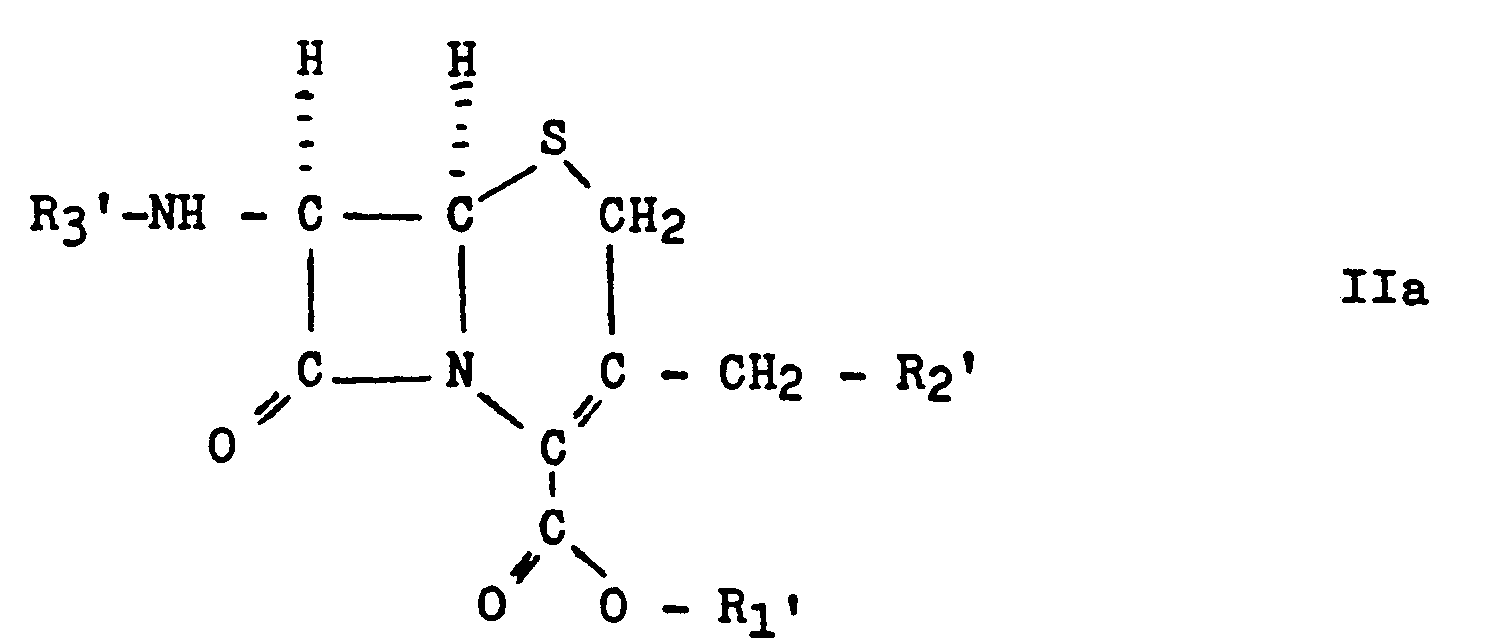
- R,' is hydrogen or a salt forming cation or a "carbon" ester residue as defined above,
- R2' is (lower)alkoxy, (lower)alkylthio, (lower)alkanoyloxy, (lower)alkanoylthio, bromo when R,' is a "carbon" ester residue, a 1-pyridinium group optionally having substituents attached to the heterocyclic ring, or an optionally substituted heterocyclic thio group as defined before, implicating that silyl groups introduced optionally to protect hydroxy, carboxy and sulfo and/or silyl groups or acyl groups introduced optionally to protect unsaturated heterocyclic secondary amino groups are removed to give the free substituent or salts thereof, and
- R3' is formyl or a group as defined above.
- According to the third object of the invention such a multi-step process for the preparation of compounds of formula Ila is thereby characterized, that 7β-acylamino-3-methyl-3-cephem-4-carboxylic acid 1β-oxide derivatives of formula Ib,

- R,' is hydrogen or a salt forming cation, or a "carbon" ester residue as defined above, and
- R3' is formyl or a group as defined above, are converted without isolation of intermediates by sequentially the following steps, optionally performed in the same reaction vessel:
- a) a silylation of the carboxyl group, to introduce a silyl group such as the trimethylsilyl group or the dimethylsilyl group via carboxylate oxygen attached to an additional cephalosporanyl moiety of formula Ib, optionally carried out in situ, when starting with a compound of formula Ib wherein R,' is not a "carbon" ester group,
- b) a light-induced bromination of the 3-methyl group of a compound of formula Ib to give a compound with the 3-bromoethyl group, using a N-bromo-amide or a N-bromo-imide as brominating agent,
- c) if necessary, as determined principally by the nature of the substituents R,' and R3' replacement by hydrogen of bromine atoms(s) introduced in step b) additionally in the methylene group adjacent to the sulphur atom of the dihydrothiazine ring by means of reaction with a trialkyl or triaryl phosphite,
- d) unless it is desired to prepare compounds of formula Ila with for R,' a "carbon" ester residue and for R2' bromo, an introduction of the substituent R2' by replacement of the bromine atom introduced in step b) in the methyl group, and,
- e) a deoxygenation of the sulphoxy group employing phosphorus pentachloride in the presence of in any case an olefinic compound, having at least one carbon-carbon double bond with no more than two hydrogen atoms attached thereto, which removes chlorine predominantly by way of addition to a carbon-carbon double bond, and optionally in the presence of added or already present catalyst or additive.
- If it is desired to operate the process of this third object of the invention without using "carbon" esters for protection of the 4-carboxyl group of the cephalosporin moiety, protection of this group is introduced preferably by silylation to be performed in the first step a) suitably by an in situ procedure. If the starting material is a salt, e.g. a sodium salt or a triethylamine salt, a monohalosilane like trimethyl chlorosilane or dimethylmethoxy chlorosilane is added to the suspension of the salt in a suitable anhydrous organic solvent. A dihalosilane like methyl dichlorosilane can also be used in such a way that the product preponderantly to exclusively is a dicephalosporanyl dimethylsilane.
- If the starting material is a cephalosporanic acid 1(3-oxide the silylation can be carried out with the same chlorosilane agents while adding a substantially equivalent amount of a suitable tertiary amine like triethylamine. In view of minimizing remaining amounts of chemicals in particular with regard to most adequate and fluent operation of step b), it is however preferred to effect silylation by means of substantially the process described in EP-A 0 043 630, which is included by reference herein, using as silylation means a balanced amount of a preferably low boiling hexa substituted disilazane of the general formula,

- This silylation catalyst proved to be satisfactorily enough upon incorporation as the first step in the multi-step one-pot processes of the present invention on reduced scale. However with regard to a, for obvious reasons desired, simple operation of the whole process, a silylation step exactly as indicated in EP-A 0043630 was found to be not sufficiently reliable and reproducible during application on industrial scale under the selective and optimized conditions involved. A major problem appeared to be related to the on large scale more difficult complete removal and/or making unreactive of the last remnants of ammonia developed during the silylation, since even very small remaining quantities of not sufficiently unreactive ammonia appeared to disturb the subsequent bromination step. A relatively minor problem arose occasionally with diligent maintenance of silyl protection throughout the whole process in particular upon performing the bromination step as circumscribed below.
- By trial and error it was found possible surprisingly to circumvent such problems by changing the conditions of the silylation of the starting desacetoxycephalosporanic acid 1β-oxide derivative with a hexasubstituted disilazane in a halogenated hydrocarbon solvent, e.g. dichloromethane, in such a manner that the silylation mixture contains in addition not only a preferably relatively strong silylation catalyst like saccharine in relative amounts of 0.005 to 5 mol% but also an organic compound in relative amounts of 1 to 50 mol %, which organic compound is prone to silylation by e.g. hexamethyl disilazane under the influence of e.g. saccharine.
- Preferably the additional organic compound is introduced in an amount greater than the amount of silylation catalyst e.g. saccharine.
- The additional organic compound in the first approach has the function of facilitating extrusion of ammonia in gaseous form, and/or binding of the ammonia e.g. by way of forming a sufficiently strong complex or salt, thereby making unreactive the ammonia. In second approach it was found to be expedient, that the additional compound is also prone to silylation, so that it can remove the usually introduced small excess of the hexasubstituted disilazane, but then not in such a way that its silylation proceeds at the cost of complete silylation of the desacetoxycephalosporin moiety. The latter means, that the silyl derivative of the additional organic compound can act as silylating agent for the desacetoxycephalosporin moiety, while it also preferably is more reactive to air-moisture than the silylated desacetoxycephalosporin 1(3-oxide derivative, the leakage of which air-moisture being difficult to prevent completely during operations on industrial scale.
- Preferred agents in this respect therefore are the usually somewhat acidic compounds belonging to the following classes, which essentially constitute relatively weaker silylation catalysts according to the invention of EP-A 0043630:
- - open imides like 3,3-dimethyl glutarimide or saturated cyclic imides like succinimide,
- - open acyl ureas like 3-benzoyl-1-penyl-urea or saturated cyclic acyl ureas like hydantoine, and
- - open or saturated cyclic N-sulphonyl carbon-amides.
- These compounds therefore contain an NH radical in between two acyl type radicals (carbonyl or sulphonyl).
- An especially preferred agent in this respect is succinimide.
- In order to indicate what is meant by a relatively strong silylation catalyst, the attention is directed to lines 4-19 of page 6 of EP-A 0043630 containing an enumeration of suitable catalysts, and to lines 20-23 of that page indicating the particularly preferred catalysts. That the above indicated compounds in the general sense are relatively weaker silylation catalysts is revealed by the examples of EP-A 0043630, for instance by the tables added to the examples 7 and 85 therein.
- It will be appreciated by persons skilled in the art, that silylation with hexamethyl disilazane using a small to very small relative amount of a relatively strong silylation catalyst like saccharine in combination with, what normally will be the case, a substantially larger amount of e.g. succinimide is not the same as silylation in the presence of saccharine while employing a mixture of e.g. hexamethyl disilazane in equivalent amount and in addition trimethylsilyl succinimide prepared separately, which alternative is possible according to EP-A 0047560 (example I therein for instance), in particular since the additional employ of succinimide does not require the use of larger amounts of hexamethyl disilazane.
- It will also be appreciated that an improvement in the silylation conditions of the above described nature can be achieved similarly and also practically by introducing a combination of 0.005 to 5 mol % of a suitable strong silylation catalyst like saccharine with a somewhat less than equivalent amount of a hexasubstituted disilazane and a relatively smaller equivalent amount of a silyl derivative of a weaker silylation catalyst as indicated above, e.g. N-trimethylsilyl-succinimide. In other words, when as normally will be the case the starting desacetoxycephalosporin 1β-oxide derivative contains one silylatable group in need of protection, i.e. in general the 4-carboxyl group, there will then be used relative to the amount of cephalosporin about 0.8 to at most 1 equivalent (or about 40 to at most 50 mol %) of the disilazane in combination with 0.01 to about 0.5 equivalent (or usually 1 to about 50 mol %) of e.g. trimethylsilyl-succinimide, in such a manner that an excess of 0.01 to 0.3 silyl group equivalent is employed. This good alternative may seem less economic since it relates to the use of a second silylation agent to be prepared separately, but its advantage may be inter alia that in comparison less of succinimide moiety may be present in the mixture.
- It is possible in principle to use cephalosporanic acid la-oxides, but the employ of the corresponding 1p-oxides usually result in better final yields and the 1β-oxides are also easier to prepare in general.
- By large scale fermentation penicillins can be obtained, having as 6p-substituent generally the group,
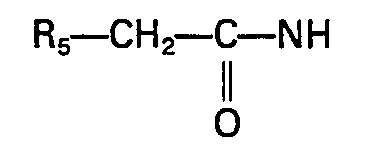
- Depending on the nature of the groups R5 and R,' and the precise conditions of step b) some material can be lost by a certain degree of concomitant bromination in the methylene group of the substituent Rs-CH2, which bromine substituent is at best only partially replaced by hydrogen in step c). If it is desired to eliminate anyhow this side reaction, another substituent R3' can be used, such as formyl or benzoyl, which substituents are not brominated to any hindering extent.
- In particular in view of the circumstance that the process of this third object yet does not comprise a side chain splitting final step, some variation in the solvent used throughout is possible. Generally most suited however are halogenated hydrocarbons, preferably low boiling examples, such as chloroform, or more suitably 1,2-dichloro ethane, and most suitably dichloromethane.
- The light induced bromination step b) is essentially the same as the one described in the process of EP-A 0 034 394. Depending on the scale of the experiment and on constructional angles, the irradiation can be performed for instance in one unit, or in a series of units, through which the solution is passed by pumping from a reservoir container, which can be cooled to give an almost uniform internal temperature in all irradiation units, from which tiny samples can be taken to verify analytically the progress of the bromination for instance by running a nuclear magnetic resonance spectrum, and which was used conveniently to carry out the preceding silylation step.
- As is described in EP-A 0 034 394 it is generally efficaceous to introduce before starting the irradiation an additive, which destroys or neutralizes small remaining amounts of the silazane employed or of degradation products thereof. Suitably this additive is sulphaminic acid.
- As indicated in the same patent application any of the known agents in the art employed for thermal, peroxide catalyzed or light induced bromination of reactive carbon-hydrogen bonds can be used, such as N-bromo-carbon amides like N-bromo-acetamide and N-bromo-caprolactam, or N-bromo-carbonimides like N-bromo-phthalimide or 1,3-dibromo-hydantoine, or N-bromo-sulphonamides and N-bromo- sulphonimides like N-bromosaccharine. Preferably the brominating agent is N-bromosuccinimide.
- Complete or substantially complete bromination of the methyl group attached to ring carbon atom 3 of the dihydrothiazine ring is usually accompanied by some bromination of the methylene group adjacent to sulphur, the extent of which side reaction is influenced by the precise conditions and by the nature of the substituents R3' and R,'. Bromine introduced additionally in this methylene group often had to be replaced by hydrogen to arrive at relatively good final yields. This can be carried out in step c) with the help of the process described in EP-A 0 001 149 which is included by reference herein, using in general phosphites, like trialkyl and triaryl phosphites. Tributyl phosphite was found to be suitable throughout.
- Since esters of 713-substituted-3-bromomethyl-3-cephem-4-carboxylic acid per se are versatile and valuable tools in the field of cephalosporin chemistry, the present process of the third object of the invention is adaptable to synthesis and isolation of such compounds by directly applying the deoxygenation step e) after step c) while omitting the substitution step d). To some extent this aspect is compatible with using silyl protection of the carboxy group, but in view of the well-known tendency of 3-bromomethyl-3-cephem-4-carboxylic acids to form fused lactone derivatives by intramolecular cyclisation, which is difficult to prevent completely, it is here preferred to use protection by "carbon" esters. It is somewhat preferred to use in this respect for R,' the t-butyl group.
- In step d) the bromo atom of the 3-bromomethyl group is replaced by the residue R2' according to procedures generally known per se. In order to increase, when necessary, the velocity of the substitution reaction, and/or to enhance the solubility of some R2' containing agents a minor volume of a substantially anhydrous highly dipolar aprotic solvent, like N,N-dimethyl formamide, N-methyl-pyrrolidinone and hexamethyl phosphoric triamide can be introduced, since relatively small amounts of such solvents will not seriously impede fast and rewarding performance of the subsequent deoxygenation process of the invention and may even provide for catalysis of the deoxygenation.
- And in this respect presently important collection of final products of the formula Ila contain for the substituent R2' an usually unsaturated heterocyclic thio group. Such thiols can be brought to reaction in the presence of a nearly equivalent amount of a suitable tertiary amine like triethyl amine or N,N-dimethyl aniline, or also suitably can be introduced as a corresponding thiolate, e.g. a metal thiolate like the sodium or the potassium thiolate. According to EP-A 0047560 it is however possible and in the context of the process for the preparation of compounds of formula Ila ocasionally advantageous indeed to carry out this substitution reaction while employing as thiolating agent the corresponding trimethylsilyl thioether. If so desired the reaction time can be reduced and/or the reaction temperature, normally falling in the range between -10 and +25°C, can be lowered by adding to the reaction between the 3-bromomethylcephalosporin intermediate and the trimethylsilylthioether hexamethylphosphoric triamide in significantly less than equivalent amount, making appropriate use of the invention described in EP-A 0091141.
- It will be appreciated that this particular modification involving the use of trimethylsilyl thioethers can be particularly effective if the heterocyclic moiety of the thiol contains a substituent in need of protection occasionally to obtain maximal yields, like hydroxy, carboxy and the likes, which substituents are then silylated together with the thiol group, preferentially using hexamethyl disilazane and catalyst.
- In the final step e) the new deoxygenation process of the invention is used, applying olefinic compounds within a reduced scope, approximately as indicated for application in the process of the second object of the invention, in that in view of adequate accommodation with the preceding steps it is preferred to use olefinic compounds which take up chlorine fast as well as preponderantly to exclusively by way of addition. Therefore, though at individually appropriately developed conditions the generally fast reacting terminal olefines with an additional substituent on the inner unsaturated carbon atom can be used, and generally dienes can be employed too, it is preferred to use a monoolefinic compound having a non-terminal carbon-carbon double bond, placed in a chain of 4--12 carbon atoms optionally substituted at one or at both unsaturated carbon atoms with a ethyl or ethyl group or in a carbocyclic ring of 5-8 ring atoms optionally substituted at one unsaturated carbon atom with a methyl or ethyl group. For reasons of general efficiency and high conversion and isolation yields, cis-cyclooctene again appeared to be a singularly suitable olefine.
- It will be appreciated from the discussion presented before, that it is generally preferred to operate the deoxygenation step while deliberately adding a catalyst. Very good catalysts are N,N-dialkyl formamides of which it is usually not necessary to employ more than 30 mole % with respect to the amount of cephalosporin introduced. It is also possible to provide for deliberate catalysis by adding in similar relative amounts some tertiary amines, in particular an N,N-dialkyl arylamine, acknowledging that then a minor part of the chlorine is taken up by substitution of the aromatic nucleus of e.g. N,N-dimethyl aniline. It is also possible to combine such catalytic additives, e.g. to introduce minor amounts of e.g. N,N-dimethylformamide as well as of N,N-dimethylaniline. It is inferred again, that depending on the precise conditions of one or more of the preceding steps, in particular with respect to the ingredients of steps a) and d), deliberate catalysis of step e) occasionally can be omitted.
- It will be appreciated, that the deoxygenation process of the present invention is related primarily to the use of an at least equivalent amount of the olefinic compound as chlorine-capturing agent, not taking into account, that in practice it may be quite well possible to develop an equally suitable deoxygenation procedure while deliberately combining a substantially less than equivalent amount of the olefine together with another type of chlorine-capturing agent, for instance an enamine or N,N-dialkyl aromatic amine or even pyridine, which additional agent consumes chlorine by another type of chemical binding.
- Such interventions are hereby not considered to constitute a result of independent inventive approach.
- As had been indicated in the beginning, it was the primary object of the present invention to develop suitable, versatile and mutually adaptable conditions of various conversions participating in a multi-step synthesis, preferably carried in one and the same reaction vessel, of various 7p-amino-3-substituted methyl-3-cephem-4-carboxylic acid derivatives starting from certain 7β-acylamino-3-methyl-3-cephem-4-carboxylic acid 1-oxide derivatives, in particular relating to the more easily attainable 1(3-oxides and in regard to the nature of the 7β-acylamino substituent to well available or economically preparable starting materials, which overall synthesis therefore would not involve isolation of any intermediate, and which synthesis in addition would be amenable to lasting protection of e.g. the cephalosporin 4-carboxy group by preferably silylation suitably applied in situ, whereby a major consideration related to effective and fluent insertion of a sulphoxide deoxygenation step, for which a new process had to be developed.
- From the rewarding application of the newly found deoxygenation process in the second object of the invention relating to the one-pot preparation of 7β-amino-3-substituted-3-cephem-4-carboxylic acid derivatives from 7β-acylamino-3-substituted-3-cephem-4-carboxylic acid 1-oxide derivatives, and in the third object of the invention dealing with the preparation of 713-acylamino-3-substituted methyl-3-cephem-4-carboxylic acid derivatives from 7β-acylamino-3-methyl-3-cephem-4-carboxylic acid 1β-oxide derivatives, the impression could emerge perhaps, that combination of the results of both preceding objects to give the fourth object of the invention, i.e. overall synthesis of 7(3-amino-3-substituted methyl 3-cephem-4-carboxylic acid derivatives from 713-acylamino-3-methyl-3-cephem-4-carboxylic acid 1β-oxide derivatives carried out without isolation of intermediates, would not involve additional inventive step.
- It will be appreciated however, that it could not be predicted without more, that the final side chain splitting step can be carried out without impeding or economically unattractive accommodation of this last step in view of the presence of possibly hindering relatively considerable amounts of a number of chemicals remaining from the first steps of the third object of the invention, e.g. in particular succinimide, trimethylsilyl succinimide, the excess of the phosphite employed in substantial excess, and the basically not well-known byproducts originating from the consumed amount of the phosphite in step c).
- Henceforth, the fourth object of the invention relates to a process for the synthesis of 7p-amino-3- substituted methyl-cephalosporanic acid derivatives of formula llla
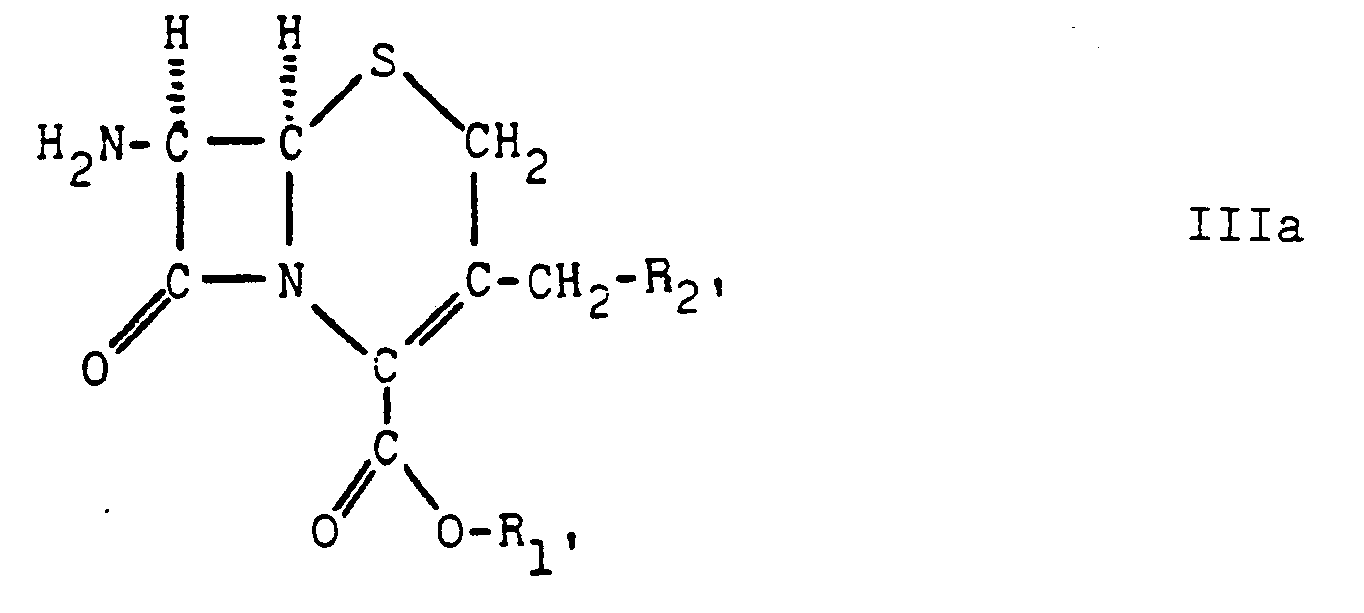
- R,' is hydrogen or a salt forming cation or a "carbon" ester residue as defined above, and
- R2' is as defined above.
- According to this fourth object of the invention such a multi-step process for the preparation of compounds of formula Ilia is thereby characterized, that 7 β-acylamino-3-methyl-3-cephem-4-carboxylic acid 1β-oxide derivatives of formula Ib, wherein, the substituents R,' and R3' are as defined as above with the exception that R3' does not include formyl, are converted without isolation of intermediates by sequentially the following steps, optionally performed in the same reaction vessel:
- a) a silylation of the carboxy group, optionally carried out in situ, when starting with a compound of formula Ib with for R1' hydrogen or a salt forming cation,
- b) a light-induced bromination of the methyl group as described and indicated before,
- c) if necessary, as described before, a selective debrominating reaction with the help of a triorganic phosphite,
- d) an introduction of the substituent R2', unless while using a "carbon" ester residue R1' it is chosen to preserve bromine as substituent R2' in a final product of formula Illa,
- e) a deoxygenation of the sulphoxy group as circumscribed before, and
- f) a deacylation reaction splitting of the 7β-acylamino substituent according to known procedures with the help of phosphorus pentachloride as described before.
- It was found experimentally possible to carry out the whole sequence of steps in one and the same reaction vessel up to the final hydrolysis, which for at least a part can also be performed in the same vessel, whereby, as will be appreciated by persons skilled in the art, in larger scale operations it can be technologically advantageous to use this reaction vessel as central supply for the light-induced bromination operated in a series of irradiation units by recycling. The final products of formula IIIa are isolated by methods known per se, optionally including hydrolytic or reductive fission of a "carbon" ester residue R1'.
- As with the third object it is also in the fourth object of the invention preferred to operate with a "carbon" ester in case of preservation of bromine as substituent R2'.
- The process description for the steps a) to e) is the same as the one given for those steps of the third object of the invention, very similar to identical also are the preferred ways of operation and the preferences indicated for e.g. solvent, temperature, and chemicals such as the olefinic compounds more suitably applied in the deoxygenation step e). Since accommodation of the final step f) surprisingly did not involve specifically adapted measures, this step can be performed as the step c) of the second object of the invention applying methods known in the art.
- Preferably starting from 7β-phenylacetamido (or phenoxyacetamido)-3-methyl-3-cephem-4-carboxylic acid 1β-oxide derivatives, a preferably prepared compound of the formula Illa is 7β-amino-3-acetoxymethyl-3-cephem-4-carboxylic acid (7-ACA) or 7β-amino-3-bromomethyl-3-cephem-4-carboxylic acid, whereby it is preferred to operate with for R1' the t-butyl group instead of another "carbon" ester group or a "silyl" group, so that the primarily isolated final compound suitably is the t-butyl ester of 7-ACA or 7β-amino-3-bromomethyl-3-cephem-4-carboxylic acid, respectively, or a salt thereof containing a strong mineral or organic acid.
- Generally however it is preferred to operate the process with "silyl" protection of the cephalosporin carboxy group, by using e.g. the trimethylsilyl group. Preferably using "silyl" protection throughout, while most suitably starting from desacetoxycephalosporin 1β-oxides having the 7a-phenylacetamido or the 7β-phenoxyacetamido group, the preferably prepared final compounds of formula Ila, with optional external salt formation of an additional carboxy or sulfo group with a cation derived from metals like sodium, potassium or magnesium, or from an amine or of the 7β-amino group or an additional dimethylamino group with a strong mineral of organic acid as defined before, are:
- 7β-amino-3-(1-methyl-(1 H)tetrazol-5-yl-thiomethyl)-3-cephem-4-carboxylic acid,
- 7β-amino-3-(2-dimethylamino)ethyl-(1 H)tetrazol-5-yl-thiomethyl)-3-cephem-4-carboxylic acid,
- 7β-amino-3-(1-sulphomethyl-(1 H)tetrazol-5-yl-thiomethyl)-3-cephem-4-carboxylic acid,
- 7β-amino-3-(1-carboxymethyl-(1H)tetrazol-5-yl-thiomethyl)-3-cephem-4-carboxylic acid,
- 7β-amino-3-(1,2,3-(1 H)triazol-5-yl-thiomethyll-3-cephem-4-carboxylic acid,
- 7β-amino-3-(5-methyl-1,3,4-thiadiazol-2-yl-thiomethyl)-3-cephem-4-carboxylic acid,
- 7β-amino-3-(1,3,4-thiadiazol-2-yl-thiomethyl)-3-cephem-4-carboxylic acid and
- 7β-amino-3-(2,5-dihydro-6-hydroxy-2-methy)-5-oxo-1,2,4-triazin-3-yl-thiomethy))-3-cephem-4-carboxylic acid.
- Again preferably using "silyl" protection during the process the most preferred final product is 7β-amino-3-(1-methyl)-(1H)tetrazol-5-yl-thiomethyl)-3-cephem-4-carboxylic acid.
- The four objects of the invention are in a not limiting way illustrated by the following examples.
- To a suspension of 3.48g g (purity 96% by weight: 9.59 mmol) of 713-phenylacetamido-3-methyl-3-cephem-4-carboxylic acid 1β-oxide in 40 ml of dichloromethane, which was kept under nitrogen, 2.3 ml (18.09 mmol) of trimethyl chlorosilane and 2.3 ml (17.75 mmol) of N,N-dimethylaniline were added with stirring at 0°C. The temperature was raised to about 20°C, followed by stirring during 30 minutes. The mixture was cooled to -60°C, followed by sequential introduction of 1.3 ml (11 mmol) of cycloheptene and 2.4 g (11.5 mmoles) of phosphorus pentachloride, whereupon the mixture was stirred additionally during 15 minutes at -45°C. Stirring was continued during cautious addition of 10 ml of water and subsequently during 15 minutes at -10°C. Addition of 30 ml of toluene and stirring for 3 hours at -5°C afforded a precipitate, which was collected by filtration, followed by washings with toluene and water, and by drying in vacuo to constant weight. Isolated weight 2.92 g of 7β-phenylacetamido-3-methyl-3-cephem-4-carboxylic acid. The identity of the isolated product was checked by TLC and PMR. A purity of 97% by weight resulted from HPLC assay, corresponding to isolation of 8.52 mmoles.
- While accounting for the purity of the starting material the yield is 88.9%. According to HPLC assay the combined filtrates still contained an amount of desired product equivalent to 7.1%. The total conversion yield therefore was 96%.
- PMR (pyridin-d5, δ-values in ppm, 60 Mc, TMS): 2.12 (s, 3H); 3.01, 3.32, 3.41 and 3.72 (AB-q, J=18Hz, 2H); 3.83 (s, 2H); 5.18 (d, J=4.5Hz, 1 H); 6.19 (dd, J=4.5Hz, J=8Hz, 1 H); 7.13 to 7.58 (m, 5H); 10.06 (d, J=8Hz, about 1H); 10.16 (s, about 1H).
- IR (KBr-disc, values in cm-'); 3270, 3060, 1760, 1700, 1665, 1626 and 1545.
- a) The first experiment was an exact replica of the experiment described in Example I but for one alteration: the 11 mmol of cycloheptene were replaced by 10 mmol (1.3 ml) of cis-cyclooctene. The isolated weight was 2.98 g, amounting to an isolation yield of 89.7% having a purity of 96% by weight as determined by HPLC assay. According to HPLC assay the combined filtrates still contained an amount of desired product equivalent to 9.4%. While accounting forthe purity ofthe starting material (96% by weight) the overall conversion yield therefore was 99.1 %.
- b) The experiment was repeated in exactly the same way. The isolation yield was 3.02 g. Direct isolation amounted to a yield of 92.4%, taking into account its purity (HPLC assay: 97.5%) and the purity of the starting material (96%).
- c) The experiment was repeated on a double scale (6.96 g of the sulphoxide) employing otherwise identical conditions. The direct isolation yield was 5.91 g, or 91.2% while accounting for its purity (97.5% according to HPLC assay) and for the purity of the starting material. The mother liquor contained a further 3.0% of desired product. The total conversion yield therefore was 94.2%.
- d) Experiment c) was repeated on the same scale employing the same conditions but for one alteration. Instead of 40 ml of toluene, now 40 ml of n-hexane were added followed by 3 hours stirring at 0°C. The precipitate was collected by filtration, washed with n-hexane and water, and dried in vacuo. The isolated weight was 6.42 g. In view of a purity of 97.5% by weight according to HPLC assay, the direct isolation yield was 97.1 %.
- This experiment was performed on approximately the same scale was in Example I, while using the same operational method described therein. Used were: 4.06 g (8.59 mmoles having a purity of 86% according to HPLC assay) of the starting sulphoxide, 2.4 ml (18.9 mmol) of trimethyl chlorosilane, 2.4 ml (18.5 mmol) of N,N-dimethylaniline, 40 ml of dichloromethane, 1.3 ml (10 mmol) of cis-cyclooctene, 2.4 g (11.5 mmol) of phosphorus pentachloride, 10 ml of water and 30 ml of toluene. Isolated weight of substantially dry product was 3.48 g. The purity of 90.5% by weight as determined by HPLC assay indicated the presence of 8.07 mmol of 7β -phenylacetamido-3-methyl-3-cephem-4-carboxylic acid in the isolated product. The actual isolation yield therefore is 94%. It was established by means of HPLC assay, that the combined filtrates still contained 3.9% of the desired compound. The overall conversion yield therefore was 97.9%. The product was identified by TLC, PMR and IR.
- PMR (DMSO-ds, δ-values in ppm, 60 Mc, TMS): 2.04 (s, 3H); about 3.6 (4H); 4.59, 4.80, 4.95 and 5.16 (AB-q, J=13Hz, 2H); 5.08 (d, J=4.5Hz, 1 H); 5.69 (dd, J=4.5Hz, J=8Hz, 1 H); 7.27 (s, 5H); 9.04 (d, J=8Hz, about 1 H).
- IR (KBr-disc, values in cm-1);0 3265, 3050, 1785, 1752, 1740, 1715, 1662, 1230.
- According to HPLC assay the starting material has a purity of 85% by weight. To a suspension of 8.00g (therefore 14.21 mmol) of the sulphoxide in 80 ml of dichloromethane, which was kept under nitrogen, 4.6 ml (36.2 mmol) of trimethyl chlorosilane and 4.5 ml (35.5 mmol) of N,N-dimethyl-aniline were added with stirring at 0°C. The temperature was raised to 20°C, followed by stirring during 30 minutes. The mixture was cooled to -66°C, followed by sequential introduction of 2.6 ml (20 mmol) of cis-cyclooctene and 3.9 g (18.7 mmol) of phosphorus pentachloride, whereupon the mixture was stirred additionally during 10 minutes at -45°C. After addition of 5 ml of N,N-dimethyl-formamide, 20 ml of water were added cautiously while stirring continuously. In the mean time the cooling bath was removed, and the layers were separated after the mixture had attained -5°C. While,adjusting the pH to 7 by addition of dilute ammonia, the organic phase was extracted a few times with a total volume of 60 ml of water. The organic phase was discarded, whereupon the combined water-layers were diluted with 50 ml of cold methanol. While maintaining pH 2 by controlled addition of 4N hydrochloric acid, the solution prepared was given gradually and slowly to a stirred mixture of 20 ml of water and 20 ml of methanol. After standing for a while at 0°C, the precipitated product was collected by filtration, followed by washing with cold water and drying to constant weight in vacuo. 7β-phenylacetamido-3-(5-methyl-1,3,4-thiadiazol-2-yl)thiomethyl-3-cephem-4-carboxylic acid was isolated in crude form. According to HPLC assay the purity of the isolated product was 87.5% by weight. The yield therefore was 12.48 mmol of 89%. The mother liquor contained another 2% of desired product. The total conversion yield therefore was 91 %.
- PMR (de-DMSO, 6-values in ppm, 60 Mc, TMS): 2.67 (s, 3H); 3.52 (s, 2H)) 3.35,3.65,3.68 and 3.98 (AB-q, J=18Hz, 2H); 4.10, 4.30, 4.43 and 4.63 (AB-q, J=12.5Hz, 2H); 5.06 (d, J=8.5Hz, 1H); 5.70 (dd, J=4.5Hz, J=8.5Hz, 1H); 7.28 (5H); 9.14 (d, J=8.5Hz, about 1H).
- IR (KBr-disc, values in cm-'); 3280, 3035, 1777, 1720, 1661, 1535, 1500 and 1458.
- a) The starting material was converted in exactly the same way as described in example IV. Employed were 5.24 g of crude starting material, according to HPLC assay containing 9.99 mmol (the sample had a purity of 88.2% by weight), 2 ml (15.7 mmol) of trimethyl chlorosilane, 2 ml (15.5 mmol) of N,N-dimethylaniline and 40 ml of dichloromethane, the resulting mixture was cooled to -60°C, followed by sequential introduction of 1.4 ml (10.8 mmol) of cis-cyclooctene and 2.4 g (11.5 mmol) of phosphorus pentachloride, and stirring during 15 minutes at -50°C, 10 ml of water were added cautiously. After introduction of 2 ml of N,N,-dimethylformamide the mixture was stirred for 15 minutes at -10°C. 30 ml of toluene were added, followed by 3 hours stirring at -5°C. The precipitate formed was filtered off, washed with cold water and toluene, and thereafter dried in vacuo. The product weighed 4.76 g. According to HPLC assay 85% of the product was 7β-phenylacetamido-3-(1-methyl-1H-tetrazol-5-yl)thiomethyl-3-cephem-4-carboxylic acid, corresponding with a yield of 90.8%. The mother liquor according to HPLC assay contained another 6.3% of the desired compound. The total conversion yield therefore was 97.1%.
- PMR (mixture of CDCI3 and d6-DMSO, 6-values in ppm, 300 Mc, TMS): 3.56, 3.60, 3.62 and 3.66 (AB-q, J=14Hz, 2H); 3.67 (s, 2H); 3.94 (s, 3H); 4.28, 4.32, 4.34 and 4.38 (AB-q, J=13.5Hz, 2H); 4.96 (d, J=5Hz, 1 H); 5.74 (dd, J=5Hz, J=8.5Hz, 1H); 7.21-7.34 (m, 5H); 8.27 (d, J=8.5Hz, about 1H).
- /R (KBr-disc, values in cm-1): 3260, 1780, 1725, 1657, 1619, 1535, 1492, 1155, 1085.
- b) For comparison of the process of the present invention with a method known in the art, the example described hereinabove was repeated while replacing cis-cyclooctene by N,N-dimethylaniline (10.8 mmol). HPLC assay of a sample that was taken directly after 15 minutes additional stirring indicated that the desired compound was formed with 86.6% conversion yield. In the isolation procedure the 3 hours stirring at -5°C did not afford a crystalline precipitate. Addition of 10 ml of water and 10 ml of dichloromethane resulted in an oily precipitate. The supernatant layer was decanted and the residual oil triturated with 15 ml of dichloromethane to give a solid. While stirring 10 ml of toluene were added at 0°C. Filtration, washing with 1:1 dichloromethane-toluene and drying in vacuo gave 4.92 g of the desired compound with a purity of only 66.5% by weight. The isolaton yield therefore was 73.4%. The mother liquor still contained about 13% of good product. A yield of conversion of about 86.5% was thereby confirmed.
- At -20°C 1.3 ml (10 mmol) of cis-cyclooctene and 2.4 g (11.5 mmol) of phosphorus pentachloride were given to a stirred solution of 4.08 g of t-butyl 7β-phenytacetamido-3-methyt-3-cephem-4-carboxytate 1β-oxide (9.08 mmol in view of 90% purity according to HPLC assay) in 80 ml of dichloromethane. The temperature was lowered to -40°C, followed by 15 minutes stirring. 10 ml of water were added with care, whereupon stirring was continued during 15 minutes at 0°C. The layers were separated, the organic layer was subjected to washings with water, drying on anhydrous magnesium sulphate, filtration and concentration in vacuo to a volume of about 25 ml. Gradual addition of light petroleum resulted in a precipitate. The solid was collected by filtration, washed with light petroleum, and dried in vacuo. 4.1 g of t-butyl 7β-phenylacetamido-3-methyl-3-cephem-4-carboxylate were obtained, corresponding with a yield of 93% in view of according to HPLC assay 80.5% purity.
- PMR (CDCI3, õ-values in ppm, 60 Mc, TMS): 1.50 (s, 9H); 2.06 (s, 3H); 2.93,3.23,3.36,3.66 (AB-q, J=18.5 Hz, 2H); 3.61 (s, 2H); 4.90 (d, J=4.5Hz, 1H); 5.75 (dd, J=4.5Hz and J=9Hz, 1H); 6.85 (d, J=9Hz, about 1H); 7.31 (s, 5H).
- IR (KBr-disc, values in cm-'): 3260, 1780, 1725, 1657, 1619, 1535, 1492, 1155 and 1085.
- The procedure used was exactly the same as described under example I. Employed were 0.245 g (maximally 0.70 mmol) of the la-oxide of phenylacetamido-desacetoxycephalosporin of unknown quality, 0.14 ml (1.10 mmol) of trimethyl chlorosilane, 0.14 ml (1.10 mol) of N,N-dimethylaniline, 2.8 ml of dichloromethane, 0.103 ml (0.79 mmol) of cis-cyclooctene, 0.175 g (0.84 mmol) of phosphorus pentachloride and in the isolation procedure 1.4 ml of toluene. The reaction conditions during the reduction sequence were as usual 15 minutes at -45°C. 0.1579 g of the desired phenylacetamido desacetoxycephalosporin were isolated in solid form. This corresponds with a direct yield of 57% in view of about 84.0% purity as determined by HPLC assay. The mother liquor contained about 15% of the same compound as determined by HPLC assay. The minimal overall conversion yield therefore is about 72%.
- A number of olefinic compounds comprised by the invention were subjected to the same standard procedure. The results of these experiments are collected in Table I, which also refers to an experiment (the last entry) wherein no secondary agent for the capture of chlorine was used, and to two experiments wherein secondary agents known in the prior art, i.e. 1-morpholin-4-yl-cyclohexene and N,N-dimethyl aniline, were employed.
- The procedure followed is the one described in example I. The amounts and volumes used were as follows:
- 6.96 g (effectively 19.38 mmol) of 7β-phenylacetamido-3-methyl-3-cephem-4-carboxylic acid 1β-oxide of according to HPLC assay 97% purity,
- 80 ml of dichloromethane,
- 4.6 ml (36.2 mmol) of trimethyl chlorosilane,
- 4.6 ml (35.5 mmol) of N,N-dimethyl aniline,
- 22 mmol of the olefinic compound or of a prior art agent,
- 4.8 g (23 mmol) of phosphorus pentachloride. During after-treatment of the reaction mixture 20 ml water and 40 ml of toluene were added.
- Unless stated otherwise all deoxygenations involved 15 minutes reaction at -45°C. By means of HPLC assay all yield percentages were corrected for the actual content of 7β-phenylacetamido-3-methyl-3-cephem-4-carboxylic acid.

- At -20°C 0.325 ml (2.5 mmol) of cis-cyclooctene and 0.6 g (2.9 mmol) of phosphorus pentachloride were given sequentially to a stirred solution of 1.21 g of t-butyl 713-phenylacetamido-3-bromomethyl-3-cephem-4-carboxylate 1β-oxid (2.33 mmol) in view of 93% purity according to HPLC assay) in 25 ml of dichloromethane. After cooling to -40°C and stirring additionally during 15 minutes, 3 ml of water were added with care, followed by 15 minutes stirring at 0°C. The layers were separated, the organic layer twice washed with 3 ml volumes of iced water, dried on anhydrous magnesium sulphate, filtered and concentrated in vacuo to a volume of about 5 ml. Addition of light petroleum (40―60°C) resulted in a precipitate. The solid was collected by filtration, washed with n-hexane, and dried in vacuo.
- 1.0g of t-butyl 7β-phenylacetamido-3-bromomethyl-3-cephem-4-carboxylate were obtained, corresponding with a yield of 85% in view of 92.5% purity according to HPLC assay.
- PMR (CDCI3, 6-values in ppm, 60 Mc, TMS): 1.52 (s, 9H); 3.15, 3.45, 3.53 and 3.83 (AB-q, 2H, J=18Hz, 2H); 3.60 (s, 2H); 4.33 (s, 2H); 4.89 (d, J=4.5Hz, 1H); 5.76 (dd, J=4.5Hz and J=9Hz, 1H); 6.46 (d, J=9Hz, about 1H); 7.27 (s, 5H).
- IR (KBr-disc, values in cm-1): 3345, 1765, 1705, 1655, 1610, 1500, 1360, 1300, 1260, 1200, 1140, 1080, 1000, 835, 710, 690 and 600.
- To a suspension of 7.29 g 7β-phenoxyacetamido-3-methyl-3-cephem-4-carboxylic acid 1β-oxide (19.7 mmol in view of 98.6% purity according to HPLC assay) in 80 ml of dichloromethane, which was kept under nitrogen, 4.6 ml (36 mmol) of trimethyl chlorosilane and 4.6 ml (35.5 mmol) of N,N-dimethylaniline were added with stirring at 0°C. After stirring additionally for 30 minutes at room temperature, the reaction mixture was cooled down to -50°C, followed by introduction of sequentially 2.86 ml (22 mmol) of cis-cyclooctene and 4.8 g (23 mmol) of phosphorus pentachloride. 15 minutes stirring at -45°C were followed by careful addition of 20 ml of water and 15 minutes stirring at about -15°C. 80 ml of toluene were added and stirring was continued during 3.5 hours at 0°C. The precipitate formed was collected by filtration, washed with water and toluene, and dried in vacuo. Isolated weight 6.37 g of 7β-phenoxyacetamido-3-methyl-3-cephem-4-carboxylic acid (yield 91.7% in view of 98.8% purity according to HPLC assay). PMR (pyridine-d5, b-values in ppm, 60 Mc, TMS): 2.14 (s, 3H); 3.02, 3.32, 3.39, 3.69 (AB-q, J=18Hz, 2H); 5.23 (d, J=4.5Hz, 1 H), 6.19 (dd, J=4.5Hz, J=8.5Hz, 1 H); 4.81 (s, 2H); 6.78-7.50 (m, 5H); about 9.1 (broad, about 1H); 9.82 (d, J=8.5Hz, about 1H).
- /R (KBr-disc, values in cm-1): 3400, 1755, 1730, 1670, 1592, 1585, 1520, 1492, 1225, 754 and 683.
- The following experiments were performed exactly at the conditions described in Example I. In all experiments were used:
- 6.93 g of the title compound (19.40 mmol in view of 97.5% purity according to HPLC analysis),
- 80 ml of dichloromethane,
- 4.6 ml (36.2 mmol) of trimethyl chlorosilane,
- 4.6 ml (35.5 mmol) of N,N-dimethylaniline,
- 4.8 g (23 mmol) of phosphorus pentachloride,
- 20 ml of water and
- 40 ml of toluene.
- a) The reaction with phosphorus pentachloride was performed in the presence of 1.36 ml (11 mmol) of 1,3-cyclooctadiene. Isolated weight 4.27 g of 7β-phenylacetamido-3-methyl-3-cephem-4-carboxylic acid. Isolation yield 61.9% in view of 93.5% purity by weight according to HPLC assay. The mother liquor contained 8.6% of this compound. The total conversion yield therefore was 70.5%.
- b) The deoxygenation was performed in the presence of 2.72 ml (22 mmol) of 1,3-cyclooctadiene. Isolated weight 4.80 g. Isolation yield 71.5% in view of 96% purity by weight. The mother liquor still contained 5.6% of desired product. Total conversion yield 77.1%.
- c) The reaction with phosphorous pentachloride was carried out in the presence of 1.26 ml (11 mmol) of trans-2-trans-4-hexadiene. Isolated weight 5.86 g. Isolation yield 86.8% in view of 95.5% purity by weight. The mother liquor still contained 6.7% of desired product. The total conversion yield therefore was 93.5%.
- d) The deoxygenation was performed in the presence of 2.51 ml (22 mmol) of trans-2-trans-4-hexadiene. Isolated weight 5.75 g. Isolation yield 87.4% in view of 98% purity by weight according to HPLC assay. The mother liquor still contained 4.1 % of desired product. The total conversion yield therefore was 91.5%.
- e) The deoxygenation was performed in the presence of 1.24 ml (10 mmol) of 1,5-cyclooctadiene. Isolated weight 4.92 g. Isolation yield 74%. in view of 95.5% purity by weight according to HPLC assay. The mother liquor still contained 4.7% of desired product. The total conversion yield therefore was 78.7%.
- To a suspension of 6.93 g (19.4 mmol) of the 97.5% pure 1β-oxide in 160 ml of acetonitrile, which was kept under nitrogen, 4.6 ml (36.2 mmol) of trimethylchlorosilane and 2.3 ml (35.5 mmol) of N,N-dimethylaniline were added with stirring at about 0°C. The temperature was raised to about 20°C, followed by 30 minutes stirring. The mixture was cooled down to below -40°C, followed by sequential introduction of 2.86 ml (22 mmol) of cis-cyclooctenne and 4.8 g (23 mmol) of phosphorus pentachloride, whereupon the mixture was stirred additionally for 15 minutes at -45°C. Stirring was continued during cautious addition of 20 ml of cold water and subsequently for 15 minutes at -10°C. Acetonitrile was removed azeotropically by concentration in vacuo at about 0°C. Addition of 40 ml of toluene and of 10 ml of cold water resulted in a crystalline precipitate. After 1 hour stirring at 0°C the product was collected by filtration, washed with cold water and toluene, and dried in vacuo to constant weight. Isolated weight 5.45 g of 7β-phenylacetamido-3-methyl-3-cephem-4-carboxylic acid. Since according to HPLC assay the isolated product had a purity of 97% by weight, the isolation yield was 82%. In view of the presence of another 2.7% of desired product in the mother liquor, the total conversion yield was 84.7%.
- a) In nitrogen atmosphere 3.6 ml (28.3 mmol) of trimethyl chlorosilane and 3.55 ml (28.0 mmol) of N,N-dimethylaniline were added at D-5°C with stirring to a suspension of 8.0 g (purity 84% by weight, 14.04 mmol) of 7β-phenylacetamido-3-(5-methyl-1,3,4-thiadiazol-2-yl-thiomethyl-3-cephem-4-carboxylic acid 1β-oxide in 60 ml of dichloromethane. The mixture was stirred at about 20°C during 30 minutes, whereupon the temperature was lowered to -60°C, followed by sequential introduction of 2.25 ml (17.3 mmol) of cis-cyclooctene and 3.9 g (18.7 mmol) of phosphorus pentachloride. The resulting reaction mixture was stirred for 10 minutes at -45°C, whereupon the temperature was lowered to -55°C, followed by sequential introduction of 5.5 g (26.4 mmol) of phosphorus pentachloride and 3.7 ml (29.2 mmol) of N,N-dimethylaniline. The mixture was stirred for 3 hours at -45°C. The temperature was brought to -60°C, 25 ml of cold isobutanol were added, and stirring was continued during 1 hour at -45°C. After addition of 25 ml of 4N sulphuric acid and stirring for 10 minutes at -10°C the resulting two-layer system was separated and the organic layer extracted with 20 ml of 2N sulphuric acid. The organic layer was discarded and the combined aqueous layers treated with 2 g of activated carbon. After removal of activated carbon by filtration, the pH was raised to 1.0 by addition of 25% ammonia in water. After 1 hour cooling in ice the precipitate formed was collected by filtration, washed with water and acetone, and dried to constant weight.
- Isolated were 4.47 g 7β-amino-3-(5-methyl-1,3,4-thiadiazol-2-yl-thiomethyl)-3-cephem-4-carboxylic acid of according to HPLC assay 92.5% purity by weight. The overall yield therefore was 86%.
- b) Very considerable efforts wer undertaken concomitantly in order to arrive at the relatively most suitable accommodation of the known phosphorus trichloride/N,N-dimethyl formamide deoxygenation method in the two-step synthesis of the same final product starting however from a considerably more pure batch of 7β-phenylacetamido-3-(5-methyl-1,3,4-thiadiazol-2-yl-thiomethyl)-3-cephem-4-carboxylic acid 1β-oxide.
- By exactly the same procedure described above 19.8 mmol of starting material (present in 10.0 g of according to HPLC-assay 95% purity by weight) were silylated in 70 ml of dichloromethane, using 39.9 mmol of trimethyl chlorosilane and 39.5 mmol of N,N-dimethyl aniline. By necessity employing continuous heavy cooling at -75 to -70°C, the deoxygenation was carried out with 13 mmol of N,N-dimethyl formamide and 31.4 mmol of phosphorus trichloride (added dropwise in 5 minutes) in 20 minutes. While using 55.1 mmol of N,N-dimethyl aniline and 48 mmol of phosphorus pentachloride, the subsequent imidchloride formation was performed in 2.5 hours, starting at -70°C and finishing at -45°C. The following treatment with isobutanol and water in the usual manner finally yielded 5.82 g of isolated product, having a purity of 94.0% by weight according to HPLC-assay. The overall yield was 80.3%.
- For a comparison the most important details of both preparations are collected in Table II appended to example XIV, whereby the amounts of the various agents employed in example a) are proportionally raised to the level of using 19.8 mmol of starting material instead.
- c) The experiment described under a) was repeated in exactly the same way but for one alteration: cis-cyclooctene was omitted so that the deoxygenation step did not comprise the use of a secondary reduction agent. The hydrolysed reaction mixture contained according to HPLC-assay an amount of the 76-amino derivative equivalent to a conversion yield of 32%. Finally isolated were 1.0 g of low quality.
- d) The experiment under a) was repeated in exactly the same way but for one alteration: the 17.3 mmol of cis-cyclooctene were replaced by 17.3 mmol of N,N-dimethyl aniline. Isolated were 4.05 g of final product, having a purity of 89.0% by weight according to HPLC assay. The overall yield therefore was 75%.
- The with respect to experiment a) 11 % lower yield of isolation is not caused by a relatively less efficient isolation, since the combined mother liquors contained a normal amount of residual product, namely 2.5%.
- a) In nitrogen atmosphere 3 ml (23.5 mmol) of trimethyl chlorosilane and 2.95 ml (23.1 mmol) of N,N-dimethylaniline were added at 0°C with stirring to a suspension of 7.8 g (purity 83% by weight, 14.0 mmol) of 7(3-phenylacetamido-3-(1-methyl-(1H)tetrazol-5-yl-thiomethyl)-3-cephem-4-carboxylic acid 1(3-oxide in 60 ml of dichloromethane. Subsequently the mixture was stirred at about 20°C during 30 minutes, and thereafter cooled to -60°C. Sequential addition of 2.05 ml (15.7 mmol) of cis-cyclooctene and 3.6 g (17.3 mmol) of phosphorus pentachloride was followed by 10 minutes stirring at -45°C, and cooling to -60°C. Addition of 4.0 g (19.2 mmol) of phosphorus pentachloride and 3.45 ml (27.2 mmol) of N,N-dimethylaniline was followed by 3 hours stirring at -45°C. The temperature was lowered to -60°C, 25 ml of pre-cooled isobutanol were introduced, and stirring was continued during 1 hour at -45°C. After addition of 25 ml of 4N sulphuric acid and stirring for 10 minutes at -15°C the resulting two-layer system was separated and the organic layer extracted with 30 ml of 6N sulphuric acid. During extraction a total volume of 70 ml of water was added to dissolve precipitating product. The organic phase was discarded thereafter. After stirring with 2 g of activated carbon and filtration, the clear combined acidic aqueous solution was treated with 25% ammonia in water to give pH 1.5 at about 0°C. Shortly thereafter the precipitated product was collected by filtration, washed with cold water and acetone, and dried to constant weight. Isolated were 4.46 g of 7β-amino-3-(1-methyl-(1H)tetrazol-5-yl-thiomethyl)-3-cephem-4-carboxylic acid fof 93.0% purity by weight according to HPLC-assay. The overall yield therefore was 90.2%.
- b) In the same way as described in example XIII b), the phosphorus trichloride/N,N-dimethyl formamide deoxygenation method was optimized to give the relatively most suitable procedure for the synthesis of title compound, while starting from appreciably more pure 7β-phenylacetamido-3-(1-methyl-(1H)tetrazol-5-yl-thiomethyl)-3-cephem-4-carboxylic acid 1β-oxide.
- The experiment was performed on a scale of 7.33 mmol of starting compound as present in 3.83 g of 88.5% purity by weight. Used were 25 ml of dichloromethane, 12.3 mmol of trimethyl chlorosilane, 14.6 mmol of N,N-dimethyl aniline, 5.8 mmol of N,N-dimethyl formamide, 12.6 mmol of phosphorus trichloride, 19.2 mmol of phosphorus pentachloride and 25.8 mmol of N,N-dimethyl aniline to give the imidechloride, the solution of which was treated with isobutanol as described under a). The deoxygenation step had to be performed at -75 to -70°C (in total 20 minutes) employing heavy cooling. Isolated were 2.15 g of final product of 86.0% purity by weight. The overall yield therefore was 76.4%.
- For comparison the most important details of both preparations are collected in Table II together with those of example XIII, whereby the amounts of the various agents employed in experiments XIV a) and b) are raised proportionally to the level of using 19.8 mmol of starting material.

- Continuously operating in nitrogen atmosphere 102.6 g of 7β-phenylacetamido-3-methyl-3-cephem-4-carboxylic acid 1β-oxide (purity 97.5% by weight according to HPLC-assay) were converted in the corresponding trimethylsilyl ester according to the method described in EP- A-0 043 630 employing 2 I of dichloromethane, 35.5 ml of hexamethyl disilizane, 10 g of succinimide and 0.075 g of saccharine. The reaction mixture obtained was brominated under irradiation according to the method described in EP-A 0 034 394 and 0 015 629, using 74 g of N-bromo-succinimide and 2.64 g of sulfaminic acid. The reaction mixture obtained was selectively debrominated according to the method described in EP-A 0 001 149, using 20 ml of tributyl phosphite.
- In the mean time 40 g of 4-methyl-1,3,4-thiadiazol-2-yl-thiol were converted in the corresponding trimethylsilyl thioether according to the process described in EP-A 0 043 630 employing 200 ml of dichloromethane, 50 ml of hexamethyldisilazane and 0.1 g of saccharine.
- According to the process described in EP-A 0 047 560 the latter solution containing the silylated thiol was added at 5°C to the former solution, followed by stirring during 5.5 h at 5°C.
- The reaction mixture obtained was cooled to -52°C, followed by introduction of sequentially 6 ml of N,N-dimethylformamide, 42 ml of cis-cyclooctene and 68 g of phosphorus pentachloride. After stirring for 15 minutes at -48 to -52°C, 64 ml of N,N-dimethyl aniline and 60 g of phosphorus pentachloride were added at -50°C followed by 2 h stirring at -50°C. 200 ml of precooled isobutanol were introduced slowly at maximally -45°C followed by 1 hour stirring at -45°C.
- The reaction mixture obtained was treated with 400 ml of water and stirred during 15 minutes at -5°C. The aqueous phase was separated from the organic layer. The latter one was extracted with 100 ml of water. The aqueous solutions combined were diluted with 400 ml of acetone, whereupon at 10°C 25% sodium hydroxide was added slowly in 30 min to give pH 3. The preparation was stored during 1 hour at 0 to 5°C. The resulting precipitate was collected by filtration, washed sequentially with 100 ml of iced water, 100 ml of 1:1 acetone-water and 200 ml of acetone. After drying in vacuo the product obtained weighed 55.5 g. According to HPLC-assay the isolated product contained 85.5% by weight of 7β-amino-3-(5-methyl-1,2,4-thiadiazol-2-yl-thiomethyl)-3-cephem-4-carboxylic acid. Among the impurities were 0.5% by weight of 7β-amino-3-methyl-3-cephem-4-carboxylic acid. In view of the content the overall yield therefore was about 48%.
- In dry atmosphere 5 of dichloromethane was removed by boiling from a mixture of 3.078 kg of the sulphoxide (purity 97.5% by weight), 0.3 kg of succinimide, 2.3 g of saccharine and 612 I of dichloromethane. Introduction of 1065 ml of hexamethyl disilazane was followed by boiling at reflux until a clear solution was achieved.
- After introduction of 80 g of sulphaminic acid and 2.225 kg of N-bromo-succinimide the mixture was irradiated during 2 h at 0 to -5°C according to the process of EP-A 0 034 394. Stirring was provided for by recycling. Subsequently 0.6 I of tributyl phosphite was added at -10°C, followed by 15 min. stirring at -5°C.
- 1.29 kg of anhydrous sodium I-methyl-(5H)tetrazol-5-yl-thiolate were added, whereupon the mixture was stirred for 1 h at 0 to -5°C.
- After cooling to -53°C 180 ml of N,N-dimethylformamide and 1.26 I of cis-cyclooctene were given to the reaction mixture, whereupon 1.8 kg of phosphorus pentachloride were introduced gradually with stirring during about 15 min., while maintaining the internal temperature close to -53°C. The resulting mixture was stirred during 30 min. at -48 to -52°C. 1.92 of N,N-dimethyl aniline and 1.8 kg of phosphorus pentachloride were added in about 15 min. followed by 2 h stirring at -47 to -45°C.
- While maintaining the reaction temperature between -42 and -40°C, 6 of precooled isobutanol were added in about 10 min. followed by 1 h stirring. The reaction mixture was transferred to another vessel and therein treated with in total 12 I of water during 10 min at finally -5°C. The aqueous phase was separated from the organic phase. The latter phase was extracted with in total about 3 I of cold water. The aqueous phases combined were diluted with 6 I of acetone. The resulting solution was at about 25°C introduced gradually with stirring in a mixture of 61 of water and 61 of acetone, while continuously adding 25% sodium hydroxide in water to maintain pH 3. After one hour additional stirring at 10°C the preparation was left standing at about 10°C during 1.5 h. The crystalline product was collected by filtration, washed sequentially with 6 I of iced water, 3 I of 1:1 acetone-water and 6 I of acetone. After drying in a ventilated cupboard the product obtained weighed 1.704 kg. According to HPLC-assay the isolated product contained 89.2% by weight of 713-amino-3-(1-methyl-(1H)tetrazol-5-ylthiomethyl)-3-cephem-4-carboxylic acid. Taking into account the actual contents of the starting sulphoxide and the final product the overall yield therefore was 53.7%. Among the impurities were about 1.5% by weight of each 7β-amino-3-methyl-3-cephem-4-carboxylic acid and 7β-amino-3-(1-methyl-(1H)tetrazol-5-ylthiomethyl)-3-cephem-4-carboxylic acid 1β-oxide.
- The crude starting material was obtained by interruption of a process similar to the one described in Example XV employing a suitable excess of pyridine instead of the silylated thiol used therein.
- 17.0 g of this product containing 33 mmol of compound in view of 82.5% purity by weight was suspended in 200 ml of dichloromethane. Due to the presence of a considerable amount of water and other hydroxylic impurities 16.9 ml (132 mmol) of N,N-dimethyl aniline and 17.0 ml (133 mmol) of trimethyl chlorosilane had to be introduced to dissolve the product during 90 minutes stirring at 30-320C in nitrogen atmosphere.
- The resulting solution was cooled down to -40°C followed by sequential introduction of 4.7 ml (36.3 mmol) of cic-cyclooctene, 0.6 ml of N,N-dimethylformamide and 8.61 g (41.3 mmol) of phosphorus pentachloride. After stirring during 20 minutes, 4 ml (31.5 mmol) of N,N-dimethyl aniline and 12.9 g (62 mmol) of phosphorus pentachloride were added followed by 70 minutes stirring at -35°C. the temperature was lowered to upon -55°C whereupon 50 ml of 1,3-dihydroxypropane were added. Stirring was continued for 60 minutes at -10°C. The mixture obtained was diluted with 50 ml of toluene and subsequently evaporated in vacuo, finally at 1.3 x 10⁻³ Bar (1 mm Hg). The residue was dissolved in methanol, whereupon 500 ml of ethyl acetate was added gradually while stirring vigorously. Cooling in an ice-bath during 1 hour afforded a precipitate, which was collected by filtration and subsequently triturated in 100 ml of ethyl acetate. After solvent removal by filtration the solid was dissolved in methanol. 200 ml of isopropanol were added, followed by concentration in vacuo to a volume of about 100 ml. The suspension obtained was subjected to centrifugation.
- The residual solid was washed twice with 50 ml of isopropanol by centrifugation. The final product was dried in vacuo. Obtained were 12.5 g of 7β-amino-3-(pyridinium-1-yl-methyl)-3-cephem-4-carboxylate dihydrochloride, amounting to a yield of 81 % in view of a purity of 78% by weight according to HPLC assay. The impurity of the final product was to considerable extent due to the presence of isopropanol and 1,3-dihydroxypropane as was apparent from the PMR spectrum.
- PMR (D20, 6-values in ppm, 60 Mc, int. ref. 2,2-dimethylsilapentane-5-sulphonate): 3.21,3.52,3.66 and 3.96 (AB-q, J=18.5Hz, 2H); 5.20 and 5.29 (d, J=5.2Hz, 1H); 5.34 and 5.42 (d, J=5.2Hz, 1H); 5.29, 5.54, 5.75 and 5.99 (AB-q, J=14.7Hz, 2H); 7.97 to 9.14 (m, 5H).
- IR (KBr-disc, values in cm-'): 3400, 1785, 1715, 1630, 1485, 1400, 1210.
- A process was carried out as described in Example XV giving after the debromination reaction a solution of 5.59 mmol of trimethylsilyl 7β-phenylacetamido-3-bromomethyl-3-cephem-4-carboxylate 1-β oxide in 65 ml of dichloromethane.
- In nitrogen atmosphere and while stirring at -10°C, 0.12 ml of N,N-dimethylformamide and 1.88 g (9.9 mmol) of ammonium 1-(2-dimethylamino)ethyl-(1H)tetrazol-5-yl-thiolate were introduced, followed by 45 minutes stirring wherein the temperature of the mixture was allowed to rise to about 10°C. The resulting reaction mixture was cooled down to -55°C, followed by sequential addition of 0.94 ml (7.26 mmol) of cis-cyclooctene, 0.14 ml (1.1 mmol) of N,N-dimethyl aniline and 2.0 g (9.5 mmol) of phosphorus pentachloride. The mixture was stirred during 30 minutes at -48°C, followed by sequential introduction of 2.0 ml (15.8 mmol) of N,N-dimethyl aniline and 2.0 g (9.5 mmol) of phosphorus pentachloride).
- The mixture was stirred for 135 minutes at -45°C, followed by dropwise addition of 6.7 ml of isobutanol and 90 minutes stirring at -40°C. 25 ml of water were added. After 10 minutes stirring at -5°C, the layers were separated and the organic layer extracted with 15 ml of water. The water layers combined were washed with 15 ml of dichloromethane. The organic layers were discarded and the aqueous solution treated with triethylamine under a layer of 25 ml of ethyl acetate until the pH had been raised to 6.0. After separation, the organic layer was discarded and the aqueous layer treated with 6N hydrochloric acid until pH 3.2, whereupon activated carbon was added, followed by stirring at 0-5°C and filtration. The filtrate was concentrated in vacuo until appearance of a precipitate. About 100 ml of ethanol were introduced gradually to effect substantially complete precipitation, whereafter stirring was continued during 30 minutes at 3°C. The solid was collected by filtration, washed respectively with ethanol and acetone, and dried in vacuo.
- Isolated were 1.70 g of 7β-amino-3-(1-(2-dimethylamino)ethyl-(1H)tetrazol-5-yl-thiomethyl-3-cephem-4-carboxylic acid hydrochloride of according to HPLC assay 87.3% purity by weight. The overall yield over three steps therefore amounts to about 63%, while the yield over the whole sequence starting from trimethylsilyl 7β-phenylacetamido-3-methyl-3-cephem-4-carboxylate 1β-oxide will be in the vicinity of 40%.
- PMR (D20, 6-values in ppm, 60 Mc, int. ref. 2,2-dimethylsilapentane-5-sulphonate): 3.07 (s, 6H); 3.86 (t, J=6Hz, 2H); 3.83 (s, 2H); 4.32 (s, 2H); 5.02 (t, J=6Hz, 2H); 5.17 (d, J=5.2Hz, H); 5.31 (d, J=5.2Hz, 1H).
- IR (KBr-disc, values in cm-1 ): 3360, 1802, 1618, 1530, 1410, 1345, 1285.
- A process was carried out as described in Example XV. Silylation, bromination and debromination afforded 323 g of a mixture containing 20.24 mmol of trimethylsilyl 7β-phenylacetamido-3-bromomethyl-3-cephem-4-carboxylate 1β-oxide according to HPLC assay.
- In nitrogen atmosphere and with stirring, 7.8 g (31.85 mmol) of dry disodium salt of 1-sulfomethyl-(1H)tetrazol-5-yl-thiol was added at -5°C in 2 minutes to this mixture, followed by 60 minutes additional stirring at -10 to 0°C.
- During cooling the resulting mixture to -60°C were introduced 0.3 ml (2.3 mmol) of N,N-dimethyl aniline, 0.3 ml of N,N-dimethylformamide and 3.4 ml (26.1 mmol) of cis-cyclooctene. Addition of 7.2 g (34.6 mmol) of phosphorus pentachloride was followed by 40 minutes stirring at -60°C, whereupon 7.2 ml (56.8 mmol) of N,N-dimethyl aniline and 7.2 g (34.6 mmol) of phosphorus pentachloride were introduced sequentially.
- The mixture obtained was stirred for 2 hours at -40 to -50°C, followed by gradual introduction of 24 ml of isobutanol and 1 hour stirring at -40°C. 45 ml of water were added and the resulting mixture was stirred vigorously at -9 to -15°C during 15 minutes. At a temperature of slightly below 0°C about 25 ml of 4N NaOH were added with stirring to the very acidic mixture to give at 0°C a pH of about 0.2. the lightly turbid solution was clarified by filtration with the help of filter-aid. The resulting layers were separated and the organic phase tracted with 12 ml of cold water. The aqueous layers were separately washed with the same portion (25 ml) of dichloromethane. The organic layers were discarded and the combined aqueous solution (about 90 ml) was treated in the cold with an aqueous solution of 0.5 g of sodium bisulphite, whereupon 200 ml of methanol were added with stirring, while at the same time introducing about 25 ml 4N NaOH and thereby increasing the pH from about 0.5 to 4.0 at about 10°C. The mixture obtained was left standing for 16 hours at 3°C, whereupon the precipitate formed was collected by filtration, washed with 70% methanol and acetone and dried in vacuo.
- Isolated were 7.73 g of the monosodium salt of 7(3-amino-3-(1-sulfomethyl-(1H)tetrazol-5-yl- thiomethyl)-3-cephem-4-carboxylic acid of according to HPLC assay 76% purity by weight. The yield over three steps therefore was 67.5%.
- PMR (D20 + NaHC03, 6-values in ppm, 60 Mc, int. ref. 2,2-dimethylsilapentane-5-sulphonate): 3.21, 3.51,3.64 and 3.93 (AB-q, J=18Hz, 2H); 3.95,4.18,4.32 and 4.54 (AB-q, J=13.5Hz, 2H); 4.71 (d, J=4.5Hz, 1H); 4.99 (d, J=4.5Hz, 1H); 5.51 (s, 2H).
- /R (KBr-disc, values in cm-': 1800, 1615, 1530, 1405, 1340, 1220, 1040, 995 and 590.
- The results collected in Table III reflect inter alia the influence of catalysts on the yield. Most of the experiments, i.e. no. 1-12 and 18 involved the following standard silylation procedure as well as the subsequent reduction procedure. In order to remove moisture azeotropically, 15 ml of dichloromethane were distilled off from a mixture consisting of 6.93 g (19.40 mmol in view of 97.5% purity by weight according to HPLC assay), 5 mg of saccharine and 125 ml of dichloromethane. Continuously operating under a blanket of nitrogen 2.42 ml (11.6 mmol or 1.29 trimethylsilyl equivalent) of hexamethyl disilazane were added dropwise in 15 minutes to the gently boiling suspension. Boiling was continued during 205 minutes, whereupon the temperature was lowered to -60°C, followed by introduction of 22 mmol of the olefine (38.8 mmol in entry 4), eventually a catalyst according to Table III and 4.8 g (23 mmol) of phosphorus pentachloride with as exception entry 18, wherein succinimide was introduced at the start of the silylation procedure. After stirring at -45°C, 20 ml of water were added slowly and carefully, followed by 15 minutes stirring at -10°C. After addition of 40 ml of toluene stirring was continued during 3 hours at 0°C. The precipitate formed was collected by filtration, washed with water and toluene, and dried in vacuo. The actual isolation yield was determined by HPLC assay. In the same way it was determined how much of 713-phenylacetamido-3-methyl-3-cephem-4-carboxylic acid was still present in the combined mother liquors.
- The silylation procedure used, which was chosen to reveal the effect of catalysis, is definitely not ideal in the sense of realizing optimum conversion yields, since, except for entry 18, the excess of the silylation agent which may hinder the reaction with phosphorus pentachloride was not destroyed, nor were remnants of ammonia made unreactive by e.g. amidosulphonic acid. The result of entry 18 indicates the positive effect of the removal of excess silylating agent. That this silylation procedure is not ideal is further indicated by the unusual amount of product still present in the mother liquor, even in the case of using cis-cyclooctene. That cis-cyclooctene, which under practical conditions is an agent of choice, is not always among the best and/or fastest reacting agents is revealed by a comparison between the results of duplicate entries 1-2 with those of at the one hand entries 3, 4 and at the other hand entries 10 and 12. Entries 5-9 in comparison with entries 1-2 definitely show catalysis by N,N-dimethyl formamide and N,N-dimethyl aniline, and by to smaller extent triethyl amine. That a possible catalysing effect of pyridine is compensated by retardation through complex formation with phosphorus pentachloride is indicated by the result of entry 5, while complexation of this agent with quinoline apparently does not fully mask the catalysing ability of this base.
- Entries 13-17 relate to the following experimental conditions:
- In the case of silylating with pyridine and trimethyl chlorosilane, these agents are sequentially introduced with an interval of five minutes at 0°C into the stirred suspension of 19.4 mmol of the starting material in 80 ml of dichloromethane, followed by 30 minutes stirring at ambient temperature. Replacing pyridine for triethylamine, introduction of the agents occurred at -10°C in the same way, followed by 60 minutes stirring at -10°C. The subsequent manipulations were carried out as indicated above.
- The results of entries 13-17 show very clearly, that even when matched with an equal excess of trimethyl chlorosilane, pyridine can only be used advantageously in a low excess. The very good result of entry 16 is possibly indicative for catalysis by the hydrochloric acid salt of pyridine.

- A process was carried out as described in Example XV. Silylation, bromination and debromination afforded 325 ml of a solution in dichloromethane, containing 26.6 mmol of trimethylsilyl 7β-phenylacetamido-3-bromomethyl-3-cephem-4-carboxylate 1β-oxide.
- In the mean time 7.2 g (45 mmol) of 1-carboxymethyl-(1H)tetrazol-4-yl-thiol, 80 ml of 1,2-dichloroethane, 80 mg of saccharine and 13.6 ml of hexamethyldisilazane were boiled at reflux during 3.5 hours. Evaporation in vacuo afforded trimethylsilyl 5-trimethylsilylthio-(1H)tetrazol-1-yl-acetate as a viscous oil.
- To the solution of the silylated 3-bromomethylcephalosporin intermediate were added at 5°C 0.9 ml of N,N-dimethylformamide and the silylated thiol with the help of a few ml of dry dichloromethane. The resulting mixture was stirred during 5.5 hours at 5°C in nitrogen atmosphere.
- The reaction mixture obtained was cooled to -52°C followed by introduction of sequentially 0.4 ml of N,N-dimethyl aniline, 5.5 ml of cis-cyclooctene and 9.9 g of phosphorous pentachloride, followed by 30 minutes stirring at -45°C. Subsequently were added 10.2 ml of N,N-dimethyl aniline and 9.9 g of phosphorus pentachloride, followed by 1 hour stirring at -45°C. Between -45 and -35°C were added slowly 31.5 ml of precooled isobutanol, whereupon the mixture was stirred during 1 hour at -40°C.
- Addition of 50 ml of water was followed by 15 minutes stirring at 0°C. The aqueous phase was separated from the organic layer, which was extracted two times with 40 ml of water. The aqueous layers combined were washed twice with dichloromethane and thereafter diluted with 300 ml of methanol. After slow addition of 4N sodium hydroxide to pH 3.4 the preparation was left standing overnight at 0°C. The precipitate formed was collected by filtration. The product was at 0°C triturated in 12 ml of a 1:1 mixture of methanol and water, collected by filtration, washed with the same mixture, thereafter with acetone, and dried in vacuo to constant weight. The product weighed 7.4 g. According to PMR-assay the isolated product contained 15.74 mmol of the desired compound, which according to titration with sodium hydroxide was an about 3:1 mixture of 7β-amino-3-(1-carboxymethyl-(1H)tetrazol-5-yl-thiomethyl)-3-cephem-4-carboxylic acid and the monosodium salt thereof. The yield on actually present compound therefore was 59.7% when based on the brominated cephalosporin derivative and about 36.8% when based on 7β-phenylacetamido-3-methyl-3-cephem-4-carboxylic acid 1(3-oxide. The purity of the product was about 84% by weight.
- The title compound, devoid of remaining monosodium salt, was obtained in about 30% overall yield, and with a purity of 95% by weight according to PMR-assay, by dissolution of the crude product in a minimal volume of water with the help of hydrochloric acid to pH 1.4, dilution with three parts of methanol, filtration and addition of sodium hydroxide to pH 2.6. The precipitate was collected by filtration, and washed and dried as indicated above.
- PMR (DC02D, 6-values in ppm, 250 Mc, int. ref. TMS): 3.83, 3.90, 3.90, 3.97 (AB-q, J= 18Hz, 2H); 4.50, 4.55, 4.64, 4.69 (AB-q, J=14Hz, 2H); 5.43, 5.45, 5.47, 5.49 (AB-q, J about 5Hz, 2H); 5.50 (s, 2H).
- IR (KBr-disc, values in cm-1): 1820, 1635, 1550, 1370, 1130, 1080.
are converted without isolation of the deoxygenation product by sequentially the following steps, optionally performed in the same reaction vessel:
Claims (33)


characterized in that the deoxygenation is carried out at -70 to 0°C in a substantially inert organic solvent in the presence of a no-enaminic olefinic compound having at least one carbon-carbon double bond with no more than three hydrogen atoms attached thereto, the non-enaminic olefinic compound having the function of removing chlorine at least in part by addition to a carbon-carbon double bond.

characterized in that 7β-acylamino-3-cephem-4-carboxylic acid 1-oxide derivatives of formula 1a,

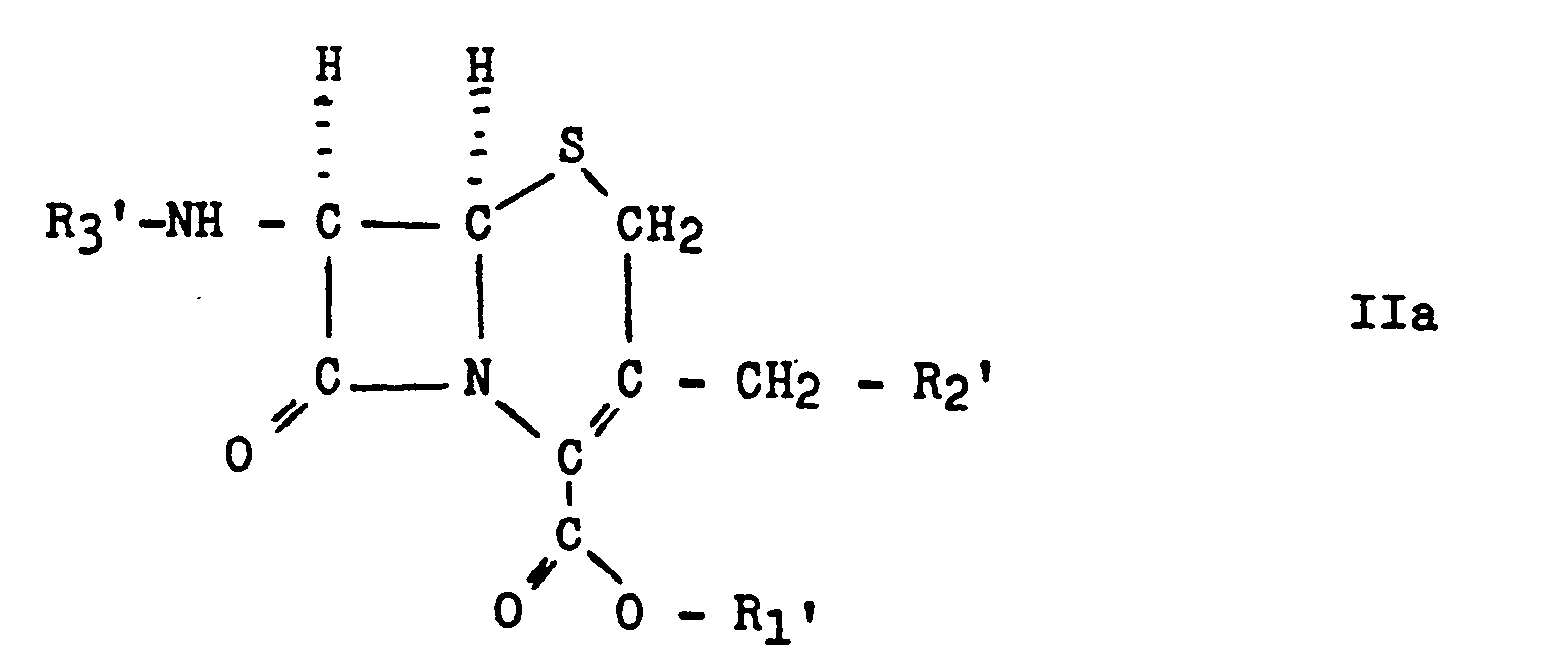
characterized in that 7β-acylamino-3-methyl-3-cephem-4-carboxylic acid 1β-oxide derivatives of formula Ib,
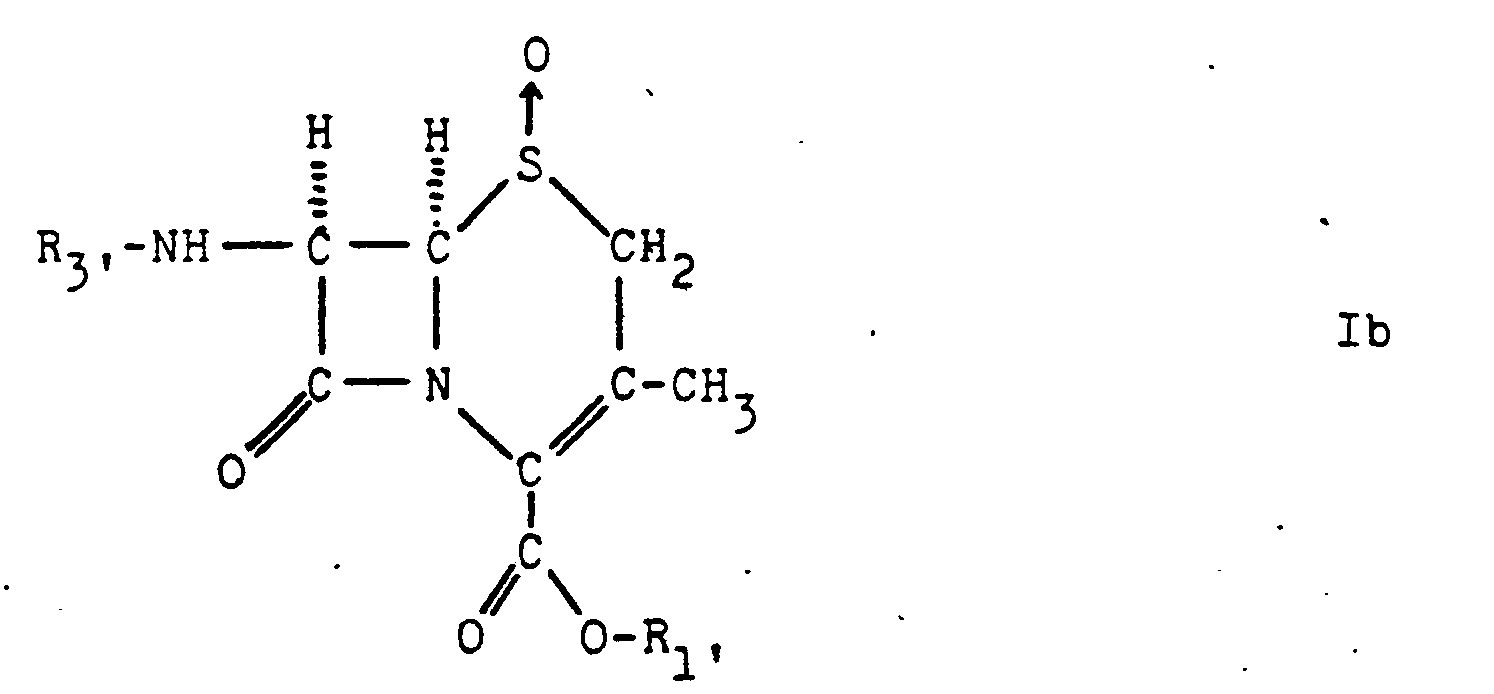
are converted without isolation or intermediates by sequentially the following steps, optionally performed in the same reaction vessel:
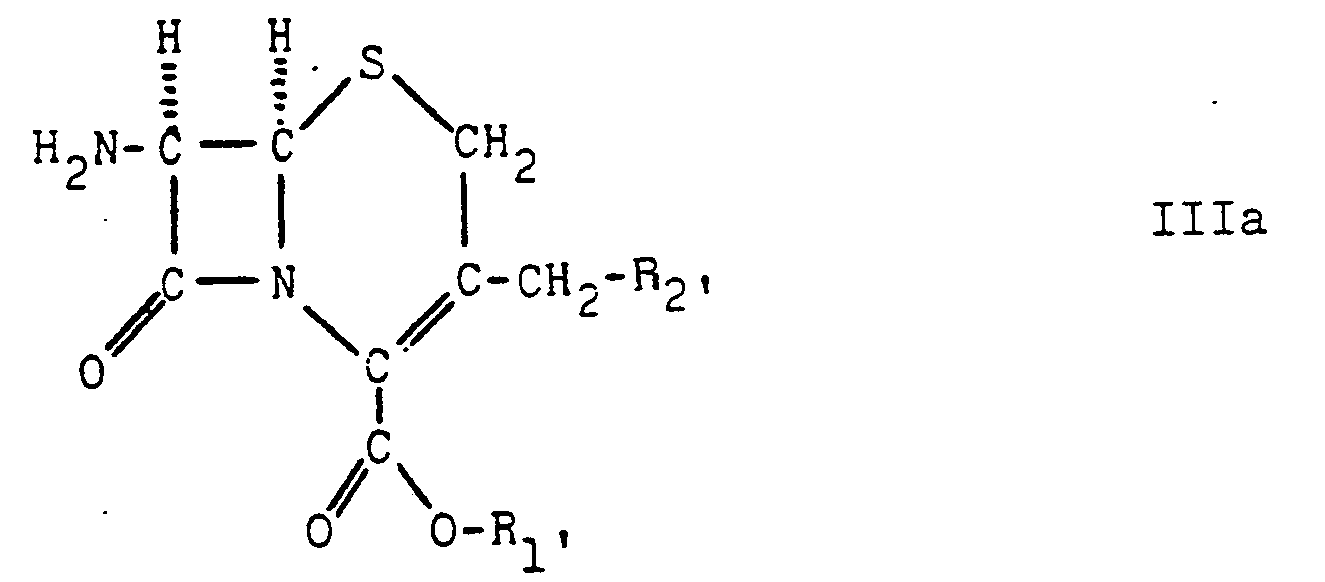
wherein,
characterized in that 7β-acylamino-3-methyl-3-cephem-4-carboxylic acid 1β-oxide derivatives of formula Ib,

Priority Applications (2)
| Application Number | Priority Date | Filing Date | Title |
|---|---|---|---|
| AT84201215T ATE52782T1 (en) | 1983-10-07 | 1984-08-24 | ONE-POT PROCESS FOR THE PREPARATION OF 7 BETAAMINO- AND 7 BETA-ACYLAMINO-3-SUBSTITUTES |
| KR1019840006183A KR870002165B1 (en) | 1983-10-07 | 1984-10-05 | Acylamino-3-substituted methyl-3-cephem-4-carboxylic acid derivatives |
Applications Claiming Priority (2)
| Application Number | Priority Date | Filing Date | Title |
|---|---|---|---|
| EP83201452 | 1983-10-07 | ||
| EP83201452 | 1983-10-07 |
Publications (3)
| Publication Number | Publication Date |
|---|---|
| EP0137534A2 EP0137534A2 (en) | 1985-04-17 |
| EP0137534A3 EP0137534A3 (en) | 1986-01-08 |
| EP0137534B1 true EP0137534B1 (en) | 1990-05-16 |
Family
ID=8190997
Family Applications (1)
| Application Number | Title | Priority Date | Filing Date |
|---|---|---|---|
| EP84201215A Expired - Lifetime EP0137534B1 (en) | 1983-10-07 | 1984-08-24 | One-pot process for preparation of 7beta-amino- and 7beta-acylamino- 3-substituted methyl-3-cephem-4-carboxylic acid derivatives and process for deoxygenation of 7beta-acylamino-3-cephem-4-carboxylic acid 1-oxide derivatives |
Country Status (14)
| Country | Link |
|---|---|
| US (1) | US4695627A (en) |
| EP (1) | EP0137534B1 (en) |
| JP (1) | JPH06102666B2 (en) |
| AU (1) | AU566944B2 (en) |
| CA (1) | CA1268171C (en) |
| DE (1) | DE3482261D1 (en) |
| DK (1) | DK478184A (en) |
| ES (4) | ES8609341A1 (en) |
| FI (1) | FI83223C (en) |
| GR (1) | GR80547B (en) |
| HU (1) | HU195823B (en) |
| IL (1) | IL72498A (en) |
| NO (1) | NO168248C (en) |
| PT (1) | PT79086B (en) |
Families Citing this family (9)
| Publication number | Priority date | Publication date | Assignee | Title |
|---|---|---|---|---|
| FR2580652B1 (en) * | 1985-04-22 | 1989-01-06 | Bristol Myers Co | 7-AMINO-3-PROPENYLCEPHALOSPORANIC ACID AND ITS ESTERS |
| IL86941A (en) * | 1987-07-10 | 1993-07-08 | Gist Brocades Nv | Process for the preparation of cephem compounds and some new cephalosporin derivatives prepared by this process |
| EP0300546B1 (en) * | 1987-07-10 | 1995-08-09 | Gist-Brocades N.V. | Process for the preparation of cephem compounds and cephalosporin derivatives |
| CA2067745A1 (en) * | 1989-10-16 | 1991-04-17 | Paulus Gerhardus Johannes Nieuwenhuis | Conversion of penicillins and cephalosporins to 1-(s)-sulfoxides |
| US5159071A (en) * | 1990-09-06 | 1992-10-27 | Ranbaxy Laboratories Limited | Process for the manufacture of 7-amino-3-exomethylene-3-cepham-4-carboxylic acid ester |
| US5604222A (en) * | 1993-12-27 | 1997-02-18 | Lupin Laboratories, Ltd. | Method for the preparation of 2-chloro sulfinyl azetidinones |
| US5578721A (en) * | 1994-07-11 | 1996-11-26 | Lupin Laboratories Limited | Process for preparation of 3-exomethylene cepham sulfoxide esters |
| IT1273605B (en) * | 1995-04-21 | 1997-07-08 | Acs Dobfar Spa | SELECTIVE REDUCTION PROCESS OF CEPHALOSPORINE SULPHOSXES |
| US20100015142A1 (en) * | 2006-12-21 | 2010-01-21 | Macrogenics Inc. | Methods for the treatment of lada and other adult- onset autoimmune using immunosuppressive monoclonal antibodies with reduced toxicity |
Family Cites Families (10)
| Publication number | Priority date | Publication date | Assignee | Title |
|---|---|---|---|---|
| US3641014A (en) * | 1968-10-03 | 1972-02-08 | Lilly Co Eli | Reduction of delta**3-cephalosporin sulfoxides |
| US4308380A (en) * | 1973-03-15 | 1981-12-29 | Fujisawa Pharmaceutical Co., Ltd. | 2-Lower alkyl-2 or 3-cephem-4-carboxylic acid derivatives |
| JPS5826355B2 (en) * | 1974-07-24 | 1983-06-02 | ザイダンホウジン サンギヨウカガクケンキユウキヨウカイ | 7- Aminocephalosporan sanyuudoutaino Seizouhouhou |
| US4044022A (en) * | 1974-11-29 | 1977-08-23 | Hoffmann-La Roche Inc. | 15-Oxasteroids |
| US4044002A (en) * | 1976-06-09 | 1977-08-23 | Eli Lilly And Company | Reduction process for cephalosporin sulfoxides |
| JPS54112891A (en) * | 1978-02-21 | 1979-09-04 | Sangyo Kagaku Kenkyu Kyokai | Preparation of 7-substituted aminocephalosporanic acid derivative |
| AR228726A1 (en) * | 1978-05-26 | 1983-04-15 | Glaxo Group Ltd | PROCEDURE FOR THE PREPARATION OF ANTIBIOTIC (6R, 7R) -7 - ((Z) -2- (2-AMINOTIAZOL-4-IL) -2- (2-CARBOXIPROP-2-OXIIMINO) ACETAMIDO) -3- (1- PIRIDINIOMETIL) CEF-3-EM-4-CARBOXILATO |
| US4223133A (en) * | 1979-02-01 | 1980-09-16 | Eli Lilly And Company | Cephalosporin reduction process |
| GB2069482B (en) * | 1980-02-14 | 1984-04-04 | Gist Brocades Nv | Process for the preparation of 3'-bromosubstituted deacetoxycephalosporanic acid sulphoxide derivatives |
| US4266049A (en) * | 1980-02-20 | 1981-05-05 | Eli Lilly And Company | Process for 3-iodomethyl cephalosporins |
-
1984
- 1984-07-20 AU AU30913/84A patent/AU566944B2/en not_active Ceased
- 1984-07-25 IL IL72498A patent/IL72498A/en unknown
- 1984-08-14 PT PT79086A patent/PT79086B/en not_active IP Right Cessation
- 1984-08-16 NO NO843283A patent/NO168248C/en unknown
- 1984-08-24 DE DE8484201215T patent/DE3482261D1/en not_active Expired - Fee Related
- 1984-08-24 EP EP84201215A patent/EP0137534B1/en not_active Expired - Lifetime
- 1984-09-21 US US06/653,866 patent/US4695627A/en not_active Expired - Fee Related
- 1984-10-03 GR GR80547A patent/GR80547B/en unknown
- 1984-10-05 HU HU843766A patent/HU195823B/en not_active IP Right Cessation
- 1984-10-05 ES ES536576A patent/ES8609341A1/en not_active Expired
- 1984-10-05 CA CA464842A patent/CA1268171C/en not_active Expired
- 1984-10-05 FI FI843926A patent/FI83223C/en not_active IP Right Cessation
- 1984-10-05 JP JP59209618A patent/JPH06102666B2/en not_active Expired - Lifetime
- 1984-10-05 DK DK478184A patent/DK478184A/en not_active Application Discontinuation
-
1986
- 1986-04-01 ES ES553558A patent/ES8800685A1/en not_active Expired
- 1986-04-01 ES ES553559A patent/ES8800239A1/en not_active Expired
- 1986-04-01 ES ES553557A patent/ES8800238A1/en not_active Expired
Non-Patent Citations (1)
| Title |
|---|
| Synthesis (1980), pp. 67-68 * |
Also Published As
| Publication number | Publication date |
|---|---|
| FI843926A0 (en) | 1984-10-05 |
| EP0137534A3 (en) | 1986-01-08 |
| CA1268171A (en) | 1990-04-24 |
| IL72498A0 (en) | 1984-11-30 |
| NO843283L (en) | 1985-04-09 |
| HUT37151A (en) | 1985-11-28 |
| IL72498A (en) | 1988-12-30 |
| FI83223C (en) | 1991-06-10 |
| AU3091384A (en) | 1985-07-04 |
| ES553559A0 (en) | 1987-11-01 |
| US4695627A (en) | 1987-09-22 |
| ES8800239A1 (en) | 1987-11-01 |
| CA1268171C (en) | 1990-04-24 |
| JPS60100584A (en) | 1985-06-04 |
| NO168248B (en) | 1991-10-21 |
| ES8800685A1 (en) | 1987-11-16 |
| PT79086B (en) | 1986-08-14 |
| NO168248C (en) | 1992-01-29 |
| ES553558A0 (en) | 1987-11-16 |
| ES536576A0 (en) | 1986-07-16 |
| AU566944B2 (en) | 1987-11-05 |
| ES8609341A1 (en) | 1986-07-16 |
| FI843926L (en) | 1985-04-08 |
| ES553557A0 (en) | 1987-11-01 |
| EP0137534A2 (en) | 1985-04-17 |
| DE3482261D1 (en) | 1990-06-21 |
| FI83223B (en) | 1991-02-28 |
| GR80547B (en) | 1985-02-05 |
| HU195823B (en) | 1988-07-28 |
| DK478184D0 (en) | 1984-10-05 |
| DK478184A (en) | 1985-04-08 |
| PT79086A (en) | 1984-09-01 |
| JPH06102666B2 (en) | 1994-12-14 |
| ES8800238A1 (en) | 1987-11-01 |
Similar Documents
| Publication | Publication Date | Title |
|---|---|---|
| JPH0333154B2 (en) | ||
| US4695627A (en) | Cephalosporin deoxygenation process | |
| IE50929B1 (en) | Process for 3-iodomethyl cephalosporins | |
| GB2049675A (en) | Cephalosporin derivatives | |
| EP0043546B1 (en) | 7-oxo-cephalosporins and 6-oxo-penicillins, their analogues and process for their preparation | |
| US3637678A (en) | Delta-2 cephalosporin compounds | |
| CH625245A5 (en) | ||
| JPS6133833B2 (en) | ||
| PL82809B1 (en) | Process for the preparation of 7-substituted amino-desacetoxycephalosporanic acid compounds[us3852281a] | |
| JPH04225985A (en) | Cephalosporin compound | |
| US4584371A (en) | Catalytic process for preparing 3-ester-methyl cephalosporins from desacetyl-7-aminocephalosporanic acid | |
| EP0907654B1 (en) | De-esterification process | |
| KR870002165B1 (en) | Acylamino-3-substituted methyl-3-cephem-4-carboxylic acid derivatives | |
| US4016155A (en) | Process for preparing cephalosporin derivatives | |
| US4183850A (en) | Process for preparing 2-acyloxymethylpenams and 3-acyloxycephams | |
| US5922861A (en) | De-esterification process | |
| KR810000636B1 (en) | Process for preparing cephalosporin compound | |
| KR810000760B1 (en) | Process for preparing cephalosporin compound | |
| JPS6150954B2 (en) | ||
| KR840002142B1 (en) | Method for preparing 7α-methoxycephalosporin derivative | |
| KR810000493B1 (en) | Process for preparing cephalosporin compounds | |
| JPS5951555B2 (en) | Method for producing cephalosporin compounds | |
| KR800000996B1 (en) | Preparation of Cephalosporin Compound | |
| KR810000637B1 (en) | Preparation of Cephalosporin Compound | |
| IL44792A (en) | Penicillin and cephalosporin cleavage process and compounds useful therein |
Legal Events
| Date | Code | Title | Description |
|---|---|---|---|
| PUAI | Public reference made under article 153(3) epc to a published international application that has entered the european phase |
Free format text: ORIGINAL CODE: 0009012 |
|
| AK | Designated contracting states |
Designated state(s): AT BE CH DE FR GB IT LI LU NL SE |
|
| PUAL | Search report despatched |
Free format text: ORIGINAL CODE: 0009013 |
|
| AK | Designated contracting states |
Designated state(s): AT BE CH DE FR GB IT LI LU NL SE |
|
| 17P | Request for examination filed |
Effective date: 19860128 |
|
| 17Q | First examination report despatched |
Effective date: 19870714 |
|
| GRAA | (expected) grant |
Free format text: ORIGINAL CODE: 0009210 |
|
| AK | Designated contracting states |
Kind code of ref document: B1 Designated state(s): AT BE CH DE FR GB IT LI LU NL SE |
|
| REF | Corresponds to: |
Ref document number: 52782 Country of ref document: AT Date of ref document: 19900615 Kind code of ref document: T |
|
| ITF | It: translation for a ep patent filed | ||
| REF | Corresponds to: |
Ref document number: 3482261 Country of ref document: DE Date of ref document: 19900621 |
|
| ET | Fr: translation filed | ||
| PLBE | No opposition filed within time limit |
Free format text: ORIGINAL CODE: 0009261 |
|
| STAA | Information on the status of an ep patent application or granted ep patent |
Free format text: STATUS: NO OPPOSITION FILED WITHIN TIME LIMIT |
|
| 26N | No opposition filed | ||
| PGFP | Annual fee paid to national office [announced via postgrant information from national office to epo] |
Ref country code: SE Payment date: 19920720 Year of fee payment: 9 |
|
| PGFP | Annual fee paid to national office [announced via postgrant information from national office to epo] |
Ref country code: CH Payment date: 19920721 Year of fee payment: 9 |
|
| PGFP | Annual fee paid to national office [announced via postgrant information from national office to epo] |
Ref country code: BE Payment date: 19920723 Year of fee payment: 9 |
|
| PGFP | Annual fee paid to national office [announced via postgrant information from national office to epo] |
Ref country code: LU Payment date: 19920804 Year of fee payment: 9 |
|
| EPTA | Lu: last paid annual fee | ||
| PG25 | Lapsed in a contracting state [announced via postgrant information from national office to epo] |
Ref country code: LU Free format text: LAPSE BECAUSE OF NON-PAYMENT OF DUE FEES Effective date: 19930824 |
|
| PG25 | Lapsed in a contracting state [announced via postgrant information from national office to epo] |
Ref country code: SE Effective date: 19930825 |
|
| ITTA | It: last paid annual fee | ||
| PG25 | Lapsed in a contracting state [announced via postgrant information from national office to epo] |
Ref country code: LI Effective date: 19930831 Ref country code: CH Effective date: 19930831 Ref country code: BE Effective date: 19930831 |
|
| BERE | Be: lapsed |
Owner name: GIST-BROCADES N.V. Effective date: 19930831 |
|
| REG | Reference to a national code |
Ref country code: CH Ref legal event code: PL |
|
| EUG | Se: european patent has lapsed |
Ref document number: 84201215.5 Effective date: 19940310 |
|
| PGFP | Annual fee paid to national office [announced via postgrant information from national office to epo] |
Ref country code: FR Payment date: 19950710 Year of fee payment: 12 |
|
| PGFP | Annual fee paid to national office [announced via postgrant information from national office to epo] |
Ref country code: AT Payment date: 19950714 Year of fee payment: 12 |
|
| PGFP | Annual fee paid to national office [announced via postgrant information from national office to epo] |
Ref country code: GB Payment date: 19950718 Year of fee payment: 12 |
|
| PGFP | Annual fee paid to national office [announced via postgrant information from national office to epo] |
Ref country code: DE Payment date: 19950721 Year of fee payment: 12 |
|
| PGFP | Annual fee paid to national office [announced via postgrant information from national office to epo] |
Ref country code: NL Payment date: 19950817 Year of fee payment: 12 |
|
| PG25 | Lapsed in a contracting state [announced via postgrant information from national office to epo] |
Ref country code: GB Effective date: 19960824 Ref country code: AT Effective date: 19960824 |
|
| PG25 | Lapsed in a contracting state [announced via postgrant information from national office to epo] |
Ref country code: NL Effective date: 19970301 |
|
| GBPC | Gb: european patent ceased through non-payment of renewal fee |
Effective date: 19960824 |
|
| PG25 | Lapsed in a contracting state [announced via postgrant information from national office to epo] |
Ref country code: FR Effective date: 19970430 |
|
| NLV4 | Nl: lapsed or anulled due to non-payment of the annual fee |
Effective date: 19970301 |
|
| PG25 | Lapsed in a contracting state [announced via postgrant information from national office to epo] |
Ref country code: DE Effective date: 19970501 |
|
| REG | Reference to a national code |
Ref country code: FR Ref legal event code: ST |