EP0134578B1 - Imidazole derivatives and processes for their production - Google Patents
Imidazole derivatives and processes for their production Download PDFInfo
- Publication number
- EP0134578B1 EP0134578B1 EP84110576A EP84110576A EP0134578B1 EP 0134578 B1 EP0134578 B1 EP 0134578B1 EP 84110576 A EP84110576 A EP 84110576A EP 84110576 A EP84110576 A EP 84110576A EP 0134578 B1 EP0134578 B1 EP 0134578B1
- Authority
- EP
- European Patent Office
- Prior art keywords
- imidazole
- acid addition
- acceptable acid
- biologically acceptable
- octene
- Prior art date
- Legal status (The legal status is an assumption and is not a legal conclusion. Google has not performed a legal analysis and makes no representation as to the accuracy of the status listed.)
- Expired
Links
- MCTWTZJPVLRJOU-UHFFFAOYSA-N C[n]1cncc1 Chemical compound C[n]1cncc1 MCTWTZJPVLRJOU-UHFFFAOYSA-N 0.000 description 2
Classifications
-
- C—CHEMISTRY; METALLURGY
- C07—ORGANIC CHEMISTRY
- C07D—HETEROCYCLIC COMPOUNDS
- C07D231/00—Heterocyclic compounds containing 1,2-diazole or hydrogenated 1,2-diazole rings
- C07D231/02—Heterocyclic compounds containing 1,2-diazole or hydrogenated 1,2-diazole rings not condensed with other rings
- C07D231/10—Heterocyclic compounds containing 1,2-diazole or hydrogenated 1,2-diazole rings not condensed with other rings having two or three double bonds between ring members or between ring members and non-ring members
- C07D231/12—Heterocyclic compounds containing 1,2-diazole or hydrogenated 1,2-diazole rings not condensed with other rings having two or three double bonds between ring members or between ring members and non-ring members with only hydrogen atoms, hydrocarbon or substituted hydrocarbon radicals, directly attached to ring carbon atoms
-
- A—HUMAN NECESSITIES
- A61—MEDICAL OR VETERINARY SCIENCE; HYGIENE
- A61P—SPECIFIC THERAPEUTIC ACTIVITY OF CHEMICAL COMPOUNDS OR MEDICINAL PREPARATIONS
- A61P31/00—Antiinfectives, i.e. antibiotics, antiseptics, chemotherapeutics
- A61P31/04—Antibacterial agents
-
- A—HUMAN NECESSITIES
- A61—MEDICAL OR VETERINARY SCIENCE; HYGIENE
- A61P—SPECIFIC THERAPEUTIC ACTIVITY OF CHEMICAL COMPOUNDS OR MEDICINAL PREPARATIONS
- A61P31/00—Antiinfectives, i.e. antibiotics, antiseptics, chemotherapeutics
- A61P31/10—Antimycotics
-
- C—CHEMISTRY; METALLURGY
- C07—ORGANIC CHEMISTRY
- C07C—ACYCLIC OR CARBOCYCLIC COMPOUNDS
- C07C45/00—Preparation of compounds having >C = O groups bound only to carbon or hydrogen atoms; Preparation of chelates of such compounds
- C07C45/61—Preparation of compounds having >C = O groups bound only to carbon or hydrogen atoms; Preparation of chelates of such compounds by reactions not involving the formation of >C = O groups
- C07C45/63—Preparation of compounds having >C = O groups bound only to carbon or hydrogen atoms; Preparation of chelates of such compounds by reactions not involving the formation of >C = O groups by introduction of halogen; by substitution of halogen atoms by other halogen atoms
-
- C—CHEMISTRY; METALLURGY
- C07—ORGANIC CHEMISTRY
- C07D—HETEROCYCLIC COMPOUNDS
- C07D233/00—Heterocyclic compounds containing 1,3-diazole or hydrogenated 1,3-diazole rings, not condensed with other rings
- C07D233/54—Heterocyclic compounds containing 1,3-diazole or hydrogenated 1,3-diazole rings, not condensed with other rings having two double bonds between ring members or between ring members and non-ring members
- C07D233/56—Heterocyclic compounds containing 1,3-diazole or hydrogenated 1,3-diazole rings, not condensed with other rings having two double bonds between ring members or between ring members and non-ring members with only hydrogen atoms or radicals containing only hydrogen and carbon atoms, attached to ring carbon atoms
-
- C—CHEMISTRY; METALLURGY
- C07—ORGANIC CHEMISTRY
- C07D—HETEROCYCLIC COMPOUNDS
- C07D249/00—Heterocyclic compounds containing five-membered rings having three nitrogen atoms as the only ring hetero atoms
- C07D249/02—Heterocyclic compounds containing five-membered rings having three nitrogen atoms as the only ring hetero atoms not condensed with other rings
- C07D249/08—1,2,4-Triazoles; Hydrogenated 1,2,4-triazoles
Definitions
- the present invention relates to novel imidazole derivatives and their biologically acceptable acid addition salts, and processes for the production thereof.
- the present invention provides an imidazole derivative represented by the general formula I or a biologically acceptable acid addition salt thereof: where Ar is a phenyl group which may be substituted by alkyl having 1 to 6 carbon atoms, alkoxy having from 1 to 4 carbon atoms, alkylamino having from 1 to 4 carbon atoms, alkoxy carbonyl having from 1 to 4 carbon atoms, phenyl, halogen or hydroxyl; a naphthyl group; a furyl group; or a thienyl group which may be substituted by halogen or alkyl having from 1 to 4 carbon atoms, and R is an alkyl group having from 1 to 10 carbon atoms; an alkenyl group having from 1 to 6 carbon atoms; or a phenylalkyl group which may be substituted by halogen.
- Ar is a phenyl group which may be substituted by alkyl having 1 to 6 carbon atoms, alkoxy having from 1 to 4 carbon atom
- novel imidazole derivatives and their biologically acceptable acid addition salts exhibit antifungal and antibacterial activities.
- the imidazole derivative of the general formula I may be prepared by reacting a compound represented by the general formula II: where X is a halogen atom and Ar and R are as defined above, with imidazole, or by reacting a compound represented by the general formula III: where R is as defined above, with a compound represented by the general formula (IV): where Ar is as defined above.
- the imidazole derivative of the formula I thus prepared may optionally be converted to its biologically acceptable acid addition salt.
- Ar is an unsubstituted phenyl group; a phenyl group substituted by C 1 -C S alkyl such as methyl, ethyl, propyl, butyl, pentyl or hexyl, C 1 -C 4 alkoxy such as methoxy, ethoxy, propoxy or butoxy, C 1 -C 4 alkylamino such as methylamino, ethylamino, propylamino or butylamino, C 1 -C 4 alkoxy carbonyl such as methylcarbonyl, ethylcarbonyl, propylcarbonyl or butylcarbonyl, phenyl, halogen such as fluorine, chlorine bromine or iodine, or hydroxyl; a phenyl group; a naphthyl group; a furyl group; or an unsubstituted thienyl group; or a thienyl group substitute
- R is a C 1 -C 10 alkyl group such as methyl, ethyl, propyl, isopropyl, butyl, isobutyl, pentyl, hexyl, heptyl or octyl; a C 1 ⁇ C 6 alkenyl group such as allyl, butenyl, 3-methyl-butenyl or pentenyl; or a phenylalkyl group such as phenylmethyl or phenylethyl, which may be substituted by halogen such as fluorine, chlorine, bromine or iodine.
- halogen such as fluorine, chlorine, bromine or iodine.
- an inorganic acid such as hydrochoric acid, hydrobromic acid, nitric acid, sulfuric acid or phosphoric acid
- an organic acid such as acetic acid, propionic acid, glycolic acid, lactic acid, oxalic acid, malonic acid, fumaric acid, tartaric acid, citric acid, maleic acid, malic acid, benzoic acid, cinnamic acid, mandelic acid, methanesulfonic acid, ethanesulfonic acid or p-toluenesulfonic acid.
- imidazole derivatives of the formula I there may be mentioned the following compounds:
- the imidazole derivative of the general formula I may be prepared by reacting the compound of the general formula II with imidazole.
- This reaction is preferably conducted in an inert solvent by using from 1 to 5 mols of imidazole relative to 1 mol of the compound of the formula II.
- the solvent there may be employed dimethylformamide, dimethylsulfoxide, dimethylacetoamide or acetonitrile. The reaction is conducted at a temperature of from 10 to 100°C for 30 minutes to 10 hours.
- the starting material of the formula II may be prepared by e.g. the following method. Namely, a compound represented by the general formula III': where R is as defined above, is reacted with a compound of the general formula IV to obtain a compound represented by the general formula V: where Ar and R are as defined above.
- This aldol-type condensation reaction may be conducted in accordance with a method disclosed in e.g. Journal of American Chemical Society, Vol. 72, p 1604 (1950).
- the compound of the formula V is reacted with a copper (II) halide in an inert solvent to obtain a compound of the formula II.
- a copper (II) halide it is preferred to use copper (II) bromide.
- the amount of the copper (II) halide is about 2 mols relative to 1 mol of the compound of the formula V.
- the solvent there may be used ether, tetrahydrofuran, dimethoxyethane or dioxane.
- the reaction is preferably conducted at a temperature of from 50 to 100°C.
- the imidazole derivative of the formula I may be prepared by reacting a compound of the formula III with a compound of the formula IV.
- This reaction is preferably conducted in an inert solvent in the presence of a basic condensing agent.
- a basic condensing agent there may be employed a lower alcohol such as methanol, ethanol or propanol.
- the basic condensing agent there may be employed potassium carbonate or sodium carbonate. The reaction is preferably conducted at a temperature of from 0 to 50°C.
- the starting material of the formula IV may be prepared by e.g. the following method. Namely, when a compound of the formula III' is halogenated in accordance with the method disclosed in Journal of Chemical Society (1948) p 272, a compound represented by the general formula VI: where R and X are as defined above, is obtained. Then, the compound of the formula VI is reacted with imidazole in an inert solvent to obtain a compound of the formula III. The amount of imidazole is from 1 to 5 mols relative to 1 mol of the compound of the formula VI. As the solvent, there may be employed dimethylformamide, dimethylsulfoxide or acetonitrile. The reaction is conducted at a temperature of from 20 to 100°C.
- the imidazole derivatives of the formula I and their biologically acceptable acid addition salts exhibit remarkable antifungal and antibacterial activities against the following microorganisms: Norcardia asteroides, Candida albicans, Candida tropicalis, Candida pseudo-tropicalia, Cryptococcus albidus, Cryptococcus neoformans, Rhodotorula glutinis, Torulopsis candia, Torulopsis colliculosa, Trichosporon cutaneum, Geotrichum candidum, Aspergillus fumigatus, Aspergillus candidus, Hormodendrum pedrosoi, Microsporum gypseum, Phialophora verrucosa, Sporothix schenkii, Trichophyton interdigital, Trichophyton rubrum, Trichophyton mentagrophytes, Saprolegnia and bacteria such as Staphylococcus aureus.
- imidazole derivatives and their biologically acceptable acid addition salts of the present invention are useful as antifungal and antibacterial agents.
- the bacteriostatic and fungistatic activities were measured by a plate dilution method.
- the measurements were conducted after culturing them at 37°C for 2 days by means of a bouillon agar culture medium.
- the measurements were conducted after culturing then by means of Sabouraud agar culture medium at 37°C for 2 days in the case of Candida and at 27°C for 7 days in the case of Trichophyton.
- the results thereby obtained are shown in Table 3.
- the numerical values represent the minimum growth inhibition concentrations. From the results of the tests, it is evident that the products of the present invention exhibit superior antifungal activities.
- phenyl 11-iodo-10-undecynoate was used.
- micronazole was used.
- the tests were conducted in accordance with a Kaken method (see The Japanese Journal of Medical Mycology, Vol. 1, p 252 (1960)).
- Four portions on the back of a Hartly guinea pig (weight: 600-700 g) were depilated for.4 cm 2 each, mildly scratched with a sand paper, and then infected with the second generation of Trichophyton mentagrophytes cultured in a guinea pig at a rate of 1 x 10 5 spores per infected portion. From 48 hours after the infection, 0.2 ml of a test sample dissolved in a ethanol was applied once a day for 10 times.
- LD 50 was calculated from the mortality after 7 days from the date of administration. As a result, LD 50 of the compound of Example 4 was found to be about 250 mg/kg.
Landscapes
- Chemical & Material Sciences (AREA)
- Organic Chemistry (AREA)
- Health & Medical Sciences (AREA)
- Chemical Kinetics & Catalysis (AREA)
- Nuclear Medicine, Radiotherapy & Molecular Imaging (AREA)
- Animal Behavior & Ethology (AREA)
- General Chemical & Material Sciences (AREA)
- Medicinal Chemistry (AREA)
- Communicable Diseases (AREA)
- Pharmacology & Pharmacy (AREA)
- Life Sciences & Earth Sciences (AREA)
- Oncology (AREA)
- General Health & Medical Sciences (AREA)
- Public Health (AREA)
- Veterinary Medicine (AREA)
- Pharmaceuticals Containing Other Organic And Inorganic Compounds (AREA)
- Plural Heterocyclic Compounds (AREA)
- Agricultural Chemicals And Associated Chemicals (AREA)
Description
- The present invention relates to novel imidazole derivatives and their biologically acceptable acid addition salts, and processes for the production thereof.
- Azolyl-alkemomes and alkemoles having agricultural fungicidal properties are described in EP-A-79006.
- Namely, the present invention provides an imidazole derivative represented by the general formula I or a biologically acceptable acid addition salt thereof:

- The novel imidazole derivatives and their biologically acceptable acid addition salts exhibit antifungal and antibacterial activities.
- The imidazole derivative of the general formula I may be prepared by reacting a compound represented by the general formula II:


- Now, the present invention will be described in detail with reference to the preferred embodiments.
- In the general formula I, Ar is an unsubstituted phenyl group; a phenyl group substituted by C1-CS alkyl such as methyl, ethyl, propyl, butyl, pentyl or hexyl, C1-C4 alkoxy such as methoxy, ethoxy, propoxy or butoxy, C1-C4 alkylamino such as methylamino, ethylamino, propylamino or butylamino, C1-C4 alkoxy carbonyl such as methylcarbonyl, ethylcarbonyl, propylcarbonyl or butylcarbonyl, phenyl, halogen such as fluorine, chlorine bromine or iodine, or hydroxyl; a phenyl group; a naphthyl group; a furyl group; or an unsubstituted thienyl group; or a thienyl group substituted by halogen such as fluorine, chlorine, bromine or iodine, or C1-C4 alkyl such as methyl, ethyl, propyl or butyl. Specific examples of Ar include

- Likewise, in the general formula I, R is a C1-C10 alkyl group such as methyl, ethyl, propyl, isopropyl, butyl, isobutyl, pentyl, hexyl, heptyl or octyl; a C1―C6 alkenyl group such as allyl, butenyl, 3-methyl-butenyl or pentenyl; or a phenylalkyl group such as phenylmethyl or phenylethyl, which may be substituted by halogen such as fluorine, chlorine, bromine or iodine. Specific examples of R include CH2CH3, ―(CH2)2CH3, ―(CH2)3CH3, ―(CH2)4CH3, ―(CH2)5CH3, -(CH2)sCH3, ―(CH2)7CH3, -CH(CH3)2, -CH2CH(CH3)2, -CH2CH=CH2, -CH2CH=CHCH3, -CH2CH=C(CH3)2,
-

- Most of the free bases of the imidazole derivatives of the formula I are oily, but they may be converted to their biologically acceptable acid addition salts and thus can be isolated in the form of crystals. There is no particular restriction to the biologically acceptable acid addition salts so long as they are biologically acceptable. As the acid to form the biologically acceptable acid addition salt, there may be employed an inorganic acid such as hydrochoric acid, hydrobromic acid, nitric acid, sulfuric acid or phosphoric acid, or an organic acid such as acetic acid, propionic acid, glycolic acid, lactic acid, oxalic acid, malonic acid, fumaric acid, tartaric acid, citric acid, maleic acid, malic acid, benzoic acid, cinnamic acid, mandelic acid, methanesulfonic acid, ethanesulfonic acid or p-toluenesulfonic acid.
- As specific examples of the imidazole derivatives of the formula I, there may be mentioned the following compounds:
- 1-(4'-chlorophenyl)-4-(imidazole-1 "-yl)-1-hexene-3-one,
- 1-(4'-chlorophenyl)-4-(imidazole-1"-yl)-1-heptene-3-one,
- 1-(4'-chlorophenyl)-4-(imidazole-1 "-yl)-1-octene-3-one,
- 1-(4'-chlorophenyl)-4-(imidazole-1 -yi)-1-nonene-3-one,
- 1-(4'-chlorophenyl)-4-(imidazole-1"-yl)-1-decene-3-one,
- 1-(4'-chlorophenyl)-4-(imidazole-1"-yl)-1-undecene-3-one,
- 1-(4'-chlorophenyl)-4-(imidazole-1"-yl)-1-dodecene-3-one,
- 1-(4'-chlorophenyl)-4-(imidazole-1 "-yl)-5-methyl-1-hexene-3-one,
- 1-(4'-chlorophenyl)-4-(imidazole-1 "-yl)-6-methyl-1-heptene-3-one,
- 1-(4'-chlorophenyl)-4-(imidazole-1 "-yl)-1,6-heptadiene-3-one,
- 1-(4'-chlorophenyl)-4-(imidazole-1 "-yl)-7-methyl-1,6-octadiene-3-one,
- 1-(4'-chlorophenyl)-4-(imidazole-1 "-yl)-5-phenyl-1-pentene-3-one,
- 1-(4'-chlorophenyl)-4-(imidazole-1"-yl)-5-(2'-chlorophenyl)-1-pentene-3-one,
- 1-(4'-chlorophenyl)-4-(imidazole-1"-yl)-5-(4'-chlorophenyl)-1-pentene-3-one,
- 1-(4'-chlorophenyl)-4-(imidazole-1"-yl)-5-(2',4'-dichlorophenyl)-1-pentene-3-one,
- 1-(4'-chlorophenyl)-4-(imidazole-1"-yl)-5-(3',4'-dichlorophenyl)-1-pentene-3-one,
- 1-(4'-chlorophenyl)-4-(imidazole-1 "-yl)-6-phenyl-1-hexene-3-one,
- 1-(2'-methylphenyl)-4-(imidazole-1" -yl)-1-heptene-3-one,
- 1-(2'-methylphenyl)-4-(imidazole-1 "-yl)-1-octene-3-one,
- 1-(2'-methylphenyl)-4-(imidazole-1 "-yl)-1-nonene-3-one,
- 1-(2'-methylphenyl)-4-(imidazole-1 "-yl)-6-methyl-1-heptene-3-one,
- 1-(3'-methylphenyl)-4-(imidazole-1 "-yl)-1-heptene-3-one,
- 1-(3'-methylphenyl)-4-(imidazole-1 "-yl)-1-octene-3-one,
- 1-(3'-methylphenyl)-4-(imidazole-1 "-yl)-1-nonene-3-one,
- 1-(3'-methylphenyl)-4-(imidazole-1"-yl)-6-methyl-1-heptene-3-one,
- 1-(4'-methylphenyl)-4-(imidazole-1"-yl)-1-heptene-3-one,
- 1-(4'-methylphenyl)-4-(imidazole-1"-yl)-1-octene-3-one,
- 1-(4'-methylphenyl)-4-(imidazole-1 "-yl)-1-nonene-3-one,
- 1-(4'-methylphenyl)-4-(imidazole-1 "-yl)-6-methyl-1-heptene-3-one,
- 1-phenyl-4-(imidazole-1'-yl)-1-octene-3-one,
- 1-phenyl-4-(imidazole-1'-yl)-1-nonene-3-one,
- 1-(4'-methoxyphenyl)-4-(imidazole-1 "-yl)-1-octene-3-one,
- 1-(4'-methoxyphenyl)-4-(imidazole-1 "-yl)-1-nonene-3-one,
- 1-(3'-methoxyphenyl)-4-(imidazole-1 "-yl)-1-octene-3-one,
- 1-(3'-methoxyphenyl)-4-(imidazole-1 "-yl)-1-nonene-3-one,
- 1-(2'-methoxyphenyl)-4-(imidazole-1 "-yl)-1-octene-3-one,
- 1-(2'-methoxyphenyl)-4-(imidazole-1 "-yl)-1-nonene-3-one,
- 1-(3',4'-dimethoxyphenyl)-4-(imidazole-1 "-yl)-1-octene-3-one,
- 1-(3',4'-dimethoxyphenyl)-4-(imidazole-1 "-yl)-1-nonene-3-one,
- 1-(2',5'-dimethoxyphenyl)-4-(imidazole-1"-yl)-1-octene-3-one,
- 1-(2',5'-dimethoxyphenyl)-4-(imidazole-I "-yl)-1-nonene-3-one,
- 1-(2',3'-dimethoxyphenyl)-4-(imidazole-1 "-yl)-1-octene-3-one,
- 1-(2',3'-dimethoxyphenyl)-4-(imidazole-1"-yl)-1-nonene-3-one,
- 1-(2',4'-dimethoxyphenyl)-4-(imidazole-1 "-yl)-1-octene-3-one,
- 1-(2',4'-dimethoxyphenyl)-4-(imidazole-1"-yl)-1-nonene-3-one,
- 1-(1-naphthyl)-4-(imidazole-1"-yl)-1-octene-3-one,
- 1-(1-naphthyl)-4-(imidazole-1 "-yl)-1-nonene-3-one,
- 1-(2-thienyl)-4-(imidazole-1"-yl)-1-octene-3-one,
- 1-(2-thienyl)-4-(imidazole-1"-yl)-1-nonene-3-one,
- 1-(3'-methyl-2'-thienyl)-4-(imidazole-1"-yl)-1-octene-3-one,
- 1-(3'-methyl-2'-thienyl)-4-(imidazole-1 "-yl)-1-nonene-3-one,
- 1-(5'-methyl-2'-thienyl)-4-(imidazole-1 "-yl)-1-octene-3-one,
- 1-(5'-methyl-2'-thienyl)-4-(imidazole-1"-yl)-1-nonene-3-one,
- 1-(5'-chloro-2'-thienyl)-4-(imidazole-1"-yl)-1-octene-3-one,
- 1-(2'-furyl)-4-(imidazole-1 "-yl)-1-octene-3-one,
- 1-(2'-furyl)-4-(imidazole-1 "-yl)-1-nonene-3-one,
- 1-(2'-chlorophenyl)-4-(imidazole-1 "-yl)-1-octene-3-one,
- 1-(2'-chlorophenyl)-4-(imidazole-1 "-yl)-1-nonene-3-one,
- 1-(3'-chlorophenyl)-4-(imidazole-1 "-yl)-1-nonene-3-one,
- 1-(2',6'-dichlorophenyl)-4-(imidazole-1 "-yl)-1-octene-3-one,
- 1-(2',6'-dichlorophenyl)-4-(imidazole-1 "-yl)-1-nonene-3-one,
- 1-(2',4'-dichlorophenyl)-4-(imidazole-1"-yl)-1-octene-3-one,
- 1-(2',4'-dichlorophenyl)-4-(imidazole-1"-yl)-1-nonene-3-one,
- 1-(3',4'-dichlorophenyl)-4-(imidazole-1 "-yl)-1-octene-3-one,
- 1-(3',4'-dichlorophenyl)-4-(imidazole-1 "-yl)-1-nonene-3-one,
- 1-(4'-fluorophenyl)-4-(imidazole-1 "-yl)-1-octene-3-one,
- 1-(4'-fluorophenyl)-4-(imidazole-1 "-yl)-1-nonene-3-one,
- 1-(4'-dimethylaminophenyl)-4-(imidazole-1 "-yl)-1-octene-3-one,
- 1-(4'-dimethylaminophenyl)-4-(imidazole-1"-yl)-1-nonene-3-one,
- 1-(4'-bromophenyl)-4-(imidazole-1 "-yl)-1-octene-3-one,
- 1-(4'-bromophenyl)-4-(imidazole-1 "-yl)-1-nonene-3-one,
- 1-(4'-methoxycarbonylphenyl)-4-(imidazole-1 "-yl)-1-octene-3-one,
- 1-(4'-methoxycarbonylphenyl)-4-(imidazole-1 "-yl)-1-nonene-3-,one,
- 1-(3'-methoxycarbonylphenyl)-4-(imidazole-1 "-yl)-1-octene-3-one,
- 1-(3'-methoxycarbonylphenyl)-4-(imidazole-1 "-yl)-1-nonene-3-one,
- 1-(4'-butylphenyl)-4-(imidazole-1 "-yl)-1-octene-3-one,
- 1-(4'-butylphenyl)-4-(imidazole-1 "-yl)-1-nonene-3-one,
- 1-(4'-sec-butylphenyl)-4-(imidazole-1 "-yl)-1-octene-3-one,
- 1-(4'-sec-butylphenyl)-4-(imidazole-1 "-yl)-1-nonene-3-one,
- 1-(4'-tert-butylphenyl)-4-(imidazole-1 "-yl)-1-octene-3-one,
- 1-(4'-tert-butylphenyl)-4-(imidazole-1 "-yl)-1-nonene-3-one,
- 1-(4'-biphenylyl)-4-(imidazole-1 "-yl)-1-octene-3-one,
- 1-(4'-biphenylyl)-4-(imidazole-1 "-yl)-1-nonene-3-one,
- 1-(4'-hydroxyphenyl)-4-(imidazole-1 "-yl)-1-octene-3-one,
- 1-(4'-hydroxyphenyl)-4-(imidazole-1"-yl)-1-nonene-3-one,
- 1-(3'-hydroxyphenyl)-4-(imidazole-1 "-yl)-1-octene-3-one,
- 1-(2'-hydroxyphenyl)-4-(imidazole-1"-yl)-1-octene-3-one,
- 1-(3',4'-dihydroxyphenyl)-4-(imidazole-1"-yl)-1-octene-3-one,
- 1-(3',4'-dihydroxyphenyl)-4-(imidazole-1 "-yl)-1-nonene-3-one,
- 1-(3'-methoxy-4'-hydroxyphenyl)-4-(imidazole-1-yl)-1-octene-3-one, and
- 1-(3'-methoxy-4'-hydroxyphenyl)-4-(imidazole-1-yl)-1-nonene-3-one,
- The imidazole derivative of the general formula I may be prepared by reacting the compound of the general formula II with imidazole.
- This reaction is preferably conducted in an inert solvent by using from 1 to 5 mols of imidazole relative to 1 mol of the compound of the formula II. As the solvent, there may be employed dimethylformamide, dimethylsulfoxide, dimethylacetoamide or acetonitrile. The reaction is conducted at a temperature of from 10 to 100°C for 30 minutes to 10 hours.
- The starting material of the formula II may be prepared by e.g. the following method. Namely, a compound represented by the general formula III':


- Alternatively, the imidazole derivative of the formula I may be prepared by reacting a compound of the formula III with a compound of the formula IV.
- This reaction is preferably conducted in an inert solvent in the presence of a basic condensing agent. As the solvent, there may be employed a lower alcohol such as methanol, ethanol or propanol. As the basic condensing agent, there may be employed potassium carbonate or sodium carbonate. The reaction is preferably conducted at a temperature of from 0 to 50°C.
- The starting material of the formula IV may be prepared by e.g. the following method. Namely, when a compound of the formula III' is halogenated in accordance with the method disclosed in Journal of Chemical Society (1948) p 272, a compound represented by the general formula VI:

- The imidazole derivatives of the formula I and their biologically acceptable acid addition salts exhibit remarkable antifungal and antibacterial activities against the following microorganisms: Norcardia asteroides, Candida albicans, Candida tropicalis, Candida pseudo-tropicalia, Cryptococcus albidus, Cryptococcus neoformans, Rhodotorula glutinis, Torulopsis candia, Torulopsis colliculosa, Trichosporon cutaneum, Geotrichum candidum, Aspergillus fumigatus, Aspergillus candidus, Hormodendrum pedrosoi, Microsporum gypseum, Phialophora verrucosa, Sporothix schenkii, Trichophyton interdigital, Trichophyton rubrum, Trichophyton mentagrophytes, Saprolegnia and bacteria such as Staphylococcus aureus.
- Thus, the imidazole derivatives and their biologically acceptable acid addition salts of the present invention are useful as antifungal and antibacterial agents.
- . Now, the present invention will be described in further detail with reference to Examples. However, it should be understood that the present invention is by no means restricted to these specific Examples.
-
- (a) 4.3 g of 1-(p-bromophenyl)-1-octene-3-one was dissolved in 400 ml of tetrahydrofuran. To this solution, 8.3 g of copper (11) bromide was added under stirring and stirred at a temperature of from 70 to 80°C for 2 hours. After cooling the reaction mixture, the precipitated crystals were filtered off, and tetrahydrofuran was distilled off under reduced pressure from the filtrate. The residue was purified by chromatography, whereby 1-(4'-bromophenyl)-4-bromo-1-octene-3-one was obtained as an oily product.
- (b) 6.0 g of imidazole was dissolved in 20 ml of N,N-dimethylformamide. While stirring this solution at room temperature, a solution obtained by dissolving 4.0 g of the oily product obtained in (a) in 10 ml of N,N-dimethylformamide, was gradually added. The mixture was stirred at room temperature for 4 hours, and the reaction mixture was poured into water and extracted with chloroform. The extraction solution was treated in a usual manner and purified by chromatography, whereby 1-(4'-bromophenyl)-4-(imidazole-1-yl)-1-octene-3-one was obtained as an oily product.
- This oily product was dissolved in 50 ml of ether, and 1 ml of concentrated nitric acid was gradually added thereto. The precipitated crystals were collected by filtration and recrystallized from ethanol, whereby 1-(4'-bromophenyl)-4-(imidazole-1-yl)-1-octene-3-one nitrate was obtained.
- Melting point: 122-123°C
- IR spectrum VKBr max cm-1: 2960, 2935, 1708, 1610, 1580, 1495
- NMR spectrum (6 ppm 60 Mdz, DMSO-ds): 0.88 (t, 3H), 0.9-180 (m, 4H), 1.9-2.4 (m, 2H), 5.78, 5.98 (dd, 1H), 7.1-8.0 (m, 8H), 9.36 (m, 1H)
- In the same manner as Example 1, the following compounds were obtained starting with the corresponding ketones. The solvent used for the measurement of NMR was DMSO-d6.

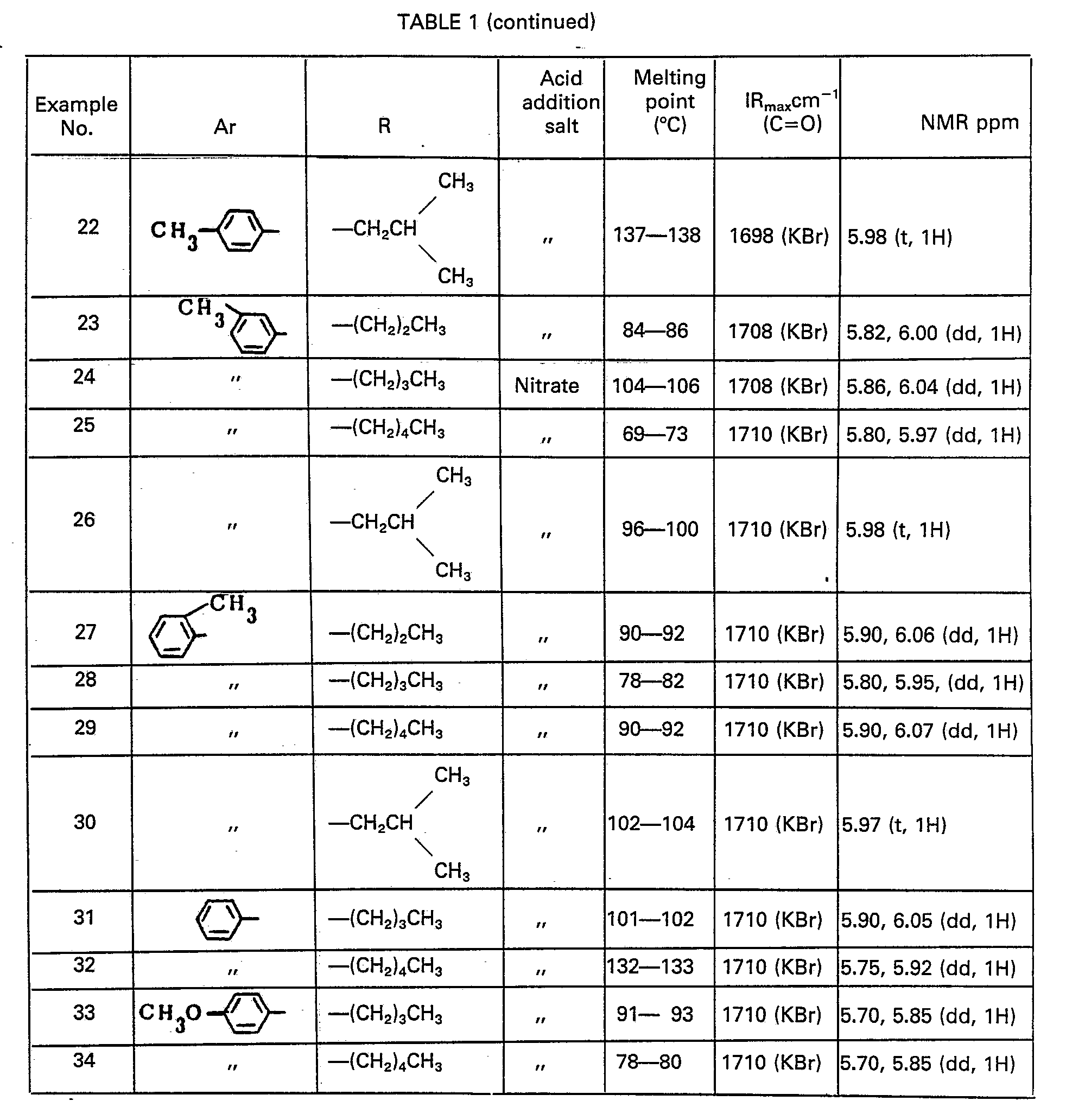
-
- (a) 30 g of imidazole was dissolved in 80 ml of N,N-dimethylformamide. To this solution, 30 g of 3-bromo-2-heptanone was gradually added under stirring, and stirred at a temperature of from 50 to 60°C for 4 hours. Then, the mixture was poured into water and extracted with chloroform. The extraction solution was treated by a usual manner, and the obtained oily product was purified by distillation, whereby 3-(imidazole-1-yl)-2-heptanone was obtained. The boiling point was 116-119°C/2 mmHg.
- (b) 2.7 g of 3-(imidazole-1-yl)-2-heptanone and 3.0 g of 3,4-dichlorobenzaldehyde were dissolved in 50 ml of methanol. While stirring this solution under cooling with ice (0-50C), 2.1 g of potassium carbonate was added. Then, the mixture was stirred at the same temperature for 7 hours. The reaction mixture was poured into water and extracted with chloroform. The extraction solution was treated by a usual method, and the obtained oily product was purified by chromatography, whereby 1-(3',4'-dichlorophenyl)-4-(imidazole-1-yl)-1-octene-3-one was obtained as an oily product.
- This oily product was dissolved in 50 ml of ether, and 1 ml of concentrated nitric acid was gradually added under stirring. The precipitated crystals were collected by filtration and recrystallized from ethanol- ethylacetate, whereby 1-(3',4'-dichlorophenyl)-4-(imidazole-1-yl)-1-octene-3-one nitrate was obtained.
- Melting point: 119--121°C
- IR spectrum VKBr max cm-1: 2960, 2935, 1710, 1615, 1580
- NMR spectrum (δ ppm 60 Mdz, DMSO-ds): 0.88 (t, 3H), 0.9―1.7 (m, 4H), 1.9―2.4 (m, 2H), 5.65, 5.80 (dd, 1H), 7.2-8.3 (m, 8H), 9.26 (m, 1H)
- In the same manner as in Example 35, the following compounds were obtained starting from the corresponding (imidazole-1-yl)-ketones. The solvent for the measurement of NMR was DMSO―d6 unless otherwise specified.


- With respect to various bacteria and fungi, the bacteriostatic and fungistatic activities were measured by a plate dilution method. In the case of bacteria, the measurements were conducted after culturing them at 37°C for 2 days by means of a bouillon agar culture medium. In the case of fungi, the measurements were conducted after culturing then by means of Sabouraud agar culture medium at 37°C for 2 days in the case of Candida and at 27°C for 7 days in the case of Trichophyton. The results thereby obtained are shown in Table 3. The numerical values represent the minimum growth inhibition concentrations. From the results of the tests, it is evident that the products of the present invention exhibit superior antifungal activities. In Comparative Example 1, phenyl 11-iodo-10-undecynoate was used. Likewise, in Comparative Example 2, micronazole was used.
- Phenyl 11-iodo-10-undecynoate:

- Miconazole:


- The tests were conducted in accordance with a Kaken method (see The Japanese Journal of Medical Mycology, Vol. 1, p 252 (1960)). Four portions on the back of a Hartly guinea pig (weight: 600-700 g) were depilated for.4 cm2 each, mildly scratched with a sand paper, and then infected with the second generation of Trichophyton mentagrophytes cultured in a guinea pig at a rate of 1 x 10⁵ spores per infected portion. From 48 hours after the infection, 0.2 ml of a test sample dissolved in a ethanol was applied once a day for 10 times. After 2 days from the final treatment, the guinea pig was killed, and 10 culture tissues from each infected portion were taken and placed on a Sabouraud agar plate containing cyclohexamine and kanamycin and cultured at 27°C for 7 days, whereupon the presence or absence of Trichophyton was determined. The inhibition rate was obtained in accordance with the following equation. The test results are shown in Table 4.


- A suspension of a sample in a 0.5% methylcellulose 50 was administered i.p. to jcl:ICR female mice of 5 weeks old. LD50 was calculated from the mortality after 7 days from the date of administration. As a result, LD50 of the compound of Example 4 was found to be about 250 mg/kg.
Claims (9)


Applications Claiming Priority (2)
| Application Number | Priority Date | Filing Date | Title |
|---|---|---|---|
| JP167560/83 | 1983-09-13 | ||
| JP58167560A JPS6058965A (en) | 1983-09-13 | 1983-09-13 | Novel imidazole derivative |
Publications (3)
| Publication Number | Publication Date |
|---|---|
| EP0134578A2 EP0134578A2 (en) | 1985-03-20 |
| EP0134578A3 EP0134578A3 (en) | 1986-11-26 |
| EP0134578B1 true EP0134578B1 (en) | 1988-05-18 |
Family
ID=15851985
Family Applications (1)
| Application Number | Title | Priority Date | Filing Date |
|---|---|---|---|
| EP84110576A Expired EP0134578B1 (en) | 1983-09-13 | 1984-09-05 | Imidazole derivatives and processes for their production |
Country Status (4)
| Country | Link |
|---|---|
| US (1) | US4608438A (en) |
| EP (1) | EP0134578B1 (en) |
| JP (1) | JPS6058965A (en) |
| DE (1) | DE3471303D1 (en) |
Families Citing this family (2)
| Publication number | Priority date | Publication date | Assignee | Title |
|---|---|---|---|---|
| US5328927A (en) * | 1992-03-03 | 1994-07-12 | Merck Sharpe & Dohme, Ltd. | Hetercyclic compounds, processes for their preparation and pharmaceutical compositions containing them |
| WO2018136792A1 (en) | 2017-01-20 | 2018-07-26 | The Regents Of The University Of California | Inhibitors of the n-terminal domain of the androgen receptor |
Family Cites Families (8)
| Publication number | Priority date | Publication date | Assignee | Title |
|---|---|---|---|---|
| DE2037610A1 (en) * | 1970-07-29 | 1972-02-03 | Bayer Ag | New alpha-substituted benzyl-azoles, processes for their production and their use as pharmaceuticals |
| GB1580535A (en) * | 1976-08-27 | 1980-12-03 | Ici Ltd | Substituted ketones and their use as herbicides |
| GB1595698A (en) * | 1977-08-18 | 1981-08-12 | Ici Ltd | Triazole compound useful as a plant fungicide |
| EP0001682A3 (en) * | 1977-10-17 | 1979-05-16 | Imperial Chemical Industries Plc | Heterocyclic compounds and their use as pesticides |
| EP0002331A3 (en) * | 1977-12-07 | 1979-06-27 | Imperial Chemical Industries Plc | Imidazole and triazole compounds, fungicidal and plant growth regulating compositions, method of combating fungal infections in plants and method of regulating plant growth |
| US4273776A (en) * | 1980-01-30 | 1981-06-16 | E. R. Squibb & Sons, Inc. | Antibacterial and antifungal derivatives of 3-(1H-imidazol-1-yl)-2-propen-1-ones |
| DE3144670A1 (en) * | 1981-11-10 | 1983-05-19 | Bayer Ag, 5090 Leverkusen | AZOLYL-ALKENONE AND -OLE, METHOD FOR THE PRODUCTION THEREOF AND THEIR USE AS PLANT GROWTH REGULATORS AND FUNGICIDES |
| DE3224129A1 (en) * | 1982-06-29 | 1983-12-29 | Bayer Ag, 5090 Leverkusen | SUBSTITUTED AZOLYL KETONES AND ALCOHOLS |
-
1983
- 1983-09-13 JP JP58167560A patent/JPS6058965A/en active Granted
-
1984
- 1984-08-16 US US06/641,198 patent/US4608438A/en not_active Expired - Fee Related
- 1984-09-05 DE DE8484110576T patent/DE3471303D1/en not_active Expired
- 1984-09-05 EP EP84110576A patent/EP0134578B1/en not_active Expired
Also Published As
| Publication number | Publication date |
|---|---|
| US4608438A (en) | 1986-08-26 |
| EP0134578A2 (en) | 1985-03-20 |
| DE3471303D1 (en) | 1988-06-23 |
| EP0134578A3 (en) | 1986-11-26 |
| JPH0557271B2 (en) | 1993-08-23 |
| JPS6058965A (en) | 1985-04-05 |
Similar Documents
| Publication | Publication Date | Title |
|---|---|---|
| US4898954A (en) | Process for the preparation of oxiranes | |
| CA1257869A (en) | Aryl cyclopropyl ketone intermediates | |
| CA1212952A (en) | 1-phenyl-2-triazolyl-ethyl ether derivatives and their use as fungicides | |
| JPS5913512B2 (en) | Method for producing triazolyl-alkanones and their salts | |
| JPS5823671A (en) | Manufacture of imidazolyl-o,n-acetal and salt | |
| CA1092130A (en) | Azolyl-carboxylic acid derivatives and their use as fungicides | |
| US4945101A (en) | Fungicidal novel hydroxyalkynyl-azolyl derivatives | |
| CA1287059C (en) | Bis-triazole derivatives having antifungal activity | |
| US5710280A (en) | Preparation of fluconazole and pharmaceutically acceptable salts thereof | |
| PL143223B1 (en) | Process for preparing novel derivatives of bis-triazole | |
| US4262000A (en) | Combating fungi with 3-substituted pyridine derivatives | |
| EP0257171B1 (en) | (benzofuran-2-yl)imidazoles having pharmaceutical activity, their salts and relevant production processes | |
| US4920139A (en) | Alpha-alkyl-alpha-(4-halophenyl)-1H-1,2,4-triazole-1-propanenitrile | |
| CA1185608A (en) | Azolyl-alkenones and -ols, a process for their preparation, and their use as plant-growth regulators and fungicides | |
| CA1185981A (en) | Substituted azolyl-phenoxy derivatives, processes for their preparation, and their use as fungicides | |
| US4427673A (en) | Azolylalkyl ketone and alcohol fungicides | |
| US4151287A (en) | Combating fungi with 1-diaryloxy-1-triazolyl-3,3-dimethyl-butan-2-ones and butan-2-ols | |
| US4291044A (en) | Combating fungi with 1-(azol-1-yl)-2-substituted-alken-3-ones | |
| EP0134578A2 (en) | Imidazole derivatives and processes for their production | |
| CA1115718A (en) | Therapeutically active substituted dibenzyl ethers | |
| US4742071A (en) | Novel 2-aryl-2-azolylmethyl-1,3-dioxepine fungicides | |
| US4721786A (en) | β-naphthylalkylamines | |
| HU208692B (en) | Method for producing 1-azolyl-mdethyl-2-aryl-1,3-dioxolanes their salts and medical prepartives containing them | |
| US5378707A (en) | Aryl-propyl-amines endowed with antifungal activity | |
| JPH07615B2 (en) | Azolyl derivative having bactericidal activity |
Legal Events
| Date | Code | Title | Description |
|---|---|---|---|
| PUAI | Public reference made under article 153(3) epc to a published international application that has entered the european phase |
Free format text: ORIGINAL CODE: 0009012 |
|
| AK | Designated contracting states |
Designated state(s): CH DE FR GB IT LI |
|
| PUAL | Search report despatched |
Free format text: ORIGINAL CODE: 0009013 |
|
| AK | Designated contracting states |
Kind code of ref document: A3 Designated state(s): CH DE FR GB IT LI |
|
| 17P | Request for examination filed |
Effective date: 19870122 |
|
| 17Q | First examination report despatched |
Effective date: 19870929 |
|
| GRAA | (expected) grant |
Free format text: ORIGINAL CODE: 0009210 |
|
| AK | Designated contracting states |
Kind code of ref document: B1 Designated state(s): CH DE FR GB IT LI |
|
| ITF | It: translation for a ep patent filed | ||
| REF | Corresponds to: |
Ref document number: 3471303 Country of ref document: DE Date of ref document: 19880623 |
|
| ET | Fr: translation filed | ||
| PLBE | No opposition filed within time limit |
Free format text: ORIGINAL CODE: 0009261 |
|
| STAA | Information on the status of an ep patent application or granted ep patent |
Free format text: STATUS: NO OPPOSITION FILED WITHIN TIME LIMIT |
|
| 26N | No opposition filed | ||
| ITTA | It: last paid annual fee | ||
| PGFP | Annual fee paid to national office [announced via postgrant information from national office to epo] |
Ref country code: GB Payment date: 19930826 Year of fee payment: 10 |
|
| PGFP | Annual fee paid to national office [announced via postgrant information from national office to epo] |
Ref country code: DE Payment date: 19930831 Year of fee payment: 10 |
|
| PGFP | Annual fee paid to national office [announced via postgrant information from national office to epo] |
Ref country code: FR Payment date: 19930909 Year of fee payment: 10 |
|
| PGFP | Annual fee paid to national office [announced via postgrant information from national office to epo] |
Ref country code: CH Payment date: 19930915 Year of fee payment: 10 |
|
| PG25 | Lapsed in a contracting state [announced via postgrant information from national office to epo] |
Ref country code: GB Effective date: 19940905 |
|
| PG25 | Lapsed in a contracting state [announced via postgrant information from national office to epo] |
Ref country code: LI Effective date: 19940930 Ref country code: CH Effective date: 19940930 |
|
| GBPC | Gb: european patent ceased through non-payment of renewal fee |
Effective date: 19940905 |
|
| PG25 | Lapsed in a contracting state [announced via postgrant information from national office to epo] |
Ref country code: FR Effective date: 19950531 |
|
| REG | Reference to a national code |
Ref country code: CH Ref legal event code: PL |
|
| PG25 | Lapsed in a contracting state [announced via postgrant information from national office to epo] |
Ref country code: DE Effective date: 19950601 |
|
| REG | Reference to a national code |
Ref country code: FR Ref legal event code: ST |