EP0134339B1 - Herbicidal composition - Google Patents
Herbicidal composition Download PDFInfo
- Publication number
- EP0134339B1 EP0134339B1 EP19830304791 EP83304791A EP0134339B1 EP 0134339 B1 EP0134339 B1 EP 0134339B1 EP 19830304791 EP19830304791 EP 19830304791 EP 83304791 A EP83304791 A EP 83304791A EP 0134339 B1 EP0134339 B1 EP 0134339B1
- Authority
- EP
- European Patent Office
- Prior art keywords
- weeds
- withered
- weight
- maleic hydrazide
- sodium
- Prior art date
- Legal status (The legal status is an assumption and is not a legal conclusion. Google has not performed a legal analysis and makes no representation as to the accuracy of the status listed.)
- Expired
Links
- 230000002363 herbicidal effect Effects 0.000 title claims description 35
- 239000000203 mixture Substances 0.000 title claims description 33
- 241000196324 Embryophyta Species 0.000 claims description 90
- BGRDGMRNKXEXQD-UHFFFAOYSA-N Maleic hydrazide Chemical compound OC1=CC=C(O)N=N1 BGRDGMRNKXEXQD-UHFFFAOYSA-N 0.000 claims description 23
- 239000005983 Maleic hydrazide Substances 0.000 claims description 23
- 150000003839 salts Chemical class 0.000 claims description 15
- YVFGPNCUNPLRAS-UHFFFAOYSA-N sodium;methoxycarbonylsulfanylazanide Chemical compound [Na+].COC(=O)S[NH-] YVFGPNCUNPLRAS-UHFFFAOYSA-N 0.000 claims description 8
- OEYIOHPDSNJKLS-UHFFFAOYSA-N choline Chemical compound C[N+](C)(C)CCO OEYIOHPDSNJKLS-UHFFFAOYSA-N 0.000 claims description 7
- 229960001231 choline Drugs 0.000 claims description 7
- 239000007788 liquid Substances 0.000 claims description 4
- 238000000034 method Methods 0.000 claims description 4
- 239000004480 active ingredient Substances 0.000 claims description 3
- 239000000843 powder Substances 0.000 claims description 3
- HZAXFHJVJLSVMW-UHFFFAOYSA-N 2-Aminoethan-1-ol Chemical compound NCCO HZAXFHJVJLSVMW-UHFFFAOYSA-N 0.000 claims 2
- DGAQECJNVWCQMB-PUAWFVPOSA-M Ilexoside XXIX Chemical compound C[C@@H]1CC[C@@]2(CC[C@@]3(C(=CC[C@H]4[C@]3(CC[C@@H]5[C@@]4(CC[C@@H](C5(C)C)OS(=O)(=O)[O-])C)C)[C@@H]2[C@]1(C)O)C)C(=O)O[C@H]6[C@@H]([C@H]([C@@H]([C@H](O6)CO)O)O)O.[Na+] DGAQECJNVWCQMB-PUAWFVPOSA-M 0.000 claims 1
- XAEFZNCEHLXOMS-UHFFFAOYSA-M potassium benzoate Chemical compound [K+].[O-]C(=O)C1=CC=CC=C1 XAEFZNCEHLXOMS-UHFFFAOYSA-M 0.000 claims 1
- 229910052708 sodium Inorganic materials 0.000 claims 1
- 239000011734 sodium Substances 0.000 claims 1
- PEXLHWBDBQUUOG-UHFFFAOYSA-M asulam-sodium Chemical compound [Na+].COC(=O)[N-]S(=O)(=O)C1=CC=C(N)C=C1 PEXLHWBDBQUUOG-UHFFFAOYSA-M 0.000 description 25
- 239000007864 aqueous solution Substances 0.000 description 13
- 230000001276 controlling effect Effects 0.000 description 11
- 239000000126 substance Substances 0.000 description 10
- 230000000694 effects Effects 0.000 description 8
- 239000004009 herbicide Substances 0.000 description 6
- XLYOFNOQVPJJNP-UHFFFAOYSA-N water Substances O XLYOFNOQVPJJNP-UHFFFAOYSA-N 0.000 description 6
- ATBGNNCHICEGFV-UHFFFAOYSA-M 2-hydroxyethyl(trimethyl)azanium;6-oxo-1h-pyridazin-3-olate Chemical compound C[N+](C)(C)CCO.[O-]C=1C=CC(=O)NN=1 ATBGNNCHICEGFV-UHFFFAOYSA-M 0.000 description 5
- 238000011835 investigation Methods 0.000 description 5
- 239000004094 surface-active agent Substances 0.000 description 5
- 238000009333 weeding Methods 0.000 description 5
- 241000217446 Calystegia sepium Species 0.000 description 4
- RGKQZJLSGXQWJV-ODZAUARKSA-N OCCNCCO.NNC(=O)\C=C/C(O)=O Chemical compound OCCNCCO.NNC(=O)\C=C/C(O)=O RGKQZJLSGXQWJV-ODZAUARKSA-N 0.000 description 4
- 241000219492 Quercus Species 0.000 description 4
- -1 polyoxyethylene Polymers 0.000 description 4
- 238000002360 preparation method Methods 0.000 description 4
- 239000002689 soil Substances 0.000 description 4
- 239000007921 spray Substances 0.000 description 4
- FFJCNSLCJOQHKM-CLFAGFIQSA-N (z)-1-[(z)-octadec-9-enoxy]octadec-9-ene Chemical compound CCCCCCCC\C=C/CCCCCCCCOCCCCCCCC\C=C/CCCCCCCC FFJCNSLCJOQHKM-CLFAGFIQSA-N 0.000 description 3
- 235000003823 Petasites japonicus Nutrition 0.000 description 3
- 240000003296 Petasites japonicus Species 0.000 description 3
- 229920003171 Poly (ethylene oxide) Polymers 0.000 description 3
- 235000009936 Pteridium aquilinum Nutrition 0.000 description 3
- 240000005893 Pteridium aquilinum Species 0.000 description 3
- 235000005291 Rumex acetosa Nutrition 0.000 description 3
- 240000007001 Rumex acetosella Species 0.000 description 3
- 235000001436 butterbur Nutrition 0.000 description 3
- 229960000878 docusate sodium Drugs 0.000 description 3
- XVTMKRCXKIHJQK-UHFFFAOYSA-M potassium;1h-pyridazin-2-ide-3,6-dione Chemical compound [K+].O=C1C=CC(=O)[N-]N1 XVTMKRCXKIHJQK-UHFFFAOYSA-M 0.000 description 3
- APSBXTVYXVQYAB-UHFFFAOYSA-M sodium docusate Chemical compound [Na+].CCCCC(CC)COC(=O)CC(S([O-])(=O)=O)C(=O)OCC(CC)CCCC APSBXTVYXVQYAB-UHFFFAOYSA-M 0.000 description 3
- 241001523383 Achnatherum Species 0.000 description 2
- 235000005474 African couch grass Nutrition 0.000 description 2
- 240000002234 Allium sativum Species 0.000 description 2
- 235000009051 Ambrosia paniculata var. peruviana Nutrition 0.000 description 2
- 235000003097 Artemisia absinthium Nutrition 0.000 description 2
- 240000001851 Artemisia dracunculus Species 0.000 description 2
- 235000017731 Artemisia dracunculus ssp. dracunculus Nutrition 0.000 description 2
- 235000003261 Artemisia vulgaris Nutrition 0.000 description 2
- VTYYLEPIZMXCLO-UHFFFAOYSA-L Calcium carbonate Chemical compound [Ca+2].[O-]C([O-])=O VTYYLEPIZMXCLO-UHFFFAOYSA-L 0.000 description 2
- 235000008671 Calycanthus floridus Nutrition 0.000 description 2
- 244000025311 Calycanthus occidentalis Species 0.000 description 2
- 235000008670 Calycanthus occidentalis Nutrition 0.000 description 2
- 244000025254 Cannabis sativa Species 0.000 description 2
- 235000014036 Castanea Nutrition 0.000 description 2
- 240000002779 Cayratia japonica Species 0.000 description 2
- 241001520106 Eustachys Species 0.000 description 2
- 235000004520 Lindera benzoin Nutrition 0.000 description 2
- 235000008262 Lindera benzoin var. benzoin Nutrition 0.000 description 2
- 240000007594 Oryza sativa Species 0.000 description 2
- 235000007164 Oryza sativa Nutrition 0.000 description 2
- 244000292693 Poa annua Species 0.000 description 2
- 235000010575 Pueraria lobata Nutrition 0.000 description 2
- 244000046146 Pueraria lobata Species 0.000 description 2
- 244000184734 Pyrus japonica Species 0.000 description 2
- 241001480065 Quercus serrata Species 0.000 description 2
- 244000088415 Raphanus sativus Species 0.000 description 2
- 235000006140 Raphanus sativus var sativus Nutrition 0.000 description 2
- 241001092459 Rubus Species 0.000 description 2
- 235000017848 Rubus fruticosus Nutrition 0.000 description 2
- 235000015761 Rumex acetosella Nutrition 0.000 description 2
- 235000002595 Solanum tuberosum Nutrition 0.000 description 2
- 244000061456 Solanum tuberosum Species 0.000 description 2
- 244000062793 Sorghum vulgare Species 0.000 description 2
- 240000001949 Taraxacum officinale Species 0.000 description 2
- 235000005187 Taraxacum officinale ssp. officinale Nutrition 0.000 description 2
- 244000248701 Turnera subulata Species 0.000 description 2
- 239000002671 adjuvant Substances 0.000 description 2
- 239000001138 artemisia absinthium Substances 0.000 description 2
- 230000002950 deficient Effects 0.000 description 2
- 235000004611 garlic Nutrition 0.000 description 2
- 235000019713 millet Nutrition 0.000 description 2
- 239000002420 orchard Substances 0.000 description 2
- 235000009566 rice Nutrition 0.000 description 2
- KDYFGRWQOYBRFD-UHFFFAOYSA-N succinic acid Chemical compound OC(=O)CCC(O)=O KDYFGRWQOYBRFD-UHFFFAOYSA-N 0.000 description 2
- 235000010301 Carolina horsenettle Nutrition 0.000 description 1
- 241001070941 Castanea Species 0.000 description 1
- 241000218645 Cedrus Species 0.000 description 1
- 235000008302 Chamaenerion angustifolium Nutrition 0.000 description 1
- 241000233838 Commelina Species 0.000 description 1
- 244000301850 Cupressus sempervirens Species 0.000 description 1
- 244000058871 Echinochloa crus-galli Species 0.000 description 1
- 235000014716 Eleusine indica Nutrition 0.000 description 1
- 241000508725 Elymus repens Species 0.000 description 1
- 241000305599 Erigeron annuus Species 0.000 description 1
- 241001252539 Erigeron philadelphicus Species 0.000 description 1
- 235000014820 Galium aparine Nutrition 0.000 description 1
- 235000001018 Hibiscus sabdariffa Nutrition 0.000 description 1
- 241000510052 Ixeris japonica Species 0.000 description 1
- 239000005909 Kieselgur Substances 0.000 description 1
- 241001166994 Kummerowia striata Species 0.000 description 1
- 241000039951 Lithocarpus glaber Species 0.000 description 1
- 244000187664 Nerium oleander Species 0.000 description 1
- 244000245600 Persicaria longiseta Species 0.000 description 1
- 244000292697 Polygonum aviculare Species 0.000 description 1
- 235000006386 Polygonum aviculare Nutrition 0.000 description 1
- 244000025767 Quercus prinus Species 0.000 description 1
- 240000001341 Reynoutria japonica Species 0.000 description 1
- 235000018167 Reynoutria japonica Nutrition 0.000 description 1
- 241000490453 Rorippa Species 0.000 description 1
- 235000005010 Scirpus paludosus Nutrition 0.000 description 1
- 244000058416 Scirpus paludosus Species 0.000 description 1
- 240000003705 Senecio vulgaris Species 0.000 description 1
- VYPSYNLAJGMNEJ-UHFFFAOYSA-N Silicium dioxide Chemical compound O=[Si]=O VYPSYNLAJGMNEJ-UHFFFAOYSA-N 0.000 description 1
- 241000501039 Solanum carolinense Species 0.000 description 1
- 240000006694 Stellaria media Species 0.000 description 1
- 241000219793 Trifolium Species 0.000 description 1
- 235000010310 bull nettle Nutrition 0.000 description 1
- 229910000019 calcium carbonate Inorganic materials 0.000 description 1
- 230000034303 cell budding Effects 0.000 description 1
- 235000010313 devils tomato Nutrition 0.000 description 1
- JZKFHQMONDVVNF-UHFFFAOYSA-N dodecyl sulfate;tris(2-hydroxyethyl)azanium Chemical compound OCCN(CCO)CCO.CCCCCCCCCCCCOS(O)(=O)=O JZKFHQMONDVVNF-UHFFFAOYSA-N 0.000 description 1
- 239000000428 dust Substances 0.000 description 1
- 238000000265 homogenisation Methods 0.000 description 1
- 239000004615 ingredient Substances 0.000 description 1
- 238000004519 manufacturing process Methods 0.000 description 1
- 230000035699 permeability Effects 0.000 description 1
- 238000011160 research Methods 0.000 description 1
- 235000003513 sheep sorrel Nutrition 0.000 description 1
- AELFEMCETQQALA-ODZAUARKSA-M sodium;(z)-4-hydrazinyl-4-oxobut-2-enoate Chemical compound [Na+].NNC(=O)\C=C/C([O-])=O AELFEMCETQQALA-ODZAUARKSA-M 0.000 description 1
- 238000003892 spreading Methods 0.000 description 1
- 230000002195 synergetic effect Effects 0.000 description 1
- 239000000454 talc Substances 0.000 description 1
- 229910052623 talc Inorganic materials 0.000 description 1
Classifications
-
- A—HUMAN NECESSITIES
- A01—AGRICULTURE; FORESTRY; ANIMAL HUSBANDRY; HUNTING; TRAPPING; FISHING
- A01N—PRESERVATION OF BODIES OF HUMANS OR ANIMALS OR PLANTS OR PARTS THEREOF; BIOCIDES, e.g. AS DISINFECTANTS, AS PESTICIDES OR AS HERBICIDES; PEST REPELLANTS OR ATTRACTANTS; PLANT GROWTH REGULATORS
- A01N47/00—Biocides, pest repellants or attractants, or plant growth regulators containing organic compounds containing a carbon atom not being member of a ring and having no bond to a carbon or hydrogen atom, e.g. derivatives of carbonic acid
- A01N47/08—Biocides, pest repellants or attractants, or plant growth regulators containing organic compounds containing a carbon atom not being member of a ring and having no bond to a carbon or hydrogen atom, e.g. derivatives of carbonic acid the carbon atom having one or more single bonds to nitrogen atoms
- A01N47/10—Carbamic acid derivatives, i.e. containing the group —O—CO—N<; Thio analogues thereof
- A01N47/24—Carbamic acid derivatives, i.e. containing the group —O—CO—N<; Thio analogues thereof containing the groups, or; Thio analogues thereof
Definitions
- the present invention relates to a herbicidal composition
- a herbicidal composition comprising as active ingredients sodium N-methoxycarbonylsulfanylamide and maleic hydrazide or a salt thereof.
- Asulam Sodium a herbicide comprising sodium N-methoxycarbonylsulfanylamide
- weeds of the rice family such as fingergrass, goose-grass, barnyard grass and annual bluegrass, annual weeds such as Polygonum blumei meisner, annual fleabane, dayflower, common chickweed, shovelweed and Japanese clover, perennial weeds such as bracken, culy dock, butterbur, common groundsel, needle-grass and hedge bindweed, and deciduous miscellaneous shrubs such as oak, chestnut and Japanese oak.
- this herbicide is insufficient in controlling the growth of the subterranean part (such as rhizome, tuber or bulb) of culy dock which brings about the most serious damage among perennial weeds often growing in a pasture or orchard, and therefore, the effect on old plants (3 to 5 years old) is poor though a sufficient effect is expected on young plants (1 to 2 years old).
- the herbicide is defective in that the effect is relatively insufficient in the actual application.
- MH Maleic hydrazide
- MH Maleic hydrazide
- this herbicide is defective in that the herbicidal effect greatly differs according to the kinds of weeds.
- MH or its salt is used in the growth period of perennial weeds, that is, in spring or summer, a highest effect is attained by a method in which a terrestrial stem or leaf portion is cut off after passage of about 7 to about 10 days from the time of the chemical treatment.
- a herbicidal composition comprising as active ingredients sodium N-methoxycarbonylsulfanylamide and maleic hydrazide or a salt thereof.
- maleic hydrazide or a salt thereof are meant maleic hydrazide, choline maleic hydrazide, diethanolamine maleic hydrazide, sodium maleic hydrazide and potassium maleic hydrazide.
- the herbicidal composition of the present invention can completely control perennial weeds often growing in an orchard, a pasture, a forest or other non-cultivated ground such as culy dock, bracken, common sorrel, horsenettle and kudzu, and shrubs (perennial tree weeds) such as rosebay, oak (Quercus serrata), white alder, spicebush and brambles. Furthermore, annual weeds and small perennial weeds such as wormwood, red garlic, hedge bindweed, nut grass, yellow cress, Yabugarashi (Cayratio japonica) and jishibari (Ixeris debilis) can be controlled by the herbicidal composition of the present invention.
- the amount of Asulam Sodium contained in the herbicidal composition of the present invention is ordinarily 2 to 30 g per a and preferably 5 to 25 g per a. If the amount applied of Asulam Sodium is smaller than 2 g per a, the herbicidal effect is insufficient, and if the amount applied of Asulam Sodium exceeds 30 g per a, the treatment is economically disadvantageous and the amount of the chemical left in soil is increased. When the herbicidal composition of the present invention is applied to well-grown weeds, it is preferred that a larger chemical amount be selected within the above-mentioned range.
- the amount of MH or its salt contained in the applied herbicidal eomposition of the present invention is ordinarily 5 to 50 g per a and preferably 10 to 25 g per a as maleic hydrazide.
- the ratio between Asulam Sodium and MH in the herbicidal composition of the present invention can optionally be chosen within such a range that the application rate of Asulam Sodium is 2 to 30 g per a and the application rate of MH or its salt is 5 to 50 g per a. If both the ingredients are mixed at such a ratio, a herbicidal composition having an excellent herbicidal effect can be obtained.
- the herbicidal compositions in accordance with the invention preferably contain 20 to 300 parts by weight of sodium N-methoxycarbonylsulfanylamide and 50 to 500 parts by weight of maleic hydrazide or its salt.
- choline maleic hydrazide is especially excellent in the effect among salts of maleic hydrazide, and diethanolamine maleic hydrazide comes next.
- the herbicidable composition of the present invention is ordinarily formulated into a liquid or powder preparation.
- Diatomaceous earth or talc is used as the carrier when a powder preparation or dust is formed.
- an adjuvant be incorporated into the herbicidal composition.
- the adjuvant may be added to the herbicidal composition when it is actually used.
- a liquid preparation is preferred.
- the unit amount per a of the herbicidal composition be diluted with about 10 I of water when the herbicidal composition of the present invention is applied.
- the damage degree was evaluated according to the following rating.
- % in the above description indicates the percentile ratio of the area where the indicator plant withered to the test area where the spray treatment was carried out. The same will apply hereinafter.
- a concrete pot having an area of 0.5 mx0.5 m was filled with field soil; and perennial weeds described below were transplanted in the pot at the beginning of April, and an aqueous solution of choline MH, an aqueous solution of Asulam Sodium or an aqueous solution of a mixture of choline MH and Asulam Sodium was sprayed at a rate of 10 I per a.
- the results of investigation made 45 days after the spray treatment are shown in Table 2.
- the damage degree was evaluated according to the following rating.
- Tubers of potato were soil-cultivated in a pot having an area of and when the grass height became 20 cm, a mixed chemical of choline MH and Asulam Sodium (shown in Table 3) was sprayed to all the stems and leaves. When 40 days had passed from the time of the spray treatment, the grass height became 50 cm. At this time, new tubers were dug out and examined. The obtained results are shown in Table 3.
- Test areas were formed in a stock farm where bracken, butterbur, kudzu, knotweed, yabugarashi (Cayratio japonica) and dandelion grew thick, and herbicides were applied singly or in combination, as indicated in Table 5, on June 20. The investigation was made on August 20 and the controlling effect was evaluated according to the following rating. The obtained results are shown in Table 5.
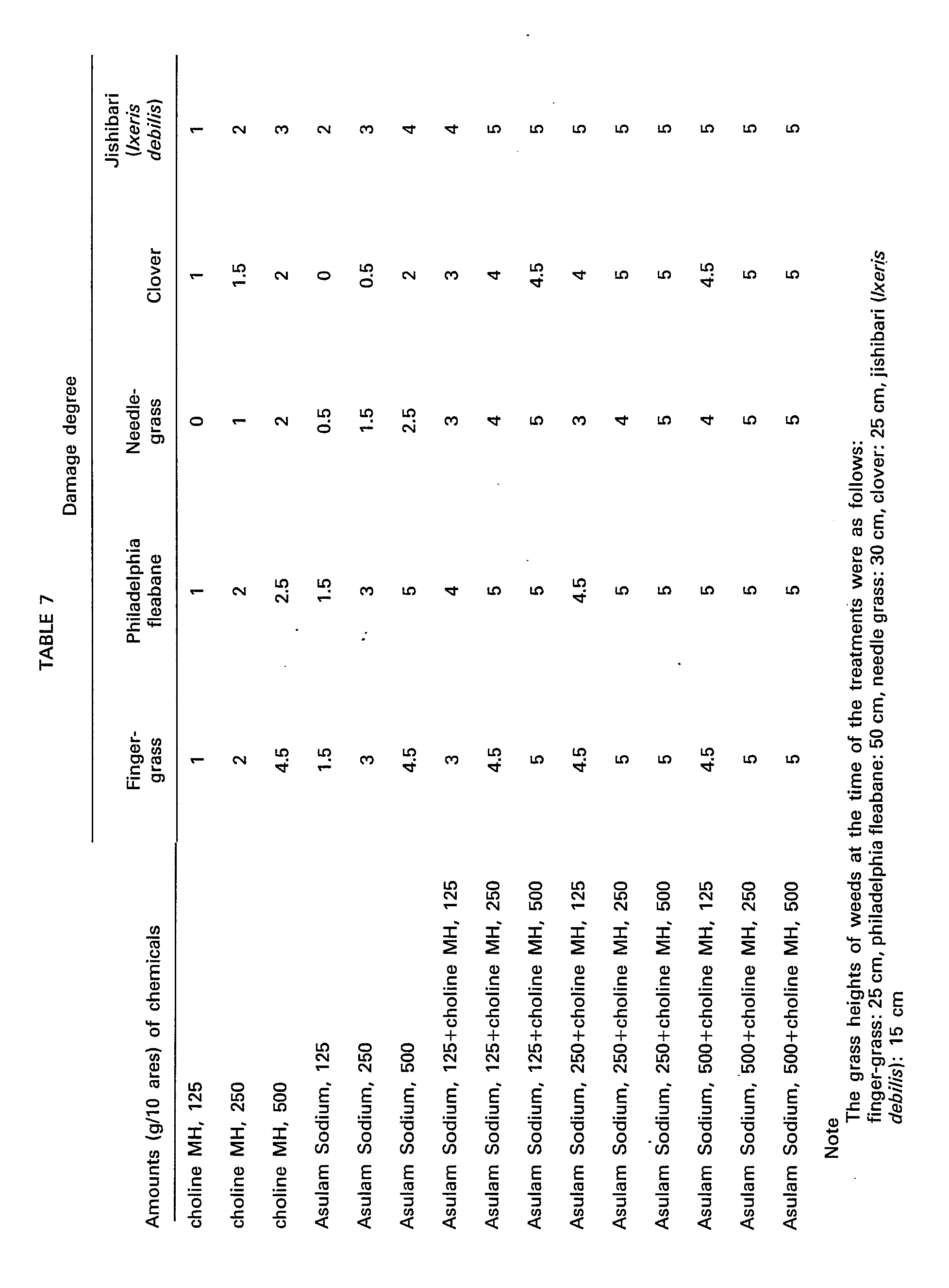
- Test areas were formed in a field where fingergrass, philadelphia fleabane, needle-grass, clover and jishibari (lxeris debilis) grew thick, and at the end of May, Asulam Sodium and choline MH were sprayed singly or in combination, as indicated in Table 7, together with water in an amount of 10 I per a. The investigation was made at the end of August, and the controlling effect was evaluated according to the following rating. The obtained results are shown in Table 7.
Landscapes
- Life Sciences & Earth Sciences (AREA)
- Agronomy & Crop Science (AREA)
- Pest Control & Pesticides (AREA)
- Plant Pathology (AREA)
- Health & Medical Sciences (AREA)
- Engineering & Computer Science (AREA)
- Dentistry (AREA)
- General Health & Medical Sciences (AREA)
- Wood Science & Technology (AREA)
- Zoology (AREA)
- Environmental Sciences (AREA)
- Agricultural Chemicals And Associated Chemicals (AREA)
Description
- The present invention relates to a herbicidal composition comprising as active ingredients sodium N-methoxycarbonylsulfanylamide and maleic hydrazide or a salt thereof.
- It is known that a herbicide comprising sodium N-methoxycarbonylsulfanylamide (hereinafter referred to as "Asulam Sodium") has a control effect of a broad spectrum to weeds of the rice family such as fingergrass, goose-grass, barnyard grass and annual bluegrass, annual weeds such as Polygonum blumei meisner, annual fleabane, dayflower, common chickweed, shovelweed and Japanese clover, perennial weeds such as bracken, culy dock, butterbur, common groundsel, needle-grass and hedge bindweed, and deciduous miscellaneous shrubs such as oak, chestnut and Japanese oak. However, this herbicide is insufficient in controlling the growth of the subterranean part (such as rhizome, tuber or bulb) of culy dock which brings about the most serious damage among perennial weeds often growing in a pasture or orchard, and therefore, the effect on old plants (3 to 5 years old) is poor though a sufficient effect is expected on young plants (1 to 2 years old). The herbicide is defective in that the effect is relatively insufficient in the actual application. Moreover, it is undesirable to apply this chemical in large amounts since it decomposes slowly in the soil and its residual amount in the soil is large.
- Maleic hydrazide (hereinafter referred to as "MH") or its salt is widely used for controlling perennial weeds such as culy dock, butterbur, hedge bindweed, wormwood, common sorrel, Japanese knotweed, red garlic and dandelion. However, this herbicide is defective in that the herbicidal effect greatly differs according to the kinds of weeds. When MH or its salt is used in the growth period of perennial weeds, that is, in spring or summer, a highest effect is attained by a method in which a terrestrial stem or leaf portion is cut off after passage of about 7 to about 10 days from the time of the chemical treatment. Even if this method is adopted, it is necessary that the chemical should be applied at such a high rate as more than 50 g per a. Moreover, in order to control the growth of the subterranean part (such as rhizome, tuber or bulb), it is necessary to apply the chemical at a rate of at least 1,000 g per 10 ares. Accordingly, it is often difficult to obtain the intended controlling effect stably.
- We made researches in view of eliminating the above disadvantages encountered in controlling perennial weeds, and as the result, we found that when Asulam Sodium and MH are used in combination, a very high synergistic effect can be attained. We have now completed the present invention based on this finding.
- More specifically, in accordance with the present invention, there is provided a herbicidal composition comprising as active ingredients sodium N-methoxycarbonylsulfanylamide and maleic hydrazide or a salt thereof.
- In the present invention, by the term "maleic hydrazide or a salt thereof" are meant maleic hydrazide, choline maleic hydrazide, diethanolamine maleic hydrazide, sodium maleic hydrazide and potassium maleic hydrazide.
- The herbicidal composition of the present invention can completely control perennial weeds often growing in an orchard, a pasture, a forest or other non-cultivated ground such as culy dock, bracken, common sorrel, horsenettle and kudzu, and shrubs (perennial tree weeds) such as rosebay, oak (Quercus serrata), white alder, spicebush and brambles. Furthermore, annual weeds and small perennial weeds such as wormwood, red garlic, hedge bindweed, nut grass, yellow cress, Yabugarashi (Cayratio japonica) and jishibari (Ixeris debilis) can be controlled by the herbicidal composition of the present invention.
- The amount of Asulam Sodium contained in the herbicidal composition of the present invention is ordinarily 2 to 30 g per a and preferably 5 to 25 g per a. If the amount applied of Asulam Sodium is smaller than 2 g per a, the herbicidal effect is insufficient, and if the amount applied of Asulam Sodium exceeds 30 g per a, the treatment is economically disadvantageous and the amount of the chemical left in soil is increased. When the herbicidal composition of the present invention is applied to well-grown weeds, it is preferred that a larger chemical amount be selected within the above-mentioned range.
- The amount of MH or its salt contained in the applied herbicidal eomposition of the present invention is ordinarily 5 to 50 g per a and preferably 10 to 25 g per a as maleic hydrazide.
- The ratio between Asulam Sodium and MH in the herbicidal composition of the present invention can optionally be chosen within such a range that the application rate of Asulam Sodium is 2 to 30 g per a and the application rate of MH or its salt is 5 to 50 g per a. If both the ingredients are mixed at such a ratio, a herbicidal composition having an excellent herbicidal effect can be obtained. Thus, the herbicidal compositions in accordance with the invention preferably contain 20 to 300 parts by weight of sodium N-methoxycarbonylsulfanylamide and 50 to 500 parts by weight of maleic hydrazide or its salt.
- In the present invention, choline maleic hydrazide is especially excellent in the effect among salts of maleic hydrazide, and diethanolamine maleic hydrazide comes next.
- The herbicidable composition of the present invention is ordinarily formulated into a liquid or powder preparation. Diatomaceous earth or talc is used as the carrier when a powder preparation or dust is formed. When a liquid preparation is formed, in order to improve the permeability and spreading property, it is preferred that an adjuvant be incorporated into the herbicidal composition. Of course, the adjuvant may be added to the herbicidal composition when it is actually used. From the viewpoint of the effect, a liquid preparation is preferred. From the viewpoints of the homogenization of the chemicals and the enhancement of the herbicidal effect, it is preferred that the unit amount per a of the herbicidal composition be diluted with about 10 I of water when the herbicidal composition of the present invention is applied.
- When the herbicidal composition of the present invention is used, a very excellent herbicidal effect can be obtained very promptly with a much smaller amount than the amount of the chemical when Asulam Sodium or MH or its salt is used singly.
- The process for preparing the herbicidal composition of the present invention will now be described with reference to the following Examples.
- 28 Parts by weight of an aqueous solution of Asulam Sodium (containing 37% by weight of Asulam Sodium) was incorporated and mixed into 68 parts by weight of an aqueous solution of choline maleic hydrazide (containing 30% by weight of maleic hydrazide), and 4 parts by weight of a surface active agent (1:1 mixture of polyoxyethylene oleyl ether and laurylsulphate triethanolamine) was added to the mixture to obtain a product which contained 39 parts by weight of choline maleic hydrazide (20 parts by weight as maleic hydrazide) and 10 parts by weight of Asulam Sodium.
- 28 Parts by weight of an aqueous solutoin of Asulam Sodium (containing 37% by weight of Asulam Sodium) was incorporated and mixed into 68 parts by weight of an aqueous solution of diethanolamine maleic hydrazide (containing 30% by weight of maleic hydrazide), and 4 parts by weight of a surface active agent (1:1 mixture of polyoxyethylene oleyl ether and dioctyl sulfosuccinate) was added to the mixture to obtain a product which contained 39 parts by weight of diethanolamine maleic hydrazide (20 parts by weight as maleic hydrazide) and 10 parts by weight of Asulam Sodium.
- 15 Parts by weight of an aqueous solution of Asulam Sodium (containing 37% by weight of Asulam Sodium) was incorporated and mixed into 50 parts by weight of an aqueous solution of potassium maleic hydrazide (containing 20% by weight of maleic hydrazide), and 5 parts by weight of a surface active agent (1:1 mixture of polyoxyethylene oleyl ether and dioctyl sulfosuccinate) and 29 parts by weight of water were added to the mixture to obtain a product which contained 12 parts by weight of potassium maleic hydrazide (10 parts by weight as maleic hydrazide), 5 parts by weight Asulam Sodium and 5 parts by weight of the surface active agent with the balance being water.
- To 100 parts by weight of calcium carbonate (having a size of 48 to 150 mesh and a purity higher than 90%) were added 4 parts by weight of an aqueous solution of choline maleic hydrazide (containing 30% by weight of maleic hydrazide), 3 parts by weight of an aqueous solution of Asulam Sodium (containing 37% by weight of Asulam Sodium) and 0.1 part by weight of a surface active agent (comprising 0.5 part by weight of polyoxyethylene dodecyl ether and 0.05 part by weight of dioctyl sulfosuccinate), and the mixture was heated and water was sufficiently evaporated to obtain a product.
- The herbicidal effect of the herbicidal composition will now be described with reference to the following tests.
- In order to confirm the herbicidal effect, edible millet (rice family) and radish (broad-leaved plant) were cultivated as indicator plants in an infant plant tester, and an aqueous solution of choline MH, an aqueous solution of Asulam Sodium or an aqueous solution of a mixture of both the chemicals was uniformly sprayed to the plants at a rate of 10 I per a at the growth period of the 4.5-leaf stage of edible millet and 4-leaf stage of radish. The results of the investigation made 1 month after the spray treatment are shown in Table 1.


- The damage degree was evaluated according to the following rating.
- 0: harmless to indicator plants and healthy growth of indicator plants
- 1: 20 % of indicator plants withered
- 1.5: 30 % of indicator plants withered
- 2: 40 % of indicator plants withered
- 2.5: 50 % of indicator plants withered
- 3: 60 % of indicator plants withered
- 3.5: 70 % of indicator plants withered
- 4: 80 % of indicator plants withered
- 4.5: 90 % of indicator plants withered
- 5: indicator plants completely withered
- Incidentally, "%" in the above description indicates the percentile ratio of the area where the indicator plant withered to the test area where the spray treatment was carried out. The same will apply hereinafter.
- A concrete pot having an area of 0.5 mx0.5 m was filled with field soil; and perennial weeds described below were transplanted in the pot at the beginning of April, and an aqueous solution of choline MH, an aqueous solution of Asulam Sodium or an aqueous solution of a mixture of choline MH and Asulam Sodium was sprayed at a rate of 10 I per a. The results of investigation made 45 days after the spray treatment are shown in Table 2.


- The damage degree was evaluated according to the following rating.
- 0: harmless to weeds and healthy growth of weeds
- 1: 20 % of weeds withered
- 1.5: 30 % of weeds withered
- 2: 40 % of weeds withered
- 2.5: 50 % of weeds withered
- 3: 60 % of weeds withered
- 3.5: 70 % of weeds withered
- 4: 80 % of weeds withered
- 4.5: 90 % of weeds withered
- 5: weeds completely withered
- The results of the test of controlling the growth of subterranean parts of perennial plants (weeds) are described.
- The every year appearance of a perennial weed is due to nutriments stored in the subterranean part. Accordingly, in order to exterminate perennial weeds, it is necessary to control the growth of the subterranean parts, and this is a most important requirement for controlling perennial weeds. In order to confirm this action, the herbicidal composition of the present invention was tested by using potato as the indicator plant (perennial weed) in the following manner.
- Tubers of potato were soil-cultivated in a pot having an area of


- On October 10, herbicides were applied singly or in combination, as indicated in Table 4, to an afforested land of cedar and cypress of the fourth cultivation year where miscellaneous shrubs such as oak, chestnut, oak (Quercus serrata), white alder, spicebush, brambles and rosebag grew thick. The investigation was made on June 10, the next year. The obtained results are shown in Table 4. The growth-controlling effect was evaluated according to the following rating.
- 5: complete control, weeding not necessary in that year
- 4: substantially complete control, but some resistant miscellaneous plants found, weeding not necessary in that year
- 3: most miscellaneous plants damaged but sprouting observed in considerable miscellaneous plants and budding found in some withered stems, weeding necessary more or less
- 2: controlling effect obvious but weeding necessary
- 1: certain controlling effect, but weeding necessary because of considerable regrowth
- O: no substantial difference from control area

- Test areas were formed in a stock farm where bracken, butterbur, kudzu, knotweed, yabugarashi (Cayratio japonica) and dandelion grew thick, and herbicides were applied singly or in combination, as indicated in Table 5, on June 20. The investigation was made on August 20 and the controlling effect was evaluated according to the following rating. The obtained results are shown in Table 5.
- 5: terrestrial part completely withered and no regrowth of killed weeds
- 4.5: 90 % of terrestrial part withered and no regrowth of killed weeds
- 4: 80 % of terrestrial part withered and no regrowth of killed weeds
- 3.5: 70 % of terrestrial part withered and no regrowth of killed weeds
- 3: 60 % of terrestrial part withered and no regrowth of killed weeds
- 2.5: 50 % of terrestrial part withered and no regrowth of killed weeds
- 2: 40 % of terrestrial part withered and no regrowth of killed weeds
- 1.5: 30 % of terrestrial part withered and no regrowth of killed weeds
- 1: 20 % of terrestrial part withered and no regrowth of killed weeds
- 0.5: 10 % of terrestrial part withered and no regrowth of killed weeds
- 0: no harm to weeds and healthy growth of weeds

- Asulam Sodium and choline MH were sprayed singly or in combination, as indicated in Table 6, together with water in an amount of 10 per a at the end of May to stems and leaves of hedge bindweed, yellow flower sorrel and quack grass which had been transplanted into a concrete pot (bottomless) in the last autumn. The examination was made at the end of August, and the controlling effect was evaluated according to the following rating. The obtained results are shown in Table 6.
- 0: harmless to weeds and healthy growth of weeds
- 0.5: 10 % of weeds withered
- 1: 20 % of weeds withered
- 1.5: 30 % of weeds withered
- 2: 40 % of weeds withered
- 2.5: 50 % of weeds withered
- 3: 60 % of weeds withered
- 3.5: 70 % of weeds withered
- 4: 80 % of weeds withered
- 4.5: 90 % of weeds withered
- 5: weeds completely withered

- Test areas were formed in a field where fingergrass, philadelphia fleabane, needle-grass, clover and jishibari (lxeris debilis) grew thick, and at the end of May, Asulam Sodium and choline MH were sprayed singly or in combination, as indicated in Table 7, together with water in an amount of 10 I per a. The investigation was made at the end of August, and the controlling effect was evaluated according to the following rating. The obtained results are shown in Table 7.
- 0: harmless to weeds and healthy growth of weeds
- 0.5: 10 % of weeds withered
- 1: 20 % of weeds withered
- 1.5: 30 % of weeds withered
- 2: 40 % of weeds withered
- 2.5: 50 % of weeds withered
- 3: 60 % of weeds withered
- 3.5: 70 % of weeds withered
- 4: 80 % of weeds withered
- 4.5: 90 % of weeds withered
- 5: weeds completely withered
Claims (6)
Priority Applications (2)
| Application Number | Priority Date | Filing Date | Title |
|---|---|---|---|
| DE8383304791T DE3374115D1 (en) | 1983-08-18 | 1983-08-18 | Herbicidal composition |
| EP19830304791 EP0134339B1 (en) | 1983-08-18 | 1983-08-18 | Herbicidal composition |
Applications Claiming Priority (1)
| Application Number | Priority Date | Filing Date | Title |
|---|---|---|---|
| EP19830304791 EP0134339B1 (en) | 1983-08-18 | 1983-08-18 | Herbicidal composition |
Publications (2)
| Publication Number | Publication Date |
|---|---|
| EP0134339A1 EP0134339A1 (en) | 1985-03-20 |
| EP0134339B1 true EP0134339B1 (en) | 1987-10-21 |
Family
ID=8191256
Family Applications (1)
| Application Number | Title | Priority Date | Filing Date |
|---|---|---|---|
| EP19830304791 Expired EP0134339B1 (en) | 1983-08-18 | 1983-08-18 | Herbicidal composition |
Country Status (2)
| Country | Link |
|---|---|
| EP (1) | EP0134339B1 (en) |
| DE (1) | DE3374115D1 (en) |
Families Citing this family (2)
| Publication number | Priority date | Publication date | Assignee | Title |
|---|---|---|---|---|
| US6383985B1 (en) * | 2000-01-10 | 2002-05-07 | Eco-Care Technologies, Inc. | Herbicidal fatty acid and maleic hydrazide salt compositions |
| CN107325009B (en) * | 2012-04-13 | 2022-03-18 | 亨斯迈石油化学有限责任公司 | Stabilization of quaternary trialkylalkanolamines using novel amines |
-
1983
- 1983-08-18 EP EP19830304791 patent/EP0134339B1/en not_active Expired
- 1983-08-18 DE DE8383304791T patent/DE3374115D1/en not_active Expired
Also Published As
| Publication number | Publication date |
|---|---|
| DE3374115D1 (en) | 1987-11-26 |
| EP0134339A1 (en) | 1985-03-20 |
Similar Documents
| Publication | Publication Date | Title |
|---|---|---|
| US8389030B2 (en) | Nematicides from Juglandaceae and methods of use thereof | |
| JP2000504340A (en) | Herbicide compositions and uses | |
| US4622060A (en) | Herbicidal compositions and herbicidal processes | |
| Freitas et al. | Herbicide mixtures to control dayflowers and drift effect on coffee cultures | |
| CN116193987A (en) | Methods and Compositions | |
| EP0134339A1 (en) | Herbicidal composition | |
| KR20010079906A (en) | Sarcosinates as glufosinate adjuvants | |
| FI75972B (en) | SYNERGISTIC HERBICID COMPOSITION AND FOER FAR INSPECTION AV VAEXLIGHET. | |
| US4028091A (en) | Herbicidal composition | |
| Ali et al. | Effect of potassium phosphonate on root rot of Pinus radiata caused by Phytophthora cinnamomi | |
| EP1179982A1 (en) | Herbicidal composition | |
| CZ34439U1 (en) | A synergistic mixture usable as a means of protecting plants from pests and diseases | |
| US4020182A (en) | Pesticidal formaldehyde concentrate | |
| RU2753468C2 (en) | Herbicidal composition and method for application thereof | |
| Oborn | Weed control investigations on some important aquatic plants which impede flow of western irrigation waters | |
| JPS6261561B2 (en) | ||
| Carey et al. | Weed control in bareroot hardwood nurseries | |
| US4153444A (en) | Herbicidal composition | |
| US3515535A (en) | Herbicidal composition | |
| CN118556703A (en) | Low-temperature efficient herbicide and preparation method and application thereof | |
| WO2023058032A1 (en) | Novel formulation systems of carboxylic acid herbicides | |
| JPS61229804A (en) | Nonselective herbicide | |
| US4319915A (en) | Herbicidal compositions | |
| RU2307505C1 (en) | Agent for controlling of suctorial insects and method for production thereof | |
| Martin et al. | Tolerance of cottonwood to certain herbicides |
Legal Events
| Date | Code | Title | Description |
|---|---|---|---|
| PUAI | Public reference made under article 153(3) epc to a published international application that has entered the european phase |
Free format text: ORIGINAL CODE: 0009012 |
|
| AK | Designated contracting states |
Designated state(s): DE FR GB NL |
|
| 17P | Request for examination filed |
Effective date: 19850425 |
|
| 17Q | First examination report despatched |
Effective date: 19860606 |
|
| GRAA | (expected) grant |
Free format text: ORIGINAL CODE: 0009210 |
|
| AK | Designated contracting states |
Kind code of ref document: B1 Designated state(s): DE FR GB NL |
|
| REF | Corresponds to: |
Ref document number: 3374115 Country of ref document: DE Date of ref document: 19871126 |
|
| ET | Fr: translation filed | ||
| PLBE | No opposition filed within time limit |
Free format text: ORIGINAL CODE: 0009261 |
|
| STAA | Information on the status of an ep patent application or granted ep patent |
Free format text: STATUS: NO OPPOSITION FILED WITHIN TIME LIMIT |
|
| 26N | No opposition filed | ||
| PGFP | Annual fee paid to national office [announced via postgrant information from national office to epo] |
Ref country code: GB Payment date: 19930730 Year of fee payment: 11 |
|
| PGFP | Annual fee paid to national office [announced via postgrant information from national office to epo] |
Ref country code: FR Payment date: 19930805 Year of fee payment: 11 |
|
| PGFP | Annual fee paid to national office [announced via postgrant information from national office to epo] |
Ref country code: DE Payment date: 19930812 Year of fee payment: 11 |
|
| PGFP | Annual fee paid to national office [announced via postgrant information from national office to epo] |
Ref country code: NL Payment date: 19930831 Year of fee payment: 11 |
|
| PG25 | Lapsed in a contracting state [announced via postgrant information from national office to epo] |
Ref country code: GB Effective date: 19940818 |
|
| PG25 | Lapsed in a contracting state [announced via postgrant information from national office to epo] |
Ref country code: NL Effective date: 19950301 |
|
| NLV4 | Nl: lapsed or anulled due to non-payment of the annual fee | ||
| GBPC | Gb: european patent ceased through non-payment of renewal fee |
Effective date: 19940818 |
|
| PG25 | Lapsed in a contracting state [announced via postgrant information from national office to epo] |
Ref country code: FR Effective date: 19950428 |
|
| PG25 | Lapsed in a contracting state [announced via postgrant information from national office to epo] |
Ref country code: DE Effective date: 19950503 |
|
| REG | Reference to a national code |
Ref country code: FR Ref legal event code: ST |