EP0134157B1 - Layered vanadium compounds containing phosphorus or arsenic and pendant organic groups - Google Patents
Layered vanadium compounds containing phosphorus or arsenic and pendant organic groups Download PDFInfo
- Publication number
- EP0134157B1 EP0134157B1 EP84305718A EP84305718A EP0134157B1 EP 0134157 B1 EP0134157 B1 EP 0134157B1 EP 84305718 A EP84305718 A EP 84305718A EP 84305718 A EP84305718 A EP 84305718A EP 0134157 B1 EP0134157 B1 EP 0134157B1
- Authority
- EP
- European Patent Office
- Prior art keywords
- compound
- vanadium
- ethanol
- mixture
- product
- Prior art date
- Legal status (The legal status is an assumption and is not a legal conclusion. Google has not performed a legal analysis and makes no representation as to the accuracy of the status listed.)
- Expired
Links
Images


Classifications
-
- C—CHEMISTRY; METALLURGY
- C07—ORGANIC CHEMISTRY
- C07F—ACYCLIC, CARBOCYCLIC OR HETEROCYCLIC COMPOUNDS CONTAINING ELEMENTS OTHER THAN CARBON, HYDROGEN, HALOGEN, OXYGEN, NITROGEN, SULFUR, SELENIUM OR TELLURIUM
- C07F9/00—Compounds containing elements of Groups 5 or 15 of the Periodic Table
- C07F9/02—Phosphorus compounds
- C07F9/28—Phosphorus compounds with one or more P—C bonds
- C07F9/38—Phosphonic acids [RP(=O)(OH)2]; Thiophosphonic acids ; [RP(=X1)(X2H)2(X1, X2 are each independently O, S or Se)]
-
- B—PERFORMING OPERATIONS; TRANSPORTING
- B01—PHYSICAL OR CHEMICAL PROCESSES OR APPARATUS IN GENERAL
- B01J—CHEMICAL OR PHYSICAL PROCESSES, e.g. CATALYSIS OR COLLOID CHEMISTRY; THEIR RELEVANT APPARATUS
- B01J23/00—Catalysts comprising metals or metal oxides or hydroxides, not provided for in group B01J21/00
- B01J23/002—Mixed oxides other than spinels, e.g. perovskite
-
- B—PERFORMING OPERATIONS; TRANSPORTING
- B01—PHYSICAL OR CHEMICAL PROCESSES OR APPARATUS IN GENERAL
- B01J—CHEMICAL OR PHYSICAL PROCESSES, e.g. CATALYSIS OR COLLOID CHEMISTRY; THEIR RELEVANT APPARATUS
- B01J27/00—Catalysts comprising the elements or compounds of halogens, sulfur, selenium, tellurium, phosphorus or nitrogen; Catalysts comprising carbon compounds
- B01J27/14—Phosphorus; Compounds thereof
- B01J27/186—Phosphorus; Compounds thereof with arsenic, antimony, bismuth, vanadium, niobium, tantalum, polonium, chromium, molybdenum, tungsten, manganese, technetium or rhenium
- B01J27/195—Phosphorus; Compounds thereof with arsenic, antimony, bismuth, vanadium, niobium, tantalum, polonium, chromium, molybdenum, tungsten, manganese, technetium or rhenium with vanadium, niobium or tantalum
- B01J27/198—Vanadium
-
- B—PERFORMING OPERATIONS; TRANSPORTING
- B01—PHYSICAL OR CHEMICAL PROCESSES OR APPARATUS IN GENERAL
- B01J—CHEMICAL OR PHYSICAL PROCESSES, e.g. CATALYSIS OR COLLOID CHEMISTRY; THEIR RELEVANT APPARATUS
- B01J31/00—Catalysts comprising hydrides, coordination complexes or organic compounds
- B01J31/16—Catalysts comprising hydrides, coordination complexes or organic compounds containing coordination complexes
- B01J31/1691—Coordination polymers, e.g. metal-organic frameworks [MOF]
-
- B—PERFORMING OPERATIONS; TRANSPORTING
- B01—PHYSICAL OR CHEMICAL PROCESSES OR APPARATUS IN GENERAL
- B01J—CHEMICAL OR PHYSICAL PROCESSES, e.g. CATALYSIS OR COLLOID CHEMISTRY; THEIR RELEVANT APPARATUS
- B01J31/00—Catalysts comprising hydrides, coordination complexes or organic compounds
- B01J31/16—Catalysts comprising hydrides, coordination complexes or organic compounds containing coordination complexes
- B01J31/18—Catalysts comprising hydrides, coordination complexes or organic compounds containing coordination complexes containing nitrogen, phosphorus, arsenic or antimony as complexing atoms, e.g. in pyridine ligands, or in resonance therewith, e.g. in isocyanide ligands C=N-R or as complexed central atoms
- B01J31/1845—Catalysts comprising hydrides, coordination complexes or organic compounds containing coordination complexes containing nitrogen, phosphorus, arsenic or antimony as complexing atoms, e.g. in pyridine ligands, or in resonance therewith, e.g. in isocyanide ligands C=N-R or as complexed central atoms the ligands containing phosphorus
- B01J31/185—Phosphites ((RO)3P), their isomeric phosphonates (R(RO)2P=O) and RO-substitution derivatives thereof
-
- C—CHEMISTRY; METALLURGY
- C07—ORGANIC CHEMISTRY
- C07C—ACYCLIC OR CARBOCYCLIC COMPOUNDS
- C07C31/00—Saturated compounds having hydroxy or O-metal groups bound to acyclic carbon atoms
- C07C31/02—Monohydroxylic acyclic alcohols
-
- C—CHEMISTRY; METALLURGY
- C07—ORGANIC CHEMISTRY
- C07C—ACYCLIC OR CARBOCYCLIC COMPOUNDS
- C07C33/00—Unsaturated compounds having hydroxy or O-metal groups bound to acyclic carbon atoms
- C07C33/18—Monohydroxylic alcohols containing only six-membered aromatic rings as cyclic part
- C07C33/20—Monohydroxylic alcohols containing only six-membered aromatic rings as cyclic part monocyclic
-
- C—CHEMISTRY; METALLURGY
- C07—ORGANIC CHEMISTRY
- C07F—ACYCLIC, CARBOCYCLIC OR HETEROCYCLIC COMPOUNDS CONTAINING ELEMENTS OTHER THAN CARBON, HYDROGEN, HALOGEN, OXYGEN, NITROGEN, SULFUR, SELENIUM OR TELLURIUM
- C07F9/00—Compounds containing elements of Groups 5 or 15 of the Periodic Table
- C07F9/02—Phosphorus compounds
- C07F9/06—Phosphorus compounds without P—C bonds
- C07F9/08—Esters of oxyacids of phosphorus
- C07F9/09—Esters of phosphoric acids
-
- C—CHEMISTRY; METALLURGY
- C07—ORGANIC CHEMISTRY
- C07F—ACYCLIC, CARBOCYCLIC OR HETEROCYCLIC COMPOUNDS CONTAINING ELEMENTS OTHER THAN CARBON, HYDROGEN, HALOGEN, OXYGEN, NITROGEN, SULFUR, SELENIUM OR TELLURIUM
- C07F9/00—Compounds containing elements of Groups 5 or 15 of the Periodic Table
- C07F9/66—Arsenic compounds
- C07F9/70—Organo-arsenic compounds
-
- B—PERFORMING OPERATIONS; TRANSPORTING
- B01—PHYSICAL OR CHEMICAL PROCESSES OR APPARATUS IN GENERAL
- B01J—CHEMICAL OR PHYSICAL PROCESSES, e.g. CATALYSIS OR COLLOID CHEMISTRY; THEIR RELEVANT APPARATUS
- B01J2523/00—Constitutive chemical elements of heterogeneous catalysts
-
- B—PERFORMING OPERATIONS; TRANSPORTING
- B01—PHYSICAL OR CHEMICAL PROCESSES OR APPARATUS IN GENERAL
- B01J—CHEMICAL OR PHYSICAL PROCESSES, e.g. CATALYSIS OR COLLOID CHEMISTRY; THEIR RELEVANT APPARATUS
- B01J2531/00—Additional information regarding catalytic systems classified in B01J31/00
- B01J2531/50—Complexes comprising metals of Group V (VA or VB) as the central metal
- B01J2531/56—Vanadium
Definitions
- This invention relates to layered oxide compounds.
- This invention concerns layered oxides containing vanadium together with phosphorus or arsenic wherein monovalent organic groups (R) are covalently bound to the phosphorus or arsenic atoms within the layered oxide structure.
- R monovalent organic groups
- Each R is bound directly through carbon or through an oxygen bridge.
- the compounds are phosphonates or arsonates whereas in the latter case they are phosphates or arsenates.
- the open and patented literature discloses layered phosphonate and/or phosphate compounds of the formula M(0 3 PR) 2 or M(0 3 PR) 2 wherein the pendant organic R groups on the phosphorus atoms are directed toward the interlayer space.
- the open and patented literature discloses layered phosphonate and/or phosphate compounds of the formula M(0 3 PR) 2 or M(0 3 PR) 2 wherein the pendant organic R groups on the phosphorus atoms are directed toward the interlayer space.
- U.S. Pat. Nos. 4,376,709 and 4,355,162 disclose compositions containing a layered mixed oxide having layers of corner-linked octahedra and tetrahedra including VOP0 4 (V in a 5+ oxidation state) which may be intercalated with a cation or reacted with a nitrogen donor Lewis base covalently bonded to the vanadium.
- VOP0 4 V in a 5+ oxidation state
- U.S. Pat. No. 4,237,061 discloses formation of intercalates of organometallic compounds by reacting with a tetravalent cation metal salt of an organic phosphate, arsenate or vanadate. The cation is not vanadium and the compound has a cation to anion ration of 1:2.
- a layered oxide compound having one of the formulae: wherein A is phosphorus or arsenic, S is a solvent molecule, R is at least one monovalent organic group, and n is zero or a positive number up to 10; and in which compound (i) the vanadium has an average oxidation state in the range of 3.6 to 4.4 and is present in an amount such that the molar ratio of A:V ranges from 0.8 to 1.2 throughout the oxide, and (ii) the, or each independently, R is a group covalently bound to an A atom in the vanadium oxide layer directly through either carbon or oxygen.
- the layered compositions may thus contain pendant alkyl, aralkyl or aryl groups covalently bonded to the phosphorus or arsenic atom contained in either side of the layer.
- the organic groups (R) are oriented in a direction toward the space between the layers.
- reactive groups may be incorporated into the R group such as -NH 2 , -OH, and -PR 2 so that various catalytically active metals can be coordinated to the compound between the layers.
- the compounds herein are useful by themselves as solid sorbents in selective separations of various compounds and also find use as oxidation catalysts or as catalysts in hydrocarbon conversion or synthesis reactions when a catalytically active metal is intercalated into the layered compound containing the reactive groups.
- the compounds of the invention comprise vanadium-phosphorus or vanadium-arsenic oxide layers which have a monovalent organic group inserted between the oxide layers and directly bound to the phosphorus or arsenic atom.
- the organic group can be covalently bonded directly through carbon to produce phosphonates and arsonates or through oxygen to yield phosphates and arsenates. Coupling of the organic group to the phosphorus or arsenic atoms may also be achieved through an intermediate atom such as silicon, sulfur, nitrogen and the like.
- the compounds herein have vanadium in a +4 oxidation state which is not coordinated to the organic groups.
- Figs. 2 and 3 illustrate the unique physical structure of the two types of compounds where the cross-hatched sections represent the layers of oxygen, vanadium and arsenic or phosphorus from which the organic groups (R or OR) are pendant in both directions.
- the R groups attachable to phosphorus or arsenic atoms in the vanadium oxide layer of the presently disclosed compounds include, but are not limited to, alkyl, alkenyl, alkynyl, haloalkyl, arylalkyl, mercaptoalkyl, aminoalkyl, carboxyalkyl, cyanoalkyl, sulfoalkyl, alkoxyalkyl, aryloxyalkyl, diketoalkyl, aryl, haloaryl, alkylaryl, aminoaryl, mercaptoaryl, carboxyaryl, cyanoaryl, sulfoaryl, alkoxyaryl, aryloxyaryl, diketoaryl or mixtures thereof.
- the organic group is a phenyl, biphenyl, C 1 -C 4 -alkyl-substituted phenyl or C 1 -C 4 -alkoxy-substituted phenyl, C 1 -C 20 alkyl group, or mixtures thereof.
- these monovalent organic groups include p-methoxyphenyl, p-ethoxyphenyl, ethyl, methyl, propyl, hexyl, octyl, decyl, octadecyl, naphthyl and the like.
- These groups may optionally include pendant functional groups containing, e.g., oxygen, sulfur, nitrogen, phosphorus, halogen or other atoms, which groups are reactive with transition metals.
- Preferred among such groups are -NH 2 , -OH, CN,COOH,SH, SO3H, and more preferred are -COOR, -COOH, -OH and -CN. If the organic group contains such functional groups it will coordinate, between the oxide layers, metals such as Ni(+2), Ru(+2), Fe(+2) and other metals which are catalytically active so as to produce an intercalated structure useful as a catalyst in, for example, hydrocarbon conversion reactions.
- suitable organic groups include aminophenyl, -CH 2 COOH, -CH 2 CH 2 SH, chloromethyl, dimethylphosphinoethyl, cyanoethyl, hydroxymethyl, hydroxyethyl, aminoethyl, bromophenyl and other groups. Mixtures of R groups containing such functional groups may also be employed.
- the layered oxides of this invention may contain more than one type of organic (R) group.
- the oxides may be composed of mixed organophosphates/phos- phonates or mixed organoarsenates/arsonates or other combinations of these groups depending on the mixture of reagents employed and the ultimate use desired. Such mixtures may be important in increasing the microporosity of the oxide compounds.
- the layered compounds herein are characterized by the vanadium having an average oxidation state in the range of 3.6 to 4.4.
- the vanadium oxidation state is in the range of 3.9 to 4.1.
- the vanadium must be present in an amount such that the molar ratio of P:V or AS:V ranges from 0.8 to 1.2 throughout the compound. This feature clearly distinguishes the present compounds from those of the prior publications wherein comparable ratios are 2.0.
- the compounds of this invention may also have incorporated therein one or more solvent molecules which depend on the particular method of preparation or the solvent used to wash the compound.
- the compounds need not contain any solvent.
- the number of solvent molecules incorporated in the compound is 0 to 10.
- the solvent molecule is a C 1 -C 20 aliphatic or aromatic alcohol.
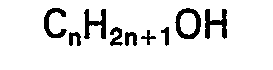
- Fig. 1 illustrates a plot of layer spacing in two phosphonate compounds as a function of the value of n in C n H 2n+1 OH and C 6 H 5 (CH 2 ) n-4 OH when they are used as solvents. It can be seen that the layer spacing increases as the chain length of the alcohol increases, and thus that the compounds herein will expand as they intercalate molecules in sorption separations.
- the optimum layer spacing for the compounds herein will depend mainly on the desired ultimate separation or catalyst use of the compound. Preferably this layer spacing will range from about 8 to 80 A, and more preferably from about 8 to 48 ⁇ .
- the layer spacing is dependent not only on the solvent, but also to varying degrees on the type of organic group employed, whether the compound is a phosphonate or phosphate, and whether phosphorus or arsenic is employed.
- solvents which may be incorporated in these layered compounds besides alcohols include water, ethers, hydrocarbons, amides, amines, esters, ketones, and the like, or mixtures thereof.
- composition of matter of this invention may be prepared by several methods. Any suitable reaction vessel equipped with a heating means may be employed such as a round-bottomed flask equipped with an electric heating mantle, a magnetic stirrer, and a reflux condenser.
- a vanadium 5+ compound such as, e.g., vanadium pentoxide or vanadyl chloride is contacted with an effective amount, i.e., form at least equimolar to a large excess over the equimolar amount of a phosphonic, phosphoric, arsonic or arsenic acid of the organic group as described above (which may also be referred to as R-substituted phosphonic, phosphoric, arsonic or arsenic acid), in the presence of a solvent and, if the solvent does not function as a reducing agent, a reducing agent.
- the particular acid employed will depend on the compound ultimately desired.
- an organophosphonic acid will result in a vanadium organophosphonate
- use of an organophosphoric acid will result in a vanadium organophosphate
- Employing oxides substituted with different R groups or employing mixtures of, e.g., phosphonic and phosphoric acids will result in mixed compounds as described above.
- solvents which function as reducing agents for the vanadium (5+) include alcohols such as ethanol, isopropanol, iso-or secondary butanol, and the like, most preferably ethanol. If the solvent acts as a reducing agent it is employed in an excess over the amount necessary for reduction. If the solvent does not act as a reducing agent, an agent for reduction of the vanadium (5+) cation must be present in the mixture.
- suitable reducing agents for this purpose include S0 2 and hydroquinone.
- a vanadium 4+ compound such as, e.g., vanadyl sulfate or vanadyl acetylacetonate is contacted directly with an effective amount (as defined above) of the R-substituted acid as defined above in a suitable solvent.
- the solvent is preferably an alcohol since all the reactants are soluble therein, but other solvents which have adequate boiling points to ensure attainment of a sufficient reaction temperature and which adequately dissolve the reactants may be employed.
- the resultant mixture is heated at temperatures which depend mainly on the particular reactants employed but generally range from 50°C to the reflux temperature of the reaction medium for a period of time sufficient to detect the product in isolable amounts.
- the reaction temperature is the reflux temperature if ethanol is employed as the solvent.
- the product is detected it is recovered from the reaction medium by any suitable techniques. Where an alcohol is employed as solvent the product is preferably recovered by cooling and filtering the reaction mixture and then washing and drying the product.
- the compounds herein may be used in hydrocarbon oxidation reactions such as, for example, oxidation of butane to maleic anhydride, wherein the catalyst is contacted with the hydrocarbon substrate during the oxidation reaction under catalytic conditions by methods known to those skilled in the art. They may also be used as supports for incorporation of catalytically active metal centers if they contain reactive organic groups as discussed above.
- the compounds may be employed as solid sorbents forthe selective separation of various organic compounds.
- the compound herein may be contacted with a mixture of chloroform, benzene and 1-hexanol under conditions so that the compound absorbs the components of the mixture. Thereafter, the components may be selectively desorbed from the compound under desorption conditions using a suitable desorbent therefor.
- One possible application for the solid sorbent is in gas-solid chromatography using the compound of this invention in the chromatography column.
- Example 1 A mixture of 2.6 g of vanadyl sulfate (VOS-O4 ⁇ 3H 2 0) and 3.8 g of phenylphosphonic acid in 60 ml of 95% ethanol was refluxed for 5 days (120 hours) as described in Example 1. The reaction mixture was thereafter cooled to room temperature and the bright blue solid obtained was filtered and washed well with ethanol. The final product was dried under vacuum at room temperature for 15 hours. An X-ray pattern of the product indicated a layered compound with a layer-to-layer separation of 12.6 A similar to that obtained by the procedure of Example 1. The product had the same formula as the product of Example 1.
- the reaction yield indicates that the compound contains both phenyl and biphenyl phosphonate groups, but the similarity to the pure biphenyl compound interlayer spacing indicates that biphenyl determines the layer separation. Consequently, additional porosity is introduced near the phenyl groups.
- the product had the formula: where S is ethanol, water or mixtures of water and ethanol.
- a mixture of 1 g of vanadium pentoxide and 1.84 g of ethylphosphonic acid was refluxed in 60 ml of 95% ethanol for 5 days as described in Example 1.
- the solids suspended in the mixture changed from orange to light blue during this time indicating reduction of V S+ to V 4+ .
- the reaction mixture was then cooled to room temperature and the solid was filtered, washed with ethanol and dried under vacuum at room temperature for 16 hours.
- An X-ray powder diffraction pattern indicated a layer-to-layer separation of 11.1 A.
- the product obtained had the formula: where S is ethanol, water or mixtures of water and ethanol.
- This example illustrates formation of a composition containing a pendant organic functional group (OH).
- This example illustrates formation of another composition containing a pendant organic functional group (COOH).
- This example illustrates another compound containing a pendant organic functional group (COOC 2 H 5 ).
- the light blue solid in an amount of 6.12 g, was separated by filtration.
- the formula for the product appears to be: where S is ethanol, water or mixtures of water and ethanol.
- the product had an overall formula of: where S is ethanol, water or mixtures of water and ethanol.
- the same compound was also prepared by heating 1-naphthylphosphonic acid with vanadyl sulfate in ethanol, using comparable amounts of reactants as were used above.
- Atotal of 4.00 ml of concentrated HCI was added to a suspension of 8.00 g of barium 2-cyanoethyl- phosphate in 50 ml of 95% ethanol. The mixture was stirred for 0.5 hours and filtered to remove BaC1 2 . The resulting 2-cyanoethylphosphoric acid solution was added to a suspension of 1.03 g of vanadium pentoxide in 75 ml of 95% ethanol. The mixture was refluxed with stirring for three days. After cooling to room temperature, a light blue solid was separated from the blue supernatant by filtration, washed with ethanol, and suction dried to yield 1.99 g of product.
- the X-ray powder diffraction pattern showed a number of lines, including the first three in an 001 series corresponding to a layer spacing of 11.64 A.
- the infrared spectrum contained an absorption at 2250 cm-1 indicating retention of the cyano group. Elemental analysis indicated a formula of: (Found: 14.05%C, 2.80%H, 5.28%N; Calculated: 14.30%C, 3.20%H, 5.56%N).
- This example illustrates another compound containing a pendant organic functional group (CN).
- Vanadyl sulfate trihydrate (2.0 g) was added to a solution of 2.11 g of phenylarsonic acid in 100 ml of 95% ethanol. The resulting solution was heated at reflux for 4 days. After cooling, 0.52 g of a blue solid was separated by filtration from the deep blue filtrate. Powder X-ray diffraction data showed a single strong line at 10.2 Atypical of a layered compound with some disorder. Elemental analysis indicated a formula of: (Found: 23.14%C, 3.45%H, 14.82%V, 21.67%As; Calculated: 22.94%C, 4.08%H, 14.74%V, 21.68%As).
- Vanadyl methoxyphenylphosphonate (VO(p-CH 3 OC 6 H 4 PO 3 ) ⁇ nS) containing both water and ethanol in the interlayer spaced was prepared as described in Example 4.
- the b axis determined the interlayer separation.
- the interlayer ethanol was removed from this phase by stirring in water for 16 hours.
- the product was filtered and dried under vacuum.
- the X-ray powder pattern of this product shown in Fig.
- Vanadyl phenylphosphonate (VO(C- 6 H 3 PO 3 ) ⁇ nS) containing both water and ethanol in the interlayer space was prepared as described in Example 1.
- the interlayer separation (b axis) contracts by 2.32 A as a result of ethanol removal.
- Examples 17 and 18 illustrate the reversible ethanol incorporation into the interlayer space of and Other alcohols, including straight chain aliphatic alcohols and phenyl alcohols also intercalate both vanadyl phosphonates. Reactions were carried out by stirring the water containing compounds with the alcohols for 16 hours at 60°C. The products were characterized by X-ray diffraction measurement of the interlayer exapansion caused by alcohol intercalation. The layer spacing for using and and for using as a function of n is shown in Figure 1.
- the present invention is seen to provide a class of novel composition of matter which have a layered structure with pendant organic groups.
Landscapes
- Chemical & Material Sciences (AREA)
- Organic Chemistry (AREA)
- Engineering & Computer Science (AREA)
- Materials Engineering (AREA)
- Chemical Kinetics & Catalysis (AREA)
- Health & Medical Sciences (AREA)
- Inorganic Chemistry (AREA)
- Life Sciences & Earth Sciences (AREA)
- Biochemistry (AREA)
- General Health & Medical Sciences (AREA)
- Molecular Biology (AREA)
- Low-Molecular Organic Synthesis Reactions Using Catalysts (AREA)
- Treatment Of Liquids With Adsorbents In General (AREA)
- Solid-Sorbent Or Filter-Aiding Compositions (AREA)
- Catalysts (AREA)
Description
- This invention relates to layered oxide compounds.
- This invention concerns layered oxides containing vanadium together with phosphorus or arsenic wherein monovalent organic groups (R) are covalently bound to the phosphorus or arsenic atoms within the layered oxide structure. Each R is bound directly through carbon or through an oxygen bridge. In the former case the compounds are phosphonates or arsonates whereas in the latter case they are phosphates or arsenates.
- The open and patented literature discloses layered phosphonate and/or phosphate compounds of the formula M(03PR)2 or M(03PR)2 wherein the pendant organic R groups on the phosphorus atoms are directed toward the interlayer space. See, for example, Dines et al., /norg. Chem., 22, .567 (1983) (Th phosphonates), Polyhedron, 1, 61 (1982) (Zr phosphonates), /norg. Chem., 20, 92 (1981) (Zr, Th, Ti, Ce and U phosphonates and phosphates), and J. Phys. Chem., 86, 571 (1982) (Zr phosphonates), Alberti et al., J. /norg. Nucl. Chem., 40, 1113 (1978) (Zr phosphonates and phosphates), and U.S. Pat. Nos. 4,232,146; 4,235,990; and 4,256,872. (Zr compounds). Other patents directed to layered organoarsenous or organophosphorus inorganic polymers include U.S. Pat. Nos. 4,374,242; 4,276,410; - 4,276,411; 4,298,723; 4,299,943; 4,373,079; 4,235,991; and 4,267,308.
- While these references and others teach formation of layered structures by reacting organophosphorus compounds with tetravalent metal salts, the complexes formed have a metal to phosphorus ratio of 1:2 and the references do not suggest use of vanadium as a tetravalent metal.
- U.S. Pat. Nos. 4,376,709 and 4,355,162 disclose compositions containing a layered mixed oxide having layers of corner-linked octahedra and tetrahedra including VOP04 (V in a 5+ oxidation state) which may be intercalated with a cation or reacted with a nitrogen donor Lewis base covalently bonded to the vanadium. U.S. Pat. No. 4,237,061 discloses formation of intercalates of organometallic compounds by reacting with a tetravalent cation metal salt of an organic phosphate, arsenate or vanadate. The cation is not vanadium and the compound has a cation to anion ration of 1:2.
- In accordance with the present invention there is provided a layered oxide compound having one of the formulae:

- The layered compositions may thus contain pendant alkyl, aralkyl or aryl groups covalently bonded to the phosphorus or arsenic atom contained in either side of the layer. The organic groups (R) are oriented in a direction toward the space between the layers. Additionally, reactive groups may be incorporated into the R group such as -NH2, -OH, and -PR2 so that various catalytically active metals can be coordinated to the compound between the layers. The compounds herein are useful by themselves as solid sorbents in selective separations of various compounds and also find use as oxidation catalysts or as catalysts in hydrocarbon conversion or synthesis reactions when a catalytically active metal is intercalated into the layered compound containing the reactive groups.
- While the literature discloses various layered metal organophosphonates and organophos- phates, these compounds have a phosphorus to metal molar ratio of 2.0, rather than the 0.8 to 1.2 ratio of the present invention, so that the detailed structures of the publicly disclosed compounds are different.
- In the drawings:
- Figure 1 illustrates a plot of the interlayer spacing of two compounds of this invention,


- Figure 2 illustrates a schematic diagram of the bonding arrangement of the VO(RA03) . ns (arso- nate or phosphonate) compounds, including a cross-sectional view of the layers.
- Figure 3 illustrates a schematic diagram of the bonding arrangement of the VO(ROAO3)· nS (arsenate or phosphate) compounds, including a cross-sectional view of the layers.
- Fig. 4 represents an x-ray powder diffraction pattern for crystalline

- Fig. 5 represents an x-ray powder diffraction pattern for crystalline

- The compounds of the invention comprise vanadium-phosphorus or vanadium-arsenic oxide layers which have a monovalent organic group inserted between the oxide layers and directly bound to the phosphorus or arsenic atom. The organic group can be covalently bonded directly through carbon to produce phosphonates and arsonates or through oxygen to yield phosphates and arsenates. Coupling of the organic group to the phosphorus or arsenic atoms may also be achieved through an intermediate atom such as silicon, sulfur, nitrogen and the like. Unlike layered vanadium oxides containing organic groups described in U.S. Pat. Nos. 4,376,709 and 4,355,162, the compounds herein have vanadium in a +4 oxidation state which is not coordinated to the organic groups. Figs. 2 and 3 illustrate the unique physical structure of the two types of compounds where the cross-hatched sections represent the layers of oxygen, vanadium and arsenic or phosphorus from which the organic groups (R or OR) are pendant in both directions.
- The R groups attachable to phosphorus or arsenic atoms in the vanadium oxide layer of the presently disclosed compounds include, but are not limited to, alkyl, alkenyl, alkynyl, haloalkyl, arylalkyl, mercaptoalkyl, aminoalkyl, carboxyalkyl, cyanoalkyl, sulfoalkyl, alkoxyalkyl, aryloxyalkyl, diketoalkyl, aryl, haloaryl, alkylaryl, aminoaryl, mercaptoaryl, carboxyaryl, cyanoaryl, sulfoaryl, alkoxyaryl, aryloxyaryl, diketoaryl or mixtures thereof. More preferably, the organic group is a phenyl, biphenyl, C1-C4-alkyl-substituted phenyl or C1-C4-alkoxy-substituted phenyl, C1-C20 alkyl group, or mixtures thereof. Examples of these monovalent organic groups include p-methoxyphenyl, p-ethoxyphenyl, ethyl, methyl, propyl, hexyl, octyl, decyl, octadecyl, naphthyl and the like. These groups may optionally include pendant functional groups containing, e.g., oxygen, sulfur, nitrogen, phosphorus, halogen or other atoms, which groups are reactive with transition metals. Preferred among such groups are -NH2, -OH, CN,COOH,SH, SO3H, and more preferred are -COOR, -COOH, -OH and -CN. If the organic group contains such functional groups it will coordinate, between the oxide layers, metals such as Ni(+2), Ru(+2), Fe(+2) and other metals which are catalytically active so as to produce an intercalated structure useful as a catalyst in, for example, hydrocarbon conversion reactions. Specific examples of suitable organic groups for this purpose include aminophenyl, -CH2COOH, -CH2CH2SH, chloromethyl, dimethylphosphinoethyl, cyanoethyl, hydroxymethyl, hydroxyethyl, aminoethyl, bromophenyl and other groups. Mixtures of R groups containing such functional groups may also be employed.
- It is to be noted that the layered oxides of this invention may contain more than one type of organic (R) group. In addition, the oxides may be composed of mixed organophosphates/phos- phonates or mixed organoarsenates/arsonates or other combinations of these groups depending on the mixture of reagents employed and the ultimate use desired. Such mixtures may be important in increasing the microporosity of the oxide compounds.
- The layered compounds herein are characterized by the vanadium having an average oxidation state in the range of 3.6 to 4.4. In the most preferred embodiment the vanadium oxidation state is in the range of 3.9 to 4.1. In addition, the vanadium must be present in an amount such that the molar ratio of P:V or AS:V ranges from 0.8 to 1.2 throughout the compound. This feature clearly distinguishes the present compounds from those of the prior publications wherein comparable ratios are 2.0.
- The compounds of this invention may also have incorporated therein one or more solvent molecules which depend on the particular method of preparation or the solvent used to wash the compound. The compounds, however, need not contain any solvent. Preferably the number of solvent molecules incorporated in the compound is 0 to 10.
- In one preferred embodiment the solvent molecule is a C1-C20 aliphatic or aromatic alcohol. Fig. 1 illustrates a plot of layer spacing in two phosphonate compounds as a function of the value of n in CnH2n+1OH and C6H5(CH2)n-4OH when they are used as solvents. It can be seen that the layer spacing increases as the chain length of the alcohol increases, and thus that the compounds herein will expand as they intercalate molecules in sorption separations. The optimum layer spacing for the compounds herein will depend mainly on the desired ultimate separation or catalyst use of the compound. Preferably this layer spacing will range from about 8 to 80 A, and more preferably from about 8 to 48 Â. The layer spacing is dependent not only on the solvent, but also to varying degrees on the type of organic group employed, whether the compound is a phosphonate or phosphate, and whether phosphorus or arsenic is employed.
- Other solvents which may be incorporated in these layered compounds besides alcohols include water, ethers, hydrocarbons, amides, amines, esters, ketones, and the like, or mixtures thereof.
- The composition of matter of this invention may be prepared by several methods. Any suitable reaction vessel equipped with a heating means may be employed such as a round-bottomed flask equipped with an electric heating mantle, a magnetic stirrer, and a reflux condenser. In one such method a vanadium 5+ compound such as, e.g., vanadium pentoxide or vanadyl chloride is contacted with an effective amount, i.e., form at least equimolar to a large excess over the equimolar amount of a phosphonic, phosphoric, arsonic or arsenic acid of the organic group as described above (which may also be referred to as R-substituted phosphonic, phosphoric, arsonic or arsenic acid), in the presence of a solvent and, if the solvent does not function as a reducing agent, a reducing agent. The particular acid employed will depend on the compound ultimately desired. For example, use of an organophosphonic acid will result in a vanadium organophosphonate, whereas use of an organophosphoric acid will result in a vanadium organophosphate. Employing oxides substituted with different R groups or employing mixtures of, e.g., phosphonic and phosphoric acids will result in mixed compounds as described above. Examples of solvents which function as reducing agents for the vanadium (5+) include alcohols such as ethanol, isopropanol, iso-or secondary butanol, and the like, most preferably ethanol. If the solvent acts as a reducing agent it is employed in an excess over the amount necessary for reduction. If the solvent does not act as a reducing agent, an agent for reduction of the vanadium (5+) cation must be present in the mixture. Examples of suitable reducing agents for this purpose include S02 and hydroquinone.
- In the alternative method for preparing the compositions of this invention a vanadium 4+ compound such as, e.g., vanadyl sulfate or vanadyl acetylacetonate is contacted directly with an effective amount (as defined above) of the R-substituted acid as defined above in a suitable solvent. The solvent is preferably an alcohol since all the reactants are soluble therein, but other solvents which have adequate boiling points to ensure attainment of a sufficient reaction temperature and which adequately dissolve the reactants may be employed.
- In both methods of preparation, after the vanadium compound is contacted with the R-substituted acid, the resultant mixture is heated at temperatures which depend mainly on the particular reactants employed but generally range from 50°C to the reflux temperature of the reaction medium for a period of time sufficient to detect the product in isolable amounts. Preferably the reaction temperature is the reflux temperature if ethanol is employed as the solvent.
- After the product is detected it is recovered from the reaction medium by any suitable techniques. Where an alcohol is employed as solvent the product is preferably recovered by cooling and filtering the reaction mixture and then washing and drying the product.
- The compounds herein may be used in hydrocarbon oxidation reactions such as, for example, oxidation of butane to maleic anhydride, wherein the catalyst is contacted with the hydrocarbon substrate during the oxidation reaction under catalytic conditions by methods known to those skilled in the art. They may also be used as supports for incorporation of catalytically active metal centers if they contain reactive organic groups as discussed above. In addition, the compounds may be employed as solid sorbents forthe selective separation of various organic compounds. For example, the compound herein may be contacted with a mixture of chloroform, benzene and 1-hexanol under conditions so that the compound absorbs the components of the mixture. Thereafter, the components may be selectively desorbed from the compound under desorption conditions using a suitable desorbent therefor. One possible application for the solid sorbent is in gas-solid chromatography using the compound of this invention in the chromatography column.
- The examples which follow illustrate the efficacy of the invention. In the examples, all parts and percentages are given in weight unless otherwise noted and n in the formulae is zero of a positive number.
- A mixture of 1 g of vanadium pentoxide and 1.74 g of phenylphosphonic acid in 60 ml of 95% ethanol (serving as both reducing agent and solvent) was refluxed for 114 hours in a round-bottomed flask equipped with a stirrer, electric heating mantle and condenser. During this period the suspended solid in the mixture changed from orange to blue, indicating reduction of VS+ to V4+. The reaction mixture was thereafter cooled to room temperature, filtered and washed twice with ethanol. The final product was dried at 68°C in vacuum for 15 hours. An X-ray power diffraction pattern of the product indicated a layered vanadium phosphonate compound with a layer separation of 12.6 A. The product had the formula:

- A mixture of 2.6 g of vanadyl sulfate (VOS-O4· 3H20) and 3.8 g of phenylphosphonic acid in 60 ml of 95% ethanol was refluxed for 5 days (120 hours) as described in Example 1. The reaction mixture was thereafter cooled to room temperature and the bright blue solid obtained was filtered and washed well with ethanol. The final product was dried under vacuum at room temperature for 15 hours. An X-ray pattern of the product indicated a layered compound with a layer-to-layer separation of 12.6 A similar to that obtained by the procedure of Example 1. The product had the same formula as the product of Example 1.
- A mixture of 1.26 g vanadyl acetylacetonate (VO(C5H7O2)2) and 0.75 g phenylphosphonic acid in 60 ml 95% ethanol was refluxed and stirred for 5 hours. The blue solid formed was separated by filtration and washed with ethanol. X-ray powder diffraction showed the product to be identical with

- A mixture of 1 g of vanadium pentoxide and 3.1 g of p-methoxyphenylphosphonic acid in 60 ml of 95% ethanol was refluxed for 11 days as described in Example 1. During this time the solids in the suspended mixture changed from orange to blue- green, indicating reduction of V°* to V4+. The reaction mixture was then cooled to room temperature, and the solid was filtered and washed with ethanol. The final product was dried under vacuum for 15 hours. An x-ray powder diffraction pattern indicated an interlayer separation of 13.24 A. The product obtained had the formula:

- A mixture of 1.3 g vanadium pentoxide and 5 g 4-biphenylphosphonic acid (C12HgPO(OH)2) was refluxed in 175 ml of 95% ethanol for five days as described in Example 1. The light blue solid produced thereby was filtered, washed with 95% ethanol and dried under vacuum at room terpera- ture. The reaction was quantitative based on vanadium. The product was then washed with water at 55°C for 24 hours and then dried under vacuum at 75°C. An X-ray diffraction powder pattern revealed the product as crystalline and single phase with orthorhombic cell constants of a=9.96, b=13.95 and c=9.79 A, where the b axis corresponds to the layer to layer separation. Elemental analysis revealed a composition of 43.03%C, 3.91%H, 9.32%P and 15.11%V as compared with the theoretical values of 43.01%C, 3.91%H, 9.24%P and 15.20%V, calculated for VO(C12H9PO3) · 2H20.
- A mixture of 0.5 g of vanadium pentoxide, 0.78 g of 4-biphenylphosphonic acid and 0.48 g of phenyl phosphonic acid was refluxed in 150 ml of 95% ethanol for 7 days. The light blue solid product resulting therefrom was filtered, washed with 95% ethanol and vacuum dried. The yield based on vanadium was 82% by weight. The product was then washed by stirring in water at 60°C for 19 hours, filtered and dried at 66°C under vacuum. An X-ray diffraction powder pattern of the product yielded a single phase with a b axis of 14.00 A similar to that observed for the pure biphenyl compound (13.95 A). The reaction yield indicates that the compound contains both phenyl and biphenyl phosphonate groups, but the similarity to the pure biphenyl compound interlayer spacing indicates that biphenyl determines the layer separation. Consequently, additional porosity is introduced near the phenyl groups. The product had the formula:

- A mixture of 1 g of vanadium pentoxide and 1.07 g of methylphosphonic acid was refluxed in 60 ml of 95% ethanol as described in Example 1. After 20 hours some color change could be observed but the reaction appeared to be slow. An additional 0.5 g of methylphosphonic acid was added to increase the P:V ratio from 1:1 1 to 1.5:1 in the reactant mixture. The rate of reaction increased when the addtional methylphosphonic acid was added, and after a further 22 hours all of the solid suspended in the mixture was blue. The reaction mixture was cooled to room temperature, and the solid was filtered, washed with ethanol, and dried under vacuum for 24 hours. An X-ray powder diffraction pattern showed a layer-to-layer separation of 9.6 A. The product obtained had the formula:

- A mixture of 1 g of vanadium pentoxide and 1.84 g of ethylphosphonic acid was refluxed in 60 ml of 95% ethanol for 5 days as described in Example 1. The solids suspended in the mixture changed from orange to light blue during this time indicating reduction of VS+ to V4+. The reaction mixture was then cooled to room temperature and the solid was filtered, washed with ethanol and dried under vacuum at room temperature for 16 hours. An X-ray powder diffraction pattern indicated a layer-to-layer separation of 11.1 A. The product obtained had the formula:

- A mixture of 0.9 g vanadium pentoxide and 5 g octadecyl phosphonic acid (Cl8H37PO(OH)2) was refluxed in 160 ml of 95% ethanol for 14 days. The blue solid product obtained was filtered, washed with 95% ethanol and dried under vacuum. An X-ray powder pattern of the product revealed that it contains two layered compounds with interlayer separations of 44.6 and 41.8 A. The 41.8 A phase is a minor component. The product obtained had the formula:

- A mixture of 0.53 g of vanadium pentoxide and 1.4 g hydroxymethylphosphonic acid (HOCH- 2PO(OH)2) was refluxed in 30 ml of 95% ethanol for three days as described in Example 1. The yellow vanadium pentoxide was converted to a blue product as the reaction proceeded. The solid product was filtered, washed with ethanol and dried under vacuum. An X-ray powder diffraction pattern of the product indicated a layer-to-layer separation of 8.8 A. The product obtained had the formula:

- This example illustrates formation of a composition containing a pendant organic functional group (OH).
- A mixture of 1.05 g of vanadium pentoxide and 1.81 g of phosphonacetic acid (HOOCCH2PO(OH)2) was refluxed in 60 ml of 95% ethanol forthree days as described in Example 1. The light blue solid produced thereby was filtered, washed with ethanol and dried under vacuum at room temperature. An X-ray powder diffraction pattern of the product indicated a layer to layer separation of 8.6 A. The product obtained had the formula:

- This example illustrates formation of another composition containing a pendant organic functional group (COOH).
- A mixture of 1.2 g vanadium pentoxide and 0.66 g of the ethyl ester of phosphonoacetic acid (C2H5OOCCH2PO(OH)2) was refluxed in 75 ml of absolute ethanol for three days. The light blue- green solid product resulting therefrom was filtered, washed with absolute ethanol and dried under vacuum. An X-ray powder diffraction pattern indicated that the product was single phase with an interlayer separation of 9.6 Å. The product obtained had the formula:

- This example illustrates another compound containing a pendant organic functional group (COOC2H5).
- Atotal of 3.9 ml concentrated HCI was added to a suspension of 6.27 g of sodium phenylphosphate in 100 ml of 95% ethanol. The mixture was stirred overnight and 2.73 g sodium chloride was separated by filtration, as determined by X-ray diffraction analysis. A total of 2.00 g of finely ground vanadium pentoxide was added to the resulting solution of phenylphosphoric acid and the mixture was refluxed with stirring for five days. After this time, the suspension was yellow-green. Another portion of phenylphosphoric acid (made from 6.27 g of C6H5OPO3Na2 and HCI in 100 ml ethanol) was added to speed the reaction, and the suspension was refluxed and stirred for 12 more days. The light blue solid, in an amount of 6.12 g, was separated by filtration. The X-ray powder diffraction pattern was characteristic of a layered material with a 14.6 A layer spacing; lines of the form 001 were observed for 1=1 to 6. The formula for the product appears to be:

- A total of 1.00 ml of concentrated HCI was added to a suspension of 3.28 g of 1-naphthylphosphate, monosodium salt in 50 ml of 95% ethanol. The mixture was stirred for one hour and sodium chloride was removed by filtration. The resulting 1-naphthylphosphoric acid solution was added to a suspension of 0.513 g of vanadium pentoxide in 75 mL of 95% ethanol, and the mixture was refluxed with stirring for 12 days. After cooling, a gray solid was separated from the red-brown supernatant by filtration, washed with ethanol, and suction dried to yield 1.97 g of product. An X-ray powder diffraction measurement revealed a sharp pattern which could be totally indexed (>25 lines) using an orthorhombic cell with a=10.35 A, b=14.85 A, and c=9.60 A, the layer spacing corresponding to the b axis. The product had an overall formula of:

- The same compound was also prepared by heating 1-naphthylphosphonic acid with vanadyl sulfate in ethanol, using comparable amounts of reactants as were used above.
- Atotal of 4.00 ml of concentrated HCI was added to a suspension of 8.00 g of barium 2-cyanoethyl- phosphate in 50 ml of 95% ethanol. The mixture was stirred for 0.5 hours and filtered to remove BaC12. The resulting 2-cyanoethylphosphoric acid solution was added to a suspension of 1.03 g of vanadium pentoxide in 75 ml of 95% ethanol. The mixture was refluxed with stirring for three days. After cooling to room temperature, a light blue solid was separated from the blue supernatant by filtration, washed with ethanol, and suction dried to yield 1.99 g of product. The X-ray powder diffraction pattern showed a number of lines, including the first three in an 001 series corresponding to a layer spacing of 11.64 A. The infrared spectrum contained an absorption at 2250 cm-1 indicating retention of the cyano group. Elemental analysis indicated a formula of:

- This example illustrates another compound containing a pendant organic functional group (CN).
- Vanadyl sulfate trihydrate (2.0 g) was added to a solution of 2.11 g of phenylarsonic acid in 100 ml of 95% ethanol. The resulting solution was heated at reflux for 4 days. After cooling, 0.52 g of a blue solid was separated by filtration from the deep blue filtrate. Powder X-ray diffraction data showed a single strong line at 10.2 Atypical of a layered compound with some disorder. Elemental analysis indicated a formula of:

- Vanadyl methoxyphenylphosphonate (VO(p-CH3OC6H4PO3) · nS) containing both water and ethanol in the interlayer spaced was prepared as described in Example 4. The X-ray powder diffraction pattern of the product was indexed using an orthorhombic unit cell with a=10.068, b=13.068 and c=9.894 A. The b axis determined the interlayer separation. The interlayer ethanol was removed from this phase by stirring in water for 16 hours. The product was filtered and dried under vacuum. The X-ray powder pattern of this product, shown in Fig. 5, which revealed that the compound remained crystalline, was indexed using an orthorhombic cell with cell constants a=10.077, b=11.273 and c=9.77 A. The a and c axes were changed little but the interlayer separation (indicated by the b axis) contracted by 1.79 Å as a result of ethanol removal. On refluxing the water-containing product in ethanol, the b axis expanded, showing that ethanol was incorporated and that the water-ethanol exchange was reversible. This example illustrates that the compounds herein reversibly sorb molecules and thus are useful in separation processes as solid sorbents.
- Vanadyl phenylphosphonate (VO(C-6H3PO3) · nS) containing both water and ethanol in the interlayer space was prepared as described in Example 1. The X-ray powder pattern was indexed using an orthorhombic unit cell with a=10.005, b=12.115 and c=9.759 A. After water washing using the procedure described in Example 17, the crystalline product gave an X-ray pattern shown in Fig. 4 with orthorhombic unit cell dimensions a=9.650, b=9.799 and c=9.572 A. The interlayer separation (b axis) contracts by 2.32 A as a result of ethanol removal.
- Examples 17 and 18 illustrate the reversible ethanol incorporation into the interlayer space of


- A total of 0.6 g of vanadyl phenylphosphonate prepared as described in Example 1 and then washed with water

- In summary, the present invention is seen to provide a class of novel composition of matter which have a layered structure with pendant organic groups.
Claims (13)

Applications Claiming Priority (2)
| Application Number | Priority Date | Filing Date | Title |
|---|---|---|---|
| US06/525,142 US4518534A (en) | 1983-08-22 | 1983-08-22 | Layered vanadium compounds containing phosphorus or arsenic and pendant organic groups |
| US525142 | 1983-08-22 |
Publications (3)
| Publication Number | Publication Date |
|---|---|
| EP0134157A2 EP0134157A2 (en) | 1985-03-13 |
| EP0134157A3 EP0134157A3 (en) | 1985-10-02 |
| EP0134157B1 true EP0134157B1 (en) | 1989-09-27 |
Family
ID=24092102
Family Applications (1)
| Application Number | Title | Priority Date | Filing Date |
|---|---|---|---|
| EP84305718A Expired EP0134157B1 (en) | 1983-08-22 | 1984-08-22 | Layered vanadium compounds containing phosphorus or arsenic and pendant organic groups |
Country Status (4)
| Country | Link |
|---|---|
| US (1) | US4518534A (en) |
| EP (1) | EP0134157B1 (en) |
| JP (1) | JPS6068053A (en) |
| DE (1) | DE3479889D1 (en) |
Families Citing this family (5)
| Publication number | Priority date | Publication date | Assignee | Title |
|---|---|---|---|---|
| US4962228A (en) * | 1987-03-09 | 1990-10-09 | Mobil Oil Corporation | Layered divalent metal phosphates containing pendent substituent groups and their preparation |
| US4960745A (en) * | 1989-07-20 | 1990-10-02 | Mobil Oil Corporation | Layered aluminum compounds containing phosphorus or arsenic and pendant organic groups |
| US5532385A (en) * | 1994-11-14 | 1996-07-02 | Trustees Of Princeton University | Catalytic process for the production of maleic anhydride |
| US6495486B1 (en) | 1999-11-10 | 2002-12-17 | Tonen Chemical Corporation | Intercalation compound and a vanadium phosphorus mixed oxide and a process for the preparation thereof |
| CN118062815B (en) * | 2022-11-23 | 2026-06-09 | 中国科学院大连化学物理研究所 | Preparation method and application of vanadyl phosphate nanosheets |
Family Cites Families (8)
| Publication number | Priority date | Publication date | Assignee | Title |
|---|---|---|---|---|
| US4436899A (en) * | 1978-09-26 | 1984-03-13 | Occidental Research Corporation | Layered organophosphorus inorganic polymers |
| US4351735A (en) * | 1978-12-19 | 1982-09-28 | R.G.B. Laboratories Inc. | Mineral enrichment composition and method of preparing same |
| US4237061A (en) * | 1979-01-02 | 1980-12-02 | Exxon Research & Engineering Co. | Organometallic intercalates |
| US4429111A (en) * | 1979-07-24 | 1984-01-31 | Occidental Research Corporation | Layered organophosphorus inorganic polymers containing mixed functional groups |
| US4390690A (en) * | 1979-07-24 | 1983-06-28 | Occidental Research Corp. | Layered organophosphorous inorganic polymers containing oxygen bonded to carbon |
| US4355162A (en) * | 1980-11-10 | 1982-10-19 | Exxon Research And Engineering Co. | Layered compounds of mixed oxides and Lewis bases |
| US4376709A (en) * | 1980-11-10 | 1983-03-15 | Exxon Research And Engineering Co. | Intercalated layered mixed oxides |
| US4386013A (en) * | 1981-08-24 | 1983-05-31 | Occidental Research Corporation | Hydroformylation process utilizing novel catalyst |
-
1983
- 1983-08-22 US US06/525,142 patent/US4518534A/en not_active Expired - Fee Related
-
1984
- 1984-08-22 JP JP59174833A patent/JPS6068053A/en active Pending
- 1984-08-22 EP EP84305718A patent/EP0134157B1/en not_active Expired
- 1984-08-22 DE DE8484305718T patent/DE3479889D1/en not_active Expired
Also Published As
| Publication number | Publication date |
|---|---|
| EP0134157A2 (en) | 1985-03-13 |
| US4518534A (en) | 1985-05-21 |
| JPS6068053A (en) | 1985-04-18 |
| EP0134157A3 (en) | 1985-10-02 |
| DE3479889D1 (en) | 1989-11-02 |
Similar Documents
| Publication | Publication Date | Title |
|---|---|---|
| Poojary et al. | Coordinative intercalation of alkylamines into layered zinc phenylphosphonate. Crystal structures from X-ray powder diffraction data | |
| Alberti et al. | Derivatives of α-zirconium phosphate with two different functional groups | |
| US4390690A (en) | Layered organophosphorous inorganic polymers containing oxygen bonded to carbon | |
| Poojary et al. | Syntheses and X-ray powder structures of two zinc propylenebis (phosphonates) | |
| Chen et al. | Synthesis and structural characterization of binuclear vanadium-oxo-organophosphonato complexes: building blocks for oxovanadium organophosphonate solids | |
| US4518534A (en) | Layered vanadium compounds containing phosphorus or arsenic and pendant organic groups | |
| US4276411A (en) | Layered organophosphorus inorganic polymers containing acyclic groups | |
| US4298723A (en) | Layered or amorphous acyclic organometallic inorganic polymers | |
| US4436899A (en) | Layered organophosphorus inorganic polymers | |
| Poojary et al. | Synthesis and crystal structure of a new layered zirconium phosphate compound, Zr (PO4) F (OSMe2) | |
| US4013586A (en) | Vanadium catalysts prepared with phosphonates | |
| US4232146A (en) | Process for preparing layered organophosphorus inorganic polymers | |
| Segawa et al. | Catalyst design of two-dimensional zirconium phosphonates | |
| US4256872A (en) | Process for preparing layered organophosphorus inorganic polymers | |
| US4695642A (en) | Method for preparing crystalline zirconium phosphates | |
| US4299943A (en) | Nonaqueous preparation of layered or amorphous organometallic inorganic polymers | |
| US4962228A (en) | Layered divalent metal phosphates containing pendent substituent groups and their preparation | |
| US4386013A (en) | Hydroformylation process utilizing novel catalyst | |
| US4960745A (en) | Layered aluminum compounds containing phosphorus or arsenic and pendant organic groups | |
| US4374242A (en) | Layered organoarsenous inorganic polymers | |
| GB2101601A (en) | Bisphosphine synthesis | |
| US4276409A (en) | Layered cyano end terminated organophosphorus inorganic polymers | |
| Harrison et al. | Synthesis, structure, and magnetism of Ba2VO (PO4) 2· H2O, a new barium vanadium (IV) phosphate hydrate | |
| US4487922A (en) | Layered organophosphorous inorganic polymers containing cyclic groups | |
| JPH04234398A (en) | Mesoporous crystalline solid compound |
Legal Events
| Date | Code | Title | Description |
|---|---|---|---|
| PUAI | Public reference made under article 153(3) epc to a published international application that has entered the european phase |
Free format text: ORIGINAL CODE: 0009012 |
|
| AK | Designated contracting states |
Designated state(s): BE DE FR GB IT |
|
| RIN1 | Information on inventor provided before grant (corrected) |
Inventor name: JACOBSON, ALLAN JOSEPH Inventor name: JOHNSON, JACK WAYNE |
|
| PUAL | Search report despatched |
Free format text: ORIGINAL CODE: 0009013 |
|
| AK | Designated contracting states |
Designated state(s): BE DE FR GB IT |
|
| 17P | Request for examination filed |
Effective date: 19860310 |
|
| 17Q | First examination report despatched |
Effective date: 19870918 |
|
| GRAA | (expected) grant |
Free format text: ORIGINAL CODE: 0009210 |
|
| AK | Designated contracting states |
Kind code of ref document: B1 Designated state(s): BE DE FR GB IT |
|
| ITF | It: translation for a ep patent filed | ||
| REF | Corresponds to: |
Ref document number: 3479889 Country of ref document: DE Date of ref document: 19891102 |
|
| ET | Fr: translation filed | ||
| PLBE | No opposition filed within time limit |
Free format text: ORIGINAL CODE: 0009261 |
|
| STAA | Information on the status of an ep patent application or granted ep patent |
Free format text: STATUS: NO OPPOSITION FILED WITHIN TIME LIMIT |
|
| 26N | No opposition filed | ||
| ITTA | It: last paid annual fee | ||
| PGFP | Annual fee paid to national office [announced via postgrant information from national office to epo] |
Ref country code: FR Payment date: 19940614 Year of fee payment: 11 |
|
| PGFP | Annual fee paid to national office [announced via postgrant information from national office to epo] |
Ref country code: DE Payment date: 19940616 Year of fee payment: 11 |
|
| PGFP | Annual fee paid to national office [announced via postgrant information from national office to epo] |
Ref country code: GB Payment date: 19940621 Year of fee payment: 11 |
|
| PGFP | Annual fee paid to national office [announced via postgrant information from national office to epo] |
Ref country code: BE Payment date: 19940705 Year of fee payment: 11 |
|
| PG25 | Lapsed in a contracting state [announced via postgrant information from national office to epo] |
Ref country code: GB Effective date: 19950822 |
|
| PG25 | Lapsed in a contracting state [announced via postgrant information from national office to epo] |
Ref country code: BE Effective date: 19950831 |
|
| BERE | Be: lapsed |
Owner name: EXXON RESEARCH AND ENGINEERING CY Effective date: 19950831 |
|
| GBPC | Gb: european patent ceased through non-payment of renewal fee |
Effective date: 19950822 |
|
| PG25 | Lapsed in a contracting state [announced via postgrant information from national office to epo] |
Ref country code: FR Effective date: 19960430 |
|
| PG25 | Lapsed in a contracting state [announced via postgrant information from national office to epo] |
Ref country code: DE Effective date: 19960501 |
|
| REG | Reference to a national code |
Ref country code: FR Ref legal event code: ST |