EP0134079B1 - Process for preparing poly alpha olefins - Google Patents
Process for preparing poly alpha olefins Download PDFInfo
- Publication number
- EP0134079B1 EP0134079B1 EP19840304182 EP84304182A EP0134079B1 EP 0134079 B1 EP0134079 B1 EP 0134079B1 EP 19840304182 EP19840304182 EP 19840304182 EP 84304182 A EP84304182 A EP 84304182A EP 0134079 B1 EP0134079 B1 EP 0134079B1
- Authority
- EP
- European Patent Office
- Prior art keywords
- catalyst
- activator
- reaction
- accordance
- polymerization
- Prior art date
- Legal status (The legal status is an assumption and is not a legal conclusion. Google has not performed a legal analysis and makes no representation as to the accuracy of the status listed.)
- Expired
Links
Classifications
-
- C—CHEMISTRY; METALLURGY
- C08—ORGANIC MACROMOLECULAR COMPOUNDS; THEIR PREPARATION OR CHEMICAL WORKING-UP; COMPOSITIONS BASED THEREON
- C08F—MACROMOLECULAR COMPOUNDS OBTAINED BY REACTIONS ONLY INVOLVING CARBON-TO-CARBON UNSATURATED BONDS
- C08F10/00—Homopolymers and copolymers of unsaturated aliphatic hydrocarbons having only one carbon-to-carbon double bond
Definitions
- This invention is related to a process for preparing polyalpha-olefins using a novel catalyst activator.
- a transition metal catalyst and an organoaluminum catalyst are usually employed.
- a catalyst activator may be used.
- the known activators are those disclosed in US Patent 3,377,325, which uses a sulfur activator; Canadian Patent 833,651, using phosphorus trichloride and 2-nitropropane as activators; US Patent 3,441,564 teaches an organic nitro compound as activator; US Patent 3,444,149 discloses the use of a nitroso compound or a quinone as activator; US Patent 3,462,399 deals with activation by organic nitrates, organic nitrites, ozoxy compounds, special organic metallic compounds or alkyl disulfides; US Patent 3,507,843 uses a phosphorus trichloride activator; and US Patent 4,347,159 employs a furoate compound as activating agent.
- the activator compounds activate the catalyst such that the unit weight of catalyst required per unit weight of polymer produced is minimized.
- the activators also operate to regulate the molecular weight and the molecular weight distribution of the polymerization product. Most surprisingly, they can be employed to polymerize alpha-olefins in combination with homogeneous and heterogeneous catalyst systems as well as in solution and polymerizations conducted in the presence of liquid reaction medium in the absence of a solvent.
- EP-A-24485 discloses a ratio of 2.5:1 resulting in markedly inferior polymer to catalyst values.
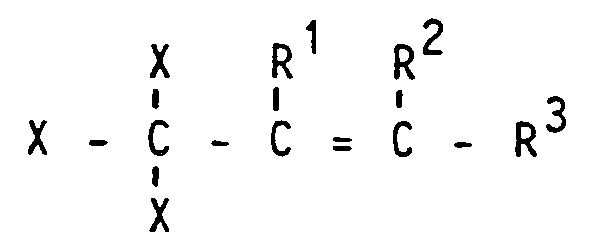
- the activator compounds employed in the process of the invention having the structure: may be prepared by reacting a compound having the formula: with a compound having the formula: wherein R 1 , R 2 , R 3 and X are as defined above, in the presence of dichlorotris[triphenylphosphine]-ruthenium, and secondly treating the resultant product with a strong Lewis base such as triethylamine.
- the reactants are present at essentially stoichiometric amounts, i.e. the A/B molar ratio being from 1.1/1 to 1/1.1, and the reaction is carried out at a temperature of 50-100°C for 0.5-5 hours, usually at reflux temperature.
- dehydrohalogenation is effected by heating the intermediate product of the reaction compounds A and B: to 50-120°C in the presence of a strong Lewis base and a solvent inert to the intermediate for 5-100 hours, usually 10-75 hours.
- a strong Lewis base is understood to mean a basic compound having pK b of 5 or less, represented by ammonia, dimethylamine, trimethylamine, di- and triethylamine, propylene and the like.
- Suitable inert solvents include heptane, octane, isooctane, decane, benzene, toluene, xylene and the
- the catalyst was precipitated by addition of n-heptane which was separated by decantation from the remaining supernatant brown viscous material.
- the brown viscous reaction product was isolated by evaporation of the n-heptane (using a rotary evaporator). It weighed 275 grams (97% yield).
- IR Infrared analysis
- reaction product (289 gm, 1 mole), triethylamine (138 ml, 1 mole) and benzene (500 ml) was placed in a three necked round bottom 2-liter flask equipped with an overhead mechanical stirrer, a condenser and a thermometer. This reaction mixture was heated at reflux (80°C) for 50 hours. After adding an additional 30 ml (0.2 mol) of triethylamine reflux was continued for another 20 hours.
- the above reaction product was dehydrochlorinated in accordance with the procedure of Example 1.
- the resultant product 2-ethylhexyl 4,4,4-trichlorobut-2-enoate, was obtained after vacuum distillation in an 80% yield.
- the IR spectrum was consistent with the title compound.
- the compounds of this invention are useful as catalyst activators for anionic polymerization of alpha-olefins employing Ziegler-Natta Type catalyst systems.
- Such catalytic systems are well known in the art and essentially comprise the combination of a transition metal salt catalyst and an organoaluminum or magnesium compound or halide cocatalyst.
- Such catalytic systems may be homogenous or heterogenous in nature, i.e., they may or may not be soluble in the polymerization medium, and they are capable to polymerizing alpha-olefins.
- EPM ethylene-propylene copolymers
- Elastomeric copolymers of ethylene and other alpha-olefins such as propylene may also incorporate copolymerizable non-conjugated dienes such as dicyclopentadiene (DCPD), 5-ethylidenorbornene-2 (ENB) or 1,4-hexadiene (1,4HD).
- DCPD dicyclopentadiene
- ENB 5-ethylidenorbornene-2
- 1,4HD 1,4-hexadiene
- the cocatalyst-catalyst molar ratio may vary from 2/1 to 500/1, usually 5/1-350/1 and more frequently 10/1-200/1; and when employing the catalyst activators of this invention, the molar activator/ catalyst ratio may range from 1/1 to 100/1, more frequently 2/1-80/1 and usually 5/1-50/1.
- Such polymerizations may be conducted in the presence of an inert medium.
- Typical media are pentane, hexane, heptane, octane, isooctane, decane, benzene, toluene, methylene chloride, chloroform and the like.
- the compounds of this invention exhibit extraordinary activation characteristics when used in such polymerizations as illustrated by the examples below.
- the polymer was analyzed as EPDM characterized by an ethylene to propylene weight ratio of 68:32, an intrinsic viscosity of 1.6, as measured in tetralin at 135°C, an iodine number of 8.4 and a glass transition temperature of -52°C.
- the yield of EPDM polymer was 43 grams representing a catalyst efficiency of 860 g polymer per millimole of vanadium.
- Example 9 is outside this invention. The data clearly indicate the extraordinary improvement in catalyst efficiency achieved (i.e., g of polymer per millimole of vanadium catalyst) when using the compounds of this invention as catalyst activators.
- a dry 2-liter Parr [trademark] autoclave equipped with a pressure gauge, as gas inlet tube, and outlet port and a stirrer was cooled externally with dry ice while flushing with dry nitrogen. Propylene monomer was condensed, and the autoclave temperature was brought to -19°C, at which point hydrogen gas was introduced at 138 kPa excess pressure as well as ethylene at the same pressure. Then, while stirring, a solution of catalyst (0.025 millimole), EASC (1.48 millimole), ENB (5.4 g) and catalyst activator (0.4 mmole) in 1000 ml heptane was charged to the autoclave which initiated polymerization.
- the reactor temperature was reduced to -27°C using a dry ice-isopropanol bath while ethylene feed was continued at the above pressure for one hour.
- the polymerization was stopped by adding a sufficient amount of isopropanol (having dissolved therein some antioxidant) to the reactor.
- the reactor contents, EPDM particles dispersed in monomer were isolated, dried, weighed and analyzed. The results are summarized in Table V below.
- DMBA dimethyl 2-trichloromethylbut-2-endioic acid ester
- BMTB n-butyl 2-methyl-4,4,4-trichlorobut-2-enoate
Landscapes
- Chemical & Material Sciences (AREA)
- Health & Medical Sciences (AREA)
- Chemical Kinetics & Catalysis (AREA)
- Medicinal Chemistry (AREA)
- Polymers & Plastics (AREA)
- Organic Chemistry (AREA)
- Transition And Organic Metals Composition Catalysts For Addition Polymerization (AREA)
- Addition Polymer Or Copolymer, Post-Treatments, Or Chemical Modifications (AREA)
- Organic Low-Molecular-Weight Compounds And Preparation Thereof (AREA)
Description
- This invention is related to a process for preparing polyalpha-olefins using a novel catalyst activator.
- In polymerisation of alpha-olefins a transition metal catalyst and an organoaluminum catalyst are usually employed. In order to enhance catalyst efficiency and/or regulate polymer molecular weight, a catalyst activator may be used. Among the known activators are those disclosed in US Patent 3,377,325, which uses a sulfur activator; Canadian Patent 833,651, using phosphorus trichloride and 2-nitropropane as activators; US Patent 3,441,564 teaches an organic nitro compound as activator; US Patent 3,444,149 discloses the use of a nitroso compound or a quinone as activator; US Patent 3,462,399 deals with activation by organic nitrates, organic nitrites, ozoxy compounds, special organic metallic compounds or alkyl disulfides; US Patent 3,507,843 uses a phosphorus trichloride activator; and US Patent 4,347,159 employs a furoate compound as activating agent.
- None of these activators combine the advantages of catalyst efficiency, control the molecular weight and molecular weight distribution of the polymer produced and are useful in both homogenous and heterogeneous phase systems.
- In the process according to the invention the activator compounds activate the catalyst such that the unit weight of catalyst required per unit weight of polymer produced is minimized. The activators also operate to regulate the molecular weight and the molecular weight distribution of the polymerization product. Most surprisingly, they can be employed to polymerize alpha-olefins in combination with homogeneous and heterogeneous catalyst systems as well as in solution and polymerizations conducted in the presence of liquid reaction medium in the absence of a solvent.
- In accordance with this invention there is provided a process for preparing polyalpha-olefins in the presence of a reaction medium reactive to the polymerization comprising contacting at least one monomer having the structure H2C=CHQ, where Q is the hydrogen atom or a Cl-Cl6 alkyl group, with an anionic polymerization catalyst, said process characterized in that it is carried out in the presence of an activator having the formula:

- In contrast EP-A-24485 discloses a ratio of 2.5:1 resulting in markedly inferior polymer to catalyst values.
- The activator compounds employed in the process of the invention having the structure:


- In the first step of the preparation, the reactants are present at essentially stoichiometric amounts, i.e. the A/B molar ratio being from 1.1/1 to 1/1.1, and the reaction is carried out at a temperature of 50-100°C for 0.5-5 hours, usually at reflux temperature. In the second step, dehydrohalogenation is effected by heating the intermediate product of the reaction compounds A and B:

- 128 grams (1 mole) of freshly distilled butyl acrylate was reacted with 300 ml of carbon tetrachloride in the presence of 1.92 (2 millimoles) of dichlorotris[triphenylphosphine)ruthenium, under nitrogen, in a three necked (1 liter round bottom) flask, equipped with a condenser, an overhead mechanical stirrer and a thermometer. The reaction mixture was heated to reflux (80°C) for about 1 hour, at which time the mixture turned brownish in color. The mixture was cooled to room temperature, and excess CC14 was removed using a rotary evaporator. The catalyst was precipitated by addition of n-heptane which was separated by decantation from the remaining supernatant brown viscous material. The brown viscous reaction product was isolated by evaporation of the n-heptane (using a rotary evaporator). It weighed 275 grams (97% yield).
- Infrared analysis (IR) of the product did not show an absorption attributable to vinylic type unsaturation indicating the absence of an acrylic double bond. After distillation, at 80°C and 26.6 Pa, the reaction product was a clear, colorless oil.
- The reaction product (289 gm, 1 mole), triethylamine (138 ml, 1 mole) and benzene (500 ml) was placed in a three necked round bottom 2-liter flask equipped with an overhead mechanical stirrer, a condenser and a thermometer. This reaction mixture was heated at reflux (80°C) for 50 hours. After adding an additional 30 ml (0.2 mol) of triethylamine reflux was continued for another 20 hours.
- After this total of 70 hours at reflux, a dark brownish material was obtained. The reaction product was filtered. The solid (C2Hs)3NHCI salt was removed leaving a soltuion from which the benzene solvent was removed by a rotary evaporator. The resultant dark brown viscous material (234 gm, 95% yield) was distilled (72-74°C at 40 Pa). The product, butyl 4,4,4-trichlorobut-2-transenoate was a colorless, clear viscous oil (90% yield). The IR and nuclear magnetic resonance (NMR) spectral ('H and '3C) data, which appear in Table II, were consistent with this compound. The elemental analysis for this compound appears in Table III.
- A carbon tetrachloride addition reaction was carried out in accordance with procedure set out with step 1 of Example 1. However, in this example butyl acrylate was replaced with methyl methacrylate. The addition reaction produced was recovered as a colorless, viscous material. The IR spectrum was consistent with that compound.
- One mole of the above reaction product was dehydrochlorinated in accordance with the procedure enumerated for Step 2 in Example 1.
- The product of this reaction, methyl 2-methyl-4,4,4-trichlorobut-2-enoate, was recovered as a clear, colorless oil (yield 85%). The IR and NMR data appear in Table II, and its elemental analysis is summarized in Table III.
- The carbon tetrachloride addition reaction of step 1 of Example 1 was repeated with the exception that butyl acrylate was replaced by ethyl acrylate. The reaction was conducted under the same conditions as were employed in Example 1. The product of this reaction was purified by distillation. The distilled product was obtained in a 93% yield. The IR spectrum was consistent with that compound. Tables II and III provide elemental analysis and IR and NMR spectral data, respectively, for the ETCB made in accordance with this example.
- The carbon tetrachloride addition reaction was repeated but for the substitution of 2-ethylhexyl acrylate for butyl acrylate of Example 1. The addition product of this reaction yielded an IR spectrum consistent with that compound.
- The above reaction product was dehydrochlorinated in accordance with the procedure of Example 1. The resultant product, 2-ethylhexyl 4,4,4-trichlorobut-2-enoate, was obtained after vacuum distillation in an 80% yield. The IR spectrum was consistent with the title compound.


- Such catalytic systems may be homogenous or heterogenous in nature, i.e., they may or may not be soluble in the polymerization medium, and they are capable to polymerizing alpha-olefins. Under alpha-olefins are considered monomers having the formula CH2=CHQ, wherein Q is hydrogen or Cl-C,6 alkyl such as ethylene, propylene, butene-1, pentene-1, hexane-1, decene-1, dodecene-1, 4-methylpentene-1, 4-ethylhexene-1, and the like which may be homo- or copolymerized to crystalline or essentially amorphous and elastomeric polymers such as polyethylene, polypropylene, polybutene, etc., or ethylene-propylene copolymers or elastomers (EPM). Elastomeric copolymers of ethylene and other alpha-olefins such as propylene may also incorporate copolymerizable non-conjugated dienes such as dicyclopentadiene (DCPD), 5-ethylidenorbornene-2 (ENB) or 1,4-hexadiene (1,4HD). Such terpolymers are known as EPDM's. The cocatalyst-catalyst molar ratio may vary from 2/1 to 500/1, usually 5/1-350/1 and more frequently 10/1-200/1; and when employing the catalyst activators of this invention, the molar activator/ catalyst ratio may range from 1/1 to 100/1, more frequently 2/1-80/1 and usually 5/1-50/1.
- Such polymerizations may be conducted in the presence of an inert medium. Typical media are pentane, hexane, heptane, octane, isooctane, decane, benzene, toluene, methylene chloride, chloroform and the like.
- In any case, the compounds of this invention, exhibit extraordinary activation characteristics when used in such polymerizations as illustrated by the examples below.
- To a dry 1500 ml 3-necked round bottom flask equipped with stirrer, thermometer, condenser, gas inlet tube and a 1-liter dropping funnel was added 1000 ml dry n-heptane solvent. Dry ethylene and propylene monomers were simultaneously introduced until to solvent was saturated, i.e., no further monomer uptake was observed. Then 1.34 ml of a 0.74 M heptane solution of ethyl-aluminum sesquichloride (EASC) cocatalyst (ca. 1 millimole) was introduced. While maintaining the ethylene-propylene feed, dropwise addition of a solution of 0.05 millimole VOCI3 catalyst, 0.1 millimole BTCB and 10 millimole ENB, all in 60 ml n-heptane was started causing polymerization to commence. VOCI3, etc., addition took about 50 minutes, but monomer introduction was continued for another 10 minutes, after which time the polymerization was terminated by the addition of 5 ml isopropanol. The polymer in solution was extracted with isoproponal to which a small amount of antioxidant was added. The stabilized polymer was recovered, weighed and analyzed.
- The polymer was analyzed as EPDM characterized by an ethylene to propylene weight ratio of 68:32, an intrinsic viscosity of 1.6, as measured in tetralin at 135°C, an iodine number of 8.4 and a glass transition temperature of -52°C. The yield of EPDM polymer was 43 grams representing a catalyst efficiency of 860 g polymer per millimole of vanadium.
- See also summary in Table III.
- Following essentially the procedure of Example 5, additional polymerizations were conducted. The results are summarized in Table IV. Example 9 is outside this invention.

- A dry 2-liter Parr [trademark] autoclave, equipped with a pressure gauge, as gas inlet tube, and outlet port and a stirrer was cooled externally with dry ice while flushing with dry nitrogen. Propylene monomer was condensed, and the autoclave temperature was brought to -19°C, at which point hydrogen gas was introduced at 138 kPa excess pressure as well as ethylene at the same pressure. Then, while stirring, a solution of catalyst (0.025 millimole), EASC (1.48 millimole), ENB (5.4 g) and catalyst activator (0.4 mmole) in 1000 ml heptane was charged to the autoclave which initiated polymerization. The reactor temperature was reduced to -27°C using a dry ice-isopropanol bath while ethylene feed was continued at the above pressure for one hour. The polymerization was stopped by adding a sufficient amount of isopropanol (having dissolved therein some antioxidant) to the reactor. The reactor contents, EPDM particles dispersed in monomer, were isolated, dried, weighed and analyzed. The results are summarized in Table V below.

- The results indicate the excellent catalyst efficiency achieved when using the compounds of this invention as catalyst activators.
- To a dry 5 gallon stainless steel jacketed reactor provided with a stirrer was added (with cooling medium flowing in the jacketed portion of the reactor) propylene, 1.75 moles hydrogen (3.5 g) and ethylene. To this was added EASC in isopentane (120 ml). Stirring was initiated at 175 revolutions per minute. With the temperature in the reactor set at -8°C, cooling was discontinued and a solution of 0.2 millimoles of catalyst, 36 milliliters of ENB, catalyst activator (amount provided in Table Vi) in 280 mi of isopentane was incrementally added to the reaction mass by means of a positive displacement pump. The addition of the catalyst solutions initiated the reaction. The reaction was terminated by passing the propylene liquid containing suspended polymer into an isopropanol solution containing an antioxidant. The polymer was separated from the liquid phase by filtration and analyzed.
- A summary of Examples 12-16 appears below in Table VI.

- Following essentially the procedure of Example 1, dimethyl 2-trichloromethylbut-2-endioic acid ester (DMBA) was prepared from dimethyl fumarate and bromotrichloromethane and by subsequent dehydrobromination of the intermediate.
- Reacting butyl methacrylate with tetrachloromethane and subsequent dehydrohalogenation resulted in the compound n-butyl 2-methyl-4,4,4-trichlorobut-2-enoate (BMTB).
- From methyl acrylate and carbon tetrachloride was prepared the intermediate CI3CCH2CHCICOOCH3, which, upon dehydrohalogenation yielded methyl 4,4,4-trichlorobut-2-enoate (MTCB).
- Following essentially the procedure of Example 1, additional EPDM preparations were carried out using compounds of this invention as catalyst activators. The results are summarized in Table VII.

- Improved catalyst activity is clearly demonstrated with transisomers having a more pronounced effect.
- The foregoing preferred embodiments and examples will make apparent, to those skilled in the art, other embodiments and examples. These embodiments and examples, within the scope and spirit of the instant invention, are within the contemplation of the present invention. Therefore, the scope of the instant invention should be limited only by the appended claims.
Claims (4)

Applications Claiming Priority (4)
| Application Number | Priority Date | Filing Date | Title |
|---|---|---|---|
| US52802083A | 1983-08-31 | 1983-08-31 | |
| US52820283A | 1983-08-31 | 1983-08-31 | |
| US528020 | 1983-08-31 | ||
| US528202 | 1983-08-31 |
Publications (3)
| Publication Number | Publication Date |
|---|---|
| EP0134079A2 EP0134079A2 (en) | 1985-03-13 |
| EP0134079A3 EP0134079A3 (en) | 1986-03-12 |
| EP0134079B1 true EP0134079B1 (en) | 1990-08-29 |
Family
ID=27062585
Family Applications (2)
| Application Number | Title | Priority Date | Filing Date |
|---|---|---|---|
| EP19840304182 Expired EP0134079B1 (en) | 1983-08-31 | 1984-06-21 | Process for preparing poly alpha olefins |
| EP19840304183 Expired - Lifetime EP0134080B2 (en) | 1983-08-31 | 1984-06-21 | Catalyst for alpha-olefin polymerization |
Family Applications After (1)
| Application Number | Title | Priority Date | Filing Date |
|---|---|---|---|
| EP19840304183 Expired - Lifetime EP0134080B2 (en) | 1983-08-31 | 1984-06-21 | Catalyst for alpha-olefin polymerization |
Country Status (2)
| Country | Link |
|---|---|
| EP (2) | EP0134079B1 (en) |
| DE (2) | DE3483076D1 (en) |
Families Citing this family (4)
| Publication number | Priority date | Publication date | Assignee | Title |
|---|---|---|---|---|
| US5786504A (en) * | 1996-05-15 | 1998-07-28 | Uniroyal Chemical Company, Inc. | Polymerization catalyst promoter |
| JP2005036042A (en) | 2003-07-16 | 2005-02-10 | Sumitomo Chemical Co Ltd | Process for producing ethylene-α-olefin copolymer |
| ITMI20041070A1 (en) * | 2004-05-27 | 2004-08-27 | Polimeri Europa Spa | CHLORINATED PROMOTERS FOR VANADIUM-BASED POLYMERIZATION CATALYSTS |
| DE602005017437D1 (en) * | 2005-09-29 | 2009-12-10 | Dow Corning Toray Co Ltd | HEAT-LEADING SILICONE ELASTOMER, HEAT-CONDUCTIVE SILICONE ELASTOMER COMPOSITION AND HEAT-CONDUCTING MEDIUM |
Family Cites Families (5)
| Publication number | Priority date | Publication date | Assignee | Title |
|---|---|---|---|---|
| US2525912A (en) * | 1947-10-25 | 1950-10-17 | Us Rubber Co | Halogen-containing derivatives of dicarboxylic acids and method for producing them |
| US2624751A (en) * | 1951-03-23 | 1953-01-06 | Monsanto Chemicals | Trichloroethylidene cyanoacetic acid alkyl ester and process |
| DE2706118C2 (en) * | 1977-02-14 | 1982-12-09 | Bayer Ag, 5090 Leverkusen | Process for the production of alternating copolymers composed of butadiene and propylene units |
| DE2933885C3 (en) * | 1979-08-22 | 1982-05-06 | Chemische Werke Hüls AG, 4370 Marl | Process for the preparation of copolymers of ethylene with at least one other 1-monoolefin and optionally a non-conjugated diene |
| US4347159A (en) * | 1980-05-23 | 1982-08-31 | Uniroyal, Inc. | Activators for Ziegler type polymerization catalysts |
-
1984
- 1984-06-21 EP EP19840304182 patent/EP0134079B1/en not_active Expired
- 1984-06-21 DE DE8484304182T patent/DE3483076D1/en not_active Expired - Fee Related
- 1984-06-21 DE DE8484304183T patent/DE3478603D1/en not_active Expired
- 1984-06-21 EP EP19840304183 patent/EP0134080B2/en not_active Expired - Lifetime
Also Published As
| Publication number | Publication date |
|---|---|
| EP0134080A3 (en) | 1986-03-12 |
| EP0134080A2 (en) | 1985-03-13 |
| DE3483076D1 (en) | 1990-10-04 |
| DE3478603D1 (en) | 1989-07-13 |
| EP0134079A2 (en) | 1985-03-13 |
| EP0134079A3 (en) | 1986-03-12 |
| EP0134080B2 (en) | 1994-01-12 |
| EP0134080B1 (en) | 1989-06-07 |
Similar Documents
| Publication | Publication Date | Title |
|---|---|---|
| CA2119629C (en) | Bis fluorenyl metallocenes and use thereof | |
| DE69412377T2 (en) | Bimetallic-metallocene alumoxane catalyst system and its use for the production of elastomeric ethylene copolymers | |
| FI101477B (en) | Catalysts, process for their preparation and use | |
| JP2796376B2 (en) | Manufacturing method of synthetic lubricating oil | |
| Yang et al. | Carbon-carbon activation at electrophilic d0/fn centers. Facile, regioselective. beta.-alkyl shift-based ring-opening polymerization reactions of methylenecyclobutane | |
| CN103601831A (en) | High vinyl terminated propylene-based oligomers | |
| KR20010099705A (en) | Bridged metallocenes for olefin copolymerization | |
| Kelly et al. | Polymerization of cyclopentene using metallocene catalysts: polymer tacticity and properties | |
| US6100354A (en) | Olefin copolymers from bridged bis(arylamido) Group 4 catalyst compounds | |
| WO2001030858A1 (en) | Stereospecific living polymerization of olefins by a novel ziegler-natta catalyst composition | |
| WO2000063256A1 (en) | Living cationic polymers prepared from silyl-functional aromatic initiators | |
| US5981785A (en) | Silyl-functional initiator for living cationic polymerization | |
| AU1866688A (en) | Novel propylene polymerization process | |
| GB2040967A (en) | Process for polymerization of a-olefins and catalysts therefor | |
| KR0173461B1 (en) | Method for preparing alkyl methacrylate monomer for anionic polymerization | |
| US4079176A (en) | Polymerization process | |
| US6051657A (en) | Silyl-functional living cationic polymers | |
| JPS6015410A (en) | Solution process for manufacturing polymers of alpha-olefins | |
| US3929745A (en) | Vanadium organophosphates | |
| US4916248A (en) | Silyl derivatives of 2, 6-dimethyl-4-allyl phenol | |
| EP0134079A2 (en) | Process for preparing poly alpha olefins | |
| Dall'Asta et al. | Polymerization of cyclobutene rings. VII. Polymerization of bicyclo [4, 2, 0] octa‐7‐ene and bicyclo [3, 2, 0] hepta‐2, 6‐diene with Ziegler‐Natta catalysts and with group VIII metal halides | |
| CA1126448A (en) | Process for the production of butadiene-propylene copolymers | |
| CA1215073A (en) | CATALYST ACTIVATOR FOR .alpha. OLEFIN POLYMERIZATION | |
| EP0111902A2 (en) | Catalyst and process using same for producing olefin polymer |
Legal Events
| Date | Code | Title | Description |
|---|---|---|---|
| PUAI | Public reference made under article 153(3) epc to a published international application that has entered the european phase |
Free format text: ORIGINAL CODE: 0009012 |
|
| AK | Designated contracting states |
Designated state(s): DE FR GB IT NL |
|
| PUAL | Search report despatched |
Free format text: ORIGINAL CODE: 0009013 |
|
| AK | Designated contracting states |
Kind code of ref document: A3 Designated state(s): DE FR GB IT NL |
|
| 17P | Request for examination filed |
Effective date: 19860908 |
|
| 17Q | First examination report despatched |
Effective date: 19870910 |
|
| RAP1 | Party data changed (applicant data changed or rights of an application transferred) |
Owner name: UNIROYAL CHEMICAL COMPANY, INC. |
|
| ITF | It: translation for a ep patent filed | ||
| GRAA | (expected) grant |
Free format text: ORIGINAL CODE: 0009210 |
|
| AK | Designated contracting states |
Kind code of ref document: B1 Designated state(s): DE FR GB IT NL |
|
| REF | Corresponds to: |
Ref document number: 3483076 Country of ref document: DE Date of ref document: 19901004 |
|
| ET | Fr: translation filed | ||
| PLBE | No opposition filed within time limit |
Free format text: ORIGINAL CODE: 0009261 |
|
| STAA | Information on the status of an ep patent application or granted ep patent |
Free format text: STATUS: NO OPPOSITION FILED WITHIN TIME LIMIT |
|
| ITTA | It: last paid annual fee | ||
| 26N | No opposition filed | ||
| PGFP | Annual fee paid to national office [announced via postgrant information from national office to epo] |
Ref country code: FR Payment date: 19970610 Year of fee payment: 14 |
|
| PGFP | Annual fee paid to national office [announced via postgrant information from national office to epo] |
Ref country code: GB Payment date: 19970612 Year of fee payment: 14 |
|
| PGFP | Annual fee paid to national office [announced via postgrant information from national office to epo] |
Ref country code: NL Payment date: 19970630 Year of fee payment: 14 Ref country code: DE Payment date: 19970630 Year of fee payment: 14 |
|
| PG25 | Lapsed in a contracting state [announced via postgrant information from national office to epo] |
Ref country code: GB Free format text: LAPSE BECAUSE OF NON-PAYMENT OF DUE FEES Effective date: 19980621 |
|
| PG25 | Lapsed in a contracting state [announced via postgrant information from national office to epo] |
Ref country code: NL Free format text: LAPSE BECAUSE OF NON-PAYMENT OF DUE FEES Effective date: 19990101 |
|
| GBPC | Gb: european patent ceased through non-payment of renewal fee |
Effective date: 19980621 |
|
| PG25 | Lapsed in a contracting state [announced via postgrant information from national office to epo] |
Ref country code: FR Free format text: LAPSE BECAUSE OF NON-PAYMENT OF DUE FEES Effective date: 19990226 |
|
| NLV4 | Nl: lapsed or anulled due to non-payment of the annual fee |
Effective date: 19990101 |
|
| PG25 | Lapsed in a contracting state [announced via postgrant information from national office to epo] |
Ref country code: DE Free format text: LAPSE BECAUSE OF NON-PAYMENT OF DUE FEES Effective date: 19990401 |
|
| REG | Reference to a national code |
Ref country code: FR Ref legal event code: ST |