EP0133964B1 - One-phase silicone-based cosmetic products containing wax - Google Patents
One-phase silicone-based cosmetic products containing wax Download PDFInfo
- Publication number
- EP0133964B1 EP0133964B1 EP84108908A EP84108908A EP0133964B1 EP 0133964 B1 EP0133964 B1 EP 0133964B1 EP 84108908 A EP84108908 A EP 84108908A EP 84108908 A EP84108908 A EP 84108908A EP 0133964 B1 EP0133964 B1 EP 0133964B1
- Authority
- EP
- European Patent Office
- Prior art keywords
- component
- composition
- alkyl
- carbon atoms
- wax
- Prior art date
- Legal status (The legal status is an assumption and is not a legal conclusion. Google has not performed a legal analysis and makes no representation as to the accuracy of the status listed.)
- Expired - Lifetime
Links
- SNHFFPYJEDBIOV-UHFFFAOYSA-N CCC(C=C)(N)O Chemical compound CCC(C=C)(N)O SNHFFPYJEDBIOV-UHFFFAOYSA-N 0.000 description 1
- 0 CCC(CC)(N*)[O+] Chemical compound CCC(CC)(N*)[O+] 0.000 description 1
Classifications
-
- A—HUMAN NECESSITIES
- A61—MEDICAL OR VETERINARY SCIENCE; HYGIENE
- A61K—PREPARATIONS FOR MEDICAL, DENTAL OR TOILETRY PURPOSES
- A61K8/00—Cosmetics or similar toiletry preparations
- A61K8/18—Cosmetics or similar toiletry preparations characterised by the composition
- A61K8/92—Oils, fats or waxes; Derivatives thereof, e.g. hydrogenation products thereof
-
- A—HUMAN NECESSITIES
- A61—MEDICAL OR VETERINARY SCIENCE; HYGIENE
- A61K—PREPARATIONS FOR MEDICAL, DENTAL OR TOILETRY PURPOSES
- A61K8/00—Cosmetics or similar toiletry preparations
- A61K8/18—Cosmetics or similar toiletry preparations characterised by the composition
- A61K8/30—Cosmetics or similar toiletry preparations characterised by the composition containing organic compounds
- A61K8/58—Cosmetics or similar toiletry preparations characterised by the composition containing organic compounds containing atoms other than carbon, hydrogen, halogen, oxygen, nitrogen, sulfur or phosphorus
- A61K8/585—Organosilicon compounds
-
- A—HUMAN NECESSITIES
- A61—MEDICAL OR VETERINARY SCIENCE; HYGIENE
- A61K—PREPARATIONS FOR MEDICAL, DENTAL OR TOILETRY PURPOSES
- A61K8/00—Cosmetics or similar toiletry preparations
- A61K8/18—Cosmetics or similar toiletry preparations characterised by the composition
- A61K8/72—Cosmetics or similar toiletry preparations characterised by the composition containing organic macromolecular compounds
- A61K8/84—Cosmetics or similar toiletry preparations characterised by the composition containing organic macromolecular compounds obtained by reactions otherwise than those involving only carbon-carbon unsaturated bonds
- A61K8/89—Polysiloxanes
- A61K8/891—Polysiloxanes saturated, e.g. dimethicone, phenyl trimethicone, C24-C28 methicone or stearyl dimethicone
-
- A—HUMAN NECESSITIES
- A61—MEDICAL OR VETERINARY SCIENCE; HYGIENE
- A61Q—SPECIFIC USE OF COSMETICS OR SIMILAR TOILETRY PREPARATIONS
- A61Q1/00—Make-up preparations; Body powders; Preparations for removing make-up
- A61Q1/02—Preparations containing skin colorants, e.g. pigments
-
- A—HUMAN NECESSITIES
- A61—MEDICAL OR VETERINARY SCIENCE; HYGIENE
- A61Q—SPECIFIC USE OF COSMETICS OR SIMILAR TOILETRY PREPARATIONS
- A61Q1/00—Make-up preparations; Body powders; Preparations for removing make-up
- A61Q1/02—Preparations containing skin colorants, e.g. pigments
- A61Q1/04—Preparations containing skin colorants, e.g. pigments for lips
-
- A—HUMAN NECESSITIES
- A61—MEDICAL OR VETERINARY SCIENCE; HYGIENE
- A61Q—SPECIFIC USE OF COSMETICS OR SIMILAR TOILETRY PREPARATIONS
- A61Q1/00—Make-up preparations; Body powders; Preparations for removing make-up
- A61Q1/02—Preparations containing skin colorants, e.g. pigments
- A61Q1/08—Preparations containing skin colorants, e.g. pigments for cheeks, e.g. rouge
-
- A—HUMAN NECESSITIES
- A61—MEDICAL OR VETERINARY SCIENCE; HYGIENE
- A61Q—SPECIFIC USE OF COSMETICS OR SIMILAR TOILETRY PREPARATIONS
- A61Q1/00—Make-up preparations; Body powders; Preparations for removing make-up
- A61Q1/02—Preparations containing skin colorants, e.g. pigments
- A61Q1/10—Preparations containing skin colorants, e.g. pigments for eyes, e.g. eyeliner, mascara
-
- Y—GENERAL TAGGING OF NEW TECHNOLOGICAL DEVELOPMENTS; GENERAL TAGGING OF CROSS-SECTIONAL TECHNOLOGIES SPANNING OVER SEVERAL SECTIONS OF THE IPC; TECHNICAL SUBJECTS COVERED BY FORMER USPC CROSS-REFERENCE ART COLLECTIONS [XRACs] AND DIGESTS
- Y10—TECHNICAL SUBJECTS COVERED BY FORMER USPC
- Y10S—TECHNICAL SUBJECTS COVERED BY FORMER USPC CROSS-REFERENCE ART COLLECTIONS [XRACs] AND DIGESTS
- Y10S424/00—Drug, bio-affecting and body treating compositions
- Y10S424/05—Stick
Definitions
- This invention relates to cosmetic products in stick, cake, or cream form such as eyeshadows, foundations, moisturizers, and skin protectants. More specifically, the invention relates to such cosmetic products which contain a silicone base, e.g. dimethylpolysiloxane fluid.
- This fluid has the chemical formula wherein both Y substituents are -CH 3 , or both are -OH, and in which the degree of polymerization d is a value, typically between 1 and 150, effective to give the fluid a viscosity of 6.5 x 10-' to 1 m/s (0.65 to 1 million centistokes) at 25°C. (Viscosity of such fluids can be measured by widely recognized test methods, such as the spinning cup test.)
- U.S. Patent No. 3,836,647 discloses skin preparations which, when applied to the extremities or other parts of the body will resist removal from the surface of the skin by repeated washings or the like.
- Illustrative of the skin preparations of said U.S. patent is a mixture consisting essentially of a trimethylsilyl endblocked diorganopolysiloxane, a hydroxyl or alkoxyl endblocked diorganopolysiloxane that is compatible with the above, a benzene-soluble organosilicone resin copolymer, and a pharmaceutically effective medicament for the skin.
- the skin preparations can be in the form of ointments, emulsions, dispersions, or as solutions which have been prepared in a nontoxic, volatile solvent, and the preferred form is a dispersion.
- U.S. Patent No. 3,136,696 discloses a shaving assisting composition
- a shaving assisting composition comprising a methyl phenyl polysiloxane fluid and a dimethyl polysiloxane fluid, said fluids being in substantially equal amounts in a total quantity of between 10% to 50% by weight, a quaternary ammonium cationic surface-active agent in a quantity of between about 0.0001% to 0.001%, a non-ionic surface-active agent derived from polyoxethylene in a quantity of between about 1% to about 25% and a vehicle selected from the group consisting of ethyl alcohol, isopropyl alcohol and mixtures thereof in a quantity of between about 5% to 80% wherein the quaternary ammonium cationic surface active agent is benzalkonium chloride.
- the DE-OS 32 06 448 discloses a hair washing composition
- a hair washing composition comprising quaternary ammonium salts, silicone dioxide powder, and silicone derivates including methylpolysiloxane, methylphenylpolysiloxane, polyether-modified-silicone-oils, epoxy-modified-silicone-oils, fluorine-modified-silicone-oils, alcohol- modified-silicone-oils and alkyl-modified-silicone-oils. These components are dissolved in water or especially in organic solvents obtaining the desired hair washing composition.
- the FR-A-2 232 302 discloses a cosmetical composition comprising a mixture of at least a cosmetical base and at least a nontoxic homopolymer composed of multiples of the following structures: wherein R is a hydrocarbon chain having 6 to 19 carbon atoms and wherein R 1 is hydrogen or a methyl radical, and R 2 is a hydrocarbon chain having 10 to 20 carbon atoms.
- the cosmetical base can contain 6 to 100% of a wax and 0 to 94% of a silicone oil.
- silicone oil examples include methyloctadecane-oxypoly-siloxane, and polydimethylsiloxy-stearoxy-siloxane. Further dimethylpolysiloxane-oils were used in the above-mentioned mixtures.
- dimethylpolysiloxane fluids offer the properties of water repellency, slip, non-greasy emollience, and low penetration of the skin, their use in anhydrous cream and stick products is limited by their poor physical compatibility when combined with other common cosmetic ingredients such as waxes.
- the dimethylpolysiloxane fluids are immiscible with waxes; a molten mixture of such a fluid and a wax can be maintained homogeneous only with determined stirring, and cooling such a molten mixture forms a product which undergoes phase separation and forms a mushy or pasty solid which is mixed with a nearly liquid fluid phase.
- many conventional pigments are very difficult to mix in silicone fluids such as dimethylpolysiloxane.
- a stick or cream cosmetic product which includes one or more waxes and dimethylpolysiloxane and which is a homogeneous, single-phase product, yet provides the non-greasy feel, excellent slip, and adhesion of the dimethylpolysiloxane fluid when applied to the skin.
- anhydrous cosmetic composition comprising
- Cosmetic compositions in accordance with this invention include 2 to 50 wt.%, preferably 10 to 40 wt.%, and more preferably 20 to 40 wt.%, of dimethylpolysiloxane having the formula (1) given above and a viscosity (at 25°C) of 6.5 x 10 -7 to 1 m l /s (0.65 to 1,000,000 centistokes).
- Preferred fluids have a viscosity of 5 x 10- 6 to 5 x 10- 4 m/s (5 to 500 centistokes).
- compositions also contain 2 to 50 wt.%, preferably 5 to 40 wt.%, and more preferably 5 to 25 wt. %, of an organosilane having the formula RSi(CH 3 ) 3 or an organo-polysiloxane having the formula wherein n is 1 to 100, m is 0 to 100, and the sum (n + m) is 1 to 100.
- R is alkyl having 1 to 30 carbon atoms, or aryl;
- R 1 and R 3 are independently alkyl having 1 to 30 carbon atoms or aryl;
- R 2 is alkyl having 2 to 30 carbon atoms, aryl or trimethylsiloxy;
- R 4 is alkyl having 2 to 30 carbon atoms, or aryl.
- alkyl and the alkyl moiety of "alkoxy” includes straight- and branched-chain aliphatic groups having 1 to 30 carbon atoms; examples include methyl, ethyl, octyl, and octadecyl.
- Preferred aryl groups include phenyl and groups in which a phenyl ring is connected to the Si by an alkyl or alkylene bridge up to 3 carbons long, such as styryl.
- R 1 , R 2 , R 3 , and R 4 is alkyl.
- X is alkyl, or alkyl-oxy, wherein the alkyl group has 1 to 30 carbon atoms; examples of such groups are methyl and octadecyl.
- Examples of the R group in the formula RSi(CH 3 ) 3 include octadecyl and octadecyloxy.
- organo-polysiloxanes where m equals zero are polymethyloctyl-siloxane, polymethyloctadecyl-siloxane, polymethylphenyl-siloxane, and octadecyloxydimethylpolydimethyl- siloxane.
- n and m are both non-zero include polymethyl/polymethylphenyl-siloxane, polymethylstyryl/polymethylethyl-siloxane, and polymethylstyryl/polymethyldodecyl-siloxane.
- polymethyloctyl-siloxane means a compound of formula (2) in which m is zero, R 1 is methyl, and R 2 is octyl.
- polymethylstyryl/polymethyldodecyl-siloxane means a compound of formula (2) wherein R 1 is methyl, R 2 is styryl (e.g. C 6 H 5 CH:CH-), R 3 is methyl, and R 4 is dodecyl (e.g. C 12 H 25 ⁇ ).
- the cosmetic composition also contains 4 to 20 wt.% and preferably 5 to 16 wt.% of a cosmetically, acceptable wax; those of ordinary skill in this art will readily identify what is meant by this term.
- a cosmetically, acceptable wax examples are carnauba, ozokerite, glyceryl tribehenate, beeswax, candelilla, paraffin, bayberry wax, lanolin, microcrystalline wax, montan, rice wax, solid mono-, di-, or triglycerol esters of C 12 -C 16 fatty acids, polyethylene, polyethylene/polyvinylacetate copolymers, polyethylene/polyacrylic acid copolymers, C 12 -C 36 fatty alcohols, and solid esters of C 12 -C 36 fatty alcohols and acids, provided that the wax used in this invention is solid at room temperature (25°C).
- the useful waxes are further characterized in that they have crystalline to microcrystalline structure; leave a film when applied to the skin from a cosmetic stick or cream; have low viscosity just above their melting points; and exhibit low solubility at room temperature in the dimethylpolysiloxane described hereinabove.
- the waxes are high-molecular-weight hydrocarbons (C 12 ⁇ C 100 ) or mixtures thereof, esters of high-molecular-weight fatty acids with high-molecular-weight fatty alcohols, or mono-, di-, or triesters of C lf -C 36 fatty acids with glycerol.
- the cosmetic composition should contain enough of the organo-polysiloxane of formula (2) described above to provide that the composition, whether it is a stick, a cake, or a cream, is a single homogeneous phase. That is, at a temperature above the melting point of the highest-melting ingredient, one should be able to stir together a molten mixture of the three components (dimethylpolysiloxane, organo- polysiloxane, and wax) easily using conventional mixing equipment; and then, on discontinuing stirring, the components should not separate into discrete layers or areas of different composition.
- the cooled product should remain one continuous phase and the wax should not ooze, bleed, or otherwise separate from the silane and/or siloxane components.
- the proper relative amounts of wax and the two silicone components can readily be determined by examination of the behavior of a sample formulation; as a general guide to formulations known to be successful, the weight percentage of the wax can be up to about one-third of the combined weight percentage of the silicone components, and the weight ratio of organopolysiloxane or organosilane to dimethylpolysiloxane can be up to about 1:1.
- the dimethylpolysiloxane component with any other liquid components (such as the organopolysiloxane, if it is liquid at room temperature) to achieve a uniform mixture.
- any of the optional components which are initially dry such as fillers, preservatives, and pigments, including the novel pigments described below are then added to the liquid mixture and dispersed using high shear equipment (such as a 3-roll mixer or Kady mill) until a homogeneous dispersion is obtained. This dispersion is then heated to a point above the melting temperature of the wax material which is to be added (usually 60-95°C).
- the wax, and the organo- polysiloxane if it is solid at room temperature, are added and stirred with a high-shear mixer until all components are melted and dispersed uniformly.
- the melted mixture is poured hot (at 60-95°C) into the containers of choice, e.g. pans, jars, or sticks, where it is permitted to cool to room temperature.
- the resulting product can be used per se as a cosmetic which is applied to soothe and moisturize the skin.
- many materials can serve simultaneously as fillers, to add body to the product, and as colorants, to make the product white or a shade such as red.
- fillers are talc, mica, silica, kaolin, magnesium silicate, magnesium carbonate, calcium silicate, calcium carbonate, powdered nylon, and combinations thereof.
- colorants include iron oxide, titanium dioxide, talc, mica, ultramarine, bismuth oxychloride, chromium oxides, chromium hydroxide, carmine, manganese violet, ferric ferrocyanide, FDA certified organic dyes and lakes, metallic powders, and equivalents.
- the total of fillers plus colorants can comprise up to 60 wt.% of the product of this invention.
- the cosmetic formulator will recognize that a blend of fragrance oils such as is conventionally supplied by fragrance manufacturers can be added, in amounts generally ranging up to about 0.5 wt.%. As preservatives one can use methyl or propyl paraben or their equivalent, in amounts up to about 0.5 wt.%.
- the composition can contain up to about 40 wt.% and preferably up to about 20 wt.% of one or more cosmetically acceptable oils, to further augment the feel of the product on the skin and to adjust the product's consistency.
- Suitable oils include glycerol esters and C a -C 22 alcohol esters of C a -C 22 fatty acids, and C 12 ⁇ C 22 fatty alcohols, provided that they are liquid at 25°C.
- the ordinarily skilled formulator will recognize that other compounds known to be equivalent to those listed herein can be incorporated into the composition of this invention.
- the mixture was poured hot (6G-95°C) into its intended package. No phase separation or component segregation occurred during or after cooling of the product. All solid ingredients which were added as finely divided powders had a particle size typically less than 50u. Materials whose crystalline structure promotes the formation of flakes rather than powders (such as mica) were typically less than 150 ⁇ in the longer dimension.
Landscapes
- Life Sciences & Earth Sciences (AREA)
- Health & Medical Sciences (AREA)
- Animal Behavior & Ethology (AREA)
- General Health & Medical Sciences (AREA)
- Public Health (AREA)
- Veterinary Medicine (AREA)
- Birds (AREA)
- Epidemiology (AREA)
- Chemical & Material Sciences (AREA)
- Oil, Petroleum & Natural Gas (AREA)
- Cosmetics (AREA)
- Compositions Of Macromolecular Compounds (AREA)
Abstract
Description
- This invention relates to cosmetic products in stick, cake, or cream form such as eyeshadows, foundations, moisturizers, and skin protectants. More specifically, the invention relates to such cosmetic products which contain a silicone base, e.g. dimethylpolysiloxane fluid. This fluid has the chemical formula

- U.S. Patent No. 3,836,647 discloses skin preparations which, when applied to the extremities or other parts of the body will resist removal from the surface of the skin by repeated washings or the like. Illustrative of the skin preparations of said U.S. patent is a mixture consisting essentially of a trimethylsilyl endblocked diorganopolysiloxane, a hydroxyl or alkoxyl endblocked diorganopolysiloxane that is compatible with the above, a benzene-soluble organosilicone resin copolymer, and a pharmaceutically effective medicament for the skin. The skin preparations can be in the form of ointments, emulsions, dispersions, or as solutions which have been prepared in a nontoxic, volatile solvent, and the preferred form is a dispersion.
- U.S. Patent No. 3,136,696 discloses a shaving assisting composition comprising a methyl phenyl polysiloxane fluid and a dimethyl polysiloxane fluid, said fluids being in substantially equal amounts in a total quantity of between 10% to 50% by weight, a quaternary ammonium cationic surface-active agent in a quantity of between about 0.0001% to 0.001%, a non-ionic surface-active agent derived from polyoxethylene in a quantity of between about 1% to about 25% and a vehicle selected from the group consisting of ethyl alcohol, isopropyl alcohol and mixtures thereof in a quantity of between about 5% to 80% wherein the quaternary ammonium cationic surface active agent is benzalkonium chloride.
- The DE-OS 32 06 448 discloses a hair washing composition comprising quaternary ammonium salts, silicone dioxide powder, and silicone derivates including methylpolysiloxane, methylphenylpolysiloxane, polyether-modified-silicone-oils, epoxy-modified-silicone-oils, fluorine-modified-silicone-oils, alcohol- modified-silicone-oils and alkyl-modified-silicone-oils. These components are dissolved in water or especially in organic solvents obtaining the desired hair washing composition.
- The FR-A-2 232 302 discloses a cosmetical composition comprising a mixture of at least a cosmetical base and at least a nontoxic homopolymer composed of multiples of the following structures:


- The cosmetical base can contain 6 to 100% of a wax and 0 to 94% of a silicone oil. Examples of the silicone oil are methyloctadecane-oxypoly-siloxane, and polydimethylsiloxy-stearoxy-siloxane. Further dimethylpolysiloxane-oils were used in the above-mentioned mixtures.
- Although dimethylpolysiloxane fluids offer the properties of water repellency, slip, non-greasy emollience, and low penetration of the skin, their use in anhydrous cream and stick products is limited by their poor physical compatibility when combined with other common cosmetic ingredients such as waxes. In particular, the dimethylpolysiloxane fluids are immiscible with waxes; a molten mixture of such a fluid and a wax can be maintained homogeneous only with determined stirring, and cooling such a molten mixture forms a product which undergoes phase separation and forms a mushy or pasty solid which is mixed with a nearly liquid fluid phase. In addition, many conventional pigments are very difficult to mix in silicone fluids such as dimethylpolysiloxane.
- It is an object of the invention to provide anhydrous, homogeneous one-phase silicone based compositions of dimethylpolysiloxane, organosilane or organo-polysiloxane and of wax.
- It is highly desirable to provide a stick or cream cosmetic product which includes one or more waxes and dimethylpolysiloxane and which is a homogeneous, single-phase product, yet provides the non-greasy feel, excellent slip, and adhesion of the dimethylpolysiloxane fluid when applied to the skin.
- According to the present invention this problem is solved by an anhydrous cosmetic composition comprising
- (a) 2 to 50 wt.% of dimethylpolysiloxane having the formula

- (b) 2 to 50 wt. % of an organosilane having the formula RSi(CH3)3 or an organo-polysiloxane having the formula

- R1 and R3 are independently alkyl having 1 to 30 carbon atoms, or aryl;
- X is alkyl or alkoxy and has 1 to 30 carbon atoms;
- R2 is alkyl having 2 to 30 carbon atoms, aryl, or trimethylsiloxy ((CH3)3SiO―);
- R4 is alkyl having 2 to 30 carbon atoms, or aryl;
- n is 1 to 100, m is 0 to 100, and (n plus m) is 1 to 100; and
- (c) 4 to 20 wt.% of a cosmetically acceptable wax.
- Cosmetic compositions in accordance with this invention include 2 to 50 wt.%, preferably 10 to 40 wt.%, and more preferably 20 to 40 wt.%, of dimethylpolysiloxane having the formula (1) given above and a viscosity (at 25°C) of 6.5 x 10⁻⁷ to 1 ml/s (0.65 to 1,000,000 centistokes). Preferred fluids have a viscosity of 5 x 10⁻⁶ to 5 x 10⁻⁴ m/s (5 to 500 centistokes).
- The compositions also contain 2 to 50 wt.%, preferably 5 to 40 wt.%, and more preferably 5 to 25 wt. %, of an organosilane having the formula RSi(CH3)3 or an organo-polysiloxane having the formula

- Examples of organo-polysiloxanes where m equals zero are polymethyloctyl-siloxane, polymethyloctadecyl-siloxane, polymethylphenyl-siloxane, and octadecyloxydimethylpolydimethyl- siloxane. Examples where n and m are both non-zero include polymethyl/polymethylphenyl-siloxane, polymethylstyryl/polymethylethyl-siloxane, and polymethylstyryl/polymethyldodecyl-siloxane. In this nomenclature, the one or two substituents named after the "poly" are each attached to the silicon atom in each repeating unit, and substituents before "poly" are attached to both ends of the polymer chain. To illustrate, "polymethyloctyl-siloxane" means a compound of formula (2) in which m is zero, R1 is methyl, and R2 is octyl. Furthermore, the term "polymethylstyryl/polymethyldodecyl-siloxane" means a compound of formula (2) wherein R1 is methyl, R2 is styryl (e.g. C6H5CH:CH-), R3 is methyl, and R4 is dodecyl (e.g. C12H25―).
- The cosmetic composition also contains 4 to 20 wt.% and preferably 5 to 16 wt.% of a cosmetically, acceptable wax; those of ordinary skill in this art will readily identify what is meant by this term. Examples are carnauba, ozokerite, glyceryl tribehenate, beeswax, candelilla, paraffin, bayberry wax, lanolin, microcrystalline wax, montan, rice wax, solid mono-, di-, or triglycerol esters of C12-C16 fatty acids, polyethylene, polyethylene/polyvinylacetate copolymers, polyethylene/polyacrylic acid copolymers, C12-C36 fatty alcohols, and solid esters of C12-C36 fatty alcohols and acids, provided that the wax used in this invention is solid at room temperature (25°C). The useful waxes are further characterized in that they have crystalline to microcrystalline structure; leave a film when applied to the skin from a cosmetic stick or cream; have low viscosity just above their melting points; and exhibit low solubility at room temperature in the dimethylpolysiloxane described hereinabove. Typically the waxes are high-molecular-weight hydrocarbons (C12―C100) or mixtures thereof, esters of high-molecular-weight fatty acids with high-molecular-weight fatty alcohols, or mono-, di-, or triesters of Clf-C36 fatty acids with glycerol.
- The cosmetic composition should contain enough of the organo-polysiloxane of formula (2) described above to provide that the composition, whether it is a stick, a cake, or a cream, is a single homogeneous phase. That is, at a temperature above the melting point of the highest-melting ingredient, one should be able to stir together a molten mixture of the three components (dimethylpolysiloxane, organo- polysiloxane, and wax) easily using conventional mixing equipment; and then, on discontinuing stirring, the components should not separate into discrete layers or areas of different composition. Likewise, when a stirred, molten mixture of the three components is cooled to 25°C, the cooled product should remain one continuous phase and the wax should not ooze, bleed, or otherwise separate from the silane and/or siloxane components. In general, the proper relative amounts of wax and the two silicone components can readily be determined by examination of the behavior of a sample formulation; as a general guide to formulations known to be successful, the weight percentage of the wax can be up to about one-third of the combined weight percentage of the silicone components, and the weight ratio of organopolysiloxane or organosilane to dimethylpolysiloxane can be up to about 1:1.
- To make the cosmetic composition of the invention, one stirs the dimethylpolysiloxane component with any other liquid components (such as the organopolysiloxane, if it is liquid at room temperature) to achieve a uniform mixture. Any of the optional components which are initially dry (such as fillers, preservatives, and pigments, including the novel pigments described below) are then added to the liquid mixture and dispersed using high shear equipment (such as a 3-roll mixer or Kady mill) until a homogeneous dispersion is obtained. This dispersion is then heated to a point above the melting temperature of the wax material which is to be added (usually 60-95°C). The wax, and the organo- polysiloxane if it is solid at room temperature, are added and stirred with a high-shear mixer until all components are melted and dispersed uniformly. The melted mixture is poured hot (at 60-95°C) into the containers of choice, e.g. pans, jars, or sticks, where it is permitted to cool to room temperature.
- The resulting product can be used per se as a cosmetic which is applied to soothe and moisturize the skin. One can also add optional ingredients such as cosmetically acceptable fillers, pigments, and/or fragrance. These ingredients are added in finely divided form to the molten mixture, with stirring, before the mixture is poured into containers. As is well recognized in this field, many materials can serve simultaneously as fillers, to add body to the product, and as colorants, to make the product white or a shade such as red. Examples of fillers are talc, mica, silica, kaolin, magnesium silicate, magnesium carbonate, calcium silicate, calcium carbonate, powdered nylon, and combinations thereof. Examples of colorants include iron oxide, titanium dioxide, talc, mica, ultramarine, bismuth oxychloride, chromium oxides, chromium hydroxide, carmine, manganese violet, ferric ferrocyanide, FDA certified organic dyes and lakes, metallic powders, and equivalents. The total of fillers plus colorants can comprise up to 60 wt.% of the product of this invention. The cosmetic formulator will recognize that a blend of fragrance oils such as is conventionally supplied by fragrance manufacturers can be added, in amounts generally ranging up to about 0.5 wt.%. As preservatives one can use methyl or propyl paraben or their equivalent, in amounts up to about 0.5 wt.%.
- The composition can contain up to about 40 wt.% and preferably up to about 20 wt.% of one or more cosmetically acceptable oils, to further augment the feel of the product on the skin and to adjust the product's consistency. Suitable oils include glycerol esters and Ca-C22 alcohol esters of Ca-C22 fatty acids, and C12―C22 fatty alcohols, provided that they are liquid at 25°C. The ordinarily skilled formulator will recognize that other compounds known to be equivalent to those listed herein can be incorporated into the composition of this invention.
- The invention is further described in the following Examples.
- In each Example, all components that are liquid at 25°C were mixed together at room temperature, and then the dry ingredients (preservatives, fillers, pigments) were mixed into the liquid using high-shear equipment. When the resulting mixture was homogeneous and all solid components were uniformly dispersed, the mixture was heated to above the melting point of the wax that was about to be added (or above the highest melting point if more than one wax was added), and then the wax was added and stirred into the mixture. If the organopolysiloxane or organosilane is a solid at 25°C, it was added at the same time as the wax. The entire mixture was stirred under conventional equipment (Lightnin brand mixer or Kady brand mill) until a uniform mixture was obtained. The mixture was poured hot (6G-95°C) into its intended package. No phase separation or component segregation occurred during or after cooling of the product. All solid ingredients which were added as finely divided powders had a particle size typically less than 50u. Materials whose crystalline structure promotes the formation of flakes rather than powders (such as mica) were typically less than 150 µ in the longer dimension.
- This procedure was used for the following products, which had the indicated components. All amounts are in percent by weight of the final product. Formulations in which each of the amounts indicated below differs by up to 5 wt.% of the product above or below the indicated value are within the scope of this invention.
-

-

-

-
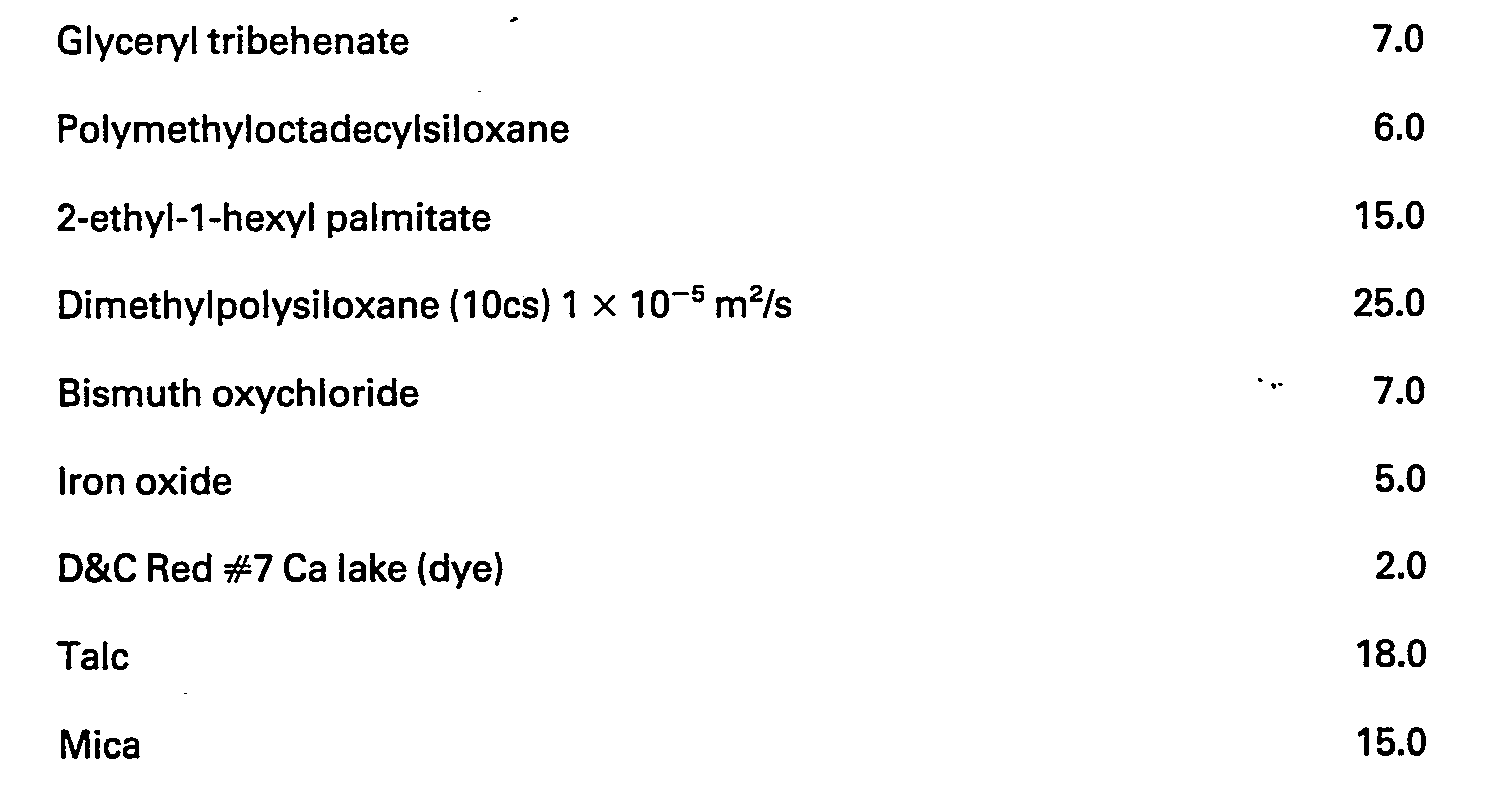

- All the above products exhibited satisfactory texture and smooth feel on the skin, and could be easily applied.
Claims (12)


Priority Applications (1)
| Application Number | Priority Date | Filing Date | Title |
|---|---|---|---|
| AT84108908T ATE54251T1 (en) | 1983-07-29 | 1984-07-27 | MONOPHASE COSMETIC PRODUCTS BASED ON SILICONE AND CONTAINING WAX. |
Applications Claiming Priority (2)
| Application Number | Priority Date | Filing Date | Title |
|---|---|---|---|
| US06/518,497 US4574082A (en) | 1983-07-29 | 1983-07-29 | One-phase silicone-based cosmetic products containing wax |
| US518497 | 1983-07-29 |
Publications (3)
| Publication Number | Publication Date |
|---|---|
| EP0133964A2 EP0133964A2 (en) | 1985-03-13 |
| EP0133964A3 EP0133964A3 (en) | 1986-01-15 |
| EP0133964B1 true EP0133964B1 (en) | 1990-07-04 |
Family
ID=24064188
Family Applications (1)
| Application Number | Title | Priority Date | Filing Date |
|---|---|---|---|
| EP84108908A Expired - Lifetime EP0133964B1 (en) | 1983-07-29 | 1984-07-27 | One-phase silicone-based cosmetic products containing wax |
Country Status (11)
| Country | Link |
|---|---|
| US (1) | US4574082A (en) |
| EP (1) | EP0133964B1 (en) |
| JP (1) | JPS6056914A (en) |
| AT (1) | ATE54251T1 (en) |
| CA (1) | CA1231055A (en) |
| DE (1) | DE3482631D1 (en) |
| DK (1) | DK367884A (en) |
| ES (1) | ES8607005A1 (en) |
| FI (1) | FI79464C (en) |
| GR (1) | GR82448B (en) |
| PT (1) | PT78993B (en) |
Cited By (2)
| Publication number | Priority date | Publication date | Assignee | Title |
|---|---|---|---|---|
| US6843982B1 (en) | 1994-01-26 | 2005-01-18 | L'oreal | Anhydrous cosmetic or dermatological composition containing the combination of a silicone oil and a wax made from an ethylene homopolymer or copolymer |
| US8303986B2 (en) | 2000-04-14 | 2012-11-06 | Jagotec Ag | Hydrophilic/lipophilic polymeric matrix dosage formulation |
Families Citing this family (70)
| Publication number | Priority date | Publication date | Assignee | Title |
|---|---|---|---|---|
| JPS62169714A (en) * | 1986-01-21 | 1987-07-25 | Sunstar Inc | Rodlike cosmetic |
| US4822603A (en) * | 1986-06-18 | 1989-04-18 | The Procter & Gamble Company | Antiperspirant stick composition and process for preparing the same |
| JP2525193B2 (en) * | 1986-09-02 | 1996-08-14 | 株式会社資生堂 | Makeup cosmetics |
| US4871529A (en) * | 1988-06-29 | 1989-10-03 | S. C. Johnson & Son, Inc. | Autophobic silicone copolyols in hairspray compositions |
| US4996239A (en) * | 1988-09-16 | 1991-02-26 | Neutrogena Corporation | Water resistant cream conditioner |
| JPH0753646B2 (en) * | 1989-01-31 | 1995-06-07 | 東レ・ダウコーニング・シリコーン株式会社 | Cosmetics |
| FR2646346B1 (en) * | 1989-04-26 | 1994-08-12 | Thorel Jean | COMPOSITION FOR THE TOPICAL DEPOSITION OF A PERMEABLE CONTINUOUS AND LIGHT-REFLECTING FILM |
| US5393521A (en) * | 1989-12-21 | 1995-02-28 | Dep Corporation | Hair treatments utilizing polymethylalkylsiloxanes |
| US5034216A (en) * | 1990-01-24 | 1991-07-23 | Revlon, Inc. | Anhydrous cosmetic product containing a particular gel phase |
| US5085855A (en) * | 1990-07-18 | 1992-02-04 | Mary Kay Cosmetics, Inc. | Silicone based cosmetic product |
| FR2665361A1 (en) * | 1990-07-31 | 1992-02-07 | Rhone Poulenc Chimie | SOOTHING CREAM FOR THE SKIN AND THE GENCIVES. |
| EP0495596B1 (en) * | 1991-01-17 | 1995-05-31 | Dow Corning Corporation | Alkylmethylsiloxanes for skin care |
| US5413781A (en) * | 1991-01-17 | 1995-05-09 | Dow Corning Corporation | Alkylmethylsiloxanes for skin care |
| WO1992019215A1 (en) * | 1991-04-26 | 1992-11-12 | The Procter & Gamble Company | Cosmetic waterproofing composition |
| US5338536A (en) * | 1991-08-08 | 1994-08-16 | General Electric Company | Personal care compositions containing polyalkylsiloxane copolymers |
| US5380527A (en) * | 1991-08-26 | 1995-01-10 | Dow Corning Corporation | Alkylmethylsiloxane mixtures for skin care |
| US5679335A (en) * | 1991-08-26 | 1997-10-21 | Dow Corning Corporation | Cyclic alkylmethylsiloxanes for skin care |
| US5225188A (en) * | 1991-12-26 | 1993-07-06 | Dow Corning Corporation | Underarm formulations containing alkylmethylsiloxanes |
| US5246703A (en) * | 1991-12-27 | 1993-09-21 | Dow Corning Corporation | Siloxy-functional cyclopolysiloxanes |
| US5232693A (en) * | 1992-03-09 | 1993-08-03 | Dow Corning Corporation | Method of treating dry skin |
| CA2107253C (en) * | 1992-12-15 | 1998-04-21 | Anthony Castrogiovanni | Cosmetic compositions with improved transfer resistance |
| US5750098A (en) * | 1993-02-05 | 1998-05-12 | Dow Corning Corporation | Silicone compositions for skin care |
| DE4306481A1 (en) * | 1993-03-02 | 1994-09-08 | Wacker Chemie Gmbh | Cosmetic compositions containing organosiloxanes |
| US5658580A (en) * | 1993-09-09 | 1997-08-19 | Chanel, Inc. | Skin cream composition |
| US5352441A (en) * | 1993-09-09 | 1994-10-04 | Chanel, Inc. | Powder-based lip liner cosmetic composition |
| US20040223937A1 (en) * | 1994-01-26 | 2004-11-11 | L'oreal | Anhydrous cosmetic or dermatological composition containing the combination of a silicone oil and a wax made from an ethylene homopolymer or copolymer |
| USRE39218E1 (en) | 1994-09-30 | 2006-08-01 | L'oreal | Anhydrous and water-resistant cosmetic compositions |
| FR2737112B1 (en) | 1995-07-28 | 1997-09-05 | Oreal | USE OF THE ASSOCIATION OF TWO PARTICULAR OILS IN A COMPOSITION, ESPECIALLY COSMETIC, AND COMPOSITION OBTAINED |
| FR2737111B1 (en) † | 1995-07-28 | 1997-09-05 | Oreal | COMPOSITION IN THE FORM OF FLEXIBLE PASTE AND METHOD OF PREPARATION |
| US5571503A (en) * | 1995-08-01 | 1996-11-05 | Mausner; Jack | Anti-pollution cosmetic composition |
| US5725845A (en) * | 1995-11-03 | 1998-03-10 | Revlon Consumer Products Corporation | Transfer resistant cosmetic stick compositions with semi-matte finish |
| US5601810A (en) * | 1995-11-22 | 1997-02-11 | Chanel, Inc. | Mascara composition |
| FR2745494B1 (en) * | 1996-03-04 | 1998-08-07 | Oreal | COMPOSITION COMPRISING AN AQUEOUS DISPERSION OF FILM-FORMING POLYMER PARTICLES, AND USE OF A POLYMERIC SYSTEM COMPRISING SAID DISPERSION, IN PARTICULAR IN COSMETICS |
| EP0891387B1 (en) * | 1996-04-04 | 2004-05-26 | Nanophase Technologies Corporation | Siloxane star-graft polymers, ceramic powders coated therewith and method of preparing coated ceramic powders |
| US5922331A (en) * | 1997-03-26 | 1999-07-13 | Chanel, Inc. | Skin cream composition |
| US5993967A (en) * | 1997-03-28 | 1999-11-30 | Nanophase Technologies Corporation | Siloxane star-graft polymers, ceramic powders coated therewith and method of preparing coated ceramic powders |
| US6620417B1 (en) * | 1999-04-26 | 2003-09-16 | Revlon Consumer Products Corporation | Color cosmetic compositions containing organic oil and silicone mixture |
| US6221115B1 (en) | 2000-02-01 | 2001-04-24 | Ciba Specialty Chemicals Corporation | Candle wax stabilized by a combination of UV absorber plus a selected hindered amine |
| US6296674B1 (en) | 2000-02-01 | 2001-10-02 | Ciba Specialty Chemicals Corporation | Candle wax stabilized with red-shift benzotriazoles |
| US6380285B1 (en) | 2000-02-01 | 2002-04-30 | Ciba Specialty Chemicals Corporation | Bloom-resistant benzotriazole UV absorbers and compositions stabilized therewith |
| US6489393B1 (en) * | 2000-10-24 | 2002-12-03 | Pennzoil-Quaker State Company | Surface tinting composition and method of use |
| NL1017487C2 (en) * | 2001-03-02 | 2002-09-06 | Caral B V I O | Preparation with polydimethylsiloxane for disorders of nails, cartilage, bones, joints, muscles and tendons. |
| US6562083B2 (en) | 2001-04-02 | 2003-05-13 | Ciba Specialty Chemicals Corporation | Candle wax stabilized with s-triazines/hals |
| US6540795B2 (en) | 2001-04-02 | 2003-04-01 | Ciba Specialty Chemicals Corporation | Candle wax stabilized with oxazolidines |
| US6846929B2 (en) | 2001-04-02 | 2005-01-25 | Ciba Specialty Chemicals Corporation | Benzotriazole/hals molecular combinations and compositions stabilized therewith |
| US6544304B2 (en) | 2001-04-02 | 2003-04-08 | Ciba Specialty Chemicals Corporation | Candle wax stabilized with morpholinones |
| US6905525B2 (en) | 2001-04-02 | 2005-06-14 | Ciba Specialty Chemicals Corporation | Candle wax stabilized with piperazinones |
| US6547840B2 (en) | 2001-04-02 | 2003-04-15 | Ciba Specialty Chemicals Corporation | Candle wax stabilized with imidazolidines |
| US6562084B2 (en) | 2001-04-02 | 2003-05-13 | Ciba Specialty Chemicals Corporation | Candle wax stabilized with piperazindiones |
| US6544305B2 (en) | 2001-04-02 | 2003-04-08 | Ciba Specialty Chemicals Corporation | Candle wax stabilized with piperazinones |
| US6465645B1 (en) | 2001-04-17 | 2002-10-15 | Ciba Specialty Chemicals Corporation | Long chain hindered amines and compositions stabilized therewith |
| US6562085B1 (en) | 2001-06-06 | 2003-05-13 | Ciba Specialty Chemicals Corporation | Candle wax compositions stabilized with UV absorber-metal combinations |
| US20030082128A1 (en) * | 2001-10-24 | 2003-05-01 | Clariant International, Ltd. | Homogeneous mixtures of silicone oils and organic oils |
| EP1374904A1 (en) * | 2002-06-20 | 2004-01-02 | Baas, Fhilipus Albert | Preparation containing polymethyl-siloxane for nails, cartilage, bone joint, muscle and tendon disorders |
| EP1475426B1 (en) * | 2003-04-24 | 2006-10-11 | Goldschmidt GmbH | Process for the production of removable soil- and water-resistant surface coatings |
| FR2867682B1 (en) * | 2004-03-22 | 2009-06-05 | Galderma Res & Dev | ANHYDROUS PHARMACEUTICAL COMPOSITION COMPRISING A SILICONE AGENT AND A SOLUBILIZED ACTIVE INGREDIENT. |
| US20050220745A1 (en) * | 2004-04-01 | 2005-10-06 | L'oreal S.A. | Cosmetic compositions containing swelled silicone elastomer powders and gelled block copolymers |
| US8158136B2 (en) | 2004-08-18 | 2012-04-17 | L'oréal | Emulsification system for use in cosmetics |
| US7758848B2 (en) | 2004-10-22 | 2010-07-20 | L'oreal | Cosmetic composition containing a polyorganosiloxane polymer |
| US8025869B2 (en) * | 2005-06-28 | 2011-09-27 | L'oréal | Cosmetic compositions having enhanced wear properties |
| US20070093619A1 (en) * | 2005-10-24 | 2007-04-26 | L'oreal | Compositions having enhanced cosmetic properties |
| WO2007128672A1 (en) * | 2006-05-03 | 2007-11-15 | Ciba Holding Inc. | Substituted hexahydro-1,4-diazepin-5-ones and compositions stabilized therewith |
| DE102006034860A1 (en) * | 2006-07-25 | 2008-01-31 | Carl Freudenberg Kg | Textile fabrics, methods of manufacture and use |
| FR2916632B1 (en) * | 2007-05-31 | 2009-08-28 | Chanel Parfums Beaute Sas Unip | COSMETIC COMPOSITION COMPRISING A CHINESE INSECTE WAX EXTRACT |
| US8685309B2 (en) | 2010-04-26 | 2014-04-01 | The Procter & Gamble Company | Method for making a personal care product |
| US8466335B2 (en) | 2010-04-26 | 2013-06-18 | The Procter & Gamble Company | Personal care product |
| US9139737B1 (en) | 2011-11-21 | 2015-09-22 | Nanophase Technologies Corporation | Multifunctional coated powders and high solids dispersions |
| US10555892B1 (en) | 2017-03-09 | 2020-02-11 | Nanophase Technologies Corporation | Functionalized siloxane or polysiloxane coated particles with enhanced light filtering properties |
| US10590278B2 (en) | 2017-04-10 | 2020-03-17 | Nanophase Technologies Corporation | Coated powders having high photostability |
| WO2020075792A1 (en) * | 2018-10-10 | 2020-04-16 | 株式会社 資生堂 | External preparation for concealing roughness |
Family Cites Families (12)
| Publication number | Priority date | Publication date | Assignee | Title |
|---|---|---|---|---|
| US3136696A (en) * | 1961-02-17 | 1964-06-09 | Corby Entpr Inc | Shaving assisting composition |
| US3641239A (en) * | 1968-11-06 | 1972-02-08 | Dow Corning | Cosmetic wax composition |
| US3836647A (en) * | 1970-10-22 | 1974-09-17 | Dow Corning | Wash-resistant skin preparation |
| LU67773A1 (en) * | 1973-06-08 | 1975-03-06 | ||
| CA1075158A (en) * | 1976-02-05 | 1980-04-08 | Peter F. Davy | Siloxane with alcohol in antiperspirant stick |
| JPS5520736A (en) * | 1978-08-01 | 1980-02-14 | Shiseido Co Ltd | Cosmetic |
| JPS5520737A (en) * | 1978-08-01 | 1980-02-14 | Shiseido Co Ltd | Cosmetic |
| US4423041A (en) * | 1979-06-25 | 1983-12-27 | Johnson & Johnson Products, Inc. | Detackifying compositions |
| JPS56128707A (en) * | 1980-03-15 | 1981-10-08 | Kanebo Ltd | Powdery make-up |
| DE3010572C2 (en) * | 1980-03-19 | 1982-05-06 | Süess, Hans R., Dr., Starrkirch | Skin care and skin protection preparations |
| JPS57130910A (en) * | 1981-02-05 | 1982-08-13 | Kao Corp | Hair treatment agent |
| JPS57140708A (en) * | 1981-02-26 | 1982-08-31 | Kao Corp | Hair rinse agent composition |
-
1983
- 1983-07-29 US US06/518,497 patent/US4574082A/en not_active Expired - Lifetime
-
1984
- 1984-07-26 FI FI842984A patent/FI79464C/en not_active IP Right Cessation
- 1984-07-27 PT PT78993A patent/PT78993B/en not_active IP Right Cessation
- 1984-07-27 DE DE8484108908T patent/DE3482631D1/en not_active Expired - Lifetime
- 1984-07-27 DK DK367884A patent/DK367884A/en not_active Application Discontinuation
- 1984-07-27 ES ES534974A patent/ES8607005A1/en not_active Expired
- 1984-07-27 GR GR75443A patent/GR82448B/el unknown
- 1984-07-27 CA CA000459842A patent/CA1231055A/en not_active Expired
- 1984-07-27 EP EP84108908A patent/EP0133964B1/en not_active Expired - Lifetime
- 1984-07-27 JP JP59155690A patent/JPS6056914A/en active Granted
- 1984-07-27 AT AT84108908T patent/ATE54251T1/en not_active IP Right Cessation
Non-Patent Citations (2)
| Title |
|---|
| Handbuch d. Kosmetik u. Riechst., Bd. I, H. Janystin, 1978, pp. 832-42 * |
| Remington's Pharm. Sciences, 15th ed., 1975, pp.1242-69 * |
Cited By (3)
| Publication number | Priority date | Publication date | Assignee | Title |
|---|---|---|---|---|
| US6843982B1 (en) | 1994-01-26 | 2005-01-18 | L'oreal | Anhydrous cosmetic or dermatological composition containing the combination of a silicone oil and a wax made from an ethylene homopolymer or copolymer |
| US8303986B2 (en) | 2000-04-14 | 2012-11-06 | Jagotec Ag | Hydrophilic/lipophilic polymeric matrix dosage formulation |
| US8460706B2 (en) | 2000-04-14 | 2013-06-11 | Jagotec Ag | Hydrophilic/lipophilic polymeric matrix dosage formulation |
Also Published As
| Publication number | Publication date |
|---|---|
| EP0133964A3 (en) | 1986-01-15 |
| JPH0553767B2 (en) | 1993-08-10 |
| FI842984A0 (en) | 1984-07-26 |
| GR82448B (en) | 1984-12-13 |
| PT78993B (en) | 1986-06-18 |
| FI79464B (en) | 1989-09-29 |
| JPS6056914A (en) | 1985-04-02 |
| ES534974A0 (en) | 1986-06-01 |
| CA1231055A (en) | 1988-01-05 |
| ATE54251T1 (en) | 1990-07-15 |
| DK367884A (en) | 1985-01-30 |
| FI79464C (en) | 1990-01-10 |
| DK367884D0 (en) | 1984-07-27 |
| US4574082A (en) | 1986-03-04 |
| FI842984L (en) | 1985-01-30 |
| EP0133964A2 (en) | 1985-03-13 |
| PT78993A (en) | 1984-08-01 |
| ES8607005A1 (en) | 1986-06-01 |
| DE3482631D1 (en) | 1990-08-09 |
Similar Documents
| Publication | Publication Date | Title |
|---|---|---|
| US4574082A (en) | One-phase silicone-based cosmetic products containing wax | |
| EP0133963B1 (en) | Silicone-based cosmetic products containing pigment | |
| JP3644971B2 (en) | Use of alkyldimethicone copolyol type silicone surfactants in the preparation of solid cosmetic water-in-oil emulsions and the resulting solid water-in-oil emulsions | |
| US5318775A (en) | Silicone based cosmetic product | |
| EP1147761B1 (en) | Composition for lipstick | |
| HK1254682A1 (en) | Solid cosmetic for lips | |
| US5859069A (en) | Gelatinous external skin treatment composition | |
| US5972318A (en) | Transfer-free make-up or care composition containing alkylpolysiloxane | |
| EP0545002A1 (en) | Silicone polymer, paste-like composition and water-in-oil type cosmetic composition comprising the same | |
| JPH07252130A (en) | Anhydrous cosmetic or dermatological composition comprising a combination of silicone oil and a wax made from ethylene homopolymer or copolymer | |
| JP3600450B2 (en) | Oil-in-oil emulsion composition | |
| EP0317313B1 (en) | Alcohol free-liquid makeup composition | |
| JP2898234B2 (en) | Anhydrous cosmetic composition in the form of a soft paste and method for preparing the same | |
| JP2622980B2 (en) | Cosmetic composition comprising oil-in-water emulsion containing pigment | |
| KR102349895B1 (en) | Water-in-oil type emulsified cosmetic composition | |
| JP2525193B2 (en) | Makeup cosmetics | |
| JPH01230511A (en) | Oily make-up cosmetic | |
| JPH0532527A (en) | Make-up cosmetic | |
| GB2401316A (en) | Cosmetic composition for the skin or lips comprising a silicone pressure sensitive adhesive elastomer | |
| JPH0372942A (en) | Water in oil emulsified composition | |
| JPH09188604A (en) | Gel composition and solid cosmetic material containing the same | |
| JPH05124931A (en) | Water-in-oil emulsified composition | |
| JP2571098B2 (en) | Oily cosmetics | |
| JP2006057054A (en) | Gel composition and cosmetics containing the same | |
| JP2004035479A (en) | Lip cosmetic |
Legal Events
| Date | Code | Title | Description |
|---|---|---|---|
| PUAI | Public reference made under article 153(3) epc to a published international application that has entered the european phase |
Free format text: ORIGINAL CODE: 0009012 |
|
| AK | Designated contracting states |
Designated state(s): AT BE CH DE FR GB IT LI LU NL SE |
|
| PUAL | Search report despatched |
Free format text: ORIGINAL CODE: 0009013 |
|
| AK | Designated contracting states |
Designated state(s): AT BE CH DE FR GB IT LI LU NL SE |
|
| 17P | Request for examination filed |
Effective date: 19860415 |
|
| 17Q | First examination report despatched |
Effective date: 19880324 |
|
| GRAA | (expected) grant |
Free format text: ORIGINAL CODE: 0009210 |
|
| AK | Designated contracting states |
Kind code of ref document: B1 Designated state(s): AT BE CH DE FR GB IT LI LU NL SE |
|
| REF | Corresponds to: |
Ref document number: 54251 Country of ref document: AT Date of ref document: 19900715 Kind code of ref document: T |
|
| REF | Corresponds to: |
Ref document number: 3482631 Country of ref document: DE Date of ref document: 19900809 |
|
| ET | Fr: translation filed | ||
| ITF | It: translation for a ep patent filed | ||
| PLBI | Opposition filed |
Free format text: ORIGINAL CODE: 0009260 |
|
| 26 | Opposition filed |
Opponent name: SOCIETE ANONYME DITE: L'OREAL Effective date: 19910403 |
|
| PGFP | Annual fee paid to national office [announced via postgrant information from national office to epo] |
Ref country code: FR Payment date: 19910616 Year of fee payment: 8 |
|
| PGFP | Annual fee paid to national office [announced via postgrant information from national office to epo] |
Ref country code: DE Payment date: 19910618 Year of fee payment: 8 |
|
| PGFP | Annual fee paid to national office [announced via postgrant information from national office to epo] |
Ref country code: SE Payment date: 19910619 Year of fee payment: 8 |
|
| PGFP | Annual fee paid to national office [announced via postgrant information from national office to epo] |
Ref country code: CH Payment date: 19910620 Year of fee payment: 8 |
|
| PGFP | Annual fee paid to national office [announced via postgrant information from national office to epo] |
Ref country code: AT Payment date: 19910624 Year of fee payment: 8 |
|
| PGFP | Annual fee paid to national office [announced via postgrant information from national office to epo] |
Ref country code: GB Payment date: 19910701 Year of fee payment: 8 |
|
| PGFP | Annual fee paid to national office [announced via postgrant information from national office to epo] |
Ref country code: LU Payment date: 19910709 Year of fee payment: 8 |
|
| PGFP | Annual fee paid to national office [announced via postgrant information from national office to epo] |
Ref country code: BE Payment date: 19910725 Year of fee payment: 8 |
|
| ITTA | It: last paid annual fee | ||
| PGFP | Annual fee paid to national office [announced via postgrant information from national office to epo] |
Ref country code: NL Payment date: 19910731 Year of fee payment: 8 |
|
| NLR1 | Nl: opposition has been filed with the epo |
Opponent name: SOCIETE ANONYME DITE: L KOREAL |
|
| EPTA | Lu: last paid annual fee | ||
| PG25 | Lapsed in a contracting state [announced via postgrant information from national office to epo] |
Ref country code: LU Free format text: LAPSE BECAUSE OF NON-PAYMENT OF DUE FEES Effective date: 19920727 |
|
| RDAG | Patent revoked |
Free format text: ORIGINAL CODE: 0009271 |
|
| STAA | Information on the status of an ep patent application or granted ep patent |
Free format text: STATUS: PATENT REVOKED |
|
| REG | Reference to a national code |
Ref country code: CH Ref legal event code: PL |
|
| 27W | Patent revoked |
Effective date: 19920731 |
|
| GBPR | Gb: patent revoked under art. 102 of the ep convention designating the uk as contracting state | ||
| BERE | Be: lapsed |
Owner name: REVLON INC. Effective date: 19920731 |
|
| NLR2 | Nl: decision of opposition | ||
| EUG | Se: european patent has lapsed |
Ref document number: 84108908.9 Effective date: 19921216 |