EP0133766B1 - Coumarin derivatives, pharmaceutical compositions containing the same, and the use thereof in the treatment of cancer - Google Patents
Coumarin derivatives, pharmaceutical compositions containing the same, and the use thereof in the treatment of cancer Download PDFInfo
- Publication number
- EP0133766B1 EP0133766B1 EP84304976A EP84304976A EP0133766B1 EP 0133766 B1 EP0133766 B1 EP 0133766B1 EP 84304976 A EP84304976 A EP 84304976A EP 84304976 A EP84304976 A EP 84304976A EP 0133766 B1 EP0133766 B1 EP 0133766B1
- Authority
- EP
- European Patent Office
- Prior art keywords
- methyl
- formula
- group
- hydroxy
- compound
- Prior art date
- Legal status (The legal status is an assumption and is not a legal conclusion. Google has not performed a legal analysis and makes no representation as to the accuracy of the status listed.)
- Expired - Lifetime
Links
- 206010028980 Neoplasm Diseases 0.000 title claims description 16
- 239000008194 pharmaceutical composition Substances 0.000 title claims description 8
- 238000011282 treatment Methods 0.000 title claims description 8
- 201000011510 cancer Diseases 0.000 title claims description 5
- 150000001893 coumarin derivatives Chemical class 0.000 title 1
- LFQSCWFLJHTTHZ-UHFFFAOYSA-N Ethanol Chemical compound CCO LFQSCWFLJHTTHZ-UHFFFAOYSA-N 0.000 claims description 156
- 150000001875 compounds Chemical class 0.000 claims description 114
- 238000000034 method Methods 0.000 claims description 81
- 125000004432 carbon atom Chemical group C* 0.000 claims description 72
- 125000001183 hydrocarbyl group Chemical group 0.000 claims description 71
- 239000000203 mixture Substances 0.000 claims description 45
- 125000002887 hydroxy group Chemical group [H]O* 0.000 claims description 40
- -1 morpholino, thiomorpholino, pyrrolidino, piperidino, piperazino, hydroxypiperidino, hydroxyethylpiperidino, hydroxypiperazino Chemical group 0.000 claims description 38
- 239000002904 solvent Substances 0.000 claims description 37
- 238000002360 preparation method Methods 0.000 claims description 35
- 125000001931 aliphatic group Chemical group 0.000 claims description 32
- 150000003839 salts Chemical class 0.000 claims description 30
- 229910052739 hydrogen Inorganic materials 0.000 claims description 29
- 239000001257 hydrogen Substances 0.000 claims description 29
- 239000002253 acid Substances 0.000 claims description 25
- 230000000259 anti-tumor effect Effects 0.000 claims description 19
- 238000006243 chemical reaction Methods 0.000 claims description 19
- 125000002496 methyl group Chemical group [H]C([H])([H])* 0.000 claims description 19
- IAZDPXIOMUYVGZ-UHFFFAOYSA-N Dimethylsulphoxide Chemical compound CS(C)=O IAZDPXIOMUYVGZ-UHFFFAOYSA-N 0.000 claims description 18
- 125000004435 hydrogen atom Chemical group [H]* 0.000 claims description 18
- QTBSBXVTEAMEQO-UHFFFAOYSA-N Acetic acid Chemical compound CC(O)=O QTBSBXVTEAMEQO-UHFFFAOYSA-N 0.000 claims description 16
- 125000002723 alicyclic group Chemical group 0.000 claims description 15
- 229930040373 Paraformaldehyde Natural products 0.000 claims description 13
- 229920002866 paraformaldehyde Polymers 0.000 claims description 13
- 125000000217 alkyl group Chemical group 0.000 claims description 12
- UFHFLCQGNIYNRP-UHFFFAOYSA-N Hydrogen Chemical compound [H][H] UFHFLCQGNIYNRP-UHFFFAOYSA-N 0.000 claims description 11
- 229910052736 halogen Inorganic materials 0.000 claims description 11
- 150000002367 halogens Chemical class 0.000 claims description 11
- 125000002950 monocyclic group Chemical group 0.000 claims description 11
- WKBOTKDWSSQWDR-UHFFFAOYSA-N Bromine atom Chemical group [Br] WKBOTKDWSSQWDR-UHFFFAOYSA-N 0.000 claims description 10
- 239000000460 chlorine Substances 0.000 claims description 10
- 229910052801 chlorine Inorganic materials 0.000 claims description 10
- 241001465754 Metazoa Species 0.000 claims description 9
- 229910052757 nitrogen Inorganic materials 0.000 claims description 9
- 238000005804 alkylation reaction Methods 0.000 claims description 8
- GDTBXPJZTBHREO-UHFFFAOYSA-N bromine Chemical group BrBr GDTBXPJZTBHREO-UHFFFAOYSA-N 0.000 claims description 8
- 229910052794 bromium Inorganic materials 0.000 claims description 8
- HNPRRBAICNPALH-UHFFFAOYSA-N 8-chloro-3-[2-(diethylamino)ethyl]-7-hydroxy-4-methyl-6-(morpholin-4-ylmethyl)chromen-2-one Chemical compound OC=1C(Cl)=C2OC(=O)C(CCN(CC)CC)=C(C)C2=CC=1CN1CCOCC1 HNPRRBAICNPALH-UHFFFAOYSA-N 0.000 claims description 7
- 125000004433 nitrogen atom Chemical group N* 0.000 claims description 7
- ZAMOUSCENKQFHK-UHFFFAOYSA-N Chlorine atom Chemical group [Cl] ZAMOUSCENKQFHK-UHFFFAOYSA-N 0.000 claims description 6
- 238000006683 Mannich reaction Methods 0.000 claims description 6
- QAOWNCQODCNURD-UHFFFAOYSA-N Sulfuric acid Chemical compound OS(O)(=O)=O QAOWNCQODCNURD-UHFFFAOYSA-N 0.000 claims description 6
- 125000003342 alkenyl group Chemical group 0.000 claims description 6
- 239000003814 drug Substances 0.000 claims description 6
- 125000006239 protecting group Chemical group 0.000 claims description 6
- LSNNMFCWUKXFEE-UHFFFAOYSA-M Bisulfite Chemical compound OS([O-])=O LSNNMFCWUKXFEE-UHFFFAOYSA-M 0.000 claims description 5
- 125000003118 aryl group Chemical group 0.000 claims description 5
- 125000000753 cycloalkyl group Chemical group 0.000 claims description 5
- 238000005932 reductive alkylation reaction Methods 0.000 claims description 5
- 125000004974 2-butenyl group Chemical group C(C=CC)* 0.000 claims description 4
- 125000003903 2-propenyl group Chemical group [H]C([*])([H])C([H])=C([H])[H] 0.000 claims description 4
- IDCWTHUMXVLMMQ-UHFFFAOYSA-N 8-chloro-6-(diethylaminomethyl)-7-hydroxy-4-methylchromen-2-one Chemical compound CC1=CC(=O)OC2=C1C=C(CN(CC)CC)C(O)=C2Cl IDCWTHUMXVLMMQ-UHFFFAOYSA-N 0.000 claims description 4
- 230000029936 alkylation Effects 0.000 claims description 4
- 150000001412 amines Chemical class 0.000 claims description 4
- 125000000113 cyclohexyl group Chemical group [H]C1([H])C([H])([H])C([H])([H])C([H])(*)C([H])([H])C1([H])[H] 0.000 claims description 4
- 239000003085 diluting agent Substances 0.000 claims description 4
- 125000001495 ethyl group Chemical group [H]C([H])([H])C([H])([H])* 0.000 claims description 4
- 125000002485 formyl group Chemical class [H]C(*)=O 0.000 claims description 4
- 125000001449 isopropyl group Chemical group [H]C([H])([H])C([H])(*)C([H])([H])[H] 0.000 claims description 4
- 229920006395 saturated elastomer Polymers 0.000 claims description 4
- 208000010110 spontaneous platelet aggregation Diseases 0.000 claims description 4
- 125000000391 vinyl group Chemical group [H]C([*])=C([H])[H] 0.000 claims description 4
- 229920002554 vinyl polymer Polymers 0.000 claims description 4
- PAXVRKSOMJZBFP-UHFFFAOYSA-N 6-[(dimethylazaniumyl)methyl]-4,8-dimethyl-2-oxochromen-7-olate Chemical compound CC1=CC(=O)OC2=C1C=C(CN(C)C)C(O)=C2C PAXVRKSOMJZBFP-UHFFFAOYSA-N 0.000 claims description 3
- ZCYVEMRRCGMTRW-UHFFFAOYSA-N 7553-56-2 Chemical group [I] ZCYVEMRRCGMTRW-UHFFFAOYSA-N 0.000 claims description 3
- OBBRLKAJSZIESX-UHFFFAOYSA-N 8-chloro-7-hydroxy-4-methyl-6-(morpholin-4-ylmethyl)chromen-2-one Chemical compound C=1C=2C(C)=CC(=O)OC=2C(Cl)=C(O)C=1CN1CCOCC1 OBBRLKAJSZIESX-UHFFFAOYSA-N 0.000 claims description 3
- YGPCAVLSUJTBDO-UHFFFAOYSA-N 8-chloro-7-hydroxy-6-(morpholin-4-ylmethyl)-4-phenylchromen-2-one Chemical compound C1=C2C(C=3C=CC=CC=3)=CC(=O)OC2=C(Cl)C(O)=C1CN1CCOCC1 YGPCAVLSUJTBDO-UHFFFAOYSA-N 0.000 claims description 3
- 238000003512 Claisen condensation reaction Methods 0.000 claims description 3
- 238000005727 Friedel-Crafts reaction Methods 0.000 claims description 3
- 238000005618 Fries rearrangement reaction Methods 0.000 claims description 3
- 229910052783 alkali metal Inorganic materials 0.000 claims description 3
- 125000004069 aziridinyl group Chemical group 0.000 claims description 3
- 150000007514 bases Chemical class 0.000 claims description 3
- 125000001995 cyclobutyl group Chemical group [H]C1([H])C([H])([H])C([H])(*)C1([H])[H] 0.000 claims description 3
- 125000001511 cyclopentyl group Chemical group [H]C1([H])C([H])([H])C([H])([H])C([H])(*)C1([H])[H] 0.000 claims description 3
- 125000001559 cyclopropyl group Chemical group [H]C1([H])C([H])([H])C1([H])* 0.000 claims description 3
- 150000003335 secondary amines Chemical class 0.000 claims description 3
- 125000006024 2-pentenyl group Chemical group 0.000 claims description 2
- CFNMUZCFSDMZPQ-GHXNOFRVSA-N 7-[(z)-3-methyl-4-(4-methyl-5-oxo-2h-furan-2-yl)but-2-enoxy]chromen-2-one Chemical compound C=1C=C2C=CC(=O)OC2=CC=1OC/C=C(/C)CC1OC(=O)C(C)=C1 CFNMUZCFSDMZPQ-GHXNOFRVSA-N 0.000 claims description 2
- LPLBQRIVEMOJHJ-UHFFFAOYSA-N 8-chloro-3-[2-(diethylamino)ethyl]-7-methoxy-4-methyl-6-(morpholin-4-ylmethyl)chromen-2-one Chemical compound COC=1C(Cl)=C2OC(=O)C(CCN(CC)CC)=C(C)C2=CC=1CN1CCOCC1 LPLBQRIVEMOJHJ-UHFFFAOYSA-N 0.000 claims description 2
- BWEZXENHTAHPGG-UHFFFAOYSA-N 8-chloro-6-[(dimethylamino)methyl]-7-hydroxy-4-methylchromen-2-one Chemical compound CC1=CC(=O)OC2=C1C=C(CN(C)C)C(O)=C2Cl BWEZXENHTAHPGG-UHFFFAOYSA-N 0.000 claims description 2
- 238000003684 Perkin reaction Methods 0.000 claims description 2
- 239000003146 anticoagulant agent Substances 0.000 claims description 2
- 239000000010 aprotic solvent Substances 0.000 claims description 2
- 125000005279 aryl sulfonyloxy group Chemical group 0.000 claims description 2
- 125000000484 butyl group Chemical group [H]C([*])([H])C([H])([H])C([H])([H])C([H])([H])[H] 0.000 claims description 2
- 125000001309 chloro group Chemical group Cl* 0.000 claims description 2
- 125000000582 cycloheptyl group Chemical group [H]C1([H])C([H])([H])C([H])([H])C([H])([H])C([H])(*)C([H])([H])C1([H])[H] 0.000 claims description 2
- 125000000596 cyclohexenyl group Chemical group C1(=CCCCC1)* 0.000 claims description 2
- 125000002433 cyclopentenyl group Chemical group C1(=CCCC1)* 0.000 claims description 2
- 125000000959 isobutyl group Chemical group [H]C([H])([H])C([H])(C([H])([H])[H])C([H])([H])* 0.000 claims description 2
- 125000001997 phenyl group Chemical group [H]C1=C([H])C([H])=C(*)C([H])=C1[H] 0.000 claims description 2
- 125000004368 propenyl group Chemical group C(=CC)* 0.000 claims description 2
- 125000001436 propyl group Chemical group [H]C([*])([H])C([H])([H])C([H])([H])[H] 0.000 claims description 2
- RMAQACBXLXPBSY-UHFFFAOYSA-N silicic acid Chemical compound O[Si](O)(O)O RMAQACBXLXPBSY-UHFFFAOYSA-N 0.000 claims description 2
- 235000012239 silicon dioxide Nutrition 0.000 claims description 2
- 125000000999 tert-butyl group Chemical group [H]C([H])([H])C(*)(C([H])([H])[H])C([H])([H])[H] 0.000 claims description 2
- 239000003937 drug carrier Substances 0.000 claims 3
- DIFPGROGRYFHIN-UHFFFAOYSA-N 7-hydroxy-4,8-dimethyl-6-(morpholin-4-ylmethyl)chromen-2-one Chemical compound C=1C=2C(C)=CC(=O)OC=2C(C)=C(O)C=1CN1CCOCC1 DIFPGROGRYFHIN-UHFFFAOYSA-N 0.000 claims 1
- 125000005278 alkyl sulfonyloxy group Chemical group 0.000 claims 1
- 230000002785 anti-thrombosis Effects 0.000 claims 1
- VEXZGXHMUGYJMC-UHFFFAOYSA-N Hydrochloric acid Chemical compound Cl VEXZGXHMUGYJMC-UHFFFAOYSA-N 0.000 description 132
- YXFVVABEGXRONW-UHFFFAOYSA-N Toluene Chemical compound CC1=CC=CC=C1 YXFVVABEGXRONW-UHFFFAOYSA-N 0.000 description 66
- VYPSYNLAJGMNEJ-UHFFFAOYSA-N Silicium dioxide Chemical compound O=[Si]=O VYPSYNLAJGMNEJ-UHFFFAOYSA-N 0.000 description 58
- 235000019441 ethanol Nutrition 0.000 description 58
- XEKOWRVHYACXOJ-UHFFFAOYSA-N Ethyl acetate Chemical compound CCOC(C)=O XEKOWRVHYACXOJ-UHFFFAOYSA-N 0.000 description 57
- YMWUJEATGCHHMB-UHFFFAOYSA-N Dichloromethane Chemical compound ClCCl YMWUJEATGCHHMB-UHFFFAOYSA-N 0.000 description 42
- 239000002244 precipitate Substances 0.000 description 38
- 239000000243 solution Substances 0.000 description 36
- 238000001914 filtration Methods 0.000 description 30
- 239000000377 silicon dioxide Substances 0.000 description 29
- 239000013078 crystal Substances 0.000 description 28
- 238000004809 thin layer chromatography Methods 0.000 description 28
- 238000001035 drying Methods 0.000 description 27
- UIIMBOGNXHQVGW-UHFFFAOYSA-M Sodium bicarbonate Chemical compound [Na+].OC([O-])=O UIIMBOGNXHQVGW-UHFFFAOYSA-M 0.000 description 24
- 239000007864 aqueous solution Substances 0.000 description 21
- WSFSSNUMVMOOMR-UHFFFAOYSA-N Formaldehyde Chemical compound O=C WSFSSNUMVMOOMR-UHFFFAOYSA-N 0.000 description 20
- 229940093499 ethyl acetate Drugs 0.000 description 19
- 235000019439 ethyl acetate Nutrition 0.000 description 19
- 125000004494 ethyl ester group Chemical group 0.000 description 17
- NJUISRMVIKYYCN-UHFFFAOYSA-N acetic acid;chloroform;methanol;hydrate Chemical compound O.OC.CC(O)=O.ClC(Cl)Cl NJUISRMVIKYYCN-UHFFFAOYSA-N 0.000 description 16
- 238000001556 precipitation Methods 0.000 description 15
- YNAVUWVOSKDBBP-UHFFFAOYSA-N Morpholine Chemical compound C1COCCN1 YNAVUWVOSKDBBP-UHFFFAOYSA-N 0.000 description 14
- 230000002001 anti-metastasis Effects 0.000 description 14
- 150000004775 coumarins Chemical class 0.000 description 14
- XLYOFNOQVPJJNP-UHFFFAOYSA-N water Substances O XLYOFNOQVPJJNP-UHFFFAOYSA-N 0.000 description 14
- 235000017557 sodium bicarbonate Nutrition 0.000 description 12
- AZRHOPMSJQAEEW-UHFFFAOYSA-N azanium;chloroform;methanol;hydroxide;hydrate Chemical compound [NH4+].O.[OH-].OC.ClC(Cl)Cl AZRHOPMSJQAEEW-UHFFFAOYSA-N 0.000 description 11
- 229910000030 sodium bicarbonate Inorganic materials 0.000 description 11
- 239000000725 suspension Substances 0.000 description 11
- HEDRZPFGACZZDS-UHFFFAOYSA-N Chloroform Chemical compound ClC(Cl)Cl HEDRZPFGACZZDS-UHFFFAOYSA-N 0.000 description 10
- ROSDSFDQCJNGOL-UHFFFAOYSA-N Dimethylamine Chemical compound CNC ROSDSFDQCJNGOL-UHFFFAOYSA-N 0.000 description 10
- 230000015572 biosynthetic process Effects 0.000 description 10
- CSCPPACGZOOCGX-UHFFFAOYSA-N Acetone Chemical compound CC(C)=O CSCPPACGZOOCGX-UHFFFAOYSA-N 0.000 description 9
- 230000000694 effects Effects 0.000 description 9
- 239000000047 product Substances 0.000 description 9
- CIXIKMJRDJIDJA-UHFFFAOYSA-N 7-hydroxy-4-methyl-8-prop-2-enylchromen-2-one Chemical compound C=CCC1=C(O)C=CC2=C1OC(=O)C=C2C CIXIKMJRDJIDJA-UHFFFAOYSA-N 0.000 description 8
- 150000007513 acids Chemical class 0.000 description 8
- 238000013019 agitation Methods 0.000 description 8
- 230000002744 anti-aggregatory effect Effects 0.000 description 8
- ZYGHJZDHTFUPRJ-UHFFFAOYSA-N benzo-alpha-pyrone Natural products C1=CC=C2OC(=O)C=CC2=C1 ZYGHJZDHTFUPRJ-UHFFFAOYSA-N 0.000 description 8
- 239000003795 chemical substances by application Substances 0.000 description 8
- 238000002474 experimental method Methods 0.000 description 8
- BWHMMNNQKKPAPP-UHFFFAOYSA-L potassium carbonate Chemical compound [K+].[K+].[O-]C([O-])=O BWHMMNNQKKPAPP-UHFFFAOYSA-L 0.000 description 8
- 0 CC**([N+](N)[O-])O Chemical compound CC**([N+](N)[O-])O 0.000 description 7
- 229960000956 coumarin Drugs 0.000 description 7
- 235000001671 coumarin Nutrition 0.000 description 7
- 238000010438 heat treatment Methods 0.000 description 7
- IJGRMHOSHXDMSA-UHFFFAOYSA-N Atomic nitrogen Chemical group N#N IJGRMHOSHXDMSA-UHFFFAOYSA-N 0.000 description 6
- QGJOPFRUJISHPQ-UHFFFAOYSA-N Carbon disulfide Chemical compound S=C=S QGJOPFRUJISHPQ-UHFFFAOYSA-N 0.000 description 6
- AFVFQIVMOAPDHO-UHFFFAOYSA-N Methanesulfonic acid Chemical compound CS(O)(=O)=O AFVFQIVMOAPDHO-UHFFFAOYSA-N 0.000 description 6
- RWRDLPDLKQPQOW-UHFFFAOYSA-N Pyrrolidine Chemical compound C1CCNC1 RWRDLPDLKQPQOW-UHFFFAOYSA-N 0.000 description 6
- KEAYESYHFKHZAL-UHFFFAOYSA-N Sodium Chemical compound [Na] KEAYESYHFKHZAL-UHFFFAOYSA-N 0.000 description 6
- PMZURENOXWZQFD-UHFFFAOYSA-L Sodium Sulfate Chemical compound [Na+].[Na+].[O-]S([O-])(=O)=O PMZURENOXWZQFD-UHFFFAOYSA-L 0.000 description 6
- VSCWAEJMTAWNJL-UHFFFAOYSA-K aluminium trichloride Chemical compound Cl[Al](Cl)Cl VSCWAEJMTAWNJL-UHFFFAOYSA-K 0.000 description 6
- 150000002148 esters Chemical class 0.000 description 6
- CDBYLPFSWZWCQE-UHFFFAOYSA-L sodium carbonate Substances [Na+].[Na+].[O-]C([O-])=O CDBYLPFSWZWCQE-UHFFFAOYSA-L 0.000 description 6
- 239000012312 sodium hydride Substances 0.000 description 6
- 229910000104 sodium hydride Inorganic materials 0.000 description 6
- PJVWKTKQMONHTI-UHFFFAOYSA-N warfarin Chemical compound OC=1C2=CC=CC=C2OC(=O)C=1C(CC(=O)C)C1=CC=CC=C1 PJVWKTKQMONHTI-UHFFFAOYSA-N 0.000 description 6
- 229960005080 warfarin Drugs 0.000 description 6
- 231100000111 LD50 Toxicity 0.000 description 5
- 241000699670 Mus sp. Species 0.000 description 5
- 235000011054 acetic acid Nutrition 0.000 description 5
- 239000011260 aqueous acid Substances 0.000 description 5
- 239000007858 starting material Substances 0.000 description 5
- 125000001424 substituent group Chemical group 0.000 description 5
- RTZKZFJDLAIYFH-UHFFFAOYSA-N Diethyl ether Chemical compound CCOCC RTZKZFJDLAIYFH-UHFFFAOYSA-N 0.000 description 4
- 229930195725 Mannitol Natural products 0.000 description 4
- NQRYJNQNLNOLGT-UHFFFAOYSA-N Piperidine Chemical compound C1CCNCC1 NQRYJNQNLNOLGT-UHFFFAOYSA-N 0.000 description 4
- JUJWROOIHBZHMG-UHFFFAOYSA-N Pyridine Chemical compound C1=CC=NC=C1 JUJWROOIHBZHMG-UHFFFAOYSA-N 0.000 description 4
- 239000013543 active substance Substances 0.000 description 4
- 230000002429 anti-coagulating effect Effects 0.000 description 4
- 239000003054 catalyst Substances 0.000 description 4
- 239000012153 distilled water Substances 0.000 description 4
- VEUUMBGHMNQHGO-UHFFFAOYSA-N ethyl chloroacetate Chemical compound CCOC(=O)CCl VEUUMBGHMNQHGO-UHFFFAOYSA-N 0.000 description 4
- 125000000524 functional group Chemical group 0.000 description 4
- 125000005842 heteroatom Chemical group 0.000 description 4
- 150000002431 hydrogen Chemical class 0.000 description 4
- 239000000594 mannitol Substances 0.000 description 4
- 235000010355 mannitol Nutrition 0.000 description 4
- BDAGIHXWWSANSR-UHFFFAOYSA-N methanoic acid Natural products OC=O BDAGIHXWWSANSR-UHFFFAOYSA-N 0.000 description 4
- 230000007170 pathology Effects 0.000 description 4
- 229910000027 potassium carbonate Inorganic materials 0.000 description 4
- 239000000843 powder Substances 0.000 description 4
- 229910000029 sodium carbonate Inorganic materials 0.000 description 4
- 239000011780 sodium chloride Substances 0.000 description 4
- FAPWRFPIFSIZLT-UHFFFAOYSA-M sodium chloride Inorganic materials [Na+].[Cl-] FAPWRFPIFSIZLT-UHFFFAOYSA-M 0.000 description 4
- 150000003460 sulfonic acids Chemical class 0.000 description 4
- JIAARYAFYJHUJI-UHFFFAOYSA-L zinc dichloride Chemical compound [Cl-].[Cl-].[Zn+2] JIAARYAFYJHUJI-UHFFFAOYSA-L 0.000 description 4
- ZWEHNKRNPOVVGH-UHFFFAOYSA-N 2-Butanone Chemical compound CCC(C)=O ZWEHNKRNPOVVGH-UHFFFAOYSA-N 0.000 description 3
- WFCSWCVEJLETKA-UHFFFAOYSA-N 2-piperazin-1-ylethanol Chemical compound OCCN1CCNCC1 WFCSWCVEJLETKA-UHFFFAOYSA-N 0.000 description 3
- RYRYTRRZFMEHRM-UHFFFAOYSA-N 8-chloro-7-hydroxy-4-methylchromen-2-one Chemical compound ClC1=C(O)C=CC2=C1OC(=O)C=C2C RYRYTRRZFMEHRM-UHFFFAOYSA-N 0.000 description 3
- UHOVQNZJYSORNB-UHFFFAOYSA-N Benzene Chemical compound C1=CC=CC=C1 UHOVQNZJYSORNB-UHFFFAOYSA-N 0.000 description 3
- LYCAIKOWRPUZTN-UHFFFAOYSA-N Ethylene glycol Chemical compound OCCO LYCAIKOWRPUZTN-UHFFFAOYSA-N 0.000 description 3
- 239000001828 Gelatine Substances 0.000 description 3
- DGAQECJNVWCQMB-PUAWFVPOSA-M Ilexoside XXIX Chemical compound C[C@@H]1CC[C@@]2(CC[C@@]3(C(=CC[C@H]4[C@]3(CC[C@@H]5[C@@]4(CC[C@@H](C5(C)C)OS(=O)(=O)[O-])C)C)[C@@H]2[C@]1(C)O)C)C(=O)O[C@H]6[C@@H]([C@H]([C@@H]([C@H](O6)CO)O)O)O.[Na+] DGAQECJNVWCQMB-PUAWFVPOSA-M 0.000 description 3
- 206010027476 Metastases Diseases 0.000 description 3
- OKKJLVBELUTLKV-UHFFFAOYSA-N Methanol Chemical compound OC OKKJLVBELUTLKV-UHFFFAOYSA-N 0.000 description 3
- KDYFGRWQOYBRFD-UHFFFAOYSA-N Succinic acid Natural products OC(=O)CCC(O)=O KDYFGRWQOYBRFD-UHFFFAOYSA-N 0.000 description 3
- NINIDFKCEFEMDL-UHFFFAOYSA-N Sulfur Chemical group [S] NINIDFKCEFEMDL-UHFFFAOYSA-N 0.000 description 3
- DKGAVHZHDRPRBM-UHFFFAOYSA-N Tert-Butanol Chemical compound CC(C)(C)O DKGAVHZHDRPRBM-UHFFFAOYSA-N 0.000 description 3
- 239000002168 alkylating agent Substances 0.000 description 3
- 229940100198 alkylating agent Drugs 0.000 description 3
- BHELZAPQIKSEDF-UHFFFAOYSA-N allyl bromide Chemical compound BrCC=C BHELZAPQIKSEDF-UHFFFAOYSA-N 0.000 description 3
- QVGXLLKOCUKJST-UHFFFAOYSA-N atomic oxygen Chemical group [O] QVGXLLKOCUKJST-UHFFFAOYSA-N 0.000 description 3
- 239000002585 base Substances 0.000 description 3
- 230000037396 body weight Effects 0.000 description 3
- 239000002775 capsule Substances 0.000 description 3
- 125000002915 carbonyl group Chemical group [*:2]C([*:1])=O 0.000 description 3
- 239000003638 chemical reducing agent Substances 0.000 description 3
- 238000009833 condensation Methods 0.000 description 3
- 230000005494 condensation Effects 0.000 description 3
- 125000000332 coumarinyl group Chemical group O1C(=O)C(=CC2=CC=CC=C12)* 0.000 description 3
- HPNMFZURTQLUMO-UHFFFAOYSA-N diethylamine Chemical compound CCNCC HPNMFZURTQLUMO-UHFFFAOYSA-N 0.000 description 3
- 229940079593 drug Drugs 0.000 description 3
- 125000004185 ester group Chemical group 0.000 description 3
- IOLQWGVDEFWYNP-UHFFFAOYSA-N ethyl 2-bromo-2-methylpropanoate Chemical compound CCOC(=O)C(C)(C)Br IOLQWGVDEFWYNP-UHFFFAOYSA-N 0.000 description 3
- 229920000159 gelatin Polymers 0.000 description 3
- 235000019322 gelatine Nutrition 0.000 description 3
- 238000005658 halogenation reaction Methods 0.000 description 3
- FUZZWVXGSFPDMH-UHFFFAOYSA-N hexanoic acid Chemical compound CCCCCC(O)=O FUZZWVXGSFPDMH-UHFFFAOYSA-N 0.000 description 3
- 210000004072 lung Anatomy 0.000 description 3
- 150000007522 mineralic acids Chemical class 0.000 description 3
- 230000004048 modification Effects 0.000 description 3
- 238000012986 modification Methods 0.000 description 3
- 150000007530 organic bases Chemical class 0.000 description 3
- 229910052760 oxygen Inorganic materials 0.000 description 3
- 239000001301 oxygen Substances 0.000 description 3
- 239000000546 pharmaceutical excipient Substances 0.000 description 3
- 239000000825 pharmaceutical preparation Substances 0.000 description 3
- 230000000144 pharmacologic effect Effects 0.000 description 3
- ISWSIDIOOBJBQZ-UHFFFAOYSA-N phenol group Chemical group C1(=CC=CC=C1)O ISWSIDIOOBJBQZ-UHFFFAOYSA-N 0.000 description 3
- 239000011541 reaction mixture Substances 0.000 description 3
- 239000007787 solid Substances 0.000 description 3
- 229910052717 sulfur Inorganic materials 0.000 description 3
- 239000011593 sulfur Chemical group 0.000 description 3
- JOXIMZWYDAKGHI-UHFFFAOYSA-N toluene-4-sulfonic acid Chemical compound CC1=CC=C(S(O)(=O)=O)C=C1 JOXIMZWYDAKGHI-UHFFFAOYSA-N 0.000 description 3
- 150000005207 1,3-dihydroxybenzenes Chemical class 0.000 description 2
- OBTZDIRUQWFRFZ-UHFFFAOYSA-N 2-(5-methylfuran-2-yl)-n-(4-methylphenyl)quinoline-4-carboxamide Chemical compound O1C(C)=CC=C1C1=CC(C(=O)NC=2C=CC(C)=CC=2)=C(C=CC=C2)C2=N1 OBTZDIRUQWFRFZ-UHFFFAOYSA-N 0.000 description 2
- PVTWRQANMLTOOR-UHFFFAOYSA-N 2-[8-chloro-3-[2-(diethylamino)ethyl]-4-methyl-6-(morpholin-4-ylmethyl)-2-oxochromen-7-yl]oxyacetic acid Chemical compound OC(=O)COC=1C(Cl)=C2OC(=O)C(CCN(CC)CC)=C(C)C2=CC=1CN1CCOCC1 PVTWRQANMLTOOR-UHFFFAOYSA-N 0.000 description 2
- BMYNFMYTOJXKLE-UHFFFAOYSA-N 3-azaniumyl-2-hydroxypropanoate Chemical compound NCC(O)C(O)=O BMYNFMYTOJXKLE-UHFFFAOYSA-N 0.000 description 2
- OSWFIVFLDKOXQC-UHFFFAOYSA-N 4-(3-methoxyphenyl)aniline Chemical compound COC1=CC=CC(C=2C=CC(N)=CC=2)=C1 OSWFIVFLDKOXQC-UHFFFAOYSA-N 0.000 description 2
- MVMMGVPSTRNMSV-UHFFFAOYSA-N 7-hydroxy-4,8-dimethylchromen-2-one Chemical compound CC1=C(O)C=CC2=C1OC(=O)C=C2C MVMMGVPSTRNMSV-UHFFFAOYSA-N 0.000 description 2
- FERIUCNNQQJTOY-UHFFFAOYSA-N Butyric acid Chemical class CCCC(O)=O FERIUCNNQQJTOY-UHFFFAOYSA-N 0.000 description 2
- KZBUYRJDOAKODT-UHFFFAOYSA-N Chlorine Chemical compound ClCl KZBUYRJDOAKODT-UHFFFAOYSA-N 0.000 description 2
- PXGOKWXKJXAPGV-UHFFFAOYSA-N Fluorine Chemical compound FF PXGOKWXKJXAPGV-UHFFFAOYSA-N 0.000 description 2
- ZHNUHDYFZUAESO-UHFFFAOYSA-N Formamide Chemical compound NC=O ZHNUHDYFZUAESO-UHFFFAOYSA-N 0.000 description 2
- KFZMGEQAYNKOFK-UHFFFAOYSA-N Isopropanol Chemical compound CC(C)O KFZMGEQAYNKOFK-UHFFFAOYSA-N 0.000 description 2
- GUBGYTABKSRVRQ-QKKXKWKRSA-N Lactose Natural products OC[C@H]1O[C@@H](O[C@H]2[C@H](O)[C@@H](O)C(O)O[C@@H]2CO)[C@H](O)[C@@H](O)[C@H]1O GUBGYTABKSRVRQ-QKKXKWKRSA-N 0.000 description 2
- 208000006552 Lewis Lung Carcinoma Diseases 0.000 description 2
- 206010058467 Lung neoplasm malignant Diseases 0.000 description 2
- 241000699666 Mus <mouse, genus> Species 0.000 description 2
- SMWDFEZZVXVKRB-UHFFFAOYSA-N Quinoline Chemical compound N1=CC=CC2=CC=CC=C21 SMWDFEZZVXVKRB-UHFFFAOYSA-N 0.000 description 2
- 241000700159 Rattus Species 0.000 description 2
- HEMHJVSKTPXQMS-UHFFFAOYSA-M Sodium hydroxide Chemical compound [OH-].[Na+] HEMHJVSKTPXQMS-UHFFFAOYSA-M 0.000 description 2
- 229920002472 Starch Polymers 0.000 description 2
- FEWJPZIEWOKRBE-UHFFFAOYSA-N Tartaric acid Natural products [H+].[H+].[O-]C(=O)C(O)C(O)C([O-])=O FEWJPZIEWOKRBE-UHFFFAOYSA-N 0.000 description 2
- DTQVDTLACAAQTR-UHFFFAOYSA-N Trifluoroacetic acid Chemical compound OC(=O)C(F)(F)F DTQVDTLACAAQTR-UHFFFAOYSA-N 0.000 description 2
- 208000009971 Walker Carcinoma 256 Diseases 0.000 description 2
- 231100000403 acute toxicity Toxicity 0.000 description 2
- 230000007059 acute toxicity Effects 0.000 description 2
- 229910052784 alkaline earth metal Inorganic materials 0.000 description 2
- SRSXLGNVWSONIS-UHFFFAOYSA-N benzenesulfonic acid Chemical compound OS(=O)(=O)C1=CC=CC=C1 SRSXLGNVWSONIS-UHFFFAOYSA-N 0.000 description 2
- 229940092714 benzenesulfonic acid Drugs 0.000 description 2
- WPYMKLBDIGXBTP-UHFFFAOYSA-N benzoic acid Chemical compound OC(=O)C1=CC=CC=C1 WPYMKLBDIGXBTP-UHFFFAOYSA-N 0.000 description 2
- 239000008280 blood Substances 0.000 description 2
- 210000004369 blood Anatomy 0.000 description 2
- 238000009835 boiling Methods 0.000 description 2
- WTEOIRVLGSZEPR-UHFFFAOYSA-N boron trifluoride Chemical compound FB(F)F WTEOIRVLGSZEPR-UHFFFAOYSA-N 0.000 description 2
- 239000007795 chemical reaction product Substances 0.000 description 2
- 238000004040 coloring Methods 0.000 description 2
- 239000006071 cream Substances 0.000 description 2
- XBDQKXXYIPTUBI-UHFFFAOYSA-N dimethylselenoniopropionate Natural products CCC(O)=O XBDQKXXYIPTUBI-UHFFFAOYSA-N 0.000 description 2
- 239000008298 dragée Substances 0.000 description 2
- 238000005886 esterification reaction Methods 0.000 description 2
- 150000002170 ethers Chemical class 0.000 description 2
- 229910052731 fluorine Inorganic materials 0.000 description 2
- 239000011737 fluorine Substances 0.000 description 2
- 235000019253 formic acid Nutrition 0.000 description 2
- 125000005843 halogen group Chemical group 0.000 description 2
- 230000026030 halogenation Effects 0.000 description 2
- VKYKSIONXSXAKP-UHFFFAOYSA-N hexamethylenetetramine Chemical compound C1N(C2)CN3CN1CN2C3 VKYKSIONXSXAKP-UHFFFAOYSA-N 0.000 description 2
- 229930195733 hydrocarbon Natural products 0.000 description 2
- 238000011065 in-situ storage Methods 0.000 description 2
- 150000007529 inorganic bases Chemical class 0.000 description 2
- 238000007918 intramuscular administration Methods 0.000 description 2
- 239000011630 iodine Substances 0.000 description 2
- 229910052740 iodine Inorganic materials 0.000 description 2
- 239000008101 lactose Substances 0.000 description 2
- 231100000053 low toxicity Toxicity 0.000 description 2
- 201000005296 lung carcinoma Diseases 0.000 description 2
- 229940098779 methanesulfonic acid Drugs 0.000 description 2
- TZIHFWKZFHZASV-UHFFFAOYSA-N methyl formate Chemical compound COC=O TZIHFWKZFHZASV-UHFFFAOYSA-N 0.000 description 2
- 239000002674 ointment Substances 0.000 description 2
- 235000011007 phosphoric acid Nutrition 0.000 description 2
- 150000003016 phosphoric acids Chemical class 0.000 description 2
- XHXFXVLFKHQFAL-UHFFFAOYSA-N phosphoryl trichloride Chemical compound ClP(Cl)(Cl)=O XHXFXVLFKHQFAL-UHFFFAOYSA-N 0.000 description 2
- BIWOSRSKDCZIFM-UHFFFAOYSA-N piperidin-3-ol Chemical compound OC1CCCNC1 BIWOSRSKDCZIFM-UHFFFAOYSA-N 0.000 description 2
- HDOWRFHMPULYOA-UHFFFAOYSA-N piperidin-4-ol Chemical compound OC1CCNCC1 HDOWRFHMPULYOA-UHFFFAOYSA-N 0.000 description 2
- 102000004169 proteins and genes Human genes 0.000 description 2
- 108090000623 proteins and genes Proteins 0.000 description 2
- UMJSCPRVCHMLSP-UHFFFAOYSA-N pyridine Natural products COC1=CC=CN=C1 UMJSCPRVCHMLSP-UHFFFAOYSA-N 0.000 description 2
- 230000002829 reductive effect Effects 0.000 description 2
- 239000012047 saturated solution Substances 0.000 description 2
- 239000007921 spray Substances 0.000 description 2
- 239000008107 starch Substances 0.000 description 2
- VZGDMQKNWNREIO-UHFFFAOYSA-N tetrachloromethane Chemical compound ClC(Cl)(Cl)Cl VZGDMQKNWNREIO-UHFFFAOYSA-N 0.000 description 2
- 230000001225 therapeutic effect Effects 0.000 description 2
- 238000002627 tracheal intubation Methods 0.000 description 2
- 230000001173 tumoral effect Effects 0.000 description 2
- 238000005303 weighing Methods 0.000 description 2
- 239000011592 zinc chloride Substances 0.000 description 2
- 235000005074 zinc chloride Nutrition 0.000 description 2
- IWZSHWBGHQBIML-ZGGLMWTQSA-N (3S,8S,10R,13S,14S,17S)-17-isoquinolin-7-yl-N,N,10,13-tetramethyl-2,3,4,7,8,9,11,12,14,15,16,17-dodecahydro-1H-cyclopenta[a]phenanthren-3-amine Chemical compound CN(C)[C@H]1CC[C@]2(C)C3CC[C@@]4(C)[C@@H](CC[C@@H]4c4ccc5ccncc5c4)[C@@H]3CC=C2C1 IWZSHWBGHQBIML-ZGGLMWTQSA-N 0.000 description 1
- 125000004178 (C1-C4) alkyl group Chemical group 0.000 description 1
- DNIAPMSPPWPWGF-GSVOUGTGSA-N (R)-(-)-Propylene glycol Chemical compound C[C@@H](O)CO DNIAPMSPPWPWGF-GSVOUGTGSA-N 0.000 description 1
- SCYULBFZEHDVBN-UHFFFAOYSA-N 1,1-Dichloroethane Chemical compound CC(Cl)Cl SCYULBFZEHDVBN-UHFFFAOYSA-N 0.000 description 1
- WGCYRFWNGRMRJA-UHFFFAOYSA-N 1-ethylpiperazine Chemical compound CCN1CCNCC1 WGCYRFWNGRMRJA-UHFFFAOYSA-N 0.000 description 1
- HZNQSWJZTWOTKM-UHFFFAOYSA-N 2,3,4-trimethoxybenzoic acid Chemical class COC1=CC=C(C(O)=O)C(OC)=C1OC HZNQSWJZTWOTKM-UHFFFAOYSA-N 0.000 description 1
- MNXINSNJIJCDPD-UHFFFAOYSA-N 2-[8-chloro-3-[2-(diethylamino)ethyl]-4-methyl-6-(morpholin-4-ylmethyl)-2-oxochromen-7-yl]oxy-2-methylpropanoic acid Chemical compound OC(=O)C(C)(C)OC=1C(Cl)=C2OC(=O)C(CCN(CC)CC)=C(C)C2=CC=1CN1CCOCC1 MNXINSNJIJCDPD-UHFFFAOYSA-N 0.000 description 1
- ISELYZKJAFEFEF-UHFFFAOYSA-N 2-[8-chloro-3-[2-(diethylamino)ethyl]-4-methyl-6-(morpholin-4-ylmethyl)-2-oxochromen-7-yl]oxy-2-methylpropanoic acid;dihydrochloride Chemical compound Cl.Cl.OC(=O)C(C)(C)OC=1C(Cl)=C2OC(=O)C(CCN(CC)CC)=C(C)C2=CC=1CN1CCOCC1 ISELYZKJAFEFEF-UHFFFAOYSA-N 0.000 description 1
- PAUCFLJVBDSZJS-UHFFFAOYSA-N 2-[8-chloro-3-[2-(diethylamino)ethyl]-4-methyl-6-(morpholin-4-ylmethyl)-2-oxochromen-7-yl]oxyacetic acid;dihydrochloride Chemical compound Cl.Cl.OC(=O)COC=1C(Cl)=C2OC(=O)C(CCN(CC)CC)=C(C)C2=CC=1CN1CCOCC1 PAUCFLJVBDSZJS-UHFFFAOYSA-N 0.000 description 1
- YSUIQYOGTINQIN-UZFYAQMZSA-N 2-amino-9-[(1S,6R,8R,9S,10R,15R,17R,18R)-8-(6-aminopurin-9-yl)-9,18-difluoro-3,12-dihydroxy-3,12-bis(sulfanylidene)-2,4,7,11,13,16-hexaoxa-3lambda5,12lambda5-diphosphatricyclo[13.2.1.06,10]octadecan-17-yl]-1H-purin-6-one Chemical compound NC1=NC2=C(N=CN2[C@@H]2O[C@@H]3COP(S)(=O)O[C@@H]4[C@@H](COP(S)(=O)O[C@@H]2[C@@H]3F)O[C@H]([C@H]4F)N2C=NC3=C2N=CN=C3N)C(=O)N1 YSUIQYOGTINQIN-UZFYAQMZSA-N 0.000 description 1
- IKCLCGXPQILATA-UHFFFAOYSA-N 2-chlorobenzoic acid Chemical class OC(=O)C1=CC=CC=C1Cl IKCLCGXPQILATA-UHFFFAOYSA-N 0.000 description 1
- WLJVXDMOQOGPHL-PPJXEINESA-N 2-phenylacetic acid Chemical compound O[14C](=O)CC1=CC=CC=C1 WLJVXDMOQOGPHL-PPJXEINESA-N 0.000 description 1
- JYUSXBBDYFBAPA-UHFFFAOYSA-N 6-[(dimethylamino)methyl]-7-hydroxy-4,8-dimethylchromen-2-one;hydrochloride Chemical compound Cl.CC1=CC(=O)OC2=C1C=C(CN(C)C)C(O)=C2C JYUSXBBDYFBAPA-UHFFFAOYSA-N 0.000 description 1
- KWQJESCCFFSHAI-UHFFFAOYSA-N 7-hydroxy-4,8-dimethyl-6-(morpholin-4-ylmethyl)chromen-2-one;hydrochloride Chemical compound Cl.C=1C=2C(C)=CC(=O)OC=2C(C)=C(O)C=1CN1CCOCC1 KWQJESCCFFSHAI-UHFFFAOYSA-N 0.000 description 1
- FLMLMFMUDJFYKT-UHFFFAOYSA-N 7-methoxy-4-methyl-6-(morpholin-4-ylmethyl)chromen-2-one Chemical compound CC1=CC(OC2=CC(=C(C=C12)CN1CCOCC1)OC)=O FLMLMFMUDJFYKT-UHFFFAOYSA-N 0.000 description 1
- KQWPGBYXJXPIIT-UHFFFAOYSA-N 7-methoxy-4-methyl-6-(piperidin-1-ylmethyl)chromen-2-one Chemical compound CC1=CC(OC2=CC(=C(C=C12)CN1CCCCC1)OC)=O KQWPGBYXJXPIIT-UHFFFAOYSA-N 0.000 description 1
- UJATZXDFOJRRKN-UHFFFAOYSA-N 8-chloro-3-[2-(diethylamino)ethyl]-7-hydroxy-4-methyl-6-(morpholin-4-ylmethyl)chromen-2-one;dihydrochloride Chemical compound Cl.Cl.OC=1C(Cl)=C2OC(=O)C(CCN(CC)CC)=C(C)C2=CC=1CN1CCOCC1 UJATZXDFOJRRKN-UHFFFAOYSA-N 0.000 description 1
- DDCHIFICMUUWKC-UHFFFAOYSA-N 8-chloro-3-[2-(diethylamino)ethyl]-7-hydroxy-4-methylchromen-2-one Chemical compound C1=C(O)C(Cl)=C2OC(=O)C(CCN(CC)CC)=C(C)C2=C1 DDCHIFICMUUWKC-UHFFFAOYSA-N 0.000 description 1
- GQOIGZDFOKHWNK-UHFFFAOYSA-N 8-chloro-3-[2-(diethylamino)ethyl]-7-methoxy-4-methyl-6-(morpholin-4-ylmethyl)chromen-2-one;dihydrochloride Chemical compound Cl.Cl.COC=1C(Cl)=C2OC(=O)C(CCN(CC)CC)=C(C)C2=CC=1CN1CCOCC1 GQOIGZDFOKHWNK-UHFFFAOYSA-N 0.000 description 1
- AYISBYKINOSCGC-UHFFFAOYSA-N 8-chloro-6-(diethylaminomethyl)-7-hydroxy-4-methylchromen-2-one;hydrochloride Chemical compound Cl.CC1=CC(=O)OC2=C1C=C(CN(CC)CC)C(O)=C2Cl AYISBYKINOSCGC-UHFFFAOYSA-N 0.000 description 1
- KIKZYTUFVAHDCX-UHFFFAOYSA-N 8-chloro-6-[(dimethylamino)methyl]-7,7-dihydroxy-4-methyl-3h-chromen-2-one Chemical compound C1C(=O)OC2=C(Cl)C(O)(O)C(CN(C)C)=CC2=C1C KIKZYTUFVAHDCX-UHFFFAOYSA-N 0.000 description 1
- WWVQYVGWQKZAIR-UHFFFAOYSA-N 8-chloro-6-[(dimethylamino)methyl]-7-hydroxy-4-methylchromen-2-one;hydrochloride Chemical compound Cl.CC1=CC(=O)OC2=C1C=C(CN(C)C)C(O)=C2Cl WWVQYVGWQKZAIR-UHFFFAOYSA-N 0.000 description 1
- TVKQDLVZTDDATE-UHFFFAOYSA-N 8-chloro-7-hydroxy-4-methyl-6-(morpholin-4-ylmethyl)chromen-2-one;hydrochloride Chemical compound Cl.C=1C=2C(C)=CC(=O)OC=2C(Cl)=C(O)C=1CN1CCOCC1 TVKQDLVZTDDATE-UHFFFAOYSA-N 0.000 description 1
- FDRSPCSMOSHMMN-UHFFFAOYSA-N 8-chloro-7-hydroxy-6-(morpholin-4-ylmethyl)-4-phenylchromen-2-one;hydrochloride Chemical compound Cl.C1=C2C(C=3C=CC=CC=3)=CC(=O)OC2=C(Cl)C(O)=C1CN1CCOCC1 FDRSPCSMOSHMMN-UHFFFAOYSA-N 0.000 description 1
- 241000478345 Afer Species 0.000 description 1
- VHUUQVKOLVNVRT-UHFFFAOYSA-N Ammonium hydroxide Chemical compound [NH4+].[OH-] VHUUQVKOLVNVRT-UHFFFAOYSA-N 0.000 description 1
- 229910015900 BF3 Inorganic materials 0.000 description 1
- 239000005711 Benzoic acid Substances 0.000 description 1
- 241000219198 Brassica Species 0.000 description 1
- 235000003351 Brassica cretica Nutrition 0.000 description 1
- 235000003343 Brassica rupestris Nutrition 0.000 description 1
- COVZYZSDYWQREU-UHFFFAOYSA-N Busulfan Chemical compound CS(=O)(=O)OCCCCOS(C)(=O)=O COVZYZSDYWQREU-UHFFFAOYSA-N 0.000 description 1
- DKPFZGUDAPQIHT-UHFFFAOYSA-N Butyl acetate Natural products CCCCOC(C)=O DKPFZGUDAPQIHT-UHFFFAOYSA-N 0.000 description 1
- 229920002134 Carboxymethyl cellulose Polymers 0.000 description 1
- 201000009030 Carcinoma Diseases 0.000 description 1
- VEXZGXHMUGYJMC-UHFFFAOYSA-M Chloride anion Chemical compound [Cl-] VEXZGXHMUGYJMC-UHFFFAOYSA-M 0.000 description 1
- JOYRKODLDBILNP-UHFFFAOYSA-N Ethyl urethane Chemical compound CCOC(N)=O JOYRKODLDBILNP-UHFFFAOYSA-N 0.000 description 1
- PEDCQBHIVMGVHV-UHFFFAOYSA-N Glycerol Natural products OCC(O)CO PEDCQBHIVMGVHV-UHFFFAOYSA-N 0.000 description 1
- 229910021578 Iron(III) chloride Inorganic materials 0.000 description 1
- 239000002841 Lewis acid Substances 0.000 description 1
- 241000124008 Mammalia Species 0.000 description 1
- 229920000168 Microcrystalline cellulose Polymers 0.000 description 1
- JGFZNNIVVJXRND-UHFFFAOYSA-N N,N-Diisopropylethylamine (DIPEA) Chemical compound CCN(C(C)C)C(C)C JGFZNNIVVJXRND-UHFFFAOYSA-N 0.000 description 1
- JLTDJTHDQAWBAV-UHFFFAOYSA-N N,N-dimethylaniline Chemical compound CN(C)C1=CC=CC=C1 JLTDJTHDQAWBAV-UHFFFAOYSA-N 0.000 description 1
- 241000283977 Oryctolagus Species 0.000 description 1
- OFOBLEOULBTSOW-UHFFFAOYSA-N Propanedioic acid Natural products OC(=O)CC(O)=O OFOBLEOULBTSOW-UHFFFAOYSA-N 0.000 description 1
- 229920001800 Shellac Polymers 0.000 description 1
- 229930006000 Sucrose Natural products 0.000 description 1
- QAOWNCQODCNURD-UHFFFAOYSA-L Sulfate Chemical compound [O-]S([O-])(=O)=O QAOWNCQODCNURD-UHFFFAOYSA-L 0.000 description 1
- 125000002777 acetyl group Chemical group [H]C([H])([H])C(*)=O 0.000 description 1
- 239000003377 acid catalyst Substances 0.000 description 1
- 238000005903 acid hydrolysis reaction Methods 0.000 description 1
- 230000009471 action Effects 0.000 description 1
- 231100000215 acute (single dose) toxicity testing Toxicity 0.000 description 1
- 125000002252 acyl group Chemical group 0.000 description 1
- 230000004931 aggregating effect Effects 0.000 description 1
- 230000002776 aggregation Effects 0.000 description 1
- 238000004220 aggregation Methods 0.000 description 1
- 125000003172 aldehyde group Chemical group 0.000 description 1
- 150000007933 aliphatic carboxylic acids Chemical class 0.000 description 1
- 150000001338 aliphatic hydrocarbons Chemical class 0.000 description 1
- 239000003513 alkali Substances 0.000 description 1
- 150000001340 alkali metals Chemical class 0.000 description 1
- 150000001447 alkali salts Chemical class 0.000 description 1
- 150000001342 alkaline earth metals Chemical class 0.000 description 1
- 125000000746 allylic group Chemical group 0.000 description 1
- 150000003868 ammonium compounds Chemical class 0.000 description 1
- 239000000908 ammonium hydroxide Substances 0.000 description 1
- 150000003863 ammonium salts Chemical class 0.000 description 1
- HOPRXXXSABQWAV-UHFFFAOYSA-N anhydrous collidine Natural products CC1=CC=NC(C)=C1C HOPRXXXSABQWAV-UHFFFAOYSA-N 0.000 description 1
- 239000002257 antimetastatic agent Substances 0.000 description 1
- 239000002246 antineoplastic agent Substances 0.000 description 1
- 229940127217 antithrombotic drug Drugs 0.000 description 1
- 239000003125 aqueous solvent Substances 0.000 description 1
- 159000000032 aromatic acids Chemical class 0.000 description 1
- 150000001491 aromatic compounds Chemical class 0.000 description 1
- 150000004945 aromatic hydrocarbons Chemical class 0.000 description 1
- 235000013871 bee wax Nutrition 0.000 description 1
- 239000012166 beeswax Substances 0.000 description 1
- 230000008901 benefit Effects 0.000 description 1
- 235000010233 benzoic acid Nutrition 0.000 description 1
- 125000001797 benzyl group Chemical group [H]C1=C([H])C([H])=C(C([H])=C1[H])C([H])([H])* 0.000 description 1
- QKSKPIVNLNLAAV-UHFFFAOYSA-N bis(2-chloroethyl) sulfide Chemical compound ClCCSCCCl QKSKPIVNLNLAAV-UHFFFAOYSA-N 0.000 description 1
- KDYFGRWQOYBRFD-NUQCWPJISA-N butanedioic acid Chemical compound O[14C](=O)CC[14C](O)=O KDYFGRWQOYBRFD-NUQCWPJISA-N 0.000 description 1
- 229940043232 butyl acetate Drugs 0.000 description 1
- 125000004063 butyryl group Chemical group O=C([*])C([H])([H])C([H])([H])C([H])([H])[H] 0.000 description 1
- 150000001728 carbonyl compounds Chemical class 0.000 description 1
- 239000001768 carboxy methyl cellulose Substances 0.000 description 1
- 239000008112 carboxymethyl-cellulose Substances 0.000 description 1
- 238000005119 centrifugation Methods 0.000 description 1
- 239000003153 chemical reaction reagent Substances 0.000 description 1
- 238000002512 chemotherapy Methods 0.000 description 1
- OJYGBLRPYBAHRT-IPQSZEQASA-N chloralose Chemical compound O1[C@H](C(Cl)(Cl)Cl)O[C@@H]2[C@@H](O)[C@@H]([C@H](O)CO)O[C@@H]21 OJYGBLRPYBAHRT-IPQSZEQASA-N 0.000 description 1
- 229950009941 chloralose Drugs 0.000 description 1
- 238000013375 chromatographic separation Methods 0.000 description 1
- 238000005345 coagulation Methods 0.000 description 1
- 230000015271 coagulation Effects 0.000 description 1
- UTBIMNXEDGNJFE-UHFFFAOYSA-N collidine Natural products CC1=CC=C(C)C(C)=N1 UTBIMNXEDGNJFE-UHFFFAOYSA-N 0.000 description 1
- 238000006482 condensation reaction Methods 0.000 description 1
- 125000000392 cycloalkenyl group Chemical group 0.000 description 1
- 238000010586 diagram Methods 0.000 description 1
- LHUZAYREVYDAGJ-UHFFFAOYSA-N dichloromethane;ethyl acetate;methanol Chemical compound OC.ClCCl.CCOC(C)=O LHUZAYREVYDAGJ-UHFFFAOYSA-N 0.000 description 1
- 235000013681 dietary sucrose Nutrition 0.000 description 1
- GGSUCNLOZRCGPQ-UHFFFAOYSA-N diethylaniline Chemical compound CCN(CC)C1=CC=CC=C1 GGSUCNLOZRCGPQ-UHFFFAOYSA-N 0.000 description 1
- VAYGXNSJCAHWJZ-UHFFFAOYSA-N dimethyl sulfate Chemical compound COS(=O)(=O)OC VAYGXNSJCAHWJZ-UHFFFAOYSA-N 0.000 description 1
- 230000032050 esterification Effects 0.000 description 1
- CCIVGXIOQKPBKL-UHFFFAOYSA-N ethanesulfonic acid Chemical compound CCS(O)(=O)=O CCIVGXIOQKPBKL-UHFFFAOYSA-N 0.000 description 1
- 238000006266 etherification reaction Methods 0.000 description 1
- 239000002024 ethyl acetate extract Substances 0.000 description 1
- 238000011156 evaluation Methods 0.000 description 1
- 238000001704 evaporation Methods 0.000 description 1
- 230000008020 evaporation Effects 0.000 description 1
- 238000000605 extraction Methods 0.000 description 1
- 239000008098 formaldehyde solution Substances 0.000 description 1
- 239000011521 glass Substances 0.000 description 1
- 235000011187 glycerol Nutrition 0.000 description 1
- 239000004312 hexamethylene tetramine Substances 0.000 description 1
- 235000010299 hexamethylene tetramine Nutrition 0.000 description 1
- 150000004677 hydrates Chemical class 0.000 description 1
- 150000002430 hydrocarbons Chemical class 0.000 description 1
- XMBWDFGMSWQBCA-UHFFFAOYSA-N hydrogen iodide Chemical compound I XMBWDFGMSWQBCA-UHFFFAOYSA-N 0.000 description 1
- 230000007062 hydrolysis Effects 0.000 description 1
- 238000006460 hydrolysis reaction Methods 0.000 description 1
- 238000002513 implantation Methods 0.000 description 1
- 238000000338 in vitro Methods 0.000 description 1
- 238000001727 in vivo Methods 0.000 description 1
- 238000001802 infusion Methods 0.000 description 1
- 230000002401 inhibitory effect Effects 0.000 description 1
- 230000005764 inhibitory process Effects 0.000 description 1
- 229940102223 injectable solution Drugs 0.000 description 1
- 238000002347 injection Methods 0.000 description 1
- 239000007924 injection Substances 0.000 description 1
- 238000010255 intramuscular injection Methods 0.000 description 1
- 239000007927 intramuscular injection Substances 0.000 description 1
- 238000001990 intravenous administration Methods 0.000 description 1
- PNDPGZBMCMUPRI-UHFFFAOYSA-N iodine Chemical group II PNDPGZBMCMUPRI-UHFFFAOYSA-N 0.000 description 1
- 150000002500 ions Chemical class 0.000 description 1
- RBTARNINKXHZNM-UHFFFAOYSA-K iron trichloride Chemical compound Cl[Fe](Cl)Cl RBTARNINKXHZNM-UHFFFAOYSA-K 0.000 description 1
- 150000007517 lewis acids Chemical class 0.000 description 1
- 239000007788 liquid Substances 0.000 description 1
- HQKMJHAJHXVSDF-UHFFFAOYSA-L magnesium stearate Substances [Mg+2].CCCCCCCCCCCCCCCCCC([O-])=O.CCCCCCCCCCCCCCCCCC([O-])=O HQKMJHAJHXVSDF-UHFFFAOYSA-L 0.000 description 1
- VZCYOOQTPOCHFL-UPHRSURJSA-N maleic acid Chemical compound OC(=O)\C=C/C(O)=O VZCYOOQTPOCHFL-UPHRSURJSA-N 0.000 description 1
- 239000011976 maleic acid Substances 0.000 description 1
- 230000007246 mechanism Effects 0.000 description 1
- HAWPXGHAZFHHAD-UHFFFAOYSA-N mechlorethamine Chemical class ClCCN(C)CCCl HAWPXGHAZFHHAD-UHFFFAOYSA-N 0.000 description 1
- 229910052751 metal Inorganic materials 0.000 description 1
- 239000002184 metal Substances 0.000 description 1
- 230000009401 metastasis Effects 0.000 description 1
- OCPCTFVEZGFQQN-UHFFFAOYSA-N methanol;prop-2-enyl acetate Chemical compound OC.CC(=O)OCC=C OCPCTFVEZGFQQN-UHFFFAOYSA-N 0.000 description 1
- WSFSSNUMVMOOMR-NJFSPNSNSA-N methanone Chemical compound O=[14CH2] WSFSSNUMVMOOMR-NJFSPNSNSA-N 0.000 description 1
- 229940016286 microcrystalline cellulose Drugs 0.000 description 1
- 235000019813 microcrystalline cellulose Nutrition 0.000 description 1
- 239000008108 microcrystalline cellulose Substances 0.000 description 1
- 125000004573 morpholin-4-yl group Chemical group N1(CCOCC1)* 0.000 description 1
- 235000010460 mustard Nutrition 0.000 description 1
- XUZLXCQFXTZASF-UHFFFAOYSA-N nitro(phenyl)methanol Chemical compound [O-][N+](=O)C(O)C1=CC=CC=C1 XUZLXCQFXTZASF-UHFFFAOYSA-N 0.000 description 1
- QJGQUHMNIGDVPM-UHFFFAOYSA-N nitrogen group Chemical group [N] QJGQUHMNIGDVPM-UHFFFAOYSA-N 0.000 description 1
- 150000007524 organic acids Chemical class 0.000 description 1
- 239000003960 organic solvent Substances 0.000 description 1
- 239000003208 petroleum Substances 0.000 description 1
- 238000011458 pharmacological treatment Methods 0.000 description 1
- 150000002989 phenols Chemical class 0.000 description 1
- OXNIZHLAWKMVMX-UHFFFAOYSA-N picric acid Chemical compound OC1=C([N+]([O-])=O)C=C([N+]([O-])=O)C=C1[N+]([O-])=O OXNIZHLAWKMVMX-UHFFFAOYSA-N 0.000 description 1
- 239000006187 pill Substances 0.000 description 1
- 125000004193 piperazinyl group Chemical group 0.000 description 1
- 125000000587 piperidin-1-yl group Chemical group [H]C1([H])N(*)C([H])([H])C([H])([H])C([H])([H])C1([H])[H] 0.000 description 1
- IUGYQRQAERSCNH-UHFFFAOYSA-N pivalic acid Chemical compound CC(C)(C)C(O)=O IUGYQRQAERSCNH-UHFFFAOYSA-N 0.000 description 1
- 229920000137 polyphosphoric acid Polymers 0.000 description 1
- 159000000001 potassium salts Chemical class 0.000 description 1
- 230000000069 prophylactic effect Effects 0.000 description 1
- 235000019260 propionic acid Nutrition 0.000 description 1
- 125000001501 propionyl group Chemical group O=C([*])C([H])([H])C([H])([H])[H] 0.000 description 1
- 238000000746 purification Methods 0.000 description 1
- 125000002112 pyrrolidino group Chemical group [*]N1C([H])([H])C([H])([H])C([H])([H])C1([H])[H] 0.000 description 1
- IUVKMZGDUIUOCP-BTNSXGMBSA-N quinbolone Chemical compound O([C@H]1CC[C@H]2[C@H]3[C@@H]([C@]4(C=CC(=O)C=C4CC3)C)CC[C@@]21C)C1=CCCC1 IUVKMZGDUIUOCP-BTNSXGMBSA-N 0.000 description 1
- 230000005855 radiation Effects 0.000 description 1
- 230000009467 reduction Effects 0.000 description 1
- 238000006722 reduction reaction Methods 0.000 description 1
- 239000004208 shellac Substances 0.000 description 1
- 229940113147 shellac Drugs 0.000 description 1
- 239000011734 sodium Substances 0.000 description 1
- 229910052708 sodium Inorganic materials 0.000 description 1
- 239000001509 sodium citrate Substances 0.000 description 1
- NLJMYIDDQXHKNR-UHFFFAOYSA-K sodium citrate Chemical compound O.O.[Na+].[Na+].[Na+].[O-]C(=O)CC(O)(CC([O-])=O)C([O-])=O NLJMYIDDQXHKNR-UHFFFAOYSA-K 0.000 description 1
- 235000011121 sodium hydroxide Nutrition 0.000 description 1
- 230000002269 spontaneous effect Effects 0.000 description 1
- 238000012453 sprague-dawley rat model Methods 0.000 description 1
- 238000007920 subcutaneous administration Methods 0.000 description 1
- 239000000126 substance Substances 0.000 description 1
- 238000006467 substitution reaction Methods 0.000 description 1
- 239000001384 succinic acid Substances 0.000 description 1
- 229960004793 sucrose Drugs 0.000 description 1
- HXJUTPCZVOIRIF-UHFFFAOYSA-N sulfolane Chemical compound O=S1(=O)CCCC1 HXJUTPCZVOIRIF-UHFFFAOYSA-N 0.000 description 1
- 239000000829 suppository Substances 0.000 description 1
- 230000004083 survival effect Effects 0.000 description 1
- GFYHSKONPJXCDE-UHFFFAOYSA-N sym-collidine Natural products CC1=CN=C(C)C(C)=C1 GFYHSKONPJXCDE-UHFFFAOYSA-N 0.000 description 1
- 239000008399 tap water Substances 0.000 description 1
- 235000020679 tap water Nutrition 0.000 description 1
- 239000011975 tartaric acid Substances 0.000 description 1
- 235000002906 tartaric acid Nutrition 0.000 description 1
- 238000012360 testing method Methods 0.000 description 1
- 238000002560 therapeutic procedure Methods 0.000 description 1
- 150000003568 thioethers Chemical class 0.000 description 1
- BRNULMACUQOKMR-UHFFFAOYSA-N thiomorpholine Chemical group C1CSCCN1 BRNULMACUQOKMR-UHFFFAOYSA-N 0.000 description 1
- 230000000699 topical effect Effects 0.000 description 1
- 231100000331 toxic Toxicity 0.000 description 1
- 230000002588 toxic effect Effects 0.000 description 1
- 230000002110 toxicologic effect Effects 0.000 description 1
- 231100000027 toxicology Toxicity 0.000 description 1
- VZCYOOQTPOCHFL-UHFFFAOYSA-N trans-butenedioic acid Natural products OC(=O)C=CC(O)=O VZCYOOQTPOCHFL-UHFFFAOYSA-N 0.000 description 1
- 238000012546 transfer Methods 0.000 description 1
- 230000009466 transformation Effects 0.000 description 1
- YNJBWRMUSHSURL-UHFFFAOYSA-N trichloroacetic acid Chemical compound OC(=O)C(Cl)(Cl)Cl YNJBWRMUSHSURL-UHFFFAOYSA-N 0.000 description 1
- 239000002966 varnish Substances 0.000 description 1
- 235000015112 vegetable and seed oil Nutrition 0.000 description 1
- 239000008158 vegetable oil Substances 0.000 description 1
Classifications
-
- C—CHEMISTRY; METALLURGY
- C07—ORGANIC CHEMISTRY
- C07D—HETEROCYCLIC COMPOUNDS
- C07D311/00—Heterocyclic compounds containing six-membered rings having one oxygen atom as the only hetero atom, condensed with other rings
- C07D311/02—Heterocyclic compounds containing six-membered rings having one oxygen atom as the only hetero atom, condensed with other rings ortho- or peri-condensed with carbocyclic rings or ring systems
- C07D311/04—Benzo[b]pyrans, not hydrogenated in the carbocyclic ring
- C07D311/06—Benzo[b]pyrans, not hydrogenated in the carbocyclic ring with oxygen or sulfur atoms directly attached in position 2
- C07D311/08—Benzo[b]pyrans, not hydrogenated in the carbocyclic ring with oxygen or sulfur atoms directly attached in position 2 not hydrogenated in the hetero ring
- C07D311/16—Benzo[b]pyrans, not hydrogenated in the carbocyclic ring with oxygen or sulfur atoms directly attached in position 2 not hydrogenated in the hetero ring substituted in position 7
-
- A—HUMAN NECESSITIES
- A61—MEDICAL OR VETERINARY SCIENCE; HYGIENE
- A61P—SPECIFIC THERAPEUTIC ACTIVITY OF CHEMICAL COMPOUNDS OR MEDICINAL PREPARATIONS
- A61P35/00—Antineoplastic agents
-
- A—HUMAN NECESSITIES
- A61—MEDICAL OR VETERINARY SCIENCE; HYGIENE
- A61P—SPECIFIC THERAPEUTIC ACTIVITY OF CHEMICAL COMPOUNDS OR MEDICINAL PREPARATIONS
- A61P7/00—Drugs for disorders of the blood or the extracellular fluid
- A61P7/02—Antithrombotic agents; Anticoagulants; Platelet aggregation inhibitors
Definitions
- the present invention relates to new basic coumarin derivatives, procedures for their preparation, pharmaceutical compositions containing them, and methods for their use.
- DE-A-2120709 teaches two compounds which have a structural resemblance to the coumarin derivatives of the present invention. These compounds are 3,4-dimethyl-6-dimethylaminomethyl-7-methoxy coumarin hydrochloride and 3-ethyl-4-methyl-6-dimethylaminomethyl-7-methoxycoumarin hydrochloride. However, in these compounds there is no substituent in the 8-position of the molecule; furthermore DE-A-2120709 does not give any indication of the pharmacological activity of these compounds.
- the present invention aims to provide new coumarin derivatives for use as pharmaceuticals. It has been found that a class of coumarin derivatives carrying a substituent in the 8-position of the coumarin molecule have anti-aggregating properties and that some of these compounds also display anti-tumour and anti-metastatic activity.
- the present invention provides new coumarin derivatives, and in particular the compounds corresponding to the general formula (I): wherein R, is halogen, an aliphatic hydrocarbyl group having 1 to 7 carbon atoms, an araliphatic hydrocarbyl group having 1 to 7 carbon atoms in the aliphatic part, or an alicyclic hydrocarbyl group having 3 to 7 carbon atoms; R 2 is hydrogen or an aliphatic hydrocarbyl group having 1 to 7 carbon atoms, an araliphatic hydrocarbyl group having 1 to 7 carbon atoms in the aliphatic part, or an alicyclic hydrocarbyl group having 3 to 7 carbon atoms; R 6 and R 7 , which may be the same or different, each represent hydrogen, an aliphatic hydrocarbyl group having 1 to 7 carbon atoms, an araliphatic hydrocarbyl group having 1 to 7 carbon atoms in the aliphatic part, or an alicyclic hydrocarbyl group having 3 to 7 carbon
- the hydrocarbyl groups can be interrupted in the carbon atom chain by heteroatoms such as oxygen, sulfur or nitrogen.
- the compounds of the present invention are active in inhibiting platelet aggregation. They can therefore be used for experimental, diagnostic or therapeutic purposes in veterinary or human medicines and especially as an antithrombotic drug.
- One of the groups of compounds of the present invention also has an antitumour and antimetastatic action and can be used to this end on animals for experimental purposes and in medicine, for instance, on patients with lung carcinoma.
- hydrocarbyl groups in formula (I) can be saturated or unsaturated and can be interrupted in the carbon atom chain by heteroatoms such as oxygen, sulfur or nitrogen.
- the preferred aliphatic hydrocarbyl groups are unsubstituted C 1-4 alkyl groups such as methyl, ethyl, propyl, isopropyl, butyl, isobutyl or tert-butyl groups; or unsubstituted alkenyl groups such as vinyl, allyl, propenyl, isobutenyl, 2-butenyl or 2-pentenyl groups; or monocyclic unsubstituted groups having from 3 to 7 carbon atoms, preferably from 5 to 7 carbon atoms, in the ring thereof.
- Preferred unsaturated aliphatic hydrocarbyl groups are alkenyl groups, preferably having from 2 to 4 carbon atoms, or polyunsaturated groups such as alkyldienyl, alkyltrienyl and the like having from 1 to 7 carbon atoms, preferably from 1 to 4 carbon atoms. All of these groups may form linear or branched chains.
- Preferred alicyclic hydrocarbyl groups are those having a simple saturated ring, such as monocyclic cycloalkyl groups and especially those with 3 to 7 carbon atoms in the ring, and more particularly from 5 to 7 carbon atoms in the ring.
- Alicyclic unsaturated groups having 3 to 7, preferably 5 to 7, carbon atoms in the ring may be used. These groups may have one or more double bonds in the ring, such as cycloalkenyl groups with a double bond.
- Preferred monocyclic cycloalkyl groups may be saturated such as cyclopropyl, cyclobutyl, cyclopentyl, cyclohexyl or cycloheptyl groups; or may have a double bond in the ring thereof such as cyclopentenyl or cyclohexenyl groups.
- hydrocarbyl groups defined above, and especially the aliphatic and alicyclic hydrocarbyl groups can be interrupted in the carbon atom chain by heteroatoms, especially by one heteroatom, as in particular by oxygen, sulfur or nitrogen.
- Preferred halogens are fluorine, chlorine and bromine.
- etherified or esterified hydroxy groups should have special mention.
- the etherifying groups may correspond to each of the above-mentioned hydrocarbyl groups, particularly alkyl groups having 1 to 7, preferably 1 to 4, carbon atoms or cycloalkyl moieties having 3 to 7 carbon atoms in the ring, such as the following groups: methyl, ethyl, isopropyl, cyclopropyl, cyclobutyl and cyclohexyl.
- the esterified hydroxyl groups may be derived from organic or inorganic acids, for example from acids of the aliphatic, araliphatic, aromatic or alicyclic series, having from 1 to 15 carbon atoms, for example from lower aliphatic acids having from 1 to 7 carbon atoms, such as formic acid, acetic acid, propionic acid, the butyric acids, trimethylacetic acid, caproic acid, succinic acid, phenylacetic acid, benzoic acid, the trimethoxybenzoic acids and the chlorobenzoic acids.
- organic or inorganic acids for example from acids of the aliphatic, araliphatic, aromatic or alicyclic series, having from 1 to 15 carbon atoms, for example from lower aliphatic acids having from 1 to 7 carbon atoms, such as formic acid, acetic acid, propionic acid, the butyric acids, trimethylacetic acid, caproic acid, succinic acid, phenylacetic acid, benzoic acid,
- the ester groups may also be derived from organic sulfonic acids, especially from alkylsulfonic acids containing from 1 to 7 carbon atoms, such as methanesulfonic acid, or from arylsulfonic acids, such as those containing only one aromatic ring, such as para-toluenesulfonic acid.
- Ester groups derived from inorganic acids include for example, sulfuric acid, the phosphoric acids and the hydracids, such as hydrochloric or hydrobromic acid.
- R 6 and R 7 moieties are both hydrogen atoms or one of the hydrocarbyl groups previously defined by R, or one of the aromatic hydrocarbyl groups also described above.
- R is an unsaturated hydrocarbyl group, especially an alkenyl group having from 2 to 7 carbon atoms, such as the vinyl, allyl, 2-butenyl and isobutenyl groups and wherein R 3 and R 4 are hydrocarbyl groups, especially alkyl groups having from 1 to 7, preferably 1 to 4, carbon atoms or R 3 and R 4 jointly with the nitrogen atom constitute a piperazinyl group.
- R 3 and R 4 jointly with the nitrogen atom represent the morpholino or thiomorpholine group or the pyrrolidino or piperidino groups.
- the compounds of formula (I) may be salified by known methods and these salts are also an object of the present invention.
- these salts those obtained by adding acids are particularly important. These are obtained in a conventional manner by treatment with suitable acids.
- Therapeutically acceptable acids such as hydrochloric, hydrobromic, sulfuric, the phosphoric acids, methanesulfonic, maleic, tartaric and succinic acid are suitably used.
- Nontherapeutic acids may however also be used, thus obtaining salts which can be used for the purification of the products, such as picric acid and picrolinic acid.
- the compounds of formula (I) in which R 2 represents hydrogen may be transformed into metal salts or organic bases by salifying a phenolic group in the 7-position with these bases.
- These salts are also an object of the invention and may be used in place of the acid addition salts or free compounds for pharmaceutical or medical purposes.
- the alkali metal salts, for instance, the sodium and potassium salts, as well as the ammonium salt are worthy of special mention.
- the compounds of formula (I) and their salts are active in preventing platelet aggregation.
- these compounds exhibit this activity in vitro at a concentration of between 10 ml and 1000 y/ml, as the following experiments show.
- Aggregation is evaluated by an aggregometer ELVI 840 according to Born's method (Nature 194, 927, 1962).
- New Zealand rabbits are anaesthetized with a mixture of Chloralose and Urethane (40 mg/kg + 500 mg/ kg), the cartoid is cannulated and 40 ml of blood is drawn and 3.8% of sodium citrate is immediately added. Two separate centrifugations are effected (at 1000 rpm and at 6000 rpm), thus obtaining PRP (protein rich plasma) and PPP (protein poor plasma); the first is diluted with the second in order to obtain a platelet concentration of 300,000 per mm 3 (the count is effected in a Buerker apparatus).
- the compounds with a platelet antiaggregating activity of the present invention are added at the desired concentrations and incubated for 30 minutes at 37°C with the aggregating agents. Platelet aggregation is stimulated by adding ADP at a concentration of 20 pg/ml.
- results are expressed as percentage of inhibition of platelet hyperaggregation induced by ADP added to the PRP in a concentration of 20 ⁇ g/ml.
- results reported in Table 1 refer to the tests effected with 100 y/ml of the single compound.
- the various compounds represented by the numbers in the first column are identifiable by the numbers in the second column which refer to the examples described below in this specification.
- 1 x 10 5 3LL carcinoma cells (Lewis lung carcinoma) are implanted by intramuscular injection in the paws of male mice of the C57B1/6J strain, weighing about 20-22 g. This operation is effected as described in the literature (Poggi A. et al. Cancer Res. 37, 272-277, 1977). The growth of the tumor is observed until the 25th day after transplant. On this day the animals are sacrificed and the primary tumor and lungs are removed in order to evaluate the growth of the primary tumor and the number of metastates. Pharmacological treatment by the oral route begins 2 days before transplant of the tumor and continues until sacrifice. The substances are dissolved in tap water and are changed every 24 hours.
- the anticoagulating activity of the compounds is verified on the same strain of mice at the same doses used for antimetastatic activity evaluation.
- Table 2 reports the results obtained with the two coumarin derivatives 19 and 26, previously mentioned in comparison with Warfarin, the well-known antitumor and antimetastatic compound, which is also a coumarin derivative. Warfarins' antimetastatic activity is widely documented both experimentally (Zacharski, L. R. et al. Cancer 44, 732-741, 1979 and Poggi, A. et al. Lancet i 163-164, 1978) and clinically (Zacharski, L. R. et al. J. Am. Med. Assoc. 245, 831-835, 1981).
- Warfarin has an antimetastatic effect on 'Lewis lung carcinoma', syngeneic with mice of the C57B1/6J strain, causing spontaneous metastasis in the lungs after intramuscular implantation of tumoral cells. This effect is measured by the number of metastases (Zacharski, L. R. et al. Cancer 44, 732-741, 1979 and Poggi, A. et al. Lancet i 163-164, 1978).
- Warfarin in association with classic methods such as chemotherapy and radiation prolongs survival time in patients with lung carcinoma.
- Warfarin in antitumor therapy has the disadvantage of having a strong anticoagulating activity, and it seems that its antitumor action mechanism is mainly linked with this activity. (Donati, M. B. et al. Brit. J. Haematol. 44, 173-182, 1980).
- the anticoagulating effect measured by the "thrombotest”, the antitumor effect measured by the decrease in weight of the primary tumor and the antimetastatic effect shown as the number of metastases present in the lungs, are reported in Table 2. While the antitumor and antimetastatic effects of Warfarin and the two new products according to the present invention are roughly equal, the strong anticoagulating effect is absent in the two new products of the invention. This is not only a completely unexpected result, but also represents a very important advantage of the new coumarin derivatives of the invention in view of their use as antitumor and antimetastatic agents.
- the compounds which are the object of the present invention have low toxicity, as can be shown by acute toxicity studies by the oral route in two animal species:
- Acute toxicity in the rat groups of Sprague Dawley rats (male + female) are treated with graduated doses ranging from 0.125 g/kg of body weight of 10 g/kg of body weight of the above mentioned compounds in aqueous solution. The compounds are administered orally by intubation. Subsequent death may be immediate or may occur at any time up to 14 days after treatment.
- the lethal dose 50 that is, the dose which causes the death of 50% of the animals, is evaluated by the method of Litchfield and Wilcoxon (J. Pharmacol. Ex. Ther. 96, 99-113,1949).
- the LD 50 determined for the two compounds under examination shows low toxicity, as is seen in Table 3.
- LD 50 lethal dose 50
- Table 4 shows that the compounds are more toxic in the mouse than in the rat. It is, however, a known fact that different results are obtained from a toxicological point of view, according to the animal species considered.
- the compounds of the invention are generally prepared by conventional synthetic routes and procedures. Typical examples of procedures for the preparation of the compounds of formula I according to the present invention are as follows:
- the Mannich reaction can be conducted in the known manner.
- the formic aldehyde may be used as such or may be formed in situ, for example using agents which generate formaldehyde, such as the polymerized or condensed aldehydes, for example paraformaldehyde or hexamethylenetetramine.
- All of the solvents recommended or described in the literature for the Mannich reaction may be used.
- the most suitable solvents are aliphatic alcohols, such as those with 1 to 5 carbon atoms, or aliphatic carboxylic acids, such as those with 2 to 4 carbon atoms.
- ethyl alcohol or acetic acid either as such or containing water, is suitably employed.
- the amine HNR 3 R 4 may be used in its free form, or as one of its salts, such as the hydrochloride or sulfate.
- the secondary amines particularly suitable for the preparation of the compounds (I) are dimethylamine, diethylamine, pyrrolidine, morpholine, piperidine, 3-hydroxypiperidine, 4-hydroxypiperidine, N-ethylpiperazine and N-hydroxyethylpiperazine. Condensation according to Mannich's method is generally effected at a temperature of between about 20° and 120°C, and preferably between about 50° and 90°C.
- the above mentioned R, in the compounds of formula III may be for example an unsaturated aliphatic hydrocarbyl group, particularly an alkenyl group, with a double bond in the beta- or gamma-position, such as an allylic group, which is transferred in the 8-position by applying a Claisen reaction, carried out by a method which is itself well known.
- the starting compound is heated to a suitable temperature, such as between 130° and 230°C with or without a solvent.
- a tertiary aromatic base such as dimethylaniline or diethylaniline, can be used as the solvent.
- R may however also represent a substituted hydrocarbyl group, for instance an acyl group, such as an acetyl, propionyl, butyryl group, etc.
- a Fries reaction is used for the transfer of the R 1 group in the 8-position and is effected by the known method, for example in the presence of suitable catalysts, such as aluminum chloride in a solvent, which could be for instance carbon disulfide or carbon tetrachloride, at between room temperature and the boiling point of the solvent.
- R 1 may be a substituted or unsubstituted hydrocarbyl aliphatic, araliphatic or alicyclic group, introduced in the 8- position by applying a Friedel-Crafts reaction by the known method.
- a suitable derivative containing the R, group is heated and bound to a halogen or an oxyhydryl (haloid, alcohol) with compound IV at a suitable temperature, such as between 50° and 120°C in the presence of a solvent and a catalyst.
- a suitable temperature such as between 50° and 120°C in the presence of a solvent and a catalyst.
- Hydrocarbons such as petroleum ether, carboxylic aliphatic acids such as acetic acid, haloids or organic sulfides such as carbon disulfide may be used as solvents, and Lewis acids, such as boron trifluoride, zinc chloride, aluminum chloride, ferric chloride or sulfuric acid are used as catalysts.
- R may also represent a chlorine or bromine atom.
- a halogenation reaction is used for the introduction of the chlorine or bromine atom, by means of the known method for the halogenation of aromatic compounds.
- a compound IV is treated with chlorine or bromine and with one of their derivatives in the presence of a solvent and possibly also a catalyst at a suitable temperature.
- the reductive alkylation reaction may be effected in the known way.
- Aldehyde V is made to react with the amine R 4 R 3 NH in the presence of a suitable reducing agent.
- Leukart's reaction is usually used, in which case the reducing agent is formic acid, formamide or methylformate.
- the reaction is carried out in a suitable solvent, such as the same reducing agent, at a temperature of between 30° and 100°C.
- the conversion of a functionally modified hydroxyl group X in the group -NR 3 R 4 is obtained by reaction of the compound of formula VI with the amine NHR 3 R 4 in a suitable solvent according to a known method.
- a suitable basic compound may be added to the reaction mixture, for instance an inorganic base such as sodium or potassium carbonate, or tertiary organic bases such as pyridine.
- the most suitable solvents for the alkylation reaction are the aliphatic alcohols and aliphatic ketones with between 1 and 5 carbon atoms.
- a functionally modified and reactive hydroxyl group is especially a hydroxyl group esterified with a hydracid such as hydrochloric, hydrobromic or hydriodic acid, and in this sense X represents chlorine, bromine or iodine, or an organic sulfonic acid such as an alkylsulfonic acid with between 1 and 7 carbon atoms, for example, methylsulfonic acid or ethylsulfonic acid or an arylsulfonic monocyclic acid such as p-toluenesulfonic or benzenesulfonic acid.
- one or both of the R 3 and R 4 groups are introduced into the -NHZ group of the compound of formula VII where Z represents respectively one of the above mentioned groups or hydrogen, in order to obtain the compound of formula I, for example by an alkylation or reductive alkylation reaction, according to known methods.
- the alkylation reaction may be carried out using as an alkylating agent a haloid of the R 3 -Y or R 4 -Y formula where Y signifies chlorine, bromine or iodine.
- this agent With the correct dose of this agent it is possible to introduce just one of the R 3 or R 4 groups and the compounds thus obtained may be further alkylated, as described above, thus obtaining, if it should be desired, compounds with the two R 3 and R 4 groups which differ between themselves.
- the compounds of the two identical R 3 and R 4 groups may be advantageously obtained by reductive alkylation. Aldehydes with the same number of carbon atoms and the same substitution present in the R 3 or R 4 groups may be used as alkylating agents.
- the Pechmann reaction may be carried out in the known way.
- the phenolic compound corresponding to formula VIII is made to react with the carbonyl compound of formula IX in which the R group corresponds to a hydrogen or an alkyl, preferably with between 1 and 4 carbon atoms.
- the reaction is carried out using the usual condensing agents for the Pechmann reaction, such as sulfuric, hydrochloric and polyphosphoric acid, phosphorus oxychloride, aluminum chloride and zinc chloride.
- X may therefore generally represent a halogen atom, in particular chlorine, bromine or iodine or an alkyl or arylsulfonyloxy, such as the methyl or ethylsulfonyloxy or benzene or p-toluenesulfonyloxy group.
- esterification reaction represented by the following diagram, may be effected in the known manner.
- the compound R 2 X is made to react with the compounds of formula IA or possibly also with their phenolic salts in a suitable solvent.
- a suitable basic compound should be added to the reaction mixture, for instance, an inorganic base such as hydrates or the basic salts of alkali or alkaline earth metals, such as sodium or potassium carbonate, or tertiary organic bases such as pyridine, quinoline, collidine or Huenig's base.
- an inorganic base such as hydrates or the basic salts of alkali or alkaline earth metals, such as sodium or potassium carbonate
- tertiary organic bases such as pyridine, quinoline, collidine or Huenig's base.
- the most suitable solvents for the previously described alkylation reaction are the aliphatic alcohols such as those with between 1 and 5 carbon atoms, aliphatic ketones or aprotic solvents; in particular acetone, methylethylketone, dimethylsulfoxide and sulfolane may be employed.
- R 2 may represent a protection group of the hydroxyl substitutable by hydrogen, that is, a hydroxyl in the 7-position may be temporarily protected during the reactions of the respective procedures and finally liberated.
- This temporary protection of the hydroxyl group may take place by functional modification as described in the literature, especially by esterification or etherification.
- esters it is worth mentioning those with aliphatic araliphatic or aromatic acids having between 1 and 15 carbon atoms such as those mentioned previously, and also acids which give easily saponifiable esters, for example, halogenated lower aliphatic acids, such as trichloro- or trifluoroacetic acid.
- ester groups may then be saponified to give the hydroxyl group by well known methods such as alkaline or possibly acid hydrolysis.
- ethers those of tertiary lower aliphatic alcohols such as tert-butyl alcohol, which may be hydrolyzed under acid conditions, can be used.
- Ethers of aliphatic alcohols such as benzyl or nitrobenzyl alcohol may also be prepared and then separated by reduction in the known way.
- the same protection groups may also serve to protect, perhaps temporarily, an R 5 hydroxyl group which is then liberated in the same way.
- moieties present in the hydrocarbyl substituents in the protected form can also be liberated, that is, functionally modified, where the protecting groups are easily eliminated.
- free functions may, if suitable, be converted into their functional derivatives.
- the transformation of a functional, free or modified group into another functional group, an object of the general preparation procedure may be effected according to methods described in the literature.
- the compounds obtained according to the above mentioned procedures can be isolated from the reaction mixture in the known way, for example by extraction with organic solvents, such as aliphatic chlorinated hydrocarbides such as methylene chloride, chloroform, dichloroethane, or ester such as ethylacetate, butylacetate, etc.
- organic solvents such as aliphatic chlorinated hydrocarbides such as methylene chloride, chloroform, dichloroethane, or ester such as ethylacetate, butylacetate, etc.
- reaction products Before isolating the reaction products, these may be converted into their salts, which may then be purified. From these salts it is possible to obtain the reaction products in the known manner, for instance by adding a base such as a hydrate of an alkali metal or an ammonium compound or with a suitable ion exchanger.
- a base such as a hydrate of an alkali metal or an ammonium compound or with a suitable ion exchanger.
- the starting compounds for procedures B, C, D, E, F are generally obtained by methods which are the same as the above mentioned procedures G and H, while the starting products in these procedures may be obtained from resorcinols or fluoroglucines, possibly substituted or functionally modified by known reactions, such as by introduction of the -CH2-NR3R4 group by a Mannich reaction similar to that used for procedure A. If the resorcinic or coumarinic starting compounds contain carbonyl reactive functions, such as ketonic functions in particular, it is advisable or necessary to protect them before the various reactions such as the Mannich-type condensation reaction.
- Protection of the carbonyl functions for example is effected by one of the known methods such as by action of an ethylene glycol under anhydrous conditions in the presence of acid catalysts. Once the Mannich condensation has been obtained, the carbonyl functions can be regenerated by hydrolysis in an acid aqueous solvent.
- the coumarin derivatives of formula I may be used as drugs in pharmaceutical preparations intended for administration to man or animals by intramuscular, subcutaneous or intradermic routes, by injection or intravenous infusion.
- These preparations may therefore be formulated as solutions of the active compounds or as freeze-dried powders of the active compounds to be mixed with one or more excipients or diluents which are acceptable from a pharmaceutical point of view, and suitable for the above mentioned means of administration and with an osmolarity compatible with physiological liquids.
- the therapeutic compounds of formula I (and therefore also formula IA) of the present invention may be in a solid or semi-solid form and may be administered by the oral or rectal route, in the form of tablets, sugar-coated pills, gelatinous opercula, suppositories, soft gelatine capsules mixed with pharmaceutically acceptable excipients and suitable for this use, or in the form of creams, ointments or sprays for local, such as topical, use.
- the preparations according to the present invention generally contain between 0.01% and 10% by weight of the active component for the solutions, sprays, ointments and creams and between 1% and 100%, preferably between 5% and 50% by weight, of the active component for the preparations in the solid form.
- the dosage to be administered depends on the prescription, the desired effect and the chosen route of administration.
- Examples 29 and 30 may be administered directly to animals or human patients by one of the routes described.
- Examples 29 and 30 show a few possible pharmaceutical compositions which can be prepared for the treatment of tumor pathologies or platelet hyperaggregation pathology.
- the pharmaceutical compositions shown in Example 29 are prepared using a double container made of glass. The first contains the active substance in the form of a freeze-dried powder together with a pharmaceutically acceptable excipient. The second container is filled with the desired quantity of solvent. Not until just before administration are the contents of the two flacons mixed and the active substance, in the form of a freeze-dried powder, is rapidly dissolved to produce an injectable solution.
- the pharmaceutical form preferred by the present invention is that which consists of a container holding the active substance as a freeze-dried powder, as the active substances has proved to be more suitable in a dry, powdered form than in solution.
- Example 30 shows pharmaceutical preparations to be used by the oral route in tumoral pathologies or in pathologies connected with platelet hyperaggregation.
- the preparations may also be formulated in a gastroresistant form.
- the present invention also includes modifications of the above mentioned procedures, where the procedures are interrupted at a certain point, or where an intermediate compound is used to begin with, after which the subsequent stages are carried out, or where the starting products are formed in situ.
- the following examples amply illustrate the products, the preparation procedures and the pharmaceutical preparations of the present invention, but are not be be considered as limiting. Unless otherwise noted, the percentages therein and throughout the application are by weight and the temperatures are in degrees Centigrade.
- the ethyl acetate extract is dried on anhydrous sodium sulfate and, after filtration, is concentrated to a small volume; precipitation of the crystalline hydrochloride is achieved by adding gaseous hydrochloric acid.
- the precipitate is separated and crystallized from ethanol; when the crystals have been filtered and dried, the hydrochloride of 4-methyl-6-dimethyl-aminomethyl-7-hydroxy-8-allylcoumarin is obtained.
- the precipitate is vacuum dried and then treated with ethyl acetate; precipitation of the crystalline hydrochloride is achieved by addition of gaseous hydrochloric acid.
- the precipitate is separated and then crystallised by ethanol; after filtration and drying of the crystals, hydrochloride of 4-methyl-6-(4-morpholinylmethyl)-7-hydroxy-8-allylcoumarin is obtained.
- 16 g of 4-methyl-6-(4-morpholinylmethyl)-7-hydroxy-8-allylcoumarin are mixed with 300 ml of toluene and 1.25 g of sodium hydride.
- the mixture is gradually heated to 60°, being continuously agitated meanwhile; after thirty mninutes' heating the solvent is evaporated in vacuum.
- the residue is solubilised with 100 ml of dimethylsulfoxide and to this solution, kept at room temperature, 9.8 g of ethyl chloroacetate are added; after twelve hours 300 ml of toluene are added and the organic mixture is washed with water.
- the toluenic solution is reduced to a small volume in vacuum and the formation of crystalline hydrochloride is achieved by adding gaseous hydrochloric acid.
- the precipitate is separated and then crystallized in ethanol; after filtering and drying the crystals, hydrochloride of 4-methyl-6-(4-morpholinylmethyl)-7-(ethoxylcarbonylmethoxy)-8-allylcoumarin is obtained.
- 16 g of 4-methyl-6-(4-morpholinyl)-7-hydroxy-8-allylcoumarin are treated as in the case of example 4 until precipitation of the hydrochloride.
- 6.1 g of allyl bromide are used in place of the ethyl chloroacetate.
- the precipitate is separated and crystallised in ethanol; after filtering and drying the crystals hydrochloride of the 4-methyl-6-(4-morpholinylmethyl)-7-allyloxy-8-allyl coumarin is obtained.
- the toluenic solution is reduced to a small volume in vacuum and formation of crystalline hydrochloride is achieved by addition of gaseous hydrochloric acid.
- the precipitate is separated and crystallised with ethanol; after filtering and drying the crystals, hydrochloride of the ethyl ester of the 2-[4-methyl-6-(4-morpholinylmethyl)-8-allylcoumarin-7-yl]oxy-2-methylpropionic acid is obtained.
- the precipitate is vacuum dried and then treated with ethyl acetate; precipitation of the crystalline hydrochloride is achieved by adding gaseous hydrochloric acid.
- the precipitate is separated and crystallised with ethanol; after filtering and drying the crystals, dihydrochloride of 4-phenyl-6-[[4-(2-hydroxyethyl)-1-piperazinyl]methyl]-7-hydroxy-8-allylcoumarin is obtained.
- the methylene chloride solution is dried on anhydrous sodium sulfate and the solvent is eliminated in vacuum after filtration.
- the residue is gathered with toluene and formation of crystalline hydrochloride is achieved by adding gaseous hydrochloric acid.
- the precipitate is gathered and then crystallised with ethanol; after filtering and drying the crystals, hydrochloride of 4-phenyl-6-(4-morpholinylmethyl)-7-allyloxy-8-allyl- coumarin is obtained.
- the precipitate is separated and crystallized with ethanolic solution by adding ethyl acetate; after filtering and drying the crystals, hydrochloride of the ethyl ester of 2-[4-phenyl-6-(4-morpholinylmethyl)-8-allylcoumarin-7-yl]oxy-2-methylpropionic acid is obtained.
- the methylene chloride solution is dried on anhydrous sodium sulfate and, after filtration, the solvent is eliminated in vacuum. The residue is gathered . with ethyl acetate and the formation of crystalline hydrochloride is achieved by adding gaseous hydrochloric acid. The precipitate is separated and crystallized from 95% ethanol; after filtering and drying the crystals, hydrochloride of 3-(diethylaminoethyl)-4-methyl-6-(4-morpholinylmethyl)-7-hydroxy-8-chloro- coumarin is obtained.
- the precipitate is separated and crystallized from ethanol; after filtering and drying the crystals, hydrochloride of the ethyl ester of [3-(2-diethylaminoethyl)-4-methyl-6-(4-morpholinylmethyl)-8-chlorocoumarin-7-yl]oxy acetic acid is obtained.
- 16 g of 3-(2-diethylaminoethyl)-4-methyl-6-(4-morpholinylmethyl)-7-hydroxy-8-chlorocoumarin are mixed with 300 ml of toluene and 1 g of sodium hydride; the mixture is gradually heated to a temperature of 60°, being kept in constant agitation in the meantime; after thirty minutes' heating the solvent is evaporated in vacuum.
- the residue is solubilized with 100 ml of dimethylsulfoxide and 7.6 g of ethyl a-bromoisobutyrate are added to the solution, which is kept at room temperature; after 48 hours 300 ml of toluene are added and the organic mixture is washed with water.
- the toluenic solution is extracted with hydrochloric acid 1N and the acid aqueous solution, after being alkalinized with sodium carbonate, is extracted with methylene chloride.
- the methylene chloride solution is dried on anhydrous sodium sulfate, filtered and the solvent is then eliminated in vacuum.
- the residue is gathered with toluene and the formation of crystalline hydrochloride is achieved by adding gaseous hydrochloric acid.
- the precipitate is separated and crystallized from ethanol; after filtering and drying the crystals, dihydrochloride of the ethyl ester of 2-[3-(2-diethylaminoethyl)-4-methyl-6-(4-morpholinylmethyl)-8-chlorocoumarin-7-yl]oxy-2-methyl- propionic acid is obtained.
- the precipitate is vacuum dried and then treated with ethyl acetate; the precipitation of the crytalline hydrochloride is achieved by adding gaseous hydrochloric acid.
- the precipitate is then separated and crystallized from methanol. After filtering and drying the crystals, hydrochloride of 4-methyl-6-(4-morpholinylmethyl)-7-hydroxy-8-chlorocoumarin is obtained.
- the toluene solution is extracted with hydrochloric acid 1N and the acid aqueous solution is alkalinized with sodium bicarbonate; a suspension is thus formed which is then filtered.
- the precipitate is vacuum dried and gathered with toluene; crystalline hydrochloride is formed by the addition of gaseous hydrochloric acid.
- injectable pharmaceutical compositions examples include injectable pharmaceutical compositions (the active compounds can be identified from Table 1 of the general description)
- Preparaton with antitumoral and antimetastatic activity in the form of an aqueous solution Preparaton with antitumoral and antimetastatic activity in the form of an aqueous solution.
- compositions by oral route The compounds can be identified from Table 1 of the general description.
- each tablet contains:
- each pill contains:
- each gelatinous operculum contains:
- each soft gelatine capsule contains:
Landscapes
- Organic Chemistry (AREA)
- Chemical & Material Sciences (AREA)
- Health & Medical Sciences (AREA)
- Animal Behavior & Ethology (AREA)
- Veterinary Medicine (AREA)
- Public Health (AREA)
- Chemical Kinetics & Catalysis (AREA)
- General Chemical & Material Sciences (AREA)
- Nuclear Medicine, Radiotherapy & Molecular Imaging (AREA)
- General Health & Medical Sciences (AREA)
- Life Sciences & Earth Sciences (AREA)
- Pharmacology & Pharmacy (AREA)
- Medicinal Chemistry (AREA)
- Bioinformatics & Cheminformatics (AREA)
- Engineering & Computer Science (AREA)
- Diabetes (AREA)
- Hematology (AREA)
- Pharmaceuticals Containing Other Organic And Inorganic Compounds (AREA)
- Pyrane Compounds (AREA)
- Plural Heterocyclic Compounds (AREA)
Description
- The present invention relates to new basic coumarin derivatives, procedures for their preparation, pharmaceutical compositions containing them, and methods for their use.
- It is known that various coumarin derivatives have anti-tumour activity against certain cancers. For example, I. S. Mathur et al. (Indian Vet. Med. J. I. March 1977: 11-19) disclose that certain N-arylmethyl nitrogen mustard derivatives of coumarin have anti-tumour activity against Walker carcinoma 256 and tumour system P388. Other nitrogen mustard derivatives of coumarin which have similar anti-tumour activity against Walker carcinoma 256 and tumour system P388 are disclosed in a paper by D. O. Shah and K. N. Trivedi (Indian J. Chem, 1975, 13, 1103-1105). The coumarin compounds described in these papers require the presence of a nitrogenous mustard type substituent of formula

- Shah and Trivedi also report (Indian J. Chem, 1975, 13, 1096-1097) the preparation of certain coumarin compounds containing an aminomethyl substituent at the 6-position. These compounds are 4-methyl-6-piperidinomethyl-7-methoxy-coumarin and 4-methyl-6-morpholinomethyl-7-methoxy-coumarin. No indication is given as to whether these compounds have any anti-tumour or other pharmacological activity. Furthermore, there is no substituent in the 8-position of the coumarin molecule in these two compounds.
- Finally, DE-A-2120709 teaches two compounds which have a structural resemblance to the coumarin derivatives of the present invention. These compounds are 3,4-dimethyl-6-dimethylaminomethyl-7-methoxy coumarin hydrochloride and 3-ethyl-4-methyl-6-dimethylaminomethyl-7-methoxycoumarin hydrochloride. However, in these compounds there is no substituent in the 8-position of the molecule; furthermore DE-A-2120709 does not give any indication of the pharmacological activity of these compounds.
- The present invention aims to provide new coumarin derivatives for use as pharmaceuticals. It has been found that a class of coumarin derivatives carrying a substituent in the 8-position of the coumarin molecule have anti-aggregating properties and that some of these compounds also display anti-tumour and anti-metastatic activity.
- Accordingly, the present invention provides new coumarin derivatives, and in particular the compounds corresponding to the general formula (I):

- The hydrocarbyl groups can be interrupted in the carbon atom chain by heteroatoms such as oxygen, sulfur or nitrogen.
- The compounds of the present invention are active in inhibiting platelet aggregation. They can therefore be used for experimental, diagnostic or therapeutic purposes in veterinary or human medicines and especially as an antithrombotic drug. One of the groups of compounds of the present invention also has an antitumour and antimetastatic action and can be used to this end on animals for experimental purposes and in medicine, for instance, on patients with lung carcinoma.
- The hydrocarbyl groups in formula (I) can be saturated or unsaturated and can be interrupted in the carbon atom chain by heteroatoms such as oxygen, sulfur or nitrogen.
- The preferred aliphatic hydrocarbyl groups are unsubstituted C1-4 alkyl groups such as methyl, ethyl, propyl, isopropyl, butyl, isobutyl or tert-butyl groups; or unsubstituted alkenyl groups such as vinyl, allyl, propenyl, isobutenyl, 2-butenyl or 2-pentenyl groups; or monocyclic unsubstituted groups having from 3 to 7 carbon atoms, preferably from 5 to 7 carbon atoms, in the ring thereof.
- Preferred unsaturated aliphatic hydrocarbyl groups are alkenyl groups, preferably having from 2 to 4 carbon atoms, or polyunsaturated groups such as alkyldienyl, alkyltrienyl and the like having from 1 to 7 carbon atoms, preferably from 1 to 4 carbon atoms. All of these groups may form linear or branched chains.
- Preferred alicyclic hydrocarbyl groups are those having a simple saturated ring, such as monocyclic cycloalkyl groups and especially those with 3 to 7 carbon atoms in the ring, and more particularly from 5 to 7 carbon atoms in the ring. Alicyclic unsaturated groups having 3 to 7, preferably 5 to 7, carbon atoms in the ring may be used. These groups may have one or more double bonds in the ring, such as cycloalkenyl groups with a double bond.
- Preferred monocyclic cycloalkyl groups may be saturated such as cyclopropyl, cyclobutyl, cyclopentyl, cyclohexyl or cycloheptyl groups; or may have a double bond in the ring thereof such as cyclopentenyl or cyclohexenyl groups.
- The hydrocarbyl groups defined above, and especially the aliphatic and alicyclic hydrocarbyl groups can be interrupted in the carbon atom chain by heteroatoms, especially by one heteroatom, as in particular by oxygen, sulfur or nitrogen.
- Preferred halogens are fluorine, chlorine and bromine. Among the protected hydroxy groups, etherified or esterified hydroxy groups should have special mention.
- The etherifying groups may correspond to each of the above-mentioned hydrocarbyl groups, particularly alkyl groups having 1 to 7, preferably 1 to 4, carbon atoms or cycloalkyl moieties having 3 to 7 carbon atoms in the ring, such as the following groups: methyl, ethyl, isopropyl, cyclopropyl, cyclobutyl and cyclohexyl. The esterified hydroxyl groups may be derived from organic or inorganic acids, for example from acids of the aliphatic, araliphatic, aromatic or alicyclic series, having from 1 to 15 carbon atoms, for example from lower aliphatic acids having from 1 to 7 carbon atoms, such as formic acid, acetic acid, propionic acid, the butyric acids, trimethylacetic acid, caproic acid, succinic acid, phenylacetic acid, benzoic acid, the trimethoxybenzoic acids and the chlorobenzoic acids. The ester groups may also be derived from organic sulfonic acids, especially from alkylsulfonic acids containing from 1 to 7 carbon atoms, such as methanesulfonic acid, or from arylsulfonic acids, such as those containing only one aromatic ring, such as para-toluenesulfonic acid. Ester groups derived from inorganic acids include for example, sulfuric acid, the phosphoric acids and the hydracids, such as hydrochloric or hydrobromic acid.
- Specifically, therefore:
- R, may be a hydrocarbyl group as defined, or a halogen, such as fluorine, chlorine or bromine.
- R2 may be a hydrogen atom or one of the hydrocarbyl groups previously defined.
- R3 and R4 may be, considered separately, one of the hydrocarbyl groups previously defined.
- The groups R3 and R4 together with the nitrogen atom to which they are attached represent aziridinyl, morpholino, thiomorpholino, pyrrolidino, piperidino, piperazino, hydroxypiperidino, hydroxyethylpiperidino, hydroxypiperazino or hydroxyethylpiperazino.
- The group R5 is a hydrogen atom or a halogen as previously described for R, or one of the hydrocarbyl groups also as previously described or a free or protected hydroxyl group. A protected hydroxyl group means an etherified or esterified group as defined above. The etherifying groups are especially C1-C7, preferably C,-C4, alkyl groups such as methyl, ethyl or isopropyl, or cycloalkyl groups having 3 to 7, preferably 5 to 7, carbon atoms in the ring, such as cyclopentyl and cyclohexyl groups.
- The R6 and R7 moieties are both hydrogen atoms or one of the hydrocarbyl groups previously defined by R, or one of the aromatic hydrocarbyl groups also described above.
- Of the compounds of formula (I) according to the invention, preferred are those in which:
- R, is a hydrocarbyl group having from 1 to 7 and preferably from 1 to 4 carbon atoms or a halogen.
- R2 is a hydrogen atom or a hydrocarbyl group having from 1 to 7 and preferably from 1 to 4 carbon atoms.
- R3 and R4 are both alkyl groups with from 1 to 7, and preferably with 1 to 4, carbon atoms or R3 and R4 together with the N-atom to which they are attached are as defined above,
- R5 is hydrogen or a free or esterified hydroxyl group with an aliphatic alcohol having 1 to 7 and preferably 1 to 4 carbon atoms.
- R6 to R7 are each and independently hydrogen or an alkyl having 1 to 7 and preferably from 1 to 4 carbon atoms which may be interrupted in the carbon atom chain by a nitrogen atom, or by a -NH- group, or by the -NR- groups, in which R represents an alkyl with from 1 to 7 and preferably from 1 to 4 carbon atoms.
- Of the products mentioned here, it is worth noting those in which R, is an unsaturated hydrocarbyl group, especially an alkenyl group having from 2 to 7 carbon atoms, such as the vinyl, allyl, 2-butenyl and isobutenyl groups and wherein R3 and R4 are hydrocarbyl groups, especially alkyl groups having from 1 to 7, preferably 1 to 4, carbon atoms or R3 and R4 jointly with the nitrogen atom constitute a piperazinyl group. Alternatively, R3 and R4 jointly with the nitrogen atom represent the morpholino or thiomorpholine group or the pyrrolidino or piperidino groups.
- Of the specific compounds according to the invention, the following are listed as examples:
- 4-methyl-6-dimethylaminomethyl-7-hydroxy-8-allylcoumarin
- 4-methyl-6-(4-morpholinylmethyl)-7-hydroxy-8-allylcoumarin
- 4-methyl-6-[[4-(2-hydroxyethyl)-1-piperazinyl]methyl]-7-hydroxy-8-allylcoumarin
- Ethyl ester of the [4-methyl-6-(4-morpholinylmethyl)-8-allylcoumarin-7-yl]oxyacetic acid
- 4-methyl-6-(4-morpholinylmethyl)-7-allyloxy-8-allylcoumarin
- Ethyl ester of the 2-[4-methyl-6-(4-morpholinylmethyl)-8-allylcoumarin-7-yl]oxy-2-methylpropionic acid
- 4-phenyl-6-(4-morpholinylmethyl)-7-hydroxy-8-allylcoumarin
- 4-phenyl-6-[[4-(2-hydroxyethyl)-1-piperazinyl]methyl]-7-hydroxy-8-allylcoumarin
- 4-phenyl-6-(4-morpholinomethyl)-7-allyloxy-8-allylcoumarin
- Ethyl ester of the [4-phenyl-6-(4-morpholinylmethyl)-8-allylcoumarin-7-yl]oxyacetic acid
- Ethyl ester of the 2-[4-phenyl-6-(4-morpholinylmethyl)-8-allylcoumarin-7-yl]oxy-2-methyl propionic acid
- 4-methyl-6-(1-pyrrolidinylmethyl)-7-hydroxy-8-allylcoumarin
- 4-methyl-6-diethylaminomethyl-7-hydroxy-8-allylcoumarin
- 4-methyl-6-(1-piperidinylmethyl)-7-hydroxy-8-allylcoumarin
- 4-methyl-6-[4-hydroxy-I-piperidinyl)methyl]-7-hydroxy-8-allylcoumarin
- 4-methyl-6-[(3-hydroxy-1-piperidinyl)methyl]-7-hydroxy-8-allylcoumarin
- 3-(2-diethylaminoethyl)-4-methyl-6-(4-morpholinylmethyl)-7-hydroxy-8-chlorocoumarin
- Ethyl ester of [3-(2-diethylaminoethyl)-4-methyl-6-(4-morpholinylmethyl)-8-chlorocoumarin-7-yl]oxyacetic acid
- 3-(2-diethylaminoethyl)-4-methyl-6-(4-morpholinylmethyl)-7-allyloxy-8-chlorocoumarin
- Ethyl ester of the 2-[3-(2-diethylaminoethyl)-4-methyl)-6-(4-morpholinylmethyl)-8-chlorocoumarin-7-yl]oxy-2-methylpropionic acid
- 4-methyl-6-(4-morpholinylmethyl)-7-hydroxy-8-chlorocoumarin
- 4-methyl-6-diethylaminomethyl-7-hydroxy-8-chlorocoumarin
- 4-phenyl-6-(4-morpholinylmethyl)-7-hydroxy-8-chlorocoumarin
- 3-(2-diethylaminoethyl)-4-methyl-6-(4-morpholinylmethyl)-7-methyl)-7-methoxy-8-chlorocoumarin
- 4-methyl-6-dimethylaminomethyl-7-hydroxy-8-chlorocoumarin
- 4,8-dimethyl-6-dimethylaminomethyl-7-hydroxycoumarin
- 4,8-dimethyl-6-(4-morpholinomethyl)-7-hydroxycoumarin
- 4-phenyl-6-dimethylaminomethyl-7-hydroxy-8-allylcoumarin
- The compounds of formula (I) may be salified by known methods and these salts are also an object of the present invention. Of these salts, those obtained by adding acids are particularly important. These are obtained in a conventional manner by treatment with suitable acids. Therapeutically acceptable acids such as hydrochloric, hydrobromic, sulfuric, the phosphoric acids, methanesulfonic, maleic, tartaric and succinic acid are suitably used. Nontherapeutic acids may however also be used, thus obtaining salts which can be used for the purification of the products, such as picric acid and picrolinic acid. The compounds of formula (I) in which R2 represents hydrogen (identifiable as compounds of formula IA) may be transformed into metal salts or organic bases by salifying a phenolic group in the 7-position with these bases. These salts are also an object of the invention and may be used in place of the acid addition salts or free compounds for pharmaceutical or medical purposes. The alkali metal salts, for instance, the sodium and potassium salts, as well as the ammonium salt are worthy of special mention.
- The compounds of formula (I) and their salts are active in preventing platelet aggregation. For example, these compounds exhibit this activity in vitro at a concentration of between 10 ml and 1000 y/ml, as the following experiments show.
- Aggregation is evaluated by an aggregometer ELVI 840 according to Born's method (Nature 194, 927, 1962).
- New Zealand rabbits are anaesthetized with a mixture of Chloralose and Urethane (40 mg/kg + 500 mg/ kg), the cartoid is cannulated and 40 ml of blood is drawn and 3.8% of sodium citrate is immediately added. Two separate centrifugations are effected (at 1000 rpm and at 6000 rpm), thus obtaining PRP (protein rich plasma) and PPP (protein poor plasma); the first is diluted with the second in order to obtain a platelet concentration of 300,000 per mm3 (the count is effected in a Buerker apparatus). The compounds with a platelet antiaggregating activity of the present invention are added at the desired concentrations and incubated for 30 minutes at 37°C with the aggregating agents. Platelet aggregation is stimulated by adding ADP at a concentration of 20 pg/ml.
- The results are expressed as percentage of inhibition of platelet hyperaggregation induced by ADP added to the PRP in a concentration of 20 µg/ml. The results reported in Table 1 refer to the tests effected with 100 y/ml of the single compound. The various compounds represented by the numbers in the first column are identifiable by the numbers in the second column which refer to the examples described below in this specification.

- Various products of the invention corresponding to formula (I) such as 4-methyl-6-dimethylaminomethyl-7-hydroxy-8-allylcoumarin and its salts, for example the hydrochloride (compound 19) and 4-methyl-6-[[4-(2-hydroxyethyl)-1-piperazinyl]methyl]-7-hydroxy-8-allylcoumarin and its salts, such as the dihydrochloride (compound 26) also have an antitumoral and antimetastatic activity, as shown by pharmacological experiments carried out in vivo on mice. This activity is to be seen for instance after administration of doses of between 0.2 mg/kg and 10 mg/kg by the oral route, as illustrated by the following experiments.
- 1 x 10⁵ 3LL carcinoma cells (Lewis lung carcinoma) are implanted by intramuscular injection in the paws of male mice of the C57B1/6J strain, weighing about 20-22 g. This operation is effected as described in the literature (Poggi A. et al. Cancer Res. 37, 272-277, 1977). The growth of the tumor is observed until the 25th day after transplant. On this day the animals are sacrificed and the primary tumor and lungs are removed in order to evaluate the growth of the primary tumor and the number of metastates. Pharmacological treatment by the oral route begins 2 days before transplant of the tumor and continues until sacrifice. The substances are dissolved in tap water and are changed every 24 hours.
- In a separate experiment, the anticoagulating activity of the compounds is verified on the same strain of mice at the same doses used for antimetastatic activity evaluation.
- The effect of coagulation is measured by a thrombotest on capillary blood taken from the retroorbital cavity (Owren, P. A. et al. Lancet ii, 754-758, 1959).
- Table 2 reports the results obtained with the two coumarin derivatives 19 and 26, previously mentioned in comparison with Warfarin, the well-known antitumor and antimetastatic compound, which is also a coumarin derivative. Warfarins' antimetastatic activity is widely documented both experimentally (Zacharski, L. R. et al. Cancer 44, 732-741, 1979 and Poggi, A. et al. Lancet i 163-164, 1978) and clinically (Zacharski, L. R. et al. J. Am. Med. Assoc. 245, 831-835, 1981). Indeed, Warfarin has an antimetastatic effect on 'Lewis lung carcinoma', syngeneic with mice of the C57B1/6J strain, causing spontaneous metastasis in the lungs after intramuscular implantation of tumoral cells. This effect is measured by the number of metastases (Zacharski, L. R. et al. Cancer 44, 732-741, 1979 and Poggi, A. et al. Lancet i 163-164, 1978).
- Clinically speaking, treatment with Warfarin in association with classic methods such as chemotherapy and radiation, prolongs survival time in patients with lung carcinoma. However, Warfarin in antitumor therapy has the disadvantage of having a strong anticoagulating activity, and it seems that its antitumor action mechanism is mainly linked with this activity. (Donati, M. B. et al. Brit. J. Haematol. 44, 173-182, 1980).
- The anticoagulating effect measured by the "thrombotest", the antitumor effect measured by the decrease in weight of the primary tumor and the antimetastatic effect shown as the number of metastases present in the lungs, are reported in Table 2. While the antitumor and antimetastatic effects of Warfarin and the two new products according to the present invention are roughly equal, the strong anticoagulating effect is absent in the two new products of the invention. This is not only a completely unexpected result, but also represents a very important advantage of the new coumarin derivatives of the invention in view of their use as antitumor and antimetastatic agents.
-

- The compounds which are the object of the present invention have low toxicity, as can be shown by acute toxicity studies by the oral route in two animal species:
- Acute toxicity in the rat: groups of Sprague Dawley rats (male + female) are treated with graduated doses ranging from 0.125 g/kg of body weight of 10 g/kg of body weight of the above mentioned compounds in aqueous solution. The compounds are administered orally by intubation. Subsequent death may be immediate or may occur at any time up to 14 days after treatment.
- The lethal dose 50 (LD50), that is, the dose which causes the death of 50% of the animals, is evaluated by the method of Litchfield and Wilcoxon (J. Pharmacol. Ex. Ther. 96, 99-113,1949). The LD50 determined for the two compounds under examination shows low toxicity, as is seen in Table 3.
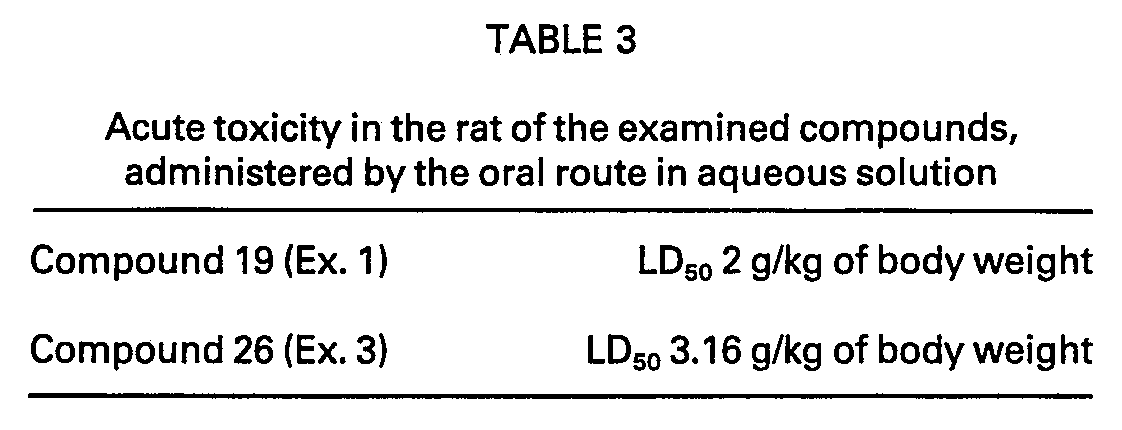
- Acute toxicity in the mouse: groups of Swiss mice (male + female) are treated with graduated doses ranging from 0.125 g/kg to 5 g/kg of body weight with compounds 19 and 26. The compounds are administered orally by intubation and dissolved in water.
- Subsequent death may be immediate or may occur at any time up to 14 days after treatment. The lethal dose 50 (LD50), that is, the dose which causes the death of 50% of the animals, is evaluated by the method of Litchfield and Wilcoxon (J. Pharmacol. Exp. Ther. 96, 99-113, 1949).
- Table 4 shows that the compounds are more toxic in the mouse than in the rat. It is, however, a known fact that different results are obtained from a toxicological point of view, according to the animal species considered.

- The coumarin derivatives of formulas I and IA and their salts, according to the present invention, may be used as platelet antiaggregation drugs for thereapeutic and/or prophylactic purposes. The dosages vary according to the conditions, age and state of the patient. Generally, a daily dose by the oral route of about 20-500 mg for a mammal weighing about 70 kg is advisable. The compounds of the invention with an antitumor and antimetastatic action may be used mainly for the treatment of tumors of various origins.
- The compounds of the invention are generally prepared by conventional synthetic routes and procedures. Typical examples of procedures for the preparation of the compounds of formula I according to the present invention are as follows:
- A. The coumarin derivatives corresponding to formula II:

- B. Expose to a Claisen or Fries reaction, a compound of formula III:

- C. By means of a Friedel-Crafts reaction, introduce a possibly substituted hydrocarbyl group R1 as defined for formula I or introduce a halogen atom R1 by halogenation as defined for formula I in a compound of formula IV:

- D. convert the aldehyde group in the 6-position present in a compound of formula V:

- E. convert a functionally modified hydroxyl group or reagent X present in a compound of formula VI:

- F. convert the -NHZ group into a compound of formula VII:

- G. condense by a Pechmann reaction a compound of formula VIII:


- E. condense by a Perkin reaction a compound of formula X:


- In the above mentioned procedure A, the Mannich reaction can be conducted in the known manner. The formic aldehyde may be used as such or may be formed in situ, for example using agents which generate formaldehyde, such as the polymerized or condensed aldehydes, for example paraformaldehyde or hexamethylenetetramine. All of the solvents recommended or described in the literature for the Mannich reaction may be used. The most suitable solvents are aliphatic alcohols, such as those with 1 to 5 carbon atoms, or aliphatic carboxylic acids, such as those with 2 to 4 carbon atoms. In particular, ethyl alcohol or acetic acid, either as such or containing water, is suitably employed.
- The amine HNR3R4 may be used in its free form, or as one of its salts, such as the hydrochloride or sulfate. The secondary amines particularly suitable for the preparation of the compounds (I) are dimethylamine, diethylamine, pyrrolidine, morpholine, piperidine, 3-hydroxypiperidine, 4-hydroxypiperidine, N-ethylpiperazine and N-hydroxyethylpiperazine. Condensation according to Mannich's method is generally effected at a temperature of between about 20° and 120°C, and preferably between about 50° and 90°C.
- In procedure B, the above mentioned R, in the compounds of formula III may be for example an unsaturated aliphatic hydrocarbyl group, particularly an alkenyl group, with a double bond in the beta- or gamma-position, such as an allylic group, which is transferred in the 8-position by applying a Claisen reaction, carried out by a method which is itself well known. For instance, the starting compound is heated to a suitable temperature, such as between 130° and 230°C with or without a solvent. A tertiary aromatic base, such as dimethylaniline or diethylaniline, can be used as the solvent.
- R, may however also represent a substituted hydrocarbyl group, for instance an acyl group, such as an acetyl, propionyl, butyryl group, etc. In this case, a Fries reaction is used for the transfer of the R1 group in the 8-position and is effected by the known method, for example in the presence of suitable catalysts, such as aluminum chloride in a solvent, which could be for instance carbon disulfide or carbon tetrachloride, at between room temperature and the boiling point of the solvent.
- In the above mentioned procedure C, some compounds of formula I are obtained in which R1 may be a substituted or unsubstituted hydrocarbyl aliphatic, araliphatic or alicyclic group, introduced in the 8- position by applying a Friedel-Crafts reaction by the known method.
- For example, a suitable derivative containing the R, group is heated and bound to a halogen or an oxyhydryl (haloid, alcohol) with compound IV at a suitable temperature, such as between 50° and 120°C in the presence of a solvent and a catalyst.
- Hydrocarbons such as petroleum ether, carboxylic aliphatic acids such as acetic acid, haloids or organic sulfides such as carbon disulfide may be used as solvents, and Lewis acids, such as boron trifluoride, zinc chloride, aluminum chloride, ferric chloride or sulfuric acid are used as catalysts.
- In procedure C, R, may also represent a chlorine or bromine atom. In this case, a halogenation reaction is used for the introduction of the chlorine or bromine atom, by means of the known method for the halogenation of aromatic compounds. For instance, a compound IV is treated with chlorine or bromine and with one of their derivatives in the presence of a solvent and possibly also a catalyst at a suitable temperature.
- In the above mentioned procedure D, the reductive alkylation reaction may be effected in the known way. Aldehyde V is made to react with the amine R4R3NH in the presence of a suitable reducing agent. Leukart's reaction is usually used, in which case the reducing agent is formic acid, formamide or methylformate. The reaction is carried out in a suitable solvent, such as the same reducing agent, at a temperature of between 30° and 100°C. In the above mentioned procedure D, the conversion of a functionally modified hydroxyl group X in the group -NR3R4 is obtained by reaction of the compound of formula VI with the amine NHR3R4 in a suitable solvent according to a known method. A suitable basic compound may be added to the reaction mixture, for instance an inorganic base such as sodium or potassium carbonate, or tertiary organic bases such as pyridine.
- The most suitable solvents for the alkylation reaction are the aliphatic alcohols and aliphatic ketones with between 1 and 5 carbon atoms. A functionally modified and reactive hydroxyl group is especially a hydroxyl group esterified with a hydracid such as hydrochloric, hydrobromic or hydriodic acid, and in this sense X represents chlorine, bromine or iodine, or an organic sulfonic acid such as an alkylsulfonic acid with between 1 and 7 carbon atoms, for example, methylsulfonic acid or ethylsulfonic acid or an arylsulfonic monocyclic acid such as p-toluenesulfonic or benzenesulfonic acid.
- In the above mentioned procedure F, one or both of the R3 and R4 groups, as defined for formula I and taken individually and not jointly, are introduced into the -NHZ group of the compound of formula VII where Z represents respectively one of the above mentioned groups or hydrogen, in order to obtain the compound of formula I, for example by an alkylation or reductive alkylation reaction, according to known methods. The alkylation reaction may be carried out using as an alkylating agent a haloid of the R3-Y or R4-Y formula where Y signifies chlorine, bromine or iodine. When starting compounds with the -CH2-NH2 group in position 6 are used, it is possible to introduce two identical R3 or R4 groups using an excess of alkylating agent. With the correct dose of this agent it is possible to introduce just one of the R3 or R4 groups and the compounds thus obtained may be further alkylated, as described above, thus obtaining, if it should be desired, compounds with the two R3 and R4 groups which differ between themselves. The compounds of the two identical R3 and R4 groups may be advantageously obtained by reductive alkylation. Aldehydes with the same number of carbon atoms and the same substitution present in the R3 or R4 groups may be used as alkylating agents.
- In the above mentioned procedure G, the Pechmann reaction may be carried out in the known way. The phenolic compound corresponding to formula VIII is made to react with the carbonyl compound of formula IX in which the R group corresponds to a hydrogen or an alkyl, preferably with between 1 and 4 carbon atoms. The reaction is carried out using the usual condensing agents for the Pechmann reaction, such as sulfuric, hydrochloric and polyphosphoric acid, phosphorus oxychloride, aluminum chloride and zinc chloride.
- The reaction is generally carried out at a temperature of between about 0° and 80°C. In some cases it is advisable to use those solvents which are recommended or described in the literature for the Pechmann reaction.
- In the above mentioned procedure H, the Perkin's reaction may be carried out in the known way. The aldehyde compound of formula X is made to react with the compound of formula XI in which the R group corresponds to a hydrogen or alkyl, preferably with between 1 and 4 carbon atoms. The reaction is carried out using condensing agents and the solvents recommended or described in the literature for the Perkin's reaction. The reaction is generally carried out at a temperature of between 50° and 110°C.
- The optional introduction of a hydrocarbyl Regroup in compounds of formula IA obtained according to any one of the above mentioned procedures may be effected by means of an etherifying reaction using an etherifying agent derived from the R2 hydroxy alcohol. These etherifying agents are for example R2X alkylation agents, in which R2 signifies a hydrocarbyl group as already described for formula I and X represents a group derived from the functional modification of the hydroxyl, or more precisely, of an ester such as a hydracid ester (and therefore a halogen) or of an inorganic acid such as sulfuric, sulfurous or silicic acid, or of organic sulfonic acids such as the sulfonic acids derived from lower aliphatic hydrocarbons with between 1 and 7 carbon atoms, for example methanesulfonic acid or sulfonic acids derived from aromatic hydrocarbons, especially monocyclic hydrocarbons, such as paratoluenesulfonic or benzenesulfonic acid. X may therefore generally represent a halogen atom, in particular chlorine, bromine or iodine or an alkyl or arylsulfonyloxy, such as the methyl or ethylsulfonyloxy or benzene or p-toluenesulfonyloxy group.
- The above mentioned esterification reaction, represented by the following diagram, may be effected in the known manner. The compound R2X is made to react with the compounds of formula IA or possibly also with their phenolic salts in a suitable solvent.

- A suitable basic compound should be added to the reaction mixture, for instance, an inorganic base such as hydrates or the basic salts of alkali or alkaline earth metals, such as sodium or potassium carbonate, or tertiary organic bases such as pyridine, quinoline, collidine or Huenig's base.
- The most suitable solvents for the previously described alkylation reaction are the aliphatic alcohols such as those with between 1 and 5 carbon atoms, aliphatic ketones or aprotic solvents; in particular acetone, methylethylketone, dimethylsulfoxide and sulfolane may be employed.
- In some of the preparation procedures for the compounds according to the invention, R2 may represent a protection group of the hydroxyl substitutable by hydrogen, that is, a hydroxyl in the 7-position may be temporarily protected during the reactions of the respective procedures and finally liberated. This temporary protection of the hydroxyl group may take place by functional modification as described in the literature, especially by esterification or etherification. Of the esters, it is worth mentioning those with aliphatic araliphatic or aromatic acids having between 1 and 15 carbon atoms such as those mentioned previously, and also acids which give easily saponifiable esters, for example, halogenated lower aliphatic acids, such as trichloro- or trifluoroacetic acid. These ester groups may then be saponified to give the hydroxyl group by well known methods such as alkaline or possibly acid hydrolysis. Of the ethers, those of tertiary lower aliphatic alcohols such as tert-butyl alcohol, which may be hydrolyzed under acid conditions, can be used. Ethers of aliphatic alcohols such as benzyl or nitrobenzyl alcohol may also be prepared and then separated by reduction in the known way. The same protection groups may also serve to protect, perhaps temporarily, an R5 hydroxyl group which is then liberated in the same way. In an independently known way, moieties present in the hydrocarbyl substituents in the protected form can also be liberated, that is, functionally modified, where the protecting groups are easily eliminated. Vice versa, free functions may, if suitable, be converted into their functional derivatives. The transformation of a functional, free or modified group into another functional group, an object of the general preparation procedure, may be effected according to methods described in the literature.
- The compounds obtained according to the above mentioned procedures can be isolated from the reaction mixture in the known way, for example by extraction with organic solvents, such as aliphatic chlorinated hydrocarbides such as methylene chloride, chloroform, dichloroethane, or ester such as ethylacetate, butylacetate, etc.
- Before isolating the reaction products, these may be converted into their salts, which may then be purified. From these salts it is possible to obtain the reaction products in the known manner, for instance by adding a base such as a hydrate of an alkali metal or an ammonium compound or with a suitable ion exchanger.
- The starting compounds to be used in the above mentioned procedures are well known, as are the methods by which they are prepared. For example, the compounds II used to prepare derivatives I and IA according to procedure A can be prepared from the resorcinol derivatives of the formula:

- Protection of the carbonyl functions for example is effected by one of the known methods such as by action of an ethylene glycol under anhydrous conditions in the presence of acid catalysts. Once the Mannich condensation has been obtained, the carbonyl functions can be regenerated by hydrolysis in an acid aqueous solvent.
- The coumarin derivatives of formula I (and therefore also of formula IA) according to the present invention may be used as drugs in pharmaceutical preparations intended for administration to man or animals by intramuscular, subcutaneous or intradermic routes, by injection or intravenous infusion. These preparations may therefore be formulated as solutions of the active compounds or as freeze-dried powders of the active compounds to be mixed with one or more excipients or diluents which are acceptable from a pharmaceutical point of view, and suitable for the above mentioned means of administration and with an osmolarity compatible with physiological liquids.
- Furthermore, the therapeutic compounds of formula I (and therefore also formula IA) of the present invention may be in a solid or semi-solid form and may be administered by the oral or rectal route, in the form of tablets, sugar-coated pills, gelatinous opercula, suppositories, soft gelatine capsules mixed with pharmaceutically acceptable excipients and suitable for this use, or in the form of creams, ointments or sprays for local, such as topical, use. The preparations according to the present invention generally contain between 0.01% and 10% by weight of the active component for the solutions, sprays, ointments and creams and between 1% and 100%, preferably between 5% and 50% by weight, of the active component for the preparations in the solid form. The dosage to be administered depends on the prescription, the desired effect and the chosen route of administration.
- The preparations presented in Examples 29 and 30 may be administered directly to animals or human patients by one of the routes described. Examples 29 and 30 show a few possible pharmaceutical compositions which can be prepared for the treatment of tumor pathologies or platelet hyperaggregation pathology. The pharmaceutical compositions shown in Example 29 are prepared using a double container made of glass. The first contains the active substance in the form of a freeze-dried powder together with a pharmaceutically acceptable excipient. The second container is filled with the desired quantity of solvent. Not until just before administration are the contents of the two flacons mixed and the active substance, in the form of a freeze-dried powder, is rapidly dissolved to produce an injectable solution. The pharmaceutical form preferred by the present invention is that which consists of a container holding the active substance as a freeze-dried powder, as the active substances has proved to be more suitable in a dry, powdered form than in solution.
- Example 30 shows pharmaceutical preparations to be used by the oral route in tumoral pathologies or in pathologies connected with platelet hyperaggregation. The preparations may also be formulated in a gastroresistant form.
- The present invention also includes modifications of the above mentioned procedures, where the procedures are interrupted at a certain point, or where an intermediate compound is used to begin with, after which the subsequent stages are carried out, or where the starting products are formed in situ. The following examples amply illustrate the products, the preparation procedures and the pharmaceutical preparations of the present invention, but are not be be considered as limiting. Unless otherwise noted, the percentages therein and throughout the application are by weight and the temperatures are in degrees Centigrade.
- 30 g of 4-methyl-7-hydroxy-8-allylcoumarin are mixed with 350 ml of ethanol, 24.3 g of dimethylamine aqueous solution at 33% and 5.5 g of paraformaldehyde. The mixture is refluxed for 48 hours, while being continuously agitated; the ethanol is then evaporated in vacuum. The residue is gathered with ethyl acetate and the organic solution is extracted with 1N hydrochloric acid. The acid aqueous layer is alkalinized with sodium bicarbonate and extracted with ethyl acetate. The ethyl acetate extract is dried on anhydrous sodium sulfate and, after filtration, is concentrated to a small volume; precipitation of the crystalline hydrochloride is achieved by adding gaseous hydrochloric acid. The precipitate is separated and crystallized from ethanol; when the crystals have been filtered and dried, the hydrochloride of 4-methyl-6-dimethyl-aminomethyl-7-hydroxy-8-allylcoumarin is obtained.
- MP 216°, Rf 0.46 [thin layer chromatography (silica) chloroform-methanol-acetic acid-water (25 + 15 + 4 + 2)].
- 32.4 g of 4-methyl-7-hydroxy-8-allylcoumarin are mixed with 300 ml of ethanol, 13 g of morpholine and 4.5 g of paraformaldehyde. The mixture is heated to 60° for 48 hours, being continuously agitated in the meantime; the ethanol is then evaporated in vacuum. A saturated solution of sodium bicarbonate is added to the residue and the mixture is then extracted with methylene chloride. The organic solution is extracted 3 times with hydrochloric acid 1N and the aqueous acid layer is neutralised with aqueous ammonium hydroxide at 32%; a suspension is thus formed which is then filtered. The precipitate is vacuum dried and then treated with ethyl acetate; precipitation of the crystalline hydrochloride is achieved by addition of gaseous hydrochloric acid. The precipitate is separated and then crystallised by ethanol; after filtration and drying of the crystals, hydrochloride of 4-methyl-6-(4-morpholinylmethyl)-7-hydroxy-8-allylcoumarin is obtained.
- MP 234°, Rf 0.78 [thin layer chromatography (silica) chloroform-methanol-water-ammonium hydroxide 32% (130 + 25 + 2.8 + 0.5)].
- 21.6 g of 4-methyl-7-hydroxy-8-allylcoumarin are mixed with 250 ml of ethanol, 16.9 g of 1-(2-hydroxyethyl)piperazine and 11.2 g of formaldehyde aqueous solution at 35%. The mixture is heated to 70° for 48 hours, being continuously agitated meanwhile; the ethanol is then evaporated in vacuum. A saturated solution of sodium bicarbonate is added to the residue and the mixture is extracted with methylene chloride. The organic solution is extracted 3 times with hydrochloric acid 1N and the acid aqueous layer is alkylated with bicarbonate of soda and extracted with toluene. The toluenic solution is dried on anhydrous sodium sulfate, filtered and the solvent is then eliminated in vacuum. The residue is gathered with ethyl acetate and the formation of crystalline hydrochloride is achieved by adding gaseous hydrochloric acid. The precipitate is separated and crystallised with 95% ethanol; after filtration and drying of the crystals dichlorohydrate of 4-methyl-6-[[4-(2-hydroxyethyl)-I-piperazinyl]methyl]-7-hydroxy-8- allylcoumarin is obtained.
- MP 201°, Rf 0.52 [thin layer chromatography (silica) chloroform-methanol-water-ammonium hydroxide 32% (130 + 25 + 2.8 + 0.5)].
- 16 g of 4-methyl-6-(4-morpholinylmethyl)-7-hydroxy-8-allylcoumarin are mixed with 300 ml of toluene and 1.25 g of sodium hydride. The mixture is gradually heated to 60°, being continuously agitated meanwhile; after thirty mninutes' heating the solvent is evaporated in vacuum. The residue is solubilised with 100 ml of dimethylsulfoxide and to this solution, kept at room temperature, 9.8 g of ethyl chloroacetate are added; after twelve hours 300 ml of toluene are added and the organic mixture is washed with water. The toluenic solution is reduced to a small volume in vacuum and the formation of crystalline hydrochloride is achieved by adding gaseous hydrochloric acid. The precipitate is separated and then crystallized in ethanol; after filtering and drying the crystals, hydrochloride of 4-methyl-6-(4-morpholinylmethyl)-7-(ethoxylcarbonylmethoxy)-8-allylcoumarin is obtained.
- MP 176°, Rf 0.85 [thin layer chromatography (silica) chloroform-methanol-acetic acid-water (25 + 15 +4 + 2)].
- 16 g of 4-methyl-6-(4-morpholinyl)-7-hydroxy-8-allylcoumarin are treated as in the case of example 4 until precipitation of the hydrochloride. 6.1 g of allyl bromide are used in place of the ethyl chloroacetate. The precipitate is separated and crystallised in ethanol; after filtering and drying the crystals hydrochloride of the 4-methyl-6-(4-morpholinylmethyl)-7-allyloxy-8-allyl coumarin is obtained.
- MP 203°, Rf 0.76 [thin layer chromatography (silica) chloroform-methanol-water-ammonium hydroxide 32% (130 + 25 + 2.8 + 0.5)].
- 9.5 g of 4-methyl-6-(4-morpholinylmethyl)-7-hydroxy-8-allylcoumarin are mixed with 300 ml of toluene and 0.8 g of sodium hydride. The mixture is gradually heated to 60°, being constantly agitated meanwhile; after 30 minutes' heating the solvent is evaporated in vacuum. The residue is solubilised with 100 ml of dimethylsulfoxide and 5.9 g of ethyl a-bromoisobutyrate are added to the solution which is kept at a temperature of 60°. After 48 hours 300 ml of toluene are added and the organic mixture is washed with water. The toluenic solution is reduced to a small volume in vacuum and formation of crystalline hydrochloride is achieved by addition of gaseous hydrochloric acid. The precipitate is separated and crystallised with ethanol; after filtering and drying the crystals, hydrochloride of the ethyl ester of the 2-[4-methyl-6-(4-morpholinylmethyl)-8-allylcoumarin-7-yl]oxy-2-methylpropionic acid is obtained.
- MP 171°, Rf 0.79 [thin layer chromatography (silica) chloroform-methanol-water-ammonium hydroxide 32% (130 + 25 + 2.8 + 0.5)].
- 20 g of 4-phenyl-7-hydroxy-8-allylcoumarin are mixed with 200 ml of 80% aqueous ethanol, 6.3 g of morpholine and 6.2 g of 35% formaldehyde aqueous solution. The same procedure as in the case of example 1 is used until precipitation of the hydrochloride. The precipitate is separated and crystallised with ethanol; after filtering and drying the crystals, hydrochloride of 4-phenyl-6-(4-morpholinylmethyl)-7-hydroxy-8-allylcoumarin is obtained.
- MP 208°, Rf 0.87 [thin layer chromatography (silica) chloroform-methanol-water-ammonium hydroxide 32% (130 + 25 + 2.8 + 0.5)].
- 15 g of 4-phenyl-7-hydroxy-8-allylcoumarin are mixed with 200 ml of ethanol, 7 g of 1-(2-hydroxyethyl)piperazine and 4.6 g of 35% formaldehyde aqueous solution. The mixture is refluxed for 48 hours, being kept in constant agitation meanwhile. The ethanol is then evaporated in vacuum. The residue is gathered with ethyl acetate and the organic solution is extracted with hydrochloric acid 1 N. The aqueous acid layer is alkalinized with sodium bicarbonate; a suspension is formed which is then filtered. The precipitate is vacuum dried and then treated with ethyl acetate; precipitation of the crystalline hydrochloride is achieved by adding gaseous hydrochloric acid. The precipitate is separated and crystallised with ethanol; after filtering and drying the crystals, dihydrochloride of 4-phenyl-6-[[4-(2-hydroxyethyl)-1-piperazinyl]methyl]-7-hydroxy-8-allylcoumarin is obtained.
- MP 250°, Rf 0.74 [thin layer chromatography (silica) chloroform-methanol-acetic acid-water (25+15+4+2)].
- 20 g of 4-phenyl-6-(4-morpholinylmethyl)-7-hydroxy-8-allylcoumarin are mixed with 300 ml of toluene and 1.35 g of sodium hydride. The mixture is gradually heated to 60°, being constantly agitated in the meantime. After 30 minutes' heating the solvent is evaporated in vacuum. The residue is solubilised with 100 ml of dimethylsulfoxide and 6.4 g of allyl bromide; after 12 hours 300 ml of toluene are added and the organic mixture is washed with water. The toluenic solution is extracted with hydrochloric acid 1 N and the aqueous solution of alkalinized with sodium carbonate and then extracted with methylene chloride. The methylene chloride solution is dried on anhydrous sodium sulfate and the solvent is eliminated in vacuum after filtration. The residue is gathered with toluene and formation of crystalline hydrochloride is achieved by adding gaseous hydrochloric acid. The precipitate is gathered and then crystallised with ethanol; after filtering and drying the crystals, hydrochloride of 4-phenyl-6-(4-morpholinylmethyl)-7-allyloxy-8-allyl- coumarin is obtained.
- MP 208°, Rf 0.87 [thin layer chromatography (silica) chloroform-methanol-water-ammonium hydroxide 32% (130 + 25 + 2.8 + 0.5)].
- 24 g of 4-phenyl-6-(4-morpholinylmethyl)-7-hydroxy-8-allylcoumarin are mixed with 300 ml of toluene and 1.6 g of sodium hydride. The mixture is gradually heated to 60°, being constantly agitated meanwhile; after 30 minutes' heating the solvent is evaporated in vacuum. The residue is solubilised with 100 ml of dimethylsulfoxide and 8 g of ethyl chloroacetate are added to the solution, which is kept at a temperature of 60°; after 24 hours 300 ml of toluene are added and the organic mixture is washed with water. The toluenic solution is extracted with hydrochloric acid 1N and the acid aqueous solution is alkalinised with sodium bicarbonate. A suspension is thus formed which is then filtered. The precipitate is vacuum dried and then gathered with toluene; the precipitation of the crystalline hydrochloride is achieved by adding gaseous hydrochloric acid. The precipitate is separated and then crystallised with ethanol; after filtering and drying the crystals, the hydrochloride of the ethyl ester of [4-phenyl-6-(4-morpholinylmethyl)-8-allylcoumarin-7-yl)oxy acetic acid is obtained.
- MP 108°, Rf 0.88 [thin layer chromatography (silica) chloroform-methanol-water-ammonium hydroxide 32% (130 + 25 + 2.8 + 0.5)].
- 20 g of 4-phenyl-6-(4-morpholinylmethyl)-7-hydroxy-8-allylcoumarin are mixed with 300 ml of tolene and 1.35 g of sodium hydride, the mixture is gradually heated to 60°, being constantly agitated meanwhile. After thirty minutes' heating the solvent is evaporated in vacuum. The residue is solubilized with 100 ml of dimethylsulfoxide and 11.7 g of ethyl a-bromoisobutyrate are added to the solution, which is kept at a temperature of 60°.
- After 72 hours 300 ml of toluene are added to the organic mixture which is then washed with water. The toluenic solution is extracted with hydrochloric acid 1N and the aqueous solution is alkalinized with sodium bicarbonate; a suspension is thus formed which is subsequently filtered. The precipitate is vacuum dried and then gathered with toluene; precipitation of the crystalline hydrochloride is achieved by adding gaseous hydrochloric acid. The precipitate is separated and crystallized with ethanolic solution by adding ethyl acetate; after filtering and drying the crystals, hydrochloride of the ethyl ester of 2-[4-phenyl-6-(4-morpholinylmethyl)-8-allylcoumarin-7-yl]oxy-2-methylpropionic acid is obtained.
- MP 191°, Rf 0.83 [thin layer chromatography (silica) chloroform-methanol-water-ammonium hydroxide 32% (130 + 25 + 2.8 + 0.5)].
- 25 g of 4-methyl-7-hydroxy-8-allylcoumarin are mixed with 300 ml of absolute ethanol, 8.3 g of pyrrolidine and 3.4 g of paraformaldehyde. The procedure then is the same as in example 1 until the precipitation of the hydrochloride. The precipitate is separated and then crystallized with ethanol; after filtering and drying the crystals, hydrochloride of the 4-methyl-6-(1-pyrrolidinylmethyl)-7-hydroxy-8-allyl- coumarin is obtained.
- MP 116°, Rf 0.62 [thin layer chromatography (silica) chloroform-methanol-acetic acid-water (25+15+4+2)].
- 25 g of 4-methyl-7-hydroxy-8-allylcoumarin are mixed with 350 ml of ethanol, 8.9 g of diethylamine and 3.9 g of paraformaldehyde. The mixture is refluxed for 60 hours, being kept in constant agitation meanwhile; the ethanol is then evaporated in vacuum. The residue is gathered with ethyl acetate and the organic solution is extracted with hydrochloric acid 1 N. The aqueous acid layer is alkalinized with sodium bicarbonate and then extracted with methylene chloride. The methylene chloride solution is dried on anhydrous sodium sulfate, filtered and then the solvent is eliminated in vacuum. The residue is gathered with ethyl acetate and the formation of crystalline hydrochloride is achieved by adding gaseous hydrochloric acid. The precipitate is separated and then crystallized with isopropanol; after filtering and drying the crystals, hydrochloride of 4-methyl-6-diethylaminomethyl-7-hydroxy-8-allylcoumarin is obtained.
- MP 188°, Rf 0.72 [thin layer chromatography (silica) chloroform-methanol-acetic acid-water (25+15+4+2)].
- 25 g of 4-methyl-7-hydroxy-8-allylcoumarin are mixed with 300 ml of ethanol, 9.9 g of piperidine and 3.4 g of paraformaldehyde. The mixture is refluxed for 96 hours, being kept constantly agitated meanwhile. The ethanol is evaporated in vacuum, after which the procedure is the same as for example 8 until precipitation of the hydrochloride. The precipitate is separated and then crystallized with ethanol, after filtering and drying the crystals, hydrochloride of 4-methyl-6-(1-piperidinylmethyl)-7-hydroxy-8-allyl- coumarin is obtained.
- MP 234°, Rf 0.84 [thin layer chromatography (silica) chloroform-methanol-water-ammonium hydroxide 32% (130 + 25 + 2.8 + 0.5)].
- 30 g of 4-methyl-7-hydroxy-8-allylcoumarin are mixed with 300 ml of ethanol, 14.1 g of 4-hydroxypiperidine and 4.2 g of paraformaldehyde. The procedure is then the same as for example 8 until precipitation of the hydrochoride. The precipitate is separated and then crystallized with ethanol; after filtering and drying the crystals, hydrochloride of the 4-methyl-6-[(4-hydroxy-I-piperidinyl)methyl]-7-hydroxy-8-allylcoumarin is obtained.
- MP 252°, Rf 0.55 [thin layer chromatography (silica) chloroform-methanol-acetic acid-water (25+15+4+2)].
- 30 g of 4-methyl-7-hydroxy-8-allylcoumarin are mixed with 300 ml of ethanol, 14.1 g of 3-hydroxypiperidine and 4.2 g of paraformaldehyde. The mixture is refluxed for 24 hours, being kept in constant agitation meanwhile. The ethanol is evaporated in vacuum and the procedure is then the same as for example 13 until the formation of hydrochloride. The precipitate is separated and then crystallized from ethanol solution by adding ethyl acetate; after filtering and drying the crystals, hydrochloride of 4-methyl-6-[(3-hydroxy-1-piperidinyl) methyl]-7-hydroxy-8-allylcoumarin is obtained.
- MP 184°, Rf 0.46 [thin layer chromatography (silica) chloride of methylene-ethyl acetate-methanol (70 + 30 + 5)] is obtained.
- 6.19 g of 3-(2-diethylaminoethyl)-4-methyl-7-hydroxy-8-chlorocoumarin are mixed with 200 ml of ethanol, 3.5 g of morpholine and 1.7 g of aqueous solution of 35% formaldehyde. The mixture is refluxed for 24 hours, being kept in constant agitation meanwhile. The ethanol is then evaporated in vacuum and the residue is gathered with ethyl acetate; a suspension is thus formed which is then filtered; the organic solution is extracted with hydrochloric acid 1 N. The aqueous acid layer is alkalinized with sodium bicarbonate and then extracted with methylene chloride. The methylene chloride solution is dried on anhydrous sodium sulfate and, after filtration, the solvent is eliminated in vacuum. The residue is gathered . with ethyl acetate and the formation of crystalline hydrochloride is achieved by adding gaseous hydrochloric acid. The precipitate is separated and crystallized from 95% ethanol; after filtering and drying the crystals, hydrochloride of 3-(diethylaminoethyl)-4-methyl-6-(4-morpholinylmethyl)-7-hydroxy-8-chloro- coumarin is obtained.
- MP 174°, Rf 0.56 [thin layer chromatography (silica) chloroform-methanol-water-ammonium hydroxide 32% (130 + 25 + 2.8 + 0.5)].
- 18 g of 3-(2-diethylaminoethyl)-4-methyl-6-(4-morpholinylmethyl)-7-hydroxy-8-chlorocoumarin are mixed with 300 ml of acetone, 12.2 g of potassium carbonate and 5.4 g of ethyl chloroacetate; the mixture is gradually brought to the boiling point, being kept in constant agitation meanwhile, and then refluxed for 24 hours. The solvent is then evaporated in vacuum. The residue is gathered with 300 ml of toluene and the mixture is treated with water. The toluenic layer is separated and then extracted with hydrochloric acid 1 N; the aqueous acid solution is alkalinized with sodium bicarbonate; a suspension is thus formed which is then filtered. The precipitate is vacuum dried and then gathered with toluene; the formation of crystalline hydrochloride is achieved by addition of gaseous hydrochloric acid.
- The precipitate is separated and crystallized from ethanol; after filtering and drying the crystals, hydrochloride of the ethyl ester of [3-(2-diethylaminoethyl)-4-methyl-6-(4-morpholinylmethyl)-8-chlorocoumarin-7-yl]oxy acetic acid is obtained.
- MP 182°, Rf 0.62 [thin layer chromatography (silica) chloroform-methanol-acetic acid-water (25 + 15 + 4 + 2)].
- 16 g of 3-(2-diethylaminoethyl)-4-methyl-6-(4-morpholinylmethyl)-7-hydroxy-8-chlorocoumarin are mixed with 300 ml of acetone, 10.8 g of potassium carbonate and 4.8 g of allylbromide. The procedure is then the same as for example 18 until the precipitation of the hydrochloride. The precipitate is separated and crystallized from ethanolic solution by adding ethyl ether; after filtering and drying the crystals, hydrochloride of 3-(2-diethylaminoethyl)-4-methyl-6-(4-morpholinylmethyl)-7-allyloxy-8-chlorocoumarin is obtained.
- MP 150°, Rf 0.35 [thin layer chromatography (silica) chloroform-methanol-acetic acid-water (25 + 15 + 4 + 2)] is obtained.
- 16 g of 3-(2-diethylaminoethyl)-4-methyl-6-(4-morpholinylmethyl)-7-hydroxy-8-chlorocoumarin are mixed with 300 ml of toluene and 1 g of sodium hydride; the mixture is gradually heated to a temperature of 60°, being kept in constant agitation in the meantime; after thirty minutes' heating the solvent is evaporated in vacuum. The residue is solubilized with 100 ml of dimethylsulfoxide and 7.6 g of ethyl a-bromoisobutyrate are added to the solution, which is kept at room temperature; after 48 hours 300 ml of toluene are added and the organic mixture is washed with water. The toluenic solution is extracted with hydrochloric acid 1N and the acid aqueous solution, after being alkalinized with sodium carbonate, is extracted with methylene chloride. The methylene chloride solution is dried on anhydrous sodium sulfate, filtered and the solvent is then eliminated in vacuum. The residue is gathered with toluene and the formation of crystalline hydrochloride is achieved by adding gaseous hydrochloric acid. The precipitate is separated and crystallized from ethanol; after filtering and drying the crystals, dihydrochloride of the ethyl ester of 2-[3-(2-diethylaminoethyl)-4-methyl-6-(4-morpholinylmethyl)-8-chlorocoumarin-7-yl]oxy-2-methyl- propionic acid is obtained.
- MP 148°, Rf 0.51 [thin layer chromatography (silica) chloroform-methanol-acetic acid-water (25 + 15 + 4 + 2)].
- 20 g of 4-methyl-7-hydroxy-8-chlorocoumarin are mixed with 300 ml of ethanol, 16.5 g of morpholine and 8 g of 35% formaldehyde aqueous solution. The mixture is refluxed for 48 hours, being kept in constant agitation meanwhile, and after 12 hours a suspension is obtained which is then filtered. The precipitate is dissolved in methylene chloride and the organic solution is extracted with aqueous solution of 10% acetic acid; the organic solution is then extracted (3 times) with hydrochloric acid 1 N. The aqueous hydrochloric layer is alkalinized with sodium bicarbonate; a suspension is thus formed which is then filtered. The precipitate is vacuum dried and then treated with ethyl acetate; the precipitation of the crytalline hydrochloride is achieved by adding gaseous hydrochloric acid. The precipitate is then separated and crystallized from methanol. After filtering and drying the crystals, hydrochloride of 4-methyl-6-(4-morpholinylmethyl)-7-hydroxy-8-chlorocoumarin is obtained.
- MP 227°, Rf 0.80 [thin layer chromatography (silica) chloroform-methanol-acetic acid-water (25 + 15 + 4 + 2)] is obtained.
- 21 g of 4-methyl-7-hydroxy-8-chlorocoumarin are mixed with 180 ml of ethanol, 20 ml chloroform, 9.5 g of diethylamine and 11.2 g of 35% aqueous formaldehyde solution. The mixture is refluxed for 20 hours, being kept in constant agitation meanwhile; the ethanol and chloroform are evaporated in vacuum. The residue is solubilized in the methylenechloride-ethyl acetate-methanol mixture (7 + 3 + 1) and the solution is used for a chromatographic separation on silica, eluting with the same mixture of solvents. 4-methyl-6-diethylaminomethyl-7-hydroxy-8-chlorocoumarin is thus obtained. It is then treated with ethyl acetate and then, by adding gaseous hydrochloric acid, crystalline hydrochloride is formed. The precipitate is separated and crystallized from ethyl acetate. After filtering and drying the crystals, hydrochloride of 4-methyl-6-diethylaminomethyl-7-hydroxy-8-chlorocoumarin is obtained.
- MP 202°, Rf 0.67 [thin layer chromatography (silica) chloroform-methanol-acetic acid-water (25 + 15 + 4 + 2)].
- 20 g of 4-phenyl-7-hydroxy-8-chloro coumarin are mixed with 300 ml of ethanol, 12.1 g of morpholine and 4.2 g of paraformaldehyde. The mixture is refluxed for 96 hours, being constantly agitated in the meantime; it is brought to room temperature and after 12 hours a suspension is obtained which is then filtered. The precipitate is dissolved in hydrochloric acid 1 N and the resulting solution is extracted (3 times) with methylene chloride. Evaporation of the solvent produces a methylene chloride solution from which a chloride residue is obtained. The precipitate is crystallized from ethyl acetate; after filtering and drying the crystals, hydrochloride of 4-phenyl-6-(4-morpholinylmethyl)-7-hydroxy-8-chlorocoumarin is obtained.
- MP 225°, Rf 0.79 [thin layer chromatography (silica) chloroform-methanol-water-ammonium hydroxide 32% (130 + 25 + 2.8 + 0.5)].
- 24.5 g of 3-(2-diethylaminoethyl)-4-methyl-6-(4-morpholinylmethyl)-7-hydroxy-8-chlorocoumarin are mixed with 300 ml of toluene and 1.6 g of sodium hydrate; the mixture is gradually heated to 60°, being constantly agitated meanwhile; after 30 minutes' heating the solvent is evaporated in vacuum. The residue is solubilized with 100 ml of dimethylsulfoxide and 7.5 g of dimethyl sulfate are added to the solution, which is kept at a temperature of 80°; after 48 hours 300 ml of toluene are added and the organic mixture is washed with water. The toluene solution is extracted with hydrochloric acid 1N and the acid aqueous solution is alkalinized with sodium bicarbonate; a suspension is thus formed which is then filtered. The precipitate is vacuum dried and gathered with toluene; crystalline hydrochloride is formed by the addition of gaseous hydrochloric acid.
- The precipitate is separated and crystallized from ethanol. After filtering and drying the crystals, dihydrochloride of 3-(2-diethylaminoethyl)-4-methyl-6-(4-morpholinylmethyl)-7-methoxy-8-chloro- coumarin is obtained.
- MP 181°, Rf 0.41 [thin layer chromatography (silica) chloroform-methanol-acetic acid-water (25 + 15 + 4 + 2)].
- 30 g of 4-methyl-7-hydroxy-8-chlorocoumarin are mixed with 200 ml of ethanol, 38.2 g of 33% dimethylamine aqueous solution and 8.5 g of paraformaldehyde. The mixture is refluxed for 72 hours, being constantly agitated in the meantime. The ethanol is evaporated in vacuum. The procedure is then the same as for example 8 until the precipitation of the hydrochloride. The precipitate is separated and crystallized from ethyl acetate; afer filtering and drying the crystals, hydrochloride of 4-methyl-7-hydroxy-6-dimethylaminomethyl-7-hydroxy-8-chlorocoumarin is obtained.
- MP 238°, Rf 0.27 [thin layer chromatography (silica) chloroform-methanol-acetic acid-water (25 + 15 + 4 + 2)].
- 30 g of 4,8-dimethyl-7-hydroxycoumarin are mixed with 300 ml of ethanol, 50 ml of chloroform, 27.1 g of 33% dimethylamine aqueous solution and 6 g of paraformaldehyde. The mixture is refluxed for 48 hours, being constantly agitated meanwhile. The ethanol and chloroform are evaporated in vacuum. The procedure is then the same as for example 13 until the formation of hydrochloride. The precipitate is separated and then crystallized from 95% ethanol; after filtering and drying the crystals, hydrochloride of 4,8-dimethyl-6-dimethylaminomethyl-7-hydroxycoumarin is obtained.
- MP 252°, Rf 0.77 [thin layer chromatography (silica) chloroform-methanol-acetic acid-water (25 + 15 + 4 + 2)].
- 30 g of 4,8-dimethyl-7-hydroxycoumarin are mixed with 300 ml of 85% aqueous ethanol, 13,8 g of morpholine and 4.8 g of paraformaldehyde. The mixture is refluxed for 96 hours, being constantly agitated meanwhile; it is then brought to a temperature of 5° and after 12 hours a suspension is obtained which is then filtered. The precipitate is vacuum dried and then treated with ethyl acetate. Precipitation of the crystalline hydrochloride is achieved by adding gaseous hydrochloric acid. The precipitate is separated and crystallized from ethanol. After filtering and drying the crystals, hydrochloride of 4.8-dimethyl-6-(4-morpholinylmethyl)-7-hydroxy coumarin is obtained.
- MP 238°, Rf 0.84 [thin layer chromatography (silica) chloroform-methanol-acetic acid-water (130 + 25 + 2.8 + 0.5)].
- 18 g of 4-phenyl-7-hydroxy-8-allyl coumarin are mixed with 250 ml of ethanol, 23.4 g of 18.5% dimethylamine aqueous solution and 5.6 g of 35% formaldehyde aqueous solution. The mixture is refluxed for 60 hours, being constantly agitated meanwhile. The ethanol is evaporated in vacuum. The procedure is then the same as for example 8 until the precipitation of the hydrochloride. The precipitate is separated and crystallized from 95% ethanol. After filtering and drying the crystals, hydrochloride of 4-phenyl-6-dimethylaminomethyl-7-hydroxy-8-allylcoumarin is obtained.
- MP 199°, Rf 0.82 [thin layer chromatography (silica) chloroform-methanol-acetic acid-water (25 + 15 + 4 + 2)].
- Preparaton with antitumoral and antimetastatic activity in the form of an aqueous solution.
-
- a. one freeze-dried flacon contains:
- - compound 19 (Ex. 1) mg 10
- - mannitol mg 10
- b. one vial of solvent contains:
- - sodium chloride mg 18
- - apyrogenetic distilled water ml 2
- Preparation with platelet antiaggregating activity in the form of an aqueous solution.
-
- a. one freeze-dried flacon contains:
- - compound 121 (Ex. 13) mg 30
- - mannitol mg 30
- b. one 5 ml vial of solvent contains:
- - sodium chloride mg 45
- - apyrogenetic distilled water ml 5
- Preparation with an antitumoral and antimetastatic activity in the form of an aqueous solution.
-
- a. one freeze-dried vial contains:
- - compound 26 (Ex. 3) mg 50
- - mannitol mg 30
- b. one 3 ml vial of solvent contains:
- - sodium chloride mg 27
- - apyrogenetic distilled water ml 3
- Preparation with platelet antiaggregating activity in the form of an aqueous solution.
-
- a. one freeze-dried vial contains:
- - compound 117 (Ex. 12) mg 40
- - mannitol mg 25
- b. one 5 ml vial of solvent contains:
- - sodium chloride mg 45
- - apyrogenetic distilled water ml 5
- Preparation with an antitumoral and platelet antiaggregating activity in tablet form.
- each tablet contains:
- -compound 19 (Ex. 1) mg. 20
- - microcrystalline cellulose mg. 150
- - lactose mg. 20
- -starch mg. 10
- -magnesium stearate mg. 5
- Preparation with a platelet antiaggregating activity in the form of sugar-coated pills.
- each pill contains:
- -compound 124 (Ex. 14) mg. 30
- -carboxymethyl cellulose mg. 150
- ―starch mg. 15
- -shellac mg. 10
- - saccharose mg. 35
- -colouring mg. 0.5
- Preparation with an antitumoral and antimetastatic-activity in the form of gelatinous opercula.
- each gelatinous operculum contains:
- -compound 26 (Ex. 3) mg. 40
- - lactose mg. 100
- - gastroresistant varnish mg. 5
- Preparation with a platelet antiaggregating activity in capsule form.
- each soft gelatine capsule contains:
- -compound 28 (Ex. 5) mg. 50
- - vegetable oil mg. 200
- - beeswax mg. 20
- - gelatine mg.150
- - glycerine mg. 50
- -coloring mg. 3
Claims (35)

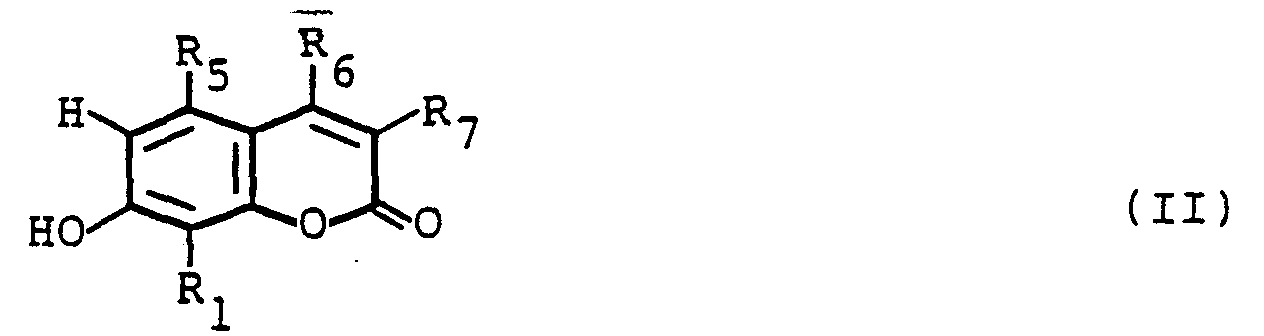


and pharmaceutically acceptable salts of these compounds.
Priority Applications (1)
| Application Number | Priority Date | Filing Date | Title |
|---|---|---|---|
| AT84304976T ATE60329T1 (en) | 1983-07-29 | 1984-07-20 | CUMARIN DERIVATIVES, PHARMACEUTICAL PREPARATIONS CONTAINING THEM AND THEIR USE IN THE TREATMENT OF CANCER. |
Applications Claiming Priority (2)
| Application Number | Priority Date | Filing Date | Title |
|---|---|---|---|
| IT8348791A IT1212882B (en) | 1983-07-29 | 1983-07-29 | BASIC DERIVATIVES OF CUMARINA |
| IT4879183 | 1983-07-29 |
Publications (3)
| Publication Number | Publication Date |
|---|---|
| EP0133766A2 EP0133766A2 (en) | 1985-03-06 |
| EP0133766A3 EP0133766A3 (en) | 1985-12-27 |
| EP0133766B1 true EP0133766B1 (en) | 1991-01-23 |
Family
ID=11268572
Family Applications (1)
| Application Number | Title | Priority Date | Filing Date |
|---|---|---|---|
| EP84304976A Expired - Lifetime EP0133766B1 (en) | 1983-07-29 | 1984-07-20 | Coumarin derivatives, pharmaceutical compositions containing the same, and the use thereof in the treatment of cancer |
Country Status (25)
| Country | Link |
|---|---|
| US (1) | US4737517A (en) |
| EP (1) | EP0133766B1 (en) |
| JP (1) | JPS6054378A (en) |
| KR (1) | KR870001483B1 (en) |
| AR (2) | AR240816A1 (en) |
| AT (1) | ATE60329T1 (en) |
| AU (1) | AU581853B2 (en) |
| BE (1) | BE900225A (en) |
| CH (1) | CH662563A5 (en) |
| DE (1) | DE3483989D1 (en) |
| DK (1) | DK354784A (en) |
| ES (4) | ES8602739A1 (en) |
| FI (1) | FI85269C (en) |
| FR (1) | FR2549832B1 (en) |
| GR (1) | GR82014B (en) |
| HU (2) | HUT36815A (en) |
| IL (1) | IL72515A (en) |
| IN (1) | IN161176B (en) |
| IT (1) | IT1212882B (en) |
| LU (1) | LU85476A1 (en) |
| MX (1) | MX162759A (en) |
| NO (1) | NO843042L (en) |
| NZ (1) | NZ209003A (en) |
| PT (1) | PT78986B (en) |
| ZA (1) | ZA845670B (en) |
Families Citing this family (16)
| Publication number | Priority date | Publication date | Assignee | Title |
|---|---|---|---|---|
| WO1990008529A2 (en) * | 1989-01-23 | 1990-08-09 | Lehigh University | 7-alkoxycoumarins, dihydropsoralens, and benzodipyranones as photo-activated therapeutic agents and inhibitors of epidermal growth factor |
| US5356929A (en) * | 1989-01-23 | 1994-10-18 | Lehigh University | Reduced and quaternized psoralens as photo-activated therapeutics |
| US6251644B1 (en) | 1990-04-16 | 2001-06-26 | Baxter International, Inc. | Method for inactivating non-enveloped viral contaminants with a photosensitizer by increasing viral permeability to the photosensitizer |
| US5516629A (en) * | 1990-04-16 | 1996-05-14 | Cryopharm Corporation | Photoinactivation of viral and bacterial blood contaminants using halogenated coumarins |
| US5484951A (en) * | 1990-10-19 | 1996-01-16 | Octamer, Incorporated | 5-iodo-6-amino-6-nitroso-1,2-benzopyrones useful as cytostatic and antiviral agents |
| US5482975A (en) * | 1991-10-22 | 1996-01-09 | Octamer, Inc. | Adenosine diphosphoribose polymerase binding nitroso aromatic compounds useful as retroviral inactivating agents, anti-retroviral agents and anti-tumor agents |
| US5877185A (en) * | 1991-10-22 | 1999-03-02 | Octamer, Inc. | Synergistic compositions useful as anti-tumor agents |
| US5783599A (en) * | 1993-02-24 | 1998-07-21 | Octamer Inc | Methods of treating cancer and viral infections with 5-iodo-6-amino-and 5-iodo-6-nitroso-1 2-benzopyrones |
| DE69425210T2 (en) * | 1993-04-13 | 2001-03-01 | Morinaga Milk Industry Co. Ltd., Tokio/Tokyo | CUMARIN DERIVATIVES AND THEIR USE |
| DE10352535A1 (en) * | 2003-11-07 | 2005-06-16 | Steag Microparts Gmbh | A microstructured separator and method of separating liquid components from a liquid containing particles |
| US20050245489A1 (en) * | 2004-05-03 | 2005-11-03 | Pinney Kevin G | Chromene-containing compounds with anti-tubulin and vascular targeting activity |
| US7456214B2 (en) * | 2004-05-03 | 2008-11-25 | Baylor University | Chromene-containing compounds with anti-tubulin and vascular targeting activity |
| BRPI0404130A (en) * | 2004-09-20 | 2006-05-02 | Univ Rio De Janeiro | substituted coumarins, process for producing such coumarins and compositions containing the same |
| CN104529972B (en) * | 2014-10-10 | 2016-05-18 | 北京工业大学 | Kinases inhibitor cumarin and preparation method thereof and medical applications |
| KR102053748B1 (en) | 2017-12-20 | 2019-12-09 | 강원대학교산학협력단 | Pharmaceutical composition for preventing or treating allergic inflammatory response comprising coumarin derivative |
| CN112778258B (en) * | 2021-01-05 | 2022-02-01 | 苏州大学 | Amide derivative neutral mitochondrial fluorescent marker and preparation method and application thereof |
Family Cites Families (7)
| Publication number | Priority date | Publication date | Assignee | Title |
|---|---|---|---|---|
| US3515721A (en) * | 1967-06-26 | 1970-06-02 | Cassella Farbwerke Mainkur Ag | 3-tertiary-aminoethyl-4-methyl or phenyl-7-ethoxycarbonylmethoxy - halo or mononitro coumarins and congeners |
| BE761985A (en) * | 1970-10-19 | 1971-07-01 | Recordati Chem Pharm | PROCESS FOR THE PREPARATION OF N-ALCOYL-DIMETHYLAMINES |
| US3880885A (en) * | 1971-11-23 | 1975-04-29 | Sandoz Ag | Tertiary aminoethyl isochromans and isocoumarins |
| IT1088554B (en) * | 1977-11-17 | 1985-06-10 | F I D I A Spa | SELLECTIVE PROCEDURE FOR THE PREPARATION OF DERIVATIVES OF 7-INDROSSI CUMARINA |
| IT1160366B (en) * | 1978-12-19 | 1987-03-11 | F I D I A Spa | PHARMACOLOGICAL AND THERAPEUTIC APPLICATIONS OF 8-CHLORINE-3 (BETA-DIETYLAMINCETYL) -4-METHYL-7-ETHOXY-CARBONYLMETHOXY CUMARINE HYDROCHLORIDE PREPARED IN THE PURE STATE WITH A SELECTIVE PROCEDURE WITH PARTICULAR RELEVANCE TO ITS ACTIVITY |
| US4321270A (en) * | 1981-01-29 | 1982-03-23 | E. R. Squibb & Sons, Inc. | Substituted chromans |
| CA1205028A (en) * | 1981-07-01 | 1986-05-27 | Jerald C. Hinshaw | Fluorescent chelates and labeled specific binding reagents prepared therefrom |
-
1983
- 1983-07-29 IT IT8348791A patent/IT1212882B/en active
-
1984
- 1984-07-19 DK DK354784A patent/DK354784A/en not_active Application Discontinuation
- 1984-07-20 DE DE8484304976T patent/DE3483989D1/en not_active Expired - Lifetime
- 1984-07-20 EP EP84304976A patent/EP0133766B1/en not_active Expired - Lifetime
- 1984-07-20 AT AT84304976T patent/ATE60329T1/en not_active IP Right Cessation
- 1984-07-20 FR FR8411537A patent/FR2549832B1/en not_active Expired
- 1984-07-21 IN IN522/CAL/84A patent/IN161176B/en unknown
- 1984-07-23 ZA ZA845670A patent/ZA845670B/en unknown
- 1984-07-24 ES ES534581A patent/ES8602739A1/en not_active Expired
- 1984-07-24 LU LU85476A patent/LU85476A1/en unknown
- 1984-07-25 NZ NZ209003A patent/NZ209003A/en unknown
- 1984-07-25 MX MX202136A patent/MX162759A/en unknown
- 1984-07-25 AR AR297339A patent/AR240816A1/en active
- 1984-07-25 GR GR75420A patent/GR82014B/el unknown
- 1984-07-26 IL IL72515A patent/IL72515A/en not_active IP Right Cessation
- 1984-07-26 CH CH3634/84A patent/CH662563A5/en not_active IP Right Cessation
- 1984-07-26 BE BE1/011065A patent/BE900225A/en not_active IP Right Cessation
- 1984-07-27 PT PT78986A patent/PT78986B/en not_active IP Right Cessation
- 1984-07-27 NO NO843042A patent/NO843042L/en unknown
- 1984-07-27 US US06/635,166 patent/US4737517A/en not_active Expired - Fee Related
- 1984-07-27 KR KR1019840004492A patent/KR870001483B1/en not_active Expired
- 1984-07-27 JP JP59158542A patent/JPS6054378A/en active Granted
- 1984-07-27 AU AU31274/84A patent/AU581853B2/en not_active Ceased
- 1984-07-27 HU HU842898A patent/HUT36815A/en unknown
- 1984-07-27 FI FI842997A patent/FI85269C/en not_active IP Right Cessation
-
1985
- 1985-07-16 ES ES545238A patent/ES8700246A1/en not_active Expired
- 1985-07-16 ES ES545240A patent/ES8706139A1/en not_active Expired
- 1985-07-16 ES ES545239A patent/ES8608503A1/en not_active Expired
-
1987
- 1987-07-27 HU HU842898A patent/HU199819B/en not_active IP Right Cessation
- 1987-09-01 AR AR308584A patent/AR240926A1/en active
Non-Patent Citations (1)
| Title |
|---|
| Indian J Chem. 1975, 13 pages 1096-1097 * |
Also Published As
Similar Documents
| Publication | Publication Date | Title |
|---|---|---|
| US4737517A (en) | Coumarin derivatives, pharmaceutical compositions containing the same, and the use thereof in the treatment of cancer | |
| CN103961340A (en) | LSD1 inhibitors and application thereof | |
| DK151253B (en) | ANALOGY PROCEDURE FOR PREPARING 2-BENZYLPHTHALAZINE-4-ACETIC ACID DERIVATIVES | |
| EP0051829A1 (en) | N-substituted omega-(2-oxo-4-imidazolin-1-yl) alcanoic acids, salts and esters thereof, process for producing the same and these active agents containing pharmaceutical compounds | |
| US4187308A (en) | Pharmaceutical composition with anti-bronchospasmodic and anti-tussive activity | |
| IE46908B1 (en) | Pyridobenzodiazepines | |
| US4327088A (en) | Phosphonooxy- or glycosyloxy-substituted acrylophenones, compositions and uses thereof | |
| CN101704828A (en) | Melonine class double-indole compound, medicine composition, preparation method and application thereof | |
| JP3575610B2 (en) | Novel benzopyranones, their preparation and their use | |
| CA1258455A (en) | Coumarin derivatives, pharmaceutical compositions containing the same, and the use thereof in the treatment of cancer | |
| CA1284640C (en) | Therapeutic compositions based on 3-alkoxyflavone derivatives, and novel 3-alkoxyflavone derivatives | |
| EP0566288B1 (en) | Flavone derivatives | |
| RU2159617C2 (en) | Xanthine derivatives, their stereoisomers and physiologically tolerable salts, pharmaceutical composition diminishing pathologic hyperactivity of eosinophilic granulates | |
| US3457273A (en) | Derivative of phenylbutazone | |
| EP0242230B1 (en) | Pyrido [1,2-a] pyrimidine derivatives | |
| EP0122053B1 (en) | Pharmaceutical compositions containing compounds with a flavanone skeleton and process for the preparation of said compounds | |
| EP0204172B1 (en) | Phenylpyrazine derivatives, processes for preparing them, pharmaceutical composition and use | |
| CA2566166C (en) | Improved flavonols | |
| US5292751A (en) | 5,7-dihydroxy-2-methyl-8-(4-(3-hydroxy-1-(1-propyl))piperidinyl)-4H-1-benzopyran-4-one, its preparation and its use | |
| IE43539B1 (en) | 2-(2'-aryl-6-chromonyl) propionic acids, and an analgesic and anti-inflammatory derivatives thereof | |
| US3096334A (en) | 6-methoxy-8-(5-n-propylaminopentylamino) quinoline, its salts and its preparation | |
| AU2006233256B2 (en) | Improved flavonols | |
| CA1042900A (en) | Amine derivatives of 4-hydroxy-2,1,3-benzthiadiazole | |
| US3458507A (en) | 3-tropanyl-2-aminophenylacrylate compounds | |
| US3567738A (en) | Bis(4-hydroxyphenyl)thianaphthyl-2-methane |
Legal Events
| Date | Code | Title | Description |
|---|---|---|---|
| PUAI | Public reference made under article 153(3) epc to a published international application that has entered the european phase |
Free format text: ORIGINAL CODE: 0009012 |
|
| AK | Designated contracting states |
Designated state(s): AT DE GB IT NL SE |
|
| PUAL | Search report despatched |
Free format text: ORIGINAL CODE: 0009013 |
|
| AK | Designated contracting states |
Designated state(s): AT DE GB IT NL SE |
|
| 17P | Request for examination filed |
Effective date: 19860212 |
|
| 17Q | First examination report despatched |
Effective date: 19871022 |
|
| GRAA | (expected) grant |
Free format text: ORIGINAL CODE: 0009210 |
|
| AK | Designated contracting states |
Kind code of ref document: B1 Designated state(s): AT DE GB IT NL SE |
|
| REF | Corresponds to: |
Ref document number: 60329 Country of ref document: AT Date of ref document: 19910215 Kind code of ref document: T |
|
| REF | Corresponds to: |
Ref document number: 3483989 Country of ref document: DE Date of ref document: 19910228 |
|
| ITF | It: translation for a ep patent filed | ||
| PGFP | Annual fee paid to national office [announced via postgrant information from national office to epo] |
Ref country code: SE Payment date: 19910612 Year of fee payment: 8 |
|
| PGFP | Annual fee paid to national office [announced via postgrant information from national office to epo] |
Ref country code: GB Payment date: 19910708 Year of fee payment: 8 |
|
| PGFP | Annual fee paid to national office [announced via postgrant information from national office to epo] |
Ref country code: AT Payment date: 19910730 Year of fee payment: 8 |
|
| PGFP | Annual fee paid to national office [announced via postgrant information from national office to epo] |
Ref country code: NL Payment date: 19910731 Year of fee payment: 8 |
|
| PGFP | Annual fee paid to national office [announced via postgrant information from national office to epo] |
Ref country code: DE Payment date: 19910927 Year of fee payment: 8 |
|
| PLBE | No opposition filed within time limit |
Free format text: ORIGINAL CODE: 0009261 |
|
| STAA | Information on the status of an ep patent application or granted ep patent |
Free format text: STATUS: NO OPPOSITION FILED WITHIN TIME LIMIT |
|
| 26N | No opposition filed | ||
| PG25 | Lapsed in a contracting state [announced via postgrant information from national office to epo] |
Ref country code: GB Effective date: 19920720 Ref country code: AT Effective date: 19920720 |
|
| PG25 | Lapsed in a contracting state [announced via postgrant information from national office to epo] |
Ref country code: SE Effective date: 19920721 |
|
| PG25 | Lapsed in a contracting state [announced via postgrant information from national office to epo] |
Ref country code: NL Effective date: 19930201 |
|
| NLV4 | Nl: lapsed or anulled due to non-payment of the annual fee | ||
| GBPC | Gb: european patent ceased through non-payment of renewal fee |
Effective date: 19920720 |
|
| PG25 | Lapsed in a contracting state [announced via postgrant information from national office to epo] |
Ref country code: DE Effective date: 19930401 |
|
| EUG | Se: european patent has lapsed |
Ref document number: 84304976.8 Effective date: 19930204 |