EP0130322B1 - Emulsion copolymerisation of meta- or para-isopropenyl-alpha,alpha-dimethylbenzylisocyanate - Google Patents
Emulsion copolymerisation of meta- or para-isopropenyl-alpha,alpha-dimethylbenzylisocyanate Download PDFInfo
- Publication number
- EP0130322B1 EP0130322B1 EP84105412A EP84105412A EP0130322B1 EP 0130322 B1 EP0130322 B1 EP 0130322B1 EP 84105412 A EP84105412 A EP 84105412A EP 84105412 A EP84105412 A EP 84105412A EP 0130322 B1 EP0130322 B1 EP 0130322B1
- Authority
- EP
- European Patent Office
- Prior art keywords
- copolymer
- meta
- para
- dimethylbenzylisocyanate
- isopropenyl
- Prior art date
- Legal status (The legal status is an assumption and is not a legal conclusion. Google has not performed a legal analysis and makes no representation as to the accuracy of the status listed.)
- Expired - Lifetime
Links
- 239000000839 emulsion Substances 0.000 title claims abstract description 36
- 229920001577 copolymer Polymers 0.000 claims abstract description 63
- 238000000034 method Methods 0.000 claims abstract description 28
- 238000006116 polymerization reaction Methods 0.000 claims abstract description 18
- 239000012986 chain transfer agent Substances 0.000 claims abstract description 16
- 239000007870 radical polymerization initiator Substances 0.000 claims abstract description 7
- 238000004519 manufacturing process Methods 0.000 claims abstract description 6
- 239000012071 phase Substances 0.000 claims abstract description 6
- 238000010257 thawing Methods 0.000 claims abstract description 5
- DIZPMCHEQGEION-UHFFFAOYSA-H aluminium sulfate (anhydrous) Chemical compound [Al+3].[Al+3].[O-]S([O-])(=O)=O.[O-]S([O-])(=O)=O.[O-]S([O-])(=O)=O DIZPMCHEQGEION-UHFFFAOYSA-H 0.000 claims abstract description 4
- 230000008014 freezing Effects 0.000 claims abstract description 4
- 238000007710 freezing Methods 0.000 claims abstract description 4
- 150000003839 salts Chemical class 0.000 claims abstract description 4
- 230000000379 polymerizing effect Effects 0.000 claims abstract description 3
- 239000007790 solid phase Substances 0.000 claims abstract description 3
- 239000000203 mixture Substances 0.000 claims description 24
- 239000000178 monomer Substances 0.000 claims description 19
- 238000006243 chemical reaction Methods 0.000 claims description 18
- VVQNEPGJFQJSBK-UHFFFAOYSA-N Methyl methacrylate Chemical compound COC(=O)C(C)=C VVQNEPGJFQJSBK-UHFFFAOYSA-N 0.000 claims description 17
- PPBRXRYQALVLMV-UHFFFAOYSA-N Styrene Chemical compound C=CC1=CC=CC=C1 PPBRXRYQALVLMV-UHFFFAOYSA-N 0.000 claims description 12
- KZCOBXFFBQJQHH-UHFFFAOYSA-N octane-1-thiol Chemical group CCCCCCCCS KZCOBXFFBQJQHH-UHFFFAOYSA-N 0.000 claims description 12
- 239000007787 solid Substances 0.000 claims description 12
- 238000007720 emulsion polymerization reaction Methods 0.000 claims description 11
- BAPJBEWLBFYGME-UHFFFAOYSA-N Methyl acrylate Chemical compound COC(=O)C=C BAPJBEWLBFYGME-UHFFFAOYSA-N 0.000 claims description 10
- XLYOFNOQVPJJNP-UHFFFAOYSA-N water Substances O XLYOFNOQVPJJNP-UHFFFAOYSA-N 0.000 claims description 10
- CQEYYJKEWSMYFG-UHFFFAOYSA-N butyl acrylate Chemical group CCCCOC(=O)C=C CQEYYJKEWSMYFG-UHFFFAOYSA-N 0.000 claims description 9
- JIGUQPWFLRLWPJ-UHFFFAOYSA-N Ethyl acrylate Chemical compound CCOC(=O)C=C JIGUQPWFLRLWPJ-UHFFFAOYSA-N 0.000 claims description 7
- WNAHIZMDSQCWRP-UHFFFAOYSA-N dodecane-1-thiol Chemical compound CCCCCCCCCCCCS WNAHIZMDSQCWRP-UHFFFAOYSA-N 0.000 claims description 7
- PNJWIWWMYCMZRO-UHFFFAOYSA-N pent‐4‐en‐2‐one Natural products CC(=O)CC=C PNJWIWWMYCMZRO-UHFFFAOYSA-N 0.000 claims description 7
- JLBJTVDPSNHSKJ-UHFFFAOYSA-N 4-Methylstyrene Chemical compound CC1=CC=C(C=C)C=C1 JLBJTVDPSNHSKJ-UHFFFAOYSA-N 0.000 claims description 6
- UXVMQQNJUSDDNG-UHFFFAOYSA-L Calcium chloride Chemical compound [Cl-].[Cl-].[Ca+2] UXVMQQNJUSDDNG-UHFFFAOYSA-L 0.000 claims description 6
- FAPWRFPIFSIZLT-UHFFFAOYSA-M Sodium chloride Chemical compound [Na+].[Cl-] FAPWRFPIFSIZLT-UHFFFAOYSA-M 0.000 claims description 6
- 239000008346 aqueous phase Substances 0.000 claims description 6
- 239000001110 calcium chloride Substances 0.000 claims description 6
- 229910001628 calcium chloride Inorganic materials 0.000 claims description 6
- USHAGKDGDHPEEY-UHFFFAOYSA-L potassium persulfate Chemical compound [K+].[K+].[O-]S(=O)(=O)OOS([O-])(=O)=O USHAGKDGDHPEEY-UHFFFAOYSA-L 0.000 claims description 5
- HRZFUMHJMZEROT-UHFFFAOYSA-L sodium disulfite Chemical compound [Na+].[Na+].[O-]S(=O)S([O-])(=O)=O HRZFUMHJMZEROT-UHFFFAOYSA-L 0.000 claims description 4
- 235000010262 sodium metabisulphite Nutrition 0.000 claims description 4
- 230000009257 reactivity Effects 0.000 claims description 3
- 239000011780 sodium chloride Substances 0.000 claims description 3
- 239000004296 sodium metabisulphite Substances 0.000 claims description 3
- PMZURENOXWZQFD-UHFFFAOYSA-L Sodium Sulfate Chemical compound [Na+].[Na+].[O-]S([O-])(=O)=O PMZURENOXWZQFD-UHFFFAOYSA-L 0.000 claims description 2
- 238000001914 filtration Methods 0.000 claims description 2
- 229910052938 sodium sulfate Inorganic materials 0.000 claims description 2
- 235000011152 sodium sulphate Nutrition 0.000 claims description 2
- -1 aluminum sulfate Chemical class 0.000 abstract description 5
- 239000008247 solid mixture Substances 0.000 abstract 1
- 239000000047 product Substances 0.000 description 18
- 229920000642 polymer Polymers 0.000 description 16
- MGYGFNQQGAQEON-UHFFFAOYSA-N 4-tolyl isocyanate Chemical compound CC1=CC=C(N=C=O)C=C1 MGYGFNQQGAQEON-UHFFFAOYSA-N 0.000 description 11
- 239000000243 solution Substances 0.000 description 10
- 239000010408 film Substances 0.000 description 9
- 239000011521 glass Substances 0.000 description 8
- 229920001897 terpolymer Polymers 0.000 description 8
- 239000003999 initiator Substances 0.000 description 7
- YMWUJEATGCHHMB-UHFFFAOYSA-N Dichloromethane Chemical compound ClCCl YMWUJEATGCHHMB-UHFFFAOYSA-N 0.000 description 6
- YXFVVABEGXRONW-UHFFFAOYSA-N Toluene Chemical compound CC1=CC=CC=C1 YXFVVABEGXRONW-UHFFFAOYSA-N 0.000 description 6
- 238000000576 coating method Methods 0.000 description 5
- 238000009826 distribution Methods 0.000 description 5
- IJGRMHOSHXDMSA-UHFFFAOYSA-N Atomic nitrogen Chemical compound N#N IJGRMHOSHXDMSA-UHFFFAOYSA-N 0.000 description 4
- 238000001291 vacuum drying Methods 0.000 description 4
- LSDPWZHWYPCBBB-UHFFFAOYSA-N Methanethiol Chemical compound SC LSDPWZHWYPCBBB-UHFFFAOYSA-N 0.000 description 3
- 239000006227 byproduct Substances 0.000 description 3
- 239000003795 chemical substances by application Substances 0.000 description 3
- 239000011248 coating agent Substances 0.000 description 3
- 150000001875 compounds Chemical class 0.000 description 3
- MTHSVFCYNBDYFN-UHFFFAOYSA-N diethylene glycol Chemical compound OCCOCCO MTHSVFCYNBDYFN-UHFFFAOYSA-N 0.000 description 3
- 238000009472 formulation Methods 0.000 description 3
- IQPQWNKOIGAROB-UHFFFAOYSA-N isocyanate group Chemical group [N-]=C=O IQPQWNKOIGAROB-UHFFFAOYSA-N 0.000 description 3
- 238000003756 stirring Methods 0.000 description 3
- 239000000758 substrate Substances 0.000 description 3
- 150000003573 thiols Chemical class 0.000 description 3
- IMNIMPAHZVJRPE-UHFFFAOYSA-N triethylenediamine Chemical compound C1CN2CCN1CC2 IMNIMPAHZVJRPE-UHFFFAOYSA-N 0.000 description 3
- ZRWNRAJCPNLYAK-UHFFFAOYSA-N 4-bromobenzamide Chemical compound NC(=O)C1=CC=C(Br)C=C1 ZRWNRAJCPNLYAK-UHFFFAOYSA-N 0.000 description 2
- 239000004925 Acrylic resin Substances 0.000 description 2
- 229920000178 Acrylic resin Polymers 0.000 description 2
- RWSOTUBLDIXVET-UHFFFAOYSA-N Dihydrogen sulfide Chemical class S RWSOTUBLDIXVET-UHFFFAOYSA-N 0.000 description 2
- 239000004159 Potassium persulphate Substances 0.000 description 2
- NIXOWILDQLNWCW-UHFFFAOYSA-N acrylic acid group Chemical group C(C=C)(=O)O NIXOWILDQLNWCW-UHFFFAOYSA-N 0.000 description 2
- 239000007864 aqueous solution Substances 0.000 description 2
- 239000008199 coating composition Substances 0.000 description 2
- 239000006185 dispersion Substances 0.000 description 2
- 230000000694 effects Effects 0.000 description 2
- 125000002887 hydroxy group Chemical group [H]O* 0.000 description 2
- 239000012948 isocyanate Substances 0.000 description 2
- 125000001261 isocyanato group Chemical group *N=C=O 0.000 description 2
- 229910052751 metal Inorganic materials 0.000 description 2
- 239000002184 metal Substances 0.000 description 2
- 229910052757 nitrogen Inorganic materials 0.000 description 2
- 239000003505 polymerization initiator Substances 0.000 description 2
- 235000019394 potassium persulphate Nutrition 0.000 description 2
- 239000002244 precipitate Substances 0.000 description 2
- 238000010107 reaction injection moulding Methods 0.000 description 2
- 239000011347 resin Substances 0.000 description 2
- 229920005989 resin Polymers 0.000 description 2
- 238000000926 separation method Methods 0.000 description 2
- 239000002904 solvent Substances 0.000 description 2
- 239000010409 thin film Substances 0.000 description 2
- 239000002023 wood Substances 0.000 description 2
- ZWVMLYRJXORSEP-UHFFFAOYSA-N 1,2,6-Hexanetriol Chemical compound OCCCCC(O)CO ZWVMLYRJXORSEP-UHFFFAOYSA-N 0.000 description 1
- NIXOWILDQLNWCW-UHFFFAOYSA-M Acrylate Chemical compound [O-]C(=O)C=C NIXOWILDQLNWCW-UHFFFAOYSA-M 0.000 description 1
- SNRUBQQJIBEYMU-UHFFFAOYSA-N Dodecane Natural products CCCCCCCCCCCC SNRUBQQJIBEYMU-UHFFFAOYSA-N 0.000 description 1
- DBMJMQXJHONAFJ-UHFFFAOYSA-M Sodium laurylsulphate Chemical compound [Na+].CCCCCCCCCCCCOS([O-])(=O)=O DBMJMQXJHONAFJ-UHFFFAOYSA-M 0.000 description 1
- ZJCCRDAZUWHFQH-UHFFFAOYSA-N Trimethylolpropane Chemical compound CCC(CO)(CO)CO ZJCCRDAZUWHFQH-UHFFFAOYSA-N 0.000 description 1
- 239000003377 acid catalyst Substances 0.000 description 1
- 238000012644 addition polymerization Methods 0.000 description 1
- 239000000654 additive Substances 0.000 description 1
- 230000000996 additive effect Effects 0.000 description 1
- 230000032683 aging Effects 0.000 description 1
- 150000001336 alkenes Chemical class 0.000 description 1
- 229910052782 aluminium Inorganic materials 0.000 description 1
- XAGFODPZIPBFFR-UHFFFAOYSA-N aluminium Chemical compound [Al] XAGFODPZIPBFFR-UHFFFAOYSA-N 0.000 description 1
- 150000001412 amines Chemical group 0.000 description 1
- 238000004458 analytical method Methods 0.000 description 1
- 239000012736 aqueous medium Substances 0.000 description 1
- QVGXLLKOCUKJST-UHFFFAOYSA-N atomic oxygen Chemical compound [O] QVGXLLKOCUKJST-UHFFFAOYSA-N 0.000 description 1
- 230000015572 biosynthetic process Effects 0.000 description 1
- 239000003054 catalyst Substances 0.000 description 1
- 229920006217 cellulose acetate butyrate Polymers 0.000 description 1
- 229940112021 centrally acting muscle relaxants carbamic acid ester Drugs 0.000 description 1
- 230000001112 coagulating effect Effects 0.000 description 1
- 238000005345 coagulation Methods 0.000 description 1
- 230000015271 coagulation Effects 0.000 description 1
- 230000001427 coherent effect Effects 0.000 description 1
- 238000007796 conventional method Methods 0.000 description 1
- 238000007334 copolymerization reaction Methods 0.000 description 1
- 238000004132 cross linking Methods 0.000 description 1
- 238000001723 curing Methods 0.000 description 1
- 238000010908 decantation Methods 0.000 description 1
- 239000008367 deionised water Substances 0.000 description 1
- 239000012973 diazabicyclooctane Substances 0.000 description 1
- 125000003438 dodecyl group Chemical group [H]C([H])([H])C([H])([H])C([H])([H])C([H])([H])C([H])([H])C([H])([H])C([H])([H])C([H])([H])C([H])([H])C([H])([H])C([H])([H])C([H])([H])* 0.000 description 1
- 238000001035 drying Methods 0.000 description 1
- 239000000706 filtrate Substances 0.000 description 1
- 238000004817 gas chromatography Methods 0.000 description 1
- 238000010438 heat treatment Methods 0.000 description 1
- 150000002513 isocyanates Chemical class 0.000 description 1
- WARQUFORVQESFF-UHFFFAOYSA-N isocyanatoethene Chemical compound C=CN=C=O WARQUFORVQESFF-UHFFFAOYSA-N 0.000 description 1
- 238000013008 moisture curing Methods 0.000 description 1
- 238000000465 moulding Methods 0.000 description 1
- 239000001301 oxygen Substances 0.000 description 1
- 229910052760 oxygen Inorganic materials 0.000 description 1
- 125000000864 peroxy group Chemical group O(O*)* 0.000 description 1
- 229920006267 polyester film Polymers 0.000 description 1
- 229920000098 polyolefin Polymers 0.000 description 1
- 229920001296 polysiloxane Polymers 0.000 description 1
- 238000002360 preparation method Methods 0.000 description 1
- 125000002924 primary amino group Chemical group [H]N([H])* 0.000 description 1
- 150000003254 radicals Chemical class 0.000 description 1
- 239000011541 reaction mixture Substances 0.000 description 1
- 235000019333 sodium laurylsulphate Nutrition 0.000 description 1
- 229940001584 sodium metabisulfite Drugs 0.000 description 1
- 239000000126 substance Substances 0.000 description 1
- 239000004094 surface-active agent Substances 0.000 description 1
- 238000004227 thermal cracking Methods 0.000 description 1
- JOYRKODLDBILNP-UHFFFAOYSA-N urethane group Chemical group NC(=O)OCC JOYRKODLDBILNP-UHFFFAOYSA-N 0.000 description 1
- 150000003673 urethanes Chemical class 0.000 description 1
- 238000003828 vacuum filtration Methods 0.000 description 1
- 125000000391 vinyl group Chemical group [H]C([*])=C([H])[H] 0.000 description 1
Classifications
-
- C—CHEMISTRY; METALLURGY
- C08—ORGANIC MACROMOLECULAR COMPOUNDS; THEIR PREPARATION OR CHEMICAL WORKING-UP; COMPOSITIONS BASED THEREON
- C08F—MACROMOLECULAR COMPOUNDS OBTAINED BY REACTIONS ONLY INVOLVING CARBON-TO-CARBON UNSATURATED BONDS
- C08F22/00—Homopolymers and copolymers of compounds having one or more unsaturated aliphatic radicals each having only one carbon-to-carbon double bond, and at least one being terminated by a carboxyl radical and containing at least one other carboxyl radical in the molecule; Salts, anhydrides, esters, amides, imides or nitriles thereof
- C08F22/10—Esters
- C08F22/12—Esters of phenols or saturated alcohols
- C08F22/18—Esters containing halogen
-
- C—CHEMISTRY; METALLURGY
- C08—ORGANIC MACROMOLECULAR COMPOUNDS; THEIR PREPARATION OR CHEMICAL WORKING-UP; COMPOSITIONS BASED THEREON
- C08F—MACROMOLECULAR COMPOUNDS OBTAINED BY REACTIONS ONLY INVOLVING CARBON-TO-CARBON UNSATURATED BONDS
- C08F6/00—Post-polymerisation treatments
- C08F6/14—Treatment of polymer emulsions
- C08F6/22—Coagulation
-
- C—CHEMISTRY; METALLURGY
- C08—ORGANIC MACROMOLECULAR COMPOUNDS; THEIR PREPARATION OR CHEMICAL WORKING-UP; COMPOSITIONS BASED THEREON
- C08F—MACROMOLECULAR COMPOUNDS OBTAINED BY REACTIONS ONLY INVOLVING CARBON-TO-CARBON UNSATURATED BONDS
- C08F212/00—Copolymers of compounds having one or more unsaturated aliphatic radicals, each having only one carbon-to-carbon double bond, and at least one being terminated by an aromatic carbocyclic ring
- C08F212/02—Monomers containing only one unsaturated aliphatic radical
- C08F212/04—Monomers containing only one unsaturated aliphatic radical containing one ring
- C08F212/14—Monomers containing only one unsaturated aliphatic radical containing one ring substituted by heteroatoms or groups containing heteroatoms
- C08F212/26—Nitrogen
-
- C—CHEMISTRY; METALLURGY
- C08—ORGANIC MACROMOLECULAR COMPOUNDS; THEIR PREPARATION OR CHEMICAL WORKING-UP; COMPOSITIONS BASED THEREON
- C08G—MACROMOLECULAR COMPOUNDS OBTAINED OTHERWISE THAN BY REACTIONS ONLY INVOLVING UNSATURATED CARBON-TO-CARBON BONDS
- C08G18/00—Polymeric products of isocyanates or isothiocyanates
- C08G18/06—Polymeric products of isocyanates or isothiocyanates with compounds having active hydrogen
- C08G18/70—Polymeric products of isocyanates or isothiocyanates with compounds having active hydrogen characterised by the isocyanates or isothiocyanates used
- C08G18/72—Polyisocyanates or polyisothiocyanates
- C08G18/728—Polymerisation products of compounds having carbon-to-carbon unsaturated bonds and having isocyanate or isothiocyanate groups or groups forming isocyanate or isothiocyanate groups
Definitions
- the present invention relates to a method of making a copolymer of meta- or para - isopropenyl - a,a - dimethylbenzylisocyanate and at least one other ethylenically unsaturated comonomer polymerizable therewith according to the preamble of the main claim.
- Such method is known from US-A-3,502,475.
- meta - isopropenyl - a,a - dimethylbenzylisocyanate (m-TMI) or para - isopropenyl - a,a - dimethylbenzylisocyanate (p-TMI), respectively, are formed.
- TMI may be homo- or co-polymerized to form polymers with isocyanate functionality which are cross-linkable with curatives containing a difunctional or polyfunctional amino or hydroxyl compound.
- Such cross-linkable compositions have film-forming properties and advantageously may be used for coatings as for example on metal, wood and glass substrates, as well as having potential applicability for production of molded articles, such by the reaction injection molding (RIM).
- U.S. Patent No. 3,290,350 discloses copolymerization of TMI by conventional methods using known addition polymerization initiators, such as those of the free radical type, e.g., peroxy and azo initiators.
- emulsion polymerization allows a rapid reaction to form a high molecular weight product with a comparatively narrow molecular weight distribution.
- the latter characteristic of narrow molecular weight distribution renders emulsion polymerization potentially attractive for the making of copolymers.
- the extremely high molecular weights yielded by emulsion polymerization renders polymers produced thereby wholly unsuitable, e.g., in end-use applications such as coatings and the molding of articles such as by reaction injection molding.
- the present invention provides a method of making a copolymer of meta- or para - isopropenyl - a,a - dimethylbenzylisocyanate and at least one other ethylenically unsaturated comonomer polymerizable therewith, comprising polymerizing said meta- or para - isopropenyl - a,a - dimethylbenzylisocyanate and at least one other ethylenically unsaturated comonomer in an aqueous emulsion in the presence of a free radical polymerization initiator, characterized in that the polymerization is carried out in the presence of 0.2 to 10 mol-%, based on the monomer, of dodecylmercaptan or n - octylthiol chain transfer agent.
- the ethylenically unsaturated comonomers polymerizable with TMI include butyl acrylate, methyl acrylate, methyl methacrylate, ethyl acrylate, styrene, a - methylstyrene, p - methyl - a - methylstyrene, and p - methylstyrene.
- the copolymer suitably may contain from about 5 to about 80 mole percent repeating units derived from meta- or para-TMI and from about 20 to about 95 percent repeating units derived from the at least one other ethylenically unsaturated comonomer.
- styrene or p - methylstyrene are employed as comonomers, the amounts thereof generally should be limited to not more than 30 mole percent in the product copolymer to insure that such product copolymer is light stable in character, where light stability is necessary and/or desirable.
- the free-radical polymerization initiator suitably may be potassium persulfate and sodium meta - bisulphite.
- the chain transfer agent advantageously is a water-insoluble mercaptan.
- the chain transfer agent is either dodecyl mercaptan or n-octyl thiol. It is a particularly surprising feature of the present invention that the use of thiols or mercaptans as chain transfer agents is efficacious in providing limited product copolymer molecular weight ranges, since in the emulsion polymerization system, one would expect such compounds to react with the free isocyanato groups contained in the TMI monomer.
- the polymerized emulsions resulting from the method of the invention are storage-stable for periods of several days and as long as 5-7 days, with 95 percent of the initial isocyanate groups based on monomer concentration thereof still being present, since one would expect reaction of such groups in the aqueous medium, i.e., the aqueous phase of such emulsions.
- the emulsion polymerization of the invention usefully may be carried out at temperature above ambient in the range of from about 25°C to about 60°C, and preferably from about 30°C to about 50°C.
- the aforementioned mercaptan or thiol chain transfer agents desirably are present in the emulsion polymerization reaction volume in an amount of from about 0.2 to about 10 mole percent based on the weight of monomer present. Under such conditions, it is possible to form emulsion copolymers having a molecular weight of from about 2,000 to about 70,000 (peak molecular weight).
- such copolymers may contain from about 5 to about 80 mole percent repeating units derived from meta- or para-TMI and from about 20 to about 95 mole percent repeating units derived from at least one other ethyienicaiiy unsaturated comonomer polymerizable with TMI as selected from the group consisting of butyl acrylate, methyl acrylate, methyl methacrylate, ethyl acrylate, styrene, a - methylstyrene, p - methyl - a - methylstyrene, and p - methylstyrene.
- a particularly advantageous copolymer composition is one containing from about 5 to about 25 mole percent repeating units derived from meta- or para-TMI and from about 75 to about 95 mole percent repeating units derived from methyl methacrylate.
- the method of the present invention permits the making of such copolymers having a molecular weight of from about 5,000 to about 10,000.
- a particularly preferred terpolymer composition obtainable by the method of the present invention contains from about 5 to about 25 mole percent repeating units derived from meta- or para-TMI, from about 20 to about 40 mole percent repeating units derived from methyl methacrylate and from about 50 to about 70 mole percent repeating units derived from butyl acrylate.
- the method of the present invention may be employed to form a substantially homogeneous copolymer of meta- or para-TMI and at least one other ethylenically unsaturated comonomers mentioned above, by the following sequence of steps:
- the method described above for formation of substantially homogeneous copolymers (hereinafter denoted the “continuous addition method") usefully may be employed to produce a product copolymer having a molecular weight of from about 2,000 to about 70,000, with a comparatively narrow distribution of molecular weights within the product volume.
- the copolymers produced according to the present invention have utility in forming coating compositions comprising same and a curative comprising a cross-linkingly effective amount of a compound with free hydroxyl or amine functionality.
- a curative comprising a cross-linkingly effective amount of a compound with free hydroxyl or amine functionality.
- Such curative compound may suitably include trimethylolpropane, ethylenediamine ketimine, diethylene glycol and 1,2,6 - hexanetriol.
- Such composition may be applied in a film to a substrate, e.g., glass, wood or metal, and cured in the presence of moisture to form a coating on the substrate which is light-stable and solvent resistant in character.
- the copolymer product of the polymerization reaction may be isolated from the aqueous emulsion following polymerization to the desired extent, by adding such aqueous emulsions to aqueous solutions of a salt such as calcium chloride, sodium chloride, or aluminum sulfate.
- a salt such as calcium chloride, sodium chloride, or aluminum sulfate.
- the copolymer product may be isolated from the aqueous emulsion after polymerization has been completed, by freezing the aqueous emulsion to a frozen solid to thereby break the aqueous emulsion, followed by thawing the frozen solid to yield a two-phase mixture comprising a reliquified aqueous phase and the copolymer as a solid phase, so that the solid copolymer readily may be separated from the reliquified aqueous phase, such as by mechanical separation.
- a particularly preferred method of separation is simple decanting of the two-phase mixture, or filtration of the two-phase mixture followed by vacuum drying of the copolymer filtrate at a temperature of from about 25°C to about 40°C.
- the emulsion then was frozen to -18°C overnight and next day, after allowing to thaw completely to room temperature, the mass of polymer was separated from the aqueous phase by decantation. The polymer then was washed with water and dried on a glass petri dish under vacuum at room temperature.
- a yield of polymer of 2.0 g was recovered (67%) having a peak molecular weight of 16,000 by GPC, and a Tg of +2°C by dynamic mechanical analysis.
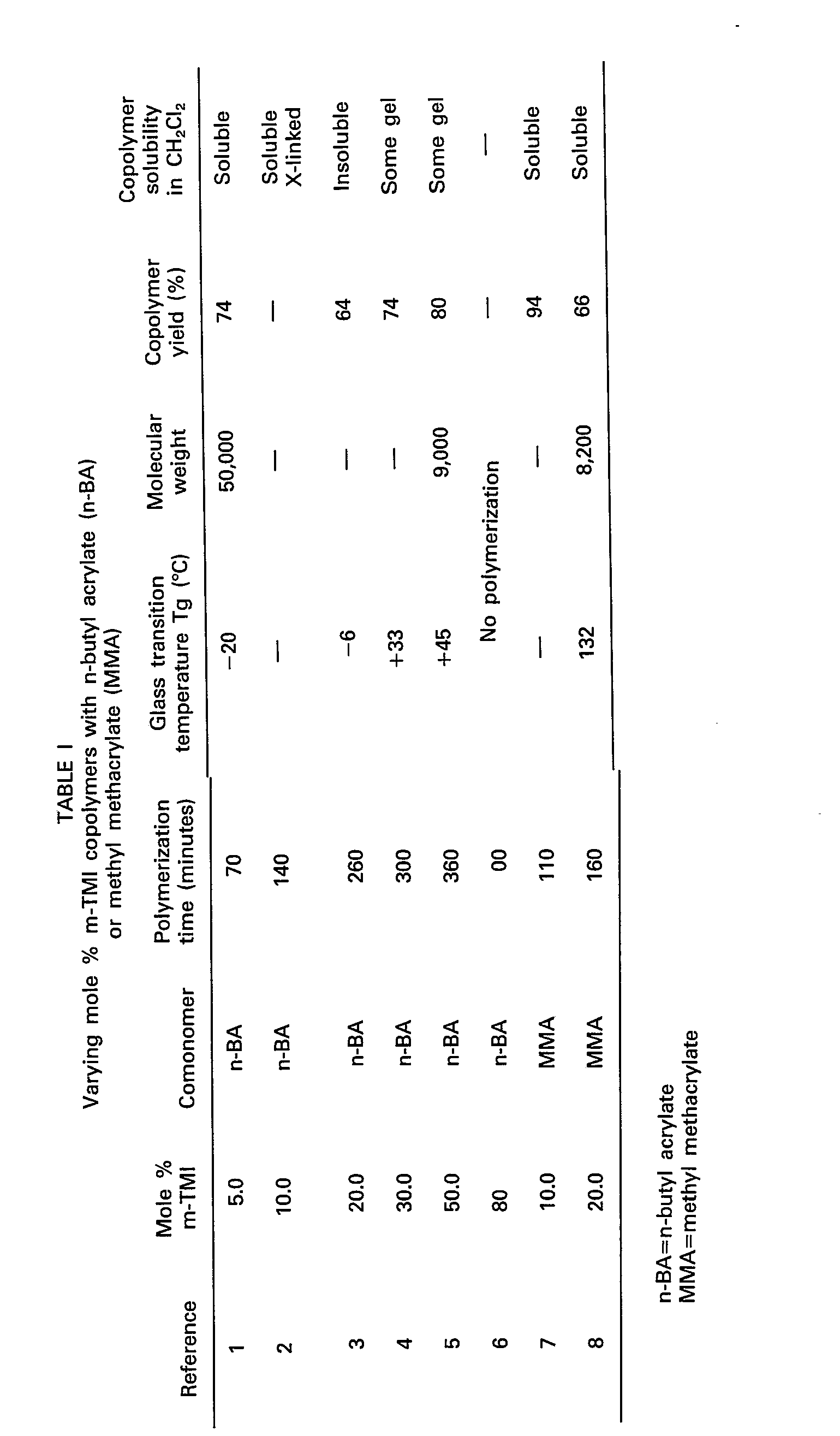
- Example I The procedure of Example I was employed to copolymerize m-TMI and p-TMI with a number of acrylic comonomers. Results are shown in Table I below.
- a 200 g monomer batch of emulsion terpolymer was prepared incorporating low initiator levels, 1.0 mole % n-octyl mercaptan, and 20% monomers concentration.
- the m-TMI/MMA mixture was added continuously to the polymerization flask containing BA and the progress of the polymerization monitored by GC. Both m-TMI and MMA was added as required to maintain a constant ratio of monomers and extra initiator to maintain a steady polymerization rate.
- the polymerization was completed in 5 hours giving a GC monomer conversion of 99.3%. The progress of the polymerization was satisfactory, giving an even m-TMI distribution in the polymer throughout the polymerization.
- the polymer was separated in the emulsion by freeze-thawing and dried by azeotroping in toluene.
- the water content of the final 35 wt. % polymer solution was 0.022 and the isocyanate content 0.307 meq/g (100% of theory).
- the molecular weight of the terpolymer by GPC was 10,000 (peak); the Tg was 4°C, and the isolated yield of polymer 93%.
- Emulsion copolymers of 10 mole percent m-TMI and 90 mole percent n-BA were prepared to evaluate the effect on product copolymer molecular weight of the concentration of polymerization initiators.
- a mixture of potassium persulfate and sodium meta bisulfite was employed as the initiator, at varying concentrations. Results are shown in Table III below, wherein all samples contained 1.67% by weight (based on total of monomer weight) n-octyl thiol as the chain transfer agent.
- the copolymer product of the emulsion reaction has increasing molecular weight with increasing initiator levels.
- initiator and chain transfer agent concentrations in a given reaction system, it is possible to closely control the molecular weight and properties of the product copolymer, while achieving substantially complete conversion of monomers.
- Emulsion terpolymers of 10 mole % m-TMI, 30 mole % MMA and 60 mole % BA were prepared by batch and in "continuous addition" processes.
- the letter process involved forming a reaction volume including water, initiator, chain transfer agent and MMA and thereafter continuously adding to such reaction volume m-TMI and BA at such rate as to maintain a constant monomeric composition in the reaction volume, to form a copolymer with a substantially homogeneous polymeric composition.
- the chain transfer agents were dodecyl mercaptan and octyl mercaptan. Results are shown in Table IV below.
- Emulsion terpolymers containing 10 mole % m-TMI, 60 mole % BA and 30 mole % MMA was prepared at differing levels of n-octyl mercaptan as the chain transfer agent. Copolymer product was isolated in each instance by freezing and thawing of the emulsion, followed by decanting of the solid copolymer. Data are shown in Table V below.
- G-Cure 867 RX 60 (Henkel Corporation, Minneapolis, Minnesota) is a hydroxyl-containing acrylic resin having a molecular weight of approximately 8000-9000, with 50% non-volatile content and an equivalent weight of 1000.
- the -NCO/-OH molar ratio in the formulation was 1.1 based on equivalent weights for the respective functionalities.
- Dow-Corning #1 (Dow Corning Corporation, Midland, Michigan) is a silicone flow control additive.
- the dimethyl tin dilaurate catalyst was introduced as a 10% weight solids dispersion in toluene, and the Dow-Corning #1 and cellulose acetate butyrate were each introduced as 10% (by weight) solutions of Cellosolve@ acetate.
- the formulation was very hazy in appearance when first prepared but cleared slightly after aging for a few minutes.
- Draw-downs of the formulation were made on 101.6x304.8 mm (4"x12") 1200S aluminum panels using a #46 wirecator. The draw-downs were applied at a 86.36 11m (3.5 mil) wet film thickness, with the applied coating films being exposed to ambient temperature conditions for 10 minutes before elevated temperature curing, at the cure time and temperature (cure schedule) conditions identified in Table VI below. The resulting films then were measured for dry film thickness, Knoop hardness, and mar and removal rub tests using MEK solvent. Results are shown in Table VI.
- a terpolymer was made from 12.6 g of n-butyl acrylate, 5.0 g of methyl methacrylate, and 3.4 g of p-TMI (60 mole % n-butyl acrylate/30 mole % methyl methacrylate/10 mole % m-TMI) by emulsion polymerization in 253 g of total reaction mixture.
- the product mixture at room temperature was poured in a thin stream into 1200 ml of 0.10 wt.% aluminum sulfate, 18-hydrate (AI 2 (S0 4 ) 3 ⁇ 18H 2 0) vigorously stirred at room temperature. After stirring for one-half hour, the solid was recovered by vacuum filtration. Vacuum drying at 25°C/1 mm Hg for 20 hours gave 19.2 g of almost transparent, soft, solid polymer.
- TMI/acrylate and TMI/methacrylate copolymers may be isolated by coagulating the emulsion in aqueous solution containing up to 10 wt.% concentrations of sodium chloride, sodium sulfate, calcium chloride, or other salts.
- a copolymer was made by emulsion polymerization of a monomer mixture containing 90 mole % ethyl acrylate and 10 mole % p-TMI. The product was isolated by coagulation in a 5% solution of calcium chloride in water, followed by vacuum drying at room temperature.
- a Cellosolve@ acetate solution was made to contain 4.0% total solids consisting of stoichiometric quantities of the p-TMI copolymer and G-Cure 867-RX-60 (hydroxylated acrylic resin from General Mills Chemicals, Inc.). Immediately after adding 1.0 wt.% (on total resins) of dimethyltin dilaurate at room temperature, the solution was used to cast a thin film on a glass plate.
- the film-glass assembly After heating the film-glass assembly at 110°C for one hour in a forced-draft oven, the film was hard and optically clear. The assembly was then immersed in methylene chloride at room temperature. After five minutes with intermittent stirring, the film was swollen but remained coherent and insoluble.
- a Cellosolve@ acetate solution was made to contain 4.0% of the p-TMI copolymer. Immediately after adding 1.0 wt.% (on copolymer) of triethylenediamine (DABCO), the solution was used to cast a thin film on a glass plate.
- DABCO triethylenediamine
- the film-glass assembly was immersed in methylene chloride. After five minutes with intermittent stirring, the film was swollen but remained largely insoluble.
Landscapes
- Chemical & Material Sciences (AREA)
- Health & Medical Sciences (AREA)
- Chemical Kinetics & Catalysis (AREA)
- Medicinal Chemistry (AREA)
- Polymers & Plastics (AREA)
- Organic Chemistry (AREA)
- Addition Polymer Or Copolymer, Post-Treatments, Or Chemical Modifications (AREA)
- Polymerisation Methods In General (AREA)
- Polyurethanes Or Polyureas (AREA)
- Paints Or Removers (AREA)
- Acyclic And Carbocyclic Compounds In Medicinal Compositions (AREA)
Abstract
Description
- The present invention relates to a method of making a copolymer of meta- or para - isopropenyl - a,a - dimethylbenzylisocyanate and at least one other ethylenically unsaturated comonomer polymerizable therewith according to the preamble of the main claim. Such method is known from US-A-3,502,475.
- In U.S. Patent 4,439,616 issued March 27, 1984 there is disclosed a method for producing tertiary aralkyl isocyanates, such as tetramethyl xylylene diisocyanates (TMXDI), by thermal cracking of corresponding urethanes formed by addition of corresponding olefins and carbamic acid esters at moderate temperatures and in the presence of acid catalyst. Such process is particularly useful for producing the meta- and para-isomers of TMXDI and as the by-product thereof, substantial amounts of the corresponding vinyl isocyanate meta- or para-isomers, viz. meta - isopropenyl - a,a - dimethylbenzylisocyanate (m-TMI) or para - isopropenyl - a,a - dimethylbenzylisocyanate (p-TMI), respectively, are formed.
- The meta-TMI or para-TMI by-products in such systems may be recycled within the process to improve the overall yield of TMXDI therein, but such by-product have substantial utility per se as separate products due to their difunctional character, i.e., the presence of reactive isocyanato (-NCO) and vinyl groups. Thus, TMI may be homo- or co-polymerized to form polymers with isocyanate functionality which are cross-linkable with curatives containing a difunctional or polyfunctional amino or hydroxyl compound. Such cross-linkable compositions have film-forming properties and advantageously may be used for coatings as for example on metal, wood and glass substrates, as well as having potential applicability for production of molded articles, such by the reaction injection molding (RIM).
- U.S. Patent No. 3,290,350 discloses copolymerization of TMI by conventional methods using known addition polymerization initiators, such as those of the free radical type, e.g., peroxy and azo initiators.
- In U.S. Patent No. 3,502,475, there is disclosed a method of forming a coating on polyolefin and polyester films, by application thereto of an aqueous dispersion of a copolymer of from about 1 to about 50 percent by weight of meta- or para-TMI.
- Relative to other modes of polymerization, emulsion polymerization allows a rapid reaction to form a high molecular weight product with a comparatively narrow molecular weight distribution. The latter characteristic of narrow molecular weight distribution, renders emulsion polymerization potentially attractive for the making of copolymers. However, for most end-use applications, the extremely high molecular weights yielded by emulsion polymerization renders polymers produced thereby wholly unsuitable, e.g., in end-use applications such as coatings and the molding of articles such as by reaction injection molding.
- The present invention provides a method of making a copolymer of meta- or para - isopropenyl - a,a - dimethylbenzylisocyanate and at least one other ethylenically unsaturated comonomer polymerizable therewith, comprising polymerizing said meta- or para - isopropenyl - a,a - dimethylbenzylisocyanate and at least one other ethylenically unsaturated comonomer in an aqueous emulsion in the presence of a free radical polymerization initiator, characterized in that the polymerization is carried out in the presence of 0.2 to 10 mol-%, based on the monomer, of dodecylmercaptan or n - octylthiol chain transfer agent.
- The ethylenically unsaturated comonomers polymerizable with TMI include butyl acrylate, methyl acrylate, methyl methacrylate, ethyl acrylate, styrene, a - methylstyrene, p - methyl - a - methylstyrene, and p - methylstyrene.
- The copolymer suitably may contain from about 5 to about 80 mole percent repeating units derived from meta- or para-TMI and from about 20 to about 95 percent repeating units derived from the at least one other ethylenically unsaturated comonomer. Where styrene or p - methylstyrene are employed as comonomers, the amounts thereof generally should be limited to not more than 30 mole percent in the product copolymer to insure that such product copolymer is light stable in character, where light stability is necessary and/or desirable.
- The free-radical polymerization initiator suitably may be potassium persulfate and sodium meta - bisulphite.
- The chain transfer agent advantageously is a water-insoluble mercaptan. Preferably, the chain transfer agent is either dodecyl mercaptan or n-octyl thiol. It is a particularly surprising feature of the present invention that the use of thiols or mercaptans as chain transfer agents is efficacious in providing limited product copolymer molecular weight ranges, since in the emulsion polymerization system, one would expect such compounds to react with the free isocyanato groups contained in the TMI monomer. Surprisingly, it has been found that the reactivity of such thiols or mercaptans, if any, with the isocyanate groups is not such as to prevent the useful control of molecular weight of emulsion polymerization copolymer products.
- It also is an unexpected aspect of the present invention that the polymerized emulsions resulting from the method of the invention are storage-stable for periods of several days and as long as 5-7 days, with 95 percent of the initial isocyanate groups based on monomer concentration thereof still being present, since one would expect reaction of such groups in the aqueous medium, i.e., the aqueous phase of such emulsions.
- The emulsion polymerization of the invention usefully may be carried out at temperature above ambient in the range of from about 25°C to about 60°C, and preferably from about 30°C to about 50°C.
- The aforementioned mercaptan or thiol chain transfer agents desirably are present in the emulsion polymerization reaction volume in an amount of from about 0.2 to about 10 mole percent based on the weight of monomer present. Under such conditions, it is possible to form emulsion copolymers having a molecular weight of from about 2,000 to about 70,000 (peak molecular weight). As indicated, such copolymers may contain from about 5 to about 80 mole percent repeating units derived from meta- or para-TMI and from about 20 to about 95 mole percent repeating units derived from at least one other ethyienicaiiy unsaturated comonomer polymerizable with TMI as selected from the group consisting of butyl acrylate, methyl acrylate, methyl methacrylate, ethyl acrylate, styrene, a - methylstyrene, p - methyl - a - methylstyrene, and p - methylstyrene.
- A particularly advantageous copolymer composition is one containing from about 5 to about 25 mole percent repeating units derived from meta- or para-TMI and from about 75 to about 95 mole percent repeating units derived from methyl methacrylate. The method of the present invention permits the making of such copolymers having a molecular weight of from about 5,000 to about 10,000.
- A particularly preferred terpolymer composition obtainable by the method of the present invention contains from about 5 to about 25 mole percent repeating units derived from meta- or para-TMI, from about 20 to about 40 mole percent repeating units derived from methyl methacrylate and from about 50 to about 70 mole percent repeating units derived from butyl acrylate.
- The method of the present invention may be employed to form a substantially homogeneous copolymer of meta- or para-TMI and at least one other ethylenically unsaturated comonomers mentioned above, by the following sequence of steps:
- (a) forming a reaction volume comprising water, free-radical polymerization initiator, chain transfer agent and such one of said other ethylenically unsaturated comonomers to be incorporated into said copolymer as has the lowest reactivity thereof; and
- (b) adding meta- or para - isopropenyl - a,a - dimethylbenzylisocyanate and other remaining comonomers to be incorporated into said copolymer continuously to said reaction volume under emulsion polymerization reaction conditions while maintaining a substantially constant monomeric composition in said reaction volume, to form said copolymer with a substantially homogeneous polymeric composition.
- The method described above for formation of substantially homogeneous copolymers (hereinafter denoted the "continuous addition method") usefully may be employed to produce a product copolymer having a molecular weight of from about 2,000 to about 70,000, with a comparatively narrow distribution of molecular weights within the product volume.
- The copolymers produced according to the present invention have utility in forming coating compositions comprising same and a curative comprising a cross-linkingly effective amount of a compound with free hydroxyl or amine functionality. Such curative compound may suitably include trimethylolpropane, ethylenediamine ketimine, diethylene glycol and 1,2,6 - hexanetriol. Such composition may be applied in a film to a substrate, e.g., glass, wood or metal, and cured in the presence of moisture to form a coating on the substrate which is light-stable and solvent resistant in character.
- In the broad practice of the present invention, the copolymer product of the polymerization reaction may be isolated from the aqueous emulsion following polymerization to the desired extent, by adding such aqueous emulsions to aqueous solutions of a salt such as calcium chloride, sodium chloride, or aluminum sulfate.
- Alternatively, the copolymer product may be isolated from the aqueous emulsion after polymerization has been completed, by freezing the aqueous emulsion to a frozen solid to thereby break the aqueous emulsion, followed by thawing the frozen solid to yield a two-phase mixture comprising a reliquified aqueous phase and the copolymer as a solid phase, so that the solid copolymer readily may be separated from the reliquified aqueous phase, such as by mechanical separation. A particularly preferred method of separation is simple decanting of the two-phase mixture, or filtration of the two-phase mixture followed by vacuum drying of the copolymer filtrate at a temperature of from about 25°C to about 40°C.
- The character of the invention will be more fully apparent from the non-limiting examples set forth hereinafter, wherein all parts and percentages are by weight, unless otherwise specified.
- The following components were charged to a reaction flask:

- The contents were stirred and sparged with nitrogen at ambient temperature for 20-30 minutes and then the flask was heated to 40°C in a water bath. A 0.30 ml sample was taken for GC analysis. In separate, sealed bottles, solutions of potassium persulphate, 0.36 g in 7.5 ml water, and sodium meta bisulphite, 1.08 g in 7.5 ml water, were prepared and sparged with nitrogen for 5 minutes, to remove oxygen, using a syringe needle through a rubber septum. One millilitre of each solution was then added to the emulsion, by syringe, adding the potassium persulphate first. Samples of emulsion were taken at intervals and analyzed by GC for the remaining monomer content until the conversion of monomers was completed. The emulsion then was frozen to -18°C overnight and next day, after allowing to thaw completely to room temperature, the mass of polymer was separated from the aqueous phase by decantation. The polymer then was washed with water and dried on a glass petri dish under vacuum at room temperature.
- A yield of polymer of 2.0 g was recovered (67%) having a peak molecular weight of 16,000 by GPC, and a Tg of +2°C by dynamic mechanical analysis.
- The procedure of Example I was employed to copolymerize m-TMI and p-TMI with a number of acrylic comonomers. Results are shown in Table I below.
- A 200 g monomer batch of emulsion terpolymer was prepared incorporating low initiator levels, 1.0 mole % n-octyl mercaptan, and 20% monomers concentration. The m-TMI/MMA mixture was added continuously to the polymerization flask containing BA and the progress of the polymerization monitored by GC. Both m-TMI and MMA was added as required to maintain a constant ratio of monomers and extra initiator to maintain a steady polymerization rate. The polymerization was completed in 5 hours giving a GC monomer conversion of 99.3%. The progress of the polymerization was satisfactory, giving an even m-TMI distribution in the polymer throughout the polymerization.
- The polymer was separated in the emulsion by freeze-thawing and dried by azeotroping in toluene. The water content of the final 35 wt. % polymer solution was 0.022 and the isocyanate content 0.307 meq/g (100% of theory). The molecular weight of the terpolymer by GPC was 10,000 (peak); the Tg was 4°C, and the isolated yield of polymer 93%.
- An emulsion copolymer of 10 mole percent m-TMI and 90 mole % n-BA was prepared at 10 weight percent monomer solids in the emulsion, using sodium lauryl sulfate as a surfactant, at a reaction temperature of 40°C. The effect of chain transfer agent concentration was evaluated by conducting three runs at chain transfer agent (n-octyl thiol) levels of 0.33%, 1.67% and 5.0%, respectively (based on weight of monomer in the polymerization emulsion). Results are shown in Table II below:

- These results show that the n-octyl thiol chain transfer agent at increasing levels of concentration was highly effective in reducing the molecular weight.
- Emulsion copolymers of 10 mole percent m-TMI and 90 mole percent n-BA were prepared to evaluate the effect on product copolymer molecular weight of the concentration of polymerization initiators. A mixture of potassium persulfate and sodium meta bisulfite was employed as the initiator, at varying concentrations. Results are shown in Table III below, wherein all samples contained 1.67% by weight (based on total of monomer weight) n-octyl thiol as the chain transfer agent.

- As these data slow, the copolymer product of the emulsion reaction has increasing molecular weight with increasing initiator levels. By appropriate choice of initiator and chain transfer agent concentrations in a given reaction system, it is possible to closely control the molecular weight and properties of the product copolymer, while achieving substantially complete conversion of monomers.
- Emulsion terpolymers of 10 mole % m-TMI, 30 mole % MMA and 60 mole % BA were prepared by batch and in "continuous addition" processes. The letter process involved forming a reaction volume including water, initiator, chain transfer agent and MMA and thereafter continuously adding to such reaction volume m-TMI and BA at such rate as to maintain a constant monomeric composition in the reaction volume, to form a copolymer with a substantially homogeneous polymeric composition. The chain transfer agents were dodecyl mercaptan and octyl mercaptan. Results are shown in Table IV below.

- The data in Table IV shows that octyl mercaptan was a more effective chain transfer agent than dodecyl mercaptan (cf. sample 22, wherein octyl mercaptan at 3.3 mole % (based on total monomer) gave a molecular weight of 7,800 with sample 19, wherein dodecyl (mercaptan) at 5 mole % yielded a molecular weight of 16,400). Further, samples 22-29 show that various runs with octyl mercaptan at 3.3 mole % concentration gave highly uniform and reproducible results (e.g., molecular weight of product copolymer in the range of 5,700 to 7,800).
- Emulsion terpolymers containing 10 mole % m-TMI, 60 mole % BA and 30 mole % MMA was prepared at differing levels of n-octyl mercaptan as the chain transfer agent. Copolymer product was isolated in each instance by freezing and thawing of the emulsion, followed by decanting of the solid copolymer. Data are shown in Table V below.

- These data indicate that chain transfer agent concentrations on the order of 3 mole % gave a good (i.e., comparatively uniform) distribution of monomer in the product copolymer.
- Samples 28 and 29 (see Examples VI and VII) were combined to yield a 10/60/30 mole % m-TMI/BA/MMA terpolymer having an equivalent weight of 1415 based on the solids content thereof. The terpolymer was then formulated into a coating formulation having the following composition:

- G-Cure 867 RX 60 (Henkel Corporation, Minneapolis, Minnesota) is a hydroxyl-containing acrylic resin having a molecular weight of approximately 8000-9000, with 50% non-volatile content and an equivalent weight of 1000. The -NCO/-OH molar ratio in the formulation was 1.1 based on equivalent weights for the respective functionalities. Dow-Corning #1 (Dow Corning Corporation, Midland, Michigan) is a silicone flow control additive. The dimethyl tin dilaurate catalyst was introduced as a 10% weight solids dispersion in toluene, and the Dow-Corning #1 and cellulose acetate butyrate were each introduced as 10% (by weight) solutions of Cellosolve@ acetate.
- The formulation was very hazy in appearance when first prepared but cleared slightly after aging for a few minutes.
- Draw-downs of the formulation were made on 101.6x304.8 mm (4"x12") 1200S aluminum panels using a #46 wirecator. The draw-downs were applied at a 86.36 11m (3.5 mil) wet film thickness, with the applied coating films being exposed to ambient temperature conditions for 10 minutes before elevated temperature curing, at the cure time and temperature (cure schedule) conditions identified in Table VI below. The resulting films then were measured for dry film thickness, Knoop hardness, and mar and removal rub tests using MEK solvent. Results are shown in Table VI.

- The appearance of all of the cured films was slightly hazy and cratered in appearance.
- A terpolymer was made from 12.6 g of n-butyl acrylate, 5.0 g of methyl methacrylate, and 3.4 g of p-TMI (60 mole % n-butyl acrylate/30 mole % methyl methacrylate/10 mole % m-TMI) by emulsion polymerization in 253 g of total reaction mixture.
- The product mixture at room temperature was poured in a thin stream into 1200 ml of 0.10 wt.% aluminum sulfate, 18-hydrate (AI2(S04)3 ● 18H20) vigorously stirred at room temperature. After stirring for one-half hour, the solid was recovered by vacuum filtration. Vacuum drying at 25°C/1 mm Hg for 20 hours gave 19.2 g of almost transparent, soft, solid polymer.
- Depending on polymer composition and molecular weight TMI/acrylate and TMI/methacrylate copolymers also may be isolated by coagulating the emulsion in aqueous solution containing up to 10 wt.% concentrations of sodium chloride, sodium sulfate, calcium chloride, or other salts.
- 29.4 g of an emulsion of a copolymer of m-TMI (10 mole %) and ethyl acrylate (90 mole %) containing 2.94 g of polymer were poured slowly into a stirred solution of 200 ml of 5% calcium chloride. A white flocculant precipitate formed which coagulated rapidly. This was filtered on a (No. 2) glass sinter and washed with deionised water in two 50 ml lots. After drying in a vacuum oven at 40°C, 1.08 g of dry polymer were obtained.
- A similar polymerization using 5% n-dodecyl mercaptan did not give a filterable precipitate with calcium chloride (low molecular weight polymers generally are difficult to filter).
- The low molecular weight emulsion copolymer of Example X (polymerized with 5% n-dodecyl mercaptan) was cooled to -8 to -12°C for 16 hours. During this time the emulsion broke and separated into two layers. The upper, aqueous layer was decanted off (alternatively, the polymer layer can be filtered and washed with water). After vacuum drying at 25-40°C (13 hours) a yield of 88% polymer (based on original monomers charged) was obtained, Tg=0°C, m.w.p. by GPC (Mw)=6700.
- A copolymer was made by emulsion polymerization of a monomer mixture containing 90 mole % ethyl acrylate and 10 mole % p-TMI. The product was isolated by coagulation in a 5% solution of calcium chloride in water, followed by vacuum drying at room temperature.
- A Cellosolve@ acetate solution was made to contain 4.0% total solids consisting of stoichiometric quantities of the p-TMI copolymer and G-Cure 867-RX-60 (hydroxylated acrylic resin from General Mills Chemicals, Inc.). Immediately after adding 1.0 wt.% (on total resins) of dimethyltin dilaurate at room temperature, the solution was used to cast a thin film on a glass plate.
- After heating the film-glass assembly at 110°C for one hour in a forced-draft oven, the film was hard and optically clear. The assembly was then immersed in methylene chloride at room temperature. After five minutes with intermittent stirring, the film was swollen but remained coherent and insoluble.
- A Cellosolve@ acetate solution was made to contain 4.0% of the p-TMI copolymer. Immediately after adding 1.0 wt.% (on copolymer) of triethylenediamine (DABCO), the solution was used to cast a thin film on a glass plate.
- After standing in the open air at room temperature for 24 hours, the film-glass assembly was immersed in methylene chloride. After five minutes with intermittent stirring, the film was swollen but remained largely insoluble.
Claims (14)
Priority Applications (1)
| Application Number | Priority Date | Filing Date | Title |
|---|---|---|---|
| AT84105412T ATE51237T1 (en) | 1983-06-01 | 1984-05-12 | EMULSION COPOLYMERIZATION OF META- OR PARAISOPROPENYL-ALPHA,ALPHA-DIMETHYLBENZYL ISOCYANATE |
Applications Claiming Priority (2)
| Application Number | Priority Date | Filing Date | Title |
|---|---|---|---|
| US49992283A | 1983-06-01 | 1983-06-01 | |
| US499922 | 1983-06-01 |
Publications (3)
| Publication Number | Publication Date |
|---|---|
| EP0130322A2 EP0130322A2 (en) | 1985-01-09 |
| EP0130322A3 EP0130322A3 (en) | 1985-08-14 |
| EP0130322B1 true EP0130322B1 (en) | 1990-03-21 |
Family
ID=23987295
Family Applications (1)
| Application Number | Title | Priority Date | Filing Date |
|---|---|---|---|
| EP84105412A Expired - Lifetime EP0130322B1 (en) | 1983-06-01 | 1984-05-12 | Emulsion copolymerisation of meta- or para-isopropenyl-alpha,alpha-dimethylbenzylisocyanate |
Country Status (7)
| Country | Link |
|---|---|
| EP (1) | EP0130322B1 (en) |
| JP (1) | JPS59227911A (en) |
| KR (1) | KR910003841B1 (en) |
| AT (1) | ATE51237T1 (en) |
| CA (1) | CA1224593A (en) |
| DE (1) | DE3481708D1 (en) |
| ES (1) | ES533023A0 (en) |
Families Citing this family (4)
| Publication number | Priority date | Publication date | Assignee | Title |
|---|---|---|---|---|
| EP0250633A1 (en) * | 1986-07-03 | 1988-01-07 | THE GLIDDEN COMPANY (formerly known as ATKEMIX EIGHT INC.) | Acrylic and acrylic/epoxy copolymer composition |
| US4694057A (en) * | 1985-03-06 | 1987-09-15 | The Goodyear Tire & Rubber Company | Preparation of polymers containing pendant isocyanate groups and derivatives thereof by emulsion copolymerization |
| US5077360A (en) * | 1991-03-20 | 1991-12-31 | Tremco Inc. | Acrylic sealant composition and methods relating thereto |
| KR100604769B1 (en) * | 2005-06-30 | 2006-07-31 | 호서대학교 산학협력단 | Method for producing acrylic polymer |
Family Cites Families (2)
| Publication number | Priority date | Publication date | Assignee | Title |
|---|---|---|---|---|
| NL302592A (en) * | 1960-05-16 | 1900-01-01 | ||
| US3502475A (en) * | 1967-07-13 | 1970-03-24 | Du Pont | Highly adherent coated films and method of producing same |
-
1984
- 1984-05-12 AT AT84105412T patent/ATE51237T1/en not_active IP Right Cessation
- 1984-05-12 EP EP84105412A patent/EP0130322B1/en not_active Expired - Lifetime
- 1984-05-12 DE DE8484105412T patent/DE3481708D1/en not_active Expired - Fee Related
- 1984-05-30 CA CA000455400A patent/CA1224593A/en not_active Expired
- 1984-05-31 ES ES533023A patent/ES533023A0/en active Granted
- 1984-05-31 JP JP59109767A patent/JPS59227911A/en active Pending
- 1984-05-31 KR KR1019840003014A patent/KR910003841B1/en not_active Expired
Non-Patent Citations (2)
| Title |
|---|
| Encyclopedia of Polymer Science and Technology, Volume 4, Interscience Publishers, New York/London/Sydney (1966), pages 370-372 * |
| Houben-Weyl, Methoden der Organischen Chemie, Band XIV/1 Makromolekulare Stoffe, Teil 1, Georg Thieme Verlag, Stuttgart (1961), pages 297-299 and 1337 * |
Also Published As
| Publication number | Publication date |
|---|---|
| EP0130322A2 (en) | 1985-01-09 |
| CA1224593A (en) | 1987-07-21 |
| ATE51237T1 (en) | 1990-04-15 |
| ES8507575A1 (en) | 1985-10-01 |
| KR910003841B1 (en) | 1991-06-12 |
| DE3481708D1 (en) | 1990-04-26 |
| EP0130322A3 (en) | 1985-08-14 |
| JPS59227911A (en) | 1984-12-21 |
| ES533023A0 (en) | 1985-10-01 |
| KR850000478A (en) | 1985-02-27 |
Similar Documents
| Publication | Publication Date | Title |
|---|---|---|
| ES2207717T3 (en) | SYNTHESIS OF RAMIFIED POLYMERS. | |
| US4246382A (en) | Solvent resistent acrylic resin and process for producing the same | |
| CA1297489C (en) | Process for producing low molecular weight, hydroxy functional (meth)acrylate polymers, their use for producing isocyanate terminal group-containing prepolymers as well as sealants and adhesives produced therefrom | |
| US4754011A (en) | Emulsion copolymers of meta- or para-isopropenyl-alpha, alpha-di-methylbenzylisocyanates | |
| EP0811020B1 (en) | Copolymers containing 1,3-dioxolan-2-one-4-yl groups and coatings made therefrom | |
| US4877853A (en) | Polymethyl methacrylate molding compounds | |
| US4308354A (en) | Making impact resistant polymers | |
| GB2148908A (en) | Process for the preparation of high impact strength moulding compositions | |
| EP0059561A1 (en) | Highly refractive urethane polymers for use in optical lenses and lenses prepared therefrom | |
| Mohammed et al. | Isocyanate‐functionalized latexes: Film formation and tensile properties | |
| JP2851875B2 (en) | Plastic lens | |
| KR100411379B1 (en) | Monomer Composition for Plastic Optical Material, Plastic Optical Material and Lens | |
| CA1224593A (en) | EMULSION COPOLYMERS OF META- OR PARA-ISOPROPENYL-.alpha., .alpha.-DIMETHYLBENZYLISOCYANATE | |
| EP0810246A2 (en) | Method of producing isocyanate-modified latex polymer | |
| EP0130323B1 (en) | Free-radical addition copolymers of meta- or para-isopropenyl-alpha,alpha-dimethylbenzylisocyanate | |
| US4576838A (en) | Anti-fouling coating composition, process for applying same and coating thereby obtained | |
| US3632796A (en) | Saturated linear polymers having plural pendant ethylenic unsaturation | |
| WO1994008963A1 (en) | N-hydroxysuccinimide-blocked isopropenyl-alpha, alpha-dimethylbenzyl isocyanate and self-cross-linking copolymers thereof | |
| CA1224594A (en) | CATIONIC COPOLYMERIZATION OF META- OR PARA- ISOPROPENYL-.alpha.,.alpha.-DIMEXTHYLBENZYLISOCYANATE | |
| JPS58455B2 (en) | Method for manufacturing solvent-resistant acrylic resin | |
| CA1335021C (en) | Room temperature curing, alternating isopropenyl- dimethylbenzylisocyanate copolymers having high isocyanate functionality | |
| JP2000136220A (en) | Optical material made from synthetic resin and its production | |
| US4910274A (en) | Preparation of monohydroxy-containing polymers | |
| JPS60233110A (en) | Production of isocyanate pendant polymer | |
| US4754008A (en) | Heat resistant molding compounds |
Legal Events
| Date | Code | Title | Description |
|---|---|---|---|
| PUAI | Public reference made under article 153(3) epc to a published international application that has entered the european phase |
Free format text: ORIGINAL CODE: 0009012 |
|
| AK | Designated contracting states |
Designated state(s): AT BE CH DE FR GB IT LI NL SE |
|
| PUAL | Search report despatched |
Free format text: ORIGINAL CODE: 0009013 |
|
| AK | Designated contracting states |
Designated state(s): AT BE CH DE FR GB IT LI NL SE |
|
| 17P | Request for examination filed |
Effective date: 19860123 |
|
| 17Q | First examination report despatched |
Effective date: 19870226 |
|
| GRAA | (expected) grant |
Free format text: ORIGINAL CODE: 0009210 |
|
| AK | Designated contracting states |
Kind code of ref document: B1 Designated state(s): AT BE CH DE FR GB IT LI NL SE |
|
| REF | Corresponds to: |
Ref document number: 51237 Country of ref document: AT Date of ref document: 19900415 Kind code of ref document: T |
|
| ET | Fr: translation filed | ||
| REF | Corresponds to: |
Ref document number: 3481708 Country of ref document: DE Date of ref document: 19900426 |
|
| ITF | It: translation for a ep patent filed | ||
| ITTA | It: last paid annual fee | ||
| PLBE | No opposition filed within time limit |
Free format text: ORIGINAL CODE: 0009261 |
|
| STAA | Information on the status of an ep patent application or granted ep patent |
Free format text: STATUS: NO OPPOSITION FILED WITHIN TIME LIMIT |
|
| 26N | No opposition filed | ||
| PGFP | Annual fee paid to national office [announced via postgrant information from national office to epo] |
Ref country code: FR Payment date: 19910404 Year of fee payment: 8 |
|
| PGFP | Annual fee paid to national office [announced via postgrant information from national office to epo] |
Ref country code: SE Payment date: 19910405 Year of fee payment: 8 |
|
| PGFP | Annual fee paid to national office [announced via postgrant information from national office to epo] |
Ref country code: DE Payment date: 19910406 Year of fee payment: 8 |
|
| PGFP | Annual fee paid to national office [announced via postgrant information from national office to epo] |
Ref country code: AT Payment date: 19910408 Year of fee payment: 8 |
|
| PGFP | Annual fee paid to national office [announced via postgrant information from national office to epo] |
Ref country code: GB Payment date: 19910415 Year of fee payment: 8 |
|
| PGFP | Annual fee paid to national office [announced via postgrant information from national office to epo] |
Ref country code: BE Payment date: 19910430 Year of fee payment: 8 |
|
| PGFP | Annual fee paid to national office [announced via postgrant information from national office to epo] |
Ref country code: NL Payment date: 19910531 Year of fee payment: 8 |
|
| PGFP | Annual fee paid to national office [announced via postgrant information from national office to epo] |
Ref country code: CH Payment date: 19910902 Year of fee payment: 8 |
|
| PG25 | Lapsed in a contracting state [announced via postgrant information from national office to epo] |
Ref country code: GB Effective date: 19920512 Ref country code: AT Effective date: 19920512 |
|
| PG25 | Lapsed in a contracting state [announced via postgrant information from national office to epo] |
Ref country code: SE Effective date: 19920513 |
|
| PG25 | Lapsed in a contracting state [announced via postgrant information from national office to epo] |
Ref country code: LI Effective date: 19920531 Ref country code: CH Effective date: 19920531 Ref country code: BE Effective date: 19920531 |
|
| BERE | Be: lapsed |
Owner name: AMERICAN CYANAMID CY Effective date: 19920531 |
|
| PG25 | Lapsed in a contracting state [announced via postgrant information from national office to epo] |
Ref country code: NL Effective date: 19921201 |
|
| GBPC | Gb: european patent ceased through non-payment of renewal fee |
Effective date: 19920512 |
|
| NLV4 | Nl: lapsed or anulled due to non-payment of the annual fee | ||
| PG25 | Lapsed in a contracting state [announced via postgrant information from national office to epo] |
Ref country code: FR Effective date: 19930129 |
|
| REG | Reference to a national code |
Ref country code: CH Ref legal event code: PL |
|
| PG25 | Lapsed in a contracting state [announced via postgrant information from national office to epo] |
Ref country code: DE Effective date: 19930202 |
|
| REG | Reference to a national code |
Ref country code: FR Ref legal event code: ST |
|
| EUG | Se: european patent has lapsed |
Ref document number: 84105412.5 Effective date: 19921204 |