EP0129243A1 - Non-aqueous electrochemical cell - Google Patents
Non-aqueous electrochemical cell Download PDFInfo
- Publication number
- EP0129243A1 EP0129243A1 EP84107000A EP84107000A EP0129243A1 EP 0129243 A1 EP0129243 A1 EP 0129243A1 EP 84107000 A EP84107000 A EP 84107000A EP 84107000 A EP84107000 A EP 84107000A EP 0129243 A1 EP0129243 A1 EP 0129243A1
- Authority
- EP
- European Patent Office
- Prior art keywords
- cell according
- depolarizer
- carbamate
- halogens
- cell
- Prior art date
- Legal status (The legal status is an assumption and is not a legal conclusion. Google has not performed a legal analysis and makes no representation as to the accuracy of the status listed.)
- Granted
Links
- 229910052736 halogen Inorganic materials 0.000 claims abstract description 6
- 150000002367 halogens Chemical class 0.000 claims abstract description 6
- 229910052751 metal Inorganic materials 0.000 claims abstract description 6
- 239000002184 metal Substances 0.000 claims abstract description 6
- 125000003545 alkoxy group Chemical group 0.000 claims abstract description 4
- 125000000217 alkyl group Chemical group 0.000 claims abstract description 4
- 239000011255 nonaqueous electrolyte Substances 0.000 claims abstract description 4
- 125000000951 phenoxy group Chemical group [H]C1=C([H])C([H])=C(O*)C([H])=C1[H] 0.000 claims abstract description 4
- 125000001997 phenyl group Chemical group [H]C1=C([H])C([H])=C(*)C([H])=C1[H] 0.000 claims abstract description 4
- 229910052784 alkaline earth metal Inorganic materials 0.000 claims description 8
- 150000001342 alkaline earth metals Chemical group 0.000 claims description 5
- WHXSMMKQMYFTQS-UHFFFAOYSA-N Lithium Chemical compound [Li] WHXSMMKQMYFTQS-UHFFFAOYSA-N 0.000 claims description 4
- 239000003513 alkali Substances 0.000 claims description 4
- 229910052744 lithium Inorganic materials 0.000 claims description 4
- ZAMOUSCENKQFHK-UHFFFAOYSA-N Chlorine atom Chemical compound [Cl] ZAMOUSCENKQFHK-UHFFFAOYSA-N 0.000 claims description 3
- 229910052801 chlorine Inorganic materials 0.000 claims description 3
- 239000000460 chlorine Substances 0.000 claims description 3
- 239000007788 liquid Substances 0.000 claims description 3
- ZCYVEMRRCGMTRW-UHFFFAOYSA-N 7553-56-2 Chemical compound [I] ZCYVEMRRCGMTRW-UHFFFAOYSA-N 0.000 claims description 2
- WKBOTKDWSSQWDR-UHFFFAOYSA-N Bromine atom Chemical compound [Br] WKBOTKDWSSQWDR-UHFFFAOYSA-N 0.000 claims description 2
- OYPRJOBELJOOCE-UHFFFAOYSA-N Calcium Chemical compound [Ca] OYPRJOBELJOOCE-UHFFFAOYSA-N 0.000 claims description 2
- DGAQECJNVWCQMB-PUAWFVPOSA-M Ilexoside XXIX Chemical compound C[C@@H]1CC[C@@]2(CC[C@@]3(C(=CC[C@H]4[C@]3(CC[C@@H]5[C@@]4(CC[C@@H](C5(C)C)OS(=O)(=O)[O-])C)C)[C@@H]2[C@]1(C)O)C)C(=O)O[C@H]6[C@@H]([C@H]([C@@H]([C@H](O6)CO)O)O)O.[Na+] DGAQECJNVWCQMB-PUAWFVPOSA-M 0.000 claims description 2
- GDTBXPJZTBHREO-UHFFFAOYSA-N bromine Substances BrBr GDTBXPJZTBHREO-UHFFFAOYSA-N 0.000 claims description 2
- 229910052794 bromium Inorganic materials 0.000 claims description 2
- 239000011575 calcium Substances 0.000 claims description 2
- 229910052791 calcium Inorganic materials 0.000 claims description 2
- 229910052740 iodine Inorganic materials 0.000 claims description 2
- 239000011630 iodine Substances 0.000 claims description 2
- 229910052708 sodium Inorganic materials 0.000 claims description 2
- 239000011734 sodium Substances 0.000 claims description 2
- 239000007787 solid Substances 0.000 claims description 2
- 230000000063 preceeding effect Effects 0.000 claims 1
- 150000003839 salts Chemical class 0.000 description 11
- 239000002904 solvent Substances 0.000 description 10
- RAHZWNYVWXNFOC-UHFFFAOYSA-N Sulphur dioxide Chemical compound O=S=O RAHZWNYVWXNFOC-UHFFFAOYSA-N 0.000 description 9
- 239000003792 electrolyte Substances 0.000 description 9
- FYSNRJHAOHDILO-UHFFFAOYSA-N thionyl chloride Chemical compound ClS(Cl)=O FYSNRJHAOHDILO-UHFFFAOYSA-N 0.000 description 6
- NINIDFKCEFEMDL-UHFFFAOYSA-N Sulfur Chemical compound [S] NINIDFKCEFEMDL-UHFFFAOYSA-N 0.000 description 3
- 150000001875 compounds Chemical class 0.000 description 3
- 239000011593 sulfur Substances 0.000 description 3
- 229910052717 sulfur Inorganic materials 0.000 description 3
- 229910052783 alkali metal Inorganic materials 0.000 description 2
- 150000001340 alkali metals Chemical class 0.000 description 2
- 239000010405 anode material Substances 0.000 description 2
- 238000006243 chemical reaction Methods 0.000 description 2
- -1 flourine Chemical class 0.000 description 2
- 239000000463 material Substances 0.000 description 2
- 239000003960 organic solvent Substances 0.000 description 2
- YBBRCQOCSYXUOC-UHFFFAOYSA-N sulfuryl dichloride Chemical compound ClS(Cl)(=O)=O YBBRCQOCSYXUOC-UHFFFAOYSA-N 0.000 description 2
- VEXZGXHMUGYJMC-UHFFFAOYSA-M Chloride anion Chemical compound [Cl-] VEXZGXHMUGYJMC-UHFFFAOYSA-M 0.000 description 1
- ZLMJMSJWJFRBEC-UHFFFAOYSA-N Potassium Chemical compound [K] ZLMJMSJWJFRBEC-UHFFFAOYSA-N 0.000 description 1
- 239000003125 aqueous solvent Substances 0.000 description 1
- 238000009835 boiling Methods 0.000 description 1
- 150000001768 cations Chemical class 0.000 description 1
- 238000004880 explosion Methods 0.000 description 1
- 238000007710 freezing Methods 0.000 description 1
- 230000008014 freezing Effects 0.000 description 1
- 230000007774 longterm Effects 0.000 description 1
- 230000028161 membrane depolarization Effects 0.000 description 1
- 238000013021 overheating Methods 0.000 description 1
- VLTRZXGMWDSKGL-UHFFFAOYSA-M perchlorate Inorganic materials [O-]Cl(=O)(=O)=O VLTRZXGMWDSKGL-UHFFFAOYSA-M 0.000 description 1
- 230000000737 periodic effect Effects 0.000 description 1
- 229910052700 potassium Inorganic materials 0.000 description 1
- 239000011591 potassium Substances 0.000 description 1
- 239000000126 substance Substances 0.000 description 1
- 125000005207 tetraalkylammonium group Chemical group 0.000 description 1
- 230000001988 toxicity Effects 0.000 description 1
- 231100000419 toxicity Toxicity 0.000 description 1
Classifications
-
- H—ELECTRICITY
- H01—ELECTRIC ELEMENTS
- H01M—PROCESSES OR MEANS, e.g. BATTERIES, FOR THE DIRECT CONVERSION OF CHEMICAL ENERGY INTO ELECTRICAL ENERGY
- H01M6/00—Primary cells; Manufacture thereof
- H01M6/14—Cells with non-aqueous electrolyte
- H01M6/16—Cells with non-aqueous electrolyte with organic electrolyte
-
- H—ELECTRICITY
- H01—ELECTRIC ELEMENTS
- H01M—PROCESSES OR MEANS, e.g. BATTERIES, FOR THE DIRECT CONVERSION OF CHEMICAL ENERGY INTO ELECTRICAL ENERGY
- H01M4/00—Electrodes
- H01M4/02—Electrodes composed of, or comprising, active material
- H01M4/36—Selection of substances as active materials, active masses, active liquids
- H01M4/60—Selection of substances as active materials, active masses, active liquids of organic compounds
Definitions
- the invention relates to non-aqueous electrochemical cells and, more particularly, to a high-rate, non-aqueous electrochemical cell which is free of sulfur-containing compounds.
- the electrolyte is normally composed of a solute which is commonly a metal salt or a complex metal salt of group I-A, II-A or III-A elements of the Periodic Table dissolved in a compatible non-aqueous solvent.
- the batteries often are used in applications which require them to be operable over a wide temperature range with a high output over that wide temperature range. For this reason, much research has been conducted concerning the development of solvent-solute pairs which are stable and have a high ionic conductivity over a wide temperature range. This generally means that the solvent solute pair should be in the liquid state over this wide temperature range, i.e., have a low freezing point and a high boiling point.
- the chemical system of the electrochemical cell have a long, stable shelf life when used in a primary or secondary battery system.
- the prior art is replete with many examples of such cells which utilize solvents containing sulfur dioxide (S0 2 ), thionyl chloride (SOCI2) and sulfuryl chloride (SO 2 Cl 2 ).
- SOCI2 thionyl chloride
- SO 2 Cl 2 sulfuryl chloride
- the present invention provides an organic solvent depolarizer system which allows long-term safe storage and greatly reduces the hazzards previously encountered in operating such cells including the toxicity problems associated with the electrochemical system involved.
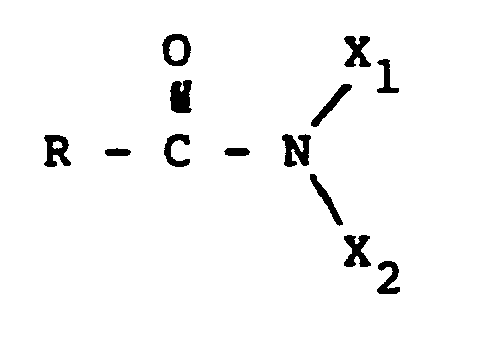
- the organic solvent depolarizers of the invention is represented by the general formula: wherein R is an alkyl, alkoxy, phenyl or phenoxy group and X 1 or X 2 are halogens.
- the depolarizers may be in the liquid or solid state.
- the cell may include an alkali or alkaline earth metal anode, a cathode where the cathode depolarizer is reduced, and a compatible electrolyte salt which is soluble in the solvent depolarizer. Preferred embodiments are described in the subclaims.
- the invention is based on the desirability of eliminating sulfur containing compounds from high voltage, high energy density, non-aqueous electrochemical cells without sacrificing cell performance. Accordingly, it has been discovered that certain N,N-dihalocarbamates provide excellent cathode depolarization characteristics and are compatible with the highly reactive alkali or alkaline earth metal anodes and non-aqueous electrolyte salts. N,N-dihalocarbamates follow the general formula wherein R is an alkyl, alkoxy, phenyl or phenoxy group and X 1 and X 2 are halogens including flourine, chlorine, bromine, and iodine or combinations of them.
- the preferred organic depolarizer is one selected from a group including N,N-dichloromethoxy carbamate and N,N-dichloroethoxy carbamate.
- the solvent depolarizer is paired with a compatible electrolyte salt which forms a system capable of long shelf life and good cell performance.
- the electrolyte salt must be soluble in the solvent depolarizer. Any electrolyte salt which meets the cell criteria may be used.
- Anode materials are generally selected from the alkali or alkaline earth metals. Of these, lithium, sodium, calcium and potassium.are preferred.
- One successful cell utilized a lithium anode, N,N-dichloroethyl carbamate as the cathode depolarizer and a tetra-alkyl ammonium perchlorate electrolyte salt.
- the cell was observed to have an open circuit voltage of 3.94 volts and, at a constant discharge current of 0.32 mA per square centimeter the cell exhibited a flat discharge voltage of 3.52 volts.
- Another cell had a lithium anode, an N,N-dichloroethyl carbamate solvent depolarizer and a lithium hexafluoroarsenate electrolyte salt. That cell exhibited a flat discharge voltage of approximately 3.5 volts at a constant current of 1 mA per square centimeter. The solubility of the electrolyte salt in the solvent depolarizer was observed to be 1.3g in 5g of solvent at room temperature.
Landscapes
- Chemical & Material Sciences (AREA)
- Chemical Kinetics & Catalysis (AREA)
- Electrochemistry (AREA)
- General Chemical & Material Sciences (AREA)
- Engineering & Computer Science (AREA)
- Manufacturing & Machinery (AREA)
- Primary Cells (AREA)
Abstract

Description
- The invention relates to
non-aqueous electrochemical cells and, more particularly, to a high-rate, non-aqueous electrochemical cell which is free of sulfur-containing compounds. - In the field of high energy battery systems utilizing highly reactive anode materials such as alkali metals is known in combination with non-aqueous electrolytes. The electrolyte is normally composed of a solute which is commonly a metal salt or a complex metal salt of group I-A, II-A or III-A elements of the Periodic Table dissolved in a compatible non-aqueous solvent. The batteries often are used in applications which require them to be operable over a wide temperature range with a high output over that wide temperature range. For this reason, much research has been conducted concerning the development of solvent-solute pairs which are stable and have a high ionic conductivity over a wide temperature range. This generally means that the solvent solute pair should be in the liquid state over this wide temperature range, i.e., have a low freezing point and a high boiling point.
- In addition, it is desirable that the chemical system of the electrochemical cell have a long, stable shelf life when used in a primary or secondary battery system. The prior art is replete with many examples of such cells which utilize solvents containing sulfur dioxide (S02), thionyl chloride (SOCI2) and sulfuryl chloride (SO2Cl2). These compounds, along with certain other oxyhalides, are normally used in combination with an alkali metal anode or alkaline earth metal anode and an electrolyte consisting of a salt of a cation of the metal of the anode together with the solvent materials.
- The basic problem with the electrochemical cells of the prior art, especially those cells utilizing sulfur dioxide, thionyl chloride or sulfuryl chloride has been the problem with safe storage and operation of the batteries. Under certain circumstances, the batteries tend to experience thermal runaway in which reactions and pressure buildup within the cell may actually cause a very violent explosion. One reason for this occurrence has been traced to reactions which occur between the metal anode and the sulfur of the solvent material. In addition, because sulfur dioxide is a gas at ordinary temperatures, overheating or the use of such batteries at higher temperatures of batteries may lead to the buildup of excessive pressure within the cell.
- In order to overcome the
problems associated with the use of sulfur dioxide, thionyl chloride and sulfural chloride in high energy density, non-aqueous electrochemical cells the present invention provides an organic solvent depolarizer system which allows long-term safe storage and greatly reduces the hazzards previously encountered in operating such cells including the toxicity problems associated with the electrochemical system involved. - The organic solvent depolarizers of the invention is represented by the general formula:

wherein R is an alkyl, alkoxy, phenyl or phenoxy group and X 1 or X 2 are halogens. Depending on the cell application, the depolarizers may be in the liquid or solid state. The cell may include an alkali or alkaline earth metal anode, a cathode where the cathode depolarizer is reduced, and a compatible electrolyte salt which is soluble in the solvent depolarizer. Preferred embodiments are described in the subclaims. - The invention is based on the desirability of eliminating sulfur containing compounds from high voltage, high energy density, non-aqueous electrochemical cells without sacrificing cell performance. Accordingly, it has been discovered that certain N,N-dihalocarbamates provide excellent cathode depolarization characteristics and are compatible with the highly reactive alkali or alkaline earth metal anodes and non-aqueous electrolyte salts. N,N-dihalocarbamates follow the general formula
- While others may successfully be used, the preferred organic depolarizer is one selected from a group including N,N-dichloromethoxy carbamate and N,N-dichloroethoxy carbamate.
- The solvent depolarizer is paired with a compatible electrolyte salt which forms a system capable of long shelf life and good cell performance. The electrolyte salt must be soluble in the solvent depolarizer. Any electrolyte salt which meets the cell criteria may be used.
- Anode materials are generally selected from the alkali or alkaline earth metals. Of these, lithium, sodium, calcium and potassium.are preferred.
- One successful cell utilized a lithium anode, N,N-dichloroethyl carbamate as the cathode depolarizer and a tetra-alkyl ammonium perchlorate electrolyte salt. The cell was observed to have an open circuit voltage of 3.94 volts and, at a constant discharge current of 0.32 mA per square centimeter the cell exhibited a flat discharge voltage of 3.52 volts.
- Another cell had a lithium anode, an N,N-dichloroethyl carbamate solvent depolarizer and a lithium hexafluoroarsenate electrolyte salt. That cell exhibited a flat discharge voltage of approximately 3.5 volts at a constant current of 1 mA per square centimeter. The solubility of the electrolyte salt in the solvent depolarizer was observed to be 1.3g in 5g of solvent at room temperature.
Claims (7)

Applications Claiming Priority (2)
| Application Number | Priority Date | Filing Date | Title |
|---|---|---|---|
| US06/506,463 US4439503A (en) | 1983-06-21 | 1983-06-21 | Metal-organic liquid depolarizer electrochemical cell |
| US506463 | 1983-06-21 |
Publications (2)
| Publication Number | Publication Date |
|---|---|
| EP0129243A1 true EP0129243A1 (en) | 1984-12-27 |
| EP0129243B1 EP0129243B1 (en) | 1988-10-19 |
Family
ID=24014694
Family Applications (1)
| Application Number | Title | Priority Date | Filing Date |
|---|---|---|---|
| EP84107000A Expired EP0129243B1 (en) | 1983-06-21 | 1984-06-19 | Non-aqueous electrochemical cell |
Country Status (3)
| Country | Link |
|---|---|
| US (1) | US4439503A (en) |
| EP (1) | EP0129243B1 (en) |
| DE (1) | DE3474744D1 (en) |
Cited By (1)
| Publication number | Priority date | Publication date | Assignee | Title |
|---|---|---|---|---|
| EP0575191A1 (en) * | 1992-06-17 | 1993-12-22 | Mitsui Petrochemical Industries, Ltd. | Non-aqueous electrolyte solvent and battery containing this electrolyte |
Families Citing this family (3)
| Publication number | Priority date | Publication date | Assignee | Title |
|---|---|---|---|---|
| US4751161A (en) * | 1986-05-29 | 1988-06-14 | The United States Of America As Represented By The Secretary Of The Navy | Non-aqueous primary cell |
| DE19858925A1 (en) * | 1998-12-19 | 2000-06-21 | Aventis Res & Tech Gmbh & Co | Improving the safety of lithium batteries for use in electronic devices by using an electrolyte containing a partly-fluorinated amide |
| DE10128581B4 (en) * | 2001-06-13 | 2005-04-07 | Epcos Ag | Electrolytic solution for electrochemical capacitors |
Citations (2)
| Publication number | Priority date | Publication date | Assignee | Title |
|---|---|---|---|---|
| US3686038A (en) * | 1971-02-03 | 1972-08-22 | Du Pont | High energy density battery with trihydrocarbyl carbamate based electrolyte |
| US4166888A (en) * | 1978-10-30 | 1979-09-04 | Exxon Research & Engineering Co. | Cell having an alkali metal anode, a fluorinated carbon cathode and an electrolyte which includes an alkali metal halide salt and a solvent system containing a substituted amide solvent and a cyclic carbonate cosolvent |
-
1983
- 1983-06-21 US US06/506,463 patent/US4439503A/en not_active Expired - Fee Related
-
1984
- 1984-06-19 DE DE8484107000T patent/DE3474744D1/en not_active Expired
- 1984-06-19 EP EP84107000A patent/EP0129243B1/en not_active Expired
Patent Citations (2)
| Publication number | Priority date | Publication date | Assignee | Title |
|---|---|---|---|---|
| US3686038A (en) * | 1971-02-03 | 1972-08-22 | Du Pont | High energy density battery with trihydrocarbyl carbamate based electrolyte |
| US4166888A (en) * | 1978-10-30 | 1979-09-04 | Exxon Research & Engineering Co. | Cell having an alkali metal anode, a fluorinated carbon cathode and an electrolyte which includes an alkali metal halide salt and a solvent system containing a substituted amide solvent and a cyclic carbonate cosolvent |
Cited By (2)
| Publication number | Priority date | Publication date | Assignee | Title |
|---|---|---|---|---|
| EP0575191A1 (en) * | 1992-06-17 | 1993-12-22 | Mitsui Petrochemical Industries, Ltd. | Non-aqueous electrolyte solvent and battery containing this electrolyte |
| US5385794A (en) * | 1992-06-17 | 1995-01-31 | Mitsui Petrochemical Industries Ltd. | Cell electrolyte solvent, cell electrolyte comprising the solvent and non-aqueous electrolyte battery comprising the electrolyte |
Also Published As
| Publication number | Publication date |
|---|---|
| US4439503A (en) | 1984-03-27 |
| DE3474744D1 (en) | 1988-11-24 |
| EP0129243B1 (en) | 1988-10-19 |
Similar Documents
| Publication | Publication Date | Title |
|---|---|---|
| US5229227A (en) | Low flammability nonaqueous electrolytes | |
| CA2072488C (en) | Nonaqueous electrolytes | |
| US6544691B1 (en) | Batteries using molten salt electrolyte | |
| US3907597A (en) | Nonaqueous cell having an electrolyte containing sulfolane or an alkyl-substituted derivative thereof | |
| US4808497A (en) | Organic electrolyte for nonaqueous cells | |
| CA1141429A (en) | Abuse resistant active metal anode/fluid cathode depolarized cells | |
| US3947289A (en) | Mixed solvents for high and low temperature organic electrolyte batteries | |
| US4177329A (en) | Electrolyte salts for non aqueous electrochemical cells | |
| EP0102692A1 (en) | Non aqueous electrochemical cell | |
| US4416960A (en) | Li/TiS2 Current producing system | |
| USH723H (en) | Lithium electrochemical cell containing diethylcarbonate as an electrolyte solvent additive | |
| US4238552A (en) | Electrolyte salt for non-aqueous electrochemical cells | |
| US4439503A (en) | Metal-organic liquid depolarizer electrochemical cell | |
| Jasinski | A summary of patents on organic electrolyte batteries | |
| JPH0475630B2 (en) | ||
| US3887397A (en) | Highly conductive stable electrolyte for lithium batteries | |
| US5352546A (en) | High rate electrochemical cell | |
| CA1043866A (en) | Nonaqueous cell having an electrolyte containing crotonitrile | |
| CA1130855A (en) | Hexafluorophosphate additive for high drain rate lithium cells | |
| EP0049139A1 (en) | Nonaqueous cell | |
| US3547703A (en) | Nonaqueous battery with ethylene glycol sulfite electrolyte solvent | |
| US4510220A (en) | Cell with PbCl2 cathode | |
| US3367800A (en) | High energy-density heat-activated voltaic cells at intermediate temperatures | |
| US4621036A (en) | Halogenated organic solid depolarizer | |
| USRE31414E (en) | Electrolyte salts for non aqueous electrochemical cells |
Legal Events
| Date | Code | Title | Description |
|---|---|---|---|
| PUAI | Public reference made under article 153(3) epc to a published international application that has entered the european phase |
Free format text: ORIGINAL CODE: 0009012 |
|
| AK | Designated contracting states |
Designated state(s): DE FR GB NL |
|
| 17P | Request for examination filed |
Effective date: 19841214 |
|
| 17Q | First examination report despatched |
Effective date: 19860124 |
|
| GRAA | (expected) grant |
Free format text: ORIGINAL CODE: 0009210 |
|
| AK | Designated contracting states |
Kind code of ref document: B1 Designated state(s): DE FR GB NL |
|
| REF | Corresponds to: |
Ref document number: 3474744 Country of ref document: DE Date of ref document: 19881124 |
|
| ET | Fr: translation filed | ||
| PGFP | Annual fee paid to national office [announced via postgrant information from national office to epo] |
Ref country code: FR Payment date: 19890615 Year of fee payment: 6 |
|
| PGFP | Annual fee paid to national office [announced via postgrant information from national office to epo] |
Ref country code: DE Payment date: 19890626 Year of fee payment: 6 |
|
| PGFP | Annual fee paid to national office [announced via postgrant information from national office to epo] |
Ref country code: NL Payment date: 19890630 Year of fee payment: 6 Ref country code: GB Payment date: 19890630 Year of fee payment: 6 |
|
| PLBE | No opposition filed within time limit |
Free format text: ORIGINAL CODE: 0009261 |
|
| STAA | Information on the status of an ep patent application or granted ep patent |
Free format text: STATUS: NO OPPOSITION FILED WITHIN TIME LIMIT |
|
| 26N | No opposition filed | ||
| PG25 | Lapsed in a contracting state [announced via postgrant information from national office to epo] |
Ref country code: GB Effective date: 19900619 |
|
| PG25 | Lapsed in a contracting state [announced via postgrant information from national office to epo] |
Ref country code: NL Effective date: 19910101 |
|
| GBPC | Gb: european patent ceased through non-payment of renewal fee | ||
| NLV4 | Nl: lapsed or anulled due to non-payment of the annual fee | ||
| PG25 | Lapsed in a contracting state [announced via postgrant information from national office to epo] |
Ref country code: FR Effective date: 19910228 |
|
| PG25 | Lapsed in a contracting state [announced via postgrant information from national office to epo] |
Ref country code: DE Effective date: 19910301 |
|
| REG | Reference to a national code |
Ref country code: FR Ref legal event code: ST |