EP0127920A2 - A process for preparing an alkylene compound starting from a fluorocyclopropane compound - Google Patents
A process for preparing an alkylene compound starting from a fluorocyclopropane compound Download PDFInfo
- Publication number
- EP0127920A2 EP0127920A2 EP84200753A EP84200753A EP0127920A2 EP 0127920 A2 EP0127920 A2 EP 0127920A2 EP 84200753 A EP84200753 A EP 84200753A EP 84200753 A EP84200753 A EP 84200753A EP 0127920 A2 EP0127920 A2 EP 0127920A2
- Authority
- EP
- European Patent Office
- Prior art keywords
- following formula
- represented
- preparing
- fluorochlorocyclopropane
- compound
- Prior art date
- Legal status (The legal status is an assumption and is not a legal conclusion. Google has not performed a legal analysis and makes no representation as to the accuracy of the status listed.)
- Granted
Links
Classifications
-
- C—CHEMISTRY; METALLURGY
- C07—ORGANIC CHEMISTRY
- C07D—HETEROCYCLIC COMPOUNDS
- C07D505/00—Heterocyclic compounds containing 5-oxa-1-azabicyclo [4.2.0] octane ring systems, i.e. compounds containing a ring system of the formula:, e.g. oxacephalosporins; Such ring systems being further condensed, e.g. 2,3-condensed with an oxygen-, nitrogen- or sulfur-containing hetero ring
-
- C—CHEMISTRY; METALLURGY
- C07—ORGANIC CHEMISTRY
- C07C—ACYCLIC OR CARBOCYCLIC COMPOUNDS
- C07C323/00—Thiols, sulfides, hydropolysulfides or polysulfides substituted by halogen, oxygen or nitrogen atoms, or by sulfur atoms not being part of thio groups
-
- C—CHEMISTRY; METALLURGY
- C07—ORGANIC CHEMISTRY
- C07C—ACYCLIC OR CARBOCYCLIC COMPOUNDS
- C07C323/00—Thiols, sulfides, hydropolysulfides or polysulfides substituted by halogen, oxygen or nitrogen atoms, or by sulfur atoms not being part of thio groups
- C07C323/23—Thiols, sulfides, hydropolysulfides or polysulfides substituted by halogen, oxygen or nitrogen atoms, or by sulfur atoms not being part of thio groups containing thio groups and nitrogen atoms, not being part of nitro or nitroso groups, bound to the same carbon skeleton
- C07C323/30—Thiols, sulfides, hydropolysulfides or polysulfides substituted by halogen, oxygen or nitrogen atoms, or by sulfur atoms not being part of thio groups containing thio groups and nitrogen atoms, not being part of nitro or nitroso groups, bound to the same carbon skeleton having the sulfur atom of at least one of the thio groups bound to a carbon atom of a ring other than a six-membered aromatic ring of the carbon skeleton
-
- C—CHEMISTRY; METALLURGY
- C07—ORGANIC CHEMISTRY
- C07C—ACYCLIC OR CARBOCYCLIC COMPOUNDS
- C07C43/00—Ethers; Compounds having groups, groups or groups
- C07C43/02—Ethers
- C07C43/18—Ethers having an ether-oxygen atom bound to a carbon atom of a ring other than a six-membered aromatic ring
- C07C43/192—Ethers having an ether-oxygen atom bound to a carbon atom of a ring other than a six-membered aromatic ring containing halogen
-
- C—CHEMISTRY; METALLURGY
- C07—ORGANIC CHEMISTRY
- C07C—ACYCLIC OR CARBOCYCLIC COMPOUNDS
- C07C43/00—Ethers; Compounds having groups, groups or groups
- C07C43/30—Compounds having groups
- C07C43/313—Compounds having groups containing halogen
-
- C—CHEMISTRY; METALLURGY
- C07—ORGANIC CHEMISTRY
- C07C—ACYCLIC OR CARBOCYCLIC COMPOUNDS
- C07C43/00—Ethers; Compounds having groups, groups or groups
- C07C43/32—Compounds having groups or groups
-
- C—CHEMISTRY; METALLURGY
- C07—ORGANIC CHEMISTRY
- C07C—ACYCLIC OR CARBOCYCLIC COMPOUNDS
- C07C2601/00—Systems containing only non-condensed rings
- C07C2601/02—Systems containing only non-condensed rings with a three-membered ring
Definitions
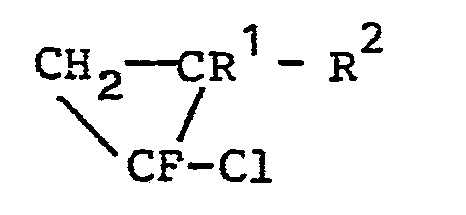
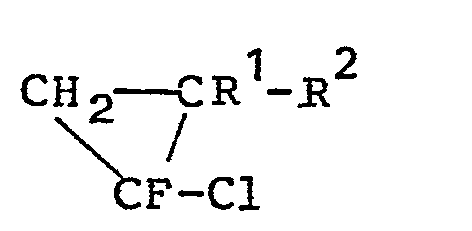
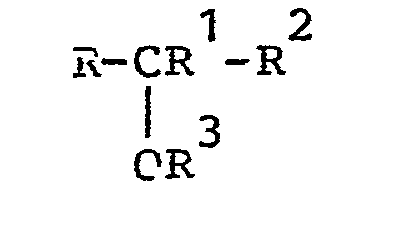
- This invention relates to a fluorochlorocyclopropane compound (I) represented by the following formula : (wherein R 1 is hydrogen, halogen, or 1 to 8C alkylamino, alkoxy, or alkylthio and
- This novel compound (I) is prepared by the addition of fluorochlorocarbene to the corresponding olefin (II) which is converted to carboxymethylthiofluoroacrylate (VIII), a useful intermediate for synthesizing, e.g., new cephalosporins (IX).
- fluorochlorocarbene to the corresponding olefin (II) which is converted to carboxymethylthiofluoroacrylate (VIII), a useful intermediate for synthesizing, e.g., new cephalosporins (IX).
- the base can be an inorganic base, e.g., alkali metal hydroxide, or an organic base, e.g., 1 to 5C-alcoholate of alkali metal or alkaline earth metal, alkylalkali metal, arylalkali metal, or the like capable of producing fluorochlorocarbene by reacting with dichlorofluoromethane.
- an inorganic base e.g., alkali metal hydroxide
- organic base e.g., 1 to 5C-alcoholate of alkali metal or alkaline earth metal, alkylalkali metal, arylalkali metal, or the like capable of producing fluorochlorocarbene by reacting with dichlorofluoromethane.
- the reaction is usually carried out in a solvent.
- the solvent is preferably that inert to the starting material, product, or fluorochlorocarbene (e.g., that having no reactive double bond nor halogen) and causing less side reaction (e.g., polymerization of the starting material or product), for example, industrial solvents of hydrocarbon or ether series. This reaction is not disturbed by water. Excess starting olefin or dichlorofluoromethane can play a role of solvent.
- the reaction is usually carried out at between -50°C and 50°C, preferably -20°C and 40°C for 1 to 10 hours time.
- phase transfer reagents in two-phase reaction e.g., tetra-lower alkylammonium halide, methyl-trilower alkyl-ammonium halide, or the like promotes the reaction.
- Fl uorochlorocyclopropanes (I) are useful as intermediates for chemicals (e.g., fluoropolymers, fluoroacrylic acid, medicines).
- fluorochlorocyclopropane (I) is heated at between 60°C and 200°C, preferably 80°C and 160°C, in a solvent to supposedly give intermediary fluorochlopropene (III) usually for 30 minutes to 10 hours.
- the solvent is water or an inert organic solvent (e.g., hydrocarbon, halohydrocarbon, alcohol, aromatic base). 3)
- the fluorochloropropene (III) reacts with alcohol (R 3 OH:R 3 is 1 to 4C alkyl) to give an acetal or aminal of acrolein or an ortho ester of acrylic acid (IV).
- An acid scavenger e.g., aromatic base, alkylamine improves the yield.
- halogen e.g., bromine
- compound (IV) is dissolved in a halohydrocarbon solvent and mixed with bromine to give dibromofluoro-propane (V) which is heated with a base (e.g., DBU) to give bromofluoropropene (VI).
- a base e.g., DBU
- An acetal or aminal (IV), dibromofluoropropane (V), or bromofluoropropene (VI), i.e., where R 1 is hydrogen, can be oxidized as follows to give an ester, amide, or thioester of propionic acid (IVa to VIa) leaving a double bond, if any, intact.
- This oxidation is carried out with an inorganic or organic peracid (e.g., persulfuric acid, periodic acid, nitrogen dioxide, percarboxylic acids), molecular halogen (e.g., chlorine, bromine), hypohalite or its precursor (e.g., hypohalogenous acid, its salt or ester, N-haloamide, N-ha- loimide), organic peroxide, hydrogen peroxide, or the like, or salts thereof, preferably at an amount of 1 to 10 molar equivalents, in a solvent at between -20°C and 100°C, preferably 40 and 85°C, for 10 minutes to 10 hours, preferably 1 to 5 hours.
- Aldehyde if resulting from acetal hydrolysis (e.g.., with acid contaminant) in the medium, is oxidized to give carboxylic acid.
- persulfuric acid or Caro's acid (1 to 10 molar equivalents) is added to a solution of the starting acetal in lower alkanol (3 to 5 parts by weight), and the mixture is warmed at between room temperature and 80°C for 1 to 5 hours.
- a typical use of the product is as follows : Namely, the propionate (VIa) is combined with alkyl thioglycolate to give carboxymethylthiofluoroacrylate (VII) which is hydrolyzed to give (VIII) which is then treated with 7-amino-3-substituted methyl-3-cephem-4-carboxylate in a usual manner to afford an antibacterial cephalosporin (IX).
- the solvent for above reactions is an industrial solvent of a series hydrocarbon (e.g., pentane, hexane, octane, benzene, toluene, xylene), halogenated hydrocarbon (e.g., dichloromethane, chloroform, carbon tetrachloride, dichloroethane, trichloroethane, chlorobenzene), ether (e.g., diethyl ether, methyl isobutyl ether, dioxane, tetrahydrofuran), ketone (e.g., acetone, methyl ethyl ketone, cyclohexanone), ester (e.g., ethyl acetate, isobutyl acetate, methyl benzoate), nitrohydrocarbon (e.g., nitromethane, nitrobenzene), nitrile (e.g., acetonitrile, benz
- Work up of above reactions includes removing (e.g., by extracting, evaporating, washing, concentrating, precipitating, filtering, drying) of contaminants (e.g., unreacted starting material, by-product, solvent) and purification (e.g., by absorbing, eluting, distilling, precipitating, separating, chromatographying) to isolate the objective product in a conventional manner.
- contaminants e.g., unreacted starting material, by-product, solvent
- purification e.g., by absorbing, eluting, distilling, precipitating, separating, chromatographying
- the method for work up is usually as follows : the reaction mixture is, if necessary, diluted with water and dichloromethane or ethyl acetate, separating organic phase is taken up, washed with water, dried, and concentrated to leave residue. If required after silica gel chromatography, the residue is purified by crystallizing, precipitating, filtrating, etc., to give the product. Physical constants of the products are same with the samples produced by other route.
- R 1 H
- R 2 OC 4 H 9 -n
- R 3 C 4 H 9 -n.
- the bromofluorovinyl compound (VI or VIa) is obtained by refluxing a solution of the corresponding dibromide (V or Va) (1 part by weight) in benzene (5 to 20 parts by weight) containing DBU (0.1 to 2.molar equivalents) for 0.5 to 5 hours in 50 to 85% yield.
- the products are listed on Table 6.
Landscapes
- Chemical & Material Sciences (AREA)
- Organic Chemistry (AREA)
- Organic Low-Molecular-Weight Compounds And Preparation Thereof (AREA)
Abstract
Description
- This invention relates to a fluorochlorocyclopropane compound (I) represented by the following formula :

- n2 is halogen or 1 to 8C alkylamino, alkoxy, or alkylthio)
- This novel compound (I) is prepared by the addition of fluorochlorocarbene to the corresponding olefin (II) which is converted to carboxymethylthiofluoroacrylate (VIII), a useful intermediate for synthesizing, e.g., new cephalosporins (IX).

- R3 is 1 to 4C alkyl)
- Japanese Patent Application No. 128,116/1983 by some of the present inventors et al. describes Compound (VII) prepared from expensive monofluoroacetate. Starting from abundant and inexpensive commodities in the market, the reactions of this invention are handled easily with only a few isolation of intermediates. The process is explained below :
- 1) The fluorochlorocyclopropane (I) is prepared by treating an olefin (II) represented by the following formula :

- The base can be an inorganic base, e.g., alkali metal hydroxide, or an organic base, e.g., 1 to 5C-alcoholate of alkali metal or alkaline earth metal, alkylalkali metal, arylalkali metal, or the like capable of producing fluorochlorocarbene by reacting with dichlorofluoromethane.
- The reaction is usually carried out in a solvent. The solvent is preferably that inert to the starting material, product, or fluorochlorocarbene (e.g., that having no reactive double bond nor halogen) and causing less side reaction (e.g., polymerization of the starting material or product), for example, industrial solvents of hydrocarbon or ether series. This reaction is not disturbed by water. Excess starting olefin or dichlorofluoromethane can play a role of solvent. The reaction is usually carried out at between -50°C and 50°C, preferably -20°C and 40°C for 1 to 10 hours time.
- In a typical case, a solution of dichlorofluoromethane (2 to 3 molar equivalents) and the olefin (II) (1 molar 6quivalent) in water (0.8 to 2 weights) containing sodium or potassium hydroxide (2 to 10 molar equivalents) is stirred for 3 to 5 hours to give the objective fluorochlorocyclopropane (I) in up to 90& yield.
- So-called crown ethers, phase transfer reagents in two-phase reaction (e.g., tetra-lower alkylammonium halide, methyl-trilower alkyl-ammonium halide), or the like promotes the reaction.
- Fluorochlorocyclopropanes (I) are useful as intermediates for chemicals (e.g., fluoropolymers, fluoroacrylic acid, medicines).
- 2) For example, fluorochlorocyclopropane (I) is heated at between 60°C and 200°C, preferably 80°C and 160°C, in a solvent to supposedly give intermediary fluorochlopropene (III) usually for 30 minutes to 10 hours.

- The solvent is water or an inert organic solvent (e.g., hydrocarbon, halohydrocarbon, alcohol, aromatic base). 3) The fluorochloropropene (III) reacts with alcohol (R 3 OH:R 3 is 1 to 4C alkyl) to give an acetal or aminal of acrolein or an ortho ester of acrylic acid (IV). An acid scavenger (e.g., aromatic base, alkylamine) improves the yield.

- 4) The acetal or aminal of acrolein or thioester or ortho ester of acrylic acid (IV) adds halogen (e.g., bromine) to the double bond. For example, compound (IV) is dissolved in a halohydrocarbon solvent and mixed with bromine to give dibromofluoro-propane (V) which is heated with a base (e.g., DBU) to give bromofluoropropene (VI).

- 5) By thermal decomposition of fluorochlorocyclopropane (I), the corresponding carbonyl compound (IVa) can be produced.

- 6) The acetal or aminal of acrolein or an ortho ester of acrylic acid (IV), dibromofluoropropane (V), or bromofluoropropene (VI), is hydrolyzed with acid to give a carbonyl compound (IVa to VIa). An aqueous reaction is promoted with a surface active reagent.

- 7) An acetal or aminal (IV), dibromofluoropropane (V), or bromofluoropropene (VI), i.e., where R1 is hydrogen, can be oxidized as follows to give an ester, amide, or thioester of propionic acid (IVa to VIa) leaving a double bond, if any, intact.

- This oxidation is carried out with an inorganic or organic peracid (e.g., persulfuric acid, periodic acid, nitrogen dioxide, percarboxylic acids), molecular halogen (e.g., chlorine, bromine), hypohalite or its precursor (e.g., hypohalogenous acid, its salt or ester, N-haloamide, N-ha- loimide), organic peroxide, hydrogen peroxide, or the like, or salts thereof, preferably at an amount of 1 to 10 molar equivalents, in a solvent at between -20°C and 100°C, preferably 40 and 85°C, for 10 minutes to 10 hours, preferably 1 to 5 hours. Aldehyde, if resulting from acetal hydrolysis (e.g.., with acid contaminant) in the medium, is oxidized to give carboxylic acid.
- In a typical reaction, persulfuric acid or Caro's acid (1 to 10 molar equivalents) is added to a solution of the starting acetal in lower alkanol (3 to 5 parts by weight), and the mixture is warmed at between room temperature and 80°C for 1 to 5 hours.
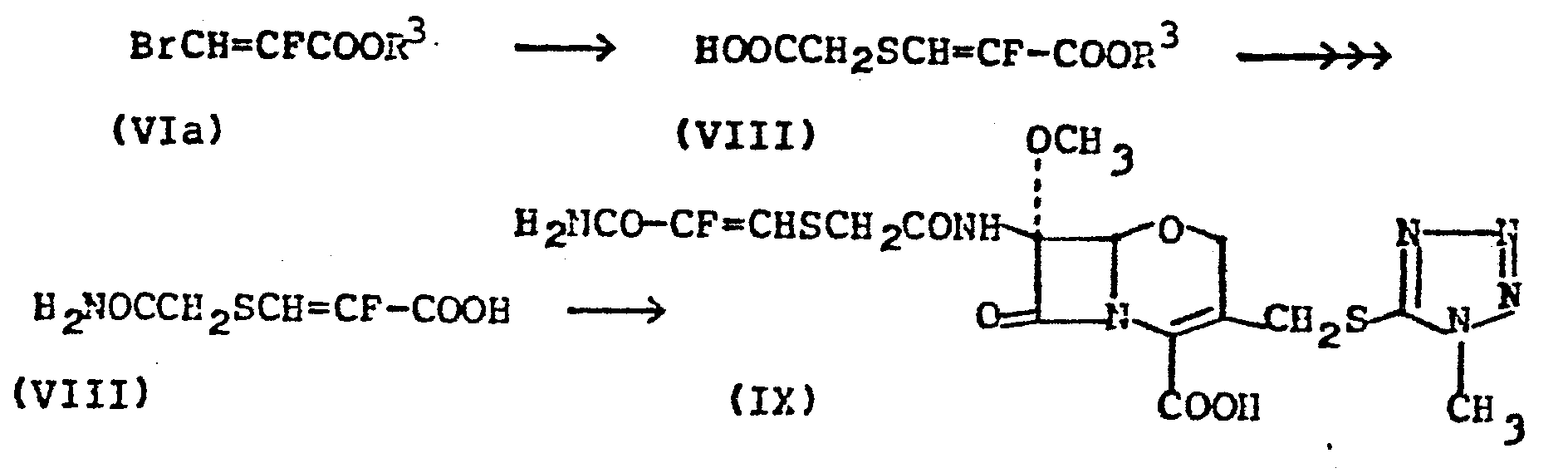
- A typical use of the product is as follows : Namely, the propionate (VIa) is combined with alkyl thioglycolate to give carboxymethylthiofluoroacrylate (VII) which is hydrolyzed to give (VIII) which is then treated with 7-amino-3-substituted methyl-3-cephem-4-carboxylate in a usual manner to afford an antibacterial cephalosporin (IX).
- The solvent for above reactions is an industrial solvent of a series hydrocarbon (e.g., pentane, hexane, octane, benzene, toluene, xylene), halogenated hydrocarbon (e.g., dichloromethane, chloroform, carbon tetrachloride, dichloroethane, trichloroethane, chlorobenzene), ether (e.g., diethyl ether, methyl isobutyl ether, dioxane, tetrahydrofuran), ketone (e.g., acetone, methyl ethyl ketone, cyclohexanone), ester (e.g., ethyl acetate, isobutyl acetate, methyl benzoate), nitrohydrocarbon (e.g., nitromethane, nitrobenzene), nitrile (e.g., acetonitrile, benzonitrile), amide (e.g., formamide, acetamide, dimethylformamide, dimethylacetamide, hexamethylphosphorotriamide), alcohol (e.g., methanol,. ethanol, propanol, hexanol, octanol, benzylalcohol), water, or the like or a mixture of these.
- Work up of above reactions includes removing (e.g., by extracting, evaporating, washing, concentrating, precipitating, filtering, drying) of contaminants (e.g., unreacted starting material, by-product, solvent) and purification (e.g., by absorbing, eluting, distilling, precipitating, separating, chromatographying) to isolate the objective product in a conventional manner.
- Following examples and experiments illustrate this invention.
- Physical constants of the products in which IR shows cm-1 value and NMR shows 6 value and J value of coupling constants in Hz scale. The physical constants of the products are listed in the Tables 3 to 7.
- The method for work up is usually as follows : the reaction mixture is, if necessary, diluted with water and dichloromethane or ethyl acetate, separating organic phase is taken up, washed with water, dried, and concentrated to leave residue. If required after silica gel chromatography, the residue is purified by crystallizing, precipitating, filtrating, etc., to give the product. Physical constants of the products are same with the samples produced by other route.
- Abbreviations are as follows :
- eq = molar equivalents per mole of the starting material,
- rt = room temperature, and
- wt = parts by weight per weight of the starting material.
-

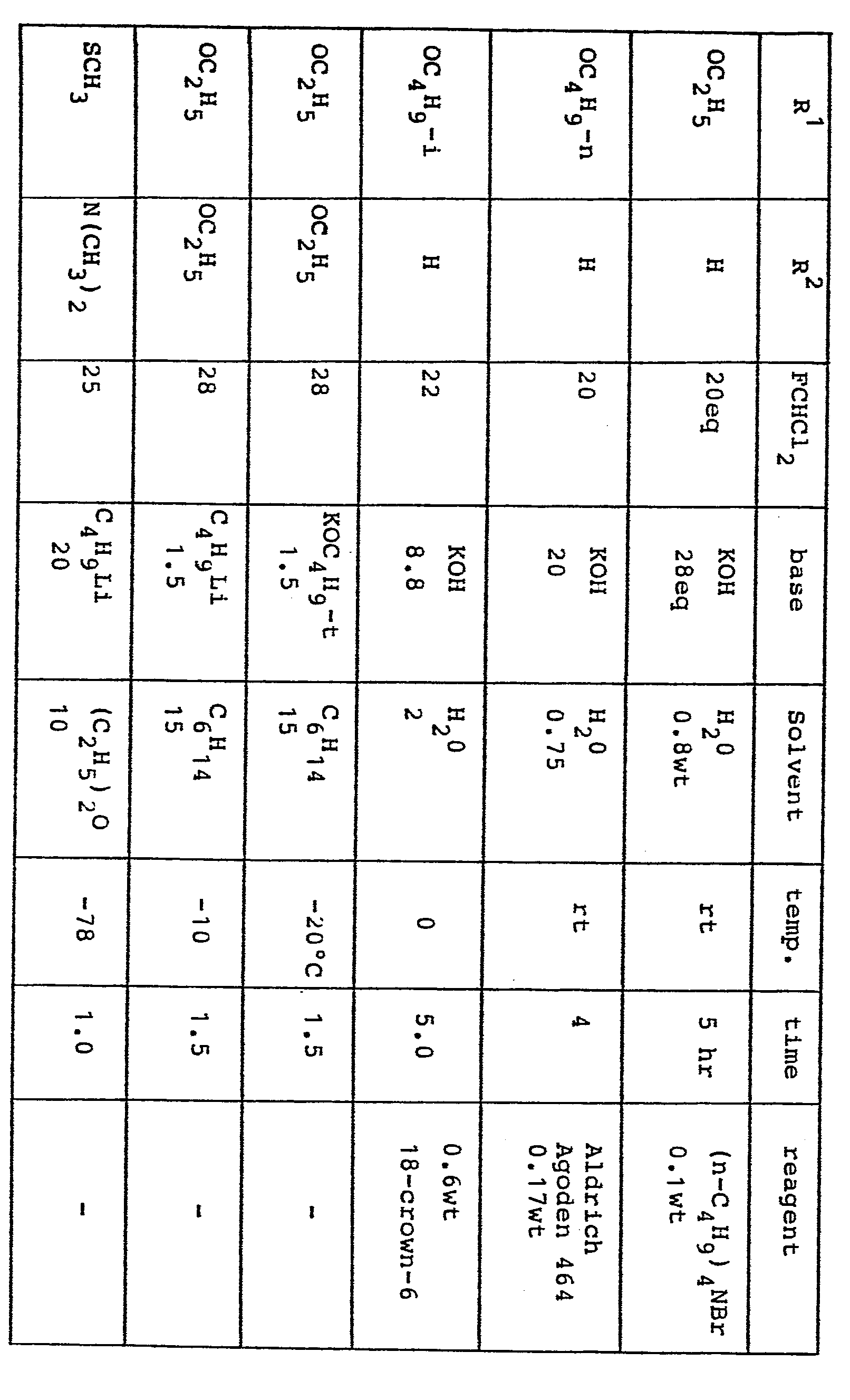
- To a solution of an olefin (II) in a solvent are added a base and dichlorofluoromethane, and the mixture is stirred for given time at given temperature, if required in the presence of an additive reagent.
- The reaction mixture is washed with water and aqueous sodium hydrogen carbonate, dried over magnesium sulfate and concentrated. The residue is distilled in vacuum to afford the corresponding fluorochlorocyclopropane (I).
- The reaction conditions are listed on Table 1.

-

- To a solvent heated in vacuum is added fluorochlorocyclopropane (I), and evaporating carbonyl compound (IVa) is collected by condensing. The reaction conditions are given on Table 2.

-

- A suspension of 1-chloro-1-fluoro-2-dimethylamino-2-methyl-thiocyclopropane (238 mg) and hydroquinone (40 mg) in aqueous 0.015M-sodium dodecylsulfate is stirred for 1 hour at 80 to 90°C. The reaction mixture is poured into ice water and extracted with ether. The extract solution is washed with water, dried, and concentrated to give methyl α-fluorothiolacrylate (200 mg).
-

- A mixture of 1-chloro-1-fluoro-2-n-butoxycyclopropane (42 g), pyridine (24 ml), and n-butanol (150 ml) is refluxed for 17 hours. The reaction mixture is poured onto aqueous potassium carbonate and extracted with ether. The extract is washed with water, dried, and concentrated. The residue is distilled in vacuum to give α-fluoroacrolein di-n-butyla- cetal. bp(12 mmHg) : 83 - 85°C.
- A solution of 1-chloro-1-fluoro-2,2-diethoxycyclopropane (5 g) in a mixture of benzene (25 ml), ethanol (2.38 ml), and pyridine (2.65 ml) is refluxed for 1 hour. The reaction mixture is filtered to remove separated salt and concentrated in vacuum. The residue is distilled to give ortho-ethyl ester of α-fluoroacrylic acid (3.7 g). Yield : 70.3%. I bp(40mmHg) : 77°C.
-

- (1) R1=H, R2=OC4H9-n, R3=C4H9-n: bp(4 mmHg) : 96 - 98°C.
- (2) R1=H, R2=OC4H9-i, R3=C4H9-i: 19F NMR: + 50.8 (ddd, J=20, 17, 4Hz).
- (3) R1=R2 =OC2H5, R3 =C2H5: bp(15 mmHg): 83 - 85°C.
-

- The reaction of Experiment 1 is repeated at 80°C to give the corresponding dibromide (Va) wherein R1= OC2H5 or R1= OC4H9-n. Similarly, the compounds on Table 5 can also be produced.
-

-

-

-

-

- A solution of acetal (IV to VI) and Caro's acid (6.8 equivalents) in n-butanol (3.1 part) is stirred at room temperature for 3 hours and at 50°C to 60°C for 1 hour. The reaction mixture is poured onto ice water and extracted with dichloromethane. The extract is washed with water, dried, and concentrated in vacuum. The residue is distilled in vacuum to give the corresponding carboxylic acid ester (IVa to VIa) in about 90% yield.
- By the methods of Examples 1 to 3, compounds of Table 7 are produced from the corresponding acetals.


Claims (7)





Applications Claiming Priority (4)
| Application Number | Priority Date | Filing Date | Title |
|---|---|---|---|
| JP97629/83 | 1983-05-31 | ||
| JP9762983A JPS59222430A (en) | 1983-05-31 | 1983-05-31 | Fluorocyclopropane derivative |
| JP104519/83 | 1983-06-10 | ||
| JP10451983A JPS59227840A (en) | 1983-06-10 | 1983-06-10 | Production of carboxylic acid ester |
Publications (3)
| Publication Number | Publication Date |
|---|---|
| EP0127920A2 true EP0127920A2 (en) | 1984-12-12 |
| EP0127920A3 EP0127920A3 (en) | 1985-04-10 |
| EP0127920B1 EP0127920B1 (en) | 1988-01-27 |
Family
ID=26438797
Family Applications (1)
| Application Number | Title | Priority Date | Filing Date |
|---|---|---|---|
| EP84200753A Expired EP0127920B1 (en) | 1983-05-31 | 1984-05-24 | A process for preparing an alkylene compound starting from a fluorocyclopropane compound |
Country Status (4)
| Country | Link |
|---|---|
| US (1) | US4570018A (en) |
| EP (1) | EP0127920B1 (en) |
| DE (1) | DE3469018D1 (en) |
| GB (1) | GB2141707B (en) |
Cited By (3)
| Publication number | Priority date | Publication date | Assignee | Title |
|---|---|---|---|---|
| FR2573069A1 (en) * | 1984-11-09 | 1986-05-16 | Inst Nat Rech Chimique | New halocyclopropane derivatives, especially acetals of 2-halo-2-fluorocyclopropanones, their method of preparation and their application to the manufacture of alkyl or aryl 2-fluoroacrylates |
| US5420367A (en) * | 1994-09-27 | 1995-05-30 | E. I. Du Pont De Nemours And Company | Polymers of vinyl(perfluorocyclopropane) |
| EP3135661A1 (en) | 2015-08-27 | 2017-03-01 | Asahi Glass Company, Limited | Method for producing halogenated acrylic acid derivative |
Families Citing this family (3)
| Publication number | Priority date | Publication date | Assignee | Title |
|---|---|---|---|---|
| TWI725046B (en) * | 2015-08-27 | 2021-04-21 | 日商Agc股份有限公司 | Method for producing halogenated acrylate ester derivate |
| WO2017163756A1 (en) * | 2016-03-23 | 2017-09-28 | 旭硝子株式会社 | Method for producing α-fluoro acrylic acid ester, and composition containing highly-pure fluorocyclopropane derivative, and composition containing highly-pure α-fluoro acrylic acid ester |
| CN107417524B (en) * | 2017-06-28 | 2019-09-24 | 临海天宇药业有限公司 | A kind of preparation method of 2- fluorinated monomer |
Family Cites Families (2)
| Publication number | Priority date | Publication date | Assignee | Title |
|---|---|---|---|---|
| US3825606A (en) * | 1972-06-02 | 1974-07-23 | Grace W R & Co | Fluorocyclopropanes as inhalation anesthetics |
| US3906111A (en) * | 1974-03-15 | 1975-09-16 | Grace W R & Co | Halogenated methylcyclopropyl ethers for inducing a state of anesthesia |
-
1984
- 1984-05-16 US US06/610,790 patent/US4570018A/en not_active Expired - Fee Related
- 1984-05-24 DE DE8484200753T patent/DE3469018D1/en not_active Expired
- 1984-05-24 EP EP84200753A patent/EP0127920B1/en not_active Expired
- 1984-05-30 GB GB08413739A patent/GB2141707B/en not_active Expired
Cited By (6)
| Publication number | Priority date | Publication date | Assignee | Title |
|---|---|---|---|---|
| FR2573069A1 (en) * | 1984-11-09 | 1986-05-16 | Inst Nat Rech Chimique | New halocyclopropane derivatives, especially acetals of 2-halo-2-fluorocyclopropanones, their method of preparation and their application to the manufacture of alkyl or aryl 2-fluoroacrylates |
| US5420367A (en) * | 1994-09-27 | 1995-05-30 | E. I. Du Pont De Nemours And Company | Polymers of vinyl(perfluorocyclopropane) |
| WO1996010605A3 (en) * | 1994-09-27 | 1996-06-27 | Du Pont | Polymers of vinyl(perfluorocyclopropane) |
| EP3135661A1 (en) | 2015-08-27 | 2017-03-01 | Asahi Glass Company, Limited | Method for producing halogenated acrylic acid derivative |
| US10252971B2 (en) | 2015-08-27 | 2019-04-09 | AGC Inc. | Method for producing halogenated acrylic acid derivative |
| EP3135661B1 (en) * | 2015-08-27 | 2019-05-08 | AGC Inc. | Method for producing halogenated acrylic acid derivative |
Also Published As
| Publication number | Publication date |
|---|---|
| GB8413739D0 (en) | 1984-07-04 |
| GB2141707B (en) | 1986-11-26 |
| EP0127920A3 (en) | 1985-04-10 |
| US4570018A (en) | 1986-02-11 |
| DE3469018D1 (en) | 1988-03-03 |
| GB2141707A (en) | 1985-01-03 |
| EP0127920B1 (en) | 1988-01-27 |
Similar Documents
| Publication | Publication Date | Title |
|---|---|---|
| JPH0710787B2 (en) | Process for producing acylated diketone compound | |
| EP0127920B1 (en) | A process for preparing an alkylene compound starting from a fluorocyclopropane compound | |
| EP0547825A2 (en) | Process for producing alpha-ketoamide derivative | |
| US4933486A (en) | Process for the preparation of 4-halo-3-oxo-2-alkoxyaminobutyric esters | |
| AU2003203479B2 (en) | Process for the preparation of bicyclic diketone salts | |
| US4851588A (en) | Novel process for the preparation of bronopol | |
| JPH05194341A (en) | Process for producing alkyl 3-chloroanthranilate | |
| EP0140454B1 (en) | Process for forming esters of glyoxylic acids | |
| EP0406660B1 (en) | A process for producing haloalkyl alkanoates | |
| US4594438A (en) | Process for preparing 2,2-dimethyl-2,3-dihydro-7-hydroxybenzofuran | |
| KR870000610B1 (en) | Method for preparing sulfamicillin and homologues | |
| JP5000031B2 (en) | Method for producing aromatic-o-dialdehyde compound | |
| JP3976286B2 (en) | Method for producing 2-benzoyl-cyclic 1,3-diketone derivative | |
| US4987247A (en) | Production of tetrahydrophthalimide compound | |
| JP2512983B2 (en) | Biphenyl derivative and method for producing the same | |
| JPH0692347B2 (en) | Terphenyl derivative and method for producing the same | |
| US4310685A (en) | Process for preparing brassylic diester | |
| US4522764A (en) | Process for the production of α, β-unsaturated carboxylic acid alkyl esters sulfonated in the α-position and compounds obtainable by this process | |
| JP2542843B2 (en) | Novel norbornane derivative and method for producing the same | |
| EP0022482B1 (en) | Process for preparing 4-hydroxy-3-methyl-2-(2-propynyl)-2-cyclopentenolone; a gamma-diketone compound and substituted acetonedicarboxylic esters | |
| KR830002719B1 (en) | How to prepare pyridoid insecticide | |
| JPS6254303B2 (en) | ||
| JPS62283944A (en) | Production of sinensal | |
| JPH0420903B2 (en) | ||
| JPH0529020B2 (en) |
Legal Events
| Date | Code | Title | Description |
|---|---|---|---|
| PUAI | Public reference made under article 153(3) epc to a published international application that has entered the european phase |
Free format text: ORIGINAL CODE: 0009012 |
|
| AK | Designated contracting states |
Designated state(s): DE FR IT |
|
| PUAL | Search report despatched |
Free format text: ORIGINAL CODE: 0009013 |
|
| AK | Designated contracting states |
Designated state(s): DE FR IT |
|
| 17P | Request for examination filed |
Effective date: 19850328 |
|
| 17Q | First examination report despatched |
Effective date: 19860530 |
|
| ITF | It: translation for a ep patent filed | ||
| GRAA | (expected) grant |
Free format text: ORIGINAL CODE: 0009210 |
|
| AK | Designated contracting states |
Kind code of ref document: B1 Designated state(s): DE FR IT |
|
| REF | Corresponds to: |
Ref document number: 3469018 Country of ref document: DE Date of ref document: 19880303 |
|
| ET | Fr: translation filed | ||
| PLBE | No opposition filed within time limit |
Free format text: ORIGINAL CODE: 0009261 |
|
| STAA | Information on the status of an ep patent application or granted ep patent |
Free format text: STATUS: NO OPPOSITION FILED WITHIN TIME LIMIT |
|
| 26N | No opposition filed | ||
| PGFP | Annual fee paid to national office [announced via postgrant information from national office to epo] |
Ref country code: FR Payment date: 19950505 Year of fee payment: 12 |
|
| ITTA | It: last paid annual fee | ||
| PGFP | Annual fee paid to national office [announced via postgrant information from national office to epo] |
Ref country code: DE Payment date: 19950726 Year of fee payment: 12 |
|
| PG25 | Lapsed in a contracting state [announced via postgrant information from national office to epo] |
Ref country code: FR Effective date: 19970131 |
|
| PG25 | Lapsed in a contracting state [announced via postgrant information from national office to epo] |
Ref country code: DE Effective date: 19970201 |
|
| REG | Reference to a national code |
Ref country code: FR Ref legal event code: ST |