EP0127597B1 - Octahydrobenzo(f)quinoline derivatives - Google Patents
Octahydrobenzo(f)quinoline derivatives Download PDFInfo
- Publication number
- EP0127597B1 EP0127597B1 EP84850121A EP84850121A EP0127597B1 EP 0127597 B1 EP0127597 B1 EP 0127597B1 EP 84850121 A EP84850121 A EP 84850121A EP 84850121 A EP84850121 A EP 84850121A EP 0127597 B1 EP0127597 B1 EP 0127597B1
- Authority
- EP
- European Patent Office
- Prior art keywords
- group
- carbon atoms
- hydrogen
- compound according
- formula
- Prior art date
- Legal status (The legal status is an assumption and is not a legal conclusion. Google has not performed a legal analysis and makes no representation as to the accuracy of the status listed.)
- Expired
Links
- UNEGVVFVYBAGHI-UHFFFAOYSA-N 1,2,3,4,4a,5,6,6a-octahydrobenzo[f]quinoline Chemical class C1CC2C=CC=CC2=C2C1NCCC2 UNEGVVFVYBAGHI-UHFFFAOYSA-N 0.000 title 1
- 150000001875 compounds Chemical class 0.000 claims description 75
- 125000000217 alkyl group Chemical group 0.000 claims description 24
- 125000004432 carbon atom Chemical group C* 0.000 claims description 24
- 229910052739 hydrogen Inorganic materials 0.000 claims description 24
- 239000001257 hydrogen Substances 0.000 claims description 19
- -1 2,6-dimethylphenyl Chemical group 0.000 claims description 15
- 239000002253 acid Substances 0.000 claims description 15
- 150000003839 salts Chemical class 0.000 claims description 14
- 125000001997 phenyl group Chemical group [H]C1=C([H])C([H])=C(*)C([H])=C1[H] 0.000 claims description 12
- 125000004435 hydrogen atom Chemical class [H]* 0.000 claims description 11
- 125000001797 benzyl group Chemical group [H]C1=C([H])C([H])=C(C([H])=C1[H])C([H])([H])* 0.000 claims description 10
- 238000006243 chemical reaction Methods 0.000 claims description 6
- 125000002496 methyl group Chemical group [H]C([H])([H])* 0.000 claims description 6
- 125000002252 acyl group Chemical group 0.000 claims description 5
- 210000003169 central nervous system Anatomy 0.000 claims description 5
- 125000000094 2-phenylethyl group Chemical group [H]C1=C([H])C([H])=C(C([H])=C1[H])C([H])([H])C([H])([H])* 0.000 claims description 4
- 208000037265 diseases, disorders, signs and symptoms Diseases 0.000 claims description 4
- 229910052760 oxygen Inorganic materials 0.000 claims description 4
- 125000003903 2-propenyl group Chemical group [H]C([*])([H])C([H])=C([H])[H] 0.000 claims description 3
- 229910052736 halogen Inorganic materials 0.000 claims description 3
- 125000004208 3-hydroxyphenyl group Chemical group [H]OC1=C([H])C([H])=C([H])C(*)=C1[H] 0.000 claims description 2
- 125000004203 4-hydroxyphenyl group Chemical group [H]OC1=C([H])C([H])=C(*)C([H])=C1[H] 0.000 claims description 2
- 241001465754 Metazoa Species 0.000 claims description 2
- 125000001931 aliphatic group Chemical group 0.000 claims description 2
- 125000003118 aryl group Chemical group 0.000 claims description 2
- 125000003236 benzoyl group Chemical group [H]C1=C([H])C([H])=C(C([H])=C1[H])C(*)=O 0.000 claims description 2
- 125000004093 cyano group Chemical group *C#N 0.000 claims description 2
- 208000035475 disorder Diseases 0.000 claims description 2
- 150000002367 halogens Chemical class 0.000 claims description 2
- 125000005842 heteroatom Chemical group 0.000 claims description 2
- 125000000449 nitro group Chemical group [O-][N+](*)=O 0.000 claims description 2
- 125000004433 nitrogen atom Chemical group N* 0.000 claims description 2
- 229910052717 sulfur Inorganic materials 0.000 claims description 2
- 239000000203 mixture Substances 0.000 description 20
- RTZKZFJDLAIYFH-UHFFFAOYSA-N Diethyl ether Chemical compound CCOCC RTZKZFJDLAIYFH-UHFFFAOYSA-N 0.000 description 17
- 238000000034 method Methods 0.000 description 16
- OKKJLVBELUTLKV-UHFFFAOYSA-N Methanol Chemical compound OC OKKJLVBELUTLKV-UHFFFAOYSA-N 0.000 description 15
- 238000002360 preparation method Methods 0.000 description 15
- 239000013543 active substance Substances 0.000 description 13
- LFQSCWFLJHTTHZ-UHFFFAOYSA-N Ethanol Chemical compound CCO LFQSCWFLJHTTHZ-UHFFFAOYSA-N 0.000 description 11
- 239000000047 product Substances 0.000 description 11
- 125000000956 methoxy group Chemical group [H]C([H])([H])O* 0.000 description 10
- 239000002904 solvent Substances 0.000 description 10
- PEDCQBHIVMGVHV-UHFFFAOYSA-N Glycerine Chemical compound OCC(O)CO PEDCQBHIVMGVHV-UHFFFAOYSA-N 0.000 description 9
- 239000003921 oil Substances 0.000 description 9
- 235000019198 oils Nutrition 0.000 description 9
- XLYOFNOQVPJJNP-UHFFFAOYSA-N water Substances O XLYOFNOQVPJJNP-UHFFFAOYSA-N 0.000 description 9
- 239000002585 base Substances 0.000 description 8
- 239000000825 pharmaceutical preparation Substances 0.000 description 8
- 239000000243 solution Substances 0.000 description 8
- CPELXLSAUQHCOX-UHFFFAOYSA-N Hydrogen bromide Chemical compound Br CPELXLSAUQHCOX-UHFFFAOYSA-N 0.000 description 7
- ZMANZCXQSJIPKH-UHFFFAOYSA-N Triethylamine Chemical compound CCN(CC)CC ZMANZCXQSJIPKH-UHFFFAOYSA-N 0.000 description 7
- 125000002887 hydroxy group Chemical group [H]O* 0.000 description 7
- IJGRMHOSHXDMSA-UHFFFAOYSA-N Atomic nitrogen Chemical compound N#N IJGRMHOSHXDMSA-UHFFFAOYSA-N 0.000 description 6
- XEKOWRVHYACXOJ-UHFFFAOYSA-N Ethyl acetate Chemical compound CCOC(C)=O XEKOWRVHYACXOJ-UHFFFAOYSA-N 0.000 description 6
- HEMHJVSKTPXQMS-UHFFFAOYSA-M Sodium hydroxide Chemical compound [OH-].[Na+] HEMHJVSKTPXQMS-UHFFFAOYSA-M 0.000 description 6
- WYURNTSHIVDZCO-UHFFFAOYSA-N Tetrahydrofuran Chemical compound C1CCOC1 WYURNTSHIVDZCO-UHFFFAOYSA-N 0.000 description 6
- YXFVVABEGXRONW-UHFFFAOYSA-N Toluene Chemical compound CC1=CC=CC=C1 YXFVVABEGXRONW-UHFFFAOYSA-N 0.000 description 6
- 239000002775 capsule Substances 0.000 description 6
- 229920000159 gelatin Polymers 0.000 description 6
- 235000019322 gelatine Nutrition 0.000 description 6
- 238000001704 evaporation Methods 0.000 description 5
- 230000008020 evaporation Effects 0.000 description 5
- 150000002431 hydrogen Chemical group 0.000 description 5
- 238000002347 injection Methods 0.000 description 5
- 239000007924 injection Substances 0.000 description 5
- 239000012044 organic layer Substances 0.000 description 5
- HBAQYPYDRFILMT-UHFFFAOYSA-N 8-[3-(1-cyclopropylpyrazol-4-yl)-1H-pyrazolo[4,3-d]pyrimidin-5-yl]-3-methyl-3,8-diazabicyclo[3.2.1]octan-2-one Chemical class C1(CC1)N1N=CC(=C1)C1=NNC2=C1N=C(N=C2)N1C2C(N(CC1CC2)C)=O HBAQYPYDRFILMT-UHFFFAOYSA-N 0.000 description 4
- 108010010803 Gelatin Proteins 0.000 description 4
- JUJWROOIHBZHMG-UHFFFAOYSA-N Pyridine Chemical compound C1=CC=NC=C1 JUJWROOIHBZHMG-UHFFFAOYSA-N 0.000 description 4
- 150000001408 amides Chemical class 0.000 description 4
- ILAHWRKJUDSMFH-UHFFFAOYSA-N boron tribromide Chemical compound BrB(Br)Br ILAHWRKJUDSMFH-UHFFFAOYSA-N 0.000 description 4
- VYFYYTLLBUKUHU-UHFFFAOYSA-N dopamine Chemical compound NCCC1=CC=C(O)C(O)=C1 VYFYYTLLBUKUHU-UHFFFAOYSA-N 0.000 description 4
- 239000008273 gelatin Substances 0.000 description 4
- 235000011852 gelatine desserts Nutrition 0.000 description 4
- HQKMJHAJHXVSDF-UHFFFAOYSA-L magnesium stearate Chemical compound [Mg+2].CCCCCCCCCCCCCCCCCC([O-])=O.CCCCCCCCCCCCCCCCCC([O-])=O HQKMJHAJHXVSDF-UHFFFAOYSA-L 0.000 description 4
- 229920001592 potato starch Polymers 0.000 description 4
- UBQKCCHYAOITMY-UHFFFAOYSA-N pyridin-2-ol Chemical compound OC1=CC=CC=N1 UBQKCCHYAOITMY-UHFFFAOYSA-N 0.000 description 4
- 239000007787 solid Substances 0.000 description 4
- 230000001225 therapeutic effect Effects 0.000 description 4
- BMYNFMYTOJXKLE-UHFFFAOYSA-N 3-azaniumyl-2-hydroxypropanoate Chemical compound NCC(O)C(O)=O BMYNFMYTOJXKLE-UHFFFAOYSA-N 0.000 description 3
- QTBSBXVTEAMEQO-UHFFFAOYSA-N Acetic acid Chemical compound CC(O)=O QTBSBXVTEAMEQO-UHFFFAOYSA-N 0.000 description 3
- WEVYAHXRMPXWCK-UHFFFAOYSA-N Acetonitrile Chemical compound CC#N WEVYAHXRMPXWCK-UHFFFAOYSA-N 0.000 description 3
- YMWUJEATGCHHMB-UHFFFAOYSA-N Dichloromethane Chemical compound ClCCl YMWUJEATGCHHMB-UHFFFAOYSA-N 0.000 description 3
- VEXZGXHMUGYJMC-UHFFFAOYSA-N Hydrochloric acid Chemical compound Cl VEXZGXHMUGYJMC-UHFFFAOYSA-N 0.000 description 3
- UFHFLCQGNIYNRP-UHFFFAOYSA-N Hydrogen Chemical compound [H][H] UFHFLCQGNIYNRP-UHFFFAOYSA-N 0.000 description 3
- GUBGYTABKSRVRQ-QKKXKWKRSA-N Lactose Natural products OC[C@H]1O[C@@H](O[C@H]2[C@H](O)[C@@H](O)C(O)O[C@@H]2CO)[C@H](O)[C@@H](O)[C@H]1O GUBGYTABKSRVRQ-QKKXKWKRSA-N 0.000 description 3
- DNIAPMSPPWPWGF-UHFFFAOYSA-N Propylene glycol Chemical compound CC(O)CO DNIAPMSPPWPWGF-UHFFFAOYSA-N 0.000 description 3
- 208000028017 Psychotic disease Diseases 0.000 description 3
- 229920002472 Starch Polymers 0.000 description 3
- DTQVDTLACAAQTR-UHFFFAOYSA-N Trifluoroacetic acid Chemical compound OC(=O)C(F)(F)F DTQVDTLACAAQTR-UHFFFAOYSA-N 0.000 description 3
- 239000003513 alkali Substances 0.000 description 3
- 239000003054 catalyst Substances 0.000 description 3
- 239000003638 chemical reducing agent Substances 0.000 description 3
- 230000000694 effects Effects 0.000 description 3
- 150000002148 esters Chemical class 0.000 description 3
- 239000012458 free base Substances 0.000 description 3
- 238000002290 gas chromatography-mass spectrometry Methods 0.000 description 3
- 238000010438 heat treatment Methods 0.000 description 3
- 238000004128 high performance liquid chromatography Methods 0.000 description 3
- 239000000543 intermediate Substances 0.000 description 3
- 239000008101 lactose Substances 0.000 description 3
- 239000007788 liquid Substances 0.000 description 3
- 229910052757 nitrogen Inorganic materials 0.000 description 3
- 230000003287 optical effect Effects 0.000 description 3
- LPNYRYFBWFDTMA-UHFFFAOYSA-N potassium tert-butoxide Chemical compound [K+].CC(C)(C)[O-] LPNYRYFBWFDTMA-UHFFFAOYSA-N 0.000 description 3
- VYPSYNLAJGMNEJ-UHFFFAOYSA-N silicon dioxide Inorganic materials O=[Si]=O VYPSYNLAJGMNEJ-UHFFFAOYSA-N 0.000 description 3
- 235000019698 starch Nutrition 0.000 description 3
- 239000006188 syrup Substances 0.000 description 3
- 235000020357 syrup Nutrition 0.000 description 3
- IEHFSJRRPMEGHO-JZKFLRDJSA-N (4as,10bs)-7-methoxy-1,2,3,4,4a,5,6,10b-octahydrobenzo[f]quinoline;hydrochloride Chemical compound Cl.C([C@H]12)CCN[C@H]1CCC1=C2C=CC=C1OC IEHFSJRRPMEGHO-JZKFLRDJSA-N 0.000 description 2
- 0 *C(CC(C1)C2CCCCC2)C(CC2)C1C1C2*(*)CCC1 Chemical compound *C(CC(C1)C2CCCCC2)C(CC2)C1C1C2*(*)CCC1 0.000 description 2
- GUBGYTABKSRVRQ-XLOQQCSPSA-N Alpha-Lactose Chemical compound O[C@@H]1[C@@H](O)[C@@H](O)[C@@H](CO)O[C@H]1O[C@@H]1[C@@H](CO)O[C@H](O)[C@H](O)[C@H]1O GUBGYTABKSRVRQ-XLOQQCSPSA-N 0.000 description 2
- QGZKDVFQNNGYKY-UHFFFAOYSA-N Ammonia Chemical compound N QGZKDVFQNNGYKY-UHFFFAOYSA-N 0.000 description 2
- 229920000945 Amylopectin Polymers 0.000 description 2
- CIWBSHSKHKDKBQ-JLAZNSOCSA-N Ascorbic acid Chemical compound OC[C@H](O)[C@H]1OC(=O)C(O)=C1O CIWBSHSKHKDKBQ-JLAZNSOCSA-N 0.000 description 2
- 229910015845 BBr3 Inorganic materials 0.000 description 2
- 229920002261 Corn starch Polymers 0.000 description 2
- FBPFZTCFMRRESA-FSIIMWSLSA-N D-Glucitol Natural products OC[C@H](O)[C@H](O)[C@@H](O)[C@H](O)CO FBPFZTCFMRRESA-FSIIMWSLSA-N 0.000 description 2
- FBPFZTCFMRRESA-KVTDHHQDSA-N D-Mannitol Chemical compound OC[C@@H](O)[C@@H](O)[C@H](O)[C@H](O)CO FBPFZTCFMRRESA-KVTDHHQDSA-N 0.000 description 2
- FBPFZTCFMRRESA-JGWLITMVSA-N D-glucitol Chemical compound OC[C@H](O)[C@@H](O)[C@H](O)[C@H](O)CO FBPFZTCFMRRESA-JGWLITMVSA-N 0.000 description 2
- 239000004150 EU approved colour Substances 0.000 description 2
- 239000001828 Gelatine Substances 0.000 description 2
- 229930195725 Mannitol Natural products 0.000 description 2
- LRHPLDYGYMQRHN-UHFFFAOYSA-N N-Butanol Chemical compound CCCCO LRHPLDYGYMQRHN-UHFFFAOYSA-N 0.000 description 2
- FAPWRFPIFSIZLT-UHFFFAOYSA-M Sodium chloride Chemical compound [Na+].[Cl-] FAPWRFPIFSIZLT-UHFFFAOYSA-M 0.000 description 2
- 229930006000 Sucrose Natural products 0.000 description 2
- CZMRCDWAGMRECN-UGDNZRGBSA-N Sucrose Chemical compound O[C@H]1[C@H](O)[C@@H](CO)O[C@@]1(CO)O[C@@H]1[C@H](O)[C@@H](O)[C@H](O)[C@@H](CO)O1 CZMRCDWAGMRECN-UGDNZRGBSA-N 0.000 description 2
- QAOWNCQODCNURD-UHFFFAOYSA-N Sulfuric acid Chemical compound OS(O)(=O)=O QAOWNCQODCNURD-UHFFFAOYSA-N 0.000 description 2
- FEWJPZIEWOKRBE-UHFFFAOYSA-N Tartaric Acid Chemical compound [H+].[H+].[O-]C(=O)C(O)C(O)C([O-])=O FEWJPZIEWOKRBE-UHFFFAOYSA-N 0.000 description 2
- GWEVSGVZZGPLCZ-UHFFFAOYSA-N Titan oxide Chemical compound O=[Ti]=O GWEVSGVZZGPLCZ-UHFFFAOYSA-N 0.000 description 2
- OCBFFGCSTGGPSQ-UHFFFAOYSA-N [CH2]CC Chemical compound [CH2]CC OCBFFGCSTGGPSQ-UHFFFAOYSA-N 0.000 description 2
- 150000007513 acids Chemical class 0.000 description 2
- 125000005336 allyloxy group Chemical group 0.000 description 2
- 150000008064 anhydrides Chemical class 0.000 description 2
- 229940111121 antirheumatic drug quinolines Drugs 0.000 description 2
- WPYMKLBDIGXBTP-UHFFFAOYSA-N benzoic acid Chemical compound OC(=O)C1=CC=CC=C1 WPYMKLBDIGXBTP-UHFFFAOYSA-N 0.000 description 2
- 230000015572 biosynthetic process Effects 0.000 description 2
- 239000001913 cellulose Substances 0.000 description 2
- 229920002678 cellulose Polymers 0.000 description 2
- 238000003776 cleavage reaction Methods 0.000 description 2
- 239000008120 corn starch Substances 0.000 description 2
- 235000013681 dietary sucrose Nutrition 0.000 description 2
- 201000010099 disease Diseases 0.000 description 2
- 239000012153 distilled water Substances 0.000 description 2
- 229960003638 dopamine Drugs 0.000 description 2
- 239000003136 dopamine receptor stimulating agent Substances 0.000 description 2
- 230000003291 dopaminomimetic effect Effects 0.000 description 2
- 238000001035 drying Methods 0.000 description 2
- QUPDWYMUPZLYJZ-UHFFFAOYSA-N ethyl Chemical compound C[CH2] QUPDWYMUPZLYJZ-UHFFFAOYSA-N 0.000 description 2
- 239000007903 gelatin capsule Substances 0.000 description 2
- 239000008187 granular material Substances 0.000 description 2
- 150000002440 hydroxy compounds Chemical class 0.000 description 2
- 235000019359 magnesium stearate Nutrition 0.000 description 2
- 239000000594 mannitol Substances 0.000 description 2
- 235000010355 mannitol Nutrition 0.000 description 2
- 231100000252 nontoxic Toxicity 0.000 description 2
- 230000003000 nontoxic effect Effects 0.000 description 2
- 239000012434 nucleophilic reagent Substances 0.000 description 2
- 229940006093 opthalmologic coloring agent diagnostic Drugs 0.000 description 2
- 239000003960 organic solvent Substances 0.000 description 2
- BWHMMNNQKKPAPP-UHFFFAOYSA-L potassium carbonate Chemical compound [K+].[K+].[O-]C([O-])=O BWHMMNNQKKPAPP-UHFFFAOYSA-L 0.000 description 2
- 230000003389 potentiating effect Effects 0.000 description 2
- 230000003518 presynaptic effect Effects 0.000 description 2
- UMJSCPRVCHMLSP-UHFFFAOYSA-N pyridine Natural products COC1=CC=CN=C1 UMJSCPRVCHMLSP-UHFFFAOYSA-N 0.000 description 2
- 150000003248 quinolines Chemical class 0.000 description 2
- 238000006722 reduction reaction Methods 0.000 description 2
- 230000007017 scission Effects 0.000 description 2
- 229910000029 sodium carbonate Inorganic materials 0.000 description 2
- 239000000600 sorbitol Substances 0.000 description 2
- 235000010356 sorbitol Nutrition 0.000 description 2
- 229960004793 sucrose Drugs 0.000 description 2
- 235000000346 sugar Nutrition 0.000 description 2
- LMBFAGIMSUYTBN-MPZNNTNKSA-N teixobactin Chemical compound C([C@H](C(=O)N[C@@H]([C@@H](C)CC)C(=O)N[C@@H](CO)C(=O)N[C@H](CCC(N)=O)C(=O)N[C@H]([C@@H](C)CC)C(=O)N[C@@H]([C@@H](C)CC)C(=O)N[C@@H](CO)C(=O)N[C@H]1C(N[C@@H](C)C(=O)N[C@@H](C[C@@H]2NC(=N)NC2)C(=O)N[C@H](C(=O)O[C@H]1C)[C@@H](C)CC)=O)NC)C1=CC=CC=C1 LMBFAGIMSUYTBN-MPZNNTNKSA-N 0.000 description 2
- VZCYOOQTPOCHFL-UHFFFAOYSA-N trans-butenedioic acid Natural products OC(=O)C=CC(O)=O VZCYOOQTPOCHFL-UHFFFAOYSA-N 0.000 description 2
- 239000003039 volatile agent Substances 0.000 description 2
- HFVMEOPYDLEHBR-UHFFFAOYSA-N (2-fluorophenyl)-phenylmethanol Chemical compound C=1C=CC=C(F)C=1C(O)C1=CC=CC=C1 HFVMEOPYDLEHBR-UHFFFAOYSA-N 0.000 description 1
- QBYIENPQHBMVBV-HFEGYEGKSA-N (2R)-2-hydroxy-2-phenylacetic acid Chemical compound O[C@@H](C(O)=O)c1ccccc1.O[C@@H](C(O)=O)c1ccccc1 QBYIENPQHBMVBV-HFEGYEGKSA-N 0.000 description 1
- KUKSPRRZVLBAEX-MRVPVSSYSA-N (2r)-2-methoxy-2-phenylacetyl chloride Chemical compound CO[C@@H](C(Cl)=O)C1=CC=CC=C1 KUKSPRRZVLBAEX-MRVPVSSYSA-N 0.000 description 1
- BRYNSDAELQECAI-JGAZGGJJSA-N (4as,10bs)-1,2,3,4,4a,5,6,10b-octahydrobenzo[f]quinolin-7-ol;hydrobromide Chemical compound Br.C([C@H]12)CCN[C@H]1CCC1=C2C=CC=C1O BRYNSDAELQECAI-JGAZGGJJSA-N 0.000 description 1
- GHNVWCDFSUPLTC-AAEUAGOBSA-N (4as,10bs)-7-methoxy-1,2,3,4,4a,5,6,10b-octahydrobenzo[f]quinoline Chemical compound C([C@H]12)CCN[C@H]1CCC1=C2C=CC=C1OC GHNVWCDFSUPLTC-AAEUAGOBSA-N 0.000 description 1
- RYHBNJHYFVUHQT-UHFFFAOYSA-N 1,4-Dioxane Chemical compound C1COCCO1 RYHBNJHYFVUHQT-UHFFFAOYSA-N 0.000 description 1
- JVSFQJZRHXAUGT-UHFFFAOYSA-N 2,2-dimethylpropanoyl chloride Chemical compound CC(C)(C)C(Cl)=O JVSFQJZRHXAUGT-UHFFFAOYSA-N 0.000 description 1
- QISOBCMNUJQOJU-UHFFFAOYSA-N 4-bromo-1h-pyrazole-5-carboxylic acid Chemical compound OC(=O)C=1NN=CC=1Br QISOBCMNUJQOJU-UHFFFAOYSA-N 0.000 description 1
- PXRKCOCTEMYUEG-UHFFFAOYSA-N 5-aminoisoindole-1,3-dione Chemical compound NC1=CC=C2C(=O)NC(=O)C2=C1 PXRKCOCTEMYUEG-UHFFFAOYSA-N 0.000 description 1
- QTBSBXVTEAMEQO-UHFFFAOYSA-M Acetate Chemical compound CC([O-])=O QTBSBXVTEAMEQO-UHFFFAOYSA-M 0.000 description 1
- 229910002012 Aerosil® Inorganic materials 0.000 description 1
- 208000007848 Alcoholism Diseases 0.000 description 1
- 102000007527 Autoreceptors Human genes 0.000 description 1
- 108010071131 Autoreceptors Proteins 0.000 description 1
- 239000005711 Benzoic acid Substances 0.000 description 1
- 229920002134 Carboxymethyl cellulose Polymers 0.000 description 1
- 102000015554 Dopamine receptor Human genes 0.000 description 1
- 108050004812 Dopamine receptor Proteins 0.000 description 1
- 206010013654 Drug abuse Diseases 0.000 description 1
- 244000165918 Eucalyptus papuana Species 0.000 description 1
- VZCYOOQTPOCHFL-OWOJBTEDSA-N Fumaric acid Natural products OC(=O)\C=C\C(O)=O VZCYOOQTPOCHFL-OWOJBTEDSA-N 0.000 description 1
- 229920000084 Gum arabic Polymers 0.000 description 1
- 208000023105 Huntington disease Diseases 0.000 description 1
- JVTAAEKCZFNVCJ-UHFFFAOYSA-M Lactate Chemical compound CC(O)C([O-])=O JVTAAEKCZFNVCJ-UHFFFAOYSA-M 0.000 description 1
- GRYLNZFGIOXLOG-UHFFFAOYSA-N Nitric acid Chemical compound O[N+]([O-])=O GRYLNZFGIOXLOG-UHFFFAOYSA-N 0.000 description 1
- IOVCWXUNBOPUCH-UHFFFAOYSA-N Nitrous acid Chemical compound ON=O IOVCWXUNBOPUCH-UHFFFAOYSA-N 0.000 description 1
- KDLHZDBZIXYQEI-UHFFFAOYSA-N Palladium on carbon Substances [Pd] KDLHZDBZIXYQEI-UHFFFAOYSA-N 0.000 description 1
- NBIIXXVUZAFLBC-UHFFFAOYSA-N Phosphoric acid Chemical compound OP(O)(O)=O NBIIXXVUZAFLBC-UHFFFAOYSA-N 0.000 description 1
- 239000002202 Polyethylene glycol Substances 0.000 description 1
- OFOBLEOULBTSOW-UHFFFAOYSA-N Propanedioic acid Natural products OC(=O)CC(O)=O OFOBLEOULBTSOW-UHFFFAOYSA-N 0.000 description 1
- IWYDHOAUDWTVEP-UHFFFAOYSA-N R-2-phenyl-2-hydroxyacetic acid Natural products OC(=O)C(O)C1=CC=CC=C1 IWYDHOAUDWTVEP-UHFFFAOYSA-N 0.000 description 1
- 206010043118 Tardive Dyskinesia Diseases 0.000 description 1
- KUKLMBRJCAMANO-SLHAJLBXSA-N [(4as,10bs)-1,2,3,4,4a,5,6,10b-octahydrobenzo[f]quinolin-7-yl] 2,2-dimethylpropanoate;hydrobromide Chemical compound Br.C([C@H]12)CCN[C@H]1CCC1=C2C=CC=C1OC(=O)C(C)(C)C KUKLMBRJCAMANO-SLHAJLBXSA-N 0.000 description 1
- ZNBIKAJGXSQZDA-AKXYIILFSA-N [(4as,10bs)-1,2,3,4,4a,5,6,10b-octahydrobenzo[f]quinolin-7-yl] n-phenylcarbamate;hydrochloride Chemical compound Cl.C([C@@H]1NCCC[C@H]1C=1C=CC=2)CC=1C=2OC(=O)NC1=CC=CC=C1 ZNBIKAJGXSQZDA-AKXYIILFSA-N 0.000 description 1
- YLEPPLRLSTVNLB-CWAVIJBDSA-N [(4as,10bs)-4-benzyl-2,3,4a,5,6,10b-hexahydro-1h-benzo[f]quinolin-7-yl] n-phenylcarbamate;hydrobromide Chemical compound Br.C([C@@H]1N(CC=2C=CC=CC=2)CCC[C@H]1C=1C=CC=2)CC=1C=2OC(=O)NC1=CC=CC=C1 YLEPPLRLSTVNLB-CWAVIJBDSA-N 0.000 description 1
- 239000000205 acacia gum Substances 0.000 description 1
- 235000010489 acacia gum Nutrition 0.000 description 1
- 230000002378 acidificating effect Effects 0.000 description 1
- 239000004480 active ingredient Substances 0.000 description 1
- 230000010933 acylation Effects 0.000 description 1
- 238000005917 acylation reaction Methods 0.000 description 1
- 230000001800 adrenalinergic effect Effects 0.000 description 1
- 239000000556 agonist Substances 0.000 description 1
- 201000007930 alcohol dependence Diseases 0.000 description 1
- 230000001476 alcoholic effect Effects 0.000 description 1
- 150000001338 aliphatic hydrocarbons Chemical group 0.000 description 1
- 125000003545 alkoxy group Chemical group 0.000 description 1
- 150000001412 amines Chemical class 0.000 description 1
- 229910021529 ammonia Inorganic materials 0.000 description 1
- 239000002269 analeptic agent Substances 0.000 description 1
- 230000000202 analgesic effect Effects 0.000 description 1
- 239000007864 aqueous solution Substances 0.000 description 1
- 235000010323 ascorbic acid Nutrition 0.000 description 1
- 229960005070 ascorbic acid Drugs 0.000 description 1
- 239000011668 ascorbic acid Substances 0.000 description 1
- 125000004429 atom Chemical group 0.000 description 1
- 235000010233 benzoic acid Nutrition 0.000 description 1
- 125000000051 benzyloxy group Chemical group [H]C1=C([H])C([H])=C(C([H])=C1[H])C([H])([H])O* 0.000 description 1
- 230000005540 biological transmission Effects 0.000 description 1
- 229910052794 bromium Inorganic materials 0.000 description 1
- 239000006172 buffering agent Substances 0.000 description 1
- CJZGTCYPCWQAJB-UHFFFAOYSA-L calcium stearate Chemical compound [Ca+2].CCCCCCCCCCCCCCCCCC([O-])=O.CCCCCCCCCCCCCCCCCC([O-])=O CJZGTCYPCWQAJB-UHFFFAOYSA-L 0.000 description 1
- 235000013539 calcium stearate Nutrition 0.000 description 1
- 239000008116 calcium stearate Substances 0.000 description 1
- MIOPJNTWMNEORI-UHFFFAOYSA-N camphorsulfonic acid Chemical compound C1CC2(CS(O)(=O)=O)C(=O)CC1C2(C)C MIOPJNTWMNEORI-UHFFFAOYSA-N 0.000 description 1
- 125000003917 carbamoyl group Chemical group [H]N([H])C(*)=O 0.000 description 1
- 125000002915 carbonyl group Chemical group [*:2]C([*:1])=O 0.000 description 1
- 239000001768 carboxy methyl cellulose Substances 0.000 description 1
- 235000010948 carboxy methyl cellulose Nutrition 0.000 description 1
- 239000008112 carboxymethyl-cellulose Substances 0.000 description 1
- 239000000969 carrier Substances 0.000 description 1
- 238000009903 catalytic hydrogenation reaction Methods 0.000 description 1
- 239000003795 chemical substances by application Substances 0.000 description 1
- 229910052801 chlorine Inorganic materials 0.000 description 1
- 238000000576 coating method Methods 0.000 description 1
- 235000005687 corn oil Nutrition 0.000 description 1
- 239000002285 corn oil Substances 0.000 description 1
- 239000013078 crystal Substances 0.000 description 1
- 238000002425 crystallisation Methods 0.000 description 1
- 230000008025 crystallization Effects 0.000 description 1
- HCAJEUSONLESMK-UHFFFAOYSA-N cyclohexylsulfamic acid Chemical compound OS(=O)(=O)NC1CCCCC1 HCAJEUSONLESMK-UHFFFAOYSA-N 0.000 description 1
- 230000001335 demethylating effect Effects 0.000 description 1
- 230000017858 demethylation Effects 0.000 description 1
- 238000010520 demethylation reaction Methods 0.000 description 1
- 150000001989 diazonium salts Chemical class 0.000 description 1
- WGLUMOCWFMKWIL-UHFFFAOYSA-N dichloromethane;methanol Chemical compound OC.ClCCl WGLUMOCWFMKWIL-UHFFFAOYSA-N 0.000 description 1
- 239000003085 diluting agent Substances 0.000 description 1
- 229940052760 dopamine agonists Drugs 0.000 description 1
- 239000003937 drug carrier Substances 0.000 description 1
- AFAXGSQYZLGZPG-UHFFFAOYSA-N ethanedisulfonic acid Chemical compound OS(=O)(=O)CCS(O)(=O)=O AFAXGSQYZLGZPG-UHFFFAOYSA-N 0.000 description 1
- PSLIMVZEAPALCD-UHFFFAOYSA-N ethanol;ethoxyethane Chemical compound CCO.CCOCC PSLIMVZEAPALCD-UHFFFAOYSA-N 0.000 description 1
- BXDRTMRKSUZYNK-UHFFFAOYSA-N ethanol;ethyl acetate;hexane Chemical compound CCO.CCCCCC.CCOC(C)=O BXDRTMRKSUZYNK-UHFFFAOYSA-N 0.000 description 1
- 238000000605 extraction Methods 0.000 description 1
- 238000011049 filling Methods 0.000 description 1
- 239000000706 filtrate Substances 0.000 description 1
- 238000001914 filtration Methods 0.000 description 1
- 239000000796 flavoring agent Substances 0.000 description 1
- 235000013355 food flavoring agent Nutrition 0.000 description 1
- 239000001530 fumaric acid Substances 0.000 description 1
- 150000004820 halides Chemical class 0.000 description 1
- 125000005843 halogen group Chemical group 0.000 description 1
- 150000004678 hydrides Chemical class 0.000 description 1
- 125000001183 hydrocarbyl group Chemical group 0.000 description 1
- 238000005984 hydrogenation reaction Methods 0.000 description 1
- 230000007062 hydrolysis Effects 0.000 description 1
- 238000006460 hydrolysis reaction Methods 0.000 description 1
- PSXRWZBTVAZNSF-UHFFFAOYSA-N hydron;quinoline;chloride Chemical compound Cl.N1=CC=CC2=CC=CC=C21 PSXRWZBTVAZNSF-UHFFFAOYSA-N 0.000 description 1
- 229910052740 iodine Inorganic materials 0.000 description 1
- 239000004922 lacquer Substances 0.000 description 1
- JVTAAEKCZFNVCJ-UHFFFAOYSA-N lactic acid Chemical compound CC(O)C(O)=O JVTAAEKCZFNVCJ-UHFFFAOYSA-N 0.000 description 1
- 239000000314 lubricant Substances 0.000 description 1
- VZCYOOQTPOCHFL-UPHRSURJSA-N maleic acid Chemical compound OC(=O)\C=C/C(O)=O VZCYOOQTPOCHFL-UPHRSURJSA-N 0.000 description 1
- 239000011976 maleic acid Substances 0.000 description 1
- 229960002510 mandelic acid Drugs 0.000 description 1
- 230000008018 melting Effects 0.000 description 1
- 238000002844 melting Methods 0.000 description 1
- 230000004060 metabolic process Effects 0.000 description 1
- 229910052751 metal Inorganic materials 0.000 description 1
- 239000002184 metal Substances 0.000 description 1
- 150000007522 mineralic acids Chemical class 0.000 description 1
- 239000012452 mother liquor Substances 0.000 description 1
- LNOPIUAQISRISI-UHFFFAOYSA-N n'-hydroxy-2-propan-2-ylsulfonylethanimidamide Chemical compound CC(C)S(=O)(=O)CC(N)=NO LNOPIUAQISRISI-UHFFFAOYSA-N 0.000 description 1
- 125000004108 n-butyl group Chemical group [H]C([H])([H])C([H])([H])C([H])([H])C([H])([H])* 0.000 description 1
- 125000004123 n-propyl group Chemical group [H]C([H])([H])C([H])([H])C([H])([H])* 0.000 description 1
- 230000001962 neuropharmacologic effect Effects 0.000 description 1
- 150000007524 organic acids Chemical class 0.000 description 1
- XSXHWVKGUXMUQE-UHFFFAOYSA-N osmium dioxide Inorganic materials O=[Os]=O XSXHWVKGUXMUQE-UHFFFAOYSA-N 0.000 description 1
- WLJNZVDCPSBLRP-UHFFFAOYSA-N pamoic acid Chemical compound C1=CC=C2C(CC=3C4=CC=CC=C4C=C(C=3O)C(=O)O)=C(O)C(C(O)=O)=CC2=C1 WLJNZVDCPSBLRP-UHFFFAOYSA-N 0.000 description 1
- 230000001575 pathological effect Effects 0.000 description 1
- DGTNSSLYPYDJGL-UHFFFAOYSA-N phenyl isocyanate Chemical compound O=C=NC1=CC=CC=C1 DGTNSSLYPYDJGL-UHFFFAOYSA-N 0.000 description 1
- 229920001223 polyethylene glycol Polymers 0.000 description 1
- 230000001242 postsynaptic effect Effects 0.000 description 1
- 229910000027 potassium carbonate Inorganic materials 0.000 description 1
- 239000002244 precipitate Substances 0.000 description 1
- YHQSXWOXIHDVHQ-UHFFFAOYSA-N quinoline;hydrobromide Chemical compound [Br-].[NH+]1=CC=CC2=CC=CC=C21 YHQSXWOXIHDVHQ-UHFFFAOYSA-N 0.000 description 1
- 238000001953 recrystallisation Methods 0.000 description 1
- 238000005932 reductive alkylation reaction Methods 0.000 description 1
- CVHZOJJKTDOEJC-UHFFFAOYSA-N saccharin Chemical compound C1=CC=C2C(=O)NS(=O)(=O)C2=C1 CVHZOJJKTDOEJC-UHFFFAOYSA-N 0.000 description 1
- 201000000980 schizophrenia Diseases 0.000 description 1
- 238000011894 semi-preparative HPLC Methods 0.000 description 1
- 238000000926 separation method Methods 0.000 description 1
- RMAQACBXLXPBSY-UHFFFAOYSA-N silicic acid Chemical compound O[Si](O)(O)O RMAQACBXLXPBSY-UHFFFAOYSA-N 0.000 description 1
- 235000012239 silicon dioxide Nutrition 0.000 description 1
- 239000011734 sodium Substances 0.000 description 1
- 239000011780 sodium chloride Substances 0.000 description 1
- 238000000638 solvent extraction Methods 0.000 description 1
- 239000003381 stabilizer Substances 0.000 description 1
- 239000008107 starch Substances 0.000 description 1
- 239000007858 starting material Substances 0.000 description 1
- 238000003756 stirring Methods 0.000 description 1
- 208000011117 substance-related disease Diseases 0.000 description 1
- IIACRCGMVDHOTQ-UHFFFAOYSA-M sulfamate Chemical compound NS([O-])(=O)=O IIACRCGMVDHOTQ-UHFFFAOYSA-M 0.000 description 1
- 239000000725 suspension Substances 0.000 description 1
- 239000000454 talc Substances 0.000 description 1
- 235000012222 talc Nutrition 0.000 description 1
- 229910052623 talc Inorganic materials 0.000 description 1
- 239000011975 tartaric acid Substances 0.000 description 1
- 235000002906 tartaric acid Nutrition 0.000 description 1
- YLQBMQCUIZJEEH-UHFFFAOYSA-N tetrahydrofuran Natural products C=1C=COC=1 YLQBMQCUIZJEEH-UHFFFAOYSA-N 0.000 description 1
- 238000002560 therapeutic procedure Methods 0.000 description 1
- 239000002562 thickening agent Substances 0.000 description 1
- 239000004408 titanium dioxide Substances 0.000 description 1
- 235000010215 titanium dioxide Nutrition 0.000 description 1
- 235000015112 vegetable and seed oil Nutrition 0.000 description 1
- 239000008158 vegetable oil Substances 0.000 description 1
- 239000001993 wax Substances 0.000 description 1
- 238000005303 weighing Methods 0.000 description 1
- 238000010626 work up procedure Methods 0.000 description 1
Classifications
-
- C—CHEMISTRY; METALLURGY
- C07—ORGANIC CHEMISTRY
- C07D—HETEROCYCLIC COMPOUNDS
- C07D221/00—Heterocyclic compounds containing six-membered rings having one nitrogen atom as the only ring hetero atom, not provided for by groups C07D211/00 - C07D219/00
- C07D221/02—Heterocyclic compounds containing six-membered rings having one nitrogen atom as the only ring hetero atom, not provided for by groups C07D211/00 - C07D219/00 condensed with carbocyclic rings or ring systems
- C07D221/04—Ortho- or peri-condensed ring systems
- C07D221/06—Ring systems of three rings
- C07D221/10—Aza-phenanthrenes
-
- A—HUMAN NECESSITIES
- A61—MEDICAL OR VETERINARY SCIENCE; HYGIENE
- A61P—SPECIFIC THERAPEUTIC ACTIVITY OF CHEMICAL COMPOUNDS OR MEDICINAL PREPARATIONS
- A61P25/00—Drugs for disorders of the nervous system
Definitions
- the present invention is related to new substituted octahydrobenzo(f)quinolines as defined below, to processes for preparing such compounds as well as to pharmaceutical preparations thereof and methods of treatment employing such compounds.
- An object of the invention is to provide specific compounds for therapeutic use, especially having a therapeutic activity in the central nervous system.
- Cannon et al. J. Med. Chem. 23,1 (1980) also describe compounds wherein Y' is 8-OH (or 8-OCH 3 ), Y" is 9-OH (or 9-OCH 3 ) and R' is H, CH 3 , C 2 H 5 or n-C 3 H 7 . Said compounds are claimed to be inactive in the central nervous system but to be potent dopamine agonists in the periphery.
- Wikstrom et al. (J. Med. Chem., 1982, 25, 925-931) describe compounds under the above formula wherein Y" is H, Y' is 7-OH, 8-OH, 9-OH and 10-OH and R' is n-Pr and n-Bu having dopaminergic properties. However, these compounds stimulate both presynaptic and postsynaptic dopamine receptors.
- the hydroxy compounds mentioned were prepared by demethylating the corresponding methoxy compounds. In the preparation of those methoxy compounds, intermediates are employed wherein Y" is H, Y' is CH 3 0 and R 1 is H.
- DE-A-20 44 172 describes compounds under the formula wherein R' and R" represent H or alkyl, X' represents H 2 or O and Y' represents H, alkoxy or hydroxy. Said compounds are claimed to have analgesic activity.
- EP-A-54 553 describes 10-methoxy-7-subst.-octahydrobenzo(f) quinolines with a centrally acting alpha 1 agonist activity. These compounds act on the adrenergic system in CNS.
- An alkyl group may be a straight alkyl group or a branched alkyl group having at least 3 carbon atoms.
- Both organic and inorganic acids can be employed to form non-toxic pharmaceutically acceptable acid addition salts of the compounds of this invention.
- Illustrative acids are sulfuric, nitric, phosphoric, hydrochloric, citric, acetic, lactic, tartaric, pamoic, ethanedisulfonic, sulfamic, succinic, cyclohexylsulfamic, fumaric, maleic and benzoic acid.
- These salts are readily prepared by methods known in the art.
- the invention is related to compounds of the formula I above wherein Y is OH, R 1 COO, or R 2 R 3 NCOO ⁇ , whereby R 1 is an alkyl group having 1 ⁇ 5 carbon atoms, or a phenyl group, and R 2 is an alkyl group having 1-5 carbon atoms, a phenethyl, benzyl or phenyl group, and R 3 is H or an alkyl group having 1-5 carbon atoms.
- One group of preferred compounds are those wherein Y is OH or R 2 R 3 NCOO. Further preferred are compounds wherein R is H or 4-hydroxybutyryl.
- Preferred compounds are those wherein Y is OH and R is H or 4-hydroxybutyryl.
- the compounds of formula I contain two asymmetric carbon atoms in the aliphatic moiety as indicated by asterisks in the above formula.
- the therapeutic properties of the compounds are ascribed to the trans isomers.
- the pure enantiomers as well as mixtures thereof are within the scope of the invention.
- the preferred enantiomers are those with 4aS, 10bS-configuration.
- the invention takes into consideration that compounds of formula I may be metabolized into other compounds of formula I before exerting their effect.
- Compounds of the invention as defined above wherein Y is other than hydroxy and compounds wherein R is other than hydrogen are thus believed to exert their main activity after metabolism to compounds wherein Y is hydroxy and R is hydrogen, respectively.
- the compounds of the invention may be obtained by one of the following methods constituting a further aspect of the invention.
- R a represents a hydrocarbon residue, preferably an alkyl group having 1-5 carbon atoms, or a benzyl group, and R is as defined above, may be cleaved to form a compound of formula I wherein Y is a hydroxy group.
- the cleavage may be carried out by treating the compound of formula II with an acidic nucleophilic reagent such as aqueous HBr, or HI, HBr/CH 3 COOH, BBr 3 , AICI 3 , pyridine-HCI or (CH 3 ) 3 Sil, or with a basic nucleophilic reagent such as CH 3 C 6 H 4 ⁇ S ⁇ or C 2 H 5 ⁇ S ⁇ .
- an acidic nucleophilic reagent such as aqueous HBr, or HI, HBr/CH 3 COOH, BBr 3 , AICI 3 , pyridine-HCI or (CH 3 ) 3 Sil
- a basic nucleophilic reagent such as CH 3 C 6 H 4 ⁇ S ⁇ or C 2 H 5 ⁇ S ⁇ .
- R a is a benzyl group
- the cleavage may also be carried out by reduction, preferably with hydrogen using Pd or Pt0 2 as catalyst.
- a compound of formula II wherein R a is a methyl group is obtained from a compound of formula IIA, as described in J. Med. Chem. 1982, 25, 925.
- Compounds of formula II wherein R a is an alkyl group with 2-5 carbon atoms are synthesized in an analogous manner starting from the appropriately substituted comopound IIA.
- Y is OH and R is as defined above may be converted into a compound of the formula I wherein Y is R 1 COO, R 2 R 3 NCOO or R 40 by treating the first mentioned compound with an appropriate carboxylic acid halide R 1 COX or anhydride (R 1 CO) 2 O or with an appropriate carbamoyl halide R 2 R 3 NCOX in the presence of a base (only when R is other than hydrogen) such as triethylamine or pyridine or an acid such as H 2 SO 4 or CF 3 COOH or with an appropriate allyl, benzyl or methyl halide R 4 X in the presence of a base such as triethylamine, pyridine or potassium t-butoxide.
- X represents a halogen, preferably CI or Br.
- R' is a compound of formula I wherein Y is OH
- R 5 COX or anhydride (R 5 CO) 2 O an appropriate carboxylic acid halide R 5 COX or anhydride (R 5 CO) 2 O in the presence of a base or an acid.
- Y is other than allyloxy
- the hydrogenation is carried out in the presence of a catalyst such as Pd.
- the starting material of formula IV is obtained by demethylation of the corresponding methoxy compound described in J. Med. Chem. 1982,25, 925-931, and, when Y other than OH is required, subsequent acylation in analogy with b) above.
- Y is other than R 2 R 3 NCOO
- Y may be converted into a compound of the formula I by reduction of the amide function and the ester function R'COO if present.
- the compound of formula V may be treated with a reducing agent preferably a hydride reducing agent such as LiAIH 4 or BH 3 in an ethereal solvent or a metal reducing agent such as Na in an alcoholic solvent such as n-butanol.
- a reducing agent preferably a hydride reducing agent such as LiAIH 4 or BH 3 in an ethereal solvent or a metal reducing agent such as Na in an alcoholic solvent such as n-butanol.
- one of the groups Z 1 and Z 2 is a leaving group X and the other is NH 2 , or Z 1 and Z 2 are both leaving groups X, and X is a leaving group such as Cl, Br, I or ⁇ OSO 2 C 6 H 4 CH 3 , may be converted to a compound of formula I wherein Y is as defined above and R is H, by treating the compound of formula VI, or when one of Z 1 and Z 2 is NH 2 , an acid addition salt thereof, with a base such as (C 2 H 5 ) 3 N or K 2 CO 3 , whereby the compound of formula Vl is treated together with an equivalent amount of ammonia or an acid addition salt thereof when Z 1 and Z 2 are both X.
- the conversion is carried out in a solvent such as tetrahydrofuran, dioxan or acetonitrile, if necessary with simultaneous or subsequent heating of the mixture.
- Y is other than allyloxy
- Y may be subjected to an intramolecular reductive alkylation, preferably by using catalytic hydrogenation, to give a compound of the formula I wherein R is hydrogen.
- R is hydrogen
- a hydroxy group may be substituted for the group Z to the formation of a compound of formula I wherein Y represents a hydroxy group.
- said reaction may be carried out by treatment with a strong alkali under heating, suitably with an alkali melt such as KOH when Z is S0 3 H, and with a strong aqueous alkali such as NaOH or KOH when Z is Cl.
- Z is NH 2 the reaction may be carried out by treatment with aqueous nitrous acid to the formation of an intermediate diazonium compound which is then subjected to hydrolysis in water.
- enantiomeric separation may be done by methods known in the art. These methods include recrystallization of diastereomeric salts with pure enantiomers of acids such as tartaric acid, O,O'-dibenzoyltartaric acid, mandelic acid and camphor-10-sulphonic acid.
- Free bases formed may subsequently be converted into their acid addition salts, and acid addition salts formed may subsequently be converted into the corresponding bases or other acid addition salts.
- the compounds of the present invention will normally be administered orally, rectally, or by injection, in the form of pharmaceutical preparations comprising the active ingredient either as a free base or as a pharmaceutically acceptable non-toxic, acid addition salt, e.g. the hydrochloride, lactate, acetate, sulfamate, and the like, in association with a pharmaceutically acceptable carrier.
- a pharmaceutically acceptable non-toxic, acid addition salt e.g. the hydrochloride, lactate, acetate, sulfamate, and the like, in association with a pharmaceutically acceptable carrier.
- the carrier may be a solid, semisolid or liquid diluent or capsule.
- These pharmaceutical preparations constitute a further aspect of this invention.
- the active substance will constitute between 0.1 and 99% by weight of the preparation, more specifically between 0.5 and 20% by weight for preparations intended for injection and between 0.2 and 95% by weight for preparations suitable for oral administration.
- compositions containing a compound of the invention in a solid form of dosage units for oral application may preferably contain between 2 and 95% by weight of the active substance, in such preparations the selected compound may be mixed with a solid fine grain carrier, e.g. lactose, saccharose, sorbitol, mannitol, starches such as potato starch, corn starch or amylopectin, cellulose derivatives, or gelatin and a lubricant such as magnesium stearate, calcium stearate, polyethylene glycol waxes, and the like, and then compressed to form tablets.
- a concentrated sugar solution which may contain, e.g.
- the tablet can be coated with a lacquer dissolved in a readily volatile organic solvent or mixture of organic solvents.
- Dyestuffs may be added to these coatings in order to readily distinguish between tablets containing different active substances or different amounts of the active compound.
- soft gelatin capsules pearl-shaped closed capsules consisting of gelatin and, for example, glycerol, or similar closed capsules
- the active substance may be admixed with a vegetable oil.
- Hard gelatin capsules may contain granulates of the active substance in combination with solid, fine grain carriers such as lactose, saccharose, sorbitol, mannitol, starches (e.g. potato starch, corn starch or amylopectin), cellulose derivatives or gelatin.
- Liquid preparations for oral application may be in the form of syrups or suspensions, for example, solutions containing from about 0.2% to about 20% by weight of the active substance herein described, the balance being sugar and a mixture of ethanol, water, glycerol and propylene glycol.
- Such liquid preparations may contain colouring agents, flavouring agents, saccharine and carboxymethylcellulose as a thickening agent.
- Solutions for parenteral applications by injection can be prepared in an aqueous solution of a watersoluble pharmaceutically acceptable salt of the active substance preferably in a concentration of from about 0.5% to about 10% by weight.
- These solutions may also contain stabilizing agents and/or buffering agents and may conveniently be provided in various dosage unit ampoules.
- the suitable daily doses of the compounds of the invention are 50-10000 mg for oral application, preferentially 200-5000 mg, and 0.005-500 mg for parenteral application, preferentially 0.25-250 mg.
- 500 g of active substance are mixed with 500 g of corn oil, whereupon the mixture is filled in soft gelatine capsules, each capsule containing 100 mg of the mixture (i.e. 50 mg of active substance).
- 0.5 kg of active substance are mixed with 0.2 kg of silicic acid of the trade mark Aerosil. 0.45 kg of potato starch and 0.5 kg of lactose are mixed therewith and the mixture is moistened with a starch paste prepared from 50 g of potato starch and distilled water, whereupon the mixture is granulated through a sieve. The granulate is dried and sieved, whereupon 20 g of magnesium stearate are mixed into it. Finally the mixture is pressed into tablets each weighing 172 mg.
- Active substance (hydrobromide) (1 g), sodium chloride (0.8 g) and ascorbic acid (0.1 g) are dissolved in sufficient amount of distilled water to give 100 ml of solution.
- This solution which contains 10 mg of active substance per ml, is used in filling ampoules, which are sterilized by heating at 120°C for 20 minutes.
- the compounds of the invention under consideration are centrally acting selective dopamine autoreceptor stimulating agents, and thus of great clinical interest in the treatment of psychotic disorders such as schizofrenia and a number of other disease states such as tardive dyskinesia, Huntington's chorea, alcoholism and drug abuse, said psychotic disorders and other disease states possibly being associated with a pathological increase in central dopamine transmission.
Landscapes
- Chemical & Material Sciences (AREA)
- Organic Chemistry (AREA)
- Health & Medical Sciences (AREA)
- Engineering & Computer Science (AREA)
- Bioinformatics & Cheminformatics (AREA)
- Biomedical Technology (AREA)
- Neurology (AREA)
- Neurosurgery (AREA)
- Chemical Kinetics & Catalysis (AREA)
- General Chemical & Material Sciences (AREA)
- Medicinal Chemistry (AREA)
- Nuclear Medicine, Radiotherapy & Molecular Imaging (AREA)
- Pharmacology & Pharmacy (AREA)
- Life Sciences & Earth Sciences (AREA)
- Animal Behavior & Ethology (AREA)
- General Health & Medical Sciences (AREA)
- Public Health (AREA)
- Veterinary Medicine (AREA)
- Pharmaceuticals Containing Other Organic And Inorganic Compounds (AREA)
- Other In-Based Heterocyclic Compounds (AREA)
- Plural Heterocyclic Compounds (AREA)
Description
- The present invention is related to new substituted octahydrobenzo(f)quinolines as defined below, to processes for preparing such compounds as well as to pharmaceutical preparations thereof and methods of treatment employing such compounds.
- An object of the invention is to provide specific compounds for therapeutic use, especially having a therapeutic activity in the central nervous system.
- Compounds of the formula

- Cannon et al. (J. Med. Chem. 23,1 (1980)) also describe compounds wherein Y' is 8-OH (or 8-OCH3), Y" is 9-OH (or 9-OCH3) and R' is H, CH3, C2H5 or n-C3H7. Said compounds are claimed to be inactive in the central nervous system but to be potent dopamine agonists in the periphery.
- Wikstrom et al. (J. Med. Chem., 1982, 25, 925-931) describe compounds under the above formula wherein Y" is H, Y' is 7-OH, 8-OH, 9-OH and 10-OH and R' is n-Pr and n-Bu having dopaminergic properties. However, these compounds stimulate both presynaptic and postsynaptic dopamine receptors. The hydroxy compounds mentioned were prepared by demethylating the corresponding methoxy compounds. In the preparation of those methoxy compounds, intermediates are employed wherein Y" is H, Y' is CH30 and R1 is H.
- DE-A-20 44 172 describes compounds under the formula

- EP-A-54 553 describes 10-methoxy-7-subst.-octahydrobenzo(f) quinolines with a centrally acting alpha1 agonist activity. These compounds act on the adrenergic system in CNS.
- According to the present invention it has been found that novel compounds of the formula


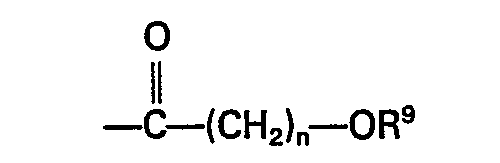
- An alkyl group may be a straight alkyl group or a branched alkyl group having at least 3 carbon atoms.
- Symbols for numbers, atoms or groups referred to below have the broadest meaning previously assigned unless specified otherwise.
- Both organic and inorganic acids can be employed to form non-toxic pharmaceutically acceptable acid addition salts of the compounds of this invention. Illustrative acids are sulfuric, nitric, phosphoric, hydrochloric, citric, acetic, lactic, tartaric, pamoic, ethanedisulfonic, sulfamic, succinic, cyclohexylsulfamic, fumaric, maleic and benzoic acid. These salts are readily prepared by methods known in the art.
- In a preferred embodiment the invention is related to compounds of the formula I above wherein Y is OH, R1COO, or R2R3NCOO―, whereby R1 is an alkyl group having 1―5 carbon atoms, or a phenyl group, and R2 is an alkyl group having 1-5 carbon atoms, a phenethyl, benzyl or phenyl group, and R3 is H or an alkyl group having 1-5 carbon atoms.
- One group of preferred compounds are those wherein Y is OH or R2R3NCOO. Further preferred are compounds wherein R is H or 4-hydroxybutyryl.
- Preferred compounds are those wherein Y is OH and R is H or 4-hydroxybutyryl.
- The compounds of formula I contain two asymmetric carbon atoms in the aliphatic moiety as indicated by asterisks in the above formula. The therapeutic properties of the compounds are ascribed to the trans isomers. The pure enantiomers as well as mixtures thereof are within the scope of the invention. The preferred enantiomers are those with 4aS, 10bS-configuration.
- The invention takes into consideration that compounds of formula I may be metabolized into other compounds of formula I before exerting their effect. Compounds of the invention as defined above wherein Y is other than hydroxy and compounds wherein R is other than hydrogen are thus believed to exert their main activity after metabolism to compounds wherein Y is hydroxy and R is hydrogen, respectively.
- The compounds of the invention may be obtained by one of the following methods constituting a further aspect of the invention.
-

- The cleavage may be carried out by treating the compound of formula II with an acidic nucleophilic reagent such as aqueous HBr, or HI, HBr/CH3COOH, BBr3, AICI3, pyridine-HCI or (CH3)3Sil, or with a basic nucleophilic reagent such as CH3C6H4―S⊖ or C2H5―S⊖. When Ra is a benzyl group the cleavage may also be carried out by reduction, preferably with hydrogen using Pd or Pt02 as catalyst.
- A compound of formula II wherein Ra is a methyl group is obtained from a compound of formula IIA, as described in J. Med. Chem. 1982, 25, 925. Compounds of formula II wherein Ra is an alkyl group with 2-5 carbon atoms are synthesized in an analogous manner starting from the appropriately substituted comopound IIA.
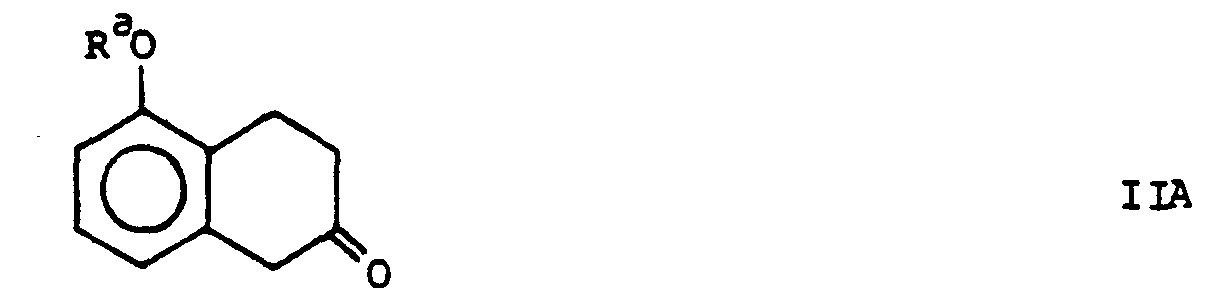
-

- Alternatively, when conversion of Y = OH into R1COO is intended and R' is


-

-

-

-

-

-

- Free bases formed may subsequently be converted into their acid addition salts, and acid addition salts formed may subsequently be converted into the corresponding bases or other acid addition salts.
- Pharmaceutical preparations of the compounds of the invention constitute a further aspect of the invention.
- In clinical practice the compounds of the present invention will normally be administered orally, rectally, or by injection, in the form of pharmaceutical preparations comprising the active ingredient either as a free base or as a pharmaceutically acceptable non-toxic, acid addition salt, e.g. the hydrochloride, lactate, acetate, sulfamate, and the like, in association with a pharmaceutically acceptable carrier.
- Accordingly, terms relating to the novel compounds of this invention, whether generically or specifically, are intended to include both the free amine base and the acid addition salts of the free base, unless the context in which such terms are used, e.g. in the specific examples, would be inconsistent with the broad concept. The carrier may be a solid, semisolid or liquid diluent or capsule. These pharmaceutical preparations constitute a further aspect of this invention. Usually the active substance will constitute between 0.1 and 99% by weight of the preparation, more specifically between 0.5 and 20% by weight for preparations intended for injection and between 0.2 and 95% by weight for preparations suitable for oral administration.
- Pharmaceutical preparations containing a compound of the invention in a solid form of dosage units for oral application may preferably contain between 2 and 95% by weight of the active substance, in such preparations the selected compound may be mixed with a solid fine grain carrier, e.g. lactose, saccharose, sorbitol, mannitol, starches such as potato starch, corn starch or amylopectin, cellulose derivatives, or gelatin and a lubricant such as magnesium stearate, calcium stearate, polyethylene glycol waxes, and the like, and then compressed to form tablets. If coated tablets are required, the cores, prepared as described above, may be coated with a concentrated sugar solution which may contain, e.g. gum arabic, gelatin, talcum, titanium dioxide, and the like. Alternatively, the tablet can be coated with a lacquer dissolved in a readily volatile organic solvent or mixture of organic solvents. Dyestuffs may be added to these coatings in order to readily distinguish between tablets containing different active substances or different amounts of the active compound.
- For the preparation of soft gelatin capsules (pearl-shaped closed capsules) consisting of gelatin and, for example, glycerol, or similar closed capsules, the active substance may be admixed with a vegetable oil. Hard gelatin capsules may contain granulates of the active substance in combination with solid, fine grain carriers such as lactose, saccharose, sorbitol, mannitol, starches (e.g. potato starch, corn starch or amylopectin), cellulose derivatives or gelatin.
- Liquid preparations for oral application may be in the form of syrups or suspensions, for example, solutions containing from about 0.2% to about 20% by weight of the active substance herein described, the balance being sugar and a mixture of ethanol, water, glycerol and propylene glycol. Optionally such liquid preparations may contain colouring agents, flavouring agents, saccharine and carboxymethylcellulose as a thickening agent.
- Solutions for parenteral applications by injection can be prepared in an aqueous solution of a watersoluble pharmaceutically acceptable salt of the active substance preferably in a concentration of from about 0.5% to about 10% by weight. These solutions may also contain stabilizing agents and/or buffering agents and may conveniently be provided in various dosage unit ampoules.
- In therapeutical treatment the suitable daily doses of the compounds of the invention are 50-10000 mg for oral application, preferentially 200-5000 mg, and 0.005-500 mg for parenteral application, preferentially 0.25-250 mg.
- The following examples will further illustrate the invention.
- Trans-7-methoxy-1,2,3,4,4a,5,6,10b-octahydrobenzo(f)quinoline hydrochloride (0.50 g, 2.0 mmol), R(-)-O-methylmandelic acid chloride (0.36 g, 2.2 mmol), methylene chloride (10 ml), water (10 ml) and 5% NaOH (10 ml) were mixed and stirred for 5 min. Extraction with ether, drying and evaporation of the volatiles gave an oil (0.77 g, theoretically 0.72 g). When adding ether to this oil, crystals of isomer 1 melting at 151-153°C were precipitated out (0.20 g, 28%), optical purity according to HPLC 96.3%. After three additional crystallizations giving an additional 0.13 g of isomer 1 the mother liquor was concentrated to an oil (0.26 g). The oil (0.26 g) was chromatographically separated by repeated injections to a semi-preparative HPLC column (Si02) using hexane-ethyl acetate-ethanol (95.5:3.75:0.75) as the motile phase giving isomer 2 (0.16 g) (98.2% of isomer 2 and 1.8% of isomer 1).
- Isomer 1 (0.19 g, 0.52 mmol) was dissolved in dry THF (40 ml) and treated with potassium tert. butoxide (0.81 g, 7.1 mmol) and H20 (64 pl, 3.6 mmol) and the mixture was stirred overnight and then refluxed for 1 hour. Water was added and the mixture was extracted with ether. The organic layer was dried and the solvent evaporated. The residue was treated with HCI/EtOH, evaporated and recrystallized from ethanol/ ether to give the desired (+)-trans-(4aR;10bR) product (120 mg, 87% on the resolved amide isomer 1), m.p. 296-301°C, [a]o2 +81° (c 0.96, MeOH).
- Isomer 2 (0.16 g; 0.44 mol) was dissolved in dry THF (20 ml) and treated with potassium tert. butoxide (0.81 g, 7.1 mmol) and H20 (64 pl, 3.6 mmol) and the mixture was stirred overnight. The mixture was then refluxed for 1 hour. Water was added and the mixture was extracted with ether. The organic layer was dried and the solvent evaporated. The residue was converted to its hydrochloride, evaporated and recrystallized (ethanol-ether) giving 55 mg (50% on the resolved amide isomer 2) of the desired (-)-trans-(4aS;10bS) product, m.p. 296-301°C, [a]p2 -88° (c 1.05, MeOH).
- (±)-trans-7-methoxy-1,2,3,4,4a,5,6,10b-octahydrobenzo(f)quinoline hydrochloride (0.50 g, 1.9 mmol) was converted to the free base by partitioning between CH2CI2 and 10% Na2C03. Drying and evaporation of volatiles gave an oil which was mixed with y-butyrolactone (0.33 g, 3.8 mmol) and 2-hydroxypyridine (0.36 g, 3.8 mmol) and dry toluene (2 ml). The mixture was refluxed for 25 hours. After one night at room temperature the precipitate (2-hydroxypyridine) was filtered off, the filtrate extracted with H20/CH2CI2, the organic layer washed with 0.5 M HCI, dried and evaporated giving an oil. This was purified on a Si02- column using ethyl acetate as eluant, giving 0.25 g (46%) of the desired product.
- (±)-trans-7-Methoxy-4-benzyl-1,2,3,4,4a,5,6,10b-octahydro(f)quinoline hydrochloride (50 mg, 0.15 mmol) was heated in 48% HBr for 2 hours at 125°C under nitrogen. The hydrobromic acid was evaporated off and the residue alkalized (Na2C03) and extracted with ethyl acetate. Evaporation of the ; solvent yielded an oil which was dissolved in toluene and refluxed in the presence of phenyl isocyanate (18 mg) for three hours. Extractive work up gave the product (40 mg) as an oil which was debenzylated as described in Example E6.
- (±)-trans-7-Methoxy-1,2,3,4,4a,5,6,10b-octahydrobenzo(f)quinoline (0.40 g, 1.8 mmol) was refluxed in 48% aqueous HBr under N2 (g) for two hours. The acid was evaporated and the residue was recrystallized from MeOH-ether giving the desired product (0.39 g, 90%), m.p. 320-330°C (dec.).
- (-)-trans-(4AS,10bS)-7-Methoxy-1,2,3,4,4a,5,6,10b-octahydrobenzo(f)quinoline hydrochloride (50 mg, 0.20 mmol) was heated in 48% aqueous HBrfor 2 hours at 125°C under nitrogen. The hydrobromic acid was evaporated off and the residue was recrystallized from MeOH-ether yielding the desired product (59 mg, 92%), 100% optical purity according to HPLC, m.p. 320―330°C (dec.), [α]22 D -60° (c 0.5, MeOH), GC-MS: M+ = m/e = 203.
- (+)-trans-(4aR;10bR)-7-Methoxy-1,2,3,4,4a,5,6,10b-octahydrobenzo(f)quinoline hydrochloride (0.12 g, 0.47 mmol) was heated in 48% aqueous HBr for 2 hours at 125°C under nitrogen. The hydrobromic acid was evaporated off and the residue was recrystallized from MeOH-ether yielding the desired product (0.11 g, 85%), 100% optical purity according to HPLC, m.p. 320―330°C (dec.), [α]22 D +60° (c 0.5, MeOH), GC-MS: M+ = m/e = 203.
- (±)-trans-7-Methoxy-4-hydroxybutyryl-1,2,3,4,4a,5,6,10b-octahydrobenzo(f)quinoline(0.25 g,0.88 mmol) was dissolved in CH2C12 (15 ml) and the solution was chilled to -70°C. BBr3 (0.7 ml) was added at this temperature. The mixture was allowed to reach room temperature under stirring. The reaction was quenched with water. The mixture was extracted with ether. The organic layer was dried and the solvent evaporated giving the desired product (0.16 g, 68%).
- (±)-trans-7-Hydroxy-1,2,3,4,4a,5,6,10b-octahydrobenzo(f)quinoline hydrobromide (50 mg, 0.17 mmol) was dissolved in trifluoroacetic acid (1 ml). Pivaloyl chloride (0.2 ml) was added and the mixture was stirred at room temperature overnight. After evaporation of the solvent, the residue was partitioned between H20 and CH2CI2. The organic layer was concentrated and applied to a Si02 column and the product was eluted with CH2Cl2 MeOH. Fractions containing the product were collected. The solvent was evaporated yielding 20 mg of an oil. GC-MS: M+ at m/e 287.
- (±)-trans-7-Phenylcarbamoyloxy-4-benryl-1,2,3,4,4a,5,6,10b-octahydrobenzo(f)quinoline hydrochloride (40 mg, 0.12 mmol) was dissolved in MeOH (5 ml) and hydrogenolyzed in the presence of 10% Pd/C (40 mg) at 25 psig at room temperature. After filtration of the catalyst and evaporation of the solvent the desired product (20 mg) was obtained. MS shows M+ at m/e 322.
- The following examples illustrate how the compounds of the present invention may be included into pharmaceutical preparations.
- 500 g of active substance are mixed with 500 g of corn oil, whereupon the mixture is filled in soft gelatine capsules, each capsule containing 100 mg of the mixture (i.e. 50 mg of active substance).
- 0.5 kg of active substance are mixed with 0.2 kg of silicic acid of the trade mark Aerosil. 0.45 kg of potato starch and 0.5 kg of lactose are mixed therewith and the mixture is moistened with a starch paste prepared from 50 g of potato starch and distilled water, whereupon the mixture is granulated through a sieve. The granulate is dried and sieved, whereupon 20 g of magnesium stearate are mixed into it. Finally the mixture is pressed into tablets each weighing 172 mg.
- 100 g of active substance are dissolved in 300 g of 95% ethanol, whereupon 300 g of glycerol, aroma and colouring agents (q.s.) and 1000 ml of water are mixed therein. A syrup is obtained.
- Active substance (hydrobromide) (1 g), sodium chloride (0.8 g) and ascorbic acid (0.1 g) are dissolved in sufficient amount of distilled water to give 100 ml of solution. This solution, which contains 10 mg of active substance per ml, is used in filling ampoules, which are sterilized by heating at 120°C for 20 minutes.
- The compounds of the invention under consideration are centrally acting selective dopamine autoreceptor stimulating agents, and thus of great clinical interest in the treatment of psychotic disorders such as schizofrenia and a number of other disease states such as tardive dyskinesia, Huntington's chorea, alcoholism and drug abuse, said psychotic disorders and other disease states possibly being associated with a pathological increase in central dopamine transmission.
- The compound (-)-trans-(4aS;10bS1-7-hydroxy-1,2,3,4,4a,5,6,10b-octahydrobenzo(f)quinoline and its salts, processes for preparing said compound and methods of employing said compound in therapy, in particular for treatment of schizophrenia represents the best mode of carrying out the invention known to the inventors at present.
Claims (8)


Applications Claiming Priority (2)
| Application Number | Priority Date | Filing Date | Title |
|---|---|---|---|
| SE8302361 | 1983-04-27 | ||
| SE8302361A SE8302361D0 (en) | 1983-04-27 | 1983-04-27 | NEW TRICYCLIC AMINES |
Publications (2)
| Publication Number | Publication Date |
|---|---|
| EP0127597A1 EP0127597A1 (en) | 1984-12-05 |
| EP0127597B1 true EP0127597B1 (en) | 1989-06-28 |
Family
ID=20350972
Family Applications (2)
| Application Number | Title | Priority Date | Filing Date |
|---|---|---|---|
| EP84850121A Expired EP0127597B1 (en) | 1983-04-27 | 1984-04-12 | Octahydrobenzo(f)quinoline derivatives |
| EP84901820A Expired EP0172821B1 (en) | 1983-04-27 | 1984-04-12 | New octahydrobenzo (f) quinoline derivatives |
Family Applications After (1)
| Application Number | Title | Priority Date | Filing Date |
|---|---|---|---|
| EP84901820A Expired EP0172821B1 (en) | 1983-04-27 | 1984-04-12 | New octahydrobenzo (f) quinoline derivatives |
Country Status (22)
| Country | Link |
|---|---|
| US (1) | US4612316A (en) |
| EP (2) | EP0127597B1 (en) |
| JP (1) | JPS60501157A (en) |
| KR (1) | KR910007239B1 (en) |
| AU (1) | AU572840B2 (en) |
| CA (1) | CA1264749A (en) |
| DD (1) | DD216716A5 (en) |
| DE (1) | DE3479724D1 (en) |
| DK (1) | DK159848C (en) |
| ES (5) | ES531931A0 (en) |
| FI (1) | FI82930C (en) |
| GB (1) | GB2138815B (en) |
| GR (1) | GR81994B (en) |
| HU (1) | HU193576B (en) |
| IE (1) | IE57883B1 (en) |
| IS (1) | IS1365B6 (en) |
| NZ (1) | NZ207881A (en) |
| PH (1) | PH24764A (en) |
| PT (1) | PT78512B (en) |
| SE (1) | SE8302361D0 (en) |
| WO (1) | WO1984004303A1 (en) |
| ZA (1) | ZA842539B (en) |
Families Citing this family (22)
| Publication number | Priority date | Publication date | Assignee | Title |
|---|---|---|---|---|
| SE8302361D0 (en) * | 1983-04-27 | 1983-04-27 | Astra Laekemedel Ab | NEW TRICYCLIC AMINES |
| US4764609A (en) * | 1986-03-31 | 1988-08-16 | Eli Lilly And Company | Synthesis of 2-aminopyrimido[4,5-g]quinolines |
| US5116984A (en) * | 1988-04-07 | 1992-05-26 | Glaxo Group Limited | Imidazole derivatives |
| GR1001059B (en) * | 1988-12-15 | 1993-04-28 | Abbott Lab | Method of preparation of s-ht selective agents |
| DE68926673T2 (en) * | 1988-12-15 | 1997-01-16 | Abbott Lab | 5-HT SELECTIVE MEDIUM |
| CA2011640A1 (en) * | 1989-03-20 | 1990-09-20 | F. Hoffmann-La Roche Ag | Quinoline derivatives |
| JP3005287B2 (en) * | 1989-07-13 | 2000-01-31 | ファルマシア・アンド・アップジョン・カンパニー | (1,2N) and (3,2N) -Carbocyclic-2-aminotetralin derivatives |
| US5486611A (en) * | 1989-07-13 | 1996-01-23 | The Upjohn Company | Carboxamido-(1,2N)-carbocyclic-2-aminotetralin derivatives |
| US5294618A (en) * | 1989-07-28 | 1994-03-15 | Merck Sharp & Dohme Limited | Octahydrobenzisoquinoline derivatives as antipsychotic agents |
| GB8917333D0 (en) * | 1989-07-28 | 1989-09-13 | Merck Sharp & Dohme | Therapeutic agents |
| DE3930282A1 (en) * | 1989-09-11 | 1991-03-21 | Boehringer Ingelheim Kg | USE OF DOPAMINE AUTOREZONE AGONISTS IN THE TREATMENT OF DRUG DEPENDENCE |
| US5244888A (en) * | 1989-11-17 | 1993-09-14 | Abbott Laboratories | 5-HT selective agents |
| EP0586525B1 (en) * | 1991-05-20 | 1997-04-16 | PHARMACIA & UPJOHN COMPANY | Carboxamido-(1,2n)-carbocyclic-2-aminotetralin derivatives |
| EP0591583B1 (en) * | 1991-08-21 | 2001-12-19 | Eli Lilly And Company | Benzo (f) quinolinones as 5-alpha-reductase inhibitors |
| US5239075A (en) * | 1991-08-21 | 1993-08-24 | Eli Lilly And Company | Process for the preparation of benzo (f) quinolinones |
| TW239127B (en) * | 1991-12-20 | 1995-01-21 | Hoffmann La Roche | |
| US5863928A (en) * | 1993-11-19 | 1999-01-26 | The Board Of Governors For Higher Education The State Of Rhode Island And Providence Plantation. | Octahydrobenzo f!quinoline-based receptor agonists and antagonists |
| JPH09509398A (en) * | 1993-11-19 | 1997-09-22 | ザ ボード オブ ガヴァナーズ フォー ハイアー エデュケーション,ステイト オブ ロードアイランド アンド プロヴィデンス プランテーションズ | Octahydrobenzo [f] quinoline receptor agonists and antagonists |
| US5578724A (en) * | 1994-09-20 | 1996-11-26 | Eli Lilly And Company | Process for preparation of benzo[f]quinolinones |
| GB9612153D0 (en) * | 1996-06-11 | 1996-08-14 | Smithkline Beecham Plc | Compounds |
| WO2005012309A1 (en) * | 2003-08-04 | 2005-02-10 | Valery Khazhmuratovich Zhilov | Cyclic bioisosters of purine system derivatives and a pharmaceutical composition based thereon |
| RU2326870C2 (en) * | 2003-08-04 | 2008-06-20 | Валерий Хажмуратович ЖИЛОВ | Application of cyclic bioisoster derivaties of purine system for treatment of disorders caused by abnormalities of nitrergic and dopaminergic systems |
Family Cites Families (6)
| Publication number | Priority date | Publication date | Assignee | Title |
|---|---|---|---|---|
| US2486440A (en) * | 1946-01-10 | 1949-11-01 | Gen Aniline & Film Corp | Production of phenazonium dyestuff images |
| GB1277789A (en) * | 1969-09-08 | 1972-06-14 | Logeais Labor Jacques | Improvements in or relating to new polycyclic pyrrole derivatives |
| CH630902A5 (en) * | 1977-01-24 | 1982-07-15 | Sandoz Ag | Process for preparing novel derivatives of 1,2,3,4,4a,10b-hexahydrobenzo(f)isoquinoline. |
| US4341786A (en) * | 1981-03-02 | 1982-07-27 | Smithkline Corporation | Pharmaceutical compositions and method of producing central alpha1 agonist activity utilizing octahydrobenzo[f]quinoline compounds |
| PT77267B (en) * | 1982-09-07 | 1986-03-21 | Lilly Co Eli | Improved process for preparing novel octahydrobenz <f> isoquinolines or compounds relating thereto |
| SE8302361D0 (en) * | 1983-04-27 | 1983-04-27 | Astra Laekemedel Ab | NEW TRICYCLIC AMINES |
-
1983
- 1983-04-27 SE SE8302361A patent/SE8302361D0/en unknown
-
1984
- 1984-04-04 ZA ZA842539A patent/ZA842539B/en unknown
- 1984-04-12 JP JP59501791A patent/JPS60501157A/en active Granted
- 1984-04-12 IE IE908/84A patent/IE57883B1/en not_active IP Right Cessation
- 1984-04-12 HU HU842280A patent/HU193576B/en not_active IP Right Cessation
- 1984-04-12 EP EP84850121A patent/EP0127597B1/en not_active Expired
- 1984-04-12 EP EP84901820A patent/EP0172821B1/en not_active Expired
- 1984-04-12 DE DE8484901820T patent/DE3479724D1/en not_active Expired
- 1984-04-12 WO PCT/SE1984/000135 patent/WO1984004303A1/en not_active Ceased
- 1984-04-12 AU AU28667/84A patent/AU572840B2/en not_active Ceased
- 1984-04-17 NZ NZ207881A patent/NZ207881A/en unknown
- 1984-04-19 US US06/601,981 patent/US4612316A/en not_active Expired - Fee Related
- 1984-04-23 PH PH30593A patent/PH24764A/en unknown
- 1984-04-26 DD DD84262369A patent/DD216716A5/en not_active IP Right Cessation
- 1984-04-26 IS IS2906A patent/IS1365B6/en unknown
- 1984-04-26 GB GB08410624A patent/GB2138815B/en not_active Expired
- 1984-04-26 ES ES531931A patent/ES531931A0/en active Granted
- 1984-04-26 CA CA000452852A patent/CA1264749A/en not_active Expired - Lifetime
- 1984-04-27 KR KR1019840002260A patent/KR910007239B1/en not_active Expired
- 1984-04-27 PT PT78512A patent/PT78512B/en not_active IP Right Cessation
- 1984-04-27 GR GR74542A patent/GR81994B/el unknown
- 1984-12-21 DK DK620784A patent/DK159848C/en not_active IP Right Cessation
-
1985
- 1985-01-31 ES ES540003A patent/ES8609258A1/en not_active Expired
- 1985-05-24 FI FI852091A patent/FI82930C/en not_active IP Right Cessation
-
1986
- 1986-03-13 ES ES552962A patent/ES8801634A1/en not_active Expired
-
1987
- 1987-08-01 ES ES557649A patent/ES8802032A1/en not_active Expired
-
1988
- 1988-01-26 ES ES557808A patent/ES8900136A1/en not_active Expired
Also Published As
Similar Documents
| Publication | Publication Date | Title |
|---|---|---|
| EP0172821B1 (en) | New octahydrobenzo (f) quinoline derivatives | |
| CA1236113A (en) | Therapeutically useful 1-alkyl-2-aminotetralin derivatives | |
| CA2373920A1 (en) | Substituted heterocycle fused gamma-carbolines | |
| CA2152630C (en) | Enantiomers of carbazole derivatives as 5-ht1-like agonists | |
| IE42216B1 (en) | Benzomorphane derivatives | |
| EP0045171B1 (en) | 9-amino-1-hydroxyoctahydrobenzo(c)quinolines and derivatives thereof | |
| EP0162695A1 (en) | 6-Oxygenated-1,3,,4,5-Tetrahydrobenz(cd)indol-4-amines | |
| US5948807A (en) | Spiroindanamines and Spiroindanimides | |
| US5616603A (en) | Enantiomers of carbazole derivatives as 5-HT1 -like agonists | |
| US5618948A (en) | Process for preparing an enantiomer of a carbazole derivative | |
| US4351833A (en) | 9-Amino-1-hydroxyoctahydrobenzo[c]quinolines and derivatives thereof as analgesics and anti-emetics | |
| EP0097628B1 (en) | Piperidine derivatives, processes for their preparation and pharmaceutical preparation containing them | |
| Neumeyer et al. | (R)-and (S)-enantiomers of 11-hydroxy-and 10, 11-dihydroxy-N-allylnoraporphine: synthesis and affinity for dopamine receptors in rat brain tissue | |
| CA2756876A1 (en) | A process for the preparation of frovatriptan and frovatriptan succinate and their synthetic intermediates | |
| WO1994007863A1 (en) | Octahydronaphthoquinolizines, and methods of making and using thereof | |
| US5917054A (en) | Process for preparing enantiomers of carbazole derivatives as 5-HT1 -like agonists | |
| AU8455082A (en) | Therapeutically useful tetralin derivatives iii,processes forpreparation and pharmaceutical preparations for such compounds | |
| Brewster | Studies directed toward the synthesis of certain trans-fused benzo (a) phenanthridines as structurally rigid dopamine D-1 agonists and antagonists | |
| NZ299232A (en) | (+)-6-carboxamido-3-n-ethylamino-1,2,3,4- tetrahydrocarbazoles; medicaments thereof |
Legal Events
| Date | Code | Title | Description |
|---|---|---|---|
| PUAI | Public reference made under article 153(3) epc to a published international application that has entered the european phase |
Free format text: ORIGINAL CODE: 0009012 |
|
| AK | Designated contracting states |
Designated state(s): IT |
|
| 17P | Request for examination filed |
Effective date: 19850507 |
|
| 17Q | First examination report despatched |
Effective date: 19861124 |
|
| RAP1 | Party data changed (applicant data changed or rights of an application transferred) |
Owner name: CARLSSON, PER ARVID EMIL |
|
| GRAA | (expected) grant |
Free format text: ORIGINAL CODE: 0009210 |
|
| AK | Designated contracting states |
Kind code of ref document: B1 Designated state(s): IT |
|
| ITF | It: translation for a ep patent filed | ||
| PLBE | No opposition filed within time limit |
Free format text: ORIGINAL CODE: 0009261 |
|
| STAA | Information on the status of an ep patent application or granted ep patent |
Free format text: STATUS: NO OPPOSITION FILED WITHIN TIME LIMIT |
|
| 26N | No opposition filed | ||
| ITTA | It: last paid annual fee |