EP0126628A1 - Fungicidal aniline derivatives - Google Patents

Fungicidal aniline derivatives Download PDF

Info

Publication number
EP0126628A1
EP0126628A1 EP84303361A EP84303361A EP0126628A1 EP 0126628 A1 EP0126628 A1 EP 0126628A1 EP 84303361 A EP84303361 A EP 84303361A EP 84303361 A EP84303361 A EP 84303361A EP 0126628 A1 EP0126628 A1 EP 0126628A1
Authority
EP
European Patent Office
Prior art keywords
compound
formula
drug
benzimidazole
methyl
Prior art date
Legal status (The legal status is an assumption and is not a legal conclusion. Google has not performed a legal analysis and makes no representation as to the accuracy of the status listed.)
Withdrawn
Application number
EP84303361A
Other languages
German (de)
French (fr)
Inventor
Junya Takahashi
Toshiro Kato
Hiroshi Noguchi
Yukio Oguri
Shigeo Yamamoto
Katsuzo Kamoshita
Current Assignee (The listed assignees may be inaccurate. Google has not performed a legal analysis and makes no representation or warranty as to the accuracy of the list.)
Sumitomo Chemical Co Ltd
Original Assignee
Sumitomo Chemical Co Ltd
Priority date (The priority date is an assumption and is not a legal conclusion. Google has not performed a legal analysis and makes no representation as to the accuracy of the date listed.)
Filing date
Publication date
Priority claimed from JP8715083A external-priority patent/JPS59212461A/en
Priority claimed from JP58087974A external-priority patent/JPS59212410A/en
Application filed by Sumitomo Chemical Co Ltd filed Critical Sumitomo Chemical Co Ltd
Publication of EP0126628A1 publication Critical patent/EP0126628A1/en
Withdrawn legal-status Critical Current

Links

Classifications

    • AHUMAN NECESSITIES
    • A01AGRICULTURE; FORESTRY; ANIMAL HUSBANDRY; HUNTING; TRAPPING; FISHING
    • A01NPRESERVATION OF BODIES OF HUMANS OR ANIMALS OR PLANTS OR PARTS THEREOF; BIOCIDES, e.g. AS DISINFECTANTS, AS PESTICIDES OR AS HERBICIDES; PEST REPELLANTS OR ATTRACTANTS; PLANT GROWTH REGULATORS
    • A01N47/00Biocides, pest repellants or attractants, or plant growth regulators containing organic compounds containing a carbon atom not being member of a ring and having no bond to a carbon or hydrogen atom, e.g. derivatives of carbonic acid
    • A01N47/08Biocides, pest repellants or attractants, or plant growth regulators containing organic compounds containing a carbon atom not being member of a ring and having no bond to a carbon or hydrogen atom, e.g. derivatives of carbonic acid the carbon atom having one or more single bonds to nitrogen atoms
    • A01N47/10Carbamic acid derivatives, i.e. containing the group —O—CO—N<; Thio analogues thereof
    • A01N47/20N-Aryl derivatives thereof

Definitions

  • This invention relates to fungicidal aniline derivatives.
  • Benzimidazole and thiophanate fungicides such as Benomyl (methyl 1-(butylcarbamoyl)benzimidazol-2-ylcarba- mate), Fubelidazol (2-(2-furyl)benzimidazole), Thiabendazole (2-(4-thiazolyl)benzimidazole), Carbendazim (methyl benz- imidazol-2-ylcarbamate), Thiophanate-methyl (1,2-bis(3-methoxycarbonyl-2-thioureido)benzene), Thiophanate (1,2- bis(3-ethoxycarbonyl-2-thioureido)benzene), 2-(O,S-dimethyl- phosphorylamino)-1-(3'-methoxycarbonyl-2'-thioureido)benzene and 2-(O,O-dimethylthiophosphorylamino)-1-(3'-methoxycarbonyl-2'-thiourei
  • Cyclic imide fungicides such as Procymidone (3-(3',5'-dichlorophenyl)-1,2-dimethylcyclopropane-l,2-dicarboximide), Iprodione (3-(3',5'-dichlorophenyl)-1-isopropylcarbamoylimidazolidine-2,4-dione), Vinchlozolin (3-(3',5'-(dichlorophenyl)-5-methyl-5-vinyl- oxazolidin-2,4-dione) and ethyl (RS)-3-(3',5'-dichlorophenyl)-5-methyl-2,4-dioxooxazolidine-5-carboxylate, which are effective against various plant
  • herbicides such as Barban (4-chloro-2-butynyl N-(3-chlorophenyl)carbamate), Chlorobufam (1-methyl-2-propynyl N-(3-chlorophenyl)carbamate), Chlorpropham (isopropyl N-(3-chlorophenyl)carbamate) and Propham (isopropyl N-phenylcarbamate) exhibit a fungicidal activity against certain organisms tolerant to some benzimidazole or thiophanate fungicides. However, their fungicidal activity against drug-resistant fungi is not strong enough, and hence,in practice they can not be used as fungicides.
  • drug-resistant fungi or "drug-resistant strains”
  • drug-sensitive fungi or “drug-sensitive strains”
  • R 1 and R 2 are each a lower alkyl group
  • R 3 is an isopropyl group
  • X is a fluorine atom
  • a and B are each an oxygen atom.
  • aniline derivatives of the formula (I) are fungicidally effective against a wide range of plant pathogenic fungi, of which examples are as follows: Podosphaera leucotricha, Venturia inaequalis, Mycosphaerella pomi, Marssonina mali and Sclerotinia mali of apple, Phyllactinia kakicola and Gloeosporium kaki of persimmon, Cladosporium carpophilum and Phomopsis sp.
  • the compounds of the formula (I) are also fungicidally effective against fungi sensitive to known fungicides as well as fungi against which the known fungicides are ineffective.
  • Examples of the fungi are Pyricularia oryzae, Pseudoperonospora cubensis, Plasmopara, viticola, Phytophthora infestans, etc.
  • the compounds (I) possess low toxicity and have little detrimental actions on mammals and fish. They may also be applied to agricultural fields without causing any significant toxicity to important crop plants.
  • the present invention provides a fungicidal compound of the formula (I) and a fungicidal composition which comprises, as an active ingredient, a fungicidally effective amount of the compound of the formula (I) and an inert carrier or diluent. It also provides a combination composition comprising as active ingredients the compound of the formula (I) together with a benzimidazole, thiophanate and/or a cyclic imide fungicide, which is fungicidally effective against not only drug-sensitive fungi but also drug-resistant fungi, and hence particularly effective for the prevention of plant diseases.
  • It also provides a method of controlling plant pathogenic fungi including drug-resistant strains and drug-sensitive strainsby applying a fungicidally effective amount of the compound of the formula (I) to plant pathogenic fungi, and a process for producing the compound (I).
  • the compound of the formula (I) can be prepared by one of the following procedures:
  • the compound (I) can be prepared by reacting a compound of the formula: wherein R 1 , R 2 and X are each as defined above, with a compound of the formula: wherein R 3 and A are each as defined above and R 4 is a halogen atom.
  • the reaction is usually carried out in the presence of an inert solvent (e.g. benzene, toluene, tetrahydrofuran, chloroform, ethyl acetate or dimethylformamide).
  • an inert solvent e.g. benzene, toluene, tetrahydrofuran, chloroform, ethyl acetate or dimethylformamide.
  • the reaction may be performed in the presence of a base (e.g. triethylamine, sodium hydroxide or sodium hydride) so as to obtain the compound (I) in a high yield.
  • a base e.g. triethylamine, sodium hydroxide or sodium hydride
  • the reaction may be -carried out at a temperature of from 30 to 120°C instantaneously or within 12 hours.
  • the compound (I) can also be prepared by reacting a compound of the formula: wherein R 1 , R 21 X and A are each as defined above, with a compound of the formula: wherein B and R 3 are each as defined above.
  • the reaction is usually carried out in the absence or presence of an inert solvent (e.g. lenzene, toluene, xylene, diethyl ether, tetrahydrofuran, dioxane, dimethylformamide, chloroform of carbon tetrachloride).
  • an inert solvent e.g. lenzene, toluene, xylene, diethyl ether, tetrahydrofuran, dioxane, dimethylformamide, chloroform of carbon tetrachloride.
  • a catalyst e.g. triethylamine, N,N-diethylaniline, 1,4-diazabicyclo-[2.2.2]octane
  • the reaction may be carried out at a temperature of from 0 to 50°C instantaneously or within 10 hours.
  • the starting compound (IV) in the above reaction can be prepared by reacting the compound (II) with phosgene or thiophosgene.
  • the reaction is usually carried out in the presence of an inert solvent (e.g. benzene, toluene,xylene or ethyl acetate).
  • an inert solvent e.g. benzene, toluene,xylene or ethyl acetate.
  • the reaction may be carried out at a temperature of from 50° to the boiling point of the solvent instantaneously or within 10 hours.
  • the starting compound (II) may be obtained by reducing a nitrobenzene derivative of the formula: wherein R 1 , R 2 and X are each as defined above according to a conventional reduction procedure.
  • the reaction may be carried out in an inert solvent (e.g. ethyl acetate or ethanol) in the presence of a catalyst (e.g.platinum oxide or palladium on carbon) at a temperature of from 0 to 60°C under hydrogen gas at an ordinary or an elevated pressure.
  • an inert solvent e.g. ethyl acetate or ethanol
  • a catalyst e.g.platinum oxide or palladium on carbon
  • the nitrobenzene derivative may be prepared by nitration of a catechol derivative of the formula: wherein R l , R 2 and X are each as defined above, for example in an acetic acid or an acetic anhydride with a nitric acid (d is 1.38 to 1.52).
  • the catechol derivative is obtained by reacting a phenol derivative of the formula: wherein R 1 is as defined above, with a compound of the formula: wherein R 2 is as defined above and R 5 is a leaving group such as a halogen atom or a tosyloxy group, or with a dialkyl sulfate of the formula: wherein R 2 is as defined above.
  • the reaction may be carried out in an inert solvent (e.g. N,N-dimethylformamide, dimethylsulfoxide, tetrahydrofuran or dioxane) in the presence of a base (e.g. sodium hydroxide, potassium carbonate or sodium hydride) at a temperature of from O to 100°C instantaneously or within 12 hours.
  • an inert solvent e.g. N,N-dimethylformamide, dimethylsulfoxide, tetrahydrofuran or dioxane
  • a base e.g. sodium hydroxide, potassium carbonate or sodium hydride
  • the phenol derivative is known per se and may be prepared, for example, according to the method as described in J.Org.Chem., 46, 203 - 206 (1981).
  • the compounds (I) as fungicides, they may be applied as such or in a formulation form such as dusts, wettable powders, oil sprays, emulsifiable concentrates, tablets, granules, fine granules, aerosols or flowables.
  • a formulation form such as dusts, wettable powders, oil sprays, emulsifiable concentrates, tablets, granules, fine granules, aerosols or flowables.
  • Such formulation form can be formulated in a conventional manner by mixing at least one of the compounds (I) with an appropriate solid or liquid carrier(s) or diluent(s) and, if necessary, an appropriate adjuvant(s) (e.g. surfactants, adherents, dispersants, stabilizers) for improving the dispersibility and other properties of the active ingredient.
  • an appropriate adjuvant(s) e.g. surfactants, adherents, dispersants, stabilizers
  • solid carriers or diluents examples include botanical materials (e.g. flour, tobacco stalk powder, soybean powder, walnut-shell powder, vegetable powder, saw dust, bran, bark powder, cellulose powder, vegetable extract residue), fibrous materials (e.g. paper, corrugated cardboard, old rags), synthetic plastic powders, clays (e.g. kaolin, bentonite, fuller's earth), talcs, other inorganic materials (e.g. pyrophyllite, sericite, pumice, sulfur powder, active carbon) and chemical fertilizers (e.g. ammonium sulfate, ammonium phosphate, ammonium nitrate, urea, ammonium chloride).
  • botanical materials e.g. flour, tobacco stalk powder, soybean powder, walnut-shell powder, vegetable powder, saw dust, bran, bark powder, cellulose powder, vegetable extract residue
  • fibrous materials e.g. paper, corrugated cardboard, old rags
  • synthetic plastic powders e.g. paper,
  • liquid carriers or diluents examples include water, alcohols (e.g. methanol, ethanol), ketones (e.g. acetone, methylethylketone), ethers (e.g. diethyl ether, dioxane, cellosolve, tetrahydrofuran), aromatic hydrocarbons (e.g. benzene, toluene, xylene, methyl naphthalene), aliphatic hydrocarbons (e.g. gasoline, kerosene, lamp oil), esters, nitriles, acid amides (e.g. dimethylformamide, dimethylacetamide), halogenated hydrocarbons (e.g. dichloroethane, carbon tetrachloride), etc.
  • alcohols e.g. methanol, ethanol
  • ketones e.g. acetone, methylethylketone
  • ethers e.g. diethyl ether, diox
  • surfactants are alkyl sulfuric esters, alkyl sulfonates, alkylaryl sulfonates, polyethylene glycol ethers, polyhydric alcohol esters, etc.
  • adherents and dispersants may include cesein, gelatin, starch powder, carboxymethyl cellulose, gum arabic, alginic acid, lignin, bentonite, molasses, polyvinyl alcohol, pine oil and agar.
  • the stabilizers there may be used PAP (isopropyl acid phosphate mixture), tricresyl phosphate (TCP), tolu oil, epoxydized oil, various surfactants, various fatty acids and their esters, etc.
  • the foregoing formulations generally contain at least one of the compounds (I) in a concentration of aboort 1 to 95 % by weight, preferably of 2.0 to 80 % by weight.
  • the compounds (I) are generally applied in such amounts as 2 to 100 g per 10 are.
  • the compounds (I) may be used alone. However, when the drug-sensitive strains are present together with the drug-resistant strains, their alternate use with benzimidazole, thiophanate and/or cyclic imide fungicides or their combined use with benzimidazole, thiophanate fungicides and/or cyclic imide fungicides is favorable. In such alternate or combined use, each active ingredient may be employed as such or in conventional agricultural formulation forms. In case of the combined use, the weight proportion of the compound (I) and the benzimidazole, thiophanate and/or cyclic imide fungicide may be from about 1 : 0.1 to 1 : 10.0.
  • Typical examples of the benzimidazole, thiophanate and cyclic imide fungicides are shown in Table 2.
  • the compounds (I) may be also used in admixture with other fungicides, herbicides, insecticides, miticides, fertilizers, etc.
  • the compounds (I) When used as fungicides, they may be applied in such amounts as 2 to 100 grams per 10 ares. However, this amount may vary depending upon formulation forms, application times, application methods, application sites, diseases, crops and so on, and therefore, they are not limited to said particular amounts.
  • fungicidal composition according to the invention Some practical embodiments of the fungicidal composition according to the invention are illustratively shown in the following Examples wherein % and part(s) are by weight.
  • Compond No. 1 Thirty parts of Compond No. 1, 45 parts of diatomaceous earth, 20 parts of white carbon, 3 parts of sodium laurylsulfate as a wetting agent and 2 parts of calcium ligninsulfonate as a dispersing agent are mixed while being powdered to obtain a wettable powder formulation containing 30 % of the active ingredients.
  • Compond No. 1 Fifty parts of Compond No. 1, 45 parts of diatomaceous earth, 2.5 parts of calcium alkylbenzenesulfonate as a wetting agent and 2.5 parts of calcium ligninsulfonate as a dispersing agent are mixed while being powdered to obtain a wettable powder formulation containing 50 % of the active ingredients.
  • Compond No. 1 Ten parts of Compond No. 1, 40 parts of Compour A, 45 parts of diatomaceous earh, 2.5 parts of calcium alkylbenzenesulfonate as a wetting agent and 2.5 parts of calcium ligninsulfonate as a dispersing aqsnt are mixed while being powdered to obtain a wettable powder formulation containing 50 % of the active ingredients.
  • a flower pot of 90 ml volume is filed with sandy soil, and seeds of cucumber (var: Sagami-hanjiro) are sowed therein. Cultivation is carried out in a greenhouse for 8 days. Onto the resulting seedlings having cotyledons, the test compound formulated in emulsifiable concentrate or wettable powder and diluted with water is sprayed at a rate of 10 ml per pot. Then, the seedlings are inoculated with a spore suspension of the drug-resistant or drug-sensitive strain of Sphaerotheca fuliginea by spraying and further cultivated in the greenhouse. Ten days thereafter, the infectious state of the plants is observed. The degree of damage is determined in the following manner, and the results are shown in Table 3.
  • the leaves examined are measured for a percentage of infected area and classified into the corresponding disease indices, 0, 0.5, 1, 2, 4:
  • the disease severity is calculated according to the following equation:
  • the prevention value is calculated according to the following equation:
  • the compound (I) of the invention show an excellent preventive effect on the drug-resistant strain but do not show any preventive effect on the tested drug-sensitive strain.
  • commercially available known fungicides such as Benomyl, Thiophanate-methyl and Carbendazim show a notable controlling effect on the drug-sensitive strain but not on the drug-resistant strain.
  • Other tested compounds structurally similar to the compounds (I) do not show any fungicidal activity on the drug-sensitive strain and the drug-resistant strain.
  • the compound (I) of the invention show an excellent preventive effect on the drug-resistant strain but do not show any preventive effect on the tested drug-sensitive strain.
  • commecially available known fungicides such as Benomyl, Thiophanate-methyl and Carbendazim show a notable controlling effect on the drug-sensitive strain but not on the drug-resistant strain.
  • Other tested compounds structurally similar to the compounds (I) do not show any fungicidal activity on the drug-sensitive strain and the drug-resistant strain.
  • a plastic pot of 90 ml volume is filled with sandy soil, and seeds of pear (var: Chojuro) are sowed therein. Cultivation is carried out in a greenhouse for 20 days. Onto the resulting seedlings, the test compound formulated in emulsifiable concentrate or wettable powder and diluted with water is sprayed at a rate of 10 ml per pot. Then, the seedlings are inoculated with a spore suspension of the drug-resistant or drug-sensitive strain of Venturia nashicola by spraying. The resulting plants are placed at 20°C under a condition of high humidity for 3 days and then at 20°C under irradiation with a fluorescent lamp for 20 days. The degree of damage is determined in the same manner as in Experiment 1, and the results are shown in Table 5.
  • the compound (I) of the invention show an excellent preventive effect on the drug-resistant strain but do not show any preventive effect on the tested drug-sensitive strain.
  • commercially available known fungicides such as Benomyl and Thioophanate-methyl show a notable controlling effect on the drug-sensitive strain but not on the drug-resistant strain.
  • the compound of the formula (I) of the invention show an excellent preventive effect on the drug-resistant strain but do not show any preventive effect on the tested drug-sensitive strain.
  • commercially available known fungicides such as Benomyl and Thiophanate-methyl show a notable controlling effect on the drug-sensitive strain but not on the drug-resistant strain.
  • Plastic pots of 90 ml volume is filled with sandy soil, and seeds of cucumber (var: Sagami-hanjiro) are sowed therein. Cultivation is carried out in a greenhouse for 8 days to obtain cucumber seedlings expanding cotyledons. Onto the resulting seedlings, the test compound formulated in emulsifiable concentrate or wettable powder and diluted with water is sprayed at a rate of 10 ml per pot. After air-drying, the seedlings were inoculated with mycelial disks (5 mm in diameter) of the drug-resistant or drug-sensitive strain of Botrytis cinerea by putting them on the leaf surfaces. After the plants are infected by incubating under high humidity at 20°C for 3 days, the rates of disease severity are observed. The degree of damage is determined in the same manner as in Experiment 1, and the results are shown in Table 7.
  • the compound (I) of the invention show an excellent preventive effect on the drug-resistant strain but do not show any preventive effect on the tested drug-sensitive strain.
  • commercially available known fungicides such as Benomyl and Thiophanate-methyl show a notable controlling effect on the drug-sensitive strain but not on the drug-resistant strain.
  • Preventive effect on gummy stem blight of cucumber Mycosphaerella melonis:-Plastic pots of 90 ml volume was filled with sandy soil, and seeds of cucumber (var: Sagami-hanjiro) were sowed therein. Cultivation was carried out in a greenhouse for 8 days to obtain cucumber seedlings expanding cotyledons. Onto the resulting seedlings, the test compound formulated in emulsifiable concentrate or wettable powder and diluted with water was sprayed at a rate of 10 ml per pot.
  • the seedlings were inoculated with mycelial disks (5 mm in diameter) of the drug-resistant or drug-sensitive strain of Mycosphaerella melonis by putting them on the leaf surfaces. After the plants were infected by incubating under high humidity at 25°C for 4 days, the rates of disease severity were observed. The degree of damage was determined in the same manner as in Experiment 1, and the results are shown in Table 8.
  • the compound of the formula (I) of the invention show an excellent preventive effect on the drug-resistant strain but do not show any preventive effect on the tested drug-sensitive strain.
  • commercially available known fungicides such as Benomyl and Thiophanate-methyl show a notable controlling effect on the drug-sensitive strain but not on the drug-resistant strain.
  • the compound of the formula (I) of the invention show an excellent preventive effect on the drug-resistant strain but do not show any preventive effect on the tested drug-sensitive strain.
  • commercially available known fungicides such as Benomyl and Thiophanate-methyl show a notable controlling effect on the drug-sensitive strain but not on the drug-resistant strain.
  • Plastic pots of 150 ml volume were filled with sandy soil, and seeds of wheat (var: Norin No. 61), apple (var: Kogyoku) and peanut (var: Chiba hanryusei) were sowed therein. Cultivation was carried out in a greenhouse. Onto the resulting seedlings, the test compound formulated in emulsifiable concentrate or wettable powder and diluted with water was sprayed. After cultivation in the greenhouse for additional 10 days, the phytotoxicity was examined on the following criteria:
  • the compound of the formula (I) of the invention produce no material phytotoxicity, while commercially available herbicides having a chemical structure similar thereto produce considerable phytotoxicity.
  • a plastic pot of 90 ml volume is filled with sandy soil, and seeds of tomato (var: Fukuju No. 2) are sowed therein. Cultivation is carried out in a greenhouse for 4 weeks. Onto the resulting seedlings at the 4-leaf stage, the test compound(s) formulated in emulsifiable concentrate or wettable powder and diluted with water are sprayed at a rate of 10 ml per pot. Then, the seedlings are inoculated with a mixed spore suspension of the drug-resistant and drug-sensitive strain of Botrytis cinerea by spraying and placed at 20°C in a room of high humidity for 5 days. The degree of damage is determined in the same manner as in Experiment 1, and the results are shown in Table 12.

Landscapes

  • Life Sciences & Earth Sciences (AREA)
  • Agronomy & Crop Science (AREA)
  • Pest Control & Pesticides (AREA)
  • Plant Pathology (AREA)
  • Health & Medical Sciences (AREA)
  • Engineering & Computer Science (AREA)
  • Dentistry (AREA)
  • General Health & Medical Sciences (AREA)
  • Wood Science & Technology (AREA)
  • Zoology (AREA)
  • Environmental Sciences (AREA)
  • Agricultural Chemicals And Associated Chemicals (AREA)
  • Plural Heterocyclic Compounds (AREA)

Abstract

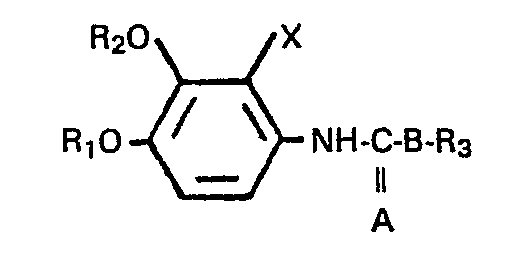
A compound of the formula:
Figure imga0001
useful as a fungicidal agent against phytopathogenic fungi, particularly their strains resistant to benzimidazole, thiophanate and/or cyclic imide fungicides.
In the formula R1, R2 and R3 are each independently a lower alkyl group, X is a halogen atom, a lower alkyl group or a lower alkoxy group and A and B are each independently an oxygen atom or a sulfur atom.

Description

  • This invention relates to fungicidal aniline derivatives.
  • Benzimidazole and thiophanate fungicides such as Benomyl (methyl 1-(butylcarbamoyl)benzimidazol-2-ylcarba- mate), Fubelidazol (2-(2-furyl)benzimidazole), Thiabendazole (2-(4-thiazolyl)benzimidazole), Carbendazim (methyl benz- imidazol-2-ylcarbamate), Thiophanate-methyl (1,2-bis(3-methoxycarbonyl-2-thioureido)benzene), Thiophanate (1,2- bis(3-ethoxycarbonyl-2-thioureido)benzene), 2-(O,S-dimethyl- phosphorylamino)-1-(3'-methoxycarbonyl-2'-thioureido)benzene and 2-(O,O-dimethylthiophosphorylamino)-1-(3'-methoxycarbonyl-2'-thioureido)benzene are known to show an excellent fungicidal activity against various plant pathogenic fungi, and they have been widely used as agricultural fungicides since 1970. However, their continuous application over a long period of time results in phytopathogenic fungi gaining a tolerance to them, so that their plant disease- preventive effect is much lowered. Furthermore, fungi which have gained a tolerance to certain kinds of benzimidazole or thiophanate fungicides also show a considerable tolerance to some other kinds of benzimidazole or thiophanate fungicides. Thus, they are apt to obtain a cross-tolerance. Thus, if any significant decrease in their plant disease.-preventive effect in certain fields is observed, their application in such fields has to be discontinued. However, it is often observed that the density of drug-resistant organisms does not decrease even long after the application is discontinued. Although other types of fungicides have to be employed in these cases, only a few are as effective as benzimidazole or thiophanate fungicides in controlling various phytopathogenic fungi. Cyclic imide fungicides such as Procymidone (3-(3',5'-dichlorophenyl)-1,2-dimethylcyclopropane-l,2-dicarboximide), Iprodione (3-(3',5'-dichlorophenyl)-1-isopropylcarbamoylimidazolidine-2,4-dione), Vinchlozolin (3-(3',5'-(dichlorophenyl)-5-methyl-5-vinyl- oxazolidin-2,4-dione) and ethyl (RS)-3-(3',5'-dichlorophenyl)-5-methyl-2,4-dioxooxazolidine-5-carboxylate, which are effective against various plant diseases, particularly those caused by Botrytis cinerea, have the same defècts as previously explained with respect to benzimidazole and thiophanate fungicides.
  • C.R. Acad. Sc. Paris, t. 289, S'erie D, pages 691-693 (1979), discloses that herbicides such as Barban (4-chloro-2-butynyl N-(3-chlorophenyl)carbamate), Chlorobufam (1-methyl-2-propynyl N-(3-chlorophenyl)carbamate), Chlorpropham (isopropyl N-(3-chlorophenyl)carbamate) and Propham (isopropyl N-phenylcarbamate) exhibit a fungicidal activity against certain organisms tolerant to some benzimidazole or thiophanate fungicides. However, their fungicidal activity against drug-resistant fungi is not strong enough, and hence,in practice they can not be used as fungicides.
  • We have now found that aniline derivatives of the formula:
    Figure imgb0001
    wherein Rl, R2 and R3 are each independently a lower alkyl group; X is a halogen atom, a lower alkyl group or a lower alkoxy group; and A and B are, each independently an oxygen atom or a sulfur atom, show an excellent fungicidal activity against plant pathogenic fungi which have developed resistance to benzimidazole, thiophanate and/or cyclic imide fungicides. It is notable that their fungicidal potency against organisms tolerant to benzimidazole, thiophanate and/or cyclic imide fungicides (hereinafter referred to as "drug-resistant fungi" or "drug-resistant strains") is much higher than that against the organisms sensitive to benzimidazole, thiophanate and/or cyclic imide fungicides (hereinafter referred to as "drug-sensitive fungi" or "drug-sensitive strains").
  • In view of their excellent fungicidal properties, particularly useful are the compound of the formula (I) wherein R1 and R2 are each a lower alkyl group, R3 is an isopropyl group, X is a fluorine atom and A and B are each an oxygen atom.
  • The aniline derivatives of the formula (I) are fungicidally effective against a wide range of plant pathogenic fungi, of which examples are as follows: Podosphaera leucotricha, Venturia inaequalis, Mycosphaerella pomi, Marssonina mali and Sclerotinia mali of apple, Phyllactinia kakicola and Gloeosporium kaki of persimmon, Cladosporium carpophilum and Phomopsis sp. of peach, Cercospora viticola, Uncinula necator, Elsinoe ampelina and Glomerella cingulata of grape, Cercospora beticola of sugarbeet, Cercospora arachidicola and Cercospora personata of peanut, Erysiphe graminis f. sp. hordei, Cercosporella herpotrichoides and Fusarium nivale of barley, Erysiphe graminis f. sp. tritici of wheat, Sphaerotheca fuliginea and Cladosporium cucumerinum of cucumber, Cladosporium fulvum of tomato, Corynespora melongenae of eggplant, Sphaerotheca humuli, Fusarium oxysporum f. sp. fragariae of strawberry, Botrytis alli of onion, Cercospora apii of cerely, Phaeoisariopsis griseola of kidney bean, Erysiphe cichoracearum of tobacco, Diplocarpon rosae of rose, Elsinoe fawcetti, Penicillium italicum, Penicillium digitatum of orange, Botrytis cinerea of cucumber, eggplant, tomato, strawberry, pimiento, onion, lettuce, grape, orange, cyclamen, rose or hop, Sclerotinia sclerotiorum of cucumber, eggplant, pimiento, lettuce, celery, kidney bean, soybean, azuki bean, potato or sunflower, Sclerotinia cinerea of peach or cherry, Mycosphaerella melonis of cucumber or melon, etc. Thus, the compounds of formula (I) are highly effective in controlling drug-resistant strains of the fungi.
  • The compounds of the formula (I) are also fungicidally effective against fungi sensitive to known fungicides as well as fungi against which the known fungicides are ineffective. Examples of the fungi are Pyricularia oryzae, Pseudoperonospora cubensis, Plasmopara, viticola, Phytophthora infestans, etc.
  • Advantageously, the compounds (I) possess low toxicity and have little detrimental actions on mammals and fish. They may also be applied to agricultural fields without causing any significant toxicity to important crop plants.
  • Thus, the present invention provides a fungicidal compound of the formula (I) and a fungicidal composition which comprises, as an active ingredient, a fungicidally effective amount of the compound of the formula (I) and an inert carrier or diluent. It also provides a combination composition comprising as active ingredients the compound of the formula (I) together with a benzimidazole, thiophanate and/or a cyclic imide fungicide, which is fungicidally effective against not only drug-sensitive fungi but also drug-resistant fungi, and hence particularly effective for the prevention of plant diseases. It also provides a method of controlling plant pathogenic fungi including drug-resistant strains and drug-sensitive strainsby applying a fungicidally effective amount of the compound of the formula (I) to plant pathogenic fungi, and a process for producing the compound (I).
  • The compound of the formula (I) can be prepared by one of the following procedures:
  • Procedure (a):-
  • The compound (I) can be prepared by reacting a compound of the formula:
    Figure imgb0002
    wherein R1, R2 and X are each as defined above, with a compound of the formula:
    Figure imgb0003
    wherein R3 and A are each as defined above and R4 is a halogen atom.
  • The reaction is usually carried out in the presence of an inert solvent (e.g. benzene, toluene, tetrahydrofuran, chloroform, ethyl acetate or dimethylformamide). If desired, the reaction may be performed in the presence of a base (e.g. triethylamine, sodium hydroxide or sodium hydride) so as to obtain the compound (I) in a high yield. The reaction may be -carried out at a temperature of from 30 to 120°C instantaneously or within 12 hours.
  • Procedure (b):-
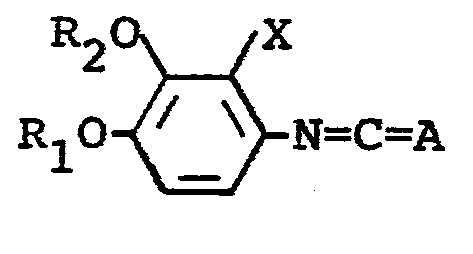
  • The compound (I) can also be prepared by reacting a compound of the formula:
    Figure imgb0004
    wherein R1, R21 X and A are each as defined above, with a compound of the formula:
    Figure imgb0005
    wherein B and R3 are each as defined above.
  • The reaction is usually carried out in the absence or presence of an inert solvent (e.g. lenzene, toluene, xylene, diethyl ether, tetrahydrofuran, dioxane, dimethylformamide, chloroform of carbon tetrachloride).If desired, the reaction may be performed in the existence of a catalyst (e.g. triethylamine, N,N-diethylaniline, 1,4-diazabicyclo-[2.2.2]octane)so as to obtain the compound (I) in a high yield. The reaction may be carried out at a temperature of from 0 to 50°C instantaneously or within 10 hours.
  • The starting compound (IV) in the above reaction can be prepared by reacting the compound (II) with phosgene or thiophosgene.
  • The reaction is usually carried out in the presence of an inert solvent (e.g. benzene, toluene,xylene or ethyl acetate). The reaction may be carried out at a temperature of from 50° to the boiling point of the solvent instantaneously or within 10 hours.
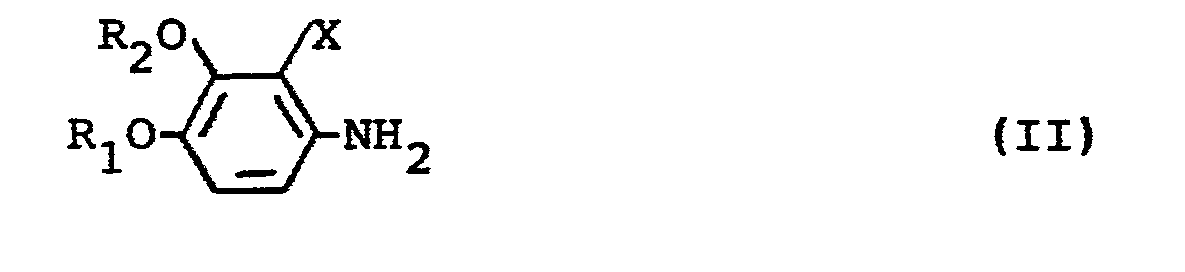
  • The starting compound (II) may be obtained by reducing a nitrobenzene derivative of the formula:
    Figure imgb0006
    wherein R1, R2 and X are each as defined above according to a conventional reduction procedure. In the case of a catalytic hydrogenation, for example, the reaction may be carried out in an inert solvent (e.g. ethyl acetate or ethanol) in the presence of a catalyst (e.g.platinum oxide or palladium on carbon) at a temperature of from 0 to 60°C under hydrogen gas at an ordinary or an elevated pressure.
  • The nitrobenzene derivative may be prepared by nitration of a catechol derivative of the formula:
    Figure imgb0007
    wherein Rl, R2 and X are each as defined above, for example in an acetic acid or an acetic anhydride with a nitric acid (d is 1.38 to 1.52).
  • The catechol derivative is obtained by reacting a phenol derivative of the formula:
    Figure imgb0008
    wherein R1 is as defined above, with a compound of the formula:
    Figure imgb0009
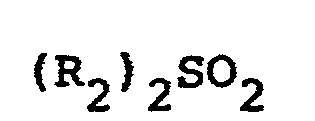
    wherein R2 is as defined above and R5 is a leaving group such as a halogen atom or a tosyloxy group, or with a dialkyl sulfate of the formula:
    Figure imgb0010
    wherein R2 is as defined above.
  • The reaction may be carried out in an inert solvent (e.g. N,N-dimethylformamide, dimethylsulfoxide, tetrahydrofuran or dioxane) in the presence of a base (e.g. sodium hydroxide, potassium carbonate or sodium hydride) at a temperature of from O to 100°C instantaneously or within 12 hours.
  • The phenol derivative is known per se and may be prepared, for example, according to the method as described in J.Org.Chem., 46, 203 - 206 (1981).
  • Some typical examples for preparation of the compound (I) are illustratively shown below.
  • Example 1 (according to Procedure (a))
  • 2-Fluoro-3,4-diethoxyaniline (0.17 g) and N,N-diethylaniline (0.13 g) were dissovled in toluene (15 ml). To the resultant solution was dropwise added isopropyl chloroformate (0.11 g) in 5 minutes under ice-cooling. The resultant mixture was allowed to stand at room temperature for 12 hours, poured into ice-water and extracted with ethyl acetate. The extract was washed with water, dried over magnesium sulfate and concentrated under reduced pressure. The residue was purified by silica gel chromatography using a mixture of toluene and ethyl acetate as the eluent to give isopropyl N-(2-fluoro-3,4-diethoxyphenyl)carbamate (Compound No. 1) (0.23 g) in a yield of 94.4 %. M.P., 79 - 81°C.
  • Elementary analysis: Calcd. for C14H20FN04: C, 58.92 %; H, 7.08 %; N, 4.91 %. Found: C, 58.95 %; H, 7.27 %; N, 4.80 %.
  • Example 2 (according to Procedure (a))
  • In the same manner as in Example 1, there was obtained isopropyl N-(2-ethyl-3,4-diethoxyphenyl)carbamate (Compound No. 2) in a yield of 68 %. M.P., 113.5 - 115°C.
  • Example 3 (according to Procedure (b))
  • 2-Fluoro-3,4-diethoxyaniline (1.99 g) in toluene (20 ml) was dropwise added to a toluene solution containing 10 g of phosgene at 10 to 20°C. The resulting mixture was gradually heated and, after being refluxed for 30 minutes, cooled to room temperature. The solvent was removed by distillation under reduced pressure to give 2-fluoro-3,4-diethoxyphenyl isocyanate. The thus obtained crude substance was added to a toluene solution (50 ml) containing triethylamine (1.0 g) and isopropanol (1.0 g). The resultant mixture was allowed to stand at room temperature for 12 hours, poured into ice-water and extracted with ethyl acetate. The extract was washed with water, dried over magnesium sulfate and concentrated under reduced pressure. The residue was purified by silica gel chromatography using a mixture of toluene and ethyl acetate as the eluent to give isopropyl N-(2-fluoro-3,4-diethoxyphenyl)carbamate (Compound No. 1) (1.99 g) in a yield of 69.8 %.
  • According to either one of Procedure (a) or (b), the aniline derivatives of the formula (I) as shown in Table 1 can be prepared.
    Figure imgb0011
  • In the practical usage of the compounds (I) as fungicides, they may be applied as such or in a formulation form such as dusts, wettable powders, oil sprays, emulsifiable concentrates, tablets, granules, fine granules, aerosols or flowables. Such formulation form can be formulated in a conventional manner by mixing at least one of the compounds (I) with an appropriate solid or liquid carrier(s) or diluent(s) and, if necessary, an appropriate adjuvant(s) (e.g. surfactants, adherents, dispersants, stabilizers) for improving the dispersibility and other properties of the active ingredient.
  • Examples of the solid carriers or diluents are botanical materials (e.g. flour, tobacco stalk powder, soybean powder, walnut-shell powder, vegetable powder, saw dust, bran, bark powder, cellulose powder, vegetable extract residue), fibrous materials (e.g. paper, corrugated cardboard, old rags), synthetic plastic powders, clays (e.g. kaolin, bentonite, fuller's earth), talcs, other inorganic materials (e.g. pyrophyllite, sericite, pumice, sulfur powder, active carbon) and chemical fertilizers (e.g. ammonium sulfate, ammonium phosphate, ammonium nitrate, urea, ammonium chloride).
  • Examples of the liquid carriers or diluents are water, alcohols (e.g. methanol, ethanol), ketones (e.g. acetone, methylethylketone), ethers (e.g. diethyl ether, dioxane, cellosolve, tetrahydrofuran), aromatic hydrocarbons (e.g. benzene, toluene, xylene, methyl naphthalene), aliphatic hydrocarbons (e.g. gasoline, kerosene, lamp oil), esters, nitriles, acid amides (e.g. dimethylformamide, dimethylacetamide), halogenated hydrocarbons (e.g. dichloroethane, carbon tetrachloride), etc.
  • Examples of the surfactants are alkyl sulfuric esters, alkyl sulfonates, alkylaryl sulfonates, polyethylene glycol ethers, polyhydric alcohol esters, etc. Examples of the adherents and dispersants may include cesein, gelatin, starch powder, carboxymethyl cellulose, gum arabic, alginic acid, lignin, bentonite, molasses, polyvinyl alcohol, pine oil and agar. As the stabilizers, there may be used PAP (isopropyl acid phosphate mixture), tricresyl phosphate (TCP), tolu oil, epoxydized oil, various surfactants, various fatty acids and their esters, etc.
  • The foregoing formulations generally contain at least one of the compounds (I) in a concentration of aboort 1 to 95 % by weight, preferably of 2.0 to 80 % by weight. By using the formulations, the compounds (I) are generally applied in such amounts as 2 to 100 g per 10 are.
  • When only the drug-resistant strains of phytopathogenic fungi are present, the compounds (I) may be used alone. However, when the drug-sensitive strains are present together with the drug-resistant strains, their alternate use with benzimidazole, thiophanate and/or cyclic imide fungicides or their combined use with benzimidazole, thiophanate fungicides and/or cyclic imide fungicides is favorable. In such alternate or combined use, each active ingredient may be employed as such or in conventional agricultural formulation forms. In case of the combined use, the weight proportion of the compound (I) and the benzimidazole, thiophanate and/or cyclic imide fungicide may be from about 1 : 0.1 to 1 : 10.0.
  • Typical examples of the benzimidazole, thiophanate and cyclic imide fungicides are shown in Table 2.
    Figure imgb0012
    Figure imgb0013
  • Besides, the compounds (I) may be also used in admixture with other fungicides, herbicides, insecticides, miticides, fertilizers, etc.
  • When the compounds (I) are used as fungicides, they may be applied in such amounts as 2 to 100 grams per 10 ares. However, this amount may vary depending upon formulation forms, application times, application methods, application sites, diseases, crops and so on, and therefore, they are not limited to said particular amounts.
  • Some practical embodiments of the fungicidal composition according to the invention are illustratively shown in the following Examples wherein % and part(s) are by weight.
  • Formulation Example 1
  • Two parts of Compound No. 1, 88 parts of clay and 10 parts of talc are thoroughly pulverized and mixed together to obtain a dust formulation containing 2 % of the active ingredients.
  • Formulation Example 2
  • Thirty parts of Compond No. 1, 45 parts of diatomaceous earth, 20 parts of white carbon, 3 parts of sodium laurylsulfate as a wetting agent and 2 parts of calcium ligninsulfonate as a dispersing agent are mixed while being powdered to obtain a wettable powder formulation containing 30 % of the active ingredients.
  • Formulation Example 3
  • Fifty parts of Compond No. 1, 45 parts of diatomaceous earth, 2.5 parts of calcium alkylbenzenesulfonate as a wetting agent and 2.5 parts of calcium ligninsulfonate as a dispersing agent are mixed while being powdered to obtain a wettable powder formulation containing 50 % of the active ingredients.
  • Formulation Example 4
  • Ten parts of Compound No. 1, 80 parts of cyclo hexanone and 10 parts of polyoxyethylene alkylaryl ether as an emulsifier are mixed together to obtain an emulsifiable concentrate formulation containing 10 % of the active ingredient.
  • Formulation Example 5
  • One part of Compound No.1, 1 part of Compound 1, 88 parts of clay and 10 parts of talc are thoroughly pulverized and mixed together to obtain a dust formulation containing 2 % of the active ingredient
  • Formulation Example 6
  • Twenty parts of Compound No. 1, 10 parts of Compound J, 45 parts of diatomaceous earth, 20 parts of white carbon, 3 parts of sodium laurylsulfate as a wetting agent and 2 parts of calcium ligninsulfonate as a dispersing agent are mixed while being powdered to obtain a wettable powder formulation containing 30 % of the active ingredients.
  • Formulation Example 7
  • Ten parts of Compond No. 1, 40 parts of Compour A, 45 parts of diatomaceous earh, 2.5 parts of calcium alkylbenzenesulfonate as a wetting agent and 2.5 parts of calcium ligninsulfonate as a dispersing aqsnt are mixed while being powdered to obtain a wettable powder formulation containing 50 % of the active ingredients.
  • Typical test data indicating the excellent fungicidal activity of the compounds of the formula (I) are shown below. The compounds used for comparison are as follows:
    Figure imgb0014
    Figure imgb0015
  • Experiment 1 Protective actmty test on pwdery mildew of cucumber (Sphaerotheca fuliginea):-
  • A flower pot of 90 ml volume is filed with sandy soil, and seeds of cucumber (var: Sagami-hanjiro) are sowed therein. Cultivation is carried out in a greenhouse for 8 days. Onto the resulting seedlings having cotyledons, the test compound formulated in emulsifiable concentrate or wettable powder and diluted with water is sprayed at a rate of 10 ml per pot. Then, the seedlings are inoculated with a spore suspension of the drug-resistant or drug-sensitive strain of Sphaerotheca fuliginea by spraying and further cultivated in the greenhouse. Ten days thereafter, the infectious state of the plants is observed. The degree of damage is determined in the following manner, and the results are shown in Table 3.
  • The leaves examined are measured for a percentage of infected area and classified into the corresponding disease indices, 0, 0.5, 1, 2, 4:
    Figure imgb0016
  • The disease severity is calculated according to the following equation:
    Figure imgb0017
  • The prevention value is calculated according to the following equation:
    Figure imgb0018
    Figure imgb0019
  • As understood from the results shown in Table 3, the compound (I) of the invention show an excellent preventive effect on the drug-resistant strain but do not show any preventive effect on the tested drug-sensitive strain. To the contrary, commercially available known fungicides such as Benomyl, Thiophanate-methyl and Carbendazim show a notable controlling effect on the drug-sensitive strain but not on the drug-resistant strain. Other tested compounds structurally similar to the compounds (I) do not show any fungicidal activity on the drug-sensitive strain and the drug-resistant strain.
  • Experiment 2
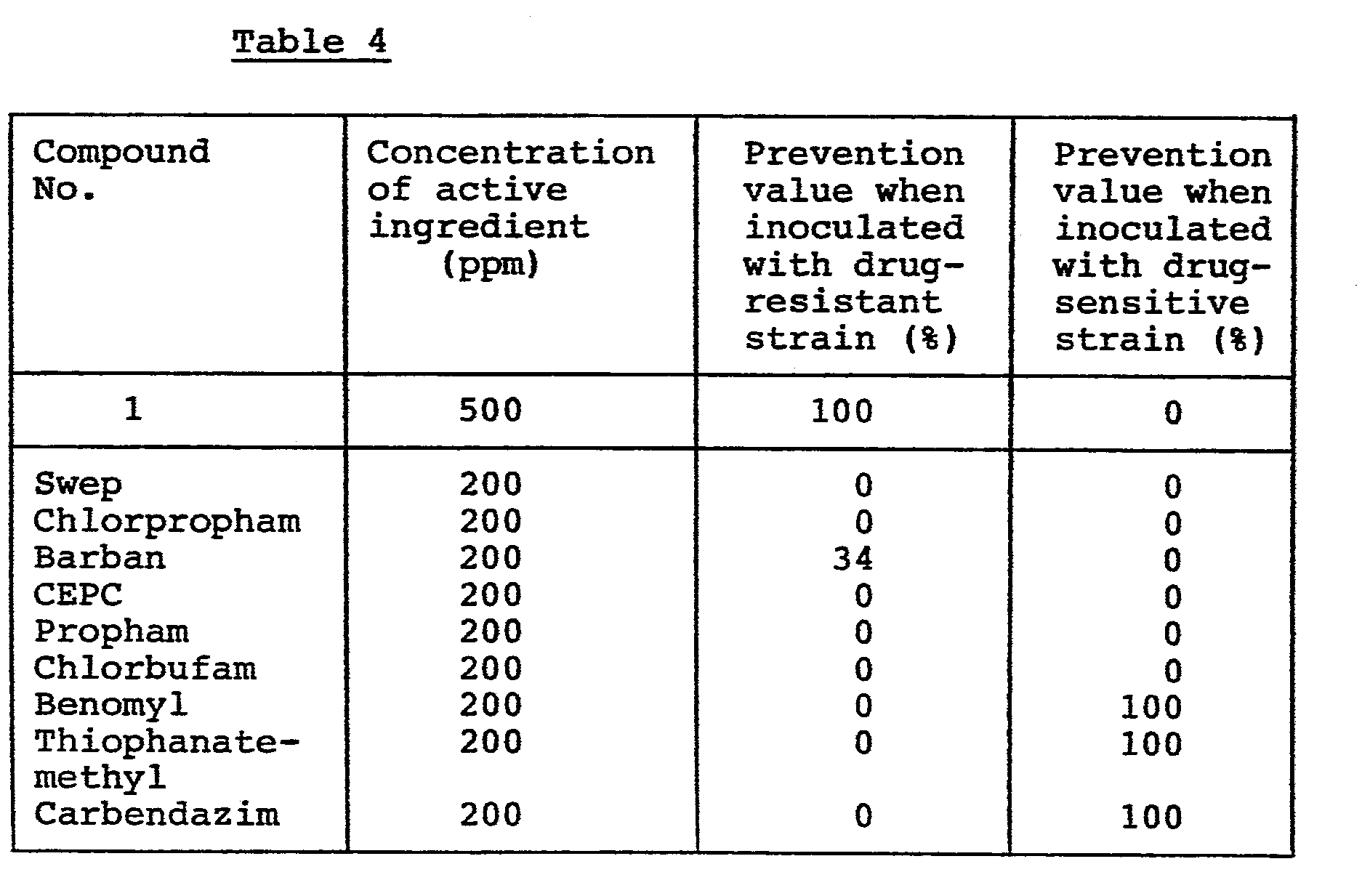
  • Preventive effect on cercospora leaf spot of sugarbeet (Cercospora beticola):-A flower pot of 90 ml volume is filled with sandy soil, and seeds of sugarbeet (var: Detroit dark red) are sowed therein. Cultivation is carried out in a greenhouse for 20 days. Onto the resulting seedlings, the test compound formulated in emulsifiable concentrate or wettable powder and diluted with water is sprayed at a rate of 10 ml per pot. Then, the seedlings are inoculated with a spore suspension of the drug-resistant or drug-sensitive strain of Cercospora beticola by spraying. The pot is covered with a polyvinyl chloride sheet to make a condition of high humidity, and cultivation is continued in the greenhouse for 10 days. The degree of damage is determined in the same manner as in Experiment 1, and the results are shown in Table 4.
    Figure imgb0020
  • As understood from the results shown in Table 4, the compound (I) of the invention show an excellent preventive effect on the drug-resistant strain but do not show any preventive effect on the tested drug-sensitive strain. To the contrary, commecially available known fungicides such as Benomyl, Thiophanate-methyl and Carbendazim show a notable controlling effect on the drug-sensitive strain but not on the drug-resistant strain. Other tested compounds structurally similar to the compounds (I) do not show any fungicidal activity on the drug-sensitive strain and the drug-resistant strain.
  • Experiment 3 Preventive effect on scab of pear (Venturia nashicola):-
  • A plastic pot of 90 ml volume is filled with sandy soil, and seeds of pear (var: Chojuro) are sowed therein. Cultivation is carried out in a greenhouse for 20 days. Onto the resulting seedlings, the test compound formulated in emulsifiable concentrate or wettable powder and diluted with water is sprayed at a rate of 10 ml per pot. Then, the seedlings are inoculated with a spore suspension of the drug-resistant or drug-sensitive strain of Venturia nashicola by spraying. The resulting plants are placed at 20°C under a condition of high humidity for 3 days and then at 20°C under irradiation with a fluorescent lamp for 20 days. The degree of damage is determined in the same manner as in Experiment 1, and the results are shown in Table 5.
  • Figure imgb0021
  • As understood from the results shown in Table 5, the compound (I) of the invention show an excellent preventive effect on the drug-resistant strain but do not show any preventive effect on the tested drug-sensitive strain. To the contrary, commercially available known fungicides such as Benomyl and Thioophanate-methyl show a notable controlling effect on the drug-sensitive strain but not on the drug-resistant strain.
  • Experiment 4
  • Preventive effect on brown leaf-spot of peanut (Cercospora arachidicola):-Plastic pots of 90 ml volume was filled with sandy soil, and seeds of peanut (var: Chiba hanryusei) were sowed therein. Cultivation was carried out in a greenhouse for 14 days. Onto the resulting seedlings, the test compound formulated in emulsifiable concentrate or wettable powder and diluted with water was sprayed at a rate of 10 ml per pot. Then, the seedlings were inoculated with a spore suspension of the drug-resistant or drug-sensitive strain of Cercospora arachidicola by spraying. The resulting plants were covered with a polyvinyl chloride sheet to make a condition of humidity and cultivated in the greenhouse for 10 days. The degree of damage was determined in the same manner as in Experiment 1, and the results are shown in Table 6.
    Figure imgb0022
  • As understood from the results shown in Table 6, the compound of the formula (I) of the invention show an excellent preventive effect on the drug-resistant strain but do not show any preventive effect on the tested drug-sensitive strain. To the contrary, commercially available known fungicides such as Benomyl and Thiophanate-methyl show a notable controlling effect on the drug-sensitive strain but not on the drug-resistant strain.
  • Experiment 5 Preventive effect on gray mold of cucumber (Botrytis cinerea):-
  • Plastic pots of 90 ml volume is filled with sandy soil, and seeds of cucumber (var: Sagami-hanjiro) are sowed therein. Cultivation is carried out in a greenhouse for 8 days to obtain cucumber seedlings expanding cotyledons. Onto the resulting seedlings, the test compound formulated in emulsifiable concentrate or wettable powder and diluted with water is sprayed at a rate of 10 ml per pot. After air-drying, the seedlings were inoculated with mycelial disks (5 mm in diameter) of the drug-resistant or drug-sensitive strain of Botrytis cinerea by putting them on the leaf surfaces. After the plants are infected by incubating under high humidity at 20°C for 3 days, the rates of disease severity are observed. The degree of damage is determined in the same manner as in Experiment 1, and the results are shown in Table 7.
    Figure imgb0023
  • As understood from the results shown in Table 7, the compound (I) of the invention show an excellent preventive effect on the drug-resistant strain but do not show any preventive effect on the tested drug-sensitive strain. To the contrary, commercially available known fungicides such as Benomyl and Thiophanate-methyl show a notable controlling effect on the drug-sensitive strain but not on the drug-resistant strain.
  • Experiment 6
  • Preventive effect on gummy stem blight of cucumber (Mycosphaerella melonis):-Plastic pots of 90 ml volume was filled with sandy soil, and seeds of cucumber (var: Sagami-hanjiro) were sowed therein. Cultivation was carried out in a greenhouse for 8 days to obtain cucumber seedlings expanding cotyledons. Onto the resulting seedlings, the test compound formulated in emulsifiable concentrate or wettable powder and diluted with water was sprayed at a rate of 10 ml per pot. After air-drying, the seedlings were inoculated with mycelial disks (5 mm in diameter) of the drug-resistant or drug-sensitive strain of Mycosphaerella melonis by putting them on the leaf surfaces. After the plants were infected by incubating under high humidity at 25°C for 4 days, the rates of disease severity were observed. The degree of damage was determined in the same manner as in Experiment 1, and the results are shown in Table 8.
    Figure imgb0024
  • As understood from the results shown in Table 8, the compound of the formula (I) of the invention show an excellent preventive effect on the drug-resistant strain but do not show any preventive effect on the tested drug-sensitive strain. To the contrary, commercially available known fungicides such as Benomyl and Thiophanate-methyl show a notable controlling effect on the drug-sensitive strain but not on the drug-resistant strain.
  • Experiment 7 Preventive effect on green mold of orange (Penicillium italicum):-
  • Fruits of orange (var: Unshu) were washed with water and dried in the air. The fruits were immersed in a solution of the test compound prepared by diluting an emulsifiable concentrate comprising the test compound with water for 1 minute. After drying in the air, the fruits were inoculated with a spore suspension of the drug-resistant or drug-sensitive strain of Penicillium italicum by spraying and placed in a room of high humidity for 14 days. The degree of damage was determined in the following manner:
    • The fruits examined were measured for a percentage of infected area and classified into the corresponding indices, 0, 1, 2, 3, 4, 5:
      Figure imgb0025
  • Calculation of the degree of damage and the prevention value was made as in Experiment 1.
  • The results are shown in Table 9.
    Figure imgb0026
  • As understood from the results shown in Table 9, the compound of the formula (I) of the invention show an excellent preventive effect on the drug-resistant strain but do not show any preventive effect on the tested drug-sensitive strain. To the contrary, commercially available known fungicides such as Benomyl and Thiophanate-methyl show a notable controlling effect on the drug-sensitive strain but not on the drug-resistant strain.
  • Experiment 8 Phytotoxicity on crop plants:-
  • Plastic pots of 150 ml volume were filled with sandy soil, and seeds of wheat (var: Norin No. 61), apple (var: Kogyoku) and peanut (var: Chiba hanryusei) were sowed therein. Cultivation was carried out in a greenhouse. Onto the resulting seedlings, the test compound formulated in emulsifiable concentrate or wettable powder and diluted with water was sprayed. After cultivation in the greenhouse for additional 10 days, the phytotoxicity was examined on the following criteria:
    Figure imgb0027
    Figure imgb0028
  • As understood from the results shown in Table 10, the compound of the formula (I) of the invention produce no material phytotoxicity, while commercially available herbicides having a chemical structure similar thereto produce considerable phytotoxicity.
  • Experiment 9
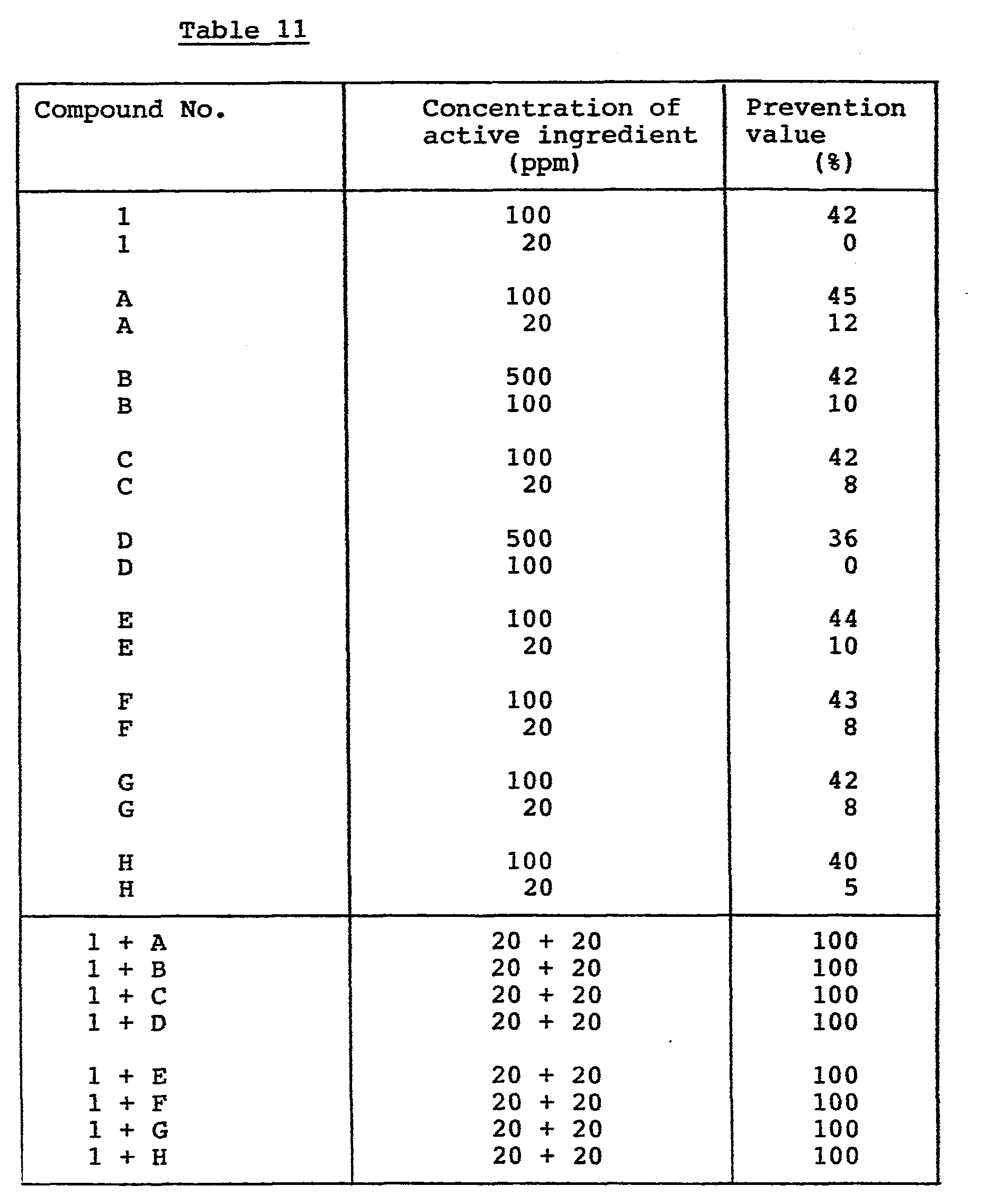
  • Preventive effect on powdery mildew of cucumber (Sphaerotheca fuliginea):-A plastic pot of 90 ml volume was filled with sandy soil, and seeds of cucumber (var: Sagami-hanjiro) were sowed therein. Cultivation was carried out in a greenhouse for 8 days. Onto the resulting seedlings having cotyledons, the test compound(s) formulated in emulsifiable concentrate or wettable powder and diluted with water were sprayed at a rate of 10 ml per pot. Then, the seedlings were inoculated with a mixed spore suspension of the drug-resistant and drug-sensitive strain of Sphaerotheca fuliginea by spraying and further cultivated in the greenhouse. Ten days thereafter, the infectious state of the plants was observed. The degree of damage was determined in the same manner as in Experiment 1, and the results are shown in Table 11.
    Figure imgb0029
  • As understood from the results shown in Table 11, the combined use of the compound of the formula (I) of the invention with benzimidazole, thiophanate and/or cyclic imide fungicides show much more excellent preventive effect than their sole use.
  • Experiment 10 Preventive effect on gray mold of tomato (Botrytis cinerea):-
  • A plastic pot of 90 ml volume is filled with sandy soil, and seeds of tomato (var: Fukuju No. 2) are sowed therein. Cultivation is carried out in a greenhouse for 4 weeks. Onto the resulting seedlings at the 4-leaf stage, the test compound(s) formulated in emulsifiable concentrate or wettable powder and diluted with water are sprayed at a rate of 10 ml per pot. Then, the seedlings are inoculated with a mixed spore suspension of the drug-resistant and drug-sensitive strain of Botrytis cinerea by spraying and placed at 20°C in a room of high humidity for 5 days. The degree of damage is determined in the same manner as in Experiment 1, and the results are shown in Table 12.
  • Figure imgb0030
    As understood from the results shown in Table 12, the combined use of the compound (I) of the invention with benzimidazole, thiophanate and/or cyclic imide fungicides show much more excellent preventive effect than their sole use.

Claims (11)

1. A compound of the formula:
Figure imgb0031
wherein R1, R2 and R3 are each independently a lower alkyl group, X is a halogen atom, a lower alkyl group or a lower alkoxy group and A and B are each independently an oxygen atom or a sulfur atom.
2. A compound as claimed in claim 1 wherein R1 and R2 are each a lower alkyl group, R3 is an isopropyl group, X is a fluorine atom and A and B are each an oxygen atom.
3. A fungicidal composition which comprises as an active ingredient a fungicidally effective amount of a compound of the formula:
Figure imgb0032
wherein Rl, R2, R3, A and B are each as defined in claim 1 together with an inert carrier or diluent.
4. A fungicidal composition as claimed in claim 3 which further comprises as an additional active ingredient(s) a benzimidazole, thiophanate and/or cyclic imide fungicide(s).
5. A fungicidal composition as claimed in claim 4 wherein the benzimidazole fungicide is methyl 1-(butylcarbamoyl)benzimidazol-2-ylcarbamate, 2-(2-furyl)-benzimidazole, 2-(4-thiazolyl)benzimidazole or methyl benzimidazol-2-ylcarbamate.
6. A fungicidal composition as claimed in claim 4 wherein the thiophanate fungicide is 1,2-bis(3-methoxycarbonyl-2-thioureido)benzene, 1,2-bis(3-ethoxycarbonyl-2-thioureido)benzene-, 2-(O,S-dimethylphosphorylamino)-1-(3'-methoxycarbonyl-2'thioureido)benzene or 2-(O,O-dim- ethylthiophosphorylamino)-1(3'-methoxycarbonyl-2'-thioureido)benzene.
7. A fungicidal composition as claimed in claim 4 wherein the cyclic imide fungicide is 3-(3',5'-dichlorophenyl)-1,2-dimethylcyclopropane-1,2-dicarboximide, 3-(3',5'-dichlorophenyl)-l-isopropylcarbamoylimidazol- idine-2,4-dione, 3-(3',5'-di-chlorophenyl)-5-methyl-5-methyl-5-vinyloxazolidine-2,4-dione or ethyl (RS)-3-(3', 5'-dichlorophenyl)-5-methyl-2,4-dioxooxazolidine-5-carboxylate.
8. A method for controlling plant pathogenic fungi which comprises applying a fungicidally effective amount of at least one of the compounds of the formula:
Figure imgb0033
wherein R1, R2, R31 X, A and B are each as defined in claim 1, to plant pathogenic fungi.
9. A method as claimed in claim 8, wherein the plant pathogenic fungi is the drug-resistant strain.
10. A method for controlling plant pathogenic fungi which comprises applying a fungicidally effective amount of a mixture of at least one of the formula:
Figure imgb0034
wherein R1, R2, R3, X, A and B are each as defined in claim 1, and at least one benzimidazole, thiophanate or cyclic imide fungicide to plant pathogenic fungi.
11. A process for producing a compound of the formula:
Figure imgb0035
wherein R1, R2, R3, A and B are as defined in claim 1 which process comprises (a) reacting a compound of the formula:
Figure imgb0036
wherein R1, R2 and X are each as defined above, with a compound of the formula:
Figure imgb0037
wherein R3, A and B are each as defined above and R4 is a halogen atom; or (b) reacting a compound of the formula:
Figure imgb0038
wherein R1, R2, X and A are each as a compound of the formula: defined above, with
Figure imgb0039
wherein R3 and B are each as defined above.
EP84303361A 1983-05-17 1984-05-17 Fungicidal aniline derivatives Withdrawn EP0126628A1 (en)

Applications Claiming Priority (4)

Application Number Priority Date Filing Date Title
JP87150/83 1983-05-17
JP8715083A JPS59212461A (en) 1983-05-17 1983-05-17 N-phenylcarbamate compound, its production and agricultural and horticultural germicide containing the same as active constituent
JP58087974A JPS59212410A (en) 1983-05-18 1983-05-18 Antifungal composition for agricultural and horticultural purposes
JP87974/83 1983-05-18

Publications (1)

Publication Number Publication Date
EP0126628A1 true EP0126628A1 (en) 1984-11-28

Family

ID=26428453

Family Applications (1)

Application Number Title Priority Date Filing Date
EP84303361A Withdrawn EP0126628A1 (en) 1983-05-17 1984-05-17 Fungicidal aniline derivatives

Country Status (2)

Country Link
US (1) US4605668A (en)
EP (1) EP0126628A1 (en)

Cited By (2)

* Cited by examiner, † Cited by third party
Publication number Priority date Publication date Assignee Title
US4617417A (en) * 1985-07-29 1986-10-14 Ortho Pharmaceutical Corporation Alkyl 2-carboalkoxy-3,4-dialkoxybenzenecarbamates and process for their preparation
WO1993015046A1 (en) * 1992-01-29 1993-08-05 Basf Aktiengesellschaft Carbamates and plant-protecting agents containing them

Families Citing this family (4)

* Cited by examiner, † Cited by third party
Publication number Priority date Publication date Assignee Title
US5007953A (en) * 1986-05-07 1991-04-16 Snake River Chemicals, Inc. Seed treatment compositions
US5212086A (en) * 1987-02-03 1993-05-18 The Royal Institution For The Advancement Of Learning (On Behalf Of Mcgill University) Fungal herbicides
DE4441674A1 (en) * 1994-11-23 1996-05-30 Basf Ag Iminooxymethylene anilides, processes and intermediates for their preparation and compositions containing them
US5571443A (en) * 1994-12-30 1996-11-05 Buckman Laboratories International, Inc. Synergistic combination of 2-(thiocyanomethylthio)benzothiazole and thiophanate compounds useful as fungicides

Citations (1)

* Cited by examiner, † Cited by third party
Publication number Priority date Publication date Assignee Title
EP0078663A2 (en) * 1981-10-29 1983-05-11 Sumitomo Chemical Company, Limited Fungicidal N-phenylcarbamates

Family Cites Families (5)

* Cited by examiner, † Cited by third party
Publication number Priority date Publication date Assignee Title
US3253904A (en) * 1965-03-15 1966-05-31 Du Pont Composition and method for desuckering tobacco
US3846555A (en) * 1970-01-26 1974-11-05 Ciba Geigy Corp Control of microorganisms with o,n-diphenylcarbamic acid esters
ZA731497B (en) * 1972-03-20 1973-12-19 Erba Carlo Spa Thiocarbamic acid derivatives and process for their preparation
US3852332A (en) * 1972-06-30 1974-12-03 American Cyanamid Co Esters of (alkynloxy) and (alkenyloxy) carbanilic acid
GR76941B (en) * 1980-11-07 1984-09-04 Sumitomo Chemical Co

Patent Citations (1)

* Cited by examiner, † Cited by third party
Publication number Priority date Publication date Assignee Title
EP0078663A2 (en) * 1981-10-29 1983-05-11 Sumitomo Chemical Company, Limited Fungicidal N-phenylcarbamates

Cited By (4)

* Cited by examiner, † Cited by third party
Publication number Priority date Publication date Assignee Title
US4617417A (en) * 1985-07-29 1986-10-14 Ortho Pharmaceutical Corporation Alkyl 2-carboalkoxy-3,4-dialkoxybenzenecarbamates and process for their preparation
EP0210857A1 (en) * 1985-07-29 1987-02-04 Ortho Pharmaceutical Corporation Process for the preparation of alkyl 2-carboalkoxy-3,4-dialkoxybenzenecarbamates
WO1993015046A1 (en) * 1992-01-29 1993-08-05 Basf Aktiengesellschaft Carbamates and plant-protecting agents containing them
KR100282840B1 (en) * 1992-01-29 2001-04-02 스타르크, 카르크 Carbamates and crop protection products containing them

Also Published As

Publication number Publication date
US4605668A (en) 1986-08-12

Similar Documents

Publication Publication Date Title
EP0078663B1 (en) Fungicidal n-phenylcarbamates
EP0100615B1 (en) Fungicidal anilides
US4501756A (en) Fungicidal carbamates useful against fungi resistant to benzamidazole fungicides
EP0127990B1 (en) Fungicidal aniline derivatives
EP0063905B1 (en) Fungicidal n-phenylcarbamates
US4672070A (en) Fungicidal N-pyridinylamide derivatives
EP0125901B1 (en) Fungicidal aniline derivatives
EP0116409B1 (en) Fungicidal aniline derivatives
EP0117024B1 (en) Fungicidal aniline derivatives
US4710514A (en) Fungicidal carbamates and thiolcarbamates
US4605668A (en) Fungicidal carbamate compounds
EP0100190B1 (en) Fungicidal n-phenylcarbamate
EP0104070B1 (en) Fungicidal n-phenylcarbamates
EP0123386B1 (en) Fungicidal n-(condensed phenyl) carbamates
EP0093620B1 (en) Fungicidal n-phenylcarbamates
GB2138804A (en) Fungicidal N-phenylcarbamates
US4727083A (en) Fungicidal composition employing nitrobenzene derivatives
GB2169283A (en) Fungicidal aniline derivatives
GB2135667A (en) Fungicidal N-phenylcarbamates
GB2137191A (en) Fungicidal N-phenylimidates

Legal Events

Date Code Title Description
PUAI Public reference made under article 153(3) epc to a published international application that has entered the european phase

Free format text: ORIGINAL CODE: 0009012

AK Designated contracting states

Designated state(s): BE CH DE FR GB IT LI NL

17P Request for examination filed

Effective date: 19850523

17Q First examination report despatched

Effective date: 19860204

STAA Information on the status of an ep patent application or granted ep patent

Free format text: STATUS: THE APPLICATION IS DEEMED TO BE WITHDRAWN

18D Application deemed to be withdrawn

Effective date: 19860617

RIN1 Information on inventor provided before grant (corrected)

Inventor name: KAMOSHITA, KATSUZO

Inventor name: OGURI, YUKIO

Inventor name: YAMAMOTO, SHIGEO

Inventor name: NOGUCHI, HIROSHI

Inventor name: TAKAHASHI, JUNYA

Inventor name: KATO, TOSHIRO