EP0126459A2 - A process for the production of expandable granules of thermoplastic polymers and relative apparatus - Google Patents
A process for the production of expandable granules of thermoplastic polymers and relative apparatus Download PDFInfo
- Publication number
- EP0126459A2 EP0126459A2 EP84105701A EP84105701A EP0126459A2 EP 0126459 A2 EP0126459 A2 EP 0126459A2 EP 84105701 A EP84105701 A EP 84105701A EP 84105701 A EP84105701 A EP 84105701A EP 0126459 A2 EP0126459 A2 EP 0126459A2
- Authority
- EP
- European Patent Office
- Prior art keywords
- granules
- polymer
- cooling
- die
- head
- Prior art date
- Legal status (The legal status is an assumption and is not a legal conclusion. Google has not performed a legal analysis and makes no representation as to the accuracy of the status listed.)
- Granted
Links
Images
Classifications
-
- B—PERFORMING OPERATIONS; TRANSPORTING
- B29—WORKING OF PLASTICS; WORKING OF SUBSTANCES IN A PLASTIC STATE IN GENERAL
- B29C—SHAPING OR JOINING OF PLASTICS; SHAPING OF MATERIAL IN A PLASTIC STATE, NOT OTHERWISE PROVIDED FOR; AFTER-TREATMENT OF THE SHAPED PRODUCTS, e.g. REPAIRING
- B29C44/00—Shaping by internal pressure generated in the material, e.g. swelling or foaming ; Producing porous or cellular expanded plastics articles
- B29C44/34—Auxiliary operations
- B29C44/3461—Making or treating expandable particles
-
- B—PERFORMING OPERATIONS; TRANSPORTING
- B29—WORKING OF PLASTICS; WORKING OF SUBSTANCES IN A PLASTIC STATE IN GENERAL
- B29B—PREPARATION OR PRETREATMENT OF THE MATERIAL TO BE SHAPED; MAKING GRANULES OR PREFORMS; RECOVERY OF PLASTICS OR OTHER CONSTITUENTS OF WASTE MATERIAL CONTAINING PLASTICS
- B29B13/00—Conditioning or physical treatment of the material to be shaped
- B29B13/04—Conditioning or physical treatment of the material to be shaped by cooling
- B29B13/045—Conditioning or physical treatment of the material to be shaped by cooling of powders or pellets
-
- B—PERFORMING OPERATIONS; TRANSPORTING
- B29—WORKING OF PLASTICS; WORKING OF SUBSTANCES IN A PLASTIC STATE IN GENERAL
- B29B—PREPARATION OR PRETREATMENT OF THE MATERIAL TO BE SHAPED; MAKING GRANULES OR PREFORMS; RECOVERY OF PLASTICS OR OTHER CONSTITUENTS OF WASTE MATERIAL CONTAINING PLASTICS
- B29B9/00—Making granules
- B29B9/02—Making granules by dividing preformed material
- B29B9/06—Making granules by dividing preformed material in the form of filamentary material, e.g. combined with extrusion
- B29B9/065—Making granules by dividing preformed material in the form of filamentary material, e.g. combined with extrusion under-water, e.g. underwater pelletizers
-
- B—PERFORMING OPERATIONS; TRANSPORTING
- B29—WORKING OF PLASTICS; WORKING OF SUBSTANCES IN A PLASTIC STATE IN GENERAL
- B29B—PREPARATION OR PRETREATMENT OF THE MATERIAL TO BE SHAPED; MAKING GRANULES OR PREFORMS; RECOVERY OF PLASTICS OR OTHER CONSTITUENTS OF WASTE MATERIAL CONTAINING PLASTICS
- B29B9/00—Making granules
- B29B9/16—Auxiliary treatment of granules
Definitions
- the present invention relates to a process for the production of expandable granules of thermoplastic polymers and to the relative apparatus.
- the present invention relates to a process for the production by extrusion of non-oriented and non-stressed expandable polymers, particularly suitable for the production of expanded articles.
- thermoplastic polymers such as for instance polystyrene
- the thermoplastic polymers may be expanded by incorporating intimately into the polymer an expanding agent and then by heating the polymer under such conditions that its viscosity lowers and the expanding agent is allowed to vaporize and to form quite a number of closed spaces or cells in the polymer.
- an organic liquid vaporizable substance such as for instance a hydrocarbon containing from 4 to 6. carbon atoms is used as expanding agent.
- the amount of expanding agent contained in the polymer may range between 2 and 10% by weight.
- the expandable polymers are generally provided in the form of beads or granules, which by effect of the heat and in particular of the water vapour, are firstly expanded till the desired density is reached and, after maturation in the air, are moulded in shape to obtain expanded blocks and shaped articles.
- the obtained expanded articles have a closed cell structure and are suitable to be used in important fields, such as in the building, refrigeration, packaging fields, etc.
- expandable beads are obtained by means of a polymerization process in suspension, appropriately combined with an impregnation procedure of the polymer with the expanding agent.
- This process that is of discontinuous kind, provides a product of good quality, but of a rather dispersed granulometry. That involves a subsequent screening to remove out of size particles.
- the polymerization process in suspension involves moreover substantial restrictions concerning the production of particular products, such as for instance the production of coloured expandable beads, because some kinds of dyes or pigments either can be incorporated into the polymer with difficulty or alternatively they can inhibit the polymerization.
- the same drawback can happen when nucleating agents are concerned, which are generally added to improve the cellular structure of the expanded polymer.
- Another process that is industrially less used, for the production of expandable polystyrene, consists in adding the expanding agent into the molten polymer during the extrusion, in drawing the resulting mass to spaghetti, in cooling and in cutting them at a distance to expandable granules.
- This type of process provides the feed of polystyrene granules into an extruder with continuous injection, by means of a metering pump, of an expanding agent into the extrusion melt.
- the resulting expandable mass is drawn to spaghetti, which are cooled in cold water in order to bring them rapidly from the extrusion temperature to a temperature lower than the Tg of the expandable polymer.
- An object of the present invention is to provide a process for the production by extrusion of spherical granules of thermoplastic polymers substantially similar to the ones obtained by the polymerization process.
- an object of the present invention is to provide a process for the production by extrusion of spherical granules of expandable thermoplastic polymers substantially free from orientations and stresses caused by quenching.
- a further object of the present invention is to provide an apparatus to carry out the hereinbefore process.
- the Tg is determined according to method DSC (differential scannin calorimetry), by using a determinate amount of material (2-3 granules) and by heating at a velocity of 10 °C/min.
- the Tg value is obtained graphically by intersection of the tangent to the base line preceding the transition with the tangent through the point of inflexion relative to the transition itself.
- the apparatus for carrying out the hereinabove process comprises an extruder; a means of injection of the expanding agent into the extruder; a die-head; a chamber fastened to said die-head provided with a rotable cutter and pipelines for feeding the water or the fluid under pressure to said chamber; a tower for the slow cooling (annealing) of the granules; some pipes for feeding the granules to said tower; some means for recovering the water or the fluid and a pressurization system to keep under pressure said chamber, the cooling tower, the pipes and the recovery means of the water or of the fluid.
- the essential conditions of the process, object of the present invention are the cutting of the expandable polymer, at the outlet of the die-head, under pressure and at a temperature higher than its Tg and the very slow cooling of the granules till a temperature lower than its Tg is reached.
- the granules are brought from at least +5 °C above to at least -5°C under the Tg of the polymer, by a cooling rate of ⁇ 3°/minute.
- the expandable granules obtained according to the process object of the present invention have a narrow granulometric distribution and are, from the point of view of their behaviour in the subsequent operations of expansion and shape molding, similar to the well known expandable beads obtained by incorporating the expanding agent during the polymerization process in suspension.
- the temperature, at which the polymer is extruded, depends on the softening temperature of the polymer composition containing the expanding agent. To avoid phenomena of solidification or obstruction of the polymers in the extrusion holes, the extrusion temperature is always kept at a value much higher than the softening one.
- the required extrusion temperature depends, moreover, on the sizes of the die-head holes and in the present process, also on the temperature of the water, into which the extruded polymer is cooled. So, for instance, when polystyrene containing from 1 to 4% by weight of pentane, as expanding agent, is used, the extrusion temperature ranges between 100 and 130 °C, if the extrusion holes have a diameter of 2-4 mm. Higher temperatures are required, when the holes are smaller. Generally, temperatures till 200 °C may be used for extrusion holes having a diameter smaller than 1 mm.
- the temperature of the water or of the fluid, into which the granules are dipped after the cutting depends on the content of expanding agent in the polymer. Generally this temperature ranges between room temperature and 80°C.
- water other fluids such as glycerol or ethylene glycol or mixture of water and ethylene glycol may be used.
- the extrusion die-head may contain several holes having a diameter that may vary between 0.5 and 4 mm.
- the cooling of the granules is carried out very slowly, preferably 1-2°/minute, in a suitable annealing tower, preferably provided with stirrer and internal baffles, in order to regulate and slow down the granule drop.
- the particle temperature is brought from 40-80 °C to 20-40 °C.
- thermoplastic polymers particularly suitable for the process of the present invention, the polystyrene is in the first place; other thermoplastic compounds, however, such as polyolefins, poly-vinyl-aromatic, poly-vinyliden-aromatic compounds or copolymers thereof may be used. Mixtures of thermoplastic polymers can be used as well.
- the vaporizable expanding agent can be a liquid organic substance, having no solvent action towards the polymer.
- the expanding agent is an organic liquid boiling, at standard pressure, between 10° and 90 °C and preferably between 20° and 80 °C.
- Generally aliphatic saturated hydrocarbons such as n.pentane, isopentane or mixture thereof are preferred.
- Butane, hexane, petroleum ether, cyclopentane or fluoro-chloro-hydrocarbons may be used as well.
- the polymer can contain one or more additives, nucleant agents, modifying agents, dyes, stabilizing agents etc. according to the usual techniques.
- the expandable polymer as soon as extruded, at the die-head outlet, is cut by using the known technique of the cutting on the die-head face and the obtained granules fall into the water or into the hot fluid sorroun- ding said face.
- the granules are conveyed by the fluid flow into an annealing tower, wherein, from the bottom, the same fluid is fed at a temperature which is regulated in such a way that a slow cooling of the granules is obtained till a temperature is reached, that is at least 5 °C lower than the Tg of the expandable polymer.
- the granules are separated from the fluid by means of a screen, and dried, preferably with hot air and collected in a container.
- the whole system comprising the chamber that wraps the die-head face, the cooling tower and the fluid relevant pipes are kept under pressure, for instance, by means of a standard pressurization pot.
- pressures higher than 2 Bar and preferably comprised between 5 and 15 Bar are used.
- the polystyrene granules are fed, through hopper (1), to a screw extruder (2) of known type for plasticizing the polystyrene and letting the plasticized polymer, under pressure, move, towards extruder head (3).
- the expanding agent in particular pentane, is fed to extruder (2) through injection line (4) and by means of pump (5).
- the last section of extruder (2) is shaped in such way as to provide the required mixing in order to insure an intimate and a perfect distribution of pentane into polystyrene.
- the polymer containing pentane is extruded through holes (6) of the die-head (3) and immediately cut by means of a cutting knife (7) rotating tangentially to the free surface of the die-head.
- the polymer cut to granules enters cutting chamber (8) that surrounds the die-head and where water or another fluid is contained at a pressure higher than 2 Bar and at a temperature higher than the Tg of the expandable polymer and preferably comprised between 40° and 80 °C.
- a heat exchanger (9) provides to maintain the water entering chamber (8) at the required temperature.
- the granules are conveyed by the water flow to the upper part of an annealing tower (10), into which, from the lower part, water or another fluid is fed, kept by exchanger (11) at a temperature that is such as to carry out a cooling of the granules from at least +5 °C to at least -5 °C the Tg of the expandable polymer.
- the drop of the granules into annealing tower (10) is regulated by means of a stirrer (12).
- the polymer granules and the water are discharged from the bottom of tower (10) through a time valve (13).
- the sizes of tower (10), time valve (13), velocity of stirrer (12) and the amount of the granules fed into the tower, are regulated in such a way that the granules remain in annealing tower (10) for the period of time necessary for cooling the granules at a velocity of 1-2°/minute under pressure, kept by the pressurization pot (20).
- a polystyrene having a melt index of 10 g/10' was fed to extruder (2) through hopper (1).
- a mixture containing n.pentane/iso-pentane, 70/30 by weight, in an amount of about 6.2% by weight was added to the melted polymer.
- the resulting expandable mass, having a temperature of about 160 °C, was drawn through an extrusion die-head (3), provided with 20 holes, each of them having a diameter of 0.7 mm.
- the polymer coming out of the die-head was cut by means of knife (7), rotating in contact with the surface of die-head (3), in order to obtain spheroidal granules having a diameter of about 1.2 mm.
- Die-head (3) protuded into chamber (8), where the water circulated at the pressure of 9 Bar and at a temperature of 62 °C.
- the cut granules were conveyed by the water flow into the upper part of annealing tower (10).
- tower (10) the granules were cooled slowly till about 42°C, by injecting, from the bottom of said tower, water heated by exchanger (11) at about 40 °C.
- the drop of the granules and time valve (13) were regulated in such a way that the residence time of the granules in tower (10) was of about 15 minutes.
- the granules were separated in screen (14), dried by means of air at 25 °C in (17) and collected in container (19).
- the expandable granules containing 6% by weight of expanding agent were pre-expanded in a continuous pre-expander with a vapor pressure of 0.2 Ate so as a density of. 18 g/l was obtained.
- the pre-expanded particles had a uniform cellular structure, with closed cells having an average diameter of about 50 m ⁇
- Granules were obtained, practically free from expansion. Said granules after pre-expansion with vapour at 0.2 Ate, presented a density of 18 g/l and an ununiform cellular structure with a circular external rim consisting of cells having an average diameter of about 40 m ⁇ and an internal part consisting of bi.gger ununiform cells, variable from 40 to 150 m ⁇ .
Landscapes
- Engineering & Computer Science (AREA)
- Mechanical Engineering (AREA)
- Manufacture Of Porous Articles, And Recovery And Treatment Of Waste Products (AREA)
- Processing And Handling Of Plastics And Other Materials For Molding In General (AREA)
Abstract
Description
- The present invention relates to a process for the production of expandable granules of thermoplastic polymers and to the relative apparatus.
- More particularly, the present invention relates to a process for the production by extrusion of non-oriented and non-stressed expandable polymers, particularly suitable for the production of expanded articles.
- It is known that the thermoplastic polymers, such as for instance polystyrene, may be expanded by incorporating intimately into the polymer an expanding agent and then by heating the polymer under such conditions that its viscosity lowers and the expanding agent is allowed to vaporize and to form quite a number of closed spaces or cells in the polymer.
- When polystyrene is concerned, as a rule, an organic liquid vaporizable substance, such as for instance a hydrocarbon containing from 4 to 6. carbon atoms is used as expanding agent.
- The amount of expanding agent contained in the polymer may range between 2 and 10% by weight.
- The expandable polymers are generally provided in the form of beads or granules, which by effect of the heat and in particular of the water vapour, are firstly expanded till the desired density is reached and, after maturation in the air, are moulded in shape to obtain expanded blocks and shaped articles.
- The obtained expanded articles have a closed cell structure and are suitable to be used in important fields, such as in the building, refrigeration, packaging fields, etc.
- These expandable beads are obtained by means of a polymerization process in suspension, appropriately combined with an impregnation procedure of the polymer with the expanding agent.
- This process, that is of discontinuous kind, provides a product of good quality, but of a rather dispersed granulometry. That involves a subsequent screening to remove out of size particles.
- The polymerization process in suspension involves moreover substantial restrictions concerning the production of particular products, such as for instance the production of coloured expandable beads, because some kinds of dyes or pigments either can be incorporated into the polymer with difficulty or alternatively they can inhibit the polymerization. The same drawback can happen when nucleating agents are concerned, which are generally added to improve the cellular structure of the expanded polymer.
- Another process, that is industrially less used, for the production of expandable polystyrene, consists in adding the expanding agent into the molten polymer during the extrusion, in drawing the resulting mass to spaghetti, in cooling and in cutting them at a distance to expandable granules.
- This type of process provides the feed of polystyrene granules into an extruder with continuous injection, by means of a metering pump, of an expanding agent into the extrusion melt.
- The resulting expandable mass is drawn to spaghetti, which are cooled in cold water in order to bring them rapidly from the extrusion temperature to a temperature lower than the Tg of the expandable polymer.
- This rapid cooling allows to avoid the polymer expansion, but it presents the great drawback to induce into the granules orientations and stresses caused by quenching, which, as known, affects negatively the uniformity of the cellular structure and the performances of the expanded product.
- In order to improve the quality of the expandable granules obtained by extrusion, it was proposed to eliminate the orientations and the stresses frozen in them, by means of a subsequent annealing at a temperature lower than the Tg of the polymer at room pressure.
- Obviously this operation needs an additional stage, that requires relatively long times. Furthermore since it has to be carried out at a temperature lower than the Tg of the expandable polymer to avoid the granule expansion, this annealing operation does not allow to eliminate completely the above mentioned drawbacks.
- In order to eliminate them, on the contrary, it should be necessary to work at a temperature higher than the Tg of the polymer and to cool slowly. This process, however, involves the risk of the non-desired expansion of the material.
- An object of the present invention is to provide a process for the production by extrusion of spherical granules of thermoplastic polymers substantially similar to the ones obtained by the polymerization process.
- More particularly, an object of the present invention is to provide a process for the production by extrusion of spherical granules of expandable thermoplastic polymers substantially free from orientations and stresses caused by quenching.
- A further object of the present invention is to provide an apparatus to carry out the hereinbefore process.
- According to the present invention the aforesaid objects and others are achieved by means of a process for the production by extrusion of expandable granules of thermoplastic polymers comprising, successively, the following stages:
- a) extrusion through a die-head of the polymer in which an expanding agent is incorporated;
- b) immediate cutting of the polymer at the die-head outlet and cooling of the thus obtained granules in water or of a fluid kept at a temperature higher than the Tg of the expandable polymer;
- c) slow cooling of the thus obtained granules at a temperature ranging between at least +5 °C and at least -5 °C the Tg of the expandable polymer;
- The Tg is determined according to method DSC (differential scannin calorimetry), by using a determinate amount of material (2-3 granules) and by heating at a velocity of 10 °C/min. The Tg value is obtained graphically by intersection of the tangent to the base line preceding the transition with the tangent through the point of inflexion relative to the transition itself.
- The apparatus for carrying out the hereinabove process comprises an extruder; a means of injection of the expanding agent into the extruder; a die-head; a chamber fastened to said die-head provided with a rotable cutter and pipelines for feeding the water or the fluid under pressure to said chamber; a tower for the slow cooling (annealing) of the granules; some pipes for feeding the granules to said tower; some means for recovering the water or the fluid and a pressurization system to keep under pressure said chamber, the cooling tower, the pipes and the recovery means of the water or of the fluid.
- We would point out that the essential conditions of the process, object of the present invention, are the cutting of the expandable polymer, at the outlet of the die-head, under pressure and at a temperature higher than its Tg and the very slow cooling of the granules till a temperature lower than its Tg is reached. Preferably, the granules are brought from at least +5 °C above to at least -5°C under the Tg of the polymer, by a cooling rate of <3°/minute.
- These conditions are essential both to avoid a beginning expansion of the granules and to reduce to a minimum the formation in said granules of orientation, stresses and/or internal holes caused by quenching.
- The expandable granules obtained according to the process object of the present invention, have a narrow granulometric distribution and are, from the point of view of their behaviour in the subsequent operations of expansion and shape molding, similar to the well known expandable beads obtained by incorporating the expanding agent during the polymerization process in suspension.
- The temperature, at which the polymer is extruded, depends on the softening temperature of the polymer composition containing the expanding agent. To avoid phenomena of solidification or obstruction of the polymers in the extrusion holes, the extrusion temperature is always kept at a value much higher than the softening one.
- The required extrusion temperature, as known, depends, moreover, on the sizes of the die-head holes and in the present process, also on the temperature of the water, into which the extruded polymer is cooled. So, for instance, when polystyrene containing from 1 to 4% by weight of pentane, as expanding agent, is used, the extrusion temperature ranges between 100 and 130 °C, if the extrusion holes have a diameter of 2-4 mm. Higher temperatures are required, when the holes are smaller. Generally, temperatures till 200 °C may be used for extrusion holes having a diameter smaller than 1 mm.
- The temperature of the water or of the fluid, into which the granules are dipped after the cutting, depends on the content of expanding agent in the polymer. Generally this temperature ranges between room temperature and 80°C. Besides water, other fluids such as glycerol or ethylene glycol or mixture of water and ethylene glycol may be used.
- The extrusion die-head may contain several holes having a diameter that may vary between 0.5 and 4 mm.
- The cooling of the granules is carried out very slowly, preferably 1-2°/minute, in a suitable annealing tower, preferably provided with stirrer and internal baffles, in order to regulate and slow down the granule drop.
- In this annealing tower, the particle temperature is brought from 40-80 °C to 20-40 °C.
- Among the thermoplastic polymers, particularly suitable for the process of the present invention, the polystyrene is in the first place; other thermoplastic compounds, however, such as polyolefins, poly-vinyl-aromatic, poly-vinyliden-aromatic compounds or copolymers thereof may be used. Mixtures of thermoplastic polymers can be used as well.
- The vaporizable expanding agent can be a liquid organic substance, having no solvent action towards the polymer. Preferably, the expanding agent is an organic liquid boiling, at standard pressure, between 10° and 90 °C and preferably between 20° and 80 °C. Generally aliphatic saturated hydrocarbons such as n.pentane, isopentane or mixture thereof are preferred. Butane, hexane, petroleum ether, cyclopentane or fluoro-chloro-hydrocarbons may be used as well.
- If desired, the polymer can contain one or more additives, nucleant agents, modifying agents, dyes, stabilizing agents etc. according to the usual techniques.
- The expandable polymer, as soon as extruded, at the die-head outlet, is cut by using the known technique of the cutting on the die-head face and the obtained granules fall into the water or into the hot fluid sorroun- ding said face.
- The granules are conveyed by the fluid flow into an annealing tower, wherein, from the bottom, the same fluid is fed at a temperature which is regulated in such a way that a slow cooling of the granules is obtained till a temperature is reached, that is at least 5 °C lower than the Tg of the expandable polymer. At the outlet of the annealing tower, the granules are separated from the fluid by means of a screen, and dried, preferably with hot air and collected in a container.
- The whole system, comprising the chamber that wraps the die-head face, the cooling tower and the fluid relevant pipes are kept under pressure, for instance, by means of a standard pressurization pot. Generally pressures higher than 2 Bar and preferably comprised between 5 and 15 Bar are used.
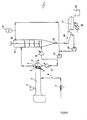
- The present invention will be better understood, if reference is made to the figure of the enclosed drawing, which represents a schematic illustration of the apparatus suitable to carry out the present invention.
- With reference to the figure, the polystyrene granules are fed, through hopper (1), to a screw extruder (2) of known type for plasticizing the polystyrene and letting the plasticized polymer, under pressure, move, towards extruder head (3). The expanding agent, in particular pentane, is fed to extruder (2) through injection line (4) and by means of pump (5).
- The last section of extruder (2) is shaped in such way as to provide the required mixing in order to insure an intimate and a perfect distribution of pentane into polystyrene.
- The polymer containing pentane is extruded through holes (6) of the die-head (3) and immediately cut by means of a cutting knife (7) rotating tangentially to the free surface of the die-head.
- The polymer cut to granules enters cutting chamber (8) that surrounds the die-head and where water or another fluid is contained at a pressure higher than 2 Bar and at a temperature higher than the Tg of the expandable polymer and preferably comprised between 40° and 80 °C. A heat exchanger (9) provides to maintain the water entering chamber (8) at the required temperature. The granules are conveyed by the water flow to the upper part of an annealing tower (10), into which, from the lower part, water or another fluid is fed, kept by exchanger (11) at a temperature that is such as to carry out a cooling of the granules from at least +5 °C to at least -5 °C the Tg of the expandable polymer. The drop of the granules into annealing tower (10) is regulated by means of a stirrer (12). The polymer granules and the water are discharged from the bottom of tower (10) through a time valve (13). The sizes of tower (10), time valve (13), velocity of stirrer (12) and the amount of the granules fed into the tower, are regulated in such a way that the granules remain in annealing tower (10) for the period of time necessary for cooling the granules at a velocity of 1-2°/minute under pressure, kept by the pressurization pot (20). The granules discharged through valve (13) fall onto a screen (14), where the separation water/granules is carried out, then the granules are dried in (17) by means of air coming from exchanger (18) and collected in container (19). The recovery water is recycled by means of pumps (15) and (16).
- In order to better understand the present invention and to carry out same, some examples are given hereinafter, having illustrative, exemplificative, but, however, non-limiting character of the present invention.
- A polystyrene having a melt index of 10 g/10' was fed to extruder (2) through hopper (1). Through pump (5) and line (4) a mixture containing n.pentane/iso-pentane, 70/30 by weight, in an amount of about 6.2% by weight was added to the melted polymer. The resulting expandable mass, having a temperature of about 160 °C, was drawn through an extrusion die-head (3), provided with 20 holes, each of them having a diameter of 0.7 mm. The polymer coming out of the die-head was cut by means of knife (7), rotating in contact with the surface of die-head (3), in order to obtain spheroidal granules having a diameter of about 1.2 mm.
- Die-head (3) protuded into chamber (8), where the water circulated at the pressure of 9 Bar and at a temperature of 62 °C.
- The cut granules were conveyed by the water flow into the upper part of annealing tower (10). In tower (10), the granules were cooled slowly till about 42°C, by injecting, from the bottom of said tower, water heated by exchanger (11) at about 40 °C. The drop of the granules and time valve (13) were regulated in such a way that the residence time of the granules in tower (10) was of about 15 minutes. The granules were separated in screen (14), dried by means of air at 25 °C in (17) and collected in container (19).
- The expandable granules containing 6% by weight of expanding agent, were pre-expanded in a continuous pre-expander with a vapor pressure of 0.2 Ate so as a density of. 18 g/l was obtained. The pre-expanded particles had a uniform cellular structure, with closed cells having an average diameter of about 50 mµ
- One worked according to example 1, by feeding water to chamber (8) at a pressure of 2 Bar.
- The obtained granules, before pre-expansion, were partially expanded. After pre-expansion, the particles presented a very ununiform and irregular cellular structure.
- One worked according to example 1, by feeding water to chamber (8) at 20 °C and at a pressure of 2 Bar and by collecting directly the granules coming out of chamber (8).
- Granules were obtained, practically free from expansion. Said granules after pre-expansion with vapour at 0.2 Ate, presented a density of 18 g/l and an ununiform cellular structure with a circular external rim consisting of cells having an average diameter of about 40 mµ and an internal part consisting of bi.gger ununiform cells, variable from 40 to 150 mµ.
wherein, both the cutting of the polymer to granules and the cooling of same are carried out at a pressure higher than 2 Bar.
Claims (12)
Applications Claiming Priority (2)
| Application Number | Priority Date | Filing Date | Title |
|---|---|---|---|
| IT21180/83A IT1163386B (en) | 1983-05-19 | 1983-05-19 | PROCEDURE FOR THE PRODUCTION OF EXPANDABLE GRANULES OF THERMOPLASTIC POLYMERS AND RELATED EQUIPMENT |
| IT2118083 | 1983-05-19 |
Publications (3)
| Publication Number | Publication Date |
|---|---|
| EP0126459A2 true EP0126459A2 (en) | 1984-11-28 |
| EP0126459A3 EP0126459A3 (en) | 1987-02-25 |
| EP0126459B1 EP0126459B1 (en) | 1989-08-16 |
Family
ID=11177986
Family Applications (1)
| Application Number | Title | Priority Date | Filing Date |
|---|---|---|---|
| EP84105701A Expired EP0126459B1 (en) | 1983-05-19 | 1984-05-18 | A process for the production of expandable granules of thermoplastic polymers and relative apparatus |
Country Status (5)
| Country | Link |
|---|---|
| US (1) | US4606873A (en) |
| EP (1) | EP0126459B1 (en) |
| JP (1) | JPS59221340A (en) |
| DE (1) | DE3479412D1 (en) |
| IT (1) | IT1163386B (en) |
Cited By (19)
| Publication number | Priority date | Publication date | Assignee | Title |
|---|---|---|---|---|
| EP0305862A1 (en) * | 1987-09-04 | 1989-03-08 | General Electric Company | One-step process for the production of expandable foam beads |
| EP0282848A3 (en) * | 1987-03-14 | 1991-09-11 | BASF Aktiengesellschaft | Process for producing polyolefin foams |
| WO1993018901A1 (en) * | 1992-03-23 | 1993-09-30 | Rieter Automatik Gmbh | Device for cooling, granulating and drying molten strands of synthetic thermoplastic material emerging from dies |
| WO1993023463A3 (en) * | 1992-05-13 | 1994-03-17 | Gaia Res Lp | Production of encapsulated chemical foaming concentrates |
| EP0668139A1 (en) * | 1994-02-21 | 1995-08-23 | Sulzer Chemtech AG | Process for preparing expandable plastic granules |
| WO2005056654A1 (en) * | 2003-12-12 | 2005-06-23 | Basf Aktiengesellschaft | Expandable styrole polymer granulates |
| WO2007107493A1 (en) * | 2006-03-22 | 2007-09-27 | Basf Se | Method and device for granulating polymer melts containing blowing agent |
| DE102008023702A1 (en) | 2007-05-18 | 2008-11-20 | Polimeri Europa S.P.A. | Process for the preparation of granules based on expandable thermoplastic polymers and composition |
| DE102008023703A1 (en) | 2007-05-18 | 2008-11-20 | Polimeri Europa S.P.A. | Composite material based on vinyl aromatic polymers with improved thermal insulation properties and process for its preparation |
| EP1694487B1 (en) * | 2003-12-12 | 2010-02-24 | Basf Se | Method of manufacturing expandable granules of polystyrene |
| EP2267065A1 (en) | 2009-06-22 | 2010-12-29 | Total Petrochemicals Research Feluy | Expandable vinyl aromatic polymers and process for the preparation thereof |
| US7868053B2 (en) | 2003-12-12 | 2011-01-11 | Basf Se | Expandable polystyrene granulates with a bi- or multi-modal molecular-weight distribution |
| WO2011092250A1 (en) | 2010-01-28 | 2011-08-04 | Total Petrochemicals Research Feluy | Method to start-up a process to make expandable vinyl aromatic polymers |
| WO2012032022A1 (en) | 2010-09-10 | 2012-03-15 | Total Petrochemicals Research Feluy | Expandable vinyl aromatic polymers |
| WO2012052423A1 (en) | 2010-10-18 | 2012-04-26 | Total Petrochemicals Research Feluy | Expandable vinyl aromatic polymers |
| WO2012175345A1 (en) | 2011-06-23 | 2012-12-27 | Total Research & Technology Feluy | Improved expandable vinyl aromatic polymers |
| WO2013000679A1 (en) | 2011-06-27 | 2013-01-03 | Total Research & Technology Feluy | Expandable graphite - containing vinyl aromatic polymers |
| EA025248B1 (en) * | 2011-09-07 | 2016-12-30 | Армаселл Энтерпрайз Гмбх | Extrusion expansion of low molecular weight polyalkylene terephthalate for production of expanded beads |
| US10500777B2 (en) | 2016-07-01 | 2019-12-10 | Gala Industries, Inc. | Method and apparatus for forming an expandable foam pellet having a hard outer shell by underwater pelletizing, and expandable foam pellets formed thereby |
Families Citing this family (42)
| Publication number | Priority date | Publication date | Assignee | Title |
|---|---|---|---|---|
| DE3644935A1 (en) * | 1986-09-15 | 1988-03-24 | Werner & Pfleiderer | Cooling device for plastics granules |
| DE3631376C1 (en) * | 1986-09-15 | 1988-05-11 | Werner & Pfleiderer | Cooling device for plastic granulate |
| FR2612085B1 (en) * | 1987-03-13 | 1989-06-16 | Insat | GRANULAR WATER TREATMENT MATERIAL AND MANUFACTURING METHOD |
| US5091256A (en) * | 1989-12-27 | 1992-02-25 | General Electric Company | Polyphenylene ether foams from low I.V. polyphenylene ether expandable microparticles |
| US5064869A (en) * | 1989-12-27 | 1991-11-12 | General Electric Company | Polyphenlene ether foams from low i.v. polyphenylene ether expandable microparticles |
| US5095041A (en) * | 1989-12-27 | 1992-03-10 | General Electric Company | Simple process for imbibing blowing agents in thermoplastic resin granules |
| US5130340A (en) * | 1990-07-09 | 1992-07-14 | General Electric Company | Elastomeric low density foamable compositions and process of making the same and articles made therefrom |
| US5190986A (en) * | 1990-07-09 | 1993-03-02 | General Electric Company | Elastomeric low density foamable compositions and process of making the same and articles made therefrom |
| JPH04325534A (en) * | 1991-04-25 | 1992-11-13 | Sekisui Plastics Co Ltd | Foamable polystyrene resin particle and its production |
| US5374175A (en) * | 1991-07-23 | 1994-12-20 | Xerox Corporation | Toner fine recovery system |
| US5288740A (en) * | 1992-10-23 | 1994-02-22 | The Dow Chemical Company | Process for making alkenyl aromatic foam packing bodies with carbon dioxide and/or ethane blowing agent systems |
| JP2641122B2 (en) * | 1993-06-22 | 1997-08-13 | 積水化成品工業株式会社 | Method for producing thermoplastic resin pre-expanded particles |
| JPH0890556A (en) * | 1994-09-20 | 1996-04-09 | Kanegafuchi Chem Ind Co Ltd | Process for producing olefin resin particles and pre-expanded particles |
| US5605937A (en) * | 1994-09-30 | 1997-02-25 | Knaus; Dennis A. | Moldable thermoplastic polymer foam beads |
| US5527553A (en) * | 1995-06-07 | 1996-06-18 | Kazemzadeh; Massoud | Under oil cutting process for pet food and feed industry |
| DE19547398A1 (en) * | 1995-12-19 | 1997-06-26 | Huels Chemische Werke Ag | Process for the production of foamable plastic granules |
| US5895617A (en) * | 1996-07-31 | 1999-04-20 | The Japan Steel Works, Ltd. | Method and apparatus for transporting underwater cut pellets |
| DE19756264C2 (en) * | 1997-12-18 | 2001-09-20 | Gefinex Polymerschaeume Gmbh | Process for producing a foamed granulate |
| DE19819058C5 (en) * | 1998-04-29 | 2015-06-25 | Basf Se | Process for the production of prefoamed EPS particles with coarse foam structure from particulate, slightly foamed, expanded styrene polymers |
| US20020117769A1 (en) * | 2000-12-04 | 2002-08-29 | Arch Paul Edward | Foamed cellular particles of an expandable polymer composition |
| ITMI20012168A1 (en) * | 2001-10-18 | 2003-04-18 | Enichem Spa | EXPANDABLE VINYLAROMATIC POLYMERS AND PROCEDURE FOR THEIR PREPARATION |
| AT410942B (en) * | 2001-10-29 | 2003-08-25 | Fellinger Markus | METHOD AND DEVICE FOR INCREASING THE LIMIT VISCOSITY OF POLYESTER |
| ITMI20012708A1 (en) * | 2001-12-20 | 2003-06-20 | Enichem Spa | DEVICE FOR HOT GRANULATION OF THERMOLASTIC POLYMERS |
| ITMI20012706A1 (en) * | 2001-12-20 | 2003-06-20 | Enichem Spa | PROCEDURE FOR THE PRODUCTION OF EXPANDABLE THERMOPLASTIC POLYMER GRANULES AND APPARATUS SUITABLE FOR THE PURPOSE |
| ITMI20020584A1 (en) * | 2002-03-20 | 2003-09-22 | Polimeri Europa Spa | COMPOSITIONS BASED ON VINYLAROMATIC POLYMERS EXPANDABLE WITH IMPROVED EXPANDABILITY |
| DE10226749B4 (en) * | 2002-06-14 | 2014-09-04 | Basf Se | Process for producing expandable polystyrene |
| US7951449B2 (en) * | 2002-06-27 | 2011-05-31 | Wenguang Ma | Polyester core materials and structural sandwich composites thereof |
| US6773739B2 (en) * | 2002-08-30 | 2004-08-10 | Wenger Manufacturing, Inc | Method and apparatus for extrusion of food products including back pressure valve/diverter |
| CA2529100A1 (en) | 2003-06-12 | 2004-12-23 | Basell Poliolefine Italia S.R.L. | Post-treatment for polymer pellets |
| DE10358805A1 (en) | 2003-12-12 | 2005-07-14 | Basf Ag | Particle foam moldings made of expandable, impact-modified, thermoplastic polymer granules |
| ES2403187T3 (en) * | 2005-03-17 | 2013-05-16 | Sulzer Chemtech Ag | Procedure and installation for the continuous manufacture of plastic granules that can be expanded |
| EP1702738B1 (en) * | 2005-03-17 | 2013-04-03 | Sulzer Chemtech AG | Procedure and plant for continuous manufacturing of expandable plastic granulates |
| ITMI20050666A1 (en) | 2005-04-15 | 2006-10-16 | Polimeri Europa Spa | PROCEDURE FOR THE IMPROVEMENT OF THE INSULATING POWER OF VINYLAROMATIC POLYMERS EXPANSED AND PRODUCTS OBTAINED |
| RU2296051C2 (en) * | 2005-05-12 | 2007-03-27 | Анатолий Анатольевич Трофимов | Method of manufacture of the articles out of the thermoplastic material |
| CH711770B1 (en) * | 2006-03-13 | 2017-05-15 | Uhde Inventa-Fischer Ag | Process for the preparation of a non-adhesive granulate of a polyester material and for the further processing of a granulate thus produced. |
| AU2008216380A1 (en) | 2007-02-13 | 2008-08-21 | John Desautels | A personal affector machine |
| EP2008784B1 (en) | 2007-06-25 | 2013-02-27 | Gala Industries, Inc. | Method and apparatus for producing polymer pellets containing volatiles and/or volatile generating material |
| AT14242U1 (en) * | 2007-06-25 | 2015-06-15 | Gala Inc | Process and apparatus for the preparation of polymer pellets with volatiles and / or such producing materials |
| US8562915B2 (en) * | 2010-01-14 | 2013-10-22 | Exxonmobil Chemical Patents Inc. | Processes and apparatus for polymer finishing and packaging |
| JP5796390B2 (en) * | 2011-07-25 | 2015-10-21 | 株式会社カネカ | Method for producing foamable thermoplastic resin particles |
| US20130059933A1 (en) * | 2011-08-31 | 2013-03-07 | Basf Se | Expandable thermally-stable styrene copolymers |
| EP2918388A1 (en) | 2014-03-10 | 2015-09-16 | Sulzer Chemtech AG | A process to recycle expandable plastic materials and an expandable or expanded plastic material obtainable thereby |
Family Cites Families (8)
| Publication number | Priority date | Publication date | Assignee | Title |
|---|---|---|---|---|
| DE1174969B (en) * | 1959-07-08 | 1964-07-30 | Basf Ag | Process and device for the production of bulky thermoplastic plastics in small-scale form |
| LU49228A1 (en) * | 1964-08-14 | 1965-10-04 | ||
| GB1062307A (en) * | 1965-03-17 | 1967-03-22 | Shell Int Research | Improvements in and relating to the manufacture of particulate expandable polymers and to the manufacture of expanded polymers therefrom |
| FR1595014A (en) * | 1968-01-18 | 1970-06-08 | ||
| DE1915950A1 (en) * | 1968-05-27 | 1969-12-04 | Basf Ag | Process for granulating thermoplastics containing blowing agents |
| US3892834A (en) * | 1974-01-09 | 1975-07-01 | Phillips Petroleum Co | Surface active agent to reduce agglomeration in dry die-face pelletizing |
| JPS5321897A (en) * | 1976-08-12 | 1978-02-28 | Gasurotsuku Hanbai Kk | Control circuit |
| US4385016A (en) * | 1980-12-19 | 1983-05-24 | Phillips Petroleum Company | Method of extruding and pelletizing expandable polymeric composition with recycling of transparent water supplied across the face of the extrusion die |
-
1983
- 1983-05-19 IT IT21180/83A patent/IT1163386B/en active
-
1984
- 1984-05-16 US US06/610,823 patent/US4606873A/en not_active Expired - Lifetime
- 1984-05-18 EP EP84105701A patent/EP0126459B1/en not_active Expired
- 1984-05-18 DE DE8484105701T patent/DE3479412D1/en not_active Expired
- 1984-05-19 JP JP59099726A patent/JPS59221340A/en active Granted
Cited By (31)
| Publication number | Priority date | Publication date | Assignee | Title |
|---|---|---|---|---|
| EP0282848A3 (en) * | 1987-03-14 | 1991-09-11 | BASF Aktiengesellschaft | Process for producing polyolefin foams |
| EP0305862A1 (en) * | 1987-09-04 | 1989-03-08 | General Electric Company | One-step process for the production of expandable foam beads |
| WO1993018901A1 (en) * | 1992-03-23 | 1993-09-30 | Rieter Automatik Gmbh | Device for cooling, granulating and drying molten strands of synthetic thermoplastic material emerging from dies |
| US5474435A (en) * | 1992-03-23 | 1995-12-12 | Rieter Automatik Gmbh | Device for cooling, granulating and drying molten strands of synthetic thermoplastic material emerging from dies |
| WO1993023463A3 (en) * | 1992-05-13 | 1994-03-17 | Gaia Res Lp | Production of encapsulated chemical foaming concentrates |
| EP0668139A1 (en) * | 1994-02-21 | 1995-08-23 | Sulzer Chemtech AG | Process for preparing expandable plastic granules |
| EP1694487B1 (en) * | 2003-12-12 | 2010-02-24 | Basf Se | Method of manufacturing expandable granules of polystyrene |
| WO2005056654A1 (en) * | 2003-12-12 | 2005-06-23 | Basf Aktiengesellschaft | Expandable styrole polymer granulates |
| US7868053B2 (en) | 2003-12-12 | 2011-01-11 | Basf Se | Expandable polystyrene granulates with a bi- or multi-modal molecular-weight distribution |
| WO2007107493A1 (en) * | 2006-03-22 | 2007-09-27 | Basf Se | Method and device for granulating polymer melts containing blowing agent |
| US8795562B2 (en) | 2006-03-22 | 2014-08-05 | Basf Se | Method and device for granulating polymer melts containing blowing agent |
| RU2395391C2 (en) * | 2006-03-22 | 2010-07-27 | Басф Се | Method and device for granulation of polymer melts containing blowing agents |
| KR101453105B1 (en) * | 2006-03-22 | 2014-10-27 | 바스프 에스이 | Method and apparatus for granulating polymer melt containing blowing agent |
| US8535585B2 (en) | 2007-05-18 | 2013-09-17 | Versalis S.P.A. | Process for the preparation of granules based on expandable thermoplastic polymers and relative product |
| DE102008023702A1 (en) | 2007-05-18 | 2008-11-20 | Polimeri Europa S.P.A. | Process for the preparation of granules based on expandable thermoplastic polymers and composition |
| US8268902B2 (en) | 2007-05-18 | 2012-09-18 | Polimeri Europa S.P.A. | Composite material based on vinylaromatic polymers having enhanced thermal insulation properties and process for the preparation thereof |
| DE102008023703A1 (en) | 2007-05-18 | 2008-11-20 | Polimeri Europa S.P.A. | Composite material based on vinyl aromatic polymers with improved thermal insulation properties and process for its preparation |
| DE102008064798B3 (en) | 2007-05-18 | 2019-12-24 | Versalis S.P.A. | Process for the production of granules based on expandable thermoplastic polymers |
| US9447273B2 (en) | 2007-05-18 | 2016-09-20 | Versalis S.P.A. | Process for the preparation of granules based on expandable thermoplastic polymers and relative product |
| DE102008023703B4 (en) | 2007-05-18 | 2019-10-02 | Polimeri Europa S.P.A. | Expandable granular composite material, a process for its manufacture and a composite foam |
| WO2010149624A1 (en) | 2009-06-22 | 2010-12-29 | Total Petrochemicals Research Feluy | Expandable vinyl aromatic polymers and process for the preparation thereof |
| EP2267065A1 (en) | 2009-06-22 | 2010-12-29 | Total Petrochemicals Research Feluy | Expandable vinyl aromatic polymers and process for the preparation thereof |
| WO2011092250A1 (en) | 2010-01-28 | 2011-08-04 | Total Petrochemicals Research Feluy | Method to start-up a process to make expandable vinyl aromatic polymers |
| EP2353832A1 (en) | 2010-01-28 | 2011-08-10 | Total Petrochemicals Research Feluy | Method to start-up a process to make expandable vinyl aromatic polymers |
| WO2012032022A1 (en) | 2010-09-10 | 2012-03-15 | Total Petrochemicals Research Feluy | Expandable vinyl aromatic polymers |
| WO2012052423A1 (en) | 2010-10-18 | 2012-04-26 | Total Petrochemicals Research Feluy | Expandable vinyl aromatic polymers |
| WO2012175345A1 (en) | 2011-06-23 | 2012-12-27 | Total Research & Technology Feluy | Improved expandable vinyl aromatic polymers |
| US9279041B2 (en) | 2011-06-23 | 2016-03-08 | Total Research & Technology Feluy | Expandable vinyl aromatic polymers |
| WO2013000679A1 (en) | 2011-06-27 | 2013-01-03 | Total Research & Technology Feluy | Expandable graphite - containing vinyl aromatic polymers |
| EA025248B1 (en) * | 2011-09-07 | 2016-12-30 | Армаселл Энтерпрайз Гмбх | Extrusion expansion of low molecular weight polyalkylene terephthalate for production of expanded beads |
| US10500777B2 (en) | 2016-07-01 | 2019-12-10 | Gala Industries, Inc. | Method and apparatus for forming an expandable foam pellet having a hard outer shell by underwater pelletizing, and expandable foam pellets formed thereby |
Also Published As
| Publication number | Publication date |
|---|---|
| IT1163386B (en) | 1987-04-08 |
| EP0126459A3 (en) | 1987-02-25 |
| EP0126459B1 (en) | 1989-08-16 |
| DE3479412D1 (en) | 1989-09-21 |
| JPH0559138B2 (en) | 1993-08-30 |
| JPS59221340A (en) | 1984-12-12 |
| IT8321180A0 (en) | 1983-05-19 |
| US4606873A (en) | 1986-08-19 |
Similar Documents
| Publication | Publication Date | Title |
|---|---|---|
| US4606873A (en) | Process for the production of expandable granules of thermoplastic polymers and relative apparatus | |
| CN100436516C (en) | Expanded bead moldings consisting of a blend of expandable polystyrene and thermoplastic polymers | |
| RU2282533C2 (en) | Pellets making method of foamed thermoplastic polymers | |
| US7815828B2 (en) | Influence of each of the parameters on the foamed product strength | |
| KR100372080B1 (en) | Manufacturing method and apparatus for foaming plastic granules | |
| US4108806A (en) | Thermoplastic expandable microsphere process and product | |
| US3026272A (en) | Process for making latent-foaming thermoplastic polymer compositions | |
| US3224984A (en) | Process of preparing expanded polystyrene containing a polyolefin | |
| US6093750A (en) | Expandable thermoplastic polymer particles and method for making same | |
| US5707573A (en) | Method of preparing thermoplastic foams using a gaseous blowing agent | |
| US3673126A (en) | Continuous process for making expandable thermoplastic resin compositions | |
| US3407151A (en) | Production of expandable and cellular resin products | |
| EP1219673A2 (en) | Blowing agents blend for producing extruded thermoplastic foams | |
| RU2295439C2 (en) | Method of production of the granules of the foaming styrene polymeric compound | |
| US3320188A (en) | Process for preparing multicellular bodies | |
| US3351569A (en) | Process for the preparation of expandable polymeric products | |
| JPH06136176A (en) | Method for producing expandable thermoplastic resin particles | |
| US4923654A (en) | Blowing agent for expandable polymeric foams | |
| JPS59207941A (en) | Styrenic polymer and its manufacturing method | |
| GB2162789A (en) | Process for making expandable polystyrene | |
| JP2003524667A (en) | Expandable thermoplastic polymer particles and method for producing the same | |
| MXPA01000851A (en) | Expandable thermoplastic polymer particles and method for making same | |
| HRP920146A2 (en) | Process for the preparation of expanding polystyrene extruded granulate by suspension impregnation | |
| JP2001347522A (en) | Polypropylene resin particles for foaming and method for producing the same | |
| JPH0632932A (en) | Method for producing expandable thermoplastic resin particles |
Legal Events
| Date | Code | Title | Description |
|---|---|---|---|
| PUAI | Public reference made under article 153(3) epc to a published international application that has entered the european phase |
Free format text: ORIGINAL CODE: 0009012 |
|
| AK | Designated contracting states |
Designated state(s): BE DE FR GB NL |
|
| PUAL | Search report despatched |
Free format text: ORIGINAL CODE: 0009013 |
|
| AK | Designated contracting states |
Kind code of ref document: A3 Designated state(s): BE DE FR GB NL |
|
| 17P | Request for examination filed |
Effective date: 19870810 |
|
| 17Q | First examination report despatched |
Effective date: 19880301 |
|
| GRAA | (expected) grant |
Free format text: ORIGINAL CODE: 0009210 |
|
| AK | Designated contracting states |
Kind code of ref document: B1 Designated state(s): BE DE FR GB NL |
|
| REF | Corresponds to: |
Ref document number: 3479412 Country of ref document: DE Date of ref document: 19890921 |
|
| ET | Fr: translation filed | ||
| PLBE | No opposition filed within time limit |
Free format text: ORIGINAL CODE: 0009261 |
|
| STAA | Information on the status of an ep patent application or granted ep patent |
Free format text: STATUS: NO OPPOSITION FILED WITHIN TIME LIMIT |
|
| 26N | No opposition filed | ||
| REG | Reference to a national code |
Ref country code: GB Ref legal event code: IF02 |
|
| PGFP | Annual fee paid to national office [announced via postgrant information from national office to epo] |
Ref country code: FR Payment date: 20030508 Year of fee payment: 20 |
|
| PGFP | Annual fee paid to national office [announced via postgrant information from national office to epo] |
Ref country code: GB Payment date: 20030514 Year of fee payment: 20 |
|
| PGFP | Annual fee paid to national office [announced via postgrant information from national office to epo] |
Ref country code: DE Payment date: 20030529 Year of fee payment: 20 |
|
| PGFP | Annual fee paid to national office [announced via postgrant information from national office to epo] |
Ref country code: NL Payment date: 20030530 Year of fee payment: 20 |
|
| PGFP | Annual fee paid to national office [announced via postgrant information from national office to epo] |
Ref country code: BE Payment date: 20030725 Year of fee payment: 20 |
|
| PG25 | Lapsed in a contracting state [announced via postgrant information from national office to epo] |
Ref country code: GB Free format text: LAPSE BECAUSE OF EXPIRATION OF PROTECTION Effective date: 20040517 |
|
| PG25 | Lapsed in a contracting state [announced via postgrant information from national office to epo] |
Ref country code: NL Free format text: LAPSE BECAUSE OF EXPIRATION OF PROTECTION Effective date: 20040518 |
|
| BE20 | Be: patent expired |
Owner name: *MONTEDISON S.P.A. Effective date: 20040518 |
|
| REG | Reference to a national code |
Ref country code: GB Ref legal event code: PE20 |
|
| NLV7 | Nl: ceased due to reaching the maximum lifetime of a patent |
Effective date: 20040518 |