EP0126166B1 - Cloning vectors comprising a restriction site bank and the construction thereof - Google Patents
Cloning vectors comprising a restriction site bank and the construction thereof Download PDFInfo
- Publication number
- EP0126166B1 EP0126166B1 EP83104665A EP83104665A EP0126166B1 EP 0126166 B1 EP0126166 B1 EP 0126166B1 EP 83104665 A EP83104665 A EP 83104665A EP 83104665 A EP83104665 A EP 83104665A EP 0126166 B1 EP0126166 B1 EP 0126166B1
- Authority
- EP
- European Patent Office
- Prior art keywords
- bank
- restriction site
- restriction
- site
- plasmid
- Prior art date
- Legal status (The legal status is an assumption and is not a legal conclusion. Google has not performed a legal analysis and makes no representation as to the accuracy of the status listed.)
- Expired - Lifetime
Links
- 238000010367 cloning Methods 0.000 title claims abstract description 40
- 238000010276 construction Methods 0.000 title claims description 24
- 239000013598 vector Substances 0.000 title abstract description 25
- 239000012634 fragment Substances 0.000 claims abstract description 48
- 238000000034 method Methods 0.000 claims abstract description 43
- 108090000623 proteins and genes Proteins 0.000 claims abstract description 34
- 230000008569 process Effects 0.000 claims abstract description 28
- 108091008146 restriction endonucleases Proteins 0.000 claims abstract description 28
- 239000000463 material Substances 0.000 claims abstract description 21
- 238000003776 cleavage reaction Methods 0.000 claims abstract description 5
- 230000007017 scission Effects 0.000 claims abstract description 5
- 229920001184 polypeptide Polymers 0.000 claims abstract 4
- 108090000765 processed proteins & peptides Proteins 0.000 claims abstract 4
- 102000004196 processed proteins & peptides Human genes 0.000 claims abstract 4
- 238000004519 manufacturing process Methods 0.000 claims abstract 2
- 239000013612 plasmid Substances 0.000 claims description 90
- 108020004414 DNA Proteins 0.000 claims description 40
- 239000013600 plasmid vector Substances 0.000 claims description 36
- 240000004808 Saccharomyces cerevisiae Species 0.000 claims description 14
- 238000012217 deletion Methods 0.000 claims description 13
- 230000037430 deletion Effects 0.000 claims description 13
- 230000010076 replication Effects 0.000 claims description 13
- 241000588724 Escherichia coli Species 0.000 claims description 10
- 230000035772 mutation Effects 0.000 claims description 9
- 241000701988 Escherichia virus T5 Species 0.000 claims description 6
- 244000005700 microbiome Species 0.000 claims description 6
- 239000003550 marker Substances 0.000 claims description 4
- 230000001131 transforming effect Effects 0.000 claims description 4
- 230000000694 effects Effects 0.000 claims description 3
- 108090000204 Dipeptidase 1 Proteins 0.000 claims 2
- 108020005091 Replication Origin Proteins 0.000 claims 2
- 102000006635 beta-lactamase Human genes 0.000 claims 2
- 238000013518 transcription Methods 0.000 claims 2
- 230000035897 transcription Effects 0.000 claims 2
- 238000004113 cell culture Methods 0.000 claims 1
- 238000012258 culturing Methods 0.000 claims 1
- 238000011144 upstream manufacturing Methods 0.000 claims 1
- 235000014680 Saccharomyces cerevisiae Nutrition 0.000 description 12
- 238000012986 modification Methods 0.000 description 9
- 230000004048 modification Effects 0.000 description 9
- 230000009466 transformation Effects 0.000 description 7
- 230000008901 benefit Effects 0.000 description 5
- 230000003115 biocidal effect Effects 0.000 description 5
- 230000002779 inactivation Effects 0.000 description 5
- 239000004098 Tetracycline Substances 0.000 description 4
- 239000003242 anti bacterial agent Substances 0.000 description 4
- 230000029087 digestion Effects 0.000 description 4
- 230000004927 fusion Effects 0.000 description 4
- 238000012216 screening Methods 0.000 description 4
- 229960002180 tetracycline Drugs 0.000 description 4
- 229930101283 tetracycline Natural products 0.000 description 4
- 235000019364 tetracycline Nutrition 0.000 description 4
- 150000003522 tetracyclines Chemical class 0.000 description 4
- 102000004594 DNA Polymerase I Human genes 0.000 description 3
- 108010017826 DNA Polymerase I Proteins 0.000 description 3
- 108090000790 Enzymes Proteins 0.000 description 3
- 102000004190 Enzymes Human genes 0.000 description 3
- 150000001413 amino acids Chemical class 0.000 description 3
- 210000004027 cell Anatomy 0.000 description 3
- 241000894006 Bacteria Species 0.000 description 2
- 108020004705 Codon Proteins 0.000 description 2
- 108020004511 Recombinant DNA Proteins 0.000 description 2
- 238000004458 analytical method Methods 0.000 description 2
- 229940088710 antibiotic agent Drugs 0.000 description 2
- 210000000234 capsid Anatomy 0.000 description 2
- 239000013599 cloning vector Substances 0.000 description 2
- 230000000295 complement effect Effects 0.000 description 2
- 238000013461 design Methods 0.000 description 2
- 210000003527 eukaryotic cell Anatomy 0.000 description 2
- 238000002474 experimental method Methods 0.000 description 2
- 238000003780 insertion Methods 0.000 description 2
- 230000037431 insertion Effects 0.000 description 2
- 238000002703 mutagenesis Methods 0.000 description 2
- 231100000350 mutagenesis Toxicity 0.000 description 2
- 230000006798 recombination Effects 0.000 description 2
- 238000005215 recombination Methods 0.000 description 2
- UCSJYZPVAKXKNQ-HZYVHMACSA-N streptomycin Chemical compound CN[C@H]1[C@H](O)[C@@H](O)[C@H](CO)O[C@H]1O[C@@H]1[C@](C=O)(O)[C@H](C)O[C@H]1O[C@@H]1[C@@H](NC(N)=N)[C@H](O)[C@@H](NC(N)=N)[C@H](O)[C@H]1O UCSJYZPVAKXKNQ-HZYVHMACSA-N 0.000 description 2
- 239000001226 triphosphate Substances 0.000 description 2
- 235000011178 triphosphate Nutrition 0.000 description 2
- 125000002264 triphosphate group Chemical class [H]OP(=O)(O[H])OP(=O)(O[H])OP(=O)(O[H])O* 0.000 description 2
- 241001515965 unidentified phage Species 0.000 description 2
- 101150028074 2 gene Proteins 0.000 description 1
- 241000589220 Acetobacter Species 0.000 description 1
- 241000589158 Agrobacterium Species 0.000 description 1
- 102000002260 Alkaline Phosphatase Human genes 0.000 description 1
- 108020004774 Alkaline Phosphatase Proteins 0.000 description 1
- 241000589149 Azotobacter vinelandii Species 0.000 description 1
- 244000063299 Bacillus subtilis Species 0.000 description 1
- 235000014469 Bacillus subtilis Nutrition 0.000 description 1
- 101000755953 Bacillus subtilis (strain 168) Ribosome maturation factor RimP Proteins 0.000 description 1
- 230000004544 DNA amplification Effects 0.000 description 1
- 238000007399 DNA isolation Methods 0.000 description 1
- 230000004543 DNA replication Effects 0.000 description 1
- 102000016928 DNA-directed DNA polymerase Human genes 0.000 description 1
- 108010014303 DNA-directed DNA polymerase Proteins 0.000 description 1
- 241000701959 Escherichia virus Lambda Species 0.000 description 1
- 241000206602 Eukaryota Species 0.000 description 1
- 241000233866 Fungi Species 0.000 description 1
- 241001465754 Metazoa Species 0.000 description 1
- 241000863393 Methylophilus methylotrophus Species 0.000 description 1
- 108020004485 Nonsense Codon Proteins 0.000 description 1
- 101710163270 Nuclease Proteins 0.000 description 1
- 241000589516 Pseudomonas Species 0.000 description 1
- 241000589517 Pseudomonas aeruginosa Species 0.000 description 1
- 241000589776 Pseudomonas putida Species 0.000 description 1
- 101000702488 Rattus norvegicus High affinity cationic amino acid transporter 1 Proteins 0.000 description 1
- 241000191043 Rhodobacter sphaeroides Species 0.000 description 1
- 230000001580 bacterial effect Effects 0.000 description 1
- 230000008859 change Effects 0.000 description 1
- 238000001514 detection method Methods 0.000 description 1
- 239000003814 drug Substances 0.000 description 1
- 229940079593 drug Drugs 0.000 description 1
- 238000005516 engineering process Methods 0.000 description 1
- 238000009396 hybridization Methods 0.000 description 1
- 238000010348 incorporation Methods 0.000 description 1
- 230000014759 maintenance of location Effects 0.000 description 1
- 230000007246 mechanism Effects 0.000 description 1
- 239000002207 metabolite Substances 0.000 description 1
- 238000004806 packaging method and process Methods 0.000 description 1
- 238000002360 preparation method Methods 0.000 description 1
- 210000001236 prokaryotic cell Anatomy 0.000 description 1
- 238000011084 recovery Methods 0.000 description 1
- 230000008439 repair process Effects 0.000 description 1
- 230000000717 retained effect Effects 0.000 description 1
- 102220277134 rs776745497 Human genes 0.000 description 1
- 239000000523 sample Substances 0.000 description 1
- 230000035945 sensitivity Effects 0.000 description 1
- 241000894007 species Species 0.000 description 1
- 229960005322 streptomycin Drugs 0.000 description 1
- 150000003456 sulfonamides Chemical group 0.000 description 1
- 238000012546 transfer Methods 0.000 description 1
Images


Classifications
-
- C—CHEMISTRY; METALLURGY
- C12—BIOCHEMISTRY; BEER; SPIRITS; WINE; VINEGAR; MICROBIOLOGY; ENZYMOLOGY; MUTATION OR GENETIC ENGINEERING
- C12N—MICROORGANISMS OR ENZYMES; COMPOSITIONS THEREOF; PROPAGATING, PRESERVING, OR MAINTAINING MICROORGANISMS; MUTATION OR GENETIC ENGINEERING; CULTURE MEDIA
- C12N15/00—Mutation or genetic engineering; DNA or RNA concerning genetic engineering, vectors, e.g. plasmids, or their isolation, preparation or purification; Use of hosts therefor
- C12N15/09—Recombinant DNA-technology
- C12N15/63—Introduction of foreign genetic material using vectors; Vectors; Use of hosts therefor; Regulation of expression
- C12N15/79—Vectors or expression systems specially adapted for eukaryotic hosts
- C12N15/80—Vectors or expression systems specially adapted for eukaryotic hosts for fungi
- C12N15/81—Vectors or expression systems specially adapted for eukaryotic hosts for fungi for yeasts
-
- C—CHEMISTRY; METALLURGY
- C12—BIOCHEMISTRY; BEER; SPIRITS; WINE; VINEGAR; MICROBIOLOGY; ENZYMOLOGY; MUTATION OR GENETIC ENGINEERING
- C12N—MICROORGANISMS OR ENZYMES; COMPOSITIONS THEREOF; PROPAGATING, PRESERVING, OR MAINTAINING MICROORGANISMS; MUTATION OR GENETIC ENGINEERING; CULTURE MEDIA
- C12N15/00—Mutation or genetic engineering; DNA or RNA concerning genetic engineering, vectors, e.g. plasmids, or their isolation, preparation or purification; Use of hosts therefor
- C12N15/09—Recombinant DNA-technology
- C12N15/63—Introduction of foreign genetic material using vectors; Vectors; Use of hosts therefor; Regulation of expression
- C12N15/67—General methods for enhancing the expression
- C12N15/69—Increasing the copy number of the vector
-
- C—CHEMISTRY; METALLURGY
- C12—BIOCHEMISTRY; BEER; SPIRITS; WINE; VINEGAR; MICROBIOLOGY; ENZYMOLOGY; MUTATION OR GENETIC ENGINEERING
- C12N—MICROORGANISMS OR ENZYMES; COMPOSITIONS THEREOF; PROPAGATING, PRESERVING, OR MAINTAINING MICROORGANISMS; MUTATION OR GENETIC ENGINEERING; CULTURE MEDIA
- C12N15/00—Mutation or genetic engineering; DNA or RNA concerning genetic engineering, vectors, e.g. plasmids, or their isolation, preparation or purification; Use of hosts therefor
- C12N15/09—Recombinant DNA-technology
- C12N15/63—Introduction of foreign genetic material using vectors; Vectors; Use of hosts therefor; Regulation of expression
- C12N15/70—Vectors or expression systems specially adapted for E. coli
-
- C—CHEMISTRY; METALLURGY
- C12—BIOCHEMISTRY; BEER; SPIRITS; WINE; VINEGAR; MICROBIOLOGY; ENZYMOLOGY; MUTATION OR GENETIC ENGINEERING
- C12N—MICROORGANISMS OR ENZYMES; COMPOSITIONS THEREOF; PROPAGATING, PRESERVING, OR MAINTAINING MICROORGANISMS; MUTATION OR GENETIC ENGINEERING; CULTURE MEDIA
- C12N15/00—Mutation or genetic engineering; DNA or RNA concerning genetic engineering, vectors, e.g. plasmids, or their isolation, preparation or purification; Use of hosts therefor
- C12N15/09—Recombinant DNA-technology
- C12N15/63—Introduction of foreign genetic material using vectors; Vectors; Use of hosts therefor; Regulation of expression
- C12N15/74—Vectors or expression systems specially adapted for prokaryotic hosts other than E. coli, e.g. Lactobacillus, Micromonospora
-
- C—CHEMISTRY; METALLURGY
- C12—BIOCHEMISTRY; BEER; SPIRITS; WINE; VINEGAR; MICROBIOLOGY; ENZYMOLOGY; MUTATION OR GENETIC ENGINEERING
- C12N—MICROORGANISMS OR ENZYMES; COMPOSITIONS THEREOF; PROPAGATING, PRESERVING, OR MAINTAINING MICROORGANISMS; MUTATION OR GENETIC ENGINEERING; CULTURE MEDIA
- C12N15/00—Mutation or genetic engineering; DNA or RNA concerning genetic engineering, vectors, e.g. plasmids, or their isolation, preparation or purification; Use of hosts therefor
- C12N15/09—Recombinant DNA-technology
- C12N15/63—Introduction of foreign genetic material using vectors; Vectors; Use of hosts therefor; Regulation of expression
- C12N15/74—Vectors or expression systems specially adapted for prokaryotic hosts other than E. coli, e.g. Lactobacillus, Micromonospora
- C12N15/78—Vectors or expression systems specially adapted for prokaryotic hosts other than E. coli, e.g. Lactobacillus, Micromonospora for Pseudomonas
Definitions
- the present invention relates to plasmid vectors containing a restriction site bank consisting of a small DNA segment comprising a large number of unique cloning sites and allowing the cloning of any foreign DNA material into prokaryotic and eukaryotic cells.
- the invention relates also to processes for the construction of plasmid vectors with restriction site banks and to the use of plasmid vectors containing such restriction site banks.
- restriction enzymes play a key role in recombinant DNA technology, e.g. by generating complementary cohesive ends from the cloning vector and from the DNA material to be cloned, thus allowing recombination between both.
- a large number of such restriction enzymes specific for well defined sites are now available, allowing great versatility in cloning experiments provided that the corresponding sites be present in the vector.
- these sites should be present in limited number and preferably be unique so as to reduce as such as possible the number of recombination events necessary to obtain the desired recombinant DNA.
- restriction site bank is defined as a segment of DNA specifically designed to have a small size and a maximum number of unique restriction sites.
- plasmid vectors which contain a larger number of unique restriction sites than conventional vectors, preferably at least 10 restriction sites selected from the group consisting of EcoRl, Clal, Hindlll, EcoRV, BamHl, Sphl, Sall(Accl, Hincll), Xmalll, Nrul, Sacl, Kpnl, Asull, Pstl, Bcll, Bglll, Xbal, Pvull, Ball, Mstll, Aval and Xhol.
- the vectors of the present invention allow the cloning of DNA material, e.g. complete genes, without running the risk of cleavage of the DNA material by the corresponding restriction enzyme. Furthermore, several genes can be cloned simultaneously.
- a plasmid vector for cloning any foreign DNA material in prokaryotic and eukaryotic orgnaisms, said plasmid vector containing a restriction site bank b1 derived from the Hindlll-Aval region of the bacteriophage T5 Hindlll L fragment and comprising unique sites for the restriction enzymes Hindlll, Sacl, Kpnl, Asull, Pstl, Bglll, Xbal, Hincll, Pvull, Ball, Mstll and Aval, arranged in the indicated order.
- the present invention also provides a plasmid vector wherein restriction sites for enzymes Xmalll and Bell have been added to bank b1 by replacing the 910 bp Pstl-Bglll segment thereof by the 210 bp Pstl-Bg/ll fragment from plasmid pKC7.
- the resulting restriction site bank referred to hereafter as b2 thus comprises unique cloning sites for restriction enzymes Hindlll, Sacl, Kpnl, Asull, Pstl, Xmalll, Bcll, Bglll, Xbal, Hincll, Pvull, Ball, Mstll and Aval, arranged in the indicated order.
- the present invention further provides plasmid vectors derived from those described hereabove fusing the Hindlll end of the restriction site banks b1 and b2 to the Aval end of the EcoRl-Aval fragment from plasmid pBR322, thus introducing additional cloning sites for the restriction enzymes EcoRl, Clal, Hindlll, EcoRV, BamHl, Sphl, Sail (Accl, Hincll), Xmalll and Nrul arranged in the indicated order.
- the new restriction site banks thus constructed will be referred to hereafter as b3 or b4 according to whether it is derived from b1 or b2.
- Restriction site banks b3 and b4 contained in these vectors comprise two Hincll sites, one of which should preferably be absent. Accordingly, the present invention also provides plasmid vectors containing a modification of banks b3 or b4 comprising a unique Hincll site from the pBR322- derived portion thereof.
- the restriction site bank thus modified will be referred to hereafter as b5 or b6 according whether it is derived from b3 or b4.
- restriction site banks b4 and b6 comprise two Xmalll sites, one of which should also be absent.
- the present invention also provides plasmid vectors containing a modification of bank b4 or b6 comprising a unique Xmalll site from the pBR322-derived portion thereof.
- the restriction site banks thus modified will be referred to hereafter as b7 or b8 according whether it is derived from b4 or b6.
- the new restriction site bank thus formed comprises the following cloning sites for restriction enzymes, EcoRl, Clal, Hindlll, EcoRV, BamHl, Sphl, Sall(Accl, Hincll), Xmalll, Nrul, Sacl, Kpnl, Asull, Pstl, Bcll, Bglll, Xbal, Pvull, Ball, Mstll, and Xhol, arranged in the indicated order.
- vectors wherein the Scal site between the tef R gene and the Sacl site is removed, thus leaving a unique Scal site in the amp R gene.
- the present invention relates to processes for the construction of plasmid vectors with the restriction site banks described above, wherein the restriction site banks are fused with DNA fragments of special plasmids.
- restriction site bank b1 comprising unique cloning sites for the restriction enzymes Hindlll, Sacl, Kpnl, Asull, Pstl, Bglll, Xbal, Hincll, Pvull, Ball, Mstll and Aval, arranged in the indicated order, comprises the steps of:
- restriction site bank b2 can be constructed in accordance with a process wherein excess DNA material present in restriction site bank b1 is removed by replacing the 910 bp Pstl-Bglll segment thereof by a 210 bp Pstl-BglLll fragment from plasmid pKC7, this resulting in the addition of sites for the restriction enzymes Xmalll and Bcll.
- restriction site banks comprising more cloning sites than b1 and b2 can be constructed therefrom by fusion with a DNA fragment from plasmid pBR322.
- the Hindlll end of restriction site bank b1 is fused with the Aval end of the EcoRl-Aval fragment from plasmid pBR322.
- This fusion results in restriction site bank b3 comprising additional cloning sites for the restriction enzymes EcoRl, Clal, Hindlll, EcoRV, BamHl, Sphl, Sall (Accl, Hincll), Smalll and Nrul, arranged in the indicated order.
- the Hindlll end of restriction site bank b2 is similarly fused with theAval end of the same fragment from pBR322, this fusion resulting in restriction site bank b4 containing the same additional cloning sites as in bank b3.
- the same restriction site bank b4 can also be constructed according to a process starting with restriction site bank b3 and wherein excess DNA material present in restriction site bank b1 is removed as described in the construction process of restriction site bank b2.
- Restriction site bank b3 has two sites for the enzyme Hincll: one in the pBR322-derived fragment and the other in the bacteriophage-derived region. From this restriction site bank, bank b5 can be constructed which contains a unique site for Hincll. In accordance with the present invention, this is achieved by a process wherein the Hincll site in the Bg/ll-Aval region of restriction site bank b1 is deleted while retaining the adjacent Xbal and Pvull sites, and then the resulting deleted region is substituted for the Bg/ll- Aval region of restriction site bank b3.
- restriction site bank b6 containing a unique Hincll site can be constructed by substituting the same deleted region from bank b1 for the Bglll-Aval region of restriction site bank b4.
- the same restriction site bank b6 can also be constructed according to a process starting with restriction site bank b5 and wherein excess DNA material present in restriction site bank b1 is removed as described in the construction process of restriction site bank b2.
- Restriction site bank b4 has two Xmalll sites: one in the pBR322-derived region and the other in the pKC7-derived fragment. According to another embodiment of the construction process of the present invention, the latter Xmalll site is deleted, this resulting in restriction site bank b7.
- restriction site bank b8 contains unique sites for the restriction enzymes EcoRl, Clal, Hindlll, EcoRV, BamHl, Sphl, Sall(Accl, Hincll Xmalll, Nrul, Sacl, Kpnl, Asull, Pstl, Bcll, Bglll, Xbal, Pvull, Ball, Mstll and Aval, arranged in the indicated order.
- restriction site bank b8 can also be constructed from bank 7 according to a process wherein the Hincll site in the Bglll-Aval region of restriction site bank b1 is deleted, and then the resulting deleted region is substituted for the Bglll-Aval region of restriction site bank b7.
- a Xhol site is fused to the Aval end of any of the restriction site banks b1 to b8 constructed as described, thus destroying the original Aval site (however Aval also cleaves the new Xhol site).
- restriction site banks constructed in accordance with the processes herein disclosed will be incorporated into special cloning vehicle whatever may be the host organism.
- they can be inserted into vector systems designed for cloning and expressing genes in prokaryotic organisms such as Escherichia coli, Bacillus subtilis, Pseudomonas species, etc...., or in eukaryotic organisms as yeasts, fungi and even animal or plant cells.
- prokaryotic organisms such as Escherichia coli, Bacillus subtilis, Pseudomonas species, etc....
- eukaryotic organisms as yeasts, fungi and even animal or plant cells.
- the large number of unique restriction sites provides exceptional cloning versatility and the clustering thereof facilitates subsequent operations as subcloning and deletion analysis of large cloning fragments.
- Incorporated into vectors allowing the cloning of large fragments such as cosmids, they are especially useful for the construction of genomic libraries.
- a useful method to take advantage of the plasmid vectors with the restriction site banks in accordance with the present invention is to incorporate the restriction site banks into a plasmid vector carrying an origin of replication recognized by the replication machinery of the selected host as well as a gene imparting resistance of the host to some drug, e.g. an antibiotic or a gene complementing some auxotrophy thereof for an essential metabolite, e.g. an amino acid, so as to allow efficient screening for the transformed organisms.
- some drug e.g. an antibiotic or a gene complementing some auxotrophy thereof for an essential metabolite, e.g. an amino acid
- plasmids currently used for transforming prokaryotic organisms and more especially E. coli can be used for this purpose.
- examples of such plasmids are pBR322 and other related plasmids such as pBR327, pMB9, etc.
- Other plasmids such as the natural replicon Col.EI and other inrelated plasmids such as P15A, F, RSF1010, R616, etc... may also be used to design efficient vectors containing restriction site banks in accordance with this invention.
- plasmids used for the transformation of eukaryotic organisms may be used.
- Typical examples of such plasmids are those designed for the transformation of yeast, e.g. pJDB207, pJDB219, pMp78, etc...
- the DNA fragment containing clustered cloning sites as obtained in each step must be produced and isolated in sufficient amount for being further processed. This can be accomplished by inserting said DNA fragment into a plasmid vector as those referred to hereabove and transforming a selected host with the resulting chimaeric plasmid.
- a plasmid vector as those referred to hereabove
- E. coli is a preferred host as well designed and efficient methods are available not only for the transformation thereof but also for DNA amplification and recovery.
- the strain E coli MM294 is used as a host, unless otherwise indicated.
- the vector used for the replication of the restriction site bank under construction is derived by modification of plasmid pBR327 obtained through EcoR II deletion from pBR322 (Soberon et al., Gene 9, 1980, 287-305).
- the modification of pBR327 consisted in removing from the amp R gene the Pstl and Hincll sites to allow unique Pstl and Hincll sites present in the final restriction site bank to be used for cloning. (Failure to remove these sites would prevent cloning by inactivation of the amp R selective marker).
- The. unique Pvul and Scal sites in the amp R gene were not removed since they are not provided in the final restriction site bank and because they may be useful to certain types of recombinant constructions.
- the basis for the construction of the restriction site bank in accordance with this invention is the Hindlll-L fragment from bacteriophage T5. This fragment contains restriction sites for Sacl, Kpnl, Bglll, Xbal and Pvull, none of these enzymes being able to cleave plasmid pBR327. However, it is too large (3.9 kb) for use in vector construction so that deletions are necessary to remove excess DNA and unwanted restriction sites.
- Figures 2a and b illustrate a typical procedure starting with the Hindlll-L fragment from bacteriophage T5 initially inserted in plasmid vector pBR322 (Brunel et al., Gene 8, 1979, 53-68). Firstly, the 490 bp region between the two Xbal sites of said fragment was removed to generate a single Xbal site ( Figure 2, pJRD109). Secondly, the 1250 bpBg/II-Bg/ll region was removed to generate a single Bg/ll and simultaneously delete an unwanted Pvull site ( Figure 2, pJRD110).
- Plasmid pJRD126 is sensitive to tetracycline due to deletion of the entire Hindlll-Aval region of pBR322 (coordinates 29-1424). This region contains several unique restriction sites that can be used for insertional inactivation and therefore can advantageously be included in a restriction site bank as considered in the present invention.
- the said Hindlll-Aval region was therefore re-introduced into pJRD126, resulting in plasmid pJRD129. To do this, the DNA of plasmid pBR322 was cleaved with Aval, repaired with DNA polymerase I Kleenow fragment and deoxynucleoside triphosphates and then cleaved with EcoRl.
- the DNA of pJRD126 was cleaved with HindIII, repaired with DNA polymerase I Kleenow fragment and deoxynucleoside triphosphates and then cleaved with EcoRl.
- the two plasmids were then mixed and ligated, resulting in replacement of the EcoRl-Hindlll region of pJRD126 by the EcoRI-AvaI region of pBR322 by a cohesive-end-blunt-end ligation, the latter destroying both the Hindlll site of pJRD126 and the Aval site of pBR322.
- the resulting plasmid pJRD129 is amp R , tet R and has one unique Hindlll site and Aval site.
- Plasmid pJRD129 has unique restriction sites for most restriction enzymes of interest but has two for HincII, one located in the tet" region and the other in the 500 bp Xbal-Pvull fragment which contains no other sites of interest. This latter site and the adjacent excess DNA was removed by Hincll digestion of pJRD126 (which has a unique Hincll site) followed by digestion with nuclease Bal 31 and blunt-end ligation. The resulting plasmids were screened for retention of both the Xbal and Pvull sites and a deletion selected that retained only about 80 bp of the original Xbal-Pvull fragment (pJRD130). This deletion was then transferred to plasmid pJRD129 by digestion of both plasmids with Bg/II+AvaI followed by ligation and transformation, resulting in plasmid pJRD133.
- plasmid pJRD133 has two sites for restriction enzyme Xmalll, one located in the tet" region and the other in the 210 bp Pstl-Bglll region introduced from pKC7 as explained hereabove. This region contains three Hpall fragments, one of which carries the Xmalll site.
- the isolated Pstl-Bglll fragment was therefore digested with Hpall and the products ligated into the PstI-Bg/II cleaved pJRD133 vector, using the method of Heusterspreute and Davison 1983 (Gene, in press).
- the resulting plasmid pJRD136 has a deletion of all three Hpall fragments (127 bp) and contains a unique Xmalll site in the tet R region.
- the plasmid pJRD136 has unique sites for virtually all commonly used restriction enzymes recognizing a 6 bp sequence but lacks sites for Xhol.
- a DNA linker carrying a Xhol site was therefore introduced into theAval site of pJRD136 (this site is not being particularly useful for cloning sinceAval has four possible recognition sites). This was accomplished by repair of Aval cleaved pJRD136 using DNA polymerase Kleenow fragment followed by blunt-end ligation of the linker to give pJRD139. This procedure destroys the original Aval site (however Aval also cleaves the new Xhol site).
- the vector pJRD143 is a small multicopy plasmid very useful for the cloning of small DNA molecules ( ⁇ 10 kb).
- An intrinsic difficulty with such vectors is that they do not transform particularly well (2x10 5 clones/pg of DNA) and that this transformation becomes increasingly inefficient when they carry large DNA inserts. Because of this large numbers of clones must be screened for a desired gene and the successful cloning of the desired gene is less likely because of the preferential cloning of small DNA fragments.
- cosmids which are small plasmids containing the cos sites of bacteriophage ⁇ required for packaging of DNA into ⁇ capsids.
- Cosmids permit the high efficiency transfer of very large DNA molecules to E coli where they are maintained as plasmids.
- the cos region of ⁇ , contained on the 400 bp Pstl-Pstl fragment of MUA 10 (Meyerowits et al., 1980) was therefore introduced into pJRD143 at the unique Pstl site.
- the resulting cosmid pJRD144 combines the restriction site bank and high copy number advantages of pJRD143 with the cosmid properties of MUA10 outlined above. It allows, all of the sites of pJRD143 to be used for cloning (except PstI) and is particularly efficient for the subsequent subcloning and deletion analysis of the large cloned DNA fragment.
- Saccharomyces cerevisiae is an important organism for both fundamental and applied science and plasmids have been constructed that are able to replicate in both S. cerevisiae and in E. coli, using the origin of replication of the yeast 2 p plasmid and the origin of replication of pBR322 respectively (Beggs 1981). Such yeast vectors would benefit by the introduction of more unique cloning sites such as are found in pJRD143.
- the vector pJDB207 comprises three different DNA segments: a fragment of yeast plasmid 2 ⁇ , responsible for DNA replication in yeast; the LEU 2 gene of yeast permitting plasmid selection and maintainance in a LEU 2- yeast auxotroph; the plasmid pAT153, a deletion derivative of pBR322 (Twigg and Sherratt, 1980) resembling pBR327.
- the region 2 ⁇ -LEU 2 requires little modification, since it has relatively few restriction sites and these are located in regions essential for either selection or replication.
- the Xbal site in pJDB207 is located in the origin of replication for the 2 ⁇ plasmid. Said Xbal site was removed by end-filling with DNA polymerase I followed by blunt-end ligation and transformation. The resulting plasmid (pJDB207 Xbal°) lacks the Xbal site but is unchanged in its ability to transform and replicate in yeast.
- This cosmid pJRD146Y has all of the combined advantages of pJRD144 and pJRD145Y in that it is able to grow and to be selected to both E. coli and yeast and it can be packaged in bacteriophage A capsids so that the efficiency of cloning in E. coli is very high.
- plasmids based solely upon the pMBI replicon e.g. pMB9, pBR322 and all of their derivatives including those described above
- pMBI replicon e.g. pMB9, pBR322 and all of their derivatives including those described above
- pJRD202 P contains the entire restriction site bank of pJRD143 and is resistant to tetracycline and streptomycin. Most of the restriction sites are unique except Sacl.
Landscapes
- Genetics & Genomics (AREA)
- Health & Medical Sciences (AREA)
- Life Sciences & Earth Sciences (AREA)
- Engineering & Computer Science (AREA)
- Chemical & Material Sciences (AREA)
- Wood Science & Technology (AREA)
- Organic Chemistry (AREA)
- Biotechnology (AREA)
- General Engineering & Computer Science (AREA)
- Biomedical Technology (AREA)
- Zoology (AREA)
- Bioinformatics & Cheminformatics (AREA)
- Molecular Biology (AREA)
- Microbiology (AREA)
- Plant Pathology (AREA)
- Physics & Mathematics (AREA)
- Biochemistry (AREA)
- General Health & Medical Sciences (AREA)
- Biophysics (AREA)
- Mycology (AREA)
- Micro-Organisms Or Cultivation Processes Thereof (AREA)
- Preparation Of Compounds By Using Micro-Organisms (AREA)
- Medicines Containing Material From Animals Or Micro-Organisms (AREA)
Abstract
Description
- The present invention relates to plasmid vectors containing a restriction site bank consisting of a small DNA segment comprising a large number of unique cloning sites and allowing the cloning of any foreign DNA material into prokaryotic and eukaryotic cells. The invention relates also to processes for the construction of plasmid vectors with restriction site banks and to the use of plasmid vectors containing such restriction site banks.
- It is well known that restriction enzymes play a key role in recombinant DNA technology, e.g. by generating complementary cohesive ends from the cloning vector and from the DNA material to be cloned, thus allowing recombination between both. A large number of such restriction enzymes specific for well defined sites are now available, allowing great versatility in cloning experiments provided that the corresponding sites be present in the vector. Moreover, these sites should be present in limited number and preferably be unique so as to reduce as such as possible the number of recombination events necessary to obtain the desired recombinant DNA.
- Previous concepts of plasmid vector design for cloning into prokaryotes have concentrated on the use of multiple antibiotic resistance genes containing unique restriction sites so that cloning at one of these sites results in sensitivity at one of the antibiotics, (insertional inactivation), thereby facilitating recombinant detection. While extremely useful, this concept has its limitations. Firstly it is difficult to construct a plasmid containing a large number of unique restriction sites since addition of other antibiotic resistance genes introduces duplicate sites and at the same time leads to an undesirable increase in size. Secondly, there are many situations in which insertional inactivation is not useful, e.g. when screening for specific rare recombinants in shotgun experiments, or when a suitable unique cloning site in an antibiotic resistance gene is not available. In the case of eukaryotes, the use of plasmid vectors with multiple antibiotic resistance genes is of little interest as eukaryotic cells are generally resistant to most antibiotics.
- Because of these limitations, techniques have been developed which allow screening for hybrid colonies in other way, e.g. using hybridization probes, complementation of genetically marked host strains or simply by screening of a large number of plasmid DNA preparations using restriction enzymes. Similarly, the proportion of non-recombinant parental type plasmids can be reduced by alkaline phosphatase treatment of the vector prior to ligation or by cloning fragments between two different non-complementary restriction sites. For these reasons, the present invention has ignored insertional inactivation as a philosophy in plasmid construction and has evolved an alternative concept, that of the restriction site bank. In this specification the restriction site bank is defined as a segment of DNA specifically designed to have a small size and a maximum number of unique restriction sites. By this definition any sub-division or addition to a restriction site bank also results in a restriction site bank. According to the present invention, plasmid vectors are provided which contain a larger number of unique restriction sites than conventional vectors, preferably at least 10 restriction sites selected from the group consisting of EcoRl, Clal, Hindlll, EcoRV, BamHl, Sphl, Sall(Accl, Hincll), Xmalll, Nrul, Sacl, Kpnl, Asull, Pstl, Bcll, Bglll, Xbal, Pvull, Ball, Mstll, Aval and Xhol. Thus, the vectors of the present invention allow the cloning of DNA material, e.g. complete genes, without running the risk of cleavage of the DNA material by the corresponding restriction enzyme. Furthermore, several genes can be cloned simultaneously.
- Preferred embodiments of the present invention are described in detail below with reference to the drawings in which:
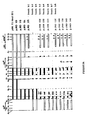
- Figure 1 shows a schematic view of the replication segment of a vector according to the invention;
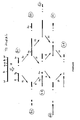
- Figures 2a and b are schematic views of restriction site banks of the present invention;
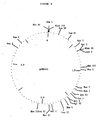
- Figure 3 gives a detailed view of a plasmid vector obtained in accordance with the process of the present invention; and
- Figure 4 shows a schematic view of a yeast plasmid containing a restriction site bank of the present invention.
- In accordance with a specific embodiment of the present invention, there is provided a plasmid vector for cloning any foreign DNA material in prokaryotic and eukaryotic orgnaisms, said plasmid vector containing a restriction site bank b1 derived from the Hindlll-Aval region of the bacteriophage T5 Hindlll L fragment and comprising unique sites for the restriction enzymes Hindlll, Sacl, Kpnl, Asull, Pstl, Bglll, Xbal, Hincll, Pvull, Ball, Mstll and Aval, arranged in the indicated order.
- From this plasmid vector, other vectors can be derived by modification of the restriction site bank b1 hereabove described. Thus, the present invention also provides a plasmid vector wherein restriction sites for enzymes Xmalll and Bell have been added to bank b1 by replacing the 910 bp Pstl-Bglll segment thereof by the 210 bp Pstl-Bg/ll fragment from plasmid pKC7. The resulting restriction site bank referred to hereafter as b2, thus comprises unique cloning sites for restriction enzymes Hindlll, Sacl, Kpnl, Asull, Pstl, Xmalll, Bcll, Bglll, Xbal, Hincll, Pvull, Ball, Mstll and Aval, arranged in the indicated order.
- The present invention further provides plasmid vectors derived from those described hereabove fusing the Hindlll end of the restriction site banks b1 and b2 to the Aval end of the EcoRl-Aval fragment from plasmid pBR322, thus introducing additional cloning sites for the restriction enzymes EcoRl, Clal, Hindlll, EcoRV, BamHl, Sphl, Sail (Accl, Hincll), Xmalll and Nrul arranged in the indicated order. The new restriction site banks thus constructed will be referred to hereafter as b3 or b4 according to whether it is derived from b1 or b2.
- Restriction site banks b3 and b4 contained in these vectors comprise two Hincll sites, one of which should preferably be absent. Accordingly, the present invention also provides plasmid vectors containing a modification of banks b3 or b4 comprising a unique Hincll site from the pBR322- derived portion thereof. The restriction site bank thus modified will be referred to hereafter as b5 or b6 according whether it is derived from b3 or b4.
- Similarly, restriction site banks b4 and b6 comprise two Xmalll sites, one of which should also be absent. Thus, the present invention also provides plasmid vectors containing a modification of bank b4 or b6 comprising a unique Xmalll site from the pBR322-derived portion thereof. The restriction site banks thus modified will be referred to hereafter as b7 or b8 according whether it is derived from b4 or b6.
- To further increase the number of useful restriction sites available for cloning there is still provided, in accordance with the present invention, plasmid vectors derived by introducing a Xhol site into the Aval end of the restriction site bank of any of the previous vectors. In the case of restriction site bank b8, the new restriction site bank thus formed comprises the following cloning sites for restriction enzymes, EcoRl, Clal, Hindlll, EcoRV, BamHl, Sphl, Sall(Accl, Hincll), Xmalll, Nrul, Sacl, Kpnl, Asull, Pstl, Bcll, Bglll, Xbal, Pvull, Ball, Mstll, and Xhol, arranged in the indicated order.
- To further increase the number of unique restriction sites available for cloning there is still provided, in accordance with the present invention, vectors wherein the Scal site between the tefR gene and the Sacl site is removed, thus leaving a unique Scal site in the ampR gene.
- In a further aspect, the present invention relates to processes for the construction of plasmid vectors with the restriction site banks described above, wherein the restriction site banks are fused with DNA fragments of special plasmids.
- The process for the construction of restriction site bank b1 comprising unique cloning sites for the restriction enzymes Hindlll, Sacl, Kpnl, Asull, Pstl, Bglll, Xbal, Hincll, Pvull, Ball, Mstll and Aval, arranged in the indicated order, comprises the steps of:
- a) generating a single Xbal site by deleting the segment between the two Xbal sites of the Hindlll-Aval region of the bacteriophage T5 Hindlll L fragment.
- b) generating a single Bglll site and simultaneously removing rendundant Pvull site by deleting the 1250 bp segment between the two Bglll sites present in the same region.
- From this first restriction site bank b1, further banks can be generated. For instance, restriction site bank b2 can be constructed in accordance with a process wherein excess DNA material present in restriction site bank b1 is removed by replacing the 910 bp Pstl-Bglll segment thereof by a 210 bp Pstl-BglLll fragment from plasmid pKC7, this resulting in the addition of sites for the restriction enzymes Xmalll and Bcll.
- Still other restriction site banks comprising more cloning sites than b1 and b2 can be constructed therefrom by fusion with a DNA fragment from plasmid pBR322. Thus, according to one embodiment of this construction process, the Hindlll end of restriction site bank b1 is fused with the Aval end of the EcoRl-Aval fragment from plasmid pBR322. This fusion results in restriction site bank b3 comprising additional cloning sites for the restriction enzymes EcoRl, Clal, Hindlll, EcoRV, BamHl, Sphl, Sall (Accl, Hincll), Smalll and Nrul, arranged in the indicated order.
- According to another embodiment of this construction process, the Hindlll end of restriction site bank b2 is similarly fused with theAval end of the same fragment from pBR322, this fusion resulting in restriction site bank b4 containing the same additional cloning sites as in bank b3. The same restriction site bank b4 can also be constructed according to a process starting with restriction site bank b3 and wherein excess DNA material present in restriction site bank b1 is removed as described in the construction process of restriction site bank b2.
- Restriction site bank b3 has two sites for the enzyme Hincll: one in the pBR322-derived fragment and the other in the bacteriophage-derived region. From this restriction site bank, bank b5 can be constructed which contains a unique site for Hincll. In accordance with the present invention, this is achieved by a process wherein the Hincll site in the Bg/ll-Aval region of restriction site bank b1 is deleted while retaining the adjacent Xbal and Pvull sites, and then the resulting deleted region is substituted for the Bg/ll- Aval region of restriction site bank b3.
- Similarly, restriction site bank b6 containing a unique Hincll site can be constructed by substituting the same deleted region from bank b1 for the Bglll-Aval region of restriction site bank b4. The same restriction site bank b6 can also be constructed according to a process starting with restriction site bank b5 and wherein excess DNA material present in restriction site bank b1 is removed as described in the construction process of restriction site bank b2.
- Restriction site bank b4 has two Xmalll sites: one in the pBR322-derived region and the other in the pKC7-derived fragment. According to another embodiment of the construction process of the present invention, the latter Xmalll site is deleted, this resulting in restriction site bank b7.
- Similarly, the same Xmalll site can be deleted from restriction site bank b6, this resulting in restriction site bank b8 which contains unique sites for the restriction enzymes EcoRl, Clal, Hindlll, EcoRV, BamHl, Sphl, Sall(Accl, Hincll Xmalll, Nrul, Sacl, Kpnl, Asull, Pstl, Bcll, Bglll, Xbal, Pvull, Ball, Mstll and Aval, arranged in the indicated order.
- The same restriction site bank b8 can also be constructed from bank 7 according to a process wherein the Hincll site in the Bglll-Aval region of restriction site bank b1 is deleted, and then the resulting deleted region is substituted for the Bglll-Aval region of restriction site bank b7.
- From any of the preceding restriction site banks still further banks may be generated. For instance, in accordance with an embodiment of the construction process of the present invention, a Xhol site is fused to the Aval end of any of the restriction site banks b1 to b8 constructed as described, thus destroying the original Aval site (however Aval also cleaves the new Xhol site).
- It is an important practical aspect of the present invention that the restriction site banks constructed in accordance with the processes herein disclosed will be incorporated into special cloning vehicle whatever may be the host organism. Thus, they can be inserted into vector systems designed for cloning and expressing genes in prokaryotic organisms such as Escherichia coli, Bacillus subtilis, Pseudomonas species, etc...., or in eukaryotic organisms as yeasts, fungi and even animal or plant cells. In these different cases, the large number of unique restriction sites provides exceptional cloning versatility and the clustering thereof facilitates subsequent operations as subcloning and deletion analysis of large cloning fragments. Incorporated into vectors allowing the cloning of large fragments such as cosmids, they are especially useful for the construction of genomic libraries.
- A useful method to take advantage of the plasmid vectors with the restriction site banks in accordance with the present invention is to incorporate the restriction site banks into a plasmid vector carrying an origin of replication recognized by the replication machinery of the selected host as well as a gene imparting resistance of the host to some drug, e.g. an antibiotic or a gene complementing some auxotrophy thereof for an essential metabolite, e.g. an amino acid, so as to allow efficient screening for the transformed organisms.
- Most plasmids currently used for transforming prokaryotic organisms and more especially E. coli, can be used for this purpose. Examples of such plasmids are pBR322 and other related plasmids such as pBR327, pMB9, etc. Other plasmids such as the natural replicon Col.EI and other inrelated plasmids such as P15A, F, RSF1010, R616, etc... may also be used to design efficient vectors containing restriction site banks in accordance with this invention.
- Similarly, plasmids used for the transformation of eukaryotic organisms may be used. Typical examples of such plasmids are those designed for the transformation of yeast, e.g. pJDB207, pJDB219, pMp78, etc...
- In applying the stepwise process of the present invention for the construction of restriction site banks, the DNA fragment containing clustered cloning sites as obtained in each step must be produced and isolated in sufficient amount for being further processed. This can be accomplished by inserting said DNA fragment into a plasmid vector as those referred to hereabove and transforming a selected host with the resulting chimaeric plasmid. Although any microorganism able to be transformed by exogeneous DNA can be used for this purpose, E. coli is a preferred host as well designed and efficient methods are available not only for the transformation thereof but also for DNA amplification and recovery. In the following examples, the strain E coli MM294 is used as a host, unless otherwise indicated. The strain E. coli MM294 transformed with the Plasmid pJRD143 has been deposited at the Centraal- bureau voor Schimelscultures, Baarn, Netherlands, on May 11, 1983 under file number LMD 83.07=CBS 396-83, and forms as such part of the invention.
- In general, the currently available segments of DNA that permit replication and selection in the various organisms indicated above are not directly suitable for incorporation of the restriction site banks and require prior modification. A typical procedure in accordance with these requirements is given in the following examples which should be considered as illustrative only and not limitative of the present invention.
- In this example, the vector used for the replication of the restriction site bank under construction is derived by modification of plasmid pBR327 obtained through EcoR II deletion from pBR322 (Soberon et al., Gene 9, 1980, 287-305). The modification of pBR327 consisted in removing from the ampR gene the Pstl and Hincll sites to allow unique Pstl and Hincll sites present in the final restriction site bank to be used for cloning. (Failure to remove these sites would prevent cloning by inactivation of the ampR selective marker). The. unique Pvul and Scal sites in the ampR gene were not removed since they are not provided in the final restriction site bank and because they may be useful to certain types of recombinant constructions. The procedure followed is shown in Figure 1. The Hincll site in the tetR gene of pBR327 was removed by fusion between the unique Sail and Aval sites to give the tetracycline sensitive plasmid pJRD117. The now unique Hincll site in the ampR gene was then removed by mutagenesis followed by repeated cycles of DNA isolation, restriction cleavage and transformation using the method of Talmadge and Gilbett (Gene 12, 1980, 235-241). This resulted in plasmid pJRD120 which has lost the unique Hincll site while retaining ampR. The region EcoRI-Pstl of pBR327 (co-ordinates 3271-2523) was then restored to pJRD120 to give ampR- tetR plasmid pJRD122 which now has a unique HincII site. pJRD122 was then subjected to further mutagenesis and restriction-transformation cycles resulting in the selection of pJRD123 which is ampR, tetR has a unique Hincll site and is lacking a Pstl site.
- The procedure resulted in an additional mutation causing a GC―AT base pair change at the position corresponding to co-ordinate 3132 of pBR322. This mutation has two important effects firstly it increases the copy number of the plasmid from about 30 to 120 so that a cloned gene would be better expressed due to increased gene dosage. Secondly it alters the normal incompatibility mechanism of the plasmid which is now able to co-exist side by side in the same cell as pBR322 and its derivatives (two pBR322 type plasmids cannot normally do this). An identical mutation has previously been independently described (Tomizawa and ltoh, Proc. Natl. Acad. Sc. USA 78, 1981, 6091-6100). The advantage of this is that it would be possible to introduce different genes cloned on different plasmids into the same cell.
- The basis for the construction of the restriction site bank in accordance with this invention is the Hindlll-L fragment from bacteriophage T5. This fragment contains restriction sites for Sacl, Kpnl, Bglll, Xbal and Pvull, none of these enzymes being able to cleave plasmid pBR327. However, it is too large (3.9 kb) for use in vector construction so that deletions are necessary to remove excess DNA and unwanted restriction sites.
- Figures 2a and b illustrate a typical procedure starting with the Hindlll-L fragment from bacteriophage T5 initially inserted in plasmid vector pBR322 (Brunel et al., Gene 8, 1979, 53-68). Firstly, the 490 bp region between the two Xbal sites of said fragment was removed to generate a single Xbal site (Figure 2, pJRD109). Secondly, the 1250 bpBg/II-Bg/ll region was removed to generate a single Bg/ll and simultaneously delete an unwanted Pvull site (Figure 2, pJRD110). Thirdly, the 1405 bpAval-Aval fragment was deleted removing one of the two Aval sites of plasmid pJRD110, one of the two Hindlll sites and the entire tetA region (this latter being not expressed due to the insertion of the original Hindlll-L fragment in the tetR promoter), to give plasmid pJRD124 (Figure 2).
- The region Aval-Hindlll of the latter plasmid was then replaced by the corresponding region of the plasmid pJRD123 constructed as explained hereabove (Figure 1). This event simultaneously introduces the EcoRII deletion of pBR327, the ampR region of pJRD123 carrying the Pst° and Hinc° mutations and the increased copy number mutation to give plasmid pJRD125 (Figure 2). The 910 bp PstI-Bg/II region of this latter plasmid was then replaced by a 210 bp PstI-Bg/II fragment from plasmid pKC7 (Rao & Rogers, Gene 7, 1979, 79-82), thus removing excess DNA and introducing a Bcll and a Xmalll site, resulting in plasmid pJRD126 (Figure 2).
- Plasmid pJRD126 is sensitive to tetracycline due to deletion of the entire Hindlll-Aval region of pBR322 (coordinates 29-1424). This region contains several unique restriction sites that can be used for insertional inactivation and therefore can advantageously be included in a restriction site bank as considered in the present invention. The said Hindlll-Aval region was therefore re-introduced into pJRD126, resulting in plasmid pJRD129. To do this, the DNA of plasmid pBR322 was cleaved with Aval, repaired with DNA polymerase I Kleenow fragment and deoxynucleoside triphosphates and then cleaved with EcoRl. Simultaneously, the DNA of pJRD126 was cleaved with HindIII, repaired with DNA polymerase I Kleenow fragment and deoxynucleoside triphosphates and then cleaved with EcoRl. The two plasmids were then mixed and ligated, resulting in replacement of the EcoRl-Hindlll region of pJRD126 by the EcoRI-AvaI region of pBR322 by a cohesive-end-blunt-end ligation, the latter destroying both the Hindlll site of pJRD126 and the Aval site of pBR322. The resulting plasmid pJRD129 is ampR, tetR and has one unique Hindlll site and Aval site.
- Plasmid pJRD129 has unique restriction sites for most restriction enzymes of interest but has two for HincII, one located in the tet" region and the other in the 500 bp Xbal-Pvull fragment which contains no other sites of interest. This latter site and the adjacent excess DNA was removed by Hincll digestion of pJRD126 (which has a unique Hincll site) followed by digestion with nuclease Bal 31 and blunt-end ligation. The resulting plasmids were screened for retention of both the Xbal and Pvull sites and a deletion selected that retained only about 80 bp of the original Xbal-Pvull fragment (pJRD130). This deletion was then transferred to plasmid pJRD129 by digestion of both plasmids with Bg/II+AvaI followed by ligation and transformation, resulting in plasmid pJRD133.
- Similarly, plasmid pJRD133 has two sites for restriction enzyme Xmalll, one located in the tet" region and the other in the 210 bp Pstl-Bglll region introduced from pKC7 as explained hereabove. This region contains three Hpall fragments, one of which carries the Xmalll site. The isolated Pstl-Bglll fragment was therefore digested with Hpall and the products ligated into the PstI-Bg/II cleaved pJRD133 vector, using the method of Heusterspreute and Davison 1983 (Gene, in press). The resulting plasmid pJRD136 has a deletion of all three Hpall fragments (127 bp) and contains a unique Xmalll site in the tetR region.
- The plasmid pJRD136 has unique sites for virtually all commonly used restriction enzymes recognizing a 6 bp sequence but lacks sites for Xhol. A DNA linker carrying a Xhol site was therefore introduced into theAval site of pJRD136 (this site is not being particularly useful for cloning sinceAval has four possible recognition sites). This was accomplished by repair of Aval cleaved pJRD136 using DNA polymerase Kleenow fragment followed by blunt-end ligation of the linker to give pJRD139. This procedure destroys the original Aval site (however Aval also cleaves the new Xhol site).
- Finally an unwanted region of about 280 bp (containing an unwanted Scal site) between the end of the tetR gene and the SacI site was removed. The small Sall-Kpnl fragment of pJRD136 was separated from the large Sall-Kpml fragment and subdigested by Taql and Rsal followed by re-ligation to the large fragment using the techniques of Nilson and Magnusson (1983) and Heusterspreute and Davison (1983). This deletion removes the 4 terminal amino acids codons of the tetR gene and replaces them by a single amino acid codon immediately followed by a nonsense codon. The resulting plasmid (pJRD140) shows normal resistance to tetracycline. The deletion was then transferred to plasmid pJRD139 by replacing the region Hindlll-Pstl resulting in plasmid pJRD143 (see Fig. 3) which contains a unique Scal site.
- The vector pJRD143 is a small multicopy plasmid very useful for the cloning of small DNA molecules (<10 kb). An intrinsic difficulty with such vectors is that they do not transform particularly well (2x10⁵ clones/pg of DNA) and that this transformation becomes increasingly inefficient when they carry large DNA inserts. Because of this large numbers of clones must be screened for a desired gene and the successful cloning of the desired gene is less likely because of the preferential cloning of small DNA fragments. A solution to these difficulties is the use of cosmids which are small plasmids containing the cos sites of bacteriophage λ required for packaging of DNA into λ capsids. Cosmids permit the high efficiency transfer of very large DNA molecules to E coli where they are maintained as plasmids. The cos region of λ, contained on the 400 bp Pstl-Pstl fragment of MUA 10 (Meyerowits et al., 1980) was therefore introduced into pJRD143 at the unique Pstl site. The resulting cosmid pJRD144 combines the restriction site bank and high copy number advantages of pJRD143 with the cosmid properties of MUA10 outlined above. It allows, all of the sites of pJRD143 to be used for cloning (except PstI) and is particularly efficient for the subsequent subcloning and deletion analysis of the large cloned DNA fragment.
- Saccharomyces cerevisiae is an important organism for both fundamental and applied science and plasmids have been constructed that are able to replicate in both S. cerevisiae and in E. coli, using the origin of replication of the
yeast 2 p plasmid and the origin of replication of pBR322 respectively (Beggs 1981). Such yeast vectors would benefit by the introduction of more unique cloning sites such as are found in pJRD143. - The vector pJDB207 comprises three different DNA segments: a fragment of yeast plasmid 2 µ, responsible for DNA replication in yeast; the LEU 2 gene of yeast permitting plasmid selection and maintainance in a LEU 2- yeast auxotroph; the plasmid pAT153, a deletion derivative of pBR322 (Twigg and Sherratt, 1980) resembling pBR327. The region 2 µ-LEU 2 requires little modification, since it has relatively few restriction sites and these are located in regions essential for either selection or replication.
- The Xbal site in pJDB207 is located in the origin of replication for the 2 µ plasmid. Said Xbal site was removed by end-filling with DNA polymerase I followed by blunt-end ligation and transformation. The resulting plasmid (pJDB207 Xbal°) lacks the Xbal site but is unchanged in its ability to transform and replicate in yeast.
- Thereafter the entire plasmid pJRD143 was inserted into pJDB207 Xbal° by EcoRl digestion and ligation, thus replacing exactly the pAT153 plasmid. The resulting plasmid pJRD145Y (Figure 4) has all of the unique restriction sites of pJRD143 except Kpnl which is now double and EcoRl which is now triple. At the same time the plasmid retains the unique Hpal and BstEll sites of pJDB207.
- The construction of this cosmid was achieved replacing the Sa/I-Bg/II region of pJRD145Y by that of pJRD144 thereby introducing the λ cos site. This cosmid pJRD146Y has all of the combined advantages of pJRD144 and pJRD145Y in that it is able to grow and to be selected to both E. coli and yeast and it can be packaged in bacteriophage A capsids so that the efficiency of cloning in E. coli is very high.
- The replication of plasmids based solely upon the pMBI replicon (e.g. pMB9, pBR322 and all of their derivatives including those described above) is restricted to E. coli and its close relatives, so that cloning in other bacterial species is impossible. In contrast other plasmids are known that are able to replicate in a wide variety of gram negative bacteria including Escherichia coli, Pseudomonas aeruginosa, Pseudomonas putida, Agrobacterium tumifaciens, Rhijobium meloti, Acetobacter xylinium, Azotobacter vinelandii, Alicagenes eutrophus, Rhodopseudomonas spheroides, Methylophilus methylotrophus etc... The most promising of those plasmids as a cloning vector is RSF1010 which has a high copy number and relatively small size, but suffers the disadvantage of having very few unique restriction sites. (Nagahari and Sakaguchi, 1978). Accordingly the non-essential EcoRI-PstI region containing the gene for resistance to sulphonamides was replaced by the EcoRl-Xhol region of pJRD143, this operation being facilitated by the addition of a Xhol linkers at the Pstl site of RSF 1010. The resulting plasmid (pJRD202 P) contains the entire restriction site bank of pJRD143 and is resistant to tetracycline and streptomycin. Most of the restriction sites are unique except Sacl.
Claims (30)
Priority Applications (6)
| Application Number | Priority Date | Filing Date | Title |
|---|---|---|---|
| DE8383104665T DE3381173D1 (en) | 1983-05-11 | 1983-05-11 | CLONING VECTORS CONTAINING A RESTRICTION BANK AND THEIR PRODUCTION. |
| EP83104665A EP0126166B1 (en) | 1983-05-11 | 1983-05-11 | Cloning vectors comprising a restriction site bank and the construction thereof |
| AT83104665T ATE49998T1 (en) | 1983-05-11 | 1983-05-11 | CLONING VECTORS INCLUDING A RESTRICTION LOCATION BASE AND THEIR PRODUCTION. |
| CA000453765A CA1229315A (en) | 1983-05-11 | 1984-05-08 | Cloning vectors comprising a restriction site bank and the construction thereof |
| US06/609,550 US4657858A (en) | 1983-05-11 | 1984-05-11 | Cloning vectors comprising a restriction site bank and the construction thereof |
| JP59094381A JPS6037987A (en) | 1983-05-11 | 1984-05-11 | Cloning vectors comprising line of limit region and constitution thereof |
Applications Claiming Priority (1)
| Application Number | Priority Date | Filing Date | Title |
|---|---|---|---|
| EP83104665A EP0126166B1 (en) | 1983-05-11 | 1983-05-11 | Cloning vectors comprising a restriction site bank and the construction thereof |
Publications (2)
| Publication Number | Publication Date |
|---|---|
| EP0126166A1 EP0126166A1 (en) | 1984-11-28 |
| EP0126166B1 true EP0126166B1 (en) | 1990-01-31 |
Family
ID=8190460
Family Applications (1)
| Application Number | Title | Priority Date | Filing Date |
|---|---|---|---|
| EP83104665A Expired - Lifetime EP0126166B1 (en) | 1983-05-11 | 1983-05-11 | Cloning vectors comprising a restriction site bank and the construction thereof |
Country Status (6)
| Country | Link |
|---|---|
| US (1) | US4657858A (en) |
| EP (1) | EP0126166B1 (en) |
| JP (1) | JPS6037987A (en) |
| AT (1) | ATE49998T1 (en) |
| CA (1) | CA1229315A (en) |
| DE (1) | DE3381173D1 (en) |
Families Citing this family (7)
| Publication number | Priority date | Publication date | Assignee | Title |
|---|---|---|---|---|
| HU194307B (en) * | 1983-09-16 | 1988-01-28 | Richter Gedeon Vegyeszet | Process for producing plasmidvectors of high copy number |
| US5290691A (en) * | 1985-10-01 | 1994-03-01 | Banyu Seiyaku Kabushiki Kaisha | Safe and versatile cloning vector |
| GB8808892D0 (en) * | 1988-04-15 | 1988-05-18 | British Bio Technology | Gene synthesis |
| WO1991014780A1 (en) * | 1990-03-21 | 1991-10-03 | Board Of Regents, The University Of Texas System | Yeast expression vectors |
| US6905818B1 (en) | 1997-11-27 | 2005-06-14 | Max-Planck-Gesellschaft Zur Forderungder Wissenschaften | Method for the identification and characterization of interacting molecules by automated interaction mating |
| US6828102B2 (en) * | 2001-11-20 | 2004-12-07 | Albany Medical College | Plasmids and methods for monitoring endonuclease digestion efficiency |
| JP2007142984A (en) * | 2005-11-21 | 2007-06-07 | Pioneer Electronic Corp | Mounting bracket and speaker unit |
Family Cites Families (1)
| Publication number | Priority date | Publication date | Assignee | Title |
|---|---|---|---|---|
| US4528266A (en) * | 1979-10-01 | 1985-07-09 | George Pieczenik | Method of inserting unique DNA sequences into DNA vectors |
-
1983
- 1983-05-11 DE DE8383104665T patent/DE3381173D1/en not_active Expired - Fee Related
- 1983-05-11 AT AT83104665T patent/ATE49998T1/en active
- 1983-05-11 EP EP83104665A patent/EP0126166B1/en not_active Expired - Lifetime
-
1984
- 1984-05-08 CA CA000453765A patent/CA1229315A/en not_active Expired
- 1984-05-11 US US06/609,550 patent/US4657858A/en not_active Expired - Fee Related
- 1984-05-11 JP JP59094381A patent/JPS6037987A/en active Pending
Non-Patent Citations (5)
| Title |
|---|
| GENE, vol. 16, 1981, pages 107-118, Elsevier/North-Holland Biomedical PressF.BRUNEL et al.: "Cloning of bateriophage T5 DNA fragments III. Expression in Escherichia coli mini-cells" * |
| GENE, vol. 16, 1981, pages 99-106, Elsevier/North-Holland Biomedical PressJ.DAVISON et al.: "Cloning of bacteriophage T5 DNA fragments II. Isolation of recombinants carrying T5 Pstl fragments" * |
| GENE, vol. 8, 1979, pages 53-68, Elsevier/North-Holland Biomedical PressF.BRUNEL et al.: "Cloning of bacteriophage T5 DNA fragments in plasmid pBR322 and bacteriophage lambdagt WES" * |
| MOLECULAR CLONING by T.MANIATIS, E.F. FRITSCH, J. SAMBROOK, C & H LABORATORY 1982,p.3-10 * |
| PALINDROMIC SEQUENCES OF RESTRICTION ENDONUCLEASES AND METHYLATES; Ed. by Boehringer Mannheim (1982), p.2-13 * |
Also Published As
| Publication number | Publication date |
|---|---|
| CA1229315A (en) | 1987-11-17 |
| JPS6037987A (en) | 1985-02-27 |
| ATE49998T1 (en) | 1990-02-15 |
| US4657858A (en) | 1987-04-14 |
| DE3381173D1 (en) | 1990-03-08 |
| EP0126166A1 (en) | 1984-11-28 |
Similar Documents
| Publication | Publication Date | Title |
|---|---|---|
| Barany | Single-stranded hexameric linkers: a system for in-phase insertion mutagenesis and protein engineering | |
| JP3210315B2 (en) | Protease deficiency | |
| US5063154A (en) | Pheromone - inducible yeast promoter | |
| US4546082A (en) | E. coli/Saccharomyces cerevisiae plasmid cloning vector containing the alpha-factor gene for secretion and processing of hybrid proteins | |
| US5093257A (en) | Hybrid prokaryotic polypeptides produced by in vivo homologous recombination | |
| Youngman et al. | A novel method for the rapid cloning in Escherichia coli of Bacillus subtilis chromosomal DNA adjacent to Tn 917 insertions | |
| US4657857A (en) | Yeast of the genus kluyveromyces modified for the expression of preprothaumatin or its various allelic and modified forms or their maturation forms, and the proteins obtained by that expression | |
| US5637504A (en) | Stable yeast 2 μm vector | |
| US4937189A (en) | Expression and secretion of heterologous proteins by Yarrowia lipolytica transformants | |
| EP0036259A2 (en) | Method,vectors and organisms for transported cloned heterologous gene products in bacillus subtilis and E.coli | |
| ES2553383T3 (en) | Procedure of localized integration of multiple copies of a gene of interest in a Yarrowia strain | |
| USRE37767E1 (en) | Highly stable recombinant yeasts for the production of recombinant proteins | |
| AU614121B2 (en) | Improvements in the production of polypeptides | |
| EP0184438A2 (en) | Transforming aspergillus niger, and plasmids for use therein | |
| JPS62104585A (en) | Site selective genom modification of pitia yeast | |
| JPH06503957A (en) | How to construct a synthetic leader sequence | |
| IE58014B1 (en) | Molecular cloning and expression in industrial microorganism species | |
| WO1984004535A1 (en) | Heat regulated production of selected and fused proteins in yeast | |
| Potter et al. | DNA recombination: in vivo and in vitro studies | |
| WO1988010308A1 (en) | Pheromone-inducible yeast promoter | |
| EP0126166A1 (en) | Cloning vectors comprising a restriction site bank and the construction thereof | |
| Davison et al. | Vectors with restriction-site banks I. pJRD158, a 3903-bp plasmid containing 28 unique cloning sites | |
| Madzak et al. | Yarrowia lipolytica | |
| EP0060045A2 (en) | Stable high copy number plasmids, method for their formation and their use in protein production | |
| EP0013830B1 (en) | Stable high copy number plasmids, their formation and use in protein production |
Legal Events
| Date | Code | Title | Description |
|---|---|---|---|
| PUAI | Public reference made under article 153(3) epc to a published international application that has entered the european phase |
Free format text: ORIGINAL CODE: 0009012 |
|
| AK | Designated contracting states |
Designated state(s): AT BE CH DE FR GB IT LI LU NL SE |
|
| 17P | Request for examination filed |
Effective date: 19850206 |
|
| 17Q | First examination report despatched |
Effective date: 19860723 |
|
| D17Q | First examination report despatched (deleted) | ||
| GRAA | (expected) grant |
Free format text: ORIGINAL CODE: 0009210 |
|
| AK | Designated contracting states |
Kind code of ref document: B1 Designated state(s): AT BE CH DE FR GB IT LI LU NL SE |
|
| PG25 | Lapsed in a contracting state [announced via postgrant information from national office to epo] |
Ref country code: SE Effective date: 19900131 Ref country code: NL Effective date: 19900131 Ref country code: IT Free format text: LAPSE BECAUSE OF FAILURE TO SUBMIT A TRANSLATION OF THE DESCRIPTION OR TO PAY THE FEE WITHIN THE PRESCRIBED TIME-LIMIT;WARNING: LAPSES OF ITALIAN PATENTS WITH EFFECTIVE DATE BEFORE 2007 MAY HAVE OCCURRED AT ANY TIME BEFORE 2007. THE CORRECT EFFECTIVE DATE MAY BE DIFFERENT FROM THE ONE RECORDED. Effective date: 19900131 Ref country code: AT Effective date: 19900131 |
|
| REF | Corresponds to: |
Ref document number: 49998 Country of ref document: AT Date of ref document: 19900215 Kind code of ref document: T |
|
| REF | Corresponds to: |
Ref document number: 3381173 Country of ref document: DE Date of ref document: 19900308 |
|
| RAP2 | Party data changed (patent owner data changed or rights of a patent transferred) |
Owner name: FINA RESEARCH S.A. |
|
| REG | Reference to a national code |
Ref country code: CH Ref legal event code: PUE Owner name: FINA RESEARCH S.A. |
|
| PGFP | Annual fee paid to national office [announced via postgrant information from national office to epo] |
Ref country code: GB Payment date: 19900417 Year of fee payment: 8 Ref country code: CH Payment date: 19900417 Year of fee payment: 8 |
|
| PGFP | Annual fee paid to national office [announced via postgrant information from national office to epo] |
Ref country code: FR Payment date: 19900419 Year of fee payment: 8 |
|
| ET | Fr: translation filed | ||
| REG | Reference to a national code |
Ref country code: GB Ref legal event code: 732 |
|
| PG25 | Lapsed in a contracting state [announced via postgrant information from national office to epo] |
Ref country code: LU Free format text: LAPSE BECAUSE OF NON-PAYMENT OF DUE FEES Effective date: 19900531 |
|
| PGFP | Annual fee paid to national office [announced via postgrant information from national office to epo] |
Ref country code: DE Payment date: 19900620 Year of fee payment: 8 |
|
| NLV1 | Nl: lapsed or annulled due to failure to fulfill the requirements of art. 29p and 29m of the patents act | ||
| PGFP | Annual fee paid to national office [announced via postgrant information from national office to epo] |
Ref country code: BE Payment date: 19900802 Year of fee payment: 8 |
|
| PLBE | No opposition filed within time limit |
Free format text: ORIGINAL CODE: 0009261 |
|
| STAA | Information on the status of an ep patent application or granted ep patent |
Free format text: STATUS: NO OPPOSITION FILED WITHIN TIME LIMIT |
|
| BECN | Be: change of holder's name |
Effective date: 19900131 |
|
| 26N | No opposition filed | ||
| PG25 | Lapsed in a contracting state [announced via postgrant information from national office to epo] |
Ref country code: GB Effective date: 19910511 |
|
| PG25 | Lapsed in a contracting state [announced via postgrant information from national office to epo] |
Ref country code: LI Effective date: 19910531 Ref country code: CH Effective date: 19910531 Ref country code: BE Effective date: 19910531 |
|
| REG | Reference to a national code |
Ref country code: FR Ref legal event code: ST |
|
| BERE | Be: lapsed |
Owner name: FINA RESEARCH S.A. Effective date: 19910531 |
|
| GBPC | Gb: european patent ceased through non-payment of renewal fee | ||
| PG25 | Lapsed in a contracting state [announced via postgrant information from national office to epo] |
Ref country code: FR Effective date: 19920131 |
|
| REG | Reference to a national code |
Ref country code: CH Ref legal event code: PL |
|
| PG25 | Lapsed in a contracting state [announced via postgrant information from national office to epo] |
Ref country code: DE Effective date: 19920303 |
|
| REG | Reference to a national code |
Ref country code: FR Ref legal event code: ST |