EP0125774B1 - Method and apparatus for testing ready-mixed concrete - Google Patents
Method and apparatus for testing ready-mixed concrete Download PDFInfo
- Publication number
- EP0125774B1 EP0125774B1 EP84302275A EP84302275A EP0125774B1 EP 0125774 B1 EP0125774 B1 EP 0125774B1 EP 84302275 A EP84302275 A EP 84302275A EP 84302275 A EP84302275 A EP 84302275A EP 0125774 B1 EP0125774 B1 EP 0125774B1
- Authority
- EP
- European Patent Office
- Prior art keywords
- mortar
- water
- ready
- mixed concrete
- sample
- Prior art date
- Legal status (The legal status is an assumption and is not a legal conclusion. Google has not performed a legal analysis and makes no representation as to the accuracy of the status listed.)
- Expired
Links
- 238000000034 method Methods 0.000 title claims description 28
- 238000012360 testing method Methods 0.000 title claims description 15
- 239000004568 cement Substances 0.000 claims description 44
- XLYOFNOQVPJJNP-UHFFFAOYSA-N water Substances O XLYOFNOQVPJJNP-UHFFFAOYSA-N 0.000 claims description 43
- 239000004570 mortar (masonry) Substances 0.000 claims description 37
- 238000005303 weighing Methods 0.000 claims description 19
- 238000003756 stirring Methods 0.000 claims description 10
- 239000004576 sand Substances 0.000 claims description 6
- 230000005484 gravity Effects 0.000 claims description 4
- 238000005070 sampling Methods 0.000 claims description 3
- 239000000203 mixture Substances 0.000 description 18
- 238000012937 correction Methods 0.000 description 13
- 238000010276 construction Methods 0.000 description 7
- 238000005259 measurement Methods 0.000 description 6
- 239000000470 constituent Substances 0.000 description 2
- 238000011835 investigation Methods 0.000 description 2
- 238000002360 preparation method Methods 0.000 description 2
- 241000283984 Rodentia Species 0.000 description 1
- 239000000306 component Substances 0.000 description 1
- 238000007796 conventional method Methods 0.000 description 1
- 125000004122 cyclic group Chemical class 0.000 description 1
- 238000000151 deposition Methods 0.000 description 1
- 230000002542 deteriorative effect Effects 0.000 description 1
- 239000006260 foam Substances 0.000 description 1
- 238000004519 manufacturing process Methods 0.000 description 1
- 239000002245 particle Substances 0.000 description 1
- 238000000275 quality assurance Methods 0.000 description 1
- 238000003908 quality control method Methods 0.000 description 1
- 230000000087 stabilizing effect Effects 0.000 description 1
- 239000008400 supply water Substances 0.000 description 1
- 238000010998 test method Methods 0.000 description 1
- VLPFTAMPNXLGLX-UHFFFAOYSA-N trioctanoin Chemical compound CCCCCCCC(=O)OCC(OC(=O)CCCCCCC)COC(=O)CCCCCCC VLPFTAMPNXLGLX-UHFFFAOYSA-N 0.000 description 1
- 238000005406 washing Methods 0.000 description 1
Images
Classifications
-
- G—PHYSICS
- G01—MEASURING; TESTING
- G01N—INVESTIGATING OR ANALYSING MATERIALS BY DETERMINING THEIR CHEMICAL OR PHYSICAL PROPERTIES
- G01N33/00—Investigating or analysing materials by specific methods not covered by groups G01N1/00 - G01N31/00
- G01N33/38—Concrete; Lime; Mortar; Gypsum; Bricks; Ceramics; Glass
- G01N33/383—Concrete or cement
Definitions
- the present invention relates to a method and an apparatus for quality investigation of ready-mixed concrete, and more particularly to a method and an apparatus for predicting the quality of hardened concrete by measuring the weight ratio of water to cement in a just-prepared concrete mixture.
- Procedure for an accepting test made on ready-mixed concrete at a construction field has usually consisted of making a slump test and sampling the received ready-mixed concrete for the purpose of investigating the compressive strength after the concrete has become hardened.
- the slump test does not always give a satisfactory result in predicting the quality of hardened concrete, while the compressive strength test cannot be carried out until the sampled concrete mixture becomes hardened after a predetermined period of time has passed. Therefore, the conventional acceptance test of ready-mixed concrete cannot pre-guarantee the quality of concrete before the concrete mixture deposited at a construction field becomes hardened.
- Encouraged by an upsurge of quality assurance movement there have been proposed many trial methods for predicting the quality of hardened concrete from the data of unhardened concrete. However, they have a problem in the correlation to compressive strength, in rapidity and easiness of test procedure, or in economical efficiency, and hence none of them has come to be practiced or used widely.
- U.S. Patent Specification US-A-4 144 762 describes a method of analysing ready-mixed concrete which enables the water-to-cement ratio to be determined by a series of measurements including determining the weight and volume of a sample of mortar, weighing a collection vessel full of water, washing the mortar into the collection vessel and re-weighing.
- German Patent Specification DE-A1-3 000 412 describes a method of determining the weight of cement in a concrete sample by weighing a known volume of a mixture of the sample with water, floating the cement to the surface as a foam layer which is then removed, and re-weighing the same volume, topped up with water, to determine the cement weight by difference.
- the present invention is directed to avoiding the disadvantages involved in the prior art methods of concrete quality investigation, and aims at providing a method and an apparatus capable of judging the quality of concrete easily and precisely at the stage of being just mixed.
- Another object of the present invention is to constitute such an apparatus so as to be used not only for an acceptance test of ready-mixed concrete received at a construction field to judge whether it has been properly compounded or not, but also for quality control of concrete mixture at a concrete mixing plant.
- the present invention which has no problems in the testing process and economical efficiency, can be used widely, and largely contributes to stabilizing the quality of concrete products.
- the method and the apparatus according to the present invention have their bases on the fact that the water-to-cement ratio in ready-mixed concrete has a strong correlation with the compressive strength of hardened concrete.
- a water-to-cement ratio in ready-mixed concrete which ratio has a close correlation to the compressive strength of hardened concrete, can easily be measured, and accordingly, it can quickly be judged whether ready-mixed concrete has been properly compounded or not. Therefore, with the present invention applied to an acceptance test of ready-mixed concrete at a construction field, it is made possible to readjust the composition of received ready-mixed concrete, even if improperly compounded, to pre-guarantee the quality of hardened concrete at the stage of depositing the concrete mixture at a construction site. On the other hand the application of the present invention to a preparation process of concrete mixture makes it possible to lessen the scattering of the strength of hardened concrete and to stabilize the quality of concrete.
- the method according to the present invention comprises the steps as defined by claim 1, while the apparatus according to the present invention is defined by the features of claim 5.
- the present invention is based on the following principle and experimental facts.
- the water-to-cement ratio in ready-mixed concrete can easily be determined by measuring the weight and underwater weight of the mortar separated from sampled ready-mixed concrete, the principle of determining the cement-to-water ratio is described in the following.
- the weight M of the mortar separated from a ready-mixed sample is expressed by where C, S and W are the respective weights of the cement, the sand and water constituting the mortar.
- the underwater weight M' of the mortar is given by where ⁇ W , Pc and Ps are the specific gravities of water, cement and sand, respectively.
- the first step in this method is to sample a certain quantity of the ready-mixed concrete to be examined.
- the sampled ready-mixed concrete is then subjected to sifting with a sifter of 5 mm-mesh to separate the mortar component therefrom with the gravel component removed.
- a predetermined weight M for instance, 400 gr of mortar is weighed out from the above separated mortar.
- the weighed-out mortar with a suitable quantity of water added thereto, is stirred to expel the air contained therein, and kept standing still, for instance, for some tens of seconds until the mortar is deposited to some extent on the bottom of the vessel.
- the underwater weight M' of the mortar is weighed with the vessel immersed in water.
- the water-to-cement ratio of the sample ready-mixed concrete can be obtained from the previously prepared graph or table by applying a measured value of M' thereto.
- the above-described embodiment of the method can be modified so as to enable the water-to-cement ratio to be obtained without preparation of the W/C-M' correlation graph or table.
- the water-to-cement ratio W/C has a linear correlation to the underwater weight M' if the weight M in the air is constant. Therefore, in case M is kept constant, W/C can be directly read out from the balance for weighing the underwater weight, if the division on the balance is previously calibrated against W/C according to Eq. (6). With the above embodiments employed, it takes only 6 minutes or less from sampling ready-mixed concrete to reading out its W/C.
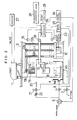
- FIG. 2 shows the constitution of the embodiment.
- an electronic balance 1 having its weighing tray 2 hanged down, is fixed on a base 3.
- the weighing tray 2 is positioned in a water tank 4 provided with a water supply port 4a and a draining port 4b.
- the water supply port 4a is connected to a water supply pump 6 through a valve 5, while the draining port is led to the atmosphere through a drain valve 7.
- a sample vessel 8 for containing mortar is held by a holder 9, which is engaged with a threaded bar 11 so as to be moved up and down along two guides 12a and 12b when the threaded bar 11 is rotated by a motor 10.
- a stirrer 15 which rotates being interlocked with the threaded bar 11 through a pulleys 13a, 13b and a belt 14.
- the sample vessel 8 is displaced vertically by the movement of the holder 9. With the holder 9 moved up to the uppermost position the stirrer 15 can stir the content of the vessel 8. With the holder 9 moved down to the lowest position the vessel 8 is placed on the weighing tray 2, being made free from the holder 9.
- the uppermost position and lowest position are detected by a stiring position sensor 16 and a measuring position sensor 17. Midway between these two sensors 16 and 17 there is provided a starting position sensor 18 for detecting the starting position of the holder 9.
- the nozzle 19 is connected to the water supply pump 6 through a flexible tube 20, a water pouring valve 21 and a control valve 22.
- the motor 10 and the pump 6 are driven by a sequence controller 26 respectively through a motor drive circuit 23 and through a pump drive circuit 24.
- the water supply valve 5, the drain valve 7 and the water pouring valve 21 are also driven by the sequence controller 26 through a valve control circuit 25.
- the sequence controller 26 further outputs a starting instruction signal and a weighing instruction signal to the electronic balance 1.
- a weight value outputted from the electronic balance 1 is inputted to a computer 27.
- the sequence controller 26 is further connected with a start switch 28 for instructing to start measuring and a lamp for indicating that the apparatus is being operated.
- the computer 27 uses the data inputted from the electronic balance 1, the computer 27 computes W/C according to a function previously stored therein.
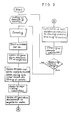
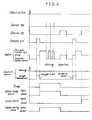
- Fig. 3 is a flow-chart showing the operation of the apparatus shown in Fig. 2, while Fig. 4 shows time-charts explaining the function of the sequence controller 26 in the apparatus.
- measuring conditions such as the mixing rate of cement and the specific gravities of aggregates are inputted to the computer 27.
- a certain quantity of concrete mixture is sampled from ready-mixed concrete to be examined, and then sifted with a sifter of 5-mm mesh to separate mortar from the concrete mixture.
- An adequate weight, for instance, 400 gr of the mortar is weighed out into a sample vessel.
- the sequence controller 26 is put into action with the start switch 26 turned on.
- the sequence controller 26 starts controlling the related elements in the apparatus in such a manner as shown with the time-charts shown in Fig. 4.
- a taring instruction signal is sent to the electronic balance 1 to make it perform a taring operation.
- the motor 10 begins rotating in the direction to move the holder 9 downward. The rotation continues until the holder 9 stops at the measuring position which is detected by the measuring position sensor 17.
- the electronic balance 1 measures the aerial weight M of the mortar in the vessel 8, and transmit the value to the computer 27.
- the motor 10 again starts rotation in the direction to move the holder 9 upward.
- the water supply valve 5 and the water pouring valve 21 are opened and the motor 10 starts rotation to supply water to both the water tank 4 and the sample vessel 8.
- the water supply to the sample vessel 8 is continued over the upward movement of the holder 9 until a predetermined quantity of water is poured into the vessel 8.
- the rotating direction of the motor 10 is inversed to lower the holder 9 again until it goes down to the starting position.
- This cycle of upward-and-downward movement of the holder 9 is repeated two or three times at a time interval of about three seconds.
- the stirrer 15 stirs the water-added mortar in the sample vessel 8 to expel the air contained in the mortar.
- the holder 9 is kept remaining still at the starting position for 10 to 20 seconds for making the mortar deposit at the bottom of the vessel 8 to some extent. While the holder 9 is kept remaining at the starting position, the mortar 10 stops and the valves 5 and 21 are closed. At the next step the holder 9 is lowered to the measuring position to place the sample vessel 8 on the weighing tray 2 to make the electronic balance 1 measure the underwater weight M' of the mortar. The measured value of M' being transmitted from the electronic balance 1 to the computer 27, which computes the water-to-cement weight ratio W/C from the previously stored aerial weight M and the underwater weight M' according to Eq. (6) previously stored in the computer 27.
- the holder 9 After the measurement of W/C, the holder 9 returns to the starting position and waits for the next operation of measurement. According to the apparatus based on the present invention, it takes only about 2 minutes and 30 seconds from turning on the start switch 28 to obtaining the water-to-ratio W/C.
- the method or the apparatus according to the present invention can be applied to the procedure for an emergency correction of concrete composition at a construction field, because the quality of a concrete mixture can be examined very rapidly according to the present invention.
- the conventional method of correction of concrete composition is to bring a tested slump magnitude and a measured air quantity close to expected values.
- a method cannot achieve a proper correction of the concrete quality.
- a slump adjustment itself can be executed by adjusting the quantity of water, the magnitude of slump is influenced not only by the quantity of water but also by the particle size of aggregates, mixing temperature, actual volume ratio and the quantity of air. Therefore, if the slump magnitude is adjusted only by adjusting the quantity of water, a change in the water-to-cement ratio may affect the compressive strength of hardened concrete.
- the water-to-cement ratio W/C in ready-mixed concrete can quickly be measured so that it can be made possible to keep not only the quantities of slump and air but also the water-to-cement ratio within stipulated values without deteriorating the compressive strength of hardened concrete.
- the quantity of cement per m 3 of concrete is nearly equal to a stipulated value in usual ready-mixed concrete. It is, therefore, possible to adjust the magnitude of slump, the quantity of air and the water-to-cement ratio simultaneously by correcting the composition of ready-mixed concrete according to the table given below.
- the table is prepared on the basis of the theory of concrete mixing, the RC instructions of the Society of Civil Engineering and other various experimental results.
- the correction of aggregate ratio and the correction of water quantity per m 3 of concrete shown in the above table, and the correction of cement quantity per m 3 of concrete due to these corrections are expressed by the following formulae: In the above formulae,
Landscapes
- Chemical & Material Sciences (AREA)
- Engineering & Computer Science (AREA)
- Health & Medical Sciences (AREA)
- Life Sciences & Earth Sciences (AREA)
- Analytical Chemistry (AREA)
- Food Science & Technology (AREA)
- Medicinal Chemistry (AREA)
- Physics & Mathematics (AREA)
- Ceramic Engineering (AREA)
- Biochemistry (AREA)
- General Health & Medical Sciences (AREA)
- General Physics & Mathematics (AREA)
- Immunology (AREA)
- Pathology (AREA)
- Preparation Of Clay, And Manufacture Of Mixtures Containing Clay Or Cement (AREA)
- Sampling And Sample Adjustment (AREA)
Description
- The present invention relates to a method and an apparatus for quality investigation of ready-mixed concrete, and more particularly to a method and an apparatus for predicting the quality of hardened concrete by measuring the weight ratio of water to cement in a just-prepared concrete mixture.
- Procedure for an accepting test made on ready-mixed concrete at a construction field has usually consisted of making a slump test and sampling the received ready-mixed concrete for the purpose of investigating the compressive strength after the concrete has become hardened. However, the slump test does not always give a satisfactory result in predicting the quality of hardened concrete, while the compressive strength test cannot be carried out until the sampled concrete mixture becomes hardened after a predetermined period of time has passed. Therefore, the conventional acceptance test of ready-mixed concrete cannot pre-guarantee the quality of concrete before the concrete mixture deposited at a construction field becomes hardened. Encouraged by an upsurge of quality assurance movement there have been proposed many trial methods for predicting the quality of hardened concrete from the data of unhardened concrete. However, they have a problem in the correlation to compressive strength, in rapidity and easiness of test procedure, or in economical efficiency, and hence none of them has come to be practiced or used widely.
- U.S. Patent Specification US-A-4 144 762 describes a method of analysing ready-mixed concrete which enables the water-to-cement ratio to be determined by a series of measurements including determining the weight and volume of a sample of mortar, weighing a collection vessel full of water, washing the mortar into the collection vessel and re-weighing.
- German Patent Specification DE-A1-3 000 412 describes a method of determining the weight of cement in a concrete sample by weighing a known volume of a mixture of the sample with water, floating the cement to the surface as a foam layer which is then removed, and re-weighing the same volume, topped up with water, to determine the cement weight by difference.
- Accordingly, the present invention is directed to avoiding the disadvantages involved in the prior art methods of concrete quality investigation, and aims at providing a method and an apparatus capable of judging the quality of concrete easily and precisely at the stage of being just mixed.
- Another object of the present invention is to constitute such an apparatus so as to be used not only for an acceptance test of ready-mixed concrete received at a construction field to judge whether it has been properly compounded or not, but also for quality control of concrete mixture at a concrete mixing plant.
- The present invention, which has no problems in the testing process and economical efficiency, can be used widely, and largely contributes to stabilizing the quality of concrete products.
- The method and the apparatus according to the present invention have their bases on the fact that the water-to-cement ratio in ready-mixed concrete has a strong correlation with the compressive strength of hardened concrete.
- According to the present invention a water-to-cement ratio in ready-mixed concrete, which ratio has a close correlation to the compressive strength of hardened concrete, can easily be measured, and accordingly, it can quickly be judged whether ready-mixed concrete has been properly compounded or not. Therefore, with the present invention applied to an acceptance test of ready-mixed concrete at a construction field, it is made possible to readjust the composition of received ready-mixed concrete, even if improperly compounded, to pre-guarantee the quality of hardened concrete at the stage of depositing the concrete mixture at a construction site. On the other hand the application of the present invention to a preparation process of concrete mixture makes it possible to lessen the scattering of the strength of hardened concrete and to stabilize the quality of concrete.
- The method according to the present invention comprises the steps as defined by claim 1, while the apparatus according to the present invention is defined by the features of claim 5.
- The present invention is based on the following principle and experimental facts.
- 1) The 28-day strength F28 of concrete is related to the cement-to-water ratio C/W (the inverse of the water-to-cement rato) in prepared concrete mixture in the form of

- 2) In the process of preparing concrete mixture the weighing of cement is free from the error due to the water content contained in the object to be weighed. Therefore, an error in the cement weight measurement is equivalent to that of a weight measuring instrument, and remains within the allowable value defined in JIS A5308.
- 3) Of the constituents of ready-mixed concrete, water content is largely influenced by the water contained in the sand and gravel. On the other hand a slump adjustment is made mainly by adjusting the quantity of water. Therefore, the weight ratio among the constituents are often outside the maximum allowable limit defined in JIS A5308. Hence the water-to-cement ratio in usual ready-mixed concrete is influenced by the quantity of water because the cement component is kept quite exact as is mentioned above.
- 4) Of four components, cement, sand, gravel and water constituting ready-mixed concrete, the gravel can easily be removed from the rest by being sifted out. Therefore, the mortar component consisting of cement, sand and water is suitable to be used as the object of examination.
- As the result, the water-to-cement ratio in ready-mixed concrete can easily be determined by measuring the weight and underwater weight of the mortar separated from sampled ready-mixed concrete, the principle of determining the cement-to-water ratio is described in the following.
- The weight M of the mortar separated from a ready-mixed sample is expressed by


-
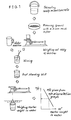
- Fig. 1 shows the procedure in an embodiment of the method based on the present invention;
- Fig. 2 shows the constitution of an embodiment of the apparatus based on the present invention;
- Fig. 3 is a flow-chart showing the function of the apparatus in Fig. 2; and
- Fig. 4 is the time-chart showing the function of the apparatus in Fig. 2.
- The method based on the present invention is described below.
- The first step in this method is to sample a certain quantity of the ready-mixed concrete to be examined. The sampled ready-mixed concrete is then subjected to sifting with a sifter of 5 mm-mesh to separate the mortar component therefrom with the gravel component removed.
- A predetermined weight M, for instance, 400 gr of mortar is weighed out from the above separated mortar. The weighed-out mortar, with a suitable quantity of water added thereto, is stirred to expel the air contained therein, and kept standing still, for instance, for some tens of seconds until the mortar is deposited to some extent on the bottom of the vessel. Then the underwater weight M' of the mortar is weighed with the vessel immersed in water. On the other hand a graph or a table showing the correlation between the water-to-cement ratio W/C and the underwater weight M' is prepared in advance by putting the aerial mortar weight M (= 400 gr) into Eq. (6). The water-to-cement ratio of the sample ready-mixed concrete can be obtained from the previously prepared graph or table by applying a measured value of M' thereto. The above-described embodiment of the method can be modified so as to enable the water-to-cement ratio to be obtained without preparation of the W/C-M' correlation graph or table. The water-to-cement ratio W/C has a linear correlation to the underwater weight M' if the weight M in the air is constant. Therefore, in case M is kept constant, W/C can be directly read out from the balance for weighing the underwater weight, if the division on the balance is previously calibrated against W/C according to Eq. (6). With the above embodiments employed, it takes only 6 minutes or less from sampling ready-mixed concrete to reading out its W/C.
- In the following an embodiment of the apparatus based on the present invention is described with reference to Fig. 2 which shows the constitution of the embodiment. Referring to Fig. 2, an electronic balance 1, having its weighing tray 2 hanged down, is fixed on a
base 3. The weighing tray 2 is positioned in awater tank 4 provided with a water supply port 4a and adraining port 4b. The water supply port 4a is connected to awater supply pump 6 through a valve 5, while the draining port is led to the atmosphere through a drain valve 7. Asample vessel 8 for containing mortar is held by aholder 9, which is engaged with a threaded bar 11 so as to be moved up and down along twoguides 12a and 12b when the threaded bar 11 is rotated by amotor 10. Above the weighing tray 2 there is provided astirrer 15 which rotates being interlocked with the threaded bar 11 through apulleys sample vessel 8 is displaced vertically by the movement of theholder 9. With theholder 9 moved up to the uppermost position thestirrer 15 can stir the content of thevessel 8. With theholder 9 moved down to the lowest position thevessel 8 is placed on the weighing tray 2, being made free from theholder 9. The uppermost position and lowest position are detected by astiring position sensor 16 and ameasuring position sensor 17. Midway between these twosensors starting position sensor 18 for detecting the starting position of theholder 9. With theholder 9 kept at the starting position, water can be poured into thesample vessel 8 from anozzel 19 attached to theholder 9. Thenozzle 19 is connected to thewater supply pump 6 through aflexible tube 20, awater pouring valve 21 and acontrol valve 22. Themotor 10 and thepump 6 are driven by asequence controller 26 respectively through amotor drive circuit 23 and through apump drive circuit 24. On the other hand the water supply valve 5, the drain valve 7 and thewater pouring valve 21 are also driven by thesequence controller 26 through avalve control circuit 25. Thesequence controller 26 further outputs a starting instruction signal and a weighing instruction signal to the electronic balance 1. A weight value outputted from the electronic balance 1 is inputted to acomputer 27. With position signals from the stirringposition sensor 16, the measuringposition sensor 17 and the startingposition sensor 18 being inputted to thecomputer 27, it controls the apparatus according to the timing described later. Thesequence controller 26 is further connected with astart switch 28 for instructing to start measuring and a lamp for indicating that the apparatus is being operated. Using the data inputted from the electronic balance 1, thecomputer 27 computes W/C according to a function previously stored therein. - In the following the operation of the apparatus is described in detail with Figs. 3 and 4 referred to additionally. Fig. 3 is a flow-chart showing the operation of the apparatus shown in Fig. 2, while Fig. 4 shows time-charts explaining the function of the
sequence controller 26 in the apparatus. - In the first place measuring conditions such as the mixing rate of cement and the specific gravities of aggregates are inputted to the
computer 27. On the other hand a certain quantity of concrete mixture is sampled from ready-mixed concrete to be examined, and then sifted with a sifter of 5-mm mesh to separate mortar from the concrete mixture. An adequate weight, for instance, 400 gr of the mortar is weighed out into a sample vessel. After the sample vessel has been set at theholder 9, thesequence controller 26 is put into action with thestart switch 26 turned on. Thesequence controller 26 starts controlling the related elements in the apparatus in such a manner as shown with the time-charts shown in Fig. 4. With thestart switch 28 turned on, a taring instruction signal is sent to the electronic balance 1 to make it perform a taring operation. At the same time themotor 10 begins rotating in the direction to move theholder 9 downward. The rotation continues until theholder 9 stops at the measuring position which is detected by the measuringposition sensor 17. After thesample vessel 8 has been placed on the weighing tray 2 with theholder 9 detached from thevessel 8, the electronic balance 1 measures the aerial weight M of the mortar in thevessel 8, and transmit the value to thecomputer 27. After the weight measurement themotor 10 again starts rotation in the direction to move theholder 9 upward. At the same time the water supply valve 5 and thewater pouring valve 21 are opened and themotor 10 starts rotation to supply water to both thewater tank 4 and thesample vessel 8. The water supply to thesample vessel 8 is continued over the upward movement of theholder 9 until a predetermined quantity of water is poured into thevessel 8. As soon as theholder 9 reaches the stirring position, the rotating direction of themotor 10 is inversed to lower theholder 9 again until it goes down to the starting position. This cycle of upward-and-downward movement of theholder 9 is repeated two or three times at a time interval of about three seconds. In this cyclic movement, while theholder 9 is at or near the stirring position, thestirrer 15 stirs the water-added mortar in thesample vessel 8 to expel the air contained in the mortar. After the stirring operation has been finished, theholder 9 is kept remaining still at the starting position for 10 to 20 seconds for making the mortar deposit at the bottom of thevessel 8 to some extent. While theholder 9 is kept remaining at the starting position, themortar 10 stops and thevalves 5 and 21 are closed. At the next step theholder 9 is lowered to the measuring position to place thesample vessel 8 on the weighing tray 2 to make the electronic balance 1 measure the underwater weight M' of the mortar. The measured value of M' being transmitted from the electronic balance 1 to thecomputer 27, which computes the water-to-cement weight ratio W/C from the previously stored aerial weight M and the underwater weight M' according to Eq. (6) previously stored in thecomputer 27. After the measurement of W/C, theholder 9 returns to the starting position and waits for the next operation of measurement. According to the apparatus based on the present invention, it takes only about 2 minutes and 30 seconds from turning on thestart switch 28 to obtaining the water-to-ratio W/C. - Further the method or the apparatus according to the present invention can be applied to the procedure for an emergency correction of concrete composition at a construction field, because the quality of a concrete mixture can be examined very rapidly according to the present invention. The conventional method of correction of concrete composition is to bring a tested slump magnitude and a measured air quantity close to expected values. However, such a method cannot achieve a proper correction of the concrete quality. Although a slump adjustment itself can be executed by adjusting the quantity of water, the magnitude of slump is influenced not only by the quantity of water but also by the particle size of aggregates, mixing temperature, actual volume ratio and the quantity of air. Therefore, if the slump magnitude is adjusted only by adjusting the quantity of water, a change in the water-to-cement ratio may affect the compressive strength of hardened concrete.
- By applying the method and the apparatus based on the present invention to the procedure for an emergency correction of concrete composition together with a slump test and an air quantity measurement, the water-to-cement ratio W/C in ready-mixed concrete can quickly be measured so that it can be made possible to keep not only the quantities of slump and air but also the water-to-cement ratio within stipulated values without deteriorating the compressive strength of hardened concrete. As is mentioned previously, the quantity of cement per m3 of concrete is nearly equal to a stipulated value in usual ready-mixed concrete. It is, therefore, possible to adjust the magnitude of slump, the quantity of air and the water-to-cement ratio simultaneously by correcting the composition of ready-mixed concrete according to the table given below. The table is prepared on the basis of the theory of concrete mixing, the RC instructions of the Society of Civil Engineering and other various experimental results.


- AW: Correction of water quantity per m3 of concrete (kg/m3)
- △S/a: Correction of aggregate ratio (%)
- △C: Correction of cement quantity per m3 of concrete (kg/m3)
- SL: Measured value of slump (cm)
- A: Measured quantity of air (%)
- Ao: Stipulated slump (cm)
- W/C: Measured water-to-cement ratio (%)
- C: Cement quantity per m3 of concrete (kg/m')
- W°/C: Stipulated water-to-cement ratio (%)
α,(β,γ,δ: Constants. At present 0.012. 0.03, 0.7, 20 are the best-fit on the basis of the table. Changable according to experimental results. - By applying to Eqs. (7), (8) and (9) a slump magnitude, an air quantity A and a water-to-cement ratio W/ C measured on the ready-mixed concrete received at a construction field, proper correction values can quickly be obtained to readjust the composition of the ready-mixed concrete before it is deposited. Further the present invention can be applied to the process of ready-mixed concrete production to stabilize the quality of concrete. It is also possible to make a microcomputer compute and output the above correction value, with Eqs. (7), (8) and (9) previously stored in the microcomputer.
Claims (5)
where W/C is the water-to-cement ratio of said ready mixed concrete, M is the weight of the mortar sample, M' is the underwater weight of said mortar sample, P is the mixing ratio of the cement in said ready mixed concrete,

Applications Claiming Priority (2)
| Application Number | Priority Date | Filing Date | Title |
|---|---|---|---|
| JP58070798A JPH0634011B2 (en) | 1983-04-20 | 1983-04-20 | Quality inspection equipment for ready-mixed concrete |
| JP70798/83 | 1983-04-20 |
Publications (3)
| Publication Number | Publication Date |
|---|---|
| EP0125774A2 EP0125774A2 (en) | 1984-11-21 |
| EP0125774A3 EP0125774A3 (en) | 1986-12-10 |
| EP0125774B1 true EP0125774B1 (en) | 1990-07-25 |
Family
ID=13441918
Family Applications (1)
| Application Number | Title | Priority Date | Filing Date |
|---|---|---|---|
| EP84302275A Expired EP0125774B1 (en) | 1983-04-20 | 1984-04-03 | Method and apparatus for testing ready-mixed concrete |
Country Status (4)
| Country | Link |
|---|---|
| US (1) | US4615215A (en) |
| EP (1) | EP0125774B1 (en) |
| JP (1) | JPH0634011B2 (en) |
| DE (1) | DE3482794D1 (en) |
Cited By (1)
| Publication number | Priority date | Publication date | Assignee | Title |
|---|---|---|---|---|
| CN102818785A (en) * | 2012-05-07 | 2012-12-12 | 天津市建筑材料产品质量监督检测中心 | Identification and detection method of doped polymers in cement-based materials and products thereof |
Families Citing this family (22)
| Publication number | Priority date | Publication date | Assignee | Title |
|---|---|---|---|---|
| US4741201A (en) * | 1986-12-10 | 1988-05-03 | Propst Robert L | Cement mix analyzing system |
| US4843868A (en) * | 1986-12-10 | 1989-07-04 | Propst Robert L | Cement mix analyzing system |
| AT389588B (en) * | 1987-04-29 | 1989-12-27 | Mayreder Keil List Bau | METHOD FOR CHECKING THE SOLIDIFICATION BEHAVIOR OR THE SETTING SPEED OF CEMENT-BONDED MATERIALS AND DEVICE FOR CARRYING OUT THE METHOD |
| US5209130A (en) * | 1990-07-19 | 1993-05-11 | Neotec Co., Ltd. | Method for recycling wash residue of ready mixed concrete and system therefor |
| DE59207494D1 (en) * | 1991-08-28 | 1996-12-12 | Atrof Bauphysik Ag | DEVICE FOR TESTING FRESH CONCRETE AND MORTAR |
| US5541855A (en) * | 1991-08-28 | 1996-07-30 | Atrof Bauphysik Ag | Device for testing unset concrete and mortar |
| US5258622A (en) * | 1992-03-13 | 1993-11-02 | Troxler Electronic Laboratories, Inc. | Apparatus and method for measuring physical characteristics of materials |
| US5396790A (en) * | 1994-04-13 | 1995-03-14 | Kansas State University Research Foundation | Method and apparatus for the rapid determination of water-cement ratios |
| JP2003513366A (en) * | 1999-10-29 | 2003-04-08 | ビルドナウ プライベート リミティド | System for monitoring product characteristics |
| JP4499244B2 (en) * | 2000-04-06 | 2010-07-07 | アースニクス株式会社 | Evaluation method for fresh concrete |
| US7114842B2 (en) * | 2000-07-05 | 2006-10-03 | W.R. Grace & Co.-Conn. | Controlling ready mixed concrete sludge water |
| US6776387B2 (en) * | 2001-08-06 | 2004-08-17 | Dominick V. Stallone | Concrete test cylinder mold cap |
| US7398131B2 (en) * | 2005-09-15 | 2008-07-08 | Nomadics, Inc. | Method and system for concrete quality control based on the concrete's maturity |
| US20040083057A1 (en) * | 2002-07-31 | 2004-04-29 | Trost Steven M. | Method and system for concrete quality control based on the concrete's maturity |
| US7181978B2 (en) * | 2003-11-14 | 2007-02-27 | Concretec Ltd. | Method, apparatus and system for forecasting strength of cementitious material |
| WO2005106461A1 (en) * | 2004-04-29 | 2005-11-10 | Draco Italiana S.P.A. | Device for determining properties of a concrete paste |
| JP4555244B2 (en) * | 2006-03-17 | 2010-09-29 | 前田建設工業株式会社 | Unit water measurement method for fresh concrete |
| US20090285958A1 (en) * | 2008-05-15 | 2009-11-19 | Garcia Jorge B | System and methods for food processing |
| US8220344B2 (en) * | 2009-07-15 | 2012-07-17 | U.S. Concrete, Inc. | Method for estimating properties of concrete |
| CN101629889B (en) * | 2009-08-18 | 2011-06-01 | 中国建筑第八工程局有限公司 | Determination method of pressure water absorption of lightweight aggregate concrete |
| CN101769843B (en) * | 2009-12-29 | 2012-03-14 | 中铁十一局集团第二工程有限公司 | Method for quickly determining water content of particulate materials |
| CN103278462B (en) * | 2013-06-21 | 2015-09-23 | 中建八局第一建设有限公司青岛分公司 | A kind of authentication method of concrete ingredients |
Family Cites Families (17)
| Publication number | Priority date | Publication date | Assignee | Title |
|---|---|---|---|---|
| CA816931A (en) * | 1969-07-01 | F. Beer Andrew | Semi conductor device | |
| DE492361C (en) * | 1930-02-21 | Hans Heidenreich | Scales for determining the specific weight of solid bodies | |
| US2043457A (en) * | 1932-04-06 | 1936-06-09 | Toledo Scale Mfg Co | Concrete aggregate testing device |
| US2995030A (en) * | 1957-03-15 | 1961-08-08 | Armstrong Cork Co | Determination of the percentage by weight solids in a slurry |
| US3203591A (en) * | 1962-03-27 | 1965-08-31 | Magnetic Controls Co | Batch weighing control unit |
| US3447906A (en) * | 1966-01-21 | 1969-06-03 | Rohm & Haas | Automatic gravimetric titrator for batch operation |
| NL140340B (en) * | 1970-02-26 | 1973-11-15 | Aannemings En Wegenbouwbedrijf | METHOD AND DEVICE FOR DETERMINING THE WEIGHT RATIO OF THE COMPONENT COMPONENTS OF A BITUMINOUS MIXTURE. |
| US3747416A (en) * | 1972-07-17 | 1973-07-24 | Thiokol Chemical Corp | Density measurement apparatus |
| GB1443789A (en) * | 1973-11-28 | 1976-07-28 | Monsanto Ltd | Apparatus for measuring specific gravity |
| JPS5226865A (en) * | 1975-08-26 | 1977-02-28 | Sumitomo Electric Ind Ltd | Automatic specific gravity measuring apparatus |
| US4144762A (en) * | 1977-06-13 | 1979-03-20 | Duxbury William G | Analyzing plastic concrete |
| US4196614A (en) * | 1978-01-20 | 1980-04-08 | Mclaughlin Robert R | Process and device for quantitative analysis of cement and water content in fresh concrete |
| SU787949A1 (en) * | 1979-02-14 | 1980-12-15 | Предприятие П/Я А-1742 | Apparatus for measuring volume and density of solid bodies |
| DE3000412C2 (en) * | 1979-03-06 | 1983-06-23 | Hubert K. Prof. Dr.-Ing. 7500 Karlsruhe Hilsdorf | Method and apparatus for determining the composition of fresh concrete |
| JPS5843696B2 (en) * | 1979-12-25 | 1983-09-28 | 株式会社竹中工務店 | Preliminary inspection method for concrete quality |
| US4320658A (en) * | 1980-09-03 | 1982-03-23 | Frito-Lay, Inc. | Weighing apparatus |
| US4372405A (en) * | 1981-02-11 | 1983-02-08 | Stuart James M | Weight, volume or density measuring system |
-
1983
- 1983-04-20 JP JP58070798A patent/JPH0634011B2/en not_active Expired - Lifetime
-
1984
- 1984-03-30 US US06/595,249 patent/US4615215A/en not_active Expired - Fee Related
- 1984-04-03 DE DE8484302275T patent/DE3482794D1/en not_active Expired - Lifetime
- 1984-04-03 EP EP84302275A patent/EP0125774B1/en not_active Expired
Cited By (2)
| Publication number | Priority date | Publication date | Assignee | Title |
|---|---|---|---|---|
| CN102818785A (en) * | 2012-05-07 | 2012-12-12 | 天津市建筑材料产品质量监督检测中心 | Identification and detection method of doped polymers in cement-based materials and products thereof |
| CN102818785B (en) * | 2012-05-07 | 2014-11-19 | 天津市建筑材料产品质量监督检测中心 | Identification and detection method of doped polymers in cement-based materials and products thereof |
Also Published As
| Publication number | Publication date |
|---|---|
| DE3482794D1 (en) | 1990-08-30 |
| EP0125774A3 (en) | 1986-12-10 |
| JPS59195159A (en) | 1984-11-06 |
| JPH0634011B2 (en) | 1994-05-02 |
| US4615215A (en) | 1986-10-07 |
| EP0125774A2 (en) | 1984-11-21 |
Similar Documents
| Publication | Publication Date | Title |
|---|---|---|
| US4615215A (en) | Method and apparatus for testing ready-mixed concrete | |
| Loser et al. | A volumetric technique for measuring the coefficient of thermal expansion of hardening cement paste and mortar | |
| FI125375B (en) | Method and apparatus for making a concrete pulp | |
| Wallevik et al. | 25 DEVELOPMENT OF A COAXIAL CYLINDERS VISCOMETER FOR FRESH CONCRETE | |
| Naik et al. | Determination of the water content of concrete by the microwave method | |
| CN103900855B (en) | Sampling device for measuring dosage of lime or cement in stabilized soil and sampling method thereof | |
| JP3142787B2 (en) | Method and apparatus for measuring material separation of concrete | |
| JPH0943233A (en) | Method for measuring unit water content of inorganic hydraulic kneaded product | |
| JPH1183718A (en) | Method of measuring density of inorganic hydraulic substance and method of measuring unit water amount of inorganic hydraulic kneaded material | |
| JPH02171213A (en) | Automatic water content measuring and correcting device of aggregate | |
| JPH0339802B2 (en) | ||
| JPS5843696B2 (en) | Preliminary inspection method for concrete quality | |
| US1989003A (en) | Method of testing materials | |
| Williamson | Methods for determining the water and cement content of fresh concrete | |
| JPH09274034A (en) | Evaluation of water/cement ratio of fresh concrete | |
| JPH04295761A (en) | Fresh concrete quality inspection equipment | |
| US4144762A (en) | Analyzing plastic concrete | |
| CN1215321C (en) | Fast strength test method of cementing material for PHC tube pile | |
| CN112318763A (en) | Control and inspection method for pouring process with filler | |
| JPS61202161A (en) | Fresh concrete quality inspection equipment | |
| JPS59196207A (en) | Ready-mix concrete mixing correction method and mixing correction content display device | |
| RU2106630C1 (en) | Process determining strength of concrete | |
| SU1565543A1 (en) | Method of investigating the process of sieve separation of grain | |
| JPH0822549B2 (en) | Method for early estimation of concrete unit water volume and strength | |
| RU2316750C1 (en) | Method of determination of plastic strength of foam concrete mix |
Legal Events
| Date | Code | Title | Description |
|---|---|---|---|
| PUAI | Public reference made under article 153(3) epc to a published international application that has entered the european phase |
Free format text: ORIGINAL CODE: 0009012 |
|
| AK | Designated contracting states |
Designated state(s): CH DE FR GB LI |
|
| PUAL | Search report despatched |
Free format text: ORIGINAL CODE: 0009013 |
|
| AK | Designated contracting states |
Kind code of ref document: A3 Designated state(s): CH DE FR GB LI |
|
| 17P | Request for examination filed |
Effective date: 19870204 |
|
| 17Q | First examination report despatched |
Effective date: 19880621 |
|
| GRAA | (expected) grant |
Free format text: ORIGINAL CODE: 0009210 |
|
| AK | Designated contracting states |
Kind code of ref document: B1 Designated state(s): CH DE FR GB LI |
|
| REF | Corresponds to: |
Ref document number: 3482794 Country of ref document: DE Date of ref document: 19900830 |
|
| ET | Fr: translation filed | ||
| PLBE | No opposition filed within time limit |
Free format text: ORIGINAL CODE: 0009261 |
|
| STAA | Information on the status of an ep patent application or granted ep patent |
Free format text: STATUS: NO OPPOSITION FILED WITHIN TIME LIMIT |
|
| 26N | No opposition filed | ||
| PGFP | Annual fee paid to national office [announced via postgrant information from national office to epo] |
Ref country code: GB Payment date: 19930330 Year of fee payment: 10 |
|
| PGFP | Annual fee paid to national office [announced via postgrant information from national office to epo] |
Ref country code: CH Payment date: 19930414 Year of fee payment: 10 |
|
| PGFP | Annual fee paid to national office [announced via postgrant information from national office to epo] |
Ref country code: FR Payment date: 19930614 Year of fee payment: 10 |
|
| PGFP | Annual fee paid to national office [announced via postgrant information from national office to epo] |
Ref country code: DE Payment date: 19930630 Year of fee payment: 10 |
|
| PG25 | Lapsed in a contracting state [announced via postgrant information from national office to epo] |
Ref country code: GB Effective date: 19940403 |
|
| PG25 | Lapsed in a contracting state [announced via postgrant information from national office to epo] |
Ref country code: LI Effective date: 19940430 Ref country code: CH Effective date: 19940430 |
|
| GBPC | Gb: european patent ceased through non-payment of renewal fee |
Effective date: 19940403 |
|
| PG25 | Lapsed in a contracting state [announced via postgrant information from national office to epo] |
Ref country code: FR Effective date: 19941229 |
|
| REG | Reference to a national code |
Ref country code: CH Ref legal event code: PL |
|
| PG25 | Lapsed in a contracting state [announced via postgrant information from national office to epo] |
Ref country code: DE Effective date: 19950103 |
|
| REG | Reference to a national code |
Ref country code: FR Ref legal event code: ST |