EP0125049A1 - Method of inhibiting sweetness - Google Patents
Method of inhibiting sweetness Download PDFInfo
- Publication number
- EP0125049A1 EP0125049A1 EP84302496A EP84302496A EP0125049A1 EP 0125049 A1 EP0125049 A1 EP 0125049A1 EP 84302496 A EP84302496 A EP 84302496A EP 84302496 A EP84302496 A EP 84302496A EP 0125049 A1 EP0125049 A1 EP 0125049A1
- Authority
- EP
- European Patent Office
- Prior art keywords
- group
- compound
- formula
- substituents
- sweetness
- Prior art date
- Legal status (The legal status is an assumption and is not a legal conclusion. Google has not performed a legal analysis and makes no representation as to the accuracy of the status listed.)
- Granted
Links
- 238000000034 method Methods 0.000 title claims description 20
- 230000002401 inhibitory effect Effects 0.000 title 1
- 150000001875 compounds Chemical class 0.000 claims abstract description 28
- 125000001424 substituent group Chemical group 0.000 claims abstract description 25
- 235000000346 sugar Nutrition 0.000 claims abstract description 20
- -1 alkenylenedioxy Chemical group 0.000 claims abstract description 11
- 125000003545 alkoxy group Chemical group 0.000 claims abstract description 8
- 125000005530 alkylenedioxy group Chemical group 0.000 claims abstract description 5
- 125000001997 phenyl group Chemical group [H]C1=C([H])C([H])=C(*)C([H])=C1[H] 0.000 claims abstract description 4
- 150000005846 sugar alcohols Chemical class 0.000 claims abstract description 4
- 125000001931 aliphatic group Chemical group 0.000 claims abstract description 3
- 125000000217 alkyl group Chemical group 0.000 claims abstract description 3
- 125000005529 alkyleneoxy group Chemical group 0.000 claims abstract description 3
- 125000004432 carbon atom Chemical group C* 0.000 claims abstract description 3
- 150000001768 cations Chemical class 0.000 claims abstract description 3
- 125000002887 hydroxy group Chemical group [H]O* 0.000 claims abstract description 3
- 125000000951 phenoxy group Chemical group [H]C1=C([H])C([H])=C(O*)C([H])=C1[H] 0.000 claims abstract description 3
- 125000002023 trifluoromethyl group Chemical group FC(F)(F)* 0.000 claims abstract description 3
- 229930006000 Sucrose Natural products 0.000 claims description 46
- 239000005720 sucrose Substances 0.000 claims description 46
- CZMRCDWAGMRECN-UGDNZRGBSA-N Sucrose Chemical compound O[C@H]1[C@H](O)[C@@H](CO)O[C@@]1(CO)O[C@@H]1[C@H](O)[C@@H](O)[C@H](O)[C@@H](CO)O1 CZMRCDWAGMRECN-UGDNZRGBSA-N 0.000 claims description 45
- 239000000203 mixture Substances 0.000 claims description 14
- WQZGKKKJIJFFOK-GASJEMHNSA-N Glucose Natural products OC[C@H]1OC(O)[C@H](O)[C@@H](O)[C@@H]1O WQZGKKKJIJFFOK-GASJEMHNSA-N 0.000 claims description 9
- 239000008103 glucose Substances 0.000 claims description 9
- 239000006188 syrup Substances 0.000 claims description 7
- 235000020357 syrup Nutrition 0.000 claims description 7
- 229910052783 alkali metal Inorganic materials 0.000 claims description 4
- WQZGKKKJIJFFOK-VFUOTHLCSA-N beta-D-glucose Chemical compound OC[C@H]1O[C@@H](O)[C@H](O)[C@@H](O)[C@@H]1O WQZGKKKJIJFFOK-VFUOTHLCSA-N 0.000 claims description 3
- 150000003839 salts Chemical class 0.000 claims description 3
- 239000007787 solid Substances 0.000 claims description 3
- 125000000956 methoxy group Chemical group [H]C([H])([H])O* 0.000 claims description 2
- HDCHEVMGIPYCMV-UHFFFAOYSA-N COc1ccc(CCC(O)=O)c(OC)c1OC.COc1cc(CCC(O)=O)cc(OC)c1OC Chemical compound COc1ccc(CCC(O)=O)c(OC)c1OC.COc1cc(CCC(O)=O)cc(OC)c1OC HDCHEVMGIPYCMV-UHFFFAOYSA-N 0.000 claims 1
- 125000001301 ethoxy group Chemical group [H]C([H])([H])C([H])([H])O* 0.000 claims 1
- 229960004793 sucrose Drugs 0.000 description 44
- 239000003112 inhibitor Substances 0.000 description 24
- 235000009508 confectionery Nutrition 0.000 description 17
- 238000002474 experimental method Methods 0.000 description 15
- XLYOFNOQVPJJNP-UHFFFAOYSA-N water Substances O XLYOFNOQVPJJNP-UHFFFAOYSA-N 0.000 description 13
- 235000013305 food Nutrition 0.000 description 7
- 239000000243 solution Substances 0.000 description 7
- 239000004615 ingredient Substances 0.000 description 6
- 230000000694 effects Effects 0.000 description 5
- BTNMPGBKDVTSJY-UHFFFAOYSA-N keto-phenylpyruvic acid Chemical class OC(=O)C(=O)CC1=CC=CC=C1 BTNMPGBKDVTSJY-UHFFFAOYSA-N 0.000 description 5
- ZVVWZNFSMIFGEP-UHFFFAOYSA-N 2-(4-ethoxyphenyl)acetic acid Chemical compound CCOC1=CC=C(CC(O)=O)C=C1 ZVVWZNFSMIFGEP-UHFFFAOYSA-N 0.000 description 4
- LHHKQWQTBCTDQM-UHFFFAOYSA-N 3-(3,4-dimethoxyphenyl)propanoic acid Chemical compound COC1=CC=C(CCC(O)=O)C=C1OC LHHKQWQTBCTDQM-UHFFFAOYSA-N 0.000 description 4
- PEDCQBHIVMGVHV-UHFFFAOYSA-N Glycerine Chemical compound OCC(O)CO PEDCQBHIVMGVHV-UHFFFAOYSA-N 0.000 description 4
- FKNQFGJONOIPTF-UHFFFAOYSA-N Sodium cation Chemical compound [Na+] FKNQFGJONOIPTF-UHFFFAOYSA-N 0.000 description 4
- 239000002253 acid Substances 0.000 description 4
- HUMNYLRZRPPJDN-UHFFFAOYSA-N benzaldehyde Chemical compound O=CC1=CC=CC=C1 HUMNYLRZRPPJDN-UHFFFAOYSA-N 0.000 description 4
- 235000014121 butter Nutrition 0.000 description 4
- 239000000796 flavoring agent Substances 0.000 description 4
- 235000003599 food sweetener Nutrition 0.000 description 4
- WUAXWQRULBZETB-UHFFFAOYSA-N homoveratric acid Chemical compound COC1=CC=C(CC(O)=O)C=C1OC WUAXWQRULBZETB-UHFFFAOYSA-N 0.000 description 4
- 230000005764 inhibitory process Effects 0.000 description 4
- 230000009467 reduction Effects 0.000 description 4
- 229910001415 sodium ion Inorganic materials 0.000 description 4
- 239000003765 sweetening agent Substances 0.000 description 4
- 238000012360 testing method Methods 0.000 description 4
- PVXPPJIGRGXGCY-TZLCEDOOSA-N 6-O-alpha-D-glucopyranosyl-D-fructofuranose Chemical compound O[C@@H]1[C@@H](O)[C@H](O)[C@@H](CO)O[C@@H]1OC[C@@H]1[C@@H](O)[C@H](O)C(O)(CO)O1 PVXPPJIGRGXGCY-TZLCEDOOSA-N 0.000 description 3
- WFDIJRYMOXRFFG-UHFFFAOYSA-N Acetic anhydride Chemical compound CC(=O)OC(C)=O WFDIJRYMOXRFFG-UHFFFAOYSA-N 0.000 description 3
- WVDDGKGOMKODPV-UHFFFAOYSA-N Benzyl alcohol Chemical class OCC1=CC=CC=C1 WVDDGKGOMKODPV-UHFFFAOYSA-N 0.000 description 3
- QIAFMBKCNZACKA-UHFFFAOYSA-N N-benzoylglycine Chemical compound OC(=O)CNC(=O)C1=CC=CC=C1 QIAFMBKCNZACKA-UHFFFAOYSA-N 0.000 description 3
- HEMHJVSKTPXQMS-UHFFFAOYSA-M Sodium hydroxide Chemical compound [OH-].[Na+] HEMHJVSKTPXQMS-UHFFFAOYSA-M 0.000 description 3
- 235000019197 fats Nutrition 0.000 description 3
- 235000019634 flavors Nutrition 0.000 description 3
- 230000008569 process Effects 0.000 description 3
- DVTVODRKZFYUMA-UHFFFAOYSA-M sodium;2-(3,4-dimethoxyphenyl)acetate Chemical compound [Na+].COC1=CC=C(CC([O-])=O)C=C1OC DVTVODRKZFYUMA-UHFFFAOYSA-M 0.000 description 3
- 150000008163 sugars Chemical class 0.000 description 3
- 239000001903 2-oxo-3-phenylpropanoic acid Substances 0.000 description 2
- ZCYXGVJUZBKJAI-UHFFFAOYSA-N 3,4,5-trimethoxydihydrocinnamic acid Chemical compound COC1=CC(CCC(O)=O)=CC(OC)=C1OC ZCYXGVJUZBKJAI-UHFFFAOYSA-N 0.000 description 2
- NRPFNQUDKRYCNX-UHFFFAOYSA-N 4-methoxyphenylacetic acid Chemical compound COC1=CC=C(CC(O)=O)C=C1 NRPFNQUDKRYCNX-UHFFFAOYSA-N 0.000 description 2
- 244000299461 Theobroma cacao Species 0.000 description 2
- DEDGUGJNLNLJSR-UHFFFAOYSA-N alpha-hydroxycinnamic acid Natural products OC(=O)C(O)=CC1=CC=CC=C1 DEDGUGJNLNLJSR-UHFFFAOYSA-N 0.000 description 2
- 239000007864 aqueous solution Substances 0.000 description 2
- 238000009833 condensation Methods 0.000 description 2
- 230000005494 condensation Effects 0.000 description 2
- 235000014103 egg white Nutrition 0.000 description 2
- 210000000969 egg white Anatomy 0.000 description 2
- 235000013601 eggs Nutrition 0.000 description 2
- RRAFCDWBNXTKKO-UHFFFAOYSA-N eugenol Chemical compound COC1=CC(CC=C)=CC=C1O RRAFCDWBNXTKKO-UHFFFAOYSA-N 0.000 description 2
- 235000011187 glycerol Nutrition 0.000 description 2
- 238000010348 incorporation Methods 0.000 description 2
- 238000004519 manufacturing process Methods 0.000 description 2
- 231100000252 nontoxic Toxicity 0.000 description 2
- 230000003000 nontoxic effect Effects 0.000 description 2
- QNGNSVIICDLXHT-UHFFFAOYSA-N para-ethylbenzaldehyde Natural products CCC1=CC=C(C=O)C=C1 QNGNSVIICDLXHT-UHFFFAOYSA-N 0.000 description 2
- SUSQOBVLVYHIEX-UHFFFAOYSA-N phenylacetonitrile Chemical compound N#CCC1=CC=CC=C1 SUSQOBVLVYHIEX-UHFFFAOYSA-N 0.000 description 2
- HPPVXGUTRQEEPC-UHFFFAOYSA-M sodium;2-(4-methoxyphenyl)acetate Chemical compound [Na+].COC1=CC=C(CC([O-])=O)C=C1 HPPVXGUTRQEEPC-UHFFFAOYSA-M 0.000 description 2
- 239000000126 substance Substances 0.000 description 2
- 238000006467 substitution reaction Methods 0.000 description 2
- MWOOGOJBHIARFG-UHFFFAOYSA-N vanillin Chemical compound COC1=CC(C=O)=CC=C1O MWOOGOJBHIARFG-UHFFFAOYSA-N 0.000 description 2
- FGQOOHJZONJGDT-UHFFFAOYSA-N vanillin Natural products COC1=CC(O)=CC(C=O)=C1 FGQOOHJZONJGDT-UHFFFAOYSA-N 0.000 description 2
- 235000012141 vanillin Nutrition 0.000 description 2
- YJJBSMOKINSQQF-UHFFFAOYSA-N 1,2-dimethyl-4-nitroimidazole Chemical compound CC1=NC([N+]([O-])=O)=CN1C YJJBSMOKINSQQF-UHFFFAOYSA-N 0.000 description 1
- IEJPPSMHUUQABK-UHFFFAOYSA-N 2,4-diphenyl-4h-1,3-oxazol-5-one Chemical compound O=C1OC(C=2C=CC=CC=2)=NC1C1=CC=CC=C1 IEJPPSMHUUQABK-UHFFFAOYSA-N 0.000 description 1
- BVRNERFWPQRVJB-UHFFFAOYSA-N 2-(2,3-dihydro-1,4-benzodioxin-6-yl)acetic acid Chemical compound O1CCOC2=CC(CC(=O)O)=CC=C21 BVRNERFWPQRVJB-UHFFFAOYSA-N 0.000 description 1
- IVEWTCACRDEAOB-UHFFFAOYSA-N 2-(2-methoxyphenyl)acetic acid Chemical compound COC1=CC=CC=C1CC(O)=O IVEWTCACRDEAOB-UHFFFAOYSA-N 0.000 description 1
- GXXXUZIRGXYDFP-UHFFFAOYSA-N 2-(4-methylphenyl)acetic acid Chemical compound CC1=CC=C(CC(O)=O)C=C1 GXXXUZIRGXYDFP-UHFFFAOYSA-N 0.000 description 1
- HNORVZDAANCHAY-UHFFFAOYSA-N 2-[4-(trifluoromethyl)phenyl]acetic acid Chemical compound OC(=O)CC1=CC=C(C(F)(F)F)C=C1 HNORVZDAANCHAY-UHFFFAOYSA-N 0.000 description 1
- OFJWFSNDPCAWDK-UHFFFAOYSA-N 2-phenylbutyric acid Chemical class CCC(C(O)=O)C1=CC=CC=C1 OFJWFSNDPCAWDK-UHFFFAOYSA-N 0.000 description 1
- XSZSNLOPIWWFHS-UHFFFAOYSA-N 3-(2-methoxyphenyl)propanoic acid Chemical compound COC1=CC=CC=C1CCC(O)=O XSZSNLOPIWWFHS-UHFFFAOYSA-N 0.000 description 1
- GNPISAHACGIXLZ-UHFFFAOYSA-N 3-(4-methylphenoxy)propanoic acid Chemical compound CC1=CC=C(OCCC(O)=O)C=C1 GNPISAHACGIXLZ-UHFFFAOYSA-N 0.000 description 1
- LEGPZHPSIPPYIO-UHFFFAOYSA-N 3-Methoxyphenylacetic acid Chemical compound COC1=CC=CC(CC(O)=O)=C1 LEGPZHPSIPPYIO-UHFFFAOYSA-N 0.000 description 1
- XMIIGOLPHOKFCH-UHFFFAOYSA-N 3-phenylpropionic acid Chemical compound OC(=O)CCC1=CC=CC=C1 XMIIGOLPHOKFCH-UHFFFAOYSA-N 0.000 description 1
- LZHMNCJMXQKSBY-UHFFFAOYSA-N 4-(4-methoxyphenyl)butanoic acid Chemical compound COC1=CC=C(CCCC(O)=O)C=C1 LZHMNCJMXQKSBY-UHFFFAOYSA-N 0.000 description 1
- ORILYTVJVMAKLC-UHFFFAOYSA-N Adamantane Natural products C1C(C2)CC3CC1CC2C3 ORILYTVJVMAKLC-UHFFFAOYSA-N 0.000 description 1
- 238000010953 Ames test Methods 0.000 description 1
- 231100000039 Ames test Toxicity 0.000 description 1
- QGZKDVFQNNGYKY-UHFFFAOYSA-O Ammonium Chemical compound [NH4+] QGZKDVFQNNGYKY-UHFFFAOYSA-O 0.000 description 1
- BHPQYMZQTOCNFJ-UHFFFAOYSA-N Calcium cation Chemical compound [Ca+2] BHPQYMZQTOCNFJ-UHFFFAOYSA-N 0.000 description 1
- NPBVQXIMTZKSBA-UHFFFAOYSA-N Chavibetol Natural products COC1=CC=C(CC=C)C=C1O NPBVQXIMTZKSBA-UHFFFAOYSA-N 0.000 description 1
- 235000005979 Citrus limon Nutrition 0.000 description 1
- 244000131522 Citrus pyriformis Species 0.000 description 1
- FBPFZTCFMRRESA-FSIIMWSLSA-N D-Glucitol Natural products OC[C@H](O)[C@H](O)[C@@H](O)[C@H](O)CO FBPFZTCFMRRESA-FSIIMWSLSA-N 0.000 description 1
- 239000005770 Eugenol Substances 0.000 description 1
- 239000005715 Fructose Substances 0.000 description 1
- 241000699670 Mus sp. Species 0.000 description 1
- ZLMJMSJWJFRBEC-UHFFFAOYSA-N Potassium Chemical compound [K] ZLMJMSJWJFRBEC-UHFFFAOYSA-N 0.000 description 1
- UVMRYBDEERADNV-UHFFFAOYSA-N Pseudoeugenol Natural products COC1=CC(C(C)=C)=CC=C1O UVMRYBDEERADNV-UHFFFAOYSA-N 0.000 description 1
- 241000293869 Salmonella enterica subsp. enterica serovar Typhimurium Species 0.000 description 1
- VMHLLURERBWHNL-UHFFFAOYSA-M Sodium acetate Chemical compound [Na+].CC([O-])=O VMHLLURERBWHNL-UHFFFAOYSA-M 0.000 description 1
- 229920002472 Starch Polymers 0.000 description 1
- 235000009470 Theobroma cacao Nutrition 0.000 description 1
- 150000001340 alkali metals Chemical class 0.000 description 1
- 229910052784 alkaline earth metal Inorganic materials 0.000 description 1
- 150000001342 alkaline earth metals Chemical class 0.000 description 1
- 238000000540 analysis of variance Methods 0.000 description 1
- 230000000845 anti-microbial effect Effects 0.000 description 1
- 238000013459 approach Methods 0.000 description 1
- 235000019445 benzyl alcohol Nutrition 0.000 description 1
- 235000013361 beverage Nutrition 0.000 description 1
- 235000012411 boiled sweets Nutrition 0.000 description 1
- 229910001424 calcium ion Inorganic materials 0.000 description 1
- 235000013736 caramel Nutrition 0.000 description 1
- 150000001720 carbohydrates Chemical class 0.000 description 1
- 235000014633 carbohydrates Nutrition 0.000 description 1
- 150000001732 carboxylic acid derivatives Chemical class 0.000 description 1
- 230000008859 change Effects 0.000 description 1
- 238000006243 chemical reaction Methods 0.000 description 1
- 235000019219 chocolate Nutrition 0.000 description 1
- 150000001851 cinnamic acid derivatives Chemical class 0.000 description 1
- 239000006071 cream Substances 0.000 description 1
- 230000034994 death Effects 0.000 description 1
- 231100000517 death Toxicity 0.000 description 1
- 231100000673 dose–response relationship Toxicity 0.000 description 1
- 238000006266 etherification reaction Methods 0.000 description 1
- 229960002217 eugenol Drugs 0.000 description 1
- 235000013312 flour Nutrition 0.000 description 1
- 238000009472 formulation Methods 0.000 description 1
- 235000021433 fructose syrup Nutrition 0.000 description 1
- 238000007429 general method Methods 0.000 description 1
- 150000004820 halides Chemical class 0.000 description 1
- 239000003906 humectant Substances 0.000 description 1
- YPGCWEMNNLXISK-UHFFFAOYSA-N hydratropic acid Chemical class OC(=O)C(C)C1=CC=CC=C1 YPGCWEMNNLXISK-UHFFFAOYSA-N 0.000 description 1
- GPRLSGONYQIRFK-UHFFFAOYSA-N hydron Chemical compound [H+] GPRLSGONYQIRFK-UHFFFAOYSA-N 0.000 description 1
- 229910052738 indium Inorganic materials 0.000 description 1
- APFVFJFRJDLVQX-UHFFFAOYSA-N indium atom Chemical compound [In] APFVFJFRJDLVQX-UHFFFAOYSA-N 0.000 description 1
- 230000003993 interaction Effects 0.000 description 1
- 238000006317 isomerization reaction Methods 0.000 description 1
- 235000014361 jams and preserves Nutrition 0.000 description 1
- 239000007788 liquid Substances 0.000 description 1
- 239000004579 marble Substances 0.000 description 1
- 239000000463 material Substances 0.000 description 1
- 150000002825 nitriles Chemical class 0.000 description 1
- 230000003647 oxidation Effects 0.000 description 1
- 238000007254 oxidation reaction Methods 0.000 description 1
- 230000008447 perception Effects 0.000 description 1
- 239000008194 pharmaceutical composition Substances 0.000 description 1
- WLJVXDMOQOGPHL-UHFFFAOYSA-N phenylacetic acid Chemical class OC(=O)CC1=CC=CC=C1 WLJVXDMOQOGPHL-UHFFFAOYSA-N 0.000 description 1
- 239000011591 potassium Substances 0.000 description 1
- 229910001414 potassium ion Inorganic materials 0.000 description 1
- 235000018102 proteins Nutrition 0.000 description 1
- 102000004169 proteins and genes Human genes 0.000 description 1
- 108090000623 proteins and genes Proteins 0.000 description 1
- 150000004728 pyruvic acid derivatives Chemical class 0.000 description 1
- 239000012088 reference solution Substances 0.000 description 1
- 235000015067 sauces Nutrition 0.000 description 1
- 235000011888 snacks Nutrition 0.000 description 1
- 239000001632 sodium acetate Substances 0.000 description 1
- 235000017281 sodium acetate Nutrition 0.000 description 1
- CJWNABPLYCZULA-UHFFFAOYSA-M sodium;2-(2,3-dihydro-1,4-benzodioxin-6-yl)acetate Chemical compound [Na+].O1CCOC2=CC(CC(=O)[O-])=CC=C21 CJWNABPLYCZULA-UHFFFAOYSA-M 0.000 description 1
- WWNSCFXFVZHYSE-UHFFFAOYSA-M sodium;2-(4-ethoxyphenyl)acetate Chemical compound [Na+].CCOC1=CC=C(CC([O-])=O)C=C1 WWNSCFXFVZHYSE-UHFFFAOYSA-M 0.000 description 1
- ZYKSSUHAAAXDBC-UHFFFAOYSA-M sodium;3-(3,4-dimethoxyphenyl)propanoate Chemical compound [Na+].COC1=CC=C(CCC([O-])=O)C=C1OC ZYKSSUHAAAXDBC-UHFFFAOYSA-M 0.000 description 1
- 239000000600 sorbitol Substances 0.000 description 1
- 235000014347 soups Nutrition 0.000 description 1
- 235000019698 starch Nutrition 0.000 description 1
- 239000008107 starch Substances 0.000 description 1
- 239000007858 starting material Substances 0.000 description 1
- 238000003756 stirring Methods 0.000 description 1
- 125000000185 sucrose group Chemical class 0.000 description 1
- 229960004016 sucrose syrup Drugs 0.000 description 1
- 235000012094 sugar confectionery Nutrition 0.000 description 1
- 230000009967 tasteless effect Effects 0.000 description 1
- 235000015149 toffees Nutrition 0.000 description 1
Images

Classifications
-
- A—HUMAN NECESSITIES
- A23—FOODS OR FOODSTUFFS; TREATMENT THEREOF, NOT COVERED BY OTHER CLASSES
- A23G—COCOA; COCOA PRODUCTS, e.g. CHOCOLATE; SUBSTITUTES FOR COCOA OR COCOA PRODUCTS; CONFECTIONERY; CHEWING GUM; ICE-CREAM; PREPARATION THEREOF
- A23G3/00—Sweetmeats; Confectionery; Marzipan; Coated or filled products
- A23G3/34—Sweetmeats, confectionery or marzipan; Processes for the preparation thereof
- A23G3/36—Sweetmeats, confectionery or marzipan; Processes for the preparation thereof characterised by the composition containing organic or inorganic compounds
-
- A—HUMAN NECESSITIES
- A21—BAKING; EDIBLE DOUGHS
- A21D—TREATMENT OF FLOUR OR DOUGH FOR BAKING, e.g. BY ADDITION OF MATERIALS; BAKING; BAKERY PRODUCTS
- A21D2/00—Treatment of flour or dough by adding materials thereto before or during baking
- A21D2/08—Treatment of flour or dough by adding materials thereto before or during baking by adding organic substances
- A21D2/14—Organic oxygen compounds
-
- A—HUMAN NECESSITIES
- A23—FOODS OR FOODSTUFFS; TREATMENT THEREOF, NOT COVERED BY OTHER CLASSES
- A23B—PRESERVATION OF FOODS, FOODSTUFFS OR NON-ALCOHOLIC BEVERAGES; CHEMICAL RIPENING OF FRUIT OR VEGETABLES
- A23B2/00—Preservation of foods or foodstuffs, in general
- A23B2/70—Preservation of foods or foodstuffs, in general by treatment with chemicals
- A23B2/725—Preservation of foods or foodstuffs, in general by treatment with chemicals in the form of liquids or solids
- A23B2/729—Organic compounds; Microorganisms; Enzymes
-
- A—HUMAN NECESSITIES
- A23—FOODS OR FOODSTUFFS; TREATMENT THEREOF, NOT COVERED BY OTHER CLASSES
- A23B—PRESERVATION OF FOODS, FOODSTUFFS OR NON-ALCOHOLIC BEVERAGES; CHEMICAL RIPENING OF FRUIT OR VEGETABLES
- A23B2/00—Preservation of foods or foodstuffs, in general
- A23B2/90—Preservation of foods or foodstuffs, in general by drying or kilning; Subsequent reconstitution
- A23B2/91—Preservation of foods or foodstuffs, in general by drying or kilning; Subsequent reconstitution with addition of chemicals before or during drying
-
- A—HUMAN NECESSITIES
- A23—FOODS OR FOODSTUFFS; TREATMENT THEREOF, NOT COVERED BY OTHER CLASSES
- A23L—FOODS, FOODSTUFFS OR NON-ALCOHOLIC BEVERAGES, NOT OTHERWISE PROVIDED FOR; PREPARATION OR TREATMENT THEREOF
- A23L27/00—Spices; Flavouring agents or condiments; Artificial sweetening agents; Table salts; Dietetic salt substitutes; Preparation or treatment thereof
- A23L27/20—Synthetic spices, flavouring agents or condiments
- A23L27/204—Aromatic compounds
-
- A—HUMAN NECESSITIES
- A23—FOODS OR FOODSTUFFS; TREATMENT THEREOF, NOT COVERED BY OTHER CLASSES
- A23L—FOODS, FOODSTUFFS OR NON-ALCOHOLIC BEVERAGES, NOT OTHERWISE PROVIDED FOR; PREPARATION OR TREATMENT THEREOF
- A23L27/00—Spices; Flavouring agents or condiments; Artificial sweetening agents; Table salts; Dietetic salt substitutes; Preparation or treatment thereof
- A23L27/30—Artificial sweetening agents
- A23L27/39—Addition of sweetness inhibitors
-
- A—HUMAN NECESSITIES
- A23—FOODS OR FOODSTUFFS; TREATMENT THEREOF, NOT COVERED BY OTHER CLASSES
- A23L—FOODS, FOODSTUFFS OR NON-ALCOHOLIC BEVERAGES, NOT OTHERWISE PROVIDED FOR; PREPARATION OR TREATMENT THEREOF
- A23L29/00—Foods or foodstuffs containing additives; Preparation or treatment thereof
- A23L29/30—Foods or foodstuffs containing additives; Preparation or treatment thereof containing carbohydrate syrups; containing sugars; containing sugar alcohols, e.g. xylitol; containing starch hydrolysates, e.g. dextrin
Definitions
- This invention relates to the use of a series of aralkyl carboxylic acid salts as sweetness inhibitors and to sweet compositions containing them and which possess a lower degree of sweetness than corresponding compositions in which they are not included.
- Sugar i.e. sucrose
- sucrose is not only a sweetener, it is also an essential structural ingredient of many food products, especially in the field of confectionery.
- the antimicrobial action of sugar as exhibited only at certain high levels, e.g. in jams and preserves. There is thus a need for a way of reducing the sweetness of a high sugar confectionery product so that a pleasant flavour can be obtained while the sugar content is kept high.
- a sugar such as sucrose has properties which, were it not for the sweetening power, would render it of considerable interest in savoury food products such as soups, sauces and snack products and also "moist” pet foods.
- a sucrose which had "lost” its sweetness would thus be highly desirable in other food areas than confectionery.
- Other sweet sugars are similarly useful in part for their technical properties, for example high-fructose syrups.
- sweet substances allied to sugars such as the sugar alcohols, are useful for purposes not related to their sweetness, for example humectants such as sorbitol. Beyond a certain level these substances contribute a degree of sweetness which might be undesirable in some formulations.
- An alternative approach to the problem is to include in the foodstuff composition an ingredient which is designed to counteract the sweetness of the sugar.
- an ingredient which is designed to counteract the sweetness of the sugar For example, the Virginia Dare Extract Company, Inc. of Brooklyn N.Y., U.S.A. are now marketing a blend of natural ingredients under the trade mark Contrasweet, for incorporation into confections such as creams, liquid centres, caramels, icings and fillings, fondants, fudges, hard candies etc.
- the problem with such a blend of natural ingredients is that, apart from the fact that the sweetness-decreasing effect is limited, the material is strongly coloured and has a tendency to impart undesirable colour to pale products, particularly icings and fillings.
- a particular class of non-toxic, substantially colourless, phenylalkanoic acid salts can effectively reduce the sweetness of sucrose and other sweeteners by 80% or even more when present in relatively small amounts.
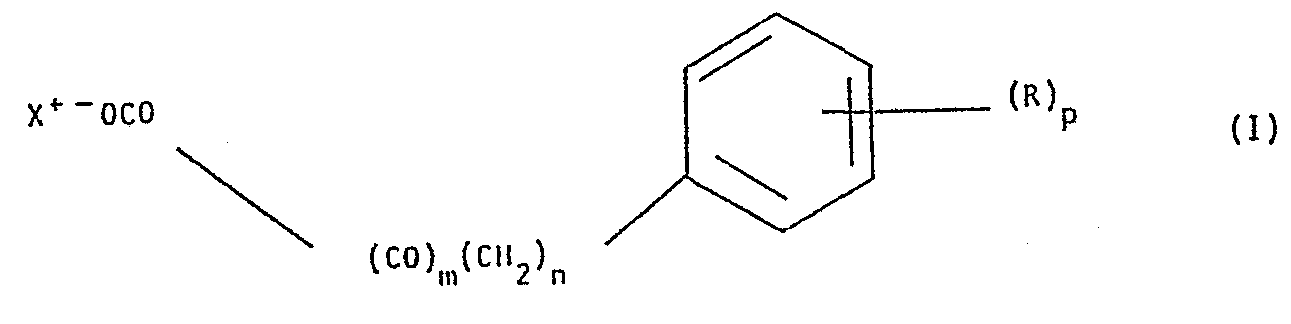
- a method of reducing the sweetness of an ingestible product containing a sweetening sugar or sugar alcohol by incorporating therein a sweetness-reducing amount of at least one compound of the general formula: in which m represents 0 or 1, and when m represents O, n represents 1, 2 or 3, and p represents 1, 2, 3 or 4, and when m represents 1, n represents 1 or 2 and p represents 0, 1, 2, 3 or 4; the substituents R, which may be the-same or different, each represent a lower alkoxy group, e.g.
- substituents R together represent an aliphatic chain linked to the phenyl ring at two positions, either directly or via an oxa-group, e.g. an alkylenedioxy. alkenylenedioxy, alkylenoxy or alkenylenoxy group; and/or one substituent R represents a hydroxy group while at least one other substituent R represents an alkoxy group; and X + represents a physiologically acceptable cation.
- an "ingestible product” there is meant one which in the ordinary course of use is intended to be swallowed, for instance, a foodstuff or beverage, or an orally administered pharmaceutical composition.
- the invention is particularly concerned with articles of confectionery.
- X + preferably represents an alkali metal, alkaline earth metal, or ammonium cation, especially the sodium ion and also the potassium or calcium ion, but can also represent a hydrogen ion.
- R preferably represents a methoxy group. Particularly advantageous results are obtained with the compounds of the general formula (I) in which m represents 0 and n represents 1. namely derivatives of phenyl acetic acid. In this series of compounds the substituents R are preferably present in the 3- and 4- positions or in the 4- position alone.
- substituents R are preferably present in the 3- and 4- positions as before, optionally in combination with a third substituent R in the 2- or 5- position.
- a single substituent R also gives good results, in any of the 2-, 3- or 4- positions.
- substituents R are again preferably in the 3- and 4- positions or in the 4- position alone.
- the most preferred pattern of substitution of the phenyl ring is for a substituent R to be in the p-position, preferably in combination with another substituent R in the m-position.
- Particularly preferred compounds for use according to the present invention thus include the alkali metal salts of:
- compounds of the general formula (I) may be synthesised by methods known in this art.
- Another general method involves the use of a corresponding substituted benzyl alcohol which is converted via the halide to the nitrile and hence to the carboxylic acid (Kondo and Oshima. J. Pharm. Soc, Japan, 51, 979, 1931).
- the intermediate phenylacetonitrile may also be used as the starting material.
- Phenylpropionic acid derivatives of formula (I) may be prepared by the method of Schopf et al. (Ann., 497. 52, 1932) by reduction of the corresponding cinnamic acid derivative, itself obtainable by a Perkin condensation of the appropriate benzaldehyde with acetic anhydride in the presence of sodium acetate.
- Pyruvic acid derivatives of formula (I) are obtainable by the method of Haworth et al. (J. Chem. Soc., 125, 1686, 1924) by condensation of the appropriate benzaldehyde with hippuric acid (benzamidoacetic acid) via an azlactone which is hydrolysed to give the arylpyruvic acid.
- This product can, in turn be oxidised to the corresponding arylacetic acid.
- the compounds of the general formula (I) are effective, for example, at a level of about 0.01 to 0.25% by weight of the composition, especially about 0.02 to 0.20%. Except at very high levels of sucrose, the ratio of inhibitor to sweetener is relevant and a range of about 0.1 to 2 parts by weight per hundred parts by weight of sucrose is effective. At this level, for example 1 part per 100 parts of sucrose, sodium 3,4-dimethoxyphenylacetate or sodium 4-methoxyphenylacetate gives a reduction in sweetness of over 80% when applied to a 5% sucrose solution. On a molar basis, about 0.01 to 0.02 moles of compound of formula (I) per mole of sucrose is required.
- the compounds of the general formula (I) are non-toxic and substantially tasteless. In mice they have an LD 50 of well over lg/Kg (no deaths at this level). The compound sodium 3.4-dimethoxyphenylacetate gives a negative Ames test in S. typhimurium.
- Sweetness Inhibitors - Dose-Response
- Panellists were given standard reference sucrose solutions 2%, 3%, 4%, 5%, 6%, 7%. 8%, 9%, 10% w/v. in Malvern water. Using these reference solutions they were asked to estimate the sweetness of a number of coded test sucrose solutions: 2.8, 5.5, 8.2, 3.6, 7.9, 6.4, 4.7, 8.8, 2.2% w/v sucrose in Malvern water
- Panellists were instructed to sip and spit and to rinse well with water between samples.
- Each inhibitor concentration experiment (I. II & III) was analysed separately. Each experiment was treated as a [20 (panellists) x 3(inhibitor 1,2,3) x 3 (sucrose concentration a,b,c)] experiment and analysis of variance carried out to determine differences between the effects of panellists inhibitors and sucrose concentrations and to determine any interactions between the effects of panellists, inhibitors and sucrose concentrations and to determine the factors.
- a cake for example, may contain about 25% sucrose but an aqueous solution at this concentration would be very unpleasant.
- the fat and sugar were creamed together and the eggs beaten in.
- the flour was then folded in and the mixture divided into paper cases (20-25g portions) and baked 25 minutes at 350-375°F (177-190°C). Cakes containing the inhibitor were noticeably less sweet, especially at the 0.14% level.
- the egg whites were beaten and the icing sugar mixed in gradually until smooth.
- the glycerine was then beaten in and sodium 3-(3,4-dimethoxyphenyl)propionate was added at 0.07% by weight.
- the icing was noticeably less sweet than a control. The effect was less marked than in cakes.
- the fat and sugar were creamed, the water was mixed in, and flavour added (e.g. 1 dsp. cocoa dissolved in water and cooled).
- flavour added e.g. 1 dsp. cocoa dissolved in water and cooled.
- Sodium 4-methoxyphenylacetate was dissolved in a small amount of water and incorporated into the icing at 0.07% by weight.
- the icing containing 0.07% inhibitor was obviously less sweet than a control containing no inhibitor.
- vanillin and butter All the ingredients except vanillin and butter were heated slowly to dissolve, then cooled to a temperature of 130°C.
- the vanillin and butter were added on removing from heat, together with sodium 4-ethoxyphenyl- acetate at 0.13% by weight, and the mass was poured onto an oiled slab, allowed to cool, and cut.
- sucrose syrup was transformed into a microcrystalline solid by the process of UK Patent No.1460614.
- the syrup contained 90% sucrose by weight plus 0.1% of sodium 3,4-dimethoxyphenylacetate.
- the product was a dry, friable, particulate product which could be used in a range of bakery and confectionery applications. Higher levels of the inhibitor (up to 1 or 2%) can be added instead of 0.1%.
- a glucose solid can be obtained from a glucose syrup containing the same inhibitor, by the process of UK Patent 2070015.
Landscapes
- Life Sciences & Earth Sciences (AREA)
- Engineering & Computer Science (AREA)
- Chemical & Material Sciences (AREA)
- Food Science & Technology (AREA)
- Polymers & Plastics (AREA)
- Health & Medical Sciences (AREA)
- Nutrition Science (AREA)
- Wood Science & Technology (AREA)
- Zoology (AREA)
- Proteomics, Peptides & Aminoacids (AREA)
- Molecular Biology (AREA)
- Inorganic Chemistry (AREA)
- Seasonings (AREA)
- Medicinal Preparation (AREA)
- General Preparation And Processing Of Foods (AREA)
- Massaging Devices (AREA)
- Organic Low-Molecular-Weight Compounds And Preparation Thereof (AREA)
- Sorption Type Refrigeration Machines (AREA)
- Control Of Motors That Do Not Use Commutators (AREA)
- Storage Of Fruits Or Vegetables (AREA)
- Steroid Compounds (AREA)
- Medicines Containing Antibodies Or Antigens For Use As Internal Diagnostic Agents (AREA)
- Ultra Sonic Daignosis Equipment (AREA)
- Coloring Foods And Improving Nutritive Qualities (AREA)
- Bakery Products And Manufacturing Methods Therefor (AREA)
- Confectionery (AREA)
- Noodles (AREA)
Abstract
Description
- This invention relates to the use of a series of aralkyl carboxylic acid salts as sweetness inhibitors and to sweet compositions containing them and which possess a lower degree of sweetness than corresponding compositions in which they are not included.
- Sugar, i.e. sucrose, is not only a sweetener, it is also an essential structural ingredient of many food products, especially in the field of confectionery. In the manufacture of chocolate and various sweets and candies, it is often desired to increase the sugar content of the composition but a limit is reached beyond which the product becomes too sweet or sickly. Similarly, the antimicrobial action of sugar as exhibited only at certain high levels, e.g. in jams and preserves. There is thus a need for a way of reducing the sweetness of a high sugar confectionery product so that a pleasant flavour can be obtained while the sugar content is kept high. A sugar such as sucrose, has properties which, were it not for the sweetening power, would render it of considerable interest in savoury food products such as soups, sauces and snack products and also "moist" pet foods. A sucrose which had "lost" its sweetness would thus be highly desirable in other food areas than confectionery. Other sweet sugars are similarly useful in part for their technical properties, for example high-fructose syrups.
- Another area in which the sweetness of sugars can be a problem is in the supply of carbohydrate to patients suffering from renal problems. Conventionally a concentrated glucose syrup is taken orally. This product is however difficult to take in quantity because of its sickly nature. Attempts have been made to render it more palatable with various flavourings. A less sweet product is clearly of considerable interest to the pharmacist.
- Finally, other sweet substances allied to sugars, such as the sugar alcohols, are useful for purposes not related to their sweetness, for example humectants such as sorbitol. Beyond a certain level these substances contribute a degree of sweetness which might be undesirable in some formulations.
- U.K.
patent application GB 2 066 639A describes and claims the substitution of sucrose in food products by isomaltulose. in order to reduce the sweetness. Such a process, of course, requires the manufacture of isomaltulose itself, which is generally obtained by enzymic isomerisation of sucrose. The incorporation of large quantities of isomaltulose into a food product must therefore, inevitably, increase the cost of the sugar content of the foodstuff. This technique obviously cannot be applied in the case of the glucose syrups mentioned above. - An alternative approach to the problem is to include in the foodstuff composition an ingredient which is designed to counteract the sweetness of the sugar. Thus, for example, the Virginia Dare Extract Company, Inc. of Brooklyn N.Y., U.S.A. are now marketing a blend of natural ingredients under the trade mark Contrasweet, for incorporation into confections such as creams, liquid centres, caramels, icings and fillings, fondants, fudges, hard candies etc. The problem with such a blend of natural ingredients, however, is that, apart from the fact that the sweetness-decreasing effect is limited, the material is strongly coloured and has a tendency to impart undesirable colour to pale products, particularly icings and fillings.
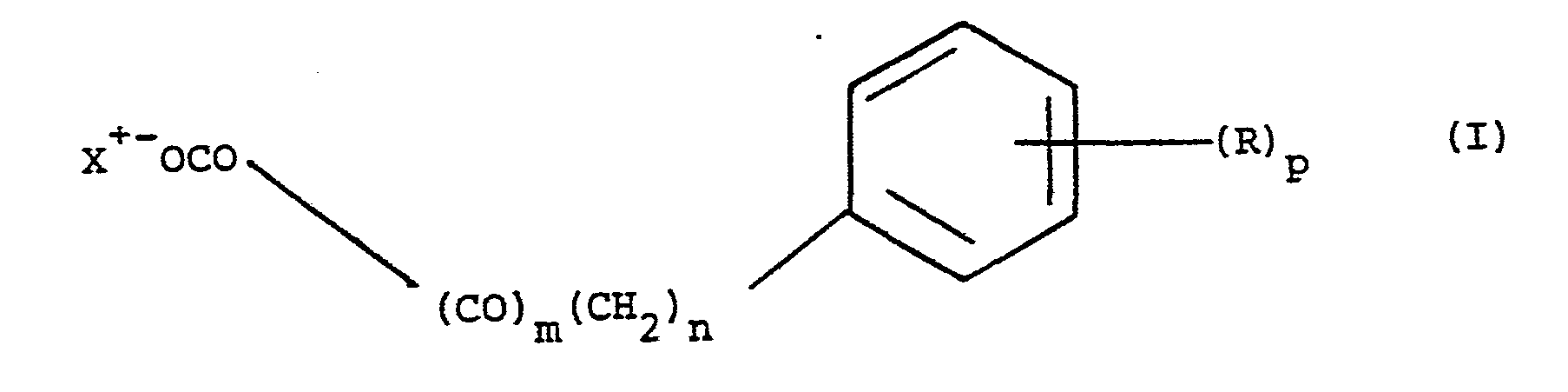
- We have now found that a particular class of non-toxic, substantially colourless, phenylalkanoic acid salts can effectively reduce the sweetness of sucrose and other sweeteners by 80% or even more when present in relatively small amounts. According to the present invention there is provided a method of reducing the sweetness of an ingestible product containing a sweetening sugar or sugar alcohol by incorporating therein a sweetness-reducing amount of at least one compound of the general formula:
- By an "ingestible product" there is meant one which in the ordinary course of use is intended to be swallowed, for instance, a foodstuff or beverage, or an orally administered pharmaceutical composition. The invention is particularly concerned with articles of confectionery.
- In the compound of the general formula (I), X+ preferably represents an alkali metal, alkaline earth metal, or ammonium cation, especially the sodium ion and also the potassium or calcium ion, but can also represent a hydrogen ion. R preferably represents a methoxy group. Particularly advantageous results are obtained with the compounds of the general formula (I) in which m represents 0 and n represents 1. namely derivatives of phenyl acetic acid. In this series of compounds the substituents R are preferably present in the 3- and 4- positions or in the 4- position alone. In the series where m represents 0 and n represents 2, namely the derivaties of phenyl propionic acid, the substituents R are preferably present in the 3- and 4- positions as before, optionally in combination with a third substituent R in the 2- or 5- position. A single substituent R also gives good results, in any of the 2-, 3- or 4- positions.
- In the series in which n represents 3, namely derivatives of phenylbutyric acid, the substituents R are again preferably in the 3- and 4- positions or in the 4- position alone.
- In the series where m represents 1 and n represents 1. namely derivatives of phenyl pyruvic acid, notable reduction of sweetness occurs when p represents 0, i.e. salts of phenylpyruvic acid itself. Otherwise substituents R are desirable, especially in the 3- and/or 4 portions.
- Thus, in general, the most preferred pattern of substitution of the phenyl ring is for a substituent R to be in the p-position, preferably in combination with another substituent R in the m-position.
- Particularly preferred compounds for use according to the present invention thus include the alkali metal salts of:
- 1 4-methoxyphenylacetic acid
- 2 3,4-dimethoxyphenylacetic acid
- 3 3-(2-methoxyphenyl)propionic acid
- 4 1,4-benzodioxan-6-acetic acid
- 5 4-ethoxyphenylacetic acid
- 6 3-(3,4-dimethoxyphenyl)propionic acid
- 7 3-(2,3,4-trimethoxyphenyl)propionic acid
- 8 3-(3,4,5-trimethoxyphenyl)propionic acid
- Other components of interest include the alkali metal salts of:
- 9 3-(4-methoxyphenyl)propionic acid
- 10 4-(4-methoxyphenyl)butyric acid
- 11 2-methoxyphenylacetic acid
- 12 3-methoxyphenylacetic acid
- 13 4-methylphenylacetic acid
- 14 4-trifluoromethylphenylacetic acid
- 15 phenylpyruvic acid
- All of these compounds are known compounds and are listed, for example, in the catalogue of Aldrich Co. Ltd.
- Alternatively, compounds of the general formula (I) may be synthesised by methods known in this art. For example the method of Harries and Adam (Berichte, 49, 1030, 1916) provides compounds in which p=2 (in the 3-and 4- positions) and R represents a 3-methoxy group and a 4-alkoxy group, by reaction of eugenol by etherification and oxidation. Another general method involves the use of a corresponding substituted benzyl alcohol which is converted via the halide to the nitrile and hence to the carboxylic acid (Kondo and Oshima. J. Pharm. Soc, Japan, 51, 979, 1931). The intermediate phenylacetonitrile may also be used as the starting material.
- Phenylpropionic acid derivatives of formula (I) may be prepared by the method of Schopf et al. (Ann., 497. 52, 1932) by reduction of the corresponding cinnamic acid derivative, itself obtainable by a Perkin condensation of the appropriate benzaldehyde with acetic anhydride in the presence of sodium acetate.
- Pyruvic acid derivatives of formula (I) are obtainable by the method of Haworth et al. (J. Chem. Soc., 125, 1686, 1924) by condensation of the appropriate benzaldehyde with hippuric acid (benzamidoacetic acid) via an azlactone which is hydrolysed to give the arylpyruvic acid. This product can, in turn be oxidised to the corresponding arylacetic acid.
- We have found that the compounds of the general formula (I) are effective, for example, at a level of about 0.01 to 0.25% by weight of the composition, especially about 0.02 to 0.20%. Except at very high levels of sucrose, the ratio of inhibitor to sweetener is relevant and a range of about 0.1 to 2 parts by weight per hundred parts by weight of sucrose is effective. At this level, for example 1 part per 100 parts of sucrose,
sodium 3,4-dimethoxyphenylacetate or sodium 4-methoxyphenylacetate gives a reduction in sweetness of over 80% when applied to a 5% sucrose solution. On a molar basis, about 0.01 to 0.02 moles of compound of formula (I) per mole of sucrose is required. Lesser sweetness reductions can obviously be obtained by incorporating the compound of formula (I) at lower levels, For other sweeteners, for example, a high glucose or fructose syrup, a similar effect can be obtained at a sweetness-related level, that is to say at a level similar to that used to reduce the sweetness of a corresponding amount of sucrose. However, the main commercial interest will obviously lie in use with sucrose. The compounds of use according to this invention do not diminish other flavours present in a foodstuff and do not discolour the product. - The compounds of the general formula (I) are non-toxic and substantially tasteless. In mice they have an LD50 of well over lg/Kg (no deaths at this level). The compound sodium 3.4-dimethoxyphenylacetate gives a negative Ames test in S. typhimurium.
- The compounds were tested accordingly to the following protocol:
- The following inhibitors were compared at equimolar concentrations.
-
- 1. 4-ethoxyphenylacetic acid (Na+) (M.W. = 180.15)
- 2. 3,4-dimethoxyphenylacetic acid (Na+) M.W. = 196.2
- 3. 3-(3,4-dimethoxyphenyl)propionic acid (Na+) M.W. = 210.23
- Three experiments were carried out. At each experiment a different concentration of inhibitor was tested:

- For each experiment all inhibitors were compared at the same concentration in 3 different sucrose concentrations.

- Panellists were given standard
reference sucrose solutions 2%, 3%, 4%, 5%, 6%, 7%. 8%, 9%, 10% w/v. in Malvern water. Using these reference solutions they were asked to estimate the sweetness of a number of coded test sucrose solutions: 2.8, 5.5, 8.2, 3.6, 7.9, 6.4, 4.7, 8.8, 2.2% w/v sucrose in Malvern water - Panellists were instructed to sip and spit and to rinse well with water between samples.
- 20 panellists were selected to participate in the sweetness inhibition experiments. These panellists all correctly estimated the % sucrose to ± 0.6% sucrose on average. A graph of actual sucrose concentration % w/v against perceived concentrations of sucrose % w/v for these 20 panellists is shown as Graph A in the accompanying drawings.
- In analysing Graph A, it will be seen that the intercept is -0.1337 and the gradient is 1.0202. giving a correlation coefficient of 0.9991.
- All samples were prepared in Malvern water. Reference samples were prepared at 2%, 3%, 4%; 5%, 6%, 7%. 8%, 9%, 10% sucrose w/v. The panellists were provided with the following test samples containing inhibitors:
-

-

-

- The inhibitor/sucrose solutions in the above experiments were tasted by a small laboratory panel to make sure sweetness levels lay within the range of the sucrose references before presenting the samples to the 20 panellists (experiments I, II, III).
- The inhibitor was dissolved in Malvern water with heat and stirring and made up to approximately 9/10 volume. Food grade N/10 NaOH was added until pH = 8.32 (that of Malvern water). This solution was then added to sucrose weighed into a volumetric flask and water added to full volume.
- At no time during the experiment were the panellists told that they were testing sweetness inhibitors (a bias could have resulted if this were the case). Panellists were given the 9 labelled reference sucrose solutions (2% - 10% sucrose) which they could taste whenever they wanted. At each experiment the 9 test sucrose/ inhibitors were presented coded with a 2 digit random number. The order of presentation of samples was randomised across the 20 panellists. Panellists were instructed to sip and spit and to rinse well with water between tasting samples and references.
- Each inhibitor concentration experiment (I. II & III) was analysed separately. Each experiment was treated as a [20 (panellists) x 3(
inhibitor - From the means of all the 20 panellists results. regression lines were drawn of perceived sucrose concentration against actual sucrose concentration for each inhibitor at each concentration and graphs were drawn of % inhibition against actual sucrose concentration using the formula

- From Graph B it can be seen that over the sucrose concentrations studied, the % inhibition is slightly greater at lower sucrose concentrations. However there is only a 10-15% change in % inhibition between 0.15 M sucrose and 0.30 M sucrose for all inhibitors at all concentrations.
- These are, of course, model aqueous solutions and do not bear a close resemblance to actual product situations where fat, protein, starch and other ingredients are present and can influence perception of sweetness. A cake, for example, may contain about 25% sucrose but an aqueous solution at this concentration would be very unpleasant.
- The following Examples illustrate the invention further:-
-
Sodium 3,4-dimethoxyphenylacetate was added at a level of 0.07% or 0.14% by weight to the following mix, after addition of the egg.
- The fat and sugar were creamed together and the eggs beaten in. The flour was then folded in and the mixture divided into paper cases (20-25g portions) and baked 25 minutes at 350-375°F (177-190°C). Cakes containing the inhibitor were noticeably less sweet, especially at the 0.14% level.
-
- 2 egg whites
- 400g icing sugar (sieved)
- 5ml glycerine
- The egg whites were beaten and the icing sugar mixed in gradually until smooth. The glycerine was then beaten in and sodium 3-(3,4-dimethoxyphenyl)propionate was added at 0.07% by weight. At 0.07% level of inhibitor, the icing was noticeably less sweet than a control. The effect was less marked than in cakes.
-
- 100g butter
- 100g icing sugar (sieved)
- 10 ml hot water.
- The fat and sugar were creamed, the water was mixed in, and flavour added (e.g. 1 dsp. cocoa dissolved in water and cooled). Sodium 4-methoxyphenylacetate was dissolved in a small amount of water and incorporated into the icing at 0.07% by weight.
- The icing containing 0.07% inhibitor was obviously less sweet than a control containing no inhibitor.
-

- The water and sugar were boiled, the glucose syrup added at 110°C, and temperature increased to 145°C. Sodium 1.4-benzodioxan-6-acetate was added at 0.13% by weight.
- The mixture poured onto an oiled marble slab, the acid and flavouring were kneaded in, and the mass was then cut into individual sweets.
-

- All the ingredients except vanillin and butter were heated slowly to dissolve, then cooled to a temperature of 130°C. The vanillin and butter were added on removing from heat, together with sodium 4-ethoxyphenyl- acetate at 0.13% by weight, and the mass was poured onto an oiled slab, allowed to cool, and cut.
- A sucrose syrup was transformed into a microcrystalline solid by the process of UK Patent No.1460614. The syrup contained 90% sucrose by weight plus 0.1% of
sodium 3,4-dimethoxyphenylacetate. The product was a dry, friable, particulate product which could be used in a range of bakery and confectionery applications. Higher levels of the inhibitor (up to 1 or 2%) can be added instead of 0.1%. - A glucose solid can be obtained from a glucose syrup containing the same inhibitor, by the process of UK Patent 2070015.
Claims (13)

Priority Applications (1)
| Application Number | Priority Date | Filing Date | Title |
|---|---|---|---|
| AT84302496T ATE21016T1 (en) | 1983-04-12 | 1984-04-12 | METHOD OF INHIBITING SWEET. |
Applications Claiming Priority (2)
| Application Number | Priority Date | Filing Date | Title |
|---|---|---|---|
| GB838309855A GB8309855D0 (en) | 1983-04-12 | 1983-04-12 | Flavour modifiers |
| GB8309855 | 1983-04-12 |
Publications (2)
| Publication Number | Publication Date |
|---|---|
| EP0125049A1 true EP0125049A1 (en) | 1984-11-14 |
| EP0125049B1 EP0125049B1 (en) | 1986-07-30 |
Family
ID=10540959
Family Applications (1)
| Application Number | Title | Priority Date | Filing Date |
|---|---|---|---|
| EP84302496A Expired EP0125049B1 (en) | 1983-04-12 | 1984-04-12 | Method of inhibiting sweetness |
Country Status (19)
| Country | Link |
|---|---|
| US (1) | US4567053A (en) |
| EP (1) | EP0125049B1 (en) |
| JP (1) | JPS6037951A (en) |
| AT (1) | ATE21016T1 (en) |
| AU (1) | AU563983B2 (en) |
| CA (1) | CA1211984A (en) |
| DE (1) | DE3460385D1 (en) |
| DK (1) | DK188684A (en) |
| ES (1) | ES8605368A1 (en) |
| FI (1) | FI78227C (en) |
| GB (2) | GB8309855D0 (en) |
| IL (1) | IL71518A (en) |
| MX (1) | MX7342E (en) |
| NO (1) | NO157802C (en) |
| NZ (1) | NZ207824A (en) |
| PH (1) | PH21376A (en) |
| PT (1) | PT78407B (en) |
| TR (1) | TR22337A (en) |
| ZA (1) | ZA842663B (en) |
Cited By (8)
| Publication number | Priority date | Publication date | Assignee | Title |
|---|---|---|---|---|
| EP0207516A1 (en) * | 1985-07-03 | 1987-01-07 | General Foods Corporation | An ingestible product containing a sweetness inhibitor and process for inhibiting sweetness in an ingestible product |
| EP0207515A1 (en) * | 1985-07-03 | 1987-01-07 | General Foods Corporation | An ingestible product containing a sweetness inhibitor and process for inhibiting sweetness in an ingestible product |
| EP0156317A3 (en) * | 1984-03-29 | 1987-03-18 | General Foods Corporation | Foodstuffs containing sweetness inhibiting agents and process for inhibiting the sweetness perception of a foodstuff |
| US4994490A (en) * | 1989-04-03 | 1991-02-19 | The Nutrasweet Company | Novel N-(sulfomethyl)-N'-arylureas |
| EP0351973A3 (en) * | 1988-07-21 | 1991-12-04 | Warner-Lambert Company | Savoury flavoured nonsweet compositions using sweet carbohydrate bulking agents and processes for their preparation |
| EP0414550A3 (en) * | 1989-08-25 | 1992-03-18 | Warner-Lambert Company | A salt substitute granule |
| US5266717A (en) * | 1989-04-03 | 1993-11-30 | Glenn Roy | N-(sulfomethyl)-N'arylureas |
| EP2055196A1 (en) * | 2007-10-29 | 2009-05-06 | Givaudan SA | Sweet flavour modulating carboxyalkyl-substituted phenyl derivatives |
Families Citing this family (24)
| Publication number | Priority date | Publication date | Assignee | Title |
|---|---|---|---|---|
| IL74842A (en) * | 1984-04-12 | 1988-04-29 | Tate & Lyle Plc | Method of modifying taste |
| US4792453A (en) * | 1987-05-04 | 1988-12-20 | Wm. Wrigley Jr. Company | Hard coated sugarless chewing gum |
| US4910031A (en) * | 1988-12-19 | 1990-03-20 | Frito-Lay, Inc. | Topped savory snack foods |
| US4912255A (en) * | 1989-04-13 | 1990-03-27 | Chan Albert S | Process for preparing sodium phenylpyruvate from calcium phenylpyruvate |
| US5302752A (en) * | 1989-10-30 | 1994-04-12 | Ethyl Corporation | Acetic acid derivatives and their production |
| US5021249A (en) * | 1989-11-09 | 1991-06-04 | Warner-Lambert Company | Method of making a savory flavor granule and a free flowing savory flavor granule |
| US5232735A (en) * | 1990-06-01 | 1993-08-03 | Bioresearch, Inc. | Ingestibles containing substantially tasteless sweetness inhibitors as bitter taste reducers or substantially tasteless bitter inhibitors as sweet taste reducers |
| US5637618A (en) * | 1990-06-01 | 1997-06-10 | Bioresearch, Inc. | Specific eatable taste modifiers |
| CA2117284A1 (en) * | 1991-11-27 | 1993-06-10 | Bioresearch, Inc. | Specific eatable taste modifiers |
| US5248508A (en) * | 1992-03-23 | 1993-09-28 | Wm. Wrigley Jr. Company | Hard coated gum with improved shelf life |
| US5286502A (en) * | 1992-04-21 | 1994-02-15 | Wm. Wrigley Jr. Company | Use of edible film to prolong chewing gum shelf life |
| US5501869A (en) * | 1992-12-28 | 1996-03-26 | Kraft Foods, Inc. | Fat-free tablespread and method of making |
| US6403134B1 (en) * | 2000-08-14 | 2002-06-11 | Kraft Foods Holdings, Inc. | Premium quality intermediate moisture vegetables and method of making |
| DE10122898A1 (en) * | 2001-05-11 | 2002-11-14 | Haarmann & Reimer Gmbh | Use of hydroxyflavanones to mask the bitter taste |
| EP1412750B1 (en) | 2001-06-26 | 2012-05-23 | Senomyx, Inc. | T1r2-t1r3 hetero-oligomeric sweet taste receptors and cell lines that express said receptors and use thereof for identification of sweet taste compounds |
| US20060088638A1 (en) * | 2002-07-29 | 2006-04-27 | Merkel Carolyn M | Method of improving sweetness delivery of sucralose |
| EP1659881B1 (en) | 2003-08-06 | 2019-04-03 | Senomyx Inc. | Novel flavors, flavor modifiers, tastants, taste enhancers, umami or sweet tastants, and/or enhancers and use thereof |
| AU2005286494B2 (en) * | 2004-09-22 | 2011-06-23 | Vib Vzw | Intestinal epithelial glucose sensor |
| US20060247180A1 (en) * | 2005-04-29 | 2006-11-02 | Bergey James L | Purgative composition and uses thereof |
| CA2616330C (en) | 2005-08-12 | 2011-04-26 | Cadbury Adams Usa Llc | Mouth-moistening compositions, delivery systems containing same and methods of making same |
| US20090170949A1 (en) * | 2006-01-25 | 2009-07-02 | Soraya Shirazi-Beechey | Method To Control Body Weight |
| DK3235811T3 (en) | 2006-04-21 | 2018-11-12 | Senomyx Inc | PROCEDURE FOR THE PREPARATION OF OXALAMIDS |
| EP2605664A1 (en) | 2010-08-18 | 2013-06-26 | Kraft Foods Global Brands LLC | Mouth-moistening gum compositions and products containing the same |
| AU2011291960B2 (en) | 2010-08-18 | 2013-12-19 | Intercontinental Great Brands Llc | Mouth-moistening gum compositions and products containing the same |
Citations (1)
| Publication number | Priority date | Publication date | Assignee | Title |
|---|---|---|---|---|
| EP0028897A1 (en) * | 1979-11-07 | 1981-05-20 | TATE & LYLE PUBLIC LIMITED COMPANY | Preparation of products for human or animal consumption using a sucrose substitute |
Family Cites Families (3)
| Publication number | Priority date | Publication date | Assignee | Title |
|---|---|---|---|---|
| EG11383A (en) * | 1972-07-11 | 1979-03-31 | Sumitomo Chemical Co | Novel composition for controlling nixious insects and process for preparing thereof |
| US4277464A (en) * | 1975-09-19 | 1981-07-07 | General Foods Corporation | Preventing tooth demineralization using aspartame |
| US4332824A (en) * | 1979-03-26 | 1982-06-01 | Rich Products Corporation | Intermediate-moisture frozen foods |
-
1983
- 1983-04-12 GB GB838309855A patent/GB8309855D0/en active Pending
-
1984
- 1984-04-11 ES ES531525A patent/ES8605368A1/en not_active Expired
- 1984-04-11 US US06/599,260 patent/US4567053A/en not_active Expired - Lifetime
- 1984-04-11 ZA ZA842663A patent/ZA842663B/en unknown
- 1984-04-11 CA CA000451733A patent/CA1211984A/en not_active Expired
- 1984-04-11 DK DK188684A patent/DK188684A/en not_active Application Discontinuation
- 1984-04-11 PT PT78407A patent/PT78407B/en not_active IP Right Cessation
- 1984-04-11 PH PH30534A patent/PH21376A/en unknown
- 1984-04-11 NO NO841429A patent/NO157802C/en unknown
- 1984-04-12 TR TR2865/84A patent/TR22337A/en unknown
- 1984-04-12 DE DE8484302496T patent/DE3460385D1/en not_active Expired
- 1984-04-12 JP JP59071926A patent/JPS6037951A/en active Pending
- 1984-04-12 IL IL71518A patent/IL71518A/en unknown
- 1984-04-12 FI FI841472A patent/FI78227C/en not_active IP Right Cessation
- 1984-04-12 AU AU26767/84A patent/AU563983B2/en not_active Ceased
- 1984-04-12 NZ NZ207824A patent/NZ207824A/en unknown
- 1984-04-12 EP EP84302496A patent/EP0125049B1/en not_active Expired
- 1984-04-12 AT AT84302496T patent/ATE21016T1/en not_active IP Right Cessation
- 1984-04-12 GB GB08409513A patent/GB2139470A/en not_active Withdrawn
- 1984-04-12 MX MX8411093U patent/MX7342E/en unknown
Patent Citations (1)
| Publication number | Priority date | Publication date | Assignee | Title |
|---|---|---|---|---|
| EP0028897A1 (en) * | 1979-11-07 | 1981-05-20 | TATE & LYLE PUBLIC LIMITED COMPANY | Preparation of products for human or animal consumption using a sucrose substitute |
Non-Patent Citations (1)
| Title |
|---|
| JOURNAL OF AGRICULTURAL AND FOOD CHEMISTRY, vol. 27, no. 3, May/June 1979 J.G. SWEENY et al. "Suppression of the sweetness of 2',3-dihydroxy-4-methoxydihydrochalcone by alpha-hydroxylation", pages 467-469 * |
Cited By (9)
| Publication number | Priority date | Publication date | Assignee | Title |
|---|---|---|---|---|
| EP0156317A3 (en) * | 1984-03-29 | 1987-03-18 | General Foods Corporation | Foodstuffs containing sweetness inhibiting agents and process for inhibiting the sweetness perception of a foodstuff |
| EP0207516A1 (en) * | 1985-07-03 | 1987-01-07 | General Foods Corporation | An ingestible product containing a sweetness inhibitor and process for inhibiting sweetness in an ingestible product |
| EP0207515A1 (en) * | 1985-07-03 | 1987-01-07 | General Foods Corporation | An ingestible product containing a sweetness inhibitor and process for inhibiting sweetness in an ingestible product |
| EP0351973A3 (en) * | 1988-07-21 | 1991-12-04 | Warner-Lambert Company | Savoury flavoured nonsweet compositions using sweet carbohydrate bulking agents and processes for their preparation |
| US4994490A (en) * | 1989-04-03 | 1991-02-19 | The Nutrasweet Company | Novel N-(sulfomethyl)-N'-arylureas |
| US5266717A (en) * | 1989-04-03 | 1993-11-30 | Glenn Roy | N-(sulfomethyl)-N'arylureas |
| EP0414550A3 (en) * | 1989-08-25 | 1992-03-18 | Warner-Lambert Company | A salt substitute granule |
| EP2055196A1 (en) * | 2007-10-29 | 2009-05-06 | Givaudan SA | Sweet flavour modulating carboxyalkyl-substituted phenyl derivatives |
| WO2009055953A1 (en) | 2007-10-29 | 2009-05-07 | Givaudan Sa | Flavour-modulating compounds |
Also Published As
| Publication number | Publication date |
|---|---|
| DK188684D0 (en) | 1984-04-11 |
| GB2139470A (en) | 1984-11-14 |
| TR22337A (en) | 1987-02-16 |
| FI841472A0 (en) | 1984-04-12 |
| NO157802B (en) | 1988-02-15 |
| AU563983B2 (en) | 1987-07-30 |
| ES8605368A1 (en) | 1986-03-16 |
| IL71518A (en) | 1988-03-31 |
| FI78227C (en) | 1989-07-10 |
| PT78407A (en) | 1984-05-01 |
| ATE21016T1 (en) | 1986-08-15 |
| PT78407B (en) | 1986-05-27 |
| NO157802C (en) | 1988-06-01 |
| FI841472L (en) | 1984-10-13 |
| AU2676784A (en) | 1984-10-18 |
| FI78227B (en) | 1989-03-31 |
| CA1211984A (en) | 1986-09-30 |
| ES531525A0 (en) | 1986-03-16 |
| NZ207824A (en) | 1987-05-29 |
| ZA842663B (en) | 1985-03-27 |
| IL71518A0 (en) | 1984-07-31 |
| DK188684A (en) | 1984-10-13 |
| MX7342E (en) | 1988-07-01 |
| GB8309855D0 (en) | 1983-05-18 |
| EP0125049B1 (en) | 1986-07-30 |
| JPS6037951A (en) | 1985-02-27 |
| PH21376A (en) | 1987-10-15 |
| DE3460385D1 (en) | 1986-09-04 |
| US4567053A (en) | 1986-01-28 |
| NO841429L (en) | 1984-10-15 |
Similar Documents
| Publication | Publication Date | Title |
|---|---|---|
| EP0125049B1 (en) | Method of inhibiting sweetness | |
| EP0159864B1 (en) | Method of modifying taste | |
| US11653685B2 (en) | D-psicose-containing sweetener and foods and drinks and the like obtained by using same | |
| ES2389709T3 (en) | Use of 1- (2,4-dihydroxyphenyl) -3- (3-hydroxy-4-methoxyphenyl) -propan-1-one | |
| US20200205445A1 (en) | Reduced-sweetener products, flavoring mixtures for said reduced-sweetener products and process for the production of products of this type | |
| CA1229763A (en) | Foodstuffs containing sweetness inhibiting agents | |
| US20080220140A1 (en) | Use of propenylphenyl glycosides for enhancing sweet sensory impressions | |
| EP0139430B1 (en) | Synergistic sweetening compositions | |
| JP2009502153A (en) | Use of hesperetin to enhance sweetness | |
| JP5597651B2 (en) | Off taste masking | |
| US4001453A (en) | Sweetening compositions | |
| CA1051260A (en) | Sugar substitute | |
| US11540542B2 (en) | Taste modulating aldehydes | |
| CN116326616B (en) | Health-care baked food for weight loss and preparation method thereof | |
| JP2001046012A (en) | Flavor improver and tablet-like composition using the same | |
| JPH0238181B2 (en) | ||
| JP7785336B2 (en) | Sweeteners and their uses | |
| JPH0616687B2 (en) | Low calorie food and drink | |
| JPS63258556A (en) | Production of food and drink |
Legal Events
| Date | Code | Title | Description |
|---|---|---|---|
| PUAI | Public reference made under article 153(3) epc to a published international application that has entered the european phase |
Free format text: ORIGINAL CODE: 0009012 |
|
| AK | Designated contracting states |
Designated state(s): AT BE CH DE FR GB IT LI LU NL SE |
|
| 17P | Request for examination filed |
Effective date: 19841212 |
|
| GRAA | (expected) grant |
Free format text: ORIGINAL CODE: 0009210 |
|
| ITF | It: translation for a ep patent filed | ||
| AK | Designated contracting states |
Kind code of ref document: B1 Designated state(s): AT BE CH DE FR GB IT LI LU NL SE |
|
| REF | Corresponds to: |
Ref document number: 21016 Country of ref document: AT Date of ref document: 19860815 Kind code of ref document: T |
|
| REF | Corresponds to: |
Ref document number: 3460385 Country of ref document: DE Date of ref document: 19860904 |
|
| ET | Fr: translation filed | ||
| PG25 | Lapsed in a contracting state [announced via postgrant information from national office to epo] |
Ref country code: LU Free format text: LAPSE BECAUSE OF NON-PAYMENT OF DUE FEES Effective date: 19870430 |
|
| PLBE | No opposition filed within time limit |
Free format text: ORIGINAL CODE: 0009261 |
|
| STAA | Information on the status of an ep patent application or granted ep patent |
Free format text: STATUS: NO OPPOSITION FILED WITHIN TIME LIMIT |
|
| 26N | No opposition filed | ||
| PGFP | Annual fee paid to national office [announced via postgrant information from national office to epo] |
Ref country code: GB Payment date: 19900402 Year of fee payment: 7 |
|
| PGFP | Annual fee paid to national office [announced via postgrant information from national office to epo] |
Ref country code: AT Payment date: 19900411 Year of fee payment: 7 |
|
| PGFP | Annual fee paid to national office [announced via postgrant information from national office to epo] |
Ref country code: CH Payment date: 19900412 Year of fee payment: 7 |
|
| PGFP | Annual fee paid to national office [announced via postgrant information from national office to epo] |
Ref country code: FR Payment date: 19900415 Year of fee payment: 7 |
|
| PGFP | Annual fee paid to national office [announced via postgrant information from national office to epo] |
Ref country code: BE Payment date: 19900417 Year of fee payment: 7 |
|
| PGFP | Annual fee paid to national office [announced via postgrant information from national office to epo] |
Ref country code: SE Payment date: 19900418 Year of fee payment: 7 |
|
| ITTA | It: last paid annual fee | ||
| PGFP | Annual fee paid to national office [announced via postgrant information from national office to epo] |
Ref country code: NL Payment date: 19900430 Year of fee payment: 7 |
|
| PGFP | Annual fee paid to national office [announced via postgrant information from national office to epo] |
Ref country code: LU Payment date: 19900509 Year of fee payment: 7 |
|
| PGFP | Annual fee paid to national office [announced via postgrant information from national office to epo] |
Ref country code: DE Payment date: 19900531 Year of fee payment: 7 |
|
| PG25 | Lapsed in a contracting state [announced via postgrant information from national office to epo] |
Ref country code: GB Effective date: 19910412 Ref country code: AT Effective date: 19910412 |
|
| PG25 | Lapsed in a contracting state [announced via postgrant information from national office to epo] |
Ref country code: SE Effective date: 19910413 |
|
| PG25 | Lapsed in a contracting state [announced via postgrant information from national office to epo] |
Ref country code: LI Effective date: 19910430 Ref country code: CH Effective date: 19910430 Ref country code: BE Effective date: 19910430 |
|
| BERE | Be: lapsed |
Owner name: TATE & LYLE P.L.C. Effective date: 19910430 |
|
| PG25 | Lapsed in a contracting state [announced via postgrant information from national office to epo] |
Ref country code: NL Effective date: 19911101 |
|
| GBPC | Gb: european patent ceased through non-payment of renewal fee | ||
| NLV4 | Nl: lapsed or anulled due to non-payment of the annual fee | ||
| PG25 | Lapsed in a contracting state [announced via postgrant information from national office to epo] |
Ref country code: FR Effective date: 19911230 |
|
| REG | Reference to a national code |
Ref country code: CH Ref legal event code: PL |
|
| PG25 | Lapsed in a contracting state [announced via postgrant information from national office to epo] |
Ref country code: DE Effective date: 19920201 |
|
| REG | Reference to a national code |
Ref country code: FR Ref legal event code: ST |
|
| EUG | Se: european patent has lapsed |
Ref document number: 84302496.9 Effective date: 19911108 |