EP0124292B1 - Water based photopolymerisable compositions and their use - Google Patents
Water based photopolymerisable compositions and their use Download PDFInfo
- Publication number
- EP0124292B1 EP0124292B1 EP84302232A EP84302232A EP0124292B1 EP 0124292 B1 EP0124292 B1 EP 0124292B1 EP 84302232 A EP84302232 A EP 84302232A EP 84302232 A EP84302232 A EP 84302232A EP 0124292 B1 EP0124292 B1 EP 0124292B1
- Authority
- EP
- European Patent Office
- Prior art keywords
- composition according
- composition
- image
- water
- hexafluorophosphate
- Prior art date
- Legal status (The legal status is an assumption and is not a legal conclusion. Google has not performed a legal analysis and makes no representation as to the accuracy of the status listed.)
- Expired
Links
- 239000000203 mixture Substances 0.000 title claims abstract description 60
- XLYOFNOQVPJJNP-UHFFFAOYSA-N water Substances O XLYOFNOQVPJJNP-UHFFFAOYSA-N 0.000 title claims abstract description 20
- -1 sensitizers Substances 0.000 claims abstract description 32
- 150000003839 salts Chemical class 0.000 claims abstract description 14
- 239000000945 filler Substances 0.000 claims abstract description 7
- 239000004014 plasticizer Substances 0.000 claims abstract description 6
- 150000001875 compounds Chemical class 0.000 claims abstract description 5
- 239000006185 dispersion Substances 0.000 claims abstract description 5
- 238000007639 printing Methods 0.000 claims abstract description 4
- 239000003822 epoxy resin Substances 0.000 claims description 16
- 229920000647 polyepoxide Polymers 0.000 claims description 16
- 230000005855 radiation Effects 0.000 claims description 13
- 239000003085 diluting agent Substances 0.000 claims description 10
- LNEPOXFFQSENCJ-UHFFFAOYSA-N haloperidol Chemical compound C1CC(O)(C=2C=CC(Cl)=CC=2)CCN1CCCC(=O)C1=CC=C(F)C=C1 LNEPOXFFQSENCJ-UHFFFAOYSA-N 0.000 claims description 10
- 239000004593 Epoxy Substances 0.000 claims description 9
- 239000000084 colloidal system Substances 0.000 claims description 8
- 238000000034 method Methods 0.000 claims description 7
- 231100000489 sensitizer Toxicity 0.000 claims description 7
- 125000000217 alkyl group Chemical group 0.000 claims description 6
- 238000000576 coating method Methods 0.000 claims description 6
- 239000004094 surface-active agent Substances 0.000 claims description 6
- RWSOTUBLDIXVET-UHFFFAOYSA-N Dihydrogen sulfide Chemical group S RWSOTUBLDIXVET-UHFFFAOYSA-N 0.000 claims description 5
- 239000011248 coating agent Substances 0.000 claims description 5
- 239000003960 organic solvent Substances 0.000 claims description 5
- 229920000642 polymer Polymers 0.000 claims description 5
- 238000007650 screen-printing Methods 0.000 claims description 5
- GJNKQJAJXSUJBO-UHFFFAOYSA-N 9,10-diethoxyanthracene Chemical group C1=CC=C2C(OCC)=C(C=CC=C3)C3=C(OCC)C2=C1 GJNKQJAJXSUJBO-UHFFFAOYSA-N 0.000 claims description 4
- VYPSYNLAJGMNEJ-UHFFFAOYSA-N Silicium dioxide Chemical compound O=[Si]=O VYPSYNLAJGMNEJ-UHFFFAOYSA-N 0.000 claims description 4
- GWEVSGVZZGPLCZ-UHFFFAOYSA-N Titan oxide Chemical compound O=[Ti]=O GWEVSGVZZGPLCZ-UHFFFAOYSA-N 0.000 claims description 4
- 125000002252 acyl group Chemical group 0.000 claims description 4
- 125000003545 alkoxy group Chemical group 0.000 claims description 4
- 125000003118 aryl group Chemical group 0.000 claims description 4
- 229920002451 polyvinyl alcohol Polymers 0.000 claims description 4
- 230000003595 spectral effect Effects 0.000 claims description 4
- ZWAJLVLEBYIOTI-OLQVQODUSA-N (1s,6r)-7-oxabicyclo[4.1.0]heptane Chemical compound C1CCC[C@@H]2O[C@@H]21 ZWAJLVLEBYIOTI-OLQVQODUSA-N 0.000 claims description 3
- OECTYKWYRCHAKR-UHFFFAOYSA-N 4-vinylcyclohexene dioxide Chemical compound C1OC1C1CC2OC2CC1 OECTYKWYRCHAKR-UHFFFAOYSA-N 0.000 claims description 3
- RBHIUNHSNSQJNG-UHFFFAOYSA-N 6-methyl-3-(2-methyloxiran-2-yl)-7-oxabicyclo[4.1.0]heptane Chemical compound C1CC2(C)OC2CC1C1(C)CO1 RBHIUNHSNSQJNG-UHFFFAOYSA-N 0.000 claims description 3
- YXALYBMHAYZKAP-UHFFFAOYSA-N 7-oxabicyclo[4.1.0]heptan-4-ylmethyl 7-oxabicyclo[4.1.0]heptane-4-carboxylate Chemical compound C1CC2OC2CC1C(=O)OCC1CC2OC2CC1 YXALYBMHAYZKAP-UHFFFAOYSA-N 0.000 claims description 3
- 239000004372 Polyvinyl alcohol Substances 0.000 claims description 3
- 239000003139 biocide Substances 0.000 claims description 3
- GYZLOYUZLJXAJU-UHFFFAOYSA-N diglycidyl ether Chemical class C1OC1COCC1CO1 GYZLOYUZLJXAJU-UHFFFAOYSA-N 0.000 claims description 3
- 239000011256 inorganic filler Substances 0.000 claims description 3
- 229910003475 inorganic filler Inorganic materials 0.000 claims description 3
- 239000002736 nonionic surfactant Substances 0.000 claims description 3
- RPQRDASANLAFCM-UHFFFAOYSA-N oxiran-2-ylmethyl prop-2-enoate Chemical class C=CC(=O)OCC1CO1 RPQRDASANLAFCM-UHFFFAOYSA-N 0.000 claims description 3
- VLTRZXGMWDSKGL-UHFFFAOYSA-M perchlorate Inorganic materials [O-]Cl(=O)(=O)=O VLTRZXGMWDSKGL-UHFFFAOYSA-M 0.000 claims description 3
- VLTRZXGMWDSKGL-UHFFFAOYSA-N perchloric acid Chemical compound OCl(=O)(=O)=O VLTRZXGMWDSKGL-UHFFFAOYSA-N 0.000 claims description 3
- 235000019422 polyvinyl alcohol Nutrition 0.000 claims description 3
- 239000003381 stabilizer Substances 0.000 claims description 3
- 125000000547 substituted alkyl group Chemical group 0.000 claims description 3
- ILAVXECZWNVQEX-UHFFFAOYSA-N 4-phenoxy-5-sulfanyloxythiophen-3-ol Chemical compound OC=1C(=C(SC1)OS)OC1=CC=CC=C1 ILAVXECZWNVQEX-UHFFFAOYSA-N 0.000 claims description 2
- 239000005995 Aluminium silicate Substances 0.000 claims description 2
- 108010010803 Gelatin Proteins 0.000 claims description 2
- 229920002153 Hydroxypropyl cellulose Polymers 0.000 claims description 2
- 229920002472 Starch Polymers 0.000 claims description 2
- 235000012211 aluminium silicate Nutrition 0.000 claims description 2
- 230000003115 biocidal effect Effects 0.000 claims description 2
- 125000002091 cationic group Chemical group 0.000 claims description 2
- 125000004093 cyano group Chemical group *C#N 0.000 claims description 2
- 125000000753 cycloalkyl group Chemical group 0.000 claims description 2
- 229920000159 gelatin Polymers 0.000 claims description 2
- 239000008273 gelatin Substances 0.000 claims description 2
- 235000019322 gelatine Nutrition 0.000 claims description 2
- 235000011852 gelatine desserts Nutrition 0.000 claims description 2
- 229910052736 halogen Inorganic materials 0.000 claims description 2
- 125000005843 halogen group Chemical group 0.000 claims description 2
- 150000002367 halogens Chemical class 0.000 claims description 2
- 125000000623 heterocyclic group Chemical group 0.000 claims description 2
- 229920001519 homopolymer Polymers 0.000 claims description 2
- 239000001257 hydrogen Substances 0.000 claims description 2
- 229910052739 hydrogen Inorganic materials 0.000 claims description 2
- 150000002431 hydrogen Chemical class 0.000 claims description 2
- XMBWDFGMSWQBCA-UHFFFAOYSA-N hydrogen iodide Chemical group I XMBWDFGMSWQBCA-UHFFFAOYSA-N 0.000 claims description 2
- 239000001863 hydroxypropyl cellulose Substances 0.000 claims description 2
- 235000010977 hydroxypropyl cellulose Nutrition 0.000 claims description 2
- NLYAJNPCOHFWQQ-UHFFFAOYSA-N kaolin Chemical compound O.O.O=[Al]O[Si](=O)O[Si](=O)O[Al]=O NLYAJNPCOHFWQQ-UHFFFAOYSA-N 0.000 claims description 2
- 229910052751 metal Inorganic materials 0.000 claims description 2
- 239000002184 metal Substances 0.000 claims description 2
- 125000000449 nitro group Chemical group [O-][N+](*)=O 0.000 claims description 2
- 239000000049 pigment Substances 0.000 claims description 2
- 229920002689 polyvinyl acetate Polymers 0.000 claims description 2
- 239000011118 polyvinyl acetate Substances 0.000 claims description 2
- 239000004800 polyvinyl chloride Substances 0.000 claims description 2
- 229920000915 polyvinyl chloride Polymers 0.000 claims description 2
- 229920000036 polyvinylpyrrolidone Polymers 0.000 claims description 2
- 239000001267 polyvinylpyrrolidone Substances 0.000 claims description 2
- 235000013855 polyvinylpyrrolidone Nutrition 0.000 claims description 2
- 230000035945 sensitivity Effects 0.000 claims description 2
- 239000000377 silicon dioxide Substances 0.000 claims description 2
- 239000008107 starch Substances 0.000 claims description 2
- 235000019698 starch Nutrition 0.000 claims description 2
- 239000004408 titanium dioxide Substances 0.000 claims description 2
- DOIRQSBPFJWKBE-UHFFFAOYSA-N dibutyl phthalate Chemical group CCCCOC(=O)C1=CC=CC=C1C(=O)OCCCC DOIRQSBPFJWKBE-UHFFFAOYSA-N 0.000 claims 2
- 239000013530 defoamer Substances 0.000 claims 1
- 229960002380 dibutyl phthalate Drugs 0.000 claims 1
- 230000001678 irradiating effect Effects 0.000 claims 1
- 238000005406 washing Methods 0.000 abstract description 9
- 239000004615 ingredient Substances 0.000 abstract description 2
- IISBACLAFKSPIT-UHFFFAOYSA-N bisphenol A Chemical compound C=1C=C(O)C=CC=1C(C)(C)C1=CC=C(O)C=C1 IISBACLAFKSPIT-UHFFFAOYSA-N 0.000 description 8
- 229910052753 mercury Inorganic materials 0.000 description 6
- 229920000728 polyester Polymers 0.000 description 5
- 229920005989 resin Polymers 0.000 description 5
- 239000011347 resin Substances 0.000 description 5
- BRLQWZUYTZBJKN-UHFFFAOYSA-N Epichlorohydrin Chemical compound ClCC1CO1 BRLQWZUYTZBJKN-UHFFFAOYSA-N 0.000 description 4
- 238000001723 curing Methods 0.000 description 4
- 239000000126 substance Substances 0.000 description 4
- OWYWGLHRNBIFJP-UHFFFAOYSA-N Ipazine Chemical compound CCN(CC)C1=NC(Cl)=NC(NC(C)C)=N1 OWYWGLHRNBIFJP-UHFFFAOYSA-N 0.000 description 3
- 239000011093 chipboard Substances 0.000 description 3
- 239000000839 emulsion Substances 0.000 description 3
- 239000000463 material Substances 0.000 description 3
- CSCPPACGZOOCGX-UHFFFAOYSA-N Acetone Chemical compound CC(C)=O CSCPPACGZOOCGX-UHFFFAOYSA-N 0.000 description 2
- 229920003319 Araldite® Polymers 0.000 description 2
- IJGRMHOSHXDMSA-UHFFFAOYSA-N Atomic nitrogen Chemical compound N#N IJGRMHOSHXDMSA-UHFFFAOYSA-N 0.000 description 2
- 241001251094 Formica Species 0.000 description 2
- 150000001412 amines Chemical class 0.000 description 2
- 239000012736 aqueous medium Substances 0.000 description 2
- 239000007795 chemical reaction product Substances 0.000 description 2
- 239000003795 chemical substances by application Substances 0.000 description 2
- 238000000354 decomposition reaction Methods 0.000 description 2
- SWXVUIWOUIDPGS-UHFFFAOYSA-N diacetone alcohol Chemical compound CC(=O)CC(C)(C)O SWXVUIWOUIDPGS-UHFFFAOYSA-N 0.000 description 2
- 239000000975 dye Substances 0.000 description 2
- 238000005516 engineering process Methods 0.000 description 2
- 239000004744 fabric Substances 0.000 description 2
- MGFYSGNNHQQTJW-UHFFFAOYSA-N iodonium Chemical compound [IH2+] MGFYSGNNHQQTJW-UHFFFAOYSA-N 0.000 description 2
- 239000011968 lewis acid catalyst Substances 0.000 description 2
- ZBJVLWIYKOAYQH-UHFFFAOYSA-N naphthalen-2-yl 2-hydroxybenzoate Chemical compound OC1=CC=CC=C1C(=O)OC1=CC=C(C=CC=C2)C2=C1 ZBJVLWIYKOAYQH-UHFFFAOYSA-N 0.000 description 2
- 229920003986 novolac Polymers 0.000 description 2
- ZMRUPTIKESYGQW-UHFFFAOYSA-N propranolol hydrochloride Chemical compound [H+].[Cl-].C1=CC=C2C(OCC(O)CNC(C)C)=CC=CC2=C1 ZMRUPTIKESYGQW-UHFFFAOYSA-N 0.000 description 2
- 239000002904 solvent Substances 0.000 description 2
- 238000003860 storage Methods 0.000 description 2
- 239000000758 substrate Substances 0.000 description 2
- 230000002110 toxicologic effect Effects 0.000 description 2
- 231100000027 toxicology Toxicity 0.000 description 2
- WJFKNYWRSNBZNX-UHFFFAOYSA-N 10H-phenothiazine Chemical compound C1=CC=C2NC3=CC=CC=C3SC2=C1 WJFKNYWRSNBZNX-UHFFFAOYSA-N 0.000 description 1
- HPILSDOMLLYBQF-UHFFFAOYSA-N 2-[1-(oxiran-2-ylmethoxy)butoxymethyl]oxirane Chemical compound C1OC1COC(CCC)OCC1CO1 HPILSDOMLLYBQF-UHFFFAOYSA-N 0.000 description 1
- KXGFMDJXCMQABM-UHFFFAOYSA-N 2-methoxy-6-methylphenol Chemical compound [CH]OC1=CC=CC([CH])=C1O KXGFMDJXCMQABM-UHFFFAOYSA-N 0.000 description 1
- QTBSBXVTEAMEQO-UHFFFAOYSA-M Acetate Chemical compound CC([O-])=O QTBSBXVTEAMEQO-UHFFFAOYSA-M 0.000 description 1
- 239000007848 Bronsted acid Substances 0.000 description 1
- 229920000742 Cotton Polymers 0.000 description 1
- IMROMDMJAWUWLK-UHFFFAOYSA-N Ethenol Chemical compound OC=C IMROMDMJAWUWLK-UHFFFAOYSA-N 0.000 description 1
- IAYPIBMASNFSPL-UHFFFAOYSA-N Ethylene oxide Chemical group C1CO1 IAYPIBMASNFSPL-UHFFFAOYSA-N 0.000 description 1
- 229920000663 Hydroxyethyl cellulose Polymers 0.000 description 1
- 239000004354 Hydroxyethyl cellulose Substances 0.000 description 1
- 239000002841 Lewis acid Substances 0.000 description 1
- 239000004640 Melamine resin Substances 0.000 description 1
- 229920000877 Melamine resin Polymers 0.000 description 1
- 229910019142 PO4 Inorganic materials 0.000 description 1
- 229920003171 Poly (ethylene oxide) Polymers 0.000 description 1
- 238000003848 UV Light-Curing Methods 0.000 description 1
- XTXRWKRVRITETP-UHFFFAOYSA-N Vinyl acetate Chemical compound CC(=O)OC=C XTXRWKRVRITETP-UHFFFAOYSA-N 0.000 description 1
- 239000000853 adhesive Substances 0.000 description 1
- 230000001070 adhesive effect Effects 0.000 description 1
- 150000004996 alkyl benzenes Chemical class 0.000 description 1
- YCZWJBIXAUQULS-UHFFFAOYSA-M bis(4-methylphenyl)iodanium;bromide Chemical compound [Br-].C1=CC(C)=CC=C1[I+]C1=CC=C(C)C=C1 YCZWJBIXAUQULS-UHFFFAOYSA-M 0.000 description 1
- 150000001732 carboxylic acid derivatives Chemical class 0.000 description 1
- 239000000969 carrier Substances 0.000 description 1
- 239000005018 casein Substances 0.000 description 1
- BECPQYXYKAMYBN-UHFFFAOYSA-N casein, tech. Chemical compound NCCCCC(C(O)=O)N=C(O)C(CC(O)=O)N=C(O)C(CCC(O)=N)N=C(O)C(CC(C)C)N=C(O)C(CCC(O)=O)N=C(O)C(CC(O)=O)N=C(O)C(CCC(O)=O)N=C(O)C(C(C)O)N=C(O)C(CCC(O)=N)N=C(O)C(CCC(O)=N)N=C(O)C(CCC(O)=N)N=C(O)C(CCC(O)=O)N=C(O)C(CCC(O)=O)N=C(O)C(COP(O)(O)=O)N=C(O)C(CCC(O)=N)N=C(O)C(N)CC1=CC=CC=C1 BECPQYXYKAMYBN-UHFFFAOYSA-N 0.000 description 1
- 235000021240 caseins Nutrition 0.000 description 1
- 239000003054 catalyst Substances 0.000 description 1
- 229920003086 cellulose ether Polymers 0.000 description 1
- 239000007376 cm-medium Substances 0.000 description 1
- 229920001577 copolymer Polymers 0.000 description 1
- 230000000694 effects Effects 0.000 description 1
- 230000007613 environmental effect Effects 0.000 description 1
- 125000003700 epoxy group Chemical group 0.000 description 1
- 238000005530 etching Methods 0.000 description 1
- JDVIRCVIXCMTPU-UHFFFAOYSA-N ethanamine;trifluoroborane Chemical compound CCN.FB(F)F JDVIRCVIXCMTPU-UHFFFAOYSA-N 0.000 description 1
- 238000001704 evaporation Methods 0.000 description 1
- 230000008020 evaporation Effects 0.000 description 1
- 238000011049 filling Methods 0.000 description 1
- 230000002538 fungal effect Effects 0.000 description 1
- 238000001879 gelation Methods 0.000 description 1
- 150000004820 halides Chemical class 0.000 description 1
- 231100001261 hazardous Toxicity 0.000 description 1
- 238000010438 heat treatment Methods 0.000 description 1
- 235000019447 hydroxyethyl cellulose Nutrition 0.000 description 1
- 238000011065 in-situ storage Methods 0.000 description 1
- 150000007517 lewis acids Chemical class 0.000 description 1
- 230000007774 longterm Effects 0.000 description 1
- 239000011159 matrix material Substances 0.000 description 1
- 229910052752 metalloid Inorganic materials 0.000 description 1
- 238000002156 mixing Methods 0.000 description 1
- 229910052757 nitrogen Inorganic materials 0.000 description 1
- 229920001568 phenolic resin Polymers 0.000 description 1
- 229950000688 phenothiazine Drugs 0.000 description 1
- 239000010452 phosphate Substances 0.000 description 1
- 229920002120 photoresistant polymer Polymers 0.000 description 1
- 230000000704 physical effect Effects 0.000 description 1
- 238000007747 plating Methods 0.000 description 1
- 229920006254 polymer film Polymers 0.000 description 1
- 239000000843 powder Substances 0.000 description 1
- 230000002035 prolonged effect Effects 0.000 description 1
- 239000007787 solid Substances 0.000 description 1
- 238000010186 staining Methods 0.000 description 1
- 229940117958 vinyl acetate Drugs 0.000 description 1
Classifications
-
- C—CHEMISTRY; METALLURGY
- C08—ORGANIC MACROMOLECULAR COMPOUNDS; THEIR PREPARATION OR CHEMICAL WORKING-UP; COMPOSITIONS BASED THEREON
- C08L—COMPOSITIONS OF MACROMOLECULAR COMPOUNDS
- C08L61/00—Compositions of condensation polymers of aldehydes or ketones; Compositions of derivatives of such polymers
-
- C—CHEMISTRY; METALLURGY
- C08—ORGANIC MACROMOLECULAR COMPOUNDS; THEIR PREPARATION OR CHEMICAL WORKING-UP; COMPOSITIONS BASED THEREON
- C08G—MACROMOLECULAR COMPOUNDS OBTAINED OTHERWISE THAN BY REACTIONS ONLY INVOLVING UNSATURATED CARBON-TO-CARBON BONDS
- C08G59/00—Polycondensates containing more than one epoxy group per molecule; Macromolecules obtained by polymerising compounds containing more than one epoxy group per molecule using curing agents or catalysts which react with the epoxy groups
- C08G59/18—Macromolecules obtained by polymerising compounds containing more than one epoxy group per molecule using curing agents or catalysts which react with the epoxy groups ; e.g. general methods of curing
- C08G59/68—Macromolecules obtained by polymerising compounds containing more than one epoxy group per molecule using curing agents or catalysts which react with the epoxy groups ; e.g. general methods of curing characterised by the catalysts used
-
- C—CHEMISTRY; METALLURGY
- C08—ORGANIC MACROMOLECULAR COMPOUNDS; THEIR PREPARATION OR CHEMICAL WORKING-UP; COMPOSITIONS BASED THEREON
- C08G—MACROMOLECULAR COMPOUNDS OBTAINED OTHERWISE THAN BY REACTIONS ONLY INVOLVING UNSATURATED CARBON-TO-CARBON BONDS
- C08G85/00—General processes for preparing compounds provided for in this subclass
-
- G—PHYSICS
- G03—PHOTOGRAPHY; CINEMATOGRAPHY; ANALOGOUS TECHNIQUES USING WAVES OTHER THAN OPTICAL WAVES; ELECTROGRAPHY; HOLOGRAPHY
- G03F—PHOTOMECHANICAL PRODUCTION OF TEXTURED OR PATTERNED SURFACES, e.g. FOR PRINTING, FOR PROCESSING OF SEMICONDUCTOR DEVICES; MATERIALS THEREFOR; ORIGINALS THEREFOR; APPARATUS SPECIALLY ADAPTED THEREFOR
- G03F7/00—Photomechanical, e.g. photolithographic, production of textured or patterned surfaces, e.g. printing surfaces; Materials therefor, e.g. comprising photoresists; Apparatus specially adapted therefor
- G03F7/004—Photosensitive materials
- G03F7/038—Macromolecular compounds which are rendered insoluble or differentially wettable
- G03F7/0385—Macromolecular compounds which are rendered insoluble or differentially wettable using epoxidised novolak resin
-
- Y—GENERAL TAGGING OF NEW TECHNOLOGICAL DEVELOPMENTS; GENERAL TAGGING OF CROSS-SECTIONAL TECHNOLOGIES SPANNING OVER SEVERAL SECTIONS OF THE IPC; TECHNICAL SUBJECTS COVERED BY FORMER USPC CROSS-REFERENCE ART COLLECTIONS [XRACs] AND DIGESTS
- Y10—TECHNICAL SUBJECTS COVERED BY FORMER USPC
- Y10S—TECHNICAL SUBJECTS COVERED BY FORMER USPC CROSS-REFERENCE ART COLLECTIONS [XRACs] AND DIGESTS
- Y10S430/00—Radiation imagery chemistry: process, composition, or product thereof
- Y10S430/1053—Imaging affecting physical property or radiation sensitive material, or producing nonplanar or printing surface - process, composition, or product: radiation sensitive composition or product or process of making binder containing
- Y10S430/1055—Radiation sensitive composition or product or process of making
- Y10S430/106—Binder containing
- Y10S430/11—Vinyl alcohol polymer or derivative
-
- Y—GENERAL TAGGING OF NEW TECHNOLOGICAL DEVELOPMENTS; GENERAL TAGGING OF CROSS-SECTIONAL TECHNOLOGIES SPANNING OVER SEVERAL SECTIONS OF THE IPC; TECHNICAL SUBJECTS COVERED BY FORMER USPC CROSS-REFERENCE ART COLLECTIONS [XRACs] AND DIGESTS
- Y10—TECHNICAL SUBJECTS COVERED BY FORMER USPC
- Y10S—TECHNICAL SUBJECTS COVERED BY FORMER USPC CROSS-REFERENCE ART COLLECTIONS [XRACs] AND DIGESTS
- Y10S430/00—Radiation imagery chemistry: process, composition, or product thereof
- Y10S430/1053—Imaging affecting physical property or radiation sensitive material, or producing nonplanar or printing surface - process, composition, or product: radiation sensitive composition or product or process of making binder containing
- Y10S430/1055—Radiation sensitive composition or product or process of making
- Y10S430/106—Binder containing
- Y10S430/113—Binder containing with plasticizer
-
- Y—GENERAL TAGGING OF NEW TECHNOLOGICAL DEVELOPMENTS; GENERAL TAGGING OF CROSS-SECTIONAL TECHNOLOGIES SPANNING OVER SEVERAL SECTIONS OF THE IPC; TECHNICAL SUBJECTS COVERED BY FORMER USPC CROSS-REFERENCE ART COLLECTIONS [XRACs] AND DIGESTS
- Y10—TECHNICAL SUBJECTS COVERED BY FORMER USPC
- Y10S—TECHNICAL SUBJECTS COVERED BY FORMER USPC CROSS-REFERENCE ART COLLECTIONS [XRACs] AND DIGESTS
- Y10S430/00—Radiation imagery chemistry: process, composition, or product thereof
- Y10S430/1053—Imaging affecting physical property or radiation sensitive material, or producing nonplanar or printing surface - process, composition, or product: radiation sensitive composition or product or process of making binder containing
- Y10S430/1055—Radiation sensitive composition or product or process of making
- Y10S430/114—Initiator containing
- Y10S430/115—Cationic or anionic
-
- Y—GENERAL TAGGING OF NEW TECHNOLOGICAL DEVELOPMENTS; GENERAL TAGGING OF CROSS-SECTIONAL TECHNOLOGIES SPANNING OVER SEVERAL SECTIONS OF THE IPC; TECHNICAL SUBJECTS COVERED BY FORMER USPC CROSS-REFERENCE ART COLLECTIONS [XRACs] AND DIGESTS
- Y10—TECHNICAL SUBJECTS COVERED BY FORMER USPC
- Y10S—TECHNICAL SUBJECTS COVERED BY FORMER USPC CROSS-REFERENCE ART COLLECTIONS [XRACs] AND DIGESTS
- Y10S430/00—Radiation imagery chemistry: process, composition, or product thereof
- Y10S430/1053—Imaging affecting physical property or radiation sensitive material, or producing nonplanar or printing surface - process, composition, or product: radiation sensitive composition or product or process of making binder containing
- Y10S430/1055—Radiation sensitive composition or product or process of making
- Y10S430/114—Initiator containing
- Y10S430/122—Sulfur compound containing
-
- Y—GENERAL TAGGING OF NEW TECHNOLOGICAL DEVELOPMENTS; GENERAL TAGGING OF CROSS-SECTIONAL TECHNOLOGIES SPANNING OVER SEVERAL SECTIONS OF THE IPC; TECHNICAL SUBJECTS COVERED BY FORMER USPC CROSS-REFERENCE ART COLLECTIONS [XRACs] AND DIGESTS
- Y10—TECHNICAL SUBJECTS COVERED BY FORMER USPC
- Y10S—TECHNICAL SUBJECTS COVERED BY FORMER USPC CROSS-REFERENCE ART COLLECTIONS [XRACs] AND DIGESTS
- Y10S430/00—Radiation imagery chemistry: process, composition, or product thereof
- Y10S430/1053—Imaging affecting physical property or radiation sensitive material, or producing nonplanar or printing surface - process, composition, or product: radiation sensitive composition or product or process of making binder containing
- Y10S430/1055—Radiation sensitive composition or product or process of making
- Y10S430/114—Initiator containing
- Y10S430/122—Sulfur compound containing
- Y10S430/123—Sulfur in heterocyclic ring
-
- Y—GENERAL TAGGING OF NEW TECHNOLOGICAL DEVELOPMENTS; GENERAL TAGGING OF CROSS-SECTIONAL TECHNOLOGIES SPANNING OVER SEVERAL SECTIONS OF THE IPC; TECHNICAL SUBJECTS COVERED BY FORMER USPC CROSS-REFERENCE ART COLLECTIONS [XRACs] AND DIGESTS
- Y10—TECHNICAL SUBJECTS COVERED BY FORMER USPC
- Y10S—TECHNICAL SUBJECTS COVERED BY FORMER USPC CROSS-REFERENCE ART COLLECTIONS [XRACs] AND DIGESTS
- Y10S430/00—Radiation imagery chemistry: process, composition, or product thereof
- Y10S430/1053—Imaging affecting physical property or radiation sensitive material, or producing nonplanar or printing surface - process, composition, or product: radiation sensitive composition or product or process of making binder containing
- Y10S430/1055—Radiation sensitive composition or product or process of making
- Y10S430/114—Initiator containing
- Y10S430/126—Halogen compound containing
-
- Y—GENERAL TAGGING OF NEW TECHNOLOGICAL DEVELOPMENTS; GENERAL TAGGING OF CROSS-SECTIONAL TECHNOLOGIES SPANNING OVER SEVERAL SECTIONS OF THE IPC; TECHNICAL SUBJECTS COVERED BY FORMER USPC CROSS-REFERENCE ART COLLECTIONS [XRACs] AND DIGESTS
- Y10—TECHNICAL SUBJECTS COVERED BY FORMER USPC
- Y10S—TECHNICAL SUBJECTS COVERED BY FORMER USPC CROSS-REFERENCE ART COLLECTIONS [XRACs] AND DIGESTS
- Y10S430/00—Radiation imagery chemistry: process, composition, or product thereof
- Y10S430/1053—Imaging affecting physical property or radiation sensitive material, or producing nonplanar or printing surface - process, composition, or product: radiation sensitive composition or product or process of making binder containing
- Y10S430/1055—Radiation sensitive composition or product or process of making
- Y10S430/127—Spectral sensitizer containing
Definitions
- This invention provides photopolymerisable compositions useful for forming coatings which can be exposed in image-wise manner and then developed so as to remove the unexposed areas, e.g. by washing with water, to leave an image suitable for use as a stencil or resist.
- Epoxy resins are cationically curable.
- Epoxy resins in particular, have been used in a variety of applications requiring high standards of chemical and mechanical resistance. Curing of epoxy resins is usually achieved by a 2 pack system utilising an active amine or carboxylic acid as the curing agent. The cure time of these compositions can be several hours and thorough mixing is required to ensure an even cure.
- a one pack epoxy resin system can be formulated employing a Lewis Acid catalyst in the form of an amine complex such as the boron trifluoride monoethylamine complex. On heating, the Lewis Acid is released and cure occurs in 1 to 8 hours. The temperature required for curing may be 160°C or higher.
- Certain photosensitive aryldiazonium salts can be employed to cure epoxy resins, see US-A-3703296. On exposure to actinic radiation these aryldiazonium salts can decompose, releasing in situ a Lewis Acid catalyst capable of effecting rapid cure of the epoxy resin.
- decomposition of the aryldiazonium salts occurs in the dark and stabilisers must be added to minimise polymerisation during storage. Despite such measures gelation of the mixture is still liable to occur during dark storage. Nitrogen is released on exposure of these salts to actinic radiation and this can result in film imperfections.
- aryldiazonium salts are thermally unstable and the use of such materials is hazardous because of the possibility of violent decomposition reactions.
- US-A-4138 255 and US-A-4136102 disclose one pack systems with long term stability containing iodonium or sulphonium salts having metal or metalloid halide anions e.g. BF4 , PF s -, AsF s - or SbF 6 - . These catalysts can generate a Bronsted Acid on exposure to actinic radiation which can effect rapid cure of epoxy resins at ambient temperatures. The rapidity of the cure on exposure to actinic radiation makes it possible to produce an epoxy film useful for reprographic purposes.
- US-A-4090936 and US-A-4139799 disclose the use of an onium salt-sensitised epoxy film as a photoresist.
- the exposed areas When the coated film is exposed image-wise, the exposed areas polymerise to give an insoluble image. The unexposed areas may then be washed off using an organic solvent.
- organic solvents for development may create a fire hazard, and many solvents represent a toxicological and environmental hazard.
- the present invention is based on the discovery that an onium salt sensitised composition can be emulsified in an aqueous system to give a composition capable of producing coated layers which cure rapidly on exposure to actinic radiation.
- the coated layer can be exposed imagewise and subsequently developed with water to provide a cured image which is mechanically and chemically resistant.
- the ease of development in aqueous media avoids the use of organic solvents with their attendant toxicological and fire hazards.
- the present invention provides a composition
- a composition comprising at least one dispersed cationically curable component which is a mixture of one or more low viscosity epoxy diluents selected from glycidyl ethers, glycidyl acrylates, 4-vinylcyclohexene dioxide, limonene dioxide, 1,2-cyclohexene oxide and 3,4-epoxycyclohexylmethyl-3', 4'-epoxycyclohexanecarboxylate, and one or more higher molecular weight epoxy resins and a photosensitive onium salt capable on exposure to actinic radiation of effecting cationic polymerisation of the said curable compound characterised in that the composition is in the form of an aqueous dispersion.
- one or more low viscosity epoxy diluents selected from glycidyl ethers, glycidyl acrylates, 4-vinylcyclohexene dioxide, limonene dioxide, 1,
- the composition also contains one or more surfactants and water soluble colloids as dispersion stabilisers, and also spectral sensitizers which are normally necessary to increase the spectral sensitivity of the photoinitiator to the radiation used.
- the composition may also contain inert polymeric or inorganic fillers, reactive diluents, plasticisers, biocides, defoamers, pigments, or dyes, which may change colour on exposure to actinic radiation as described in our co-pending application No. 8217461 (GB-A-2100874).
- the preferred onium salt photoinitiators are iodonium and sulphonium salts.
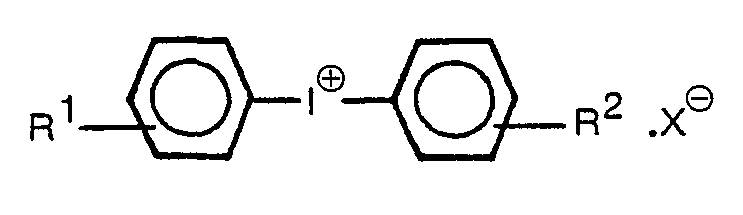
- the iodonium salts may have the formula:- where each of R 1 and R 2 is selected from hydrogen, halogen, straight or branched alkyl, alkoxy, aryl, acyl, nitro, or cyano, and X- is tetrafluoroborate, hexafluorophosphate, hexafluoroarsenate, hexafluoroantimonate, perchlorate, or trifluoromethanesulphate.
- photoinitiators are used in the new compositions in a proportion of 1% to 10%, and preferably 1% to 5%, by weight.
- Preferred photoinitiators of the aforesaid formulae are 4,4'-dimethyldiphenyliodonium hexafluorophosphate, diphenyliodonium hexafluorophosphate, triphenylsulphonium hexafluorophosphate, and 4-thiophenoxyphenyl-S-diphenylsulphonium hexafluorophosphate.
- a sensitiser is preferably added to increase the spectral sensivity of the photoinitiator.
- the preferred sensitisers are 9,10-diethoxyanthracene and 2-alkyl-9,10-diethoxyanthracene in a proportion of 0-5%, preferably 0 to 3%, by weight of the composition.
- Polyaromatic compounds and phenothiazine may also be used.
- Epoxy resins are used as cationically photopolymerisable materials as they are readily available and the resulting cured polymers possess excellent dimensional and thermal stability in addition to superior mechanical strength and chemical resistance.
- a wide range of epoxy and epoxy substituted compounds can be used in photopolymerisation processes, thus making it relatively easy to obtain cured resins with specifically desired chemical and physical properties.
- the epoxy resins preferably used contain a plurality of epoxy groups and may be based on the reaction product of Bisphenol A (i.e. 2,2-bis(4-hydroxyphenyl)propane) and epichlorohydrin, e.g. the resins sold under the registered Trade Mark Araldite by Ciba-Geigy Ltd., or on the reaction product of epichlorohydrin with a phenol-formaldehyde resin of relatively low molecular weight, e.g. epoxy-Novolaks (available, for example from Dow), or other modified epoxy resins as disclosed in 'UV Curing Science and Technology' (Technology Marketing Corp. Stamford, Conn).
- Bisphenol A i.e. 2,2-bis(4-hydroxyphenyl)propane
- epichlorohydrin e.g. the resins sold under the registered Trade Mark Araldite by Ciba-Geigy Ltd.
- a phenol-formaldehyde resin of relatively low molecular weight
- Reactive diluents such as glycidyl ethers, glycidyl acrylates, 4-vinylcyclohexene dioxide, limonene dioxide, 1,2-cyclohexene oxide and 3,4-epoxycyclohexylmethyl 3',4'-epoxyhexanecarboxylate, are used as viscosity modifying agents for such epoxy resins.
- the reactive diluent may be employed where necessary to render the epoxy resin dispersible in an aqueous medium. The use of excess reactive diluent is however to be avoided as it results in a softer film and an increase in curing time.
- the epoxy component or components are generally present in a proportion of 10-60%, preferably 25 to 50%, by weight of the composition.
- Enhanced emulsion stability of the new compositions can be achieved by the addition of a water-soluble colloid and preferably a surfactant, normally a non-ionic surfactant.
- a surfactant normally a non-ionic surfactant.
- the proportion of such surfactant is preferably 0 to 5% by weight of the composition.
- Suitable water-soluble colloids include polyvinylalcohol, gelatin, cellulose ethers, such as hydroxyethylcellulose or hydroxypropyl cellulose, casein, and polyvinylpyrrolidone.
- colloid carriers are not insolublised by the photoinitiator employed in the new compositions but are physically entrapped in the cured polymer matrix.
- the compositions of the invention normally contain 4 to 14%, and preferably 6 to 10%, of such colloid by weight.
- an inert filler which may be a polymer, e.g. a vinylacetate homopolymer or copolymer in emulsion or solid form, or another filler which may be, for example, starch, or an inorganic filler such as silica, kaolin or titanium dioxide.
- the purpose of such fillers is to modify the properties of the dried film to render it more suitable for the end purpose contemplated.
- the proportion of filler may be 0 to 10% by weight of the composition.
- a plasticiser e.g. a dialkylphthalate or a phosphate ester
- a biocide may be added to prevent fungal growth in the stored emulsion, preferably in a proportion of no more than 0 to 1 % by weight of the composition.
- the photosensitive composition may also contain a colourant which may give a coloured contrast on exposure to actinic radiation, in a proportion up to 1% by weight, as described in our copending Application No. 8217461 (GB-A-2100874).
- compositions of the present invention are aqueous and may contain 40 to 80%, preferably 50 to 70%, by weight of water, including water added in admixture with other ingredients, e.g. the water in any polymer solution included in the composition.
- a minor amount of other solvents, e.g. diacetone alcohol or acetone, may be added to improve the stability of the composition in small proportion, e.g. 0 to 5% by weight.
- composition of the present invention is coated onto a substrate and dried.
- the dried film is then exposed image-wise to actinic radiation, and the exposed film is developed, e.g. with water to remove the unexposed areas.
- the hardness of the stencil can be increased by allowing the exposed film to stand in the dark prior to development. This post cure period toughens the stencil, but some "filling in" of fine detail is noticeable if the period is prolonged.
- the images formed by photopolymerisation and development of the new compositions as described above can be used for preparing stencils for screen printing, or in any photographic process where resists, stencils or relief images are required, for example etching and plating resists for printing plates, nameplates, dials and circuit patterns, ink accepting images for lithographic masters, or negative stencils for positive reversal litho systems. Images can also serve as dye resists or printing matrices as well as visually coloured displays in reflective or transparent form. The suitability of the image for a specific application is determined primarily by the choice of epoxy resin and reactive diluent.
- composition was coated onto both sides of a 90 threads/cm polyester filament mesh, dried and exposed through a photographic positive transparency to a 800 W mercury halide lamp at a distance of 1 metre for 200 seconds. After washing with water, a good stencil image was obtained.
- a composition was formulated as described in Example 1 but omitting the diphenyliodonium hexafluorophosphate.
- the coated screen was exposed to a 800 W mercury halide lamp at a distance of 1 metre for 10 minutes. On washing with water the whole coated layer was removed indicating that no insolubilisation of the coating occurs in the absence of photoinitiator.
- composition was coated onto both sides of a 90 threads/cm polyester filament mesh, dried and exposed through a positive transparency to a 800 W mercury halide lamp at a distance of 1 metre for 400 seconds. After washing with cold water a pigmented good stencil image was obtained.
- composition was coated onto both sides of a 90 threads/cm polyester filament mesh, dried and exposed through a positive transparency to a 800 W mercury halide lamp at a distance of 1 metre for 500 seconds. The exposed screen was then allowed to stand in the dark for 30 minutes prior to washing out with water, after which a good stencil image was obtained.
- composition was coated onto both sides of a 15 threads/cm polyester filament mesh, dried and exposed through a positive transparency to a 800 W mercury halide lamp at a distance of 1 metre for 620 seconds. After washing out with cold water a pigmented screen printing stencil was obtained.
- composition was coated onto both sides of a 90 threads/cm polyester filament mesh, dried and exposed through a positive transparency to a 800 W mercury halide lamp at a distance of 1 metre for 450 seconds. After washing with water a good stencil image was obtained.
- the composition was printed onto white cotton fabric through a 43 threads/cm screen printing mesh, allowed to dry at room temperature and passed through a HiDry (2 x 80 W/cm medium pressure Hg halide) UV drier, at a belt speed of 4.5 metres/min. A readily visible coloured image was achieved which could not be removed by flexing the material.
- the cured print and a printed unexposed sample were each wash tested at 60°C for 30 minutes in the presence of a proprietary washing powder. The unexposed print washed off completely whereas the cured print showed no loss of colour or staining of adjacent white fabric.
- the composition was bar coated onto a chipboard surface and then passed through a HiDry UV drier (160 W/cm) at 1.5 metres/minute belt speed. The coating cured to a tack free finish which could not be removed under aqueous conditions and could be sanded to give a smooth finish.
- a melamine resin laminate sheet as sold under the trade mark "Formica” was applied to the coated chipboard using a proprietary adhesive and allowed to stand for the requisite period of time. Good adhesion was observed between the "Formica" sheet and the coated chipboard.
Landscapes
- Chemical & Material Sciences (AREA)
- Medicinal Chemistry (AREA)
- Health & Medical Sciences (AREA)
- Chemical Kinetics & Catalysis (AREA)
- Polymers & Plastics (AREA)
- Organic Chemistry (AREA)
- Physics & Mathematics (AREA)
- General Physics & Mathematics (AREA)
- Spectroscopy & Molecular Physics (AREA)
- Epoxy Resins (AREA)
- Compositions Of Macromolecular Compounds (AREA)
- Photosensitive Polymer And Photoresist Processing (AREA)
- Polymerisation Methods In General (AREA)
- Paints Or Removers (AREA)
Abstract
Description
- This invention provides photopolymerisable compositions useful for forming coatings which can be exposed in image-wise manner and then developed so as to remove the unexposed areas, e.g. by washing with water, to leave an image suitable for use as a stencil or resist.
- Many resins are cationically curable. Epoxy resins, in particular, have been used in a variety of applications requiring high standards of chemical and mechanical resistance. Curing of epoxy resins is usually achieved by a 2 pack system utilising an active amine or carboxylic acid as the curing agent. The cure time of these compositions can be several hours and thorough mixing is required to ensure an even cure.
- A one pack epoxy resin system can be formulated employing a Lewis Acid catalyst in the form of an amine complex such as the boron trifluoride monoethylamine complex. On heating, the Lewis Acid is released and cure occurs in 1 to 8 hours. The temperature required for curing may be 160°C or higher. These one pack epoxy compositions cannot therefore be used to coat heat-sensitive substrates such as polymer films or mesh, nor can volatile reactive diluents be used because of evaporation losses during cure.
- Certain photosensitive aryldiazonium salts can be employed to cure epoxy resins, see US-A-3703296. On exposure to actinic radiation these aryldiazonium salts can decompose, releasing in situ a Lewis Acid catalyst capable of effecting rapid cure of the epoxy resin. However, decomposition of the aryldiazonium salts occurs in the dark and stabilisers must be added to minimise polymerisation during storage. Despite such measures gelation of the mixture is still liable to occur during dark storage. Nitrogen is released on exposure of these salts to actinic radiation and this can result in film imperfections. In addition aryldiazonium salts are thermally unstable and the use of such materials is hazardous because of the possibility of violent decomposition reactions.
- US-A-4138 255 and US-A-4136102 disclose one pack systems with long term stability containing iodonium or sulphonium salts having metal or metalloid halide anions e.g. BF4 , PFs-, AsFs- or SbF6 -.These catalysts can generate a Bronsted Acid on exposure to actinic radiation which can effect rapid cure of epoxy resins at ambient temperatures. The rapidity of the cure on exposure to actinic radiation makes it possible to produce an epoxy film useful for reprographic purposes. US-A-4090936 and US-A-4139799 disclose the use of an onium salt-sensitised epoxy film as a photoresist. When the coated film is exposed image-wise, the exposed areas polymerise to give an insoluble image. The unexposed areas may then be washed off using an organic solvent. However in large scale processes, the use of large amounts of organic solvents for development may create a fire hazard, and many solvents represent a toxicological and environmental hazard.
- The present invention is based on the discovery that an onium salt sensitised composition can be emulsified in an aqueous system to give a composition capable of producing coated layers which cure rapidly on exposure to actinic radiation. The coated layer can be exposed imagewise and subsequently developed with water to provide a cured image which is mechanically and chemically resistant. The ease of development in aqueous media avoids the use of organic solvents with their attendant toxicological and fire hazards.
- The present invention provides a composition comprising at least one dispersed cationically curable component which is a mixture of one or more low viscosity epoxy diluents selected from glycidyl ethers, glycidyl acrylates, 4-vinylcyclohexene dioxide, limonene dioxide, 1,2-cyclohexene oxide and 3,4-epoxycyclohexylmethyl-3', 4'-epoxycyclohexanecarboxylate, and one or more higher molecular weight epoxy resins and a photosensitive onium salt capable on exposure to actinic radiation of effecting cationic polymerisation of the said curable compound characterised in that the composition is in the form of an aqueous dispersion. Preferably the composition also contains one or more surfactants and water soluble colloids as dispersion stabilisers, and also spectral sensitizers which are normally necessary to increase the spectral sensitivity of the photoinitiator to the radiation used. The composition may also contain inert polymeric or inorganic fillers, reactive diluents, plasticisers, biocides, defoamers, pigments, or dyes, which may change colour on exposure to actinic radiation as described in our co-pending application No. 8217461 (GB-A-2100874). The preferred onium salt photoinitiators are iodonium and sulphonium salts. The iodonium salts may have the formula:-

- The sulphonium salts may be of the formula:-

- Such photoinitiators are used in the new compositions in a proportion of 1% to 10%, and preferably 1% to 5%, by weight. Preferred photoinitiators of the aforesaid formulae are 4,4'-dimethyldiphenyliodonium hexafluorophosphate, diphenyliodonium hexafluorophosphate, triphenylsulphonium hexafluorophosphate, and 4-thiophenoxyphenyl-S-diphenylsulphonium hexafluorophosphate.
- A sensitiser is preferably added to increase the spectral sensivity of the photoinitiator. The preferred sensitisers are 9,10-diethoxyanthracene and 2-alkyl-9,10-diethoxyanthracene in a proportion of 0-5%, preferably 0 to 3%, by weight of the composition. Polyaromatic compounds and phenothiazine may also be used.
- Epoxy resins are used as cationically photopolymerisable materials as they are readily available and the resulting cured polymers possess excellent dimensional and thermal stability in addition to superior mechanical strength and chemical resistance. A wide range of epoxy and epoxy substituted compounds can be used in photopolymerisation processes, thus making it relatively easy to obtain cured resins with specifically desired chemical and physical properties.
- The epoxy resins preferably used contain a plurality of epoxy groups and may be based on the reaction product of Bisphenol A (i.e. 2,2-bis(4-hydroxyphenyl)propane) and epichlorohydrin, e.g. the resins sold under the registered Trade Mark Araldite by Ciba-Geigy Ltd., or on the reaction product of epichlorohydrin with a phenol-formaldehyde resin of relatively low molecular weight, e.g. epoxy-Novolaks (available, for example from Dow), or other modified epoxy resins as disclosed in 'UV Curing Science and Technology' (Technology Marketing Corp. Stamford, Conn). Reactive diluents such as glycidyl ethers, glycidyl acrylates, 4-vinylcyclohexene dioxide, limonene dioxide, 1,2-cyclohexene oxide and 3,4-epoxycyclohexylmethyl 3',4'-epoxyhexanecarboxylate, are used as viscosity modifying agents for such epoxy resins. The reactive diluent may be employed where necessary to render the epoxy resin dispersible in an aqueous medium. The use of excess reactive diluent is however to be avoided as it results in a softer film and an increase in curing time. The epoxy component or components are generally present in a proportion of 10-60%, preferably 25 to 50%, by weight of the composition.
- Enhanced emulsion stability of the new compositions can be achieved by the addition of a water-soluble colloid and preferably a surfactant, normally a non-ionic surfactant. The proportion of such surfactant is preferably 0 to 5% by weight of the composition. Suitable water-soluble colloids include polyvinylalcohol, gelatin, cellulose ethers, such as hydroxyethylcellulose or hydroxypropyl cellulose, casein, and polyvinylpyrrolidone. Such colloid carriers are not insolublised by the photoinitiator employed in the new compositions but are physically entrapped in the cured polymer matrix. The compositions of the invention normally contain 4 to 14%, and preferably 6 to 10%, of such colloid by weight.
- It may be desirable to include in the compositions of the invention an inert filler which may be a polymer, e.g. a vinylacetate homopolymer or copolymer in emulsion or solid form, or another filler which may be, for example, starch, or an inorganic filler such as silica, kaolin or titanium dioxide. The purpose of such fillers is to modify the properties of the dried film to render it more suitable for the end purpose contemplated. The proportion of filler may be 0 to 10% by weight of the composition.
- A plasticiser e.g. a dialkylphthalate or a phosphate ester, may be added in a proportion up to 10%, but preferably only 0 to 5%, by weight of the composition to improve the flexibility of the cured composition. A biocide may be added to prevent fungal growth in the stored emulsion, preferably in a proportion of no more than 0 to 1 % by weight of the composition.
- The photosensitive composition may also contain a colourant which may give a coloured contrast on exposure to actinic radiation, in a proportion up to 1% by weight, as described in our copending Application No. 8217461 (GB-A-2100874).
- The compositions of the present invention are aqueous and may contain 40 to 80%, preferably 50 to 70%, by weight of water, including water added in admixture with other ingredients, e.g. the water in any polymer solution included in the composition. A minor amount of other solvents, e.g. diacetone alcohol or acetone, may be added to improve the stability of the composition in small proportion, e.g. 0 to 5% by weight.
- The composition of the present invention is coated onto a substrate and dried. The dried film is then exposed image-wise to actinic radiation, and the exposed film is developed, e.g. with water to remove the unexposed areas. The hardness of the stencil can be increased by allowing the exposed film to stand in the dark prior to development. This post cure period toughens the stencil, but some "filling in" of fine detail is noticeable if the period is prolonged.
- The images formed by photopolymerisation and development of the new compositions as described above can be used for preparing stencils for screen printing, or in any photographic process where resists, stencils or relief images are required, for example etching and plating resists for printing plates, nameplates, dials and circuit patterns, ink accepting images for lithographic masters, or negative stencils for positive reversal litho systems. Images can also serve as dye resists or printing matrices as well as visually coloured displays in reflective or transparent form. The suitability of the image for a specific application is determined primarily by the choice of epoxy resin and reactive diluent.
- The following Examples illustrate the invention.
-

- 1. GH20 is a high molecular weight 88% hydrolysed (12% residual acetate) polyvinylalcohol obtainable from Gohsenol.
- 2. RD 2 is butanedioldiglycidyl ether obtainable from Ciba Geigy.
- 3. Araldite 6100 is a Bisphenol A/epichlorhydrin epoxy resin obtainable from Ciba Geigy.
- 4. CY 179 is 3,4-epoxycyclohexylmethyl-3',4'-epoxycyclohexanecarboxylate obtainable from Ciba Geigy.
- 5. VAGD is a polyvinylchloride polyvinylacetate copolymer obtainable from Union Carbide.
- 6. FC 150 is 9,10-diethoxyanthracene obtainable from 3M.
- 7. Berol 02 is a nonylphenylpolyoxyethylene non-ionic surfactant containing 6 ethylene oxide residues per molecule obtainable from Berol Kemi (UK) Ltd.
- The composition was coated onto both sides of a 90 threads/cm polyester filament mesh, dried and exposed through a photographic positive transparency to a 800 W mercury halide lamp at a distance of 1 metre for 200 seconds. After washing with water, a good stencil image was obtained.
- A composition was formulated as described in Example 1 but omitting the diphenyliodonium hexafluorophosphate. The coated screen was exposed to a 800 W mercury halide lamp at a distance of 1 metre for 10 minutes. On washing with water the whole coated layer was removed indicating that no insolubilisation of the coating occurs in the absence of photoinitiator.
-


- 8. UVE 1014 is a triarylsulphonium salt obtainable from GEC.
- The composition was coated onto both sides of a 90 threads/cm polyester filament mesh, dried and exposed through a positive transparency to a 800 W mercury halide lamp at a distance of 1 metre for 400 seconds. After washing with cold water a pigmented good stencil image was obtained.
-

- The composition was coated onto both sides of a 90 threads/cm polyester filament mesh, dried and exposed through a positive transparency to a 800 W mercury halide lamp at a distance of 1 metre for 500 seconds. The exposed screen was then allowed to stand in the dark for 30 minutes prior to washing out with water, after which a good stencil image was obtained.
-


- The composition was coated onto both sides of a 15 threads/cm polyester filament mesh, dried and exposed through a positive transparency to a 800 W mercury halide lamp at a distance of 1 metre for 620 seconds. After washing out with cold water a pigmented screen printing stencil was obtained.
-

- 9. Epikote 255 is a water dispersable Bisphenol A/epichlorhydrin resin obtainable from Shell Chemical Co.
- 10. FC 170-C is a fluorinated alkylbenzene polyoxyethylene obtainable from 3M.
- The composition was coated onto both sides of a 90 threads/cm polyester filament mesh, dried and exposed through a positive transparency to a 800 W mercury halide lamp at a distance of 1 metre for 450 seconds. After washing with water a good stencil image was obtained.
-


- 11. DEN 438 is an epoxy novolak resin obtainable from Dow Chemicals.
- The composition was printed onto white cotton fabric through a 43 threads/cm screen printing mesh, allowed to dry at room temperature and passed through a HiDry (2 x 80 W/cm medium pressure Hg halide) UV drier, at a belt speed of 4.5 metres/min. A readily visible coloured image was achieved which could not be removed by flexing the material. The cured print and a printed unexposed sample were each wash tested at 60°C for 30 minutes in the presence of a proprietary washing powder. The unexposed print washed off completely whereas the cured print showed no loss of colour or staining of adjacent white fabric.
-

- The composition was bar coated onto a chipboard surface and then passed through a HiDry UV drier (160 W/cm) at 1.5 metres/minute belt speed. The coating cured to a tack free finish which could not be removed under aqueous conditions and could be sanded to give a smooth finish. A melamine resin laminate sheet as sold under the trade mark "Formica" was applied to the coated chipboard using a proprietary adhesive and allowed to stand for the requisite period of time. Good adhesion was observed between the "Formica" sheet and the coated chipboard.
Claims (19)


Priority Applications (1)
| Application Number | Priority Date | Filing Date | Title |
|---|---|---|---|
| AT84302232T ATE40757T1 (en) | 1983-03-31 | 1984-03-30 | WATER-BASED PHOTOPOLYMERIZABLE COMPOSITIONS AND USE. |
Applications Claiming Priority (2)
| Application Number | Priority Date | Filing Date | Title |
|---|---|---|---|
| GB8309019 | 1983-03-31 | ||
| GB08309019A GB2137626B (en) | 1983-03-31 | 1983-03-31 | Water based photopolymerisable compositions and their use |
Publications (3)
| Publication Number | Publication Date |
|---|---|
| EP0124292A2 EP0124292A2 (en) | 1984-11-07 |
| EP0124292A3 EP0124292A3 (en) | 1985-09-18 |
| EP0124292B1 true EP0124292B1 (en) | 1989-02-08 |
Family
ID=10540571
Family Applications (1)
| Application Number | Title | Priority Date | Filing Date |
|---|---|---|---|
| EP84302232A Expired EP0124292B1 (en) | 1983-03-31 | 1984-03-30 | Water based photopolymerisable compositions and their use |
Country Status (9)
| Country | Link |
|---|---|
| US (1) | US4548890A (en) |
| EP (1) | EP0124292B1 (en) |
| JP (1) | JPS59184220A (en) |
| AT (1) | ATE40757T1 (en) |
| AU (1) | AU574672B2 (en) |
| CA (1) | CA1264889A (en) |
| DE (1) | DE3476706D1 (en) |
| DK (1) | DK173784A (en) |
| GB (1) | GB2137626B (en) |
Cited By (1)
| Publication number | Priority date | Publication date | Assignee | Title |
|---|---|---|---|---|
| CN110256993A (en) * | 2018-12-05 | 2019-09-20 | 广东嘉元科技股份有限公司 | It is a kind of applied to the colloid copper foil for preparing copper coated foil plate |
Families Citing this family (49)
| Publication number | Priority date | Publication date | Assignee | Title |
|---|---|---|---|---|
| GB2139369B (en) * | 1983-05-06 | 1987-01-21 | Sericol Group Ltd | Photosensitive systems showing visible indication of exposure |
| DE3565013D1 (en) * | 1984-02-10 | 1988-10-20 | Ciba Geigy Ag | Process for the preparation of a protection layer or a relief pattern |
| GB8405549D0 (en) * | 1984-03-02 | 1984-04-04 | Sericol Group Ltd | Screen printing compositions |
| US4554342A (en) * | 1984-07-30 | 1985-11-19 | Shell Oil Company | Heat-curable compositions comprising an epoxy resin, an amine and a sulfonium salt |
| JPS61252546A (en) * | 1985-05-01 | 1986-11-10 | Ueno Kagaku Kogyo Kk | Photosensitive resist ink and manufacture of ps plate by using it and method for etching this ps plate |
| JPS62273226A (en) * | 1986-05-20 | 1987-11-27 | Nippon Soda Co Ltd | Photo-setting resist resin composition for electroless plating |
| US5300380A (en) * | 1986-08-06 | 1994-04-05 | Ciba-Geigy Corporation | Process for the production of relief structures using a negative photoresist based on polyphenols and epoxy compounds or vinyl ethers |
| DE3766315D1 (en) * | 1986-08-06 | 1991-01-03 | Ciba Geigy Ag | NEGATIVE PHOTORESIST BASED ON POLYPHENOLS AND EPOXY COMPOUNDS OR VINYL ETHERS. |
| EP0267554A3 (en) * | 1986-11-12 | 1990-09-19 | S.C. Johnson & Son, Inc. | Aqueous polymer systems curable by cationic photo-initiation and methods of applying same to substrates |
| JPS63200339A (en) * | 1987-02-12 | 1988-08-18 | Canon Inc | information recording medium |
| JPH0814695B2 (en) * | 1987-03-25 | 1996-02-14 | 富士写真フイルム株式会社 | Photosolubilizing composition |
| US4994346A (en) * | 1987-07-28 | 1991-02-19 | Ciba-Geigy Corporation | Negative photoresist based on polyphenols and selected epoxy or vinyl ether compounds |
| US4840977A (en) * | 1987-10-01 | 1989-06-20 | General Electric Company | Polymeric iodonium salts, method for making, and heat curable compositions |
| JP2686283B2 (en) * | 1988-06-13 | 1997-12-08 | 関西ペイント株式会社 | Photopolymerizable composition |
| US5264325A (en) * | 1988-12-30 | 1993-11-23 | International Business Machines Corporation | Composition for photo imaging |
| US6180317B1 (en) | 1988-12-30 | 2001-01-30 | International Business Machines Corporation | Composition for photoimaging |
| US5439766A (en) * | 1988-12-30 | 1995-08-08 | International Business Machines Corporation | Composition for photo imaging |
| US5026624A (en) * | 1989-03-03 | 1991-06-25 | International Business Machines Corporation | Composition for photo imaging |
| US5747223A (en) * | 1988-12-30 | 1998-05-05 | International Business Machines Corporation | Composition for photoimaging |
| US4940651A (en) * | 1988-12-30 | 1990-07-10 | International Business Machines Corporation | Method for patterning cationic curable photoresist |
| US5304457A (en) * | 1989-03-03 | 1994-04-19 | International Business Machines Corporation | Composition for photo imaging |
| US5278010A (en) * | 1989-03-03 | 1994-01-11 | International Business Machines Corporation | Composition for photo imaging |
| US5391465A (en) * | 1989-06-20 | 1995-02-21 | Rohm And Haas Company | Method of using selected photoactive compounds in high resolution, acid hardening photoresists with near ultraviolet radiation wherein the photoresist comprise conventional deep UV photoacid generators |
| US5110711A (en) * | 1989-10-10 | 1992-05-05 | International Business Machines Corporation | Method for forming a pattern |
| US5059512A (en) * | 1989-10-10 | 1991-10-22 | International Business Machines Corporation | Ultraviolet light sensitive photoinitiator compositions, use thereof and radiation sensitive compositions |
| US5667934A (en) * | 1990-10-09 | 1997-09-16 | International Business Machines Corporation | Thermally stable photoimaging composition |
| GB2269385A (en) * | 1992-07-14 | 1994-02-09 | Coates Brothers Plc | Coating compositions |
| US5439779A (en) * | 1993-02-22 | 1995-08-08 | International Business Machines Corporation | Aqueous soldermask |
| US6020436A (en) * | 1993-03-09 | 2000-02-01 | The Chromaline Corporation | Photosensitive resin composition |
| TW460509B (en) * | 1996-07-12 | 2001-10-21 | Ciba Sc Holding Ag | Curing process for cationically photocurable formulations |
| EP0927726B1 (en) * | 1996-09-19 | 2004-11-10 | Nippon Soda Co., Ltd. | Photocatalytic composition |
| JP3993691B2 (en) * | 1997-09-24 | 2007-10-17 | 関西ペイント株式会社 | Resist pattern forming method |
| US20030157414A1 (en) * | 1997-11-13 | 2003-08-21 | Pradeep K. Dhal | Holographic medium and process for use thereof |
| EP1106639B1 (en) * | 1998-03-20 | 2007-08-29 | Nippon Soda Co., Ltd. | Photocurable composition containing iodonium salt compound |
| US6232361B1 (en) * | 1998-12-11 | 2001-05-15 | Sun Chemical Corporation | Radiation curable water based cationic inks and coatings |
| JP3992550B2 (en) * | 2002-07-04 | 2007-10-17 | 國宏 市村 | Active energy ray resin composition, active energy ray resin film, and pattern forming method using the film |
| JP4773348B2 (en) | 2003-07-12 | 2011-09-14 | アクセラー8 テクノロジー コーポレイション | Sensitive and rapid biodetection method |
| US20120077206A1 (en) | 2003-07-12 | 2012-03-29 | Accelr8 Technology Corporation | Rapid Microbial Detection and Antimicrobial Susceptibility Testing |
| JP2005162962A (en) * | 2003-12-05 | 2005-06-23 | Konica Minolta Medical & Graphic Inc | Active ray-hardening type composition, active ray hardening type ink, image-forming method using the ink and inkjet recorder |
| JP4522751B2 (en) * | 2004-06-08 | 2010-08-11 | 株式会社ムラカミ | Photosensitive film, screen printing plate and etching photosensitive film |
| US20060189716A1 (en) * | 2005-02-24 | 2006-08-24 | Toru Ushirogouchi | Dispersion, inkjet ink, method of manufacturing dispersion, method of manufacturing inkjet ink, and printed matter |
| US20060234159A1 (en) * | 2005-04-19 | 2006-10-19 | Nitto Denko Corporation | Photosensitive epoxy resin adhesive composition and use thereof |
| US10254204B2 (en) | 2011-03-07 | 2019-04-09 | Accelerate Diagnostics, Inc. | Membrane-assisted purification |
| AU2016243656A1 (en) | 2015-03-30 | 2017-11-09 | Accelerate Diagnostics, Inc. | Instrument and system for rapid microorganism identification and antimicrobial agent susceptibility testing |
| EP4082677A4 (en) * | 2020-01-30 | 2024-01-24 | Toray Industries, Inc. | Coating agent, sheet-like intermediate base material, photocurable resin film, fiber-reinforced composite material intermediate, fiber-reinforced composite material, method for producing fiber-reinforced composite material intermediate, and method for producing fiber-reinforced composite material |
| JP7707559B2 (en) * | 2020-03-02 | 2025-07-15 | 東レ株式会社 | Coatings and intermediate substrates |
| JP7739717B2 (en) * | 2020-03-03 | 2025-09-17 | 東レ株式会社 | Fiber-reinforced composite material intermediate, and method for producing fiber-reinforced composite material |
| JP7739718B2 (en) * | 2020-04-28 | 2025-09-17 | 東レ株式会社 | Fiber-reinforced composite material intermediate, and method for producing fiber-reinforced composite material |
| JP2022153282A (en) * | 2021-03-29 | 2022-10-12 | 東レ株式会社 | Epoxy resin composition, surface protective intermediate base and fiber-reinforced composite material intermediate |
Family Cites Families (14)
| Publication number | Priority date | Publication date | Assignee | Title |
|---|---|---|---|---|
| DE1669723A1 (en) * | 1967-09-22 | 1971-06-09 | Basf Ag | Plates, sheets or films of photopolymerizable compositions containing indigoid dyes |
| US3708296A (en) * | 1968-08-20 | 1973-01-02 | American Can Co | Photopolymerization of epoxy monomers |
| US3782952A (en) * | 1971-04-01 | 1974-01-01 | Polychrome Corp | Light-sensitive composition of a tetra (epoxy-propoxyphenyl)-lower alkane and an initiator |
| US4175972A (en) * | 1974-05-02 | 1979-11-27 | General Electric Company | Curable epoxy compositions containing aromatic onium salts and hydroxy compounds |
| US4136102A (en) * | 1974-05-02 | 1979-01-23 | General Electric Company | Photoinitiators |
| US4378277A (en) * | 1974-05-08 | 1983-03-29 | Minnesota Mining & Manufacturing Company | Photopolymerizable epoxy-containing compositions |
| US4069054A (en) * | 1975-09-02 | 1978-01-17 | Minnesota Mining And Manufacturing Company | Photopolymerizable composition containing a sensitized aromatic sulfonium compound and a cationacally polymerizable monomer |
| US4090936A (en) * | 1976-10-28 | 1978-05-23 | Minnesota Mining And Manufacturing Company | Photohardenable compositions |
| US4102687A (en) * | 1977-02-14 | 1978-07-25 | General Electric Company | UV Curable composition of a thermosetting condensation resin and Group VIa onium salt |
| US4173476A (en) * | 1978-02-08 | 1979-11-06 | Minnesota Mining And Manufacturing Company | Complex salt photoinitiator |
| US4286047A (en) * | 1979-07-25 | 1981-08-25 | Minnesota Mining And Manufacturing Company | Pressure-sensitive adhesive susceptible to ultraviolet light-induced detackification |
| US4341859A (en) * | 1980-09-23 | 1982-07-27 | General Electric Company | Emulsion for making dry film resists |
| GB2100874B (en) * | 1981-06-19 | 1985-05-01 | Sericol Group Ltd | Photosensitive compositions and their use |
| US4418138A (en) * | 1981-11-03 | 1983-11-29 | Sericol Group Limited | Photopolymerizable materials for use in producing stencils for screen printing |
-
1983
- 1983-03-31 GB GB08309019A patent/GB2137626B/en not_active Expired
-
1984
- 1984-03-29 CA CA000450900A patent/CA1264889A/en not_active Expired - Fee Related
- 1984-03-29 AU AU26238/84A patent/AU574672B2/en not_active Ceased
- 1984-03-30 US US06/595,448 patent/US4548890A/en not_active Expired - Fee Related
- 1984-03-30 AT AT84302232T patent/ATE40757T1/en not_active IP Right Cessation
- 1984-03-30 DK DK173784A patent/DK173784A/en active IP Right Grant
- 1984-03-30 JP JP59063114A patent/JPS59184220A/en active Pending
- 1984-03-30 EP EP84302232A patent/EP0124292B1/en not_active Expired
- 1984-03-30 DE DE8484302232T patent/DE3476706D1/en not_active Expired
Cited By (2)
| Publication number | Priority date | Publication date | Assignee | Title |
|---|---|---|---|---|
| CN110256993A (en) * | 2018-12-05 | 2019-09-20 | 广东嘉元科技股份有限公司 | It is a kind of applied to the colloid copper foil for preparing copper coated foil plate |
| CN110256993B (en) * | 2018-12-05 | 2021-04-06 | 广东嘉元科技股份有限公司 | Colloidal copper foil applied to preparation of copper-clad plate |
Also Published As
| Publication number | Publication date |
|---|---|
| AU2623884A (en) | 1984-10-04 |
| ATE40757T1 (en) | 1989-02-15 |
| CA1264889A (en) | 1990-01-23 |
| DE3476706D1 (en) | 1989-03-16 |
| EP0124292A2 (en) | 1984-11-07 |
| GB2137626A (en) | 1984-10-10 |
| GB2137626B (en) | 1986-10-15 |
| US4548890A (en) | 1985-10-22 |
| DK173784D0 (en) | 1984-03-30 |
| EP0124292A3 (en) | 1985-09-18 |
| AU574672B2 (en) | 1988-07-14 |
| JPS59184220A (en) | 1984-10-19 |
| DK173784A (en) | 1984-10-01 |
Similar Documents
| Publication | Publication Date | Title |
|---|---|---|
| US4548890A (en) | Water-based photopolymerizable compositions and their use | |
| EP0125102B1 (en) | Photosensitive systems showing visible indication of exposure | |
| US3708296A (en) | Photopolymerization of epoxy monomers | |
| US4394403A (en) | Photopolymerizable compositions | |
| DE69324942T2 (en) | Radiation sensitive compositions and methods | |
| JPS5942688B2 (en) | Photocopolymerizable compositions based on epoxy and hydroxyl-containing organic substances | |
| US3295974A (en) | Light sensitive epoxy material for the photomechanical production of printing plates | |
| US4378277A (en) | Photopolymerizable epoxy-containing compositions | |
| CA1164710A (en) | Phototropic photosensitive compositions containing fluoran colorformer | |
| EP2927216A1 (en) | Novel sulfonic acid derivative compound, photoacid generator, cationic polymerization initiator, resist composition, and cationically polymerizable composition | |
| CA1242919A (en) | Process for the production of images | |
| JPH107709A (en) | Energy-sensitive activator composition, sensitive composition using the same, and image-forming composition | |
| CA1331926C (en) | Photoresist compositions | |
| EP1553449B1 (en) | Active energy ray sensitive resin composition, active energy ray sensitive resin film and method for forming pattern using said film | |
| US4902726A (en) | Photosensitive resin composition solution | |
| JP6274655B2 (en) | Sulfonic acid derivative compound, photoacid generator, resist composition, cationic polymerization initiator, and cationic polymerizable composition | |
| US5122442A (en) | Method for forming an image from a high speed screen printing composition on a screen mesh | |
| US3467518A (en) | Photochemical cross-linking of polymers | |
| EP3272737B1 (en) | Sulfonic acid derivative compound, photoacid generator, resist composition, cationic polymerization initiator, and cationically polymerizable composition | |
| US3936366A (en) | Radiation polymerisable compositions containing 3-sorboyloxy-2-hydroxypropyl groups | |
| JPH01126638A (en) | Image forming resin composition | |
| JPH01126362A (en) | Epoxy resin composition for image-forming | |
| JPH06258823A (en) | Photosensitive resin | |
| US3740376A (en) | Photosensitive polymer layers of vinyl alcohol polymers | |
| TW475097B (en) | A negative photoactive composition |
Legal Events
| Date | Code | Title | Description |
|---|---|---|---|
| PUAI | Public reference made under article 153(3) epc to a published international application that has entered the european phase |
Free format text: ORIGINAL CODE: 0009012 |
|
| AK | Designated contracting states |
Designated state(s): AT BE CH DE FR GB IT LI LU NL SE |
|
| PUAL | Search report despatched |
Free format text: ORIGINAL CODE: 0009013 |
|
| AK | Designated contracting states |
Designated state(s): AT BE CH DE FR GB IT LI LU NL SE |
|
| 17P | Request for examination filed |
Effective date: 19860315 |
|
| 17Q | First examination report despatched |
Effective date: 19870508 |
|
| GRAA | (expected) grant |
Free format text: ORIGINAL CODE: 0009210 |
|
| AK | Designated contracting states |
Kind code of ref document: B1 Designated state(s): AT BE CH DE FR GB IT LI LU NL SE |
|
| REF | Corresponds to: |
Ref document number: 40757 Country of ref document: AT Date of ref document: 19890215 Kind code of ref document: T |
|
| REF | Corresponds to: |
Ref document number: 3476706 Country of ref document: DE Date of ref document: 19890316 |
|
| ET | Fr: translation filed | ||
| ITF | It: translation for a ep patent filed | ||
| PG25 | Lapsed in a contracting state [announced via postgrant information from national office to epo] |
Ref country code: AT Effective date: 19890330 |
|
| PG25 | Lapsed in a contracting state [announced via postgrant information from national office to epo] |
Ref country code: SE Effective date: 19890331 Ref country code: LU Free format text: LAPSE BECAUSE OF NON-PAYMENT OF DUE FEES Effective date: 19890331 Ref country code: LI Effective date: 19890331 Ref country code: FR Free format text: LAPSE BECAUSE OF NON-PAYMENT OF DUE FEES Effective date: 19890331 Ref country code: CH Effective date: 19890331 Ref country code: BE Effective date: 19890331 |
|
| BERE | Be: lapsed |
Owner name: SERICOL GROUP LTD Effective date: 19890331 |
|
| PG25 | Lapsed in a contracting state [announced via postgrant information from national office to epo] |
Ref country code: NL Effective date: 19891001 |
|
| NLV4 | Nl: lapsed or anulled due to non-payment of the annual fee | ||
| REG | Reference to a national code |
Ref country code: CH Ref legal event code: PL |
|
| PLBE | No opposition filed within time limit |
Free format text: ORIGINAL CODE: 0009261 |
|
| STAA | Information on the status of an ep patent application or granted ep patent |
Free format text: STATUS: NO OPPOSITION FILED WITHIN TIME LIMIT |
|
| 26N | No opposition filed | ||
| REG | Reference to a national code |
Ref country code: FR Ref legal event code: ST |
|
| PGFP | Annual fee paid to national office [announced via postgrant information from national office to epo] |
Ref country code: GB Payment date: 19900331 Year of fee payment: 7 |
|
| PGFP | Annual fee paid to national office [announced via postgrant information from national office to epo] |
Ref country code: DE Payment date: 19900526 Year of fee payment: 7 |
|
| PG25 | Lapsed in a contracting state [announced via postgrant information from national office to epo] |
Ref country code: GB Effective date: 19910330 |
|
| GBPC | Gb: european patent ceased through non-payment of renewal fee | ||
| PG25 | Lapsed in a contracting state [announced via postgrant information from national office to epo] |
Ref country code: DE Effective date: 19920101 |
|
| EUG | Se: european patent has lapsed |
Ref document number: 84302232.8 Effective date: 19900412 |