EP0124018A1 - Pharmaceutical preparation containing purified fibronectin - Google Patents
Pharmaceutical preparation containing purified fibronectin Download PDFInfo
- Publication number
- EP0124018A1 EP0124018A1 EP84104360A EP84104360A EP0124018A1 EP 0124018 A1 EP0124018 A1 EP 0124018A1 EP 84104360 A EP84104360 A EP 84104360A EP 84104360 A EP84104360 A EP 84104360A EP 0124018 A1 EP0124018 A1 EP 0124018A1
- Authority
- EP
- European Patent Office
- Prior art keywords
- sodium
- fibronectin
- preparation
- carbohydrate
- polyoxy ethylene
- Prior art date
- Legal status (The legal status is an assumption and is not a legal conclusion. Google has not performed a legal analysis and makes no representation as to the accuracy of the status listed.)
- Granted
Links
Classifications
-
- A—HUMAN NECESSITIES
- A61—MEDICAL OR VETERINARY SCIENCE; HYGIENE
- A61K—PREPARATIONS FOR MEDICAL, DENTAL OR TOILETRY PURPOSES
- A61K47/00—Medicinal preparations characterised by the non-active ingredients used, e.g. carriers or inert additives; Targeting or modifying agents chemically bound to the active ingredient
- A61K47/06—Organic compounds, e.g. natural or synthetic hydrocarbons, polyolefins, mineral oil, petrolatum or ozokerite
- A61K47/28—Steroids, e.g. cholesterol, bile acids or glycyrrhetinic acid
-
- A—HUMAN NECESSITIES
- A61—MEDICAL OR VETERINARY SCIENCE; HYGIENE
- A61K—PREPARATIONS FOR MEDICAL, DENTAL OR TOILETRY PURPOSES
- A61K38/00—Medicinal preparations containing peptides
- A61K38/16—Peptides having more than 20 amino acids; Gastrins; Somatostatins; Melanotropins; Derivatives thereof
- A61K38/17—Peptides having more than 20 amino acids; Gastrins; Somatostatins; Melanotropins; Derivatives thereof from animals; from humans
- A61K38/39—Connective tissue peptides, e.g. collagen, elastin, laminin, fibronectin, vitronectin, cold insoluble globulin [CIG]
-
- A—HUMAN NECESSITIES
- A61—MEDICAL OR VETERINARY SCIENCE; HYGIENE
- A61K—PREPARATIONS FOR MEDICAL, DENTAL OR TOILETRY PURPOSES
- A61K47/00—Medicinal preparations characterised by the non-active ingredients used, e.g. carriers or inert additives; Targeting or modifying agents chemically bound to the active ingredient
- A61K47/06—Organic compounds, e.g. natural or synthetic hydrocarbons, polyolefins, mineral oil, petrolatum or ozokerite
- A61K47/26—Carbohydrates, e.g. sugar alcohols, amino sugars, nucleic acids, mono-, di- or oligo-saccharides; Derivatives thereof, e.g. polysorbates, sorbitan fatty acid esters or glycyrrhizin
-
- A—HUMAN NECESSITIES
- A61—MEDICAL OR VETERINARY SCIENCE; HYGIENE
- A61K—PREPARATIONS FOR MEDICAL, DENTAL OR TOILETRY PURPOSES
- A61K9/00—Medicinal preparations characterised by special physical form
- A61K9/0012—Galenical forms characterised by the site of application
- A61K9/0019—Injectable compositions; Intramuscular, intravenous, arterial, subcutaneous administration; Compositions to be administered through the skin in an invasive manner
-
- A—HUMAN NECESSITIES
- A61—MEDICAL OR VETERINARY SCIENCE; HYGIENE
- A61K—PREPARATIONS FOR MEDICAL, DENTAL OR TOILETRY PURPOSES
- A61K9/00—Medicinal preparations characterised by special physical form
- A61K9/14—Particulate form, e.g. powders, Processes for size reducing of pure drugs or the resulting products, Pure drug nanoparticles
- A61K9/19—Particulate form, e.g. powders, Processes for size reducing of pure drugs or the resulting products, Pure drug nanoparticles lyophilised, i.e. freeze-dried, solutions or dispersions
Definitions
- This invention relates to a stable pharmaceutical composition containing fibronectin. More particularly, the invention relates to a stable freeze-dried solid composition containing fibronectin which can be readily reconsitituted.
- Fibronectin is a large complex protein possessing important biological activities as a structural component of tissues and as a protein modulating and controlling the function of cells in the body in ways that range from normal growth to repair of damage and participation in the defense against invading foreign substances and organisms. It is known by a variety of names that reflect its diverse biological activities including the names of: large external transformation sensitive protein (LETS); cell surface protein (CSP); cell adhesion protein (CAP); opsonic 0 ( 2 surface binding glycoprotein; and cold insoluble globulin (CIG).
- PES large external transformation sensitive protein
- CSP cell surface protein
- CAP cell adhesion protein
- opsonic 0 2 surface binding glycoprotein
- CCG cold insoluble globulin
- Pharmacological application of fibronectin includes treatment of septic shock and treatment of infective diseases. Due to its action of enhancing intercellular adhesive properties and its effect on the morphology of cancer cells, fibronectin is a potential candidate for cancer treatment.
- Fibronectin is obtained from fractions of plasma protein or fibroblast culture fluid, purified and pasteurized to eliminate the risk of contamination by viruses, and formulated for clinical application.
- fibronectin To be suitable for clinical application, fibronectin must be in a readily injectible or infusable form, must possess a high degree of therapeutic activity, must be stable on storage prior to use and must be homogeneous at the time of injection without aggregated particles or precipitates therein.
- fibronectin obtained by many techniques of purification common to the art is unstable in liquid media, undergoing progressive molecular decomposition on prolonged storage unless it is stored in the frozen state. The decomposition is accelerated by room and elevated temperatures resulting in hydrolysis and formulation into discrete fragments of the polypeptide structure. The loss of therapeutic activity due to decomposition is substantial even within a few weeks rendering the composition ineffective for the intended purpose. Instability may be due to the presence of trace quantities of a proteolytic enzyme which may not be completely removed in the purification of the fibronectin. To stabilize fibronectin and prevent loss of therapeutic activity therein, fibronectin preparations are lyophilized for storage and reconsitituted prior to injection or infusion into the patient.
- stabilizing agents in protein preparations in order to prevent denaturation or other alteration of the proteins.
- Such stabilizers include albumin, amino acids, gelatin, glycine, and various sugars. It is also known that some of these stabilizing agents enhance the solubility and help prevent aggregation of some freeze dried proteins upon reconstitution.
- stabilizing agents are used to advantage in certain protein formulations, they do not always lend a solution to the problems associated with freeze dried fibronectin preparations, namely, problems of stability, therapeutic activity and reconstitution.
- the present invention relates to a lyophilized fibronectin preparation containing:
- a neutral salt such as sodium chloride is added to adjust osmolar concentration and a buffer salt is used to control pH of the media.
- the preferred buffer salt is sodium citrate, which in small quantities enhances solubility of fibronectin and also possesses mild chelating properties helping to prevent fibronectin polymerization.
- the purified and pasteurized fibronectin in an aqueous solution containing the above-described ingredients is lyophilized into a solid in suitable containers and stored. Prior to use, the solid is reconstituted with sterile water.
- the active component of the formulations of the present invention in an aqueous solution is purified and pasteurized fibronectin comprising about 85 to 100% of the dissolved proteinaceous solids which can be obtained from human plasma, cryoprecipitate fraction of human plasma, a sub-fraction of the cryoprecipitate of human plasma, and Fraction I and Fraction I-O of human plasma.
- the procedure for obtaining the purified fibronectin may be any of the procedures used by the prior art that result in such purification.
- the purified and pasteurized fibronectin so obtained is present in an aqueous solution containing about 1 to about 16 mg/ml and preferably about 3 to about 8 mg/ml of fibronectin.
- such aqueous solutions also contain a buffer and/or neutral salt in sufficient quantities to maintain solubility of fibronectin and to regulate the pH from about 6 to 8, preferably from about 6.5 to 7.5 and most preferably from 6.8 to 7.3.
- the ingredients used therein are the same as, or are compatible with, the ingredients of the formulations of the present invention.
- This desired result may also be accomplished by exchange or removal of certain components, such as buffer or neutral salts by the technique of dialysis across a semi-permeable membrane or diafiltration.
- permeation chromatography technique on hydrophilic gel media such as cross-linked dextran, agarose, or polyacrylamide may be employed for removal of certain components from the fibronectin solution.
- fibronectin in which fibronectin comprises about 85 to 100% and preferably at least 95% of the dissolved proteinaceous solids undergo molecular decomposition on extended storage in liquid media.
- the decomposition is progressive with time and is accelerated by room and elevated temperatures. While the mechanism of decomposition is not well understood, the resultant preparation containing fragments of fibronectin is not well-suited for clinical use. Lyophilization on the other hand, prevents such decomposition and is therefore an effective means for preserving the biological properties of fibronectin.
- Table I illustrates the typical result obtained on analysis of the respective solutions.
- compositions of fibronectin (Fn) containing 189 mg of fibronectin, in a buffer of 0.13 M NaCl, 0.05 M glycine sodium glycinate, 0.01 M Sodium citrate, at pH 7.3, having amounts of albumin indicated herein were lyophilized and then reconstituted with 50 ml of water. Percent dissolution of fibronectin at various time intervals are shown. The amount of fibronectin dissolved was determined by absorbance measurement at 280 nm using an A280 of 12.8 for 1% (w/v) fibronectin solution.
- albumin enhances dissolution of fibronectin, the indicated time intervals for dissolution are too long to be of practical value.
- compositions of fibronectin containing 189 mg of fibronectin, in a buffer of 0.08 M NaCl, 0.01 M citrate, at pH 7.3, having 2.5% w/v sucrose and amounts of albumin indicated herein were lyophilized and then reconsitituted with 50 ml of water. Percent dissolution of fibronectin at various time intervals are shown. The amount of fibronectin dissolved was determined as in Example 1.
- compositions of fibronectin containing 125 mg of fibronectin, in a buffer of 0.075 M NaCl, 0.002 M citrate, at pH 7.2, having amounts of surfactant Tween® 80 indicated herein were lyophilized and then reconstituted with 25 ml of water. Percent dissolution of fibronectin at various time intervals are shown. The amount of fibronectin dissolved was determined as in Example 1.
- the surfactant used in this example is not effective in enhancing dissolution of fibronectin.
- compositions of fibronectin containing 189 mg of fibronectin, in a buffer of 0.08 M NaCl, 0.01 M citrate at pH 7.3, having 2.5% w/v glucose and amounts of the surfactant Pluronic F68 indicated herein were lyophilized and then reconstituted with 50 ml of water. Percent dissolution of fibronectin at various time intervals are shown. The amount of fibronectin dissolved was determined as in Example 1.
- fibronectin a short period of time, ranging from a couple to 20 minutes, preferably to less than 10 minutes, and most preferably to less than one minute.
- the reconstituted solution of fibronectin prepared in accordance with the present invention is safe and effective and may be injected or infused into patients in need of fibronectin.
- the above described ingredients are admixed and the pH of the mixture is adjusted, using an acid or a base, to the value of 6.5 - 7.5 and preferably 6.8 - 7.3.
- the mixture is then lyophilized in suitable containers for storage.
- the sterile solution was then asceptically dispensed into glass vials, 50 ml per vial, fitted with an appropriate rubber stopper of the lyophilizing type.
- the vials were placed in a freezer, and after freezing, subjected to lyophilization by the procedure customarily used in the art.
- aqueous solution of 12 mg/ml fibronectin was obtained containing 8M urea and 0.01M sodium citrate at pH 7.2 from a commercial source.
- the solution was processed over a chromatographic column of Sephadex® -G-25 equilibrated with an aqueous buffer solution containing 5.0% w/v sucrose, 0.05M NaCl, and 0.02M sodium citrate at pH 7.0.
- an aqueous buffer solution containing 5.0% w/v sucrose, 0.05M NaCl, and 0.02M sodium citrate at pH 7.0.
- the fibronectin was diluted from the initial concentration of 12 mg/ml to about 8 mg/ml. The two batches of purified fibronectin were then pooled.
- Example 5 To 5 liters of an aqueous solution containing 6.2 mg/ml of purified fibronectin, 0.002M sodium citrate, and 0.05M NaCl at pH 7.1 was added 0.30 Kg of parenteral grade sucrose and 3.0 7 gms of Pluronic® F-68. The solution was mixed to dissolve the ingredients and the volume was adjusted to 6.1 liters with an aqueous solution containing 0.05M NaCl and 0.002M sodium citrate at pH 7.1. The pH of the solution was adjusted to 6.8 - 7.3 using dilute HC1 and NaOH. The solution was then further processed as described is Example 5.
- compositions of the final formulas are presented in Table II.
- the following example describes the dosage form for human administration.
- Fibronectin lyophilized in the presence of 0.075M NaCl, 0.002M sodium citrate and containing the herein denoted amounts of carbohydrates and surfactants were reconstituted with 48.5 ml of water. Reconstitution time and remarks are shown hereinbelow.
- Example 13 clearly show the unexpected and greatly improved solubility within short time periods of the lyophilized fibronectin in the formulations of the present invention.
Landscapes
- Health & Medical Sciences (AREA)
- Chemical & Material Sciences (AREA)
- Life Sciences & Earth Sciences (AREA)
- Veterinary Medicine (AREA)
- Engineering & Computer Science (AREA)
- Medicinal Chemistry (AREA)
- Pharmacology & Pharmacy (AREA)
- Epidemiology (AREA)
- Animal Behavior & Ethology (AREA)
- General Health & Medical Sciences (AREA)
- Public Health (AREA)
- Chemical Kinetics & Catalysis (AREA)
- Bioinformatics & Cheminformatics (AREA)
- General Chemical & Material Sciences (AREA)
- Oil, Petroleum & Natural Gas (AREA)
- Immunology (AREA)
- Zoology (AREA)
- Gastroenterology & Hepatology (AREA)
- Biomedical Technology (AREA)
- Proteomics, Peptides & Aminoacids (AREA)
- Biochemistry (AREA)
- Molecular Biology (AREA)
- Dermatology (AREA)
- Medicines That Contain Protein Lipid Enzymes And Other Medicines (AREA)
- Medicinal Preparation (AREA)
- Cosmetics (AREA)
- Pharmaceuticals Containing Other Organic And Inorganic Compounds (AREA)
Abstract
Description
- This invention relates to a stable pharmaceutical composition containing fibronectin. More particularly, the invention relates to a stable freeze-dried solid composition containing fibronectin which can be readily reconsitituted.
- Fibronectin is a large complex protein possessing important biological activities as a structural component of tissues and as a protein modulating and controlling the function of cells in the body in ways that range from normal growth to repair of damage and participation in the defense against invading foreign substances and organisms. It is known by a variety of names that reflect its diverse biological activities including the names of: large external transformation sensitive protein (LETS); cell surface protein (CSP); cell adhesion protein (CAP); opsonic 0(2 surface binding glycoprotein; and cold insoluble globulin (CIG). Pharmacological application of fibronectin includes treatment of septic shock and treatment of infective diseases. Due to its action of enhancing intercellular adhesive properties and its effect on the morphology of cancer cells, fibronectin is a potential candidate for cancer treatment.
- Fibronectin is obtained from fractions of plasma protein or fibroblast culture fluid, purified and pasteurized to eliminate the risk of contamination by viruses, and formulated for clinical application.
- To be suitable for clinical application, fibronectin must be in a readily injectible or infusable form, must possess a high degree of therapeutic activity, must be stable on storage prior to use and must be homogeneous at the time of injection without aggregated particles or precipitates therein.
- Purified fibronectin obtained by many techniques of purification common to the art is unstable in liquid media, undergoing progressive molecular decomposition on prolonged storage unless it is stored in the frozen state. The decomposition is accelerated by room and elevated temperatures resulting in hydrolysis and formulation into discrete fragments of the polypeptide structure. The loss of therapeutic activity due to decomposition is substantial even within a few weeks rendering the composition ineffective for the intended purpose. Instability may be due to the presence of trace quantities of a proteolytic enzyme which may not be completely removed in the purification of the fibronectin. To stabilize fibronectin and prevent loss of therapeutic activity therein, fibronectin preparations are lyophilized for storage and reconsitituted prior to injection or infusion into the patient. While lyophilization has been found effective in preventing the undesirable decomposition, it created a problem with reconstitution: fibronectin at low temperatures precipitates, hence the name cold insoluble globulin, and on reconstitution in aqueous media a portion of fibronectin remains precipitated requiring extented time periods for dissolution. This is undesirable to both patient and personnel administering the fibronectin, since time is of considerable importance for proper treatment of various conditions. Also, it is left to chance that health care personnel will uniformly insure complete dissolution of fibronectin in each vial containing unit dosages prior to administration to patients.
- It is known to use stabilizing agents in protein preparations in order to prevent denaturation or other alteration of the proteins. Such stabilizers include albumin, amino acids, gelatin, glycine, and various sugars. It is also known that some of these stabilizing agents enhance the solubility and help prevent aggregation of some freeze dried proteins upon reconstitution.
- While such stabilizing agents are used to advantage in certain protein formulations, they do not always lend a solution to the problems associated with freeze dried fibronectin preparations, namely, problems of stability, therapeutic activity and reconstitution.
- The present invention relates to a lyophilized fibronectin preparation containing:
- 1 - 16 mg/ml fibronectin;
- 2% to 10% w/v of a carbohydrate; and
- 0.01% to 0.4% w/v of a pharmaceutically acceptable surface active agent, and in the form of an aqueous solution for intravenous administration. The present invention also relates to an aqueous fibronectin solution for lyophilization containing said components.
- In accordance with the present invention a preparation is made containing:
- an aqueous solution of fibronectin;
- a carbohydrate; and
- a surface active agent.
- Additionally, a neutral salt such as sodium chloride is added to adjust osmolar concentration and a buffer salt is used to control pH of the media. The preferred buffer salt is sodium citrate, which in small quantities enhances solubility of fibronectin and also possesses mild chelating properties helping to prevent fibronectin polymerization.
- In general, the purified and pasteurized fibronectin in an aqueous solution containing the above-described ingredients is lyophilized into a solid in suitable containers and stored. Prior to use, the solid is reconstituted with sterile water.
- The active component of the formulations of the present invention in an aqueous solution is purified and pasteurized fibronectin comprising about 85 to 100% of the dissolved proteinaceous solids which can be obtained from human plasma, cryoprecipitate fraction of human plasma, a sub-fraction of the cryoprecipitate of human plasma, and Fraction I and Fraction I-O of human plasma. The procedure for obtaining the purified fibronectin may be any of the procedures used by the prior art that result in such purification. The purified and pasteurized fibronectin so obtained is present in an aqueous solution containing about 1 to about 16 mg/ml and preferably about 3 to about 8 mg/ml of fibronectin. Generally, such aqueous solutions also contain a buffer and/or neutral salt in sufficient quantities to maintain solubility of fibronectin and to regulate the pH from about 6 to 8, preferably from about 6.5 to 7.5 and most preferably from 6.8 to 7.3.
- In practicing the present invention it is desirable to so design the final steps of the purification and pasteuriza- ation of fibronectin that the ingredients used therein are the same as, or are compatible with, the ingredients of the formulations of the present invention. This desired result may also be accomplished by exchange or removal of certain components, such as buffer or neutral salts by the technique of dialysis across a semi-permeable membrane or diafiltration. Alternatively, permeation chromatography technique on hydrophilic gel media, such as cross-linked dextran, agarose, or polyacrylamide may be employed for removal of certain components from the fibronectin solution.
- As previously noted, highly purified solutions of fibronectin in which fibronectin comprises about 85 to 100% and preferably at least 95% of the dissolved proteinaceous solids undergo molecular decomposition on extended storage in liquid media. The decomposition is progressive with time and is accelerated by room and elevated temperatures. While the mechanism of decomposition is not well understood, the resultant preparation containing fragments of fibronectin is not well-suited for clinical use. Lyophilization on the other hand, prevents such decomposition and is therefore an effective means for preserving the biological properties of fibronectin. Table I illustrates the typical result obtained on analysis of the respective solutions.
-

- It can be readily ascertained from the above results that lyophilization prevents decomposition of fibronectin on storage. However, upon trying to reconstitute the lyophilized fibronectin great difficulty was experienced with the dissolution of fibronectin as shown in the following examples.
- Compositions of fibronectin (Fn) containing 189 mg of fibronectin, in a buffer of 0.13 M NaCl, 0.05 M glycine sodium glycinate, 0.01 M Sodium citrate, at pH 7.3, having amounts of albumin indicated herein were lyophilized and then reconstituted with 50 ml of water. Percent dissolution of fibronectin at various time intervals are shown. The amount of fibronectin dissolved was determined by absorbance measurement at 280 nm using an A280 of 12.8 for 1% (w/v) fibronectin solution.

- Without albumin, even after 1440 minutes, only 82.2% of the fibronectin is dissolved.
- Although albumin enhances dissolution of fibronectin, the indicated time intervals for dissolution are too long to be of practical value.
- Compositions of fibronectin containing 189 mg of fibronectin, in a buffer of 0.08 M NaCl, 0.01 M citrate, at pH 7.3, having 2.5% w/v sucrose and amounts of albumin indicated herein were lyophilized and then reconsitituted with 50 ml of water. Percent dissolution of fibronectin at various time intervals are shown. The amount of fibronectin dissolved was determined as in Example 1.

- With albumin and sucrose present there appears to be certain improvement in enhancement of dissolution, however, the required dissolution time is still impractical.
- Compositions of fibronectin containing 125 mg of fibronectin, in a buffer of 0.075 M NaCl, 0.002 M citrate, at pH 7.2, having amounts of surfactant Tween®80 indicated herein were lyophilized and then reconstituted with 25 ml of water. Percent dissolution of fibronectin at various time intervals are shown. The amount of fibronectin dissolved was determined as in Example 1.
-

- Compositions of fibronectin containing 189 mg of fibronectin, in a buffer of 0.08 M NaCl, 0.01 M citrate at pH 7.3, having 2.5% w/v glucose and amounts of the surfactant Pluronic F68 indicated herein were lyophilized and then reconstituted with 50 ml of water. Percent dissolution of fibronectin at various time intervals are shown. The amount of fibronectin dissolved was determined as in Example 1.

- Dissolution of fibronectin in the presence of Pluronic F68 and glucose is enhanced.
- We have discovered that selected ingredients used in lyophilized formulations containing fibronectin enables full and complete solution of fibronectin in a short period of time, ranging from a couple to 20 minutes, preferably to less than 10 minutes, and most preferably to less than one minute. The reconstituted solution of fibronectin prepared in accordance with the present invention is safe and effective and may be injected or infused into patients in need of fibronectin.
- A preferred embodiment of the invention comprises:
- a., an aqueous solution containing about 1-16 mg/ml, preferably about 3-8 mg/ml, and most preferably about 46 mg/ml of fibronectin;
- b., a 0.002M to 0.05M, preferably 0.005M to 0.02M of a physiologically acceptable buffer salt selected from the group consisting of sodium citrate, sodium glycinate, sodium phosphate, and tris(hydroxymethyl)aminomethane or mixtures thereof;
- c., a 0.03M to 0..09M, and preferably 0.04 to 0.08M of a neutral salt, such as sodium chloride, to adjust the osmolar concentration of the formula to that of the physiologic milieu of about 0.14M of sodium chloride.
- d., about 2% to 10% w/v, and preferably about 3% to 7% w/v of a carbohydrate selected from the group consisting of monosaccharides and disaccharides including glucose, galactose, mannose, sucrose, lactose, maltose, mannitol, or sorbitol; and
- e., about 0.01% to 0.4% w/v, preferably 0.02% to 0.1% w/v of a pharmaceutically acceptable surface active agent selected from the group consisting of: poly(oxyakly- lenes) mono- and tri-sorbitan esters (fatty acid esters of sorbitol and its anhydrides copolymerized with a varying number of moles of ethylene oxide) such as Polysorbate 80 (an oleate ester), Polysorbate 20 (a laurate ester), Polysorbate 40 (a palmitate ester), and Polysorbate 60 (a stearate ester); alkyl phenyl polyoxyethylenes (such as Triton@ and Nornidet®); anionic agents such as bile salts (sodium taurocholate, sodium cholate, sodium deoxycholate and sodium glycocholate); and polyhydric alcohols with surface active properties such as the high molecular weight copolymers of propylene glycol and propylene oxide sold under the trade names of Pluroni® F-38 and Pluronic® F-68.
- The above described ingredients are admixed and the pH of the mixture is adjusted, using an acid or a base, to the value of 6.5 - 7.5 and preferably 6.8 - 7.3. The mixture is then lyophilized in suitable containers for storage.
- The following examples illustrate the preparations of the present invention.
- To 13 liters of an aqueous solution containing about 7 mg/ml of fibronectin, 0.01M sodium citrate and 0.075M NaCl at pH 6.7 was added 0.5 Kg of parental grade glucose and 10 grams of Polysorbate 80 (PS 80). The solution was gently stirrred until all components dissolved. The solution was then diluted to 20 liters with an aqueous buffer consisting of 0.01M sodium citrate, 0.075M NaCl at about pH 7.0. The pH of the resultant solution was verified to be between 6.8 - 7.3, then the solution was subjected to initial clarification on a non-sterile filter and then sterilized by passage through a sterile, bacterially retentive filter. The sterile solution was then asceptically dispensed into glass vials, 50 ml per vial, fitted with an appropriate rubber stopper of the lyophilizing type. The vials were placed in a freezer, and after freezing, subjected to lyophilization by the procedure customarily used in the art.
- To about 14 liters of an aqueous solution containing about 8.2 mg/ml of fibronectin, 6% w/v of sucrose, 0.005M sodium citrate, 0.005M sodium glycinate at a pH of 6.5 was added 135 gms of NaCl, and 7.5 gms of Polysorbate 80. After dissolution of the ingredients by stirring, the volume was adjusted to 15 liters with an aqueous buffer solution of 0.005M of sodium citrate and 0.005M of sodium glycinate at pH 7.2. The pH of the diluted solution was adjusted with dilute HCl and NaOH and was verified to be between 6.8 - 7.3. The solution was then further processed as described in Example 5.
- Eight liters of an aqueous solution containing 7.6 mg/ml of purifed fibronectin, 0.001M sodium citrate, and 0.16M NaCl at pH 7.0 was diluted two-fold with an aqueous buffer consisting of 0.01M sodium citrate, 5.0% w/v glucose and 8 grams of Pluronic® F-68 at pH 7.0. After stirring to obtain complete dissolution the pH of the resultant solution was between 6.8 - 7.3. The solution was then further processed as described in Example 5.
- An aqueous solution of 12 mg/ml fibronectin was obtained containing 8M urea and 0.01M sodium citrate at pH 7.2 from a commercial source. The solution was processed over a chromatographic column of Sephadex® -G-25 equilibrated with an aqueous buffer solution containing 5.0% w/v sucrose, 0.05M NaCl, and 0.02M sodium citrate at pH 7.0. During chromatographic equilibration of two 3 liter batches of purified fibronectin on a column bed of 16 liters the fibronectin was diluted from the initial concentration of 12 mg/ml to about 8 mg/ml. The two batches of purified fibronectin were then pooled. Nine liters of this pooled solution was further diluted with additional column buffer to obtain a fibronectin concentration of about 6 mg/ml. To 12 liters of the diluted solution was added with stirring 6.0 gms of Polysorbate'80. The pH of the resultant solution was between 6.8 - 7.3. The solution was further processed as described in Example 5.
- To 5 liters of an aqueous solution containing 6.3 mg/ml purified fibronectin, 0.075M NaCl, 0.002M sodium citrate at pH 7.2 was 0.325 Kg of parenteral grade maltose and 5.0 gms of Polysorbate-80. The ingredients were dissolved by gentle stirring. The solution was diluted to about 6.5 liters with an aqueous solution containing 0.01M sodium citrate, 0.075M NaCl at pH 7.0. The pH of the resultant solution was adjusted to 6.8 - 7.3 using dilute HC1 and NaOH. The solution was further processed as described in Example 5.
- To 6.3 liters of an aqueous solution containing 8.1 mg/ml of purified fibronectin, 0.002M sodium citrate and 0.05M NaCl at pH 7.2 was added 0.5 Kg of parenteral grade sucrose and 5 grams of sodium taurocholate. After mixing to dissolve the ingredients, the volume was adjusted to 10.0 liters with an aqueous solution containing 0.05M NaCl and 0.002M sodium citrate at pH 7.2. The solution was then further processed as described in Example 5.
- To 5 liters of an aqueous solution containing 6.2 mg/ml of purified fibronectin, 0.002M sodium citrate, and 0.05M NaCl at pH 7.1 was added 0.30 Kg of parenteral grade sucrose and 3.07gms of Pluronic® F-68. The solution was mixed to dissolve the ingredients and the volume was adjusted to 6.1 liters with an aqueous solution containing 0.05M NaCl and 0.002M sodium citrate at pH 7.1. The pH of the solution was adjusted to 6.8 - 7.3 using dilute HC1 and NaOH. The solution was then further processed as described is Example 5.
- Compositions of the final formulas are presented in Table II.

- The following example describes the dosage form for human administration.
-
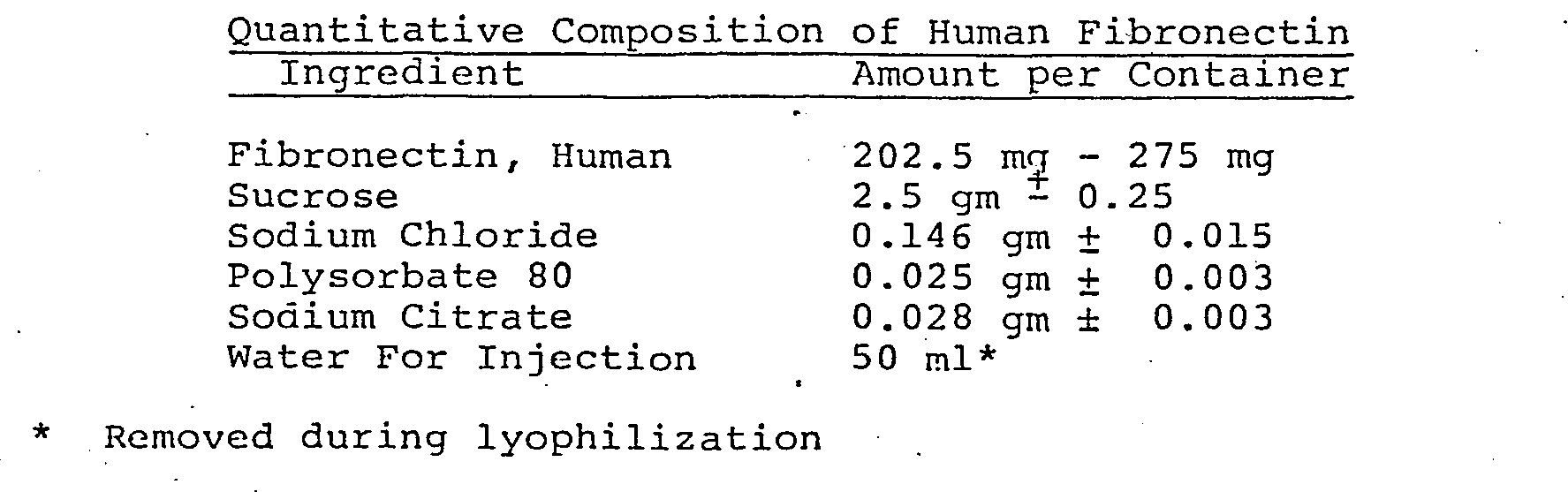
- The lyophilized formulations of the present invention are easily reconstituted prior to use. Illustrative data on reconstitution is presented in Example 13.
- Fibronectin lyophilized in the presence of 0.075M NaCl, 0.002M sodium citrate and containing the herein denoted amounts of carbohydrates and surfactants were reconstituted with 48.5 ml of water. Reconstitution time and remarks are shown hereinbelow.

- The results in Example 13 clearly show the unexpected and greatly improved solubility within short time periods of the lyophilized fibronectin in the formulations of the present invention.
Claims (23)
Priority Applications (1)
| Application Number | Priority Date | Filing Date | Title |
|---|---|---|---|
| AT84104360T ATE31023T1 (en) | 1983-04-28 | 1984-04-17 | PHARMACEUTICAL PREPARATION CONTAINING PURIFIED FIBRINONECTIN. |
Applications Claiming Priority (2)
| Application Number | Priority Date | Filing Date | Title |
|---|---|---|---|
| US48962483A | 1983-04-28 | 1983-04-28 | |
| US489624 | 1983-04-28 |
Publications (2)
| Publication Number | Publication Date |
|---|---|
| EP0124018A1 true EP0124018A1 (en) | 1984-11-07 |
| EP0124018B1 EP0124018B1 (en) | 1987-11-25 |
Family
ID=23944603
Family Applications (1)
| Application Number | Title | Priority Date | Filing Date |
|---|---|---|---|
| EP84104360A Expired EP0124018B1 (en) | 1983-04-28 | 1984-04-17 | Pharmaceutical preparation containing purified fibronectin |
Country Status (7)
| Country | Link |
|---|---|
| EP (1) | EP0124018B1 (en) |
| JP (1) | JPS59206312A (en) |
| AT (1) | ATE31023T1 (en) |
| AU (1) | AU561590B2 (en) |
| CA (1) | CA1214102A (en) |
| DE (1) | DE3467706D1 (en) |
| ZA (1) | ZA842984B (en) |
Cited By (10)
| Publication number | Priority date | Publication date | Assignee | Title |
|---|---|---|---|---|
| EP0179477A3 (en) * | 1984-10-24 | 1987-02-04 | Green Cross Corporation | Fibronectin preparations |
| US4727059A (en) * | 1985-03-28 | 1988-02-23 | Serotherapeutisches Institut Wien Gesellschaft M.B.H. | Fibronectin solution suitable for use in humans and process for its preparation |
| EP0261599A3 (en) * | 1986-09-26 | 1989-07-19 | Exovir, Inc. | Compositions suitable for human topical application including a growth factor and/or related materials |
| WO1989011298A1 (en) * | 1988-05-27 | 1989-11-30 | Centocor, Inc. | Formulation for antibody reagents |
| EP0420049A1 (en) * | 1989-09-28 | 1991-04-03 | F. Hoffmann-La Roche Ag | Stabilized leucocyte-interferon |
| EP0448146A1 (en) * | 1990-03-20 | 1991-09-25 | Akzo Nobel N.V. | Stabilized gonadotropin containing preparations |
| EP0386951A3 (en) * | 1989-03-06 | 1992-05-20 | Eli Lilly And Company | An improved diluent formulation for daptomycin |
| EP0417193B1 (en) * | 1988-05-27 | 1993-08-04 | Centocor, Inc. | Freeze-dried formulation for antibody products |
| US8518452B2 (en) | 2007-02-15 | 2013-08-27 | Octapharma Ag | Method for stabilizing blood plasma components in a lyophilizate using carbon dioxide and phosphoric acid |
| CN117860608A (en) * | 2023-12-28 | 2024-04-12 | 深圳柏垠生物科技有限公司 | Instant fibronectin freeze-dried powder and preparation method thereof |
Families Citing this family (2)
| Publication number | Priority date | Publication date | Assignee | Title |
|---|---|---|---|---|
| JP7110360B2 (en) | 2017-10-09 | 2022-08-01 | テルモ ビーシーティー バイオテクノロジーズ,エルエルシー | Freeze-drying method |
| CN113614477B (en) | 2019-03-14 | 2023-04-28 | 泰尔茂比司特生物技术有限公司 | Freeze-drying loading tray assembly and system |
Citations (2)
| Publication number | Priority date | Publication date | Assignee | Title |
|---|---|---|---|---|
| EP0035204A2 (en) * | 1980-03-05 | 1981-09-09 | Miles Inc. | Pasteurized therapeutically active protein compositions |
| EP0047216A1 (en) * | 1980-09-02 | 1982-03-10 | Edward Shanbrom | Method of selectively increasing yield and purity of certain cryoprecipitate proteins |
Family Cites Families (2)
| Publication number | Priority date | Publication date | Assignee | Title |
|---|---|---|---|---|
| JPS5767520A (en) * | 1980-10-13 | 1982-04-24 | Katsuyuki Haranaka | Preparation of antitumor agent |
| JPS5967228A (en) * | 1982-10-07 | 1984-04-16 | Green Cross Corp:The | Method for freeze-drying cold-insoluble globulin |
-
1984
- 1984-04-17 AT AT84104360T patent/ATE31023T1/en not_active IP Right Cessation
- 1984-04-17 DE DE8484104360T patent/DE3467706D1/en not_active Expired
- 1984-04-17 EP EP84104360A patent/EP0124018B1/en not_active Expired
- 1984-04-18 CA CA000452289A patent/CA1214102A/en not_active Expired
- 1984-04-19 ZA ZA842984A patent/ZA842984B/en unknown
- 1984-04-26 AU AU27402/84A patent/AU561590B2/en not_active Ceased
- 1984-04-26 JP JP59083038A patent/JPS59206312A/en not_active Expired - Lifetime
Patent Citations (2)
| Publication number | Priority date | Publication date | Assignee | Title |
|---|---|---|---|---|
| EP0035204A2 (en) * | 1980-03-05 | 1981-09-09 | Miles Inc. | Pasteurized therapeutically active protein compositions |
| EP0047216A1 (en) * | 1980-09-02 | 1982-03-10 | Edward Shanbrom | Method of selectively increasing yield and purity of certain cryoprecipitate proteins |
Cited By (12)
| Publication number | Priority date | Publication date | Assignee | Title |
|---|---|---|---|---|
| EP0179477A3 (en) * | 1984-10-24 | 1987-02-04 | Green Cross Corporation | Fibronectin preparations |
| US4740498A (en) * | 1984-10-24 | 1988-04-26 | Green Cross Corporation | Fibronectin preparations |
| US4727059A (en) * | 1985-03-28 | 1988-02-23 | Serotherapeutisches Institut Wien Gesellschaft M.B.H. | Fibronectin solution suitable for use in humans and process for its preparation |
| AT385658B (en) * | 1985-03-28 | 1988-05-10 | Serotherapeutisches Inst Wien | METHOD FOR PRODUCING A FIBRONEKTIN SOLUTION SUITABLE FOR HUMAN USE |
| EP0261599A3 (en) * | 1986-09-26 | 1989-07-19 | Exovir, Inc. | Compositions suitable for human topical application including a growth factor and/or related materials |
| WO1989011298A1 (en) * | 1988-05-27 | 1989-11-30 | Centocor, Inc. | Formulation for antibody reagents |
| EP0417193B1 (en) * | 1988-05-27 | 1993-08-04 | Centocor, Inc. | Freeze-dried formulation for antibody products |
| EP0386951A3 (en) * | 1989-03-06 | 1992-05-20 | Eli Lilly And Company | An improved diluent formulation for daptomycin |
| EP0420049A1 (en) * | 1989-09-28 | 1991-04-03 | F. Hoffmann-La Roche Ag | Stabilized leucocyte-interferon |
| EP0448146A1 (en) * | 1990-03-20 | 1991-09-25 | Akzo Nobel N.V. | Stabilized gonadotropin containing preparations |
| US8518452B2 (en) | 2007-02-15 | 2013-08-27 | Octapharma Ag | Method for stabilizing blood plasma components in a lyophilizate using carbon dioxide and phosphoric acid |
| CN117860608A (en) * | 2023-12-28 | 2024-04-12 | 深圳柏垠生物科技有限公司 | Instant fibronectin freeze-dried powder and preparation method thereof |
Also Published As
| Publication number | Publication date |
|---|---|
| AU561590B2 (en) | 1987-05-14 |
| JPS59206312A (en) | 1984-11-22 |
| ZA842984B (en) | 1984-11-28 |
| AU2740284A (en) | 1984-11-01 |
| EP0124018B1 (en) | 1987-11-25 |
| CA1214102A (en) | 1986-11-18 |
| ATE31023T1 (en) | 1987-12-15 |
| DE3467706D1 (en) | 1988-01-07 |
Similar Documents
| Publication | Publication Date | Title |
|---|---|---|
| US4478829A (en) | Pharmaceutical preparation containing purified fibronectin | |
| US5945098A (en) | Stable intravenously-administrable immune globulin preparation | |
| EP0758248B1 (en) | Formulations for factor ix | |
| KR102051922B1 (en) | Pharmaceutical composition containing deoxycholic acid | |
| EP0876155B1 (en) | Highly concentrated, lyophilized and liquid factor ix formulations | |
| AU735411B2 (en) | Stable lyophilized pharmaceutical preparations of monoclonal or polyclonal antibodies | |
| US5834028A (en) | Soluble thrombomodulin-containing composition | |
| US4186192A (en) | Stabilized immune serum globulin | |
| DE3400413C2 (en) | ||
| CA1254510A (en) | Fibronectin preparations | |
| JP5253501B2 (en) | Stabilized thrombin composition | |
| US4439421A (en) | Stabilized gamma globulin concentrate | |
| US20010031721A1 (en) | Highly concentrated, lyophilized, and liquid factor IX formulations | |
| US6150331A (en) | Human growth hormone-containing aqueous pharmaceutical composition | |
| JP2001515460A (en) | Production and use of plasma protein liquid preparations | |
| JPH06510031A (en) | Method for producing injectable or injectable pharmaceutical preparations containing human proteins | |
| EP0124018B1 (en) | Pharmaceutical preparation containing purified fibronectin | |
| IE64080B1 (en) | Pharmaceutical for subcutaneous administration containing polypeptides | |
| KR0137476B1 (en) | Factor ññ for the prevention intraventricular hemorrhage | |
| KR900004799B1 (en) | Stable gamma-interferon formulations and its preparation | |
| KR100255095B1 (en) | Therapeutic agent for threatened abortion | |
| JPH06135851A (en) | Chondroitinase composition and preparation for injection containing the same composition | |
| JP2783367B2 (en) | Heparin-containing preparations | |
| EP0419251A1 (en) | Protein-containing aqueous solutions | |
| JPH0296536A (en) | Dry plasminogen pharmaceutical |
Legal Events
| Date | Code | Title | Description |
|---|---|---|---|
| PUAI | Public reference made under article 153(3) epc to a published international application that has entered the european phase |
Free format text: ORIGINAL CODE: 0009012 |
|
| AK | Designated contracting states |
Designated state(s): AT BE CH DE FR GB IT LI LU NL SE |
|
| 17P | Request for examination filed |
Effective date: 19850403 |
|
| 17Q | First examination report despatched |
Effective date: 19860612 |
|
| GRAA | (expected) grant |
Free format text: ORIGINAL CODE: 0009210 |
|
| AK | Designated contracting states |
Kind code of ref document: B1 Designated state(s): AT BE CH DE FR GB IT LI LU NL SE |
|
| REF | Corresponds to: |
Ref document number: 31023 Country of ref document: AT Date of ref document: 19871215 Kind code of ref document: T |
|
| REF | Corresponds to: |
Ref document number: 3467706 Country of ref document: DE Date of ref document: 19880107 |
|
| ET | Fr: translation filed | ||
| ITF | It: translation for a ep patent filed | ||
| PG25 | Lapsed in a contracting state [announced via postgrant information from national office to epo] |
Ref country code: LU Free format text: LAPSE BECAUSE OF NON-PAYMENT OF DUE FEES Effective date: 19880430 |
|
| PLBE | No opposition filed within time limit |
Free format text: ORIGINAL CODE: 0009261 |
|
| STAA | Information on the status of an ep patent application or granted ep patent |
Free format text: STATUS: NO OPPOSITION FILED WITHIN TIME LIMIT |
|
| 26N | No opposition filed | ||
| PG25 | Lapsed in a contracting state [announced via postgrant information from national office to epo] |
Ref country code: AT Effective date: 19890417 |
|
| PG25 | Lapsed in a contracting state [announced via postgrant information from national office to epo] |
Ref country code: SE Effective date: 19890418 |
|
| PG25 | Lapsed in a contracting state [announced via postgrant information from national office to epo] |
Ref country code: LI Effective date: 19890430 Ref country code: CH Effective date: 19890430 Ref country code: BE Effective date: 19890430 |
|
| BERE | Be: lapsed |
Owner name: ARMOUR PHARMACEUTICAL CY Effective date: 19890430 |
|
| PG25 | Lapsed in a contracting state [announced via postgrant information from national office to epo] |
Ref country code: NL Effective date: 19891101 |
|
| NLV4 | Nl: lapsed or anulled due to non-payment of the annual fee | ||
| REG | Reference to a national code |
Ref country code: CH Ref legal event code: PL |
|
| PGFP | Annual fee paid to national office [announced via postgrant information from national office to epo] |
Ref country code: FR Payment date: 19900325 Year of fee payment: 7 |
|
| PGFP | Annual fee paid to national office [announced via postgrant information from national office to epo] |
Ref country code: DE Payment date: 19900329 Year of fee payment: 7 |
|
| PGFP | Annual fee paid to national office [announced via postgrant information from national office to epo] |
Ref country code: GB Payment date: 19900331 Year of fee payment: 7 |
|
| ITTA | It: last paid annual fee | ||
| PG25 | Lapsed in a contracting state [announced via postgrant information from national office to epo] |
Ref country code: GB Effective date: 19910417 |
|
| GBPC | Gb: european patent ceased through non-payment of renewal fee | ||
| PG25 | Lapsed in a contracting state [announced via postgrant information from national office to epo] |
Ref country code: FR Effective date: 19911230 |
|
| PG25 | Lapsed in a contracting state [announced via postgrant information from national office to epo] |
Ref country code: DE Effective date: 19920201 |
|
| REG | Reference to a national code |
Ref country code: FR Ref legal event code: ST |
|
| EUG | Se: european patent has lapsed |
Ref document number: 84104360.7 Effective date: 19900412 |