EP0122658A1 - Method for the separate recovery of metals from waste in particular chemical waste - Google Patents
Method for the separate recovery of metals from waste in particular chemical waste Download PDFInfo
- Publication number
- EP0122658A1 EP0122658A1 EP19840200464 EP84200464A EP0122658A1 EP 0122658 A1 EP0122658 A1 EP 0122658A1 EP 19840200464 EP19840200464 EP 19840200464 EP 84200464 A EP84200464 A EP 84200464A EP 0122658 A1 EP0122658 A1 EP 0122658A1
- Authority
- EP
- European Patent Office
- Prior art keywords
- solution
- extraction
- waste
- chromium
- zinc
- Prior art date
- Legal status (The legal status is an assumption and is not a legal conclusion. Google has not performed a legal analysis and makes no representation as to the accuracy of the status listed.)
- Granted
Links
- 238000000034 method Methods 0.000 title claims abstract description 28
- 239000002699 waste material Substances 0.000 title claims abstract description 27
- 229910052751 metal Inorganic materials 0.000 title claims abstract description 26
- 239000002184 metal Substances 0.000 title claims abstract description 26
- 150000002739 metals Chemical class 0.000 title claims abstract description 20
- 239000002894 chemical waste Substances 0.000 title claims abstract description 17
- 238000011084 recovery Methods 0.000 title claims abstract description 14
- 238000000605 extraction Methods 0.000 claims abstract description 95
- 239000000243 solution Substances 0.000 claims abstract description 73
- XEEYBQQBJWHFJM-UHFFFAOYSA-N Iron Chemical compound [Fe] XEEYBQQBJWHFJM-UHFFFAOYSA-N 0.000 claims abstract description 48
- 239000011701 zinc Substances 0.000 claims abstract description 31
- 229910052725 zinc Inorganic materials 0.000 claims abstract description 30
- PXHVJJICTQNCMI-UHFFFAOYSA-N Nickel Chemical compound [Ni] PXHVJJICTQNCMI-UHFFFAOYSA-N 0.000 claims abstract description 29
- HCHKCACWOHOZIP-UHFFFAOYSA-N Zinc Chemical compound [Zn] HCHKCACWOHOZIP-UHFFFAOYSA-N 0.000 claims abstract description 29
- 229910052793 cadmium Inorganic materials 0.000 claims abstract description 28
- BDOSMKKIYDKNTQ-UHFFFAOYSA-N cadmium atom Chemical compound [Cd] BDOSMKKIYDKNTQ-UHFFFAOYSA-N 0.000 claims abstract description 27
- 229910052742 iron Inorganic materials 0.000 claims abstract description 24
- 239000007864 aqueous solution Substances 0.000 claims abstract description 18
- 239000002253 acid Substances 0.000 claims abstract description 17
- 239000011651 chromium Substances 0.000 claims abstract description 17
- 229910052759 nickel Inorganic materials 0.000 claims abstract description 15
- 150000001450 anions Chemical class 0.000 claims abstract description 13
- PMZURENOXWZQFD-UHFFFAOYSA-L Sodium Sulfate Chemical compound [Na+].[Na+].[O-]S([O-])(=O)=O PMZURENOXWZQFD-UHFFFAOYSA-L 0.000 claims abstract description 12
- JOPOVCBBYLSVDA-UHFFFAOYSA-N chromium(6+) Chemical compound [Cr+6] JOPOVCBBYLSVDA-UHFFFAOYSA-N 0.000 claims abstract description 10
- 229910052804 chromium Inorganic materials 0.000 claims abstract description 9
- VYZAMTAEIAYCRO-UHFFFAOYSA-N Chromium Chemical compound [Cr] VYZAMTAEIAYCRO-UHFFFAOYSA-N 0.000 claims abstract description 8
- VTLYFUHAOXGGBS-UHFFFAOYSA-N Fe3+ Chemical compound [Fe+3] VTLYFUHAOXGGBS-UHFFFAOYSA-N 0.000 claims abstract description 8
- BFGKITSFLPAWGI-UHFFFAOYSA-N chromium(3+) Chemical compound [Cr+3] BFGKITSFLPAWGI-UHFFFAOYSA-N 0.000 claims abstract description 6
- 229910052938 sodium sulfate Inorganic materials 0.000 claims abstract description 6
- 235000011152 sodium sulphate Nutrition 0.000 claims abstract description 6
- XLYOFNOQVPJJNP-UHFFFAOYSA-N water Substances O XLYOFNOQVPJJNP-UHFFFAOYSA-N 0.000 claims abstract description 6
- 238000010828 elution Methods 0.000 claims abstract description 5
- 239000007800 oxidant agent Substances 0.000 claims abstract description 5
- 238000005406 washing Methods 0.000 claims abstract description 5
- 229910000147 aluminium phosphate Inorganic materials 0.000 claims abstract description 3
- 230000001590 oxidative effect Effects 0.000 claims abstract description 3
- NBIIXXVUZAFLBC-UHFFFAOYSA-N phosphoric acid Substances OP(O)(O)=O NBIIXXVUZAFLBC-UHFFFAOYSA-N 0.000 claims abstract description 3
- VEXZGXHMUGYJMC-UHFFFAOYSA-N Hydrochloric acid Chemical compound Cl VEXZGXHMUGYJMC-UHFFFAOYSA-N 0.000 claims description 20
- SUKJFIGYRHOWBL-UHFFFAOYSA-N sodium hypochlorite Chemical compound [Na+].Cl[O-] SUKJFIGYRHOWBL-UHFFFAOYSA-N 0.000 claims description 9
- NUJOXMJBOLGQSY-UHFFFAOYSA-N manganese dioxide Chemical compound O=[Mn]=O NUJOXMJBOLGQSY-UHFFFAOYSA-N 0.000 claims description 8
- 229910017052 cobalt Inorganic materials 0.000 claims description 7
- 239000010941 cobalt Substances 0.000 claims description 7
- GUTLYIVDDKVIGB-UHFFFAOYSA-N cobalt atom Chemical compound [Co] GUTLYIVDDKVIGB-UHFFFAOYSA-N 0.000 claims description 7
- FAPWRFPIFSIZLT-UHFFFAOYSA-M Sodium chloride Chemical compound [Na+].[Cl-] FAPWRFPIFSIZLT-UHFFFAOYSA-M 0.000 claims description 6
- 239000005708 Sodium hypochlorite Substances 0.000 claims description 5
- 230000003647 oxidation Effects 0.000 claims description 5
- 238000007254 oxidation reaction Methods 0.000 claims description 5
- GRYLNZFGIOXLOG-UHFFFAOYSA-N Nitric acid Chemical compound O[N+]([O-])=O GRYLNZFGIOXLOG-UHFFFAOYSA-N 0.000 claims description 4
- MOUPNEIJQCETIW-UHFFFAOYSA-N lead chromate Chemical compound [Pb+2].[O-][Cr]([O-])(=O)=O MOUPNEIJQCETIW-UHFFFAOYSA-N 0.000 claims description 4
- 229910017604 nitric acid Inorganic materials 0.000 claims description 4
- 239000003960 organic solvent Substances 0.000 claims description 4
- PXLIDIMHPNPGMH-UHFFFAOYSA-N sodium chromate Chemical compound [Na+].[Na+].[O-][Cr]([O-])(=O)=O PXLIDIMHPNPGMH-UHFFFAOYSA-N 0.000 claims description 4
- GNFTZDOKVXKIBK-UHFFFAOYSA-N 3-(2-methoxyethoxy)benzohydrazide Chemical compound COCCOC1=CC=CC(C(=O)NN)=C1 GNFTZDOKVXKIBK-UHFFFAOYSA-N 0.000 claims description 3
- 229910052802 copper Inorganic materials 0.000 claims description 3
- 239000010949 copper Substances 0.000 claims description 3
- 239000011780 sodium chloride Substances 0.000 claims description 3
- FGUUSXIOTUKUDN-IBGZPJMESA-N C1(=CC=CC=C1)N1C2=C(NC([C@H](C1)NC=1OC(=NN=1)C1=CC=CC=C1)=O)C=CC=C2 Chemical compound C1(=CC=CC=C1)N1C2=C(NC([C@H](C1)NC=1OC(=NN=1)C1=CC=CC=C1)=O)C=CC=C2 FGUUSXIOTUKUDN-IBGZPJMESA-N 0.000 claims description 2
- WPBNNNQJVZRUHP-UHFFFAOYSA-L manganese(2+);methyl n-[[2-(methoxycarbonylcarbamothioylamino)phenyl]carbamothioyl]carbamate;n-[2-(sulfidocarbothioylamino)ethyl]carbamodithioate Chemical compound [Mn+2].[S-]C(=S)NCCNC([S-])=S.COC(=O)NC(=S)NC1=CC=CC=C1NC(=S)NC(=O)OC WPBNNNQJVZRUHP-UHFFFAOYSA-L 0.000 claims description 2
- RYGMFSIKBFXOCR-UHFFFAOYSA-N Copper Chemical compound [Cu] RYGMFSIKBFXOCR-UHFFFAOYSA-N 0.000 claims 2
- ZCDOYSPFYFSLEW-UHFFFAOYSA-N chromate(2-) Chemical compound [O-][Cr]([O-])(=O)=O ZCDOYSPFYFSLEW-UHFFFAOYSA-N 0.000 claims 1
- 238000001914 filtration Methods 0.000 claims 1
- 239000002244 precipitate Substances 0.000 claims 1
- DGAQECJNVWCQMB-PUAWFVPOSA-M Ilexoside XXIX Chemical compound C[C@@H]1CC[C@@]2(CC[C@@]3(C(=CC[C@H]4[C@]3(CC[C@@H]5[C@@]4(CC[C@@H](C5(C)C)OS(=O)(=O)[O-])C)C)[C@@H]2[C@]1(C)O)C)C(=O)O[C@H]6[C@@H]([C@H]([C@@H]([C@H](O6)CO)O)O)O.[Na+] DGAQECJNVWCQMB-PUAWFVPOSA-M 0.000 abstract 1
- 238000011109 contamination Methods 0.000 abstract 1
- 238000000926 separation method Methods 0.000 abstract 1
- 229910052708 sodium Inorganic materials 0.000 abstract 1
- 239000011734 sodium Substances 0.000 abstract 1
- 239000002609 medium Substances 0.000 description 36
- QAOWNCQODCNURD-UHFFFAOYSA-N Sulfuric acid Chemical compound OS(O)(=O)=O QAOWNCQODCNURD-UHFFFAOYSA-N 0.000 description 10
- 239000001117 sulphuric acid Substances 0.000 description 10
- 235000011149 sulphuric acid Nutrition 0.000 description 10
- NTIZESTWPVYFNL-UHFFFAOYSA-N Methyl isobutyl ketone Chemical compound CC(C)CC(C)=O NTIZESTWPVYFNL-UHFFFAOYSA-N 0.000 description 6
- UIHCLUNTQKBZGK-UHFFFAOYSA-N Methyl isobutyl ketone Natural products CCC(C)C(C)=O UIHCLUNTQKBZGK-UHFFFAOYSA-N 0.000 description 6
- 238000000622 liquid--liquid extraction Methods 0.000 description 6
- 229940043265 methyl isobutyl ketone Drugs 0.000 description 6
- 238000000638 solvent extraction Methods 0.000 description 6
- STCOOQWBFONSKY-UHFFFAOYSA-N tributyl phosphate Chemical compound CCCCOP(=O)(OCCCC)OCCCC STCOOQWBFONSKY-UHFFFAOYSA-N 0.000 description 6
- 239000010802 sludge Substances 0.000 description 5
- 230000008929 regeneration Effects 0.000 description 4
- 238000011069 regeneration method Methods 0.000 description 4
- 150000002500 ions Chemical class 0.000 description 3
- 239000003350 kerosene Substances 0.000 description 3
- 239000000203 mixture Substances 0.000 description 3
- XTAZYLNFDRKIHJ-UHFFFAOYSA-N n,n-dioctyloctan-1-amine Chemical compound CCCCCCCCN(CCCCCCCC)CCCCCCCC XTAZYLNFDRKIHJ-UHFFFAOYSA-N 0.000 description 3
- QAOWNCQODCNURD-UHFFFAOYSA-L Sulfate Chemical compound [O-]S([O-])(=O)=O QAOWNCQODCNURD-UHFFFAOYSA-L 0.000 description 2
- 239000008346 aqueous phase Substances 0.000 description 2
- 239000007788 liquid Substances 0.000 description 2
- 229910021645 metal ion Inorganic materials 0.000 description 2
- 238000005192 partition Methods 0.000 description 2
- 239000012071 phase Substances 0.000 description 2
- 238000002203 pretreatment Methods 0.000 description 2
- 239000000047 product Substances 0.000 description 2
- 239000012266 salt solution Substances 0.000 description 2
- 229910021653 sulphate ion Inorganic materials 0.000 description 2
- WRIDQFICGBMAFQ-UHFFFAOYSA-N (E)-8-Octadecenoic acid Natural products CCCCCCCCCC=CCCCCCCC(O)=O WRIDQFICGBMAFQ-UHFFFAOYSA-N 0.000 description 1
- KEQXNNJHMWSZHK-UHFFFAOYSA-L 1,3,2,4$l^{2}-dioxathiaplumbetane 2,2-dioxide Chemical compound [Pb+2].[O-]S([O-])(=O)=O KEQXNNJHMWSZHK-UHFFFAOYSA-L 0.000 description 1
- LQJBNNIYVWPHFW-UHFFFAOYSA-N 20:1omega9c fatty acid Natural products CCCCCCCCCCC=CCCCCCCCC(O)=O LQJBNNIYVWPHFW-UHFFFAOYSA-N 0.000 description 1
- QSBYPNXLFMSGKH-UHFFFAOYSA-N 9-Heptadecensaeure Natural products CCCCCCCC=CCCCCCCCC(O)=O QSBYPNXLFMSGKH-UHFFFAOYSA-N 0.000 description 1
- OYPRJOBELJOOCE-UHFFFAOYSA-N Calcium Chemical compound [Ca] OYPRJOBELJOOCE-UHFFFAOYSA-N 0.000 description 1
- PWHULOQIROXLJO-UHFFFAOYSA-N Manganese Chemical compound [Mn] PWHULOQIROXLJO-UHFFFAOYSA-N 0.000 description 1
- ZQPPMHVWECSIRJ-UHFFFAOYSA-N Oleic acid Natural products CCCCCCCCC=CCCCCCCCC(O)=O ZQPPMHVWECSIRJ-UHFFFAOYSA-N 0.000 description 1
- 239000005642 Oleic acid Substances 0.000 description 1
- BJTCYVABSUBZSY-UHFFFAOYSA-N [Zn+2].[Cr+4] Chemical compound [Zn+2].[Cr+4] BJTCYVABSUBZSY-UHFFFAOYSA-N 0.000 description 1
- 239000012736 aqueous medium Substances 0.000 description 1
- 239000006227 byproduct Substances 0.000 description 1
- 229910052791 calcium Inorganic materials 0.000 description 1
- 239000011575 calcium Substances 0.000 description 1
- UUMMHAPECIIHJR-UHFFFAOYSA-N chromium(4+) Chemical compound [Cr+4] UUMMHAPECIIHJR-UHFFFAOYSA-N 0.000 description 1
- HPDFFVBPXCTEDN-UHFFFAOYSA-N copper manganese Chemical compound [Mn].[Cu] HPDFFVBPXCTEDN-UHFFFAOYSA-N 0.000 description 1
- ARUVKPQLZAKDPS-UHFFFAOYSA-L copper(II) sulfate Chemical compound [Cu+2].[O-][S+2]([O-])([O-])[O-] ARUVKPQLZAKDPS-UHFFFAOYSA-L 0.000 description 1
- 238000010586 diagram Methods 0.000 description 1
- 238000004090 dissolution Methods 0.000 description 1
- 238000004821 distillation Methods 0.000 description 1
- 239000000428 dust Substances 0.000 description 1
- 238000009713 electroplating Methods 0.000 description 1
- 230000002349 favourable effect Effects 0.000 description 1
- -1 ferrous metals Chemical class 0.000 description 1
- 229940083124 ganglion-blocking antiadrenergic secondary and tertiary amines Drugs 0.000 description 1
- 229910001385 heavy metal Inorganic materials 0.000 description 1
- 238000005342 ion exchange Methods 0.000 description 1
- FBAFATDZDUQKNH-UHFFFAOYSA-M iron chloride Chemical compound [Cl-].[Fe] FBAFATDZDUQKNH-UHFFFAOYSA-M 0.000 description 1
- QXJSBBXBKPUZAA-UHFFFAOYSA-N isooleic acid Natural products CCCCCCCC=CCCCCCCCCC(O)=O QXJSBBXBKPUZAA-UHFFFAOYSA-N 0.000 description 1
- 229910052745 lead Inorganic materials 0.000 description 1
- 229910052748 manganese Inorganic materials 0.000 description 1
- 239000011572 manganese Substances 0.000 description 1
- 239000000463 material Substances 0.000 description 1
- ZQPPMHVWECSIRJ-KTKRTIGZSA-N oleic acid Chemical compound CCCCCCCC\C=C/CCCCCCCC(O)=O ZQPPMHVWECSIRJ-KTKRTIGZSA-N 0.000 description 1
- 238000005554 pickling Methods 0.000 description 1
- 150000003141 primary amines Chemical class 0.000 description 1
- 150000003242 quaternary ammonium salts Chemical class 0.000 description 1
- 238000004064 recycling Methods 0.000 description 1
- 150000003839 salts Chemical class 0.000 description 1
- 235000021122 unsaturated fatty acids Nutrition 0.000 description 1
- 150000004670 unsaturated fatty acids Chemical class 0.000 description 1
Images

Classifications
-
- C—CHEMISTRY; METALLURGY
- C22—METALLURGY; FERROUS OR NON-FERROUS ALLOYS; TREATMENT OF ALLOYS OR NON-FERROUS METALS
- C22B—PRODUCTION AND REFINING OF METALS; PRETREATMENT OF RAW MATERIALS
- C22B7/00—Working up raw materials other than ores, e.g. scrap, to produce non-ferrous metals and compounds thereof; Methods of a general interest or applied to the winning of more than two metals
- C22B7/006—Wet processes
- C22B7/007—Wet processes by acid leaching
-
- Y—GENERAL TAGGING OF NEW TECHNOLOGICAL DEVELOPMENTS; GENERAL TAGGING OF CROSS-SECTIONAL TECHNOLOGIES SPANNING OVER SEVERAL SECTIONS OF THE IPC; TECHNICAL SUBJECTS COVERED BY FORMER USPC CROSS-REFERENCE ART COLLECTIONS [XRACs] AND DIGESTS
- Y02—TECHNOLOGIES OR APPLICATIONS FOR MITIGATION OR ADAPTATION AGAINST CLIMATE CHANGE
- Y02P—CLIMATE CHANGE MITIGATION TECHNOLOGIES IN THE PRODUCTION OR PROCESSING OF GOODS
- Y02P10/00—Technologies related to metal processing
- Y02P10/20—Recycling
Definitions
- the invention relates to a method for the separate recovery of metals such as chromium, zinc, cadmium, nickel from iron-containing waste, especially chemical waste, in which the waste is treated with an acid, whereby an aqueous solution (1) and a residue are obtained.
- metals such as chromium, zinc, cadmium, nickel from iron-containing waste, especially chemical waste, in which the waste is treated with an acid, whereby an aqueous solution (1) and a residue are obtained.
- waste materials which are recognized as chemical waste by the laws of any country and for which there are restrictions concerning the disposal of such waste.
- the invention relates in particular to the disposal of this chemical waste.
- the invention is not limited to this however.
- the invention can be also in general applied to the processing of waste (or waste materials), for instance a waste product or by-product of a process, which is not waste within the meaning of the law but which is a metal-containing mixture which in any case contains iron, and from which the separate recovery of metals is rational.
- the invention relates to waste originating from the electroplating and pickling industries.
- the method is however also applicable to waste from other origins such as harbour or dock sludge.
- the method may even be applied to waste in the form of e.g. dust.
- the waste undergoes a pre-treatment in which the metals in the waste are concentrated. After the pre-treatment the waste often takes the form of a metal-containing sludge.
- hydrochloric acid must, after the recovery of other metals from the hydrochloric solution, (1) be recovered by distillation or (2) be neutralised whereby expensive hydrochloric acid is lost and much salt is produced for the disposal of which a levy must be paid; both methods carry large extra costs.
- MIBK MIBK
- a further problem with lead is that, during the recovery of other metals in an anion exchanger, this metal diffuses. The metals recovered in an anion exchanger are therefore heavily contaminated with lead.
- chromium (III) passes through the exchanger, while during extraction of chromium (IV) zinc and cadmium are co - extracted.
- the object of the invention is to provide a solution of the above-mentioned difficulties and hence improve known methods.
- the advantage of this is that in this way iron can be extracted selectively from the aqueous solution with a partition coefficient of about 1000, with not more than a very slight loss of extraction medium.
- di-2-ethylhexylphosphoric acid dissolved in a suitable organic solvent is used as extraction medium.
- a further improvement consists in subjecting the chromium (III) in the solution (2) to oxidation treatment using an oxidising agent such as sodium hypochlorite (NaClO) at a pH of 2-4, in selectively extracting the chromium (VI) so formed from the solution at a pH of 2.5-4 using a suitable extraction medium (III) and in removing co-extracted cadmium and zinc from the charged extraction medium (III) before back-extraction of the chromium (IV) by washing with a wash liquid such as a sodium sulphate solution with a pH of about 3; the advantage of this is that the Cr VI to be recovered is hardly contaminated with cadmium and zinc.
- an oxidising agent such as sodium hypochlorite (NaClO) at a pH of 2-4
- reference numeral 1 shows the supply of mixed metal-containing sludges to a solution step a.
- An acid is introduced by a supply 2.
- the sludge is dissolved in an acid suitable for the purpose so that the pH of a solution (1) obtained reaches a final value of between 0 and 1.
- Sulphuric acid is preferably used since it is cheap and since when sulphuric acid is used calcium for the most part does not go into solution. If however there is much lead present in the sludge so that the residue obtained from the solution step 'a' through the discharge 3 would not conform with the legal standards, use is made of hydrochloric or nitric acid.
- the iron is first removed from the solution (1) obtained at step a.
- solution (1) is brought to a step b, at which the iron is removed selectively from solution (1).
- This can be achieved by means of liquid-liquid extraction in which an organo-phosphoric acid is used as extraction medium (I).
- an organo-phosphoric acid is used as extraction medium (I).
- D2EHPA di-2-ethylhexylphosphoric acid
- suitable organic solvent is suitable.
- the stripping/regeneration of the organic extraction medium charged with iron and zinc by means of sulphuric acid, as described in DE 2503398, is not effective.
- the following method is employed (see Fig. 2).
- the charged extraction medium is subjected to a subsequent liquid-liquid extraction step, in which the aqueous phase consists of a 6 M HC1 solution.
- the iron thus goes over into the aqueous phase, from which it can be removed by a known technique, for instance by means of liquid-liquid extraction using a solvating extraction medium (II) such as methyl- isobutyl ketone (MIBK) or tributyl phosphate (TSP).
- II solvating extraction medium
- MIBK methyl- isobutyl ketone
- TSP tributyl phosphate
- the iron-free hydrochloric solution is after recuperation re-used for the regeneration of the extraction medium (I).
- the iron extraction is shown schematically in Fig. 2.
- the other numbers in Fig. 2 are iron concentrations (g/1) in the relevant flows in the embodiment.
- the extraction media in the example are:
- the resultant iron chloride solution can be highly concentrated. (In the example by a factor 25 relative to the original solution).
- Zinc is extracted only to the extent of 1% in the first step, and the other non-ferrous metals remain below that.
- the solution (2) obtained at step b is, as shown in Fig. 1, brought to a process step c, in which the Cr (III) present is oxidised to Cr (VI) in an oxidation step c-2 using sodium hypochlorite, in which the pH should lie between 2 and 4.
- the chromium in its hexavalent form can be removed selectively from the solution. The removal of the chromium is necessary since it will interfere with the subsequent process steps.
- the manganese which may be present (as Mn 2 +) in solution (2) is deposited as manganese dioxide (Mn0 2 ) as a result of the oxidising treatment in oxidation step c-2 and is then filtered off.
- the Cr (VI) formed is removed selectively from the solution in step c-3 using liquid-liquid extraction.
- basic extraction media known per se such as primary, secondary and tertiary amines, and also quaternary ammonium salts.
- a mixture of trioctylamine and tributyl phosphate (TOA/TBP) is especially suitable for this purpose.
- n and q have the same significance as in Fig. 2.
- the extraction medium (III) is TOA/TBP (50/100 g/1) in kerosine.
- Zinc and cadmium are very strongly co-extracted, but can be washed out effectively using a sulphate solution.
- Cu2+ is selectively removed from the solution (3) obtained at step c by means of liquid-liquid extraction at a pH between 4 and 5.5.
- the copper-charged extraction medium (IV) is stripped/regenerated using sulphuric acid to obtain a highly concentrated copper sulphate solution.
- the solution (4) obtained in step d plus the wash water from step c-3 contains ions of zinc, cadmium, nickel and cobalt. These metal ions are extracted at step e from solution (4) using extraction medium (V) by carrying out the extraction in a number of equilibrium steps at a pH between 6 and 7.
- extraction medium (V) by carrying out the extraction in a number of equilibrium steps at a pH between 6 and 7.
- the aqueous solution (5) so obtained contains no more heavy metals and can be disposed of.
- the extraction medium (V) obtained at step e and charged with S n 2+ , Cd 2+ , Ni 2+ and Co 2+ is stripped/regenerated in step f at a pH of less than 5 using an aqueous solution containing 5 mol/l NaCl. In this, the above-mentioned metal ions go over into the aqueous solution (6).
- Nickel is finally extracted from the salt solution (7) at step h at a pH of between 6 and 7 using extraction medium (VI).
- the nickel-charged extraction medium (VI) is stripped with sulphuric acid.
- the resultant salt solution (8) can afterwards be brought back to strength and used again for stripping the extraction medium (V) charged in step e.
- a mixture of cyclohexanoxime and an unsaturated fatty acid such as e.g. oleic acid in an arbitrary organic solvent is especially suitable for the extraction media (IV), (V) and (VI).
Landscapes
- Engineering & Computer Science (AREA)
- Chemical & Material Sciences (AREA)
- Geology (AREA)
- Life Sciences & Earth Sciences (AREA)
- General Life Sciences & Earth Sciences (AREA)
- Manufacturing & Machinery (AREA)
- Environmental & Geological Engineering (AREA)
- Materials Engineering (AREA)
- Mechanical Engineering (AREA)
- Metallurgy (AREA)
- Organic Chemistry (AREA)
- Manufacture And Refinement Of Metals (AREA)
- Removal Of Specific Substances (AREA)
- Extraction Or Liquid Replacement (AREA)
Abstract
- A. treatment of the waste with an acid whereby an aqueous solution (1) and a residue are obtained,
- B. selective extraction of iron (III) from solution (I) at a pH of 0-1 using an organo-phosphoric acid as an extraction medium (I),
- C-2 oxidative treatment of the chromium (III) in solution freed from iron at a pH of 2-4 using an oxidising agent, such as sodium hypoclhorite (NaCIO), and
- C-3 selective extraction of the chromium (VI) formed from the solution at a pH of 2.5-4 using a suitable extraction medium (III) and the removal of co-extracted cadmium and zinc from the charged extraction medium (III) by washing with a wash liquor such as a sodium sulphate solution at a pH of 3 before back-extraction of the chromium (VI),
- zinc, cadmium and nickel can be extracted together from the solution freed from chromium at a pH of 6-7 using a suitable extraction medium (V) and separated by back-extraction of the extraction medium (V) at a pH of less than 5 using an aqueous solution which contains about 5 MoL/1 NaCi, fixing of zinc and cadmium from this solution on a strongly basic anion exchanger followed by subsequent elution of zinc and cadmium with about 0.02 m HCI and water respectively, and extraction of the nickel from the solution which has passed unhindered through the anion exchanger at a pH of 6-7.
Description
- The applicant names as inventors:
- Ir. Arend Bolt of Geldrop
- Dr. Ir. Wilhelmus J. Th. van Gemert of Apeldoorn
- Ing. Bernhard A. Kamphuis of Baarn
- Prof. Ir. Martinus Tels of Eindhoven
- The invention relates to a method for the separate recovery of metals such as chromium, zinc, cadmium, nickel from iron-containing waste, especially chemical waste, in which the waste is treated with an acid, whereby an aqueous solution (1) and a residue are obtained.
- In this connection, by chemical waste is understood waste materials which are recognized as chemical waste by the laws of any country and for which there are restrictions concerning the disposal of such waste. The invention relates in particular to the disposal of this chemical waste. The invention is not limited to this however. The invention can be also in general applied to the processing of waste (or waste materials), for instance a waste product or by-product of a process, which is not waste within the meaning of the law but which is a metal-containing mixture which in any case contains iron, and from which the separate recovery of metals is rational. In particular the invention relates to waste originating from the electroplating and pickling industries. The method is however also applicable to waste from other origins such as harbour or dock sludge. The method may even be applied to waste in the form of e.g. dust. As a rule the waste undergoes a pre-treatment in which the metals in the waste are concentrated. After the pre-treatment the waste often takes the form of a metal-containing sludge.
- It is known, as the first step in the recovery of metals, to treat the chemical waste with acid. The aim here is to obtain an aqueous solution containing the ions of the metal, and a residue which is not chemical waste within the meaning of the law and which can be freely disposed of. The preferred acid is the cheap sulphuric acid. Known methods for the separate recovery of metals are liquid-liquid extraction - called extraction in the following - and ion exchange.
- Mostly, the chemical waste contains significant quantities of iron, and althoughiron is not chemical waste within the meaning of the law it goes partially into solution during the dissolution treatment. The iron which is dissolved interferes with the separate recovery of other metals and must therefore be removed. It is known to remove iron (III) selectively from an aqueous solution by extraction using MIBK (methyl- isobutyl ketone) as the extraction medium. This extraction has the following difficulties. Firstly the extraction is only possible from a solution containing much hydrochloric acid. The hydrochloric acid must, after the recovery of other metals from the hydrochloric solution, (1) be recovered by distillation or (2) be neutralised whereby expensive hydrochloric acid is lost and much salt is produced for the disposal of which a levy must be paid; both methods carry large extra costs. Secondly, when MIBK is used much of this extraction medium is lost due to its high solubility in the aqueous solution.
- If the waste also contains lead, it is necessary to use another acid such as hydrochloric or nitric acid, in place of the sulphuric acid, since the use of sulphuric acid leaves an unacceptable quantity of lead sulphate in the residue as a result of its poor solubility. When hydrochloric acid is chosen there remains the above-mentioned second difficulty, with MIBK, of the loss of this extraction material in the aqueous solution.
- A further problem with lead is that, during the recovery of other metals in an anion exchanger, this metal diffuses. The metals recovered in an anion exchanger are therefore heavily contaminated with lead.
- The separate recovery of chromium also poses a problem. When an anion exchanger is employed, chromium (III) passes through the exchanger, while during extraction of chromium (IV) zinc and cadmium are co-extracted.
- The object of the invention is to provide a solution of the above-mentioned difficulties and hence improve known methods.
- This is achieved in the invention by selectively extracting the iron (III) from the solution (1) at a pH of 0-1 using an organophosphoric acid as extraction medium (1), and by recovering other metals separately too. The advantage of this is that in this way iron can be extracted selectively from the aqueous solution with a partition coefficient of about 1000, with not more than a very slight loss of extraction medium.
- It is remarked that it is known from DE 2503398 to extract iron and zinc together froman acid sulphate solution with an organophosphoric acid as extraction medium. What is not known is how to use this extraction medium to extract iron (present as Fe3+) selectively from an acid solution by controlling the pH accurately to a value between 0 and 1, whereby the aqueous medium is not bound to sulphuric acid.
- Preferably di-2-ethylhexylphosphoric acid dissolved in a suitable organic solvent is used as extraction medium.
- The regeneration of this extraction medium with sulphuric acid, as described in DE 2503398 is not efficient, and hence the iron is preferably back-extracted from the extraction medium using a strong, e.g. 6 M, HC1 solution.
- A further improvement consists in subjecting the chromium (III) in the solution (2) to oxidation treatment using an oxidising agent such as sodium hypochlorite (NaClO) at a pH of 2-4, in selectively extracting the chromium (VI) so formed from the solution at a pH of 2.5-4 using a suitable extraction medium (III) and in removing co-extracted cadmium and zinc from the charged extraction medium (III) before back-extraction of the chromium (IV) by washing with a wash liquid such as a sodium sulphate solution with a pH of about 3; the advantage of this is that the Cr VI to be recovered is hardly contaminated with cadmium and zinc.
- In another aspect the object of the invention is achieved by the combination of the following steps:
- a. treatment of the waste with an acid, whereby an aqueous solution (I) and a residue are obtained;
- b. selective extraction of the iron (III) from solution (1) at a pH of 0-1 using an organophosphoric acid as extraction medium (I);
- c-2. oxidative treatment of the chromium (III) in solution (2) at a pH of 2-4 using an oxidising agent, such as sodium hypochlorite (NaClO), and
- c-3. selective extraction of the chromium (VI) formed from the solution at a pH of 2.5-4 using a suitable extraction medium (III) and the removal of co-extracted cadmium and zinc from the charged extraction medium (III) by washing it with a wash liquid, such as a sodium sulphate solution at a pH of 3, before back-extraction of the chromium (VI).
- A further improvement is achieved by the following step:
- e. extraction of zinc, cadmium and nickel together from the solution (4) at a pH of 6-7 using a suitable extraction medium (V). The solution (4), when zinc, cadmium and nickel have been removed, can be disposed of. The zinc, cadmium and nickel can finally be recovered separately by the three following steps:
- f. back-extraction of the extraction medium (V) charged in step e at a pH of less than 5 using an aqueous solution which contains about .5 mol/l of NaCl;
- g. fixing zinc and cadmium from solution (6) on a strongly basic anion exchanger followed by successive elution of zinc and cadmium with 0.02 M HC1 and water respectively and
- h. extraction from solution (7) of the nickel which has passed unhindered through the anion exchanger during the fixing at step g by the use of a suitable extraction medium (VI) at a pH of 6-7..
- Particular embodiments of the method of the invention for the case where the chemical waste also contains cobalt, manganese copper or lead are given in subclaims.
- The invention will be illustrated non-restrictively with reference to the drawing.
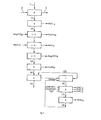
- Fig. 1 shows a process diagram for the separate recovery of metals from chemical waste in accordance with the invention.
- Fig. 2 shows in detail the step, indicated in Fig. 1 by a, of selective extraction of iron (III) and shows an embodiment of the extraction process.
- Fig. 3 shows in detail the step, indicated in Fig. 1 by c-3, of selective extraction of chromium (VI) and shows an embodiment of the extraction process.
- In Fig. 1
reference numeral 1 shows the supply of mixed metal-containing sludges to a solution step a. An acid is introduced by asupply 2. - The sludge is dissolved in an acid suitable for the purpose so that the pH of a solution (1) obtained reaches a final value of between 0 and 1. Sulphuric acid is preferably used since it is cheap and since when sulphuric acid is used calcium for the most part does not go into solution. If however there is much lead present in the sludge so that the residue obtained from the solution step 'a' through the
discharge 3 would not conform with the legal standards, use is made of hydrochloric or nitric acid. - Since in the solution step a the metals cited in the Chemical Waste Law (Cu, Zn, Ni, Cr, Cd, Co and Pb) go into solution with an efficiency of more than 99% together with a quantity of iron and manganese, a residual sludge is obtained which is not a chemical waste within the meaning of the Chemical Waste Law, together with a solution (1) which contains the metals cited.
- Since iron will interfere during the separate recovery of the metals from the solution, the iron is first removed from the solution (1) obtained at step a. For this purpose solution (1) is brought to a step b, at which the iron is removed selectively from solution (1). This can be achieved by means of liquid-liquid extraction in which an organo-phosphoric acid is used as extraction medium (I). For example a 20% solution of di-2-ethylhexylphosphoric acid (D2EHPA) in a suitable organic solvent is suitable.
- The stripping/regeneration of the organic extraction medium charged with iron and zinc by means of sulphuric acid, as described in DE 2503398, is not effective. For an effective regeneration of the charged extraction medium the following method is employed (see Fig. 2). The charged extraction medium is subjected to a subsequent liquid-liquid extraction step, in which the aqueous phase consists of a 6 M HC1 solution. The iron thus goes over into the aqueous phase, from which it can be removed by a known technique, for instance by means of liquid-liquid extraction using a solvating extraction medium (II) such as methyl- isobutyl ketone (MIBK) or tributyl phosphate (TSP).
- The iron-free hydrochloric solution is after recuperation re-used for the regeneration of the extraction medium (I).
- The iron extraction is shown schematically in Fig. 2.
- In addition, an embodiment is given, in which
n = number of equilibrium stages
q = organic/water phase ratio by volume
- The other numbers in Fig. 2 are iron concentrations (g/1) in the relevant flows in the embodiment. The extraction media in the example are:
- Extraction medium I: 20% D2EHPA in kerosine
- Extraction medium II: 10% TBP in kerosine.
- By selecting favourable phase ratios the resultant iron chloride solution can be highly concentrated. (In the example by a factor 25 relative to the original solution).
- Zinc is extracted only to the extent of 1% in the first step, and the other non-ferrous metals remain below that.
- The solution (2) obtained at step b is, as shown in Fig. 1, brought to a process step c, in which the Cr (III) present is oxidised to Cr (VI) in an oxidation step c-2 using sodium hypochlorite, in which the pH should lie between 2 and 4. The chromium in its hexavalent form can be removed selectively from the solution. The removal of the chromium is necessary since it will interfere with the subsequent process steps.
- The manganese which may be present (as Mn2+) in solution (2) is deposited as manganese dioxide (Mn02) as a result of the oxidising treatment in oxidation step c-2 and is then filtered off.
- If lead is also present in solution (2) it is possible to prevent the insoluble lead chromate (2) from being deposited along with the manganese dioxide by treating the solution (2) at a step c-1 with sodium chromate, so that the lead chromate can be filtered off before the oxidisation treatment in step c-2 takes place.
- The Cr (VI) formed is removed selectively from the solution in step c-3 using liquid-liquid extraction. For this purpose it is possible to use basic extraction media known per se such as primary, secondary and tertiary amines, and also quaternary ammonium salts. A mixture of trioctylamine and tributyl phosphate (TOA/TBP) is especially suitable for this purpose.
- During the extraction of Cr (VI) at an equilibrium pH of between 2.5 and 4 small quantities of zinc and cadmium are co-extracted. At this'point, see Fig. 3, by treating the charged extraction medium (III) in a subsequent extraction step with sodium sulphate solution at pH = 3, the co-extractedd zinc and cadmium are selectively washed from extraction medium (III). The Cr (VI) is back-extracted from the charged extraction medium (III) using an aqueous solution at a pH between 6 and 9. By using this aqueous solution several times for this purpose a highly concentrated sodium chromate solution is obtained. The regenerated extraction medium (III) so obtained is re-used for the extraction of the Cr (VI) without further post-treatment. The Cr (VI) extraction is reproduced schematically in Fig. 3.
- An embodiment is also given in which n and q have the same significance as in Fig. 2. In the embodiment the extraction medium (III) is TOA/TBP (50/100 g/1) in kerosine.
- For the conditions indicated in Fig. 3, the following partition in the various flows applies :

- Zinc and cadmium are very strongly co-extracted, but can be washed out effectively using a sulphate solution.
- By partially recycling the product flow P, it is possibl-e to obtain a reducing concentration of the sodium chromate solution.
- In a subsequent process step d, Cu2+ is selectively removed from the solution (3) obtained at step c by means of liquid-liquid extraction at a pH between 4 and 5.5. The copper-charged extraction medium (IV) is stripped/regenerated using sulphuric acid to obtain a highly concentrated copper sulphate solution.
- The solution (4) obtained in step d plus the wash water from step c-3 contains ions of zinc, cadmium, nickel and cobalt. These metal ions are extracted at step e from solution (4) using extraction medium (V) by carrying out the extraction in a number of equilibrium steps at a pH between 6 and 7. The aqueous solution (5) so obtained contains no more heavy metals and can be disposed of.
- The extraction medium (V) obtained at step e and charged with Sn2+, Cd2+, Ni2+ and Co2+ is stripped/regenerated in step f at a pH of less than 5 using an aqueous solution containing 5 mol/l NaCl. In this, the above-mentioned metal ions go over into the aqueous solution (6).
- By passing this solution (6) over a strongly basic anion exchanger the ions of zinc, cadmium and cobalt are fixed on the anion exchanger at step g, while Ni2+ passes through unhindered. Co2+, Zn 2+ and Cd2+ are washed separately from the anion exchanger by successive elution with about 0.5 M HC1, about 0.02 M HCl and water.
- Nickel is finally extracted from the salt solution (7) at step h at a pH of between 6 and 7 using extraction medium (VI). The nickel-charged extraction medium (VI) is stripped with sulphuric acid.
- The resultant salt solution (8) can afterwards be brought back to strength and used again for stripping the extraction medium (V) charged in step e.
- A mixture of cyclohexanoxime and an unsaturated fatty acid such as e.g. oleic acid in an arbitrary organic solvent is especially suitable for the extraction media (IV), (V) and (VI).
Claims (11)
- Method for the separate recovery of metals such as chromium, zinc, cadmium, nickel from iron-containing waste, in particular chemical waste, in which the waste is treated with an acid whereby an aqueous solution (1) and a residue are obtained, characterised in that the iron (III) is extracted selectively from the solution (1) at a pH of 0-1 using an organophosphoric acid as extraction medium (I) and that other metals are also separately recovered.
- 2. Method in accordance with claim 1 characterised in that the chromium (III) in solution (2) is subjected to an oxidation treatment at a pH of 2-4 using an oxidising agent, such as sodium hypochlorite (NaClO), that the chromium (VI) formed is selectively extracted from the solution at a pH of 2.5-4 using a suitable extraction medium (III), and that the charged extraction medium (III) is freed of co-extracted cadmium and zinc by washing with a wash liquor, such as a sodium sulphate solution, at a pH of about 3 before back-extraction of the chromium (VI).
- 3. A method for the separate recovery of metals such as chromium, zinc, cadmium and nickel from iron-containing waste, in particular chemical waste, characterised in the combination of the following steps:a. treatment of the waste with an acid whereby an aqueous solution (1) and a residue are obtained;b. selective extraction of iron (III) from solution ; (1) at a pH of 0-1 using an organo-phosphoric acid as an extraction medium (I);c-2. oxidative treatment of the chromium (III) in solution (2) at a pH of 2-4 using an oxidising agent, such as sodium hypochlorite (NaClO), and c-3. selective extraction of the chromium (VI) formed from the solution at a pH of 2.5-4 using a suitable extraction medium (III) and the removal of co-extracted cadmium and zinc from the charged extraction medium (III) by washing with a wash liquor such as a sodium sulphate solution at a pH of 3 before back-extraction of the chromium (VI).
- 4. Method according to one of the above claims, characterised by a subsequent step:e. extraction of zinc, cadmium and nickel together from the solution (4) at a pH of 6-7 using a suitable extraction medium (V).
- 5. Method according to claim 4 characterised by the three following steps:f. back-extraction of the extraction medium (V) charged in step e at a pH of less than 5 using an aqueous solution which contains about 5 mol/l NaCl;g. fixing of zinc and cadmium from solution (6) on a strongly basic anion exchanger followed by subsequent elution of zinc and cadmium with about 0.02 M HC1 and water respectively andh. extraction from solution (7) of the nickel which has passed unhindered through the anion exchanger during fixing in step g, at a pH of 6-7 using a suitable extraction medium.
- 6. Method according to claims 4 and 5, wherein the waste also contains cobalt, characterised by extraction of cobalt at step e and fixing of cobalt on the anion exchanger followed by elution of cobalt with about 0.5 M HCl at step f.
- 7. Method according to claims 2 or 3, wherein the waste also contains manganese, characterised in that the manganese dioxide precipitate (Mn02) formed during the oxidation treatment (step c-2) is filtered off.
- 8. Method according to one of the foregoing claims, wherein the waste also contains copper, characterised by a step:d. selective extraction of copper from solution (3) at a pH of 4-5.5 using a suitable extraction medium (IV).
- 9. Method according to one of the preceding claims, wherein the waste also contains lead, characterised by a step carried out directly after step b: the selective extraction of iron;c-1. treatment of solution (2), which is obtained from solution (1) after the iron extraction of step b, this latter solution being obtained by treatment of the waste with hydrochloric acid (HC1) or nitric acid (HNO3), using a chromate e.g. sodium chromate (Na2 Cr04) and filtration of the lead chromate (PbCrO4) formed.
- 10. Method according to one of the preceding claims characterised in that the extraction medium (I) is di-2-ethylhexylphosphoric acid, this acid being dissolved in a suitable organic solvent.
- 11. Method according to one of the preceding claims, characterised in that the iron is back-extracted from the extraction medium (I) using a concentrated, e.g. 6 M, HC1 solution.
Applications Claiming Priority (2)
| Application Number | Priority Date | Filing Date | Title |
|---|---|---|---|
| NL8301185A NL8301185A (en) | 1983-04-05 | 1983-04-05 | METHOD FOR SEPARATELY RECOVERY OF METALS FROM WASTE, IN PARTICULAR CHEMICAL WASTE. |
| NL8301185 | 1983-04-05 |
Publications (2)
| Publication Number | Publication Date |
|---|---|
| EP0122658A1 true EP0122658A1 (en) | 1984-10-24 |
| EP0122658B1 EP0122658B1 (en) | 1986-10-15 |
Family
ID=19841650
Family Applications (1)
| Application Number | Title | Priority Date | Filing Date |
|---|---|---|---|
| EP19840200464 Expired EP0122658B1 (en) | 1983-04-05 | 1984-04-02 | Method for the separate recovery of metals from waste in particular chemical waste |
Country Status (3)
| Country | Link |
|---|---|
| EP (1) | EP0122658B1 (en) |
| DE (1) | DE3460983D1 (en) |
| NL (1) | NL8301185A (en) |
Cited By (7)
| Publication number | Priority date | Publication date | Assignee | Title |
|---|---|---|---|---|
| US6486213B1 (en) | 1994-03-04 | 2002-11-26 | University Of Washington | Block and graft copolymers and methods relating thereto |
| EP3156508A1 (en) | 2015-10-16 | 2017-04-19 | Vito NV | Recovery process for metal-containing byproducts of metal production and processing |
| CN109280776A (en) * | 2018-11-15 | 2019-01-29 | 华南理工大学 | A kind of method for recovering chromium in electroplating sludge by sub-molten salt method |
| US10463901B2 (en) * | 2009-11-26 | 2019-11-05 | Centre National De La Recherche Scientifique | Use of metal-accumulating plants for the preparation of catalysts that can be used in chemical reactions |
| CN112981104A (en) * | 2021-02-05 | 2021-06-18 | 桐乡市思远环保科技有限公司 | Method for treating cadmium-containing waste residues and recovering metal cadmium |
| CN114293017A (en) * | 2021-12-30 | 2022-04-08 | 上海第二工业大学 | Method for preparing high-purity superfine palladium powder from waste palladium-carbon catalyst |
| CN115287454A (en) * | 2022-07-30 | 2022-11-04 | 格林美(江苏)钴业股份有限公司 | A method for treating cobalt-loaded organic phase to reduce Cd in cobalt chloride stripping solution |
Families Citing this family (1)
| Publication number | Priority date | Publication date | Assignee | Title |
|---|---|---|---|---|
| CN112359224B (en) * | 2020-11-11 | 2022-09-02 | 吉林吉恩镍业股份有限公司 | Method for purifying cadmium-containing nickel-cobalt solution to remove cadmium |
Citations (5)
| Publication number | Priority date | Publication date | Assignee | Title |
|---|---|---|---|---|
| US3966569A (en) * | 1974-01-28 | 1976-06-29 | Mx Processor Reinhardt & Co. Ab | Method of recovering metal from metalliferous waste |
| FR2351177A1 (en) * | 1976-05-13 | 1977-12-09 | Goldschmidt Ag Th | TREATMENT OF WASTE HYDROXIDE SLUDGE FROM NON-FERROUS METALS |
| US4151257A (en) * | 1978-01-16 | 1979-04-24 | Th. Goldschmidt Ag | Processing nonferrous metal hydroxide sludge wastes |
| US4162294A (en) * | 1977-09-29 | 1979-07-24 | Th. Goldschmidt Ag | Process for working up nonferrous metal hydroxide sludge waste |
| FR2436821A1 (en) * | 1978-09-22 | 1980-04-18 | Goldschmidt Ag Th | PROCESS FOR TREATING RESIDUES FROM NON-FERROUS HEAVY METAL HYDROXIDE SLUDGES |
-
1983
- 1983-04-05 NL NL8301185A patent/NL8301185A/en not_active Application Discontinuation
-
1984
- 1984-04-02 EP EP19840200464 patent/EP0122658B1/en not_active Expired
- 1984-04-02 DE DE8484200464T patent/DE3460983D1/en not_active Expired
Patent Citations (5)
| Publication number | Priority date | Publication date | Assignee | Title |
|---|---|---|---|---|
| US3966569A (en) * | 1974-01-28 | 1976-06-29 | Mx Processor Reinhardt & Co. Ab | Method of recovering metal from metalliferous waste |
| FR2351177A1 (en) * | 1976-05-13 | 1977-12-09 | Goldschmidt Ag Th | TREATMENT OF WASTE HYDROXIDE SLUDGE FROM NON-FERROUS METALS |
| US4162294A (en) * | 1977-09-29 | 1979-07-24 | Th. Goldschmidt Ag | Process for working up nonferrous metal hydroxide sludge waste |
| US4151257A (en) * | 1978-01-16 | 1979-04-24 | Th. Goldschmidt Ag | Processing nonferrous metal hydroxide sludge wastes |
| FR2436821A1 (en) * | 1978-09-22 | 1980-04-18 | Goldschmidt Ag Th | PROCESS FOR TREATING RESIDUES FROM NON-FERROUS HEAVY METAL HYDROXIDE SLUDGES |
Non-Patent Citations (1)
| Title |
|---|
| ANNALES DES MINES, no. 2, February 1970, page 68, G.E.D.I.M., 42029, Saint-Etienne, FR. * |
Cited By (10)
| Publication number | Priority date | Publication date | Assignee | Title |
|---|---|---|---|---|
| US6486213B1 (en) | 1994-03-04 | 2002-11-26 | University Of Washington | Block and graft copolymers and methods relating thereto |
| US10463901B2 (en) * | 2009-11-26 | 2019-11-05 | Centre National De La Recherche Scientifique | Use of metal-accumulating plants for the preparation of catalysts that can be used in chemical reactions |
| EP3156508A1 (en) | 2015-10-16 | 2017-04-19 | Vito NV | Recovery process for metal-containing byproducts of metal production and processing |
| CN109280776A (en) * | 2018-11-15 | 2019-01-29 | 华南理工大学 | A kind of method for recovering chromium in electroplating sludge by sub-molten salt method |
| CN109280776B (en) * | 2018-11-15 | 2020-11-24 | 华南理工大学 | A kind of method for recovering chromium in electroplating sludge by sub-molten salt method |
| CN112981104A (en) * | 2021-02-05 | 2021-06-18 | 桐乡市思远环保科技有限公司 | Method for treating cadmium-containing waste residues and recovering metal cadmium |
| CN112981104B (en) * | 2021-02-05 | 2023-04-25 | 桐乡市思远环保科技有限公司 | Method for treating cadmium-containing waste residues and recycling metal cadmium |
| CN114293017A (en) * | 2021-12-30 | 2022-04-08 | 上海第二工业大学 | Method for preparing high-purity superfine palladium powder from waste palladium-carbon catalyst |
| CN114293017B (en) * | 2021-12-30 | 2022-11-04 | 上海第二工业大学 | Method for preparing high-purity ultrafine palladium powder from waste palladium-carbon catalyst |
| CN115287454A (en) * | 2022-07-30 | 2022-11-04 | 格林美(江苏)钴业股份有限公司 | A method for treating cobalt-loaded organic phase to reduce Cd in cobalt chloride stripping solution |
Also Published As
| Publication number | Publication date |
|---|---|
| NL8301185A (en) | 1984-11-01 |
| EP0122658B1 (en) | 1986-10-15 |
| DE3460983D1 (en) | 1986-11-20 |
Similar Documents
| Publication | Publication Date | Title |
|---|---|---|
| US4083758A (en) | Process for regenerating and for recovering metallic copper from chloride-containing etching solutions | |
| US3966569A (en) | Method of recovering metal from metalliferous waste | |
| JPS62253738A (en) | Removal of dangerous metal waste sludge | |
| CA2307500A1 (en) | Method for removing contaminants from process streams in metal recovery processes | |
| US4591489A (en) | Process for the treatment of hydrochloric acid pickles containing iron and zinc | |
| JPH08506524A (en) | Granular material treatment method | |
| EP0122658B1 (en) | Method for the separate recovery of metals from waste in particular chemical waste | |
| US4171255A (en) | Apparatus for recovery of metals from metal plating baths and neutralizing toxic effluents therefrom | |
| Clevenger et al. | Recovery of metals from electroplating wastes using liquid-liquid extraction | |
| DE69804016T2 (en) | OXIDIZING LIQUIDIZATION OF FERROUS CABINET SLAVE WITH REMOVAL OF ZINC AND LEAD | |
| Van der Zeeuw | Purification of zinc calcine leach solutions by exchange extraction with the zinc salt of “versatic” acid | |
| Twidwell et al. | Treatment of metal finishing sludge for detoxification and metal value | |
| EP0813500B1 (en) | Purification of metal containing solutions | |
| CH630664A5 (en) | Process for working up nonferrous metal hydroxide sludge wastes | |
| Chang et al. | Alternative waste minimization analyses for the printed circuit board industry: Examples for small and large manufacturers | |
| Brooks et al. | Processing of superalloy scrap | |
| Mahmoud et al. | Utilization of spent copper-pickle liquor for recovery of metal values | |
| US4151257A (en) | Processing nonferrous metal hydroxide sludge wastes | |
| JP2002121626A (en) | Method of recovering valuable metals from plating sludge | |
| Twidwell et al. | Recovery of metal values from metal finishing hydroxides sludges by phosphate precipitation | |
| RU2098498C1 (en) | Method for utilization of cakes of treatment products of flushing waters of electroplating shops | |
| JPS642917B2 (en) | ||
| FI67356B (en) | FOERFARANDE FOER AOTERVINNING AV CYANIDER FRAON SPOLLOESNINGARERHAOLLNA FRAON ELUTFAELLNINGSPROCESSER | |
| US5221525A (en) | Solvent extraction of gallium from acidic solutions containing phosphorus | |
| Negrea et al. | USE OF ZINC ASH FROM GALVANIZATION AS A SOURCE OF ZINC OXIDE. |
Legal Events
| Date | Code | Title | Description |
|---|---|---|---|
| PUAI | Public reference made under article 153(3) epc to a published international application that has entered the european phase |
Free format text: ORIGINAL CODE: 0009012 |
|
| 17P | Request for examination filed |
Effective date: 19840402 |
|
| AK | Designated contracting states |
Designated state(s): BE CH DE FR GB LI LU NL |
|
| GRAA | (expected) grant |
Free format text: ORIGINAL CODE: 0009210 |
|
| AK | Designated contracting states |
Kind code of ref document: B1 Designated state(s): BE CH DE FR GB LI LU NL |
|
| REF | Corresponds to: |
Ref document number: 3460983 Country of ref document: DE Date of ref document: 19861120 |
|
| ET | Fr: translation filed | ||
| PLBE | No opposition filed within time limit |
Free format text: ORIGINAL CODE: 0009261 |
|
| STAA | Information on the status of an ep patent application or granted ep patent |
Free format text: STATUS: NO OPPOSITION FILED WITHIN TIME LIMIT |
|
| 26N | No opposition filed | ||
| REG | Reference to a national code |
Ref country code: CH Ref legal event code: PUE Owner name: ESDEX V.O.F. |
|
| NLS | Nl: assignments of ep-patents |
Owner name: ESDEX V.O.F. TE AMSTERDAM. |
|
| REG | Reference to a national code |
Ref country code: FR Ref legal event code: TP |
|
| REG | Reference to a national code |
Ref country code: GB Ref legal event code: 732 |
|
| PGFP | Annual fee paid to national office [announced via postgrant information from national office to epo] |
Ref country code: DE Payment date: 19930427 Year of fee payment: 10 |
|
| PGFP | Annual fee paid to national office [announced via postgrant information from national office to epo] |
Ref country code: CH Payment date: 19930428 Year of fee payment: 10 |
|
| PGFP | Annual fee paid to national office [announced via postgrant information from national office to epo] |
Ref country code: LU Payment date: 19930429 Year of fee payment: 10 |
|
| PGFP | Annual fee paid to national office [announced via postgrant information from national office to epo] |
Ref country code: NL Payment date: 19930430 Year of fee payment: 10 Ref country code: FR Payment date: 19930430 Year of fee payment: 10 |
|
| PGFP | Annual fee paid to national office [announced via postgrant information from national office to epo] |
Ref country code: BE Payment date: 19930506 Year of fee payment: 10 |
|
| EPTA | Lu: last paid annual fee | ||
| PGFP | Annual fee paid to national office [announced via postgrant information from national office to epo] |
Ref country code: GB Payment date: 19940323 Year of fee payment: 11 |
|
| PG25 | Lapsed in a contracting state [announced via postgrant information from national office to epo] |
Ref country code: LU Free format text: LAPSE BECAUSE OF NON-PAYMENT OF DUE FEES Effective date: 19940402 |
|
| PG25 | Lapsed in a contracting state [announced via postgrant information from national office to epo] |
Ref country code: LI Effective date: 19940430 Ref country code: CH Effective date: 19940430 Ref country code: BE Effective date: 19940430 |
|
| BERE | Be: lapsed |
Owner name: ESDEX V.O.F. Effective date: 19940430 |
|
| PG25 | Lapsed in a contracting state [announced via postgrant information from national office to epo] |
Ref country code: NL Effective date: 19941101 |
|
| NLV4 | Nl: lapsed or anulled due to non-payment of the annual fee | ||
| PG25 | Lapsed in a contracting state [announced via postgrant information from national office to epo] |
Ref country code: FR Effective date: 19941229 |
|
| REG | Reference to a national code |
Ref country code: CH Ref legal event code: PL |
|
| PG25 | Lapsed in a contracting state [announced via postgrant information from national office to epo] |
Ref country code: DE Effective date: 19950103 |
|
| REG | Reference to a national code |
Ref country code: FR Ref legal event code: ST |
|
| PG25 | Lapsed in a contracting state [announced via postgrant information from national office to epo] |
Ref country code: GB Effective date: 19950402 |
|
| GBPC | Gb: european patent ceased through non-payment of renewal fee |
Effective date: 19950402 |