EP0120428A1 - Benzopyran isomers - Google Patents
Benzopyran isomers Download PDFInfo
- Publication number
- EP0120428A1 EP0120428A1 EP84102963A EP84102963A EP0120428A1 EP 0120428 A1 EP0120428 A1 EP 0120428A1 EP 84102963 A EP84102963 A EP 84102963A EP 84102963 A EP84102963 A EP 84102963A EP 0120428 A1 EP0120428 A1 EP 0120428A1
- Authority
- EP
- European Patent Office
- Prior art keywords
- isomer
- formula
- compound
- alkyl
- trans
- Prior art date
- Legal status (The legal status is an assumption and is not a legal conclusion. Google has not performed a legal analysis and makes no representation as to the accuracy of the status listed.)
- Granted
Links
- 150000001562 benzopyrans Chemical class 0.000 title 1
- 150000001875 compounds Chemical class 0.000 claims abstract description 170
- 239000000203 mixture Substances 0.000 claims abstract description 69
- 229910052739 hydrogen Inorganic materials 0.000 claims abstract description 47
- 239000001257 hydrogen Substances 0.000 claims abstract description 47
- 125000000217 alkyl group Chemical group 0.000 claims abstract description 44
- 238000000034 method Methods 0.000 claims abstract description 40
- 125000004435 hydrogen atom Chemical group [H]* 0.000 claims abstract description 27
- 125000004432 carbon atom Chemical group C* 0.000 claims abstract description 26
- -1 alkylhydroxymethyl Chemical group 0.000 claims abstract description 24
- 125000000449 nitro group Chemical group [O-][N+](*)=O 0.000 claims abstract description 14
- 125000004093 cyano group Chemical group *C#N 0.000 claims abstract description 13
- 125000004448 alkyl carbonyl group Chemical group 0.000 claims abstract description 11
- 238000002360 preparation method Methods 0.000 claims abstract description 10
- 125000002252 acyl group Chemical group 0.000 claims abstract description 9
- 239000008194 pharmaceutical composition Substances 0.000 claims abstract description 8
- 125000001309 chloro group Chemical group Cl* 0.000 claims abstract description 7
- 125000002924 primary amino group Chemical group [H]N([H])* 0.000 claims abstract description 7
- 125000004453 alkoxycarbonyl group Chemical group 0.000 claims abstract description 6
- 125000004466 alkoxycarbonylamino group Chemical group 0.000 claims abstract description 5
- 125000003806 alkyl carbonyl amino group Chemical group 0.000 claims abstract description 5
- 125000005196 alkyl carbonyloxy group Chemical group 0.000 claims abstract description 5
- 125000004644 alkyl sulfinyl group Chemical group 0.000 claims abstract description 5
- 125000004390 alkyl sulfonyl group Chemical group 0.000 claims abstract description 5
- 125000004656 alkyl sulfonylamino group Chemical group 0.000 claims abstract description 5
- 125000003917 carbamoyl group Chemical group [H]N([H])C(*)=O 0.000 claims abstract description 5
- 125000005469 ethylenyl group Chemical group 0.000 claims abstract description 5
- 125000002023 trifluoromethyl group Chemical group FC(F)(F)* 0.000 claims abstract description 5
- TVZCRIROJQEVOT-CABCVRRESA-N Cromakalim Chemical compound N1([C@@H]2C3=CC(=CC=C3OC([C@H]2O)(C)C)C#N)CCCC1=O TVZCRIROJQEVOT-CABCVRRESA-N 0.000 claims description 12
- SYSQUGFVNFXIIT-UHFFFAOYSA-N n-[4-(1,3-benzoxazol-2-yl)phenyl]-4-nitrobenzenesulfonamide Chemical class C1=CC([N+](=O)[O-])=CC=C1S(=O)(=O)NC1=CC=C(C=2OC3=CC=CC=C3N=2)C=C1 SYSQUGFVNFXIIT-UHFFFAOYSA-N 0.000 claims description 12
- 230000003287 optical effect Effects 0.000 claims description 9
- 206010020772 Hypertension Diseases 0.000 claims description 8
- 238000011282 treatment Methods 0.000 claims description 7
- WQVAONLPZUUERM-KGLIPLIRSA-N 1-[(3s,4r)-3-hydroxy-2,2-dimethyl-6-nitro-3,4-dihydrochromen-4-yl]pyrrolidin-2-one Chemical compound N1([C@@H]2C3=CC(=CC=C3OC([C@H]2O)(C)C)[N+]([O-])=O)CCCC1=O WQVAONLPZUUERM-KGLIPLIRSA-N 0.000 claims description 5
- CWNDIXOXRUSATL-CVEARBPZSA-N 1-[(3s,4r)-6-acetyl-3-hydroxy-2,2-dimethyl-3,4-dihydrochromen-4-yl]pyrrolidin-2-one Chemical compound N1([C@H]2[C@H](O)C(C)(C)OC3=CC=C(C=C32)C(=O)C)CCCC1=O CWNDIXOXRUSATL-CVEARBPZSA-N 0.000 claims description 5
- 239000003937 drug carrier Substances 0.000 claims description 5
- 238000011321 prophylaxis Methods 0.000 claims description 5
- IEKDJVUNXSQUHG-CVEARBPZSA-N (3s,4r)-3-hydroxy-2,2-dimethyl-4-(2-oxopiperidin-1-yl)-3,4-dihydrochromene-6-carbonitrile Chemical compound N1([C@@H]2C3=CC(=CC=C3OC([C@H]2O)(C)C)C#N)CCCCC1=O IEKDJVUNXSQUHG-CVEARBPZSA-N 0.000 claims description 4
- NUKJAKNCRUTTMR-CABCVRRESA-N 1-[(3s,4r)-3-hydroxy-2,2-dimethyl-6-nitro-3,4-dihydrochromen-4-yl]piperidin-2-one Chemical compound N1([C@@H]2C3=CC(=CC=C3OC([C@H]2O)(C)C)[N+]([O-])=O)CCCCC1=O NUKJAKNCRUTTMR-CABCVRRESA-N 0.000 claims description 4
- HBAQYPYDRFILMT-UHFFFAOYSA-N 8-[3-(1-cyclopropylpyrazol-4-yl)-1H-pyrazolo[4,3-d]pyrimidin-5-yl]-3-methyl-3,8-diazabicyclo[3.2.1]octan-2-one Chemical class C1(CC1)N1N=CC(=C1)C1=NNC2=C1N=C(N=C2)N1C2C(N(CC1CC2)C)=O HBAQYPYDRFILMT-UHFFFAOYSA-N 0.000 claims description 2
- KLUMRFDKRSYNGF-SJORKVTESA-N 1-[(3s,4r)-6-acetyl-3-hydroxy-2,2-dimethyl-3,4-dihydrochromen-4-yl]piperidin-2-one Chemical compound N1([C@H]2[C@H](O)C(C)(C)OC3=CC=C(C=C32)C(=O)C)CCCCC1=O KLUMRFDKRSYNGF-SJORKVTESA-N 0.000 claims 3
- 150000002431 hydrogen Chemical group 0.000 abstract description 14
- UFHFLCQGNIYNRP-UHFFFAOYSA-N Hydrogen Chemical compound [H][H] UFHFLCQGNIYNRP-UHFFFAOYSA-N 0.000 abstract description 12
- 230000003276 anti-hypertensive effect Effects 0.000 abstract description 4
- 230000000144 pharmacologic effect Effects 0.000 abstract description 3
- 125000004429 atom Chemical group 0.000 description 21
- 238000006243 chemical reaction Methods 0.000 description 20
- YXFVVABEGXRONW-UHFFFAOYSA-N Toluene Chemical compound CC1=CC=CC=C1 YXFVVABEGXRONW-UHFFFAOYSA-N 0.000 description 18
- LFQSCWFLJHTTHZ-UHFFFAOYSA-N Ethanol Chemical compound CCO LFQSCWFLJHTTHZ-UHFFFAOYSA-N 0.000 description 12
- 125000001424 substituent group Chemical group 0.000 description 12
- OKKJLVBELUTLKV-UHFFFAOYSA-N Methanol Chemical compound OC OKKJLVBELUTLKV-UHFFFAOYSA-N 0.000 description 9
- HEMHJVSKTPXQMS-UHFFFAOYSA-M Sodium hydroxide Chemical compound [OH-].[Na+] HEMHJVSKTPXQMS-UHFFFAOYSA-M 0.000 description 9
- 150000002148 esters Chemical class 0.000 description 9
- CSCPPACGZOOCGX-UHFFFAOYSA-N Acetone Chemical compound CC(C)=O CSCPPACGZOOCGX-UHFFFAOYSA-N 0.000 description 7
- 239000012452 mother liquor Substances 0.000 description 7
- 239000002904 solvent Substances 0.000 description 7
- XEKOWRVHYACXOJ-UHFFFAOYSA-N Ethyl acetate Chemical compound CCOC(C)=O XEKOWRVHYACXOJ-UHFFFAOYSA-N 0.000 description 6
- ZMXDDKWLCZADIW-UHFFFAOYSA-N N,N-Dimethylformamide Chemical compound CN(C)C=O ZMXDDKWLCZADIW-UHFFFAOYSA-N 0.000 description 6
- ZMANZCXQSJIPKH-UHFFFAOYSA-N Triethylamine Chemical compound CCN(CC)CC ZMANZCXQSJIPKH-UHFFFAOYSA-N 0.000 description 6
- 239000007795 chemical reaction product Substances 0.000 description 6
- 235000019441 ethanol Nutrition 0.000 description 6
- 125000002887 hydroxy group Chemical group [H]O* 0.000 description 6
- 125000002496 methyl group Chemical group [H]C([H])([H])* 0.000 description 6
- 150000003839 salts Chemical class 0.000 description 6
- 239000003981 vehicle Substances 0.000 description 6
- 230000036772 blood pressure Effects 0.000 description 5
- 239000003795 chemical substances by application Substances 0.000 description 5
- 238000001640 fractional crystallisation Methods 0.000 description 5
- 229910052751 metal Inorganic materials 0.000 description 5
- 239000002184 metal Substances 0.000 description 5
- XLYOFNOQVPJJNP-UHFFFAOYSA-N water Substances O XLYOFNOQVPJJNP-UHFFFAOYSA-N 0.000 description 5
- 239000002253 acid Substances 0.000 description 4
- 125000003277 amino group Chemical group 0.000 description 4
- 230000000694 effects Effects 0.000 description 4
- 239000012442 inert solvent Substances 0.000 description 4
- 239000012038 nucleophile Substances 0.000 description 4
- 238000000926 separation method Methods 0.000 description 4
- 0 Cc(cc1)cc(C(C2*)*(CCC3)CC3=O)c1OC2(*)I Chemical compound Cc(cc1)cc(C(C2*)*(CCC3)CC3=O)c1OC2(*)I 0.000 description 3
- HEDRZPFGACZZDS-UHFFFAOYSA-N Chloroform Chemical compound ClC(Cl)Cl HEDRZPFGACZZDS-UHFFFAOYSA-N 0.000 description 3
- FBPFZTCFMRRESA-FSIIMWSLSA-N D-Glucitol Natural products OC[C@H](O)[C@H](O)[C@@H](O)[C@H](O)CO FBPFZTCFMRRESA-FSIIMWSLSA-N 0.000 description 3
- YMWUJEATGCHHMB-UHFFFAOYSA-N Dichloromethane Chemical compound ClCCl YMWUJEATGCHHMB-UHFFFAOYSA-N 0.000 description 3
- KWYUFKZDYYNOTN-UHFFFAOYSA-M Potassium hydroxide Chemical compound [OH-].[K+] KWYUFKZDYYNOTN-UHFFFAOYSA-M 0.000 description 3
- DNIAPMSPPWPWGF-UHFFFAOYSA-N Propylene glycol Chemical compound CC(O)CO DNIAPMSPPWPWGF-UHFFFAOYSA-N 0.000 description 3
- 239000003153 chemical reaction reagent Substances 0.000 description 3
- 238000007796 conventional method Methods 0.000 description 3
- RTZKZFJDLAIYFH-UHFFFAOYSA-N ether Substances CCOCC RTZKZFJDLAIYFH-UHFFFAOYSA-N 0.000 description 3
- 125000001495 ethyl group Chemical group [H]C([H])([H])C([H])([H])* 0.000 description 3
- 238000011049 filling Methods 0.000 description 3
- 239000007788 liquid Substances 0.000 description 3
- 238000010992 reflux Methods 0.000 description 3
- 239000000600 sorbitol Substances 0.000 description 3
- 235000010356 sorbitol Nutrition 0.000 description 3
- 239000006188 syrup Substances 0.000 description 3
- 235000020357 syrup Nutrition 0.000 description 3
- 239000003826 tablet Substances 0.000 description 3
- RFFLAFLAYFXFSW-UHFFFAOYSA-N 1,2-dichlorobenzene Chemical compound ClC1=CC=CC=C1Cl RFFLAFLAYFXFSW-UHFFFAOYSA-N 0.000 description 2
- 241000220479 Acacia Species 0.000 description 2
- KXDHJXZQYSOELW-UHFFFAOYSA-M Carbamate Chemical compound NC([O-])=O KXDHJXZQYSOELW-UHFFFAOYSA-M 0.000 description 2
- IAZDPXIOMUYVGZ-UHFFFAOYSA-N Dimethylsulphoxide Chemical compound CS(C)=O IAZDPXIOMUYVGZ-UHFFFAOYSA-N 0.000 description 2
- 108010010803 Gelatin Proteins 0.000 description 2
- PEDCQBHIVMGVHV-UHFFFAOYSA-N Glycerine Chemical compound OCC(O)CO PEDCQBHIVMGVHV-UHFFFAOYSA-N 0.000 description 2
- VEXZGXHMUGYJMC-UHFFFAOYSA-N Hydrochloric acid Chemical compound Cl VEXZGXHMUGYJMC-UHFFFAOYSA-N 0.000 description 2
- 235000010643 Leucaena leucocephala Nutrition 0.000 description 2
- 241000124008 Mammalia Species 0.000 description 2
- PCLIMKBDDGJMGD-UHFFFAOYSA-N N-bromosuccinimide Chemical compound BrN1C(=O)CCC1=O PCLIMKBDDGJMGD-UHFFFAOYSA-N 0.000 description 2
- KEAYESYHFKHZAL-UHFFFAOYSA-N Sodium Chemical compound [Na] KEAYESYHFKHZAL-UHFFFAOYSA-N 0.000 description 2
- CDBYLPFSWZWCQE-UHFFFAOYSA-L Sodium Carbonate Chemical compound [Na+].[Na+].[O-]C([O-])=O CDBYLPFSWZWCQE-UHFFFAOYSA-L 0.000 description 2
- PXIPVTKHYLBLMZ-UHFFFAOYSA-N Sodium azide Chemical compound [Na+].[N-]=[N+]=[N-] PXIPVTKHYLBLMZ-UHFFFAOYSA-N 0.000 description 2
- 238000002441 X-ray diffraction Methods 0.000 description 2
- 125000000738 acetamido group Chemical group [H]C([H])([H])C(=O)N([H])[*] 0.000 description 2
- 239000012042 active reagent Substances 0.000 description 2
- 150000001450 anions Chemical class 0.000 description 2
- 125000001246 bromo group Chemical group Br* 0.000 description 2
- 239000002775 capsule Substances 0.000 description 2
- 150000004657 carbamic acid derivatives Chemical class 0.000 description 2
- 125000002915 carbonyl group Chemical group [*:2]C([*:1])=O 0.000 description 2
- 238000004587 chromatography analysis Methods 0.000 description 2
- 239000013078 crystal Substances 0.000 description 2
- 239000002178 crystalline material Substances 0.000 description 2
- 238000002425 crystallisation Methods 0.000 description 2
- 229960001760 dimethyl sulfoxide Drugs 0.000 description 2
- 238000005886 esterification reaction Methods 0.000 description 2
- 239000000945 filler Substances 0.000 description 2
- 239000008273 gelatin Substances 0.000 description 2
- 229920000159 gelatin Polymers 0.000 description 2
- 235000019322 gelatine Nutrition 0.000 description 2
- 235000011852 gelatine desserts Nutrition 0.000 description 2
- 238000010438 heat treatment Methods 0.000 description 2
- 238000011065 in-situ storage Methods 0.000 description 2
- 239000012948 isocyanate Substances 0.000 description 2
- 150000002513 isocyanates Chemical class 0.000 description 2
- HQKMJHAJHXVSDF-UHFFFAOYSA-L magnesium stearate Chemical compound [Mg+2].CCCCCCCCCCCCCCCCCC([O-])=O.CCCCCCCCCCCCCCCCCC([O-])=O HQKMJHAJHXVSDF-UHFFFAOYSA-L 0.000 description 2
- 230000014759 maintenance of location Effects 0.000 description 2
- 238000002156 mixing Methods 0.000 description 2
- 150000002924 oxiranes Chemical class 0.000 description 2
- 238000007911 parenteral administration Methods 0.000 description 2
- 235000013855 polyvinylpyrrolidone Nutrition 0.000 description 2
- 239000001267 polyvinylpyrrolidone Substances 0.000 description 2
- 229920000036 polyvinylpyrrolidone Polymers 0.000 description 2
- 239000000843 powder Substances 0.000 description 2
- 239000003755 preservative agent Substances 0.000 description 2
- 239000000047 product Substances 0.000 description 2
- 125000000467 secondary amino group Chemical group [H]N([*:1])[*:2] 0.000 description 2
- 239000012312 sodium hydride Substances 0.000 description 2
- 229910000104 sodium hydride Inorganic materials 0.000 description 2
- 239000007787 solid Substances 0.000 description 2
- 239000000243 solution Substances 0.000 description 2
- 239000007858 starting material Substances 0.000 description 2
- 239000000725 suspension Substances 0.000 description 2
- 230000035488 systolic blood pressure Effects 0.000 description 2
- VZGDMQKNWNREIO-UHFFFAOYSA-N tetrachloromethane Chemical compound ClC(Cl)(Cl)Cl VZGDMQKNWNREIO-UHFFFAOYSA-N 0.000 description 2
- ZDHXKXAHOVTTAH-UHFFFAOYSA-N trichlorosilane Chemical compound Cl[SiH](Cl)Cl ZDHXKXAHOVTTAH-UHFFFAOYSA-N 0.000 description 2
- 239000005052 trichlorosilane Substances 0.000 description 2
- 239000000080 wetting agent Substances 0.000 description 2
- MLIWQXBKMZNZNF-KUHOPJCQSA-N (2e)-2,6-bis[(4-azidophenyl)methylidene]-4-methylcyclohexan-1-one Chemical compound O=C1\C(=C\C=2C=CC(=CC=2)N=[N+]=[N-])CC(C)CC1=CC1=CC=C(N=[N+]=[N-])C=C1 MLIWQXBKMZNZNF-KUHOPJCQSA-N 0.000 description 1
- UCEHSLHTSICLRD-CABCVRRESA-N (3s,4r)-3-hydroxy-2,2-dimethyl-4-pyrrolidin-1-yl-3,4-dihydrochromene-6-carbonitrile Chemical compound N1([C@@H]2C3=CC(=CC=C3OC([C@H]2O)(C)C)C#N)CCCC1 UCEHSLHTSICLRD-CABCVRRESA-N 0.000 description 1
- 125000000229 (C1-C4)alkoxy group Chemical group 0.000 description 1
- DYLIWHYUXAJDOJ-OWOJBTEDSA-N (e)-4-(6-aminopurin-9-yl)but-2-en-1-ol Chemical compound NC1=NC=NC2=C1N=CN2C\C=C\CO DYLIWHYUXAJDOJ-OWOJBTEDSA-N 0.000 description 1
- ZORQXIQZAOLNGE-UHFFFAOYSA-N 1,1-difluorocyclohexane Chemical compound FC1(F)CCCCC1 ZORQXIQZAOLNGE-UHFFFAOYSA-N 0.000 description 1
- RYHBNJHYFVUHQT-UHFFFAOYSA-N 1,4-Dioxane Chemical compound C1COCCO1 RYHBNJHYFVUHQT-UHFFFAOYSA-N 0.000 description 1
- IIZPXYDJLKNOIY-JXPKJXOSSA-N 1-palmitoyl-2-arachidonoyl-sn-glycero-3-phosphocholine Chemical compound CCCCCCCCCCCCCCCC(=O)OC[C@H](COP([O-])(=O)OCC[N+](C)(C)C)OC(=O)CCC\C=C/C\C=C/C\C=C/C\C=C/CCCCC IIZPXYDJLKNOIY-JXPKJXOSSA-N 0.000 description 1
- HBLDKCGIBIGVPC-UHFFFAOYSA-N 3,4-dihydro-2h-chromen-3-ol Chemical class C1=CC=C2CC(O)COC2=C1 HBLDKCGIBIGVPC-UHFFFAOYSA-N 0.000 description 1
- 235000019489 Almond oil Nutrition 0.000 description 1
- VHUUQVKOLVNVRT-UHFFFAOYSA-N Ammonium hydroxide Chemical compound [NH4+].[OH-] VHUUQVKOLVNVRT-UHFFFAOYSA-N 0.000 description 1
- 241000416162 Astragalus gummifer Species 0.000 description 1
- WKBOTKDWSSQWDR-UHFFFAOYSA-N Bromine atom Chemical compound [Br] WKBOTKDWSSQWDR-UHFFFAOYSA-N 0.000 description 1
- 229920002134 Carboxymethyl cellulose Polymers 0.000 description 1
- 229920002261 Corn starch Polymers 0.000 description 1
- FBPFZTCFMRRESA-JGWLITMVSA-N D-glucitol Chemical compound OC[C@H](O)[C@@H](O)[C@H](O)[C@H](O)CO FBPFZTCFMRRESA-JGWLITMVSA-N 0.000 description 1
- QOSSAOTZNIDXMA-UHFFFAOYSA-N Dicylcohexylcarbodiimide Chemical compound C1CCCCC1N=C=NC1CCCCC1 QOSSAOTZNIDXMA-UHFFFAOYSA-N 0.000 description 1
- 239000004150 EU approved colour Substances 0.000 description 1
- IAYPIBMASNFSPL-UHFFFAOYSA-N Ethylene oxide Chemical compound C1CO1 IAYPIBMASNFSPL-UHFFFAOYSA-N 0.000 description 1
- DHMQDGOQFOQNFH-UHFFFAOYSA-N Glycine Chemical compound NCC(O)=O DHMQDGOQFOQNFH-UHFFFAOYSA-N 0.000 description 1
- 206010019280 Heart failures Diseases 0.000 description 1
- 239000004354 Hydroxyethyl cellulose Substances 0.000 description 1
- 229920000663 Hydroxyethyl cellulose Polymers 0.000 description 1
- AVXURJPOCDRRFD-UHFFFAOYSA-N Hydroxylamine Chemical group ON AVXURJPOCDRRFD-UHFFFAOYSA-N 0.000 description 1
- GUBGYTABKSRVRQ-QKKXKWKRSA-N Lactose Natural products OC[C@H]1O[C@@H](O[C@H]2[C@H](O)[C@@H](O)C(O)O[C@@H]2CO)[C@H](O)[C@@H](O)[C@H]1O GUBGYTABKSRVRQ-QKKXKWKRSA-N 0.000 description 1
- 235000019759 Maize starch Nutrition 0.000 description 1
- 229920000168 Microcrystalline cellulose Polymers 0.000 description 1
- 206010067482 No adverse event Diseases 0.000 description 1
- CTQNGGLPUBDAKN-UHFFFAOYSA-N O-Xylene Chemical compound CC1=CC=CC=C1C CTQNGGLPUBDAKN-UHFFFAOYSA-N 0.000 description 1
- OFBQJSOFQDEBGM-UHFFFAOYSA-N Pentane Chemical compound CCCCC OFBQJSOFQDEBGM-UHFFFAOYSA-N 0.000 description 1
- 241000700159 Rattus Species 0.000 description 1
- VYPSYNLAJGMNEJ-UHFFFAOYSA-N Silicium dioxide Chemical compound O=[Si]=O VYPSYNLAJGMNEJ-UHFFFAOYSA-N 0.000 description 1
- DBMJMQXJHONAFJ-UHFFFAOYSA-M Sodium laurylsulphate Chemical compound [Na+].CCCCCCCCCCCCOS([O-])(=O)=O DBMJMQXJHONAFJ-UHFFFAOYSA-M 0.000 description 1
- 239000004141 Sodium laurylsulphate Substances 0.000 description 1
- 229920002472 Starch Polymers 0.000 description 1
- 229920001615 Tragacanth Polymers 0.000 description 1
- HCHKCACWOHOZIP-UHFFFAOYSA-N Zinc Chemical compound [Zn] HCHKCACWOHOZIP-UHFFFAOYSA-N 0.000 description 1
- 125000002777 acetyl group Chemical group [H]C([H])([H])C(*)=O 0.000 description 1
- 150000008065 acid anhydrides Chemical class 0.000 description 1
- 150000007513 acids Chemical class 0.000 description 1
- 239000011149 active material Substances 0.000 description 1
- 239000013543 active substance Substances 0.000 description 1
- 238000005917 acylation reaction Methods 0.000 description 1
- 239000000654 additive Substances 0.000 description 1
- 239000002671 adjuvant Substances 0.000 description 1
- 150000001298 alcohols Chemical class 0.000 description 1
- 125000003545 alkoxy group Chemical group 0.000 description 1
- 125000002538 alkyl iodide group Chemical group 0.000 description 1
- 239000002168 alkylating agent Substances 0.000 description 1
- 229940100198 alkylating agent Drugs 0.000 description 1
- 230000029936 alkylation Effects 0.000 description 1
- 238000005804 alkylation reaction Methods 0.000 description 1
- 239000008168 almond oil Substances 0.000 description 1
- CEGOLXSVJUTHNZ-UHFFFAOYSA-K aluminium tristearate Chemical compound [Al+3].CCCCCCCCCCCCCCCCCC([O-])=O.CCCCCCCCCCCCCCCCCC([O-])=O.CCCCCCCCCCCCCCCCCC([O-])=O CEGOLXSVJUTHNZ-UHFFFAOYSA-K 0.000 description 1
- 150000001412 amines Chemical class 0.000 description 1
- 239000000908 ammonium hydroxide Substances 0.000 description 1
- 239000003708 ampul Substances 0.000 description 1
- 230000003444 anaesthetic effect Effects 0.000 description 1
- IMNFDUFMRHMDMM-UHFFFAOYSA-N anhydrous n-heptane Natural products CCCCCCC IMNFDUFMRHMDMM-UHFFFAOYSA-N 0.000 description 1
- IVRMZWNICZWHMI-UHFFFAOYSA-N azide group Chemical group [N-]=[N+]=[N-] IVRMZWNICZWHMI-UHFFFAOYSA-N 0.000 description 1
- 125000003236 benzoyl group Chemical group [H]C1=C([H])C([H])=C(C([H])=C1[H])C(*)=O 0.000 description 1
- FFBHFFJDDLITSX-UHFFFAOYSA-N benzyl N-[2-hydroxy-4-(3-oxomorpholin-4-yl)phenyl]carbamate Chemical compound OC1=C(NC(=O)OCC2=CC=CC=C2)C=CC(=C1)N1CCOCC1=O FFBHFFJDDLITSX-UHFFFAOYSA-N 0.000 description 1
- NDKBVBUGCNGSJJ-UHFFFAOYSA-M benzyltrimethylammonium hydroxide Chemical compound [OH-].C[N+](C)(C)CC1=CC=CC=C1 NDKBVBUGCNGSJJ-UHFFFAOYSA-M 0.000 description 1
- 239000011230 binding agent Substances 0.000 description 1
- 230000015572 biosynthetic process Effects 0.000 description 1
- KGBXLFKZBHKPEV-UHFFFAOYSA-N boric acid Chemical compound OB(O)O KGBXLFKZBHKPEV-UHFFFAOYSA-N 0.000 description 1
- 239000004327 boric acid Substances 0.000 description 1
- GDTBXPJZTBHREO-UHFFFAOYSA-N bromine Substances BrBr GDTBXPJZTBHREO-UHFFFAOYSA-N 0.000 description 1
- 229910052794 bromium Inorganic materials 0.000 description 1
- 239000006172 buffering agent Substances 0.000 description 1
- 239000001506 calcium phosphate Substances 0.000 description 1
- 229910000389 calcium phosphate Inorganic materials 0.000 description 1
- 235000011010 calcium phosphates Nutrition 0.000 description 1
- 125000001589 carboacyl group Chemical group 0.000 description 1
- 239000001768 carboxy methyl cellulose Substances 0.000 description 1
- 235000010948 carboxy methyl cellulose Nutrition 0.000 description 1
- 150000001732 carboxylic acid derivatives Chemical group 0.000 description 1
- 239000008112 carboxymethyl-cellulose Substances 0.000 description 1
- 150000001805 chlorine compounds Chemical class 0.000 description 1
- QZHPTGXQGDFGEN-UHFFFAOYSA-N chromene Chemical compound C1=CC=C2C=C[CH]OC2=C1 QZHPTGXQGDFGEN-UHFFFAOYSA-N 0.000 description 1
- 239000003240 coconut oil Substances 0.000 description 1
- 235000019864 coconut oil Nutrition 0.000 description 1
- 238000009833 condensation Methods 0.000 description 1
- 230000005494 condensation Effects 0.000 description 1
- 239000012043 crude product Substances 0.000 description 1
- 125000004122 cyclic group Chemical group 0.000 description 1
- 238000001212 derivatisation Methods 0.000 description 1
- 239000012954 diazonium Substances 0.000 description 1
- 150000001989 diazonium salts Chemical class 0.000 description 1
- 239000007884 disintegrant Substances 0.000 description 1
- 239000002552 dosage form Substances 0.000 description 1
- 239000008157 edible vegetable oil Substances 0.000 description 1
- 230000008030 elimination Effects 0.000 description 1
- 238000003379 elimination reaction Methods 0.000 description 1
- 239000003995 emulsifying agent Substances 0.000 description 1
- 239000000839 emulsion Substances 0.000 description 1
- 239000002702 enteric coating Substances 0.000 description 1
- 238000009505 enteric coating Methods 0.000 description 1
- BEFDCLMNVWHSGT-UHFFFAOYSA-N ethenylcyclopentane Chemical compound C=CC1CCCC1 BEFDCLMNVWHSGT-UHFFFAOYSA-N 0.000 description 1
- 238000006266 etherification reaction Methods 0.000 description 1
- 150000002170 ethers Chemical class 0.000 description 1
- 125000001301 ethoxy group Chemical group [H]C([H])([H])C([H])([H])O* 0.000 description 1
- QVDYYQXUNAQSNI-UHFFFAOYSA-N ethyl acetate;pentane Chemical compound CCCCC.CCOC(C)=O QVDYYQXUNAQSNI-UHFFFAOYSA-N 0.000 description 1
- 239000003925 fat Substances 0.000 description 1
- 235000019197 fats Nutrition 0.000 description 1
- 238000001914 filtration Methods 0.000 description 1
- 239000000796 flavoring agent Substances 0.000 description 1
- 239000012530 fluid Substances 0.000 description 1
- 239000000499 gel Substances 0.000 description 1
- 235000011187 glycerol Nutrition 0.000 description 1
- 239000008187 granular material Substances 0.000 description 1
- 125000005843 halogen group Chemical group 0.000 description 1
- 230000003301 hydrolyzing effect Effects 0.000 description 1
- 235000019447 hydroxyethyl cellulose Nutrition 0.000 description 1
- 230000001631 hypertensive effect Effects 0.000 description 1
- 238000010348 incorporation Methods 0.000 description 1
- 239000008101 lactose Substances 0.000 description 1
- 235000010445 lecithin Nutrition 0.000 description 1
- 239000000787 lecithin Substances 0.000 description 1
- 229940067606 lecithin Drugs 0.000 description 1
- 239000007937 lozenge Substances 0.000 description 1
- 235000019359 magnesium stearate Nutrition 0.000 description 1
- 239000000463 material Substances 0.000 description 1
- 229920000609 methyl cellulose Polymers 0.000 description 1
- 239000004292 methyl p-hydroxybenzoate Substances 0.000 description 1
- 235000010270 methyl p-hydroxybenzoate Nutrition 0.000 description 1
- 239000001923 methylcellulose Substances 0.000 description 1
- 235000010981 methylcellulose Nutrition 0.000 description 1
- 229940016286 microcrystalline cellulose Drugs 0.000 description 1
- 235000019813 microcrystalline cellulose Nutrition 0.000 description 1
- 239000008108 microcrystalline cellulose Substances 0.000 description 1
- 230000004048 modification Effects 0.000 description 1
- 238000012986 modification Methods 0.000 description 1
- 230000000802 nitrating effect Effects 0.000 description 1
- 239000002687 nonaqueous vehicle Substances 0.000 description 1
- 231100000252 nontoxic Toxicity 0.000 description 1
- 239000003921 oil Substances 0.000 description 1
- 235000019198 oils Nutrition 0.000 description 1
- 229940006093 opthalmologic coloring agent diagnostic Drugs 0.000 description 1
- 230000003647 oxidation Effects 0.000 description 1
- 238000007254 oxidation reaction Methods 0.000 description 1
- 239000003182 parenteral nutrition solution Substances 0.000 description 1
- KHIWWQKSHDUIBK-UHFFFAOYSA-N periodic acid Chemical compound OI(=O)(=O)=O KHIWWQKSHDUIBK-UHFFFAOYSA-N 0.000 description 1
- 239000000546 pharmaceutical excipient Substances 0.000 description 1
- LPNYRYFBWFDTMA-UHFFFAOYSA-N potassium tert-butoxide Chemical compound [K+].CC(C)(C)[O-] LPNYRYFBWFDTMA-UHFFFAOYSA-N 0.000 description 1
- 230000002335 preservative effect Effects 0.000 description 1
- 230000001737 promoting effect Effects 0.000 description 1
- 239000004405 propyl p-hydroxybenzoate Substances 0.000 description 1
- 235000010232 propyl p-hydroxybenzoate Nutrition 0.000 description 1
- 235000013772 propylene glycol Nutrition 0.000 description 1
- QELSKZZBTMNZEB-UHFFFAOYSA-N propylparaben Chemical compound CCCOC(=O)C1=CC=C(O)C=C1 QELSKZZBTMNZEB-UHFFFAOYSA-N 0.000 description 1
- 238000000425 proton nuclear magnetic resonance spectrum Methods 0.000 description 1
- 150000003254 radicals Chemical class 0.000 description 1
- 230000002829 reductive effect Effects 0.000 description 1
- 230000000452 restraining effect Effects 0.000 description 1
- 238000007363 ring formation reaction Methods 0.000 description 1
- 238000007789 sealing Methods 0.000 description 1
- 239000003579 shift reagent Substances 0.000 description 1
- 238000007086 side reaction Methods 0.000 description 1
- 239000000741 silica gel Substances 0.000 description 1
- 229910002027 silica gel Inorganic materials 0.000 description 1
- 229910000029 sodium carbonate Inorganic materials 0.000 description 1
- 235000019333 sodium laurylsulphate Nutrition 0.000 description 1
- 159000000000 sodium salts Chemical class 0.000 description 1
- 229940080313 sodium starch Drugs 0.000 description 1
- 239000011877 solvent mixture Substances 0.000 description 1
- 239000004334 sorbic acid Substances 0.000 description 1
- 235000010199 sorbic acid Nutrition 0.000 description 1
- 229940075582 sorbic acid Drugs 0.000 description 1
- 239000001593 sorbitan monooleate Substances 0.000 description 1
- 235000011069 sorbitan monooleate Nutrition 0.000 description 1
- 229940035049 sorbitan monooleate Drugs 0.000 description 1
- 238000011699 spontaneously hypertensive rat Methods 0.000 description 1
- 239000008107 starch Substances 0.000 description 1
- 229940032147 starch Drugs 0.000 description 1
- 235000019698 starch Nutrition 0.000 description 1
- 230000001954 sterilising effect Effects 0.000 description 1
- 238000004659 sterilization and disinfection Methods 0.000 description 1
- 235000000346 sugar Nutrition 0.000 description 1
- 239000000829 suppository Substances 0.000 description 1
- 239000000375 suspending agent Substances 0.000 description 1
- 239000002278 tabletting lubricant Substances 0.000 description 1
- 238000012360 testing method Methods 0.000 description 1
- 231100000419 toxicity Toxicity 0.000 description 1
- 230000001988 toxicity Effects 0.000 description 1
- 239000000196 tragacanth Substances 0.000 description 1
- 235000010487 tragacanth Nutrition 0.000 description 1
- 229940116362 tragacanth Drugs 0.000 description 1
- 238000012546 transfer Methods 0.000 description 1
- QORWJWZARLRLPR-UHFFFAOYSA-H tricalcium bis(phosphate) Chemical compound [Ca+2].[Ca+2].[Ca+2].[O-]P([O-])([O-])=O.[O-]P([O-])([O-])=O QORWJWZARLRLPR-UHFFFAOYSA-H 0.000 description 1
- 238000009827 uniform distribution Methods 0.000 description 1
- 238000010792 warming Methods 0.000 description 1
- 239000008215 water for injection Substances 0.000 description 1
- 239000008096 xylene Substances 0.000 description 1
- 239000011701 zinc Substances 0.000 description 1
- 229910052725 zinc Inorganic materials 0.000 description 1
Classifications
-
- C—CHEMISTRY; METALLURGY
- C07—ORGANIC CHEMISTRY
- C07D—HETEROCYCLIC COMPOUNDS
- C07D405/00—Heterocyclic compounds containing both one or more hetero rings having oxygen atoms as the only ring hetero atoms, and one or more rings having nitrogen as the only ring hetero atom
- C07D405/02—Heterocyclic compounds containing both one or more hetero rings having oxygen atoms as the only ring hetero atoms, and one or more rings having nitrogen as the only ring hetero atom containing two hetero rings
- C07D405/04—Heterocyclic compounds containing both one or more hetero rings having oxygen atoms as the only ring hetero atoms, and one or more rings having nitrogen as the only ring hetero atom containing two hetero rings directly linked by a ring-member-to-ring-member bond
-
- A—HUMAN NECESSITIES
- A61—MEDICAL OR VETERINARY SCIENCE; HYGIENE
- A61P—SPECIFIC THERAPEUTIC ACTIVITY OF CHEMICAL COMPOUNDS OR MEDICINAL PREPARATIONS
- A61P9/00—Drugs for disorders of the cardiovascular system
- A61P9/12—Antihypertensives
Definitions
- European patent publication 9912 dislcoses the compound, 6-cyano-3,4-dihydro-2,2-dimethyl-trans 4-pyrrolidino-2H-benzo[b]pyran-3-ol, which has blood pressure lowering activity. It also dislcoses that the (+)-isomer has greater blood pressure lowering activity than the (-)- isomer.
- reaction (b) can produce mixtures of compounds during reaction (b) owing to the two sites available for ring formation. It is therefore advisable to remove any of the undesired compound by, for example, chromatography, before reaction (c) or (d).
- the (3S,4R)-isomer of a compound of formula (I) has a better blood pressure lowering activity than the corresponding (3R,4S)-isomer. This isomer is therefore useful in the treatment of hypertension, optionally in admixture with the corresponding (3R,4S)-isomer as hereinbefore defined.
- compositions may be in the form of tablets, capsules, powders, granules, lozenges, suppositories, reconstitutable powders, or liquid preparations, such as oral or sterile parenteral solutions or suspensions.
- Unit dose presentation forms for oral administration may be tablets and capsules and may contain conventional excipients such as binding agents, for example syrup, acacia, gelatin, sorbitol, tragacanth, or polyvinylpyrrolidone; fillers, for example lactose, sugar, maize-starch, calcium phosphate, sorbitol or glycine; tabletting lubricants, for example magnesium stearate; disintegrants, for example starch, polyvinylpyrrolidone, sodium starch glycollate or microcrystalline cellulose; or pharmaceutically acceptable wetting agents such as sodium lauryl sulphate.
- binding agents for example syrup, acacia, gelatin, sorbitol, tragacanth, or polyvinylpyrrolidone
- fillers for example lactose, sugar, maize-starch, calcium phosphate, sorbitol or glycine
- tabletting lubricants for example magnesium stearate
- disintegrants for example star
Landscapes
- Chemical & Material Sciences (AREA)
- Organic Chemistry (AREA)
- Health & Medical Sciences (AREA)
- Engineering & Computer Science (AREA)
- Bioinformatics & Cheminformatics (AREA)
- Cardiology (AREA)
- Heart & Thoracic Surgery (AREA)
- Chemical Kinetics & Catalysis (AREA)
- General Chemical & Material Sciences (AREA)
- Medicinal Chemistry (AREA)
- Nuclear Medicine, Radiotherapy & Molecular Imaging (AREA)
- Pharmacology & Pharmacy (AREA)
- Life Sciences & Earth Sciences (AREA)
- Animal Behavior & Ethology (AREA)
- General Health & Medical Sciences (AREA)
- Public Health (AREA)
- Veterinary Medicine (AREA)
- Pharmaceuticals Containing Other Organic And Inorganic Compounds (AREA)
- Pyrane Compounds (AREA)
- Plural Heterocyclic Compounds (AREA)
Abstract

- one of R1 and R2 is hydrogen and the other is selected from the class of alkylcarbonyl, alkoxycarbonyl, alkylcarbonyloxy, alkylhydroxymethyl, nitro, cyano, chloro, trifluoromethyl, alkylsulphinyl, alkylsulphonyl, alkoxysulphinyl, alkoxysulphonyl, alkylcarbonylamino, alkoxycarbonylamino or aminosulphinyl, aminosulphonyl or aminocarbonyl, the amino moiety being optionally substituted by one ortwo alkyl groups, or alkylsulphinylamino, alkylsulphonylamino, alkoxysulphinylamino or alkoxysulphonylamino or ethylenyl terminally substituted by alkylcarbonyl, nitro or cyano, or -C(alkyl)NOH or -C(alkyl) NNH2, the alkyl groups or alkyl moieties of alkyl-containing groups having from 1 to 6 carbon atoms;
- one of R3 and R. is hydrogen or alkyl having from 1 to 4 carbon atoms and the other is alkyl having from 1 to 4 carbon atoms, orR3 and R4 together are C2-5 polymethylene;
- R5 is hydrogen, alkyl having from 1 to 3 carbon atoms or acyl having from 1 to 8 carbon atoms; and
- nis1 or2,
Description
- The present invention relates to one isomeric form of chemical compounds having pharmacological activity, to a process for the preparation of such isomers, and to their pharmaceutical use, and to pharmaceutical compositions containing them.
- European patent publication 9912 dislcoses the compound, 6-cyano-3,4-dihydro-2,2-dimethyl-trans 4-pyrrolidino-2H-benzo[b]pyran-3-ol, which has blood pressure lowering activity. It also dislcoses that the (+)-isomer has greater blood pressure lowering activity than the (-)- isomer.
- It has now been dicovered that, in relation to a class of 3,4-dihydrobenzopyran-3-ols and the corresponding ethers and esters, characterised by being substituted in the 4-position by a pyrrolidon-1-yl or piperidon-1-yl radical trans to the 3-hydroxy, -ether or -ester group, one isomer, namely the (3S,4R) -isomer, has greater blood pressure lowering activity than the other isomer, namely the (3R,4S)-isomer.
- Accordingly, the present invention provides the (3S,4R)-isomer of a compound of formula (I) optionally in admixture with up to 45% of the mixture by weight of the corresponding (3R,4S)-isomer:

- one of R1 and R2 is hydrogen and the other is selected from the class of alkylcarbonyl, alkoxycarbonyl, alkylcarbonyloxy, alkylhydroxymethyl, nitro, cyano, chloro, trifluoromethyl, alkylsulphinyl, alkylsulphonyl, alkoxysulphinyl, alkoxysulphonyl, alkylcarbonylamino, alkoxycarbonylamino or aminosulphinyl, aminosulphonyl or aminocarbonyl, the amino moiety being optionally substituted by one or two alkyl groups, or alkylsulphinylamino, alkylsulphonylamino, alkoxysulphinylamino or alkoxysulphonylamino or ethylenyl terminally substituted by alkylcarbonyl, nitro or cyano, or -C(alkyl)NOH or -C(alkyl)NNH2, the alkyl groups or alkyl moieties of alkyl-containing groups having from 1 to 6 carbon atoms;
- one of R3 and R4 is hydrogen or alkyl having from 1 to 4 carbon atoms and the other is alkyl having from 1 to 4 carbon atoms, or R3 and R4 together are C2-5 polymethylene;
- R5 is hydrogen, alkyl having from 1 to 3 carbon atoms or acyl having from 1 to 8 carbon atoms; and
- n is 1 or 2.
- The (more active) (3S,4R)-isomer of a compound of formula (I) is of formula (II):

- The (more active) (3S,4R)-isomers of compounds of formula (I) have the same configuration as that enantiomer of a compound of formula (III) which has a negative optical rotation:

- the OH and pyrrolidon-1-yl groups in formula (III) being mutually trans. The compound of formula (III) is trans-6-cyano-3,4-dihydro-2,2-dimethyl-4-(2-oxo-l-pyrrolidinyl)-benzo[b]pyran-3-ol.
- The other isomer of a compound of formula (I), i.e. the (3R,4S)-isomer, has the same configuration as the other enantiomer of the compound of formula (III), that is the enantiomer which has a positive optical rotation.
- A group of isomers of formula (II) is that wherein each isomer has a negative optical rotation, that is, it is the (-)-isomer. The other isomer has a positive optical rotation, that is, it is the (+)-isomer.
- The absolute configuration of each isomer of a compound of formula (I) at the 3- and 4-centres may conveniently be determined by routine and conventional X-ray crystallographic analysis of an isolated diastereomeric derivative of that isomer, the configuration at the 3- and 4- centres of the isomer and its derivative being the same. For example, an isomer of a compound of formula (I) wherein R5 is H may be reacted with a chiral esterifying agent with retention of 3- and 4- centre configuration to form a diastereomeric ester derivative of the isomer. This may be isolated as a crystalline solid and the crystals used for the foregoing X-ray analysis. An isomer of a compound of formula (I) wherein R5 is an alkyl or acyl group as hereinbefore defined may be converted conventionally to the corresponding isomer of a compound of formula (I) wherein R5 is H, with retention of 3- and 4- centre configuration. This may then be derivatised and its absolute configuration determined as described hereinbefore.
- The optical rotation of any similarly resolved and isolated enantiomer of the compound of formula (III) or any compound of formula (II) may be routinely ascertained by conventional methods.
- A process for the separation of diastereomeric derivatives of the isomers of a compound of formula (I), and for the resolution of the isomers of a compound of formula (I), is described hereinafter.
- One of Rl and R2 is hydrogen. The other is preferably selected from the class of alkylcarbonyl, alkoxycarbonyl, nitro or cyano, in particular nitro or cyano.
- The alkyl groups or alkyl moieties of alkyl-containing groups, in respect of the other of R1 and R2, are preferably methyl or ethyl.
- It is preferred that R2 is hydrogen and R1 is selected from the class of substituents as defined hereinbefore. It is particularly preferred that R2 is hydrogen and R1 is nitro or cyano. It is also preferred that R2 is hydrogen and Rl is acetyl.
- R3 and R4 are preferably both alkyl having from 1 to 4 carbon atoms. In particular they are each methyl or ethyl, preferably each methyl.
- When R5 is alkyl, preferred examples thereof include methyl, ethyl and n- propyl, of which methyl is most preferred. When R5 is acyl, a preferred class is unsubstituted carboxylic acyl, such as aliphatic acyl or benzoyl. R5 however is preferably hydrogen.
- Preferably, the (3S,4R)-isomer of a compound of formula (I) is in a form containing from 0 to 40%, 0 to 30%, 0 to 20% or 0 to 10% of the corresponding (3R,4S)-isomer. More preferably, the (3S,4R)-isomer is in a form containing 0 to 5% of the corresponding (3R,4S)-isomer. Most preferably, the (3S,4R)-isomer i.3 in a form containing 0% or no detectable amount of the corresponding (3R,4S)-isomer. All percentages hereinbefore are percentages of the mixture by weight. The presence of (3R,4S)-isomer may for example be routinely detected by the comparison of the optical rotation of a sample of the isomeric mixture with that of a pure sample of the (3S,4R)-isomer, or by the 1H nmr spectrum of a sample of the isomeric mixture in the presence of a chiral shift reagent or chiral solvating agent.
- The present invention also provides a process for the preparation of the (3S,4R)-isomer of a compound of formula (I), optionally in admixture with up to 45% of the mixture by weight of the corresponding (3R,4S)-isomer, which process comprises resolution of a mixture of (3S,4R)- and (4S,3R)-isomers of a compound of formula (I) to the extent that the resolution fraction which predominantly contains (3S,4R)-isomer optionally contains up to 45% of that resolution fraction by weight of the corresponding (3R,4S)-isomer; and optionally converting any R5 group in the (3S,4R)-isomer, and in the (3R,4S)-isomer when present, to another R5 group.
- The term 'resolution' is used herein in the conventional practical sense used in the art to include partial resolution, that is, the separation of a mixture of enantiomers of a compound (in any ratio) into two fractions, one of which is enriched in one enantiomer relative to the initial mixture.
- Resolution of the mixture of (3S,4R)- and (3R,4S)-isomers of a compound of formula (I) may be effected conventionally by derivatising the mixture with a chiral derivatising agent, to form a mixture of diastereomers of a derivative of the compound of formula (I). The components of the mixture may then be separated conventionally, for example by fractional crystallisation. Separation may be complete, or partial, such that a given separated fraction comprises up to 45% of the total fraction by weight of the diastereomeric derivative of the (3R,4S)-isomer. Subsequently, the diastereomeric derivative of the desired (3S,4R)-isomer, optionally in admixture with the diastereomeric derivative of the (3R,4S)-isomer is converted to the desired (3S,4R)-isomer of the compound of formula (I), optionally in admixture with up to 45% of the (3R,4S)-isomer.
- The derivatisation for the process of the present invention is preferably effected on a mixture of (3S,4R)- and (3R,4S)-isomers of a compound of formula (I) wherein R5 is hydrogen, by reacting such a mixture of isomers with an optically active reagent suitable for resolving alcohols. Such reagents include optically active acids or acid derivatives, such as acid chlorides, acid anhydrides or isocyanates. One preferred reagent is (-)-a-methylbenzyl isocyanate.
- The resolution process is carried out in accordance with conventional procedures. With the preferred reagent, (-)-a-methylbenzyl isocyanate, formation of the derivatives is preferably carried out by heating the isocyanate with the mixture of isomers at reflux temperature in an inert solvent such as toluene. The resulting residue, which is a mixture of carbamates, may then separate conventionally, for example by fractional crystallisation using a suitable solvent or solvent mixture, such as ethyl acetate and pentane.
- In this way the diastereomeric derivative of the (3S,4R)-isomer may be obtained as a crystalline material, optionally in admixture with the diastereomeric derivative of the (3R,4S)-isomer, depending on the process conditions, and the remainder of the diastereomeric derivative of the (3R,4S)-isomer remains in the mother liquor. It is preferred that process conditions are chosen such that, if present, the diastereomeric derivative of the (3R,4S)-isomer is only 45% or less of the total crystalline fraction, so that the fraction may be converted to give the desired (3S,4R)-isomer of the compound of formula (I) in the desired form as hereinbefore defined without the need for further fractional crystallisation.
- It will be appreciated that the optically active reagent could be such that the derivative of the (3R,4S)-isomer of a compound of formula (I) wherein R5 is hydrogen is initiallly isolated as crystalline material and the derivative of the desired (3S,4R)-isomer remains in the mother liquor, optionally with the derivative of the (3R,4S)-isomer also in the mother liquor. The derivative of the (3S,4R)-isomer optionally in admixture with the derivative of the (3R,4S)-isomer may be isolated from the mother liquor by conventional means such as further crystallisation. It is preferred that process conditions are chosen such that, if present, the derivative of the (3R,4S)-isomer is only present as 45% or less by weight of the total derivative of the compound of formula (I) present in the mother liquor, so that the crystals subsequently isolated from the mother liquor may be converted to give the desired (3S,4R)-isomer of the compound of formula (I) in the desired form as hereinbefore defined without the need for further fractional crystallisation.
- It is preferred that separation of any diastereomeric derivatives is as complete as possible, so that the desired end-product (3S,4R)-isomer of a compound of formula (I) is in a form containing as little as possible of the (3R,4S)-isomer.
- Conversion of the (partially) separated diastereomeric derivative of the desired (3S,4R)-isomer of the compound of formula (I) to the (3S,4R)-isomer of the compound of formula (I) in the desired form as hereinbefore defined may be effected conventionally. For example, when the diastereomeric derivatives are esters, these may be hydrolysed conventionally, for example by warming them with trichlorosilane in the presence of a base, such as triethylamine, in an inert solvent such as toluene.
- It will be appreciated that the material for the foregoing resolution using diastereomeric ester derivatives is a mixture of (3S,4R)- and (3R,4S)-isomers of a compound of formula (I) wherein R5 is hydrogen. When it is desired to resolve a mixture of isomers of a compound of formula (I) wherein R5 is other than hydrogen, that is, alkyl or acyl as defined hereinbefore, it is generally necessary, in this preferred process, first to convert R5 to hydrogen by conventional de-etherification or de-esterification processes respectively; for example de-esterification may be effected as described hereinbefore for the diastereomeric ester derivatives of the compound of formula (I) (These methods are also applicable to all such R5 interconvertions hereinafter).
- Thus it will be appreciated that the starting material leading to the (3S,4R)isomer of a compound of formula (I) in the form hereinbefore defined is not necessarily the same compound of formula (I); it may differ in the R5 group. Generally however, it is convenient to use as a starting material the same compound of formula (I) as is desired in (partially) resolved form as the end-product.
- The mixture of (3S,4R)- and (3R,4S)-isomers used in the resolution process of the present invention normally contains at least about 50% of (3R,4S)-isomer. In fact, mixtures containing about 50% of each isomer are usually obtained from any one of the processes described hereinafter for the preparation of a compound of formula (I).
- When (partial) resolution of the isomers of a compound of formula (I) is effected using diastereomeric ester derivatives of a compound of formula (I) wherein R5 is hydrogen, it may be desired to convert the R5 hydrogen atom to other R5 as hereinbefore defined.
- The R5 hydrogen atom in the resolution product may be converted to alkyl or acyl as hereinbefore defined by conventional methods. (These methods are also applicable to all such R5 interconversions hereinafter).
- Preferably, the alkylating agent is an alkyl iodide, the reaction being carried out in an inert solvent, such as toluene in the presence of a base, such as potassium t-butoxide.
- Preferably, the acylating agent is a carboxylic acid or derivative thereof, the reaction being carried out in a non-hydroxylic soluent in the presence of a condensation promoting agent, such as dicyclohexylcarbodiimide.
- In the preferred case when R5 is hydrogen, there is of course no need to carry out any subsequent alkylation or acylation reaction.
- The (3R,4S)-isomer corresponding to the desired end-product (3S,4R)-isomer of the compound of formula (I) may be incorporated into a mixture with the (3S,4R)-isomer to the extent that it forms up to 45% of the mixture by weight. The (3R,4S)-isomer may be incorporated into the mixture at any stage in the process of the invention subsequent to (partial) resolution step.
- Thus the (3R,4S)-isomer corresponding to the desired (3S,4R)-isomer of the end-product compound of formula (I) may be added to that (3S,4R)-isomer (optionally already in admixture with (3R,4S)-isomer as hereinbefore defined), to the extent hereinbefore defined.
- Alternatively, the (3R,4S)-isomer of an intermediate compound of formula (I) (for example one where R5 is hydrogen) may be added to the corresponding (partially) resolved (3S,4R)-isomer, to the extent that it forms up to 45% of the mixture by weight. All R5 groups in the mixture may be converted to other R5 to incorporate the (3R,4S)-isomer corresponding to the desired end-product (3S,4R)-isomer of a compound of formula (I) into a mixture with that (3R,4S)-isomer as hereinbefore defined.
- It is preferred that there is no such subsequent incorporation of any such (3R,4S)-isomer corresponding to the desired (3S,4R)-isomer into a mixture therewith, so that the desired (3S,4R)-isomer of a compound of formula (I) is in a form containing as little as possible of the (3R,4S)-isomer.
- A mixture of isomers, usually in an approximate 50; 50 ratio, of a compound of formula (I), may be obtained by carrying out any one of the following processes 1 to 4. In all these processes it is preferred that, in any compound of formula (I) so prepared, R5 is hydrogen, so that the reaction product may be used directly in the preferred resolution process of the present invention using diastereomeric ester derivatives of a compound of formula (I) wherein R5 is hydrogen, without the need to convert R5 to hydrogen beforehand.
- Process 1. Cyclising a compound of formula (IV), or a metal salt thereof:

- The leaving group L1 is a group that is displaceable by a secondary amino nucleophile. Preferred examples of such groups include hydroxy and, in particular, Cl-4 alkoxy, such as ethoxy.
- The cyclisation is normally carried out by heating the compound of formula (IV) under reflux in an inert solvent, such as xylene or toluene.
- When a metal salt of formula (IV) is used, the sodium salt is preferred. However, it is even more preferred not to use a metal salt at all, especially as any elimination side reactions are thereby avoided.
- In the case where one of R1' or R2- is a group or atom convertible to the class of substituents, other than hydrogen, as defined hereinbefore for R1 or R2, such conversions are generally well-known in the art.
- In the case where R1' or R2- is a group or atom convertible to hydrogen, such conversions are also generally well-known in the art. For example, a hydrogen atom may be replaced by a nitro group by nitrating in a known manner a compound of formula (IV), wherein one of R1' and R2- is hydrogen. An acetamido group may be replaced by a hydrogen atom by hydrolysing a compound of formula (IV) wherein one of R1' and R2' is acetamido, converting the resulting amine into a diazonium salt, and finally decomposing it in reductive conditions.
- It is however preferred that any conversions are carried out at an earlier stage as mentioned hereinafter.
- Compounds of formula (IV) can be prepared by reacting a compound of formula (V);


- The reaction is normally carried out in a solvent at low, medium or high temperature. The solvent may be an alcohol, such as methanol or ethanol.
- When Ll is hydroxy the reaction proceeds well if carried out in refluxing ethanol in the presence of aqueous sodium carbonate. When Ll is C1-4 alkoxy, the compound of formula (VI) is preferably used in the form of a salt and the reaction is preferably carried out in the presence of sodium hydroxide in ethanol.
- Under some conditions, the compound of formula (VI) spontaneously cyclises to form a compound of formula (I).
- Compounds of formula (V) can be prepared, preferably in situ, by reacting a compound of formula (VII):

- Alternatively, compounds of formula (IV) can be prepared by reacting a compound of formula (VIII):

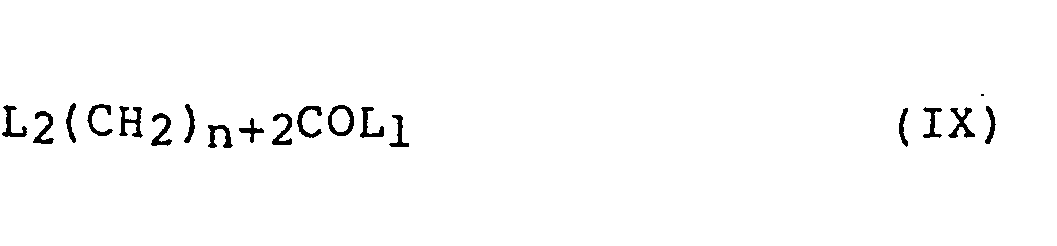
- wherein n and L1 are as defined hereinbefore and L2 is a leaving group; and optionally converting the R5 hydrogen atom in the resultant compound to other R5 as hereinbefore defined.
- The leaving group, L2, is a group that is displaceable by a primary amino nucleophile. Preferred examples of such groups include halo, such as chloro and bromo.
- Compounds of formula (VIII) can be prepared by a reaction of a compound of formula (V) with ethanolic ammonium hydroxide solution. Alternatively, they can be prepared by reduction with zinc and hydrochloric acid of a compound of formula (X):
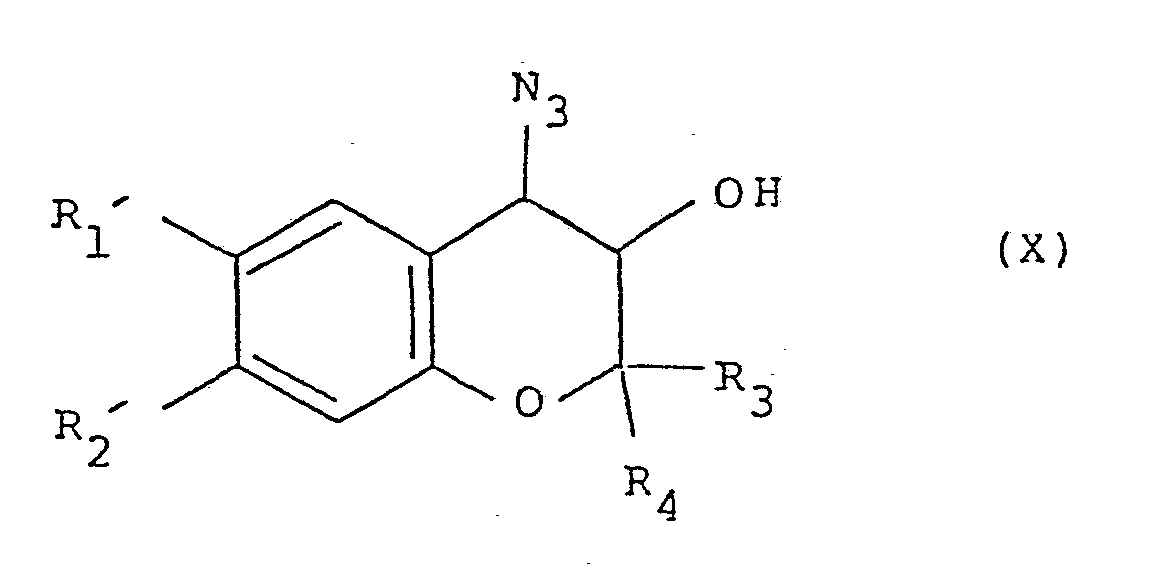
- Compounds of formula (X) can in turn be prepared from a compound of formula (V) by reaction with sodium azide in the presence of boric acid in for example dimethylformamide. Process 2. Oxidising a compound of formula (XI), or a metal salt thereof:
-
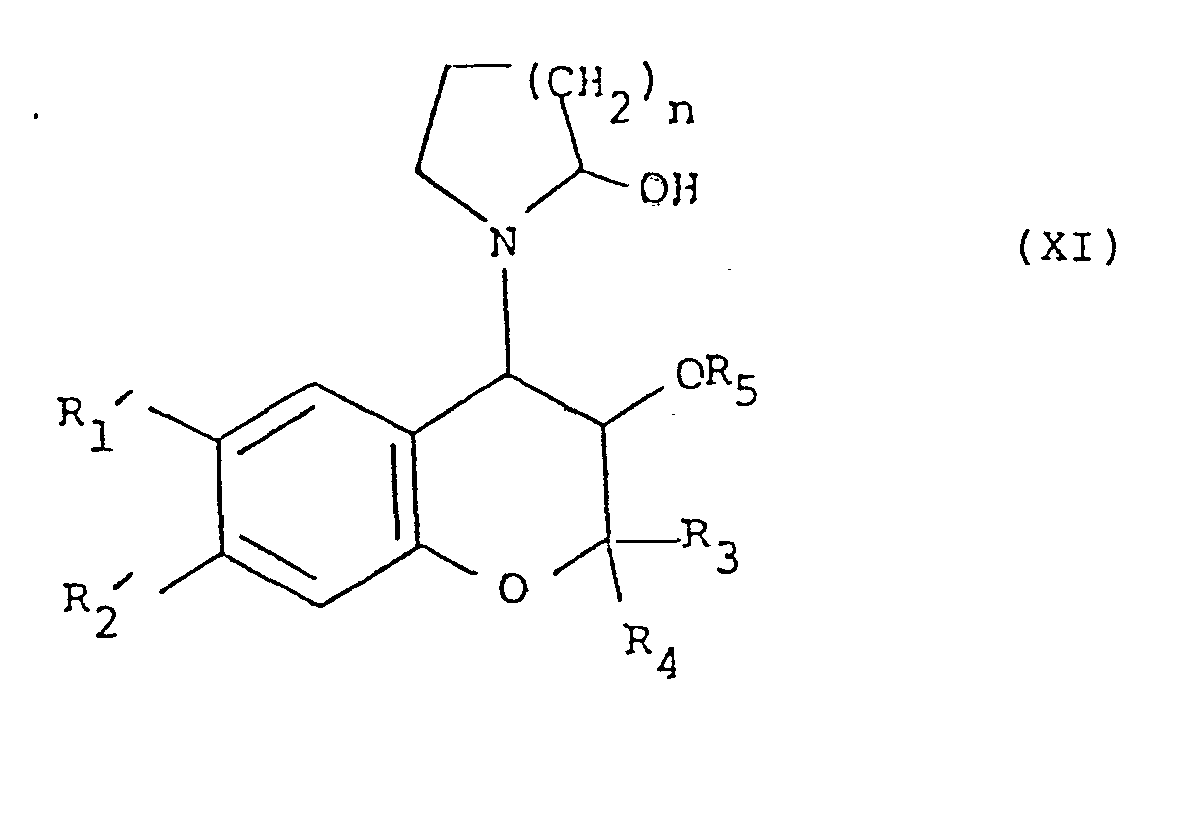
- The oxidation is preferably carried out in a solvent such as aqueous methanol with a metal periodate such as potassium periodate.
- Compounds of formula (XI) can be prepared by cyclising in the presence of an acid a compound of formula (XII):

- Compounds of formula (XII) can in turn be prepared by reacting a compound of formula (V) with a compound of formula (XIII):

- Process 3. Reacting a compound of formula (V) with an anion of formula (XIV):

- The reaction is preferably carried out in a solvent such as dimethylsulphoxide in the presence of a base, such as sodium hydride.
- The compound of formula (V) can be prepared in situ from the corresponding compound of formula (VII). In such circumstances, it is advantageous not to add the lactam anion of formula (XIV) until sufficient time has elapsed for the epoxide of formula (V) to be produced.
- 4) Cyclising a compound of formula (XV):
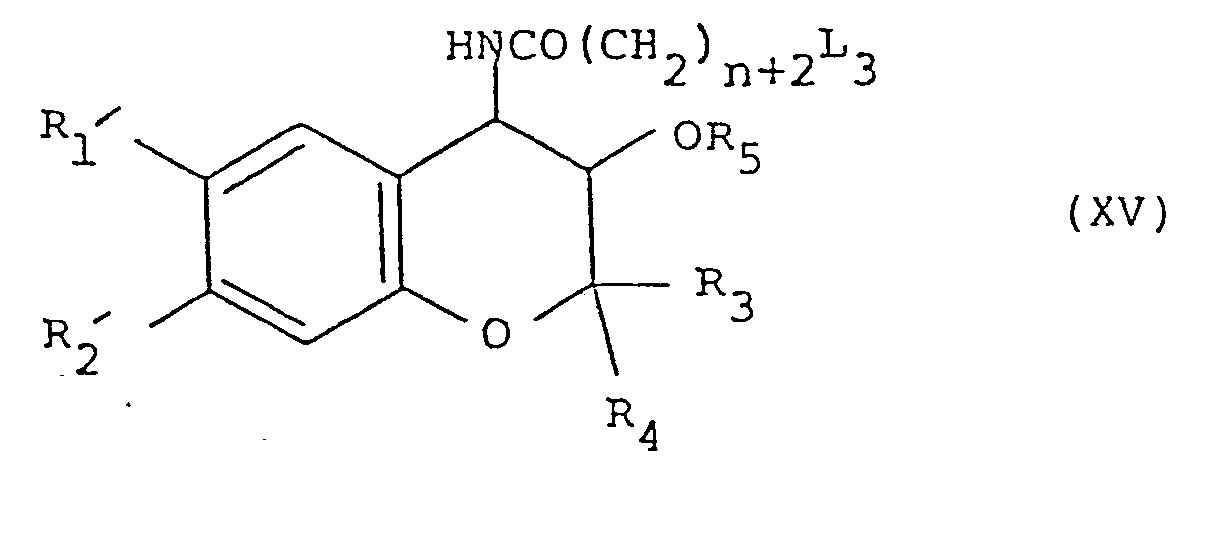
- The leaving group L3 is a group that is displaceable by a secondary amino nucleophile adjacent a carbonyl function. A preferred example is chloro.
- The cyclisation reaction is preferably carried out in a solvent such as dimethylformamide in the presence of a base, such as sodium hydride.
- Compounds of formula (XV) can be prepared by reacting a compound of formula (VIII) with a compound of formula (XVI):

- The leaving group L4 is a group that, when adjacent to a carbonyl function, is displaceable by a primary amino nucleophile.
- The reaction is preferably carried out in a solvent, such as chloroform or methylene chloride, in the presence of aqueous base, such as aqueous sodium hydroxide.
- In the reactions with the epoxide of formula (V), the trans isomer is specifically formed.
- Compounds of formula (VII) can be prepared in accordance with known processes. Schematically, such process can be depicted thus:

- (a) Room temperature; NaOH/40% benzyltrimethylammonium hydroxide in methanol;
- (b) Heat in o-dichlorobenzene;
- (c) N-bromosuccinimide/dimethylsulphoxide/water;
- (d) Bromine in carbon tetrachloride; and
- (e) Acetone/water.
- The above process can produce mixtures of compounds during reaction (b) owing to the two sites available for ring formation. It is therefore advisable to remove any of the undesired compound by, for example, chromatography, before reaction (c) or (d).
- Instead of carrying out the conversion of a group or atom Rl' or R2' into hydrogen or into one of the class of substituents defined for the other of Rl and R2 after cyclising a compound of formula (IV) or (XV), or after oxidising a compound of formula (XI), or after reacting a compound of formula (V) with an anion of formula (XIV), it is greatly preferred that any such conversions are carried out at an earlier stage, preferably on the chromene produced after reaction (b) above. In other words, it is preferred that, for the processes of the invention R1' and R2 - are R1 and R2 respectively.
- The (3S,4R)-isomer of a compound of formula (I) has a better blood pressure lowering activity than the corresponding (3R,4S)-isomer. This isomer is therefore useful in the treatment of hypertension, optionally in admixture with the corresponding (3R,4S)-isomer as hereinbefore defined.
- The present invention accordingly provides a pharmaceutical composition which comprises the (3S,4R)-isomer of a compound of formula (I) optionally in admixture with up to 45% of the mixture of isomers by weight of the corresponding (3R,4S)-isomer and a pharmaceutically acceptable carrier. In particular, the present invention provides an antihypertensive pharmaceutical composition which comprises an anti-hypertensive effective amount of the (3S,4R)-isomer of a compound of formula (I) optionally in admixture with up to 45% of the mixture of isomers by weight of the corresponding (3R,4S)-isomer and a pharmaceutically acceptable carrier.
- The compositions are preferably adapted for oral administration. However, they may be adapted for other modes of administration, for example parenteral administration for patients suffering from heart failure.
- The compositions may be in the form of tablets, capsules, powders, granules, lozenges, suppositories, reconstitutable powders, or liquid preparations, such as oral or sterile parenteral solutions or suspensions.
- In order to obtain consistency of administration it is preferred that a composition of the invention is in the form of a unit dose.
- Unit dose presentation forms for oral administration may be tablets and capsules and may contain conventional excipients such as binding agents, for example syrup, acacia, gelatin, sorbitol, tragacanth, or polyvinylpyrrolidone; fillers, for example lactose, sugar, maize-starch, calcium phosphate, sorbitol or glycine; tabletting lubricants, for example magnesium stearate; disintegrants, for example starch, polyvinylpyrrolidone, sodium starch glycollate or microcrystalline cellulose; or pharmaceutically acceptable wetting agents such as sodium lauryl sulphate.
- The solid oral compositions may be prepared by conventional methods of blending, filling, tabletting or the like. Repeated blending operations may be used to distribute the active agent throughout those compositions employing large quantities of fillers. Such operations are of course conventional in the art. The tablets may be coated according to methods well known in normal pharmaceutical practice, in particular with an enteric coating.
- Oral liquid preparations may be in the form of, for example, emulsions, syrups, or elixirs, or may be presented as a dry product for reconstitution with water or other suitable vehicle before use. Such liquid preparations may contain conventional additives such as suspending agents, for example sorbitol, syrup, methyl cellulose, gelatin, hydroxyethylcellulose, carboxymethylcellulose, aluminium stearate gel,hydrogenated edible fats; emulsifying agents, for example lecithin, sorbitan monooleate, or acacia; non-aqueous vehicles (which may include edible oils), for example almond oil, fractionated coconut oil, oily esters such as esters of glycerine, propylene glycol, or ethyl alcohol; preservatives, for example methyl or propyl p-hydroxybenzoate or sorbic acid; and if desired conventional flavouring or colouring agents. For parenteral administration, fluid unit dosage forms are prepared utilizing the compound and a sterile vehicle, and, depending on the concentration used, can be either suspended or dissolved in the vehicle. In preparing solutions the compound can be dissolved in water for injection and filter sterilized before filling into a suitable vial or ampoule and sealing. Advantageously, adjuvants such as a local anaesthetic, a preservative and buffering agents can be dissolved in the vehicle. To enhance the stability, the composition can be frozen after filling into the vial and the water removed under vacuum. Parenteral suspensions are prepared in substantially the same manner, except that the compound is suspended in the vehicle instead of being dissolved, and sterilization cannot be accomplished by filtration. The compound can be sterilized by exposure to ethylene oxide before suspending in the sterile vehicle. Advantageously, a sufactant or wetting agent is included in the composition to facilitate uniform distribution of the compound.
- The compositions may contain from 0.1% to 99% by weight, preferably from 10-60% by weight, of the active material, depending on the method of administration.
- The present invention further provides a method of prophylaxis or treatment of hypertension in mammals including man, which comprises administering to the suffering mammal an anti-hypertensive effective amount of the (3S,4R)-isomer of a compound of formula (I) optionally in admixture with up to 45% of the mixture of isomers by weight of the corresponding (3R,4S)-isomer, or a pharmaceutical composition of the invention.
- An effective amount will depend on the relative efficacy of the compounds of the present invention, the severity of the hypertension being treated and the weight of the sufferer. However, a unit dose form of a composition of the invention may contain from 0.5 to 100 mg of a compound of the invention and more usually from 1 to 50 mg, for example 1 to 10 mg, such as 1, 2, 5, or 10mg. Such compositions may be administered from 1 to 6 times a day, more usually from 1 to 4 times a day, in a manner such that the daily dose is from 1 to 100mgfor a 70 kg human adult and more particularly from 1 to 10 mg.
- The present invention further provides the (3S,4R)-isomer of a compound of formula (I) optionally in admixture with up to 45% of the mixture of isomers by weight of the corresponding (3R,4S)-isomer for use in the treatment or prophylaxis of hypertension.
- The following example illustratesthe resolution of the (3S,4R)-isomer of a compound of formula (I).
- A mixture of the title compound (16.6mM) and (-)-a-methylbenzyl isocyanate (19.3mM) in toluene (160 ml) was refluxed for 43 h and then evaporated to leave a gum. Fractional crystallisation from ethyl acetate-pentane afforded the carbamate of the (-) isomer of the title compound, [a]D 26(acetone)-14.24°, in 21% yield. Crystallisation of the oil derived from the mother liquor similarly gave the carbamate of the (+) isomer of the title compound [a]D26 (acetone)-77.12°, in 14% yield.
- The foregoing carbamates were each hydrolysed back to the parent carbinols by treatment with triethylamine (two equivalents) and trichlorosilane (two equivalents) in toluene at 35-40°C for 16 h. The crude products were purified by chromatography on silica gel, eluting with ethyl acetate, to afford the pure (-) isomer of the title compound, [a]D 26 (CHCl3)-52.2°, m.p. 242-4oC (63%)', and (+)-isomer of the title compound [a]D 26 (CHC13) +53.50, m.p. 243-5°C (66%) respectively.
- The following compounds are resolved analogously:
- 6-acetyl-3,4-dihydro-2,2-dimethyl-trans-4-(2-oxo-1-piperidinyl)-2H-benzo[b]pyran-3-ol(2)
- 6-acetyl-3,4-dihydro-2,2-dimethyl-trans-4-(2-oxo-l-pyrrolidinyl)-2H-benzo[b]pyran-3-ol (3)
- 6-cyano-3,4-dihydro-2,2-dimethyl-trans-4-(2-oxo-l-piperidinyl)-2H-benzo[b]pyran-3-ol (4)
- 6-nitro-3,4-dihydro-2,2-dimethyl-trans-4-(2-oxo-l-pyrrolidinyl)-2H-benzo[b]pyran-3-ol (5)
- 6-nitro-3,4-dihydro-2,2-dimethyl-trans-4-(2-oxo-l-piperidinyl)-2H-benzo[b]pyran-3-ol (6)
- Systolic blood pressures were recorded by a modification of the tail cuff method described by I.M. Claxton, M.G. Palfreyman, R.H. Poyser, R.L. Whiting, European Journal of Pharmacology, 37, 179 (1976).
- W+W BP recorder, model 8005, was used to display pulses. Prior to all measurments rats were placed in a heated environment (33.5±0.5°C) before transfer to a restraining cage. Each determination of blood pressure was the mean of at least 6 readings. Spontaneously hypertensive rats (ages 12-18 weeks) with systolic blood pressures >170 mmHg were considered hypertensive.

- No toxic effects were observed in the above tests.
Claims (32)


Applications Claiming Priority (2)
| Application Number | Priority Date | Filing Date | Title |
|---|---|---|---|
| GB8308062 | 1983-03-24 | ||
| GB838308062A GB8308062D0 (en) | 1983-03-24 | 1983-03-24 | Active compounds |
Publications (2)
| Publication Number | Publication Date |
|---|---|
| EP0120428A1 true EP0120428A1 (en) | 1984-10-03 |
| EP0120428B1 EP0120428B1 (en) | 1990-05-23 |
Family
ID=10540102
Family Applications (1)
| Application Number | Title | Priority Date | Filing Date |
|---|---|---|---|
| EP84102963A Expired - Lifetime EP0120428B1 (en) | 1983-03-24 | 1984-03-17 | Benzopyran isomers |
Country Status (12)
| Country | Link |
|---|---|
| EP (1) | EP0120428B1 (en) |
| JP (1) | JPH0791188B2 (en) |
| AU (1) | AU571498B2 (en) |
| CA (1) | CA1284150C (en) |
| CS (1) | CS391391A3 (en) |
| DE (1) | DE3482323D1 (en) |
| ES (1) | ES8607964A1 (en) |
| GB (1) | GB8308062D0 (en) |
| GR (1) | GR81923B (en) |
| IE (1) | IE57119B1 (en) |
| NZ (1) | NZ207594A (en) |
| ZA (1) | ZA842123B (en) |
Cited By (21)
| Publication number | Priority date | Publication date | Assignee | Title |
|---|---|---|---|---|
| EP0274821A1 (en) * | 1986-10-21 | 1988-07-20 | Beecham Group Plc | Benzopyran compounds, processes for their preparation and their pharmaceutical use |
| EP0337179A1 (en) * | 1988-03-31 | 1989-10-18 | Hoechst Aktiengesellschaft | Unsaturated N-benzopyranyllactams |
| DE3823533A1 (en) * | 1988-07-12 | 1990-02-08 | Beiersdorf Ag | SUBSTITUTED 4-HETEROCYCLYL-2H-BENZO (B) PYRANEES, METHOD AND 4-HYDROXY-3-BROM, 3,4-OXIRANYL-3,4-DEHYDRO-2H-BENZO (B) PYRANES AS INTERMEDIATE PRODUCTS FOR THEIR MANUFACTURE, AND THE INVENTION PHARMACEUTICAL PRECAUTIONS CONTAINING THEM |
| EP0385584A1 (en) * | 1989-02-01 | 1990-09-05 | Beecham Group Plc | Method for the preparation of 4-(cyclic-amido)-2H-1-benzopyrans and 4-amino-3-hydroxy-2H-1-benzopyrans |
| EP0405298A1 (en) * | 1989-06-27 | 1991-01-02 | Chemisch Pharmazeutische Forschungsgesellschaft m.b.H. | Thienopyran derivatives, a process for their preparation, and their use |
| EP0406656A1 (en) | 1989-07-07 | 1991-01-09 | MERCK PATENT GmbH | Chroman derivatives |
| EP0344572A3 (en) * | 1988-05-28 | 1991-01-16 | Hoechst Aktiengesellschaft | Composition of angiotensin-converting-enzyme inhibitor with calcium chanell modulators and uses thereof as pharmaceuticals |
| EP0409651A1 (en) * | 1989-07-21 | 1991-01-23 | Alkaloida Vegyeszeti Gyar | New Process for the preparation of anti-hypertensive benzopyran derivative |
| US4988723A (en) * | 1988-06-02 | 1991-01-29 | Fujisawa Pharmaceutical Co., Ltd. | Benzopyran derivatives and their use as anti-hypertensives |
| AU614285B2 (en) * | 1987-05-16 | 1991-08-29 | Sandoz Ltd. | Novel benzo (b)pyranes and pyranopyridines, process for their preparation and their use |
| US5066816A (en) * | 1989-03-03 | 1991-11-19 | Yoshitomi Pharmaceutical Industries, Ltd. | Processes for preparing optically active 3,4-dihydro-3,4-epoxy-2h-1-benzopyran compounds and intermediates therefor |
| US5130310A (en) * | 1989-01-21 | 1992-07-14 | Hoechst Aktiengesellschaft | Substituted benzo[b]pyrans, processes for their preparation, their use and pharmaceutical preparations based on these compounds |
| US5162553A (en) * | 1989-03-03 | 1992-11-10 | Yoshitomi Pharmaceutical Industries, Ltd. | Processes for preparing optically active 3,4-dihydro-3,4-epoxy-2H-1-benzopyran compounds and intermediates therefor |
| EP0277611B1 (en) * | 1987-02-04 | 1993-06-16 | Hoechst Aktiengesellschaft | Alkyl-substituted n-benzopyranyl lactames, process for their preparation, their use and pharmaceutical preparations on the basis of these compounds |
| EP0277612B1 (en) * | 1987-02-04 | 1993-07-28 | Hoechst Aktiengesellschaft | Substituted 3,4-dihydro-2h-benzopyranes, process for their preparation, their use and pharmaceutical preparations based on these compounds |
| US5239090A (en) * | 1989-02-01 | 1993-08-24 | Beecham Group P.L.C. | Certain optically active 3,4-dihydrobenzopyran-4-ols which are intermediates |
| US5703113A (en) * | 1992-12-19 | 1997-12-30 | Alkaloida Vegyeszeti Gyar | Benzopyran derivatives |
| US6417207B1 (en) | 1999-05-12 | 2002-07-09 | Nitromed, Inc. | Nitrosated and nitrosylated potassium channel activators, compositions and methods of use |
| US10981951B2 (en) | 2014-01-31 | 2021-04-20 | Mayo Foundation For Medical Education And Research | Therapeutics for the treatment of glaucoma |
| US12454539B2 (en) | 2019-12-12 | 2025-10-28 | Qlaris Bio, Inc. | Controlled-delivery cromakalim prodrugs |
| US12564572B2 (en) | 2022-11-04 | 2026-03-03 | Qlaris Bio, Inc. | Topical ocular delivery of cromakalim |
Families Citing this family (2)
| Publication number | Priority date | Publication date | Assignee | Title |
|---|---|---|---|---|
| PT84806B (en) * | 1986-05-03 | 1989-12-29 | Beecham Group Plc | PROCESS FOR THE PREPARATION OF BENZOPYRANES |
| CN115768419A (en) * | 2020-02-07 | 2023-03-07 | 奎拉里斯生物公司 | Improved methods and compositions for chromankaline prodrug therapy |
Citations (3)
| Publication number | Priority date | Publication date | Assignee | Title |
|---|---|---|---|---|
| GB1548222A (en) * | 1976-12-17 | 1979-07-04 | Beecham Group Ltd | Trans-4-heterocyclyl-3,4-dihydro-2h-benzo pyarn-3-ol derivatives |
| FR2468601A1 (en) * | 1979-10-29 | 1981-05-08 | Maruko Pharmaceutical Co | NEW FLAVANNE DERIVATIVES USEFUL IN PARTICULAR AS ANTI-CONVULSANTS |
| EP0033612A1 (en) * | 1980-02-02 | 1981-08-12 | Beecham Group Plc | Pyrano derivatives, a process for their preparation and antihypertensive compositions containing them |
Family Cites Families (3)
| Publication number | Priority date | Publication date | Assignee | Title |
|---|---|---|---|---|
| DE2965739D1 (en) * | 1978-10-04 | 1983-07-28 | Beecham Group Plc | Chromanol derivatives, a process for their preparation and pharmaceutical compositions comprising them |
| GB2107706A (en) * | 1981-09-25 | 1983-05-05 | Beecham Group Plc | Benzopyrans |
| JPH0471072A (en) * | 1990-07-11 | 1992-03-05 | Fujitsu Ltd | Method for simulating analog/digital mixed integrated circuit |
-
1983
- 1983-03-24 GB GB838308062A patent/GB8308062D0/en active Pending
-
1984
- 1984-03-17 DE DE8484102963T patent/DE3482323D1/en not_active Expired - Lifetime
- 1984-03-17 EP EP84102963A patent/EP0120428B1/en not_active Expired - Lifetime
- 1984-03-22 AU AU26007/84A patent/AU571498B2/en not_active Expired
- 1984-03-22 CA CA000450251A patent/CA1284150C/en not_active Expired - Lifetime
- 1984-03-22 ZA ZA842123A patent/ZA842123B/en unknown
- 1984-03-22 GR GR74175A patent/GR81923B/el unknown
- 1984-03-22 IE IE707/84A patent/IE57119B1/en not_active IP Right Cessation
- 1984-03-22 NZ NZ207594A patent/NZ207594A/en unknown
- 1984-03-23 JP JP59055933A patent/JPH0791188B2/en not_active Expired - Lifetime
- 1984-03-23 ES ES530958A patent/ES8607964A1/en not_active Expired
-
1991
- 1991-12-19 CS CS913913A patent/CS391391A3/en unknown
Patent Citations (3)
| Publication number | Priority date | Publication date | Assignee | Title |
|---|---|---|---|---|
| GB1548222A (en) * | 1976-12-17 | 1979-07-04 | Beecham Group Ltd | Trans-4-heterocyclyl-3,4-dihydro-2h-benzo pyarn-3-ol derivatives |
| FR2468601A1 (en) * | 1979-10-29 | 1981-05-08 | Maruko Pharmaceutical Co | NEW FLAVANNE DERIVATIVES USEFUL IN PARTICULAR AS ANTI-CONVULSANTS |
| EP0033612A1 (en) * | 1980-02-02 | 1981-08-12 | Beecham Group Plc | Pyrano derivatives, a process for their preparation and antihypertensive compositions containing them |
Cited By (30)
| Publication number | Priority date | Publication date | Assignee | Title |
|---|---|---|---|---|
| EP0274821A1 (en) * | 1986-10-21 | 1988-07-20 | Beecham Group Plc | Benzopyran compounds, processes for their preparation and their pharmaceutical use |
| EP0277612B1 (en) * | 1987-02-04 | 1993-07-28 | Hoechst Aktiengesellschaft | Substituted 3,4-dihydro-2h-benzopyranes, process for their preparation, their use and pharmaceutical preparations based on these compounds |
| EP0277611B1 (en) * | 1987-02-04 | 1993-06-16 | Hoechst Aktiengesellschaft | Alkyl-substituted n-benzopyranyl lactames, process for their preparation, their use and pharmaceutical preparations on the basis of these compounds |
| AU614285B2 (en) * | 1987-05-16 | 1991-08-29 | Sandoz Ltd. | Novel benzo (b)pyranes and pyranopyridines, process for their preparation and their use |
| EP0337179A1 (en) * | 1988-03-31 | 1989-10-18 | Hoechst Aktiengesellschaft | Unsaturated N-benzopyranyllactams |
| US5043344A (en) * | 1988-03-31 | 1991-08-27 | Hoechst Aktiengesellschaft | Unsaturated N-benzopyranyllactams |
| EP0344572A3 (en) * | 1988-05-28 | 1991-01-16 | Hoechst Aktiengesellschaft | Composition of angiotensin-converting-enzyme inhibitor with calcium chanell modulators and uses thereof as pharmaceuticals |
| US4988723A (en) * | 1988-06-02 | 1991-01-29 | Fujisawa Pharmaceutical Co., Ltd. | Benzopyran derivatives and their use as anti-hypertensives |
| DE3823533A1 (en) * | 1988-07-12 | 1990-02-08 | Beiersdorf Ag | SUBSTITUTED 4-HETEROCYCLYL-2H-BENZO (B) PYRANEES, METHOD AND 4-HYDROXY-3-BROM, 3,4-OXIRANYL-3,4-DEHYDRO-2H-BENZO (B) PYRANES AS INTERMEDIATE PRODUCTS FOR THEIR MANUFACTURE, AND THE INVENTION PHARMACEUTICAL PRECAUTIONS CONTAINING THEM |
| US5096914A (en) * | 1988-07-12 | 1992-03-17 | Beiersdorf Aktiengesellschaft | Novel benzopyran derivatives, processes for their preparation and their use and preparations containing the compounds |
| US5028711A (en) * | 1988-07-12 | 1991-07-02 | Beiersdorf Aktiengesellschaft | Novel benzopyran derivatives, processes for their preparation and their use and preparations containing the compounds |
| US5130310A (en) * | 1989-01-21 | 1992-07-14 | Hoechst Aktiengesellschaft | Substituted benzo[b]pyrans, processes for their preparation, their use and pharmaceutical preparations based on these compounds |
| US5126460A (en) * | 1989-02-01 | 1992-06-30 | Beecham Group P.L.C. | Process for preparing benzoypyranol derivatives |
| US5239090A (en) * | 1989-02-01 | 1993-08-24 | Beecham Group P.L.C. | Certain optically active 3,4-dihydrobenzopyran-4-ols which are intermediates |
| AU626376B2 (en) * | 1989-02-01 | 1992-07-30 | Beecham Group Plc | Process for the preparation of pure (3S,4R)-4-pyrrolidon- 1-yl (or 4-piperidon-1-yl)-3,4-dihydrobenzo pyran-3-ol derivatives |
| EP0385584A1 (en) * | 1989-02-01 | 1990-09-05 | Beecham Group Plc | Method for the preparation of 4-(cyclic-amido)-2H-1-benzopyrans and 4-amino-3-hydroxy-2H-1-benzopyrans |
| US5066816A (en) * | 1989-03-03 | 1991-11-19 | Yoshitomi Pharmaceutical Industries, Ltd. | Processes for preparing optically active 3,4-dihydro-3,4-epoxy-2h-1-benzopyran compounds and intermediates therefor |
| US5162553A (en) * | 1989-03-03 | 1992-11-10 | Yoshitomi Pharmaceutical Industries, Ltd. | Processes for preparing optically active 3,4-dihydro-3,4-epoxy-2H-1-benzopyran compounds and intermediates therefor |
| EP0405298A1 (en) * | 1989-06-27 | 1991-01-02 | Chemisch Pharmazeutische Forschungsgesellschaft m.b.H. | Thienopyran derivatives, a process for their preparation, and their use |
| EP0406656A1 (en) | 1989-07-07 | 1991-01-09 | MERCK PATENT GmbH | Chroman derivatives |
| EP0409651A1 (en) * | 1989-07-21 | 1991-01-23 | Alkaloida Vegyeszeti Gyar | New Process for the preparation of anti-hypertensive benzopyran derivative |
| US5703113A (en) * | 1992-12-19 | 1997-12-30 | Alkaloida Vegyeszeti Gyar | Benzopyran derivatives |
| US6417207B1 (en) | 1999-05-12 | 2002-07-09 | Nitromed, Inc. | Nitrosated and nitrosylated potassium channel activators, compositions and methods of use |
| US6693122B2 (en) | 1999-05-12 | 2004-02-17 | Nitromed, Inc. | Nitrosated and nitrosylated potassium channel activators, compositions and methods of use |
| US10981951B2 (en) | 2014-01-31 | 2021-04-20 | Mayo Foundation For Medical Education And Research | Therapeutics for the treatment of glaucoma |
| US11505572B2 (en) | 2014-01-31 | 2022-11-22 | Mayo Foundation For Medical Education And Research | Therapeutics for the treatment of glaucoma |
| US12209140B2 (en) | 2014-01-31 | 2025-01-28 | Mayo Foundation For Medical Education And Research | Therapeutics for the treatment of glaucoma |
| US12454539B2 (en) | 2019-12-12 | 2025-10-28 | Qlaris Bio, Inc. | Controlled-delivery cromakalim prodrugs |
| US12564572B2 (en) | 2022-11-04 | 2026-03-03 | Qlaris Bio, Inc. | Topical ocular delivery of cromakalim |
| US12564573B2 (en) | 2022-11-04 | 2026-03-03 | Qlaris Bio, Inc. | Topical ocular delivery of cromakalim |
Also Published As
| Publication number | Publication date |
|---|---|
| ES530958A0 (en) | 1986-06-01 |
| IE840707L (en) | 1984-09-24 |
| JPS59176282A (en) | 1984-10-05 |
| JPH0791188B2 (en) | 1995-10-04 |
| CS391391A3 (en) | 1992-09-16 |
| NZ207594A (en) | 1987-07-31 |
| IE57119B1 (en) | 1992-05-06 |
| GR81923B (en) | 1984-12-12 |
| GB8308062D0 (en) | 1983-05-05 |
| EP0120428B1 (en) | 1990-05-23 |
| AU2600784A (en) | 1984-09-27 |
| CA1284150C (en) | 1991-05-14 |
| ZA842123B (en) | 1985-04-24 |
| DE3482323D1 (en) | 1990-06-28 |
| AU571498B2 (en) | 1988-04-21 |
| ES8607964A1 (en) | 1986-06-01 |
Similar Documents
| Publication | Publication Date | Title |
|---|---|---|
| CA1284150C (en) | (3s,4r)-trans-4-pyrrolidon/piperidon-1-yl-3,4-dihydro-2h- benzo ¬b|pyran-3-olderivatives | |
| EP0120427B1 (en) | 3,4-Dihydro-thiaoxo-1-pyrrolidinyl-or piperidinyl-ZH-benzo[b]pyrons | |
| US4831050A (en) | Pyrrolidinyl benzopyrans as hypotensive agents | |
| US4782083A (en) | 3,4-dihydro-2H-1-benzopyrans useful as anti-hypertensive agents | |
| US4446113A (en) | Benzopyrans | |
| EP0126367B1 (en) | Chroman and chromene derivatives | |
| EP0107423B1 (en) | Novel chromans and chromenes | |
| EP0172352B1 (en) | Active benzopyran compounds | |
| US4644070A (en) | Chroman-3-ol compounds | |
| EP0250077A2 (en) | Pharmacologically active benzopyranes | |
| CZ391791A3 (en) | Benzopyran derivatives, process of their preparation and pharmaceutical compositions in which they are comprised | |
| EP0120426B1 (en) | Antihypertensive benzopyrons | |
| EP0158923B1 (en) | Chrome derivatives | |
| EP0168619B1 (en) | N-acylated di- or tetrahydronaphthalenamines, and antihypertensive compositions containing them | |
| EP0218373B1 (en) | Chroman derivatives and analogues having antihypertensive activity | |
| EP0126350A1 (en) | Novel compounds | |
| CA2087423A1 (en) | Benzopyran derivative, process for producing the same and pharmaceutical composition containing the same | |
| WO1991009031A1 (en) | Trifluoromethyl substituted compounds and a pharmaceutical composition | |
| US4808619A (en) | Di/tetra-hydroquinolines | |
| EP0138134A2 (en) | Chroman derivatives | |
| EP0214743A2 (en) | Use of quinoline derivatives in the manufacture of medicaments for the treatment of cerebrovascular disorders and cerebral senility | |
| EP0033613A1 (en) | Chromanol derivatives, a process for their preparation and compositions containing them | |
| EP0516658A1 (en) | Benzopyrans having pharmacological activity |
Legal Events
| Date | Code | Title | Description |
|---|---|---|---|
| PUAI | Public reference made under article 153(3) epc to a published international application that has entered the european phase |
Free format text: ORIGINAL CODE: 0009012 |
|
| AK | Designated contracting states |
Designated state(s): BE CH DE FR GB IT LI NL SE |
|
| 17P | Request for examination filed |
Effective date: 19841113 |
|
| 17Q | First examination report despatched |
Effective date: 19861028 |
|
| GRAA | (expected) grant |
Free format text: ORIGINAL CODE: 0009210 |
|
| AK | Designated contracting states |
Kind code of ref document: B1 Designated state(s): BE CH DE FR GB IT LI NL SE |
|
| REF | Corresponds to: |
Ref document number: 3482323 Country of ref document: DE Date of ref document: 19900628 |
|
| ET | Fr: translation filed | ||
| ITF | It: translation for a ep patent filed | ||
| PLBE | No opposition filed within time limit |
Free format text: ORIGINAL CODE: 0009261 |
|
| STAA | Information on the status of an ep patent application or granted ep patent |
Free format text: STATUS: NO OPPOSITION FILED WITHIN TIME LIMIT |
|
| ITTA | It: last paid annual fee | ||
| 26N | No opposition filed | ||
| EAL | Se: european patent in force in sweden |
Ref document number: 84102963.0 |
|
| REG | Reference to a national code |
Ref country code: GB Ref legal event code: IF02 |
|
| PGFP | Annual fee paid to national office [announced via postgrant information from national office to epo] |
Ref country code: GB Payment date: 20030204 Year of fee payment: 20 |
|
| PGFP | Annual fee paid to national office [announced via postgrant information from national office to epo] |
Ref country code: NL Payment date: 20030206 Year of fee payment: 20 |
|
| PGFP | Annual fee paid to national office [announced via postgrant information from national office to epo] |
Ref country code: FR Payment date: 20030303 Year of fee payment: 20 |
|
| PGFP | Annual fee paid to national office [announced via postgrant information from national office to epo] |
Ref country code: SE Payment date: 20030304 Year of fee payment: 20 |
|
| PGFP | Annual fee paid to national office [announced via postgrant information from national office to epo] |
Ref country code: CH Payment date: 20030319 Year of fee payment: 20 |
|
| PGFP | Annual fee paid to national office [announced via postgrant information from national office to epo] |
Ref country code: DE Payment date: 20030331 Year of fee payment: 20 |
|
| PGFP | Annual fee paid to national office [announced via postgrant information from national office to epo] |
Ref country code: BE Payment date: 20030409 Year of fee payment: 20 |
|
| PG25 | Lapsed in a contracting state [announced via postgrant information from national office to epo] |
Ref country code: LI Free format text: LAPSE BECAUSE OF EXPIRATION OF PROTECTION Effective date: 20040316 Ref country code: GB Free format text: LAPSE BECAUSE OF EXPIRATION OF PROTECTION Effective date: 20040316 Ref country code: CH Free format text: LAPSE BECAUSE OF EXPIRATION OF PROTECTION Effective date: 20040316 |
|
| PG25 | Lapsed in a contracting state [announced via postgrant information from national office to epo] |
Ref country code: NL Free format text: LAPSE BECAUSE OF EXPIRATION OF PROTECTION Effective date: 20040317 |
|
| BE20 | Be: patent expired |
Owner name: *BEECHAM GROUP P.L.C. Effective date: 20040317 |
|
| REG | Reference to a national code |
Ref country code: GB Ref legal event code: PE20 |
|
| REG | Reference to a national code |
Ref country code: CH Ref legal event code: PL |
|
| NLV7 | Nl: ceased due to reaching the maximum lifetime of a patent |
Effective date: 20040317 |
|
| EUG | Se: european patent has lapsed |