EP0120403A2 - Heat developable color photographic materials - Google Patents
Heat developable color photographic materials Download PDFInfo
- Publication number
- EP0120403A2 EP0120403A2 EP84102744A EP84102744A EP0120403A2 EP 0120403 A2 EP0120403 A2 EP 0120403A2 EP 84102744 A EP84102744 A EP 84102744A EP 84102744 A EP84102744 A EP 84102744A EP 0120403 A2 EP0120403 A2 EP 0120403A2
- Authority
- EP
- European Patent Office
- Prior art keywords
- group
- dye
- color photographic
- photographic material
- base
- Prior art date
- Legal status (The legal status is an assumption and is not a legal conclusion. Google has not performed a legal analysis and makes no representation as to the accuracy of the status listed.)
- Granted
Links
- 0 CC(*)=N*c1ccccc1* Chemical compound CC(*)=N*c1ccccc1* 0.000 description 3
Classifications
-
- G—PHYSICS
- G03—PHOTOGRAPHY; CINEMATOGRAPHY; ANALOGOUS TECHNIQUES USING WAVES OTHER THAN OPTICAL WAVES; ELECTROGRAPHY; HOLOGRAPHY
- G03C—PHOTOSENSITIVE MATERIALS FOR PHOTOGRAPHIC PURPOSES; PHOTOGRAPHIC PROCESSES, e.g. CINE, X-RAY, COLOUR, STEREO-PHOTOGRAPHIC PROCESSES; AUXILIARY PROCESSES IN PHOTOGRAPHY
- G03C8/00—Diffusion transfer processes or agents therefor; Photosensitive materials for such processes
- G03C8/40—Development by heat ; Photo-thermographic processes
- G03C8/4013—Development by heat ; Photo-thermographic processes using photothermographic silver salt systems, e.g. dry silver
- G03C8/408—Additives or processing agents not provided for in groups G03C8/402 - G03C8/4046
- G03C8/4086—Base precursors
-
- C—CHEMISTRY; METALLURGY
- C07—ORGANIC CHEMISTRY
- C07C—ACYCLIC OR CARBOCYCLIC COMPOUNDS
- C07C317/00—Sulfones; Sulfoxides
-
- G—PHYSICS
- G03—PHOTOGRAPHY; CINEMATOGRAPHY; ANALOGOUS TECHNIQUES USING WAVES OTHER THAN OPTICAL WAVES; ELECTROGRAPHY; HOLOGRAPHY
- G03C—PHOTOSENSITIVE MATERIALS FOR PHOTOGRAPHIC PURPOSES; PHOTOGRAPHIC PROCESSES, e.g. CINE, X-RAY, COLOUR, STEREO-PHOTOGRAPHIC PROCESSES; AUXILIARY PROCESSES IN PHOTOGRAPHY
- G03C1/00—Photosensitive materials
- G03C1/494—Silver salt compositions other than silver halide emulsions; Photothermographic systems ; Thermographic systems using noble metal compounds
- G03C1/498—Photothermographic systems, e.g. dry silver
- G03C1/49836—Additives
- G03C1/49845—Active additives, e.g. toners, stabilisers, sensitisers
-
- G—PHYSICS
- G03—PHOTOGRAPHY; CINEMATOGRAPHY; ANALOGOUS TECHNIQUES USING WAVES OTHER THAN OPTICAL WAVES; ELECTROGRAPHY; HOLOGRAPHY
- G03C—PHOTOSENSITIVE MATERIALS FOR PHOTOGRAPHIC PURPOSES; PHOTOGRAPHIC PROCESSES, e.g. CINE, X-RAY, COLOUR, STEREO-PHOTOGRAPHIC PROCESSES; AUXILIARY PROCESSES IN PHOTOGRAPHY
- G03C8/00—Diffusion transfer processes or agents therefor; Photosensitive materials for such processes
- G03C8/40—Development by heat ; Photo-thermographic processes
- G03C8/4013—Development by heat ; Photo-thermographic processes using photothermographic silver salt systems, e.g. dry silver
- G03C8/4033—Transferable dyes or precursors
Definitions
- This invention relates to a heat developable color photographic material, and more particularly to a novel photographic material containing a dye releasing material capable of releasing a hydrophilic dye through reaction with a light-sensitive silver halide upon heating a substantially water free state.
- the invention relates further to a heat developable color photographic material containing a base precursor.
- the "base precursor” in this invention is a material releasing a basic component by thermal decomposition.
- the photographic process using silver halide has excellent photographic properties such as sensitivity and gradation control as compared with other photographic processes, such as, for example, an electrophotographic process and a diazo photographic process, the silver halide photographic process has been most widely used. Recently, however, a technique of easily and rapidly obtaining images by employing a dry process such as heating, etc., as the image-forming process of a photographic material using silver halide in place of a conventional wet processing using developing solution, etc., has been developed.
- Heat developable photographic materials are known in the art and heat developable photographic materials and processes for processing these photographic materials are described in, for example, Shashin Kogaku no Kiso (The Basis of Photographic Engineering), pages 553-555, published by Corona K.K., 1979; Eizo Joho (Image Information), page 40, published April, 1978; Nebletts Handbook of Photography and Reprography, 7 th Ed., pages 32-33, published by Van Nostrand Reinhold Company; U.S. Patent Nos. 3,152,904; 3,301,678; 3,392,020; 3,457,075; U.K. Patent Nos. 1,131,108; 1,167,777; and Research Discharge, June 1978, pages 9-15 (RD-17029).
- An object of this invention is to overcome the disadvantages of conventional materials as described above and to provide a novel color photographic material for forming dye images by heating in a substantially water free state.
- Another object of this invention is to provide a photographic material capable of providing a high- density color image in a short period of time.
- Still another object of this invention is to provide a photographic material containing a novel base precursor capable of providing color images having less fog and high density.
- Another object of this invention is to provide a thermally developable color photographic material having excellent stability with the passage of time.
- stability with the passage of time is meant that the change in photographic properties such as the maximum density, the minimum density, the sensitivity, etc., is less during the storage of the photographic material before heat development.
- Yet another object of this invention is to provide a simple process forming a color images.
- the present invention provides a heat developable color photographic material comprising a support having thereon at least a photosensitive silver halide, a binder, a dye-releasing material which is reductive to the photosensitive silver halide and releases a hydrophilic dye upon reaction with the photosensitive silver halide by heating, and a base precursor represented by the following general formula (I) wherein- R represents an alkyl group having 1 to 22 carbon atoms, an alkylene group having 1 to 22 carbon atoms, an aryl group having 6 to 22 carbon atoms, an arylene group having 6 to 22 carbon atoms, or a monovalent or divalent 5- or 6-membered heterocyclic group containing N, S and/or O as hetero atom(s) or its condensed ring group, each of which may be unsubstituted or substituted; B represent a monoacidic or diacidic base having a pKa of not lower than 9 and
- Preferred condensed heterocyclic group includes the above heterocyclic groups condensed with benzene ring.
- R include an aryl group, an arylene group, a monovalent or divalent heterocyclic group, and substituted counterparts of these groups.
- Particularly preferred examples of R include aryl groups or heterocyclic groups (including condensed heterocyclic groups) substituted with an electron attracting group having a Hammet sigma value of about 0 (for example, a halogen atom, a cyano group, a nitro group, a carbamoyl group, a sulfamoyl group, etc.)
- bases represented by B bases with low volatility and having a pKa value of not lower than 10 and a boiling point of not lower than 150°C are preferred.
- bases for B include guanidines, cyclic guanidines, amidines, cyclic amidines and tetraalkylannonium hydroxide.
- R examples include a methylene group, an ethylene group, a phenyl group, a p-chlorophenyl group, a p-bromophenyl group, a p-iodophenyl group, a 3,4-dichlorophenyl group, a 2,5-dichlorophenyl group, a 2,4-dichlorophenyl group, a 3-nitrophenyl group, a 4-nitrophenyl group, a 4-cyanophenyl group, a 3-carbamoylphenyl group, a 3-sulfamoylphenyl group, a 2-methoxycarbonylphenyl group, a 3-methoxycarbonylphenyl group, a 1-naphthyl group, a 2-naphthyl group, a 2-pyridyl group, a 4-pyridyl group, a 2-thienyl group, a 5-chloro-2-
- bases represented by B include dimethylamine, diethylamine, piperidine, piperazine, ethylenediamine, N,N'-dimethylethylenediamine, acetoamidine, diazabicyclononene, diazabicycloundecene, tetramethylammonium hydroxide, tetraethylammonium hydroxide, etc.
- the a-sulfonylacetate represented by the general formula (I) can generally be prepared by condensing a sulfinic acid with an a-haloacetic acid ester to form an a-sulfonylacetic acid ester, subjecting this ester to hydrolysis with an alkali at room temperature to obtain an a-sulfonylacetic acid and converting the acid to its salt in a conventional method.
- the ester thus obtained was added to a 15% potassium hydroxide aqueous solution and the mixture was stirred at room temperature for 1 hour. While cooling with ice, the mixture was neutralized with diluted hydrochloric acid and extracted with ethyl acetate. The organic layer was separated, washed with water and dried. Distilling off the ethyl acetate under reduced pressure gave rise to 28 g of phenylsulfonylacetic acid as colorless crystals.
- the ester thus obtained (110 g) was added portionwise to a 20% sodium hydroxide aqueous solution while cooling with ice. During this procedure, white crystals separated out quickly. After stirring at room temperature for 1 hour, the mixturewas cooled with ice arid white crystals were collected by filtration and washed with isopropanol. The crystals thus obtained were dissolved in 300 ml of water and the solution was neutralized with diluted hydrochloric acid. The white crystals which separated out were collected by filtration, washed with water to obtain 90 g of p-chlorophenylsulfonylacetic acid.
- the base precursor used in this invention can be employed in a wide range of amounts.
- the base precursors in this invention may be used alone or as a mixture of two or more of the base precursors or they may be used in combination with other known base precursor or precursors.
- the base precursors in this invention can be incorporated in the binder as a solution in a water miscible organic solvent, for example, methanol, ethanol, acetone, dimethyl formamide, etc.) or in a mixture of such an organic solvent and water.
- the base precursor in this invention can be prepared by admixing an acid (R(SO 2 CH 2 CO 2 H)) and an organic base (B) in the presence of a suitable solvent and a suitable vehicle (e.g., a coating solution) and can be used as is.
- the heat developable color photographic material of this invention simultaneously provides a silver image and a mobile dye or mobile dyes at the area corresponding to the silver image supply by heat development of the color photographic material after image exposure.
- heat development means heating a heat developable color photographic material, after image-wise exposure or simultaneously with image-wise exposure, in a substantially water-free state so as to provide an exposed silver halide and a dye-releasing material, thereby releasing a dye.
- a base is directly incorporated in a color photographic material, the stability of the photographic material with the passage of time is reduced.
- a base is released when developing the photographic material containing the base precursor by heating at high temperature. Accordingly, the stability of the photographic material with the passage of time can be improved.
- the foregoing explanation relates to using a negative-type silver halide emulsion.
- An explanation using an autopositive silver halide emulsion is the same except that the silver image and the mobile dye are obtained in the unexposed area.
- a feature of this invention is that the oxidation reduction reaction of the photosensitive silver halide and the dye-releasing material and the dye releasing reaction subsequently occur at high temperature in a substantially water free state.
- high temperature as used herein is a temperature higher than 80°C and the term “substantially water free state” is a state which is in an equilibrium relation with the moisture in the air but water is not supplied to the system. Such a state is described in The Theory of the Photographic Process, 4th Ed., page 374, Edited by T. H. James, published by Macmillan Co.
- the system of this invention exhibits sufficient reactivity even in the substantially water free state and this can be confirmed from the fact that when a sample is dried in vacuum of 10- 3 mmHg for one day, the reactivity thereof is not reduced.
- the heat developable color photographic material of this invention shows a high reactivity under high temperature in a substantially water free dry state.
- the dye-releasing material of this invention can result in an oxidation reduction reaction with silver halide without requiring the assistance of a so-called auxiliary developing agent. This is also unexpected from conventional knowledge about wet development at temperatures near normal temperature.
- the dye releasing redox compound which releases a hydrophilic diffusible dye which can be used in the present invention is a compound described in European Patent Application (OPI) No. 76,492, which disclosure is herein incorporated by reference, as a dye releasing compound and is represented by the following general formula: Wherein R a represents a reducing group capable of being oxidized by the silver halide; and D represents an image forming dye moiety containing a hydrophilic group.
- the above-described compound is oxidized corresponding to or in a reverse manner corresponding to the latent image distributed imagewise in the silver halide and a mobile dye is released in an imagewise manner.
- Suitable dye releasing redox compounds which also can be used in the present invention include the compounds as described, for example, in U.S. Patent 4,055,428, Japanese Patent Application (OPI) Nos. 12642/81, 16130/81, 16131/81, 650/82 and 4043/82, U.S. Patents 3,928,312 and 4,076,529, U.S. Published Patent Application B 351,673, U.S. Patents 4,135,929 and 4,198,235, Japanese Patent Application (OPI) No. 46730/78, U.S. Patents 4,273,855, 4,149,892, 4,142,891 and-4,258,120, etc., the disclosures of which are incorporated herein by reference. These compounds are also effective in addition to the above-described compounds.
- the dye releasing redox compounds which release a yellow dye as described, for example, in U.S. Patents 4,013,633, 4,156,609, 4,148,641, 4,165,987, 4,148,643, 4,183,755, 4,246,414, 4,268,625 and 4,245,023, Japanese Patent Application (OPI) Nos. 71072/81, 25737/81, 138744/80, 134849/80, 106727/77, 114930/76, etc., the disclosures of which are herein incorporated by reference, can be effectively used in the present invention.
- OPI Japanese Patent Application
- the dye releasing redox compounds which release a magenta dye as described, for example, in U.S. Patents 3,954,476, 3,932,380, 3,931,144, 3,932,381, 4,268,624 and 4,255,509, Japanese Patent Application (OPI) Nos. 73057/81, 71060/81, 134850/80, 40402/80, 36804/80, 23628/78, 106727/77, 33142/80 and 53329/80, etc., the disclosure of which are herein incorporated by reference, can be effectively used in the present invention.
- OPI Japanese Patent Application
- Two or more of dye releasing redox compounds can be used together, if desired. In these cases, two or more dye releasing redox compounds may be used together in order to achieve the same hue or in order to achieve a black color.
- the dye releasing redox compounds are suitably used in a range from about 10 mg/m 2 to about 15 g/m 2 and preferably in a range from 20 mg/m 2 to 10 g/m 2 in'a total.
- the dye releasing redox compound of the formula (I) used in the present invention can be introduced into a layer of the light-sensitive material using known methods such as a method as described in U.S. Patent 2,322,027.
- a method as described in U.S. Patent 2,322,027 such as a method as described in U.S. Patent 2,322,027.
- an organic solvent having a high boiling point or an organic solvent having a low boiling point as described below can be used.
- the dye releasing redox compound can be dispersed in a hydrophilic colloid after, it is dissolved in an organic solvent having a high boiling point, for example, a phthalic acid alkyl ester (for example, dibutyl phthalate, dioctyl phthalate, etc.), a phosphoric acid ester (for example, diphenyl phosphate, triphenyl phosphate, tricresyl phosphate, dioctylbutyl phosphate, etc.), a citric acid ester (for example, tributyl acetyl- citrate, etc.), a benzoic acid ester (for example, octyl benzoate, etc.), an alkylamide (for example, diethyl laurylamide, etc.), an aliphatic acid ester (for example, dibutoxyethyl succinate, dioctyl azelate, etc.), a trimesic acid ester (for example,
- a reducing agent may also be used.
- the reducing agent in this case is so-called auxiliary developing agent, which is oxidized by the silver halide and/or the organic silver salt oxidizing agent to form an oxidized product having the ability to oxidize the reducing group Y in the dye releasing redox comound of the general formula (I).
- auxiliary developing agents examples include the compounds specifically described in European Patent Application (OPI) No. 76,492.
- Suitable reducing agents which can be used in the present invention include the following compounds: hydroquinone compounds (for example, hydroquinone, 2,5-dichlorohydroquinone, 2-chlorohydroquinone, etc.), aminophenol compounds (for example, 4-aminophenol, N-methylaminophenol, 3-methyl-4-aminophenol, 3,5-dibromoaminophenol, etc.), catechol compounds (for example, catechol, 4-cyclo- hexylcatechol, 3-methoxycatechol, 4-(N-octadecyl- amino)catechol, etc.), phenylenediamine compounds (for example, N,N-diethyl-p-phenylenediamine, 3-methyl-N,N-diethyl-p-phenylenediamine, 3-methoxy-N-ethyl-N-ethoxy-p-phenylenediamine, N,N,N',N'- tetramethyl-p-phenylenedi
- the amount of the reducing agent which can be employed is from 0.01 mol to 20 mols per mol of silver and more preferably from 0.1 mol to 10 mols per mol of silver.
- the silver halide used in the present invention can be silver chloride, silver chlorobromide, silver chloroiodide, silver bromide, silver iodobromide, silver chloroiodobromide and silver iodide, etc.
- silver halide in which the organic silver salt oxidizing agent is not used together with but the silver halide is used alone, particularly preferred silver halide is silver halide partially containing a silver iodide crystal in the particles. That is, a silver halide in which the X-ray diffraction pattern shows that of pure silver iodide is particularly preferred.
- a silver halide containing two or more kinds of halogen atoms can be used.
- Such a silver halide yields a completely mixed crystal in a conventional silver halide emulsion.
- the particles of silver iodobromide show an X-ray diffraction pattern at a position corresponding to the mixed ratio of silver iodide crystal and silver bromide crystal but not at a position corresponding to pure silver iodide crystal and pure silver bromide crystal separately.
- silver iodobromide is prepared by first adding a silver nitrate solution to a potassium bromide solution to form silver bromide particles and then adding potassium iodide to the mixture.
- Two or more kinds of silver halides in which the particle size and/or a halogen composition are different from each other may be used in admixture, if desired.
- the average particle size of the silver halide used in the present invention is preferably from about 0.001 ⁇ m to about 10 ⁇ m and more preferably from 0.001 ⁇ m to 5 ⁇ m.
- the silver halide used in the present invention may be used as is.
- the silver halide may also be chemically sensitized with a chemical sensitizing agent such as compounds of sulfur, selenium or tellurium, etc., or compounds of gold, platinum, palladium, rhodium or iridium, etc., a reducing agent such as tin halide, etc., or a combination thereof.
- a chemical sensitizing agent such as compounds of sulfur, selenium or tellurium, etc., or compounds of gold, platinum, palladium, rhodium or iridium, etc.
- a reducing agent such as tin halide, etc.
- an organic silver salt oxidizing agent is also used.
- the organic silver salt oxidizing agent is a silver salt which forms a silver image upon reaction with the above-described image forming substance or a reducing agent which are copresent, if desired, with the image forming substance, when it is heated to a temperature of above about 80°C and, preferably, above 100°C in the presence of exposed silver halide. Due to the copresence of the organic silver salt oxidizing agent, a light-sensitive material which provides higher color density can be obtained.
- the silver halide used in this case need not always have the characteristic that the silver halide contains pure silver iodide crystals in the case of using the silver halide alone. Any silver halide which is known in the art can be used.
- organic silver salt oxidizing agents examples include those described in European Patent Application (OPI) No. 76,492.
- a silver salt of an organic compound having a carboxy group can be used. Typical examples thereof include a silver salt of an aliphatic carboxylic acid and a silver salt of an aromatic carboxylic acid.
- a silver salt of a compound containing a mercapto group or a thione group and a derivative thereof can be used.
- a silver salt of a compound containing an imino group can be employed.
- Suitable examples of these compounds include a silver salt of benzotriazole and the derivatives thereof as described in Japanese Patent Publication Nos. 30270/69 and 18416/70, for example, a silver salt of benzotriazole, a silver salt of alkyl-substituted benzotriazole such as a silver salt of methylbenzotriazole, etc., a silver salt of a halogen-substituted benzotriazole such as a silver salt of 5-chlorobenzotriazole, etc., a silver salt of carboimidobenzotriazole such as a silver salt of butylcarboimidobenzotriazole, etc., a silver salt of 1,2,4-triazole or 1-H-tetrazole as described in U.S. Patent 4,220,709, a silver salt of carbazole, a silver salt of saccharin, a silver salt
- a silver salt as described in Research Disclosure, Vol. 170, No. 17029 (June, 1978) and an organic metal salt such as copper stearate, etc. are organic metal salt oxidizing agents capable of being used in the present invention.
- a suitable coating amount of the light-sentitive silver halide and the organic silver salt oxidizing agent employed in the present invention is in a total of from 50 mg/m 2 to 10 g/m calculated as silver.
- the light-sensitive silver halide and the organic silver salt oxidizing agent used in the present invention are prepared in the binder as described below. Further, the dye releasing redox compound used in the present invention is dispersed in the binder described below.
- the binder which can be used in the present invention can be employed alone or as a combination thereof.
- a hydrophilic binder can be used as the binder according to the present invention.
- Typical hydrophilic binders are transparent or translucent hydrophilic colloids, examples of which include natural substances, for example, a protein such as gelatin, a gelatin derivative, a cellulose derivative, etc., a polysaccharide such as starch, gum arabic, etc., and a synthetic . polymer, for example, a water-soluble polyvinyl compound such as polyvinyl alcohol, polyvinyl pyrrolidone, acrylamide polymer, etc.
- Another example of a synthetic polymer compound is a dispersed vinyl compound in a latex form which is used for the purpose of increasing the dimensional stability of the photographic material.
- the silver halide used in the present invention can be spectrally sensitized with methine dyes or other dyes.
- Suitable dyes which can be employed include cyanine dyes, merocyanine dyes, complex cyanine dyes, complex merocyanine dyes, holopolar cyanine dyes, hemicyanine dyes, styryl dyes, and hemioxonol dyes. Of these dyes, cyanine dyes, merocyanine dyes and complex merocyanine dyes are particularly useful. Any conventionally utilized nucleus for cyanine dyes, such as basic heterocyclic nuclei, can be employed in these dyes.
- Suitable merocyanine dyes and complex merocyanine dyes are those having nuclei with a ketomethylene structure, 5- or 6-membered heterocyclic nuclei such as a pyrazolin-5- one nucleus, a thiohydantoin nucleus, a 2-thiooxazolidin-2, 4-dione nucleus, a thiazolidin-2,4-dione nucleus, a rhodanine nucleus, a thiobarbituric acid nucleus, etc.
- sensitizing dyes can be employed alone, and can also be employed as a combination thereof.
- a combination of sensitizing dyes is often used, particularly for-the purpose of supersentitization. Representative examples thereof are described in U.S. Patents 2,688,545, 2,977,229, 3,397,060, 3,522,052, 3,527,641, 3,617,293, 3,628,964, 3,666,480, 3,672,898, 3,679,428, 3,703,377, 3,769,301, 3,814,609, 3,837,862 and 4,026,707, British Patents 1,344,281 and 1,507,803, Japanese Patent Publication Nos. 4936/68 and 12375/78, Japanese Patent Application (OPI) Nox. 110618/77 and 109925/77, etc.
- the sensitizing dyes may be present in the emulsion together with dyes which themselves do not provide spectrally sensitizing effects but exhibit a supersentitizing effect or materials which do not substantially absorb visible light but exhibit a supersentitizing effect.
- dyes which themselves do not provide spectrally sensitizing effects but exhibit a supersentitizing effect or materials which do not substantially absorb visible light but exhibit a supersentitizing effect For example, amino- stilbene compounds substituted with a nitrogen-containing heterocyclic group (e.g., those described in U.S. Patents 2,933,390 and 3,635,721), aromatic organic acid-formaldehyde condensates (e.g., those described in U.S. Patent 3,743,510), cadmium salts, azaindene compounds, etc., can be employed.
- the combinations described in U.S. Patents 3,615,613, 3,615,641, 3,617,295 and 3,635,712 are particularly useful.
- Suitable supports used in the light-sensitive material and the dye fixing material employed, if desired, according to the present invention are supports which can endure the processing temperature.
- ordinary support such as glass, paper, metal or analogues thereof may be used, but also an acetyl cellulose film, a cellulose ester film, a polyvinyl acetal film, a polystyrene film, a polycarbonate film, a polyethylene terephthalate film, and a film related thereto or a synthetic resin material may be used.
- a paper support laminated with a polymer such as polyethylene, etc. can be used.
- the polyesters described in U.S. Patents 3,634,089 and 3,725;070 are preferably used.
- a dye releasing activator is a substance which accelerates the ocidation-reduction reaction between the light-sensitive silver halide and/or the organic silver salt oxidizing agent and dye releasing redox compound or accelerates release of a dye due to its nucleophilic action on the ozidized dye releasing redox compound in the dye releasing reaction which subsequently occurrs, and a base and a base precursor can be used. It is particularly advantageous to use dye releasing activators in order to accelerate the reactions in the present invention.
- Examples of preferred bases are amines which include trialkylamines, hydroxylamines, aliphatic polyamines, N-alkyl substituted aromatic amines, N-hydroxyalkyl substituted aromatic amines and bisCp-(dialkylamino)phenyl3methanes. Further, betaine tetramethylammonium iodide and diaminobutane dihydrochloride as described in U.S. Patent 2,410,644, and urea and organic compounds including amino acids such as 6-aminocaproic acid as described in U.S. Patent 3,506,444 can be-used.
- a base precursor is a substance which releases a basic component upon heating. Examples of typical base precursors are described in British Patent 998,949.
- a preferred base precursor is a salt of a carboxylic acid and an organic base
- suitable carboxylic acids include trichloroacetic acid and trifluoroacetic acid
- suitable bases include guanidine, piperidine, morpholine, p-toluidine and 2-picoline, etc.
- Guanidine trichloroacetate as described in U.S. Patent 3,220,846 is particularly preferred.
- aldonic amides as described in Japanese Patent Application (OPI) No. 22625/75 are preferably used because they decompose at a high temperature to form bases.
- a 1 , A 2 , A3 and A 4 which may be the same or different, each represents a hydrogen atom or a substituent selected from the group consisting of an alkyl group, a substituted alkyl group, a cycloalkyl group, an aralkyl group, an aryl group, substituted aryl group and a heterocyclic group; and A 1 and A 2 or A3 and A4 may combine with each other to form a ring.
- the above-described compound can be used in abroad range of amounts.
- a useful range is up to about 20% by weight based on the weight of a dry layer coated of the light-sensitive material.
- a range of 0.1% by weight to 15% by weight is more preferred.
- the water releasing compound means a compound which releases water upon decomposition during heat development. These compounds are particularly known in the field of printing of fabrics, and NH 4 Fe(SO 4 ) 2 ⁇ 12H 2 O, etc., as described in Japanese-Patent Application (OPI) No. 88386/75 are useful.
- a compound which activates development simultaneously while stabilizing the image isothiuroniums including 2-hydroxyethylisothiuronium trichloroacetate as described in U.S. Patent 3,301,678, bisisothiuroniums including l,8-(3,6-dioxaoctane)-bis(isothiuronium trifluoroacetate), etc., as described in U.S. Patent 3,669,670, thiol compounds as described in German Patent Application (OLS) No.
- thiazolium compounds such as 2-amino-2-thiazolium trichloroacetate, 2-amino-5-bromoetyl-2-thiazolium trichloroacetate, etc. as describee in U.S. Patent 4,012,260, compounds having a-sulfonylacetate as an acid moiety such as bis(2-amino-2-thiazolium)-methylenebis(sulfonylacetate), 2-amino-2-thiazolium phenylsulfonylacetate, etc., as described in U.S. Patent 4,060,420, and compounds having 2-carboxycarboxamide as an acid part as described in U.S. Patent 4,088,496 are preferred for use.
- thermal solvent means a non- hydrolyzable organic material which is solid at ambient temperature but melts together with the other components at a temperature of the heat treatment or below.
- thermal solvents include compounds acting as a solvent for the developing agent and compounds having a high dielectric constant which accelerate physical development of silver salts. Examples of preferred thermal solvents include those described in European Patent Application (OPI) No. 76,492.
- the light-sensitive material of the present invention may contain, if desired, various additives known for heat-developable light-sensitive materials and may include a layer other than the light-sensitive layer, for example, an antistatic layer, an electrically conductive layer, a protective layer, an intermediate layer, an antihalation layer, a strippable layer, etc.
- the photographic emulsion layer and other hydrophilic colloid layers in the light-sensitive material of the present invention may contain various surface active agents for various purposes, for example, as coating aids or for prevention of electrical charging, improvement of lubricating property, emulsification, prevention of adhesion, improvement of photographic properties (for example, acceleration of development, providing a hard tone or sensitization), etc.
- nonionic surface active agents such as saponin (steroid), alkylene oxide derivatives (for example, polyethylene glycol, polyethylene glycol/polypropylene glycol condensates, polyethylene glycol alkyl ethers or polyethylene glycol alkylaryl ethers, polyethylene glycol esters, polyethylene glycol sorbitan esters, polyalkylene glycol alkylamine or amides, polyethylene oxide adducts of silicone, etc.), glycidol derivatives (for example, alkenylsuccinic acid polyglycerides, alkylphenol polyglycerides, etc.), polyhydric alcohol aliphatic acid esters or saccharide alkyl esters, etc., anionic surface active agents containing acid groups such as a carboxy group, a sulfo group, a phospho group, a sulfate group, a phosphate group, etc., such as alkylcarboxylic acid salts, alkylsulfonic acid salt
- polyethylene glycol type nonionic sufface active agents having ethylene oxide recurring unit in their structure are preferably incorporated into the light-sensitive material. It is particularly preferred for the structure to contains 5 or more of ethylene oxide recurring units.
- nonionic sufface active agents capable of satisfying the above-described conditions are well known as to their structures, properties and methods of synthesis. These nonionic sufface active agents are widely used even outside this field. Representative references describing these agents include: Surfactant Science Series, Vol. 1, Nonionic Surfactants (edited by Martin J. Schick, Marcel Dekker Inc., 1967), and Surface Active Ethylene Oxide Adducts (edited by Schoufeldt N. Pergamon'Press, 1969). Suitable nonionic surface active agents described in the above-mentioned references, are those capable of satisfying the above-described conditions and they are preferably employed in connection with the present invention.
- the nonionic surface active agents can be used alone or as a mixture of two or more thereof, if desired.
- Polyethylene glycol type nonionic surface active agents can be used in an amount of less than about 100% by weight, preferably less than 50% by weight, based on the weight of hydrophilic binder present.
- the light-sensitive material of the present invention may contain a cationic compound containing a pyridinium salt.
- a cationic compound containing a pyridinium group which can be used are described in PSA Journal, Section B 36 (1953), U.S. Patents 2,648,604 and 3,671,247, Japanese Patent Publication Nos. 30074/69 and 9503/69, etc.
- the photographic emulsion layer and other binder layers of the photographic light-sensitive material and the dye fixing material of the present invention may contain inorganic or organic hardeners.
- Chromium salts chromium alum, chromium acetate, etc.
- aldehydes formaldehyde, glyoxal, glutaraldehyde, etc.
- N-methylol compounds dimethylolurea, methylol dimethylhydantoin, etc.
- dioxane derivatives (2,3-dihydroxydioxane, etc.)
- active vinyl compounds (1,3,5-triacryloylhexahydro-s-triazine, 1,3-vinylsulfonyl-2-propanol, etc.
- active halogen compounds (2,4-dichloro-6-hydroxy-s-triazine, etc.
- mucohalogenic acids mucochloric acid, mucophenoxychloric acid, etc.
- additives examples include those described in Research Disclosure, Vol. 170, No. 17029 (June, 1978), for example, plasticizers, dyes for improving shapness, antihalation dyes, sensitizing dyes, matting agents, fluorescent whitening agents and fading preventing agent, etc.
- two or more layers may be coated at the same time by the method as described in U.S. Patent 2,761,791 and British Patent 837,095.
- Latent images are obtained by image- wise exposure to radiant light including visible rays.
- light sources used for conventional color prints can be used, examples of which include tungsten lamps, mercury lamps, halogen lamps such as iodine lamps, xenon lamps, laser light sources, CRT light sources, fluorescent tubes and light- emitting diodes, etc.
- the resulting latent image can be developed by heating the entire material to a suitably elevated temperature, for example, about 80°C to about 250°C for about 0.5 second to about 300 seconds.
- a higher temperature or lower temperature can be utilized with heating time, if it is within the above-described temperature range, being prolonged or shortened.
- a temperature range of about 110°C to about 160°C is useful.
- a simple heat plate, iron, heat roller, heat generator utilizing carbon or titanium white, etc., or analogues thereof may be used as the heating means.
- the heat-developable color photographic material of the present invention comprises a support having thereon a light-sensitive layer (I) containing at least a silver halide, an organic silver salt oxidizing agent, a dye releasing redox compound which is also a reducing agent for the organic silver salt oxidizing agent and a binder, and a dye fixing layer (II) capable of receiving the hydrophilic diffusible dye formed in the light-sensitive layer (I).
- the above described light-sensitive layer (I) and the dye fixing layer (II) may be formed on the same support, or they may be formed on different supports, respectively.
- the dye fixing layer (II) can be stripped off the light-sensitive layer (I). For example, after the heat-developable color photographic material is exposed imagewise to light, it is developed by heating uniformly and thereafter the dye fixing layer (II) or the light-sensitive layer (I) is peeled apart.
- the mobile dye can be transferred to the dye fixing layer (II) by superposing the fixing material on the light-sensitive material.
- the dye fixing layer (II) can contqin, for example, a dye mordant in order to fix the dye.
- a dye mordant in order to fix the dye.
- various mordants can be used, and polymer mordants are particularly preferred.
- the dye fixing layer may contain bases, base precursors and thermal solvents as previously discribed.
- incorporation of the bases or base precursors into the dye fixing layer (II) is particularly preferred where the light-sensitive layer (I) and the dye fixing layer (II) are formed on different supports.
- Polymer mordants which can be used in the present invention are polymers containing secondary and tertiary amino groups, polymers containing nitrogen-containing heterocyclic moieties, polymers with quaternary cation groups thereof, having a molecular weight of from about 5,000 to about 200,000, and particularly from 10,000 to 50,000.
- vinylpyridine polymers and vinyl- pyridinium cation polymers as disclosed in U.S. Patents 2,548,564, 2,484,430, 3,148,061 and 3,756,814, etc.
- polymer mordants capable of cross-linking with gelatin as disclosed in U.S. Patents 3,625,694, 3,859,096 and 4,128,538, British Patent 1,277,453, etc.
- aqueous sol type mordants as disclosed ip U.S. Patents 3,958,995, 2,721,852 and 2,798,063, Japanese Patent Application (OPI) Nos. 115228/79, 145529/79 and 126027/79, etc.
- water-insoluble mordants as disclosed in U.S.
- Patent 3,898,088, etc. reactive mordants capable of forming covalent bonds with dyes used as disclosed in U.S. Patent 4,168,976 (Japanese Patent Application (OPI) No. 13733/79, etc., and mordants disclosed in U.S. Patents 3,709,690, 3,788,855, 3,642,482, 3,488,706, 3,557,066, 3,271,147 and 3,271,148, Japanese Patent Application (OPI) Nos. 71332/75, 30328/78, 155528/77, 125/78 and 1024/78, etc., are illustrative.
- the dye fixing layer (II) can have a white reflective layer.
- a layer of titanium dioxide dispersed in gelatin can be provided on the mordant layer on a transparent support.
- the layer of titanium dioxide forms a white opaque layer, by which reflection color images of the transferred color images which is observed through the transparent support are obtained.
- a typical dye fixing material used in the present invention is obtained by mixing a polymer containing ammonium salt groups with gelatin and applying the mixture to a transparent support.
- the transfer of dye from the light-sensitive layer to the dye fixing layer can be carried out using a dye transfer assistant.
- useful dye transfer assistants include water and an alkaline aqueous solution containing sodium hydroxide, potassium hydroxide and an inorganic alkali metal salt.
- a solvent having a low boiling point such as methanol, N,N-dimethylformamide, acetone, diisobutyl ketone, etc., and a mixture of such a solvent having a low boiling point with water or an alkaline aqueous solution can be used.
- the dye transfer assistant can be employed by wetting the image receiving layer with the transfer assistant or by incorporating it in the form of water of crystallization or microcapsules into the material.
- the pH of the silver iodobromide emulsion was controlled to precipitate excessive salts, which were removed. Thereafter, the pH of the emulsion was adjusted to 6.0 to provide 400 g of a silver iodobromide emulsion.
- Dye-Releasing Mater-al (1) shown below 0.5 g of a surface active agent, succinic acid-2-ethyl-hexyl ester sodium sulfonate, and 5 g of tricresyl phosphate and the mixture was heated to about 60°C to form a solution.
- the solution was mixed with 100 g of a 10% gelatin aqueous solution with stirring and the resultant mixture was treated in a homogenizer at 10,000 r.p.m. for 10 minutes to form a dispersion.
- the dispersion was a dispersion of dye-releasing material.
- a light-sensitive material was prepared as follows.
- a mixture of the foregoing components (a) to (e) was heated to form a solution and the solution was coated on a polyethylene terephthalate film of a thickness of 180 um at a wet thickness of 30 ⁇ m to provide a light-sensitive coated material.
- the coated sample was imagewise exposed to light from tungsten lamp at 2,000 lux for 10 seconds and thereafter, the sample was uniformly heated on a heat block heated to 150°C for 30 seconds to provide Sample A.
- An image-receiving material having an image-receiving layer was prepared as follows.
- the base precursors of this invention provide image with high maximum density.
- the pH of the benzotriazole silver salt emulsion was controlled to precipitate excessive salts, which were then removed. Thereafter, the pH of the emulsion was adjusted to 6.0 to provide 400 g of a benzotriazole silver salt emulsion.
- a light-sensitive material was prepared as follows using the benzotriazole silver salt emulsion.
- the base precursor of this invention provides images with high density.
Landscapes
- Chemical & Material Sciences (AREA)
- Physics & Mathematics (AREA)
- General Physics & Mathematics (AREA)
- Organic Chemistry (AREA)
- Engineering & Computer Science (AREA)
- Materials Engineering (AREA)
- Non-Silver Salt Photosensitive Materials And Non-Silver Salt Photography (AREA)
Abstract
Description
- This invention relates to a heat developable color photographic material, and more particularly to a novel photographic material containing a dye releasing material capable of releasing a hydrophilic dye through reaction with a light-sensitive silver halide upon heating a substantially water free state.
- The invention relates further to a heat developable color photographic material containing a base precursor. The "base precursor" in this invention is a material releasing a basic component by thermal decomposition.
- Since the photographic process using silver halide has excellent photographic properties such as sensitivity and gradation control as compared with other photographic processes, such as, for example, an electrophotographic process and a diazo photographic process, the silver halide photographic process has been most widely used. Recently, however, a technique of easily and rapidly obtaining images by employing a dry process such as heating, etc., as the image-forming process of a photographic material using silver halide in place of a conventional wet processing using developing solution, etc., has been developed.
- Heat developable photographic materials are known in the art and heat developable photographic materials and processes for processing these photographic materials are described in, for example, Shashin Kogaku no Kiso (The Basis of Photographic Engineering), pages 553-555, published by Corona K.K., 1979; Eizo Joho (Image Information), page 40, published April, 1978; Nebletts Handbook of Photography and Reprography, 7 th Ed., pages 32-33, published by Van Nostrand Reinhold Company; U.S. Patent Nos. 3,152,904; 3,301,678; 3,392,020; 3,457,075; U.K. Patent Nos. 1,131,108; 1,167,777; and Research Discharge, June 1978, pages 9-15 (RD-17029).
- Various processes of obtaining color images using a system have been proposed. For example, a process for forming color images by the combination of the oxidation product of a developing agent and couplers involving p-phenylenediamine reducing agents and phenolic or active methylene couplers are described in U.S. Patent No. 3,531,286; p-aminophenol reducing agents are described in U.S. Patent No. 3,761,270; sulfonamidophenol reducing agents are described in Belgian Patent No. 802,519 and Research Disclosure, September 1975, pages 31 and 32; and the combination of sulfonamidophenol reducing agents and 4-equivalent couplers are described in U.S. Patent No. 4,021,240.
- However, these processes have the disadvantage that turbid color images are formed since reduced silver images and the color images are simultaneously formed at the unexposed areas after heat development. To overcome this disadvantage, a process of removing the silver images by liquid treatment and a process of transferring the dye only onto another layer, for example, a sheet having an image-receiving layer have been proposed, however, it is not easy to discriminate the dye from unreacted materials and transfer only the dye.
- Also, a process of introducing a nitrogen-containing heterocyclic group into a dye, forming a silver salt, and liberating the dye by heat development in the presence of the silver salt is described in Research Disclosure, May 1978, pages 54-58 (RD-16966). However, in this process, clear images cannot be obtained since it is difficult to control the liberation of dye at the unexposed areas and hence the process is unsuitable for general use.
- Furthermore, a process of forming positive color images using heat-sensitive silver dye bleaching process is known with useful dyes and bleaching processes being described in, for example, Research Disclosure, April 1976, pages 30-32 (RD-14433); ibid., December 1976, pages 14-15 (RD-15227); U.S. Patent No. 4,235,957, etc.
- However, the foregoing processes have the disadvantages an additional step of superposing an activating agent sheet followed by heating is required for accelerating the bleaching of the dye and also the color image formed is gradually bleached by reduction due to free silver which is present during storage of the color image material for a long period of time.
- Also, a process of producing color images utilizing leuco dyes is described in, for example, U.S. Patent Nos. 3,985,565 and 4,022,617. However, the process has the disadvantage that it is difficult to retain leuco dyes in photographic materials in a stable manner and hence the photographic material gradually becomes colored during storage.
- An object of this invention is to overcome the disadvantages of conventional materials as described above and to provide a novel color photographic material for forming dye images by heating in a substantially water free state.
- Another object of this invention is to provide a photographic material capable of providing a high- density color image in a short period of time.
- Still another object of this invention is to provide a photographic material containing a novel base precursor capable of providing color images having less fog and high density.
- Another object of this invention is to provide a thermally developable color photographic material having excellent stability with the passage of time. By the term "stability with the passage of time" is meant that the change in photographic properties such as the maximum density, the minimum density, the sensitivity, etc., is less during the storage of the photographic material before heat development.
- Yet another object of this invention is to provide a simple process forming a color images.
- The foregoing various objects of this invention are attained by the present invention. That is, the present invention provides a heat developable color photographic material comprising a support having thereon at least a photosensitive silver halide, a binder, a dye-releasing material which is reductive to the photosensitive silver halide and releases a hydrophilic dye upon reaction with the photosensitive silver halide by heating, and a base precursor represented by the following general formula (I)

- Preferred condensed heterocyclic group includes the above heterocyclic groups condensed with benzene ring.
- Preferred examples of R include an aryl group, an arylene group, a monovalent or divalent heterocyclic group, and substituted counterparts of these groups. Particularly preferred examples of R include aryl groups or heterocyclic groups (including condensed heterocyclic groups) substituted with an electron attracting group having a Hammet sigma value of about 0 (for example, a halogen atom, a cyano group, a nitro group, a carbamoyl group, a sulfamoyl group, etc.)
- Of the bases represented by B, bases with low volatility and having a pKa value of not lower than 10 and a boiling point of not lower than 150°C are preferred. Most preferred examples of bases for B include guanidines, cyclic guanidines, amidines, cyclic amidines and tetraalkylannonium hydroxide.
- Preferred specific examples of R include a methylene group, an ethylene group, a phenyl group, a p-chlorophenyl group, a p-bromophenyl group, a p-iodophenyl group, a 3,4-dichlorophenyl group, a 2,5-dichlorophenyl group, a 2,4-dichlorophenyl group, a 3-nitrophenyl group, a 4-nitrophenyl group, a 4-cyanophenyl group, a 3-carbamoylphenyl group, a 3-sulfamoylphenyl group, a 2-methoxycarbonylphenyl group, a 3-methoxycarbonylphenyl group, a 1-naphthyl group, a 2-naphthyl group, a 2-pyridyl group, a 4-pyridyl group, a 2-thienyl group, a 5-chloro-2-thienyl group, a 2-benzimidazolyl group, a 1,3-phenylene group, a 1,5-naphthylene group, a 2,6-naphthylene group, a 2,7-naththylene group, etc.
- Preferred specific examples of bases represented by B include dimethylamine, diethylamine, piperidine, piperazine, ethylenediamine, N,N'-dimethylethylenediamine, acetoamidine, diazabicyclononene, diazabicycloundecene, tetramethylammonium hydroxide, tetraethylammonium hydroxide,


- The following are preferred examples of the base precursor which can be used in the present invention. However, the present invention is not to be constructed as being limited thereto.


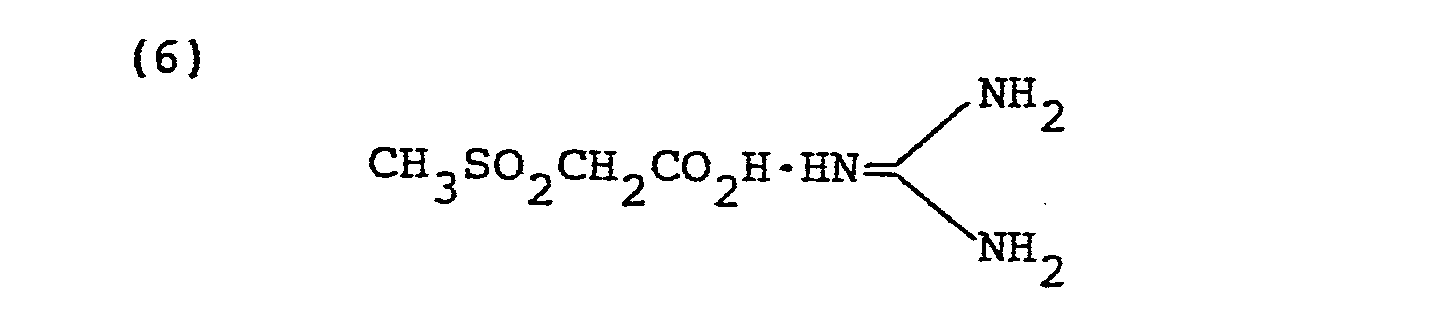


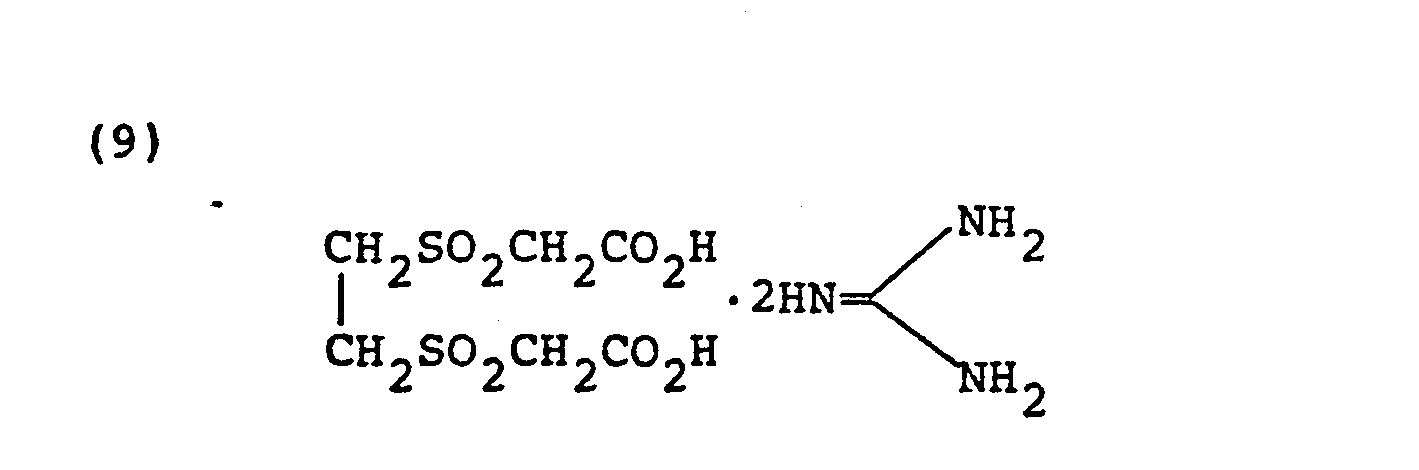


- The a-sulfonylacetate represented by the general formula (I) can generally be prepared by condensing a sulfinic acid with an a-haloacetic acid ester to form an a-sulfonylacetic acid ester, subjecting this ester to hydrolysis with an alkali at room temperature to obtain an a-sulfonylacetic acid and converting the acid to its salt in a conventional method.
- The synthesis of examples of the base precursors of the present invention are shown below. Unless otherwise indicated, all parts percents, ratios and the like are by weight.
- A mixture of 60 g of sodium benzenesulfinate dihydrate, 33.4g of ethyl bromoacetate and 300 ml of methanol was heated under reflux for 2 hours. After the methanol was distilled off under reduced pressure, water and ethyl acetate were added and the organic layer formed was separated. The organic layer was washed with water and dried followed by distilling off the ethyl acetate under reduced pressure to obtain 43.3 g of ethyl phenylsulfonyl acetate as a pale yellow liquid.
- The ester thus obtained was added to a 15% potassium hydroxide aqueous solution and the mixture was stirred at room temperature for 1 hour. While cooling with ice, the mixture was neutralized with diluted hydrochloric acid and extracted with ethyl acetate. The organic layer was separated, washed with water and dried. Distilling off the ethyl acetate under reduced pressure gave rise to 28 g of phenylsulfonylacetic acid as colorless crystals.
- A mixture of 20 g of phenylsulfonylacetic acid, 9 g of guanidine carbonate and 100 ml of methanol was stirred at room temperature for 1 hour. Distilling off methanol (at a temperature of 50°C or less) afforded 25.5 g of Base Precursor (1). Melting point (decomp): 137-138°C.
- To a mixture of 504 g of sodium sulfite and 1.8 Q of water was added portionwise 16 g of p-chlorobenzenesulfonyl chloride at 50°C. After being stirred at 55-60°C for 3 hours, the mixturewas cooled with ice andwhite crystals which separated out were collected and washed with cold water to obtain 152 g of sodium p-chlorobenzensulfinate. In a manner similar to Synthesis Example 1, sodium p-chlorobenzenesulfinate and ethyl chloroacetate were reacted to obtain ethyl p-chlorophenylsulfonyl acetate. The ester thus obtained (110 g) was added portionwise to a 20% sodium hydroxide aqueous solution while cooling with ice. During this procedure, white crystals separated out quickly. After stirring at room temperature for 1 hour, the mixturewas cooled with ice arid white crystals were collected by filtration and washed with isopropanol. The crystals thus obtained were dissolved in 300 ml of water and the solution was neutralized with diluted hydrochloric acid. The white crystals which separated out were collected by filtration, washed with water to obtain 90 g of p-chlorophenylsulfonylacetic acid.
- A mixture of 82 g of p-chlorophenylsulfonylacetic acid, 31.5 g of guanidine carbonate, 200 ml of methanol and 100 ml of water was stirred at room temperature for 3 hours. The white crystals which separated out were collected by filtration and washed with methanol to obtain 88 g of Base Precursor (ll). Melting point (decomp.): 147-148°C.
- The base precursor used in this invention can be employed in a wide range of amounts. For example, it is advantageous for the base precursor be used in a coverage of less than 50% by weight, preferably 0.01 to 40% by weight based on the dry weight of the coating.
- The base precursors in this invention may be used alone or as a mixture of two or more of the base precursors or they may be used in combination with other known base precursor or precursors.
- The base precursors in this invention can be incorporated in the binder as a solution in a water miscible organic solvent, for example, methanol, ethanol, acetone, dimethyl formamide, etc.) or in a mixture of such an organic solvent and water. The base precursor in this invention can be prepared by admixing an acid (R(SO2CH2CO2H)) and an organic base (B) in the presence of a suitable solvent and a suitable vehicle (e.g., a coating solution) and can be used as is.
- The heat developable color photographic material of this invention simultaneously provides a silver image and a mobile dye or mobile dyes at the area corresponding to the silver image supply by heat development of the color photographic material after image exposure.
- The term "heat development" as used herein means heating a heat developable color photographic material, after image-wise exposure or simultaneously with image-wise exposure, in a substantially water-free state so as to provide an exposed silver halide and a dye-releasing material, thereby releasing a dye.
- When the heat developable color photographic material of this invention is heated after image- wise exposed-or simultaneously with image-wise exposure in a substantially water-free state, an oxidation reduction reaction occurs between the photosensitive silver halide and the reducing dye-releasing material with the exposed photosensitive silver halide to form a silver image at the exposed area. In this step the dye-releasing material is oxidized by the photosensitive silver halide to form the oxidation product thereof, whereby a hydrophilic mobile dye is released and a silver image and the mobile dye are obtained at the exposed area. In this case, when a base exists in the system, the above-described reaction is accelerated. By transferring the mobile dye or dyes onto a dye-fixing layer, a dye image is obtained. However, if a base is directly incorporated in a color photographic material, the stability of the photographic material with the passage of time is reduced. On the other hand, in the case of using the base precursor of this invention, a base is released when developing the photographic material containing the base precursor by heating at high temperature. Accordingly, the stability of the photographic material with the passage of time can be improved.
- The foregoing explanation relates to using a negative-type silver halide emulsion. An explanation using an autopositive silver halide emulsion is the same except that the silver image and the mobile dye are obtained in the unexposed area.
- A feature of this invention is that the oxidation reduction reaction of the photosensitive silver halide and the dye-releasing material and the dye releasing reaction subsequently occur at high temperature in a substantially water free state. The term "high temperature" as used herein is a temperature higher than 80°C and the term "substantially water free state" is a state which is in an equilibrium relation with the moisture in the air but water is not supplied to the system. Such a state is described in The Theory of the Photographic Process, 4th Ed., page 374, Edited by T. H. James, published by Macmillan Co.
- The system of this invention exhibits sufficient reactivity even in the substantially water free state and this can be confirmed from the fact that when a sample is dried in vacuum of 10-3 mmHg for one day, the reactivity thereof is not reduced.
- Hitherto, it has been believed that a dye-releasing reaction occurs due to an attack of a so-called nucleophilic reagent and the dye-reasing reaction is usually performed in a liquid with a pH of not lower than 10. Therefore, it is unexpected that the heat developable color photographic material of this invention shows a high reactivity under high temperature in a substantially water free dry state. Also, the dye-releasing material of this invention can result in an oxidation reduction reaction with silver halide without requiring the assistance of a so-called auxiliary developing agent. This is also unexpected from conventional knowledge about wet development at temperatures near normal temperature.
- When an organic silver salt oxidizing agent is present in the reaction system, the foregoing reaction proceeds well and results in a high image density. Accordingly, particularly preferred embodiment in this invention involves an organic silver salt oxidizing agent in' the reaction system.
- The dye releasing redox compound which releases a hydrophilic diffusible dye which can be used in the present invention is a compound described in European Patent Application (OPI) No. 76,492, which disclosure is herein incorporated by reference, as a dye releasing compound and is represented by the following general formula:

- The above-described compound is oxidized corresponding to or in a reverse manner corresponding to the latent image distributed imagewise in the silver halide and a mobile dye is released in an imagewise manner.
- Detailed definitions of R a and D, examples of the specific compounds and synthesis examples thereof are described in European Patent Application (OPI) No. 76,492.
- Suitable dye releasing redox compounds which also can be used in the present invention include the compounds as described, for example, in U.S. Patent 4,055,428, Japanese Patent Application (OPI) Nos. 12642/81, 16130/81, 16131/81, 650/82 and 4043/82, U.S. Patents 3,928,312 and 4,076,529, U.S. Published Patent Application B 351,673, U.S. Patents 4,135,929 and 4,198,235, Japanese Patent Application (OPI) No. 46730/78, U.S. Patents 4,273,855, 4,149,892, 4,142,891 and-4,258,120, etc., the disclosures of which are incorporated herein by reference. These compounds are also effective in addition to the above-described compounds.
- Further, the dye releasing redox compounds which release a yellow dye as described, for example, in U.S. Patents 4,013,633, 4,156,609, 4,148,641, 4,165,987, 4,148,643, 4,183,755, 4,246,414, 4,268,625 and 4,245,023, Japanese Patent Application (OPI) Nos. 71072/81, 25737/81, 138744/80, 134849/80, 106727/77, 114930/76, etc., the disclosures of which are herein incorporated by reference, can be effectively used in the present invention.
- The dye releasing redox compounds which release a magenta dye as described, for example, in U.S. Patents 3,954,476, 3,932,380, 3,931,144, 3,932,381, 4,268,624 and 4,255,509, Japanese Patent Application (OPI) Nos. 73057/81, 71060/81, 134850/80, 40402/80, 36804/80, 23628/78, 106727/77, 33142/80 and 53329/80, etc., the disclosure of which are herein incorporated by reference, can be effectively used in the present invention.
- The dye releasing redox compounds which release a cyan dye as described, for example, in U.S. Patents 3,929,760, 4,013,635, 3,942,987, 4,273,708, 4,148,642, 4,183,754, 4,147,544, 4,165,238, 4,246,414 and 4,268,625, Japanese Patent Application (OPI) Nos. 71061/81, 47823/78, 8827/77 and 143323/78, etc., the disclosures of which are herein incorporated by reference, can be effectively used in the present invention.
- Two or more of dye releasing redox compounds can be used together, if desired. In these cases, two or more dye releasing redox compounds may be used together in order to achieve the same hue or in order to achieve a black color.
- The dye releasing redox compounds are suitably used in a range from about 10 mg/m2 to about 15 g/m2 and preferably in a range from 20 mg/m2 to 10 g/m2 in'a total.
- The dye releasing redox compound of the formula (I) used in the present invention can be introduced into a layer of the light-sensitive material using known methods such as a method as described in U.S. Patent 2,322,027. In this case, an organic solvent having a high boiling point or an organic solvent having a low boiling point as described below can be used. For example, the dye releasing redox compound can be dispersed in a hydrophilic colloid after, it is dissolved in an organic solvent having a high boiling point, for example, a phthalic acid alkyl ester (for example, dibutyl phthalate, dioctyl phthalate, etc.), a phosphoric acid ester (for example, diphenyl phosphate, triphenyl phosphate, tricresyl phosphate, dioctylbutyl phosphate, etc.), a citric acid ester (for example, tributyl acetyl- citrate, etc.), a benzoic acid ester (for example, octyl benzoate, etc.), an alkylamide (for example, diethyl laurylamide, etc.), an aliphatic acid ester (for example, dibutoxyethyl succinate, dioctyl azelate, etc.), a trimesic acid ester (for example, tributyl trimesate, etc.), etc., or an organic solvent having a low boiling point of about 30° to 160°C, for example, a lower alkyl acetate such as ethyl acetate, butyl acetate, etc., ethyl priopionate, secondary butyl alcohol, methyl isobutyl ketone, 8-ethoxyethyl acetate, methyl cellosolve acetate, cyclohexanone, etc. The above-described organic solvents having a high boiling point and organic solvents having a low boiling point may be used as a mixture thereof, if desired.
- Further, it is possible to use a dispersion method employing a polymer as described in Japanese Patent Publication No. 39853/76 and Japanese Patent Application (OPI) No. 59943/76. Moreover, various surface active agents can be used when the dye releasing redox compound is dispersed in a hydrophilic colloid. For this purpose, the surface active agents illustrated hereinafter in the specification can be used.
- In the present invention, if desired, a reducing agent may also be used. The reducing agent in this case is so-called auxiliary developing agent, which is oxidized by the silver halide and/or the organic silver salt oxidizing agent to form an oxidized product having the ability to oxidize the reducing group Y in the dye releasing redox comound of the general formula (I).
- Examples of useful auxiliary developing agents include the compounds specifically described in European Patent Application (OPI) No. 76,492.
- Suitable reducing agents which can be used in the present invention include the following compounds: hydroquinone compounds (for example, hydroquinone, 2,5-dichlorohydroquinone, 2-chlorohydroquinone, etc.), aminophenol compounds (for example, 4-aminophenol, N-methylaminophenol, 3-methyl-4-aminophenol, 3,5-dibromoaminophenol, etc.), catechol compounds (for example, catechol, 4-cyclo- hexylcatechol, 3-methoxycatechol, 4-(N-octadecyl- amino)catechol, etc.), phenylenediamine compounds (for example, N,N-diethyl-p-phenylenediamine, 3-methyl-N,N-diethyl-p-phenylenediamine, 3-methoxy-N-ethyl-N-ethoxy-p-phenylenediamine, N,N,N',N'- tetramethyl-p-phenylenediamine, etc.).
- Various combinations of developing agents as described in U.S. Patent 3,039,869 can also be used.
- In the present invention, the amount of the reducing agent which can be employed is from 0.01 mol to 20 mols per mol of silver and more preferably from 0.1 mol to 10 mols per mol of silver.
- The silver halide used in the present invention can be silver chloride, silver chlorobromide, silver chloroiodide, silver bromide, silver iodobromide, silver chloroiodobromide and silver iodide, etc.
- In the embodiment of the present invention in which the organic silver salt oxidizing agent is not used together with but the silver halide is used alone, particularly preferred silver halide is silver halide partially containing a silver iodide crystal in the particles. That is, a silver halide in which the X-ray diffraction pattern shows that of pure silver iodide is particularly preferred.
- In photographic materials a silver halide containing two or more kinds of halogen atoms can be used. Such a silver halide yields a completely mixed crystal in a conventional silver halide emulsion. For example, the particles of silver iodobromide show an X-ray diffraction pattern at a position corresponding to the mixed ratio of silver iodide crystal and silver bromide crystal but not at a position corresponding to pure silver iodide crystal and pure silver bromide crystal separately.
- Particularly preferred examples of silver halides which can be used in the present invention include silver chloroiodide, silver iodobromide, and silver chloroiodobromide each containing silver iodide crystals in the particles thereof and showing X-ray diffraction pattern of silver iodide crystals.
- The process for preparing those silver halides using silver iodobromide as exemplary. That is, silver iodobromide is prepared by first adding a silver nitrate solution to a potassium bromide solution to form silver bromide particles and then adding potassium iodide to the mixture.
- Two or more kinds of silver halides in which the particle size and/or a halogen composition are different from each other may be used in admixture, if desired.
- The average particle size of the silver halide used in the present invention is preferably from about 0.001 µm to about 10 µm and more preferably from 0.001 µm to 5 µm.
- The silver halide used in the present invention may be used as is. However, the silver halide may also be chemically sensitized with a chemical sensitizing agent such as compounds of sulfur, selenium or tellurium, etc., or compounds of gold, platinum, palladium, rhodium or iridium, etc., a reducing agent such as tin halide, etc., or a combination thereof. The details thereof are described in T.H. James, The Theory of the Photographic Process, the Fourth Edition, Chapter 5, pages 149 to 169.
- In a particularly preferred embodiment of the present invention, an organic silver salt oxidizing agent is also used. The organic silver salt oxidizing agent is a silver salt which forms a silver image upon reaction with the above-described image forming substance or a reducing agent which are copresent, if desired, with the image forming substance, when it is heated to a temperature of above about 80°C and, preferably, above 100°C in the presence of exposed silver halide. Due to the copresence of the organic silver salt oxidizing agent, a light-sensitive material which provides higher color density can be obtained.
- The silver halide used in this case need not always have the characteristic that the silver halide contains pure silver iodide crystals in the case of using the silver halide alone. Any silver halide which is known in the art can be used.
- Examples of such organic silver salt oxidizing agents include those described in European Patent Application (OPI) No. 76,492.
- A silver salt of an organic compound having a carboxy group can be used. Typical examples thereof include a silver salt of an aliphatic carboxylic acid and a silver salt of an aromatic carboxylic acid.
- In addition, a silver salt of a compound containing a mercapto group or a thione group and a derivative thereof can be used.
- Further, a silver salt of a compound containing an imino group can be employed. Suitable examples of these compounds include a silver salt of benzotriazole and the derivatives thereof as described in Japanese Patent Publication Nos. 30270/69 and 18416/70, for example, a silver salt of benzotriazole, a silver salt of alkyl-substituted benzotriazole such as a silver salt of methylbenzotriazole, etc., a silver salt of a halogen-substituted benzotriazole such as a silver salt of 5-chlorobenzotriazole, etc., a silver salt of carboimidobenzotriazole such as a silver salt of butylcarboimidobenzotriazole, etc., a silver salt of 1,2,4-triazole or 1-H-tetrazole as described in U.S. Patent 4,220,709, a silver salt of carbazole, a silver salt of saccharin, a silver salt of imidazole and an imidazole derivative, and the like.
- Moreover, a silver salt as described in Research Disclosure, Vol. 170, No. 17029 (June, 1978) and an organic metal salt such as copper stearate, etc., are organic metal salt oxidizing agents capable of being used in the present invention.
- Methods of preparing these silver halide and organic silver salt oxidizing agents and techniques of blending them are described in Research Disclosure, No. 17029, Japanese Patent Application (OPI) Nos. 32928/75 and 42529/76, U.S. Patent 3,700,458, and Japanese Patent Application (OPI) Nos. 13224/74 and 17216/75.
- A suitable coating amount of the light-sentitive silver halide and the organic silver salt oxidizing agent employed in the present invention is in a total of from 50 mg/m2 to 10 g/m calculated as silver.
- The light-sensitive silver halide and the organic silver salt oxidizing agent used in the present invention are prepared in the binder as described below. Further, the dye releasing redox compound used in the present invention is dispersed in the binder described below.
- The binder which can be used in the present invention can be employed alone or as a combination thereof. A hydrophilic binder can be used as the binder according to the present invention. Typical hydrophilic binders are transparent or translucent hydrophilic colloids, examples of which include natural substances, for example, a protein such as gelatin, a gelatin derivative, a cellulose derivative, etc., a polysaccharide such as starch, gum arabic, etc., and a synthetic.polymer, for example, a water-soluble polyvinyl compound such as polyvinyl alcohol, polyvinyl pyrrolidone, acrylamide polymer, etc. Another example of a synthetic polymer compound is a dispersed vinyl compound in a latex form which is used for the purpose of increasing the dimensional stability of the photographic material.
- The silver halide used in the present invention can be spectrally sensitized with methine dyes or other dyes. Suitable dyes which can be employed include cyanine dyes, merocyanine dyes, complex cyanine dyes, complex merocyanine dyes, holopolar cyanine dyes, hemicyanine dyes, styryl dyes, and hemioxonol dyes. Of these dyes, cyanine dyes, merocyanine dyes and complex merocyanine dyes are particularly useful. Any conventionally utilized nucleus for cyanine dyes, such as basic heterocyclic nuclei, can be employed in these dyes. That is, a pyrroline nucleus, an oxazoline nucleus, a thiazoline nucleus, a pyrrole nucleus, an oxazole nucleus, a thiazole nucleus, a selenazole nucleus, an imidazole nucleus, a tetrazole nucleus, a pyridine nucleus, etc., and further, nuclei formed by condensing alicyclic hydrocarbon rings with these nuclei and nuclei formed by condensing aromatic hydrocarbon rings with these nuclei, that is, an indolenine nucleus, a benzindolenine nucleus, an indole nucleus, a benzoxazole nucleus, a naphthoxazole nucleus, a benzothiazole nucleus, a naphthothiazole nucleus, a benzoselenazole nucleus, a benzimidazole nucleus, a quinoline nucleus, etc., are appropriate. The carbon atoms of these nuclei may also be substitured, if desired.
- Suitable merocyanine dyes and complex merocyanine dyes are those having nuclei with a ketomethylene structure, 5- or 6-membered heterocyclic nuclei such as a pyrazolin-5- one nucleus, a thiohydantoin nucleus, a 2-thiooxazolidin-2, 4-dione nucleus, a thiazolidin-2,4-dione nucleus, a rhodanine nucleus, a thiobarbituric acid nucleus, etc.
- These sensitizing dyes can be employed alone, and can also be employed as a combination thereof. A combination of sensitizing dyes is often used, particularly for-the purpose of supersentitization. Representative examples thereof are described in U.S. Patents 2,688,545, 2,977,229, 3,397,060, 3,522,052, 3,527,641, 3,617,293, 3,628,964, 3,666,480, 3,672,898, 3,679,428, 3,703,377, 3,769,301, 3,814,609, 3,837,862 and 4,026,707, British Patents 1,344,281 and 1,507,803, Japanese Patent Publication Nos. 4936/68 and 12375/78, Japanese Patent Application (OPI) Nox. 110618/77 and 109925/77, etc.
- The sensitizing dyes may be present in the emulsion together with dyes which themselves do not provide spectrally sensitizing effects but exhibit a supersentitizing effect or materials which do not substantially absorb visible light but exhibit a supersentitizing effect. For example, amino- stilbene compounds substituted with a nitrogen-containing heterocyclic group (e.g., those described in U.S. Patents 2,933,390 and 3,635,721), aromatic organic acid-formaldehyde condensates (e.g., those described in U.S. Patent 3,743,510), cadmium salts, azaindene compounds, etc., can be employed. The combinations described in U.S. Patents 3,615,613, 3,615,641, 3,617,295 and 3,635,712 are particularly useful.
- Suitable supports used in the light-sensitive material and the dye fixing material employed, if desired, according to the present invention are supports which can endure the processing temperature. As ordinary support, such as glass, paper, metal or analogues thereof may be used, but also an acetyl cellulose film, a cellulose ester film, a polyvinyl acetal film, a polystyrene film, a polycarbonate film, a polyethylene terephthalate film, and a film related thereto or a synthetic resin material may be used. Further, a paper support laminated with a polymer such as polyethylene, etc., can be used. The polyesters described in U.S. Patents 3,634,089 and 3,725;070 are preferably used.
- In the present invention, various kinds of dye releasing activators can be used. A dye releasing activator is a substance which accelerates the ocidation-reduction reaction between the light-sensitive silver halide and/or the organic silver salt oxidizing agent and dye releasing redox compound or accelerates release of a dye due to its nucleophilic action on the ozidized dye releasing redox compound in the dye releasing reaction which subsequently occurrs, and a base and a base precursor can be used. It is particularly advantageous to use dye releasing activators in order to accelerate the reactions in the present invention.
- Examples of preferred bases are amines which include trialkylamines, hydroxylamines, aliphatic polyamines, N-alkyl substituted aromatic amines, N-hydroxyalkyl substituted aromatic amines and bisCp-(dialkylamino)phenyl3methanes. Further, betaine tetramethylammonium iodide and diaminobutane dihydrochloride as described in U.S. Patent 2,410,644, and urea and organic compounds including amino acids such as 6-aminocaproic acid as described in U.S. Patent 3,506,444 can be-used. A base precursor is a substance which releases a basic component upon heating. Examples of typical base precursors are described in British Patent 998,949. A preferred base precursor is a salt of a carboxylic acid and an organic base, and examples of suitable carboxylic acids include trichloroacetic acid and trifluoroacetic acid and examples of suitable bases include guanidine, piperidine, morpholine, p-toluidine and 2-picoline, etc. Guanidine trichloroacetate as described in U.S. Patent 3,220,846 is particularly preferred. Further, aldonic amides as described in Japanese Patent Application (OPI) No. 22625/75 are preferably used because they decompose at a high temperature to form bases.
- It is advantageous to use a compound represented by the general formula described below in the heat-developable color photographic material in order to accelerate development and accelerate release of a dye.

- The above-described compound can be used in abroad range of amounts. A useful range is up to about 20% by weight based on the weight of a dry layer coated of the light-sensitive material. A range of 0.1% by weight to 15% by weight is more preferred.
- It is advantageous to use a water releasing compound in the present invention in order to accelerate the dye releasing reaction.
- The water releasing compound means a compound which releases water upon decomposition during heat development. These compounds are particularly known in the field of printing of fabrics, and NH4Fe(SO4)2·12H2O, etc., as described in Japanese-Patent Application (OPI) No. 88386/75 are useful.
- Further, in the present invention, it is possible to use a compound which activates development simultaneously while stabilizing the image. Particularly, isothiuroniums including 2-hydroxyethylisothiuronium trichloroacetate as described in U.S. Patent 3,301,678, bisisothiuroniums including l,8-(3,6-dioxaoctane)-bis(isothiuronium trifluoroacetate), etc., as described in U.S. Patent 3,669,670, thiol compounds as described in German Patent Application (OLS) No. 2,162,714, thiazolium compounds such as 2-amino-2-thiazolium trichloroacetate, 2-amino-5-bromoetyl-2-thiazolium trichloroacetate, etc. as describee in U.S. Patent 4,012,260, compounds having a-sulfonylacetate as an acid moiety such as bis(2-amino-2-thiazolium)-methylenebis(sulfonylacetate), 2-amino-2-thiazolium phenylsulfonylacetate, etc., as described in U.S. Patent 4,060,420, and compounds having 2-carboxycarboxamide as an acid part as described in U.S. Patent 4,088,496 are preferred for use.
- In the present invention, it is possible to use a thermal solvent. The term "thermal solvent" means a non- hydrolyzable organic material which is solid at ambient temperature but melts together with the other components at a temperature of the heat treatment or below. Preferred examples of thermal solvents include compounds acting as a solvent for the developing agent and compounds having a high dielectric constant which accelerate physical development of silver salts. Examples of preferred thermal solvents include those described in European Patent Application (OPI) No. 76,492.
- In the present invention, though it is not very necessary to further incorporate substances or dyes for preventing irradiation or halation in the light-sensitive material, because the light-sensitive material is colored by the dye releasing redox compound, it is possible to use filter dyes or light absorbing materials, etc., as described in Japanese Patent Publication No. 3692/73 and U.S. Patents 3,253,921, 2,527,583 and 2,956,879, etc., in order to further improve the.sharpness. Preferably these dyes have a thermal bleaching property. For example, the dyes as described in U.S. Patents 3,769,019, 3,745,009 and 3,615,432 are preferred.
- The light-sensitive material of the present invention may contain, if desired, various additives known for heat-developable light-sensitive materials and may include a layer other than the light-sensitive layer, for example, an antistatic layer, an electrically conductive layer, a protective layer, an intermediate layer, an antihalation layer, a strippable layer, etc.
- The photographic emulsion layer and other hydrophilic colloid layers in the light-sensitive material of the present invention may contain various surface active agents for various purposes, for example, as coating aids or for prevention of electrical charging, improvement of lubricating property, emulsification, prevention of adhesion, improvement of photographic properties (for example, acceleration of development, providing a hard tone or sensitization), etc.
- For example, nonionic surface active agents such as saponin (steroid), alkylene oxide derivatives (for example, polyethylene glycol, polyethylene glycol/polypropylene glycol condensates, polyethylene glycol alkyl ethers or polyethylene glycol alkylaryl ethers, polyethylene glycol esters, polyethylene glycol sorbitan esters, polyalkylene glycol alkylamine or amides, polyethylene oxide adducts of silicone, etc.), glycidol derivatives (for example, alkenylsuccinic acid polyglycerides, alkylphenol polyglycerides, etc.), polyhydric alcohol aliphatic acid esters or saccharide alkyl esters, etc., anionic surface active agents containing acid groups such as a carboxy group, a sulfo group, a phospho group, a sulfate group, a phosphate group, etc., such as alkylcarboxylic acid salts, alkylsulfonic acid salts, alkylbenzenesulfonic acid salts, alkylnaphthalenesulfonic acid salts, alkyl sulfuric acid esters, alkylphosphoric acid esters, N-acyl-N-alkyltaurines, sulfosuccinic acid esters, sulfoalkyl polyoxyethylene alkylphenyl ethers, polyoxyethylene alkylphosphoric acid esters, etc.; ampholytic surface active agents such as amino acids, aminoalkylsulfonic acids, aminoalkylsulfuric acid esters or phosphoric acid esters, alkylbetaines, amine oxides, etc.; and cationic surface active agents such as alkylamine salts, aliphatic or aromatic quaternary ammonium salts, heterocyclic quaternary ammonium slats such as pyridinium salts, imidazolium salts, etc., aliphatic or heterocyclic phosphonium salts, aliphatic or heterocyclic solfonium salts, etc. can be used.
- Of the above-described surface active agents, polyethylene glycol type nonionic sufface active agents having ethylene oxide recurring unit in their structure are preferably incorporated into the light-sensitive material. It is particularly preferred for the structure to contains 5 or more of ethylene oxide recurring units.
- The nonionic sufface active agents capable of satisfying the above-described conditions are well known as to their structures, properties and methods of synthesis. These nonionic sufface active agents are widely used even outside this field. Representative references describing these agents include: Surfactant Science Series, Vol. 1, Nonionic Surfactants (edited by Martin J. Schick, Marcel Dekker Inc., 1967), and Surface Active Ethylene Oxide Adducts (edited by Schoufeldt N. Pergamon'Press, 1969). Suitable nonionic surface active agents described in the above-mentioned references, are those capable of satisfying the above-described conditions and they are preferably employed in connection with the present invention.
- The nonionic surface active agents can be used alone or as a mixture of two or more thereof, if desired.
- Polyethylene glycol type nonionic surface active agents can be used in an amount of less than about 100% by weight, preferably less than 50% by weight, based on the weight of hydrophilic binder present.
- The light-sensitive material of the present invention may contain a cationic compound containing a pyridinium salt. Examples of cationic compounds containing a pyridinium group which can be used are described in PSA Journal, Section B 36 (1953), U.S. Patents 2,648,604 and 3,671,247, Japanese Patent Publication Nos. 30074/69 and 9503/69, etc.
- The photographic emulsion layer and other binder layers of the photographic light-sensitive material and the dye fixing material of the present invention may contain inorganic or organic hardeners. Chromium salts (chromium alum, chromium acetate, etc.), aldehydes (formaldehyde, glyoxal, glutaraldehyde, etc.), N-methylol compounds (dimethylolurea, methylol dimethylhydantoin, etc.), dioxane derivatives (2,3-dihydroxydioxane, etc.), active vinyl compounds (1,3,5-triacryloylhexahydro-s-triazine, 1,3-vinylsulfonyl-2-propanol, etc.), active halogen compounds (2,4-dichloro-6-hydroxy-s-triazine, etc.), mucohalogenic acids (mucochloric acid, mucophenoxychloric acid, etc.), etc., can be used alone or as a combination thereof.
- Examples of various additives include those described in Research Disclosure, Vol. 170, No. 17029 (June, 1978), for example, plasticizers, dyes for improving shapness, antihalation dyes, sensitizing dyes, matting agents, fluorescent whitening agents and fading preventing agent, etc.
- If desired, two or more layers may be coated at the same time by the method as described in U.S. Patent 2,761,791 and British Patent 837,095.
- Various means of exposure can be used in the present invention. Latent images are obtained by image- wise exposure to radiant light including visible rays. Generally, light sources used for conventional color prints can be used, examples of which include tungsten lamps, mercury lamps, halogen lamps such as iodine lamps, xenon lamps, laser light sources, CRT light sources, fluorescent tubes and light- emitting diodes, etc.
- In the present invention, simultaneously with or after the heat-developable color photographic material is exposed to light, the resulting latent image can be developed by heating the entire material to a suitably elevated temperature, for example, about 80°C to about 250°C for about 0.5 second to about 300 seconds. A higher temperature or lower temperature can be utilized with heating time, if it is within the above-described temperature range, being prolonged or shortened. Particularly, a temperature range of about 110°C to about 160°C is useful.
- A simple heat plate, iron, heat roller, heat generator utilizing carbon or titanium white, etc., or analogues thereof may be used as the heating means.
- In the present invention, a specific method for forming a color image by heat development comprises transfer of a hydrophilic mobile dye. For this purpose, the heat-developable color photographic material of the present invention comprises a support having thereon a light-sensitive layer (I) containing at least a silver halide, an organic silver salt oxidizing agent, a dye releasing redox compound which is also a reducing agent for the organic silver salt oxidizing agent and a binder, and a dye fixing layer (II) capable of receiving the hydrophilic diffusible dye formed in the light-sensitive layer (I).
- The above described light-sensitive layer (I) and the dye fixing layer (II) may be formed on the same support, or they may be formed on different supports, respectively. The dye fixing layer (II) can be stripped off the light-sensitive layer (I). For example, after the heat-developable color photographic material is exposed imagewise to light, it is developed by heating uniformly and thereafter the dye fixing layer (II) or the light-sensitive layer (I) is peeled apart. Also, when a light-sensitive material having the light-sensitive layer coated on a support and a fixing material having the dye fixing layer (II) coated on a support are separately formed, after the light-sensitive material is exposed imagewise to light and uniformly heated, the mobile dye can be transferred to the dye fixing layer (II) by superposing the fixing material on the light-sensitive material.
- Further, a method wherein only the light-sensitive layer (I) is exposed imagewise to light and the heated uniformly by superposing the dye fixing layer (II) on the light-sensitive layer (I) can be used.
- The dye fixing layer (II) can contqin, for example, a dye mordant in order to fix the dye. In the present invention, various mordants can be used, and polymer mordants are particularly preferred. In addition to the mordants, the dye fixing layer may contain bases, base precursors and thermal solvents as previously discribed. In particular, incorporation of the bases or base precursors into the dye fixing layer (II) is particularly preferred where the light-sensitive layer (I) and the dye fixing layer (II) are formed on different supports.
- Polymer mordants which can be used in the present invention are polymers containing secondary and tertiary amino groups, polymers containing nitrogen-containing heterocyclic moieties, polymers with quaternary cation groups thereof, having a molecular weight of from about 5,000 to about 200,000, and particularly from 10,000 to 50,000.
- For example, vinylpyridine polymers and vinyl- pyridinium cation polymers as disclosed in U.S. Patents 2,548,564, 2,484,430, 3,148,061 and 3,756,814, etc., polymer mordants capable of cross-linking with gelatin as disclosed in U.S. Patents 3,625,694, 3,859,096 and 4,128,538, British Patent 1,277,453, etc., aqueous sol type mordants as disclosed ip U.S. Patents 3,958,995, 2,721,852 and 2,798,063, Japanese Patent Application (OPI) Nos. 115228/79, 145529/79 and 126027/79, etc., water-insoluble mordants as disclosed in U.S. Patent 3,898,088, etc., reactive mordants capable of forming covalent bonds with dyes used as disclosed in U.S. Patent 4,168,976 (Japanese Patent Application (OPI) No. 13733/79, etc., and mordants disclosed in U.S. Patents 3,709,690, 3,788,855, 3,642,482, 3,488,706, 3,557,066, 3,271,147 and 3,271,148, Japanese Patent Application (OPI) Nos. 71332/75, 30328/78, 155528/77, 125/78 and 1024/78, etc., are illustrative.
- In addition, the mordants disclosed in U.S. Patents 2,675,316 and 2,882,156 can be used.
- The dye fixing layer (II) can have a white reflective layer. For example, a layer of titanium dioxide dispersed in gelatin can be provided on the mordant layer on a transparent support. The layer of titanium dioxide forms a white opaque layer, by which reflection color images of the transferred color images which is observed through the transparent support are obtained.
- A typical dye fixing material used in the present invention is obtained by mixing a polymer containing ammonium salt groups with gelatin and applying the mixture to a transparent support.
- The transfer of dye from the light-sensitive layer to the dye fixing layer can be carried out using a dye transfer assistant. Examples of useful dye transfer assistants include water and an alkaline aqueous solution containing sodium hydroxide, potassium hydroxide and an inorganic alkali metal salt. Further, a solvent having a low boiling point such as methanol, N,N-dimethylformamide, acetone, diisobutyl ketone, etc., and a mixture of such a solvent having a low boiling point with water or an alkaline aqueous solution can be used. The dye transfer assistant can be employed by wetting the image receiving layer with the transfer assistant or by incorporating it in the form of water of crystallization or microcapsules into the material.
- Unless otherwise indicated all parts, ratios and percentages are by weight.
- In 3,000 ml of water were dissolved 40 g of gelatin and 26 g of potassium bromide and the solution was stirred at 50°C. Then, a solution of 34 g of silver nitrate in 200 ml of water was added to the foregoing solution over a period of 10 minutes and thereafter a solution of 3.3 g of potassium iodide in 100 ml of water was added thereto over a period of 2 minutes.
- The pH of the silver iodobromide emulsion was controlled to precipitate excessive salts, which were removed. Thereafter, the pH of the emulsion was adjusted to 6.0 to provide 400 g of a silver iodobromide emulsion.
- Then, a selating dispersion of a dye-releasing material was prepared as follows.
- To 30 ml of ethyl acetate were added 5 g of Dye-Releasing Mater-al (1) shown below, 0.5 g of a surface active agent, succinic acid-2-ethyl-hexyl ester sodium sulfonate, and 5 g of tricresyl phosphate and the mixture was heated to about 60°C to form a solution. The solution was mixed with 100 g of a 10% gelatin aqueous solution with stirring and the resultant mixture was treated in a homogenizer at 10,000 r.p.m. for 10 minutes to form a dispersion. The dispersion was a dispersion of dye-releasing material.
-

- Then, a light-sensitive material was prepared as follows.

- A mixture of the foregoing components (a) to (e) was heated to form a solution and the solution was coated on a polyethylene terephthalate film of a thickness of 180 um at a wet thickness of 30 µm to provide a light-sensitive coated material.
- After drying, the coated sample was imagewise exposed to light from tungsten lamp at 2,000 lux for 10 seconds and thereafter, the sample was uniformly heated on a heat block heated to 150°C for 30 seconds to provide Sample A.
- -Then, by following the same proceudre as used in producing Sanple A except that 30 ml of 50:50 vol% water-nethanol was used in place of component (e) above containing Base Precursor (1) of this invention, Sample B was prepared.
- An image-receiving material having an image-receiving layer was prepared as follows.
- In 200 ml of water was dissolved 10 g of polymethyl acrylate-co-N,N,N-trimethyl-N-vinylbenzylammonium chloride) (the weitht ratio of methyl acrylate and vinyl- venzylammonium chloride was 1:1) and the solution was uniformly mixed with 100 g of a 10% aqeous solution of lime-treated gelatin. The mixture was uniformly coated on a paper support having laminated thereon a layer of polyethylene with titanium dioxide dispersed therein at a wet thickness of 90 µm and dried to provide an iamge-receiving material.
- After wetting the image-receiving material with water, each of the foregoing heated light-sensitive materials, Samples A and B, was superposed on the image-receiving material so that the coated layers were in a face-to-face relationship.
- After heating the assembly on a heat block heated to 80°C for 6 seconds, the image-receiving material was separated from the light-sensitive material, a negative magenta dye image was obtained on the image-receiving material.' When the density of the negative image was measured using a Macbeth reflection densitometer (RD-519), the following results were obtained.

- From the above results, it can be seen that the use of the base precursor of this invention results in high density.
- Furthermore, when Sample A was stored for 2, days at 60°C and then precessed in the same manner as described above, the minimum density and the maximum density were 0.28 and 1.99 respectively, which indicates that the sample of this invention also has excellent shelf life.
- By following the same procedure as described in Example 1 except that the base precursors shown in the table below were used in the amounts shown in the same table, the following results were obtained.

- From the above results, it can be seen that the base precursors of this invention have excellent effects.
- By following the same procedure as described in Example 1 except that each of the following dye-releasing materials was used in place of the Dye-Releasing Material (1) in Example 1, the following dispersions of dye-releasing materials were prepared.


-

-

- Also, by following the same procedure as described'in Example 1, light-sensitive samples were prepared and they were processed as described in Example 1. The results obtained are shown in the following table.

- From the above results, it can be seen that the base precursors of this invention provide image with high maximum density.
- The following example illustrates the use of an organic silver salt oxidizing agent.
- Preparation of benzotriazole silver salt emulsion:
- In 3,000 ml of water were dissolved 28 g of gelatin and 13.2 g of benzotriazole and the solution was stirred at 40°C. To the solution was added a solution of 17 g of silver nitrate in 100 ml of water over a period of two minutes.
- The pH of the benzotriazole silver salt emulsion was controlled to precipitate excessive salts, which were then removed. Thereafter, the pH of the emulsion was adjusted to 6.0 to provide 400 g of a benzotriazole silver salt emulsion.
- A light-sensitive material was prepared as follows using the benzotriazole silver salt emulsion.

- The foregoing components (a) to (f) were mixed and by following the same procedure as described in Example 1 using the mixture, a light-sensitive sample was prepared. The sample was processed as described in Example 1. The results obtained are shown below together with results of a comparison sample prepared using the same emthod as above but without using the base precursor.

- From the above results, it can be seen that the base precursor of this invention provides images with high density.
- While the invention has been described in detail and with reference to specific embodiments thereof, it will be apparent to one skilled in the art that various changes and modifications can be made therein without departing from the spirit and scope thereof.
Claims (10)


Applications Claiming Priority (2)
| Application Number | Priority Date | Filing Date | Title |
|---|---|---|---|
| JP43861/83 | 1983-03-16 | ||
| JP4386183A JPH0245181B2 (en) | 1983-03-16 | 1983-03-16 | NETSUGENZOKARAAKANKOZAIRYO |
Publications (3)
| Publication Number | Publication Date |
|---|---|
| EP0120403A2 true EP0120403A2 (en) | 1984-10-03 |
| EP0120403A3 EP0120403A3 (en) | 1984-11-28 |
| EP0120403B1 EP0120403B1 (en) | 1987-06-10 |
Family
ID=12675476
Family Applications (1)
| Application Number | Title | Priority Date | Filing Date |
|---|---|---|---|
| EP19840102744 Expired EP0120403B1 (en) | 1983-03-16 | 1984-03-13 | Heat developable color photographic materials |
Country Status (3)
| Country | Link |
|---|---|
| EP (1) | EP0120403B1 (en) |
| JP (1) | JPH0245181B2 (en) |
| DE (1) | DE3464164D1 (en) |
Cited By (22)
| Publication number | Priority date | Publication date | Assignee | Title |
|---|---|---|---|---|
| EP0160996A3 (en) * | 1984-05-09 | 1986-11-20 | Fuji Photo Film Co., Ltd. | Heat developable light-sensitive material |
| US5071740A (en) * | 1985-01-31 | 1991-12-10 | Konishiroku Photo Industry Co., Ltd. | Heat developable color photosensitive material |
| EP0605286A1 (en) * | 1992-12-21 | 1994-07-06 | Minnesota Mining And Manufacturing Company | Thermal-dye-bleach construction |
| EP0605285A1 (en) * | 1992-12-21 | 1994-07-06 | Minnesota Mining And Manufacturing Company | Tetra-alkylammonium phenylsulfonylacetate thermal-dye-bleach agents |
| EP1109064A1 (en) * | 1999-12-17 | 2001-06-20 | Konica Corporation | Photographic processing element and image forming method by the use thereof |
| WO2005043238A1 (en) * | 2003-08-04 | 2005-05-12 | Eastman Kodak Company | Thermal base precursors |
| WO2010047982A1 (en) | 2008-10-22 | 2010-04-29 | Merck Sharp & Dohme Corp. | Novel cyclic benzimidazole derivatives useful anti-diabetic agents |
| WO2010051206A1 (en) | 2008-10-31 | 2010-05-06 | Merck Sharp & Dohme Corp. | Novel cyclic benzimidazole derivatives useful anti-diabetic agents |
| WO2011106273A1 (en) | 2010-02-25 | 2011-09-01 | Merck Sharp & Dohme Corp. | Novel cyclic benzimidazole derivatives useful anti-diabetic agents |
| WO2012116145A1 (en) | 2011-02-25 | 2012-08-30 | Merck Sharp & Dohme Corp. | Novel cyclic azabenzimidazole derivatives useful as anti-diabetic agents |
| US8394969B2 (en) | 2008-09-26 | 2013-03-12 | Merck Sharp & Dohme Corp. | Cyclic benzimidazole derivatives useful as anti-diabetic agents |
| WO2014022528A1 (en) | 2012-08-02 | 2014-02-06 | Merck Sharp & Dohme Corp. | Antidiabetic tricyclic compounds |
| WO2014031465A1 (en) | 2012-08-22 | 2014-02-27 | Merck Sharp & Dohme Corp. | Novel azabenzimidazole tetrahydropyran derivatives |
| WO2014139388A1 (en) | 2013-03-14 | 2014-09-18 | Merck Sharp & Dohme Corp. | Novel indole derivatives useful as anti-diabetic agents |
| WO2015051725A1 (en) | 2013-10-08 | 2015-04-16 | Merck Sharp & Dohme Corp. | Antidiabetic tricyclic compounds |
| WO2015095256A1 (en) | 2013-12-19 | 2015-06-25 | Merck Sharp & Dohme Corp. | Antidiabetic substituted heteroaryl compounds |
| US9290517B2 (en) | 2012-08-22 | 2016-03-22 | Merck Sharp & Dohme Corp. | Azabenzimidazole hexahydrofuro[3,2-b]furan derivatives |
| US9527839B2 (en) | 2012-08-22 | 2016-12-27 | Merck Sharp & Dohme Corp. | Benzimidazole tetrahydropyran derivatives |
| US9540364B2 (en) | 2012-08-22 | 2017-01-10 | Merck Sharp & Dohme Corp. | Benzimidazole tetrahydrofuran derivatives |
| US9556193B2 (en) | 2012-08-22 | 2017-01-31 | Merck Shapr & Dohme Corp. | Benzimidazole hexahydrofuro[3,2-b]furan derivatives |
| US9868733B2 (en) | 2012-08-22 | 2018-01-16 | Merck Sharp & Dohme Corp. | Azabenzimidazole tetrahydrofuran derivatives |
| US10519115B2 (en) | 2013-11-15 | 2019-12-31 | Merck Sharp & Dohme Corp. | Antidiabetic tricyclic compounds |
Families Citing this family (8)
| Publication number | Priority date | Publication date | Assignee | Title |
|---|---|---|---|---|
| US4705737A (en) * | 1983-03-16 | 1987-11-10 | Fuji Photo Film Co., Ltd. | Heat developable photographic materials |
| JP2670769B2 (en) * | 1984-08-20 | 1997-10-29 | 富士写真フイルム株式会社 | Photothermographic material and thermosensitive recording material |
| JPH0816772B2 (en) * | 1984-06-13 | 1996-02-21 | 富士写真フイルム株式会社 | Photothermographic material |
| JPH0593586U (en) * | 1992-05-25 | 1993-12-21 | ソニツク・フエロー株式会社 | Cleaning equipment |
| JP3737536B2 (en) | 1994-10-19 | 2006-01-18 | 富士写真フイルム株式会社 | Bisguanidine salt |
| US6280913B1 (en) | 2000-06-13 | 2001-08-28 | Eastman Kodak Company | Photographic element comprising an ion exchanged photographically useful compound |
| WO2007111092A1 (en) | 2006-03-24 | 2007-10-04 | Konica Minolta Medical & Graphic, Inc. | Transparent barrier sheet and method for producing transparent barrier sheet |
| JP2012507530A (en) | 2008-10-29 | 2012-03-29 | メルク・シャープ・エンド・ドーム・コーポレイション | Novel cyclic benzimidazole derivatives that are useful anti-diabetic agents |
Family Cites Families (2)
| Publication number | Priority date | Publication date | Assignee | Title |
|---|---|---|---|---|
| US3420665A (en) * | 1965-08-30 | 1969-01-07 | Addressograph Multigraph | Heat-sensitive diazotype materials |
| JPS57198458A (en) * | 1981-06-01 | 1982-12-06 | Fuji Photo Film Co Ltd | Heat developing color photosensitive material |
-
1983
- 1983-03-16 JP JP4386183A patent/JPH0245181B2/en not_active Expired - Lifetime
-
1984
- 1984-03-13 EP EP19840102744 patent/EP0120403B1/en not_active Expired
- 1984-03-13 DE DE8484102744T patent/DE3464164D1/en not_active Expired
Cited By (30)
| Publication number | Priority date | Publication date | Assignee | Title |
|---|---|---|---|---|
| EP0160996A3 (en) * | 1984-05-09 | 1986-11-20 | Fuji Photo Film Co., Ltd. | Heat developable light-sensitive material |
| US5071740A (en) * | 1985-01-31 | 1991-12-10 | Konishiroku Photo Industry Co., Ltd. | Heat developable color photosensitive material |
| EP0605286A1 (en) * | 1992-12-21 | 1994-07-06 | Minnesota Mining And Manufacturing Company | Thermal-dye-bleach construction |
| EP0605285A1 (en) * | 1992-12-21 | 1994-07-06 | Minnesota Mining And Manufacturing Company | Tetra-alkylammonium phenylsulfonylacetate thermal-dye-bleach agents |
| EP1109064A1 (en) * | 1999-12-17 | 2001-06-20 | Konica Corporation | Photographic processing element and image forming method by the use thereof |
| US6455235B1 (en) | 1999-12-17 | 2002-09-24 | Konica Corporation | Photographic processing element and image forming method by the use thereof |
| WO2005043238A1 (en) * | 2003-08-04 | 2005-05-12 | Eastman Kodak Company | Thermal base precursors |
| US8394969B2 (en) | 2008-09-26 | 2013-03-12 | Merck Sharp & Dohme Corp. | Cyclic benzimidazole derivatives useful as anti-diabetic agents |
| WO2010047982A1 (en) | 2008-10-22 | 2010-04-29 | Merck Sharp & Dohme Corp. | Novel cyclic benzimidazole derivatives useful anti-diabetic agents |
| WO2010051206A1 (en) | 2008-10-31 | 2010-05-06 | Merck Sharp & Dohme Corp. | Novel cyclic benzimidazole derivatives useful anti-diabetic agents |
| WO2011106273A1 (en) | 2010-02-25 | 2011-09-01 | Merck Sharp & Dohme Corp. | Novel cyclic benzimidazole derivatives useful anti-diabetic agents |
| US8895596B2 (en) | 2010-02-25 | 2014-11-25 | Merck Sharp & Dohme Corp | Cyclic benzimidazole derivatives useful as anti-diabetic agents |
| WO2012116145A1 (en) | 2011-02-25 | 2012-08-30 | Merck Sharp & Dohme Corp. | Novel cyclic azabenzimidazole derivatives useful as anti-diabetic agents |
| EP3243385A1 (en) | 2011-02-25 | 2017-11-15 | Merck Sharp & Dohme Corp. | Novel cyclic azabenzimidazole derivatives useful as anti-diabetic agents |
| WO2014022528A1 (en) | 2012-08-02 | 2014-02-06 | Merck Sharp & Dohme Corp. | Antidiabetic tricyclic compounds |
| US9540364B2 (en) | 2012-08-22 | 2017-01-10 | Merck Sharp & Dohme Corp. | Benzimidazole tetrahydrofuran derivatives |
| US9556193B2 (en) | 2012-08-22 | 2017-01-31 | Merck Shapr & Dohme Corp. | Benzimidazole hexahydrofuro[3,2-b]furan derivatives |
| US9868733B2 (en) | 2012-08-22 | 2018-01-16 | Merck Sharp & Dohme Corp. | Azabenzimidazole tetrahydrofuran derivatives |
| US9290517B2 (en) | 2012-08-22 | 2016-03-22 | Merck Sharp & Dohme Corp. | Azabenzimidazole hexahydrofuro[3,2-b]furan derivatives |
| US9382243B2 (en) | 2012-08-22 | 2016-07-05 | Merck Sharp & Dohme Corp. | Azabenzimidazole tetrahydropyran derivatives |
| US9527839B2 (en) | 2012-08-22 | 2016-12-27 | Merck Sharp & Dohme Corp. | Benzimidazole tetrahydropyran derivatives |
| WO2014031465A1 (en) | 2012-08-22 | 2014-02-27 | Merck Sharp & Dohme Corp. | Novel azabenzimidazole tetrahydropyran derivatives |
| US9650375B2 (en) | 2013-03-14 | 2017-05-16 | Merck Sharp & Dohme Corp. | Indole derivatives useful as anti-diabetic agents |
| WO2014139388A1 (en) | 2013-03-14 | 2014-09-18 | Merck Sharp & Dohme Corp. | Novel indole derivatives useful as anti-diabetic agents |
| WO2015051725A1 (en) | 2013-10-08 | 2015-04-16 | Merck Sharp & Dohme Corp. | Antidiabetic tricyclic compounds |
| US9932311B2 (en) | 2013-10-08 | 2018-04-03 | Merck Sharp & Dohme Corp. | Antidiabetic tricyclic compounds |
| US10519115B2 (en) | 2013-11-15 | 2019-12-31 | Merck Sharp & Dohme Corp. | Antidiabetic tricyclic compounds |
| US9834563B2 (en) | 2013-12-19 | 2017-12-05 | Merck Sharp & Dohme Corp. | Antidiabetic substituted heteroaryl compounds |
| WO2015095256A1 (en) | 2013-12-19 | 2015-06-25 | Merck Sharp & Dohme Corp. | Antidiabetic substituted heteroaryl compounds |
| EP3974413A1 (en) | 2013-12-19 | 2022-03-30 | Merck Sharp & Dohme Corp. | Antidiabetic substituted heteroaryl compounds |
Also Published As
| Publication number | Publication date |
|---|---|
| DE3464164D1 (en) | 1987-07-16 |
| JPH0245181B2 (en) | 1990-10-08 |
| EP0120403B1 (en) | 1987-06-10 |
| EP0120403A3 (en) | 1984-11-28 |
| JPS59168441A (en) | 1984-09-22 |
Similar Documents
| Publication | Publication Date | Title |
|---|---|---|
| EP0120403B1 (en) | Heat developable color photographic materials | |
| EP0118078B1 (en) | Heat-developable color photographic materials | |
| US4704345A (en) | Heat development in presence of water | |
| EP0122512B1 (en) | Dry image-forming process and material therefor | |
| US4499172A (en) | Heat-developable color light-sensitive material with alkyl carboxylic acid base precursor containing triple bond | |
| US4511650A (en) | Heat developable color light-sensitive materials with base releasors | |
| US4587206A (en) | Method for forming images | |
| EP0125521B1 (en) | Heat-developable light-sensitive material | |
| US4599296A (en) | Process for forming image | |
| US4665005A (en) | Stripping process for forming color image using fluorine surfactant | |
| US4536467A (en) | Heat development of silver halide element with redox dye releaser and stabilizer | |
| EP0123166B1 (en) | Process for forming color images | |
| EP0119615B1 (en) | Dry image-forming process | |
| US4536466A (en) | Heat developable element with stabilizer | |
| US4628021A (en) | Heat developable color photographic materials with silver halide containing iodide | |
| US4555476A (en) | Heat development process with stabilizer | |
| US4610957A (en) | Heat-developable light-sensitive material | |
| US4629684A (en) | Heat developable color photographic light-sensitive material with development accelerator | |
| US4500627A (en) | Heat developement of silver halide element with redox dye releaser and fog reducer | |
| US4713319A (en) | Heat developable photosensitive material | |
| US5250386A (en) | Dry image-forming process | |
| US4639418A (en) | Heat developable photosensitive material | |
| EP0123904B1 (en) | Heat developable photographic material | |
| US4705737A (en) | Heat developable photographic materials | |
| US4560644A (en) | Heat-developable light-sensitive materials with shifted dyes |
Legal Events
| Date | Code | Title | Description |
|---|---|---|---|
| PUAI | Public reference made under article 153(3) epc to a published international application that has entered the european phase |
Free format text: ORIGINAL CODE: 0009012 |
|
| PUAL | Search report despatched |
Free format text: ORIGINAL CODE: 0009013 |
|
| AK | Designated contracting states |
Designated state(s): DE FR GB NL |
|
| AK | Designated contracting states |
Designated state(s): DE FR GB NL |
|
| 17P | Request for examination filed |
Effective date: 19841109 |
|
| GRAA | (expected) grant |
Free format text: ORIGINAL CODE: 0009210 |
|
| AK | Designated contracting states |
Kind code of ref document: B1 Designated state(s): DE FR GB NL |
|
| PG25 | Lapsed in a contracting state [announced via postgrant information from national office to epo] |
Ref country code: NL Effective date: 19870610 Ref country code: FR Free format text: THE PATENT HAS BEEN ANNULLED BY A DECISION OF A NATIONAL AUTHORITY Effective date: 19870610 |
|
| REF | Corresponds to: |
Ref document number: 3464164 Country of ref document: DE Date of ref document: 19870716 |
|
| EN | Fr: translation not filed | ||
| NLV1 | Nl: lapsed or annulled due to failure to fulfill the requirements of art. 29p and 29m of the patents act | ||
| PLBE | No opposition filed within time limit |
Free format text: ORIGINAL CODE: 0009261 |
|
| STAA | Information on the status of an ep patent application or granted ep patent |
Free format text: STATUS: NO OPPOSITION FILED WITHIN TIME LIMIT |
|
| 26N | No opposition filed | ||
| PGFP | Annual fee paid to national office [announced via postgrant information from national office to epo] |
Ref country code: GB Payment date: 19890228 Year of fee payment: 6 |
|
| PGFP | Annual fee paid to national office [announced via postgrant information from national office to epo] |
Ref country code: DE Payment date: 19890428 Year of fee payment: 6 |
|
| PG25 | Lapsed in a contracting state [announced via postgrant information from national office to epo] |
Ref country code: GB Effective date: 19900313 |
|
| GBPC | Gb: european patent ceased through non-payment of renewal fee | ||
| PG25 | Lapsed in a contracting state [announced via postgrant information from national office to epo] |
Ref country code: DE Effective date: 19901201 |