EP0120308B1 - Formaldehyde-free insolubilizers for binders for paper coating compositions - Google Patents
Formaldehyde-free insolubilizers for binders for paper coating compositions Download PDFInfo
- Publication number
- EP0120308B1 EP0120308B1 EP84101929A EP84101929A EP0120308B1 EP 0120308 B1 EP0120308 B1 EP 0120308B1 EP 84101929 A EP84101929 A EP 84101929A EP 84101929 A EP84101929 A EP 84101929A EP 0120308 B1 EP0120308 B1 EP 0120308B1
- Authority
- EP
- European Patent Office
- Prior art keywords
- glyoxal
- urea
- mole
- solution
- insolubilizer
- Prior art date
- Legal status (The legal status is an assumption and is not a legal conclusion. Google has not performed a legal analysis and makes no representation as to the accuracy of the status listed.)
- Expired
Links
- 239000008199 coating composition Substances 0.000 title claims abstract description 20
- 239000011230 binding agent Substances 0.000 title claims description 17
- LEQAOMBKQFMDFZ-UHFFFAOYSA-N glyoxal Chemical compound O=CC=O LEQAOMBKQFMDFZ-UHFFFAOYSA-N 0.000 claims abstract description 108
- 229940015043 glyoxal Drugs 0.000 claims abstract description 54
- XSQUKJJJFZCRTK-UHFFFAOYSA-N Urea Chemical compound NC(N)=O XSQUKJJJFZCRTK-UHFFFAOYSA-N 0.000 claims abstract description 32
- 239000004202 carbamide Substances 0.000 claims abstract description 32
- 239000000203 mixture Substances 0.000 claims abstract description 9
- 238000000034 method Methods 0.000 claims description 19
- 238000006243 chemical reaction Methods 0.000 claims description 9
- CSCPPACGZOOCGX-UHFFFAOYSA-N Acetone Chemical compound CC(C)=O CSCPPACGZOOCGX-UHFFFAOYSA-N 0.000 claims description 8
- 238000000576 coating method Methods 0.000 claims description 8
- 239000000463 material Substances 0.000 claims description 8
- 239000000049 pigment Substances 0.000 claims description 8
- XLYOFNOQVPJJNP-UHFFFAOYSA-N water Substances O XLYOFNOQVPJJNP-UHFFFAOYSA-N 0.000 claims description 8
- 239000011248 coating agent Substances 0.000 claims description 5
- 239000000314 lubricant Substances 0.000 claims description 3
- 239000002518 antifoaming agent Substances 0.000 claims description 2
- 239000002270 dispersing agent Substances 0.000 claims description 2
- 230000015572 biosynthetic process Effects 0.000 abstract description 2
- 239000000243 solution Substances 0.000 description 39
- 239000007787 solid Substances 0.000 description 16
- HEMHJVSKTPXQMS-UHFFFAOYSA-M Sodium hydroxide Chemical compound [OH-].[Na+] HEMHJVSKTPXQMS-UHFFFAOYSA-M 0.000 description 15
- 238000012360 testing method Methods 0.000 description 12
- 229920000642 polymer Polymers 0.000 description 8
- 239000000047 product Substances 0.000 description 8
- 239000007788 liquid Substances 0.000 description 7
- NNTWKXKLHMTGBU-UHFFFAOYSA-N 4,5-dihydroxyimidazolidin-2-one Chemical compound OC1NC(=O)NC1O NNTWKXKLHMTGBU-UHFFFAOYSA-N 0.000 description 6
- 229920001807 Urea-formaldehyde Polymers 0.000 description 6
- 238000009833 condensation Methods 0.000 description 6
- 230000005494 condensation Effects 0.000 description 6
- 239000011521 glass Substances 0.000 description 6
- ZCYVEMRRCGMTRW-UHFFFAOYSA-N 7553-56-2 Chemical compound [I] ZCYVEMRRCGMTRW-UHFFFAOYSA-N 0.000 description 5
- 229920000877 Melamine resin Polymers 0.000 description 5
- DWAQJAXMDSEUJJ-UHFFFAOYSA-M Sodium bisulfite Chemical compound [Na+].OS([O-])=O DWAQJAXMDSEUJJ-UHFFFAOYSA-M 0.000 description 5
- 229920002472 Starch Polymers 0.000 description 5
- 238000013019 agitation Methods 0.000 description 5
- 229910052740 iodine Inorganic materials 0.000 description 5
- 239000011630 iodine Substances 0.000 description 5
- 235000010267 sodium hydrogen sulphite Nutrition 0.000 description 5
- 235000019698 starch Nutrition 0.000 description 5
- 239000012467 final product Substances 0.000 description 4
- LSNNMFCWUKXFEE-UHFFFAOYSA-M Bisulfite Chemical compound OS([O-])=O LSNNMFCWUKXFEE-UHFFFAOYSA-M 0.000 description 3
- AEMRFAOFKBGASW-UHFFFAOYSA-N Glycolic acid Chemical compound OCC(O)=O AEMRFAOFKBGASW-UHFFFAOYSA-N 0.000 description 3
- 239000007853 buffer solution Substances 0.000 description 3
- ZMGMDXCADSRNCX-UHFFFAOYSA-N 5,6-dihydroxy-1,3-diazepan-2-one Chemical compound OC1CNC(=O)NCC1O ZMGMDXCADSRNCX-UHFFFAOYSA-N 0.000 description 2
- VTYYLEPIZMXCLO-UHFFFAOYSA-L Calcium carbonate Chemical compound [Ca+2].[O-]C([O-])=O VTYYLEPIZMXCLO-UHFFFAOYSA-L 0.000 description 2
- GWEVSGVZZGPLCZ-UHFFFAOYSA-N Titan oxide Chemical compound O=[Ti]=O GWEVSGVZZGPLCZ-UHFFFAOYSA-N 0.000 description 2
- 239000003513 alkali Substances 0.000 description 2
- 239000007864 aqueous solution Substances 0.000 description 2
- 238000001035 drying Methods 0.000 description 2
- 238000001914 filtration Methods 0.000 description 2
- 238000009472 formulation Methods 0.000 description 2
- 239000002244 precipitate Substances 0.000 description 2
- 239000003755 preservative agent Substances 0.000 description 2
- 239000008107 starch Substances 0.000 description 2
- 238000005705 Cannizzaro reaction Methods 0.000 description 1
- 102000011632 Caseins Human genes 0.000 description 1
- 108010076119 Caseins Proteins 0.000 description 1
- 102000004190 Enzymes Human genes 0.000 description 1
- 108090000790 Enzymes Proteins 0.000 description 1
- 239000007836 KH2PO4 Substances 0.000 description 1
- 239000002174 Styrene-butadiene Substances 0.000 description 1
- 239000002253 acid Substances 0.000 description 1
- 238000007259 addition reaction Methods 0.000 description 1
- 239000000654 additive Substances 0.000 description 1
- 239000000853 adhesive Substances 0.000 description 1
- 230000001070 adhesive effect Effects 0.000 description 1
- XAGFODPZIPBFFR-UHFFFAOYSA-N aluminium Chemical compound [Al] XAGFODPZIPBFFR-UHFFFAOYSA-N 0.000 description 1
- 229910052782 aluminium Inorganic materials 0.000 description 1
- 125000003368 amide group Chemical group 0.000 description 1
- 125000003277 amino group Chemical group 0.000 description 1
- 230000000844 anti-bacterial effect Effects 0.000 description 1
- IRERQBUNZFJFGC-UHFFFAOYSA-L azure blue Chemical compound [Na+].[Na+].[Na+].[Na+].[Na+].[Na+].[Na+].[Na+].[Al+3].[Al+3].[Al+3].[Al+3].[Al+3].[Al+3].[S-]S[S-].[O-][Si]([O-])([O-])[O-].[O-][Si]([O-])([O-])[O-].[O-][Si]([O-])([O-])[O-].[O-][Si]([O-])([O-])[O-].[O-][Si]([O-])([O-])[O-].[O-][Si]([O-])([O-])[O-] IRERQBUNZFJFGC-UHFFFAOYSA-L 0.000 description 1
- 239000003899 bactericide agent Substances 0.000 description 1
- MTAZNLWOLGHBHU-UHFFFAOYSA-N butadiene-styrene rubber Chemical compound C=CC=C.C=CC1=CC=CC=C1 MTAZNLWOLGHBHU-UHFFFAOYSA-N 0.000 description 1
- 229910000019 calcium carbonate Inorganic materials 0.000 description 1
- 235000010216 calcium carbonate Nutrition 0.000 description 1
- 229910052799 carbon Inorganic materials 0.000 description 1
- 239000006229 carbon black Substances 0.000 description 1
- 235000019241 carbon black Nutrition 0.000 description 1
- 125000002915 carbonyl group Chemical group [*:2]C([*:1])=O 0.000 description 1
- 239000005018 casein Substances 0.000 description 1
- BECPQYXYKAMYBN-UHFFFAOYSA-N casein, tech. Chemical compound NCCCCC(C(O)=O)N=C(O)C(CC(O)=O)N=C(O)C(CCC(O)=N)N=C(O)C(CC(C)C)N=C(O)C(CCC(O)=O)N=C(O)C(CC(O)=O)N=C(O)C(CCC(O)=O)N=C(O)C(C(C)O)N=C(O)C(CCC(O)=N)N=C(O)C(CCC(O)=N)N=C(O)C(CCC(O)=N)N=C(O)C(CCC(O)=O)N=C(O)C(CCC(O)=O)N=C(O)C(COP(O)(O)=O)N=C(O)C(CCC(O)=N)N=C(O)C(N)CC1=CC=CC=C1 BECPQYXYKAMYBN-UHFFFAOYSA-N 0.000 description 1
- 235000021240 caseins Nutrition 0.000 description 1
- 239000007795 chemical reaction product Substances 0.000 description 1
- 239000003153 chemical reaction reagent Substances 0.000 description 1
- 239000003795 chemical substances by application Substances 0.000 description 1
- 230000000052 comparative effect Effects 0.000 description 1
- 238000001816 cooling Methods 0.000 description 1
- 238000000354 decomposition reaction Methods 0.000 description 1
- 230000003247 decreasing effect Effects 0.000 description 1
- 229910000397 disodium phosphate Inorganic materials 0.000 description 1
- BXUKAXFDABMVND-UHFFFAOYSA-L disodium;1,2-dihydroxyethane-1,2-disulfonate Chemical group [Na+].[Na+].[O-]S(=O)(=O)C(O)C(O)S([O-])(=O)=O BXUKAXFDABMVND-UHFFFAOYSA-L 0.000 description 1
- 239000012153 distilled water Substances 0.000 description 1
- 230000000694 effects Effects 0.000 description 1
- 238000007710 freezing Methods 0.000 description 1
- 230000008014 freezing Effects 0.000 description 1
- 125000000524 functional group Chemical group 0.000 description 1
- 239000000417 fungicide Substances 0.000 description 1
- 125000002887 hydroxy group Chemical group [H]O* 0.000 description 1
- -1 include clays Substances 0.000 description 1
- 229920000126 latex Polymers 0.000 description 1
- 239000011344 liquid material Substances 0.000 description 1
- 238000004519 manufacturing process Methods 0.000 description 1
- 229910000402 monopotassium phosphate Inorganic materials 0.000 description 1
- 235000013808 oxidized starch Nutrition 0.000 description 1
- 238000011056 performance test Methods 0.000 description 1
- 239000008363 phosphate buffer Substances 0.000 description 1
- GNSKLFRGEWLPPA-UHFFFAOYSA-M potassium dihydrogen phosphate Chemical compound [K+].OP(O)([O-])=O GNSKLFRGEWLPPA-UHFFFAOYSA-M 0.000 description 1
- 235000018102 proteins Nutrition 0.000 description 1
- 108090000623 proteins and genes Chemical group 0.000 description 1
- 102000004169 proteins and genes Human genes 0.000 description 1
- 229920005989 resin Polymers 0.000 description 1
- 239000011347 resin Substances 0.000 description 1
- 239000011115 styrene butadiene Substances 0.000 description 1
- 229920003048 styrene butadiene rubber Polymers 0.000 description 1
- 239000000758 substrate Substances 0.000 description 1
- 239000004408 titanium dioxide Substances 0.000 description 1
- 235000010215 titanium dioxide Nutrition 0.000 description 1
- 238000004448 titration Methods 0.000 description 1
- 235000013799 ultramarine blue Nutrition 0.000 description 1
- 238000005303 weighing Methods 0.000 description 1
Classifications
-
- D—TEXTILES; PAPER
- D21—PAPER-MAKING; PRODUCTION OF CELLULOSE
- D21H—PULP COMPOSITIONS; PREPARATION THEREOF NOT COVERED BY SUBCLASSES D21C OR D21D; IMPREGNATING OR COATING OF PAPER; TREATMENT OF FINISHED PAPER NOT COVERED BY CLASS B31 OR SUBCLASS D21G; PAPER NOT OTHERWISE PROVIDED FOR
- D21H19/00—Coated paper; Coating material
- D21H19/36—Coatings with pigments
- D21H19/44—Coatings with pigments characterised by the other ingredients, e.g. the binder or dispersing agent
- D21H19/62—Macromolecular organic compounds or oligomers thereof obtained otherwise than by reactions only involving carbon-to-carbon unsaturated bonds
-
- C—CHEMISTRY; METALLURGY
- C08—ORGANIC MACROMOLECULAR COMPOUNDS; THEIR PREPARATION OR CHEMICAL WORKING-UP; COMPOSITIONS BASED THEREON
- C08G—MACROMOLECULAR COMPOUNDS OBTAINED OTHERWISE THAN BY REACTIONS ONLY INVOLVING UNSATURATED CARBON-TO-CARBON BONDS
- C08G12/00—Condensation polymers of aldehydes or ketones with only compounds containing hydrogen attached to nitrogen
- C08G12/02—Condensation polymers of aldehydes or ketones with only compounds containing hydrogen attached to nitrogen of aldehydes
- C08G12/04—Condensation polymers of aldehydes or ketones with only compounds containing hydrogen attached to nitrogen of aldehydes with acyclic or carbocyclic compounds
- C08G12/10—Condensation polymers of aldehydes or ketones with only compounds containing hydrogen attached to nitrogen of aldehydes with acyclic or carbocyclic compounds with acyclic compounds having the moiety X=C(—N<)2 in which X is O, S or —N
- C08G12/12—Ureas; Thioureas
-
- C—CHEMISTRY; METALLURGY
- C09—DYES; PAINTS; POLISHES; NATURAL RESINS; ADHESIVES; COMPOSITIONS NOT OTHERWISE PROVIDED FOR; APPLICATIONS OF MATERIALS NOT OTHERWISE PROVIDED FOR
- C09D—COATING COMPOSITIONS, e.g. PAINTS, VARNISHES OR LACQUERS; FILLING PASTES; CHEMICAL PAINT OR INK REMOVERS; INKS; CORRECTING FLUIDS; WOODSTAINS; PASTES OR SOLIDS FOR COLOURING OR PRINTING; USE OF MATERIALS THEREFOR
- C09D161/00—Coating compositions based on condensation polymers of aldehydes or ketones; Coating compositions based on derivatives of such polymers
- C09D161/20—Condensation polymers of aldehydes or ketones with only compounds containing hydrogen attached to nitrogen
- C09D161/22—Condensation polymers of aldehydes or ketones with only compounds containing hydrogen attached to nitrogen of aldehydes with acyclic or carbocyclic compounds
- C09D161/24—Condensation polymers of aldehydes or ketones with only compounds containing hydrogen attached to nitrogen of aldehydes with acyclic or carbocyclic compounds with urea or thiourea
-
- Y—GENERAL TAGGING OF NEW TECHNOLOGICAL DEVELOPMENTS; GENERAL TAGGING OF CROSS-SECTIONAL TECHNOLOGIES SPANNING OVER SEVERAL SECTIONS OF THE IPC; TECHNICAL SUBJECTS COVERED BY FORMER USPC CROSS-REFERENCE ART COLLECTIONS [XRACs] AND DIGESTS
- Y10—TECHNICAL SUBJECTS COVERED BY FORMER USPC
- Y10T—TECHNICAL SUBJECTS COVERED BY FORMER US CLASSIFICATION
- Y10T428/00—Stock material or miscellaneous articles
- Y10T428/31504—Composite [nonstructural laminate]
- Y10T428/31855—Of addition polymer from unsaturated monomers
- Y10T428/31859—Next to an aldehyde or ketone condensation product
- Y10T428/3187—Amide-aldehyde
- Y10T428/31873—Urea or modified urea-aldehyde
-
- Y—GENERAL TAGGING OF NEW TECHNOLOGICAL DEVELOPMENTS; GENERAL TAGGING OF CROSS-SECTIONAL TECHNOLOGIES SPANNING OVER SEVERAL SECTIONS OF THE IPC; TECHNICAL SUBJECTS COVERED BY FORMER USPC CROSS-REFERENCE ART COLLECTIONS [XRACs] AND DIGESTS
- Y10—TECHNICAL SUBJECTS COVERED BY FORMER USPC
- Y10T—TECHNICAL SUBJECTS COVERED BY FORMER US CLASSIFICATION
- Y10T428/00—Stock material or miscellaneous articles
- Y10T428/31504—Composite [nonstructural laminate]
- Y10T428/31855—Of addition polymer from unsaturated monomers
- Y10T428/3188—Next to cellulosic
- Y10T428/31895—Paper or wood
- Y10T428/31899—Addition polymer of hydrocarbon[s] only
- Y10T428/31902—Monoethylenically unsaturated
-
- Y—GENERAL TAGGING OF NEW TECHNOLOGICAL DEVELOPMENTS; GENERAL TAGGING OF CROSS-SECTIONAL TECHNOLOGIES SPANNING OVER SEVERAL SECTIONS OF THE IPC; TECHNICAL SUBJECTS COVERED BY FORMER USPC CROSS-REFERENCE ART COLLECTIONS [XRACs] AND DIGESTS
- Y10—TECHNICAL SUBJECTS COVERED BY FORMER USPC
- Y10T—TECHNICAL SUBJECTS COVERED BY FORMER US CLASSIFICATION
- Y10T428/00—Stock material or miscellaneous articles
- Y10T428/31504—Composite [nonstructural laminate]
- Y10T428/31942—Of aldehyde or ketone condensation product
- Y10T428/31949—Next to cellulosic
- Y10T428/31964—Paper
Definitions
- This invention relates to use of low molecular weight polymers (oligomers) as insolubilizers for binders in paper coating compositions.
- Polymers have been used as insolubilizers for binders in paper coating compositions.
- Polymers produced by the prior art could not successfully compete with melamine-formaldehyde resins due to their higher cost and poor performances when compared on a cost basis.
- the polymers produced by the present invention have numerous advantages over prior art polymers even when used in a fraction of the amount required for the melamine-formaldehyde resins to produce high wet-rub resistance deemed to be satisfactory in paper coating applications.
- the present invention relates to production of an oligomer of glyoxal and urea.
- This oligomer is obtained by condensation of an aqueous solution containing about 3 moles of glyoxal and about 1 mole of urea at about 40 to about 50°C for several hours.
- the water soluble oligomer may be added in the form of an aqueous solution to paper coating compositions containing binders, pigments, preservatives, lubricants, defoamers and other additives.
- Coating compositions may contain starches such as natural starches, oxidized starches or enzyme converted starches having functional groups such as hydroxyl, carbonyl, amido or amino groups, proteins such as casein, latices such as styrene-butadiene resins or the like.
- Pigments, which may be present in coating compositions include clays, titanium dioxide, calcium carbonate, carbon blacks, ultramarine blue or the like.
- Preservatives such as bactericides, fungicides, silimicides or the like may also be present in coating compositions.
- Total solids content of the coating compositions may be within the range of about 40 to about 70% depending on the method of application and product requirements.
- the amount of binder is based upon the amount of pigment; the ratio varies with the amount of bonding desired and with the adhesive characteristics of the particular binder employed.
- the amount of binder may be from about 10 to about 25%, and preferably from about 12 to about 18% based on weight of the pigment.
- Amount of insolubilizer varies with the amount and properties of the binder and the amount of insolubilization desired; in general it is about 2% to about 15% by weight and preferably from about 5 to about 10% based on the weight of the binder.
- the preferred method for determination of free glyoxal and terminal CHO groups a method based on a kinetic study by the Department of Chemistry, University of Turku, Finland, was used. This method is based on addition of excess sodium bisulfite to glyoxal in a phosphate buffer system in order to effect a rapid addition reaction, after which the excess bisulfite is titrated with standard iodine solution under acid conditions in order to prevent the decomposition of the glyoxal-bisulfite adduct during the titration.
- the 13.1 % CHO terminal groups in the dry polymer correspond to about 2 terminal CHO groups in the assumed structure of the oligomer
- Example II The molar ratio of glyoxal to urea in Example II was 2.8 moles of glyoxal to 1 mole of urea.
- the molar ratio of glyoxal to urea in this Example III was 3.2 moles of glyoxal to 1.0 mole of urea.
- the molar ratio of glyoxal to urea in this example was 1.8 mole of glyoxal to 1.0 mole of urea.
- the molar ratio of glyoxal to urea in Example V was 1.5 moles of glyoxal to 1.0 mole of urea.
- test coating formula was prepared as follows:
- Coatings were applied using the rod applicator (No. 8 rod) on the Keegan coater and sheets were continuously dried using two infra-red driers on the Keegan. Coat weights were approximately 11.8-14.8 g/m 2 (8-10 Ib/3300 square feet) and were controlled as closely as possible. Adams wet rub tests were run 24 hours after coating application.
- the modified procedure adds to test accuracy because the filtration step is omitted and the inherent inaccuracies of filter papers with milligram differences in residue weight are eliminated. Beside this, the residue weights are tripled by the use of 3 times greater surface area of coated paper. Each weight was divided by 3 for reporting to conform to the original procedure as supplied by the Testing Machines, Inc.
Landscapes
- Chemical & Material Sciences (AREA)
- Organic Chemistry (AREA)
- Chemical Kinetics & Catalysis (AREA)
- Life Sciences & Earth Sciences (AREA)
- Engineering & Computer Science (AREA)
- Materials Engineering (AREA)
- Wood Science & Technology (AREA)
- Health & Medical Sciences (AREA)
- Medicinal Chemistry (AREA)
- Polymers & Plastics (AREA)
- Paper (AREA)
- Phenolic Resins Or Amino Resins (AREA)
Abstract
Description
- This invention relates to use of low molecular weight polymers (oligomers) as insolubilizers for binders in paper coating compositions.
- Polymers have been used as insolubilizers for binders in paper coating compositions.
- US-A-3,869,296 - Kelly, Jr. et al, issued March 4, 1975, describes paper coating compositions containing a pigment, starch as binder for the pigment and a insolubilizing agent for the binder, being the reaction produce of glyoxal and urea at a mole ratio of 1.0 mole glyoxal to from about 0.5 mole to about 0.75 mole of urea. These compositions cure at low temperatures, are stable and provide coatings which possess high wet-rub resistance.
- US―A―3,917,659― Glancy et al, issued November 4, 1975, describes dry, solid glyoxal-urea products obtained by drying the reaction product of 1.0 mole glyoxal to from 0.25 mol to 0.9 mole of urea. These products are useful in paper coating compositions.
- US-A-4,343,655 - Dodd et al, issued August 10, 1982, describes paper coating compositions containing at least one pigment, at least one binder and as an insolubilizer for the binder an alkylated product of the reaction of glyoxal and a cyclic urea at a mole ratio of about 0.5 to about 2.0 mole glyoxal to 1.0 mole of cyclic urea.
- It has been found unexpectedly that when glyoxal and urea are reacted at temperatures between about 40 and about 50°C for several hours using a very narrow molar ratio of glyoxal to urea, with the preferred ratio being about 3 moles of glyoxal to about 1- mole of urea, the resulting product contains 95-96% of a polymeric material having a low molecular weight, a water soluble oligomer which is a highly efficient formaldehyde-free paper coating composition insolubilizer. Any substantial deviation from the 3:1 ratio results in a highly decreased performance when used as a paper coating insolubilizer.
- Polymers produced by the prior art could not successfully compete with melamine-formaldehyde resins due to their higher cost and poor performances when compared on a cost basis. The polymers produced by the present invention have numerous advantages over prior art polymers even when used in a fraction of the amount required for the melamine-formaldehyde resins to produce high wet-rub resistance deemed to be satisfactory in paper coating applications.
- The present invention relates to production of an oligomer of glyoxal and urea. This oligomer is obtained by condensation of an aqueous solution containing about 3 moles of glyoxal and about 1 mole of urea at about 40 to about 50°C for several hours.
- The water soluble oligomer may be added in the form of an aqueous solution to paper coating compositions containing binders, pigments, preservatives, lubricants, defoamers and other additives. Coating compositions may contain starches such as natural starches, oxidized starches or enzyme converted starches having functional groups such as hydroxyl, carbonyl, amido or amino groups, proteins such as casein, latices such as styrene-butadiene resins or the like. Pigments, which may be present in coating compositions, include clays, titanium dioxide, calcium carbonate, carbon blacks, ultramarine blue or the like. Preservatives such as bactericides, fungicides, silimicides or the like may also be present in coating compositions.
- Total solids content of the coating compositions may be within the range of about 40 to about 70% depending on the method of application and product requirements. In these coating compositions, the amount of binder is based upon the amount of pigment; the ratio varies with the amount of bonding desired and with the adhesive characteristics of the particular binder employed. The amount of binder may be from about 10 to about 25%, and preferably from about 12 to about 18% based on weight of the pigment. Amount of insolubilizer varies with the amount and properties of the binder and the amount of insolubilization desired; in general it is about 2% to about 15% by weight and preferably from about 5 to about 10% based on the weight of the binder. These coating compositions may be applied to paper or paper-like substrates by any known and convenient means.
- For a fuller understanding of the nature and advantages of this invention, reference may be made to the following examples. All quantities, proportions and percentages are by weight and all references to temperature are °C.
- 435.0 g of a 40% by weight aqueous glyoxal solution containing 3.0 moles of glyoxal were charged into a glass lined reactor. Temperature of the charge was 23°C and the pH 2.16. 60.0 g of urea containing 1.0 mole of urea were added to the agitated glyoxal solution. After 15 minutes, a uniform solution was obtained, the condensation temperature fell to 16°C and the pH rose to 2.89. Low heat was applied and the temperature gradually increased over one hour's time to 45°C. The pH of the condensation solution dropped to 2.33. The condensation mixture was held at a constant temperature of 45°C for the next 2.5 hours. At the end of this period, the pH of the condensation solution fell to 2.17. After 2 more hours at 45°C, no further change in pH was noted and the condensation mixture was cooled to 20°C. A mixture of 0.85 g sodium hydroxide 50% and 3.5 g water was prepared and added slowly under agitation. The resulting product, a pale-yellow, clear liquid having 46.9% by weight solids, a pH of 6.9 and a freezing point of -7°C, contained an oligomer. The molar ratio of glyoxal to urea in the oligomer was 3 moles of glyoxal to 1 mole of urea. The oligomer was analyzed by the following methods:
- A total of 30.0 grams of the product was added to 600 grams of acetone, stirred with a glass rod for 10 minutes to obtain a white precipitate. The white precipitate, the oligomer was transferred quantitatively to a weighed filter paper, washed 2 times with 200 grams acetone, dried in a vacuum dessicator and then overnight in an oven at 90-1000C. The weight of the recovered oligomer was 13.44 grams.

- A 40% water solution of the recovered oligomer had a reduced viscosity at 30°C "splc = 0.089 as measured by the Cannon-Fenske instrument.
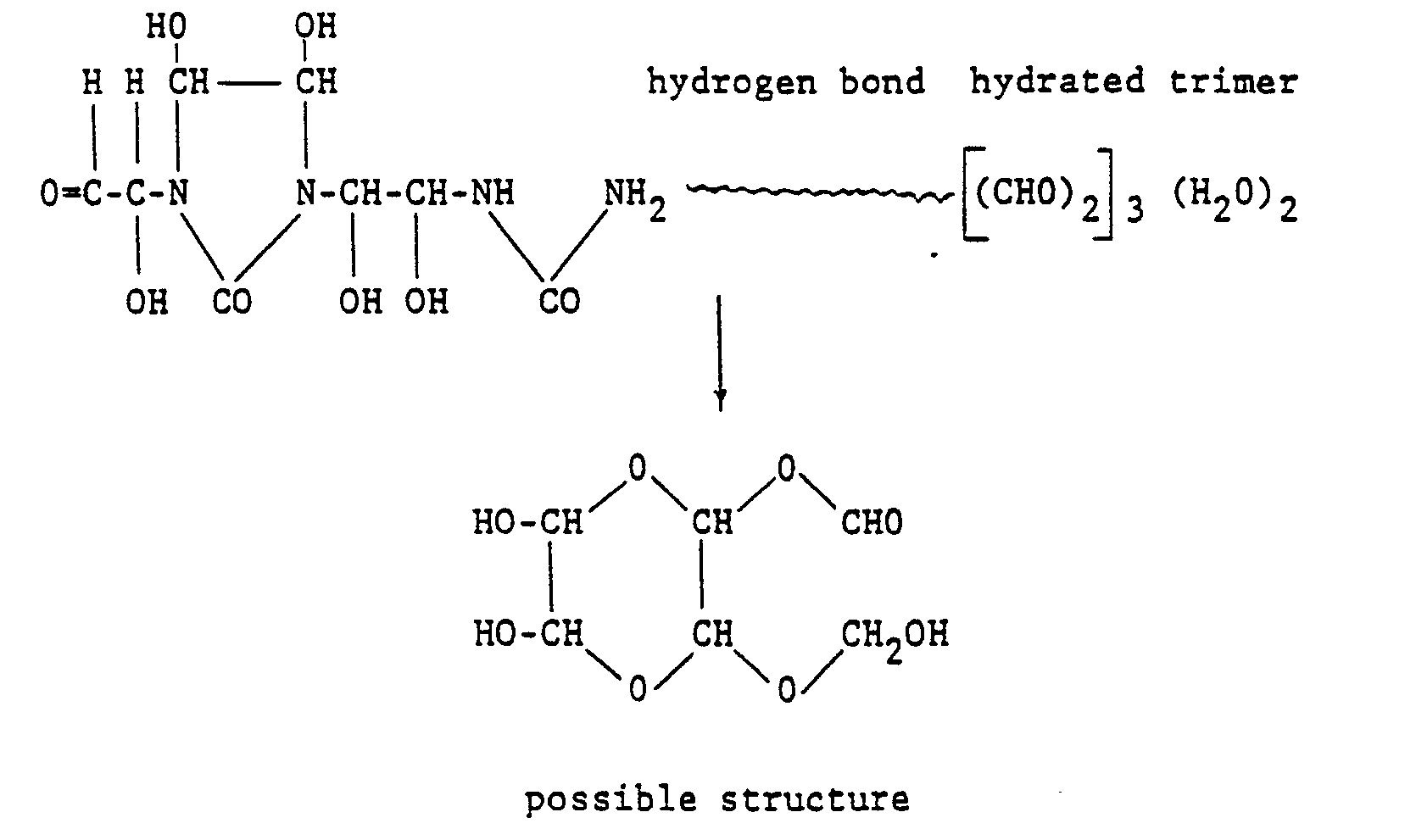
- Structure of the oligomer was unknown but it is assumed to be:
- 6 moles of glyoxal + 2 moles of urea
- Attempts to determine residual glyoxal remaining in the oligimer or the terminal CHO groups by simple alkalimetric method where excess of alkali is used to convert the glyoxal to glycolic acid by the Cannizzaro reaction were fruitless because under strong alkali conditions the oligomer was split resulting in formation of excess of glycolic acid groups and giving completely erroneous results.
- The preferred method for determination of free glyoxal and terminal CHO groups, a method based on a kinetic study by the Department of Chemistry, University of Turku, Finland, was used. This method is based on addition of excess sodium bisulfite to glyoxal in a phosphate buffer system in order to effect a rapid addition reaction, after which the excess bisulfite is titrated with standard iodine solution under acid conditions in order to prevent the decomposition of the glyoxal-bisulfite adduct during the titration.
- Following are the details of the method:
- Apparatus Erlenmeyer flasks, 250 ml; burette 25 ml; Volumetric flasks, 1000 ml; 200 ml; Automatic pipettes, 20 ml; 10 ml; 5 ml.
- Reagents 0.05 Molar glyoxal solution = 7.25 grams glyoxal 40%/liter 0.1 Normal sodium bisulfite solution = 10.4 gram/liter (freshly prepared) 0.1 Normal iodine solution Buffer solution, 71 grams Na2HP04 + 17 grams KH2PO4 1 Normal HCI solution Starch indicator solution
- Procedure 1. Add to a 250 ml Erlenmeyer flask exactly 20 ml 0.1 Normal sodium bisulfite solution. 10 ml buffer solution, 5 ml 1 Normal HCI solution. Titrate with 0.1 Normal iodine solution. Record the number of ml required = X.
2. Add to a 250 ml Erlenmeyer flask exactly 5 ml 0.05 molar glyoxal solution, 20 ml 0.1 Normal sodium bisulfite solution. Leave standing for 3 minutes time. Add 5 ml 1 Normal HCI solution. Titrate with 0.1 Normal iodine solution. Record the number of ml required = Y.
3. Dissolve exactly 5.8 grams of the tested liquid sample or 2.0 grams of the solid sample in a 200 ml volumetric flask with distilled water. Fill to the mark and shake well to get a uniform solution. Add 5 ml of the solution to a 250 ml Erlenmeyer flask followed by 10 ml buffer solution and 20 ml of 0.1 Normal sodium bisulfite solution. Leave standing for a 3 minute period. Add 5 ml 1 Normal HCI solution. Titrate with 0.1 Normal iodine solution. Record the number of ml required = Z. - Calculation % free glyoxal + CHO terminal groups 5.8 grams sample:


- Sample from Example I as is 5.8 grams was analyzed by the bisulfite method and gave the following results:


- Acetone precipitated sample weighing 2 grams was analyzed by the bisulfite method and gave the following results:




- 13.1 x 0.469 = 6.14% CHO terminal groups in liquid material
- % free glyoxal 7.94―6.14 = 1.8%.
- The 13.1 % CHO terminal groups in the dry polymer correspond to about 2 terminal CHO groups in the assumed structure of the oligomer
- 406.0 g of a 40% aqueous glyoxal solution containing 2.8 moles of glyoxal were charged into a glass lined reactor. The temperature was 22°C and the pH was 2.16. 60.0 g of urea (1.0 mole) were added to the glyoxal solution under agitation. After 15 minutes, a uniform solution resulted. The temperature dropped to 15°C and the pH rose to 2.9. Low heat was applied and the temperature rose gradually within one hour's time to 46°C. The reaction mass was kept at a constant temperature of 46° for a four hour period. The reaction mass was then cooled to 20°C and 4 g of 10% by weight sodium hydroxide solution was added slowly. The final product appeared as a pale-yellow, clear liquid having 47.3% solids and a pH of 6.0.
- The molar ratio of glyoxal to urea in Example II was 2.8 moles of glyoxal to 1 mole of urea.
- 464.0 g of a 40% aqueous glyoxal solution containing 3.2 moles of glyoxal were charged into a glass lined reactor. The temperature was 20°C and the pH was 2.16. 60.0 g of urea (1.0 mole) were added to the glyoxal solution under agitation. After 18 minutes time a uniform solution resulted, the temperature dropped to 12°C and the pH rose to 2.8. Low heat was applied and the temperature rose gradually within one hour's time to 44°C. The reaction mass was kept at constant 44°C for 4 hours. The reaction mass was then cooled to 20°C and 4 g of 10% by weight sodium hydroxide solution was added slowly. The final product appeared as a pale-yellow, clear liquid having 46.5% solids and a pH of 6.0.
- The molar ratio of glyoxal to urea in this Example III was 3.2 moles of glyoxal to 1.0 mole of urea.
- 261.0 g of a 40% aqueous glyoxal solution containing 1.8 moles of glyoxal were charged into a glass coated reactor. The temperature was 23°C and the pH was 2.17. 60.0 g of urea (1 mole) were added to the glyoxal solution under agitation. After 15 minutes time a uniform solution resulted, the temperature dropped to 12°C and the pH rose to 2.9. Low heat was applied and the temperature rose gradually within one hour to 45°C and was kept constant at 45°C for a four hour period. After cooling to 20°C, 4 g of 10% by weight sodium hydroxide solution was added slowly. The final product was a pale-yellow, clear liquid having 50.5% solids and a pH of 6.0.
- The molar ratio of glyoxal to urea in this example was 1.8 mole of glyoxal to 1.0 mole of urea.
- 217.5 g of a 40% aqueous glyoxal solution containing 1.5 moles of glyoxal were charged into a glass coated reactor. The temperature was 22°C and the pH was 2.7. 60 g of urea (1 mole) were added to the glyoxal solution under agitation. After 15 minutes time a uniform solution resulted, the temperature dropped to 12°C and the pH rose to 2.9. Low heat was applied and the temperature rose gradually within one hour's time to 45°C. The reaction mass was kept at constant temperature of 45°C for the next 4 hours, then cooled to 20°C. 4 g of sodium hydroxide 10% was added slowly. The final product appeared as a pale-yellow, clear liquid having 52% solids and a pH of 6.0.
- The molar ratio of glyoxal to urea in Example V was 1.5 moles of glyoxal to 1.0 mole of urea.
- A test coating formula was prepared as follows:

- The following materials were added as insolubilizers:
- No. 1 A commercial melamine formaldehyde resin, solids 62%.
- No. 2 A commercial glyoxal-ethylene urea resin, solids 45%.
- No. 3 Example No. 1, glyoxal-urea resin, solids 46.9%.
- No. 4 Example No. 2, glyoxal-urea resin, solids 47.3%.
- No. 5 Example No. 3, glyoxal-urea resin, solids 46.5%.
- No. 6 Example No. 4, glyoxal-urea resin, solids 50.5%.
- No. 7 Example No. 5, glyoxal-urea resin, solids 52%.
- Wet Rub Results According to TAPPI UM468


- The above tests show that the materials prepared according to the process of the invention with ratios glyoxal to urea in the range of 2.8-3.2 moles of glyoxal to 1.0 mole urea are at least 50% better than the standard melamine formaldehyde resin (Sample No. 1) and at least 3 times better than the commercial glyoxal-ethylene urea products (Sample No. 2).
- When the molar ratio of glyoxal to urea is outside of the claimed optimum range, the performance of the materials drops drastically as to between 17-26% of the performance of the optimum ratio materials.
- Three pigmented coatings formulas were used to evaluate the performance of different insolubilizers for wet-rub resistance using the Adams Wet Rub Tester.

- 0.1% antifoam, 0.1 % dispersant and 1 % lubricant were added to all 3 formulations. 3% of insolubilizer were added to the formulas. pH = 7.0.
- Coatings were applied using the rod applicator (No. 8 rod) on the Keegan coater and sheets were continuously dried using two infra-red driers on the Keegan. Coat weights were approximately 11.8-14.8 g/m2 (8-10 Ib/3300 square feet) and were controlled as closely as possible. Adams wet rub tests were run 24 hours after coating application. The procedure as supplied by the Testing Machines, Inc., the equipment suppliers, was modified to obtain the highest possible test accuracy. Whereas the procedure called for running one test strip and using a filtration technique with filter paper and drying the filter paper with residue, in the modified procedure 3 test strips (1 each from 3 different coated sheets) were used and the water was evaporated in aluminum dishes that contained the water used during the test sequence. The modified procedure adds to test accuracy because the filtration step is omitted and the inherent inaccuracies of filter papers with milligram differences in residue weight are eliminated. Beside this, the residue weights are tripled by the use of 3 times greater surface area of coated paper. Each weight was divided by 3 for reporting to conform to the original procedure as supplied by the Testing Machines, Inc.
-


- The above tests show that the materials made according to the process of invention are 2-6 times better than the MF resins and 1.3-2 times better than the commercial formaldehyde-free formulations, depending on coating compositions.
Claims (5)
Priority Applications (1)
| Application Number | Priority Date | Filing Date | Title |
|---|---|---|---|
| AT84101929T ATE36169T1 (en) | 1983-02-28 | 1984-02-23 | FORMALDEHYDE-FREE HARDENING AGENT FOR BINDERS IN PAPER COATING COMPOSITIONS. |
Applications Claiming Priority (2)
| Application Number | Priority Date | Filing Date | Title |
|---|---|---|---|
| US470393 | 1983-02-28 | ||
| US06/470,393 US4471087A (en) | 1983-02-28 | 1983-02-28 | Formaldehyde-free insolubilizers for binders for paper coating compositions |
Publications (3)
| Publication Number | Publication Date |
|---|---|
| EP0120308A2 EP0120308A2 (en) | 1984-10-03 |
| EP0120308A3 EP0120308A3 (en) | 1985-08-28 |
| EP0120308B1 true EP0120308B1 (en) | 1988-08-03 |
Family
ID=23867460
Family Applications (1)
| Application Number | Title | Priority Date | Filing Date |
|---|---|---|---|
| EP84101929A Expired EP0120308B1 (en) | 1983-02-28 | 1984-02-23 | Formaldehyde-free insolubilizers for binders for paper coating compositions |
Country Status (6)
| Country | Link |
|---|---|
| US (1) | US4471087A (en) |
| EP (1) | EP0120308B1 (en) |
| JP (1) | JPH0811878B2 (en) |
| AT (1) | ATE36169T1 (en) |
| CA (1) | CA1221190A (en) |
| DE (1) | DE3473156D1 (en) |
Families Citing this family (11)
| Publication number | Priority date | Publication date | Assignee | Title |
|---|---|---|---|---|
| US4972880A (en) * | 1987-06-15 | 1990-11-27 | Insta-Pipe Research Limited Partnership | Pipe liner |
| FR2642430B1 (en) * | 1989-01-10 | 1991-05-17 | Hoechst France | NOVEL AMINOPLAST RESINS FOR THE ENNOBLISSEMENT OF CELLULOSIC FIBERS AND THEIR APPLICATION |
| US5114999A (en) * | 1989-04-03 | 1992-05-19 | Ppg Industries, Inc. | Glyoxal-containing binder insolubilizer |
| FR2707310B1 (en) * | 1993-07-05 | 1995-10-06 | Hoechst France | Compositions for the treatment of the surfaces of paper and / or cardboard and their application in the paper industry. |
| US5435841A (en) * | 1994-05-25 | 1995-07-25 | Henkel Corporation | Insolubilizers for binders in paper coating compositions |
| US5830978A (en) * | 1994-12-07 | 1998-11-03 | Sequa Chemicals, Inc. | Resin composition |
| GB0019575D0 (en) * | 2000-08-10 | 2000-09-27 | Clariant Int Ltd | Process for the prepartion of paper having a special appearance |
| FR2894261B1 (en) * | 2005-12-02 | 2008-02-22 | Clariant France Soc Par Action | GLYOXAL INSOLUBILIZING AQUEOUS COMPOSITION FOR THE SURFACE TREATMENT OF PAPER AND CARTON. |
| WO2009041358A1 (en) | 2007-09-27 | 2009-04-02 | Kuraray Co., Ltd. | Vinyl alcohol polymer-containing coating agent for paper and paper and thermal paper coated with the coating agent |
| EP2436709A1 (en) | 2010-09-30 | 2012-04-04 | Cytec Technology Corp. | Non-etherified reaction product of a cyclic urea and a multifunctional aldehyde |
| RU2612257C1 (en) * | 2015-11-19 | 2017-03-03 | Федеральное государственное бюджетное учреждение науки Институт химии нефти Сибирского отделения Российской академии наук (ИХН СО РАН) | Method for glyocarb oligomer preparation |
Family Cites Families (5)
| Publication number | Priority date | Publication date | Assignee | Title |
|---|---|---|---|---|
| US3869296A (en) * | 1972-03-29 | 1975-03-04 | Union Carbide Corp | Aqueous starch-pigment paper coating compositions containing glyoxal-urea insolubilizer |
| US3917659A (en) * | 1974-07-27 | 1975-11-04 | Union Carbide Corp | Solid glyoxal-urea products |
| US4284758A (en) * | 1979-11-08 | 1981-08-18 | Sun Chemical Corp. | Glyoxal/cyclic urea condensates |
| US4343655A (en) * | 1979-11-08 | 1982-08-10 | Sun Chemical Corporation | Insolubilizers for binders for paper coating compositions |
| US4332586A (en) * | 1980-11-17 | 1982-06-01 | Sun Chemical Corporation | Novel reactants for crosslinking textile fabrics |
-
1983
- 1983-02-28 US US06/470,393 patent/US4471087A/en not_active Expired - Lifetime
- 1983-12-07 CA CA000442756A patent/CA1221190A/en not_active Expired
-
1984
- 1984-02-02 JP JP59017644A patent/JPH0811878B2/en not_active Expired - Lifetime
- 1984-02-23 AT AT84101929T patent/ATE36169T1/en not_active IP Right Cessation
- 1984-02-23 DE DE8484101929T patent/DE3473156D1/en not_active Expired
- 1984-02-23 EP EP84101929A patent/EP0120308B1/en not_active Expired
Also Published As
| Publication number | Publication date |
|---|---|
| EP0120308A2 (en) | 1984-10-03 |
| US4471087A (en) | 1984-09-11 |
| DE3473156D1 (en) | 1988-09-08 |
| CA1221190A (en) | 1987-04-28 |
| ATE36169T1 (en) | 1988-08-15 |
| EP0120308A3 (en) | 1985-08-28 |
| JPS59163497A (en) | 1984-09-14 |
| JPH0811878B2 (en) | 1996-02-07 |
Similar Documents
| Publication | Publication Date | Title |
|---|---|---|
| US4471087A (en) | Formaldehyde-free insolubilizers for binders for paper coating compositions | |
| US6548625B2 (en) | Stable liquid melamine urea formaldehyde resins, hardeners, adhesive compositions, and methods for making same | |
| US4247433A (en) | Process for the preparation of thermosettable urea-formaldehyde resins and method for use thereof | |
| US3654263A (en) | Starch derivatives processes for making them compositions based upon the starch derivatives and methods of making the compositions | |
| US3869296A (en) | Aqueous starch-pigment paper coating compositions containing glyoxal-urea insolubilizer | |
| US4840705A (en) | Papermaking method | |
| US4557951A (en) | Cellulosic organic solvent soluble products | |
| US5849856A (en) | Water soluble resins and application thereof to paper coating | |
| US2928812A (en) | Hydroxyalkyl carbamate-formaldehyde condensation products | |
| US3758324A (en) | Cross linking agents for paper binders and paper coated therewith | |
| CA1153142A (en) | Low-foam surface sizing agents for paper | |
| US2541152A (en) | N-vinyl alkylene ureas and polymers thereof | |
| US3004002A (en) | Homopolymers of 1,3 bis-(hydroxymethyl) 2-imidazolidones or imidazolithiones | |
| US4490516A (en) | Cellulosic organic solvent soluble products | |
| US2834675A (en) | Polyalkylene-polyamine resinous composition, method of making paper using same and paper containing same | |
| JPS6265728A (en) | Preparation of novel cationic dispersant | |
| EP0409777A2 (en) | Polyimide-forming compositions | |
| JPS62156123A (en) | Production of urethane modified resin and composition | |
| US3634399A (en) | Water-soluble latent cross-linking agents | |
| US2659712A (en) | Preparation of resinous condensation products from aromatic ketones and amines | |
| EP0007705B1 (en) | Modified aminoplast condensation products and process for their preparation | |
| US3689466A (en) | Sulfonated polymeric alcohols | |
| US2444802A (en) | Nitrogenous resins containing alkylene sulfonate groups | |
| Barminas et al. | Development of amino resins for paint formulation. 1. Effect of pH on a new synthetic route | |
| ES472102A1 (en) | Process for preparing solutions of curable urea- formaldehyde resins |
Legal Events
| Date | Code | Title | Description |
|---|---|---|---|
| PUAI | Public reference made under article 153(3) epc to a published international application that has entered the european phase |
Free format text: ORIGINAL CODE: 0009012 |
|
| AK | Designated contracting states |
Designated state(s): AT BE CH DE FR GB IT LI NL SE |
|
| PUAL | Search report despatched |
Free format text: ORIGINAL CODE: 0009013 |
|
| AK | Designated contracting states |
Designated state(s): AT BE CH DE FR GB IT LI NL SE |
|
| 17P | Request for examination filed |
Effective date: 19860226 |
|
| 17Q | First examination report despatched |
Effective date: 19861120 |
|
| RAP1 | Party data changed (applicant data changed or rights of an application transferred) |
Owner name: HENKEL CORPORATION |
|
| GRAA | (expected) grant |
Free format text: ORIGINAL CODE: 0009210 |
|
| AK | Designated contracting states |
Kind code of ref document: B1 Designated state(s): AT BE CH DE FR GB IT LI NL SE |
|
| REF | Corresponds to: |
Ref document number: 36169 Country of ref document: AT Date of ref document: 19880815 Kind code of ref document: T |
|
| ITF | It: translation for a ep patent filed | ||
| REF | Corresponds to: |
Ref document number: 3473156 Country of ref document: DE Date of ref document: 19880908 |
|
| ET | Fr: translation filed | ||
| PLBE | No opposition filed within time limit |
Free format text: ORIGINAL CODE: 0009261 |
|
| STAA | Information on the status of an ep patent application or granted ep patent |
Free format text: STATUS: NO OPPOSITION FILED WITHIN TIME LIMIT |
|
| 26N | No opposition filed | ||
| ITTA | It: last paid annual fee | ||
| EAL | Se: european patent in force in sweden |
Ref document number: 84101929.2 |
|
| PGFP | Annual fee paid to national office [announced via postgrant information from national office to epo] |
Ref country code: BE Payment date: 19970128 Year of fee payment: 14 |
|
| PGFP | Annual fee paid to national office [announced via postgrant information from national office to epo] |
Ref country code: AT Payment date: 19970213 Year of fee payment: 14 |
|
| PGFP | Annual fee paid to national office [announced via postgrant information from national office to epo] |
Ref country code: GB Payment date: 19970214 Year of fee payment: 14 |
|
| PGFP | Annual fee paid to national office [announced via postgrant information from national office to epo] |
Ref country code: CH Payment date: 19970310 Year of fee payment: 14 |
|
| PG25 | Lapsed in a contracting state [announced via postgrant information from national office to epo] |
Ref country code: GB Free format text: LAPSE BECAUSE OF NON-PAYMENT OF DUE FEES Effective date: 19980223 Ref country code: AT Free format text: LAPSE BECAUSE OF NON-PAYMENT OF DUE FEES Effective date: 19980223 |
|
| PG25 | Lapsed in a contracting state [announced via postgrant information from national office to epo] |
Ref country code: LI Free format text: LAPSE BECAUSE OF NON-PAYMENT OF DUE FEES Effective date: 19980228 Ref country code: CH Free format text: LAPSE BECAUSE OF NON-PAYMENT OF DUE FEES Effective date: 19980228 Ref country code: BE Free format text: LAPSE BECAUSE OF NON-PAYMENT OF DUE FEES Effective date: 19980228 |
|
| BERE | Be: lapsed |
Owner name: HENKEL CORP. Effective date: 19980228 |
|
| GBPC | Gb: european patent ceased through non-payment of renewal fee |
Effective date: 19980223 |
|
| REG | Reference to a national code |
Ref country code: CH Ref legal event code: PL |
|
| NLS | Nl: assignments of ep-patents |
Owner name: NOPCO PAPER TECHNOLOGY AS;COGNIS CORPORATION |
|
| REG | Reference to a national code |
Ref country code: FR Ref legal event code: TP |
|
| PGFP | Annual fee paid to national office [announced via postgrant information from national office to epo] |
Ref country code: SE Payment date: 20030131 Year of fee payment: 20 Ref country code: FR Payment date: 20030131 Year of fee payment: 20 |
|
| PGFP | Annual fee paid to national office [announced via postgrant information from national office to epo] |
Ref country code: NL Payment date: 20030228 Year of fee payment: 20 |
|
| PGFP | Annual fee paid to national office [announced via postgrant information from national office to epo] |
Ref country code: DE Payment date: 20030306 Year of fee payment: 20 |
|
| PG25 | Lapsed in a contracting state [announced via postgrant information from national office to epo] |
Ref country code: NL Free format text: LAPSE BECAUSE OF EXPIRATION OF PROTECTION Effective date: 20040223 |
|
| EUG | Se: european patent has lapsed | ||
| NLV7 | Nl: ceased due to reaching the maximum lifetime of a patent |
Effective date: 20040223 |