EP0118614A2 - Alkaline cell - Google Patents
Alkaline cell Download PDFInfo
- Publication number
- EP0118614A2 EP0118614A2 EP83112530A EP83112530A EP0118614A2 EP 0118614 A2 EP0118614 A2 EP 0118614A2 EP 83112530 A EP83112530 A EP 83112530A EP 83112530 A EP83112530 A EP 83112530A EP 0118614 A2 EP0118614 A2 EP 0118614A2
- Authority
- EP
- European Patent Office
- Prior art keywords
- positive electrode
- cell
- nickel
- cells
- stainless steel
- Prior art date
- Legal status (The legal status is an assumption and is not a legal conclusion. Google has not performed a legal analysis and makes no representation as to the accuracy of the status listed.)
- Granted
Links
Images

Classifications
-
- H—ELECTRICITY
- H01—ELECTRIC ELEMENTS
- H01M—PROCESSES OR MEANS, e.g. BATTERIES, FOR THE DIRECT CONVERSION OF CHEMICAL ENERGY INTO ELECTRICAL ENERGY
- H01M6/00—Primary cells; Manufacture thereof
- H01M6/04—Cells with aqueous electrolyte
- H01M6/06—Dry cells, i.e. cells wherein the electrolyte is rendered non-fluid
- H01M6/12—Dry cells, i.e. cells wherein the electrolyte is rendered non-fluid with flat electrodes
-
- H—ELECTRICITY
- H01—ELECTRIC ELEMENTS
- H01M—PROCESSES OR MEANS, e.g. BATTERIES, FOR THE DIRECT CONVERSION OF CHEMICAL ENERGY INTO ELECTRICAL ENERGY
- H01M4/00—Electrodes
- H01M4/02—Electrodes composed of, or comprising, active material
- H01M4/64—Carriers or collectors
- H01M4/66—Selection of materials
- H01M4/661—Metal or alloys, e.g. alloy coatings
-
- H—ELECTRICITY
- H01—ELECTRIC ELEMENTS
- H01M—PROCESSES OR MEANS, e.g. BATTERIES, FOR THE DIRECT CONVERSION OF CHEMICAL ENERGY INTO ELECTRICAL ENERGY
- H01M4/00—Electrodes
- H01M4/02—Electrodes composed of, or comprising, active material
- H01M4/64—Carriers or collectors
- H01M4/66—Selection of materials
- H01M4/669—Steels
-
- H—ELECTRICITY
- H01—ELECTRIC ELEMENTS
- H01M—PROCESSES OR MEANS, e.g. BATTERIES, FOR THE DIRECT CONVERSION OF CHEMICAL ENERGY INTO ELECTRICAL ENERGY
- H01M50/00—Constructional details or processes of manufacture of the non-active parts of electrochemical cells other than fuel cells, e.g. hybrid cells
- H01M50/10—Primary casings; Jackets or wrappings
- H01M50/116—Primary casings; Jackets or wrappings characterised by the material
- H01M50/117—Inorganic material
- H01M50/119—Metals
-
- H—ELECTRICITY
- H01—ELECTRIC ELEMENTS
- H01M—PROCESSES OR MEANS, e.g. BATTERIES, FOR THE DIRECT CONVERSION OF CHEMICAL ENERGY INTO ELECTRICAL ENERGY
- H01M50/00—Constructional details or processes of manufacture of the non-active parts of electrochemical cells other than fuel cells, e.g. hybrid cells
- H01M50/10—Primary casings; Jackets or wrappings
- H01M50/116—Primary casings; Jackets or wrappings characterised by the material
- H01M50/124—Primary casings; Jackets or wrappings characterised by the material having a layered structure
- H01M50/126—Primary casings; Jackets or wrappings characterised by the material having a layered structure comprising three or more layers
- H01M50/128—Primary casings; Jackets or wrappings characterised by the material having a layered structure comprising three or more layers with two or more layers of only inorganic material
-
- H—ELECTRICITY
- H01—ELECTRIC ELEMENTS
- H01M—PROCESSES OR MEANS, e.g. BATTERIES, FOR THE DIRECT CONVERSION OF CHEMICAL ENERGY INTO ELECTRICAL ENERGY
- H01M50/00—Constructional details or processes of manufacture of the non-active parts of electrochemical cells other than fuel cells, e.g. hybrid cells
- H01M50/50—Current conducting connections for cells or batteries
- H01M50/543—Terminals
- H01M50/545—Terminals formed by the casing of the cells
Definitions
- the present invention relates to an alkaline cell, and more particularly to a small sized alkaline cell having its surface processed with anticorrosion material.
- the present inventors discovered that the corrosion of the enclosure of the conventional cell occurs in such a manner that the electricity of the cell is discharged in the gastric juice of aciditic solution which includes halogen ions, whereby the enclosure or positive electrode can of the cell is corroded.
- the corrosion of the positive electrode can of the cell in the gastric juice progresses relatively rapidly compared with the corrosion occurs in a normal chemical process.
- the positive electrode cans of the conventional flat type cells are made of iron with nickel plating surface lacking for resistivity against the aciditic corrosion, if such a conventional flat type cell is swallowed, there is a great possibility of occurring of the corrosion of the positive electrode can, before the cell is excreted, during staying of the cell swallowed in the human body.
- the present invention is made to eliminate such drawbacks as mentioned above being inherent in the conventional alkaline cell and has its essential object to provide an alkaline cell having a positive electrode can which is not readily corroded in the gastric juice so as to prevent leakage of harmful materials out of the cell even if the cell is swallowed in a human body .
- the positive electrode can be formed by a high chrome stainless steel sheet which includes chrome more than 23% by weight.
- the stainless steel may be SUS 4471J1, SUS329Jl, SUS 329J2, and SUS 310S.
- the stainless steel of the positive electrode can may be coated with one or more nickel layers in order to prevent releasing of hexa chrome ions from the stainless steel.
- the nickel layer may be formed either on the inner surface or outer surface of the positive electrode can alternatively.
- the nickel layers may be formed on both of the inner surface and the outer surface of the positive electrode can.
- the thickness of the nickel layer of the positive electrode can be more than 3tm.
- the term of the small sized cell used herein includes all kinds of small sized cells such as a button type, flat disc type, cylindrical type, each comprising alkaline aqueous solution as electrolyte and a laminated cell which a plurality of cells of one of the above described types are laminated.
- Sample electrodes were made using the stainless steel, iron and nickel as shown in the table 1.
- Each of the samples was soaked in an artificial gastric juice consisting of aqueous solution including 2g of NaCl in one liter and 24 ml of HC1 of 10% by weight with a platinum plate opposed to the sample electrode as an opposing electrode.
- a variable voltage is applied across the sample electrode and the opposing electrode, whereby corrosion commencing voltages were measured.
- the results of the measurement are shown in the table 2.
- the term of corrosion commencing voltage means a potential at the rising point of the polarization curve of the sample electrode in the artificial gastric juice.
- the value shown in the table 2 is the potential with respect to a reference electrode of a silver chloride.
- the corrosion commencing voltage becomes remarkably high against the stainless steel including more than 23% of chrome. In other words there is a remarkable difference of the corrosion commencing voltages between the stainless steel including more than 23% of chrome and the stainless steel including less than 21% of chrome.
- a plurality of cells as described hereinafter in the examples 1 and 2 were made based on the results mentioned above and compared with a conventional cell in terms of occurrence of damage of the cells in the artificial gastric juice.
- Alkaline electrolyte made of potassium hydroxide aqueous solution of 35% with zinc oxide solved is injected in the cell thus formed.
- the positive electrode material mix 2 is a press formed body having a diameter of 10.9 mm and a thickness of 1.8 mm composed of mixture of weight of 510mg of manganese dioxide, phosphorus graphite and poly acrylic sodium and being pressed by a pressure of 1t/cm 2 .
- the negative active materials 5 consists of zinc amalgam of weight of 110mg with the rate of amalgamation of 9%.
- Example 1 was substantially repeated except that a stainless steel plate of SUS447J1 was used for the positive electrode can 1 in place of SUS329J1 in the example 1.
- Example 1 was substantially repeated except that a nickel plated iron plate of a thickness of 0.25 mm was used for the positive electrode can 1.
- the conventional cell was damaged in 24 hours in the artificial gastric juice, to the contrary the cells according to the examples 1 and 2 were never damaged after not only 24 hours but also 200 hours in the artificial gastric juice.
- the positive electrode cans 1 of the cells shown in the examples 1 and 2 are made of high chrome stainless steel, which is easily electrolytically oxydized by the effect of positive active materials in the alkaline electrolyte solution, hexa valent chrome ions (Cr6+) may easily be released from the positive electrode can in the electrolyte solution, and the released ions are shifted to the negative electrode, whereby an undesired layer may be formed surrounding the surface of each of the negative active materials and causing the negative active materials to be ineffective resulting in lowering the voltage of the cell when a load is connected across the cell (such voltage will be referred to as closed circiut voltage hereinafter).
- a nickel layer or nickel layers may be formed on the surface of the positive electrode can 1.
- a nickel layer 8 as shown in Fig. 3 was plated on the inner surface of the positive electrode can 1 with a thickness of 3 ⁇ m.
- the cell shown in the example 2 was used.
- the cells of-the examples 2 and 3 were stored in an atmosphere of a temperature of 60'C for 5 days and 10 days. Then the open circuit voltage and the closed circuit voltage were inspected. The result of the inspection is shown in the table 4.
- the open circuit voltage and the closed circuit voltage of the cell of example 3 are much stable compared with the cell of example 2 in which the open circuit voltage'and the closed circuit voltage are lowered from the initial state.
- the closed circuit voltage of the cell of the example 2 is remarkably lowered due to the releasing of the hexa valent chrome ions in the electrolyte.
- the nickel layer 8 may be provided by either nickel plating on the stainless steel sheet or laminating a nickel clad plate onto the stainless steel sheet.
- the thickness of the nickel layer is more than 3r m.
- a nickel layer 81 was plated on the outer surface of the positive electrode can 1 in the cell of the example 2 with the thickness of 3 ⁇ m as shown in Fig. 4.
- the cell in the example 2 was used. Both of the cells were soaked in the gastric juice defined above of 37°C for 24 hours. The amount of releasing of the hexa valent chrome ions (Cr 6+ ) in the gastric juice described above was measured by a spectroscopic analysis. The result of the measurement is shown in the table 5. The amount of releasing of the hexa valent chrome ions in the cell of the example 4 is remarkably decreased compared with that of the cell of the example 2.
- the outer surface of the positive electrode can 1 By coating the outer surface of the positive electrode can 1 with the nickel layer, dissolving of nickel commences at a voltage lower than the voltage for releasing the hexa valent chrome ions, so that releasing of the hexa valent chrome ions can be suppressed.
- Example 4 was substantially repeated with the ratio W/Q of the amount W of nickel of the nickel layer 81 and the quantity Q of electricity of the positive electrode changed by various values as shown in the table 6.
- the quantity Q of the electricity of the positive electricity was 125 mAh (miliampere hour).
- the result of the inspection is shown in the table 6. According -to the table 6, the amount of releasing of the hexa valent chrome ions can be decreased in case where the ratio W/Q is more than 5 X 10 -12 mg/mAh.
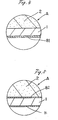
- Nickel layers 81 and 82 were plated on the outer surface and the inner surface of the positive electrode can 1 made in a same manner as the cell of the example 2 with a thickness of 3 ⁇ m as shown in Fig. 5.
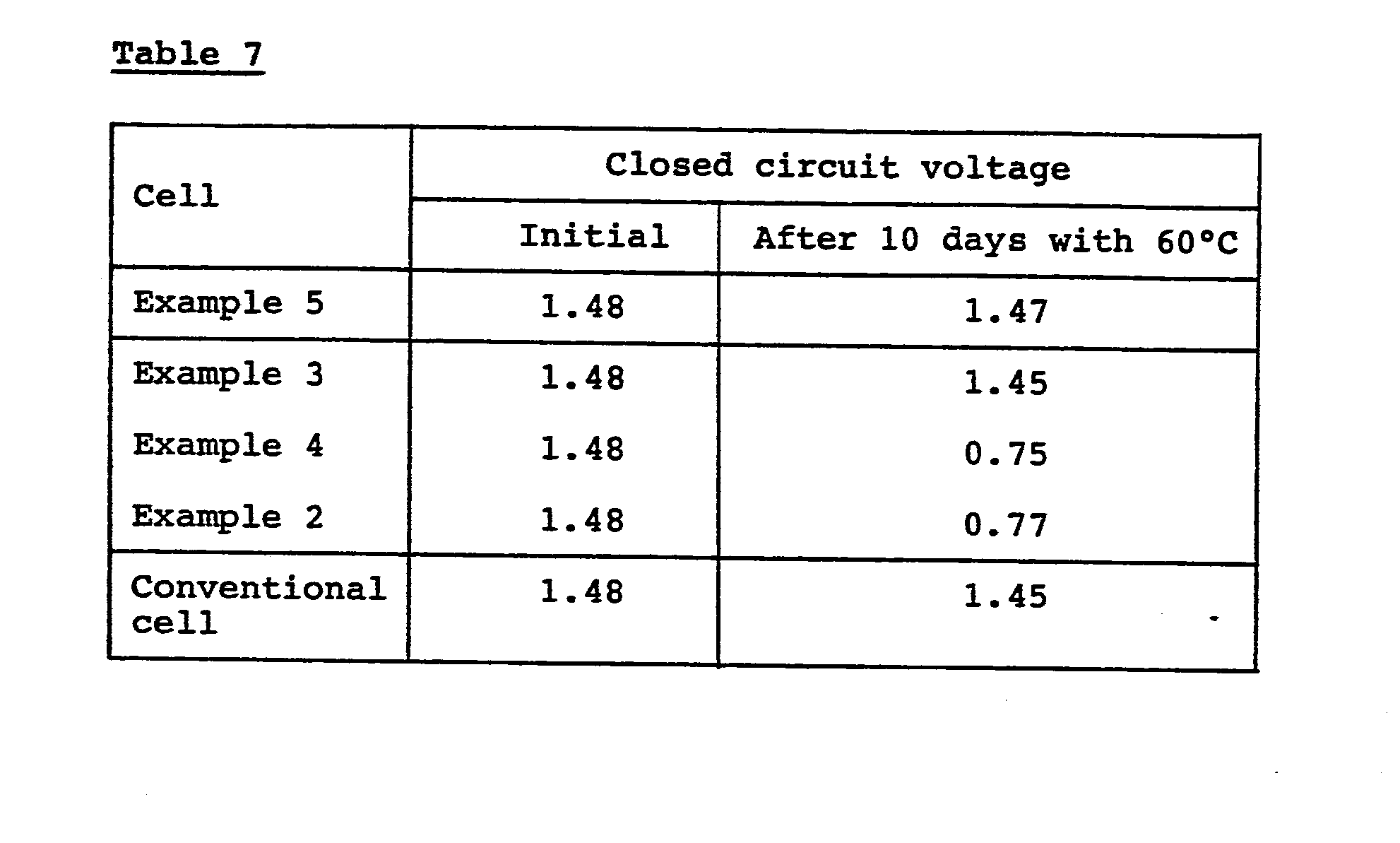
- the cells of the examples 2, 3 and 4 were used for the comparative examples in addition to the conventional cell. These cells were stored in an atmosphere of 60° C for 10 days. Thereafter the closed circuit voltage was measured. Also, these cells were soaked in the gastric juice as described above for 50 hours under the temperature of 37'C and the amount of releasing of the hexa valent chrome ions was measured and degree of damage of the cells was inspected. The results of the inspection are shown in the tables 7 and 8.
- the amount of decreasing of the closed circuit voltage of the cell and the amount of releasing of the hexa valent chrome ions are small compared with those of the cells of the examples 2, 3 and 4 and the conventional cells. Also damage of the the cells did not occur in the examples 2, 3, 4 and 6.
- the amount W of nickel means that of the nickel layer formed on the outer face of the positive electrode can and does not include the amount of nickel contained in the material of the positive electrode can per se.
Landscapes
- Chemical & Material Sciences (AREA)
- Chemical Kinetics & Catalysis (AREA)
- Electrochemistry (AREA)
- General Chemical & Material Sciences (AREA)
- Engineering & Computer Science (AREA)
- Inorganic Chemistry (AREA)
- Materials Engineering (AREA)
- Manufacturing & Machinery (AREA)
- Battery Electrode And Active Subsutance (AREA)
- Sealing Battery Cases Or Jackets (AREA)
Abstract
Description
- The present invention relates to an alkaline cell, and more particularly to a small sized alkaline cell having its surface processed with anticorrosion material.
- With progress of a wide use of various cell appliances such as game machines and/or game watches using one or more small sized alkaline cells, there sometimes happen accidents that a child accidentally swallows a small sized cell. It is reported that in such an accident, the enclosure of the cell swallowed may be corroded in a stomach, whereby the human body may be harmed by an alkaline electrolyte leaked out of the cell.
- As the result of study, the present inventors discovered that the corrosion of the enclosure of the conventional cell occurs in such a manner that the electricity of the cell is discharged in the gastric juice of aciditic solution which includes halogen ions, whereby the enclosure or positive electrode can of the cell is corroded. The corrosion of the positive electrode can of the cell in the gastric juice progresses relatively rapidly compared with the corrosion occurs in a normal chemical process. As the positive electrode cans of the conventional flat type cells are made of iron with nickel plating surface lacking for resistivity against the aciditic corrosion, if such a conventional flat type cell is swallowed, there is a great possibility of occurring of the corrosion of the positive electrode can, before the cell is excreted, during staying of the cell swallowed in the human body.
- The present invention is made to eliminate such drawbacks as mentioned above being inherent in the conventional alkaline cell and has its essential object to provide an alkaline cell having a positive electrode can which is not readily corroded in the gastric juice so as to prevent leakage of harmful materials out of the cell even if the cell is swallowed in a human body .
- According to the present invention, the positive electrode can may be formed by a high chrome stainless steel sheet which includes chrome more than 23% by weight.
- The stainless steel may be SUS 4471J1, SUS329Jl, SUS 329J2, and SUS 310S.
- The stainless steel of the positive electrode can may be coated with one or more nickel layers in order to prevent releasing of hexa chrome ions from the stainless steel.
- The nickel layer may be formed either on the inner surface or outer surface of the positive electrode can alternatively.
- The nickel layers may be formed on both of the inner surface and the outer surface of the positive electrode can.
- Preferably, the thickness of the nickel layer of the positive electrode can may be more than 3tm.
-
- Fig. 1 is a side view of one embodiment of an alkaline cell according to the present invention with partly broken,
- Fig. 2 is a side view of another embodiment of an alkaline cell according to the present invention with partly broken,
- Fig. 3 is a partial enlarged cross sectional view showing the part surrounded by the circle A in Fig. 2, and
- Figs. 4 and 5 are partial enlarged cross sectional views of further modifications of the alkaline cells showing the part surrounded by the circle A in Fig. 2.
- Before the description proceeds, it is noted that like parts are designated by like reference numerals throughout the drawings.
- It is also noted that the term of the small sized cell used herein includes all kinds of small sized cells such as a button type, flat disc type, cylindrical type, each comprising alkaline aqueous solution as electrolyte and a laminated cell which a plurality of cells of one of the above described types are laminated.
- Following experiments were made to find materials suitable for the positive electrode cans of the alkaline cells to prevent corrosion of the positive electrode in the gastric juice. Sample electrodes were made using the stainless steel, iron and nickel as shown in the table 1. Each of the samples was soaked in an artificial gastric juice consisting of aqueous solution including 2g of NaCl in one liter and 24 ml of HC1 of 10% by weight with a platinum plate opposed to the sample electrode as an opposing electrode. A variable voltage is applied across the sample electrode and the opposing electrode, whereby corrosion commencing voltages were measured. The results of the measurement are shown in the table 2. The term of corrosion commencing voltage means a potential at the rising point of the polarization curve of the sample electrode in the artificial gastric juice. The value shown in the table 2 is the potential with respect to a reference electrode of a silver chloride.
- As apparent from the tables 1 and 2, the corrosion commencing voltage becomes remarkably high against the stainless steel including more than 23% of chrome. In other words there is a remarkable difference of the corrosion commencing voltages between the stainless steel including more than 23% of chrome and the stainless steel including less than 21% of chrome.
- A plurality of cells as described hereinafter in the examples 1 and 2 were made based on the results mentioned above and compared with a conventional cell in terms of occurrence of damage of the cells in the artificial gastric juice.
- A small sized cell of LR 43 type as shown in Fig. 1 was made using a positive electrode can 1 of high chrome stainless steel of SUS 447J1. In Fig. 1, 1 denotes the positive electrode can; 2 denotes a positive electrode material mix comprising, for example, silver oxide as a main ingredient; 3 denotes an annular metallic pedestal fixed on the inner wall of the positive electrode can 1, 4 denotes a separator comprising a microporous polypropylene film imparted a hydrophilic property, a cellophane film and a vinylon-rayon mixed paper; 5 denotes a negative electrode material mix; 6 denotes a negative electrode terminal plate, as the negative electrode collector, made of a clad plate consisting of a nickel layer on the outer face, austenitic stainless steel plate of SUS304 as a base material and a copper layer on the inner face and formed in a shape having the peripheral turn-up part by draw forming; 7 denotes an annular gasket made of nylon and placed at the turn-up part of the negative
electrode terminal plate 6. - Alkaline electrolyte made of potassium hydroxide aqueous solution of 35% with zinc oxide solved is injected in the cell thus formed. The positive
electrode material mix 2 is a press formed body having a diameter of 10.9 mm and a thickness of 1.8 mm composed of mixture of weight of 510mg of manganese dioxide, phosphorus graphite and poly acrylic sodium and being pressed by a pressure of 1t/cm2. The negativeactive materials 5 consists of zinc amalgam of weight of 110mg with the rate of amalgamation of 9%. - Example 1 was substantially repeated except that a stainless steel plate of SUS447J1 was used for the positive electrode can 1 in place of SUS329J1 in the example 1.
- Example 1 was substantially repeated except that a nickel plated iron plate of a thickness of 0.25 mm was used for the positive electrode can 1.
- The respective cells made in a manner as described above were soaked in the artificial gastric juice as defined above for 24 hours under the temperature of 370C and occurrence of damage of the cells was inspected by measuring the value of potassium ion in the artificial gastric juice. The results are shown in the table 3. In case of occurrence of pin holes on the positive electrode can due to corrosion in the artificial gastric juice, the electrolyte might leak out the cell through the pin holes in the artificial gastric juice, the method of detecting sodium ion was used for inspecting the occurrence of the damage of the cells.
- As shown in the table 3, the conventional cell was damaged in 24 hours in the artificial gastric juice, to the contrary the cells according to the examples 1 and 2 were never damaged after not only 24 hours but also 200 hours in the artificial gastric juice.
- Since the positive electrode cans 1 of the cells shown in the examples 1 and 2 are made of high chrome stainless steel, which is easily electrolytically oxydized by the effect of positive active materials in the alkaline electrolyte solution, hexa valent chrome ions (Cr6+) may easily be released from the positive electrode can in the electrolyte solution, and the released ions are shifted to the negative electrode, whereby an undesired layer may be formed surrounding the surface of each of the negative active materials and causing the negative active materials to be ineffective resulting in lowering the voltage of the cell when a load is connected across the cell (such voltage will be referred to as closed circiut voltage hereinafter). In order to prevent the releasing of the hexa valent chrome ions, a nickel layer or nickel layers may be formed on the surface of the positive electrode can 1.
- In addition to the cell shown in the Example 2 a
nickel layer 8 as shown in Fig. 3 was plated on the inner surface of the positive electrode can 1 with a thickness of 3 µm. For the comparative reference the cell shown in the example 2 was used. The cells of-the examples 2 and 3 were stored in an atmosphere of a temperature of 60'C for 5 days and 10 days. Then the open circuit voltage and the closed circuit voltage were inspected. The result of the inspection is shown in the table 4. As shown in the table 4, the open circuit voltage and the closed circuit voltage of the cell of example 3 are much stable compared with the cell of example 2 in which the open circuit voltage'and the closed circuit voltage are lowered from the initial state. According to the table 4, the closed circuit voltage of the cell of the example 2 is remarkably lowered due to the releasing of the hexa valent chrome ions in the electrolyte. Thenickel layer 8 may be provided by either nickel plating on the stainless steel sheet or laminating a nickel clad plate onto the stainless steel sheet. Preferably, the thickness of the nickel layer is more than 3r m. - A
nickel layer 81 was plated on the outer surface of the positive electrode can 1 in the cell of the example 2 with the thickness of 3 µm as shown in Fig. 4. As a comparative example, the cell in the example 2 was used. Both of the cells were soaked in the gastric juice defined above of 37°C for 24 hours. The amount of releasing of the hexa valent chrome ions (Cr6+) in the gastric juice described above was measured by a spectroscopic analysis. The result of the measurement is shown in the table 5. The amount of releasing of the hexa valent chrome ions in the cell of the example 4 is remarkably decreased compared with that of the cell of the example 2. By coating the outer surface of the positive electrode can 1 with the nickel layer, dissolving of nickel commences at a voltage lower than the voltage for releasing the hexa valent chrome ions, so that releasing of the hexa valent chrome ions can be suppressed. - Example 4 was substantially repeated with the ratio W/Q of the amount W of nickel of the
nickel layer 81 and the the quantity Q of electricity of the positive electrode changed by various values as shown in the table 6. In the examples 5, the quantity Q of the electricity of the positive electricity was 125 mAh (miliampere hour). The result of the inspection is shown in the table 6. According -to the table 6, the amount of releasing of the hexa valent chrome ions can be decreased in case where the ratio W/Q is more than 5 X 10 -12 mg/mAh. - Nickel layers 81 and 82 were plated on the outer surface and the inner surface of the positive electrode can 1 made in a same manner as the cell of the example 2 with a thickness of 3µm as shown in Fig. 5. The cells of the examples 2, 3 and 4 were used for the comparative examples in addition to the conventional cell. These cells were stored in an atmosphere of 60° C for 10 days. Thereafter the closed circuit voltage was measured. Also, these cells were soaked in the gastric juice as described above for 50 hours under the temperature of 37'C and the amount of releasing of the hexa valent chrome ions was measured and degree of damage of the cells was inspected. The results of the inspection are shown in the tables 7 and 8. As understood from the tables 7 and 8, in the cell of the example 6, the amount of decreasing of the closed circuit voltage of the cell and the amount of releasing of the hexa valent chrome ions are small compared with those of the cells of the examples 2, 3 and 4 and the conventional cells. Also damage of the the cells did not occur in the examples 2, 3, 4 and 6.
- It is noted that in the examples 5, the amount W of nickel means that of the nickel layer formed on the outer face of the positive electrode can and does not include the amount of nickel contained in the material of the positive electrode can per se.



Claims (5)
- (1) An alkaline cell comprising positive active materials and negative active materials, a positive electrode can for accommodating the positive active materials characterized in that the positive electrode can is formed by a stainless steel including chrome more than 23 % by weight.
- (2) The alkaline cell according to claim 1, wherein the positive electrode can has its inner surface coated with a nickel layer.
- (3) The alkaline cell according to claim 1, wherein the positive electrode can has its outer surface coated with a nickel layer.
- (4) The alkaline cell according to claim 1, wherein the positive electrode can has its inner surface and the outer surface coated with nickel layers respectively.
- (5) the alkaline cell according to claim 3, wherein the total weight W of the nickel of the nickel layer is defined in such a manner that the ratio of W/Q (wherein Q is quantity of electricity of manganse dioxide as the positive active materials) is equal to or more than 5 x 10⁻² mg/mAh.
Applications Claiming Priority (10)
| Application Number | Priority Date | Filing Date | Title |
|---|---|---|---|
| JP57220698A JPS59111251A (en) | 1982-12-15 | 1982-12-15 | Small size alkali-manganese battery |
| JP220695/82 | 1982-12-15 | ||
| JP57220697A JPS59111250A (en) | 1982-12-15 | 1982-12-15 | Small size alkali-manganese battery |
| JP220697/82 | 1982-12-15 | ||
| JP57220695A JPS59111248A (en) | 1982-12-15 | 1982-12-15 | Small size alkaline battery |
| JP57220696A JPS59111249A (en) | 1982-12-15 | 1982-12-15 | Small size alkaline battery |
| JP57220699A JPS59111252A (en) | 1982-12-15 | 1982-12-15 | Small size alkali-manganese battery |
| JP220699/82 | 1982-12-15 | ||
| JP220698/82 | 1982-12-15 | ||
| JP220696/82 | 1982-12-15 |
Publications (3)
| Publication Number | Publication Date |
|---|---|
| EP0118614A2 true EP0118614A2 (en) | 1984-09-19 |
| EP0118614A3 EP0118614A3 (en) | 1986-01-02 |
| EP0118614B1 EP0118614B1 (en) | 1987-09-09 |
Family
ID=27529699
Family Applications (1)
| Application Number | Title | Priority Date | Filing Date |
|---|---|---|---|
| EP83112530A Expired EP0118614B1 (en) | 1982-12-15 | 1983-12-13 | Alkaline cell |
Country Status (3)
| Country | Link |
|---|---|
| US (1) | US5069989A (en) |
| EP (1) | EP0118614B1 (en) |
| DE (1) | DE3373595D1 (en) |
Cited By (5)
| Publication number | Priority date | Publication date | Assignee | Title |
|---|---|---|---|---|
| EP0441583A3 (en) * | 1990-02-05 | 1992-11-04 | Wilson Greatbatch Ltd. | Cathode current collector material for solid cathode cell |
| EP0725453A4 (en) * | 1993-10-22 | 1996-08-21 | ||
| EP0741427A1 (en) * | 1995-05-05 | 1996-11-06 | Rayovac Corporation | Thin-walled anode can for a metal-air electrochemical cell |
| US7322105B2 (en) | 2005-11-18 | 2008-01-29 | Ultradent Products, Inc. | Methods for manufacturing endodontic instruments by milling |
| EP2973778A4 (en) * | 2013-03-13 | 2016-11-30 | Brigham & Womens Hospital | INGREDIENT BATTERIES WITHOUT DANGER |
Families Citing this family (10)
| Publication number | Priority date | Publication date | Assignee | Title |
|---|---|---|---|---|
| US5576113A (en) * | 1993-06-04 | 1996-11-19 | Katayama Special Industries, Ltd. | Battery can, sheet for forming battery can, and method for manufacturing sheet |
| US5733676A (en) * | 1995-05-05 | 1998-03-31 | Rayovac Corporation | Metal-air cathode can and electrochemical cell made therewith |
| US5658356A (en) | 1995-05-05 | 1997-08-19 | Rayovac Corporation | Metal-air cathode can having reduced corner radius and electrochemical cells made therewith |
| US6443942B2 (en) | 1996-11-01 | 2002-09-03 | Minimed, Inc. | Medication device with protein stabilizing surface coating |
| US6248463B1 (en) | 1997-05-05 | 2001-06-19 | Rayovac Corporation | Metal-air cathode can and electrochemical cell made therewith |
| US6205831B1 (en) | 1998-10-08 | 2001-03-27 | Rayovac Corporation | Method for making a cathode can from metal strip |
| SE0700978L (en) * | 2007-04-23 | 2008-10-24 | Sandvik Intellectual Property | Contact element of an alkaline battery |
| EP2803096A1 (en) | 2012-01-13 | 2014-11-19 | Eveready Battery Company, Inc. | Lithium coin cell construction to mitigate damage from ingestion |
| US10700362B2 (en) | 2016-09-15 | 2020-06-30 | Energizer Brands, Llc | Coatings for mitigation of coin cell ingestion |
| EP4205225A4 (en) | 2020-08-26 | 2025-07-30 | Fenwood Labs Inc | Safely ingestible batteries for rapid deactivation in biological environments and methods for producing the same |
Family Cites Families (4)
| Publication number | Priority date | Publication date | Assignee | Title |
|---|---|---|---|---|
| US2829189A (en) * | 1956-08-24 | 1958-04-01 | Burgess Battery Co | Alkaline dry cell |
| US4125638A (en) * | 1975-12-18 | 1978-11-14 | Matsushita Electric Industrial Co., Ltd. | Dry cells with stainless steel current collector |
| DE2636230C2 (en) * | 1976-08-12 | 1984-07-19 | Varta Batterie Ag, 3000 Hannover | Galvanic element, especially an alkaline accumulator |
| US4260669A (en) * | 1980-03-14 | 1981-04-07 | Union Carbide Corporation | Alkaline-MnO2 cell having a zinc powder-gel anode containing starch graft copolymer |
-
1983
- 1983-12-13 DE DE8383112530T patent/DE3373595D1/en not_active Expired
- 1983-12-13 EP EP83112530A patent/EP0118614B1/en not_active Expired
-
1990
- 1990-06-13 US US07/537,118 patent/US5069989A/en not_active Expired - Fee Related
Cited By (5)
| Publication number | Priority date | Publication date | Assignee | Title |
|---|---|---|---|---|
| EP0441583A3 (en) * | 1990-02-05 | 1992-11-04 | Wilson Greatbatch Ltd. | Cathode current collector material for solid cathode cell |
| EP0725453A4 (en) * | 1993-10-22 | 1996-08-21 | ||
| EP0741427A1 (en) * | 1995-05-05 | 1996-11-06 | Rayovac Corporation | Thin-walled anode can for a metal-air electrochemical cell |
| US7322105B2 (en) | 2005-11-18 | 2008-01-29 | Ultradent Products, Inc. | Methods for manufacturing endodontic instruments by milling |
| EP2973778A4 (en) * | 2013-03-13 | 2016-11-30 | Brigham & Womens Hospital | INGREDIENT BATTERIES WITHOUT DANGER |
Also Published As
| Publication number | Publication date |
|---|---|
| EP0118614A3 (en) | 1986-01-02 |
| EP0118614B1 (en) | 1987-09-09 |
| US5069989A (en) | 1991-12-03 |
| DE3373595D1 (en) | 1987-10-15 |
Similar Documents
| Publication | Publication Date | Title |
|---|---|---|
| EP0118614B1 (en) | Alkaline cell | |
| KR101265909B1 (en) | Alkaline electrochemical cell with reduced gassing and reduced discolouration | |
| EP3683861B1 (en) | Alkaline electrochemical cells with separator and electrolyte combination | |
| EP1187236B1 (en) | Alkaline battery | |
| AU682541B2 (en) | Sealed rechargeable cells containing mercury-free zinc anodes, and a method of manufacture | |
| US6228536B1 (en) | Lithium-ion battery cell having an oxidized/reduced negative current collector | |
| EP0007091A2 (en) | Leak-proof alkaline cell and its production | |
| EP1243036B1 (en) | Zinc/air cell | |
| CN100524909C (en) | Cathode material and additive for an alkaline battery | |
| CH639512A5 (en) | LOW-WATER ALKALINE PRIMARY CELL WITH LONG LIFE. | |
| EP0081201A2 (en) | Leak-proof alkaline cell | |
| US5213914A (en) | Non-aqueous, rechargeable electrochemical cell | |
| JP3522303B2 (en) | Button type alkaline battery | |
| DK168345B1 (en) | Galvanic element | |
| EP2101367A1 (en) | Method for producing alkaline battery, and alkaline battery | |
| JPS5994363A (en) | Electrochemical battery | |
| JP2555710B2 (en) | Zinc electrode | |
| JP4009786B2 (en) | Cylindrical air battery | |
| JPH09161769A (en) | Electrode and lithium secondary battery using the same | |
| JPS59111252A (en) | Small size alkali-manganese battery | |
| JPS59111251A (en) | Small size alkali-manganese battery | |
| JPS61200664A (en) | Alkaline battery | |
| JPS5942765A (en) | Button alkaline battery | |
| JPS59111248A (en) | Small size alkaline battery | |
| US8920617B1 (en) | Selective plating fixture |
Legal Events
| Date | Code | Title | Description |
|---|---|---|---|
| PUAI | Public reference made under article 153(3) epc to a published international application that has entered the european phase |
Free format text: ORIGINAL CODE: 0009012 |
|
| AK | Designated contracting states |
Designated state(s): CH DE FR GB LI |
|
| PUAL | Search report despatched |
Free format text: ORIGINAL CODE: 0009013 |
|
| AK | Designated contracting states |
Designated state(s): CH DE FR GB LI |
|
| 17P | Request for examination filed |
Effective date: 19860607 |
|
| 17Q | First examination report despatched |
Effective date: 19870121 |
|
| GRAA | (expected) grant |
Free format text: ORIGINAL CODE: 0009210 |
|
| AK | Designated contracting states |
Kind code of ref document: B1 Designated state(s): CH DE FR GB LI |
|
| REF | Corresponds to: |
Ref document number: 3373595 Country of ref document: DE Date of ref document: 19871015 |
|
| ET | Fr: translation filed | ||
| PLBE | No opposition filed within time limit |
Free format text: ORIGINAL CODE: 0009261 |
|
| STAA | Information on the status of an ep patent application or granted ep patent |
Free format text: STATUS: NO OPPOSITION FILED WITHIN TIME LIMIT |
|
| 26N | No opposition filed | ||
| PGFP | Annual fee paid to national office [announced via postgrant information from national office to epo] |
Ref country code: DE Payment date: 20001204 Year of fee payment: 18 |
|
| PGFP | Annual fee paid to national office [announced via postgrant information from national office to epo] |
Ref country code: FR Payment date: 20001212 Year of fee payment: 18 |
|
| PGFP | Annual fee paid to national office [announced via postgrant information from national office to epo] |
Ref country code: GB Payment date: 20001213 Year of fee payment: 18 |
|
| PGFP | Annual fee paid to national office [announced via postgrant information from national office to epo] |
Ref country code: CH Payment date: 20001215 Year of fee payment: 18 |
|
| PG25 | Lapsed in a contracting state [announced via postgrant information from national office to epo] |
Ref country code: GB Free format text: LAPSE BECAUSE OF NON-PAYMENT OF DUE FEES Effective date: 20011213 |
|
| PG25 | Lapsed in a contracting state [announced via postgrant information from national office to epo] |
Ref country code: LI Free format text: LAPSE BECAUSE OF NON-PAYMENT OF DUE FEES Effective date: 20011231 Ref country code: CH Free format text: LAPSE BECAUSE OF NON-PAYMENT OF DUE FEES Effective date: 20011231 |
|
| REG | Reference to a national code |
Ref country code: GB Ref legal event code: IF02 |
|
| PG25 | Lapsed in a contracting state [announced via postgrant information from national office to epo] |
Ref country code: DE Free format text: LAPSE BECAUSE OF NON-PAYMENT OF DUE FEES Effective date: 20020702 |
|
| GBPC | Gb: european patent ceased through non-payment of renewal fee |
Effective date: 20011213 |
|
| REG | Reference to a national code |
Ref country code: CH Ref legal event code: PL |
|
| PG25 | Lapsed in a contracting state [announced via postgrant information from national office to epo] |
Ref country code: FR Free format text: LAPSE BECAUSE OF NON-PAYMENT OF DUE FEES Effective date: 20020830 |
|
| REG | Reference to a national code |
Ref country code: FR Ref legal event code: ST |