EP0113493B1 - Aluminium hydroxycarbonate gel - Google Patents
Aluminium hydroxycarbonate gel Download PDFInfo
- Publication number
- EP0113493B1 EP0113493B1 EP83300103A EP83300103A EP0113493B1 EP 0113493 B1 EP0113493 B1 EP 0113493B1 EP 83300103 A EP83300103 A EP 83300103A EP 83300103 A EP83300103 A EP 83300103A EP 0113493 B1 EP0113493 B1 EP 0113493B1
- Authority
- EP
- European Patent Office
- Prior art keywords
- process according
- gel
- reaction mixture
- aluminium
- solution
- Prior art date
- Legal status (The legal status is an assumption and is not a legal conclusion. Google has not performed a legal analysis and makes no representation as to the accuracy of the status listed.)
- Expired
Links
- 229910052782 aluminium Inorganic materials 0.000 title claims description 17
- 239000004411 aluminium Substances 0.000 title claims description 17
- XAGFODPZIPBFFR-UHFFFAOYSA-N aluminium Chemical compound [Al] XAGFODPZIPBFFR-UHFFFAOYSA-N 0.000 title claims description 17
- NKCVNYJQLIWBHK-UHFFFAOYSA-N carbonodiperoxoic acid Chemical compound OOC(=O)OO NKCVNYJQLIWBHK-UHFFFAOYSA-N 0.000 title claims description 15
- 239000011541 reaction mixture Substances 0.000 claims description 69
- 239000000243 solution Substances 0.000 claims description 64
- 238000006243 chemical reaction Methods 0.000 claims description 59
- 238000000034 method Methods 0.000 claims description 47
- 239000000499 gel Substances 0.000 claims description 45
- 159000000013 aluminium salts Chemical class 0.000 claims description 39
- 229910000329 aluminium sulfate Inorganic materials 0.000 claims description 39
- 239000000376 reactant Substances 0.000 claims description 33
- VSCWAEJMTAWNJL-UHFFFAOYSA-K aluminium trichloride Chemical compound Cl[Al](Cl)Cl VSCWAEJMTAWNJL-UHFFFAOYSA-K 0.000 claims description 30
- 239000007788 liquid Substances 0.000 claims description 28
- BVKZGUZCCUSVTD-UHFFFAOYSA-L Carbonate Chemical compound [O-]C([O-])=O BVKZGUZCCUSVTD-UHFFFAOYSA-L 0.000 claims description 26
- BVKZGUZCCUSVTD-UHFFFAOYSA-M Bicarbonate Chemical compound OC([O-])=O BVKZGUZCCUSVTD-UHFFFAOYSA-M 0.000 claims description 24
- 238000002347 injection Methods 0.000 claims description 21
- 239000007924 injection Substances 0.000 claims description 21
- 239000012266 salt solution Substances 0.000 claims description 19
- -1 bicarbonate anions Chemical class 0.000 claims description 18
- 239000000047 product Substances 0.000 claims description 17
- CDBYLPFSWZWCQE-UHFFFAOYSA-L sodium carbonate Substances [Na+].[Na+].[O-]C([O-])=O CDBYLPFSWZWCQE-UHFFFAOYSA-L 0.000 claims description 15
- 239000012670 alkaline solution Substances 0.000 claims description 14
- 238000005406 washing Methods 0.000 claims description 13
- 150000002500 ions Chemical class 0.000 claims description 11
- UIIMBOGNXHQVGW-UHFFFAOYSA-M sodium bicarbonate Substances [Na+].OC([O-])=O UIIMBOGNXHQVGW-UHFFFAOYSA-M 0.000 claims description 11
- 239000003929 acidic solution Substances 0.000 claims description 10
- 238000007792 addition Methods 0.000 claims description 10
- 239000000203 mixture Substances 0.000 claims description 9
- 239000002245 particle Substances 0.000 claims description 9
- 239000002244 precipitate Substances 0.000 claims description 9
- 230000002378 acidificating effect Effects 0.000 claims description 8
- 239000007864 aqueous solution Substances 0.000 claims description 8
- 229910000029 sodium carbonate Inorganic materials 0.000 claims description 8
- 239000007787 solid Substances 0.000 claims description 8
- 239000006228 supernatant Substances 0.000 claims description 8
- BWHMMNNQKKPAPP-UHFFFAOYSA-L potassium carbonate Chemical compound [K+].[K+].[O-]C([O-])=O BWHMMNNQKKPAPP-UHFFFAOYSA-L 0.000 claims description 6
- 229910000030 sodium bicarbonate Inorganic materials 0.000 claims description 6
- 235000017557 sodium bicarbonate Nutrition 0.000 claims description 6
- XLYOFNOQVPJJNP-UHFFFAOYSA-N water Substances O XLYOFNOQVPJJNP-UHFFFAOYSA-N 0.000 claims description 5
- DGAQECJNVWCQMB-PUAWFVPOSA-M Ilexoside XXIX Chemical compound C[C@@H]1CC[C@@]2(CC[C@@]3(C(=CC[C@H]4[C@]3(CC[C@@H]5[C@@]4(CC[C@@H](C5(C)C)OS(=O)(=O)[O-])C)C)[C@@H]2[C@]1(C)O)C)C(=O)O[C@H]6[C@@H]([C@H]([C@@H]([C@H](O6)CO)O)O)O.[Na+] DGAQECJNVWCQMB-PUAWFVPOSA-M 0.000 claims description 4
- 238000013019 agitation Methods 0.000 claims description 4
- 239000001164 aluminium sulphate Substances 0.000 claims description 4
- 235000011128 aluminium sulphate Nutrition 0.000 claims description 4
- BUACSMWVFUNQET-UHFFFAOYSA-H dialuminum;trisulfate;hydrate Chemical compound O.[Al+3].[Al+3].[O-]S([O-])(=O)=O.[O-]S([O-])(=O)=O.[O-]S([O-])(=O)=O BUACSMWVFUNQET-UHFFFAOYSA-H 0.000 claims description 4
- 229910052783 alkali metal Inorganic materials 0.000 claims description 3
- 229910000288 alkali metal carbonate Inorganic materials 0.000 claims description 3
- 150000008041 alkali metal carbonates Chemical class 0.000 claims description 3
- 235000015497 potassium bicarbonate Nutrition 0.000 claims description 3
- 229910000027 potassium carbonate Inorganic materials 0.000 claims description 3
- 235000011181 potassium carbonates Nutrition 0.000 claims description 3
- 238000010924 continuous production Methods 0.000 claims description 2
- 239000011736 potassium bicarbonate Substances 0.000 claims description 2
- 229910000028 potassium bicarbonate Inorganic materials 0.000 claims description 2
- TYJJADVDDVDEDZ-UHFFFAOYSA-M potassium hydrogencarbonate Chemical compound [K+].OC([O-])=O TYJJADVDDVDEDZ-UHFFFAOYSA-M 0.000 claims description 2
- 238000004064 recycling Methods 0.000 claims description 2
- 235000015424 sodium Nutrition 0.000 claims description 2
- 239000011240 wet gel Substances 0.000 claims description 2
- 239000000654 additive Substances 0.000 claims 1
- 239000011259 mixed solution Substances 0.000 claims 1
- 150000003839 salts Chemical class 0.000 claims 1
- 229940001593 sodium carbonate Drugs 0.000 claims 1
- 238000003483 aging Methods 0.000 description 21
- 230000032683 aging Effects 0.000 description 20
- 239000007863 gel particle Substances 0.000 description 11
- CURLTUGMZLYLDI-UHFFFAOYSA-N Carbon dioxide Chemical compound O=C=O CURLTUGMZLYLDI-UHFFFAOYSA-N 0.000 description 8
- 238000004519 manufacturing process Methods 0.000 description 6
- 238000002156 mixing Methods 0.000 description 6
- 238000001556 precipitation Methods 0.000 description 6
- 239000002562 thickening agent Substances 0.000 description 6
- 239000002253 acid Substances 0.000 description 5
- VTYYLEPIZMXCLO-UHFFFAOYSA-L Calcium carbonate Chemical class [Ca+2].[O-]C([O-])=O VTYYLEPIZMXCLO-UHFFFAOYSA-L 0.000 description 4
- SMYKVLBUSSNXMV-UHFFFAOYSA-K aluminum;trihydroxide;hydrate Chemical compound O.[OH-].[OH-].[OH-].[Al+3] SMYKVLBUSSNXMV-UHFFFAOYSA-K 0.000 description 4
- 229940069428 antacid Drugs 0.000 description 4
- 239000003159 antacid agent Substances 0.000 description 4
- 230000001458 anti-acid effect Effects 0.000 description 4
- 239000001569 carbon dioxide Substances 0.000 description 4
- 229910002092 carbon dioxide Inorganic materials 0.000 description 4
- 239000007791 liquid phase Substances 0.000 description 4
- 238000000926 separation method Methods 0.000 description 4
- 239000002002 slurry Substances 0.000 description 4
- VEXZGXHMUGYJMC-UHFFFAOYSA-N Hydrochloric acid Chemical compound Cl VEXZGXHMUGYJMC-UHFFFAOYSA-N 0.000 description 3
- 238000006460 hydrolysis reaction Methods 0.000 description 3
- 239000000463 material Substances 0.000 description 3
- 229910052751 metal Inorganic materials 0.000 description 3
- 239000002184 metal Substances 0.000 description 3
- 238000006386 neutralization reaction Methods 0.000 description 3
- 239000012071 phase Substances 0.000 description 3
- 239000000523 sample Substances 0.000 description 3
- ATRRKUHOCOJYRX-UHFFFAOYSA-N Ammonium bicarbonate Chemical compound [NH4+].OC([O-])=O ATRRKUHOCOJYRX-UHFFFAOYSA-N 0.000 description 2
- FAPWRFPIFSIZLT-UHFFFAOYSA-M Sodium chloride Chemical compound [Na+].[Cl-] FAPWRFPIFSIZLT-UHFFFAOYSA-M 0.000 description 2
- JGDITNMASUZKPW-UHFFFAOYSA-K aluminium trichloride hexahydrate Chemical compound O.O.O.O.O.O.Cl[Al](Cl)Cl JGDITNMASUZKPW-UHFFFAOYSA-K 0.000 description 2
- 239000001099 ammonium carbonate Substances 0.000 description 2
- 239000000706 filtrate Substances 0.000 description 2
- 230000007062 hydrolysis Effects 0.000 description 2
- 239000012535 impurity Substances 0.000 description 2
- 238000010348 incorporation Methods 0.000 description 2
- 239000000693 micelle Substances 0.000 description 2
- 238000004448 titration Methods 0.000 description 2
- 229910000013 Ammonium bicarbonate Inorganic materials 0.000 description 1
- UIIMBOGNXHQVGW-DEQYMQKBSA-M Sodium bicarbonate-14C Chemical compound [Na+].O[14C]([O-])=O UIIMBOGNXHQVGW-DEQYMQKBSA-M 0.000 description 1
- 238000010521 absorption reaction Methods 0.000 description 1
- PPQREHKVAOVYBT-UHFFFAOYSA-H aluminium carbonate Inorganic materials [Al+3].[Al+3].[O-]C([O-])=O.[O-]C([O-])=O.[O-]C([O-])=O PPQREHKVAOVYBT-UHFFFAOYSA-H 0.000 description 1
- WNROFYMDJYEPJX-UHFFFAOYSA-K aluminium hydroxide Chemical group [OH-].[OH-].[OH-].[Al+3] WNROFYMDJYEPJX-UHFFFAOYSA-K 0.000 description 1
- 229940024546 aluminum hydroxide gel Drugs 0.000 description 1
- 235000012538 ammonium bicarbonate Nutrition 0.000 description 1
- 235000012501 ammonium carbonate Nutrition 0.000 description 1
- 230000015572 biosynthetic process Effects 0.000 description 1
- 150000004649 carbonic acid derivatives Chemical class 0.000 description 1
- 239000012141 concentrate Substances 0.000 description 1
- 238000010276 construction Methods 0.000 description 1
- 238000001914 filtration Methods 0.000 description 1
- 210000004211 gastric acid Anatomy 0.000 description 1
- 150000004687 hexahydrates Chemical class 0.000 description 1
- 239000007970 homogeneous dispersion Substances 0.000 description 1
- 238000000265 homogenisation Methods 0.000 description 1
- XLYOFNOQVPJJNP-UHFFFAOYSA-M hydroxide Chemical compound [OH-] XLYOFNOQVPJJNP-UHFFFAOYSA-M 0.000 description 1
- 238000001727 in vivo Methods 0.000 description 1
- 238000005259 measurement Methods 0.000 description 1
- 239000012452 mother liquor Substances 0.000 description 1
- 238000001139 pH measurement Methods 0.000 description 1
- 230000035515 penetration Effects 0.000 description 1
- 159000000001 potassium salts Chemical class 0.000 description 1
- 230000001737 promoting effect Effects 0.000 description 1
- 239000002994 raw material Substances 0.000 description 1
- 239000012047 saturated solution Substances 0.000 description 1
- 229910052708 sodium Inorganic materials 0.000 description 1
- 239000011734 sodium Substances 0.000 description 1
- 239000011780 sodium chloride Substances 0.000 description 1
- 239000007921 spray Substances 0.000 description 1
- 238000003860 storage Methods 0.000 description 1
- 239000000126 substance Substances 0.000 description 1
Images

Classifications
-
- C—CHEMISTRY; METALLURGY
- C01—INORGANIC CHEMISTRY
- C01F—COMPOUNDS OF THE METALS BERYLLIUM, MAGNESIUM, ALUMINIUM, CALCIUM, STRONTIUM, BARIUM, RADIUM, THORIUM, OR OF THE RARE-EARTH METALS
- C01F7/00—Compounds of aluminium
- C01F7/77—Aluminium carbonates
Definitions
- This invention relates to a process for the production of aluminium hydroxycarbonate gel.
- Aluminium hydroxide gel has been used as an effective antacid for decades, and has commonly been prepared by hydrolysis of aluminium salt solutions with an aqueous alkaline solution. It is known that, depending on the nature of the reactants, the gel product can contain various non-hydroxyl anions. In particular, it is known that by reacting an aqueous solution of an aluminium salt with an aqueous alkaline solution containing carbonate and bicarbonate anion, an aluminium hydroxide gel having especially good antacid properties can be obtained.
- This product has a polymeric aluminium hydroxide structure, with the carbonate anion being integrally incorporated into the polymeric structure, and is referred to as aluminium hydroxycarbonate gel.
- GB-1489400 discloses a process for the production of an aluminium hydroxycarbonate gel in which aqueous solutions of aluminium sulphate and of an alkaline metal bicarbonate and/or alkaline metal carbonate are allowed to flow simutaneously into water, while maintaining a pH value of 6.8 to 7.8, the pH value of the reaction mixture, after completion of the precipitation, being adjusted to 5.5 to 6.5 with an aluminium salt which has an acid reaction in aqueous solution due to hydrolysis, the adjusted value remaining constant for two hours and the pH value not increasing above 7 over the course of fifteen hours, the precipitated product, after standing for at least fifteen hours, being filtered off, washed and dried.
- a process for the continuous production of an aluminium hydroxycarbonate gel by reacting an aqueous solution of an aluminium salt with an aqueous alkaline solution which contains carbonate and bicarbonate anions and which undergoes reaction with the aluminium salt to precipitate therefrom an aluminium hydroxycarbonate gel; the process comprising:
- At least one of, and more preferably both of, the reactant solutions are injected under pressure into the reactor vessel from injection points located below the surface of the reaction mixture.
- the reactants can be injected through fine-sized, divergently-arranged nozzles or in some other manner that causes the injected reactant solution to be rapidly dispersed within the reaction mixture. Injection of the reactants allow for very rapid mixing of the reactant liquids to yield a homogeneous reaction mixture.
- the reaction mixture in the initial reactor vessel is maintained at a relatively high (more alkaline) pH and the output stream from the initial reactor vessel is continuously fed to a subsequent reaction vessel of relatively larger capacity wherein the reaction mixture resides for a period permitting growth of the particles of precipitated gel, whereby separation of the particles of gel from the liquid phase is facilitated, the mixture being maintained in said ageing vessel at substantially constant relatively lower (more acidic) pH through controlled additions of an aqueous acidic solution of an aluminium salt and being vigorously agitated so as to maintain the reaction mixture in a substantially homogeneous condition, a continuous stream of reaction mixture containing gel particles of increased size being withdrawn from said subsequent reaction vessel.
- the reaction mixture may contain numerous gel particles or micelles that cannot readily be separated from the reaction mixture using the usual kinds of the solid-liquid separator devices, it is advantageous to conduct the process in such manner that, after the gel-forming reaction is substantially complete, the gel is permitted to separate from the reaction mixture to form a gel precipitate phase and a supernatant phase containing small suspended particles of aluminium hydroxycarbonate gel, and the supernatant phase is withdrawn and recycled to the reactor vessel.
- the filtrate recovered in subsequent gel-filtering steps, and any aqueous washings recovered in subsequent procedures for washing the gel product to reduce its content of water-soluble impurities may also be recycled to the reactor vessel.
- the efficiency of the reaction is improved as small sized gel particles are thereby cycled round the system until they attain sufficient particle size to be separated off and recovered with the main body of the gel product, and, moreover, unreacted aluminium salt and/or carbonate and bicarbonate solutions can be returned to the reaction system.
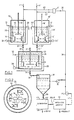
- a reactor vessel 10 has inlets 11 and 12 for introduction of a mixed carbonate and bicarbonate solution, and an aluminium salt solution, respectively.
- Each solution enters the reaction mixture 13 contained within the reaction vessel through an injection unit 14, as illustrated in more detail in Figures 3 and 4.
- Each unit comprises a delivery tube 16 connecting at its lower end with a header box 17 on which are disposed two divergent rows of nozzle pieces 18.
- each nozzle piece 18 comprises a tube of plastic or other inert material that tapers toward a capillary-sized orifice at the tip.
- each reactant solution there are two or more injection units for each reactant solution, with pairs of the injection units 14a for the aluminium chloride solution and 14b for the carbonate and bicarbonate solution being arranged diametrically opposite one another within the reactor vessel 10 and having their injection nozzles 18 positioned generally tangentially, so that a swirling motion is imparted to the reaction mixture 13.
- the reactor vessel 14 is provided with a conventional form of agitator 19 which is operated at medium rotational speeds in the sense conforming to the rotation of the vortex created by the injection units 14.
- At the bottom of the reactor vessel there is an outlet 21, and the rate of outflow of the reaction mixture is controllable by means of a valve 22.
- a overflow 23 At the upper end of the reactor vessel 10 is a overflow 23, and the inflow of reactants through the lines 11 and 12 is maintained slightly in excess of that leaving through the output line 21, so that a small outflow is maintained through the overflow 23, thereby maintaining an approximately constant level of reaction mixture within the reactor vessel 10.
- the injection units include radially orientated baffle plates 15 which are arranged radially so as to create turbulence within the reactor vessel, thus promoting homogeneous mixing of the contents of the reaction mixture.
- the reactor vessel 10 may first be filled wtih a mixture of carbonate and bicarbonate solutions in the desired proportions, and then, with the agitator 19 being operated under high mass transfer conditions, injection of the aluminium salt solution through the input line 12 and injection units 14a is commenced simultaneously with injection of a mixed carbonate and bicarbonate solution through the input lines 11 and injection units 14b, and outflow of reaction mixture at a corresponding flow rate is commenced through the output pipe 21.
- the injection of the solution through the injector units 14a and 14b is made with the solutions under positive pressure so that penetration of the reaction mixture 13 back into the capillary nozzle 18 is prevented.
- the aqueous aluminium solution consists of a solution of aluminium chloride.
- aluminium chloride is normally preferred, other aluminium salt solutions that will react with alkaline carbonate and bicarbonate, for example aluminium sulphate solution, can of course be employed.
- aluminium sulphate solution can be employed.
- One advantage of the process as illustrated in the drawings is that relatively high concentrations of aluminium salt solution can be employed, as, owing to the highly efficient mixing conditions that can be achieved in the continuous reactor 10, local concentrations of concentrated acid-reacting aluminium salt solution can be substantially avoided, whereby loss of carbonate anion through evolution of carbon dioxide is much reduced.
- solutions of up to about 33% by weight concentration may be employable.
- concentrations by weight of aluminium chloride solutions herein refer to the weight of aluminium chloride hexahydrate dissolved in the solution. However, owing to the restricted commercial availability of concentrated aluminium salt solutions, it may be more convenient to employ solutions of somewhat lesser concentration.
- the concentration of the solution is at least 10% by weight, based on the total weight of the solution, and in the preferred form an aluminium chloride solution of 20 to 30% by weight concentration (based on the weight of aluminium chloride hexahydrate) is employed.
- the aluminium salt solution may contain from about 0.4 to about 1.6 moles AI3+ ion per litre, more preferably from about 0.9 to about 1.4 moles A1 3+ ion per litre.
- the alkaline carbonate and bicarbonate solution comprises a solution of alkaline metal carbonate and bicarbonate although other water-soluble alkaline-reacting carbonate and bicarbonate solutions may be employed e.g. ammonium carbonate and ammonium bicarbonate. Because of their low cost and widespread availability, the use of sodium carbonate and sodium bicarbonate is preferred, although in the case of the production of specialized sodium-free gel products, a mixture of potassium carbonate and potassium bicarbonate may be employed instead.
- the alkaline solution fed through the inlet line 11 contains from about 2 to 6% by weight sodium carbonate, more preferably about 2.8% by weight, while the bicarbonate content ranges from about 3.0 to about 8% by weight, more preferably about 4.5% by weight.
- this alkaline solution should preferably contain from about 0.1 to about 0.6 moles C0 3 z - ion per litre and from about 0.2 to about 1.0 moles HCOg" ion per litre, more preferably from about 0.2 to about 0.3 moles CO 3 2 - ion per litre and from about 0.5 to about 0.6 moles HC0 3 - ion per litre.
- the volume of the reaction mixture 13 within the vessel 10 should be kept substantially constant and, in the example illustrated, this is ensured by feeding reactant in through lines 11 and 12 at a rate slightly higher than the outflow through line 21 and taking a small overflow over the weir 23.
- the reaction mixture within the reactor vessel 10 should be maintained as far as possible in a completely homogeneously state, so that there are no local concentrations of aluminium salt solution that may cause loss of carbonate anion through evolution of carbon dioxide.
- the reactor vessel 10 may be provided adjacent its outlet 22 with a pH-measuring probe 24, whereby the pH of the reaction mixture exiting from the reactor vessel may be monitored, and the rates of flow of the alkaline and acidic reactant solutions entering through the lines 11 and 12 may be adjusted so as to control the pH within a required range.
- the reaction mixture exiting through the output line 21 contains substantial quantities of particles of gel of relatively small size that cannot be readily separated from the reaction mixture using solids-liquids separator devices of the conventional type. Normally, the reaction mixture exiting through the line 21 will also contain substantial quantities of unreacted carbonate and bicarbonate.
- the ratio of the reactant liquids supplied to the reactor vessel 10 so that the pH of the reaction mixture exiting the reactor vessel 10 is slightly more alkaline than that required for optimum precipitation conditions, and to feed the mixture continuously to a subsequent reaction vessel comprising a precipitate ageing vessel 26, wherein the reaction mixture is maintained thoroughly agitated and in a substantially homogeneous condition by an agitator or stirrer 27, and the pH of the mixture is maintained at a relatively lower (more acidic) substantially constant value through controlled introduction of an aqueous acidic aluminium salt solution.
- Measurements of pH of the reaction mixture within the ageing vessel 26 is conducted using a pH measuring probe 28 adjacent the lower region of the vessel 26, from which an output is taken through an output line 29.
- Controlled additions of acidic aluminium salt solution are made to the ageing tank in accordance with the pH measurements obtained with the probe, so that the pH of the mixture in the vessel 26 is maintained at a substantially constant value.
- the acidic solution preferably is injected into the vessel 26 through an arrangement of injection units 31 similar to the units 14 employed in the reactor vessel 10. These injection units 31 are applied through a feed line 32, and provide for very rapid and efficient homogeneous dispersion of the aluminium salt solution throughout the body of reaction mixture 33 maintained within the vessel 26.
- the aluminium salt solution introduced in the ageing vessel may be any aqueous acid-reacting aluminium salt that is compatible with the reactants and that will react with unreacted carbonate and bicarbonate in the reaction mixture received from the reactor vessel, but usually it is more convenient to employ a solution of an aluminium salt the same as that introduced in the reactor vessel 10.
- the solution is, however, normally considerably more dilute than the solution employed in the reactor vessel 10, so that additions of relatively small quantities of the acidic-reacting substance can be made with precision.
- the acidic solution is an aqueous solution of aluminium chloride, this will preferably be a solution of about 5 to about 15% by weight concentration, (based on the weight of the hexahydrate) more preferably about 10% by weight concentration.
- the acidic solution preferably contains from about 0.2 to about 0.7 moles AI 3+ ion per litre, more preferably about 0.4 to about 0.5 moles AI 3+ ion per litre.
- the reaction mixture In the ageing vessel 26, it usually will be desired to maintain the reaction mixture at a substantially constant pH in the range of about 6.4 to about 6.8. In the case of the reaction between aluminium chloride solution and sodium carbonate and sodium bicarbonate solution, it is desirable to maintain the reaction mixture in the ageing tank at a substantially constant pH of about 6.5.
- the reaction mixture is maintained within the ageing tank 26 under substantially homogeneous conditions for an adequate residence time, sufficient to allow substantially complete reaction of the aluminium salt solution with the alkaline carbonate and bicarbonate solution, and to permit the gel particles to increase in size to a desired extent, permitting their more ready separation from the liquid phase of the reaction mixture at a subsequent stage.
- a continuous outflow of the reaction mixture is taken from the ageing vessel 26 through the outflow line 29 under the control of an adjustable valve 34.
- the reactant solutions are preferably pre-cooled before being introduced into the reactor vessel 10 and ageing vessel 26, and these vessels may be provided with thermally-insulative jackets 25 to reduce absorption of heat from the surroundings.
- the ageing vessel 26 may be maintained substantially full of the reaction mixture 33 at all times, as illustrated in Figure 1, or the vessel 26 may be provided with a weir overflow similar to the overflow 23 or 23' employed for the vessel 10 or 10', and the feed of reactant liquids to the vessel through the lines 21,21' and 32 may be arranged to be slightly greater than the output flow through the line 29, to ensure that a constant volume of liquid is maintained in the vessel 26.
- the reaction mixture exiting from the ageing vessel 26 Before subjecting the reaction mixture exiting from the ageing vessel 26 to a solids-liquids separation step to remove excess liquids, it is desirable to concentrate the solids content, and this can be performed by feeding the output from the ageing vessel 26 into a conventional form of thickener vessel 36 in which the slurry of the gel precipitate is allowed to settle slowly to the bottom and subsequently exit continuously through an underflow outlet pipe 37, under the control of a flow-controlling valve 38 to the separator unit.
- the overflow or supernatant liquid from the upper part of the thickener vessel 36 is withdrawn through a pump P1.
- This supernatant liquid contains small sized gel particles or micelles, and after adjusting the concentration with fresh raw materials, the supernatant liquid is recycled to the reactor vessel 10 along a line 39.
- the flow of recycled liquid may be divided at a flow dividing valve 41, and in the example shown in Figure 1, half the flow is returned to the reactor vessel 10 along line 42 and the other half is returned to reactor vessel 10' along the line 42'.
- the undersized gel particles thereby recycled to the reactor vessel 10 or 10' can coagulate to form larger gel particles which can be removed from the main body of the gel product during a subsequent settling step in the thickener vessels 36.
- the gel slurry withdrawn from the ageing tank along the line 29 normally contains excess unreacted carbonate anion, and this will also be recycled to the reactors 10 or 10' with the recycled stream along the line 42 and 42' for further reaction.
- the thickened gel precipitate slurry withdrawn from the thickener vessel 36 through line 37 is passed to a solids-liquids separator unit 43.
- a continuously-operating solids-liquids separator device is employed, and advantageously this is a continuous belt vacuum filter.
- the gel product is washed with water in a washing device 44, to yield the final gel product.
- the liquids separated at the separator device 43 and the washings from the washing device 44 are preferably also recycled to the reactors 10 and 10'.
- the liquid withdrawn from the separator device along a line 46 is passed to a line 47 and the liquid is pumped through pump P2 to the main recycle line 39.
- the functions of solid-liquids separation and washing can be combined in a single unit, for example a continuous belt vacuum filter equipped with a water spray washer that washes the filtered solids residue.
- any unreacted carbonate in the separated liquid and in the washings obtained from the washing device can be recycled to the reactors 10 and 10', together with any small-sized gel particles that pass over into the liquid phase at the solids-liquids separator.
- overflow weirs are used to control the levels in the reactor vessels 10 or 10' or in the ageing vessel 26, the small quantities of overflow liquids may be recycled to the reactors 10 or 10' along the recycling line 39.
- the washing step is so conducted as to yield in the solids residue a content of no more than about 0.5% by weight of the alkali metal cation based on the weight of the wet gel product, preferably no more than about 0.1% by weight.
- the reactor vessel 10 having a capacity of approximately 75 litres was first charged with 10 litres of mixed carbonate and bicarbonate solution (4.5% sodium bicarbonate and 2.8% sodium carbonate anhydrous). This is enough to well cover the blades of the stirrer 19. Introduction of AlCl 3 ⁇ 6H 2 0 (30%) solution and of the said mixed carbonate and bicarbonate solution was then commenced through the inlet lines 12 and 11, feeding these solutions through the 7 injection units 14a and 14b, respectively.
- the properties of the aluminium hydrocarbonate gel obtained following the procedure of the detailed Example were investigated.
- the acid consuming capacity was conducted in accordance with the procedure in U.S. Pharmacopeia, 19th rev. 1975 page 21.
- the acid neutralization properties of the gel product were determined by conducting the pH-stat titration described by Kerkhof et al, J. Pharm. Sci., Vol. 66, 1528 (1977). This pH stat titration determines the acid neutralization rate at a constant pH (pH 3.0) during the whole course of the reaction, and simulates the in vivo gastric acid neutralization reaction. The results were as shown in the following Table.
Landscapes
- Chemical & Material Sciences (AREA)
- Organic Chemistry (AREA)
- Life Sciences & Earth Sciences (AREA)
- Geology (AREA)
- Inorganic Chemistry (AREA)
- Compounds Of Alkaline-Earth Elements, Aluminum Or Rare-Earth Metals (AREA)
Description
- This invention relates to a process for the production of aluminium hydroxycarbonate gel.
- Aluminium hydroxide gel has been used as an effective antacid for decades, and has commonly been prepared by hydrolysis of aluminium salt solutions with an aqueous alkaline solution. It is known that, depending on the nature of the reactants, the gel product can contain various non-hydroxyl anions. In particular, it is known that by reacting an aqueous solution of an aluminium salt with an aqueous alkaline solution containing carbonate and bicarbonate anion, an aluminium hydroxide gel having especially good antacid properties can be obtained. This product has a polymeric aluminium hydroxide structure, with the carbonate anion being integrally incorporated into the polymeric structure, and is referred to as aluminium hydroxycarbonate gel.
- As far as the inventors are aware, in processes that have previously been employed on a commercial scale for production of aluminium hydroxycarbonate gel, relatively dilute reactant solutions have been employed, and these solutions have been introduced at somewhat slow rates of addition to reaction vessels wherein the reaction mixture is thoroughly agitated, in order to reduce as far as possible loss of carbonate anion through evolution of carbon dioxide as a result of reaction with local concentrations of the usually acid-reacting aluminium salt solution. As a result, large capacity reaction vessels have had to be employed in order to hold the large volumes of reaction solutions, and the rates of production of the gel product have not been very high.
- GB-1489400 discloses a process for the production of an aluminium hydroxycarbonate gel in which aqueous solutions of aluminium sulphate and of an alkaline metal bicarbonate and/or alkaline metal carbonate are allowed to flow simutaneously into water, while maintaining a pH value of 6.8 to 7.8, the pH value of the reaction mixture, after completion of the precipitation, being adjusted to 5.5 to 6.5 with an aluminium salt which has an acid reaction in aqueous solution due to hydrolysis, the adjusted value remaining constant for two hours and the pH value not increasing above 7 over the course of fifteen hours, the precipitated product, after standing for at least fifteen hours, being filtered off, washed and dried.
- According to the present invention there is provided a process for the continuous production of an aluminium hydroxycarbonate gel by reacting an aqueous solution of an aluminium salt with an aqueous alkaline solution which contains carbonate and bicarbonate anions and which undergoes reaction with the aluminium salt to precipitate therefrom an aluminium hydroxycarbonate gel; the process comprising:
- (i) continuously introducing the reactant solutions into an initial reaction vessel in which the gel-forming reaction takes place;
- (ii) vigorously agitating the reaction mixture so as to maintain the reactants and the gel precipitate formed therefrom substantially homogeneously distributed throughout the initial reaction vessel, wherein the reaction mixture in the initial reaction vessel is mainained at a pH of from 6.5 to 7.0, by controlled addition of an aqueous solution of an aluminium salt and alkaline solution;
- (iii) continuously withdrawing, from the initial reaction vessel, an output stream of the reaction mixture containing aluminium hydroxycarbonate gel:
- (iv) passing the withdrawn reaction mixture to a subsequent reaction vessel, wherein the reaction mixture is maintained at a pH lower, i.e., more acidic, relative to the pH of the initial reaction vessel by controlled additions of an aqueous acidic solution of an aluminium salt under vigorous agitation; and
- (v) permitting the gel-forming reaction to proceed in the subsequent reaction vessel.
- With this process, as there is continuous introduction of reactants and continuous withdrawal of reaction mixture, this permits the use of a relatively small reactor vessel in which the average residence time of the reactants can be quite brief, and within this small volume of reaction mixture, efficient mixing of the reactants can be more readily achieved, so that the reaction mixture can be made highly homogeneous. It is considered that highly homogeneous precipitation conditions promote the formation of a gel product having good antacid properties. The present process moreover permits the use of 'relatively high concentrations of the reactant solutions, especially of the aluminium salt solution, without undue loss of carbonate anion, and greater yields of the gel product can be obtained.
- In the preferred form, at least one of, and more preferably both of, the reactant solutions are injected under pressure into the reactor vessel from injection points located below the surface of the reaction mixture. The reactants can be injected through fine-sized, divergently-arranged nozzles or in some other manner that causes the injected reactant solution to be rapidly dispersed within the reaction mixture. Injection of the reactants allow for very rapid mixing of the reactant liquids to yield a homogeneous reaction mixture.
- Normally, it is desired to conduct the precipitation reaction at a particular pH selected to so control the hydrolysis reaction as to yield gel precipitate particles of large size, and to promote the incorporation of the carbonate anion into the polymeric structure. As the rates of inflow of reactants into the reactor vessel will usually be high, it can be difficult to avoid variations in the pH of the reaction mixture as a result of small variations in the rates of inflow or in the concentrations of the respective reactant solutions and, as noted above, there is a risk that local concentrations of acid-reacting aluminium salt solution may cause loss of carbonate anion through evolution of carbon dioxide. Moreover, owing to the short residence time in.the reactor vessel, many of the gel particles in the reaction mixture will not have grown to a particle size that permits them to be readily filtered off from the reaction mixture.
- The reaction mixture in the initial reactor vessel is maintained at a relatively high (more alkaline) pH and the output stream from the initial reactor vessel is continuously fed to a subsequent reaction vessel of relatively larger capacity wherein the reaction mixture resides for a period permitting growth of the particles of precipitated gel, whereby separation of the particles of gel from the liquid phase is facilitated, the mixture being maintained in said ageing vessel at substantially constant relatively lower (more acidic) pH through controlled additions of an aqueous acidic solution of an aluminium salt and being vigorously agitated so as to maintain the reaction mixture in a substantially homogeneous condition, a continuous stream of reaction mixture containing gel particles of increased size being withdrawn from said subsequent reaction vessel.
- Since, even after residence in a subsequent reaction or ageing vessel, the reaction mixture may contain numerous gel particles or micelles that cannot readily be separated from the reaction mixture using the usual kinds of the solid-liquid separator devices, it is advantageous to conduct the process in such manner that, after the gel-forming reaction is substantially complete, the gel is permitted to separate from the reaction mixture to form a gel precipitate phase and a supernatant phase containing small suspended particles of aluminium hydroxycarbonate gel, and the supernatant phase is withdrawn and recycled to the reactor vessel. Similarly, the filtrate recovered in subsequent gel-filtering steps, and any aqueous washings recovered in subsequent procedures for washing the gel product to reduce its content of water-soluble impurities, may also be recycled to the reactor vessel. In this manner, the efficiency of the reaction is improved as small sized gel particles are thereby cycled round the system until they attain sufficient particle size to be separated off and recovered with the main body of the gel product, and, moreover, unreacted aluminium salt and/or carbonate and bicarbonate solutions can be returned to the reaction system.
- The present invention will now be more fully described, by way of example only, with reference to the accompanying drawings, wherein:
- Figure 1 shows partly schematically, and partly in vertical section, one form of apparatus for use in carrying out the method of the invention;
- Figure 2 shows a horizontal cross-section through a reactor vessel employed in the apparatus of Figure 1;
- Figure 3 shows a perspective view of an injection unit employed in the reactor vessels of Figure 1; and
- Figure 4 shows a plan view of the injection unit of Figure 3.
- Referring to the drawings, wherein like reference numerals indicate like parts, in Figure 1, a
reactor vessel 10 hasinlets 11 and 12 for introduction of a mixed carbonate and bicarbonate solution, and an aluminium salt solution, respectively. Each solution enters thereaction mixture 13 contained within the reaction vessel through aninjection unit 14, as illustrated in more detail in Figures 3 and 4. Each unit comprises adelivery tube 16 connecting at its lower end with aheader box 17 on which are disposed two divergent rows ofnozzle pieces 18. Preferably eachnozzle piece 18 comprises a tube of plastic or other inert material that tapers toward a capillary-sized orifice at the tip. In the preferred form, as illustrated in Figure 2, there are two or more injection units for each reactant solution, with pairs of theinjection units 14a for the aluminium chloride solution and 14b for the carbonate and bicarbonate solution being arranged diametrically opposite one another within thereactor vessel 10 and having theirinjection nozzles 18 positioned generally tangentially, so that a swirling motion is imparted to thereaction mixture 13. Thereactor vessel 14 is provided with a conventional form ofagitator 19 which is operated at medium rotational speeds in the sense conforming to the rotation of the vortex created by theinjection units 14. At the bottom of the reactor vessel there is anoutlet 21, and the rate of outflow of the reaction mixture is controllable by means of avalve 22. At the upper end of thereactor vessel 10 is aoverflow 23, and the inflow of reactants through thelines 11 and 12 is maintained slightly in excess of that leaving through theoutput line 21, so that a small outflow is maintained through theoverflow 23, thereby maintaining an approximately constant level of reaction mixture within thereactor vessel 10. - As can be seen from Figure 3, in the preferred arrangement the injection units include radially orientated
baffle plates 15 which are arranged radially so as to create turbulence within the reactor vessel, thus promoting homogeneous mixing of the contents of the reaction mixture. - On start-up of the process, the
reactor vessel 10 may first be filled wtih a mixture of carbonate and bicarbonate solutions in the desired proportions, and then, with theagitator 19 being operated under high mass transfer conditions, injection of the aluminium salt solution through theinput line 12 andinjection units 14a is commenced simultaneously with injection of a mixed carbonate and bicarbonate solution through the input lines 11 andinjection units 14b, and outflow of reaction mixture at a corresponding flow rate is commenced through theoutput pipe 21. The injection of the solution through theinjector units reaction mixture 13 back into thecapillary nozzle 18 is prevented. - In the preferred form, the aqueous aluminium solution consists of a solution of aluminium chloride. Although aluminium chloride is normally preferred, other aluminium salt solutions that will react with alkaline carbonate and bicarbonate, for example aluminium sulphate solution, can of course be employed. One advantage of the process as illustrated in the drawings is that relatively high concentrations of aluminium salt solution can be employed, as, owing to the highly efficient mixing conditions that can be achieved in the
continuous reactor 10, local concentrations of concentrated acid-reacting aluminium salt solution can be substantially avoided, whereby loss of carbonate anion through evolution of carbon dioxide is much reduced. For example, in the case of aluminium chloride solution, solutions of up to about 33% by weight concentration may be employable. All concentrations by weight of aluminium chloride solutions herein refer to the weight of aluminium chloride hexahydrate dissolved in the solution. However, owing to the restricted commercial availability of concentrated aluminium salt solutions, it may be more convenient to employ solutions of somewhat lesser concentration. Preferably, the concentration of the solution is at least 10% by weight, based on the total weight of the solution, and in the preferred form an aluminium chloride solution of 20 to 30% by weight concentration (based on the weight of aluminium chloride hexahydrate) is employed. More generally, the aluminium salt solution may contain from about 0.4 to about 1.6 moles AI3+ ion per litre, more preferably from about 0.9 to about 1.4 moles A13+ ion per litre. - In the preferred process, the alkaline carbonate and bicarbonate solution comprises a solution of alkaline metal carbonate and bicarbonate although other water-soluble alkaline-reacting carbonate and bicarbonate solutions may be employed e.g. ammonium carbonate and ammonium bicarbonate. Because of their low cost and widespread availability, the use of sodium carbonate and sodium bicarbonate is preferred, although in the case of the production of specialized sodium-free gel products, a mixture of potassium carbonate and potassium bicarbonate may be employed instead.
- Preferably, the alkaline solution fed through the inlet line 11 contains from about 2 to 6% by weight sodium carbonate, more preferably about 2.8% by weight, while the bicarbonate content ranges from about 3.0 to about 8% by weight, more preferably about 4.5% by weight. In more general terms, this alkaline solution should preferably contain from about 0.1 to about 0.6 moles C03 z- ion per litre and from about 0.2 to about 1.0 moles HCOg" ion per litre, more preferably from about 0.2 to about 0.3 moles CO3 2- ion per litre and from about 0.5 to about 0.6 moles HC03- ion per litre.
- In order to conduct the mixing of the reactant liquids efficiently within the
reactor vessel 10, the volume of thereaction mixture 13 within thevessel 10 should be kept substantially constant and, in the example illustrated, this is ensured by feeding reactant in throughlines 11 and 12 at a rate slightly higher than the outflow throughline 21 and taking a small overflow over theweir 23. Under the above described reaction conditions, the reaction mixture within thereactor vessel 10 should be maintained as far as possible in a completely homogeneously state, so that there are no local concentrations of aluminium salt solution that may cause loss of carbonate anion through evolution of carbon dioxide. Normally, it is desirable to maintain the contents of the reaction vessel at as far as possible a selected pH which has been determined to promote precipitation of the aluminium hydroxide gel to form good-sized gel particles, with satisfactory incorporation of carbonate anion into the hydroxide gel structure. In the case of reaction of aluminium chloride solution with sodium carbonate and bicarbonate, it is desirable to conduct the precipitation at about pH 6.5. Thereactor vessel 10 may be provided adjacent itsoutlet 22 with a pH-measuring probe 24, whereby the pH of the reaction mixture exiting from the reactor vessel may be monitored, and the rates of flow of the alkaline and acidic reactant solutions entering through thelines 11 and 12 may be adjusted so as to control the pH within a required range. - Owing to the high flow rates of the reactant solutions that are fed into the
reactor vessel 10, and because it is difficult to avoid small fluctuations in these flow rates or in the concentrations of the respective reactant solutions, it is difficult to control the pH of the reaction mixture within thereactor vessel 10 closely, and moreover, as the residence time of the reaction mixture in thereactor 10 is relatively brief, the reaction mixture exiting through theoutput line 21 contains substantial quantities of particles of gel of relatively small size that cannot be readily separated from the reaction mixture using solids-liquids separator devices of the conventional type. Normally, the reaction mixture exiting through theline 21 will also contain substantial quantities of unreacted carbonate and bicarbonate. In order to permit growth of the gel particles within the reaction mixture to a larger particle size that renders them more separable from the liquid phase, and also to permit continued reaction of unreacted materials under more closely controlled conditions of pH, it is preferred to adjust the ratio of the reactant liquids supplied to thereactor vessel 10 so that the pH of the reaction mixture exiting thereactor vessel 10 is slightly more alkaline than that required for optimum precipitation conditions, and to feed the mixture continuously to a subsequent reaction vessel comprising aprecipitate ageing vessel 26, wherein the reaction mixture is maintained thoroughly agitated and in a substantially homogeneous condition by an agitator or stirrer 27, and the pH of the mixture is maintained at a relatively lower (more acidic) substantially constant value through controlled introduction of an aqueous acidic aluminium salt solution. Measurements of pH of the reaction mixture within theageing vessel 26 is conducted using a pH measuringprobe 28 adjacent the lower region of thevessel 26, from which an output is taken through anoutput line 29. - Controlled additions of acidic aluminium salt solution are made to the ageing tank in accordance with the pH measurements obtained with the probe, so that the pH of the mixture in the
vessel 26 is maintained at a substantially constant value. The acidic solution preferably is injected into thevessel 26 through an arrangement ofinjection units 31 similar to theunits 14 employed in thereactor vessel 10. Theseinjection units 31 are applied through afeed line 32, and provide for very rapid and efficient homogeneous dispersion of the aluminium salt solution throughout the body ofreaction mixture 33 maintained within thevessel 26. - The aluminium salt solution introduced in the ageing vessel may be any aqueous acid-reacting aluminium salt that is compatible with the reactants and that will react with unreacted carbonate and bicarbonate in the reaction mixture received from the reactor vessel, but usually it is more convenient to employ a solution of an aluminium salt the same as that introduced in the
reactor vessel 10. The solution is, however, normally considerably more dilute than the solution employed in thereactor vessel 10, so that additions of relatively small quantities of the acidic-reacting substance can be made with precision. In the case where the acidic solution is an aqueous solution of aluminium chloride, this will preferably be a solution of about 5 to about 15% by weight concentration, (based on the weight of the hexahydrate) more preferably about 10% by weight concentration. More generally, the acidic solution preferably contains from about 0.2 to about 0.7 moles AI3+ ion per litre, more preferably about 0.4 to about 0.5 moles AI3+ ion per litre. - In the ageing
vessel 26, it usually will be desired to maintain the reaction mixture at a substantially constant pH in the range of about 6.4 to about 6.8. In the case of the reaction between aluminium chloride solution and sodium carbonate and sodium bicarbonate solution, it is desirable to maintain the reaction mixture in the ageing tank at a substantially constant pH of about 6.5. The reaction mixture is maintained within the ageingtank 26 under substantially homogeneous conditions for an adequate residence time, sufficient to allow substantially complete reaction of the aluminium salt solution with the alkaline carbonate and bicarbonate solution, and to permit the gel particles to increase in size to a desired extent, permitting their more ready separation from the liquid phase of the reaction mixture at a subsequent stage. A continuous outflow of the reaction mixture is taken from the ageingvessel 26 through theoutflow line 29 under the control of anadjustable valve 34. - In order to avoid impairing the antacid properties of the gel product, it is desirable to conduct the gel-forming reaction at below ambient temperatures, typically in the range of about 0°C to 5°C. For this purpose, the reactant solutions are preferably pre-cooled before being introduced into the
reactor vessel 10 and ageingvessel 26, and these vessels may be provided with thermally-insulative jackets 25 to reduce absorption of heat from the surroundings. - In order to increase the throughput of materials while still retaining the capability to conduct a thorough and efficient mixing and homogenisation of the reactant solutions in a relative small reactor vessel, it may be desired to employ two or more reactor vessels feeding into the ageing
vessel 26. In Figure 1, a second reactor vessel 10' is empoyed, feeding into the ageing vessel through an outlet line 21'. The construction and operation of the second reactor vessel 10' is in all respects similarto that described above for thereactor 10. - The ageing
vessel 26 may be maintained substantially full of thereaction mixture 33 at all times, as illustrated in Figure 1, or thevessel 26 may be provided with a weir overflow similar to theoverflow 23 or 23' employed for thevessel 10 or 10', and the feed of reactant liquids to the vessel through thelines line 29, to ensure that a constant volume of liquid is maintained in thevessel 26. - Before subjecting the reaction mixture exiting from the ageing
vessel 26 to a solids-liquids separation step to remove excess liquids, it is desirable to concentrate the solids content, and this can be performed by feeding the output from the ageingvessel 26 into a conventional form ofthickener vessel 36 in which the slurry of the gel precipitate is allowed to settle slowly to the bottom and subsequently exit continuously through anunderflow outlet pipe 37, under the control of a flow-controllingvalve 38 to the separator unit. The overflow or supernatant liquid from the upper part of thethickener vessel 36 is withdrawn through a pump P1. This supernatant liquid contains small sized gel particles or micelles, and after adjusting the concentration with fresh raw materials, the supernatant liquid is recycled to thereactor vessel 10 along aline 39. Where two or more reactor vessels are employed, the flow of recycled liquid may be divided at aflow dividing valve 41, and in the example shown in Figure 1, half the flow is returned to thereactor vessel 10 alongline 42 and the other half is returned to reactor vessel 10' along the line 42'. The undersized gel particles thereby recycled to thereactor vessel 10 or 10' can coagulate to form larger gel particles which can be removed from the main body of the gel product during a subsequent settling step in thethickener vessels 36. - When the process is operated in accordance with the preferred procedure as described above, the gel slurry withdrawn from the ageing tank along the
line 29 normally contains excess unreacted carbonate anion, and this will also be recycled to thereactors 10 or 10' with the recycled stream along theline 42 and 42' for further reaction. - The thickened gel precipitate slurry withdrawn from the
thickener vessel 36 throughline 37 is passed to a solids-liquids separator unit 43. Preferably, a continuously-operating solids-liquids separator device is employed, and advantageously this is a continuous belt vacuum filter. In order to reduce the content of water-soluble impurities in the product, especially the content of sodium or potassium salts where sodium or potassium carbonate and bicarbonate are employed as the alkaline-reacting carbonate and bicarbonate solution, the gel product is washed with water in awashing device 44, to yield the final gel product. The liquids separated at theseparator device 43 and the washings from thewashing device 44 are preferably also recycled to thereactors 10 and 10'. In the example shown in Figure 1, therefore, the liquid withdrawn from the separator device along aline 46 is passed to aline 47 and the liquid is pumped through pump P2 to themain recycle line 39. Conveniently, the functions of solid-liquids separation and washing can be combined in a single unit, for example a continuous belt vacuum filter equipped with a water spray washer that washes the filtered solids residue. In this manner, any unreacted carbonate in the separated liquid and in the washings obtained from the washing device can be recycled to thereactors 10 and 10', together with any small-sized gel particles that pass over into the liquid phase at the solids-liquids separator. Where overflow weirs are used to control the levels in thereactor vessels 10 or 10' or in the ageingvessel 26, the small quantities of overflow liquids may be recycled to thereactors 10 or 10' along therecycling line 39. - Preferably, where an alkali metal carbonate and bicarbonate solution are employed as the alkaline-reacting carbonate and bicarbonate reactants, the washing step is so conducted as to yield in the solids residue a content of no more than about 0.5% by weight of the alkali metal cation based on the weight of the wet gel product, preferably no more than about 0.1% by weight.
- Although the above disclosure taken in conjunction with the accompanying drawings provides ample ) information to one skilled in the art to permit the production of an aluminium hydroxy-carbonate gel, for the avoidance of doubt a detailed example of one form of gel-forming process in accordance with the invention will now be given.
- ; Employing the apparatus as illustrated in Figure 1, the
reactor vessel 10 having a capacity of approximately 75 litres was first charged with 10 litres of mixed carbonate and bicarbonate solution (4.5% sodium bicarbonate and 2.8% sodium carbonate anhydrous). This is enough to well cover the blades of thestirrer 19. Introduction of AlCl3 · 6H20 (30%) solution and of the said mixed carbonate and bicarbonate solution was then commenced through the inlet lines 12 and 11, feeding these solutions through the 7injection units reaction mixture 13 in thereactor vessel 10 remained between 6.6 and 7.0. The two solutions were pre-cooled to 2 to 3°C before being introduced into thereactor vessel 10, so that the temperature of the ; solutions in thereactor vessel 10 and in the ageingvessel 26 was kept below 5°C. - Once the volume of the reaction mixture in the
reactor vessel 10 exceeded approximately 50 litres, continuous discharge of the reaction mixture into the ageing vessel 26 (of capacity 125 litres) was commenced, where the pH was maintained at 6.5 by continual additions of 10% AICI3. 6H20 solution, about 15 litres being added, through theinjectors 31, over the whole period of the run. - With the ageing
vessel 26 full of liquid, discharge of liquid was commenced into thethickener 36 where the solids content of the underflowing slurry was concentrated to over 30% by weight. The underflow was filtered by a vacuum drum filter and the wet cake was then thoroughly washed to remove the undesirables (chiefly sodium chloride), using approximately 35 volumes of water per volume of gel. The mother liquor in thethickener 36 and some filtrate were transferred to a storage tank (500 litres) the concentration of which was adjusted with saturated solutions of sodium carbonate and sodium bicarbonate. This mixture of carbonates was used for further reaction. The total yield of the washed aluminium hydroxycarbonate gel was 29.5 kg (11.6% AI203 content). - The properties of the aluminium hydrocarbonate gel obtained following the procedure of the detailed Example were investigated. The acid consuming capacity was conducted in accordance with the procedure in U.S. Pharmacopeia, 19th rev. 1975
page 21. The acid neutralization properties of the gel product were determined by conducting the pH-stat titration described by Kerkhof et al, J. Pharm. Sci., Vol. 66, 1528 (1977). This pH stat titration determines the acid neutralization rate at a constant pH (pH 3.0) during the whole course of the reaction, and simulates the in vivo gastric acid neutralization reaction. The results were as shown in the following Table.
- *ACP, acid consuming capacity, is the number of milliliters of 0.1 N Hydrochloric acid required to neutralize one gram of gel containing 4% A1203 at pH 3.5.
- **T50, T90, T100 are the times in min. required to add 50, 90, 100% respectively of the total 1.ON HCl needed to neutralize the aluminum hydroxide gel present maintaining the pH of the mixture at 3.0 throughout.
Claims (28)
Priority Applications (2)
| Application Number | Priority Date | Filing Date | Title |
|---|---|---|---|
| DE8383300103T DE3379501D1 (en) | 1983-01-10 | 1983-01-10 | ALUMINUM HYDROXYCARBONATE GEL |
| EP83300103A EP0113493B1 (en) | 1983-01-10 | 1983-01-10 | Aluminium hydroxycarbonate gel |
Applications Claiming Priority (1)
| Application Number | Priority Date | Filing Date | Title |
|---|---|---|---|
| EP83300103A EP0113493B1 (en) | 1983-01-10 | 1983-01-10 | Aluminium hydroxycarbonate gel |
Publications (2)
| Publication Number | Publication Date |
|---|---|
| EP0113493A1 EP0113493A1 (en) | 1984-07-18 |
| EP0113493B1 true EP0113493B1 (en) | 1989-03-29 |
Family
ID=8191027
Family Applications (1)
| Application Number | Title | Priority Date | Filing Date |
|---|---|---|---|
| EP83300103A Expired EP0113493B1 (en) | 1983-01-10 | 1983-01-10 | Aluminium hydroxycarbonate gel |
Country Status (2)
| Country | Link |
|---|---|
| EP (1) | EP0113493B1 (en) |
| DE (1) | DE3379501D1 (en) |
Family Cites Families (5)
| Publication number | Priority date | Publication date | Assignee | Title |
|---|---|---|---|---|
| US3115387A (en) * | 1958-02-06 | 1963-12-24 | Warner Lambert Pharmaceutical | Molecularly dehydrated aluminum hydroxide derivatives |
| US3501264A (en) * | 1967-08-25 | 1970-03-17 | Grace W R & Co | Glassy alkalized alumina |
| US3911090A (en) * | 1973-05-14 | 1975-10-07 | Purdue Research Foundation | Aluminum hydroxy carbonates nucleated with silicate anion |
| DE2421703C3 (en) * | 1974-05-04 | 1982-05-19 | Dr. Madaus & Co, 5000 Köln | Process for the production of basic aluminum oxicarbonate hydrate |
| GB2072636B (en) * | 1980-03-28 | 1983-07-27 | Nicholas Pty Ltd | Preparation of dihydroxyaluminium sodium carbonate |
-
1983
- 1983-01-10 DE DE8383300103T patent/DE3379501D1/en not_active Expired
- 1983-01-10 EP EP83300103A patent/EP0113493B1/en not_active Expired
Also Published As
| Publication number | Publication date |
|---|---|
| DE3379501D1 (en) | 1989-05-03 |
| EP0113493A1 (en) | 1984-07-18 |
Similar Documents
| Publication | Publication Date | Title |
|---|---|---|
| CA1098284A (en) | Method of and apparatus for extracting alumina from bauxite | |
| US4780303A (en) | Continuous process for the preparation of high strength sodium hypochlorite solutions | |
| FI83426B (en) | FOERFARANDE FOER KONTINUERLIG FRAMSTAELLNING AV MICROCRYSTALLINE KITOSAN. | |
| US4252776A (en) | Aluminum dross processing | |
| US4049773A (en) | Process for precipitation of aluminum hydroxide from aluminate solution | |
| US2642426A (en) | Method of producing ihygopbotein | |
| US4094771A (en) | Process for preparation of a sprayable precipitated silicic acid suspension | |
| US4495087A (en) | Preparation of aluminum hydroxycarbonate gels by a continuous process | |
| US4622167A (en) | Low viscosity aluminum hydroxy carbonate gel process | |
| US5175322A (en) | Continuous process for preparing metallic soaps | |
| US4320098A (en) | Aluminum sulfate manufacture from aluminum dross tailings | |
| CA1082883A (en) | Method for removing ferrous iron from alkali metal aluminate liquor | |
| EP0846486B1 (en) | Process for reducing or avoiding foam generation in chemical or physical substance converting processes and device for its realization | |
| CA1154932A (en) | Preparation of aluminum hydroxycarbonate gel | |
| US2089339A (en) | Method of manufacturing magnesium hydroxide | |
| EP0122349A2 (en) | A process for producing aluminium hydroxycarbonate gel | |
| EP0113493A1 (en) | Aluminium hydroxycarbonate gel | |
| EP0018339B1 (en) | A method of producing an aluminium-sulphate solution | |
| EP4724162A1 (en) | Device for producing lithium carbonate crystals | |
| US3025136A (en) | Method for continuous production of a basic cupric sulfate | |
| GB2219994A (en) | Apparatus for preparing uranium tetrafluoride | |
| US3271117A (en) | Apparatus for recovery of magnesium values | |
| JPH0331643B2 (en) | ||
| EP0277422B1 (en) | Chemical treatment of liquors | |
| US2573616A (en) | Methods of extracting magnesia from aqueous solution containing magnesium salts decomposable by lime and alkalies |
Legal Events
| Date | Code | Title | Description |
|---|---|---|---|
| PUAI | Public reference made under article 153(3) epc to a published international application that has entered the european phase |
Free format text: ORIGINAL CODE: 0009012 |
|
| AK | Designated contracting states |
Designated state(s): BE DE FR GB IT |
|
| 17P | Request for examination filed |
Effective date: 19841210 |
|
| 17Q | First examination report despatched |
Effective date: 19860728 |
|
| ITF | It: translation for a ep patent filed | ||
| GRAA | (expected) grant |
Free format text: ORIGINAL CODE: 0009210 |
|
| AK | Designated contracting states |
Kind code of ref document: B1 Designated state(s): BE DE FR GB IT |
|
| REF | Corresponds to: |
Ref document number: 3379501 Country of ref document: DE Date of ref document: 19890503 |
|
| ET | Fr: translation filed | ||
| PLBE | No opposition filed within time limit |
Free format text: ORIGINAL CODE: 0009261 |
|
| STAA | Information on the status of an ep patent application or granted ep patent |
Free format text: STATUS: NO OPPOSITION FILED WITHIN TIME LIMIT |
|
| 26N | No opposition filed | ||
| PGFP | Annual fee paid to national office [announced via postgrant information from national office to epo] |
Ref country code: FR Payment date: 19911227 Year of fee payment: 10 |
|
| PGFP | Annual fee paid to national office [announced via postgrant information from national office to epo] |
Ref country code: GB Payment date: 19911231 Year of fee payment: 10 |
|
| PGFP | Annual fee paid to national office [announced via postgrant information from national office to epo] |
Ref country code: DE Payment date: 19920129 Year of fee payment: 10 |
|
| ITTA | It: last paid annual fee | ||
| PGFP | Annual fee paid to national office [announced via postgrant information from national office to epo] |
Ref country code: BE Payment date: 19920207 Year of fee payment: 10 |
|
| PG25 | Lapsed in a contracting state [announced via postgrant information from national office to epo] |
Ref country code: GB Effective date: 19930110 |
|
| PG25 | Lapsed in a contracting state [announced via postgrant information from national office to epo] |
Ref country code: BE Effective date: 19930131 |
|
| BERE | Be: lapsed |
Owner name: WARNER-LAMBERT CANADA INC. Effective date: 19930131 |
|
| GBPC | Gb: european patent ceased through non-payment of renewal fee |
Effective date: 19930110 |
|
| PG25 | Lapsed in a contracting state [announced via postgrant information from national office to epo] |
Ref country code: FR Effective date: 19930930 |
|
| PG25 | Lapsed in a contracting state [announced via postgrant information from national office to epo] |
Ref country code: DE Effective date: 19931001 |
|
| REG | Reference to a national code |
Ref country code: FR Ref legal event code: ST |