EP0113159B1 - Zinc-bromine battery and operation thereof - Google Patents
Zinc-bromine battery and operation thereof Download PDFInfo
- Publication number
- EP0113159B1 EP0113159B1 EP83304040A EP83304040A EP0113159B1 EP 0113159 B1 EP0113159 B1 EP 0113159B1 EP 83304040 A EP83304040 A EP 83304040A EP 83304040 A EP83304040 A EP 83304040A EP 0113159 B1 EP0113159 B1 EP 0113159B1
- Authority
- EP
- European Patent Office
- Prior art keywords
- zinc
- bromine
- catalyst
- hydrogen
- battery
- Prior art date
- Legal status (The legal status is an assumption and is not a legal conclusion. Google has not performed a legal analysis and makes no representation as to the accuracy of the status listed.)
- Expired
Links
Images
Classifications
-
- H—ELECTRICITY
- H01—ELECTRIC ELEMENTS
- H01M—PROCESSES OR MEANS, e.g. BATTERIES, FOR THE DIRECT CONVERSION OF CHEMICAL ENERGY INTO ELECTRICAL ENERGY
- H01M10/00—Secondary cells; Manufacture thereof
- H01M10/36—Accumulators not provided for in groups H01M10/05-H01M10/34
- H01M10/365—Zinc-halogen accumulators
-
- H—ELECTRICITY
- H01—ELECTRIC ELEMENTS
- H01M—PROCESSES OR MEANS, e.g. BATTERIES, FOR THE DIRECT CONVERSION OF CHEMICAL ENERGY INTO ELECTRICAL ENERGY
- H01M10/00—Secondary cells; Manufacture thereof
- H01M10/42—Methods or arrangements for servicing or maintenance of secondary cells or secondary half-cells
- H01M10/52—Removing gases inside the secondary cell, e.g. by absorption
-
- Y—GENERAL TAGGING OF NEW TECHNOLOGICAL DEVELOPMENTS; GENERAL TAGGING OF CROSS-SECTIONAL TECHNOLOGIES SPANNING OVER SEVERAL SECTIONS OF THE IPC; TECHNICAL SUBJECTS COVERED BY FORMER USPC CROSS-REFERENCE ART COLLECTIONS [XRACs] AND DIGESTS
- Y02—TECHNOLOGIES OR APPLICATIONS FOR MITIGATION OR ADAPTATION AGAINST CLIMATE CHANGE
- Y02E—REDUCTION OF GREENHOUSE GAS [GHG] EMISSIONS, RELATED TO ENERGY GENERATION, TRANSMISSION OR DISTRIBUTION
- Y02E60/00—Enabling technologies; Technologies with a potential or indirect contribution to GHG emissions mitigation
- Y02E60/10—Energy storage using batteries
-
- Y—GENERAL TAGGING OF NEW TECHNOLOGICAL DEVELOPMENTS; GENERAL TAGGING OF CROSS-SECTIONAL TECHNOLOGIES SPANNING OVER SEVERAL SECTIONS OF THE IPC; TECHNICAL SUBJECTS COVERED BY FORMER USPC CROSS-REFERENCE ART COLLECTIONS [XRACs] AND DIGESTS
- Y02—TECHNOLOGIES OR APPLICATIONS FOR MITIGATION OR ADAPTATION AGAINST CLIMATE CHANGE
- Y02E—REDUCTION OF GREENHOUSE GAS [GHG] EMISSIONS, RELATED TO ENERGY GENERATION, TRANSMISSION OR DISTRIBUTION
- Y02E60/00—Enabling technologies; Technologies with a potential or indirect contribution to GHG emissions mitigation
- Y02E60/30—Hydrogen technology
- Y02E60/50—Fuel cells
Definitions
- US-A-4,113,924 describes an electrochemical zinc-halogen cell, in which decomposition gaseous hydrogen is consumed by use of a charged auxiliary electrode.
Landscapes
- Engineering & Computer Science (AREA)
- Manufacturing & Machinery (AREA)
- Chemical & Material Sciences (AREA)
- Chemical Kinetics & Catalysis (AREA)
- Electrochemistry (AREA)
- General Chemical & Material Sciences (AREA)
- Hybrid Cells (AREA)
- Catalysts (AREA)
- Micro-Organisms Or Cultivation Processes Thereof (AREA)
- Secondary Cells (AREA)
Abstract
Description
- This invention pertains to zinc-bromine battery systems, and more particularly to a method and apparatus for maintaining the pH value of zinc-bromine batteries.
- The zinc-bromine battery has recently attracted much attention as a viable system for the future. The basic zinc bromine battery system is shown in a patent to A. Venero, Patent No. 4,105,829 issued August 8, 1978.
- The zinc-bromine system comprises series of cells which are provided with circulating electrolyte. The electrolyte is stored in a reservoir when the battery system is quiescent.
- During the operation of the zinc-bromine battery, small quantities of hydrogen are produced. This decomposition hydrogen acts to increase the pH of the system, which eventually leads to the formation of zinc oxide/hydroxide solids. These solids interfere with the performance of the battery, such that it becomes desirable to prevent this from ocurring.
- The present invention consumes'the formed hydrogen by reacting it with bromine to form acid before it can form the aforementioned solids. This prevents the pH from rising and forming the undesirable zinc oxide/hydroxide solids.
- US-A-4,113,924 describes an electrochemical zinc-halogen cell, in which decomposition gaseous hydrogen is consumed by use of a charged auxiliary electrode.
- The above-mentioned battery has several drawbacks, one of which is that the auxiliary electrode device will only work to a substantial degree in a sealed system, wherein there is sufficient hydrogen build-up, such that the hydrogen surrounds the electrode.
- Such an auxiliary electrode device is closely cupped to and near the power electrodes in a cell. This would not be efficient in a circulating system, wherein the decomposition hydrogen is carried by the circulating electrolytes throughout the system to the gas space of the system in a thinly veiled manner.
- FR-A-2,403,593 specifically discloses a method of operating a zinc chloride secondary battery in which the pH of the electrolyte is controlled. The method comprises converting at least a portion of hydrogen generated in association with chlorine during battery charging into hydrogen chloride and dissolving at least some of the hydrogen chloride in the electrolyte. The reaction may be catalysed; ultraviolet light being the catalytic means named. The disclosure states, without detail, that the hydrogen could be combined with bromine; and also states, without detail, that ultraviolet light is not the only usable catalyt means.
- DE-A-2 444 147 discloses a secondary cell having a non-consumable silicon cathode, having either an electroconductive or electrocatalytic surface. The platinum group of metals are stated to be suitable for an electrocatalytic surface.
- It is an object of this invention to provide an improved zinc-bromine battery system in which gaseous decomposition hydrogen is consumed.
- In one aspect the invention provides a method of consuming gaseous decomposition hydrogen in a zinc-bromine battery system, whereby the pH of the system is substantially maintained at a desired value; characterised by the step of reacting the hydrogen with bromine within said zinc-bromine system in the presence of a catalyst which is supported on an electronically conductive substrate and which encourages formation of hydrogen and bromide ions, said catalyst being disposed at a gas/liquid interface of said system.
- In another aspect the invention provides a zinc-bromine battery system which consumes gaseous decomposition hydrogen produced therein during use, whereby the pH of the system is substantially maintained at a desired value; characterised in that the system contains a catalyst which is supported on an electronically conductive substrate and which encourages formation.of hydrogen and bromide ions for reaction therebetween; said catalyst being disposed at a gas/liquid interface of the system.
- A catalyst for the purpose of forming hydrogen and bromide ions can comprise ruthenium, or platinum. Platinum, however, can find its way into the electrolyte, and eventually plate-out upon the zinc electrode. Therefore, ruthenium is preferred for long term systems, because of its inability to plate-out upon the zinc.
- Other catalysts which can be used are calcined metal sulfides, high surface area activated carbon and oxide supported metals. The catalyst is easily employed by disposing it in the reservoir of the zinc-bromine circulating battery system. The cata= lyst can be disposed at the gas/liquid interface, or in either the gas or the liquid phase.
- The invention will now be described with. reference to the accompanying drawing, in which:-
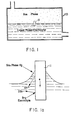
- Figure 1 is a schematic in situ view of the catalyst of the invention in the reservoir of the circulating battery system; and
- Figure 2 is a schematic view of the chemical reaction which takes place about the catalyst of Figure 1.
- Generally speaking, zinc bromine batteries produce small quantities of hydrogen. The net effect is the reaction:

- In a functioning zinc bromine battery equal quantities of zinc metal and bromine are produced in the charge process. Consumption of zinc by the above process leaves an equivalent
- amount of bromine in the system. Reaction of the hydrogen with the bromine "left" behind will restore the pH through production of HBr, as detailed in the following equations:


- The summation equations are thus:


- Hydrogen and bromine are combined in the presence of a catalyst, such as ruthenium, in accordance with the present invention.
- Referring to Figure 1, a reservoir 10 of a zinc-bromine circulating battery system is shown. A catalyst 11 for encouraging hydrogen and bromide ions (ruthenium) is disposed at the gas/ liquid interface within reservoir 10. The catalyst 11 is shown in greater detail in Figure 1a. Hydrogen in the gas phase diffuses to the gas/ liquid/catalyst 11 interface where hydrogen is oxidized to 2 protons with electron release to an electronically conductive substrate. The electrons are conducted to another region where bromine from the electrolyte is electrochemically converted to 2 bromide ions. The net reaction is:

- The potential for this reaction is 1.08 volts. Hydrogen activation catalysts are needed at the interfacial region and correspondingly bromine activation catalysts in the electrolyte region. The catalytic activity need not be high since there is a high driving force (1.08 volts) in this system.
- In a functioning battery system, the catalytic section could be floated on rafts at the gas/liquid interface in the battery reservoir as illustrated in Figure 1.
Claims (6)
Priority Applications (1)
| Application Number | Priority Date | Filing Date | Title |
|---|---|---|---|
| AT83304040T ATE25304T1 (en) | 1982-12-01 | 1983-07-12 | ZINC BROMIUM BATTERY AND ITS OPERATION. |
Applications Claiming Priority (2)
| Application Number | Priority Date | Filing Date | Title |
|---|---|---|---|
| US44596982A | 1982-12-01 | 1982-12-01 | |
| US445969 | 1982-12-01 |
Publications (2)
| Publication Number | Publication Date |
|---|---|
| EP0113159A1 EP0113159A1 (en) | 1984-07-11 |
| EP0113159B1 true EP0113159B1 (en) | 1987-01-28 |
Family
ID=23770855
Family Applications (1)
| Application Number | Title | Priority Date | Filing Date |
|---|---|---|---|
| EP83304040A Expired EP0113159B1 (en) | 1982-12-01 | 1983-07-12 | Zinc-bromine battery and operation thereof |
Country Status (6)
| Country | Link |
|---|---|
| EP (1) | EP0113159B1 (en) |
| JP (1) | JPH0626141B2 (en) |
| AT (1) | ATE25304T1 (en) |
| AU (1) | AU558832B2 (en) |
| CA (1) | CA1202071A (en) |
| DE (1) | DE3369604D1 (en) |
Families Citing this family (4)
| Publication number | Priority date | Publication date | Assignee | Title |
|---|---|---|---|---|
| DE3734287A1 (en) * | 1987-10-09 | 1989-04-27 | Manfred Dipl Ing Kessler | VEHICLE DRIVING OR -DRIVE |
| AU2010310894B2 (en) * | 2009-10-23 | 2014-08-07 | Redflow R&D Pty Ltd | Recombinator for flowing electrolyte battery |
| AT512184B1 (en) | 2012-01-23 | 2013-06-15 | Cellstrom Gmbh | SYSTEM FOR ENERGY GENERATION BZW. STORAGE OF ELECTROCHEMICAL BASIS |
| CN116387521A (en) * | 2023-03-27 | 2023-07-04 | 天津大学 | Application of electrocatalyst as self-dehydrogenation catalyst in water system energy storage device |
Family Cites Families (8)
| Publication number | Priority date | Publication date | Assignee | Title |
|---|---|---|---|---|
| DE921929C (en) * | 1952-10-07 | 1955-01-07 | Riedel De Haeen Ag | Process for the production of hydrogen bromide |
| US3848065A (en) * | 1972-09-29 | 1974-11-12 | Monsanto Co | Method for producing hydrogen iodide |
| DE2326169A1 (en) * | 1973-05-23 | 1974-12-12 | Bosch Gmbh Robert | ARRANGEMENT FOR THE RECOMBINATION OF THE GASES PRODUCED IN A SECONDARY CELL |
| SE7410963L (en) * | 1973-08-31 | 1975-03-03 | Energy Dev Ass | |
| CA1031819A (en) * | 1973-09-19 | 1978-05-23 | Ppg Industries, Inc. | Secondary electrochemical cell having non-consumable silicon cathode |
| US4113924A (en) * | 1977-05-26 | 1978-09-12 | Exxon Research & Engineering Co. | Zinc-halogen compound electrochemical cell having an auxiliary electrode and method |
| US4144381A (en) * | 1977-09-20 | 1979-03-13 | Energy Development Associates | Electrochemical pH control |
| US4320179A (en) * | 1978-04-03 | 1982-03-16 | Energy Development Associates, Inc. | Transference and purification of halogen and hydrohalic acid in an electrochemical system |
-
1983
- 1983-06-02 CA CA000429527A patent/CA1202071A/en not_active Expired
- 1983-07-12 DE DE8383304040T patent/DE3369604D1/en not_active Expired
- 1983-07-12 EP EP83304040A patent/EP0113159B1/en not_active Expired
- 1983-07-12 AT AT83304040T patent/ATE25304T1/en not_active IP Right Cessation
- 1983-07-19 AU AU16997/83A patent/AU558832B2/en not_active Ceased
- 1983-07-21 JP JP58133549A patent/JPH0626141B2/en not_active Expired - Lifetime
Also Published As
| Publication number | Publication date |
|---|---|
| AU558832B2 (en) | 1987-02-12 |
| EP0113159A1 (en) | 1984-07-11 |
| CA1202071A (en) | 1986-03-18 |
| JPH0626141B2 (en) | 1994-04-06 |
| JPS59101779A (en) | 1984-06-12 |
| AU1699783A (en) | 1984-06-07 |
| DE3369604D1 (en) | 1987-03-05 |
| ATE25304T1 (en) | 1987-02-15 |
Similar Documents
| Publication | Publication Date | Title |
|---|---|---|
| US4576878A (en) | Method and apparatus for rebalancing a redox flow cell system | |
| US4523981A (en) | Means and method for reducing carbon dioxide to provide a product | |
| US4882241A (en) | Redox battery | |
| US3981747A (en) | Process for producing electric current by the electrochemical oxidation of an active anodic metal, especially zinc | |
| US6849356B2 (en) | Separated flow liquid catholyte aluminum hydrogen peroxide seawater semi fuel cell | |
| US4545872A (en) | Method for reducing carbon dioxide to provide a product | |
| US4968393A (en) | Membrane divided aqueous-nonaqueous system for electrochemical cells | |
| US4370392A (en) | Chrome-halogen energy storage device and system | |
| CN1209219A (en) | Electric conversion battery | |
| US5516972A (en) | Mediated electrochemical oxidation of organic wastes without electrode separators | |
| EP0159442B1 (en) | Improved electrolyte for zinc-bromine batteries | |
| EP0390158A2 (en) | Electrolysis cell and method of use | |
| US4540639A (en) | Method and apparatus for maintaining the pH in zinc-bromine battery systems | |
| US4220690A (en) | Secondary zinc/oxygen electrochemical cells using inorganic oxyacid electrolytes | |
| EP0113159B1 (en) | Zinc-bromine battery and operation thereof | |
| US4113924A (en) | Zinc-halogen compound electrochemical cell having an auxiliary electrode and method | |
| EP0411614B1 (en) | Method of operating a zinc bromide battery | |
| US4721660A (en) | Electrically regeneratable fuel cell | |
| US4328287A (en) | Gas flow through electrodes | |
| US3252837A (en) | Fuel cell | |
| US20180138567A1 (en) | Redox-air indirect fuel cell | |
| US4478916A (en) | Method and apparatus for operating aqueous galvanic high energy cells | |
| EP0097218A1 (en) | Photoassisted generation of hydrogen from water | |
| US3218195A (en) | Electricity generating cell | |
| EP0029279A1 (en) | Material for electrodes and electrolytic cells with anodes consisting of this material |
Legal Events
| Date | Code | Title | Description |
|---|---|---|---|
| PUAI | Public reference made under article 153(3) epc to a published international application that has entered the european phase |
Free format text: ORIGINAL CODE: 0009012 |
|
| AK | Designated contracting states |
Designated state(s): AT BE CH DE FR GB LI |
|
| 17P | Request for examination filed |
Effective date: 19841211 |
|
| GRAA | (expected) grant |
Free format text: ORIGINAL CODE: 0009210 |
|
| AK | Designated contracting states |
Kind code of ref document: B1 Designated state(s): AT BE CH DE FR GB LI |
|
| REF | Corresponds to: |
Ref document number: 25304 Country of ref document: AT Date of ref document: 19870215 Kind code of ref document: T |
|
| REF | Corresponds to: |
Ref document number: 3369604 Country of ref document: DE Date of ref document: 19870305 |
|
| ET | Fr: translation filed | ||
| PLBE | No opposition filed within time limit |
Free format text: ORIGINAL CODE: 0009261 |
|
| STAA | Information on the status of an ep patent application or granted ep patent |
Free format text: STATUS: NO OPPOSITION FILED WITHIN TIME LIMIT |
|
| 26N | No opposition filed | ||
| PGFP | Annual fee paid to national office [announced via postgrant information from national office to epo] |
Ref country code: FR Payment date: 19980615 Year of fee payment: 16 |
|
| PGFP | Annual fee paid to national office [announced via postgrant information from national office to epo] |
Ref country code: DE Payment date: 19980618 Year of fee payment: 16 |
|
| PGFP | Annual fee paid to national office [announced via postgrant information from national office to epo] |
Ref country code: GB Payment date: 19980619 Year of fee payment: 16 |
|
| PGFP | Annual fee paid to national office [announced via postgrant information from national office to epo] |
Ref country code: CH Payment date: 19980625 Year of fee payment: 16 Ref country code: BE Payment date: 19980625 Year of fee payment: 16 |
|
| PGFP | Annual fee paid to national office [announced via postgrant information from national office to epo] |
Ref country code: AT Payment date: 19980721 Year of fee payment: 16 |
|
| PG25 | Lapsed in a contracting state [announced via postgrant information from national office to epo] |
Ref country code: GB Free format text: LAPSE BECAUSE OF NON-PAYMENT OF DUE FEES Effective date: 19990712 Ref country code: AT Free format text: LAPSE BECAUSE OF NON-PAYMENT OF DUE FEES Effective date: 19990712 |
|
| PG25 | Lapsed in a contracting state [announced via postgrant information from national office to epo] |
Ref country code: LI Free format text: LAPSE BECAUSE OF NON-PAYMENT OF DUE FEES Effective date: 19990731 Ref country code: FR Free format text: THE PATENT HAS BEEN ANNULLED BY A DECISION OF A NATIONAL AUTHORITY Effective date: 19990731 Ref country code: CH Free format text: LAPSE BECAUSE OF NON-PAYMENT OF DUE FEES Effective date: 19990731 Ref country code: BE Free format text: LAPSE BECAUSE OF NON-PAYMENT OF DUE FEES Effective date: 19990731 |
|
| BERE | Be: lapsed |
Owner name: EXXON RESEARCH AND ENGINEERING CY Effective date: 19990731 |
|
| GBPC | Gb: european patent ceased through non-payment of renewal fee |
Effective date: 19990712 |
|
| REG | Reference to a national code |
Ref country code: CH Ref legal event code: PL |
|
| PG25 | Lapsed in a contracting state [announced via postgrant information from national office to epo] |
Ref country code: DE Free format text: LAPSE BECAUSE OF NON-PAYMENT OF DUE FEES Effective date: 20000503 |
|
| REG | Reference to a national code |
Ref country code: FR Ref legal event code: ST |