EP0112514B2 - Silver halide photographic light-sensitive material - Google Patents
Silver halide photographic light-sensitive material Download PDFInfo
- Publication number
- EP0112514B2 EP0112514B2 EP83111926A EP83111926A EP0112514B2 EP 0112514 B2 EP0112514 B2 EP 0112514B2 EP 83111926 A EP83111926 A EP 83111926A EP 83111926 A EP83111926 A EP 83111926A EP 0112514 B2 EP0112514 B2 EP 0112514B2
- Authority
- EP
- European Patent Office
- Prior art keywords
- radical
- silver halide
- formula
- sensitive material
- light
- Prior art date
- Legal status (The legal status is an assumption and is not a legal conclusion. Google has not performed a legal analysis and makes no representation as to the accuracy of the status listed.)
- Expired - Lifetime
Links
- -1 Silver halide Chemical class 0.000 title claims description 211
- 229910052709 silver Inorganic materials 0.000 title claims description 75
- 239000004332 silver Substances 0.000 title claims description 75
- 239000000463 material Substances 0.000 title claims description 50
- 239000000839 emulsion Substances 0.000 claims description 48
- 239000000975 dye Substances 0.000 claims description 47
- 239000003795 chemical substances by application Substances 0.000 claims description 27
- 150000003254 radicals Chemical class 0.000 claims description 25
- 125000004435 hydrogen atom Chemical group [H]* 0.000 claims description 19
- 125000005843 halogen group Chemical group 0.000 claims description 16
- 150000001875 compounds Chemical class 0.000 claims description 14
- 238000006243 chemical reaction Methods 0.000 claims description 11
- 125000003118 aryl group Chemical group 0.000 claims description 10
- 150000005840 aryl radicals Chemical class 0.000 claims description 10
- 239000001043 yellow dye Substances 0.000 claims description 10
- AJDUTMFFZHIJEM-UHFFFAOYSA-N n-(9,10-dioxoanthracen-1-yl)-4-[4-[[4-[4-[(9,10-dioxoanthracen-1-yl)carbamoyl]phenyl]phenyl]diazenyl]phenyl]benzamide Chemical compound O=C1C2=CC=CC=C2C(=O)C2=C1C=CC=C2NC(=O)C(C=C1)=CC=C1C(C=C1)=CC=C1N=NC(C=C1)=CC=C1C(C=C1)=CC=C1C(=O)NC1=CC=CC2=C1C(=O)C1=CC=CC=C1C2=O AJDUTMFFZHIJEM-UHFFFAOYSA-N 0.000 claims description 8
- 125000004432 carbon atom Chemical group C* 0.000 claims description 5
- MDFFNEOEWAXZRQ-UHFFFAOYSA-N aminyl Chemical compound [NH2] MDFFNEOEWAXZRQ-UHFFFAOYSA-N 0.000 claims description 4
- 229910052801 chlorine Inorganic materials 0.000 claims description 3
- 125000001309 chloro group Chemical group Cl* 0.000 claims description 3
- WPWHSFAFEBZWBB-UHFFFAOYSA-N 1-butyl radical Chemical compound [CH2]CCC WPWHSFAFEBZWBB-UHFFFAOYSA-N 0.000 claims description 2
- 229910052799 carbon Inorganic materials 0.000 claims description 2
- 125000004433 nitrogen atom Chemical group N* 0.000 claims description 2
- JEXVQSWXXUJEMA-UHFFFAOYSA-N pyrazol-3-one Chemical class O=C1C=CN=N1 JEXVQSWXXUJEMA-UHFFFAOYSA-N 0.000 claims description 2
- QUPDWYMUPZLYJZ-UHFFFAOYSA-N ethyl Chemical compound C[CH2] QUPDWYMUPZLYJZ-UHFFFAOYSA-N 0.000 claims 1
- 239000010410 layer Substances 0.000 description 44
- 229960001413 acetanilide Drugs 0.000 description 27
- 108010010803 Gelatin Proteins 0.000 description 22
- 229920000159 gelatin Polymers 0.000 description 22
- 239000008273 gelatin Substances 0.000 description 22
- 235000019322 gelatine Nutrition 0.000 description 22
- 235000011852 gelatine desserts Nutrition 0.000 description 22
- 238000000034 method Methods 0.000 description 15
- DOIRQSBPFJWKBE-UHFFFAOYSA-N dibutyl phthalate Chemical compound CCCCOC(=O)C1=CC=CC=C1C(=O)OCCCC DOIRQSBPFJWKBE-UHFFFAOYSA-N 0.000 description 14
- 238000000576 coating method Methods 0.000 description 13
- 239000007788 liquid Substances 0.000 description 13
- 239000002243 precursor Substances 0.000 description 13
- 230000033458 reproduction Effects 0.000 description 13
- 230000003595 spectral effect Effects 0.000 description 12
- 230000009102 absorption Effects 0.000 description 10
- 238000010521 absorption reaction Methods 0.000 description 10
- XEKOWRVHYACXOJ-UHFFFAOYSA-N Ethyl acetate Chemical compound CCOC(C)=O XEKOWRVHYACXOJ-UHFFFAOYSA-N 0.000 description 9
- 239000011248 coating agent Substances 0.000 description 9
- 238000009835 boiling Methods 0.000 description 7
- 239000000203 mixture Substances 0.000 description 7
- 239000002245 particle Substances 0.000 description 7
- HEMHJVSKTPXQMS-UHFFFAOYSA-M Sodium hydroxide Chemical compound [OH-].[Na+] HEMHJVSKTPXQMS-UHFFFAOYSA-M 0.000 description 6
- SJOOOZPMQAWAOP-UHFFFAOYSA-N [Ag].BrCl Chemical compound [Ag].BrCl SJOOOZPMQAWAOP-UHFFFAOYSA-N 0.000 description 6
- 125000000484 butyl group Chemical group [H]C([*])([H])C([H])([H])C([H])([H])C([H])([H])[H] 0.000 description 6
- 239000006185 dispersion Substances 0.000 description 6
- 125000001495 ethyl group Chemical group [H]C([H])([H])C([H])([H])* 0.000 description 6
- 239000003960 organic solvent Substances 0.000 description 6
- 238000012545 processing Methods 0.000 description 6
- 239000000047 product Substances 0.000 description 6
- ADZWSOLPGZMUMY-UHFFFAOYSA-M silver bromide Chemical compound [Ag]Br ADZWSOLPGZMUMY-UHFFFAOYSA-M 0.000 description 6
- 238000012360 testing method Methods 0.000 description 6
- 239000000654 additive Substances 0.000 description 5
- 230000000052 comparative effect Effects 0.000 description 5
- 238000011161 development Methods 0.000 description 5
- 125000002496 methyl group Chemical group [H]C([H])([H])* 0.000 description 5
- 125000002347 octyl group Chemical group [H]C([*])([H])C([H])([H])C([H])([H])C([H])([H])C([H])([H])C([H])([H])C([H])([H])C([H])([H])[H] 0.000 description 5
- 230000008569 process Effects 0.000 description 5
- 125000001436 propyl group Chemical group [H]C([*])([H])C([H])([H])C([H])([H])[H] 0.000 description 5
- 238000011160 research Methods 0.000 description 4
- XLYOFNOQVPJJNP-UHFFFAOYSA-N water Substances O XLYOFNOQVPJJNP-UHFFFAOYSA-N 0.000 description 4
- WVDDGKGOMKODPV-UHFFFAOYSA-N Benzyl alcohol Chemical compound OCC1=CC=CC=C1 WVDDGKGOMKODPV-UHFFFAOYSA-N 0.000 description 3
- OKKJLVBELUTLKV-UHFFFAOYSA-N Methanol Chemical compound OC OKKJLVBELUTLKV-UHFFFAOYSA-N 0.000 description 3
- 239000004698 Polyethylene Substances 0.000 description 3
- 239000006096 absorbing agent Substances 0.000 description 3
- 239000002253 acid Substances 0.000 description 3
- 230000015572 biosynthetic process Effects 0.000 description 3
- 239000000084 colloidal system Substances 0.000 description 3
- 238000002845 discoloration Methods 0.000 description 3
- 239000011229 interlayer Substances 0.000 description 3
- 229920000573 polyethylene Polymers 0.000 description 3
- 150000003839 salts Chemical class 0.000 description 3
- GEHJYWRUCIMESM-UHFFFAOYSA-L sodium sulfite Chemical compound [Na+].[Na+].[O-]S([O-])=O GEHJYWRUCIMESM-UHFFFAOYSA-L 0.000 description 3
- 125000001424 substituent group Chemical group 0.000 description 3
- QGKMIGUHVLGJBR-UHFFFAOYSA-M (4z)-1-(3-methylbutyl)-4-[[1-(3-methylbutyl)quinolin-1-ium-4-yl]methylidene]quinoline;iodide Chemical compound [I-].C12=CC=CC=C2N(CCC(C)C)C=CC1=CC1=CC=[N+](CCC(C)C)C2=CC=CC=C12 QGKMIGUHVLGJBR-UHFFFAOYSA-M 0.000 description 2
- GOJUJUVQIVIZAV-UHFFFAOYSA-N 2-amino-4,6-dichloropyrimidine-5-carbaldehyde Chemical group NC1=NC(Cl)=C(C=O)C(Cl)=N1 GOJUJUVQIVIZAV-UHFFFAOYSA-N 0.000 description 2
- CSCPPACGZOOCGX-UHFFFAOYSA-N Acetone Chemical compound CC(C)=O CSCPPACGZOOCGX-UHFFFAOYSA-N 0.000 description 2
- PAYRUJLWNCNPSJ-UHFFFAOYSA-N Aniline Chemical compound NC1=CC=CC=C1 PAYRUJLWNCNPSJ-UHFFFAOYSA-N 0.000 description 2
- SNRUBQQJIBEYMU-UHFFFAOYSA-N Dodecane Natural products CCCCCCCCCCCC SNRUBQQJIBEYMU-UHFFFAOYSA-N 0.000 description 2
- LFQSCWFLJHTTHZ-UHFFFAOYSA-N Ethanol Chemical compound CCO LFQSCWFLJHTTHZ-UHFFFAOYSA-N 0.000 description 2
- QIGBRXMKCJKVMJ-UHFFFAOYSA-N Hydroquinone Chemical compound OC1=CC=C(O)C=C1 QIGBRXMKCJKVMJ-UHFFFAOYSA-N 0.000 description 2
- DGAQECJNVWCQMB-PUAWFVPOSA-M Ilexoside XXIX Chemical compound C[C@@H]1CC[C@@]2(CC[C@@]3(C(=CC[C@H]4[C@]3(CC[C@@H]5[C@@]4(CC[C@@H](C5(C)C)OS(=O)(=O)[O-])C)C)[C@@H]2[C@]1(C)O)C)C(=O)O[C@H]6[C@@H]([C@H]([C@@H]([C@H](O6)CO)O)O)O.[Na+] DGAQECJNVWCQMB-PUAWFVPOSA-M 0.000 description 2
- XEEYBQQBJWHFJM-UHFFFAOYSA-N Iron Chemical compound [Fe] XEEYBQQBJWHFJM-UHFFFAOYSA-N 0.000 description 2
- OFOBLEOULBTSOW-UHFFFAOYSA-N Malonic acid Chemical compound OC(=O)CC(O)=O OFOBLEOULBTSOW-UHFFFAOYSA-N 0.000 description 2
- 239000004952 Polyamide Substances 0.000 description 2
- ZLMJMSJWJFRBEC-UHFFFAOYSA-N Potassium Chemical compound [K] ZLMJMSJWJFRBEC-UHFFFAOYSA-N 0.000 description 2
- CDBYLPFSWZWCQE-UHFFFAOYSA-L Sodium Carbonate Chemical compound [Na+].[Na+].[O-]C([O-])=O CDBYLPFSWZWCQE-UHFFFAOYSA-L 0.000 description 2
- FAPWRFPIFSIZLT-UHFFFAOYSA-M Sodium chloride Chemical compound [Na+].[Cl-] FAPWRFPIFSIZLT-UHFFFAOYSA-M 0.000 description 2
- QAOWNCQODCNURD-UHFFFAOYSA-N Sulfuric acid Chemical compound OS(O)(=O)=O QAOWNCQODCNURD-UHFFFAOYSA-N 0.000 description 2
- YSMRWXYRXBRSND-UHFFFAOYSA-N TOTP Chemical compound CC1=CC=CC=C1OP(=O)(OC=1C(=CC=CC=1)C)OC1=CC=CC=C1C YSMRWXYRXBRSND-UHFFFAOYSA-N 0.000 description 2
- CIUQDSCDWFSTQR-UHFFFAOYSA-N [C]1=CC=CC=C1 Chemical group [C]1=CC=CC=C1 CIUQDSCDWFSTQR-UHFFFAOYSA-N 0.000 description 2
- 125000000217 alkyl group Chemical group 0.000 description 2
- 239000011230 binding agent Substances 0.000 description 2
- 239000007844 bleaching agent Substances 0.000 description 2
- 239000013078 crystal Substances 0.000 description 2
- 125000003438 dodecyl group Chemical group [H]C([H])([H])C([H])([H])C([H])([H])C([H])([H])C([H])([H])C([H])([H])C([H])([H])C([H])([H])C([H])([H])C([H])([H])C([H])([H])C([H])([H])* 0.000 description 2
- 230000000694 effects Effects 0.000 description 2
- 238000011156 evaluation Methods 0.000 description 2
- 229910052731 fluorine Inorganic materials 0.000 description 2
- 238000010438 heat treatment Methods 0.000 description 2
- 230000002401 inhibitory effect Effects 0.000 description 2
- 125000001997 phenyl group Chemical group [H]C1=C([H])C([H])=C(*)C([H])=C1[H] 0.000 description 2
- 229920002647 polyamide Polymers 0.000 description 2
- 239000011591 potassium Substances 0.000 description 2
- 229910052700 potassium Inorganic materials 0.000 description 2
- IOLCXVTUBQKXJR-UHFFFAOYSA-M potassium bromide Chemical compound [K+].[Br-] IOLCXVTUBQKXJR-UHFFFAOYSA-M 0.000 description 2
- BWHMMNNQKKPAPP-UHFFFAOYSA-L potassium carbonate Chemical compound [K+].[K+].[O-]C([O-])=O BWHMMNNQKKPAPP-UHFFFAOYSA-L 0.000 description 2
- 239000011241 protective layer Substances 0.000 description 2
- 230000035945 sensitivity Effects 0.000 description 2
- 230000001235 sensitizing effect Effects 0.000 description 2
- 239000011734 sodium Substances 0.000 description 2
- 229910052708 sodium Inorganic materials 0.000 description 2
- JHJLBTNAGRQEKS-UHFFFAOYSA-M sodium bromide Chemical compound [Na+].[Br-] JHJLBTNAGRQEKS-UHFFFAOYSA-M 0.000 description 2
- 239000002904 solvent Substances 0.000 description 2
- UMGDCJDMYOKAJW-UHFFFAOYSA-N thiourea Chemical compound NC(N)=S UMGDCJDMYOKAJW-UHFFFAOYSA-N 0.000 description 2
- 238000005406 washing Methods 0.000 description 2
- BJEPYKJPYRNKOW-REOHCLBHSA-N (S)-malic acid Chemical compound OC(=O)[C@@H](O)CC(O)=O BJEPYKJPYRNKOW-REOHCLBHSA-N 0.000 description 1
- KKFDJZZADQONDE-UHFFFAOYSA-N (hydridonitrato)hydroxidocarbon(.) Chemical compound O[C]=N KKFDJZZADQONDE-UHFFFAOYSA-N 0.000 description 1
- NYKNAHRZCSMHST-UHFFFAOYSA-N 1-(2-chloro-5-octadecylphenyl)-1-[5-oxo-1-(2,4,6-trichlorophenyl)-4H-pyrazol-3-yl]urea Chemical compound ClC1=C(C(=CC(=C1)Cl)Cl)N1N=C(CC1=O)N(C1=C(C=CC(=C1)CCCCCCCCCCCCCCCCCC)Cl)C(N)=O NYKNAHRZCSMHST-UHFFFAOYSA-N 0.000 description 1
- HRBLHUVHOWWBEN-UHFFFAOYSA-N 1-n,4-n-diethylbenzene-1,4-diamine;hydrochloride Chemical compound Cl.CCNC1=CC=C(NCC)C=C1 HRBLHUVHOWWBEN-UHFFFAOYSA-N 0.000 description 1
- PXJHVKRLFWZUNV-UHFFFAOYSA-N 1-n,4-n-dimethylbenzene-1,4-diamine;hydron;dichloride Chemical compound Cl.Cl.CNC1=CC=C(NC)C=C1 PXJHVKRLFWZUNV-UHFFFAOYSA-N 0.000 description 1
- HFZLSTDPRQSZCQ-UHFFFAOYSA-N 1-pyrrolidin-3-ylpyrrolidine Chemical compound C1CCCN1C1CNCC1 HFZLSTDPRQSZCQ-UHFFFAOYSA-N 0.000 description 1
- JQADLJKVUIDLRH-UHFFFAOYSA-N 2-(3-tert-butyl-4-hydroxyphenoxy)-n-[4-chloro-3-[[5-oxo-1-(2,4,6-trichlorophenyl)-4h-pyrazol-3-yl]amino]phenyl]tetradecanamide Chemical compound C=1C=C(Cl)C(NC=2CC(=O)N(N=2)C=2C(=CC(Cl)=CC=2Cl)Cl)=CC=1NC(=O)C(CCCCCCCCCCCC)OC1=CC=C(O)C(C(C)(C)C)=C1 JQADLJKVUIDLRH-UHFFFAOYSA-N 0.000 description 1
- WFXLRLQSHRNHCE-UHFFFAOYSA-N 2-(4-amino-n-ethylanilino)ethanol Chemical compound OCCN(CC)C1=CC=C(N)C=C1 WFXLRLQSHRNHCE-UHFFFAOYSA-N 0.000 description 1
- DLLMHEDYJQACRM-UHFFFAOYSA-N 2-(carboxymethyldisulfanyl)acetic acid Chemical compound OC(=O)CSSCC(O)=O DLLMHEDYJQACRM-UHFFFAOYSA-N 0.000 description 1
- AKVNSBRRUSKWSU-UHFFFAOYSA-N 3,4-dibutylphthalic acid;phthalic acid Chemical compound OC(=O)C1=CC=CC=C1C(O)=O.CCCCC1=CC=C(C(O)=O)C(C(O)=O)=C1CCCC AKVNSBRRUSKWSU-UHFFFAOYSA-N 0.000 description 1
- BXJAOEIVXHPEMY-UHFFFAOYSA-N 3-(2-chlorododec-5-enyl)-1-[5-[[4-[[3-[[5-[3-(2-chlorododec-5-enyl)-2,5-dioxopyrrolidin-1-yl]-1-(2,4,6-trichlorophenyl)cyclohexa-2,4-dien-1-yl]amino]-5-oxopyrazol-4-yl]methyl]-5-oxopyrazol-3-yl]amino]-5-(2,4,6-trichlorophenyl)cyclohexa-1,3-dien-1-yl]pyrrolidine-2,5-dione Chemical compound C(C1=C(N=NC1=O)NC1(CC(=CC=C1)N1C(C(CC1=O)CC(CCC=CCCCCCC)Cl)=O)C1=C(C=C(C=C1Cl)Cl)Cl)C1=C(N=NC1=O)NC1(CC(=CC=C1)N1C(C(CC1=O)CC(CCC=CCCCCCC)Cl)=O)C1=C(C=C(C=C1Cl)Cl)Cl BXJAOEIVXHPEMY-UHFFFAOYSA-N 0.000 description 1
- MPYWHZZGIPSVMD-UHFFFAOYSA-N 3-(2-chlorooctadec-5-enyl)-1-[5-[(5-oxo-4H-pyrazol-1-yl)amino]-5-(2,4,6-trichlorophenyl)cyclohexa-1,3-dien-1-yl]pyrrolidine-2,5-dione Chemical compound ClC1=C(C(=CC(=C1)Cl)Cl)C1(NN2N=CCC2=O)CC(=CC=C1)N1C(C(CC1=O)CC(CCC=CCCCCCCCCCCCC)Cl)=O MPYWHZZGIPSVMD-UHFFFAOYSA-N 0.000 description 1
- QNKXKRLHLYQUHS-UHFFFAOYSA-N 3-(2-chlorooctadecan-5-yl)-1-[5-[(5-oxo-4H-pyrazol-1-yl)amino]-5-(2,4,6-trichlorophenyl)cyclohexa-1,3-dien-1-yl]pyrrolidine-2,5-dione Chemical compound ClC1=C(C(=CC(=C1)Cl)Cl)C1(NN2N=CCC2=O)CC(=CC=C1)N1C(C(CC1=O)C(CCC(C)Cl)CCCCCCCCCCCCC)=O QNKXKRLHLYQUHS-UHFFFAOYSA-N 0.000 description 1
- QDIMMGOJTIUSOA-UHFFFAOYSA-N 3-[[2-[2,4-bis(2-methylbutan-2-yl)phenoxy]acetyl]amino]-n-[5-oxo-1-(2,4,6-trichlorophenyl)-4h-pyrazol-3-yl]benzamide Chemical compound CCC(C)(C)C1=CC(C(C)(C)CC)=CC=C1OCC(=O)NC1=CC=CC(C(=O)NC=2CC(=O)N(N=2)C=2C(=CC(Cl)=CC=2Cl)Cl)=C1 QDIMMGOJTIUSOA-UHFFFAOYSA-N 0.000 description 1
- 125000004172 4-methoxyphenyl group Chemical group [H]C1=C([H])C(OC([H])([H])[H])=C([H])C([H])=C1* 0.000 description 1
- MTOCKMVNXPZCJW-UHFFFAOYSA-N 4-n-dodecyl-4-n-ethyl-2-methylbenzene-1,4-diamine Chemical compound CCCCCCCCCCCCN(CC)C1=CC=C(N)C(C)=C1 MTOCKMVNXPZCJW-UHFFFAOYSA-N 0.000 description 1
- IJJSFSXLZYFTKV-UHFFFAOYSA-N 4-n-methylbenzene-1,4-diamine;hydrochloride Chemical compound Cl.CNC1=CC=C(N)C=C1 IJJSFSXLZYFTKV-UHFFFAOYSA-N 0.000 description 1
- QGZKDVFQNNGYKY-UHFFFAOYSA-O Ammonium Chemical compound [NH4+] QGZKDVFQNNGYKY-UHFFFAOYSA-O 0.000 description 1
- VHUUQVKOLVNVRT-UHFFFAOYSA-N Ammonium hydroxide Chemical compound [NH4+].[OH-] VHUUQVKOLVNVRT-UHFFFAOYSA-N 0.000 description 1
- WKBOTKDWSSQWDR-UHFFFAOYSA-N Bromine atom Chemical compound [Br] WKBOTKDWSSQWDR-UHFFFAOYSA-N 0.000 description 1
- DKPFZGUDAPQIHT-UHFFFAOYSA-N Butyl acetate Natural products CCCCOC(C)=O DKPFZGUDAPQIHT-UHFFFAOYSA-N 0.000 description 1
- VEXZGXHMUGYJMC-UHFFFAOYSA-M Chloride anion Chemical compound [Cl-] VEXZGXHMUGYJMC-UHFFFAOYSA-M 0.000 description 1
- LEVWYRKDKASIDU-QWWZWVQMSA-N D-cystine Chemical compound OC(=O)[C@H](N)CSSC[C@@H](N)C(O)=O LEVWYRKDKASIDU-QWWZWVQMSA-N 0.000 description 1
- FEWJPZIEWOKRBE-JCYAYHJZSA-N Dextrotartaric acid Chemical compound OC(=O)[C@H](O)[C@@H](O)C(O)=O FEWJPZIEWOKRBE-JCYAYHJZSA-N 0.000 description 1
- MQIUGAXCHLFZKX-UHFFFAOYSA-N Di-n-octyl phthalate Natural products CCCCCCCCOC(=O)C1=CC=CC=C1C(=O)OCCCCCCCC MQIUGAXCHLFZKX-UHFFFAOYSA-N 0.000 description 1
- QEVGZEDELICMKH-UHFFFAOYSA-N Diglycolic acid Chemical compound OC(=O)COCC(O)=O QEVGZEDELICMKH-UHFFFAOYSA-N 0.000 description 1
- KCXVZYZYPLLWCC-UHFFFAOYSA-N EDTA Chemical compound OC(=O)CN(CC(O)=O)CCN(CC(O)=O)CC(O)=O KCXVZYZYPLLWCC-UHFFFAOYSA-N 0.000 description 1
- PXGOKWXKJXAPGV-UHFFFAOYSA-N Fluorine Chemical compound FF PXGOKWXKJXAPGV-UHFFFAOYSA-N 0.000 description 1
- CWNSVVHTTQBGQB-UHFFFAOYSA-N N,N-Diethyldodecanamide Chemical compound CCCCCCCCCCCC(=O)N(CC)CC CWNSVVHTTQBGQB-UHFFFAOYSA-N 0.000 description 1
- 239000000020 Nitrocellulose Substances 0.000 description 1
- 229910019142 PO4 Inorganic materials 0.000 description 1
- 239000002202 Polyethylene glycol Substances 0.000 description 1
- 239000004793 Polystyrene Substances 0.000 description 1
- KJTLSVCANCCWHF-UHFFFAOYSA-N Ruthenium Chemical compound [Ru] KJTLSVCANCCWHF-UHFFFAOYSA-N 0.000 description 1
- BUGBHKTXTAQXES-UHFFFAOYSA-N Selenium Chemical compound [Se] BUGBHKTXTAQXES-UHFFFAOYSA-N 0.000 description 1
- 229910021607 Silver chloride Inorganic materials 0.000 description 1
- DWAQJAXMDSEUJJ-UHFFFAOYSA-M Sodium bisulfite Chemical compound [Na+].OS([O-])=O DWAQJAXMDSEUJJ-UHFFFAOYSA-M 0.000 description 1
- QAOWNCQODCNURD-UHFFFAOYSA-L Sulfate Chemical compound [O-]S([O-])(=O)=O QAOWNCQODCNURD-UHFFFAOYSA-L 0.000 description 1
- NINIDFKCEFEMDL-UHFFFAOYSA-N Sulfur Chemical compound [S] NINIDFKCEFEMDL-UHFFFAOYSA-N 0.000 description 1
- FEWJPZIEWOKRBE-UHFFFAOYSA-N Tartaric acid Natural products [H+].[H+].[O-]C(=O)C(O)C(O)C([O-])=O FEWJPZIEWOKRBE-UHFFFAOYSA-N 0.000 description 1
- ATJFFYVFTNAWJD-UHFFFAOYSA-N Tin Chemical compound [Sn] ATJFFYVFTNAWJD-UHFFFAOYSA-N 0.000 description 1
- XSQUKJJJFZCRTK-UHFFFAOYSA-N Urea Natural products NC(N)=O XSQUKJJJFZCRTK-UHFFFAOYSA-N 0.000 description 1
- FJWGYAHXMCUOOM-QHOUIDNNSA-N [(2s,3r,4s,5r,6r)-2-[(2r,3r,4s,5r,6s)-4,5-dinitrooxy-2-(nitrooxymethyl)-6-[(2r,3r,4s,5r,6s)-4,5,6-trinitrooxy-2-(nitrooxymethyl)oxan-3-yl]oxyoxan-3-yl]oxy-3,5-dinitrooxy-6-(nitrooxymethyl)oxan-4-yl] nitrate Chemical compound O([C@@H]1O[C@@H]([C@H]([C@H](O[N+]([O-])=O)[C@H]1O[N+]([O-])=O)O[C@H]1[C@@H]([C@@H](O[N+]([O-])=O)[C@H](O[N+]([O-])=O)[C@@H](CO[N+]([O-])=O)O1)O[N+]([O-])=O)CO[N+](=O)[O-])[C@@H]1[C@@H](CO[N+]([O-])=O)O[C@@H](O[N+]([O-])=O)[C@H](O[N+]([O-])=O)[C@H]1O[N+]([O-])=O FJWGYAHXMCUOOM-QHOUIDNNSA-N 0.000 description 1
- MPLZNPZPPXERDA-UHFFFAOYSA-N [4-(diethylamino)-2-methylphenyl]azanium;chloride Chemical compound [Cl-].CC[NH+](CC)C1=CC=C(N)C(C)=C1 MPLZNPZPPXERDA-UHFFFAOYSA-N 0.000 description 1
- XCFIVNQHHFZRNR-UHFFFAOYSA-N [Ag].Cl[IH]Br Chemical compound [Ag].Cl[IH]Br XCFIVNQHHFZRNR-UHFFFAOYSA-N 0.000 description 1
- 150000007513 acids Chemical class 0.000 description 1
- 239000012190 activator Substances 0.000 description 1
- 230000002411 adverse Effects 0.000 description 1
- 239000003513 alkali Substances 0.000 description 1
- BJEPYKJPYRNKOW-UHFFFAOYSA-N alpha-hydroxysuccinic acid Natural products OC(=O)C(O)CC(O)=O BJEPYKJPYRNKOW-UHFFFAOYSA-N 0.000 description 1
- 229910000147 aluminium phosphate Inorganic materials 0.000 description 1
- 150000001408 amides Chemical class 0.000 description 1
- 239000000908 ammonium hydroxide Substances 0.000 description 1
- XYXNTHIYBIDHGM-UHFFFAOYSA-N ammonium thiosulfate Chemical compound [NH4+].[NH4+].[O-]S([O-])(=O)=S XYXNTHIYBIDHGM-UHFFFAOYSA-N 0.000 description 1
- 229940101006 anhydrous sodium sulfite Drugs 0.000 description 1
- 239000002216 antistatic agent Substances 0.000 description 1
- 150000003934 aromatic aldehydes Chemical class 0.000 description 1
- 150000004982 aromatic amines Chemical class 0.000 description 1
- 125000004429 atom Chemical group 0.000 description 1
- XNSQZBOCSSMHSZ-UHFFFAOYSA-K azane;2-[2-[bis(carboxylatomethyl)amino]ethyl-(carboxymethyl)amino]acetate;iron(3+) Chemical compound [NH4+].[Fe+3].[O-]C(=O)CN(CC([O-])=O)CCN(CC([O-])=O)CC([O-])=O XNSQZBOCSSMHSZ-UHFFFAOYSA-K 0.000 description 1
- QVQLCTNNEUAWMS-UHFFFAOYSA-N barium oxide Chemical compound [Ba]=O QVQLCTNNEUAWMS-UHFFFAOYSA-N 0.000 description 1
- 229910001864 baryta Inorganic materials 0.000 description 1
- 235000019445 benzyl alcohol Nutrition 0.000 description 1
- BJQHLKABXJIVAM-UHFFFAOYSA-N bis(2-ethylhexyl) phthalate Chemical compound CCCCC(CC)COC(=O)C1=CC=CC=C1C(=O)OCC(CC)CCCC BJQHLKABXJIVAM-UHFFFAOYSA-N 0.000 description 1
- 238000004061 bleaching Methods 0.000 description 1
- 238000005282 brightening Methods 0.000 description 1
- GDTBXPJZTBHREO-UHFFFAOYSA-N bromine Substances BrBr GDTBXPJZTBHREO-UHFFFAOYSA-N 0.000 description 1
- 229910052794 bromium Inorganic materials 0.000 description 1
- 125000004744 butyloxycarbonyl group Chemical group 0.000 description 1
- UOCJDOLVGGIYIQ-PBFPGSCMSA-N cefatrizine Chemical group S([C@@H]1[C@@H](C(N1C=1C(O)=O)=O)NC(=O)[C@H](N)C=2C=CC(O)=CC=2)CC=1CSC=1C=NNN=1 UOCJDOLVGGIYIQ-PBFPGSCMSA-N 0.000 description 1
- 229920002301 cellulose acetate Polymers 0.000 description 1
- 230000008859 change Effects 0.000 description 1
- 239000007795 chemical reaction product Substances 0.000 description 1
- SURLGNKAQXKNSP-DBLYXWCISA-N chlorin Chemical compound C\1=C/2\N/C(=C\C3=N/C(=C\C=4NC(/C=C\5/C=CC/1=N/5)=CC=4)/C=C3)/CC\2 SURLGNKAQXKNSP-DBLYXWCISA-N 0.000 description 1
- JAWGVVJVYSANRY-UHFFFAOYSA-N cobalt(3+) Chemical compound [Co+3] JAWGVVJVYSANRY-UHFFFAOYSA-N 0.000 description 1
- 239000003086 colorant Substances 0.000 description 1
- 238000010276 construction Methods 0.000 description 1
- 238000007766 curtain coating Methods 0.000 description 1
- JEVCWSUVFOYBFI-UHFFFAOYSA-N cyanyl Chemical compound N#[C] JEVCWSUVFOYBFI-UHFFFAOYSA-N 0.000 description 1
- 229960003067 cystine Drugs 0.000 description 1
- 230000008021 deposition Effects 0.000 description 1
- 238000009795 derivation Methods 0.000 description 1
- 238000010586 diagram Methods 0.000 description 1
- 125000002720 diazolyl group Chemical group 0.000 description 1
- KCIDZIIHRGYJAE-YGFYJFDDSA-L dipotassium;[(2r,3r,4s,5r,6r)-3,4,5-trihydroxy-6-(hydroxymethyl)oxan-2-yl] phosphate Chemical compound [K+].[K+].OC[C@H]1O[C@H](OP([O-])([O-])=O)[C@H](O)[C@@H](O)[C@H]1O KCIDZIIHRGYJAE-YGFYJFDDSA-L 0.000 description 1
- 238000007598 dipping method Methods 0.000 description 1
- 238000004090 dissolution Methods 0.000 description 1
- 238000001035 drying Methods 0.000 description 1
- 229960001484 edetic acid Drugs 0.000 description 1
- 239000011737 fluorine Substances 0.000 description 1
- 125000001153 fluoro group Chemical group F* 0.000 description 1
- 108700039708 galantide Proteins 0.000 description 1
- 239000011521 glass Substances 0.000 description 1
- PCHJSUWPFVWCPO-UHFFFAOYSA-N gold Chemical compound [Au] PCHJSUWPFVWCPO-UHFFFAOYSA-N 0.000 description 1
- 229910052737 gold Inorganic materials 0.000 description 1
- 239000010931 gold Substances 0.000 description 1
- 150000004820 halides Chemical class 0.000 description 1
- 229910052736 halogen Inorganic materials 0.000 description 1
- 150000002367 halogens Chemical class 0.000 description 1
- FUZZWVXGSFPDMH-UHFFFAOYSA-N hexanoic acid Chemical compound CCCCCC(O)=O FUZZWVXGSFPDMH-UHFFFAOYSA-N 0.000 description 1
- BLNWTAHYTCHDJH-UHFFFAOYSA-O hydroxy(oxo)azanium Chemical compound O[NH+]=O BLNWTAHYTCHDJH-UHFFFAOYSA-O 0.000 description 1
- TUJKJAMUKRIRHC-UHFFFAOYSA-N hydroxyl Chemical compound [OH] TUJKJAMUKRIRHC-UHFFFAOYSA-N 0.000 description 1
- NXPHCVPFHOVZBC-UHFFFAOYSA-N hydroxylamine;sulfuric acid Chemical compound ON.OS(O)(=O)=O NXPHCVPFHOVZBC-UHFFFAOYSA-N 0.000 description 1
- 230000006872 improvement Effects 0.000 description 1
- 238000007689 inspection Methods 0.000 description 1
- 229910052741 iridium Inorganic materials 0.000 description 1
- GKOZUEZYRPOHIO-UHFFFAOYSA-N iridium atom Chemical compound [Ir] GKOZUEZYRPOHIO-UHFFFAOYSA-N 0.000 description 1
- 229910052742 iron Inorganic materials 0.000 description 1
- 239000004816 latex Substances 0.000 description 1
- 229920000126 latex Polymers 0.000 description 1
- 239000001630 malic acid Substances 0.000 description 1
- 235000011090 malic acid Nutrition 0.000 description 1
- 238000005259 measurement Methods 0.000 description 1
- DZVCFNFOPIZQKX-LTHRDKTGSA-M merocyanine Chemical compound [Na+].O=C1N(CCCC)C(=O)N(CCCC)C(=O)C1=C\C=C\C=C/1N(CCCS([O-])(=O)=O)C2=CC=CC=C2O\1 DZVCFNFOPIZQKX-LTHRDKTGSA-M 0.000 description 1
- 229910052751 metal Inorganic materials 0.000 description 1
- 239000002184 metal Substances 0.000 description 1
- 150000001457 metallic cations Chemical class 0.000 description 1
- 150000001455 metallic ions Chemical class 0.000 description 1
- 150000002739 metals Chemical class 0.000 description 1
- CLJDCQWROXMJAZ-UHFFFAOYSA-N n-[2-(4-amino-n-ethyl-3-methylanilino)ethyl]methanesulfonamide;sulfuric acid Chemical compound OS(O)(=O)=O.CS(=O)(=O)NCCN(CC)C1=CC=C(N)C(C)=C1 CLJDCQWROXMJAZ-UHFFFAOYSA-N 0.000 description 1
- UDVIVSCMZQLZQL-UHFFFAOYSA-N n-[4-chloro-3-[[5-oxo-1-(2,4,6-trichlorophenyl)-4h-pyrazol-3-yl]amino]phenyl]tetradecanamide Chemical compound CCCCCCCCCCCCCC(=O)NC1=CC=C(Cl)C(NC=2CC(=O)N(N=2)C=2C(=CC(Cl)=CC=2Cl)Cl)=C1 UDVIVSCMZQLZQL-UHFFFAOYSA-N 0.000 description 1
- 125000000740 n-pentyl group Chemical group [H]C([H])([H])C([H])([H])C([H])([H])C([H])([H])C([H])([H])* 0.000 description 1
- 230000007935 neutral effect Effects 0.000 description 1
- MGFYIUFZLHCRTH-UHFFFAOYSA-N nitrilotriacetic acid Chemical compound OC(=O)CN(CC(O)=O)CC(O)=O MGFYIUFZLHCRTH-UHFFFAOYSA-N 0.000 description 1
- 229920001220 nitrocellulos Polymers 0.000 description 1
- XNGIFLGASWRNHJ-UHFFFAOYSA-N o-dicarboxybenzene Natural products OC(=O)C1=CC=CC=C1C(O)=O XNGIFLGASWRNHJ-UHFFFAOYSA-N 0.000 description 1
- 230000003287 optical effect Effects 0.000 description 1
- 150000007524 organic acids Chemical class 0.000 description 1
- 235000005985 organic acids Nutrition 0.000 description 1
- 125000002971 oxazolyl group Chemical group 0.000 description 1
- ORTFAQDWJHRMNX-UHFFFAOYSA-M oxidooxomethyl Chemical compound [O-][C]=O ORTFAQDWJHRMNX-UHFFFAOYSA-M 0.000 description 1
- 150000002989 phenols Chemical class 0.000 description 1
- NBIIXXVUZAFLBC-UHFFFAOYSA-K phosphate Chemical compound [O-]P([O-])([O-])=O NBIIXXVUZAFLBC-UHFFFAOYSA-K 0.000 description 1
- 239000010452 phosphate Substances 0.000 description 1
- NBIIXXVUZAFLBC-UHFFFAOYSA-N phosphoric acid Substances OP(O)(O)=O NBIIXXVUZAFLBC-UHFFFAOYSA-N 0.000 description 1
- 229910052698 phosphorus Inorganic materials 0.000 description 1
- 239000004014 plasticizer Substances 0.000 description 1
- 229920006289 polycarbonate film Polymers 0.000 description 1
- 229920006267 polyester film Polymers 0.000 description 1
- 229920001223 polyethylene glycol Polymers 0.000 description 1
- 229920000139 polyethylene terephthalate Polymers 0.000 description 1
- 239000005020 polyethylene terephthalate Substances 0.000 description 1
- 229920000642 polymer Polymers 0.000 description 1
- 238000006116 polymerization reaction Methods 0.000 description 1
- 229920002223 polystyrene Polymers 0.000 description 1
- 229910000027 potassium carbonate Inorganic materials 0.000 description 1
- 238000002601 radiography Methods 0.000 description 1
- 230000009257 reactivity Effects 0.000 description 1
- 230000009467 reduction Effects 0.000 description 1
- 229910052703 rhodium Inorganic materials 0.000 description 1
- 239000010948 rhodium Substances 0.000 description 1
- MHOVAHRLVXNVSD-UHFFFAOYSA-N rhodium atom Chemical compound [Rh] MHOVAHRLVXNVSD-UHFFFAOYSA-N 0.000 description 1
- 229910052707 ruthenium Inorganic materials 0.000 description 1
- 229910052711 selenium Inorganic materials 0.000 description 1
- 239000011669 selenium Substances 0.000 description 1
- ZUNKMNLKJXRCDM-UHFFFAOYSA-N silver bromoiodide Chemical compound [Ag].IBr ZUNKMNLKJXRCDM-UHFFFAOYSA-N 0.000 description 1
- HKZLPVFGJNLROG-UHFFFAOYSA-M silver monochloride Chemical compound [Cl-].[Ag+] HKZLPVFGJNLROG-UHFFFAOYSA-M 0.000 description 1
- 229910000029 sodium carbonate Inorganic materials 0.000 description 1
- 239000011780 sodium chloride Substances 0.000 description 1
- HRZFUMHJMZEROT-UHFFFAOYSA-L sodium disulfite Chemical compound [Na+].[Na+].[O-]S(=O)S([O-])(=O)=O HRZFUMHJMZEROT-UHFFFAOYSA-L 0.000 description 1
- 229940079827 sodium hydrogen sulfite Drugs 0.000 description 1
- 235000010267 sodium hydrogen sulphite Nutrition 0.000 description 1
- 229940001584 sodium metabisulfite Drugs 0.000 description 1
- 235000010262 sodium metabisulphite Nutrition 0.000 description 1
- 229940001482 sodium sulfite Drugs 0.000 description 1
- 235000010265 sodium sulphite Nutrition 0.000 description 1
- 238000013112 stability test Methods 0.000 description 1
- 229940124530 sulfonamide Drugs 0.000 description 1
- 229910052717 sulfur Inorganic materials 0.000 description 1
- 239000011593 sulfur Substances 0.000 description 1
- 239000004094 surface-active agent Substances 0.000 description 1
- 239000011975 tartaric acid Substances 0.000 description 1
- 235000002906 tartaric acid Nutrition 0.000 description 1
- 125000000999 tert-butyl group Chemical group [H]C([H])([H])C(*)(C([H])([H])[H])C([H])([H])[H] 0.000 description 1
- 125000003831 tetrazolyl group Chemical group 0.000 description 1
- 150000003568 thioethers Chemical class 0.000 description 1
- 238000011282 treatment Methods 0.000 description 1
- 125000001425 triazolyl group Chemical group 0.000 description 1
- 239000000080 wetting agent Substances 0.000 description 1
- 229910052724 xenon Inorganic materials 0.000 description 1
- FHNFHKCVQCLJFQ-UHFFFAOYSA-N xenon atom Chemical compound [Xe] FHNFHKCVQCLJFQ-UHFFFAOYSA-N 0.000 description 1
Classifications
-
- G—PHYSICS
- G03—PHOTOGRAPHY; CINEMATOGRAPHY; ANALOGOUS TECHNIQUES USING WAVES OTHER THAN OPTICAL WAVES; ELECTROGRAPHY; HOLOGRAPHY
- G03C—PHOTOSENSITIVE MATERIALS FOR PHOTOGRAPHIC PURPOSES; PHOTOGRAPHIC PROCESSES, e.g. CINE, X-RAY, COLOUR, STEREO-PHOTOGRAPHIC PROCESSES; AUXILIARY PROCESSES IN PHOTOGRAPHY
- G03C7/00—Multicolour photographic processes or agents therefor; Regeneration of such processing agents; Photosensitive materials for multicolour processes
- G03C7/30—Colour processes using colour-coupling substances; Materials therefor; Preparing or processing such materials
- G03C7/32—Colour coupling substances
- G03C7/34—Couplers containing phenols
- G03C7/342—Combination of phenolic or naphtholic couplers
-
- G—PHYSICS
- G03—PHOTOGRAPHY; CINEMATOGRAPHY; ANALOGOUS TECHNIQUES USING WAVES OTHER THAN OPTICAL WAVES; ELECTROGRAPHY; HOLOGRAPHY
- G03C—PHOTOSENSITIVE MATERIALS FOR PHOTOGRAPHIC PURPOSES; PHOTOGRAPHIC PROCESSES, e.g. CINE, X-RAY, COLOUR, STEREO-PHOTOGRAPHIC PROCESSES; AUXILIARY PROCESSES IN PHOTOGRAPHY
- G03C7/00—Multicolour photographic processes or agents therefor; Regeneration of such processing agents; Photosensitive materials for multicolour processes
- G03C7/26—Silver halide emulsions for subtractive colour processes
Definitions
- the present invention relates to a silver halide photographic light-sensitive material, and more particularly to a silver halide photographic light-sensitive material which contains a cyan coupler excellent in the solubility as well as in the dispersion stability and which is capable of giving a satisfactorily color-reproducible and well-preservable dye image.
- the formation of a dye image by use of a silver halide color photographic light-sensitive material is generally carried out in the manner that an aromatic primary amine color developing agent itself, when reducing the light-exposed silver halide particles of a silver halide color photographic light-sensitive material, is oxidized, and the oxidized product reacts with a coupler that is in advance contained in the silver halide color photographic light-sensitive material to thereby form a dye.
- a coupler because the color reproduction is usually carried out by the color subtractive process, three different couplers; i.e., yellow, magenta and cyan couplers are used.
- couplers each is normally dissolved into a substantially water-insoluble high-boiling organic solvent or at need together with an auxiliary solvent, and the resulting solution is then added to a silver halide emulsion.
- cyan couplers include 2,5-diacylaminophenol-type cyan couplers which are phenol compounds the second and fifth positions of which are substituted by acylamino radicals, as described in, e.g., U.S. Patent No. 2,985,826, Japanese Patent Publication Open to Public Inspection (hereinafter referred to as Japanese Patent O.P.I. Publication) Nos. 112038/1975, 109630/1978 and 163537/ 1980.
- the use of a 2,5-diacylaminophenol-type cyan coupler can not sufficiently satisfy the foregoing fundamental nature requirements because the coupler has the disadvantages that (1) its special minimum density in the wavelength range of from 450 to 480nm is so high and its lightness is so low that its color reproducible range becomes narrow, while its absorption in the wavelength range of from 500 to 550nm is so high that its green color reproduction becomes poor, (2) its resistance to light is insufficient, and (3) its solubility and dispersion ability are unsatisfactory.
- a silver halide photographic light-sensitive material comprising a support having thereon at least one silver halide emulsion layer containing in combination at least one of those cyan couplers having the following Formula [I], [1a] or [1b] and at least one of those cyan couplers having the following Formula [II] : wherein, R2 is an alkyl radical; and Z1 is a hydrogen atom, a halogen atom, or a radical that can be split off by the reaction of said coupler with the oxidized product of an aromatic primary amine-type color developing agent, wherein R4 is an alkyl radical; R5 is an alkyl radical; R6 is a halogen atom; and Z2 is a hydrogen atom, a halogen atom, or a radical that can be split off by the reaction of said coupler with the oxidized product of an aromatic primary amine-type color developing agent.
- the alkyl radical represented by R2 includes those in the straight chain or branched chain form, such as methyl, ethyl, propyl, butyl and octyl.
- the preferred cyan couplers having Formula [I] in the present invention include those compounds having the following Formula [III]: wherein
- the radical represented by R8, when the n is equal to 0, is an alkyl and, when the n is equal to or more than 1, is preferred an aryl.
- the further preferred radical represented by R8 is a phenyl radical having substituents as, when the n is equal to or more than 1, phenyl or phenyl radical having a single or a plurality of substituents selected from the group of radicals (preferably t-butyl, t-amyl, octyl), alkyl-sulfonamido radicals (preferably butyl-sulfonamido, octyl-sulfonamido, dodecyl-sulfonamido, aryl-sulfonamido radicals (preferably phenyl-sulfonamido), aminosulfonamido radicals (preferably dimethylaminosulfonamido), or alkylcarbonyl radicals (preferably methyloxycarbonyl, buty
- R9 represents a straight-chain or branched-chain alkylene radical having from 1 to 20 carbon atoms, and more preferably from 1 to 12 atoms.
- Z3 is a hydrogen atom, a halogen atom, or a radical that can be split off by the reaction of the coupler with the oxidized product of an aromatic primary amine-type color developing agent, the radical being preferably a chlorine atom or a fluorine atom.
- the cyan couplers having Formula [II] are more preferably those compounds having the following Formula [IV]: wherein R11 and R12 may be either the same or different from each other and each is a hydrogen atom, an alkyl radical (such as, e.g., methyl, ethyl, propyl, butyl, amyl, octyl, dodecyl), or an alkoxy radical (such as, e.g., methoxy, ethoxy), provided that the sum of the carbon atoms of R11 and R12 is from 8 to 16, and more preferably R11 and R12 each is a butyl or amyl radical; R13 is a hydrogen atom or an alkyl radical (such as, e.g., methyl, ethyl, propyl, butyl, octyl), and preferably a hydrogen atom, ethyl or butyl radical; m is an integer of 0 to 2; and Z4 is a
- radicals include, for example, alkoxy radicals, aryloxy radicals, arylazo radicals, thioether, carbamoyloxy radical, acyloxy radicals, imido radical, sulfonamido radical, thiocyano radical or heterocyclic radicals (such as, e.g., oxazolyl, diazolyl, triazolyl, tetrazolyl).
- the particularly preferred examples represented by Z are a hydrogen atom or a chlorine atom.
- the cyan coupler having Formula [I], [Ia] and [Ib] and the cyan coupler having Formula [II] there may be used at least one of these cyan couplers having formula [I], [Ia] or [Ib] and at least one of these cyan couplers having Formula [II] in an arbitrary proportion in the combination thereof, but it is desirable that of the total amount of the cyan couplers the cyan coupler having Formula [I], [Ia] or [Ib] be used in the quantity so as to account for from 30 to 90 moles%, and more preferably from 50 to 90 mole%.
- the silver halide color photographic light-sensitive material of the present invention is allowed to be of any construction as long as it comprises a support having thereon at least one silver halide emulsion layer, and no particular restrictions are placed on the number of and the coating order of silver halide emulsion layers and non-light-sensitive layers.
- Typical examples of the light-sensitive material include color positive or negative films, color photographic printing papers, color slides, and those light-sensitive materials for special use such as for graphic arts use, radiography use, and high-resolution applications, and particularly suitable for use as color photographic printing papers.
- Most of the foregoing silver halide emulsion layers and nonlight-sensitive layers are usually comprised of hydrophilic binder-containing hydrophilic colloidal layers.
- the hydrophilic binder there may be preferably used gelatin or gelatin derivatives such as acylated gelatin, guanidylated gelatin, carbamylated gelatin, cyanoethanolated gelatin, and esterified gelatin.
- cyan couplers having Formulas [I], [Ia] or [Ib] and [II] may be incorporated by the application of the method for use in ordinary cyan dye-forming couplers thereto into silver halide emulsion layers, the layers being coated on a support, thereby forming a photographic element.
- the photographic element is allowed to be either a monochromatic element or multicolour element.
- the cyan coupler is usually incorporated into the red-sensitive silver halide emulsion layer, but may be allowed in a nonlight-sensitive emulsion layer or emulsion layer that is sensitive to three-primary-color regions excluding the red.
- Each component unit capable of forming a dye image is a single or one of a plurality of emulsion layers, having sensitivity to each given spectral region.
- the cyan coupler having formula [I], [Ia], [Ib] or [II] may be incorporated into an emulsion in accordance with any of conventionally known methods.
- the cyan coupler is dissolved separately into such a single high-boiling organic solvent as a phthalate (dibutyl phthalate), a phosphate (tricresyl phosphate) or a N,N-diaIkyl-substituted amide (N,N-diethyl-laurylamide) and into such a single low-boiling organic solvent as butyl acetate or butyl propionate, or dissolved into, if necessary, a mixture of the high-boiling and low-boiling organic solvents.
- a phthalate dibutyl phthalate
- a phosphate tricresyl phosphate
- N,N-diaIkyl-substituted amide N,N-diethyl-
- the solution is mixed with an aqueous gelatin solution containing a surfactant, and then emulsified to be dispersed by use of a high-speed mixer, a colloid mill or a ultrasonic disperser.
- the resulting dispersed liquid is subsequently added to a silver halide, whereby a silver halide emulsion for use in the present invention can be prepared.
- the cyan coupler having formula [I], [Ia], [Ib] or [II] may be added to the silver halide emulsion usually within the quantity range of from 0.05 to 2 moles per mole of silver halide, and preferably from 0.1 to 1 mole per mole of silver halide.
- the typical multicolor photographic element is one that comprises a support having thereon a cyan dye image-formable component unit consisting of at least one red-sensitive silver halide emulsion layer containing a cyan dye forming coupler (at least one of the cyan dye forming couplers is the cyan coupler having Formula [I] and at least further one of the cyan couplers is the cyan coupler having Formula [II]); a magenta dye image-formable component unit consisting of at least one green-sensitive silver halide emulsion layer containing at least one magenta dye forming coupler; and a yellow dye image-formable component unit consisting of at least one blue-sensitive silver halide emulsion layer containing at least one yellow dye forming coupler.
- the photographic element may have additional layers; such nonlight-sensitive layers as filter layers, interlayers, a protective layer, an antihalation layer, and a subbing layer.
- nonlight-sensitive layers as filter layers, interlayers, a protective layer, an antihalation layer, and a subbing layer.
- yellow dye forming coupler there may be suitably used those compounds having the following Formula [V]: wherein R14 represents an alkyl radical (such as, e.g., methyl, ethyl, propyl, butyl or an aryl radical (such as, e.g., phenyl, p-methoxyphenyl; R15 represents an aryl radical; and Y represents a hydrogen atom or a radical which can be split off during the course of a color developing reaction).
- R14 represents an alkyl radical (such as, e.g., methyl, ethyl, propyl, butyl or an aryl radical (such as, e.g., phenyl, p-methoxyphenyl
- R15 represents an aryl radical
- Y represents a hydrogen atom or a radical which can be split off during the course of a color developing reaction.
- the yellow coupler capable of forming a dye image are those compounds having the following Formula [VI]: wherein R16 is a halogen atom, an alkoxy radical or an aryloxy radical; R17, R18 and R19 each is a hydrogen atom, a halogen atom, an alkyl radical, an alkenyl radical, an alkoxy radical, an aryl radical, an aryloxy radical, a carbonyl radical, a sulfonyl radical, a carbonyl radical, an alkoxycarbonyl radical, a sulfone radical, a sulfamyl radical, a sulfonamide radical, an acylamido radical, an ureido radical or an amido radical; and Y is as defined previously.
- magenta dye image forming coupler there may be preferably used those couplers having the following Formula [VII]: wherein Ar is an aryl radical; R20 is a hydrogen atom, a halogen atom, an alkyl radical or an alkoxy radical; R21 is an alkyl radical, an amido radical, an imido radical, an N-alkylcarbamoyl radical, an N-alkyl-sulfamoyl radical, an alkyloxycarbonyl radical, an acyloxy radical, a sulfonamido radical, or an urethane radical; Y is as defined in Formula [V]; and W is -NH-,-NHCO-(wherein the N atom is bonded with the carbon atom of pyrazolone nucleus) or -NHCONH-.
- Ar is an aryl radical
- R20 is a hydrogen atom, a halogen atom, an alkyl radical or an alkoxy radical
- R21 is
- any of these yellow dye forming couplers and magenta dye forming couplers may be incorporated into a silver halide emulsion layer within the quantity range of from 0.05 to 2 moles per mole of silver halide.
- any of these materials may be used such as, for example, baryta paper, polyethylene-coated paper, polypropylene-synthetic paper, a transparent support material provided with a reflective layer or material, a glass plate, cellulose acetate, cellulose nitrate, polyester film such as polyethylene terephthalate, polyamide film, polycarbonate film, and polystyrene film.
- These support materials may be arbitrarily selected according to the purpose for which is used the silver halide photographic light-sensitive material of the present invention.
- the coating process for use in coating the silver halide emulsion layers and nonlight-sensitive layers of the light-sensitive material of the present invention includes such various processes as the dipping coating process, air-doctor coating process, curtain coating process, and hopper coating process.
- the silver halide used for the silver halide emulsion includes those arbitrarily used for ordinary silver halide emulsions: silver bromide, silver chloride, silver iodobromide, silver chlorobromide, and silver chloroiodobromide.
- the particles of these silver halides are allowed to be either coarse-grained or fine-grained, and be of either wide or narrow particle-size distribution.
- the crystal of these silver halide particles may be either regular or twin, and those having an arbitrary proportion of its [100] face to [111] face can be used. Further the crystal structure of these silver halide particles may be either homogeneous from the inside to the outside thereof or heterogeneous between the inside and the outside thereof. Furthermore, these silver halides may be either of the type of forming a latent image mainly on the surface of the particles thereof or of the type of forming it inside the particles thereof. In addition, these silver halides may be prepared by any of the neutral method, ammoniacal method and acid method, and silver halide particles produced by any of the simultaneous mixing method, sequential mixing method and conversion method may be applied.
- the silver halide emulsion used in the present invention can be chemically sensitized by the single or combined use of sulfur sensitizers such as, e.g., aryl-thiocarbamide, thiourea, cystine; active or inert selenium sensitizers; reduction sensitizers such as, e.g., stannous salts or polyamides; noble-metallic sensitizers including such gold sensitizers as sodium aurithiocyanate, potassium chloroaurate, 2-aurosulfo-benzothiazolemethyl chloride, water-soluble-salt sensitizers such as of ruthenium, rhodium, iridium, and ammonium chloropalladate, potassium chloropalladate and sodium chloropalladite.
- sulfur sensitizers such as, e.g., aryl-thiocarbamide, thiourea, cystine
- active or inert selenium sensitizers reduction sensitizers such as,
- Into the silver halide emulsion used in the invention may be incorporated various known photographic additives such as those described in, e.g., Research Disclosure No. 17643, Dec. 1978.
- the silver halide emulsion used in the invention in order to be provided with sensitivity to the necessary wavelength region for a red-sensitive emulsion, is spectrally sensitized by the addition thereto of an appropriately selected sensitizing dye.
- an appropriately selected sensitizing dye As the spectral sensitizer, various sensitizing dyes may be used singly or in combination.
- spectral sensitizers to the invention include such typical cyanine dyes, merocyanine dyes, and complex cyanine dyes as described in U.S. Patent Nos. 2,269,234, 2,270,378 2,442,710 and 2,454,620.
- additives may also be arbitrarily incorporated into the silver halide emulsion layers and nonlight sensitive layers of the silver halide photographic light-sensitive material of the present invention, the additives including antifoggants, antistain agents, brightening agents, antistatic agents, hardening agents, plasticizers, wetting agents, and ultraviolet absorbing agents, as described in Research Disclosure No. 17643.
- the thus constructed silver halide photographic light-sensitive material of the present invention after being exposed to light, is then developed by the color development process including various photographic processing procedures.
- the preferred color developer liquid is one that contains an aromatic primary amine-type color developing agent as the principal component thereof, the color developing agent being typified by p-phenylenediamine-type compounds including, for example, diethyl-p-phenylenediamine hydrochloride, monomethyl - p - phenylenediamine hydrochloride, dimethyl - p - phenylenediamine hydrochloride, 2 - amino - 5 - diethylaminotoluene hydrochloride, 2 - amino - 5 - (N - ethyl - N - dodecylamino) - toluene, 2 - amino - 5 - (N - ethyl - N - ⁇ - methanesulfonamidoethyl)-
- color developing agents may be used singly or in combination, or used together with hydroquinone.
- the color developer liquid contains generally alkali agents such as sodium hydroxide, ammonium hydroxide, sodium carbonate or sodium sulfite, and may also contain various additives including such halogenated alkaline metals as, e.g., potassium bromide, and development control agents such as, e.g., hydrazinic acid.
- the silver halide photographic light-sensitive material of the present invention may contain in the hydrophilic colloidal layers thereof the foregoing color developing agent as it is or in the form of the precursor thereof.
- the color developing agent precursor is a compound capable of producing a color developing agent under an alkaline condition, the precursor including aromatic aldehyde derivative- Schiff's base-type precursors, multivalent metallic ion complex precursors, phthalic acid imide derivative precursors, phosphoric acid imide derivation precursors, sugar-amine reaction product precursors and urethane-type precursors.
- aromatic primary amine color developing agent precursors are, as described in, e.g., U.S. Patent Nos.
- Any of these aromatic primary amine color developing agents of precursors thereof should be added in a quantity enough to obtain a sufficient color formation during the development process.
- the quantity largely differs according to the kind of the light-sensitive material used, but is used within the range of from 0.1 mole to 5 moles, and preferably from 0.5 mole to 3 moles per mole of light-sensitive silver halide.
- These color developing agents or precursors may be used singly or in combination.
- the photographic light-sensitive material may be incorporated any of the foregoing compounds in the form of a solution of it dissolved into an appropriate solvent such as water, methanol, ethanol or acetone, or in the form of a dispersed liquid of it with use of a high-boiling organic solvent such as dibutyl phthalate, dioctyl phthalate, or tricresyl phosphate, or in the form of it impregnated into a latex polymer as described in Research Disclosure No. 14850.
- an appropriate solvent such as water, methanol, ethanol or acetone
- a high-boiling organic solvent such as dibutyl phthalate, dioctyl phthalate, or tricresyl phosphate
- the silver halide photographic light-sensitive material of the present invention after color development, is usually subjected to a bleach-fix bath processing or to separate bleaching and fixing treatments and then washed in water.
- a bleach-fix bath processing for color development, is usually subjected to a bleach-fix bath processing or to separate bleaching and fixing treatments and then washed in water.
- the bleaching agent there may be used many compounds, among which multivalent metallic compounds such as of iron (III), cobalt (III), and tin (II), especially complex salts of these metallic cations with organic acids, such as, for example, metallic complex salts, ferricyanates or dichromates of ethylenediamine-tetraacetic acid, nitrilotriacetic acid, aminopolycarboxylic acids such as N-hydroxyethyl-ethylenediaminediacetic acid, malonic acid, tartaric acid, malic acid, diglycolic acid, and dithioglycolic acid, may be used singly or in combination.
- the solubility, dispersibility and dispersion stability of the cyan coupler contained in the silver halide emulsion layer are so good that no such a trouble as deposition of the coupler will occur.
- the cyan coupler is excellent in the spectral absorbing characteristic as well as in the color tone and capable of forming a clear dye image in an extensive color reproduction range; particularly a cyan dye image having the maximum absorption in the wavelength range of from 640 to 660nm and having little or no absorption in the regions of from 400 to 450nm, from 450 to 480nm, and from 500 to 550nm, so that the coupler produces very excellent blue and green color reproductions with very satisfactory lightness with no trouble at all.
- the formed dye image is also excellent in the resistance to light, heat and moisture as well as in its preservability.
- the cyan couplers of formula [I] and [II] given in Table 1 and the following comparative couplers were used and 10g of each of these couplers was added to a mixture of 5ml of dibutyl phthalate with 30ml of ethyl acetate, and completely dissolved by heating to 60°C.
- This solution was mixed with 5ml of an aqueous 10% solution of Alkanol B (alkyl-naphthalenesulfonate, manufactured by DuPont) and 200ml of an aqueous 5% gelatin solution, and this mixture was emulsified by means of a colloid mill to prepare a coupler-dispersed liquid.
- the silver halide color photographic light-sensitive material samples of the present invention have little undesirable absorptions in 550nm and 420nm and low reflection minimum densities as compared to the silver halide color photographic light-sensitive material samples containing compounds having Formula [I] alone, thus resulting in the formation of a dye image having a high lightness and satisfactory spectral reflection characteristics.
- This is quite an unexpected multiplied effect obtained due to the use of the cyan couplers having Formula [II].
- the formed dye image displays very satisfactory results in respect of the resistance to light and dark stability.
- the cyan couplers of formula [I] and [II] and the comparative couplers shown in Table 1 were used, and 0.1 mole of each of the couplers was added to and dissolved by heating to 60°C into a mixture liquid of 20ml of dibutyl phthalate and ethyl acetate. The necessary quantity of the ethyl acetate for the dissolution was measured. The results are as shown in Table 2.
- the thus obtained coupler solutions each was then mixed with the same aqueous Alkanol B solution as in Example 1 and an aqueous gelatin solution, and the mixture was emulsified by means of a colloid mill to thereby prepare a coupler-dispersed liquid.
- the coupler-dispersed liquid was subsequently added to 1000 ml of a red-sensitive silver chlorobromide emulsion (containing 70 mole% of silver bromide) containing photographic additives such as a hardening agent, coating aid, whereby a coating liquid for making a red-sensitive emulsion layer.
- These coupler-dispersed liquid-containing silver halide emulsion coating liquids each, being kept at a temperature of 40°C, was flowed at a rate of 2 liters per minute for 48 hours through stainless tubing with its internal diameter of 5 cm by use of a circulation pump, and the time of a deposit beginning to attach to the inside wall of the tubing and the attached quantity of the deposit two days later were measured.
- Table 2 As apparent from the results shown in Table 2, the cyan couplers are very excellent in the solubility, dispersibility and dispersion stability.
- the following layers were coated on a polyethylene-coated paper support in the described order from the support sidee to thereby prepare multicolor photographic element samples.
- a yellow coupler-containing blue-sensitive silver halide emulsion (a silver chlorobromide emulsion containing 90 mole% of silver bromide and 300 g of gelatin per mole of silver halide and also containing 0.5 mole per mole of silver halide of an yellow coupler YC-1 dissolved into dibutyl phthalate and dispersed into the emulsion) is coated so that the coating quantity of gelatin is 2 g/m, and then dried.
- a first interlayer (a gelatin layer of 1.5 g of gelatin/m).
- a magenta coupler-containing green-sensitive silver halide emulsion (a silver chlorobromide emulsion containing 80 mole% of silver bromide and 400 g of gelatin per mole of silver halide and also containing 0.3 mole per mole of silver halide of the following magenta coupler MC-1 dissolved into dibutyl phthalate and dispersed into the emulsion) is coated so that the coating quantity of gelatin is 2 g/m, and then dried.
- An ultraviolet absorbing agent-containing second interlayer (containing the following ultraviolet absorbing agent UV-1: a solution of the agent dissolved into 20 g of dibutyl phthalate is dispersed into gelatin, and the dispersed liquid is coated so that the coating quantity of the agent is 0.6 g/m and that of gelatin is 1.5 g/m, and then dried.).
- Cyan coupler-containing red-sensitive silver halide emulsions [silver chlorobromide emulsion containing 80 mole% of silver bromide and 300 g of gelatin per mole of silver halide, into parts of which emulsion are dispersed separately dibutyl phthalate solutions of exemplified couplers having Formula [I] and [II], respectively, and into the other parts of which emulsion are dispersed separately the same comparative couplers-1 and -2 as in Example 1, respectively, (the individual quantities of the respective couplers are given in mole% to the total amount of all the cyan couplers in Table 3), the emulsions containing 0.4 mole per mole of silver halide of the above couplers, respectively) each is coated so that the coating quantity of gelatin is 20 g/m, and then dried.
- a protective layer (a gelatin layer of 1.5 g of gelatin/m).
- composition of the color developer is composition of the color developer:
- N-ethyl-N- ⁇ -methanesulfonamidoethyl-3-methyl-4-aminoaniline sulfate 4.0 g Hydroxyamine sulfate 2.0 g Potassium carbonate 25.0 g Sodium chloride 0.1 g Sodium bromide 0.2 g Anhydrous sodium sulfite 2.0 g Benzyl alcohol 10.0 ml Polyethylene glycol (average polymerization degree: 400) 3.0 ml Water to make 1 liter
- composition of the bleach-fix bath :
- the multicolor photographic elements which use the cyan couplers of formula [I] and [II] show much improved blue color reproductions with clear dye images formed in a wide color reproduction region without any adverse effect on the green color reproduction, and further show well-balanced degree of cyan-magenta-yellow discoloration, thus showing much improved dye image stability on the whole.
- Monochromatic photographic element samples were prepared in the same manners as in previous examples with the exception that Exemplified Couplers I-16, II-4 and II-5 were used in place of the I-5, II-3 and II-1, respectively, and Comparative Couplers-4, -5 and -6 in place of the Comparative Couplers-1, -2 and -3.
- the silver halide color photographic light-sensitive material samples of the present invention have less undesirable absorptions in 550 nm and 420 nm and lower reflection minimum densities than do the silver halide color photographic light-sensitive material samples containing those of Formula [I] alone, so that the samples of the present invention form high lightness and satisfactory spectral reflection characteristics having dye images. And the formed dye images display very satisfactory light stability and dark stability characteristics.
- Example 3 Similar multicolor photographic element samples to the multicolor photographic element samples of Example 3 were prepared in the same manners as in Example 3 with the exception that the exemplified couplers were replaced by those used In Example 4, respectively, and the YC-1, MC-1 and UV-1 were replaced by the following YC-2, MC-2 and UV-2, respectively.
- the samples containing cyan couplers of formula [I] and [II] show improved red, green and blue color reproductions, particularly the conspicuous improvement on the blue-color reproduction, with clear dye image formed in a wide color reproduction region, and also show well-balanced degree of cyan-magenta-yellow discoloration, thus showing much improved image preservability on the whole.
Landscapes
- Physics & Mathematics (AREA)
- General Physics & Mathematics (AREA)
- Silver Salt Photography Or Processing Solution Therefor (AREA)
Description
- The present invention relates to a silver halide photographic light-sensitive material, and more particularly to a silver halide photographic light-sensitive material which contains a cyan coupler excellent in the solubility as well as in the dispersion stability and which is capable of giving a satisfactorily color-reproducible and well-preservable dye image.
- The formation of a dye image by use of a silver halide color photographic light-sensitive material is generally carried out in the manner that an aromatic primary amine color developing agent itself, when reducing the light-exposed silver halide particles of a silver halide color photographic light-sensitive material, is oxidized, and the oxidized product reacts with a coupler that is in advance contained in the silver halide color photographic light-sensitive material to thereby form a dye. And as the coupler, because the color reproduction is usually carried out by the color subtractive process, three different couplers; i.e., yellow, magenta and cyan couplers are used.
- These couplers each is normally dissolved into a substantially water-insoluble high-boiling organic solvent or at need together with an auxiliary solvent, and the resulting solution is then added to a silver halide emulsion.
- Fundamental requirements for the nature of these couplers are that the coupler shall:
- O have large solubility in high-boiling organic solvents,
- O have so satisfactory dispersibility and dispersion stability that the coupler is hardly deposited,
- O be so excellent in the spectral absorption characteristic as well as in the color tone that a clear dye image can be formed in a wide color reproduction range, and
- O form a dye image which is highly resistant to light, heat and moisture. Especially, the cyan coupler should be improved on two points: one is that it should have little or no absorption in the wavelength region other than its intrinsic spectral absorption wavelength region, and the other is that it should have higher resistance to light, heat and moisture.
- Those conventionally known cyan couplers include 2,5-diacylaminophenol-type cyan couplers which are phenol compounds the second and fifth positions of which are substituted by acylamino radicals, as described in, e.g., U.S. Patent No. 2,985,826, Japanese Patent Publication Open to Public Inspection (hereinafter referred to as Japanese Patent O.P.I. Publication) Nos. 112038/1975, 109630/1978 and 163537/ 1980. When such a 2,5-diacylaminophenol-type cyan coupler is used in a silver halide light-sensitive material, because of its very small secondary absorption in the spectral wavelength range of from 400 to 450nm, the light-sensitive material becomes better in the blue color reproduction as well as in the color restoration (cyan dye loss is prevented), and further becomes better improved on the dark discoloration resistance such as the resistance to heat and moisture, so that the light-sensitive material can be largely improved on the cyan dye image. However, the use of a 2,5-diacylaminophenol-type cyan coupler can not sufficiently satisfy the foregoing fundamental nature requirements because the coupler has the disadvantages that (1) its special minimum density in the wavelength range of from 450 to 480nm is so high and its lightness is so low that its color reproducible range becomes narrow, while its absorption in the wavelength range of from 500 to 550nm is so high that its green color reproduction becomes poor, (2) its resistance to light is insufficient, and (3) its solubility and dispersion ability are unsatisfactory.
- It is therefore a first object of the present invention to provide a silver halide photographic light-sensitive material containing a cyan coupler which is excellent in the spectral absorption characteristic and capable of forming a clear dye image with good color tone in a wide color reproduction range.
- It is a second object of the present invention to provide a silve halide photographic light-sensitive material which is improved so as to have well balanced resistances to light, heat and moisture, and capable of forming a well preservable dye image.
- It is a third object of the present invention to provide a silver halide photographic light-sensitive material containing a cyan coupler which is excellent in the solubility, dispersibility and dispersion stability.
- We have now found that the above objects of the present invention can be accomplished by a silver halide photographic light-sensitive material comprising a support having thereon at least one silver halide emulsion layer containing in combination at least one of those cyan couplers having the following Formula [I], [1a] or [1b] and at least one of those cyan couplers having the following Formula [II] :


Light sensitive materials containing cyan couplers of Formula I' :

- In the present invention, the alkyl radical represented by R₂ includes those in the straight chain or branched chain form, such as methyl, ethyl, propyl, butyl and octyl.
- The preferred cyan couplers having Formula [I] in the present invention include those compounds having the following Formula [III]:

- R₈ is an alkyl or aryl radical. The alkyl radical or the aryl radical is allowed to have a single or a plurality of substituents which may be typified by halogens (such as, e.g., fluorine, chlorin, bromine), hydroxyl radical, carboxyl radical, alkyl radicals (such as, e.g., methyl, ethyl, propyl, butyl, octyl, dodecyl), aralkyl radicals, cyano radical, nitro radical, alkoxy radicals (such as, e.g., methoxy, ethoxy), aryloxy radicals, alkyl-sulfonamido radicals (such as, e.g., methyl-sulfonamido, octyl-sulfonamido, aryl-sulfonamido radicals (such as, e.g., phenyl-sulfonamido, naphtyl-sulfonamido, alkyl-sulfamoyl radicals (such as, e.g., butyl-sulfamoyl), aryl-sulfamoyl radicals (such as, e.g., phenyl sulfamoyl), alkyloxycarbonyl radicals (such as, e.g., methyloxycarbonyl), aryloxycarbonyl radicals (such as, e.g., phenyloxycarbonyl, aminosulfonamido radicals (such as, e.g., dimethylaminosulfonamido), alkyl-sulfonyl radicals, aryl-sulfonyl radicals, alkyl-carbonyl radicals, aryl-carbonyl radicals, aminocarbonylamido radical, carbamoyl radical, and sulfinyl radical.
- The radical represented by R₈, when the n is equal to 0, is an alkyl and, when the n is equal to or more than 1, is preferred an aryl. The further preferred radical represented by R₈ is a phenyl radical having substituents as, when the n is equal to or more than 1, phenyl or phenyl radical having a single or a plurality of substituents selected from the group of radicals (preferably t-butyl, t-amyl, octyl), alkyl-sulfonamido radicals (preferably butyl-sulfonamido, octyl-sulfonamido, dodecyl-sulfonamido, aryl-sulfonamido radicals (preferably phenyl-sulfonamido), aminosulfonamido radicals (preferably dimethylaminosulfonamido), or alkylcarbonyl radicals (preferably methyloxycarbonyl, butyloxycarbonyl).
- R₉ represents a straight-chain or branched-chain alkylene radical having from 1 to 20 carbon atoms, and more preferably from 1 to 12 atoms.
- n is 0 or a positive integer and preferably 0 to 5,
- more preferably 0 or 1.
- X is a divalent radical such as -O-,-CO-,-COO-,-OCO-,-S0₂NR'-,-NR'SO₂NR"-,-S-, -SO-or-SO₂-wherein R' and R" each is a substituted or unsubstituted alkyl radical, and preferably -O-,-S-,-SO-or-SO₂-.
- Z₃ is a hydrogen atom, a halogen atom, or a radical that can be split off by the reaction of the coupler with the oxidized product of an aromatic primary amine-type color developing agent, the radical being preferably a chlorine atom or a fluorine atom.
- The following are typical examples of the cyan coupler having Formula [I], but the present invention is not limited thereto.


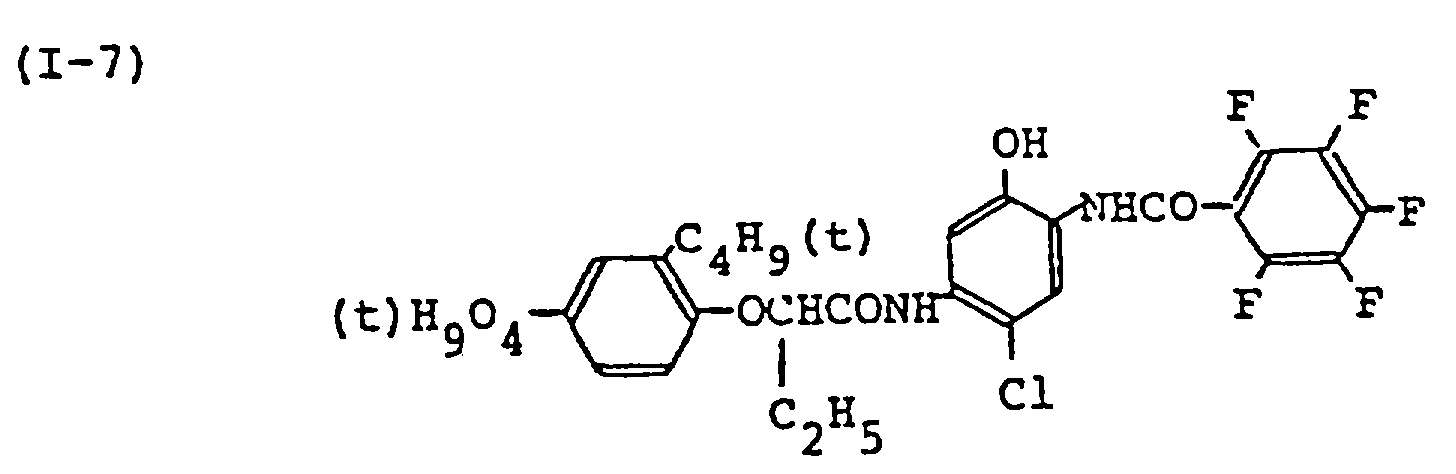


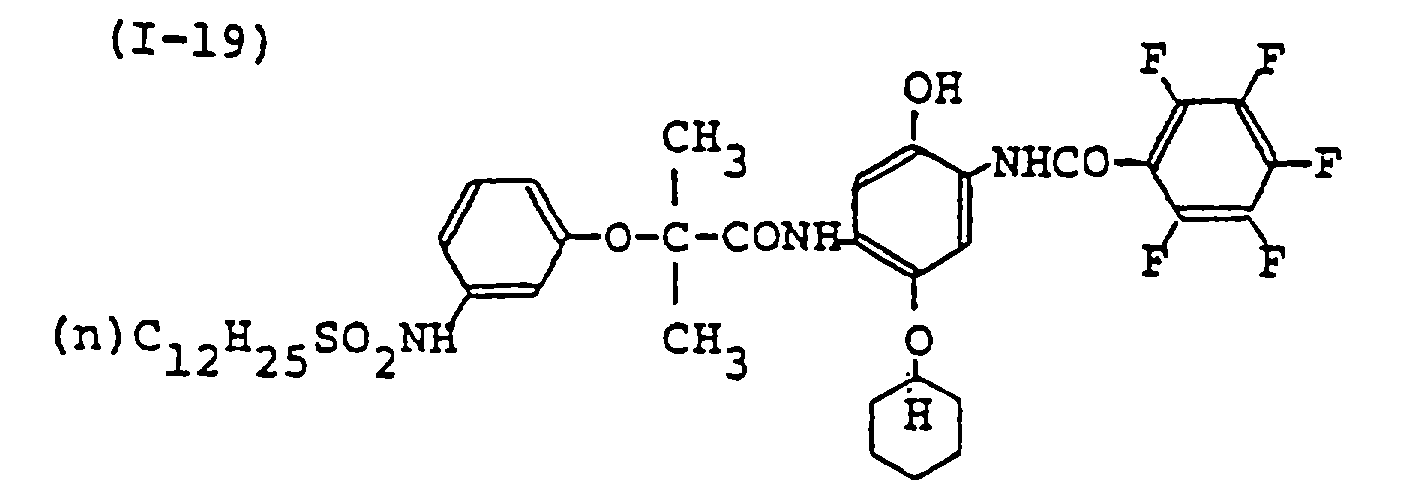


- The cyan couplers having Formula [II] are more preferably those compounds having the following Formula [IV]:

- The Formulas [I], [II], [III] and [IV], the radicals that can be split off by the reaction of these couplers with the oxidized product of the aromatic primary amine-type color developing agents represented by Z₁, Z₂, Z₃ and Z₄ are all known to those skilled in the art. Any of these radicals changes the reactivity of the coupler or is split from the coupler to fulfill its development-inhibiting, bleach-inhibiting and color-compensation functions to thereby advantageously act in the coupler-containing layers or other layers of the silver halide color photographic light-sensitive material. Typical examples of such radicals include, for example, alkoxy radicals, aryloxy radicals, arylazo radicals, thioether, carbamoyloxy radical, acyloxy radicals, imido radical, sulfonamido radical, thiocyano radical or heterocyclic radicals (such as, e.g., oxazolyl, diazolyl, triazolyl, tetrazolyl). The particularly preferred examples represented by Z are a hydrogen atom or a chlorine atom.
- The following are typical examples of those cyan couplers having Formula [II], but the present invention is not limited thereto.


- In the case of using in combination the cyan coupler having Formula [I], [Ia] and [Ib] and the cyan coupler having Formula [II], there may be used at least one of these cyan couplers having formula [I], [Ia] or [Ib] and at least one of these cyan couplers having Formula [II] in an arbitrary proportion in the combination thereof, but it is desirable that of the total amount of the cyan couplers the cyan coupler having Formula [I], [Ia] or [Ib] be used in the quantity so as to account for from 30 to 90 moles%, and more preferably from 50 to 90 mole%.
- The silver halide color photographic light-sensitive material of the present invention is allowed to be of any construction as long as it comprises a support having thereon at least one silver halide emulsion layer, and no particular restrictions are placed on the number of and the coating order of silver halide emulsion layers and non-light-sensitive layers. Typical examples of the light-sensitive material include color positive or negative films, color photographic printing papers, color slides, and those light-sensitive materials for special use such as for graphic arts use, radiography use, and high-resolution applications, and particularly suitable for use as color photographic printing papers. Most of the foregoing silver halide emulsion layers and nonlight-sensitive layers are usually comprised of hydrophilic binder-containing hydrophilic colloidal layers. As the hydrophilic binder, there may be preferably used gelatin or gelatin derivatives such as acylated gelatin, guanidylated gelatin, carbamylated gelatin, cyanoethanolated gelatin, and esterified gelatin.
- These cyan couplers having Formulas [I], [Ia] or [Ib] and [II] may be incorporated by the application of the method for use in ordinary cyan dye-forming couplers thereto into silver halide emulsion layers, the layers being coated on a support, thereby forming a photographic element. The photographic element is allowed to be either a monochromatic element or multicolour element. In the case of the multicolor element, the cyan coupler is usually incorporated into the red-sensitive silver halide emulsion layer, but may be allowed in a nonlight-sensitive emulsion layer or emulsion layer that is sensitive to three-primary-color regions excluding the red. Each component unit capable of forming a dye image is a single or one of a plurality of emulsion layers, having sensitivity to each given spectral region.
- The cyan coupler having formula [I], [Ia], [Ib] or [II] may be incorporated into an emulsion in accordance with any of conventionally known methods. For example, the cyan coupler is dissolved separately into such a single high-boiling organic solvent as a phthalate (dibutyl phthalate), a phosphate (tricresyl phosphate) or a N,N-diaIkyl-substituted amide (N,N-diethyl-laurylamide) and into such a single low-boiling organic solvent as butyl acetate or butyl propionate, or dissolved into, if necessary, a mixture of the high-boiling and low-boiling organic solvents. After that, the solution is mixed with an aqueous gelatin solution containing a surfactant, and then emulsified to be dispersed by use of a high-speed mixer, a colloid mill or a ultrasonic disperser. The resulting dispersed liquid is subsequently added to a silver halide, whereby a silver halide emulsion for use in the present invention can be prepared.
- The cyan coupler having formula [I], [Ia], [Ib] or [II] may be added to the silver halide emulsion usually within the quantity range of from 0.05 to 2 moles per mole of silver halide, and preferably from 0.1 to 1 mole per mole of silver halide.
- In the case where the silver halide color photographic light-sensitive material of the present invention is a multicolor element, all the layers including the above image forming component unit layers required for the photographic element may be coated in various orders as is known to those skilled in the art. The typical multicolor photographic element is one that comprises a support having thereon a cyan dye image-formable component unit consisting of at least one red-sensitive silver halide emulsion layer containing a cyan dye forming coupler (at least one of the cyan dye forming couplers is the cyan coupler having Formula [I] and at least further one of the cyan couplers is the cyan coupler having Formula [II]); a magenta dye image-formable component unit consisting of at least one green-sensitive silver halide emulsion layer containing at least one magenta dye forming coupler; and a yellow dye image-formable component unit consisting of at least one blue-sensitive silver halide emulsion layer containing at least one yellow dye forming coupler.
- The photographic element may have additional layers; such nonlight-sensitive layers as filter layers, interlayers, a protective layer, an antihalation layer, and a subbing layer.
- As the yellow dye forming coupler there may be suitably used those compounds having the following Formula [V]:

- Further, particularly preferred as the yellow coupler capable of forming a dye image are those compounds having the following Formula [VI]:

- These are as described in, for example, U.S. Patent Nos. 2,778,658, 2,875,057, 2.908,573, 3,227,155, 3,227,550, 2,253,924, 3,265,506, 3,277,155, 3,341,331, 3,369,895, 3,384,657, 3,408,194, 3,415,652, 3,447,928, 3,551,155, 3,582,322, 3,725,072, 3,894,875, West German OLS Patent Nos. 1,547,868, 2,057,941, 2,162,899, 2,163,812, 2,213,461, 2,219,917, 2,261,361, 2,263,875, Japanese Patent Examined Publication No. 13576/ 1974, Japanese Patent O.P.I. Publication Nos. 29432/1973, 66834/1973, 10736/1974, 122335/1975, 28834/ 1975 and 132926/1975.
- As the magenta dye image forming coupler, there may be preferably used those couplers having the following Formula [VII]:

- These are as described in, e.g., U.S. Patent Nos. 2,600,788, 3,061,432, 3,062,653, 3,217,269, 3,311,476, 3,152,896, 3,419,391, 3,519,429, 3,555,318, 3,684,514, 3,888,680, 3,907,571, 3,928,044, 3,930,861, 3,930,866, 3,933,500, Japanese Patent O.P.I. Publication Nos. 29639/1974, 111631/1974, 129538/1974, 13041/1975, 58922/1977, 62454/1980, 118034/1980, 38043/1981, British Patent No. 1,247,493, Belgian Patent Nos. 769,116 and 792,525, West German Patent No. 2,156,111, Japanese Patent Examined Publication No. 60479/1971.
- The following are typical examples of the yellow and magenta dye image forming couplers which are suitably usable in the present invention, but the present invention is not limited thereto.
-
- (Y-1)α-benzoyl-2-chloro-5-[α-(dodecyloxycarbonyl)-ethoxycarbonyl]-acetanilide.
- (Y-2) α-benzoyl-2-chloro-5-[γ-(2,4-di-t-amylphenoxy)-butylamido]-acetanilide.
- (Y-3) α-fluoro-α-pivalyl-2-chloro-5-[γ-(2,4-di-t-amylphenoxy)-butylamido]-acetanilide.
- (Y-4) α-pivalyl-α-stearoyloxy-4-sulfamoyl-acetanilide.
- (Y-5) α-pivalyl-α-[4-(4-benzyloxyphenyl-sulfonyl)-phenoxy]-2-chloro-5-[γ-(2,4-di-t-amylphenoxy)-butylamido]-acetanilide.
- (Y-6) α-(2-methoxybenzoyl)-α-(4-acetoxyphenoxy)-4-chloro-2-(4-t-actylphenoxy)-acetanilide.
- (Y-7) α-pivalyl-α-(3,3-dipropyl-2,4-dioxo-acetidin-1-yl)-2-chloro-5-[α-(dodecyloxycarbonyl)-ethoxycarbonyl]-acetanilide.
- (Y-8) α-pivalyl-α-succinimido-2-chloro-5-[γ-(2,4-di-t-amylphenoxy)butylamido]-acetanilide.
- (Y-9) α-pivalyl-α-(3-tetradecyl-1-succinimido)-acetanilide.
- (Y-10) Dipotassium α-(4-dodecyloxybenzoyl)-α-(3-methoxy-1-succinimido)-3,5-dicarboxyacetanilide.
- (Y-11) α-pivalyl-α-phthalimido-2-chloro-5-[γ-2,4-di-t-amylphenoxy]-butylamido]-acetanilide.
- (Y-12) α-2-furyl-α-phthalimido-2-chloro-5-[γ-2,4-di-t-amylphenoxy]-butylamido]-acetanilide.
- (Y-13) α-3-[α-(2,4-di-t-amylphenoxy)-butylamido)-benzoyl-α-succinimido-2-methoxyacetanilide.
- (Y-14) α-phthalimido-α-pivalyl-2-methoxy-4-[(N-methyl-N-octadecyl)-sulfamoyl]-acetanilide.
- (Y-15) α-acetyl-α-succinimido-2-methoxy-4-[(N-methyl-N-octadecyl)-sulfamoyl]-acetanilide.
- (Y-16) α-cyclobutyryl-α-(3-methyl-3-ethyl-1-succinimido)-2-chloro-5-[(2,5-di-t-amylphenoxy)-acetamido]-acetanilide.
- (Y-17) α-(3-octadecyl-1-succinimido)-α-propanoyl-acetanilide.
- (Y-18) α-[2,6-di-oxo-3-n-propyl-piperidine-1-yl]-α-pivalyl-2-chloro-5-[γ-(2,4-di-t-amylphenoxy)-butylcarbamoyl]-acetanilide.
- (Y-19) α-(1-benzyl-2,4-dioxo-imidazolidine-3-yl)-α-pivalyl-2-chloro-5-[γ-(2,4-di-t-amylphenoxy)-butylamido]-acetanilide.
- (Y-20) α-(1-benzyl-2-phenyl-3,5-dioxo-1,2,4-triazine-4-yl)-α-pivalyl-2-chloro-5-[γ-(2,4-di-t-amylphenoxy)-butylamido]-acetanilide.
- (Y-21) α-(3,3-dimethyl-1-succinimido)-α-pivalyl-2-chloro-5-[α-(2,4-di-t-amylphenoxy)-butylamido]-acetanilide.
- (Y-22) α-(3-(p-chlorophenyl)-4,4-dimethyl-2,5-dioxo-1-imidazolyl]-α-pivalyl-2-chloro-5-[γ-(2,4-di-t-amylphenoxy)-butylamido]-acetanilide.
- (Y-23) α-pivalyl-α-(2,5-dioxo-1,3,4-triazine-1-yl]-2-methoxy-5-[α-(2,4-di-t-amylphenoxy)-butylamido]-acetanilide.
- (Y-24) α-[5-benzyl-2,4-dioxo-3-oxazoyl)-α-pivalyl-2-chloro-5-[γ-(2,4-di-t-amylphenoxy)-butylamido]-acetanilide.
- (Y-25) α-(5,5-dimethyl-2,4-dioxo-3-oxazoyl)-α-pivalyl-2-chloro-5-[α-(2,4-di-t-amylphenoxy)-butylamido]-acetanilide.
- (Y-26) α-(3,5-dioxo-4-oxadinyl)-α-pivalyl-2-chloro-5-[γ-(2,4-di-t-amylphenoxy)-butylamido]-acetanilide.
- (Y-27) α-pivalyl-α-(2,4-dioxo-5-methyl-3-thiazolyl)-2-chloro-5-[γ-(2,4-di-t-amylphenoxy)-butylamido]-acetanilide.
- (Y-28) α-[3-(2H)-pyridazone-2-yl]-α-pivalyl-2-chloro-5-[γ-(2,4-di-t-amylphenoxy)-butylamido]-acetanilide.
- (Y-29) α-[4,5-dichloro-3(2H)-pyridazone-2-yl)-α-benzoyl-2-chloro-5-[α-(dodecyloxycarbonyl)-ethoxycarbonyl)-acetaniIide.
- (Y-30) α-(1-phenyl-tetrazole-5-oxy)-α-pivalyl-2-chloro-5-[γ-(2,4-di-t-amylphenoxy)-butylamido-acetanilide.
- (Y-31) 4,4'-di-(acetacetamino)-3,3-dimethyl-diphenyl-methane.
- (Y-32) P,P'-di-(acetacetamino)-diphenyl-methane.
-
- (M-1) 1-(2,4,6-trichlorophenyl)-3-(2-chloro-5-octadecyl-carbamoyl-anilino)-5-pyrazolone.
- (M-2) 1-(2,4,6-trichlorophenyl)-3-(2-chloro-5-tetradecanamido-anilino)-5-pyrazolone.
- (M-3) 1-(2,4,6-trichlorophenyl)-3-[2-chloro-5-γ-(2,4-di-t-amylphenoxy)-butyl-carbamoyl)-anilino)-5-pyrazolone.
- (M-4) 1-(2,4,6-trichlorophenyl)-4-chloro-3-[2-chloro-5-γ-(2,4-di-t-amylphenoxy)-butyl-carbamoyl]- anilino)-5-pyrazolone.
- (M-5) 1-(2,4,6-trichlorophenyl)-4-diphenyl-methyl-3-[2-chloro-5-(γ-octadecenylsuccinimido)-propyl-sulfamoyl)-anilino-5-pyrazolone.
- (M-6) 1-(2,4,6-trichlorophenyl)-4-acetoxy-5-(2-chloro-5-tetradecaneamido)-anilino-5-pyrazolone.
- (M-7) 1-[γ-(3-pentadecylphenoxy)-butylamido]-phenyl-3-anilino-4-(1-phenyl-tetrazole-5-thio)-5-pyrazolone.
- (M-8) 1-(2,4,6-trichlorophenyl)-3-(2-chloro-5-octadecylsuccinimido)-anilino-5-pyrazolone.
- (M-9) 1-(2,4,6-trichlorophenyl)-3-(2-chloro-5-octadecenylsuccinimido)-anilino-5-pyrazolone.
- (M-10) 1-(2,4,6-trichlorophenyl)-3-(2-chloro-5-(N-phenyl-N-octyl-carbamoyl)]-anilino-5-pyrazolone.
- (M-11) 1-(2,4,6-trichlorophenyl)-3-(2-chloro-5-(N-butyl-carbonyl)-pyrazinyl-carbonyl]-anilino-5-pyrazolone.
- (M-12) 1-(2,4,6-trichlorophenyl)-3-(2-chloro-5-(2,4-di-carboxy-5-phenyl-carbamoyl)-benzylamido]-anilino-5-pyrazolone.
- (M-13) 1-(2,4,6-trichlorophenyl)-3-(4-tetradecyl-thiomethylsuccinimido)-anilino-5-pyrazolone.
- (M-14) 1-(2,4,6-trichlorophenyl)-3-[2-chloro-4-(2-benzofurylcarboxyamido)]-anilino-5-pyrazolone.
- (M-15) 1-(2,4,6-trichlorophenyl)-3-{2-chloro-4-(2-chloro-4-[γ-(2,2-dimethyl-6-octadecyl-7-hydroxy chroman-4-yl)-propionamido]}-anilino-5-pyrazolone.
- (M-16) 1-(2,4,6-trichlorophenyl)-3-[2-chloro-5-(3-pentadecylphenyl)-phenylcarboamido)anilino-5-pyrazolone.
- (M-17) 1-(2,4,6-trichlorophenyl)-3-{2-chloro-5-[2-(3-t-butyl-4-hydroxyphenoxy)-tetradecanamido]-anilino}-5-pyrazolone.
- (M-18) 1-(2,6-dichloro-4-methoxyphenyl)-3-(2-methyl-5-tetradecanamido]-anilino}-5-pyrazolone.
- (M-19) 4,4'-benzylidene-bis-[1-(2,4,6-trichlorophenyl)-3-{2-chloro-4-[γ-(2,4-di-t-amylphenoxy)-butylamido]-anilino}-5-pyrazolone.
- (M-20) 4,4'-benzylidene-bis-[1-(2,3,4,5,6-pentachlorophenyl)-3-2-chloro-5-[γ-(2,4-di-t-amylphenoxy)-butylamido]-anilino-5-pyrazolone.
- (M-21) 4,4'-(2-chloro)-benzylidene-bis-[1-(2,4,6-trichlorophenyl)-3-(2-chloro-5-dodecylsuccinimido)-anilino-5-pyrazolone.
- (M-22) 4,4'-benzylidene-bis-[1-(2-chlorophenyl)-3-(2-methoxy-4-hexadecanamido)-anilino-5-pyrazolone].
- (M-23) 4,4'-methylene-bis-[1-(2,4,6-trichlorophenyl)-3-(2-chloro-5-dodecenylsuccinimido)-anilino-5-pyrazolone].
- (M-24) 1-(2,4,6-trichlorophenyl)-3-[3-(2,4-di-t-amylphenoxyacetamido)-benzamido]-5-pyrazolone.
- (M-25) 3-ethoxy-1-4-[γ-(3-pentadecenylphenoxy)-butylamido]-phenyl-5-pyrazolone.
- (M-26) 1-(2,4,6-trichlorophenyl)-3-[2-chloro-5-{α-(3-t-butyl-4-hydroxy)-phenyl}-tetradecanamido]-anilino-5-pyrazolone.
- (M-27) 1-(2,4,6-trichlorophenyl)-3-3-nitriloanilino-5-pyrazolone.
- Any of these yellow dye forming couplers and magenta dye forming couplers may be incorporated into a silver halide emulsion layer within the quantity range of from 0.05 to 2 moles per mole of silver halide.
- For the support of the light-sensitive material of the present invention, any of these materials may be used such as, for example, baryta paper, polyethylene-coated paper, polypropylene-synthetic paper, a transparent support material provided with a reflective layer or material, a glass plate, cellulose acetate, cellulose nitrate, polyester film such as polyethylene terephthalate, polyamide film, polycarbonate film, and polystyrene film. These support materials may be arbitrarily selected according to the purpose for which is used the silver halide photographic light-sensitive material of the present invention.
- The coating process for use in coating the silver halide emulsion layers and nonlight-sensitive layers of the light-sensitive material of the present invention includes such various processes as the dipping coating process, air-doctor coating process, curtain coating process, and hopper coating process.
- The silver halide used for the silver halide emulsion includes those arbitrarily used for ordinary silver halide emulsions: silver bromide, silver chloride, silver iodobromide, silver chlorobromide, and silver chloroiodobromide. The particles of these silver halides are allowed to be either coarse-grained or fine-grained, and be of either wide or narrow particle-size distribution.
- The crystal of these silver halide particles may be either regular or twin, and those having an arbitrary proportion of its [100] face to [111] face can be used. Further the crystal structure of these silver halide particles may be either homogeneous from the inside to the outside thereof or heterogeneous between the inside and the outside thereof. Furthermore, these silver halides may be either of the type of forming a latent image mainly on the surface of the particles thereof or of the type of forming it inside the particles thereof. In addition, these silver halides may be prepared by any of the neutral method, ammoniacal method and acid method, and silver halide particles produced by any of the simultaneous mixing method, sequential mixing method and conversion method may be applied.
- The silver halide emulsion used in the present invention can be chemically sensitized by the single or combined use of sulfur sensitizers such as, e.g., aryl-thiocarbamide, thiourea, cystine; active or inert selenium sensitizers; reduction sensitizers such as, e.g., stannous salts or polyamides; noble-metallic sensitizers including such gold sensitizers as sodium aurithiocyanate, potassium chloroaurate, 2-aurosulfo-benzothiazolemethyl chloride, water-soluble-salt sensitizers such as of ruthenium, rhodium, iridium, and ammonium chloropalladate, potassium chloropalladate and sodium chloropalladite.
- Into the silver halide emulsion used in the invention may be incorporated various known photographic additives such as those described in, e.g., Research Disclosure No. 17643, Dec. 1978.
- The silver halide emulsion used in the invention, in order to be provided with sensitivity to the necessary wavelength region for a red-sensitive emulsion, is spectrally sensitized by the addition thereto of an appropriately selected sensitizing dye. As the spectral sensitizer, various sensitizing dyes may be used singly or in combination.
- Advantageously applicable spectral sensitizers to the invention include such typical cyanine dyes, merocyanine dyes, and complex cyanine dyes as described in U.S. Patent Nos. 2,269,234, 2,270,378 2,442,710 and 2,454,620.
- Other additives may also be arbitrarily incorporated into the silver halide emulsion layers and nonlight sensitive layers of the silver halide photographic light-sensitive material of the present invention, the additives including antifoggants, antistain agents, brightening agents, antistatic agents, hardening agents, plasticizers, wetting agents, and ultraviolet absorbing agents, as described in Research Disclosure No. 17643.
- The thus constructed silver halide photographic light-sensitive material of the present invention, after being exposed to light, is then developed by the color development process including various photographic processing procedures. The preferred color developer liquid is one that contains an aromatic primary amine-type color developing agent as the principal component thereof, the color developing agent being typified by p-phenylenediamine-type compounds including, for example, diethyl-p-phenylenediamine hydrochloride, monomethyl - p - phenylenediamine hydrochloride, dimethyl - p - phenylenediamine hydrochloride, 2 - amino - 5 - diethylaminotoluene hydrochloride, 2 - amino - 5 - (N - ethyl - N - dodecylamino) - toluene, 2 - amino - 5 - (N - ethyl - N - β - methanesulfonamidoethyl)-aminotoluene sulfate,4 -(N - ethyl - N - β - methanesulfonamidoethylamino)aniline, 4 -(N - ethyl - N - β - hydroxyethylamino)aniline, and 2 - amino - 5 - (N - ethyl - β - methoxyethyl)aminotoluene.
- These color developing agents may be used singly or in combination, or used together with hydroquinone. Further, the color developer liquid contains generally alkali agents such as sodium hydroxide, ammonium hydroxide, sodium carbonate or sodium sulfite, and may also contain various additives including such halogenated alkaline metals as, e.g., potassium bromide, and development control agents such as, e.g., hydrazinic acid.
- The silver halide photographic light-sensitive material of the present invention may contain in the hydrophilic colloidal layers thereof the foregoing color developing agent as it is or in the form of the precursor thereof. The color developing agent precursor is a compound capable of producing a color developing agent under an alkaline condition, the precursor including aromatic aldehyde derivative- Schiff's base-type precursors, multivalent metallic ion complex precursors, phthalic acid imide derivative precursors, phosphoric acid imide derivation precursors, sugar-amine reaction product precursors and urethane-type precursors. These aromatic primary amine color developing agent precursors are, as described in, e.g., U.S. Patent Nos. 3,342,599, 2,507,114, 2,695,234, 3,719,492, British Patent No. 803,783, Japanese Patent O.P.I. Publication Nos. 135628/1978 and 79035/1979, and Research Disclosure Nos. 15,159, 12,146 and 13,924. Any of these aromatic primary amine color developing agents of precursors thereof should be added in a quantity enough to obtain a sufficient color formation during the development process. The quantity largely differs according to the kind of the light-sensitive material used, but is used within the range of from 0.1 mole to 5 moles, and preferably from 0.5 mole to 3 moles per mole of light-sensitive silver halide. These color developing agents or precursors may be used singly or in combination. Into the photographic light-sensitive material may be incorporated any of the foregoing compounds in the form of a solution of it dissolved into an appropriate solvent such as water, methanol, ethanol or acetone, or in the form of a dispersed liquid of it with use of a high-boiling organic solvent such as dibutyl phthalate, dioctyl phthalate, or tricresyl phosphate, or in the form of it impregnated into a latex polymer as described in Research Disclosure No. 14850.
- The silver halide photographic light-sensitive material of the present invention, after color development, is usually subjected to a bleach-fix bath processing or to separate bleaching and fixing treatments and then washed in water. As the bleaching agent, there may be used many compounds, among which multivalent metallic compounds such as of iron (III), cobalt (III), and tin (II), especially complex salts of these metallic cations with organic acids, such as, for example, metallic complex salts, ferricyanates or dichromates of ethylenediamine-tetraacetic acid, nitrilotriacetic acid, aminopolycarboxylic acids such as N-hydroxyethyl-ethylenediaminediacetic acid, malonic acid, tartaric acid, malic acid, diglycolic acid, and dithioglycolic acid, may be used singly or in combination.
- According to the silver halide photographic light-sensitive material of the present invention, the solubility, dispersibility and dispersion stability of the cyan coupler contained in the silver halide emulsion layer are so good that no such a trouble as deposition of the coupler will occur. The cyan coupler is excellent in the spectral absorbing characteristic as well as in the color tone and capable of forming a clear dye image in an extensive color reproduction range; particularly a cyan dye image having the maximum absorption in the wavelength range of from 640 to 660nm and having little or no absorption in the regions of from 400 to 450nm, from 450 to 480nm, and from 500 to 550nm, so that the coupler produces very excellent blue and green color reproductions with very satisfactory lightness with no trouble at all. Besides, the formed dye image is also excellent in the resistance to light, heat and moisture as well as in its preservability.
- The present invention will be illustrated further in detail in reference to examples below, but embodiments of the present invention are not limited thereto.
- The cyan couplers of formula [I] and [II] given in Table 1 and the following comparative couplers were used and 10g of each of these couplers was added to a mixture of 5ml of dibutyl phthalate with 30ml of ethyl acetate, and completely dissolved by heating to 60°C. This solution was mixed with 5ml of an aqueous 10% solution of Alkanol B (alkyl-naphthalenesulfonate, manufactured by DuPont) and 200ml of an aqueous 5% gelatin solution, and this mixture was emulsified by means of a colloid mill to prepare a coupler-dispersed liquid. The thus dispersed liquids each was added to 500g of a silver chlorobromide (containing 80 mole% silver bromide) emulsion, and the resulting emulsion was coated on a polyethylene-coated paper support and then dried, whereby 13 different monochromatic photographic elements were prepared These samples were exposed through an optical wedge to light and subsequently processed in the baths given below in accordance with the following steps:
Processing steps Temperature Time Colour developing 30°C 3 min & 30 s Bleach-fix 30°C 1 min & 30 s Washing 30°C 2 min 

- The thus processed samples each was tested for the spectral reflection characteristics and preservability thereof in the following manners:
- Spectral reflection characteristics tests:
- (i) Reflection maximum wavelength (λmax): The wavelength at which the reflection density becomes maximum was tested by use of Hitachi® Color Analyzer Model 607.
- (ii) Reflection density (D): Reflection densities at the wavelengths λ of 550 nm, 470 nm and 420 nm when the maximum density is 2.0 by use of the same color analyzer as in (i).
- (iii) Lightness (L*): Measurements were made in accordance with the Japanese Industrial Standard JIS Z 8729-1980.
- (iv) Light stability: Each of the resulting dye images was exposed to the light of 45,000 luxes of a xenon fadometer over a period of 150 hours, and after that the residential density at the initial density of 1.0 was measured.
- (v) Dark stability: After storing the samples at 77°C in the dark for two weeks, the residual density of each of the samples at the initial density of 1.0 was measured.
- The results obtained in (i)-(v) are given together in Table 1.
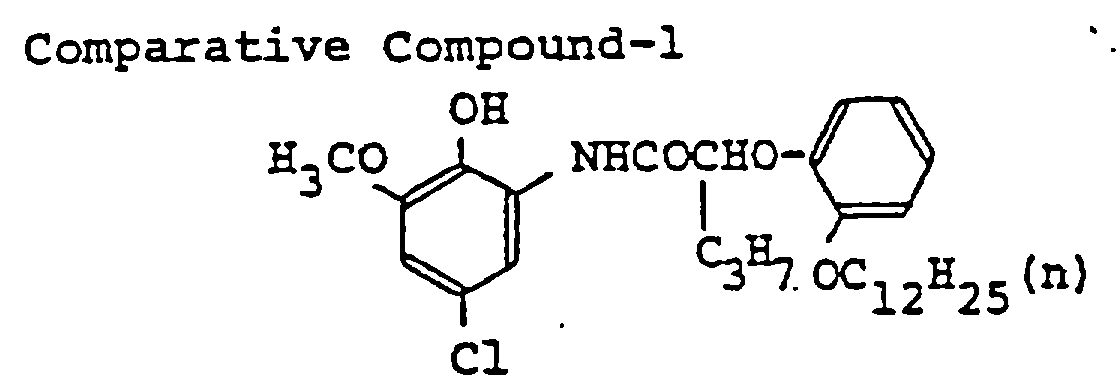


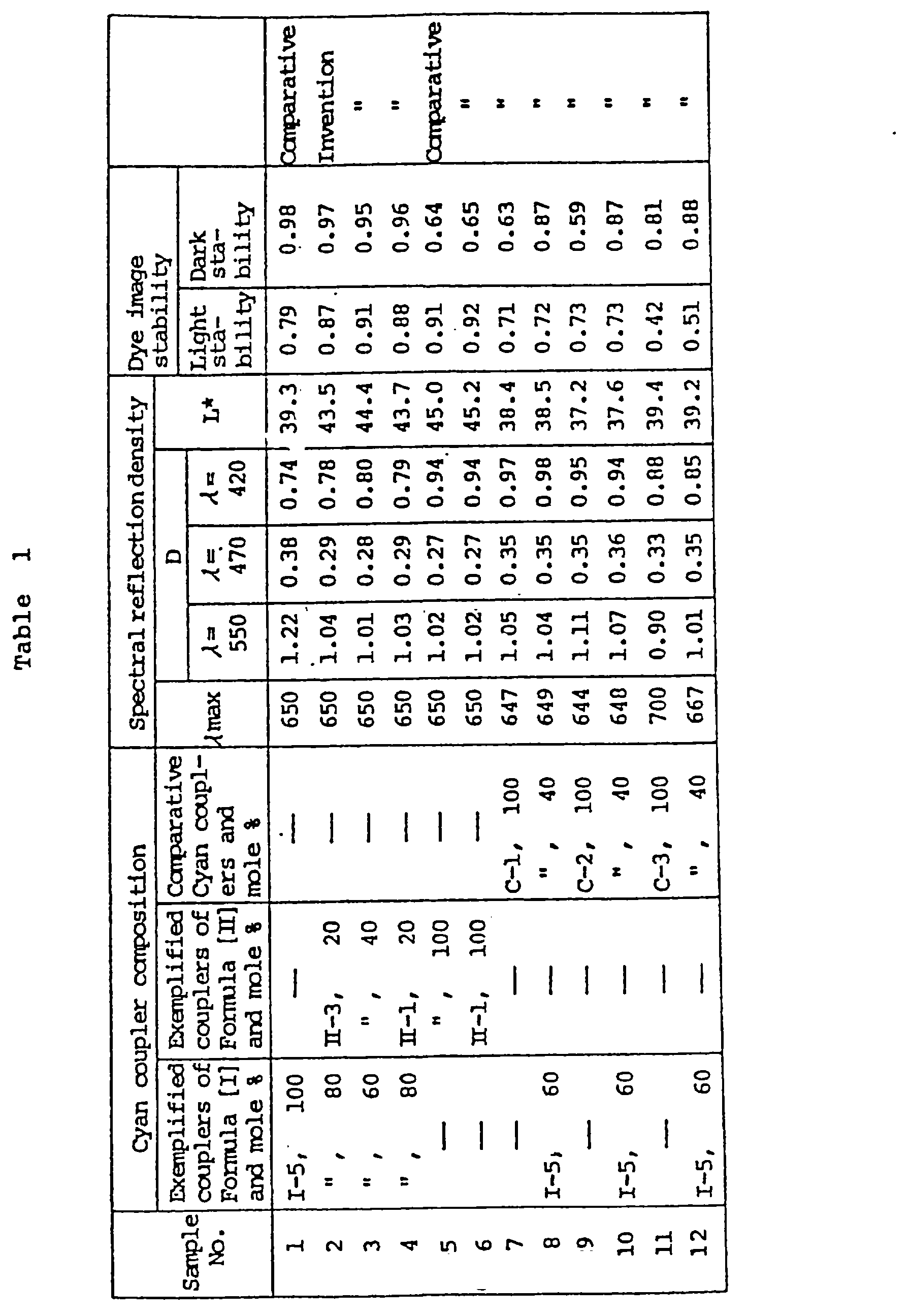
- As apparent from the results shown in Table 1, the silver halide color photographic light-sensitive material samples of the present invention have little undesirable absorptions in 550nm and 420nm and low reflection minimum densities as compared to the silver halide color photographic light-sensitive material samples containing compounds having Formula [I] alone, thus resulting in the formation of a dye image having a high lightness and satisfactory spectral reflection characteristics. This is quite an unexpected multiplied effect obtained due to the use of the cyan couplers having Formula [II]. And the formed dye image displays very satisfactory results in respect of the resistance to light and dark stability.
- The cyan couplers of formula [I] and [II] and the comparative couplers shown in Table 1 were used, and 0.1 mole of each of the couplers was added to and dissolved by heating to 60°C into a mixture liquid of 20ml of dibutyl phthalate and ethyl acetate. The necessary quantity of the ethyl acetate for the dissolution was measured. The results are as shown in Table 2. The thus obtained coupler solutions each was then mixed with the same aqueous Alkanol B solution as in Example 1 and an aqueous gelatin solution, and the mixture was emulsified by means of a colloid mill to thereby prepare a coupler-dispersed liquid. The coupler-dispersed liquid was subsequently added to 1000 ml of a red-sensitive silver chlorobromide emulsion (containing 70 mole% of silver bromide) containing photographic additives such as a hardening agent, coating aid, whereby a coating liquid for making a red-sensitive emulsion layer. These coupler-dispersed liquid-containing silver halide emulsion coating liquids each, being kept at a temperature of 40°C, was flowed at a rate of 2 liters per minute for 48 hours through stainless tubing with its internal diameter of 5 cm by use of a circulation pump, and the time of a deposit beginning to attach to the inside wall of the tubing and the attached quantity of the deposit two days later were measured. The obtained results are as given in Table 2. As apparent from the results shown in Table 2, the cyan couplers are very excellent in the solubility, dispersibility and dispersion stability.

- The following layers were coated on a polyethylene-coated paper support in the described order from the support sidee to thereby prepare multicolor photographic element samples.
- A yellow coupler-containing blue-sensitive silver halide emulsion (a silver chlorobromide emulsion containing 90 mole% of silver bromide and 300 g of gelatin per mole of silver halide and also containing 0.5 mole per mole of silver halide of an yellow coupler YC-1 dissolved into dibutyl phthalate and dispersed into the emulsion) is coated so that the coating quantity of gelatin is 2 g/m, and then dried.
- A first interlayer (a gelatin layer of 1.5 g of gelatin/m).
- A magenta coupler-containing green-sensitive silver halide emulsion (a silver chlorobromide emulsion containing 80 mole% of silver bromide and 400 g of gelatin per mole of silver halide and also containing 0.3 mole per mole of silver halide of the following magenta coupler MC-1 dissolved into dibutyl phthalate and dispersed into the emulsion) is coated so that the coating quantity of gelatin is 2 g/m, and then dried.
- An ultraviolet absorbing agent-containing second interlayer (containing the following ultraviolet absorbing agent UV-1: a solution of the agent dissolved into 20 g of dibutyl phthalate is dispersed into gelatin, and the dispersed liquid is coated so that the coating quantity of the agent is 0.6 g/m and that of gelatin is 1.5 g/m, and then dried.).
- Cyan coupler-containing red-sensitive silver halide emulsions [silver chlorobromide emulsion containing 80 mole% of silver bromide and 300 g of gelatin per mole of silver halide, into parts of which emulsion are dispersed separately dibutyl phthalate solutions of exemplified couplers having Formula [I] and [II], respectively, and into the other parts of which emulsion are dispersed separately the same comparative couplers-1 and -2 as in Example 1, respectively, (the individual quantities of the respective couplers are given in mole% to the total amount of all the cyan couplers in Table 3), the emulsions containing 0.4 mole per mole of silver halide of the above couplers, respectively) each is coated so that the coating quantity of gelatin is 20 g/m, and then dried.
- A protective layer (a gelatin layer of 1.5 g of gelatin/m).
- The thus prepared samples 29-42 each was exposed to blue, green, and red lights through a wedge by use of a sensitometer (Model KS-7, manufactured by Konishiroku Photo Ind. Co., Ltd.), and then processed in the following baths in accordance with the processing steps given below:
Processing steps (32.8°C) Processing time Color developing 3 min & 30 s Bleach-fix 1 min & 30 s Washing 3 min & 30 s Drying -
N-ethyl-N-β-methanesulfonamidoethyl-3-methyl-4-aminoaniline sulfate 4.0 g Hydroxyamine sulfate 2.0 g Potassium carbonate 25.0 g Sodium chloride 0.1 g Sodium bromide 0.2 g Anhydrous sodium sulfite 2.0 g Benzyl alcohol 10.0 ml Polyethylene glycol (average polymerization degree: 400) 3.0 ml Water to make 1 liter -
Iron-ammonium ethylenediamine-tetraacetate 60.0 g Ammonium thiosulfate 100.0 g Sodium hydrogensulfite 20.0 g Sodium metabisulfite 5.0 g Water to make 1 liter -


- The thus processed samples were tested for the evaluation of the color-reproducible region thereof and for the dye image preservability thereof.
- In accordance with the method for representing colors by the L*, u* and v* systems specified by the Japanese Industrial Standard JIS Z 8729-1980, a chromaticity diagram of u' and v', when L* is equal to 50, was prepared for each of the samples to thereby evaluate the color-reproducible region (as integrated value) from the relative areas formed by the yellow, magenta and cyan dyes. Further, the color area formed by the formed cyan and magenta dyes was regarded as the blue-reproduced region, the color area formed by the formed cyan and yellow dyes as the green-reproduced region, and the color area formed by the formed magenta and yellow dyes as the red-reproduced region, and these respective color-reproduced regions were evaluated from the relative areas thereof.
- The formed yellow (Y), magenta (M) and cyan (C) dye images were tested for the light stability and the dark stability in the same manners as in Example 1.
- The results obtained from the above tests are as given together in Table 3.

- As apparent from Table 3, the multicolor photographic elements which use the cyan couplers of formula [I] and [II] show much improved blue color reproductions with clear dye images formed in a wide color reproduction region without any adverse effect on the green color reproduction, and further show well-balanced degree of cyan-magenta-yellow discoloration, thus showing much improved dye image stability on the whole.
- Monochromatic photographic element samples were prepared in the same manners as in previous examples with the exception that Exemplified Couplers I-16, II-4 and II-5 were used in place of the I-5, II-3 and II-1, respectively, and Comparative Couplers-4, -5 and -6 in place of the Comparative Couplers-1, -2 and -3.
- The thus obtained different samples were used for the same tests as in Example 1. As a result, the silver halide color photographic light-sensitive material samples of the present invention have less undesirable absorptions in 550 nm and 420 nm and lower reflection minimum densities than do the silver halide color photographic light-sensitive material samples containing those of Formula [I] alone, so that the samples of the present invention form high lightness and satisfactory spectral reflection characteristics having dye images. And the formed dye images display very satisfactory light stability and dark stability characteristics.

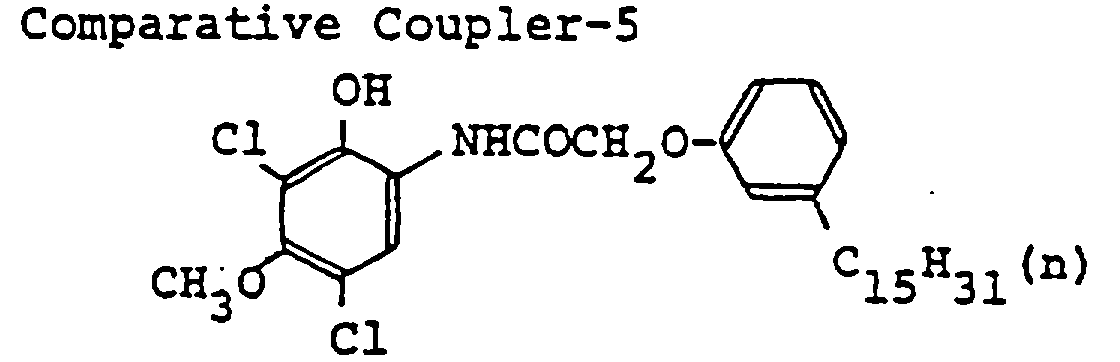

- Similar multicolor photographic element samples to the multicolor photographic element samples of Example 3 were prepared in the same manners as in Example 3 with the exception that the exemplified couplers were replaced by those used In Example 4, respectively, and the YC-1, MC-1 and UV-1 were replaced by the following YC-2, MC-2 and UV-2, respectively.
- The thus obtained different samples were subjected to the same tests as in Example 3. As a result, the samples containing cyan couplers of formula [I] and [II] show improved red, green and blue color reproductions, particularly the conspicuous improvement on the blue-color reproduction, with clear dye image formed in a wide color reproduction region, and also show well-balanced degree of cyan-magenta-yellow discoloration, thus showing much improved image preservability on the whole.


Claims (12)
- A silver halide photographic light-sensitive material comprising a support having thereon at least one silver halide emulsion layer containing in combination at least one of those cyan couplers having the following Formula [I], [1a] or [IB] and at least one of those cyan couplers having the following Formula [II]:


- The light-sensitive material of claim 1, wherein the cyan couplers having the Formula [II] are the compounds having the following Formula [IV]:

- The light-sensitive material of claim 2, wherein the alkyl radicals represented by R₁₁ and R₁₂ in Formula [IV] are butyl radicals or amyl radicals, respectively.
- The light-sensitive material of claim 2, wherein the alkyl radical represented by R₁₃ in Formula [IV] is an ethyl radical or a butyl radical.
- The light-sensitive material of claim 2, wherein the halogen atom represented by Z₄ in Formula [IV] is a chlorine atom.
- The light-sensitive material of claim 1, wherein the cyan coupler having Formula [I], [Ia] or [Ib] out of the total quantity of the cyan couplers being contained in the silver halide emulsion layer is used in the quantity so as to account for from 30 to 90 mole per cent.
- The light-sensitive material of claim 6, wherein the cyan coupler having Formula [I], [Ia] or [Ib] out of the total quantity of the cyan couplers being contained in the silver halide emulsion layer is used in the quantity so as to account for from 50 to 90 mole per cent.
- The light-sensitive material of claim 1, wherein the cyan coupler having Formula [I], [Ia] or [Ib] and that having Formula [II] are respectively contained in the quantity within the range of from 0.1 to 1 mole thereof per mole of silver halide.
- The light-sensitive material of claim 1, wherein the support has thereon a cyan dye image-formable component unit consisting of at least one red-sensitive silver halide emulsion layer containing in a combination of a cyan coupler having Formula [I], [Ia] or [Ib] and a cyan coupler having Formula [II] of claim 1; a magenta dye image-formable component unit consisting of at least one green-sensitive silver halide emulsion layer containing at least one magenta dye forming coupler; and a yellow dye image-formable component unit consisting of at least one blue-sensitive silver halide emulsion layer containing at least one yellow dye forming coupler.
- The light-sensitive material of claim 9, wherein the yellow dye image forming coupler is a compound having the following Formula [V]:

- The light-sensitive material of claim 9, wherein the yellow dye forming coupler is a compound having the following Formula [VI]:

- The light-sensitive material of claim 9, wherein the magenta dye forming coupler is a compound having the following Formula [VII]:

Applications Claiming Priority (2)
| Application Number | Priority Date | Filing Date | Title |
|---|---|---|---|
| JP210219/82 | 1982-11-30 | ||
| JP57210219A JPS59100440A (en) | 1982-11-30 | 1982-11-30 | Photosensitive silver halide material |
Publications (4)
| Publication Number | Publication Date |
|---|---|
| EP0112514A2 EP0112514A2 (en) | 1984-07-04 |
| EP0112514A3 EP0112514A3 (en) | 1985-10-23 |
| EP0112514B1 EP0112514B1 (en) | 1989-06-28 |
| EP0112514B2 true EP0112514B2 (en) | 1996-01-17 |
Family
ID=16585754
Family Applications (1)
| Application Number | Title | Priority Date | Filing Date |
|---|---|---|---|
| EP83111926A Expired - Lifetime EP0112514B2 (en) | 1982-11-30 | 1983-11-29 | Silver halide photographic light-sensitive material |
Country Status (4)
| Country | Link |
|---|---|
| US (1) | US4537857A (en) |
| EP (1) | EP0112514B2 (en) |
| JP (1) | JPS59100440A (en) |
| DE (1) | DE3380127D1 (en) |
Families Citing this family (20)
| Publication number | Priority date | Publication date | Assignee | Title |
|---|---|---|---|---|
| JPS59124341A (en) * | 1982-12-29 | 1984-07-18 | Konishiroku Photo Ind Co Ltd | Photographic coupler |
| JPS59195642A (en) * | 1983-04-21 | 1984-11-06 | Fuji Photo Film Co Ltd | Color photographic sensitive silver halide material |
| US4623616A (en) * | 1984-03-30 | 1986-11-18 | Konishiroku Photo Industry Co., Ltd. | Silver halide photographic light-sensitive material |
| JPS60242457A (en) * | 1984-04-19 | 1985-12-02 | Konishiroku Photo Ind Co Ltd | Silver halide photosensitive material |
| JPS60221753A (en) * | 1984-04-19 | 1985-11-06 | Konishiroku Photo Ind Co Ltd | Silver halide photosensitive material |
| JPS60221752A (en) * | 1984-04-19 | 1985-11-06 | Konishiroku Photo Ind Co Ltd | Silver halide photosensitive material |
| JPS60222853A (en) * | 1984-04-20 | 1985-11-07 | Konishiroku Photo Ind Co Ltd | Silver halide color photosensitive material |
| JPS60229029A (en) * | 1984-04-26 | 1985-11-14 | Fuji Photo Film Co Ltd | Silver halide color photographic sensitive material |
| JPS60250344A (en) * | 1984-05-26 | 1985-12-11 | Fuji Photo Film Co Ltd | Color photographic sensitive material |
| JPS619653A (en) * | 1984-06-25 | 1986-01-17 | Fuji Photo Film Co Ltd | Color photographic sensitive silver halide material |
| JPS6153643A (en) * | 1984-08-24 | 1986-03-17 | Fuji Photo Film Co Ltd | Silver halide color photosensitive material |
| JPS6199141A (en) * | 1984-10-22 | 1986-05-17 | Konishiroku Photo Ind Co Ltd | Silver halide color photographic sensitive material |
| EP0192199B1 (en) * | 1985-02-16 | 1991-09-11 | Konica Corporation | Light-sensitive photographic material |
| JPH0715568B2 (en) | 1986-01-20 | 1995-02-22 | コニカ株式会社 | Silver halide color photographic light-sensitive material |
| EP0491678A3 (en) * | 1986-04-18 | 1992-09-09 | Konica Corporation | Method for processing a light-sensitive silver halide color photographic material |
| US4916050A (en) * | 1987-05-26 | 1990-04-10 | Konica Corporation | Silver halide light-sensitive photographic material |
| IT1229993B (en) * | 1989-03-09 | 1991-09-20 | Minnesota Mining & Mfg | COLOR PHOTOGRAPHIC MATERIALS WITH SILVER HALIDES. |
| JPH03191345A (en) * | 1989-12-20 | 1991-08-21 | Fuji Photo Film Co Ltd | Silver halide color photographic sensitive material |
| GB9905544D0 (en) * | 1999-03-10 | 1999-05-05 | Eastman Kodak Co | Photographic elements containing blend of cyan dye-forming couplers |
| GB0023096D0 (en) | 2000-09-20 | 2000-11-01 | Eastman Kodak Co | Photographic elements containg a cyan dye-forming coupler,stabilizer and solvent |
Family Cites Families (10)
| Publication number | Priority date | Publication date | Assignee | Title |
|---|---|---|---|---|
| JPS6213658B2 (en) * | 1974-05-23 | 1987-03-27 | Fuji Photo Film Co Ltd | |
| JPS5655945A (en) * | 1979-10-15 | 1981-05-16 | Fuji Photo Film Co Ltd | Color photographic material |
| JPS6038695B2 (en) * | 1979-12-05 | 1985-09-02 | 富士写真フイルム株式会社 | Color photographic material |
| JPS5719739A (en) * | 1980-07-11 | 1982-02-02 | Konishiroku Photo Ind Co Ltd | Formation of dye image |
| JPS57142640A (en) * | 1981-02-27 | 1982-09-03 | Konishiroku Photo Ind Co Ltd | Formation of cyan dye image |
| JPS57173835A (en) * | 1981-04-20 | 1982-10-26 | Fuji Photo Film Co Ltd | Silver halide color photosensitive material |
| JPS5898731A (en) * | 1981-12-07 | 1983-06-11 | Fuji Photo Film Co Ltd | Color photosensitive material |
| US4434225A (en) * | 1982-02-24 | 1984-02-28 | Konishiroku Photo Industry Co., Ltd. | Light-sensitive silver halide color photographic material |
| JPS58147744A (en) * | 1982-02-25 | 1983-09-02 | Konishiroku Photo Ind Co Ltd | Silver halide color photographic sensitive material |
| JPS58208745A (en) * | 1982-05-28 | 1983-12-05 | Konishiroku Photo Ind Co Ltd | Color photographic sensitive material |
-
1982
- 1982-11-30 JP JP57210219A patent/JPS59100440A/en active Granted
-
1983
- 1983-11-29 DE DE8383111926T patent/DE3380127D1/en not_active Expired
- 1983-11-29 US US06/556,129 patent/US4537857A/en not_active Ceased
- 1983-11-29 EP EP83111926A patent/EP0112514B2/en not_active Expired - Lifetime
Also Published As
| Publication number | Publication date |
|---|---|
| EP0112514B1 (en) | 1989-06-28 |
| EP0112514A3 (en) | 1985-10-23 |
| US4537857A (en) | 1985-08-27 |
| DE3380127D1 (en) | 1989-08-03 |
| EP0112514A2 (en) | 1984-07-04 |
| JPH0430573B2 (en) | 1992-05-22 |
| JPS59100440A (en) | 1984-06-09 |
Similar Documents
| Publication | Publication Date | Title |
|---|---|---|
| US4666826A (en) | Photographic light-sensitive material containing phenolic couplers and stabilizers | |
| EP0112514B1 (en) | Silver halide photographic light-sensitive material | |
| EP0113124B1 (en) | Silver halide photographic light-sensitive material | |
| EP0137722B1 (en) | Silver halide color photographic material | |
| US4551422A (en) | Silver halide photographic light-sensitive material | |
| US4564587A (en) | Light-sensitive silver halide color photographic material comprising multi-silver halide emulsion layers having same color sensitiveness but different in sensitivities | |
| US4529690A (en) | Silver halide color photographic light-sensitive material | |
| JPH0477895B2 (en) | ||
| JPS6257023B2 (en) | ||
| US4609618A (en) | Silver halide photographic light-sensitive material | |
| US4613565A (en) | Silver halide photographic material | |
| US4914013A (en) | Silver halide light-sensitive color photographic material | |
| US4613564A (en) | Silver halide photographic material | |
| US4954431A (en) | Silver halide photographic light-sensitive material | |
| JPH0514893B2 (en) | ||
| JPH0371701B2 (en) | ||
| US5270158A (en) | Light-sensitive silver halide color photographic material | |
| USRE34697E (en) | Silver halide photographic light-sensitive material | |
| US4614710A (en) | Silver halide photographic material | |
| US5364753A (en) | Silver halide color photographic light-sensitive material | |
| JPH043542B2 (en) | ||
| EP0254318B1 (en) | Silver halide color photographic material | |
| JPH0244052B2 (en) | HAROGENKAGINKARAASHASHINSEIHIN | |
| JPS6055343A (en) | Color photographic sensitive silver halide material |
Legal Events
| Date | Code | Title | Description |
|---|---|---|---|
| PUAI | Public reference made under article 153(3) epc to a published international application that has entered the european phase |
Free format text: ORIGINAL CODE: 0009012 |
|
| AK | Designated contracting states |
Designated state(s): DE FR GB IT |
|
| PUAL | Search report despatched |
Free format text: ORIGINAL CODE: 0009013 |
|
| AK | Designated contracting states |
Designated state(s): DE FR GB IT |
|
| 17P | Request for examination filed |
Effective date: 19860524 |
|
| 17Q | First examination report despatched |
Effective date: 19870813 |
|
| GRAA | (expected) grant |
Free format text: ORIGINAL CODE: 0009210 |
|
| AK | Designated contracting states |
Kind code of ref document: B1 Designated state(s): DE FR GB IT |
|
| REF | Corresponds to: |
Ref document number: 3380127 Country of ref document: DE Date of ref document: 19890803 |
|
| ET | Fr: translation filed | ||
| ITF | It: translation for a ep patent filed | ||
| PLBI | Opposition filed |
Free format text: ORIGINAL CODE: 0009260 |
|
| 26 | Opposition filed |
Opponent name: FUJI PHOTO FILM CO., LTD. Effective date: 19900328 |
|
| RAP4 | Party data changed (patent owner data changed or rights of a patent transferred) |
Owner name: KONICA CORPORATION |
|
| ITTA | It: last paid annual fee | ||
| PGFP | Annual fee paid to national office [announced via postgrant information from national office to epo] |
Ref country code: FR Payment date: 19931110 Year of fee payment: 11 |
|
| PG25 | Lapsed in a contracting state [announced via postgrant information from national office to epo] |
Ref country code: FR Effective date: 19950731 |
|
| REG | Reference to a national code |
Ref country code: FR Ref legal event code: ST |
|
| PUAH | Patent maintained in amended form |
Free format text: ORIGINAL CODE: 0009272 |
|
| STAA | Information on the status of an ep patent application or granted ep patent |
Free format text: STATUS: PATENT MAINTAINED AS AMENDED |
|
| 27A | Patent maintained in amended form |
Effective date: 19960117 |
|
| AK | Designated contracting states |
Kind code of ref document: B2 Designated state(s): DE FR GB IT |
|
| EN | Fr: translation not filed | ||
| PGFP | Annual fee paid to national office [announced via postgrant information from national office to epo] |
Ref country code: DE Payment date: 19971205 Year of fee payment: 15 |
|
| PG25 | Lapsed in a contracting state [announced via postgrant information from national office to epo] |
Ref country code: DE Free format text: LAPSE BECAUSE OF NON-PAYMENT OF DUE FEES Effective date: 19990901 |
|
| PGFP | Annual fee paid to national office [announced via postgrant information from national office to epo] |
Ref country code: GB Payment date: 20001129 Year of fee payment: 18 |
|
| PG25 | Lapsed in a contracting state [announced via postgrant information from national office to epo] |
Ref country code: GB Free format text: LAPSE BECAUSE OF NON-PAYMENT OF DUE FEES Effective date: 20011129 |
|
| REG | Reference to a national code |
Ref country code: GB Ref legal event code: IF02 |
|
| GBPC | Gb: european patent ceased through non-payment of renewal fee |
Effective date: 20011129 |