EP0109815B1 - Improvements in and relating to substituted tetrahydrona phthalenes - Google Patents
Improvements in and relating to substituted tetrahydrona phthalenes Download PDFInfo
- Publication number
- EP0109815B1 EP0109815B1 EP83306936A EP83306936A EP0109815B1 EP 0109815 B1 EP0109815 B1 EP 0109815B1 EP 83306936 A EP83306936 A EP 83306936A EP 83306936 A EP83306936 A EP 83306936A EP 0109815 B1 EP0109815 B1 EP 0109815B1
- Authority
- EP
- European Patent Office
- Prior art keywords
- compound
- hydroxy
- methyl
- formula
- tetrahydro
- Prior art date
- Legal status (The legal status is an assumption and is not a legal conclusion. Google has not performed a legal analysis and makes no representation as to the accuracy of the status listed.)
- Expired
Links
- CXWXQJXEFPUFDZ-UHFFFAOYSA-N tetralin Chemical class C1=CC=C2CCCCC2=C1 CXWXQJXEFPUFDZ-UHFFFAOYSA-N 0.000 title description 3
- 150000001875 compounds Chemical class 0.000 claims description 81
- 125000002496 methyl group Chemical group [H]C([H])([H])* 0.000 claims description 65
- QCQCHGYLTSGIGX-GHXANHINSA-N 4-[[(3ar,5ar,5br,7ar,9s,11ar,11br,13as)-5a,5b,8,8,11a-pentamethyl-3a-[(5-methylpyridine-3-carbonyl)amino]-2-oxo-1-propan-2-yl-4,5,6,7,7a,9,10,11,11b,12,13,13a-dodecahydro-3h-cyclopenta[a]chrysen-9-yl]oxy]-2,2-dimethyl-4-oxobutanoic acid Chemical compound N([C@@]12CC[C@@]3(C)[C@]4(C)CC[C@H]5C(C)(C)[C@@H](OC(=O)CC(C)(C)C(O)=O)CC[C@]5(C)[C@H]4CC[C@@H]3C1=C(C(C2)=O)C(C)C)C(=O)C1=CN=CC(C)=C1 QCQCHGYLTSGIGX-GHXANHINSA-N 0.000 claims description 23
- 239000003054 catalyst Substances 0.000 claims description 23
- 150000003839 salts Chemical class 0.000 claims description 17
- 239000007868 Raney catalyst Substances 0.000 claims description 15
- 229910000564 Raney nickel Inorganic materials 0.000 claims description 15
- NPXOKRUENSOPAO-UHFFFAOYSA-N Raney nickel Chemical compound [Al].[Ni] NPXOKRUENSOPAO-UHFFFAOYSA-N 0.000 claims description 15
- OAKJQQAXSVQMHS-UHFFFAOYSA-N Hydrazine Chemical compound NN OAKJQQAXSVQMHS-UHFFFAOYSA-N 0.000 claims description 14
- 125000001495 ethyl group Chemical group [H]C([H])([H])C([H])([H])* 0.000 claims description 14
- -1 C1―C3 alkyl aldehyde Chemical class 0.000 claims description 13
- 102000003946 Prolactin Human genes 0.000 claims description 13
- 108010057464 Prolactin Proteins 0.000 claims description 13
- 229940097325 prolactin Drugs 0.000 claims description 13
- 125000004123 n-propyl group Chemical group [H]C([H])([H])C([H])([H])C([H])([H])* 0.000 claims description 10
- 206010034010 Parkinsonism Diseases 0.000 claims description 8
- 239000002253 acid Substances 0.000 claims description 8
- 125000001797 benzyl group Chemical group [H]C1=C([H])C([H])=C(C([H])=C1[H])C([H])([H])* 0.000 claims description 7
- 125000003917 carbamoyl group Chemical group [H]N([H])C(*)=O 0.000 claims description 6
- 229910052751 metal Inorganic materials 0.000 claims description 6
- 239000002184 metal Substances 0.000 claims description 6
- 125000006273 (C1-C3) alkyl group Chemical group 0.000 claims description 5
- 239000003638 chemical reducing agent Substances 0.000 claims description 3
- 239000003795 chemical substances by application Substances 0.000 claims description 3
- 230000002401 inhibitory effect Effects 0.000 claims description 3
- 239000003960 organic solvent Substances 0.000 claims description 3
- 239000008194 pharmaceutical composition Substances 0.000 claims description 3
- 239000000546 pharmaceutical excipient Substances 0.000 claims description 3
- 229940124531 pharmaceutical excipient Drugs 0.000 claims description 3
- 239000004480 active ingredient Substances 0.000 claims description 2
- 230000002152 alkylating effect Effects 0.000 claims description 2
- 230000002862 amidating effect Effects 0.000 claims description 2
- 238000007796 conventional method Methods 0.000 claims description 2
- 239000002220 antihypertensive agent Substances 0.000 claims 1
- 238000004519 manufacturing process Methods 0.000 claims 1
- OKKJLVBELUTLKV-UHFFFAOYSA-N Methanol Chemical group OC OKKJLVBELUTLKV-UHFFFAOYSA-N 0.000 description 135
- HEDRZPFGACZZDS-UHFFFAOYSA-N Chloroform Chemical compound ClC(Cl)Cl HEDRZPFGACZZDS-UHFFFAOYSA-N 0.000 description 106
- LFQSCWFLJHTTHZ-UHFFFAOYSA-N Ethanol Chemical compound CCO LFQSCWFLJHTTHZ-UHFFFAOYSA-N 0.000 description 82
- XEKOWRVHYACXOJ-UHFFFAOYSA-N Ethyl acetate Chemical compound CCOC(C)=O XEKOWRVHYACXOJ-UHFFFAOYSA-N 0.000 description 51
- 239000000243 solution Substances 0.000 description 50
- VEXZGXHMUGYJMC-UHFFFAOYSA-N Hydrochloric acid Chemical compound Cl VEXZGXHMUGYJMC-UHFFFAOYSA-N 0.000 description 47
- FAPWRFPIFSIZLT-UHFFFAOYSA-M Sodium chloride Chemical class [Na+].[Cl-] FAPWRFPIFSIZLT-UHFFFAOYSA-M 0.000 description 47
- RTZKZFJDLAIYFH-UHFFFAOYSA-N Diethyl ether Chemical compound CCOCC RTZKZFJDLAIYFH-UHFFFAOYSA-N 0.000 description 42
- 239000011541 reaction mixture Substances 0.000 description 42
- KDLHZDBZIXYQEI-UHFFFAOYSA-N palladium Substances [Pd] KDLHZDBZIXYQEI-UHFFFAOYSA-N 0.000 description 41
- 238000001704 evaporation Methods 0.000 description 35
- 230000008020 evaporation Effects 0.000 description 35
- 239000010410 layer Substances 0.000 description 35
- 239000002904 solvent Substances 0.000 description 35
- 238000002360 preparation method Methods 0.000 description 34
- 239000000203 mixture Substances 0.000 description 33
- XLYOFNOQVPJJNP-UHFFFAOYSA-N water Substances O XLYOFNOQVPJJNP-UHFFFAOYSA-N 0.000 description 33
- 238000000034 method Methods 0.000 description 31
- 229920006395 saturated elastomer Polymers 0.000 description 29
- WYURNTSHIVDZCO-UHFFFAOYSA-N Tetrahydrofuran Chemical compound C1CCOC1 WYURNTSHIVDZCO-UHFFFAOYSA-N 0.000 description 26
- 238000002844 melting Methods 0.000 description 25
- 230000008018 melting Effects 0.000 description 25
- 238000006243 chemical reaction Methods 0.000 description 24
- 239000011780 sodium chloride Substances 0.000 description 22
- NBBJYMSMWIIQGU-UHFFFAOYSA-N Propionic aldehyde Chemical compound CCC=O NBBJYMSMWIIQGU-UHFFFAOYSA-N 0.000 description 20
- 239000000284 extract Substances 0.000 description 18
- 239000000047 product Substances 0.000 description 17
- 239000000706 filtrate Substances 0.000 description 15
- 238000005984 hydrogenation reaction Methods 0.000 description 15
- VLKZOEOYAKHREP-UHFFFAOYSA-N n-Hexane Chemical compound CCCCCC VLKZOEOYAKHREP-UHFFFAOYSA-N 0.000 description 15
- BEOOHQFXGBMRKU-UHFFFAOYSA-N sodium cyanoborohydride Chemical compound [Na+].[B-]C#N BEOOHQFXGBMRKU-UHFFFAOYSA-N 0.000 description 15
- 238000001953 recrystallisation Methods 0.000 description 13
- YLQBMQCUIZJEEH-UHFFFAOYSA-N tetrahydrofuran Natural products C=1C=COC=1 YLQBMQCUIZJEEH-UHFFFAOYSA-N 0.000 description 13
- QTBSBXVTEAMEQO-UHFFFAOYSA-N Acetic acid Chemical compound CC(O)=O QTBSBXVTEAMEQO-UHFFFAOYSA-N 0.000 description 12
- QGZKDVFQNNGYKY-UHFFFAOYSA-N Ammonia Chemical compound N QGZKDVFQNNGYKY-UHFFFAOYSA-N 0.000 description 12
- IJGRMHOSHXDMSA-UHFFFAOYSA-N Atomic nitrogen Chemical compound N#N IJGRMHOSHXDMSA-UHFFFAOYSA-N 0.000 description 12
- YXFVVABEGXRONW-UHFFFAOYSA-N Toluene Chemical compound CC1=CC=CC=C1 YXFVVABEGXRONW-UHFFFAOYSA-N 0.000 description 12
- DTQVDTLACAAQTR-UHFFFAOYSA-N Trifluoroacetic acid Chemical compound OC(=O)C(F)(F)F DTQVDTLACAAQTR-UHFFFAOYSA-N 0.000 description 12
- 239000002026 chloroform extract Substances 0.000 description 12
- 239000012279 sodium borohydride Substances 0.000 description 11
- 229910000033 sodium borohydride Inorganic materials 0.000 description 11
- 239000007858 starting material Substances 0.000 description 11
- ZTQSAGDEMFDKMZ-UHFFFAOYSA-N butyric aldehyde Natural products CCCC=O ZTQSAGDEMFDKMZ-UHFFFAOYSA-N 0.000 description 10
- 239000011877 solvent mixture Substances 0.000 description 10
- AQRLNPVMDITEJU-UHFFFAOYSA-N triethylsilane Chemical compound CC[SiH](CC)CC AQRLNPVMDITEJU-UHFFFAOYSA-N 0.000 description 10
- CSCPPACGZOOCGX-UHFFFAOYSA-N Acetone Chemical compound CC(C)=O CSCPPACGZOOCGX-UHFFFAOYSA-N 0.000 description 9
- WSFSSNUMVMOOMR-UHFFFAOYSA-N Formaldehyde Chemical compound O=C WSFSSNUMVMOOMR-UHFFFAOYSA-N 0.000 description 9
- UFHFLCQGNIYNRP-UHFFFAOYSA-N Hydrogen Chemical compound [H][H] UFHFLCQGNIYNRP-UHFFFAOYSA-N 0.000 description 9
- ZMXDDKWLCZADIW-UHFFFAOYSA-N N,N-Dimethylformamide Chemical compound CN(C)C=O ZMXDDKWLCZADIW-UHFFFAOYSA-N 0.000 description 9
- 241000700159 Rattus Species 0.000 description 9
- 150000003857 carboxamides Chemical group 0.000 description 9
- 239000003136 dopamine receptor stimulating agent Substances 0.000 description 9
- 239000001257 hydrogen Substances 0.000 description 9
- 229910052739 hydrogen Inorganic materials 0.000 description 9
- 238000010992 reflux Methods 0.000 description 9
- 230000028327 secretion Effects 0.000 description 9
- 239000007787 solid Substances 0.000 description 9
- FKHIFSZMMVMEQY-UHFFFAOYSA-N talc Chemical compound [Mg+2].[O-][Si]([O-])=O FKHIFSZMMVMEQY-UHFFFAOYSA-N 0.000 description 9
- KFZMGEQAYNKOFK-UHFFFAOYSA-N Isopropanol Chemical compound CC(C)O KFZMGEQAYNKOFK-UHFFFAOYSA-N 0.000 description 8
- PXIPVTKHYLBLMZ-UHFFFAOYSA-N Sodium azide Chemical compound [Na+].[N-]=[N+]=[N-] PXIPVTKHYLBLMZ-UHFFFAOYSA-N 0.000 description 8
- UIIMBOGNXHQVGW-UHFFFAOYSA-M Sodium bicarbonate Chemical compound [Na+].OC([O-])=O UIIMBOGNXHQVGW-UHFFFAOYSA-M 0.000 description 8
- 230000002378 acidificating effect Effects 0.000 description 8
- 239000012458 free base Substances 0.000 description 8
- 125000002887 hydroxy group Chemical group [H]O* 0.000 description 8
- VHUUQVKOLVNVRT-UHFFFAOYSA-N Ammonium hydroxide Chemical compound [NH4+].[OH-] VHUUQVKOLVNVRT-UHFFFAOYSA-N 0.000 description 7
- 239000000908 ammonium hydroxide Substances 0.000 description 7
- 230000036772 blood pressure Effects 0.000 description 7
- 150000002148 esters Chemical class 0.000 description 7
- 229910052763 palladium Inorganic materials 0.000 description 7
- IKHGUXGNUITLKF-UHFFFAOYSA-N Acetaldehyde Chemical compound CC=O IKHGUXGNUITLKF-UHFFFAOYSA-N 0.000 description 6
- WTDHULULXKLSOZ-UHFFFAOYSA-N Hydroxylamine hydrochloride Chemical compound Cl.ON WTDHULULXKLSOZ-UHFFFAOYSA-N 0.000 description 6
- HEMHJVSKTPXQMS-UHFFFAOYSA-M Sodium hydroxide Chemical compound [OH-].[Na+] HEMHJVSKTPXQMS-UHFFFAOYSA-M 0.000 description 6
- 229960000583 acetic acid Drugs 0.000 description 6
- 239000012362 glacial acetic acid Substances 0.000 description 6
- IXCSERBJSXMMFS-UHFFFAOYSA-N hydrogen chloride Substances Cl.Cl IXCSERBJSXMMFS-UHFFFAOYSA-N 0.000 description 6
- 229910000041 hydrogen chloride Inorganic materials 0.000 description 6
- 229910052757 nitrogen Inorganic materials 0.000 description 6
- 238000006722 reduction reaction Methods 0.000 description 6
- 238000012360 testing method Methods 0.000 description 6
- VZGDMQKNWNREIO-UHFFFAOYSA-N tetrachloromethane Chemical compound ClC(Cl)(Cl)Cl VZGDMQKNWNREIO-UHFFFAOYSA-N 0.000 description 6
- 241000124008 Mammalia Species 0.000 description 5
- 125000003277 amino group Chemical group 0.000 description 5
- 229910021529 ammonia Inorganic materials 0.000 description 5
- 239000000470 constituent Substances 0.000 description 5
- 230000002829 reductive effect Effects 0.000 description 5
- NWZSZGALRFJKBT-KNIFDHDWSA-N (2s)-2,6-diaminohexanoic acid;(2s)-2-hydroxybutanedioic acid Chemical compound OC(=O)[C@@H](O)CC(O)=O.NCCCC[C@H](N)C(O)=O NWZSZGALRFJKBT-KNIFDHDWSA-N 0.000 description 4
- CPELXLSAUQHCOX-UHFFFAOYSA-N Hydrogen bromide Chemical compound Br CPELXLSAUQHCOX-UHFFFAOYSA-N 0.000 description 4
- 150000001408 amides Chemical class 0.000 description 4
- 150000001412 amines Chemical class 0.000 description 4
- 238000000354 decomposition reaction Methods 0.000 description 4
- 229940052760 dopamine agonists Drugs 0.000 description 4
- 238000001914 filtration Methods 0.000 description 4
- IKDUDTNKRLTJSI-UHFFFAOYSA-N hydrazine monohydrate Substances O.NN IKDUDTNKRLTJSI-UHFFFAOYSA-N 0.000 description 4
- DTFGDFRHHIMQAG-UHFFFAOYSA-N methyl 6-azido-5-hydroxy-2-phenylmethoxy-5,6,7,8-tetrahydronaphthalene-1-carboxylate Chemical compound C1=CC=2C(O)C(N=[N+]=[N-])CCC=2C(C(=O)OC)=C1OCC1=CC=CC=C1 DTFGDFRHHIMQAG-UHFFFAOYSA-N 0.000 description 4
- MHCXBXFRLROQFZ-UHFFFAOYSA-N methyl 8-oxo-3-phenylmethoxy-6,7-dihydro-5h-naphthalene-2-carboxylate Chemical compound COC(=O)C1=CC=2C(=O)CCCC=2C=C1OCC1=CC=CC=C1 MHCXBXFRLROQFZ-UHFFFAOYSA-N 0.000 description 4
- 150000002923 oximes Chemical class 0.000 description 4
- BWHMMNNQKKPAPP-UHFFFAOYSA-L potassium carbonate Chemical compound [K+].[K+].[O-]C([O-])=O BWHMMNNQKKPAPP-UHFFFAOYSA-L 0.000 description 4
- 238000001556 precipitation Methods 0.000 description 4
- JUJWROOIHBZHMG-UHFFFAOYSA-O pyridinium Chemical compound C1=CC=[NH+]C=C1 JUJWROOIHBZHMG-UHFFFAOYSA-O 0.000 description 4
- 229910000030 sodium bicarbonate Inorganic materials 0.000 description 4
- 235000017557 sodium bicarbonate Nutrition 0.000 description 4
- RYHBNJHYFVUHQT-UHFFFAOYSA-N 1,4-Dioxane Chemical compound C1COCCO1 RYHBNJHYFVUHQT-UHFFFAOYSA-N 0.000 description 3
- WEVYAHXRMPXWCK-UHFFFAOYSA-N Acetonitrile Chemical compound CC#N WEVYAHXRMPXWCK-UHFFFAOYSA-N 0.000 description 3
- 208000027089 Parkinsonian disease Diseases 0.000 description 3
- VYPSYNLAJGMNEJ-UHFFFAOYSA-N Silicium dioxide Chemical compound O=[Si]=O VYPSYNLAJGMNEJ-UHFFFAOYSA-N 0.000 description 3
- GHVZOJONCUEWAV-UHFFFAOYSA-N [K].CCO Chemical compound [K].CCO GHVZOJONCUEWAV-UHFFFAOYSA-N 0.000 description 3
- 150000001299 aldehydes Chemical class 0.000 description 3
- 230000029936 alkylation Effects 0.000 description 3
- 238000005804 alkylation reaction Methods 0.000 description 3
- 238000007112 amidation reaction Methods 0.000 description 3
- IVRMZWNICZWHMI-UHFFFAOYSA-N azide group Chemical group [N-]=[N+]=[N-] IVRMZWNICZWHMI-UHFFFAOYSA-N 0.000 description 3
- 239000002585 base Substances 0.000 description 3
- 125000000051 benzyloxy group Chemical group [H]C1=C([H])C([H])=C(C([H])=C1[H])C([H])([H])O* 0.000 description 3
- 244000309464 bull Species 0.000 description 3
- MOIPGXQKZSZOQX-UHFFFAOYSA-N carbonyl bromide Chemical compound BrC(Br)=O MOIPGXQKZSZOQX-UHFFFAOYSA-N 0.000 description 3
- 239000003153 chemical reaction reagent Substances 0.000 description 3
- 239000013078 crystal Substances 0.000 description 3
- 238000006264 debenzylation reaction Methods 0.000 description 3
- 230000003291 dopaminomimetic effect Effects 0.000 description 3
- 230000000694 effects Effects 0.000 description 3
- 239000000463 material Substances 0.000 description 3
- WSFSSNUMVMOOMR-NJFSPNSNSA-N methanone Chemical compound O=[14CH2] WSFSSNUMVMOOMR-NJFSPNSNSA-N 0.000 description 3
- 230000000144 pharmacologic effect Effects 0.000 description 3
- BASFCYQUMIYNBI-UHFFFAOYSA-N platinum Substances [Pt] BASFCYQUMIYNBI-UHFFFAOYSA-N 0.000 description 3
- 238000011699 spontaneously hypertensive rat Methods 0.000 description 3
- DNXIKVLOVZVMQF-UHFFFAOYSA-N (3beta,16beta,17alpha,18beta,20alpha)-17-hydroxy-11-methoxy-18-[(3,4,5-trimethoxybenzoyl)oxy]-yohimban-16-carboxylic acid, methyl ester Natural products C1C2CN3CCC(C4=CC=C(OC)C=C4N4)=C4C3CC2C(C(=O)OC)C(O)C1OC(=O)C1=CC(OC)=C(OC)C(OC)=C1 DNXIKVLOVZVMQF-UHFFFAOYSA-N 0.000 description 2
- 0 *c1cc(CC(CC2)N(*)*)c2c(*)c1O Chemical compound *c1cc(CC(CC2)N(*)*)c2c(*)c1O 0.000 description 2
- ALKYHXVLJMQRLQ-UHFFFAOYSA-N 3-Hydroxy-2-naphthoate Chemical compound C1=CC=C2C=C(O)C(C(=O)O)=CC2=C1 ALKYHXVLJMQRLQ-UHFFFAOYSA-N 0.000 description 2
- NHQDETIJWKXCTC-UHFFFAOYSA-N 3-chloroperbenzoic acid Chemical compound OOC(=O)C1=CC=CC(Cl)=C1 NHQDETIJWKXCTC-UHFFFAOYSA-N 0.000 description 2
- USFZMSVCRYTOJT-UHFFFAOYSA-N Ammonium acetate Chemical compound N.CC(O)=O USFZMSVCRYTOJT-UHFFFAOYSA-N 0.000 description 2
- 239000005695 Ammonium acetate Substances 0.000 description 2
- DCOQPLLFKUOZJZ-UHFFFAOYSA-N C1=CC=2C(S(=O)(=O)C=3C=CC=CC=3)C(=NO)CCC=2C(C(=O)OC)=C1OCC1=CC=CC=C1 Chemical compound C1=CC=2C(S(=O)(=O)C=3C=CC=CC=3)C(=NO)CCC=2C(C(=O)OC)=C1OCC1=CC=CC=C1 DCOQPLLFKUOZJZ-UHFFFAOYSA-N 0.000 description 2
- OKTJSMMVPCPJKN-UHFFFAOYSA-N Carbon Chemical compound [C] OKTJSMMVPCPJKN-UHFFFAOYSA-N 0.000 description 2
- VEXZGXHMUGYJMC-UHFFFAOYSA-M Chloride anion Chemical compound [Cl-] VEXZGXHMUGYJMC-UHFFFAOYSA-M 0.000 description 2
- 206010020772 Hypertension Diseases 0.000 description 2
- 208000001953 Hypotension Diseases 0.000 description 2
- FXHOOIRPVKKKFG-UHFFFAOYSA-N N,N-Dimethylacetamide Chemical compound CN(C)C(C)=O FXHOOIRPVKKKFG-UHFFFAOYSA-N 0.000 description 2
- NBIIXXVUZAFLBC-UHFFFAOYSA-N Phosphoric acid Chemical compound OP(O)(O)=O NBIIXXVUZAFLBC-UHFFFAOYSA-N 0.000 description 2
- JUJWROOIHBZHMG-UHFFFAOYSA-N Pyridine Chemical compound C1=CC=NC=C1 JUJWROOIHBZHMG-UHFFFAOYSA-N 0.000 description 2
- LCQMZZCPPSWADO-UHFFFAOYSA-N Reserpilin Natural products COC(=O)C1COCC2CN3CCc4c([nH]c5cc(OC)c(OC)cc45)C3CC12 LCQMZZCPPSWADO-UHFFFAOYSA-N 0.000 description 2
- QEVHRUUCFGRFIF-SFWBKIHZSA-N Reserpine Natural products O=C(OC)[C@@H]1[C@H](OC)[C@H](OC(=O)c2cc(OC)c(OC)c(OC)c2)C[C@H]2[C@@H]1C[C@H]1N(C2)CCc2c3c([nH]c12)cc(OC)cc3 QEVHRUUCFGRFIF-SFWBKIHZSA-N 0.000 description 2
- VMHLLURERBWHNL-UHFFFAOYSA-M Sodium acetate Chemical compound [Na+].CC([O-])=O VMHLLURERBWHNL-UHFFFAOYSA-M 0.000 description 2
- UIIMBOGNXHQVGW-DEQYMQKBSA-M Sodium bicarbonate-14C Chemical compound [Na+].O[14C]([O-])=O UIIMBOGNXHQVGW-DEQYMQKBSA-M 0.000 description 2
- QAOWNCQODCNURD-UHFFFAOYSA-N Sulfuric acid Chemical compound OS(O)(=O)=O QAOWNCQODCNURD-UHFFFAOYSA-N 0.000 description 2
- 150000007513 acids Chemical class 0.000 description 2
- 125000000217 alkyl group Chemical group 0.000 description 2
- 230000009435 amidation Effects 0.000 description 2
- 229940043376 ammonium acetate Drugs 0.000 description 2
- 235000019257 ammonium acetate Nutrition 0.000 description 2
- 239000007864 aqueous solution Substances 0.000 description 2
- CBHOOMGKXCMKIR-UHFFFAOYSA-N azane;methanol Chemical compound N.OC CBHOOMGKXCMKIR-UHFFFAOYSA-N 0.000 description 2
- 150000001540 azides Chemical class 0.000 description 2
- CSKNSYBAZOQPLR-UHFFFAOYSA-N benzenesulfonyl chloride Chemical compound ClS(=O)(=O)C1=CC=CC=C1 CSKNSYBAZOQPLR-UHFFFAOYSA-N 0.000 description 2
- KCXMKQUNVWSEMD-UHFFFAOYSA-N benzyl chloride Chemical compound ClCC1=CC=CC=C1 KCXMKQUNVWSEMD-UHFFFAOYSA-N 0.000 description 2
- 229940073608 benzyl chloride Drugs 0.000 description 2
- 229910052799 carbon Inorganic materials 0.000 description 2
- 125000002915 carbonyl group Chemical group [*:2]C([*:1])=O 0.000 description 2
- 229920001429 chelating resin Polymers 0.000 description 2
- KRVSOGSZCMJSLX-UHFFFAOYSA-L chromic acid Substances O[Cr](O)(=O)=O KRVSOGSZCMJSLX-UHFFFAOYSA-L 0.000 description 2
- 238000002425 crystallisation Methods 0.000 description 2
- 230000008025 crystallization Effects 0.000 description 2
- VAYGXNSJCAHWJZ-UHFFFAOYSA-N dimethyl sulfate Chemical compound COS(=O)(=O)OC VAYGXNSJCAHWJZ-UHFFFAOYSA-N 0.000 description 2
- 229940079593 drug Drugs 0.000 description 2
- 239000003814 drug Substances 0.000 description 2
- 239000012259 ether extract Substances 0.000 description 2
- 239000002024 ethyl acetate extract Substances 0.000 description 2
- AWJWCTOOIBYHON-UHFFFAOYSA-N furo[3,4-b]pyrazine-5,7-dione Chemical compound C1=CN=C2C(=O)OC(=O)C2=N1 AWJWCTOOIBYHON-UHFFFAOYSA-N 0.000 description 2
- XMBWDFGMSWQBCA-UHFFFAOYSA-N hydrogen iodide Chemical compound I XMBWDFGMSWQBCA-UHFFFAOYSA-N 0.000 description 2
- 208000021822 hypotensive Diseases 0.000 description 2
- 230000001077 hypotensive effect Effects 0.000 description 2
- 239000005457 ice water Substances 0.000 description 2
- 230000005764 inhibitory process Effects 0.000 description 2
- 239000000543 intermediate Substances 0.000 description 2
- 238000007918 intramuscular administration Methods 0.000 description 2
- 238000007912 intraperitoneal administration Methods 0.000 description 2
- 238000001990 intravenous administration Methods 0.000 description 2
- 230000006651 lactation Effects 0.000 description 2
- YECIFGHRMFEPJK-UHFFFAOYSA-N lidocaine hydrochloride monohydrate Chemical compound O.[Cl-].CC[NH+](CC)CC(=O)NC1=C(C)C=CC=C1C YECIFGHRMFEPJK-UHFFFAOYSA-N 0.000 description 2
- HGVMCQPJSCSFDA-UHFFFAOYSA-N methyl 2-phenylmethoxy-7,8-dihydronaphthalene-1-carboxylate Chemical compound C1=CC=2C=CCCC=2C(C(=O)OC)=C1OCC1=CC=CC=C1 HGVMCQPJSCSFDA-UHFFFAOYSA-N 0.000 description 2
- DKRWXHWGHGGOBE-UHFFFAOYSA-N methyl 3-phenylmethoxy-5,6,7,8-tetrahydronaphthalene-2-carboxylate Chemical compound COC(=O)C1=CC=2CCCCC=2C=C1OCC1=CC=CC=C1 DKRWXHWGHGGOBE-UHFFFAOYSA-N 0.000 description 2
- BUWRCNBKUSFNFH-UHFFFAOYSA-N methyl 5-oxo-2-phenylmethoxy-7,8-dihydro-6h-naphthalene-1-carboxylate Chemical compound C1=CC=2C(=O)CCCC=2C(C(=O)OC)=C1OCC1=CC=CC=C1 BUWRCNBKUSFNFH-UHFFFAOYSA-N 0.000 description 2
- AVNDYZYKECWLSA-UHFFFAOYSA-N methyl 6-amino-5-oxo-2-phenylmethoxy-7,8-dihydro-6h-naphthalene-1-carboxylate;hydrochloride Chemical compound Cl.C1=CC=2C(=O)C(N)CCC=2C(C(=O)OC)=C1OCC1=CC=CC=C1 AVNDYZYKECWLSA-UHFFFAOYSA-N 0.000 description 2
- FQWIWLFTZCIYEX-UHFFFAOYSA-N methyl 7-amino-8-hydroxy-3-phenylmethoxy-5,6,7,8-tetrahydronaphthalene-2-carboxylate;hydrochloride Chemical compound Cl.COC(=O)C1=CC=2C(O)C(N)CCC=2C=C1OCC1=CC=CC=C1 FQWIWLFTZCIYEX-UHFFFAOYSA-N 0.000 description 2
- QLAGQOBZAHRUEK-UHFFFAOYSA-N methyl 7-azido-8-hydroxy-3-phenylmethoxy-5,6,7,8-tetrahydronaphthalene-2-carboxylate Chemical compound COC(=O)C1=CC=2C(O)C(N=[N+]=[N-])CCC=2C=C1OCC1=CC=CC=C1 QLAGQOBZAHRUEK-UHFFFAOYSA-N 0.000 description 2
- ONLFFQFEUALUFP-UHFFFAOYSA-N methyl 8-hydroxyimino-3-phenylmethoxy-6,7-dihydro-5h-naphthalene-2-carboxylate Chemical compound COC(=O)C1=CC=2C(=NO)CCCC=2C=C1OCC1=CC=CC=C1 ONLFFQFEUALUFP-UHFFFAOYSA-N 0.000 description 2
- QPJVMBTYPHYUOC-UHFFFAOYSA-N methyl benzoate Chemical compound COC(=O)C1=CC=CC=C1 QPJVMBTYPHYUOC-UHFFFAOYSA-N 0.000 description 2
- 150000004702 methyl esters Chemical class 0.000 description 2
- 239000012299 nitrogen atmosphere Substances 0.000 description 2
- 229910000069 nitrogen hydride Inorganic materials 0.000 description 2
- 229910000510 noble metal Inorganic materials 0.000 description 2
- 231100000252 nontoxic Toxicity 0.000 description 2
- 230000003000 nontoxic effect Effects 0.000 description 2
- 239000012044 organic layer Substances 0.000 description 2
- 230000003647 oxidation Effects 0.000 description 2
- 238000007254 oxidation reaction Methods 0.000 description 2
- 238000007911 parenteral administration Methods 0.000 description 2
- 239000012071 phase Substances 0.000 description 2
- 229910052697 platinum Inorganic materials 0.000 description 2
- 235000015497 potassium bicarbonate Nutrition 0.000 description 2
- 229910000028 potassium bicarbonate Inorganic materials 0.000 description 2
- 239000011736 potassium bicarbonate Substances 0.000 description 2
- 229910000027 potassium carbonate Inorganic materials 0.000 description 2
- 235000011181 potassium carbonates Nutrition 0.000 description 2
- TYJJADVDDVDEDZ-UHFFFAOYSA-M potassium hydrogencarbonate Chemical compound [K+].OC([O-])=O TYJJADVDDVDEDZ-UHFFFAOYSA-M 0.000 description 2
- 230000035484 reaction time Effects 0.000 description 2
- QEVHRUUCFGRFIF-MDEJGZGSSA-N reserpine Chemical compound O([C@H]1[C@@H]([C@H]([C@H]2C[C@@H]3C4=C(C5=CC=C(OC)C=C5N4)CCN3C[C@H]2C1)C(=O)OC)OC)C(=O)C1=CC(OC)=C(OC)C(OC)=C1 QEVHRUUCFGRFIF-MDEJGZGSSA-N 0.000 description 2
- 229960003147 reserpine Drugs 0.000 description 2
- MDMGHDFNKNZPAU-UHFFFAOYSA-N roserpine Natural products C1C2CN3CCC(C4=CC=C(OC)C=C4N4)=C4C3CC2C(OC(C)=O)C(OC)C1OC(=O)C1=CC(OC)=C(OC)C(OC)=C1 MDMGHDFNKNZPAU-UHFFFAOYSA-N 0.000 description 2
- 239000001632 sodium acetate Substances 0.000 description 2
- 235000017281 sodium acetate Nutrition 0.000 description 2
- 239000011343 solid material Substances 0.000 description 2
- 238000010561 standard procedure Methods 0.000 description 2
- 239000000725 suspension Substances 0.000 description 2
- 208000024891 symptom Diseases 0.000 description 2
- FYSNRJHAOHDILO-UHFFFAOYSA-N thionyl chloride Chemical compound ClS(Cl)=O FYSNRJHAOHDILO-UHFFFAOYSA-N 0.000 description 2
- VZCYOOQTPOCHFL-UHFFFAOYSA-N trans-butenedioic acid Natural products OC(=O)C=CC(O)=O VZCYOOQTPOCHFL-UHFFFAOYSA-N 0.000 description 2
- 238000001665 trituration Methods 0.000 description 2
- 230000028838 turning behavior Effects 0.000 description 2
- XINQFOMFQFGGCQ-UHFFFAOYSA-L (2-dodecoxy-2-oxoethyl)-[6-[(2-dodecoxy-2-oxoethyl)-dimethylazaniumyl]hexyl]-dimethylazanium;dichloride Chemical compound [Cl-].[Cl-].CCCCCCCCCCCCOC(=O)C[N+](C)(C)CCCCCC[N+](C)(C)CC(=O)OCCCCCCCCCCCC XINQFOMFQFGGCQ-UHFFFAOYSA-L 0.000 description 1
- JRZGPXSSNPTNMA-UHFFFAOYSA-N 1,2,3,4-tetrahydronaphthalen-1-amine Chemical class C1=CC=C2C(N)CCCC2=C1 JRZGPXSSNPTNMA-UHFFFAOYSA-N 0.000 description 1
- BMMFPNOKCCOFMP-UHFFFAOYSA-N 1-(hydroxyamino)naphthalene-2-carboxamide Chemical compound C1=CC=CC2=C(NO)C(C(=O)N)=CC=C21 BMMFPNOKCCOFMP-UHFFFAOYSA-N 0.000 description 1
- LNETULKMXZVUST-UHFFFAOYSA-N 1-naphthoic acid Chemical compound C1=CC=C2C(C(=O)O)=CC=CC2=C1 LNETULKMXZVUST-UHFFFAOYSA-N 0.000 description 1
- HCSBTDBGTNZOAB-UHFFFAOYSA-N 2,3-dinitrobenzoic acid Chemical compound OC(=O)C1=CC=CC([N+]([O-])=O)=C1[N+]([O-])=O HCSBTDBGTNZOAB-UHFFFAOYSA-N 0.000 description 1
- FFRBMBIXVSCUFS-UHFFFAOYSA-N 2,4-dinitro-1-naphthol Chemical compound C1=CC=C2C(O)=C([N+]([O-])=O)C=C([N+]([O-])=O)C2=C1 FFRBMBIXVSCUFS-UHFFFAOYSA-N 0.000 description 1
- NGNBDVOYPDDBFK-UHFFFAOYSA-N 2-[2,4-di(pentan-2-yl)phenoxy]acetyl chloride Chemical compound CCCC(C)C1=CC=C(OCC(Cl)=O)C(C(C)CCC)=C1 NGNBDVOYPDDBFK-UHFFFAOYSA-N 0.000 description 1
- UPHOPMSGKZNELG-UHFFFAOYSA-N 2-hydroxynaphthalene-1-carboxylic acid Chemical compound C1=CC=C2C(C(=O)O)=C(O)C=CC2=C1 UPHOPMSGKZNELG-UHFFFAOYSA-N 0.000 description 1
- LBLYYCQCTBFVLH-UHFFFAOYSA-M 2-methylbenzenesulfonate Chemical compound CC1=CC=CC=C1S([O-])(=O)=O LBLYYCQCTBFVLH-UHFFFAOYSA-M 0.000 description 1
- BMYNFMYTOJXKLE-UHFFFAOYSA-N 3-azaniumyl-2-hydroxypropanoate Chemical compound NCC(O)C(O)=O BMYNFMYTOJXKLE-UHFFFAOYSA-N 0.000 description 1
- OBKXEAXTFZPCHS-UHFFFAOYSA-N 4-phenylbutyric acid Chemical compound OC(=O)CCCC1=CC=CC=C1 OBKXEAXTFZPCHS-UHFFFAOYSA-N 0.000 description 1
- YYROPELSRYBVMQ-UHFFFAOYSA-N 4-toluenesulfonyl chloride Chemical compound CC1=CC=C(S(Cl)(=O)=O)C=C1 YYROPELSRYBVMQ-UHFFFAOYSA-N 0.000 description 1
- LSHRDKPBUUXBAF-UHFFFAOYSA-N 6-(dimethylamino)-5,6,7,8-tetrahydronaphthalene-1,2-diol Chemical compound C1=CC(O)=C(O)C2=C1CC(N(C)C)CC2 LSHRDKPBUUXBAF-UHFFFAOYSA-N 0.000 description 1
- QHTKNYFTHVEUSH-UHFFFAOYSA-N 6-amino-2-methyl-5,6,7,8-tetrahydronaphthalen-1-ol Chemical compound C1C(N)CCC2=C(O)C(C)=CC=C21 QHTKNYFTHVEUSH-UHFFFAOYSA-N 0.000 description 1
- ASXGAOFCKGHGMF-UHFFFAOYSA-N 6-amino-5,6,7,8-tetrahydronaphthalene-2,3-diol Chemical compound OC1=C(O)C=C2CC(N)CCC2=C1 ASXGAOFCKGHGMF-UHFFFAOYSA-N 0.000 description 1
- PVFOHMXILQEIHX-UHFFFAOYSA-N 8-[(6-bromo-1,3-benzodioxol-5-yl)sulfanyl]-9-[2-(2-bromophenyl)ethyl]purin-6-amine Chemical class C=1C=2OCOC=2C=C(Br)C=1SC1=NC=2C(N)=NC=NC=2N1CCC1=CC=CC=C1Br PVFOHMXILQEIHX-UHFFFAOYSA-N 0.000 description 1
- HBAQYPYDRFILMT-UHFFFAOYSA-N 8-[3-(1-cyclopropylpyrazol-4-yl)-1H-pyrazolo[4,3-d]pyrimidin-5-yl]-3-methyl-3,8-diazabicyclo[3.2.1]octan-2-one Chemical class C1(CC1)N1N=CC(=C1)C1=NNC2=C1N=C(N=C2)N1C2C(N(CC1CC2)C)=O HBAQYPYDRFILMT-UHFFFAOYSA-N 0.000 description 1
- QTBSBXVTEAMEQO-UHFFFAOYSA-M Acetate Chemical compound CC([O-])=O QTBSBXVTEAMEQO-UHFFFAOYSA-M 0.000 description 1
- NIXOWILDQLNWCW-UHFFFAOYSA-M Acrylate Chemical compound [O-]C(=O)C=C NIXOWILDQLNWCW-UHFFFAOYSA-M 0.000 description 1
- 244000186140 Asperula odorata Species 0.000 description 1
- BVKZGUZCCUSVTD-UHFFFAOYSA-M Bicarbonate Chemical compound OC([O-])=O BVKZGUZCCUSVTD-UHFFFAOYSA-M 0.000 description 1
- LSNNMFCWUKXFEE-UHFFFAOYSA-M Bisulfite Chemical compound OS([O-])=O LSNNMFCWUKXFEE-UHFFFAOYSA-M 0.000 description 1
- CPELXLSAUQHCOX-UHFFFAOYSA-M Bromide Chemical compound [Br-] CPELXLSAUQHCOX-UHFFFAOYSA-M 0.000 description 1
- KRKNYBCHXYNGOX-UHFFFAOYSA-K Citrate Chemical compound [O-]C(=O)CC(O)(CC([O-])=O)C([O-])=O KRKNYBCHXYNGOX-UHFFFAOYSA-K 0.000 description 1
- FEWJPZIEWOKRBE-JCYAYHJZSA-N Dextrotartaric acid Chemical compound OC(=O)[C@H](O)[C@@H](O)C(O)=O FEWJPZIEWOKRBE-JCYAYHJZSA-N 0.000 description 1
- 229940098778 Dopamine receptor agonist Drugs 0.000 description 1
- KRHYYFGTRYWZRS-UHFFFAOYSA-M Fluoride anion Chemical compound [F-] KRHYYFGTRYWZRS-UHFFFAOYSA-M 0.000 description 1
- BDAGIHXWWSANSR-UHFFFAOYSA-M Formate Chemical compound [O-]C=O BDAGIHXWWSANSR-UHFFFAOYSA-M 0.000 description 1
- 208000001287 Galactorrhea Diseases 0.000 description 1
- 206010017600 Galactorrhoea Diseases 0.000 description 1
- 235000008526 Galium odoratum Nutrition 0.000 description 1
- JVTAAEKCZFNVCJ-UHFFFAOYSA-M Lactate Chemical compound CC(O)C([O-])=O JVTAAEKCZFNVCJ-UHFFFAOYSA-M 0.000 description 1
- OFOBLEOULBTSOW-UHFFFAOYSA-L Malonate Chemical compound [O-]C(=O)CC([O-])=O OFOBLEOULBTSOW-UHFFFAOYSA-L 0.000 description 1
- AFVFQIVMOAPDHO-UHFFFAOYSA-N Methanesulfonic acid Chemical compound CS(O)(=O)=O AFVFQIVMOAPDHO-UHFFFAOYSA-N 0.000 description 1
- 229910002651 NO3 Inorganic materials 0.000 description 1
- NHNBFGGVMKEFGY-UHFFFAOYSA-N Nitrate Chemical compound [O-][N+]([O-])=O NHNBFGGVMKEFGY-UHFFFAOYSA-N 0.000 description 1
- GRYLNZFGIOXLOG-UHFFFAOYSA-N Nitric acid Chemical compound O[N+]([O-])=O GRYLNZFGIOXLOG-UHFFFAOYSA-N 0.000 description 1
- MUBZPKHOEPUJKR-UHFFFAOYSA-N Oxalic acid Chemical compound OC(=O)C(O)=O MUBZPKHOEPUJKR-UHFFFAOYSA-N 0.000 description 1
- 229910019142 PO4 Inorganic materials 0.000 description 1
- NBIIXXVUZAFLBC-UHFFFAOYSA-L Phosphate ion(2-) Chemical compound OP([O-])([O-])=O NBIIXXVUZAFLBC-UHFFFAOYSA-L 0.000 description 1
- ZLMJMSJWJFRBEC-UHFFFAOYSA-N Potassium Chemical compound [K] ZLMJMSJWJFRBEC-UHFFFAOYSA-N 0.000 description 1
- XBDQKXXYIPTUBI-UHFFFAOYSA-M Propionate Chemical compound CCC([O-])=O XBDQKXXYIPTUBI-UHFFFAOYSA-M 0.000 description 1
- QAOWNCQODCNURD-UHFFFAOYSA-L Sulfate Chemical compound [O-]S([O-])(=O)=O QAOWNCQODCNURD-UHFFFAOYSA-L 0.000 description 1
- LSNNMFCWUKXFEE-UHFFFAOYSA-N Sulfurous acid Chemical compound OS(O)=O LSNNMFCWUKXFEE-UHFFFAOYSA-N 0.000 description 1
- 241000906446 Theraps Species 0.000 description 1
- XSQUKJJJFZCRTK-UHFFFAOYSA-N Urea Chemical compound NC(N)=O XSQUKJJJFZCRTK-UHFFFAOYSA-N 0.000 description 1
- 238000006959 Williamson synthesis reaction Methods 0.000 description 1
- ZZXDRXVIRVJQBT-UHFFFAOYSA-M Xylenesulfonate Chemical compound CC1=CC=CC(S([O-])(=O)=O)=C1C ZZXDRXVIRVJQBT-UHFFFAOYSA-M 0.000 description 1
- HCHKCACWOHOZIP-UHFFFAOYSA-N Zinc Chemical compound [Zn] HCHKCACWOHOZIP-UHFFFAOYSA-N 0.000 description 1
- 238000010521 absorption reaction Methods 0.000 description 1
- IKHGUXGNUITLKF-XPULMUKRSA-N acetaldehyde Chemical compound [14CH]([14CH3])=O IKHGUXGNUITLKF-XPULMUKRSA-N 0.000 description 1
- IPBVNPXQWQGGJP-UHFFFAOYSA-N acetic acid phenyl ester Natural products CC(=O)OC1=CC=CC=C1 IPBVNPXQWQGGJP-UHFFFAOYSA-N 0.000 description 1
- YTIVTFGABIZHHX-UHFFFAOYSA-L acetylenedicarboxylate(2-) Chemical compound [O-]C(=O)C#CC([O-])=O YTIVTFGABIZHHX-UHFFFAOYSA-L 0.000 description 1
- 125000001931 aliphatic group Chemical group 0.000 description 1
- 239000003513 alkali Substances 0.000 description 1
- 125000005907 alkyl ester group Chemical group 0.000 description 1
- PNEYBMLMFCGWSK-UHFFFAOYSA-N aluminium oxide Inorganic materials [O-2].[O-2].[O-2].[Al+3].[Al+3] PNEYBMLMFCGWSK-UHFFFAOYSA-N 0.000 description 1
- 229910000147 aluminium phosphate Inorganic materials 0.000 description 1
- 238000005915 ammonolysis reaction Methods 0.000 description 1
- VMWNQDUVQKEIOC-CYBMUJFWSA-N apomorphine Chemical compound C([C@H]1N(C)CC2)C3=CC=C(O)C(O)=C3C3=C1C2=CC=C3 VMWNQDUVQKEIOC-CYBMUJFWSA-N 0.000 description 1
- 229960004046 apomorphine Drugs 0.000 description 1
- 239000008346 aqueous phase Substances 0.000 description 1
- 239000007900 aqueous suspension Substances 0.000 description 1
- 159000000032 aromatic acids Chemical class 0.000 description 1
- 125000005279 aryl sulfonyloxy group Chemical group 0.000 description 1
- UGUUDTWORXNLAK-UHFFFAOYSA-N azidoalcohol Chemical compound ON=[N+]=[N-] UGUUDTWORXNLAK-UHFFFAOYSA-N 0.000 description 1
- 229940077388 benzenesulfonate Drugs 0.000 description 1
- SRSXLGNVWSONIS-UHFFFAOYSA-M benzenesulfonate Chemical compound [O-]S(=O)(=O)C1=CC=CC=C1 SRSXLGNVWSONIS-UHFFFAOYSA-M 0.000 description 1
- WPYMKLBDIGXBTP-UHFFFAOYSA-N benzoic acid Chemical compound OC(=O)C1=CC=CC=C1 WPYMKLBDIGXBTP-UHFFFAOYSA-N 0.000 description 1
- 230000037396 body weight Effects 0.000 description 1
- 238000009835 boiling Methods 0.000 description 1
- 210000004556 brain Anatomy 0.000 description 1
- GDTBXPJZTBHREO-UHFFFAOYSA-N bromine Chemical compound BrBr GDTBXPJZTBHREO-UHFFFAOYSA-N 0.000 description 1
- 150000001793 charged compounds Chemical class 0.000 description 1
- JOYKCMAPFCSKNO-UHFFFAOYSA-N chloro benzenesulfonate Chemical compound ClOS(=O)(=O)C1=CC=CC=C1 JOYKCMAPFCSKNO-UHFFFAOYSA-N 0.000 description 1
- KVSASDOGYIBWTA-UHFFFAOYSA-N chloro benzoate Chemical compound ClOC(=O)C1=CC=CC=C1 KVSASDOGYIBWTA-UHFFFAOYSA-N 0.000 description 1
- 238000004587 chromatography analysis Methods 0.000 description 1
- 238000003776 cleavage reaction Methods 0.000 description 1
- 238000001816 cooling Methods 0.000 description 1
- 239000002178 crystalline material Substances 0.000 description 1
- GHVNFZFCNZKVNT-UHFFFAOYSA-M decanoate Chemical compound CCCCCCCCCC([O-])=O GHVNFZFCNZKVNT-UHFFFAOYSA-M 0.000 description 1
- GHVNFZFCNZKVNT-UHFFFAOYSA-N decanoic acid Chemical compound CCCCCCCCCC(O)=O GHVNFZFCNZKVNT-UHFFFAOYSA-N 0.000 description 1
- 239000012024 dehydrating agents Substances 0.000 description 1
- 125000005265 dialkylamine group Chemical group 0.000 description 1
- 150000001991 dicarboxylic acids Chemical class 0.000 description 1
- NBIIXXVUZAFLBC-UHFFFAOYSA-M dihydrogenphosphate Chemical compound OP(O)([O-])=O NBIIXXVUZAFLBC-UHFFFAOYSA-M 0.000 description 1
- XPPKVPWEQAFLFU-UHFFFAOYSA-J diphosphate(4-) Chemical compound [O-]P([O-])(=O)OP([O-])([O-])=O XPPKVPWEQAFLFU-UHFFFAOYSA-J 0.000 description 1
- 235000011180 diphosphates Nutrition 0.000 description 1
- 239000003480 eluent Substances 0.000 description 1
- 125000004185 ester group Chemical group 0.000 description 1
- 230000032050 esterification Effects 0.000 description 1
- 238000005886 esterification reaction Methods 0.000 description 1
- ZKQFHRVKCYFVCN-UHFFFAOYSA-N ethoxyethane;hexane Chemical compound CCOCC.CCCCCC ZKQFHRVKCYFVCN-UHFFFAOYSA-N 0.000 description 1
- 230000001747 exhibiting effect Effects 0.000 description 1
- 239000012065 filter cake Substances 0.000 description 1
- VZCYOOQTPOCHFL-OWOJBTEDSA-L fumarate(2-) Chemical compound [O-]C(=O)\C=C\C([O-])=O VZCYOOQTPOCHFL-OWOJBTEDSA-L 0.000 description 1
- 239000007903 gelatin capsule Substances 0.000 description 1
- 229940093915 gynecological organic acid Drugs 0.000 description 1
- MNWFXJYAOYHMED-UHFFFAOYSA-N heptanoic acid Chemical compound CCCCCCC(O)=O MNWFXJYAOYHMED-UHFFFAOYSA-N 0.000 description 1
- KKLGDUSGQMHBPB-UHFFFAOYSA-N hex-2-ynedioic acid Chemical compound OC(=O)CCC#CC(O)=O KKLGDUSGQMHBPB-UHFFFAOYSA-N 0.000 description 1
- QAOWNCQODCNURD-UHFFFAOYSA-M hydrogensulfate Chemical compound OS([O-])(=O)=O QAOWNCQODCNURD-UHFFFAOYSA-M 0.000 description 1
- 150000001261 hydroxy acids Chemical class 0.000 description 1
- CUILPNURFADTPE-UHFFFAOYSA-N hypobromous acid Chemical compound BrO CUILPNURFADTPE-UHFFFAOYSA-N 0.000 description 1
- 239000012535 impurity Substances 0.000 description 1
- 238000002329 infrared spectrum Methods 0.000 description 1
- 239000003112 inhibitor Substances 0.000 description 1
- 239000007924 injection Substances 0.000 description 1
- 238000002347 injection Methods 0.000 description 1
- 239000007928 intraperitoneal injection Substances 0.000 description 1
- KQNPFQTWMSNSAP-UHFFFAOYSA-N isobutyric acid Chemical compound CC(C)C(O)=O KQNPFQTWMSNSAP-UHFFFAOYSA-N 0.000 description 1
- 125000001449 isopropyl group Chemical group [H]C([H])([H])C([H])(*)C([H])([H])[H] 0.000 description 1
- 230000003902 lesion Effects 0.000 description 1
- 239000007788 liquid Substances 0.000 description 1
- 229940049920 malate Drugs 0.000 description 1
- VZCYOOQTPOCHFL-UPHRSURJSA-N maleic acid Chemical compound OC(=O)\C=C/C(O)=O VZCYOOQTPOCHFL-UPHRSURJSA-N 0.000 description 1
- BJEPYKJPYRNKOW-UHFFFAOYSA-N malic acid Chemical compound OC(=O)C(O)CC(O)=O BJEPYKJPYRNKOW-UHFFFAOYSA-N 0.000 description 1
- IWYDHOAUDWTVEP-UHFFFAOYSA-M mandelate Chemical compound [O-]C(=O)C(O)C1=CC=CC=C1 IWYDHOAUDWTVEP-UHFFFAOYSA-M 0.000 description 1
- 238000001819 mass spectrum Methods 0.000 description 1
- 125000005341 metaphosphate group Chemical group 0.000 description 1
- YRGJVRHNWPDXMH-UHFFFAOYSA-N methyl 3-hydroxy-5,6,7,8-tetrahydronaphthalene-2-carboxylate Chemical compound C1CCCC2=C1C=C(C(=O)OC)C(O)=C2 YRGJVRHNWPDXMH-UHFFFAOYSA-N 0.000 description 1
- YVVBECLPRBAATK-UHFFFAOYSA-N methyl 3-hydroxynaphthalene-2-carboxylate Chemical compound C1=CC=C2C=C(O)C(C(=O)OC)=CC2=C1 YVVBECLPRBAATK-UHFFFAOYSA-N 0.000 description 1
- BZVKJXIKYXAYLU-UHFFFAOYSA-N methyl 5-ethoxy-6-hydroxy-2-phenylmethoxy-5,6,7,8-tetrahydronaphthalene-1-carboxylate Chemical compound CCOC1C(O)CCC(C=2C(=O)OC)=C1C=CC=2OCC1=CC=CC=C1 BZVKJXIKYXAYLU-UHFFFAOYSA-N 0.000 description 1
- FQNWTAZOVYNXNA-UHFFFAOYSA-N methyl 5-hydroxyimino-2-phenylmethoxy-7,8-dihydro-6h-naphthalene-1-carboxylate Chemical compound C1=CC=2C(=NO)CCCC=2C(C(=O)OC)=C1OCC1=CC=CC=C1 FQNWTAZOVYNXNA-UHFFFAOYSA-N 0.000 description 1
- QLGUJYHTOWVQQC-UHFFFAOYSA-N methyl 6-(dipropylamino)-5-hydroxy-2-phenylmethoxy-5,6,7,8-tetrahydronaphthalene-1-carboxylate Chemical compound OC1C(N(CCC)CCC)CCC(C=2C(=O)OC)=C1C=CC=2OCC1=CC=CC=C1 QLGUJYHTOWVQQC-UHFFFAOYSA-N 0.000 description 1
- ZECILFWEBGYLBG-UHFFFAOYSA-N methyl 7-(dimethylamino)-8-hydroxy-3-phenylmethoxy-5,6,7,8-tetrahydronaphthalene-2-carboxylate;hydrochloride Chemical compound Cl.COC(=O)C1=CC=2C(O)C(N(C)C)CCC=2C=C1OCC1=CC=CC=C1 ZECILFWEBGYLBG-UHFFFAOYSA-N 0.000 description 1
- XXINNJHYIOUQDA-UHFFFAOYSA-N methyl 7-(dipropylamino)-8-hydroxy-3-phenylmethoxy-5,6,7,8-tetrahydronaphthalene-2-carboxylate Chemical compound COC(=O)C=1C=C2C(O)C(N(CCC)CCC)CCC2=CC=1OCC1=CC=CC=C1 XXINNJHYIOUQDA-UHFFFAOYSA-N 0.000 description 1
- WFTRVJCPORTRHA-UHFFFAOYSA-N methyl 7-(dipropylamino)-8-hydroxy-3-phenylmethoxy-5,6,7,8-tetrahydronaphthalene-2-carboxylate;hydrochloride Chemical compound Cl.COC(=O)C=1C=C2C(O)C(N(CCC)CCC)CCC2=CC=1OCC1=CC=CC=C1 WFTRVJCPORTRHA-UHFFFAOYSA-N 0.000 description 1
- PSLKWLGELZYUHL-UHFFFAOYSA-N methyl 7-amino-8-hydroxy-3-phenylmethoxy-5,6,7,8-tetrahydronaphthalene-2-carboxylate Chemical compound COC(=O)C1=CC=2C(O)C(N)CCC=2C=C1OCC1=CC=CC=C1 PSLKWLGELZYUHL-UHFFFAOYSA-N 0.000 description 1
- LOBUMRQFVKRFKE-UHFFFAOYSA-N methyl 7-amino-8-oxo-3-phenylmethoxy-6,7-dihydro-5h-naphthalene-2-carboxylate Chemical compound COC(=O)C1=CC=2C(=O)C(N)CCC=2C=C1OCC1=CC=CC=C1 LOBUMRQFVKRFKE-UHFFFAOYSA-N 0.000 description 1
- OUMKRXCAPKTVMT-UHFFFAOYSA-N methyl 7-amino-8-oxo-3-phenylmethoxy-6,7-dihydro-5h-naphthalene-2-carboxylate;hydrochloride Chemical compound Cl.COC(=O)C1=CC=2C(=O)C(N)CCC=2C=C1OCC1=CC=CC=C1 OUMKRXCAPKTVMT-UHFFFAOYSA-N 0.000 description 1
- RVSDUFWGFRVHHP-UHFFFAOYSA-N methyl 7-azido-8-oxo-3-phenylmethoxy-6,7-dihydro-5h-naphthalene-2-carboxylate Chemical compound COC(=O)C1=CC=2C(=O)C(N=[N+]=[N-])CCC=2C=C1OCC1=CC=CC=C1 RVSDUFWGFRVHHP-UHFFFAOYSA-N 0.000 description 1
- RSVQPCOEIPGGHU-UHFFFAOYSA-N methyl 8-(benzenesulfonyl)-7-hydroxyimino-3-phenylmethoxy-6,8-dihydro-5H-naphthalene-2-carboxylate Chemical compound C(C1=CC=CC=C1)OC1=CC=2CCC(C(C2C=C1C(=O)OC)S(=O)(=O)C1=CC=CC=C1)=NO RSVQPCOEIPGGHU-UHFFFAOYSA-N 0.000 description 1
- IZYBEMGNIUSSAX-UHFFFAOYSA-N methyl benzenecarboperoxoate Chemical compound COOC(=O)C1=CC=CC=C1 IZYBEMGNIUSSAX-UHFFFAOYSA-N 0.000 description 1
- 229940095102 methyl benzoate Drugs 0.000 description 1
- 230000001035 methylating effect Effects 0.000 description 1
- 150000007522 mineralic acids Chemical class 0.000 description 1
- VDCLSGXZVUDARN-UHFFFAOYSA-N molecular bromine;pyridine;hydrobromide Chemical compound Br.BrBr.C1=CC=NC=C1 VDCLSGXZVUDARN-UHFFFAOYSA-N 0.000 description 1
- PSZYNBSKGUBXEH-UHFFFAOYSA-N naphthalene-1-sulfonic acid Chemical compound C1=CC=C2C(S(=O)(=O)O)=CC=CC2=C1 PSZYNBSKGUBXEH-UHFFFAOYSA-N 0.000 description 1
- JVXXKQIRGQDWOJ-UHFFFAOYSA-N naphthalene-2-carboxamide Chemical class C1=CC=CC2=CC(C(=O)N)=CC=C21 JVXXKQIRGQDWOJ-UHFFFAOYSA-N 0.000 description 1
- KVBGVZZKJNLNJU-UHFFFAOYSA-N naphthalene-2-sulfonic acid Chemical compound C1=CC=CC2=CC(S(=O)(=O)O)=CC=C21 KVBGVZZKJNLNJU-UHFFFAOYSA-N 0.000 description 1
- 230000007935 neutral effect Effects 0.000 description 1
- 229910017604 nitric acid Inorganic materials 0.000 description 1
- WWZKQHOCKIZLMA-UHFFFAOYSA-M octanoate Chemical compound CCCCCCCC([O-])=O WWZKQHOCKIZLMA-UHFFFAOYSA-M 0.000 description 1
- 230000003287 optical effect Effects 0.000 description 1
- 150000007524 organic acids Chemical class 0.000 description 1
- 235000005985 organic acids Nutrition 0.000 description 1
- 239000012074 organic phase Substances 0.000 description 1
- 150000003891 oxalate salts Chemical class 0.000 description 1
- GEVPUGOOGXGPIO-UHFFFAOYSA-N oxalic acid;dihydrate Chemical compound O.O.OC(=O)C(O)=O GEVPUGOOGXGPIO-UHFFFAOYSA-N 0.000 description 1
- 125000004043 oxo group Chemical group O=* 0.000 description 1
- 238000005502 peroxidation Methods 0.000 description 1
- DYUMLJSJISTVPV-UHFFFAOYSA-N phenyl propanoate Chemical compound CCC(=O)OC1=CC=CC=C1 DYUMLJSJISTVPV-UHFFFAOYSA-N 0.000 description 1
- 229940049953 phenylacetate Drugs 0.000 description 1
- WLJVXDMOQOGPHL-UHFFFAOYSA-N phenylacetic acid Chemical compound OC(=O)CC1=CC=CC=C1 WLJVXDMOQOGPHL-UHFFFAOYSA-N 0.000 description 1
- 229950009215 phenylbutanoic acid Drugs 0.000 description 1
- NBIIXXVUZAFLBC-UHFFFAOYSA-K phosphate Chemical compound [O-]P([O-])([O-])=O NBIIXXVUZAFLBC-UHFFFAOYSA-K 0.000 description 1
- 239000010452 phosphate Substances 0.000 description 1
- XNGIFLGASWRNHJ-UHFFFAOYSA-L phthalate(2-) Chemical compound [O-]C(=O)C1=CC=CC=C1C([O-])=O XNGIFLGASWRNHJ-UHFFFAOYSA-L 0.000 description 1
- 229910052700 potassium Inorganic materials 0.000 description 1
- 239000011591 potassium Substances 0.000 description 1
- 239000002244 precipitate Substances 0.000 description 1
- 239000002243 precursor Substances 0.000 description 1
- 230000003518 presynaptic effect Effects 0.000 description 1
- 150000003141 primary amines Chemical class 0.000 description 1
- 125000002924 primary amino group Chemical group [H]N([H])* 0.000 description 1
- KCXFHTAICRTXLI-UHFFFAOYSA-N propane-1-sulfonic acid Chemical compound CCCS(O)(=O)=O KCXFHTAICRTXLI-UHFFFAOYSA-N 0.000 description 1
- 125000001436 propyl group Chemical group [H]C([*])([H])C([H])([H])C([H])([H])[H] 0.000 description 1
- UORVCLMRJXCDCP-UHFFFAOYSA-M propynoate Chemical compound [O-]C(=O)C#C UORVCLMRJXCDCP-UHFFFAOYSA-M 0.000 description 1
- 125000006239 protecting group Chemical group 0.000 description 1
- 238000000746 purification Methods 0.000 description 1
- UMJSCPRVCHMLSP-UHFFFAOYSA-N pyridine Natural products COC1=CC=CN=C1 UMJSCPRVCHMLSP-UHFFFAOYSA-N 0.000 description 1
- 239000000376 reactant Substances 0.000 description 1
- 230000008707 rearrangement Effects 0.000 description 1
- 238000005932 reductive alkylation reaction Methods 0.000 description 1
- 238000012552 review Methods 0.000 description 1
- 229910052703 rhodium Inorganic materials 0.000 description 1
- 239000010948 rhodium Substances 0.000 description 1
- MHOVAHRLVXNVSD-UHFFFAOYSA-N rhodium atom Chemical compound [Rh] MHOVAHRLVXNVSD-UHFFFAOYSA-N 0.000 description 1
- YGSDEFSMJLZEOE-UHFFFAOYSA-M salicylate Chemical compound OC1=CC=CC=C1C([O-])=O YGSDEFSMJLZEOE-UHFFFAOYSA-M 0.000 description 1
- 230000007017 scission Effects 0.000 description 1
- 229940116351 sebacate Drugs 0.000 description 1
- CXMXRPHRNRROMY-UHFFFAOYSA-L sebacate(2-) Chemical compound [O-]C(=O)CCCCCCCCC([O-])=O CXMXRPHRNRROMY-UHFFFAOYSA-L 0.000 description 1
- 125000000467 secondary amino group Chemical class [H]N([*:1])[*:2] 0.000 description 1
- 210000002966 serum Anatomy 0.000 description 1
- 239000000741 silica gel Substances 0.000 description 1
- 229910002027 silica gel Inorganic materials 0.000 description 1
- 239000000377 silicon dioxide Substances 0.000 description 1
- 238000012453 sprague-dawley rat model Methods 0.000 description 1
- 238000003756 stirring Methods 0.000 description 1
- 238000007920 subcutaneous administration Methods 0.000 description 1
- TYFQFVWCELRYAO-UHFFFAOYSA-L suberate(2-) Chemical compound [O-]C(=O)CCCCCCC([O-])=O TYFQFVWCELRYAO-UHFFFAOYSA-L 0.000 description 1
- 239000000126 substance Substances 0.000 description 1
- 125000001424 substituent group Chemical group 0.000 description 1
- KDYFGRWQOYBRFD-UHFFFAOYSA-L succinate(2-) Chemical compound [O-]C(=O)CCC([O-])=O KDYFGRWQOYBRFD-UHFFFAOYSA-L 0.000 description 1
- 229940095064 tartrate Drugs 0.000 description 1
- KKEYFWRCBNTPAC-UHFFFAOYSA-L terephthalate(2-) Chemical compound [O-]C(=O)C1=CC=C(C([O-])=O)C=C1 KKEYFWRCBNTPAC-UHFFFAOYSA-L 0.000 description 1
- ISIJQEHRDSCQIU-UHFFFAOYSA-N tert-butyl 2,7-diazaspiro[4.5]decane-7-carboxylate Chemical compound C1N(C(=O)OC(C)(C)C)CCCC11CNCC1 ISIJQEHRDSCQIU-UHFFFAOYSA-N 0.000 description 1
- 238000010998 test method Methods 0.000 description 1
- 238000005809 transesterification reaction Methods 0.000 description 1
- MASNJXDMMSOROP-UHFFFAOYSA-N triethylsilane 2,2,2-trifluoroacetic acid Chemical compound CC[SiH](CC)CC.OC(=O)C(F)(F)F MASNJXDMMSOROP-UHFFFAOYSA-N 0.000 description 1
- 238000005303 weighing Methods 0.000 description 1
- 229940071104 xylenesulfonate Drugs 0.000 description 1
Classifications
-
- C—CHEMISTRY; METALLURGY
- C07—ORGANIC CHEMISTRY
- C07C—ACYCLIC OR CARBOCYCLIC COMPOUNDS
- C07C231/00—Preparation of carboxylic acid amides
- C07C231/12—Preparation of carboxylic acid amides by reactions not involving the formation of carboxamide groups
-
- C—CHEMISTRY; METALLURGY
- C07—ORGANIC CHEMISTRY
- C07C—ACYCLIC OR CARBOCYCLIC COMPOUNDS
- C07C247/00—Compounds containing azido groups
-
- A—HUMAN NECESSITIES
- A61—MEDICAL OR VETERINARY SCIENCE; HYGIENE
- A61P—SPECIFIC THERAPEUTIC ACTIVITY OF CHEMICAL COMPOUNDS OR MEDICINAL PREPARATIONS
- A61P25/00—Drugs for disorders of the nervous system
-
- A—HUMAN NECESSITIES
- A61—MEDICAL OR VETERINARY SCIENCE; HYGIENE
- A61P—SPECIFIC THERAPEUTIC ACTIVITY OF CHEMICAL COMPOUNDS OR MEDICINAL PREPARATIONS
- A61P9/00—Drugs for disorders of the cardiovascular system
- A61P9/12—Antihypertensives
-
- B—PERFORMING OPERATIONS; TRANSPORTING
- B01—PHYSICAL OR CHEMICAL PROCESSES OR APPARATUS IN GENERAL
- B01J—CHEMICAL OR PHYSICAL PROCESSES, e.g. CATALYSIS OR COLLOID CHEMISTRY; THEIR RELEVANT APPARATUS
- B01J23/00—Catalysts comprising metals or metal oxides or hydroxides, not provided for in group B01J21/00
- B01J23/38—Catalysts comprising metals or metal oxides or hydroxides, not provided for in group B01J21/00 of noble metals
- B01J23/40—Catalysts comprising metals or metal oxides or hydroxides, not provided for in group B01J21/00 of noble metals of the platinum group metals
- B01J23/44—Palladium
-
- C—CHEMISTRY; METALLURGY
- C07—ORGANIC CHEMISTRY
- C07C—ACYCLIC OR CARBOCYCLIC COMPOUNDS
- C07C231/00—Preparation of carboxylic acid amides
- C07C231/22—Separation; Purification; Stabilisation; Use of additives
-
- C—CHEMISTRY; METALLURGY
- C07—ORGANIC CHEMISTRY
- C07C—ACYCLIC OR CARBOCYCLIC COMPOUNDS
- C07C237/00—Carboxylic acid amides, the carbon skeleton of the acid part being further substituted by amino groups
- C07C237/48—Carboxylic acid amides, the carbon skeleton of the acid part being further substituted by amino groups having the carbon atom of at least one of the carboxamide groups bound to a carbon atom of a six-membered aromatic ring being part of a condensed ring system of the same carbon skeleton
-
- C—CHEMISTRY; METALLURGY
- C07—ORGANIC CHEMISTRY
- C07C—ACYCLIC OR CARBOCYCLIC COMPOUNDS
- C07C243/00—Compounds containing chains of nitrogen atoms singly-bound to each other, e.g. hydrazines, triazanes
- C07C243/24—Hydrazines having nitrogen atoms of hydrazine groups acylated by carboxylic acids
- C07C243/38—Hydrazines having nitrogen atoms of hydrazine groups acylated by carboxylic acids with acylating carboxyl groups bound to carbon atoms of six-membered aromatic rings
-
- C—CHEMISTRY; METALLURGY
- C07—ORGANIC CHEMISTRY
- C07C—ACYCLIC OR CARBOCYCLIC COMPOUNDS
- C07C2602/00—Systems containing two condensed rings
- C07C2602/02—Systems containing two condensed rings the rings having only two atoms in common
- C07C2602/04—One of the condensed rings being a six-membered aromatic ring
- C07C2602/10—One of the condensed rings being a six-membered aromatic ring the other ring being six-membered, e.g. tetraline
Definitions
- Aminotetrahydronaphthalenes which have dopamine-like pharmacological activity are known.
- Woodruff, Comp. Gen. Pharmacol., 2, 439 (1971) describes 2-amino-6,7-dihydroxy-1,2,3,4-tetrahydronaphthalene and states that it has a dopamine-like action.
- M7(2-dimethylamino-5,6-dihydroxy-1,2,3,4-tetrahydronaphthalene) is also said to have dopamine-like activity-see Cannon et al., J. Med. Chem., 15, 348 (1972) and Long et al. J. Pharm. Exper. Therap., 102, 336 (1975). Its action parallels that of apomorphine.
- the 6,7-dihydroxy isomer is also said to be a presynaptic dopamine receptor agonist, according to Lander et al., Science, 210, 1141 (1980).
- This invention concerns substituted tetrahydronaphthalenes of the formula wherein:
- C 1 ⁇ C 3 alkyl includes methyl, ethyl, n-propyl and isopropyl.
- the NH 3 may be liquid or gaseous and, if desired, under pressure when reacted.
- the preferred temperature is room temperature.
- the C 1 ⁇ C 4 alkanol of choice is methanol.
- the preferred temperature is reflux, and the organic solvent is, for example, C 1 ⁇ C 4 alkanol, dioxane and tetrahydrofuran.
- Part (b) above describes a standard azide reduction.
- H 2 and a nobel metal catalyst e.g. Pd, Pt, Raney nickel, etc.
- the preferred solvents are C l -C 4 alkanols, and the preferred temperature is room temperature.
- cleavage of the benzyloxy group in part (c) above is done under standard hydrogenation conditions.
- Suitable reagents are H 2 and a nobel metal catalyst, such as those used in part (b).
- Room temperature is preferred with solvents such as dioxane, tetrahydrofuran and C 1 ⁇ C 4 alkanols.
- the alkylation described in step (d) above is preformed under standard conditions.
- the reductive alkylation is done with a reducing agent such as sodium cyanoborohydride or sodium borohydride.
- the solvents preferred are C 1 ⁇ C 4 alkanol, dioxane or tetrahydrofuran.
- the C 1 ⁇ 3 alkyl halide is preferably a C 1 -C 3 alkyl bromide or chloride.
- the preferred solvents are a C 1 ⁇ C 3 alkanol, acetone or acetonitrile.
- the temperature is from room temperature to reflux.
- steps (b) and (c) can be combined using H 2 and a palladium-on-carbon catalyst to both reduce the 6-azide group and cleave the 2-benzyloxy group in one reaction.
- the compounds of formula I are dopamine agonists and are therefore usefui in inhibiting proiactin secretion, alleviating the symptoms of Parkinsonism and reducing blood pressure levels in mammals having elevated blood pressure.
- a method of inhibiting the secretion of prolactin in mammals which comprises administering to a mammal having a condition accompanied by excess prolactin secretion and in need of treatment a prolactin secretion lowering dose of a compound of formula I.
- a method of treating Parkinson's Syndrome which comprises administering to a human suffering from Parkinson's Syndrome and in need of treatment, a dose effective to alleviate some or all of the manifestations of Parkinson's Syndrome.
- a pharmaceutical formulation comprising as an active ingredient a 1-(or 3-)carbamoyl-2-hydroxy-6-(substituted)amino-5,6,7,8-tetrahydronaphthalene derivative of formula I, or a pharmaceutically-acceptable salt thereof, associated with one or more pharmaceutical excipients.
- the compounds of formula I are named as dl(or ⁇ )-6-(substituted)amino-1-carbamoyl-2-hydroxy-5,6,7,8-tetrahydronaphthalenes (when R is a carbamoyl group) or as dl(or ⁇ )-6-(substituted)amino-3-carbamoyl-2-hydroxy-5,6,7,8-tetrahydronaphthalenes (when R' is a carbamoyl group).
- the "dl” refers to the fact that the carbon carrying the amine function is asymmetric, thereby giving rise to two optical isomers occurring as a racemic mixture.
- This invention includes within its scope dopamine agonists of formula I, whether as a racemate or as the d or I components thereof.
- Pharmaceutically-acceptable acid addition salts of the compounds of formula I include salts derived from non-toxic inorganic acids such as: hydrochloric acid, nitric acid, phosphoric acid, sulfuric acid, hydrobromic acid, hydriodic acid, phosphorous acid and the like, as well as salts derived from non-toxic organic acids such as aliphatic mono and dicarboxylic acids, phenyl-substituted alkanoic acids, hydroxy alkanoic and alkandioic acids, aromatic acids, aliphatic and aromatic sulfonic acids, and others.
- non-toxic inorganic acids such as: hydrochloric acid, nitric acid, phosphoric acid, sulfuric acid, hydrobromic acid, hydriodic acid, phosphorous acid and the like
- non-toxic organic acids such as aliphatic mono and dicarboxylic acids, phenyl-substituted alkanoic acids, hydroxy alkanoic and alkandioic acids
- Such pharmaceutically-acceptable salts thus include sulfate, pyrosulfate, bisulfate, sulfite, bisulfite, nitrate, phosphate, monohydrogenphosphate, dihydrogenphosphate, metaphosphate, pyrophosphate, chloride, bromide, iodide, fluoride, acetate, propionate, decanoate, caprylate, acrylate, formate, isobutyrate, caprate, heptanoate, propiolate, oxalate, malonate, succinate, suberate, sebacate, fumarate, maleate, mandelate, butyne-1,4-dioate, hexyne-1,6-dioate, benzoate, chlorobenzoate, methylbenzoate, dinitrobenzoate, hydroxybenzoate, methoxybenzoate, phthalate, terephthalate, benzenesulfonate, toluenes
- asymmetric carbons are present at both C-5 and C-6.
- Compounds with two asymmetric centers exist as four stereoisomers, occurring as two racemic pairs.
- Formulas, while two dimensional, are intended to represent the 3-dimensional individual enantiomers as well as the optically neutral racemates, made up of molecular compounds each containing a pair of stereoisomers.
- a convenient preparation of the compounds of formula I wherein R is H and R' is carboxamide begins with commercially available 3-hydroxy-2-naphthoic acid.
- the process of converting the hydroxy acid to the corresponding methyl ester is done according to the procedure of J.A.C.S., 76, 5761 (1954) utilizing dimethyl sulfate in the presence of potassium bicarbonate as the methylating system.
- Other esterification systems can be used as will be apparent to those skilled in the art, and other lower alkyl esters can be prepared and are equally useful.
- the reaction of the above prepared 5-carbonyl compound with hydroxylamine hydrochloride produces the corresponding oxime.
- the oxime is next acylated with an aryl sulfonylchloride such as benzenesulfonylchloride or p-tosylchloride to yield the arylsulfonyloxy derivative.
- This derivative upon treatment with a base such as potassium ethylate, rearranges to yield methyl dl-5,6,7,8-tetrahydro-2-benzyloxy-5-oxo-6-amino-3-naphthoate, isolated in the form of its hydrochloride salt.
- Sodium borohydride .reduction of the aminoketone yields the corresponding 5-hydroxy derivative.
- the amino group can be alkylated.
- the amine is reacted with at least 2 moles of propionaldehyde in the presence of sodium cyanoborohydride.
- formaldehyde and acetaldehyde are used in place of propionaldehyde.
- methyl 5,6,7,8-tetrahydro-2-benzyloxy-5-oxo-3-naphthoate can be brominated alpha to the carbonyl group using pyridinium perbromide hydrobromide or other suitable brominating agent, including molecular bromine, to yield the corresponding 5-oxo-6-bromo derivative. Reaction of this bromo derivative with sodium azide yields methyl dl-5,6,7,8-tetrahydro-2-benzyloxy-5-oxo-5-azido-3-naphthoate.
- Reduction with sodium borohydride serves to reduce the oxo group to a hydroxy group, and the hydroxy is removed by treatment with triethylsilane in trifluoroacetic acid (TFA).
- TFA trifluoroacetic acid
- the resulting 6-azido derivative is then converted to the corresponding 6-amino derivative by treatment with hydrazine and Raney nickel.
- the 6-amino derivative can be alkylated as with formaldehyde, acetaldehyde or propionaldehyde and sodium cyanoborohydride to yield the 6-N,N-dialkyl derivative, which derivative after debenzylation with hydrogen over a palladium catalyst followed by conversion of the ester to the amide yields an N,N-dialkyl-2-hydroxy-6-amino-5,6,7,8-tetrahydronaphthalene-3-carboxamide.
- the hydroxyl group is readily removed by treatment with triethylsilane and trifluoroacetic acid to yield methyl dl-2-benzyloxy-6-azido-5,6,7,8-tetrahydro-1-naphthoate.
- the 6-azido group is then converted to an amino group by treatment with hydrazine and Raney nickel to provide the corresponding 6-amino derivative.
- the amino derivative can then be alkylated by treatment with a C,-C 3 alkyl aldehyde (formaldehyde, acetaldehyde, or propionaldehyde) and sodium cyanoborohydride.
- the resulting compound a methyl dl-2-benzyloxy-6-dialkylamino-5,6,7,8-tetrahydro-1-naphthoate, upon hydrogenation with palladium-on-carbon, is debenzylated to yield the corresponding 2-hydroxy compound.
- the ester group is then converted with hydrazine to the carboxhydrazide derivative which can be split by treatment with Raney nickel to yield a dl-1-carbamoyl-2-hydroxy-6-dialkylamino-5,6,7,8-tetrahydronaphthalene of formula I.
- the 2-hydroxycarboxylic acid ester can be converted directly to the carboxamide of formula I with methanolic ammonia under pressure.
- the methyl dl-2-benzyloxy-6-amino-5,6,7,8-tetrahydro-naphthoate can be directly debenzylated with palladium-on-carbon and hydrogen and the resulting 2-hydroxy derivative converted to the 1-carboxamide either directly with methanolic ammonia or indirectly via the hydrazide.
- the methyl 2-benzyloxy-5-oxo derivative a precursor to the 6-bromo derivative used as a starting material in the above sequence
- the 5-hydroxy compound which can in turn be dehydrated to give a methyl 2-benzyloxy-7,B-dihydro-1-naphthoate.
- the same compound can be prepared from the 5-oxo-6-bromo derivative by reduction of the carbonyl group to hydroxyl and removal of the elements of HOBr to yield the 5,6-unsaturated derivative.
- the methyl dl-2-benzyl-oxy-6-azido-5,6,7,8-tetrahydro-1-naphthoate can be treated with ammonia in methanol under pressure to yield the corresponding dl-1-carbamoyl-2-benzyloxy-6-azido-5,6,7,8-tetrahydronaphthalene.
- Conversion of the azide group to an amino group with hydrazine and Raney nickel yields a dl-1-carbamoyl-2-benzyloxy-6-amino-5,6,7,8-tetrahydronaphthalene.
- This compound can be treated directly with hydrogen in the presence of a palladium catalyst to remove the benzyl group and yield a compound according to formula I wherein R 2 and R 3 are both hydrogen.
- the benzyloxy derivative can be alkylated with a C l -C 3 alkyl aldehyde and sodium cyanoborohydride to yield a dl-1-carbamoyl-2-benzyloxy-6-dialkylamino-5,6,7,8-tetrahydronaphthalene which compound, upon treatment with hydrogen in the presence of a palladium catalyst, yields a compound of formula I where R and R 3 are individually methyl, ethyl or n-propyl.
- the 2-benzyloxy-5-oxo-5,6,7,8-tetrahydro-1-naphthoate ester can be converted to the corresponding oxime with hydroxylamine hydrochloride and the oxime acylated with an arylsulfonyl- chloride. Rearrangement of the acyloxime with base yields the 5-oxo-6-amino derivative. This compound is then reduced to the corresponding 5-hydroxy compound. The amine group can then be optionally alkylated with an aldehyde and sodium cyanoborohydride. Finally, the benzyl group and the 5-hydroxy group are both removed with hydrogen in the presence of a palladium catalyst to yield, after ammonolysis of the ester function, a compound of formula I where R and R 3 are alkyl.
- An alternative procedure proceeds from an azido naphthoate ester with a protected ortho-benzyloxy group to the dl-1-carbamoyl-2-hydroxy-6-amino-5,6,7,8-tetrahydronaphthalene via the free acid, acid chloride and amide followed by reduction of the azide group to NH 2 and lastly by debenzylation to the free 2-OH derivative.
- the aldehyde-cyanoborohydride procedure can thus be repeated,if desired, on the secondary amino compound with a different aldehyde so as to produce a compound according to formula I wherein R 2 and R 3 are not the same but are individually methyl, ethyl or n-propyl.
- a solution was prepared by dissolving 8.9 g. of methyl 2-benzyloxy-5-oxo-5,6,7,8-tetrahydro-1- napthoate prepared by the procedure of Chem. Pharm. Bull., 25, 2999 (1977) in 150 ml. of methanol and 150 ml. of tetrahydrofuran (THF).
- THF tetrahydrofuran
- pyridinium perbromide hydrobromide were added and the reaction mixture stirred for about three hours, after which time it was diluted with water and the resulting aqueous mixture extracted with chloroform.
- the chloroform layer was separated and the separated layer washed with saturated sodium chloride and then dried.
- the compound melted at 65-7°C. with decomposition after crystallization from methanol.
- the 6-azido compound was dissolved in about 200 ml. of methanol and the methanol solution cooled to about 0°C.
- Nine grams of sodium borohydride were added thereto in small portions with stirring.
- the reaction mixture was next stirred for about four hours and then diluted with water.
- the aqueous mixture was extracted several times with equal volumes of chloroform.
- the chloroform extracts were combined and the combined extracts washed with saturated sodium chloride and then dried. Evaporation of the chloroform yielded methyl dl-2-benzyloxy-5-hydroxy-6-azido-5,6,7,8-tetrahydro-naphthoate formed in the above reaction.
- reaction mixture was filtered and the volatile constituents removed by evaporation. This residue was dissolved in 200 ml. of methanol. One gram of sodium cyanoborohydride was added followed by 10 mi. of 37% aqueous formaldehyde. The reaction mixture was stirred at room temperature under a nitrogen atmosphere overnight and was then diluted with saturated aqueous sodium bicarbonate. The alkaline aqueous mixture was extracted with chloroform. The chloroform extract was separated and the separated extract washed with saturated aqueous sodium chloride and then dried. Evaporation of the solvent yielded a residue which, by TLC, indicated one major product contaminated with a small amount of starting material. A chloroform solution of the residue was chromatographed over 100 g.
- a reaction mixture was prepared from the above quantity of ester, 50 g. of potassium carbonate, 46 g. of benzylchloride and 400 ml. of dimethylacetamide (DMA). After the reaction had gone to completion, the reaction mixture was filtered through Florisil and the precipitate of methyl 2-benzyloxy-5,6,7,8-tetrahydro-3-naphthoate which formed was crystallized from ethanol to yield 142.7 g of compound melting at 60 ⁇ 3°C.
- DMA dimethylacetamide
- the benzenesulfoximino compound was rearranged with alkali according to the tollowing procedure: One and five tenths grams of methyl 2-benzyloxy-5-benzenesulfonyloximino-5,6,7,8-tetrahydro-3-naphthoate were dissolved in 40 ml. of toluene. This solution was added dropwise to a solution of potassium ethylate prepared by adding 0.2 g. of potassium to 25 ml. of ethanol. The reaction mixture was maintained in the range 0-5°C. at which temperature it was stirred for about 1.5 hours after the addition had been completed.
- the reaction mixture was kept in the refrigerator for 48 hours after which time it was diluted with ethyl acetate and the separated ethyl acetate layer washed with water. The ethyl acetate layer was dried and the ethyl acetate removed by evaporation in vacuo. TLC showed one major spot.
- the residue was dissolved in methanol, and the hydrochloride salt was prepared by passing gaseous hydrogen chloride into a methanolic solution of the base. Recrystallization of the hydrochloride salt from a methanol/ether solvent mixture yielded 290 mg. of methyl dt-2-benzyioxy-6-amino-5-oxo-5,6,7,8-tetrahydro-3-naphthoate hydrochloride melting at 195-200°C.
- a suspension of 2 g. of sodium borohydride was prepared in 100 ml. of ethanol. Two and two tenths grams of methyl dl-2-benzyloxy-6-amino-5-oxo-5,6,7,8-tetrahydro-3-naphthoate hydrochloride were added thereto in portions. The reaction mixture was stirred for two hours and was then diluted with water and the aqueous mixture extracted several times with equal volumes of chloroform. The chloroform extracts were combined and the combined extracts washed with saturated aqueous sodium chloride and then dried.
- the chloroform extracts were combined and the combined extracts washed with saturated aqueous sodium chloride and then dried. Evaporation of the solvent yielded methyl dl-2-hydroxy-6-di-n-propy!amino-5,6,7,8-tetrahydro-3-naphthoate.
- the hydrochloride salt was prepared in ethanol solution, during which time a trans-esterification reaction apparently occurred since the product isolated was ethyl dl-2-hydroxy-6-di-n-propylamino-5,6,7,8-tetrahydro-3-naphthoate hydrochloride. four hundred and ten mg. of the hydrochloride salt melting at 202-4°C were obtained after recrystallisation from an ethanol/ether solvent mixture.
- the chloroform phases were combined and the combined phases washed with water and with saturated aqueous sodium chloride and were then dried. Evaporation of the chloroform yielded a dark viscous oil. Trituration of the oil with CHCI 3 yielded a solid which was filtered and the filter cake dissolved in chloroform. The chloroform solution was chromatographed over 100 g. of Florisil using chloroform containing increasing amounts (0-2%) of methanol as the eluant.
- a solution was prepared from 3.4 g. of dl-1-carbamoyl-2-benzyloxy-6-azido-5,6,7,8-tetrahydronaphthalene (from Preparation D) and 100 ml. of isopropanol.
- the solution was cooled and 0.5 g. of sodium borohydride added thereto in small portions.
- the reaction mixture was heated to reflux temperature under a nitrogen blanket for about 18 hours.
- the reaction mixture was then cooled and the cooled mixture diluted with water.
- the aqueous mixture was made acidic by the addition of 1 N aqueous hydrochloric acid.
- the aqueous acidic layer was extracted with ether and the ether extract discarded.
- the aqueous acidic layer was made basic by the addition of 10% aqueous sodium hydroxide.
- the alkaline layer was extracted several times with equal volumes of a 3:1 chloroform/methanol solvent mixture.
- the organic extracts were combined and the combined extracts washed with saturated aqueous sodium chloride and then dried. Evaporation of the solvent therefrom yielded a residue comprising dl-I-carbamoyl-2-benzyloxy-6-amino-5,6,7,8-tetrahydronaphthalene.
- TLC indicated a single spot at the origin.
- An infrared spectrum of the solid indicated no absorption attritutable to an azide group.
- the residue was dissolved in chloroform and the chloroform solution saturated with gaseous hydrogen chloride.
- a solution was prepared from about 10 g. of methyl 2-benzyloxy-5-oxo-5,6,7,8-tetrahydro-I-naphthoate in 250 ml. of methanol to which was added 10 g.of sodium borohydride in small portions with cooling. After the borohydride had been added, the mixture was stirred for about 3 hours and then diluted with water. The aqueous layer was extracted several times with equal volumes of chloroform. The chloroform extracts were combined and the combined extracts were washed with saturated aqueous sodium chloride and then dried. Evaporation of the solvent yielded 7.0 g. of an oil comprising methyl dl-2- benzyioxy-5-hydroxy-5,6,7,8-tetrahydro-1-naphthoate.
- Methyl 2-benzyIoxy-5-oxo-5,6,7,8-tetrahydro-1-naphthoate was brominated with pyridinium bromide perbromide in glacial acetic acid.
- Methyl dl-2-benzyloxy-5-oxo-6-bromo-5,6,7,8-tetrahydro-1-naphthoate melting at 120 ⁇ 4°C. was obtained.
- Twenty-six grams of the bromo ketone were suspended in 600 ml. of methanol and 20 g. of sodium borohydride added.
- a reaction mixture was prepared from 6.5 g. of methyl 2-benzyloxy-7,8-dihydro-1-naphthoate (prepared from either Part (1) or (2) above), 4.8 g of 85% m-chloroperbenzoic acid, 250 ml. of chloroform and 25 ml. of anhydrous ethanol. The reaction mixture was allowed to remain overnight at ambient temperature. Evaporation of the volatile constituents in vacuo left a residue which was dissolved in chloroform. The chloroform solution was filtered through about 150 g. of alumina (grade I).
- hydrochloride salt was converted to the free base by standard procedures. Sixty-four hundredths grams of free base thus obtained were dissolved in boiling methanol to which was added 280 mg. of oxalic acid dihydrate. Six hundred milligrams of the oxalate salt of methyl dl-2-benzyoxy-6-amino-5,6,7,8-tetrahydro-1-naphthoate melting at 181-3°C. were obtained.
- the chloroform extract containing methyl dl-2-benzyloxy-6-bromo-5-oxo-5,6,7,8-tetrahydro-3-naphthoate was washed with saturated aqueous sodium chloride and then dried. The solvent was removed therefrom by evaporation. The resulting residue was dissolved in 500 ml. of DMF containing 10 ml. of glacial acetic acid. The solution was cooled in an ice-water bath to about 0°C. A solution of 12 g. of sodium azide in 100 ml. of water was added. The reaction mixture was cooled for 2 hours, and was then diluted with water. The aqueous mixture extracted with ethyl aetate.
- the ethyl acetate extract was washed with water and with saturated aqueous sodium chloride and was then dried. Evaporation of the ethyl acetate yielded a residue comprising methyl dl-2-benzyloxy-6-azido-5-oxo-5,6,7,8-tetrahydro-3-naphthoate.
- the residue was dissolved in THF and the THF solution diluted with 400 ml. of methanol.
- the solution was cooled to about 0°C. and 20 g. of sodium borohydride added thereto in portions.
- the reaction mixture was stirred at ambient temperature for about 2 hours and was then diluted with water, and the resulting aqueous mixture extracted with chloroform.
- the chloroform layer was separated; the separated layer washed with water and with saturated aqueous sodium chloride and then dried. Evaporation of the chloroform yielded methyl dl-2-benzyloxy-6-azido-5-hydroxy-5,6,7,8-tetrahydro-3-naphthoate. This residue was chromatographed over 400 g. of Florisil using hexane containing increasing amounts (0-100%) ether as the eluant. Twenty grams of the hydroxy azide were obtained from fractions shown by TLC to contain the desired material.
- aqueous layer and acidic extracts were then made basic with 14N ammonium hydroxide and the basic layer extracted with chloroform.
- the chloroform extract was separated and the separated extract washed with saturated aqueous sodium chloride and then dried. Evaporation of the solvent yielded 15.5 g. of methyl dl-2-benzyloxy-6-amino-5,6,7,8-tetrahydro-3-naphthoate.
- the solid hydrochloride salt product obtained in Preparation A was dissolved in water and dilute aqueous sodium bicarbonate added until the aqueous layer became basic. The aqueous layer was extracted several times with an equal volume of a chloroform/isopropanol solvent mixture. The organic extracts were combined and the combined extracts washed with saturated aqueous sodium chloride and then dried. Evaporation of the solvent in vacuo yielded 1.20 g. of an oil comprising methyl dl-2-hydroxy-6-dimethyiamino-5,6,7,8-tetrahydro-1-naphthoate free base. The oil was dissolved in a 60 ml. of methanol to which was added 10 mi.
- This compound was reacted with hydrazine hydrate and Raney nickel in THF and ethanol to yield methyl dl-2-benzyloxy-6-amino-5,6,7,8-tetrahydro-l-naphthoate.
- the 6-amino compound was dissolved in 200 ml. of methanol to which was added 1 g. of sodium cyanoborohydride followed by 10 ml. of propionaldehyde.
- the reaction mixture was stirred at room temperature under a nitrogen blanket overnight, and was then diluted with saturated aqueous sodium bicarbonate solution.
- the alkaline layer was extracted with chloroform.
- the chloroform extract was separated and the separated extract washed with saturated aqueous sodium chloride and then dried.
- Methyl dl-2-hydroxy-6-di-n-propylamino-5,6,7.B-tetrahydro-1-naphthoate hydrochloride is readily converted to the corresponding 1-carbamoyl compound by the procedure of Example 3.
- the product formed is identical to the product of Examples 2 and 7.
- a solution was prepared by dissolving 0.7 g. of dl-1-carbamoyl-2-benzyloxy-6-azido-5,6,7,8-tetrahydronaphthalene in 50 ml. of ethanol.
- the solution was placed in a low pressure hydrogenation apparatus and hydrogenated over a palladium-on-carbon catalyst at about 4.22 kg./cm. 2 .
- the hydrogenation mixture was removed from the apparatus and the catalyst separated by filtration. Evaporation of the solvent from the filtrate yielded dl-1-carbamoyl-2-hydroxy-6-amino-5,6,7,8-tetrahydronaphthalene.
- the hydrochloride salt was converted back to the free base by standard procedures and the free base chromatographed. Fractions containing di-1-carbamoyi-2-hydroxy-6-di-n-propyiamino-5,6,7,8-tetrahydronaphthalene were combined and the solvent removed by evaporation. The solid was reconverted to the hydrochloride salt in ethanol with gaseous hydrogen chloride. Ether was added to the ethanol solution to the point of incipient precipitation and the solution cooled to about -15°C.
- the primary amine prepared in Preparation G can be debenzylated by hydrogenation over a palladium-on-carbon catalyst and the resulting compound converted to the carboxamide by procedures set forth in Examples 1, 3 and 5.
- the resulting product is identical to the product of Example 6.
- the amine from Preparation G can be alkylated with formaldehyde, acetaldehyde or propionaldehyde in the presence of sodium cyanoborohydride and the resulting dialkylamine debenzylated and the free-hydroxy compound converted to the carboxamide also by procedures of the above examples, to yield products identical to Examples 1, 2, 3 and 4.
- Methyl di-2-hydroxy-6-amino-5,6,7,8-tetrahydro-3-naphthoate hydrochloride (from Preparation H) was dissolved in methanol and the methanol solution cooled to about 0°C. The cooled solution was saturated with gaseous ammonia and the resulting mixture allowed to remain at ambient temperature for about 17 days. At this time, TLC indicated the amidation reaction had gone substantially to completion. The reaction mixture was decolorized with carbon and filtered and the filtrate concentrated in vacuo to yield about 3.5 g. of di-3-carbamoyl-2-hydroxy-6-amino-5,6,7,8-tetrahydronaphathalene hydrochloride melting at about 300°C.
- the compounds of formula I are dopamine agonists.
- SHR spontaneously hypertensive rats
- the compounds of formula I are also useful as inhibitors of prolactin secretion. Dopaminergic drugs with such activity can be employed in the treatment of inappropriate lactation, such as postpartum lactation and galactorrhea.
- the compounds of formula I have been shown to inhibit prolactin secretion according to the following procedure: Adult male rats of the Sprague-Dawley strain weighing about 200 g. were housed in an air-conditioned room with controlled lighting (lights on 6 a.m.-8 p.m.) and fed lab chow and water ad libitum. Each rat received an intraperitoneal injection of 2.0 mg. of reserpine in aqueous suspension 18 hours before administration of the test compound.
- the purpose of the reserpine was to keep prolactin levels uniformly elevated.
- the compounds under test were dissolved in water and were injected intraperitoneally at a 1 mg./kg. dose level. Each compound was administered to a group of 10 rats, and a control group of 10 intact males received an equivalent amount of solvent onyl. One hour after treatment all rats were killed by decapitation, and 150 pl. aliquots of serum were assayed for prolactin.
- a compound according to formula I, or a salt thereof is administered to a subject suffering from Parkinsonism or hypertension, or needing to have his or her prolactin level reduced, in an amount effective to alleviate some of the symptoms of Parkinsonism or to reduce blood pressure or to reduce an elevated prolactin level.
- Oral administration is preferred. If parenteral administration is used, administration is preferably by the subcutaneous route using an appropriate pharmaceutical formulation. Other modes of parenteral administration such as intraperitoneal, intramuscular, or intravenous routes are equally effective.
- a water soluble pharmaceutically-acceptable salt is employed.
- a compound according to formula I either as the free base or in the form of a salt thereof, is mixed with standard pharmaceutical excipients and the mixture loaded into empty telescoping gelatin capsules or pressed into tablets.
- the oral dosage should be in the range 0.01-10 mg./kg. of mammalian body weight and the parenteral dose in the range 0.0025 to 2.5 mg./kg.
Landscapes
- Chemical & Material Sciences (AREA)
- Organic Chemistry (AREA)
- Health & Medical Sciences (AREA)
- Chemical Kinetics & Catalysis (AREA)
- Engineering & Computer Science (AREA)
- Life Sciences & Earth Sciences (AREA)
- Public Health (AREA)
- General Chemical & Material Sciences (AREA)
- Medicinal Chemistry (AREA)
- Nuclear Medicine, Radiotherapy & Molecular Imaging (AREA)
- Veterinary Medicine (AREA)
- Pharmacology & Pharmacy (AREA)
- Bioinformatics & Cheminformatics (AREA)
- Animal Behavior & Ethology (AREA)
- General Health & Medical Sciences (AREA)
- Cardiology (AREA)
- Heart & Thoracic Surgery (AREA)
- Biomedical Technology (AREA)
- Neurology (AREA)
- Neurosurgery (AREA)
- Materials Engineering (AREA)
- Organic Low-Molecular-Weight Compounds And Preparation Thereof (AREA)
- Low-Molecular Organic Synthesis Reactions Using Catalysts (AREA)
- Acyclic And Carbocyclic Compounds In Medicinal Compositions (AREA)
Description
- Aminotetrahydronaphthalenes which have dopamine-like pharmacological activity are known. For example, Woodruff, Comp. Gen. Pharmacol., 2, 439 (1971) describes 2-amino-6,7-dihydroxy-1,2,3,4-tetrahydronaphthalene and states that it has a dopamine-like action. M7(2-dimethylamino-5,6-dihydroxy-1,2,3,4-tetrahydronaphthalene) is also said to have dopamine-like activity-see Cannon et al., J. Med. Chem., 15, 348 (1972) and Long et al. J. Pharm. Exper. Therap., 102, 336 (1975). Its action parallels that of apomorphine. The 6,7-dihydroxy isomer is also said to be a presynaptic dopamine receptor agonist, according to Lander et al., Science, 210, 1141 (1980).
- Derivatatives of 5-hydroxy-6-methyl-2-amino-1,2,3,4-tetrahydronaphthalene are disclosed in Cannon et al., J. Med. Chem., 23, 750 (1980). Cannon et al ibid, 24, 1113 (1981) review the chemistry and pharmacological activity of aminohydroxytetrahydronaphthalenes
- Belgian Patent 861,516 and West German Patent 2,803,582 disclose 1-mesylamido-2-hydroxy-6-amino (or dialkylamino)-5,6,7,8-tetrahydronaphthalene and 2-mesylamido-3-hydroxy-7-amino (or dialkylamino)-5,6,7,8-tetrahydronaphthalene, both said to be dopamine-like compounds.
- This invention concerns substituted tetrahydronaphthalenes of the formula

- one of R and R' is H and the other is CONH2;
- R2 and R3 are individually H, methyl, ethyl or n-propyl; and
- pharmaceutically acceptable acid addition salts thereof.
- The compounds of formula I above are prepared by:
- (a) amidating a compound of the formula

- R2 and R3 are defined as above;
one of R4 and R5 is H and the other is


- (b) reducing a compound of the formula

- R and R1 are defined as above;
with hydrazine and Raney nickel or H2 and a nobel metal catalyst, to provide the compounds of formula I wherein R2 and R3 are both H; or - (c) cleaving a compound of the formula

- R, R1, R2, R3 are defined as above;
with H2 and a nobel metal catalyst; or - (d) alkylating a compound of the formula
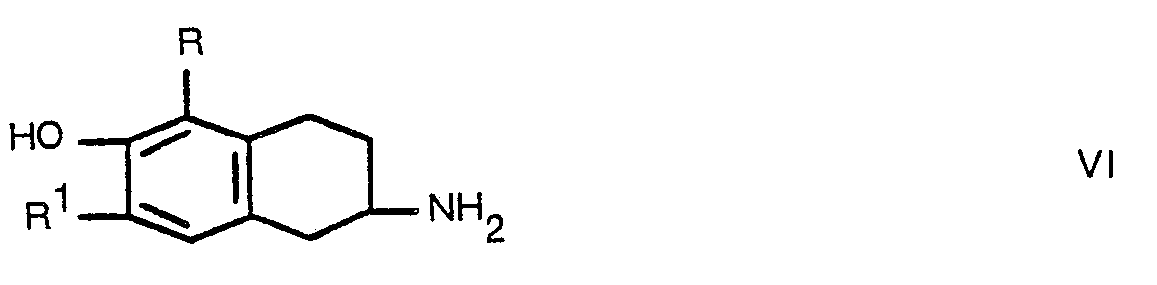
- R and R' are defined as above;
- with a C1―C3 alkyl aldehyde in the presence of a reducing agent; or
- with an C1―C3 alkyl halide; or
- R and R' are defined as above;
- (e) optionally salifying a product of any of the preceding steps by conventional methods.
- The various chemical terms above have their common meaning. For example, C1―C3 alkyl" includes methyl, ethyl, n-propyl and isopropyl.
- In part (a) above, the NH3 may be liquid or gaseous and, if desired, under pressure when reacted. The preferred temperature is room temperature. The C1―C4 alkanol of choice is methanol. When Raney nickel is used, the preferred temperature is reflux, and the organic solvent is, for example, C1―C4 alkanol, dioxane and tetrahydrofuran.
- Part (b) above describes a standard azide reduction. H2 and a nobel metal catalyst (e.g. Pd, Pt, Raney nickel, etc.) under standard conditions are employed. The preferred solvents are Cl-C4 alkanols, and the preferred temperature is room temperature.
- The cleavage of the benzyloxy group in part (c) above is done under standard hydrogenation conditions. Suitable reagents are H2 and a nobel metal catalyst, such as those used in part (b). Room temperature is preferred with solvents such as dioxane, tetrahydrofuran and C1―C4 alkanols.
- The alkylation described in step (d) above is preformed under standard conditions. The reductive alkylation is done with a reducing agent such as sodium cyanoborohydride or sodium borohydride. The solvents preferred are C1―C4 alkanol, dioxane or tetrahydrofuran. The C1―3 alkyl halide is preferably a C1-C3 alkyl bromide or chloride. The preferred solvents are a C1―C3 alkanol, acetone or acetonitrile. The temperature is from room temperature to reflux.
- It is possible to combine the above steps of the process when the reagent used in both steps is the same. For example, steps (b) and (c) can be combined using H2 and a palladium-on-carbon catalyst to both reduce the 6-azide group and cleave the 2-benzyloxy group in one reaction.
- The discussion hereinbelow on the preparation of starting materials also provides some further discussion of steps (a) to (d) above.
- The compounds of formula I are dopamine agonists and are therefore usefui in inhibiting proiactin secretion, alleviating the symptoms of Parkinsonism and reducing blood pressure levels in mammals having elevated blood pressure.
- Thus, included within the scope of this invention are three methods which are:
- A method for reducing elevated blood pressure in a mammal having high blood pressure and in need of treatment which comprises administering to said mammal a hypotensive dose of a compound of formula I, or a pharmaceutically-acceptable salt thereof.
- A method of inhibiting the secretion of prolactin in mammals which comprises administering to a mammal having a condition accompanied by excess prolactin secretion and in need of treatment a prolactin secretion lowering dose of a compound of formula I.
- A method of treating Parkinson's Syndrome which comprises administering to a human suffering from Parkinson's Syndrome and in need of treatment, a dose effective to alleviate some or all of the manifestations of Parkinson's Syndrome.
- Also included within the scope of this invention is a pharmaceutical formulation comprising as an active ingredient a 1-(or 3-)carbamoyl-2-hydroxy-6-(substituted)amino-5,6,7,8-tetrahydronaphthalene derivative of formula I, or a pharmaceutically-acceptable salt thereof, associated with one or more pharmaceutical excipients.
- The compounds of formula I are named as dl(or±)-6-(substituted)amino-1-carbamoyl-2-hydroxy-5,6,7,8-tetrahydronaphthalenes (when R is a carbamoyl group) or as dl(or ±)-6-(substituted)amino-3-carbamoyl-2-hydroxy-5,6,7,8-tetrahydronaphthalenes (when R' is a carbamoyl group). The "dl" refers to the fact that the carbon carrying the amine function is asymmetric, thereby giving rise to two optical isomers occurring as a racemic mixture. This invention includes within its scope dopamine agonists of formula I, whether as a racemate or as the d or I components thereof.
- Also included within the scope of this invention are intermediates useful in preparing the above compounds, said intermediates having the structure

one of R4 and R5 is H and the other is
- R° is H or benzyl; and
- R2 and R3 are individually H, methyl, ethyl or n-propyl.
- Pharmaceutically-acceptable acid addition salts of the compounds of formula I include salts derived from non-toxic inorganic acids such as: hydrochloric acid, nitric acid, phosphoric acid, sulfuric acid, hydrobromic acid, hydriodic acid, phosphorous acid and the like, as well as salts derived from non-toxic organic acids such as aliphatic mono and dicarboxylic acids, phenyl-substituted alkanoic acids, hydroxy alkanoic and alkandioic acids, aromatic acids, aliphatic and aromatic sulfonic acids, and others. Such pharmaceutically-acceptable salts thus include sulfate, pyrosulfate, bisulfate, sulfite, bisulfite, nitrate, phosphate, monohydrogenphosphate, dihydrogenphosphate, metaphosphate, pyrophosphate, chloride, bromide, iodide, fluoride, acetate, propionate, decanoate, caprylate, acrylate, formate, isobutyrate, caprate, heptanoate, propiolate, oxalate, malonate, succinate, suberate, sebacate, fumarate, maleate, mandelate, butyne-1,4-dioate, hexyne-1,6-dioate, benzoate, chlorobenzoate, methylbenzoate, dinitrobenzoate, hydroxybenzoate, methoxybenzoate, phthalate, terephthalate, benzenesulfonate, toluenesulfonate, chlorobenzenesulfonate, xylenesulfonate, phenylacetate, phenyl propionate, phenylbutyrate, citrate, lactate, B-hydroxybutyrate, glycollate, malate, tartrate, methanesulfonate, propanesulfonate, naphthalene-1-sulfonate, naphthalene-2-sulfonate and the like salts.
- The compounds of the above formulae having a single mono-valent substituent [N3, NH2, N(alk)2, etc.] in the tetrahydro portion of the tetrahydronaphthalene ring, have an asymmetric center at C-6, the point of attachment of the monovalent group. Such compounds exist and are provided herein as a pair of stereoisomers occurring as a racemate.
- In certain structures, asymmetric carbons are present at both C-5 and C-6. Compounds with two asymmetric centers exist as four stereoisomers, occurring as two racemic pairs. Formulas, while two dimensional, are intended to represent the 3-dimensional individual enantiomers as well as the optically neutral racemates, made up of molecular compounds each containing a pair of stereoisomers.
- A convenient preparation of the compounds of formula I wherein R is H and R' is carboxamide begins with commercially available 3-hydroxy-2-naphthoic acid. The process of converting the hydroxy acid to the corresponding methyl ester is done according to the procedure of J.A.C.S., 76, 5761 (1954) utilizing dimethyl sulfate in the presence of potassium bicarbonate as the methylating system. Other esterification systems can be used as will be apparent to those skilled in the art, and other lower alkyl esters can be prepared and are equally useful. Hydrogenation of the methyl ester over a palladium-on-carbon catalyst or other suitable noble metal catalyst, such as a platinum or rhodium catalyst, yields a for example, methyl 5,6,7,8-tetrahydro-2-hydroxy-3-naphthoate. This ester is then converted to the 2-benzyl ether with benzylchloride in the presence of potassium carbonate, a classical Williamson synthesis. Chromic acid oxidation of the thus-formed methyl 5,6,7,8-tetrahydro-2-benzyloxy-3-naphthoate yields methyl 5,6,7,8-tetrahydro-2-benzyloxy-5-oxo-3-riaphthoate.
- The reaction of the above prepared 5-carbonyl compound with hydroxylamine hydrochloride produces the corresponding oxime. The oxime is next acylated with an aryl sulfonylchloride such as benzenesulfonylchloride or p-tosylchloride to yield the arylsulfonyloxy derivative. This derivative, upon treatment with a base such as potassium ethylate, rearranges to yield methyl dl-5,6,7,8-tetrahydro-2-benzyloxy-5-oxo-6-amino-3-naphthoate, isolated in the form of its hydrochloride salt. Sodium borohydride .reduction of the aminoketone yields the corresponding 5-hydroxy derivative. At this point, the amino group can be alkylated. For example, to prepare an N,N-di-n-propyl derivative, the amine is reacted with at least 2 moles of propionaldehyde in the presence of sodium cyanoborohydride. To prepare an N,N-dimethyl or N,N-diethyl derivative, formaldehyde and acetaldehyde are used in place of propionaldehyde. The resulting product, methyl dl-5,6,7,8-tetrahydro-2-benzyloxy-5-hydroxy-6-dialkylamino-3-naphthoate, where R and R3 are methyl, ethyl or n-propyl, is hydrogenated again using palladium-on-carbon or other suitable noble metal catalyst. This hydrogenation-serves to cleave the benzyloxy function to a hydroxyl group and to remove the 5-hydroxy function entirely. The product of this reaction, a methyl dl-N,N-dialkyl-2-hydroxy-6-amino-5,6,7,8-tetrahydro-3-naphthoate, is then converted to the corresponding amide of formula I, using ammonia in methanol under pressure.
- If it is desired to prepare compounds according to formula I where R and R3 are H and R' is carboxamide, then for example methyl 6-amino-2-benzyloxy-5-hydroxy-5,6,7,8-tetrahydro-3-naphthoate is reduced and debenzylated as set forth above and the hydroxy group is removed in this procedure. The methyl d)-2-hydroxy-6-amino-5,6,7,8-tetrahydro-3-naphthoate thus prepared is readily converted by the above procedure to the 3-carbamoylnaphthalene derivative.
- Alternatively, methyl 5,6,7,8-tetrahydro-2-benzyloxy-5-oxo-3-naphthoate can be brominated alpha to the carbonyl group using pyridinium perbromide hydrobromide or other suitable brominating agent, including molecular bromine, to yield the corresponding 5-oxo-6-bromo derivative. Reaction of this bromo derivative with sodium azide yields methyl dl-5,6,7,8-tetrahydro-2-benzyloxy-5-oxo-5-azido-3-naphthoate. Reduction with sodium borohydride serves to reduce the oxo group to a hydroxy group, and the hydroxy is removed by treatment with triethylsilane in trifluoroacetic acid (TFA). The resulting 6-azido derivative is then converted to the corresponding 6-amino derivative by treatment with hydrazine and Raney nickel. At this point, hydrogenation with a palladium catalyst serves to remove the benzyl protecting group and the resulting methyl dl-5,6,7,8-tetrahydro-2-hydroxy-6-amino-3-naphthoate can be converted directly by ammonia in methanol under pressure to yield a compound of formula I, dl-3-carbamoyl-2-hydroxy-6-amino-5,6,7,8-tetrahydronaphthalene. Alternatively, the 6-amino derivative can be alkylated as with formaldehyde, acetaldehyde or propionaldehyde and sodium cyanoborohydride to yield the 6-N,N-dialkyl derivative, which derivative after debenzylation with hydrogen over a palladium catalyst followed by conversion of the ester to the amide yields an N,N-dialkyl-2-hydroxy-6-amino-5,6,7,8-tetrahydronaphthalene-3-carboxamide.
- Compounds according to formula I wherein R' is H and R is carboxamide are prepared in an analogous manner. For example, methyl dl-2-benzyloxy-5-oxo-6-bromo-5,6,7,B-tetrahydro-1-naphthoat&-see Chem. Pharm. Bull., 25, 2999 (1977)-is reacted with sodium azide to yield the corresponding 6-azido derivative. Reduction of this azide with sodium borohydride yields methyl dl-2-benzyloxy-5-hydroxy-6-azido-5,6,7,8-tetrahydro-1-naphthoate. The hydroxyl group is readily removed by treatment with triethylsilane and trifluoroacetic acid to yield methyl dl-2-benzyloxy-6-azido-5,6,7,8-tetrahydro-1-naphthoate. The 6-azido group is then converted to an amino group by treatment with hydrazine and Raney nickel to provide the corresponding 6-amino derivative. The amino derivative can then be alkylated by treatment with a C,-C3 alkyl aldehyde (formaldehyde, acetaldehyde, or propionaldehyde) and sodium cyanoborohydride. The resulting compound, a methyl dl-2-benzyloxy-6-dialkylamino-5,6,7,8-tetrahydro-1-naphthoate, upon hydrogenation with palladium-on-carbon, is debenzylated to yield the corresponding 2-hydroxy compound. The ester group is then converted with hydrazine to the carboxhydrazide derivative which can be split by treatment with Raney nickel to yield a dl-1-carbamoyl-2-hydroxy-6-dialkylamino-5,6,7,8-tetrahydronaphthalene of formula I. Alternatively, the 2-hydroxycarboxylic acid ester can be converted directly to the carboxamide of formula I with methanolic ammonia under pressure.
- If it is desired to prepare a compound in which R2 and R3 are both H, the methyl dl-2-benzyloxy-6-amino-5,6,7,8-tetrahydro-naphthoate can be directly debenzylated with palladium-on-carbon and hydrogen and the resulting 2-hydroxy derivative converted to the 1-carboxamide either directly with methanolic ammonia or indirectly via the hydrazide.
- The procedure utilized in Chem. Pharm. Bull. (loc. cit.) to yield the bromoketone starting material is as follows: 2-hydroxy-1-naphthoic acid, commercially available, is esterified with a Cl-C3 alkanol. The 2-hydroxy-1-carboxylic acid ester is then hydrogenated over palladium-on-carbon to yield a 2-hydroxytetra- hydronaphthoic acid ester. The hydroxy group of this compound is next protected with a benzyl group or other suitable protecting group. Chromic acid oxidation yields the corresponding 5-oxo derivative which is then brominated with pyridinium perbromide hydrobromide to yield the aforementioned bromoketone starting material.
- Alternatively, the methyl 2-benzyloxy-5-oxo derivative, a precursor to the 6-bromo derivative used as a starting material in the above sequence, can be reduced to the 5-hydroxy compound which can in turn be dehydrated to give a methyl 2-benzyloxy-7,B-dihydro-1-naphthoate. The same compound can be prepared from the 5-oxo-6-bromo derivative by reduction of the carbonyl group to hydroxyl and removal of the elements of HOBr to yield the 5,6-unsaturated derivative. Peroxidation of this compound with m-chloroperbenzoic acid or other suitable agent in the presence of ethanol yields a 5-ethoxy-6-hydroxy derivative which compound, on treatment with acid, produces methyl dl-2-benzyloxy-6-oxo-5,6,7,8-tetrahydro-1-naphthoate. The 6-oxo derivative is then converted to the 6-amino derivative with ammonium acetate and sodium cyanoborohydride. Conversion of the 6-amino derivative to a compound of formula I where R2 and R3 are both alkyl is done as described hereinbefore.
- In a different procedure in which the order of steps is somewhat changed, the methyl dl-2-benzyl-oxy-6-azido-5,6,7,8-tetrahydro-1-naphthoate can be treated with ammonia in methanol under pressure to yield the corresponding dl-1-carbamoyl-2-benzyloxy-6-azido-5,6,7,8-tetrahydronaphthalene. Conversion of the azide group to an amino group with hydrazine and Raney nickel yields a dl-1-carbamoyl-2-benzyloxy-6-amino-5,6,7,8-tetrahydronaphthalene. This compound can be treated directly with hydrogen in the presence of a palladium catalyst to remove the benzyl group and yield a compound according to formula I wherein R2 and R3 are both hydrogen. Alternatively, the benzyloxy derivative can be alkylated with a Cl-C3 alkyl aldehyde and sodium cyanoborohydride to yield a dl-1-carbamoyl-2-benzyloxy-6-dialkylamino-5,6,7,8-tetrahydronaphthalene which compound, upon treatment with hydrogen in the presence of a palladium catalyst, yields a compound of formula I where R and R3 are individually methyl, ethyl or n-propyl.
- It is apparent that the reactions described above can be similarly modified by preparing the carboxamide function early in the procedure rather than as a last step, and other necessary reactions carried out on the carboxamide.
- Alternatively, the 2-benzyloxy-5-oxo-5,6,7,8-tetrahydro-1-naphthoate ester can be converted to the corresponding oxime with hydroxylamine hydrochloride and the oxime acylated with an arylsulfonyl- chloride. Rearrangement of the acyloxime with base yields the 5-oxo-6-amino derivative. This compound is then reduced to the corresponding 5-hydroxy compound. The amine group can then be optionally alkylated with an aldehyde and sodium cyanoborohydride. Finally, the benzyl group and the 5-hydroxy group are both removed with hydrogen in the presence of a palladium catalyst to yield, after ammonolysis of the ester function, a compound of formula I where R and R3 are alkyl.
- An alternative procedure proceeds from an azido naphthoate ester with a protected ortho-benzyloxy group to the dl-1-carbamoyl-2-hydroxy-6-amino-5,6,7,8-tetrahydronaphthalene via the free acid, acid chloride and amide followed by reduction of the azide group to NH2 and lastly by debenzylation to the free 2-OH derivative.
- In the above discussion, alkylation of the 6-amino group has been illustrated only to produce symmetrical dialkyl derivatives (R2 = R3 = methyl, ethyl or n-propyl). If it is desired to produce monoalkyl derivatives or unsymmetrical dialkyl derivatives of formula I, the following general procedure is employed. First, the 6-amino group is mono alkylated by using equimolar quantities of aldehyde and amine plus an excess of sodium cyanoborohydride. The secondary amine thus produced, after debenzylation and amidation, has a structure according to formula I wherein one of R and R' is H and the other is carboxamide, and one of R2 and R3 is H and the other is methyl, ethyl or n=propyl. The aldehyde-cyanoborohydride procedure can thus be repeated,if desired, on the secondary amino compound with a different aldehyde so as to produce a compound according to formula I wherein R2 and R3 are not the same but are individually methyl, ethyl or n-propyl.
- In all of the above process discussion where specific compounds are used to illustrate the various reaction steps, it is also intended that other relevant terms could be substituted where appropriate in the process. For example, if the ester used was methyl, other esters are included which function in a similar manner and ultimately result in a compound within the scope of formula I. Similarly, other such interchangeable terms, equivalent reactants and conditions (e.g. solvents, temperatures, etc.) are included.
- This invention is further exemplified by the following specific examples.
- Preparation of Methyl dl-2-hydroxy-6-methylamino-5,6,7,B-tetrahydro-1-naphthoate hydrochloride.
- A solution was prepared by dissolving 8.9 g. of methyl 2-benzyloxy-5-oxo-5,6,7,8-tetrahydro-1- napthoate prepared by the procedure of Chem. Pharm. Bull., 25, 2999 (1977) in 150 ml. of methanol and 150 ml. of tetrahydrofuran (THF). Nine and six tenths grams of pyridinium perbromide hydrobromide were added and the reaction mixture stirred for about three hours, after which time it was diluted with water and the resulting aqueous mixture extracted with chloroform. The chloroform layer was separated and the separated layer washed with saturated sodium chloride and then dried. Evaporation yielded methyl dl-2-benzyloxy-5-oxo-6-bromo-5,6,7,8-tetrahydro-l-naphthoate as a residue. The residue was dissolved in 200 ml. of dimethylformamide (DMF) containing 5 ml. of glacial acetic acid. This solution was cooled to about 0°C. A solution containing 4 g. of sodium azide in 40 ml. of water was then added. The resulting reaction mixture was stirred and cooled for about four hours and then left at about 0-5°C. overnight. It was then diluted with water and the aqueous mixture extracted with ethyl acetate. The ethyl acetate layer was separated and the separated layer washed with saturated aqueous sodium chloride and then dried. Evaporation of the residue yielded methyl dl-2-henzyloxy-5-oxo-6-azido-5,6,7,B-tetrahydro-1-naphthoate formed in the above reaction.
- The compound melted at 65-7°C. with decomposition after crystallization from methanol.

- The 6-azido compound was dissolved in about 200 ml. of methanol and the methanol solution cooled to about 0°C. Nine grams of sodium borohydride were added thereto in small portions with stirring. The reaction mixture was next stirred for about four hours and then diluted with water. The aqueous mixture was extracted several times with equal volumes of chloroform. The chloroform extracts were combined and the combined extracts washed with saturated sodium chloride and then dried. Evaporation of the chloroform yielded methyl dl-2-benzyloxy-5-hydroxy-6-azido-5,6,7,8-tetrahydro-naphthoate formed in the above reaction. TLC over silica (ether) indicated that the solid residue was substantially the desired product containing a small amount of starting material. Eleven grams of a viscous oil which crystallized after standing overnight were obtained. Methyl dl-2-benzyloxy-5-hydroxy-6-azido-5,6,7,8-tetrahydro.I-naphthoate thus prepared melted at 65-66°C. after recrystallization from ether.

- Five hundred milligrams of methyl df-2-benzyloxy-5-hydroxy-6-azido-5,6,7,8-tetrahydro-1-naphthoate were suspended in 10 ml. of triethylsilane and 10 mi. of carbon tetrachloride. About 5 ml. of trifluoroacetic acid were added. TLC after a ten minute reaction time indicated that there was no longer any starting material present and that there was only one major component in the reaction mixture. After 25 minutes reaction time, the reaction mixture was poured over ice and the aqueous solution made basic with 14N aqueous ammonium hydroxide. The alkaline layer was extracted with chloroform. The chloroform extract was separated, washed with saturated sodium chloride and dried and the solvent removed by evaporation. The residue was chromatographed over 30 g. of Florisil using hexane containing increasing amounts (0-20%) of ether as the eluant. Fractions shown by TLC to contain the desired product, methyl dl-2-benzyloxy-6-azido-5,6,7,8-tetrahydro-1-naphthoate, were combined. Evaporation of the solvent from the combined fractions yielded purified methyl dl-2-benzyloxy-6-azido-5,6,7,8-tetrahydro-1-naphthoate which melted at 83-4°C. after recrystallization from hexane; yield = 365 mg.

- The above reaction in which the 5-hydroxy group was eliminated by using a triethylsilane-trifluoroacetic acid reagent was repeated on a 4.4 g. sample of methyl dl-2-benzyloxy-5-hydroxy-6-azido-5,6,7,8-tetrahydronaphthoate. The 6-azido compound from this reaction was used without further purification as follows: The residue from evaporation of the extracting solvent was dissolved in 100 ml. of THF and 100 ml. of ethanol. About 3 g. of Raney nickel were added. Next, a solution of 2 ml. of hydrazine hydrate in 10 ml. of ethanol was added in dropwise fashion to the stirred reaction mixture. The reaction mixture was filtered and the volatile constituents removed by evaporation. This residue was dissolved in 200 ml. of methanol. One gram of sodium cyanoborohydride was added followed by 10 mi. of 37% aqueous formaldehyde. The reaction mixture was stirred at room temperature under a nitrogen atmosphere overnight and was then diluted with saturated aqueous sodium bicarbonate. The alkaline aqueous mixture was extracted with chloroform. The chloroform extract was separated and the separated extract washed with saturated aqueous sodium chloride and then dried. Evaporation of the solvent yielded a residue which, by TLC, indicated one major product contaminated with a small amount of starting material. A chloroform solution of the residue was chromatographed over 100 g. of Florisil using chloroform containing increasing amounts (0-4%) of methanol as the eluant. Fractions shown by TLC to contain the desired product, methyl dl-2-benzyloxy-6-dimethylamino-5,6,7,8-tetrahydro-1-naphthoate, were combined in ethanol solution and the solution saturated with gaseous hydrogen chloride. The crystalline hydrochloride salt was separated by filtration and recrystallized from an ethanol/ether solvent mixture. One and seven tenths grams of hydrochloride salt melting at 190-20C. were obtained.

- Two and thirty-eight hundredths grams of methyl dl.-2-benzyloxy-6-dimethylamino-5,6,7,8-tetrahydro-1-naphthoate hydrochloride were dissolved in 50 ml. of methanol and hydrogenated with 1 g. of palladium-on-carbon in 10 ml. of THF at a hydrogen pressure of 4.22 kg/cm.2. After the theoretical quantity of hydrogen had been absorbed, the reaction mixture was taken from the hydrogenator and filtered. Evaporation of the solvent in vacuo yielded, as a residue, methyl dl-2-hydroxy-6-dimethylamino-5,6,7,8-tetrahydro-1-naphthoate hydrochloride formed in the above reaction. One and five tenths grams of a solid were obtained which decomposed at about 225°C.

- Preparation of Ethyl dl-2-hydroxy-6-di-n-propylamino-5,6,7,8-tetrahydro-3-naphthoate hydrochloride A reaction mixture was prepared from 200 g. of 2-hydroxy-3-naphthoic acid, 160 g. of potassium bicarbonate, 154 g of dimethyl sulfate and 1500 mi. of acetone. The reaction mixture was heated to refluxing temperature for about 3 hours after which time it was diluted with water and the resulting alkaline aqueous layer extracted with ethyl acetate. The ethyl acetate layer was separated and the separated layer washed with water and saturated aqueous sodium chloride and then dried. Evaporation of the solvent yielded a residue which solidified upon trituration with methanol to yield 205 g. of methyl 2-hydroxy-3-naphthoate melting at 72-4°C.
- Two hundred and twenty-two grams of the above ester were hydrogenated at 105.5 kg./cm2 using 80 g. of a 5% palladium-on-carbon catalyst and 1.45 I. of methanol as a solvent. The hydrogenation was carried out at 70°C. and took six hours. The hydrogenation mixture was cooled and the catalyst removed by filtration. The solvent was removed from the filtrate by evaporation to yield two crystallone fractions (total yield = 144.5 g.) of methyl, 2-hydroxy-5,8,7,8-tetrahydro-3-naphthoate melting at 41-2°C.

- A reaction mixture was prepared from the above quantity of ester, 50 g. of potassium carbonate, 46 g. of benzylchloride and 400 ml. of dimethylacetamide (DMA). After the reaction had gone to completion, the reaction mixture was filtered through Florisil and the precipitate of methyl 2-benzyloxy-5,6,7,8-tetrahydro-3-naphthoate which formed was crystallized from ethanol to yield 142.7 g of compound melting at 60―3°C.

- A solution of 142 g. of the above ether-ester in 600 ml. of glacial acetic acid was chilled. A second solution of 100 g. of Cr03 in 280 ml. of glacial acetic acid and 40 mi. of H20 was added to the first in dropwise fashion. The reaction was stirred and cooled (a-5°C.) for about 3 hrs., after which time excess Cr03 was destroyed by the addition of isopropanol. The reaction mixture was diluted with water and the aqueous mixture extracted with ethyl acetate. The ethyl acetate extract was separated and washed successively with water, saturated aqueous sodium bicarbonate, water, and saturated aqueous sodium chloride. The ethyl acetate solution was dried. Concentration of the solution yielded solid methyl 2-benzyloxy-5-oxo-5,6,7,8-tetrahydro-3-naphthoate melting at 111-4°C; yield = 58 g. An additional 35 g. were obtained from the filtrate, utilizing chromatography to remove impurities.
- Forty-three grams of methyl 2-benzyloxy-5-oxo-5,6,7,8-tetrahydro-3-naphthoate were suspended in 1 I. of methanol to which was added 14 g. of hydroxylamine hydrochloride. Sixteen grams of sodium acetate were then added. The reaction mixture was stirred at ambient temperature under a nitrogen blanket for about one day after which time it was diluted with water and the aqueous layer extracted with ethyl acetate. The ethyl acetate layer was separated, the separated layer washed with water and saturated aqueous sodium chloride and then dried. Evaporation of the solvent yielded 49 g. of methyl 2-benzyloxy-5-oximino-5,6,7,8-tetrahydro-3-naphthoate melting at 148-150°C. after recrystallisation from ether.

- Forty-nine grams of methyl 2-benzyloxy-5-oximino-5,6,7,8-tetrahydro-3-naphthoate were dissolved in 300 ml. of pyridine and the solution cooled to about 0°C. Twenty-three ml. of benzenesulfonylchloride were added slowly. After the addition had been completed, the reaction mixture was stirred at about 0°C. for about 1.75 hours. The reaction mixture was kept at 0-5°C. overnight and was then diluted with water and the resulting aqueous mixture extracted with chloroform. The organic layer was separated and the separated layer washed with saturated aqueous sodium chloride and then dried. Evaporation of the solvent in vacuo yielded a residue which was dissolved in chloroform and the chloroform solution filtered through 300 g. of Florisil. TLC showed one major spot. The residue from the Florisil filtration procedure was recrystallized from ether to yield 51 g. of methyl 2-benzyloxy-5-0-benzenesulfoximino-5,6,7,8-tetrahydro-3-naphthoate formed in the above reaction melting at 125-8°C. Recrystallization from methanol yielded crystals melting 171-2°C. An additional 2. g. of material were obtained from the mother liquors.

- The benzenesulfoximino compound was rearranged with alkali according to the tollowing procedure: One and five tenths grams of methyl 2-benzyloxy-5-benzenesulfonyloximino-5,6,7,8-tetrahydro-3-naphthoate were dissolved in 40 ml. of toluene. This solution was added dropwise to a solution of potassium ethylate prepared by adding 0.2 g. of potassium to 25 ml. of ethanol. The reaction mixture was maintained in the range 0-5°C. at which temperature it was stirred for about 1.5 hours after the addition had been completed. The reaction mixture was kept in the refrigerator for 48 hours after which time it was diluted with ethyl acetate and the separated ethyl acetate layer washed with water. The ethyl acetate layer was dried and the ethyl acetate removed by evaporation in vacuo. TLC showed one major spot. The residue was dissolved in methanol, and the hydrochloride salt was prepared by passing gaseous hydrogen chloride into a methanolic solution of the base. Recrystallization of the hydrochloride salt from a methanol/ether solvent mixture yielded 290 mg. of methyl dt-2-benzyioxy-6-amino-5-oxo-5,6,7,8-tetrahydro-3-naphthoate hydrochloride melting at 195-200°C.

- A suspension of 2 g. of sodium borohydride was prepared in 100 ml. of ethanol. Two and two tenths grams of methyl dl-2-benzyloxy-6-amino-5-oxo-5,6,7,8-tetrahydro-3-naphthoate hydrochloride were added thereto in portions. The reaction mixture was stirred for two hours and was then diluted with water and the aqueous mixture extracted several times with equal volumes of chloroform. The chloroform extracts were combined and the combined extracts washed with saturated aqueous sodium chloride and then dried. Evaporation of the chloroform yielded a residue comprising methyl dl-2-benzyloxy-6-amino-5-hydroxy-5,6,7,8-tetrahydro-3-naphthoate hydrochloride formed in the above reaction. One and forty-one hundredths grams of the hydrochloride salt melting at 160-5°C, were obtained. Recrystallization from ethanol yielded crystals melting at 172-5°C.

- Two and eighteen hundredths grams of methyl dl-2-benzyloxy-6-amino-5-hydroxy-5,6,7,8-tetrahydro-3-naphthoate hydrochloride, 500 mg. of sodium acetate, 380 mg. of sodium cyanoborohydride, 4 ml. of propionaldehyde and 150 ml. of methanol were placed in a reaction vessel which was stirred under a nitrogen atmosphere for about 19 hours. The reaction mixture was then diluted with 1 N aqueous hydrochloric acid. The aqueous acidic layer was washed with ether, the ether wash being discarded, and was then made basic with 14N ammonium hydroxide. The resulting alkaline aqueous layer was extracted several times with equal volumes of chloroform. The chloroform extracts were combined and the combined extracts washed with saturated aqueous sodium chloride and then dried. Evaporation of the chloroform yielded a residue which, by TLC, showed one major spot. The residue was dissolved in chloroform and the chloroform solution chromatagraphed over 35 g. of Florisil using chloroform containing small quantities of methanol as the eluant. Fractions shown by TLC to contain methyl dl-2-benzyloxy-6-di-n-propylamino-5-hydroxy-5,6,7,8-tetrahydro-3-naphthoate were combined and the solvent evaporated therefrom. The resulting residue was dissolved in ethanol and gaseous hydrogen chloride passed into the ethanolic solution thus forming the hydrochloride salt. Recrystallization of the solid hydrochloride salt yielded 1.55 g. of methyl dI-2-benzyIoxy-6-di-n-propyIamino-5-hydroxy-3-naphthoate hydrochloride melting at 199-200°C.

- One and five tenths grams of methyl dl-2-benzyloxy-6-di-n-propylamino-5-hydroxy-5,6,7,8-tetrahydro-3-naphthoate hydrochloride were dissolved in 5 ml. of water and 50 ml. of methanol. One gram of palladium-on-carbon was added and the resulting mixture hydrogenated at 4.22 kg./cm2 at a temperature of about 50°C. After the hydrogenation was complete, the hydrogenation mixture was filtered to remove the catalyst and the solvent evaporated from the filtrate. The thus-obtained residue was suspended in dilute aqueous sodium bicarbonate and the bicarbonate suspension extracted several times with equal volumes of chloroform. The chloroform extracts were combined and the combined extracts washed with saturated aqueous sodium chloride and then dried. Evaporation of the solvent yielded methyl dl-2-hydroxy-6-di-n-propy!amino-5,6,7,8-tetrahydro-3-naphthoate. The hydrochloride salt was prepared in ethanol solution, during which time a trans-esterification reaction apparently occurred since the product isolated was ethyl dl-2-hydroxy-6-di-n-propylamino-5,6,7,8-tetrahydro-3-naphthoate hydrochloride. four hundred and ten mg. of the hydrochloride salt melting at 202-4°C were obtained after recrystallisation from an ethanol/ether solvent mixture.

- Following the procedure, of Preparation B, but starting with 59 g. of methyl 2-benzyloxy-5-oxo-5,6,7,8-tetrahydro-1-naphthoate, 43 g. of methyl 2-benzyloxy-5-oximino-5,6,7,8-tetrahydro-1-naphthoate were obtained melting at 178-180°C.
- Methyl 2-benzyloxy-5-benzenesulfonyloximino-5,6,7,8-tetrahydro-1-naphthoate was next prepared and melted at 135-7°C.; yield = 46.5 g. from 40 g. of oximino compound.
- Fifty grams of methyl 2-benzyloxy-5-benzene-sulfonyloximino-5,6,7,8-tetrahydro-1-naphthoate were treated with potassium ethylate in toluene solution to yield about 22 g. of methyl dl-2-benzyloxy-5-oxo-6-amino-5,6,7,8-tetrahydro-1-naphthoate hydrochloride melting at about 220°C. with decomposition after recrystallization from ethanol.
- Twenty-two and four tenths grams of methyl dl-2-benzyloxy-5-oxo-6-amino-5,6,7,8-tetrahydro-1-naphthoate hydrochloride were reduced with sodium borohydride in ethanol to produce the corresponding 5-hydroxy compound isolated as a hydrochloride salt. This compound was alkylated with propionaldehyde in the presence of sodium cyanoborohydride in methanol solution to yield methyl dl-2-benzyloxy-5-hydroxy-6-di-n-propylamino-5,6,7,8-tetrahydro-1-naphthoate as the hydrochloride salt. (8.3 g.) melting at about 215-6°C.

- Hydrogenation of this compound with palladium-on-carbon in methanol at about 4.22 kg./cm.2 and 50°C. gave methyl dl-2-hydroxy-6-di-n-propylamino-5,6,7,8-tetrahydro-9-naphthoate hydrochloride (2.1 g. of starting material yielded 710 mg. of hydrochloride salt) M.P. = 195-6°C. after recrystallization from an ether/ethanol solvent mixture.

- One-half gram of methyl dl-2-benzyloxy-6-azido-5,6,7.8-tetrahydro-1-naphthoate (from Preparation A) were dissolved in 20 ml. of ethanol to which were added 20 ml. of 50% (w/v) aqueous sodium hydroxide. This mixture was heated at about 100°C. for 18 hours, after which time the reaction mixture was poured into an ice-water mixture. Sufficient 12N aqueous hydrochloric acid was added to make the reaction mixture acidic. dl-2-Benzyloxy-6-azido-5,6,7,8-tetrahydro-1-naphthoic acid formed in the above reaction, being insoluble in the acidic layer, separated and was dissolved with several 3:1 chloroform/isopropanol extracts. The organic extracts were combined and the combined extracts washed with saturated aqueous sodium chloride and then dried. Evaporation of the solvent in vacuo yielded a dark viscous oil which was dissolved in chloroform and the chloroform solution chromatographed over silica gel using chloroform containing increasing quantities (0-5%) of methanol as the eluant. Fractions shown by TLC to contain the desired naphthoic acid were combined and the solvent removed therefrom. The residual golden yellow oil thus obtained was dissolved in ether and hexane added to the ethefeal solution to the point of incipient precipitation. A yellow crystalline material, M.P. = 74--75°C., comprising dl-2-benzyloxy-6-azido-5,6,7,8-tetrahydro-1-naphthoic acid, was obtained.

- Six and fifty-six hundredths grams of the above acid were heated to reflux temperature overnight in 100 ml. of thionyl chloride. The reaction mixture was then cooled to room temperature and the volatile constituents removed in vacuo. The residue containing dl-2-benzyloxy-6-azido-5,6,7,8-tetrahydro-1-naphthoyl chloride was diluted with chloroform. About 100 ml. of 14N aqueous ammonium hydroxide were then added. This new reaction mixture was stirred for one hour at ambient temperature and was then diluted with water. The organic phase was separated and the aqueous phase extracted several times with equal volumes of chloroform. The chloroform phases were combined and the combined phases washed with water and with saturated aqueous sodium chloride and were then dried. Evaporation of the chloroform yielded a dark viscous oil. Trituration of the oil with CHCI3 yielded a solid which was filtered and the filter cake dissolved in chloroform. The chloroform solution was chromatographed over 100 g. of Florisil using chloroform containing increasing amounts (0-2%) of methanol as the eluant. One eight tenths grams of a solid material were obtained showing a single spot (R,=.46) on TLC in ether; dl-1-carbamoyl-2-benzyloxy-6-azido-5,6,7,8-tetrahydro-naphthalene thus prepared melted at 128-130°C.

- A solution was prepared from 3.4 g. of dl-1-carbamoyl-2-benzyloxy-6-azido-5,6,7,8-tetrahydronaphthalene (from Preparation D) and 100 ml. of isopropanol. The solution was cooled and 0.5 g. of sodium borohydride added thereto in small portions. After the addition had been completed, the reaction mixture was heated to reflux temperature under a nitrogen blanket for about 18 hours. The reaction mixture was then cooled and the cooled mixture diluted with water. The aqueous mixture was made acidic by the addition of 1 N aqueous hydrochloric acid. The aqueous acidic layer was extracted with ether and the ether extract discarded. The aqueous acidic layer was made basic by the addition of 10% aqueous sodium hydroxide. The alkaline layer was extracted several times with equal volumes of a 3:1 chloroform/methanol solvent mixture. The organic extracts were combined and the combined extracts washed with saturated aqueous sodium chloride and then dried. Evaporation of the solvent therefrom yielded a residue comprising dl-I-carbamoyl-2-benzyloxy-6-amino-5,6,7,8-tetrahydronaphthalene. TLC indicated a single spot at the origin. An infrared spectrum of the solid indicated no absorption attritutable to an azide group. The residue was dissolved in chloroform and the chloroform solution saturated with gaseous hydrogen chloride. The solvent was removed in vacuo and the residue dissolved in methanol. Ether was added to the point of incipient precipitation and the solution was cooled overnight. Forty-eight hundredths grams of tan crystals melting above 235°C. consisting of dl-1-carbamoyl-2-benzyloxy-6-amino-5,6,7,8-tetrahydronaphthaIene hydrochloride were recovered.

- 0.5 g. of dl-1-Carbamoyl-2-benzyloxy-6-azido-5,6,7,8-tetrahydronaphthalene were dissolved in 100 ml. of a 1:1 THF/ethanol solvent mixture. About 1 g. of Raney nickel were added and the mixture stirred at about 0°C. while 5 ml. of hydrazine hydrate were added thereto in dropwise fashion. After the addition had been completed, the reaction mixture was stirred for 4 hours at ambient temperature after which time it was filtered. The solvent was removed from the filtrate leaving a yellow residue. TLC indicated a single spot with Rf = .63 using a 63:7:27:3 chloroform/methanol/acetone/ammonium hydroxide solvent system. Yield of dl-1-carbamoyl-2-benzyloxy-6-amino-5,6,7,8-tetrahydronaphthalene was 0.46 g. (100%). This 0.46 sample was alkylated with propionaldehyde and sodium cyanoborohydride by the procedure of Preparation A to yield dl-I-carbamoyl-2-benzyloxy-6-di-n-propylamino-5,6,7,8-tetrahydronaphthalene hydrochloride. TLC (9:1 chloroform/methanol) Rf = .40.
- Mass spectrum: molecular ion at 380.

- A solution was prepared from about 10 g. of methyl 2-benzyloxy-5-oxo-5,6,7,8-tetrahydro-I-naphthoate in 250 ml. of methanol to which was added 10 g.of sodium borohydride in small portions with cooling. After the borohydride had been added, the mixture was stirred for about 3 hours and then diluted with water. The aqueous layer was extracted several times with equal volumes of chloroform. The chloroform extracts were combined and the combined extracts were washed with saturated aqueous sodium chloride and then dried. Evaporation of the solvent yielded 7.0 g. of an oil comprising methyl dl-2- benzyioxy-5-hydroxy-5,6,7,8-tetrahydro-1-naphthoate.
- The oily residue was dissolved in 400 ml. of toluene to which were added 3 g. of Amberlite° 15 as a dehydrating agent. The mixture was distilled under a nitrogen blanket for about 15 minutes after which time it was filtered, and the filtrate cooled. The solvent was removed from the cooled filtrate by evaporation. The resulting residue was recrystallized from an ether/hexane solvent mixture to yield 6.5 g. of methyl 2-benzyloxy-7,B-dihydro-1-naphthoate melting at 97-100°C.
- The above compound was also prepared by the following sequence of reactions: Methyl 2-benzyIoxy-5-oxo-5,6,7,8-tetrahydro-1-naphthoate was brominated with pyridinium bromide perbromide in glacial acetic acid. Methyl dl-2-benzyloxy-5-oxo-6-bromo-5,6,7,8-tetrahydro-1-naphthoate melting at 120―4°C. was obtained. Twenty-six grams of the bromo ketone were suspended in 600 ml. of methanol and 20 g. of sodium borohydride added. Twenty-four and five tenths grams of methyl dl-2-benzyloxy-5-hydroxy-6-bromo-5,6,7,8-tetrahydro-1-naphthoate melting at 120-2°C. were obtained. Thirty-one and three tenths grams of the hydroxybromo compound were mixed with 70 g. of zinc dust and 400 ml. of glacial acetic acid. The reaction mixture was heated at reflux temperature for about 3 hours under a nitrogen blanket and was then filtered. The filtrate was poured over ice and the aqueous mixture extracted with ethyl acetate. The ethyl acetate layer was separated and the separated layer washed with water, aqueous sodium bicarbonate, again with water, and finally with saturated aqueous sodium chloride. The organic layer was dried and the solvent was evaporated therefrom in vacuo. Seventeen and five tenths grams of methyl 2-benzyloxy-7,8-dihydro-1-naphthoate melting at 88-92°C. were obtained by this route.
- A reaction mixture was prepared from 6.5 g. of methyl 2-benzyloxy-7,8-dihydro-1-naphthoate (prepared from either Part (1) or (2) above), 4.8 g of 85% m-chloroperbenzoic acid, 250 ml. of chloroform and 25 ml. of anhydrous ethanol. The reaction mixture was allowed to remain overnight at ambient temperature. Evaporation of the volatile constituents in vacuo left a residue which was dissolved in chloroform. The chloroform solution was filtered through about 150 g. of alumina (grade I). Two and three tenths grams of methyl dl-2-benzyloxy-5-ethoxy-6-hydroxy-5,6,7,B-tetrahydro-1-naphthoate melting at 133-70C. were obtained from the filtrate after crystallization from an ether-hexane solvent mixture.

- Nine and six tenths grams of methyl dl-2-benzyloxy-5-ethoxy-6-hydroxy-5,6,7,8-tetrahydro-1-naphthoate were mixed with 4 g. of Amberlite@ 15 and 250 ml. of toluene. The mixture was heated to refluxing temperature for about 15 minutes and was then filtered and the filtrate cooled. Evaporation of the filtrate to dryness yielded a residue which was dissolved in 300 ml. of methanol to which was added 23 g. of ammonium acetate. Ten grams of sodium cyanoborohydride were added thereto in portions. The reaction mixture was stirred at ambient temperature under a nitrogen blanket overnight. It was then diluted with 1 N aqueous hydrochloric acid and the acidic layer extracted with ether. The ether extract was discarded. The aqueous layer was made basic with 14N ammonium hydroxide and the alkaline layer extracted several' times with equal volumes of chloroform. The chloroform extracts were combined and the combined extracts washed with saturated aqueous sodium chloride and then dried. Evaporation of the chloroform in vacuo yielded a residue comprising methyl di-2-benzyioxy-6-amino-5,6,7,8-tetrahydro-1-naphthoate. The free base was dissolved in ethanol and converted to the hydrochloride salt by the addition of 2 ml. of 12N aqueous hydrochloric acid. One and twenty-five hundredths grams of hydrochloride salt were obtained. The hydrochloride salt was converted to the free base by standard procedures. Sixty-four hundredths grams of free base thus obtained were dissolved in boiling methanol to which was added 280 mg. of oxalic acid dihydrate. Six hundred milligrams of the oxalate salt of methyl dl-2-benzyoxy-6-amino-5,6,7,8-tetrahydro-1-naphthoate melting at 181-3°C. were obtained.

- Twenty-four and eight tenths grams of methyl 2-benzyloxy-5-oxo-5,6,7,8-tetrahydro-3-naphthoate were dissolved in a mixture of 200 ml. of THF and 200 ml. of methanol. Twenty-eight grams of pyridinium perbromide hydrobromide were added and the reaction mixture stirred at ambient temperature for 2.5 hours after which time it was diluted with water and the resulting aqueous mixture extracted with chloroform. The chloroform extract containing methyl dl-2-benzyloxy-6-bromo-5-oxo-5,6,7,8-tetrahydro-3-naphthoate was washed with saturated aqueous sodium chloride and then dried. The solvent was removed therefrom by evaporation. The resulting residue was dissolved in 500 ml. of DMF containing 10 ml. of glacial acetic acid. The solution was cooled in an ice-water bath to about 0°C. A solution of 12 g. of sodium azide in 100 ml. of water was added. The reaction mixture was cooled for 2 hours, and was then diluted with water. The aqueous mixture extracted with ethyl aetate. The ethyl acetate extract was washed with water and with saturated aqueous sodium chloride and was then dried. Evaporation of the ethyl acetate yielded a residue comprising methyl dl-2-benzyloxy-6-azido-5-oxo-5,6,7,8-tetrahydro-3-naphthoate. The residue was dissolved in THF and the THF solution diluted with 400 ml. of methanol. The solution was cooled to about 0°C. and 20 g. of sodium borohydride added thereto in portions. The reaction mixture was stirred at ambient temperature for about 2 hours and was then diluted with water, and the resulting aqueous mixture extracted with chloroform. The chloroform layer was separated; the separated layer washed with water and with saturated aqueous sodium chloride and then dried. Evaporation of the chloroform yielded methyl dl-2-benzyloxy-6-azido-5-hydroxy-5,6,7,8-tetrahydro-3-naphthoate. This residue was chromatographed over 400 g. of Florisil using hexane containing increasing amounts (0-100%) ether as the eluant. Twenty grams of the hydroxy azide were obtained from fractions shown by TLC to contain the desired material.
- About 20 g. of methyl dl-2-benzyloxy-6-azido-5-hydroxy-5,6,7,8-tetrahydro-3-naphthoate thus obtained were dissolved in 150 ml. of carbon tetrachloride to which was added 25 g. of triethylsilane and 30 ml. of trifluoroacetic acid. The reaction mixture was stirred for about 20 minutes at room temperature and was then poured over ice. The aqueous mixture was made basic with 14N ammonium hydroxide. The alkaline layer was extracted with chloroform. The chloroform extract was separated and the separated extract washed with saturated aqueous sodium chloride and then dried. Evaporation of the chloroform yielded methyl dl-2-benzyloxy-6-azido-5,6,7,8-tetrahydro-3-naphthoate. The residue was dissolved in 250 ml. of THF and 250 ml. of methanol. Ten grams of Raney nickel were added to this mixture followed by the dropwise addition of 10 ml, of 85% hydrazine hydrate in 40 ml. of methanol. This reaction mixture was stirred for about 30 minutes and then filtered. The filtrate was concentrated in vacuo and the concentrated filtrate diluted with ethyl acetate. The ethyl acetate layer was extracted several times with 10% aqueous hydrochloric acid. The aqueous layer and acidic extracts were then made basic with 14N ammonium hydroxide and the basic layer extracted with chloroform. The chloroform extract was separated and the separated extract washed with saturated aqueous sodium chloride and then dried. Evaporation of the solvent yielded 15.5 g. of methyl dl-2-benzyloxy-6-amino-5,6,7,8-tetrahydro-3-naphthoate.
- A portion of the above free base was converted to the hydrochloride salt. Eight and nine tenths grams of this salt were dissolve'd in methanol containing 1 ml. of water. Two grams of 5% palladium-on-carbon were added and the mixture hydrogenated at 4.22 kg./cm.2. The hydrogenation mixture was then filtered and the filtrate evaporated to dryness in vacuo. A white solid shown by TLC to consist of a single spot comprising methyl dl-2-hydroxy-6-amino-5,6,7,8-tetrahydro-3-naphthoate hydrochloride was obtained.
- The solid hydrochloride salt product obtained in Preparation A was dissolved in water and dilute aqueous sodium bicarbonate added until the aqueous layer became basic. The aqueous layer was extracted several times with an equal volume of a chloroform/isopropanol solvent mixture. The organic extracts were combined and the combined extracts washed with saturated aqueous sodium chloride and then dried. Evaporation of the solvent in vacuo yielded 1.20 g. of an oil comprising methyl dl-2-hydroxy-6-dimethyiamino-5,6,7,8-tetrahydro-1-naphthoate free base. The oil was dissolved in a 60 ml. of methanol to which was added 10 mi. of anhydrous hydrazine. The reaction mixture was heated to refluxing temperature for about one day and then cooled. The volatile constituents were removed in vacuo and the residue, comprising di-2-hydroxy-6-dimethyiamino-5,6,7,8-tetrahydro-1-naphthaienecarboxhydrazide formed in the above reaction, was dissolved in 125 ml. of ethanol to which were added about 2 g. of Raney nickel. This reaction mixture was heated to refluxing temperature for about one day after which time it was cooled and filtered. Gaseous HCI was passed into the solution. The volatile constituents were evaporated in vacuo and the residue recrystallized from ethanol. Four hundred and seventy mg. of dl-1-carbamoyl-2-hydroxy-6-dimethylamino-5,6,7,8-naphthalene hydrochloride were obtained melting at 249-251°C. with decomposition.

- Following the procedure of Preparation A, 4.0 g. of methyl dl-2-benzyloxy-5-hydroxy-6-azido-5,6,7,8-tetrahydro-1-naphthoate were treated with a mixture of triethylsilane and trifluoroacetic acid in carbon tetrachloride solution to yield methyl dl-2-benzyloxy-6-azido-5,6,7,8-tetrahydro-I-naphthoate. This compound was reacted with hydrazine hydrate and Raney nickel in THF and ethanol to yield methyl dl-2-benzyloxy-6-amino-5,6,7,8-tetrahydro-l-naphthoate. The 6-amino compound was dissolved in 200 ml. of methanol to which was added 1 g. of sodium cyanoborohydride followed by 10 ml. of propionaldehyde. The reaction mixture was stirred at room temperature under a nitrogen blanket overnight, and was then diluted with saturated aqueous sodium bicarbonate solution. The alkaline layer was extracted with chloroform. The chloroform extract was separated and the separated extract washed with saturated aqueous sodium chloride and then dried. Evaporation of the solvent in vacuo yielded a residue which was dissolved in chloroform and the chloroform solution chromatographed over 100 g. of Florisil using chloroform containing increasing quantities (0-2%) of methanol as the eluent. Fractions containing methyl dl-2-benzyloxy-6-di-n-propylamino-5,6,7,8-tetrahydro-1-naphthoate were combined and the solvent evaporated from the combined fractions. The resulting residue was converted to the hydrochloride salt which melted at 170-1°C. after recrystallization from an ethanol/ether solvent mixture; yield = 3.41 g.

- The product was debenzylated by hydrogenation in the presence of a palladium catalyst and the debenzylated compound converted to the amide by the procedure of Example 1.
- Three hundred and sixty mg. of ethyl dl-2-hydroxy-6-di-n-propylamino-5,6,7,8-tetrahydro-3-naphthoate hydrochloride were dissolved in 100 ml. of methanol and the methanolic solution cooled to about 0°C. The cooled solution was then saturated with gaseous ammonia. The amidation mixture was left at ambient temperature under essentially anhydrous conditions for about 5 days. The course of the reaction was followed during this time by TLC which showed increasing amounts of a more polar material, presumably the 3-carbamoyl compound, and lesser amounts of starting material. Evaporation of the reaction mixture in vacuo yielded a solid material which melted at 272-4°C. with decomposition after recrystallization from ethanol; yield = 280 mg. of dl-3-carbamoyl-2-hydroxy-6-di-n-propylamino-5,6,7,8-tetrahydronaphthalene.

- The alkylation of methyl 2-benzytoxy-6-amino-5-hydroxy-5,6,7,8-tetrahydro-3-naphthoate hydrochloride was repeated using Preparation B replacing propionaldehyde with formaldehyde. Methyl dl-2-benzyloxy-6-dimethylamino-5-hydroxy-5,6,7,8-tetrahydro-3-naphthoate hydrochloride thus prepared melted at 192-3°C. after recrystallization from ethanol.

- The compound was converted to dl-3-carbamoyl-2-hydroxy-6-dimethylamino-5,6,7,8-tetrahydronaphthalene by the procedure of Example 3.
- Methyl dl-2-hydroxy-6-di-n-propylamino-5,6,7.B-tetrahydro-1-naphthoate hydrochloride is readily converted to the corresponding 1-carbamoyl compound by the procedure of Example 3. The product formed is identical to the product of Examples 2 and 7.
- A solution was prepared by dissolving 0.7 g. of dl-1-carbamoyl-2-benzyloxy-6-azido-5,6,7,8-tetrahydronaphthalene in 50 ml. of ethanol. The solution was placed in a low pressure hydrogenation apparatus and hydrogenated over a palladium-on-carbon catalyst at about 4.22 kg./cm.2. After the theoretical quantity of hydrogen had been absorbed, the hydrogenation mixture was removed from the apparatus and the catalyst separated by filtration. Evaporation of the solvent from the filtrate yielded dl-1-carbamoyl-2-hydroxy-6-amino-5,6,7,8-tetrahydronaphthalene. The residue was dissolved in methanol and gaseous hydrogen chloride passed into the methanol solution, thus forming the hydrochloride salt. Ether was added to the solution to the point of incipient precipitation and the solution was cooled. Crystalline dl-1-carbamoyl-2-hydroxy-6-amino-5,6,7,8-tetrahydronaphthalene hydrochloride thus obtained melted at 245°C; yield = 0.3 g.

- The benzyl group of dl-2-benzyloxy-1-carbamoyl-6-di-n-propylamino-5,6,7,8-tetrahydronaphthalene hydrochloride was removed by hydrogenation over a palladium-on-carbon catalylst according to the procedure of Preparation A to yield about 0.4 g. of di-l-carbamoyl-2-hydroxy-6-di-n-propylamino-5,6,7,8-tetrahydronaphthalene hydrochloride, identical to the product of Example 5.
- The hydrochloride salt was converted back to the free base by standard procedures and the free base chromatographed. Fractions containing di-1-carbamoyi-2-hydroxy-6-di-n-propyiamino-5,6,7,8-tetrahydronaphthalene were combined and the solvent removed by evaporation. The solid was reconverted to the hydrochloride salt in ethanol with gaseous hydrogen chloride. Ether was added to the ethanol solution to the point of incipient precipitation and the solution cooled to about -15°C. Crystalline dl-1-carbamoyl-2-hydroxy-6-di-n-propylamino-5,6,7,8-tetrahydronaphthalene hydrochloride thus purified melted at 168-170°C.; yield = 29.4 mg.

- The primary amine prepared in Preparation G can be debenzylated by hydrogenation over a palladium-on-carbon catalyst and the resulting compound converted to the carboxamide by procedures set forth in Examples 1, 3 and 5. The resulting product is identical to the product of Example 6.
- Alternatively, the amine from Preparation G can be alkylated with formaldehyde, acetaldehyde or propionaldehyde in the presence of sodium cyanoborohydride and the resulting dialkylamine debenzylated and the free-hydroxy compound converted to the carboxamide also by procedures of the above examples, to yield products identical to Examples 1, 2, 3 and 4.
- Methyl di-2-hydroxy-6-amino-5,6,7,8-tetrahydro-3-naphthoate hydrochloride (from Preparation H) was dissolved in methanol and the methanol solution cooled to about 0°C. The cooled solution was saturated with gaseous ammonia and the resulting mixture allowed to remain at ambient temperature for about 17 days. At this time, TLC indicated the amidation reaction had gone substantially to completion. The reaction mixture was decolorized with carbon and filtered and the filtrate concentrated in vacuo to yield about 3.5 g. of di-3-carbamoyl-2-hydroxy-6-amino-5,6,7,8-tetrahydronaphathalene hydrochloride melting at about 300°C.

- As previously stated, the compounds of formula I are dopamine agonists. As such one of their properties, shared by many dopamine agonists, is the ability to lower blood pressure in anesthetized spontaneously hypertensive rats (SHR). Table 1 which follows gives the results of testing compounds of formula I which lowered the blood pressure of anesthetized SHR at dose levels of 1 mg./kg. or lower. In the Table, the first column gives the carbamoylhydroxyaminonaphthalene used, by the working Example number; and the last 4 columns give the percent blood pressure lowering ± standard error for the particular compound at 4 different dose levels.

- Compounds with dopaminergic or dopamine agonist activity also affect turning behaviour in a test procedure utilising 6-hydroxydopamine-lesioned rats. In this test, nigro-neostriatal-lesioned rats, prepared by the procedure of Ungerstedt and Arbuthnott, Brain Res, 24, 485 (1970), are employed. A compound having dopamine agonist activity, upon injection, causes the rats to turn in circles contralateral to the side of the lesion. After a latency period, which varies from compound to compound, the number of turns is counted over a 15-minute period. The drugs to be administered are dissolved in water and the resulting aqueous solution injected into the rat by the intraperitoneal route at a 1 mg./kg. dose level. Table 2 which follows gives the results of such tests. In Table 2, column 1 gives the compound used, by the working Example number; column 2 the percent of rats exhibiting turning behavior; and column 3 the average number of turns.

- The compounds of formula I are also useful as inhibitors of prolactin secretion. Dopaminergic drugs with such activity can be employed in the treatment of inappropriate lactation, such as postpartum lactation and galactorrhea. The compounds of formula I have been shown to inhibit prolactin secretion according to the following procedure: Adult male rats of the Sprague-Dawley strain weighing about 200 g. were housed in an air-conditioned room with controlled lighting (lights on 6 a.m.-8 p.m.) and fed lab chow and water ad libitum. Each rat received an intraperitoneal injection of 2.0 mg. of reserpine in aqueous suspension 18 hours before administration of the test compound. The purpose of the reserpine was to keep prolactin levels uniformly elevated. The compounds under test were dissolved in water and were injected intraperitoneally at a 1 mg./kg. dose level. Each compound was administered to a group of 10 rats, and a control group of 10 intact males received an equivalent amount of solvent onyl. One hour after treatment all rats were killed by decapitation, and 150 pl. aliquots of serum were assayed for prolactin.
- The results of this prolactin secretion inhibition test are given in Table 3 below. In the table, column 1 gives the compound by the working Example number; and column 2, the percent inhibition of prolactin secretion. The dosage was 1 mg./kg.

- In using the dopaminergic compounds of formula I to inhibit prolactin secretion or to treat Parkinson's syndrome or as hypotensive drugs or for other dopaminergic pharmacologic action, a compound according to formula I, or a salt thereof, is administered to a subject suffering from Parkinsonism or hypertension, or needing to have his or her prolactin level reduced, in an amount effective to alleviate some of the symptoms of Parkinsonism or to reduce blood pressure or to reduce an elevated prolactin level. Oral administration is preferred. If parenteral administration is used, administration is preferably by the subcutaneous route using an appropriate pharmaceutical formulation. Other modes of parenteral administration such as intraperitoneal, intramuscular, or intravenous routes are equally effective. In particular, with intravenous or intramuscular administration, a water soluble pharmaceutically-acceptable salt is employed. For oral administration, a compound according to formula I either as the free base or in the form of a salt thereof, is mixed with standard pharmaceutical excipients and the mixture loaded into empty telescoping gelatin capsules or pressed into tablets. The oral dosage should be in the range 0.01-10 mg./kg. of mammalian body weight and the parenteral dose in the range 0.0025 to 2.5 mg./kg.
Claims (13)

pharmaceutically-acceptable acid addition salts thereof.

one of R4 and R5 is H and the other is


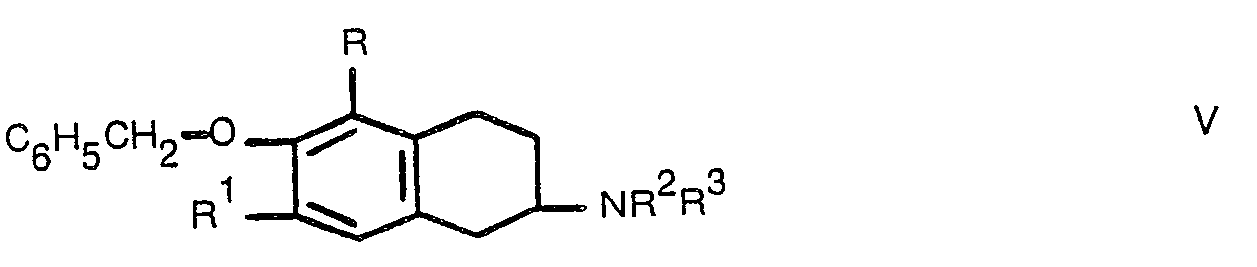


Applications Claiming Priority (2)
| Application Number | Priority Date | Filing Date | Title |
|---|---|---|---|
| US442074 | 1982-11-16 | ||
| US06/442,074 US4448990A (en) | 1982-11-16 | 1982-11-16 | Hydroxyaminotetralincarboxamides |
Publications (2)
| Publication Number | Publication Date |
|---|---|
| EP0109815A1 EP0109815A1 (en) | 1984-05-30 |
| EP0109815B1 true EP0109815B1 (en) | 1986-05-28 |
Family
ID=23755442
Family Applications (1)
| Application Number | Title | Priority Date | Filing Date |
|---|---|---|---|
| EP83306936A Expired EP0109815B1 (en) | 1982-11-16 | 1983-11-14 | Improvements in and relating to substituted tetrahydrona phthalenes |
Country Status (11)
| Country | Link |
|---|---|
| US (1) | US4448990A (en) |
| EP (1) | EP0109815B1 (en) |
| JP (1) | JPS59108748A (en) |
| KR (1) | KR870000204B1 (en) |
| CA (1) | CA1198122A (en) |
| DE (1) | DE3363813D1 (en) |
| DK (1) | DK515483D0 (en) |
| GB (1) | GB2130209B (en) |
| GR (1) | GR79034B (en) |
| HU (1) | HU196168B (en) |
| IL (1) | IL70158A (en) |
Families Citing this family (8)
| Publication number | Priority date | Publication date | Assignee | Title |
|---|---|---|---|---|
| JPS5970653A (en) * | 1982-10-15 | 1984-04-21 | Takeda Chem Ind Ltd | Naphthalenecaroxamide compound and intraocular pressure reducing agent containing the same |
| CA2012502A1 (en) * | 1989-03-21 | 1990-09-21 | Novartis Ag | Initiators for materials which can be polymerized cationically |
| DE3924365A1 (en) * | 1989-07-22 | 1991-01-24 | Boehringer Ingelheim Kg | 2-AMINO-7-CARBAMOYL-1,2,3,4-TETRAHYDRONAPHTHALINE, METHOD FOR THE PRODUCTION THEREOF AND THEIR USE AS A MEDICAMENT |
| WO1994022495A1 (en) * | 1993-03-31 | 1994-10-13 | The Trustees Of The University Of Pennsylvania | Dopamine d-3 and serotonin (5-ht1a) receptor ligands and imaging agents |
| US5763609A (en) * | 1996-03-21 | 1998-06-09 | Neurogen Corporation | Certain pyrrolo pyridine-3-carboxamides; a new class of gaba brain receptor ligands |
| RU2185372C2 (en) * | 1996-05-31 | 2002-07-20 | Фармация Энд Апджон Компани | Alkyl-substituted cyclic amines as selective ligands of d3-dopamine |
| IT1294931B1 (en) * | 1997-09-22 | 1999-04-23 | Sigma Tau Ind Farmaceuti | DERIVATIVES OF 2-AMINOTETHRALIN PROCEDURE FOR THEIR PREPARATION AND PHARMACEUTICAL COMPOSITIONS CONTAINING THEM, ACTIVE IN THE |
| EP1812416B1 (en) * | 2004-10-14 | 2013-08-21 | Abbott GmbH & Co. KG | Arylsulfonylmethyl or arylsulfonamide substituted aromatic compounds suitable for treating disorders that respond to modulation of the dopamine d3 receptor |
Family Cites Families (4)
| Publication number | Priority date | Publication date | Assignee | Title |
|---|---|---|---|---|
| US2029509A (en) * | 1932-12-23 | 1936-02-04 | Ici Ltd | Arylamides of 2,3-hydroxynaphthoic acids |
| US4163063A (en) * | 1976-01-02 | 1979-07-31 | University Of Iowa Research Foundation | Aminotetralin adrenergic β-agonists |
| DE2752659A1 (en) * | 1976-12-07 | 1978-06-08 | Sandoz Ag | NEW TETRALINE DERIVATIVES, THEIR PRODUCTION AND USE |
| SE8004002L (en) * | 1980-05-29 | 1981-11-30 | Arvidsson Folke Lars Erik | THERAPEUTICALLY APPLICABLE TETRALIN DERIVATIVES |
-
1982
- 1982-11-16 US US06/442,074 patent/US4448990A/en not_active Expired - Fee Related
-
1983
- 1983-11-07 IL IL70158A patent/IL70158A/en unknown
- 1983-11-10 GR GR72940A patent/GR79034B/el unknown
- 1983-11-10 CA CA000440888A patent/CA1198122A/en not_active Expired
- 1983-11-11 DK DK5154/83A patent/DK515483D0/en unknown
- 1983-11-14 GB GB08330279A patent/GB2130209B/en not_active Expired
- 1983-11-14 DE DE8383306936T patent/DE3363813D1/en not_active Expired
- 1983-11-14 EP EP83306936A patent/EP0109815B1/en not_active Expired
- 1983-11-15 HU HU833927A patent/HU196168B/en unknown
- 1983-11-15 JP JP58215891A patent/JPS59108748A/en active Pending
- 1983-11-16 KR KR1019830005431A patent/KR870000204B1/en not_active Expired
Also Published As
| Publication number | Publication date |
|---|---|
| GR79034B (en) | 1984-10-02 |
| KR870000204B1 (en) | 1987-02-16 |
| GB8330279D0 (en) | 1983-12-21 |
| DK515483D0 (en) | 1983-11-11 |
| HU196168B (en) | 1988-10-28 |
| GB2130209A (en) | 1984-05-31 |
| US4448990A (en) | 1984-05-15 |
| DE3363813D1 (en) | 1986-07-03 |
| GB2130209B (en) | 1986-05-29 |
| JPS59108748A (en) | 1984-06-23 |
| IL70158A0 (en) | 1984-02-29 |
| IL70158A (en) | 1987-03-31 |
| KR840007561A (en) | 1984-12-08 |
| EP0109815A1 (en) | 1984-05-30 |
| CA1198122A (en) | 1985-12-17 |
Similar Documents
| Publication | Publication Date | Title |
|---|---|---|
| US4490371A (en) | N,N-Disubstituted-(2-oxo-1,2,3,5-tetrahydroimidazo-[2,1-B]quinazolinyl)oxyalkylamides | |
| US5464872A (en) | Arylalkyl (thio) amides | |
| EP0013787B1 (en) | Octahydro pyrazolo (3,4-g)quinolines, process for their preparation and pharmaceutical compositions containing them | |
| US4476136A (en) | Aminomethyl-5 oxazolidinic derivatives and therapeutic use thereof | |
| US4096173A (en) | Chlorinated 1-aminoindane N-methyl transferase inhibitors | |
| EP0109815A1 (en) | Improvements in and relating to substituted tetrahydrona phthalenes | |
| CZ279745B6 (en) | Stereochemically pure derivative of 2-hydroxycyclopentylamide of ergoline, its use, process of its preparation and pharmaceutical composition containing thereof | |
| US4554287A (en) | Antihypertensive 7-[2-(dialkylamino)ethyl]-4-hydroxy-1,3-benzimidazol-2-ones | |
| US4500545A (en) | Hydroxyaminotetralincarboxamides | |
| JP2527784B2 (en) | Sulfonyldecahydro-8H-isoquino [2,1-g] [1,6] naphthyridine compound | |
| US4598093A (en) | 4-amino-tetrahydro-2-naphthoic acid derivatives | |
| EP0070531B1 (en) | Tetrahydronaphthoxazoles | |
| US3943173A (en) | 3-Alkylamino- alpha-aminomethyl-4-hydroxybenzyl alcohols | |
| Sober et al. | Selective and potent. beta. 2-adrenoceptor agents within the tetrahydroisoquinoline class: effect of methyl substitution at the benzylic carbon of the 1-(3, 4, 5-trimethoxybenzyl) group of trimetoquinol | |
| SK108995A3 (en) | Oxazolequinolinone derivatives, process for preparing the same and pharmaceutical agents containing these derivatives | |
| IE48295B1 (en) | Octahydro-2h-pyrrolo(3,4-g)quinolines | |
| EP0139393B1 (en) | Pyrimido(4,5-g)quinolines, process for their preparation, and pharmaceutical compositions containing them | |
| US4843073A (en) | 1-t-butyl ergolines useful in the treatment of cerebral insufficiency and senile dementia | |
| EP0209275B1 (en) | Benz-trisubstituted 2-aminotetralins | |
| JPS611659A (en) | 4-(2-(dialkylamino)ethyl)isatin | |
| US3763233A (en) | 7-substituted-hexahydro pleiadenes | |
| EP0172697A2 (en) | Octahydro-oxazolo[4,5-g]quinolines | |
| US4146626A (en) | 8-adamantylaminomethyl ergolene derivatives | |
| EP0061341B1 (en) | 6-substituted hexahydroindazolo isoquinolines | |
| US3996383A (en) | 3-Alkylamino-α-aminomethyl-4-hydroxybenzyl alcohols with β-adrenergic stimulant activity |
Legal Events
| Date | Code | Title | Description |
|---|---|---|---|
| PUAI | Public reference made under article 153(3) epc to a published international application that has entered the european phase |
Free format text: ORIGINAL CODE: 0009012 |
|
| 17P | Request for examination filed |
Effective date: 19831119 |
|
| AK | Designated contracting states |
Designated state(s): BE CH DE FR GB IT LI LU NL SE |
|
| GRAA | (expected) grant |
Free format text: ORIGINAL CODE: 0009210 |
|
| AK | Designated contracting states |
Kind code of ref document: B1 Designated state(s): BE CH DE FR GB IT LI LU NL SE |
|
| REF | Corresponds to: |
Ref document number: 3363813 Country of ref document: DE Date of ref document: 19860703 |
|
| ET | Fr: translation filed | ||
| ITF | It: translation for a ep patent filed | ||
| PG25 | Lapsed in a contracting state [announced via postgrant information from national office to epo] |
Ref country code: LU Free format text: LAPSE BECAUSE OF NON-PAYMENT OF DUE FEES Effective date: 19861130 |
|
| PLBE | No opposition filed within time limit |
Free format text: ORIGINAL CODE: 0009261 |
|
| STAA | Information on the status of an ep patent application or granted ep patent |
Free format text: STATUS: NO OPPOSITION FILED WITHIN TIME LIMIT |
|
| 26N | No opposition filed | ||
| PGFP | Annual fee paid to national office [announced via postgrant information from national office to epo] |
Ref country code: NL Payment date: 19871130 Year of fee payment: 5 |
|
| PG25 | Lapsed in a contracting state [announced via postgrant information from national office to epo] |
Ref country code: GB Effective date: 19881114 |
|
| PG25 | Lapsed in a contracting state [announced via postgrant information from national office to epo] |
Ref country code: SE Effective date: 19881115 |
|
| PG25 | Lapsed in a contracting state [announced via postgrant information from national office to epo] |
Ref country code: LI Effective date: 19881130 Ref country code: CH Effective date: 19881130 Ref country code: BE Effective date: 19881130 |
|
| BERE | Be: lapsed |
Owner name: ELI LILLY AND CY Effective date: 19881130 |
|
| PG25 | Lapsed in a contracting state [announced via postgrant information from national office to epo] |
Ref country code: NL Effective date: 19890601 |
|
| NLV4 | Nl: lapsed or anulled due to non-payment of the annual fee | ||
| GBPC | Gb: european patent ceased through non-payment of renewal fee | ||
| PG25 | Lapsed in a contracting state [announced via postgrant information from national office to epo] |
Ref country code: FR Free format text: LAPSE BECAUSE OF NON-PAYMENT OF DUE FEES Effective date: 19890731 |
|
| REG | Reference to a national code |
Ref country code: CH Ref legal event code: PL |
|
| PG25 | Lapsed in a contracting state [announced via postgrant information from national office to epo] |
Ref country code: DE Effective date: 19890801 |
|
| REG | Reference to a national code |
Ref country code: FR Ref legal event code: ST |
|
| EUG | Se: european patent has lapsed |
Ref document number: 83306936.2 Effective date: 19890726 |