EP0108567B1 - Continuous business form assembly - Google Patents
Continuous business form assembly Download PDFInfo
- Publication number
- EP0108567B1 EP0108567B1 EP83306576A EP83306576A EP0108567B1 EP 0108567 B1 EP0108567 B1 EP 0108567B1 EP 83306576 A EP83306576 A EP 83306576A EP 83306576 A EP83306576 A EP 83306576A EP 0108567 B1 EP0108567 B1 EP 0108567B1
- Authority
- EP
- European Patent Office
- Prior art keywords
- web
- webs
- openings
- envelopes
- flaps
- Prior art date
- Legal status (The legal status is an assumption and is not a legal conclusion. Google has not performed a legal analysis and makes no representation as to the accuracy of the status listed.)
- Expired
Links
Images

Classifications
-
- B—PERFORMING OPERATIONS; TRANSPORTING
- B42—BOOKBINDING; ALBUMS; FILES; SPECIAL PRINTED MATTER
- B42D—BOOKS; BOOK COVERS; LOOSE LEAVES; PRINTED MATTER CHARACTERISED BY IDENTIFICATION OR SECURITY FEATURES; PRINTED MATTER OF SPECIAL FORMAT OR STYLE NOT OTHERWISE PROVIDED FOR; DEVICES FOR USE THEREWITH AND NOT OTHERWISE PROVIDED FOR; MOVABLE-STRIP WRITING OR READING APPARATUS
- B42D5/00—Sheets united without binding to form pads or blocks
- B42D5/02—Form sets
- B42D5/023—Continuous form sets
- B42D5/025—Mailer assemblies
Definitions
- This invention relates to a continuous business form assembly, and more particularly, to a continuous, filled envelope assembly, or, in business jargon, a return envelope mailer.
- the webs form series of overlying record sheets, originating envelopes, return envelopes, and message sheets.
- the return envelopes and message sheets are contained within the originating envelopes.
- the return envelopes and message sheets are removed from the originating envelopes by their first recipients, who separate the assembly along perforation lines as provided.
- the webs which form the return envelopes and message sheets include spaced, transversely extending openings between the feed strips, which allow the webs which form the originating envelopes to be joined, in part, through the openings and about the return envelopes and message sheets.
- CH-A-492565 describes a continuous envelope assembly having front and back panels secured together with intermediate parts with cross perforations to divide the assembly into envelope lengths and with sever- able lines to enable an envelope to be grasped and burst to enable an insert to be severed.
- a continuous form envelope assembly comprising a first web and a second web, the first web having longitudinally spaced, transversely extending flaps, the flaps each having cut edges and a folded edge, the flaps being folded and thereby providing openings in the first web adjacent the flaps, said openings in the first web being aligned with openings in the second web.
- this invention proceeds with the discovery of an alternate continuous business form construction which not only increases the possible size of return envelopes for any given assembly but also simultaneously eliminates the paper waste of the openings cut through the one of the webs from which the flaps of the return envelopes are formed.
- CH-A-492565 which describes a continuous business form assembly comprising a first web, a second web, a third web and a fourth web, all the webs being continuous in a longitudinal direction and having a transverse extent perpendicular to the longitudinal direction, the first web having first rectangular openings and the second web having second rectangular openings, said first and second openings being longitudinally and transversely aligned with one another and the third web being joined to the fourth web in part through the openings of the first and second webs, the third and fourth webs being adapted to form originating envelopes including therein a return envelope, the first and second webs being adapted to form said return envelopes, the first web having longitudinally spaced, transversely extending rectangular flaps, the flaps each having three cut edges and a folded edge along which the flaps can be folded, each folded edge defining an edge of said first rectangular openings in the first web, and the second web being joined to the first web to form return envelopes such that the flaps constitute return envelope flap
- the preferred embodiment of the invention is a continuous business form assembly 10.
- the assembly includes five webs, specifically a first web 12, a second web 14, a third web 16, a fourth web 18, and a fifth web 20.
- the webs are 18, 20, 14, 12, 16.
- Each web 12-20 has a longitudinal extent along its direction of continuity 22, and a transverse extent along a transverse direction 24 perpendicular to the direction 22.
- each web 12-20 has marginal feed strips 30, 32, respectively, defined by marginal perforation lines 34, 36 and marginal rows of spaced feed holes 38, 40, respectively.
- Longitudinal first and second glue lines 44, 42 which are a type of means for joining the webs, extend along the inward sides of the marginal perforation lines 34, 36 and join the web 12-20.
- Spaced, transverse lines of perforations 46 divide the webs 12-20 into sheets or panels 48, 50, 52, 54, 56, respectively.
- the webs 12, 14 20 Inward of the first glue line 44, the webs 12, 14 20 have perforation lines 58 interrupted by openings 60, 61 and 63, respectively. Inward of the second glue line 42, the webs 12, 14, 20 have perforation lines 62, also interrupted by the openings 60, 62, 63 and the webs 16, 18 have continuous perforation lines 64.
- the openings 60, 61, 63 are centered on the transverse perforation lines 46, and extend transversely from the perforation lines 58 to the perforation lines 62.
- Glue lines 66, 68 join the webs 16, 18 through the openings 60, 61, 63 along both sides of the transverse perforation lines 46.
- the glue lines 66, 68 combine with the glue lines 42, 44 to form originating envelopes 69 (Fig. 3) of the panels 52, 54, which contain the panels 48, 50, 56 of the webs 12, 14, 20, respectively.
- the panels 48, 50, 56 are the contents of the originating envelopes 69.
- Panel 56 is a message sheet, which may be a bill, notice or the like.
- Panels 48, 50 form a return envelope 51, as will now be described.
- Panels 48 have a longitudinal extent from one opening 60 to an adjacent opening 60; panels 50 have a longitudinal extent from one opening 61 to an adjacent opening 61; and panels 56 have a longitudinal extent from one opening 63 to an adjacent opening 63.
- the longitudinal extents of the panels 50, 56 are substantially identical to each other, and about 3.2 mm (one-eighth inch) less than that of the panels 48, for clearance of a flap 76.
- the openings 61, 63 are substantially aligned longitudinally and transversely, with the openings 60.
- panel 50 Along the inner sides of the perforation lines 58, 62, and on the face toward panel 48, panel 50 has longitudinal glue lines 70, 72.
- the panel 50 further has a transverse glue line 74.
- the glue lines 70, 72, 74 join the panels 48, 50 along three of their sides, forming a pocket.
- the panel 48 On its face away from the panel 50, and at its transverse edge opposite the glue line 74, the panel 48 has the flap 76.
- the flap 76 is folded back against the panel 48 along a fold line 78.
- the edge of the opening 60 in the web 12 adjacent the flap 76 is formed by the fold line 78, and the transverse and longitudinal extents of the flap 76 equal the transverse and longitudinal extents, respectively, of the opening 60.
- the panels 48, 50 thus form the return envelope 51, with an integral top opening flap 76.
- the assembly 10 provides continuous series of originating envelopes 69, message sheets 56 and return envelopes 51.
- a carbon backing 80 is provided on the panels 54.
- the units of the envelopes 51, 69 and sheets 56 may be printed, separated as in Fig. 3 from adjacent units and their feed strips 30, 32, and then sent.
- the envelopes 69 may be opened by transverse stress using thumb notches 82, again as in Fig. 3.
- the contents 51, 56 may then be pulled from the envelopes 69 and used. If the flap 76 has been prepared with an adhesive for the recipient, the return envelope 51 may be readily sealed and returned to the originator.
Landscapes
- Credit Cards Or The Like (AREA)
- Making Paper Articles (AREA)
- Sheet Holders (AREA)
Abstract
Description
- This invention relates to a continuous business form assembly, and more particularly, to a continuous, filled envelope assembly, or, in business jargon, a return envelope mailer.
- As computer printing has facilitated computer billing and the like, the use of continuous business form assemblies has increased. For computer billing and the like, such assemblies have typically included multiple overlying webs with marginal feed strips. The webs form series of overlying record sheets, originating envelopes, return envelopes, and message sheets. The return envelopes and message sheets are contained within the originating envelopes. The return envelopes and message sheets are removed from the originating envelopes by their first recipients, who separate the assembly along perforation lines as provided. The webs which form the return envelopes and message sheets include spaced, transversely extending openings between the feed strips, which allow the webs which form the originating envelopes to be joined, in part, through the openings and about the return envelopes and message sheets.
- Thus for example CH-A-492565 describes a continuous envelope assembly having front and back panels secured together with intermediate parts with cross perforations to divide the assembly into envelope lengths and with sever- able lines to enable an envelope to be grasped and burst to enable an insert to be severed.
- Also in US-A-3482763 there is described a continuous form envelope assembly comprising a first web and a second web, the first web having longitudinally spaced, transversely extending flaps, the flaps each having cut edges and a folded edge, the flaps being folded and thereby providing openings in the first web adjacent the flaps, said openings in the first web being aligned with openings in the second web.
- While these assemblies have proven successful, the need to provide the return envelopes with a flap or alternate sealing means has been a problem. The dimensions of the envelopes have been limited by this need.
- With the problems of return envelopes within continuous business forms assemblies at hand, this invention proceeds with the discovery of an alternate continuous business form construction which not only increases the possible size of return envelopes for any given assembly but also simultaneously eliminates the paper waste of the openings cut through the one of the webs from which the flaps of the return envelopes are formed.
- With respect to the prior art -known from CH-A-492565 which describes a continuous business form assembly comprising a first web, a second web, a third web and a fourth web, all the webs being continuous in a longitudinal direction and having a transverse extent perpendicular to the longitudinal direction, the first web having first rectangular openings and the second web having second rectangular openings, said first and second openings being longitudinally and transversely aligned with one another and the third web being joined to the fourth web in part through the openings of the first and second webs, the third and fourth webs being adapted to form originating envelopes including therein a return envelope, the first and second webs being adapted to form said return envelopes, the first web having longitudinally spaced, transversely extending rectangular flaps, the flaps each having three cut edges and a folded edge along which the flaps can be folded, each folded edge defining an edge of said first rectangular openings in the first web, and the second web being joined to the first web to form return envelopes such that the flaps constitute return envelope flaps, the invention is characterised in that the three other edges of said first rectangular openings and the three cut edges of each flap are aligned with one another when the flap lies in the plane defined by the edges of said first openings.
-
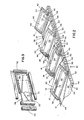
- Fig. 1 is a progressively cutaway view of the- preferred embodiment of the invention;
- Fig. 2 is a perspective view of the preferred embodiment with its webs progressively peeled back, and
- Fig. 3 is a perspective view of a single one of the series of messages and envelope units formed by the preferred embodiment, as separated from its adjacent units and burst apart during use.
- Also in the drawing, and the description which follows, construction details of the preferred embodiment which are repeated in series and repeated among the webs in overlying relationships, are given a single reference number, despite the repetition, for clarity.
- -Referring to the figures of the drawing, the preferred embodiment of the invention is a continuous
business form assembly 10. The assembly includes five webs, specifically afirst web 12, asecond web 14, athird web 16, afourth web 18, and afifth web 20. In order from the top of Fig. 1, the webs are 18, 20, 14, 12, 16. - Each web 12-20 has a longitudinal extent along its direction of
continuity 22, and a transverse extent along atransverse direction 24 perpendicular to thedirection 22. Along transversely marginal, longitudinally extending (i.e., marginal)edges assembly 10, each web 12-20 hasmarginal feed strips marginal perforation lines feed holes second glue lines marginal perforation lines perforations 46 divide the webs 12-20 into sheets orpanels - Inward of the
first glue line 44, thewebs perforation lines 58 interrupted byopenings second glue line 42, thewebs perforation lines 62, also interrupted by theopenings webs continuous perforation lines 64. - The
openings transverse perforation lines 46, and extend transversely from theperforation lines 58 to theperforation lines 62.Glue lines webs openings transverse perforation lines 46. Theglue lines glue lines panels panels webs - Thus, the
panels envelopes 69.Panel 56 is a message sheet, which may be a bill, notice or the like.Panels return envelope 51, as will now be described. -
Panels 48 have a longitudinal extent from one opening 60 to anadjacent opening 60;panels 50 have a longitudinal extent from one opening 61 to anadjacent opening 61; andpanels 56 have a longitudinal extent from one opening 63 to anadjacent opening 63. The longitudinal extents of thepanels panels 48, for clearance of aflap 76. Theopenings openings 60. Along the inner sides of theperforation lines panel 48,panel 50 haslongitudinal glue lines adjacent openings 61 and on the same face, thepanel 50 further has atransverse glue line 74. The glue lines 70, 72, 74 join thepanels - On its face away from the
panel 50, and at its transverse edge opposite theglue line 74, thepanel 48 has theflap 76. Theflap 76 is folded back against thepanel 48 along afold line 78. The edge of theopening 60 in theweb 12 adjacent theflap 76 is formed by thefold line 78, and the transverse and longitudinal extents of theflap 76 equal the transverse and longitudinal extents, respectively, of theopening 60. - These relationships exist between the
flap 76 and opening 60 because- the two are simultaneously formed, and theflap 76 is integral to theweb 12. The two transverse and one longitudinal edges of theflap 76 and of the opening 60 in theweb 12 are formed by cutting, or slitting, of theweb 12. The other longitudinal edge of theflap 76 and of the opening 60 is defined by thefold line 78, as theflap 76 is folded back. - The
panels return envelope 51, with an integraltop opening flap 76. - As now described, the
assembly 10 provides continuous series of originatingenvelopes 69,message sheets 56 and returnenvelopes 51. For computer printing, acarbon backing 80 is provided on thepanels 54. The units of theenvelopes sheets 56 may be printed, separated as in Fig. 3 from adjacent units and theirfeed strips - Upon receipt, the
envelopes 69 may be opened by transverse stress usingthumb notches 82, again as in Fig. 3. Thecontents envelopes 69 and used. If theflap 76 has been prepared with an adhesive for the recipient, thereturn envelope 51 may be readily sealed and returned to the originator. - The invention, the preferred embodiment and the manner and process of making and using the invention have now been described in such full, clear, concise and exact terms as to enable any person skilled in the art to make and use the same. The best mode contemplated by the invention of carrying out the invention has been set forth.
- To particularly point out and distinctly claim the subject matter regarded as invention, the following claims conclude this specification.
Claims (3)
Priority Applications (1)
| Application Number | Priority Date | Filing Date | Title |
|---|---|---|---|
| AT83306576T ATE31277T1 (en) | 1982-11-03 | 1983-10-28 | ENDLESS SET OF BUSINESS LETTERS. |
Applications Claiming Priority (2)
| Application Number | Priority Date | Filing Date | Title |
|---|---|---|---|
| US06/438,787 US4440341A (en) | 1982-11-03 | 1982-11-03 | Return envelope mailer |
| US438787 | 1982-11-03 |
Publications (3)
| Publication Number | Publication Date |
|---|---|
| EP0108567A2 EP0108567A2 (en) | 1984-05-16 |
| EP0108567A3 EP0108567A3 (en) | 1985-05-22 |
| EP0108567B1 true EP0108567B1 (en) | 1987-12-09 |
Family
ID=23742009
Family Applications (1)
| Application Number | Title | Priority Date | Filing Date |
|---|---|---|---|
| EP83306576A Expired EP0108567B1 (en) | 1982-11-03 | 1983-10-28 | Continuous business form assembly |
Country Status (5)
| Country | Link |
|---|---|
| US (1) | US4440341A (en) |
| EP (1) | EP0108567B1 (en) |
| AT (1) | ATE31277T1 (en) |
| CA (1) | CA1217168A (en) |
| DE (1) | DE3374855D1 (en) |
Families Citing this family (10)
| Publication number | Priority date | Publication date | Assignee | Title |
|---|---|---|---|---|
| US4598860A (en) * | 1983-10-05 | 1986-07-08 | Moore Business Forms, Inc. | Flip die cut label for folded mailer |
| US4705298A (en) * | 1984-05-03 | 1987-11-10 | Moore Business Forms, Inc. | Die cut window mailer with self-imaging sheet |
| US4960237A (en) * | 1988-08-09 | 1990-10-02 | Bruce Bendel | Self-contained insert mailer |
| US4915287A (en) * | 1988-11-03 | 1990-04-10 | Moore Business Forms, Inc. | Intelligently imaged envelopes with intelligently imaged integral tear-off flaps |
| GB2229962B (en) * | 1989-03-30 | 1992-11-11 | Moore Business Forms Inc | Improvements in return business forms assemblies |
| US5040720A (en) * | 1990-08-20 | 1991-08-20 | Moore Business Forms, Inc. | Return envelope mailer |
| US5640835A (en) * | 1991-10-16 | 1997-06-24 | Muscoplat; Richard | Multiple envelope with integrally formed and printed contents and return envelope |
| US5167739A (en) * | 1991-11-21 | 1992-12-01 | Moore Business Forms, Inc. | Pressure seal multiple part |
| US20040119205A1 (en) * | 2002-10-11 | 2004-06-24 | Taylor's Industrial Services, Llc | Rotating turret molding machine and associated process |
| US8695313B2 (en) * | 2008-12-04 | 2014-04-15 | Lockheed Martin Corporation | Method of inserting mail pieces into individual folder |
Family Cites Families (14)
| Publication number | Priority date | Publication date | Assignee | Title |
|---|---|---|---|---|
| US3104799A (en) * | 1963-09-24 | Envelope assembly | ||
| GB190315557A (en) * | 1903-07-14 | 1903-09-24 | Bertrand Joseph Pattison | Improvements in or relating to Envelopes. |
| US1279171A (en) * | 1915-05-10 | 1918-09-17 | Standard Paper Bag Company | Continuous bag. |
| US2824685A (en) * | 1954-02-11 | 1958-02-25 | Uarco Inc | Assembly of series-connected envelopes and method of making same |
| US3026018A (en) * | 1956-04-05 | 1962-03-20 | Uarco Inc | Envelopes having gummed flaps formed with tape |
| US3058648A (en) * | 1960-09-15 | 1962-10-16 | John H Alexander | Send and return stationery |
| US3261623A (en) * | 1964-11-23 | 1966-07-19 | Pak Well Paper Ind Inc | Envelope |
| US3294423A (en) * | 1965-06-25 | 1966-12-27 | Curtis 1000 Inc | Continuous envelopes |
| US3482763A (en) * | 1968-03-29 | 1969-12-09 | Us Envelope Co | Continuous form envelopes with inserts |
| US3554438A (en) * | 1968-06-24 | 1971-01-12 | Moore Business Forms Inc | Correspondence assembly |
| FR2106874A5 (en) * | 1970-09-23 | 1972-05-05 | Malenge Expl Ets | |
| US3837565A (en) * | 1972-02-15 | 1974-09-24 | E Johnsen | Rapid production envelope assemblies |
| US3905545A (en) * | 1974-03-11 | 1975-09-16 | Uarco Inc | Continuous forms assembly |
| US4081127A (en) * | 1976-06-15 | 1978-03-28 | Wallace Business Forms, Inc. | Return envelope for mailer and method |
-
1982
- 1982-11-03 US US06/438,787 patent/US4440341A/en not_active Expired - Lifetime
-
1983
- 1983-10-28 AT AT83306576T patent/ATE31277T1/en active
- 1983-10-28 DE DE8383306576T patent/DE3374855D1/en not_active Expired
- 1983-10-28 EP EP83306576A patent/EP0108567B1/en not_active Expired
- 1983-11-02 CA CA000440244A patent/CA1217168A/en not_active Expired
Also Published As
| Publication number | Publication date |
|---|---|
| CA1217168A (en) | 1987-01-27 |
| US4440341A (en) | 1984-04-03 |
| EP0108567A3 (en) | 1985-05-22 |
| ATE31277T1 (en) | 1987-12-15 |
| EP0108567A2 (en) | 1984-05-16 |
| DE3374855D1 (en) | 1988-01-21 |
Similar Documents
| Publication | Publication Date | Title |
|---|---|---|
| EP0354780B1 (en) | Mailer | |
| US4081127A (en) | Return envelope for mailer and method | |
| EP0058248B1 (en) | A peel back mailer | |
| US3554438A (en) | Correspondence assembly | |
| EP0007388B1 (en) | A continuous mailer | |
| US5040720A (en) | Return envelope mailer | |
| US4944449A (en) | Oversize laser mailer and return envelope and method | |
| US4705298A (en) | Die cut window mailer with self-imaging sheet | |
| CA2142732C (en) | Single-part statement mailer | |
| US5118030A (en) | Mailer with perforated adhesive areas | |
| US4440341A (en) | Return envelope mailer | |
| US4889278A (en) | Method of producing a printed mailer form | |
| US4598860A (en) | Flip die cut label for folded mailer | |
| EP0355969A2 (en) | Fold- over mailer with side-open return envelope with slittable edge | |
| EP0070129B1 (en) | Continuous filled envelope assembly | |
| EP0129950B1 (en) | Continuous business assembly of combined mailers and top-opening return envelopes | |
| US4475747A (en) | Packing form | |
| US4671454A (en) | Top open return envelope mailer with tear tab perforations | |
| US5238183A (en) | Bifold mailer with return envelope | |
| USRE33139E (en) | Packing form | |
| US4032065A (en) | File folder web of indeterminate length | |
| CA1245194A (en) | Flip die cut label for folded mailer | |
| EP0143622A1 (en) | Improvements in business form assemblies | |
| EP0138501A2 (en) | Cut sheet mailer | |
| USRE33570E (en) | Continuous filled envelope assembly with non-marginal spaced feed holes |
Legal Events
| Date | Code | Title | Description |
|---|---|---|---|
| PUAI | Public reference made under article 153(3) epc to a published international application that has entered the european phase |
Free format text: ORIGINAL CODE: 0009012 |
|
| AK | Designated contracting states |
Designated state(s): AT BE CH DE FR GB IT LI LU NL SE |
|
| PUAL | Search report despatched |
Free format text: ORIGINAL CODE: 0009013 |
|
| AK | Designated contracting states |
Designated state(s): AT BE CH DE FR GB IT LI LU NL SE |
|
| 17P | Request for examination filed |
Effective date: 19850430 |
|
| 17Q | First examination report despatched |
Effective date: 19860103 |
|
| ITF | It: translation for a ep patent filed | ||
| GRAA | (expected) grant |
Free format text: ORIGINAL CODE: 0009210 |
|
| AK | Designated contracting states |
Kind code of ref document: B1 Designated state(s): AT BE CH DE FR GB IT LI LU NL SE |
|
| REF | Corresponds to: |
Ref document number: 31277 Country of ref document: AT Date of ref document: 19871215 Kind code of ref document: T |
|
| REF | Corresponds to: |
Ref document number: 3374855 Country of ref document: DE Date of ref document: 19880121 |
|
| ET | Fr: translation filed | ||
| PLBE | No opposition filed within time limit |
Free format text: ORIGINAL CODE: 0009261 |
|
| STAA | Information on the status of an ep patent application or granted ep patent |
Free format text: STATUS: NO OPPOSITION FILED WITHIN TIME LIMIT |
|
| PG25 | Lapsed in a contracting state [announced via postgrant information from national office to epo] |
Ref country code: LU Free format text: LAPSE BECAUSE OF NON-PAYMENT OF DUE FEES Effective date: 19881031 |
|
| 26N | No opposition filed | ||
| PG25 | Lapsed in a contracting state [announced via postgrant information from national office to epo] |
Ref country code: DE Effective date: 19890701 |
|
| PG25 | Lapsed in a contracting state [announced via postgrant information from national office to epo] |
Ref country code: AT Effective date: 19891028 |
|
| PG25 | Lapsed in a contracting state [announced via postgrant information from national office to epo] |
Ref country code: SE Effective date: 19891029 |
|
| PGFP | Annual fee paid to national office [announced via postgrant information from national office to epo] |
Ref country code: CH Payment date: 19900725 Year of fee payment: 8 |
|
| PGFP | Annual fee paid to national office [announced via postgrant information from national office to epo] |
Ref country code: LU Payment date: 19900927 Year of fee payment: 8 Ref country code: BE Payment date: 19900927 Year of fee payment: 8 |
|
| ITTA | It: last paid annual fee | ||
| PG25 | Lapsed in a contracting state [announced via postgrant information from national office to epo] |
Ref country code: LI Effective date: 19911031 Ref country code: CH Effective date: 19911031 Ref country code: BE Effective date: 19911031 |
|
| BERE | Be: lapsed |
Owner name: MOORE BUSINESS FORMS INC. Effective date: 19911031 |
|
| REG | Reference to a national code |
Ref country code: CH Ref legal event code: PL |
|
| PGFP | Annual fee paid to national office [announced via postgrant information from national office to epo] |
Ref country code: GB Payment date: 19920911 Year of fee payment: 10 |
|
| PGFP | Annual fee paid to national office [announced via postgrant information from national office to epo] |
Ref country code: NL Payment date: 19921031 Year of fee payment: 10 |
|
| PGFP | Annual fee paid to national office [announced via postgrant information from national office to epo] |
Ref country code: FR Payment date: 19930914 Year of fee payment: 11 |
|
| PG25 | Lapsed in a contracting state [announced via postgrant information from national office to epo] |
Ref country code: GB Effective date: 19931028 |
|
| PG25 | Lapsed in a contracting state [announced via postgrant information from national office to epo] |
Ref country code: NL Effective date: 19940501 |
|
| NLV4 | Nl: lapsed or anulled due to non-payment of the annual fee | ||
| GBPC | Gb: european patent ceased through non-payment of renewal fee |
Effective date: 19931028 |
|
| EUG | Se: european patent has lapsed |
Ref document number: 83306576.6 Effective date: 19900706 |
|
| PG25 | Lapsed in a contracting state [announced via postgrant information from national office to epo] |
Ref country code: FR Effective date: 19950630 |
|
| REG | Reference to a national code |
Ref country code: FR Ref legal event code: ST |