EP0108396B1 - Stabilized graft copolymers - Google Patents
Stabilized graft copolymers Download PDFInfo
- Publication number
- EP0108396B1 EP0108396B1 EP19830110979 EP83110979A EP0108396B1 EP 0108396 B1 EP0108396 B1 EP 0108396B1 EP 19830110979 EP19830110979 EP 19830110979 EP 83110979 A EP83110979 A EP 83110979A EP 0108396 B1 EP0108396 B1 EP 0108396B1
- Authority
- EP
- European Patent Office
- Prior art keywords
- copolymer
- polymer
- alkadiene
- styrene
- graft copolymer
- Prior art date
- Legal status (The legal status is an assumption and is not a legal conclusion. Google has not performed a legal analysis and makes no representation as to the accuracy of the status listed.)
- Expired
Links
- 229920000578 graft copolymer Polymers 0.000 title claims description 28
- PPBRXRYQALVLMV-UHFFFAOYSA-N Styrene Chemical compound C=CC1=CC=CC=C1 PPBRXRYQALVLMV-UHFFFAOYSA-N 0.000 claims description 42
- 229920000642 polymer Polymers 0.000 claims description 32
- 239000005062 Polybutadiene Substances 0.000 claims description 21
- 229920002857 polybutadiene Polymers 0.000 claims description 21
- 229920001577 copolymer Polymers 0.000 claims description 16
- NLHHRLWOUZZQLW-UHFFFAOYSA-N Acrylonitrile Chemical compound C=CC#N NLHHRLWOUZZQLW-UHFFFAOYSA-N 0.000 claims description 15
- KAKZBPTYRLMSJV-UHFFFAOYSA-N Butadiene Chemical compound C=CC=C KAKZBPTYRLMSJV-UHFFFAOYSA-N 0.000 claims description 15
- 239000000839 emulsion Substances 0.000 claims description 15
- 239000000758 substrate Substances 0.000 claims description 13
- -1 aliphatic ester Chemical class 0.000 claims description 12
- VVQNEPGJFQJSBK-UHFFFAOYSA-N Methyl methacrylate Chemical compound COC(=O)C(C)=C VVQNEPGJFQJSBK-UHFFFAOYSA-N 0.000 claims description 9
- 150000001875 compounds Chemical class 0.000 claims description 5
- 125000000217 alkyl group Chemical group 0.000 claims description 4
- 125000004432 carbon atom Chemical group C* 0.000 claims description 3
- 238000000034 method Methods 0.000 description 17
- 239000000203 mixture Substances 0.000 description 16
- 229920000122 acrylonitrile butadiene styrene Polymers 0.000 description 13
- OKKJLVBELUTLKV-UHFFFAOYSA-N Methanol Chemical compound OC OKKJLVBELUTLKV-UHFFFAOYSA-N 0.000 description 12
- ARNIBHATWCFIIK-UHFFFAOYSA-N dodecyl 3-sulfanylpropanoate Chemical compound CCCCCCCCCCCCOC(=O)CCS ARNIBHATWCFIIK-UHFFFAOYSA-N 0.000 description 9
- 239000004816 latex Substances 0.000 description 9
- 229920000126 latex Polymers 0.000 description 9
- 238000006243 chemical reaction Methods 0.000 description 8
- 238000002360 preparation method Methods 0.000 description 7
- 239000002253 acid Substances 0.000 description 6
- 239000011347 resin Substances 0.000 description 6
- 229920005989 resin Polymers 0.000 description 6
- 239000003963 antioxidant agent Substances 0.000 description 4
- 230000003078 antioxidant effect Effects 0.000 description 4
- VNWKTOKETHGBQD-UHFFFAOYSA-N methane Chemical compound C VNWKTOKETHGBQD-UHFFFAOYSA-N 0.000 description 4
- 150000003254 radicals Chemical class 0.000 description 4
- 230000006641 stabilisation Effects 0.000 description 4
- 238000011105 stabilization Methods 0.000 description 4
- UHOVQNZJYSORNB-UHFFFAOYSA-N Benzene Chemical compound C1=CC=CC=C1 UHOVQNZJYSORNB-UHFFFAOYSA-N 0.000 description 3
- MHAJPDPJQMAIIY-UHFFFAOYSA-N Hydrogen peroxide Chemical compound OO MHAJPDPJQMAIIY-UHFFFAOYSA-N 0.000 description 3
- 238000013019 agitation Methods 0.000 description 3
- 150000001993 dienes Chemical class 0.000 description 3
- 239000000178 monomer Substances 0.000 description 3
- 241000894007 species Species 0.000 description 3
- 125000003396 thiol group Chemical class [H]S* 0.000 description 3
- MYRTYDVEIRVNKP-UHFFFAOYSA-N 1,2-Divinylbenzene Chemical compound C=CC1=CC=CC=C1C=C MYRTYDVEIRVNKP-UHFFFAOYSA-N 0.000 description 2
- LEJBBGNFPAFPKQ-UHFFFAOYSA-N 2-(2-prop-2-enoyloxyethoxy)ethyl prop-2-enoate Chemical compound C=CC(=O)OCCOCCOC(=O)C=C LEJBBGNFPAFPKQ-UHFFFAOYSA-N 0.000 description 2
- DKIDEFUBRARXTE-UHFFFAOYSA-N 3-mercaptopropanoic acid Chemical compound OC(=O)CCS DKIDEFUBRARXTE-UHFFFAOYSA-N 0.000 description 2
- XKRFYHLGVUSROY-UHFFFAOYSA-N Argon Chemical compound [Ar] XKRFYHLGVUSROY-UHFFFAOYSA-N 0.000 description 2
- XEEYBQQBJWHFJM-UHFFFAOYSA-N Iron Chemical compound [Fe] XEEYBQQBJWHFJM-UHFFFAOYSA-N 0.000 description 2
- RRHGJUQNOFWUDK-UHFFFAOYSA-N Isoprene Chemical compound CC(=C)C=C RRHGJUQNOFWUDK-UHFFFAOYSA-N 0.000 description 2
- 239000003431 cross linking reagent Substances 0.000 description 2
- 238000000354 decomposition reaction Methods 0.000 description 2
- 150000002148 esters Chemical class 0.000 description 2
- 238000010438 heat treatment Methods 0.000 description 2
- 230000003647 oxidation Effects 0.000 description 2
- 238000007254 oxidation reaction Methods 0.000 description 2
- 239000002245 particle Substances 0.000 description 2
- 229920001195 polyisoprene Polymers 0.000 description 2
- 230000000379 polymerizing effect Effects 0.000 description 2
- 229920000098 polyolefin Polymers 0.000 description 2
- USHAGKDGDHPEEY-UHFFFAOYSA-L potassium persulfate Chemical compound [K+].[K+].[O-]S(=O)(=O)OOS([O-])(=O)=O USHAGKDGDHPEEY-UHFFFAOYSA-L 0.000 description 2
- CWERGRDVMFNCDR-UHFFFAOYSA-N thioglycolic acid Chemical compound OC(=O)CS CWERGRDVMFNCDR-UHFFFAOYSA-N 0.000 description 2
- VDYWHVQKENANGY-UHFFFAOYSA-N 1,3-Butyleneglycol dimethacrylate Chemical compound CC(=C)C(=O)OC(C)CCOC(=O)C(C)=C VDYWHVQKENANGY-UHFFFAOYSA-N 0.000 description 1
- XSZYESUNPWGWFQ-UHFFFAOYSA-N 1-(2-hydroperoxypropan-2-yl)-4-methylcyclohexane Chemical compound CC1CCC(C(C)(C)OO)CC1 XSZYESUNPWGWFQ-UHFFFAOYSA-N 0.000 description 1
- BJELTSYBAHKXRW-UHFFFAOYSA-N 2,4,6-triallyloxy-1,3,5-triazine Chemical compound C=CCOC1=NC(OCC=C)=NC(OCC=C)=N1 BJELTSYBAHKXRW-UHFFFAOYSA-N 0.000 description 1
- PFHOSZAOXCYAGJ-UHFFFAOYSA-N 2-[(2-cyano-4-methoxy-4-methylpentan-2-yl)diazenyl]-4-methoxy-2,4-dimethylpentanenitrile Chemical compound COC(C)(C)CC(C)(C#N)N=NC(C)(C#N)CC(C)(C)OC PFHOSZAOXCYAGJ-UHFFFAOYSA-N 0.000 description 1
- HWSSEYVMGDIFMH-UHFFFAOYSA-N 2-[2-[2-(2-methylprop-2-enoyloxy)ethoxy]ethoxy]ethyl 2-methylprop-2-enoate Chemical compound CC(=C)C(=O)OCCOCCOCCOC(=O)C(C)=C HWSSEYVMGDIFMH-UHFFFAOYSA-N 0.000 description 1
- LTHJXDSHSVNJKG-UHFFFAOYSA-N 2-[2-[2-[2-(2-methylprop-2-enoyloxy)ethoxy]ethoxy]ethoxy]ethyl 2-methylprop-2-enoate Chemical compound CC(=C)C(=O)OCCOCCOCCOCCOC(=O)C(C)=C LTHJXDSHSVNJKG-UHFFFAOYSA-N 0.000 description 1
- FRIBMENBGGCKPD-UHFFFAOYSA-N 3-(2,3-dimethoxyphenyl)prop-2-enal Chemical compound COC1=CC=CC(C=CC=O)=C1OC FRIBMENBGGCKPD-UHFFFAOYSA-N 0.000 description 1
- 239000004215 Carbon black (E152) Substances 0.000 description 1
- GHKOFFNLGXMVNJ-UHFFFAOYSA-N Didodecyl thiobispropanoate Chemical compound CCCCCCCCCCCCOC(=O)CCSCCC(=O)OCCCCCCCCCCCC GHKOFFNLGXMVNJ-UHFFFAOYSA-N 0.000 description 1
- 239000003508 Dilauryl thiodipropionate Substances 0.000 description 1
- SNRUBQQJIBEYMU-UHFFFAOYSA-N Dodecane Natural products CCCCCCCCCCCC SNRUBQQJIBEYMU-UHFFFAOYSA-N 0.000 description 1
- CJQWLNNCQIHKHP-UHFFFAOYSA-N Ethyl 3-mercaptopropanoic acid Chemical compound CCOC(=O)CCS CJQWLNNCQIHKHP-UHFFFAOYSA-N 0.000 description 1
- 244000043261 Hevea brasiliensis Species 0.000 description 1
- 239000004743 Polypropylene Substances 0.000 description 1
- 241001085205 Prenanthella exigua Species 0.000 description 1
- BZHJMEDXRYGGRV-UHFFFAOYSA-N Vinyl chloride Chemical compound ClC=C BZHJMEDXRYGGRV-UHFFFAOYSA-N 0.000 description 1
- NIXOWILDQLNWCW-UHFFFAOYSA-M acrylate group Chemical group C(C=C)(=O)[O-] NIXOWILDQLNWCW-UHFFFAOYSA-M 0.000 description 1
- 239000000654 additive Substances 0.000 description 1
- 230000000996 additive effect Effects 0.000 description 1
- 125000001931 aliphatic group Chemical group 0.000 description 1
- 238000004458 analytical method Methods 0.000 description 1
- 229910052786 argon Inorganic materials 0.000 description 1
- RWCCWEUUXYIKHB-UHFFFAOYSA-N benzophenone Chemical compound C=1C=CC=CC=1C(=O)C1=CC=CC=C1 RWCCWEUUXYIKHB-UHFFFAOYSA-N 0.000 description 1
- 239000012965 benzophenone Substances 0.000 description 1
- 230000015572 biosynthetic process Effects 0.000 description 1
- AXCZMVOFGPJBDE-UHFFFAOYSA-L calcium dihydroxide Chemical compound [OH-].[OH-].[Ca+2] AXCZMVOFGPJBDE-UHFFFAOYSA-L 0.000 description 1
- 229910001861 calcium hydroxide Inorganic materials 0.000 description 1
- 239000000920 calcium hydroxide Substances 0.000 description 1
- 229910052799 carbon Inorganic materials 0.000 description 1
- 125000003178 carboxy group Chemical group [H]OC(*)=O 0.000 description 1
- 239000003638 chemical reducing agent Substances 0.000 description 1
- 125000002704 decyl group Chemical group [H]C([H])([H])C([H])([H])C([H])([H])C([H])([H])C([H])([H])C([H])([H])C([H])([H])C([H])([H])C([H])([H])C([H])([H])* 0.000 description 1
- LSXWFXONGKSEMY-UHFFFAOYSA-N di-tert-butyl peroxide Chemical compound CC(C)(C)OOC(C)(C)C LSXWFXONGKSEMY-UHFFFAOYSA-N 0.000 description 1
- 235000019304 dilauryl thiodipropionate Nutrition 0.000 description 1
- VVYDVQWJZWRVPE-UHFFFAOYSA-L dimethyltin(2+);diiodide Chemical compound C[Sn](C)(I)I VVYDVQWJZWRVPE-UHFFFAOYSA-L 0.000 description 1
- 230000008034 disappearance Effects 0.000 description 1
- VMOFMVRUKMJXBM-UHFFFAOYSA-N dodecyl 2-sulfanylpropanoate Chemical compound CCCCCCCCCCCCOC(=O)C(C)S VMOFMVRUKMJXBM-UHFFFAOYSA-N 0.000 description 1
- 125000003438 dodecyl group Chemical group [H]C([H])([H])C([H])([H])C([H])([H])C([H])([H])C([H])([H])C([H])([H])C([H])([H])C([H])([H])C([H])([H])C([H])([H])C([H])([H])C([H])([H])* 0.000 description 1
- 230000000694 effects Effects 0.000 description 1
- 229920001971 elastomer Polymers 0.000 description 1
- 239000012634 fragment Substances 0.000 description 1
- 239000011953 free-radical catalyst Substances 0.000 description 1
- 125000003187 heptyl group Chemical group [H]C([*])([H])C([H])([H])C([H])([H])C([H])([H])C([H])([H])C([H])([H])C([H])([H])[H] 0.000 description 1
- 125000004051 hexyl group Chemical group [H]C([H])([H])C([H])([H])C([H])([H])C([H])([H])C([H])([H])C([H])([H])* 0.000 description 1
- 229930195733 hydrocarbon Natural products 0.000 description 1
- 150000002430 hydrocarbons Chemical class 0.000 description 1
- 150000002432 hydroperoxides Chemical class 0.000 description 1
- 238000010348 incorporation Methods 0.000 description 1
- 230000002401 inhibitory effect Effects 0.000 description 1
- 239000003999 initiator Substances 0.000 description 1
- 229910052742 iron Inorganic materials 0.000 description 1
- 229920012128 methyl methacrylate acrylonitrile butadiene styrene Polymers 0.000 description 1
- 125000001421 myristyl group Chemical group [H]C([*])([H])C([H])([H])C([H])([H])C([H])([H])C([H])([H])C([H])([H])C([H])([H])C([H])([H])C([H])([H])C([H])([H])C([H])([H])C([H])([H])C([H])([H])C([H])([H])[H] 0.000 description 1
- 229920003052 natural elastomer Polymers 0.000 description 1
- 229920001194 natural rubber Polymers 0.000 description 1
- 231100000989 no adverse effect Toxicity 0.000 description 1
- 125000001400 nonyl group Chemical group [H]C([*])([H])C([H])([H])C([H])([H])C([H])([H])C([H])([H])C([H])([H])C([H])([H])C([H])([H])C([H])([H])[H] 0.000 description 1
- 125000002347 octyl group Chemical group [H]C([*])([H])C([H])([H])C([H])([H])C([H])([H])C([H])([H])C([H])([H])C([H])([H])C([H])([H])[H] 0.000 description 1
- 125000000913 palmityl group Chemical group [H]C([*])([H])C([H])([H])C([H])([H])C([H])([H])C([H])([H])C([H])([H])C([H])([H])C([H])([H])C([H])([H])C([H])([H])C([H])([H])C([H])([H])C([H])([H])C([H])([H])C([H])([H])C([H])([H])[H] 0.000 description 1
- 150000002978 peroxides Chemical class 0.000 description 1
- JRKICGRDRMAZLK-UHFFFAOYSA-L peroxydisulfate Chemical compound [O-]S(=O)(=O)OOS([O-])(=O)=O JRKICGRDRMAZLK-UHFFFAOYSA-L 0.000 description 1
- ISWSIDIOOBJBQZ-UHFFFAOYSA-N phenol group Chemical group C1(=CC=CC=C1)O ISWSIDIOOBJBQZ-UHFFFAOYSA-N 0.000 description 1
- 229920000768 polyamine Polymers 0.000 description 1
- 229920000728 polyester Polymers 0.000 description 1
- 229920001155 polypropylene Polymers 0.000 description 1
- 239000012429 reaction media Substances 0.000 description 1
- 239000011541 reaction mixture Substances 0.000 description 1
- 230000000717 retained effect Effects 0.000 description 1
- 239000005060 rubber Substances 0.000 description 1
- 229920006395 saturated elastomer Polymers 0.000 description 1
- 239000007787 solid Substances 0.000 description 1
- 239000003381 stabilizer Substances 0.000 description 1
- 239000007858 starting material Substances 0.000 description 1
- 125000004079 stearyl group Chemical group [H]C([*])([H])C([H])([H])C([H])([H])C([H])([H])C([H])([H])C([H])([H])C([H])([H])C([H])([H])C([H])([H])C([H])([H])C([H])([H])C([H])([H])C([H])([H])C([H])([H])C([H])([H])C([H])([H])C([H])([H])C([H])([H])[H] 0.000 description 1
- QAOWNCQODCNURD-UHFFFAOYSA-N sulfuric acid Substances OS(O)(=O)=O QAOWNCQODCNURD-UHFFFAOYSA-N 0.000 description 1
- AKRQMTFHUVDMIL-UHFFFAOYSA-N tetrakis(prop-2-enyl)silane Chemical compound C=CC[Si](CC=C)(CC=C)CC=C AKRQMTFHUVDMIL-UHFFFAOYSA-N 0.000 description 1
- 150000003573 thiols Chemical class 0.000 description 1
- WGKLOLBTFWFKOD-UHFFFAOYSA-N tris(2-nonylphenyl) phosphite Chemical compound CCCCCCCCCC1=CC=CC=C1OP(OC=1C(=CC=CC=1)CCCCCCCCC)OC1=CC=CC=C1CCCCCCCCC WGKLOLBTFWFKOD-UHFFFAOYSA-N 0.000 description 1
- XHGIFBQQEGRTPB-UHFFFAOYSA-N tris(prop-2-enyl) phosphate Chemical compound C=CCOP(=O)(OCC=C)OCC=C XHGIFBQQEGRTPB-UHFFFAOYSA-N 0.000 description 1
- 238000009281 ultraviolet germicidal irradiation Methods 0.000 description 1
- XLYOFNOQVPJJNP-UHFFFAOYSA-N water Substances O XLYOFNOQVPJJNP-UHFFFAOYSA-N 0.000 description 1
Classifications
-
- C—CHEMISTRY; METALLURGY
- C08—ORGANIC MACROMOLECULAR COMPOUNDS; THEIR PREPARATION OR CHEMICAL WORKING-UP; COMPOSITIONS BASED THEREON
- C08K—Use of inorganic or non-macromolecular organic substances as compounding ingredients
- C08K5/00—Use of organic ingredients
- C08K5/36—Sulfur-, selenium-, or tellurium-containing compounds
- C08K5/37—Thiols
-
- C—CHEMISTRY; METALLURGY
- C08—ORGANIC MACROMOLECULAR COMPOUNDS; THEIR PREPARATION OR CHEMICAL WORKING-UP; COMPOSITIONS BASED THEREON
- C08K—Use of inorganic or non-macromolecular organic substances as compounding ingredients
- C08K5/00—Use of organic ingredients
- C08K5/36—Sulfur-, selenium-, or tellurium-containing compounds
- C08K5/37—Thiols
- C08K5/372—Sulfides, e.g. R-(S)x-R'
Definitions
- the invention of this application relates as indicated to the preparation of stabilized graft copolymers. More particularly, it relates to the preparation of such copolymers in aqueous emulsion, from stabilized polymers of an alkadiene-1,3.
- aqueous polymer emulsions While certain aqueous polymer emulsions are in many instances used as such, they often are used as a starting material in the preparation of a graft copolymer such as ABS. It is important for many applications that the ultimate graft copolymer product be as colorless and as stable as possible. These are difficult requirements for an ABS-type polymer because of the presence of a large number of olefinic double bonds in such a polymer. These double bonds are of course readily susceptible to oxidation which gives rise to color formation and other physical changes and which is a prime cause of instability. It is necessary to provide some means for preventing or inhibiting such oxidation so as to provide the desired color and thermal stability of the final copolymer product.
- US-A-4,213,892 shows the stabilization of a polymer by reacting it with an antioxidant in the presence of a free radical.
- the antioxidant is one "which gives rise to a free radical in the molecule", col. 1, line 50.
- the reaction may be carried out in an aqueous emulsion, col. 6, line 29.
- a polypropylene film is stabilized by irradiation in a solution of 3,5-ditertiarylbutyl-4-hydroxybenzyl acrylate and benzophenone in benzene for 90 hours.
- the source of the irradiation is a UV lamp which radiates light of wave length above 250 mm.
- antioxidant is an acrylate which contains a phenolic group
- a saturated thiol as an antioxidant, for use with an unsaturated polymer.
- aliphatic esters containing a thiol group might be effective to stabilize an alkadiene-1,3 polymer.
- J. Appl. Polymer Sci. 3, No. 7, 11-19 (1960) discloses the reaction of natural rubber, in latex form, with mercapto acid esters.
- the reaction is catalyzed by a free-radical catalyst and is carried out at 0°C for at least 24 hours.
- the reaction medium is quite acid (pH: 1-2).
- the resulting product is hydrolyzed to the corresponding acid which then is cross-linked, through the carboxyl groups, by means of calcium hydroxide.
- NL-A-6,501,026, [C.A. 64, 6851 (1-966)] shows the stabilization of a polyolefin by dispersing it in an inert hydrocarbon with dodecyl mercaptopropionate and heating the mixture at 60-98° for 3-4 hours under UV irradiation. It does not show any such stabilization reaction in an aqueous emulsion, nor does it show the stabilization of an alkadiene-1,3 polymer.
- US-A-3,864,429 discloses high impact-resistant vinyl chloride polymer compositions which contain a modified MBS resin.
- the MBS resin is treated as an aqueous emulsion with an alkyl mercaptan.
- the invention of the present application is a stabilized graft copolymer comprising as a substrate an alkadiene-1,3 polymer.
- the graft copolymer is characterized in that the substrate is a thermally stable polymer prepared by treating an aqueous emulsion of the alkadiene-1,3 polymer with from about 0.001 percent to about 10.0 percent based on mols of alkadiene-1,3 units in the polymer, of an aliphatic ester of the formula where R is an alkyl group of 6-18 carbon atoms, in the presence of a radical-generating compound.
- Alkadiene polymers contemplated for use in the process of this invention include chiefly polybutadiene, polyisoprene, and copolymers of butadiene and isoprene such as butadiene/styrene and butadiene/alphamethylstyrene copolymers.
- the polymers are used in the form of aqueous emulsions and in the ordinary situation the aqueous emulsion in which the alkadiene polymer or copolymer is prepared is _quite suitable for use in the process.
- the preparation of these polymers and copolymers in aqueous emulsion is well-known and is, in fact, the usual method of their preparation.
- the aliphatic ester which is in effect the stabilizing agent is an alkyl mercaptopropionate having the structure shown above.
- the alkyl group contains 6-18 carbon atoms.
- Illustrative alkyl groups include hexyl, heptyl, octyl, 2-ethylhexyl, isooctyl, nonyl, decyl, dodecyl, tetradecyl, hexadecyl and octadecyl.
- Radical-generating compounds are those which give rise to a fragment of a molecule having one or more unpaired electrons.
- Redox systems are particularly convenient, including mixtures of a cumene hydroperoxide plus iron, hydroperoxide plus a polyamine, a persulfate plus a reducing agent, etc.
- Azo compounds such as azoisobutyronitrile (AIBN) are useful; so are ditertiarybutyl peroxide, hydrogen peroxide, p-menthane hydroperoxide, and potassium persulfate.
- peroxides, hydroperoxides, redox systems and azo compounds are suitable radical generators for the process herein.
- the pH of the process mixture is desirably above 7.0 and preferably is within the range of from about 7.0 to about 11.0.
- the temperature of the process mixture should be maintained within the range of from about 30°C to about 100°C. Obviously, the reaction will proceeed at a higher rate at a higher temperature, but it ordinarily is unnecessary to heat the reaction mixture above 70°C to achieve a satisfactory reaction rate. An especially suitable range is from about 40°C to about 70°C. The optimum temperature will vary depending, e.g., on the initiator used.
- the amount of alkyl 3-mercaptopropionate which should be used in the process of the invention will range from about 0.001 to about 10 percent, on a molar basis, with respect to the alkadiene-1,3 content of the polymer.
- the concentration of alkyl 3-mercaptopropionate will be within the range of from about 0.01 to about 3.0 percent on a molar basis.
- the effectiveness of the 3-mercaptopropionate residue, it will be seen, is not due (solely, at least) to the disappearance of double bonds in the butadiene units.
- the radical-generating compound should be used in a concentration of from about 0.01 to about 1.0 percent of the polymer. Preferably the concentration should be within the range of from about 0.1 to about 0.5 percent.
- a mixture of 246 parts of polybutadiene latex containing 40.66% of polybutadiene having a weight average particle of 700A, 0.31 part of potassium persulfate (K Z S Z O $ ) and 5 parts (1.0 molar percent) of dodecyl 3-mercaptopropionate is placed in a bottle, purged with argon and heated with agitation at 60°C for 22 hours.
- the resulting product mixture is coagulated with a 50-50 mixture of methanol and water containing 10% of concentrated sulfuric acid.
- the solid, crumblike product is reslurried with methanol (in which the dodecyl 3-mercaptopropionate is soluble), filtered and washed with more methanol.
- the rubbery crumb is dried in vacuo for six days, yielding a bright white product.
- Example 2 The procedure of Example 1 is repeated except that the initial mixture contains no dodecyl 3-mercaptopropionate.
- the resulting product is a light beige color.
- the thermal. stability of each of the dried products is determined in an iso-DSC (Differential Scanning Calorimeter) apparatus at 200°C, i.e., the sample is heated at this temperature until the onset of an exotherm, which indicates the beginning of decomposition of the test sample, and the time required for this occurrence is noted.
- the sample is retained in the apparatus at this same temperature for such additional time as required to develop a significantly increased color, a further indication of decomposition.
- Table I The data from these tests is shown in Table I.
- Example 1 is more stable at elevated temperatures than the product of Example 2.
- the graft copolymer of this invention may be prepared by known methods such as (1) preparing a polymer latex (substrate) by polymerizing (in an aqueous emulsion) an alkadiene-1,3 or mixture thereof with styrene and up to 10% (based on monomer content of the latex) of acrylonitrile, (2) adding to said latex a mixture of styrene and up to 40% of acrylonitrile and/or methyl methacrylate (based on monomer content of the added mixture), and (3) polymerizing the mixture of (2).
- the polymer latex of (1) may be polybutadiene, polyisoprene, a copolymer of butadiene and styrene, or a copolymer of butadiene, styrene and acrylonitrile.
- the graft copolymer may be polybutadiene, polyisoprene, a copolymer of butadiene and styrene, or a copolymer of butadiene, styrene and acrylonitrile.
- the mixture of (2) may be styrene and acrylonitrile, styrene and methyl methacrylate, or styrene, acrylonitrile and methyl methacrylate.
- the butadiene content of the graft copolymer will range from about 10% to about 75%.
- the acrylonitrile content in the graft copolymer will be in the range of from about 2 to about 10 percent.
- the styrene content thereof preferably is 2-30%.
- the styrene content of the superstrate ranges from about 15% to about 100%, while the preferred range is from about 15% to about 80%.
- the acrylonitrile and methyl methacrylate contents (in the superstrate) preferably are each from about 10% to about 40%.
- the substrate normally will comprise from about 15% to about 60% of the graft copolymer and the superstrate from about 85% to about 40% thereof.
- Cross-linking agents can be used as desired in the above process. They may be used both in the step of preparing the latex and in step (3) involving preparation of the superstrate.
- Illustrative cross-linking agents include divinylbenzene, and dimethacrylates such as mono-di-, tri- and tetraethylene glycol dimethacrylate and 1,3-butylene glycol dimethacrylate, triallyl phosphate, triallyl cyanurate, tetraallyl silane, diallyl itaconate, diethylene glycol diacrylate, etc.
- Preferred graft copolymers are those wherein the superstrate, i.e., the grafted polymer, is a copolymer of styrene and acrylonitrile and the substrate is polybutadiene.
- Another preferred species is an MABS resin, i.e., one where the superstrate is a grafted copolymer of acrylonitrile, methyl methacrylate and styrene.
- Still another preferred species (MBS) is prepared by copolymerizing styrene and methyl methacrylate in the presence of polybutadiene (as the substrate).
- a particularly preferred graft copolymer is one wherein a copolymer of from about 70 parts to about 90 parts of styrene and from about 10 parts to about 30 parts of methyl methacrylate is grafted onto a polybutadiene substrate.
- the product of the process herein i.e., the stabilized alkadiene polymer, is especially useful as a substrate in the preparation of graft copolymers.
- An ABS copolymer prepared from such a substrate, for example, is characterized by improved thermal stability. The data set out in Table III and IV show this.
- the first batch utilized an aqueous emulsion of polybutadiene (prepared as in Example 1) which had been treated with parts of dodecyl 3-mercaptopropionate per 100 parts of polybutadiene;
- the second batch utilized an aqueous emulsion of polybutadiene which was not so treated.
- Each batch was heated with agitation at 60°C for four hours, then acid coagulated.
- the first batch utilized an aqueous emulsion of polybutadiene (prepared as in Example 1) which had been treated with 5 parts of dodecyl-3-mercaptopropionate per 100 parts of polybutadiene;
- the second batch utilized an aqueous emulsion of polybutadiene which was not so treated.
- Each batch was heated with agitation at 60°C for 1.25 hours, then acid coagulated.
- ABS copolymers can be prepared in the normal manner from the stabilized alkadiene-1,3 polymers of this invention.
- ABS copolymers thus prepared are characterized by increased thermal stability as shown by relative iso-DSC values. These are set out in Table III and are obtained by heating the sample at a given temperature (190°C and 200°C in these instances) until the onset of an exotherm.
- Test samples Nos. 1-4 correspond to those shown in Table II.
- Test samples Nos. 2A and 4A differ from Nos. 2 and 4 in that they each contain an amount of dilaurylthiodipropionate, 5.0 and 2.0 parts, respectively, per 100 parts of ABS resin which is equal to the number of mols of dodecyl 3-mercaptopropionate in Nos. 1 and 3.
- test samples Nos. 1,2 and 2A each contain 0.1 pph of AO 425 and test samples 3, 4 and 4A each contain 0.4 pph of AO 425.
- a mixture of 246 parts of polybutadiene latex containing 40% of polybutadiene having a weight average particle size of 3000 A, 1.0 phr (parts per hundred parts of resin) of dodecyl 3-mercaptopropionate and 0.08 phr of 2,2'-azobis-(2,4-dimethyl-4-methoxyvaleronitrile) is warmed at 100°F for ten days in a tray drier.
- the resulting polybutadiene latex is converted to an ABS resin according to the procedure of Example 4 except that the sytrene contains 0.14 phr of 2,2'-bis-(hydroxy-3-tertiarybutyl-5-ethylphenyl)methane and 0.45 phr of tri-(nonylphenyl)phosphite, and the process is carried out in a continuous manner.
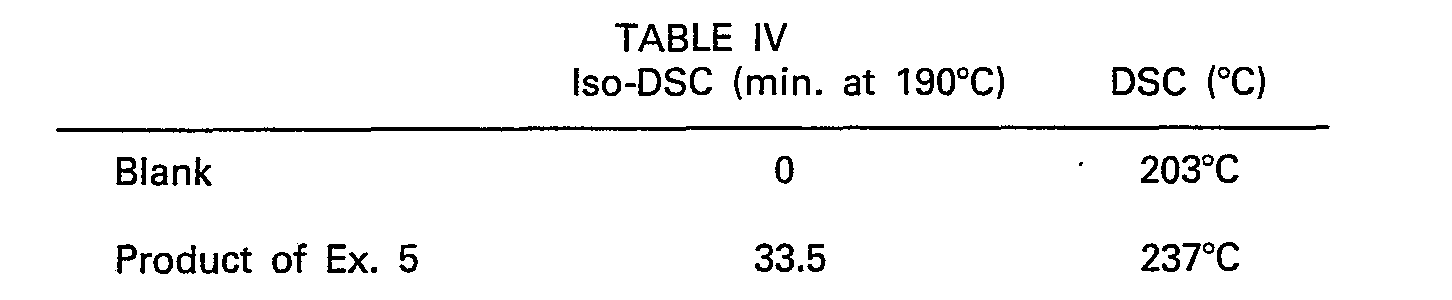
- the enhanced thermal stability of the product of Example 5 is shown by the data in Table IV.
- the data is obtained in terms of iso-DSC and DSC valves, the blank being an ABS resin prepared as in Example 5 except that the polybutadiene from which it is prepared is not previously reacted with dodecyl 3-mercaptopropionate.
- the iso-DSC valves (minutes) are obtained at 190°C and the DSC valves are the temperatures at which the samples decompose.
Landscapes
- Chemical & Material Sciences (AREA)
- Health & Medical Sciences (AREA)
- Chemical Kinetics & Catalysis (AREA)
- Medicinal Chemistry (AREA)
- Polymers & Plastics (AREA)
- Organic Chemistry (AREA)
- Graft Or Block Polymers (AREA)
- Addition Polymer Or Copolymer, Post-Treatments, Or Chemical Modifications (AREA)
Description
- The invention of this application relates as indicated to the preparation of stabilized graft copolymers. More particularly, it relates to the preparation of such copolymers in aqueous emulsion, from stabilized polymers of an alkadiene-1,3.
- While certain aqueous polymer emulsions are in many instances used as such, they often are used as a starting material in the preparation of a graft copolymer such as ABS. It is important for many applications that the ultimate graft copolymer product be as colorless and as stable as possible. These are difficult requirements for an ABS-type polymer because of the presence of a large number of olefinic double bonds in such a polymer. These double bonds are of course readily susceptible to oxidation which gives rise to color formation and other physical changes and which is a prime cause of instability. It is necessary to provide some means for preventing or inhibiting such oxidation so as to provide the desired color and thermal stability of the final copolymer product. It is known from GB-A-1 575 115 to treat polybutadiene with a mercapto alkanoic acid ester in the presence of a radical generating compound. In J. appl. Polyester Sci: 3, No. 7, 11-19 (1960) there is disclosed the reaction of thioglycolic acid and its octyl ester or ethyl-3-mercaptopropionate with rubber. From BE-A-656 258 it is known to treat polyolefins with the laurylester of mercaptopropionic acid. US-A-3 168 593 discloses the grafting of polybutadiene with a copolymer of styrene and acrylonitrile.
- US-A-4,213,892 shows the stabilization of a polymer by reacting it with an antioxidant in the presence of a free radical. The antioxidant is one "which gives rise to a free radical in the molecule", col. 1, line 50. The reaction may be carried out in an aqueous emulsion, col. 6, line 29. In a typical example a polypropylene film is stabilized by irradiation in a solution of 3,5-ditertiarylbutyl-4-hydroxybenzyl acrylate and benzophenone in benzene for 90 hours. The source of the irradiation is a UV lamp which radiates light of wave length above 250 mm. Although the preferred species of antioxidant is an acrylate which contains a phenolic group there is a disclosure of a saturated thiol as an antioxidant, for use with an unsaturated polymer. Nevertheless, there is no suggestion that aliphatic esters containing a thiol group might be effective to stabilize an alkadiene-1,3 polymer.
- J. Appl. Polymer Sci. 3, No. 7, 11-19 (1960) discloses the reaction of natural rubber, in latex form, with mercapto acid esters. The reaction is catalyzed by a free-radical catalyst and is carried out at 0°C for at least 24 hours. The reaction medium is quite acid (pH: 1-2). The resulting product is hydrolyzed to the corresponding acid which then is cross-linked, through the carboxyl groups, by means of calcium hydroxide.
- NL-A-6,501,026, [C.A. 64, 6851 (1-966)], shows the stabilization of a polyolefin by dispersing it in an inert hydrocarbon with dodecyl mercaptopropionate and heating the mixture at 60-98° for 3-4 hours under UV irradiation. It does not show any such stabilization reaction in an aqueous emulsion, nor does it show the stabilization of an alkadiene-1,3 polymer.
- US-A-3,864,429 discloses high impact-resistant vinyl chloride polymer compositions which contain a modified MBS resin. The MBS resin is treated as an aqueous emulsion with an alkyl mercaptan.
- The invention of the present application is a stabilized graft copolymer comprising as a substrate an alkadiene-1,3 polymer. The graft copolymer is characterized in that the substrate is a thermally stable polymer prepared by treating an aqueous emulsion of the alkadiene-1,3 polymer with from about 0.001 percent to about 10.0 percent based on mols of alkadiene-1,3 units in the polymer, of an aliphatic ester of the formula

- Alkadiene polymers contemplated for use in the process of this invention include chiefly polybutadiene, polyisoprene, and copolymers of butadiene and isoprene such as butadiene/styrene and butadiene/alphamethylstyrene copolymers. As indicated, the polymers are used in the form of aqueous emulsions and in the ordinary situation the aqueous emulsion in which the alkadiene polymer or copolymer is prepared is _quite suitable for use in the process. The preparation of these polymers and copolymers in aqueous emulsion is well-known and is, in fact, the usual method of their preparation.
- The aliphatic ester which is in effect the stabilizing agent is an alkyl mercaptopropionate having the structure shown above. The alkyl group contains 6-18 carbon atoms. Illustrative alkyl groups include hexyl, heptyl, octyl, 2-ethylhexyl, isooctyl, nonyl, decyl, dodecyl, tetradecyl, hexadecyl and octadecyl.
- Radical-generating compounds are those which give rise to a fragment of a molecule having one or more unpaired electrons. Redox systems are particularly convenient, including mixtures of a cumene hydroperoxide plus iron, hydroperoxide plus a polyamine, a persulfate plus a reducing agent, etc. Azo compounds such as azoisobutyronitrile (AIBN) are useful; so are ditertiarybutyl peroxide, hydrogen peroxide, p-menthane hydroperoxide, and potassium persulfate. In general, peroxides, hydroperoxides, redox systems and azo compounds are suitable radical generators for the process herein.
- The pH of the process mixture is desirably above 7.0 and preferably is within the range of from about 7.0 to about 11.0.
- The temperature of the process mixture should be maintained within the range of from about 30°C to about 100°C. Obviously, the reaction will proceeed at a higher rate at a higher temperature, but it ordinarily is unnecessary to heat the reaction mixture above 70°C to achieve a satisfactory reaction rate. An especially suitable range is from about 40°C to about 70°C. The optimum temperature will vary depending, e.g., on the initiator used.
- The amount of alkyl 3-mercaptopropionate which should be used in the process of the invention will range from about 0.001 to about 10 percent, on a molar basis, with respect to the alkadiene-1,3 content of the polymer. Preferably, the concentration of alkyl 3-mercaptopropionate will be within the range of from about 0.01 to about 3.0 percent on a molar basis. The effectiveness of the 3-mercaptopropionate residue, it will be seen, is not due (solely, at least) to the disappearance of double bonds in the butadiene units.
- The radical-generating compound should be used in a concentration of from about 0.01 to about 1.0 percent of the polymer. Preferably the concentration should be within the range of from about 0.1 to about 0.5 percent.
- The process of the invention and the improved properties of the product of that process are shown in the following examples and table.
- A mixture of 246 parts of polybutadiene latex containing 40.66% of polybutadiene having a weight average particle of 700A, 0.31 part of potassium persulfate (KZSZO$) and 5 parts (1.0 molar percent) of dodecyl 3-mercaptopropionate is placed in a bottle, purged with argon and heated with agitation at 60°C for 22 hours. The resulting product mixture is coagulated with a 50-50 mixture of methanol and water containing 10% of concentrated sulfuric acid. The solid, crumblike product is reslurried with methanol (in which the dodecyl 3-mercaptopropionate is soluble), filtered and washed with more methanol. The rubbery crumb is dried in vacuo for six days, yielding a bright white product.
- The procedure of Example 1 is repeated except that the initial mixture contains no dodecyl 3-mercaptopropionate. The resulting product is a light beige color.
- To each of the products prepared as in Examples 1 and 2 is added two phr (parts per hundred parts of resin) of 2,2'-bis-(hydroxy-3-tertiarybutyl-5-methylphenyl)methane (AO 425) dissolved in methanol. The mixture is stirred for an hour and then flash evaporated and the residue is vacuum dried for one day.
- The thermal. stability of each of the dried products is determined in an iso-DSC (Differential Scanning Calorimeter) apparatus at 200°C, i.e., the sample is heated at this temperature until the onset of an exotherm, which indicates the beginning of decomposition of the test sample, and the time required for this occurrence is noted. The sample is retained in the apparatus at this same temperature for such additional time as required to develop a significantly increased color, a further indication of decomposition. The data from these tests is shown in Table I.

- It will be seen that the product of Example 1 is more stable at elevated temperatures than the product of Example 2.
- The graft copolymer of this invention may be prepared by known methods such as (1) preparing a polymer latex (substrate) by polymerizing (in an aqueous emulsion) an alkadiene-1,3 or mixture thereof with styrene and up to 10% (based on monomer content of the latex) of acrylonitrile, (2) adding to said latex a mixture of styrene and up to 40% of acrylonitrile and/or methyl methacrylate (based on monomer content of the added mixture), and (3) polymerizing the mixture of (2). Thus, the polymer latex of (1), for example, may be polybutadiene, polyisoprene, a copolymer of butadiene and styrene, or a copolymer of butadiene, styrene and acrylonitrile. As little as 15% and up to 70% of styrene, based on the overall monomer content, may be present in the graft copolymer; and the mixture of (2) may be styrene and acrylonitrile, styrene and methyl methacrylate, or styrene, acrylonitrile and methyl methacrylate. The butadiene content of the graft copolymer will range from about 10% to about 75%. Preferably the acrylonitrile content in the graft copolymer will be in the range of from about 2 to about 10 percent.
- When the substrate contains styrene the styrene content thereof preferably is 2-30%. The styrene content of the superstrate ranges from about 15% to about 100%, while the preferred range is from about 15% to about 80%. The acrylonitrile and methyl methacrylate contents (in the superstrate) preferably are each from about 10% to about 40%.
- The substrate normally will comprise from about 15% to about 60% of the graft copolymer and the superstrate from about 85% to about 40% thereof.
- Cross-linking agents can be used as desired in the above process. They may be used both in the step of preparing the latex and in step (3) involving preparation of the superstrate. Illustrative cross-linking agents include divinylbenzene, and dimethacrylates such as mono-di-, tri- and tetraethylene glycol dimethacrylate and 1,3-butylene glycol dimethacrylate, triallyl phosphate, triallyl cyanurate, tetraallyl silane, diallyl itaconate, diethylene glycol diacrylate, etc.
- Methods of making the graft copolymers herein are well known. U.S. 2,802,808 (Hayes), for example, shows methods of preparing ABS resins, as does also U.S. 2,994,683 (Calver). The MBS resins and other graft copolymers herein are prepared similarly.
- Preferred graft copolymers are those wherein the superstrate, i.e., the grafted polymer, is a copolymer of styrene and acrylonitrile and the substrate is polybutadiene. Another preferred species is an MABS resin, i.e., one where the superstrate is a grafted copolymer of acrylonitrile, methyl methacrylate and styrene. Still another preferred species (MBS) is prepared by copolymerizing styrene and methyl methacrylate in the presence of polybutadiene (as the substrate).
- A particularly preferred graft copolymer is one wherein a copolymer of from about 70 parts to about 90 parts of styrene and from about 10 parts to about 30 parts of methyl methacrylate is grafted onto a polybutadiene substrate.
- The product of the process herein, i.e., the stabilized alkadiene polymer, is especially useful as a substrate in the preparation of graft copolymers. An ABS copolymer prepared from such a substrate, for example, is characterized by improved thermal stability. The data set out in Table III and IV show this.
- Two batches of an ABS graft copolymer were prepared each according to the following recipe:

- The first batch (No. 1) utilized an aqueous emulsion of polybutadiene (prepared as in Example 1) which had been treated with parts of dodecyl 3-mercaptopropionate per 100 parts of polybutadiene; the second batch (No. 2) utilized an aqueous emulsion of polybutadiene which was not so treated. Each batch was heated with agitation at 60°C for four hours, then acid coagulated.
- Two additional batches of ABS graft copolymer were prepared according to the following recipe:
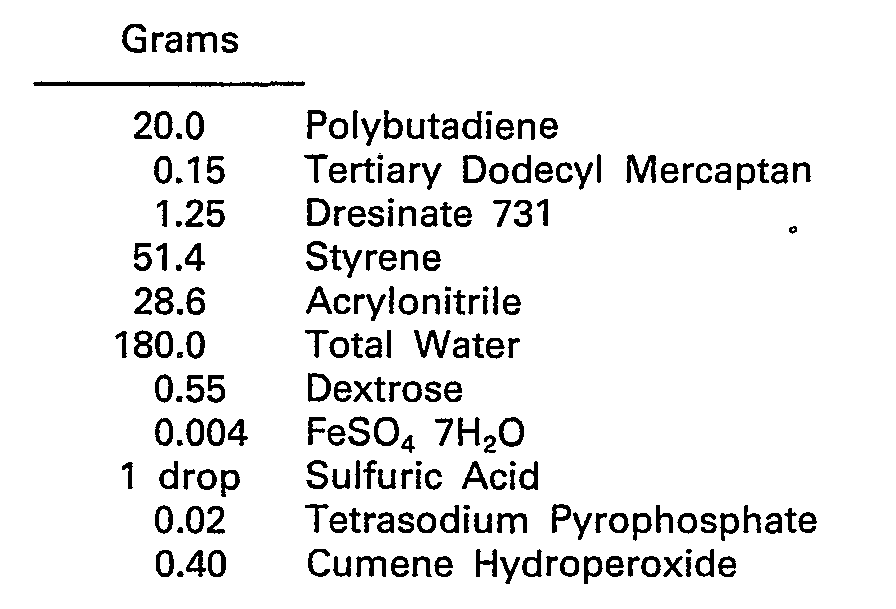
- The first batch (No. 3) utilized an aqueous emulsion of polybutadiene (prepared as in Example 1) which had been treated with 5 parts of dodecyl-3-mercaptopropionate per 100 parts of polybutadiene; the second batch (No. 4) utilized an aqueous emulsion of polybutadiene which was not so treated. Each batch was heated with agitation at 60°C for 1.25 hours, then acid coagulated.
- Analyses of the ABS graft copolymers obtained from these four batches showed the following:

- The above data show that the incorporation of the dodecyl-3-mercaptopropionate in the polybutadiene molecule has no adverse effect on the subsequent grafting reaction with styrene and acrylonitrile. That is, suitable ABS copolymers can be prepared in the normal manner from the stabilized alkadiene-1,3 polymers of this invention.
- Moreover, the ABS copolymers thus prepared are characterized by increased thermal stability as shown by relative iso-DSC values. These are set out in Table III and are obtained by heating the sample at a given temperature (190°C and 200°C in these instances) until the onset of an exotherm. Test samples Nos. 1-4 correspond to those shown in Table II. Test samples Nos. 2A and 4A differ from Nos. 2 and 4 in that they each contain an amount of dilaurylthiodipropionate, 5.0 and 2.0 parts, respectively, per 100 parts of ABS resin which is equal to the number of mols of dodecyl 3-mercaptopropionate in Nos. 1 and 3. Also, test samples Nos. 1,2 and 2A each contain 0.1 pph of AO 425 and test samples 3, 4 and 4A each contain 0.4 pph of AO 425.

- The above data show the superior thermal stability of an ABS prepared from the alkyl 3-mercaptopropionate-treated polymers herein (Nos. 1 and 3) with respect to ABS prepared form untreated polymers (Nos. 2 and 4) and from untreated polymers containing an additive of similar structure (Nos. 2A and 4A).
- A mixture of 246 parts of polybutadiene latex containing 40% of polybutadiene having a weight average particle size of 3000 A, 1.0 phr (parts per hundred parts of resin) of dodecyl 3-mercaptopropionate and 0.08 phr of 2,2'-azobis-(2,4-dimethyl-4-methoxyvaleronitrile) is warmed at 100°F for ten days in a tray drier.
- The resulting polybutadiene latex is converted to an ABS resin according to the procedure of Example 4 except that the sytrene contains 0.14 phr of 2,2'-bis-(hydroxy-3-tertiarybutyl-5-ethylphenyl)methane and 0.45 phr of tri-(nonylphenyl)phosphite, and the process is carried out in a continuous manner.
- The enhanced thermal stability of the product of Example 5 is shown by the data in Table IV. The data is obtained in terms of iso-DSC and DSC valves, the blank being an ABS resin prepared as in Example 5 except that the polybutadiene from which it is prepared is not previously reacted with dodecyl 3-mercaptopropionate. The iso-DSC valves (minutes) are obtained at 190°C and the DSC valves are the temperatures at which the samples decompose.
- All parts and percentages herein, unless otherwise specifically stated, are by weight.
Claims (7)

Applications Claiming Priority (4)
| Application Number | Priority Date | Filing Date | Title |
|---|---|---|---|
| US43916482A | 1982-11-04 | 1982-11-04 | |
| US439164 | 1982-11-04 | ||
| US43951582A | 1982-11-05 | 1982-11-05 | |
| US439515 | 1982-11-05 |
Publications (2)
| Publication Number | Publication Date |
|---|---|
| EP0108396A1 EP0108396A1 (en) | 1984-05-16 |
| EP0108396B1 true EP0108396B1 (en) | 1986-12-10 |
Family
ID=27031932
Family Applications (2)
| Application Number | Title | Priority Date | Filing Date |
|---|---|---|---|
| EP19830110979 Expired EP0108396B1 (en) | 1982-11-04 | 1983-11-03 | Stabilized graft copolymers |
| EP19830110978 Expired EP0109008B1 (en) | 1982-11-04 | 1983-11-03 | Stabilization of poly-(alkadiene-1,3) |
Family Applications After (1)
| Application Number | Title | Priority Date | Filing Date |
|---|---|---|---|
| EP19830110978 Expired EP0109008B1 (en) | 1982-11-04 | 1983-11-03 | Stabilization of poly-(alkadiene-1,3) |
Country Status (2)
| Country | Link |
|---|---|
| EP (2) | EP0108396B1 (en) |
| DE (2) | DE3368275D1 (en) |
Families Citing this family (4)
| Publication number | Priority date | Publication date | Assignee | Title |
|---|---|---|---|---|
| US4939271A (en) * | 1987-09-21 | 1990-07-03 | Eagle-Picher Industries, Inc. | Mercapto-modified N-(R-oxymethyl) acrylamide/rubber-formable monomer/(meth)acrylonitrile terpolymers |
| DE19712248A1 (en) * | 1997-03-24 | 1998-10-01 | Basf Ag | Process for the derivatization of ethylenically unsaturated polymers in aqueous dispersion |
| US8541510B2 (en) * | 2008-09-25 | 2013-09-24 | Bridgestone Corporation | Thermosetting composition |
| CN114591506B (en) * | 2020-12-07 | 2023-07-21 | 中国石油化工股份有限公司 | Modified diene rubber and preparation method thereof |
Family Cites Families (3)
| Publication number | Priority date | Publication date | Assignee | Title |
|---|---|---|---|---|
| US3168593A (en) * | 1953-01-15 | 1965-02-02 | Union Carbide Corp | Shock-resistant compositions prepared by polymerizing styrene and acrylonitrile withpolybutadiene |
| DE1545155A1 (en) * | 1964-01-31 | 1970-01-22 | Glanzstoff Ag | Process to improve the stability of polyolefins |
| DE2653144C2 (en) * | 1976-11-23 | 1984-12-20 | Bayer Ag, 5090 Leverkusen | Process for the production of modified polybutadiene |
-
1983
- 1983-11-03 DE DE8383110979T patent/DE3368275D1/en not_active Expired
- 1983-11-03 EP EP19830110979 patent/EP0108396B1/en not_active Expired
- 1983-11-03 DE DE8383110978T patent/DE3368070D1/en not_active Expired
- 1983-11-03 EP EP19830110978 patent/EP0109008B1/en not_active Expired
Also Published As
| Publication number | Publication date |
|---|---|
| EP0108396A1 (en) | 1984-05-16 |
| EP0109008A1 (en) | 1984-05-23 |
| EP0109008B1 (en) | 1986-12-03 |
| DE3368070D1 (en) | 1987-01-15 |
| DE3368275D1 (en) | 1987-01-22 |
Similar Documents
| Publication | Publication Date | Title |
|---|---|---|
| US3642950A (en) | Graft copolymerization on alpha-monoolefin copolymer rubbers to make gum plastics | |
| US4354007A (en) | Process for preparing oxidatively-stable polymers | |
| EP0355900B1 (en) | Grafting of hindered C-nitro compounds onto polymers | |
| EP0185606B1 (en) | Polymerizable thioester synergists | |
| JPH07149844A (en) | Radical-curing rubber using acrylic or methacrylic ester of hydroxybenzne or hydroxynaphthalene compound as curing aid | |
| CN1121083A (en) | Graft (co) polymers useful as flame retardant additives | |
| US4764563A (en) | Clear impact modifier for PVC | |
| EP0109008B1 (en) | Stabilization of poly-(alkadiene-1,3) | |
| CA2078829C (en) | Production of thermoplastic resin having high impact resistance | |
| US4859744A (en) | Process for the production of graft polymers of high rubber content | |
| US5225465A (en) | Process for working up stabilized abs polymers with recovery of unreacted monomers | |
| JP2858472B2 (en) | Stabilizer dispersion | |
| US5102939A (en) | Mixtures suitable as stabilizers for polymers | |
| EP0225510B1 (en) | Compositions suited as stabilizers for polymers | |
| CA1233296A (en) | Stabilization of poly-(alkadiene-1,3) | |
| EP0180985B1 (en) | Process for preparing thermoplastic resin | |
| US4442264A (en) | Graft rubbers for modifying thermoplastic moulding compositions | |
| JP3204662B2 (en) | Molding compositions based on vinyl chloride polymers with reduced fogging | |
| EP0972796B1 (en) | Conjugated diene polymer composition and rubber-reinforced styrene resin | |
| US3691261A (en) | Graft copolymer with an alkyl acrylate and ethylthiaethyl metharylate backbone | |
| US3655828A (en) | Process for preparing a polymer composition having improved gloss and color | |
| JPS63152610A (en) | Method for stabilizing diene polymers | |
| JPH0748497A (en) | Thermoplastic composition cooperatively combining dilauryl thiodipropionate and tris (nonylphenyl) phosphite | |
| JPH027323B2 (en) | ||
| US3662026A (en) | Process for preparing graft copolymers containing n,n-di(beta-hydroxyethyl) glycine salts |
Legal Events
| Date | Code | Title | Description |
|---|---|---|---|
| PUAI | Public reference made under article 153(3) epc to a published international application that has entered the european phase |
Free format text: ORIGINAL CODE: 0009012 |
|
| AK | Designated contracting states |
Designated state(s): DE FR GB |
|
| 17P | Request for examination filed |
Effective date: 19840726 |
|
| GRAA | (expected) grant |
Free format text: ORIGINAL CODE: 0009210 |
|
| AK | Designated contracting states |
Kind code of ref document: B1 Designated state(s): DE FR GB |
|
| REF | Corresponds to: |
Ref document number: 3368275 Country of ref document: DE Date of ref document: 19870122 |
|
| ET | Fr: translation filed | ||
| PLBE | No opposition filed within time limit |
Free format text: ORIGINAL CODE: 0009261 |
|
| STAA | Information on the status of an ep patent application or granted ep patent |
Free format text: STATUS: NO OPPOSITION FILED WITHIN TIME LIMIT |
|
| 26N | No opposition filed | ||
| REG | Reference to a national code |
Ref country code: GB Ref legal event code: 732 |
|
| REG | Reference to a national code |
Ref country code: FR Ref legal event code: TP Ref country code: FR Ref legal event code: CD |
|
| PGFP | Annual fee paid to national office [announced via postgrant information from national office to epo] |
Ref country code: FR Payment date: 19931011 Year of fee payment: 11 |
|
| PGFP | Annual fee paid to national office [announced via postgrant information from national office to epo] |
Ref country code: DE Payment date: 19931022 Year of fee payment: 11 |
|
| PGFP | Annual fee paid to national office [announced via postgrant information from national office to epo] |
Ref country code: GB Payment date: 19931027 Year of fee payment: 11 |
|
| PG25 | Lapsed in a contracting state [announced via postgrant information from national office to epo] |
Ref country code: GB Effective date: 19941103 |
|
| GBPC | Gb: european patent ceased through non-payment of renewal fee |
Effective date: 19941103 |
|
| PG25 | Lapsed in a contracting state [announced via postgrant information from national office to epo] |
Ref country code: FR Effective date: 19950731 |
|
| PG25 | Lapsed in a contracting state [announced via postgrant information from national office to epo] |
Ref country code: DE Effective date: 19950801 |
|
| REG | Reference to a national code |
Ref country code: FR Ref legal event code: ST |