EP0107895B1 - Elimination process - Google Patents
Elimination process Download PDFInfo
- Publication number
- EP0107895B1 EP0107895B1 EP83305174A EP83305174A EP0107895B1 EP 0107895 B1 EP0107895 B1 EP 0107895B1 EP 83305174 A EP83305174 A EP 83305174A EP 83305174 A EP83305174 A EP 83305174A EP 0107895 B1 EP0107895 B1 EP 0107895B1
- Authority
- EP
- European Patent Office
- Prior art keywords
- polymer
- rings
- amine
- present
- range
- Prior art date
- Legal status (The legal status is an assumption and is not a legal conclusion. Google has not performed a legal analysis and makes no representation as to the accuracy of the status listed.)
- Expired
Links
Classifications
-
- C—CHEMISTRY; METALLURGY
- C08—ORGANIC MACROMOLECULAR COMPOUNDS; THEIR PREPARATION OR CHEMICAL WORKING-UP; COMPOSITIONS BASED THEREON
- C08F—MACROMOLECULAR COMPOUNDS OBTAINED BY REACTIONS ONLY INVOLVING CARBON-TO-CARBON UNSATURATED BONDS
- C08F8/00—Chemical modification by after-treatment
Definitions
- This invention relates to the preparation of polymers which have aromatic rings in the backbone thereof.
- the present invention provides a process for the preparation of a polymer having aromatic rings in the backbone thereof which process comprises reacting a polymeric composition comprising a polymer which has cyclohex-2-enylene rings bearing carbonate groups at the 5,6 ring positions in the polymer backbone with an organic amine of formula wherein at least one of the groups R 10 , R" and R12, which may be the same or different, is a hydrocarbyl group, such that the carbonate groups are eliminated from at least substantially all of the said cyclohexenylene rings leading to the aromatisation of the said rings.
- the organic amine which is used in the process of the present invention is preferably a weak nucleophile and a strong base (by which we mean it has pKa of more than 7 and preferably more than 10) and more preferably is readily volatilised under suitable conditions.
- the amine used in the process of the present invention may be a primary amine, a secondary amine or a tertiary amine.
- the hydrocarbyl groups in the amine may be alkyl, aryl, alkaryl or aralkyl and where a plurality of hydrocarbyl groups are present, i.e. the amine is a secondary or tertiary amine, the hydrorcabyl groups may be the same or different.
- Suitable amines many be mentioned, ethylamine, laurylamine, hexamethylenediamine, ethylenediamine, 4,4'-diaminodiphenylmethane, di-n-octylamine, di- ispropylamine, piperidine, pyridine, bipyridyl.
- the amine is a tertiary amine, for example a tertiary alkyl amine R 1 3 N (wherein R 1 , each of which may be the same or different, is an alkyl group having one to 12 carbon atoms e.g. n-butyl or n-octyl) or an alkylarylamine, e.g. 1,8-bis-dimethylaminonaphthalene.
- An organic amine used in the process of the present invention will have a volatility such that sufficient remains in the polymer during the process of the present invention to catalyse the desired elimination and may be readily removed from the polymer, where removal is desired, by increasing the temperature and/or decreasing the pressure after catalysis is complete. However, we do not exclude the possibility that removal may be effected by a suitable solvent treatment.
- the amine has a boiling point at ambient pressure in the range 200°C to 600°C.
- the 5,6-substituents in the polymer of which the polymeric composition which is used in the process of the present invention is comprised may be cis or trans to each other.
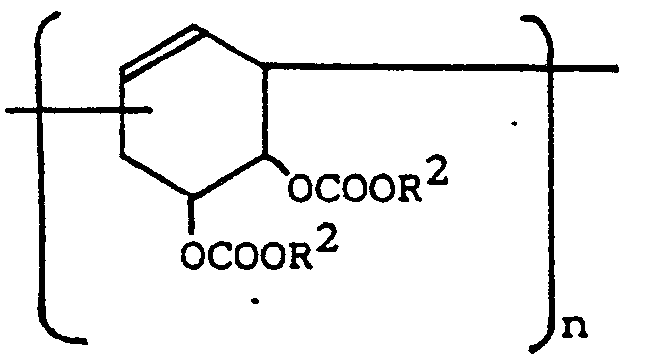
- the polymer of which the polymeric composition which is used in the process of the present invention is comprised has a structure which may be represented by the general formula: wherein the cyclohexenylene ring and the residue X, where X is present, may vary from unit to unit along the polymer chain; each R 2 , which may be the same or different, is a hydrocarbyl group, e.g. an aryl group or an alkyl group having up to twelve carbon atoms; X is the residue of one or more polymerisable comonomers; n is a whole number; m is 0 or a whole number; and the ratio of n:m lies in the range 1:0 to 1:100.
- R 2 is an alkyl group having up to four carbon atoms and more preferably is methyl.
- polymerisable comonomer we mean a compound which can be reacted under the polymerisation conditions with a 1,2-disubstituted-cyclohexa-3,5-diene which has 1,2-substituents as hereinbefore defined to form a copolymer therewith.
- suitable polymerisable comonomers of which the polymer which is used in the present invention may be comprised include vinyl monomers, for example, olefinic hydrocarbons, e.g. styrene and ethylene, methacrylates, vinyl halides, vinyl esters, acrylonitrile and tetrafluoroethylene; and compounds such as carbon monoxide, carbon dioxide and sulphur dioxide.
- vinyl monomers for example, olefinic hydrocarbons, e.g. styrene and ethylene, methacrylates, vinyl halides, vinyl esters, acrylonitrile and tetrafluoroethylene
- compounds such as carbon monoxide, carbon dioxide and sulphur dioxide.
- each of the bonds which bind the cyclic ring into the polymer backbone is preferably attached to a carbon atom adjacent the olefinic double bond in the cyclic ring, i.e. the cyclic rings are bonded in the polymer backbone at the 1,4-positions.
- n is preferably greater than about 400 to give improved mechanical properties; and m is preferably 0, to increase the thermal stability of the product.
- the residues X, where present, and the cyclohexenylene rings preferably form an alternating copolymer; and the group X, where present, is preferably the residue of a polymerisable comonomer chosen from the group consisting of -CH,CHCI, -CF 2 CF 2- , -CO-, and -S0 2 - (where Z is a halogen atom or R 3 and R 3 is hydrogen or R 1 , where R 1 has the meaning hereinbefore ascribed to it) and more preferably is -CH 2 CHPh-, -CH 2 CMeC0 2 Me, or -Ch 2 CHCN-.
- the process of the present invention may be carried out by treating the polymeric composition as hereinbefore defined in solution in a suitable solvent, e.g. squalane, sulpholane or dimethylformamide, it is often preferred that a neat polymeric composition, preferably comprising a polymer of general formula I, is employed.
- a suitable solvent e.g. squalane, sulpholane or dimethylformamide
- the process of the present invention may be carried out on a polymeric blend which comprises a polymeric composition as hereinbefore defined and a suitable second polymer.
- suitable second polymers may be mentioned inter alia polystyrene, polyphenylene oxide and polyethylene terephthalate. It will be appreciated that where the process is carried out on such a blend the product of thereof will likewise be a polymeric blend which comprises a polymer which has aromatic rings in the backbone thereof and a suitable second polymer.
- the process of the present invention is preferably carried out at a temperature in the range 100°C to 300°C and more preferably in the range 180°C to 260°C, typically for a period of several hours. It will be appreciated that the particular temperature employed will depend on the catalyst which is used.
- the amount of organic amine used in the process of the present invention is preferably between 0.1 and 5 mole % and more preferably between 1 and 2 mole %.
- the process of the present invention is carried out on a polymeric composition which is in the form e.g. of a film, coating or fibre, which it is desired that the product of the process adopt.
- the shaped and/or formed cyclohexenylene polymer is subjected to a tensile stress during treatment under the aforesaid conditions since such a stress tends to increase the tensile modulus of the resulting product, e.g. a fibre.
- the film or coating may be prepared by evaporation of a solution of the polymer in a suitable solvent, which preferably has a boiling point above 40°C, or the film may be prepared from a melt thereof.
- suitable solvents may be mentioned inter alia halogenated hydrocarbons, e.g. o-dichlorobenzene and ethylene dichloride, and ethers, e.g. dioxane.
- the fibres are conveniently prepared by dry spinning the polymer from a suitable solvent, e.g. methylene chloride.
- the process of the present invention is preferably effected in a vacuo or in an inert atmosphere, e.g. nitrogen.
- the resulting polymer is often at least 90% polyphenylene as indicated by microanalysis and IR analysis.
- the process of the present invention may be carried out on a polymer which has substantially a three dimensional shape, e.g. a solid cube.
- a foamed product may be produced.
- the elimination reaction is effected by induction heating.
- poly(cyclohexa-1,3-diene-5,6-ylene dicarbonates) used in the process of the present invention are conveniently prepared by polymerisation of the corresponding monomer as is more fully described in European Patent Specification No. 76605A, which monomeric carbonates may be prepared from 5,6-dihydroxycyclohexa-1,3-diene by techniques well known in the art.
- the poly(cyclohexa-1,3-diene-5,6-ylene dicarbonate) may be prepared from a poly(5,6- disubstituted cyclohexa-1,3-diene), e.g. poly(5,6-dihydroxycyclohexa-1,3-diene).
- An additive may be present in the polymeric composition used in the process of the present invention which additive absorbs or reacts with the eliminated carbonate groups.
- a silane e.g. coated on glass microsphers, may be used to react with the methanol.
- the yield of polymer was 56.2 grams. It was shown by gel permeation chromatography to have Mn of 114000, Mw of 343000 and D of 3.0 and by laser light scattering to have Mw of 180000.
- test-tube was then heated, under vacuum or in nitrogen atmosphere, for a specified time at a specified temperature.
- This Example illustrates the use of tri-N-octylamine in the preparation of polymer blends.
- Polystyrene (500 mg) and poly[cyclohexa-1,3-diene-5,6-ylene di(methylcarbonate)] (190 mg) were dissolved in 5 ml of a chloroform solution cotaning 0.05 mmoles of tri-n-octylamine in a heavy walled glass tube. The solvent was removed under reduced pressure and the evacuated glass tube was sealed. After heating for 6 hours at 245°C the tube was cooled and opened. IR spectroscopic analysis of the polymer mixture showed the absence of carbonate absorption peaks and the presence of absorption peaks (e.g. 810 cm- 1 ) associated with polyphenylene. The polymer blend was treated with refluxing THF and a very finely dispersed insoluble fraction was separated. The IR spectrum of this material showed it to be rich in polyphenylene.
- Example 1 The procedure of Example 1 was repeated except that a range of amines as indicated in Table 3 was used instead of tri-n-octylamine.
Landscapes
- Chemical & Material Sciences (AREA)
- General Chemical & Material Sciences (AREA)
- Health & Medical Sciences (AREA)
- Chemical Kinetics & Catalysis (AREA)
- Medicinal Chemistry (AREA)
- Polymers & Plastics (AREA)
- Organic Chemistry (AREA)
- Addition Polymer Or Copolymer, Post-Treatments, Or Chemical Modifications (AREA)
- Compositions Of Macromolecular Compounds (AREA)
- Polyesters Or Polycarbonates (AREA)
Description
- This invention relates to the preparation of polymers which have aromatic rings in the backbone thereof.
- Our copending European Patent Publication No. 76605A describes the preparation of polymers which have aromatic rings in the backbone thereof by way treating certain poly(5,6-disubstituted-cyclohexa-1,3- diene) homo or copolymers under conditions such that elimination of the 5,6-substituents occurs.
- We have now found that where the aforesaid 5,6-substituents are carbonate groups such elimination can be catalysed by organic amines and that often the organic amine may be readily removed from the product. Furthermore, the rates of elimination are often faster than the rates observed when the elimination reaction is carried out in the presence of the reagents specifically disclosed in the aforesaid published European Patent Specification. The products of the process do not contain metallic residues from the elimination catalyst and hence offer advantages where they are to be used as insulants or dielectric capacitants.
- Accordingly, the present invention provides a process for the preparation of a polymer having aromatic rings in the backbone thereof which process comprises reacting a polymeric composition comprising a polymer which has cyclohex-2-enylene rings bearing carbonate groups at the 5,6 ring positions in the polymer backbone with an organic amine of formula
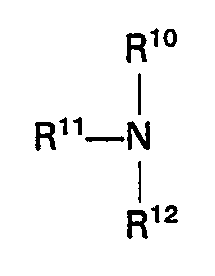
- The organic amine which is used in the process of the present invention is preferably a weak nucleophile and a strong base (by which we mean it has pKa of more than 7 and preferably more than 10) and more preferably is readily volatilised under suitable conditions.
- The presence of bulky groups in the organic amine tends to sterically hinder its attack on carbon centres and hence reduces its nucleophility.
- The amine used in the process of the present invention may be a primary amine, a secondary amine or a tertiary amine. The hydrocarbyl groups in the amine may be alkyl, aryl, alkaryl or aralkyl and where a plurality of hydrocarbyl groups are present, i.e. the amine is a secondary or tertiary amine, the hydrorcabyl groups may be the same or different. As examples of suitable amines many be mentioned, ethylamine, laurylamine, hexamethylenediamine, ethylenediamine, 4,4'-diaminodiphenylmethane, di-n-octylamine, di- ispropylamine, piperidine, pyridine, bipyridyl.
- It is often preferred that the amine is a tertiary amine, for example a tertiary alkyl amine R1 3N (wherein R1, each of which may be the same or different, is an alkyl group having one to 12 carbon atoms e.g. n-butyl or n-octyl) or an alkylarylamine, e.g. 1,8-bis-dimethylaminonaphthalene.
- An organic amine used in the process of the present invention will have a volatility such that sufficient remains in the polymer during the process of the present invention to catalyse the desired elimination and may be readily removed from the polymer, where removal is desired, by increasing the temperature and/or decreasing the pressure after catalysis is complete. However, we do not exclude the possibility that removal may be effected by a suitable solvent treatment. Typically the amine has a boiling point at ambient pressure in the range 200°C to 600°C.
- The 5,6-substituents in the polymer of which the polymeric composition which is used in the process of the present invention is comprised may be cis or trans to each other.
- Preferably the polymer of which the polymeric composition which is used in the process of the present invention is comprised has a structure which may be represented by the general formula:

- By "polymerisable comonomer" we mean a compound which can be reacted under the polymerisation conditions with a 1,2-disubstituted-cyclohexa-3,5-diene which has 1,2-substituents as hereinbefore defined to form a copolymer therewith.
- Examples of suitable polymerisable comonomers of which the polymer which is used in the present invention may be comprised include vinyl monomers, for example, olefinic hydrocarbons, e.g. styrene and ethylene, methacrylates, vinyl halides, vinyl esters, acrylonitrile and tetrafluoroethylene; and compounds such as carbon monoxide, carbon dioxide and sulphur dioxide.
- In polymers of general formula 1, in substantially all of the cyclic rings, each of the bonds which bind the cyclic ring into the polymer backbone is preferably attached to a carbon atom adjacent the olefinic double bond in the cyclic ring, i.e. the cyclic rings are bonded in the polymer backbone at the 1,4-positions.
- In polymers of general formula I, n is preferably greater than about 400 to give improved mechanical properties; and m is preferably 0, to increase the thermal stability of the product.
- The residues X, where present, and the cyclohexenylene rings preferably form an alternating copolymer; and the group X, where present, is preferably the residue of a polymerisable comonomer chosen from the group consisting of


- Although we do not exclude the possibility that the process of the present invention may be carried out by treating the polymeric composition as hereinbefore defined in solution in a suitable solvent, e.g. squalane, sulpholane or dimethylformamide, it is often preferred that a neat polymeric composition, preferably comprising a polymer of general formula I, is employed.
- The process of the present invention may be carried out on a polymeric blend which comprises a polymeric composition as hereinbefore defined and a suitable second polymer. As examples of suitable second polymers may be mentioned inter alia polystyrene, polyphenylene oxide and polyethylene terephthalate. It will be appreciated that where the process is carried out on such a blend the product of thereof will likewise be a polymeric blend which comprises a polymer which has aromatic rings in the backbone thereof and a suitable second polymer.
- The process of the present invention is preferably carried out at a temperature in the range 100°C to 300°C and more preferably in the range 180°C to 260°C, typically for a period of several hours. It will be appreciated that the particular temperature employed will depend on the catalyst which is used.
- The amount of organic amine used in the process of the present invention is preferably between 0.1 and 5 mole % and more preferably between 1 and 2 mole %.
- Where it is desired to remove the organic amine from the product this may be effected by suitable heat treatment, e.g. heating at 300°C under vacuum, or treatment with a suitable solvent for the amine, which solvent does not have a deleterious effect on the polymer.
- It is often preferred that the process of the present invention is carried out on a polymeric composition which is in the form e.g. of a film, coating or fibre, which it is desired that the product of the process adopt. Furthermore, it is often preferred that the shaped and/or formed cyclohexenylene polymer is subjected to a tensile stress during treatment under the aforesaid conditions since such a stress tends to increase the tensile modulus of the resulting product, e.g. a fibre.
- Where a process of the present invention is carried out on a suitable polymer which is in the form of a film or coating, the film or coating may be prepared by evaporation of a solution of the polymer in a suitable solvent, which preferably has a boiling point above 40°C, or the film may be prepared from a melt thereof. As examples of suitable solvents may be mentioned inter alia halogenated hydrocarbons, e.g. o-dichlorobenzene and ethylene dichloride, and ethers, e.g. dioxane.
- Where the process of the present invention is carried out on a suitable polymer which is in fibrous form, the fibres are conveniently prepared by dry spinning the polymer from a suitable solvent, e.g. methylene chloride.
- The process of the present invention is preferably effected in a vacuo or in an inert atmosphere, e.g. nitrogen. The resulting polymer is often at least 90% polyphenylene as indicated by microanalysis and IR analysis.
- We do not exclude the possibility that the process of the present invention may be carried out on a polymer which has substantially a three dimensional shape, e.g. a solid cube. Where elimination is effected on a polymer of such a shape and where the polymer comprises suitably volatile substituents, or derivatives thereof, which are eliminated during the process, a foamed product may be produced. Where it is desired to produce a foamed product it is often preferred that the elimination reaction is effected by induction heating.
- The poly(cyclohexa-1,3-diene-5,6-ylene dicarbonates) used in the process of the present invention are conveniently prepared by polymerisation of the corresponding monomer as is more fully described in European Patent Specification No. 76605A, which monomeric carbonates may be prepared from 5,6-dihydroxycyclohexa-1,3-diene by techniques well known in the art. However, we do not exclude the possibility that the poly(cyclohexa-1,3-diene-5,6-ylene dicarbonate) may be prepared from a poly(5,6- disubstituted cyclohexa-1,3-diene), e.g. poly(5,6-dihydroxycyclohexa-1,3-diene).
- An additive may be present in the polymeric composition used in the process of the present invention which additive absorbs or reacts with the eliminated carbonate groups. For example, where methanol is eliminated a silane, e.g. coated on glass microsphers, may be used to react with the methanol.
- The present invention will now be described by reference to the following Examples which are illustrative of the invention.
- These Examples illustrate the use of tri-n-octylamine as catatlyst for the aromatisation of poly[cyclohexa-1,3-diene-5,6-ylene di(methylcarbonate)].
- Cyclohexa-1,3-diene-5,6-ylene di(methyl carbonate) (72.4 grams; 317.5 mmoles) and azobisisobutyronitrile (350 mgs; 2.13 mmoles); in an ampoule, were subjected to three freeze-thaw cycles to remove traces of oxygen. The ampoule was sealed under vacuum and immersed in a water bath at 50°C for 5Y2 days.
- A clear glassy product was recovered from the ampoule and dissolved in chloroform (400 mls). The chloroform solution was added dropwise with stirring to hexane (2 litres) to give a precipitate which was filtered off and washed with 10% v/v chloroform/hexane and then twice with hexane. The precipitation/ washing cycle was repeated until the monomer content of the polymer was about 0.5%.
- The yield of polymer was 56.2 grams. It was shown by gel permeation chromatography to have Mn of 114000, Mw of 343000 and D of 3.0 and by laser light scattering to have Mw of 180000.
- Approximately 1 gram of the polymer was dissolved in chloroform (10 ml), a solution of tri-n-octylamine (2 mole %) in chloroform was added to the solution, the mixture was shaken and evaporated to dryness in a test-tube under a stream of nitrogen. Traces of residual chloroform was removed in a vac oven at room temperature for 2 hours.
- The test-tube was then heated, under vacuum or in nitrogen atmosphere, for a specified time at a specified temperature.
- The results are shown in Table 1.

- This Example illustrates the use of tri-N-octylamine in the preparation of polymer blends.
- Polystyrene (500 mg) and poly[cyclohexa-1,3-diene-5,6-ylene di(methylcarbonate)] (190 mg) were dissolved in 5 ml of a chloroform solution cotaning 0.05 mmoles of tri-n-octylamine in a heavy walled glass tube. The solvent was removed under reduced pressure and the evacuated glass tube was sealed. After heating for 6 hours at 245°C the tube was cooled and opened. IR spectroscopic analysis of the polymer mixture showed the absence of carbonate absorption peaks and the presence of absorption peaks (e.g. 810 cm-1) associated with polyphenylene. The polymer blend was treated with refluxing THF and a very finely dispersed insoluble fraction was separated. The IR spectrum of this material showed it to be rich in polyphenylene.
- These Examples illustrate the affect of temperature on the rate of aromatisation catalysed by tri-n-octylamine.
- A solution of the catalyst and poly[cyclohexa-1,3-diene-5,6-ylene di(methylcarbonate)] was evaporated to dryness. Approximately 2 milligrams of the residue were analysed by isothermal gravimetric analysis from which the approximate half-life of the reaction was determined.
- The results are shown in Table 2, along with half-lives from comparative experiments, from which the increased rate of aromatisation on use of tri-n-octylamine can be seen. In Table 2 "CT" is a comparative experiment.

- These Examples illustrate the use of a range of amines in the presence of the present invention.
- The procedure of Example 1 was repeated except that a range of amines as indicated in Table 3 was used instead of tri-n-octylamine.

Claims (10)


each R2, which may be the same or different, is a hydrocarbyl group;
Applications Claiming Priority (2)
| Application Number | Priority Date | Filing Date | Title |
|---|---|---|---|
| GB8228269 | 1982-10-04 | ||
| GB8228269 | 1982-10-04 |
Publications (3)
| Publication Number | Publication Date |
|---|---|
| EP0107895A2 EP0107895A2 (en) | 1984-05-09 |
| EP0107895A3 EP0107895A3 (en) | 1985-12-18 |
| EP0107895B1 true EP0107895B1 (en) | 1989-04-12 |
Family
ID=10533359
Family Applications (1)
| Application Number | Title | Priority Date | Filing Date |
|---|---|---|---|
| EP83305174A Expired EP0107895B1 (en) | 1982-10-04 | 1983-09-06 | Elimination process |
Country Status (7)
| Country | Link |
|---|---|
| US (1) | US4454307A (en) |
| EP (1) | EP0107895B1 (en) |
| JP (1) | JPS5986605A (en) |
| CA (1) | CA1222090A (en) |
| DE (1) | DE3379587D1 (en) |
| GB (1) | GB8323881D0 (en) |
| IE (1) | IE55943B1 (en) |
Families Citing this family (11)
| Publication number | Priority date | Publication date | Assignee | Title |
|---|---|---|---|---|
| GB8408953D0 (en) * | 1984-04-06 | 1984-05-16 | Ici Plc | Polymer coatings |
| US5654392A (en) * | 1988-02-17 | 1997-08-05 | Maxdem Incorporated | Rigid-rod polymers |
| US5646231A (en) * | 1988-02-17 | 1997-07-08 | Maxdem, Incorporated | Rigid-rod polymers |
| US5227457A (en) * | 1988-02-17 | 1993-07-13 | Maxdem Incorporated | Rigid-rod polymers |
| US5565543A (en) * | 1988-02-17 | 1996-10-15 | Maxdem Incorporated | Rigid-rod polymers |
| GB9018698D0 (en) * | 1990-08-24 | 1990-10-10 | Lynxvale Ltd | Semiconductive copolymers for use in electroluminescent devices |
| US5128418A (en) * | 1991-01-29 | 1992-07-07 | California Institute Of Technology | Polymerization of cis-5,6-bis(trimethylsiloxy)-1,3-cyclohexadiene and other substituted cyclohexadienes |
| US5248734A (en) * | 1992-06-16 | 1993-09-28 | Cornell Research Foundation, Inc. | Process for preparing a polyphenylene polymer |
| DE69434935D1 (en) * | 1994-02-01 | 2007-04-12 | Asahi Chemical Ind | NEW POLYMER CONTAINING MODIFIED CYCLIC STRUCTURE |
| US5886130A (en) * | 1995-11-02 | 1999-03-23 | Maxdem Incorporated | Polyphenylene co-polymers |
| US5668245A (en) * | 1995-11-02 | 1997-09-16 | Maxdem Incorporated | Polymers with heterocyclic side groups |
Family Cites Families (1)
| Publication number | Priority date | Publication date | Assignee | Title |
|---|---|---|---|---|
| US2502645A (en) * | 1946-02-08 | 1950-04-04 | California Research Corp | Unsaturated alcohol esters of cyclohexadiene dicarboxylic acids |
-
1983
- 1983-09-06 EP EP83305174A patent/EP0107895B1/en not_active Expired
- 1983-09-06 DE DE8383305174T patent/DE3379587D1/en not_active Expired
- 1983-09-06 GB GB838323881A patent/GB8323881D0/en active Pending
- 1983-09-08 IE IE2113/83A patent/IE55943B1/en not_active IP Right Cessation
- 1983-09-09 US US06/530,678 patent/US4454307A/en not_active Expired - Fee Related
- 1983-10-04 CA CA000438327A patent/CA1222090A/en not_active Expired
- 1983-10-04 JP JP58185802A patent/JPS5986605A/en active Granted
Also Published As
| Publication number | Publication date |
|---|---|
| GB8323881D0 (en) | 1983-10-05 |
| DE3379587D1 (en) | 1989-05-18 |
| US4454307A (en) | 1984-06-12 |
| CA1222090A (en) | 1987-05-19 |
| IE832113L (en) | 1984-04-04 |
| JPH0449561B2 (en) | 1992-08-11 |
| EP0107895A2 (en) | 1984-05-09 |
| EP0107895A3 (en) | 1985-12-18 |
| IE55943B1 (en) | 1991-02-27 |
| JPS5986605A (en) | 1984-05-18 |
Similar Documents
| Publication | Publication Date | Title |
|---|---|---|
| Taton et al. | Synthesis of chiral and racemic functional polymers from glycidol and thioglycidol | |
| Chung | Synthesis of polyalcohols via Ziegler-Natta polymerization | |
| US4665136A (en) | Process for producing novel block alkylene polycarbonate copolymers | |
| US4454307A (en) | Elimination process | |
| Cho et al. | Polymerizations of substituted cyclopropanes. I. Radical polymerization of 1, 1‐disubstituted 2‐vinylcyclopropanes | |
| EP0217178A2 (en) | Process for the production of telechelic vinyl polymer having alkoxysilyl group. | |
| JPS61188404A (en) | Polymerization by lewis base catalyst | |
| US3629214A (en) | Process for the copolymerization of vinyltrialkoxysilanes | |
| EP0076605B1 (en) | Process and polymers | |
| Takata et al. | Synthesis and Anionic Ring-Opening Polymerization of a Novel Aromatic Cyclic Carbonate Having Binaphthyl Structure. | |
| WO2000032654A1 (en) | Silyl-functional living cationic polymers | |
| US3875114A (en) | Amidomethylene modified aromatic carbocyclic polymers and methods for making the same | |
| EP0274913A2 (en) | Polyalcohol homopolymers | |
| EP0524198B1 (en) | Butadiene monoepoxide/maleic anhydride copolymers | |
| JPH0826144B2 (en) | Method for producing polyether copolymer having epoxy group in side chain | |
| JPH0753773B2 (en) | Telechelic vinyl polymer having alkoxysilyl group and process for producing the same | |
| KR910008289B1 (en) | Manufacturing method of polymer by removal process | |
| EP0794969B1 (en) | Functionalized para-alkylstyrene polymers and copolymers | |
| Hodge et al. | Lithiation of crosslinked polymers prepared using 2-vinylthiophen: application to the preparation of polymer-supported reagents | |
| Pourahmady et al. | Chemical modification of poly (vinyl chloride): improved thermal stability by partial reduction with organoboron reagents | |
| JPH03106890A (en) | Silyl derivative of 2-allyl phenol | |
| JPH0366324B2 (en) | ||
| MXPA97003576A (en) | Polymers and copolymers of para-alquilestirenofuncionaliza | |
| JP3068183B2 (en) | Heat stable polyvinyl chloride resin | |
| EP0397276A2 (en) | Functionalized elastomeric polymers |
Legal Events
| Date | Code | Title | Description |
|---|---|---|---|
| PUAI | Public reference made under article 153(3) epc to a published international application that has entered the european phase |
Free format text: ORIGINAL CODE: 0009012 |
|
| AK | Designated contracting states |
Designated state(s): DE FR GB NL |
|
| PUAL | Search report despatched |
Free format text: ORIGINAL CODE: 0009013 |
|
| AK | Designated contracting states |
Designated state(s): DE FR GB NL |
|
| 17P | Request for examination filed |
Effective date: 19860503 |
|
| 17Q | First examination report despatched |
Effective date: 19880224 |
|
| GRAA | (expected) grant |
Free format text: ORIGINAL CODE: 0009210 |
|
| AK | Designated contracting states |
Kind code of ref document: B1 Designated state(s): DE FR GB NL |
|
| REF | Corresponds to: |
Ref document number: 3379587 Country of ref document: DE Date of ref document: 19890518 |
|
| ET | Fr: translation filed | ||
| PLBE | No opposition filed within time limit |
Free format text: ORIGINAL CODE: 0009261 |
|
| STAA | Information on the status of an ep patent application or granted ep patent |
Free format text: STATUS: NO OPPOSITION FILED WITHIN TIME LIMIT |
|
| 26N | No opposition filed | ||
| PGFP | Annual fee paid to national office [announced via postgrant information from national office to epo] |
Ref country code: FR Payment date: 19930809 Year of fee payment: 11 |
|
| PGFP | Annual fee paid to national office [announced via postgrant information from national office to epo] |
Ref country code: DE Payment date: 19930813 Year of fee payment: 11 |
|
| REG | Reference to a national code |
Ref country code: GB Ref legal event code: 732E |
|
| PGFP | Annual fee paid to national office [announced via postgrant information from national office to epo] |
Ref country code: GB Payment date: 19930824 Year of fee payment: 11 |
|
| PGFP | Annual fee paid to national office [announced via postgrant information from national office to epo] |
Ref country code: NL Payment date: 19930930 Year of fee payment: 11 |
|
| PG25 | Lapsed in a contracting state [announced via postgrant information from national office to epo] |
Ref country code: GB Effective date: 19940906 |
|
| PG25 | Lapsed in a contracting state [announced via postgrant information from national office to epo] |
Ref country code: NL Effective date: 19950401 |
|
| GBPC | Gb: european patent ceased through non-payment of renewal fee |
Effective date: 19940906 |
|
| NLV4 | Nl: lapsed or anulled due to non-payment of the annual fee | ||
| PG25 | Lapsed in a contracting state [announced via postgrant information from national office to epo] |
Ref country code: FR Effective date: 19950531 |
|
| PG25 | Lapsed in a contracting state [announced via postgrant information from national office to epo] |
Ref country code: DE Effective date: 19950601 |
|
| REG | Reference to a national code |
Ref country code: FR Ref legal event code: ST |