EP0107316B1 - Sodium styrene sulfonate-co-sodium-n-(4-sulfophenyl)-maleimide - an improved viscosity control additive - Google Patents
Sodium styrene sulfonate-co-sodium-n-(4-sulfophenyl)-maleimide - an improved viscosity control additive Download PDFInfo
- Publication number
- EP0107316B1 EP0107316B1 EP19830305338 EP83305338A EP0107316B1 EP 0107316 B1 EP0107316 B1 EP 0107316B1 EP 19830305338 EP19830305338 EP 19830305338 EP 83305338 A EP83305338 A EP 83305338A EP 0107316 B1 EP0107316 B1 EP 0107316B1
- Authority
- EP
- European Patent Office
- Prior art keywords
- sodium
- water
- drilling mud
- maleimide
- copolymer
- Prior art date
- Legal status (The legal status is an assumption and is not a legal conclusion. Google has not performed a legal analysis and makes no representation as to the accuracy of the status listed.)
- Expired
Links
Classifications
-
- C—CHEMISTRY; METALLURGY
- C09—DYES; PAINTS; POLISHES; NATURAL RESINS; ADHESIVES; COMPOSITIONS NOT OTHERWISE PROVIDED FOR; APPLICATIONS OF MATERIALS NOT OTHERWISE PROVIDED FOR
- C09K—MATERIALS FOR MISCELLANEOUS APPLICATIONS, NOT PROVIDED FOR ELSEWHERE
- C09K8/00—Compositions for drilling of boreholes or wells; Compositions for treating boreholes or wells, e.g. for completion or for remedial operations
- C09K8/02—Well-drilling compositions
- C09K8/04—Aqueous well-drilling compositions
- C09K8/14—Clay-containing compositions
- C09K8/18—Clay-containing compositions characterised by the organic compounds
- C09K8/22—Synthetic organic compounds
- C09K8/24—Polymers
Definitions
- This invention relates to water-based drilling muds.
- the muds of this invention can typically contain sodium styrene sulphonate-co-sodium-N-(4-sulphophenyl)-maleimide. This is used as an improved viscosity control additive for water-based drilling muds.
- the resultant muds display good viscosity characteristics and good stability when formulated from ionomers having an appropriate sulphonate level, cations type and cosolvent content. These water-based drilling muds may be used during operation of gas and oil wells.
- EP-0079071 describes bore flushing additives which are copolymers of sulphonates of styrene, certain N-vinylamides and optionally acrylamide or methacrylamide.
- the water-based drilling muds of the present invention minimally comprise fresh water or salt water, a weighting material and a base to adjust the pH of the water-based drilling mud to between 10.0 and 10.5. Other additives are also included.
- the specific gravity of the drilling mud is 7 pounds per gallon to 20 pounds per gallon (0.7 to 2 kg/I), more preferably 10 to 16 Ib/gallon (1 to 1.6 kg/I) and most preferably 12 to 16 pounds per gallon (1.2 to 1.6 kg/I).
- a typical water-based drilling mud comprises water or salt water; weighting material necessary to give a mud density of 7 Ib to 23 Ib/gallon (0.7 to 2 kg/I); 0.25 to 5 Ib/ bbl.(0.0007 to 0.014 kg/I) of sodium styrene sulphonate-co-sodium-N-(4-sulphophenyl)-maleimide; and sufficient concentration of base to adjust the pH of the water-based drilling mud to 10.0 to 10.5. Higher levels of the sulphonated polyer can be employed but it is not normally economically attractive.
- the drilling mud also contains a clay such as Bentonite, at a concentration level of 4 to 30 Ib/bbl.
- a lignosulfonate which is a deflocculation agent, is added to the drilling mud at a concentration level of 1 to 30 Ib/bbl. (0.0028 to 0.084 kg/I).
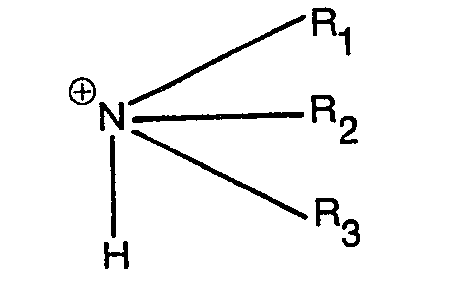
- the solid copolymers of the present invention comprise a compolymer of N-(sodiumsulfophenyl)-maleimide and a sulfonate-containing monomer characterized by the formula: wherein Y+ is a cation selected from Groups IA, IIA, IB and IIB of the Periodic Table or an amine of the formula: where R 1 , R 2 and R 3 are G 1 to C 12 aliphatic groups or hydrogen and the copolymer being water soluble.
- the monomers used in the free radical solution copolymerization process are for example N-(4- sodiumsulfophenyl)-maleimide and a sulfonated styrenic comonomer.
- the comonomers are dissolved in a water phase in the presence of a suitable free radical initiator, wherein the temperature is sufficient to initiate polymerization.
- a suitable free radical initiator wherein the temperature is sufficient to initiate polymerization.
- the resultant polymer can be precipitated and filtered and dried under high vacuum.
- the copolymers formed from the free radical solution copolymerization of the present invention can be generally described as having an M n of 5,000 to 200,000, more preferably 10,000 to 100,000.
- the sulfonated styrenic monomers of the present invention which are water soluble can be generally described as monomers having unsaturation and a metal or amine sulfonate group.
- the metal or amine neutralized suflonate monomer is characterized by the formula: wherein Y+ is a cation selected from Groups IA; IIA, IB and IIB of the Periodic Table or an amine of the formula: wherein R,, R 2 and R 3 are C 1 to C 12 aliphatic groups or hydrogen.
- Particularly suitable metal cations are sodium, potassium and zinc, and an especially preferred metal cation is sodium.
- a typical example of suitable sulfonate-containing monomers is sodium styrene sulfonate
- the N-(4-sodiumsulfophenyl)-maleimide monomer used in the free radical solution copolymerization is prepared by a two-step process.
- maleic anhydride is reacted with sulfanilic acid, sodium salt monhydrate in a methanol solution at room temperature to form a half imide according to the reaction scheme:
- the formed precipitate of the half imide is recovered by filtration and dried under high vacuum.
- the previously formed half imide is refluxed with sodium acetate and acetic anhydride until a tannish color developed. After cooling, the formed precipitate of the N-(4-sodium- sulfophenyl)-maleimide is formed.
- the reaction scheme is:
- the copolymerization of the sulfonate-containing monomer with the N-(4-sodiumsulfophenyl)-maleimide comprises the steps of dissolving both the sulfonate-containing monomer and the N-(4-phenyl- sulfophenyl)-maleimide in deoxygenated water at 50°C under N 2 positive pressure and a water soluble peroxy initiator is added to the solution. The reaction is allowed to proceed from 1 to 48 hours, more preferably 6 to 24 hours. Acetone is added to the reaction solution and the resultant precipitate is filtered and dried under high vacuum.
- the water soluble peroxy initiators are selected from potassium persulphate and ammonium persulfate.
- concentration of initiator is 5 to 0.1 wt.% based on total reaction solution, more preferably 2 to 0.5 wt.%.
- Water soluble redox initiators can also be employed in this free radical solution copolymerization.
- Chain transfer agents can be readily employed in the present polymerization process for controlling the molecular weight of the resultant copolymer.
- a second route to these copolymers involves the modification of preformed alternating sytrene/maleic anhydride copolymers. This is accomplished sequentially by first sulfonating the styrenic pendant unit with SO 3 , followed by addition of sulfanilic acid to the enchained succinic anhydride units.
- the preformed polymer can range in molecular weight from 1000 to 500,000.
- IR (Nujol): 3280 cm -1 (broad), 1715 cm -1 , 1630 cm -1 , 1560-1480 cm -1 (broad), 1320 cm -1 (weak), 1300 cm- 1 , 1200 cm -1 , 1120 cm -1 , 1040-1000 cm -1 (3 peaks), 970 cm- 1 , 900 cm -1 , 850 cm -1 , 710 cm -1 , 640 cm -1 620 cm-1.
- IR (Nujol): 1770 cm -1 (weak), 1700 cm -1 , 1600 cm -1 , 1500 cm -1 , 1400 cm -1 , 1210 cm -1 , 1180 cm -1 , 1130 cm -1 , 1040 cm- 1 , 1010 cm- 1 , 950 cm- 1 , 820 cm- 1 , 755 cm- 1 , 720 cm- 1 , 690 cm- 1 , 670 cm- 1 , 625 cm- 1 (weak).
- IR film from H 2 0: 3100 cm -1 (weak), 3060 cm -1 (weak), 2190 cm -1 (weak), 1770 cm -1 , 1700 cm- 1 , 1600 cm- 1 , 1200 cm- 1 , 1120 cm- 1 , 1035 cm- 1 , 830 cm- 1 , 710 cm -1 .
- Sulfanilic acid 17.3 g., was dissolved in 200 ml. of water combined with 13.3 g. of 50% sodium hydroxide solution.
- the sulfonated copolymer 25.5 g., was added and stirred until dissolved.
- the solution was placed in pressure reactor which was heated by a 190°C oil bath for 16 hours.
- the solution was spraydried using 125°C external temperature, and a 75°C outlet temperature.
- the product was a fine powder weighing 35 g.
- the following is a typical formulation for a fresh water lignosulfonate mud.
- the density of this system can be adjusted as desired by the addition of Barite (BaS0 4 ).
- the Bentonite is added slowly to the fresh water so as to obtain maximum yield or viscosity. This slurry is then aged overnight at 150°F (65.6°C). To the cooled mud is added the lignosulfonate and the pH is adjusted to 10 to 10.5 with caustic. Barite is added for the desired weight (14.5 Ib/gal) (1.45 kg/I). The mud is aged again overnight at 150°F (65.6°C) to ensure chemical equilibrium. The pH of the cooled mud is readjusted to 10 to 10.5 with caustic. To aliquots of this base mud were added the dispersant stabilizers. These samples were bombed at 400°F (204°C) for 16 hours and then the rheological properties were measured.
Landscapes
- Chemical & Material Sciences (AREA)
- Dispersion Chemistry (AREA)
- Life Sciences & Earth Sciences (AREA)
- General Life Sciences & Earth Sciences (AREA)
- Engineering & Computer Science (AREA)
- Materials Engineering (AREA)
- Organic Chemistry (AREA)
- Addition Polymer Or Copolymer, Post-Treatments, Or Chemical Modifications (AREA)
Description
- This invention relates to water-based drilling muds.
- The muds of this invention can typically contain sodium styrene sulphonate-co-sodium-N-(4-sulphophenyl)-maleimide. This is used as an improved viscosity control additive for water-based drilling muds. The resultant muds display good viscosity characteristics and good stability when formulated from ionomers having an appropriate sulphonate level, cations type and cosolvent content. These water-based drilling muds may be used during operation of gas and oil wells.
- EP-0079071 describes bore flushing additives which are copolymers of sulphonates of styrene, certain N-vinylamides and optionally acrylamide or methacrylamide.
- The water-based drilling muds of the present invention minimally comprise fresh water or salt water, a weighting material and a base to adjust the pH of the water-based drilling mud to between 10.0 and 10.5. Other additives are also included. The specific gravity of the drilling mud is 7 pounds per gallon to 20 pounds per gallon (0.7 to 2 kg/I), more preferably 10 to 16 Ib/gallon (1 to 1.6 kg/I) and most preferably 12 to 16 pounds per gallon (1.2 to 1.6 kg/I).
- A typical water-based drilling mud, as envisaged by the present invention, comprises water or salt water; weighting material necessary to give a mud density of 7 Ib to 23 Ib/gallon (0.7 to 2 kg/I); 0.25 to 5 Ib/ bbl.(0.0007 to 0.014 kg/I) of sodium styrene sulphonate-co-sodium-N-(4-sulphophenyl)-maleimide; and sufficient concentration of base to adjust the pH of the water-based drilling mud to 10.0 to 10.5. Higher levels of the sulphonated polyer can be employed but it is not normally economically attractive. The drilling mud also contains a clay such as Bentonite, at a concentration level of 4 to 30 Ib/bbl. (0.011 to 0.084 kg/I), wherein the clay is added to the drilling mud to promote circulation and improve hole stability and cleaning. A lignosulfonate, which is a deflocculation agent, is added to the drilling mud at a concentration level of 1 to 30 Ib/bbl. (0.0028 to 0.084 kg/I).
- The solid copolymers of the present invention comprise a compolymer of N-(sodiumsulfophenyl)-maleimide and a sulfonate-containing monomer characterized by the formula:


- The monomers used in the free radical solution copolymerization process are for example N-(4- sodiumsulfophenyl)-maleimide and a sulfonated styrenic comonomer.
- The comonomers are dissolved in a water phase in the presence of a suitable free radical initiator, wherein the temperature is sufficient to initiate polymerization. The resultant polymer can be precipitated and filtered and dried under high vacuum.
- The copolymers formed from the free radical solution copolymerization of the present invention can be generally described as having an Mn of 5,000 to 200,000, more preferably 10,000 to 100,000.
- The formed copolymers contain about 50 mol.% of N-(4-sodiumsulfophenyl)-maleimide. The sulfonated styrenic comonomer content is also 50 mol.%.
- The sulfonated styrenic monomers of the present invention which are water soluble can be generally described as monomers having unsaturation and a metal or amine sulfonate group. The metal or amine neutralized suflonate monomer is characterized by the formula:


- An especially preferred sulfonate-containing monomer is a metal sulfonate styrene. The molar ratio of sulfonate-containing monomer to the N-(4-sodiumsulfophenyl)-maleimide is 50 to 50.
- The N-(4-sodiumsulfophenyl)-maleimide monomer used in the free radical solution copolymerization is prepared by a two-step process. In the first step, maleic anhydride is reacted with sulfanilic acid, sodium salt monhydrate in a methanol solution at room temperature to form a half imide according to the reaction scheme:

- The formed precipitate of the half imide is recovered by filtration and dried under high vacuum.
- In the second step, the previously formed half imide is refluxed with sodium acetate and acetic anhydride until a tannish color developed. After cooling, the formed precipitate of the N-(4-sodium- sulfophenyl)-maleimide is formed. The reaction scheme is:

- The copolymerization of the sulfonate-containing monomer with the N-(4-sodiumsulfophenyl)-maleimide comprises the steps of dissolving both the sulfonate-containing monomer and the N-(4-phenyl- sulfophenyl)-maleimide in deoxygenated water at 50°C under N2 positive pressure and a water soluble peroxy initiator is added to the solution. The reaction is allowed to proceed from 1 to 48 hours, more preferably 6 to 24 hours. Acetone is added to the reaction solution and the resultant precipitate is filtered and dried under high vacuum.
- The water soluble peroxy initiators are selected from potassium persulphate and ammonium persulfate. The concentration of initiator is 5 to 0.1 wt.% based on total reaction solution, more preferably 2 to 0.5 wt.%.
- Water soluble redox initiators can also be employed in this free radical solution copolymerization.
- Chain transfer agents can be readily employed in the present polymerization process for controlling the molecular weight of the resultant copolymer.
- A second route to these copolymers involves the modification of preformed alternating sytrene/maleic anhydride copolymers. This is accomplished sequentially by first sulfonating the styrenic pendant unit with SO3, followed by addition of sulfanilic acid to the enchained succinic anhydride units. The preformed polymer can range in molecular weight from 1000 to 500,000.
- To a solution of 54.0 g. sulfanilic acid, sodium salt monohydrate (234 mmoles) in 1000 ml. abs. MeOH was added a solution of 35.0 g. maleic anhydride (357 mmoles, 1.53 equivalents) in 250 ml. abs. MeOH. After stirring at room temperature for less than five minutes, a yellow precipitate formed. The reaction was allowed to continue for a total of 20 minutes, then the precipitate was filtered off and dried under high vacuum giving 67.89 g. II (99.1% yield).
- IR (Nujol): 3280 cm-1 (broad), 1715 cm-1, 1630 cm-1, 1560-1480 cm-1 (broad), 1320 cm-1 (weak), 1300 cm-1, 1200 cm-1, 1120 cm-1, 1040-1000 cm-1 (3 peaks), 970 cm-1, 900 cm-1, 850 cm-1, 710 cm-1, 640 cm-1 620 cm-1.
- Analytical analysis: Calculated C, 40.96; H, 2.73; N, 4.78; S, 10.92. Found C, 37.38; H, 353; N, 4.36; S, 10.02.
- A slurry of 0.8 g. sodium acetate (9.8 mmoles) and 16.0 g. 11 (54.6 mmoles) in 200 ml. acetic anhydride was refluxed until a color change to a tannish solution was noted. The solution was cooled to room temperature and diluted with 200 ml. EtOH:Acetone 3:2. The solution was filtered and the precipitate was slurried in an additional 200 ml. EtOH:Acetone 3:2 then filtered. The precipitate was dried under high vacuum giving 10.23 g. III (68.1%).
- IR (Nujol): 1770 cm-1 (weak), 1700 cm-1, 1600 cm-1, 1500 cm-1, 1400 cm-1, 1210 cm-1, 1180 cm-1, 1130 cm-1, 1040 cm-1, 1010 cm-1, 950 cm-1, 820 cm-1, 755 cm-1, 720 cm-1, 690 cm-1, 670 cm-1, 625 cm-1 (weak).
- Analysis: Calcd. C, 43.64; H, 2.18; N, 5.09; S, 11.64. Found C, 42.61; H, 2.87; N, 5.92; S, 11.75.
- NMR (D20): 6.35, singlet, 2H; 7.3-8.0, multiplet, 4H.
- To a stirred solution of 10.0 g. N-(4-sodiumsulfophenyl)-maleimide (36.4 mmole) and 7.49 g. sodium- styrenesulfonate (36.4 mmole) in 100 ml. deoxygenated H20 at 50°C under N2 positive pressure was added 0.01 g. potassium peroxydisulphate (0.1 wt.%). The mixture was allowed to react for 24 hours then the product was precipitated by addition of the solution to 2000 ml. acetone. The pinkish, fibrous precipitate (VII) was filtered and dried under high vacuum giving 14.28 g. (81.6% yield).
- IR (film from H20): 3100 cm-1 (weak), 3060 cm-1 (weak), 2190 cm-1 (weak), 1770 cm-1, 1700 cm-1, 1600 cm-1, 1200 cm-1, 1120 cm-1, 1035 cm-1, 830 cm-1, 710 cm-1.
- Analysis Calcd. N, 2.92; S, 13.36; Found N, 3.05; S, 13.57.
- Alternating 1:1 styrene maleic anhydride copolymer, 202 g. was combined with 2000 ml. dichloroethane and 18.2 g. triethylphosphate; 88 g. of sulfur trioxide was added slowly over about 15 minutes. The mixture was stirred at ambient for several hours and collected by filtration. The solid was washed with several portions of ether and dried in vacuo. Titration. indicated that about two-thirds of the available styrene units were sulfonated.
- Sulfanilic acid, 17.3 g., was dissolved in 200 ml. of water combined with 13.3 g. of 50% sodium hydroxide solution. The sulfonated copolymer, 25.5 g., was added and stirred until dissolved. The solution was placed in pressure reactor which was heated by a 190°C oil bath for 16 hours. The solution was spraydried using 125°C external temperature, and a 75°C outlet temperature. The product was a fine powder weighing 35 g.
- The following is a typical formulation for a fresh water lignosulfonate mud. The density of this system can be adjusted as desired by the addition of Barite (BaS04).


- The Bentonite is added slowly to the fresh water so as to obtain maximum yield or viscosity. This slurry is then aged overnight at 150°F (65.6°C). To the cooled mud is added the lignosulfonate and the pH is adjusted to 10 to 10.5 with caustic. Barite is added for the desired weight (14.5 Ib/gal) (1.45 kg/I). The mud is aged again overnight at 150°F (65.6°C) to ensure chemical equilibrium. The pH of the cooled mud is readjusted to 10 to 10.5 with caustic. To aliquots of this base mud were added the dispersant stabilizers. These samples were bombed at 400°F (204°C) for 16 hours and then the rheological properties were measured.
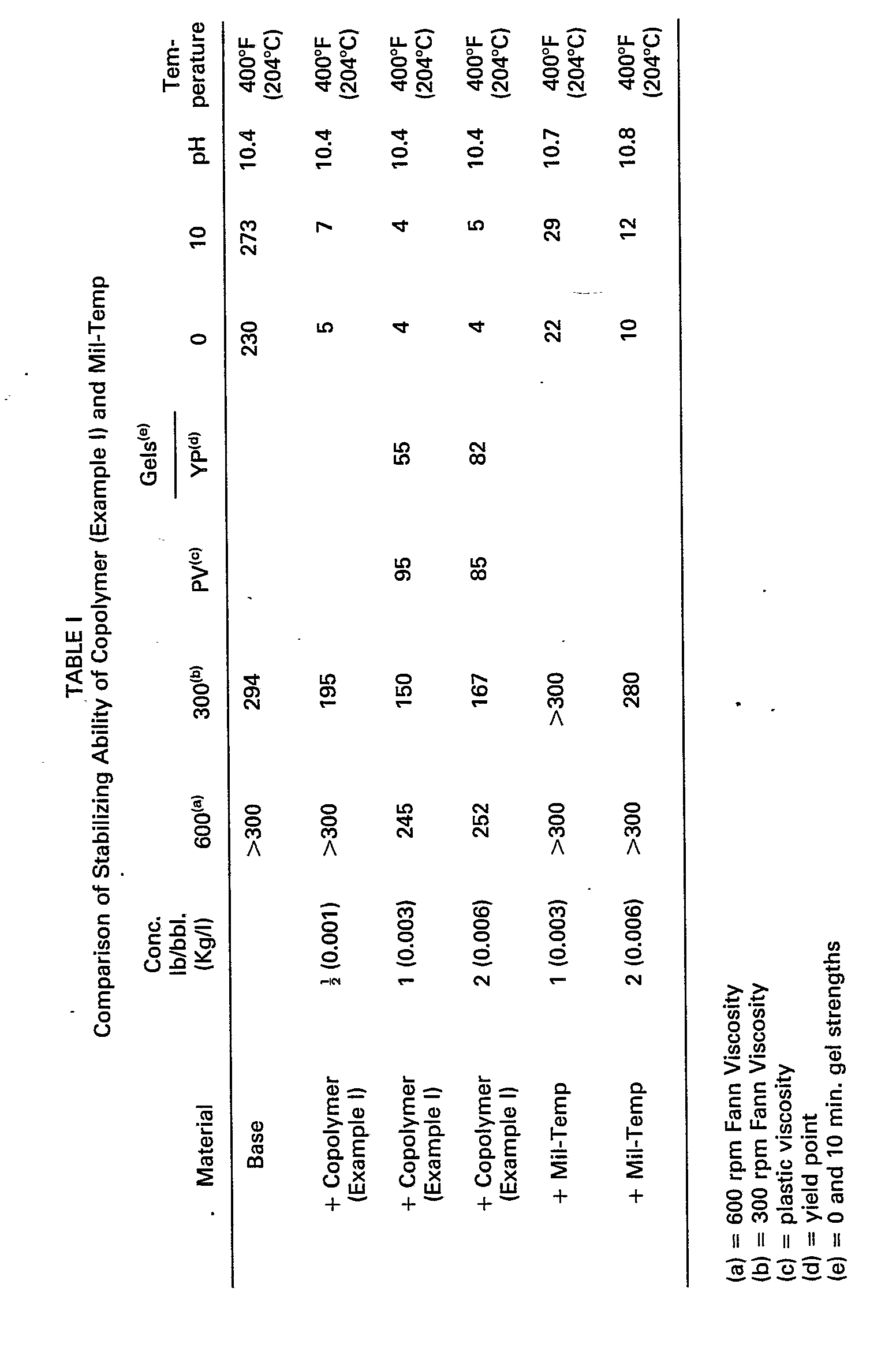
- The results of testing (1) in comparison to the commercial Mil-Temp deflocculation polymer are shown in Table I. Significant improvements in the deflocculation efficacy of (I) versus Mil-Temp were observed. At the one pound per barrel (0.003 kg/I) additive level, the 0 and 10 min. gel strengths are reduced by a factor of 5.5 to 7 and the 600 and 300 rpm viscosities also significantly reduced.
Claims (5)

Applications Claiming Priority (4)
| Application Number | Priority Date | Filing Date | Title |
|---|---|---|---|
| US41693882A | 1982-09-13 | 1982-09-13 | |
| US416939 | 1982-09-13 | ||
| US06/416,939 US4478727A (en) | 1982-09-13 | 1982-09-13 | Sodium styrene sulfonate-co-sodium-n-(4-sulfophenyl)-maleimide- an improved viscosity control additive |
| US416938 | 1982-09-13 |
Publications (2)
| Publication Number | Publication Date |
|---|---|
| EP0107316A1 EP0107316A1 (en) | 1984-05-02 |
| EP0107316B1 true EP0107316B1 (en) | 1986-08-06 |
Family
ID=27023545
Family Applications (1)
| Application Number | Title | Priority Date | Filing Date |
|---|---|---|---|
| EP19830305338 Expired EP0107316B1 (en) | 1982-09-13 | 1983-09-13 | Sodium styrene sulfonate-co-sodium-n-(4-sulfophenyl)-maleimide - an improved viscosity control additive |
Country Status (7)
| Country | Link |
|---|---|
| EP (1) | EP0107316B1 (en) |
| JP (1) | JPH0653778B2 (en) |
| AR (1) | AR241919A1 (en) |
| AU (1) | AU568507B2 (en) |
| CA (1) | CA1220929A (en) |
| DE (1) | DE3365147D1 (en) |
| NO (1) | NO158301C (en) |
Families Citing this family (5)
| Publication number | Priority date | Publication date | Assignee | Title |
|---|---|---|---|---|
| EP0143508A3 (en) * | 1983-10-31 | 1986-02-12 | Atlantic Richfield Company | Additive for water-base drilling fluid and process |
| US4655838A (en) * | 1984-09-27 | 1987-04-07 | Idemitsu Petrochemical Co., Ltd. | Cement additive composition |
| WO1993021556A1 (en) * | 1992-04-17 | 1993-10-28 | Hoechst Aktiengesellschaft | Maleic imide copolymer used as the orientation film for liquid-crystal displays |
| US5705080A (en) * | 1994-07-06 | 1998-01-06 | Applied Materials, Inc. | Plasma-inert cover and plasma cleaning process |
| JP5850474B2 (en) * | 2011-09-20 | 2016-02-03 | 東ソー有機化学株式会社 | Polystyrene sulfonic acid copolymer, dispersant using the same, nanocarbon material aqueous dispersion, and method for producing polystyrene sulfonic acid copolymer |
Family Cites Families (4)
| Publication number | Priority date | Publication date | Assignee | Title |
|---|---|---|---|---|
| US3332872A (en) * | 1962-12-28 | 1967-07-25 | Monsanto Co | Drilling fluid |
| US3730900A (en) * | 1972-09-25 | 1973-05-01 | Milchem Inc | Composition and process for drilling subterranean wells |
| DE3144770A1 (en) * | 1981-11-11 | 1983-05-19 | Cassella Ag, 6000 Frankfurt | WATER-SOLUBLE COPOLYMER, ITS PRODUCTION AND USE |
| US4471097A (en) * | 1982-01-11 | 1984-09-11 | Klaus Uhl | Water soluble copolymers containing vinyl imidazole as drilling fluid additives |
-
1983
- 1983-06-16 CA CA000430518A patent/CA1220929A/en not_active Expired
- 1983-07-13 NO NO832551A patent/NO158301C/en unknown
- 1983-09-12 AU AU19052/83A patent/AU568507B2/en not_active Ceased
- 1983-09-13 DE DE8383305338T patent/DE3365147D1/en not_active Expired
- 1983-09-13 EP EP19830305338 patent/EP0107316B1/en not_active Expired
- 1983-09-13 AR AR29418383A patent/AR241919A1/en active
-
1991
- 1991-06-26 JP JP15458391A patent/JPH0653778B2/en not_active Expired - Lifetime
Also Published As
| Publication number | Publication date |
|---|---|
| NO832551L (en) | 1984-03-14 |
| NO158301C (en) | 1988-08-17 |
| JPH0653778B2 (en) | 1994-07-20 |
| CA1220929A (en) | 1987-04-28 |
| JPH05117331A (en) | 1993-05-14 |
| DE3365147D1 (en) | 1986-09-11 |
| EP0107316A1 (en) | 1984-05-02 |
| AR241919A1 (en) | 1993-01-29 |
| AU1905283A (en) | 1984-03-22 |
| AU568507B2 (en) | 1988-01-07 |
| NO158301B (en) | 1988-05-09 |
Similar Documents
| Publication | Publication Date | Title |
|---|---|---|
| US4357245A (en) | Water-soluble copolymer and its preparation | |
| CA2046669A1 (en) | Zwitterionic functionalized polymers as deflocculants in water based drilling fluids | |
| US5032295A (en) | Polymers for use in drilling muds | |
| US4471097A (en) | Water soluble copolymers containing vinyl imidazole as drilling fluid additives | |
| US6089318A (en) | Method for control of fluid loss and gas migration in well cementing | |
| US4478727A (en) | Sodium styrene sulfonate-co-sodium-n-(4-sulfophenyl)-maleimide- an improved viscosity control additive | |
| US4604216A (en) | Drilling fluids | |
| EP0122073A1 (en) | Intramolecular polymer complexes - viscosifiers for high ionic strength drilling fluids | |
| US3730900A (en) | Composition and process for drilling subterranean wells | |
| US4581147A (en) | Dispersant for water-based solids-containing fluids and a drilling fluid | |
| EP0192447A2 (en) | Oil field cementing methods and compositions | |
| US6436878B1 (en) | Rheology stabilizer for high-temperature high-pressure high-mineralized degree drilling fluids | |
| GB2174402A (en) | Anionic copolymers for improved control of drilling fluid rheology | |
| US4749498A (en) | Water-soluble polymers and their use as flushing liquid additives for drilling | |
| EP0106528B1 (en) | Drilling fluids based on sulfonated thermoplastic polymers having improved low temperature rheological properties | |
| US6085840A (en) | Method for control of liquid loss and gas migration in well cementing | |
| CA1220929A (en) | Sodium styrene sulfonate-co-sodium-n-(4-sulfophenyl)- maleimide - an improved viscosity control additive | |
| US4812244A (en) | Well drilling fluids and process for drilling wells | |
| US4728445A (en) | Well drilling fluids and process for drilling wells | |
| US4540762A (en) | Copolymers of sodium styrene sulfonate and sodium-N-(4-sulfophenyl)-maleimide | |
| US4652621A (en) | Novel water-soluble copolymer | |
| GB2210888A (en) | Chemically modified lignin materials and their use in controlling fluid loss | |
| CA2055011A1 (en) | Thermally stable hydrophobically associating rheological control additives for water-based drilling fluids | |
| CN120248202A (en) | A high temperature resistant zwitterionic polymer viscosity reducer and its preparation method and application | |
| US3108956A (en) | Low viscosity water-base drilling mud |
Legal Events
| Date | Code | Title | Description |
|---|---|---|---|
| PUAI | Public reference made under article 153(3) epc to a published international application that has entered the european phase |
Free format text: ORIGINAL CODE: 0009012 |
|
| AK | Designated contracting states |
Designated state(s): BE CH DE FR GB IT LI NL SE |
|
| 17P | Request for examination filed |
Effective date: 19841008 |
|
| GRAA | (expected) grant |
Free format text: ORIGINAL CODE: 0009210 |
|
| AK | Designated contracting states |
Kind code of ref document: B1 Designated state(s): BE CH DE FR GB IT LI NL SE |
|
| ITF | It: translation for a ep patent filed | ||
| REF | Corresponds to: |
Ref document number: 3365147 Country of ref document: DE Date of ref document: 19860911 |
|
| ET | Fr: translation filed | ||
| PLBE | No opposition filed within time limit |
Free format text: ORIGINAL CODE: 0009261 |
|
| STAA | Information on the status of an ep patent application or granted ep patent |
Free format text: STATUS: NO OPPOSITION FILED WITHIN TIME LIMIT |
|
| 26N | No opposition filed | ||
| ITTA | It: last paid annual fee | ||
| PGFP | Annual fee paid to national office [announced via postgrant information from national office to epo] |
Ref country code: CH Payment date: 19920619 Year of fee payment: 10 |
|
| PGFP | Annual fee paid to national office [announced via postgrant information from national office to epo] |
Ref country code: FR Payment date: 19930616 Year of fee payment: 11 |
|
| PGFP | Annual fee paid to national office [announced via postgrant information from national office to epo] |
Ref country code: SE Payment date: 19930617 Year of fee payment: 11 Ref country code: DE Payment date: 19930617 Year of fee payment: 11 |
|
| PGFP | Annual fee paid to national office [announced via postgrant information from national office to epo] |
Ref country code: GB Payment date: 19930624 Year of fee payment: 11 |
|
| PGFP | Annual fee paid to national office [announced via postgrant information from national office to epo] |
Ref country code: BE Payment date: 19930702 Year of fee payment: 11 |
|
| PG25 | Lapsed in a contracting state [announced via postgrant information from national office to epo] |
Ref country code: LI Effective date: 19930930 Ref country code: CH Effective date: 19930930 |
|
| PGFP | Annual fee paid to national office [announced via postgrant information from national office to epo] |
Ref country code: NL Payment date: 19930930 Year of fee payment: 11 |
|
| REG | Reference to a national code |
Ref country code: CH Ref legal event code: PL |
|
| PG25 | Lapsed in a contracting state [announced via postgrant information from national office to epo] |
Ref country code: GB Effective date: 19940913 |
|
| PG25 | Lapsed in a contracting state [announced via postgrant information from national office to epo] |
Ref country code: SE Effective date: 19940914 |
|
| PG25 | Lapsed in a contracting state [announced via postgrant information from national office to epo] |
Ref country code: BE Effective date: 19940930 |
|
| EAL | Se: european patent in force in sweden |
Ref document number: 83305338.2 |
|
| BERE | Be: lapsed |
Owner name: EXXON RESEARCH AND ENGINEERING CY Effective date: 19940930 |
|
| PG25 | Lapsed in a contracting state [announced via postgrant information from national office to epo] |
Ref country code: NL Effective date: 19950401 |
|
| GBPC | Gb: european patent ceased through non-payment of renewal fee |
Effective date: 19940913 |
|
| NLV4 | Nl: lapsed or anulled due to non-payment of the annual fee | ||
| PG25 | Lapsed in a contracting state [announced via postgrant information from national office to epo] |
Ref country code: FR Effective date: 19950531 |
|
| PG25 | Lapsed in a contracting state [announced via postgrant information from national office to epo] |
Ref country code: DE Effective date: 19950601 |
|
| EUG | Se: european patent has lapsed |
Ref document number: 83305338.2 |
|
| REG | Reference to a national code |
Ref country code: FR Ref legal event code: ST |