EP0106911B1 - Light-catalyzed process for preparing amines - Google Patents
Light-catalyzed process for preparing amines Download PDFInfo
- Publication number
- EP0106911B1 EP0106911B1 EP82109847A EP82109847A EP0106911B1 EP 0106911 B1 EP0106911 B1 EP 0106911B1 EP 82109847 A EP82109847 A EP 82109847A EP 82109847 A EP82109847 A EP 82109847A EP 0106911 B1 EP0106911 B1 EP 0106911B1
- Authority
- EP
- European Patent Office
- Prior art keywords
- photocatalyst
- ammonia
- triphenylphosphine
- rhodium
- light
- Prior art date
- Legal status (The legal status is an assumption and is not a legal conclusion. Google has not performed a legal analysis and makes no representation as to the accuracy of the status listed.)
- Expired
Links
- 150000001412 amines Chemical class 0.000 title claims description 22
- 238000004519 manufacturing process Methods 0.000 title 1
- QGZKDVFQNNGYKY-UHFFFAOYSA-N Ammonia Chemical compound N QGZKDVFQNNGYKY-UHFFFAOYSA-N 0.000 claims description 46
- 238000000034 method Methods 0.000 claims description 26
- 238000006243 chemical reaction Methods 0.000 claims description 23
- 229910021529 ammonia Inorganic materials 0.000 claims description 22
- 239000011941 photocatalyst Substances 0.000 claims description 22
- QSHDDOUJBYECFT-UHFFFAOYSA-N mercury Chemical group [Hg] QSHDDOUJBYECFT-UHFFFAOYSA-N 0.000 claims description 19
- 239000000376 reactant Substances 0.000 claims description 19
- CSCPPACGZOOCGX-UHFFFAOYSA-N Acetone Chemical compound CC(C)=O CSCPPACGZOOCGX-UHFFFAOYSA-N 0.000 claims description 18
- VYPSYNLAJGMNEJ-UHFFFAOYSA-N Silicium dioxide Chemical compound O=[Si]=O VYPSYNLAJGMNEJ-UHFFFAOYSA-N 0.000 claims description 18
- 150000001336 alkenes Chemical class 0.000 claims description 16
- 229910052753 mercury Inorganic materials 0.000 claims description 14
- 150000001875 compounds Chemical class 0.000 claims description 10
- JRZJOMJEPLMPRA-UHFFFAOYSA-N olefin Natural products CCCCCCCC=C JRZJOMJEPLMPRA-UHFFFAOYSA-N 0.000 claims description 10
- YRKCREAYFQTBPV-UHFFFAOYSA-N acetylacetone Chemical compound CC(=O)CC(C)=O YRKCREAYFQTBPV-UHFFFAOYSA-N 0.000 claims description 8
- 239000011521 glass Substances 0.000 claims description 8
- -1 heterocyclic amine Chemical class 0.000 claims description 8
- 125000002924 primary amino group Chemical group [H]N([H])* 0.000 claims description 8
- ZWEHNKRNPOVVGH-UHFFFAOYSA-N 2-Butanone Chemical compound CCC(C)=O ZWEHNKRNPOVVGH-UHFFFAOYSA-N 0.000 claims description 6
- 229910017147 Fe(CO)5 Inorganic materials 0.000 claims description 6
- 229910052703 rhodium Inorganic materials 0.000 claims description 6
- 239000010948 rhodium Substances 0.000 claims description 6
- MHOVAHRLVXNVSD-UHFFFAOYSA-N rhodium atom Chemical compound [Rh] MHOVAHRLVXNVSD-UHFFFAOYSA-N 0.000 claims description 6
- 229910052723 transition metal Inorganic materials 0.000 claims description 5
- 150000003624 transition metals Chemical class 0.000 claims description 5
- XEEYBQQBJWHFJM-UHFFFAOYSA-N Iron Chemical compound [Fe] XEEYBQQBJWHFJM-UHFFFAOYSA-N 0.000 claims description 4
- WIWBLJMBLGWSIN-UHFFFAOYSA-L dichlorotris(triphenylphosphine)ruthenium(ii) Chemical group [Cl-].[Cl-].[Ru+2].C1=CC=CC=C1P(C=1C=CC=CC=1)C1=CC=CC=C1.C1=CC=CC=C1P(C=1C=CC=CC=1)C1=CC=CC=C1.C1=CC=CC=C1P(C=1C=CC=CC=1)C1=CC=CC=C1 WIWBLJMBLGWSIN-UHFFFAOYSA-L 0.000 claims description 4
- QBERHIJABFXGRZ-UHFFFAOYSA-M rhodium;triphenylphosphane;chloride Chemical compound [Cl-].[Rh].C1=CC=CC=C1P(C=1C=CC=CC=1)C1=CC=CC=C1.C1=CC=CC=C1P(C=1C=CC=CC=1)C1=CC=CC=C1.C1=CC=CC=C1P(C=1C=CC=CC=1)C1=CC=CC=C1 QBERHIJABFXGRZ-UHFFFAOYSA-M 0.000 claims description 4
- ZOKXTWBITQBERF-UHFFFAOYSA-N Molybdenum Chemical compound [Mo] ZOKXTWBITQBERF-UHFFFAOYSA-N 0.000 claims description 3
- 150000002576 ketones Chemical class 0.000 claims description 3
- 239000003446 ligand Substances 0.000 claims description 3
- 229910052750 molybdenum Inorganic materials 0.000 claims description 3
- 239000011733 molybdenum Substances 0.000 claims description 3
- 150000002894 organic compounds Chemical class 0.000 claims description 3
- TUQOTMZNTHZOKS-UHFFFAOYSA-N tributylphosphine Chemical compound CCCCP(CCCC)CCCC TUQOTMZNTHZOKS-UHFFFAOYSA-N 0.000 claims description 3
- BDZBKCUKTQZUTL-UHFFFAOYSA-N triethyl phosphite Chemical compound CCOP(OCC)OCC BDZBKCUKTQZUTL-UHFFFAOYSA-N 0.000 claims description 3
- KJTLSVCANCCWHF-UHFFFAOYSA-N Ruthenium Chemical compound [Ru] KJTLSVCANCCWHF-UHFFFAOYSA-N 0.000 claims description 2
- 150000004945 aromatic hydrocarbons Chemical class 0.000 claims description 2
- XGRJZXREYAXTGV-UHFFFAOYSA-N chlorodiphenylphosphine Chemical compound C=1C=CC=CC=1P(Cl)C1=CC=CC=C1 XGRJZXREYAXTGV-UHFFFAOYSA-N 0.000 claims description 2
- LVTCZSBUROAWTE-UHFFFAOYSA-N diethyl(phenyl)phosphane Chemical compound CCP(CC)C1=CC=CC=C1 LVTCZSBUROAWTE-UHFFFAOYSA-N 0.000 claims description 2
- 229910052742 iron Inorganic materials 0.000 claims description 2
- 125000000962 organic group Chemical group 0.000 claims description 2
- 229910052707 ruthenium Inorganic materials 0.000 claims description 2
- 150000003464 sulfur compounds Chemical class 0.000 claims description 2
- KCTAHLRCZMOTKM-UHFFFAOYSA-N tripropylphosphane Chemical compound CCCP(CCC)CCC KCTAHLRCZMOTKM-UHFFFAOYSA-N 0.000 claims description 2
- OTMSDBZUPAUEDD-UHFFFAOYSA-N Ethane Chemical compound CC OTMSDBZUPAUEDD-UHFFFAOYSA-N 0.000 claims 1
- LFQSCWFLJHTTHZ-UHFFFAOYSA-N Ethanol Chemical compound CCO LFQSCWFLJHTTHZ-UHFFFAOYSA-N 0.000 claims 1
- 125000000217 alkyl group Chemical group 0.000 claims 1
- 125000002524 organometallic group Chemical group 0.000 claims 1
- 125000000467 secondary amino group Chemical class [H]N([*:1])[*:2] 0.000 claims 1
- 239000000203 mixture Substances 0.000 description 17
- VGGSQFUCUMXWEO-UHFFFAOYSA-N Ethene Chemical compound C=C VGGSQFUCUMXWEO-UHFFFAOYSA-N 0.000 description 14
- 239000005977 Ethylene Substances 0.000 description 14
- UHOVQNZJYSORNB-UHFFFAOYSA-N Benzene Chemical compound C1=CC=CC=C1 UHOVQNZJYSORNB-UHFFFAOYSA-N 0.000 description 12
- QUSNBJAOOMFDIB-UHFFFAOYSA-N Ethylamine Chemical compound CCN QUSNBJAOOMFDIB-UHFFFAOYSA-N 0.000 description 8
- ROSDSFDQCJNGOL-UHFFFAOYSA-N Dimethylamine Chemical compound CNC ROSDSFDQCJNGOL-UHFFFAOYSA-N 0.000 description 7
- VXNZUUAINFGPBY-UHFFFAOYSA-N 1-Butene Chemical compound CCC=C VXNZUUAINFGPBY-UHFFFAOYSA-N 0.000 description 6
- PAYRUJLWNCNPSJ-UHFFFAOYSA-N Aniline Chemical compound NC1=CC=CC=C1 PAYRUJLWNCNPSJ-UHFFFAOYSA-N 0.000 description 6
- 239000007789 gas Substances 0.000 description 6
- ZMANZCXQSJIPKH-UHFFFAOYSA-N Triethylamine Chemical class CCN(CC)CC ZMANZCXQSJIPKH-UHFFFAOYSA-N 0.000 description 5
- 150000003335 secondary amines Chemical class 0.000 description 5
- NLXLAEXVIDQMFP-UHFFFAOYSA-N Ammonia chloride Chemical compound [NH4+].[Cl-] NLXLAEXVIDQMFP-UHFFFAOYSA-N 0.000 description 4
- 238000004458 analytical method Methods 0.000 description 4
- HQABUPZFAYXKJW-UHFFFAOYSA-N butan-1-amine Chemical compound CCCCN HQABUPZFAYXKJW-UHFFFAOYSA-N 0.000 description 4
- QHCCDDQKNUYGNC-UHFFFAOYSA-N n-ethylbutan-1-amine Chemical compound CCCCNCC QHCCDDQKNUYGNC-UHFFFAOYSA-N 0.000 description 4
- 239000010453 quartz Substances 0.000 description 4
- 230000005855 radiation Effects 0.000 description 4
- 229910001220 stainless steel Inorganic materials 0.000 description 4
- 239000010935 stainless steel Substances 0.000 description 4
- 229910052724 xenon Inorganic materials 0.000 description 4
- FHNFHKCVQCLJFQ-UHFFFAOYSA-N xenon atom Chemical compound [Xe] FHNFHKCVQCLJFQ-UHFFFAOYSA-N 0.000 description 4
- RWRDLPDLKQPQOW-UHFFFAOYSA-N Pyrrolidine Chemical compound C1CCNC1 RWRDLPDLKQPQOW-UHFFFAOYSA-N 0.000 description 3
- YXFVVABEGXRONW-UHFFFAOYSA-N Toluene Chemical compound CC1=CC=CC=C1 YXFVVABEGXRONW-UHFFFAOYSA-N 0.000 description 3
- 150000004982 aromatic amines Chemical class 0.000 description 3
- 229910052734 helium Inorganic materials 0.000 description 3
- 239000001307 helium Substances 0.000 description 3
- SWQJXJOGLNCZEY-UHFFFAOYSA-N helium atom Chemical compound [He] SWQJXJOGLNCZEY-UHFFFAOYSA-N 0.000 description 3
- 239000007788 liquid Substances 0.000 description 3
- 230000003595 spectral effect Effects 0.000 description 3
- KWKAKUADMBZCLK-UHFFFAOYSA-N 1-octene Chemical compound CCCCCCC=C KWKAKUADMBZCLK-UHFFFAOYSA-N 0.000 description 2
- HXVNBWAKAOHACI-UHFFFAOYSA-N 2,4-dimethyl-3-pentanone Chemical compound CC(C)C(=O)C(C)C HXVNBWAKAOHACI-UHFFFAOYSA-N 0.000 description 2
- BKOOMYPCSUNDGP-UHFFFAOYSA-N 2-methylbut-2-ene Chemical compound CC=C(C)C BKOOMYPCSUNDGP-UHFFFAOYSA-N 0.000 description 2
- KDSNLYIMUZNERS-UHFFFAOYSA-N 2-methylpropanamine Chemical compound CC(C)CN KDSNLYIMUZNERS-UHFFFAOYSA-N 0.000 description 2
- HCFAJYNVAYBARA-UHFFFAOYSA-N 4-heptanone Chemical compound CCCC(=O)CCC HCFAJYNVAYBARA-UHFFFAOYSA-N 0.000 description 2
- ROWKJAVDOGWPAT-UHFFFAOYSA-N Acetoin Chemical compound CC(O)C(C)=O ROWKJAVDOGWPAT-UHFFFAOYSA-N 0.000 description 2
- KWOLFJPFCHCOCG-UHFFFAOYSA-N Acetophenone Chemical compound CC(=O)C1=CC=CC=C1 KWOLFJPFCHCOCG-UHFFFAOYSA-N 0.000 description 2
- KAKZBPTYRLMSJV-UHFFFAOYSA-N Butadiene Chemical compound C=CC=C KAKZBPTYRLMSJV-UHFFFAOYSA-N 0.000 description 2
- YZCKVEUIGOORGS-OUBTZVSYSA-N Deuterium Chemical compound [2H] YZCKVEUIGOORGS-OUBTZVSYSA-N 0.000 description 2
- RRHGJUQNOFWUDK-UHFFFAOYSA-N Isoprene Chemical compound CC(=C)C=C RRHGJUQNOFWUDK-UHFFFAOYSA-N 0.000 description 2
- BAVYZALUXZFZLV-UHFFFAOYSA-N Methylamine Chemical compound NC BAVYZALUXZFZLV-UHFFFAOYSA-N 0.000 description 2
- MMVYPOCJESWGTC-UHFFFAOYSA-N Molybdenum(2+) Chemical compound [Mo+2] MMVYPOCJESWGTC-UHFFFAOYSA-N 0.000 description 2
- YNAVUWVOSKDBBP-UHFFFAOYSA-N Morpholine Chemical compound C1COCCN1 YNAVUWVOSKDBBP-UHFFFAOYSA-N 0.000 description 2
- NQRYJNQNLNOLGT-UHFFFAOYSA-N Piperidine Chemical compound C1CCNCC1 NQRYJNQNLNOLGT-UHFFFAOYSA-N 0.000 description 2
- JUJWROOIHBZHMG-UHFFFAOYSA-N Pyridine Chemical compound C1=CC=NC=C1 JUJWROOIHBZHMG-UHFFFAOYSA-N 0.000 description 2
- PPBRXRYQALVLMV-UHFFFAOYSA-N Styrene Chemical compound C=CC1=CC=CC=C1 PPBRXRYQALVLMV-UHFFFAOYSA-N 0.000 description 2
- 150000001298 alcohols Chemical class 0.000 description 2
- 125000001931 aliphatic group Chemical group 0.000 description 2
- XXROGKLTLUQVRX-UHFFFAOYSA-N allyl alcohol Chemical compound OCC=C XXROGKLTLUQVRX-UHFFFAOYSA-N 0.000 description 2
- 235000019270 ammonium chloride Nutrition 0.000 description 2
- IAQRGUVFOMOMEM-UHFFFAOYSA-N but-2-ene Chemical compound CC=CC IAQRGUVFOMOMEM-UHFFFAOYSA-N 0.000 description 2
- 125000004432 carbon atom Chemical group C* 0.000 description 2
- 125000002915 carbonyl group Chemical group [*:2]C([*:1])=O 0.000 description 2
- 239000003054 catalyst Substances 0.000 description 2
- 230000003197 catalytic effect Effects 0.000 description 2
- PAFZNILMFXTMIY-UHFFFAOYSA-N cyclohexylamine Chemical compound NC1CCCCC1 PAFZNILMFXTMIY-UHFFFAOYSA-N 0.000 description 2
- 229910052805 deuterium Inorganic materials 0.000 description 2
- SWXVUIWOUIDPGS-UHFFFAOYSA-N diacetone alcohol Chemical compound CC(=O)CC(C)(C)O SWXVUIWOUIDPGS-UHFFFAOYSA-N 0.000 description 2
- JQVDAXLFBXTEQA-UHFFFAOYSA-N dibutylamine Chemical compound CCCCNCCCC JQVDAXLFBXTEQA-UHFFFAOYSA-N 0.000 description 2
- DMBHHRLKUKUOEG-UHFFFAOYSA-N diphenylamine Chemical compound C=1C=CC=CC=1NC1=CC=CC=C1 DMBHHRLKUKUOEG-UHFFFAOYSA-N 0.000 description 2
- 125000000524 functional group Chemical group 0.000 description 2
- 238000004817 gas chromatography Methods 0.000 description 2
- 230000001678 irradiating effect Effects 0.000 description 2
- IVSZLXZYQVIEFR-UHFFFAOYSA-N m-xylene Chemical group CC1=CC=CC(C)=C1 IVSZLXZYQVIEFR-UHFFFAOYSA-N 0.000 description 2
- XNLICIUVMPYHGG-UHFFFAOYSA-N pentan-2-one Chemical compound CCCC(C)=O XNLICIUVMPYHGG-UHFFFAOYSA-N 0.000 description 2
- FDPIMTJIUBPUKL-UHFFFAOYSA-N pentan-3-one Chemical compound CCC(=O)CC FDPIMTJIUBPUKL-UHFFFAOYSA-N 0.000 description 2
- YWAKXRMUMFPDSH-UHFFFAOYSA-N pentene Chemical compound CCCC=C YWAKXRMUMFPDSH-UHFFFAOYSA-N 0.000 description 2
- QMMOXUPEWRXHJS-UHFFFAOYSA-N pentene-2 Natural products CCC=CC QMMOXUPEWRXHJS-UHFFFAOYSA-N 0.000 description 2
- 239000012071 phase Substances 0.000 description 2
- 150000003141 primary amines Chemical class 0.000 description 2
- WGYKZJWCGVVSQN-UHFFFAOYSA-N propylamine Chemical compound CCCN WGYKZJWCGVVSQN-UHFFFAOYSA-N 0.000 description 2
- 150000004992 toluidines Chemical class 0.000 description 2
- GETQZCLCWQTVFV-UHFFFAOYSA-N trimethylamine Chemical group CN(C)C GETQZCLCWQTVFV-UHFFFAOYSA-N 0.000 description 2
- RIOQSEWOXXDEQQ-UHFFFAOYSA-N triphenylphosphine Chemical compound C1=CC=CC=C1P(C=1C=CC=CC=1)C1=CC=CC=C1 RIOQSEWOXXDEQQ-UHFFFAOYSA-N 0.000 description 2
- CRSBERNSMYQZNG-UHFFFAOYSA-N 1 -dodecene Natural products CCCCCCCCCCC=C CRSBERNSMYQZNG-UHFFFAOYSA-N 0.000 description 1
- QFMZQPDHXULLKC-UHFFFAOYSA-N 1,2-bis(diphenylphosphino)ethane Chemical compound C=1C=CC=CC=1P(C=1C=CC=CC=1)CCP(C=1C=CC=CC=1)C1=CC=CC=C1 QFMZQPDHXULLKC-UHFFFAOYSA-N 0.000 description 1
- CDULGHZNHURECF-UHFFFAOYSA-N 2,3-dimethylaniline 2,4-dimethylaniline 2,5-dimethylaniline 2,6-dimethylaniline 3,4-dimethylaniline 3,5-dimethylaniline Chemical group CC1=CC=C(N)C(C)=C1.CC1=CC=C(C)C(N)=C1.CC1=CC(C)=CC(N)=C1.CC1=CC=C(N)C=C1C.CC1=CC=CC(N)=C1C.CC1=CC=CC(C)=C1N CDULGHZNHURECF-UHFFFAOYSA-N 0.000 description 1
- MRDMGGOYEBRLPD-UHFFFAOYSA-N 2-ethoxy-1-(2-ethoxyphenyl)ethanone Chemical compound CCOCC(=O)C1=CC=CC=C1OCC MRDMGGOYEBRLPD-UHFFFAOYSA-N 0.000 description 1
- BSMGLVDZZMBWQB-UHFFFAOYSA-N 2-methyl-1-phenylpropan-1-one Chemical compound CC(C)C(=O)C1=CC=CC=C1 BSMGLVDZZMBWQB-UHFFFAOYSA-N 0.000 description 1
- DHYFYDYQEUCFPK-UHFFFAOYSA-N 3-methylbut-1-ene Chemical compound CC(C)C=C.CC(C)C=C DHYFYDYQEUCFPK-UHFFFAOYSA-N 0.000 description 1
- 239000005725 8-Hydroxyquinoline Substances 0.000 description 1
- SNRUBQQJIBEYMU-UHFFFAOYSA-N Dodecane Natural products CCCCCCCCCCCC SNRUBQQJIBEYMU-UHFFFAOYSA-N 0.000 description 1
- PIICEJLVQHRZGT-UHFFFAOYSA-N Ethylenediamine Chemical compound NCCN PIICEJLVQHRZGT-UHFFFAOYSA-N 0.000 description 1
- OAKJQQAXSVQMHS-UHFFFAOYSA-N Hydrazine Chemical compound NN OAKJQQAXSVQMHS-UHFFFAOYSA-N 0.000 description 1
- VEXZGXHMUGYJMC-UHFFFAOYSA-N Hydrochloric acid Chemical compound Cl VEXZGXHMUGYJMC-UHFFFAOYSA-N 0.000 description 1
- UFHFLCQGNIYNRP-UHFFFAOYSA-N Hydrogen Chemical compound [H][H] UFHFLCQGNIYNRP-UHFFFAOYSA-N 0.000 description 1
- VQTUBCCKSQIDNK-UHFFFAOYSA-N Isobutene Chemical group CC(C)=C VQTUBCCKSQIDNK-UHFFFAOYSA-N 0.000 description 1
- CTQNGGLPUBDAKN-UHFFFAOYSA-N O-Xylene Chemical compound CC1=CC=CC=C1C CTQNGGLPUBDAKN-UHFFFAOYSA-N 0.000 description 1
- 229910021604 Rhodium(III) chloride Inorganic materials 0.000 description 1
- PJANXHGTPQOBST-VAWYXSNFSA-N Stilbene Natural products C=1C=CC=CC=1/C=C/C1=CC=CC=C1 PJANXHGTPQOBST-VAWYXSNFSA-N 0.000 description 1
- HCCMSBBXUYYHHU-UHFFFAOYSA-B [Cl-].[Cl-].[Cl-].[Cl-].[Cl-].[Cl-].[Cl-].[Cl-].[Cl-].[Cl-].[Cl-].[Cl-].[Mo++].[Mo++].[Mo++].[Mo++].[Mo++].[Mo++] Chemical compound [Cl-].[Cl-].[Cl-].[Cl-].[Cl-].[Cl-].[Cl-].[Cl-].[Cl-].[Cl-].[Cl-].[Cl-].[Mo++].[Mo++].[Mo++].[Mo++].[Mo++].[Mo++] HCCMSBBXUYYHHU-UHFFFAOYSA-B 0.000 description 1
- 150000001299 aldehydes Chemical class 0.000 description 1
- 125000003545 alkoxy group Chemical group 0.000 description 1
- 150000003973 alkyl amines Chemical class 0.000 description 1
- 150000001348 alkyl chlorides Chemical class 0.000 description 1
- XYLMUPLGERFSHI-UHFFFAOYSA-N alpha-Methylstyrene Chemical compound CC(=C)C1=CC=CC=C1 XYLMUPLGERFSHI-UHFFFAOYSA-N 0.000 description 1
- 125000003277 amino group Chemical group 0.000 description 1
- BKZJXSDQOIUIIG-UHFFFAOYSA-N argon mercury Chemical compound [Ar].[Hg] BKZJXSDQOIUIIG-UHFFFAOYSA-N 0.000 description 1
- QVGXLLKOCUKJST-UHFFFAOYSA-N atomic oxygen Chemical compound [O] QVGXLLKOCUKJST-UHFFFAOYSA-N 0.000 description 1
- OSOHBQZPFDDOMK-UHFFFAOYSA-N azane;propan-2-one Chemical compound N.CC(C)=O OSOHBQZPFDDOMK-UHFFFAOYSA-N 0.000 description 1
- RWCCWEUUXYIKHB-UHFFFAOYSA-N benzophenone Chemical compound C=1C=CC=CC=1C(=O)C1=CC=CC=C1 RWCCWEUUXYIKHB-UHFFFAOYSA-N 0.000 description 1
- 239000012965 benzophenone Substances 0.000 description 1
- 230000005540 biological transmission Effects 0.000 description 1
- 230000015572 biosynthetic process Effects 0.000 description 1
- 150000001649 bromium compounds Chemical class 0.000 description 1
- 125000001246 bromo group Chemical group Br* 0.000 description 1
- 125000000484 butyl group Chemical group [H]C([*])([H])C([H])([H])C([H])([H])C([H])([H])[H] 0.000 description 1
- 229910052799 carbon Inorganic materials 0.000 description 1
- IETKMTGYQIVLRF-UHFFFAOYSA-N carbon monoxide;rhodium;triphenylphosphane Chemical compound [Rh].[O+]#[C-].C1=CC=CC=C1P(C=1C=CC=CC=1)C1=CC=CC=C1.C1=CC=CC=C1P(C=1C=CC=CC=1)C1=CC=CC=C1.C1=CC=CC=C1P(C=1C=CC=CC=1)C1=CC=CC=C1 IETKMTGYQIVLRF-UHFFFAOYSA-N 0.000 description 1
- 239000012159 carrier gas Substances 0.000 description 1
- 125000001309 chloro group Chemical group Cl* 0.000 description 1
- GRFFKYTUNTWAGG-UHFFFAOYSA-N chloroethene;prop-2-enenitrile Chemical compound ClC=C.C=CC#N GRFFKYTUNTWAGG-UHFFFAOYSA-N 0.000 description 1
- YACLQRRMGMJLJV-UHFFFAOYSA-N chloroprene Chemical compound ClC(=C)C=C YACLQRRMGMJLJV-UHFFFAOYSA-N 0.000 description 1
- 238000004587 chromatography analysis Methods 0.000 description 1
- 238000012790 confirmation Methods 0.000 description 1
- 238000010924 continuous production Methods 0.000 description 1
- 238000001816 cooling Methods 0.000 description 1
- LDHQCZJRKDOVOX-NSCUHMNNSA-N crotonic acid Chemical compound C\C=C\C(O)=O LDHQCZJRKDOVOX-NSCUHMNNSA-N 0.000 description 1
- 125000004122 cyclic group Chemical group 0.000 description 1
- 125000005265 dialkylamine group Chemical group 0.000 description 1
- UAOMVDZJSHZZME-UHFFFAOYSA-N diisopropylamine Chemical compound CC(C)NC(C)C UAOMVDZJSHZZME-UHFFFAOYSA-N 0.000 description 1
- XNMQEEKYCVKGBD-UHFFFAOYSA-N dimethylacetylene Natural products CC#CC XNMQEEKYCVKGBD-UHFFFAOYSA-N 0.000 description 1
- WEHWNAOGRSTTBQ-UHFFFAOYSA-N dipropylamine Chemical compound CCCNCCC WEHWNAOGRSTTBQ-UHFFFAOYSA-N 0.000 description 1
- 238000004821 distillation Methods 0.000 description 1
- 229940069096 dodecene Drugs 0.000 description 1
- 239000000975 dye Substances 0.000 description 1
- 150000002170 ethers Chemical class 0.000 description 1
- 239000011953 free-radical catalyst Substances 0.000 description 1
- 125000004836 hexamethylene group Chemical class [H]C([H])([*:2])C([H])([H])C([H])([H])C([H])([H])C([H])([H])C([H])([H])[*:1] 0.000 description 1
- NAQMVNRVTILPCV-UHFFFAOYSA-N hexane-1,6-diamine Chemical compound NCCCCCCN NAQMVNRVTILPCV-UHFFFAOYSA-N 0.000 description 1
- 239000001257 hydrogen Substances 0.000 description 1
- 229910052739 hydrogen Inorganic materials 0.000 description 1
- 125000002887 hydroxy group Chemical group [H]O* 0.000 description 1
- 125000000959 isobutyl group Chemical group [H]C([H])([H])C([H])(C([H])([H])[H])C([H])([H])* 0.000 description 1
- 238000002955 isolation Methods 0.000 description 1
- JJWLVOIRVHMVIS-UHFFFAOYSA-N isopropylamine Chemical compound CC(C)N JJWLVOIRVHMVIS-UHFFFAOYSA-N 0.000 description 1
- 239000007791 liquid phase Substances 0.000 description 1
- 238000004949 mass spectrometry Methods 0.000 description 1
- 239000000463 material Substances 0.000 description 1
- 229910052751 metal Inorganic materials 0.000 description 1
- 239000002184 metal Substances 0.000 description 1
- XJRBAMWJDBPFIM-UHFFFAOYSA-N methyl vinyl ether Chemical compound COC=C XJRBAMWJDBPFIM-UHFFFAOYSA-N 0.000 description 1
- 238000002156 mixing Methods 0.000 description 1
- DAZXVJBJRMWXJP-UHFFFAOYSA-N n,n-dimethylethylamine Chemical compound CCN(C)C DAZXVJBJRMWXJP-UHFFFAOYSA-N 0.000 description 1
- TVMXDCGIABBOFY-UHFFFAOYSA-N n-Octanol Natural products CCCCCCCC TVMXDCGIABBOFY-UHFFFAOYSA-N 0.000 description 1
- GNVRJGIVDSQCOP-UHFFFAOYSA-N n-ethyl-n-methylethanamine Chemical compound CCN(C)CC GNVRJGIVDSQCOP-UHFFFAOYSA-N 0.000 description 1
- 150000005002 naphthylamines Chemical class 0.000 description 1
- 150000002825 nitriles Chemical class 0.000 description 1
- 150000002828 nitro derivatives Chemical class 0.000 description 1
- 229910000069 nitrogen hydride Inorganic materials 0.000 description 1
- IOQPZZOEVPZRBK-UHFFFAOYSA-N octan-1-amine Chemical compound CCCCCCCCN IOQPZZOEVPZRBK-UHFFFAOYSA-N 0.000 description 1
- 239000001301 oxygen Substances 0.000 description 1
- 229910052760 oxygen Inorganic materials 0.000 description 1
- 229960003540 oxyquinoline Drugs 0.000 description 1
- 125000001147 pentyl group Chemical group C(CCCC)* 0.000 description 1
- 150000002978 peroxides Chemical class 0.000 description 1
- 239000003504 photosensitizing agent Substances 0.000 description 1
- 229920000768 polyamine Polymers 0.000 description 1
- KRIOVPPHQSLHCZ-UHFFFAOYSA-N propiophenone Chemical compound CCC(=O)C1=CC=CC=C1 KRIOVPPHQSLHCZ-UHFFFAOYSA-N 0.000 description 1
- 238000000746 purification Methods 0.000 description 1
- UMJSCPRVCHMLSP-UHFFFAOYSA-N pyridine Natural products COC1=CC=CN=C1 UMJSCPRVCHMLSP-UHFFFAOYSA-N 0.000 description 1
- MCJGNVYPOGVAJF-UHFFFAOYSA-N quinolin-8-ol Chemical compound C1=CN=C2C(O)=CC=CC2=C1 MCJGNVYPOGVAJF-UHFFFAOYSA-N 0.000 description 1
- 238000010992 reflux Methods 0.000 description 1
- SONJTKJMTWTJCT-UHFFFAOYSA-K rhodium(iii) chloride Chemical compound [Cl-].[Cl-].[Cl-].[Rh+3] SONJTKJMTWTJCT-UHFFFAOYSA-K 0.000 description 1
- 229920006395 saturated elastomer Polymers 0.000 description 1
- BHRZNVHARXXAHW-UHFFFAOYSA-N sec-butylamine Chemical compound CCC(C)N BHRZNVHARXXAHW-UHFFFAOYSA-N 0.000 description 1
- 239000000377 silicon dioxide Substances 0.000 description 1
- 239000007787 solid Substances 0.000 description 1
- 239000007790 solid phase Substances 0.000 description 1
- 239000007858 starting material Substances 0.000 description 1
- PJANXHGTPQOBST-UHFFFAOYSA-N stilbene Chemical compound C=1C=CC=CC=1C=CC1=CC=CC=C1 PJANXHGTPQOBST-UHFFFAOYSA-N 0.000 description 1
- 235000021286 stilbenes Nutrition 0.000 description 1
- 239000000126 substance Substances 0.000 description 1
- 229940065278 sulfur compound Drugs 0.000 description 1
- 238000003786 synthesis reaction Methods 0.000 description 1
- LDHQCZJRKDOVOX-UHFFFAOYSA-N trans-crotonic acid Natural products CC=CC(O)=O LDHQCZJRKDOVOX-UHFFFAOYSA-N 0.000 description 1
- BPLUKJNHPBNVQL-UHFFFAOYSA-N triphenylarsine Chemical compound C1=CC=CC=C1[As](C=1C=CC=CC=1)C1=CC=CC=C1 BPLUKJNHPBNVQL-UHFFFAOYSA-N 0.000 description 1
- ZHXAZZQXWJJBHA-UHFFFAOYSA-N triphenylbismuthane Chemical compound C1=CC=CC=C1[Bi](C=1C=CC=CC=1)C1=CC=CC=C1 ZHXAZZQXWJJBHA-UHFFFAOYSA-N 0.000 description 1
- HVYVMSPIJIWUNA-UHFFFAOYSA-N triphenylstibine Chemical compound C1=CC=CC=C1[Sb](C=1C=CC=CC=1)C1=CC=CC=C1 HVYVMSPIJIWUNA-UHFFFAOYSA-N 0.000 description 1
- 238000009834 vaporization Methods 0.000 description 1
- 230000008016 vaporization Effects 0.000 description 1
- 239000008096 xylene Substances 0.000 description 1
- 239000004711 α-olefin Substances 0.000 description 1
Classifications
-
- C—CHEMISTRY; METALLURGY
- C07—ORGANIC CHEMISTRY
- C07C—ACYCLIC OR CARBOCYCLIC COMPOUNDS
- C07C209/00—Preparation of compounds containing amino groups bound to a carbon skeleton
- C07C209/60—Preparation of compounds containing amino groups bound to a carbon skeleton by condensation or addition reactions, e.g. Mannich reaction, addition of ammonia or amines to alkenes or to alkynes or addition of compounds containing an active hydrogen atom to Schiff's bases, quinone imines, or aziranes
Definitions
- This invention relates to a method for preparing aliphatic and aromatic amines from olefins having from 2 to 8 carbons and terminal isolated double bonds and ammonia or a primary or secondary amine.
- this invention is concerned with forming aliphatic, heterocyclic aliphatic, or aromatic amines from an olefin and either ammonia or a primary or secondary amine by the catalytic use of actinic light.
- Prior art methods for preparing amines have either involved reduction of nitriles, nitro compounds, etc. or have involved reactions in which the amino group replaces some other functional group, such as the hydroxyl group in alcohols, the chloro or bromo group in alkyl chlorides or bromides, the oxygen in the carbonyl group of aldehydes or ketones, or an alkoxy group in ethers.
- Direct synthesis of amines from olefins bypasses the need for these intermediate compounds containing functional groups and simplifies the isolation and purification of the desired product amines.
- US-A-2,772,271 discloses a method for reacting amines and alpha-olefins in the presence of peroxides or light that results in addition of the olefin at an alpha carbon atom of the amine.
- US-A-3,492,353 contains a disclosure of an analogous reaction in which the amine is trimethylamine and which is conducted in the presence of a free-radical catalyst or actinic radiation of a quartz discharge lamp (which emits above 2240 A). This reaction likewise leads to addition of olefin molecules to the carbon atoms alpha to the amino nitrogen.
- the present invention is directed to a process for producing amines by reacting a primary or secondary amine or ammonia with an olefin having a terminal double bond and 2 to 8 carbons, which is characterized by carrying out the reaction in the presence of light having a wavelength above 160 nm (1600 A) and a photocatalyst, whereby an N-H bond of the amine or ammonia is added across the double bond of the olefin.
- This process can be conducted both with or without a photocatalyst depending on the source of actinic radiation used. It has been discovered that if a suitable photocatalyst is not present, the light source must be one with significant output in the spectral region with wavelengths from about 220 to about 160 nm (about 2200 A to about 1600 A) to be effective. Since the reactors and lamps used for this process usually consist of vessels having conventional quartz glass walls to pass actinic light, the lower-wavelength end, in practice, is usually set by the light transmission cut-off of conventional quartz glass (around 180 nm).
- amorphous silica or synthetic silica glass for the vessel walls or for the lamp glass of the equipment of this process is advantageous because it transmits more short-wave length ultraviolet radiation than conventional quartz glass (cut-off around 160 nm).
- Glass comprising such synthetic silica is marketed under the trademark Suprasil@ by Heraeus Amersil and as Corning #7940 by Corning Glass Company.
- Typical lamps emitting in the range of 160-220 nm (1600-2200 A) are deuterium lamps, low-pressure mercury-argon lamps, and high-energy xenon flash lamps.
- the high-energy xenon flash lamp is particularly effective because of its high-energy intensity and its large output in the range 180-220 nm.
- This listing is non-limiting and the lamps mentioned are to be used only as examples of available light sources. Lamps that transmit light with wavelengths above this range are only marginally effective without the use of a photocatalyst; additionally, low-energy flash lamps which peak out at about 400 nm, require the use of a photocatalyst to provide a suitable yield in this reaction.
- the term photocatalyst can mean a material which when added to the reactants causes the desired reaction to occur under the influence of actinic light at a significantly increased rate.
- the photocatalyst can be a light-absorbing organic compound, a transition-metal coordination compound that can complex with the olefin and amine reactants and make them more susceptible to reaction under the influence of actinic light, or mercury.
- Useful organic photosensitizers fall into the categories of ketones, aromatic hydrocarbons, alcohols, organometallics heterocyclic amines, organic dyes, sulfur-compounds, and organo derivatives of Group V A elements.
- Examples of useful organic photocatalysts for this invention are acetone, 2-butanone, 2-pentanone, 3-pentanone, 4-heptanone, diisopropylketone, acetophenone, isobutyrophenone, propiophenone, benzophenone, 3-hydroxy-2-butanone, 2,4-pentanedione, benzene, m-xylene, diacetone alcohol, pyridine, 2,2'-diethoxyacetophenone, triphenylphosphine, triphenylarsine, triphenylbismuthine, triphenylstibine, tributylphosphine and 8-hydroxyquinoline.
- Preferred examples are acetone, 2-butanone, and 2,
- transition-metal complexes are coordination compounds of rhodium, ruthenium, iron and molybdenum. Specific examples are: hydridocarbonyltris (triphenylphosphine) rhodium (I), chlorotris (triphenylphosphine) rhodium (I), dichlorobis (dimethylglyoximato) rhodium (III), dichlorobis (phenylmethylglyoximato) rhodium (III), methylaquobis (dimethylglyoximato) rhodium (III), chloro- triphenylphosphinebis (dimethylglyoximato) rhodium (III), dichlorotetrakis (isoquinolino) rhodium (III) chloride, dichlorotris (triphenylphosphine) ruthenium (11), hexamolybdenum dodecachloride, molybdenum
- Preferred transition-metal photocatalysts are dichlorotris (triphenylphosphine) ruthenium (II), chlorotris (triphenylphosphine) rhodium (I), molybdenum (II) cluster compounds of the formula [MO 6 Cl 8 ] C1 4 L 2 (when L is as defined above) and Fe(CO) 5 .
- the above photocatalysts can be used individually or in combination to improve conversions and yields.
- Particularly preferred are combinations of Fe(CO) 5 with one or more of the following compounds: tri(n-butyl) phosphine, tri(n-propyl) phosphine, triethylphosphite, diethylphenylphosphine, diphenylchlorophosphine, bis(1,2-diphenylphosphino) ethane, and 2,4-pentanedione.
- Organic photocatalysts can be added in any catalytically effective amount with respect to the amine or ammonia reactant, with the preferred range being below the limit of solubility of the organic photocatalyst. Transition-metal photocatalysts may also be added in any effective amount, but are typically used at their solubility limits in the ammonia or amine reactants.
- Mercury is usually employed as a catalyst in a vapor form prepared by passing an inert carrier gas, e.g., helium, through elemental mercury maintained at vaporization temperature (200°C). Fine droplets of elemental mercury may also be used without a carrier, if desired.
- the mercury catalyst is used in an amount at least sufficient to demonstrate catalytic activity.
- the maximum concentration of mercury which is used with an inert carrier is up to and including the amount of mercury vapor carried by the flowing gas at the saturated vapor-pressure of mercury.
- Suitable reactants containing N-H bonds are ammonia and the various primary and secondary amines.
- Specific examples of such amines include: methylamine, dimethylamine, ethylamine, dimethylamine, n-propylamine, isopropylamine, di(n-propyl) amine, di(isopropyl) amine, n-butylamine, di(n-butyl) amine, sec-butylamine, di-(sec:butyl) amine, isobutylamine, di(isobutyl) amine, the pentyl and higher alkyl amines; cycloaliphatic amines such as cyclohexylamine; aromatic amines such as aniline, the N-alkylanilines, diphenylamine, the naphthylamines, and the toluidines; heterocyclic amines such as pyrrolidine, morpholine, and piperidine; substituted amines such as the alkan
- N-H containing reactants because of their commercial significance, are ammonia, and the mono- and di-alkyl (C 1 -C a ) amines.
- An especially preferred N-H containing reactant is ammonia.
- Olefinic compounds suitable for the present process are the unactivated alkenes of 2 to 8 carbons having terminal double bonds. Specific examples of such compounds are ethylene, propylene, 1-butene, 2-butene, isobutylene, 1-pentene, 2-pentene, 3-methyl-1-butene 3-methyl-1-butene, 2-methyl-2-butene, the several possible hexenes, higher alkenes (e.g., dodecene), styrene, alpha methylstyrene, alpha, alpha- dimethylstyrene, butadiene, 2-methyl-1,3-butadiene, 2-chloro-1,3-butadiene, acrylonitrile vinylchloride, methyl vinyl ether, and allyl alcohol.
- alkenes e.g., dodecene
- styrene alpha methylstyrene, alpha, alpha- dimethylstyrene, butadiene, 2-
- N-H containing reactants and olefins can be optionally substituted with various groups (such as -OH, -halide, -CN) as long as such groups do not interfere with the process.
- Typical temperatures for conducting the process of this invention range from -10°C to 40°C but any convenient temperature may be used. Temperatures in the range -10°C to 10°C are preferred. The lower temperatures allow greater solubility of gaseous olefins, such as ethylene, in liquid ammonia or the amines.
- the mole ratio of ammonia or starting amine to olefin can range from 1:1 to 20:1 with a ratio in the range of 5:1 to 15:1 being preferred.
- a mixture of 4.04 moles of n-butylamine, 0.221 mole of Fe(CO) 5 , and 0.221 moles of triethyl phosphite was pressurized to 18.2 bar at 35°C, with ethylene in the reactor system described in Example 1.
- the light source was a 550 watt, high pressure mercury ultraviolet lamp.
- the mixture was circulated for 4 hours with constant irradiation. Analysis of the products showed a 15.5% conversion of the n-butylamine to N-ethyl-n-butylamine.
- Ammonia (18.2 moles) and ammonium chloride (NH 4 CI), 0.18 mole) were charged to a 1-liter cyclic system equipped with a circulating pump, a cooling coil, and a cylindrical glass reactor.
- An ultraviolet lamp was mounted near the reactor and both the reactor and lamp were enclosed in a reflecting stainless-steel cylinder. Ethylene was charged to the system until the pressure was, arbitrarily, 18.2 bar. The resulting solution was circulated for about hour or until the solution temperature reached 7-8°C. The lamp was turned on and the solution was irradiated for four hours.
- Gaseous ammonia, ethylene, helium and mercury vapor are exposed simultaneously to ultraviolet light in a single-pass reactor system consisting of flow controllers, a stainless-steel, mercury-reflux pot and a quartz reactor chamber.
- a stream of helium is first passed through elemental mercury heated to about 200°C and the He/Hg vapor is immediately blended with a mixture of ethylene and ammonia (1:1 volume) prior to the reactor chamber.
- the reactor chamber is irradiated by a low pressure mercury lamp external to the reactor. The vent gases were collected and the product was identified as ethylamine in 85 to 98% purity.
Landscapes
- Chemical & Material Sciences (AREA)
- Organic Chemistry (AREA)
- Chemical Kinetics & Catalysis (AREA)
- Organic Low-Molecular-Weight Compounds And Preparation Thereof (AREA)
- Physical Or Chemical Processes And Apparatus (AREA)
- Low-Molecular Organic Synthesis Reactions Using Catalysts (AREA)
Description
- This invention relates to a method for preparing aliphatic and aromatic amines from olefins having from 2 to 8 carbons and terminal isolated double bonds and ammonia or a primary or secondary amine. In particular, this invention is concerned with forming aliphatic, heterocyclic aliphatic, or aromatic amines from an olefin and either ammonia or a primary or secondary amine by the catalytic use of actinic light.
- Prior art methods for preparing amines have either involved reduction of nitriles, nitro compounds, etc. or have involved reactions in which the amino group replaces some other functional group, such as the hydroxyl group in alcohols, the chloro or bromo group in alkyl chlorides or bromides, the oxygen in the carbonyl group of aldehydes or ketones, or an alkoxy group in ethers. Direct synthesis of amines from olefins bypasses the need for these intermediate compounds containing functional groups and simplifies the isolation and purification of the desired product amines. US-A-2,772,271 discloses a method for reacting amines and alpha-olefins in the presence of peroxides or light that results in addition of the olefin at an alpha carbon atom of the amine. Similarly, US-A-3,492,353 contains a disclosure of an analogous reaction in which the amine is trimethylamine and which is conducted in the presence of a free-radical catalyst or actinic radiation of a quartz discharge lamp (which emits above 2240 A). This reaction likewise leads to addition of olefin molecules to the carbon atoms alpha to the amino nitrogen. D. Bryce-Smith et al. [Angew. Chem., !nt'! Ed., 13, 341 (1974)] reports 1,2- and 1,3- photoaddition of primary and secondary amines to benzene. F. D. Lewis and T. Ho [JACS 99, 7991 (1977)] and M. Kawanisi and K. Matsunaga [J. Chem. Soc. Chem. Commun. 313 (1971)] report the photochemical addition of dialkylamines to stilbene (an activated olefin) to form, among other products, N,N-dialkyl-1,2-diphenylethylamine, but only in low yields (15-20%) using a technique in which the minimum wavelength is 2900 A. The reaction of ammonia with benzene, toluene, or xylene under the influence of a nondisruptive electric discharge or irradiation by actinic light to form aniline, toluidine, and xylidine, respectively, plus hydrogen as disclosed in US―A―2,749,297, does not involve addition across a double bond. Chemical Abstracts, Vol. 75, 109586v, describes the photo addition of aniline to crotonic acid in benzene.
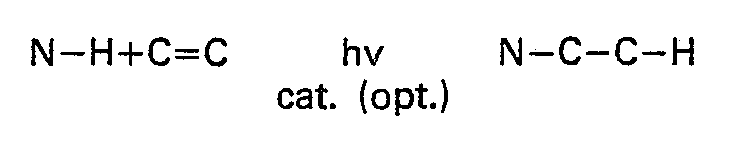
- The present invention is directed to a process for producing amines by reacting a primary or secondary amine or ammonia with an olefin having a terminal double bond and 2 to 8 carbons, which is characterized by carrying out the reaction in the presence of light having a wavelength above 160 nm (1600 A) and a photocatalyst, whereby an N-H bond of the amine or ammonia is added across the double bond of the olefin.
- The process of the present invention can be illustrated by the following general reaction:
- This process can be conducted both with or without a photocatalyst depending on the source of actinic radiation used. It has been discovered that if a suitable photocatalyst is not present, the light source must be one with significant output in the spectral region with wavelengths from about 220 to about 160 nm (about 2200 A to about 1600 A) to be effective. Since the reactors and lamps used for this process usually consist of vessels having conventional quartz glass walls to pass actinic light, the lower-wavelength end, in practice, is usually set by the light transmission cut-off of conventional quartz glass (around 180 nm). However, we have found that the use of amorphous silica or synthetic silica glass for the vessel walls or for the lamp glass of the equipment of this process is advantageous because it transmits more short-wave length ultraviolet radiation than conventional quartz glass (cut-off around 160 nm). Glass comprising such synthetic silica is marketed under the trademark Suprasil@ by Heraeus Amersil and as Corning #7940 by Corning Glass Company.
- Typical lamps emitting in the range of 160-220 nm (1600-2200 A) are deuterium lamps, low-pressure mercury-argon lamps, and high-energy xenon flash lamps. The high-energy xenon flash lamp is particularly effective because of its high-energy intensity and its large output in the range 180-220 nm. This listing is non-limiting and the lamps mentioned are to be used only as examples of available light sources. Lamps that transmit light with wavelengths above this range are only marginally effective without the use of a photocatalyst; additionally, low-energy flash lamps which peak out at about 400 nm, require the use of a photocatalyst to provide a suitable yield in this reaction.
- As used herein, the term photocatalyst can mean a material which when added to the reactants causes the desired reaction to occur under the influence of actinic light at a significantly increased rate. Although not wishing to be limited by any theory, the photocatalyst can be a light-absorbing organic compound, a transition-metal coordination compound that can complex with the olefin and amine reactants and make them more susceptible to reaction under the influence of actinic light, or mercury.
- Useful organic photosensitizers fall into the categories of ketones, aromatic hydrocarbons, alcohols, organometallics heterocyclic amines, organic dyes, sulfur-compounds, and organo derivatives of Group V A elements. Examples of useful organic photocatalysts for this invention are acetone, 2-butanone, 2-pentanone, 3-pentanone, 4-heptanone, diisopropylketone, acetophenone, isobutyrophenone, propiophenone, benzophenone, 3-hydroxy-2-butanone, 2,4-pentanedione, benzene, m-xylene, diacetone alcohol, pyridine, 2,2'-diethoxyacetophenone, triphenylphosphine, triphenylarsine, triphenylbismuthine, triphenylstibine, tributylphosphine and 8-hydroxyquinoline. Preferred examples are acetone, 2-butanone, and 2,4-pentanedione.
- Examples of suitable transition-metal complexes are coordination compounds of rhodium, ruthenium, iron and molybdenum. Specific examples are: hydridocarbonyltris (triphenylphosphine) rhodium (I), chlorotris (triphenylphosphine) rhodium (I), dichlorobis (dimethylglyoximato) rhodium (III), dichlorobis (phenylmethylglyoximato) rhodium (III), methylaquobis (dimethylglyoximato) rhodium (III), chloro- triphenylphosphinebis (dimethylglyoximato) rhodium (III), dichlorotetrakis (isoquinolino) rhodium (III) chloride, dichlorotris (triphenylphosphine) ruthenium (11), hexamolybdenum dodecachloride, molybdenum (II) cluster compounds of the formulas Mo6Cl12, [Mo6Cl8] Cl4L2, where L is a ligand displaceable by the amino reactant and may be the amino reactant (e.g., (CH3)2NH or NH3) itself, and Group VIII metal carbonyls. Preferred transition-metal photocatalysts are dichlorotris (triphenylphosphine) ruthenium (II), chlorotris (triphenylphosphine) rhodium (I), molybdenum (II) cluster compounds of the formula [MO6Cl8] C14L2 (when L is as defined above) and Fe(CO)5.
- The above photocatalysts can be used individually or in combination to improve conversions and yields. Particularly preferred are combinations of Fe(CO)5 with one or more of the following compounds: tri(n-butyl) phosphine, tri(n-propyl) phosphine, triethylphosphite, diethylphenylphosphine, diphenylchlorophosphine, bis(1,2-diphenylphosphino) ethane, and 2,4-pentanedione.
- Organic photocatalysts can be added in any catalytically effective amount with respect to the amine or ammonia reactant, with the preferred range being below the limit of solubility of the organic photocatalyst. Transition-metal photocatalysts may also be added in any effective amount, but are typically used at their solubility limits in the ammonia or amine reactants.
- Mercury is usually employed as a catalyst in a vapor form prepared by passing an inert carrier gas, e.g., helium, through elemental mercury maintained at vaporization temperature (200°C). Fine droplets of elemental mercury may also be used without a carrier, if desired. The mercury catalyst is used in an amount at least sufficient to demonstrate catalytic activity. The maximum concentration of mercury which is used with an inert carrier is up to and including the amount of mercury vapor carried by the flowing gas at the saturated vapor-pressure of mercury.
- Suitable reactants containing N-H bonds are ammonia and the various primary and secondary amines. Specific examples of such amines include: methylamine, dimethylamine, ethylamine, dimethylamine, n-propylamine, isopropylamine, di(n-propyl) amine, di(isopropyl) amine, n-butylamine, di(n-butyl) amine, sec-butylamine, di-(sec:butyl) amine, isobutylamine, di(isobutyl) amine, the pentyl and higher alkyl amines; cycloaliphatic amines such as cyclohexylamine; aromatic amines such as aniline, the N-alkylanilines, diphenylamine, the naphthylamines, and the toluidines; heterocyclic amines such as pyrrolidine, morpholine, and piperidine; substituted amines such as the alkanolamines; and polyamines such as ethylene diamine, and 1,6-hexanediamine.
- Preferred N-H containing reactants, because of their commercial significance, are ammonia, and the mono- and di-alkyl (C1-Ca) amines. An especially preferred N-H containing reactant is ammonia.
- Olefinic compounds suitable for the present process are the unactivated alkenes of 2 to 8 carbons having terminal double bonds. Specific examples of such compounds are ethylene, propylene, 1-butene, 2-butene, isobutylene, 1-pentene, 2-pentene, 3-methyl-1-butene 3-methyl-1-butene, 2-methyl-2-butene, the several possible hexenes, higher alkenes (e.g., dodecene), styrene, alpha methylstyrene, alpha, alpha- dimethylstyrene, butadiene, 2-methyl-1,3-butadiene, 2-chloro-1,3-butadiene, acrylonitrile vinylchloride, methyl vinyl ether, and allyl alcohol.
- It is to be understood that the N-H containing reactants and olefins can be optionally substituted with various groups (such as -OH, -halide, -CN) as long as such groups do not interfere with the process.
- Typical temperatures for conducting the process of this invention range from -10°C to 40°C but any convenient temperature may be used. Temperatures in the range -10°C to 10°C are preferred. The lower temperatures allow greater solubility of gaseous olefins, such as ethylene, in liquid ammonia or the amines.
- The mole ratio of ammonia or starting amine to olefin can range from 1:1 to 20:1 with a ratio in the range of 5:1 to 15:1 being preferred.
- Although it is preferable to conduct the reaction of this invention in the liquid phase, it is also possible to operate in the gas or solid phase. By operating in the gas phase the use of certain solid photocatalysts may be precluded because of their low vapor-pressure.
- Most of the examples which follow, illustrate the process of this invention as carried out in an apparatus which can be used in a continuous process in either the liquid or gas phase using known methods for introducing reactants and the photocatalyst, and for separating products from the starting materials.
- 18.2 moles of ammonia was charged into a reactor system consisting of a one-liter stainless steel reservoir, a quartz reactor for admitting the actinic light to the solution, and a circulating pump. External to the quartz reactor was an ultraviolet light source. Both reactor and light source were enclosed in a reflecting stainless steel cylinder. Ethylene was then charged into the system until the pressure reached 18.9 bar and 2.3 moles of ethylene were dissolved in the ammonia. Before the lamp was turned on, the solution was circulated for approximately one-half hour to ensure proper mixing and to cool the reactant mixture to 7-8°C. No reaction was observed in this period. The circulating high pressure (autogenous) liquid reactant mixture was then exposed to ultraviolet lamps for the time periods given in Table 1. Analyses of the final mixture by gas chromatography are also shown in the Table. Conversions are given for ethylene, and yields are to mixed mono-, di- and tri-ethylamines. The high-energy xenon flash lamp of Table 1 discharges 25 joules over a 10 cm. path through a 1 mm. bore; the spectral output peaks at 300 nm and a large proportion of the radiation falls in the range of 180-220 nm.

- It is readily seen from Table 1 that poor yields are obtained with the mercury lamp, a device that has no output below 220 nm, and the low-energy xenon flash lamp which discharges 25 joules over a 10 cm. path through a 13 mm. bore and has a spectral output peak of 400 nm.
- A mixture of 18.2 moles of ammonia and 0.9 moles of acetone was charged into the reactor system described in Example 1. Ethylene was then charged into the system and 2.3 moles dissolved in the ammonia-acetone solution. After circulation of the solution for one-half hour, a deuterium lamp was turned on and the solution exposed for 4 hours. Analysis of the final mixture by gas chromatography showed a 27.9 conversion of ethylene with a 72.1% yield to mono-, di- and tri-ethylamines.
- A mixture of 18.2 moles of ammonia, 1.82 moles of 1-butene and 0.9 moles of acetone was charged into the reactor system described in Example 1 except that the light source was 550-watt mercury lamp. The high-pressure liquid mixture was circulated for four hours at 8°C. Gas chromatographic analyses and confirmatory identifications by mass spectrometry showed a 7.0% conversion to N-ethyl-n-butyl amine. When acetone is not used, no product is observed.
- A mixture of 17.0 moles of ammonia, 1.72 moles of 1-octene, and 0.88 moles of acetone was charged into the reactor system described in Example 1 and circulated for five hours at 8°C. The UV light source was a 550-W mercury lamp. The product, 2.9 grams of octylamine, was collected at 180°C by distillation and identified by NMR. Further confirmation was obtained by titrimetric analysis. When acetone is not used, no product is observed.
- A mixture consisting of 8.68 moles of ethylamine, 1.43 moles of 1-butene and 0.7 moles of methyl ethyl ketone was charged into the reactor system described in Example 1. Circulation of this reactant mixture for four hours at 8°C gave a 1-butene conversion of 5.0% and yield to N-ethyl-n-butylamine of 100% using the 550-W mercury lamp.
- A mixture of 5.0 moles of n-butylamine, 0.5 mole of acetone and 0.84 mole of ethylene were charged into the reactor system described in Example 1. Circulation of the reactant mixture for four hours at 8°C using the 550-Watt mercury lamp gave a conversion of ethylene of 12.0% and a yield to N-ethyl-n-butylamine of 100%.
- A mixture of 7.60 moles of dimethylamine, 1.15 moles ethylene and 0.0023 mole of MOCCI12 was charged into the reactor system described in Example 1. Circulation of the reactant mixture for four hours at 8°C gave a conversion of ethylene of 10% and a combined yield to dimethylethylamine, diethylmethylamine, and triethylamine of nearly 100% using the 550-watt mercury lamp.
- A mixture of 4.04 moles of n-butylamine, 0.221 mole of Fe(CO)5, and 0.221 moles of triethyl phosphite was pressurized to 18.2 bar at 35°C, with ethylene in the reactor system described in Example 1. The light source was a 550 watt, high pressure mercury ultraviolet lamp. The mixture was circulated for 4 hours with constant irradiation. Analysis of the products showed a 15.5% conversion of the n-butylamine to N-ethyl-n-butylamine.
- Ammonia (18.2 moles) and ammonium chloride (NH4CI), 0.18 mole) were charged to a 1-liter cyclic system equipped with a circulating pump, a cooling coil, and a cylindrical glass reactor. An ultraviolet lamp was mounted near the reactor and both the reactor and lamp were enclosed in a reflecting stainless-steel cylinder. Ethylene was charged to the system until the pressure was, arbitrarily, 18.2 bar. The resulting solution was circulated for about hour or until the solution temperature reached 7-8°C. The lamp was turned on and the solution was irradiated for four hours.
- To demonstrate the influence of amorphous silica glass in the reactor and the irradiating lamp, the results of eight runs using the above described procedure are reported in the following table. In four (4) of the eight runs, the reactor walls were of conventional quartz glass while in the remaining four (4) runs, the reactor walls were of amorphous silica glass (Suprasil@). In both series of four (4) runs, the irradiating lamps of two (2) runs had conventional quartz glass housings while the other two (2) used lamps with amorphous silica glass (Suprasil@) housings. The percent conversions in the table are based on the amount of ammonium chloride present since, in every case, the product, ethylamine, was obtained as the corresponding hydrochloride. The yields are virtually quantitative.

- Gaseous ammonia, ethylene, helium and mercury vapor are exposed simultaneously to ultraviolet light in a single-pass reactor system consisting of flow controllers, a stainless-steel, mercury-reflux pot and a quartz reactor chamber. A stream of helium is first passed through elemental mercury heated to about 200°C and the He/Hg vapor is immediately blended with a mixture of ethylene and ammonia (1:1 volume) prior to the reactor chamber. The reactor chamber is irradiated by a low pressure mercury lamp external to the reactor. The vent gases were collected and the product was identified as ethylamine in 85 to 98% purity.
Claims (11)
Priority Applications (6)
| Application Number | Priority Date | Filing Date | Title |
|---|---|---|---|
| CA000412048A CA1190181A (en) | 1982-10-25 | 1982-09-23 | Light-catalyzed process for preparing amines |
| DE8282109847T DE3276753D1 (en) | 1982-10-25 | 1982-10-25 | Light-catalyzed process for preparing amines |
| EP82109847A EP0106911B1 (en) | 1982-10-25 | 1982-10-25 | Light-catalyzed process for preparing amines |
| AU89867/82A AU554110B2 (en) | 1982-10-25 | 1982-10-28 | Light catalyzed process for preparing amines |
| ZA827932A ZA827932B (en) | 1982-10-25 | 1982-10-29 | |
| JP57192588A JPS5982348A (en) | 1982-10-25 | 1982-11-04 | Photocatalytical manufacture of amine |
Applications Claiming Priority (1)
| Application Number | Priority Date | Filing Date | Title |
|---|---|---|---|
| EP82109847A EP0106911B1 (en) | 1982-10-25 | 1982-10-25 | Light-catalyzed process for preparing amines |
Publications (2)
| Publication Number | Publication Date |
|---|---|
| EP0106911A1 EP0106911A1 (en) | 1984-05-02 |
| EP0106911B1 true EP0106911B1 (en) | 1987-07-15 |
Family
ID=8189307
Family Applications (1)
| Application Number | Title | Priority Date | Filing Date |
|---|---|---|---|
| EP82109847A Expired EP0106911B1 (en) | 1982-10-25 | 1982-10-25 | Light-catalyzed process for preparing amines |
Country Status (6)
| Country | Link |
|---|---|
| EP (1) | EP0106911B1 (en) |
| JP (1) | JPS5982348A (en) |
| AU (1) | AU554110B2 (en) |
| CA (1) | CA1190181A (en) |
| DE (1) | DE3276753D1 (en) |
| ZA (1) | ZA827932B (en) |
Families Citing this family (5)
| Publication number | Priority date | Publication date | Assignee | Title |
|---|---|---|---|---|
| US4483757A (en) * | 1981-12-23 | 1984-11-20 | Pennwalt Corporation | Photochemical process for preparing amines |
| US6033531A (en) * | 1997-06-18 | 2000-03-07 | Berkshire Laboratories, Inc. | Spectral catalysts |
| EP1490315A4 (en) * | 2002-03-11 | 2005-07-06 | Berkshire Lab Inc | Controlling chemical reactions by spectral chemistry and spectral conditioning |
| US7482072B2 (en) | 2002-07-09 | 2009-01-27 | Grintellectual Reserve, Llc | Optimizing reactions in fuel cells and electrochemical reactions |
| US8349780B2 (en) * | 2009-11-13 | 2013-01-08 | The Procter & Gamble Company | Compositions and methods incorporating photocatalysts |
Family Cites Families (1)
| Publication number | Priority date | Publication date | Assignee | Title |
|---|---|---|---|---|
| CA1176661A (en) * | 1980-04-28 | 1984-10-23 | David M. Gardner | Preparation of amines from olefins using certain transition metal catalysts |
-
1982
- 1982-09-23 CA CA000412048A patent/CA1190181A/en not_active Expired
- 1982-10-25 EP EP82109847A patent/EP0106911B1/en not_active Expired
- 1982-10-25 DE DE8282109847T patent/DE3276753D1/en not_active Expired
- 1982-10-28 AU AU89867/82A patent/AU554110B2/en not_active Ceased
- 1982-10-29 ZA ZA827932A patent/ZA827932B/xx unknown
- 1982-11-04 JP JP57192588A patent/JPS5982348A/en active Granted
Non-Patent Citations (2)
| Title |
|---|
| C.R. NOLLER: Chemistry of Organic Compounds, pages 622-623 * |
| P. Sykes: A guidebook to mechanism in organic chemistry, page 197 * |
Also Published As
| Publication number | Publication date |
|---|---|
| DE3276753D1 (en) | 1987-08-20 |
| AU8986782A (en) | 1984-05-03 |
| EP0106911A1 (en) | 1984-05-02 |
| ZA827932B (en) | 1983-11-03 |
| CA1190181A (en) | 1985-07-09 |
| JPH0251421B2 (en) | 1990-11-07 |
| JPS5982348A (en) | 1984-05-12 |
| AU554110B2 (en) | 1986-08-07 |
Similar Documents
| Publication | Publication Date | Title |
|---|---|---|
| Smutny | Oligomerization and dimerization of butadiene under homogeneous catalysis. Reaction with nucleophiles and the synthesis of 1, 3, 7-octatriene | |
| Salomon et al. | Copper (I) catalysis in photocycloadditions. I. Norbornene | |
| Sharpless et al. | 1, 2-Diamination of 1, 3-dienes by imido selenium compounds | |
| EP0071437B1 (en) | Process of preparing hydrocarbons rich in light monoolefins from methanol and/or dimethyl ether | |
| US4459191A (en) | Light-catalyzed process for preparing amines | |
| EP0115943A2 (en) | Process for preparing polyfluoroalkyl-substituted compounds | |
| EP0106911A1 (en) | Light-catalyzed process for preparing amines | |
| Dzhemilev et al. | Hydroamination of conjugated dienes catalyzed by transition metal complexes | |
| Coates et al. | New synthesis of ethyl 2, 3-dihydro-1H-pyrrolo [1, 2-a] indole-9-carboxylates via apparent 1-aza-1'-oxa [3, 3] sigmatropic rearrangement | |
| Liu et al. | Photochemistry of iron and ruthenium carbonyl complexes: evidence for light-induced loss of carbon monoxide and reductive elimination of triethylsilane from cis-mer-HM (SiEt3)(CO) 3 (PPh3) | |
| EP0062542B1 (en) | Process for synthesizing aniline | |
| EP0158716B1 (en) | Photochemical process for preparing amines | |
| KR880002620B1 (en) | Light catalyzed process for preparing amines | |
| CA1064054A (en) | Process for the manufacture of 3-aminophenols by dehydrogenation of 3-aminocyclohexenones | |
| US4760184A (en) | Alkylation of aromatic amines in the presence of non-zeolitic molecular sieves | |
| Michejda et al. | Addition of complexed amino radicals to conjugated alkenes | |
| Paquette et al. | . alpha.-Halo sulfones. XIV.[4.4. 2] Propella-2, 4, 7, 9, 11-pentaene | |
| GB1462254A (en) | Alkylation of aromatic amines | |
| Dajnak et al. | Imine-stabilized silylium ions: synthesis, structure and application in catalysis | |
| Jaenicke et al. | Quantum yields in photolysis of (diene) tricarbonyliron and bis (diene) carbonyliron complexes | |
| Sinnreich et al. | The light-induced addition of 2-pyrrolidone to olefins | |
| Manion et al. | Synthesis and reactivity of rhenium (I) tris (acetylene) complexes ReX (RC. tplbond. CR) 3 | |
| Seltzer et al. | Photonitration of phenols by tetranitromethane under visible light | |
| Kabalka et al. | Hydroboration/Amination of N-Trimethylsilyl Protected Olefinic Amines and Diolefins: Synthesis of Isomerically Pure Diamines | |
| US3623966A (en) | Photodimerization of acrylonitrile |
Legal Events
| Date | Code | Title | Description |
|---|---|---|---|
| PUAI | Public reference made under article 153(3) epc to a published international application that has entered the european phase |
Free format text: ORIGINAL CODE: 0009012 |
|
| AK | Designated contracting states |
Designated state(s): BE DE FR GB IT NL SE |
|
| 17P | Request for examination filed |
Effective date: 19840903 |
|
| GRAA | (expected) grant |
Free format text: ORIGINAL CODE: 0009210 |
|
| ITF | It: translation for a ep patent filed | ||
| AK | Designated contracting states |
Kind code of ref document: B1 Designated state(s): BE DE FR GB IT NL SE |
|
| REF | Corresponds to: |
Ref document number: 3276753 Country of ref document: DE Date of ref document: 19870820 |
|
| ET | Fr: translation filed | ||
| PLBE | No opposition filed within time limit |
Free format text: ORIGINAL CODE: 0009261 |
|
| STAA | Information on the status of an ep patent application or granted ep patent |
Free format text: STATUS: NO OPPOSITION FILED WITHIN TIME LIMIT |
|
| 26N | No opposition filed | ||
| REG | Reference to a national code |
Ref country code: GB Ref legal event code: 732 |
|
| ITPR | It: changes in ownership of a european patent |
Owner name: CAMBIO RAGIONE SOCIALE;ATOCHEM NORTH AMERICA INC. |
|
| REG | Reference to a national code |
Ref country code: FR Ref legal event code: CD |
|
| PGFP | Annual fee paid to national office [announced via postgrant information from national office to epo] |
Ref country code: SE Payment date: 19920924 Year of fee payment: 11 |
|
| PGFP | Annual fee paid to national office [announced via postgrant information from national office to epo] |
Ref country code: GB Payment date: 19920928 Year of fee payment: 11 |
|
| PGFP | Annual fee paid to national office [announced via postgrant information from national office to epo] |
Ref country code: FR Payment date: 19921009 Year of fee payment: 11 |
|
| PGFP | Annual fee paid to national office [announced via postgrant information from national office to epo] |
Ref country code: DE Payment date: 19921026 Year of fee payment: 11 |
|
| ITTA | It: last paid annual fee | ||
| PGFP | Annual fee paid to national office [announced via postgrant information from national office to epo] |
Ref country code: NL Payment date: 19921031 Year of fee payment: 11 |
|
| PGFP | Annual fee paid to national office [announced via postgrant information from national office to epo] |
Ref country code: BE Payment date: 19921116 Year of fee payment: 11 |
|
| PG25 | Lapsed in a contracting state [announced via postgrant information from national office to epo] |
Ref country code: GB Effective date: 19931025 |
|
| PG25 | Lapsed in a contracting state [announced via postgrant information from national office to epo] |
Ref country code: SE Effective date: 19931026 |
|
| PG25 | Lapsed in a contracting state [announced via postgrant information from national office to epo] |
Ref country code: BE Effective date: 19931031 |
|
| BERE | Be: lapsed |
Owner name: ATOCHEM NORTH AMERICA INC. Effective date: 19931031 |
|
| PG25 | Lapsed in a contracting state [announced via postgrant information from national office to epo] |
Ref country code: NL Effective date: 19940501 |
|
| NLV4 | Nl: lapsed or anulled due to non-payment of the annual fee | ||
| GBPC | Gb: european patent ceased through non-payment of renewal fee |
Effective date: 19931025 |
|
| PG25 | Lapsed in a contracting state [announced via postgrant information from national office to epo] |
Ref country code: FR Effective date: 19940630 |
|
| PG25 | Lapsed in a contracting state [announced via postgrant information from national office to epo] |
Ref country code: DE Effective date: 19940701 |
|
| REG | Reference to a national code |
Ref country code: FR Ref legal event code: ST |
|
| EUG | Se: european patent has lapsed |
Ref document number: 82109847.2 Effective date: 19940510 |