EP0106889B1 - Plasma protein concentrates of reduced thrombogenicity and their use in clinical replacement therapy - Google Patents
Plasma protein concentrates of reduced thrombogenicity and their use in clinical replacement therapy Download PDFInfo
- Publication number
- EP0106889B1 EP0106889B1 EP83901767A EP83901767A EP0106889B1 EP 0106889 B1 EP0106889 B1 EP 0106889B1 EP 83901767 A EP83901767 A EP 83901767A EP 83901767 A EP83901767 A EP 83901767A EP 0106889 B1 EP0106889 B1 EP 0106889B1
- Authority
- EP
- European Patent Office
- Prior art keywords
- factor
- fraction
- concentrate
- factors
- plasma
- Prior art date
- Legal status (The legal status is an assumption and is not a legal conclusion. Google has not performed a legal analysis and makes no representation as to the accuracy of the status listed.)
- Expired - Lifetime
Links
- 239000012141 concentrate Substances 0.000 title claims abstract description 56
- 238000009256 replacement therapy Methods 0.000 title abstract description 14
- 102000004506 Blood Proteins Human genes 0.000 title description 5
- 108010017384 Blood Proteins Proteins 0.000 title description 5
- 108010076282 Factor IX Proteins 0.000 claims description 51
- 102100022641 Coagulation factor IX Human genes 0.000 claims description 37
- 108010014173 Factor X Proteins 0.000 claims description 30
- 229960004222 factor ix Drugs 0.000 claims description 30
- 108010012557 prothrombin complex concentrates Proteins 0.000 claims description 22
- 108010094028 Prothrombin Proteins 0.000 claims description 16
- 238000000034 method Methods 0.000 claims description 15
- FAPWRFPIFSIZLT-UHFFFAOYSA-M Sodium chloride Chemical compound [Na+].[Cl-] FAPWRFPIFSIZLT-UHFFFAOYSA-M 0.000 claims description 14
- 230000000694 effects Effects 0.000 claims description 14
- 102000004169 proteins and genes Human genes 0.000 claims description 9
- 108090000623 proteins and genes Proteins 0.000 claims description 9
- 239000003795 chemical substances by application Substances 0.000 claims description 8
- 238000010828 elution Methods 0.000 claims description 8
- 230000001453 nonthrombogenic effect Effects 0.000 claims description 8
- 239000011780 sodium chloride Substances 0.000 claims description 7
- 230000001965 increasing effect Effects 0.000 claims description 6
- 239000011159 matrix material Substances 0.000 claims description 6
- 230000001225 therapeutic effect Effects 0.000 claims description 6
- AGVAZMGAQJOSFJ-WZHZPDAFSA-M cobalt(2+);[(2r,3s,4r,5s)-5-(5,6-dimethylbenzimidazol-1-yl)-4-hydroxy-2-(hydroxymethyl)oxolan-3-yl] [(2r)-1-[3-[(1r,2r,3r,4z,7s,9z,12s,13s,14z,17s,18s,19r)-2,13,18-tris(2-amino-2-oxoethyl)-7,12,17-tris(3-amino-3-oxopropyl)-3,5,8,8,13,15,18,19-octamethyl-2 Chemical compound [Co+2].N#[C-].[N-]([C@@H]1[C@H](CC(N)=O)[C@@]2(C)CCC(=O)NC[C@@H](C)OP(O)(=O)O[C@H]3[C@H]([C@H](O[C@@H]3CO)N3C4=CC(C)=C(C)C=C4N=C3)O)\C2=C(C)/C([C@H](C\2(C)C)CCC(N)=O)=N/C/2=C\C([C@H]([C@@]/2(CC(N)=O)C)CCC(N)=O)=N\C\2=C(C)/C2=N[C@]1(C)[C@@](C)(CC(N)=O)[C@@H]2CCC(N)=O AGVAZMGAQJOSFJ-WZHZPDAFSA-M 0.000 claims description 5
- 238000001179 sorption measurement Methods 0.000 claims description 4
- 150000004676 glycans Chemical class 0.000 claims description 3
- 229920001282 polysaccharide Polymers 0.000 claims description 3
- 239000005017 polysaccharide Substances 0.000 claims description 3
- 230000008569 process Effects 0.000 claims description 3
- XLYOFNOQVPJJNP-UHFFFAOYSA-N water Substances O XLYOFNOQVPJJNP-UHFFFAOYSA-N 0.000 claims description 2
- 239000006096 absorbing agent Substances 0.000 claims 2
- 239000007864 aqueous solution Substances 0.000 claims 2
- 238000010521 absorption reaction Methods 0.000 claims 1
- 238000004255 ion exchange chromatography Methods 0.000 claims 1
- 102000015081 Blood Coagulation Factors Human genes 0.000 abstract description 20
- 108010039209 Blood Coagulation Factors Proteins 0.000 abstract description 20
- 239000003114 blood coagulation factor Substances 0.000 abstract description 20
- 230000002885 thrombogenetic effect Effects 0.000 abstract description 10
- 229930003448 Vitamin K Natural products 0.000 abstract description 9
- 230000001419 dependent effect Effects 0.000 abstract description 9
- SHUZOJHMOBOZST-UHFFFAOYSA-N phylloquinone Natural products CC(C)CCCCC(C)CCC(C)CCCC(=CCC1=C(C)C(=O)c2ccccc2C1=O)C SHUZOJHMOBOZST-UHFFFAOYSA-N 0.000 abstract description 9
- 235000019168 vitamin K Nutrition 0.000 abstract description 9
- 239000011712 vitamin K Substances 0.000 abstract description 9
- 150000003721 vitamin K derivatives Chemical class 0.000 abstract description 9
- 229940046010 vitamin k Drugs 0.000 abstract description 9
- 230000002950 deficient Effects 0.000 abstract description 7
- 208000027219 Deficiency disease Diseases 0.000 abstract description 2
- 108010062466 Enzyme Precursors Proteins 0.000 abstract description 2
- 102000010911 Enzyme Precursors Human genes 0.000 abstract description 2
- 229940024790 prothrombin complex concentrate Drugs 0.000 description 18
- 102100027378 Prothrombin Human genes 0.000 description 11
- 229940039716 prothrombin Drugs 0.000 description 11
- 238000001802 infusion Methods 0.000 description 10
- 238000012360 testing method Methods 0.000 description 10
- 239000008280 blood Substances 0.000 description 8
- 210000004369 blood Anatomy 0.000 description 8
- 208000009429 hemophilia B Diseases 0.000 description 8
- 238000002360 preparation method Methods 0.000 description 8
- 241000283973 Oryctolagus cuniculus Species 0.000 description 7
- 241001465754 Metazoa Species 0.000 description 6
- 229920005654 Sephadex Polymers 0.000 description 6
- 239000012507 Sephadex™ Substances 0.000 description 6
- 230000015271 coagulation Effects 0.000 description 6
- 238000005345 coagulation Methods 0.000 description 6
- 230000007812 deficiency Effects 0.000 description 6
- 108010049003 Fibrinogen Proteins 0.000 description 5
- 102000008946 Fibrinogen Human genes 0.000 description 5
- 230000037396 body weight Effects 0.000 description 5
- 229940012952 fibrinogen Drugs 0.000 description 5
- 238000000338 in vitro Methods 0.000 description 5
- 239000000463 material Substances 0.000 description 5
- 238000000746 purification Methods 0.000 description 5
- 230000009424 thromboembolic effect Effects 0.000 description 5
- 206010010356 Congenital anomaly Diseases 0.000 description 4
- 238000011888 autopsy Methods 0.000 description 4
- 238000001727 in vivo Methods 0.000 description 4
- 201000002282 venous insufficiency Diseases 0.000 description 4
- 102100023804 Coagulation factor VII Human genes 0.000 description 3
- 108010023321 Factor VII Proteins 0.000 description 3
- 108010054218 Factor VIII Proteins 0.000 description 3
- 102000001690 Factor VIII Human genes 0.000 description 3
- BWGVNKXGVNDBDI-UHFFFAOYSA-N Fibrin monomer Chemical group CNC(=O)CNC(=O)CN BWGVNKXGVNDBDI-UHFFFAOYSA-N 0.000 description 3
- 101800004937 Protein C Proteins 0.000 description 3
- 102000017975 Protein C Human genes 0.000 description 3
- 208000008425 Protein deficiency Diseases 0.000 description 3
- 101800001700 Saposin-D Proteins 0.000 description 3
- 241000282887 Suidae Species 0.000 description 3
- 238000010171 animal model Methods 0.000 description 3
- 238000011109 contamination Methods 0.000 description 3
- 238000010586 diagram Methods 0.000 description 3
- 208000009190 disseminated intravascular coagulation Diseases 0.000 description 3
- 238000011156 evaluation Methods 0.000 description 3
- 229960000301 factor viii Drugs 0.000 description 3
- 230000001939 inductive effect Effects 0.000 description 3
- 238000002347 injection Methods 0.000 description 3
- 239000007924 injection Substances 0.000 description 3
- 239000000178 monomer Substances 0.000 description 3
- 239000000047 product Substances 0.000 description 3
- 229960000856 protein c Drugs 0.000 description 3
- 238000011555 rabbit model Methods 0.000 description 3
- 239000007858 starting material Substances 0.000 description 3
- BFSVOASYOCHEOV-UHFFFAOYSA-N 2-diethylaminoethanol Chemical compound CCN(CC)CCO BFSVOASYOCHEOV-UHFFFAOYSA-N 0.000 description 2
- 229920002307 Dextran Polymers 0.000 description 2
- 108010073385 Fibrin Proteins 0.000 description 2
- 102000009123 Fibrin Human genes 0.000 description 2
- 235000010469 Glycine max Nutrition 0.000 description 2
- 244000068988 Glycine max Species 0.000 description 2
- 239000004698 Polyethylene Substances 0.000 description 2
- 208000007536 Thrombosis Diseases 0.000 description 2
- 101710162629 Trypsin inhibitor Proteins 0.000 description 2
- 229940122618 Trypsin inhibitor Drugs 0.000 description 2
- 206010047249 Venous thrombosis Diseases 0.000 description 2
- 238000005571 anion exchange chromatography Methods 0.000 description 2
- 238000003556 assay Methods 0.000 description 2
- 230000015572 biosynthetic process Effects 0.000 description 2
- 238000006243 chemical reaction Methods 0.000 description 2
- 230000003247 decreasing effect Effects 0.000 description 2
- 231100000676 disease causative agent Toxicity 0.000 description 2
- 238000002474 experimental method Methods 0.000 description 2
- 229940012413 factor vii Drugs 0.000 description 2
- 229950003499 fibrin Drugs 0.000 description 2
- 238000005194 fractionation Methods 0.000 description 2
- 238000005462 in vivo assay Methods 0.000 description 2
- 239000000203 mixture Substances 0.000 description 2
- 238000012986 modification Methods 0.000 description 2
- 230000004048 modification Effects 0.000 description 2
- 230000001575 pathological effect Effects 0.000 description 2
- -1 polyethylene Polymers 0.000 description 2
- 229920000573 polyethylene Polymers 0.000 description 2
- 238000011160 research Methods 0.000 description 2
- 239000011347 resin Substances 0.000 description 2
- 229920005989 resin Polymers 0.000 description 2
- 231100000279 safety data Toxicity 0.000 description 2
- 230000037390 scarring Effects 0.000 description 2
- 238000002560 therapeutic procedure Methods 0.000 description 2
- 230000001732 thrombotic effect Effects 0.000 description 2
- 239000002753 trypsin inhibitor Substances 0.000 description 2
- 210000003462 vein Anatomy 0.000 description 2
- PGOHTUIFYSHAQG-LJSDBVFPSA-N (2S)-6-amino-2-[[(2S)-5-amino-2-[[(2S)-2-[[(2S)-2-[[(2S)-2-[[(2S)-4-amino-2-[[(2S)-2-[[(2S)-2-[[(2S)-2-[[(2S)-2-[[(2S)-5-amino-2-[[(2S)-5-amino-2-[[(2S)-2-[[(2S)-2-[[(2S)-2-[[(2S,3R)-2-[[(2S)-5-amino-2-[[(2S)-2-[[(2S)-2-[[(2S,3R)-2-[[(2S)-2-[[(2S)-2-[[(2S)-2-[[(2S)-2-[[(2S)-5-amino-2-[[(2S)-1-[(2S,3R)-2-[[(2S)-2-[[(2S)-2-[[(2R)-2-[[(2S)-2-[[(2S)-2-[[2-[[(2S)-2-[[(2S)-2-[[(2S)-2-[[(2S)-1-[(2S)-2-[[(2S)-2-[[(2S)-2-[[(2S)-2-amino-4-methylsulfanylbutanoyl]amino]-3-(1H-indol-3-yl)propanoyl]amino]-5-carbamimidamidopentanoyl]amino]propanoyl]pyrrolidine-2-carbonyl]amino]-3-methylbutanoyl]amino]-4-methylpentanoyl]amino]-4-methylpentanoyl]amino]acetyl]amino]-3-hydroxypropanoyl]amino]-4-methylpentanoyl]amino]-3-sulfanylpropanoyl]amino]-4-methylsulfanylbutanoyl]amino]-5-carbamimidamidopentanoyl]amino]-3-hydroxybutanoyl]pyrrolidine-2-carbonyl]amino]-5-oxopentanoyl]amino]-3-hydroxypropanoyl]amino]-3-hydroxypropanoyl]amino]-3-(1H-imidazol-5-yl)propanoyl]amino]-4-methylpentanoyl]amino]-3-hydroxybutanoyl]amino]-3-(1H-indol-3-yl)propanoyl]amino]-5-carbamimidamidopentanoyl]amino]-5-oxopentanoyl]amino]-3-hydroxybutanoyl]amino]-3-hydroxypropanoyl]amino]-3-carboxypropanoyl]amino]-3-hydroxypropanoyl]amino]-5-oxopentanoyl]amino]-5-oxopentanoyl]amino]-3-phenylpropanoyl]amino]-5-carbamimidamidopentanoyl]amino]-3-methylbutanoyl]amino]-4-methylpentanoyl]amino]-4-oxobutanoyl]amino]-5-carbamimidamidopentanoyl]amino]-3-(1H-indol-3-yl)propanoyl]amino]-4-carboxybutanoyl]amino]-5-oxopentanoyl]amino]hexanoic acid Chemical compound CSCC[C@H](N)C(=O)N[C@@H](Cc1c[nH]c2ccccc12)C(=O)N[C@@H](CCCNC(N)=N)C(=O)N[C@@H](C)C(=O)N1CCC[C@H]1C(=O)N[C@@H](C(C)C)C(=O)N[C@@H](CC(C)C)C(=O)N[C@@H](CC(C)C)C(=O)NCC(=O)N[C@@H](CO)C(=O)N[C@@H](CC(C)C)C(=O)N[C@@H](CS)C(=O)N[C@@H](CCSC)C(=O)N[C@@H](CCCNC(N)=N)C(=O)N[C@@H]([C@@H](C)O)C(=O)N1CCC[C@H]1C(=O)N[C@@H](CCC(N)=O)C(=O)N[C@@H](CO)C(=O)N[C@@H](CO)C(=O)N[C@@H](Cc1cnc[nH]1)C(=O)N[C@@H](CC(C)C)C(=O)N[C@@H]([C@@H](C)O)C(=O)N[C@@H](Cc1c[nH]c2ccccc12)C(=O)N[C@@H](CCCNC(N)=N)C(=O)N[C@@H](CCC(N)=O)C(=O)N[C@@H]([C@@H](C)O)C(=O)N[C@@H](CO)C(=O)N[C@@H](CC(O)=O)C(=O)N[C@@H](CO)C(=O)N[C@@H](CCC(N)=O)C(=O)N[C@@H](CCC(N)=O)C(=O)N[C@@H](Cc1ccccc1)C(=O)N[C@@H](CCCNC(N)=N)C(=O)N[C@@H](C(C)C)C(=O)N[C@@H](CC(C)C)C(=O)N[C@@H](CC(N)=O)C(=O)N[C@@H](CCCNC(N)=N)C(=O)N[C@@H](Cc1c[nH]c2ccccc12)C(=O)N[C@@H](CCC(O)=O)C(=O)N[C@@H](CCC(N)=O)C(=O)N[C@@H](CCCCN)C(O)=O PGOHTUIFYSHAQG-LJSDBVFPSA-N 0.000 description 1
- 108010088751 Albumins Proteins 0.000 description 1
- 102000009027 Albumins Human genes 0.000 description 1
- KRKNYBCHXYNGOX-UHFFFAOYSA-K Citrate Chemical compound [O-]C(=O)CC(O)(CC([O-])=O)C([O-])=O KRKNYBCHXYNGOX-UHFFFAOYSA-K 0.000 description 1
- 102100026735 Coagulation factor VIII Human genes 0.000 description 1
- 102100029117 Coagulation factor X Human genes 0.000 description 1
- 208000027205 Congenital disease Diseases 0.000 description 1
- GUBGYTABKSRVRQ-WFVLMXAXSA-N DEAE-cellulose Chemical compound OC1C(O)C(O)C(CO)O[C@H]1O[C@@H]1C(CO)OC(O)C(O)C1O GUBGYTABKSRVRQ-WFVLMXAXSA-N 0.000 description 1
- 206010051055 Deep vein thrombosis Diseases 0.000 description 1
- 108010048049 Factor IXa Proteins 0.000 description 1
- 201000003542 Factor VIII deficiency Diseases 0.000 description 1
- 108010058861 Fibrin Fibrinogen Degradation Products Proteins 0.000 description 1
- 208000009292 Hemophilia A Diseases 0.000 description 1
- 208000032843 Hemorrhage Diseases 0.000 description 1
- 241000282412 Homo Species 0.000 description 1
- 101000911390 Homo sapiens Coagulation factor VIII Proteins 0.000 description 1
- 108090000113 Plasma Kallikrein Proteins 0.000 description 1
- 208000010378 Pulmonary Embolism Diseases 0.000 description 1
- 206010061481 Renal injury Diseases 0.000 description 1
- 238000000692 Student's t-test Methods 0.000 description 1
- 241000282898 Sus scrofa Species 0.000 description 1
- 108010000499 Thromboplastin Proteins 0.000 description 1
- 102000002262 Thromboplastin Human genes 0.000 description 1
- 230000005856 abnormality Effects 0.000 description 1
- 230000004913 activation Effects 0.000 description 1
- 230000002411 adverse Effects 0.000 description 1
- 230000000603 anti-haemophilic effect Effects 0.000 description 1
- 239000003146 anticoagulant agent Substances 0.000 description 1
- 229940127219 anticoagulant drug Drugs 0.000 description 1
- 229910052788 barium Inorganic materials 0.000 description 1
- DSAJWYNOEDNPEQ-UHFFFAOYSA-N barium atom Chemical compound [Ba] DSAJWYNOEDNPEQ-UHFFFAOYSA-N 0.000 description 1
- 239000011324 bead Substances 0.000 description 1
- 230000008827 biological function Effects 0.000 description 1
- 239000006227 byproduct Substances 0.000 description 1
- 210000001715 carotid artery Anatomy 0.000 description 1
- 230000008859 change Effects 0.000 description 1
- 206010010371 congenital aortic valve stenosis Diseases 0.000 description 1
- 239000007857 degradation product Substances 0.000 description 1
- MUCZHBLJLSDCSD-UHFFFAOYSA-N diisopropyl fluorophosphate Chemical compound CC(C)OP(F)(=O)OC(C)C MUCZHBLJLSDCSD-UHFFFAOYSA-N 0.000 description 1
- 230000008030 elimination Effects 0.000 description 1
- 238000003379 elimination reaction Methods 0.000 description 1
- 208000005376 factor X deficiency Diseases 0.000 description 1
- 229940012426 factor x Drugs 0.000 description 1
- 108010073651 fibrinmonomer Proteins 0.000 description 1
- 229960005051 fluostigmine Drugs 0.000 description 1
- 230000006870 function Effects 0.000 description 1
- 238000002695 general anesthesia Methods 0.000 description 1
- 230000002008 hemorrhagic effect Effects 0.000 description 1
- 229960000027 human factor ix Drugs 0.000 description 1
- 238000011835 investigation Methods 0.000 description 1
- 238000002955 isolation Methods 0.000 description 1
- 210000004731 jugular vein Anatomy 0.000 description 1
- 208000019423 liver disease Diseases 0.000 description 1
- 230000007246 mechanism Effects 0.000 description 1
- 244000309715 mini pig Species 0.000 description 1
- 208000010125 myocardial infarction Diseases 0.000 description 1
- 229940105631 nembutal Drugs 0.000 description 1
- WEXRUCMBJFQVBZ-UHFFFAOYSA-N pentobarbital Chemical compound CCCC(C)C1(CC)C(=O)NC(=O)NC1=O WEXRUCMBJFQVBZ-UHFFFAOYSA-N 0.000 description 1
- 229940081857 plasma protein fraction Drugs 0.000 description 1
- 108010058237 plasma protein fraction Proteins 0.000 description 1
- 239000004033 plastic Substances 0.000 description 1
- 229920003023 plastic Polymers 0.000 description 1
- 238000011886 postmortem examination Methods 0.000 description 1
- 238000001556 precipitation Methods 0.000 description 1
- 239000003805 procoagulant Substances 0.000 description 1
- 238000001742 protein purification Methods 0.000 description 1
- 238000011084 recovery Methods 0.000 description 1
- 230000008929 regeneration Effects 0.000 description 1
- 238000011069 regeneration method Methods 0.000 description 1
- 210000002966 serum Anatomy 0.000 description 1
- 229920000260 silastic Polymers 0.000 description 1
- 239000007787 solid Substances 0.000 description 1
- 239000000243 solution Substances 0.000 description 1
- 238000010561 standard procedure Methods 0.000 description 1
- 239000000126 substance Substances 0.000 description 1
- 239000006228 supernatant Substances 0.000 description 1
- 230000002459 sustained effect Effects 0.000 description 1
- 238000003786 synthesis reaction Methods 0.000 description 1
- 231100000331 toxic Toxicity 0.000 description 1
- 230000002588 toxic effect Effects 0.000 description 1
- 231100000048 toxicity data Toxicity 0.000 description 1
- 210000002620 vena cava superior Anatomy 0.000 description 1
- 238000011179 visual inspection Methods 0.000 description 1
Images


Classifications
-
- C—CHEMISTRY; METALLURGY
- C12—BIOCHEMISTRY; BEER; SPIRITS; WINE; VINEGAR; MICROBIOLOGY; ENZYMOLOGY; MUTATION OR GENETIC ENGINEERING
- C12N—MICROORGANISMS OR ENZYMES; COMPOSITIONS THEREOF; PROPAGATING, PRESERVING, OR MAINTAINING MICROORGANISMS; MUTATION OR GENETIC ENGINEERING; CULTURE MEDIA
- C12N9/00—Enzymes; Proenzymes; Compositions thereof; Processes for preparing, activating, inhibiting, separating or purifying enzymes
- C12N9/14—Hydrolases (3)
- C12N9/48—Hydrolases (3) acting on peptide bonds (3.4)
- C12N9/50—Proteinases, e.g. Endopeptidases (3.4.21-3.4.25)
- C12N9/64—Proteinases, e.g. Endopeptidases (3.4.21-3.4.25) derived from animal tissue
- C12N9/6421—Proteinases, e.g. Endopeptidases (3.4.21-3.4.25) derived from animal tissue from mammals
- C12N9/6424—Serine endopeptidases (3.4.21)
- C12N9/647—Blood coagulation factors not provided for in a preceding group or according to more than one of the proceeding groups
-
- A—HUMAN NECESSITIES
- A61—MEDICAL OR VETERINARY SCIENCE; HYGIENE
- A61K—PREPARATIONS FOR MEDICAL, DENTAL OR TOILETRY PURPOSES
- A61K38/00—Medicinal preparations containing peptides
Definitions
- Prothrombin complex concentrates are clinically employed in current replacement therapy for patients with deficiences of the vitamin K-dependent clotting Factors II, VII, IX and X. These concentrates, also referred to as Factor IX concentrates, Factor IX complex concentrates, and PPSB (prothrombin, proconvertin, Stuart factor, and antihemophilic B factor), have demonstrated efficacy in the treatment of hemophilia B (Christmas disease) by alleviating hemorrhagic episodes and preventing post-surgical complications.
- Hephilia B Christmas disease
- Factor IX Factor IX complex concentrates
- Factor IX complex concentrates have, however, been implicated as a cause of thromboembolic complications and disseminated intravascular coagulation (DIC), particularly in patients with acquired deficiences of the vitamin K-dependent clotting factors, especially those with liver disease.
- DIC disseminated intravascular coagulation
- the invention is predicated on the identification of products useful in replacement therapy for congenital and acquired deficiencies of vitamin K-dependent clotting factors having little or no thrombogenic potential, as assessed by animal models based on the Wessler venous stasis technique (Wessler, et al., "Biologic Assay of a Thrombosis-inducing Activity in Human Serum", J. Appl. Physiol., 14:943-946, 1959) and a modification of the method of Prowse and Williams (Prowse, et al., "A Comparison of the In Vitro and In Vivo Thrombogenic Activity of Factor IX Concentrates Using Stasis and Non-Stasis Rabbit Models", Thromb.
- Factor IX complex concentrate purified with respect to Factors II, VII, and X has little or no potential for causing thromboembolic complications in hemophilia B recipients based on animal safety data; similarly, Factor X concentrate purified with respect to Factors II, VII and IX exhibits little or no thrombogenic potential, again based on animal safety data.
- the invention accordingly provides an intermediate purified nonthromobogenic Factor IX concentrate containing Factor IX in therapeutic amounts up to a specific activity of 17.6 (u/mg protein), and containing Factors II, VII and X in nonthrombogenic amounts of less than 1%, 0.5% and 5% by specific activity of Factor IX respectively.
- the concentrate is suitable for the treatment of vitamin K-dependent clotting factor deficiencies comprising a replacement therapy based on the administration of a plasma protein fraction concentrated with respect to the deficient clotting factor and substantially devoid of extraneous clotting factors.
- the concentrate may be used for the treatment of hemophilia B comprising a replacement therapy based on the administration of a Factor IX plasma concentrate substantially devoid of Factors II, VII, and X, and a method for the treatment of a Factor X deficiency comprising a replacement therapy based on the administration of a Factor X plasma concentrate substantially devoid of Factors II, VII, and IX.
- a Factor IX concentrate substantially devoid of Factors II, VII and X is employed in replacement therapy for the treatment of hemophilia B in humans.
- Suitable starting materials for the preparation of this concentrate are whole plasma, plasma cryosupernatant, or Cohn Effluent I. Such starting materials are then purified to substantially remove clotting Factors II, VII and X, for example by anion-exchange chromatography on DEAE-Sephadex° or DEAE-cellulose followed by adsorption on a water-insoluble cross-linked sulfated polysaccharide gel matrix of the type described in U.S. Patent No. 3,842,061 to Andersson, et al.
- Factor IX complex concentrates can also be employed as starting material, in which case the initial step of anion-exchange chromatography can usually be eliminated.
- a particularly useful procedure for the purification of Factor IX is described by Miletich, et al., in "The Synthesis of Sulfated Dextran Beads for Isolation of Human Coagulation Factors II, IX and X" (Anal. Biochem., 105:304-310, 1980).
- the Miletich procedure is modified by elimination of the initial step of barium precipitation, and omission of treatment with diisopropylfluorophosphate and benzamdine, to avoid the possibility that these toxic materials might be present in the infusion in harmful quantities.
- adsorption of the starting Factor IX complex concentrate is followed by stepwise elution or gradient elution with increasing concentrations of NaCl to permit recovery of the Factor II, X and Protein C by-products.
- Factor X concentrates according to the invention for use in replacement therapy for deficiencies of this factor conveniently comprise the Factor X fraction eluted according to the purification scheme of the invention, exemplified in the flow diagram illustrated in Fig. 1. Since Protein C functions as an anti-coagulant, it is surprising that the Factor IX concentrate purified with respect to this protein is non- thrombogenic.
- the resultant purified concentrates are substantially devoid of extraneous clotting factors and exhibit substantially no thrombogenic potential as measured by the Wessler venous stasis technique in rabbits, at the therapeutic dosage levels.
- Preferred Factor IX concentrates for clinical use contain extraneous clotting factors II, VII and X in amounts of less than about 1%, 0.5%, and 5% by specific activity (u/mg) of Factor IX, respectively, and, most preferably, are substantially devoid of these extraneous clotting factors.
- Preferred Factor X concentrates for clinical use contain Factors II, VII, and IX in amounts of less than about 1 %, 0.5%, and 15% by specific activity of Factor X, respectively, and, most preferably, are substantially devoid of these extraneous clotting factors.
- the reduced risk of thrombotic episodes attendant upon the clinical use of the purified Factor IX and X concentrates according to the present invention also permits infusions of these factors at higher dosage levels for more effective therapy. While dosage levels comparable to those recommended by standard clinical protocols for Factor IX complex concentrates are highly effective, if desired, dosages in excess of these levels, for example, up to twice the standard dosage, may be used, based upon the toxicity data obtained from animal trials. Generally, dosages sufficient to bring the deficient factors to a circulating level of from about 30% to about 50% of normal are recommended, usually requiring from about 30 to 50 units/ kg body weight.
- the Factor IX-containing fraction was then eluted with 0.2M Na-Citrate, pH 6-0 (approximately 0.08 I/I original plasma).
- the DEAE-Sephadex eluate was diafiltered into 0.15M NaCI, 0.02M Na-Citrate, pH 6.0 to a final volume of 15 ml/l original plasma and was then loaded onto a column of sulfated dextran previously equilibrated with 0.15M NaCI, 0.02M Na-Citrate, pH 6.0) which was prepared by the method of Miletich, et al. For each litre of original plasma, 10 ml of sulfated dextran was required.
- the overall yield of Factor IX is 18% with an 880-fold increase in specific activity.
- the resultant Factor IX concentrate is between 5 and 6% pure in terms of protein.
- this preparation of Factor IX contains less than 1% of either prothrombin or Factor X contamination.
- Factor X contamination of Factor IX concentrate is typically below 4% while prothrombin contamination is typically below 1%.
- Stasis Rabbit Model A model using the venous stasis technique of Wessler, et al., supra, was , employed for testing several batches of purified Factor IX concentrate obtained according to Example 1.
- the jugular vein of a rabbit was ligated 10-15 seconds after injecting the sample to be tested in the marginal vein of the ear.
- the formation of thrombi in the isolated vein segment was determined by visual inspection after 10 minutes and scored from 0 to 4, a score of 4 indicating complete occlusion of the vessel.
- the results obtained on several batches of Factor IX concentrate from Example 1 are given in Table 2. Preparations were found to be non-thrombogenic with dosages of Factor IX concentrate ranging from 150 to as high as 380 units/kg of rabbit body weight.
- Non-Stasis Rabbit Model Comparable results were obtained when testing the DEAE-Sephadex eluate and the Factor IX concentrate of Example 1 using a rabbit non-stasis model.
- 3.6 to 4 kg male white rabbits were sedated with NEMBUTAL (27 mg/kg).
- a polyethylene cannula was introduced into the carotid artery. Blood samples were obtained from this cannula 30 minutes prior to and immediately before (0 time) the test material was injected at a rate of 2 ml/min. Blood samples were then taken at various times up to 2 hours after test sample injection. The blood samples (7 ml) were collected into plastic tubes containing 0.15 ml 1 M citrate.
- citrated blood Three ml of the citrated blood was then placed into a second tube containing 6 mg of soybean trypsin inhibitor.
- the citrated sample was used for the coagulation factor assays and platelet count, while the soybean trypsin inhibitor-treated blood was used to measure fibrinogen.
- IVC intravascular coagulation
- PCC activated Factor IX complex concentrates
- Overt IVC was associated with decreased platelet count, fribrinogen, presence of fibrin monomers, and postmortem thrombosis.
- Sub-clinical IVC was associated with increased monomers with variable changes in platelet count and fibrinogen, but postmortem evidence of renal injury. Control infusions (2 pigs) of albumin were negative.
- a purified Factor IX concentrate obtained according to Example 1 was injected at a level of 200 units/kg body weight. Autopsy results showed that all tissues were normal on gross examination, with no apparent residual scarring as a result of the infusion. Autopsy results are summarized in Table 7.
- the purified Factor IX concentrate obtained according to Example 1 was freeze-dried and stored at 1 to 10°C.
- the powdered concentrate was apportioned into dosages for clinical use.
- the dosages were reconstituted with 10 ml of water prior to injection to provide an infusion isotonic with blood and of the following composition:
- the Factor X fraction obtained after elution from sulfated-dextran with 0.45M NaCl in the Factor IX purification procedure of Example 1 was tested for thrombogenicity according to the stasis and non-stasis models of Examples 2 and 3.
Landscapes
- Health & Medical Sciences (AREA)
- Life Sciences & Earth Sciences (AREA)
- Engineering & Computer Science (AREA)
- Chemical & Material Sciences (AREA)
- Genetics & Genomics (AREA)
- Organic Chemistry (AREA)
- Biomedical Technology (AREA)
- Zoology (AREA)
- Bioinformatics & Cheminformatics (AREA)
- Wood Science & Technology (AREA)
- Hematology (AREA)
- Microbiology (AREA)
- Biotechnology (AREA)
- Molecular Biology (AREA)
- Biochemistry (AREA)
- General Engineering & Computer Science (AREA)
- General Health & Medical Sciences (AREA)
- Medicinal Chemistry (AREA)
- Medicines That Contain Protein Lipid Enzymes And Other Medicines (AREA)
- Medicines Containing Material From Animals Or Micro-Organisms (AREA)
- Peptides Or Proteins (AREA)
Abstract
Description
- Plasma contains a variety of proteins which have specific biologic functions, some known and well defined for a given protein, some still to be determined. Any plasma protein deficiency occurring either as a congenital disease or as an acquired state associated with a pathologic condition may indicate the need for replacement therapy. Because of technologic advances in the collection, storage and fractionation of plasma, a single unit of blood can now supply many concentrated, purified proteins for different therapeutic uses. For example, plasma was formerly the mainstay of hemophilia A and hemophilia B therapy; it is now used only when no other source of Factor VIII or Factor IX (the respective deficient factors) is available. It is currently considered poor practice to use unfractionated materials except in an emergency, because of the difficulty of achieving adequate and sustained therapeutic levels of the deficient materials without inducing circulatory overload. With the introduction of new techniques for protein purification and the recognition of congenital or acquired pathological states associated with specific protein deficiency, a number of plasma derivatives or concentrated fractions have been made available for the treatment of specific plasma protein deficiencies.
- Prothrombin complex concentrates are clinically employed in current replacement therapy for patients with deficiences of the vitamin K-dependent clotting Factors II, VII, IX and X. These concentrates, also referred to as Factor IX concentrates, Factor IX complex concentrates, and PPSB (prothrombin, proconvertin, Stuart factor, and antihemophilic B factor), have demonstrated efficacy in the treatment of hemophilia B (Christmas disease) by alleviating hemorrhagic episodes and preventing post-surgical complications. The efficacy of these Factor IX concentrates for replacement therapy in deficiencies of prothrombin (Factor II), Factor VII, and Factor X is also generally acceptable, although the incidence of congenital deficiency of these factors is much rarer, and fewer data are available. Factor IX complex concentrates have, however, been implicated as a cause of thromboembolic complications and disseminated intravascular coagulation (DIC), particularly in patients with acquired deficiences of the vitamin K-dependent clotting factors, especially those with liver disease. In patients with hemophilia B, thrombohemorrhagic complications occasionally result from infusions of conventional Factor IX complex concentrates. The reaction to these concentrates may be quite severe, with manifestations including superficial vein thrombosis, deep vein thrombosis, pulmonary embolism, and myocardial infarction. Fatalities believed to be directly attributable to commercial Factor IX complex concentrates have been documented.
- While attempts have been made to devise reliable in vitro methods for the prediction of potential thrombogenicity in Factor IX complex concentrates and to identify the agent or agents present in these concentrates responsible for inducing thromboembolic complications, the results have been inconclusive. Experiments with animal models have demonstrated a correlation between non-activated partial thromboplastin time (NAPTT) and in vivo assays for thrombogenicity; thrombine generation test (TGt50) also correlates with in vivo test results. Using these and other in vitro tests, in conjunction with in vivo assays in animal models, researchers have suggested various causes of the thrombogenic activity associated with Factor IX complex concentrates prepared by standard methods, including Factors Xa, IXa, Vila, and factors of the contact phase; Factor Xlla activation of prekallikrein; and high levels of zymogens extraneous to the deficient factor in the concentrates. Also considered as a possible factor in the adverse activity of the concentrates is Factor VIII bypassing activity. Unfortunately, available in vitro tests, including NAPPT and TGt50 are not reliably predictive of clinical thrombogenicity, and in vivo animal studies have proved inconclusive for various reasons. The lack of reliable in vitro tests and the impracticality of extensive in vivo testing has seriously hampered research attempts to isolate the causative agent or agents of the documented thromboembolic complications. As succinctly stated by Coan, et al. in "Properties of Commercial Factor IX Concentrates" (Ann. N.Y. Acad. Sci., 731-746; 734, 789, 1981), "Various investigators have proposed at one time or another that any of the activated coagulation factors are the cause of thrombogenicity. These include Factors Vlla, IXa, Xa, and Xla. There are no consistent results. The actual thrombogenic agent may be none, one, several or all of the above ... Results [of extended investigations] suggest that some as yet unidentified component of the Factor IX preparation may well be involved in the occurrence of thrombogenic reactions independent of the state or concentration of the major vitamin K-dependent factors." A Factor IX concentrate is disclosed in Chemical Abstracts 87: 51425 W, which concentrate contains almost equal amounts of Factor IX and X and significant amounts of Factors II and VII. FR-A-2234312 discloses the preparation of substantially pure Factor IX but gives no details as to the actual make up of the product.
- It is accordingly highly desirable to provide concentrated plasma protein fractions useful for replacement therapy in congenital or acquired deficiencies of vitamin K-dependent clotting factors but which have little or no thrombogenic potential. From a practical standpoint, it is particularly desirable to provide a Factor IX concentrate devoid of thrombogenic agents but retaining clinical activity for the control of hemorrhage in hemophilia B patients, owing to the relatively more common incidence of this deficiency disease.
- The invention is predicated on the identification of products useful in replacement therapy for congenital and acquired deficiencies of vitamin K-dependent clotting factors having little or no thrombogenic potential, as assessed by animal models based on the Wessler venous stasis technique (Wessler, et al., "Biologic Assay of a Thrombosis-inducing Activity in Human Serum", J. Appl. Physiol., 14:943-946, 1959) and a modification of the method of Prowse and Williams (Prowse, et al., "A Comparison of the In Vitro and In Vivo Thrombogenic Activity of Factor IX Concentrates Using Stasis and Non-Stasis Rabbit Models", Thromb. Haemostas., 44:82-86, 1980). Pursuant to the postulation that vitamin K-dependent clotting factors in conventional Factor IX complex concentrates which are extraneous to the deficient factor are responsible for thromboembolic complications in recipients of replacement therapy by overloading the coagulation mechanism, non-thrombogenic plasma protein fractions for replacement therapy have been developed which are substantially devoid of extraneous vitamin K-dependent clotting factors. In particular, it has been discovered that conventional Factor IX complex concentrate purified with respect to Factors II, VII, and X has little or no potential for causing thromboembolic complications in hemophilia B recipients based on animal safety data; similarly, Factor X concentrate purified with respect to Factors II, VII and IX exhibits little or no thrombogenic potential, again based on animal safety data. The invention accordingly provides an intermediate purified nonthromobogenic Factor IX concentrate containing Factor IX in therapeutic amounts up to a specific activity of 17.6 (u/mg protein), and containing Factors II, VII and X in nonthrombogenic amounts of less than 1%, 0.5% and 5% by specific activity of Factor IX respectively. The concentrate is suitable for the treatment of vitamin K-dependent clotting factor deficiencies comprising a replacement therapy based on the administration of a plasma protein fraction concentrated with respect to the deficient clotting factor and substantially devoid of extraneous clotting factors. In particular, the concentrate may be used for the treatment of hemophilia B comprising a replacement therapy based on the administration of a Factor IX plasma concentrate substantially devoid of Factors II, VII, and X, and a method for the treatment of a Factor X deficiency comprising a replacement therapy based on the administration of a Factor X plasma concentrate substantially devoid of Factors II, VII, and IX.
- Fig. 1 is a flow diagram exemplifying the preparation of Factor IX and Factor X concentrates according to the invention;
- Fig. 2 is a graph of fibrinogen levels over time (non-stasis model) after administration of the concentrates of the invention; and
- Fig. 3 is a graph of Wessler venous stasis scores after administration of the concentrates according to the invention.
- According to the invention, a Factor IX concentrate substantially devoid of Factors II, VII and X is employed in replacement therapy for the treatment of hemophilia B in humans. Suitable starting materials for the preparation of this concentrate are whole plasma, plasma cryosupernatant, or Cohn Effluent I. Such starting materials are then purified to substantially remove clotting Factors II, VII and X, for example by anion-exchange chromatography on DEAE-Sephadex° or DEAE-cellulose followed by adsorption on a water-insoluble cross-linked sulfated polysaccharide gel matrix of the type described in U.S. Patent No. 3,842,061 to Andersson, et al. Commercial Factor IX complex concentrates can also be employed as starting material, in which case the initial step of anion-exchange chromatography can usually be eliminated. A particularly useful procedure for the purification of Factor IX is described by Miletich, et al., in "The Synthesis of Sulfated Dextran Beads for Isolation of Human Coagulation Factors II, IX and X" (Anal. Biochem., 105:304-310, 1980). In the improved process of the invention for the preparation of concentrates suitable for clinical use, the Miletich procedure is modified by elimination of the initial step of barium precipitation, and omission of treatment with diisopropylfluorophosphate and benzamdine, to avoid the possibility that these toxic materials might be present in the infusion in harmful quantities. Preferably, adsorption of the starting Factor IX complex concentrate is followed by stepwise elution or gradient elution with increasing concentrations of NaCl to permit recovery of the Factor II, X and Protein C by-products. Factor X concentrates according to the invention for use in replacement therapy for deficiencies of this factor conveniently comprise the Factor X fraction eluted according to the purification scheme of the invention, exemplified in the flow diagram illustrated in Fig. 1. Since Protein C functions as an anti-coagulant, it is surprising that the Factor IX concentrate purified with respect to this protein is non- thrombogenic.
- The resultant purified concentrates are substantially devoid of extraneous clotting factors and exhibit substantially no thrombogenic potential as measured by the Wessler venous stasis technique in rabbits, at the therapeutic dosage levels. Preferred Factor IX concentrates for clinical use contain extraneous clotting factors II, VII and X in amounts of less than about 1%, 0.5%, and 5% by specific activity (u/mg) of Factor IX, respectively, and, most preferably, are substantially devoid of these extraneous clotting factors. Preferred Factor X concentrates for clinical use contain Factors II, VII, and IX in amounts of less than about 1 %, 0.5%, and 15% by specific activity of Factor X, respectively, and, most preferably, are substantially devoid of these extraneous clotting factors.
- The reduced risk of thrombotic episodes attendant upon the clinical use of the purified Factor IX and X concentrates according to the present invention also permits infusions of these factors at higher dosage levels for more effective therapy. While dosage levels comparable to those recommended by standard clinical protocols for Factor IX complex concentrates are highly effective, if desired, dosages in excess of these levels, for example, up to twice the standard dosage, may be used, based upon the toxicity data obtained from animal trials. Generally, dosages sufficient to bring the deficient factors to a circulating level of from about 30% to about 50% of normal are recommended, usually requiring from about 30 to 50 units/ kg body weight.
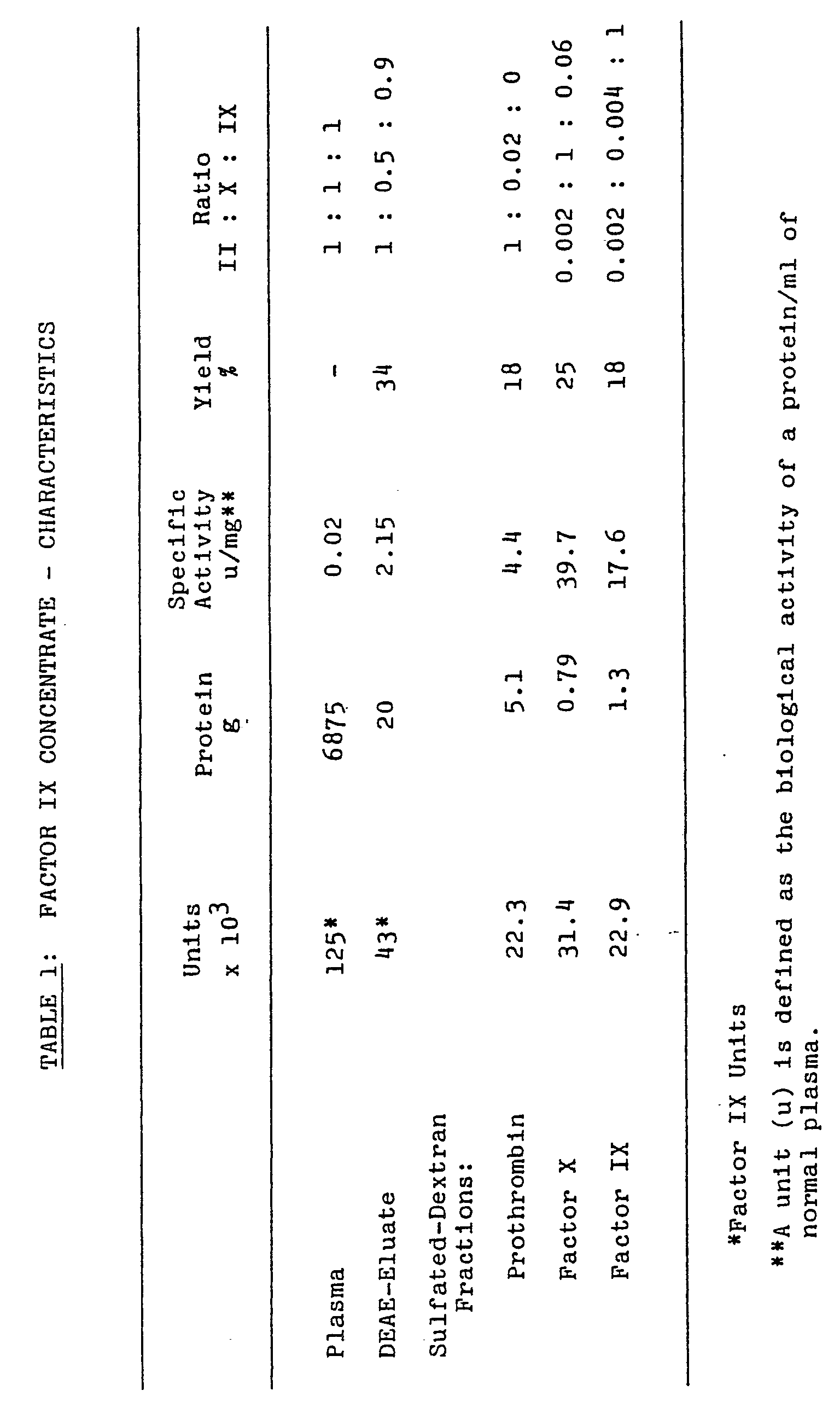
- Several batches of Factor IX concentrate were prepared according to the flow diagram illustrated in Fig. 1. For each litre of human cryosupernatant plasma, 1.7 g of DEAE-Sephadex A-50 (previously swollen in 0.07M Na-Citrate, pH 6.0) was added. The mixture was stirred gently for 1 h, the supernatant decanted and the resin collected in a polyethylene Buchner funnel (70 pm porosity) and washed with 0.07M Na-Citrate, pH 6.0 until the A280 reached a plateaux value of about 0.2 and the color of the resin changed from deep green to light blue (approximately 0.64 l/l original plasma). The Factor IX-containing fraction was then eluted with 0.2M Na-Citrate, pH 6-0 (approximately 0.08 I/I original plasma). The DEAE-Sephadex eluate was diafiltered into 0.15M NaCI, 0.02M Na-Citrate, pH 6.0 to a final volume of 15 ml/l original plasma and was then loaded onto a column of sulfated dextran previously equilibrated with 0.15M NaCI, 0.02M Na-Citrate, pH 6.0) which was prepared by the method of Miletich, et al. For each litre of original plasma, 10 ml of sulfated dextran was required. After the breakthrough protein eluted from the column, the NaCl concentration was increased to 0.25M to elute the prothrombin; Factor X was eluted with 0.45M NaCl and Factor IX was eluted with 0.8M NaCI. All the eluting solutions contained 0.02M Na-Citrate, pH 6.0. The stepwise elution of the clotting factors from the sulfated-dextran column yields prothrombin, a Factor X concentrate contaminated with both Protein C and a small but significant amount of Factor IX and a Factor IX concentrate essentially free of Factor X and prothrombin. A summary of a purification is shown in Table 1. The overall yield of Factor IX is 18% with an 880-fold increase in specific activity. Based on the specific activity of pure human Factor IX of 325 or 275, the resultant Factor IX concentrate is between 5 and 6% pure in terms of protein. On an activity basis, this preparation of Factor IX contains less than 1% of either prothrombin or Factor X contamination. Factor X contamination of Factor IX concentrate is typically below 4% while prothrombin contamination is typically below 1%.
- Stasis Rabbit Model. A model using the venous stasis technique of Wessler, et al., supra, was , employed for testing several batches of purified Factor IX concentrate obtained according to Example 1. The jugular vein of a rabbit was ligated 10-15 seconds after injecting the sample to be tested in the marginal vein of the ear. The formation of thrombi in the isolated vein segment was determined by visual inspection after 10 minutes and scored from 0 to 4, a score of 4 indicating complete occlusion of the vessel. The results obtained on several batches of Factor IX concentrate from Example 1 are given in Table 2. Preparations were found to be non-thrombogenic with dosages of Factor IX concentrate ranging from 150 to as high as 380 units/kg of rabbit body weight. In contrast, a commercial Factor IX complex concentrate, as well as DEAE-Sephadex eluate (obtained during the first step of the fractionation procedure of Example 1), both of which contain significant amounts of prothrombin and Factor X, induced clots with scores ranging from 1 to 2 when injecting dosages of Factor IX ranging from 56 to 100 units/kg.

- Non-Stasis Rabbit Model. Comparable results were obtained when testing the DEAE-Sephadex eluate and the Factor IX concentrate of Example 1 using a rabbit non-stasis model. In this procedure, 3.6 to 4 kg male white rabbits were sedated with NEMBUTAL (27 mg/kg). A polyethylene cannula was introduced into the carotid artery. Blood samples were obtained from this
cannula 30 minutes prior to and immediately before (0 time) the test material was injected at a rate of 2 ml/min. Blood samples were then taken at various times up to 2 hours after test sample injection. The blood samples (7 ml) were collected into plastic tubes containing 0.15 ml 1 M citrate. Three ml of the citrated blood was then placed into a second tube containing 6 mg of soybean trypsin inhibitor. The citrated sample was used for the coagulation factor assays and platelet count, while the soybean trypsin inhibitor-treated blood was used to measure fibrinogen. As shown in Table 3, the eluate containing Factor IX, prothrombin, and Factor X, when infused at 100 u/kg Factor IX, induced coagulation changes compatible with DIC as evidenced by a decrease in the platelet count, and decreased concentrations of Factors V and VIII, whereas the Factor IX concentrate, when infused at 200 u/kg, did not change the coagulation parameters apart from a slight decrease in the platelet count and a predictable rise in the Factor IX level (Table 4). Preliminary results with three (3) rabbits showed that when prothrombin is tested in this model, minimal changes occur except for a decrease in platelet count and Factor VIII level. A modification of the non-statis model of Prowse, et al. (supra) and Triantaphyllopolous, "Intravascular Coagulation Following Injection of Prothrombin Complex",Am. J. Clin. Path., 57:603-610, 1972, was employed. -


- Porcine Model. Harrison et al., (Clinical Research, 30: 318a, 1982) reported that a more sensitive animal in which to assess the thrombogenicity of Factor IX concentrate is the mini-pig (small pig). The Harrison porcine model is a model developed for the evaluation of thrombogenicity of prothrombin complex concentrate. Internal jugular/superior vena cava I.V. silastic tubing was placed in 18 pigs aged 4 mos. (20-25 kg) under general anesthesia. Catheter placement was observed for 24 hours before infusion. Sequentially obtained blood samples to monitor intravascular coagulation (IVC) including platelet count, PT, PTT, TT, procoagulant factors, fibrin monomer, and degradation products, were obtained for 24-48 hours after infusion. Postmortem examination was performed at the time of death or 14 days after infusion. Five (5) different sources of nonactivated and 2 sources of activated Factor IX complex concentrates (PCC) were infused. Seven of 8 pigs receiving >50 units/kgm as a single infusion of nonactivated PCC had 1 + to 4+ fibrin monomers at 15 minutes, whereas 7 of 8 receiving activated PCC had similar changes at doses >25 units/kg. Evidence of severe IVC occurred in all 5 animals receiving 100 units/kgm of either material. Overt IVC was associated with decreased platelet count, fribrinogen, presence of fibrin monomers, and postmortem thrombosis. Sub-clinical IVC was associated with increased monomers with variable changes in platelet count and fibrinogen, but postmortem evidence of renal injury. Control infusions (2 pigs) of albumin were negative.
-

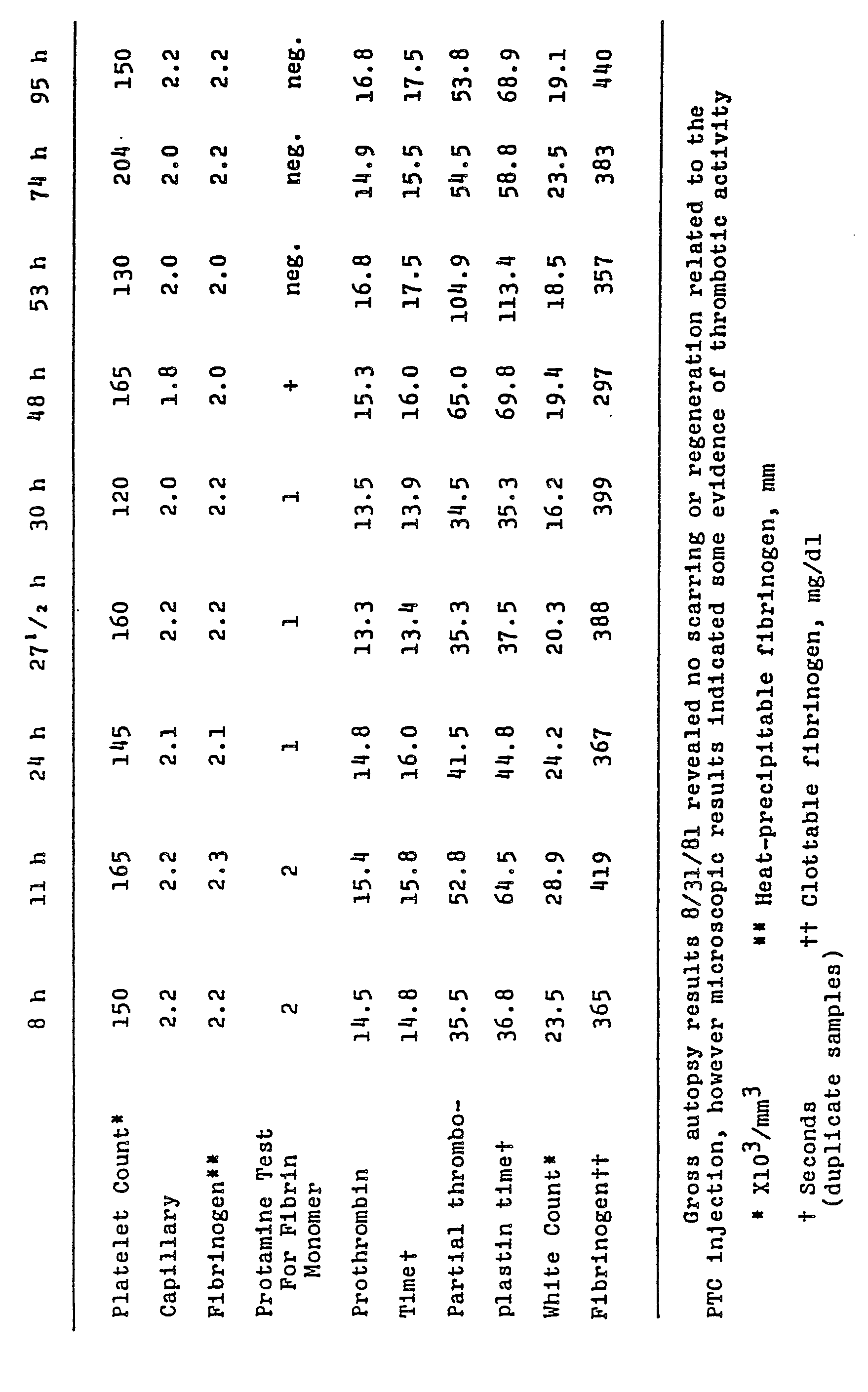
- Preliminary experiments were performed by these investigators with the DEAE-Sephadex eluate obtained according to Example 1, which contains Factors II, Ix and X, and minor amounts of Factor VII (prior to adsorption and elution from sulfated dextran). This eluate was injected at a dose of 50 units of Factor IX/ kg body weight and resulted in evidence of thrombotic activity (Table 5).
- When one lot of purified IX concentrate according to Example 1 was injected at a dose of 50 units/kg the gross autopsy revealed no scarring or regeneration related to the product and the microscopic results showed no abnormalities. The autopsy details are summarized in Table 6.
- A purified Factor IX concentrate obtained according to Example 1 was injected at a level of 200 units/kg body weight. Autopsy results showed that all tissues were normal on gross examination, with no apparent residual scarring as a result of the infusion. Autopsy results are summarized in Table 7.
- The purified Factor IX concentrate obtained according to Example 1 was freeze-dried and stored at 1 to 10°C. The powdered concentrate was apportioned into dosages for clinical use. The dosages were reconstituted with 10 ml of water prior to injection to provide an infusion isotonic with blood and of the following composition:

- The Factor X fraction obtained after elution from sulfated-dextran with 0.45M NaCl in the Factor IX purification procedure of Example 1 was tested for thrombogenicity according to the stasis and non-stasis models of Examples 2 and 3.
- As illustrated in Fig. 2, in the non-stasis model (3 rabbits each) the eluate fraction containing Factors II, IX and X (DEAE), when infused at 100 u of the fraction per kilogram of body weight, induced coagulation changes compatible with DIC as evidenced by a decrease in fibrinogen level. In contrast, the purified Factor X concentrate only slightly lowered the fibrinogen level in this model. (The solid points in the graph have statistical significance at p < .05, based on the Two-Tailed Student's t-Test.)
- As illustrated in Fig. 3, in the stasis model, average scores (indicated by dotted lines) did not exceed 1 for the Factors II, IX, and X concentrates obtained according to Example 1. In contrast, the average score for the fraction containing Factors II, X, and IX (DEAE) was greater than 3.5. The average scores of the Factor IX and Factor X concentrates were the same; however, the Factor IX concentrate was administered at twice the dosage (200 u/kg) as the Factor X concentrate 100 u/kg.


Claims (7)
Priority Applications (1)
| Application Number | Priority Date | Filing Date | Title |
|---|---|---|---|
| AT83901767T ATE52031T1 (en) | 1982-04-28 | 1983-04-14 | PLASMA PROTEIN CONCENTRATES WITH REDUCED THROMBROGENICITY AND THEIR USE IN CLINICAL REPLACEMENT THERAPY. |
Applications Claiming Priority (2)
| Application Number | Priority Date | Filing Date | Title |
|---|---|---|---|
| US372525 | 1982-04-28 | ||
| US06/372,525 US4447416A (en) | 1982-04-28 | 1982-04-28 | Plasma protein concentrates of reduced thrombogenicity and their use in clinical replacement therapy |
Publications (3)
| Publication Number | Publication Date |
|---|---|
| EP0106889A1 EP0106889A1 (en) | 1984-05-02 |
| EP0106889A4 EP0106889A4 (en) | 1984-09-11 |
| EP0106889B1 true EP0106889B1 (en) | 1990-04-18 |
Family
ID=23468505
Family Applications (1)
| Application Number | Title | Priority Date | Filing Date |
|---|---|---|---|
| EP83901767A Expired - Lifetime EP0106889B1 (en) | 1982-04-28 | 1983-04-14 | Plasma protein concentrates of reduced thrombogenicity and their use in clinical replacement therapy |
Country Status (6)
| Country | Link |
|---|---|
| US (1) | US4447416A (en) |
| EP (1) | EP0106889B1 (en) |
| AU (1) | AU566362B2 (en) |
| CA (1) | CA1212319A (en) |
| DE (1) | DE3381467D1 (en) |
| WO (1) | WO1983003760A1 (en) |
Families Citing this family (17)
| Publication number | Priority date | Publication date | Assignee | Title |
|---|---|---|---|---|
| US4447416A (en) * | 1982-04-28 | 1984-05-08 | American National Red Cross | Plasma protein concentrates of reduced thrombogenicity and their use in clinical replacement therapy |
| US5614500A (en) * | 1983-03-04 | 1997-03-25 | The Scripps Research Institute | Compositions containing highly purified factor IX proteins prepared by immunoaffinity chromatography |
| US4721572A (en) * | 1985-07-12 | 1988-01-26 | Miles Laboratories, Inc. | Purfication of blood clotting factors and other blood proteins on non-carbohydrate sulfated matrices |
| AT399095B (en) * | 1986-03-27 | 1995-03-27 | Vukovich Thomas Dr | METHOD FOR SEPARATING PROTEINS BY MEANS OF GRADIENT ELUTION AND DEVICE FOR IMPLEMENTING THE METHOD |
| DE3627762A1 (en) * | 1986-08-16 | 1988-02-18 | Behringwerke Ag | METHOD FOR PRODUCING A LOW PROTHROMBINE PREPARATION VITAMIN K-DEPENDENT COagulation FACTORS, AND A SUBSTANCE AVAILABLE AFTER THIS |
| EP0317376B2 (en) * | 1987-10-23 | 1996-04-03 | Centre Regional De Transfusion Sanguine De Lille | Preparation of a concentrate of high-purity human factor IX and of other plasma proteins |
| DE3826792C1 (en) * | 1988-08-06 | 1989-07-06 | Biotest Pharma Gmbh, 6072 Dreieich, De | |
| DE3914869C1 (en) * | 1989-05-05 | 1990-08-09 | Biotest Pharma Gmbh, 6072 Dreieich, De | |
| CA2105282C (en) * | 1991-03-01 | 2002-09-24 | Centeon L.L.C. | Preparation of factor ix |
| FR2679251B1 (en) * | 1991-07-18 | 1993-11-12 | Nord Assoc Essor Transfusion San | PROCESS FOR THE PREPARATION OF A HUMAN THROMBIN CONCENTRATE FOR THERAPEUTIC USE. |
| US5589571A (en) * | 1994-10-28 | 1996-12-31 | Cor Therapeutics, Inc. | Process for production of inhibited forms of activated blood factors |
| SE9501189D0 (en) * | 1995-03-31 | 1995-03-31 | Pharmacia Ab | Protein formulation |
| US5714583A (en) | 1995-06-07 | 1998-02-03 | Genetics Institute, Inc. | Factor IX purification methods |
| USRE38431E1 (en) * | 1995-12-01 | 2004-02-17 | The American National Red Cross | Methods of production and use of liquid formulations of plasma proteins |
| US6320029B1 (en) | 1996-11-29 | 2001-11-20 | The American National Red Cross | Methods of production and use of liquid formulations of plasma proteins |
| US5925738A (en) * | 1995-12-01 | 1999-07-20 | The American National Red Cross | Methods of production and use of liquid formulations of plasma proteins |
| GB0029729D0 (en) * | 2000-12-06 | 2001-01-17 | Ids Ltd | Method for detection of vitamin D metabolites |
Citations (1)
| Publication number | Priority date | Publication date | Assignee | Title |
|---|---|---|---|---|
| US4447416A (en) * | 1982-04-28 | 1984-05-08 | American National Red Cross | Plasma protein concentrates of reduced thrombogenicity and their use in clinical replacement therapy |
Family Cites Families (2)
| Publication number | Priority date | Publication date | Assignee | Title |
|---|---|---|---|---|
| US3920625A (en) * | 1973-06-19 | 1975-11-18 | Kabi Ab | Isolation of coagulation factors from biological material using cross linked sulfated, sulfonated carbohydrates |
| US4081432A (en) * | 1977-07-25 | 1978-03-28 | Monsanto Company | Method of separating a Factor IX preparation from plasma using ethylene-maleic anhydride polymers |
-
1982
- 1982-04-28 US US06/372,525 patent/US4447416A/en not_active Expired - Fee Related
-
1983
- 1983-04-14 WO PCT/US1983/000549 patent/WO1983003760A1/en not_active Ceased
- 1983-04-14 DE DE8383901767T patent/DE3381467D1/en not_active Expired - Lifetime
- 1983-04-14 AU AU16001/83A patent/AU566362B2/en not_active Ceased
- 1983-04-14 EP EP83901767A patent/EP0106889B1/en not_active Expired - Lifetime
- 1983-04-27 CA CA000426860A patent/CA1212319A/en not_active Expired
Patent Citations (1)
| Publication number | Priority date | Publication date | Assignee | Title |
|---|---|---|---|---|
| US4447416A (en) * | 1982-04-28 | 1984-05-08 | American National Red Cross | Plasma protein concentrates of reduced thrombogenicity and their use in clinical replacement therapy |
Non-Patent Citations (1)
| Title |
|---|
| CHEMICAL ABSTRACTS, vol. 81, no. 7, 19.08.1974, p. 270, abstract 36023w, Columbus, Ohio (US) A C W SWART et al.:"Differential interaction of clotting factors II, VII, IX and X with Sephadex and dextran blue". * |
Also Published As
| Publication number | Publication date |
|---|---|
| CA1212319A (en) | 1986-10-07 |
| AU566362B2 (en) | 1987-10-15 |
| AU1600183A (en) | 1983-11-21 |
| EP0106889A1 (en) | 1984-05-02 |
| WO1983003760A1 (en) | 1983-11-10 |
| EP0106889A4 (en) | 1984-09-11 |
| US4447416A (en) | 1984-05-08 |
| DE3381467D1 (en) | 1990-05-23 |
Similar Documents
| Publication | Publication Date | Title |
|---|---|---|
| AU566362B2 (en) | Plasma protein concentrates of reduced thrombogenicity and their use in clinical replacement therapy | |
| JP2766986B2 (en) | Pharmaceutical compositions for preventing thrombotic occlusion or embolism of arteries | |
| US5891843A (en) | Pharmaceutical composition for the treatment of blood coagulation diseases, methods for the production thereof and its use | |
| Sills et al. | Severe homozygous protein C deficiency | |
| EP1232252B1 (en) | Reversibly inactivated acidified plasmin | |
| UA72194C2 (en) | Method of treatment for patients with acquired hypercoagulable state or acquired protein c deficiency | |
| JPH0378375B2 (en) | ||
| JPH05345799A (en) | Preparation of high purity activated factor viia concentrate | |
| JPH04273827A (en) | Medicine containing lys plasminogen | |
| US6280729B1 (en) | Preparation of factor IX | |
| Dosekun et al. | Ancrod in systemic lupus erythematosus with thrombosis: clinical and fibrinolysis effects | |
| JPH02504587A (en) | Method for producing a fraction rich in factor 7a and its use as a medicine | |
| JP5261478B2 (en) | Method for preparing factor X, activated factor X, inactive factor X and inactivated factor Xa, and pharmaceutical composition containing said factor | |
| US4286063A (en) | Method for producing thrombolytic preparation | |
| Theodorsson et al. | A technique for specific removal of factor IX alloantibodies from human plasma: partial characterization of the alloantibodies | |
| DE69833727T2 (en) | Method of treating vascular disease with activated protein C | |
| Barlow | Pharmacology of fibrinolytic agents | |
| Ezer et al. | Neonatal purpura fulminans due to homozygous protein C deficiency | |
| EP0181596B1 (en) | Process for preparing a urokinase complex | |
| JP3104214B2 (en) | Composition for increasing production of thrombomodulin | |
| WO2003084466A2 (en) | FACTORVIIa COMPOSITIONS | |
| JPS59500673A (en) | Blood plasma protein concentrates with reduced clot-forming properties and their use in clinical replacement therapy | |
| MXPA99008941A (en) | Immunotolerant prothrombin complex preparation | |
| JPS6351336A (en) | Manufacture of vitamin k dependent coagulation factor medicine containing low prothrombin content |
Legal Events
| Date | Code | Title | Description |
|---|---|---|---|
| PUAI | Public reference made under article 153(3) epc to a published international application that has entered the european phase |
Free format text: ORIGINAL CODE: 0009012 |
|
| 17P | Request for examination filed |
Effective date: 19831212 |
|
| AK | Designated contracting states |
Designated state(s): AT BE CH DE FR GB LI NL SE |
|
| GRAA | (expected) grant |
Free format text: ORIGINAL CODE: 0009210 |
|
| AK | Designated contracting states |
Kind code of ref document: B1 Designated state(s): AT BE CH DE FR GB LI NL SE |
|
| REF | Corresponds to: |
Ref document number: 52031 Country of ref document: AT Date of ref document: 19900515 Kind code of ref document: T |
|
| REF | Corresponds to: |
Ref document number: 3381467 Country of ref document: DE Date of ref document: 19900523 |
|
| ET | Fr: translation filed | ||
| PLBE | No opposition filed within time limit |
Free format text: ORIGINAL CODE: 0009261 |
|
| STAA | Information on the status of an ep patent application or granted ep patent |
Free format text: STATUS: NO OPPOSITION FILED WITHIN TIME LIMIT |
|
| 26N | No opposition filed | ||
| PGFP | Annual fee paid to national office [announced via postgrant information from national office to epo] |
Ref country code: GB Payment date: 19920414 Year of fee payment: 10 |
|
| PGFP | Annual fee paid to national office [announced via postgrant information from national office to epo] |
Ref country code: FR Payment date: 19920424 Year of fee payment: 10 |
|
| PGFP | Annual fee paid to national office [announced via postgrant information from national office to epo] |
Ref country code: SE Payment date: 19920427 Year of fee payment: 10 Ref country code: CH Payment date: 19920427 Year of fee payment: 10 |
|
| PGFP | Annual fee paid to national office [announced via postgrant information from national office to epo] |
Ref country code: AT Payment date: 19920428 Year of fee payment: 10 |
|
| PGFP | Annual fee paid to national office [announced via postgrant information from national office to epo] |
Ref country code: NL Payment date: 19920430 Year of fee payment: 10 |
|
| PGFP | Annual fee paid to national office [announced via postgrant information from national office to epo] |
Ref country code: DE Payment date: 19920521 Year of fee payment: 10 |
|
| PGFP | Annual fee paid to national office [announced via postgrant information from national office to epo] |
Ref country code: BE Payment date: 19920604 Year of fee payment: 10 |
|
| PG25 | Lapsed in a contracting state [announced via postgrant information from national office to epo] |
Ref country code: GB Effective date: 19930414 Ref country code: AT Effective date: 19930414 |
|
| PG25 | Lapsed in a contracting state [announced via postgrant information from national office to epo] |
Ref country code: SE Effective date: 19930415 |
|
| PG25 | Lapsed in a contracting state [announced via postgrant information from national office to epo] |
Ref country code: LI Effective date: 19930430 Ref country code: CH Effective date: 19930430 Ref country code: BE Effective date: 19930430 |
|
| BERE | Be: lapsed |
Owner name: AMERICAN NATIONAL RED CROSS Effective date: 19930430 |
|
| PG25 | Lapsed in a contracting state [announced via postgrant information from national office to epo] |
Ref country code: NL Effective date: 19931101 |
|
| GBPC | Gb: european patent ceased through non-payment of renewal fee |
Effective date: 19930414 |
|
| NLV4 | Nl: lapsed or anulled due to non-payment of the annual fee | ||
| PG25 | Lapsed in a contracting state [announced via postgrant information from national office to epo] |
Ref country code: FR Effective date: 19931229 |
|
| REG | Reference to a national code |
Ref country code: CH Ref legal event code: PL |
|
| PG25 | Lapsed in a contracting state [announced via postgrant information from national office to epo] |
Ref country code: DE Effective date: 19940101 |
|
| REG | Reference to a national code |
Ref country code: FR Ref legal event code: ST |
|
| EUG | Se: european patent has lapsed |
Ref document number: 83901767.0 Effective date: 19931110 |