EP0105763B1 - Indole compounds, their preparation and pharmaceutical compositions comprising them - Google Patents
Indole compounds, their preparation and pharmaceutical compositions comprising them Download PDFInfo
- Publication number
- EP0105763B1 EP0105763B1 EP83306030A EP83306030A EP0105763B1 EP 0105763 B1 EP0105763 B1 EP 0105763B1 EP 83306030 A EP83306030 A EP 83306030A EP 83306030 A EP83306030 A EP 83306030A EP 0105763 B1 EP0105763 B1 EP 0105763B1
- Authority
- EP
- European Patent Office
- Prior art keywords
- compound
- formula
- indole
- carboxamide
- hydroxy
- Prior art date
- Legal status (The legal status is an assumption and is not a legal conclusion. Google has not performed a legal analysis and makes no representation as to the accuracy of the status listed.)
- Expired
Links
- 0 CC=C(*)[C@@]1C=C(*)C(C)=CC1NN Chemical compound CC=C(*)[C@@]1C=C(*)C(C)=CC1NN 0.000 description 1
Classifications
-
- C—CHEMISTRY; METALLURGY
- C07—ORGANIC CHEMISTRY
- C07D—HETEROCYCLIC COMPOUNDS
- C07D405/00—Heterocyclic compounds containing both one or more hetero rings having oxygen atoms as the only ring hetero atoms, and one or more rings having nitrogen as the only ring hetero atom
- C07D405/02—Heterocyclic compounds containing both one or more hetero rings having oxygen atoms as the only ring hetero atoms, and one or more rings having nitrogen as the only ring hetero atom containing two hetero rings
- C07D405/12—Heterocyclic compounds containing both one or more hetero rings having oxygen atoms as the only ring hetero atoms, and one or more rings having nitrogen as the only ring hetero atom containing two hetero rings linked by a chain containing hetero atoms as chain links
-
- A—HUMAN NECESSITIES
- A61—MEDICAL OR VETERINARY SCIENCE; HYGIENE
- A61P—SPECIFIC THERAPEUTIC ACTIVITY OF CHEMICAL COMPOUNDS OR MEDICINAL PREPARATIONS
- A61P25/00—Drugs for disorders of the nervous system
- A61P25/02—Drugs for disorders of the nervous system for peripheral neuropathies
-
- A—HUMAN NECESSITIES
- A61—MEDICAL OR VETERINARY SCIENCE; HYGIENE
- A61P—SPECIFIC THERAPEUTIC ACTIVITY OF CHEMICAL COMPOUNDS OR MEDICINAL PREPARATIONS
- A61P9/00—Drugs for disorders of the cardiovascular system
-
- A—HUMAN NECESSITIES
- A61—MEDICAL OR VETERINARY SCIENCE; HYGIENE
- A61P—SPECIFIC THERAPEUTIC ACTIVITY OF CHEMICAL COMPOUNDS OR MEDICINAL PREPARATIONS
- A61P9/00—Drugs for disorders of the cardiovascular system
- A61P9/06—Antiarrhythmics
-
- A—HUMAN NECESSITIES
- A61—MEDICAL OR VETERINARY SCIENCE; HYGIENE
- A61P—SPECIFIC THERAPEUTIC ACTIVITY OF CHEMICAL COMPOUNDS OR MEDICINAL PREPARATIONS
- A61P9/00—Drugs for disorders of the cardiovascular system
- A61P9/08—Vasodilators for multiple indications
-
- A—HUMAN NECESSITIES
- A61—MEDICAL OR VETERINARY SCIENCE; HYGIENE
- A61P—SPECIFIC THERAPEUTIC ACTIVITY OF CHEMICAL COMPOUNDS OR MEDICINAL PREPARATIONS
- A61P9/00—Drugs for disorders of the cardiovascular system
- A61P9/10—Drugs for disorders of the cardiovascular system for treating ischaemic or atherosclerotic diseases, e.g. antianginal drugs, coronary vasodilators, drugs for myocardial infarction, retinopathy, cerebrovascula insufficiency, renal arteriosclerosis
-
- A—HUMAN NECESSITIES
- A61—MEDICAL OR VETERINARY SCIENCE; HYGIENE
- A61P—SPECIFIC THERAPEUTIC ACTIVITY OF CHEMICAL COMPOUNDS OR MEDICINAL PREPARATIONS
- A61P9/00—Drugs for disorders of the cardiovascular system
- A61P9/12—Antihypertensives
-
- C—CHEMISTRY; METALLURGY
- C07—ORGANIC CHEMISTRY
- C07D—HETEROCYCLIC COMPOUNDS
- C07D209/00—Heterocyclic compounds containing five-membered rings, condensed with other rings, with one nitrogen atom as the only ring hetero atom
- C07D209/02—Heterocyclic compounds containing five-membered rings, condensed with other rings, with one nitrogen atom as the only ring hetero atom condensed with one carbocyclic ring
- C07D209/04—Indoles; Hydrogenated indoles
- C07D209/10—Indoles; Hydrogenated indoles with substituted hydrocarbon radicals attached to carbon atoms of the hetero ring
- C07D209/12—Radicals substituted by oxygen atoms
-
- C—CHEMISTRY; METALLURGY
- C07—ORGANIC CHEMISTRY
- C07D—HETEROCYCLIC COMPOUNDS
- C07D209/00—Heterocyclic compounds containing five-membered rings, condensed with other rings, with one nitrogen atom as the only ring hetero atom
- C07D209/02—Heterocyclic compounds containing five-membered rings, condensed with other rings, with one nitrogen atom as the only ring hetero atom condensed with one carbocyclic ring
- C07D209/04—Indoles; Hydrogenated indoles
- C07D209/30—Indoles; Hydrogenated indoles with hetero atoms or with carbon atoms having three bonds to hetero atoms with at the most one bond to halogen, directly attached to carbon atoms of the hetero ring
- C07D209/42—Carbon atoms having three bonds to hetero atoms with at the most one bond to halogen, e.g. ester or nitrile radicals
Definitions
- This invention relates to novel indole compounds having various pharmacological activities such as blood pressure lowering activity, vasodilating activity, adrenergic beta-blocking activity and blood flow increasing activity.
- the invention also relates to processes for the production of the aforesaid compounds.
- US-A-4152446 discloses aminopropanol compounds of the formula where R is alkyl, cycloalkyl or alkylthioalkyl, R 2 is hydrogen, alkyl, hydroxyalkyl, alkoxyalkyl or pivaloylalkyl and among eight possibilities for R, is included -CONR 3 R 4 where R 3 and R 4 are hydrogen or lower alkyl.
- the compounds are said to be effective in the treatment of cardiac and circulatory diseases.
- R is alkylthioalkyl and R 1 is CONR 3 R 4 , with R 3 and R 4 both being either hydrogen (Example 8) or methyl (Example 9). No test data are given for these two compounds.
- Arzneistoff, 2nd Edition, Vol. 2 (1972), 195-198 and 207 discloses the use of various nitrites and nitrates, including isosorbide dinitrates, as coronary vasodilators. Moderne Arzneistoff, 5 Auflage 1980, page 855 suggests the use of a mixture of isosorbide dinitrate with 1-(indol-4-yloxy)-3-isopropylaminopropan-2-ol (a beta-blocker) in the treatment of cardiac disease.
- R represents a linear or branched C 2 ⁇ C 5 alkyl group which may be substituted by a phenyl or phenoxy group unsubstituted or substituted by a C,-C 3 alkoxy group
- R 1 represents a hydrogen atom, a C,-C 3 alkyl group, or a nitro group
- n is an integer of 1 to 5.
- example of the C 2 -C 5 alkyl group are ethyl, n- or iso-propyl, and n-, iso-, sec- or tert-butyl.
- the alkyl group may be substituted by a phenyl or phenoxy group unsubstituted or substituted by a C,-C 3 alkoxy group, preferably a methoxy group.
- R 1 in formula (I) may be bonded not only to the 4-, 5-, 6-or 7-position of the indole ring, but also to the 2- or 3-position.
- the symbol n preferably represents an integer of 2 or 3.
- the compounds of formula (I) can be produced, for example, by the following process (a), (b), (c) or (d).
- the compound of formula (II) used in process (a) can be produced by subjecting to a nitrate ester-forming reaction a compound of the following formula (X) wherein R 1 and n are as defined above, which can be obtained by subjecting a compound of the following formula (IX) wherein R, and n are as defined above, to a glycidyl-forming reaction.
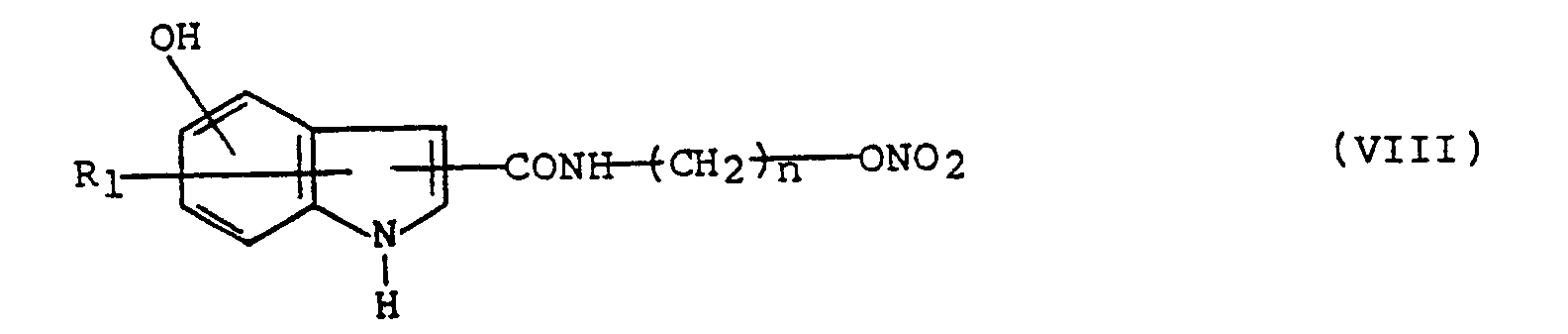
- the compound of formula (II) can also be produced by subjecting to a glycidyl-forming reaction the compound of formula (VIII) which can be obtained by subjecting the compound of formula (IX) to a nitrate ester-forming reaction.
- a compound of formula (VIII) can be produced by reacting a hydroxyindole carboxylic acid derivative of the following formula (XI) wherein R 1 and R' are as defined above, with the compound of formula (VI).
- the compound of formula (VIII) which can be so produced may also be utilized as a starting compound in process (d).
- the compound of formula (IX) can be obtained by protecting the OH group of the compound of formula (XI) and then reacting the protected compound of formula (XI) with a compound of the following formula (Vll) wherein n is as defined above.
- the compound of formula (IV) used in process (b) can be produced by reacting the compound of formula (X) with the amine compound offormula (III).
- a compound offormula (IV) can be produced also by reacting the compound of formula (V) with the compound of formula (VII).
- the compound of formula (V) which can be used in the production of the compound offormula (IV) and also as a starting material in process (c) can be produced by reacting a compound of the following formula (XII) wherein R and R' are as defined above, which can be obtained by subjecting the compound of formula (XI) to a glycidyl-forming reaction, with the amine compound of formula (III).
- the amination of the epoxy group-containing compound of formula (II), (X) or (XII) with the compound of formula (III) can be carried out by contacting the compound of formula (II), (X) or (XII) with the compound of formula (III) in a suitable solvent.
- the solvent may be an inert organic solvent. Specific examples include methanol, ethanol and isopropanol.
- the reaction is carried out preferably under heating, for example under refluxing temperature conditions, for example at a reaction temperature ranging from room temperature to about 150°C.
- the reaction time can be selected properly, and is, for example, about 1 to about 5 hours.
- the nitrate ester-forming reaction of the hydroxyalkylamide derivative of formula (IV), (IX) or (X) can be carried out by contacting the compound of formula (IV), (IX) or (X) with a nitrating reagent such as fuming nitric acid or a mixture of fuming nitric acid and acetic anhydride in the presence or absence of a solvent.
- a nitrating reagent such as fuming nitric acid or a mixture of fuming nitric acid and acetic anhydride
- a solvent that may be used include acetonitrile, dioxane and tetrahydrofuran.
- the reaction is carried out at relatively low temperatures, for example at about -40°C to room temperature.
- the reaction time can be properly selected, and is, for example, several minutes to about 1 hour.
- the nitrate ester-forming reaction is carried out after the hydroxyl group excepting ⁇ CONH ⁇ (CH) n ⁇ OH is protected.
- Specific protective groups used for the protecting reaction include a trichloroacetyl group, a dichloroacetyl group and a trichloroacetyl group.
- the amidation of the compound of formula (XI) or (V) with the nitroxyalkylamine of formula (VI) or the hydroxyalkylamine of formula (VII) can be carried out by contacting this ester with the compond of formula (VI) or (VII).
- the reaction temperature can be properly chosen and is, for example, room temperature to about 130°C.
- the reaction time can also be properly chosen, and is, for example, about 1 to about 6 hours.
- the amidation reaction can be carried out by contacting the compound of formula (XI) or (V) with the compound of formula (VI) or (VII) in the presence of a suitable coupling reagent such as dicyclohexyl carbodiimide or carbonyl diimidazole at a relatively low temperature of, for example, about 0 to about 70°C.
- a suitable coupling reagent such as dicyclohexyl carbodiimide or carbonyl diimidazole at a relatively low temperature of, for example, about 0 to about 70°C.
- the protecting reaction can be carried out in the same way as described hereinabove with regard to the nitrate ester-forming reaction in section 2 above.
- the aminoalkanol-forming reaction ofthe compound of the formula (VIII) can be carried out by reacting it with an alkylaminoalkanol under ordinary conditions.
- the glycidyl-forming reaction of the compound of formula (VIII), (IX) or (XI) can be carried out, for example, by contacting it with epichlorohydrin and piperidine or 1,8-azabicyclo[5.4.0]undec-7-ene (DBU) at a reaction temperature ranging from room temperature to about 100°C for about 1 to. about 5 hours.
- DBU 1,8-azabicyclo[5.4.0]undec-7-ene
- novel compounds of formula (I) which can be produced as described above show various pharmacological activities such as blood pressure lowering activity, vasoldilating activity, adrenergic beta-blocking activity and blood flow increasing activity and are useful, for example, as anti-angina pectoris agents, hypotensive agents, cerebral circulation improvers and antiarrhythmic agents.
- the present invention can also provide a pharmaceutical composition
- a pharmaceutical composition comprising an amount, effective for the treatment of cardiovascular disease, of a compound of formula (1) and a pharmaceutically acceptable diluent or carrier.
- Liquid or solid carriers or diluents may be used in forming the pharmaceutical composition. They may include excipients, binders, lubricants, emulsifiers, etc. known in pharmaceutical production. Examples of these carriers or diluents include starches such as potato starch, wheat starch, corn starch and rice starch; sugars such as lactose, sucrose, glucose, mannitol and sorbitol; celluloses such as crystalline cellulose, calcium carboxymethyl cellulose and hydroxypropyl cellulose of a low degree of substitution; inorganic substances such as potassium phosphate, calcium sulfate, calcium carbonate and talc; binder compounds such as gelatin, gum arabic, methyl cellulose, sodium carboxymethyl cellulose, polyvinyl pyrrolidone and hydroxypropyl cellulose; polyhydric alcohol ester-type nonionic surfactants such as fatty acid monoglycerides, sorbitol fatty acid esters, sucrose and p
- the pharmaceutical composition may be in any dosage forms known in the art of formulating pharmaceuticals, such as suppositories, powders, granules, tablets, sublingual tablets, liquid preparations, injectable preparations, and suspension.
- the pharmaceutical composition may be administered through any of peroral or parenteral routes, such as intravenous, sublingual or intrarectal administation.
- peroral or parenteral routes such as intravenous, sublingual or intrarectal administation.
- the oral route is preferred.
- the dose may be changed as desired.
- the compound of formula (I) may be administered in a dose of about 1 to about 100 mg/body/day, preferably about 5 to about 50 mg/body/day.
- the compounds of this invention have low toxicity.
- Test 1 Blood pressure and heart rate using dogs.
- Test 2 (3-Blocking action using isolated atrial muscle of a guinea pig.
- Test 3 Coronary blood flow using dogs.
Landscapes
- Health & Medical Sciences (AREA)
- Chemical & Material Sciences (AREA)
- Organic Chemistry (AREA)
- Engineering & Computer Science (AREA)
- Bioinformatics & Cheminformatics (AREA)
- Life Sciences & Earth Sciences (AREA)
- Public Health (AREA)
- General Chemical & Material Sciences (AREA)
- Medicinal Chemistry (AREA)
- Nuclear Medicine, Radiotherapy & Molecular Imaging (AREA)
- Chemical Kinetics & Catalysis (AREA)
- Pharmacology & Pharmacy (AREA)
- Veterinary Medicine (AREA)
- Animal Behavior & Ethology (AREA)
- General Health & Medical Sciences (AREA)
- Heart & Thoracic Surgery (AREA)
- Cardiology (AREA)
- Urology & Nephrology (AREA)
- Vascular Medicine (AREA)
- Biomedical Technology (AREA)
- Neurology (AREA)
- Neurosurgery (AREA)
- Indole Compounds (AREA)
- Pharmaceuticals Containing Other Organic And Inorganic Compounds (AREA)
Description
- This invention relates to novel indole compounds having various pharmacological activities such as blood pressure lowering activity, vasodilating activity, adrenergic beta-blocking activity and blood flow increasing activity. The invention also relates to processes for the production of the aforesaid compounds.
- US-A-4152446 discloses aminopropanol compounds of the formula

- Arzneimittel, 2nd Edition, Vol. 2 (1972), 195-198 and 207 discloses the use of various nitrites and nitrates, including isosorbide dinitrates, as coronary vasodilators. Moderne Arzneimittel, 5 Auflage 1980, page 855 suggests the use of a mixture of isosorbide dinitrate with 1-(indol-4-yloxy)-3-isopropylaminopropan-2-ol (a beta-blocker) in the treatment of cardiac disease.
- The compounds of this invention have not been described in the literature and are novel. They can be represented by the following formula (I).

- In formula (I), example of the C2-C5 alkyl group are ethyl, n- or iso-propyl, and n-, iso-, sec- or tert-butyl. The alkyl group may be substituted by a phenyl or phenoxy group unsubstituted or substituted by a C,-C3 alkoxy group, preferably a methoxy group. R1 in formula (I) may be bonded not only to the 4-, 5-, 6-or 7-position of the indole ring, but also to the 2- or 3-position. The symbol n preferably represents an integer of 2 or 3.
- Specific examples of the compound of formula (I) are:
- 4- or 5-[(2-hydroxy-3-n- or iso-propylamino)propyloxy]-N-(2- or 3-nitroxyethyl or -nitroxypropyl)indole-2-carboxamide,
- 4- or 5-[(2-hydroxy-3-n-, iso-, sec- or tert-butylamino)propyloxy]-N-(2- or 3-nitroxyethyl or -nitroxypropyl)indole-2-carboxamide,
- 4- or 5-[(2-hydroxy-3-beta-phenethylamino)propyloxy]-N-(2- or 3-nitroxyethyl or -nitroxypropyl)indole-2-carboxamide,
- 4- or 5-{[(2-hydroxy-3-(beta-methoxyphenoxy)ethylamino]propyloxy}-N-[2- or 3-nitroxyethyl or -nitroxypropyl)indole-2-carboxamide,
- 4- or 5-[(2-hydroxy-3-amylamino)propyloxy]-N-(2- or 3-nitroxyethyl or -nitroxypropyl)indole-2-carboxamide, and
- 4- or 5-[(2-hydroxy-3-n- or iso-propylamino)propyloxy]-7-nitro-N-(2- or 3-nitroxyethyl or -nitroxypropyl)indole-2-carboxamide.
- The compounds of formula (I) can be produced, for example, by the following process (a), (b), (c) or (d).
- A compound of the following formula (II)

is reacted with an amine compound of the following formula (III)
- A compound of the following formula (IV)

- A compound of the following formula (V)


- A compound of the following formula (VIII)

is subjected to an aminoalkanol-forming reaction. - The compound of formula (II) used in process (a) can be produced by subjecting to a nitrate ester-forming reaction a compound of the following formula (X)

which can be obtained by subjecting a compound of the following formula (IX)
to a glycidyl-forming reaction. The compound of formula (II) can also be produced by subjecting to a glycidyl-forming reaction the compound of formula (VIII) which can be obtained by subjecting the compound of formula (IX) to a nitrate ester-forming reaction. - A compound of formula (VIII) can be produced by reacting a hydroxyindole carboxylic acid derivative of the following formula (XI)

with the compound of formula (VI). The compound of formula (VIII) which can be so produced may also be utilized as a starting compound in process (d). - The compound of formula (IX) can be obtained by protecting the OH group of the compound of formula (XI) and then reacting the protected compound of formula (XI) with a compound of the following formula (Vll)

- The compound of formula (IV) used in process (b) can be produced by reacting the compound of formula (X) with the amine compound offormula (III). A compound offormula (IV) can be produced also by reacting the compound of formula (V) with the compound of formula (VII).
- The compound of formula (V) which can be used in the production of the compound offormula (IV) and also as a starting material in process (c) can be produced by reacting a compound of the following formula (XII)

- The processes (a) to (d) are schematically shown below together with examples of producing the starting compounds used therefor.

- In processes (a) to (d) and the production processes for starting compounds in these processes, the amination with the amine compound of formula (III), the amidation with the compound of formula (VI), the amidation with the compound of formula (VII), the nitrate ester-forming reaction, the amino-alkanol- forming reaction, and the glycidyl-forming reaction can be performed as shown below.
- The amination of the epoxy group-containing compound of formula (II), (X) or (XII) with the compound of formula (III) can be carried out by contacting the compound of formula (II), (X) or (XII) with the compound of formula (III) in a suitable solvent. The solvent may be an inert organic solvent. Specific examples include methanol, ethanol and isopropanol. The reaction is carried out preferably under heating, for example under refluxing temperature conditions, for example at a reaction temperature ranging from room temperature to about 150°C. The reaction time can be selected properly, and is, for example, about 1 to about 5 hours.
- The nitrate ester-forming reaction of the hydroxyalkylamide derivative of formula (IV), (IX) or (X) can be carried out by contacting the compound of formula (IV), (IX) or (X) with a nitrating reagent such as fuming nitric acid or a mixture of fuming nitric acid and acetic anhydride in the presence or absence of a solvent. Examples of the solvent that may be used include acetonitrile, dioxane and tetrahydrofuran. Preferably, the reaction is carried out at relatively low temperatures, for example at about -40°C to room temperature. The reaction time can be properly selected, and is, for example, several minutes to about 1 hour. When the compound of formula (VIII) is to be produced from the compound of formula (IX), the nitrate ester-forming reaction is carried out after the hydroxyl group excepting ―CONH―(CH)n―OH is protected. Specific protective groups used for the protecting reaction include a trichloroacetyl group, a dichloroacetyl group and a trichloroacetyl group.
- When the compound of formula (XI) or (V) is an indole carboxylic acid ester in which R' in the group -COOR' is a C,-C3 alkyl group, the amidation of the compound of formula (XI) or (V) with the nitroxyalkylamine of formula (VI) or the hydroxyalkylamine of formula (VII) can be carried out by contacting this ester with the compond of formula (VI) or (VII). The reaction temperature can be properly chosen and is, for example, room temperature to about 130°C. The reaction time can also be properly chosen, and is, for example, about 1 to about 6 hours. When R' in the group -COOR' in the compound of formula (XI) or (V) is a hydrogen atom (namely, when the group -COOR' is a free carboxyl group), the amidation reaction can be carried out by contacting the compound of formula (XI) or (V) with the compound of formula (VI) or (VII) in the presence of a suitable coupling reagent such as dicyclohexyl carbodiimide or carbonyl diimidazole at a relatively low temperature of, for example, about 0 to about 70°C.
- In the reaction of the compound of formula (XI) with the compound of formula (VI) or (VII), the reaction is carried out preferably after the OH group other than -COOR' (R'=H) in formula (XI) is protected. The protecting reaction can be carried out in the same way as described hereinabove with regard to the nitrate ester-forming reaction in section 2 above.
- The aminoalkanol-forming reaction ofthe compound of the formula (VIII) can be carried out by reacting it with an alkylaminoalkanol under ordinary conditions.
- The glycidyl-forming reaction of the compound of formula (VIII), (IX) or (XI) can be carried out, for example, by contacting it with epichlorohydrin and piperidine or 1,8-azabicyclo[5.4.0]undec-7-ene (DBU) at a reaction temperature ranging from room temperature to about 100°C for about 1 to. about 5 hours.
- The novel compounds of formula (I) which can be produced as described above show various pharmacological activities such as blood pressure lowering activity, vasoldilating activity, adrenergic beta-blocking activity and blood flow increasing activity and are useful, for example, as anti-angina pectoris agents, hypotensive agents, cerebral circulation improvers and antiarrhythmic agents.
- Accordingly, the present invention can also provide a pharmaceutical composition comprising an amount, effective for the treatment of cardiovascular disease, of a compound of formula (1) and a pharmaceutically acceptable diluent or carrier.
- Liquid or solid carriers or diluents may be used in forming the pharmaceutical composition. They may include excipients, binders, lubricants, emulsifiers, etc. known in pharmaceutical production. Examples of these carriers or diluents include starches such as potato starch, wheat starch, corn starch and rice starch; sugars such as lactose, sucrose, glucose, mannitol and sorbitol; celluloses such as crystalline cellulose, calcium carboxymethyl cellulose and hydroxypropyl cellulose of a low degree of substitution; inorganic substances such as potassium phosphate, calcium sulfate, calcium carbonate and talc; binder compounds such as gelatin, gum arabic, methyl cellulose, sodium carboxymethyl cellulose, polyvinyl pyrrolidone and hydroxypropyl cellulose; polyhydric alcohol ester-type nonionic surfactants such as fatty acid monoglycerides, sorbitol fatty acid esters, sucrose and plyglycerol fatty acid esters; and polyoxyethylene- type nonionic surfactants.
- The pharmaceutical composition may be in any dosage forms known in the art of formulating pharmaceuticals, such as suppositories, powders, granules, tablets, sublingual tablets, liquid preparations, injectable preparations, and suspension.
- The pharmaceutical composition may be administered through any of peroral or parenteral routes, such as intravenous, sublingual or intrarectal administation. For long-term administration, the oral route is preferred.
- The dose may be changed as desired. For example, the compound of formula (I) may be administered in a dose of about 1 to about 100 mg/body/day, preferably about 5 to about 50 mg/body/day. The compounds of this invention have low toxicity.
- The compounds of formula (I) in accordance with this invention have been found to be active in the following pharmacological activity tests.
- Test 1: Blood pressure and heart rate using dogs.
- Test 2: (3-Blocking action using isolated atrial muscle of a guinea pig.
- Test 3: Coronary blood flow using dogs.
-

- The crystals were dissolved in 350 ml of ethanol, and 0.5 g of 10% palladium-carbon was added. The mixture was stirred for 5 hours under a hydrogen stream. The catalyst was removed by filtration. The reaction mixture was concentrated, and the resulting yellow oil was crystallized from ethyl acetate to give 7.00 g (yield 99.3%) of 5-hydroxy-N-(3-hydroxypropyl)indole-2-carboxamide as colorless prismatic crystals having a melting point of 186 to 188°C.
- MS: m/e 234 [M+]
- IR, Vmax k8r cm-': 3250 (NH, OH), 1610 (CONH), 1050 (C=O).
- (2) Epichlorohydrin (21.65 g) was added to a solution of 2.74 g of the resulting 5-hydroxy-N-(3-hydroxypropyl)indole-2-carboxamide and 3.56 g of 1,8-diazabicyclo[5.4.0]undec-7-ene (DBU) in 100 ml of methanol, and the mixture was stirred under refluxing for 3 hours. After the reaction, the solvent was evaporated under reduced pressure. An aqueous solution of sodium chloride was added to the resulting oily product, and the mixture was extracted with chloroform. The extract was washed with water and dried and the solvent was evaporated. The residue was crystallized from ethyl acetate to give 1.06 g (yield 31.3%) of 5-(2,3-epoxypropyloxy)-N-(3-hydroxypropyl)indole-2-carboxamide as colorless needlelike crystals having a melting point of 99 to 101°C.
- (3) A solution of 0.393 g of the resulting epoxy compound in 20 ml of acetonitrile was cooled to -30°C, and 0.496 g of an equimolar mixture of acetic anhydride and fuming nitric acid was added, and the mixture was stirred for 10 minutes. After the reaction, an aqueous solution of sodium bicarbonate was injected into the reaction mixture, and it was extracted with ethyl acetate. The extract was washed with water, dried, and purified by silica gel column chromatography. Crystallization gave 0.073 g (yield 16.0%) of 5-(2,3-epoxypropyloxy)-N-(3-nitroxypropyl)indole-2-carboxamide as yellow prismatic crystals having a melting point of 148 to 149°C.
- MS: m/e 335 [M+] 272 [M+-HON02]
- IR, VKBr max cm-': 3360 (CONH), 3260 (NH), 1640 (CONH), 1620, 1280 (ON02).
- (4) Methanol (10 ml) and 0.14 g of isopropylamine were added to 0.076 g of the resulting epoxy-nitroxy compound, and the mixture was heated under reflux for 3 hours with stirring. After the reaction, the solvent was evaporated, and the resulting oily product was separated by alumina thin-layer chromatography (developing solvent: chloroformmethanol=10/1) - to give 0.029 g (yield 32.4%) of 5-[(2-hydroxy-3-isopropylamino)propyloxy]-N-(3-nitroxypropyl)indole-2-carboxamide as a pale yellow powder.
- MS: m/e 331 [M+―HONO2]
- IR, vmax KBR cm-1: 3240 (NH), 1640 (CONH, ON02), 1280 (ON02).
- 1H-NMR: δCDCl3:
- 7.33 (1H, d, J=8Hz, HD)
- 7.07 (1H, d, J=2.0Hz, HB)
- 6.96 (2H, d, d, J=8.8Hz, J=2.2Hz, HC)
- 6.91 (1 H, d, J=0.7Hz, HA)
- 4.57 (2H, t, J=6.4Hz, -CH20N02)
- 4.17-3.92 (3H, m,

- 3.53 (2H, t, J=6.6Hz, -CONHCH2-)
- 2.94-2.63 (3H, m,

- 2.07 (2H, q, J=6.6Hz, -CH2CH2CH2-)
- 1.12 (6H, d,d, J=6.5Hz, J=1.5Hz,


- The compounds in the following Examples were synthesized in the same way as in Example 1.
-

- Property: Pale yellow prismatic crystals
- Melting point: 129-131°C
- MS: m/e 345 [M+&HONO2]
- IR, Vmax KBr cm-1: 3280 (NH, OH), 1630 (CONH, ON02), 1280 (ON02).
- 1H―NMR: δCDCl3:
- 9.11 (1H, br.s,―CH2NH―)
- 7.32 (1H, d, J=8.8Hz, HD)
- 7.06 (1H, d, J=2.2Hz, HB)
- 6.99 (1H, d,d, J=8.8Hz, J=2.2Hz, HC)
- 6.75 (1H, s, HA)
- 6.34 (1 H, br.s, -CONH-)
- 4.59 (2H, t, J=6.3Hz, -CH2ONO2)
- 4.08-3.92 (3H, m,

- 3.61 (2H, q, J=6.4Hz, ―CH2CH2CH2O―)
- 2.97-2.67 (2H, m,

- 2.10 (2H, q, J=6.4Hz, -CONHCH2CH2-)
- 1.14 (9H, s, ―C(CH3)3)

-

- Property: Pale yellow powder
- Melting point: 134-136°C
- MS: m/e 393 [M+―HONO3] 302 [M+-HON03, C7H7]
- IR, Vmax KBR cm-1: 3300 (OH), 3240 (NH), 1640 (CONH), 1620, 1280 (ONO2).
- 1H-NMR: δCDCl3―CD3OD
- 7.40-6.87 (9H, m, aromatic ring H)
- 4.57 (2H, t, J=6.3Hz, -CH20N02)
- 4.25-3.94 (5H, m,

- 3.52 (2H, t, J=6.8Hz, -NHCH2-)
- 3.05-2.73 (4H, m, -CH2NHCH2-)
- 2.07 (2H, q, J=6.4Hz, ―CH2CH2CH2―)
-
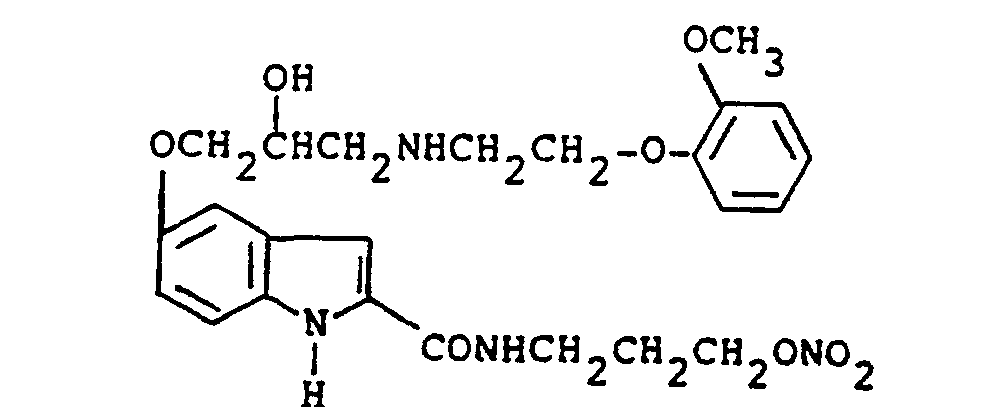
- Property: Pale yellow powder
- Melting point: 128-131°C
- MS: m/e 439 [M+―HONO3]
- IR, Vmax KBR cm-1: 1620 (CONH, ONO2),1280 (ONO2).
- 1H―NMR: δCDCl3-CD3OD
- 7.33 (1H, d,J=8.8Hz, HD)
- 7.08 (1 H, d, J=2.2Hz, HB
- 7.00-6.77 (6H, m, HA, HB,

- 4.57 (2H, t, J=6.6Hz,-CH2ONO2)
- 4.28-3.64 (5H, m,

- 3.85 (3H, s,-OCH3)
- 3.53 (2H, t, J=6.6Hz,-CONHCH2-)
- 3.23-2.89 (4H, m,―CH2NHCH2―)
- 2.07 (2H, q, J=6.9Hz, ―CH2CH2CH2―)

-

- Property: Orange powder
- Melting point: 158-160°C
- MS: m/e 376 [M+―HONO3]
- IR, Vmax KBr Cm-1: 1630 (CONH), 1620 (ON02), 1560 (N02), 1280 (ON02)
- 1H-NMR: δCDCl3
- 8.15 (1H, d, J=9.3Hz, HC)
- 7.39 (1H, s, HA)
- 6.67 (1H, d, J=9.0Hz, HB)
- 4.64 (2H, t, J=6.4Hz, -CH2ONO2)
- 3.95-3.78 (1H, m,

- 3.70-3.45 (7H, m, -CONHCH2-,

- 2.10 (2H, q, J=6.4Hz, -CH2CH2CH2-)
- 1.38-1.35 (6H, d,d, J=6.6Hz,


Claims (8)


Applications Claiming Priority (2)
| Application Number | Priority Date | Filing Date | Title |
|---|---|---|---|
| JP57173949A JPS5965073A (en) | 1982-10-05 | 1982-10-05 | Indole derivative |
| JP173949/82 | 1982-10-05 |
Publications (2)
| Publication Number | Publication Date |
|---|---|
| EP0105763A1 EP0105763A1 (en) | 1984-04-18 |
| EP0105763B1 true EP0105763B1 (en) | 1988-01-20 |
Family
ID=15970049
Family Applications (1)
| Application Number | Title | Priority Date | Filing Date |
|---|---|---|---|
| EP83306030A Expired EP0105763B1 (en) | 1982-10-05 | 1983-10-05 | Indole compounds, their preparation and pharmaceutical compositions comprising them |
Country Status (3)
| Country | Link |
|---|---|
| EP (1) | EP0105763B1 (en) |
| JP (1) | JPS5965073A (en) |
| DE (1) | DE3375391D1 (en) |
Families Citing this family (7)
| Publication number | Priority date | Publication date | Assignee | Title |
|---|---|---|---|---|
| FR2654335A1 (en) * | 1989-11-10 | 1991-05-17 | Oreal | TINCTORIAL COMPOSITIONS FOR KERATIN FIBERS CONTAINING OXIDATION COLORING PRECURSORS AND 4-HYDROXYINDOLE DERIVED COUPLERS, AND METHOD OF DYING USING SAME. |
| FR2705095B1 (en) * | 1993-05-12 | 1995-06-23 | Adir | New substituted indoles, process for their preparation and pharmaceutical compositions containing them. |
| MX9709875A (en) * | 1995-06-06 | 1998-03-31 | Pfizer | Substituted n-(indole-2-carbonyl)-glycinamides and derivatives as glycogen phosphorylase inhibitors. |
| HU227197B1 (en) | 2000-10-24 | 2010-10-28 | Richter Gedeon Nyrt | Nmda receptor antagonist carboxylic acid amide derivatives and pharmaceutical compositions containing them |
| US6939869B2 (en) | 2002-09-12 | 2005-09-06 | Kaohsiung Medical University | Pyrrolo[2,1-c][1,4] benzodiazepine-indole derivatives, their preparation process, and uses of the same |
| EA200801607A1 (en) | 2004-06-15 | 2008-10-30 | Пфайзер Инк. | DERIVATIVES OF BENZIMIDAZOLONIC CARBONIC ACID |
| US7737163B2 (en) | 2004-06-15 | 2010-06-15 | Pfizer Inc. | Benzimidazolone carboxylic acid derivatives |
Family Cites Families (1)
| Publication number | Priority date | Publication date | Assignee | Title |
|---|---|---|---|---|
| US4152446A (en) * | 1974-11-16 | 1979-05-01 | Boehringer Mannheim Gmbh | Aminopropanol compounds and compositions for the treatment of cardiac and circulatory diseases |
-
1982
- 1982-10-05 JP JP57173949A patent/JPS5965073A/en active Granted
-
1983
- 1983-10-05 DE DE8383306030T patent/DE3375391D1/en not_active Expired
- 1983-10-05 EP EP83306030A patent/EP0105763B1/en not_active Expired
Also Published As
| Publication number | Publication date |
|---|---|
| DE3375391D1 (en) | 1988-02-25 |
| EP0105763A1 (en) | 1984-04-18 |
| JPH0213671B2 (en) | 1990-04-04 |
| JPS5965073A (en) | 1984-04-13 |
Similar Documents
| Publication | Publication Date | Title |
|---|---|---|
| US4310527A (en) | Etherified hydroxy quinazolone compounds | |
| FR2530626A1 (en) | CARBOSTYRYL COMPOUNDS | |
| JPH0572384B2 (en) | ||
| ZA200607092B (en) | Derivatives of alkylpiperazine- and alkylhomopiperazine-carboxylates, preparation method thereof and use of same as Faah enzyme inhibitors | |
| EP0314446B1 (en) | Novel antihypertensive benzopyran derivatives | |
| US4032559A (en) | N,2-dicyanoacetimidates | |
| US4283541A (en) | Pyridylacyl-hydroxamates | |
| EP0105763A1 (en) | Indole compounds, their preparation and pharmaceutical compositions comprising them | |
| US3551419A (en) | Amino acid amides and process for their production | |
| US4297357A (en) | N-Phenethylacetamide compounds and process for preparation thereof | |
| US4448989A (en) | N-Nitroxyalkylene benzamide derivatives | |
| KR20060120677A (en) | Nitrooxy derivatives of carvedilol and other beta blockers as antihypertensive agents | |
| US4171446A (en) | Indazole compounds | |
| CA2111460C (en) | Tetrahydrobenzazepine derivatives which inhibit lipoxygenase | |
| JP2678758B2 (en) | Novel propane derivative | |
| JPS6355512B2 (en) | ||
| EP0602458A1 (en) | 1,4-Benzoxazine derivatives | |
| KR880001105B1 (en) | Method for preparing 1-benzyl-4- [4- (2-pyrimidinylamino) benzyl] -2,3-dioxopiperazin derivative | |
| US5106846A (en) | 2,3-thiomorpholinedione-2-oxime derivatives and pharmaceutical compositions containing them | |
| KR20060120164A (en) | Nitrox derivatives of antihypertensive agents | |
| HU191694B (en) | Process for production of new derivatives of amineburnan carbonic acid | |
| HU194164B (en) | Process for production of 1,2-dihydroxi-3-//2-indolil-1,1-dialkyl-ethil/-amin/-prophanes | |
| RO113856B1 (en) | Sulphonamide derivatives, process for their preparation and pharmaceutical composition containing said derivatives for diabetes therapy | |
| US4013682A (en) | N-hydroxy-amidine compounds | |
| JP2816974B2 (en) | Benzimidazole derivative, method for producing the same, and antiulcer agent containing the same |
Legal Events
| Date | Code | Title | Description |
|---|---|---|---|
| PUAI | Public reference made under article 153(3) epc to a published international application that has entered the european phase |
Free format text: ORIGINAL CODE: 0009012 |
|
| AK | Designated contracting states |
Designated state(s): DE FR GB IT SE |
|
| 17P | Request for examination filed |
Effective date: 19840829 |
|
| ITF | It: translation for a ep patent filed | ||
| GRAA | (expected) grant |
Free format text: ORIGINAL CODE: 0009210 |
|
| AK | Designated contracting states |
Kind code of ref document: B1 Designated state(s): DE FR GB IT SE |
|
| REF | Corresponds to: |
Ref document number: 3375391 Country of ref document: DE Date of ref document: 19880225 |
|
| ET | Fr: translation filed | ||
| PLBE | No opposition filed within time limit |
Free format text: ORIGINAL CODE: 0009261 |
|
| STAA | Information on the status of an ep patent application or granted ep patent |
Free format text: STATUS: NO OPPOSITION FILED WITHIN TIME LIMIT |
|
| 26N | No opposition filed | ||
| ITTA | It: last paid annual fee | ||
| EAL | Se: european patent in force in sweden |
Ref document number: 83306030.4 |
|
| PGFP | Annual fee paid to national office [announced via postgrant information from national office to epo] |
Ref country code: GB Payment date: 19970926 Year of fee payment: 15 |
|
| PGFP | Annual fee paid to national office [announced via postgrant information from national office to epo] |
Ref country code: FR Payment date: 19971009 Year of fee payment: 15 |
|
| PGFP | Annual fee paid to national office [announced via postgrant information from national office to epo] |
Ref country code: DE Payment date: 19971010 Year of fee payment: 15 |
|
| PGFP | Annual fee paid to national office [announced via postgrant information from national office to epo] |
Ref country code: SE Payment date: 19971015 Year of fee payment: 15 |
|
| PG25 | Lapsed in a contracting state [announced via postgrant information from national office to epo] |
Ref country code: GB Free format text: LAPSE BECAUSE OF NON-PAYMENT OF DUE FEES Effective date: 19981005 |
|
| PG25 | Lapsed in a contracting state [announced via postgrant information from national office to epo] |
Ref country code: SE Free format text: LAPSE BECAUSE OF NON-PAYMENT OF DUE FEES Effective date: 19981006 |
|
| GBPC | Gb: european patent ceased through non-payment of renewal fee |
Effective date: 19981005 |
|
| EUG | Se: european patent has lapsed |
Ref document number: 83306030.4 |
|
| PG25 | Lapsed in a contracting state [announced via postgrant information from national office to epo] |
Ref country code: FR Free format text: LAPSE BECAUSE OF NON-PAYMENT OF DUE FEES Effective date: 19990630 |
|
| REG | Reference to a national code |
Ref country code: FR Ref legal event code: ST |
|
| PG25 | Lapsed in a contracting state [announced via postgrant information from national office to epo] |
Ref country code: DE Free format text: LAPSE BECAUSE OF NON-PAYMENT OF DUE FEES Effective date: 19990803 |