EP0104857A1 - Deoxyuridine compounds, methods for preparing them and their use in medicine - Google Patents
Deoxyuridine compounds, methods for preparing them and their use in medicine Download PDFInfo
- Publication number
- EP0104857A1 EP0104857A1 EP83305481A EP83305481A EP0104857A1 EP 0104857 A1 EP0104857 A1 EP 0104857A1 EP 83305481 A EP83305481 A EP 83305481A EP 83305481 A EP83305481 A EP 83305481A EP 0104857 A1 EP0104857 A1 EP 0104857A1
- Authority
- EP
- European Patent Office
- Prior art keywords
- bromovinyl
- formula
- hydrogen
- deoxy
- phenyl
- Prior art date
- Legal status (The legal status is an assumption and is not a legal conclusion. Google has not performed a legal analysis and makes no representation as to the accuracy of the status listed.)
- Withdrawn
Links
- 238000000034 method Methods 0.000 title description 4
- MXHRCPNRJAMMIM-SHYZEUOFSA-N 2'-deoxyuridine Chemical class C1[C@H](O)[C@@H](CO)O[C@H]1N1C(=O)NC(=O)C=C1 MXHRCPNRJAMMIM-SHYZEUOFSA-N 0.000 title description 2
- 239000003814 drug Substances 0.000 title 1
- 150000001875 compounds Chemical class 0.000 claims abstract description 42
- 229910052739 hydrogen Inorganic materials 0.000 claims abstract description 23
- 239000001257 hydrogen Substances 0.000 claims abstract description 22
- 125000001997 phenyl group Chemical class [H]C1=C([H])C([H])=C(*)C([H])=C1[H] 0.000 claims abstract description 16
- 125000004435 hydrogen atom Chemical group [H]* 0.000 claims abstract description 10
- 150000002431 hydrogen Chemical group 0.000 claims abstract description 8
- 125000004169 (C1-C6) alkyl group Chemical class 0.000 claims abstract description 7
- 125000004122 cyclic group Chemical group 0.000 claims abstract description 6
- 125000002252 acyl group Chemical group 0.000 claims abstract description 5
- GDTBXPJZTBHREO-UHFFFAOYSA-N bromine Chemical group BrBr GDTBXPJZTBHREO-UHFFFAOYSA-N 0.000 claims abstract description 5
- 229910052794 bromium Inorganic materials 0.000 claims abstract description 5
- WKBOTKDWSSQWDR-UHFFFAOYSA-N Bromine atom Chemical group [Br] WKBOTKDWSSQWDR-UHFFFAOYSA-N 0.000 claims abstract description 4
- 239000000460 chlorine Substances 0.000 claims abstract description 4
- 229910052801 chlorine Inorganic materials 0.000 claims abstract description 4
- 229910052736 halogen Inorganic materials 0.000 claims abstract description 4
- 150000002367 halogens Chemical group 0.000 claims abstract description 4
- 208000036142 Viral infection Diseases 0.000 claims abstract description 3
- 125000001309 chloro group Chemical group Cl* 0.000 claims abstract description 3
- PNDPGZBMCMUPRI-UHFFFAOYSA-N iodine Chemical group II PNDPGZBMCMUPRI-UHFFFAOYSA-N 0.000 claims abstract description 3
- 230000009385 viral infection Effects 0.000 claims abstract description 3
- 239000000203 mixture Substances 0.000 claims description 24
- DRTQHJPVMGBUCF-XVFCMESISA-N Uridine Chemical compound O[C@@H]1[C@H](O)[C@@H](CO)O[C@H]1N1C(=O)NC(=O)C=C1 DRTQHJPVMGBUCF-XVFCMESISA-N 0.000 claims description 13
- 125000002496 methyl group Chemical group [H]C([H])([H])* 0.000 claims description 11
- 229940045145 uridine Drugs 0.000 claims description 10
- DRTQHJPVMGBUCF-PSQAKQOGSA-N beta-L-uridine Natural products O[C@H]1[C@@H](O)[C@H](CO)O[C@@H]1N1C(=O)NC(=O)C=C1 DRTQHJPVMGBUCF-PSQAKQOGSA-N 0.000 claims description 8
- DRTQHJPVMGBUCF-UHFFFAOYSA-N uracil arabinoside Natural products OC1C(O)C(CO)OC1N1C(=O)NC(=O)C=C1 DRTQHJPVMGBUCF-UHFFFAOYSA-N 0.000 claims description 8
- 125000001495 ethyl group Chemical group [H]C([H])([H])C([H])([H])* 0.000 claims description 5
- RTZKZFJDLAIYFH-UHFFFAOYSA-N Diethyl ether Chemical compound CCOCC RTZKZFJDLAIYFH-UHFFFAOYSA-N 0.000 claims description 4
- UFHFLCQGNIYNRP-UHFFFAOYSA-N Hydrogen Chemical compound [H][H] UFHFLCQGNIYNRP-UHFFFAOYSA-N 0.000 claims description 4
- 239000003937 drug carrier Substances 0.000 claims description 4
- 239000008194 pharmaceutical composition Substances 0.000 claims description 3
- 125000004191 (C1-C6) alkoxy group Chemical group 0.000 claims description 2
- 125000003545 alkoxy group Chemical group 0.000 claims description 2
- QVGXLLKOCUKJST-UHFFFAOYSA-N atomic oxygen Chemical compound [O] QVGXLLKOCUKJST-UHFFFAOYSA-N 0.000 claims description 2
- 125000001797 benzyl group Chemical group [H]C1=C([H])C([H])=C(C([H])=C1[H])C([H])([H])* 0.000 claims description 2
- 239000002552 dosage form Substances 0.000 claims description 2
- 125000005843 halogen group Chemical group 0.000 claims description 2
- 239000001301 oxygen Substances 0.000 claims description 2
- 229910052760 oxygen Inorganic materials 0.000 claims description 2
- 239000000546 pharmaceutical excipient Substances 0.000 claims description 2
- 125000001246 bromo group Chemical group Br* 0.000 claims 1
- 125000004218 chloromethyl group Chemical group [H]C([H])(Cl)* 0.000 claims 1
- 238000004519 manufacturing process Methods 0.000 claims 1
- CSCPPACGZOOCGX-UHFFFAOYSA-N Acetone Chemical compound CC(C)=O CSCPPACGZOOCGX-UHFFFAOYSA-N 0.000 description 30
- XEKOWRVHYACXOJ-UHFFFAOYSA-N Ethyl acetate Chemical compound CCOC(C)=O XEKOWRVHYACXOJ-UHFFFAOYSA-N 0.000 description 30
- VLKZOEOYAKHREP-UHFFFAOYSA-N n-Hexane Chemical compound CCCCCC VLKZOEOYAKHREP-UHFFFAOYSA-N 0.000 description 23
- WYURNTSHIVDZCO-UHFFFAOYSA-N Tetrahydrofuran Chemical compound C1CCOC1 WYURNTSHIVDZCO-UHFFFAOYSA-N 0.000 description 22
- 239000000243 solution Substances 0.000 description 21
- HEDRZPFGACZZDS-MICDWDOJSA-N Trichloro(2H)methane Chemical compound [2H]C(Cl)(Cl)Cl HEDRZPFGACZZDS-MICDWDOJSA-N 0.000 description 14
- YLQBMQCUIZJEEH-UHFFFAOYSA-N tetrahydrofuran Natural products C=1C=COC=1 YLQBMQCUIZJEEH-UHFFFAOYSA-N 0.000 description 11
- HEDRZPFGACZZDS-UHFFFAOYSA-N Chloroform Chemical compound ClC(Cl)Cl HEDRZPFGACZZDS-UHFFFAOYSA-N 0.000 description 10
- LFQSCWFLJHTTHZ-UHFFFAOYSA-N Ethanol Chemical compound CCO LFQSCWFLJHTTHZ-UHFFFAOYSA-N 0.000 description 10
- CSNNHWWHGAXBCP-UHFFFAOYSA-L Magnesium sulfate Chemical compound [Mg+2].[O-][S+2]([O-])([O-])[O-] CSNNHWWHGAXBCP-UHFFFAOYSA-L 0.000 description 10
- VYPSYNLAJGMNEJ-UHFFFAOYSA-N Silicium dioxide Chemical compound O=[Si]=O VYPSYNLAJGMNEJ-UHFFFAOYSA-N 0.000 description 10
- UIIMBOGNXHQVGW-UHFFFAOYSA-M Sodium bicarbonate Chemical compound [Na+].OC([O-])=O UIIMBOGNXHQVGW-UHFFFAOYSA-M 0.000 description 10
- 239000000741 silica gel Substances 0.000 description 10
- 229910002027 silica gel Inorganic materials 0.000 description 10
- ZMXDDKWLCZADIW-UHFFFAOYSA-N N,N-Dimethylformamide Chemical compound CN(C)C=O ZMXDDKWLCZADIW-UHFFFAOYSA-N 0.000 description 9
- ODZBBRURCPAEIQ-PIXDULNESA-N helpin Chemical compound C1[C@H](O)[C@@H](CO)O[C@H]1N1C(=O)NC(=O)C(\C=C\Br)=C1 ODZBBRURCPAEIQ-PIXDULNESA-N 0.000 description 8
- 238000006243 chemical reaction Methods 0.000 description 7
- 238000004440 column chromatography Methods 0.000 description 7
- OKKJLVBELUTLKV-UHFFFAOYSA-N Methanol Chemical compound OC OKKJLVBELUTLKV-UHFFFAOYSA-N 0.000 description 6
- 229910052943 magnesium sulfate Inorganic materials 0.000 description 6
- KJIFKLIQANRMOU-UHFFFAOYSA-N oxidanium;4-methylbenzenesulfonate Chemical compound O.CC1=CC=C(S(O)(=O)=O)C=C1 KJIFKLIQANRMOU-UHFFFAOYSA-N 0.000 description 6
- 238000010828 elution Methods 0.000 description 5
- 239000011541 reaction mixture Substances 0.000 description 5
- JYYNAJVZFGKDEQ-UHFFFAOYSA-N 2,4-Dimethylpyridine Chemical compound CC1=CC=NC(C)=C1 JYYNAJVZFGKDEQ-UHFFFAOYSA-N 0.000 description 4
- ATBHKHVJFMQCLH-GBTQTLIESA-N 5-[(e)-2-bromoethenyl]-1-[(2r,4s,5r)-5-(hydroxymethyl)-4-(phenylmethoxymethoxy)oxolan-2-yl]pyrimidine-2,4-dione Chemical compound O([C@H]1C[C@@H](O[C@@H]1CO)N1C(NC(=O)C(\C=C\Br)=C1)=O)COCC1=CC=CC=C1 ATBHKHVJFMQCLH-GBTQTLIESA-N 0.000 description 4
- JGFZNNIVVJXRND-UHFFFAOYSA-N N,N-Diisopropylethylamine (DIPEA) Chemical compound CCN(C(C)C)C(C)C JGFZNNIVVJXRND-UHFFFAOYSA-N 0.000 description 4
- 230000000840 anti-viral effect Effects 0.000 description 4
- 238000004587 chromatography analysis Methods 0.000 description 4
- 239000000284 extract Substances 0.000 description 4
- 239000011521 glass Substances 0.000 description 4
- TYJJADVDDVDEDZ-UHFFFAOYSA-M potassium hydrogencarbonate Chemical class [K+].OC([O-])=O TYJJADVDDVDEDZ-UHFFFAOYSA-M 0.000 description 4
- 239000011369 resultant mixture Substances 0.000 description 4
- 239000007858 starting material Substances 0.000 description 4
- XLYOFNOQVPJJNP-UHFFFAOYSA-N water Substances O XLYOFNOQVPJJNP-UHFFFAOYSA-N 0.000 description 4
- LELRZSFDJVZCPG-KYYCJIGLSA-N 5-[(e)-2-bromoethenyl]-1-[(2r,4s,5r)-5-(1-ethoxypropoxymethyl)-4-hydroxyoxolan-2-yl]pyrimidine-2,4-dione Chemical compound C1[C@H](O)[C@@H](COC(CC)OCC)O[C@H]1N1C(=O)NC(=O)C(\C=C\Br)=C1 LELRZSFDJVZCPG-KYYCJIGLSA-N 0.000 description 3
- FVEJMDRMVFCDBX-OYGSNPQQSA-N 5-[(e)-2-bromoethenyl]-1-[(2r,4s,5r)-5-(ethoxymethoxymethyl)-4-hydroxyoxolan-2-yl]pyrimidine-2,4-dione Chemical compound C1[C@H](O)[C@@H](COCOCC)O[C@H]1N1C(=O)NC(=O)C(\C=C\Br)=C1 FVEJMDRMVFCDBX-OYGSNPQQSA-N 0.000 description 3
- RHRVBRQPQAWHFW-YQJLUSGRSA-N 5-[(e)-2-bromoethenyl]-1-[(2r,4s,5r)-5-(hydroxymethyl)-4-(oxan-2-yloxy)oxolan-2-yl]pyrimidine-2,4-dione Chemical compound O([C@H]1C[C@@H](O[C@@H]1CO)N1C(NC(=O)C(\C=C\Br)=C1)=O)C1CCCCO1 RHRVBRQPQAWHFW-YQJLUSGRSA-N 0.000 description 3
- VOSKMLPTWUSEIY-UPMHXXEDSA-N 5-[(e)-2-bromoethenyl]-1-[(2r,4s,5r)-5-(hydroxymethyl)-4-(oxolan-2-yloxy)oxolan-2-yl]pyrimidine-2,4-dione Chemical compound O([C@H]1C[C@@H](O[C@@H]1CO)N1C(NC(=O)C(\C=C\Br)=C1)=O)C1CCCO1 VOSKMLPTWUSEIY-UPMHXXEDSA-N 0.000 description 3
- WSFSSNUMVMOOMR-UHFFFAOYSA-N Formaldehyde Chemical compound O=C WSFSSNUMVMOOMR-UHFFFAOYSA-N 0.000 description 3
- 239000007795 chemical reaction product Substances 0.000 description 3
- 239000003480 eluent Substances 0.000 description 3
- OAYLNYINCPYISS-UHFFFAOYSA-N ethyl acetate;hexane Chemical compound CCCCCC.CCOC(C)=O OAYLNYINCPYISS-UHFFFAOYSA-N 0.000 description 3
- 235000019341 magnesium sulphate Nutrition 0.000 description 3
- -1 methyl,chloro-methyl Chemical group 0.000 description 3
- 239000012074 organic phase Substances 0.000 description 3
- 235000017557 sodium bicarbonate Nutrition 0.000 description 3
- 229910000030 sodium bicarbonate Inorganic materials 0.000 description 3
- 239000007787 solid Substances 0.000 description 3
- 239000006188 syrup Substances 0.000 description 3
- 235000020357 syrup Nutrition 0.000 description 3
- FXIQITGZZVEIRY-GVLPHVPESA-N 5-[(E)-2-bromoethenyl]-3-(4-chlorobenzoyl)-1-[(2R,4S,5R)-4-(phenylmethoxymethoxy)-5-(phenylmethoxymethoxymethyl)oxolan-2-yl]pyrimidine-2,4-dione Chemical compound C(C1=CC=CC=C1)OCO[C@H]1C[C@@H](O[C@@H]1COCOCC1=CC=CC=C1)N1C(=O)N(C(=O)C(=C1)\C=C\Br)C(C1=CC=C(C=C1)Cl)=O FXIQITGZZVEIRY-GVLPHVPESA-N 0.000 description 2
- PNMZCUGXKIQFKZ-VREHXWONSA-N 5-[(e)-2-bromoethenyl]-1-[(2r,4s,5r)-4-(ethoxymethoxy)-5-(ethoxymethoxymethyl)oxolan-2-yl]pyrimidine-2,4-dione Chemical compound C1[C@H](OCOCC)[C@@H](COCOCC)O[C@H]1N1C(=O)NC(=O)C(\C=C\Br)=C1 PNMZCUGXKIQFKZ-VREHXWONSA-N 0.000 description 2
- HOTQVVMRBHESGT-FTRHTPEESA-N 5-[(e)-2-bromoethenyl]-1-[(2r,4s,5r)-4-(oxolan-2-yloxy)-5-(oxolan-2-yloxymethyl)oxolan-2-yl]pyrimidine-2,4-dione Chemical compound O=C1NC(=O)C(/C=C/Br)=CN1[C@@H]1O[C@H](COC2OCCC2)[C@@H](OC2OCCC2)C1 HOTQVVMRBHESGT-FTRHTPEESA-N 0.000 description 2
- ZYIKYCJVVFCAQR-LZDJJOMISA-N 5-[(e)-2-bromoethenyl]-1-[(2r,4s,5r)-4-hydroxy-5-(methoxymethoxymethyl)oxolan-2-yl]pyrimidine-2,4-dione Chemical compound C1[C@H](O)[C@@H](COCOC)O[C@H]1N1C(=O)NC(=O)C(\C=C\Br)=C1 ZYIKYCJVVFCAQR-LZDJJOMISA-N 0.000 description 2
- FOYQQHBIERIVLL-UPMHXXEDSA-N 5-[(e)-2-bromoethenyl]-1-[(2r,4s,5r)-4-hydroxy-5-(oxolan-2-yloxymethyl)oxolan-2-yl]pyrimidine-2,4-dione Chemical compound C([C@H]1O[C@H](C[C@@H]1O)N1C(NC(=O)C(\C=C\Br)=C1)=O)OC1CCCO1 FOYQQHBIERIVLL-UPMHXXEDSA-N 0.000 description 2
- QGZKDVFQNNGYKY-UHFFFAOYSA-N Ammonia Chemical compound N QGZKDVFQNNGYKY-UHFFFAOYSA-N 0.000 description 2
- PEDCQBHIVMGVHV-UHFFFAOYSA-N Glycerine Chemical compound OCC(O)CO PEDCQBHIVMGVHV-UHFFFAOYSA-N 0.000 description 2
- 241000700588 Human alphaherpesvirus 1 Species 0.000 description 2
- JUJWROOIHBZHMG-UHFFFAOYSA-N Pyridine Chemical compound C1=CC=NC=C1 JUJWROOIHBZHMG-UHFFFAOYSA-N 0.000 description 2
- 241000700605 Viruses Species 0.000 description 2
- 125000000217 alkyl group Chemical group 0.000 description 2
- 239000002775 capsule Substances 0.000 description 2
- 239000003054 catalyst Substances 0.000 description 2
- LADPCMZCENPFGV-UHFFFAOYSA-N chloromethoxymethylbenzene Chemical compound ClCOCC1=CC=CC=C1 LADPCMZCENPFGV-UHFFFAOYSA-N 0.000 description 2
- 239000012043 crude product Substances 0.000 description 2
- 239000013078 crystal Substances 0.000 description 2
- 239000006260 foam Substances 0.000 description 2
- 238000009472 formulation Methods 0.000 description 2
- 239000007788 liquid Substances 0.000 description 2
- HQKMJHAJHXVSDF-UHFFFAOYSA-L magnesium stearate Chemical compound [Mg+2].CCCCCCCCCCCCCCCCCC([O-])=O.CCCCCCCCCCCCCCCCCC([O-])=O HQKMJHAJHXVSDF-UHFFFAOYSA-L 0.000 description 2
- 238000012423 maintenance Methods 0.000 description 2
- 239000002904 solvent Substances 0.000 description 2
- 238000006467 substitution reaction Methods 0.000 description 2
- 239000003826 tablet Substances 0.000 description 2
- 230000000699 topical effect Effects 0.000 description 2
- 241001529453 unidentified herpesvirus Species 0.000 description 2
- HEVMDQBCAHEHDY-UHFFFAOYSA-N (Dimethoxymethyl)benzene Chemical compound COC(OC)C1=CC=CC=C1 HEVMDQBCAHEHDY-UHFFFAOYSA-N 0.000 description 1
- MBNMGGKBGCIEGF-UHFFFAOYSA-N 1,1-diethoxypropane Chemical compound CCOC(CC)OCC MBNMGGKBGCIEGF-UHFFFAOYSA-N 0.000 description 1
- YUIHSLYOPKDRCJ-UHFFFAOYSA-N 2-[(2-methylpropan-2-yl)oxy]oxolane Chemical compound CC(C)(C)OC1CCCO1 YUIHSLYOPKDRCJ-UHFFFAOYSA-N 0.000 description 1
- OVXJWSYBABKZMD-UHFFFAOYSA-N 2-chloro-1,1-diethoxyethane Chemical compound CCOC(CCl)OCC OVXJWSYBABKZMD-UHFFFAOYSA-N 0.000 description 1
- HZLHRDBTVSZCBS-UVJJDBRNSA-N 4-[(e)-(4-aminophenyl)-(4-imino-3-methylcyclohexa-2,5-dien-1-ylidene)methyl]-2-methylaniline;hydrochloride Chemical compound Cl.C1=CC(=N)C(C)=C\C1=C(C=1C=C(C)C(N)=CC=1)/C1=CC=C(N)C=C1 HZLHRDBTVSZCBS-UVJJDBRNSA-N 0.000 description 1
- ZBOFYRMHUQTQTH-NYTRKWKYSA-N 5-[(e)-2-bromoethenyl]-1-[(2r,4s,5r)-4-(1-ethoxypropoxy)-5-(1-ethoxypropoxymethyl)oxolan-2-yl]pyrimidine-2,4-dione Chemical compound C1[C@H](OC(CC)OCC)[C@@H](COC(CC)OCC)O[C@H]1N1C(=O)NC(=O)C(\C=C\Br)=C1 ZBOFYRMHUQTQTH-NYTRKWKYSA-N 0.000 description 1
- PFMFEYRCOKLKOT-UPMHXXEDSA-N 5-[(e)-2-bromoethenyl]-1-[(2r,4s,5r)-4-(2-chloro-1-ethoxyethoxy)-5-(hydroxymethyl)oxolan-2-yl]pyrimidine-2,4-dione Chemical compound O1[C@H](CO)[C@@H](OC(CCl)OCC)C[C@@H]1N1C(=O)NC(=O)C(\C=C\Br)=C1 PFMFEYRCOKLKOT-UPMHXXEDSA-N 0.000 description 1
- YWHVUEXMAYMFNV-FTRHTPEESA-N 5-[(e)-2-bromoethenyl]-1-[(2r,4s,5r)-4-(2-chloro-1-ethoxyethoxy)-5-[(2-chloro-1-ethoxyethoxy)methyl]oxolan-2-yl]pyrimidine-2,4-dione Chemical compound C1[C@H](OC(CCl)OCC)[C@@H](COC(CCl)OCC)O[C@H]1N1C(=O)NC(=O)C(\C=C\Br)=C1 YWHVUEXMAYMFNV-FTRHTPEESA-N 0.000 description 1
- HSYDBDHIQMTXSZ-OYGSNPQQSA-N 5-[(e)-2-bromoethenyl]-1-[(2r,4s,5r)-4-(ethoxymethoxy)-5-(hydroxymethyl)oxolan-2-yl]pyrimidine-2,4-dione Chemical compound O1[C@H](CO)[C@@H](OCOCC)C[C@@H]1N1C(=O)NC(=O)C(\C=C\Br)=C1 HSYDBDHIQMTXSZ-OYGSNPQQSA-N 0.000 description 1
- YAWNDIOHJWYYNZ-QLTKDOQRSA-N 5-[(e)-2-bromoethenyl]-1-[(2r,4s,5r)-4-(phenylmethoxymethoxy)-5-(phenylmethoxymethoxymethyl)oxolan-2-yl]pyrimidine-2,4-dione Chemical compound O=C1NC(=O)C(/C=C/Br)=CN1[C@@H]1O[C@H](COCOCC=2C=CC=CC=2)[C@@H](OCOCC=2C=CC=CC=2)C1 YAWNDIOHJWYYNZ-QLTKDOQRSA-N 0.000 description 1
- IEFVPWGASCLRRY-YQJLUSGRSA-N 5-[(e)-2-bromoethenyl]-1-[(2r,4s,5r)-4-hydroxy-5-(oxan-2-yloxymethyl)oxolan-2-yl]pyrimidine-2,4-dione Chemical compound C([C@H]1O[C@H](C[C@@H]1O)N1C(NC(=O)C(\C=C\Br)=C1)=O)OC1CCCCO1 IEFVPWGASCLRRY-YQJLUSGRSA-N 0.000 description 1
- ZNEZPGAPWJUCIF-GBTQTLIESA-N 5-[(e)-2-bromoethenyl]-1-[(2r,4s,5r)-4-hydroxy-5-(phenylmethoxymethoxymethyl)oxolan-2-yl]pyrimidine-2,4-dione Chemical compound C([C@H]1O[C@H](C[C@@H]1O)N1C(NC(=O)C(\C=C\Br)=C1)=O)OCOCC1=CC=CC=C1 ZNEZPGAPWJUCIF-GBTQTLIESA-N 0.000 description 1
- MCAGPTBNPAUCQX-LZDJJOMISA-N 5-[(e)-2-bromoethenyl]-1-[(2r,4s,5r)-5-(hydroxymethyl)-4-(methoxymethoxy)oxolan-2-yl]pyrimidine-2,4-dione Chemical compound O1[C@H](CO)[C@@H](OCOC)C[C@@H]1N1C(=O)NC(=O)C(\C=C\Br)=C1 MCAGPTBNPAUCQX-LZDJJOMISA-N 0.000 description 1
- DFXHSOAEWKHOPN-UPMHXXEDSA-N 5-[(e)-2-bromoethenyl]-1-[(2r,4s,5r)-5-[(2-chloro-1-ethoxyethoxy)methyl]-4-hydroxyoxolan-2-yl]pyrimidine-2,4-dione Chemical compound C1[C@H](O)[C@@H](COC(CCl)OCC)O[C@H]1N1C(=O)NC(=O)C(\C=C\Br)=C1 DFXHSOAEWKHOPN-UPMHXXEDSA-N 0.000 description 1
- DLXDACQULABCTR-VREHXWONSA-N 5-[(e)-2-bromoethenyl]-3-(4-chlorobenzoyl)-1-[(2r,4s,5r)-4-hydroxy-5-(hydroxymethyl)oxolan-2-yl]pyrimidine-2,4-dione Chemical compound C1[C@H](O)[C@@H](CO)O[C@H]1N1C(=O)N(C(=O)C=2C=CC(Cl)=CC=2)C(=O)C(\C=C\Br)=C1 DLXDACQULABCTR-VREHXWONSA-N 0.000 description 1
- QTBSBXVTEAMEQO-UHFFFAOYSA-M Acetate Chemical compound CC([O-])=O QTBSBXVTEAMEQO-UHFFFAOYSA-M 0.000 description 1
- 229920000936 Agarose Polymers 0.000 description 1
- GUBGYTABKSRVRQ-XLOQQCSPSA-N Alpha-Lactose Chemical compound O[C@@H]1[C@@H](O)[C@@H](O)[C@@H](CO)O[C@H]1O[C@@H]1[C@@H](CO)O[C@H](O)[C@H](O)[C@H]1O GUBGYTABKSRVRQ-XLOQQCSPSA-N 0.000 description 1
- ODZBBRURCPAEIQ-DJLDLDEBSA-N Brivudine Chemical compound C1[C@H](O)[C@@H](CO)O[C@H]1N1C(=O)NC(=O)C(C=CBr)=C1 ODZBBRURCPAEIQ-DJLDLDEBSA-N 0.000 description 1
- 101150041968 CDC13 gene Proteins 0.000 description 1
- ZAMOUSCENKQFHK-UHFFFAOYSA-N Chlorine atom Chemical compound [Cl] ZAMOUSCENKQFHK-UHFFFAOYSA-N 0.000 description 1
- 241000282552 Chlorocebus aethiops Species 0.000 description 1
- BUDQDWGNQVEFAC-UHFFFAOYSA-N Dihydropyran Chemical compound C1COC=CC1 BUDQDWGNQVEFAC-UHFFFAOYSA-N 0.000 description 1
- 239000004150 EU approved colour Substances 0.000 description 1
- 108010010803 Gelatin Proteins 0.000 description 1
- WQZGKKKJIJFFOK-GASJEMHNSA-N Glucose Natural products OC[C@H]1OC(O)[C@H](O)[C@@H](O)[C@@H]1O WQZGKKKJIJFFOK-GASJEMHNSA-N 0.000 description 1
- 241000282412 Homo Species 0.000 description 1
- 241000701074 Human alphaherpesvirus 2 Species 0.000 description 1
- VEXZGXHMUGYJMC-UHFFFAOYSA-N Hydrochloric acid Chemical compound Cl VEXZGXHMUGYJMC-UHFFFAOYSA-N 0.000 description 1
- GUBGYTABKSRVRQ-QKKXKWKRSA-N Lactose Natural products OC[C@H]1O[C@@H](O[C@H]2[C@H](O)[C@@H](O)C(O)O[C@@H]2CO)[C@H](O)[C@@H](O)[C@H]1O GUBGYTABKSRVRQ-QKKXKWKRSA-N 0.000 description 1
- 241001465754 Metazoa Species 0.000 description 1
- 240000007594 Oryza sativa Species 0.000 description 1
- 235000007164 Oryza sativa Nutrition 0.000 description 1
- FAPWRFPIFSIZLT-UHFFFAOYSA-M Sodium chloride Chemical compound [Na+].[Cl-] FAPWRFPIFSIZLT-UHFFFAOYSA-M 0.000 description 1
- 229920002472 Starch Polymers 0.000 description 1
- 239000002253 acid Substances 0.000 description 1
- 239000003377 acid catalyst Substances 0.000 description 1
- 239000004480 active ingredient Substances 0.000 description 1
- 239000002168 alkylating agent Substances 0.000 description 1
- 229940100198 alkylating agent Drugs 0.000 description 1
- 229910021529 ammonia Inorganic materials 0.000 description 1
- 239000007864 aqueous solution Substances 0.000 description 1
- WQZGKKKJIJFFOK-VFUOTHLCSA-N beta-D-glucose Chemical compound OC[C@H]1O[C@@H](O)[C@H](O)[C@@H](O)[C@@H]1O WQZGKKKJIJFFOK-VFUOTHLCSA-N 0.000 description 1
- 230000037396 body weight Effects 0.000 description 1
- 239000002537 cosmetic Substances 0.000 description 1
- 239000006071 cream Substances 0.000 description 1
- 231100000135 cytotoxicity Toxicity 0.000 description 1
- 230000003013 cytotoxicity Effects 0.000 description 1
- 238000010790 dilution Methods 0.000 description 1
- 239000012895 dilution Substances 0.000 description 1
- NKDDWNXOKDWJAK-UHFFFAOYSA-N dimethoxymethane Chemical compound COCOC NKDDWNXOKDWJAK-UHFFFAOYSA-N 0.000 description 1
- 235000021186 dishes Nutrition 0.000 description 1
- 239000006196 drop Substances 0.000 description 1
- 150000002148 esters Chemical class 0.000 description 1
- 235000019441 ethanol Nutrition 0.000 description 1
- KLKFAASOGCDTDT-UHFFFAOYSA-N ethoxymethoxyethane Chemical compound CCOCOCC KLKFAASOGCDTDT-UHFFFAOYSA-N 0.000 description 1
- NBEMQPLNBYYUAZ-UHFFFAOYSA-N ethyl acetate;propan-2-one Chemical compound CC(C)=O.CCOC(C)=O NBEMQPLNBYYUAZ-UHFFFAOYSA-N 0.000 description 1
- 239000003889 eye drop Substances 0.000 description 1
- 239000000796 flavoring agent Substances 0.000 description 1
- 235000013312 flour Nutrition 0.000 description 1
- 239000008098 formaldehyde solution Substances 0.000 description 1
- 238000001891 gel spinning Methods 0.000 description 1
- 239000008273 gelatin Substances 0.000 description 1
- 229920000159 gelatin Polymers 0.000 description 1
- 235000019322 gelatine Nutrition 0.000 description 1
- 235000011852 gelatine desserts Nutrition 0.000 description 1
- 239000008103 glucose Substances 0.000 description 1
- 235000001727 glucose Nutrition 0.000 description 1
- 235000011187 glycerol Nutrition 0.000 description 1
- 230000003301 hydrolyzing effect Effects 0.000 description 1
- 239000005457 ice water Substances 0.000 description 1
- 238000000338 in vitro Methods 0.000 description 1
- 239000012442 inert solvent Substances 0.000 description 1
- 208000015181 infectious disease Diseases 0.000 description 1
- 239000007924 injection Substances 0.000 description 1
- 238000002347 injection Methods 0.000 description 1
- 150000002500 ions Chemical class 0.000 description 1
- 210000003734 kidney Anatomy 0.000 description 1
- 239000008101 lactose Substances 0.000 description 1
- 239000006210 lotion Substances 0.000 description 1
- 235000019359 magnesium stearate Nutrition 0.000 description 1
- 238000002844 melting Methods 0.000 description 1
- 230000008018 melting Effects 0.000 description 1
- GRVDJDISBSALJP-UHFFFAOYSA-N methyloxidanyl Chemical compound [O]C GRVDJDISBSALJP-UHFFFAOYSA-N 0.000 description 1
- 150000004682 monohydrates Chemical class 0.000 description 1
- 231100000252 nontoxic Toxicity 0.000 description 1
- 230000003000 nontoxic effect Effects 0.000 description 1
- 239000002674 ointment Substances 0.000 description 1
- 229940006093 opthalmologic coloring agent diagnostic Drugs 0.000 description 1
- 239000012044 organic layer Substances 0.000 description 1
- 239000003960 organic solvent Substances 0.000 description 1
- 239000000047 product Substances 0.000 description 1
- UMJSCPRVCHMLSP-UHFFFAOYSA-N pyridine Natural products COC1=CC=CN=C1 UMJSCPRVCHMLSP-UHFFFAOYSA-N 0.000 description 1
- 239000012429 reaction media Substances 0.000 description 1
- 235000009566 rice Nutrition 0.000 description 1
- 229920006395 saturated elastomer Polymers 0.000 description 1
- 239000002002 slurry Substances 0.000 description 1
- 239000011780 sodium chloride Substances 0.000 description 1
- 235000002639 sodium chloride Nutrition 0.000 description 1
- 239000008247 solid mixture Substances 0.000 description 1
- 238000010186 staining Methods 0.000 description 1
- 235000019698 starch Nutrition 0.000 description 1
- 239000008107 starch Substances 0.000 description 1
- 239000012258 stirred mixture Substances 0.000 description 1
- 239000000725 suspension Substances 0.000 description 1
- 125000004187 tetrahydropyran-2-yl group Chemical group [H]C1([H])OC([H])(*)C([H])([H])C([H])([H])C1([H])[H] 0.000 description 1
- JOXIMZWYDAKGHI-UHFFFAOYSA-N toluene-4-sulfonic acid Chemical compound CC1=CC=C(S(O)(=O)=O)C=C1 JOXIMZWYDAKGHI-UHFFFAOYSA-N 0.000 description 1
- 229920002554 vinyl polymer Polymers 0.000 description 1
Classifications
-
- C—CHEMISTRY; METALLURGY
- C07—ORGANIC CHEMISTRY
- C07H—SUGARS; DERIVATIVES THEREOF; NUCLEOSIDES; NUCLEOTIDES; NUCLEIC ACIDS
- C07H19/00—Compounds containing a hetero ring sharing one ring hetero atom with a saccharide radical; Nucleosides; Mononucleotides; Anhydro-derivatives thereof
- C07H19/02—Compounds containing a hetero ring sharing one ring hetero atom with a saccharide radical; Nucleosides; Mononucleotides; Anhydro-derivatives thereof sharing nitrogen
- C07H19/04—Heterocyclic radicals containing only nitrogen atoms as ring hetero atom
- C07H19/06—Pyrimidine radicals
-
- A—HUMAN NECESSITIES
- A61—MEDICAL OR VETERINARY SCIENCE; HYGIENE
- A61P—SPECIFIC THERAPEUTIC ACTIVITY OF CHEMICAL COMPOUNDS OR MEDICINAL PREPARATIONS
- A61P31/00—Antiinfectives, i.e. antibiotics, antiseptics, chemotherapeutics
- A61P31/12—Antivirals
Definitions
- This invention relates to certain deoxyuridine compounds which have antiviral activity.
- a compound of formula (I) in which Y is chlorine, bromine or iodine, preferably bromine, each of R 1 and R 2 is hydrogen or a group of formula R 4- CH- in which R 4 is hydrogen, optionally O R 5 halo-substituted C 1-6 alkyl, phenyl or phenyl - C l - 6 alkyl, R 5 is optionally halo-substituted C 1-6 alkyl or phenyl-C 1-6 alkyl, or R 4 and R 5 complete a ring system and together represent -(C H 2 ) 3 -, -(CH 2 ) 4 - or -CH 2 0CH 2 CH 2 -, and R3 is hydrogen or an acyl group of formula in which X is C l - 6 alkyl, phenyl or phenyl-Ci- 6 alkyl, each of which is optionally substituted with halogen, with the proviso that
- R 2 is hydrogen
- R 4 is hydrogen, methyl,chloro-methyl, ethyl or phenyl
- R 5 is methyl, ethyl or benzyl.
- R 4 and R 5 together complete a ring system they preferably represent -(CH 2 ) 4 -.
- R 3 is an acyl group
- X is preferably optionally substituted phenyl, suitably chloro- substituted phenyl.
- Compounds of formula (I) in which R4 and R 5 complete a ring system may be prepared by treating a compound of formula (II): in which Y and R 3 are as defined in formula (I), with an ether of formula (III): in which Z is hydrogen or a C 1-6 alkoxy group, preferably t-butoxy and, when Z is hydrogen, the -R 4- R 5 group includes a double bond adjacent to the oxygen.
- the reaction is preferably carried out in an inert organic solvent, suitably tetrahydrofuran, and in the presence of an acid catalyst, suitably p-toluene sulphonic acid.
- an inert organic solvent suitably tetrahydrofuran
- an acid catalyst suitably p-toluene sulphonic acid.
- the reaction will generally produce a mixture of three compounds wherein substitution is present at (a) the 3' position, (b) the 5 1 position, and (c) the 3' and 5 1 positions.
- the mixture may be separated into its individual components by standard chromatographic methods.
- Compounds of formula (I) in which R 4 and R 5 do not complete a ring system may be prepared by treating a compound of formula (II), as defined, with a compound of formula (IV): in which W is a C l - 6 alkoxy group or a halogen atom, preferably chlorine.
- the reaction is preferably carried out in a similar reaction medium to that employed in the reaction between compounds of formulae (II) and (III), and a mixture of two compounds will generally be produced in which substitution is present at (a) the 3' and 5' positions, and (b) the 5' position.
- the mixture may be separated into its components by chromatographic methods.
- the reaction is preferably carried out in an inert solvent, suitably dimethylformamide, in the presence of a basic catalyst, suitably diisopropylethylamine.
- a basic catalyst suitably diisopropylethylamine.
- This reaction is particularly suitable for preparing compounds of formula (I) wherein R 5 represents a phenyl-Ci- 6 alkyl group and R 4 represents hydrogen.
- a similar reaction, using 2,4-lutidine as the basic catalyst, is particularly suitable for preparing compounds of formula (I) wherein R 5 represents C l - 6 alkyl and R 4 represents hydrogen.
- a mixture of 3 1 ,5 1 disubstituted and 3' or 5' mono-substituted compounds will generally be produced and the individual compounds can be separated chromatographically.
- the compounds of formulae (III) and (IV), are either known compounds, or can be prepared from known compounds by known methods.
- the compounds of formula (I) may be formulated for use in a pharmaceutical composition. Accordingly, in a further aspect of the invention, there is provided a pharmaceutical composition which comprises a compound of the formula (I) together with a pharmaceutically acceptable carrier or excipient.
- compositions which may be administered by the oral route to humans may be compounded in the form of syrups, tablets and capsules.
- any pharmaceutical carrier suitable for formulating such solid compositions may be used, for example magnesium stearate, starch, lactose, glucose, rice, flour and chalk.
- the composition may also be in the form of an ingestible capsule, for example of gelatin, to contain the compound, or in the form of a syrup, a solution or a suspension.
- Suitable liquid pharmaceutical carriers include ethyl alcohol, glycerine, saline and water to which flavouring or colouring agents may be added to form syrups.
- the compounds may also be presented with a sterile liquid carrier for injection.
- composition may also be formulated for topical application to the skin or eyes.
- the compounds of the invention may be made up into a cream, lotion or ointment.
- These formulations may be conventional formulations well known in the art, for example, as described in standard books of pharmaceutics and cosmetics, such as Harry's Cosmeticology published by Leonard Hill Books and the British Pharmacopaeia.
- composition for application to the eyes may be a conventional eye-drop composition well known in the art.
- compositions of this invention are in unit dosage form or in some other form that the patient may administer to himself a single dose.
- a suitable dosage unit might contain from 50 mg to 1 g of active ingredient, for example 100 to 500 mg. Such doses may be administered 1 to 4 times a day or more usually 2 or 3 times a day.
- the effective dose of compound depends on the particular compound employed, but is in general in the range of from 1.0 to 20 mg/kg of body weight per day or more usually 2.0 to 10 mg/kg per day.
- a method of treating viral infections in a human or non-human animal which comprises administering to the animal an effective, non-toxic amount of a compound of formula (I).
- a crystal of p-toluenesulphonic acid monohydrate was added to a stirred mixture of 5-(E-2-bromovinyl)-2'-deoxyuridine (2.08g) and dihydropyran (1.2ml) in tetrahydrofuran (30ml) at room temperature and the mixture was stirred at room temperature overnight. It was then partitioned between aqueous sodium bicarbonate and ethyl acetate. The organic extract was dried and evaporated and the residue was chromatographed over silica gel (70g).
- the aqueous solution was extracted with ethyl acetate (300ml) and the organic layer washed with sodium hydrogen carbonate solution (300ml) and water (200ml) and dried (anhydrous magnesium sulphate). The ethyl'acetate was removed in vacuo to give the crude reaction products.
- Vero African Green Monkey Kidney cells were grown to confluence in 24 well multidishes, each well being 1.6 cm in diameter.
- the cells were infected with Herpes simplex type 1 virus (HFEM strain) and overlaid with 0.5ml of 0.9% agarose (w/v) in maintenance medium.
- Test compounds prepared in maintenance medium in concentrations ranging from 100 to 0.03 pg/ml in half-log dilution steps, were added in 0.5ml volume.
- the virus infected cultures were then incubated at 37 0 C for 4 days before fixing in 4% formaldehyde solution and staining with carbolfuchsin.
- the dishes were then examined to find what concentration of test compound caused a 50% reduction in the number of virus plaques formed (PDD 50 value) and the minimum concentration of test compound which caused cytotoxicity (MTD).
- PDD 50 value 50% reduction in the number of virus plaques formed
- MTD minimum concentration of test compound which caused cytotoxicity
Landscapes
- Health & Medical Sciences (AREA)
- Chemical & Material Sciences (AREA)
- Organic Chemistry (AREA)
- Life Sciences & Earth Sciences (AREA)
- General Health & Medical Sciences (AREA)
- Medicinal Chemistry (AREA)
- Public Health (AREA)
- General Chemical & Material Sciences (AREA)
- Communicable Diseases (AREA)
- Nuclear Medicine, Radiotherapy & Molecular Imaging (AREA)
- Virology (AREA)
- Pharmacology & Pharmacy (AREA)
- Animal Behavior & Ethology (AREA)
- Oncology (AREA)
- Chemical Kinetics & Catalysis (AREA)
- Veterinary Medicine (AREA)
- Engineering & Computer Science (AREA)
- Biochemistry (AREA)
- Biotechnology (AREA)
- Genetics & Genomics (AREA)
- Molecular Biology (AREA)
- Saccharide Compounds (AREA)
- Pharmaceuticals Containing Other Organic And Inorganic Compounds (AREA)
Abstract
A compound of formula (I):
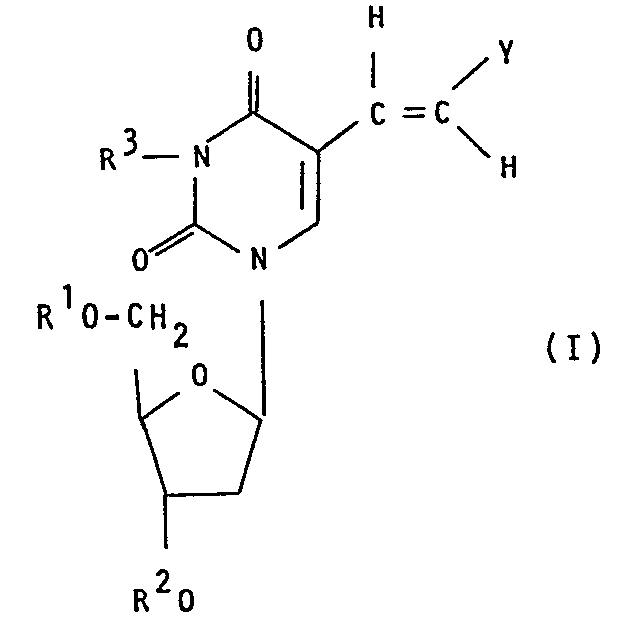
in which Y is chlorine, bromine or iodine, each of R1 and R2 is hydrogen or a group of formula
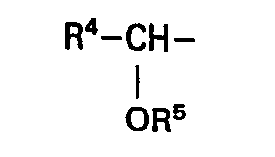
in which R4 is hydrogen, optionally halo-substituted C1-6 alkyl, phenyl or phenyl -C1-6 alkyl, R5 is optionally halo-substituted C1-6 alkyl, or phenyl-C1-6alkyl, or R4 and R5 complete a ring system and together represent -(CH2)3-, -(CH2)4- or -CH2OCH2CH2-, and R3 is hydrogen or an acyl group of formula

in which X is C1-6alkyl, phenyl or phenyl-C1-8alkyl, each of which is optionally substituted with halogen, with the proviso that R1 and R2 are not simultaneously hydrogen, is useful in treating viral infections.
Description
- This invention relates to certain deoxyuridine compounds which have antiviral activity.
- Published European Patent Application No. 0 061 283 discloses esters of 5-(2-halogenovinyl)-2'-deoxyuridines which have anti-viral activity selective against herpes viruses.
- We have now found a group of mono-, di- and trisubstituted 5-(2-halogenomnyl)-2'-deoxyuridmes which have antiviral activity, and which are useful in the treatment of infections caused by herpes viruses, such as herpes simplex type 1, herpes simplex type 2 and varicella.
- According to the present invention there is provided a compound of formula (I):


- Preferably, R2 is hydrogen.
- Preferably, R4 is hydrogen, methyl,chloro-methyl, ethyl or phenyl, and R5 is methyl, ethyl or benzyl. When R4 and R5 together complete a ring system they preferably represent -(CH2)4-.
- When R3 is an acyl group, X is preferably optionally substituted phenyl, suitably chloro- substituted phenyl.
- Compounds of formula (I) in which R4 and R5 complete a ring system, may be prepared by treating a compound of formula (II):


- The reaction is preferably carried out in an inert organic solvent, suitably tetrahydrofuran, and in the presence of an acid catalyst, suitably p-toluene sulphonic acid.
- The reaction will generally produce a mixture of three compounds wherein substitution is present at (a) the 3' position, (b) the 51 position, and (c) the 3' and 51 positions. The mixture may be separated into its individual components by standard chromatographic methods.
- Compounds of formula (I) in which R4 and R5 do not complete a ring system may be prepared by treating a compound of formula (II), as defined, with a compound of formula (IV):

- When W is Cl-6 alkoxy the reaction is preferably carried out in a similar reaction medium to that employed in the reaction between compounds of formulae (II) and (III), and a mixture of two compounds will generally be produced in which substitution is present at (a) the 3' and 5' positions, and (b) the 5' position. As before, the mixture may be separated into its components by chromatographic methods.
- When W is halogen, the reaction is preferably carried out in an inert solvent, suitably dimethylformamide, in the presence of a basic catalyst, suitably diisopropylethylamine. This reaction is particularly suitable for preparing compounds of formula (I) wherein R5 represents a phenyl-Ci-6alkyl group and R4 represents hydrogen. A similar reaction, using 2,4-lutidine as the basic catalyst, is particularly suitable for preparing compounds of formula (I) wherein R5 represents Cl-6 alkyl and R4 represents hydrogen. Again, a mixture of 31,51 disubstituted and 3' or 5' mono-substituted compounds will generally be produced and the individual compounds can be separated chromatographically.
- Compounds of formula (II) in which R3 is an acyl group may themselves be produced by selectively hydrolysing a 3,3',5-triacylated derivative of a compound of formula (II), in the manner as described in Published European Patent Application No. 0 061 283.
- The compounds of formulae (III) and (IV), are either known compounds, or can be prepared from known compounds by known methods.
- The compounds of formula (I) may be formulated for use in a pharmaceutical composition. Accordingly, in a further aspect of the invention, there is provided a pharmaceutical composition which comprises a compound of the formula (I) together with a pharmaceutically acceptable carrier or excipient.
- Compositions which may be administered by the oral route to humans may be compounded in the form of syrups, tablets and capsules. When the composition is in the form of a tablet, any pharmaceutical carrier suitable for formulating such solid compositions may be used, for example magnesium stearate, starch, lactose, glucose, rice, flour and chalk. The composition may also be in the form of an ingestible capsule, for example of gelatin, to contain the compound, or in the form of a syrup, a solution or a suspension. Suitable liquid pharmaceutical carriers include ethyl alcohol, glycerine, saline and water to which flavouring or colouring agents may be added to form syrups. The compounds may also be presented with a sterile liquid carrier for injection.
- The composition may also be formulated for topical application to the skin or eyes.
- For topical application to the skin, the compounds of the invention may be made up into a cream, lotion or ointment. These formulations may be conventional formulations well known in the art, for example, as described in standard books of pharmaceutics and cosmetics, such as Harry's Cosmeticology published by Leonard Hill Books and the British Pharmacopaeia.
- The composition for application to the eyes may be a conventional eye-drop composition well known in the art.
- Preferably, the compositions of this invention are in unit dosage form or in some other form that the patient may administer to himself a single dose. A suitable dosage unit might contain from 50 mg to 1 g of active ingredient, for example 100 to 500 mg. Such doses may be administered 1 to 4 times a day or more usually 2 or 3 times a day. The effective dose of compound depends on the particular compound employed, but is in general in the range of from 1.0 to 20 mg/kg of body weight per day or more usually 2.0 to 10 mg/kg per day.
- In a further aspect of the invention there is provided a method of treating viral infections in a human or non-human animal, which comprises administering to the animal an effective, non-toxic amount of a compound of formula (I).
- The following Examples illustrate the invention.
- To a sitrred solution of 5-(E-2-bromovinyl)-2'-deoxyuridine (1.32g) and 2-t-butoxytetrahydrofuran (1.0g) in tetrahydrofuran (10ml), a crystal of p-toluenesulphonic acid monohydrate was added and the mixture was stirred at room temperature for 5 min. It was then partitioned between aqueous sodium bicarbonate and ethyl acetate and the organic extract was dried and evaporated. The residue was chromatographed over silica gel (80g). Elution of the column with ethyl acetate-hexane (3:1) gave 5-(E-2-bromovinyl)-2'-deoxy-3',5'-bis-O-(tetrahydrofuran-2-yl)uridine (0.3g), vmax . (CHCl3) 1710, 1685, 1430 and 1280 cm-1; δH (CDCl3) 1.70-2.10 (8H, m), 2.10-2.55 (2H, m, 2'-CH2), 3.40-4.40 (8H, m), 5.16 (2H, broad s), 6.18 (1H, m, 1'-CH), 6.64 (1H, s, J 14Hz, CH=CHBr), 7.35 (1H, d, J 14Hz, CH=CHBr), 7.80 (1H, s, 6-CH), 9.13 (1H, m, D20 exchangeable); and 5-(E-2-bromovinyl)-2'-deoxy-3'-O-(tetrahydrofuran-2-yl)uridine (0.32g), Xmax (EtOH) 250 (ε 16,600) and 293 (ε 14,300) nm; vmax (CHCl3) 1705, 1685, 1460, 1280 and 1100 cm-1; δH [(CD3) 2SQ] 1.83(4H, m), 2.20 (2H, m, 2'-CH2) , 3.50-4.40 (6H, m), 5.17 (1H, m), 5.20 (1H, m, D20 exchangeable, 5'OH), 6.13 (1H, m, 1'-GH), 6.88 (1H, d, J 14Hz, CH=CHBr), 7.33 (1H, d, J 14Hz, CH=CHBr), 7.86, 8.13 (1H, s, 6-CH), 11.66 (1H, broad s, D20 exchangable) (Found: C, 44.85; H, 4.3; N, 6.4%. C15H19N2 0 6Br requires C, 44.7; H, 4.75; N, 6.95%); followed by 5-(E-2-bromovinyl)-2'-deoxy-5'-O-(tetrahydrofuran-2-yl)uridine (0.46g), m.p. 160-164°C (from ethyl acetate-hexane); Xmax (EtOH) 251 (ε 14,100) and 293 (ε 12,100) nm; vmax (KBr) 1718, 1685, 1670, 1660 and 1280 cm-1; δH [(CD3)2SO] 1.80 (4H, m), 2.13 (1H, t, J 6Hz, 2-CH2) , 3.40-4.25 (6H, m), 5.15 (1H, m), 5.30 (1H, m, D20 exchangeable, 3'-OH), 6.15 (1H, t, J 6Hz, 1'-CH), 6.86 (1H, d, J 14Hz, CH=CHBr), 7.30 (1H, d, J 14Hz, CH=CHBr), 7.85 (1H, s, 6-CH), 11.63 (1H, broad s, D20 exchangeable, NH) "(Found: C, 44.55; H, 4.25; N, 6.75%. C15H19N2O6Br requires C, 44.7; H, 4.75; N, 6.95%).
- A crystal of p-toluenesulphonic acid monohydrate was added to a stirred mixture of 5-(E-2-bromovinyl)-2'-deoxyuridine (2.08g) and dihydropyran (1.2ml) in tetrahydrofuran (30ml) at room temperature and the mixture was stirred at room temperature overnight. It was then partitioned between aqueous sodium bicarbonate and ethyl acetate. The organic extract was dried and evaporated and the residue was chromatographed over silica gel (70g). Elution of the column with ethyl acetate-hexane (4:1) afforded 5-(E-2-bromovinyl)-21-deoxy-31,51-bis-O-(tetrahydropyran-2-yl)-uridine (0.05g), vmax (CHC13) 1700, 1680, 1460, 1278, 1124, 1070, 1030 and 905 cm-1; δH (CDC13) 1.35-2.70 (14H, m), 3.35-4.85 (10H, m), 6.25 (1H, m, 1'-CH), 6.61, 6.73 (1H, d, J 14Hz, CH=CHBr), 7.34, 7.40 (1H, d, J 14Hz, CH=CHBr), 7.76, 7.94, 7.98 (1H, s, 6-CH), 9.37 (1H, m, D2O exchangeable, NH); followed by 5-(E-2-bromovinyl)-2'-deoxy-3'-O-(tetrahydropyran-2-yl)uridine (0.5g), λmax (EtOH) 250 (ε 12,900) and 293 (e 11,000)nm; vmax (CHCl3) 1700, 1455, 1275, and 1100 cm-1; δH (CDC13) 1.35-1.90 (6H, m), 2.05-2.70 (2H, m, 2'-CH2), 2.60 (1H, m, D20 exchangeable, OH), 3.25-4.95 (7H, m), 6.15 (1H, t, J 6Hz, 1'-CH), 6.60 (1H, d, J 14Hz, CH=CHBr), 7.27 (1H, d, J 14Hz, CH=CHBr), 7.76, 7.80 (1H, s, 6-CH), and 9.10 (1H, m, D20 exchangeable, NH) (Found: C, 46.5; H, 5.05; N, 6.15%. C16H21N206Br requires C, 46.05; H, 5.05; N, 6.7%); and 5-(E-2-bromovinyl)-2'-deoxy-5'-O-(tetrahydropyran-2-yl)uridine (0.5g), m.p. 160-162°C (from acetone-ethyl acetate), Xmax (EtOH) 250 (ε 14,600) and 293(ε 12,500 nm; vmax (KBr) 1685, 1470, 1385, and 1035 cm-1: δH ((CD3)2SO] 1.30-1.82 (6H, m), 2.14 (2H, m, 2'-CH2), 3.24-4.00 (5H, m), 4.20 (1H, m), 4.55 (1H, m), 5.24 (1H, m, D20 exchangeable, OH), 6.10 (1H, t, J 6Hz, 1'-CH), 6.76, 6.70 (1H, d, J 14Hz, CH=CHBr), 7.13, 7.15 (1H, d, J 14Hz, CH=CHBr), 7.75-7.85 (1H, s, 6-CH), and 11.53 (1H, m, D20 exchangeable, NH) (Found: C, 46.2; H, 4.7; N, 6.75%. C 16H21 N 2 0 6 Br requires C, 46.05; H, 5.05; N, 6.7%).
- A solution of 5-(E-2-bromovinyl)-2'-deoxyuridine (3.00g, 9mmol) in dry tetrahydrofuran (20ml) containing p-toluenesulphonic acid monohydrate (15mg) was charged with propionaldehyde diethyl acetal (5.90g, 7.5ml, 45mmol). The mixture was stirred at 25°C for 24 hours. The reaction mixture was poured onto saturated potassium hydrogen carbonate solution (50ml) and extracted with ethyl acetate (2 x 150ml). The organic phase was separated, dried (MgSO4), and evaporated under reduced pressure. The crude products were subjected to short-path column chromatography using 10-30% acetone in n-hexane. Pure 5-(E-2-bromovinyl)-2'-deoxy-3',5'-bis-O-(1-ethoxypropyl)uridine was isolated as a glass (1.8g, 39% based on consumption of BVDU) with vmax (film) 1710, 1470, and 1288 cm-1; δH (CDC13) 0.70-2.00 (16H, m, 4 x CH3 and 2 x CH2), 2.30-2.60 (2H, m, 2'-CH2), 3.30-4.05 (6H, m, 5'-CH2 and 2 x CH2O) , 4.15-4.75 (4H, m, 3'-CH, 4'-CH, 2 x CH), 6.10-6.50 (1H, m, 1'-CH), 6.75 (1H, dd, CH=CHBr), 7.45 (1H, d, CH=CHBr), 7.98 (1H, d, 6-CH), 9.63 (1H, br.s, D2O exchangeable, NH); m/z 504/506 (M+, 1.5%), 401/403 (M+-C5H11O, 6.5%); observed mass 401.0696, C16H22N2O5Br requires 402.0712.
- Pure 5-(E-2-bromovinyl)-2'-deoxy-5'-O-(1-ethoxypropyl)-uridine was isolated as a low melting foam (1.25g, 33% based on consumption of 5=(E-2-bromovinyl)-2'-deoxyuridine) with vmax (film) 1707, 1675, 1600, 1466, and 1280 cm-1; δH [(CD3)2SO] 0.70-1.90 (8H, m, 2 x CH3 and 1 x CH2), 2.00-2.40 (2H, m, 2'-CH2), 3.20-4.65 (7H, m, 3'-CH, 4'-CH, 5'-CH2, CH20 and CH), 5.33 (1H, d, D20 exchangeable, OH), 6.00-6.40 (1H, m, 1'-CH), 6.83 (1H, d, CH=CHBr), 7.35 (1H, d, CH=CHBr), 7.95 (1H, d, 6-CH), 11.86 (1H, br.s, D20 exchangeable, NH); m/z 418/420 (M+, 0.3%); observed mass 418.0724, C 16 H 23 N 2 0 6Br requires 418.0739.
- To a solution of 5-(E-2-bromovinyl)-3-p-chlorobenzoyl-2'-deoxyuridine (950mg, 2mmol) in dry N,N-dimethylformamide (20ml) was added diisopropylethylamine (5ml) and benzoxymethyl chloride (6.0ml, 6.60g) and the mixture stirred overnight at 25°C. The excess alkylating agent was removed by addition of a mixture of methanol (20ml) and pyridine (100ml). The solvents were removed under high vacuum and the residue subjected to short path column chromatography on silica gel using 10-20% chloroform in n-hexane as eluent. Pure 3',5'- bis-O-benzoxymethyl-5-(E-2-bromovinyl)-3-p-chlorobenzoyl-2'-deoxyuridine (1.35g, 94%) was obtained as an oil with vmax (film) 1750, 1700, 1664, 1590, 1450, 907 and 730 cm-1; δH (CDC3) 1.90-2.50 (2H, m, 21-CH2), 3.65-3.90 (2H, m, 5'-CH2), 4.00-4.90 (10H, m, 3'-CH, 4'-CH, 2 x ArCH2 and 2 x OCH2), 6.05-6.35 (1H, m, 11-CH), 6.66 (1H, d, CH=CHBr), 7.10-7.80 (15H,.m, CH=CHBr, pClC6H4CO and 2 x C6H5), 7.90 (1H, s, 6-CH).
- A solution of 3',5'-bis-O-benzoxymethyl-5-(E-2-bromo- vinyl)-3-p-chloro benzoyl-2'-deoxyuridine (3.04g, 4.26mmol) in anhydrous tetrahydrofuran (200ml) at 0°C was saturated with gaseous ammonia. The mixture was allowed to reach room temperature and stirred overnight. Removal of the tetrahydrofuran gave the crude reaction products. Short-path chromatography (silica gel, 10-20% acetone in n-hexane) failed to separate the desired product from p-chloroacetamide. Pure 3',5'-bis-O-benzoxymethyl-5-(E-2-bromovinyl)-2'-deoxyuridine was obtained (876mg, 36%) using silica gel spinning band chromatography (50:1 chloroform/methanol eluent) as a yellow oil with vmax (film) 1700, 1595, 1459, 1278, and 1020 cm-1; 6H [(CD3)2SO] 2.15-2.45 (2H, m, 21-CH2), 3.55- 3.85 (2H, m, 5'-CH2), 4.00-4.25 (1H, m, 4'-CH) , 4.30-4.65 (3H, m, 3'-CH and ArCH2), 4.80 (2H, d, ArCH2), 6.15 (1H, t, 1'-CH), 6.83 (1H, d, CH=CHBr), 7.10-7.50 (11H, m, CH=CHBr and 2 x C6H5), 7.85 (1H, s, 6-CH), 11.50 (1H, br.s, NH, D20 exchangeable); m/z 573/575 (MH+, 2%).
- To a solution of 5-(E-2-bromovinyl)2'-deoxyuridine (2.00g, 6mmol) in tetrahydrofuran (20ml) and N,N-dimethylformamide (5ml) 2,4-lutidine (4.28g, 4.50ml, 40mmol) and benzoxymethyl chloride (3.14g, 3.00ml, 20mmol) were added. The resultant mixture was stirred at room temperature for 72 hours. The reaction mixture was poured into ice-water (100ml) and extracted with ethyl acetate (300ml). The organic phase was washed with dilute hydrochloric acid (100ml), saturated potassium hydrogen carbonate solution (300ml), water (200ml) and dried (MgSO4). Removal of the solvent under reduced pressure followed by short path column chromatography(silica gel, 30% acetone in n-hexane) gave 3'-O-benzoxymethyl-5-(E-2-bromovinyl)-2'-deoxyuridine as an oil (0.21g, 7.7%) with vmax (film) 3400, 3175, 3050, 1700, 1460, 1280, 1100, and 1038 cm-1; δH (CDC13) 1.60 (1H, br.s, 5'-OH, D20 exchangeable), 2.15-2.60 (2H, m, 2'-CH2), 3.60-4.20 (3H, m, 51-CH2 and 41-CH), 4.35-4.90 (5H, m, 3'-CH and 2 x CH2), 6.20 (1H, t, 1'-CH), 6.63 (1H, d, CH=CHBr), 7.20-7.50 (6H, m, CH=CHBr and C6H5), 7.80 (1H, s, 6-CH), 8.90 (1H, br.s, NH, D20 exchangeable); MS (Positive Ion FAB) m/z 453 (MH+, 2%).
- Further elution (50% acetone in n-hexane) gave 5'-0-benzoxymethyl-5-(E-2-bromovinyl)-2'-deoxyuridine as a solid (0.325g, 12%) with m.p. 138-140°C; vmax (film) 3400, 3240, 3060, 1700, 1675, 1598, 1468, 1278, and 1022 cm 1; δH [(CD3)2SO] 2.00-2.40 (2H, m, 2'-CH2), 3.50-4.05 (3H, m, 5'-CH2 and 4'-CH), 4.10-4.43 (1H, m, 31-CH), 4.70 (4H, d, 2 x CH2), 5.18 (1H, d, 3'-OH, D20 exchangeable), 6.10-6.35 (1H, m, 1'-CH), 6.85 (1H, d, CH=CHBr), 7.10-7.50 (6H, m, CH=CHBr and C6H5), 7.95 (1H, s, 6-CH), 11.58 (1H, br.s, NH, D20 exchangeable).
- To a solution of 5-(E-2-bromovinyl)-2'-deoxyuridine (3.00g, 9mmol) and dimethoxymethane (50ml) in anhydrous tetrahydrofuran (100ml) was added p-toluenesulphonic acid monohydrate (300mg) and the resultant mixture stirred at 25°. After 24 h the solution was poured into saturated sodium hydrogen carbonate solution (300ml). The aqueous mixture was extracted with ethyl acetate (250ml) and the organic phase washed with saturated sodium hydrogen carbonate solution (300ml), water (300ml) and dried (anhydrous magnesium sulphate). The ethyl acetate was removed in vacuo to give the crude reaction products. Short-path column chromatography (silica gel, 10-50% acetone in n-hexane) gave successively 5-(E-2-bromovinyl)-2'-deoxy-3',5'-bis-0-methoxymethyluridine (920mg, 24%) as a white solid with m.p. 101-103°; vmax (KBr) 1720, 1700, 1680, 1465, 1286, 1150, 1100, and 1032 cm-1; δH (CDC13) 2.00-2.80 (2H, m, 2'-CH2) , 3.40 (6H, d, 2 x CH30), 3.60-4.00 (2H, m, 5'-CH2), 4.10-4.45 (2H, m, 3'-CH and 4'-CH), 4.70 (4H, d, 2 x CH2O) , 6.25 (1H, t, 1'-CH), 6.63 (1H, d, CH=CHBr), 7.30 (1H, d, CH=CHBr), 7.87 (1H, s, 6-CH), 9.40 (1H, br.s, NH, D20 exchangeable); observed mass 420.0534, C15 H 21N2 0 7 Br requires 420.0533. 5-(E-2-bromovinyl)-2'-deoxy-3'-O-methoxymethyluridine (230mg, 6.80%) as a glass with vmax (film) 3400, 1705, 1467, 1280, amd 1027 cm-1; δH [(CD3)2SO] 2.10-2.35 (2H, m, 2'-CH2) , 3.28 (3H, s, CH30), 3.40-3.70 (2H, m, 5'-CH2) , 3.80-4.00 (1H, m, 4'-CH), 4.15-4.40 (1H, m, 3'-CH), 4.65 (2H, s, CH20), 5.15 (1H, t, 5'-OH, D20 exchangeable), 6.10 (1H, m, 1'-CH) , 6.80 (1H, d, CH=CHBr), 7.25 (1H, d, CH=CHBr), 8.05 (1H, s, 6-CH), 11.50 (1H, br.s, NH, D20 exchangeable); m/z 377/379 (MH+, 4.00%). 5-(E-2-Bromovinyl)-21-deoxy-51-0-methoxymethyluridine (450mg, 13%) as a white solid with m.p. 173-175°; vmax (KBr) 3375, 3160, 1690, 1466, 1273, 1068, 1045, and 1027 cm-1; δH [(CD3)2SO] 2.05-2.35 (2H, m, 2'-CH2) , 3.30 (3A,s,CH3O) 3.50-3.65 (2H, m, 5'-CH2), 3.75-4.05 (1H, m, 4'-CH), 4.10-4.40 (1H, m, 3'-CH), 4.63 (2H, s, CH20), 5.30 (1H, d; 3'-OH, D20 exchangeable), 6.15 (1H, t, 1'-CH) , 6.82 (1H, d, CH=CHBr) , 7.25 (1H, d, CH=CHBr), 7.85 (1H, s, 6-CH), 11.50 (1H, br.s, NH, D20 exchangeable); observed mass 376.0272, C13H17N2O6Br requires 376.0271.
- To a solution of 5-(E-2-bromovinyl)-2'-deoxyuridine (3.00g, =9mmol) in tetrahydrofuran (50ml) diethoxymethane (6.8ml, ≃54mmo1) and p-toluenesulphonic acid monohydrate (500mg) were added. The resultant solution was stirred overnight at room temperature. The reaction mixture was poured into saturated potassium hydrogen carbonate solution (200ml) and the aqueous mixture extracted with ethyl acetate (2 x 200ml). The combined organic extracts were washed with saturated potassium hydrogen carbonate solution (2 x 200ml) and dried (magnesium sulphate). Removal of the ethyl acetate in vacuo gave the crude products. Short-path column chromatography on silica gel using 10% acetone in hexane as eluent gave 5-(E-2-bromovinyl)-2'-deoxy-3',5'- bis-O-ethoxymethyluridine (1.52g, 37% based on consumption of starting material) with vmax (film) 1700, and 1680 cm-1; 6H (CDC13) 1.25 (6H, m, 2 x CH3), 1.90-2.65 (2H, m, 2'-CH2), 3.45-4.00 (4H, m, 5'-CH2 and 2 x CH3CH20), 4.10-4.50 (2H, m, 3'-CH and 41-CH), 4.80 (4H, m, 2 x EtOCH20), 6.25 (1H, m, 1'-CH) , 6.65 (1H, d, CH=CHBr), 7.35 (1H, d, CH=CHBr), 7.90 (1H, s, 6-CH), 9.85 (1H, br.s, NH, D20 exchangeable); observed mass 448.0839, C17H25N2O7Br requires 448.0846.
- Subsequent elution with 25% acetone in n-hexane gave 5-(E-2-bromovinyl-)-2'-deoxy-3'-O-ethoxymethyluridine(0.19g, 6.3% based on consumption of starting material) with vmax (film) 3440, 3175, 1700, 1100, and 1035 cm-1; δH (CDC13) 1.20 (3H, t, CH3), 2.10-2.60 (2H, m, 2'-CH2) , 2.83 (1H, br.s, 5'-OH, D20 exchangeable), 3.45-4.15 (5H, m, 4'-CH, 51-CH2 and CH3CH20-), 4.23-4.52 (1H, m, 3'-CH), 4.75 (2H, s, EtOCH20-), 6.20 (1H, t, 1'-CH), 6.60 (1H, d, CH=CHBr), 7.28 (1H, d, CH=CHBr), 7.85 (1H, s, 6-CH), 9.50 (1H, br.s, NH, D20 exchangeable); observed mass 390.0430, C14H19N2O6Br requires 390.0427.
- Further elution with 30% acetone in n-hexane gave 5-(E-2-bromovinyl)-2'-deoxy-5'-O-ethoxymethyluridine (0.61g, 20% based on consumption of starting material) with vmax (film) 3425, 3225, 1710, and 1662 cm-1; δH [CDCl3 + 1 drop (CD3)2SO] 1.20 (3H, t, CH3), 1.90-2.60 (2H, m, 2'-CH2), 3.45-3.80 (4H, m, 5'-CH2 and CH3CH20-), 4.05 (1H, m, 4'-CH), 4.30 (1H, m, 3'-CH), 4.75 (2H, s, EtOCH20-), 5.00 (1H, d, 3'-OH, D20 exchangeable), 6.30 (1H, t, 1'-CH), 6.65 (1H, d, CH=CHBr), 7.28 (1H, d, CH=CHBr), 7.85 (1H, s, 6-CH), 10.85 (1H, br.s, NH, D20 exchangeable); observed mass 390.0422, C14H19N2O6Br requires 390.0427.
- To a solution of 5-(E-2-bromovinyl)-2'-deoxyuridine (3.33g, 10mmol) and chloroacetaldehyde diethylacetal (27.54g, 27ml, 180mmol) in anhydrous tetrahydrofuran (50ml) was added p-toluenesulponic acid monohydrate (1.5g) and the resultant mixture stirred at 25°C. After 6 hours it was apparent (tlc) that no more starting material was being consumed and the reaction mixture was poured into saturated sodium hydrogen carbonate solution (300ml). The aqueous solution was extracted with ethyl acetate (300ml) and the organic layer washed with sodium hydrogen carbonate solution (300ml) and water (200ml) and dried (anhydrous magnesium sulphate). The ethyl'acetate was removed in vacuo to give the crude reaction products. Short-path column chromatography (silica gel, 10-50% acetone in n-hexane) gave successively 5-(E-2-bromovinyl)-3',5'-bis-O-(2-chloro-1-ethoxyethyl)-2'-deoxyuridine (552mg, 10.10%) as an oil with vmax (film) 1706, 1055 cm-1; δH (CDC13) 1.20 (6H, m, 2 x CH3), 2.15-2.75 (2H, m, 2'-CH2), 3.35-4.00 (10H, m, 5'-CH2, 2 x CH20 and 2 x ClCH2), 4.10-4.85 (4H, m, 4'-CH, 3'-CH and 2 x CH), 6.15-6.45 (1H, m, 1'-CH), 6.73 (1H, dd, CH=CHBr), 7.35 (1H, d, CH=CHBr), 7.80 (1H, d, 6-CH), 9.90 (1H, d, NH, D20 exchangeable); m/z 547 (MH+, 21%). 5-(E-2-bromovinyl)-3'-O-(2-chloro-1-ethoxyethyl)-2'-deoxyuridine (294mg, 6.70%) as glass with vmax (film) 3450, 1706, 1468, 1286, 1110, and 1060 cm ; δH [(CD3)2SO] 1.15 (3H, t, CH3) 2.25 (2H, m, 2'-CH2), 3.40-3.75 (6H, m, 5'-CH2, ClCH2 and OCH2), 3.90 (1H, m, 4'-CH), 4.35 (1H, m, 3'-CH), 4.73 (1H, t, CH), 5.15 (1H, t, 5'-OH, D20 exchangeable), 6.10 (1H, t, 1'-CH), 6.80 (1H, d, CH=CHBr), 7.23 (1H, d, CH=CHBr), 8.00 (1H, s, 6-CH), 11.50 (1H, s, NH, D20 exchangeable); m/z 439 (MH+, 8.00%). 5-(E-2-Bromovinyl)-5'-O-(2-chloro-1-ethoxyethyl)-2'-deoxyuridine (736mg, 16.75%) as a foam with vmax (KBr) 3440, 1700, 1470, 1288, and 1060 cm-1; δH[(CD3)2SOt, CH3), 2.15 (2H, m, 2'-CH2), 3.40-4.05 (7H, m, 5'-CH2, ClCH2, OCH2 and 4'-CH), 4.25 (1H, m, 3'-CH), 4.75 (1H, t, CH), 5.33 (1H, d, 3'-OH, D20 exchangeable), 6.25 (1H, m, 1'-CH), 6.83 (1H, d, CH=CHBr), 7.25 (1H, d, CH=CHBr), 7.90 (1H, d, 6-CH), 11.50 (1H, s, NH, D20 exchangeable); m/z 439 (MH+, 24%).

- To a solution of 5-(E-2-bromovinyl)-2'-deoxyuridine (4.00g, 12mmol) in anhydrous tetrahydrofuran (20ml), p-toluenesulphonic acid monohydrate (0.005g) and benzaldehyde dimethyl acetal (11.00g, 11.00ml, 72mmol) were added and the resultant mixture stirred at room temperature for 72 hours. The reaction mixture was poured into saturated sodium hydrogen carbonate solution (100ml) and the aqueous slurry extracted with ethyl acetate (2 x 100ml). The organic extract was dried (MgS04) and evaporated under reduced pressure. Short-path column chromatography (silica gel, 10-30% acetone in n-hexane) gave 5-(E-2-bromovinyl)-2'-deoxy-3',5'-bis-O-α-methoxybenyluridine as a glass (2.65g, 38.5%) with vmax (film) 3180, 3060, 1700, 1455, 1280, 1100, 1060, 1030, 756, and 703 cm-1; δH (CDCl3) 1.70-2.75 (2H, m, 2'-CH2), 3.20-3.90 (8H, m, 2 x CH30 and 5'-CH2), 4.10-4.70 (2H, m, 3'-CH and 4'-CH), 5.30-5.65 (2H, m, 2 x ArCHOMe), 5.80-6.70 (2H, m, 1'-CH and CH=CHBr), 7.10-7.95 (12H, m, CH=CHBr, 6-CH and 2 x C6H5), 9.75 (1H, br.s, NH, D20 exchangeable) (Found: C, 56.64; H, 4.87; N, 4.77%. C27H29N207Br requires C, 56.54; H, 5.06; N, 4.88%).
- Vero (African Green Monkey Kidney) cells were grown to confluence in 24 well multidishes, each well being 1.6 cm in diameter. The cells were infected with Herpes simplex type 1 virus (HFEM strain) and overlaid with 0.5ml of 0.9% agarose (w/v) in maintenance medium. Test compounds prepared in maintenance medium in concentrations ranging from 100 to 0.03 pg/ml in half-log dilution steps, were added in 0.5ml volume. The virus infected cultures were then incubated at 370C for 4 days before fixing in 4% formaldehyde solution and staining with carbolfuchsin. The dishes were then examined to find what concentration of test compound caused a 50% reduction in the number of virus plaques formed (PDD50 value) and the minimum concentration of test compound which caused cytotoxicity (MTD).
-

Claims (10)
1. A compound of formula (I):

in which Y is chlorine, bromine or iodine, each of R1 and R2 is hydrogen or a group of formula R4-CH- in which R4 is hydrogen, optionally halo-substituted C1-6 alkyl, phenyl or phenyl - C1-6 alkyl, R5 is optionally halo-substituted C1-6 alkyl or phenyl-C1-6alkyl, or R4 and R5 complete a ring system and together represent -(CH2)3-, -(CH2)4- or -CH20CH2CH2-, and R3 is hydrogen or an acyl group of formula

in which X is C1-6salkyl, phenyl or phenyl-Ci-6alkyl, each of which is optionally substituted with halogen, with the proviso that R1 and R2 are not simultaneously hydrogen.
2. A compound according to claim 1, in which R2 is hydrogen.
3. A compound according to claim 1 or claim 2, in which R4 is hydrogen, methyl, chloromethyl, ethyl or phenyl, and R5 is methyl, ethyl or benzyl.
4. A compound according to claim 1 or claim 2, in which R4 and R5 together represent -(CH2)4-.
5. A compound according to any one of claims 1 to 4 in which Y is bromine.
6. A compound according to claim 1 selected from
5-(E-2-bromovinyl)-2'-deoxy-5'-0-(tetrahydrofuran-2-yl)uridine;
5-(E-2-bromovinyl-2'-deoxy-5'-0-(tetrahydropyran-2-yl)uridine;
5-(E-2-bromovinyl)-21-deoxy-51-0-(l-ethoxypropyl)-uridine;
5'-0-benzoxymethyl-5-(E-2-bromovinyl)-2'deoxyuridine;
5-(E-2-bromovinyl)-2'-deoxy-5'-0-methoxymethyi- uridine;
5-(E-2-bromovinyl)-2'-deoxy-5'-0-ethoxymethyl- uridine;
5-(E-2-bromovinyl)-5'-0-(2-chloro-1-ethoxyethyl)-2'-deoxyuridine;
7. A process for preparing a compound of formula (I), as defined in claim 1, which comprises
a) treating a compound of formula (II):
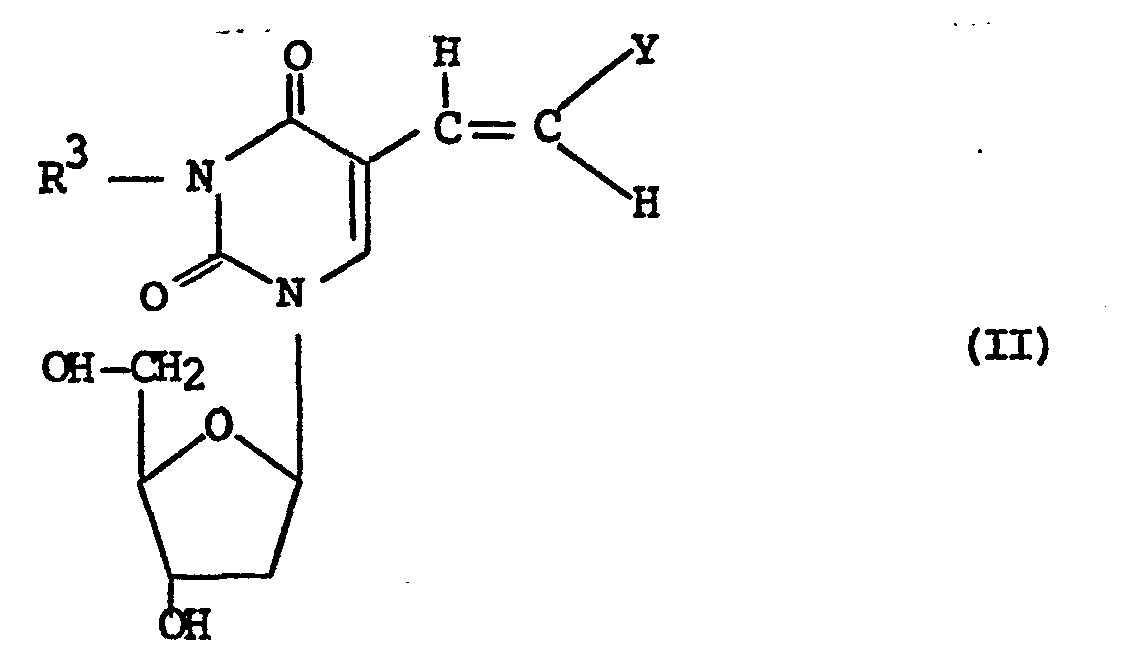
in which Y and R3 are as defined in formula (I), with an ether of formula (III):

in which Z is hydrogen or a Cl-6 alkoxy group, and, when Z is hydrogen, the -R4-R5- group includes a double bond adjacent to the oxygen, or
b) treating a compound of formula (II) with a compound of formula (IV):

in which W is a C1-6 alkoxy group or a halogen atom.
8. A pharmaceutical composition which comprises a compound of formula (I), as defined in claim 1, together with a pharmaceutically acceptable carrier or excipient.
9. A composition according to claim 8, in unit dosage form.
10. A compound according to any one of claims 1 to 6, or a composition according to claim 8 or 9, for use in treating viral infections.
Applications Claiming Priority (2)
| Application Number | Priority Date | Filing Date | Title |
|---|---|---|---|
| GB8227643 | 1982-09-28 | ||
| GB8227643 | 1982-09-28 |
Publications (1)
| Publication Number | Publication Date |
|---|---|
| EP0104857A1 true EP0104857A1 (en) | 1984-04-04 |
Family
ID=10533217
Family Applications (1)
| Application Number | Title | Priority Date | Filing Date |
|---|---|---|---|
| EP83305481A Withdrawn EP0104857A1 (en) | 1982-09-28 | 1983-09-19 | Deoxyuridine compounds, methods for preparing them and their use in medicine |
Country Status (2)
| Country | Link |
|---|---|
| EP (1) | EP0104857A1 (en) |
| JP (1) | JPS5980693A (en) |
Cited By (8)
| Publication number | Priority date | Publication date | Assignee | Title |
|---|---|---|---|---|
| WO1991015498A3 (en) * | 1990-04-04 | 1992-06-11 | Holmes Michael John | Nucleoside derivatives |
| US5446031A (en) * | 1991-04-24 | 1995-08-29 | Yamasa Shuyu Kabushiki Kaisha | 1-β-D-arabinofuranosyl-(E)-5-(2-halogenovinyl)uracil derivatives |
| FR2818907A1 (en) * | 2001-01-03 | 2002-07-05 | Berlin Chemie Ag | USE OF BRIVUDINE FOR THE PREPARATION OF A PHARMACEUTICAL COMPOSITION |
| WO2008017515A1 (en) | 2006-08-11 | 2008-02-14 | Resprotect Gmbh | Nucleosides for suppressing or reducing the development of resistance in cytostatic therapy |
| WO2020136170A3 (en) * | 2018-12-26 | 2020-08-13 | Illumina Cambridge Limited | Nucleosides and nucleotides with 3'-hydroxy blocking groups and their use in polynucleotide sequencing methods |
| JP2023531009A (en) * | 2020-06-22 | 2023-07-20 | イルミナ ケンブリッジ リミテッド | Nucleosides and nucleotides with 3' acetal blocking groups |
| JP2023533745A (en) * | 2020-07-07 | 2023-08-04 | サイクラリティ・セラピューティクス・インコーポレイテッド | Cyclodextrin dimer and use thereof |
| JP2023130947A (en) * | 2022-03-08 | 2023-09-21 | 国立大学法人東海国立大学機構 | Bisphosphoryl cross-linked stilbene compound and oil droplet dye |
Families Citing this family (1)
| Publication number | Priority date | Publication date | Assignee | Title |
|---|---|---|---|---|
| JPH0816423B2 (en) * | 1991-06-13 | 1996-02-21 | 株式会社桂 | Door latch device |
Citations (3)
| Publication number | Priority date | Publication date | Assignee | Title |
|---|---|---|---|---|
| DE2915254A1 (en) * | 1978-04-24 | 1979-11-15 | Stichting Rega V Z W | NEW CHEMICAL COMPOUNDS, PROCESS FOR THEIR PRODUCTION AND THEIR USE AS MEDICINAL PRODUCTS WITH ANTIVIRAL EFFECT |
| DE3010399A1 (en) * | 1980-03-18 | 1981-09-24 | Kailash Kumar Dr. 2359 Lentföhrden Gauri | Cytostatic and antiviral pyrimidine nucleoside derivs. - which are 5-haloalkyl-pyrimidine nucleoside 5'-ester derivs. |
| EP0061283A1 (en) * | 1981-03-20 | 1982-09-29 | Beecham Group Plc | Antiviral agents, their preparation and use |
-
1983
- 1983-09-19 EP EP83305481A patent/EP0104857A1/en not_active Withdrawn
- 1983-09-27 JP JP58179106A patent/JPS5980693A/en active Pending
Patent Citations (3)
| Publication number | Priority date | Publication date | Assignee | Title |
|---|---|---|---|---|
| DE2915254A1 (en) * | 1978-04-24 | 1979-11-15 | Stichting Rega V Z W | NEW CHEMICAL COMPOUNDS, PROCESS FOR THEIR PRODUCTION AND THEIR USE AS MEDICINAL PRODUCTS WITH ANTIVIRAL EFFECT |
| DE3010399A1 (en) * | 1980-03-18 | 1981-09-24 | Kailash Kumar Dr. 2359 Lentföhrden Gauri | Cytostatic and antiviral pyrimidine nucleoside derivs. - which are 5-haloalkyl-pyrimidine nucleoside 5'-ester derivs. |
| EP0061283A1 (en) * | 1981-03-20 | 1982-09-29 | Beecham Group Plc | Antiviral agents, their preparation and use |
Non-Patent Citations (1)
| Title |
|---|
| CHEMICAL ABSTRACTS, vol. 94, no. 11, 16th March 1981, page 758, no. 84422r, Columbus, Ohio, US * |
Cited By (22)
| Publication number | Priority date | Publication date | Assignee | Title |
|---|---|---|---|---|
| WO1991015498A3 (en) * | 1990-04-04 | 1992-06-11 | Holmes Michael John | Nucleoside derivatives |
| US5446031A (en) * | 1991-04-24 | 1995-08-29 | Yamasa Shuyu Kabushiki Kaisha | 1-β-D-arabinofuranosyl-(E)-5-(2-halogenovinyl)uracil derivatives |
| FR2818907A1 (en) * | 2001-01-03 | 2002-07-05 | Berlin Chemie Ag | USE OF BRIVUDINE FOR THE PREPARATION OF A PHARMACEUTICAL COMPOSITION |
| GB2370771A (en) * | 2001-01-03 | 2002-07-10 | Berlin Chemie Ag | Once-a-day pharmaceutical composition comprising brivudine |
| ES2192456A1 (en) * | 2001-01-03 | 2003-10-01 | Berlin Chemie Ag | Once-a-day pharmaceutical composition comprising brivudine |
| BE1014522A5 (en) * | 2001-01-03 | 2003-12-02 | Berlin Chemie Ag | Pharmaceutical composition and use. |
| WO2008017515A1 (en) | 2006-08-11 | 2008-02-14 | Resprotect Gmbh | Nucleosides for suppressing or reducing the development of resistance in cytostatic therapy |
| JP2010500307A (en) * | 2006-08-11 | 2010-01-07 | レスプロテクト ゲゼルシャフト ミット ベシュレンクテル ハフツング | Nucleosides, drugs containing them and their use |
| US8492537B2 (en) | 2006-08-11 | 2013-07-23 | Resprotect Gmbh | Nucleosides for suppressing or reducing the development of resistance in cytostatic therapy |
| CN112638925A (en) * | 2018-12-26 | 2021-04-09 | 伊卢米纳剑桥有限公司 | Nucleosides and nucleotides having 3' -hydroxyl blocking groups and their use in polynucleotide sequencing methods |
| WO2020136170A3 (en) * | 2018-12-26 | 2020-08-13 | Illumina Cambridge Limited | Nucleosides and nucleotides with 3'-hydroxy blocking groups and their use in polynucleotide sequencing methods |
| US11293061B2 (en) | 2018-12-26 | 2022-04-05 | Illumina Cambridge Limited | Sequencing methods using nucleotides with 3′ AOM blocking group |
| US11827931B2 (en) | 2018-12-26 | 2023-11-28 | Illumina Cambridge Limited | Methods of preparing growing polynucleotides using nucleotides with 3′ AOM blocking group |
| IL279644B1 (en) * | 2018-12-26 | 2025-02-01 | Illumina Cambridge Ltd | Nucleosides and nucleotides with 3'-hydroxy blocking groups and their use in polynucleotide sequencing methods |
| US12227802B2 (en) | 2018-12-26 | 2025-02-18 | Illumina Cambridge Limited | Nucleotides with a 3′ AOM blocking group |
| AU2019412494B2 (en) * | 2018-12-26 | 2025-04-03 | Illumina Cambridge Limited | Nucleosides and nucleotides with 3'-hydroxy blocking groups and their use in polynucleotide sequencing methods |
| IL279644B2 (en) * | 2018-12-26 | 2025-06-01 | Illumina Cambridge Ltd | Nucleotides and nucleosides with '3-hydroxy' blocking groups |
| JP2023531009A (en) * | 2020-06-22 | 2023-07-20 | イルミナ ケンブリッジ リミテッド | Nucleosides and nucleotides with 3' acetal blocking groups |
| US11787831B2 (en) | 2020-06-22 | 2023-10-17 | Illumina Cambridge Limited | Nucleosides and nucleotides with 3′ acetal blocking group |
| US12286453B2 (en) | 2020-06-22 | 2025-04-29 | Illumina Cambridge Limited | Methods of sequencing using nucleotides with 3′ acetal blocking group |
| JP2023533745A (en) * | 2020-07-07 | 2023-08-04 | サイクラリティ・セラピューティクス・インコーポレイテッド | Cyclodextrin dimer and use thereof |
| JP2023130947A (en) * | 2022-03-08 | 2023-09-21 | 国立大学法人東海国立大学機構 | Bisphosphoryl cross-linked stilbene compound and oil droplet dye |
Also Published As
| Publication number | Publication date |
|---|---|
| JPS5980693A (en) | 1984-05-10 |
Similar Documents
| Publication | Publication Date | Title |
|---|---|---|
| DE69133576T2 (en) | Process for the preparation of enantiomerically pure beta-D-dioxolane nucleosides | |
| US4692434A (en) | Difluoro antivirals and intermediate therefor | |
| CA2147893C (en) | Enantiomerically pure .beta.-d-dioxolane nucleosides with selective anti-hepatitis .beta. virus activity | |
| DE69933860T2 (en) | 2'-FLUORONUKLEOSIDE | |
| US5668113A (en) | Method of using 1,5-anhydrohexitol nucleoside analogues to treat viral infections | |
| HUT63851A (en) | Process for producing nucleoside derivatives and pharmaceutical compositions comprising such compounds | |
| KR20050040912A (en) | Compounds with the bicyclo[4.2.1]nonane system for the treatment of flaviviridae infections | |
| EP0296573B1 (en) | Novel nucleosides, their preparation and pharmaceutical compositions | |
| KR100187326B1 (en) | Heterocyclic compounds | |
| US4697005A (en) | 1-fluoro, 4-fluoro, and 1,4-difluoro anthracycline anticancer antibiotics | |
| US4958010A (en) | Epipodophyllotoxin glucoside lactam derivatives | |
| JPS5980693A (en) | Deoxyuridine derivative, manufacture and medicinal composition | |
| US4383990A (en) | Antiviral agents, their preparation and use | |
| EP0061283A1 (en) | Antiviral agents, their preparation and use | |
| EP0095294A1 (en) | Deoxyuridine compounds, methods for preparing them and their use in medicine | |
| US4874851A (en) | 3',4'-dinitrogen substituted epipodophyllotoxin glucoside derivatives | |
| JPH07502740A (en) | therapeutic nucleosides | |
| US5028598A (en) | Oxetanocin derivatives and their salts as well as use thereof | |
| EP0097039A1 (en) | 5-(E-2-halovinyl)-2'-deoxyuridine derivatives, processes for their preparation, pharmaceutical compositions containing them, and their use in treating viral infections | |
| EP0080305A1 (en) | Antiviral 2'-deoxyuridines, their preparation and use | |
| US5126347A (en) | Isomeric dideoxynuclesides | |
| EP0060099A1 (en) | Antiviral agents, their preparation and use | |
| EP0610076B1 (en) | Cytotoxic compounds | |
| EP0095292A1 (en) | 5-(2-halogenovinyl)-2'-deoxyuridine derivatives, processes for their preparation, pharmaceutical compositions containing them, and their use in treating viral infections" | |
| EP0072137A1 (en) | Antiviral deoxyuridine compounds |
Legal Events
| Date | Code | Title | Description |
|---|---|---|---|
| PUAI | Public reference made under article 153(3) epc to a published international application that has entered the european phase |
Free format text: ORIGINAL CODE: 0009012 |
|
| AK | Designated contracting states |
Designated state(s): CH DE FR GB IT LI NL |
|
| STAA | Information on the status of an ep patent application or granted ep patent |
Free format text: STATUS: THE APPLICATION IS DEEMED TO BE WITHDRAWN |
|
| 18D | Application deemed to be withdrawn |
Effective date: 19841205 |
|
| RIN1 | Information on inventor provided before grant (corrected) |
Inventor name: LUK, KONG Inventor name: SHANKS, COLIN THOMAS Inventor name: HARNDEN, MICHAEL RAYMOND |