EP0104042B1 - Preparation of polyvinylpyrrolidone or vinyl-pyrrolidone/vinyl acetate copolymers of various molecular weights using a single initiator system - Google Patents
Preparation of polyvinylpyrrolidone or vinyl-pyrrolidone/vinyl acetate copolymers of various molecular weights using a single initiator system Download PDFInfo
- Publication number
- EP0104042B1 EP0104042B1 EP19830305356 EP83305356A EP0104042B1 EP 0104042 B1 EP0104042 B1 EP 0104042B1 EP 19830305356 EP19830305356 EP 19830305356 EP 83305356 A EP83305356 A EP 83305356A EP 0104042 B1 EP0104042 B1 EP 0104042B1
- Authority
- EP
- European Patent Office
- Prior art keywords
- product
- process according
- vinylpyrrolidone
- vinyl acetate
- water
- Prior art date
- Legal status (The legal status is an assumption and is not a legal conclusion. Google has not performed a legal analysis and makes no representation as to the accuracy of the status listed.)
- Expired
Links
- 229920000036 polyvinylpyrrolidone Polymers 0.000 title claims description 31
- 235000013855 polyvinylpyrrolidone Nutrition 0.000 title claims description 31
- 239000001267 polyvinylpyrrolidone Substances 0.000 title claims description 31
- 239000003999 initiator Substances 0.000 title claims description 25
- 229920001577 copolymer Polymers 0.000 title claims description 7
- KFZMGEQAYNKOFK-UHFFFAOYSA-N Isopropanol Chemical compound CC(C)O KFZMGEQAYNKOFK-UHFFFAOYSA-N 0.000 claims description 41
- WHNWPMSKXPGLAX-UHFFFAOYSA-N N-Vinyl-2-pyrrolidone Chemical compound C=CN1CCCC1=O WHNWPMSKXPGLAX-UHFFFAOYSA-N 0.000 claims description 31
- XLYOFNOQVPJJNP-UHFFFAOYSA-N water Substances O XLYOFNOQVPJJNP-UHFFFAOYSA-N 0.000 claims description 26
- OPQYOFWUFGEMRZ-UHFFFAOYSA-N tert-butyl 2,2-dimethylpropaneperoxoate Chemical compound CC(C)(C)OOC(=O)C(C)(C)C OPQYOFWUFGEMRZ-UHFFFAOYSA-N 0.000 claims description 22
- 238000000034 method Methods 0.000 claims description 16
- 238000006116 polymerization reaction Methods 0.000 claims description 15
- XTXRWKRVRITETP-UHFFFAOYSA-N Vinyl acetate Chemical compound CC(=O)OC=C XTXRWKRVRITETP-UHFFFAOYSA-N 0.000 claims description 14
- 230000008569 process Effects 0.000 claims description 14
- 239000000178 monomer Substances 0.000 claims description 13
- 239000000203 mixture Substances 0.000 claims description 11
- LFQSCWFLJHTTHZ-UHFFFAOYSA-N Ethanol Chemical compound CCO LFQSCWFLJHTTHZ-UHFFFAOYSA-N 0.000 claims description 10
- 239000002904 solvent Substances 0.000 claims description 10
- BTANRVKWQNVYAZ-UHFFFAOYSA-N butan-2-ol Chemical compound CCC(C)O BTANRVKWQNVYAZ-UHFFFAOYSA-N 0.000 claims description 9
- 150000003254 radicals Chemical class 0.000 claims description 9
- 238000006243 chemical reaction Methods 0.000 claims description 7
- 238000004821 distillation Methods 0.000 claims description 6
- 239000007864 aqueous solution Substances 0.000 claims description 4
- 230000000379 polymerizing effect Effects 0.000 claims description 2
- IJGRMHOSHXDMSA-UHFFFAOYSA-N Atomic nitrogen Chemical compound N#N IJGRMHOSHXDMSA-UHFFFAOYSA-N 0.000 description 34
- 229910052757 nitrogen Inorganic materials 0.000 description 17
- 238000010992 reflux Methods 0.000 description 17
- 229960004592 isopropanol Drugs 0.000 description 12
- 239000007787 solid Substances 0.000 description 9
- 239000004615 ingredient Substances 0.000 description 6
- 238000004519 manufacturing process Methods 0.000 description 5
- MHAJPDPJQMAIIY-UHFFFAOYSA-N Hydrogen peroxide Chemical compound OO MHAJPDPJQMAIIY-UHFFFAOYSA-N 0.000 description 4
- 239000012153 distilled water Substances 0.000 description 4
- 238000004458 analytical method Methods 0.000 description 3
- 239000003054 catalyst Substances 0.000 description 3
- 239000012986 chain transfer agent Substances 0.000 description 3
- 238000000354 decomposition reaction Methods 0.000 description 3
- 125000001449 isopropyl group Chemical group [H]C([H])([H])C([H])(*)C([H])([H])[H] 0.000 description 3
- LLLWMXQKXWIRDZ-UHFFFAOYSA-N 1-ethenylpyrrolidin-2-one Chemical compound C=CN1CCCC1=O.C=CN1CCCC1=O LLLWMXQKXWIRDZ-UHFFFAOYSA-N 0.000 description 2
- OZAIFHULBGXAKX-UHFFFAOYSA-N 2-(2-cyanopropan-2-yldiazenyl)-2-methylpropanenitrile Chemical compound N#CC(C)(C)N=NC(C)(C)C#N OZAIFHULBGXAKX-UHFFFAOYSA-N 0.000 description 2
- QGZKDVFQNNGYKY-UHFFFAOYSA-N Ammonia Chemical compound N QGZKDVFQNNGYKY-UHFFFAOYSA-N 0.000 description 2
- LSXWFXONGKSEMY-UHFFFAOYSA-N di-tert-butyl peroxide Chemical compound CC(C)(C)OOC(C)(C)C LSXWFXONGKSEMY-UHFFFAOYSA-N 0.000 description 2
- 239000011521 glass Substances 0.000 description 2
- 230000000977 initiatory effect Effects 0.000 description 2
- 230000007246 mechanism Effects 0.000 description 2
- 150000002978 peroxides Chemical class 0.000 description 2
- 229920000642 polymer Polymers 0.000 description 2
- 239000000376 reactant Substances 0.000 description 2
- BZHJMEDXRYGGRV-UHFFFAOYSA-N Vinyl chloride Chemical compound ClC=C BZHJMEDXRYGGRV-UHFFFAOYSA-N 0.000 description 1
- 125000003158 alcohol group Chemical group 0.000 description 1
- -1 alkyl hydroperoxides Chemical class 0.000 description 1
- 150000001412 amines Chemical class 0.000 description 1
- 229910021529 ammonia Inorganic materials 0.000 description 1
- 238000010923 batch production Methods 0.000 description 1
- 239000000872 buffer Substances 0.000 description 1
- 238000010924 continuous production Methods 0.000 description 1
- 230000003247 decreasing effect Effects 0.000 description 1
- 230000001419 dependent effect Effects 0.000 description 1
- 230000000694 effects Effects 0.000 description 1
- 238000005516 engineering process Methods 0.000 description 1
- 239000012535 impurity Substances 0.000 description 1
- 238000010348 incorporation Methods 0.000 description 1
- 238000012986 modification Methods 0.000 description 1
- 230000004048 modification Effects 0.000 description 1
- 210000003739 neck Anatomy 0.000 description 1
- 239000003960 organic solvent Substances 0.000 description 1
- 229920002689 polyvinyl acetate Polymers 0.000 description 1
- 239000011118 polyvinyl acetate Substances 0.000 description 1
- 238000012545 processing Methods 0.000 description 1
- 238000010926 purge Methods 0.000 description 1
- 239000000243 solution Substances 0.000 description 1
- 238000001694 spray drying Methods 0.000 description 1
- 239000000126 substance Substances 0.000 description 1
- 231100000331 toxic Toxicity 0.000 description 1
- 230000002588 toxic effect Effects 0.000 description 1
- 231100000419 toxicity Toxicity 0.000 description 1
- 230000001988 toxicity Effects 0.000 description 1
Classifications
-
- C—CHEMISTRY; METALLURGY
- C08—ORGANIC MACROMOLECULAR COMPOUNDS; THEIR PREPARATION OR CHEMICAL WORKING-UP; COMPOSITIONS BASED THEREON
- C08F—MACROMOLECULAR COMPOUNDS OBTAINED BY REACTIONS ONLY INVOLVING CARBON-TO-CARBON UNSATURATED BONDS
- C08F26/00—Homopolymers and copolymers of compounds having one or more unsaturated aliphatic radicals, each having only one carbon-to-carbon double bond, and at least one being terminated by a single or double bond to nitrogen or by a heterocyclic ring containing nitrogen
- C08F26/06—Homopolymers and copolymers of compounds having one or more unsaturated aliphatic radicals, each having only one carbon-to-carbon double bond, and at least one being terminated by a single or double bond to nitrogen or by a heterocyclic ring containing nitrogen by a heterocyclic ring containing nitrogen
- C08F26/10—N-Vinyl-pyrrolidone
Definitions
- N-vinyl-2-pyrrolidone (vinylpyrrolidone) and vinyl acetate by free radical mechanisms to form vinylpyrrolidone/vinyl acetate copolymer (PVP/VA)
- PVP/VA vinylpyrrolidone/vinyl acetate copolymer
- Polymerization of N-vinyl-2-pyrrolidone (vinylpyrrolidone) by free radical mechanisms to form polyvinylpyrrolidone (PVP) is also well known and is described for instance in U.S. patents 4,058,655, 4,053,696 and 3,862,915.
- Such polymerizations are usually carried out in water or organic solvent using free radical initiators such as hydrogen peroxide, alkyl hydroperoxides, dialkyl peroxides such as di-tert.-butyl peroxide or azodiisobutyronitrile.
- free radical initiators such as hydrogen peroxide, alkyl hydroperoxides, dialkyl peroxides such as di-tert.-butyl peroxide or azodiisobutyronitrile.
- Previously suggested initiators have, however, not been completely satisfactory. It has for instance been necessary to use different initiator systems depending upon whether low, medium, or high molecular weight PVP or PVP/VA product is desired. While some variation of molecular weight has been possible with previously used initiators, no single initiator has previously been known which could be used for making PVP or PVP/VA of a wide range of molecular weights.
- vinylpyrrolidone or vinylpyrrolidone and vinyl acetate monomers are polymerized in a reaction zone in the presence of free radical initiator consisting essentially of t-Butylperoxypivalate to form polyvinylpyrrolidone or vinylpyrrolidone/vinyl acetate copolymer.
- the polymerization is carried out at a temperature between about 40°C and about 150°C and in solvent consisting essentially of water, isopropyl alcohol, sec. butyl alcohol or mixtures thereof.
- solvent are isopropylalcohol alone and a mixture of isopropylalcohol and water containing 40° wt % to 100 wt % water.
- t-Butylperoxypivalate is a known free radical initiator which has previously been suggested for other uses such as initiation of vinyl chloride polymerization reactions, but which has not been previously suggested for use in polymerizing vinylpyrrolidone or vinylpyrrolidone and vinyl acetate to form polyvinylpyrrolidone or vinylpyrrolidone/vinyl acetate copolymer.
- this initiator it has now been found possible to produce PVP or PVPNA of almost any desired molecular weight range of the PVP or PVPNA product within narrow limits. Since the use of t-Butylperoxypivalate initiator does not produce toxic decomposition products, this initiator can be used to produce pharmaceutical grades of PVP or PVPNA.
- K value is a function of molecular weight and as used herein is calculated by the method set forth in the Encyclopedia of Chemical Technology, Vol. 21, 2nd Ed., p. 427-428 (John Wiley and Sons, 1970).
- the present invention is useful in manufacturing PVP and PVPNA having K values ranging from 10 to 100 corresponding to number average molecular weights of about 6000 and about 450,000 respectively.
- K value of PVP and PVPNA produced according to the present invention is dependent primarily upon the amount of isopropyl alcohol or secondary butyl alcohol (sec. butyl alcohol) used relative to the amount of vinylpyrrolidone monomer. Higher K values result from the use of smaller amounts of alcohol.
- K value is also to some extent influenced by the operating conditions used, especially pressure, temperature and concentration of free radical initiator, i.e. t-Butylperoxypivalate. In general higher temperatures and initiator concentration result in somewhat lower K values for the PVP or PVPNA product.
- t-Butylperoxypivalate initiator is generally used in amounts between 0.1% and 5 weight percent (wt%) based on the total of the vinylpyrrolidone or vinylpyrrolidone and vinyl acetate monomers.
- lsop- ropyl alcohol or sec. butyl alcohol functions both as solvent and as a chain transfer agent so that relatively larger amounts of alcohol as a percentage of the amount of monomer used serve to produce PVP or PVPNA product of decreasing K value.
- Isopropyl alcohol is generally used except when product of exceptionally high K values are desired. When used isopropyl alcohol is frequently present in amounts between about 5 wt% and about 100 wt% based on monomer. For product of exceptionally low K value, it may be desirable to use increased amounts of initiator or relatively high temperatures or pressures in order to reduce the amount of alcohol chain transfer agent needed.
- the relative amounts of vinylpyrrolidone and vinyl acetate used in making PVPNA product according to the invention may vary considerably depending upon the exact nature of the desired copolymer product.
- vinylpyrrolidone may be used in amounts between about 5 wt% and about 95 wt% based on total vinyl pyrrolidone and vinyl acetate monomers with the use of between about 25 wt% and about 75 wt% on the same basis being preferred.
- Use of relatively smaller amounts of vinylpyrrolidone relative to the amount of vinyl acetate used results in product which has film forming properties similar to polyvinylacetate.
- Use of relatively larger amounts of vinylpyrrolidone and relatively smaller amounts of vinyl acetate results in product which has film forming properties similar to polyvinylpyrrolidone.
- the amount of water used in the process of the invention may vary widely depending upon the K value desired for the PVP or PVPNA product and the amount of isopropyl or sec. butyl alcohol chain transfer agent used. For manufacturing product of low K value, i.e. about 30 or below, it is frequently desirable to omit the water completely and use only sec. butyl alcohol or more preferably isopropyl alcohol. For high K value product the amount of water may be increased with water being used as the only solvent for manufacturing product of high K value, e.g. about 90 or above. For ease of processing, the total amount of solvent, i.e. water plus isopropyl or sec. butyl alcohol is preferably between about 40 wt% and about 100 wt% based on the amount of monomer used.
- the invention may be practiced as either a batch or continuous process, however, continuous or semicontinuous additon of vinylpyrrolidone or vinylpyrrolidone and vinyl acetate monomers and t-Butylperoxypivalate initiator is preferred especially in making product of low K value.
- product of the process of the invention may include any water and/or isopropyl or sec. butyl alcohol used in making the PVP or PVPNA product, it is generally preferred to remove at least the alcohol and frequently both the water and the alcohol after the polymerization reaction is completed. Alcohol may be readily removed by distillation and where water and alcohol are both present, an azeotropic mixture is readily removed by distillation. For ease in removing product from the reaction zone it is generally preferred that the product be removed as a water solution. For this purpose an aqueous solution of between about 20 wt% and about 60 wt% solids is preferred.
- water is not used in the process in sufficient quantities for this purpose, it is generally preferred to introduce water to the reaction zone as alcohol is distilled off in order to allow withdrawal of the PVPNA product as an aqueous solution.
- the aqueous solution of PVP or PVPNA may be transported or stored or water may be removed as by spray drying to produce a solid PVP or PVP/ VA product.
- a 12 liter four-necked flask equipped with mechanical stirrer, reflux condenser, thermometer, and glass stopper was purged with nitrogen for 15 minutes. 1150 grams of vinylpyrrolidone and 3850 grams of distilled water were then charged and a positive nitrogen pressure was maintained throughout the reaction. The reactants were heated to 55°C in 20 minutes and 3 milliliters (ml) of t-Butylperoxypivalate was then added to the vinylpyrrolidone/water mixture through one of the necks of the flask. The temperature of the reactor was then maintained at 55°C for 3 hours after which the system was heated to 80°C in one-half hour and maintained at 80°C for another 15 minutes. The reactor was then cooled to room temperature and the product discharged. The product had the following properties:
- the reactants were heated to 70°C after which additional 378 grams of vinylpyrrolidone was added continuously over a two-hour period during which the temperature was maintained at 70°C. The temperature was then held at 70°C for an additional hour after which an additional 1 gram of t-Butylperoxypivalate was added. The temperature was then maintained at 70°C for an additional hour following which the kettle was cooled and the product was discharged. Analysis indicated the product had a solids content of 36.26 wt% and a K value of 63.1.
- a 2 liter kettle equipped as described in Example 2 was purged with nitrogen for 10 minutes and then maintained under a nitrogen blanket. After the initial nitrogen purge the following ingredients were added: The mixture was then heated to a gentle reflux (82°C) and maintained at reflux while an additional 378 grams of vinylpyrrolidone was added continuously over a 2 hour period. The temperature was then held for an additional 1/2 hour and then reduced to 70°C. After that 1 gram of t-Butylperoxypivalate was added and the mixture was heated to reflux again and held for 1 hour after which another 1 gram of t-Butylperoxypivalate was added and the temperature again held at reflux for 1 hour. Following this the product was cooled and discharged. The product had a solids content of 37.76 wt% and a K value of 41.8.
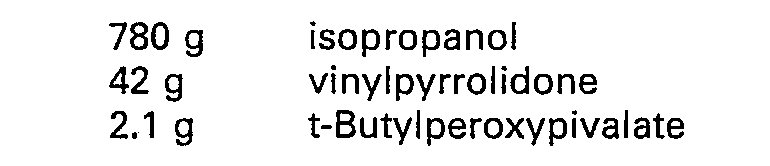
- a 2 liter kettle equipped as described in Example 2 was purged with nitrogen for 10 minutes and the following ingredients were charged under a blanket of nitrogen: The mixture was then heated to a gentle reflux at 82°C after which an additional 378 grams of vinylpyrrolidone was continuously added over a 2 hour period while the temperature was maintained at reflux. The temperature was then held at reflux (about 85°C) for an additional 1/2 hour after which another 1 gram of t-Butylperoxypivalate was added and the temperature was maintained at reflux for another hour. An additional 1 gram of t-Butylperoxypivalate was then added and the temperature again maintained at reflux for 1 hour. The kettle was then changed to a distillation mode and 780 grams of isopropyl alcohol were distilled off at atmospheric pressure.
- a 1 liter kettle equipped with mechanical stirrer, reflux condenser, thermometer and a dropping funnel was purged with nitrogen for 15 minutes after which 125 gm isopropanol and 125 gm distilled water were charged under a blanket of nitrogen.
- One hundred and twenty five grams of vinylpyrrolidone and 100 gms of vinyl acetate were charged into the dropping funnel.
- the kettle was heated to 78°C and 0.2 ml t-Butylperoxypivalate was added after which the VPNA mixture in the dropping funnel was fed in four portions over 2 hours with one addition of 0.2 ml t-Butylperoxypivalate.
- Example 5 A 1 liter kettle equipped as described in Example 5 was purged with nitrogen for 15 minutes after which 200 gms of isopropanol and 50 gms of distilled water were charged under a blanket of nitrogen. The same amount of vinylpyrrolidone and vinyl acetate as described in Example 5 was charged into the dropping funnel. After the kettle was heated to 78°C and 0.2 ml t-Butylperoxypivalate was added then a feeding of VP, VA and catalyst schedule as described in Example 5 was carried out. The kettle was cooled down and discharged after 4 hours of polymerization. The product had a solids content of 55.86 wt% and a K value of 36.0.
- Example 5 A 1 liter kettle equipped as described in Example 5 was purged with nitrogen for 15 minutes after which 250 gm of isopropanol were charged under a blanket of nitrogen. One hundred and twenty five gramx of vinylpyrrolidone and 100 grams of vinyl acetate were charged into the dropping funnel. After the kettle was heated to a gentle reflux, 0.2 ml t-Butylperoxypivalate was added. A feeding schedule of VP, VA and catalyst as described in Example 5 was carried out. The kettle was cooled down and discharged. The product had a solid of 47.6 wt% and a Ka value of 26.1.
Landscapes
- Chemical & Material Sciences (AREA)
- Health & Medical Sciences (AREA)
- Chemical Kinetics & Catalysis (AREA)
- Medicinal Chemistry (AREA)
- Polymers & Plastics (AREA)
- Organic Chemistry (AREA)
- Addition Polymer Or Copolymer, Post-Treatments, Or Chemical Modifications (AREA)
- Medicinal Preparation (AREA)
Description
- Polymerization of N-vinyl-2-pyrrolidone (vinylpyrrolidone) and vinyl acetate by free radical mechanisms to form vinylpyrrolidone/vinyl acetate copolymer (PVP/VA) is well known and is described for instance in U.S. patent 2,667,473. Polymerization of N-vinyl-2-pyrrolidone (vinylpyrrolidone) by free radical mechanisms to form polyvinylpyrrolidone (PVP) is also well known and is described for instance in U.S. patents 4,058,655, 4,053,696 and 3,862,915. Such polymerizations are usually carried out in water or organic solvent using free radical initiators such as hydrogen peroxide, alkyl hydroperoxides, dialkyl peroxides such as di-tert.-butyl peroxide or azodiisobutyronitrile. Previously suggested initiators have, however, not been completely satisfactory. It has for instance been necessary to use different initiator systems depending upon whether low, medium, or high molecular weight PVP or PVP/VA product is desired. While some variation of molecular weight has been possible with previously used initiators, no single initiator has previously been known which could be used for making PVP or PVP/VA of a wide range of molecular weights. It has also been difficult with many initiator and solvent systems to obtain polymer of narrow molecular weight range. The toxicity of decomposition products of commonly used initiators has also frequently resulted in product unsuitable for pharmaceutical use. Other disadvantages have included a need for amine or ammonia buffers with hydrogen peroxide to control pH, the production of undesirable impurities as decomposition products of eg. azodiisobutyronitrile initiator, etc. Previously used peroxides such as di-tert-butyl peroxide require the use of extremely high temperatures.
- The various disadvantages inherent in use of previously known initiators are largely eliminated or alleviated by the process of the present invention.
- In accordance with the present invention vinylpyrrolidone or vinylpyrrolidone and vinyl acetate monomers are polymerized in a reaction zone in the presence of free radical initiator consisting essentially of t-Butylperoxypivalate to form polyvinylpyrrolidone or vinylpyrrolidone/vinyl acetate copolymer. In preferred embodiments of the invention the polymerization is carried out at a temperature between about 40°C and about 150°C and in solvent consisting essentially of water, isopropyl alcohol, sec. butyl alcohol or mixtures thereof. Notable possibilities for the solvent are isopropylalcohol alone and a mixture of isopropylalcohol and water containing 40° wt % to 100 wt % water.
- As noted above, previously suggested free radical initiators for initiating polymerization of vinylpyrrolidone or vinylpyrrolidone and vinyl acetate to form polyvinylpyrrolidone (PVP) or vinylpyrrolidone/vinyl acetate copolymer (PVP/ VA) have not for one reason or other proven entirely satisfactory. It has now been found that many of the disadvantages inherent in use of the previously suggested initiators can be avoided or alleviated by use of t-Butylperoxypivalate as the free radical initiator for these polymerizations. t-Butylperoxypivalate is a known free radical initiator which has previously been suggested for other uses such as initiation of vinyl chloride polymerization reactions, but which has not been previously suggested for use in polymerizing vinylpyrrolidone or vinylpyrrolidone and vinyl acetate to form polyvinylpyrrolidone or vinylpyrrolidone/vinyl acetate copolymer. By use of this initiator it has now been found possible to produce PVP or PVPNA of almost any desired molecular weight range of the PVP or PVPNA product within narrow limits. Since the use of t-Butylperoxypivalate initiator does not produce toxic decomposition products, this initiator can be used to produce pharmaceutical grades of PVP or PVPNA.
- In accordance with conventional practice PVP and PVPNA product referred to herein will be characterized primarily in terms of K value. K value is a function of molecular weight and as used herein is calculated by the method set forth in the Encyclopedia of Chemical Technology, Vol. 21, 2nd Ed., p. 427-428 (John Wiley and Sons, 1970).
- The present invention is useful in manufacturing PVP and PVPNA having K values ranging from 10 to 100 corresponding to number average molecular weights of about 6000 and about 450,000 respectively. K value of PVP and PVPNA produced according to the present invention is dependent primarily upon the amount of isopropyl alcohol or secondary butyl alcohol (sec. butyl alcohol) used relative to the amount of vinylpyrrolidone monomer. Higher K values result from the use of smaller amounts of alcohol. K value is also to some extent influenced by the operating conditions used, especially pressure, temperature and concentration of free radical initiator, i.e. t-Butylperoxypivalate. In general higher temperatures and initiator concentration result in somewhat lower K values for the PVP or PVPNA product. It is usually preferred to adjust the types and proportions of ingredients so as to produce PVP or PVPNA of the generally desired K value range with operating conditions, especially temperature, being used for the final adjustment to obtain the precise K value desired. This technique allows production of PVP or PVPNA of almost any desired K value with very small variation in molecular weight of the product.
- While the invention may be practiced using a wide variety of temperature and pressure conditions, one of the advantages of the invention is that it need not be practiced at the elevated temperatures and pressures commonly used with previously known initiator and solvent systems. This is especially true where PVP or PVPNA product of relatively low K value is being produced. For product of especially low K value such as between about K 10 and about K 20 temperatures between 100° and 150°C and pressure between 2.3x10⁵ Pa (20 psig) and 11.3.105 Pa (150) psig) are preferred. For product of higher K values, e.g. between about K 20 and about K 90 or K 100 temperatures between 40° and 100°C and pressures between atmospheric (0 psig) and 2.3.105 Pa (20 psig) are preferred. Elevated temperatures and pressures may of course be used for high K value product as well as for low K value product, but are not generally considered desirable because of the need for pressurized equipment and the additional energy requirements needed for maintaining such conditions.
- In practicing the invention t-Butylperoxypivalate initiator is generally used in amounts between 0.1% and 5 weight percent (wt%) based on the total of the vinylpyrrolidone or vinylpyrrolidone and vinyl acetate monomers. lsop- ropyl alcohol or sec. butyl alcohol functions both as solvent and as a chain transfer agent so that relatively larger amounts of alcohol as a percentage of the amount of monomer used serve to produce PVP or PVPNA product of decreasing K value. Isopropyl alcohol is generally used except when product of exceptionally high K values are desired. When used isopropyl alcohol is frequently present in amounts between about 5 wt% and about 100 wt% based on monomer. For product of exceptionally low K value, it may be desirable to use increased amounts of initiator or relatively high temperatures or pressures in order to reduce the amount of alcohol chain transfer agent needed.
- The relative amounts of vinylpyrrolidone and vinyl acetate used in making PVPNA product according to the invention may vary considerably depending upon the exact nature of the desired copolymer product. In general vinylpyrrolidone may be used in amounts between about 5 wt% and about 95 wt% based on total vinyl pyrrolidone and vinyl acetate monomers with the use of between about 25 wt% and about 75 wt% on the same basis being preferred. Use of relatively smaller amounts of vinylpyrrolidone relative to the amount of vinyl acetate used results in product which has film forming properties similar to polyvinylacetate. Use of relatively larger amounts of vinylpyrrolidone and relatively smaller amounts of vinyl acetate results in product which has film forming properties similar to polyvinylpyrrolidone.
- The amount of water used in the process of the invention may vary widely depending upon the K value desired for the PVP or PVPNA product and the amount of isopropyl or sec. butyl alcohol chain transfer agent used. For manufacturing product of low K value, i.e. about 30 or below, it is frequently desirable to omit the water completely and use only sec. butyl alcohol or more preferably isopropyl alcohol. For high K value product the amount of water may be increased with water being used as the only solvent for manufacturing product of high K value, e.g. about 90 or above. For ease of processing, the total amount of solvent, i.e. water plus isopropyl or sec. butyl alcohol is preferably between about 40 wt% and about 100 wt% based on the amount of monomer used.
- The invention may be practiced as either a batch or continuous process, however, continuous or semicontinuous additon of vinylpyrrolidone or vinylpyrrolidone and vinyl acetate monomers and t-Butylperoxypivalate initiator is preferred especially in making product of low K value.
- While product of the process of the invention may include any water and/or isopropyl or sec. butyl alcohol used in making the PVP or PVPNA product, it is generally preferred to remove at least the alcohol and frequently both the water and the alcohol after the polymerization reaction is completed. Alcohol may be readily removed by distillation and where water and alcohol are both present, an azeotropic mixture is readily removed by distillation. For ease in removing product from the reaction zone it is generally preferred that the product be removed as a water solution. For this purpose an aqueous solution of between about 20 wt% and about 60 wt% solids is preferred. Where water is not used in the process in sufficient quantities for this purpose, it is generally preferred to introduce water to the reaction zone as alcohol is distilled off in order to allow withdrawal of the PVPNA product as an aqueous solution. Following withdrawal from the reaction zone the aqueous solution of PVP or PVPNA may be transported or stored or water may be removed as by spray drying to produce a solid PVP or PVP/ VA product.
- The following examples are intended to illustrate the invention without limiting the scope thereof as claimed.
- A 12 liter four-necked flask equipped with mechanical stirrer, reflux condenser, thermometer, and glass stopper was purged with nitrogen for 15 minutes. 1150 grams of vinylpyrrolidone and 3850 grams of distilled water were then charged and a positive nitrogen pressure was maintained throughout the reaction. The reactants were heated to 55°C in 20 minutes and 3 milliliters (ml) of t-Butylperoxypivalate was then added to the vinylpyrrolidone/water mixture through one of the necks of the flask. The temperature of the reactor was then maintained at 55°C for 3 hours after which the system was heated to 80°C in one-half hour and maintained at 80°C for another 15 minutes. The reactor was then cooled to room temperature and the product discharged. The product had the following properties:

- A 2 liter kettle equipped with mechanical stirrer, reflux condenser, thermometer and glass stopper was purged with nitrogen for 10 minutes after which the following ingredients were charged under a blanket of nitrogen:

- The reactants were heated to 70°C after which additional 378 grams of vinylpyrrolidone was added continuously over a two-hour period during which the temperature was maintained at 70°C. The temperature was then held at 70°C for an additional hour after which an additional 1 gram of t-Butylperoxypivalate was added. The temperature was then maintained at 70°C for an additional hour following which the kettle was cooled and the product was discharged. Analysis indicated the product had a solids content of 36.26 wt% and a K value of 63.1.
- A 2 liter kettle equipped as described in Example 2 was purged with nitrogen for 10 minutes and then maintained under a nitrogen blanket. After the initial nitrogen purge the following ingredients were added:

- A 2 liter kettle equipped as described in Example 2 was purged with nitrogen for 10 minutes and the following ingredients were charged under a blanket of nitrogen:
- While the invention has been described above with respect to polymerization of pure vinylpyrrolidone monomer it will be understood that minor amounts of various other monomers copolymerizable with vinylpyrrolidone may frequently be incorporated without detriment, although incorporation of more than about 10 wt% based on vinylpyrrolidone of such additional monomers may effect the operating conditions or proportions of ingredients needed to obtain polymer of desired K value.
- A 1 liter kettle equipped with mechanical stirrer, reflux condenser, thermometer and a dropping funnel was purged with nitrogen for 15 minutes after which 125 gm isopropanol and 125 gm distilled water were charged under a blanket of nitrogen. One hundred and twenty five grams of vinylpyrrolidone and 100 gms of vinyl acetate were charged into the dropping funnel. The kettle was heated to 78°C and 0.2 ml t-Butylperoxypivalate was added after which the VPNA mixture in the dropping funnel was fed in four portions over 2 hours with one addition of 0.2 ml t-Butylperoxypivalate. At the end of two hours, 0.25 ml t-Butylperoxypivalate and 25 gms of VP were added to the kettle. The kettle was kept at reflux temperature for an additional two hours with one charge of 0.2 ml t-Butylperoxypivalate. The kettle was then cooled down and discharged. Analysis indicated that the product had a solids content of 51.37 wt% and a K value of 38.5.
- A 1 liter kettle equipped as described in Example 5 was purged with nitrogen for 15 minutes after which 200 gms of isopropanol and 50 gms of distilled water were charged under a blanket of nitrogen. The same amount of vinylpyrrolidone and vinyl acetate as described in Example 5 was charged into the dropping funnel. After the kettle was heated to 78°C and 0.2 ml t-Butylperoxypivalate was added then a feeding of VP, VA and catalyst schedule as described in Example 5 was carried out. The kettle was cooled down and discharged after 4 hours of polymerization. The product had a solids content of 55.86 wt% and a K value of 36.0.
- A 5 liter kettle equipped with mechanical stirrer, reflux condenser, thermometer and dropping funnel was purged with nitrogen for 15 minutes and the following ingredients were charged under a blanket of nitrogen:

- The mixture was then heated to a gentle reflux at 78°C. Fifteen minutes after the addition of 3 ml t-Butylperoxypivalate the feeding of vinylpyrrolidone according to the following schedule was started.

- Within the VP feeding period, 3 additional charges of catalyst 3 ml each were carried out. After the VP was completely fed in, the kettle was maintained at reflux temperature for 1/2 hour and then cooled down and discharged. Analysis indicated the product had a solid of 49.05 wt% and a K value of 30.1.
- A 1 liter kettle equipped as described in Example 5 was purged with nitrogen for 15 minutes after which 250 gm of isopropanol were charged under a blanket of nitrogen. One hundred and twenty five gramx of vinylpyrrolidone and 100 grams of vinyl acetate were charged into the dropping funnel. After the kettle was heated to a gentle reflux, 0.2 ml t-Butylperoxypivalate was added. A feeding schedule of VP, VA and catalyst as described in Example 5 was carried out. The kettle was cooled down and discharged. The product had a solid of 47.6 wt% and a Ka value of 26.1.
- While the invention has been described above with respect to certain preferred embodiments, it will be understood by those skilled in the art that various changes and modifications may be made within the scope of the invention as claimed.
Claims (10)
Applications Claiming Priority (4)
| Application Number | Priority Date | Filing Date | Title |
|---|---|---|---|
| US06/419,869 US4520179A (en) | 1982-09-20 | 1982-09-20 | Preparation of vinylpyrrolidone/vinyl acetate copolymers of various molecular weights using a single initiator system consisting essentially of t-Butylperoxypivalate |
| US06/419,870 US4520180A (en) | 1982-09-20 | 1982-09-20 | Polymerization of vinylpyrrolidone to various molecular weights using a single initiator system consisting essentially of t-Butylperoxypivalate |
| US419870 | 1995-04-11 | ||
| US419869 | 1999-10-19 |
Publications (3)
| Publication Number | Publication Date |
|---|---|
| EP0104042A2 EP0104042A2 (en) | 1984-03-28 |
| EP0104042A3 EP0104042A3 (en) | 1984-12-05 |
| EP0104042B1 true EP0104042B1 (en) | 1988-10-05 |
Family
ID=27024655
Family Applications (1)
| Application Number | Title | Priority Date | Filing Date |
|---|---|---|---|
| EP19830305356 Expired EP0104042B1 (en) | 1982-09-20 | 1983-09-13 | Preparation of polyvinylpyrrolidone or vinyl-pyrrolidone/vinyl acetate copolymers of various molecular weights using a single initiator system |
Country Status (4)
| Country | Link |
|---|---|
| EP (1) | EP0104042B1 (en) |
| CA (1) | CA1211892A (en) |
| DE (1) | DE3378157D1 (en) |
| ES (1) | ES525709A0 (en) |
Cited By (1)
| Publication number | Priority date | Publication date | Assignee | Title |
|---|---|---|---|---|
| EP0418721A2 (en) | 1989-09-22 | 1991-03-27 | BASF Aktiengesellschaft | Process of preparation of copolymers clear in water |
Families Citing this family (5)
| Publication number | Priority date | Publication date | Assignee | Title |
|---|---|---|---|---|
| DE3612212A1 (en) * | 1986-04-11 | 1987-10-15 | Basf Ag | METHOD FOR PRODUCING SOLID PHARMACEUTICAL FORMS |
| DE3642633A1 (en) * | 1986-12-13 | 1988-06-23 | Basf Ag | METHOD FOR PRODUCING VINYLPYRROLIDONE POLYMERISATS |
| WO1994013139A1 (en) * | 1992-12-04 | 1994-06-23 | E.I. Du Pont De Nemours And Company | Microcapsule formulations of agricultural chemicals |
| USH1749H (en) * | 1994-09-15 | 1998-09-01 | Exxon Production Research Company | Method for inhibiting hydrate formation |
| US5874660A (en) * | 1995-10-04 | 1999-02-23 | Exxon Production Research Company | Method for inhibiting hydrate formation |
Family Cites Families (2)
| Publication number | Priority date | Publication date | Assignee | Title |
|---|---|---|---|---|
| US3350366A (en) * | 1964-11-17 | 1967-10-31 | Gen Aniline & Film Corp | Cross-linking of polymeric nu-vinyl lactams, polymeric vinyl esters and polymeric acrylate esters with alpha-omega aliphatic diolefins |
| DE2514127C3 (en) * | 1975-03-29 | 1981-05-14 | Basf Ag, 6700 Ludwigshafen | Process for the preparation of polymers of N-vinylpyrrolidone-2 |
-
1983
- 1983-07-25 CA CA000433058A patent/CA1211892A/en not_active Expired
- 1983-09-13 EP EP19830305356 patent/EP0104042B1/en not_active Expired
- 1983-09-13 DE DE8383305356T patent/DE3378157D1/en not_active Expired
- 1983-09-19 ES ES525709A patent/ES525709A0/en active Granted
Cited By (1)
| Publication number | Priority date | Publication date | Assignee | Title |
|---|---|---|---|---|
| EP0418721A2 (en) | 1989-09-22 | 1991-03-27 | BASF Aktiengesellschaft | Process of preparation of copolymers clear in water |
Also Published As
| Publication number | Publication date |
|---|---|
| EP0104042A2 (en) | 1984-03-28 |
| ES8503012A1 (en) | 1985-02-01 |
| DE3378157D1 (en) | 1988-11-10 |
| CA1211892A (en) | 1986-09-23 |
| ES525709A0 (en) | 1985-02-01 |
| EP0104042A3 (en) | 1984-12-05 |
Similar Documents
| Publication | Publication Date | Title |
|---|---|---|
| US4520179A (en) | Preparation of vinylpyrrolidone/vinyl acetate copolymers of various molecular weights using a single initiator system consisting essentially of t-Butylperoxypivalate | |
| US4554311A (en) | Method of preparing an aqueous solution comprising vinylpyrrolidone/vinyl acetate copolymers of various molecular weights using a single initiator system consisting essentially of t-Butylperoxypivalate | |
| US3992562A (en) | Manufacture of insoluble and only slightly water-swellable polymers of N-vinyl lactams of improved adsorptivity | |
| US4554312A (en) | Method of preparing aqueous solutions of polyvinyl-pyrrolidone homopolymer of various molecular weights using a single initiator system consisting essentially of t-Butylperoxypivalate | |
| EP0479856B1 (en) | Precipitation polymerization of vinyl lactam terpolymers | |
| US4520180A (en) | Polymerization of vinylpyrrolidone to various molecular weights using a single initiator system consisting essentially of t-Butylperoxypivalate | |
| US5319041A (en) | Process for the preparation of vinylpyrrolidone/vinyl acetate copolymers | |
| US4595737A (en) | Water-soluble terpolymers and their preparation | |
| US4058655A (en) | Manufacture of low molecular weight poly-N-vinylpyrrolidone-2 | |
| US4013825A (en) | Manufacture of insoluble and only slightly water-swellable polymers of n-vinyl lactams of improved adsorptivity | |
| EP0104042A2 (en) | Preparation of polyvinylpyrrolidone or vinyl-pyrrolidone/vinyl acetate copolymers of various molecular weights using a single initiator system | |
| AU752860B2 (en) | Process for producing high-purity vinylpyrrolidone polymer | |
| US4229551A (en) | Preparation of modified polymers of N-vinylpyrrolid-2-one and their use for the preparation of polymers interrupted by bridge members | |
| US5239053A (en) | Purification of vinyl lactam polymers | |
| WO1993016114A1 (en) | Purification of vinyl lactam polymers | |
| US4816534A (en) | Preparation of vinylpyrrolidone polymers | |
| US5342911A (en) | Crosslinked polyacrylic acids having low solvent residue, a process for the preparation thereof and the use thereof as thickening agents | |
| US5362815A (en) | Process for making polyvinylpyrrolidone polymer having predetermined characteristics | |
| US20020173608A1 (en) | Process for preparing vinylpyrrolidone polymer | |
| CA2178328A1 (en) | Process for producing powdery polymers based on n-vinyl caprolactams | |
| US5506318A (en) | Process for producing N-vinyl pyrrolidone polymer having low residual monomer | |
| US5191043A (en) | Precipitation polmerization of copolymers of a vinyl lactam and a polymerizable carboxylic acid having a molecular weight of less than 20,000 in a cosolvent mixture of an aliphatic hydrocarbon solvent and isopropanol | |
| US5663253A (en) | Policarboxylic acids | |
| DE2500765C3 (en) | Process for reducing the content of monomeric vinyl chloride in polyvinyl chloride produced by bulk polymerization | |
| WO1993006816A1 (en) | Polymer hair fixatives |
Legal Events
| Date | Code | Title | Description |
|---|---|---|---|
| PUAI | Public reference made under article 153(3) epc to a published international application that has entered the european phase |
Free format text: ORIGINAL CODE: 0009012 |
|
| AK | Designated contracting states |
Designated state(s): CH DE FR GB LI |
|
| PUAL | Search report despatched |
Free format text: ORIGINAL CODE: 0009013 |
|
| AK | Designated contracting states |
Designated state(s): CH DE FR GB LI |
|
| 17P | Request for examination filed |
Effective date: 19850529 |
|
| 17Q | First examination report despatched |
Effective date: 19860613 |
|
| RAP1 | Party data changed (applicant data changed or rights of an application transferred) |
Owner name: GAF CORPORATION |
|
| RAP1 | Party data changed (applicant data changed or rights of an application transferred) |
Owner name: GAF CORPORATION |
|
| GRAA | (expected) grant |
Free format text: ORIGINAL CODE: 0009210 |
|
| AK | Designated contracting states |
Kind code of ref document: B1 Designated state(s): CH DE FR GB LI |
|
| REF | Corresponds to: |
Ref document number: 3378157 Country of ref document: DE Date of ref document: 19881110 |
|
| ET | Fr: translation filed | ||
| PLBE | No opposition filed within time limit |
Free format text: ORIGINAL CODE: 0009261 |
|
| STAA | Information on the status of an ep patent application or granted ep patent |
Free format text: STATUS: NO OPPOSITION FILED WITHIN TIME LIMIT |
|
| 26N | No opposition filed | ||
| PGFP | Annual fee paid to national office [announced via postgrant information from national office to epo] |
Ref country code: FR Payment date: 19920615 Year of fee payment: 10 |
|
| PGFP | Annual fee paid to national office [announced via postgrant information from national office to epo] |
Ref country code: CH Payment date: 19920915 Year of fee payment: 10 |
|
| PGFP | Annual fee paid to national office [announced via postgrant information from national office to epo] |
Ref country code: DE Payment date: 19920930 Year of fee payment: 10 |
|
| PG25 | Lapsed in a contracting state [announced via postgrant information from national office to epo] |
Ref country code: LI Effective date: 19930930 Ref country code: CH Effective date: 19930930 |
|
| PG25 | Lapsed in a contracting state [announced via postgrant information from national office to epo] |
Ref country code: FR Free format text: LAPSE BECAUSE OF NON-PAYMENT OF DUE FEES Effective date: 19940531 |
|
| REG | Reference to a national code |
Ref country code: CH Ref legal event code: PL |
|
| PG25 | Lapsed in a contracting state [announced via postgrant information from national office to epo] |
Ref country code: DE Effective date: 19940601 |
|
| PGFP | Annual fee paid to national office [announced via postgrant information from national office to epo] |
Ref country code: GB Payment date: 19940627 Year of fee payment: 12 |
|
| REG | Reference to a national code |
Ref country code: FR Ref legal event code: ST |
|
| PG25 | Lapsed in a contracting state [announced via postgrant information from national office to epo] |
Ref country code: GB Effective date: 19950913 |
|
| GBPC | Gb: european patent ceased through non-payment of renewal fee |
Effective date: 19950913 |