EP0101747B1 - Process for producing polyethylene - Google Patents
Process for producing polyethylene Download PDFInfo
- Publication number
- EP0101747B1 EP0101747B1 EP82107100A EP82107100A EP0101747B1 EP 0101747 B1 EP0101747 B1 EP 0101747B1 EP 82107100 A EP82107100 A EP 82107100A EP 82107100 A EP82107100 A EP 82107100A EP 0101747 B1 EP0101747 B1 EP 0101747B1
- Authority
- EP
- European Patent Office
- Prior art keywords
- polymerization
- reaction product
- process according
- general formula
- ethylene
- Prior art date
- Legal status (The legal status is an assumption and is not a legal conclusion. Google has not performed a legal analysis and makes no representation as to the accuracy of the status listed.)
- Expired
Links
- -1 polyethylene Polymers 0.000 title claims description 55
- 238000000034 method Methods 0.000 title claims description 32
- 239000004698 Polyethylene Substances 0.000 title claims description 20
- 229920000573 polyethylene Polymers 0.000 title claims description 20
- 238000006116 polymerization reaction Methods 0.000 claims description 92
- 239000007795 chemical reaction product Substances 0.000 claims description 90
- VGGSQFUCUMXWEO-UHFFFAOYSA-N Ethene Chemical compound C=C VGGSQFUCUMXWEO-UHFFFAOYSA-N 0.000 claims description 63
- 239000005977 Ethylene Substances 0.000 claims description 63
- 239000003054 catalyst Substances 0.000 claims description 48
- 239000010936 titanium Substances 0.000 claims description 46
- 238000002360 preparation method Methods 0.000 claims description 41
- 239000011777 magnesium Substances 0.000 claims description 34
- 229910052749 magnesium Inorganic materials 0.000 claims description 33
- FYYHWMGAXLPEAU-UHFFFAOYSA-N Magnesium Chemical compound [Mg] FYYHWMGAXLPEAU-UHFFFAOYSA-N 0.000 claims description 32
- 238000006243 chemical reaction Methods 0.000 claims description 31
- 239000004215 Carbon black (E152) Substances 0.000 claims description 23
- 229930195733 hydrocarbon Natural products 0.000 claims description 23
- 150000002430 hydrocarbons Chemical group 0.000 claims description 22
- 150000004795 grignard reagents Chemical class 0.000 claims description 20
- 239000007818 Grignard reagent Substances 0.000 claims description 19
- 239000012434 nucleophilic reagent Substances 0.000 claims description 18
- LFQSCWFLJHTTHZ-UHFFFAOYSA-N Ethanol Chemical compound CCO LFQSCWFLJHTTHZ-UHFFFAOYSA-N 0.000 claims description 17
- 150000001875 compounds Chemical class 0.000 claims description 16
- 150000001299 aldehydes Chemical class 0.000 claims description 12
- 150000002576 ketones Chemical class 0.000 claims description 12
- 150000001338 aliphatic hydrocarbons Chemical class 0.000 claims description 11
- 125000005843 halogen group Chemical group 0.000 claims description 11
- 150000003623 transition metal compounds Chemical class 0.000 claims description 10
- 239000002904 solvent Substances 0.000 claims description 9
- VXNZUUAINFGPBY-UHFFFAOYSA-N 1-Butene Chemical compound CCC=C VXNZUUAINFGPBY-UHFFFAOYSA-N 0.000 claims description 8
- 150000003609 titanium compounds Chemical class 0.000 claims description 6
- 238000007334 copolymerization reaction Methods 0.000 claims description 5
- 239000013067 intermediate product Substances 0.000 claims description 5
- 125000004435 hydrogen atom Chemical group [H]* 0.000 claims description 4
- 229910052782 aluminium Inorganic materials 0.000 claims description 3
- 230000000379 polymerizing effect Effects 0.000 claims description 3
- 150000003682 vanadium compounds Chemical class 0.000 claims description 3
- AFFLGGQVNFXPEV-UHFFFAOYSA-N 1-decene Chemical compound CCCCCCCCC=C AFFLGGQVNFXPEV-UHFFFAOYSA-N 0.000 claims description 2
- WSSSPWUEQFSQQG-UHFFFAOYSA-N 4-methyl-1-pentene Chemical compound CC(C)CC=C WSSSPWUEQFSQQG-UHFFFAOYSA-N 0.000 claims description 2
- 125000003545 alkoxy group Chemical group 0.000 claims description 2
- 150000001923 cyclic compounds Chemical class 0.000 claims description 2
- 125000000951 phenoxy group Chemical group [H]C1=C([H])C([H])=C(O*)C([H])=C1[H] 0.000 claims description 2
- QQONPFPTGQHPMA-UHFFFAOYSA-N propylene Natural products CC=C QQONPFPTGQHPMA-UHFFFAOYSA-N 0.000 claims description 2
- 125000004805 propylene group Chemical group [H]C([H])([H])C([H])([*:1])C([H])([H])[*:2] 0.000 claims description 2
- LIKMAJRDDDTEIG-UHFFFAOYSA-N 1-hexene Chemical compound CCCCC=C LIKMAJRDDDTEIG-UHFFFAOYSA-N 0.000 claims 1
- 150000002681 magnesium compounds Chemical class 0.000 claims 1
- IMNFDUFMRHMDMM-UHFFFAOYSA-N N-Heptane Chemical compound CCCCCCC IMNFDUFMRHMDMM-UHFFFAOYSA-N 0.000 description 60
- RTZKZFJDLAIYFH-UHFFFAOYSA-N ether Substances CCOCC RTZKZFJDLAIYFH-UHFFFAOYSA-N 0.000 description 55
- WYURNTSHIVDZCO-UHFFFAOYSA-N Tetrahydrofuran Chemical compound C1CCOC1 WYURNTSHIVDZCO-UHFFFAOYSA-N 0.000 description 34
- 230000003197 catalytic effect Effects 0.000 description 26
- 239000000243 solution Substances 0.000 description 24
- YXFVVABEGXRONW-UHFFFAOYSA-N Toluene Chemical compound CC1=CC=CC=C1 YXFVVABEGXRONW-UHFFFAOYSA-N 0.000 description 18
- YLQBMQCUIZJEEH-UHFFFAOYSA-N tetrahydrofuran Natural products C=1C=COC=1 YLQBMQCUIZJEEH-UHFFFAOYSA-N 0.000 description 17
- 239000000203 mixture Substances 0.000 description 16
- 238000004821 distillation Methods 0.000 description 14
- 229920000642 polymer Polymers 0.000 description 13
- UFHFLCQGNIYNRP-UHFFFAOYSA-N Hydrogen Chemical compound [H][H] UFHFLCQGNIYNRP-UHFFFAOYSA-N 0.000 description 11
- IJGRMHOSHXDMSA-UHFFFAOYSA-N Atomic nitrogen Chemical compound N#N IJGRMHOSHXDMSA-UHFFFAOYSA-N 0.000 description 10
- RTAQQCXQSZGOHL-UHFFFAOYSA-N Titanium Chemical compound [Ti] RTAQQCXQSZGOHL-UHFFFAOYSA-N 0.000 description 9
- 229910052739 hydrogen Inorganic materials 0.000 description 9
- 239000001257 hydrogen Substances 0.000 description 9
- 229910052719 titanium Inorganic materials 0.000 description 9
- LGYNIFWIKSEESD-UHFFFAOYSA-N 2-ethylhexanal Chemical compound CCCCC(CC)C=O LGYNIFWIKSEESD-UHFFFAOYSA-N 0.000 description 7
- 150000004945 aromatic hydrocarbons Chemical class 0.000 description 7
- VLKZOEOYAKHREP-UHFFFAOYSA-N n-Hexane Chemical compound CCCCCC VLKZOEOYAKHREP-UHFFFAOYSA-N 0.000 description 7
- 239000011541 reaction mixture Substances 0.000 description 7
- 238000003756 stirring Methods 0.000 description 7
- UHOVQNZJYSORNB-UHFFFAOYSA-N Benzene Chemical compound C1=CC=CC=C1 UHOVQNZJYSORNB-UHFFFAOYSA-N 0.000 description 6
- IYTXKIXETAELAV-UHFFFAOYSA-N Nonan-3-one Chemical compound CCCCCCC(=O)CC IYTXKIXETAELAV-UHFFFAOYSA-N 0.000 description 6
- 238000000862 absorption spectrum Methods 0.000 description 6
- 239000000725 suspension Substances 0.000 description 6
- 230000000052 comparative effect Effects 0.000 description 5
- 238000009826 distribution Methods 0.000 description 5
- 239000011521 glass Substances 0.000 description 5
- 229910052757 nitrogen Inorganic materials 0.000 description 5
- 239000011949 solid catalyst Substances 0.000 description 5
- YIWUKEYIRIRTPP-UHFFFAOYSA-N 2-ethylhexan-1-ol Chemical compound CCCCC(CC)CO YIWUKEYIRIRTPP-UHFFFAOYSA-N 0.000 description 4
- KFZMGEQAYNKOFK-UHFFFAOYSA-N Isopropanol Chemical compound CC(C)O KFZMGEQAYNKOFK-UHFFFAOYSA-N 0.000 description 4
- QUXHCILOWRXCEO-UHFFFAOYSA-M magnesium;butane;chloride Chemical compound [Mg+2].[Cl-].CCC[CH2-] QUXHCILOWRXCEO-UHFFFAOYSA-M 0.000 description 4
- UAEPNZWRGJTJPN-UHFFFAOYSA-N methylcyclohexane Chemical compound CC1CCCCC1 UAEPNZWRGJTJPN-UHFFFAOYSA-N 0.000 description 4
- 239000007787 solid Substances 0.000 description 4
- ZWEHNKRNPOVVGH-UHFFFAOYSA-N 2-Butanone Chemical compound CCC(C)=O ZWEHNKRNPOVVGH-UHFFFAOYSA-N 0.000 description 3
- CSCPPACGZOOCGX-UHFFFAOYSA-N Acetone Chemical compound CC(C)=O CSCPPACGZOOCGX-UHFFFAOYSA-N 0.000 description 3
- OKKJLVBELUTLKV-UHFFFAOYSA-N Methanol Chemical compound OC OKKJLVBELUTLKV-UHFFFAOYSA-N 0.000 description 3
- 238000010521 absorption reaction Methods 0.000 description 3
- 238000009835 boiling Methods 0.000 description 3
- 230000003247 decreasing effect Effects 0.000 description 3
- YNLAOSYQHBDIKW-UHFFFAOYSA-M diethylaluminium chloride Chemical compound CC[Al](Cl)CC YNLAOSYQHBDIKW-UHFFFAOYSA-M 0.000 description 3
- UAIZDWNSWGTKFZ-UHFFFAOYSA-L ethylaluminum(2+);dichloride Chemical compound CC[Al](Cl)Cl UAIZDWNSWGTKFZ-UHFFFAOYSA-L 0.000 description 3
- 238000010528 free radical solution polymerization reaction Methods 0.000 description 3
- 239000002002 slurry Substances 0.000 description 3
- 229910001220 stainless steel Inorganic materials 0.000 description 3
- 239000010935 stainless steel Substances 0.000 description 3
- VOITXYVAKOUIBA-UHFFFAOYSA-N triethylaluminium Chemical compound CC[Al](CC)CC VOITXYVAKOUIBA-UHFFFAOYSA-N 0.000 description 3
- BBMCTIGTTCKYKF-UHFFFAOYSA-N 1-heptanol Chemical compound CCCCCCCO BBMCTIGTTCKYKF-UHFFFAOYSA-N 0.000 description 2
- IKHGUXGNUITLKF-UHFFFAOYSA-N Acetaldehyde Chemical compound CC=O IKHGUXGNUITLKF-UHFFFAOYSA-N 0.000 description 2
- ZTQSAGDEMFDKMZ-UHFFFAOYSA-N Butyraldehyde Chemical compound CCCC=O ZTQSAGDEMFDKMZ-UHFFFAOYSA-N 0.000 description 2
- XDTMQSROBMDMFD-UHFFFAOYSA-N Cyclohexane Chemical compound C1CCCCC1 XDTMQSROBMDMFD-UHFFFAOYSA-N 0.000 description 2
- AMIMRNSIRUDHCM-UHFFFAOYSA-N Isopropylaldehyde Chemical compound CC(C)C=O AMIMRNSIRUDHCM-UHFFFAOYSA-N 0.000 description 2
- LRHPLDYGYMQRHN-UHFFFAOYSA-N N-Butanol Chemical compound CCCCO LRHPLDYGYMQRHN-UHFFFAOYSA-N 0.000 description 2
- ISWSIDIOOBJBQZ-UHFFFAOYSA-N Phenol Chemical compound OC1=CC=CC=C1 ISWSIDIOOBJBQZ-UHFFFAOYSA-N 0.000 description 2
- 229910003074 TiCl4 Inorganic materials 0.000 description 2
- 230000032683 aging Effects 0.000 description 2
- HUMNYLRZRPPJDN-UHFFFAOYSA-N benzaldehyde Chemical compound O=CC1=CC=CC=C1 HUMNYLRZRPPJDN-UHFFFAOYSA-N 0.000 description 2
- BTANRVKWQNVYAZ-UHFFFAOYSA-N butan-2-ol Chemical compound CCC(C)O BTANRVKWQNVYAZ-UHFFFAOYSA-N 0.000 description 2
- KBPLFHHGFOOTCA-UHFFFAOYSA-N caprylic alcohol Natural products CCCCCCCCO KBPLFHHGFOOTCA-UHFFFAOYSA-N 0.000 description 2
- 229910052799 carbon Inorganic materials 0.000 description 2
- 125000004432 carbon atom Chemical group C* 0.000 description 2
- 230000015556 catabolic process Effects 0.000 description 2
- 238000001816 cooling Methods 0.000 description 2
- 229920001577 copolymer Polymers 0.000 description 2
- JHIVVAPYMSGYDF-UHFFFAOYSA-N cyclohexanone Chemical compound O=C1CCCCC1 JHIVVAPYMSGYDF-UHFFFAOYSA-N 0.000 description 2
- MWKFXSUHUHTGQN-UHFFFAOYSA-N decan-1-ol Chemical compound CCCCCCCCCCO MWKFXSUHUHTGQN-UHFFFAOYSA-N 0.000 description 2
- DIOQZVSQGTUSAI-UHFFFAOYSA-N decane Chemical compound CCCCCCCCCC DIOQZVSQGTUSAI-UHFFFAOYSA-N 0.000 description 2
- 238000006731 degradation reaction Methods 0.000 description 2
- 238000005227 gel permeation chromatography Methods 0.000 description 2
- 230000020169 heat generation Effects 0.000 description 2
- 125000004051 hexyl group Chemical group [H]C([H])([H])C([H])([H])C([H])([H])C([H])([H])C([H])([H])C([H])([H])* 0.000 description 2
- 239000007788 liquid Substances 0.000 description 2
- 238000005259 measurement Methods 0.000 description 2
- 229910052751 metal Inorganic materials 0.000 description 2
- 239000002184 metal Substances 0.000 description 2
- GYNNXHKOJHMOHS-UHFFFAOYSA-N methyl-cycloheptane Natural products CC1CCCCCC1 GYNNXHKOJHMOHS-UHFFFAOYSA-N 0.000 description 2
- GLDOVTGHNKAZLK-UHFFFAOYSA-N octadecan-1-ol Chemical compound CCCCCCCCCCCCCCCCCCO GLDOVTGHNKAZLK-UHFFFAOYSA-N 0.000 description 2
- FWWQKRXKHIRPJY-UHFFFAOYSA-N octadecanal Chemical compound CCCCCCCCCCCCCCCCCC=O FWWQKRXKHIRPJY-UHFFFAOYSA-N 0.000 description 2
- TVMXDCGIABBOFY-UHFFFAOYSA-N octane Chemical compound CCCCCCCC TVMXDCGIABBOFY-UHFFFAOYSA-N 0.000 description 2
- FDPIMTJIUBPUKL-UHFFFAOYSA-N pentan-3-one Chemical compound CCC(=O)CC FDPIMTJIUBPUKL-UHFFFAOYSA-N 0.000 description 2
- HGBOYTHUEUWSSQ-UHFFFAOYSA-N pentanal Chemical compound CCCCC=O HGBOYTHUEUWSSQ-UHFFFAOYSA-N 0.000 description 2
- 239000000047 product Substances 0.000 description 2
- BDERNNFJNOPAEC-UHFFFAOYSA-N propan-1-ol Chemical compound CCCO BDERNNFJNOPAEC-UHFFFAOYSA-N 0.000 description 2
- XJDNKRIXUMDJCW-UHFFFAOYSA-J titanium tetrachloride Chemical compound Cl[Ti](Cl)(Cl)Cl XJDNKRIXUMDJCW-UHFFFAOYSA-J 0.000 description 2
- 239000002699 waste material Substances 0.000 description 2
- QOOQLKSEGVNYLA-UHFFFAOYSA-N 1-$l^{1}-oxidanylbutane Chemical compound CCCC[O] QOOQLKSEGVNYLA-UHFFFAOYSA-N 0.000 description 1
- DURPTKYDGMDSBL-UHFFFAOYSA-N 1-butoxybutane Chemical compound CCCCOCCCC DURPTKYDGMDSBL-UHFFFAOYSA-N 0.000 description 1
- FJJYHTVHBVXEEQ-UHFFFAOYSA-N 2,2-dimethylpropanal Chemical compound CC(C)(C)C=O FJJYHTVHBVXEEQ-UHFFFAOYSA-N 0.000 description 1
- WZJUBBHODHNQPW-UHFFFAOYSA-N 2,4,6,8-tetramethyl-1,3,5,7,2$l^{3},4$l^{3},6$l^{3},8$l^{3}-tetraoxatetrasilocane Chemical compound C[Si]1O[Si](C)O[Si](C)O[Si](C)O1 WZJUBBHODHNQPW-UHFFFAOYSA-N 0.000 description 1
- VLQZJOLYNOGECD-UHFFFAOYSA-N 2,4,6-trimethyl-1,3,5,2,4,6-trioxatrisilinane Chemical compound C[SiH]1O[SiH](C)O[SiH](C)O1 VLQZJOLYNOGECD-UHFFFAOYSA-N 0.000 description 1
- TZYRSLHNPKPEFV-UHFFFAOYSA-N 2-ethyl-1-butanol Chemical compound CCC(CC)CO TZYRSLHNPKPEFV-UHFFFAOYSA-N 0.000 description 1
- CMAOLVNGLTWICC-UHFFFAOYSA-N 2-fluoro-5-methylbenzonitrile Chemical compound CC1=CC=C(F)C(C#N)=C1 CMAOLVNGLTWICC-UHFFFAOYSA-N 0.000 description 1
- QTWJRLJHJPIABL-UHFFFAOYSA-N 2-methylphenol;3-methylphenol;4-methylphenol Chemical compound CC1=CC=C(O)C=C1.CC1=CC=CC(O)=C1.CC1=CC=CC=C1O QTWJRLJHJPIABL-UHFFFAOYSA-N 0.000 description 1
- JGEGJYXHCFUMJF-UHFFFAOYSA-N 4-methylpentanal Chemical compound CC(C)CCC=O JGEGJYXHCFUMJF-UHFFFAOYSA-N 0.000 description 1
- XPVATDCOZDHQNL-UHFFFAOYSA-N CC(C)(C)[Mg]C(C)(C)C Chemical compound CC(C)(C)[Mg]C(C)(C)C XPVATDCOZDHQNL-UHFFFAOYSA-N 0.000 description 1
- UWKKBEQZACDEBT-UHFFFAOYSA-N CCCC[Mg] Chemical compound CCCC[Mg] UWKKBEQZACDEBT-UHFFFAOYSA-N 0.000 description 1
- ABXKXVWOKXSBNR-UHFFFAOYSA-N CCC[Mg]CCC Chemical compound CCC[Mg]CCC ABXKXVWOKXSBNR-UHFFFAOYSA-N 0.000 description 1
- NTIZESTWPVYFNL-UHFFFAOYSA-N Methyl isobutyl ketone Chemical compound CC(C)CC(C)=O NTIZESTWPVYFNL-UHFFFAOYSA-N 0.000 description 1
- UIHCLUNTQKBZGK-UHFFFAOYSA-N Methyl isobutyl ketone Natural products CCC(C)C(C)=O UIHCLUNTQKBZGK-UHFFFAOYSA-N 0.000 description 1
- CTQNGGLPUBDAKN-UHFFFAOYSA-N O-Xylene Chemical compound CC1=CC=CC=C1C CTQNGGLPUBDAKN-UHFFFAOYSA-N 0.000 description 1
- XUIMIQQOPSSXEZ-UHFFFAOYSA-N Silicon Chemical compound [Si] XUIMIQQOPSSXEZ-UHFFFAOYSA-N 0.000 description 1
- 229910010061 TiC13 Inorganic materials 0.000 description 1
- 229910010066 TiC14 Inorganic materials 0.000 description 1
- 229910010062 TiCl3 Inorganic materials 0.000 description 1
- 150000001412 amines Chemical class 0.000 description 1
- 125000004429 atom Chemical group 0.000 description 1
- 150000007514 bases Chemical class 0.000 description 1
- RWCCWEUUXYIKHB-UHFFFAOYSA-N benzophenone Chemical compound C=1C=CC=CC=1C(=O)C1=CC=CC=C1 RWCCWEUUXYIKHB-UHFFFAOYSA-N 0.000 description 1
- 239000012965 benzophenone Substances 0.000 description 1
- 230000015572 biosynthetic process Effects 0.000 description 1
- 244000309464 bull Species 0.000 description 1
- YLYNVLJAZMTTIQ-UHFFFAOYSA-N butoxy(diethyl)alumane Chemical compound CCCC[O-].CC[Al+]CC YLYNVLJAZMTTIQ-UHFFFAOYSA-N 0.000 description 1
- SHOVVTSKTTYFGP-UHFFFAOYSA-L butylaluminum(2+);dichloride Chemical compound CCCC[Al](Cl)Cl SHOVVTSKTTYFGP-UHFFFAOYSA-L 0.000 description 1
- 239000008139 complexing agent Substances 0.000 description 1
- 239000007859 condensation product Substances 0.000 description 1
- 238000007796 conventional method Methods 0.000 description 1
- 239000002826 coolant Substances 0.000 description 1
- 229930003836 cresol Natural products 0.000 description 1
- 239000013078 crystal Substances 0.000 description 1
- SHQSVMDWKBRBGB-UHFFFAOYSA-N cyclobutanone Chemical compound O=C1CCC1 SHQSVMDWKBRBGB-UHFFFAOYSA-N 0.000 description 1
- SXOZDDAFVJANJP-UHFFFAOYSA-N cyclodecanone Chemical compound O=C1CCCCCCCCC1 SXOZDDAFVJANJP-UHFFFAOYSA-N 0.000 description 1
- HPXRVTGHNJAIIH-UHFFFAOYSA-N cyclohexanol Chemical compound OC1CCCCC1 HPXRVTGHNJAIIH-UHFFFAOYSA-N 0.000 description 1
- KSMVZQYAVGTKIV-UHFFFAOYSA-N decanal Chemical compound CCCCCCCCCC=O KSMVZQYAVGTKIV-UHFFFAOYSA-N 0.000 description 1
- 238000010908 decantation Methods 0.000 description 1
- 238000000354 decomposition reaction Methods 0.000 description 1
- HJXBDPDUCXORKZ-UHFFFAOYSA-N diethylalumane Chemical compound CC[AlH]CC HJXBDPDUCXORKZ-UHFFFAOYSA-N 0.000 description 1
- 238000007865 diluting Methods 0.000 description 1
- LVCMXMSJOUJZFC-UHFFFAOYSA-N diphenyl(silyloxy)silane Chemical compound C=1C=CC=CC=1[SiH](O[SiH3])C1=CC=CC=C1 LVCMXMSJOUJZFC-UHFFFAOYSA-N 0.000 description 1
- KPUWHANPEXNPJT-UHFFFAOYSA-N disiloxane Chemical class [SiH3]O[SiH3] KPUWHANPEXNPJT-UHFFFAOYSA-N 0.000 description 1
- 150000002170 ethers Chemical class 0.000 description 1
- GCPCLEKQVMKXJM-UHFFFAOYSA-N ethoxy(diethyl)alumane Chemical compound CCO[Al](CC)CC GCPCLEKQVMKXJM-UHFFFAOYSA-N 0.000 description 1
- 238000001704 evaporation Methods 0.000 description 1
- 230000008020 evaporation Effects 0.000 description 1
- 238000001914 filtration Methods 0.000 description 1
- 239000007789 gas Substances 0.000 description 1
- 238000004817 gas chromatography Methods 0.000 description 1
- 239000004519 grease Substances 0.000 description 1
- 150000004820 halides Chemical class 0.000 description 1
- 229910052736 halogen Inorganic materials 0.000 description 1
- 150000002367 halogens Chemical class 0.000 description 1
- WTJKUFMLQFLJOT-UHFFFAOYSA-N heptadecan-9-one Chemical compound CCCCCCCCC(=O)CCCCCCCC WTJKUFMLQFLJOT-UHFFFAOYSA-N 0.000 description 1
- 230000007062 hydrolysis Effects 0.000 description 1
- 238000006460 hydrolysis reaction Methods 0.000 description 1
- 238000009776 industrial production Methods 0.000 description 1
- 238000002347 injection Methods 0.000 description 1
- 239000007924 injection Substances 0.000 description 1
- JEIPFZHSYJVQDO-UHFFFAOYSA-N iron(III) oxide Inorganic materials O=[Fe]O[Fe]=O JEIPFZHSYJVQDO-UHFFFAOYSA-N 0.000 description 1
- 239000003350 kerosene Substances 0.000 description 1
- CQRPUKWAZPZXTO-UHFFFAOYSA-M magnesium;2-methylpropane;chloride Chemical compound [Mg+2].[Cl-].C[C-](C)C CQRPUKWAZPZXTO-UHFFFAOYSA-M 0.000 description 1
- WRYKIHMRDIOPSI-UHFFFAOYSA-N magnesium;benzene Chemical compound [Mg+2].C1=CC=[C-]C=C1.C1=CC=[C-]C=C1 WRYKIHMRDIOPSI-UHFFFAOYSA-N 0.000 description 1
- IWCVDCOJSPWGRW-UHFFFAOYSA-M magnesium;benzene;chloride Chemical compound [Mg+2].[Cl-].C1=CC=[C-]C=C1 IWCVDCOJSPWGRW-UHFFFAOYSA-M 0.000 description 1
- KJJBSBKRXUVBMX-UHFFFAOYSA-N magnesium;butane Chemical compound [Mg+2].CCC[CH2-].CCC[CH2-] KJJBSBKRXUVBMX-UHFFFAOYSA-N 0.000 description 1
- CCERQOYLJJULMD-UHFFFAOYSA-M magnesium;carbanide;chloride Chemical compound [CH3-].[Mg+2].[Cl-] CCERQOYLJJULMD-UHFFFAOYSA-M 0.000 description 1
- DLPASUVGCQPFFO-UHFFFAOYSA-N magnesium;ethane Chemical compound [Mg+2].[CH2-]C.[CH2-]C DLPASUVGCQPFFO-UHFFFAOYSA-N 0.000 description 1
- FRIJBUGBVQZNTB-UHFFFAOYSA-M magnesium;ethane;bromide Chemical compound [Mg+2].[Br-].[CH2-]C FRIJBUGBVQZNTB-UHFFFAOYSA-M 0.000 description 1
- YCCXQARVHOPWFJ-UHFFFAOYSA-M magnesium;ethane;chloride Chemical compound [Mg+2].[Cl-].[CH2-]C YCCXQARVHOPWFJ-UHFFFAOYSA-M 0.000 description 1
- KMYFNYFIPIGQQZ-UHFFFAOYSA-N magnesium;octane Chemical compound [Mg+2].CCCCCCC[CH2-].CCCCCCC[CH2-] KMYFNYFIPIGQQZ-UHFFFAOYSA-N 0.000 description 1
- HQDAZWQQKSJCTM-UHFFFAOYSA-M magnesium;octane;chloride Chemical compound [Mg+2].[Cl-].CCCCCCC[CH2-] HQDAZWQQKSJCTM-UHFFFAOYSA-M 0.000 description 1
- 238000004519 manufacturing process Methods 0.000 description 1
- 239000000155 melt Substances 0.000 description 1
- 238000002844 melting Methods 0.000 description 1
- 230000008018 melting Effects 0.000 description 1
- WSFSSNUMVMOOMR-NJFSPNSNSA-N methanone Chemical compound O=[14CH2] WSFSSNUMVMOOMR-NJFSPNSNSA-N 0.000 description 1
- ZKUUVVYMPUDTGJ-UHFFFAOYSA-N methyl 5-hydroxy-4-methoxy-2-nitrobenzoate Chemical compound COC(=O)C1=CC(O)=C(OC)C=C1[N+]([O-])=O ZKUUVVYMPUDTGJ-UHFFFAOYSA-N 0.000 description 1
- 229940043265 methyl isobutyl ketone Drugs 0.000 description 1
- 238000000465 moulding Methods 0.000 description 1
- GOQYKNQRPGWPLP-UHFFFAOYSA-N n-heptadecyl alcohol Natural products CCCCCCCCCCCCCCCCCO GOQYKNQRPGWPLP-UHFFFAOYSA-N 0.000 description 1
- WSGCRAOTEDLMFQ-UHFFFAOYSA-N nonan-5-one Chemical compound CCCCC(=O)CCCC WSGCRAOTEDLMFQ-UHFFFAOYSA-N 0.000 description 1
- NUJGJRNETVAIRJ-UHFFFAOYSA-N octanal Chemical compound CCCCCCCC=O NUJGJRNETVAIRJ-UHFFFAOYSA-N 0.000 description 1
- 150000002894 organic compounds Chemical class 0.000 description 1
- QNGNSVIICDLXHT-UHFFFAOYSA-N para-ethylbenzaldehyde Natural products CCC1=CC=C(C=O)C=C1 QNGNSVIICDLXHT-UHFFFAOYSA-N 0.000 description 1
- WVDDGKGOMKODPV-ZQBYOMGUSA-N phenyl(114C)methanol Chemical compound O[14CH2]C1=CC=CC=C1 WVDDGKGOMKODPV-ZQBYOMGUSA-N 0.000 description 1
- 230000035484 reaction time Effects 0.000 description 1
- 229910052703 rhodium Inorganic materials 0.000 description 1
- 239000010948 rhodium Substances 0.000 description 1
- MHOVAHRLVXNVSD-UHFFFAOYSA-N rhodium atom Chemical compound [Rh] MHOVAHRLVXNVSD-UHFFFAOYSA-N 0.000 description 1
- 238000000926 separation method Methods 0.000 description 1
- 229910052710 silicon Inorganic materials 0.000 description 1
- 239000010703 silicon Substances 0.000 description 1
- 239000000126 substance Substances 0.000 description 1
- UBZYKBZMAMTNKW-UHFFFAOYSA-J titanium tetrabromide Chemical compound Br[Ti](Br)(Br)Br UBZYKBZMAMTNKW-UHFFFAOYSA-J 0.000 description 1
- 229910052723 transition metal Inorganic materials 0.000 description 1
- 150000003624 transition metals Chemical class 0.000 description 1
- 125000004665 trialkylsilyl group Chemical group 0.000 description 1
- SQBBHCOIQXKPHL-UHFFFAOYSA-N tributylalumane Chemical compound CCCC[Al](CCCC)CCCC SQBBHCOIQXKPHL-UHFFFAOYSA-N 0.000 description 1
- CDDLDLRMXLVXOP-UHFFFAOYSA-N triethyl(ethylsilyloxy)silane Chemical compound CC[SiH2]O[Si](CC)(CC)CC CDDLDLRMXLVXOP-UHFFFAOYSA-N 0.000 description 1
- ORYGRKHDLWYTKX-UHFFFAOYSA-N trihexylalumane Chemical compound CCCCCC[Al](CCCCCC)CCCCCC ORYGRKHDLWYTKX-UHFFFAOYSA-N 0.000 description 1
- MCULRUJILOGHCJ-UHFFFAOYSA-N triisobutylaluminium Chemical compound CC(C)C[Al](CC(C)C)CC(C)C MCULRUJILOGHCJ-UHFFFAOYSA-N 0.000 description 1
- UHUUYVZLXJHWDV-UHFFFAOYSA-N trimethyl(methylsilyloxy)silane Chemical compound C[SiH2]O[Si](C)(C)C UHUUYVZLXJHWDV-UHFFFAOYSA-N 0.000 description 1
- JLTRXTDYQLMHGR-UHFFFAOYSA-N trimethylaluminium Chemical compound C[Al](C)C JLTRXTDYQLMHGR-UHFFFAOYSA-N 0.000 description 1
- 125000000026 trimethylsilyl group Chemical group [H]C([H])([H])[Si]([*])(C([H])([H])[H])C([H])([H])[H] 0.000 description 1
- LFXVBWRMVZPLFK-UHFFFAOYSA-N trioctylalumane Chemical compound CCCCCCCC[Al](CCCCCCCC)CCCCCCCC LFXVBWRMVZPLFK-UHFFFAOYSA-N 0.000 description 1
- 229910052720 vanadium Inorganic materials 0.000 description 1
- 239000007966 viscous suspension Substances 0.000 description 1
- 238000005406 washing Methods 0.000 description 1
- 239000008096 xylene Substances 0.000 description 1
Classifications
-
- C—CHEMISTRY; METALLURGY
- C08—ORGANIC MACROMOLECULAR COMPOUNDS; THEIR PREPARATION OR CHEMICAL WORKING-UP; COMPOSITIONS BASED THEREON
- C08F—MACROMOLECULAR COMPOUNDS OBTAINED BY REACTIONS ONLY INVOLVING CARBON-TO-CARBON UNSATURATED BONDS
- C08F10/00—Homopolymers and copolymers of unsaturated aliphatic hydrocarbons having only one carbon-to-carbon double bond
- C08F10/02—Ethene
-
- Y—GENERAL TAGGING OF NEW TECHNOLOGICAL DEVELOPMENTS; GENERAL TAGGING OF CROSS-SECTIONAL TECHNOLOGIES SPANNING OVER SEVERAL SECTIONS OF THE IPC; TECHNICAL SUBJECTS COVERED BY FORMER USPC CROSS-REFERENCE ART COLLECTIONS [XRACs] AND DIGESTS
- Y02—TECHNOLOGIES OR APPLICATIONS FOR MITIGATION OR ADAPTATION AGAINST CLIMATE CHANGE
- Y02P—CLIMATE CHANGE MITIGATION TECHNOLOGIES IN THE PRODUCTION OR PROCESSING OF GOODS
- Y02P20/00—Technologies relating to chemical industry
- Y02P20/50—Improvements relating to the production of bulk chemicals
- Y02P20/52—Improvements relating to the production of bulk chemicals using catalysts, e.g. selective catalysts
Definitions
- the present invention relates to a process for producing polyethylene by polymerizing ethylene or copolymerizing ethylene with other a-olefin in the presence of a highly active catalyst system, the preparation of which is simplified with use of a novel magnesium component.
- polymerization of ethylene when polymerization of ethylene or copolymerization of ethylene with other a-olefin (the polymerization and copolymerization will hereinafter generally be referred to as "polymerization of ethylene") is carried out in the presence of a catalyst system comprising a solid catalyst component obtained by reacting a reaction product of a hydropolysiloxane with a Grignard reagent, with a titanium or vanadium halide and an organoaluminum or a dialkylzinc, the yield of polyethylene per unit weight of the transition metal is extremely high, and the process as such is extremely advantageous for the industrial production of polyethylene (Japanese Examined Patent Publication No. 13232/1977).
- the reaction product of the hydropolysiloxane with the Grignard reagent is insoluble in an aliphatic hydrocarbon or an alicyclic hydrocarbon, and accordingly when such a hydrocarbon having a boiling point higher than the ether compound is added to the reaction mixture and the mixture is subjected to distillation in an attempt to remove the ether compound, the viscosity of the reaction mixture tends to gradually increase and the mixture becomes difficult to stir, or the reaction product tends to separate from the hydrocarbon and adheres to the wall of the distillation vessel, whereby it is impossible to properly carry out the distillation. Thus, it is thereby difficult to obtain the reaction product with a minimum amount of the remaining ether compound, in a form of a suspension.
- a solution polymerization in which the polymerization of ethylene is carried out with use of a Zieglar catalyst at such a high temperature condition that the polymer is formed in a form of a solution.
- the polymerization is carried out at a temperature as high as possible in order to facilitate the removal of the reaction heat generated during the polymerization or to facilitate the separation of the polymer from the solvent and to maintain the melting temperature of the polymer thereby separated at a high level so that it can be pelletized with a minimum amount of energy, or to lower the viscosity of the polymer solution in the polymerization reactor and thereby to increase the concentration of the polymer solution.
- the present inventors have conducted an extensive research to overcome the drawbacks of the conventional processes. As a result, it has been found that the removal of the ether compound can be facilitated by reacting Si-H groups present in the reaction product of a hydropolysiloxane with a Grignard reagent, with a nucleophilic reagent such as an aldehyde, a ketone or an alcohol, even when an aliphatic hydrocarbon or an alicyclic hydrocarbon is used, and if a proper condition is selected, it is possible to obtain the reaction product in such a state as dissolved in the hydrocarbon.
- a nucleophilic reagent such as an aldehyde, a ketone or an alcohol
- a first object of the present invention is to provide a process for polymerization of ethylene, whereby a high catalytic activity is obtainable even at a high polymerization temperature of at least 170°C and the catalyst residue in the polymer thereby obtained is minimized so that the step of removing the catalyst residue may be omitted.
- a second object of the present invention is to provide a process for polymerization of ethylene, whereby it is not required to wash the solid catalyst component prior to supplying it to the polymerization reactor or to treat the waste liquor and whereby the preparation of the catalyst system is simplified.
- a third object of the present invention is to provide a process for polymerization of ethylene, whereby it is possible to obtain a polymer having a narrow molecular weight distribution and high strength and being useful for the production of an injection molded product or a blown film.
- the present invention provides a process for producing polyethylene which comprises polymerizing ethylene or copolymerizing ethylene with other a-olefin (hereinafter referred to simply as "polymerization of ethylene”) in the presence of a catalyst system obtained by bringing the following components (I), (II) and (III) in contact with one another:
- Another feature of the present invention resides in that with use of the reaction product (B) obtainable under a specific condition and being soluble in an aliphatic hydrocarbon or an alicyclic hydrocarbon, it is possible to supply all of the catalyst components in a liquid form to the polymerization reactor, whereby troubles such as clogging of the piping or the supply pump by the solid components can be eliminated.
- the hydropolysiloxane used in the preparation of the intermediate product (A) of the present invention is a ⁇ silicon-containing chain or cyclic compound having a structural unit represented by the general formula wherein R 1 is a C 1 -C 12 hydrocarbon group, an alkoxy group or a phenoxy group, a is 0, 1 or 2 and b is 1, 2 or 3 provided a+b ⁇ 3.
- the degree of polymerization of the hydropolysiloxane is not critical, and the hydropolysiloxane may be a grease or wax having various degrees of polymerization ranging from a low viscosity liquid having a low polymerization degree to the one having a viscosity of 100,000 centistokes at 25°C. Further, it may be a solid.
- the terminal groups of the hydropolysiloxane do not substantially affect the catalytic activity and may be optional inert groups such as trialkyl silyl groups.
- Hydropolysiloxanes which may usually be used in the present invention, include tetramethyl disiloxane, tetraethyl disiloxane, diphenyl disiloxane, trimethylcyclotrisiloxane, tetramethylcyclotetrasiloxane, methylhydropolysiloxane, phenylhydropoly- siloxane, ethoxyhydropolysiloxane, cyclooctylhydropolysiloxane, and chlorophenylhydropolysiloxane.
- MgR 2 X i.e. p is 0 and q is 1
- a dihydrocarbyl magnesium represented by the formula i.e. p is 1 and q is 0, and various other organic magnesium halides represented by the formula where p and q take various intermediate values, and ether complexes thereof or mixtures thereof.
- Grignard reagents can readily be prepared by a conventional method, for instance, in an ether solvent such as diethyl ether, dibutyl ether or tetrahydrofuran or in a hydrocarbon solvent such as heptane, octane, benzene or toluene in the presence of a proper amount of a complexing agent such as an ether or amine.
- ether solvent such as diethyl ether, dibutyl ether or tetrahydrofuran
- hydrocarbon solvent such as heptane, octane, benzene or toluene
- methyl magnesium chloride ethyl magnesium chloride, ethyl magnesium bromide, n-propyl magnesium chloride, n-butyl magnesium chloride, tert-butyl magnesium chloride, n-octyl magnesium chloride and phenyl magnesium chloride.
- diethyl magnesium di-n-propyl magnesium, di-n-butyl magnesium, di-tert-butyl magnesium, di-n-octyl magnesium, and diphenyl magnesium.
- the reaction of the hydropolysiloxane with the Grignard reagent is carried out, for instance, in the following manner.
- the hydropolysiloxane is portion-wise added to the Grignard reagent synthesized in a proper solvent under stirring (or conversely, the Grignard reagent may be added to the hydropolysiloxane). After the addition of the total amount, the mixture is heated and reacted for a predetermined period of time.
- metal magnesium may be dispersed in a suitable solvent in the same manner as in the preparation of a Grignard reagent, and while stirring, a mixture of the organic halide and hydropolysiloxane is dropwise added at a predetermined temperature, and thereafter the mixture is reacted for a predetermined period of time. This reaction proceeds at room temperature with a vigorous heat generation.
- the charging amounts of the hydropolysiloxane and the Grignard reagent are preferably such that the molar ratio of MgR 2 :Si is 1:1 to 1:20, especially from 1:1 to 1:5.
- the intermediate reaction product (A) is obtainable in a form of a solution when a Grignard reagent synthesized in tetrahydrofuran is used, or in a form of a suspension when a chain ether compound such as diethyl ether is used.
- the nucleophilic reagent to be used for the preparation of the reaction product (B) of the present invention is an aldehyde or ketone represented by the general formula R 3 GOR 4 where R 3 and R 4 may be the same or different and each represents a hydrogen atom or a C l -C l7 hydrocarbon group and the general formula where R 5 is a divalent C3-C" hydrocarbon group, or an alcohol represented by the general formula R 6 0H where R 6 is a C 1 ⁇ C 18 hydrocarbon group.
- aldehyde there may be mentioned formaldehyde, acetoaldehyde, n-propylaldehyde, n-butyraldehyde, isobutyraldehyde, n-valeraldehyde, trimethylacetoaldehyde, iso- hexaldehyde, n-octaldehyde, 2-ethylhexaldehyde, n-decaldehyde, tridecaldehyde or stearaldehyde, benzaldehyde.
- ketone there may be mentioned acetone, methylethyl ketone, diethyl ketone, methylisobutyl ketone, di-n-butyl ketone, di-n-octyl ketone, ethylhexyl ketone, benzophenone, cyclobutanone, cyclohexanone or cyclodecanone.
- the alcohol there may be mentioned methanol, ethanol, n-propanol, isopropanol, n-butanol, sec-butanol, 2-ethylbutanol, n-heptanol, n-octanol, 2-ethylhexanol, n-decanol, stearyl alcohol, cyclohexanol, benzyl alcohol, phenol, or cresol.
- nucleophilic reagents may be used alone or as a mixture of two or more different kinds for the reaction with the intermediate reaction product (A).
- the reaction to obtain the reaction product (B) useful for the present invention is carried out by dropwise adding the nucleophilic reagent to the intermediate reaction product (A) under stirring.
- the reaction proceeds at room temperature with heat generation.
- the reaction is preferably continued at a temperature of from 20 to 150°C, especially from 30 to 100°C, for from 0.5 to 10 hours, especially from 1 to 5 hours, to complete the reaction.
- This reaction may also be carried out in a diluted state by preliminarily adding an optional inert hydrocarbon solvent to the intermediate reaction product (A).
- the amount of the nucleophilic reagent used to obtain the reaction product (B) is preferably not more than 1.0 mol per mol of the Si-H group in the intermediate reaction product (A) and at least 0.5 mol per mol of magnesium in the intermediate reaction product (A). If the amount of the nucleophilic reagent is less than 0.5 mol per mol of magnesium in the intermediate reaction product (A), the removal of the ether compound will be inadequate and the reaction product tends to be viscous, whereby it becomes difficult to perform the operation for the removal of the ether.
- the amount is greater than 1.0 mol per mol of the Si-H group in the intermediate reaction product (A)
- the catalytic activity tends to be decreased or the solubility of the reaction product (B) in the hydrocarbon tends to be lowered.
- the reaction of the intermediate reaction product (A) with the alcohol is accompanied with the generation of hydrogen gas. Whereas, when an aldehyde or ketone is reacted thereto, no gas will be generated.
- reaction product (B) dissolved or suspended in an inert hydrocarbon by removing the ether compound from the reaction mixture of the intermediate reaction product (A) and the nucleophilic reagent
- the reaction product (B) is soluble in the inert hydrocarbon, it is also possible to directly remove the ether compound from the reaction mixture and then dissolve the reaction product in the inert hydrocarbon.
- the temperature for distilling off the ether compound is preferably not higher than 150°C, especially not higher than 100°C. If the temperature exceeds 150°C, an insoluble substance is likely to form from the soluble reaction product (B), such being undesirable.
- the amount of the ether compound remaining in the reaction product (B) is influential over the catalytic activity, and the smaller the amount, the better. Usually, it is preferred that the amount is not more than 0.4 mol, especially not more than 0.2 mol, per gram atom of magnesium in the reaction product (B).
- the solubility of the reaction product (B) in the inert hydrocarbon varies depending not only on the temperature but also on the type of the inert-hydrocarbon, the type of the nucleophilic reagent, the hydrocarbon group of the Grignard reagent, and the type and the residual amount'of the ether compound.
- the reaction product (B) is most soluble in an aromatic hydrocarbon such as benzene, toluene or xylene and then in an alicyclic hydrocarbon such as cyclohexane or methyl cyclohexane, and least soluble in an aliphatic hydrocarbon such as n-hexane, n-heptane or n-decane.
- the reaction product (B) obtainable with use of an aldehyde, ketone or alcohol having at least 8 carbon atoms, is soluble in the aliphatic hydrocarbon at room temperature.
- reaction product (B) is obtainable in a non-soluble or partially soluble state as suspended in the aliphatic hydrocarbon at room temperature.
- reaction product (B) must be used in a form dissolved or suspended in the aliphatic hydrocarbon or alicyclic hydrocarbon.
- titanium compounds are represented by the general formula Ti(OR 7 ) n X 4-n where R 7 is a C 1 -C 12 hydrocarbon group, X is a halogen atom and 0 ⁇ n ⁇ 4.
- Trivalent titanium compounds represented by the general formula Ti(OR 8 ) 1 X 3-1 where R S is a C 1 -C 12 hydrocarbon group and I is a number satisfying 0 ⁇ I ⁇ 3, such as TiC1 3 (any one of a, ⁇ , y and 6 crystal forms is useful), Ti(Oiso ⁇ C 3 H 7 )Cl 2 , Ti(OC 2 H 5 ) 2 Cl, Ti(OCH 3 ) 3 or Ti(OC 2 H 5 ) 3 , may also be used. Further, complexes of these trivalent titanium compounds coordinated with a nucleophilic reagent such as an aldehyde, a ketone or an alcohol, may also be used. The amount of the nucleophilic reagent in the complex is preferably not more than 6 mol per mol of the trivalent titanium compound.
- vanadium compounds among the transition metal compounds there may be mentioned compounds represented by the general formula VO(OR 9 ) r X 3 - r where R 9 is a C 1 ⁇ C 12 hydrocarbon group, X is a halogen atom and r is a number satisfying 0 ⁇ r ⁇ 3, such as VOCI 3 , VO(On ⁇ C 4 H 9 ) 3 , VO(OnC 10 H 21 ) 2 Cl and VO(OC 2 H 5 ) 3 , and compounds represented by the general formula VX 4 , where X is a halogen atom such as VCI 4 .
- the organoaluminum compounds to be used in the present invention are compounds represented by the general formula AlR m 10 (OR 11 ) s X 3-m-s where each of R 10 and R" is a C 1 ⁇ C 12 hydrocarbon group, X is a hydrogen atom or a halogen atom and 0 ⁇ m ⁇ 3 and 0 ⁇ s ⁇ 3 provided 0 ⁇ (s+m) ⁇ 3.
- trimethylaluminum triethylaluminum, tributylaluminum, trihexylaluminum, trioctylaluminum, diethylaluminum hydride, dibutylaluminum hydride, diethylaluminum chloride, ethylaluminum sesquichloride, ethylaluminum dichloride, butylaluminum dichloride, diethylaluminum ethoxide and diethylaluminum butoxide.
- the final form of the catalyst system of the present invention is obtainable by bringing the reaction product (B) (component (I)), the transition metal compound (component (11)) and at least one organoaluminum compound (component (III)) in contact with one another.
- the components may be brought in contact with one another in various manners as described below.
- the simplest manner comprises diluting the respective components (I), (II) and (III) with an optional hydrocarbon, and separately introducing them into the polymerization reactor to bring them in contact with one another in the reactor.
- the components (I) and (II) are preliminarily mixed and reacted, and then introduced into the polymerization reactor, and separately the component (III) is introduced into the reactor so that the three components are brought in contact with one another in the reactor.
- the components (I) and (II) and one kind or a part of the component (III) are preliminarily mixed and reacted and then introduced into the polymerization reactor, and the other kind or the rest of the component (III) is separately introduced into the reactor so that the predetermined amounts of the respective components are brought in contact with one another in the reactor.
- the preliminary step in the third method may be carried out, for instance,
- the reaction temperature is from 0 to 100°C, preferably from 20 to 80°C and the reaction time is from one minute to 5 hours, preferably from 30 minutes to 2 hours.
- the ratio of the components (I), (II) and (III) is such that the component (II) is from 0.005 to 1.0 mol, preferably from 0.01 to 0.5 mol, and one kind or a part of the component (III) is from 0.1 to 3 mol, per mol of magnesium of the component (I) in the reaction product (B).
- the total amount of the organoaluminum compound i.e. the component (III) supplied to the polymerization reactor is from 0.1 to 10 mmol, preferably from 0.2 to 2 mmol, per liter of the solvent.
- the ratio of the organoaluminum compound to the titanium compound and/or the vanadium compound as represented by the molar ratio of AI/(Ti+V) is from 5 to 2000, preferably from 10 to 500.
- the catalyst is usually dispersed in an aliphatic hydrocarbon such as hexane, heptane or kerosene, or an alicyclic hydrocarbon such as cyclohexane or methylcyclohexane, as the solvent, and ethylene is introduced thereto.
- ethylene may be polymerized in the presence of not more than 300 molar %, based on ethylene, of an a-olefin such as propylene, butene-1, hexene-1,4-methyl-pentene-1, octene-1 or decene-1 to obtain a copolymer having a density of as low as 0.910.
- the polymerization temperature is usually from 30 to 300°C. However, in order to obtain a copolymer having a narrow molecular weight distribution and a density of from 0.910 to 0.945, it is preferred to carry out the polymerization by a solution polymerization at a temperature of from 140 to 300°C.
- the polymerization pressure is usually from the atmospheric pressure to 250 kg/cm 2. However, it is possible to carry out the polymerization under a high pressure of from 250 to 3500 kg/cm 2.
- the polymerization time is from 1 minute to 7 hours, and it is possible to shorten the polymerization time by raising the polymerization pressure.
- the molecular weight of the polymer may be controlled by adjusting the polymerization temperature or by introducing hydrogen to the polymerization system.
- melt index and the molecular weight distribution were employed.
- Mw/Mn Weight average molecular weight/number average molecular weight This indicates the degree of the molecular weight distribution as obtained by Gel permeation chromatography (GPC).
Landscapes
- Chemical & Material Sciences (AREA)
- Health & Medical Sciences (AREA)
- Chemical Kinetics & Catalysis (AREA)
- Medicinal Chemistry (AREA)
- Polymers & Plastics (AREA)
- Organic Chemistry (AREA)
- Transition And Organic Metals Composition Catalysts For Addition Polymerization (AREA)
- Addition Polymer Or Copolymer, Post-Treatments, Or Chemical Modifications (AREA)
Description
- The present invention relates to a process for producing polyethylene by polymerizing ethylene or copolymerizing ethylene with other a-olefin in the presence of a highly active catalyst system, the preparation of which is simplified with use of a novel magnesium component.
- It has been disclosed that when polymerization of ethylene or copolymerization of ethylene with other a-olefin (the polymerization and copolymerization will hereinafter generally be referred to as "polymerization of ethylene") is carried out in the presence of a catalyst system comprising a solid catalyst component obtained by reacting a reaction product of a hydropolysiloxane with a Grignard reagent, with a titanium or vanadium halide and an organoaluminum or a dialkylzinc, the yield of polyethylene per unit weight of the transition metal is extremely high, and the process as such is extremely advantageous for the industrial production of polyethylene (Japanese Examined Patent Publication No. 13232/1977).
- In the above Patent Publication, it is recommended that in order to remove an ether compound accompanying the Grignard reagent in the preparation of the reaction product of the hydropolysiloxane with the Grignard reagent, the reaction mixture is dried by evaporation and then dissolved in an aromatic hydrocarbon or an aromatic hydrocarbon having a boiling point higher than that of the ether compound is added to the reaction mixture and then the ether compound is removed by distillation to obtain the reaction product in a state as dissolved in the aromatic hydrocarbon. The amount of the ether compound remaining in the reaction product is influential over the catalytic activity and it is therefore desired to minimize the remaining ether compound. However, according to the above mentioned methods, it is difficult to reduce the amount of the remaining ether compound to less than 0.4 mol per mol of magnesium in the reaction product. Namely, the reaction product of the hydropolysiloxane with the Grignard reagent is insoluble in an aliphatic hydrocarbon or an alicyclic hydrocarbon, and accordingly when such a hydrocarbon having a boiling point higher than the ether compound is added to the reaction mixture and the mixture is subjected to distillation in an attempt to remove the ether compound, the viscosity of the reaction mixture tends to gradually increase and the mixture becomes difficult to stir, or the reaction product tends to separate from the hydrocarbon and adheres to the wall of the distillation vessel, whereby it is impossible to properly carry out the distillation. Thus, it is thereby difficult to obtain the reaction product with a minimum amount of the remaining ether compound, in a form of a suspension.
- It is generally known that when ethylene is polymerized in the presence of a Ziegler catalyst, an aliphatic hydrocarbon or an alicyclic hydrocarbon is usually used as the polymerization medium and the catalytic activity will be deteriorated if an aromatic hydrocarbon is incorporated. Therefore, when the aromatic hydrocarbon solution of the above reaction product is to be used as a catalyst component, it is essential to remove the aromatic hydrocarbon prior to supplying it to the polymerization reactor,, and it is necessary to sufficiently wash the solid component obtained by the reaction with an excess amount of a transition metal compound, with an aliphatic hydrocarbon or an alicyclic hydrocarbon. Consequently, it is necessary either to incinerate the waste liquor discharged from the washing operation, after removal of the transition metal compound, or to distil it to recover the respective hydrocarbons. An improvement has therefore been desired for simplifying the preparation of the catalyst.
- On the other hand, a solution polymerization is known in which the polymerization of ethylene is carried out with use of a Zieglar catalyst at such a high temperature condition that the polymer is formed in a form of a solution. For this solution polymerization method, it is desired that the polymerization is carried out at a temperature as high as possible in order to facilitate the removal of the reaction heat generated during the polymerization or to facilitate the separation of the polymer from the solvent and to maintain the melting temperature of the polymer thereby separated at a high level so that it can be pelletized with a minimum amount of energy, or to lower the viscosity of the polymer solution in the polymerization reactor and thereby to increase the concentration of the polymer solution. However, when ethylene is polymerized with use of the catalyst system proposed in the above mentioned Patent Publication at a polymerization temperature of at least 110°C, especially at least 170°C, at which the polymer forms a solution, there is a drawback that the catalytic activity is thereby considerably decreased. Consequently, the polymer obtained at such a high temperature has a drawback that it contains a substantial amount of the catalyst residue which tends to lead to the formation of rust on the molding machine or the colour degradation of the formed product. Under the circumstances, it has been desired to develop a catalyst system which does not undergo degradation of the catalytic activity even at a high temperature.
- The present inventors have conducted an extensive research to overcome the drawbacks of the conventional processes. As a result, it has been found that the removal of the ether compound can be facilitated by reacting Si-H groups present in the reaction product of a hydropolysiloxane with a Grignard reagent, with a nucleophilic reagent such as an aldehyde, a ketone or an alcohol, even when an aliphatic hydrocarbon or an alicyclic hydrocarbon is used, and if a proper condition is selected, it is possible to obtain the reaction product in such a state as dissolved in the hydrocarbon. It has been confirmed that the preparation of a catalyst system can be simplified by bringing this reaction product in contact with a transition metal compound and an organoaluminum compound, and the catalytic activity will not thereby be decreased even at a high temperature of at least 170°C. Thus, the present invention has been accomplished.
- A first object of the present invention is to provide a process for polymerization of ethylene, whereby a high catalytic activity is obtainable even at a high polymerization temperature of at least 170°C and the catalyst residue in the polymer thereby obtained is minimized so that the step of removing the catalyst residue may be omitted.
- A second object of the present invention is to provide a process for polymerization of ethylene, whereby it is not required to wash the solid catalyst component prior to supplying it to the polymerization reactor or to treat the waste liquor and whereby the preparation of the catalyst system is simplified.
- A third object of the present invention is to provide a process for polymerization of ethylene, whereby it is possible to obtain a polymer having a narrow molecular weight distribution and high strength and being useful for the production of an injection molded product or a blown film.
- The present invention provides a process for producing polyethylene which comprises polymerizing ethylene or copolymerizing ethylene with other a-olefin (hereinafter referred to simply as "polymerization of ethylene") in the presence of a catalyst system obtained by bringing the following components (I), (II) and (III) in contact with one another:
- (I) a reaction product (B) obtained by reacting an intermediate reaction product (A) obtained by a reaction of a hydropolysiloxane with a Grignard reagent, with at least one nucleophilic reagent selected from an aldehyde, a ketone and an alcohol,
- (II) a transition metal compound, and
- (III) at least one organic aluminum compound.
- Another feature of the present invention resides in that with use of the reaction product (B) obtainable under a specific condition and being soluble in an aliphatic hydrocarbon or an alicyclic hydrocarbon, it is possible to supply all of the catalyst components in a liquid form to the polymerization reactor, whereby troubles such as clogging of the piping or the supply pump by the solid components can be eliminated.
- The hydropolysiloxane used in the preparation of the intermediate product (A) of the present invention is a· silicon-containing chain or cyclic compound having a structural unit represented by the general formula

- The degree of polymerization of the hydropolysiloxane is not critical, and the hydropolysiloxane may be a grease or wax having various degrees of polymerization ranging from a low viscosity liquid having a low polymerization degree to the one having a viscosity of 100,000 centistokes at 25°C. Further, it may be a solid. The terminal groups of the hydropolysiloxane do not substantially affect the catalytic activity and may be optional inert groups such as trialkyl silyl groups. Hydropolysiloxanes which may usually be used in the present invention, include tetramethyl disiloxane, tetraethyl disiloxane, diphenyl disiloxane, trimethylcyclotrisiloxane, tetramethylcyclotetrasiloxane, methylhydropolysiloxane, phenylhydropoly- siloxane, ethoxyhydropolysiloxane, cyclooctylhydropolysiloxane, and chlorophenylhydropolysiloxane.
- The Grignard reagent to be used in the present invention is obtainable by a reaction of a halogen-containing organic compound with metal magnesium, and is a compound represented by the general formula (MgR')p - (MgR2X)q where R2 is a C,-C,2 hydrocarbon group, X is a halogen atom, and each of p and q is a number of from 0 to 1 provided p+q=1, or its ether complex compound or a mixture thereof. For instance, there may be mentioned a so-called Grignard reagent represented by the formula MgR2X i.e. p is 0 and q is 1, a dihydrocarbyl magnesium represented by the formula


- These Grignard reagents can readily be prepared by a conventional method, for instance, in an ether solvent such as diethyl ether, dibutyl ether or tetrahydrofuran or in a hydrocarbon solvent such as heptane, octane, benzene or toluene in the presence of a proper amount of a complexing agent such as an ether or amine.
- As specific examples of the compounds of the formula MgRZX, there may be mentioned methyl magnesium chloride, ethyl magnesium chloride, ethyl magnesium bromide, n-propyl magnesium chloride, n-butyl magnesium chloride, tert-butyl magnesium chloride, n-octyl magnesium chloride and phenyl magnesium chloride.
- As specific examples of the compounds of the formula MgR2, there may be mentioned diethyl magnesium, di-n-propyl magnesium, di-n-butyl magnesium, di-tert-butyl magnesium, di-n-octyl magnesium, and diphenyl magnesium.
- The reaction of the hydropolysiloxane with the Grignard reagent is carried out, for instance, in the following manner.
- Namely, the hydropolysiloxane is portion-wise added to the Grignard reagent synthesized in a proper solvent under stirring (or conversely, the Grignard reagent may be added to the hydropolysiloxane). After the addition of the total amount, the mixture is heated and reacted for a predetermined period of time. Alternatively, metal magnesium may be dispersed in a suitable solvent in the same manner as in the preparation of a Grignard reagent, and while stirring, a mixture of the organic halide and hydropolysiloxane is dropwise added at a predetermined temperature, and thereafter the mixture is reacted for a predetermined period of time. This reaction proceeds at room temperature with a vigorous heat generation. To complete the reaction, it is preferred to heat the mixture at a temperature of from 20 to 100°C, especially from 30 to 80°C, for from 1 to 5 hours. A temperature higher than 100°C is not desirable since the Si-H bonds thereby tend to undergo decomposition. The charging amounts of the hydropolysiloxane and the Grignard reagent are preferably such that the molar ratio of MgR2:Si is 1:1 to 1:20, especially from 1:1 to 1:5.
- It is known that when methylhydropolysiloxane is used as the hydropolysiloxane, the reaction to obtain the intermediate reaction product (A) proceeds in the following manner (Japanese Examined Patent Publication No. 13232/80).

- The intermediate reaction product (A) is obtainable in a form of a solution when a Grignard reagent synthesized in tetrahydrofuran is used, or in a form of a suspension when a chain ether compound such as diethyl ether is used.
- The nucleophilic reagent to be used for the preparation of the reaction product (B) of the present invention is an aldehyde or ketone represented by the general formula R3GOR4 where R3 and R4 may be the same or different and each represents a hydrogen atom or a Cl-Cl7 hydrocarbon group and the general formula

- As specific examples of the aldehyde, there may be mentioned formaldehyde, acetoaldehyde, n-propylaldehyde, n-butyraldehyde, isobutyraldehyde, n-valeraldehyde, trimethylacetoaldehyde, iso- hexaldehyde, n-octaldehyde, 2-ethylhexaldehyde, n-decaldehyde, tridecaldehyde or stearaldehyde, benzaldehyde.
- As specific examples of the ketone, there may be mentioned acetone, methylethyl ketone, diethyl ketone, methylisobutyl ketone, di-n-butyl ketone, di-n-octyl ketone, ethylhexyl ketone, benzophenone, cyclobutanone, cyclohexanone or cyclodecanone.
- As specific examples of the alcohol, there may be mentioned methanol, ethanol, n-propanol, isopropanol, n-butanol, sec-butanol, 2-ethylbutanol, n-heptanol, n-octanol, 2-ethylhexanol, n-decanol, stearyl alcohol, cyclohexanol, benzyl alcohol, phenol, or cresol.
- These nucleophilic reagents may be used alone or as a mixture of two or more different kinds for the reaction with the intermediate reaction product (A).
- The reaction to obtain the reaction product (B) useful for the present invention is carried out by dropwise adding the nucleophilic reagent to the intermediate reaction product (A) under stirring. The reaction proceeds at room temperature with heat generation. After completion of the dropwise addition, the reaction is preferably continued at a temperature of from 20 to 150°C, especially from 30 to 100°C, for from 0.5 to 10 hours, especially from 1 to 5 hours, to complete the reaction. This reaction may also be carried out in a diluted state by preliminarily adding an optional inert hydrocarbon solvent to the intermediate reaction product (A).
- The amount of the nucleophilic reagent used to obtain the reaction product (B) is preferably not more than 1.0 mol per mol of the Si-H group in the intermediate reaction product (A) and at least 0.5 mol per mol of magnesium in the intermediate reaction product (A). If the amount of the nucleophilic reagent is less than 0.5 mol per mol of magnesium in the intermediate reaction product (A), the removal of the ether compound will be inadequate and the reaction product tends to be viscous, whereby it becomes difficult to perform the operation for the removal of the ether. On the other hand, if the amount is greater than 1.0 mol per mol of the Si-H group in the intermediate reaction product (A), the catalytic activity tends to be decreased or the solubility of the reaction product (B) in the hydrocarbon tends to be lowered.
- The reaction of the intermediate reaction product (A) with the alcohol is accompanied with the generation of hydrogen gas. Whereas, when an aldehyde or ketone is reacted thereto, no gas will be generated.
- From the measurement of the infrared absorption spectrum of the Si-H bonds in the intermediate reaction product (A) and the reaction product (B) by infrared absorption spectrum method at 2100 cm-1, it has been confirmed that the majority of Si-H bonds are disappeared in the reaction product (B). From this, the reaction of the intermediate reaction product (A) with the aldehyde, ketone or alcohol, as represented by the above mentioned formula (1), is. assumed to proceed in the following manner:


- As a process for obtaining the reaction product (B) dissolved or suspended in an inert hydrocarbon by removing the ether compound from the reaction mixture of the intermediate reaction product (A) and the nucleophilic reagent, it is preferred to add to the reaction mixture an.inert hydrocarbon having a boiling point higher than the ether compound and to subject the mixture to distillation under the atmospheric pressure or reduced pressure to distil off the ether compound. In a case where the reaction product (B) is soluble in the inert hydrocarbon, it is also possible to directly remove the ether compound from the reaction mixture and then dissolve the reaction product in the inert hydrocarbon.
- The temperature for distilling off the ether compound is preferably not higher than 150°C, especially not higher than 100°C. If the temperature exceeds 150°C, an insoluble substance is likely to form from the soluble reaction product (B), such being undesirable.
- The amount of the ether compound remaining in the reaction product (B) is influential over the catalytic activity, and the smaller the amount, the better. Usually, it is preferred that the amount is not more than 0.4 mol, especially not more than 0.2 mol, per gram atom of magnesium in the reaction product (B).
- The solubility of the reaction product (B) in the inert hydrocarbon varies depending not only on the temperature but also on the type of the inert-hydrocarbon, the type of the nucleophilic reagent, the hydrocarbon group of the Grignard reagent, and the type and the residual amount'of the ether compound. With respect to the type of the inert hydrocarbon, the reaction product (B) is most soluble in an aromatic hydrocarbon such as benzene, toluene or xylene and then in an alicyclic hydrocarbon such as cyclohexane or methyl cyclohexane, and least soluble in an aliphatic hydrocarbon such as n-hexane, n-heptane or n-decane. However, the reaction product (B) obtainable with use of an aldehyde, ketone or alcohol having at least 8 carbon atoms, is soluble in the aliphatic hydrocarbon at room temperature.
- In the case of an aldehyde, ketone or alcohol having less than 8 carbon atoms, the reaction product (B) is obtainable in a non-soluble or partially soluble state as suspended in the aliphatic hydrocarbon at room temperature.
- To accomplish the object of the present invention, the reaction product (B) must be used in a form dissolved or suspended in the aliphatic hydrocarbon or alicyclic hydrocarbon.
- Among the transition metal compounds to be used in the present invention, titanium compounds are represented by the general formula Ti(OR7)nX4-n where R7 is a C1-C12 hydrocarbon group, X is a halogen atom and 0≦n≦4. For instance, there may be mentioned TiC14, TiBr4, Ti(OC2H5)Cl3, Ti(OC2H5)2Cl2, Ti(OC2H5)3Cl, Ti(OC2H5)4, Ti(On-C3H7)4, Ti(Oiso―C3H7)Cl3, Ti(Oiso―C3H7)2Cl2, Ti(Oiso―C3H7)3Cl, Ti(Oiso-C3H7)4, Ti(On-C4H9)CI3, Ti(On-C4H9)2CI2, Ti(On―C4H9)3Cl, Ti(On-C4H9)4, Ti(On―C6H13)Cl3, Ti(On-C6H13)4, Ti(On―C8H17)4, or Ti(OC6H5)Cl3. Further a condensation product such as n-C4H9O[Ti(On-C4H9)20]4n-C4H9 may also be used.
- Trivalent titanium compounds represented by the general formula Ti(OR8)1X3-1 where RS is a C1-C12 hydrocarbon group and I is a number satisfying 0≦I≦3, such as TiC13 (any one of a, β, y and 6 crystal forms is useful), Ti(Oiso―C3H7)Cl2, Ti(OC2H5)2Cl, Ti(OCH3)3 or Ti(OC2H5)3, may also be used. Further, complexes of these trivalent titanium compounds coordinated with a nucleophilic reagent such as an aldehyde, a ketone or an alcohol, may also be used. The amount of the nucleophilic reagent in the complex is preferably not more than 6 mol per mol of the trivalent titanium compound.
- As the vanadium compounds among the transition metal compounds, there may be mentioned compounds represented by the general formula VO(OR9)rX3-r where R9 is a C1―C12 hydrocarbon group, X is a halogen atom and r is a number satisfying 0≦r≦3, such as VOCI3, VO(On―C4H9)3, VO(OnC10H21)2Cl and VO(OC2H5)3, and compounds represented by the general formula VX4, where X is a halogen atom such as VCI4.
- The organoaluminum compounds to be used in the present invention are compounds represented by the general formula AlRm 10(OR11)sX3-m-s where each of R10 and R" is a C1―C12 hydrocarbon group, X is a hydrogen atom or a halogen atom and 0<m≦3 and 0≦s<3 provided 0<(s+m)≦3. As specific examples, there may be mentioned trimethylaluminum, triethylaluminum, tributylaluminum, trihexylaluminum, trioctylaluminum, diethylaluminum hydride, dibutylaluminum hydride, diethylaluminum chloride, ethylaluminum sesquichloride, ethylaluminum dichloride, butylaluminum dichloride, diethylaluminum ethoxide and diethylaluminum butoxide.
- The final form of the catalyst system of the present invention is obtainable by bringing the reaction product (B) (component (I)), the transition metal compound (component (11)) and at least one organoaluminum compound (component (III)) in contact with one another. The components may be brought in contact with one another in various manners as described below.
- As a first method, the simplest manner comprises diluting the respective components (I), (II) and (III) with an optional hydrocarbon, and separately introducing them into the polymerization reactor to bring them in contact with one another in the reactor.
- As a second method, the components (I) and (II) are preliminarily mixed and reacted, and then introduced into the polymerization reactor, and separately the component (III) is introduced into the reactor so that the three components are brought in contact with one another in the reactor.
- As a third method, the components (I) and (II) and one kind or a part of the component (III) are preliminarily mixed and reacted and then introduced into the polymerization reactor, and the other kind or the rest of the component (III) is separately introduced into the reactor so that the predetermined amounts of the respective components are brought in contact with one another in the reactor. Particularly, the preliminary step in the third method may be carried out, for instance,
- (i) by reacting the components (I) and (II) and then reacting them with one kind or a part of the component
- (III), followed by the introduction into the polymerization reactor;
- (ii) by reacting the component (1) with one kind or a part of the component (III) and then reacting them with the component (II), followed by the introduction into the polymerization reactor; or
- (iii) by reacting the components (I) and (II) and one kind or a part of the component (III) simultaneously and introducing them into the polymerization reactor. In each case, the subsequent step is carried out in the same manner as mentioned above.
- In the second and third methods, the following reaction conditions are commonly applicable. Namely, in the reaction of the components (I) and (11) or in the reaction of the components (I) and (II) and one kind or a part of the component (III), the reaction temperature is from 0 to 100°C, preferably from 20 to 80°C and the reaction time is from one minute to 5 hours, preferably from 30 minutes to 2 hours. The ratio of the components (I), (II) and (III) is such that the component (II) is from 0.005 to 1.0 mol, preferably from 0.01 to 0.5 mol, and one kind or a part of the component (III) is from 0.1 to 3 mol, per mol of magnesium of the component (I) in the reaction product (B).
- The total amount of the organoaluminum compound i.e. the component (III) supplied to the polymerization reactor is from 0.1 to 10 mmol, preferably from 0.2 to 2 mmol, per liter of the solvent. The ratio of the organoaluminum compound to the titanium compound and/or the vanadium compound as represented by the molar ratio of AI/(Ti+V) is from 5 to 2000, preferably from 10 to 500.
- When the polymerization of ethylene is carried out with use of the catalyst system of the present invention, the catalyst is usually dispersed in an aliphatic hydrocarbon such as hexane, heptane or kerosene, or an alicyclic hydrocarbon such as cyclohexane or methylcyclohexane, as the solvent, and ethylene is introduced thereto. Further, ethylene may be polymerized in the presence of not more than 300 molar %, based on ethylene, of an a-olefin such as propylene, butene-1, hexene-1,4-methyl-pentene-1, octene-1 or decene-1 to obtain a copolymer having a density of as low as 0.910. The polymerization temperature is usually from 30 to 300°C. However, in order to obtain a copolymer having a narrow molecular weight distribution and a density of from 0.910 to 0.945, it is preferred to carry out the polymerization by a solution polymerization at a temperature of from 140 to 300°C. The polymerization pressure is usually from the atmospheric pressure to 250 kg/cm2. However, it is possible to carry out the polymerization under a high pressure of from 250 to 3500 kg/cm2. The polymerization time is from 1 minute to 7 hours, and it is possible to shorten the polymerization time by raising the polymerization pressure.
- The molecular weight of the polymer may be controlled by adjusting the polymerization temperature or by introducing hydrogen to the polymerization system.
- Further, it is possible to prepare a polymer having a wide molecular weight distribution by a so-called multi-stage polymerization in which the polymerization is carried out by means of a combination of a plurality of reaction zones having different polymerization temperatures and hydrogen concentrations.
- Now, the present invention will be described in further detail with reference to Examples. For the melt index and the molecular weight distribution, the following methods for measurement were employed.
- M12: Melt index (ASTM-D-1238-65-T, 190°C, Load: 2.16 kg)
- Mw/Mn: (Weight average molecular weight/number average molecular weight) This indicates the degree of the molecular weight distribution as obtained by Gel permeation chromatography (GPC).
-
- (a) Preparation of the intermediate reaction product (A)
- Into a glass reactor preliminarily thoroughly dried internally and flushed with nitrogen, 44 ml of a tetrahydrofuran solution of n-butyl magnesium chloride (which contained 0.1 mol of n-butyl magnesium) was introduced, and while stirring the solution, 6 ml of methylhydropolysiloxane with its terminals sealed with trimethyl silyl groups (the viscosity: about 30 centistokes at 25°C) (which contained 0.1 mol of Si) was dropwise added at room temperature in one hour. After the dropwise addition, the mixture was aged at 70°C for one hour to obtain a dark brown transparent intermediate product (A). The infrared absorption spectrum of the intermediate product (A) was measured, whereby the ratio of the absorption peak of the Si-H bond at 2100 cm-1 to the absorption peak of the Si-CH3 bond at 1250 cm-1 (Si-H 2100 cm-1/Si-CH31250 cm-') was 1.13.
- (b) Preparation of the reaction product (B)
- Into a tetrahydrofuran solution of the intermediate reaction product (A) obtained in (a), 0.1 mol of 2-ethylhexaaldehyde was dropwise added in one hour at room temperature under stirring. During the dropwise addition, the solution was cooled with a cooling medium to dissipate the heat generated. After completion of the dropwise addition, the reaction was continued at 50°C for one hour, and 35 ml of heptane was added to bring the magnesium concentration to be about 1 mol/I. Then, distillation under reduced pressure was carried out at a temperature of from 50 to 60°C under pressure of from 120 to 240 mmHg to distil off 60 ml. Then, n-heptane was added, and the distillation under reduced pressure was further repeated twice, whereupon a colourless transparent n-heptane solution of a reaction product (B) was obtained. The magnesium concentration was 0.97 mol/I and 0.163 mol of tetrahydrofuran per mol of magnesium remained. (The tetrahydrofuran was quantitatively measured by gas chromatography after subjecting the reaction product (B) to hydrolysis.) The infrared absorption spectrum of the reaction product (B) was measured, whereupon it was found that the peak ratio (Si-H 2100 cm-1/Si-CH3 1250 cm-1) was 0.038 and the majority of Si-H groups were reacted with 2-ethylhexaldehyde.
- (c) Preparation of the catalyst system
- Into a glass reactor preliminarily dried internally and flushed with nitrogen, 50 ml of n-heptane and the reaction product (B) obtained in (b) in an amount of 3.5 mmol as represented by magnesium, were introduced. Then, 7.0 mmol of ethylaluminum dichloride diluted with n-heptane to a concentration of 1.0 mol/I, was added and the mixture was reacted at 70°C for one hour to obtain a white slurry. To this white slurry, 0.175 mmol of Ti(On―C4H9)4 diluted with n-heptane to a concentration of 0.2 mol/I, was added and the mixture was reacted at 70°C for one hour.
- (d) Polymerization of ethylene
- Into a 1.6 stainless steel autoclave dried internally and flushed with ethylene, 600 ml of n-heptane was fed, then hydrogen was introduced under 0.3 kg/cm2 (absolute pressure), and the mixture was heated to 200°C. Then, the catalyst obtained in (c) in an amount of 0.35 mg as titanium and 0.3 mmol of triisobutyl aluminum were sequentially added, and ethylene was continuously supplied so that the total pressure became 35 kg/cm2 (gauge pressure). The polymerization was carried out for 30 minutes while maintaining the polymerization temperature at 200°C. After cooling, the formed polymer was directly separated and dried, whereupon 52.7 g of polyethylene was obtained, which corresponded to a catalytic activity of 151 kgPE/gTi. MI2 was 1.95, the density was 0.9578 and Mw/Mn was 3.8.
-
- (a) Preparation of the reaction product (B)
- The preparation of the reaction product (B) was performed under the same conditions as in Example 1-(b) except that instead of 2-ethylhexaldehyde, 0.1 mmol of ethylhexylketone was used, whereby a yellowish transparent n-heptane solution having a magnesium concentration of 0.885 mol/I was obtained.
- The peak ratio (Si-H 2100 cm-'/Si-CH21250 cm-1) of the infrared absorption spectrum was 0.061, which indicates that the majority of Si-H groups were reacted with ethylhexylketone. The amount of the remaining tetrahydrofuran was 0.168 mol per mol of magnesium.
- (b) Polymerization of ethylene
- The preparation of the catalyst and the polymerization of ethylene were performed under the same conditions as in Example 1-(c) and 1-(d) except that the reaction product (B) obtained in the above (a) was used, whereupon 31.8 g of polyethylene was obtained. The catalytic activity was 91 kgPE/gTi, M12 was 1.14, the density was 0.9558 and Mw/Mn was 4.0.
-
- (a) Preparation of the reaction product (B)
- The preparation of the reaction product (B) was performed under the same conditions as in Example 1-(b) except that instead of 2-ethylhexaldehyde, 0.1 mol of 2-ethylhexanol was used and prior to carrying out the distillation under reduced pressure, ageing was conducted at room temperature for 2 hours until no more generation of hydrogen gas was observed, whereby a colourless transparent n-heptane solution having a magnesium concentration of 1.07 mol/I was obtained. The amount of the remaining tetrahydrofuran was 0.015 mol per mol of magnesium. The peak ratio (Si-H 2100 em-'/Si-CH3 1250 cm-1) was 0.418.
- (b) Polymerization of ethylene
- The preparation of the catalyst and the polymerization of ethylene were performed under the same conditions as in Example 1-(c) and 1-(d) except that the reaction product (B) obtained in the above (a) was used, whereupon 51.1 of polyethylene was obtained.
- The catalytic activity was 146 kgPE/gTi, M12 was 4.14, the density was 0.9584 and Mw/Mn was 3.6.
-
- (a) Removal of tetrahydrofuran from the intermediate reaction product (A)
- To an intermediate reaction product (A) obtained under the same conditions as in Example 1-(a), 100 ml of n-heptane was added, and the mixture was subjected to distillation under reduced pressure at a temperature of from 50 to 60°C to distil off tetrahydrofuran (THF). The tetrahydrofuran solution of the reaction product (A) was immiscible with n-heptane, and separated as a lower layer. As the tetrahydrofuran was removed, the intermediate reaction product (A) became viscous and adhered to the reactor wall, and it solidified without being dispersed in n-heptane, whereby it was impossible to obtain a uniform suspension.
-
- (a) Removal of tetrahydrofuran from the intermediate reaction product (A)
- To an intermediate reaction product (A) obtained under the same conditions as in Example 1-(a), 50 ml of toluene was added, and the magnesium concentration was adjusted to about 1 mol/I. Then, the mixture was subjected to distillation under reduced pressure at a temperature of from 50 to 60°C under pressure of from 120 to 240 mmHg to distil off 60 ml. The addition of toluene and the distillation under reduced pressure were further repeated twice, whereupon a dark brown transparent solution was obtained.
- The magnesium concentration was 1.10 mol/I, and the amount of the remaining tetrahydrofuran was 0.45 mol per mol of magnesium.
- (b) Polymerization of ethylene
- The preparation of the catalyst and the polymerization of ethylene were performed under the same conditions as in Example 1-(c) and 1-(d) except that the toluene solution of the above intermediate reaction product (A) was used, whereupon 4.5 g of polyethylene was obtained. The catalytic activity was 13 kgPE/gTi, which was considerably lower than the catalytic activity obtained by the present invention.
-
- (a) Preparation of a solid catalyst component
- Into a glass reactor dried and flushed with nitrogen, the intermediate reaction product'(A) obtained in Comparative Example 2-(a), in an amount of 0.1 mmol as magnesium, and 100 ml of toluene were introduced and heated to 70°C. Then, 0.2 mmol of TiCl4 was dropwise added under stirring, and reacted at 70°C for 2 hours. After the reaction, the solid component thereby obtained was washed with 300 ml of n-heptane 6 times by decantation and filtration. The titanium content in 1 g of the solid catalyst component thereby obtained was 110 mg.
- (b) Polymerization of ethylene
- The polymerization of ethylene was carried out under the same conditions as in Example 1-(d) except that the solid catalyst component obtained in the above (a) was used in an amount of 0.40 mg as titanium, whereupon 8.3 g of polyethylene was obtained. The catalytic activity was 21 kgPE/gTi, which was considerably lower than the catalytic activity obtained by the present invention.
-
- (a) Preparation of the intermediate reaction product (A)
- The reaction was performed in the same manner as in Example 1-(a) except that instead of the tetrahydrofuran solution of n-butyl magnesium chloride, 45 ml (0.1 mol as magnesium) of a diethyl ether solution of n-butyl magnesium chloride was used and the ageing after the addition of methylhydropolysiloxane was carried out at 36°C for one hour, whereby a white suspension of an intermediate reaction product (A) was obtained.
- (b) Preparation of the reaction product (B)
- To the above mentioned intermediate product (A), 50 ml of n-heptane was added and then 0.078 mol of 2-ethylhexaldehyde was dropwise added at room temperature in one hour. During the dropwise addition, heat was generated, the white suspension gradually disappeared, and after the dropwise addition a colourless transparent solution was obtained. The solution was subjected to distillation at an internal temperature of from 36 to 60°C under the atmospheric or reduced pressure to distil off 35 ml whereby diethyl ether was removed.
- After an addition of n-heptane, a colourless transparent solution of a reaction product (B) having a magnesium concentration of 0.831 mol/I was obtained.
- The amount of the remaining diethyl ether was 0.092 mol per mol of magnesium. The peak ratio (Si-H 2100 cm-1/Si-CH3 1250 cm-1) of the infrared absorption spectrum was 0.172. No absorption peaks at 1690 cm-1 and 1747 cm-1 for the C=0 bonds of 2-ethylhexaaldehyde were detected.
- (c) Polymerization of ethylene
- The preparation of the catalyst and the polymerization of ethylene were performed under the same conditions as in Example 1-(c) and 1-(d), whereupon 74.2 g of polyethylene was obtained.
- The catalytic activity was 212 kgPE/gTi, M12 was 3.93 and the density was 0.9596.
-
- (a) Polymerization of ethylene
- The polymerization of ethylene was performed under the same conditions as in Example 4 except that the polymerization temperature was 170°C and hydrogen was supplied under 0.6 kg/cm2 (absolute pressure), whereupon 144.5 g of polyethylene was obtained.
- The catalytic activity was 413 kgPE/gTi, M12 was 1.47 and the density was 0.9575.
-
- (a) Preparation of the reaction product (B)
- The operation was performed in the same manner as in Example 4-(b) except that instead of 2-ethylhexaldehyde, 0.1 mol of ethanol was used and the amount of the distillate at the time of the distillation of the ether was 61 ml, whereby a white suspension of a reaction product (B) having a magnesium concentration of 0.798 mol/I was obtained. The amount of the remaining diethyl ether was 0.04 mol per mol of magnesium.
- (b) Polymerization of ethylene
- The preparation of the catalyst and the polymerization of ethylene were performed under the same conditions as in Example 1-(c) and 1-(d), whereupon 54.7 g of polyethylene was obtained.
- The catalytic activity was 156 kgPE/gTi, and M12 was 3.78.
-
- (a) Removal of diethyl ether from the intermediate reaction product (A)
- The removal of diethyl ether was performed in accordance with Example 4-(b) without reacting 2-ethylhexaldehyde, whereby a viscous suspension of an intermediate reaction product (A) was obtained. The magnesium concentration was 0.876 mol/I, and the amount of the remaining ether was 0.643 mol per mol of magnesium.
- (b) Polymerization of ethylene
- The preparation of the catalyst and the polymerization of ethylene were performed under the same condition as in Example 1-(c) and 1-(d), whereupon 9.0 g of polyethylene was obtained.
- The catalytic activity was 26 kgPE/gTi, which was considerably lower than the catalytic activity obtained by the present invention.
-
- (a) Preparation of the catalyst
- Into a glass reactor preliminarily dried internally and flushed with nitrogen, 50 ml of n-heptane and the reaction product (B) obtained by Example 3-(a) in an amount of 3.5 mmol as magnesium were introduced. Then, 0.175 mmol of Ti(On-C4H9)4 was added and reacted at 70°C for one hour, whereby no change on appearance was observed on the colourless transparent solution.
- (b) Polymerization of ethylene
- Into a 1.6 I stainless steel autoclave dried internally and flushed with ethylene, 600 ml of n-heptane was fed, then hydrogen was introduced under 0.6 kg/cm2 (absolute pressure) and the temperature was raised to 170°C. Then, the catalyst component obtained in the above (a) in an amount of 0.35 mg as titanium and 0.5 mmol of diethylaluminum chloride was sequentially added, and ethylene was continuously supplied so that the total pressure became 35 kg/cm2 (gauge pressure). The polymerization was carried out for 30 minutes while maintaining the polymerization temperature at 170°C. After cooling, the formed polymer is directly separated and dried. The results thereby obtained are shown in Table 1.
-
- (a) Polymerization of ethylene
- The polymerization of ethylene was performed under the same condition as in Example 7-(b) except that without carrying out the preparation of the catalyst as mentioned in Example 7-(a), the reaction product (B) obtained by Example 3-(a) in an amount of 0.146 mmol as magnesium, 0.5 mmol of diethylaluminum chloride and 0.0073 mmol (0.35 mg as titanium) of Ti(On-C4H9)4, were sequentially added to the autoclave after heated to 170°C.
- The results thereby obtained are shown in Table 1.
-
- (a) Polymerization of ethylene
- The preparation of the catalyst and the polymerization of ethylene were performed under the same conditions as in Example 7-(a) and 7-(b) except that the reaction product (B) obtained by Example 4-(b) was used and Ti(On-C4H9)4 was used in amount of 0.105 mmol.
- The results thereby obtained are shown in Table 1.
-
- (a) Polymerization of ethylene
- The preparation of the catalyst and the polymerization of ethylene were performed under the same condition as in Example 7-(a) and 7-(b) except that the reaction product (B) obtained by Example 4-(b) was used and instead of Ti(On―C4H9)4, TiCl4 was used.
- The results thereby obtained are shown in Table 1.

-
- (a) Preparation of the reaction product (B)
- The preparation of the reaction product (B) was carried out under the same conditions as in Example 1-(a) and 1-(b) except that the type of the Grignard reagent, the type and amount of the nucleophilic reagent and the number of times of the distillation under reduced pressure for the removal of tetrahydrofuran were varied.
- (b) Polymerization of ethylene
- The preparation of the catalyst and the polymerization of ethylene were performed under the same conditions as in Example 7-(a) and 7-(b).
- The results thereby obtained are shown in Table 2.
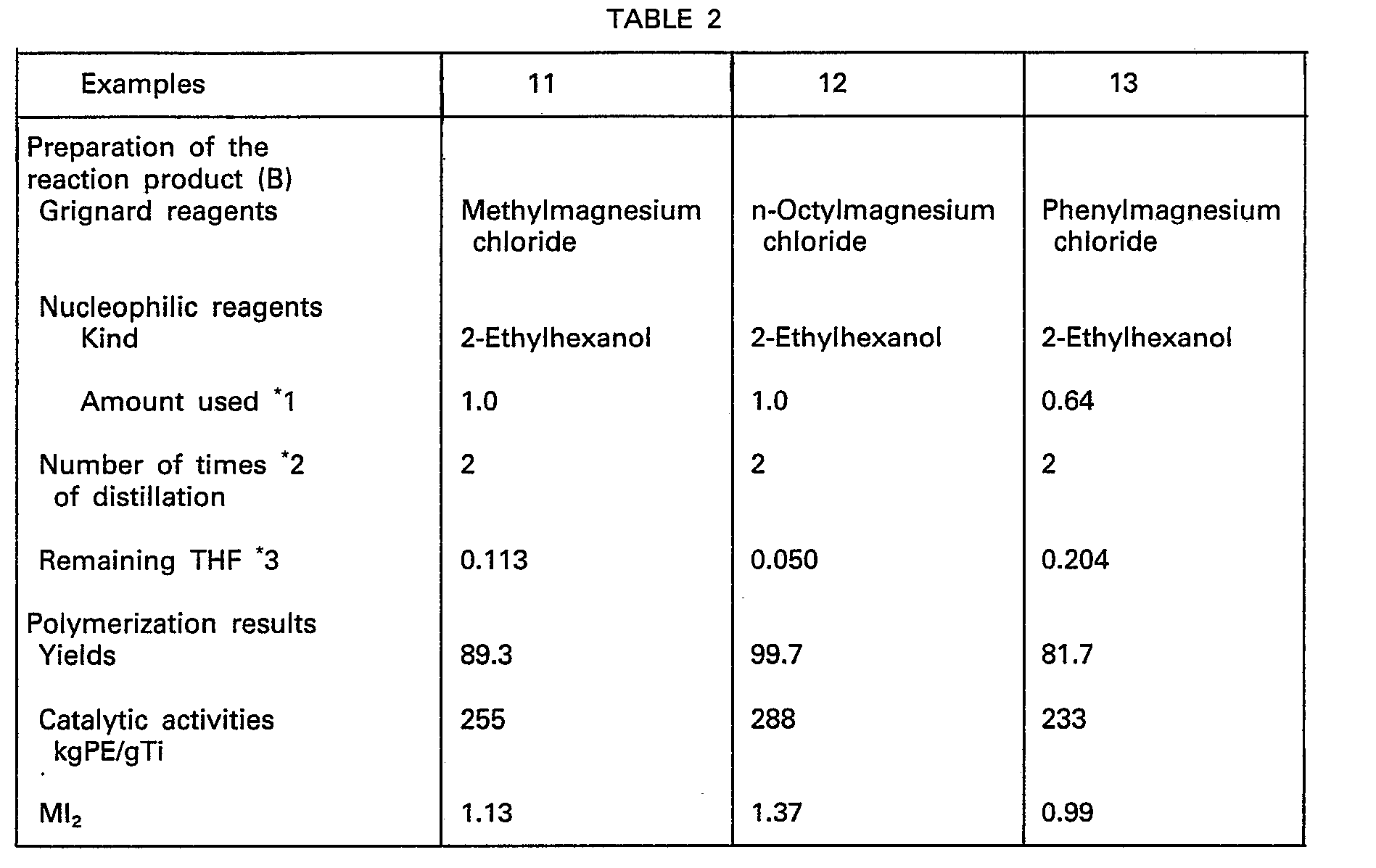

-
- (a) Preparation of the catalyst
- The preparation of the catalyst was performed under the same condition as in Example 7-(a) except that 1.19 mmol of triethylaluminum was added prior to the addition of Ti(On―C4H9)4 and reacted at 70°C for one hour, whereupon a brown transparent solution was obtained.
- (b) Polymerization of ethylene
- The polymerization was performed under the same conditions as in Example 7-(b) except that the polymerization temperature was 200°C and the supply of hydrogen was 0.3 kg/cm2 (absolute pressure), whereupon 46.3 g of polyethylene was obtained.
- The catalytic activity was 132 kgPE/gTi, and M12 was 2.92.
-
- (a) Preparation of the catalyst
- The preparation of the catalyst was performed under the same condition as in Example 1-(c) except that the reaction product (B) obtained by Example 3-(a) was used, 3.5 mmol of ethylaluminum dichloride was used, and the type of the transition metal compound was varied.
- (b) Polymerization of ethylene
- The polymerization of ethylene was performed under the same condition as in Example 7-(b).
- The results thereby obtained are shown in Table 3.

-
- (a) Preparation .of the catalyst
- Into a glass reactor preliminarily dried and flushed with nitrogen, 50 ml of n-heptane and 5 mmol of γ-TiCl3 were introduced, and 20 mmol of isopropanol was dropwise added at room temperature, and reacted at 60°C for one hour, whereby a blue TiCla-isopropanol complex slurry was obtained.
- The preparation of catalyst was performed under the same conditions as in Example 7-(a) except that instead of Ti(On―C4H9)4, the above TiCl3-isopropanol complex was used in an amount of 0.175 mmol as titanium, whereby a brown transparent solution was obtained.
- (b) Polymerization of ethylene
- The polymerization of ethylene was performed under the same conditions as in Example 7-(b), whereupon 122.6 g of polyethylene was obtained.
- The catalytic activity was 350 kgPE/gTi and M12 was 1.24.
-
- (a) Polymerization of ethylene
- The copolymerization of ethylene with octene-1 was performed under the same conditions as in Example 1-(d) except that the catalyst component obtained by Example 3 was used in an amount of 0.53 as titanium, 80 g of octene-1 was added, and the supply of hydrogen was 0.1 kg/cm2 (absolute pressure), whereupon 119.8 g of polyethylene was obtained.
- The catalytic activity was 226 kg/gTi, M12 was 3.70 and the density was 0.9212.
-
- (a) Polymerization of ethylene
- The copolymerization of ethylene with butene-1 was performed under the same condition as in Example 7-(b) except that 20 g of butene-1 was used and the supply of hydrogen was 0.1 kg/cm2 (absolute pressure), whereupon 83.0 g of polyethylene was obtained.
- The catalytic activity was 237 kgPE/gTi. M12 was 3.40 and the density was 0.9228.
-
- (a) Preparation of the catalyst
- The preparation of the catalyst was performed under the same conditions as in Example 1-(c) except that the reaction product (B) obtained by Example 3-(a) was used and Ti(On-C4H9)4 was used in an amount of 0.35 mmol.
- (b) Polymerization of ethylene
- Into a 1.6 I stainless steel autoclave dried internally and flushed with ethylene, 600 ml of n-hexane and 0.5 mmol of triethylaluminum was fed and the temperature was raised to 55°C. Then, the catalyst prepared in the above (a) was added in an amount of 0.5 mg as titanium and hydrogen was introduced under 2.5 kg/cm2 (absolute pressure). After raising the temperature to 75°C, ethylene was supplied to bring the total pressure to a constant level of 8 kg/cm2 (gauge pressure), and the polymerization was conducted for one hour while maintaining the polymerization temperature at 75°C. The yield of the polyethylene thereby obtained was 194.3 g. The catalytic activity was 389 kgPE/gTi. M12 was 1.30.
Claims (14)


Applications Claiming Priority (2)
| Application Number | Priority Date | Filing Date | Title |
|---|---|---|---|
| JP57121759A JPS5912906A (en) | 1982-07-13 | 1982-07-13 | Preparation of polyethylene |
| JP121759/82 | 1982-07-13 |
Publications (2)
| Publication Number | Publication Date |
|---|---|
| EP0101747A1 EP0101747A1 (en) | 1984-03-07 |
| EP0101747B1 true EP0101747B1 (en) | 1986-02-26 |
Family
ID=14819178
Family Applications (1)
| Application Number | Title | Priority Date | Filing Date |
|---|---|---|---|
| EP82107100A Expired EP0101747B1 (en) | 1982-07-13 | 1982-08-05 | Process for producing polyethylene |
Country Status (8)
| Country | Link |
|---|---|
| US (1) | US4657996A (en) |
| EP (1) | EP0101747B1 (en) |
| JP (1) | JPS5912906A (en) |
| AU (1) | AU551145B2 (en) |
| CA (1) | CA1184347A (en) |
| DE (1) | DE3269386D1 (en) |
| ES (2) | ES8501418A1 (en) |
| IN (1) | IN157330B (en) |
Families Citing this family (3)
| Publication number | Priority date | Publication date | Assignee | Title |
|---|---|---|---|---|
| JPH0665687B2 (en) * | 1984-09-13 | 1994-08-24 | 日産化学工業株式会社 | Improved ethylene polymerization or copolymerization process |
| US4760121A (en) * | 1986-01-03 | 1988-07-26 | Mobil Oil Corporation | Preparation of alpha-olefin polymers of relatively narrow molecular weight distrbution |
| JP2716615B2 (en) * | 1991-10-25 | 1998-02-18 | 丸善ポリマー株式会社 | Method for producing ethylene polymer composition |
Family Cites Families (7)
| Publication number | Priority date | Publication date | Assignee | Title |
|---|---|---|---|---|
| US3907759A (en) * | 1972-10-06 | 1975-09-23 | Nissan Chemical Ind Ltd | Catalyst for polymerization of olefins and process for polymerization of olefins with use of said catalyst |
| US4507450A (en) * | 1976-08-18 | 1985-03-26 | Mitsubishi Chemical Industries Limited | Process for preparing polyolefin |
| JPS58448B2 (en) * | 1976-09-27 | 1983-01-06 | 三井化学株式会社 | Method for manufacturing polyolefin |
| JPS5447783A (en) * | 1977-09-22 | 1979-04-14 | Nissan Chem Ind Ltd | Preparation of ethylene polymer |
| JPS54112982A (en) * | 1978-02-02 | 1979-09-04 | Sumitomo Chem Co Ltd | Polymerization of olefins |
| US4258167A (en) * | 1978-02-13 | 1981-03-24 | Nissan Chemical Industries, Ltd. | Process for producing powdery isotactic polyolefin |
| JPS55133408A (en) * | 1979-04-05 | 1980-10-17 | Sumitomo Chem Co Ltd | Polymerization of olefin |
-
1982
- 1982-07-13 JP JP57121759A patent/JPS5912906A/en active Granted
- 1982-08-05 DE DE8282107100T patent/DE3269386D1/en not_active Expired
- 1982-08-05 EP EP82107100A patent/EP0101747B1/en not_active Expired
- 1982-08-21 IN IN973/CAL/82A patent/IN157330B/en unknown
- 1982-08-23 AU AU87502/82A patent/AU551145B2/en not_active Ceased
- 1982-08-25 CA CA000410074A patent/CA1184347A/en not_active Expired
- 1982-09-10 ES ES515652A patent/ES8501418A1/en not_active Expired
-
1983
- 1983-12-14 ES ES528061A patent/ES8602854A1/en not_active Expired
-
1986
- 1986-02-27 US US06/833,670 patent/US4657996A/en not_active Expired - Lifetime
Also Published As
| Publication number | Publication date |
|---|---|
| IN157330B (en) | 1986-03-01 |
| AU551145B2 (en) | 1986-04-17 |
| ES528061A0 (en) | 1985-11-16 |
| CA1184347A (en) | 1985-03-19 |
| ES515652A0 (en) | 1984-11-16 |
| US4657996A (en) | 1987-04-14 |
| JPS5912906A (en) | 1984-01-23 |
| DE3269386D1 (en) | 1986-04-03 |
| EP0101747A1 (en) | 1984-03-07 |
| AU8750282A (en) | 1984-01-19 |
| JPS634848B2 (en) | 1988-02-01 |
| ES8602854A1 (en) | 1985-11-16 |
| ES8501418A1 (en) | 1984-11-16 |
Similar Documents
| Publication | Publication Date | Title |
|---|---|---|
| US4357448A (en) | Two step process for polymerizing ethylene | |
| KR940006217B1 (en) | Polymerization method of olefin using the catalyst for olefin polymerization and this catalyst for olefin polymerization | |
| EP0068200B1 (en) | Process for the polymerization or copolymerization of ethylene | |
| JPH0780968B2 (en) | Process for producing olefin polymer | |
| JPH0343285B2 (en) | ||
| US4398006A (en) | Process for producing polybutene-1 | |
| US4308369A (en) | High efficiency catalyst for polymerizing olefins | |
| US4364851A (en) | Process for producing olefin polymers | |
| US4657996A (en) | Process for producing polyethylene | |
| US4399053A (en) | High efficiency catalyst containing titanium, zirconium and zinc for polymerizing olefins | |
| EP0111902B1 (en) | Catalyst and process using same for producing olefin polymer | |
| JPS6072903A (en) | Polymerization of alpha-olefin | |
| US4742132A (en) | Process for the polymerization or copolymerization of ethylene | |
| JPH0725806B2 (en) | Olefin polymerization catalyst component | |
| JPS58451B2 (en) | Ethylene Nojiyugohouhou | |
| EP0132288A1 (en) | A method of polymerizing an olefin | |
| JPH07238108A (en) | Preparation of solid catalyst component for ethylene polymerization and production of ethylene copolymer using catalyst containing the solid catalyst component | |
| JPS5821407A (en) | Production of ethylene polymer | |
| JPS62135509A (en) | Production of propylene block copolymer | |
| JP3248385B2 (en) | Olefin (co) polymerization catalyst and method for producing olefin (co) polymer | |
| JPS5949241B2 (en) | Method for producing stereoregular polyolefin | |
| JPS6254804B2 (en) | ||
| JPH0689071B2 (en) | Amorphous propylene-ethylene copolymer | |
| JPH0455205B2 (en) | ||
| JPH0358370B2 (en) |
Legal Events
| Date | Code | Title | Description |
|---|---|---|---|
| PUAI | Public reference made under article 153(3) epc to a published international application that has entered the european phase |
Free format text: ORIGINAL CODE: 0009012 |
|
| AK | Designated contracting states |
Designated state(s): BE DE FR GB NL |
|
| 17P | Request for examination filed |
Effective date: 19840807 |
|
| GRAA | (expected) grant |
Free format text: ORIGINAL CODE: 0009210 |
|
| AK | Designated contracting states |
Designated state(s): BE DE FR GB NL |
|
| REF | Corresponds to: |
Ref document number: 3269386 Country of ref document: DE Date of ref document: 19860403 |
|
| ET | Fr: translation filed | ||
| PLBE | No opposition filed within time limit |
Free format text: ORIGINAL CODE: 0009261 |
|
| STAA | Information on the status of an ep patent application or granted ep patent |
Free format text: STATUS: NO OPPOSITION FILED WITHIN TIME LIMIT |
|
| 26N | No opposition filed | ||
| PGFP | Annual fee paid to national office [announced via postgrant information from national office to epo] |
Ref country code: GB Payment date: 19940726 Year of fee payment: 13 |
|
| PGFP | Annual fee paid to national office [announced via postgrant information from national office to epo] |
Ref country code: FR Payment date: 19940809 Year of fee payment: 13 |
|
| PGFP | Annual fee paid to national office [announced via postgrant information from national office to epo] |
Ref country code: DE Payment date: 19940816 Year of fee payment: 13 |
|
| PGFP | Annual fee paid to national office [announced via postgrant information from national office to epo] |
Ref country code: NL Payment date: 19940831 Year of fee payment: 13 |
|
| PGFP | Annual fee paid to national office [announced via postgrant information from national office to epo] |
Ref country code: BE Payment date: 19941012 Year of fee payment: 13 |
|
| PG25 | Lapsed in a contracting state [announced via postgrant information from national office to epo] |
Ref country code: GB Effective date: 19950805 |
|
| PG25 | Lapsed in a contracting state [announced via postgrant information from national office to epo] |
Ref country code: BE Effective date: 19950831 |
|
| BERE | Be: lapsed |
Owner name: NISSAN CHEMICAL INDUSTRIES LTD Effective date: 19950831 |
|
| PG25 | Lapsed in a contracting state [announced via postgrant information from national office to epo] |
Ref country code: NL Effective date: 19960301 |
|
| GBPC | Gb: european patent ceased through non-payment of renewal fee |
Effective date: 19950805 |
|
| PG25 | Lapsed in a contracting state [announced via postgrant information from national office to epo] |
Ref country code: FR Effective date: 19960430 |
|
| NLV4 | Nl: lapsed or anulled due to non-payment of the annual fee |
Effective date: 19960301 |
|
| PG25 | Lapsed in a contracting state [announced via postgrant information from national office to epo] |
Ref country code: DE Effective date: 19960501 |
|
| REG | Reference to a national code |
Ref country code: FR Ref legal event code: ST |