EP0101232A2 - Method for manufacturing low pour point petroleum product - Google Patents
Method for manufacturing low pour point petroleum product Download PDFInfo
- Publication number
- EP0101232A2 EP0101232A2 EP83304411A EP83304411A EP0101232A2 EP 0101232 A2 EP0101232 A2 EP 0101232A2 EP 83304411 A EP83304411 A EP 83304411A EP 83304411 A EP83304411 A EP 83304411A EP 0101232 A2 EP0101232 A2 EP 0101232A2
- Authority
- EP
- European Patent Office
- Prior art keywords
- distillate
- oil
- range
- hydrofining
- pour point
- Prior art date
- Legal status (The legal status is an assumption and is not a legal conclusion. Google has not performed a legal analysis and makes no representation as to the accuracy of the status listed.)
- Granted
Links
Images
Classifications
-
- C—CHEMISTRY; METALLURGY
- C10—PETROLEUM, GAS OR COKE INDUSTRIES; TECHNICAL GASES CONTAINING CARBON MONOXIDE; FUELS; LUBRICANTS; PEAT
- C10G—CRACKING HYDROCARBON OILS; PRODUCTION OF LIQUID HYDROCARBON MIXTURES, e.g. BY DESTRUCTIVE HYDROGENATION, OLIGOMERISATION, POLYMERISATION; RECOVERY OF HYDROCARBON OILS FROM OIL-SHALE, OIL-SAND, OR GASES; REFINING MIXTURES MAINLY CONSISTING OF HYDROCARBONS; REFORMING OF NAPHTHA; MINERAL WAXES
- C10G65/00—Treatment of hydrocarbon oils by two or more hydrotreatment processes only
- C10G65/02—Treatment of hydrocarbon oils by two or more hydrotreatment processes only plural serial stages only
- C10G65/04—Treatment of hydrocarbon oils by two or more hydrotreatment processes only plural serial stages only including only refining steps
-
- C—CHEMISTRY; METALLURGY
- C10—PETROLEUM, GAS OR COKE INDUSTRIES; TECHNICAL GASES CONTAINING CARBON MONOXIDE; FUELS; LUBRICANTS; PEAT
- C10G—CRACKING HYDROCARBON OILS; PRODUCTION OF LIQUID HYDROCARBON MIXTURES, e.g. BY DESTRUCTIVE HYDROGENATION, OLIGOMERISATION, POLYMERISATION; RECOVERY OF HYDROCARBON OILS FROM OIL-SHALE, OIL-SAND, OR GASES; REFINING MIXTURES MAINLY CONSISTING OF HYDROCARBONS; REFORMING OF NAPHTHA; MINERAL WAXES
- C10G2400/00—Products obtained by processes covered by groups C10G9/00 - C10G69/14
- C10G2400/06—Gasoil
Definitions
- This invention relates to a method for manufacturing a low pour point petroleum product from distillates of crude oil, and more particularly to a method for economically manufacturing a low pour point petroleum product, such as the insulating oil, the lubricating oil used for various types of freezing devices, or the base oil for such lubricating oil, from a paraffin-based crude oil as the starting material without using any special rare crude oil, such as naphthene-based crude oil.
- the first problem is that when the dewaxing treatment inevitably required to be performed during the manufacture of a petroleum product of low pour point for the purpose of removing wax component and lowering the pour point is carried out by the ordinary solvent dewaxing via the propane method of MEK method, the largest possible decrease of the pour point is to the level of about -20°C.
- the attainment of the upper limit of pour point -27.5 0 C fixed by JIS (Japanese Industrial Standard) (for insulating oil No. 2 and refrigerating machine oils No. 2 and No. 3), or -350 C fixed similarly (for refrigerating machine oil No. 1), is generally impracticable.
- the still lower pour point of not more than -40 P C which a certain special lubricant base oil is required to satisfy can hardly be attained.
- crystalline zeolite TSZ advantageously serves as the catalyst.
- the crystalline zeolite TSZ is preferably used in a form of hydrogen-type or metal ion-exchanged type or in a form of metal impregnated type.
- This metal is at least one member selected from the group consisting of the elements of Group VIII (iron family and platinum family) and Group IIA (alkaline earth metals) of the Periodic Table of Elements. Preferably, it is at least one member selected from the group consisting of nickel, palladium and platinum.
- zeolite TSZ is meant what is disclosed in Japanese Patent Application No. 143396/1981 filed by the applicants of the present invention.
- the zeolite TSZ is a crystalline aluminosilicate comprising a chemical composition which, in the molar ratio of oxides, is expressed by the following formula: 0.8-1.5M2/nO:Al203:10-100/Si02:ZH20 (wherein M denotes at least one metallic cation species, n the valency of the metallic cation, and Z a numeral of the value of 0 to 40) and possesses a specified X-ray power diffraction pattern at least exhibiting interplanar spacing shown in Table 1.
- the catalyst to be used in this invention is prepared by converting the zeolite TSZ of the aforementioned description through a treatment with ammonium chloride into a hydrogen-form TSZ, impregnating the aforementioned metal, and blending the metal-loaded hydrogen-form TSZ with alumina, clay, silica, silica-alumina, or a metal oxide (such as, for example, zirconia or magnesia) as a binder.
- the amount of the binder thus added is generally in the range of 5 to 50%, and preferably in the range of 15 to 30%. It has been found, however, that a catalyst consisting solely of TSZ and containing none of the aforementioned binder can be effectively used for the purpose of this invention.
- an object of this invention to provide a method for manufacturing in high yields a petroleum product of low pour point of not more than -20°C from paraffin-based crude oil as the raw material.
- the method for the manufacture of the petroleum product of low pour point by the present invention comprises:
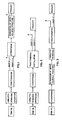
- Figures 1, 2 and 3 are schematic outlines of three alternate process sequences within the scope of the present invention.
- a petroleum product of low pour point can be economically obtained from the paraffin-based crude oil in higher yields than by the conventional solvent dewaxing and catalytic dewaxing methods.
- the catalyst used in the catalytic dewaxing operation consisted of 70 weight percent of zeolite TSZ (containing 0.8 weight percent of Ni) and 30 weight percent of alumina as a binder.
- This zeolite TSZ was prepared as follows:
- This x-ray analysis was carried out by the ordinary procedure of x-ray powder diffraction.
- the radiation was made of the K alpha doublet of copper and the intensities of the x-ray tube were 40 KV and 70mA, respectively.
- the angle of diffraction 29, and the intensity of diffraction beam were measured by the use of a scintillation counter provided with a goniometer and a strip chart pen recorder. In this case, the scanning speed was 2 0 /minute for 20 rotation and the time constant for the rate meter was fixed at 1 second.
- this H-TSZ was kneaded, in the presence of water, with a separately prepared alumina binder added thereto in an amoont corresponding to 30 weight percent A1 2 0 3 .
- the resultant mixture was extruded to produce pellets of 1.5 mm in diameter, and the pellets were calcined further in air at 400 o C.
- Nickel was incorporated into the pellets by subjecting the pellets to ion-exchange treatment at 80°C for 3 hours, using 3 ml of a 1N aqueous solution of nickel nitrate per 1 g of the aforementioned TSZ pellets.
- the hydrofining catalyst was of the commonly used type obtained by having at least one member from among Ni, Co, Mo and W compounds impregnated on alumina or silica-alumina.
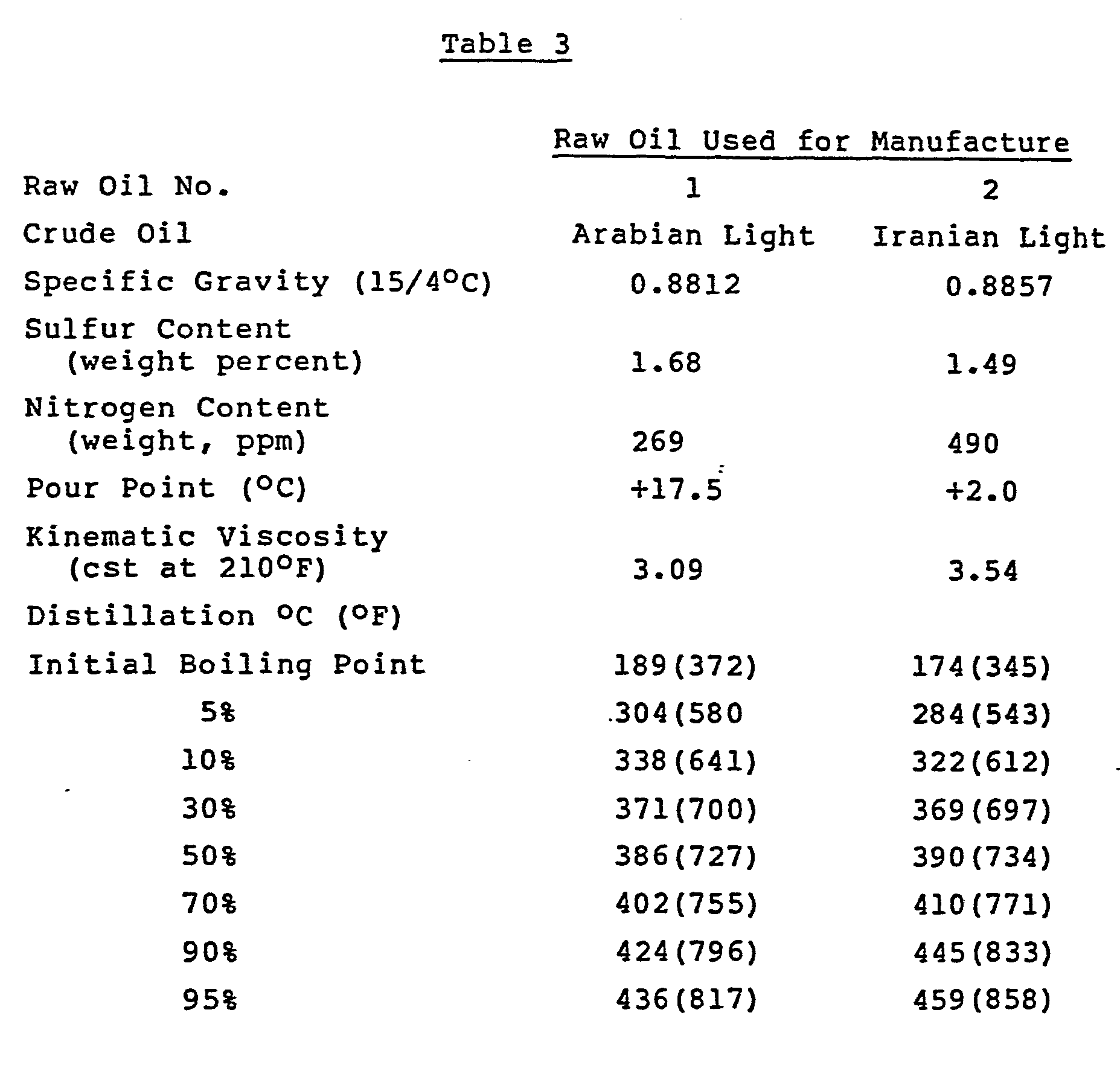
- the raw oils fed to the manufacturing process were distillates of boiling points in the range of 330°F to 900°F (165.6°C to 482.2 0 C) as illustrated in Table 3, which were obtained by distilling Arabian Light and Egyptian Light, respectively.
- a zeolite ZSM-5 was prepared in its nickel-hydrogen form as follows:
- the H-ZSM-5 was kneaded with a separately prepared alumina binder in an amount corresponding to 30 weight percent A1 2 0 3 .
- the resultant mixture was extruded to produce pellets 1.5 mm in diameter.
- the pellets were dried at 110 0 C and further calcined in air at 400°C.
- the ZSM-5 pellets were subjected to ion-exchange treatment at 80°C for three hours, using 3 ml of a IN aqueous solution of nickel nitrate per g of the pellets. They were then washed thoroughly with water, dried at 110°C, and calcined at 540°C for three hours.
- the Ni, H-ZSM-5 was found to contain 0.77 weight percent of Ni.
- Table 10 shows Comparative Examples 1-2 which were conducted by using the aforementioned Ni, H-ZSM-5 as a catalyst for catalytic dewaxing, by way of comparison under the conditions and on the feeds of Example 2(1) and Example 3(1), respectively.
- Table 11 shows Comparative Example 3 which was conducted by using the Ni, H-ZSM-5 in catalytic dewaxing by way of comparison under the conditions and on the feed of Example -4(1).
- Table 12 shows comparative Examples 4(1) through (3) which report the properties of insulating oils from the distillate fraction boiling between 550°F and 725 0 F (287.8°C and 385 0 C) of the oils obtained in Comparative Examples 1 through 3. These results are to be compared with Examples 5(1), (4), and (5), respectively.
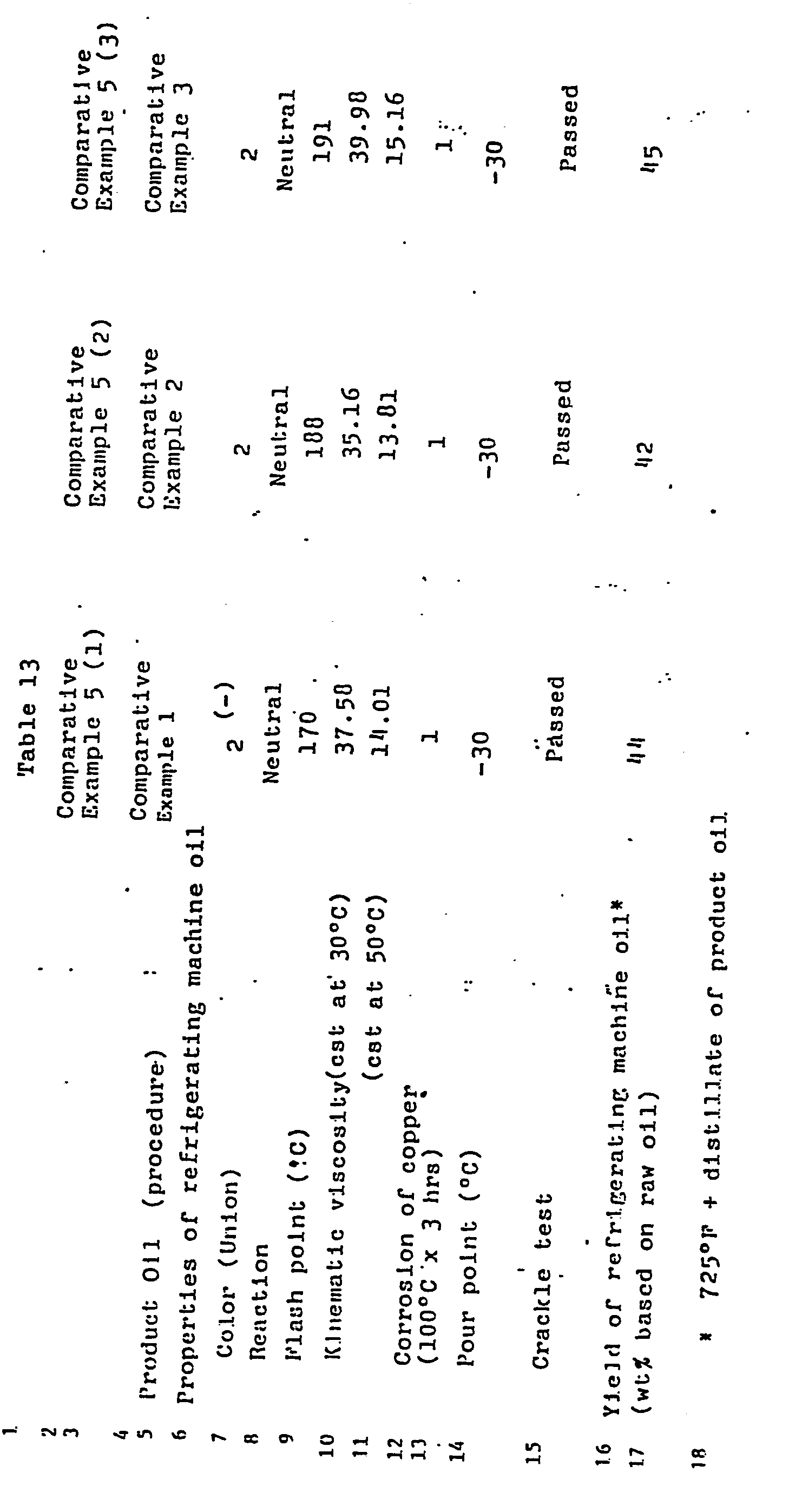
- Table 13 shows Comparative Examples 5(1) through (3) which report the properties of refrigerating machine oils from the distillate fraction boiling about 725°F (385°C) of the 'oils obtained in Comparative Examples 1 through 3. These results are to be compared with Examples 6(1), (4), and (5), respectively.
Landscapes
- Chemical & Material Sciences (AREA)
- Oil, Petroleum & Natural Gas (AREA)
- Engineering & Computer Science (AREA)
- Chemical Kinetics & Catalysis (AREA)
- General Chemical & Material Sciences (AREA)
- Organic Chemistry (AREA)
- Production Of Liquid Hydrocarbon Mixture For Refining Petroleum (AREA)
- Catalysts (AREA)
Abstract
Description
- This invention relates to a method for manufacturing a low pour point petroleum product from distillates of crude oil, and more particularly to a method for economically manufacturing a low pour point petroleum product, such as the insulating oil, the lubricating oil used for various types of freezing devices, or the base oil for such lubricating oil, from a paraffin-based crude oil as the starting material without using any special rare crude oil, such as naphthene-based crude oil.
- Heretofore, the raw material accepted as usable for the manufacture of such petroleum products of low pour point as insulating oil, refrigerating machine oil, and lubricating base oil has been limited to naphthene-based crude oil. Unfortunately, the naphthene-based crude oil is produced in a small amount. There are all indications that the supply of this particular crude oil in the future will keep pace with the demand for such petroleum products of low pour point with increasing difficulty.
- Various attempts have been made to obtain the petroleum products of low pour point from the paraffin-based crude oil. They still have problems yet to be solved. The first problem is that when the dewaxing treatment inevitably required to be performed during the manufacture of a petroleum product of low pour point for the purpose of removing wax component and lowering the pour point is carried out by the ordinary solvent dewaxing via the propane method of MEK method, the largest possible decrease of the pour point is to the level of about -20°C. Thus, the attainment of the upper limit of pour point, -27.50C fixed by JIS (Japanese Industrial Standard) (for insulating oil No. 2 and refrigerating machine oils No. 2 and No. 3), or -350C fixed similarly (for refrigerating machine oil No. 1), is generally impracticable. The still lower pour point of not more than -40PC which a certain special lubricant base oil is required to satisfy can hardly be attained.
- Recently, there has been proposed a catalytic dewaxing method which obtains a petroleum product of low pour point by treating paraffin-based crude oil as raw material with a crystalline zeolite like ZSM-5 as a catalyst, thereby removing wax from the crude oil by the resultant catalytic reaction. This method has not proved quite satisfactory in terms of yield and pour point of the finished petroleum product of low pour point.
- After various studies and'experiments, it has been found that for the catalytic dewaxing method to be performed in a satisfactory manner on the paraffin-based crude oil as the raw material the selection of the catalyst, the conditions for the dewaxing operation, and the treatments to be given to the raw material or the product before and after the dewaxing operation must be . optimized.
- It has been discovered that crystalline zeolite TSZ advantageously serves as the catalyst. The crystalline zeolite TSZ is preferably used in a form of hydrogen-type or metal ion-exchanged type or in a form of metal impregnated type.
- This metal is at least one member selected from the group consisting of the elements of Group VIII (iron family and platinum family) and Group IIA (alkaline earth metals) of the Periodic Table of Elements. Preferably, it is at least one member selected from the group consisting of nickel, palladium and platinum. By "zeolite TSZ" is meant what is disclosed in Japanese Patent Application No. 143396/1981 filed by the applicants of the present invention. More specifically, the zeolite TSZ is a crystalline aluminosilicate comprising a chemical composition which, in the molar ratio of oxides, is expressed by the following formula:
0.8-1.5M2/nO:Al203:10-100/Si02:ZH20
(wherein M denotes at least one metallic cation species, n the valency of the metallic cation, and Z a numeral of the value of 0 to 40) and possesses a specified X-ray power diffraction pattern at least exhibiting interplanar spacing shown in Table 1.
- It has now been discovered that a petroleum product of low pour point can be obtained in high yields by a method combining the catalytic dewaxing operation utilizing the aforementioned zeolite TSZ and a hydrofining process.
- The catalyst to be used in this invention is prepared by converting the zeolite TSZ of the aforementioned description through a treatment with ammonium chloride into a hydrogen-form TSZ, impregnating the aforementioned metal, and blending the metal-loaded hydrogen-form TSZ with alumina, clay, silica, silica-alumina, or a metal oxide (such as, for example, zirconia or magnesia) as a binder. The amount of the binder thus added is generally in the range of 5 to 50%, and preferably in the range of 15 to 30%. It has been found, however, that a catalyst consisting solely of TSZ and containing none of the aforementioned binder can be effectively used for the purpose of this invention.
- It is, therefore, an object of this invention to provide a method for manufacturing in high yields a petroleum product of low pour point of not more than -20°C from paraffin-based crude oil as the raw material.
- The method for the manufacture of the petroleum product of low pour point by the present invention, in summary, comprises:
- (1) using as starting material a paraffin-based crude oil such as, for example, Arabian Light;
- (2) fractionating the crude oil thereby into a distillate of boiling points in the range of 330°F to 9000F (165.60C to 482.2°C), (raw oil);
- (3) subjecting, or not subjecting the raw oil to a preliminary hydrofining step at the descretion of the practitioner;
- (4) passing the raw oil through a fixed-bed reactor packed with a catalyst containing zeolite TSZ under pressure of hydrogen (the feed gas should be at least 50% hydrogen) at a prescribed reactor temperature at a prescribed flow rate, thereby effecting catalytic dewaxing for the wax component of the raw oil into more volatile hydrocarbons and eliminating the wax component therefrom;
- (5) distilling the product of the catalytic dewaxing to afford a petroleum product of low pour point satisfying the specification requirements of the desired product, with due consideration paid to flash point or viscosity;
- (6) preferably performing.hydrofining before or after the aforementioned distillation where the raw oil resulting from the catalytic dewaxing operation has not yet been subjected to hydrofining, or subjecting the raw oil as occasion demands to a further hydrofining where the raw oil has been treated in advance of catalytic dewaxing to a hydrofining step; and
- (7) further, for the purpose of adjusting the specification by the product or further improving the quality of the product, giving to the raw oil or the oil resulting from the catalytic dewaxing operation an aftertreatment, such as with clay, depending on the extent to which the hydrofining has been effected.
- Figures 1, 2 and 3 are schematic outlines of three alternate process sequences within the scope of the present invention.
- By the manufacturing method of the present invention practiced as described above, a petroleum product of low pour point can be economically obtained from the paraffin-based crude oil in higher yields than by the conventional solvent dewaxing and catalytic dewaxing methods.
- The present invention will be described below with reference to the working examples which are presented by way of examples and not limitation.
- The catalyst used in the catalytic dewaxing operation consisted of 70 weight percent of zeolite TSZ (containing 0.8 weight percent of Ni) and 30 weight percent of alumina as a binder.
- This zeolite TSZ was prepared as follows:
- In 510 g of purified water, 12 g of aluminum sulfate was dissolved. By adding 17.1 g of concentrated sulfuric acid (95 weight percent) and 54 g of sodium chloride to the resultant solution there was obtained aluminum sulfate solution. This aluminum sulfate solution was mixed under continued stirring into a mixed solution of 75 g of water and 189 g of water glass (containing 9.5 weight percent of Na20 and 28.6 weight percent of Si02) (water glass, No. 3, specified by Japanese Industrial Standard), to afford an aqueous reaction mixture having a composition represented, in molar ratio of oxides, as 3.9Na2O·Al2O3-50SiO2·2184H2O. The sodium chloride used in this case as a mineralizing agent had a Cl/Si02 molar ratio of 1.02. The aqueous reaction mixture was placed in a stainless steel autoclave, heated to an elevated temperature, and kept heated at 1800C for 20 hours under autogenous pressure The crystallized solid product was separated by filtration, washed with water, and dried at 110°C. Chemical analysis of a sample of the solid product produced revealed it to have a chemical composition of 2.6 weight percent of Na20, 4.23 weight percent of A1203, 84.8 weight percent of Si02, and 8.4 weight percent of H20. This composition may be rewritten in molar ratio of oxides as follows:
- When this product was subjected to x-ray analysis, the results shown in Table 2 were obtained.

- This x-ray analysis was carried out by the ordinary procedure of x-ray powder diffraction. The radiation was made of the K alpha doublet of copper and the intensities of the x-ray tube were 40 KV and 70mA, respectively. The angle of diffraction 29, and the intensity of diffraction beam were measured by the use of a scintillation counter provided with a goniometer and a strip chart pen recorder. In this case, the scanning speed was 20/minute for 20 rotation and the time constant for the rate meter was fixed at 1 second.
- By using 15 ml of a 5 weight percent ammonium chloride solution per g of zeolite, 25 g of the TSZ product was subjected to ion-exchange treatment a total of four times at 80°C. Each cycle of the treatment was continued for two hours. Then the product of ion-exchange treatment was thoroughly washed with water, dried at 110°C, and calcined in air at 540°C for three hours, yielding an H (hydrogen)-form TSZ. On chemical analysis, this H-TSZ was found to contain 0.02 weight percent of Na20.
- Subsequently, this H-TSZ was kneaded, in the presence of water, with a separately prepared alumina binder added thereto in an amoont corresponding to 30 weight percent A1203. The resultant mixture was extruded to produce pellets of 1.5 mm in diameter, and the pellets were calcined further in air at 400oC. Nickel was incorporated into the pellets by subjecting the pellets to ion-exchange treatment at 80°C for 3 hours, using 3 ml of a 1N aqueous solution of nickel nitrate per 1 g of the aforementioned TSZ pellets. Thereafter, the pellets were thoroughly washed with water, dried at 110oC, and calcined in air at 540°C for three hours. Consequently, there was obtained Ni,H-TSZ. On chemical analysis it was found to contain 0.81 weight percent of Ni.
- The hydrofining catalyst was of the commonly used type obtained by having at least one member from among Ni, Co, Mo and W compounds impregnated on alumina or silica-alumina.
- The raw oils fed to the manufacturing process were distillates of boiling points in the range of 330°F to 900°F (165.6°C to 482.20C) as illustrated in Table 3, which were obtained by distilling Arabian Light and Iranian Light, respectively.
- Each of the raw oils obtained as described above was subjected to catalytic dewaxing using the catalyst of Example 1. Of the oil resulting from the catalytic dewaxing treatment, the fraction boiling at or above 550°F (287.80C) was forwarded as feed oil to the stage for hydrofining to afford a petroleum product of low pour point (Figure 1). The results were as shown in Table 4.

- A raw oil indicated in Table 5 was subjected to catalytic dewaxing using the catalyst of Example 1. The oil resulting from the catalytic dewaxing was directly forwarded as a feed oil to hydrofining to obtain a product of low pour point (Figure 2). The results'are shown in Table 5.

- The raw oils indicated in Table 6 were first treated by hydrofining. Then the oils resulting from the hydrofining were fractionated to remove the more volatile portion and forwarded to the stage for catalytic dewaxing using the catalyst shown in Example 1, to obtain a product of low pour point (Figure 3). The results were as shown in Table 6.

- The distillates boiling between 550°F and 725°F (287.8°C and 385°C), originating in the products of Examples 2-4, were found to be usable as insulating oils (Table 7).
- The distillates boiling more than 725°F (385°C), originating in the products of Examples 2-4 were found to be usable as refrigerating machine oils (Table 8).
- The products of Examples 2-4, when subjected to an aftertreatment (either hydrofining or treatment with clay), yielded insulating oils or refrigerating machine oils. The aftertreatment serves to improve the product quality (Table 9).


- As a catalyst for use in catalytic dewaxing, a zeolite ZSM-5 was prepared in its nickel-hydrogen form as follows:
- In 165 g of purified water, 6.1 g of aluminum sulfate was dissolved. By mixing the resultant solution with 12 g of concentrated sulfuric acid (95 weight percent) and 21 g of tetrapropyl ammonium bromide (TPA Br), there was obtained a mixed solution (Solution A). Then another mixed solution (Solution B) was prepared by using 100 g of purified water and 165 g of water glass (containing 9.4 weight percent of Na20 and 29.4 weight percent of Si02). Further, an aqueous solution of sodium chloride was prepared by dissolving 63 g of sodium chloride in 250 g of purified water. The aforementioned Solution A and Solution B were simultaneously added dropwise, under stirring, into the sodium chloride solution. Consequently, there was obtained an aqueous reaction mixture having a composition expressed in molar ratio of oxides as 4.3 (TPA)20. 6Na2O.Al2O3·BBSiO2·5735H2O. This aqueous reaction mixture was placed in a stainless steel autoclave, heated to an elevated temperature, and kept at 160°C for 20 hours under the autogenous pressure. A solid product was separated by filtration, washed with water, and dried at 110°C. When the crystalline solid product was analyzed by an x-ray powder diffraction method the diffraction pattern was consistent with that of ZSM-5 shown in U. S. Patent No. 3,702,886.
- 25 g of ZSM-5 was calcined in air at 5400C for three hours. It was then subjected to ion-exchange treatment a total of four times at 80°C using 15 ml of 5 weight percent ammonium chloride solution per g of zeolite. Each cycle of the treatment was continued for 1.5 hours. Then the product resulting from the ion-exchange treatment was thoroughly washed with water, then dried at 110°C, and subsequently calcined in air at 540°C for three hours to prepare an H (hydrogen)-form ZSM-5. On chemical analysis the H-ZSM-5 was found to have a composition of 0.02 weight percent of Na20, 3.18 weight percent of A1203, and 96.60 weight percent of Si02 (Si02/Al203 = 51.6).
- Then the H-ZSM-5 was kneaded with a separately prepared alumina binder in an amount corresponding to 30 weight percent A1203. The resultant mixture was extruded to produce pellets 1.5 mm in diameter. The pellets were dried at 1100C and further calcined in air at 400°C. To make a Ni, H-fZ6m ZSM-5, the ZSM-5 pellets were subjected to ion-exchange treatment at 80°C for three hours, using 3 ml of a IN aqueous solution of nickel nitrate per g of the pellets. They were then washed thoroughly with water, dried at 110°C, and calcined at 540°C for three hours. On chemical analysis, the Ni, H-ZSM-5 was found to contain 0.77 weight percent of Ni.
- Table 10 shows Comparative Examples 1-2 which were conducted by using the aforementioned Ni, H-ZSM-5 as a catalyst for catalytic dewaxing, by way of comparison under the conditions and on the feeds of Example 2(1) and Example 3(1), respectively. Table 11 shows Comparative Example 3 which was conducted by using the Ni, H-ZSM-5 in catalytic dewaxing by way of comparison under the conditions and on the feed of Example -4(1).


- The results indicated above prove that the manufacturing method contemplated by the present invention is capable of affording petroleum products of low pour point.
- Table 12 shows comparative Examples 4(1) through (3) which report the properties of insulating oils from the distillate fraction boiling between 550°F and 7250 F (287.8°C and 3850C) of the oils obtained in Comparative Examples 1 through 3. These results are to be compared with Examples 5(1), (4), and (5), respectively.
- Table 13 shows Comparative Examples 5(1) through (3) which report the properties of refrigerating machine oils from the distillate fraction boiling about 725°F (385°C) of the 'oils obtained in Comparative Examples 1 through 3. These results are to be compared with Examples 6(1), (4), and (5), respectively.
- These results prove that in accordance with the manufacturing method contemplated by the present invention petroleum products of lower pour point and better quality can be produced.

- Japanese patent application No.143396/1981 was filed on 11 September 1981 and was laid open to public inspection as publication 45111/1983 on 16 March 1983.
1.01Na2O·Al2O3·34.1SiO2·11.2H2O
Claims (10)
Applications Claiming Priority (2)
| Application Number | Priority Date | Filing Date | Title |
|---|---|---|---|
| JP57134454A JPS5924791A (en) | 1982-07-31 | 1982-07-31 | Preparation of low-pour point petroleum product |
| JP134454/82 | 1982-07-31 |
Publications (3)
| Publication Number | Publication Date |
|---|---|
| EP0101232A2 true EP0101232A2 (en) | 1984-02-22 |
| EP0101232A3 EP0101232A3 (en) | 1986-02-19 |
| EP0101232B1 EP0101232B1 (en) | 1989-04-19 |
Family
ID=15128715
Family Applications (1)
| Application Number | Title | Priority Date | Filing Date |
|---|---|---|---|
| EP83304411A Expired EP0101232B1 (en) | 1982-07-31 | 1983-07-29 | Method for manufacturing low pour point petroleum product |
Country Status (5)
| Country | Link |
|---|---|
| US (1) | US4664775A (en) |
| EP (1) | EP0101232B1 (en) |
| JP (1) | JPS5924791A (en) |
| CA (1) | CA1231907A (en) |
| DE (1) | DE3379662D1 (en) |
Cited By (2)
| Publication number | Priority date | Publication date | Assignee | Title |
|---|---|---|---|---|
| EP0134637A1 (en) * | 1983-07-11 | 1985-03-20 | Mobil Oil Corporation | Viscosity index improvement in dewaxed lube basestock by partial desulfurization in hydrotreat bed |
| EP0152485A4 (en) * | 1983-03-09 | 1986-03-18 | Toa Nenryo Kogyo Kk | BINDER FREE ZEOLITE CATALYST, PROCESS FOR PREPARING SAME AND CATALYTIC REACTION USING THE SAME. |
Families Citing this family (7)
| Publication number | Priority date | Publication date | Assignee | Title |
|---|---|---|---|---|
| JPS614109A (en) * | 1984-06-18 | 1986-01-10 | 出光興産株式会社 | Electrically insulating oil |
| US4755279A (en) * | 1984-12-24 | 1988-07-05 | Amoco Corporation | Process for the manufacture of lubricating oils |
| DE3572003D1 (en) * | 1984-12-27 | 1989-09-07 | Mobil Oil Corp | Process for hydrocracking and catalytic dewaxing |
| AU592372B2 (en) * | 1985-10-15 | 1990-01-11 | Mobil Oil Corporation | Processing aromatic vacuum gas oil for jet fuel production |
| US5167847A (en) * | 1990-05-21 | 1992-12-01 | Exxon Research And Engineering Company | Process for producing transformer oil from a hydrocracked stock |
| CN1317368C (en) * | 2004-03-31 | 2007-05-23 | 中国石油化工股份有限公司 | Method for preparing lubricating oil base oil |
| US12695096B2 (en) | 2020-12-14 | 2026-07-28 | Artience Co., Ltd. | Conductive material dispersion, coating and secondary battery |
Family Cites Families (18)
| Publication number | Priority date | Publication date | Assignee | Title |
|---|---|---|---|---|
| US28398A (en) * | 1860-05-22 | Henry l | ||
| US3700585A (en) * | 1969-10-10 | 1972-10-24 | Mobil Oil Corp | Dewaxing of oils by shape selective cracking and hydrocracking over zeolites zsm-5 and zsm-8 |
| USRE28398E (en) | 1969-10-10 | 1975-04-22 | Marshall dann | |
| US3702886A (en) * | 1969-10-10 | 1972-11-14 | Mobil Oil Corp | Crystalline zeolite zsm-5 and method of preparing the same |
| US3894938A (en) * | 1973-06-15 | 1975-07-15 | Mobil Oil Corp | Catalytic dewaxing of gas oils |
| US4175114A (en) * | 1973-12-13 | 1979-11-20 | Mobil Oil Corporation | Method for producing zeolites |
| US4257885A (en) * | 1976-02-04 | 1981-03-24 | Union Carbide Corporation | Novel zeolite compositions and processes for preparing and using same |
| GB1567948A (en) * | 1976-07-22 | 1980-05-21 | Ici Ltd | Zeolite synthesis |
| US4137148A (en) * | 1977-07-20 | 1979-01-30 | Mobil Oil Corporation | Manufacture of specialty oils |
| CA1117455A (en) * | 1977-12-20 | 1982-02-02 | Mobil Oil Corporation | Manufacture of lube base stock oil |
| US4294687A (en) * | 1979-12-26 | 1981-10-13 | Atlantic Richfield Company | Lubricating oil process |
| JPS577819A (en) * | 1980-06-14 | 1982-01-16 | Idemitsu Kosan Co Ltd | Manufacture of crystalline aluminosilicate zeolite |
| US4325804A (en) * | 1980-11-17 | 1982-04-20 | Atlantic Richfield Company | Process for producing lubricating oils and white oils |
| EP0054386B1 (en) * | 1980-12-17 | 1985-03-27 | Imperial Chemical Industries Plc | Zeolites |
| DE3268503D1 (en) * | 1981-05-20 | 1986-02-27 | Ici Plc | Zeolites |
| JPS58143396A (en) * | 1982-02-19 | 1983-08-25 | 日本電気株式会社 | Voice recognition unit |
| JPS58199714A (en) * | 1982-05-18 | 1983-11-21 | Toa Nenryo Kogyo Kk | Modified zeolite and manufacture of hydrocarbon using it |
| AU569055B2 (en) * | 1983-02-10 | 1988-01-21 | Fuji Oil Company Limited | Dewaxing |
-
1982
- 1982-07-31 JP JP57134454A patent/JPS5924791A/en active Granted
-
1983
- 1983-07-26 US US06/517,372 patent/US4664775A/en not_active Expired - Lifetime
- 1983-07-28 CA CA000433492A patent/CA1231907A/en not_active Expired
- 1983-07-29 EP EP83304411A patent/EP0101232B1/en not_active Expired
- 1983-07-29 DE DE8383304411T patent/DE3379662D1/en not_active Expired
Cited By (4)
| Publication number | Priority date | Publication date | Assignee | Title |
|---|---|---|---|---|
| EP0152485A4 (en) * | 1983-03-09 | 1986-03-18 | Toa Nenryo Kogyo Kk | BINDER FREE ZEOLITE CATALYST, PROCESS FOR PREPARING SAME AND CATALYTIC REACTION USING THE SAME. |
| DE3490097C2 (en) * | 1983-03-09 | 1991-04-25 | Toa Nenryo Kogyo K.K., Tokio/Tokyo, Jp | |
| EP0134637A1 (en) * | 1983-07-11 | 1985-03-20 | Mobil Oil Corporation | Viscosity index improvement in dewaxed lube basestock by partial desulfurization in hydrotreat bed |
| US4564440A (en) * | 1983-07-11 | 1986-01-14 | Mobil Oil Corporation | Viscosity index improvement in dewaxed lube basestock by partial desulfurization in hydrotreat bed |
Also Published As
| Publication number | Publication date |
|---|---|
| DE3379662D1 (en) | 1989-05-24 |
| EP0101232B1 (en) | 1989-04-19 |
| CA1231907A (en) | 1988-01-26 |
| EP0101232A3 (en) | 1986-02-19 |
| JPH0443954B2 (en) | 1992-07-20 |
| JPS5924791A (en) | 1984-02-08 |
| US4664775A (en) | 1987-05-12 |
Similar Documents
| Publication | Publication Date | Title |
|---|---|---|
| EP0095303B1 (en) | Catalytic dewaxing process | |
| DE69006580T2 (en) | Process for improving an insert containing sulfur. | |
| JP3677039B2 (en) | Lubricant hydrocracking method | |
| DE60130758T2 (en) | ZEOLITE SSZ-53 | |
| JP2969062B2 (en) | Hydrotreating method for producing premium isomerized gasoline | |
| RU2228947C2 (en) | Base oil production process (options) | |
| EP0094827B1 (en) | Simultaneous catalytic hydrocracking and hydrodewaxing of hydrocarbon oils with zeolite beta | |
| JPH0781147B2 (en) | Contact dewaxing method | |
| JPH0472579B2 (en) | ||
| US20110123433A1 (en) | Method for making aluminosilicate zsm-12 | |
| JPS59117584A (en) | Organic conversion reaction using improved hydrothermally stable zeolite catalyst | |
| EP0263228B2 (en) | Process for producing a product hydrocarbon having a reduced content of normal paraffins | |
| US4664775A (en) | Method for manufacturing low pour point petroleum product with zeolite TSZ | |
| JPH09512043A (en) | Method for improving cetane number of distillate fraction | |
| JPH0546875B2 (en) | ||
| US5273645A (en) | Manufacture of lubricating oils | |
| KR20120095991A (en) | Process for isosomerizing a hydrocarbonaceos feedstock using aluminosilicate zsm-12 | |
| US3989617A (en) | Catalytic treatment of lubrication oil base stock for improvement of oxidative stability | |
| KR100527644B1 (en) | How to improve the flow point of paraffin feedstock using a catalyst containing IM-5 zeolite base | |
| US4810356A (en) | Process for treating gas oils | |
| EP0101177B1 (en) | A process and catalyst composition for upgrading a hydrocarbon feedstock | |
| KR910008565B1 (en) | Catalyst and process for hydrocracking and dewaxing hydrocarbon oils | |
| JP5480680B2 (en) | Method for producing gasoline base material using highly aromatic hydrocarbon oil as raw material | |
| CN1098334C (en) | Method for improving pour-point of paraffin feedstock with Nu-86 zeolite based catalyst | |
| EP0119709B1 (en) | Process for the dewaxing of hydrocarbon fractions |
Legal Events
| Date | Code | Title | Description |
|---|---|---|---|
| PUAI | Public reference made under article 153(3) epc to a published international application that has entered the european phase |
Free format text: ORIGINAL CODE: 0009012 |
|
| AK | Designated contracting states |
Designated state(s): DE FR GB IT |
|
| PUAL | Search report despatched |
Free format text: ORIGINAL CODE: 0009013 |
|
| AK | Designated contracting states |
Designated state(s): DE FR GB IT |
|
| 17P | Request for examination filed |
Effective date: 19860718 |
|
| 17Q | First examination report despatched |
Effective date: 19870805 |
|
| GRAA | (expected) grant |
Free format text: ORIGINAL CODE: 0009210 |
|
| AK | Designated contracting states |
Kind code of ref document: B1 Designated state(s): DE FR GB IT |
|
| ITF | It: translation for a ep patent filed | ||
| REF | Corresponds to: |
Ref document number: 3379662 Country of ref document: DE Date of ref document: 19890524 |
|
| ET | Fr: translation filed | ||
| PLBI | Opposition filed |
Free format text: ORIGINAL CODE: 0009260 |
|
| 26 | Opposition filed |
Opponent name: MOBIL OIL CORPORATION Effective date: 19891218 |
|
| ITTA | It: last paid annual fee | ||
| PGFP | Annual fee paid to national office [announced via postgrant information from national office to epo] |
Ref country code: FR Payment date: 19920616 Year of fee payment: 10 |
|
| PGFP | Annual fee paid to national office [announced via postgrant information from national office to epo] |
Ref country code: DE Payment date: 19920619 Year of fee payment: 10 |
|
| PGFP | Annual fee paid to national office [announced via postgrant information from national office to epo] |
Ref country code: GB Payment date: 19920626 Year of fee payment: 10 |
|
| RDAG | Patent revoked |
Free format text: ORIGINAL CODE: 0009271 |
|
| STAA | Information on the status of an ep patent application or granted ep patent |
Free format text: STATUS: PATENT REVOKED |
|
| 27W | Patent revoked |
Effective date: 19921009 |
|
| GBPR | Gb: patent revoked under art. 102 of the ep convention designating the uk as contracting state |
Free format text: 921009 |