EP0099079A1 - Co-vulcanizable compositions based on fluoroelastomers and polymeric compounds with a perfluoroetheric structure - Google Patents
Co-vulcanizable compositions based on fluoroelastomers and polymeric compounds with a perfluoroetheric structure Download PDFInfo
- Publication number
- EP0099079A1 EP0099079A1 EP83106683A EP83106683A EP0099079A1 EP 0099079 A1 EP0099079 A1 EP 0099079A1 EP 83106683 A EP83106683 A EP 83106683A EP 83106683 A EP83106683 A EP 83106683A EP 0099079 A1 EP0099079 A1 EP 0099079A1
- Authority
- EP
- European Patent Office
- Prior art keywords
- polymeric
- radical
- elastomeric composition
- perfluoropolyether
- composition according
- Prior art date
- Legal status (The legal status is an assumption and is not a legal conclusion. Google has not performed a legal analysis and makes no representation as to the accuracy of the status listed.)
- Granted
Links
Classifications
-
- C—CHEMISTRY; METALLURGY
- C08—ORGANIC MACROMOLECULAR COMPOUNDS; THEIR PREPARATION OR CHEMICAL WORKING-UP; COMPOSITIONS BASED THEREON
- C08L—COMPOSITIONS OF MACROMOLECULAR COMPOUNDS
- C08L27/00—Compositions of homopolymers or copolymers of compounds having one or more unsaturated aliphatic radicals, each having only one carbon-to-carbon double bond, and at least one being terminated by a halogen; Compositions of derivatives of such polymers
- C08L27/02—Compositions of homopolymers or copolymers of compounds having one or more unsaturated aliphatic radicals, each having only one carbon-to-carbon double bond, and at least one being terminated by a halogen; Compositions of derivatives of such polymers not modified by chemical after-treatment
- C08L27/12—Compositions of homopolymers or copolymers of compounds having one or more unsaturated aliphatic radicals, each having only one carbon-to-carbon double bond, and at least one being terminated by a halogen; Compositions of derivatives of such polymers not modified by chemical after-treatment containing fluorine atoms
- C08L27/16—Homopolymers or copolymers or vinylidene fluoride
-
- C—CHEMISTRY; METALLURGY
- C08—ORGANIC MACROMOLECULAR COMPOUNDS; THEIR PREPARATION OR CHEMICAL WORKING-UP; COMPOSITIONS BASED THEREON
- C08L—COMPOSITIONS OF MACROMOLECULAR COMPOUNDS
- C08L71/00—Compositions of polyethers obtained by reactions forming an ether link in the main chain; Compositions of derivatives of such polymers
- C08L71/02—Polyalkylene oxides
Definitions
- the aims or objects of group A were persued in the past with the help of process-assisting agents of the plasticizing type or by means of various lubricants.
- the products used so far for this purpose such as polyesters, polyethylene, pentaherithritol tetrastearate, wax and the likes, etc. did not prove to be suited be cause they cause an appreciable decay of the typicalcha racteristics of the fluorinated elastomers.
- fluoroelastomer a mixture of vinylidene fluoride, hexafluoropropene and tetrafluoroethylene will be used as fluoroelastomer.
- a special molar ratio of these components is about 3:1:1.
- This fluoroelastomer may contain e.g. CF 2 CHBr, which may be present in amounts of e.g. 0.4 - 0.5 percent in mols.
- the perfluoropolyethers that shall be used in quantities comprised between 1% and 25% by weight on the fluoro-elas tomer, have a polymeric structure formed of repetitive units represented by the formula: wherein: CF 2 0 and -CF 2 CF 2 0 are oxyperfluoroalkylenunits, which prove contemporaneously present and statistically distribuited along the chain; where indexes n and m are integers comprised between 2 and 100 and the sum of n+m is a number comprised between 5 and 200, but preferably between 15 and 100, while ratio m/m is comprised between 0.2 and 1.5, but preferably is comprised between 0.3 and 1.2, and wherein Q is an organic radical chosen between: Q 3 : -CH 2 O-R-O-CH 2 -In compounds of class A(Q 1 ), R is a bivalent radicalcho sen from amongst:
- R' is an'aliphatic or aromatic tetravalent radi cal containing from 2 to 20 carbon atoms, but preferably from 6 to 12 carbon atoms possibly with alkyl substituents in the main chain.
- Said radicals may contain one ormore benzene or alicyclic rings possibly linked to each other by: 0, S , or -CO-, -SO-, SO 2 , -NH- groups.
- the compounds of group A(Q 3 ) are polyethers wherein R has the same meaning it has in the compounds of group Q l .
- perfluoropolyether derivatives which are useful as additives for fluoroelastomers accor ding to this invention, have such a degree of polycondensation wherefore their inherent viscosity, measured at 20°C, at a concentration of 0.3% by weight, in an ad mixture of 1,1,3-trichlorotrifluoroethane with dimethylformamide in a 4 : 1 by volume ratio, proves to be comprised between 0.2 and 0.9 dl/g.
- PREFERRED COMPOUNDS are those in which R is: for which the necessary intermediates are respectively: l-ethyl-2,4-benzenediamine; 1-vinyl-2,4-benzenediamine, 1-allyl-2,4-benzenediamine, 6-dodecen-1,12-diamine, he xandiamine, 2,4-toluendiamine.
- compositions of the molecules according to, this in vention and the results of the vulcanization have been recorded on Tables I - IV.
- This copolymer was prepared in 5 1 autoclave fil led with 3.5 1 water, 2 g/1 ammonium persulfate and hexafluoropropene till 6 Atm. and feeding during the po lymerization 2 g/1 sodium bisulfite, 2 g/1 Mohr salt and a gaseous mixture of vinylidene fluoride 61%, hexa fluoropropene 20%, tetrafluoroethylene 18.6% and di- fluoro-bromoethylene 0.4% by mols.
- the temperature was kept at 36 °C and the pressure at 20 Atm.
- the polymerization was carried out for two hours, obtained conversion 10 mols monomers in total, obtained polymerizate about 900 g.
- TABLES 1 and 2 report the results obtained by the use of the covulcanizable compositions object of the presentin vention in which the examined fluoroelastomers are based on vinylidene fluoride. In these compositions are evidenced the improvements obtained with regard to the hard ness as well as in the extrusion forming of complex profiles, improvements that are observed already at low levels of co-vulcanizable agent of general formula A(Q 1 , Q 2 and Q 3 ).
- covulcanizable agents have been used at levels comprised between 2.5 and 20 phr, obtaining appreciable advantages especially with regard to the extrusion of complex profiles (ASTM 2230 standards, Garvery A) also at a low level of polymeric additive.
- ASTM 2230 standards, Garvery A The quantities appearing in the tables are expressed in parts by weight.
Landscapes
- Chemical & Material Sciences (AREA)
- Health & Medical Sciences (AREA)
- Chemical Kinetics & Catalysis (AREA)
- Medicinal Chemistry (AREA)
- Polymers & Plastics (AREA)
- Organic Chemistry (AREA)
- Compositions Of Macromolecular Compounds (AREA)
Abstract
Description
- In the field of development of fluorinated elasto mers, in later times well defined requirements have experienced a growing strengthening, that is, the contem poraneous solution of at least one of the aims of group A and one of the aims of Group B as follows:
- Al - A general improvement of the rheological characteristics and the processability (workability) of the mixes or blends;
- A2 - Reduction of the hardness of the blends or mixes (with respect to Shore A = 75 as reported by Kirk Othmer - III edition (1980), vol. 8, page 509 as typical value for a fluoroelastomer).
- A3 - The possibility for an easy extrusion of manufac tured articles with a complicated profile and a considerable size.
- Bl - A high resistance to steam at high temperatures.
- B2 - A high resistance to inorganic acids.
- B3 - A high chemical stability against recent types of lubricants additivated with aminic compounds, such as the oils of the series SF.
- The aims or objects of group A were persued in the past with the help of process-assisting agents of the plasticizing type or by means of various lubricants. The products used so far for this purpose, such as polyesters, polyethylene, pentaherithritol tetrastearate, wax and the likes, etc. did not prove to be suited be cause they cause an appreciable decay of the typicalcha racteristics of the fluorinated elastomers.
- A considerable technical improvement was at a cer tain point introduced by the use of fluoropolyamidesas 'process-coadjuvants' for fluoroelastomers based on.vinylidene fluoride. It was thus possible, operating according to the procedures described in European Patent Appli- cation with the publication No. 23957, to achieve all the objects of point A. Nevertheless, the chemical stability values .achieved made these products not suitable for particular applications, such as for instance oil sealing rings, pipes and gaskets in contact with water and steam at high temperatures.
- The achievement of the objects of point B was possible by operating according to the procedures described in US.Patent n° 4.035.565 (Du Pont) and in French Pat. n° 2.386.561 (Daikin). The polymers prepared according to the teachings of the above cited patents differ from the preceding types of fluoroelastomers based on vinylidene fluoride, in as much as they contain carhon-bro mine or carbo-iodine bonds. They display a high bulk viscosity, as can be seen from the capillary rheometry measurements at 150°C and from the measurements of elon gational viscosity, and they turn out to have processability characteristics inferior to those of the elaste mers vulcanizable with bisphenols and are free of car bon-bromine or carbon-iodine bonds. These latter arepre pared according to the procedures described, for instance, in US.Patents nos. 3.876.654 (Du Pont), 3.712.877 (3M), 4.259.463 (Montedison).
- More particularly, in the extrusion processes for the above said polymers, containing carbon-bromine or carbon-iodine bonds, there are required, at equal productivity, higher shearing forces and while there areob served superficial irregularities at lower flow rates (with respect to the fluoroelastomers based on vinylidene fluoride which do not contain vulcanization spots with C-Br and C-1 bonds and are vulcanizable withbis phenols).
- This behavious is quite explainable by the fact that there can be easily formed interchain bonds at temperatures lower than the vulcanization temperatures, due to the low rupture energy (rupture resistance) of the C-Br and C-1 bonds.
- With the products obtained according to this teaching it is not possible, however, to achieve contempo raneously objects Al and A3. Also as far as the hardness is concerned, the values are always higher than 75 SHORE. Improvements of these characteristics, obviously may be achieved by means of process-coadjuvants of the type of traditional plasticizers and lubricants, but still with the drawbacks already mentioned influencing the properties of the vulcanized products obtai ned.
- It has now been found that the above cited drawbacks may be avoided by the use of co-vulcanizable com pounds derived from perfluoropolyethers in fluoroelastomers based on vinylidene fluoride.
- According to special embodiments a mixture of vinylidene fluoride, hexafluoropropene and tetrafluoroethylene will be used as fluoroelastomer. A special molar ratio of these components (in the sequence m.a.) is about 3:1:1. This fluoroelastomer may contain e.g. CF2CHBr, which may be present in amounts of e.g. 0.4 - 0.5 percent in mols.
- The perfluoropolyethers, that shall be used in quantities comprised between 1% and 25% by weight on the fluoro-elas tomer, have a polymeric structure formed of repetitive units represented by the formula:


- a) alkenylscontaining from 2 to 20 carbon atoms, but pre ferably from 6 to 12, possibly with alkyl substitutents in the main chain;
- b) cycloalkenylscontaining from 5 to 10 carbon atoms, pos sibly with alkyl substituents (which are preferably lower* alkyl groups);
- c) heterocyclic radicals with a ring of 5 or 6 atoms
- d) arylene or alkylarylene radicals**with one or more benzene rings, possibly linked to each other by 0, S atoms or by: -CO-, -SO-, -NH-, -SO2-, alkenyl groups.(e.g. lower alkenyl groups).
- * the term "lower" which is used herein means corresponding groups containing 1-6, e.g. 1-4 carbon atoms.
- ** the alkylmoiety of the alkylarylene radical being preferably a lower one.
- The above indicated polyamides obtained from per fluorinated ethers, are amply described in US.Pat. n° 3,876,617. In said patent there is also described the preparation of the polyamides in question by means of the polycondensation of bifunctional amines with methyl or phenyl esters of polyoxaperfluoroalkandioic acids of the formula: ROOC-CF20 (CF2CF2O)m-(CF2O)n-CF2COOR (where R is methyl or phenyl), in admixture with a certain quan tity of the corresponding monocarboxylic containing, that is, an inactive terminal group of the type: -OCF3, -OCF2CL, -OCHF 2. are
- The compounds of group A(Q2)/fluorinated polyamides in which R' is an'aliphatic or aromatic tetravalent radi cal containing from 2 to 20 carbon atoms, but preferably from 6 to 12 carbon atoms possibly with alkyl substituents in the main chain. Said radicals may contain one ormore benzene or alicyclic rings possibly linked to each other by: 0, S, or -CO-, -SO-, SO2, -NH- groups.
- The above mentioned polyamides derived from perfluorina ted ethers are amply described in US.Patent n°4080319. In this patent there is also described the preparation of the polyamides in question by polycondensation of the derivatives of one or more tetracarboxylic acids or of the diamines of the formula:

- The compounds of group A(Q3) are polyethers wherein R has the same meaning it has in the compounds of group Ql.
- The above mentioned polyethers are amply described in US.Patent 3.976.603.
- The above defined perfluoropolyether derivatives, which are useful as additives for fluoroelastomers accor ding to this invention, have such a degree of polycondensation wherefore their inherent viscosity, measured at 20°C, at a concentration of 0.3% by weight, in an ad mixture of 1,1,3-trichlorotrifluoroethane with dimethylformamide in a 4 : 1 by volume ratio, proves to be comprised between 0.2 and 0.9 dl/g.
- With reference to formula A(Q1), PREFERRED COMPOUNDS are those in which R is:

- Amongst the polyamides of general formula A (Q2) the preferred compounds are those in which R' is:


- - dianhydride of bicyclooctentetracarboxylic acid
- - dianhydride of pyromellitic acid
- - " " " methylpyromellitic acid
- - " " bicyclooctantetracarboxylic acid
- - " " furantetracarboxylic acid
- - " " " cyclopentantetracarboxylic acid
- Also usable are mixtures of these compounds. Amongst the polyethers of formula A(Q3) there are preferred those in which R =

- -αα'-dichloro-p.xylol
- - p.tolyl-dichlorotriazine sim.
- - 1,4-dichloro-butene-2.
- The compositions of the molecules according to, this in vention and the results of the vulcanization have been recorded on Tables I - IV.
- For comparative purposes there are recorded tests with mixes of fluoroelastomers free of compounds of ge neral formula A as well as tests with coadjuvants of the - Fluoroelastomer 3 : elastomeric vinylidene fluoride, hexafluoropropene and tetrafluoroethylene in a molar ratio of about 3 : 1 : 1 and containing 0.4% in mols of CF2CHBr, with a specific weight at 25 °C = 1.86 g/cu.cm and a Mooney ML (1 + 4) viscosity at 100 °C = = 98. This copolymer was prepared in 5 1 autoclave fil led with 3.5 1 water, 2 g/1 ammonium persulfate and hexafluoropropene till 6 Atm. and feeding during the po lymerization 2 g/1 sodium bisulfite, 2 g/1 Mohr salt and a gaseous mixture of vinylidene fluoride 61%, hexa fluoropropene 20%, tetrafluoroethylene 18.6% and di- fluoro-bromoethylene 0.4% by mols. The temperature was kept at 36 °C and the pressure at 20 Atm. The polymerization was carried out for two hours, obtained conversion 10 mols monomers in total, obtained polymerizate about 900 g.
-
- - Fluoroelastomer 1 : elastomeric vinylidene fluoride, hexafluoropropene and tetrafluoroethylene copolymer in a molar ratio of about 2:1:1 and containing 0.5% in mols of C2F3Br, with a Mooney ML (1+4) viscosity at 100°C = 85 and with a specific weight at 25°C = 1.88 g/cu.cm.
- - Fluoroelastomer 2 : elastomeric copolymer of vinyli dene fluoride/hexafluoropropene/tetrafluoroethylene in a molar ratio of about 3:1:1 and containing 0.5% in mols of C2F3Br, a specific weight of 1.86, a Mooney ML (1+4) viscosity at 100°C = 130.
- - Fluoroelastomer 3 : elastomeric copolymer like fluo roelstomer 2 but not containing C2F3Br.
- - Fluoroelastomers: "AFLAS 100" and "AFLAS 150" (trade marks of Asahi Glass Co.):elastomeric copolymers of the tetrafluoroethylene with propylene.
- - Polymeric additive 1 : polyamide of general formula A(Q1) wherein R = -(CH2)6; prepared according to what described in US.Pat. n°3.876.617 and having an inherent viscosity equal to 0.40
- - Polymeric additive 2 : polyamide of general formula A (Q1) wherein:
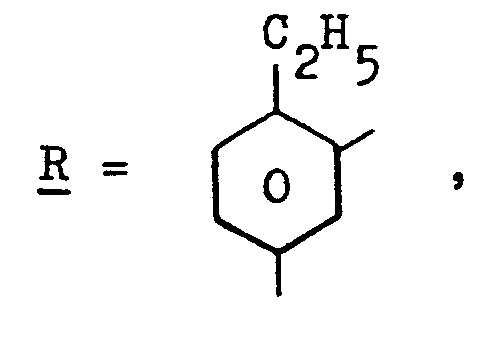
- - Polymeric additive 3 : polyamide of general formula A(Q1) wherein:

- - Polymeric additive 4 : copolyamide of general formula A(Q2) wherein: R consists of the groups:

- - Polymeric additive 5 : polyether of general formula A(Q3) wherein:

- - PROXIMON F40 (Montedison trade mark):αα' bis-(t-butyl peroxy)-diisopropylbenzene at 40% in calcium carbonate.
- - DIAK-7 (DuPont trade mark) : triallylisocyanurate.
- - CARBONBLACK MT.
- - ACCELERATOR : Benzyl, tris(dimethylamino)phosphoniote- trafluoroborate.
- - MAGLITE D : magnesium oxide.
- TABLES 1 and 2 report the results obtained by the use of the covulcanizable compositions object of the presentin vention in which the examined fluoroelastomers are based on vinylidene fluoride. In these compositions are evidenced the improvements obtained with regard to the hard ness as well as in the extrusion forming of complex profiles, improvements that are observed already at low levels of co-vulcanizable agent of general formula A(Q1, Q2 and Q3).
- These covulcanizable agents have been used at levels comprised between 2.5 and 20 phr, obtaining appreciable advantages especially with regard to the extrusion of complex profiles (ASTM 2230 standards, Garvery A) also at a low level of polymeric additive. The quantities appearing in the tables are expressed in parts by weight.
- TABLE III reports the results obtained by using the co- vulcanizable compositions object of the present invention, wherein the tested fluoroelastomers are copolymers chosen from between tetrafluoroethylene and propylene (AFLAS 100 and AFLAS 150). In these fluoroelastomers are brought to evidence the improvements obtained with regard to the hardness and in the extrusion of complex profiles.
- These agents have been used at levels comprisedbet ween 2.5 and 10%, thereby obtaining considerable advan tages, especially with regard to the extrusion of complex profiles (ASTM 2230 standards, Garvery A) also at a lower level of polymeric additive.
- .On Table 4 there is compared the behavious of a fluoroetheric polyamide in combination with thefluoro elastomer 3, vulcanizable with bisphenol (see examples 26-31), with the behaviour of the same polyamide when in combination with the fluoroelastomers 2 containing peroxydic C-Br vulcanization points (examples 32 - 34).
- The results show that, while the hardness and extrudability are almost the same in the two cases, the chemical stability is definitely better in the products vulcanized with peroxides.
- The values regarding the "edge" and the "surface" in the following Tables are based on the ASTM-System.


Claims (6)


Applications Claiming Priority (2)
| Application Number | Priority Date | Filing Date | Title |
|---|---|---|---|
| IT22272/82A IT1199986B (en) | 1982-07-07 | 1982-07-07 | CONVULCANIZABLE COMPOSITIONS BASED ON FLUOROELASTOMERS AND POLYMERIC COMPOUNDS WITH A PERFLUOROPOLYEREE STRUCTURE |
| IT2227282 | 1982-07-07 |
Publications (2)
| Publication Number | Publication Date |
|---|---|
| EP0099079A1 true EP0099079A1 (en) | 1984-01-25 |
| EP0099079B1 EP0099079B1 (en) | 1987-05-13 |
Family
ID=11193970
Family Applications (1)
| Application Number | Title | Priority Date | Filing Date |
|---|---|---|---|
| EP83106683A Expired EP0099079B1 (en) | 1982-07-07 | 1983-07-07 | Co-vulcanizable compositions based on fluoroelastomers and polymeric compounds with a perfluoroetheric structure |
Country Status (5)
| Country | Link |
|---|---|
| US (1) | US4530969A (en) |
| EP (1) | EP0099079B1 (en) |
| JP (1) | JPS5922953A (en) |
| DE (1) | DE3371531D1 (en) |
| IT (1) | IT1199986B (en) |
Cited By (5)
| Publication number | Priority date | Publication date | Assignee | Title |
|---|---|---|---|---|
| JPH01221443A (en) * | 1987-10-02 | 1989-09-04 | Ausimont Spa | Co-support additive for releasing rubber vulcanizable by peroxide from mold |
| EP2065441A1 (en) | 2007-11-30 | 2009-06-03 | Solvay Solexis S.p.A. | Fluoroelastomer composition |
| US20150005454A1 (en) * | 2013-06-30 | 2015-01-01 | Xerox Corporation | Grafted polymers as oleophobic low adhesion anti-wetting coatings |
| US9233533B2 (en) | 2013-06-30 | 2016-01-12 | Xerox Corporation | Grafted polymers as oleophobic low adhesion anti-wetting coatings for printhead applications |
| US9365742B2 (en) | 2013-06-30 | 2016-06-14 | Xerox Corporation | Grafted polymers as oleophobic or hydrophobic coatings |
Families Citing this family (4)
| Publication number | Priority date | Publication date | Assignee | Title |
|---|---|---|---|---|
| DE3583598D1 (en) * | 1984-12-27 | 1991-08-29 | Asahi Glass Co Ltd | Curable resin mix. |
| US4708988A (en) * | 1985-07-01 | 1987-11-24 | E. I. Du Pont De Nemours And Company | Process for dynamically partially gelling fluoroelastomers |
| US20040236028A1 (en) * | 2003-05-21 | 2004-11-25 | Ming-Hong Hung | Fluoroelastomer composition having excellent low temperature properties |
| US9187587B2 (en) * | 2013-06-30 | 2015-11-17 | Xerox Corporation | Fluoroelastomers for marking system components, including grafted fluorinated polymers |
Citations (2)
| Publication number | Priority date | Publication date | Assignee | Title |
|---|---|---|---|---|
| FR2386561A1 (en) * | 1977-04-08 | 1978-11-03 | Daikin Ind Ltd | CROSS-LINKABLE FLUORINE POLYMER AND ITS PREPARATION |
| EP0023957A1 (en) * | 1979-06-14 | 1981-02-18 | Montedison S.p.A. | Vulcanizable compositions based on elastomeric copolymers of vinylidene fluoride and vulcanized articles obtained from these compositions |
Family Cites Families (7)
| Publication number | Priority date | Publication date | Assignee | Title |
|---|---|---|---|---|
| US3876654A (en) * | 1970-12-23 | 1975-04-08 | Du Pont | Fluoroelastomer composition |
| US3712877A (en) * | 1971-07-06 | 1973-01-23 | Minnesota Mining & Mfg | Curable vinylidene fluoride elastomers containing phosphonium curing agents |
| IT963296B (en) * | 1972-07-24 | 1974-01-10 | Montedison Spa | ELASTOMERIC COPOLYMIDES CONTAINING FLUORINE AND PROCEDURE FOR THEIR PREPARATION |
| US3851018A (en) * | 1973-07-31 | 1974-11-26 | Du Pont | Crosslinked fluoroelastomer and composition containing same |
| IT1007029B (en) * | 1974-01-23 | 1976-10-30 | Montedison Spa | FLUORINATED ELASTOMERIC POLYMERS CONTAINING THE RING OF 1.3.5 TRIAZINE AND PROCEDURE FOR THE PREPARATION |
| US4035565A (en) * | 1975-03-27 | 1977-07-12 | E. I. Du Pont De Nemours And Company | Fluoropolymer containing a small amount of bromine-containing olefin units |
| NL189567C (en) * | 1977-12-14 | 1993-05-17 | Montedison Spa | Vulcanizable mixtures based on elastomeric copolymers of vinylidene fluoride, process for vulcanizing them and articles consisting wholly or partly of the vulcanized mixtures thus obtained. |
-
1982
- 1982-07-07 IT IT22272/82A patent/IT1199986B/en active
-
1983
- 1983-07-06 US US06/511,263 patent/US4530969A/en not_active Expired - Lifetime
- 1983-07-07 EP EP83106683A patent/EP0099079B1/en not_active Expired
- 1983-07-07 JP JP58122446A patent/JPS5922953A/en active Granted
- 1983-07-07 DE DE8383106683T patent/DE3371531D1/en not_active Expired
Patent Citations (2)
| Publication number | Priority date | Publication date | Assignee | Title |
|---|---|---|---|---|
| FR2386561A1 (en) * | 1977-04-08 | 1978-11-03 | Daikin Ind Ltd | CROSS-LINKABLE FLUORINE POLYMER AND ITS PREPARATION |
| EP0023957A1 (en) * | 1979-06-14 | 1981-02-18 | Montedison S.p.A. | Vulcanizable compositions based on elastomeric copolymers of vinylidene fluoride and vulcanized articles obtained from these compositions |
Cited By (7)
| Publication number | Priority date | Publication date | Assignee | Title |
|---|---|---|---|---|
| JPH01221443A (en) * | 1987-10-02 | 1989-09-04 | Ausimont Spa | Co-support additive for releasing rubber vulcanizable by peroxide from mold |
| EP2065441A1 (en) | 2007-11-30 | 2009-06-03 | Solvay Solexis S.p.A. | Fluoroelastomer composition |
| US8236897B2 (en) | 2007-11-30 | 2012-08-07 | Solvay Solexis S.P.A. | Fluoroelastomer composition |
| US20150005454A1 (en) * | 2013-06-30 | 2015-01-01 | Xerox Corporation | Grafted polymers as oleophobic low adhesion anti-wetting coatings |
| US9206269B2 (en) * | 2013-06-30 | 2015-12-08 | Xerox Corporation | Grafted polymers as oleophobic low adhesion anti-wetting coatings |
| US9233533B2 (en) | 2013-06-30 | 2016-01-12 | Xerox Corporation | Grafted polymers as oleophobic low adhesion anti-wetting coatings for printhead applications |
| US9365742B2 (en) | 2013-06-30 | 2016-06-14 | Xerox Corporation | Grafted polymers as oleophobic or hydrophobic coatings |
Also Published As
| Publication number | Publication date |
|---|---|
| US4530969A (en) | 1985-07-23 |
| JPH032382B2 (en) | 1991-01-14 |
| IT1199986B (en) | 1989-01-05 |
| IT8222272A0 (en) | 1982-07-07 |
| EP0099079B1 (en) | 1987-05-13 |
| DE3371531D1 (en) | 1987-06-19 |
| JPS5922953A (en) | 1984-02-06 |
Similar Documents
| Publication | Publication Date | Title |
|---|---|---|
| US7381774B2 (en) | Perfluoroelastomer compositions for low temperature applications | |
| US9267012B2 (en) | Fluoroelastomer composition | |
| US5384374A (en) | Curing fluorocarbon elastomers | |
| US4530971A (en) | Covulcanizable compositions from fluoroelastomers based on vinylidene fluoride and copolymers tetrafluoroethylene-propylene | |
| US5266650A (en) | Curing fluorocarbon elastomers | |
| EP0023957B1 (en) | Vulcanizable compositions based on elastomeric copolymers of vinylidene fluoride and vulcanized articles obtained from these compositions | |
| US8318850B2 (en) | Cured perfluoroelastomer article | |
| JPH09509210A (en) | Heat resistant perfluoroelastomer composition | |
| US4894418A (en) | Vulcanizable compositions of fluoroelastomers having improved characteristics of processability and of chemical stability | |
| US4946936A (en) | Fluorinated polymers and copolymers containing perfluoropolyethers blocks | |
| EP0208314A2 (en) | Fluorelastomers | |
| EP0566692A1 (en) | Curing fluorocarbon elastomers | |
| KR20000015908A (en) | Fluoroelastomer compositions | |
| EP0099079B1 (en) | Co-vulcanizable compositions based on fluoroelastomers and polymeric compounds with a perfluoroetheric structure | |
| KR920004894B1 (en) | Fluoroelastomer composition containing fluoroaliphatic sulfonamide as a curing agent | |
| US6005054A (en) | Curable composition of fluoroelastomers | |
| EP0592931B1 (en) | Compositions of ionically curable elastomeric polymers | |
| US6265494B1 (en) | Curable fluoroelastomeric compositions | |
| US10513593B2 (en) | Fluoroelastomer composition | |
| US20240182695A1 (en) | Fluoropolymer composition | |
| US20170204230A1 (en) | Perfluoroelastomer composition |
Legal Events
| Date | Code | Title | Description |
|---|---|---|---|
| PUAI | Public reference made under article 153(3) epc to a published international application that has entered the european phase |
Free format text: ORIGINAL CODE: 0009012 |
|
| AK | Designated contracting states |
Designated state(s): BE DE FR GB NL |
|
| 17P | Request for examination filed |
Effective date: 19840704 |
|
| GRAA | (expected) grant |
Free format text: ORIGINAL CODE: 0009210 |
|
| RAP1 | Party data changed (applicant data changed or rights of an application transferred) |
Owner name: AUSIMONT S.P.A. |
|
| AK | Designated contracting states |
Kind code of ref document: B1 Designated state(s): BE DE FR GB NL |
|
| REF | Corresponds to: |
Ref document number: 3371531 Country of ref document: DE Date of ref document: 19870619 |
|
| ET | Fr: translation filed | ||
| PLBE | No opposition filed within time limit |
Free format text: ORIGINAL CODE: 0009261 |
|
| STAA | Information on the status of an ep patent application or granted ep patent |
Free format text: STATUS: NO OPPOSITION FILED WITHIN TIME LIMIT |
|
| 26N | No opposition filed | ||
| PGFP | Annual fee paid to national office [announced via postgrant information from national office to epo] |
Ref country code: NL Payment date: 19940731 Year of fee payment: 12 |
|
| PGFP | Annual fee paid to national office [announced via postgrant information from national office to epo] |
Ref country code: BE Payment date: 19940912 Year of fee payment: 12 |
|
| PG25 | Lapsed in a contracting state [announced via postgrant information from national office to epo] |
Ref country code: BE Effective date: 19950731 |
|
| BERE | Be: lapsed |
Owner name: AUSIMONT S.P.A. Effective date: 19950731 |
|
| PG25 | Lapsed in a contracting state [announced via postgrant information from national office to epo] |
Ref country code: NL Effective date: 19960201 |
|
| NLV4 | Nl: lapsed or anulled due to non-payment of the annual fee |
Effective date: 19960201 |
|
| REG | Reference to a national code |
Ref country code: GB Ref legal event code: IF02 |
|
| PGFP | Annual fee paid to national office [announced via postgrant information from national office to epo] |
Ref country code: GB Payment date: 20020703 Year of fee payment: 20 |
|
| PGFP | Annual fee paid to national office [announced via postgrant information from national office to epo] |
Ref country code: FR Payment date: 20020709 Year of fee payment: 20 |
|
| PGFP | Annual fee paid to national office [announced via postgrant information from national office to epo] |
Ref country code: DE Payment date: 20020710 Year of fee payment: 20 |
|
| PG25 | Lapsed in a contracting state [announced via postgrant information from national office to epo] |
Ref country code: GB Free format text: LAPSE BECAUSE OF EXPIRATION OF PROTECTION Effective date: 20030706 |
|
| REG | Reference to a national code |
Ref country code: GB Ref legal event code: PE20 |