EP0098335B1 - Cycloaliphatic alcohols - Google Patents
Cycloaliphatic alcohols Download PDFInfo
- Publication number
- EP0098335B1 EP0098335B1 EP82303188A EP82303188A EP0098335B1 EP 0098335 B1 EP0098335 B1 EP 0098335B1 EP 82303188 A EP82303188 A EP 82303188A EP 82303188 A EP82303188 A EP 82303188A EP 0098335 B1 EP0098335 B1 EP 0098335B1
- Authority
- EP
- European Patent Office
- Prior art keywords
- formula
- compounds
- group
- acid
- preparation
- Prior art date
- Legal status (The legal status is an assumption and is not a legal conclusion. Google has not performed a legal analysis and makes no representation as to the accuracy of the status listed.)
- Expired
Links
- 0 C*C1C(*)(*)C(*)(*)C(*)*1 Chemical compound C*C1C(*)(*)C(*)(*)C(*)*1 0.000 description 1
Classifications
-
- C—CHEMISTRY; METALLURGY
- C07—ORGANIC CHEMISTRY
- C07C—ACYCLIC OR CARBOCYCLIC COMPOUNDS
- C07C67/00—Preparation of carboxylic acid esters
- C07C67/30—Preparation of carboxylic acid esters by modifying the acid moiety of the ester, such modification not being an introduction of an ester group
- C07C67/303—Preparation of carboxylic acid esters by modifying the acid moiety of the ester, such modification not being an introduction of an ester group by hydrogenation of unsaturated carbon-to-carbon bonds
-
- C—CHEMISTRY; METALLURGY
- C07—ORGANIC CHEMISTRY
- C07C—ACYCLIC OR CARBOCYCLIC COMPOUNDS
- C07C29/00—Preparation of compounds having hydroxy or O-metal groups bound to a carbon atom not belonging to a six-membered aromatic ring
- C07C29/132—Preparation of compounds having hydroxy or O-metal groups bound to a carbon atom not belonging to a six-membered aromatic ring by reduction of an oxygen containing functional group
- C07C29/136—Preparation of compounds having hydroxy or O-metal groups bound to a carbon atom not belonging to a six-membered aromatic ring by reduction of an oxygen containing functional group of >C=O containing groups, e.g. —COOH
- C07C29/147—Preparation of compounds having hydroxy or O-metal groups bound to a carbon atom not belonging to a six-membered aromatic ring by reduction of an oxygen containing functional group of >C=O containing groups, e.g. —COOH of carboxylic acids or derivatives thereof
- C07C29/149—Preparation of compounds having hydroxy or O-metal groups bound to a carbon atom not belonging to a six-membered aromatic ring by reduction of an oxygen containing functional group of >C=O containing groups, e.g. —COOH of carboxylic acids or derivatives thereof with hydrogen or hydrogen-containing gases
-
- C—CHEMISTRY; METALLURGY
- C07—ORGANIC CHEMISTRY
- C07C—ACYCLIC OR CARBOCYCLIC COMPOUNDS
- C07C29/00—Preparation of compounds having hydroxy or O-metal groups bound to a carbon atom not belonging to a six-membered aromatic ring
- C07C29/17—Preparation of compounds having hydroxy or O-metal groups bound to a carbon atom not belonging to a six-membered aromatic ring by hydrogenation of carbon-to-carbon double or triple bonds
- C07C29/177—Preparation of compounds having hydroxy or O-metal groups bound to a carbon atom not belonging to a six-membered aromatic ring by hydrogenation of carbon-to-carbon double or triple bonds with simultaneous reduction of a carboxy group
-
- C—CHEMISTRY; METALLURGY
- C07—ORGANIC CHEMISTRY
- C07C—ACYCLIC OR CARBOCYCLIC COMPOUNDS
- C07C31/00—Saturated compounds having hydroxy or O-metal groups bound to acyclic carbon atoms
- C07C31/27—Polyhydroxylic alcohols containing saturated rings
- C07C31/272—Monocyclic
- C07C31/276—Monocyclic with a six-membered ring
-
- C—CHEMISTRY; METALLURGY
- C08—ORGANIC MACROMOLECULAR COMPOUNDS; THEIR PREPARATION OR CHEMICAL WORKING-UP; COMPOSITIONS BASED THEREON
- C08G—MACROMOLECULAR COMPOUNDS OBTAINED OTHERWISE THAN BY REACTIONS ONLY INVOLVING UNSATURATED CARBON-TO-CARBON BONDS
- C08G18/00—Polymeric products of isocyanates or isothiocyanates
- C08G18/06—Polymeric products of isocyanates or isothiocyanates with compounds having active hydrogen
- C08G18/28—Polymeric products of isocyanates or isothiocyanates with compounds having active hydrogen characterised by the compounds used containing active hydrogen
- C08G18/30—Low-molecular-weight compounds
- C08G18/32—Polyhydroxy compounds; Polyamines; Hydroxyamines
- C08G18/3203—Polyhydroxy compounds
- C08G18/3212—Polyhydroxy compounds containing cycloaliphatic groups
-
- C—CHEMISTRY; METALLURGY
- C08—ORGANIC MACROMOLECULAR COMPOUNDS; THEIR PREPARATION OR CHEMICAL WORKING-UP; COMPOSITIONS BASED THEREON
- C08G—MACROMOLECULAR COMPOUNDS OBTAINED OTHERWISE THAN BY REACTIONS ONLY INVOLVING UNSATURATED CARBON-TO-CARBON BONDS
- C08G18/00—Polymeric products of isocyanates or isothiocyanates
- C08G18/06—Polymeric products of isocyanates or isothiocyanates with compounds having active hydrogen
- C08G18/28—Polymeric products of isocyanates or isothiocyanates with compounds having active hydrogen characterised by the compounds used containing active hydrogen
- C08G18/67—Unsaturated compounds having active hydrogen
- C08G18/675—Low-molecular-weight compounds
- C08G18/676—Low-molecular-weight compounds containing the unsaturation at least partially in a non-aromatic carbocyclic ring
-
- C—CHEMISTRY; METALLURGY
- C07—ORGANIC CHEMISTRY
- C07C—ACYCLIC OR CARBOCYCLIC COMPOUNDS
- C07C2601/00—Systems containing only non-condensed rings
- C07C2601/12—Systems containing only non-condensed rings with a six-membered ring
- C07C2601/14—The ring being saturated
-
- C—CHEMISTRY; METALLURGY
- C07—ORGANIC CHEMISTRY
- C07C—ACYCLIC OR CARBOCYCLIC COMPOUNDS
- C07C2601/00—Systems containing only non-condensed rings
- C07C2601/12—Systems containing only non-condensed rings with a six-membered ring
- C07C2601/16—Systems containing only non-condensed rings with a six-membered ring the ring being unsaturated
Definitions
- This invention relates to polyfunctional alcohols, in particular triols, which may be utilized among other purposes for the preparation of polyurethanes.
- polyfunctional cycloaliphatic acids may be prepared through a Diels-Alder reaction. Such materials are useful in the preparation of polyesters.
- ester bond itself is subjectto attack by a number of chemical agents. It has therefore been found desirable to prepare a compound not subject to an ester attack by eliminating the carboxylic acid functionality.
- the resultant compounds have been found to possess the advantages of high flexibility when used in urethanes and light stability when the compound is hydrogenated.
- the novel compounds of the present invention may either contain a saturated or unsaturated bond within the six membered ring in their structure. This is particularly important in that should it be desired to promote ultraviolet stability, the bond within the ring structure may be hydrogenated or if a fire retardant property or some further derivatization is desired, the unsaturation may be left in the molecule thereby providing an active site.
- novel polyols of this invention which contain all primary alcohol groups can be prepared by reduction of acids or esters.
- x is preferably 4 or 5
- y is preferably 7 or 8
- R' if it represents an alkyl group, preferably contains from 1 to 6 carbon atoms. Further unsaturation in the aliphatic side chains of formula II may be present if a material such as tung oil is employed.
- Either unsaturated or saturated esters of formula II can be converted into saturated polyols of formula I by hydrogenolysis using copper chromite catalysts such as those described by Adkins J. Amer. Chem. Soc. 54,1138 (1932) or commercially available modifications of copper chromite catalysts.
- the ester groups of the unsaturated esters of formula II' can be hydrogenolyzed with the carbon-carbon double bonds being preserved by using chemical reducing agents such as alkali metal alcoholates (e.g. sodium metal and alcohols - Bouveault-Blanc reductions) or LiAIH 4 .
- alkali metal alcoholates e.g. sodium metal and alcohols - Bouveault-Blanc reductions
- LiAIH 4 LiAIH 4
- the acid and ester reagents of formula II may be prepared from a variety of conjugated fatty acids or their derivatives and a dieneophile, suitably by a Diels-Alder reaction as previously described.
- the Diels-Alder reaction is conducted after obtaining the methyl ester of a drying or semi-drying oil through methanolysis.
- the methyl ester may be obtained by methanolysis of tung oil.
- methanolysis is mentioned, however, any alcoholysis reaction may be employed.
- Variations in the present invention allow the use of various unsaturated materials which are derived from the semi-drying oils such as those selected from the group consisting of soybean oil, tall oil, tung oil, linseed oil, safflower oil, sunflower oil and other similar materials.
- unsaturated acids may be utilized herein as previously indicated including those conveniently having 18 carbon atoms such as 9,12-octadecadienoic acid (linoleic acid); 9,11-octadecadienoic acid; 10,12-octadecadienoic acid; 9,12,15-octadecatrienoic acid (linolenic acid); 6,9,12-octadecatrienoic acid; 9,11,13-octadecatrienoic acid (eleostearic acid); 10,12,14-octadecatrienoic acid and other similar materials.
- fatty acids may be employed, particularly the alkyl esters and particularly those containing up to 8 carbon atoms. Most conveniently, however, the methyl ester is employed for reasons of convenience and expense.
- a particularly interesting variable in the present invention is to conjugate the double bonds of the fatty acids described above and such may be done by known techniques such as alkali conjugation. Conjugation by some method is necessary for the Diels-Alder reaction.
- Maleic anhydride may also be employed.
- the dieneophile and methyl ester of the drying oil together with a polymerization inhibitor such as para-methoxyphenol are charged into a reactor flushed with nitrogen and heated to a temperature of from about 110 to 180 degrees C for a substantial period of time. After the reaction is complete, any excess dieneophile is then removed and the unpurified unsaturated cycloaliphatic material is obtained.
- the above unsaturated product of formula II can be reduced using a common hydrogenation catalyst.
- a common hydrogenation catalyst Most practically platinum and palladium on carbon can be utilized.
- the material as described above is then saturated by placing it in a reaction vessel with the 5 percent palladium on carbon catalyst and the reaction vessel is flushed with nitrogen followed by pressurization with hydrogen gas at from about 1 to about 500 atmospheres (0.1 to 50.7 MNm- 2 ).
- the temperature is maintained during the hydrogenation at from about 20 to 150, preferably 55 to 135, degrees Celsius.
- the pressure during the hydrogenation reaction is conveniently maintained at from about 10 to about 200 atmospheres (1.0 to 20.3 MNm- 2 ).
- the reaction time is simply that required to obtain as high a degree of hydrogenation as is desired. Conveniently, this reaction may be conducted for from about 3 to 8 hours.
- the acid or ester may be reacted utilizing hydrogen gas and copper chromite utilizing conditions for reduction of the acid or ester to the corresponding alcohols of formula I.
- such a hydrogenolysis reaction with the copper chromite catalyst may be conducted at from about 240 to about 300 degrees C, preferably from about 250 to about 280 degrees C.
- the pressure for the hydrogenation reaction may be maintained at from about 200 to 500 atmospheres (20.3 to 50.7 MNm- 2 ), preferably from about 220 to about 480 atmospheres (22.3 to 48.6 MNm- 2 ).
- the compounds of the present invention may be used to prepare urethanes and melamine coatings.
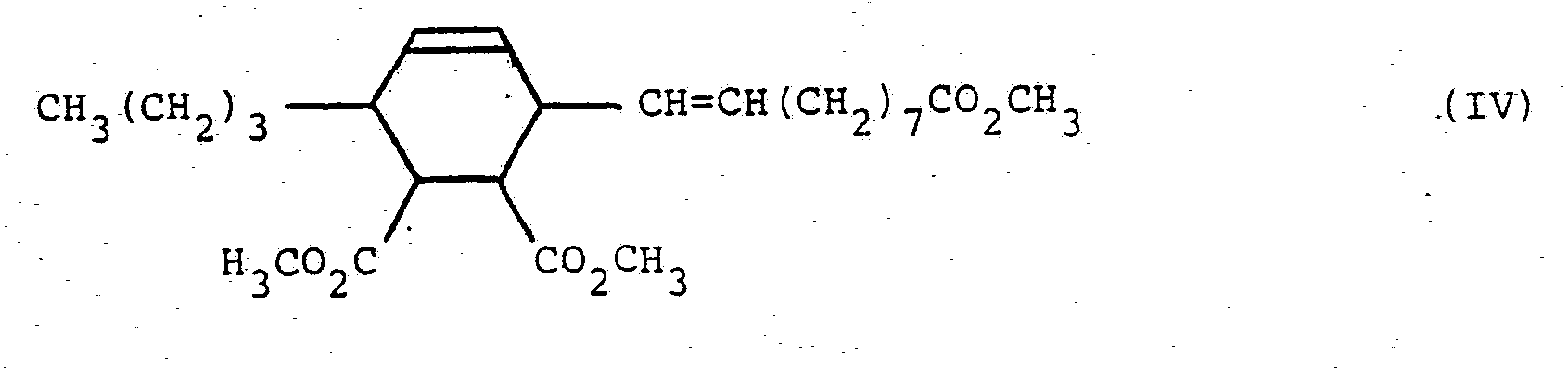
- Thetriester product (methyl 10-(3-n-butyl-1,2-di-methoxycarbonyl-cyclohex-5-enyl)-dec-9-enoate) is of formula IV
- the polyols of formula I herein are suitable for melamine curing agents, for urethane preparation and similar uses requiring hydroxyl functionality or hydroxyl with unsaturation.
- the esters of formula II are, of course, useful as the precursors to the various polyols.
Landscapes
- Chemical & Material Sciences (AREA)
- Organic Chemistry (AREA)
- Health & Medical Sciences (AREA)
- Chemical Kinetics & Catalysis (AREA)
- Medicinal Chemistry (AREA)
- Polymers & Plastics (AREA)
- Organic Low-Molecular-Weight Compounds And Preparation Thereof (AREA)
- Polyurethanes Or Polyureas (AREA)
- Preparation Of Compounds By Using Micro-Organisms (AREA)
- Fats And Perfumes (AREA)
Abstract
Description
- This invention relates to polyfunctional alcohols, in particular triols, which may be utilized among other purposes for the preparation of polyurethanes.
- It is known that polyfunctional cycloaliphatic acids may be prepared through a Diels-Alder reaction. Such materials are useful in the preparation of polyesters. However, the ester bond itself is subjectto attack by a number of chemical agents. It has therefore been found desirable to prepare a compound not subject to an ester attack by eliminating the carboxylic acid functionality. The resultant compounds have been found to possess the advantages of high flexibility when used in urethanes and light stability when the compound is hydrogenated.
- A detailed discussion of the art to which the invention relates may be found in United States Patent 4,216,343 (Rogier) dated August 5, 1980 to which attention is particularly drawn. United States Patent 2,415,335 (Bruson) dated February 4, 1947 discloses diols of formulae
- C4H9―C6H7(CH2OH)―C9H16―CH2OH and
- C4H9―C6H9(CH2OH)―C9H18―CH2OH
- According to one aspect of the invention there are provided compounds of formula I

- As indicated previously, the novel compounds of the present invention may either contain a saturated or unsaturated bond within the six membered ring in their structure. This is particularly important in that should it be desired to promote ultraviolet stability, the bond within the ring structure may be hydrogenated or if a fire retardant property or some further derivatization is desired, the unsaturation may be left in the molecule thereby providing an active site.
- The novel polyols of this invention which contain all primary alcohol groups can be prepared by reduction of acids or esters.
- According to a further aspect of the invention there is provided a process for the preparation of compounds of formula I which process comprises reducing a compound of formula II

- In the acid or ester of formula II, x is preferably 4 or 5, y is preferably 7 or 8, and R', if it represents an alkyl group, preferably contains from 1 to 6 carbon atoms. Further unsaturation in the aliphatic side chains of formula II may be present if a material such as tung oil is employed.
- The carbon-carbon double bonds of the above cyclohexane derivatives of formula II wherein Z represents a ―CH=CH― group can be saturated by catalytic hydrogenation using catalysts such as Raney nickel, supported nickels, palladium or platinum.
- Either unsaturated or saturated esters of formula II can be converted into saturated polyols of formula I by hydrogenolysis using copper chromite catalysts such as those described by Adkins J. Amer. Chem. Soc. 54,1138 (1932) or commercially available modifications of copper chromite catalysts.
- If the unsaturated polyols of formula I (wherein Z represents a―CH=CH― group) are desired, the ester groups of the unsaturated esters of formula II' (wherein Z represents a -CH=CH- group) can be hydrogenolyzed with the carbon-carbon double bonds being preserved by using chemical reducing agents such as alkali metal alcoholates (e.g. sodium metal and alcohols - Bouveault-Blanc reductions) or LiAIH4.
- The acid and ester reagents of formula II may be prepared from a variety of conjugated fatty acids or their derivatives and a dieneophile, suitably by a Diels-Alder reaction as previously described. Basically, the Diels-Alder reaction is conducted after obtaining the methyl ester of a drying or semi-drying oil through methanolysis. Conveniently, the methyl ester may be obtained by methanolysis of tung oil. For the sake of simplicity, methanolysis is mentioned, however, any alcoholysis reaction may be employed.
- Variations in the present invention allow the use of various unsaturated materials which are derived from the semi-drying oils such as those selected from the group consisting of soybean oil, tall oil, tung oil, linseed oil, safflower oil, sunflower oil and other similar materials.
- Various unsaturated acids may be utilized herein as previously indicated including those conveniently having 18 carbon atoms such as 9,12-octadecadienoic acid (linoleic acid); 9,11-octadecadienoic acid; 10,12-octadecadienoic acid; 9,12,15-octadecatrienoic acid (linolenic acid); 6,9,12-octadecatrienoic acid; 9,11,13-octadecatrienoic acid (eleostearic acid); 10,12,14-octadecatrienoic acid and other similar materials. It is also noted as previously stated that various derivatives of the fatty acids may be employed, particularly the alkyl esters and particularly those containing up to 8 carbon atoms. Most conveniently, however, the methyl ester is employed for reasons of convenience and expense. It is also noted that a particularly interesting variable in the present invention is to conjugate the double bonds of the fatty acids described above and such may be done by known techniques such as alkali conjugation. Conjugation by some method is necessary for the Diels-Alder reaction.
- Dieneophiles which can be used in the preparation of compounds of formula II wherein Z represents a -CH=CH- group include acrylic acid, methacrylic acid, crotonic acid, maleic acid, fumaric acid and the C, to C8 esters of such acids. Maleic anhydride may also be employed.
- The dieneophile and methyl ester of the drying oil together with a polymerization inhibitor such as para-methoxyphenol are charged into a reactor flushed with nitrogen and heated to a temperature of from about 110 to 180 degrees C for a substantial period of time. After the reaction is complete, any excess dieneophile is then removed and the unpurified unsaturated cycloaliphatic material is obtained.
- Wherein the saturated material is required, the above unsaturated product of formula II can be reduced using a common hydrogenation catalyst. Most practically platinum and palladium on carbon can be utilized. The material as described above is then saturated by placing it in a reaction vessel with the 5 percent palladium on carbon catalyst and the reaction vessel is flushed with nitrogen followed by pressurization with hydrogen gas at from about 1 to about 500 atmospheres (0.1 to 50.7 MNm-2). The temperature is maintained during the hydrogenation at from about 20 to 150, preferably 55 to 135, degrees Celsius. The pressure during the hydrogenation reaction is conveniently maintained at from about 10 to about 200 atmospheres (1.0 to 20.3 MNm-2). The reaction time is simply that required to obtain as high a degree of hydrogenation as is desired. Conveniently, this reaction may be conducted for from about 3 to 8 hours.
- Thereafter, the acid or ester may be reacted utilizing hydrogen gas and copper chromite utilizing conditions for reduction of the acid or ester to the corresponding alcohols of formula I.
- It has been found that such a hydrogenolysis reaction with the copper chromite catalyst may be conducted at from about 240 to about 300 degrees C, preferably from about 250 to about 280 degrees C. The pressure for the hydrogenation reaction may be maintained at from about 200 to 500 atmospheres (20.3 to 50.7 MNm-2), preferably from about 220 to about 480 atmospheres (22.3 to 48.6 MNm-2).
- The compounds of the present invention may be used to prepare urethanes and melamine coatings.
- According to a further aspect of the present invention there is provided the use of compounds of formula I in the preparation of urethane or melamine coatings or mouldings.
- The following Examples are provided to illustrate the scope of the present invention.
- Throughout this specification, percentages and ratios are by weight and temperatures in degrees Celsius unless otherwise indicated.
- Into a 5 litre Pyrex flask equipped with a reflux condenser and source of nitrogen purge is placed 1208 grams of the methyl esters of tung oil fatty acids (77 percent eleostearic acid) and 636 grams of dimethyl maleate. The reaction system is flushed with nitrogen and heated at 180 degrees C for 24 hours.
- The reaction product is combined with the product of a similar run starting with 301 grams of methyl tungate. The combined crude products after stripping of excess dimethyl maleate by distillation under reduced pressure weigh 2222 grams. Thin-film distillation of 2191 grams of this residue yielded the following fractions:

- Thetriester product (methyl 10-(3-n-butyl-1,2-di-methoxycarbonyl-cyclohex-5-enyl)-dec-9-enoate) is of formula IV
- Into a litre, 316 SS Magne-Drive autoclave is charged 497 grams of the triester product of Example I of formula IV (Fraction 2) and 50 grams of copper chromite catalyst (Cu―1910―P, Harshaw Chemical Co.). The autoclave is flushed with nitrogen, then charged with hydrogen to 200 atmosphere (20.3 MNm-2) and heated to 270 degrees C. The reaction is maintained at 270 degrees C and 200-250 atmospheres (20.3 to 25.3 MNm-2) pressure for 12 hours. The reaction is cooled, vented, flushed with nitrogen and filtered under pressure. The filtered product weighed 315 grams after vacuum stripping and had a hydroxyl equivalent weight of 286. The product was essentially the triol of formula V

- The polyols of formula I herein are suitable for melamine curing agents, for urethane preparation and similar uses requiring hydroxyl functionality or hydroxyl with unsaturation. The esters of formula II are, of course, useful as the precursors to the various polyols.
for use in the preparation of linear polyesters and alkyd resins.
Claims (8)


Priority Applications (3)
| Application Number | Priority Date | Filing Date | Title |
|---|---|---|---|
| DE8282303188T DE3275083D1 (en) | 1982-06-18 | 1982-06-18 | Cycloaliphatic alcohols |
| AT82303188T ATE24887T1 (en) | 1982-06-18 | 1982-06-18 | CYCLOALIPHATIC ALCOHOLS. |
| EP82303188A EP0098335B1 (en) | 1982-06-18 | 1982-06-18 | Cycloaliphatic alcohols |
Applications Claiming Priority (1)
| Application Number | Priority Date | Filing Date | Title |
|---|---|---|---|
| EP82303188A EP0098335B1 (en) | 1982-06-18 | 1982-06-18 | Cycloaliphatic alcohols |
Publications (2)
| Publication Number | Publication Date |
|---|---|
| EP0098335A1 EP0098335A1 (en) | 1984-01-18 |
| EP0098335B1 true EP0098335B1 (en) | 1987-01-14 |
Family
ID=8189704
Family Applications (1)
| Application Number | Title | Priority Date | Filing Date |
|---|---|---|---|
| EP82303188A Expired EP0098335B1 (en) | 1982-06-18 | 1982-06-18 | Cycloaliphatic alcohols |
Country Status (3)
| Country | Link |
|---|---|
| EP (1) | EP0098335B1 (en) |
| AT (1) | ATE24887T1 (en) |
| DE (1) | DE3275083D1 (en) |
Family Cites Families (4)
| Publication number | Priority date | Publication date | Assignee | Title |
|---|---|---|---|---|
| US2415335A (en) * | 1945-11-09 | 1947-02-04 | Resinous Prod & Chemical Co | High molecular weight glycols |
| US4038326A (en) * | 1973-03-23 | 1977-07-26 | Phillips Petroleum Company | Unsaturated alicyclic carbinols and dicarbinols and method of preparation |
| DE3061482D1 (en) * | 1979-04-04 | 1983-02-03 | Henkel Corp | Gem-bis (hydroxymethyl) alcohols and mixtures thereof with diols, process for their preparation and a process for the preparation of polyurethanes therefrom |
| US4348543A (en) * | 1981-02-12 | 1982-09-07 | Henkel Corporation | Cycloaliphatic alcohols |
-
1982
- 1982-06-18 DE DE8282303188T patent/DE3275083D1/en not_active Expired
- 1982-06-18 AT AT82303188T patent/ATE24887T1/en active
- 1982-06-18 EP EP82303188A patent/EP0098335B1/en not_active Expired
Also Published As
| Publication number | Publication date |
|---|---|
| EP0098335A1 (en) | 1984-01-18 |
| ATE24887T1 (en) | 1987-01-15 |
| DE3275083D1 (en) | 1987-02-19 |
Similar Documents
| Publication | Publication Date | Title |
|---|---|---|
| EP0483197B1 (en) | Alkoxylation products of carboxylic acids and/or carboxylic acid derivatives containing oh groups | |
| US3288842A (en) | Alkoxyalkyl esters of carboxylic acids | |
| US4348543A (en) | Cycloaliphatic alcohols | |
| US5198554A (en) | 5-(2,4-Dioxotetrahydro-3-furanylmethyl)norbornane-2,3-dicarboxylic acid anhydride and process for production thereof | |
| CA2523433A1 (en) | Aldehyde and alcohol compositions derived from seed oils | |
| US4825004A (en) | Process for the production of alkane polyols | |
| US4356128A (en) | Fatty polyhydric alcohols having a polar functional group | |
| US3899476A (en) | Process for making a methacrylic acid adduct of linoleic acid and product | |
| US8541536B2 (en) | Coupling method for providing high molecular weight natural oil polyol | |
| EP0098335A1 (en) | Cycloaliphatic alcohols | |
| US8822625B2 (en) | Method for providing higher molecular weight natural oil polyols without loss of functionality | |
| US3243414A (en) | Electrical resistive polyurethane resin from a mixture of polyols containing nonadecanediol | |
| US2484486A (en) | Preparation of carboxylic acids by the reduction of beta lactones | |
| CA1185991A (en) | Cycloaliphatic alcohols | |
| DE69836724T2 (en) | ETHER COMPOUNDS AND METHOD FOR THE PRODUCTION THEREOF | |
| US4895982A (en) | Tricarboxylic acids | |
| US3278557A (en) | Lactones from keto esters | |
| DE3802783A1 (en) | METHOD FOR THE PRODUCTION OF ALKYLENE GLYCOLDIALKYLETHERS | |
| EP0063944B1 (en) | Polyhydric alcohols | |
| EP0751158A1 (en) | Monomer mixture and process for producing the same | |
| EP0984916B1 (en) | Oligomers of fatty acids | |
| US3257461A (en) | Phosphine diols and resins derived therefrom | |
| EP0433349A1 (en) | Process for producing fatty alcohol derivatives | |
| US2413613A (en) | High molecular polyhydric esters | |
| JP2721550B2 (en) | Method for producing fused ring-containing compound |
Legal Events
| Date | Code | Title | Description |
|---|---|---|---|
| PUAI | Public reference made under article 153(3) epc to a published international application that has entered the european phase |
Free format text: ORIGINAL CODE: 0009012 |
|
| AK | Designated contracting states |
Designated state(s): AT BE CH DE FR GB IT LI NL SE |
|
| RAP1 | Party data changed (applicant data changed or rights of an application transferred) |
Owner name: HENKEL CORPORATION |
|
| 17P | Request for examination filed |
Effective date: 19840706 |
|
| GRAA | (expected) grant |
Free format text: ORIGINAL CODE: 0009210 |
|
| AK | Designated contracting states |
Kind code of ref document: B1 Designated state(s): AT BE CH DE FR GB IT LI NL SE |
|
| PG25 | Lapsed in a contracting state [announced via postgrant information from national office to epo] |
Ref country code: NL Effective date: 19870114 Ref country code: LI Effective date: 19870114 Ref country code: IT Free format text: LAPSE BECAUSE OF FAILURE TO SUBMIT A TRANSLATION OF THE DESCRIPTION OR TO PAY THE FEE WITHIN THE PRESCRIBED TIME-LIMIT;WARNING: LAPSES OF ITALIAN PATENTS WITH EFFECTIVE DATE BEFORE 2007 MAY HAVE OCCURRED AT ANY TIME BEFORE 2007. THE CORRECT EFFECTIVE DATE MAY BE DIFFERENT FROM THE ONE RECORDED. Effective date: 19870114 Ref country code: FR Free format text: THE PATENT HAS BEEN ANNULLED BY A DECISION OF A NATIONAL AUTHORITY Effective date: 19870114 Ref country code: CH Effective date: 19870114 Ref country code: BE Effective date: 19870114 Ref country code: AT Effective date: 19870114 |
|
| REF | Corresponds to: |
Ref document number: 24887 Country of ref document: AT Date of ref document: 19870115 Kind code of ref document: T |
|
| PG25 | Lapsed in a contracting state [announced via postgrant information from national office to epo] |
Ref country code: SE Effective date: 19870131 |
|
| REF | Corresponds to: |
Ref document number: 3275083 Country of ref document: DE Date of ref document: 19870219 |
|
| REG | Reference to a national code |
Ref country code: CH Ref legal event code: PL |
|
| EN | Fr: translation not filed | ||
| NLV1 | Nl: lapsed or annulled due to failure to fulfill the requirements of art. 29p and 29m of the patents act | ||
| PLBE | No opposition filed within time limit |
Free format text: ORIGINAL CODE: 0009261 |
|
| STAA | Information on the status of an ep patent application or granted ep patent |
Free format text: STATUS: NO OPPOSITION FILED WITHIN TIME LIMIT |
|
| 26N | No opposition filed | ||
| PG25 | Lapsed in a contracting state [announced via postgrant information from national office to epo] |
Ref country code: DE Effective date: 19880301 |
|
| GBPC | Gb: european patent ceased through non-payment of renewal fee | ||
| PG25 | Lapsed in a contracting state [announced via postgrant information from national office to epo] |
Ref country code: GB Effective date: 19881122 |