EP0098059B1 - Record material - Google Patents
Record material Download PDFInfo
- Publication number
- EP0098059B1 EP0098059B1 EP83303266A EP83303266A EP0098059B1 EP 0098059 B1 EP0098059 B1 EP 0098059B1 EP 83303266 A EP83303266 A EP 83303266A EP 83303266 A EP83303266 A EP 83303266A EP 0098059 B1 EP0098059 B1 EP 0098059B1
- Authority
- EP
- European Patent Office
- Prior art keywords
- colour developing
- record material
- composition
- developing composition
- topcoat
- Prior art date
- Legal status (The legal status is an assumption and is not a legal conclusion. Google has not performed a legal analysis and makes no representation as to the accuracy of the status listed.)
- Expired
Links
Classifications
-
- B—PERFORMING OPERATIONS; TRANSPORTING
- B41—PRINTING; LINING MACHINES; TYPEWRITERS; STAMPS
- B41M—PRINTING, DUPLICATING, MARKING, OR COPYING PROCESSES; COLOUR PRINTING
- B41M5/00—Duplicating or marking methods; Sheet materials for use therein
- B41M5/124—Duplicating or marking methods; Sheet materials for use therein using pressure to make a masked colour visible, e.g. to make a coloured support visible, to create an opaque or transparent pattern, or to form colour by uniting colour-forming components
- B41M5/132—Chemical colour-forming components; Additives or binders therefor
- B41M5/155—Colour-developing components, e.g. acidic compounds; Additives or binders therefor; Layers containing such colour-developing components, additives or binders
-
- B—PERFORMING OPERATIONS; TRANSPORTING
- B41—PRINTING; LINING MACHINES; TYPEWRITERS; STAMPS
- B41M—PRINTING, DUPLICATING, MARKING, OR COPYING PROCESSES; COLOUR PRINTING
- B41M5/00—Duplicating or marking methods; Sheet materials for use therein
- B41M5/124—Duplicating or marking methods; Sheet materials for use therein using pressure to make a masked colour visible, e.g. to make a coloured support visible, to create an opaque or transparent pattern, or to form colour by uniting colour-forming components
Definitions
- the present invention relates to record material utilizing organic colour developing compositions, particularly phenolic resin compositions.
- the record material may be, for example, a pressure-sensitive record material.
- Pressure-sensitive record materials generally comprise an upper sheet which is coated on its lower surface with microcapsules containing an oily solution of at least one colourless colour former (hereinafter referred to as a CB sheet) and a lower sheet which is coated on its upper surface with a colour developing co-reactant material (hereinafter referred to as a CF sheet). If more than one copy is required one or more intermediate sheets are provided each of which is coated on its lower surface with microcapsules and on its upper surface with colour developing co-reactant material (hereinafter referred to as a CFB sheet).
- both the microcapsules containing colour former and the colour developer are coated on the same side of the sheet usually in separate layers.
- Self-contained pressure-sensitive record material is described for example in U.S. Patent No. 4197346 and UK Patent No. 1215618.
- phenolic resins have been prominent, particularly certain oil-soluble phenol-formaldehyde novolak resins.
- Manifold forms utilizing pressure-sensitive record materials are in common commercial use. Most of these forms are produced by processes which utilize conventional printing press techniques. For some applications, however, the production of the multi-part form by photocopying or laser printer operations is preferred. Some of the reasons which can make the production of forms by photocopying or laser printer techniques more attractive are short-run form production, emergencies, experimental or individualized forms and the like.
- high speed copier/duplicators such as, for example, the Xerox 9200, the Kodak Ektaprint 150 and the IBM Series III-model 20 copiers, or laser printers, such as, for example, the IBM 3800, are commonly employed for the printing.
- the pressure-sensitive record material comprising oil-soluble phenol-formaldehyde novolak resins as the colour developer, such as the compositions disclosed in U.S. Patent Nos. 3,455,721 and 4,166,644, CF coating components accumulate on the heated fuser roll of the copier or the laser printer, presumably because the resins are thermoplastic, i.e. they soften on heating. This accumulation becomes tacky and mixed with coloured toner particles contaminating the fuser roll. The accumulating contamination on the fuser roll can eventually result in adverse machine runnability and poor copy quality.
- British Patent No. 1,215,618 discloses a self-contained record material having a first coat of microcapsules containing a solution of chromogenic material and a top coating comprising a mixture of kaolin clay and an oil-soluble phenol-formaldehyde novolak resin.
- a self-contained record sheet produces the same fuser roll contamination problems as the previously-described CF sheets when printed in high speed copier/ duplicators or laser printers.
- record material comprising a substrate having bound on the surface thereof a thermoplastic organic colour developing composition, characterized in that a topcoat composition comprising a substantially non-reactant pigment material is bound on the surface of the thermoplastic organic colour developing composition.
- the substrate is paper.
- substantially non-reactant pigment material is defined as material which, when contacted with a solution of basic chromogenic material, produces substantially no colour.
- the composition of the topcoat of the present invention comprises substantially non-reactant pigment material and one or more binders.
- the substantially non-reactant pigments are kaolin clay, calcium carbonate, and calcined kaolin clay. More preferred among the non-reactant pigments is a mixture of kaolin clay and an additional substantially non-reactant pigment selected from the group consisting of calcium carbonate and calcined kaolin clay. Most preferred among the non-reactant pigments is a mixture of kaolin clay and calcium carbonate.
- thermoplastic organic colour developing composition is preferably a phenolic resin colour developing composition of the type disclosed in any of the patents referred to above, particularly an oil soluble phenol-formaldehyde novolak resin colour developing composition.
- the phenol moiety of the phenolic resin may be substituted, for example it may be p-octyl phenol, p-phenyl phenol or p-tert-butyl phenol.
- the colour developing composition is an oil soluble metal salt, preferably a zinc salt, of a phenol-formaldehyde novolak resin colour developing composition.
- a formulation as listed in Table 1 comprising a zinc-modified p-octylphenol-formaldehyde resin, as disclosed in U.S. Patent No. 3,737,410, was ground in an attritor at 54% solids.
- This resin grind was then used in a CF coating composition as shown below.
- the above composition was mixed, applied to a 70 gm- 2 base stock and the coating was dried yielding a CF sheet with a dry coat weight of 2.2 gm- 2 .
- a top coating composition was then prepared as follows:
- topcoat composition was mixed, applied to the above-described CF sheet and the resulting coating was dried yielding a dry topcoat coat weight of 6.5 gm- 2 .
- CF coating compositions comprising the resin grind of Table 1 were formulated, mixed, coated and dried.
- topcoat formulations were prepared, applied to the respective CF coatings and dried.
- the materials listed in Table 2 on a % Dry Basis were employed for these coatinas:
- Example 2 The topcoat of Example 2 was applied at two different coat weights, resulting in two samples, A and B.
- the topcoated CF sheet of Example 3 was further modified by applying the composition given in Table 3 to the uncoated side and drying the coating, resulting in a CFB sheet with a total CB coat weight of 5.3 g m - 2 .
- microcapsules employed above contained a colour former solution within urea-formaldehyde capsule walls produced by polymerization methods generally disclosed in U.S. Patent No. 4,001,140.
- Example 2 In a similar manner to Example 1, four additional examples of two-coat CF sheets were prepared by coating a subcoat, as in Example 2, at a coat weight of 3.7 gm- 2 and top coating the respective topcoats listed in Table 4 at coat weights of 5.9 gm- 2 .
- Example 2 In a similar manner to Example 1, a two-coat CF sheet comprising an oil-absorptive inorganic material in a subcoat was prepared as follows to determine the effect on the performance of the resulting CF in a copier/duplicator:
- the CF topcoat formulation is substantially the same as that of Sample A, Table VI, U.S. Patent No. 4,166,644.
- the CF sheet of Example 10 was further modified by the application of the composition given in Table 6A to the uncoated side and drying the coating, resulting in a CFB sheet with a total CB coat weight of 5.3 gm-2.
- microcapsules employed above contained a colour former solution within urea-formaldehyde capsule walls produced by polymerization methods generally disclosed in U.S. Patent No. 4,001,140.
- the third comparative CF example was prepared by sensitizing a base sheet with a phenolic polymeric film material as described in U.S. Patent No. 3,466,184.
- the materials listed in Table 6B were employed to produce a sensitized CF sheet in a gravure printing operation resulting in a dry coat weight of about 1.3 gm -2 .
- Example 12 was further modified by the alternative application of two different compositions to the uncoated side and drying the coating, resulting in two different CFB sheets identified as Examples 12-1 and 12-2.
- Example 12-2 was produced by coating a composition like that of Table 6A with the exception that the capsule walls comprised melamine-formaldehyde resins produced by polymerization methods utilizing initial condensates as generally disclosed in U.S. Patent No. 4,100,103.
- Example 12-1 was produced by coating a composition substantially like that of Table 6A with the exception that the capsule walls comprised a gelatin coacervate and were made in accordance with the procedures generally disclosed in U.S. Patent No. 3,041,289.
- microcapsules employed contained the colour former (basic chromogenic material) solution of Table 8 within urea-formaldehyde capsule walls produced by polymerization methods generally disclosed in U.S. Patent No. 4,001,140.
- TI test a standard pattern is typed on a CB-CF (or CB-CFB) pair.
- the reflectance of the typed area is a measure of colour development on the CF sheet and is reported as the ratio (1/1 0 ) of the reflectance of the typed area (I) to that of the background reflectance of the CF paper (1 0 ), expressed as a percentage. A high value indicates little colour development and a low value indicates good colour development.
- Table 9 Listed in Table 9 are the TI data for the CF surfaces of Examples 1 through 12 measured 20 minutes after typing.
- each of the topcoat mixtures was also coated directly on 70 gm- 2 base stock so that the reactivity of the topcoat mixtures could be measured.
- Two additional similar examples (Examples 22 and 23) were prepared as above except that 20% rather than 40% of the additional pigment was utilized. Additional kaolin clay was employed to bring the total kaolin clay to 73%.
- Example 24 was prepared which was a duplicate of Example 5 and wherein 93% kaolin clay was employed as the sole pigment in the topcoat.
- Each of the topcoat formulations of Examples 22-24 was also coated directly on 70 gm- 2 base stock.
- Each of the two-coat CF sheets and corresponding topcoat only samples was evaluated for print intensity in a TI test as described previously. The results are listed in Table 10.
- the TI data demonstrate that all of the above two-coat CF sheets functioned well as record sheets in pressure-sensitive record material and that all of the topcoat only formulations are substantially nonreactive with a solution of basic chromogenic material.
- Examples 1 through 4 and 9 through 12 were evaluated for performance in copier/duplicators and/or a laser printer in order to evaluate the examples of the invention and to'compare them with the performance of the controls. These results are listed in Table 11.
- CF sheet which comprises a base coat containing an oil-soluble phenol-formaldehyde novolak resin and a topcoat comprising substantially non-reactant pigment and binder material, but no colour developer materials, overcomes the problem of contamination of fuser rolls on copier/duplicators and laser printers while providing a satisfactory print intensity as a pressure-sensitive recording sheet.
Landscapes
- Chemical & Material Sciences (AREA)
- Chemical Kinetics & Catalysis (AREA)
- General Chemical & Material Sciences (AREA)
- Color Printing (AREA)
- Materials For Medical Uses (AREA)
- Developing Agents For Electrophotography (AREA)
- Laminated Bodies (AREA)
- Polishing Bodies And Polishing Tools (AREA)
- Medicines Containing Plant Substances (AREA)
- Processes Of Treating Macromolecular Substances (AREA)
- Paper (AREA)
- Pharmaceuticals Containing Other Organic And Inorganic Compounds (AREA)
- Crystals, And After-Treatments Of Crystals (AREA)
- Sampling And Sample Adjustment (AREA)
Abstract
Description
- The present invention relates to record material utilizing organic colour developing compositions, particularly phenolic resin compositions. The record material may be, for example, a pressure-sensitive record material.
- Pressure-sensitive record materials generally comprise an upper sheet which is coated on its lower surface with microcapsules containing an oily solution of at least one colourless colour former (hereinafter referred to as a CB sheet) and a lower sheet which is coated on its upper surface with a colour developing co-reactant material (hereinafter referred to as a CF sheet). If more than one copy is required one or more intermediate sheets are provided each of which is coated on its lower surface with microcapsules and on its upper surface with colour developing co-reactant material (hereinafter referred to as a CFB sheet). Pressure exerted on the sheets by writing or typing ruptures the microcapsules thereby releasing colour former solution on to the colour developing co-reactant material and giving rise to a chemical reaction which develops the colour former and so produces an image. Such record materials, which are generally termed transfer record materials, and their preparation are disclosed in U.S. Patent No. 2730456.
- In another type of pressure-sensitive record material, termed self-contained pressure sensitive record material, both the microcapsules containing colour former and the colour developer are coated on the same side of the sheet usually in separate layers. Self-contained pressure-sensitive record material is described for example in U.S. Patent No. 4197346 and UK Patent No. 1215618.
- Amongst the colour developing co-reactant materials known in the pressure-sensitive record material art, phenolic resins have been prominent, particularly certain oil-soluble phenol-formaldehyde novolak resins.
- Such resins and their preparation and use are described in one or more of U.S. Patent Nos. 3,672,935, 3,455,721, 3,617,410 and 3,663,256. The use and preparation of certain oil-soluble metal salts of phenol-formaldehyde novolak resins as colour developers in pressure-sensitive record materials are described in one or more of U.S. Patent Nos. 3,732,120, 3,737,410, 4,165,102, 4,165,103, 4,166,644 and 4,188,456. In this specification the term "phenolic resin" embraces metal resin salts as just referred to. The use of oil-soluble novolak resins incorporating water or oil-soluble metal salts is disclosed in U.S. Patents Nos. 3,516,845 and 3,723,156 respectively.
- Manifold forms utilizing pressure-sensitive record materials are in common commercial use. Most of these forms are produced by processes which utilize conventional printing press techniques. For some applications, however, the production of the multi-part form by photocopying or laser printer operations is preferred. Some of the reasons which can make the production of forms by photocopying or laser printer techniques more attractive are short-run form production, emergencies, experimental or individualized forms and the like. When pressure-sensitive record material form production by photocopying techniques is preferred or required, high speed copier/duplicators, such as, for example, the Xerox 9200, the Kodak Ektaprint 150 and the IBM Series III-model 20 copiers, or laser printers, such as, for example, the IBM 3800, are commonly employed for the printing. During such printing of the pressure-sensitive record material comprising oil-soluble phenol-formaldehyde novolak resins as the colour developer, such as the compositions disclosed in U.S. Patent Nos. 3,455,721 and 4,166,644, CF coating components accumulate on the heated fuser roll of the copier or the laser printer, presumably because the resins are thermoplastic, i.e. they soften on heating. This accumulation becomes tacky and mixed with coloured toner particles contaminating the fuser roll. The accumulating contamination on the fuser roll can eventually result in adverse machine runnability and poor copy quality.
- Similar problems arise with self-contained record materials. For example, British Patent No. 1,215,618 discloses a self-contained record material having a first coat of microcapsules containing a solution of chromogenic material and a top coating comprising a mixture of kaolin clay and an oil-soluble phenol-formaldehyde novolak resin. Such a self-contained record sheet produces the same fuser roll contamination problems as the previously-described CF sheets when printed in high speed copier/ duplicators or laser printers.
- In order to overcome the problems of fuser roll contamination it has been proposed in the art to employ a CF sheet sensitized with a phenolic polymeric film material as described in U.S. Patent No. 3,466,184. While the use of such a sheet minimizes the contamination problem it results in a pressure-sensitive record material which has a slow print development rate (print speed).
- It has now been found that the above mentioned disadvantages of record material utilizing a phenolic resin colour developer composition can be overcome or at least mitigated if a substantially non-reactive pigment-containing topcoat composition is employed over the colour developer coating.
- Surprisingly, it has been found that while the non-reactive topcoat composition eliminates the accumulation of contaminants on the fuser roll, the reactivity of the phenolic-resin-containing subcoat is maintained, as evidenced by the intensity and speed of the print developable thereon, rather than being masked as might be expected.
- Whilst the foregoing description has been based on experience with phenolic resin colour developers, the problem and its solution are also in principle applicable to record materials utilizing other thermoplastic organic colour developer compositions.
- According to the present invention therefore, there is provided record material comprising a substrate having bound on the surface thereof a thermoplastic organic colour developing composition, characterized in that a topcoat composition comprising a substantially non-reactant pigment material is bound on the surface of the thermoplastic organic colour developing composition.
- Typically, the substrate is paper.
- In the context of the present invention, substantially non-reactant pigment material is defined as material which, when contacted with a solution of basic chromogenic material, produces substantially no colour.
- The composition of the topcoat of the present invention comprises substantially non-reactant pigment material and one or more binders. Preferred among the substantially non-reactant pigments are kaolin clay, calcium carbonate, and calcined kaolin clay. More preferred among the non-reactant pigments is a mixture of kaolin clay and an additional substantially non-reactant pigment selected from the group consisting of calcium carbonate and calcined kaolin clay. Most preferred among the non-reactant pigments is a mixture of kaolin clay and calcium carbonate.
- The thermoplastic organic colour developing composition is preferably a phenolic resin colour developing composition of the type disclosed in any of the patents referred to above, particularly an oil soluble phenol-formaldehyde novolak resin colour developing composition. The phenol moiety of the phenolic resin may be substituted, for example it may be p-octyl phenol, p-phenyl phenol or p-tert-butyl phenol.
- More preferably, the colour developing composition is an oil soluble metal salt, preferably a zinc salt, of a phenol-formaldehyde novolak resin colour developing composition.
- The present invention will now be illustrated by the following examples, in which all percentages and parts are by weight unless otherwise specified.
- A formulation as listed in Table 1 comprising a zinc-modified p-octylphenol-formaldehyde resin, as disclosed in U.S. Patent No. 3,737,410, was ground in an attritor at 54% solids.

- This resin grind was then used in a CF coating composition as shown below.

- The above composition was mixed, applied to a 70 gm-2 base stock and the coating was dried yielding a CF sheet with a dry coat weight of 2.2 gm-2.
- A top coating composition was then prepared as follows:

- The topcoat composition was mixed, applied to the above-described CF sheet and the resulting coating was dried yielding a dry topcoat coat weight of 6.5 gm-2.
- In a similar manner to Example 1, CF coating compositions comprising the resin grind of Table 1 were formulated, mixed, coated and dried. Likewise, topcoat formulations were prepared, applied to the respective CF coatings and dried. The materials listed in Table 2 on a % Dry Basis were employed for these coatinas:

- The topcoat of Example 2 was applied at two different coat weights, resulting in two samples, A and B.
- The topcoated CF sheet of Example 3 was further modified by applying the composition given in Table 3 to the uncoated side and drying the coating, resulting in a CFB sheet with a total CB coat weight of 5.3 gm-2 .

- The microcapsules employed above contained a colour former solution within urea-formaldehyde capsule walls produced by polymerization methods generally disclosed in U.S. Patent No. 4,001,140.
- In a similar manner to Example 1, four additional examples of two-coat CF sheets were prepared by coating a subcoat, as in Example 2, at a coat weight of 3.7 gm-2 and top coating the respective topcoats listed in Table 4 at coat weights of 5.9 gm-2.

- In a similar manner to Example 1, a two-coat CF sheet comprising an oil-absorptive inorganic material in a subcoat was prepared as follows to determine the effect on the performance of the resulting CF in a copier/duplicator:

- The CF topcoat formulation is substantially the same as that of Sample A, Table VI, U.S. Patent No. 4,166,644.
- Three comparative CF examples were prepared for testing performance in the copier/duplicators and/orthe laser printer. The first two of these are generally disclosed in U.S. Patent No. 3,732,120 and more specifically disclosed in U.S. Patent No. 4,166,644. The components listed in Table 5 were employed for the CF coating and applied at a dry coat weight of about 7.4 gm-2.

- The CF sheet of Example 10 was further modified by the application of the composition given in Table 6A to the uncoated side and drying the coating, resulting in a CFB sheet with a total CB coat weight of 5.3 gm-2.

- The microcapsules employed above contained a colour former solution within urea-formaldehyde capsule walls produced by polymerization methods generally disclosed in U.S. Patent No. 4,001,140.
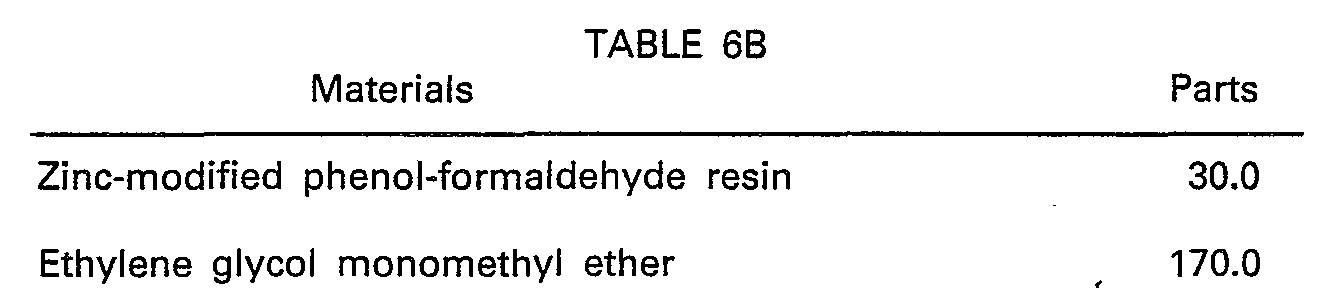
- The third comparative CF example was prepared by sensitizing a base sheet with a phenolic polymeric film material as described in U.S. Patent No. 3,466,184. The materials listed in Table 6B were employed to produce a sensitized CF sheet in a gravure printing operation resulting in a dry coat weight of about 1.3 gm-2.
- The CF sheet of Example 12 was further modified by the alternative application of two different compositions to the uncoated side and drying the coating, resulting in two different CFB sheets identified as Examples 12-1 and 12-2. Example 12-2 was produced by coating a composition like that of Table 6A with the exception that the capsule walls comprised melamine-formaldehyde resins produced by polymerization methods utilizing initial condensates as generally disclosed in U.S. Patent No. 4,100,103. Example 12-1 was produced by coating a composition substantially like that of Table 6A with the exception that the capsule walls comprised a gelatin coacervate and were made in accordance with the procedures generally disclosed in U.S. Patent No. 3,041,289.
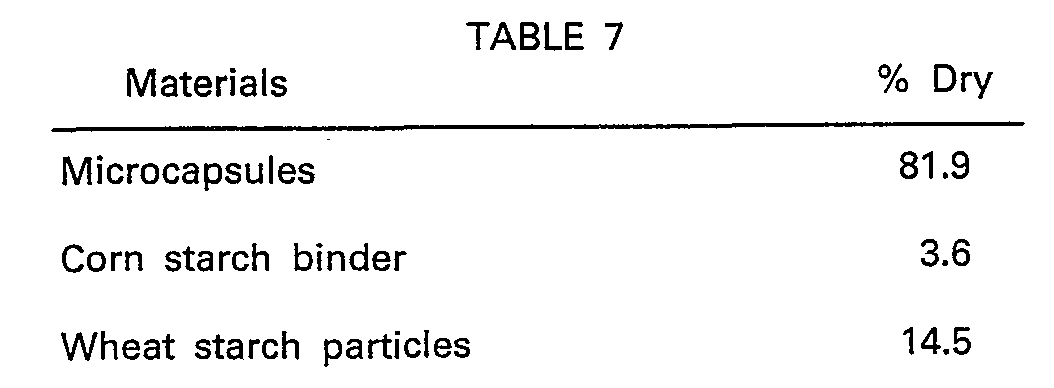
- Each of the CF surfaces of Examples 1 through 12 were tested in a Typewriter Intensity (TI) test with CB sheets comprising a 5.5 gm-2 coating of the composition listed in Table 7.
- The microcapsules employed contained the colour former (basic chromogenic material) solution of Table 8 within urea-formaldehyde capsule walls produced by polymerization methods generally disclosed in U.S. Patent No. 4,001,140.

- In the TI test a standard pattern is typed on a CB-CF (or CB-CFB) pair. The reflectance of the typed area is a measure of colour development on the CF sheet and is reported as the ratio (1/10) of the reflectance of the typed area (I) to that of the background reflectance of the CF paper (10), expressed as a percentage. A high value indicates little colour development and a low value indicates good colour development.
- Listed in Table 9 are the TI data for the CF surfaces of Examples 1 through 12 measured 20 minutes after typing.

- It can be observed from Table 9 that the examples which produced the least intense prints were controls 12-1 and 12-2 even though they contained 1.7 to 2.0 times the amount of zinc-modified phenol-formaldehyde resin colour developer contained in control Examples 11 and 10, respectively.
- In a manner substantially the same as Example 8, nine different two-coat CF sheets were prepared wherein nine different pigments were evaluated in a topcoat mixture with kaolin clay. In addition to coating each of the topcoat formulations over the subcoat CF formulation used for Example 8, each of the topcoat mixtures was also coated directly on 70 gm-2 base stock so that the reactivity of the topcoat mixtures could be measured. Two additional similar examples (Examples 22 and 23) were prepared as above except that 20% rather than 40% of the additional pigment was utilized. Additional kaolin clay was employed to bring the total kaolin clay to 73%. Finally, an example (Example 24) was prepared which was a duplicate of Example 5 and wherein 93% kaolin clay was employed as the sole pigment in the topcoat. Each of the topcoat formulations of Examples 22-24 was also coated directly on 70 gm-2 base stock. Each of the two-coat CF sheets and corresponding topcoat only samples was evaluated for print intensity in a TI test as described previously. The results are listed in Table 10.

- The TI data demonstrate that all of the above two-coat CF sheets functioned well as record sheets in pressure-sensitive record material and that all of the topcoat only formulations are substantially nonreactive with a solution of basic chromogenic material.
- Examples 1 through 4 and 9 through 12 were evaluated for performance in copier/duplicators and/or a laser printer in order to evaluate the examples of the invention and to'compare them with the performance of the controls. These results are listed in Table 11.

- When there was contamination on the fuser roll, e.g. Examples 10 and 11, the buildup was cumulative. In the early parts of the run there was a noticeable darkening of the fuser roll but no adverse effect on copy quality. As the length of the run increased, the accumulation on the fuser roll increased and became tacky and tinted with toner. Severe contamination occurred between 500 and 2000 copies and it was in this interval where adverse effects of the fuser roll contamination on copy quality become noticeable.
- Conventional CF paper comprising an oil-soluble metal salt of a phenol-formaldehyde novolak resin produces problems of accumulation of contamination on the fuser roll of all copier/duplicators and printers listed. However, the rate of this accumulation varies with the specific equipment tested. The Xerox 9200 seems to be more resistant to such accumulation and therefore longer runs must be employed to detect the adverse results of the accumulation.
- Extended runs (10,000 or more copies) with Examples 12-1 and 12-2 result in slight contamination of the fuser roll but this accumulation did not adversely affect copy quality or machine runnability. As previously pointed out in relation to the TI data in Table 9 however, the record material of Examples 12-1 and 12-2 is relatively unsatisfactory in terms of colour development performance.
- The above data clearly show that a CF sheet which comprises a base coat containing an oil-soluble phenol-formaldehyde novolak resin and a topcoat comprising substantially non-reactant pigment and binder material, but no colour developer materials, overcomes the problem of contamination of fuser rolls on copier/duplicators and laser printers while providing a satisfactory print intensity as a pressure-sensitive recording sheet.
Claims (7)
Priority Applications (1)
| Application Number | Priority Date | Filing Date | Title |
|---|---|---|---|
| AT83303266T ATE21067T1 (en) | 1982-06-28 | 1983-06-07 | RECORDING MATERIAL. |
Applications Claiming Priority (2)
| Application Number | Priority Date | Filing Date | Title |
|---|---|---|---|
| US06/392,868 US4470058A (en) | 1982-06-28 | 1982-06-28 | Pressure-sensitive recording sheet |
| US392868 | 1999-09-09 |
Publications (3)
| Publication Number | Publication Date |
|---|---|
| EP0098059A2 EP0098059A2 (en) | 1984-01-11 |
| EP0098059A3 EP0098059A3 (en) | 1984-03-28 |
| EP0098059B1 true EP0098059B1 (en) | 1986-07-30 |
Family
ID=23552344
Family Applications (1)
| Application Number | Title | Priority Date | Filing Date |
|---|---|---|---|
| EP83303266A Expired EP0098059B1 (en) | 1982-06-28 | 1983-06-07 | Record material |
Country Status (15)
| Country | Link |
|---|---|
| US (1) | US4470058A (en) |
| EP (1) | EP0098059B1 (en) |
| JP (1) | JPS5948184A (en) |
| AT (1) | ATE21067T1 (en) |
| AU (1) | AU563607B2 (en) |
| BR (1) | BR8303403A (en) |
| CA (1) | CA1192400A (en) |
| DE (1) | DE3364934D1 (en) |
| DK (1) | DK294783A (en) |
| ES (1) | ES8501676A1 (en) |
| FI (1) | FI78027C (en) |
| GR (1) | GR78590B (en) |
| NO (1) | NO832335L (en) |
| PT (1) | PT76918B (en) |
| ZA (1) | ZA834358B (en) |
Families Citing this family (6)
| Publication number | Priority date | Publication date | Assignee | Title |
|---|---|---|---|---|
| US4859561A (en) * | 1986-09-09 | 1989-08-22 | The Mead Corporation | Developer sheet useful in providing transparencies or reproductions having a controlled gloss finish |
| US4772532A (en) * | 1987-03-18 | 1988-09-20 | The Mead Corporation | Glossable developer sheet with reduced tack |
| GB8706667D0 (en) * | 1987-03-20 | 1987-04-23 | Wiggins Teape Group Ltd | Self-adhesive label assembly |
| ES2049819T3 (en) * | 1988-07-01 | 1994-05-01 | Wiggins Teape Group Ltd | PRESSURE SENSITIVE COPY PAPER. |
| EP0707978B1 (en) * | 1994-10-14 | 1999-01-13 | Agfa-Gevaert N.V. | Direct thermal imaging material |
| US7291400B2 (en) * | 2002-03-20 | 2007-11-06 | Dai Nippon Printing Co., Ltd. | Decorative sheet |
Family Cites Families (10)
| Publication number | Priority date | Publication date | Assignee | Title |
|---|---|---|---|---|
| JPS5536518B2 (en) * | 1972-11-21 | 1980-09-20 | ||
| JPS5229649B2 (en) * | 1973-02-17 | 1977-08-03 | ||
| JPS5220114A (en) * | 1975-08-02 | 1977-02-15 | Nippon Pulp Ind Co Ltd | Colorrdeveloping sheets for pressure sensitized copy sheets |
| US4154462A (en) * | 1975-10-30 | 1979-05-15 | Champion International Corporation | Transfer sheet coated with microcapsules and oil-absorptive particles |
| JPS5286807A (en) * | 1976-01-13 | 1977-07-19 | Fuji Photo Film Co Ltd | Record sheets |
| JPS6021875B2 (en) * | 1976-09-30 | 1985-05-29 | 富士写真フイルム株式会社 | recording material |
| GB1564850A (en) * | 1977-01-27 | 1980-04-16 | Mead Corp | Producing metal modified phenol-aldehyde novolak resins |
| JPS5479709A (en) * | 1977-12-07 | 1979-06-26 | Fuji Photo Film Co Ltd | Method of making sheet |
| JPS5528859A (en) * | 1978-08-23 | 1980-02-29 | Ricoh Co Ltd | Image recording method |
| JPS5686792A (en) * | 1979-12-18 | 1981-07-14 | Fuji Photo Film Co Ltd | Heat sensitive recording sheet |
-
1982
- 1982-06-28 US US06/392,868 patent/US4470058A/en not_active Expired - Lifetime
-
1983
- 1983-03-26 PT PT76918A patent/PT76918B/en unknown
- 1983-06-06 CA CA000429749A patent/CA1192400A/en not_active Expired
- 1983-06-07 EP EP83303266A patent/EP0098059B1/en not_active Expired
- 1983-06-07 DE DE8383303266T patent/DE3364934D1/en not_active Expired
- 1983-06-07 AT AT83303266T patent/ATE21067T1/en not_active IP Right Cessation
- 1983-06-08 AU AU15488/83A patent/AU563607B2/en not_active Ceased
- 1983-06-14 ZA ZA834358A patent/ZA834358B/en unknown
- 1983-06-22 GR GR71749A patent/GR78590B/el unknown
- 1983-06-22 FI FI832289A patent/FI78027C/en not_active IP Right Cessation
- 1983-06-27 BR BR8303403A patent/BR8303403A/en unknown
- 1983-06-27 NO NO832335A patent/NO832335L/en unknown
- 1983-06-27 DK DK294783A patent/DK294783A/en not_active Application Discontinuation
- 1983-06-27 ES ES523607A patent/ES8501676A1/en not_active Expired
- 1983-06-28 JP JP58116786A patent/JPS5948184A/en active Granted
Also Published As
| Publication number | Publication date |
|---|---|
| JPH0575593B2 (en) | 1993-10-20 |
| JPS5948184A (en) | 1984-03-19 |
| DK294783D0 (en) | 1983-06-27 |
| DK294783A (en) | 1983-12-29 |
| EP0098059A2 (en) | 1984-01-11 |
| DE3364934D1 (en) | 1986-09-04 |
| ATE21067T1 (en) | 1986-08-15 |
| US4470058A (en) | 1984-09-04 |
| BR8303403A (en) | 1984-02-07 |
| EP0098059A3 (en) | 1984-03-28 |
| AU1548883A (en) | 1984-01-05 |
| ES523607A0 (en) | 1984-12-01 |
| CA1192400A (en) | 1985-08-27 |
| PT76918A (en) | 1983-07-01 |
| FI832289A0 (en) | 1983-06-22 |
| ES8501676A1 (en) | 1984-12-01 |
| ZA834358B (en) | 1984-07-25 |
| PT76918B (en) | 1986-03-11 |
| AU563607B2 (en) | 1987-07-16 |
| FI78027C (en) | 1989-06-12 |
| NO832335L (en) | 1983-12-29 |
| FI832289L (en) | 1983-12-29 |
| FI78027B (en) | 1989-02-28 |
| GR78590B (en) | 1984-09-27 |
Similar Documents
| Publication | Publication Date | Title |
|---|---|---|
| EP0005976B1 (en) | Process for preparing zinc-modified phenol-aldehyde novolak resins and heat- or pressure-sensitive recording material carrying a resin so prepared | |
| CA1120183A (en) | Method of preparing zinc-modified phenol-aldehyde novolak resins | |
| GB1591361A (en) | Pressure-sensitive carbonless sheet sets and processes for producing them | |
| US4906605A (en) | Carbonless paper printable in electrostatic copiers | |
| EP0098059A2 (en) | Record material | |
| EP0060386B1 (en) | Color-developing sheet for pressure-sensitive recording sheet | |
| JPH05254240A (en) | Pressure-sensitive recording paper | |
| US4851384A (en) | Record material | |
| EP0029323A2 (en) | Use of vinyl phenol polymer as colour developer for leuco pigment and colour developer composition and thermosensitive recording element comprising same | |
| JPS63297089A (en) | Glossy developer sheet, adhesion of which is reduced | |
| EP0017386B1 (en) | Self-contained pressure sensitive recording paper | |
| US20060240343A1 (en) | Digital press printing | |
| EP0620121A2 (en) | Legume starch stilting material for carbonless papers used in offset printing presses and in copier/duplicators | |
| EP0338808B1 (en) | Alkyl salicylate resin for carbonless copy paper and imaging use | |
| US6407035B1 (en) | Copyable carbonless paper | |
| EP0357187B1 (en) | Pressure-sensitive copying paper | |
| JP2999788B2 (en) | Pressure sensitive copy paper for ink jet recording | |
| EP0627994B1 (en) | Xerographable carbonless forms | |
| CA2382673C (en) | Copyable carbonless paper | |
| JPH02223467A (en) | Color developer sheet for carbonless copy paper | |
| JPH05169872A (en) | Plate material for direct drawing type lithography | |
| JPH04367868A (en) | Printing plate material for electrostatic transfer system direct writing type planographic printing | |
| JPH1178228A (en) | Pressure-sensitive copy paper and pressure-sensitive copy paper set | |
| JPH04208487A (en) | Tamper-proof single-layer self-coloring pressure-sensitive copying paper | |
| JPH05246166A (en) | Direct drawing type lithographic printing plate material |
Legal Events
| Date | Code | Title | Description |
|---|---|---|---|
| PUAI | Public reference made under article 153(3) epc to a published international application that has entered the european phase |
Free format text: ORIGINAL CODE: 0009012 |
|
| 17P | Request for examination filed |
Effective date: 19830614 |
|
| AK | Designated contracting states |
Designated state(s): AT BE CH DE FR GB IT LI LU NL SE |
|
| PUAL | Search report despatched |
Free format text: ORIGINAL CODE: 0009013 |
|
| AK | Designated contracting states |
Designated state(s): AT BE CH DE FR GB IT LI LU NL SE |
|
| GRAA | (expected) grant |
Free format text: ORIGINAL CODE: 0009210 |
|
| AK | Designated contracting states |
Kind code of ref document: B1 Designated state(s): AT BE CH DE FR GB IT LI LU NL SE |
|
| REF | Corresponds to: |
Ref document number: 21067 Country of ref document: AT Date of ref document: 19860815 Kind code of ref document: T |
|
| ITF | It: translation for a ep patent filed | ||
| REF | Corresponds to: |
Ref document number: 3364934 Country of ref document: DE Date of ref document: 19860904 |
|
| ET | Fr: translation filed | ||
| PLBE | No opposition filed within time limit |
Free format text: ORIGINAL CODE: 0009261 |
|
| STAA | Information on the status of an ep patent application or granted ep patent |
Free format text: STATUS: NO OPPOSITION FILED WITHIN TIME LIMIT |
|
| PG25 | Lapsed in a contracting state [announced via postgrant information from national office to epo] |
Ref country code: LU Free format text: LAPSE BECAUSE OF NON-PAYMENT OF DUE FEES Effective date: 19870630 |
|
| 26N | No opposition filed | ||
| PGFP | Annual fee paid to national office [announced via postgrant information from national office to epo] |
Ref country code: SE Payment date: 19890420 Year of fee payment: 7 Ref country code: CH Payment date: 19890420 Year of fee payment: 7 |
|
| PGFP | Annual fee paid to national office [announced via postgrant information from national office to epo] |
Ref country code: AT Payment date: 19890629 Year of fee payment: 7 |
|
| PGFP | Annual fee paid to national office [announced via postgrant information from national office to epo] |
Ref country code: NL Payment date: 19890630 Year of fee payment: 7 |
|
| PG25 | Lapsed in a contracting state [announced via postgrant information from national office to epo] |
Ref country code: AT Effective date: 19900607 |
|
| PG25 | Lapsed in a contracting state [announced via postgrant information from national office to epo] |
Ref country code: SE Effective date: 19900608 |
|
| PG25 | Lapsed in a contracting state [announced via postgrant information from national office to epo] |
Ref country code: LI Effective date: 19900630 Ref country code: CH Effective date: 19900630 |
|
| PG25 | Lapsed in a contracting state [announced via postgrant information from national office to epo] |
Ref country code: NL Effective date: 19910101 |
|
| NLV4 | Nl: lapsed or anulled due to non-payment of the annual fee | ||
| REG | Reference to a national code |
Ref country code: CH Ref legal event code: PL |
|
| ITTA | It: last paid annual fee | ||
| EUG | Se: european patent has lapsed |
Ref document number: 83303266.7 Effective date: 19910206 |
|
| REG | Reference to a national code |
Ref country code: GB Ref legal event code: IF02 |
|
| PGFP | Annual fee paid to national office [announced via postgrant information from national office to epo] |
Ref country code: FR Payment date: 20020513 Year of fee payment: 20 |
|
| PGFP | Annual fee paid to national office [announced via postgrant information from national office to epo] |
Ref country code: GB Payment date: 20020520 Year of fee payment: 20 |
|
| PGFP | Annual fee paid to national office [announced via postgrant information from national office to epo] |
Ref country code: DE Payment date: 20020523 Year of fee payment: 20 |
|
| PGFP | Annual fee paid to national office [announced via postgrant information from national office to epo] |
Ref country code: BE Payment date: 20020603 Year of fee payment: 20 |
|
| PG25 | Lapsed in a contracting state [announced via postgrant information from national office to epo] |
Ref country code: GB Free format text: LAPSE BECAUSE OF EXPIRATION OF PROTECTION Effective date: 20030606 |
|
| BE20 | Be: patent expired |
Owner name: *APPLETON PAPERS INC. Effective date: 20030607 |
|
| REG | Reference to a national code |
Ref country code: GB Ref legal event code: PE20 |