EP0098041B1 - Sesquiterpene lactones, extracts containing them, their preparation and pharmaceutical use - Google Patents
Sesquiterpene lactones, extracts containing them, their preparation and pharmaceutical use Download PDFInfo
- Publication number
- EP0098041B1 EP0098041B1 EP83302790A EP83302790A EP0098041B1 EP 0098041 B1 EP0098041 B1 EP 0098041B1 EP 83302790 A EP83302790 A EP 83302790A EP 83302790 A EP83302790 A EP 83302790A EP 0098041 B1 EP0098041 B1 EP 0098041B1
- Authority
- EP
- European Patent Office
- Prior art keywords
- oil
- active composition
- fractions
- sesquiterpene lactone
- extract
- Prior art date
- Legal status (The legal status is an assumption and is not a legal conclusion. Google has not performed a legal analysis and makes no representation as to the accuracy of the status listed.)
- Expired
Links
- FMTPPIDUVOYOFX-UHFFFAOYSA-N CC(C)(CCC1C(C)(CCC2C3=C)O)C1C2OC3=O Chemical compound CC(C)(CCC1C(C)(CCC2C3=C)O)C1C2OC3=O FMTPPIDUVOYOFX-UHFFFAOYSA-N 0.000 description 2
- HWESJFYTWYDPNG-UHFFFAOYSA-N CC(C(O)OC(C1CCC2(C)OC22CC(C3=C)O)C23O)C1=C Chemical compound CC(C(O)OC(C1CCC2(C)OC22CC(C3=C)O)C23O)C1=C HWESJFYTWYDPNG-UHFFFAOYSA-N 0.000 description 1
- FHSISQLXQJQHEA-UHFFFAOYSA-N CC(C)(CCC(C1)C(C2(CC(C3)O)O)OC1=O)C23O Chemical compound CC(C)(CCC(C1)C(C2(CC(C3)O)O)OC1=O)C23O FHSISQLXQJQHEA-UHFFFAOYSA-N 0.000 description 1
- AQSCXKLORHEXPQ-UHFFFAOYSA-N CC(C)(CCC1C(C)(CCC2C3=C)[O]=C)C1C2OC3=O Chemical compound CC(C)(CCC1C(C)(CCC2C3=C)[O]=C)C1C2OC3=O AQSCXKLORHEXPQ-UHFFFAOYSA-N 0.000 description 1
- FXERMYWTAJWNMP-TXRQMBTQSA-N CC(CCC(C)(C(C(C(C(CC=C)O)C1=C)OC1O)O)I)OC(C1)C(C)(C)CCC2OC2(C)CCC1[C@@H](C)C(O)=O Chemical compound CC(CCC(C)(C(C(C(C(CC=C)O)C1=C)OC1O)O)I)OC(C1)C(C)(C)CCC2OC2(C)CCC1[C@@H](C)C(O)=O FXERMYWTAJWNMP-TXRQMBTQSA-N 0.000 description 1
- MRVZYJSBRXYWGV-XKPIQKOXSA-N CC1(CCC([C@@H]2OC3O)C3=C)OC1CCC(C)(C)C2OC(CCC1(C)OC1C(C(C(C1)O)C2=C)[IH]OC2O)C1=C Chemical compound CC1(CCC([C@@H]2OC3O)C3=C)OC1CCC(C)(C)C2OC(CCC1(C)OC1C(C(C(C1)O)C2=C)[IH]OC2O)C1=C MRVZYJSBRXYWGV-XKPIQKOXSA-N 0.000 description 1
Images

Classifications
-
- C—CHEMISTRY; METALLURGY
- C07—ORGANIC CHEMISTRY
- C07D—HETEROCYCLIC COMPOUNDS
- C07D493/00—Heterocyclic compounds containing oxygen atoms as the only ring hetero atoms in the condensed system
- C07D493/02—Heterocyclic compounds containing oxygen atoms as the only ring hetero atoms in the condensed system in which the condensed system contains two hetero rings
- C07D493/04—Ortho-condensed systems
-
- A—HUMAN NECESSITIES
- A61—MEDICAL OR VETERINARY SCIENCE; HYGIENE
- A61K—PREPARATIONS FOR MEDICAL, DENTAL OR TOILETRY PURPOSES
- A61K31/00—Medicinal preparations containing organic active ingredients
- A61K31/33—Heterocyclic compounds
- A61K31/335—Heterocyclic compounds having oxygen as the only ring hetero atom, e.g. fungichromin
- A61K31/365—Lactones
-
- C—CHEMISTRY; METALLURGY
- C07—ORGANIC CHEMISTRY
- C07D—HETEROCYCLIC COMPOUNDS
- C07D307/00—Heterocyclic compounds containing five-membered rings having one oxygen atom as the only ring hetero atom
- C07D307/77—Heterocyclic compounds containing five-membered rings having one oxygen atom as the only ring hetero atom ortho- or peri-condensed with carbocyclic rings or ring systems
- C07D307/93—Heterocyclic compounds containing five-membered rings having one oxygen atom as the only ring hetero atom ortho- or peri-condensed with carbocyclic rings or ring systems condensed with a ring other than six-membered
-
- C—CHEMISTRY; METALLURGY
- C07—ORGANIC CHEMISTRY
- C07D—HETEROCYCLIC COMPOUNDS
- C07D493/00—Heterocyclic compounds containing oxygen atoms as the only ring hetero atoms in the condensed system
- C07D493/12—Heterocyclic compounds containing oxygen atoms as the only ring hetero atoms in the condensed system in which the condensed system contains three hetero rings
- C07D493/14—Ortho-condensed systems
Definitions
- This invention relates to sesquiterpene lactones and sesquiterpene lactone-containing plant extracts and preparations for pharmaceutical use, and particularly to extracts and preparations which are useful in the treatment of migraine and various arthritic and bronchial conditions.
- migraine migraine is said to be in the region of 12% of the population. Its precise causes have not been determined but certain elements in its causation are well documented.
- Neurohumoral and local hormone (autacoid) factors such as noradrenaline, 5-hydroxytryptamine (serotonin), histamine and prostaglandins are implicated in migraine probably acting at the cerebrovascular level.
- prostaglandins such as PGE 2 , PGF 2a , PG1 2 (prostacyclin) or thromboxane A 2 are involved comes from the fact that non-steroidal anti-inflammatory drugs such as aspirin, which act by inhibiting the synthesis of prostaglandins, are highly effective for both the prophylactic and acute treatment of migraine.
- prostaglandins As to the causes of arthritic conditions, the suppression of prostaglandin synthesis by non-steroidal anti-inflammatory drugs such as aspirin or indomethacin strongly implicates prostaglandins as inflammatory mediators at least in rheumatoid arthritis. Prostaglandin-like material is present in inflammatory perfusates of experimental animals. The E-prostaglandins in low concentrations are striking potentiators of the pain-producing properties of other agonists such as histamine r 5-hydroxytryptamine and plasmakinins (e.g. bradykinin) as well as other features of the inflammatory response such as increased vascular permeability, erythema, white cell accumulation and platelet aggregation.
- non-steroidal anti-inflammatory drugs such as aspirin or indomethacin strongly implicates prostaglandins as inflammatory mediators at least in rheumatoid arthritis.
- Prostaglandin-like material is present in inflammatory perfus
- bronchial asthma and chronic bronchitis suffer attacks of wheezing and difficulty in breathing. These are due to bronchial narrowing from spasm of the bronchial smooth muscle or from sticky secretions, or more commonly from a combination of the two.
- endogenous neurohumoral and autacoid spasmogens such as acetylchlorine, 5-hydroxytryptamine (serotonin), histamine, some prostaglandins and leukotrienes may be involved.
- Allergic reactions to substances in inhaled dust or those absorbed from food may be manifested by bronchoconstriction or urticaria ("nettle-rash") or circulatory collapse caused by the release of histamine or other endogenous substances.
- Drugs with spasmolytic actions such as aminophylline are used to treat bronchospasm.
- Drugs with antihistamine activity are also used in asthma and for wheezing and other symptoms associated with allergic phenomena such as hay fever.
- Tanacetum parthenium (formerly called Chrysanthemum parthenium and commonly known as feverfew, featherfoil, flirtwort and Bachelor's Buttons) has been put forward in herbal medicine as a possibility effective treatment for migraine when consumed. No serious medical study of this treatment for migraine has apparently been published, nor has there been any consideration of what ingredient or ingredients of the plant might be involved in this alleged efficacy.
- sesquiterpene lactones parthenolide and santamarine may be extracted from feverfew using light petroleum and chloroform respectively (see Soucek, Heront and Sorm, Coll. Czech. Chem, Comm., (1961), 26, 803 and Romo et al, Tetrahedron, (1965), 21, 1741 respectively). It was also reported that the sesquiterpene lactones chrysartemin A and B are present in Tanacetum parthenium (see Dictionary of Organic Compounds, 5th Edn., Vol 1, A-Clor, page 1233). In those publications, there was no indication of any possible medical use for the sesquiterpene lactones.
- sesquiterpene lactones are potent inhibitors of carrageenan-induced edma and chronic adjuvant-induced arthritis in rodents (see Hall, Starnes, Lee and Waddell, J. Pharm. Sci., (1979), 68, 537). This article does not, however, suggest that any sesquiterpene lactone has pharmaceutical activity against any complaint, let alone against migraine.
- a sesquiterpene lactone is used for the treatment of migraine, asthmatic, bronchial or arthritic conditions, which sesquiterpene lactone is derived from the plant Tanacetum parthenium (hereinafter called "feverfew") by extraction with an organic solvent which is essentially non-polar, for example, light petroleum, hexane, chloroform or an oil, for example, a saturated or unsaturated long chain (e.g. C 10 - 25 ) hydrocarbon or fatty acid, e.g.
- an organic solvent which is essentially non-polar, for example, light petroleum, hexane, chloroform or an oil, for example, a saturated or unsaturated long chain (e.g. C 10 - 25 ) hydrocarbon or fatty acid, e.g.
- a commercial available vegetable or animal oil such as coconut oil, soya bean oil, a fish oil, there derivatives such as polyoxyethylated fatty acids, reconstituted glycerides and esters, e.g. sorbitan esters of the above compounds.
- the sesquiterpene-lactone may be present in a'n extract of the plant, which extract may be obtained by mixing dried, pulverized feverfew leaves with the non-polar solvent and leaving the mixture to stand to allow the extraction to take place.
- the dry powder may be exhaustively extracted with the non-polar organic solvent, for example in a Soxhlet apparatus.
- Classes of sesquiterpene lactones which include compounds which we find likely to be effective against one or more or migraine, asthma and arthritic conditions are germacranolides and guaianolides, including pseudoguaianolides, especially those sesquiterpene lactones having an a-methylene substituent in the lactone ring.
- the extract may contain a plurality of sesquiterpene lactones such as these.
- a germacranolide which can be extracted from feverfew is parthenolide of the formula and we find that this compound and extracts from feverfew which contain it are particularly likely to be effective against migraine, asthma and various arthritic conditions.
- the invention additionally provides a germacranolide which contains at least two germacrane nuclei in its molecule.
- germacranolides e.g. dimers and trimers
- Such guaianolides have an oxygen functionality at the 10-position of the guaiane nucleus provided, for example, by an epoxy linked to a carbon atom adjacent to the said 10-position, or a hydroxyl, ether or ester group, or pharmaceutically acceptable derivatives of such compounds.
- Guaianolides having multiple functionality such as those having oxygen functionality at the 10- position, are, we believe likely to be more effective than guaianolides having no such multiple functionality.
- a sesquiterpene lactone-containing extract or preparation for use in accordance with the invention may be obtained from feverfew in the following manner.
- Leaves of feverfew are freeze-dried and then powdered.
- the dry powder is exhaustively extracted in a Soxhlet apparatus with an organic solvent for example, petroleum ether (i.e. light petroleum) boiling range 60/40°.
- the extract is evaporated to dryness and chromatographed, e.g. on a silica gel column. Elution of the column is effected by increasing polarity of solvent, e.g. from 100% petroleum ether boiling range 60/40° to 40% methanol in chloroform.
- Fractions are collected and combined as appropriate having regard to their thin layer chromatography. The combined fractions are tested for spasmolytic activity as later described. Those fractions showing 100% inhibition of the agonists are further sub-fractionated. These sub-fractions are then tested.
- the active constituents may be isolated after further purification (usually preparative thin layer chromatography). The pure compounds can be re-crystallised from appropriate solvents and analysed by spectroscopic techniques, for example, 1 H NMR, 13C NMR, mass spectroscopy, infrared spectroscopy or ultraviolet spectroscopy.
- compositions in accordance with the invention for pharmaceutical use by conventional procedures.
- a sesquiterpene lactone-containing extract for use in accordance with the present invention may be obtained from feverfew by mixing the dried, pulverized leaves of the plant with a non-polar solvent to form a suspension and allowing the mixture to stand to allow extraction of sesquiterpene lactones from the plant.
- the suspension may then be stabilized by use of suitable solid fat mixtures, with or without the presence of beeswax or other mineral waxs, colloidal silica, derivatives of cellulose such as carboxy methylcellulose and/or natural gums such as agar or Xanthan, starches, starch derivatives and other suitable carbohydrates, with or without the addition of wetting agents such as sorbitan fatty esters and lecithin.
- suitable solid fat mixtures with or without the presence of beeswax or other mineral waxs, colloidal silica, derivatives of cellulose such as carboxy methylcellulose and/or natural gums such as agar or Xanthan, starches, starch derivatives and other suitable carbohydrates, with or without the addition of wetting agents such as sorbitan fatty esters and lecithin.
- a preparation in accordance with the invention may be formed by encapsulating the suspension in either a hermetically sealed one-piece soft shell or a two- piece hard shell gelatin capsule representing a one unit dose, preferably an approximate amount of 0.25 to 200 mg, of feverfew leaf with or without the other pharmaceutically active substances.
- the dried, pulverized feverfew may be allowed to stand in the non-polar solvent for sufficient time to allow extraction, e.g. 14 days, and then strained to form a macerate of filtered to leave an extract solution.
- the suspension macerate or extract solution may be mixed with surfactive agents or mixtures thereof, such as polyethoxy fatty acid sorbitan esters, mono and di glycerides, acetylated glycerides, to form a self- emulsifying system.
- surfactive agents or mixtures thereof such as polyethoxy fatty acid sorbitan esters, mono and di glycerides, acetylated glycerides, to form a self- emulsifying system.
- a sesquiterpene lactone containing extract for use in accordance with the invention as a medicament may be administered as it is, i.e. in the form of a plant extract or purified sesquiterpene lactone alone, but is usually admixed with a pharmaceutically acceptable excipient.
- the medicament may comprise one or more extracts and/or synthesized sesquiterpene lactones.
- the medicaments may be administered orally or parenterally and conveniently take the form of a tablet or liquid suspension. They may additionally include, in addition to the sesquiterpene lactones, other known anti-migraine preparations, analgesics and antiemetics as
- the dosage of active ingredient may be from 0.25 to 200 milligrams per day. In general, from 0.25 to 20 mg per day is sufficient but, in the treatment of an acute attack of migraine or allied disorder the optimal dosage range will be higher at about 2 milligrams to 200 milligrams per day.
- the medicament may contain any conventional tabletting or capsuling carrier, or as a suspension in any orally acceptable non-toxic liquid carrier.
- the drug may be provided in encapsulated form for sustained release over a period of time.
- parenteral administration the drug may be provided as a suspension in any suitable, sterile injection medium, e.g. sterile aqueous saline solution.
- Excellent efficacy of a medicament in accordance with this invention is thought likely (a) in the treatment of classical and common migraine; (b) in the treatment of migrainous neuralgia (cluster headache); and (c) in the treatment of premenstrual and menstrual migraine and other headaches.
- the medicaments are likely to be useful in the prevention of the above types of headache, being effective in reducing the frequency, severity and duration of the attacks. They should also be effective in reducing the nausea and vomiting associated with such attacks, or nausea and vomiting as isolated symptoms. They can probably also be used to treat the acute attacks of the above sorts of headache reducing their duration, severity and associated symptoms.
- medicaments in accordance with the invention block the actions of neurohumoral transmitters and autacoids such as acetylcholoine, noradrenaline, 5-hydroxytryptamine, histamine, bradykinin and prostaglandin E 2 on smooth muscle. Furthermore chronic administration of the extracts to guinea-pigs causes a progressive decrease in the reactivity of their smooth muscle to 5-hydroxytryptamine and histamine. Indeed we find that such tests may be carried out on a particular medicament to determine its likely efficacy in the treatment of migraine.
- neurohumoral transmitters and autacoids such as acetylcholoine, noradrenaline, 5-hydroxytryptamine, histamine, bradykinin and prostaglandin E 2
- chronic administration of the extracts to guinea-pigs causes a progressive decrease in the reactivity of their smooth muscle to 5-hydroxytryptamine and histamine. Indeed we find that such tests may be carried out on a particular medicament to determine its likely efficacy in
- medicaments in accordance with the invention may be administered orally, rectally, parenterally or by inhalation and conveniently take the form of a tablet, capsule, suppository or liquid suspension.
- the dosage of active ingredient may be from 0.25 to 200 mg per day. In general, from 0.25 to 20 mg per day is sufficient but, in the treatment of an acute attack of rheumatoid arthritis or allied disorder the optimal dose range will be higher at about 2 milligrams to 200 milligrams per day.
- a medicament in accordance with the invention may additionally include other antiarthritis agents including non-steroidal antiinflammatory drugs, analgesics, skeletal muscle relaxants, steroids, gold and penicillanine.
- other antiarthritis agents including non-steroidal antiinflammatory drugs, analgesics, skeletal muscle relaxants, steroids, gold and penicillanine.
- Efficacy of a medicament in accordance with this invention is indicated (a) in the treatment of rheumatoid arthritis; (b) in the treatment of osteoarthritis; and (c) in the treatment of arthritis associated with Felty's syndrome, Still's disease, systemic lupus erythematosus, polyarteritis nodosa, scleroderma, gout, achalasia of the cardia, Crohn's disease, chronic brucellosis, ankylosing spondylitis, sarcoidosis, psoriasis and gonorrhoea.
- the medicaments are likely to be useful in the prevention of the above arthritides, being effective in reducing the frequency, severity and duration of the attacks.
- the medicaments can also be used to treat the acute attacks of the above arthritides reducing their duration, severity and associated symptoms.
- medicaments in accordance with the invention have marked spasmolytic actions against a wide variety of smooth muscle spasmogens. Thus they block the actions of histamine, 5-hydroxytryptamine, bradykinin and prostaglandin E 2 . Thus they oppose the pharmacological actions of the most commonly-implicated mediators of chronic inflammation. We find that such tests may be carried out on a particular medicament to determine its likely efficacy in the treatment of rheumatoid arthritis and associated conditions.
- medicaments in accordance with the invention may be administered orally, rectally, parenterally or by inhalation.
- the dosage of active ingredient may be from 0.25 to 200 milligrams per day. In general, from 0.25 to 20 mg per day is sufficient, but in the treatment of an acute attack of asthma or allied disorder the optimal dose range will be higher at about 2-200 mg per day.
- the medicament may also contain other ingredients such as bronchodilator, antihistamine and anti-infective agents, examples of which agents are
- Efficacy of a medicament in accordance with this invention is indicated (a) in the treatment of bronchial asthma; (b) in the treatment of bronchoconstriction associated with chronic bronchitis; (c) in the treatment of symptoms associated with histamine release in allergic hypersensitivity phenomena such as hay fever and anaphylaxis.
- the medicaments can also be co-administered with other bronchodilator, antihistamine and anti-infective agents as enumerated above.
- the excellent effects of a medicament in accordance with the invention in the treatment of bronchoconstriction may be the result of a stabilisation of the smooth muscle cell membranes leading to a direct inhibition or reduction of their responsiveness to biogenic amines, prostaglandins and polypeptides, or to an indirect action by the inhibition of the effects of the active ingredients on the nerves to the bronchial musculature and/or mucus secreting cells.
- medicaments in accordance with the invention block the spasms (contractions) of smooth muscle caused by acetylcholine, 5-hydroxytryptamine, histamine, prostaglandin E 2 and bradykinin. Indeed we find that such spasmolytic activity tests can be carried out on a particular medicament to deterine its likely efficacy in the treatment of bronchial complaints.
- the accompanying drawing illustrates the extraction and isolation procedure starting from a light petroleum extract of feverfew.
- PTLC means "Preparative Thin Layer Chromatography"
- the numbers represent combined fractions, i.e. 1-8 and new compounds or mixtures are indicated by the following codes:-
- Silica gel was the adsorbent used for all chromatography.
- the silica gel used for column chromatography was Kiosolgel 60 (Merck) and for thin-layer chromatography (TLC) Kieselgel G (Merck) and Kieselgel GE 254 (Merck).
- TLC plates for routine work, both analytical and preparative, were prepared by mixing 15 g Kieselgel G and 15 g Kieselgel GF 254 with 60 ml distilled water Kieselgel is a Trade Mark.
- the slurry was spread in a layer 0.25 mm thick on 20 x 20 cm glass plates. The plates were dried in the open air and then activated at 105°C for one hour.
- Silver nitrate impregnated plates where prepared by mixing 30 g Kieselgel G with 60 ml of a 10% w/v solution of silver nitrate in distilled water. The slurry was spread in a layer as before.
- 50 mg of the petroleum extract was tested for spasmolytic activity using acetylcholine (Ach), 5-hydroxytryptamine (5-HT) and histamine as agonists as described below.
- Guinea pigs weighing 200-300 g were killed by a blow on the head.
- the proximal ileum was excised and 2-3 cm length were cleaned and suspended in Krebs solution (NaCi 118.4, KCI 4.7, CaCI 2 2.5, MgS0 4 1.2, KH 2 PO 4 1.2, NaHC0 3 25 and glucose 11.5 mMole/litre) at 37°C through which a mixture of 95% 0 2 and 5% C0 2 was constantly bubbled.
- the lengths of ileum were set up to record longitudinal contractions insometrically.
- Log (dose) vs response curves were recorded to acetylcholine, 5-hydroxytryptamine and histamine from which ED 50 doses were taken and given repeatedly until constant responses were achieved.
- the antagonist i.e. the petroleum extract
- the antagonist was then dissolved in the minimum of dimethylsulphoxide and made up to a concentration of 10- 4 g/ml with Krebs solution. This was added to the bath containing the ileum and left for 30 minutes. After thorough washing with Krebs solution to remove the residual antagonist the responses of the tissue to the agonists were then recorded and the precentage change calculated.
- the plant materinl, 950 g, previously extracted with light petroleum b.r. 40-60°C was exhaustively extracted with chloroform in a Soxhlet apparatus for 9 days.
- the extract was evaporated to dryness under reduced pressure using a rotary evaporator to give a green oily residue weighing 46 g.
- Fractions 144 ⁇ 176 from the petroleum extract showed 100% inhibition of the three agonists Ach, 5-HT and histamine at 10- 4 g/ml.
- fractions A 59-65, i.e. band 6, crystallised from chloroform and methanol as fine needles (26 mg) of DJ140a, 8' ⁇ ,[4'a,5' ⁇ -epoxy-1' ⁇ -(1 ⁇ ,10 ⁇ -epoxy-4 ⁇ -hydroxygermacr-11(13)-en-12, 6 ⁇ -olactoyl-5 ⁇ -yloxy)-germacra-10'(14'), 11'(13')-dien-12', 6' ⁇ -olactoyl]-8" ⁇ -(3 ⁇ -hydroxy-3 ⁇ ,4 ⁇ -dimethyl 2 ⁇ -methylenepentanoyl)-4" ⁇ ,5" ⁇ -epoxy-1" ⁇ , 6" ⁇ -dihydroxygermacra-10"(14"), 11"(13")-dien-12”-oate (chrysanthemonin, ), m.p.
- DJ140a combined with mother liquors
- dioxan 5 ml
- K 2 CO 3 a stoichiometric amount of K 2 CO 3 (i.e. 245 microlitres of a solution containing 500 mg in 5 ml) was added.
- the reaction was monitored by TLC. After seven days with a gradual increase in temperature and addition of more base only starting material could be detected.
- This component was further purified by TLC using CHCI 3 : MeOH (98:2) as developing solvent. After extraction into CHCI 3 the material crystallised from CHCI 3 and hexane as colourless plates (5 mg) of DJ 14 0 aH2, 4' ⁇ ,5' ⁇ -epoxy-8' ⁇ -hydroxy-1' ⁇ -(1 ⁇ , 10 ⁇ -epoxy-4a-hydroxygermacr-11(13)-en-12,6 ⁇ -olactoyl-5 ⁇ -yloxy)-germacra-10'(14), 11'(13')-dien-12',6' ⁇ -olactone ), m.p.
- Fractions Aa 70-76 contained only one major component which crystallised from chloroform and methanol to give 14 mg of DJ140a, identical with that obtained from fractions A 59-65, above.
- Fractions Aa 50-63 (0.039 g) were further separated by preparative TLC using chloroform:methanol (98:2) as the developing solvent. Three bands were located under ultra-violet light (254 nm) and their constituents extracted with chloroform.
- DJ177b was acetylated in the normal way using pyridine and acetic anhydride. After the usual work up spots for both starting material and a less polar product were present on TLC examination. The material was too little to be completely purified but the 1 H NMR spectrum of the crude product showed the following additional signals which may be assigned to the acetate product: ⁇ , CDCl 3 : 2.16 (3H, s, CH 3 CO 2 ⁇ ) and 4.60 (1 H, m, H-3).
- Fractions 47-52 (0.123 g) were chromatographed on a silica gel column (10 g). 100 ml fractions were taken and combined as appropriate with reference to TLC. Solvent elution of the column and weight of the combined fractions are shown in Tables 12 and 13.
- band 1 The components in band 1 (11 mg) were further purified by preparative TLC. The plate was run seven times with chloroform: methanol (98:2) as the developing solvent. Four bands were located under ultraviolet light (254 nm) and their components extracted with chloroform. The components contained in band 1 of the latter plate weighed 6 mg and crystallised from chloroform and n-pentane to give DJ179a1. This material was possibly also a mixture of sesquiterpene lactones despite showing only one spot on TLC investigation. Signals were seen in the 'H NMR spectrum which could be assigned to reynosin, chrysartemin B and perhaps a dihydro-derivative of reynosin. The paucity of material precluded further study at this stage but the further possibility that of the material's being a trimeric compound rather like DJ140a cannot be discounted.
- Fractions 124-143 from the petroleum extract showed 100% inhibition of the two agonists 5-HT and histamine, and 91% inhibition of Ach.
- Fractions B 107-111 showed 100% inhibition of all three agonists.
- the fractions (2.434 g) were chromatographed on a silica gel column (120 g). 100 ml fractions were taken and combined as appropriate with reference to TLC. Solvent elution of the column and weight of the combined fractions are shown in Tables 17 and 18.
- Fractions 75-80 (C) from the petroleum extract showed 100% inhibition of the two agonists, 5-HT and histamine, and 91% inhibition of Ach.
- Fractions 177-200 from the petroleum extract showed 100% inhibition of the two agonists 5-HT and histamine, and 81% inhibition of Ach.
- Fractions D21-26 (0.110 g) were further separated by preparative TLC using chloroform:methanol (95:5) as developing solvent. The plates were run three times. Three bands were located under ultraviolet light (254 nm) and by spraying the edge of the plate with H 2 SO 4 and heating. Their components were extracted with chloroform.
- Fractions E 15-21 were combined and purified by TLC using chloroform : hexane (75:25) as developing solvent. The major component was extracted and identified as parthenolide by chromatographic comparison with an authentic specimen and by spectroscopic means.
- Powdered feverfew leaf and soya bean oil are mixed in the following proportions:-
- the mixture is encapsulated into a soft shell capsule or hard shell capsule, representing a dose of 25 mg of dried leaf. This fills into a 7.5 oval soft shell capsule or a number 2 hard shell capsule with a target fill weight of 380.5 mg.
- the mixture is strained and the resulting macerate, encapsulated as the oily extract, is stabilised with one or more of the above described suspending agents, into soft shell or two piece hard shell gelatin capsules.
- Powdered feverfew leaf and cod liver oil are mixed in the following proportions:-
- the mixture is allowed to stand for 14 days for extraction of the active ingredients.
- the resultant mixture is filtered and the filtrate encapsulated at a fill weight of 250 mg per unit dose, to represent approximately 25 mg of dried leaf in a soft shell or two piece hard shell capsule.
- the suspension or macerate is mixed with surfactive agents or mixtures thereof, such as polyethoxy fatty acid sorbitan esters, mono and di glycerides or acetylated glycerides, to form a self emulsifying system.
- surfactive agents or mixtures thereof such as polyethoxy fatty acid sorbitan esters, mono and di glycerides or acetylated glycerides
- the resultant formulation is encapsulated into a soft shell or two piece hard shell capsule.
- the soft shell or two piece hard shell gelatin capsule may be used via the oral or rectal route.
- gastro resistant coatings such as hydroxymethyl propyl cellulose or the content may be mixed with polymeric matrix materials as known to the pharmaceutical industry, to release the active principles at a controlled rate.
Landscapes
- Chemical & Material Sciences (AREA)
- Organic Chemistry (AREA)
- Health & Medical Sciences (AREA)
- General Health & Medical Sciences (AREA)
- Veterinary Medicine (AREA)
- Epidemiology (AREA)
- Life Sciences & Earth Sciences (AREA)
- Animal Behavior & Ethology (AREA)
- Medicinal Chemistry (AREA)
- Public Health (AREA)
- Pharmacology & Pharmacy (AREA)
- Pharmaceuticals Containing Other Organic And Inorganic Compounds (AREA)
- Acyclic And Carbocyclic Compounds In Medicinal Compositions (AREA)
- Medicines Containing Plant Substances (AREA)
- Plural Heterocyclic Compounds (AREA)
- Heterocyclic Carbon Compounds Containing A Hetero Ring Having Oxygen Or Sulfur (AREA)
- Organic Low-Molecular-Weight Compounds And Preparation Thereof (AREA)
Description
- This invention relates to sesquiterpene lactones and sesquiterpene lactone-containing plant extracts and preparations for pharmaceutical use, and particularly to extracts and preparations which are useful in the treatment of migraine and various arthritic and bronchial conditions.
- The incidence of migraine is said to be in the region of 12% of the population. Its precise causes have not been determined but certain elements in its causation are well documented.
- Neurohumoral and local hormone (autacoid) factors such as noradrenaline, 5-hydroxytryptamine (serotonin), histamine and prostaglandins are implicated in migraine probably acting at the cerebrovascular level.
- There is much evidence to suggest that a disturbance of blood vessel diameter is involved in the migraine process. Thus reports have demonstrated a constriction of cerebral cortical vessels followed by a dilatation during a migraine attack. The vasoconstriction is believed to be due to the release of amines such as noradrenaline from neurones and 5-hydroxytryptamine from platelets. Histamine is also released from mast cells and plays an important role in the migraine variant known as cluster headache (migrainous neuralgia). Drugs with antinoradrenaline, anti 5-hydroxytryptamine and antihistamine activities are all used to alleviate the symptoms of migraine. Evidence that prostaglandins (PG), such as PGE2, PGF2a, PG12 (prostacyclin) or thromboxane A2 are involved comes from the fact that non-steroidal anti-inflammatory drugs such as aspirin, which act by inhibiting the synthesis of prostaglandins, are highly effective for both the prophylactic and acute treatment of migraine.
- As to the causes of arthritic conditions, the suppression of prostaglandin synthesis by non-steroidal anti-inflammatory drugs such as aspirin or indomethacin strongly implicates prostaglandins as inflammatory mediators at least in rheumatoid arthritis. Prostaglandin-like material is present in inflammatory perfusates of experimental animals. The E-prostaglandins in low concentrations are striking potentiators of the pain-producing properties of other agonists such as histaminer5-hydroxytryptamine and plasmakinins (e.g. bradykinin) as well as other features of the inflammatory response such as increased vascular permeability, erythema, white cell accumulation and platelet aggregation.
- Patients with bronchial asthma and chronic bronchitis suffer attacks of wheezing and difficulty in breathing. These are due to bronchial narrowing from spasm of the bronchial smooth muscle or from sticky secretions, or more commonly from a combination of the two. The precise causes of the bronchoconstriction in asthma have not been fully elucidated, but it is believed endogenous neurohumoral and autacoid spasmogens such as acetylchlorine, 5-hydroxytryptamine (serotonin), histamine, some prostaglandins and leukotrienes may be involved. Allergic reactions to substances in inhaled dust or those absorbed from food may be manifested by bronchoconstriction or urticaria ("nettle-rash") or circulatory collapse caused by the release of histamine or other endogenous substances.
- Drugs with spasmolytic actions such as aminophylline are used to treat bronchospasm. Drugs with antihistamine activity are also used in asthma and for wheezing and other symptoms associated with allergic phenomena such as hay fever.
- It has been known for many years that sesquiterpene lactones and present in plants, for example, in the family Compositae (see Yoshio, Mabry and Timmermann, "Sesquiterpene Lactones, Chemistry, NMR and Plant Distribution", University of Tokyo Press 1973).
- Of these plants Tanacetum parthenium (formerly called Chrysanthemum parthenium and commonly known as feverfew, featherfoil, flirtwort and Bachelor's Buttons) has been put forward in herbal medicine as a possibility effective treatment for migraine when consumed. No serious medical study of this treatment for migraine has apparently been published, nor has there been any consideration of what ingredient or ingredients of the plant might be involved in this alleged efficacy.
- Many years ago, it was reported that the sesquiterpene lactones parthenolide and santamarine may be extracted from feverfew using light petroleum and chloroform respectively (see Soucek, Heront and Sorm, Coll. Czech. Chem, Comm., (1961), 26, 803 and Romo et al, Tetrahedron, (1965), 21, 1741 respectively). It was also reported that the sesquiterpene lactones chrysartemin A and B are present in Tanacetum parthenium (see Dictionary of Organic Compounds, 5th Edn.,
Vol 1, A-Clor, page 1233). In those publications, there was no indication of any possible medical use for the sesquiterpene lactones. - Some cytotoxic activity of parthenolide and several other sesquiterpene lactones has also been reported some time ago (Lee et al, Cancer Research, (1971 37,1649). There is, however, no suggestion in this article that any sesquiterpene lactone or extract containing it may be useful in the treatment of migraine, arthritis or bronchial complaints.
- More recently it has been shown that certain sesquiterpene lactones are potent inhibitors of carrageenan-induced edma and chronic adjuvant-induced arthritis in rodents (see Hall, Starnes, Lee and Waddell, J. Pharm. Sci., (1979), 68, 537). This article does not, however, suggest that any sesquiterpene lactone has pharmaceutical activity against any complaint, let alone against migraine.
- By repeated selective extraction of feverfew material, and extensive in vitro testing of the extracts for biological activity, in particular spasmoytic activity in smooth muscle tests, we have found surprisingly that, of the very many constituents of the plant, certain of the compounds within the range of sesquiterpene lactones present have properties strongly indicative of efficacy in the treatment of migraine. This is particularly surprising because the existence of some such compounds in the plant has been known for many years and yet there has been no disclosure or suggestion anywhere in the literature that they possess any useful activity against migraine. Furthermore, at least some of the reports on the use of feverfew in the treatment of migraine suggest taking an aqueous extract of the plant as a "tea". This points away from sesquiterpene lactones being active ingredients since they are unlikely to be extracted from the plant by this method.
- The indications are that such compounds are also likely to be efficacious in the treatment not only of migraine but also of bronchial asthma and arthritic conditions such as rheumatoid arthritis, osteoarthritis and related arthritides. This could not have been predicted from the completely unrelated cytotoxic activity reported by Lee et al (see above).
- According to one aspect of the invention, a sesquiterpene lactone is used for the treatment of migraine, asthmatic, bronchial or arthritic conditions, which sesquiterpene lactone is derived from the plant Tanacetum parthenium (hereinafter called "feverfew") by extraction with an organic solvent which is essentially non-polar, for example, light petroleum, hexane, chloroform or an oil, for example, a saturated or unsaturated long chain (e.g. C10-25) hydrocarbon or fatty acid, e.g. a commercial available vegetable or animal oil such as coconut oil, soya bean oil, a fish oil, there derivatives such as polyoxyethylated fatty acids, reconstituted glycerides and esters, e.g. sorbitan esters of the above compounds.
- The sesquiterpene-lactone may be present in a'n extract of the plant, which extract may be obtained by mixing dried, pulverized feverfew leaves with the non-polar solvent and leaving the mixture to stand to allow the extraction to take place. Alternatively, the dry powder may be exhaustively extracted with the non-polar organic solvent, for example in a Soxhlet apparatus. Classes of sesquiterpene lactones which include compounds which we find likely to be effective against one or more or migraine, asthma and arthritic conditions are germacranolides and guaianolides, including pseudoguaianolides, especially those sesquiterpene lactones having an a-methylene substituent in the lactone ring. The extract may contain a plurality of sesquiterpene lactones such as these.
- A germacranolide which can be extracted from feverfew is parthenolide of the formulaand we find that this compound and extracts from feverfew which contain it are particularly likely to be effective against migraine, asthma and various arthritic conditions.

- The invention additionally provides a germacranolide which contains at least two germacrane nuclei in its molecule.
- Because such germacranolides e.g. dimers and trimers, have more than one germacrane nucleus, each of which preferably carries out or more functional substituents, thay are, we believe, likely to be more effective than germacranolides containing a single germacrane nucleus. Hence we predict that they can be administered at lower dosage levels to achieve a comparative effect.
- A particular such germacranolide and feverfew extracts containing it which we find likely to be effective has the formula

- We have also hydrolysed chrysanthemonin to yield a compound of the formula

- Particular guaianolides and feverfew extracts containing them which we find are likely to be effective have the respective formulae


- We have obtained these compounds by extraction from feverfew with a non-polar solvent and believe them to be newly isolated. We call them "partholide" (3)' and "chrysanthemolide" (4). The compounds appear to be nowhere described in the literature.
- Such guaianolides have an oxygen functionality at the 10-position of the guaiane nucleus provided, for example, by an epoxy linked to a carbon atom adjacent to the said 10-position, or a hydroxyl, ether or ester group, or pharmaceutically acceptable derivatives of such compounds.
- Guaianolides having multiple functionality, such as those having oxygen functionality at the 10- position, are, we believe likely to be more effective than guaianolides having no such multiple functionality.
- A sesquiterpene lactone-containing extract or preparation for use in accordance with the invention may be obtained from feverfew in the following manner.
- Leaves of feverfew are freeze-dried and then powdered. The dry powder is exhaustively extracted in a Soxhlet apparatus with an organic solvent for example, petroleum ether (i.e. light petroleum) boiling range 60/40°. The extract is evaporated to dryness and chromatographed, e.g. on a silica gel column. Elution of the column is effected by increasing polarity of solvent, e.g. from 100% petroleum ether boiling range 60/40° to 40% methanol in chloroform.
- Fractions are collected and combined as appropriate having regard to their thin layer chromatography. The combined fractions are tested for spasmolytic activity as later described. Those fractions showing 100% inhibition of the agonists are further sub-fractionated. These sub-fractions are then tested. Optionally, the active constituents may be isolated after further purification (usually preparative thin layer chromatography). The pure compounds can be re-crystallised from appropriate solvents and analysed by spectroscopic techniques, for example, 1H NMR, 13C NMR, mass spectroscopy, infrared spectroscopy or ultraviolet spectroscopy.
- They may then be made up into compositions in accordance with the invention for pharmaceutical use by conventional procedures.
- Alternatively a sesquiterpene lactone-containing extract for use in accordance with the present invention may be obtained from feverfew by mixing the dried, pulverized leaves of the plant with a non-polar solvent to form a suspension and allowing the mixture to stand to allow extraction of sesquiterpene lactones from the plant.
- The suspension may then be stabilized by use of suitable solid fat mixtures, with or without the presence of beeswax or other mineral waxs, colloidal silica, derivatives of cellulose such as carboxy methylcellulose and/or natural gums such as agar or Xanthan, starches, starch derivatives and other suitable carbohydrates, with or without the addition of wetting agents such as sorbitan fatty esters and lecithin.
- Where the extract containing the sesquiterpene lactone is obtained by forming a stable suspension of dried, pulverized feverfew leaf in a non-polar solvent, a preparation in accordance with the invention may be formed by encapsulating the suspension in either a hermetically sealed one-piece soft shell or a two- piece hard shell gelatin capsule representing a one unit dose, preferably an approximate amount of 0.25 to 200 mg, of feverfew leaf with or without the other pharmaceutically active substances.
- Alternatively the dried, pulverized feverfew may be allowed to stand in the non-polar solvent for sufficient time to allow extraction, e.g. 14 days, and then strained to form a macerate of filtered to leave an extract solution.
- The suspension macerate or extract solution may be mixed with surfactive agents or mixtures thereof, such as polyethoxy fatty acid sorbitan esters, mono and di glycerides, acetylated glycerides, to form a self- emulsifying system.
- A sesquiterpene lactone containing extract for use in accordance with the invention as a medicament may be administered as it is, i.e. in the form of a plant extract or purified sesquiterpene lactone alone, but is usually admixed with a pharmaceutically acceptable excipient. The medicament may comprise one or more extracts and/or synthesized sesquiterpene lactones.
- For the treatment of migraine the medicaments may be administered orally or parenterally and conveniently take the form of a tablet or liquid suspension. They may additionally include, in addition to the sesquiterpene lactones, other known anti-migraine preparations, analgesics and antiemetics as
- Propranolol Hydrochloride,
- Ergotamine Tartrate,
- Methylsergide Maleate,
- Dihydroergotamine Mesylate,
- Clonidine Hydrochloride,
- Ismetheptene Mucate,
- Buclizine Dihydrochloride,
- Metoclopramide Hydrochloride,
- Pizotifen Hydrogen Malate,
- aspirin and other non-steroidal anti-flammatory agents,
- paracetamol and other minor analgesics,
- pentazocine hydrochloride,
- prochlorperazine,
- Caffeine,
- Meprobamate,
- Ethoheptazine Citrate,
- Zomepirac,
- Meptazinol Hydrochloride,
- The dosage of active ingredient may be from 0.25 to 200 milligrams per day. In general, from 0.25 to 20 mg per day is sufficient but, in the treatment of an acute attack of migraine or allied disorder the optimal dosage range will be higher at about 2 milligrams to 200 milligrams per day.
- It is best given in an oral form made up as a tablet, capsule, or as a liquid suspension on a daily basis or regular basis as prescribed by a doctor. One dose should be effective but can be repeated as necessary. However, circumstance may arise where it is best administered by suppository, inhalation or injection.
- For oral administration, the medicament may contain any conventional tabletting or capsuling carrier, or as a suspension in any orally acceptable non-toxic liquid carrier. If desired, the drug may be provided in encapsulated form for sustained release over a period of time. For parenteral administration the drug may be provided as a suspension in any suitable, sterile injection medium, e.g. sterile aqueous saline solution. Given the desired dosage rates indicated above, the appropriate method of formulation of the drug in a form suitable for oral or parenteral administration will be obvious to persons skilled in the art. The same applies for rectal administration, which is also feasible.
- Excellent efficacy of a medicament in accordance with this invention is thought likely (a) in the treatment of classical and common migraine; (b) in the treatment of migrainous neuralgia (cluster headache); and (c) in the treatment of premenstrual and menstrual migraine and other headaches.
- The medicaments are likely to be useful in the prevention of the above types of headache, being effective in reducing the frequency, severity and duration of the attacks. They should also be effective in reducing the nausea and vomiting associated with such attacks, or nausea and vomiting as isolated symptoms. They can probably also be used to treat the acute attacks of the above sorts of headache reducing their duration, severity and associated symptoms.
- The precise reason for the effectiveness of these medicaments in the treatment of migraine is not known but it is hypothesised that in the disorder of migraine and its associated conditions there is an altered reactivity of the cerebral blood vessels to biogenic amines and prostaglandins released locally or into the systemic circulation. Based on this hypothesis, it is believed that the effects of a medicament in accordance with the invention in the treatment of migraine may be the result of a stabilisation of the blood vessel smooth muscle cell membranes leading to a direct inhibition or reduction of their responsiveness to biogenic amines and prostaglandins or to a indirect action by the inhibition of the effects of these substances on the nerves to the intracranial blood vessels.
- We find that medicaments in accordance with the invention block the actions of neurohumoral transmitters and autacoids such as acetylcholoine, noradrenaline, 5-hydroxytryptamine, histamine, bradykinin and prostaglandin E2 on smooth muscle. Furthermore chronic administration of the extracts to guinea-pigs causes a progressive decrease in the reactivity of their smooth muscle to 5-hydroxytryptamine and histamine. Indeed we find that such tests may be carried out on a particular medicament to determine its likely efficacy in the treatment of migraine.
- For the treatment of arthritic conditions, medicaments in accordance with the invention may be administered orally, rectally, parenterally or by inhalation and conveniently take the form of a tablet, capsule, suppository or liquid suspension.
- The dosage of active ingredient may be from 0.25 to 200 mg per day. In general, from 0.25 to 20 mg per day is sufficient but, in the treatment of an acute attack of rheumatoid arthritis or allied disorder the optimal dose range will be higher at about 2 milligrams to 200 milligrams per day.
- It is best given in an oral form made up as a tablet or as a liquid suspension on a daily basis or regular basis as prescribed by a doctor. One dose should be effective but can be repeated as necessary. However circumstances may arise where it is best administered by suppository, inhalation or injection.
- A medicament in accordance with the invention may additionally include other antiarthritis agents including non-steroidal antiinflammatory drugs, analgesics, skeletal muscle relaxants, steroids, gold and penicillanine.
- Examples of such agents are
- aspirin,
- indomethacin,
- piroxicam,
- benorylate,
- ibuprofen,
- paracetamol,
- salicylamine,
- diflunisal,
- ethoheptazine,
- fenoprofen (calcium fenoprofate),
- flufenamic acid,
- mefenamic acid,
- naproxen sodium,
- ketoprofen,
- phenylbutazone,
- sulindac,
- penicillamine,
- salsalate,
- fenclofenac,
- flurbiprofen,
- fenbufen,
- feprazone,
- sodium aurothiomalate,
- naproxen,
- benoxaprofen,
- aloxiprin,
- hydroxychloroquine sulphate,
- azapropazone,
- oxyphenbutazone,
- tolmetin,
- choline magnesium trisalicylate,
- diclofenac,
- adrenal steroids such as prednisone or prednisolone.
- As to oral administration of the medicament for arthritis treatment, see the remarks above.
- Efficacy of a medicament in accordance with this invention is indicated (a) in the treatment of rheumatoid arthritis; (b) in the treatment of osteoarthritis; and (c) in the treatment of arthritis associated with Felty's syndrome, Still's disease, systemic lupus erythematosus, polyarteritis nodosa, scleroderma, gout, achalasia of the cardia, Crohn's disease, chronic brucellosis, ankylosing spondylitis, sarcoidosis, psoriasis and gonorrhoea.
- The medicaments are likely to be useful in the prevention of the above arthritides, being effective in reducing the frequency, severity and duration of the attacks. The medicaments can also be used to treat the acute attacks of the above arthritides reducing their duration, severity and associated symptoms.
- The precise reason for the likely effectiveness of these medicaments in the treatment of arthritis is not known but it is hypothesised that in rheumatoid arthritis and its associated conditions prostaglandins and other substances such as histamine, 5-hydroxytryptamine and bradykinin are released in and around joints. Prostaglandins potentiate the pain-inducing properties of the other substances. Based on this hypothesis, it is believed that the likely effects of a medicament in accordance with the invention in the treatment of arthritic conditions may be the result of their antiprostaglandin, antihistamine, anti-5-hydroxytryptamine and antibradykinin actions.
- We find that medicaments in accordance with the invention have marked spasmolytic actions against a wide variety of smooth muscle spasmogens. Thus they block the actions of histamine, 5-hydroxytryptamine, bradykinin and prostaglandin E2. Thus they oppose the pharmacological actions of the most commonly-implicated mediators of chronic inflammation. We find that such tests may be carried out on a particular medicament to determine its likely efficacy in the treatment of rheumatoid arthritis and associated conditions.
- For the treatment of asthma, medicaments in accordance with the invention may be administered orally, rectally, parenterally or by inhalation.
- The dosage of active ingredient may be from 0.25 to 200 milligrams per day. In general, from 0.25 to 20 mg per day is sufficient, but in the treatment of an acute attack of asthma or allied disorder the optimal dose range will be higher at about 2-200 mg per day.
- It is best given in an oral form made up as a tablet or capsule or as a liquid suspension on a daily or regular basis as prescribed by a doctor. One dose may be effective but can be repeated as necessary. However, circumstances may arise where it is best administered by suppository, inhalation or injection.
- In addition to the sesquiterpene lactone, the medicament may also contain other ingredients such as bronchodilator, antihistamine and anti-infective agents, examples of which agents are
- isoprenaline sulphate,
- orciprenaline,
- adrenaline,
- terbutaline sulphate,
- theophylline,
- choline theophyllinate,
- aminophylline,
- ephedrine hydrochloride,
- papaverine hydrochloride,
- ipratropium bromide,
- atropine methonitrate,
- beclomethasone dipropionate,
- fenoterol hydrobromide,
- betamethasone,
- isoetharine mesylate or hydrochloride,
- phenylephrine hydrochloride or bitartrate,
- thenyldiamine hydrochloride,
- reproterol hydrochloride,
- deptropine citrate,
- butethamate citrate,
- acepifylline,
- diphenylpyraline hydrochloride,
- sodium cromoglycate,
- etamiphylline camsylate,
- theophylline monoethanolamine,
- etafedrine hydrochloride,
- bufylline,
- guaiphenesin,
- diphenyldramine hydrochloride and other histamine Hi-receptor antagonists,
- diprophylline,
- methoxyphenamine hydrochloride,
- rimiterol hydrobromide,
- hyoscine hydrobromide,
- salbutamol sulphate,
- ketotifen hydrogen fumarate,
- pseudo-ephedrine hydrochloride,
- bromhexine hydrochloride, and
- antifungal, antibacterial and antiviral agents.
- As to oral administration for treatment of asthma, see the remarks above.
- Efficacy of a medicament in accordance with this invention is indicated (a) in the treatment of bronchial asthma; (b) in the treatment of bronchoconstriction associated with chronic bronchitis; (c) in the treatment of symptoms associated with histamine release in allergic hypersensitivity phenomena such as hay fever and anaphylaxis.
- The medicaments can also be co-administered with other bronchodilator, antihistamine and anti-infective agents as enumerated above.
- The precise reason for the proposed effectiveness of these substances in the treatment of asthma and other allergic reactions, rests on their ability to prevent or inhibit smooth muscle spasm caused by a variety of endogenous substances such as acetylcholine, histamine, 5-hydroxytryptamine, bradykinin and prostaglandins capable of being released locally or into the systemic circulation. Thus the excellent effects of a medicament in accordance with the invention in the treatment of bronchoconstriction may be the result of a stabilisation of the smooth muscle cell membranes leading to a direct inhibition or reduction of their responsiveness to biogenic amines, prostaglandins and polypeptides, or to an indirect action by the inhibition of the effects of the active ingredients on the nerves to the bronchial musculature and/or mucus secreting cells.
- We find that medicaments in accordance with the invention block the spasms (contractions) of smooth muscle caused by acetylcholine, 5-hydroxytryptamine, histamine, prostaglandin E2 and bradykinin. Indeed we find that such spasmolytic activity tests can be carried out on a particular medicament to deterine its likely efficacy in the treatment of bronchial complaints.
- The extraction from feverfew of sesquiterpene lactones for use in the manufacture of spasmolytically active medicaments and compositions in accordance with the invention and the efficacy of such medicaments and compositions will now be illustrated in more detail with reference to the accompanying drawings and the following Examples
- The accompanying drawing illustrates the extraction and isolation procedure starting from a light petroleum extract of feverfew.
- In the drawing, "PTLC" means "Preparative Thin Layer Chromatography", the numbers represent combined fractions, i.e. 1-8 and new compounds or mixtures are indicated by the following codes:-
- DJ 156a - partholide of formula (3) above
- DJ 177b - chrysanthemolide of formula (4) above
- DJ 140a chrysanthemonin of formula (5) above
- DJ 140a H2 - compound of formula (6) above
- DJ 61a - a long chain fatty acid ester
- DJ 192a - a mixture of parthenolide and an unidentified terpene.
- DJ 124a - a mixture of fatty acid esters
- DJ 179al - possibly a mixture of reynosin, chrysartemin A and a new sesquiterpene lactone dihydroreynosin.
- DJ 179c - a complex sesquiterpene lactone containing an a-methylene-y-lactone.
- Silica gel was the adsorbent used for all chromatography. The silica gel used for column chromatography was Kiosolgel 60 (Merck) and for thin-layer chromatography (TLC) Kieselgel G (Merck) and Kieselgel GE254 (Merck). TLC plates for routine work, both analytical and preparative, were prepared by mixing 15 g Kieselgel G and 15 g Kieselgel GF254 with 60 ml distilled water Kieselgel is a Trade Mark. The slurry was spread in a layer 0.25 mm thick on 20 x 20 cm glass plates. The plates were dried in the open air and then activated at 105°C for one hour. Silver nitrate impregnated plates where prepared by mixing 30 g Kieselgel G with 60 ml of a 10% w/v solution of silver nitrate in distilled water. The slurry was spread in a layer as before.
- The solvents used for elution of columns and the development of TLC plates are detailed in the appropriate sections.
- Short wave ultraviolet light (254 nm) and spraying with 20% v/v sulphuric acid in distilled water followed by heating at 105°C for 10 minutes were used for the detection of components.
- Obtained is solid films, Nujol mulls, chloroform solutions or KBr discs using a Unicam SP200 spectrometer. Nujol and Unicam are Trade Marks.
- Taken in spectroscopic ethanol at a pathlength of 1 cm using a Porkin-Elmer (Trade Mark) Lambda 3 UVNIS spectrophotometer.
- Taken with an Electrothermal melting point apparatus and are uncorrected.
- Recorded at 400 MHz using a Bruker (Trade Mark) WH 400 spectrometer or at 200 MHz on a Nicolet (Trade Mark) NT 200 spectrometer in deuterochloroform using tetramethylsilane (TMS) as internal standard.
- Recorded at 100.6 MHz using a Bruker WH 400 spectrometer in deuterochloroform using tetramethylsilane as internal standard.
- Both 1H and 13C resonances are given in 6 (TMS 6 0.0) and the following abbreviations have been used: s, singlet; d, doublet; t, triplet; q, quartet; m, multiplet and J, coupling constant.
- Recorded on an AEI MS 902 high resolution mass spectrometer or a VG Micromass (Trade Mark) 16S spectrometer at 18 or 70 eV with direct inlet temperatures of between 180°C and 240°C.
- 5.8 kg of the leaves of Tanacetumparathonium were collected in January 1980 from the Chelsea Physic Garden, Royal Hospital Road, London SW3 and freeze-dried using a Chemical Laboratory Instruments SB4 freeze-drier. A voucher specimen of the dried aerial parts of the plant was placed in the museum at Chelsea College. The freeze-dried leaves lost 82.8% on drying to give a final weight of 1 kg. These were powdered and exhaustively extracted in a Soxhlet apparatus with light petroleum b.r. 40-60°C for 7 days. The extract was evaporated to dryness using a rotary evaporator under reduced pressure to give a yellow oily residue weighing 44 g.
- 50 mg of the petroleum extract was tested for spasmolytic activity using acetylcholine (Ach), 5-hydroxytryptamine (5-HT) and histamine as agonists as described below.
- Guinea pigs weighing 200-300 g were killed by a blow on the head. The proximal ileum was excised and 2-3 cm length were cleaned and suspended in Krebs solution (NaCi 118.4, KCI 4.7, CaCI2 2.5, MgS04 1.2, KH2PO4 1.2, NaHC03 25 and glucose 11.5 mMole/litre) at 37°C through which a mixture of 95% 02 and 5% C02 was constantly bubbled. The lengths of ileum were set up to record longitudinal contractions insometrically. Log (dose) vs response curves were recorded to acetylcholine, 5-hydroxytryptamine and histamine from which ED50 doses were taken and given repeatedly until constant responses were achieved. The antagonist i.e. the petroleum extract, was then dissolved in the minimum of dimethylsulphoxide and made up to a concentration of 10-4 g/ml with Krebs solution. This was added to the bath containing the ileum and left for 30 minutes. After thorough washing with Krebs solution to remove the residual antagonist the responses of the tissue to the agonists were then recorded and the precentage change calculated.
- A control experiment was performed in exactly the same way except the antagonist was omitted. (This was essential since leaving an undosed tissue for 30 minutes often increases its sensitivity to exogenous agonist). The petroleum extract showed 100% inhibition to the three agonists.
- 1.25 g of the petroleum extract was taken and chromatographed on a silica gel column (50 g) to investigate the components present and the degree of separation in view of a larger scale examination. This pilot study proved satisfactory and so 40 g of the petrol extract was placed on a column containing 1.2 kg silica gel mixed to a slurry with light petroleum b.r. 40-60°. 200 ml fractions were collected. The fractions were examined by TLC and combined as appropriate (see the drawing).
- Solvent elution of the column and weights of the combined fractions are shown in Tables 1 and 2.


- The combined fractions from the petroleum extract were tested for spasmolytic activity as described in Part 3 above. The results are shown in Table 3.

- The plant materinl, 950 g, previously extracted with light petroleum b.r. 40-60°C was exhaustively extracted with chloroform in a Soxhlet apparatus for 9 days. The extract was evaporated to dryness under reduced pressure using a rotary evaporator to give a green oily residue weighing 46 g.
- 50 mg of the chloroform extract was tested for spasmolytic activity as before (see Part 3 above). 100% inhibition of the three agonists was obtained.
- 4.5 g of the chloroform extract was chromatographed on a silica gel column (120 g) to investigate the components present and the degree of separation in view of a larger scale examination. 100 ml fractions were taken and combined as appropriate with reference to TLC. Solvent elution of the column and weights of the combined fractions are shown in Tables 4 and 5.


- The combined fractions from the chloroform extract were tested for spasmolytic activity as described in Part 3 above. The results are shown in Table 6. No fractions showed 100% antagonism to all three agonists and so were not investigated further with respect to pharmacological activity. The extract was fractionated however to isolate new compounds in the hope that these would be of help in the structural elucidation of the active ones from the light petroleum extract.

- Fractions 144―176 from the petroleum extract showed 100% inhibition of the three agonists Ach, 5-HT and histamine at 10-4 g/ml.
- These fractions (1.959 g) were chromatographed on a silica gel column (40 g). 100 ml fractions were taken and combined as appropriate with reference to TLC. Solvent elution of the column and weight of the combined fractions are shown in Tables 7 and 8.


- Those fractions weighing more than 50 mg were tested for spasmolytic activity as described in Part 3 above. The results are shown in Table 9.

- From Table 9, it can be seen that extracts from feverfew within the present invention which are obtained by extraction with a non-polar solvent have particularly high spasmolytic activity, which, we believe, is useful in the treatment of migraine. We expect, therefore, that at least those fractions showing 100% inhibition of all of the three agonists Ach, 5-HT and histamine will be effective against migraine. We expect also that these fractions would also be useful as anti-inflammatory agents and in the treatment of arthritic and bronchial complaints. As shown below these fractions all contain sesquiterpene lactones.
- Since fractions A 59―65 weighed the most of the 100% active fractions this was investigated first.
- It was decided to separate fractions A 59-65 by preparative TLC. 204 mg was placed on four 20 x 20 cm TLC plates (0.25 mm thickness) and developed in chloroform:methanol (98:2).
- Eight bands were located under ultraviolet light (254 nm). The components in each band were extracted with chloroform in the usual way.
- The major components of fractions A 59-65, i.e. band 6, crystallised from chloroform and methanol as fine needles (26 mg) of DJ140a, 8'α,[4'a,5'β-epoxy-1'β-(1β,10β-epoxy-4α-hydroxygermacr-11(13)-en-12, 6α-olactoyl-5β-yloxy)-germacra-10'(14'), 11'(13')-dien-12', 6'α-olactoyl]-8"α-(3α-hydroxy-3α,4α-dimethyl 2α-methylenepentanoyl)-4"α,5"β-epoxy-1"β, 6"α-dihydroxygermacra-10"(14"), 11"(13")-dien-12"-oate (chrysanthemonin, ), m.p. 211° (d); UV:


- 52 mg of DJ140a (combined with mother liquors) was dissolved in dioxan (5 ml) and a stoichiometric amount of K2CO3 (i.e. 245 microlitres of a solution containing 500 mg in 5 ml) was added. The reaction was monitored by TLC. After seven days with a gradual increase in temperature and addition of more base only starting material could be detected.
- 2 ml of a 2% solution of KOH in H20 was then added and the solution refluxed for 30 minutes. After normal work up the mixture was separated by preparative TLC using CBCI3: MeOH (49:2) as developing solvent. More than twenty bands were located by ultraviolet light (254 nm) and spraying the edge of the plate with 20% v/v sulphuric acid and heating. The major component, located in band 2, was extracted with CHCI3, DJ140a (i.e. the starting material) was located in band 3 and this was extracted and hydrolysed again using 2% w/v KOH solution and worked up as before. The organic solvent-soluble portion of this and the extract from band 2 of the original hydrolysis were identical on TLC. They were combined and purified by TLC using CHCI3: MeOH (98:2) as developing solvent. The plate was developed three times. The major component was located in band 2 by spraying the edge of the plate with sulphuric acid as before and heating.
- This component was further purified by TLC using CHCI3: MeOH (98:2) as developing solvent. After extraction into CHCI3 the material crystallised from CHCI3 and hexane as colourless plates (5 mg) of
DJ 140aH2, 4'α,5'β-epoxy-8'α-hydroxy-1'β-(1β, 10β-epoxy-4a-hydroxygermacr-11(13)-en-12,6α-olactoyl-5β-yloxy)-germacra-10'(14), 11'(13')-dien-12',6'α-olactone ), m.p. 159° (d);


- These two sets of fractions were combined (0.236 g) and chromatographed on a silica gel column (10 g). 100 ml fractions were taken and combined as appropriate with reference to TLC. Solvent elution of the column and weights of the combined fractions are shown in Tables 10 and 11.


- Fractions Aa 70-76 contained only one major component which crystallised from chloroform and methanol to give 14 mg of DJ140a, identical with that obtained from fractions A 59-65, above.
- Fractions Aa 50-63 (0.039 g) were further separated by preparative TLC using chloroform:methanol (98:2) as the developing solvent. Three bands were located under ultra-violet light (254 nm) and their constituents extracted with chloroform. The major components of fractions Aa 50-63, i.e. in band 2, weighed 18 mg and crystallised from chloroform and hexane as colourless needles (8 mg) of DJ177b, 9,10-epoxy-3, 5 dihydroxyguia-4(15), 11(13)-dien-12, 6a-olactone (chrysanthemolide, ), m.p. 116-117° (d); UV:


- 4 mg of DJ177b was acetylated in the normal way using pyridine and acetic anhydride. After the usual work up spots for both starting material and a less polar product were present on TLC examination. The material was too little to be completely purified but the 1H NMR spectrum of the crude product showed the following additional signals which may be assigned to the acetate product: δ, CDCl3: 2.16 (3H, s, CH3CO2―) and 4.60 (1 H, m, H-3).
- Fractions 47-52 (0.123 g) were chromatographed on a silica gel column (10 g). 100 ml fractions were taken and combined as appropriate with reference to TLC. Solvent elution of the column and weight of the combined fractions are shown in Tables 12 and 13.
- Fractions Ab 34-56 were further separated by preparative TLC using chloroform:methanol (98:2) as the developing solvent. Four bands were located under ultraviolet light (254 nm) and their components extracted with chloroform. The major component, i.e. contained in band 3, weighed 20 mg and crystallised from chloroform and n-pentane to give DJ179c. This material was a mixture of sesquiterpene lactones which resisted all attempts at purification. It was thus not investigated further.


- The components in band 1 (11 mg) were further purified by preparative TLC. The plate was run seven times with chloroform: methanol (98:2) as the developing solvent. Four bands were located under ultraviolet light (254 nm) and their components extracted with chloroform. The components contained in
band 1 of the latter plate weighed 6 mg and crystallised from chloroform and n-pentane to give DJ179a1. This material was possibly also a mixture of sesquiterpene lactones despite showing only one spot on TLC investigation. Signals were seen in the 'H NMR spectrum which could be assigned to reynosin, chrysartemin B and perhaps a dihydro-derivative of reynosin. The paucity of material precluded further study at this stage but the further possibility that of the material's being a trimeric compound rather like DJ140a cannot be discounted. - Fractions 124-143 from the petroleum extract showed 100% inhibition of the two agonists 5-HT and histamine, and 91% inhibition of Ach.
- These fractions (7.525 g) were chromatographed on a silica gel column (150 g). 100 ml fractions were taken and combined as appropriate with reference to TLC. Solvent elution of the column and weight of the combined fractions are shown in Tables 14 and 15.


- Those fractions weighing more than 50 mg were tested for spasmolytic activity as described in Part 3 above. The results are shown in Table 16.

- Fractions B 107-111 showed 100% inhibition of all three agonists. The fractions (2.434 g) were chromatographed on a silica gel column (120 g). 100 ml fractions were taken and combined as appropriate with reference to TLC. Solvent elution of the column and weight of the combined fractions are shown in Tables 17 and 18.


- The major component of fractions B107-111, i.e. contained in subfractions Ba 34-55, crystallised from chloroform and hexane to give parthenolide (478 mg) as colourless plates, m.p. 113-114°; UV:


- This material was identical in all respects with an authentic sample supplied by F. Sorm.
- Fractions 75-80 (C) from the petroleum extract showed 100% inhibition of the two agonists, 5-HT and histamine, and 91% inhibition of Ach.
- 0.65 g were chromatographed on a column of silica gel (60 g). 100 ml fractions were collected and combined as appropriate with reference to TLC. The weights of the combined fractions and solvent elution of the column are given in Tables 19 and 20.
-


- All these subfractions were devoid of spasmolytic activity at a concentration of 10-4 g/ml and so were not investigated further.
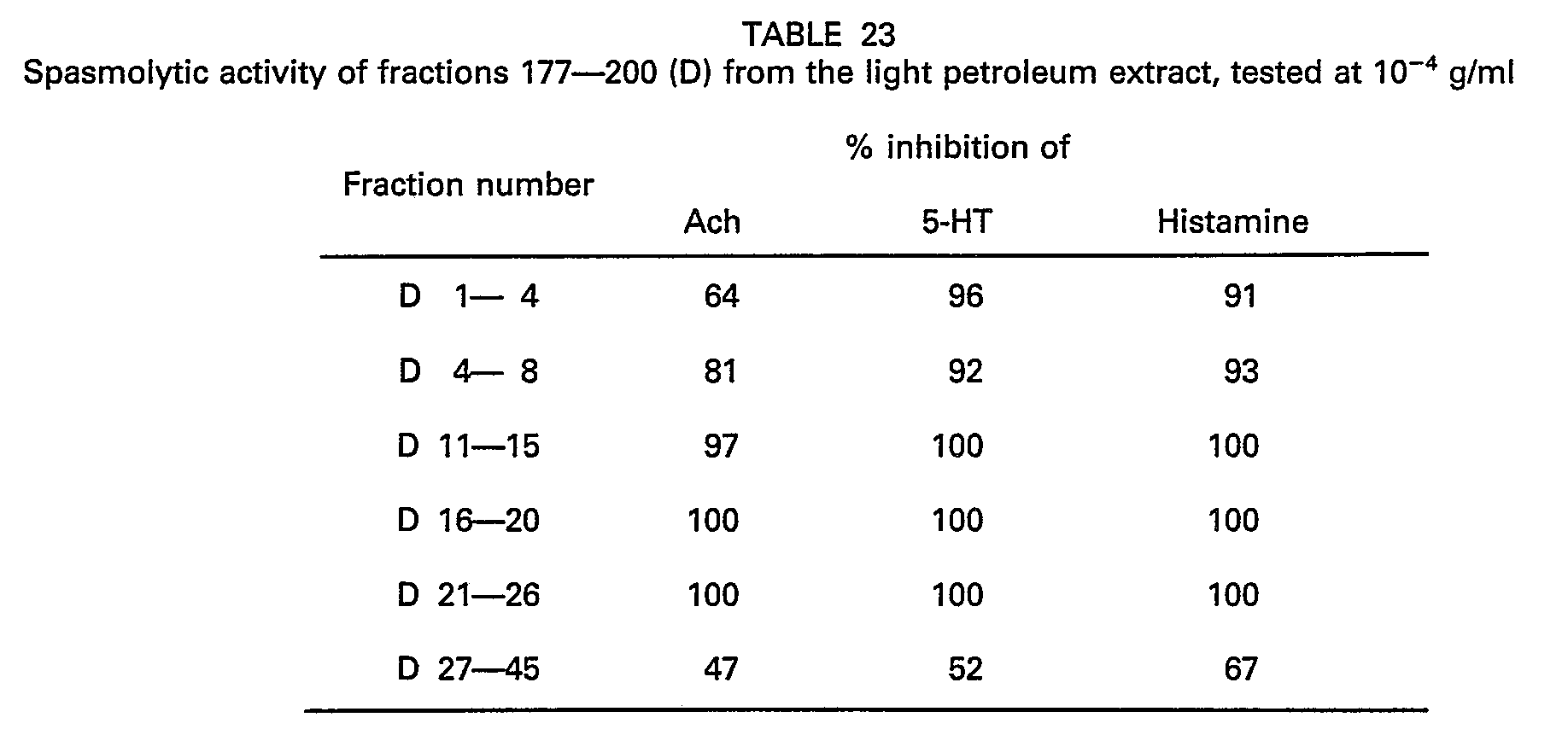
- Fractions 177-200 from the petroleum extract showed 100% inhibition of the two agonists 5-HT and histamine, and 81% inhibition of Ach.
- These fractions (0.729 g) were chromatographed on a silica gel column (30 g). 100 ml fractions were taken and combined as appropriate with reference to TLC. Solvent elution of the column and weights of the combined fractions are shown in Tables 21 and 22.


- Those fractions weighing more than 50 mg were tested for spasmolytic activity as described in Part 3 above. The results are as shown in Table 23.
- Fractions D 16-20 (0.175g) were further separated by preparative TLC using chloroform:methanol (95:5) as developing solvent. The plates were run three times. Three bands were located under ultraviolet light (254 nm) and their components extracted with chloroform. The major component, i.e. in
band 1, weighed 59 mg and crystallised from chloroform and methanol as colourless plates (26 mg) of DJ 154a, m.p. 248°; UV:


- Fractions D21-26 (0.110 g) were further separated by preparative TLC using chloroform:methanol (95:5) as developing solvent. The plates were run three times. Three bands were located under ultraviolet light (254 nm) and by spraying the edge of the plate with H2SO4 and heating. Their components were extracted with chloroform.
- The major component of fractions D 21-26, i.e. in band 2, crystallised from chloroform and hexane to give colourless needles (16 mg) of DJ156a, 4α,10β-dihydroxy-1β,5α-gui-11(13)-en-12,6α-olactone (partholide, ) m.p. 154°; UV:


- Fractions 119-123 from the petroleum extract showed 97% inhibition of 5-HT and histamine and 84% inhibition of Ach.
- These fractions (1.583 g) were chromatographed on a silica gel column (30 g). 100 ml fractions were taken and combined as appropriate with reference to TLC. Solvent elution of the column and weights of the combined fractions are shown in Tables 24 and 25.


- Those fractions weighing more than 50 mg were tested for spasmolytic activity as described in Part 3 above. The results are shown in Table 26.

- Fractions E 15-21 were combined and purified by TLC using chloroform : hexane (75:25) as developing solvent. The major component was extracted and identified as parthenolide by chromatographic comparison with an authentic specimen and by spectroscopic means.
- As can be seen from the above, extraction of feverfew with a non-polar solvent can provide fractions having high spasmolytic activity, from which fractions pure sesquiterpene lactones can be obtained.
- Compounds 140a, 156a and 177b which we believe have not been previously disclosed in the literature have the following mobilities in thin layer chromatography.

-

- The mixture is allowed to stand for 14 days with stirring for extraction of the active ingredients and then stabilized by:-

- The mixture is encapsulated into a soft shell capsule or hard shell capsule, representing a dose of 25 mg of dried leaf. This fills into a 7.5 oval soft shell capsule or a number 2 hard shell capsule with a target fill weight of 380.5 mg.
- In an alternative method, the mixture is strained and the resulting macerate, encapsulated as the oily extract, is stabilised with one or more of the above described suspending agents, into soft shell or two piece hard shell gelatin capsules.
-

- The mixture is allowed to stand for 14 days for extraction of the active ingredients.
- The resultant mixture is filtered and the filtrate encapsulated at a fill weight of 250 mg per unit dose, to represent approximately 25 mg of dried leaf in a soft shell or two piece hard shell capsule.
- In an alternative method the suspension or macerate is mixed with surfactive agents or mixtures thereof, such as polyethoxy fatty acid sorbitan esters, mono and di glycerides or acetylated glycerides, to form a self emulsifying system.
- The resultant formulation is encapsulated into a soft shell or two piece hard shell capsule.
- It is predicted that mixtures and dosages will enhance absorption of the oily active principles via the lymphatic system.
- The following are mixed:-
-

- These are mixed and encapsulated at a dosage fill weight of 415 mg into soft shell or two piece hard shell capsule, representing approximately 25 mg of dried feverfew leaf.
- The soft shell or two piece hard shell gelatin capsule may be used via the oral or rectal route.
- They may be treated to retard disintegration or absorption by the use of gastro resistant coatings, such as hydroxymethyl propyl cellulose or the content may be mixed with polymeric matrix materials as known to the pharmaceutical industry, to release the active principles at a controlled rate.
Claims (31)


Priority Applications (1)
| Application Number | Priority Date | Filing Date | Title |
|---|---|---|---|
| AT83302790T ATE45160T1 (en) | 1982-05-19 | 1983-05-17 | SESQUITERPEN LACTONES, EXTRACTS CONTAINING THESE, THEIR PREPARATION AND PHARMACEUTICAL USE. |
Applications Claiming Priority (4)
| Application Number | Priority Date | Filing Date | Title |
|---|---|---|---|
| GB8214572 | 1982-05-19 | ||
| GB8214572 | 1982-05-19 | ||
| GB8227062 | 1982-09-22 | ||
| GB8227062 | 1982-09-22 |
Publications (3)
| Publication Number | Publication Date |
|---|---|
| EP0098041A2 EP0098041A2 (en) | 1984-01-11 |
| EP0098041A3 EP0098041A3 (en) | 1984-12-12 |
| EP0098041B1 true EP0098041B1 (en) | 1989-08-02 |
Family
ID=26282867
Family Applications (1)
| Application Number | Title | Priority Date | Filing Date |
|---|---|---|---|
| EP83302790A Expired EP0098041B1 (en) | 1982-05-19 | 1983-05-17 | Sesquiterpene lactones, extracts containing them, their preparation and pharmaceutical use |
Country Status (13)
| Country | Link |
|---|---|
| US (1) | US4758433A (en) |
| EP (1) | EP0098041B1 (en) |
| KR (1) | KR840004511A (en) |
| AR (1) | AR230008A1 (en) |
| AU (1) | AU564371B2 (en) |
| CA (1) | CA1270843A (en) |
| DE (1) | DE3380306D1 (en) |
| DK (1) | DK219083A (en) |
| FI (1) | FI831740A7 (en) |
| GB (1) | GB2124486B (en) |
| IE (1) | IE55766B1 (en) |
| NO (1) | NO831762L (en) |
| NZ (1) | NZ204256A (en) |
Families Citing this family (36)
| Publication number | Priority date | Publication date | Assignee | Title |
|---|---|---|---|---|
| DE3635522A1 (en) * | 1986-10-18 | 1988-04-28 | Euro Celtique Sa | PHARMACEUTICAL COMPOSITION |
| MC2056A1 (en) * | 1987-12-23 | 1990-09-04 | Psoricur Ltd | THERAPEUTIC COMPOSITION AGAINST PSORIASIS, METHOD FOR THE PREPARATION THEREOF AND USE OF MEDICINAL PLANTS THEREOF |
| GB9100581D0 (en) * | 1991-01-11 | 1991-02-27 | Rhodes Technology | Method for the extraction of sesquiterpene lactones |
| DE4202657C2 (en) * | 1992-01-31 | 1995-10-12 | Schaper & Bruemmer Gmbh | Pharmaceutically active composition from Tanacetum parthenium and process for their extraction and medicament produced with the pharmaceutically active composition |
| US5278172A (en) * | 1992-07-24 | 1994-01-11 | Hennessey Richard K | Method and composition for treating tendon or joint inflammation using a vasodilator |
| US5576329A (en) * | 1992-07-24 | 1996-11-19 | Hennessey; Richard K. | Method for treating tendon or joint inflammation with papaverine HCL |
| CN1056142C (en) * | 1993-01-04 | 2000-09-06 | 昆明医学院第一附属医院 | The preparation method of hydrocalactone |
| CA2141126A1 (en) * | 1995-01-26 | 1996-07-27 | Natalie J. Lazarowych | Combinational drug for treating migraine and other illnesses |
| US6379714B1 (en) | 1995-04-14 | 2002-04-30 | Pharmaprint, Inc. | Pharmaceutical grade botanical drugs |
| US5665731A (en) * | 1995-06-07 | 1997-09-09 | Hennessey; Richard K. | Method and composition for treating with a vasodilator inflammation, bone loss and detachment of teeth as associated with periodontal |
| JP4346685B2 (en) * | 1996-10-21 | 2009-10-21 | ユーロビタ アクティーゼルスカブ | Pharmaceutical composition containing parthenium integrofolium or part or extract thereof or component thereof, use of such plant material for pharmaceutical production, and method for producing parthenium integrofolium extract |
| US5905089A (en) * | 1997-04-14 | 1999-05-18 | Board Of Supervisors Of Louisiana State University And Agricultural And Mechanical College | Use of sesquiterpene lactones for treatment of severe inflammatory disorders |
| US5972916A (en) * | 1997-07-14 | 1999-10-26 | Bristol-Myers Squibb Company | Compositions containing the nonprescription combination of acetaminophen, aspirin and caffeine to alleviate the pain and symptoms of migraine |
| WO1999033463A1 (en) * | 1997-12-23 | 1999-07-08 | Moser, René | SESQUITERPENE LACTONES SPECIFICALLY INHIBIT ACTIVATION OF NF-λB BY PREVENTING THE DEGRADATION OF IλB-α AND IλB-$g(b) |
| US6225339B1 (en) * | 1998-01-29 | 2001-05-01 | Pfizer Inc. | Terpenoid lactone compounds and their production process |
| US6068999A (en) * | 1998-06-25 | 2000-05-30 | Hendrix; Curt | Dietary supplement for supporting cerebrovascular tone and treating migraine headaches |
| US6221899B1 (en) | 1999-01-15 | 2001-04-24 | Pfizer Inc. | Terpenoid lactone compounds and their production process |
| US20030003170A1 (en) * | 2000-06-02 | 2003-01-02 | Theresa Callaghan | Method for the topical treatment and prevention of inflammatory disorders and related conditions using extracts of feverfew (Tanacetum parthenium) |
| ES2239010T3 (en) * | 1999-06-03 | 2005-09-16 | JOHNSON & JOHNSON CONSUMER FRANCE SAS | CHRYSANTHEMUM MATRICAIRE EXTRACTS (TANACETUM PARTHENIUM) USED AGAINST INFLAMMATORY DISORDERS. |
| IT1312342B1 (en) * | 1999-06-03 | 2002-04-15 | Indena Spa | TANACETUM PARTHENIUM EXTRACT SUBSTANTIALLY FREE OF GAMMALATTONI-ALFA-UNSATURI. |
| US6642243B1 (en) | 1999-07-22 | 2003-11-04 | Ashkan Imanzahrai | Migraine medicine and method for treating same |
| DE10015617A1 (en) * | 2000-03-29 | 2001-10-04 | Peter Laetzsch | Herbal composition for prophylaxis of migraine, headache, toothache and other recurrent pain, contains combination of feverfew and St. John's wort, |
| IN188857B (en) * | 2000-07-14 | 2002-11-16 | Govind Kane Dr Shantaram | |
| US20030077343A1 (en) * | 2001-03-16 | 2003-04-24 | Martin Katharine M. | Composition containing feverfew extract and use thereof |
| CN100539984C (en) * | 2001-03-16 | 2009-09-16 | 强生消费者公司 | Composition containing feverfew extract and its use |
| US20040086579A1 (en) * | 2002-11-05 | 2004-05-06 | Higgins James W. | Dietary supplement comprising parthenolide |
| US7192614B2 (en) | 2002-11-05 | 2007-03-20 | Gelstat Corporation | Compositions and methods of treatment to alleviate or prevent migrainous headaches and their associated symptoms |
| US20040219229A1 (en) * | 2003-04-30 | 2004-11-04 | Tim Clarot | Migraine relief composition and methods of using and forming same |
| US20040247706A1 (en) * | 2003-06-06 | 2004-12-09 | Roberts Stephen C. | Transdermal dietary supplement comprising parthenolide |
| US20040247705A1 (en) * | 2003-06-06 | 2004-12-09 | Roberts Stephen C. | Transdermal compositions and methods of treatment to alleviate or prevent migrainous headaches and their associated symptoms |
| US7678904B2 (en) | 2003-07-11 | 2010-03-16 | University Of Kentucky | Use of parthenolide derivatives as antileukemic and cytotoxic agents |
| US20050186269A1 (en) * | 2004-02-25 | 2005-08-25 | Udell Ronald G. | Stabilized feverfew formulations |
| US20060222722A1 (en) * | 2005-03-30 | 2006-10-05 | Roberts Stephen C | Sublingual methods of treatment to alleviate or prevent arthritis |
| EP2170324A4 (en) * | 2007-06-21 | 2010-11-03 | Puramed Bioscience Inc | Compositions and methods for treating and preventing migrainous headaches and associated symptoms |
| US10500182B2 (en) * | 2018-01-10 | 2019-12-10 | Robert Firger | Compositions of ketogenic sources, micronutrients and phytochemicals for prophylaxis and mitigation of migraine headache |
| CN109761994B (en) * | 2019-02-28 | 2021-06-29 | 中国科学院新疆理化技术研究所 | Norcarb-like guaiacol-type sesquiterpene lactone compounds and preparation method thereof |
-
1983
- 1983-05-16 CA CA000428228A patent/CA1270843A/en not_active Expired - Lifetime
- 1983-05-17 DK DK219083A patent/DK219083A/en not_active Application Discontinuation
- 1983-05-17 DE DE8383302790T patent/DE3380306D1/en not_active Expired
- 1983-05-17 GB GB08313530A patent/GB2124486B/en not_active Expired
- 1983-05-17 NZ NZ204256A patent/NZ204256A/en unknown
- 1983-05-17 EP EP83302790A patent/EP0098041B1/en not_active Expired
- 1983-05-18 NO NO831762A patent/NO831762L/en unknown
- 1983-05-18 IE IE1164/83A patent/IE55766B1/en not_active IP Right Cessation
- 1983-05-18 FI FI831740A patent/FI831740A7/en not_active Application Discontinuation
- 1983-05-18 AU AU14646/83A patent/AU564371B2/en not_active Expired
- 1983-05-19 KR KR1019830002209A patent/KR840004511A/en not_active Ceased
- 1983-05-19 AR AR293097A patent/AR230008A1/en active
-
1985
- 1985-06-26 US US06/749,008 patent/US4758433A/en not_active Expired - Lifetime
Non-Patent Citations (2)
| Title |
|---|
| Chemical Abstracts vol. 98, no. 25, 20 June 1983, Columbus, OH (US); F.BOHLMANN et al.: "Naturally occuring terpene derivatives. Part 454. Sesquiterpene lactones and other constituents from tanacetum parthenium", p. 319, no. 212794k * |
| Dictionary of organic compounds, 5th ed., Chapman & Hall (1982), pp. 1233,2738-2740, 2818, 2820 * |
Also Published As
| Publication number | Publication date |
|---|---|
| NO831762L (en) | 1983-11-21 |
| DK219083A (en) | 1983-11-20 |
| FI831740L (en) | 1983-11-20 |
| CA1270843A (en) | 1990-06-26 |
| GB8313530D0 (en) | 1983-06-22 |
| NZ204256A (en) | 1988-02-29 |
| EP0098041A3 (en) | 1984-12-12 |
| US4758433A (en) | 1988-07-19 |
| GB2124486A (en) | 1984-02-22 |
| DK219083D0 (en) | 1983-05-17 |
| EP0098041A2 (en) | 1984-01-11 |
| KR840004511A (en) | 1984-10-22 |
| AR230008A1 (en) | 1984-02-29 |
| GB2124486B (en) | 1986-07-16 |
| IE55766B1 (en) | 1991-01-16 |
| AU564371B2 (en) | 1987-08-13 |
| AU1464683A (en) | 1983-11-24 |
| DE3380306D1 (en) | 1989-09-07 |
| IE831164L (en) | 1983-11-19 |
| FI831740A7 (en) | 1983-11-20 |
| FI831740A0 (en) | 1983-05-18 |
Similar Documents
| Publication | Publication Date | Title |
|---|---|---|
| EP0098041A2 (en) | Sesquiterpene lactones, extracts containing them, their preparation and pharmaceutical use | |
| JP2929025B2 (en) | Macrocyclic lactones that inhibit cell growth | |
| Le Quesne et al. | Antitumour plants. Part 6. Novel modified germacranolides and other constituents of Eremanthus elaeagnus Schultz-Bip (Compositae) | |
| CA2985065A1 (en) | Hydrogenation of cannabis oil | |
| EP0210785A1 (en) | Process for obtaining proanthocyanidine A2, pharmaceutical compositions and their therapeutic use | |
| EP0402925B1 (en) | A method of isolating ginkgolides from the leaves of the ginkgo tree and purifying them | |
| US6737439B2 (en) | Aromatase inhibitors from Broussonetia papyrifera | |
| Ma et al. | Study of antimalarial activity of chemical constituents from Diospyros quaesita | |
| KR20130128677A (en) | Composition made of the compounds extracted from morus alba for prevention and treatment of cerebropathia | |
| EP1200444B1 (en) | Novel xanthone compounds, their preparation and use as medicament | |
| Abdel–Moneim et al. | Constituents of local plants | |
| JPS61289030A (en) | Novel antiulcer and quassinoids | |
| Park et al. | Chemical constituents from Buddleja officinalis and their inhibitory effects on nitric oxide production | |
| JPH0340012B2 (en) | ||
| Saiin et al. | Isolation and in vitro antimalarial activity of hexane extract from Thai Picrasma javanica B1 stembark | |
| CN113999245A (en) | Natural compound with anti-pancreatic cancer activity and separation method and application thereof | |
| US3203953A (en) | Lactone obtained from helenium sp. and derivatives thereof | |
| CN111233648B (en) | Double chalcone compound and preparation method and application thereof | |
| KR100475647B1 (en) | A composition for treating sexual dysfunction comprising an extract from sophora flavescens and compounds isolated therefrom | |
| JP2005041788A (en) | Component of orchidaceous plant and its application | |
| US5563167A (en) | Abruquinone derivatives and their uses | |
| JPH024790A (en) | Antiulcer agent | |
| US3978081A (en) | 11H,12H-[1]benzopyrano[2,3-b][1]benzopyran-11,12-dione and derivatives | |
| JPH06211826A (en) | Sesquiterpene compound and antiulcer agent containing the same | |
| JPH0665224A (en) | Lignan derivative |
Legal Events
| Date | Code | Title | Description |
|---|---|---|---|
| PUAI | Public reference made under article 153(3) epc to a published international application that has entered the european phase |
Free format text: ORIGINAL CODE: 0009012 |
|
| AK | Designated contracting states |
Designated state(s): AT BE CH DE FR GB IT LI LU NL SE |
|
| PUAL | Search report despatched |
Free format text: ORIGINAL CODE: 0009013 |
|
| AK | Designated contracting states |
Designated state(s): AT BE CH DE FR GB IT LI LU NL SE |
|
| RAP1 | Party data changed (applicant data changed or rights of an application transferred) |
Owner name: R.P. SCHERER CORPORATION |
|
| RIN1 | Information on inventor provided before grant (corrected) |
Inventor name: HYLANDS NEE JESSUP, DEBORAH MARGARET Inventor name: HYLANDS, PETER JOHN Inventor name: JOHNSON, EDWARD STEWART |
|
| 17P | Request for examination filed |
Effective date: 19850422 |
|
| 17Q | First examination report despatched |
Effective date: 19860414 |
|
| GRAA | (expected) grant |
Free format text: ORIGINAL CODE: 0009210 |
|
| AK | Designated contracting states |
Kind code of ref document: B1 Designated state(s): AT BE CH DE FR IT LI LU NL SE |
|
| REF | Corresponds to: |
Ref document number: 45160 Country of ref document: AT Date of ref document: 19890815 Kind code of ref document: T |
|
| REF | Corresponds to: |
Ref document number: 3380306 Country of ref document: DE Date of ref document: 19890907 |
|
| ITF | It: translation for a ep patent filed | ||
| ET | Fr: translation filed | ||
| PLBI | Opposition filed |
Free format text: ORIGINAL CODE: 0009260 |
|
| PG25 | Lapsed in a contracting state [announced via postgrant information from national office to epo] |
Ref country code: SE Effective date: 19900518 |
|
| 26 | Opposition filed |
Opponent name: SCHAPER & BRUEMMER GMBH & CO. KG Effective date: 19900428 |
|
| NLR1 | Nl: opposition has been filed with the epo |
Opponent name: SCHAPER & BRUEMMER GMBH & CO. KG |
|
| ITTA | It: last paid annual fee | ||
| PLBM | Termination of opposition procedure: date of legal effect published |
Free format text: ORIGINAL CODE: 0009276 |
|
| STAA | Information on the status of an ep patent application or granted ep patent |
Free format text: STATUS: OPPOSITION PROCEDURE CLOSED |
|
| 27C | Opposition proceedings terminated |
Effective date: 19911223 |
|
| NLR2 | Nl: decision of opposition | ||
| EPTA | Lu: last paid annual fee | ||
| EUG | Se: european patent has lapsed |
Ref document number: 83302790.7 Effective date: 19910115 |
|
| PGFP | Annual fee paid to national office [announced via postgrant information from national office to epo] |
Ref country code: FR Payment date: 20020501 Year of fee payment: 20 |
|
| PGFP | Annual fee paid to national office [announced via postgrant information from national office to epo] |
Ref country code: AT Payment date: 20020502 Year of fee payment: 20 |
|
| PGFP | Annual fee paid to national office [announced via postgrant information from national office to epo] |
Ref country code: CH Payment date: 20020503 Year of fee payment: 20 |
|
| PGFP | Annual fee paid to national office [announced via postgrant information from national office to epo] |
Ref country code: NL Payment date: 20020507 Year of fee payment: 20 |
|
| PGFP | Annual fee paid to national office [announced via postgrant information from national office to epo] |
Ref country code: DE Payment date: 20020520 Year of fee payment: 20 |
|
| PGFP | Annual fee paid to national office [announced via postgrant information from national office to epo] |
Ref country code: LU Payment date: 20020523 Year of fee payment: 20 |
|
| PGFP | Annual fee paid to national office [announced via postgrant information from national office to epo] |
Ref country code: BE Payment date: 20020711 Year of fee payment: 20 |
|
| PG25 | Lapsed in a contracting state [announced via postgrant information from national office to epo] |
Ref country code: LI Free format text: LAPSE BECAUSE OF EXPIRATION OF PROTECTION Effective date: 20030516 Ref country code: CH Free format text: LAPSE BECAUSE OF EXPIRATION OF PROTECTION Effective date: 20030516 |
|
| PG25 | Lapsed in a contracting state [announced via postgrant information from national office to epo] |
Ref country code: NL Free format text: LAPSE BECAUSE OF EXPIRATION OF PROTECTION Effective date: 20030517 Ref country code: LU Free format text: LAPSE BECAUSE OF EXPIRATION OF PROTECTION Effective date: 20030517 Ref country code: AT Free format text: LAPSE BECAUSE OF EXPIRATION OF PROTECTION Effective date: 20030517 |
|
| BE20 | Be: patent expired |
Owner name: *R.P. SCHERER CORP. Effective date: 20030517 |
|
| REG | Reference to a national code |
Ref country code: CH Ref legal event code: PL |
|
| NLV7 | Nl: ceased due to reaching the maximum lifetime of a patent |
Effective date: 20030517 |