EP0096069B1 - Phosphoanhydrite process - Google Patents
Phosphoanhydrite process Download PDFInfo
- Publication number
- EP0096069B1 EP0096069B1 EP83900373A EP83900373A EP0096069B1 EP 0096069 B1 EP0096069 B1 EP 0096069B1 EP 83900373 A EP83900373 A EP 83900373A EP 83900373 A EP83900373 A EP 83900373A EP 0096069 B1 EP0096069 B1 EP 0096069B1
- Authority
- EP
- European Patent Office
- Prior art keywords
- anhydrite
- slurry
- zone
- phosphoric acid
- gypsum
- Prior art date
- Legal status (The legal status is an assumption and is not a legal conclusion. Google has not performed a legal analysis and makes no representation as to the accuracy of the status listed.)
- Expired
Links
- 238000000034 method Methods 0.000 title claims description 44
- 230000008569 process Effects 0.000 title claims description 42
- OSGAYBCDTDRGGQ-UHFFFAOYSA-L calcium sulfate Chemical compound [Ca+2].[O-]S([O-])(=O)=O OSGAYBCDTDRGGQ-UHFFFAOYSA-L 0.000 claims description 120
- NBIIXXVUZAFLBC-UHFFFAOYSA-N Phosphoric acid Chemical compound OP(O)(O)=O NBIIXXVUZAFLBC-UHFFFAOYSA-N 0.000 claims description 108
- 229910052925 anhydrite Inorganic materials 0.000 claims description 64
- QAOWNCQODCNURD-UHFFFAOYSA-N Sulfuric acid Chemical compound OS(O)(=O)=O QAOWNCQODCNURD-UHFFFAOYSA-N 0.000 claims description 57
- 229910000147 aluminium phosphate Inorganic materials 0.000 claims description 52
- 229910052602 gypsum Inorganic materials 0.000 claims description 40
- 239000010440 gypsum Substances 0.000 claims description 40
- 239000002002 slurry Substances 0.000 claims description 37
- 238000002156 mixing Methods 0.000 claims description 31
- 239000002367 phosphate rock Substances 0.000 claims description 22
- 239000000047 product Substances 0.000 claims description 20
- 238000000926 separation method Methods 0.000 claims description 17
- 229910001868 water Inorganic materials 0.000 claims description 11
- 238000002425 crystallisation Methods 0.000 claims description 10
- 230000008025 crystallization Effects 0.000 claims description 10
- XLYOFNOQVPJJNP-UHFFFAOYSA-N water Substances O XLYOFNOQVPJJNP-UHFFFAOYSA-N 0.000 claims description 10
- 239000012065 filter cake Substances 0.000 claims description 8
- 239000007787 solid Substances 0.000 claims description 8
- PASHVRUKOFIRIK-UHFFFAOYSA-L calcium sulfate dihydrate Chemical compound O.O.[Ca+2].[O-]S([O-])(=O)=O PASHVRUKOFIRIK-UHFFFAOYSA-L 0.000 claims description 7
- 238000001914 filtration Methods 0.000 claims description 7
- QAOWNCQODCNURD-UHFFFAOYSA-L Sulfate Chemical compound [O-]S([O-])(=O)=O QAOWNCQODCNURD-UHFFFAOYSA-L 0.000 claims description 6
- 230000036571 hydration Effects 0.000 claims description 6
- 238000006703 hydration reaction Methods 0.000 claims description 6
- 239000002245 particle Substances 0.000 claims description 6
- 230000002285 radioactive effect Effects 0.000 claims description 4
- 239000000706 filtrate Substances 0.000 claims description 3
- 239000012264 purified product Substances 0.000 claims description 2
- 238000004064 recycling Methods 0.000 claims 1
- 239000013078 crystal Substances 0.000 description 26
- 150000004683 dihydrates Chemical group 0.000 description 12
- 238000006243 chemical reaction Methods 0.000 description 9
- 239000000203 mixture Substances 0.000 description 8
- 238000004519 manufacturing process Methods 0.000 description 7
- NBIIXXVUZAFLBC-UHFFFAOYSA-K phosphate Chemical compound [O-]P([O-])([O-])=O NBIIXXVUZAFLBC-UHFFFAOYSA-K 0.000 description 6
- 229910019142 PO4 Inorganic materials 0.000 description 4
- 239000002253 acid Substances 0.000 description 4
- 239000004035 construction material Substances 0.000 description 4
- 239000010452 phosphate Substances 0.000 description 4
- 239000000463 material Substances 0.000 description 3
- 239000011435 rock Substances 0.000 description 3
- 150000007513 acids Chemical class 0.000 description 2
- 238000013019 agitation Methods 0.000 description 2
- 230000004888 barrier function Effects 0.000 description 2
- 230000015572 biosynthetic process Effects 0.000 description 2
- 239000004566 building material Substances 0.000 description 2
- 238000010276 construction Methods 0.000 description 2
- 230000003247 decreasing effect Effects 0.000 description 2
- 239000003337 fertilizer Substances 0.000 description 2
- 239000012535 impurity Substances 0.000 description 2
- 239000012770 industrial material Substances 0.000 description 2
- 229940085991 phosphate ion Drugs 0.000 description 2
- 239000002244 precipitate Substances 0.000 description 2
- 238000001556 precipitation Methods 0.000 description 2
- 239000011541 reaction mixture Substances 0.000 description 2
- 238000001878 scanning electron micrograph Methods 0.000 description 2
- VYPSYNLAJGMNEJ-UHFFFAOYSA-N silicon dioxide Inorganic materials O=[Si]=O VYPSYNLAJGMNEJ-UHFFFAOYSA-N 0.000 description 2
- OYPRJOBELJOOCE-UHFFFAOYSA-N Calcium Chemical compound [Ca] OYPRJOBELJOOCE-UHFFFAOYSA-N 0.000 description 1
- BHPQYMZQTOCNFJ-UHFFFAOYSA-N Calcium cation Chemical compound [Ca+2] BHPQYMZQTOCNFJ-UHFFFAOYSA-N 0.000 description 1
- 239000005696 Diammonium phosphate Substances 0.000 description 1
- BPQQTUXANYXVAA-UHFFFAOYSA-N Orthosilicate Chemical compound [O-][Si]([O-])([O-])[O-] BPQQTUXANYXVAA-UHFFFAOYSA-N 0.000 description 1
- PMZURENOXWZQFD-UHFFFAOYSA-L Sodium Sulfate Chemical compound [Na+].[Na+].[O-]S([O-])(=O)=O PMZURENOXWZQFD-UHFFFAOYSA-L 0.000 description 1
- 238000002441 X-ray diffraction Methods 0.000 description 1
- 230000009471 action Effects 0.000 description 1
- 230000004913 activation Effects 0.000 description 1
- 150000008064 anhydrides Chemical class 0.000 description 1
- 229910052586 apatite Inorganic materials 0.000 description 1
- 238000009835 boiling Methods 0.000 description 1
- 229910052791 calcium Inorganic materials 0.000 description 1
- 239000011575 calcium Substances 0.000 description 1
- FUFJGUQYACFECW-UHFFFAOYSA-L calcium hydrogenphosphate Chemical compound [Ca+2].OP([O-])([O-])=O FUFJGUQYACFECW-UHFFFAOYSA-L 0.000 description 1
- 229910001424 calcium ion Inorganic materials 0.000 description 1
- 239000001506 calcium phosphate Substances 0.000 description 1
- 229910000389 calcium phosphate Inorganic materials 0.000 description 1
- 235000011010 calcium phosphates Nutrition 0.000 description 1
- ZHZFKLKREFECML-UHFFFAOYSA-L calcium;sulfate;hydrate Chemical class O.[Ca+2].[O-]S([O-])(=O)=O ZHZFKLKREFECML-UHFFFAOYSA-L 0.000 description 1
- 239000004568 cement Substances 0.000 description 1
- 238000000576 coating method Methods 0.000 description 1
- 238000010960 commercial process Methods 0.000 description 1
- 238000011109 contamination Methods 0.000 description 1
- 238000001816 cooling Methods 0.000 description 1
- 230000001419 dependent effect Effects 0.000 description 1
- MNNHAPBLZZVQHP-UHFFFAOYSA-N diammonium hydrogen phosphate Chemical compound [NH4+].[NH4+].OP([O-])([O-])=O MNNHAPBLZZVQHP-UHFFFAOYSA-N 0.000 description 1
- 229910000388 diammonium phosphate Inorganic materials 0.000 description 1
- 235000019838 diammonium phosphate Nutrition 0.000 description 1
- 230000029087 digestion Effects 0.000 description 1
- 238000004090 dissolution Methods 0.000 description 1
- 238000001035 drying Methods 0.000 description 1
- 238000005265 energy consumption Methods 0.000 description 1
- 239000000499 gel Substances 0.000 description 1
- 230000000887 hydrating effect Effects 0.000 description 1
- 229910052739 hydrogen Inorganic materials 0.000 description 1
- 239000001257 hydrogen Substances 0.000 description 1
- 239000004615 ingredient Substances 0.000 description 1
- 230000004048 modification Effects 0.000 description 1
- 238000012986 modification Methods 0.000 description 1
- VSIIXMUUUJUKCM-UHFFFAOYSA-D pentacalcium;fluoride;triphosphate Chemical compound [F-].[Ca+2].[Ca+2].[Ca+2].[Ca+2].[Ca+2].[O-]P([O-])([O-])=O.[O-]P([O-])([O-])=O.[O-]P([O-])([O-])=O VSIIXMUUUJUKCM-UHFFFAOYSA-D 0.000 description 1
- YXJYBPXSEKMEEJ-UHFFFAOYSA-N phosphoric acid;sulfuric acid Chemical compound OP(O)(O)=O.OS(O)(=O)=O YXJYBPXSEKMEEJ-UHFFFAOYSA-N 0.000 description 1
- 229910052705 radium Inorganic materials 0.000 description 1
- HCWPIIXVSYCSAN-UHFFFAOYSA-N radium atom Chemical compound [Ra] HCWPIIXVSYCSAN-UHFFFAOYSA-N 0.000 description 1
- 230000035484 reaction time Effects 0.000 description 1
- 238000001953 recrystallisation Methods 0.000 description 1
- 229910052938 sodium sulfate Inorganic materials 0.000 description 1
- 235000011152 sodium sulphate Nutrition 0.000 description 1
- QORWJWZARLRLPR-UHFFFAOYSA-H tricalcium bis(phosphate) Chemical compound [Ca+2].[Ca+2].[Ca+2].[O-]P([O-])([O-])=O.[O-]P([O-])([O-])=O QORWJWZARLRLPR-UHFFFAOYSA-H 0.000 description 1
- 238000005406 washing Methods 0.000 description 1
- 239000002699 waste material Substances 0.000 description 1
- 229910021489 α-quartz Inorganic materials 0.000 description 1
Images


Classifications
-
- C—CHEMISTRY; METALLURGY
- C01—INORGANIC CHEMISTRY
- C01B—NON-METALLIC ELEMENTS; COMPOUNDS THEREOF; METALLOIDS OR COMPOUNDS THEREOF NOT COVERED BY SUBCLASS C01C
- C01B25/00—Phosphorus; Compounds thereof
- C01B25/16—Oxyacids of phosphorus; Salts thereof
- C01B25/18—Phosphoric acid
- C01B25/22—Preparation by reacting phosphate-containing material with an acid, e.g. wet process
- C01B25/222—Preparation by reacting phosphate-containing material with an acid, e.g. wet process with sulfuric acid, a mixture of acids mainly consisting of sulfuric acid or a mixture of compounds forming it in situ, e.g. a mixture of sulfur dioxide, water and oxygen
- C01B25/223—Preparation by reacting phosphate-containing material with an acid, e.g. wet process with sulfuric acid, a mixture of acids mainly consisting of sulfuric acid or a mixture of compounds forming it in situ, e.g. a mixture of sulfur dioxide, water and oxygen only one form of calcium sulfate being formed
-
- C—CHEMISTRY; METALLURGY
- C01—INORGANIC CHEMISTRY
- C01B—NON-METALLIC ELEMENTS; COMPOUNDS THEREOF; METALLOIDS OR COMPOUNDS THEREOF NOT COVERED BY SUBCLASS C01C
- C01B25/00—Phosphorus; Compounds thereof
- C01B25/16—Oxyacids of phosphorus; Salts thereof
- C01B25/18—Phosphoric acid
- C01B25/22—Preparation by reacting phosphate-containing material with an acid, e.g. wet process
- C01B25/222—Preparation by reacting phosphate-containing material with an acid, e.g. wet process with sulfuric acid, a mixture of acids mainly consisting of sulfuric acid or a mixture of compounds forming it in situ, e.g. a mixture of sulfur dioxide, water and oxygen
- C01B25/223—Preparation by reacting phosphate-containing material with an acid, e.g. wet process with sulfuric acid, a mixture of acids mainly consisting of sulfuric acid or a mixture of compounds forming it in situ, e.g. a mixture of sulfur dioxide, water and oxygen only one form of calcium sulfate being formed
- C01B25/2235—Anhydrite processes
-
- C—CHEMISTRY; METALLURGY
- C01—INORGANIC CHEMISTRY
- C01B—NON-METALLIC ELEMENTS; COMPOUNDS THEREOF; METALLOIDS OR COMPOUNDS THEREOF NOT COVERED BY SUBCLASS C01C
- C01B25/00—Phosphorus; Compounds thereof
- C01B25/16—Oxyacids of phosphorus; Salts thereof
- C01B25/18—Phosphoric acid
- C01B25/22—Preparation by reacting phosphate-containing material with an acid, e.g. wet process
- C01B25/222—Preparation by reacting phosphate-containing material with an acid, e.g. wet process with sulfuric acid, a mixture of acids mainly consisting of sulfuric acid or a mixture of compounds forming it in situ, e.g. a mixture of sulfur dioxide, water and oxygen
- C01B25/228—Preparation by reacting phosphate-containing material with an acid, e.g. wet process with sulfuric acid, a mixture of acids mainly consisting of sulfuric acid or a mixture of compounds forming it in situ, e.g. a mixture of sulfur dioxide, water and oxygen one form of calcium sulfate being formed and then converted to another form
-
- C—CHEMISTRY; METALLURGY
- C01—INORGANIC CHEMISTRY
- C01F—COMPOUNDS OF THE METALS BERYLLIUM, MAGNESIUM, ALUMINIUM, CALCIUM, STRONTIUM, BARIUM, RADIUM, THORIUM, OR OF THE RARE-EARTH METALS
- C01F11/00—Compounds of calcium, strontium, or barium
- C01F11/46—Sulfates
- C01F11/466—Conversion of one form of calcium sulfate to another
-
- C—CHEMISTRY; METALLURGY
- C01—INORGANIC CHEMISTRY
- C01P—INDEXING SCHEME RELATING TO STRUCTURAL AND PHYSICAL ASPECTS OF SOLID INORGANIC COMPOUNDS
- C01P2004/00—Particle morphology
- C01P2004/60—Particles characterised by their size
- C01P2004/61—Micrometer sized, i.e. from 1-100 micrometer
Definitions
- the present invention relates to the production of phosphoric acid and more particularly refers to an improved wet process for converting phosphate rock into a concentrated phosphoric acid with concomitant production of an improved calcium sulfate.
- the phosphogypsum becomes unstable during operations so that increased amounts of the metastable hemihydrate are formed, with attendant hardening and setting up in mixing vessels and greatly increased reaction times. Further concentration of the phosphoric acid to more concentrated products requires energy intensive and expensive evaporators. A phosphoric acid of about 42% P 2 0 5 (60% H 3 P0 4 ) is needed because fertilizer manufacturers use this concentration to make diammonium phosphate.
- a less commercially attractive variant on the wet process is the hemihydrate process.
- the hemihydrate processes may be useful in obtaining a calcium sulfate for building materials manufacture.
- the operator must be careful that the filters do not cool since the hemihydrate can set to gypsum. Then jackhammers are needed to remove it.
- the hemihydrate product is objectionable because impurities such as radium in the ore and excess phosphoric acid are carried over into the hemihydrate.
- the phosphoric acid product about 32% P 2 0 5 , must be concentrated for fertilizer production.
- phosphoanhydrite can possibly be produced in a phosphoric acid attack system provided the temperature and concentration of the acids are sufficiently high, about 135°C and about 80% H 3 PO 4 .
- anhydride could be made at 95-100°C in a mixture of 42% P 2 0 5 phosphoric acid and 3-3.5% sulfuric acid; or at 85-90°C in the presence of 48-52% P 2 0 5 phosphoric acid.
- U.S. patent 2,531,977 discloses a dihydrate wet process for producing phosphoric acid with the suggestion that the phosphogypsum obtained be thereafter treated with 15-33% sulfuric acid at a temperature of from 60°C to the boiling point of sulfuric acid solution for periods of more than 30 minutes (generally 2-3 hours) to obtain a calcium sulfate anhydrite. None is known about the purity or practical usability of this anhydrite.
- US-A-2710247 discloses a process for producing phosphoric acid and calcium sulfate from phosphate rock which comprises:
- One object of the present invention is to provide a process for economically and efficiently producing increased yields of strong phosphoric acid.
- Strong phosphoric acid as defined herein is phosphoric acid of at least about 35% P 2 0 5 (48% H 3 P0 4 ), and preferably about 42% P 2 0 1 (60% H 3 P0 4 ), content.
- Another object of this invention is the production of a phosphoanhydrite which may be converted to gypsum products useful in the construction and building materials industry.
- a process for producing phosphoric acid and calcium sulfate from phosphate rock which comprises:
- the slurry withdrawn from the first separation zone may be passed to a second filtering separation zone to separate coarse calcium sulfate anhydrite filter cake and a slurry of fine anhydrite seed in phosphoric acid filtrate which may be returned to the mixing zone.
- the anhydrite filter cake may be passed to a crystallization zone to hydrate a substantial portion but not all of the anhydrite to coarse phosphogypsum; and a portion of the phosphogypsum may be separated as purified product gypsum.
- the anhydrite filter cake may be continuously passed to a crystallization zone
- the anhydrite charged to the mixing zone may be about 5-15 micrometers particle size.
- a portion of the phosphoanhydrite can thus be separated by series separation from the recycle slurry, and mixed with additional sulfuric acid and a sulfate hydration accelerator plus a large proportion by weight of dihydrate seed crystals to convert the phosphanhydrite to a purified gypsum product of low radioactivity.
- Figure 1 is a plot of phosphoric acid concentrations, with approximately 1.5% sulfuric acid present versus temperature showing the states of hydration of the calcium sulfate and the area of interest in the present invention (Region II) in heavier lines.
- Figure 2 is a labelled flow sheet diagrammatically illustrating the various vessels, all of which are conventional, employed in the process; and
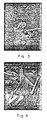
- Figures 3-5 are scanning electron microphotographs of various calcium sulfate products produced by the present invention.
- the rate of calcium sulfate crystal growth is proportional to the supersaturation level of a high concentration of reacting calcium and sulfate ions.
- the solids deposited per unit of time is proportional to the available crystal surface area (or for a given crystal seed, its specific surface), a low water content (i.e., a high P Z O S phosphoric acid concentration) and high temperature.
- Region I the dissolution of finely divided phosphate rock takes place through the dissolving action of phosphoric acid, and to some degree sulfuric acid.
- the calcium ion that is brought into solution in this region combines with sulfate ion to precipitate the unstable hemihydrate.
- This hemihydrate in turn dissolves and recrystallizes as the dihydrate, particularly if dihydrate seed crystals are available for surface precipitation. This region is where most commercial processes operate. However, above the practical 28-32% P 2 0 5 concentrations and 75°-80°C for the dihydrate process, the calcium sulfate dihydrate becomes unstable and increasing amounts of the metastable hemihydrate are formed, especially if large amounts of hemihydrate seed crystals are present. Again, conversion of the hemihydrate to a stable insoluble anhydrite is slow.
- region II along the border to region III of Figure 1 the conditions are sufficient to precipitate anhydrite on an insoluble anhydrite seed crystal, and any hemihydrate will readily convert to anhydrite since the hemihydrate phase is unstable.
- the rate of precipitation is dependent upon the temperature, solution agitation, surface area of seed crystals, solids content of the mixture, sulfuric acid concentration and the time allowed for phosphate rock accidulation and anhydrite recrystallization.
- the process of the present invention should be operated in the leach zone at a temperature between about 60°C and about 110°C, preferably about 75-95°C. Substantially below about 75°C, increased cooling capacity would be needed and sufficient hemihydrate would be formed to interfere with the process. Substantially above 95°C is undesirable for additional heat would be needed to maintain the reaction.
- Sufficient solution agitation is accomplished in conventional mixing vessels for phosphate ore or rock digestion.
- the process may be carried out in either multitank digesters or a single tank system with multiple zones, compartments or cells.
- the preferred anhydrite seed crystals have an optimum mean particle size of about 1-10 micrometers, more preferably 1-4 micrometers.
- the seed crystals may be derived from any origin, but preferably are recycle product for continuous operation.
- the anhydrite seed crystal recycle rate is preferably about 20:1 to 100:1, and more preferably about 60:1-80:1, by weight, of anhydrite to phosphate rock ore. At substantially less than about 20:1 in region II of Figure 1, hemihydrate seed crystals precipitate. Above about 100:1 recycle, the time for reaction becomes excessive. Maintaining this ratio is readily accomplished by controlling the metering of ore into the mixing zone. If the ore is metered too fast then some hemihydrate formation occurs, and there is insufficient balancing of the reaction conditions to overcome the energy barrier shift from the metastable hemihydrate to the anhydrite.
- the "free", excess above stoichiometric, sulfuric acid concentration in the present process ranges from about 1 to 4%, with about 1.5-2% being optimum. If substantially less than 1% free sulfuric acid is present, the accidulation rate of the ore is decreased and the phosphate ore particles tend to become encapsulated with relatively insoluble dicalcium orthophosphate. Also, increasing amounts of silicate gels are formed, which interfere with calcium sulfate crystal growth. Above about 4% free sulfuric acid, the accidulation rate of the ore is also decreased and the ore particles tend to become encapsulated with calcium sulfate coatings.
- the mixture In the digesting zone, as shown in Figure 2, generally from 3-10 mixing cells are utilized in the practice of the present process.
- the mixture Upon mixing the phosphate rock, recycle and any makeup feed materials, the mixture constitutes a slurry of about 20-50% solids. At substantially less than 20% solids, more phosphate ion is co-precipitated with calcium sulfate thus causing phosphate loss in the process; while above 50% solids, the slurry is difficult to mix.
- the slurry has about 62-73% total phosphoric acid and sulfuric acid content in the proportions indicated hereinabove.
- the slurry After digesting the rock, as shown in Figure 2, the slurry passes to a filter to separate the desirable phosphoric acid product from a recycle slurry of anhydrite filter cake and residual phosphoric acid.
- a portion of the recycle slurry may be converted to calcium sulfate suitable for use in industrial products by filtering, washing, passing the anhydrite to a hydrating section, preferably 1-3 mixing cells, and thereafter, a series separation by conventional means produces a coarse dihydrate product suitable for use in gypsum materials, small sized anhydrite relics containing impurities, and clarified filtrate for recycle.
- Phosphoanhydrite (CaS0 4 ) and strong phosphoric acid were produced by the process of the invention by the acidulation of phosphate rock ore with a phosphoric acid-sulfuric acid mix containing a very high recycle content of anhydrite seed crystals.
- the reaction mixture fed to the digesters comprised 44% P 2 0, phosphoric acid (60.7% H 3 P0 4 ) and 1.5% H 2 SO 4 . At these acid concentrations, essentially all water is tied up through hydrogen bonding to the acids so that little or no water is available to form calcium sulfate hydrates.
- the acid mixture contained 5% anhydrite solids as seed crystals.
- the temperature of the reaction mixture was 85°C, which put the reaction conditions well into Region II in Figure 1 where anhydrite is stable.
- the co-produced phosphoanhydrite may be disposed of or alternatively, converted into useful gypsum products. It may be suitable as is, for example as an ingredient in construction materials such as a Keene's cement. However, if the original phosphate rock contained considerable radioactive matter it may not be suitable. In that case it is preferred to remove such contamination by various means.
- the phosphoanhydrite obtained by this process is formed into a slurry with about 1-20% accelerator or accelerator mixture (such as 1.5 weight % sulfuric acid and 1.5 weight % sodium sulfate) and substantial proportions of coarse purified gypsum recycle seed crystals (such as about 40 micrometers sized gypsum in 40:1 to 100:1 weight proportions of seed gypsum to anhydrite).
- accelerator or accelerator mixture such as 1.5 weight % sulfuric acid and 1.5 weight % sodium sulfate
- coarse purified gypsum recycle seed crystals such as about 40 micrometers sized gypsum in 40:1 to 100:1 weight proportions of seed gypsum to anhydrite.
- the slurry is allowed to hydrate about 30% to 95% of the anhydrite, Figure 3 (leaving about 70-5% anhydrite relic unrehydrated) depending upon the level of radioactivity in the anhydrite, yielding gypsum crystals, illustrated in Figure 4 of about 30-1 00 micrometers, say 40 and 100 micrometers, (preferably greater than about 50 micrometers).
- the particle size of remaining anhydrite crystal not rehydrated is about 5-25 micrometers. These are readily separated by conventional equipment to a substantially radium- free gypsum.
- the anhydrite filter cake may be continuously passed to a crystallization zone;
- the recovered gypsum is suitable for conventional processing in the manufacture of gypsum wallboard, gypsum plasters and other gypsum products.
Landscapes
- Chemical & Material Sciences (AREA)
- Organic Chemistry (AREA)
- Inorganic Chemistry (AREA)
- Life Sciences & Earth Sciences (AREA)
- Geology (AREA)
- Compounds Of Alkaline-Earth Elements, Aluminum Or Rare-Earth Metals (AREA)
- Saccharide Compounds (AREA)
- Low-Molecular Organic Synthesis Reactions Using Catalysts (AREA)
Description
- The present invention relates to the production of phosphoric acid and more particularly refers to an improved wet process for converting phosphate rock into a concentrated phosphoric acid with concomitant production of an improved calcium sulfate.
- In conventional wet methods of producing phosphoric acid, finely divided phosphate rock is digested with a mixture of phosphoric acid, sulfuric acid and water causing a reaction between the calcium phosphate in the rock and the sulfuric acid to produce phosphoric acid and a precipitate of calcium sulfate (either the anhydrite form - CaS04 with no water of hydration; the hemihydrate form - CaS04.2H20; or the dihydrate form - CaS04.2H20). Over the years numerous improvements and refinements in these methods have been proposed, many of which are described in Phosphoric Acid edited by A. V. Slack (published by Marcel Dekker, Inc., New York, 1968). Many of these refinements are directed to producing the calcium sulfate co-product in various forms.
- Most wet processes are directed to producing the calcium sulfate product in the dihydrate form, or phosphogypsum. In most commercial operations, the plants are run at about 75--80°C and 30% P20, in the leach zone. Here the reaction of sulfuric acid and apatite (phosphate rock) is over in about 15 minutes. However, a residence time of about 4 hours is needed for gypsum crystal growth to sufficiently large crystals for filtration. Generally, the practial maximum P2O5 concentration of the phosphoric acid for a dihydrate process is around 29-30% (40-41% H3PO4), which must subsequently be concentrated to high levels, while the operational temperature is about 75-80°C. Above these temperatures and P205 concentration limits, the phosphogypsum becomes unstable during operations so that increased amounts of the metastable hemihydrate are formed, with attendant hardening and setting up in mixing vessels and greatly increased reaction times. Further concentration of the phosphoric acid to more concentrated products requires energy intensive and expensive evaporators. A phosphoric acid of about 42% P205 (60% H3P04) is needed because fertilizer manufacturers use this concentration to make diammonium phosphate.
- A less commercially attractive variant on the wet process is the hemihydrate process. The hemihydrate processes may be useful in obtaining a calcium sulfate for building materials manufacture. However, the operator must be careful that the filters do not cool since the hemihydrate can set to gypsum. Then jackhammers are needed to remove it. Further, the hemihydrate product is objectionable because impurities such as radium in the ore and excess phosphoric acid are carried over into the hemihydrate. Here again, the phosphoric acid product, about 32% P205, must be concentrated for fertilizer production.
- According to data published in the Slack text volume 1 part 1, in an article on hemihydrate and anhydrite processes in Europe by P. M. R. Ver- steegh and J. T. Boontje, phosphoanhydrite can possibly be produced in a phosphoric acid attack system provided the temperature and concentration of the acids are sufficiently high, about 135°C and about 80% H3PO4. For example, it is there proposed that anhydride could be made at 95-100°C in a mixture of 42% P205 phosphoric acid and 3-3.5% sulfuric acid; or at 85-90°C in the presence of 48-52% P205 phosphoric acid. In the first case, a 75-82% sulfuric acid would be required; and in the second case, a 78% sulfuric acid would be required for the phosphate rock in the leach zone. The reference appears devoid of any mention of using anhydrite seed crystal in the proposed processes.
- U.S. patent 2,531,977 discloses a dihydrate wet process for producing phosphoric acid with the suggestion that the phosphogypsum obtained be thereafter treated with 15-33% sulfuric acid at a temperature of from 60°C to the boiling point of sulfuric acid solution for periods of more than 30 minutes (generally 2-3 hours) to obtain a calcium sulfate anhydrite. Nothing is known about the purity or practical usability of this anhydrite.
- US-A-2710247 discloses a process for producing phosphoric acid and calcium sulfate from phosphate rock which comprises:
- feeding finely divided phosphate rock, sulfuric acid, phosphoric acid, water and anhydrite seed to a mixing zone and mixing them to form a slurry comprising 45% and more P205, the mixing temperature being 100-1100C in the range 45-50% P2O5. The leach slurry is then withdrawn from the mixing zone and passed to a filtering separation zone to separate and recover a strong phosphoric acid, and recycle to the mixing zone calcium sulfate anhydrite and phosphoric acid from the separation zone.
- However these prior disclosures require a high energy consumption and expensive equipment.
- There is thus a need at the present time to provide improved processes for reducing the energy requirements and equipment capitalization expenses in phosphoric acid production; further to provide economic means of obtaining higher P205 content phosphoric acid product; and further to provide processes which convert the previous "waste" calcium sulfate co-product into material acceptable for commercial utilization in gypsum board and other industrial and construction materials.
- One object of the present invention is to provide a process for economically and efficiently producing increased yields of strong phosphoric acid. Strong phosphoric acid as defined herein is phosphoric acid of at least about 35% P205 (48% H3P04), and preferably about 42% P201 (60% H3P04), content.
- Another object of this invention is the production of a phosphoanhydrite which may be converted to gypsum products useful in the construction and building materials industry.
- It has been discovered that there is a very narrow range of temperature and phosphoric acid and sulfuric acid concentration conditions wherein a very stable insoluble anhydrite is produced; and further, that in the presence of large amounts of recycle anhydrite seed crystals, the rate of anhydrite crystallization is very rapid. In addition, it has also been found that, in a separate reactor under certain conditions, particularly including a large proportion of dihydrate seed crystals, the phosphoanhydrite may be rapidly converted to a gypsum product suitable for use in construction and industrial materials.
- According to the invention there is provided a process for producing phosphoric acid and calcium sulfate from phosphate rock which comprises:
- continuously feeding finely divided phosphate rock, sulfuric acid, phosphoric acid, water and anhydrite seed to a mixing zone and mixing them to form a slurry; characterised by
- the quantities charged to the mixing zone being such as to provide a slurry comprising about 20-50 weight % total solids, about 62-73 weight % total phosphoric acid and sulfuric acid content with about 1--4 weight % sulfuric acid, and about 10:1-100:1 by weight of anhydrite seed to phosphate rock, and mixing at a temperature between about 60° and 110°C;
- by continuously withdrawing a leach slurry from said mixing zone and passing it to a first filtering separation zone to separate calcium sulfate slurry and phosphoric acid;
- by recovering a strong phosphoric acid (as herein defined) from the first separation zone; and
- by recovering a slurry of calcium sulfate anhydrite in phosphoric acid from the first separation zone and returning it to the mixing zone.
- The slurry withdrawn from the first separation zone may be passed to a second filtering separation zone to separate coarse calcium sulfate anhydrite filter cake and a slurry of fine anhydrite seed in phosphoric acid filtrate which may be returned to the mixing zone.
- The anhydrite filter cake may be passed to a crystallization zone to hydrate a substantial portion but not all of the anhydrite to coarse phosphogypsum; and a portion of the phosphogypsum may be separated as purified product gypsum.
- The anhydrite filter cake may be continuously passed to a crystallization zone;
- may be mixed in the crystallization zone at a temperature between ambient and 40°C with seed gypsum and soluble sulfate hydration accelerator to form a slurry,
- the quantities charged in the crystallizing zone may be such as to provide a slurry comprising by weight about 1-20% accelerator and about 1:10 to 10:1 proportions of coarse gypsum to anhydrite, said coarse gypsum being all at least about 30 um;
- the slurry may be continuously passed to a third separation zone to separate fine anhydrite relic and coarse gypsum;
- fine anhydrite relic contaminated with radioactive matter may be recovered and passed to disposal;
- about 30-90% by weight proportion of the coarse gypsum may be recovered as product purified gypsum; and
- about 70-10% by weight proportion of the coarse gypsum may be recovered and recycled to the crystallizing zone.
- The anhydrite charged to the mixing zone may be about 5-15 micrometers particle size.
- A portion of the phosphoanhydrite can thus be separated by series separation from the recycle slurry, and mixed with additional sulfuric acid and a sulfate hydration accelerator plus a large proportion by weight of dihydrate seed crystals to convert the phosphanhydrite to a purified gypsum product of low radioactivity.
- Figure 1 is a plot of phosphoric acid concentrations, with approximately 1.5% sulfuric acid present versus temperature showing the states of hydration of the calcium sulfate and the area of interest in the present invention (Region II) in heavier lines. Figure 2 is a labelled flow sheet diagrammatically illustrating the various vessels, all of which are conventional, employed in the process; and Figures 3-5 are scanning electron microphotographs of various calcium sulfate products produced by the present invention.
- It is theorized that all phosphoric acid processes of the wet process type are carried out under conditions wherein an insoluble anhydrite is the thermodynamically stable form of calcium sulfate. The crystal states actually precipitated, however, in most commercial wet processes are the metastable varieties, the hemihydrate and dihydrate. Conversion of these into the stable anhydrite modification under the conditions prevailing in the dihydrate and hemihydrate wet processes is extremely slow. This is because the activation energy required to cross the energy barrier for conversion is very high.
- Referring to Figure 1, under practical process conditions in wet processes for producing phosphoric acid, the rate of calcium sulfate crystal growth is proportional to the supersaturation level of a high concentration of reacting calcium and sulfate ions. The solids deposited per unit of time is proportional to the available crystal surface area (or for a given crystal seed, its specific surface), a low water content (i.e., a high PZOS phosphoric acid concentration) and high temperature. In Region I, the dissolution of finely divided phosphate rock takes place through the dissolving action of phosphoric acid, and to some degree sulfuric acid. The calcium ion that is brought into solution in this region combines with sulfate ion to precipitate the unstable hemihydrate. This hemihydrate in turn dissolves and recrystallizes as the dihydrate, particularly if dihydrate seed crystals are available for surface precipitation. This region is where most commercial processes operate. However, above the practical 28-32% P205 concentrations and 75°-80°C for the dihydrate process, the calcium sulfate dihydrate becomes unstable and increasing amounts of the metastable hemihydrate are formed, especially if large amounts of hemihydrate seed crystals are present. Again, conversion of the hemihydrate to a stable insoluble anhydrite is slow. In region II along the border to region III of Figure 1, the conditions are sufficient to precipitate anhydrite on an insoluble anhydrite seed crystal, and any hemihydrate will readily convert to anhydrite since the hemihydrate phase is unstable. The rate of precipitation is dependent upon the temperature, solution agitation, surface area of seed crystals, solids content of the mixture, sulfuric acid concentration and the time allowed for phosphate rock accidulation and anhydrite recrystallization.
- The process of the present invention should be operated in the leach zone at a temperature between about 60°C and about 110°C, preferably about 75-95°C. Substantially below about 75°C, increased cooling capacity would be needed and sufficient hemihydrate would be formed to interfere with the process. Substantially above 95°C is undesirable for additional heat would be needed to maintain the reaction.
- Sufficient solution agitation is accomplished in conventional mixing vessels for phosphate ore or rock digestion. The process may be carried out in either multitank digesters or a single tank system with multiple zones, compartments or cells.
- The preferred anhydrite seed crystals have an optimum mean particle size of about 1-10 micrometers, more preferably 1-4 micrometers. The seed crystals may be derived from any origin, but preferably are recycle product for continuous operation.
- The anhydrite seed crystal recycle rate is preferably about 20:1 to 100:1, and more preferably about 60:1-80:1, by weight, of anhydrite to phosphate rock ore. At substantially less than about 20:1 in region II of Figure 1, hemihydrate seed crystals precipitate. Above about 100:1 recycle, the time for reaction becomes excessive. Maintaining this ratio is readily accomplished by controlling the metering of ore into the mixing zone. If the ore is metered too fast then some hemihydrate formation occurs, and there is insufficient balancing of the reaction conditions to overcome the energy barrier shift from the metastable hemihydrate to the anhydrite.
- The "free", excess above stoichiometric, sulfuric acid concentration in the present process ranges from about 1 to 4%, with about 1.5-2% being optimum. If substantially less than 1% free sulfuric acid is present, the accidulation rate of the ore is decreased and the phosphate ore particles tend to become encapsulated with relatively insoluble dicalcium orthophosphate. Also, increasing amounts of silicate gels are formed, which interfere with calcium sulfate crystal growth. Above about 4% free sulfuric acid, the accidulation rate of the ore is also decreased and the ore particles tend to become encapsulated with calcium sulfate coatings.
- In the digesting zone, as shown in Figure 2, generally from 3-10 mixing cells are utilized in the practice of the present process. Upon mixing the phosphate rock, recycle and any makeup feed materials, the mixture constitutes a slurry of about 20-50% solids. At substantially less than 20% solids, more phosphate ion is co-precipitated with calcium sulfate thus causing phosphate loss in the process; while above 50% solids, the slurry is difficult to mix. The slurry has about 62-73% total phosphoric acid and sulfuric acid content in the proportions indicated hereinabove. Below about 43% P205 (58% H3PO4) and 4% sulfuric acid, free water becomes available for calcium sulfate dihydrate formation and tends to move the operation too far toward Region I of Figure 1. Above a concentration of about 50% P205 (71.5% H3PO4) phosphoric acid and 1.5% sulfuric aid, viscosity of the slurry becomes high enough that increased amounts of phosphate ion are co-precipitated with the anhydrite, again causing phosphoric acid losses in the process. Residence time in this zone through the different cells is about 1-4 hours, depending upon temperature, recycle rate of anhydrite seed crystals, volume of the particular cells and the like.
- After digesting the rock, as shown in Figure 2, the slurry passes to a filter to separate the desirable phosphoric acid product from a recycle slurry of anhydrite filter cake and residual phosphoric acid. A portion of the recycle slurry may be converted to calcium sulfate suitable for use in industrial products by filtering, washing, passing the anhydrite to a hydrating section, preferably 1-3 mixing cells, and thereafter, a series separation by conventional means produces a coarse dihydrate product suitable for use in gypsum materials, small sized anhydrite relics containing impurities, and clarified filtrate for recycle.
- Phosphoanhydrite (CaS04) and strong phosphoric acid were produced by the process of the invention by the acidulation of phosphate rock ore with a phosphoric acid-sulfuric acid mix containing a very high recycle content of anhydrite seed crystals.
- The reaction mixture fed to the digesters comprised 44% P20, phosphoric acid (60.7% H3P04) and 1.5% H2SO4. At these acid concentrations, essentially all water is tied up through hydrogen bonding to the acids so that little or no water is available to form calcium sulfate hydrates. The acid mixture contained 5% anhydrite solids as seed crystals. The temperature of the reaction mixture was 85°C, which put the reaction conditions well into Region II in Figure 1 where anhydrite is stable.
- The ground phosphate rock and 60% sulfuric acid were metered in slowly enough so that acidulation could take place readily, and a ratio of at least 20 to 1 by weight of anhydrite seed crystals to phosphate rock was present. Two hours residence time was allowed after the last phosphate addition for complete crystallization of anhydrite. The mixture was filtered while hot and washed with hot water. After drying, it analyzed 38.05% CaO, 52.24% So3, 0.04% Fe203, 0.09% A1203, 0.08% F, 0.58% P, 0.52% H20, 0.027 Mg and 5.75% Si02. X-ray diffraction analysis showed only insoluble anhydrite and alpha quartz. Scanning electron microphotographs of the phosphoanhydrite are illustrated in Figures 3-5. The process yielded a strong phosphoric acid having a 44% P05 concentration.
- The co-produced phosphoanhydrite may be disposed of or alternatively, converted into useful gypsum products. It may be suitable as is, for example as an ingredient in construction materials such as a Keene's cement. However, if the original phosphate rock contained considerable radioactive matter it may not be suitable. In that case it is preferred to remove such contamination by various means. The phosphoanhydrite obtained by this process is formed into a slurry with about 1-20% accelerator or accelerator mixture (such as 1.5 weight % sulfuric acid and 1.5 weight % sodium sulfate) and substantial proportions of coarse purified gypsum recycle seed crystals (such as about 40 micrometers sized gypsum in 40:1 to 100:1 weight proportions of seed gypsum to anhydrite). The slurry is allowed to hydrate about 30% to 95% of the anhydrite, Figure 3 (leaving about 70-5% anhydrite relic unrehydrated) depending upon the level of radioactivity in the anhydrite, yielding gypsum crystals, illustrated in Figure 4 of about 30-1 00 micrometers, say 40 and 100 micrometers, (preferably greater than about 50 micrometers). The particle size of remaining anhydrite crystal not rehydrated is about 5-25 micrometers. These are readily separated by conventional equipment to a substantially radium- free gypsum. Alternatively, the anhydrite filter cake may be continuously passed to a crystallization zone;
- may be mixed in the crystallization zone at a temperature between ambient and 40°C with seed gypsum and soluble sulfate hydration accelerator to form a slurry,
- the quantities charged in the crystallizing zone may be such as to provide a slurry comprising by weight about 1-20% accelerator and about 1:10 to 10:1 proportions of coarse gypsum to anhydrite, said coarse gypsum being all at least about 30 Jlm;
- the slurry may be continuously passed to a third separation zone to separate fine anhydrite relic and coarse gypsum;
- fine anhydrite relic contaminated with radioactive matter may be recovered and passed to disposal;
- about 30-90% by weight proportion of the coarse gypsum may be recovered as product purified gypsum; and
- about 70-10% by weight proportion of the coarse gypsum may be recovered and recycled to the crystallizing zone.
- The recovered gypsum is suitable for conventional processing in the manufacture of gypsum wallboard, gypsum plasters and other gypsum products.
Claims (11)
Applications Claiming Priority (2)
| Application Number | Priority Date | Filing Date | Title |
|---|---|---|---|
| US330529 | 1981-12-14 | ||
| US06/330,529 US4452770A (en) | 1981-12-14 | 1981-12-14 | Phosphoanhydrite process |
Publications (3)
| Publication Number | Publication Date |
|---|---|
| EP0096069A1 EP0096069A1 (en) | 1983-12-21 |
| EP0096069A4 EP0096069A4 (en) | 1984-02-16 |
| EP0096069B1 true EP0096069B1 (en) | 1987-03-04 |
Family
ID=23290163
Family Applications (1)
| Application Number | Title | Priority Date | Filing Date |
|---|---|---|---|
| EP83900373A Expired EP0096069B1 (en) | 1981-12-14 | 1982-12-14 | Phosphoanhydrite process |
Country Status (6)
| Country | Link |
|---|---|
| US (1) | US4452770A (en) |
| EP (1) | EP0096069B1 (en) |
| KR (1) | KR870001377B1 (en) |
| AU (1) | AU574321B2 (en) |
| DE (1) | DE3275536D1 (en) |
| WO (1) | WO1983002107A1 (en) |
Families Citing this family (8)
| Publication number | Priority date | Publication date | Assignee | Title |
|---|---|---|---|---|
| US4402922A (en) * | 1981-12-14 | 1983-09-06 | United States Gypsum Company | Process for rapid conversion of fluoroanhydrite to gypsum |
| EP0181029B1 (en) * | 1984-11-05 | 1991-06-12 | Prayon Développement Société anonyme | Continuous process for the preparation of phosphoric acid and of calcium sulphate |
| TNSN92119A1 (en) * | 1992-02-07 | 1993-06-08 | Ct D Etudes Et De Rech S Des Phosphates Mineraux Cerphos | PROCESS FOR THE MANUFACTURE OF VERY LOW CADMIUM PHOSPHORIC ACID |
| US6409824B1 (en) | 2000-04-25 | 2002-06-25 | United States Gypsum Company | Gypsum compositions with enhanced resistance to permanent deformation |
| WO2006043769A1 (en) * | 2004-10-18 | 2006-04-27 | Yeun-Wook Jeung | Phosphoniter and confirmatory and quantitative methods of phosphoric acid and nitrogen contained in phosphoniter |
| US20120039785A1 (en) * | 2010-08-10 | 2012-02-16 | Wellthought Products, Inc. | Process for Producing Products Under Very Low Supersaturation |
| CN108773964A (en) * | 2018-06-15 | 2018-11-09 | 烟台金正环保科技有限公司 | A kind of zero-emission of high calcium waste water and method of resource |
| CN115583666B (en) * | 2022-10-25 | 2024-03-29 | 宜都兴发化工有限公司 | Method for producing phosphogypsum by semi-water-dihydrate wet phosphoric acid process |
Family Cites Families (13)
| Publication number | Priority date | Publication date | Assignee | Title |
|---|---|---|---|---|
| US1154231A (en) * | 1914-12-30 | 1915-09-21 | Radium Therapy Corp | Process of concentrating radium ores and residues. |
| US2006342A (en) * | 1934-05-18 | 1935-07-02 | Krebs Pigment & Color Corp | Process of making anhydrite |
| US2531977A (en) * | 1948-01-22 | 1950-11-28 | Allied Chem & Dye Corp | Process for manufacture of phosphoric acid |
| US2710247A (en) * | 1950-12-29 | 1955-06-07 | Knowles Associates | Treatment of phosphate rock |
| DE1027647B (en) * | 1955-02-16 | 1958-04-10 | Nordengren & Co Ab | Process for the production of phosphoric acid |
| US2885263A (en) * | 1955-06-10 | 1959-05-05 | Chemical Construction Corp | Anhydrite process for phosphoric acid manufacture |
| BE756759A (en) * | 1969-09-30 | 1971-03-29 | Pechiney Saint Gobain | PROCESS FOR THE MANUFACTURING OF WET PHOSPHORIC ACID AND CALCIUM SULPHATE OF IMPROVED QUALITY |
| US3792151A (en) * | 1971-10-18 | 1974-02-12 | Atlantic Richfield Co | Process for producing phosphoric acid |
| GB1429187A (en) * | 1972-05-11 | 1976-03-24 | Bpb Industries Ltd | Process for the conversion of anhydrite into gypsum |
| US4146568A (en) * | 1977-08-01 | 1979-03-27 | Olin Corporation | Process for reducing radioactive contamination in waste product gypsum |
| NL7812109A (en) * | 1978-12-13 | 1980-06-17 | Stamicarbon | PROCESS FOR PREPARING CALCIUM SULPHATE ANHYDRITE AND CALCIUM SULPHATE ANHYDRITE OBTAINED BY THIS PROCESS. |
| US4328193A (en) * | 1980-02-27 | 1982-05-04 | Olin Corporation | Process for removing radium from monocalcium phosphate solutions by centrifugation |
| NL8004058A (en) * | 1980-07-15 | 1982-02-16 | Stamicarbon | PROCESS FOR PREPARING PHOSPHORIC ACID AND CALCIUM SULPHATE ANHYDRITE, AND PHOSPHORIC ACID AND CALCIUM SULPHATE ANHYDRITE OBTAINED BY THIS PROCESS. |
-
1981
- 1981-12-14 US US06/330,529 patent/US4452770A/en not_active Expired - Lifetime
-
1982
- 1982-12-14 EP EP83900373A patent/EP0096069B1/en not_active Expired
- 1982-12-14 WO PCT/US1982/001736 patent/WO1983002107A1/en not_active Ceased
- 1982-12-14 DE DE8383900373T patent/DE3275536D1/en not_active Expired
- 1982-12-14 AU AU11508/83A patent/AU574321B2/en not_active Ceased
- 1982-12-14 KR KR8205633A patent/KR870001377B1/en not_active Expired
Also Published As
| Publication number | Publication date |
|---|---|
| AU574321B2 (en) | 1988-07-07 |
| KR870001377B1 (en) | 1987-07-24 |
| AU1150883A (en) | 1983-06-30 |
| DE3275536D1 (en) | 1987-04-09 |
| US4452770A (en) | 1984-06-05 |
| EP0096069A1 (en) | 1983-12-21 |
| KR840002738A (en) | 1984-07-16 |
| WO1983002107A1 (en) | 1983-06-23 |
| EP0096069A4 (en) | 1984-02-16 |
Similar Documents
| Publication | Publication Date | Title |
|---|---|---|
| US3949047A (en) | Method of precipitating radium to yield high purity calcium sulfate from phosphate ores | |
| US3632307A (en) | Process for the preparation of phosphoric acid and gypsum from phosphate rock | |
| EP0096718B1 (en) | Process for reducing radioactive contamination in phosphogypsum | |
| EP0012487B1 (en) | Process for the preparation of calcium sulphate anhydrite and calcium sulphate anhydrite obtained by this process | |
| AU574321B2 (en) | Phosphoanhydrite process | |
| US3795728A (en) | Process for manufacturing phosphoric acid and substantially alkalisilico-fluoride-free gypsum | |
| US4421731A (en) | Process for purifying phosphogypsum | |
| US4088738A (en) | Process for producing phosphoric acid using mixed acid feed and a dicalcium phosphate intermediate | |
| US4393032A (en) | Production of phosphoric acid and additional products from phosphate ore | |
| US4222990A (en) | Production of fluoride-free phosphates | |
| IE55482B1 (en) | Phosphohemihydrate purification | |
| US4086322A (en) | Production of fluoride-free phosphates | |
| US4758412A (en) | Production of rare earth hydroxides from phosphate ores | |
| EP0096063B1 (en) | Process for rapid conversion of fluoroanhydrite to gypsum | |
| US4377560A (en) | Process for producing low aluminum content phosphoric acid from high aluminum matrix | |
| US4379776A (en) | Process for reducing aluminum and fluorine in phosphoric acids | |
| US4181703A (en) | Method for the treatment of phosphate rock | |
| CA1186867A (en) | Phosphoanhydrite process | |
| US3523754A (en) | Process for preparing phosphoric acil | |
| CA1185070A (en) | Process for rapid conversion of fluoroanhydrite to gypsum | |
| RU2094365C1 (en) | Method of phosphoric acid production | |
| US4505884A (en) | Process for producing HF from impure phosphoric acids | |
| CA1168418A (en) | Process for reducing radioactive contamination in phosphogypsum | |
| EP0571047B1 (en) | Process for the preparation of precipitated borates | |
| CA1198877A (en) | Process for purifying phosphogypsum |
Legal Events
| Date | Code | Title | Description |
|---|---|---|---|
| PUAI | Public reference made under article 153(3) epc to a published international application that has entered the european phase |
Free format text: ORIGINAL CODE: 0009012 |
|
| AK | Designated contracting states |
Designated state(s): BE DE FR GB |
|
| 17P | Request for examination filed |
Effective date: 19831220 |
|
| GRAA | (expected) grant |
Free format text: ORIGINAL CODE: 0009210 |
|
| AK | Designated contracting states |
Kind code of ref document: B1 Designated state(s): BE DE FR GB |
|
| REF | Corresponds to: |
Ref document number: 3275536 Country of ref document: DE Date of ref document: 19870409 |
|
| ET | Fr: translation filed | ||
| PLBE | No opposition filed within time limit |
Free format text: ORIGINAL CODE: 0009261 |
|
| STAA | Information on the status of an ep patent application or granted ep patent |
Free format text: STATUS: NO OPPOSITION FILED WITHIN TIME LIMIT |
|
| 26N | No opposition filed | ||
| PGFP | Annual fee paid to national office [announced via postgrant information from national office to epo] |
Ref country code: FR Payment date: 19921110 Year of fee payment: 11 |
|
| PGFP | Annual fee paid to national office [announced via postgrant information from national office to epo] |
Ref country code: BE Payment date: 19921120 Year of fee payment: 11 |
|
| PGFP | Annual fee paid to national office [announced via postgrant information from national office to epo] |
Ref country code: DE Payment date: 19921123 Year of fee payment: 11 |
|
| PGFP | Annual fee paid to national office [announced via postgrant information from national office to epo] |
Ref country code: GB Payment date: 19921127 Year of fee payment: 11 |
|
| PG25 | Lapsed in a contracting state [announced via postgrant information from national office to epo] |
Ref country code: GB Effective date: 19931214 |
|
| PG25 | Lapsed in a contracting state [announced via postgrant information from national office to epo] |
Ref country code: BE Effective date: 19931231 |
|
| BERE | Be: lapsed |
Owner name: UNITED STATES GYPSUM CY Effective date: 19931231 |
|
| GBPC | Gb: european patent ceased through non-payment of renewal fee |
Effective date: 19931214 |
|
| PG25 | Lapsed in a contracting state [announced via postgrant information from national office to epo] |
Ref country code: FR Effective date: 19940831 |
|
| PG25 | Lapsed in a contracting state [announced via postgrant information from national office to epo] |
Ref country code: DE Effective date: 19940901 |
|
| REG | Reference to a national code |
Ref country code: FR Ref legal event code: ST |